EP1837208A2 - Tire condition monitor device and method of manufacturing the same - Google Patents
Tire condition monitor device and method of manufacturing the same Download PDFInfo
- Publication number
- EP1837208A2 EP1837208A2 EP06019287A EP06019287A EP1837208A2 EP 1837208 A2 EP1837208 A2 EP 1837208A2 EP 06019287 A EP06019287 A EP 06019287A EP 06019287 A EP06019287 A EP 06019287A EP 1837208 A2 EP1837208 A2 EP 1837208A2
- Authority
- EP
- European Patent Office
- Prior art keywords
- circuit board
- condition monitor
- tire condition
- monitor device
- urethane resin
- Prior art date
- Legal status (The legal status is an assumption and is not a legal conclusion. Google has not performed a legal analysis and makes no representation as to the accuracy of the status listed.)
- Granted
Links
Images

Classifications
-
- C—CHEMISTRY; METALLURGY
- C08—ORGANIC MACROMOLECULAR COMPOUNDS; THEIR PREPARATION OR CHEMICAL WORKING-UP; COMPOSITIONS BASED THEREON
- C08G—MACROMOLECULAR COMPOUNDS OBTAINED OTHERWISE THAN BY REACTIONS ONLY INVOLVING UNSATURATED CARBON-TO-CARBON BONDS
- C08G18/00—Polymeric products of isocyanates or isothiocyanates
- C08G18/06—Polymeric products of isocyanates or isothiocyanates with compounds having active hydrogen
- C08G18/28—Polymeric products of isocyanates or isothiocyanates with compounds having active hydrogen characterised by the compounds used containing active hydrogen
- C08G18/40—High-molecular-weight compounds
- C08G18/62—Polymers of compounds having carbon-to-carbon double bonds
- C08G18/6204—Polymers of olefins
-
- B—PERFORMING OPERATIONS; TRANSPORTING
- B60—VEHICLES IN GENERAL
- B60C—VEHICLE TYRES; TYRE INFLATION; TYRE CHANGING; CONNECTING VALVES TO INFLATABLE ELASTIC BODIES IN GENERAL; DEVICES OR ARRANGEMENTS RELATED TO TYRES
- B60C23/00—Devices for measuring, signalling, controlling, or distributing tyre pressure or temperature, specially adapted for mounting on vehicles; Arrangement of tyre inflating devices on vehicles, e.g. of pumps or of tanks; Tyre cooling arrangements
- B60C23/02—Signalling devices actuated by tyre pressure
- B60C23/04—Signalling devices actuated by tyre pressure mounted on the wheel or tyre
- B60C23/0408—Signalling devices actuated by tyre pressure mounted on the wheel or tyre transmitting the signals by non-mechanical means from the wheel or tyre to a vehicle body mounted receiver
-
- B—PERFORMING OPERATIONS; TRANSPORTING
- B60—VEHICLES IN GENERAL
- B60C—VEHICLE TYRES; TYRE INFLATION; TYRE CHANGING; CONNECTING VALVES TO INFLATABLE ELASTIC BODIES IN GENERAL; DEVICES OR ARRANGEMENTS RELATED TO TYRES
- B60C23/00—Devices for measuring, signalling, controlling, or distributing tyre pressure or temperature, specially adapted for mounting on vehicles; Arrangement of tyre inflating devices on vehicles, e.g. of pumps or of tanks; Tyre cooling arrangements
- B60C23/02—Signalling devices actuated by tyre pressure
- B60C23/04—Signalling devices actuated by tyre pressure mounted on the wheel or tyre
- B60C23/0491—Constructional details of means for attaching the control device
- B60C23/0494—Valve stem attachments positioned inside the tyre chamber
-
- C—CHEMISTRY; METALLURGY
- C08—ORGANIC MACROMOLECULAR COMPOUNDS; THEIR PREPARATION OR CHEMICAL WORKING-UP; COMPOSITIONS BASED THEREON
- C08G—MACROMOLECULAR COMPOUNDS OBTAINED OTHERWISE THAN BY REACTIONS ONLY INVOLVING UNSATURATED CARBON-TO-CARBON BONDS
- C08G18/00—Polymeric products of isocyanates or isothiocyanates
- C08G18/06—Polymeric products of isocyanates or isothiocyanates with compounds having active hydrogen
- C08G18/28—Polymeric products of isocyanates or isothiocyanates with compounds having active hydrogen characterised by the compounds used containing active hydrogen
- C08G18/40—High-molecular-weight compounds
- C08G18/62—Polymers of compounds having carbon-to-carbon double bonds
- C08G18/6204—Polymers of olefins
- C08G18/6208—Hydrogenated polymers of conjugated dienes
-
- C—CHEMISTRY; METALLURGY
- C08—ORGANIC MACROMOLECULAR COMPOUNDS; THEIR PREPARATION OR CHEMICAL WORKING-UP; COMPOSITIONS BASED THEREON
- C08G—MACROMOLECULAR COMPOUNDS OBTAINED OTHERWISE THAN BY REACTIONS ONLY INVOLVING UNSATURATED CARBON-TO-CARBON BONDS
- C08G18/00—Polymeric products of isocyanates or isothiocyanates
- C08G18/06—Polymeric products of isocyanates or isothiocyanates with compounds having active hydrogen
- C08G18/70—Polymeric products of isocyanates or isothiocyanates with compounds having active hydrogen characterised by the isocyanates or isothiocyanates used
- C08G18/72—Polyisocyanates or polyisothiocyanates
- C08G18/74—Polyisocyanates or polyisothiocyanates cyclic
- C08G18/76—Polyisocyanates or polyisothiocyanates cyclic aromatic
- C08G18/7657—Polyisocyanates or polyisothiocyanates cyclic aromatic containing two or more aromatic rings
- C08G18/7664—Polyisocyanates or polyisothiocyanates cyclic aromatic containing two or more aromatic rings containing alkylene polyphenyl groups
- C08G18/7671—Polyisocyanates or polyisothiocyanates cyclic aromatic containing two or more aromatic rings containing alkylene polyphenyl groups containing only one alkylene bisphenyl group
Definitions
- the present invention relates to a tire condition monitor device mounted on a tire wheel of a vehicle such as automobiles and provided with a circuit board for detecting a pneumatic pressure in a tire and a method of manufacturing the tire condition monitor device.
- Conventional tire condition monitor devices of the above-described type comprises a circuit board on which a pressure sensor is mounted, and a casing accommodating the circuit board.
- JP-A-2005-119370 discloses one of such conventional tire condition monitor devices.
- a coating process is applied to the circuit board and the casing is then filled with silicon resin for improvement of gas barrier properties (or gas permeability) and moisture-proof properties, whereby the circuit board is protected.
- JP-A-S62-61392 discloses such circuit board.
- the tire condition monitor devices are used under the specific environment of being subject to a high-pressure gas containing corrosion components (sulfur constituent, for example) in a tire.
- corrosion components sulfur constituent, for example
- an object of the present invention is to provide a tire condition monitor device which has improved gas barrier properties and moisture-proof properties and a method of manufacturing the tire condition monitor device.
- the present invention provides a tire condition monitor device comprising a circuit board mounted on a tire wheel for detecting a pneumatic pressure in an interior of a tire, characterized in that the circuit board is covered with urethane resin.
- the urethane resin contains a structural unit derived from polyolefin polyol and a structural unit derived from polyisocyanate.
- the urethane resin contains a structural unit derived from poly-a-olefin.
- the invention provides a method of manufacturing a tire condition monitor device which is mounted on a tire wheel and includes a circuit board for detecting a pneumatic pressure in an interior of a tire, the method comprising applying heat to the tire condition monitor device so that moisture contained in the circuit board is vaporized, arranging the tire condition monitor device with residual heat due to heat-applying step in a vacuum and covering the circuit board with urethane resin.
- the urethane resin is employed as a covering material in the tire condition monitor device of the present invention.
- the urethane resin is obtained by mixing a first compound including a second compound having two or more hydroxyl groups in at least one molecule and/or a third compound having two or more amino groups in at least one molecule each amino group having active hydrogen, and an organic compound having two or more isocyanate groups in at least one molecule.
- the second compound containing two or more hydroxyl groups in one molecule includes, for example, 1, 2-propylene glycol, dipropylene glycol, 1, 2-butanediol, 1, 3-butanediol, 2, 3-butanediol, 1, 2-pentanediol, 2, 3-pentanediol, 2, 5-hexanediol, 2, 4-hexanediol, 2-ethyl-1, 3-hexanediol, cyclohexanediol, glycerin, N, N-bis-2-hydroxypropyl aniline, N, N'-bishydroxyisopropyl-2-methylpiperazine, bisphenol A added with propylene oxide, ethyleneglycol, diethyleneglycol, 1, 3-propyleneglycol, 1, 4-butanediol, 1, 5-pentanediol, 1, 6-hexanediol, trimethylolpropane, pentaeryth
- the above-mentioned polyol compounds may be employed individually, or two or more polyol compounds may be mixed in use.
- the above-mentioned third compound with two or more amino groups each having active hydrogen includes aliphatic polyamine such as hexamethylene diamine, polyoxypropylene polyamine, etc.; alicyclic polyamine such as 3, 3'-dimethyl-4, 4'-diamino dicyclohexylmethane, etc.; and aromatic polyamine such as 3, 3'-dichloro-4, 4'-diaminodiphenyl methane, 3, 5'-diethyltoluene-2, 4-diamine, 3, 5-diethyltoluene-2, 6-diamine, etc.
- the first compound including the first and/or second compound has a preferable content ranging from 20 to 95 weight percentage (wt%) relative to a total amount of the urethane resin.
- a more preferable content ranges from 30 to 90 wt% and a most preferable content ranges from 40 to 80 wt%.
- the compound tends to be defective in the hardening when the content is not more than 20wt% or when the content is not less than 95 wt%.
- the organic compound includes aromatic polyisocyanate such as tolylene diisocyanate (TDI), diphenylmethane diisocyanate (MDI), carbodiimide-modified diphenylmethane diisocyanate, polymethylene polyphenyl isocyanate, phenylene diisocyanate, naphthalene-1, 5-diisocyanate, o-toluidine diisocyanate, triphenylmethane triisocyanate, tris (isocyanatephenyl) thiophosphate, isopropyl benzene-2, 4-diisocyanate, etc.; an aliphatic-aromatic polyisocyanate such as xylylenediisocyanate (XDI), tetramethylxylylene diisocyante (TMXDI), etc.; an aliphatic-aromatic polyisocyanate such as xylylenediisocyanate (XDI), t
- polyisocyanate compounds may be mixed in use.
- Another alternative is the use of a block isocyanate compound in which an isocyanate group of each polyisocyanate compound is blocked by a blocking agent such as phenols, oximes, imides, mercaptans, alcohols, e-caprolactam, ethyleneimine, a-pyrolidone, diethyl malonate, sodium hydrogensulfite, boric acid, etc.
- a blocking agent such as phenols, oximes, imides, mercaptans, alcohols, e-caprolactam, ethyleneimine, a-pyrolidone, diethyl malonate, sodium hydrogensulfite, boric acid, etc.
- a blocking agent such as phenols, oximes, imides, mercaptans, alcohols, e-caprolactam, ethyleneimine, a-pyrolidone, diethyl malonate, sodium hydrogensulfite, boric acid, etc
- the organic compound having two or more isocyanate groups in one molecule has a preferable content ranging from 0.8 to 1.2 equivalent relative to one equivalent of a compound having hydroxyl groups and/or a compound having two or more amino groups in one molecule each amino group having active hydrogen.
- a substantial content preferably ranges from 1 to 30 wt% relative to total amount of urethane resin, more preferably ranges from 2 to 25 wt% or most preferably ranges from 3 to 15 wt%. Insufficient hardening tends to occur when the substantial amount is not more than 1 wt% or not less than 30 wt%.
- the urethane resin in the invention may be used with a plasticizer containing no hydroxyl group.
- the plasticizer includes phthalic ester such as dioctyl phthalate, phosphate ester such as triphenyl phosphate, tricresyl phosphate, cresyl phenyl phosphate, etc., an olefin elasticizer such as poly-a-olefin etc.
- phthalic ester such as dioctyl phthalate
- phosphate ester such as triphenyl phosphate, tricresyl phosphate, cresyl phenyl phosphate, etc.
- an olefin elasticizer such as poly-a-olefin etc.
- hydrogenated ones are preferable for stability in weather resistance
- hydrogenated poly-a-olefin is particularly preferable in stability, hardenability, safety, etc.
- These plasticizers without hydroxyl group may be used individually or in a combination of two or more.
- the aforesaid plasticizers without hydroxyl group has a content preferably ranging from 5 to 80 wt% relative to a total amount of urethane resin, more preferably ranging from 10 to 60 wt% and most preferably ranging from 30 to 50 wt%.
- the tensile modulus tends to be increased when the content is not more than 5 wt%.
- Stickiness is increased when the content is not less than 80 wt%.
- the plasticizers tend to be hard to use practically.
- additives may be added to the urethane resin in the invention if necessary such as a flame retardant of red phosphorus, hexabromobenzene, dibromophenyl glycidyl ether, dibromocresyl glycidyl ether, antimonous oxide, etc., coloring agent of red pigment, ferric oxide, carbon, titanium white, etc., silicon antifoams or the like.
- an inorganic filler may be used with the urethane resin, when needed.
- the filler may include, for example, fused silica, crystalline silica, talc, calcium carbonate, various types of glasses, silicon dioxide (quartz, quartz glass, silica gel, etc.), alumina, various types of ceramics, diatom earth, kaolin, clay mineral (montmorillonite etc.), activated earth, synthetic zeolite, mica, calcium fluoride, ytterbium fluoride, calcium phosphate, barium sulphate, zirconium dioxide, titanium dioxide, etc.
- These inorganic fillers may be used individually or in a combination of two or more. When a content of the inorganic filler exceeds 300 parts by weight relative to urethane resin of 100 parts by weight, the viscosity of the urethane resin is increased, whereupon the working efficiency tends to be reduced.
- a silane, aluminum or titanium coupling agent may be added to the urethane resin of the invention, if necessary.
- the silane coupling agent may include aminosilanes such as ⁇ -methacryloxypropyl trimethoxysilane, ⁇ -aminopropyl triethoxysilane, ⁇ -aminopropyl trimethoxysilane, imidazolinesilane, N-aminoethyl aminopropyl trimethoxysilane, N-phenyl- ⁇ -aminopropyl trimethoxysilane, N- ⁇ -(N-vinylbenzylaminoethyl)- ⁇ -aminopropyl trimethoxysilane hydrochloride, N-3-(4-(3-aminoproxy)butoxy)propyl-3-aminopropyl trimethoxysilane, and triazinesilane; epoxysilanes such as ⁇ -glycidoxypropyl trimethoxy
- the titanate coupling agent may include isopropyltriisostearoyl titanate, isopropyltris (dioctylpyrophosphate) titanate, isopropyltri (N-aminoethylaminoethyl) titanate, isopropyl tridecylbenzenesulfonyl titanate, etc.
- the aluminate coupling agent may include acetoalkoxyaluminum diisopropylate etc.
- Each coupling agent may have a content ranging from 0.5 to 2 wt% relative to polyol and polyisocyanate or more preferably ranging from 0.7 to 1.0 wt%.
- each coupling agent When the content of each coupling agent is less than 0.5 wt%, an interface between the filler and the urethane resin composition has an insufficient wettability, whereupon the moisture resistance is reduced. Furthermore, when the content of the silane coupling agent is more than 2 wt%, part of the agent remains in the urethane resin composition as unreacted component, whereupon the urethane resin tends to be difficult to harden.
- the urethane resin has a tensile modulus of not more than 5 MPa at 25°C. More preferably, the tensile modulus of the urethane resin ranges from 0.01 to 5.00 MPa, much more preferably from 0.02 to 3.00 MPa. Most preferably, the tensile modulus ranges from 0.1 to 2.0 MPa. When the tensile modulus of the urethane resin is not more than 0.01 MPa, the effect of protecting a base material tends to be reduced. When the tensile modulus is 5.00 MPa or more, thermal shock tends to result in crack, damage of the base material, etc.
- the circuit board is covered with the urethane resin.
- the urethane resin has a finer resin network than a silicon resin conventionally used for protection of the board. Since a sulfur gas and moisture become hard to pass through the resin network, the gas barrier property and moisture-proof property can be improved.
- the heat-applying step is carried out before the step of covering the circuit board with urethane resin. Since moisture contained in the circuit board is evaporated, the circuit board covered with the urethane resin can reliably be protected from moisture. Additionally, after circuit board protecting step, hardening step is carried out in which heat is applied to the tire condition monitor device at or above 100°C for more than one hour. Consequently, an internal stress of the post-hardened urethane resin can be reduced.
- the tire condition monitor device 20 of the embodiment comprises a case 21 accommodating therein a circuit board 22 and microcell (not shown).
- the case 21 includes a case body 21A having an open end 21C and a closure plate 21B closing the open end 21C of the case body 21A.
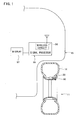
- Four tire condition monitor devices 20 are mounted on four wheels 11 of a vehicle respectively together with tire valves 50 as shown in FIG. 1, though only one of the wheels 11 is shown.
- the tire condition monitor devices 20 are disposed in enclosed space of tires 14 mounted on the wheels 11 respectively.
- the case 21 is made from a composition comprised of 6, 6-nylon added with reinforcement such as glass fiber. However, the case 21 may be made from a composition comprised of 6, 6-nylon added without the reinforcement. The case 21 may be made from another composition comprised of poly phenylene sulfide (PPS) added with or without reinforcement such as glass fiber.
- PPS poly phenylene sulfide
- the pressure sensor 23 is disposed at the open end 21C side of the case body 21A on the circuit board 22.
- the pressure sensor 23 has a pressure-sensitive surface 23A located on an end at the side spaced away from the circuit board 22.
- the aforesaid communication controller carries out a predetermined program when the acceleration sensor has detected a centrifugal force due to rotation of the wheel 11.
- the wireless circuit 24 transmits by radio the pressure and temperature in the tire 14 detected by the respective pressure sensor 23 and temperature sensor.
- a vehicle body 15 is provided with a signal processor 55 having another wireless circuit 56.
- the wireless circuit 56 receives the radio signal delivered by the tire condition monitor device 20, and for example, information about the tire conditions (pressure and temperature or presence or absence of abnormality) is displayed on a display 57 provided in a vehicle interior.
- the interior of the case 21 is filled with a board protecting resin 31.
- the board protecting resin 31 is an urethane resin made by three-dimensionally crosslinking polyolefin by urethane bond.
- the board protecting resin 31 is poured into the case 21 in a molten state to be hardened, thereby covering an entire circuit board 22 except the pressure sensitive surface 23A of the pressure sensor 23.
- the tire condition monitor device 20 thus constructed is manufactured in the following method. Firstly, the circuit board 22 and other components are accommodated in the case 21. The closure plate 21B is kept detached from the case body 21A. Furthermore, the tire condition monitor device 20 is also kept unfixed to the tire valve 50. A plurality of tire condition monitor devices 20 are fixed to respective jigs with the open end 21C of the case body 21A being directed upward, for example.
- a prebaking process of the present invention is carried out.
- the above-described jigs and a plurality of tire condition monitor devices 20 are carried into a heating chamber so that heat is applied to the jigs and tire conditionmonitor devices 20 at 120°C over one hour.
- the jigs and tire condition monitor devices 20 are taken out of the heating chamber, and a board protecting process of the invention is carried out.
- the jigs and tire condition monitor devices 20 are carried into a vacuum chamber while heat due to the prebaking process is remaining in the tire condition monitor devices 20.
- an industrial robot with a nozzle 30 mounted thereon is provided in the vacuum chamber.
- the nozzle 30 is connected to an injector (not shown). An interior of the injector is filled with the board protecting resin 31 in the molten state.
- the board protecting resin 31 comprises a chief material containing hydrogenated isoprene polyol and hydrogenated poly-a-olefin and liquefaction degenerated 4, 4'-dipheyl methane diisocyanate, as a hardener, mixed with the chief material.
- the nozzle 30 is moved over the tire condition monitor devices 20 by the robot so that the molten board protecting resin 31 is discharged from the nozzle 30.
- the case 21 of each tire condition monitor device 20 is filled with the board protecting resin 31.
- the position of the robot is controlled so that the molten board protecting resin 31 is firstly poured into a gap between side edges of the circuit board 22 and an inner surface of the case 21.
- the molten board protecting resin 31 is poured below the circuit board 22 and thereafter, the nozzle 30 is operated so that an entire surface except for the pressure sensor 23 of the circuit board 22 at the open end 21C side is covered with the molten board protecting resin 31.
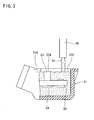
- the board protecting process is completed after the whole circuit board 22 except for the pressure sensitive surface 23A of the pressure sensor 23 is covered with the board protecting resin 31, as shown in FIG. 3.
- the tire condition monitor devices 20 are taken out of the vacuum chamber and then re-carried into the heating chamber for a hardening process of the invention. Heat is applied to the tire condition monitor devices 20 at 100°C for one hour in the hardening process. The tire condition monitor devices 20 are then taken out of the heating chamber and the closure plate 21B is attached to the open end 21C of the case body 21A after natural cooling. The tire valve 50 is fixed to the case 21 of each tire condition monitor device 20, whereby the manufacturing process is completed.
- the tire condition monitor device 20 thus manufactured, water contained in the circuit board 22 is evaporated in the prebaking process executed before the board protecting process. Accordingly, the circuit board 22 covered with the board protecting resin 31 can reliably be protected from moisture. However, the prebaking process may be eliminated when no moisture is present on the surface of the circuit board 22.
- the board protecting resin 31 comprises an urethane resin made by three-dimensionally crosslinking polyolefin by urethane bond
- the tire condition monitor devices 20 can be improved in the gas barrier property and dampproof property for the following reason as compared with the conventional construction using a silicon resin as the board protecting resin 31: polyolefin that is a main component of the board protecting resin 31 has a shorter chain length as compared with the silicon resin, and a loose binding force mutually acts between polyolefin chains.
- the board protecting resin 31 (urethane resin) has finer resin meshes as compared with the conventional silicon resin serving as the board protecting resin. Since sulfur gas and water is hard to permeate through the board protecting resin 31, the gas barrier property and dampproof property can be improved as compared with the conventional structure. Additionally, since polyolefin has high hydrophobicity, waterproof property can be improved in this respect, too.
- the silicon resin serving as the conventional board protecting resin comprises organo polysiloxane (silicone oil) three-dimensionally crosslinked by polyfunctional low-molecular polysiloxane. Since polyfunctional low-molecular polysiloxane in the silicone resin has a similar structure to glass, the silicone resin has low adhesiveness to materials other than glass although having high adhesiveness to glass. On the other hand, the urethane bond in the board protecting resin 31 in the above embodiment has polarity. Accordingly, high adhesiveness is achieved regardless of selection of material. This enables the board protecting resin 31, the circuit board 22 and the case 21 to be prevented from being delaminated. Thus, the gas barrier property and dampproof property can be improved in this respect, too. Furthermore, the conventional coating process becomes unnecessary.
- An insulating constituent was prepared from a blending composition and a blending amount as shown in TABLE 1.
- Materials A and B were agitated at 1000 rpm for 5 minutes using a lab stirrer.
- the materials A and B are then vacuum-defoamed at 10 Torr for 5 minutes and thereafter subjected to heat at 100°C for one hour.
- Curing was then carried out at 23°C for 48 hours, whereby hardened materials were sampled. Characteristics of the hardened materials were measured by the following method.
- TABLE 1 shows results of the measurement. Used substances are as follows:
- a modulus of elongation was measured according to a JIS K6251 tensile test for vulcanized rubber using a specimen of dumbbell No. 3.
- a permeability coefficient of hydrogen gas was measured according to a JIS K7126 differential pressure method as a method of gas permeability test for plastic film and sheet when the hardened material had a thickness ranging from 0. 3 mm to 0. 4 mm.
- a moisture permeability of water was measured according to a JIS Z0208 method of moisture permeability test for moisture-proof packing material when the hardened material had a thickness ranging from 0.3 mm to 0.4 mm.
Landscapes
- Chemical & Material Sciences (AREA)
- Health & Medical Sciences (AREA)
- Chemical Kinetics & Catalysis (AREA)
- Medicinal Chemistry (AREA)
- Polymers & Plastics (AREA)
- Organic Chemistry (AREA)
- Engineering & Computer Science (AREA)
- Mechanical Engineering (AREA)
- Polyurethanes Or Polyureas (AREA)
- Measuring Fluid Pressure (AREA)
Abstract
Description
- The present invention relates to a tire condition monitor device mounted on a tire wheel of a vehicle such as automobiles and provided with a circuit board for detecting a pneumatic pressure in a tire and a method of manufacturing the tire condition monitor device.
- Conventional tire condition monitor devices of the above-described type comprises a circuit board on which a pressure sensor is mounted, and a casing accommodating the circuit board. For example,
JP-A-2005-119370 JP-A-S62-61392 - However, the tire condition monitor devices are used under the specific environment of being subject to a high-pressure gas containing corrosion components (sulfur constituent, for example) in a tire. Thus, further improvements in the gas barrier and moisture-proof properties have been required of the tire condition monitor devices.
- Therefore, an object of the present invention is to provide a tire condition monitor device which has improved gas barrier properties and moisture-proof properties and a method of manufacturing the tire condition monitor device.
- In one aspect, the present invention provides a tire condition monitor device comprising a circuit board mounted on a tire wheel for detecting a pneumatic pressure in an interior of a tire, characterized in that the circuit board is covered with urethane resin.
- In one embodiment, the urethane resin contains a structural unit derived from polyolefin polyol and a structural unit derived from polyisocyanate.
- In another embodiment, the urethane resin contains a structural unit derived from poly-a-olefin.
- In another aspect, the invention provides a method of manufacturing a tire condition monitor device which is mounted on a tire wheel and includes a circuit board for detecting a pneumatic pressure in an interior of a tire, the method comprising applying heat to the tire condition monitor device so that moisture contained in the circuit board is vaporized, arranging the tire condition monitor device with residual heat due to heat-applying step in a vacuum and covering the circuit board with urethane resin.
- The urethane resin is employed as a covering material in the tire condition monitor device of the present invention. The urethane resin is obtained by mixing a first compound including a second compound having two or more hydroxyl groups in at least one molecule and/or a third compound having two or more amino groups in at least one molecule each amino group having active hydrogen, and an organic compound having two or more isocyanate groups in at least one molecule.
- The second compound containing two or more hydroxyl groups in one molecule includes, for example, 1, 2-propylene glycol, dipropylene glycol, 1, 2-butanediol, 1, 3-butanediol, 2, 3-butanediol, 1, 2-pentanediol, 2, 3-pentanediol, 2, 5-hexanediol, 2, 4-hexanediol, 2-ethyl-1, 3-hexanediol, cyclohexanediol, glycerin, N, N-bis-2-hydroxypropyl aniline, N, N'-bishydroxyisopropyl-2-methylpiperazine, bisphenol A added with propylene oxide, ethyleneglycol, diethyleneglycol, 1, 3-propyleneglycol, 1, 4-butanediol, 1, 5-pentanediol, 1, 6-hexanediol, trimethylolpropane, pentaerythritol, dipentaerythritol, dimmer acid diol, polyetherpolyol and modified polyetherpolyol, polytetraethylene ether glycol, tetrahydrofuran/alkyleneoxide copolymer polyol, epoxy resin modified polyol, polyesterpolyol, polydiene polyol, partially saponified ethylene-vinyl acetate copolymer or each of these compounds added with hydrogen or polyol compound such as castor oil, hydrogenated castor oil or alternative to castor oil ester. Of these polyol compounds, polyolefin polyol is preferable from the view point of cracking resistance, and hydrogen-added polyol is most preferable from the view point of service life.
- The above-mentioned polyol compounds may be employed individually, or two or more polyol compounds may be mixed in use. The above-mentioned third compound with two or more amino groups each having active hydrogen includes aliphatic polyamine such as hexamethylene diamine, polyoxypropylene polyamine, etc.; alicyclic polyamine such as 3, 3'-dimethyl-4, 4'-diamino dicyclohexylmethane, etc.; and aromatic polyamine such as 3, 3'-dichloro-4, 4'-diaminodiphenyl methane, 3, 5'-diethyltoluene-2, 4-diamine, 3, 5-diethyltoluene-2, 6-diamine, etc.
- The first compound including the first and/or second compound has a preferable content ranging from 20 to 95 weight percentage (wt%) relative to a total amount of the urethane resin. A more preferable content ranges from 30 to 90 wt% and a most preferable content ranges from 40 to 80 wt%. The compound tends to be defective in the hardening when the content is not more than 20wt% or when the content is not less than 95 wt%.
- It is preferable that the above-mentioned organic compound should have reactive isocyanate groups to the hydroxyl groups of the second compound. The organic compound includes aromatic polyisocyanate such as tolylene diisocyanate (TDI), diphenylmethane diisocyanate (MDI), carbodiimide-modified diphenylmethane diisocyanate, polymethylene polyphenyl isocyanate, phenylene diisocyanate, naphthalene-1, 5-diisocyanate, o-toluidine diisocyanate, triphenylmethane triisocyanate, tris (isocyanatephenyl) thiophosphate, isopropyl benzene-2, 4-diisocyanate, etc.; an aliphatic-aromatic polyisocyanate such as xylylenediisocyanate (XDI), tetramethylxylylene diisocyante (TMXDI), etc.; an aliphatic polyisocyanate such as hexamethylene diisocyanate, dodecane diisocyanate, lysine diisocyanate, lysineester triisocyanate, 1, 6, 11-undecanetriisocyanate, 1, 8-diisocyanate-4-isocyanatemethyloctane, 1, 3, 6-hexamethylene triisocyanate, trimethylhexamethylene diisocyanate, etc.; an alicyclic polyisocyanate such as transcyclohexane-1, 4-diisocyanate, bicycloheptane triisocyanate, isophorone diisocyanate (IPDI), dicyclohexyl methanediisocyanate (hydrogenated MDI), hydrogenated tolylene diisocyanate, hydrogenated xylylene diisocyanate, hydrogenated tetramethylxylylene diisocyanate, etc.; addition reactant of said polyisocyanate compound and polyol compound such as cyclized trimer of said polyisocyanate compound (isocyanurate modifier), burette modifier, ethylene glycol, 1, 4-butanediol, propylene glycol, dipropylene glycol, trimethylolpropane, polyethelpolyol, polymerpolyol, polytetramethylene etherglycol, polyesterpolyol, acrylpolyol, polyalkadienepolyol, hydride of polyalkadienepolyol, copolymer of partially saponified ethylene and vinyl acetate, castor oil polyol, etc.
- Furthermore, two or more these polyisocyanate compounds may be mixed in use. Another alternative is the use of a block isocyanate compound in which an isocyanate group of each polyisocyanate compound is blocked by a blocking agent such as phenols, oximes, imides, mercaptans, alcohols, e-caprolactam, ethyleneimine, a-pyrolidone, diethyl malonate, sodium hydrogensulfite, boric acid, etc. Of these isocyanate compounds, liquid ones at ordinary temperature are preferable in handling ability and miscibility.
- The organic compound having two or more isocyanate groups in one molecule has a preferable content ranging from 0.8 to 1.2 equivalent relative to one equivalent of a compound having hydroxyl groups and/or a compound having two or more amino groups in one molecule each amino group having active hydrogen. A substantial content preferably ranges from 1 to 30 wt% relative to total amount of urethane resin, more preferably ranges from 2 to 25 wt% or most preferably ranges from 3 to 15 wt%. Insufficient hardening tends to occur when the substantial amount is not more than 1 wt% or not less than 30 wt%.
- The urethane resin in the invention may be used with a plasticizer containing no hydroxyl group. The plasticizer includes phthalic ester such as dioctyl phthalate, phosphate ester such as triphenyl phosphate, tricresyl phosphate, cresyl phenyl phosphate, etc., an olefin elasticizer such as poly-a-olefin etc. Of these plasticizers, hydrogenated ones are preferable for stability in weather resistance, and hydrogenated poly-a-olefin is particularly preferable in stability, hardenability, safety, etc. These plasticizers without hydroxyl group may be used individually or in a combination of two or more.
- The aforesaid plasticizers without hydroxyl group has a content preferably ranging from 5 to 80 wt% relative to a total amount of urethane resin, more preferably ranging from 10 to 60 wt% and most preferably ranging from 30 to 50 wt%. The tensile modulus tends to be increased when the content is not more than 5 wt%. Stickiness is increased when the content is not less than 80 wt%. In each case, the plasticizers tend to be hard to use practically.
- Furthermore, various types of additives may be added to the urethane resin in the invention if necessary such as a flame retardant of red phosphorus, hexabromobenzene, dibromophenyl glycidyl ether, dibromocresyl glycidyl ether, antimonous oxide, etc., coloring agent of red pigment, ferric oxide, carbon, titanium white, etc., silicon antifoams or the like. Furthermore, an inorganic filler may be used with the urethane resin, when needed. The filler may include, for example, fused silica, crystalline silica, talc, calcium carbonate, various types of glasses, silicon dioxide (quartz, quartz glass, silica gel, etc.), alumina, various types of ceramics, diatom earth, kaolin, clay mineral (montmorillonite etc.), activated earth, synthetic zeolite, mica, calcium fluoride, ytterbium fluoride, calcium phosphate, barium sulphate, zirconium dioxide, titanium dioxide, etc. These inorganic fillers may be used individually or in a combination of two or more. When a content of the inorganic filler exceeds 300 parts by weight relative to urethane resin of 100 parts by weight, the viscosity of the urethane resin is increased, whereupon the working efficiency tends to be reduced.
- A silane, aluminum or titanium coupling agent may be added to the urethane resin of the invention, if necessary. The silane coupling agent may include aminosilanes such as γ-methacryloxypropyl trimethoxysilane, γ-aminopropyl triethoxysilane, γ-aminopropyl trimethoxysilane, imidazolinesilane, N-aminoethyl aminopropyl trimethoxysilane, N-phenyl-γ-aminopropyl trimethoxysilane, N-β-(N-vinylbenzylaminoethyl)-γ-aminopropyl trimethoxysilane hydrochloride, N-3-(4-(3-aminoproxy)butoxy)propyl-3-aminopropyl trimethoxysilane, and triazinesilane; epoxysilanes such as γ-glycidoxypropyl trimethoxysilane, 4-glycidylbutyl trimethoxysilane, γ-glycidoxypropylmethyldiethoxysilane, β-(3, 4-epoxycyclohexyl) ethyltrimethoxysilane, etc.; chlorosilanes such as γ-chloropropyltrimethoxysilane; and vinylsilanes such as vinyltrimethoxysilane, vinyltriethoxysilane, etc. Furthermore, the titanate coupling agent may include isopropyltriisostearoyl titanate, isopropyltris (dioctylpyrophosphate) titanate, isopropyltri (N-aminoethylaminoethyl) titanate, isopropyl tridecylbenzenesulfonyl titanate, etc. The aluminate coupling agent may include acetoalkoxyaluminum diisopropylate etc. Each coupling agent may have a content ranging from 0.5 to 2 wt% relative to polyol and polyisocyanate or more preferably ranging from 0.7 to 1.0 wt%. When the content of each coupling agent is less than 0.5 wt%, an interface between the filler and the urethane resin composition has an insufficient wettability, whereupon the moisture resistance is reduced. Furthermore, when the content of the silane coupling agent is more than 2 wt%, part of the agent remains in the urethane resin composition as unreacted component, whereupon the urethane resin tends to be difficult to harden.
- The urethane resin has a tensile modulus of not more than 5 MPa at 25°C. More preferably, the tensile modulus of the urethane resin ranges from 0.01 to 5.00 MPa, much more preferably from 0.02 to 3.00 MPa. Most preferably, the tensile modulus ranges from 0.1 to 2.0 MPa. When the tensile modulus of the urethane resin is not more than 0.01 MPa, the effect of protecting a base material tends to be reduced. When the tensile modulus is 5.00 MPa or more, thermal shock tends to result in crack, damage of the base material, etc.
- In the above-described tire condition monitor device, the circuit board is covered with the urethane resin. The urethane resin has a finer resin network than a silicon resin conventionally used for protection of the board. Since a sulfur gas and moisture become hard to pass through the resin network, the gas barrier property and moisture-proof property can be improved.
- Furthermore, in the method of manufacturing the tire condition monitor device, the heat-applying step is carried out before the step of covering the circuit board with urethane resin. Since moisture contained in the circuit board is evaporated, the circuit board covered with the urethane resin can reliably be protected from moisture. Additionally, after circuit board protecting step, hardening step is carried out in which heat is applied to the tire condition monitor device at or above 100°C for more than one hour. Consequently, an internal stress of the post-hardened urethane resin can be reduced.
- The invention will be described, merely by way of example, with reference to the accompanying drawings, in which:
- FIG. 1 is a conceptual illustration of a vehicle provided with a tire condition monitor device of one embodiment in accordance with the present invention;
- FIG. 2 is a side sectional view of the tire condition monitor device; and
- FIG. 3 is a side sectional view of the tire condition monitor device in a circuit board protecting step.
- One embodiment of the present invention will be described with reference to the accompanying drawings. Referring first to FIG. 2, the tire
condition monitor device 20 of the embodiment comprises acase 21 accommodating therein acircuit board 22 and microcell (not shown). Thecase 21 includes acase body 21A having anopen end 21C and aclosure plate 21B closing theopen end 21C of thecase body 21A. Four tirecondition monitor devices 20 are mounted on fourwheels 11 of a vehicle respectively together withtire valves 50 as shown in FIG. 1, though only one of thewheels 11 is shown. The tirecondition monitor devices 20 are disposed in enclosed space oftires 14 mounted on thewheels 11 respectively. - The
case 21 is made from a composition comprised of 6, 6-nylon added with reinforcement such as glass fiber. However, thecase 21 may be made from a composition comprised of 6, 6-nylon added without the reinforcement. Thecase 21 may be made from another composition comprised of poly phenylene sulfide (PPS) added with or without reinforcement such as glass fiber. - On the
circuit board 22 are mounted apressure sensor 23, awireless circuit 24, a temperature sensor (not shown), an acceleration sensor (not shown), a communication controller (not shown) and the like. Thepressure sensor 23 is disposed at theopen end 21C side of thecase body 21A on thecircuit board 22. Thepressure sensor 23 has a pressure-sensitive surface 23A located on an end at the side spaced away from thecircuit board 22. - The aforesaid communication controller carries out a predetermined program when the acceleration sensor has detected a centrifugal force due to rotation of the
wheel 11. Thewireless circuit 24 transmits by radio the pressure and temperature in thetire 14 detected by therespective pressure sensor 23 and temperature sensor. On the other hand, as shown in FIG. 1, avehicle body 15 is provided with asignal processor 55 having anotherwireless circuit 56. Thewireless circuit 56 receives the radio signal delivered by the tirecondition monitor device 20, and for example, information about the tire conditions (pressure and temperature or presence or absence of abnormality) is displayed on adisplay 57 provided in a vehicle interior. - The interior of the
case 21 is filled with aboard protecting resin 31. Theboard protecting resin 31 is an urethane resin made by three-dimensionally crosslinking polyolefin by urethane bond. Theboard protecting resin 31 is poured into thecase 21 in a molten state to be hardened, thereby covering anentire circuit board 22 except the pressuresensitive surface 23A of thepressure sensor 23. - The tire
condition monitor device 20 thus constructed is manufactured in the following method. Firstly, thecircuit board 22 and other components are accommodated in thecase 21. Theclosure plate 21B is kept detached from thecase body 21A. Furthermore, the tirecondition monitor device 20 is also kept unfixed to thetire valve 50. A plurality of tirecondition monitor devices 20 are fixed to respective jigs with theopen end 21C of thecase body 21A being directed upward, for example. - Subsequently, a prebaking process of the present invention is carried out. For this purpose, the above-described jigs and a plurality of tire
condition monitor devices 20 are carried into a heating chamber so that heat is applied to the jigs and tireconditionmonitor devices 20 at 120°C over one hour. Thereafter, the jigs and tirecondition monitor devices 20 are taken out of the heating chamber, and a board protecting process of the invention is carried out. For this purpose, the jigs and tirecondition monitor devices 20 are carried into a vacuum chamber while heat due to the prebaking process is remaining in the tirecondition monitor devices 20. For example, an industrial robot with anozzle 30 mounted thereon is provided in the vacuum chamber. Thenozzle 30 is connected to an injector (not shown). An interior of the injector is filled with theboard protecting resin 31 in the molten state. Theboard protecting resin 31 comprises a chief material containing hydrogenated isoprene polyol and hydrogenated poly-a-olefin and liquefaction degenerated 4, 4'-dipheyl methane diisocyanate, as a hardener, mixed with the chief material. - The
nozzle 30 is moved over the tirecondition monitor devices 20 by the robot so that the moltenboard protecting resin 31 is discharged from thenozzle 30. As a result, thecase 21 of each tirecondition monitor device 20 is filled with theboard protecting resin 31. In this case, the position of the robot is controlled so that the moltenboard protecting resin 31 is firstly poured into a gap between side edges of thecircuit board 22 and an inner surface of thecase 21. Next, the moltenboard protecting resin 31 is poured below thecircuit board 22 and thereafter, thenozzle 30 is operated so that an entire surface except for thepressure sensor 23 of thecircuit board 22 at theopen end 21C side is covered with the moltenboard protecting resin 31. The board protecting process is completed after thewhole circuit board 22 except for the pressuresensitive surface 23A of thepressure sensor 23 is covered with theboard protecting resin 31, as shown in FIG. 3. - Subsequently, the tire
condition monitor devices 20 are taken out of the vacuum chamber and then re-carried into the heating chamber for a hardening process of the invention. Heat is applied to the tirecondition monitor devices 20 at 100°C for one hour in the hardening process. The tirecondition monitor devices 20 are then taken out of the heating chamber and theclosure plate 21B is attached to theopen end 21C of thecase body 21A after natural cooling. Thetire valve 50 is fixed to thecase 21 of each tirecondition monitor device 20, whereby the manufacturing process is completed. - According to the tire
condition monitor device 20 thus manufactured, water contained in thecircuit board 22 is evaporated in the prebaking process executed before the board protecting process. Accordingly, thecircuit board 22 covered with theboard protecting resin 31 can reliably be protected from moisture. However, the prebaking process may be eliminated when no moisture is present on the surface of thecircuit board 22. Furthermore, since theboard protecting resin 31 comprises an urethane resin made by three-dimensionally crosslinking polyolefin by urethane bond, the tirecondition monitor devices 20 can be improved in the gas barrier property and dampproof property for the following reason as compared with the conventional construction using a silicon resin as the board protecting resin 31: polyolefin that is a main component of theboard protecting resin 31 has a shorter chain length as compared with the silicon resin, and a loose binding force mutually acts between polyolefin chains. Accordingly, the board protecting resin 31 (urethane resin) has finer resin meshes as compared with the conventional silicon resin serving as the board protecting resin. Since sulfur gas and water is hard to permeate through theboard protecting resin 31, the gas barrier property and dampproof property can be improved as compared with the conventional structure. Additionally, since polyolefin has high hydrophobicity, waterproof property can be improved in this respect, too. - The silicon resin serving as the conventional board protecting resin comprises organo polysiloxane (silicone oil) three-dimensionally crosslinked by polyfunctional low-molecular polysiloxane. Since polyfunctional low-molecular polysiloxane in the silicone resin has a similar structure to glass, the silicone resin has low adhesiveness to materials other than glass although having high adhesiveness to glass. On the other hand, the urethane bond in the
board protecting resin 31 in the above embodiment has polarity. Accordingly, high adhesiveness is achieved regardless of selection of material. This enables theboard protecting resin 31, thecircuit board 22 and thecase 21 to be prevented from being delaminated. Thus, the gas barrier property and dampproof property can be improved in this respect, too. Furthermore, the conventional coating process becomes unnecessary. - The invention will be described by way of examples in more detail. However, the invention should not be limited to these examples.
- An insulating constituent was prepared from a blending composition and a blending amount as shown in TABLE 1. Materials A and B were agitated at 1000 rpm for 5 minutes using a lab stirrer. The materials A and B are then vacuum-defoamed at 10 Torr for 5 minutes and thereafter subjected to heat at 100°C for one hour. Curing was then carried out at 23°C for 48 hours, whereby hardened materials were sampled. Characteristics of the hardened materials were measured by the following method. TABLE 1 shows results of the measurement. Used substances are as follows:
- Hydroxyl-containing liquid polyisoprene: EPOL (trade name of product made by Idemitsu Petrochemical Co., Ltd.)
- Hydrogenated poly-a-olefin: PAO (trade name of product made by Idemitsu Petrochemical Co., Ltd.)
- Liquefaction degenerated 4, 4'-dipheyl methane diisocyanate: LF-1209 (trade name of product made by Guntsman)
- Dehydrating agent: Molecular sieve 3AB (trade name of product made by UNION SHOWA K.K.)
- A modulus of elongation was measured according to a JIS K6251 tensile test for vulcanized rubber using a specimen of dumbbell No. 3.
- A permeability coefficient of hydrogen gas was measured according to a JIS K7126 differential pressure method as a method of gas permeability test for plastic film and sheet when the hardened material had a thickness ranging from 0. 3 mm to 0. 4 mm.
- A moisture permeability of water was measured according to a JIS Z0208 method of moisture permeability test for moisture-proof packing material when the hardened material had a thickness ranging from 0.3 mm to 0.4 mm.
- Necessary force was obtained when the hardened material bonded to a case made from 6, 6-nylon was to be removed.
TABLE 1 Items Embodiment 1 Compared example 1 Composition Material A (parts by weight) Hydrogenated isoprene polyol 100 - Hydrogenated poly-α-olefin 75 - Dehydrating agent 2 - Material B (parts by weight) Liquefaction degenerated 4, 4'-dipheyl methane diisocyanate 19.5 - Silicon compound (parts by Weight) - 100 Modulus of elongation [MPa] 0.9 0.5 Gas Permeability [mol · n/m2 · s · Pa] 2.38×10¹⁴ 2.14×10⁻¹³ Moisture permeability [g/m2 · 24h] 14 145 Adhesiveness to the case [MPa] 0.79 0.26 Viscosity [Pa · s] 5.3 8.7 Thixotropy [-] 1.03 1.07 Can stability [-] Ordinary temperature ≤10°C Specific gravity [-] 0.93 1.01 - It is explicitly stated that all features disclosed in the description and/or the claims are intended to be disclosed separately and independently from each other for the purpose of original disclosure as well as for the purpose of restricting the claimed invention independent of the composition of the features in the embodiments and/or the claims. It is explicitly stated that all value ranges or indications of groups of entities disclose every possible intermediate value or intermediate entity for the purpose of original disclosure as well as for the purpose of restricting the claimed invention, in particular as limits of value ranges.
Claims (6)
- A tire condition monitor device (20) comprising a circuit board (22) mounted on a tire wheel (11) for detecting a pneumatic pressure in an interior of a tire (14), characterized in that the circuit board (22) is covered with urethane resin.
- The tire condition monitor device (20) according to claim 1, characterized in that the urethane resin has a tensile modulus of not more than 5 MPa at 25°C.
- The tire condition monitor device (20) according to claim 1 or 2, characterized in that the urethane resin contains a structural unit derived from polyolefin polyol and a structural unit derived from polyisocyanate.
- The tire condition monitor device (20) according to claim 3, characterized in that the urethane resin contains a structural unit derived from poly-a-olefin.
- A method of manufacturing a tire condition monitor device (20) which is mounted on a wheel (11) and includes a circuit board (22) for detecting a pneumatic pressure in an interior of a tire (14), characterized by:arranging the tire condition monitor device (20) in a vacuum and covering the circuit board (22) with urethane resin.
- A method of manufacturing a tire condition monitor device (20) which is mounted on a wheel (11) and includes a circuit board (22) for detecting a pneumatic pressure in an interior of a tire (14), characterized by:applying heat to the tire condition monitor device (20) so that moisture contained in the circuit board (22) is vaporized; andarranging the tire condition monitor device (20) with residual heat due to the heat-applying step in a vacuum and covering the circuit board (22) with urethane resin.
Applications Claiming Priority (1)
| Application Number | Priority Date | Filing Date | Title |
|---|---|---|---|
| JP2006082361A JP4721225B2 (en) | 2006-03-24 | 2006-03-24 | Tire condition monitoring device and manufacturing method thereof |
Publications (3)
| Publication Number | Publication Date |
|---|---|
| EP1837208A2 true EP1837208A2 (en) | 2007-09-26 |
| EP1837208A3 EP1837208A3 (en) | 2008-12-17 |
| EP1837208B1 EP1837208B1 (en) | 2013-10-23 |
Family
ID=38308680
Family Applications (1)
| Application Number | Title | Priority Date | Filing Date |
|---|---|---|---|
| EP06019287.9A Active EP1837208B1 (en) | 2006-03-24 | 2006-09-14 | Tire condition monitor device and method of manufacturing the same |
Country Status (3)
| Country | Link |
|---|---|
| US (1) | US7392694B2 (en) |
| EP (1) | EP1837208B1 (en) |
| JP (1) | JP4721225B2 (en) |
Cited By (2)
| Publication number | Priority date | Publication date | Assignee | Title |
|---|---|---|---|---|
| WO2013178518A1 (en) | 2012-06-01 | 2013-12-05 | Roche Diagnostics Gmbh | Carrier element and packaging device for packaging at least one product into at least one packaging |
| WO2017153071A1 (en) * | 2016-03-10 | 2017-09-14 | Huf Hülsbeck & Fürst Gmbh & Co. Kg | Tire pressure checking system for a vehicle |
Families Citing this family (10)
| Publication number | Priority date | Publication date | Assignee | Title |
|---|---|---|---|---|
| SE528760C2 (en) * | 2005-05-18 | 2007-02-13 | Secure Logistics Sweden Ab | Method and apparatus for detecting intrusion into or manipulation of the contents of an enclosure |
| US8373551B2 (en) * | 2009-07-29 | 2013-02-12 | Rimex Supply Ltd. | Tire pressure sensor |
| KR20130035687A (en) * | 2011-09-30 | 2013-04-09 | 삼성전기주식회사 | TPM transmission module |
| JP5491583B2 (en) * | 2012-07-09 | 2014-05-14 | 為升電装工業股▲分▼有限公司 | Tire pressure sensor and setting method thereof |
| TWM505131U (en) * | 2015-01-30 | 2015-07-11 | Arima Communication Corp | Mobile phone automated production system |
| CN108699376A (en) * | 2015-11-09 | 2018-10-23 | 普利司通美国轮胎运营有限责任公司 | For the rubber coating of electronic communications module, include the electronic module and associated method of the rubber coating |
| US10583565B2 (en) * | 2016-08-30 | 2020-03-10 | Seiko Epson Corporation | Control apparatus, robot and robot system |
| US11117428B2 (en) * | 2019-05-22 | 2021-09-14 | Orange Electronic Co., Ltd | Tire pressure sensor structure and forming method thereof |
| JP7315832B2 (en) * | 2019-08-22 | 2023-07-27 | 横浜ゴム株式会社 | Polyurethane adhesive composition |
| US20230326823A1 (en) * | 2022-04-06 | 2023-10-12 | Infineon Technologies Ag | Temperature Sensor Arrangement in Semiconductor Module |
Citations (2)
| Publication number | Priority date | Publication date | Assignee | Title |
|---|---|---|---|---|
| US3985984A (en) | 1973-03-23 | 1976-10-12 | Industrie Pirelli S.P.A. | Rim for a pneumatic tire and a switch device for signaling a change in physical conditions in a pneumatic tire mounted on the rim |
| WO2006000212A1 (en) | 2004-06-25 | 2006-01-05 | Conti Temic Microelectronic Gmbh | Electrical subassembly comprising a protective sheathing |
Family Cites Families (7)
| Publication number | Priority date | Publication date | Assignee | Title |
|---|---|---|---|---|
| JPS6261392A (en) | 1985-09-11 | 1987-03-18 | 株式会社日立製作所 | electronic circuit board |
| JPH0739461B2 (en) * | 1992-03-31 | 1995-05-01 | 三洋化成工業株式会社 | Polyurethane resin forming composition for casting |
| US5955559A (en) * | 1996-09-17 | 1999-09-21 | Shell Oil Company | Cast polyurethane elastomers containing low polarity amine curing agents |
| FR2787187B1 (en) * | 1998-12-11 | 2001-01-05 | Sagem | TIRE PRESSURE MEASUREMENT MODULE |
| JP3392362B2 (en) * | 1998-12-17 | 2003-03-31 | 太平洋工業株式会社 | Substrate structure of transmitter for tire pressure monitoring device |
| JP2005119370A (en) | 2003-10-14 | 2005-05-12 | Pacific Ind Co Ltd | Transmitter of tire condition monitoring device |
| JP2005340232A (en) * | 2004-05-24 | 2005-12-08 | Toto Ltd | Electronic circuit substrate and moisture-proof treating method thereof |
-
2006
- 2006-03-24 JP JP2006082361A patent/JP4721225B2/en not_active Expired - Lifetime
- 2006-09-12 US US11/519,146 patent/US7392694B2/en active Active
- 2006-09-14 EP EP06019287.9A patent/EP1837208B1/en active Active
Patent Citations (2)
| Publication number | Priority date | Publication date | Assignee | Title |
|---|---|---|---|---|
| US3985984A (en) | 1973-03-23 | 1976-10-12 | Industrie Pirelli S.P.A. | Rim for a pneumatic tire and a switch device for signaling a change in physical conditions in a pneumatic tire mounted on the rim |
| WO2006000212A1 (en) | 2004-06-25 | 2006-01-05 | Conti Temic Microelectronic Gmbh | Electrical subassembly comprising a protective sheathing |
Cited By (3)
| Publication number | Priority date | Publication date | Assignee | Title |
|---|---|---|---|---|
| WO2013178518A1 (en) | 2012-06-01 | 2013-12-05 | Roche Diagnostics Gmbh | Carrier element and packaging device for packaging at least one product into at least one packaging |
| US10766652B2 (en) | 2012-06-01 | 2020-09-08 | Roche Diagnostics Gmbh | Carrier element and packaging device for packaging at least one product into at least one package |
| WO2017153071A1 (en) * | 2016-03-10 | 2017-09-14 | Huf Hülsbeck & Fürst Gmbh & Co. Kg | Tire pressure checking system for a vehicle |
Also Published As
| Publication number | Publication date |
|---|---|
| JP4721225B2 (en) | 2011-07-13 |
| JP2007256143A (en) | 2007-10-04 |
| EP1837208B1 (en) | 2013-10-23 |
| EP1837208A3 (en) | 2008-12-17 |
| US20070220963A1 (en) | 2007-09-27 |
| US7392694B2 (en) | 2008-07-01 |
Similar Documents
| Publication | Publication Date | Title |
|---|---|---|
| US7392694B2 (en) | Tire condition monitor device and method of manufacturing the same | |
| CN1054148C (en) | Polyurethane sealant compositions | |
| US9834711B2 (en) | One-pack moisture-curing composition | |
| CN113956832B (en) | Double-component PU structure adhesive and preparation method thereof | |
| JP2021519364A (en) | Two-component polyurethane adhesive composition | |
| US12330385B2 (en) | Cast lens | |
| CN109071755A (en) | silane-containing high modulus polyurethane adhesive | |
| RU2717688C2 (en) | System for forming elastomeric compositions for deposition on metal | |
| EP0829497A1 (en) | Cast polyurethane composition | |
| EP3892697B1 (en) | Urethane-based adhesive for automobile | |
| EP3189090B1 (en) | Polyurethane mats | |
| KR100264684B1 (en) | Polydiene polyols and castor oil based polyurethane elastomer formulations with improved damping properties | |
| JP7315832B2 (en) | Polyurethane adhesive composition | |
| US11479667B2 (en) | Two-part curable urethane-based composition | |
| JP2009091414A (en) | Urea resin composition | |
| KR20250129621A (en) | Non-solvent structural adhesive, cured product thereof, and structure | |
| JP4641136B2 (en) | Water-swelling water stop material | |
| JP2000226424A (en) | Urethane prepolymer composition | |
| EP3941956B1 (en) | Water-resistive coating composition | |
| EP3617168B1 (en) | Method of manufacturing insulating glass and insulating glass | |
| KR100777429B1 (en) | Moisture-curable polyurethane composition with excellent shelf life and its manufacturing method | |
| EP3058006A1 (en) | Sealant compositions with a polyurethane dispersion and a hydroxy-functional compound | |
| KR20010074673A (en) | Composition for filling and sealing electric connectors | |
| KR20190129529A (en) | Thermal acid generator and thermosetting resin comprising the same | |
| JP2009242600A (en) | Urea urethane resin composition |
Legal Events
| Date | Code | Title | Description |
|---|---|---|---|
| PUAI | Public reference made under article 153(3) epc to a published international application that has entered the european phase |
Free format text: ORIGINAL CODE: 0009012 |
|
| AK | Designated contracting states |
Kind code of ref document: A2 Designated state(s): AT BE BG CH CY CZ DE DK EE ES FI FR GB GR HU IE IS IT LI LT LU LV MC NL PL PT RO SE SI SK TR |
|
| AX | Request for extension of the european patent |
Extension state: AL BA HR MK YU |
|
| PUAL | Search report despatched |
Free format text: ORIGINAL CODE: 0009013 |
|
| AK | Designated contracting states |
Kind code of ref document: A3 Designated state(s): AT BE BG CH CY CZ DE DK EE ES FI FR GB GR HU IE IS IT LI LT LU LV MC NL PL PT RO SE SI SK TR |
|
| AX | Request for extension of the european patent |
Extension state: AL BA HR MK RS |
|
| 17P | Request for examination filed |
Effective date: 20090527 |
|
| AKX | Designation fees paid |
Designated state(s): DE FR GB |
|
| 17Q | First examination report despatched |
Effective date: 20111010 |
|
| GRAP | Despatch of communication of intention to grant a patent |
Free format text: ORIGINAL CODE: EPIDOSNIGR1 |
|
| INTG | Intention to grant announced |
Effective date: 20130702 |
|
| GRAS | Grant fee paid |
Free format text: ORIGINAL CODE: EPIDOSNIGR3 |
|
| GRAA | (expected) grant |
Free format text: ORIGINAL CODE: 0009210 |
|
| AK | Designated contracting states |
Kind code of ref document: B1 Designated state(s): DE FR GB |
|
| REG | Reference to a national code |
Ref country code: GB Ref legal event code: FG4D |
|
| REG | Reference to a national code |
Ref country code: DE Ref legal event code: R096 Ref document number: 602006038922 Country of ref document: DE Effective date: 20131219 |
|
| REG | Reference to a national code |
Ref country code: DE Ref legal event code: R097 Ref document number: 602006038922 Country of ref document: DE |
|
| PLBE | No opposition filed within time limit |
Free format text: ORIGINAL CODE: 0009261 |
|
| STAA | Information on the status of an ep patent application or granted ep patent |
Free format text: STATUS: NO OPPOSITION FILED WITHIN TIME LIMIT |
|
| 26N | No opposition filed |
Effective date: 20140724 |
|
| REG | Reference to a national code |
Ref country code: DE Ref legal event code: R097 Ref document number: 602006038922 Country of ref document: DE Effective date: 20140724 |
|
| REG | Reference to a national code |
Ref country code: FR Ref legal event code: PLFP Year of fee payment: 11 |
|
| REG | Reference to a national code |
Ref country code: FR Ref legal event code: PLFP Year of fee payment: 12 |
|
| REG | Reference to a national code |
Ref country code: FR Ref legal event code: PLFP Year of fee payment: 13 |
|
| REG | Reference to a national code |
Ref country code: DE Ref legal event code: R081 Ref document number: 602006038922 Country of ref document: DE Owner name: RESONAC CORP., JP Free format text: FORMER OWNERS: HITACHI CHEMICAL CO., LTD., TOKYO, JP; PACIFIC INDUSTRIAL CO., LTD., OGAKI-SHI, GIFU-KEN, JP Ref country code: DE Ref legal event code: R081 Ref document number: 602006038922 Country of ref document: DE Owner name: PACIFIC INDUSTRIAL CO., LTD., OGAKI-SHI, JP Free format text: FORMER OWNERS: HITACHI CHEMICAL CO., LTD., TOKYO, JP; PACIFIC INDUSTRIAL CO., LTD., OGAKI-SHI, GIFU-KEN, JP |
|
| PGFP | Annual fee paid to national office [announced via postgrant information from national office to epo] |
Ref country code: DE Payment date: 20250730 Year of fee payment: 20 |
|
| PGFP | Annual fee paid to national office [announced via postgrant information from national office to epo] |
Ref country code: GB Payment date: 20250731 Year of fee payment: 20 |
|
| PGFP | Annual fee paid to national office [announced via postgrant information from national office to epo] |
Ref country code: FR Payment date: 20250808 Year of fee payment: 20 |