EP1835627A1 - Method and apparatus for reducing out-of-band interference generated by a bluetooth device - Google Patents
Method and apparatus for reducing out-of-band interference generated by a bluetooth device Download PDFInfo
- Publication number
- EP1835627A1 EP1835627A1 EP06300230A EP06300230A EP1835627A1 EP 1835627 A1 EP1835627 A1 EP 1835627A1 EP 06300230 A EP06300230 A EP 06300230A EP 06300230 A EP06300230 A EP 06300230A EP 1835627 A1 EP1835627 A1 EP 1835627A1
- Authority
- EP
- European Patent Office
- Prior art keywords
- communication device
- band interference
- reducing
- response
- band
- Prior art date
- Legal status (The legal status is an assumption and is not a legal conclusion. Google has not performed a legal analysis and makes no representation as to the accuracy of the status listed.)
- Ceased
Links
- 238000000034 method Methods 0.000 title claims abstract description 28
- 238000004891 communication Methods 0.000 claims abstract description 154
- 230000004044 response Effects 0.000 claims abstract description 37
- 239000003638 chemical reducing agent Substances 0.000 claims abstract description 25
- 230000009471 action Effects 0.000 claims description 20
- 230000003044 adaptive effect Effects 0.000 claims description 6
- 230000001413 cellular effect Effects 0.000 claims description 6
- 230000003993 interaction Effects 0.000 description 5
- 238000010586 diagram Methods 0.000 description 4
- 230000006870 function Effects 0.000 description 3
- 238000011176 pooling Methods 0.000 description 3
- 230000005540 biological transmission Effects 0.000 description 2
- 230000004048 modification Effects 0.000 description 2
- 238000012986 modification Methods 0.000 description 2
- 230000001960 triggered effect Effects 0.000 description 2
- 230000010267 cellular communication Effects 0.000 description 1
- 230000003247 decreasing effect Effects 0.000 description 1
- 238000001514 detection method Methods 0.000 description 1
- 238000005516 engineering process Methods 0.000 description 1
- 230000008569 process Effects 0.000 description 1
- 230000003595 spectral effect Effects 0.000 description 1
- 230000003068 static effect Effects 0.000 description 1
Images


Classifications
-
- H—ELECTRICITY
- H04—ELECTRIC COMMUNICATION TECHNIQUE
- H04B—TRANSMISSION
- H04B15/00—Suppression or limitation of noise or interference
-
- H—ELECTRICITY
- H04—ELECTRIC COMMUNICATION TECHNIQUE
- H04B—TRANSMISSION
- H04B2215/00—Reducing interference at the transmission system level
- H04B2215/064—Reduction of clock or synthesizer reference frequency harmonics
- H04B2215/068—Reduction of clock or synthesizer reference frequency harmonics by avoiding a reception frequency range
Definitions
- the present invention generally relates to wireless communication systems, and more particularly relates to a method and apparatus for reducing radio frequency (RF) interference generated by a Bluetooth ® wireless communication device.
- RF radio frequency
- Bluetooth is a low cost wireless communication technology operating in the unlicensed 2.4 gigahertz (GHz) frequency band.
- Bluetooth devices transmit and receive wireless transmissions which can interfere with other radio systems in the same 2.4 GHz frequency band (e.g., wireless internet local area network connections such as WiFi), as well as radio systems in nearby frequency bands (e.g., XM satellite radio in the 2.3 GHz frequency band).
- Complex collaborative systems have been developed for reducing in band interference between Bluetooth devices and, for example, WiFi devices. Without a system for reducing out of band interference between Bluetooth devices and devices operating in nearby frequency bands such as XM satellite radio receivers, it is impossible to provide both capabilities in a single device, such as XM satellite radio reception and Bluetooth communication capability in a single device.
- a method for reducing out-of-band interference in accordance with the present invention includes the step of reducing out-of-band interference between a first communication device and a second communication device by controlling the second communication device in response to the first communication device.
- the transmit power or an application of the second communication device could be controlled in response to arbitration parameters of the first communication device, such as signal strength and/or signal quality.
- An apparatus for reducing out-of-band interference in accordance with the present invention includes a first communication device for receiving radio frequency (RF) signals in a first frequency band, a second communication device for wirelessly communicating in a second frequency band different from the first frequency band, and an out-of-band interference reducer coupled to the first communication device and the second communication device and reducing out-of-band interference therebetween by controlling the second communication device in response to the first communication device.
- RF radio frequency
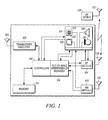
- a wireless communication device 100 such as a cellular telephone handset, in accordance with the embodiment of the present invention includes a satellite radio receiver module 102 and a Bluetooth communication module 104.
- the apparatus 100 depicted is a wireless communication device, the apparatus can be a portable electronic device, a computer, a home stereo system, or any other environment which includes a first communication device such as the satellite radio receiver module 102 and a second communication device such as the Bluetooth communication module 104.
- the wireless communication device 100 includes an antenna 106 for receiving and transmitting radio frequency (RF) signals.
- Transceiver circuitry 108 demodulates and decodes RF signals received from cellular telephone system to derive information therefrom and is coupled to a controller 110 for providing the decoded information thereto for utilization thereby in accordance with the function(s) of the wireless communication device 100.
- the controller 210 also provides information to the transceiver circuitry 108 for encoding and modulating information into RF signals for transmission from the antenna 106.
- the controller 110 is typically coupled to a memory device 112 and a user interface 114 to perform the functions of the wireless communication device 100.
- the user interface 114 includes a microphone 116, a speaker 118 and a display 120 which may be designed to accept touch screen inputs.
- the user interface 114 also includes one or more key inputs 122, including a keypad 124.
- the satellite radio receiver module 102 is coupled to a second antenna 126 to receive satellite radio RF signals, such as XM satellite radio signals, in a first frequency band.
- the Bluetooth communication module 104 is a Bluetooth-enabled wireless communication device coupled to a third antenna 128 for communicating in a second frequency band in accordance with Bluetooth protocol with another communication device 130 which is also Bluetooth-enabied via an antenna 132.
- the communication device 130 could be a stereo headset, a cellular telephone headset with cellular call capabilities or a Bluetooth module within stereo equipment to provide Bluetooth capability thereto.
- Both the satellite radio receiver module 102 and the Bluetooth communication module 104 are coupled to the user interface 114 for providing output to a user via, for example, the speaker 118 and for the Bluetooth communication module 104 to receive input from a user via, for example, the microphone 116.
- the controller 110 includes an out-of-band interference reducer 134.
- the satellite radio receiver module 102 will receive XM satellite radio RF signals in the first frequency band, the 2.35 GHz frequency band.
- the Bluetooth communication module 104 will transmit and receive RF signals in the second frequency band, the unlicensed 2.4GHz frequency band, and may or may not use applications for the operation thereof, such as adaptive frequency hopping (AFH) applications.
- the RF signals for the two modules 102, 104 will not interfere with the cellular communications of the wireless communication device 100.
- harmonics of RF signals transmitted from or received by the Bluetooth communication module 104 can cause out-of-band interference with RF signals received by the satellite radio receiver module 102.
- the out-of-band interference reducer 134 is coupled to the satellite radio receiver module 102 and the Bluetooth communication module 104 for reducing interference therebetween.
- the out-of-band interference reducer 134 can be implemented in either hardware or so are and, while shown as implemented in the controller 110, the out-of-band interference reducer 134 could be provided as a separate module or component of the wireless communication device 100.
- the out-of-band interference reducer 134 includes a satellite radio receiver sensor 202 and a Bluetooth sensor 204 for measuring the signal characteristics such as signal qualities and signal power levels of the satellite radio receiver module 102 and the Bluetooth module 104, respectively, each sensor 202, 204 including a signal-to-noise ratio (SNR) input for measuring the signal quality and a signal power input for measuring the signal strength.
- SNR signal-to-noise ratio
- the satellite radio receiver sensor 202 and the Bluetooth sensor 204 are coupled to an alarm subsystem 206 to provide data thereto, the alarm subsystem 206 generating status messages for an arbiter 208 in response to the data received.
- the alarm subsystem 206 can be interrupt triggered by the use of system interrupts from the sensors 202, 204 or pooling triggered with a programmable timer utilizing information provided by the XM sensor 202 and the Bluetooth sensor 204.
- the sensors 202, 204 are operated by means of an alarm subsystem request sent thereto from the alarm subsystem 206 for controlling the operation thereof.
- the alarm subsystem 206 generates status messages or alerts to be sent to the arbiter 208 when the measures from the sensors exceed defined thresholds.
- the status messages contain the values for the following variable parameters: Bluetooth signal quality, Bluetooth signal strength, satellite radio receiver signal quality, satellite radio receiver signal strength, and a state where no satellite radio receiver signal is detected.
- the alarm subsystem 206 also supports the commands from the arbiter 208, including a set_pooling_timer(time) command which modifies the timer of the pooling process for measuring the signal quality in response to the time indicated and a set_new_threshold(threshold_id, value) command which allows the arbiter 208 to dynamically modify the threshold values.
- the arbiter 208 is a state machine that will modify the operation of the Bluetooth module 104 in response to information received from the satellite radio receiver sensor 202 and the Bluetooth sensor 204 and information contained in a profile database 210.
- the profile database 210 is a repository of profiles defined for each class of BT device and contains the initial conditions to be applied to the Bluetooth module 104 when connecting to another Bluetooth communication device 130 (FIG. 1) as well as the arbitration parameters to be applied to the Bluetooth module 104 in response to information received from the satellite radio receiver sensor 202 and the Bluetooth sensor 204.
- the profile database 210 may be located in the out-of-band interference reducer 134, as shown in FIG. 2, or may be memory locations within the memory 112 (FIG. 1) which may be accessed by the out-of-band interference reducer 134. Also, the threshold power and AFH could be stored in the profile database 210.
- the arbiter 208 can determine arbitration profiles adapted to each class of Bluetooth device. In addition, the arbiter 208 can access signals from the alarm subsystem 206 for the measures of the links qualities.
- the arbiter 208 provides signals to a Bluetooth controller 212 to modify the power output and the AFH mask of the Bluetooth module 104. Modification of the AFH mask of the Bluetooth module 104 may include increasing the AFH mask which reduces the frequency band available for adaptive frequency hopping by the Bluetooth module 104.
- the Bluetooth communication module 104 may be a Bluetooth chipset and the Bluetooth sensor 204 and the Bluetooth controller 212 may be software units built over the Bluetooth communication module 104 stack. The Bluetooth controller 212 may then directly apply the modifications of the AFH mask modifying the connection to the Bluetooth device 130 and also modulate the maximal power output of the Bluetooth chipset.
- the arbiter 208 provides signals to an indication interface 214 coupled to the user interface 114 to provide indications, alerts and user interaction requests to a user thereby.
- the indications, alerts and user interaction requests may include indication of bad signal quality, a signal power drop or losing a Bluetooth communication connection.
- the indication interface 214 may be a software unit whose mission is to send to the user interface 114 and the controller 110 messages or indications requiring an action from the user when the arbiter 208 dictates it necessary.
- the indication interface 214 may also specify the type of message to be sent to the user.
- an example of an arbitration profiler or action table is shown. This example is for a headset stereo Bluetooth device without call capabilities.
- the actions to be taken are classified in accordance with three types of parameters: a use case applicable during the current operation, alert variables provided by the alarm subsystem, and state variables calculated by the arbiter.
- the alert variables comprise data from the current connection quality state of both the satellite radio receiver module 102 and the Bluetooth module 104.
- the alert variables are: the quality of the Bluetooth signal (BT Q), the signal strength of the Bluetooth signal (BT Pwr), the quality of the satellite radio signal (XM Q), the signal strength of the satellite radio signal (XM Pwr), and whether no satellite radio signal is detected (XM NS).
- the state variables are calculated by the arbiter 208 and imply if the maximal arbitration thresholds have been achieved.
- the arbiter 208 can determine whether the maximum power threshold (Pwr thrshld) for the Bluetooth module 104 has been reached by comparing the power threshold calculated by the arbiter 208 with the maximum power threshold stored in the profile database 210.
- a group of actions is taken.
- the actions that can be applied are: an increase of the uplink power of the Bluetooth module 104 (Inc BT Pwr), a decrease of the uplink power of the Bluetooth module 104 (Dec BT Pwr), an increase of the AFH mask of the Bluetooth module 104 (Inc AFH msk), a decrease of the AFH mask of the Bluetooth module 104 (Dec AFH msk), sending a user indication (U.I.), turning off the Bluetooth module 104 (Cut BT), or turning off the satellite radio receiver module 102 (Cut XM).
- Both the action table and the threshold limits may be static or dynamic.
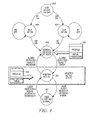
- a state diagram of the out-of-interference reducer 134 is shown.
- the arbitration procedure is only active if both the satellite radio receiver module 102 and the Bluetooth module 104 are used simultaneously. Thus initially, when both modules are off 402, no arbitration procedure is activated. Likewise, if one module 102, 104 is turned ON (XM ON 404 or BT ON 406), the arbiter 208 idles. When one of the modules 102, 104 is no longer used, the arbiter 208 will be in an Idle state.
- the arbiter goes into Normal mode applying 410 the initial conditions for power output and AFH mask for the Bluetooth communication module 104.
- the arbiter thresholds are also initialized 410 from the values stored in the profile database 210.
- the arbiter will apply 410 the initial profile conditions by determining a Bluetooth classification of the connected device 130 (FIG. 1), such as whether the connected device 130 is an AFH communication device or a non-AFH communication device and retrieving the corresponding profile from the profile database 210. Operation will remain in the normal operating state 408 state so long as the arbiter 208 does not receive an alarm of a signal quality or signal strength drop.
- the arbiter 208 switches to an Arbiter Active state 412 in response to detection of a signal quality drop.
- the arbiter 208 will switch to the Arbiter Active state 412 in response to a signal quality drop alarm signal from the alarm subsystem 206 generated in response to the XM sensor 202 detecting a drop in the signal quality of the signal from the satellite radio receiver module 102.
- the pooling period of the alarm subsystem 206 is configured 414 to have improved feedback in accordance with the operation of the arbiter 208.
- the arbiter will analyze the plurality of variable arbitration parameters of the arbitration profiler using the profile retrieved 414 from the profile database 210 to control the Bluetooth communication module 104 in response to the arbitration profiler or action table. Then the arbiter 208 will apply the actions appearing in the action table to reduce the out-of-band interference between the modules 102, 104, such as reducing a selectable transmit power of the Bluetooth communication module 104 (Dec BT Pwr action of the action table of FIG. 3) or adjusting the frequency band utilized by the Bluetooth communication module 104 for communication with the other Bluetooth-enable wireless communication device 130 (Inc AFH Msk or Dec AFH Msk actions of the action table of FIG. 3).
- the arbiter 208 can reduce the out-of-band interference between the modules 102, 104 by defining a decreased AFH mask for the Bluetooth communication module 104 which reduces a frequency width of the frequency band of operation of the Bluetooth communication module 104.
- the arbiter 208 can additionally reduce the out-of-band interference by allocating the reduced-width frequency band to selected carrier frequencies more than a predetermined frequency from the frequency band of operation of the satellite radio receiver module.
- the out-of band interference may be reduced in response to an application of the Bluetooth communication module 104, such as an adaptive frequency hopping application, or the out-of band interference may be reduced in response to the communication between the Bluetooth communication module 104 and the other Bluetooth communication device 130, such as whether the two Bluetooth-enabled communication devices 104, 130 operate on a reduced set of frequencies or whether they are non-AFH communication devices or an AFH communication devices.
- variable arbitration parameters are state parameters and allow the arbiter 208 to adapt itself to the environment.
- the arbiter 208 may modify the internal quality and signal strength thresholds of the alarm subsystem 206, thus allowing the arbiter 208 to redefine the predetermined power state for determining the power threshold or signal strength threshold of the Bluetooth communication module 104 or redefine the predetermined AFH state for determining the AFH threshold state of the Bluetooth communication module 104.
- the alarm subsystem 206 will detect extreme conditions, such as a communication module 104 or a satellite radio receiver module 102 loss of signal or loss of coverage, that will put the system in a User Alert/No Signal state 416.
- a communication module 104 or a satellite radio receiver module 102 loss of signal or loss of coverage In this state 416 neither the Bluetooth communication module 104 nor the satellite radio receiver module 102 capabilities can be guaranteed and user interaction may be required.
- the User Alert/No Signal state 416 causes the arbiter 208 to provide a signal to the indication interface 214 which may be used as a trigger for operations of the controller 110 or, as indicated in FIG. 2, may provide user alerts directly to the user interface 114 for presentation to a user via the display 120 and/or the speaker 118.
Landscapes
- Engineering & Computer Science (AREA)
- Computer Networks & Wireless Communication (AREA)
- Signal Processing (AREA)
- Mobile Radio Communication Systems (AREA)
Abstract
Description
- The present invention generally relates to wireless communication systems, and more particularly relates to a method and apparatus for reducing radio frequency (RF) interference generated by a Bluetooth® wireless communication device.
- Bluetooth is a low cost wireless communication technology operating in the unlicensed 2.4 gigahertz (GHz) frequency band. Bluetooth devices transmit and receive wireless transmissions which can interfere with other radio systems in the same 2.4 GHz frequency band (e.g., wireless internet local area network connections such as WiFi), as well as radio systems in nearby frequency bands (e.g., XM satellite radio in the 2.3 GHz frequency band). Complex collaborative systems have been developed for reducing in band interference between Bluetooth devices and, for example, WiFi devices. Without a system for reducing out of band interference between Bluetooth devices and devices operating in nearby frequency bands such as XM satellite radio receivers, it is impossible to provide both capabilities in a single device, such as XM satellite radio reception and Bluetooth communication capability in a single device.
- Thus, what is needed is a method and apparatus for reducing out of band interference from a Bluetooth device. Furthermore, other desirable features and characteristics of the present invention will become apparent from the subsequent detailed description of the invention and the appended claims, taken in conjunction with the accompanying drawings and this background of the invention.
- The present invention will hereinafter be described in conjunction with the following drawing figures, wherein like numerals denote like elements, and
- FIG. 1 is a block diagram of a wireless communication device communicating with a Bluetooth-enabled communication device in accordance with an embodiment of the present invention;
- FIG. 2 is a block diagram of an out-of-band interference reducer of the wireless communication device of FIG. 1 in accordance with the embodiment of the present invention;
- FIG. 3 is an arbitration profiler table in accordance with the embodiment of the present invention; and
- FIG. 4 is a state diagram of the operation of the out-of-band interference reducer of FIG. 2 in accordance with the embodiment of the present invention.
- A method for reducing out-of-band interference in accordance with the present invention includes the step of reducing out-of-band interference between a first communication device and a second communication device by controlling the second communication device in response to the first communication device. The transmit power or an application of the second communication device could be controlled in response to arbitration parameters of the first communication device, such as signal strength and/or signal quality.
- An apparatus for reducing out-of-band interference in accordance with the present invention includes a first communication device for receiving radio frequency (RF) signals in a first frequency band, a second communication device for wirelessly communicating in a second frequency band different from the first frequency band, and an out-of-band interference reducer coupled to the first communication device and the second communication device and reducing out-of-band interference therebetween by controlling the second communication device in response to the first communication device.
- The following detailed description of the invention is merely exemplary in nature and is not intended to limit the invention or the application and uses of the invention. Furthermore, there is no intention to be bound by any theory presented in the preceding background of the invention or the following detailed description of the invention.
- Referring to FIG. 1, a wireless communication device 100, such as a cellular telephone handset, in accordance with the embodiment of the present invention includes a satellite
radio receiver module 102 and a Bluetoothcommunication module 104. Although the apparatus 100 depicted is a wireless communication device, the apparatus can be a portable electronic device, a computer, a home stereo system, or any other environment which includes a first communication device such as the satelliteradio receiver module 102 and a second communication device such as the Bluetoothcommunication module 104. - The wireless communication device 100 includes an
antenna 106 for receiving and transmitting radio frequency (RF) signals.Transceiver circuitry 108 demodulates and decodes RF signals received from cellular telephone system to derive information therefrom and is coupled to acontroller 110 for providing the decoded information thereto for utilization thereby in accordance with the function(s) of the wireless communication device 100. Thecontroller 210 also provides information to thetransceiver circuitry 108 for encoding and modulating information into RF signals for transmission from theantenna 106. - As is well-known in the art, the
controller 110 is typically coupled to amemory device 112 and auser interface 114 to perform the functions of the wireless communication device 100. Theuser interface 114 includes amicrophone 116, aspeaker 118 and adisplay 120 which may be designed to accept touch screen inputs. Theuser interface 114 also includes one or morekey inputs 122, including a keypad 124. - The satellite
radio receiver module 102 is coupled to asecond antenna 126 to receive satellite radio RF signals, such as XM satellite radio signals, in a first frequency band. The Bluetoothcommunication module 104 is a Bluetooth-enabled wireless communication device coupled to athird antenna 128 for communicating in a second frequency band in accordance with Bluetooth protocol with anothercommunication device 130 which is also Bluetooth-enabied via anantenna 132. For example, thecommunication device 130 could be a stereo headset, a cellular telephone headset with cellular call capabilities or a Bluetooth module within stereo equipment to provide Bluetooth capability thereto. Both the satelliteradio receiver module 102 and the Bluetoothcommunication module 104 are coupled to theuser interface 114 for providing output to a user via, for example, thespeaker 118 and for the Bluetoothcommunication module 104 to receive input from a user via, for example, themicrophone 116. - In accordance with the present invention, the
controller 110 includes an out-of-band interference reducer 134. The satelliteradio receiver module 102 will receive XM satellite radio RF signals in the first frequency band, the 2.35 GHz frequency band. The Bluetoothcommunication module 104 will transmit and receive RF signals in the second frequency band, the unlicensed 2.4GHz frequency band, and may or may not use applications for the operation thereof, such as adaptive frequency hopping (AFH) applications. The RF signals for the twomodules modules communication module 104 can cause out-of-band interference with RF signals received by the satelliteradio receiver module 102. This interference has its origin in the small spectral distance between the two bands (2.35GHz for XM and 2.4GHz for Bluetooth) that allows the harmonics of the frequency-hopped signal generated by Bluetooth to appear in the XM band with power levels beyond the receiver selectivity of the satelliteradio receiver module 102. As described in more detail below, the out-of-band interference reducer 134 is coupled to the satelliteradio receiver module 102 and the Bluetoothcommunication module 104 for reducing interference therebetween. The out-of-band interference reducer 134 can be implemented in either hardware or so are and, while shown as implemented in thecontroller 110, the out-of-band interference reducer 134 could be provided as a separate module or component of the wireless communication device 100. - Referring to FIG. 2, an embodiment of the out-of-
band interference reducer 134 which monitors the signals of the satelliteradio receiver module 102 and the Bluetoothmodule 104 and, in response thereto, modifies the characteristics of the Bluetoothmodule 104 is shown in more detail. The out-of-band interference reducer 134 includes a satelliteradio receiver sensor 202 and a Bluetoothsensor 204 for measuring the signal characteristics such as signal qualities and signal power levels of the satelliteradio receiver module 102 and the Bluetoothmodule 104, respectively, eachsensor - The satellite
radio receiver sensor 202 and the Bluetoothsensor 204 are coupled to analarm subsystem 206 to provide data thereto, thealarm subsystem 206 generating status messages for anarbiter 208 in response to the data received. Thealarm subsystem 206 can be interrupt triggered by the use of system interrupts from thesensors XM sensor 202 and the Bluetoothsensor 204. Thesensors alarm subsystem 206 for controlling the operation thereof. In addition, thealarm subsystem 206 generates status messages or alerts to be sent to thearbiter 208 when the measures from the sensors exceed defined thresholds. The status messages contain the values for the following variable parameters: Bluetooth signal quality, Bluetooth signal strength, satellite radio receiver signal quality, satellite radio receiver signal strength, and a state where no satellite radio receiver signal is detected. Thealarm subsystem 206 also supports the commands from thearbiter 208, including a set_pooling_timer(time) command which modifies the timer of the pooling process for measuring the signal quality in response to the time indicated and a set_new_threshold(threshold_id, value) command which allows thearbiter 208 to dynamically modify the threshold values. - The
arbiter 208 is a state machine that will modify the operation of the Bluetoothmodule 104 in response to information received from the satelliteradio receiver sensor 202 and the Bluetoothsensor 204 and information contained in aprofile database 210. - The
profile database 210 is a repository of profiles defined for each class of BT device and contains the initial conditions to be applied to the Bluetoothmodule 104 when connecting to another Bluetooth communication device 130 (FIG. 1) as well as the arbitration parameters to be applied to the Bluetoothmodule 104 in response to information received from the satelliteradio receiver sensor 202 and the Bluetoothsensor 204. Theprofile database 210 may be located in the out-of-band interference reducer 134, as shown in FIG. 2, or may be memory locations within the memory 112 (FIG. 1) which may be accessed by the out-of-band interference reducer 134. Also, the threshold power and AFH could be stored in theprofile database 210. - By accessing the
profile database 206, thearbiter 208 can determine arbitration profiles adapted to each class of Bluetooth device. In addition, thearbiter 208 can access signals from thealarm subsystem 206 for the measures of the links qualities. Thearbiter 208 provides signals to a Bluetoothcontroller 212 to modify the power output and the AFH mask of the Bluetoothmodule 104. Modification of the AFH mask of the Bluetoothmodule 104 may include increasing the AFH mask which reduces the frequency band available for adaptive frequency hopping by the Bluetoothmodule 104. The Bluetoothcommunication module 104 may be a Bluetooth chipset and the Bluetoothsensor 204 and the Bluetoothcontroller 212 may be software units built over the Bluetoothcommunication module 104 stack. The Bluetoothcontroller 212 may then directly apply the modifications of the AFH mask modifying the connection to the Bluetoothdevice 130 and also modulate the maximal power output of the Bluetooth chipset. - In addition, the
arbiter 208 provides signals to anindication interface 214 coupled to theuser interface 114 to provide indications, alerts and user interaction requests to a user thereby. The indications, alerts and user interaction requests may include indication of bad signal quality, a signal power drop or losing a Bluetooth communication connection. Theindication interface 214 may be a software unit whose mission is to send to theuser interface 114 and thecontroller 110 messages or indications requiring an action from the user when thearbiter 208 dictates it necessary. Theindication interface 214 may also specify the type of message to be sent to the user. - Referring to FIG. 3, an example of an arbitration profiler or action table is shown. This example is for a headset stereo Bluetooth device without call capabilities. The actions to be taken are classified in accordance with three types of parameters: a use case applicable during the current operation, alert variables provided by the alarm subsystem, and state variables calculated by the arbiter. The alert variables comprise data from the current connection quality state of both the satellite
radio receiver module 102 and theBluetooth module 104. The alert variables are: the quality of the Bluetooth signal (BT Q), the signal strength of the Bluetooth signal (BT Pwr), the quality of the satellite radio signal (XM Q), the signal strength of the satellite radio signal (XM Pwr), and whether no satellite radio signal is detected (XM NS). The state variables are calculated by thearbiter 208 and imply if the maximal arbitration thresholds have been achieved. For example, thearbiter 208 can determine whether the maximum power threshold (Pwr thrshld) for theBluetooth module 104 has been reached by comparing the power threshold calculated by thearbiter 208 with the maximum power threshold stored in theprofile database 210. - In accordance with the table of FIG. 3, for each ensemble of variables a group of actions is taken. The actions that can be applied are: an increase of the uplink power of the Bluetooth module 104 (Inc BT Pwr), a decrease of the uplink power of the Bluetooth module 104 (Dec BT Pwr), an increase of the AFH mask of the Bluetooth module 104 (Inc AFH msk), a decrease of the AFH mask of the Bluetooth module 104 (Dec AFH msk), sending a user indication (U.I.), turning off the Bluetooth module 104 (Cut BT), or turning off the satellite radio receiver module 102 (Cut XM). Both the action table and the threshold limits may be static or dynamic.
- Referring to FIG. 4, a state diagram of the out-of-
interference reducer 134 is shown. The arbitration procedure is only active if both the satelliteradio receiver module 102 and theBluetooth module 104 are used simultaneously. Thus initially, when both modules are off 402, no arbitration procedure is activated. Likewise, if onemodule XM ON 404 or BT ON 406), thearbiter 208 idles. When one of themodules arbiter 208 will be in an Idle state. - When both
modules Bluetooth communication module 104. The arbiter thresholds are also initialized 410 from the values stored in theprofile database 210. The arbiter will apply 410 the initial profile conditions by determining a Bluetooth classification of the connected device 130 (FIG. 1), such as whether theconnected device 130 is an AFH communication device or a non-AFH communication device and retrieving the corresponding profile from theprofile database 210. Operation will remain in thenormal operating state 408 state so long as thearbiter 208 does not receive an alarm of a signal quality or signal strength drop. - The
arbiter 208 switches to an ArbiterActive state 412 in response to detection of a signal quality drop. For example, thearbiter 208 will switch to the ArbiterActive state 412 in response to a signal quality drop alarm signal from thealarm subsystem 206 generated in response to theXM sensor 202 detecting a drop in the signal quality of the signal from the satelliteradio receiver module 102. - In the Arbiter
Active state 412 the pooling period of thealarm subsystem 206 is configured 414 to have improved feedback in accordance with the operation of thearbiter 208. The arbiter will analyze the plurality of variable arbitration parameters of the arbitration profiler using the profile retrieved 414 from theprofile database 210 to control theBluetooth communication module 104 in response to the arbitration profiler or action table. Then thearbiter 208 will apply the actions appearing in the action table to reduce the out-of-band interference between themodules Bluetooth communication module 104 for communication with the other Bluetooth-enable wireless communication device 130 (Inc AFH Msk or Dec AFH Msk actions of the action table of FIG. 3). - For example, the
arbiter 208 can reduce the out-of-band interference between themodules Bluetooth communication module 104 which reduces a frequency width of the frequency band of operation of theBluetooth communication module 104. Thearbiter 208 can additionally reduce the out-of-band interference by allocating the reduced-width frequency band to selected carrier frequencies more than a predetermined frequency from the frequency band of operation of the satellite radio receiver module. - Also, the out-of band interference may be reduced in response to an application of the
Bluetooth communication module 104, such as an adaptive frequency hopping application, or the out-of band interference may be reduced in response to the communication between theBluetooth communication module 104 and the otherBluetooth communication device 130, such as whether the two Bluetooth-enabledcommunication devices - Several of the variable arbitration parameters are state parameters and allow the
arbiter 208 to adapt itself to the environment. In order to avoid closed loop situations and to better adapt itself to the environment characteristics, thearbiter 208 may modify the internal quality and signal strength thresholds of thealarm subsystem 206, thus allowing thearbiter 208 to redefine the predetermined power state for determining the power threshold or signal strength threshold of theBluetooth communication module 104 or redefine the predetermined AFH state for determining the AFH threshold state of theBluetooth communication module 104. - In some situations, the
alarm subsystem 206 will detect extreme conditions, such as acommunication module 104 or a satelliteradio receiver module 102 loss of signal or loss of coverage, that will put the system in a User Alert/No Signal state 416. In thisstate 416 neither theBluetooth communication module 104 nor the satelliteradio receiver module 102 capabilities can be guaranteed and user interaction may be required. The User Alert/No Signal state 416 causes thearbiter 208 to provide a signal to theindication interface 214 which may be used as a trigger for operations of thecontroller 110 or, as indicated in FIG. 2, may provide user alerts directly to theuser interface 114 for presentation to a user via thedisplay 120 and/or thespeaker 118. - Only an indication of signal quality increase from the
alarm subsystem 206 or a user interaction via theindication interface 114 can get thearbiter 208 out of the User Alert/No Signal state 416. An appropriate signal indication or user interaction will cause thearbiter 208 to return to the ArbiterActive state 412, and, possibly, to thenormal operation state 408. - Thus, a method and apparatus for reducing out-of-band interference from a Bluetooth device has been described which allows for a
Bluetooth communication module 104 and anothermodule 102, even an XM satellite communication receiver operating in a frequency band very near to the operational frequency band of the Bluetooth device, to be incorporated into a single wireless communication device. While at least one exemplary embodiment has been presented in the foregoing detailed description of the invention, it should be appreciated that a vast number of variations exist. It should also be appreciated that the exemplary embodiment or exemplary embodiments are only examples, and are not intended to limit the scope, applicability, or configuration of the invention in any way. Rather, the foregoing detailed description will provide those skilled in the art with a convenient road map for implementing an exemplary embodiment of the invention, it being understood that various changes may be made in the function and arrangement of elements described in an exemplary embodiment without departing from the scope of the invention as set forth in the appended claims.
Claims (37)
- An apparatus comprising:a first communication device (102) for receiving radio frequency (RF) signals in a first frequency band;a second communication device (104) for wirelessly communicating in a second frequency band different from the first frequency band;an out-of-band interference reducer (134) coupled to the first communication device (102) and the second communication device (104) and reducing out-of-band interference therebetween by controlling the second communication device (104) in response to the first communication device (102).
- The apparatus of Claim 1 wherein the second communication device (104) transmits RF signals at a selectable transmit power, and
wherein the out-of-band interference reducer (134) reduces the out-of-band interference by reducing the selectable transmit power of the second communication device (104) in response to the first communication device (102). - The apparatus of Claim 2 wherein the second communication device (104) transmits and receives RF signals on selectable carrier frequencies within the second frequency band, and
wherein the out-of-band interference reducer (134) reduces the out-of-band interference by selecting one or more of the selectable carrier frequencies for the second communication device (104) to transmit and receive RF signals in response to the first frequency band. - The apparatus of Claim I wherein the out-of-band interference reducer (134) reduces the out-of-band interference by adjusting the second frequency band.
- The apparatus of Claim 4 wherein the out-of-band interference reducer (134) reduces the out-of-band interference by reducing a width of the second frequency band.
- The apparatus of Claim 5 wherein the out-of-band interference reducer (134) reduces the out-of-band interference by allocating the second frequency band to selected carrier frequencies more than a predetermined frequency width from the first frequency band.
- The apparatus of Claim 1 wherein the second communication device (104) uses an application to wirelessly communicate, and
wherein the out-of-band interference reducer (134) reduces the out-of-band interference in response to the application. - The apparatus of Claim 1 wherein the second communication device (104) wirelessly communicates with a third communication device (130), and
wherein the out-of-band interference reducer (134) reduces the out-of-band interference in response to the third communication device (130). - The apparatus of Claim 8 wherein the third communication device (130) is a non-adaptive frequency hopping (non-AFH) communication device.
- The apparatus of Claim 9 wherein the second communication device (104) is an AFH communication device.
- The apparatus of Claim 8 wherein the second and third communication devices wirelessly communicate on a reduced set of frequencies, and
wherein the out-of-band interference reducer (134) reduces the out-of-band interference in response to the reduced set of frequencies. - The apparatus of Claim 1 wherein the out-of-band interference reducer (134) comprises an arbitration profiler comprising a plurality of actions, each of the plurality of actions determined in response to one or more of a plurality of arbitration parameters.
- The apparatus of Claim 12 wherein the plurality of arbitration parameters includes one or more of a signal quality of the first communication device, a signal strength of the first communication device, a signal quality of the second communication device, a signal strength of the second communication device (104), a power threshold state for the second communication device (104), or an AFH threshold state for the second communication device (104).
- The apparatus of Claim 13 wherein the out-of-band interference reducer (134) determines whether the power threshold state for the second communication device (104) is within a predetermined power state for the second communication device.
- The apparatus of Claim 13 wherein the out-of-band interference reducer (134) determines whether the AFH threshold state for the second communication device (104) is within a predetermined AFH state for the second communication device.
- The apparatus of Claim 1 wherein the second communication device (104) is a Bluetooth-enabled wireless communication device.
- The apparatus of Claim 1 wherein the first communication device (102) is an XM satellite radio receiving device.
- The apparatus of Claim 1 wherein the apparatus is a cellular telephone handset (100).
- A method for reducing out-of-band interference comprising the step of reducing out-of-band interference between a first communication device (102) and a second communication device (104) by controlling the second communication device (104) in response to the first communication device (102).
- The method of Claim 19 wherein the step of reducing out-of-band interference comprises the steps of:measuring signal characteristics of signals received by the first communication device (102) and the second communication device (104); andreducing a selectable transmit power of the second communication device (104) in response to the signal characteristics measured.
- The method of Claim 19 wherein the step of reducing out-of-band interference comprises the steps of:reducing a selectable transmit power of the second communication device (104) in response to the first communication device (102); andselecting one or more of selectable carrier frequencies for the second communication device (104) to transmit and receive RF signals in response to a first frequency band in which the first communication device (102) communicates.
- The method of Claim 19 wherein the step of reducing out-of-band interference comprises the step of adjusting a second frequency band of the second communication device.
- The method of Claim 22 wherein the step of reducing out-of-band interference comprises the step of reducing a width of the second frequency band.
- The method of Claim 23 wherein the step of reducing the width of the second frequency band comprises the step of reducing the width of the second frequency band and allocating the reduced-width second frequency band to selected carrier frequencies more than a predetermined frequency width from a first frequency band of the first communication device (102).
- The method of Claim 19 wherein the second communication (104) device uses an application to wirelessly communicate, and wherein the step of reducing the out-of-band interference comprises the step of reducing the out-of-band interference in response to the application.
- The method of Claim 19 wherein the second communication device (104) wirelessly communicates with a third communication device (130), and wherein the step of reducing the out-of-band interference comprises the step of reducing the out-of-band interference in response to the third communication device (130).
- The method of Claim 26 wherein the step of reducing the out-of-band interference comprises the steps of:determining whether the third communication device (130) is a non-adaptive frequency hopping (non-AFH) communication device; andreducing the out-of-band interference in response to whether the third communication device (130) is a non-AFH communication device.
- The method of Claim 27 wherein the determining step comprises the steps of:determining whether the third communication device (130) is a non-adaptive frequency hopping (non-AFH) communication device; anddetermining whether the second communication device (104) is an AFH communication device, andwherein the step of reducing the out-of-band interference comprises the step of reducing the out-of-band interference in response to whether the third communication device (130) is a non-AFH communication device and whether the second communication device (104) is an AFH communication device.
- The method of Claim 26 wherein the second and third communication devices (130) wirelessly communicate on a reduced set of frequencies, and wherein the step of reducing the out-of-band interference comprises the step of reducing the out-of-band interference in response to the reduced set of frequencies.
- The method of Claim 19 wherein the step of reducing the out-of-band interference comprises the step of reducing the out-of-band interference in response to one or more of a plurality of actions in an arbitration profiler, each of the plurality of actions determined in response to one or more of a plurality of arbitration parameters, and wherein the step of reducing the out-of-band interference comprises the step of reducing the out-of-band interference in response to one or more of the plurality of actions.
- The method of Claim 30 wherein the plurality of arbitration parameters includes one or more of a signal quality of the first communication device, a signal strength of the first communication device, a signal quality of the second communication device, a signal strength of the second communication device, a power threshold state for the second communication device, or an AFH threshold state for the second communication device.
- The method of Claim 31 wherein the step of reducing the out-of-band interference in response to the one or more of the plurality of actions comprises the step of determining whether the power threshold state for the second communication device is within a predetermined power state for the second communication device.
- The method of Claim 31 wherein the step of reducing the out-of-band interference in response to the one or more of the plurality of actions comprises the step of determining whether the AFH threshold state for the second communication device (104) is within a predetermined AFH state for the second communication device (104).
- The method of Claim 19 wherein the second communication device (104) is a Bluetooth-enabled wireless communication device.
- The method of Claim 19 wherein the first communication device (102) is an XM satellite radio receiving device.
- The method of Claim 19 wherein the first communication device (102) and the second communication device (104) are incorporated into a wireless communication device.
- The method of Claim 19 wherein the wireless communication device (100) is a cellular telephone handset.
Priority Applications (2)
| Application Number | Priority Date | Filing Date | Title |
|---|---|---|---|
| EP06300230A EP1835627A1 (en) | 2006-03-14 | 2006-03-14 | Method and apparatus for reducing out-of-band interference generated by a bluetooth device |
| PCT/US2007/063378 WO2007106678A2 (en) | 2006-03-14 | 2007-03-06 | Method and apparatus for reducing out-of-band interference generated by a bluetooth device |
Applications Claiming Priority (1)
| Application Number | Priority Date | Filing Date | Title |
|---|---|---|---|
| EP06300230A EP1835627A1 (en) | 2006-03-14 | 2006-03-14 | Method and apparatus for reducing out-of-band interference generated by a bluetooth device |
Publications (1)
| Publication Number | Publication Date |
|---|---|
| EP1835627A1 true EP1835627A1 (en) | 2007-09-19 |
Family
ID=36702645
Family Applications (1)
| Application Number | Title | Priority Date | Filing Date |
|---|---|---|---|
| EP06300230A Ceased EP1835627A1 (en) | 2006-03-14 | 2006-03-14 | Method and apparatus for reducing out-of-band interference generated by a bluetooth device |
Country Status (2)
| Country | Link |
|---|---|
| EP (1) | EP1835627A1 (en) |
| WO (1) | WO2007106678A2 (en) |
Cited By (2)
| Publication number | Priority date | Publication date | Assignee | Title |
|---|---|---|---|---|
| WO2010090567A1 (en) * | 2009-02-09 | 2010-08-12 | Telefonaktiebolaget Lm Ericsson | Method and arrangement in a wireless communication system |
| GB2504366A (en) * | 2012-06-20 | 2014-01-29 | Cambridge Silicon Radio Ltd | Reducing self-interference between a co-located transmitter and receiver by controlling transmit power in accordance with quality of received signal |
Families Citing this family (2)
| Publication number | Priority date | Publication date | Assignee | Title |
|---|---|---|---|---|
| US8238831B2 (en) | 2010-03-26 | 2012-08-07 | Apple Inc. | Wireless interference mitigation |
| US8805397B2 (en) | 2010-03-26 | 2014-08-12 | Apple Inc. | Wireless interference mitigation |
Citations (6)
| Publication number | Priority date | Publication date | Assignee | Title |
|---|---|---|---|---|
| US6107960A (en) * | 1998-01-20 | 2000-08-22 | Snaptrack, Inc. | Reducing cross-interference in a combined GPS receiver and communication system |
| EP1079533A1 (en) * | 1999-08-24 | 2001-02-28 | Telefonaktiebolaget L M Ericsson (Publ) | Parallel operation of devices using multiple communication standards |
| EP1091497A1 (en) * | 1999-08-24 | 2001-04-11 | Telefonaktiebolaget L M Ericsson (Publ) | Transmitter leakage cancellation circuit for co-located GPS receiver |
| EP1253720A1 (en) * | 2001-04-27 | 2002-10-30 | Nokia Corporation | A method and electronic device for reducing interference in a receiver |
| WO2004109940A1 (en) * | 2003-06-10 | 2004-12-16 | Nokia Corporation | Reception of signals in a device comprising a transmitter |
| US6961019B1 (en) * | 2000-08-10 | 2005-11-01 | Sirf Technology, Inc. | Method and apparatus for reducing GPS receiver jamming during transmission in a wireless receiver |
Family Cites Families (5)
| Publication number | Priority date | Publication date | Assignee | Title |
|---|---|---|---|---|
| US6704346B1 (en) * | 2000-03-16 | 2004-03-09 | Sharp Laboratories Of America, Inc. | Method and apparatus to provide improved microwave interference robustness in RF communications devices |
| JP3560149B2 (en) * | 2000-09-12 | 2004-09-02 | 日本電気株式会社 | Mobile phone, GPS, Bluetooth integrated composite terminal and control method therefor |
| US6944460B2 (en) * | 2001-06-07 | 2005-09-13 | Telefonaktiebolaget L M Ericsson (Publ) | System and method for link adaptation in communication systems |
| GB2398965B (en) * | 2003-02-27 | 2005-05-18 | Toshiba Res Europ Ltd | Methods of controlling transmission power levels in air interface channels |
| DE10314553A1 (en) * | 2003-03-31 | 2004-10-28 | Infineon Technologies Ag | Frequency channel selection in a data transmission method using a frequency hopping method |
-
2006
- 2006-03-14 EP EP06300230A patent/EP1835627A1/en not_active Ceased
-
2007
- 2007-03-06 WO PCT/US2007/063378 patent/WO2007106678A2/en not_active Ceased
Patent Citations (6)
| Publication number | Priority date | Publication date | Assignee | Title |
|---|---|---|---|---|
| US6107960A (en) * | 1998-01-20 | 2000-08-22 | Snaptrack, Inc. | Reducing cross-interference in a combined GPS receiver and communication system |
| EP1079533A1 (en) * | 1999-08-24 | 2001-02-28 | Telefonaktiebolaget L M Ericsson (Publ) | Parallel operation of devices using multiple communication standards |
| EP1091497A1 (en) * | 1999-08-24 | 2001-04-11 | Telefonaktiebolaget L M Ericsson (Publ) | Transmitter leakage cancellation circuit for co-located GPS receiver |
| US6961019B1 (en) * | 2000-08-10 | 2005-11-01 | Sirf Technology, Inc. | Method and apparatus for reducing GPS receiver jamming during transmission in a wireless receiver |
| EP1253720A1 (en) * | 2001-04-27 | 2002-10-30 | Nokia Corporation | A method and electronic device for reducing interference in a receiver |
| WO2004109940A1 (en) * | 2003-06-10 | 2004-12-16 | Nokia Corporation | Reception of signals in a device comprising a transmitter |
Cited By (5)
| Publication number | Priority date | Publication date | Assignee | Title |
|---|---|---|---|---|
| WO2010090567A1 (en) * | 2009-02-09 | 2010-08-12 | Telefonaktiebolaget Lm Ericsson | Method and arrangement in a wireless communication system |
| US8880112B2 (en) | 2009-02-09 | 2014-11-04 | Optis Cellular Technology, Llc | Methods and arrangements in a wireless communication system |
| CN102308610B (en) * | 2009-02-09 | 2015-09-23 | 奥普蒂斯蜂窝技术有限责任公司 | Method and device in wireless communication system |
| GB2504366A (en) * | 2012-06-20 | 2014-01-29 | Cambridge Silicon Radio Ltd | Reducing self-interference between a co-located transmitter and receiver by controlling transmit power in accordance with quality of received signal |
| US9723620B2 (en) | 2012-06-20 | 2017-08-01 | Qualcomm Technologies International, Ltd. | Power-aware coexistence |
Also Published As
| Publication number | Publication date |
|---|---|
| WO2007106678A2 (en) | 2007-09-20 |
| WO2007106678A3 (en) | 2008-11-20 |
Similar Documents
| Publication | Publication Date | Title |
|---|---|---|
| CN108282166B (en) | Antenna coexistence and mutual interference processing method, device, storage medium and electronic device | |
| KR101409099B1 (en) | Methods and apparatus for enhanced coexistence algorithms in wireless systems | |
| US10412605B2 (en) | Self-adaptive bluetooth performance adjustment communication terminal and method | |
| JP4533413B2 (en) | Mobile communication terminal, radio communication system, and frequency allocation method | |
| US8995939B2 (en) | Method and apparatus for power cutback in a simultaneous dual frequency band call | |
| EP2219308B1 (en) | Method and systems to facilitate reducing interference betweeen rf signals | |
| KR20070088720A (en) | Wireless access control method and device | |
| US7945209B2 (en) | Blocking of communication channels | |
| CN108183725A (en) | Antenna coexistence and mutual interference processing method, device, storage medium and electronic equipment | |
| CN108233956B (en) | Antenna coexistence mutual interference processing method and device, storage medium and electronic equipment | |
| CN106922013A (en) | With the method for the WAP and drop low signal interference of frequency range dijection frequency module | |
| CN1146124C (en) | Radio communications unit | |
| EP3847839A1 (en) | External information assistant channel assessment for bluetooth adaptive frequency hopping | |
| CN111050410A (en) | An antenna control method and electronic device | |
| WO2007106678A2 (en) | Method and apparatus for reducing out-of-band interference generated by a bluetooth device | |
| CN110381598A (en) | Resource regulating method, information transferring method, the network equipment and terminal | |
| CN107070563A (en) | Radio frequency interference processing method, storage medium and mobile terminal | |
| JP7278397B2 (en) | Transmission resource indication method, transmission method, network equipment and terminal | |
| US10091742B2 (en) | Wireless communication device | |
| CN117528751A (en) | Power adjustment method, device, terminal equipment and computer readable storage medium | |
| EP1543483B1 (en) | Wireless audio monitor | |
| KR20040103082A (en) | Device and the Method for processing the electromagnetic wave of mobile phone | |
| CN108259064A (en) | Antenna coexistence and mutual interference processing method, device, storage medium and electronic equipment | |
| CN101202594B (en) | Frequency changing method of wireless peripheral device | |
| JP2006345274A (en) | Method for avoiding interference of Bluetooth (registered trademark) terminal |
Legal Events
| Date | Code | Title | Description |
|---|---|---|---|
| PUAI | Public reference made under article 153(3) epc to a published international application that has entered the european phase |
Free format text: ORIGINAL CODE: 0009012 |
|
| AK | Designated contracting states |
Kind code of ref document: A1 Designated state(s): AT BE BG CH CY CZ DE DK EE ES FI FR GB GR HU IE IS IT LI LT LU LV MC NL PL PT RO SE SI SK TR |
|
| AX | Request for extension of the european patent |
Extension state: AL BA HR MK YU |
|
| 17P | Request for examination filed |
Effective date: 20080317 |
|
| 17Q | First examination report despatched |
Effective date: 20080417 |
|
| AKX | Designation fees paid |
Designated state(s): AT BE BG CH CY CZ DE DK EE ES FI FR GB GR HU IE IS IT LI LT LU LV MC NL PL PT RO SE SI SK TR |
|
| RAP1 | Party data changed (applicant data changed or rights of an application transferred) |
Owner name: MOTOROLA MOBILITY, INC. |
|
| RAP1 | Party data changed (applicant data changed or rights of an application transferred) |
Owner name: MOTOROLA MOBILITY LLC |
|
| STAA | Information on the status of an ep patent application or granted ep patent |
Free format text: STATUS: THE APPLICATION HAS BEEN REFUSED |
|
| 18R | Application refused |
Effective date: 20140316 |
|
| P01 | Opt-out of the competence of the unified patent court (upc) registered |
Effective date: 20230520 |