EP1833817B1 - Synthesis of ccr5 receptor antagonists - Google Patents
Synthesis of ccr5 receptor antagonists Download PDFInfo
- Publication number
- EP1833817B1 EP1833817B1 EP06717461A EP06717461A EP1833817B1 EP 1833817 B1 EP1833817 B1 EP 1833817B1 EP 06717461 A EP06717461 A EP 06717461A EP 06717461 A EP06717461 A EP 06717461A EP 1833817 B1 EP1833817 B1 EP 1833817B1
- Authority
- EP
- European Patent Office
- Prior art keywords
- compound
- formula
- group
- carbamate
- reacting
- Prior art date
- Legal status (The legal status is an assumption and is not a legal conclusion. Google has not performed a legal analysis and makes no representation as to the accuracy of the status listed.)
- Expired - Lifetime
Links
- 0 Cc1c(C(*(CC2)CCC2(*)N(CCN2C(C(CC3)CCN3S(C3CC3)(=O)=O)c3cccc(F)c3)CC2Cl)=O)c(*)ncn1 Chemical compound Cc1c(C(*(CC2)CCC2(*)N(CCN2C(C(CC3)CCN3S(C3CC3)(=O)=O)c3cccc(F)c3)CC2Cl)=O)c(*)ncn1 0.000 description 4
- GQPGVHUPBOJHDS-XPKAQORNSA-N CC(CNCC1)N1[C@H](C1CCN(C)CC1)c1cc(F)ccc1 Chemical compound CC(CNCC1)N1[C@H](C1CCN(C)CC1)c1cc(F)ccc1 GQPGVHUPBOJHDS-XPKAQORNSA-N 0.000 description 1
- WMSPXQIQBQAWLL-UHFFFAOYSA-N NS(C1CC1)(=O)=O Chemical compound NS(C1CC1)(=O)=O WMSPXQIQBQAWLL-UHFFFAOYSA-N 0.000 description 1
Classifications
-
- C—CHEMISTRY; METALLURGY
- C07—ORGANIC CHEMISTRY
- C07D—HETEROCYCLIC COMPOUNDS
- C07D211/00—Heterocyclic compounds containing hydrogenated pyridine rings, not condensed with other rings
- C07D211/92—Heterocyclic compounds containing hydrogenated pyridine rings, not condensed with other rings with a hetero atom directly attached to the ring nitrogen atom
- C07D211/96—Sulfur atom
-
- A—HUMAN NECESSITIES
- A61—MEDICAL OR VETERINARY SCIENCE; HYGIENE
- A61P—SPECIFIC THERAPEUTIC ACTIVITY OF CHEMICAL COMPOUNDS OR MEDICINAL PREPARATIONS
- A61P1/00—Drugs for disorders of the alimentary tract or the digestive system
- A61P1/04—Drugs for disorders of the alimentary tract or the digestive system for ulcers, gastritis or reflux esophagitis, e.g. antacids, inhibitors of acid secretion, mucosal protectants
-
- A—HUMAN NECESSITIES
- A61—MEDICAL OR VETERINARY SCIENCE; HYGIENE
- A61P—SPECIFIC THERAPEUTIC ACTIVITY OF CHEMICAL COMPOUNDS OR MEDICINAL PREPARATIONS
- A61P11/00—Drugs for disorders of the respiratory system
- A61P11/06—Antiasthmatics
-
- A—HUMAN NECESSITIES
- A61—MEDICAL OR VETERINARY SCIENCE; HYGIENE
- A61P—SPECIFIC THERAPEUTIC ACTIVITY OF CHEMICAL COMPOUNDS OR MEDICINAL PREPARATIONS
- A61P17/00—Drugs for dermatological disorders
- A61P17/02—Drugs for dermatological disorders for treating wounds, ulcers, burns, scars, keloids, or the like
-
- A—HUMAN NECESSITIES
- A61—MEDICAL OR VETERINARY SCIENCE; HYGIENE
- A61P—SPECIFIC THERAPEUTIC ACTIVITY OF CHEMICAL COMPOUNDS OR MEDICINAL PREPARATIONS
- A61P17/00—Drugs for dermatological disorders
- A61P17/06—Antipsoriatics
-
- A—HUMAN NECESSITIES
- A61—MEDICAL OR VETERINARY SCIENCE; HYGIENE
- A61P—SPECIFIC THERAPEUTIC ACTIVITY OF CHEMICAL COMPOUNDS OR MEDICINAL PREPARATIONS
- A61P19/00—Drugs for skeletal disorders
- A61P19/02—Drugs for skeletal disorders for joint disorders, e.g. arthritis, arthrosis
-
- A—HUMAN NECESSITIES
- A61—MEDICAL OR VETERINARY SCIENCE; HYGIENE
- A61P—SPECIFIC THERAPEUTIC ACTIVITY OF CHEMICAL COMPOUNDS OR MEDICINAL PREPARATIONS
- A61P25/00—Drugs for disorders of the nervous system
-
- A—HUMAN NECESSITIES
- A61—MEDICAL OR VETERINARY SCIENCE; HYGIENE
- A61P—SPECIFIC THERAPEUTIC ACTIVITY OF CHEMICAL COMPOUNDS OR MEDICINAL PREPARATIONS
- A61P29/00—Non-central analgesic, antipyretic or antiinflammatory agents, e.g. antirheumatic agents; Non-steroidal antiinflammatory drugs [NSAID]
-
- A—HUMAN NECESSITIES
- A61—MEDICAL OR VETERINARY SCIENCE; HYGIENE
- A61P—SPECIFIC THERAPEUTIC ACTIVITY OF CHEMICAL COMPOUNDS OR MEDICINAL PREPARATIONS
- A61P31/00—Antiinfectives, i.e. antibiotics, antiseptics, chemotherapeutics
- A61P31/12—Antivirals
- A61P31/14—Antivirals for RNA viruses
- A61P31/18—Antivirals for RNA viruses for HIV
-
- A—HUMAN NECESSITIES
- A61—MEDICAL OR VETERINARY SCIENCE; HYGIENE
- A61P—SPECIFIC THERAPEUTIC ACTIVITY OF CHEMICAL COMPOUNDS OR MEDICINAL PREPARATIONS
- A61P37/00—Drugs for immunological or allergic disorders
- A61P37/02—Immunomodulators
- A61P37/06—Immunosuppressants, e.g. drugs for graft rejection
-
- A—HUMAN NECESSITIES
- A61—MEDICAL OR VETERINARY SCIENCE; HYGIENE
- A61P—SPECIFIC THERAPEUTIC ACTIVITY OF CHEMICAL COMPOUNDS OR MEDICINAL PREPARATIONS
- A61P37/00—Drugs for immunological or allergic disorders
- A61P37/08—Antiallergic agents
-
- A—HUMAN NECESSITIES
- A61—MEDICAL OR VETERINARY SCIENCE; HYGIENE
- A61P—SPECIFIC THERAPEUTIC ACTIVITY OF CHEMICAL COMPOUNDS OR MEDICINAL PREPARATIONS
- A61P43/00—Drugs for specific purposes, not provided for in groups A61P1/00-A61P41/00
-
- C—CHEMISTRY; METALLURGY
- C07—ORGANIC CHEMISTRY
- C07D—HETEROCYCLIC COMPOUNDS
- C07D211/00—Heterocyclic compounds containing hydrogenated pyridine rings, not condensed with other rings
- C07D211/04—Heterocyclic compounds containing hydrogenated pyridine rings, not condensed with other rings with only hydrogen or carbon atoms directly attached to the ring nitrogen atom
- C07D211/06—Heterocyclic compounds containing hydrogenated pyridine rings, not condensed with other rings with only hydrogen or carbon atoms directly attached to the ring nitrogen atom having no double bonds between ring members or between ring members and non-ring members
- C07D211/08—Heterocyclic compounds containing hydrogenated pyridine rings, not condensed with other rings with only hydrogen or carbon atoms directly attached to the ring nitrogen atom having no double bonds between ring members or between ring members and non-ring members with hydrocarbon or substituted hydrocarbon radicals directly attached to ring carbon atoms
- C07D211/18—Heterocyclic compounds containing hydrogenated pyridine rings, not condensed with other rings with only hydrogen or carbon atoms directly attached to the ring nitrogen atom having no double bonds between ring members or between ring members and non-ring members with hydrocarbon or substituted hydrocarbon radicals directly attached to ring carbon atoms with substituted hydrocarbon radicals attached to ring carbon atoms
- C07D211/26—Heterocyclic compounds containing hydrogenated pyridine rings, not condensed with other rings with only hydrogen or carbon atoms directly attached to the ring nitrogen atom having no double bonds between ring members or between ring members and non-ring members with hydrocarbon or substituted hydrocarbon radicals directly attached to ring carbon atoms with substituted hydrocarbon radicals attached to ring carbon atoms with hydrocarbon radicals, substituted by nitrogen atoms
-
- C—CHEMISTRY; METALLURGY
- C07—ORGANIC CHEMISTRY
- C07D—HETEROCYCLIC COMPOUNDS
- C07D401/00—Heterocyclic compounds containing two or more hetero rings, having nitrogen atoms as the only ring hetero atoms, at least one ring being a six-membered ring with only one nitrogen atom
- C07D401/14—Heterocyclic compounds containing two or more hetero rings, having nitrogen atoms as the only ring hetero atoms, at least one ring being a six-membered ring with only one nitrogen atom containing three or more hetero rings
Definitions
- This application concerns the synthesis of the CCR5 receptor antagonist 4-[4-[(R)-[1-[cyclopropylsulfonyl)-4-piperidinyl](3-fluorophenyl)methyl]-3(S)-methyl-1-piperazinyl]-1-[(4,6-dimethyl-5-pyrimidinyl)carbonyl]-4-methylpiperidine.
- the compound of Formula I is an antagonist of the CCR5 receptor and is useful for the treatment of AIDS and related HIV infections.
- CCR5 receptors have also been reported to mediate cell transfer in inflammatory diseases such as arthritis, rheumatoid arthritis, atopic dermatitis, psoriasis, asthma and allergies, and inhibitors of such receptors are expected to be useful in the treatment of such diseases, and in the treatment of other inflammatory diseases or conditions such as inflammatory bowel disease, multiple sclerosis, solid organ transplant rejection and graft v. host disease.
- This compound is described and claimed in United States Patent No. 6,720,325 , the disclosure of which is incorporated herein by reference.
- the present application teaches a novel process of making a compound of formula I.
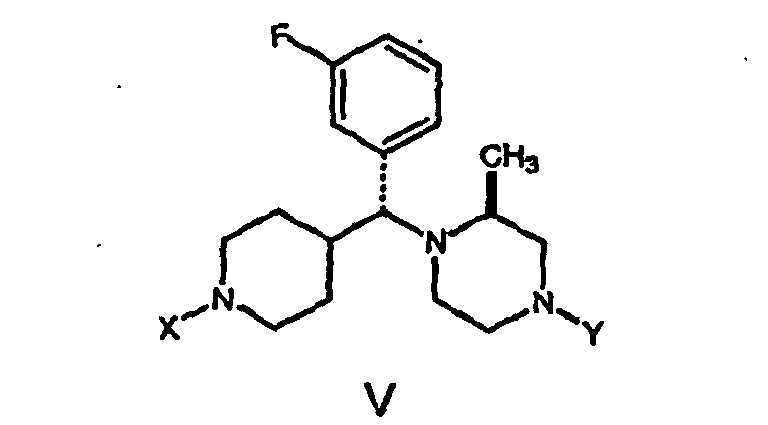
- the compound of formula I is prepared from a compound of formula V: where X is selected from the group consisting of: p-methoxybenzyl (PMB), allyl, methoxymethyl, benzyloxymethyl, trityl, pivaloyloxymethyl, tetrahydranyl, benzyl, di(p-methoxyphenyl)methyl, triphenylmethyl, (p-methoxyphenyl)diphenylmethyl, and t-butyl carbamate (“t-Boc"); and Y is selected from the group consisting of: carbobenzyloxy (Cbz), CZ 3 CO (where Z is a halogen), 2-trimethylsilylethyl carbamate, 1-methyl-1-phenylethyl carbamate, t-butyl carbamate, cyclobutyl carbamate, 1-methylcyclobutyl carbamate, a
- the inventive process comprises the sequential steps of:
- the inventive process to make the compound of formula I has numerous advantages including it is economical and can be easily scaled-up.
- Acyl means an H-C(O)-, alkyl-C(O)-, cycloalkyl-C(O)-, or aryl-C(O)- and the like. The bond to the parent moiety is through the carbonyl.
- Alkyl means an aliphatic hydrocarbon group which may be straight or branched and comprising about 1 to about 20 carbon atoms in the chain. Preferred alkyl groups contain about 1 to about 12 carbon atoms in the chain. More preferred alkyl groups contain about 1 to about 6 carbon atoms in the chain. Branched means that one or more lower alkyl groups such as methyl, ethyl or propyl, are attached to a linear alkyl chain. "Lower alkyl” means a group having about 1 to about 6 carbon atoms in the chain which may be straight or branched.
- substituted alkyl means that the alkyl group may be substituted by one or more substituents which may be the same or different, each substituent being independently selected from the group consisting of halo, alkyl, aryl, cycloalkyl, cyano, hydroxy, alkoxy, alkylthio, amino, -NH(alkyl), -NH(cycloalkyl), -N(alkyl) 2 , carboxy and -C(O)O-alkyl.
- suitable alkyl groups include methyl, ethyl, n-propyl, isopropyl and t-butyl.
- Alkylsulfonate means an alkyl-S(O 2 )-O- group in which the alkyl group is as previously described. Preferred groups are those in which the alkyl group is lower alkyl. The bond to the parent moiety is through the oxygen.
- Aryl means an aromatic monocyclic or multicyclic ring system comprising about 6 to about 14 carbon atoms, preferably about 6 to about 10 carbon atoms.
- the aryl group can be optionally substituted with one or more "ring system substituents" which may be the same or different, and are as defined herein.
- suitable aryl groups include phenyl and naphthyl.
- Cycloalkyl means a non-aromatic mono- or multicyclic ring system comprising about 3 to about 10 carbon atoms, preferably about 5 to about 10 carbon atoms. Preferred cycloalkyl rings contain about 5 to about 7 ring atoms.
- Halide means fluoro, chloro, bromo or iodo.
- Halogen means fluoro, chloro, bromo or iodo.
- Heterocyclic means a non-aromatic saturated monocyclic or multicyclic ring system comprising about 3 to about 10 ring atoms, preferably about 4 to about 7 ring atoms, in which one or more of the atoms in the ring system is an element other than carbon, for Preparative Example nitrogen, oxygen or sulfur, alone or in combination. There are no adjacent oxygen and/or sulfur atoms present in the ring system.
- Preferred heterocyclyls contain about 5 to about 6 ring atoms.
- the prefix aza, oxa or thia before the heterocyclyl root name means that at least a nitrogen, oxygen or sulfur atom respectively is present as a ring atom.
- Any -NH in a heterocyclyl ring may exist protected such as, for example, as an -N(Boc), -N(cbz), -N(Tos) group and the like; such protections are also considered part of this invention.
- PMB means p-methoxybenzyl
- Triflate means trifluoromethanesulfonyl.
- the present invention discloses a novel, easy-to-use process for preparing the compound of formula I.
- the process comprises:
- X and Y are not the same moiety since X and Y are to be differentiated under the reaction conditions employed.
- PMB p-methoxybenzyl
- the preferred protecting group for Y is carbobenzyloxy (Cbz):
- the deprotection in step (d) is performed using 2,3-dichoro-5,6-dicyano-1,4-benzoquinone or trifluoroacetic anhydride.
- the deprotection is performed using trifluoroacetic anhydride.
- the preferred W in step (e) is Cl.
- step (f) is performed using strong acids such as sulfuric acid, hydrochloric acid, hydrobromic acid, methanesulfonic acid and the like.
- the protection is accomplished using methanesulfonic acid.
- the reaction in step (g) comprises (1) converting compound of formula VIII to a free base by use of a basic compound and (2) reacting free base with an agent containing a leaving group G and the compound of Formula VIIIa: where G is a leaving group preferably selected from the group consisting of CN, Z, OSO 2 R 2 , OCOCZ 3 and benzotriazolyl, with R 2 being an alkyl or aryl group and Z is a halogen.
- G is a leaving group preferably selected from the group consisting of CN, Z, OSO 2 R 2 , OCOCZ 3 and benzotriazolyl, with R 2 being an alkyl or aryl group and Z is a halogen.
- an agent containing a leaving group G refers to a compound that upon reaction as shown herein, leaves a moiety G described above on the compound being reacted.
- G is a leaving group preferably selected from the group consisting of CN, Z, OSO 2 R 2 , OCOCZ 3 and benzotriazolyl
- the compound (agent) contains in it as bonded moiety CN, Z, OSO 2 R 2 , OCOCZ 3 or benzotriazolyl, and then leaves the CN, Z, OSO 2 R 2 , OCOCZ 3 or benzotriazolyl upon being reacted with the compound of Formula VIII to form the compound of Formula IX as a result of said reaction.
- the more preferred agent containing a leaving group is a cyanating agent and is selected from the group consisting of: HCN, acetone cyanohydrin; cyclohexanone cyanohydrin; a mixture of (C 2 H 5 )AlCN and Ti(OPr) 4 , a mixture of acetic acid, H 2 SO 4 ; NaHSO 4 , KHSO 3 or Na 2 S 2 O 5 and a cyanide source such as NaCN or KCN; trimethylsilylcyanide; glycolonitrile; mandelonitrile; glycinonitrile; acetone amino nitrile; and dimethylaminoacetonitrile.
- the cyanating agent is acetone cyanohydrin.
- the acetone cyanohydrin is used in about 1-5 molar equivalents with respect to the compound of formula VIII.
- the compound of Formula VIIIa is used in about 1-4 molar equivalents with respect to the compound of formula VIII.
- the basic compound in step (g) is selected from the group consisting of a metal hydroxide, oxide, carbonate and a bicarbonate, wherein the metal is selected from the group consisting of lithium, sodium, potassium, rubidium, cesium, beryllium, magnesium, calcium, strontium, barium, aluminum, indium, thallium, titanium, zirconium, cobalt, copper, silver, zinc, cadmium, mercury and cerium; a metal salt of a C 1 -C 12 alkanol, a C 3 -C 12 cycloalkanol, a (C 3 -C 8 cycloalkyl)C 1 -C 6 alkanol; ammonia, a C 1 -C 12 alkylamine, a di(C 1 -C 12 alkyl)amine, a C 3 -C 8 cycloalkylamine, a N-(C 3 -C 8 cycloalkyl)-N-(C 1 -C 12 alkyl)
- a di(C 3 -C 8 cycloalkyl)amine a (C 3 -C 8 cycloalkyl)C 1 -C 6 alkylamine, a N-(C 3 -C 8 -cycloalkyl)C 1 -C 6 -alkyl-N-(C 1 -C 12 alkyl)amine, a N-(C 3 -C 8 cycloalkyl)C 1 -C 6 alkyl-N-(C 3 -C 8 cycloalkyl)amine, a di[(C 1 -C 6 cycloalkyl)C 1 -C 6 alkyl[amine; and a heterocyclic amine selected from the group consisting of imidazole, triazole, pyrrolidine, piperidine, heptamethyleneimine, morpholine, thiomorpholine and a 1-(C 1 -C 4 alkyl)piperazine.
- the basic compound is selected from the group consisting of KOH, NaOH, Na 2 CO 3 , K 2 CO 3 , NaHCO 3 , KHCO 3 , tetramethylguanidine, DBU, diisopropylethylamine and mixtures thereof. More preferably, the basic compound is Na 2 CO 3 or K 2 CO 3 . Most preferably, the basic compound is K 2 CO 3 .
- the Grignard reagent in step (h) is selected from the group consisting of MeMgCl, MeMgBr and MeMgl and is most preferably MeMgCl.
- the MeMgCl is used in about 1-4 molar equivalents with respect to the compound of formula IX.
- the solvent in step (h) is selected from the group consisting of toluene, xylene, chlorobenzene, or dichlorobenzene alone or in admixture with a solvent selected from the group consisting of a C 5 -C 12 alkyl ether, 1,2-dimethoxyethane, 1.2-diethoxyethane, diglyme, 1,4-dioxane and tetrahydrofuran.
- the preferred solvent is a mixture of toluene and tetrahydrofuran.
- the work-up in step (h) is treatment with an acid such as sulfuric acid, hydrochloric acid, phosphoric acid, and the like, in an aqueous phase and is preferably hydrochloric acid.
- an acid such as sulfuric acid, hydrochloric acid, phosphoric acid, and the like
- the application teaches a method for the preparation of a compound of formula V from a compound of formula IV: wherein the process comprises reacting the compound of formula IV with (i) benzotriazole, nitriles, halogens, alkylsulfonates or haloalkyl esters, preferably benzotriazole; (ii) 3-fluorophenylmagnesium bromide, and (ii) the compound: in a suitable solvent to yield a compound of formula V.
- the solvent is selected from the group consisting of hydrocarbons, halogenated hydrocarbons, ethers, and mixtures thereof, and is preferably a mixture of toluene and tetrahydrofuran.
- alkyl refers to a monovalent group derived from a straight or branched chain saturated hydrocarbon by the removal of a single atom having from 1 to 8 carbon atoms, preferably from 1 to 6.
- aryl represents a carbocyclic group having from 6 to 14 carbon atoms and having at least one benzenoid ring, with all available substitutable aromatic carbon atoms of the carbocyclic group being intended as possible points of attachment.
- Preferred aryl groups include phenyl, 1-naphthyl and 2-naphthyl, and especially phenyl.
- halogen represents fluorine, chlorine, bromine and iodine.
- the compound of formula I may be further converted to the CCR5 antagonist of formula X by suitable procedures known to those skilled in the art.
- the products of the various steps in the reaction schemes described herein may be isolated and purified by conventional techniques such as, for example, filtration, recrystallization, solvent extraction, distillation, precipitation, sublimation and the like, well known to those skilled in the art.
- the products may be analyzed and/or checked for purity by conventional methods well known to those skilled in the art such as, for example, thin layer chromatography, NMR, HPLC, melting point, mass spectral analysis, elemental analysis and the like.
- Compound III is prepared from compound II and p-anisaldehyde via reductive amination.
- Compound II 50 g, 318 mmol
- p-Anisaldehyde 45.5g, 1.05 equiv
- the mixture is stirred for about 16 hours at room temperature.
- the reaction is quenched with the addition of water (150 mL), and THF is removed via vacuum distillation.
- MTBE and water are added to the batch followed by pH adjustment to 1.5-2.5 with hydrochloric acid.
- the batch is filtered to remove boric acid before splitting the layers.
- the product containing aqueous layer is washed with MTBE. After splitting, fresh MTBE is charged to aqueous layer followed by pH adjustment to 9-11 with sodium hydroxide. After splitting, the aqueous layer is charged with MTBE, the mixture is filtered and the phases are separated.
- the combined organic layers are concentrated and diluted with toluene.
- the batch is concentrated under vacuum to a final volume of 150 mL. This solvent displacement provides III in about 90-95% yield as an approximately 50% solution in toluene.
- the product solution is filtered to remove residual solids and is used directly in the next step.
- Literature reference Abe, T.; Haga, T.; Negi, S.; Morita, Y.; Takayanagi, K.; Hamamura, K. Tetrahedron, 2001, 57, 2701 .
- the modified Red-Al reagent is prepared according to the above literature reference: Red-Al solution (150 mL, 70wt% in toluene) is charged to a clean reaction vessel under nitrogen. MTBE (180 mL) is added to dilute the reagent and the batch is cooled to -25°C. Pyrrolidine (52 mL) is slowly charged to the batch maintaining the temperature below - 5°C. The batch is warmed to 25°C and agitated for 10 hours. A slurry of potassium t-butoxide (4.3 g) in THF (12 mL) is added and the mixture is agitated for 1 hour to give the modified Red-Al reagent.
- the pH of combined bisulfite extracts is adjusted to 9-10 using potassium carbonate (approx. 120 g) in water (250 mL).
- the precipitated bisulfite salt IVa is collected by filtration and washed with MTBE. A sample of the bisulfite salt was dried to give a white solid.
- the wet bisulfite salt IVa is suspended in MTBE (300 mL) at 25°C and treated with 25% NaOH (250 mL) for 1 hour. After split, product containing organic layer is concentrated and the solvent is exchanged to toluene to a final volume of 300 mL. The solution of III in toluene is used directly in the next step.
- Benzotriazole (57.0 g), toluene (1 L) and solution of A (105.5 g active) in toluene are charged to vessel equipped with a Dean-Stark collection apparatus under nitrogen.
- a solution of IV (100.0 g active, 429 mmol) in toluene is charged keeping the batch temperature below 30°C.
- the batch is heated to reflux (110 - 120°C) and agitated until water collection in the Dean-Stark trap is complete.
- the batch is atmospherically concentrated and a sample is taken to check for reaction completion by NMR and batch KF.
- the batch is further concentrated under vacuum to 300 mL.
- Anhydrous THF (1800 mL) is added at 50-60°C and the batch is cooled to 15°C.
- a solution of 3-fluorophenylmagnesium bromide in THF (643 mL of 1.0 M solution) is slowly charged to the batch keeping the batch temperature below 25°C.
- the batch is quenched at 0°C by adding a solution of sodium citrate in water (100 mL, 22 wt%) and the organic layer is concentrated to 800 mL by atmospheric distillation.
- the batch is cooled to 25 °C and MTBE (800 mL) is added followed by a solution of sodium citrate in water (500 mL, 22 wt%) are added.
- the batch is warmed up to 35 °C and agitated for 15 min.
- the aqueous layer is extracted with fresh MTBE (500 mL).
- a solution of V (109 g, 199 mmol) is cooled to 0 °C and triethylamine (56 mL) is added. Trifluoroacetic anhydride (56 mL) is added slowly to the batch keeping the temperature below 10°C. The batch is warmed to 20°C and agitated for 1 hour. A sample is taken to check for reaction completion by HPLC. Batch is cooled to 0°C and water (300 mL) is charged keeping the temperature below 10°C. Batch is agitated for 30 min, settled, and aqueous layer is split to waste. The organic layer is a solution of compound Va .
- a warm solution of V (80 g active, 147 mmol) is diluted with EtOH (1000 mL) and concentrated atmospherically to a final volume of 700 mL.
- Batch is cooled to 25°C and aqueous solution of NaOH (170 mL, 50 wt%) is charged keeping the batch temperature below 40°C.
- the batch is heated to reflux and agitated at reflux for about 6 hours until the conversion is complete by HPLC.
- the batch is cooled to 25°C and concentrated under vacuum to a volume of about 300 mL. Water (600 mL) and MTBE (500 mL) are added to the batch, temperature is adjusted to 30-40°C.
- the aqueous layer is extracted with fresh MTBE (200 mL), and organic layers are combined.
- the product is back-extracted with dilute hydrochloric acid at pH ⁇ 5-6.
- the aqueous layer is washed with fresh MTBE, diluted with MTBE (500 mL), and the batch pH is adjusted to 12-14 with sodium hydroxide.
- Aqueous layer is split, extracted with fresh MTBE (500 mL).
- the combined organic layers are washed with water and concentrated by atmospheric distillation to 400 mL volume and cooled to 40°C. Isopropyl alcohol is charged (1600 mL) and the batch is concentrated by atmospheric distillation to 1200 mL volume.
- the batch is settled for at least 1 hour and then the product containing aqueous layer split.
- THF is added to the aqueous layer and the batch is cooled to 0 °C.
- Batch pH is carefully adjusted to 8-10 range using 50 wt% sodium hydroxide keeping the temperature below 30 °C.
- the aqueous layer is split to waste, and organic layer is concentrated solvent-exchanged to isopropyl alcohol.
- the batch is passed twice through CUNO ® cartridges containing DARCO ® -G60.
- the batch is heated to 75°C and 48% hydrobromic acid solution (98 g) is added slowly.
- the batch is heated to reflux (80-85°C) and agitated for 3-5 hours until the start of product crystallization.
- the filtrate is atmospherically concentrated to 400 mL and heptane (150 mL) containing compound IX seeds is added at reflux. After heated at reflux for 1 hour, additional heptane (150 mL) is added at reflux. The resulting slurry is heated at reflux for 1 hour and cooled over 1 hour to room temperature. After stirring at room temperature for 1 hour, the slurry is filtered and washed with 1:1 ethyl acetate/heptane (200 mL). The wet cake is dried at 45°C under vacuum overnight to give a white solid (96 g, 84% yield). m.p.: 185°C by DSC.
- the organic layer was washed with 1.5M aqueous HCl (442 ml).
- the aqueous acidic layer was digested at 35-45°C for 4 hours and then cooled to 15-25°C.
- the aqueous layer was neutralized with 25% aqueous NaOH (119 mL) and then extracted into isopropyl acetate (1250 mL).
- the organic layer was washed with water (500 mL) and then evaporated under vacuum to give a foam. The yield was 96%.
Landscapes
- Health & Medical Sciences (AREA)
- Organic Chemistry (AREA)
- Chemical & Material Sciences (AREA)
- Life Sciences & Earth Sciences (AREA)
- Pharmacology & Pharmacy (AREA)
- General Health & Medical Sciences (AREA)
- Chemical Kinetics & Catalysis (AREA)
- General Chemical & Material Sciences (AREA)
- Medicinal Chemistry (AREA)
- Veterinary Medicine (AREA)
- Nuclear Medicine, Radiotherapy & Molecular Imaging (AREA)
- Public Health (AREA)
- Animal Behavior & Ethology (AREA)
- Bioinformatics & Cheminformatics (AREA)
- Engineering & Computer Science (AREA)
- Immunology (AREA)
- Pulmonology (AREA)
- Virology (AREA)
- Dermatology (AREA)
- Rheumatology (AREA)
- AIDS & HIV (AREA)
- Molecular Biology (AREA)
- Communicable Diseases (AREA)
- Oncology (AREA)
- Biomedical Technology (AREA)
- Neurology (AREA)
- Neurosurgery (AREA)
- Pain & Pain Management (AREA)
- Tropical Medicine & Parasitology (AREA)
- Orthopedic Medicine & Surgery (AREA)
- Physical Education & Sports Medicine (AREA)
- Transplantation (AREA)
- Pharmaceuticals Containing Other Organic And Inorganic Compounds (AREA)
- Plural Heterocyclic Compounds (AREA)
- Organic Low-Molecular-Weight Compounds And Preparation Thereof (AREA)
- Hydrogenated Pyridines (AREA)
- Nitrogen Condensed Heterocyclic Rings (AREA)
Abstract
Description
- This application concerns the synthesis of the CCR5 receptor antagonist 4-[4-[(R)-[1-[cyclopropylsulfonyl)-4-piperidinyl](3-fluorophenyl)methyl]-3(S)-methyl-1-piperazinyl]-1-[(4,6-dimethyl-5-pyrimidinyl)carbonyl]-4-methylpiperidine.
- 4-[4-[(R)-[1-[cyclopropylsulfonyl)-4-piperidinyl](3-fluorophenyl)methyl]-3(S)-methyl-1-piperazinyl]-1-[(4,6-dimethyl-5-pyrimidinyl)carbonyl]-4-methylpiperidine] has the structure shown below (Formula I):

- The compound of Formula I is an antagonist of the CCR5 receptor and is useful for the treatment of AIDS and related HIV infections. CCR5 receptors have also been reported to mediate cell transfer in inflammatory diseases such as arthritis, rheumatoid arthritis, atopic dermatitis, psoriasis, asthma and allergies, and inhibitors of such receptors are expected to be useful in the treatment of such diseases, and in the treatment of other inflammatory diseases or conditions such as inflammatory bowel disease, multiple sclerosis, solid organ transplant rejection and graft v. host disease. This compound is described and claimed in United States Patent No.
6,720,325 , the disclosure of which is incorporated herein by reference. - Reference is also made to
EP application Serial Number 06 733613.1 EP1836190 ) , filed concurrently herewith which relates to certain rotamer salts. - In view of the importance of antagonists of the CCR5 receptor, new, novel methods of making such antagonists are always of interest.
- In one embodiment, the present application teaches a novel process of making a compound of formula I. The compound of formula I is prepared from a compound of formula V:

- The inventive process comprises the sequential steps of:
- (a) selectively removing the X protecting group of the compound of formula V to produce a compound of formula VI:

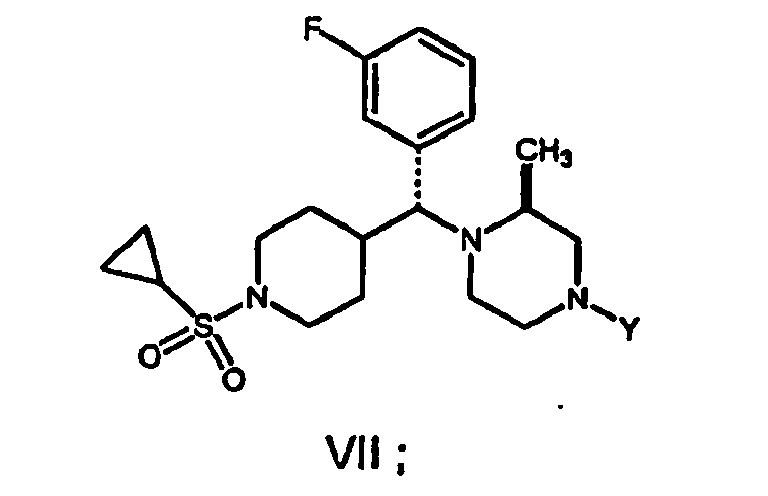
- (b) sulfonylating the compound of formula VI with

to form the compound of formula VII:
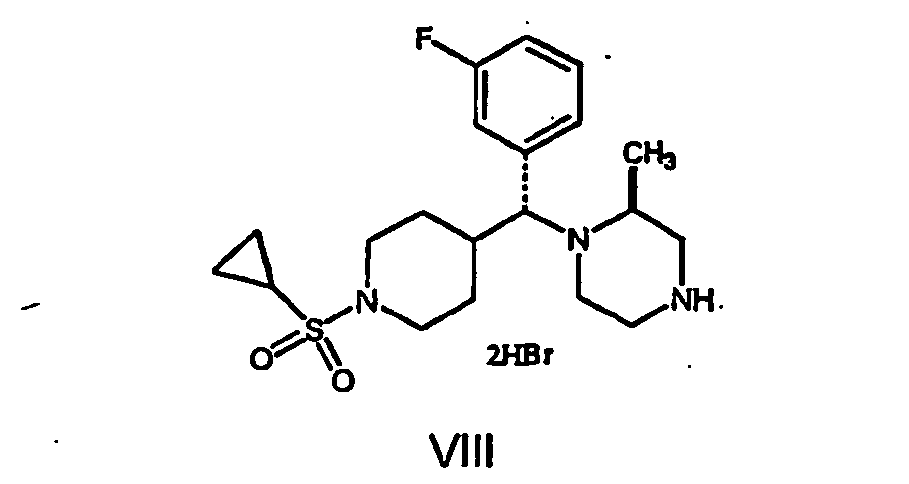
- (c) removing the Y protecting group from the compound of formula VII and then reacting with hydrogen bromide to produce the di-hydrobromide salt formula VIII:

- (d) reacting the compound of formula VIII with (i) an agent containing a leaving group G, where G is a leaving group selected from the group consisting of CN, Z, OSO2R1, OCOCZ3 and benzotriazolyl, with R1 being an alkyl or aryl group and Z is a halogen, and (ii) the compound:


- (e) reacting the compound of formula IX with a Grignard reagent in a suitable solvent, followed by a workup, to yield the compound of formula I.
- The inventive process to make the compound of formula I has numerous advantages including it is economical and can be easily scaled-up.
- Except where stated otherwise, the following definitions apply throughout the present specification and claims. These definitions apply regardless of whether a term is used by itself or in combination with other terms.
- "Acyl" means an H-C(O)-, alkyl-C(O)-, cycloalkyl-C(O)-, or aryl-C(O)- and the like. The bond to the parent moiety is through the carbonyl.
- "Alkyl" means an aliphatic hydrocarbon group which may be straight or branched and comprising about 1 to about 20 carbon atoms in the chain. Preferred alkyl groups contain about 1 to about 12 carbon atoms in the chain. More preferred alkyl groups contain about 1 to about 6 carbon atoms in the chain. Branched means that one or more lower alkyl groups such as methyl, ethyl or propyl, are attached to a linear alkyl chain. "Lower alkyl" means a group having about 1 to about 6 carbon atoms in the chain which may be straight or branched. The term "substituted alkyl" means that the alkyl group may be substituted by one or more substituents which may be the same or different, each substituent being independently selected from the group consisting of halo, alkyl, aryl, cycloalkyl, cyano, hydroxy, alkoxy, alkylthio, amino, -NH(alkyl), -NH(cycloalkyl), -N(alkyl)2, carboxy and -C(O)O-alkyl. Non-limiting examples of suitable alkyl groups include methyl, ethyl, n-propyl, isopropyl and t-butyl.
- "Alkylsulfonate" means an alkyl-S(O2)-O- group in which the alkyl group is as previously described. Preferred groups are those in which the alkyl group is lower alkyl. The bond to the parent moiety is through the oxygen.
- "Aryl" means an aromatic monocyclic or multicyclic ring system comprising about 6 to about 14 carbon atoms, preferably about 6 to about 10 carbon atoms. The aryl group can be optionally substituted with one or more "ring system substituents" which may be the same or different, and are as defined herein. Non-limiting examples of suitable aryl groups include phenyl and naphthyl.
- "Cycloalkyl" means a non-aromatic mono- or multicyclic ring system comprising about 3 to about 10 carbon atoms, preferably about 5 to about 10 carbon atoms. Preferred cycloalkyl rings contain about 5 to about 7 ring atoms.
- "Halide" means fluoro, chloro, bromo or iodo.
- "Halogen" means fluoro, chloro, bromo or iodo.
- "Heterocyclic" means a non-aromatic saturated monocyclic or multicyclic ring system comprising about 3 to about 10 ring atoms, preferably about 4 to about 7 ring atoms, in which one or more of the atoms in the ring system is an element other than carbon, for Preparative Example nitrogen, oxygen or sulfur, alone or in combination. There are no adjacent oxygen and/or sulfur atoms present in the ring system. Preferred heterocyclyls contain about 5 to about 6 ring atoms. The prefix aza, oxa or thia before the heterocyclyl root name means that at least a nitrogen, oxygen or sulfur atom respectively is present as a ring atom. Any -NH in a heterocyclyl ring may exist protected such as, for example, as an -N(Boc), -N(cbz), -N(Tos) group and the like; such protections are also considered part of this invention.
- "PMB" means p-methoxybenzyl.
- "Triflate" means trifluoromethanesulfonyl.
- In one embodiment, the present invention discloses a novel, easy-to-use process for preparing the compound of formula I. The process comprises:
- (a) converting the compound of formula II:


- (b) reacting the compound of formula III with a suitable reducing reagent, followed by purification through formation of a bisulfite salt and subsequent treatment with a base, to yield a compound of formula IV:

- (c) reacting the compound of formula IV with (i) the compound of formula:


- (d) removing the X protecting group of the compound of formula V to produce a compound of formula VI:

- (e) sulfonylating the compound of formula VI with a cyclopropyl


- (f) removing the Y protecting group from the compound of formula VII and reacting with hydrogen bromide to produce the di-hydrobromide salt formula VIII:

- (g) reacting the compound of formula VIII with an agent containing a leaving group G where G is a leaving group preferably selected from the group consisting of CN, Z, OSO2R1, OCOCZ3 and benzotriazolyl, with R1 being an alkyl or aryl group and Z is a halogen; and the compound of Formula VIIIa:


- (h) reacting the compound of formula IX with a Grignard reagent in a suitable solvent to yield the compound of formula I.
- As stated above, X and Y are not the same moiety since X and Y are to be differentiated under the reaction conditions employed.
- The preferred protecting group for X is p-methoxybenzyl (PMB):

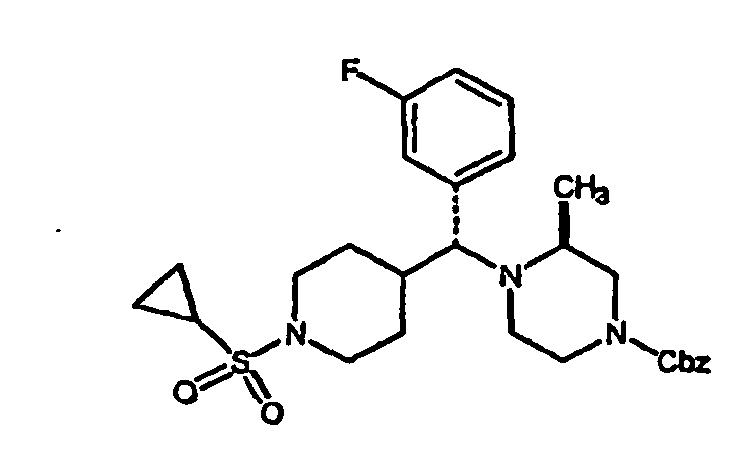
- The preferred protecting group for Y is carbobenzyloxy (Cbz):

- Protecting groups are sometimes named as carbamates herein for convenience; for example Cbz could be referred to as benzyl carbamate and so forth.
- The deprotection in step (d) is performed using 2,3-dichoro-5,6-dicyano-1,4-benzoquinone or trifluoroacetic anhydride. Preferably, the deprotection is performed using trifluoroacetic anhydride.
- The preferred W in step (e) is Cl.
- The deprotection in step (f) is performed using strong acids such as sulfuric acid, hydrochloric acid, hydrobromic acid, methanesulfonic acid and the like. Preferably, the protection is accomplished using methanesulfonic acid.
- The reaction in step (g) comprises (1) converting compound of formula VIII to a free base by use of a basic compound and (2) reacting free base with an agent containing a leaving group G and the compound of Formula VIIIa:

- The term "an agent containing a leaving group G" refers to a compound that upon reaction as shown herein, leaves a moiety G described above on the compound being reacted. Thus, the above-noted phrase "where G is a leaving group preferably selected from the group consisting of CN, Z, OSO2R2, OCOCZ3 and benzotriazolyl" means that the compound (agent) contains in it as bonded moiety CN, Z, OSO2R2, OCOCZ3 or benzotriazolyl, and then leaves the CN, Z, OSO2R2, OCOCZ3 or benzotriazolyl upon being reacted with the compound of Formula VIII to form the compound of Formula IX as a result of said reaction. The more preferred agent containing a leaving group is a cyanating agent and is selected from the group consisting of: HCN, acetone cyanohydrin; cyclohexanone cyanohydrin; a mixture of (C2H5)AlCN and Ti(OPr)4, a mixture of acetic acid, H2SO4; NaHSO4, KHSO3 or Na2S2O5 and a cyanide source such as NaCN or KCN; trimethylsilylcyanide; glycolonitrile; mandelonitrile; glycinonitrile; acetone amino nitrile; and dimethylaminoacetonitrile. Most preferably, the cyanating agent is acetone cyanohydrin.
- The acetone cyanohydrin is used in about 1-5 molar equivalents with respect to the compound of formula VIII.

- The basic compound in step (g) is selected from the group consisting of a metal hydroxide, oxide, carbonate and a bicarbonate, wherein the metal is selected from the group consisting of lithium, sodium, potassium, rubidium, cesium, beryllium, magnesium, calcium, strontium, barium, aluminum, indium, thallium, titanium, zirconium, cobalt, copper, silver, zinc, cadmium, mercury and cerium; a metal salt of a C1-C12 alkanol, a C3-C12 cycloalkanol, a (C3-C8 cycloalkyl)C1-C6 alkanol; ammonia, a C1-C12 alkylamine, a di(C1-C12 alkyl)amine, a C3-C8 cycloalkylamine, a N-(C3-C8 cycloalkyl)-N-(C1-C12 alkyl)amine. a di(C3-C8 cycloalkyl)amine, a (C3-C8 cycloalkyl)C1-C6 alkylamine, a N-(C3-C8-cycloalkyl)C1-C6-alkyl-N-(C1-C12 alkyl)amine, a N-(C3-C8 cycloalkyl)C1-C6 alkyl-N-(C3-C8 cycloalkyl)amine, a di[(C1-C6 cycloalkyl)C1-C6 alkyl[amine; and a heterocyclic amine selected from the group consisting of imidazole, triazole, pyrrolidine, piperidine, heptamethyleneimine, morpholine, thiomorpholine and a 1-(C1-C4 alkyl)piperazine.
- Preferably, the basic compound is selected from the group consisting of KOH, NaOH, Na2CO3, K2CO3, NaHCO3, KHCO3, tetramethylguanidine, DBU, diisopropylethylamine and mixtures thereof. More preferably, the basic compound is Na2CO3 or K2CO3. Most preferably, the basic compound is K2CO3.
- The Grignard reagent in step (h) is selected from the group consisting of MeMgCl, MeMgBr and MeMgl and is most preferably MeMgCl.
- The MeMgCl is used in about 1-4 molar equivalents with respect to the compound of formula IX.
- The solvent in step (h) is selected from the group consisting of toluene, xylene, chlorobenzene, or dichlorobenzene alone or in admixture with a solvent selected from the group consisting of a C5-C12 alkyl ether, 1,2-dimethoxyethane, 1.2-diethoxyethane, diglyme, 1,4-dioxane and tetrahydrofuran. The preferred solvent is a mixture of toluene and tetrahydrofuran.
- The work-up in step (h) is treatment with an acid such as sulfuric acid, hydrochloric acid, phosphoric acid, and the like, in an aqueous phase and is preferably hydrochloric acid.
- In another embodiment, the application teaches a method for the preparation of a compound of formula V from a compound of formula IV:


- The solvent is selected from the group consisting of hydrocarbons, halogenated hydrocarbons, ethers, and mixtures thereof, and is preferably a mixture of toluene and tetrahydrofuran.
- The inventive process is schematically described in Scheme I:

- The term "alkyl" refers to a monovalent group derived from a straight or branched chain saturated hydrocarbon by the removal of a single atom having from 1 to 8 carbon atoms, preferably from 1 to 6. The term "aryl" represents a carbocyclic group having from 6 to 14 carbon atoms and having at least one benzenoid ring, with all available substitutable aromatic carbon atoms of the carbocyclic group being intended as possible points of attachment. Preferred aryl groups include phenyl, 1-naphthyl and 2-naphthyl, and especially phenyl. The term "halogen" represents fluorine, chlorine, bromine and iodine.
- If desired, the compound of formula I may be further converted to the CCR5 antagonist of formula X by suitable procedures known to those skilled in the art.
- The products of the various steps in the reaction schemes described herein may be isolated and purified by conventional techniques such as, for example, filtration, recrystallization, solvent extraction, distillation, precipitation, sublimation and the like, well known to those skilled in the art. The products may be analyzed and/or checked for purity by conventional methods well known to those skilled in the art such as, for example, thin layer chromatography, NMR, HPLC, melting point, mass spectral analysis, elemental analysis and the like.
- The following nonlimiting EXAMPLES are provided in order to further illustrate the present invention. It will be apparent to those skilled in the art that many modifications, variations and alterations to the present disclosure, both to materials, methods and reaction conditions, may be practiced.
- Unless otherwise stated, the following abbreviations have the stated meanings in the Examples below:
- CDCl3=
- Deuterochloroform
- Cbz=
- carbobenzyloxy
- DSC=
- Differential Scanning Calorimetry
- DMSO=
- dimethylsulfoxide
- EtOH=
- ethanol
- g=
- grams
- HCl=
- hydrochloric acid
- HPLC=
- High Performance Liquid Chromatography M.pt: melting point
- MHz=
- megahertz
- mL=
- milliliters
- MS=
- Mass Spectrum
- MTBE=
- methyl t-butyl ether
- NaOH=
- sodium hydroxide
- NMR=
- nuclear magnetic resonance spectroscopy
- PMB=
- p-methoxybenzyl
- THF=
- tetrahydrofuran
- Compound III is prepared from compound II and p-anisaldehyde via reductive amination. Compound II (50 g, 318 mmol) is added to a stirred slurry of sodium triacetoxyborohydride (101.1g, 1.5 equiv) in anhydrous tetrahydrofuran (500 mL). p-Anisaldehyde (45.5g, 1.05 equiv) is next added to the batch slowly at a batch temperature below 25°C. The mixture is stirred for about 16 hours at room temperature. Upon completion the reaction is quenched with the addition of water (150 mL), and THF is removed via vacuum distillation. MTBE and water are added to the batch followed by pH adjustment to 1.5-2.5 with hydrochloric acid. The batch is filtered to remove boric acid before splitting the layers. The product containing aqueous layer is washed with MTBE. After splitting, fresh MTBE is charged to aqueous layer followed by pH adjustment to 9-11 with sodium hydroxide. After splitting, the aqueous layer is charged with MTBE, the mixture is filtered and the phases are separated. The combined organic layers are concentrated and diluted with toluene. The batch is concentrated under vacuum to a final volume of 150 mL. This solvent displacement provides III in about 90-95% yield as an approximately 50% solution in toluene. The product solution is filtered to remove residual solids and is used directly in the next step. For oxalate salt of compound III: 1H NMR (400 MHz, DMSO-d6) δ 7.41 (m, 2H), 6.92 (m, 2H), 4.11 (br, 4H), 3.80 (s, 3H), 3.20 (br, 2H), 2.82 (br, 2H), 2.61 (s, 1H), 2.05 (d, J = 6.5 Hz), 1.85 (br, 2H), 1.21 (t, J = 7.1 Hz, 3H); 13C NMR (100.6 MHz, DMSO-d6) δ 173.5. 164.6, 160.1, 132.7, 123.2, 114.4. 60.6, 59.1, 55.5, 50.4, 39.2, 38.2, 25.5, 14.4; MS (ESI) for M+H calcd. 278, found 278.
- Literature reference: Abe, T.; Haga, T.; Negi, S.; Morita, Y.; Takayanagi, K.; Hamamura, K. Tetrahedron, 2001, 57, 2701.
- The modified Red-Al reagent is prepared according to the above literature reference: Red-Al solution (150 mL, 70wt% in toluene) is charged to a clean reaction vessel under nitrogen. MTBE (180 mL) is added to dilute the reagent and the batch is cooled to -25°C. Pyrrolidine (52 mL) is slowly charged to the batch maintaining the temperature below - 5°C. The batch is warmed to 25°C and agitated for 10 hours. A slurry of potassium t-butoxide (4.3 g) in THF (12 mL) is added and the mixture is agitated for 1 hour to give the modified Red-Al reagent.
- To a solution of III in toluene (containing 100 g active, 360 mmole) diluted with MTBE (100 mL) is slowly charged the above modified Red-Al reagent at a temperature below 10°C. Batch is agitated at 5-10°C until the reaction completion is indicated by GC analysis. Batch is cooled to -5°C and quenched first with a solution of sodium citrate dihydrate (120 g) in water (400 mL), followed by addition of an aqueous solution of citric acid to adjust pH to 8-9 range. The product containing organic layer is washed with water. The crude product aldehyde IV is extracted from organic layer with two washes of aqueous sodium bisulfite. The pH of combined bisulfite extracts is adjusted to 9-10 using potassium carbonate (approx. 120 g) in water (250 mL). The precipitated bisulfite salt IVa is collected by filtration and washed with MTBE. A sample of the bisulfite salt was dried to give a white solid. 1H NMR (400 MHz, DMSO-d6) δ 7.14 (d, J = 8.4 Hz, 2H), 6.81 (d, J = 8.4 Hz, 2H), 4.82 (d, J = 5.3 Hz, 1H), 3.68 (s, 3H), 3.57 (t, J = 5.2 Hz, 1H), 3.27 (s, 2H), 2.71 (br d, J = 10.9 Hz, 2H), 1.62 (m, 5H), 1.25 (m, 2H).
- The wet bisulfite salt IVa is suspended in MTBE (300 mL) at 25°C and treated with 25% NaOH (250 mL) for 1 hour. After split, product containing organic layer is concentrated and the solvent is exchanged to toluene to a final volume of 300 mL. The solution of III in toluene is used directly in the next step. A purified sample of IV gives the following spectral data: 1H NMR (400 MHz, CDCl3): δ 9.65 (s, 1H), 7.25 (m, 2H), 6.82 (m, 2H), 3.82 (s, 3H), 3.41 (s, 2H), 2.82 (m, 2H), 2.25 (m, 1H), 2.15 (m, 2H), 1.91 (m, 2H), 1.70 (m, 2H). MS (ESI) for M+H calcd. 234, found 234.
- Benzotriazole (57.0 g), toluene (1 L) and solution of A (105.5 g active) in toluene are charged to vessel equipped with a Dean-Stark collection apparatus under nitrogen. A solution of IV (100.0 g active, 429 mmol) in toluene is charged keeping the batch temperature below 30°C. The batch is heated to reflux (110 - 120°C) and agitated until water collection in the Dean-Stark trap is complete. The batch is atmospherically concentrated and a sample is taken to check for reaction completion by NMR and batch KF. The batch is further concentrated under vacuum to 300 mL. Anhydrous THF (1800 mL) is added at 50-60°C and the batch is cooled to 15°C. A solution of 3-fluorophenylmagnesium bromide in THF (643 mL of 1.0 M solution) is slowly charged to the batch keeping the batch temperature below 25°C. Upon reaction completion by HPLC, the batch is quenched at 0°C by adding a solution of sodium citrate in water (100 mL, 22 wt%) and the organic layer is concentrated to 800 mL by atmospheric distillation. The batch is cooled to 25 °C and MTBE (800 mL) is added followed by a solution of sodium citrate in water (500 mL, 22 wt%) are added. The batch is warmed up to 35 °C and agitated for 15 min. The aqueous layer is extracted with fresh MTBE (500 mL). Organic layers are combined, washed with sodium hydroxide (400 mL, 2.0 N) to remove benzotriazole and finally concentrated to 400 mL. The prepared solution of V is kept warm at 50-60°C to avoid solidification and used directly in the next step. A purified sample of V gives the following spectral data: 1H NMR (400 MHz, CDCl3) of a purified sample of V: δ 7.20 (m, 9H), 6.75 (m, 4H), 5.01 (m, 2H), 3.65 (s, 3H), 3.51 (d, J = 8.1 Hz, 1H), 3.36 (s, 2H), 2.81 (br, 2H), 2.58 (br, 1H), 1.85 (m, 5H), 1.20 (m, 2H), 1.05 (br, 4H). MS (ESI) for M+H calcd. 546, found 546.
- A solution of V (109 g, 199 mmol) is cooled to 0 °C and triethylamine (56 mL) is added. Trifluoroacetic anhydride (56 mL) is added slowly to the batch keeping the temperature below 10°C. The batch is warmed to 20°C and agitated for 1 hour. A sample is taken to check for reaction completion by HPLC. Batch is cooled to 0°C and water (300 mL) is charged keeping the temperature below 10°C. Batch is agitated for 30 min, settled, and aqueous layer is split to waste. The organic layer is a solution of compound Va. A purified sample of Va gives the following spectral data: 1H NMR (400 MHz, CDCl3): δ 7.32 (m, 6H), 6.85 (m, 3H), 5.05 (br, 2H), 4.69 (m, 1H), 4.45 (m, 1H), 4.05 (br, 3H), 3.75 (m, 1H), 3.20 (m, 3H), 2.74 (m, 2H), 2.25 (br, 2H), 1.75 (s, 2H), 1.45 (m, 2H), 1.20 (m, 3H). MS (ESI) for M+H calcd. 522.2, found 522.2.
- The above solution of Va is charged with benzyl triethylammonium chloride (15 g) and 25% sodium hydroxide solution (200 g). The batch is heated to 55°C and agitated for 3 hours. A sample is taken to check for reaction completion by HPLC. The batch is cooled to 20°C, settled and aqueous layer is split to waste. The pH is adjusted to 0-1 with hydrochloric acid. Batch is agitated at 25°C for 1 hour, settled, and the product containing aqueous layer was split and washed twice with isopropyl acetate to remove non-basic impurities. THF (250 mL) and MTBE (250 mL) were charged to the batch, followed by pH adjustment to 11-12 with sodium hydroxide. Product containing organic layer was washed with 20% sodium chloride solution (300 mL). The solvent is exchanged to toluene, the batch is azeotropically dried and concentrated to 500 mL. The prepared solution of VI in toluene was used directly in the next step. A purified sample of VI gives the following spectral data: 1H NMR (400 MHz, CDCl3) δ 7.35 (m, 5H), 7.25 (m, 1H), 6.96 (m, 1H), 6.90 (m, 1H), 6.85 (m, 1H), 5.10 (br, 2H), 3.90 (br, 2H), 3.67 (m, 1H), 3.15 (m, 1H), 3.01 (m, 2H), 2.70 (br, 4H), 2.20 (m, 5H), 1.32 (m, 1H), 1.21 (m, 4H), 1.05 (m, 1H). MS (ESI) for M+H calcd. 426, found 426.
- A warm solution of V (80 g active, 147 mmol) is diluted with EtOH (1000 mL) and concentrated atmospherically to a final volume of 700 mL. Batch is cooled to 25°C and aqueous solution of NaOH (170 mL, 50 wt%) is charged keeping the batch temperature below 40°C. The batch is heated to reflux and agitated at reflux for about 6 hours until the conversion is complete by HPLC. The batch is cooled to 25°C and concentrated under vacuum to a volume of about 300 mL.
Water (600 mL) and MTBE (500 mL) are added to the batch, temperature is adjusted to 30-40°C. After agitation, settling and split, the aqueous layer is extracted with fresh MTBE (200 mL), and organic layers are combined. The product is back-extracted with dilute hydrochloric acid at pH∼5-6. The aqueous layer is washed with fresh MTBE, diluted with MTBE (500 mL), and the batch pH is adjusted to 12-14 with sodium hydroxide. Aqueous layer is split, extracted with fresh MTBE (500 mL). The combined organic layers are washed with water and concentrated by atmospheric distillation to 400 mL volume and cooled to 40°C. Isopropyl alcohol is charged (1600 mL) and the batch is concentrated by atmospheric distillation to 1200 mL volume. Batch is cooled to 25°C and treated with activated carbon (10 g, DARCO®) at reflux for 2 hours. The batch is cooled to 25°C, filtered through celite pad, followed by wash of celite cake with isopropyl alcohol (200 mL). The filtrate is concentrated by atmospheric distillation to 500 mL volume and diluted with fresh isopropyl alcohol (700 mL). Solution of oxalic acid (40 g) in isopropyl alcohol (200 mL) is added keeping the batch temperature below 30°C. MTBE (1500 mL) is added and the batch is heated to reflux and agitated for 4 hours. The batch is cooled to 20°C and precipitated product is filtered. The cake is washed with isopropyl alcohol/MTBE mixture (400 mL, 1:1 v/v) and dried under vacuum with nitrogen purge at 70-80°C to give 140.0 g of Vb as an off-white solid. m.p.: 194°C by DSC. 1H NMR (400 MHz, CDCl3) δ 7.31 (m, 2H), 6.93 (m, 1H), 6.82 (m, 4H), 6.65 (m, 1H), 3.52 (d, J=10.1 Hz, 1H), 3.41 (s, 2H), 3.33 (s, 3H), 2.97 (m, 1H), 2.71 (m, 1H), 2.55 (m, 2H), 2.35 (m, 2H), 2.10 (m, 1H), 1.95 (m, 1H), 1.79 (m, 2H), 1.70 (m, 1H), 1.4 (m, 1H), 1.2 (m, 2H). MS (ESI) for M+H calcd. 412, found 412. - Solid compound Vb (100 g, 199 mmol) and N-(benzyloxycarbonyloxy) succinimide (53 g) are charged to a reaction vessel under nitrogen atmosphere. THF (300 mL) and water (300 mL) are added and batch is agitated at 25°C for 30 min. Batch is then warmed to 35 °C and agitated for an additional 3 hours. A sample is taken to check for reaction completion by HPLC. Toluene (500 mL) is charged to the batch. A solution of potassium carbonate (200 g) in water (200 mL) is charged slowly maintaining batch temperature below 20°C. Batch pH is adjusted to a range of 9-11. The lower aqueous layer is split and extracted with toluene (300 mL). Organic layers are combined, washed with water and concentrated by atmospheric distillation to 450 mL volume to give a solution of V.
- To a solution of compound VI (100 g active, 235 mmol) is charged toluene (500 mL) and triethylamine (28 g) and the batch is cooled to 0°C. Cyclopropyl sulfonyl chloride (36.5 g) is added keeping the batch temperature below 10°C. The batch is agitated at 0°C for 2 hours and sampled for reaction completion. Batch is washed with a solution of 10% acetic acid in water (200 mL) to give a solution of VII in toluene. A purified sample of VII gives the following spectral data: 1H NMR (400 MHz, CDCl3): δ 7.28 (m, 6H), 6.95 (m, 1H), 6.87 (m, 1H), 6.78 (m, 1H), 5.05 (br, 2H), 3.85 (d, J=12 Hz, 2H), 3.65 (m, 2H), 2.80 (m, 5H), 2.25 (m, 3H), 1.15 (m, 6H), 0.95 (m, 3H); 13C NMR (100.6 MHz, DMSO-d6) δ 171.1, 163.9. 161.4, 154.8, 138.0, 136.6, 129.6, 128.5, 128.0, 124.8, 114.4, 67.0, 60.3, 51.5, 46.5, 46.3, 35.2, 29.7, 25.6, 21.0, 14.1, 4.2. MS (ESI) for M+H calcd. 530, found 530.
- To the above solution is added a solution of methanesulfonic acid (250 mL) in water (250 mL) keeping the temperature below 30°C. The batch is warmed to 50°C, agitated for 30 min, settled and product containing aqueous layer is split. The organic layer is washed with methanesulfonic acid (250 mL) in water (250 mL). The combined aqueous layers are heated at 100°C for 15-20 hours. A sample is taken to check for reaction completion by HPLC. Batch is cooled to 25°C and toluene (500 mL) is added, followed by slow addition of 50% sodium hydroxide (100 mL). Batch is agitated for 15 min and a sample is taken to ensure pH < 2.0. The batch is settled for at least 1 hour and then the product containing aqueous layer split. THF is added to the aqueous layer and the batch is cooled to 0 °C. Batch pH is carefully adjusted to 8-10 range using 50 wt% sodium hydroxide keeping the temperature below 30 °C. The aqueous layer is split to waste, and organic layer is concentrated solvent-exchanged to isopropyl alcohol. The batch is passed twice through CUNO® cartridges containing DARCO®-G60. The batch is heated to 75°C and 48% hydrobromic acid solution (98 g) is added slowly. The batch is heated to reflux (80-85°C) and agitated for 3-5 hours until the start of product crystallization. The batch was slowly cooled to 15°C over 4 hours, held at 15°C for 1 hour and then filtered. Isolated cake was washed twice with isopropyl alcohol (170 mL total) and dried under vacuum at 60°C. Obtained 100.4 g of compound VIII as an off-white solid. m.p.: 176°C by DSC. 1H NMR (400 MHz, CDCl3) δ 7.31 (m, 1H), 7.05 (m, 1H), 6.91 (m, 1H), 6.82 (m, 1H), 3.86 (br d, J = 12.0 Hz, 1H), 3.67 (m, 1H), 3.63 (d, J = 10.5 Hz, 1H), 2.75 (br m, 5H), 2.50 (m, 2H), 2.25 (m, 2H), 2.15 (m, 1H), 2.02 (s, 2H), 1.30 (m, 3H), 1.10 (m, 6H), 0.95 (m, 2H). MS (ESI) for M+H calcd. 396, found 396.
- Compound VIII (100g, 179 mmol) is suspended in ethyl acetate (1000 mL) and treated with a solution of aqueous potassium carbonate (52 g, 2.1 eq, in 500 mL water). The aqueous layer is split off at 35-45°C and the organic layer is washed with water at 35-45°C. The organic layer is azetropically dried and mixed with compound B (42 g, 1 eq) and acetone cyanohydrin (18 g , 1.2 eq). The resulting mixture is concentrated atmospherically to 300 mL over 8-10 hours. The concentrate is diluted with ethyl acetate (900 mL) and filtered through a bed of Celite (10 g). The filtrate is atmospherically concentrated to 400 mL and heptane (150 mL) containing compound IX seeds is added at reflux. After heated at reflux for 1 hour, additional heptane (150 mL) is added at reflux. The resulting slurry is heated at reflux for 1 hour and cooled over 1 hour to room temperature. After stirring at room temperature for 1 hour, the slurry is filtered and washed with 1:1 ethyl acetate/heptane (200 mL). The wet cake is dried at 45°C under vacuum overnight to give a white solid (96 g, 84% yield). m.p.: 185°C by DSC. 1H NMR (400 MHz, CDCl3): δ 8.98 (s, 1H), 7.29 (dt, J1 = 7.8 Hz, J2 = 6.1 Hz, 1H), 6.97 (dt, J1 = 8.4 Hz, J2 = 2.1 Hz, 1 H), 6.87 (d, J = 7.6 Hz, 1H), 6.80 (br d, J = 9.7 Hz, 1H), 4.53 (br d, J = 14.2 Hz, 1H), 3.87 (br d, J = 12.0 Hz, 1H), 3.66 (m, 2H), 3.32 (m, 2H), 3.22 (m, 1H), 2.60-2.95 (m, 5H), 2.41 (s, 3H), 2.37 (s, 3H), 2.35 (m, 1H), 2.22 (m, 4H), 2.05 (m, 4H), 1.65 (m, 1H), 1.55 (m, 1H), 1.30 (m, 2H), 1.15 (m, 6H), 0.95 (m, 2H), MS (ESI) for M+H calcd. 638, found 638.
- To a solution of compound IX (250.0g, 393 mmol) in tetrahydrofuran (1250 mL) cooled to 15-25°C was added ∼20 wt % of trimethyl aluminum in toluene (500 mL, 530 mmol). To the resulting homogeneous solution was slowly added 3.0M methyl magnesium chloride in tetrahydrofuran (325 mL, 510 mmol) at 15-25°C. The reaction mixture was stirred for 4 hours and then quenched in 10% aqueous sodium citrate solution (1575 mL) maintained at 35-45°C. The organic layer was washed with 10% aqueous sodium citrate solution (550 mL). The organic layer was washed with 1.5M aqueous HCl (442 ml). The aqueous acidic layer was digested at 35-45°C for 4 hours and then cooled to 15-25°C. The aqueous layer was neutralized with 25% aqueous NaOH (119 mL) and then extracted into isopropyl acetate (1250 mL). The organic layer was washed with water (500 mL) and then evaporated under vacuum to give a foam. The yield was 96%. 1H NMR (400 MHz, CDCl3): δ 8.6 (s, 1H); 7.3 (t, J = 6.2 Hz, 1H); 7.0 (t, J = 7.2 Hz, 1H); 6.9 (d, J = 7.5 Hz, 1H); 6.8 (d, J = 8.6 Hz, 1H); 4.0 (br, 1H); 3.8 (br, 1H); 3.6 (br m, 2H); 3.3 (t, J=11.0 Hz, 1H); 3.2 (t, J=11.0 Hz, 1H); 2.7 (br m, 5H); 2.5 (br, 1H); 2.4 (s, 3H); 2.3 (s, 3H); 2.2 (br m, 5H); 1.9 (br m, 3H); 1.7 (br, 1H); 1.4 (br m, 3H); 1.1 and 1.0 (br m, 7H); 0.93 (m, 2H), 0.88 (s, 3H). MS (ESI) for M+H calcd. 627, found 627.
- While the EXAMPLES are described herein as the preparation of the compounds indicated, it will be apparent to those skilled in the art that any modifications, variations and alterations to the present disclosure, both to materials, methods and reaction conditions, may be practiced.
Claims (52)
- A process for preparing a compound of formula (I)

 (a) selectively removing the X protecting group of the compound of formula V to produce a compound of formula VI:
 (b) sulfonylating the compound of formula VI with a cyclopropyl sulfonyl moiety, where W is a first leaving group:
 (c) removing the Y protecting group from the compound of formula VII and reacting with hydrogen bromide to produce the di-hydrobromide salt formula VIII:
 (d) reacting the compound of formula VIII with (I) an agent containing a leaving group G where G is a second leaving group selected from the group consisting of CN, Z, alkylsulfonates, OCOCZ3 and benzotriazolyl, with Z being a halogen; and (ii) the compound of Formula VIIIa:
 (e) reacting the compound of formula IX with a Grignard reagent in a suitable solvent, followed by workup, to yield the compound of formula I,with the proviso that X and Y are different such that X may be selectively removed.
 - The process according to claim 1, wherein X is selected from the group consisting of: p-methoxybenzyl (PMB), allyl, methoxymethyl, benzyloxymethyl, trityl, pivaloyloxymethyl, tetrahydranyl, benzyl, di(p-methoxyphenyl)methyl, triphenylmethyl, (p-methoxyphenyl)-diphenylmethyl and t-butyl carbamate ("t-Boc").
- The process according to claim 2, wherein X is p-methoxybenzyl (PMB):

- The process according to claim 1, wherein Y is selected from the group consisting of: carbobenzyloxy (Cbz), CZ3CO (where Z is a halogen), 2-trimethylsilylethyl carbamate, 1-methyl-1-phenylethyl carbamate, t-butyl carbamate, cyclobutyl carbamate, 1-methylcyclobutyl carbamate, adamantyl carbamate, vinyl carbamate, allyl carbamate, cinnamyl carbamate, 8-quinolyl carbamate, 4,5-diphenyl-3-oxazolin-2-one, benzyl carbamate, 9-anthrylmethyl carbamate, diphenylmethyl carbamate, S-benzylcarbamate, methyl carbamate, ethyl carbamate, diphenylphosphinyl, benzenesulfenyl, or acyl.
- The process according to claim 4, wherein Y is carbobenzyloxy (Cbz):

- The process of claim 1, wherein W is a halide or triflate.
- The process according to claim 6, wherein W is Cl.
- A process for preparing a compound of formula (V)


- A process for preparing a compound of formula VI:


- A process for preparing a compound of formula VII


- The process for preparing a compound of formula VIII:

- A process for preparing a compound of formula IX:


- A process of preparing a compound of formula I:


- The process of claim 1, wherein said deprotection in step (a) is performed using trifluoroacetic anhydride.
- The process of claim 1, wherein said deprotection in step (a) is performed using 2,3-dichloro-5,6-dicyano-1,4-benzoquinone.
- The process of claim 1, wherein said deprotection in step (c) is performed using methanesulfonic acid.
- The process of claim 1, wherein said deprotection in step (c) is performed using a strong acid selected from the group consisting of sulfuric acid, hydrochloric acid and hydrobromic acid.
- The process of claim 1, wherein step (d) comprises (1) converting said compound of formula VIII to a free base by use of a basic compound and (2) reacting said free base with an agent containing a leaving

- The process of claim 18, wherein said agent containing a leaving group is a cyanating agent and is selected from the group consisting of: HCN, acetone cyanohydrin; cyclohexanone cyanohydrin; a mixture of (C2H5)2AlCN and Ti(OPr)4, a mixture of acetic acid, H2SO4; NaHSO4, KHSO3 or Na2S2O5 and a cyanide source such as NaCN or KCN; trimethylsilylcyanide; glycolonitrile; mandelonitrile; glycinonitrile; acetone amino nitrile; and dimethylaminoacetonitrile.
- The process of claim 19, wherein said cyanating agent is acetone cyanohydrin.
- The process of claim 20, wherein said acetone cyanohydrin is used in about 1-5 molar equivalents with respect to the compound of formula VIII.
- The process of claim 18, wherein the compound of Formula VIIIa is used in about 1-4 molar equivalents with respect to the compound of formula VIII.
- The process of claim 18, wherein said basic compound is selected from the group consisting of:a metal hydroxide, oxide, carbonate and a bicarbonate, wherein the metal is selected from the group consisting of lithium, sodium, potassium, rubidium, cesium, beryllium, magnesium, calcium, strontium, barium, aluminum, indium, thallium, titanium, zirconium, cobalt, copper, silver, zinc, cadmium, mercury and cerium;a metal salt of a C1-C12 alkanol, a C3-C12 cycloalkanol, a (C3-C8 cycloalkyl)C1-C6 alkanol;ammonia, a (C1-C12 alkylamine, a di(C1-C12 alkyl)amine, a C3-C8 cycloalkylamine, a N-(C3-C8 cycloalkyl)-N-(C1-C12 alkyl)amine, a di(C3-C8 cycloalkyl)amine, a (C3-C8 cycloalkyl)C1-C6 alkylamine, a N-(C3-C8-cycloalkyl)C1-C6-alkyl-N-(C1-C12 alkyl)amine, a N-(C3-C8 cycloalkyl)C1-C6 alkyl-N-(C3-C8 cycloalkyl)amine, a di[(C1-C8 cycloalkyl)C1-C6 alkyl(amine; anda heterocyclic amine selected from the group consisting of imidazole, triazole, pyrrolidine, piperidine, heptamethyleneimine, morpholine, thiomorpholine and a 1-(C1-C4alkyl)piperazine.
- The process of claim 23, wherein said basic compound is selected from the group consisting of KOH, NaOH, Na2CO3, K2CO3, NaHCO3, KHCO3, tetramethylguanidine, DBU, diisopropylethylamine and mixtures thereof.
- The process of claim 24, wherein said basic compound is Na2CO3 or K2CO3.
- The process of claim 25, wherein said basic compound is K2CO3.
- The process of claim 1, wherein said Grignard reagent in step (e) is selected from the group consisting of MeMgCl, MeMgBr and MeMgl.
- The process of claim 27, wherein said Grignard reagent is MeMgCl.
- The process of claim 28, wherein said MeMgCl is used in about 1-4 molar equivalents with respect to the compound of formula III.
- The process of claim 1, wherein said solvent in step (e) is selected from the group consisting of hydrocarbons, halogenated hydrocarbons, ethers, and mixtures thereof.
- The process of claim 30, wherein said solvent is selected from toluene, xylene, chlorobenzene, or dichlorobenzene alone or in admixture with a solvent selected from the group consisting of a C5-C12 alkyl ether, 1,2-dimethoxyethane, 1,2-diethoxyethane, diglyme, 1,4-dioxane and tetrahydrofuran.
- The process of claim 1, wherein said work-up in step (e) is treatment with an acid in an aqueous phase.
- The process of claim 32, wherein said acid is HCl.
- The process of claim 32, wherein said acid is a strong acid selected from the group consisting of hydrobromic acid, sulfuric acid, and phosphoric acid.
- The process of claim 8, wherein said solvent is selected from the group consisting of hydrocarbon, ether, and mixtures thereof.
- The process of claim 8, wherein said reagent is benzotriazole.
- The process of claim 9, wherein removal of said PMB protecting group is accomplished with trifluoroacetic anhydride.
- The process of claim 10, wherein said sulfonylating step is performed in toluene and utilizing triethyl amine as the base.
- The process of claim 11, wherein removal of said Cbz is accomplished using methanesulfonic acid.
- The process of claim 12, wherein said agent containing a leaving group is a cyanating agent selected from the group consisting of: HCN, acetone cyanohydrin; cyclohexanone cyanohydrin; a mixture of (C2H5)2AlCN and Ti(OPr)4, a mixture of acetic acid, H2SO4; NaHSO4, KHSO3 or Na2S2O5 and a cyanide source such as NaCN or KCN; trimethylsilylcyanide; glycolonitrile; mandelonitrile; glycinonitrile; acetone amino nitrile; and dimethylaminoacetonitrile.
- The process of claim 40, wherein said cyanating agent is acetone cyanohydrin.
- The process of claim 13, wherein said Grignard reagent is methyl magnesium chloride.
- The process of claim 13, wherein said solvent is a mixture of toluene and tetrahydrofuran.
- A process for preparing a compound of formula (I)

from a compound of formula II: (a) converting the compound of formula II to a compound of formula III by reacting with a reagent that introduces a PMB group:
 (b) reacting said compound of formula III with a suitable reducing reagent, followed by purification through formation of a bisulfite salt and subsequent treatment with a basic compound, to yield a compound of formula IV:
 (c) reacting said compound of formula IV with benzotriazole, 3-fluorophenylmagnesium bromide and the compound:
 (d) removing the PMB protecting group of the compound of formula V to produce a compound of formula VI:
 (e) sulfonylating the compound of formula VI with cyclopropyl sulfonyl chloride, to form the compound of formula VII:
 (f) removing the Cbz protecting group from the compound of formula VII and reacting with hydrogen bromide to produce the di-hydrobromide salt formula VIII:
 (g) reacting the compound of formula VIII with (i) an agent containing a leaving group G where G is a leaving group selected from the group consisting of CN, Z, OSO2R2, OCOCZ3 and benzotriazolyl, with R2 being an allyl or aryl group and Z is a halogen: and (ii) the compound:
 (h) reacting the compound of formula IX with a Grignard reagent in a suitable solvent followed by a workup to yield the compound of formula I.
 - A compound of the formula:

- A compound of the formula::

- A compound of the formula:
- A compound of the formula:

- A compound of the formula:

- A compound of the formula:
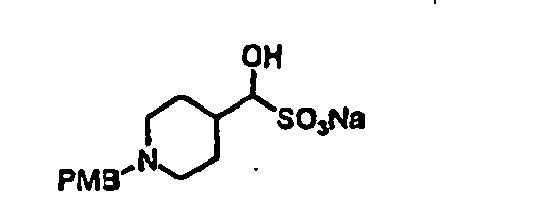
- A compound of the formula:
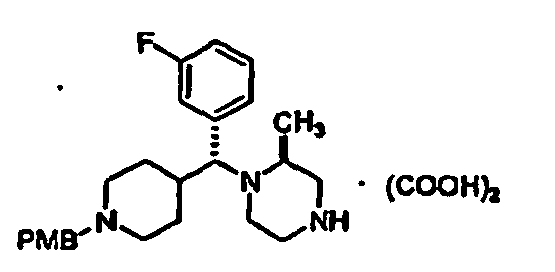
- A compound, including stereoisomers of said compound, of the formula:

Applications Claiming Priority (2)
| Application Number | Priority Date | Filing Date | Title |
|---|---|---|---|
| US64190005P | 2005-01-06 | 2005-01-06 | |
| PCT/US2006/000262 WO2006074270A2 (en) | 2005-01-06 | 2006-01-05 | Synthesis of ccr5 receptor antagonists |
Publications (2)
| Publication Number | Publication Date |
|---|---|
| EP1833817A2 EP1833817A2 (en) | 2007-09-19 |
| EP1833817B1 true EP1833817B1 (en) | 2010-10-13 |
Family
ID=36571985
Family Applications (1)
| Application Number | Title | Priority Date | Filing Date |
|---|---|---|---|
| EP06717461A Expired - Lifetime EP1833817B1 (en) | 2005-01-06 | 2006-01-05 | Synthesis of ccr5 receptor antagonists |
Country Status (12)
| Country | Link |
|---|---|
| US (2) | US7728135B2 (en) |
| EP (1) | EP1833817B1 (en) |
| JP (1) | JP2008526863A (en) |
| CN (1) | CN101137646A (en) |
| AR (1) | AR054422A1 (en) |
| AT (1) | ATE484500T1 (en) |
| CA (1) | CA2594114A1 (en) |
| DE (1) | DE602006017507D1 (en) |
| MX (1) | MX2007008280A (en) |
| SG (1) | SG158861A1 (en) |
| WO (1) | WO2006074270A2 (en) |
| ZA (1) | ZA200705524B (en) |
Families Citing this family (5)
| Publication number | Priority date | Publication date | Assignee | Title |
|---|---|---|---|---|
| AU2005234596B8 (en) | 2004-04-13 | 2011-06-16 | Incyte Holdings Corporation | Piperazinylpiperidine derivatives as chemokine receptor antagonists |
| WO2008079284A1 (en) * | 2006-12-22 | 2008-07-03 | Schering Corporation | Process for preparing ccr-5 receptor antagonists utilizing 4-substituted 1-cyclopropane-sulfonyl-piperidinyl compounds |
| AU2012273125B2 (en) | 2011-06-19 | 2017-05-25 | New York University | Leukotoxin E/D as a new anti-inflammatory agent and microbicide |
| CN103804445B (en) * | 2013-12-30 | 2016-01-13 | 广州自远生物科技有限公司 | A kind of preparation method of acetylisovaleryl tylosin of improvement |
| US11629196B2 (en) | 2020-04-27 | 2023-04-18 | Incelldx, Inc. | Method of treating SARS-CoV-2-associated hypercytokinemia by administering a human monoclonal antibody (PRO-140) that inhibits CCR5/CCL5 binding interactions |
Family Cites Families (2)
| Publication number | Priority date | Publication date | Assignee | Title |
|---|---|---|---|---|
| IL117149A0 (en) | 1995-02-23 | 1996-06-18 | Schering Corp | Muscarinic antagonists |
| CZ20032636A3 (en) * | 2001-03-29 | 2003-12-17 | Schering Corporation | CCR5 antagonizing substances |
-
2006
- 2006-01-05 AR ARP060100038A patent/AR054422A1/en not_active Application Discontinuation
- 2006-01-05 CN CNA2006800071994A patent/CN101137646A/en active Pending
- 2006-01-05 SG SG201000071-9A patent/SG158861A1/en unknown
- 2006-01-05 DE DE602006017507T patent/DE602006017507D1/en not_active Expired - Lifetime
- 2006-01-05 MX MX2007008280A patent/MX2007008280A/en active IP Right Grant
- 2006-01-05 US US11/326,154 patent/US7728135B2/en not_active Expired - Fee Related
- 2006-01-05 AT AT06717461T patent/ATE484500T1/en not_active IP Right Cessation
- 2006-01-05 CA CA002594114A patent/CA2594114A1/en not_active Abandoned
- 2006-01-05 EP EP06717461A patent/EP1833817B1/en not_active Expired - Lifetime
- 2006-01-05 WO PCT/US2006/000262 patent/WO2006074270A2/en not_active Ceased
- 2006-01-05 JP JP2007550449A patent/JP2008526863A/en active Pending
-
2007
- 2007-07-05 ZA ZA200705524A patent/ZA200705524B/en unknown
-
2009
- 2009-10-16 US US12/580,855 patent/US20100036125A1/en not_active Abandoned
Also Published As
| Publication number | Publication date |
|---|---|
| US20060258863A1 (en) | 2006-11-16 |
| EP1833817A2 (en) | 2007-09-19 |
| JP2008526863A (en) | 2008-07-24 |
| ATE484500T1 (en) | 2010-10-15 |
| HK1102303A1 (en) | 2007-11-16 |
| CA2594114A1 (en) | 2006-07-13 |
| SG158861A1 (en) | 2010-02-26 |
| ZA200705524B (en) | 2008-09-25 |
| WO2006074270A2 (en) | 2006-07-13 |
| DE602006017507D1 (en) | 2010-11-25 |
| WO2006074270A3 (en) | 2007-10-04 |
| MX2007008280A (en) | 2007-09-07 |
| AR054422A1 (en) | 2007-06-27 |
| US7728135B2 (en) | 2010-06-01 |
| CN101137646A (en) | 2008-03-05 |
| US20100036125A1 (en) | 2010-02-11 |
Similar Documents
| Publication | Publication Date | Title |
|---|---|---|
| US8008479B2 (en) | Organic compounds | |
| US7923567B2 (en) | Process for preparing valsartan | |
| DK2593429T3 (en) | A process for preparing a biphenyl-2-ylcarbamic acid | |
| JPH0757748B2 (en) | 3-Aminopiperidine derivatives and related nitrogen-containing heterocyclic compounds | |
| US20100036125A1 (en) | Synthesis of ccr5 receptor antagonists | |
| EP2240441B1 (en) | Process for the preparation of 6-substituted-1-(2h)-isoquinolinones | |
| WO2023104920A1 (en) | Crystalline acetone solvate of revefenacin | |
| HK1102303B (en) | Synthesis of ccr5 receptor antagonists | |
| JP2010254692A (en) | Method for purifying paliperidone | |
| JP2020070296A (en) | Method for producing linagliptin | |
| US7473778B2 (en) | 3-(4-piperidinyl)-2,3,4,5-tetrahydro-1,3-benzodiazepin-2(1H)-one | |
| KR20200088570A (en) | Process for Preparation of Fimasartan and Intermediate for Preparing the Same | |
| KR101628946B1 (en) | Improved Process of Silodosin | |
| EP2616464B1 (en) | Improved process for the preparation of a precursor of sufentanil base | |
| KR101009404B1 (en) | (S) -ene- (1-carboxy-2-methyl-pro-1-fil) -ene-pentanoyl-ene- [2 '-(1H-tetrazol-5-yl) biphenyl-4-yl -Purity preparation method of -methyl] amine compound | |
| EP3365327B1 (en) | Process for the preparation of fexofenadine and of intermediates used therein | |
| WO2026037241A1 (en) | Preparation method for isoindoline compound, intermediate thereof, and preparation method for intermediate | |
| EP2125733A1 (en) | Process for preparing ccr-5 receptor antagonists utilizing 4-substituted 1-cyclopropane-sulfonyl-piperidinyl compounds | |
| US9512077B2 (en) | Process for the preparation of methylphenidate hydrochloride and its intermediates thereof | |
| US20040181070A1 (en) | Process and intermediates for the preparation of 4-aryl piperidines | |
| CN115925615A (en) | A kind of preparation method of optically pure 2-methylpiperidin-5-amine | |
| JP2010526126A (en) | Method for producing valsartan | |
| JPH10147593A (en) | Method for producing 3-aminosteroid derivative |
Legal Events
| Date | Code | Title | Description |
|---|---|---|---|
| PUAI | Public reference made under article 153(3) epc to a published international application that has entered the european phase |
Free format text: ORIGINAL CODE: 0009012 |
|
| 17P | Request for examination filed |
Effective date: 20070713 |
|
| AK | Designated contracting states |
Kind code of ref document: A2 Designated state(s): AT BE BG CH CY CZ DE DK EE ES FI FR GB GR HU IE IS IT LI LT LU LV MC NL PL PT RO SE SI SK TR |
|
| AX | Request for extension of the european patent |
Extension state: AL BA HR MK YU |
|
| REG | Reference to a national code |
Ref country code: HK Ref legal event code: DE Ref document number: 1102303 Country of ref document: HK |
|
| R17D | Deferred search report published (corrected) |
Effective date: 20071004 |
|
| RIN1 | Information on inventor provided before grant (corrected) |
Inventor name: WU, WENXUE Inventor name: SHIH, XIONGWEI Inventor name: ZHU, MAN Inventor name: DAHANUKAR, VILAS Inventor name: ZAVIALOV, ILIA, A. Inventor name: TRAN, LOC, THANH Inventor name: LEONG, WILLIAM Inventor name: ZHAO, SHANNON Inventor name: ORR, CECILIA Inventor name: LEE, HONG-CHANG Inventor name: LIU, YI Inventor name: NGUYEN, HOA, N. Inventor name: LIANG, FENG Inventor name: D'SA, BOSCO |
|
| 17Q | First examination report despatched |
Effective date: 20081006 |
|
| GRAP | Despatch of communication of intention to grant a patent |
Free format text: ORIGINAL CODE: EPIDOSNIGR1 |
|
| GRAS | Grant fee paid |
Free format text: ORIGINAL CODE: EPIDOSNIGR3 |
|
| RIN1 | Information on inventor provided before grant (corrected) |
Inventor name: LEE, HONG-CHANG Inventor name: LEONG, WILLIAM Inventor name: WU, WENXUE Inventor name: ZAVIALOV, ILIA, A. Inventor name: TRAN, LOC, THANH Inventor name: SHIH, XIONGWEI Inventor name: LIU, YI Inventor name: NGUYEN, HOA, N. Inventor name: ZHAO, SHANNON Inventor name: LIANG, FENG Inventor name: ZHU, MAN Inventor name: PROIETTI, CECILIA Inventor name: DAHANUKAR, VILAS Inventor name: D'SA, BOSCO |
|
| GRAA | (expected) grant |
Free format text: ORIGINAL CODE: 0009210 |
|
| AK | Designated contracting states |
Kind code of ref document: B1 Designated state(s): AT BE BG CH CY CZ DE DK EE ES FI FR GB GR HU IE IS IT LI LT LU LV MC NL PL PT RO SE SI SK TR |
|
| AX | Request for extension of the european patent |
Extension state: AL BA HR MK YU |
|
| REG | Reference to a national code |
Ref country code: GB Ref legal event code: FG4D |
|
| REG | Reference to a national code |
Ref country code: CH Ref legal event code: EP |
|
| REG | Reference to a national code |
Ref country code: IE Ref legal event code: FG4D |
|
| REG | Reference to a national code |
Ref country code: NL Ref legal event code: T3 |
|
| REF | Corresponds to: |
Ref document number: 602006017507 Country of ref document: DE Date of ref document: 20101125 Kind code of ref document: P |
|
| PGFP | Annual fee paid to national office [announced via postgrant information from national office to epo] |
Ref country code: IE Payment date: 20101028 Year of fee payment: 6 |
|
| LTIE | Lt: invalidation of european patent or patent extension |
Effective date: 20101013 |
|
| PG25 | Lapsed in a contracting state [announced via postgrant information from national office to epo] |
Ref country code: LT Free format text: LAPSE BECAUSE OF FAILURE TO SUBMIT A TRANSLATION OF THE DESCRIPTION OR TO PAY THE FEE WITHIN THE PRESCRIBED TIME-LIMIT Effective date: 20101013 |
|
| PG25 | Lapsed in a contracting state [announced via postgrant information from national office to epo] |
Ref country code: SE Free format text: LAPSE BECAUSE OF FAILURE TO SUBMIT A TRANSLATION OF THE DESCRIPTION OR TO PAY THE FEE WITHIN THE PRESCRIBED TIME-LIMIT Effective date: 20101013 Ref country code: LV Free format text: LAPSE BECAUSE OF FAILURE TO SUBMIT A TRANSLATION OF THE DESCRIPTION OR TO PAY THE FEE WITHIN THE PRESCRIBED TIME-LIMIT Effective date: 20101013 Ref country code: PT Free format text: LAPSE BECAUSE OF FAILURE TO SUBMIT A TRANSLATION OF THE DESCRIPTION OR TO PAY THE FEE WITHIN THE PRESCRIBED TIME-LIMIT Effective date: 20110214 Ref country code: AT Free format text: LAPSE BECAUSE OF FAILURE TO SUBMIT A TRANSLATION OF THE DESCRIPTION OR TO PAY THE FEE WITHIN THE PRESCRIBED TIME-LIMIT Effective date: 20101013 Ref country code: SI Free format text: LAPSE BECAUSE OF FAILURE TO SUBMIT A TRANSLATION OF THE DESCRIPTION OR TO PAY THE FEE WITHIN THE PRESCRIBED TIME-LIMIT Effective date: 20101013 Ref country code: FI Free format text: LAPSE BECAUSE OF FAILURE TO SUBMIT A TRANSLATION OF THE DESCRIPTION OR TO PAY THE FEE WITHIN THE PRESCRIBED TIME-LIMIT Effective date: 20101013 Ref country code: BG Free format text: LAPSE BECAUSE OF FAILURE TO SUBMIT A TRANSLATION OF THE DESCRIPTION OR TO PAY THE FEE WITHIN THE PRESCRIBED TIME-LIMIT Effective date: 20110113 Ref country code: IS Free format text: LAPSE BECAUSE OF FAILURE TO SUBMIT A TRANSLATION OF THE DESCRIPTION OR TO PAY THE FEE WITHIN THE PRESCRIBED TIME-LIMIT Effective date: 20110213 |
|
| PG25 | Lapsed in a contracting state [announced via postgrant information from national office to epo] |
Ref country code: BE Free format text: LAPSE BECAUSE OF FAILURE TO SUBMIT A TRANSLATION OF THE DESCRIPTION OR TO PAY THE FEE WITHIN THE PRESCRIBED TIME-LIMIT Effective date: 20101013 Ref country code: GR Free format text: LAPSE BECAUSE OF FAILURE TO SUBMIT A TRANSLATION OF THE DESCRIPTION OR TO PAY THE FEE WITHIN THE PRESCRIBED TIME-LIMIT Effective date: 20110114 |
|
| PG25 | Lapsed in a contracting state [announced via postgrant information from national office to epo] |
Ref country code: CZ Free format text: LAPSE BECAUSE OF FAILURE TO SUBMIT A TRANSLATION OF THE DESCRIPTION OR TO PAY THE FEE WITHIN THE PRESCRIBED TIME-LIMIT Effective date: 20101013 Ref country code: ES Free format text: LAPSE BECAUSE OF FAILURE TO SUBMIT A TRANSLATION OF THE DESCRIPTION OR TO PAY THE FEE WITHIN THE PRESCRIBED TIME-LIMIT Effective date: 20110124 Ref country code: EE Free format text: LAPSE BECAUSE OF FAILURE TO SUBMIT A TRANSLATION OF THE DESCRIPTION OR TO PAY THE FEE WITHIN THE PRESCRIBED TIME-LIMIT Effective date: 20101013 |
|
| REG | Reference to a national code |
Ref country code: NL Ref legal event code: V1 Effective date: 20110801 |
|
| PLBE | No opposition filed within time limit |
Free format text: ORIGINAL CODE: 0009261 |
|
| STAA | Information on the status of an ep patent application or granted ep patent |
Free format text: STATUS: NO OPPOSITION FILED WITHIN TIME LIMIT |
|
| PG25 | Lapsed in a contracting state [announced via postgrant information from national office to epo] |
Ref country code: DK Free format text: LAPSE BECAUSE OF FAILURE TO SUBMIT A TRANSLATION OF THE DESCRIPTION OR TO PAY THE FEE WITHIN THE PRESCRIBED TIME-LIMIT Effective date: 20101013 Ref country code: SK Free format text: LAPSE BECAUSE OF FAILURE TO SUBMIT A TRANSLATION OF THE DESCRIPTION OR TO PAY THE FEE WITHIN THE PRESCRIBED TIME-LIMIT Effective date: 20101013 Ref country code: PL Free format text: LAPSE BECAUSE OF FAILURE TO SUBMIT A TRANSLATION OF THE DESCRIPTION OR TO PAY THE FEE WITHIN THE PRESCRIBED TIME-LIMIT Effective date: 20101013 Ref country code: MC Free format text: LAPSE BECAUSE OF NON-PAYMENT OF DUE FEES Effective date: 20110131 Ref country code: RO Free format text: LAPSE BECAUSE OF FAILURE TO SUBMIT A TRANSLATION OF THE DESCRIPTION OR TO PAY THE FEE WITHIN THE PRESCRIBED TIME-LIMIT Effective date: 20101013 |
|
| REG | Reference to a national code |
Ref country code: CH Ref legal event code: PL |
|
| 26N | No opposition filed |
Effective date: 20110714 |
|
| GBPC | Gb: european patent ceased through non-payment of renewal fee |
Effective date: 20110113 |
|
| REG | Reference to a national code |
Ref country code: FR Ref legal event code: ST Effective date: 20110930 |
|
| PG25 | Lapsed in a contracting state [announced via postgrant information from national office to epo] |
Ref country code: FR Free format text: LAPSE BECAUSE OF NON-PAYMENT OF DUE FEES Effective date: 20110131 Ref country code: LI Free format text: LAPSE BECAUSE OF NON-PAYMENT OF DUE FEES Effective date: 20110131 Ref country code: CH Free format text: LAPSE BECAUSE OF NON-PAYMENT OF DUE FEES Effective date: 20110131 |
|
| REG | Reference to a national code |
Ref country code: HK Ref legal event code: GR Ref document number: 1102303 Country of ref document: HK |
|
| REG | Reference to a national code |
Ref country code: DE Ref legal event code: R097 Ref document number: 602006017507 Country of ref document: DE Effective date: 20110714 |
|
| PG25 | Lapsed in a contracting state [announced via postgrant information from national office to epo] |
Ref country code: GB Free format text: LAPSE BECAUSE OF NON-PAYMENT OF DUE FEES Effective date: 20110113 |
|
| REG | Reference to a national code |
Ref country code: DE Ref legal event code: R119 Ref document number: 602006017507 Country of ref document: DE Effective date: 20110802 |
|
| PG25 | Lapsed in a contracting state [announced via postgrant information from national office to epo] |
Ref country code: IT Free format text: LAPSE BECAUSE OF FAILURE TO SUBMIT A TRANSLATION OF THE DESCRIPTION OR TO PAY THE FEE WITHIN THE PRESCRIBED TIME-LIMIT Effective date: 20101013 Ref country code: NL Free format text: LAPSE BECAUSE OF NON-PAYMENT OF DUE FEES Effective date: 20110801 |
|
| REG | Reference to a national code |
Ref country code: IE Ref legal event code: MM4A |
|
| PG25 | Lapsed in a contracting state [announced via postgrant information from national office to epo] |
Ref country code: IE Free format text: LAPSE BECAUSE OF NON-PAYMENT OF DUE FEES Effective date: 20120105 |
|
| PG25 | Lapsed in a contracting state [announced via postgrant information from national office to epo] |
Ref country code: CY Free format text: LAPSE BECAUSE OF FAILURE TO SUBMIT A TRANSLATION OF THE DESCRIPTION OR TO PAY THE FEE WITHIN THE PRESCRIBED TIME-LIMIT Effective date: 20101013 Ref country code: LU Free format text: LAPSE BECAUSE OF NON-PAYMENT OF DUE FEES Effective date: 20110105 |
|
| PG25 | Lapsed in a contracting state [announced via postgrant information from national office to epo] |
Ref country code: DE Free format text: LAPSE BECAUSE OF NON-PAYMENT OF DUE FEES Effective date: 20110802 |
|
| PG25 | Lapsed in a contracting state [announced via postgrant information from national office to epo] |
Ref country code: TR Free format text: LAPSE BECAUSE OF FAILURE TO SUBMIT A TRANSLATION OF THE DESCRIPTION OR TO PAY THE FEE WITHIN THE PRESCRIBED TIME-LIMIT Effective date: 20101013 |
|
| PG25 | Lapsed in a contracting state [announced via postgrant information from national office to epo] |
Ref country code: HU Free format text: LAPSE BECAUSE OF FAILURE TO SUBMIT A TRANSLATION OF THE DESCRIPTION OR TO PAY THE FEE WITHIN THE PRESCRIBED TIME-LIMIT Effective date: 20101013 |