EP1832642A2 - UV-emitting phosphor and lamp containing same - Google Patents
UV-emitting phosphor and lamp containing same Download PDFInfo
- Publication number
- EP1832642A2 EP1832642A2 EP07000906A EP07000906A EP1832642A2 EP 1832642 A2 EP1832642 A2 EP 1832642A2 EP 07000906 A EP07000906 A EP 07000906A EP 07000906 A EP07000906 A EP 07000906A EP 1832642 A2 EP1832642 A2 EP 1832642A2
- Authority
- EP
- European Patent Office
- Prior art keywords
- phosphor
- emitting
- emission
- ranges
- emitting lamp
- Prior art date
- Legal status (The legal status is an assumption and is not a legal conclusion. Google has not performed a legal analysis and makes no representation as to the accuracy of the status listed.)
- Withdrawn
Links
Images


Classifications
-
- C—CHEMISTRY; METALLURGY
- C09—DYES; PAINTS; POLISHES; NATURAL RESINS; ADHESIVES; COMPOSITIONS NOT OTHERWISE PROVIDED FOR; APPLICATIONS OF MATERIALS NOT OTHERWISE PROVIDED FOR
- C09K—MATERIALS FOR MISCELLANEOUS APPLICATIONS, NOT PROVIDED FOR ELSEWHERE
- C09K11/00—Luminescent materials, e.g. electroluminescent or chemiluminescent
- C09K11/08—Luminescent materials, e.g. electroluminescent or chemiluminescent containing inorganic luminescent materials
- C09K11/55—Luminescent materials, e.g. electroluminescent or chemiluminescent containing inorganic luminescent materials containing beryllium, magnesium, alkali metals or alkaline earth metals
-
- C—CHEMISTRY; METALLURGY
- C09—DYES; PAINTS; POLISHES; NATURAL RESINS; ADHESIVES; COMPOSITIONS NOT OTHERWISE PROVIDED FOR; APPLICATIONS OF MATERIALS NOT OTHERWISE PROVIDED FOR
- C09K—MATERIALS FOR MISCELLANEOUS APPLICATIONS, NOT PROVIDED FOR ELSEWHERE
- C09K11/00—Luminescent materials, e.g. electroluminescent or chemiluminescent
- C09K11/08—Luminescent materials, e.g. electroluminescent or chemiluminescent containing inorganic luminescent materials
- C09K11/77—Luminescent materials, e.g. electroluminescent or chemiluminescent containing inorganic luminescent materials containing rare earth metals
- C09K11/7766—Luminescent materials, e.g. electroluminescent or chemiluminescent containing inorganic luminescent materials containing rare earth metals containing two or more rare earth metals
- C09K11/7774—Aluminates
-
- C—CHEMISTRY; METALLURGY
- C09—DYES; PAINTS; POLISHES; NATURAL RESINS; ADHESIVES; COMPOSITIONS NOT OTHERWISE PROVIDED FOR; APPLICATIONS OF MATERIALS NOT OTHERWISE PROVIDED FOR
- C09K—MATERIALS FOR MISCELLANEOUS APPLICATIONS, NOT PROVIDED FOR ELSEWHERE
- C09K11/00—Luminescent materials, e.g. electroluminescent or chemiluminescent
- C09K11/08—Luminescent materials, e.g. electroluminescent or chemiluminescent containing inorganic luminescent materials
- C09K11/64—Luminescent materials, e.g. electroluminescent or chemiluminescent containing inorganic luminescent materials containing aluminium
-
- C—CHEMISTRY; METALLURGY
- C09—DYES; PAINTS; POLISHES; NATURAL RESINS; ADHESIVES; COMPOSITIONS NOT OTHERWISE PROVIDED FOR; APPLICATIONS OF MATERIALS NOT OTHERWISE PROVIDED FOR
- C09K—MATERIALS FOR MISCELLANEOUS APPLICATIONS, NOT PROVIDED FOR ELSEWHERE
- C09K11/00—Luminescent materials, e.g. electroluminescent or chemiluminescent
- C09K11/08—Luminescent materials, e.g. electroluminescent or chemiluminescent containing inorganic luminescent materials
- C09K11/77—Luminescent materials, e.g. electroluminescent or chemiluminescent containing inorganic luminescent materials containing rare earth metals
- C09K11/7706—Aluminates
-
- H—ELECTRICITY
- H01—ELECTRIC ELEMENTS
- H01J—ELECTRIC DISCHARGE TUBES OR DISCHARGE LAMPS
- H01J61/00—Gas-discharge or vapour-discharge lamps
- H01J61/02—Details
- H01J61/38—Devices for influencing the colour or wavelength of the light
- H01J61/42—Devices for influencing the colour or wavelength of the light by transforming the wavelength of the light by luminescence
- H01J61/44—Devices characterised by the luminescent material
-
- Y—GENERAL TAGGING OF NEW TECHNOLOGICAL DEVELOPMENTS; GENERAL TAGGING OF CROSS-SECTIONAL TECHNOLOGIES SPANNING OVER SEVERAL SECTIONS OF THE IPC; TECHNICAL SUBJECTS COVERED BY FORMER USPC CROSS-REFERENCE ART COLLECTIONS [XRACs] AND DIGESTS
- Y02—TECHNOLOGIES OR APPLICATIONS FOR MITIGATION OR ADAPTATION AGAINST CLIMATE CHANGE
- Y02B—CLIMATE CHANGE MITIGATION TECHNOLOGIES RELATED TO BUILDINGS, e.g. HOUSING, HOUSE APPLIANCES OR RELATED END-USER APPLICATIONS
- Y02B20/00—Energy efficient lighting technologies, e.g. halogen lamps or gas discharge lamps
Definitions
- This invention is related to phosphors that emit ultraviolet (UV) radiation and lamps containing UV-emitting phosphors. More particularly, this invention is related to phosphors that emit UV radiation when stimulated by vacuum ultraviolet (VUV) radiation.
- UV ultraviolet
- VUV vacuum ultraviolet
- UV radiation for medical phototherapy
- UV therapy is now involved in the treatment of more than 40 types of skin diseases and disorders such as psoriasis, vitiligo and eczema.
- Phototherapy studies of UVB wavelengths between 260 nm and 320 nm have found that a narrow-band UVB emission centered at approximately 312 nm is most effective for phototherapy while at the same time limiting undesirable erythemal effects. Since the skin's erythemal (or sunburning sensitivity) is at its maximum at about 297 nm, a narrow-band emission at about 312 nm allows a patient to have longer treatment times before an erythemal response appears.
- the Gd 3+ 6 P 7/2 --> 8 S transitions are ideal for 312 nm narrow-band emissions.
- f-f transitions of rare earths being parity forbidden, are very weak and the use of a sensitizer is necessary to obtain a useful emission intensity.
- One of the first narrow-band UVB phosphors to be developed was sensitized with bismuth, e.g., (Gd 0.5 ,La 0.487 )B 3 O 6 :Bi 0.013 . On excitation by 254 nm radiation, this borate phosphor emits the characteristic radiation with a very narrow band centered on 312 nm.
- UV-emitting phosphors have been optimized for excitation by the 254 nm emission of the low-pressure mercury discharge used in conventional fluorescent lighting.
- mercury-free lighting technologies One such technology is the xenon discharge lamp which produces radiation at about 172 nm in the vacuum ultraviolet (VUV) region of the electromagnetic spectrum. It would be advantageous to develop phosphors which are optimized for excitation in the VUV region and could be used in a Xe-discharge lamp for medical phototherapy.
- VUV vacuum ultraviolet
- Cerium-activated strontium magnesium aluminate Sr(Al,Mg) 12 O 19 :Ce, is a commercial UVB-emitting phosphor used in suntan lamps as a minor component to increase the tanning efficiency of such lamps and reduce the time needed to obtain a tan of the desired level.
- This phosphor is excited by 254 nm radiation and has a broad band emission centered approximately at 307 nm.
- the amount of Ce 3+ activator substituted for strontium on the Sr 2+ sites is counterbalanced by substituting a similar amount of Mg 2+ for aluminum on the Al 3+ sites leading approximately to charge balance.
- Mg 2+ levels in addition to and beyond the benefit of charge balancing, the presence of an optimum Mg 2+ level in the phosphor lattice is thought to be necessary for maximum light output.
- Most of the rare earth 3+ ions have similar atomic and ionic radii, and it was thought that other rare earth 3+ ions could replace cerium in the phosphor lattice as in, for example, the quantum-splitting phosphor Sr(Al,Mg) 12 O 19 :Pr which is described in U.S. Patent Nos. 5,571,451 and 6,613,248 and U.S. Application Serial No. 11/160,052, filed 6/7/2005 .
- the inventors discovered that when strontium magnesium aluminate is activated with gadolinium a narrow-band UV line emission is observed at about 310 nm. This is a slightly lower wavelength than exhibited by the above-mentioned yttrium magnesium pentaborate phosphors, but it is still close to the optimal wavelength for medical phototherapy.
- the UV emission intensity of this phosphor is very weak under 254 nm excitation, however, under VUV excitation, the emission intensity is significantly greater than the commercial yttrium magnesium pentaborate phosphors.
- the phosphor of this invention may be used in a Xe-discharge lamp to provide a mercury-free lamp for medical phototherapy.
- composition of the gadolinium-activated strontium magnesium aluminate phosphor of this invention may be generally represented by the formula, Sr(Al,Mg) 12 O 19 :Gd.
- the phosphor may be represented by the formula, Sri- x Gd x Al 12-y MgyO 19 , where x ranges from about 0.03 to about 0.15 and y ranges from greater than 0 to about 0.2. More preferably, y ranges from x-0.02 to x+0.02 for optimal charge balance. A more preferred value for x is about 0.07. It is possible to include additional coactivators such as Ce and Pr to increase the phosphor's sensitivity to 254 nm radiation. However, these coactivators tend to decrease the VUV-excited emission and are therefore less preferred.
- the gadolinium-activated strontium magnesium aluminate phosphor can easily be prepared using dry blending and a single firing step, whereas the yttrium magnesium pentaborate phosphors are prepared through a more complicated process of precipitation and double firing.
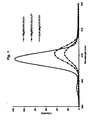
- Fig. 1 is a graph comparing the UV emission of the phosphor of this invention with two yttrium magnesium pentaborate phosphors.
- Fig. 2 is a cross-sectional illustration of a lamp containing the phosphor of this invention.
- Fig. 3 is a graph of the relative intensity of the ultraviolet emission of the phosphor of this invention as a function of the amount of the gadolinium activator.
- Fig. 4 is a graph of the excitation spectra of the phosphor of this invention compared with a yttrium magnesium borate phosphor.
- Fig. 1 shows the VUV-excited emission spectra between 300 nm and 320 nm of a Sr(Al,Mg) 12 O 19 :Gd phosphor and two 312 nm line emitting phosphors, YMgB 5 O 10 :Gd, Ce and YMgB 5 O 10 :Gd, Ce, Pr.
- the Sr(Al,Mg) 12 O 19 :Gd phosphor of this invention exhibits a much more intense UV line emission in the region of interest for medical phototherapy.
- Fig. 2 illustrates a type of VUV-excited device which is generally referred to as a dielectric barrier discharge lamp.
- the flat rectangular-shaped device is shown in cross section.
- the discharge vessel 10 is constructed of a transparent material such as glass and comprises a front plate 3 and a back plate 2 which are joined by frame 5 at the periphery of the plates.
- the discharge vessel 10 encloses discharge chamber 1 5 which contains a rare gas, typically xenon, or mixture of rare gases, and is used to generate a discharge which emits vacuum ultraviolet (VUV) radiation.
- a preferred discharge is a Xe-excimer discharge which emits VUV radiation at about 172 nm.
- the back plate 2 has multiple strip electrodes 6 which may serve as anodes and cathodes during operation. At least some of the electrodes 6' are covered with a dielectric barrier layer 7. Further examples of dielectric barrier discharge lamps are described in U.S. Patent Nos. 6,566,810 , 6,246,171 and 6,469
- a UV-emitting lamp may be formed by coating the inner surface of the top plate 3 and back plate 2 with a phosphor layer 11 that contains the UV-emitting phosphor of this invention.
- the UV-emitting phosphor converts at least some of the VUV radiation from the gas discharge into longer wavelength UV radiation.
- the lamp produces a narrow-band UV line emission at about 310 nm which may be used for medical phototherapy.
- the Sr(Al,Mg) 12 O 19 :Gd phosphor may be prepared by thoroughly dry blending the appropriate metal oxides, hydroxides, carbonates, and halides, then firing the blended material in a reducing atmosphere, preferably 75% H 2 - 25% N 2 , for a time and temperature sufficient to form the phosphor, preferably at least about 1.5 hours at a temperature between about 1500 °C and about 1600 °C.
- the fired material may be sifted and further processed with water and/or chemical washing and milling steps before it is dried and sifted for lamp use. Chemical precipitation techniques may also be used to prepare a thorough mixture in lieu of dry blending.
- Table 1 lists the reagents, their assays, their formula weights, and the quantities used for inventive samples 1-11. Each sample was formulated to contain 0.083 moles Mg/mole phosphor. Depending on the amount of activator, it may be necessary to adjust the amount of Mg in the formulation to obtain optimal charge compensation and brightness. Such adjustments are well within the capabilities of one skilled in the art in view of the present disclosure. In a preferred embodiment, the amount of magnesium in the phosphor ranges from greater than 0 to about 0.2 moles Mg/mole of phosphor.
- the materials were weighed, added to a 500 ml plastic bottle, and then thoroughly blended on a paint shaker. The blended materials were then loaded into 100 ml alumina crucibles and fired for 2 hrs at 1550 °C in a continuous furnace under a reducing atmosphere of 75% H 2 /25% N 2 . The fired phosphors were then screened through a -60 mesh nylon screen and measured for their emission properties under VUV excitation.
- T he UV line emissions of the samples were measured with a Perkin-Elmer LS-50B model spectrophotometer, which had been modified with a nitrogen-purged sample chamber and fitted with a Xe lamp for vacuum ultraviolet excitation.
- the excitation source is a commercially available xenon excimer lamp (XeCM-L from Resonance, Ltd., Barrie, Ontario, Canada) used to illuminate powder plaques while excluding air from the VUV beam path. This particular lamp has a very intense sharp Xe emission line at 147 nm and a broad, much less intense Xe excimer band emission at about 172 nm.
- Table 2 gives the formulated amounts of the activators in samples 1-11 in moles of activator/mole of phosphor and the resulting relative integrated intensities of their UV line emission between 305 - 31 5 nm. Two yttrium magnesium borate phosphors were also measured as controls. The integrated intensities are given relative to Control 1.
- Table 2 Sample Gd Ce Pr Rel. Intensity Control 1-YMgB 5 O 10 :Gd, Ce NA NA NA 100% Control 2-YMgB 5 O 10 :Gd, Ce, Pr NA NA NA 169% 1 0.03 0.01 0.01 148% 2 0.05 0.01 0.01 226% 3 0.05 0.01 0 236% 4 0.07 0.01 0.01 257% 5 0.05 0 0.01 292% 6 0.07 0.005 0.005 302% 7 0.11 0 0 335% 8 0.15 0 0.01 335% 9 0.09 0 0 350% 10 0.05 0 0 384% 11 0.07 0 0 437%
- the amount of gadolinium that yielded the maximum emission intensity was approximately 0.07 moles Gd/mole phosphor, but all levels between 0.03 and 0.15 moles Gd/mole phosphor yielded a relatively good emission intensity.
- the addition of Ce and Pr coactivators tended to reduce the intensity of the UV line emission under VUV excitation.
- the effect of the amount of Gd activator alone on the emission intensity is shown in Fig. 3 which is a plot of the relative intensity for samples 7 and 9-11 (no coactivators).
- the excitation spectrum of sample 11 is shown in Fig. 4 together with the excitation spectrum of a YMgB 5 O 10 :Gd,Ce,Pr phosphor.
- sample 11 the intensity of the UV emission at 311 nm was observed while the excitation wavelength was varied.
- the intensity of the UV emission at 313 nm was used. In both cases, the intensity of the UV emission was normalized to the intensity of the excitation wavelength. It can be seen in Fig.
- the excitation maximum for the Sr(Al,Mg) 12 O 19 :Gd phosphor occurs at about 172 nm which makes it ideal for use with a Xe-excimer discharge. There is also significant excitation down to at least 140 nm making the phosphor useable with other VUV wavelengths. On the other side of the maximum, there is virtually no excitation of the phosphor above about 188 nm. Almost the opposite is true for the YMgB 5 O 10 :Gd,Ce,Pr phosphor. The level of excitation below about 180 nm is significantly less than the excitation at about 254 nm.
Landscapes
- Chemical & Material Sciences (AREA)
- Inorganic Chemistry (AREA)
- Engineering & Computer Science (AREA)
- Materials Engineering (AREA)
- Organic Chemistry (AREA)
- Luminescent Compositions (AREA)
- Vessels And Coating Films For Discharge Lamps (AREA)
Abstract
Description
- This invention is related to phosphors that emit ultraviolet (UV) radiation and lamps containing UV-emitting phosphors. More particularly, this invention is related to phosphors that emit UV radiation when stimulated by vacuum ultraviolet (VUV) radiation.
- The use of ultraviolet (UV) radiation for medical phototherapy is well established. In fact, UV therapy is now involved in the treatment of more than 40 types of skin diseases and disorders such as psoriasis, vitiligo and eczema. Phototherapy studies of UVB wavelengths between 260 nm and 320 nm have found that a narrow-band UVB emission centered at approximately 312 nm is most effective for phototherapy while at the same time limiting undesirable erythemal effects. Since the skin's erythemal (or sunburning sensitivity) is at its maximum at about 297 nm, a narrow-band emission at about 312 nm allows a patient to have longer treatment times before an erythemal response appears.
- The Gd3+ 6P7/2 --> 8S transitions are ideal for 312 nm narrow-band emissions. However, f-f transitions of rare earths, being parity forbidden, are very weak and the use of a sensitizer is necessary to obtain a useful emission intensity. One of the first narrow-band UVB phosphors to be developed was sensitized with bismuth, e.g., (Gd0.5,La0.487)B3O6:Bi0.013. On excitation by 254 nm radiation, this borate phosphor emits the characteristic radiation with a very narrow band centered on 312 nm. However, because of the toxicity of the bismuth sensitizer, other narrow-band UVB phosphors were developed, in particular YMgB5O10:Gd,Ce (
U.S. Patent Nos. 4,319,161 and6,007,741 ), and YMgB5O10:Gd,Ce,Pr (U.S. Patent Application No. 10/907,349, filed 3/30/2005 - For the most part, UV-emitting phosphors have been optimized for excitation by the 254 nm emission of the low-pressure mercury discharge used in conventional fluorescent lighting. However, because of environmental concerns, there is a growing need for mercury-free lighting technologies. One such technology is the xenon discharge lamp which produces radiation at about 172 nm in the vacuum ultraviolet (VUV) region of the electromagnetic spectrum. It would be advantageous to develop phosphors which are optimized for excitation in the VUV region and could be used in a Xe-discharge lamp for medical phototherapy.
- Cerium-activated strontium magnesium aluminate, Sr(Al,Mg)12O19:Ce, is a commercial UVB-emitting phosphor used in suntan lamps as a minor component to increase the tanning efficiency of such lamps and reduce the time needed to obtain a tan of the desired level. This phosphor is excited by 254 nm radiation and has a broad band emission centered approximately at 307 nm.
- The amount of Ce3+ activator substituted for strontium on the Sr2+ sites is counterbalanced by substituting a similar amount of Mg2+ for aluminum on the Al3+ sites leading approximately to charge balance. In addition to and beyond the benefit of charge balancing, the presence of an optimum Mg2+ level in the phosphor lattice is thought to be necessary for maximum light output. Most of the rare earth 3+ ions have similar atomic and ionic radii, and it was thought that other rare earth 3+ ions could replace cerium in the phosphor lattice as in, for example, the quantum-splitting phosphor Sr(Al,Mg)12O19:Pr which is described in
U.S. Patent Nos. 5,571,451 and6,613,248 andU.S. Application Serial No. 11/160,052, filed 6/7/2005 - The inventors discovered that when strontium magnesium aluminate is activated with gadolinium a narrow-band UV line emission is observed at about 310 nm. This is a slightly lower wavelength than exhibited by the above-mentioned yttrium magnesium pentaborate phosphors, but it is still close to the optimal wavelength for medical phototherapy. The UV emission intensity of this phosphor is very weak under 254 nm excitation, however, under VUV excitation, the emission intensity is significantly greater than the commercial yttrium magnesium pentaborate phosphors. Thus, the phosphor of this invention may be used in a Xe-discharge lamp to provide a mercury-free lamp for medical phototherapy.
- The composition of the gadolinium-activated strontium magnesium aluminate phosphor of this invention may be generally represented by the formula, Sr(Al,Mg)12O19:Gd. In a preferred embodiment, the phosphor may be represented by the formula, Sri-xGdxAl12-yMgyO19, where x ranges from about 0.03 to about 0.15 and y ranges from greater than 0 to about 0.2. More preferably, y ranges from x-0.02 to x+0.02 for optimal charge balance. A more preferred value for x is about 0.07. It is possible to include additional coactivators such as Ce and Pr to increase the phosphor's sensitivity to 254 nm radiation. However, these coactivators tend to decrease the VUV-excited emission and are therefore less preferred.
- In addition, the gadolinium-activated strontium magnesium aluminate phosphor can easily be prepared using dry blending and a single firing step, whereas the yttrium magnesium pentaborate phosphors are prepared through a more complicated process of precipitation and double firing.
- Fig. 1 is a graph comparing the UV emission of the phosphor of this invention with two yttrium magnesium pentaborate phosphors.
- Fig. 2 is a cross-sectional illustration of a lamp containing the phosphor of this invention.
- Fig. 3 is a graph of the relative intensity of the ultraviolet emission of the phosphor of this invention as a function of the amount of the gadolinium activator.
- Fig. 4 is a graph of the excitation spectra of the phosphor of this invention compared with a yttrium magnesium borate phosphor.
- For a better understanding of the present invention, together with other and further objects, advantages and capabilities thereof, reference is made to the following disclosure and appended claims taken in conjunction with the above-described drawings.
- Fig. 1 shows the VUV-excited emission spectra between 300 nm and 320 nm of a Sr(Al,Mg)12O19:Gd phosphor and two 312 nm line emitting phosphors, YMgB5O10:Gd, Ce and YMgB5O10:Gd, Ce, Pr. Under VUV-excitation, the Sr(Al,Mg)12O19:Gd phosphor of this invention exhibits a much more intense UV line emission in the region of interest for medical phototherapy.
- Fig. 2 illustrates a type of VUV-excited device which is generally referred to as a dielectric barrier discharge lamp. The flat rectangular-shaped device is shown in cross section. The
discharge vessel 10 is constructed of a transparent material such as glass and comprises a front plate 3 and aback plate 2 which are joined byframe 5 at the periphery of the plates. Thedischarge vessel 10 encloses discharge chamber 1 5 which contains a rare gas, typically xenon, or mixture of rare gases, and is used to generate a discharge which emits vacuum ultraviolet (VUV) radiation. A preferred discharge is a Xe-excimer discharge which emits VUV radiation at about 172 nm. Theback plate 2 hasmultiple strip electrodes 6 which may serve as anodes and cathodes during operation. At least some of the electrodes 6' are covered with adielectric barrier layer 7. Further examples of dielectric barrier discharge lamps are described inU.S. Patent Nos. 6,566,810 ,6,246,171 and6,469,435 . - A UV-emitting lamp may be formed by coating the inner surface of the top plate 3 and
back plate 2 with aphosphor layer 11 that contains the UV-emitting phosphor of this invention. The UV-emitting phosphor converts at least some of the VUV radiation from the gas discharge into longer wavelength UV radiation. In a preferred embodiment, the lamp produces a narrow-band UV line emission at about 310 nm which may be used for medical phototherapy. - The Sr(Al,Mg)12O19:Gd phosphor may be prepared by thoroughly dry blending the appropriate metal oxides, hydroxides, carbonates, and halides, then firing the blended material in a reducing atmosphere, preferably 75% H2- 25% N2, for a time and temperature sufficient to form the phosphor, preferably at least about 1.5 hours at a temperature between about 1500 °C and about 1600 °C. The fired material may be sifted and further processed with water and/or chemical washing and milling steps before it is dried and sifted for lamp use. Chemical precipitation techniques may also be used to prepare a thorough mixture in lieu of dry blending.
- Table 1 lists the reagents, their assays, their formula weights, and the quantities used for inventive samples 1-11. Each sample was formulated to contain 0.083 moles Mg/mole phosphor. Depending on the amount of activator, it may be necessary to adjust the amount of Mg in the formulation to obtain optimal charge compensation and brightness. Such adjustments are well within the capabilities of one skilled in the art in view of the present disclosure. In a preferred embodiment, the amount of magnesium in the phosphor ranges from greater than 0 to about 0.2 moles Mg/mole of phosphor.
- The materials were weighed, added to a 500 ml plastic bottle, and then thoroughly blended on a paint shaker. The blended materials were then loaded into 100 ml alumina crucibles and fired for 2 hrs at 1550 °C in a continuous furnace under a reducing atmosphere of 75% H2/25% N2. The fired phosphors were then screened through a -60 mesh nylon screen and measured for their emission properties under VUV excitation.
- Table 1
Sample SrCO3 SrF2 Pr4O7 MgO Gd2O3 CeO2 Al(OH)3 Assay 0.997 0.995 1.000 0.994 0.995 1.000 0.996 Formula Wt. (g/mol) 147.630 127.620 675.63 40.304 362.500 172.120 78.003 1 19.26 g 7.95 g 0.34 g 0.67 g 1.09 g 0.34 g 186.70 g 2 18.67 g 7.95 g 0.34 g 0.67 g 1.82 g 0.34 g 186.70 g 3 18.97 g 7.95 g 0 0.67 g 1.82 g 0.34 g 186.70 g 4 18.08 g 7.95 g 0.34 g 0.67 g 2.55 g 0.34 g 186.70 g 5 18.97 g 7.95 g 0.34 g 0.67 g 1.82 g 0 186.70 g 6 18.37 g 7.95 g 0.17 g 0.67g 2.55 g 0.17 g 186.70 g 7 17.49 g 7.95 g 0 0.67 g 4.01 g 0 186.70 g 8 16.30 g 7.95 g 0 0.67 g 5.46 g 0 186.70 g 9 18.08 g 7.95 g 0 0.67 g 3.28 g 0 186.70 g 10 19.26 g 7.95 g 0 0.67 g 1.82 g 0 186.70 g 11 18.67 g 7.95 g 0 0.67 g 2.55 g 0 186.70 g - The UV line emissions of the samples were measured with a Perkin-Elmer LS-50B model spectrophotometer, which had been modified with a nitrogen-purged sample chamber and fitted with a Xe lamp for vacuum ultraviolet excitation. The excitation source is a commercially available xenon excimer lamp (XeCM-L from Resonance, Ltd., Barrie, Ontario, Canada) used to illuminate powder plaques while excluding air from the VUV beam path. This particular lamp has a very intense sharp Xe emission line at 147 nm and a broad, much less intense Xe excimer band emission at about 172 nm. Table 2 gives the formulated amounts of the activators in samples 1-11 in moles of activator/mole of phosphor and the resulting relative integrated intensities of their UV line emission between 305 - 31 5 nm. Two yttrium magnesium borate phosphors were also measured as controls. The integrated intensities are given relative to Control 1.
- Table 2
Sample Gd Ce Pr Rel. Intensity Control 1-YMgB5O10:Gd, Ce NA NA NA 100% Control 2-YMgB5O10:Gd, Ce, Pr NA NA NA 169% 1 0.03 0.01 0.01 148% 2 0.05 0.01 0.01 226% 3 0.05 0.01 0 236% 4 0.07 0.01 0.01 257% 5 0.05 0 0.01 292% 6 0.07 0.005 0.005 302% 7 0.11 0 0 335% 8 0.15 0 0.01 335% 9 0.09 0 0 350% 10 0.05 0 0 384% 11 0.07 0 0 437% - The amount of gadolinium that yielded the maximum emission intensity was approximately 0.07 moles Gd/mole phosphor, but all levels between 0.03 and 0.15 moles Gd/mole phosphor yielded a relatively good emission intensity. The addition of Ce and Pr coactivators tended to reduce the intensity of the UV line emission under VUV excitation. The effect of the amount of Gd activator alone on the emission intensity is shown in Fig. 3 which is a plot of the relative intensity for
samples 7 and 9-11 (no coactivators). - The excitation spectrum of
sample 11 is shown in Fig. 4 together with the excitation spectrum of a YMgB5O10:Gd,Ce,Pr phosphor. Forsample 11, the intensity of the UV emission at 311 nm was observed while the excitation wavelength was varied. For the YMgB5O10:Gd,Ce,Pr phosphor, the intensity of the UV emission at 313 nm was used. In both cases, the intensity of the UV emission was normalized to the intensity of the excitation wavelength. It can be seen in Fig. 4 that the excitation maximum for the Sr(Al,Mg)12O19:Gd phosphor occurs at about 172 nm which makes it ideal for use with a Xe-excimer discharge. There is also significant excitation down to at least 140 nm making the phosphor useable with other VUV wavelengths. On the other side of the maximum, there is virtually no excitation of the phosphor above about 188 nm. Almost the opposite is true for the YMgB5O10:Gd,Ce,Pr phosphor. The level of excitation below about 180 nm is significantly less than the excitation at about 254 nm. This means that the yttrium magnesium borate phosphor would not be nearly as effective as the Sr(Al,Mg)12O19:Gd phosphor when used with a VUV source such as a Xe-excimer discharge. - While there have been shown and described what are present considered to be the preferred embodiments of the invention, it will be apparent to those skilled in the art that various changes and modifications can be made herein without departing from the scope of the invention as defined by the appended claims.
Claims (15)
- A UV-emitting phosphor comprising gadolinium-activated strontium magnesium aluminate.
- The phosphor of claim 1 wherein the phosphor is represented by a formula Sr1-xGdxAh12-yMgyO19, where x ranges from about 0.03 to about 0.15 and y ranges from greater than 0 to about 0.2.
- The phosphor of claim 2 wherein y ranges from x-0.02 to x+0.02.
- The phosphor of claim 2 wherein x is about 0.07.
- The phosphor of claim 1 wherein the phosphor has an excitation maximum at about 172nm.
- The phosphor of claim 1 wherein the phosphor is coactivated with at least one of Ce and Pr.
- The phosphor of claim 1 wherein the phosphor contains magnesium in an amount from greater than 0 to about 0.2 moles Mg per mole of phosphor.
- A UV-emitting lamp comprising a discharge vessel containing a source of vacuum ultraviolet radiation and a UV-emitting phosphor on an interior wall of the discharge vessel, the UV-emitting phosphor comprising gadolinium-activated strontium magnesium aluminate.
- The UV-emitting lamp of claim 8 wherein the source of vacuum ultraviolet radiation is a xenon excimer discharge.
- The UV-emitting lamp of claim 9 wherein the discharge vessel has dielectrically impeded electrodes.
- The UV-emitting lamp of claim 8 wherein the phosphor is represented by a formula Sr1-xGdxAl12-yMgyO19, where x ranges from about 0.03 to about 0.1 5 and y ranges from greater than 0 to about 0.2.
- The UV-emitting lamp of claim 9 wherein the phosphor has an excitation maximum at about 172 nm.
- The UV-emitting lamp of claim 11 wherein y ranges from x-0.02 to x+0.02.
- The UV-emitting lamp of claim 11 wherein x is about 0.07.
- The UV-emitting lamp of claim 8 wherein the phosphor contains magnesium in an amount from greater than 0 to about 0.2 moles Mg per mole of phosphor.
Applications Claiming Priority (1)
| Application Number | Priority Date | Filing Date | Title |
|---|---|---|---|
| US11/308,099 US7419621B2 (en) | 2006-03-07 | 2006-03-07 | UV-emitting phosphor and lamp containing same |
Publications (2)
| Publication Number | Publication Date |
|---|---|
| EP1832642A2 true EP1832642A2 (en) | 2007-09-12 |
| EP1832642A3 EP1832642A3 (en) | 2009-09-02 |
Family
ID=38191142
Family Applications (1)
| Application Number | Title | Priority Date | Filing Date |
|---|---|---|---|
| EP07000906A Withdrawn EP1832642A3 (en) | 2006-03-07 | 2007-01-17 | UV-emitting phosphor and lamp containing same |
Country Status (5)
| Country | Link |
|---|---|
| US (1) | US7419621B2 (en) |
| EP (1) | EP1832642A3 (en) |
| JP (1) | JP2007238938A (en) |
| KR (1) | KR20080003702A (en) |
| CA (1) | CA2572901A1 (en) |
Families Citing this family (9)
| Publication number | Priority date | Publication date | Assignee | Title |
|---|---|---|---|---|
| US7435358B2 (en) * | 2005-06-07 | 2008-10-14 | Osram Sylvania Inc. | UVC-emitting Sr(Al,Mg)12O19:Pr phosphor and lamp containing same |
| US8647373B1 (en) * | 2010-02-11 | 2014-02-11 | James G. Shepherd | Phototherapy methods using fluorescent UV light |
| EP2997108B1 (en) * | 2013-05-13 | 2020-02-05 | Signify Holding B.V. | Uv radiation device |
| JP2016201353A (en) * | 2015-04-08 | 2016-12-01 | パナソニックIpマネジメント株式会社 | Ultraviolet light emitting element |
| JP2016201352A (en) * | 2015-04-08 | 2016-12-01 | パナソニックIpマネジメント株式会社 | Ultraviolet light emitting element |
| CN105441076A (en) * | 2015-12-14 | 2016-03-30 | 江门市科恒实业股份有限公司 | UVB narrowband emission phosphor and preparation method thereof |
| DE102017121889B3 (en) * | 2017-09-21 | 2018-11-22 | Heraeus Noblelight Gmbh | Broadband semiconductor-based UV light source for a spectrum analyzer |
| JP7234730B2 (en) * | 2019-03-25 | 2023-03-08 | 東芝ライテック株式会社 | Discharge lamp and liquid crystal panel manufacturing equipment |
| KR102743465B1 (en) * | 2022-10-31 | 2024-12-16 | 한국공학대학교산학협력단 | One plate type stserilizing lamp |
Family Cites Families (19)
| Publication number | Priority date | Publication date | Assignee | Title |
|---|---|---|---|---|
| NL187212B (en) * | 1978-11-21 | 1991-02-01 | Philips Nv | LUMINESCENT TERRAIR ALUMINATE; LUMINESCENT SCREEN; LOW-PRESSURE MERCURY DISCHARGE LAMP. |
| NL7905680A (en) * | 1979-07-23 | 1981-01-27 | Philips Nv | LUMINESCENT SCREEN. |
| FR2659639B1 (en) * | 1990-03-13 | 1992-06-12 | Quartz & Silice | MIXED STRONTIUM AND LANTHANIDE OXIDES AND LASER USING SINGLE CRYSTALS OF THESE OXIDES. |
| US5571451A (en) * | 1995-01-03 | 1996-11-05 | General Electric Company | Quantum splitting oxide phosphor and method of making |
| US5557112A (en) | 1995-07-21 | 1996-09-17 | Light Sources, Inc. | Dual radiation ultraviolet lamp |
| JP3735989B2 (en) * | 1997-01-27 | 2006-01-18 | 三菱化学株式会社 | Ultraviolet light emitting phosphor composition |
| ES2201499T3 (en) * | 1997-03-21 | 2004-03-16 | Patent-Treuhand-Gesellschaft Fur Elektrische Gluhlampen Mbh | GASEOUS DISCHARGE LAMP WITH DIELECTRICALLY INHIBITED ELECTRODES. |
| DE19826808C2 (en) * | 1998-06-16 | 2003-04-17 | Patent Treuhand Ges Fuer Elektrische Gluehlampen Mbh | Discharge lamp with dielectric barrier electrodes |
| US6007741A (en) * | 1998-08-19 | 1999-12-28 | Osram Sylvania Inc. | Method of making luminescent metaborates |
| DE19843419A1 (en) * | 1998-09-22 | 2000-03-23 | Patent Treuhand Ges Fuer Elektrische Gluehlampen Mbh | Discharge lamp suited for operation by dielectrically obstructed discharge has part of electrodes covered with dielectric layer additionally covered directly with blocking layer between each electrode and dielectric layer. |
| DE19919169A1 (en) * | 1999-04-28 | 2000-11-02 | Philips Corp Intellectual Pty | Device for disinfecting water with a UV-C gas discharge lamp |
| JP2001081460A (en) * | 1999-07-09 | 2001-03-27 | Nec Kansai Ltd | Ultraviolet-luminescent material, and ultraviolet- luminescent fluorescent-lamp and ultraviolet- luminescent element using same |
| JP2003535954A (en) * | 2000-06-08 | 2003-12-02 | バイリー・クレイグ・ジェイムソン | Improved luminescent material |
| US6613248B2 (en) * | 2001-05-18 | 2003-09-02 | General Electric Company | Quantum-splitting oxide-based phosphors and method of producing the same |
| US6621208B2 (en) * | 2001-05-18 | 2003-09-16 | General Electric Company | Quantum-splitting oxide-based phosphors, method of producing, and rules for designing the same |
| DE10129630A1 (en) * | 2001-06-20 | 2003-01-02 | Philips Corp Intellectual Pty | Low pressure gas discharge lamp with fluorescent coating |
| US6984931B2 (en) | 2003-01-21 | 2006-01-10 | Osram Sylvania Inc. | UV-emitting phosphor blend and tanning lamp containing same |
| US7221084B2 (en) * | 2005-03-30 | 2007-05-22 | Osram Sylvania Inc. | Narrow-band UVB-emitting phosphor |
| US7435358B2 (en) * | 2005-06-07 | 2008-10-14 | Osram Sylvania Inc. | UVC-emitting Sr(Al,Mg)12O19:Pr phosphor and lamp containing same |
-
2006
- 2006-03-07 US US11/308,099 patent/US7419621B2/en active Active
-
2007
- 2007-01-04 CA CA002572901A patent/CA2572901A1/en not_active Abandoned
- 2007-01-17 EP EP07000906A patent/EP1832642A3/en not_active Withdrawn
- 2007-03-05 JP JP2007054127A patent/JP2007238938A/en active Pending
- 2007-03-05 KR KR1020070021364A patent/KR20080003702A/en not_active Ceased
Also Published As
| Publication number | Publication date |
|---|---|
| US20070221883A1 (en) | 2007-09-27 |
| US7419621B2 (en) | 2008-09-02 |
| KR20080003702A (en) | 2008-01-08 |
| CA2572901A1 (en) | 2007-09-07 |
| EP1832642A3 (en) | 2009-09-02 |
| JP2007238938A (en) | 2007-09-20 |
Similar Documents
| Publication | Publication Date | Title |
|---|---|---|
| US20090160341A1 (en) | Discharge lamp comprising uv-phosphor | |
| EP1842892A1 (en) | UV-emitting phosphor and lamp containing same | |
| EP0023068B1 (en) | Luminescent screen | |
| KR20080003702A (en) | UV-emitting phosphor and lamp containing it | |
| JP2006012770A (en) | Light-emitting device and image display device using this light-emitting device | |
| US20100225224A1 (en) | Fluorescent material and fluorescent lamp using the same | |
| JP2002097466A (en) | Aluminate phosphor, phosphor paste composition and vacuum ultraviolet ray excited light emitting device | |
| EP1887068A2 (en) | Ce, pr-coactivated yttrium phosphate phosphor and lamp containing same | |
| US7591962B2 (en) | Low-pressure mercury vapor discharge lamp comprising UV-A phosphor | |
| US7435358B2 (en) | UVC-emitting Sr(Al,Mg)12O19:Pr phosphor and lamp containing same | |
| EP1741118B1 (en) | Dielectric barrier discharge lamp comprising an uv-b phosphor | |
| EP1842893B1 (en) | Ce, Pr-coactivated calcium pyrophosphate phosphor and lamp containing same | |
| US7449129B2 (en) | Ce,Pr-coactivated strontium magnesium aluminate phosphor and lamp containing same | |
| KR100867289B1 (en) | Alkaline earth aluminate phosphor, phosphor paste composition and vacuum ultraviolet excitation light emitting device | |
| JP5916599B2 (en) | Ultraviolet light emitting phosphor and light emitting device using the same | |
| JP2002294230A (en) | Aluminosilicate phosphor for vacuum ultraviolet excitation and vacuum ultraviolet excitation light emitting device using the phosphor | |
| EP1634314B1 (en) | Vuv-excited device with blue-emitting phosphor | |
| JP4244265B2 (en) | Aluminate phosphor, phosphor paste composition, and vacuum ultraviolet light-excited light emitting device | |
| JP2001303047A (en) | Vacuum ultraviolet excitation phosphor and light emitting device using the same | |
| JP3754701B2 (en) | Phosphor and light emitting device using the same | |
| JPH10204430A (en) | UV-emitting phosphor composition | |
| CN100558850C (en) | Phosphor and light-emitting element using the same | |
| US20070069623A1 (en) | Vuv-excited device with blue-emitting phosphor | |
| JP2004244478A (en) | Alkaline earth aluminate phosphor, method for producing the phosphor, phosphor paste composition and vacuum ultraviolet ray excited light emitting device | |
| JP2004238511A (en) | Alkaline earth aluminate phosphor, method for producing the phosphor, phosphor paste composition and vacuum ultraviolet ray excited light emitting device |
Legal Events
| Date | Code | Title | Description |
|---|---|---|---|
| PUAI | Public reference made under article 153(3) epc to a published international application that has entered the european phase |
Free format text: ORIGINAL CODE: 0009012 |
|
| AK | Designated contracting states |
Kind code of ref document: A2 Designated state(s): AT BE BG CH CY CZ DE DK EE ES FI FR GB GR HU IE IS IT LI LT LU LV MC NL PL PT RO SE SI SK TR |
|
| AX | Request for extension of the european patent |
Extension state: AL BA HR MK YU |
|
| PUAL | Search report despatched |
Free format text: ORIGINAL CODE: 0009013 |
|
| AK | Designated contracting states |
Kind code of ref document: A3 Designated state(s): AT BE BG CH CY CZ DE DK EE ES FI FR GB GR HU IE IS IT LI LT LU LV MC NL PL PT RO SE SI SK TR |
|
| AX | Request for extension of the european patent |
Extension state: AL BA HR MK RS |
|
| 17P | Request for examination filed |
Effective date: 20100302 |
|
| AKX | Designation fees paid |
Designated state(s): DE HU NL |
|
| 17Q | First examination report despatched |
Effective date: 20100512 |
|
| RAP1 | Party data changed (applicant data changed or rights of an application transferred) |
Owner name: OSRAM SYLVANIA INC. |
|
| GRAP | Despatch of communication of intention to grant a patent |
Free format text: ORIGINAL CODE: EPIDOSNIGR1 |
|
| RIC1 | Information provided on ipc code assigned before grant |
Ipc: H01J 61/44 20060101ALI20120403BHEP Ipc: C09K 11/64 20060101AFI20120403BHEP |
|
| RIN1 | Information on inventor provided before grant (corrected) |
Inventor name: SNYDER, THOMAS M. Inventor name: MARKING GREGORY A. |
|
| STAA | Information on the status of an ep patent application or granted ep patent |
Free format text: STATUS: THE APPLICATION IS DEEMED TO BE WITHDRAWN |
|
| 18D | Application deemed to be withdrawn |
Effective date: 20120919 |