EP1831191B1 - Chroman derivatives and their use as 5-ht receptor ligands - Google Patents
Chroman derivatives and their use as 5-ht receptor ligands Download PDFInfo
- Publication number
- EP1831191B1 EP1831191B1 EP05822998A EP05822998A EP1831191B1 EP 1831191 B1 EP1831191 B1 EP 1831191B1 EP 05822998 A EP05822998 A EP 05822998A EP 05822998 A EP05822998 A EP 05822998A EP 1831191 B1 EP1831191 B1 EP 1831191B1
- Authority
- EP
- European Patent Office
- Prior art keywords
- compound
- hydrogen
- alkyl
- formula
- chroman
- Prior art date
- Legal status (The legal status is an assumption and is not a legal conclusion. Google has not performed a legal analysis and makes no representation as to the accuracy of the status listed.)
- Expired - Lifetime
Links
- 0 C*(/C=C1)/C=C(/C(CO2)C#N)\C2=C/[C@]1(C)*([Al])=C Chemical compound C*(/C=C1)/C=C(/C(CO2)C#N)\C2=C/[C@]1(C)*([Al])=C 0.000 description 2
- SLRTVDWSALDXGQ-UHFFFAOYSA-N CC(C)(C1)Oc(cc(cc2)S(c3ccccc3)(=O)=O)c2C1=O Chemical compound CC(C)(C1)Oc(cc(cc2)S(c3ccccc3)(=O)=O)c2C1=O SLRTVDWSALDXGQ-UHFFFAOYSA-N 0.000 description 1
- QNBWEYUYCHDWPB-UHFFFAOYSA-N CC(C)(C1)Oc(cc(cc2)Sc3ccccc3)c2C1=O Chemical compound CC(C)(C1)Oc(cc(cc2)Sc3ccccc3)c2C1=O QNBWEYUYCHDWPB-UHFFFAOYSA-N 0.000 description 1
- SXPPZYRWHWCVMF-UHFFFAOYSA-N CC1C(OCCC2O)=C2C#CC1[S](=C(CC=C1)C=C1F)(=O)=O Chemical compound CC1C(OCCC2O)=C2C#CC1[S](=C(CC=C1)C=C1F)(=O)=O SXPPZYRWHWCVMF-UHFFFAOYSA-N 0.000 description 1
- XFEWAOLFUCBYGD-UHFFFAOYSA-N NCCC1c(ccc(S(c2ccccc2)(=O)=O)c2)c2OCC1 Chemical compound NCCC1c(ccc(S(c2ccccc2)(=O)=O)c2)c2OCC1 XFEWAOLFUCBYGD-UHFFFAOYSA-N 0.000 description 1
- YJICJMJSILKKBO-UHFFFAOYSA-N O=C(CCOc1c2)c1ccc2S(c1cc(F)ccc1)(=O)=O Chemical compound O=C(CCOc1c2)c1ccc2S(c1cc(F)ccc1)(=O)=O YJICJMJSILKKBO-UHFFFAOYSA-N 0.000 description 1
- WXRDJJHWYRDOGR-UHFFFAOYSA-N OC(CCOc1c2)c1ccc2S(c1cc(F)ccc1)(=O)=O Chemical compound OC(CCOc1c2)c1ccc2S(c1cc(F)ccc1)(=O)=O WXRDJJHWYRDOGR-UHFFFAOYSA-N 0.000 description 1
Classifications
-
- C—CHEMISTRY; METALLURGY
- C07—ORGANIC CHEMISTRY
- C07D—HETEROCYCLIC COMPOUNDS
- C07D313/00—Heterocyclic compounds containing rings of more than six members having one oxygen atom as the only ring hetero atom
- C07D313/02—Seven-membered rings
- C07D313/06—Seven-membered rings condensed with carbocyclic rings or ring systems
- C07D313/08—Seven-membered rings condensed with carbocyclic rings or ring systems condensed with one six-membered ring
-
- C—CHEMISTRY; METALLURGY
- C07—ORGANIC CHEMISTRY
- C07D—HETEROCYCLIC COMPOUNDS
- C07D307/00—Heterocyclic compounds containing five-membered rings having one oxygen atom as the only ring hetero atom
- C07D307/77—Heterocyclic compounds containing five-membered rings having one oxygen atom as the only ring hetero atom ortho- or peri-condensed with carbocyclic rings or ring systems
- C07D307/78—Benzo [b] furans; Hydrogenated benzo [b] furans
- C07D307/82—Benzo [b] furans; Hydrogenated benzo [b] furans with hetero atoms or with carbon atoms having three bonds to hetero atoms with at the most one bond to halogen, e.g. ester or nitrile radicals, directly attached to carbon atoms of the hetero ring
- C07D307/84—Carbon atoms having three bonds to hetero atoms with at the most one bond to halogen
-
- A—HUMAN NECESSITIES
- A61—MEDICAL OR VETERINARY SCIENCE; HYGIENE
- A61K—PREPARATIONS FOR MEDICAL, DENTAL OR TOILETRY PURPOSES
- A61K31/00—Medicinal preparations containing organic active ingredients
- A61K31/33—Heterocyclic compounds
- A61K31/335—Heterocyclic compounds having oxygen as the only ring hetero atom, e.g. fungichromin
- A61K31/35—Heterocyclic compounds having oxygen as the only ring hetero atom, e.g. fungichromin having six-membered rings with one oxygen as the only ring hetero atom
- A61K31/352—Heterocyclic compounds having oxygen as the only ring hetero atom, e.g. fungichromin having six-membered rings with one oxygen as the only ring hetero atom condensed with carbocyclic rings, e.g. methantheline
- A61K31/353—3,4-Dihydrobenzopyrans, e.g. chroman, catechin
-
- A—HUMAN NECESSITIES
- A61—MEDICAL OR VETERINARY SCIENCE; HYGIENE
- A61P—SPECIFIC THERAPEUTIC ACTIVITY OF CHEMICAL COMPOUNDS OR MEDICINAL PREPARATIONS
- A61P1/00—Drugs for disorders of the alimentary tract or the digestive system
-
- A—HUMAN NECESSITIES
- A61—MEDICAL OR VETERINARY SCIENCE; HYGIENE
- A61P—SPECIFIC THERAPEUTIC ACTIVITY OF CHEMICAL COMPOUNDS OR MEDICINAL PREPARATIONS
- A61P1/00—Drugs for disorders of the alimentary tract or the digestive system
- A61P1/04—Drugs for disorders of the alimentary tract or the digestive system for ulcers, gastritis or reflux esophagitis, e.g. antacids, inhibitors of acid secretion, mucosal protectants
-
- A—HUMAN NECESSITIES
- A61—MEDICAL OR VETERINARY SCIENCE; HYGIENE
- A61P—SPECIFIC THERAPEUTIC ACTIVITY OF CHEMICAL COMPOUNDS OR MEDICINAL PREPARATIONS
- A61P1/00—Drugs for disorders of the alimentary tract or the digestive system
- A61P1/14—Prodigestives, e.g. acids, enzymes, appetite stimulants, antidyspeptics, tonics, antiflatulents
-
- A—HUMAN NECESSITIES
- A61—MEDICAL OR VETERINARY SCIENCE; HYGIENE
- A61P—SPECIFIC THERAPEUTIC ACTIVITY OF CHEMICAL COMPOUNDS OR MEDICINAL PREPARATIONS
- A61P25/00—Drugs for disorders of the nervous system
-
- A—HUMAN NECESSITIES
- A61—MEDICAL OR VETERINARY SCIENCE; HYGIENE
- A61P—SPECIFIC THERAPEUTIC ACTIVITY OF CHEMICAL COMPOUNDS OR MEDICINAL PREPARATIONS
- A61P25/00—Drugs for disorders of the nervous system
- A61P25/06—Antimigraine agents
-
- A—HUMAN NECESSITIES
- A61—MEDICAL OR VETERINARY SCIENCE; HYGIENE
- A61P—SPECIFIC THERAPEUTIC ACTIVITY OF CHEMICAL COMPOUNDS OR MEDICINAL PREPARATIONS
- A61P25/00—Drugs for disorders of the nervous system
- A61P25/08—Antiepileptics; Anticonvulsants
-
- A—HUMAN NECESSITIES
- A61—MEDICAL OR VETERINARY SCIENCE; HYGIENE
- A61P—SPECIFIC THERAPEUTIC ACTIVITY OF CHEMICAL COMPOUNDS OR MEDICINAL PREPARATIONS
- A61P25/00—Drugs for disorders of the nervous system
- A61P25/08—Antiepileptics; Anticonvulsants
- A61P25/10—Antiepileptics; Anticonvulsants for petit-mal
-
- A—HUMAN NECESSITIES
- A61—MEDICAL OR VETERINARY SCIENCE; HYGIENE
- A61P—SPECIFIC THERAPEUTIC ACTIVITY OF CHEMICAL COMPOUNDS OR MEDICINAL PREPARATIONS
- A61P25/00—Drugs for disorders of the nervous system
- A61P25/08—Antiepileptics; Anticonvulsants
- A61P25/12—Antiepileptics; Anticonvulsants for grand-mal
-
- A—HUMAN NECESSITIES
- A61—MEDICAL OR VETERINARY SCIENCE; HYGIENE
- A61P—SPECIFIC THERAPEUTIC ACTIVITY OF CHEMICAL COMPOUNDS OR MEDICINAL PREPARATIONS
- A61P25/00—Drugs for disorders of the nervous system
- A61P25/14—Drugs for disorders of the nervous system for treating abnormal movements, e.g. chorea, dyskinesia
-
- A—HUMAN NECESSITIES
- A61—MEDICAL OR VETERINARY SCIENCE; HYGIENE
- A61P—SPECIFIC THERAPEUTIC ACTIVITY OF CHEMICAL COMPOUNDS OR MEDICINAL PREPARATIONS
- A61P25/00—Drugs for disorders of the nervous system
- A61P25/14—Drugs for disorders of the nervous system for treating abnormal movements, e.g. chorea, dyskinesia
- A61P25/16—Anti-Parkinson drugs
-
- A—HUMAN NECESSITIES
- A61—MEDICAL OR VETERINARY SCIENCE; HYGIENE
- A61P—SPECIFIC THERAPEUTIC ACTIVITY OF CHEMICAL COMPOUNDS OR MEDICINAL PREPARATIONS
- A61P25/00—Drugs for disorders of the nervous system
- A61P25/18—Antipsychotics, i.e. neuroleptics; Drugs for mania or schizophrenia
-
- A—HUMAN NECESSITIES
- A61—MEDICAL OR VETERINARY SCIENCE; HYGIENE
- A61P—SPECIFIC THERAPEUTIC ACTIVITY OF CHEMICAL COMPOUNDS OR MEDICINAL PREPARATIONS
- A61P25/00—Drugs for disorders of the nervous system
- A61P25/20—Hypnotics; Sedatives
-
- A—HUMAN NECESSITIES
- A61—MEDICAL OR VETERINARY SCIENCE; HYGIENE
- A61P—SPECIFIC THERAPEUTIC ACTIVITY OF CHEMICAL COMPOUNDS OR MEDICINAL PREPARATIONS
- A61P25/00—Drugs for disorders of the nervous system
- A61P25/22—Anxiolytics
-
- A—HUMAN NECESSITIES
- A61—MEDICAL OR VETERINARY SCIENCE; HYGIENE
- A61P—SPECIFIC THERAPEUTIC ACTIVITY OF CHEMICAL COMPOUNDS OR MEDICINAL PREPARATIONS
- A61P25/00—Drugs for disorders of the nervous system
- A61P25/24—Antidepressants
-
- A—HUMAN NECESSITIES
- A61—MEDICAL OR VETERINARY SCIENCE; HYGIENE
- A61P—SPECIFIC THERAPEUTIC ACTIVITY OF CHEMICAL COMPOUNDS OR MEDICINAL PREPARATIONS
- A61P25/00—Drugs for disorders of the nervous system
- A61P25/28—Drugs for disorders of the nervous system for treating neurodegenerative disorders of the central nervous system, e.g. nootropic agents, cognition enhancers, drugs for treating Alzheimer's disease or other forms of dementia
-
- A—HUMAN NECESSITIES
- A61—MEDICAL OR VETERINARY SCIENCE; HYGIENE
- A61P—SPECIFIC THERAPEUTIC ACTIVITY OF CHEMICAL COMPOUNDS OR MEDICINAL PREPARATIONS
- A61P25/00—Drugs for disorders of the nervous system
- A61P25/30—Drugs for disorders of the nervous system for treating abuse or dependence
- A61P25/32—Alcohol-abuse
-
- A—HUMAN NECESSITIES
- A61—MEDICAL OR VETERINARY SCIENCE; HYGIENE
- A61P—SPECIFIC THERAPEUTIC ACTIVITY OF CHEMICAL COMPOUNDS OR MEDICINAL PREPARATIONS
- A61P25/00—Drugs for disorders of the nervous system
- A61P25/30—Drugs for disorders of the nervous system for treating abuse or dependence
- A61P25/34—Tobacco-abuse
-
- A—HUMAN NECESSITIES
- A61—MEDICAL OR VETERINARY SCIENCE; HYGIENE
- A61P—SPECIFIC THERAPEUTIC ACTIVITY OF CHEMICAL COMPOUNDS OR MEDICINAL PREPARATIONS
- A61P25/00—Drugs for disorders of the nervous system
- A61P25/30—Drugs for disorders of the nervous system for treating abuse or dependence
- A61P25/36—Opioid-abuse
-
- A—HUMAN NECESSITIES
- A61—MEDICAL OR VETERINARY SCIENCE; HYGIENE
- A61P—SPECIFIC THERAPEUTIC ACTIVITY OF CHEMICAL COMPOUNDS OR MEDICINAL PREPARATIONS
- A61P3/00—Drugs for disorders of the metabolism
- A61P3/04—Anorexiants; Antiobesity agents
-
- A—HUMAN NECESSITIES
- A61—MEDICAL OR VETERINARY SCIENCE; HYGIENE
- A61P—SPECIFIC THERAPEUTIC ACTIVITY OF CHEMICAL COMPOUNDS OR MEDICINAL PREPARATIONS
- A61P43/00—Drugs for specific purposes, not provided for in groups A61P1/00-A61P41/00
-
- C—CHEMISTRY; METALLURGY
- C07—ORGANIC CHEMISTRY
- C07D—HETEROCYCLIC COMPOUNDS
- C07D307/00—Heterocyclic compounds containing five-membered rings having one oxygen atom as the only ring hetero atom
- C07D307/77—Heterocyclic compounds containing five-membered rings having one oxygen atom as the only ring hetero atom ortho- or peri-condensed with carbocyclic rings or ring systems
- C07D307/78—Benzo [b] furans; Hydrogenated benzo [b] furans
- C07D307/79—Benzo [b] furans; Hydrogenated benzo [b] furans with only hydrogen atoms, hydrocarbon or substituted hydrocarbon radicals, directly attached to carbon atoms of the hetero ring
- C07D307/81—Radicals substituted by nitrogen atoms not forming part of a nitro radical
-
- C—CHEMISTRY; METALLURGY
- C07—ORGANIC CHEMISTRY
- C07D—HETEROCYCLIC COMPOUNDS
- C07D311/00—Heterocyclic compounds containing six-membered rings having one oxygen atom as the only hetero atom, condensed with other rings
- C07D311/02—Heterocyclic compounds containing six-membered rings having one oxygen atom as the only hetero atom, condensed with other rings ortho- or peri-condensed with carbocyclic rings or ring systems
- C07D311/04—Benzo[b]pyrans, not hydrogenated in the carbocyclic ring
-
- C—CHEMISTRY; METALLURGY
- C07—ORGANIC CHEMISTRY
- C07D—HETEROCYCLIC COMPOUNDS
- C07D311/00—Heterocyclic compounds containing six-membered rings having one oxygen atom as the only hetero atom, condensed with other rings
- C07D311/02—Heterocyclic compounds containing six-membered rings having one oxygen atom as the only hetero atom, condensed with other rings ortho- or peri-condensed with carbocyclic rings or ring systems
- C07D311/04—Benzo[b]pyrans, not hydrogenated in the carbocyclic ring
- C07D311/58—Benzo[b]pyrans, not hydrogenated in the carbocyclic ring other than with oxygen or sulphur atoms in position 2 or 4
-
- C—CHEMISTRY; METALLURGY
- C07—ORGANIC CHEMISTRY
- C07D—HETEROCYCLIC COMPOUNDS
- C07D405/00—Heterocyclic compounds containing both one or more hetero rings having oxygen atoms as the only ring hetero atoms, and one or more rings having nitrogen as the only ring hetero atom
- C07D405/02—Heterocyclic compounds containing both one or more hetero rings having oxygen atoms as the only ring hetero atoms, and one or more rings having nitrogen as the only ring hetero atom containing two hetero rings
- C07D405/06—Heterocyclic compounds containing both one or more hetero rings having oxygen atoms as the only ring hetero atoms, and one or more rings having nitrogen as the only ring hetero atom containing two hetero rings linked by a carbon chain containing only aliphatic carbon atoms
Definitions
- Amidinyl means a group of the formula: wherein each R independently is hydrogen or alkyl as defined herein.
- treating when referring to a chemical reaction means adding or mixing two or more reagents under appropriate conditions to produce the indicated and/or the desired product. It should be appreciated that the reaction which produces the indicated and/or the desired product may not necessarily result directly from the combination of two reagents which were initially added, i.e., there may be one or more intermediates which are produced in the mixture which ultimately leads to the formation of the indicated and/or the desired product.
- R 3 and R 4 are hydrogen.
- R 5 and R 6 may be hydrogen.
- the subject compounds may be more specifically of formula IV: wherein:
- R 1 , R 2 , R 3 , R 4 , R 5 , R 6 , R 7 , R a , R b , R c , R d , R e , R f , R g , R h , R i , R j , and R k are C 1-12 -alkyl or contain an C 1-12 -alkyl moiety, such C 1-12 -alkyl is preferably lower alkyl, i.e. C 1 -C 6 alkyl, and more preferably C 1 -C 4 alkyl.
- step 3 A reduction reaction takes place in step 3 in which the residual unsaturation in compound i is hydrogenated by treatment with hydrogen in the presence of a suitable platinum or palladium catalyst, to provide ester compound j .
- the pharmacology of the compounds of this invention was determined by art recognized procedures.
- the in vitro techniques for determining the affinities of test compounds at the 5-HT6 receptor and the 5-HT2A receptor in radioligand binding, FLIPR and functional assays are described below.
- formulations can be prepared with enteric coatings adapted for sustained or controlled release administration of the active ingredient.
- the compounds of the present invention can be formulated in transdermal or subcutaneous drug delivery devices. These delivery systems are advantageous when sustained release of the compound is necessary and when patient compliance with a treatment regimen is crucial.
- Compounds in transdermal delivery systems are frequently attached to an skin-adhesive solid support.
- the compound of interest can also be combined with a penetration enhancer, e.g., Azone (1-dodecylazacycloheptan-2-one).
- Sustained release delivery systems are inserted subcutaneously into the subdermal layer by surgery or injection.
- the subdermal implants encapsulate the compound in a lipid soluble membrane, e.g., silicone rubber, or a biodegradable polymer, e.g., polylactic acid.
- the binding activity of compounds of this invention in vitro was determined as follows. Duplicate determinations of 5-HT 6 ligand affinity were made by competing for binding of [ 3 H]LSD in cell membranes derived from HEK293 cells stably expressing recombinant human 5-HT 6 receptor. Duplicate determinations of 5-HT 2A ligand affinity were made by competing for binding of [ 3 H]Ketanserin (3-(2-(4-(4-fluorobenzoyl)piperidinol)ethyl)-2,4(1H,3H)-quinazolinedione) in cell membranes derived from CHO-K1 cells stably expressing recombinant human 5-HT 2A receptor.
Landscapes
- Health & Medical Sciences (AREA)
- Chemical & Material Sciences (AREA)
- Organic Chemistry (AREA)
- Engineering & Computer Science (AREA)
- Bioinformatics & Cheminformatics (AREA)
- Veterinary Medicine (AREA)
- Public Health (AREA)
- General Health & Medical Sciences (AREA)
- Animal Behavior & Ethology (AREA)
- Life Sciences & Earth Sciences (AREA)
- Medicinal Chemistry (AREA)
- Pharmacology & Pharmacy (AREA)
- Chemical Kinetics & Catalysis (AREA)
- General Chemical & Material Sciences (AREA)
- Nuclear Medicine, Radiotherapy & Molecular Imaging (AREA)
- Neurosurgery (AREA)
- Biomedical Technology (AREA)
- Neurology (AREA)
- Psychiatry (AREA)
- Addiction (AREA)
- Pain & Pain Management (AREA)
- Psychology (AREA)
- Child & Adolescent Psychology (AREA)
- Diabetes (AREA)
- Hematology (AREA)
- Obesity (AREA)
- Anesthesiology (AREA)
- Hospice & Palliative Care (AREA)
- Nutrition Science (AREA)
- Epidemiology (AREA)
- Pharmaceuticals Containing Other Organic And Inorganic Compounds (AREA)
- Plural Heterocyclic Compounds (AREA)
- Pyrane Compounds (AREA)
- Preparation Of Compounds By Using Micro-Organisms (AREA)
Abstract
Description
- The invention provides compounds of the formula I, their use for the preparation of medicaments useful for treating CNS and gastrointestinal disorders and pharmaceutical compositions containing them:

wherein: - m is from 0 to 3;
- p is from 1 to 3;
- q is 0, 1 or 2;
- Ar is optionally substituted aryl or optionally substituted 5- or 6- membered heteroaryl;
- each R1 is independently halo, C1-12-alkyl, C1-12-haloalkyl, C1-12-heteroalkyl, cyano, -S(O)t-Ra, -C(=O)-NRbRc, -SO2-NRbRc, -N(Rd)-C(=O)-Re, -C(=O)N(Rd)-, or -C(=O)-Re, where t is from 0 to 2, Ra, Rb, Rc, Rd and Re each independently is hydrogen or C1-12-alkyl;
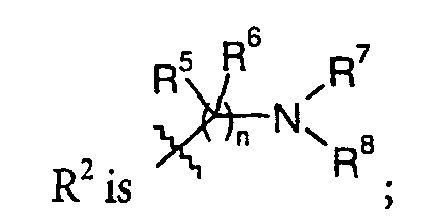
- n is from 1 to 3;
- R3 and R4 each independently is hydrogen or C1-12-alkyl;
- R5 and R6 each independently is hydrogen or C1-12-alkyl, or R5 and R6 together may form =NRf wherein Rf is hydrogen or C1-12-akyl; and
- R7 and R8 each independently is hydrogen or C1-12-akyl, or one of R7 and R8 is hydrogen and the other is an optionally substituted 5- or 6- membered heteroaryl or 5- or 6- membered heterocyclyl ring containing one or two nitrogen(s), or R7 and R8 together with the nitrogen to which they are attached may form an amidinyl group, a urea group, a guanidinyl group, or a 5- or 6-membered heterocyclic ring that optionally includes an additional heteroatom selected from O, N and S and which is optionally substituted with amino, or one of R7 and R8 and one of R5 and R6 together with the atoms to which they are attached may form a 5- or 6-membered heterocyclic ring that optionally includes an additional heteroatom selected from O, N and S.
- The compounds of the invention have selective affinity for 5-HT receptors, including the 5-HT6 the 5-HT2A receptor, or both, and as such are expected to be useful in the treatment of certain CNS disorders such as Parkinson's disease, Huntington's disease, anxiety, depression, manic depression, psychosis, epilepsy, obsessive compulsive disorders, mood disorders, migraine, Alzheimer's disease (enhancement of cognitive memory), sleep disorders, feeding disorders such as anorexia, bulimia, and obesity, panic attacks, akathisia, attention deficit hyperactivity disorder (ADHD), attention deficit disorder (ADD), withdrawal from drug abuse such as cocaine, ethanol, nicotine and benzodiazepines, schizophrenia, and also disorders associated with spinal trauma and/or head injury such as hydrocephalus. Such compounds are also expected to be of use in the treatment of certain GI (gastrointestinal) disorders such functional bowel disorder and irritable bowel syndrome.
- The actions of 5-hydroxytryptamine (5-HT) as a major modulatory neurotransmitter in the brain are mediated through a number of receptor families termed 5-HT1, 5-HT2, 5- HT3, 5-HT4, 5-HT5, 5-HT6, and 5-HT7. Based on a high level of 5-HT6 receptor mRNA in the brain, it has been stated that the 5-HT6 receptor may play a role in the pathology and treatment of central nerve system disorders. In particular, 5-HT2-selective and 5-HT6 selective ligands have been identified as potentially useful in the treatment of certain CNS disorders such as Parkinson's disease, Huntington's disease, anxiety, depression, manic depression, psychoses, epilepsy, obsessive compulsive disorders, mood disorders, migraine, Alzheimer's disease (enhancement of cognitive memory), sleep disorders, feeding disorders such as anorexia, bulimia and obesity, panic attacks, akathisia, attention deficit hyperactivity disorder (ADHD), attention deficit disorder (ADD), withdrawal from drug abuse such as cocaine, ethanol, nicotine and benzodiazepines, schizophrenia, and also disorders associated with spinal trauma and/or head injury such as hydrocephalus. Such compounds are also expected to be of use in the treatment of certain gastrointestinal (GI) disorders such as functional bowel disorder. See for example, B.L. Roth et al., J. Pharmacol. Exp. Ther., 1994,268, pages 1403-14120, D. R. Sibley et al., Mol. Pharmacol.,1993, 43, 320-327, A.J. Sleight et al., Neurotransmission, 1995, 11, 1-5, and A. J. Sleight et al., Serotonin ID Research Alert, 1997, 2(3), 115-8.
US-A-2003/0 060 498 describes 5-arylsulphonyl-indol(in)es being useful as selective 5-HT6 inhibitors. - While some 5-HT6 and 5-HT2A modulators have been disclosed, there continues to be a need for compounds that are useful for modulating the 5-HT6 receptor, the 5-HT2A receptor, or both.
- Unless otherwise stated, the following terms used in this Application, including the specification and claims, have the definitions given below. It must be noted that, as used in the specification and the appended claims, the singular forms "a", "an," and "the" include plural referents unless the context clearly dictates otherwise.
- "Agonist" refers to a compound that enhances the activity of another compound or receptor site.
- "Alkyl" means the monovalent linear or branched saturated hydrocarbon moiety, consisting solely of carbon and hydrogen atoms, having from one to twelve carbon atoms. "Lower alkyl" refers to an alkyl group of one to six carbon atoms (i.e., "C1-6-alkyl"). Examples of alkyl groups include, but are not limited to, methyl, ethyl, propyl, isopropyl, isobutyl, sec-butyl, tert-butyl, pentyl, n-hexyl, octyl, dodecyl, as well as those groups which are illustrated with the examples of the compounds of the invention hereinafter.
- "Alkylene" means a linear saturated divalent hydrocarbon radical of one to six carbon atoms or a branched saturated divalent hydrocarbon radical of three to six carbon atoms, e.g., methylene, ethylene, 2,2-dimethylethylene, propylene, 2-methylpropylene, butylene, pentylene, as well as those groups which are illustrated with the examples of the compounds of the invention hereinafter.
- "Alkenylene" means a linear unsaturated divalent hydrocarbon radical of two to six carbon atoms or a branched saturated divalent hydrocarbon radical of three to six carbon atoms, e.g., ethenylene (-CH=CH-), 2,2-dimethylethenylene, propenylene, 2-methylpropenylene, butenylene, pentenylene, as well as those groups which are illustrated with the examples of the compounds of the invention hereinafter.
- "Alkoxy" means a group -OR, wherein R is alkyl as defined herein. Examples of alkoxy moieties include, but are not limited to, methoxy, ethoxy, isopropoxy, as well as those groups which are illustrated with the examples of the compounds of the invention hereinafter.
- "Amidinyl" means a group of the formula:

- "Amidinylalkyl" means a group -R-R' wherein R' is amidinyl as defined herein and R is alkylene.
- "Aminoalkyl" means a group -R-R' wherein R' is amino and R is alkylene as defined herein. "Aminoalkyl" includes aminomethyl, aminoethyl, 1-aminopropyl, 2-aminopropyl, and the like. The amino moiety of "aminoalkyl" may be substituted once or twice with alkyl to provide "alkylaminoalkyl" and "dialkylaminoalkyl" respectively. "Alkylaminoalkyl" includes methylaminomethyl, methylaminoethyl, methylaminopropyl, ethylaminoethyl and the like. "Dialkylaminoalkyl" includes dimethylaminomethyl, dimethylaminoethyl, dimethylaminopropyl, N-methyl-N-ethylaminoethyl, as well as those groups which are illustrated with the examples of the compounds of the invention hereinafter.
- "Antagonist" refers to a compound that diminishes or prevents the action of another compound or receptor site.
- "Aryl" means a monovalent cyclic aromatic hydrocarbon moiety consisting of a mono-, bi- or tricyclic aromatic ring. The aryl group can be optionally substituted as defined herein. Examples of aryl moieties include, but are not limited to, phenyl, naphthyl, naphthalenyl, phenanthryl, fluorenyl, indenyl, pentalenyl, azulenyl, oxydiphenyl, biphenyl, methylenediphenyl, aminodiphenyl, diphenylsulfidyl, diphenylsulfonyl, diphenylisopropylidenyl, benzodioxanyl, benzofuranyl, benzodioxylyl, benzopyranyl, benzoxazinyl, benzoxazinonyl, benzopiperadinyl, benzopiperazinyl, benzopyrrolidinyl, benzomorpholinyl, methylenedioxyphenyl, ethylenedioxyphenyl, as well as those groups which are illustrated with the examples of the compounds of the invention hereinafter, including partially hydrogenated derivatives thereof.
- "Arylene" means a divalent aryl radical wherein aryl is as defined herein. "Arylene" includes, for example, ortho-, meta- and para- phenylene (1,2-phenylene, 1,3-phenylene and 1,4-phenylene respectively), which may be optionally substituted as defined herein.
- "Arylalkyl" and "Aralkyl", which may be used interchangeably, mean a radical
- -R-R' where R is an alkylene group and R' is an aryl group as defined herein; e.g., benzyl, phenylethyl, 3-(3-chlorophenyl)-2-methylpentyl, as well as those groups which are illustrated with the examples of the compounds of the invention hereinafter, are examples of arylalkyl.
- "Cycloalkyl" means a saturated carbocyclic moiety consisting of mono- or bicyclic rings. Cycloalkyl can optionally be substituted with one or more substituents, wherein each substituent is independently hydroxy, alkyl, alkoxy, halo, haloalkyl, amino, monoalkylamino, or dialkylamino, unless otherwise specifically indicated. Examples of cycloalkyl moieties include, but are not limited to, cyclopropyl, cyclobutyl, cyclopentyl, cyclohexyl, cycloheptyl, as well as those groups which are illustrated with the examples of the compounds of the invention hereinafter, including partially unsaturated derivatives thereof such as cyclohexenyl, cyclopentenyl, and the like.
- "Cycloalkylalkyl" means a moiety of the formula -R-R', where R is alkylene and R' is cycloalkyl as defined herein.
- "Guanidinyl" means a group of the formula

- "Guanidinylalkyl" is a group -R-R' wherein R' is guanidinyl as defined herein and R is alkylene.
- "Heteroalkyl" means an alkyl radical as defined herein wherein one, two or three hydrogen atoms have been replaced with a substituent independently selected from the group consisting of -ORa, -NRbRc, and -S(O)nRd (where n is an integer from 0 to 2), with the understanding that the point of attachment of the heteroalkyl radical is through a carbon atom, wherein Ra is hydrogen, acyl, alkyl, cycloalkyl, or cycloalkylalkyl; Rb and Rc are independently of each other hydrogen, acyl, alkyl, cycloalkyl, or cycloalkylalkyl; and when n is 0, Rd is hydrogen, alkyl, cycloalkyl, or cycloalkylalkyl, and when n is 1 or 2, Rd is alkyl, cycloalkyl, cycloalkylalkyl, amino, acylamino, monoalkylamino, or dialkylamino. Representative examples include, but are not limited to, methoxy, ethoxy, 2-hydroxyethyl, 3-hydroxypropyl, 2-methoxyethyl, 3-methoxypropyl, 2-hydroxy-1-hydroxymethylethyl, 2,3-dihydroxypropyl, 1-hydroxymethylethyl, 3-hydroxybutyl, 2,3-dihydroxybutyl, 2-hydroxy-1-methylpropyl, 2-aminoethyl, 3-aminopropyl, 2-methylsulfonylethyl, aminosulfonylmethyl, aminosulfonylethyl, aminosulfonylpropyl, methylaminosulfonylmethyl, methylaminosulfonylethyl, methylaminosulfonylpropyl, as well as those groups which are illustrated with the examples of the compounds of the invention hereinafter.
- "Heteroaryl" means a monocyclic or bicyclic monovalent radical of 5 to 12 ring atoms, preferably 5 or 6 ring atoms having at least one aromatic ring containing one, two, or three ring heteroatoms selected from N, O, or S, the remaining ring atoms being C, with the understanding that the attachment point of the heteroaryl radical will be on an aromatic ring. The heteroaryl ring may be optionally substituted as defined herein. Examples of heteroaryl moieties include, but are not limited to, imidazolyl, oxazolyl, isoxazolyl, thiazolyl, isothiazolyl, oxadiazolyl, thiadiazolyl, pyrazinyl, thienyl, benzothienyl, thiophenyl, furanyl, pyranyl, pyridyl, pyridinyl, pyridazyl, pyrrolyl, pyrazolyl, pyrimidyl, quinolinyl, isoquinolinyl, benzofuryl, benzothiophenyl, benzothiopyranyl, benzimidazolyl, benzooxazolyl, benzooxadiazolyl, benzothiazolyl, benzothiadiazolyl, benzopyranyl, indolyl, isoindolyl, triazolyl, triazinyl, quinoxalinyl, purinyl, quinazolinyl, quinolizinyl, naphthyridinyl, pteridinyl, carbazolyl, azepinyl, diazepinyl, acridinyl and the like, including partially hydrogenated derivatives thereof. The aforementioned heteroaryl moieties may be partially saturated. Thus, "heteroaryl" includes "imidazolinyl", tetrahydropyrimidinyl" as well as those groups which are illustrated with the examples of the compounds of the invention hereinafter.
- "Heteroarylene" means a divalent heteroaryl radical wherein heteroaryl is as defined herein. "Heteroarylene" may be optionally substituted as defined herein. "Heteroarylene" includes, for example, indolylene, pyrimidinylene, as well as those groups which are illustrated with the examples of the compounds of the invention hereinafter.
- The terms "halo" and "halogen", which may be used interchangeably, refer to a substituent fluoro, chloro, bromo, or iodo.
- "Haloalkyl" means alkyl as defined herein in which one or more hydrogen has been replaced with same or different halogen. Exemplary haloalkyls include -CH2Cl,-CH2CF3, -CH2CCl3, perfluoroalkyl (e.g., -CF3), and the like.
- "Heterocycloamino" means a saturated ring wherein at least one ring atom is N, NH or N-alkyl and the remaining ring atoms form an alkylene group.
- "Heterocyclyl" means a monovalent saturated moiety, consisting of one to three rings, incorporating one, two, or three or four heteroatoms (chosen from nitrogen, oxygen or sulfur). The heterocyclyl ring may be optionally substituted as defined herein. Examples of heterocyclyl moieties include, but are not limited to, piperidinyl, piperazinyl, homopiperazinyl, azepinyl, pyrrolidinyl, pyrazolidinyl, imidazolinyl, imidazolidinyl, pyridinyl, pyridazinyl, oxazolidinyl, isoxazolidinyl, morpholinyl, thiazolidinyl, isothiazolidinyl, quinuclidinyl, quinolinyl, isoquinolinyl, benzimidazolyl, thiadiazolylidinyl, benzothiazolidinyl, benzoazolylidinyl, dihydrofuryl, tetrahydrofuryl, dihydropyranyl, tetrahydropyranyl, thiamorpholinyl, thiamorpholinylsulfoxide, thiamorpholinylsulfone, dihydroquinolinyl, dihydrisoquinolinyl, tetrahydroquinolinyl, tetrahydrisoquinolinyl, as well as those groups which are illustrated with the examples of the compounds of the invention hereinafter, including partially unsaturated derivatives thereof.
- "Imidazolinyl" means a group of the formula

- "Imidazolinylalkyl" means a group -R-R' wherein R' is imidazolinyl as defined herein and R is alkylene.
- "Imidazolinylaminoalkyl" means a group -R-R'-R" wherein R" is imidazolinyl as defined herein, R' is amino, and R is alkylene. The amino moiety of "imidazolinylaminoalkyl" may be optionally substituted with alkyl.
- "Pyrimidinylaminoalkyl" means a group -R-R'-R" wherein R" is pyrimidinyl (preferably pyrimidin-2-yl), R' is amino, and R is alkylene. The pyrimidinyl moiety of "pyrimidinylaminoalkyl" may be optionally substituted as defined herein, and the amino moiety of "pyrimidinylaminoalkyl" may be optionally substituted with alkyl.
- "Tetrahydropyrimidinyl" means 1,4,5,6-tetrahydropyrimidinyl, preferably 1,4,5,6-tetrahydropyrimidin-2-yl, and may be optionally substituted as defined herein. "Tetrahydropyrimidinyl" includes 5,5-dimethyl-1,4,5,6-tetrahydropyrimidin-2-yl.
- "Tetrahydropyrimidinylaminoalkyl" means a group -R-R'-R" wherein R" is tetrahydropyrimidinyl, R' is amino, and R is alkylene. The amino moiety of "tetrahydropyrimidinylaminoalkyl" may be optionally substituted with alkyl.
- "Urea" means a group of the formula:

- "Urealkyl" means a group R-R' wherein R' is urea and R is alkylene.
- "Optionally substituted", when used in association with "aryl", phenyl", "heteroaryl", cycloalkyl or "heterocyclyl", means an aryl, phenyl, heteroaryl, or heterocyclyl which is optionally substituted independently with one to four substituents, preferably one or two substituents selected from alkyl, cycloalkyl, cycloalkylalkyl, heteroalkyl, hydroxyalkyl, halo, nitro, cyano, hydroxy, alkoxy, amino, acylamino, monoalkylamino, di-alkylamino, haloalkyl, haloalkoxy, heteroalkyl, -COR (where R is hydrogen, alkyl, phenyl or phenylalkyl), -(CR'R")n-COOR (where n is an integer from 0 to 5, R' and R" are independently hydrogen or alkyl, and R is hydrogen, alkyl, cycloalkyl, cycloalkylalkyl, phenyl or phenylalkyl), or -(CR'R")n-CONRaRb (where n is an integer from 0 to 5, R' and R" are independently hydrogen or alkyl, and Ra and Rb are, independently of each other, hydrogen, alkyl, cycloalkyl, cycloalkylalkyl, phenyl or phenylalkyl.
- "Leaving group" means the group with the meaning conventionally associated with it in synthetic organic chemistry, i.e., an atom or group displaceable under substitution reaction conditions. Examples of leaving groups include, but are not limited to, halogen, alkane- or arylenesulfonyloxy, such as methanesulfonyloxy, ethanesulfonyloxy, thiomethyl, benzenesulfonyloxy, tosyloxy, and thienyloxy, dihalophosphinoyloxy, optionally substituted benzyloxy, isopropyloxy, acyloxy, as well as those groups which are illustrated with the examples of the compounds of the invention hereinafter.
- "Modulator" means a molecule that interacts with a target. The interactions include, but are not limited to, agonist, antagonist, and the like, as defined herein.
- "Optional" or "optionally" means that the subsequently described event or circumstance may but need not occur, and that the description includes instances where the event or circumstance occurs and instances in which it does not.
- "Disease state" means any disease, condition, symptom, or indication.
- "Inert organic solvent" or "inert solvent" means the solvent is inert under the conditions of the reaction being described in conjunction therewith, including for example, benzene, toluene, acetonitrile, tetrahydrofuran, N,N-dimethylformamide, chloroform, methylene chloride or dichloromethane, dichloroethane, diethyl ether, ethyl acetate, acetone, methyl ethyl ketone, methanol, ethanol, propanol, isopropanol, tert-butanol, dioxane, pyridine, and the like. Unless specified to the contrary, the solvents used in the reactions of the present invention are inert solvents.
- "Pharmaceutically acceptable" means that which is useful in preparing a pharmaceutical composition that is generally safe, non-toxic, and neither biologically nor otherwise undesirable and includes that which is acceptable for veterinary as well as human pharmaceutical use.
- "Pharmaceutically acceptable salts" of a compound means salts that are pharmaceutically acceptable, as defined herein, and that possess the desired pharmacological activity of the parent compound. Such salts include:
- acid addition salts formed with inorganic acids such as hydrochloric acid, hydrobromic acid, sulfuric acid, nitric acid, phosphoric acid, and the like; or formed with organic acids such as acetic acid, benzenesulfonic acid, benzoic, camphorsulfonic acid, citric acid, ethanesulfonic acid, fumaric acid, glucoheptonic acid, gluconic acid, glutamic acid, glycolic acid, hydroxynaphtoic acid, 2-hydroxyethanesulfonic acid, lactic acid, maleic acid, malic acid, malonic acid, mandelic acid, methanesulfonic acid, muconic acid, 2-naphthalenesulfonic acid, propionic acid, salicylic acid, succinic acid, tartaric acid, p-toluenesulfonic acid, trimethylacetic acid, and the like; or
- salts formed when an acidic proton present in the parent compound either is replaced by a metal ion, e.g., an alkali metal ion, an alkaline earth ion, or an aluminum ion; or coordinates with an organic or inorganic base. Acceptable organic bases include diethanolamine, ethanolamine, N-methylglucamine, triethanolamine, tromethamine, and the like. Acceptable inorganic bases include aluminum hydroxide, calcium hydroxide, potassium hydroxide, sodium carbonate and sodium hydroxide.
- The preferred pharmaceutically acceptable salts are the salts formed from acetic acid, hydrochloric acid, sulphuric acid, methanesulfonic acid, maleic acid, phosphoric acid, tartaric acid, citric acid, sodium, potassium, calcium, zinc, and magnesium.
- It should be understood that all references to pharmaceutically acceptable salts include solvent addition forms (solvates) or crystal forms (polymorphs) as defined herein, of the same acid addition salt.
- The terms "pro-drug" and "prodrug", which may be used interchangeably herein, refer to any compound which releases an active parent drug according to formula I in vivo when such prodrug is administered to a mammalian subject. Prodrugs of a compound of formula I are prepared by modifying one or more functional group(s) present in the compound of formula I in such a way that the modification(s) may be cleaved in vivo to release the parent compound. Prodrugs include compounds of formula I wherein a hydroxy, amino, or sulfhydryl group in a compound of Formula I is bonded to any group that may be cleaved in vivo to regenerate the free hydroxyl, amino, or sulfhydryl group, respectively. Examples of prodrugs include, but are not limited to, esters (e.g., acetate, formate, and benzoate derivatives), carbamates (e.g., N,N-dimethylaminocarbonyl) of hydroxy functional groups in compounds of formula I, N-acyl derivatives (e.g. N-acetyl) N-Mannich bases, Schiff bases and enaminones of amino functional groups, oximes, acetals, ketals and enol esters of ketone and aldehyde functional groups in compounds of Formula I, and the like, see Bundegaard, H. "Design of Prodrugs" p1-92, Elesevier, New York-Oxford (1985), and the like.
- "Protective group" or "protecting group" means the group which selectively blocks one reactive site in a multifunctional compound such that a chemical reaction can be carried out selectively at another unprotected reactive site in the meaning conventionally associated with it in synthetic chemistry. Certain processes of this invention rely upon the protective groups to block reactive nitrogen and/or oxygen atoms present in the reactants. For example, the terms "amino-protecting group" and "nitrogen protecting group" are used interchangeably herein and refer to those organic groups intended to protect the nitrogen atom against undesirable reactions during synthetic procedures. Exemplary nitrogen protecting groups include, but are not limited to, trifluoroacetyl, acetamido, benzyl (Bn), benzyloxycarbonyl (carbobenzyloxy, CBZ), p-methoxybenzyloxycarbonyl, p-nitrobenzyloxycarbonyl, tert-butoxycarbonyl (BOC), and the like. Those skilled in the art know how to choose a group for the ease of removal and for the ability to withstand the following reactions.
- "Solvates" means solvent addition forms that contain either stoichiometric or non stoichiometric amounts of solvent. Some compounds have a tendency to trap a fixed molar ratio of solvent molecules in the crystalline solid state, thus forming a solvate. If the solvent is water the solvate formed is a hydrate, when the solvent is alcohol, the solvate formed is an alcoholate. Hydrates are formed by the combination of one or more molecules of water with one of the substances in which the water retains its molecular state as H2O, such combination being able to form one or more hydrate.
- "Subject" means mammals and non-mammals. Mammals means any member of the mammalia class including, but not limited to, humans; non-human primates such as chimpanzees and other apes and monkey species; farm animals such as cattle, horses, sheep, goats, and swine; domestic animals such as rabbits, dogs, and cats; laboratory animals including rodents, such as rats, mice, and guinea pigs; and the like. Examples of non-mammals include, but are not limited to, birds, and the like. The term "subject" does not denote a particular age or sex.
- "Therapeutically effective amount" means an amount of a compound that, when administered to a subject for treating a disease state, is sufficient to effect such treatment for the disease state. The "therapeutically effective amount" will vary depending on the compound, disease state being treated, the severity or the disease treated, the age and relative health of the subject, the route and form of administration, the judgement of the attending medical or veterinary practitioner, and other factors.
- The terms "those defined above" and "those defined herein" when referring to a variable incorporates by reference the broad definition of the variable as well as preferred, more preferred and most preferred definitions, if any.
- "Treating" or "treatment" of a disease state includes:
- (i) preventing the disease state, i.e. causing the clinical symptoms of the disease state not to develop in a subject that may be exposed to or predisposed to the disease state, but does not yet experience or display symptoms of the disease state.
- (ii) inhibiting the disease state, i.e., arresting the development of the disease state or its clinical symptoms, or
- (iii) relieving the disease state, i.e., causing temporary or permanent regression of the disease state or its clinical symptoms.
- The terms "treating", "contacting" and "reacting" when referring to a chemical reaction means adding or mixing two or more reagents under appropriate conditions to produce the indicated and/or the desired product. It should be appreciated that the reaction which produces the indicated and/or the desired product may not necessarily result directly from the combination of two reagents which were initially added, i.e., there may be one or more intermediates which are produced in the mixture which ultimately leads to the formation of the indicated and/or the desired product.
- In general, the nomenclature used in this Application is based on AUTONOM™ v.4.0, a Beilstein Institute computerized system for the generation of IUPAC systematic nomenclature.
- Chemical structures shown herein were prepared using ISIS® version 2.2. Any open valency appearing on a carbon, oxygen or nitrogen atom in the structures herein indicates the presence of a hydrogen atom.
- It should be understood that the scope of this invention encompasses not only the various isomers which may exist but also the various mixture of isomers which may be formed. Furthermore, the scope of the present invention also encompasses solvates and salts of compounds of formula I:

wherein: - m is from 0 to 3;
- p is from 1 to 3;
- q is 0, 1 or 2;
- Ar is optionally substituted aryl or optionally substituted 5- or 6- membered heteroaryl;
- each R1 is independently halo, C1-12-alkyl, C1-12-haloalkyl, C1-12-heteroalkyl, cyano, -S(O)t-Ra, -C(=O)-NRbRc, -SO2-NRbRc, -N(Rd)-C(=O)-Re, -C(=O)N(Rd)-, or -C(=O)-Re, where t is from 0 to 2, Ra, Rb, Rc, Rd and Re each independently is hydrogen or C1-12-alkyl;
- R2 is

- n is from 1 to 3;
- R3 and R4 each independently is hydrogen or C1-12-alkyl;
- R5 and R6 each independently is hydrogen or C1-12-alkyl, or R5 and R6 together may form =NRf wherein Rf is hydrogen or C1-12-alkyl; and
- R7 and R8 each independently is hydrogen or C1-12-alkyl, or one of R7 and R8 is hydrogen and the other is an optionally substituted 5- or 6- membered heteroaryl or 5- or 6- membered heterocyclyl containing one or two nitrogens, or R7 and R8 together with the nitrogen to which they are attached may form an amidinyl group, a urea group, a guanidinyl group, or a 5- or 6-membered heterocyclic ring that optionally includes an additional heteroatom selected from O, N and S and which is optionally substituted with amino, or one of R7 and R8 and one of R5 and R6 together with the atoms to which they are attached may form a 5- or 6-membered heterocyclic ring that optionally includes an additional heteroatom selected from O, N and S.
- In certain embodiments of formula I, p is 1 or 2, and in specific embodiments p is 2. In many embodiments q is 2.
- In many embodiments of formula I, R3 and R4 are hydrogen.
- In certain embodiments, the compounds of the invention may be of formula II:

- In some embodiments of formula I or formula II, m is 0 or 1, with R1 preferably being halo. In certain embodiments Ar is optionally substituted aryl such as phenyl or naphthyl, each optionally substituted. In other embodiments Ar may be optionally substituted 5- or 6- membered heteroaryl such as thienyl, pyridyl or pyrimidyl, each optionally substituted.
- In certain embodiments of the invention, the compounds of formula I or formula II have n equal to 1. In such embodiments R7 and R8 may both be hydrogen. Alternatively one of R7 and R8 may be hydrogen while the other is C1-12-alkyl, preferably methyl.
- In many embodiments of formula I or formula II wherein n is 1, R5 and R6 may be hydrogen.
- In other embodiments of formula I or formula II wherein n is 1, one of R7 and R8 is hydrogen and the other may be optionally substituted 5- or 6- membered heteroaryl such as optionally substituted imidazolinyl, optionally substituted pyrimidinyl, optionally substituted pyrrolyl, optionally substituted imidazolyl, or optionally substituted tetrahydropyrimidinyl.
- In still other embodiments of formula I or formula II wherein n is 1, R7 and R8 together with the nitrogen to which they are attached may form an amidinyl group.
- In yet other embodiments R7 and R8 together with the nitrogen to which they are attached may form a guanidinyl group.
- In still other embodiments, R7 and R8 together with the nitrogen to which they are attached may form a urea group.
- In further embodiments of formula I or formula II wherein n is 1, R5 and R6 together with the nitrogen to which they are attached may form =NRf wherein Rf is hydrogen, and wherein R5 and R6 are hydrogen.
- In still further embodiments of formula I or formula II wherein n is 1, one of R7 and R8 and one of R5 and R6 together with the atoms to which they are attached may form an imidazolinyl ring.
- In still other embodiments of formula I or formula II wherein n is 1, one of R7 and R8 is hydrogen and the other is pyrrolidinyl.
- In certain embodiments of the invention, the compounds of formula I or formula II have n equal to 2. In such embodiments R7 and R8 may both be hydrogen, or alternatively one of R5 and R6 may be hydrogen while the other is C1-12-alkyl, preferably methyl.
- In many embodiments of formula I or formula II wherein n is 2, R5 and R6 may be hydrogen.
- In other embodiments of formula I or formula II wherein n is 2, one of R7 and R8 is hydrogen and the other may be optionally substituted 5- or 6- membered heteroaryl such as optionally substituted imidazolinyl, optionally substituted pyrimidinyl, optionally substituted pyrrolyl, optionally substituted imidazolyl, optionally substituted benzothiazolyl, or optionally substituted tetrahydropyrimidinyl.
- In still other embodiments of formula I or formula II wherein n is 2, R7 and R8 together with the nitrogen to which they are attached may form an amidinyl group, while in yet other embodiments R7 and R8 together with the nitrogen to which they are attached may form a guanidinyl group.
- In further embodiments of formula I or formula II wherein n is 2, R5 and R6 together with the nitrogen to which they are attached may form =NRf wherein Rf is hydrogen, and wherein R7 and R8 are hydrogen.
- In still further embodiments of formula I or formula II wherein n is 2, one of R7 and R8 and one of R5 and R6 together with the atoms to which they are attached may form an imidazolinyl ring.
- In certain embodiments of the invention, the compounds of formula I or formula II have n equal to 3. In such embodiments R7 and R8 may both be hydrogen, or alternatively one of R7 and R8 may be hydrogen while the other is C1-12-alkyl, preferably methyl.
- In many embodiments of formula I or formula II wherein n is 3, R5 and R6 may be hydrogen.
- In other embodiments of formula I or formula II wherein n is 3, one of R7 and R8 is hydrogen and the other may be optionally substituted 5- or 6- membered heteroaryl such as optionally substituted imidazolinyl, optionally substituted pyrimidinyl, optionally substituted pyrrolyl, optionally substituted imidazolyl, optionally substituted benzothiazolyl, or optionally substituted tetrahydropyrimidinyl.
- In still other embodiments of formula I or formula II wherein n is 3, R7 and R8 together with the nitrogen to which they are attached may form an amidinyl group, while in yet other embodiments R7 and R8 together with the nitrogen to which they are attached may form a guanidinyl group.
- In further embodiments of formula I or formula II wherein n is 3, R3 and R4 together with the nitrogen to which they are attached may form =NRf wherein Rf is hydrogen, and wherein R5 and R6 are hydrogen. In still further embodiments of formula I or formula II wherein n is 2, one of R7 and R8 and one of R5 and R6 together with the atoms to which they are attached may form an imidazolinyl ring.
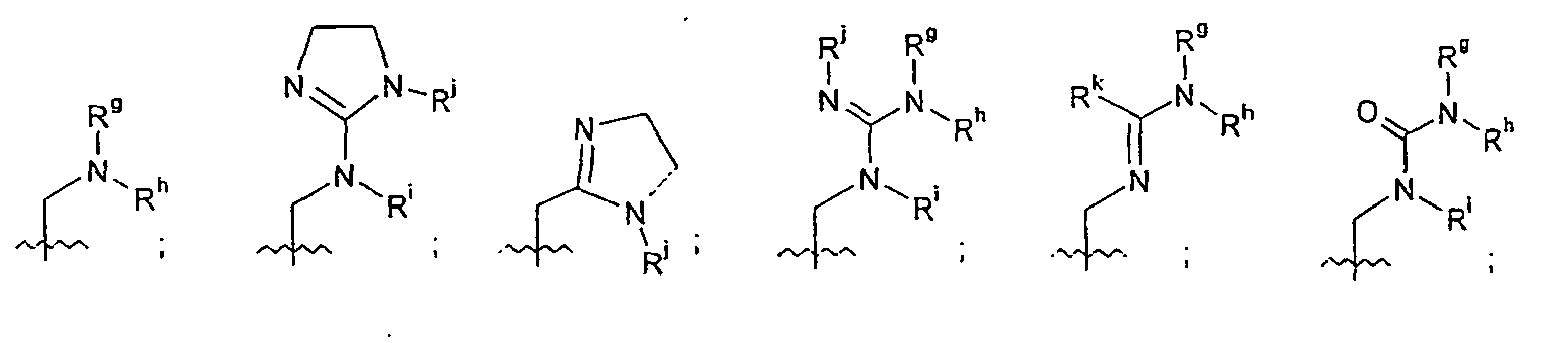
- In certain embodiments of formula I or formula II, R2 may be amino-C1-12-alkyl, C1-12-alkylamino-C1-12-alkyl, di(C1-12)-alkylaminoalkyl, imidazolinylamino-C1-12-alkyl, imidazolinyl-C1-12-alkyl, guanidinyl-C1-12-alkyl, tetrahydropyrimidinylamino-C1-12-alkyl, amidinyl-C1-12-alkyl, ure-C1-12-akyl or pyrimidinylamino-C1-12-alkyl.
- In certain embodiments of formula I or formula II, R2 may be


- In certain embodiments of the invention, the subject compounds may be of the formula III:

- s is from 0 to 4;
- each R9 is independently halo, C1-12-alkyl, C1-12-alkoxy, C1-12-haloalkyl, C1-12-heteroalkyl, cyano, -S(O)r-Ra, -C(=O)-NRbRc, -SO2-NRbRc, -N(Rd)-C(=O)-Re, or-C(=O)-Re, where r is from 0 to 2, Ra, Rb, Rc, Rd and Re each independently is hydrogen or alkyl; and
- n, R3, R4, R5 and R6 are as recited in claim 1.
- In many embodiments of formula III, s is from 0 to 2, and each R9 is independently halo, C1-12-alkyl, C1-12-alkoxy, or C1-12-haloalkyl. In certain embodiments of formula III, n is 1 or 2, and preferably n is 1. In certain embodiments of formula III, R5 and R6 are hydrogen. In some embodiments of formula III wherein R5 and R6 are hydrogen, R7 and R8 are hydrogen. In other embodiments of formula III wherein R5 and R6 are hydrogen, one of R7 and R8 is hydrogen and the other is C1-12-alkyl, preferably methyl. In still other embodiments of formula III wherein R5 and R6 are hydrogen, R7 and R8 may both be C1-12-alkyl, preferably methyl.
- In certain embodiments of the invention, the subject compounds may be more specifically of formula IV:

- n is 1 or 2;
- s is 0 or 1;
- R9 is halo, C1-12-alkyl, C1-12-alkoxy, or C1-12-haloalkyl; and
- R5 and R6 each independently is hydrogen or C1-12-alkyl, or or R5 and R6 together with the nitrogen to which they are attached may form an amidinyl group or a guanidinyl group.
- In many embodiments of formula IV, s is from 0 to 2, and each R9 is independently halo, C1-12-alkyl, C1-12-alkoxy, or C1-12-haloalkyl. In certain embodiments of formula IV, n is 1 or 2, and preferably n is 1. In certain embodiments of formula IV, R7 and R8 are hydrogen. In other embodiments of formula IV, one of R7 and R8 is hydrogen and the other is C1-12-alkyl, preferably methyl. In still other embodiments of formula IV, R7 and R8 may both be C1-12-alkyl, preferably methyl.
- Where any of R1, R2, R3, R4, R5, R6, R7, Ra, Rb, Rc, Rd, Re, Rf, Rg, Rh, Ri, Rj, and Rk herein are C1-12-alkyl or contain an C1-12-alkyl moiety, such C1-12-alkyl is preferably lower alkyl, i.e. C1-C6alkyl, and more preferably C1-C4alkyl.
- In embodiments of the invention wherein R7 and R8 together with the nitrogen to which they are attached form an amidinyl, such amidinyl is of the formula:

- Representative compounds in accordance with the invention are shown in the Experimental section below.
- Another aspect of the invention provides a composition comprising a therapeutically effective amount of at least one compound of formula (I) and a pharmaceutically acceptable carrier.
- Yet another aspect of the invention provides the use of the compounds of the invention for the preparation of a medicament useful for treating a central nervous system (CNS) disease state in a subject. The disease state may comprise, for example, psychoses, schizophrenia, manic depressions, neurological disorders, memory disorders, attention deficit disorder, Parkinson's disease, amyotrophic lateral sclerosis, Alzheimer's disease or Huntington's disease.
- Still another aspect of the present invention provides the use of the compounds of the invention for the preparation of a medicament useful for treating a disorder of the gastrointestinal tract in a subject.
- Another aspect of the present invention provides a method for producing a compound of formula (I).
- Representative compounds in accordance with the invention are shown in Table 1.
TABLE 1 # Structure Name MP or M+H 1 
2-(7-Benzenesulfonyl-chroman-4-yl)-ethylamine 244.0-245.8 °C (HCl salt) 2 
C-(7-Benzenesulfonyl-chroman-4-yl)-methylamine 246.8-249.8 °C (HCl salt) 3 
(7-Benzenesulfonyl-chroman-4-ylmethyl)-methyl-amine 158.1-159.8 °C (HCl salt) 4 
N-(7-Benzenesulfonyl-chroman-4-ylmethyl)-guanidine >300 °C 5 
(7-Benzenesulfonyl-chroman-4-ylmethyl)-urea 166.2-170.9 °C 6 
N-(7-Benzenesulfonyl-chroman-4-ylmethyl)-acetamidine 253.4-256.0 °C (HCl salt) 7 
(1-{2-[7-(3-Fluoro-benzenesulfonyl)-chroman-4-yl]-ethyl}-pyrrolidin-3-yl)-methyl-amine 401 8 
(1-{2-[7-(3-Fluoro-benzenesulfonyl)-chroman-4-yl]-ethyl} -pyrrolidin-3-yl) -dimethyl-amine 415 9 
{2-[7-(3-Fluoro-benzenesulfonyl)-chroman-4-yl]-ethyl}-pyrrolidin-3-yl-amine 405 10 
[7-(3-Fluoro-benzenesulfonyl)-chroman-4-ylmethyl]-methyl-amine 336 - The invention also provides methods for preparing, methods of using, and pharmaceutical compositions comprising the aforementioned compounds. One such method is for producing a compound of formula c;

the method comprising reducing a compound of formula b
- Compounds of the present invention can be made by a variety of methods depicted in the illustrative synthetic reaction schemes shown and described below.
- The starting materials and reagents used in preparing these compounds generally are either available from commercial suppliers, such as Aldrich Chemical Co., or are prepared by methods known to those skilled in the art following procedures set forth in references such as Fieser and Fieser's Reagents for Organic Synthesis; Wiley & Sons: New York, 1991, Volumes 1-15; Rodd's Chemistry of Carbon Compounds, Elsevier Science Publishers, 1989, Volumes 1-5 and Supplementals; and Organic Reactions, Wiley & Sons: New York, 2004, Volumes 1-56. The following synthetic reaction schemes are merely illustrative of some methods by which the compounds of the present invention can be synthesized, and various modifications to these synthetic reaction schemes can be made and will be suggested to one skilled in the art having referred to the disclosure contained in this Application.
- The starting materials and the intermediates of the synthetic reaction schemes can be isolated and purified if desired using conventional techniques, including but not limited to, filtration, distillation, crystallization, chromatography, and the like. Such materials can be characterized using conventional means, including physical constants and spectral data.
- Unless specified to the contrary, the reactions described herein preferably are conducted under an inert atmosphere at atmospheric pressure at a reaction temperature range of from about -78 °C to about 150 °C, more preferably from about 0 °C to about 125 °C, and most preferably and conveniently at about room (or ambient) temperature, e.g., about 20 °C.
- Scheme A below illustrates one synthetic procedure usable to prepare compounds of the invention, wherein Ar, m, p, q, R1, R2 and R3 are as defined herein. Numerous synthetic routes to the chroman and dihydrobenzofuran compounds of the invention are possible, and the procedure of Scheme A is only exemplary. A specific example of the procedure of Scheme A are provided in the following Experimental section.

- In step 1a of Scheme A, ketone compound a undergoes a cyanylation reaction by treatment with diethyl cyanophosphonate to give an arylsulfonyl nitrile compound b . Ketone compound may comprise, for example, an arylsulfonyl dihydrobenzofuranone where q is 2 and p 1, an arylsulfonyl chromanone where q is 2 and p is 2, or like ketone in accordance with the invention. Corresponding, arylsulfanyl (q = 0) and arylsulfinyl (q = 1) ketone compounds may be used in this step, and subject to subsequent oxidation of the sulfur atom if desired. Ketone compounds a may be prepared by a variety of techniques known in the art, and specific examples of preparing such compounds are provided below in the Experimental section of this disclosure.
- In step 2a, arylsulfonyl nitrile compound b is subject to reduction to provide arylsulfonyl aminomethyl compound c . This reduction removes a residual unsaturation resulting from step 1, and may be carried out using borane under polar protic solvent conditions. Compound b is a compound of formula I in accordance with the invention.
- In an alternate procedure, step 1b maybe carried out instead of step 1a. In step 1b, ketone compound a is treated with diethylcyanomethyl phosphonate to afford nitrile compound d . In subsequent step 2b, reduction of nitrile compound d is carried out using a platinum or palladium catalyst in the presence of hydrogen to yield compound e by removing the unsaturation in the alpha position with respect to the nitrile group of compound d . Compound e is then subject to brorane reduction in step 3b to yield arylsulfonyl aminoethyl compound f . Compound f is a compound of formula I in accordance with the invention.
- Many variations on the procedure of Scheme A are possible and will suggest themselves to those skilled in the art. In one such variation, the nitrile group of compound b or e may be subject to acid hydrolysis, followed by treatment with ammonia, to yield corresponding compounds having an amidine functionality in place of the nitrile group.
- Referring to Scheme B, another synthetic route for the subject compounds is shown, wherein X is a leaving group and may be the same or different in each occurrence, R is any lower alkyl and may be the same or different in each occurrence, and Ar, m, n, p, q, R1, R3, R4, R5, R6, R7 and R8 are as defined herein.
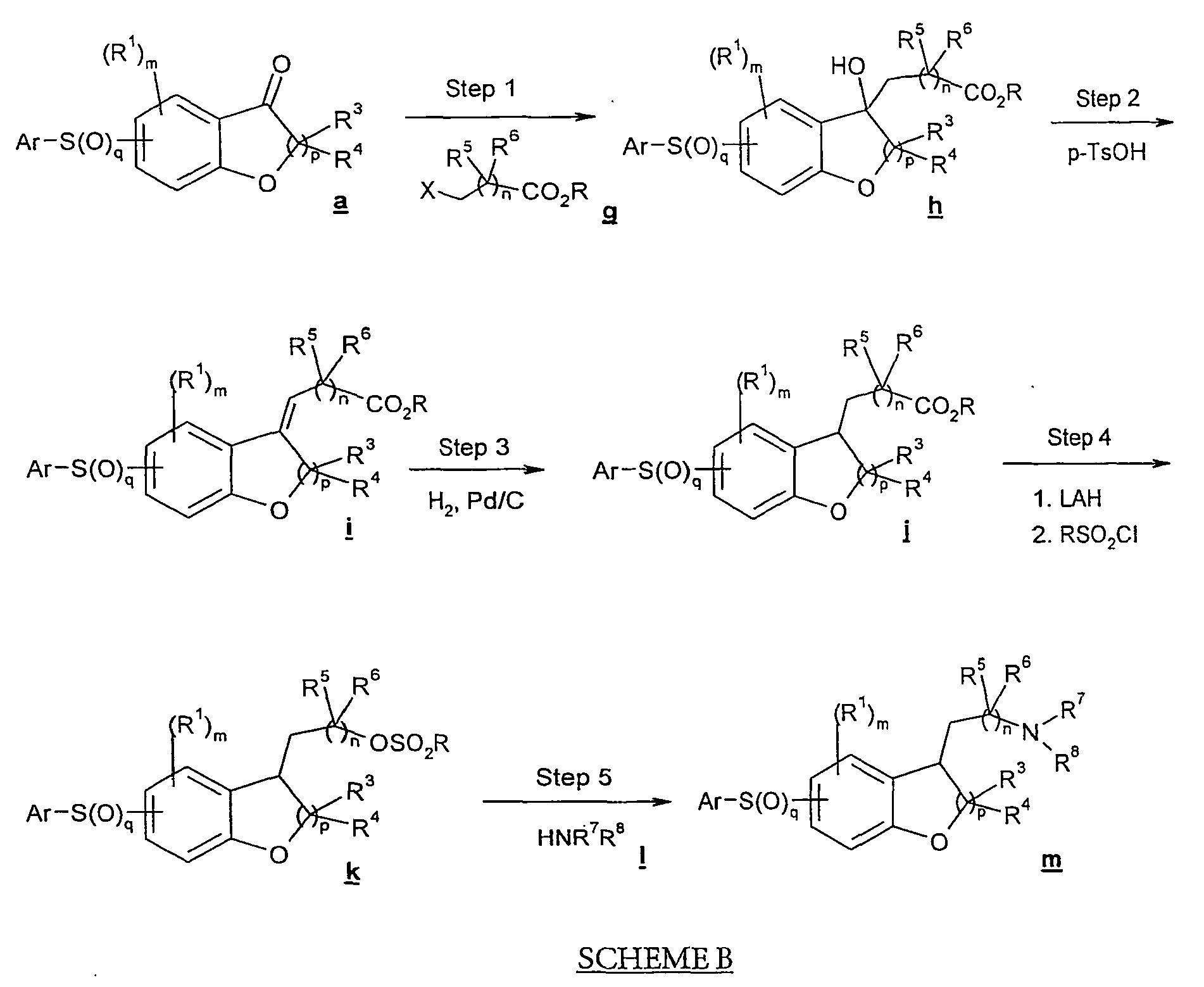
- In step 1 of Scheme B, ketone compound a is subject to an alkylation reaction by treatment with a haloalkyl ester compound g to afford a hydroxy ester compound h . Ketone compound a may be any one of a variety of arylsulfonyl, arylsulfanyl or arylsulfinyl indanone and tetralinone compounds as noted above. Alkylation in step 1 may be effected by treatment of ketone compound a with zinc and iodine, followed by haloalkyl ester compound g , which may be ethyl bromopropionate (where X is bromo, n is 1, R3 and R4 are hydrogen, and R is ethyl), or the like.
- In step 2, hydroxy ester compound h is dehydrated by treatment with acid such as para-toluenesulfonic acid, to yield an unsaturated ester compound i . In certain embodiments the dehydration of step 2 may occur spontaneously during step 1, and thus step 2 may be omitted.
- A reduction reaction takes place in step 3 in which the residual unsaturation in compound i is hydrogenated by treatment with hydrogen in the presence of a suitable platinum or palladium catalyst, to provide ester compound j .
- In step 4, the compound j is subject to reduction, followed by alkylsulfonylation, to afford sulfonate compound k . This step may be carried out by treatment of compound j with reducing agent such as lithium aluminum hydride to form an alcohol (not shown), which is then treated with alkylsulfonyl halide such as methanesulfonyl chloride.
- Amination of arylsulfonate compound k in step 5 provides amine compound m . This amination in many embodiments may comprise treatment of sulfonate compound k with amine l . For a compound m where R7 and R8 are hydrogen, compound k may be treated with sodium azide to form an azido compound (not shown), which is then reduced, using lithium aluminum hydride or like reducing agent, followed by acid workup to yield amine m . Compound m is a compound of formula I in accordance with the invention.
- As with Scheme A, many variations on the procedure of Scheme B are possible. In on such variation, sulfonate compound k may be treated with cyanide to form a nitrile compound, which in turn may be reduced to provide an amine.
- Scheme C shows another synthetic route to compounds of the invention, wherein Ar, m, p, q, R1, R3, R4, R5, R6, R7 and R8 are as defined herein.

- In step 1 of Scheme C, ketone a is subject to reduction to form alcohol compound b . Compound b is then treated with 2-cthoxycarbonyl-malonic acid diethyl ester in step 2 to afford triester compound o . In step 3 compound o is hydrolized to triacid compound p , which in turn is treated with acetic acid to afford acetyl compound q in step 4. The acety compound is reduced to alcohol r in step 5. In step 6 the alcohol r undergoes alkylsulfonylation to afford alkylsulfonyl compound s . Compound s may then be reacted with amine 1 to provide amino compound t , which is a compound of formula I in accordance with the invention.
- The amino functionality of the subject compounds may be subject to further reaction to afford monoalkylamino, dialkylamino, amidinyl, guanidinyl, imidazolinyl, imidazolinylamino, and other functionalities as shown in Scheme D.
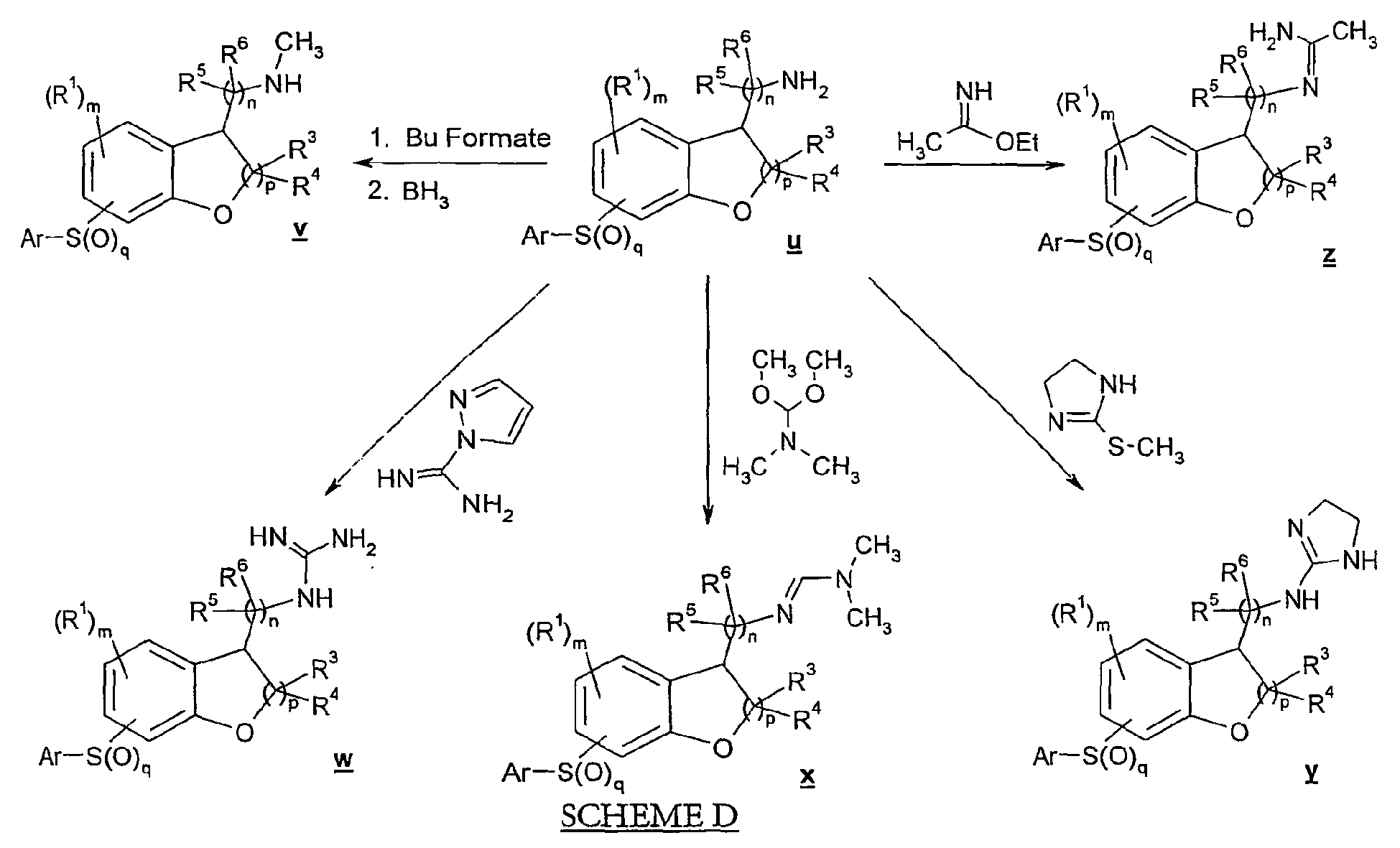
- In Scheme C, arylsulfonyl amine compound u may be converted to a formamide which is then reduced to provide methylamino compound v .
- Compound u may also be reacted with 1H-pyrazol-1-carboxamidine hydrochloride in the presence of amine catalyst under polar aprotic solvent conditions to afford urea compound w . Alternatively, compound u may be reacted with dimethylformamide dimethyl acetal to yield acetamidine compound x . As yet another alternative, compound u may be treated with 2-methylsulfanyl-4,5-dihydro-1H-imidazole to afford imidazolinylamino compound y . In still another alternative, compound u may be reacted with ethyl imidate (acetimidic acid ethyl ester) to provide acetamidine compound z .
- Specific details for producing compounds of formula I are described in the Examples section below.
- The compounds of the invention have selective affinity for 5-HT receptors, including the 5-HT6 the 5-HT2A receptor, or both, and as such are expected to be useful in the treatment of certain CNS disorders such as Parkinson's disease, Huntington's disease, anxiety, depression, manic depression, psychosis, epilepsy, obsessive compulsive disorders, mood disorders, migraine, Alzheimer's disease (enhancement of cognitive memory), sleep disorders, feeding disorders such as anorexia, bulimia, and obesity, panic attacks, akathisia, attention deficit hyperactivity disorder (ADHD), attention deficit disorder (ADD), withdrawal from drug abuse such as cocaine, ethanol, nicotine and benzodiazepines, schizophrenia, and also disorders associated with spinal trauma and/or head injury such as hydrocephalus. Such compounds are also expected to be of use in the treatment of certain GI (gastrointestinal) disorders such functional bowel disorder and irritable bowel syndrome.
- The pharmacology of the compounds of this invention was determined by art recognized procedures. The in vitro techniques for determining the affinities of test compounds at the 5-HT6 receptor and the 5-HT2A receptor in radioligand binding, FLIPR and functional assays are described below.
- The present invention includes pharmaceutical compositions comprising at least one compound of the present invention, or an individual isomer, racemic or non-racemic mixture of isomers or a pharmaceutically acceptable salt or solvate thereof, together with at least one pharmaceutically acceptable carrier, and optionally other therapeutic and/or prophylactic ingredients.
- In general, the compounds of the present invention will be administered in a therapeutically effective amount by any of the accepted modes of administration for agents that serve similar utilities. Suitable dosage ranges are typically 1-500 mg daily, preferably 1-100 mg daily, and most preferably 1-30 mg daily, depending upon numerous factors such as the severity of the disease to be treated, the age and relative health of the subject, the potency of the compound used, the route and form of administration, the indication towards which the administration is directed, and the preferences and experience of the medical practitioner involved. One of ordinary skill in the art of treating such diseases will be able, without undue experimentation and in reliance upon personal knowledge and the disclosure of this Application, to ascertain a therapeutically effective amount of the compounds of the present invention for a given disease.
- In general, compounds of the present invention will be administered as pharmaceutical formulations including those suitable for oral (including buccal and sublingual), rectal, nasal, topical, pulmonary, vaginal, or parenteral (including intramuscular, intra-arterial, intra-thecal, subcutaneous and intravenous) administration or in a form suitable for administration by inhalation or insufflation. The preferred manner of administration is generally oral using a convenient daily dosage regimen which can be adjusted according to the degree of affliction.
- A compound or compounds of the present invention, together with one or more conventional adjuvants, carriers, or diluents, may be placed into the form of pharmaceutical compositions and unit dosages. The pharmaceutical compositions and unit dosage forms may be comprised of conventional ingredients in conventional proportions, with or without additional active compounds or principles, and the unit dosage forms may contain any suitable effective amount of the active ingredient commensurate with the intended daily dosage range to be employed. The pharmaceutical compositions may be employed as solids, such as tablets or filled capsules, semisolids, powders, sustained release formulations, or liquids such as solutions, suspensions, emulsions, elixirs, or filled capsules for oral use; or in the form of suppositories for rectal or vaginal administration; or in the form of sterile injectable solutions for parenteral use. Formulations containing about one (1) milligram of active ingredient or, more broadly, about 0.01 to about one hundred (100) milligrams, per tablet, are accordingly suitable representative unit dosage forms.
- The compounds of the present invention may be formulated in a wide variety of oral administration dosage forms. The pharmaceutical compositions and dosage forms may comprise a compound or compounds of the present invention or pharmaceutically acceptable salts thereof as the active component. The pharmaceutically acceptable carriers may be either solid or liquid. Solid form preparations include powders, tablets, pills, capsules, cachets, suppositories, and dispersible granules. A solid carrier may be one or more substances which may also act as diluents, flavoring agents, solubilizers, lubricants, suspending agents, binders, preservatives, tablet disintegrating agents, or an encapsulating material. In powders, the carrier generally is a finely divided solid which is a mixture with the finely divided active component. In tablets, the active component generally is mixed with the carrier having the necessary binding capacity in suitable proportions and compacted in the shape and size desired. The powders and tablets preferably contain from about one (1) to about seventy (70) percent of the active compound. Suitable carriers include but are not limited to magnesium carbonate, magnesium stearate, talc, sugar, lactose, pectin, dextrin, starch, gelatine, tragacanth, methylcellulose, sodium carboxymethylcellulose, a low melting wax, cocoa butter, and the like. The term "preparation" is intended to include the formulation of the active compound with encapsulating material as carrier, providing a capsule in which the active component, with or without carriers, is surrounded by a carrier, which is in association with it. Similarly, cachets and lozenges are included. Tablets, powders, capsules, pills, cachets, and lozenges may be as solid forms suitable for oral administration.
- Other forms suitable for oral administration include liquid form preparations including emulsions, syrups, elixirs, aqueous solutions, aqueous suspensions, or solid form preparations which are intended to be converted shortly before use to liquid form preparations. Emulsions may be prepared in solutions, for example, in aqueous propylene glycol solutions or may contain emulsifying agents, for example, such as lecithin, sorbitan monooleate, or acacia. Aqueous solutions can be prepared by dissolving the active component in water and adding suitable colorants, flavors, stabilizers, and thickening agents. Aqueous suspensions can be prepared by dispersing the finely divided active component in water with viscous material, such as natural or synthetic gums, resins, methylcellulose, sodium carboxymethylcellulose, and other well known suspending agents. Solid form preparations include solutions, suspensions, and emulsions, and may contain, in addition to the active component, colorants, flavors, stabilizers, buffers, artificial and natural sweeteners, dispersants, thickeners, solubilizing agents, and the like.
- The compounds of the present invention may be formulated for parenteral administration (e.g., by injection, for example bolus injection or continuous infusion) and may be presented in unit dose form in ampoules, pre-filled syringes, small volume infusion or in multi-dose containers with an added preservative. The compositions may take such forms as suspensions, solutions, or emulsions in oily or aqueous vehicles, for example solutions in aqueous polyethylene glycol. Examples of oily or non-aqueous carriers, diluents, solvents or vehicles include propylene glycol, polyethylene glycol, vegetable oils (e.g., olive oil), and injectable organic esters (e.g., ethyl oleate), and may contain formulatory agents such as preserving, wetting, emulsifying or suspending, stabilizing and/or dispersing agents. Alternatively, the active ingredient may be in powder form, obtained by aseptic isolation of sterile solid or by lyophilization from solution for constitution before use with a suitable vehicle, e.g., sterile, pyrogen-free water.
- The compounds of the present invention may be formulated for topical administration to the epidermis as ointments, creams or lotions, or as a transdermal patch. Ointments and creams may, for example, be formulated with an aqueous or oily base with the addition of suitable thickening and/or gelling agents. Lotions may be formulated with an aqueous or oily base and will in general also containing one or more emulsifying agents, stabilizing agents, dispersing agents, suspending agents, thickening agents, or coloring agents. Formulations suitable for topical administration in the mouth include lozenges comprising active agents in a flavored base, usually sucrose and acacia or tragacanth; pastilles comprising the active ingredient in an inert base such as gelatine and glycerin or sucrose and acacia; and mouthwashes comprising the active ingredient in a suitable liquid carrier.
- The compounds of the present invention may be formulated for administration as suppositories. A low melting wax, such as a mixture of fatty acid glycerides or cocoa butter is first melted and the active component is dispersed homogeneously, for example, by stirring. The molten homogeneous mixture is then poured into convenient sized molds, allowed to cool, and to solidify.
- The compounds of the present invention may be formulated for vaginal administration. Pessaries, tampons, creams, gels, pastes, foams or sprays containing in addition to the active ingredient such carriers as are known in the art to be appropriate.
- The compounds of the present invention may be formulated for nasal administration. The solutions or suspensions are applied directly to the nasal cavity by conventional means, for example, with a dropper, pipette or spray. The formulations may be provided in a single or multidose form. In the latter case of a dropper or pipette, this may be achieved by the patient administering an appropriate, predetermined volume of the solution or suspension. In the case of a spray, this may be achieved for example by means of a metering atomizing spray pump.
- The compounds of the present invention may be formulated for aerosol administration, particularly to the respiratory tract and including intranasal administration. The compound will generally have a small particle size for example of the order of five (5) microns or less. Such a particle size may be obtained by means known in the art, for example by micronization. The active ingredient is provided in a pressurized pack with a suitable propellant such as a chlorofluorocarbon (CFC), for example, dichlorodiffuoromethane, trichlorofluoromethane, or dichlorotetrafluoroethane, or carbon dioxide or other suitable gas. The aerosol may conveniently also contain a surfactant such as lecithin. The dose of drug may be controlled by a metered valve. Alternatively the active ingredients may be provided in a form of a dry powder, for example a powder mix of the compound in a suitable powder base such as lactose, starch, starch derivatives such as hydroxypropylmethyl cellulose and polyvinylpyrrolidine (PVP). The powder carrier will form a gel in the nasal cavity. The powder composition may be presented in unit dose form for example in capsules or cartridges of e.g., gelatin or blister packs from which the powder may be administered by means of an inhaler.
- When desired, formulations can be prepared with enteric coatings adapted for sustained or controlled release administration of the active ingredient. For example, the compounds of the present invention can be formulated in transdermal or subcutaneous drug delivery devices. These delivery systems are advantageous when sustained release of the compound is necessary and when patient compliance with a treatment regimen is crucial. Compounds in transdermal delivery systems are frequently attached to an skin-adhesive solid support. The compound of interest can also be combined with a penetration enhancer, e.g., Azone (1-dodecylazacycloheptan-2-one). Sustained release delivery systems are inserted subcutaneously into the subdermal layer by surgery or injection. The subdermal implants encapsulate the compound in a lipid soluble membrane, e.g., silicone rubber, or a biodegradable polymer, e.g., polylactic acid.
- The pharmaceutical preparations are preferably in unit dosage forms. In such form, the preparation is subdivided into unit doses containing appropriate quantities of the active component. The unit dosage form can be a packaged preparation, the package containing discrete quantities of preparation, such as packeted tablets, capsules, and powders in vials or ampoules. Also, the unit dosage form can be a capsule, tablet, cachet, or lozenge itself, or it can be the appropriate number of any of these in packaged form.
- Other suitable pharmaceutical carriers and their formulations are described in Remington: The Science and Practice of Pharmacy 1995, edited by E. W. Martin, Mack Publishing Company, 19th edition, Easton, Pennsylvania. Representative pharmaceutical formulations containing a compound of the present invention are described in the Examples below.
- The following preparations and examples are given to enable those skilled in the art to more clearly understand and to practice the present invention. They should not be considered as limiting the scope of the invention, but merely as being illustrative and representative thereof. The following abbreviations may be used in the Examples.
-
- DCM
- dichloromethane/methylene chloride
- DMF
- N,N-dimethylformamide
- DMAP
- 4-dimethylaminopyridine
- EtOAc
- ethyl acetate
- EtOH
- ethanol
- tBuOH
- tert-butanol
- gc
- gas chromatography
- HMPA
- hexamethylphosphoramide
- HOAc/AcOH
- acetic acid
- hplc
- high performance liquid chromatography
- mCPBA
- m-chloroperbenzoic acid
- MeCN
- acetonitrile
- NMP
- N-methyl pyrrolidinone
- TEA
- triethylamine
- TFA
- trifluoroacetic acid
- THF
- tetrahydrofuran
- LDA
- lithium diisopropylamine
- TLC
- thin layer chromatography
- The synthetic procedure described in this Preparation was carried out according to the process shown in Scheme E.

-

- 3-Fluorophenol (8.9 g, 79.5 mmol) and 3-bromopropionic acid (12.24 g, 80.0 mmol) were placed in a flask. A solution of NaOH (6.7 g, 167 mmol) in 20 mL water was added slowly to the flask. The reaction mixture was heated to reflux for two hours and then cooled to room temperature and partitioned between ethyl acetate and water. The organic layer was dried over MgSO4, and solvent was evaporated under reduced pressure to give 4.57 g (25 mmol, 31.4 %) of 3-(3-fluoro-phenoxy)-propionic acid. MS: 185 (M+H)+.
-

- 3-(3-Fluoro-phenoxy)-propionic acid (3.37 g, 18.3 mmol), was dissolved in a mixture of 25 mL trifluoroacetic acid and 9 mL methanesulfonic acid. The reaction mixture was heated to 90 °C and was stirred at 90 °C for one hour. The reaction mixture was cooled to room temperature and partitioned between ethyl acetate and water. The organic layer was dried over MgSO4, and solvent was evaporated under reduced pressure. The residue was eluted through silica gel (15%EtOAc in hexanes), and solvent was removed under reduced pressure to yield 1.24 g (7.5 mmol, 41%) of 7-fluoro-chroman-4-one (MS: 167 (M+H)+.
-
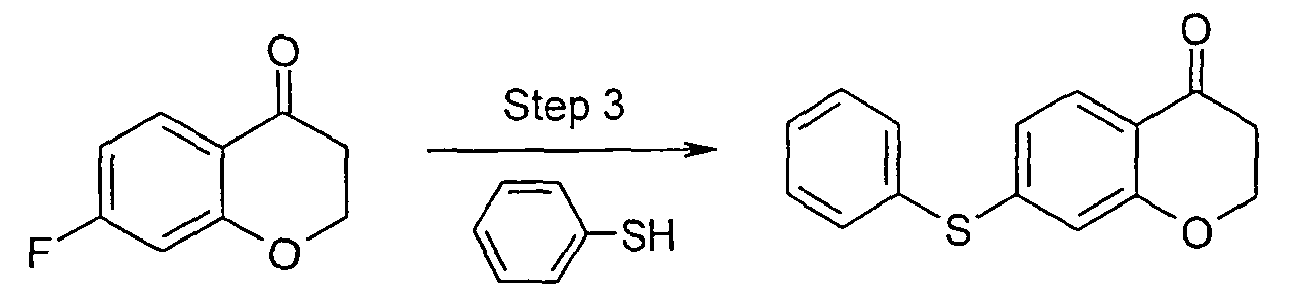
- A solution of 7-fluoroo-chroman-4-one (1.87 g, 11.27 mmol) and K2CO3 (9.28 g, 67.12 mmol) was added to 20 mL of dimethylformamide (DMF). Benzenethiol (1.37 mL, 13.52 mmol) was added, and the reaction mixture was stirred at room temperature for two hours, and then partitioned between ethyl acetate and water. The organic layer was dried over MgSO4, and solvent was evaporated under reduced pressure to yield an oil that was eluted through silica gel using hexanes/EtOAc (9:1). Removal of solvent under reduced pressure provided 2.21 g (8.62 mmol, 77%) of 7-phenylsulfanyl-chroman-4-one. MS: 257 (M+H)+.
-

- A solution of 7-phenylsulfanyl-chroman-4-one (2.21 g, 8.62 mmol) in 20 mL o MeOH and 2 mL water was stirred at room temperature. OXONE™ (potassium peroxymonosulfate, 6.35 g, 10.35 mmol) was added, and the reaction mixture was stirred for 3 hours at room temperature. The reaction mixture was partitioned between ethyl acetate and water. The organic layer was dried over MgSO4, and solvent was evaporated under reduced pressure. The resulting residue was eluted through silica gel with 35% EtOAc in hexanes. Removal of solvent under reduced pressure afforded 1.56 g (5.41 mmol, 63%) of 7-benzenesulfonyl-chroman-4-one. MS: 289 (M+H)+.
- The synthetic procedure described in this Preparation was carried out according to the process shown in Scheme F.

-

- 1-(4-Fluoro-2-hydroxy-phenyl)-ethanone (5.0 g, 32.44 mmol), acetone (11.92 mL, 162.2 mmol) and pyrrolidine (2.7 mL, 32.44 mmol) were dissolved in 20 mL benzene, and the reaction mixture was refluxed for four hours. The reaction mixture was cooled to room temperature and partitioned between ethyl acetate and 1 N HCl. The organic layer was dried over MgSO4, and solvent was evaporated under reduced pressure. The resulting residue was chromatographed (15% ethyl acetate in hexanes eluting through silica) and solvent was removed to yield 3.33 g (17.16 mg, 53%) of 7-fluoro-2,2-dimethylchroman-4-one as an oil. MS: 195 (M+H)+.
-

- The procedure of step 3 of preparation 1 was used to provide 1.49 g of 7-Benzenesulfanyl-2,2-dimethyl-chroman-4-one. MS: 285 (M+H)+.
-

- The procedure of step 4 of preparation 1 was used to provide 1.10 g of 7-Benzenesulfonyl-2,2-dimethyl-chroman-4-one. MS: 317 (M+H)+.
- The synthetic procedure described in this Example was carried out according to the process shown in Scheme G.

-

- 7-Benzenesulfonyl-chroman-4-one from Preparation 1 above (500 mg, 1.73 mmol) was dissolved in 10 mL of tetrahydrofuran (THF). Diethyl cyanophosphonate (789 uL, 5.21 mmol) and lithium cyanide (10.42 mL, 5.21 mmol) were added, and the reaction mixture was stirred for 10 minutes at room temperature. Water (150 (mL) was added, and the aqueous mixture was extracted twice with 200 mL of EtOAc. The combined organic layers were washed with brine, dried over MgSO4, and the solvent was evaporated under reduced pressure. The residue was dissolved in 5 mL THF, and 70 mL of MeOH was added. SmI2 (52 mL, 5.21 mmol) was then added over five minutes, and the reaction mixture was stirred for 10 minutes at room temperature. The reaction was quenched by addition of 20 mL 1 N HCl, and the resulting aqueous mixture was extracted with EtOAc and 1 N Na2S2O3. The organic phase was dried over MgSO4, and solvent was removed under reduced pressure. The residue eluted through silica gel using 40% EtOAc in hexanes, and solvent was removed under reduced pressure to yield 300 mg (1 mmol, 58%) of 7-benzenesulfonyl-chroman-4-carbonitrile. MS: 300 (M+H)+.
-

- 7-Benzenesulfonyl-chroman-4-carbonitrile (300 mg, 1 mmol) was dissolved in 10 mL THF, and 237 ul (2.5 mmol) of BH3·DMF was added. The reaction mixture was stirred for one hour at room temperature, and then heated to 80 °C for twenty minutes. The reaction mixture was then cooled, quenched by addition of methanol, and diluted with water. The aqueous mixture was extracted with EtOAc. The organic phase was dried over MgSO4, and solvent was removed under reduced pressure to yield 95 mg (31%) of C-(7-benzenesulfonyl-chroman-4-yl)-methylamine. MS: 304 (M+H)+. This product was dissolved in 2N HCl/EtOH and recrystallized by addition of Et2O to afford 52 mg of the corresponding hydrochloride salt. Mp: 246.8-249.8 °C.
- The synthetic procedure described in this Example was carried out according to the process shown in Scheme H.

-

- Sodium hydride (90 mg, 3.91 mmol) was added to 10 mL THF and was stirred for 30 minutes at 0°C. 7-Benzenesulfonyl-chroman-4-one (564 mg, 1.96 mmol) was dissolved in 5 mL THF, and the resulting solution was added to the reaction mixture. The reaction mixture was stirred for 10 minutes and then quenched by addition of 150 mL water. The resulting aqueous mixture was extracted twice with 200 mL EtOAc. The combined organic layers were dried over MgSO4, and solvent was removed under reduced pressure. The residue was chromatographed through silica gel using 35% EtOAc in hexanes, and solvent was removed under reduced pressure to afford 395 mg (1.27 mmol, 65%) of (7-benzenesulfonyl-chroman-4-ylidene)-acetonitrile. MS: 312 (M+H)+.
-

- (7-Benzenesulfonyl-chroman-4-ylidene)-acetonitrile (395 mg, 1.27 mmol) was dissolved in 4 mL EtOAc and placed in a Parr flask containing 40g of Pd (10% wt) on carbon. The flask was sealed and shaken overnight under 3.4·104 Pa (50 psi) of hydrogen. The Pd/C was removed by filtration and the solvent was evaporated under reduced pressure to afford 397 mg (1.26 mmol, 99%) of (7-benzenesulfonyl-chroman-4-yl)-acetonitrile. MS: 314 (M+H)+.
-

- (7-Benzenesulfonyl-chroman-4-yl)-acetonitrile (397 mg, 1.26 mmol) was dissolved in 5 mL THF, and 190 ul (1.9 mmol) of BH3·DMF was added. The reaction mixture was heated to reflux for one hour and then cooled to room temperature, quenched by addition of methanol, and diluted with water. The aqueous mixture was extracted with EtOAc. The organic phase was dried over MgSO4, and solvent was removed under reduced pressure. The residue was chromatographed through silica gel (MeOH: CH2Cl2: NH4OH 8%:90%:2%), and solvent was removed under reduced pressure to yield 120 mg (0.38 mmol, 30%) of 2-(7-benzenesulfonyl-chroman-4-yl)-ethylamine. This product was dissolved in 2N HCl/EtOH and recrystallized by addition of Et2O to afford 95 mg of the corresponding hydrochloride salt. Mp: 244.6-245.8 °C.
-

- 114 mg (0.376 mmol) of -(7-Benzenesulfonyl-chroman-4-yl)-methylamine HCl salt was dissolved in excess butyl formate and heated to reflux for 15 minutes. The resulting formamide was cooled to room temperature, concentrated, the residue dissolved in 3 mL THF and then reduced by adding 5 µL (1.5 eq., 0.563 mmol) of 10M BH3·DMS complex. The mixture was stirred for 1.5 h and quenched with methanol, partitioned between ethyl acetate and water, dried, concentrated and treated with 2 N HCl/EtOH and ether to provide 80 mg (60%) of (7-benzenesulfonyl-chroman-4-ylmethyl)-methyl-amine as the HCl salt, MS: 318 (M+H).
-

- C-(7-Benzenesulfonyl-chroman-4-yl)-methylamine HCl salt (125 mg, 0.378 mmol), 1H-pyrazol-1-carboxamidine hydrochloride (65 mg, 0.44 mmol) and 62 µL of triethylamine (0.44 mmol) were dissolved in 3 mL of EtOH. The reaction mixture was heated to 60° C overnight. The mixture was then cooled and partitioned between EtOAc and water, dried over MgSO4 concentrated and purified column chromatography (silica gel, MeOH/CHCl3/NH4OH 10:89:1). Formation of the HCl salt gave 15 mg (11%) of N-(7-Benzenesulfonyl-chroman-4-ylmethyl)-guanidine HCl, MS: 346 (M+H)+.
-

- C-(7-Benzenesulfonyl-chroman-4-yl)-methylamine HCl salt (75 mg, 0.22 mmol) was dissolved in 8 mL water and KOCN (36 mg, 0.44 mmol) was added. The reaction mixture was stirred at 100°C for 30 minutes., then cooled, partitioned between EtOAc and water, and dried over MgSO4. After concentration, the product was precipitated from Et2O/hexanes. After formation of the HCl salt, 24 mg (32%) of (7-Benzenesulfonylchroman-4-ylmethyl)-urea was collected. MS: 347 (M+H)+.
-

- C-(7-Benzenesulfonyl-chroman-4-yl)-methylamine HCl salt (90 mg, 0.26 mmol) and methyl imidate (acetimidic acid methyl ester, 58 mg, 0.529 mmol) were dissolved in 3 mL of absolute ethanol and 0.362 mL of triethylamine (2.6 mmol) was added. The reaction mixture was stirred at 80°C for 2 days. It was then cooled, partitioned between EtOAc and water, dried over MgSO4, concentrated and purified using column chromatography (silica gel, MeOH/CHCl3/NH4OH 10:89:1) After formation of the HCl salt, 9 mg (10%) of. N-(7-Benzenesulfonyl-chroman-4-ylmethyl)-acetamidine was collected. MS: 345 (M+H)+.
- The synthetic procedure described in this Example was carried out according to the process shown in Scheme I.

-

- The starting material 7-(3-Fluoro-benzenesulfonyl)-chroman-4-one was synthesized by the procedure of Example 1 except that 3-fluorothiophenol was used instead of thiophenol..
- To a solution of 7-(3-Fluoro-benzenesulfonyl)-chroman-4-one (3.31g, 10.81mmol) in THF (100ml) was added NaBH4 (0.49g, 12.9mmol) at 0 °C. The mixture was stirred at 0°C for 3 hours. The reaction mixture was partitioned between water and EtOAc. The EtOAc layer was washed with brine, dried with MgSO4, filtered and concentrated. The residue was purified with flash chromatography to give 2.0 g of 7-(3-Fluorobenzene-sulfonyl)-chroman-4-ol, as a white foam. MS: 599.2 (2M-OH)+.
-

- To a solution of 7-(3-Fluorobenzene-sulfonyl)-chroman-4-ol (3.0g, 9.7mmol) in THF (40ml) and toluene (40ml) was added HC(COOEt)3 (4.5g, 19.5mmol) and then PMe3 (19.5ml of 1.0M THF solution). The mixture was cooled to -78 oC. DIAD (4.0g, 19.5mmol) was added dropwise. The mixture was stirred at -78oC for 1 hour and then at RT for overnight. The next day the TLC showed that the reaction was complete. The solvent was removed and the residue was partitioned between EtOAc and H2O. The EtOAc layer was washed with brine, dried with MgSO4, concentrated and purified with flash column to give 2-Ethoxycarbonyl-2-[7-(3-fluoro-benzenesulfonyl)-chroman-4-yl]-malonicacid diethyl ester: 5.0 g, clear oil. MS: 545 (M+Na)+.
-

- To a solution of 2-Ethoxycarbonyl-2-[7-(3-fluoro-benzenesulfonyl)-chroman-4-yl]-malonicacid diethyl ester (5.0 g, 9.6mmol) in MeOH (50 ml) was added NaOH (25 ml, 3N in H2O). The milky mixture was heated at 65 °C overnight. The solvent was evaporated to give crude 2-Carboxy-2-[7-(3-fluoro-benzenesulfonyl)-chroman-4-yl]-malonic acid as a solid.
-

- The crude 2-Carboxy-2-[7-(3-fluoro-benzenesulfonyl)-chroman-4-yl]-malonic acid of step 3 was dissolved in HOAc (50ml), and the mixture was heated to 100°C overnight.. HOAc was removed via vacuum, and he residue was dissolved in EtOAc, washed with H2O, brine, dried with MgSO4, filtered and concentrated to give [7-(3-Fluoro-benzenesulfonyl)-chroman-4-yl]-acetic acid as a colorless oil which turned to a white solid upon standing: 2.55 g; MS 373(M+Na)+, 723.3 (2M+Na)+.
-

- To a solution of [7-(3-Fluoro-benzenesulfonyl)-chroman-4-yl]-acetic acid (1.5 g, 4.28 mmol) in THF 40ml) was added BH3 Me2S (0.41 ml, 4.32 mmol) at 0 °C. The mixture was stirred in the ice bath for 30 minutes and then at room temperature overnight. The mixture was quenched with MeOH and the solvent was removed. The residue was dissolved in EtOAc, washed with brine, dried with MgSQ4, filtered and concentrated to give 2-[7-(3-Fluoro-benzenesulfonyl)-chroman-4-yl]-ethanol as a clear syrup: 1.35 g; MS: 337.2 (M+H)+, 378.2(M+CH3CN+H)+.
-

- A solution of 2-[7-(3-Fluoro-benzenesulfonyl)-chroman-4-yl]-ethanol (1.35 g, 4.01 mmol) in CH2Cl2 (40 ml) was cooled to 0 °C. Et3N (4.06 g, 40.2 mmol) was added at 0 °C followed by methanesulfonylchloride (0.91 g, 8.00 mmol). The reaction mixture was stirred in an ice bath for 2 hours, then diluted with CH2Cl2, washed with brine, dried with MgSO4, filtered and concentrated to give AN oil residue. The residue was purified with flash chromatography to give methanesulfonic acid 2-[7-(3-fluoro-benzenesulfonyl)-chroman-4-yl]-ethyl ester as a clear oil: 1.35g; MS: 415.2 (M+H)+, 829.2 (2M+H)+.
-
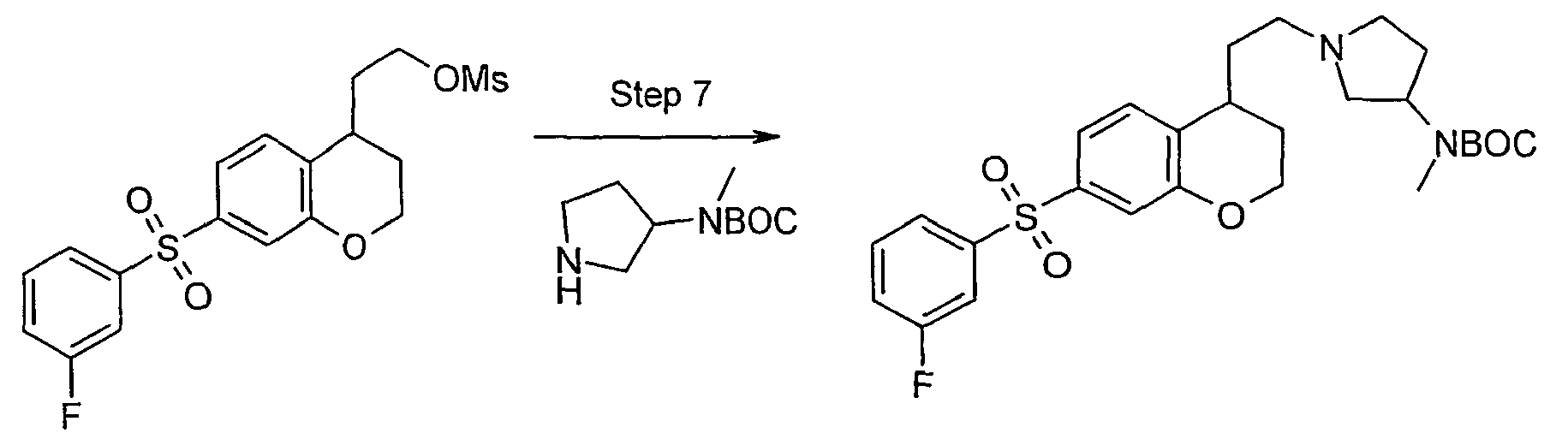
- 2-[7-(3-fluoro-benzenesulfonyl)-chroman-4-yl]-ethyl ester (0.1 g, 0.24 mmol) and 3-(N-tert-butoxycarbonyl-N-methyl amino)-pyrrolidine (1.0 ml, 4.3 mmol) were dissolved in THF (2.0 ml). The mixture was set up in a microwave reactor at 120°C for 3 hours. The reaction mixture was partitioned between water and EtOAc. The EtOAc layer was dried with MgSO4, filtered and concentrated. The residue was purified with preparative-TLC to give (1-{2-[7-(3-Fluoro-benzenesulfonyl)-chroman-4-yl]-ethyl}-pyrrolidin-3-yl)-methyl-carbamic acid tert-butyl ester (0.9 g), MS: 519.4(M+H)+.
-

- (1-{2-[7-(3-Fluoro-benzenesulfonyl)-chroman-4-yl] -ethyl}-pyrrolidin-3-yl)-methyl-carbamic acid tert-butyl ester (0.9 g) was dissolved in 2N HCl in EtOH (2 ml) and the mixture was heated at 60°C for 40 minutes. The reaction mixture was cooled to room temperature and was quenched with saturated NaHCO3, extracted with methylene chloride, dried with MgSO4, filtered, concentrated and purified with preparative TLC (10% MeOH in methylene chloride with 1% Et3N) to give (1-{2-[7-(3-fluorobenzenesulfonyl)-chroman-4-yl]-ethyl}-pyrrolidin-3-yl)-methyl-amine, which was treated with a few drops of 2N HCl in EtOH and dried under vacuum to give (1-{2-[7-(3-Fluoro-benzenesulfonyl)-chroman-4-yl]-ethyl}-pyrrolidin-3-yl)-methyl-amine HCl salt: 61.8mg, MS: 419.5 (M+H)+.
- Similarly prepared from the mesylate of step 6, were:
- (1-{2-[7-(3-Fluoro-benzenesulfonyl)-chroman-4-yl]-ethyl}-pyrrolidin-3-yl)-dimethyl-amine, 60% yield, MS: 433.3(M+H)+; and
- {2-[7-(3-Fluoro-benzenesulfonyl)-chroman-4-yl]-ethyl}-pyrrolidin-3-yl-amine, 61% yield, MS: 405.5(M+H)+.
- The synthetic procedure described in this Example was carried out according to the process shown in Scheme J.

-

- To a solution of [7-(3-Fluoro-benzenesulfonyl)-chroman-4-yl] -acetic acid (1.0g, 2.85 mmol) in CH2Cl2 (20 ml) at 0°C was added oxalyl chloride (2.85 ml, 2M in CH2Cl2, 5.71 mmol) followed by 3 drops of DMF. The reaction mixture was stirred in the ice bath for 3 hours. The solvent was removed, and toluene (10 ml) was added to the residue, and was evaporated via vacuum to remove any remaining oxalyl chloride. The crude 7-(3-fluoro-benzenesulfonyl)-chroman-4-yl]-acetyl chloride was obtained as a syrup.
-
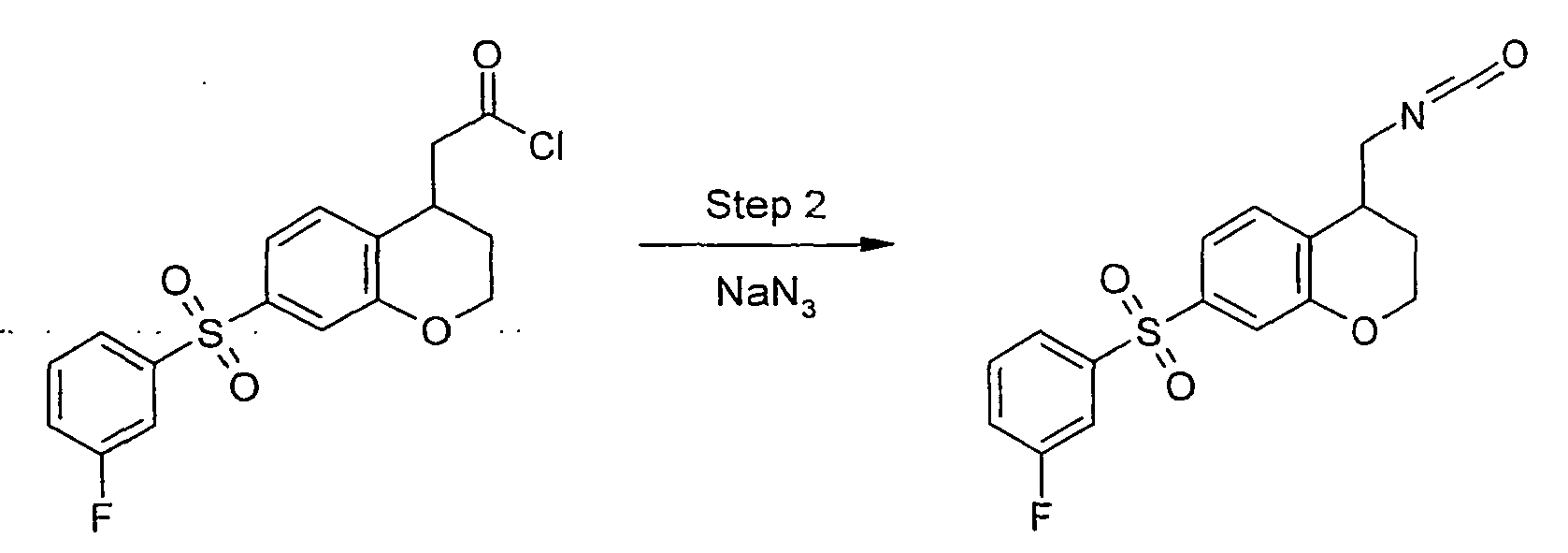
- A solution of NaN3 (0.56 g, 8.61 mmol) in H2O (2 ml) was added to a solution of 7-(3-fluoro-benzenesulfonyl)-chroman-4-yl]-acetyl chloride in acetone (10 ml) at 0°C. The mixture was stirred in the ice bath for 30 minutes then at room temperature overnight. The mixture was partitioned between water and EtOAc. The EtOAc layer was dried with MgSO4, filtered, concentrated and purified with flash chromatography to give 7-(3-fluoro-benzenesulfonyl)-4-isocyanatomethyl-chroman as a clear waxy oil: 0.55g, MS: 348.1(M+H)+, 389.2(M+CH3CN+H)+.
-

- To a solution of 7-(3-fluoro-benzenesulfonyl)-4-isocyanatomethyl-chroman (0.12 g, 0.35 mmol) in THF (15 ml) at 0°C was added LiAlH4 (0.52 ml, 1.0 M in THF, 0.525 mmol). The mixture was stirred at 0°C for 2 hours, then was quenched with one.drop of H2O 3 drops of 2N NaOH, and 3 drops of H2O again. The precipitate was filtered off. The solution was diluted with EtOAc, washed with water, dried with MgSO4, filtered and concentrated. The residue was purified with preparative TLC to give [7-(3-Fluorobenzenesulfonyl)-chroman-4-ylmethyl]-methyl-amine free base, which was further treated with a few drops of 2N HCl in EtOH and dried under vacuum to give the corresponding HCl salt: 33.5mg. MS: 336.2 (M+H)+, 377.2 (M+CH3CN+H)+, 671.3 (2M+H)+.
- Pharmaceutical preparations for delivery by various routes are formulated as shown in the following Tables. "Active ingredient" or "Active compound" as used in the Tables means one or more of the Compounds of Formula I.
-
Ingredient % wt./wt. Active ingredient 20.0% Lactose 79.5% Magnesium stearate 0.5% - The ingredients are mixed and dispensed into capsules containing about 100 mg each; one capsule would approximate a total daily dosage.
-
Ingredient % wt./wt. Active ingredient 20.0% Magnesium stearate 0.5% Crosscarmellose sodium 2.0% Lactose 76.5% PVP (polyvinylpyrrolidine) 1.0% - The ingredients are combined and granulated using a solvent such as methanol. The formulation is then dried and formed into tablets (containing about 20 mg of active compound) with an appropriate tablet machine.
-
Ingredient Amount Active compound 1.0 g Fumaric acid 0.5 g Sodium chloride 2.0 g Methyl paraben 0.15 g Propyl paraben 0.05 g Granulated sugar 25.5 g Sorbitol (70% solution) 12.85 g Veegum K (Vanderbilt Co.) 1.0 g Flavoring 0.035 ml Colorings 0.5 mg Distilled water q.s. to 100 ml - The ingredients are mixed to form a suspension for oral administration.
-
Ingredient % wt./wt. Active ingredient 0.25 g Sodium Chloride qs to make isotonic Water for injection 100 ml - The active ingredient is dissolved in a portion of the water for injection. A sufficient quantity of sodium chloride is then added with stirring to make the solution isotonic. The solution is made up to weight with the remainder of the water for injection, filtered through a 0.2 micron membrane filter and packaged under sterile conditions.
-
Ingredient % wt./wt. Active ingredient 1.0% Polyethylene glycol 1000 74.5% Polyethylene glycol 4000 24.5% - The ingredients are melted together and mixed on a steam bath, and poured into molds containing 2.5 g total weight.
-
Ingredients grams Active compound 0.2-2 Span 60 2 Tween 60 2 Mineral oil 5 Petrolatum 10 Methyl paraben 0.15 Propyl paraben 0.05 BHA (butylated hydroxy anisole) 0.01 Water q.s. 100 - All of the ingredients, except water, are combined and heated to about 60°C with stirring. A sufficient quantity of water at about 60°C is then added with vigorous stirring to emulsify the ingredients, and water then added q.s. about 100 g.
- Several aqueous suspensions containing from about 0.025-0.5 percent active compound are prepared as nasal spray formulations. The formulations optionally contain inactive ingredients such as, for example, microcrystalline cellulose, sodium carboxymethylcellulose, dextrose, and the like. Hydrochloric acid may be added to adjust pH. The nasal spray formulations may be delivered via a nasal spray metered pump typically delivering about 50-100 microliters of formulation per actuation. A typical dosing schedule is 2-4 sprays every 4-12 hours.
- This example illustrates in vitro radioligand binding studies of compound of formula I.
- The binding activity of compounds of this invention in vitro was determined as follows. Duplicate determinations of 5-HT6 ligand affinity were made by competing for binding of [3H]LSD in cell membranes derived from HEK293 cells stably expressing recombinant human 5-HT6 receptor. Duplicate determinations of 5-HT2A ligand affinity were made by competing for binding of [3H]Ketanserin (3-(2-(4-(4-fluorobenzoyl)piperidinol)ethyl)-2,4(1H,3H)-quinazolinedione) in cell membranes derived from CHO-K1 cells stably expressing recombinant human 5-HT2A receptor. Membranes were prepared from HEK 293 cell lines by the method described by Monsma et al., Molecular Pharmacology, Vol. 43 pp. 320-327 (1993), and from CHO-Kl cell lines as described by Bonhaus et al., Br J Pharmacol. Jun;115(4):622-8 (1995).
- For estimation of affinity at the 5-HT6 receptor, all determinations were made in assay buffer containing 50 mM Tris-HCl, 10 mM MgSO4, 0.5 mM EDTA, 1 mM ascorbic acid, pH 7.4 at 37 °C, in a 250 microliter reaction volume. For estimation of affinity at the 5-HT2A receptor all determinations were made in assay buffer containing 50 mM Tris-HCl, 5 mM ascorbic acid, 4 mM CaCl2, pH 7.4 at 32 °C, in a 250 microliter reaction volume.
- Assay tubes containing [3H] LSD or [3H]Ketanserin (5 nM), competing ligand, and membrane were incubated in a shaking water bath for 75 min. at 37 °C (for 5-HT6) or 60 min. at 32°C (for 5-HT2A), filtered onto Packard GF-B plates (pre-soaked with 0.3% PEI) using a Packard 96 well cell harvester and washed 3 times in ice cold 50 mM Tris-HCl. Bound [3H] LSD or [3H]Ketanserin were determined as radioactive counts per minute using Packard TopCount.
- Displacement of [3H]LSD or [3H]Ketanserin from the binding sites was quantified by fitting concentration-binding data to a 4-parameter logistic equation:

where Hill is the Hill slope, [ligand] is the concentration of competing radioligand and IC50 is the concentration of radioligand producing half-maximal specific binding of radioligand. The specific binding window is the difference between the Bmax and the basal parameters. - Using the procedures of this Example, compounds of Formula I were tested and found to be selective 5-HT6 antagonists, selective 5-HT2A antagonists, or both. For example, the compound C-(7-benzenesulfonyl-chroman-4-yl)-methylamine, exhibited a pKi of approximately 9.14 for 5-HT6, and a pKi of approximately 7.69 for 5-HT2A.
- The cognition-enhancing properties of compounds of the invention may be in a model of animal cognition: the object recognition task model. 4-month-old male Wistar rats (Charles River, The Netherlands) were used. Compounds were prepared daily and dissolved in physiological saline and tested at three doses. Administration was always given i.p. (injection volume 1 ml/kg) 60 minutes before T1. Scopolamine hydrobromide was injected 30 minutes after compound injection. Two equal testing groups were made of 24 rats and were tested by two experimenters. The testing order of doses was determined randomly. The experiments were performed using a double blind protocol. All rats were treated once with each dose condition. The object recognition test was performed as described by Ennaceur, A., Delacour, J., 1988, A new one-trial test for neurobiological studies of memory in rats. 1: Behavioral data. Behav. Brain Res. 31,47-59.
Claims (26)
- A compound of formula I:

wherein:m is from 0 to 3;p is from 1 to 3;q is 0, 1 or 2;Ar is optionally substituted aryl or optionally substituted 5- or 6- membered heteroaryl;each R1 is independently halo, C1-12-alkyl, C1-12-haloalkyl, C1-12-heteroalkyl, cyano, -S(O)t-Ra, -C(=O)-NRbRc, -SO2-NRbRc, -N(Rd)-C(=O)-Re, -C(=O)N(Rd)-, or -C(=O)-Re, where t is from 0 to 2, Ra, Rb, Rc, Rd and Re each independently is hydrogen or C1-12-alkyl;R2 is n is from 1 to 3;R3 and R4 each independently is hydrogen or C1-12-alkyl;R5 and R6 each independently is hydrogen or C1-12-alkyl, or R5 and R6 together may form =NRf wherein Rf is hydrogen or C1-12-alkyl; andR7 and R8 each independently is hydrogen or C1-12-alkyl, or one of R7 and R8 is hydrogen and the other is an optionally substituted 5- or 6- membered heteroaryl or 5- or 6- membered heterocyclyl containing one or two nitrogens, or R7 and R8 together with the nitrogen to which they are attached may form an amidinyl group, a urea group, a guanidinyl group, or a 5- or 6-membered heterocyclic ring that optionally includes an additional heteroatom selected from O, N and S and which is optionally substituted with amino, or one of R7 and R8 and one of R5 and R6 together with the atoms to which they are attached may form a 5- or 6-membered heterocyclic ring that optionally includes an additional heteroatom selected from O, N and S.
 - The compound of claim 1, wherein p is 2.
- The compound of claim 2, wherein q is 2.
- The compound of claim 3, wherein m is 0 or 1.
- The compound of claim 4, wherein Ar is optionally substituted phenyl.
- The compound of claim 5, wherein n is 1.
- The compound of claim 6, wherein R5 and R6 are hydrogen.
- The compound of claim 7, wherein R7 and R8 are hydrogen.
- The compound of claim 7, wherein one of R7 and R8 is hydrogen and the other is C1-12-alkyl.
- The compound of claim 7, wherein one of R7 and R8 is hydrogen and the other is pyrrolidinyl.
- The compound of claim 7, wherein R7 and R8 together with the nitrogen to which they are attached form an amidinyl group.
- The compound of claim 7, wherein R7 and R8 together with the nitrogen to which they are attached form a guanidinyl group
- The compound of claim 7, wherein R7 and R8 together with the nitrogen to which they are attached form a urea group.
- The compound of claim 5, wherein n is 2.
- The compound of claim 14, wherein R5 and R6 are hydrogen.
- The compound of claim 15, wherein R7 and R8 are hydrogen.
- The compound of claim 15, wherein one of R7 and R8 is hydrogen and the other is C1-12-alkyl.
- The compound of claim 15, wherein one of R7 and R8 is hydrogen and the other is optionally substituted pyrrolidinyl.
- The compound of claim 15, wherein R7 and R8 together with the nitrogen to which they are attached form an amidinyl group.
- The compound of claim 15, wherein R7 and R8 together with the nitrogen to which they are attached form a guanidinyl group.
- The compound of claim 1, wherein said compound is of formula II:

- The compound of claim 1, wherein said compound is of formula III:
 s is from 0 to 4;each R9 is independently halo, C1-12-alkyl, C1-12-alkoxy, C1-12-haloalkyl, C1-12-heteroalkyl, cyano, -S(O)r-Ra, -C(=O)-NRbRc, -SO2-NRbRc, -N(Rd)-C(=O)-Re, or-C(=O)-Re, where r is from 0 to 2, Ra, Rb, Rc, Rd and Re each independently is hydrogen or C1-12-alkyl; andn, R3, R4, R5 and R6 are as recited in claim 1.
 - The compound of claim 1, wherein said compound is of formula IV:
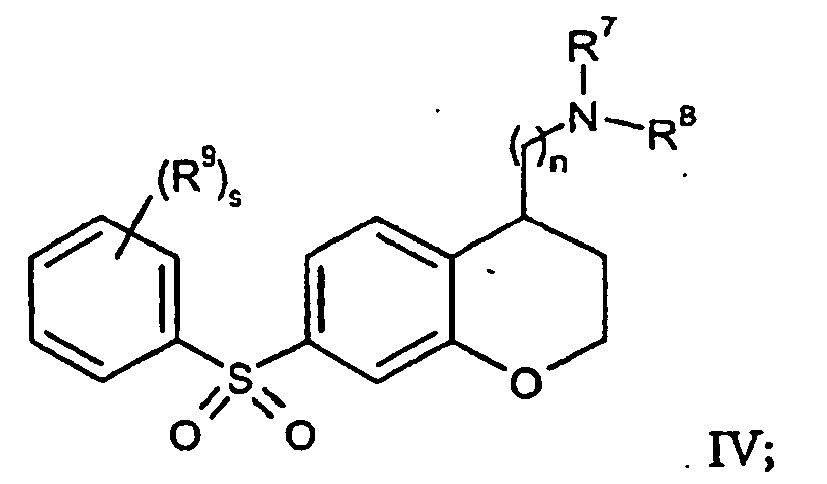 n is 1 or 2;s is 0 or 1;R9 is halo, C1-12-alkyl, C1-12-alkoxy, or C1-12-haloalkyl; andR5 and R6 each independently is hydrogen or C1-12-alkyl, or or R5 and R6 together with the nitrogen to which they are attached may form an amidinyl group or a guanidinyl group.
 - A pharmaceutical composition comprising an effective amount of the compound of any one of claims 1 to 23 in admixture with a pharmaceutically acceptable carrier.
- Use of a compound according to any one of claims 1 to 23 for the preparation of a medicament useful for treating a central nervous system disease state selected from psychoses, schizophrenia, manic depressions, neurological disorders, memory disorders, attention deficit disorder, Parkinson's disease, amyotrophic lateral sclerosis, Alzheimer's disease, food uptake disorders, and Huntington's disease.
- Use of a compound according to any one of claims 1 to 23 for the preparation of a medicament useful for treating a disorder of the gastrointestinal tract.
Priority Applications (1)
| Application Number | Priority Date | Filing Date | Title |
|---|---|---|---|
| PL05822998T PL1831191T3 (en) | 2004-12-21 | 2005-12-12 | Chroman derivatives and their use as 5-ht receptor ligands |
Applications Claiming Priority (2)
| Application Number | Priority Date | Filing Date | Title |
|---|---|---|---|
| US63785404P | 2004-12-21 | 2004-12-21 | |
| PCT/EP2005/013291 WO2006066746A1 (en) | 2004-12-21 | 2005-12-12 | Chroman derivatives and their use as 5-ht receptor ligands |
Publications (2)
| Publication Number | Publication Date |
|---|---|
| EP1831191A1 EP1831191A1 (en) | 2007-09-12 |
| EP1831191B1 true EP1831191B1 (en) | 2008-05-21 |
Family
ID=35929640
Family Applications (1)
| Application Number | Title | Priority Date | Filing Date |
|---|---|---|---|
| EP05822998A Expired - Lifetime EP1831191B1 (en) | 2004-12-21 | 2005-12-12 | Chroman derivatives and their use as 5-ht receptor ligands |
Country Status (15)
| Country | Link |
|---|---|
| US (1) | US7759389B2 (en) |
| EP (1) | EP1831191B1 (en) |
| JP (1) | JP2008524275A (en) |
| KR (1) | KR20070088798A (en) |
| CN (1) | CN101124212A (en) |
| AT (1) | ATE396183T1 (en) |
| AU (1) | AU2005318596B2 (en) |
| BR (1) | BRPI0516381A (en) |
| CA (1) | CA2592001A1 (en) |
| DE (1) | DE602005007064D1 (en) |
| ES (1) | ES2306275T3 (en) |
| MX (1) | MX2007007480A (en) |
| PL (1) | PL1831191T3 (en) |
| RU (1) | RU2396264C2 (en) |
| WO (1) | WO2006066746A1 (en) |
Families Citing this family (11)
| Publication number | Priority date | Publication date | Assignee | Title |
|---|---|---|---|---|
| US7842713B2 (en) * | 2006-04-20 | 2010-11-30 | Pfizer Inc | Fused phenyl amido heterocyclic compounds |
| KR101258331B1 (en) | 2008-09-11 | 2013-04-26 | 화이자 인코포레이티드 | Heteroaryls amide derivatives and their use as glucokinase activators |
| MY151246A (en) * | 2009-03-11 | 2014-04-30 | Pfizer | Benzofuranyl derivatives |
| CN101838274B (en) * | 2009-05-21 | 2012-03-28 | 浙江医药股份有限公司新昌制药厂 | Improved preparation method of d-biotin |
| EP2533638B1 (en) * | 2010-02-12 | 2016-02-10 | Nivalis Therapeutics, Inc. | Novel s-nitrosoglutathione reductase inhibitors |
| KR101770979B1 (en) * | 2010-05-21 | 2017-08-24 | 애브비 인코포레이티드 | Modulators of 5-ht receptors and methods of use thereof |
| CA2822357A1 (en) | 2010-12-22 | 2012-06-28 | Abbvie Inc. | Hepatitis c inhibitors and uses thereof |
| CN110981844A (en) * | 2019-12-19 | 2020-04-10 | 江南大学 | Preparation method of sulfoxide flavonoid and sulfone flavonoid |
| CN111039998A (en) * | 2019-12-19 | 2020-04-21 | 江南大学 | Preparation method of 8-benzenesulfonyl substituted flavone glucose glycoside |
| CN111072617A (en) * | 2019-12-19 | 2020-04-28 | 江南大学 | A kind of preparation method of 8-benzenesulfonyl substituted flavonol |
| CN113214231B (en) * | 2020-01-21 | 2022-04-08 | 瀚远医药有限公司 | 5HT2A receptor antagonists and their medical uses |
Family Cites Families (30)
| Publication number | Priority date | Publication date | Assignee | Title |
|---|---|---|---|---|
| DE3901814A1 (en) * | 1988-07-28 | 1990-02-01 | Bayer Ag | SUBSTITUTED AMINOMETHYLZETRALINE AND ITS HETEROCYCLIC ANALOG |
| IL114715A (en) * | 1989-02-27 | 1997-01-10 | Lilly Co Eli | Intermediate compounds for ring-substituted 2-amino-1, 2, 3, 4-tetrahydronaphthalenes and 3-aminochromanes |
| US5420151A (en) * | 1989-12-22 | 1995-05-30 | Aktiebolaget Astra | Chroman derivatives |
| US5506192A (en) * | 1990-06-07 | 1996-04-09 | Sandoz Ltd. | Substituted phthalides and heterocyclic phthalides |
| ATE161254T1 (en) * | 1990-07-27 | 1998-01-15 | Chugai Pharmaceutical Co Ltd | BENZOPYRANE DERIVATIVE |
| US5401848A (en) | 1990-11-26 | 1995-03-28 | E. R. Squibb & Sons, Inc. | Indane and quinoline derivatives |
| US5817693A (en) * | 1991-11-05 | 1998-10-06 | Cousins; Russell Donovan | Endothelin receptor antagonists |
| ZA93436B (en) * | 1992-01-24 | 1993-08-25 | Chugai Pharmaceutical Co Ltd | Benzopyran derivatives |
| ATE191716T1 (en) * | 1992-08-17 | 2000-04-15 | Chugai Pharmaceutical Co Ltd | BENZOPYRAN AND BENZOXAZINE DERIVATIVES |
| US5374643A (en) | 1992-09-11 | 1994-12-20 | E. R. Squibb & Sons, Inc. | Aryl urea (thiourea) and cyanoguanidine derivatives |
| US5739135A (en) * | 1993-09-03 | 1998-04-14 | Bristol-Myers Squibb Company | Inhibitors of microsomal triglyceride transfer protein and method |
| US6150402A (en) * | 1994-08-15 | 2000-11-21 | Loma Linda University Medical Center | Natriuretic compounds |
| US5869478A (en) * | 1995-06-07 | 1999-02-09 | Bristol-Myers Squibb Company | Sulfonamido substituted benzopyran derivatives |
| PL324319A1 (en) | 1995-06-30 | 1998-05-25 | Upjohn Co | 1,6-disubstituted isochromates for fighting against sick headaches |
| US5663194A (en) * | 1995-07-25 | 1997-09-02 | Mewshaw; Richard E. | Chroman-2-ylmethylamino derivatives |
| US5935958A (en) * | 1996-07-01 | 1999-08-10 | Schering Corporation | Muscarinic antagonists |
| EP1019035A4 (en) * | 1996-08-21 | 2001-10-17 | Smithkline Beecham Corp | Il-8 receptor antagonists |
| US6559144B2 (en) * | 1997-02-13 | 2003-05-06 | Merck Patent Gesellschaft Mit | Bicyclic amino acids |
| HU225960B1 (en) * | 1997-02-27 | 2008-01-28 | Takeda Pharmaceutical | Amine compounds, their production and use |
| TWI242011B (en) * | 1997-03-31 | 2005-10-21 | Eisai Co Ltd | 1,4-substituted cyclic amine derivatives |
| FR2778662B1 (en) * | 1998-05-12 | 2000-06-16 | Adir | NOVEL SUBSTITUTED CYCLIC COMPOUNDS, PROCESS FOR THEIR PREPARATION AND PHARMACEUTICAL COMPOSITIONS CONTAINING THEM |
| US6479536B1 (en) * | 1998-12-04 | 2002-11-12 | Takeda Chemical Industries, Ltd. | Benzofuran derivatives, process for the preparation of the same and uses thereof |
| CN101058543B (en) * | 2000-04-03 | 2010-05-26 | 武田药品工业株式会社 | Process for preparing amine derivatives |
| AR035858A1 (en) * | 2001-04-23 | 2004-07-21 | Bayer Corp | CHROME DERIVATIVES 2,6-SUBSTITUTES, PHARMACEUTICAL COMPOSITIONS, USE OF SUCH DERIVATIVES FOR THE MANUFACTURE OF USEFUL MEDICINES AS BETA-3 ADRENORRECEPTING AGONISTS |
| EP1411925A1 (en) * | 2001-08-03 | 2004-04-28 | PHARMACIA & UPJOHN COMPANY | 5-arylsulfonyl indoles having 5-ht6 receptor affinity |
| JP2005505586A (en) * | 2001-10-04 | 2005-02-24 | ワイス | Chroman derivatives as 5-hydroxytryptamine-6 ligands |
| WO2003029239A1 (en) * | 2001-10-04 | 2003-04-10 | Wyeth | Chroman and benzofuran derivatives as 5-hydroxytryptamine-6 ligands |
| JP4754821B2 (en) * | 2002-06-20 | 2011-08-24 | プロキシマゲン・リミテッド | Novel compounds useful for the treatment of obesity, type II diabetes and CNS disorders |
| WO2005037223A2 (en) * | 2003-10-15 | 2005-04-28 | Brigham And Women's Hospital, Inc. | Methods and compositions for immunomodulation |
| EP1678121A4 (en) | 2003-10-24 | 2007-07-25 | Exelixis Inc | Tao kinase modulators and methods of use |
-
2005
- 2005-12-12 CA CA002592001A patent/CA2592001A1/en not_active Abandoned
- 2005-12-12 CN CNA2005800485143A patent/CN101124212A/en active Pending
- 2005-12-12 RU RU2007123251/04A patent/RU2396264C2/en not_active IP Right Cessation
- 2005-12-12 AT AT05822998T patent/ATE396183T1/en active
- 2005-12-12 WO PCT/EP2005/013291 patent/WO2006066746A1/en not_active Ceased
- 2005-12-12 JP JP2007547254A patent/JP2008524275A/en not_active Ceased
- 2005-12-12 ES ES05822998T patent/ES2306275T3/en not_active Expired - Lifetime
- 2005-12-12 PL PL05822998T patent/PL1831191T3/en unknown
- 2005-12-12 EP EP05822998A patent/EP1831191B1/en not_active Expired - Lifetime
- 2005-12-12 KR KR1020077016602A patent/KR20070088798A/en not_active Ceased
- 2005-12-12 MX MX2007007480A patent/MX2007007480A/en active IP Right Grant
- 2005-12-12 BR BRPI0516381-1A patent/BRPI0516381A/en not_active IP Right Cessation
- 2005-12-12 AU AU2005318596A patent/AU2005318596B2/en not_active Ceased
- 2005-12-12 DE DE602005007064T patent/DE602005007064D1/en not_active Expired - Lifetime
- 2005-12-21 US US11/315,392 patent/US7759389B2/en not_active Expired - Fee Related
Also Published As
| Publication number | Publication date |
|---|---|
| WO2006066746A1 (en) | 2006-06-29 |
| AU2005318596A1 (en) | 2006-06-29 |
| RU2396264C2 (en) | 2010-08-10 |
| CN101124212A (en) | 2008-02-13 |
| PL1831191T3 (en) | 2008-10-31 |
| ES2306275T3 (en) | 2008-11-01 |
| MX2007007480A (en) | 2007-07-20 |
| CA2592001A1 (en) | 2006-06-29 |
| KR20070088798A (en) | 2007-08-29 |
| US20060148888A1 (en) | 2006-07-06 |
| RU2007123251A (en) | 2009-01-27 |
| DE602005007064D1 (en) | 2008-07-03 |
| AU2005318596B2 (en) | 2010-12-23 |
| US7759389B2 (en) | 2010-07-20 |
| EP1831191A1 (en) | 2007-09-12 |
| JP2008524275A (en) | 2008-07-10 |
| BRPI0516381A (en) | 2008-09-02 |
| ATE396183T1 (en) | 2008-06-15 |
Similar Documents
| Publication | Publication Date | Title |
|---|---|---|
| US7671235B2 (en) | Tetralin and indane derivatives and uses thereof | |
| EP1831191B1 (en) | Chroman derivatives and their use as 5-ht receptor ligands | |
| EP1831159B1 (en) | Tetralin and indane derivatives and uses thereof | |
| EP1831152B1 (en) | Tetralin and indane derivatives and uses thereof as 5-ht antagonists | |
| AU2005318516B2 (en) | Chroman derivatives and uses thereof in the treatment of CNS disorders | |
| US7799797B2 (en) | Arylsulfonyl naphthalene derivatives and uses thereof | |
| EP2027104B1 (en) | Arylsulfonylchromans as 5-ht6 inhibitors | |
| EP1831189B1 (en) | Tetralin and indane derivatives and uses thereof |
Legal Events
| Date | Code | Title | Description |
|---|---|---|---|
| PUAI | Public reference made under article 153(3) epc to a published international application that has entered the european phase |
Free format text: ORIGINAL CODE: 0009012 |
|
| 17P | Request for examination filed |
Effective date: 20070723 |
|
| AK | Designated contracting states |
Kind code of ref document: A1 Designated state(s): AT BE BG CH CY CZ DE DK EE ES FI FR GB GR HU IE IS IT LI LT LU LV MC NL PL PT RO SE SI SK TR |
|
| DAX | Request for extension of the european patent (deleted) | ||
| RIN1 | Information on inventor provided before grant (corrected) |
Inventor name: KRAUSS, NANCY, ELISABETH Inventor name: ZHAO, SHU-HAI |
|
| GRAP | Despatch of communication of intention to grant a patent |
Free format text: ORIGINAL CODE: EPIDOSNIGR1 |
|
| RAP1 | Party data changed (applicant data changed or rights of an application transferred) |
Owner name: F. HOFFMANN-LA ROCHE AG |
|
| GRAS | Grant fee paid |
Free format text: ORIGINAL CODE: EPIDOSNIGR3 |
|
| GRAA | (expected) grant |
Free format text: ORIGINAL CODE: 0009210 |
|
| RIN1 | Information on inventor provided before grant (corrected) |
Inventor name: ZHAO, SHU-HAI Inventor name: KRAUSS, NANCY, ELISABETH |
|
| AK | Designated contracting states |
Kind code of ref document: B1 Designated state(s): AT BE BG CH CY CZ DE DK EE ES FI FR GB GR HU IE IS IT LI LT LU LV MC NL PL PT RO SE SI SK TR |
|
| REG | Reference to a national code |
Ref country code: GB Ref legal event code: FG4D |
|
| REG | Reference to a national code |
Ref country code: CH Ref legal event code: EP |
|
| REF | Corresponds to: |
Ref document number: 602005007064 Country of ref document: DE Date of ref document: 20080703 Kind code of ref document: P |
|
| REG | Reference to a national code |
Ref country code: IE Ref legal event code: FG4D |
|
| REG | Reference to a national code |
Ref country code: SE Ref legal event code: TRGR |
|
| PG25 | Lapsed in a contracting state [announced via postgrant information from national office to epo] |
Ref country code: SI Free format text: LAPSE BECAUSE OF FAILURE TO SUBMIT A TRANSLATION OF THE DESCRIPTION OR TO PAY THE FEE WITHIN THE PRESCRIBED TIME-LIMIT Effective date: 20080521 |
|
| PG25 | Lapsed in a contracting state [announced via postgrant information from national office to epo] |
Ref country code: FI Free format text: LAPSE BECAUSE OF FAILURE TO SUBMIT A TRANSLATION OF THE DESCRIPTION OR TO PAY THE FEE WITHIN THE PRESCRIBED TIME-LIMIT Effective date: 20080521 |
|
| REG | Reference to a national code |
Ref country code: PL Ref legal event code: T3 |
|
| REG | Reference to a national code |
Ref country code: ES Ref legal event code: FG2A Ref document number: 2306275 Country of ref document: ES Kind code of ref document: T3 |
|
| PG25 | Lapsed in a contracting state [announced via postgrant information from national office to epo] |
Ref country code: LV Free format text: LAPSE BECAUSE OF FAILURE TO SUBMIT A TRANSLATION OF THE DESCRIPTION OR TO PAY THE FEE WITHIN THE PRESCRIBED TIME-LIMIT Effective date: 20080521 |
|
| PG25 | Lapsed in a contracting state [announced via postgrant information from national office to epo] |
Ref country code: IS Free format text: LAPSE BECAUSE OF FAILURE TO SUBMIT A TRANSLATION OF THE DESCRIPTION OR TO PAY THE FEE WITHIN THE PRESCRIBED TIME-LIMIT Effective date: 20080921 |
|
| PG25 | Lapsed in a contracting state [announced via postgrant information from national office to epo] |
Ref country code: LT Free format text: LAPSE BECAUSE OF FAILURE TO SUBMIT A TRANSLATION OF THE DESCRIPTION OR TO PAY THE FEE WITHIN THE PRESCRIBED TIME-LIMIT Effective date: 20080521 Ref country code: CZ Free format text: LAPSE BECAUSE OF FAILURE TO SUBMIT A TRANSLATION OF THE DESCRIPTION OR TO PAY THE FEE WITHIN THE PRESCRIBED TIME-LIMIT Effective date: 20080521 Ref country code: DK Free format text: LAPSE BECAUSE OF FAILURE TO SUBMIT A TRANSLATION OF THE DESCRIPTION OR TO PAY THE FEE WITHIN THE PRESCRIBED TIME-LIMIT Effective date: 20080521 |
|
| PG25 | Lapsed in a contracting state [announced via postgrant information from national office to epo] |
Ref country code: SK Free format text: LAPSE BECAUSE OF FAILURE TO SUBMIT A TRANSLATION OF THE DESCRIPTION OR TO PAY THE FEE WITHIN THE PRESCRIBED TIME-LIMIT Effective date: 20080521 Ref country code: RO Free format text: LAPSE BECAUSE OF FAILURE TO SUBMIT A TRANSLATION OF THE DESCRIPTION OR TO PAY THE FEE WITHIN THE PRESCRIBED TIME-LIMIT Effective date: 20080521 Ref country code: PT Free format text: LAPSE BECAUSE OF FAILURE TO SUBMIT A TRANSLATION OF THE DESCRIPTION OR TO PAY THE FEE WITHIN THE PRESCRIBED TIME-LIMIT Effective date: 20081021 |
|
| PLBE | No opposition filed within time limit |
Free format text: ORIGINAL CODE: 0009261 |
|
| STAA | Information on the status of an ep patent application or granted ep patent |
Free format text: STATUS: NO OPPOSITION FILED WITHIN TIME LIMIT |
|
| 26N | No opposition filed |
Effective date: 20090224 |
|
| PG25 | Lapsed in a contracting state [announced via postgrant information from national office to epo] |
Ref country code: BG Free format text: LAPSE BECAUSE OF FAILURE TO SUBMIT A TRANSLATION OF THE DESCRIPTION OR TO PAY THE FEE WITHIN THE PRESCRIBED TIME-LIMIT Effective date: 20080821 Ref country code: EE Free format text: LAPSE BECAUSE OF FAILURE TO SUBMIT A TRANSLATION OF THE DESCRIPTION OR TO PAY THE FEE WITHIN THE PRESCRIBED TIME-LIMIT Effective date: 20080521 |
|
| PG25 | Lapsed in a contracting state [announced via postgrant information from national office to epo] |
Ref country code: MC Free format text: LAPSE BECAUSE OF NON-PAYMENT OF DUE FEES Effective date: 20081231 |
|
| REG | Reference to a national code |
Ref country code: IE Ref legal event code: MM4A |
|
| PG25 | Lapsed in a contracting state [announced via postgrant information from national office to epo] |
Ref country code: IE Free format text: LAPSE BECAUSE OF NON-PAYMENT OF DUE FEES Effective date: 20081212 |
|
| PG25 | Lapsed in a contracting state [announced via postgrant information from national office to epo] |
Ref country code: HU Free format text: LAPSE BECAUSE OF FAILURE TO SUBMIT A TRANSLATION OF THE DESCRIPTION OR TO PAY THE FEE WITHIN THE PRESCRIBED TIME-LIMIT Effective date: 20081122 Ref country code: CY Free format text: LAPSE BECAUSE OF FAILURE TO SUBMIT A TRANSLATION OF THE DESCRIPTION OR TO PAY THE FEE WITHIN THE PRESCRIBED TIME-LIMIT Effective date: 20080521 Ref country code: LU Free format text: LAPSE BECAUSE OF NON-PAYMENT OF DUE FEES Effective date: 20081212 |
|
| PG25 | Lapsed in a contracting state [announced via postgrant information from national office to epo] |
Ref country code: GR Free format text: LAPSE BECAUSE OF FAILURE TO SUBMIT A TRANSLATION OF THE DESCRIPTION OR TO PAY THE FEE WITHIN THE PRESCRIBED TIME-LIMIT Effective date: 20080822 |
|
| PGFP | Annual fee paid to national office [announced via postgrant information from national office to epo] |
Ref country code: PL Payment date: 20100920 Year of fee payment: 6 |
|
| PGFP | Annual fee paid to national office [announced via postgrant information from national office to epo] |
Ref country code: AT Payment date: 20101122 Year of fee payment: 6 Ref country code: FR Payment date: 20101203 Year of fee payment: 6 Ref country code: NL Payment date: 20101124 Year of fee payment: 6 |
|
| PGFP | Annual fee paid to national office [announced via postgrant information from national office to epo] |
Ref country code: CH Payment date: 20101026 Year of fee payment: 6 |
|
| PGFP | Annual fee paid to national office [announced via postgrant information from national office to epo] |
Ref country code: SE Payment date: 20101122 Year of fee payment: 6 Ref country code: IT Payment date: 20101213 Year of fee payment: 6 Ref country code: GB Payment date: 20101123 Year of fee payment: 6 Ref country code: TR Payment date: 20101129 Year of fee payment: 6 |
|
| PGFP | Annual fee paid to national office [announced via postgrant information from national office to epo] |
Ref country code: DE Payment date: 20101230 Year of fee payment: 6 |
|
| PGFP | Annual fee paid to national office [announced via postgrant information from national office to epo] |
Ref country code: ES Payment date: 20101215 Year of fee payment: 6 Ref country code: BE Payment date: 20101213 Year of fee payment: 6 |
|
| BERE | Be: lapsed |
Owner name: F. HOFFMANN-LA ROCHE A.G. Effective date: 20111231 |
|
| REG | Reference to a national code |
Ref country code: NL Ref legal event code: V1 Effective date: 20120701 |
|
| REG | Reference to a national code |
Ref country code: CH Ref legal event code: PL Ref country code: SE Ref legal event code: EUG |
|
| GBPC | Gb: european patent ceased through non-payment of renewal fee |
Effective date: 20111212 |
|
| REG | Reference to a national code |
Ref country code: FR Ref legal event code: ST Effective date: 20120831 |
|
| REG | Reference to a national code |
Ref country code: DE Ref legal event code: R119 Ref document number: 602005007064 Country of ref document: DE Effective date: 20120703 |
|
| PG25 | Lapsed in a contracting state [announced via postgrant information from national office to epo] |
Ref country code: CH Free format text: LAPSE BECAUSE OF NON-PAYMENT OF DUE FEES Effective date: 20111231 Ref country code: GB Free format text: LAPSE BECAUSE OF NON-PAYMENT OF DUE FEES Effective date: 20111212 Ref country code: BE Free format text: LAPSE BECAUSE OF NON-PAYMENT OF DUE FEES Effective date: 20111231 Ref country code: LI Free format text: LAPSE BECAUSE OF NON-PAYMENT OF DUE FEES Effective date: 20111231 Ref country code: SE Free format text: LAPSE BECAUSE OF NON-PAYMENT OF DUE FEES Effective date: 20111213 Ref country code: DE Free format text: LAPSE BECAUSE OF NON-PAYMENT OF DUE FEES Effective date: 20120703 |
|
| PG25 | Lapsed in a contracting state [announced via postgrant information from national office to epo] |
Ref country code: IT Free format text: LAPSE BECAUSE OF NON-PAYMENT OF DUE FEES Effective date: 20111212 |
|
| REG | Reference to a national code |
Ref country code: AT Ref legal event code: MM01 Ref document number: 396183 Country of ref document: AT Kind code of ref document: T Effective date: 20111212 |
|
| PG25 | Lapsed in a contracting state [announced via postgrant information from national office to epo] |
Ref country code: AT Free format text: LAPSE BECAUSE OF NON-PAYMENT OF DUE FEES Effective date: 20111212 Ref country code: NL Free format text: LAPSE BECAUSE OF NON-PAYMENT OF DUE FEES Effective date: 20120701 |
|
| REG | Reference to a national code |
Ref country code: PL Ref legal event code: LAPE |
|
| PG25 | Lapsed in a contracting state [announced via postgrant information from national office to epo] |
Ref country code: FR Free format text: LAPSE BECAUSE OF NON-PAYMENT OF DUE FEES Effective date: 20120102 |
|
| PG25 | Lapsed in a contracting state [announced via postgrant information from national office to epo] |
Ref country code: PL Free format text: LAPSE BECAUSE OF NON-PAYMENT OF DUE FEES Effective date: 20111212 |
|
| REG | Reference to a national code |
Ref country code: ES Ref legal event code: FD2A Effective date: 20130703 |
|
| PG25 | Lapsed in a contracting state [announced via postgrant information from national office to epo] |
Ref country code: ES Free format text: LAPSE BECAUSE OF NON-PAYMENT OF DUE FEES Effective date: 20111213 |
|
| PG25 | Lapsed in a contracting state [announced via postgrant information from national office to epo] |
Ref country code: TR Free format text: LAPSE BECAUSE OF NON-PAYMENT OF DUE FEES Effective date: 20111212 |