EP1829870A1 - 2-(pyrazol-1-yl)pyridine derivative - Google Patents
2-(pyrazol-1-yl)pyridine derivative Download PDFInfo
- Publication number
- EP1829870A1 EP1829870A1 EP05820319A EP05820319A EP1829870A1 EP 1829870 A1 EP1829870 A1 EP 1829870A1 EP 05820319 A EP05820319 A EP 05820319A EP 05820319 A EP05820319 A EP 05820319A EP 1829870 A1 EP1829870 A1 EP 1829870A1
- Authority
- EP
- European Patent Office
- Prior art keywords
- formula
- compound shown
- optionally substituted
- acid
- compound
- Prior art date
- Legal status (The legal status is an assumption and is not a legal conclusion. Google has not performed a legal analysis and makes no representation as to the accuracy of the status listed.)
- Withdrawn
Links
- RHOKJICKMBAHQL-UHFFFAOYSA-N Clc1ncc(COC2OCCCC2)cc1 Chemical compound Clc1ncc(COC2OCCCC2)cc1 RHOKJICKMBAHQL-UHFFFAOYSA-N 0.000 description 1
- WKZOWFBYNFULNJ-UHFFFAOYSA-N [O-][N+](Cc1ccc(-[n]2nccc2)nc1)=O Chemical compound [O-][N+](Cc1ccc(-[n]2nccc2)nc1)=O WKZOWFBYNFULNJ-UHFFFAOYSA-N 0.000 description 1
- XXTPHXNBKRVYJI-UHFFFAOYSA-N c1c[n](-c2ccccn2)nc1 Chemical compound c1c[n](-c2ccccn2)nc1 XXTPHXNBKRVYJI-UHFFFAOYSA-N 0.000 description 1
Classifications
-
- C—CHEMISTRY; METALLURGY
- C07—ORGANIC CHEMISTRY
- C07D—HETEROCYCLIC COMPOUNDS
- C07D401/00—Heterocyclic compounds containing two or more hetero rings, having nitrogen atoms as the only ring hetero atoms, at least one ring being a six-membered ring with only one nitrogen atom
- C07D401/02—Heterocyclic compounds containing two or more hetero rings, having nitrogen atoms as the only ring hetero atoms, at least one ring being a six-membered ring with only one nitrogen atom containing two hetero rings
- C07D401/04—Heterocyclic compounds containing two or more hetero rings, having nitrogen atoms as the only ring hetero atoms, at least one ring being a six-membered ring with only one nitrogen atom containing two hetero rings directly linked by a ring-member-to-ring-member bond
-
- A—HUMAN NECESSITIES
- A61—MEDICAL OR VETERINARY SCIENCE; HYGIENE
- A61P—SPECIFIC THERAPEUTIC ACTIVITY OF CHEMICAL COMPOUNDS OR MEDICINAL PREPARATIONS
- A61P31/00—Antiinfectives, i.e. antibiotics, antiseptics, chemotherapeutics
- A61P31/04—Antibacterial agents
-
- C—CHEMISTRY; METALLURGY
- C07—ORGANIC CHEMISTRY
- C07D—HETEROCYCLIC COMPOUNDS
- C07D401/00—Heterocyclic compounds containing two or more hetero rings, having nitrogen atoms as the only ring hetero atoms, at least one ring being a six-membered ring with only one nitrogen atom
- C07D401/14—Heterocyclic compounds containing two or more hetero rings, having nitrogen atoms as the only ring hetero atoms, at least one ring being a six-membered ring with only one nitrogen atom containing three or more hetero rings
Definitions
- the present invention relates to 2-(pyrazole-1-yl)pyridine derivative, a method of producing the same, and a method of using the same.
- Patent document 1 discloses a compound which is useful as an antimicrobial agent, represented by the formula: It also discloses as its intermediate, a compound shown by the formula: As a production method thereof, the reaction as shown below is described. [Patent document 1] U.S. Patent Publication No. 2004/0171818
- the present compound is a compound shown by formula: (wherein R is a protected hydroxy or a group shown by formula: (wherein R 1 and R 2 each independently represent hydrogen, alkyl, optionally substituted aralkyl, optionally substituted aryl or optionally substituted heteroaryl)).
- protected hydroxy refers to a hydroxy group protected with a protective group. Examples of protective group include tetrahydropyranyl, methoxymethyl, 1-methoxy-1-methylethyl, 1-ethoxyethyl, methyl, benzyl, substituted benzyl and the like. In particular, tetrahydropyranyl is preferred.
- alkyl refers to a straight-chain or branched alkyl group having 1 to 8 carbon (s).
- alkyl refers to a straight-chain or branched alkyl group having 1 to 8 carbon (s).
- methyl, ethyl, n-propyl, isopropyl, n-butyl, isobutyl, sec-butyl, tert-butyl, n-pentyl, isopentyl, neopentyl, tert-pentyl, n-hexyl, isohexyl and the like can be exemplified.
- a straight-chain or branched alkyl group having 1 to 4 carbon(s) such as methyl, ethyl, n-propyl, isopropyl, n-butyl, isobutyl, sec-butyl, tert-butyl or the like is preferred.
- aralkyl used herein refers to the afore-defined alkyl substituted with phenyl or naphthyl, for example, benzyl, phenethyl, naphthylmethyl and the like.
- aryl used herein refers to an aromatic carbocyclic group of monocycle or condensed ring having 6 to 14 carbon(s).
- heteroaryl refers to 5- to 8-membered aromatic heterocyclic group having one to four oxygen atom, sulfur atom and/or nitrogen atom in a ring, or an aromatic heterocyclic group in which 5- to 8-membered aromatic heterocycle is condensed with one to four 5- to 8-membered aromatic carbocycle or other 5-to 8-membered aromatic heterocycle, and may have a bonding hand at any position which allows substitution.
- the bonding hand may be located at either carbon atom or nitrogen atom in a ring.
- Alkyl moiety in alkyloxy is as same as the alkyl as described above.
- Halogen means fluorine, chlorine, bromine or iodine.
- substituent in optionally substituted aralkyl, optionally substituted aryl, and optionally substituted heteroaryl include the afore-defined alkyl, afore-defined alkyloxy, halogen and the like.
- a compound shown by formula III R 1 and R 2 each independently represent hydrogen, alkyl, optionally substituted aralkyl, optionally substituted aryl or optionally substituted heteroaryl, X is halogen
- R 1 and R 2 each independently represent hydrogen, alkyl, optionally substituted aralkyl, optionally substituted aryl or optionally substituted heteroaryl, X is halogen
- a compound shown by formula IV in the presence of base or acid
- the acid p-toluenesulfonic acid, benzenesulfonic acid, sulfuric acid, acetic acid, hydrochloric acid and the like may be used.
- An amount of the acid may be for example, 1.05 to 1.5 equivalents, relative to the compound shown by formula III.
- the solvent dimethylsulfoxide, dimethylformamide, dimethylacetamide, tetrahydrofuran, N-methylpyrrolidinone, N,N-dimethylimidazolydinone, diglyme, triglyme and the like may be used. Reaction may be carried out at about 0 to 150°C, for example, at 120°C.
- the reaction may be carried out in the presence of a catalytic amount (e.g., 0.1 to 0.2 equivalents) of sodium para-toluenesulfonate, sodium iodide, potassium iodide, or sodium paratoluenesulinate.
- a catalytic amount e.g., 0.1 to 0.2 equivalents
- the compound shown by formula III may be obtained by reacting a compound shown by formula I (for example, R is halogen, alkylsulfonyloxy or arylsulfonyloxy, X is halogen) with a compound shown by formula II (R 1 and R 2 each independently represent hydrogen, alkyl, optionally substituted aralkyl, optionally substituted aryl or optionally substituted heteroaryl) in the presence of base in a solvent such as dimethylformamide, dimethylsulfoxide, N-methylpyrrolidinone or the like.
- a solvent such as dimethylformamide, dimethylsulfoxide, N-methylpyrrolidinone or the like.
- the base for example, sodium hydroxide, potassium hydroxide, sodium carbonate, potassium carbonate or the like may be used.
- the solvent may contain water.
- R 1 and R 2 each independently represent hydrogen, alkyl, optionally substituted aralkyl, optionally substituted aryl or optionally substituted heteroaryl, and X is halogen
- R 1 and R 2 are methyl
- R 1 is ethyl and R 2 is methyl
- R 1 is phenyl and R 2 is methyl and the like
- acid hydrochloric acid (concentrated HCl diluted HCl), sulfuric acid, phosphoric acid or nitric acid may be used.
- solvent alcohol, acetic acid, ethyl acetate, acetonitrile, dimethylformamide or the like may be used. Particularly preferred is to carry out hydrolysis using diluted sulfuric acid in water solvent. Reaction may be carried out at -20 to 150°C, for example, at room temperature.
- a compound shown by formula VIII R 3 is protective group of hydroxy, and X is halogen
- base sodium hydride, lithium hydride, sodium hydroxide, potassium hydroxide, potassium tert-butoxide, sodium methoxide or the like may be used.
- the base may be used, for example, in an amount of 1.05 to 1.5 equivalents, relative to the compound shown by formula VIII.
- As the acid p-toluenesulfonic acid, benzenesulfonic acid, sulfuric acid, acetic acid, hydrochloric acid or the like may be used.
- dimethylsulfoxide, dimethylformamide, dimethylacetamide, tetrahydrofuran, N-methylpyrrolidinone, N,N-dimethylimidazolydinone, diglyme, triglyme or the like may be used.
- the reaction may be carried out at 0 to 150°C, for example, at 120°C.
- a catalytic amount (for example, 0.1 to 0.2 equivalents) or sodium paratoluenesulinate may be used.
- the protective group of hydroxy, tetrahydropyranyl, methoxymethyl, 1-methoxy-1-methylethyl, 1-othoxyethyl, methyl, benzyl, substituted benzyl and the like are recited.
- Particularly preferred is tetrahydropyranyl.
- halogen fluorine, chlorine, bromine, iodine and the like can be recited. Particularly preferred is chlorine.
- acid hydrochloric acid (concentrated HCl, diluted HC1), sulfuric acid, nitric acid, acetic acid, acidic ion exchange resin, solid acid or the like may be used. Particularly preferred is concentrated HCl.
- alcohol may be used. For example, methyl alcohol, ethyl alcohol, or isopropyl alcohol may be used. Particularly preferred is isopropyl alcohol.
- the reaction may be carried out at 0 to 50°C, for example, at room temperature.
- a halogenating agent thionyl chloride, thionyl bromide, phosphorus tribromide, oxalyl chloride or the like may be used. Particularly preferred is thionyl chloride.
- the solvent benzene, toluene, dimethylformamide, ethyl acetate, acetonitrile or the like may be used. These solvents may be used in mixture. For example, a mixed solvent of toluene and dimethylformamide may be used.
- the reaction may be carried out at 0 to 50°C for example, at room temperature.
- a compound shown by formula XI X is halogen
- a compound shown by formula XII a compound shown by formula XIII.
- the solvent dimethylsulfoxide, dimethylformamide, dimethylacetamide, tetrahydrofuran, N-methylpyrrolidinone, N,N-dimethylimidazolydinone, diglyme, triglyme or the like may be used.
- the reaction is preferably carried out in the presence of base.
- DBU(1,8-diazabicyclo[5.4.0]undec-7-ene), triethylamine, sodium hydroxide aqueous solution, lithium hydroxide aqueous solution or the like may be used as the base.
- the reaction may be carried out at 0 to 50°C, for example, at room temperature.
- a compound shown by formula XI X is halogen or the like
- base sodium hydride, lithium hydride, sodium hydroxide, potassium hydroxide, triethylamine, DBU(1,8-diazabicyclo[5.4.0]undec-7-ene), sodium methoxide, potassium tert-butoxide or the like may be used.
- the base may be used, for example, in an mount of 1.05 to 1.5 equivalents, relative to the compound shown by formula XI.
- dimethylsulfoxide dimethylformamide, dimethylacetamide, tetrahydrofuran, N-methylpyrrolidinone, N.N-dimethylimidazolydinone, diglyme, triglyme or the like may be used.
- the reaction may be carried out at 0 to 50°C, for example, at room temperature.
- a compound shown by formula: may be produced in accordance with a method described in Patent document 1.
- a compound shown by formula: may be produced by reacting a compound shown by formula VI with a compound shown by formula: in the presence of acid or base. The conditions and the like may follow Patent document 1.
- the present invention embraces salts of compounds shown by formula: As the salt, hydrochloric acid salt, sulfuric acid salt, trichloroacetic acid salt, trifluoroacetic acid salt, methanesulfonic acid salt, p-toluenesulfonic acid, benzenesulfonic acid, perchloric acid, hydrobromic acid, benzoic acids, nitric acid, acetic acid, carbonic acid, oxalic acid, phosphoric acid and the like are recited, and hydrochloric acid salt, sulfuric acid salt, trichloroacetic acid salt or trifluoroacetic acid is particularly preferred.
- Hydroxylamine having a melting point of 42.5-42.6°C by itself is low in melting point, poor in stability and poor in workability in production.
- the present invention also embraces the following compounds.
- X is halogen, and particularly preferably chloro.
Landscapes
- Chemical & Material Sciences (AREA)
- Organic Chemistry (AREA)
- Health & Medical Sciences (AREA)
- Communicable Diseases (AREA)
- Oncology (AREA)
- Chemical Kinetics & Catalysis (AREA)
- General Chemical & Material Sciences (AREA)
- Medicinal Chemistry (AREA)
- Nuclear Medicine, Radiotherapy & Molecular Imaging (AREA)
- Pharmacology & Pharmacy (AREA)
- Life Sciences & Earth Sciences (AREA)
- Animal Behavior & Ethology (AREA)
- General Health & Medical Sciences (AREA)
- Public Health (AREA)
- Veterinary Medicine (AREA)
- Plural Heterocyclic Compounds (AREA)
- Saccharide Compounds (AREA)
- Pharmaceuticals Containing Other Organic And Inorganic Compounds (AREA)
- Nitrogen Condensed Heterocyclic Rings (AREA)
Abstract
Inventors found that a compound shown by formula:
can be produced efficiently by using a compound shown by formula:
(wherein R is a protected hydroxy or a group shown by:
(wherein R 1 is alkyl or optionally substituted aralkyl, and R 2 is alkyl)).
Description
- The present invention relates to 2-(pyrazole-1-yl)pyridine derivative, a method of producing the same, and a method of using the same.
- Patent document 1 discloses a compound which is useful as an antimicrobial agent, represented by the formula:

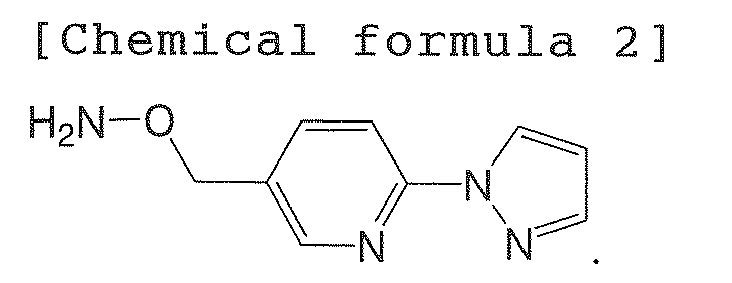


U.S. Patent Publication No. 2004/0171818 - It is an object of the present invention to provide a method of producing an antimicrobial agent shown by formula:

- We found a novel synthesis method of a compound shown by formula:


The present invention embraces the following inventions. - (1) A compound shown by formula:



- (2) A method of producing compound shown by formula V


- (3) A method of producing a compound shown by formula VI or its salt:


- (4) A method of producing a compound shown by formula IX:


- (5) A method of producing a compound shown by formula X:


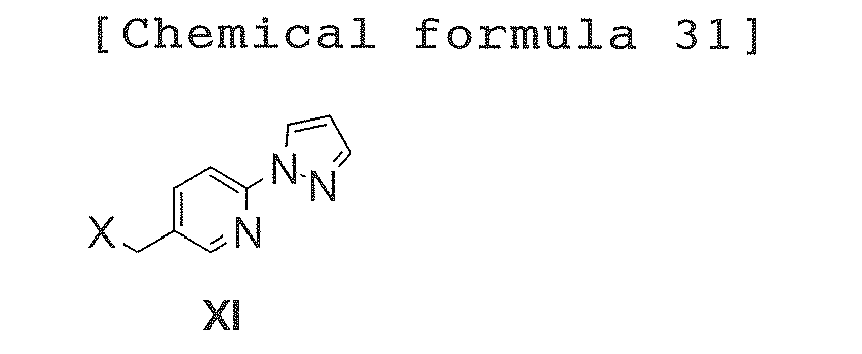
- (6) A method of producing a compound shown by formula XI:

comprising obtaining a compound shown by formula X:
- (7) A method of producing a compound shown by formula XIII


- (8) A method of producing a compound or its salt shown by formula VI:


- (9) A method of producing a compound shown by formula:


- (10) A method of producing a compound shown by formula:


- (11) A salt of a compound shown by formula VI:

- (12) The salt of (11) which is a hydrochloride, sulfate, trichloroacetate or trifluoroacetate.
- (13) A compound shown by formula:

- The present compound is a compound shown by formula:


The term "protected hydroxy" used herein refers to a hydroxy group protected with a protective group. Examples of protective group include tetrahydropyranyl, methoxymethyl, 1-methoxy-1-methylethyl, 1-ethoxyethyl, methyl, benzyl, substituted benzyl and the like. In particular, tetrahydropyranyl is preferred. As a substituted group of substituted benzyl, alkyl, nitro, halogen and the like can be recited.
The term "alkyl" used herein refers to a straight-chain or branched alkyl group having 1 to 8 carbon (s). For example, methyl, ethyl, n-propyl, isopropyl, n-butyl, isobutyl, sec-butyl, tert-butyl, n-pentyl, isopentyl, neopentyl, tert-pentyl, n-hexyl, isohexyl and the like can be exemplified. A straight-chain or branched alkyl group having 1 to 4 carbon(s) such as methyl, ethyl, n-propyl, isopropyl, n-butyl, isobutyl, sec-butyl, tert-butyl or the like is preferred.
The term "aralkyl" used herein refers to the afore-defined alkyl substituted with phenyl or naphthyl, for example, benzyl, phenethyl, naphthylmethyl and the like.
The term "aryl" used herein refers to an aromatic carbocyclic group of monocycle or condensed ring having 6 to 14 carbon(s). For example, phenyl, naphthyl, phenanthryl and the like are recited. Phenyl is particularly preferred.
The term "heteroaryl" used herein refers to 5- to 8-membered aromatic heterocyclic group having one to four oxygen atom, sulfur atom and/or nitrogen atom in a ring, or an aromatic heterocyclic group in which 5- to 8-membered aromatic heterocycle is condensed with one to four 5- to 8-membered aromatic carbocycle or other 5-to 8-membered aromatic heterocycle, and may have a bonding hand at any position which allows substitution. The bonding hand may be located at either carbon atom or nitrogen atom in a ring. For example, thienyl, furyl, pyrrolyl, imidazolyl, pyrazolyl, triazolyl, tetrazolyl, oxazolyl, isoxazolyl, thiazolyl, isothiazolyl, pyridyl, pyridazinyl, pyrimidinyl, furazanyl, pyrazinyl, thiadiazolyl, oxadiazolyl, benzofuryl, benzothienyl, benzimidazolyl, benzothiazolyl, indolyl, dibenzofuryl, quinolyl, isoquinolyl, cinnolyl, quinazolyl, quinoxalyl, phthaladinyl, puryl, puteridinyl, carbazolyl, phenanthridinyl, acrydinyl, phanazinyl, 1,10-phenanthronitrile, isoindolyl, 1H-indazolyl, indolidinyl and the like can be recited.
Alkyl moiety in alkyloxy is as same as the alkyl as described above.
Halogen means fluorine, chlorine, bromine or iodine.
Examples of substituent in optionally substituted aralkyl, optionally substituted aryl, and optionally substituted heteroaryl include the afore-defined alkyl, afore-defined alkyloxy, halogen and the like. - In the following, explanation will be made on a method of producing a compound shown by formula:

-

- This is a step of reacting a compound shown by formula III (R1 and R2 each independently represent hydrogen, alkyl, optionally substituted aralkyl, optionally substituted aryl or optionally substituted heteroaryl, X is halogen) with a compound shown by formula IV in the presence of base or acid, to obtain a compound shown by formula V.
As the base, sodium hydride, lithium hydride, sodium hydroxide, potassium hydroxide, triethylamine, DBU(1,8-diazabicyclo[5.4.0]undec-7-ene), sodium methoxide, potassium tert-butoxide and the like may be used. An amount of the base may be, for example, 1.05 to 1.5 equivalents, relative to the compound shown by formula III.
As the acid, p-toluenesulfonic acid, benzenesulfonic acid, sulfuric acid, acetic acid, hydrochloric acid and the like may be used. An amount of the acid may be for example, 1.05 to 1.5 equivalents, relative to the compound shown by formula III. As the solvent, dimethylsulfoxide, dimethylformamide, dimethylacetamide, tetrahydrofuran, N-methylpyrrolidinone, N,N-dimethylimidazolydinone, diglyme, triglyme and the like may be used. Reaction may be carried out at about 0 to 150°C, for example, at 120°C. The reaction may be carried out in the presence of a catalytic amount (e.g., 0.1 to 0.2 equivalents) of sodium para-toluenesulfonate, sodium iodide, potassium iodide, or sodium paratoluenesulinate.
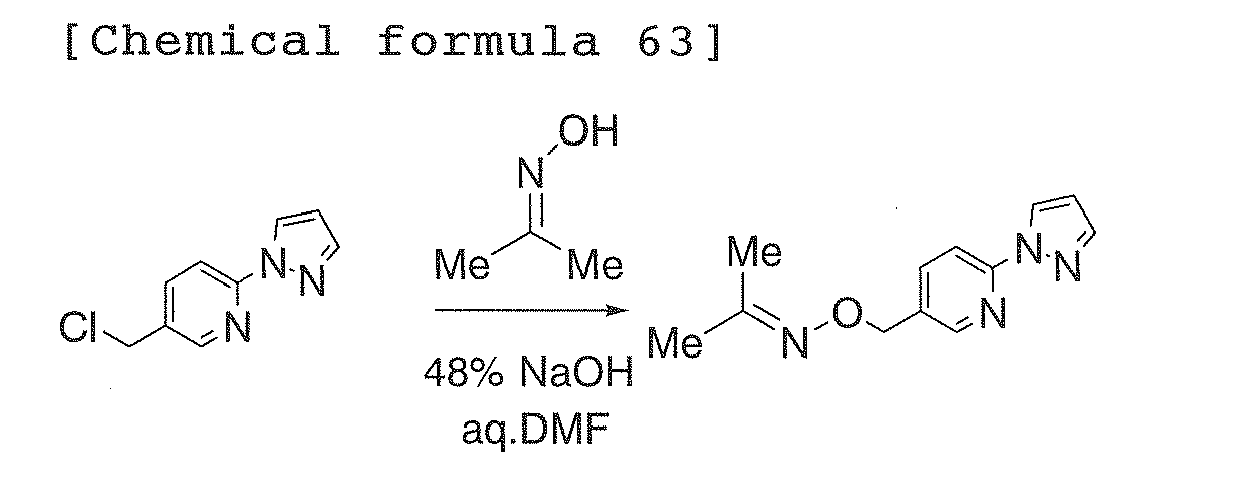
The compound shown by formula III may be obtained by reacting a compound shown by formula I (for example, R is halogen, alkylsulfonyloxy or arylsulfonyloxy, X is halogen) with a compound shown by formula II (R1 and R2 each independently represent hydrogen, alkyl, optionally substituted aralkyl, optionally substituted aryl or optionally substituted heteroaryl) in the presence of base in a solvent such as dimethylformamide, dimethylsulfoxide, N-methylpyrrolidinone or the like. As the base, for example, sodium hydroxide, potassium hydroxide, sodium carbonate, potassium carbonate or the like may be used. The solvent may contain water. As the compound shown by formula III, compounds in which R1 and R2 each independently represent hydrogen, alkyl, optionally substituted aralkyl, optionally substituted aryl or optionally substituted heteroaryl, and X is halogen can be recited. For example, compounds in which R1 and R2 are methyl, compounds in which R1 is ethyl and R2 is methyl, compounds in which R1 is phenyl and R2 is methyl and the like may be used. - This is a step of hydrolyzing a compound shown by formula V (R1 and R2 each independently represent hydrogen, alkyl, optionally substituted aralkyl, optionally substituted aryl or optionally substituted heteroaryl) in the presence of acid, to obtain a compound shown by formula VI.
As the acid, hydrochloric acid (concentrated HCl diluted HCl), sulfuric acid, phosphoric acid or nitric acid may be used. As the solvent, alcohol, acetic acid, ethyl acetate, acetonitrile, dimethylformamide or the like may be used. Particularly preferred is to carry out hydrolysis using diluted sulfuric acid in water solvent. Reaction may be carried out at -20 to 150°C, for example, at room temperature. -


- This is a step of reacting a compound shown by formula VIII (R3 is protective group of hydroxy, and X is halogen) with a compound shown by formula IV in the presence of base, to obtain a compound shown by formula IX.
As the base, sodium hydride, lithium hydride, sodium hydroxide, potassium hydroxide, potassium tert-butoxide, sodium methoxide or the like may be used. The base may be used, for example, in an amount of 1.05 to 1.5 equivalents, relative to the compound shown by formula VIII.
As the acid, p-toluenesulfonic acid, benzenesulfonic acid, sulfuric acid, acetic acid, hydrochloric acid or the like may be used.
As the solvent, dimethylsulfoxide, dimethylformamide, dimethylacetamide, tetrahydrofuran, N-methylpyrrolidinone, N,N-dimethylimidazolydinone, diglyme, triglyme or the like may be used.
The reaction may be carried out at 0 to 150°C, for example, at 120°C. A catalytic amount (for example, 0.1 to 0.2 equivalents) or sodium paratoluenesulinate may be used.
As the protective group of hydroxy, tetrahydropyranyl, methoxymethyl, 1-methoxy-1-methylethyl, 1-othoxyethyl, methyl, benzyl, substituted benzyl and the like are recited. Particularly preferred is tetrahydropyranyl.
As the halogen, fluorine, chlorine, bromine, iodine and the like can be recited. Particularly preferred is chlorine. - This is a step of hydrolyzing a compound shown by formula IX (R3 represents a protective group of hydroxy) in the presence of acid or hydrogenolyzing in hydrogen atmosphere, to obtain a compound shown by formula X.
As the acid, hydrochloric acid (concentrated HCl, diluted HC1), sulfuric acid, nitric acid, acetic acid, acidic ion exchange resin, solid acid or the like may be used. Particularly preferred is concentrated HCl.
As the solvent, alcohol may be used. For example, methyl alcohol, ethyl alcohol, or isopropyl alcohol may be used.
Particularly preferred is isopropyl alcohol. The reaction may be carried out at 0 to 50°C, for example, at room temperature. - This is a step of reacting a compound shown by formula X with a halogenating agent, to obtain a compound shown by formula XI.
As the halogenating agent, thionyl chloride, thionyl bromide, phosphorus tribromide, oxalyl chloride or the like may be used. Particularly preferred is thionyl chloride. As the solvent, benzene, toluene, dimethylformamide, ethyl acetate, acetonitrile or the like may be used. These solvents may be used in mixture. For example, a mixed solvent of toluene and dimethylformamide may be used. The reaction may be carried out at 0 to 50°C for example, at room temperature. - This is a step of reacting a compound shown by formula XI (X is halogen) with a compound shown by formula XII , to obtain a compound shown by formula XIII.
As the solvent, dimethylsulfoxide, dimethylformamide, dimethylacetamide, tetrahydrofuran, N-methylpyrrolidinone, N,N-dimethylimidazolydinone, diglyme, triglyme or the like may be used. The reaction is preferably carried out in the presence of base. As the base, DBU(1,8-diazabicyclo[5.4.0]undec-7-ene), triethylamine, sodium hydroxide aqueous solution, lithium hydroxide aqueous solution or the like may be used. The reaction may be carried out at 0 to 50°C, for example, at room temperature.
- This is a step of reacting a compound shown by formula XI (X is halogen or the like) with a compound shown by formula II in the presence of base, to obtain a compound shown by formula V.
As the base, sodium hydride, lithium hydride, sodium hydroxide, potassium hydroxide, triethylamine, DBU(1,8-diazabicyclo[5.4.0]undec-7-ene), sodium methoxide, potassium tert-butoxide or the like may be used. The base may be used, for example, in an mount of 1.05 to 1.5 equivalents, relative to the compound shown by formula XI. As the solvent, dimethylsulfoxide, dimethylformamide, dimethylacetamide, tetrahydrofuran, N-methylpyrrolidinone, N.N-dimethylimidazolydinone, diglyme, triglyme or the like may be used. The reaction may be carried out at 0 to 50°C, for example, at room temperature. - A compound shown by formula:

A compound shown by formula:

- The present invention embraces salts of compounds shown by formula:

Further, the present invention also embraces the following compounds. The following compound has excellent characteristics as crystals and is easy to be crystallized from water-containing solvent in spite of its low melting point (when X is chloro, m.p.= 46-47.5°C). Therefore, the process using this compound is particularly suited for industrial production. X is halogen, and particularly preferably chloro. Compound shown by:
- In the following, Examples will be described, however, it is to be noted that the present invention will not be limited to these Examples.
-

E isomer: 1H NMR (CDCl3, 300 MHz) d1.07 (t, 3H, J= 7.5 Hz), 1.85 (s, 3H), 2.18 (q, 2H, J= 7.5 Hz), 5.04 (s, 2H), 7.31 (d, 1H, J= 7.8 Hz), 7.63-7.68 (m, 1H), 8.36-8.39 (m, 1H); TLC (silicagel, toluene/AcOEt= 10/1) Rf= 0.45.
Z isomer: 1H NMR (CDCl3, 300 MHz) d1.04 (t, 3H, J= 7.5 Hz), 1.84 (s, 3H), 2.34 (q, 2H, J= 7.5 Hz) 5.03 (s, 2H), 7.31 (d, 1H, J= 8.7 Hz), 7.62-7.67 (m, 1H), 8.36-8.38 (m, 1H) ; TLC (silicagel, toluene/AcOEt= 10/1) Rf= 0.40 -

1H NMR (CDCl3, 300 MHz) d2.25 (s, 3H), 5.21 (s, 2H), 7.31-7.39 (m, 4H), 7.57-7.65 (m, 2H), 7.71 (dd, 1H, J= 2.4, 8.1 Hz), 8.43-8.47 (m, 1H)
TLC (silicagel, toluene/AcOEt= 10/1) Rf= 0.5. -

1H NMR(CDCl3, 300 MHz) d 1.86 (s, 3H), 1.87 (s, 3H), 5.04 (s, 2H), 7.31 (d, 1H, J= 8.3 Hz), 7.65 (dd, 1H, J= 2.3, 8.3 Hz), 8.37 (d, 1H, J= 2.3 Hz)
TLC (silicagel, toluene/AcOEt= 10/1) Rf= 0.35
m.p.= 46 - 47.5 °C. -

E isomer: 1H NMR (CDCl3, 300 MHz) d 1.07 (t, 3H, J= 7.8 Hz), 1.86 (s, 3H), 2.18 (q, 2H, J= 7.8 Hz), 5.09 (s, 2H), 6.46 (dd, 1H, J= 1.5, 2.1 Hz), 7.74 (d, 1H, J= 1.5 Hz), 7.81-7.86 (m, 1H, J= 2.4, 8.7 Hz), 7.97 (d, 1H, J= 8.7 Hz), 8.41 (d, 1H), 8.61 (d, 1H, J= 2.7 Hz);
TLC (silicagel, toluene/AcOEt= 5/1) Rf= 0.50.
Z isomer: 1H NMR (CDCl3, 300 MHz) d1.07 (t, 3H, J= 7.8 Hz), 1.84 (s, 3H), 2.35 (q, 2H, J= 7.8 Hz), 5.07 (s, 2H), 6.46 (dd, 1H, J= 1.5, 2.1 Hz), 7.74 (d, 1H, J= 1.5 Hz), 7.81-7.86 (m, 1H, J= 2.4, 8.7 Hz), 7.97 (d, 1H, J= 8.7 Hz), 8.41 (d, 1H), 8.61 (d, 1H, J= 2.7 Hz);
TLC (silicagel, toluene/AcOEt= 5/1) Rf= 0.45. -

1H NMR (CDCl3, 300 MHz) d2.26 (s, 3H), 5.25 (s, 2H), 6.46 (dd, 1H, J= 1.7, 2.6 Hz), 7.33-7.39 (m, 4H), 7.59-7.65 (m, 2H), 7.74 (dd, 1H, J= 0.8, 1.7 Hz), 7.88 (dd, 1H, J= 2.1, 8.4 Hz), 7.99 (dd, 1H, J= 2.4, 8.4 Hz), 8.46-8.48 (m, 1H), 8.57 (dd, 1H, J= 0.8, 2.6 Hz);
TLC (silicagel, toluene/AcOEt= 10/1) Rf= 0.6. -

To a solution of 1.99 g (10.0 mmol) of O-(2-chloropyridine-5-yl)methyl acetone oxime and 681 mg (10.0 mmol) of pyrazole in 6 mL diglyme, 1.90 g (10.0 mmol) of p-toluenesulfonic acid monohydrate was added at room temperature, and stirred for 10 hours under heating at 100°C. After reaction, the mixture was added with iced water, and extracted with ethyl acetate. The obtained organic layer was washed with saturated saline, and ethyl acetate solvent was distilled off under reduced pressure. The obtained residue was subjected to silica-gel chromatography, and eluted with ethyl acetate/hexane(1/20), to give 1.22 g of an objective product (yield 53%).
1H NMR (CDCl3, 300 MHz) d1.87 (s, 3H), 1.88 (s, 3H), 5.08 (s, 2H), 6.46 (dd, 1H, J= 1.5, 2.4 Hz), 7.73 (d, 1H, J= 1.5 Hz), 7.81 (dd, 1H, J= 2.4, 8.7 Hz), 7.96 (dd, 1H, J= 0.6, 8.7 Hz), 8.39 (d, 1H, J= 2.4 Hz), 8.56 (dd, 1H, J= 0.6, 2.4 Hz); TLC (silicagel, toluene/AcOEt= 4/1) Rf= 0.5;
m.p.= 57-59°C. -

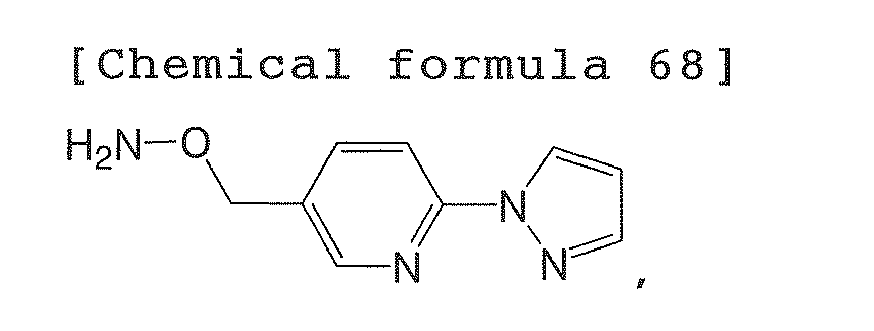
1H NMR (CDCl3, 300 MHz) d 4.71 (s, 2H), 5.46 (brs, 2H), 6.47 (dd, 1H, J= 1.7, 2.4 Hz), 7.74 (dd, 1H, J= 0.8, 1.7 Hz), 7.83 (dd, 1H, J= 2.4, 8.4 Hz), 7.98 (dd, 1H, J= 0.9, 8.4 Hz), 8.40 (dd, 1H, J= 0.8, 2.4 Hz), 8.57 (dd, 1H, J= 0.9, 2.4 Hz); m.p.= 42.5-42.6°C;
TLC (silicagel, CHCl3/MeOH= 100/3) Rf= 0.4. -

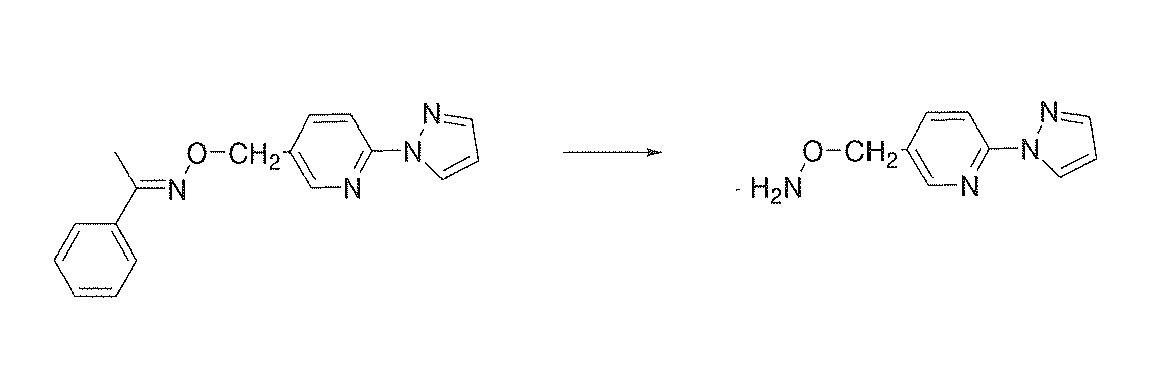
1H NMR (CDCl3, 300 MHz) d4.71 (s, 2H), 5.46 (brs, 2H), 6.47 (dd, 1H, J= 1.7, 2.4 Hz), 7.74 (dd, 1H, J= 0.8, 1.7 Hz), 7.83 (dd, 1H, J= 2.4, 8.4 Hz), 7.98 (dd, 1H, J= 0.9, 8.4 Hz), 8.40 (dd, 1H, J= 0.8, 2.4 Hz), 8.57 (dd, 1H, J= 0.9, 2.4 Hz); m.p.= 42.5-42.6 °C;
TLC (silicagel, CHCl3/MeOH= 100/3) Rf= 0.4. -

1H NMR (CDCl3, 300 MHz) d4.71 (s, 2H), 5.46 (brs, 2H), 6.47 (dd, 1H, J= 1.7, 2.4 Hz), 7.74 (dd, 1H, J= 0.8, 1.7 Hz), 7.83 (dd, 1H, J= 2.4, 8.4 Hz), 7.98 (dd, 1H, J= 0.9, 8.4 Hz), 8.40 (dd, 1H, J= 0.8, 2.4 Hz), 8.57 (dd, 1H, J= 0.9, 2.4 Hz); m.p.= 42.5-42.6°C;
TLC (silicagel, CHCl3//MeOH= 100/3) Rf= 0.4. -
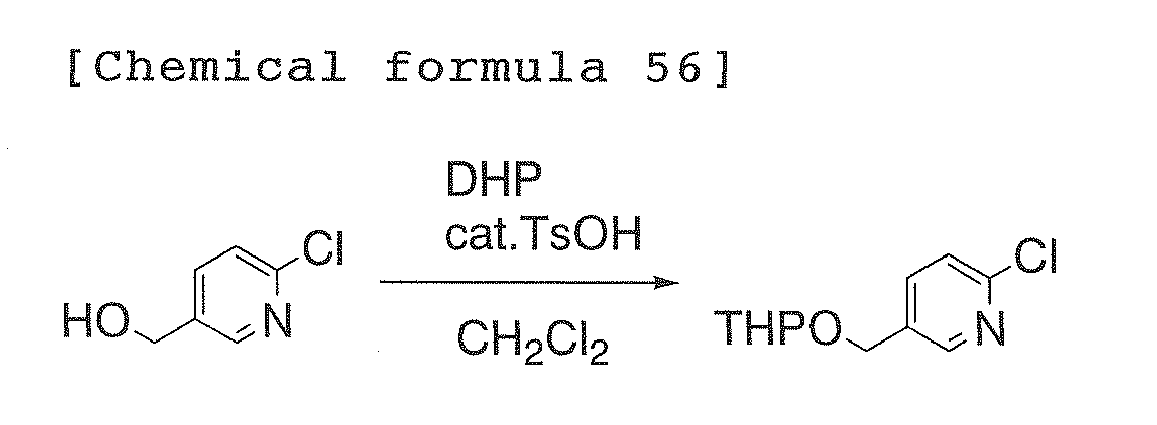
1H NMR (CDCl3, 300 MHz) d8.37 (d, J= 2.7 Hz, 1H), 7.83 (dd, J= 2.4, 8.1 Hz, 1H), 7. 17 (d, J= 7.2 Hz, 1H), 4.77 (d, J= 12.3 Hz, 1H), 4.74 (dd, J= 3.0, 3.3 Hz, 1H), 4.54 (d, J= 12.3 Hz, 1H), 3.91 (m, 1H), 3.56 (m, 1H), 1.48-1.92 (m, 6H); -

1H NMR (CDCl3, 300 MHz) d8.56 (dd, J= 0.7, 2.6 Hz, 1H), 8.40 (dd, J= 0.7, 2.3 Hz, 1H), 7.97 (dd, J= 0.7, 8.6 Hz, 1H), 7.83 (dd, J= 2.0, 8.6 Hz, 1H), 7.74 (dd, J= 0.7, 1.0 Hz, 1H), 6.47 (dd, J= 1.6, 2.6 Hz, 1H), 4.82 (d, J= 12.2 Hz, 1H), 4.74 (dd, J= 3.3, 3.6 Hz, 1H), 4.49 (d, J= 12.2 Hz, 1H), 3.87 (ddd, J= 3.3, 8.1, 10.8 Hz, 1H), 3. 55 (m, 1H), 1.48-1.92 (m, 6H) ; 13C NMR (CDCl3, 75MHz) d147.4, 142.0, 131.5, 127.0, 119.1, 112.0, 107.7, 97.9, 65.9, 62.2, 30.4, 25.3, 19.3. -

1H NMR (CD3OD, 300 MHz) d8.68 (dd, J= 0.7, 3.0 Hz, 1H), 8.48 (dd, J= 0.7, 2.0 Hz, 1H), 8.29 (dd, J= 2.0, 8.6 Hz, 1H), 8.16 (dd, J= 0.7, 8.6 Hz, 1H), 7.93 (d, J= 1.3 Hz, 1H), 6.69 (dd, J= 2.0, 3.0 Hz, 1H), 4.75 (s, 2H). -

1H NMR (CDCl3, 300 MHz) d8.60 (dd, J= 0.7, 2.6 Hz, 1H), 8.47 (d, J= 2.0 Hz, 1H), 8.00 (dd, J= 2.3, 8.6 Hz, 1H), 7.94 (dd, J= 0.7, 8.2 Hz, 1H), 7.77 (d, J= 1.0 Hz, 1H), 6.54 (dd, J= 1.7, 2.6 Hz, 1H), 4.63 (s, 2H). -

1H NMR (CDCl3, 300 MHz) d8.57 (dd, J= 0.7, 2.6 Hz, 1H), 8.46 (m, 1H), 8.03 (s, 1H), 8.02 (s, 1H), 7.75 (m, 1H), 6.48 (dd, J= 1.7, 2.6 Hz, 1H), 5.15 (s, 2H), 2.70 (s, 4H); 13C NMR (CDCl3, 75 MHz) d171.0, 152.2, 149.1, 142.5, 140.5, 127.3, 126.9, 112.2, 108.1, 75.4, 25.4, 20.0. -

m.p. 43.0-43.5°C, 1H NMR (CD3OD, 300 MHz) d 8.59 (dd, J= 0.7, 2.6 Hz, 1H), 8.41 (dd, J= 0.7, 2.3 Hz, 1H), 7.932 (d, J= 0.7 Hz, 1H), 7.926 (s, 1H), 7.75 (dd, J= 0.7, 1.6 Hz, 1H), 6.53 (dd, J= 2.0, 2.6 Hz, 1H), 4.71 (s, 2H). -

1H NMR (CDCl3, 300 MHz) d1.86 (s, 3H), 1.87 (s, 3H), 5.04 (s, 2H), 7.31 (d, 1H, J= 8.3 Hz), 7.65 (dd, 1H, J= 2.3, 8.3 Hz), 8.37 (d, 1H, J= 2.3 Hz);
TLC (silicagel, toluene/AcOEt= 10/1) Rf= 0.35;
m.p.= 46-47.5°C -
1H NMR (DMSO 300 MHz) d4.86 (s, 2H), 6.60 (dd, 1H, J= 1.8,2.7 Hz), 7.84 (dd, 1H, J= 1.2 Hz), 7.93 (m, 2H), 8.47 (dd, 1H, J= 1.5 Hz), 8.64 (dd, 1H, J= 2.7 Hz)
m.p.= 197.8-197.9°CElement analysis C18H22N8O6S Calc.: H(%) 4.63, C(%) 45.18, N(%) 23.42, S(%) 6.70 Found: H(%) 4.31, C(%)45.24, N(%) 23.39, S(%) 6.56 -

1H NMR (DMSO 300 MHz) d5.14 (brs, 2H) 6.60 (dd, 1H, J= 1.2 Hz), 7.86 (dd, 1H), 8.00 (m, 3H), 8.53 (dd, 1H, J= 1.5 Hz), 8.65 (dd, 1H, J= 2.4 Hz)
m.p.= 207.3-207.4°CElement analysis C8H9ClN4O Calc.: H(%) 4.27, C(%) 45.19, N(%) 26.35, Cl(%) 16.67 Found: H(%) 4.67, C(%) 47.46, N(%) 24.63, Cl(%) 15.20 -

1H NMR (DMSO 300 MHz) d4.63 (s, 2H), 6.17 (brs, 2H), 6.58 (dd, 1H), 7.74 (dd, 1H, J= 0.8, 1.7Hz), 7.83 (dd, 1H, J= 1.2 Hz), 7.93 (m, 2H),8.42 (dd, 1H), 8.62 (dd, 1H, J= 2.7 Hz)
m.p.= 127.2-127.3°C (decomposed)Element analysis C11H11Cl3N4O3 Calc.: H(%) 3.14, C(%) 37.36, N(%) 15.85, Cl(%) 30.08 Found: H(%) 3.11, C(%) 37.40, N(%) 16.08, Cl (%) 30.23 -

1H NMR (DMSO 300 MHz) d5.05 (s, 2H), 6.60 (s, 1H) 7.86 (dd, 1H, J= 0.6 Hz), 8.00(m, 2H), 8.50 (dd, 1H, J= 1.5 Hz), 8.64 (dd, 1H , J= 2.4 Hz)
m.p.= 170.5-170.6°C (decomposed)
Element analysis C9H11N5O4 Calc.: H(%) 4.38, C(%) 42.69, N(%) 27.66 Found: H(%) 4.28, C(%) 42.66, N(%) 27.84 -

1H NMR (DMSO 300 MHz) d4.99 (s, 2H), 6.59 (d, 1H, 1.2= Hz), 7.84 (dd, 1H), 8.00 (m, 2H), 8.47 (dd, 1H), 8.64 (dd, 1H, J= 2.4 Hz) m.p.= 117.7°C (decomposed)Element analysis C11H11F3N4O3 Calc.: H(%) 3.64, C(%) 43.43, N(%) 18.42, F(%) 18.73 Found: H(%) 3.61, C(%) 43.48, N(%) 18.49, F(%) 18.89 - Through a compound of the present invention, it is possible to efficiently produce a compound shown by formula:

Claims (13)
- A compound shown by formula:


- A method of producing compound shown by formula V


- A method of producing a compound shown by formula VI or its salt:


- A method of producing a compound shown by formula IX:


- A method of producing a compound shown by formula X:


- A method of producing a compound shown by formula XI:


- A method of producing a compound shown by formula XIII


according to the method according to claim 6, and reacting the obtained compound with a compound shown by formula XII:
- A method of producing a compound or its salt shown by formula VI :


- A method of producing a compound shown by formula:


- A method of producing a compound shown by formula:


- A salt of a compound shown by formula VI:


- The salt according to claim 11 which is a hydrochloride, sulfate, trichloroacetate or trifluoroacetate.
- A compound shown by formula:

Applications Claiming Priority (2)
| Application Number | Priority Date | Filing Date | Title |
|---|---|---|---|
| JP2004370710 | 2004-12-22 | ||
| PCT/JP2005/023302 WO2006068102A1 (en) | 2004-12-22 | 2005-12-20 | 2-(pyrazol-1-yl)pyridine derivative |
Publications (2)
| Publication Number | Publication Date |
|---|---|
| EP1829870A1 true EP1829870A1 (en) | 2007-09-05 |
| EP1829870A4 EP1829870A4 (en) | 2009-09-30 |
Family
ID=36601702
Family Applications (1)
| Application Number | Title | Priority Date | Filing Date |
|---|---|---|---|
| EP05820319A Withdrawn EP1829870A4 (en) | 2004-12-22 | 2005-12-20 | 2-(pyrazol-1-yl)pyridine derivative |
Country Status (7)
| Country | Link |
|---|---|
| US (1) | US20080086007A1 (en) |
| EP (1) | EP1829870A4 (en) |
| JP (1) | JP4061333B2 (en) |
| KR (1) | KR20070090937A (en) |
| CN (1) | CN101084213A (en) |
| TW (1) | TW200634000A (en) |
| WO (1) | WO2006068102A1 (en) |
Families Citing this family (1)
| Publication number | Priority date | Publication date | Assignee | Title |
|---|---|---|---|---|
| KR101506869B1 (en) * | 2013-03-26 | 2015-04-08 | 한국교통대학교산학협력단 | pyrazole derivative and organoelectroluminescent device employing the same |
Family Cites Families (6)
| Publication number | Priority date | Publication date | Assignee | Title |
|---|---|---|---|---|
| CN1099408C (en) * | 1998-10-07 | 2003-01-22 | 湖南化工研究院 | Biocidal oximido ether compound |
| WO2005070918A1 (en) * | 2002-05-13 | 2005-08-04 | Enanta Pharmaceuticals, Inc. | Process for the preparation of t-11 bicyclic erythromycin derivatives |
| BR0310050A (en) * | 2002-05-13 | 2005-05-10 | Enanta Pharm Inc | Bicyclic ketolide derivatives 6-11, pharmaceutical compositions and processes |
| WO2005067564A2 (en) * | 2004-01-07 | 2005-07-28 | Enanta Pharmaceuticals, Inc. | 6-11 bicyclic erythromycin derivatives |
| JP2007518806A (en) * | 2004-01-23 | 2007-07-12 | メルク エンド カムパニー インコーポレーテッド | 6,11-3C-bicyclic 8A-azalide derivatives |
| US7538225B2 (en) * | 2005-05-02 | 2009-05-26 | Enanta Pharmaceuticals, Inc. | Processes for the preparation of o-(6-pyrazol-1-yl-pyridin-3-ylmethyl)-hydroxylamine |
-
2005
- 2005-12-16 TW TW094144593A patent/TW200634000A/en unknown
- 2005-12-20 US US11/793,021 patent/US20080086007A1/en not_active Abandoned
- 2005-12-20 KR KR1020077013912A patent/KR20070090937A/en not_active Withdrawn
- 2005-12-20 WO PCT/JP2005/023302 patent/WO2006068102A1/en not_active Ceased
- 2005-12-20 CN CNA2005800436185A patent/CN101084213A/en active Pending
- 2005-12-20 JP JP2006548980A patent/JP4061333B2/en not_active Expired - Fee Related
- 2005-12-20 EP EP05820319A patent/EP1829870A4/en not_active Withdrawn
Also Published As
| Publication number | Publication date |
|---|---|
| TW200634000A (en) | 2006-10-01 |
| KR20070090937A (en) | 2007-09-06 |
| CN101084213A (en) | 2007-12-05 |
| WO2006068102A1 (en) | 2006-06-29 |
| JPWO2006068102A1 (en) | 2008-06-12 |
| JP4061333B2 (en) | 2008-03-19 |
| US20080086007A1 (en) | 2008-04-10 |
| EP1829870A4 (en) | 2009-09-30 |
Similar Documents
| Publication | Publication Date | Title |
|---|---|---|
| JP7534346B2 (en) | Method for producing compounds having PDE4 inhibitory activity | |
| SK133198A3 (en) | Piperazine and piperidine compounds, process for their preparation and pharmaceutical compositions containing them | |
| JP4617292B2 (en) | Preparation of arylalkyl carbamate derivatives and their therapeutic use | |
| JPS63316757A (en) | 3-Amino-2-substituted benzoylacrylic acid derivative | |
| US20050245750A1 (en) | Process for preparing 1,3-benzodioxole-2-spirocycloalkane derivative | |
| CN102746327A (en) | Method for producing hydrazine compound,and production intermediates of hydrazine compound and methods of producing the intermediates | |
| JP4061333B2 (en) | 2- (Pyrazol-1-yl) pyridine derivatives | |
| JPH05201984A (en) | Quinolin-2-yl-methoxybenzylhydroxyurea compound | |
| JPH02289563A (en) | Improved process for producing ortho-carboxypyridyl- and ortho-carboxyquinolylimidazolinones | |
| US6252082B1 (en) | Pyridone derivatives, their preparation and their use as synthesis intermediates | |
| JP6961595B2 (en) | Method for producing 4-alkoxy-3-trifluoromethylbenzyl alcohol | |
| TWI500596B (en) | Method for synthesizing 3,4-dimethoxybicyclo[4.2.0]oct-1,3,5-triene-7-carbonitrile, and synthesis of ivabradine (IVABRADINE) and its Acceptable acid addition salt application | |
| US20070149606A1 (en) | Process for producing phenylacetic acid derivative | |
| JP2000007664A (en) | Optically active piperazine compound, its intermediate and their production | |
| JP4491104B2 (en) | Method for producing carbonyl compound | |
| JP4828740B2 (en) | Process for producing 1,2,5-thiadiazoylmethanone derivative and dioxime derivative | |
| JP2009046400A (en) | Intermediate for producing insecticidal compound and method for producing the same | |
| US8802860B2 (en) | Method for producing substituted pyridin-2-one | |
| CA3214107A1 (en) | New process for the synthesis of 5-{5-chloro-2-[(3s)-3- [(morpholin-4-yl)methyl]-3,4-dihydroisoquinoline-2(1h)- carbonyl]phenyl}-1,2-dimethyl-1h-pyrrole-3-carboxylic acid derivatives and its application for the production of pharmaceutical compounds | |
| JPH07278052A (en) | 2,4-Pentanedione derivative | |
| JPH07309845A (en) | New production of pyrazine derivative | |
| HK1085193B (en) | Aryl alkyl carbamate derivatives production and use thereof in therapy | |
| HK1181384B (en) | Method for producing substituted pyridin-2-one | |
| JP2002114750A (en) | Method for producing aminobenzamidine compound | |
| JPWO1994004506A1 (en) | Method for producing quinolinecarboxylic acid derivatives |
Legal Events
| Date | Code | Title | Description |
|---|---|---|---|
| PUAI | Public reference made under article 153(3) epc to a published international application that has entered the european phase |
Free format text: ORIGINAL CODE: 0009012 |
|
| 17P | Request for examination filed |
Effective date: 20070711 |
|
| AK | Designated contracting states |
Kind code of ref document: A1 Designated state(s): AT BE BG CH CY CZ DE DK EE ES FI FR GB GR HU IE IS IT LI LT LU LV MC NL PL PT RO SE SI SK TR |
|
| DAX | Request for extension of the european patent (deleted) | ||
| A4 | Supplementary search report drawn up and despatched |
Effective date: 20090827 |
|
| 17Q | First examination report despatched |
Effective date: 20091215 |
|
| STAA | Information on the status of an ep patent application or granted ep patent |
Free format text: STATUS: THE APPLICATION IS DEEMED TO BE WITHDRAWN |
|
| 18D | Application deemed to be withdrawn |
Effective date: 20100427 |