EP1829556A1 - NK-3 Receptor in vivo assay - Google Patents
NK-3 Receptor in vivo assay Download PDFInfo
- Publication number
- EP1829556A1 EP1829556A1 EP06119132A EP06119132A EP1829556A1 EP 1829556 A1 EP1829556 A1 EP 1829556A1 EP 06119132 A EP06119132 A EP 06119132A EP 06119132 A EP06119132 A EP 06119132A EP 1829556 A1 EP1829556 A1 EP 1829556A1
- Authority
- EP
- European Patent Office
- Prior art keywords
- human animal
- agonist
- antagonist
- receptor
- locomotor activity
- Prior art date
- Legal status (The legal status is an assumption and is not a legal conclusion. Google has not performed a legal analysis and makes no representation as to the accuracy of the status listed.)
- Withdrawn
Links
Images

Classifications
-
- A—HUMAN NECESSITIES
- A61—MEDICAL OR VETERINARY SCIENCE; HYGIENE
- A61K—PREPARATIONS FOR MEDICAL, DENTAL OR TOILETRY PURPOSES
- A61K49/00—Preparations for testing in vivo
- A61K49/0004—Screening or testing of compounds for diagnosis of disorders, assessment of conditions, e.g. renal clearance, gastric emptying, testing for diabetes, allergy, rheuma, pancreas functions
- A61K49/0008—Screening agents using (non-human) animal models or transgenic animal models or chimeric hosts, e.g. Alzheimer disease animal model, transgenic model for heart failure
-
- A—HUMAN NECESSITIES
- A61—MEDICAL OR VETERINARY SCIENCE; HYGIENE
- A61P—SPECIFIC THERAPEUTIC ACTIVITY OF CHEMICAL COMPOUNDS OR MEDICINAL PREPARATIONS
- A61P25/00—Drugs for disorders of the nervous system
- A61P25/18—Antipsychotics, i.e. neuroleptics; Drugs for mania or schizophrenia
-
- A—HUMAN NECESSITIES
- A61—MEDICAL OR VETERINARY SCIENCE; HYGIENE
- A61P—SPECIFIC THERAPEUTIC ACTIVITY OF CHEMICAL COMPOUNDS OR MEDICINAL PREPARATIONS
- A61P25/00—Drugs for disorders of the nervous system
- A61P25/22—Anxiolytics
-
- G—PHYSICS
- G01—MEASURING; TESTING
- G01N—INVESTIGATING OR ANALYSING MATERIALS BY DETERMINING THEIR CHEMICAL OR PHYSICAL PROPERTIES
- G01N33/00—Investigating or analysing materials by specific methods not covered by groups G01N1/00 - G01N31/00
- G01N33/48—Biological material, e.g. blood, urine; Haemocytometers
- G01N33/50—Chemical analysis of biological material, e.g. blood, urine; Testing involving biospecific ligand binding methods; Immunological testing
- G01N33/53—Immunoassay; Biospecific binding assay; Materials therefor
- G01N33/566—Immunoassay; Biospecific binding assay; Materials therefor using specific carrier or receptor proteins as ligand binding reagents where possible specific carrier or receptor proteins are classified with their target compounds
Definitions
- Tachykinins are a family of small peptides, e.g. Substance P, Neurokinin A and Neurokinin B, characterized by the shared presence of a common C-terminal amidated sequence Phe-Xaa-Gly-Leu-Met-NH2 (SEQ. ID. NO: 1). Their biological effects are mediated through three distinct types of receptors e.g. Neurokinin 1 (NK1), Neurokinin 2 (NK2) and Neurokinin 3 (NK3), respectively. Tachykinins and their receptors have been the focus of intense research over the past few years.
- NK1 Neurokinin 1
- NK2 Neurokinin 2
- NK3 Neurokinin 3
- NK3-R selective NK3-receptor
- the present invention provides a method of assessing the in vivo potency of a NK3 receptor antagonist comprising:
- in vivo potency refers to the capacity of a compound, in this case a NK3-R antagonist, to produce the desired effect in a non-human animal, thereby attenuating the effect of NK3 or an NK3-R agonist to the NK3-R is the desired effect.
- NK3-R antagonist or "antagonist” as used herein, refers to a compound capable of attenuating the effect of NK3 or an NK3-R agonist to the NK3-R.
- NK3-R agonist or "agonist” as used herein refers to a compound capable of stimulating the Neurokinin 3 receptor.
- the NK3 antagonist may be administered to the non-human animal by known enteral or parenteral routes, including but not limited to oral administration (such as oral gavage, sublingual administration or rectal administration), injection directly into the blood stream (such as intravenous or intra-arterial administration), or various parenteral routes (such as intraperitoneal and subcutaneous routes such as intramuscular), respiratory-based administration via an aerosol, and administration under the skin (i.e., transdermal, transcutaneous or percutaneous), as well as topical administration of the formulated compound of interest.
- oral administration such as oral gavage, sublingual administration or rectal administration
- injection directly into the blood stream such as intravenous or intra-arterial administration
- various parenteral routes such as intraperitoneal and subcutaneous routes such as intramuscular
- respiratory-based administration via an aerosol and administration under the skin (i.e., transdermal, transcutaneous or percutaneous)
- topical administration of the formulated compound of interest i.e., transdermal, transcutaneous or percutaneous
- the antagonist is typically administered some time prior to the testing of the activity of the non-human animal.
- the length of time depends of the time a compound needs for absorption and to overcome the blood-brain barrier.
- the antagonist is administered to the non-human animal 15 to 240 minutes before the testing.
- the NK3 receptor agonist may be any agonist of the Neurokinin 3 receptor, preferably the agonist is N-(3-carboxy-1-oxopropyl)-L- ⁇ -aspartyl-L-phenylalanyl-N-methyl-L-phenylalanylglycyl-L-leucyl-L-methioninamide (Senktide).
- the agonist maybe administered to the non-human animal by injection into the brain of the animal. More preferably, the agonist is injected into one or more ventricles. More preferably, the agonist is injected into the third (ventral) ventricle of the non-human animal.
- the agonist is typically administered at a single dose shortly prior to the testing of the activity of the non-human animal.
- the non-human animal usually is anaestesized.
- the testing starts right after the non-human animal has awaken, which may be 1 to 4 minutes after the administration of the NK3-R agonist.
- the locomotor activity of the non-human includes but is not limited to walking, running, swimming or stereotypic activity such as e.g. grooming, licking or rearing.
- the locomotor activity is measured by determining the distance covered by the non-human animal.
- the non-human animal may be any animal excluding human.
- the non-human animal is a rodent, more preferably a gerbil or a mouse.
- the most preferred non-human animal is a Mongolian gerbil (meriones unguiculates).
- the non-human animal may also be a non-human animal transgenic for the human NK3-receptor or the gerbil NK3-receptor.
- *** p ⁇ 0.001 (Dunnet multiple comparison test) versus vehicle.
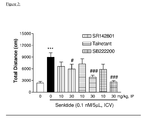
- Figure 2 shows a graphical presentation of the effect of N-[1-[3-[(3R)-(1-benzoyl-3-(3,4-dichlorophenyl)-3-piperidinyl]propyl]-4-phenyl-4-piperidinyl]-N-methyl-acetamide (10 or 30 mg/kg, IP), 3-hydroxy-2-phenyl-N-[(1S)-1-phenylpropyl]-4-quinolinecarboxamide (10 or 30 mg/kg, IP) and 3-methyl-2-phenyl-N-[(1S)-1-phenylpropyl]-4-quinolinecarboxamide (10 or 30 mg/kg, IP) on locomotor activity induced by N-(3-carboxy-1-oxopropyl)-L- ⁇ -aspartyl-L-phenylalanyl-N-methyl-L-phenylalanylglycyl-L-leucyl-L-methioninamide.
- # p ⁇
- Gerbils Male and female Mongolian gerbils [Biological Research Laboratories, 4414 Medinsdorf, Switzerland] weighing between 40-70g were used. Gerbils were housed four per cage for approximately four to seven days following arrival in the laboratory colony. The gerbils had ad libitum access to tap water and lab chow in the home cage. The animal quarters were maintained on a 12:12 hour light-dark cycle with light onset at 6 a.m. and with both temperature (21-23°C) and humidity (55-65%) regulated. All testing was conducted during the light phase of the light-dark cycle. All procedures described here received prior approval from the City of Basel Cantonal Animal Protection Committee based on adherence to federal and local regulations. The experiments were carried out in an animal colony supervised by the veterinary staff of Hoffmann-La Roche Ltd.
- the antagonists were prepared immediately prior to use (vehicle 0.3%Tween-80/saline).
- the antagonistic substances were administered IP or PO, 30min to 240min prior to testing.
- Senktide was dissolved in 0.1% BSAin distilled water and frozen (-20°C) in aliquots until use, where it was given by direct intracerebroventricular (i.c.v., ICV) injection.
- Gerbils were anaesthetised by inhalation of isoflurane/oxygen mixture, the scalp was exposed and Senktide (0.01 - 0.1 nmol/5 ⁇ l) was administered into the third (ventral) ventricle (icv) via a cuffed 25G needle vertically inserted to a depth of 4.5mm below bregma. The incision was closed using a clip suture and gerbils were placed into perspex boxes on recovery of their righting reflex and then placed into locomotor activity boxes (Accuscan instruments, USA). Activity was then measured automatically for a period of 90 minutes.
- Senktide (0.01, 0.03 or 0.1 nM/5 ⁇ , ICV) induced a significant increase total distance traveled at a dose of 0.1 nM/5 ⁇ L (ICV; Fig. 1).
- SR142801 (10 or 30 mg/kg IP, 30min pre-treatment time) significantly reduced senktide (0.1nM/5 ⁇ L, ICV)-induced locomotor activity at a dose of 30 mg/kg (Fig. 2).
- Talnetant (10 or 30 mg/kg IP, 30min pre-treatment time) significantly reduced senktide (0.1nM/5 ⁇ L, ICV)-induced locomotor activity at a dose of 30 mg/kg (Fig. 2).
- SB222200 (10 or 30 mg/kg IP, 30min pre-treatment time) significantly reduced senktide (0.1nM/5 ⁇ L, ICV)-induced locomotor activity at a dose of 30 mg/kg (Fig. 2).
- Senktide induced a significant increase in locomotor activity as measured by means of total distance traveled over a period of 90 minutes following the ICV injection. This effect was inhibited by selective NK3 receptor antagonists such as SR142801, Talnetant and SB222200. These data indicate that senktide-induced locomotor activity is a selective NK3 receptor mediated effect and can be used to assess in vivo potency of NK3 receptor antagonists.
Landscapes
- Health & Medical Sciences (AREA)
- Life Sciences & Earth Sciences (AREA)
- Engineering & Computer Science (AREA)
- Biomedical Technology (AREA)
- Chemical & Material Sciences (AREA)
- General Health & Medical Sciences (AREA)
- Urology & Nephrology (AREA)
- Immunology (AREA)
- Pathology (AREA)
- Veterinary Medicine (AREA)
- Medicinal Chemistry (AREA)
- Hematology (AREA)
- Animal Behavior & Ethology (AREA)
- Molecular Biology (AREA)
- Public Health (AREA)
- Bioinformatics & Cheminformatics (AREA)
- Toxicology (AREA)
- Biotechnology (AREA)
- Neurology (AREA)
- Neurosurgery (AREA)
- Rheumatology (AREA)
- Chemical Kinetics & Catalysis (AREA)
- General Chemical & Material Sciences (AREA)
- Gastroenterology & Hepatology (AREA)
- Nuclear Medicine, Radiotherapy & Molecular Imaging (AREA)
- Organic Chemistry (AREA)
- Pharmacology & Pharmacy (AREA)
- General Physics & Mathematics (AREA)
- Endocrinology (AREA)
- Epidemiology (AREA)
- Cell Biology (AREA)
- Diabetes (AREA)
- Microbiology (AREA)
- Zoology (AREA)
- Food Science & Technology (AREA)
- Physics & Mathematics (AREA)
- Analytical Chemistry (AREA)
- Biochemistry (AREA)
- Psychiatry (AREA)
- Medicines That Contain Protein Lipid Enzymes And Other Medicines (AREA)
Abstract
Description
- Tachykinins are a family of small peptides, e.g. Substance P, Neurokinin A and Neurokinin B, characterized by the shared presence of a common C-terminal amidated sequence Phe-Xaa-Gly-Leu-Met-NH2 (SEQ. ID. NO: 1). Their biological effects are mediated through three distinct types of receptors e.g. Neurokinin 1 (NK1), Neurokinin 2 (NK2) and Neurokinin 3 (NK3), respectively. Tachykinins and their receptors have been the focus of intense research over the past few years. Recently, the selective NK3-receptor (NK3-R) antagonist SR142801 (Osanetant) was shown to be active in a double blind placebo controlled clinical trial in schizophrenia patients (Meltzer H.Y., Arvanitis L., Bauer D., Rein W.: Aplacebo-controlled evaluation of four novel compounds for the treatment of schizophrenia and schizoaffective disorder. Am J Psych 161:975-84, 2004). However, the pharmacology and function of NK3 receptors in brain and behaviour and animal models are less well studied. There is a need for accurate means to assess the effect of NK3-R in vivo.
- Therefore, the present invention provides a method of assessing the in vivo potency of a NK3 receptor antagonist comprising:
- a) treating a non-human animal with the NK3-R antagonist of interest,
- b) treating the non-human animal with a NK3-R agonist,
- c) measuring the locomotor activity of the treated non-human animal and,
- d) correlating the effect of the antagonist of interest on the locomotor activity of the treated non-human animal with the in vivo potency of the antagonist.
- The term "in vivo potency" as used herein refers to the capacity of a compound, in this case a NK3-R antagonist, to produce the desired effect in a non-human animal, thereby attenuating the effect of NK3 or an NK3-R agonist to the NK3-R is the desired effect.
- The term "NK3-R antagonist" or "antagonist" as used herein, refers to a compound capable of attenuating the effect of NK3 or an NK3-R agonist to the NK3-R.
- The term "NK3-R agonist" or "agonist" as used herein refers to a compound capable of stimulating the Neurokinin 3 receptor.
- The NK3 antagonist may be administered to the non-human animal by known enteral or parenteral routes, including but not limited to oral administration (such as oral gavage, sublingual administration or rectal administration), injection directly into the blood stream (such as intravenous or intra-arterial administration), or various parenteral routes (such as intraperitoneal and subcutaneous routes such as intramuscular), respiratory-based administration via an aerosol, and administration under the skin (i.e., transdermal, transcutaneous or percutaneous), as well as topical administration of the formulated compound of interest. A preferred form of administration of the antagonist is the oral (PO) administration or the intraperitoneal (IP) administration. Preferably, the antagonist is administered at a single dose.
- The antagonist is typically administered some time prior to the testing of the activity of the non-human animal. The length of time depends of the time a compound needs for absorption and to overcome the blood-brain barrier. Preferably, the antagonist is administered to the non-human animal 15 to 240 minutes before the testing.
- The NK3 receptor agonist may be any agonist of the Neurokinin 3 receptor, preferably the agonist is N-(3-carboxy-1-oxopropyl)-L-α-aspartyl-L-phenylalanyl-N-methyl-L-phenylalanylglycyl-L-leucyl-L-methioninamide (Senktide). The agonist maybe administered to the non-human animal by injection into the brain of the animal. More preferably, the agonist is injected into one or more ventricles. More preferably, the agonist is injected into the third (ventral) ventricle of the non-human animal. The agonist is typically administered at a single dose shortly prior to the testing of the activity of the non-human animal. For the injection of the NK3-receptor agonist into the brain, the non-human animal usually is anaestesized. Preferably, the testing starts right after the non-human animal has awaken, which may be 1 to 4 minutes after the administration of the NK3-R agonist.
- The locomotor activity of the non-human includes but is not limited to walking, running, swimming or stereotypic activity such as e.g. grooming, licking or rearing. Preferably, the locomotor activity is measured by determining the distance covered by the non-human animal.
- The non-human animal may be any animal excluding human. Preferably, the non-human animal is a rodent, more preferably a gerbil or a mouse. The most preferred non-human animal is a Mongolian gerbil (meriones unguiculates). The non-human animal may also be a non-human animal transgenic for the human NK3-receptor or the gerbil NK3-receptor.
- Having now generally described this invention, the same will become better understood by reference to the specific examples, which are included herein for purpose of illustration only and are not intended to be limiting unless otherwise specified, in connection with the following figures.
- Figure 1 shows a graphical presentation of the locomotor activity induced by increasing doses of N-(3-carboxy-1-oxopropyl)-L-α-aspartyl -L-phenylalanyl-N-methyl-L-phenylalanylglycyl-L-leucyl-L-methioninamide (=senktide).
*** = p<0.001 (Dunnet multiple comparison test) versus vehicle. - Figure 2 shows a graphical presentation of the effect of N-[1-[3-[(3R)-(1-benzoyl-3-(3,4-dichlorophenyl)-3-piperidinyl]propyl]-4-phenyl-4-piperidinyl]-N-methyl-acetamide (10 or 30 mg/kg, IP), 3-hydroxy-2-phenyl-N-[(1S)-1-phenylpropyl]-4-quinolinecarboxamide (10 or 30 mg/kg, IP) and 3-methyl-2-phenyl-N-[(1S)-1-phenylpropyl]-4-quinolinecarboxamide (10 or 30 mg/kg, IP) on locomotor activity induced by N-(3-carboxy-1-oxopropyl)-L-α-aspartyl-L-phenylalanyl-N-methyl-L-phenylalanylglycyl-L-leucyl-L-methioninamide.
# = p<0.05, ### = p<0.001(un-paired T-test) versus senktide. - Commercially available reagents referred to in the example were used according to manufacturer's instructions unless otherwise indicated.
- Male and female Mongolian gerbils [Biological Research Laboratories, 4414 Füllinsdorf, Switzerland] weighing between 40-70g were used. Gerbils were housed four per cage for approximately four to seven days following arrival in the laboratory colony. The gerbils had ad libitum access to tap water and lab chow in the home cage. The animal quarters were maintained on a 12:12 hour light-dark cycle with light onset at 6 a.m. and with both temperature (21-23°C) and humidity (55-65%) regulated. All testing was conducted during the light phase of the light-dark cycle. All procedures described here received prior approval from the City of Basel Cantonal Animal Protection Committee based on adherence to federal and local regulations. The experiments were carried out in an animal colony supervised by the veterinary staff of Hoffmann-La Roche Ltd.
-
- N-(3-carboxy-1-oxopropyl)-L-α-aspartyl-L-phenylalanyl-N-methyl-L-phenylalanylglycyl-L-leucyl-L-methioninamide (Senktide)
-
- N-[1-[3-[(3R)-(1-benzoyl-3-(3,4-dichlorophenyl)-3-piperidinyl]propyl]-4-phenyl-4-piperidinyl]-N-methyl-acetamide (SR142801)
- 3-methyl-2-phenyl-N-[(1S)-1-phenylpropyl]-4-quinolinecarboxamide(SB222200)
- 3-hydroxy-2-phenyl-N-[(1S)-1-phenylpropyl]-4-quinolinecarboxamide (Talnetant)
- The antagonists were prepared immediately prior to use (vehicle 0.3%Tween-80/saline). The antagonistic substances were administered IP or PO, 30min to 240min prior to testing. Senktide was dissolved in 0.1% BSAin distilled water and frozen (-20°C) in aliquots until use, where it was given by direct intracerebroventricular (i.c.v., ICV) injection.
- Gerbils were anaesthetised by inhalation of isoflurane/oxygen mixture, the scalp was exposed and Senktide (0.01 - 0.1 nmol/5µl) was administered into the third (ventral) ventricle (icv) via a cuffed 25G needle vertically inserted to a depth of 4.5mm below bregma. The incision was closed using a clip suture and gerbils were placed into perspex boxes on recovery of their righting reflex and then placed into locomotor activity boxes (Accuscan instruments, USA). Activity was then measured automatically for a period of 90 minutes.
- Data were analysed using a One way anova followed by Dunnet multiple comparison test or t-test (one-tailed) where appropriate (Statistica, Statsoft).
- Senktide (0.01, 0.03 or 0.1 nM/5µ, ICV) induced a significant increase total distance traveled at a dose of 0.1 nM/5µL (ICV; Fig. 1).
- SR142801 (10 or 30 mg/kg IP, 30min pre-treatment time) significantly reduced senktide (0.1nM/5µL, ICV)-induced locomotor activity at a dose of 30 mg/kg (Fig. 2).
- Talnetant (10 or 30 mg/kg IP, 30min pre-treatment time) significantly reduced senktide (0.1nM/5µL, ICV)-induced locomotor activity at a dose of 30 mg/kg (Fig. 2).
- SB222200 (10 or 30 mg/kg IP, 30min pre-treatment time) significantly reduced senktide (0.1nM/5µL, ICV)-induced locomotor activity at a dose of 30 mg/kg (Fig. 2).
- Senktide induced a significant increase in locomotor activity as measured by means of total distance traveled over a period of 90 minutes following the ICV injection. This effect was inhibited by selective NK3 receptor antagonists such as SR142801, Talnetant and SB222200. These data indicate that senktide-induced locomotor activity is a selective NK3 receptor mediated effect and can be used to assess in vivo potency of NK3 receptor antagonists.

Claims (7)
- An method of assessing the in vivo potency of a NK3 receptor antagonist comprising:a) treating a non-human animal with the NK3 receptor antagonist of interest,b) treating the non-human animal with a NK3 receptor agonist,c) measuring the locomotor activity of the treated non-human animal and,d) correlating the effect of the antagonist of interest on the locomotor activity of the treated non-human animal with the in vivo potency of the antagonist.
- The method according to claim 1, wherein the NK3-R agonist is N-(3-carboxy-1-oxopropyl)-L-α-aspartyl-L-phenylalanyl-N-methyl-L-phenylalanylglycyl-L-leucyl-L-methioninamide.
- The method according to claim 1 or 2, wherein the agonist is injected into the brain of the non-human animal.
- The method according to claim 1 or 2, wherein the agonist is injected into one or more ventricles.
- The method according to claim 1 or 2, wherein the agonist is injected into the third (ventral) ventricle.
- The method according to any one of the claims 1 to 5, wherein the non-human animal is a rodent.
- The method according to any one of the claims 1 to 5, wherein the non-human animal is a gerbil or a mouse.
Applications Claiming Priority (1)
| Application Number | Priority Date | Filing Date | Title |
|---|---|---|---|
| EP05107892 | 2005-08-29 |
Publications (1)
| Publication Number | Publication Date |
|---|---|
| EP1829556A1 true EP1829556A1 (en) | 2007-09-05 |
Family
ID=37804407
Family Applications (1)
| Application Number | Title | Priority Date | Filing Date |
|---|---|---|---|
| EP06119132A Withdrawn EP1829556A1 (en) | 2005-08-29 | 2006-08-18 | NK-3 Receptor in vivo assay |
Country Status (6)
| Country | Link |
|---|---|
| US (1) | US20070048225A1 (en) |
| EP (1) | EP1829556A1 (en) |
| JP (1) | JP2007139753A (en) |
| CN (1) | CN1927385A (en) |
| CA (1) | CA2557246A1 (en) |
| SG (1) | SG130169A1 (en) |
-
2006
- 2006-08-14 US US11/504,241 patent/US20070048225A1/en not_active Abandoned
- 2006-08-18 EP EP06119132A patent/EP1829556A1/en not_active Withdrawn
- 2006-08-25 CA CA002557246A patent/CA2557246A1/en not_active Abandoned
- 2006-08-25 SG SG200605816-8A patent/SG130169A1/en unknown
- 2006-08-29 JP JP2006231441A patent/JP2007139753A/en not_active Ceased
- 2006-08-29 CN CNA2006101265876A patent/CN1927385A/en active Pending
Non-Patent Citations (3)
| Title |
|---|
| LESSARD A; COUTURE R: "Modulation of cardiac activity by tachykinins in the rat substantia nigra", BRITISH JOURNAL OF PHARMACOLOGY, vol. 134, no. 8, December 2001 (2001-12-01), pages 1749 - 1759, XP002443850, ISSN: 0007-1188 * |
| PEMBERTON D J; GARTLON J E; JONES D N C: "Effects of a NK - 3 receptor antagonist on ICV administered senktide - induced behaviours in the guinea pig.", SOCIETY FOR NEUROSCIENCE ABSTRACT VIEWER AND ITINERARY PLANNER, vol. 2003, 2003, 33RD ANNUAL MEETING OF THE SOCIETY OF NEUROSCIENCE; NEW ORLEANS, LA, USA; NOVEMBER 08-12, 2003, pages Abstract No. 858.6 URL - http://sf, XP001207106 * |
| RENZETTI A R ET AL: "CHARACTERIZATION OF NK-3 BINDING SITES IN RAT AND GUINEA PIG CORTICAL MEMBRANES BY THE SELECTIVE LIGAND [3H]-SENKTIDE", NEUROPEPTIDES, vol. 18, no. 1, 1991, pages 107 - 114, XP000197094, ISSN: 0143-4179 * |
Also Published As
| Publication number | Publication date |
|---|---|
| SG130169A1 (en) | 2007-03-20 |
| US20070048225A1 (en) | 2007-03-01 |
| CA2557246A1 (en) | 2007-02-28 |
| JP2007139753A (en) | 2007-06-07 |
| CN1927385A (en) | 2007-03-14 |
Similar Documents
| Publication | Publication Date | Title |
|---|---|---|
| JP7490018B2 (en) | Therapeutic compounds and compositions for treating social and substance use disorders | |
| Bonaventure et al. | A selective orexin-1 receptor antagonist attenuates stress-induced hyperarousal without hypnotic effects | |
| Varty et al. | The gerbil elevated plus-maze II: anxiolytic-like effects of selective neurokinin NK1 receptor antagonists | |
| US20250186429A1 (en) | Methods and compositions for reducing tactile dysfunction and anxiety associated with autism spectrum disorder, rett syndrome, and fragile x syndrome | |
| Massa et al. | Vanilloid receptor (TRPV1)-deficient mice show increased susceptibility to dinitrobenzene sulfonic acid induced colitis | |
| Zhou et al. | Upregulation of orexin receptor in paraventricular nucleus promotes sympathetic outflow in obese Zucker rats | |
| Bavley et al. | Cocaine-and stress-primed reinstatement of drug-associated memories elicit differential behavioral and frontostriatal circuit activity patterns via recruitment of L-type Ca2+ channels | |
| Chisholm et al. | Assessment of carbon dioxide, carbon dioxide/oxygen, isoflurane and pentobarbital killing methods in adult female Sprague-Dawley rats | |
| Straub et al. | Characterization of kindled VGAT‐Cre mice as a new animal model of temporal lobe epilepsy | |
| Vidal-Torres et al. | Supraspinal and peripheral, but not intrathecal, σ1r blockade by S1ra enhances morphine antinociception | |
| Martín-García et al. | An operant conditioning model combined with a chemogenetic approach to study the neurobiology of food addiction in mice | |
| Kwok et al. | Pannexin-1 channel inhibition alleviates opioid withdrawal in rodents by modulating locus coeruleus to spinal cord circuitry | |
| Silkstone et al. | Dissimilar interaction between dopaminergic and cholinergic systems in the initiation of emission of 50-kHz and 22-kHz vocalizations | |
| Hall et al. | Blockade of D1 dopamine receptors in the medial prefrontal cortex attenuates amphetamine-and methamphetamine-induced locomotor activity in the rat | |
| EP1829556A1 (en) | NK-3 Receptor in vivo assay | |
| Molosh et al. | Changes in central sodium and not osmolarity or lactate induce panic-like responses in a model of panic disorder | |
| Placenza et al. | Effects of central neurokinin-1 receptor antagonism on cocaine-and opiate-induced locomotor activity and self-administration behaviour in rats | |
| JP6698358B2 (en) | A sweat secretagogue and a preventive or therapeutic agent for dry skin containing the sweat secretagogue | |
| Codreanu et al. | A brief review of the dysthymic disorder's main ethological and pathophysiological coordinates in domestic carnivores. | |
| Hinz et al. | Receptor interaction profile and CNS general pharmacology of metrifonate and its transformation product dichlorvos in rodents | |
| EP3431468B1 (en) | Use of adiponectin receptor agonists in treating depression, anxiety and neuroinflammation | |
| Jiang et al. | Hypothalamic CRH neurons modulate sevoflurane anesthesia and the post-anesthesia stress responses | |
| Wu et al. | Ketamine restores escape behavior by re-engaging dopamine systems to drive cortical spinogenesis | |
| JP2020114863A (en) | How to treat or ameliorate migraine | |
| Taninishi et al. | Effect of nitrous oxide on neuronal damage and extracellular glutamate concentration as a function of mild, moderate, or severe ischemia in halothane-anesthetized gerbils |
Legal Events
| Date | Code | Title | Description |
|---|---|---|---|
| PUAI | Public reference made under article 153(3) epc to a published international application that has entered the european phase |
Free format text: ORIGINAL CODE: 0009012 |
|
| AK | Designated contracting states |
Kind code of ref document: A1 Designated state(s): AT BE BG CH CY CZ DE DK EE ES FI FR GB GR HU IE IS IT LI LT LU LV MC NL PL PT RO SE SI SK TR |
|
| AX | Request for extension of the european patent |
Extension state: AL BA HR MK YU |
|
| 17P | Request for examination filed |
Effective date: 20080305 |
|
| 17Q | First examination report despatched |
Effective date: 20080402 |
|
| AKX | Designation fees paid |
Designated state(s): AT BE BG CH CY CZ DE DK EE ES FI FR GB GR HU IE IS IT LI LT LU LV MC NL PL PT RO SE SI SK TR |
|
| GRAP | Despatch of communication of intention to grant a patent |
Free format text: ORIGINAL CODE: EPIDOSNIGR1 |
|
| GRAS | Grant fee paid |
Free format text: ORIGINAL CODE: EPIDOSNIGR3 |
|
| STAA | Information on the status of an ep patent application or granted ep patent |
Free format text: STATUS: THE APPLICATION IS DEEMED TO BE WITHDRAWN |
|
| 18D | Application deemed to be withdrawn |
Effective date: 20091117 |