EP1829266B1 - Data flow control with duplicate acknowledgment - Google Patents
Data flow control with duplicate acknowledgment Download PDFInfo
- Publication number
- EP1829266B1 EP1829266B1 EP04804219A EP04804219A EP1829266B1 EP 1829266 B1 EP1829266 B1 EP 1829266B1 EP 04804219 A EP04804219 A EP 04804219A EP 04804219 A EP04804219 A EP 04804219A EP 1829266 B1 EP1829266 B1 EP 1829266B1
- Authority
- EP
- European Patent Office
- Prior art keywords
- size
- data
- peer
- sequence
- data segment
- Prior art date
- Legal status (The legal status is an assumption and is not a legal conclusion. Google has not performed a legal analysis and makes no representation as to the accuracy of the status listed.)
- Expired - Lifetime
Links
- 238000000034 method Methods 0.000 claims abstract description 36
- 238000004891 communication Methods 0.000 claims abstract description 22
- 239000000872 buffer Substances 0.000 claims abstract description 17
- 230000005540 biological transmission Effects 0.000 claims description 38
- 238000004590 computer program Methods 0.000 claims description 6
- 230000003044 adaptive effect Effects 0.000 abstract description 2
- 230000007246 mechanism Effects 0.000 description 8
- 230000000903 blocking effect Effects 0.000 description 3
- 230000003111 delayed effect Effects 0.000 description 3
- 230000001960 triggered effect Effects 0.000 description 3
- 238000004364 calculation method Methods 0.000 description 2
- 230000003247 decreasing effect Effects 0.000 description 2
- 230000001934 delay Effects 0.000 description 2
- 238000004422 calculation algorithm Methods 0.000 description 1
- 238000011084 recovery Methods 0.000 description 1
- 230000004044 response Effects 0.000 description 1
Images



Classifications
-
- H—ELECTRICITY
- H04—ELECTRIC COMMUNICATION TECHNIQUE
- H04L—TRANSMISSION OF DIGITAL INFORMATION, e.g. TELEGRAPHIC COMMUNICATION
- H04L1/00—Arrangements for detecting or preventing errors in the information received
- H04L1/12—Arrangements for detecting or preventing errors in the information received by using return channel
- H04L1/16—Arrangements for detecting or preventing errors in the information received by using return channel in which the return channel carries supervisory signals, e.g. repetition request signals
- H04L1/18—Automatic repetition systems, e.g. Van Duuren systems
-
- H—ELECTRICITY
- H04—ELECTRIC COMMUNICATION TECHNIQUE
- H04L—TRANSMISSION OF DIGITAL INFORMATION, e.g. TELEGRAPHIC COMMUNICATION
- H04L1/00—Arrangements for detecting or preventing errors in the information received
- H04L1/12—Arrangements for detecting or preventing errors in the information received by using return channel
- H04L1/16—Arrangements for detecting or preventing errors in the information received by using return channel in which the return channel carries supervisory signals, e.g. repetition request signals
- H04L1/18—Automatic repetition systems, e.g. Van Duuren systems
- H04L1/1829—Arrangements specially adapted for the receiver end
- H04L1/1858—Transmission or retransmission of more than one copy of acknowledgement message
-
- H—ELECTRICITY
- H04—ELECTRIC COMMUNICATION TECHNIQUE
- H04L—TRANSMISSION OF DIGITAL INFORMATION, e.g. TELEGRAPHIC COMMUNICATION
- H04L1/00—Arrangements for detecting or preventing errors in the information received
- H04L1/12—Arrangements for detecting or preventing errors in the information received by using return channel
- H04L1/16—Arrangements for detecting or preventing errors in the information received by using return channel in which the return channel carries supervisory signals, e.g. repetition request signals
- H04L1/18—Automatic repetition systems, e.g. Van Duuren systems
- H04L1/1867—Arrangements specially adapted for the transmitter end
- H04L1/1874—Buffer management
Definitions
- the present invention relates to a method of controlling the flow of an amount of data from a sending peer to a receiving peer of a given communication protocol.
- This procedure occurs at a so-called sending peer of a communication governed by a predetermined protocol that contains the rules for handling such data segments.
- the receiving entity associated with the predetermined protocol is referred to as the receiving peer.
- the concepts of protocols, protocol hierarchies, layering, and protocol peers is well known in the art, see for example " TCP/IP Illustrated Volume 1, The Protocols" by W. Richard Stevens, Addison Wesley 1994 .
- the well known Transmission Control Protocol (TCP) from the TCP/IP protocols suite is an example of such a protocol that arranges data to be sent into a sequence of segments.
- the individual segments will be placed into data units having a structure defined by the given protocol.
- These data units may have different names in the context of different protocols, such as packets, frames, protocol data units, cells, etc.
- data unit shall be used generically to cover any such defined data structure.
- the present specification shall use the terms “segment” and “data unit” interchangeably.
- the sending peer will hand the data unit downwards to a lower layer, e.g. a TCP sending peer will hand a TCP segments via the IP layer to a link layer, and on the receiving side the receiving peer shall receive data units from the lower layers.
- the predetermined structure defining the data units e.g. defining a beginning and an end, allows the receiving peer to identify individual segments.
- the given sending peer passes a stream of bits downward and the receiving peer receives a stream of bits, where this stream of bits contains certain identifying elements, such as frame boundary indicators, with the help of which the receiving peer can identify individual data units and individual segments.
- retransmission time-out means that after sending a data unit, a timer is monitored, and if a predetermined amount of time passes without having received an acknowledgement for the given data unit, then it is assumed that the data unit has been lost and it is accordingly retransmitted.
- a duplicate acknowledgement is an acknowledgement that identifies as the last correctly received data segment a data segment that has already been acknowledged previously.
- many protocols such as e.g. TCP, have an acknowledgement generating mechanism for receiving peers that operates to send out an acknowledgement message for each correctly received segment of the sequence, where the acknowledgement identifies the last correctly received data segment in the order of sequence. In other words, if for example the first to fourth data segments have been received and acknowledged, and then the fifth data segment arrives, the receiving peer will send out an acknowledgement for that fifth segment.
- the receiving peer will again send out one or two acknowledgement messages, but these acknowledgement messages will only identify the fifth segment, because the fifth was the last segment that was correctly received in the order of the sequence. Namely, the receiving peer is expecting the sixth segment, and even if it correctly receives segments above the sixth segment, it will continue to acknowledge the fifth segment. Consequently, the receipt of duplicate acknowledgements by the sending peer gives the sending peer an indication that a data unit has been lost.
- a retransmission mechanism may be implemented that performs a retransmission if a predetermined number of duplicate acknowledgements is received by the sending peer.
- the corresponding mechanism is known as "fast retransmit", where a retransmission is enacted after the receipt of three duplicate acknowledgements.
- This object of the invention is solved by a method of controlling the flow of a sequence of data segments from a sending peer to a receiving peer, comprising transmitting data segments from the sending peer to the receiving peer in the order of the sequence; receiving acknowledgement messages from the receiving peer, wherein an acknowledgement message indicates the correct receipt of a data segment in the proper order of the sequence; receiving a duplicate acknowledgement message from the receiving peer at the sending peer, indicating that a data segment was received but not in the proper order of the sequence, the duplicate acknowledgement message being received in association with the last correctly received packet in the order of the sequence of data segments; deciding that a data segment, which was sent but not acknowledged, that was lost, if the number of duplicate acknowledgement messages received by the sending peer reaches a duplicate acknowledgement message threshold determined based on the size of a receive window, the size of the receive window corresponding to a number of data segments which can be stored in a buffer space at the receiving peer; and retransmitting the data segment decided to be lost.
- the sending peer can set the duplicate acknowledgement message threshold by considering the situation at the receiving peer.
- the duplicate acknowledgement threshold is set such that the data segment determined to be lost is retransmitted before a point in time in the sequence of data segments selected such that the acknowledgement message indicating proper receipt of the data segment determined to be lost, i.e. the retransmitted data segment, is expected to be received at the sending peer before transmitting the data segment with a sequence number exceeding the sequence number of the data segment determined to be lost by the size of the receive window. Accordingly, the threshold can always be maintained on a value with optimum utilization of the resources at the receiving peer.
- the duplicate acknowledgement message threshold is determined on the basis of a size of a usable window constituted by the difference between the size of the receive window and a flight size, the flight size representing the number of transmitted data segments.which have not yet been acknowledged.
- the duplicate acknowledgement message threshold may be determined based on the difference between the size of the usable window and the flight size.
- the duplicate acknowledgement message threshold is determined one instant in time prior to receiving the first duplication message as the larger value of the value 1 and the value obtained by calculating size of receive window - k ⁇ flight size , wherein k is a float.
- k 2.
- the duplicate acknowledgement message threshold may be determined as size of the receive window - 2 ⁇ flight size + N , with N constituting a tuning parameter satisfying the condition ( 2 ⁇ flight size ) - size of receive window + 1 ⁇ N ⁇ 3.
- the duplicate acknowledgement message threshold is updated upon determining a change in the size of the receive window.
- the duplicate acknowledgement threshold may be updated at least each first time a duplicate acknowledgement message for one of the data segments is received.
- the tuning parameter N may preferably be set to 5.
- the duplicate acknowledgement message threshold is updated each time an acknowledgement message is received.
- the data segment determined to be lost is retransmitted, if the sending peer is blocked from transmitting a previously unsent data segment.
- the sending peer is considered blocked, if one of the following conditions is fulfilled: the number of previously unsent data segments exceeds the size of the receive window; the number of previously unsent data segments exceeds the size of the send window; or an application constituting the source of the data segments does not supply data segments for transmission.
- a computer program may be arranged to perform at least one of the above operations when executed on a computer.
- a computer readable memory device may store the computer program.
- a communication device controlling the flow of a sequence of data segments from a sending peer to a receiving peer, comprising means for transmitting data segments from the sending peer to the receiving peer in the order of the sequence, means for receiving acknowledgment messages from the receiving peer, where an acknowledgment message indicates the correct receipt of a data segment in the proper order of the sequence, means for receiving a duplicate acknowledgement message from the receiving peer at the sending peer, wherein the duplicate acknowledgment message indicates that a data segment was received but not in the proper order of the sequence, the duplicate acknowledgement message being received in association with the last correctly received packet in the order of the sequence of data segments, means for deciding that a data segment, which was sent but not acknowledged, that was lost, if the number of duplicate acknowledgement messages reaches a duplicate acknowledgement threshold determined based on the size of a receive window, the size of the receive window corresponding to a number of data segments which can be stored in a buffer space at the receiving peer; and means for retransmitting the data segment decided to be lost.
- the present invention is applicable to any implementation of a given communication protocol to which an amount of data that is to be sent is divided into a plurality of data segments, and said data segments are ordered in a sequence, where the data segments are sent from the sending peer to the receiving peer in the order of said sequence, where a receiving peer sends acknowledgements to the sending peer, said acknowledgements indicating the correct receipt in the proper order of the sequence, such that an acknowledgement message indicates the last correctly received data segment of said sequence that was received in the proper order of the sequence, and where if the sending peer receives a threshold number of acknowledgement messages that each identify the same data segment as the last correctly received data segment of the segment that was received in the proper order, the segment that immediately follows the segment for which duplicate acknowledgements were received is retransmitted.
- TCP Transmission Control Protocol
- the invention is also applicable to any other communication protocol that has the above described characteristics as far as they are relevant for implementing the inventive concept.
- the threshold number of acknowledgement messages i.e. the duplicate acknowledgement threshold is a parameter determined based on the size of a receive window, the size of the receive window representing a number of data segments which can be stored in a buffer space at the receiving peer.
- the duplicate acknowledgement threshold is a parameter that is associated with the sending peer's decision on how long to wait until a given segment for which duplicate acknowledgements are being received is assumed to have been lost. Due to the solution of the present invention, according to which the threshold is adapted, it is possible to make this decision itself adaptive and thereby more flexible.
- Fig. 1 illustrates operations for controlling a flow of data segments between a sending peer and a receiving peer (not shown) according to an embodiment of the invention.
- the sending peer is considered to carry out a normal routine of transmitting data segments to a receiving peer in a certain given sequence.
- the data segments are numbered consecutively such as 01, 02, 03, 04, 05, 06, ... and scheduled for transmission at the sending peer in the order of the sequential numbering.
- the sequential numbering may suitably correspond to the output of data segments of a data source, e.g. as known in the art.
- the data segments may carry any kind of payload data, i.e. data relating to any kind of application or format, such as voice data, data exchange between computing device in a communication session, video data, audio data and similar.
- the receiving peer receives the data segments and acknowledges the receipt of the data segments with an acknowledgement message returned to the sending peer. These acknowledgement messages from the receiving peer are received at the sending peer in an operation 102. If operation is normal and data segments transmitted in a sequence are received in the same sequence at the receiving peer, each data packet is acknowledged with an acknowledgement message and the sending peer knows that the data segments are received in the proper order of the sequence. The data segments which have been transmitted from the sending peer and properly acknowledged, can be discarded, e.g. removed from a transmit buffer at the sending peer, as it a retransmission of the transmitted data segments will not be required.
- each correctly received data segment i.e. error free and in the order of the sequence, triggers an acknowledgement message at the receiving peer, which is returned to the sending peer. If after a correctly received data segment a data segment is received which is not in the order of the sequence, i.e. a delay or fault in transmitting a data segment occurred, then the acknowledgement message for the last correctly received data segment is repeated, and this repeated acknowledgement message is termed duplicate acknowledgement message.
- the receiving peer if for one reason or the other a data segment is not received in the proper order of the transmitting sequence, e.g. if data segment 05 is received after segments 01, 02, 03 but before data segment 04, the receiving peer thus does not return an acknowledgement message to the sending peer. Instead, the receiving peer transmits a duplicate acknowledgement message to the sending peer, indicating that a data segment was received, but not in the order of the sequence.
- the duplicate acknowledgement message is associated with the last correctly received packet in the order of the sequence of data segments.
- the duplicate acknowledgement message in the above example of receiving data segment 05 before data segment 04 will indicate that the last data segment which was correctly received in the order of the sequence was data segment 03.
- the duplicate acknowledgement message received at the sending peer in an operation 103 consequently notifies the sending peer that a retransmission of the packet following the last correctly received packet may be required, in case it turns out or is determined that this data packet was actually lost during the transmission path from the sending peer to the receiving peer. Hence, the sending peer may not discard all those data packets from the sending buffer, which were transmitted after the last correctly received data packet indicated by the duplicate acknowledgement message received in operation 103.
- the sending peer continuous to transmit data segments to the receiving peer, and thus, presuming that the data segment 04 of the above example is still not received at the receiving peer for a longer period of time, the receiving peer continues to transmit duplicate acknowledgement messages for each received data segment. Accordingly, the sending peer receives an increasing number of duplicate acknowledgement messages, and with each duplicate acknowledgement.message the probability that the unacknowledged data segment was actually lost, increases.
- an operation 104 the sending peer now decides whether the number of duplicate acknowledgement messages reaches or exceeds an appropriately set (as will be described later) duplicate acknowledgement message threshold set at the sending peer. If in operation 104 the decision is "NO", indicating that the duplicate acknowledgement message threshold is not yet been reached, the flow of operation returns to operation 101, i.e., the sending peer continues to transmit data segments in the order of the sequence.
- the sending peer decides that the data segment was lost, which was sent but not acknowledged.
- the sending peer will decide that the data segment 4 was actually lost.
- the data segment determined to be lost i.e. in the example data segment 04
- the retransmission may for example be carried out by a fast retransmit according to the TCP protocol.
- the duplicate acknowledgement message threshold can be set under consideration of the size of a receive window at the receiving peer, the size of the receive window constituting the number of data segments which can be stored in a buffer space at the receiving peer.
- This size of the receive window may be reported by the receiving peer for example with the acknowledgement messages, such that the sending peer is always aware of the present size of the receive window.
- the threshold should be set such that a transmission of data segments at no point in time is prohibited due to reaching at the sending peer the maximum allowed transmitted but not acknowledged data segments, this maximum number being equal to the size of the receive window.
- a data segment from the sending peer according to a communication protocol may only be scheduled for transmission, if the difference in sequence numbers of the oldest acknowledged data segment and the next data segment for transmission does not exceed the size of the receive window.
- the duplicate acknowledgement threshold uses the size of the receive window. It is noted that, even though not further described here, the duplicate acknowledgement threshold may in addition thereto be further adapted based on the situation at the sending peer, e.g. a size of a window at the sending peer to further improve the setting of the duplicate acknowledgement threshold.
- Fig. 2 illustrates operations for suitably setting the duplicate acknowledgement message threshold.
- the threshold is suitably to be selected such that a buffer overflow at the receiving peer can surely be avoided and that further a stalling of a transmission of data segments from the sending peer can surely be avoided.
- a stalling or blocking of a transmission at the sending peer can occur if the number of sent but unacknowledged data segments is about to exceed the sized of the receive window.
- a retransmission of this data segment is to be scheduled at a point in time that still allows an acknowledgement of proper receipt of the retransmission of this data segment to reach the sending peer before a data segment with a sequence number is scheduled for transmission which would potentially lead to an overflow of the receiver buffer if no proper acknowledgement of the retransmitted data segment were received.
- the retransmission of the unacknowledged data segment needs to be performed such that an acknowledgement pertaining to this retransmission is expected to be received at the sending peer before the transmitted number of data segments since and including the unacknowledged data segment exceeds the size of the receive window. If this condition were not met, the sending peer would not be allowed to transmit further data packets, and the connection would stall.
- the duplicate acknowledgement message threshold is set such that the data segment determined to be lost is retransmitted at or before a point in time in the sequence of data segments selected such that the acknowledgement message indicating proper receipt of the data segment determined to be lost is expected to be received at the sending.peer before the data segment with a sequence number exceeding the sequence number of the data segment determined to be lost by the size of the receive window is scheduled for transmission. Accordingly, it can be avoided that the sending peer is barred from transmitting further data segments.
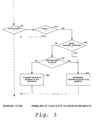
- Fig. 3 shows a flow chart that describes an embodiment of the present invention.
- the left hand side of the flow chart relates to general flow control, and due to the fact that the present invention is not concerned with the general type of flow control, e.g. as provided by TCP or any other flow control protocol, this part is only shown schematically as a dashed line.
- the right hand side of the Fig. discloses a procedure for handling duplicate acknowledgements. Namely, if in the course of the general flow control an acknowledgement (ACK) is received, see operation 301 then the procedure for handling duplicate acknowledgements is triggered.
- ACK acknowledgement
- the acknowledgement is a duplicate acknowledgement. Namely, the number of times N that the specific acknowledgement, which identifies the last correctly received data segment of the sequence that was received in the proper order of the sequence, is determined and it is judged if this number N is larger than 1. If not, then the ACK is not a duplicate ACK, and the procedure returns to the general flow control.
- the procedure goes to operation 303, where it is determined if N(ACK) reached the duplicate acknowledgement threshold Th.
- the duplicate acknowledgement threshold may be considered to be reached if N(ACK) is equal to the duplicate acknowledgement threshold.
- the duplicate acknowledgement threshold may be considered to be reached if N(ACK) is larger than the duplicate acknowledgement threshold.
- This operation can be implemented in any appropriate way, for example by simply keeping a record of the last acknowledged segment and setting an associated counter, such that if a newly received acknowledgment is identical to the previous acknowledgement (i.e. a duplicate acknowledgement) the counter is incremented by one, and if the new acknowledgement identifies a segment that is subsequent to the segment identified in the last received acknowledgement, then the counter is reset to 1.
- N(ACK) indicates the number of times that the sending peer has received the given acknowledgement ACK.
- N 1 means that the acknowledgement for a given segment has been received the first time, and a number N > 1 indicates that it is a duplicate acknowledgement.
- operation 303 determines that the number of acknowledgments has reached the threshold, then the oldest unacknowledged segment is retransmitted in operation 305. The oldest unacknowledged segment then immediately follows the segment identified in the duplicate acknowledgments. On the other hand, if the outcome of operation 303 is negative, the flow proceeds to operation 304 to also consider the situation at the sending peer.
- operation 304 it is determined whether the sending peer is blocked from transmitting data segments due to a condition arising at the sending peer. Blocked in this connection means that the sending peer is not allowed or otherwise unable to transmit data segments to the receiving peer.
- the sending peer is considered blocked, if the number of previously unsent data segments exceeds the size of the receive window. For example due to an error or an unforeseen condition the duplicate acknowledgement threshold may be selected to large and the receive window size may be reached. This situation may be termed receiver limited.
- the sending peer is considered blocked, if the number of previously unsent data segments exceeds the size of the send window.
- the transmit buffer of the sending peer may be a shared memory area with a space left for storing data segments reduced in size, such as below the size of the receive window. This situation may be termed sender limited.
- the sending peer is considered blocked, if an application constituting the source of the data segments does not supply data segments for transmission.
- data segments may be generated dynamically, e.g. of a web page, and the application may temporarily cease generating new data segments. Further, an application may simply presently have no further data segments for transmission. This situation may be termed application limited.
- operation 304 may be optional and that in an alternative the flow may return, if the decision in operation 303 is "NO", to the general flow instead or proceed to operation 306 for transmitting the next data segment in the sequence.
- Fig. 3 is only one example, and this example can be varied in a number of ways.
- the skilled person will understand that the operations can also be arranged differently.
- operation 306 is only an example, as the present invention is not specifically concerned with the procedure after the duplicate acknowledgment threshold is exceeded.
- the procedure after exceeding the duplicate acknowledgment threshold can be chosen in any appropriate or suitable way, where different possibilities for TCP-like protocols shall be discussed further on.
- the response in the general flow control to duplicate acknowledgments is not essential to the present invention.
- the general flow control can stop sending any further segments, or can equally well continue to send further segments.
- the duplicate acknowledgment threshold can be set or updated in any suitable or desirable way. For example, it can be updated at regular intervals, based on one or more values used for adapting the threshold. In other words, these one or more values are regularly measured or determined, and the threshold Th is accordingly updated. This process occurs outside of what is shown in Fig. 3 , in an independent procedure. Consequently, this independent procedure regularly updates the value of Th that is appropriately stored, and operations 303 and 304 simply access or call the current value of Th. On the other hand, it is also possible to update Th at the occurrence of a predetermined triggering event. One possibility can consist in updating Th only if one or more of the one or more values used to adapt Th have changed. Such a procedure would again be independent of what is shown in Fig. 3 , and operations 303 and 304 would simply access or call the current value of Th.
- the specified triggering event can also be a part of the procedure shown in Fig. 4 .
- Th can be updated at every first receipt of a duplicate ACK.
- Fig. 4 where the same reference numerals as used in Fig. 3 refer to the same operations.
- the operations 401 and 402 shown in Fig. 4 are implemented between the operations 302 and 303 as shown in Fig. 3 .
- the threshold Th can also be updated at every acknowledgment.
- the updating operation would be implemented between operations 301 and 302 of Fig. 3 .
- the updating of the duplicate acknowledgment threshold Th can be done whenever suitable or desirable. Equally, it can be done on any appropriate or suitable basis by taking into account the size of the receiving window at the receiving peer, as noted above.
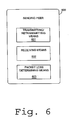
- Fig. 6 illustrates elements of a sending peer for controlling a flow of data segments transmitted between a sending peer and receiving peer, for example utilizing the TCP protocol or any other suitable communication protocol.
- Fig. 6 illustrates a sending peer 600, such as any kind of computing device, e.g. a desktop computer, laptop computer, mobile computing device such as PDA or mobile telephone and similar.
- the invention is equally applicable to wire-bound data exchange as well as wireless or at least partially wireless data transmission.
- the sending peer comprises transmitting/retransmitting means 601 for transmitting data segments from the sending peer to the receiving peer in the order of the sequence and for retransmitting a data segment determined to be lost, as noted with regard to previous embodiments.
- the sending peer comprises receiving means 602, for receiving acknowledgement messages from the receiving peer, were an acknowledgement message in case the correct receipt of a data segment in the proper order of the sequence, and for receiving a duplicate acknowledgement message from the receiving peer if a data segment was received, but not in the proper order of the sequence, the duplicate acknowledgement message being received in association with the last correctly received data segment in order of the sequence of data segments.
- the sending peer comprises packet loss determining means 603 for deciding that a data segment was lost which was sent but not acknowledged, if the number of duplicate acknowledgement messages reaches a duplicate acknowledgement message threshold determined based on the size of a receive window, the size of the receive window corresponding to a number of data segments which can be stored in a buffer space at the receiving peer.
- the packet loss determining means may obtain information on the size of the receive window with acknowledgement messages received from the receiving peer, or by any other means.
- the packet loss determining means may be adapted to set the duplicate acknowledgement threshold such that the data segment determined to be lost is retransmitted at a point in time in the sequence of data segments selected such that the acknowledgement message indicating proper receipt of the data segment determined to be lost, i.e. the retransmitted data segment, is expected to be received at the sending peer before transmitting the data segment with a sequence number exceeding the sequence number of the data segment determined to be lost by the size of the receive window.
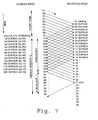
- Fig. 7 illustrates a detailed embodiment for further illustrating the principles of determining the duplicate acknowledgement message threshold by use an example of the TCP protocol.
- Fig. 7 illustrates a sending peer and a receiving peer, as for example noted with regard to previous embodiments.
- a sequence of data segments labelled 01, 02, 03 ... 30 for transmission to the receiving peer is illustrated, including a retransmission of data segment 01 which is considered lost or excessively delayed on the transmission path.
- Data segment 01 is retransmitted after data segment 22, for reasons explained in the following.
- the duplicate acknowledgement threshold is set based on the size of the receive window and more precisely, is set such that the data segment determined to be lost is retransmitted at a point in time in the sequence of data segments selected such that the acknowledgement message indicating proper receipt of the data segment determined to be lost is expected to be received at the sending peer before transmitting the data segment with the sequence number exceeding the sequence number of the data segment determined to be lost by the size of the receive window.
- the point in time for retransmitting the data segment 01 constitutes the latest point in time possible before stalling at the sending peer would occur. Therefore, while further delayed transmission, i.e. a further increased duplicate acknowledgement threshold should be avoided, a lesser delay, i.e. a reduced duplicate acknowledgement threshold would generally be possible.
- the size of the receive window is considered to be 30, i.e., the receive buffer has 30 storage locations for data segments. This implies for the transmission of data segments, that a 31st data segment can only be transmitted after an acknowledgement for the first data segment is received.
- data segment 01 transmitted at the sending peer as a first data segment is considered to be lost along the transmission path.
- Data segments 02, 03 etc. are considered to be transmitted and received properly.
- DUPACK first duplicate acknowledgement message
- This delay of the DUPACK is associated with the transmission delays, processing delays and similar.
- all subsequent receptions of data segments at the receiving peer will trigger the transmission of duplicate acknowledgement messages from the receiving peer to the sending peer, the sending peer receiving an increasing number of duplicate acknowledgement messages as indicated on the left hand side of Fig. 7 .
- the sending peer would continue to transmit data segments in the order of the sequence, without retransmitting the first data segment 01, eventually the data segment 30 will be transmitted and transmission would have to be halted, as the size of the receive window would be reached. In other words, further transmissions after the data segment 30 would be not allowed, as acknowledgements for 30 data segments are outstanding, 30 data segments from and including the data segment 01.
- a stalling or blocking of a transmission at the sending peer can for example occur if the number of sent but unacknowledged data segments is about to exceed the sized of the receive window.
- the first data packet 01 is retransmitted after receiving the 13 th duplicate acknowledgement message triggered by the 14 th transmitted data packet, data packet 14, in order to allow enough time for the acknowledgement of the retransmitted data segment 01 to reach the sending peer before data segment 31 is to be transmitted. Accordingly, data segment 01 should exactly or at the latest be transmitted after receiving the 13 th duplicate acknowledgement message, after data segment 22, allowing to avoid a stalling of the transmission of the sequence of data segments beyond the data segment 30.
- Retransmitting the data segment 01 after the 13 th duplicate acknowledgement message in this example must therefore be avoided unless a stalling of the transmission is accepted or by other means avoided.
- Earlier transmission does not lead to any stalling, but increases the network traffic caused by possibly unnecessary retransmissions. In other words, it should be waited as long as possible with retransmitting data segment 01 such that a stalling at the sending peer of the transmission can be avoided, as depicted in Fig. 7 .
- the duplicate acknowledgement message threshold therefore is determined on the basis of a size of a usable window constituted by the difference between the size of the receive window and a flight size, the flight size representing the number of transmitted data segments which have not yet been acknowledged. If it is for example assumed that the duplicate acknowledgement message threshold is calculated when transmitting the data segment 10, the flight size, i.e., the transmitted but not yet acknowledged data segments, is 10. Further, the usable window as indicated in the figure is defined as the size of the receive window minus the size of the send window, i.e., the difference between the left edge of the send window being the lowest sequence number of data segments that has been sent but not acknowledged and the right edge of the send window being the lowest sequence number of data segments not yet being sent.
- the usable window in other words, is the amount of data that a TCP sender could send at any given point in time, if permitted by conditions, until becoming limited by the receiving peer.
- the duplicate acknowledgement threshold based on the difference between the size of the usable window and the flight size. More precisely, according to another example, if it is again assumed that the duplicate acknowledgement threshold is calculated just prior to receiving the first duplicate acknowledgement message, i.e., when transmitting the data segment 10, the duplicate acknowledgement message threshold meeting the condition shown in Fig. 7 and explained above, is the size of usable window + 2 - flight size - 1 which is equal size of usable window - the flight size + 3.
- the duplicate acknowledgement threshold is calculated on receiving the first duplicate acknowledgement message, i.e., upon transmitting the data segment 11, please be referred to the previous embodiments for updating the threshold, the usable window would be reduced by 1, the flight size would be increased by 1 and thus the duplicate acknowledgement threshold would be calculated as usable window - flight size + 5.
- the duplicate acknowledgement threshold is determined as size of the receive window - 2 ⁇ flight size + N , with N constituting the tuning parameter satisfying the condition ( 2 ⁇ flight size ) - size of receive window + 1 ⁇ N ⁇ 3 , if it is assumed that the duplicate acknowledgement threshold is calculated one operation prior to receiving the first duplicate acknowledgement message, as indicated in Fig. 7 . Again, as outlined before, if the duplicate acknowledgement threshold is calculated one operation later, i.e., upon receiving the first duplicate acknowledgement message, N ⁇ 3 is to be replaced by N ⁇ 5.
- the tuning parameter N can, in this case, be set to 5, thus fulfilling the above discussed condition that an acknowledgement for the retransmitted data segment is received before the number of previously unsent data segments, i.e. data segments which are sent for the first time, exceeds the size of the receive window. If the condition were not fulfilled, this would lead to a transmission stall at the sending peer, as the sending peer is only allowed to transmit a further data segment in the sequence, if the number of sent but unacknowledged data segments does not exceed the size of the receive window as advertised by the receiving peer.
- a negative duplicate acknowledgement threshold is obtained, in cases were the flight size is large in relation to the receive window.
- N is decreased
- the system is made less conservative, i.e., error recovery is triggered earlier, in other words it is earlier judged that a data packet is lost.
- the sending peer is less robust to a packet reordering the network.
- the communication device of Fig. 6 may be configured to perform the above calculations and operations.
- the communication device comprises means for setting the duplicate acknowledgement threshold such that the data segment determined to be lost is retransmitted before a point in time in the sequence of data segments selected such that the acknowledgement message indicating proper receipt of the data segment determined to be lost, i.e. the retransmitted data segment, is expected to be received at the sending peer before transmitting the data segment with a sequence number exceeding the sequence number of the data segment determined to be lost by the size of the receive window.
- the communication device comprises means for determining the duplicate acknowledgement threshold on the basis of a size of a usable window constituted by the difference between the size of the receive window and a flight size, the flight size representing the number of transmitted data segments which have not yet been acknowledged.
- the communication device comprises means for determining the duplicate acknowledgement threshold based on the difference between the size of the usable window and the flight size.
- the means for determining the duplicate acknowledgement may be adapted perform the determination one instant in time prior to receiving the first duplication message as the larger value of:
- the communication device comprises means for determining the duplicate acknowledgement threshold as size of receive window - 2 ⁇ flight size + N , with N constituting a tuning parameter satisfying the condition ( 2 ⁇ flight size ) - size of receive window + 1 ⁇ N ⁇ 3.
- the communication device comprises means for updating the duplicate acknowledgement threshold upon determining a change in the size of the receive window.
- the communication device comprises means for updating the duplicate acknowledgement threshold at least each first time that a duplicate acknowledgement message for one of the data segments is received.
- the communication device comprises means for updating the duplicate acknowledgement threshold each time that an acknowledgement message is received.
- the situation at the sending peer may be taken into account as well.
- the data segment determined to be lost is retransmitted, if the sending peer is blocked from transmitting a previously unsent data segment.
- the sending peer may be considered blocked, if one of the following conditions is fulfilled: the number of previously unsent data segments exceeds the size of the receive window; the number of previously unsent data segments exceeds the size of the send window; or an application constituting the source of the data segments does not supply data segments for transmission.
- the method of the present invention can be put to practice in any suitable or appropriate way, and can especially be present in the form of a computer program, and consequently also in the form of a storage medium carrying such a computer program. Equally, the invention can be present in the form of a communication device arranged to operate in accordance with the method of the invention.
Landscapes
- Engineering & Computer Science (AREA)
- Computer Networks & Wireless Communication (AREA)
- Signal Processing (AREA)
- Communication Control (AREA)
- Detection And Prevention Of Errors In Transmission (AREA)
- Data Exchanges In Wide-Area Networks (AREA)
- Circuits Of Receivers In General (AREA)
- Vehicle Body Suspensions (AREA)
- Infusion, Injection, And Reservoir Apparatuses (AREA)
- Electrotherapy Devices (AREA)
Abstract
Description
- The present invention relates to a method of controlling the flow of an amount of data from a sending peer to a receiving peer of a given communication protocol.
- In the field of communications, data transmission techniques are known where an amount of data to be transmitted is divided into a plurality of data segments, the data segments being ordered in a sequence. These data segments are then transmitted in the order of said sequence.
- This procedure occurs at a so-called sending peer of a communication governed by a predetermined protocol that contains the rules for handling such data segments. The receiving entity associated with the predetermined protocol is referred to as the receiving peer. The concepts of protocols, protocol hierarchies, layering, and protocol peers is well known in the art, see for example "TCP/IP Illustrated . The well known Transmission Control Protocol (TCP) from the TCP/IP protocols suite is an example of such a protocol that arranges data to be sent into a sequence of segments.
- Typically, in order to be sent, the individual segments will be placed into data units having a structure defined by the given protocol. These data units may have different names in the context of different protocols, such as packets, frames, protocol data units, cells, etc. In the present description the term "data unit" shall be used generically to cover any such defined data structure. The present specification shall use the terms "segment" and "data unit" interchangeably.
- The sending peer will hand the data unit downwards to a lower layer, e.g. a TCP sending peer will hand a TCP segments via the IP layer to a link layer, and on the receiving side the receiving peer shall receive data units from the lower layers. The predetermined structure defining the data units, e.g. defining a beginning and an end, allows the receiving peer to identify individual segments.
- It may be noted that in accordance with the OSI layering concept, it does not matter how the data units passed to a lower layer are processed and transported there. Namely, the given sending peer passes a stream of bits downward and the receiving peer receives a stream of bits, where this stream of bits contains certain identifying elements, such as frame boundary indicators, with the help of which the receiving peer can identify individual data units and individual segments.
- In order to ensure the reliable transmission of data, many protocols provide the feature of data unit retransmission, which means that segments from the sequence can be retransmitted if necessary. Typically this will be done with the help of an acknowledgement technique, which means that the correct receipt of a data unit by the receiving peer is acknowledged with an appropriate acknowledgement message that the receiving peer sends back to the sending peer. Once the sending peer has received such an acknowledgment message, it can appropriately continue sending further data units, or if no acknowledgement or a non-acknowledgement message is received, the data unit that was not correctly received by the receiving peer can be retransmitted by the sending peer.
- Several mechanisms are known with the help of which a sending peer is supposed to obtain an indication that the loss of a data unit or segment has occurred, such that an appropriate retransmission can take place. One such known feature is retransmission time-out, which means that after sending a data unit, a timer is monitored, and if a predetermined amount of time passes without having received an acknowledgement for the given data unit, then it is assumed that the data unit has been lost and it is accordingly retransmitted.
- Another such mechanism is that of counting duplicate acknowledgements. A duplicate acknowledgement is an acknowledgement that identifies as the last correctly received data segment a data segment that has already been acknowledged previously. Namely, many protocols, such as e.g. TCP, have an acknowledgement generating mechanism for receiving peers that operates to send out an acknowledgement message for each correctly received segment of the sequence, where the acknowledgement identifies the last correctly received data segment in the order of sequence. In other words, if for example the first to fourth data segments have been received and acknowledged, and then the fifth data segment arrives, the receiving peer will send out an acknowledgement for that fifth segment. If thereafter the seventh and eight segments correctly arrive, then the receiving peer will again send out one or two acknowledgement messages, but these acknowledgement messages will only identify the fifth segment, because the fifth was the last segment that was correctly received in the order of the sequence. Namely, the receiving peer is expecting the sixth segment, and even if it correctly receives segments above the sixth segment, it will continue to acknowledge the fifth segment. Consequently, the receipt of duplicate acknowledgements by the sending peer gives the sending peer an indication that a data unit has been lost.
- As a consequence, in protocols that use the above described acknowledgement mechanism according to which acknowledgement messages only acknowledge the last data unit that was correctly received in the order of the sequence, even if data units are received that lie further on in said sequence, a retransmission mechanism may be implemented that performs a retransmission if a predetermined number of duplicate acknowledgements is received by the sending peer. In TCP, the corresponding mechanism is known as "fast retransmit", where a retransmission is enacted after the receipt of three duplicate acknowledgements. A detailed description of the fast retransmit mechanism in TCP can e.g. be found in the above mentioned book by Stevens, chapter 21.7.
-
US 2002/145976 (Meyer Michael et al, 10 October 2002 ) describes the sending of a duplicate acknowledgment when a data segment is received out of order. - All such mechanisms as described above for receiving an indication that a data unit has been lost, suffer from the problem that the sending peer only receives an indirect indication that a data unit was lost, and in fact the occurrence of the predetermined triggering event (a time-out or a predetermined number of duplicate acknowledgements) does not necessarily mean that a data unit was really lost. These triggering events can also be caused spuriously, e.g. if a data unit is delayed in the transmission network, while data units associated with segments further on in the sequence are delivered by the network. Such a phenomenon is also referred to as reordering.
- It is the object of the present invention to generally improve the possibilities for handling the retransmission of segments in a sending peer.
- This object of the invention is solved by a method of controlling the flow of a sequence of data segments from a sending peer to a receiving peer, comprising transmitting data segments from the sending peer to the receiving peer in the order of the sequence; receiving acknowledgement messages from the receiving peer, wherein an acknowledgement message indicates the correct receipt of a data segment in the proper order of the sequence; receiving a duplicate acknowledgement message from the receiving peer at the sending peer, indicating that a data segment was received but not in the proper order of the sequence, the duplicate acknowledgement message being received in association with the last correctly received packet in the order of the sequence of data segments; deciding that a data segment, which was sent but not acknowledged, that was lost, if the number of duplicate acknowledgement messages received by the sending peer reaches a duplicate acknowledgement message threshold determined based on the size of a receive window, the size of the receive window corresponding to a number of data segments which can be stored in a buffer space at the receiving peer; and retransmitting the data segment decided to be lost.
- Accordingly, the sending peer can set the duplicate acknowledgement message threshold by considering the situation at the receiving peer.
- According to another embodiment, the duplicate acknowledgement threshold is set such that the data segment determined to be lost is retransmitted before a point in time in the sequence of data segments selected such that the acknowledgement message indicating proper receipt of the data segment determined to be lost, i.e. the retransmitted data segment, is expected to be received at the sending peer before transmitting the data segment with a sequence number exceeding the sequence number of the data segment determined to be lost by the size of the receive window. Accordingly, the threshold can always be maintained on a value with optimum utilization of the resources at the receiving peer.
- According to another embodiment, the duplicate acknowledgement message threshold is determined on the basis of a size of a usable window constituted by the difference between the size of the receive window and a flight size, the flight size representing the number of transmitted data segments.which have not yet been acknowledged.
- Still further, the duplicate acknowledgement message threshold may be determined based on the difference between the size of the usable window and the flight size.
- According to another embodiment, the duplicate acknowledgement message threshold is determined one instant in time prior to receiving the first duplication message as the larger value of the
value 1 and the value obtained by calculating
wherein k is a float. Advantageously, k = 2. - Still further, the duplicate acknowledgement message threshold may be determined as

with N constituting a tuning parameter satisfying the condition
- According to another embodiment, the duplicate acknowledgement message threshold is updated upon determining a change in the size of the receive window.
- Alternatively, the duplicate acknowledgement threshold may be updated at least each first time a duplicate acknowledgement message for one of the data segments is received. In this case the tuning parameter N may preferably be set to 5.
- In another alternative, the duplicate acknowledgement message threshold is updated each time an acknowledgement message is received.
- According to another embodiment, the data segment determined to be lost is retransmitted, if the sending peer is blocked from transmitting a previously unsent data segment.
- In this embodiment, the sending peer is considered blocked, if one of the following conditions is fulfilled: the number of previously unsent data segments exceeds the size of the receive window; the number of previously unsent data segments exceeds the size of the send window; or an application constituting the source of the data segments does not supply data segments for transmission.
- A computer program may be arranged to perform at least one of the above operations when executed on a computer.
- A computer readable memory device may store the computer program.
- Still further, the object of the invention is solved by a communication device controlling the flow of a sequence of data segments from a sending peer to a receiving peer, comprising means for transmitting data segments from the sending peer to the receiving peer in the order of the sequence, means for receiving acknowledgment messages from the receiving peer, where an acknowledgment message indicates the correct receipt of a data segment in the proper order of the sequence, means for receiving a duplicate acknowledgement message from the receiving peer at the sending peer, wherein the duplicate acknowledgment message indicates that a data segment was received but not in the proper order of the sequence, the duplicate acknowledgement message being received in association with the last correctly received packet in the order of the sequence of data segments, means for deciding that a data segment, which was sent but not acknowledged, that was lost, if the number of duplicate acknowledgement messages reaches a duplicate acknowledgement threshold determined based on the size of a receive window, the size of the receive window corresponding to a number of data segments which can be stored in a buffer space at the receiving peer; and means for retransmitting the data segment decided to be lost.
-
- Fig. 1
- illustrates operations of a method for controlling the flow of a data sequence according to an embodiment of the invention,
- Fig. 2
- illustrates operations for determining the duplicate acknowledgement threshold according to an embodiment of the invention,
- Fig. 3
- illustrates operations for controlling the flow of data segments from a sending peer to a receiving peer according to another embodiment of the invention, particularly outlining a flow for retransmitting an unacknowledged data segment,
- Fig. 4
- illustrates operations for updating the duplicate acknowledgement threshold according to an embodiment of the invention,
- Fig. 5
- illustrates operations for updating the duplicate acknowledgement threshold according to an embodiment of the invention, and
- Fig. 6
- illustrates a communication device for controlling the flow of data segments, the communication device at least acting as a sending peer, and
- Fig. 7
- shows a detailed illustration of a flow of data segments and acknowledgement messages between a sending peer and a receiving peer to illustrate determination of the duplicate acknowledgement threshold.
- The present invention is applicable to any implementation of a given communication protocol to which an amount of data that is to be sent is divided into a plurality of data segments, and said data segments are ordered in a sequence, where the data segments are sent from the sending peer to the receiving peer in the order of said sequence, where a receiving peer sends acknowledgements to the sending peer, said acknowledgements indicating the correct receipt in the proper order of the sequence, such that an acknowledgement message indicates the last correctly received data segment of said sequence that was received in the proper order of the sequence, and where if the sending peer receives a threshold number of acknowledgement messages that each identify the same data segment as the last correctly received data segment of the segment that was received in the proper order, the segment that immediately follows the segment for which duplicate acknowledgements were received is retransmitted.
- An example of such a protocol is TCP. However, it is explicitly noted that the invention is also applicable to any other communication protocol that has the above described characteristics as far as they are relevant for implementing the inventive concept.
- According to the present invention, the threshold number of acknowledgement messages, i.e. the duplicate acknowledgement threshold is a parameter determined based on the size of a receive window, the size of the receive window representing a number of data segments which can be stored in a buffer space at the receiving peer.
- As already mentioned previously, therefore, the duplicate acknowledgement threshold is a parameter that is associated with the sending peer's decision on how long to wait until a given segment for which duplicate acknowledgements are being received is assumed to have been lost. Due to the solution of the present invention, according to which the threshold is adapted, it is possible to make this decision itself adaptive and thereby more flexible.
-
Fig. 1 illustrates operations for controlling a flow of data segments between a sending peer and a receiving peer (not shown) according to an embodiment of the invention. - In a
first operation 101 the sending peer is considered to carry out a normal routine of transmitting data segments to a receiving peer in a certain given sequence. For example, the data segments are numbered consecutively such as 01, 02, 03, 04, 05, 06, ... and scheduled for transmission at the sending peer in the order of the sequential numbering. The sequential numbering may suitably correspond to the output of data segments of a data source, e.g. as known in the art. It is understood that the data segments may carry any kind of payload data, i.e. data relating to any kind of application or format, such as voice data, data exchange between computing device in a communication session, video data, audio data and similar. - The receiving peer (not shown in
Fig. 1 ) receives the data segments and acknowledges the receipt of the data segments with an acknowledgement message returned to the sending peer. These acknowledgement messages from the receiving peer are received at the sending peer in anoperation 102. If operation is normal and data segments transmitted in a sequence are received in the same sequence at the receiving peer, each data packet is acknowledged with an acknowledgement message and the sending peer knows that the data segments are received in the proper order of the sequence. The data segments which have been transmitted from the sending peer and properly acknowledged, can be discarded, e.g. removed from a transmit buffer at the sending peer, as it a retransmission of the transmitted data segments will not be required. - Generally, each correctly received data segment, i.e. error free and in the order of the sequence, triggers an acknowledgement message at the receiving peer, which is returned to the sending peer. If after a correctly received data segment a data segment is received which is not in the order of the sequence, i.e. a delay or fault in transmitting a data segment occurred, then the acknowledgement message for the last correctly received data segment is repeated, and this repeated acknowledgement message is termed duplicate acknowledgement message.
- In the above example, if for one reason or the other a data segment is not received in the proper order of the transmitting sequence, e.g. if
data segment 05 is received aftersegments data segment 04, the receiving peer thus does not return an acknowledgement message to the sending peer. Instead, the receiving peer transmits a duplicate acknowledgement message to the sending peer, indicating that a data segment was received, but not in the order of the sequence. The duplicate acknowledgement message is associated with the last correctly received packet in the order of the sequence of data segments. The duplicate acknowledgement message in the above example of receivingdata segment 05 beforedata segment 04 will indicate that the last data segment which was correctly received in the order of the sequence wasdata segment 03. - The duplicate acknowledgement message received at the sending peer in an
operation 103 consequently notifies the sending peer that a retransmission of the packet following the last correctly received packet may be required, in case it turns out or is determined that this data packet was actually lost during the transmission path from the sending peer to the receiving peer. Hence, the sending peer may not discard all those data packets from the sending buffer, which were transmitted after the last correctly received data packet indicated by the duplicate acknowledgement message received inoperation 103. - However, the sending peer continuous to transmit data segments to the receiving peer, and thus, presuming that the
data segment 04 of the above example is still not received at the receiving peer for a longer period of time, the receiving peer continues to transmit duplicate acknowledgement messages for each received data segment. Accordingly, the sending peer receives an increasing number of duplicate acknowledgement messages, and with each duplicate acknowledgement.message the probability that the unacknowledged data segment was actually lost, increases. - In an
operation 104 the sending peer now decides whether the number of duplicate acknowledgement messages reaches or exceeds an appropriately set (as will be described later) duplicate acknowledgement message threshold set at the sending peer. If inoperation 104 the decision is "NO", indicating that the duplicate acknowledgement message threshold is not yet been reached, the flow of operation returns tooperation 101, i.e., the sending peer continues to transmit data segments in the order of the sequence. - However, if in
operation 104 the decision is "YES", indicating that the duplicate acknowledgement message threshold is reached or exceeded, in anoperation 105 the sending peer decides that the data segment was lost, which was sent but not acknowledged. Continuing with the above example, with the duplicate acknowledgement messages indicating that the last correctly received data segment in the order of the sequence was data segment 3, the sending peer will decide that the data segment 4 was actually lost. - In an
operation 106 the data segment determined to be lost, i.e. in theexample data segment 04, is retransmitted. The retransmission may for example be carried out by a fast retransmit according to the TCP protocol. - Of course, it is of highest importance to suitably set the duplicate acknowledgement message threshold keeping in mind that a to early retransmission of data packets causes unnecessary traffic, and that a refraining from retransmitting a data segment for too long may cause a blocking of further transmissions, as all data segments which have been transmitted but not acknowledged must be kept in the buffers of the sending peer receiving peer.
- Most importantly, for superior flow control, the duplicate acknowledgement message threshold can be set under consideration of the size of a receive window at the receiving peer, the size of the receive window constituting the number of data segments which can be stored in a buffer space at the receiving peer. This size of the receive window may be reported by the receiving peer for example with the acknowledgement messages, such that the sending peer is always aware of the present size of the receive window.
- More precisely, the threshold should be set such that a transmission of data segments at no point in time is prohibited due to reaching at the sending peer the maximum allowed transmitted but not acknowledged data segments, this maximum number being equal to the size of the receive window. Note that according to a sliding window protocol a data segment from the sending peer according to a communication protocol may only be scheduled for transmission, if the difference in sequence numbers of the oldest acknowledged data segment and the next data segment for transmission does not exceed the size of the receive window.
- The above illustrated an embodiment where the calculation of the duplicate acknowledgement threshold uses the size of the receive window. It is noted that, even though not further described here, the duplicate acknowledgement threshold may in addition thereto be further adapted based on the situation at the sending peer, e.g. a size of a window at the sending peer to further improve the setting of the duplicate acknowledgement threshold.
- In the following a further embodiment of the invention will be described with regard to
Fig. 2. Fig. 2 illustrates operations for suitably setting the duplicate acknowledgement message threshold. - As noted above, the threshold is suitably to be selected such that a buffer overflow at the receiving peer can surely be avoided and that further a stalling of a transmission of data segments from the sending peer can surely be avoided. A stalling or blocking of a transmission at the sending peer can occur if the number of sent but unacknowledged data segments is about to exceed the sized of the receive window.
- To meet these conditions, it must always be assured that the number of data segments which have been transmitted after and including the oldest unacknowledged data segment does not exceed the size of the receive window at the receiving peer.
- Accordingly, if a data segment has not been acknowledged, a retransmission of this data segment is to be scheduled at a point in time that still allows an acknowledgement of proper receipt of the retransmission of this data segment to reach the sending peer before a data segment with a sequence number is scheduled for transmission which would potentially lead to an overflow of the receiver buffer if no proper acknowledgement of the retransmitted data segment were received.
- In other words, the retransmission of the unacknowledged data segment needs to be performed such that an acknowledgement pertaining to this retransmission is expected to be received at the sending peer before the transmitted number of data segments since and including the unacknowledged data segment exceeds the size of the receive window. If this condition were not met, the sending peer would not be allowed to transmit further data packets, and the connection would stall.
- In
Fig. 2 , in anoperation 201, it is decided whether the duplicate acknowledgement message threshold should be updated according to conditions to be described later. If the decision is "YES", inoperation 202, in accordance with the above said, the duplicate acknowledgement message threshold is set such that the data segment determined to be lost is retransmitted at or before a point in time in the sequence of data segments selected such that the acknowledgement message indicating proper receipt of the data segment determined to be lost is expected to be received at the sending.peer before the data segment with a sequence number exceeding the sequence number of the data segment determined to be lost by the size of the receive window is scheduled for transmission. Accordingly, it can be avoided that the sending peer is barred from transmitting further data segments. - In this case a window stalling in the data transmission can be avoided and further, an overflow of the receive buffer can be avoided.
-
Fig. 3 shows a flow chart that describes an embodiment of the present invention. The left hand side of the flow chart relates to general flow control, and due to the fact that the present invention is not concerned with the general type of flow control, e.g. as provided by TCP or any other flow control protocol, this part is only shown schematically as a dashed line. The right hand side of the Fig. discloses a procedure for handling duplicate acknowledgements. Namely, if in the course of the general flow control an acknowledgement (ACK) is received, seeoperation 301 then the procedure for handling duplicate acknowledgements is triggered. - In
operation 302 it is determined if the acknowledgement is a duplicate acknowledgement. Namely, the number of times N that the specific acknowledgement, which identifies the last correctly received data segment of the sequence that was received in the proper order of the sequence, is determined and it is judged if this number N is larger than 1. If not, then the ACK is not a duplicate ACK, and the procedure returns to the general flow control. - If the outcome of
operation 302 indicates that the acknowledgement is a duplicate acknowledgement, the procedure goes tooperation 303, where it is determined if N(ACK) reached the duplicate acknowledgement threshold Th. Depending on the implementation, the duplicate acknowledgement threshold may be considered to be reached if N(ACK) is equal to the duplicate acknowledgement threshold. Alternatively, the duplicate acknowledgement threshold may be considered to be reached if N(ACK) is larger than the duplicate acknowledgement threshold. - This operation can be implemented in any appropriate way, for example by simply keeping a record of the last acknowledged segment and setting an associated counter, such that if a newly received acknowledgment is identical to the previous acknowledgement (i.e. a duplicate acknowledgement) the counter is incremented by one, and if the new acknowledgement identifies a segment that is subsequent to the segment identified in the last received acknowledgement, then the counter is reset to 1.
- In the example of
Fig. 3 , N(ACK) indicates the number of times that the sending peer has received the given acknowledgement ACK. In other words, N = 1 means that the acknowledgement for a given segment has been received the first time, and a number N > 1 indicates that it is a duplicate acknowledgement. - If
operation 303 determines that the number of acknowledgments has reached the threshold, then the oldest unacknowledged segment is retransmitted inoperation 305. The oldest unacknowledged segment then immediately follows the segment identified in the duplicate acknowledgments. On the other hand, if the outcome ofoperation 303 is negative, the flow proceeds tooperation 304 to also consider the situation at the sending peer. - In
operation 304 it is determined whether the sending peer is blocked from transmitting data segments due to a condition arising at the sending peer. Blocked in this connection means that the sending peer is not allowed or otherwise unable to transmit data segments to the receiving peer. - According to an example, the sending peer is considered blocked, if the number of previously unsent data segments exceeds the size of the receive window. For example due to an error or an unforeseen condition the duplicate acknowledgement threshold may be selected to large and the receive window size may be reached. This situation may be termed receiver limited.
- According to another example, the sending peer is considered blocked, if the number of previously unsent data segments exceeds the size of the send window. For example the transmit buffer of the sending peer may be a shared memory area with a space left for storing data segments reduced in size, such as below the size of the receive window. This situation may be termed sender limited.
- According to another example, the sending peer is considered blocked, if an application constituting the source of the data segments does not supply data segments for transmission. For example, data segments may be generated dynamically, e.g. of a web page, and the application may temporarily cease generating new data segments. Further, an application may simply presently have no further data segments for transmission. This situation may be termed application limited.
- If in
operation 304 it is determined that the sending peer is blocked from transmitting data segments, then the oldest unacknowledged segment is retransmitted inoperation 305. - If in
operation 304 it is determined that the sending peer is not blocked from transmitting data segments, then the next segment in the sequence following the segment that immediately follows the segment identified in the duplicate acknowledgment is transmitted in anoperation 306. - After
operations - It is noted that
operation 304 may be optional and that in an alternative the flow may return, if the decision inoperation 303 is "NO", to the general flow instead or proceed tooperation 306 for transmitting the next data segment in the sequence. - It may be noted that the embodiment of
Fig. 3 is only one example, and this example can be varied in a number of ways. The skilled person will understand that the operations can also be arranged differently. Moreover,operation 306 is only an example, as the present invention is not specifically concerned with the procedure after the duplicate acknowledgment threshold is exceeded. In other words, the procedure after exceeding the duplicate acknowledgment threshold can be chosen in any appropriate or suitable way, where different possibilities for TCP-like protocols shall be discussed further on. - Equally, the response in the general flow control to duplicate acknowledgments is not essential to the present invention. For example, after the negative outcome of
operation 303, which means that a duplicate acknowledgment has been received, but the number of duplicate acknowledgments has not yet reached the threshold, the general flow control can stop sending any further segments, or can equally well continue to send further segments. - The duplicate acknowledgment threshold can be set or updated in any suitable or desirable way. For example, it can be updated at regular intervals, based on one or more values used for adapting the threshold. In other words, these one or more values are regularly measured or determined, and the threshold Th is accordingly updated. This process occurs outside of what is shown in
Fig. 3 , in an independent procedure. Consequently, this independent procedure regularly updates the value of Th that is appropriately stored, andoperations Fig. 3 , andoperations - However, the specified triggering event can also be a part of the procedure shown in
Fig. 4 . Namely, it is possible to perform an updating of Th at the occurrence of a triggering event that is associated with the receipt of acknowledgments. For example, Th can be updated at every first receipt of a duplicate ACK. This is shown inFig. 4 , where the same reference numerals as used inFig. 3 refer to the same operations. In other words, theoperations Fig. 4 are implemented between theoperations Fig. 3 . Afteroperation 302 has determined that a duplicate acknowledgment has been received,operation 401 determines if the duplicate acknowledgment is the first duplicate acknowledgment, namely if N(ACK) = 2, and if this is the case, then Th is updated inoperation 402. Afteroperations operation 303 is performed, and all the other operations already discussed in connection withFig. 3 , such that a further discussion is not necessary. - It is also possible to perform an updating of Th at every duplicate acknowledgment. This is shown in
Fig. 5 . Namely, the updatingoperation 501 follows afteroperation 302, such that every duplicate acknowledgment leads to an updating of Th. - As another alternative, which is not shown in the figures, the threshold Th can also be updated at every acknowledgment. In other words, the updating operation would be implemented between
operations Fig. 3 . Another variation can consist in updating the threshold Th at every ACK that relates to outstanding data segments, i.e. only for such acknowledgments where N(ACK) = 1. Consequently, the updating operation could be implemented at the negative output ofoperation 302 inFig. 3 . - As described above, the updating of the duplicate acknowledgment threshold Th can be done whenever suitable or desirable. Equally, it can be done on any appropriate or suitable basis by taking into account the size of the receiving window at the receiving peer, as noted above.
- In the following a further embodiment of the invention will be described with regard to
Fig. 6. Fig. 6 illustrates elements of a sending peer for controlling a flow of data segments transmitted between a sending peer and receiving peer, for example utilizing the TCP protocol or any other suitable communication protocol. -
Fig. 6 illustrates a sendingpeer 600, such as any kind of computing device, e.g. a desktop computer, laptop computer, mobile computing device such as PDA or mobile telephone and similar. The invention is equally applicable to wire-bound data exchange as well as wireless or at least partially wireless data transmission. - The sending peer comprises transmitting/retransmitting means 601 for transmitting data segments from the sending peer to the receiving peer in the order of the sequence and for retransmitting a data segment determined to be lost, as noted with regard to previous embodiments.
- Further, the sending peer comprises receiving means 602, for receiving acknowledgement messages from the receiving peer, were an acknowledgement message in case the correct receipt of a data segment in the proper order of the sequence, and for receiving a duplicate acknowledgement message from the receiving peer if a data segment was received, but not in the proper order of the sequence, the duplicate acknowledgement message being received in association with the last correctly received data segment in order of the sequence of data segments.
- Further, the sending peer comprises packet loss determining means 603 for deciding that a data segment was lost which was sent but not acknowledged, if the number of duplicate acknowledgement messages reaches a duplicate acknowledgement message threshold determined based on the size of a receive window, the size of the receive window corresponding to a number of data segments which can be stored in a buffer space at the receiving peer. The packet loss determining means may obtain information on the size of the receive window with acknowledgement messages received from the receiving peer, or by any other means.
- Further, the packet loss determining means may be adapted to set the duplicate acknowledgement threshold such that the data segment determined to be lost is retransmitted at a point in time in the sequence of data segments selected such that the acknowledgement message indicating proper receipt of the data segment determined to be lost, i.e. the retransmitted data segment, is expected to be received at the sending peer before transmitting the data segment with a sequence number exceeding the sequence number of the data segment determined to be lost by the size of the receive window.
- In the following a further embodiment of the invention will be described with regard to
Fig. 6 . -
Fig. 7 illustrates a detailed embodiment for further illustrating the principles of determining the duplicate acknowledgement message threshold by use an example of the TCP protocol. -
Fig. 7 illustrates a sending peer and a receiving peer, as for example noted with regard to previous embodiments. - At the sending peer a sequence of data segments labelled 01, 02, 03 ... 30 for transmission to the receiving peer is illustrated, including a retransmission of
data segment 01 which is considered lost or excessively delayed on the transmission path.Data segment 01 is retransmitted afterdata segment 22, for reasons explained in the following. - In the embodiment of
Fig. 7 the duplicate acknowledgement threshold is set based on the size of the receive window and more precisely, is set such that the data segment determined to be lost is retransmitted at a point in time in the sequence of data segments selected such that the acknowledgement message indicating proper receipt of the data segment determined to be lost is expected to be received at the sending peer before transmitting the data segment with the sequence number exceeding the sequence number of the data segment determined to be lost by the size of the receive window. The point in time for retransmitting thedata segment 01 constitutes the latest point in time possible before stalling at the sending peer would occur. Therefore, while further delayed transmission, i.e. a further increased duplicate acknowledgement threshold should be avoided, a lesser delay, i.e. a reduced duplicate acknowledgement threshold would generally be possible. - In the present case the size of the receive window is considered to be 30, i.e., the receive buffer has 30 storage locations for data segments. This implies for the transmission of data segments, that a 31st data segment can only be transmitted after an acknowledgement for the first data segment is received.
- In the example of
Fig. 7 , as noted before, and as indicated by the dashed arrow,data segment 01 transmitted at the sending peer as a first data segment, is considered to be lost along the transmission path.Data segments - Accordingly, as
data segment 01 is missing at the receiving peer, the receipt of thedata segment 02 at the receiving peer will trigger a return of a first duplicate acknowledgement message (DUPACK) which is considered to be received at the sending peer after transmission ofdata packet 10 and before transmission ofdata packet 11. This delay of the DUPACK is associated with the transmission delays, processing delays and similar. Similarly, asdata segment 01 continuous to be missing, all subsequent receptions of data segments at the receiving peer will trigger the transmission of duplicate acknowledgement messages from the receiving peer to the sending peer, the sending peer receiving an increasing number of duplicate acknowledgement messages as indicated on the left hand side ofFig. 7 . If the sending peer would continue to transmit data segments in the order of the sequence, without retransmitting thefirst data segment 01, eventually thedata segment 30 will be transmitted and transmission would have to be halted, as the size of the receive window would be reached. In other words, further transmissions after thedata segment 30 would be not allowed, as acknowledgements for 30 data segments are outstanding, 30 data segments from and including thedata segment 01. A stalling or blocking of a transmission at the sending peer can for example occur if the number of sent but unacknowledged data segments is about to exceed the sized of the receive window. - In order to avoid this situation, as shown in the figure, the
first data packet 01 is retransmitted after receiving the 13th duplicate acknowledgement message triggered by the 14th transmitted data packet,data packet 14, in order to allow enough time for the acknowledgement of the retransmitteddata segment 01 to reach the sending peer before data segment 31 is to be transmitted. Accordingly,data segment 01 should exactly or at the latest be transmitted after receiving the 13th duplicate acknowledgement message, afterdata segment 22, allowing to avoid a stalling of the transmission of the sequence of data segments beyond thedata segment 30. - Retransmitting the
data segment 01 after the 13th duplicate acknowledgement message in this example must therefore be avoided unless a stalling of the transmission is accepted or by other means avoided. Earlier transmission does not lead to any stalling, but increases the network traffic caused by possibly unnecessary retransmissions. In other words, it should be waited as long as possible with retransmittingdata segment 01 such that a stalling at the sending peer of the transmission can be avoided, as depicted inFig. 7 . - Advantageously, the duplicate acknowledgement message threshold therefore is determined on the basis of a size of a usable window constituted by the difference between the size of the receive window and a flight size, the flight size representing the number of transmitted data segments which have not yet been acknowledged. If it is for example assumed that the duplicate acknowledgement message threshold is calculated when transmitting the
data segment 10, the flight size, i.e., the transmitted but not yet acknowledged data segments, is 10. Further, the usable window as indicated in the figure is defined as the size of the receive window minus the size of the send window, i.e., the difference between the left edge of the send window being the lowest sequence number of data segments that has been sent but not acknowledged and the right edge of the send window being the lowest sequence number of data segments not yet being sent. The usable window, in other words, is the amount of data that a TCP sender could send at any given point in time, if permitted by conditions, until becoming limited by the receiving peer. - Still further, it is preferred to set the duplicate acknowledgement threshold based on the difference between the size of the usable window and the flight size. More precisely, according to another example, if it is again assumed that the duplicate acknowledgement threshold is calculated just prior to receiving the first duplicate acknowledgement message, i.e., when transmitting the
data segment 10, the duplicate acknowledgement message threshold meeting the condition shown inFig. 7 and explained above, is the
which is equal
- If in another alternative it were assumed that the duplicate acknowledgement threshold is calculated on receiving the first duplicate acknowledgement message, i.e., upon transmitting the
data segment 11, please be referred to the previous embodiments for updating the threshold, the usable window would be reduced by 1, the flight size would be increased by 1 and thus the duplicate acknowledgement threshold would be calculated as
- In more general terms the duplicate acknowledgement threshold can be calculated as the

and with the above explained condition that the
the duplicate acknowledgement threshold is obtained as
or still more general,
wherein k is a floating value. - Still further, according to another example, the duplicate acknowledgement threshold is determined as

with N constituting the tuning parameter satisfying the condition
if it is assumed that the duplicate acknowledgement threshold is calculated one operation prior to receiving the first duplicate acknowledgement message, as indicated inFig. 7 . Again, as outlined before, if the duplicate acknowledgement threshold is calculated one operation later, i.e., upon receiving the first duplicate acknowledgement message, N < 3 is to be replaced by N < 5. Advantageously, the tuning parameter N can, in this case, be set to 5, thus fulfilling the above discussed condition that an acknowledgement for the retransmitted data segment is received before the number of previously unsent data segments, i.e. data segments which are sent for the first time, exceeds the size of the receive window. If the condition were not fulfilled, this would lead to a transmission stall at the sending peer, as the sending peer is only allowed to transmit a further data segment in the sequence, if the number of sent but unacknowledged data segments does not exceed the size of the receive window as advertised by the receiving peer.
Using the above formulas, it is possible that a negative duplicate acknowledgement threshold is obtained, in cases were the flight size is large in relation to the receive window. In order to avoid such a negative duplicate acknowledgement threshold, a max-operator can be used, which can prevent the duplicate acknowledgement threshold from obtaining such negative values. Accordingly, the preferred way of calculating the duplicate acknowledgement threshold at the time indicated inFig. 7 , i.e., prior to receiving the first duplicate acknowledgement message, is
- In the following examples are described, how the tuning parameter N can be determined. As noted above, with N = 3 and determining the duplicate acknowledgement message threshold one operation prior to receiving the first duplicate acknowledgement message, the acknowledgement for the retransmission of the
first data packet 01 is exactly received after the receive window is "filled up". This is, however, valid only under the condition that only one packet was lost and that no packet reordering occurred. In cases where the two conditions are valid, any increase of N beyond 3 would eventually lead to a window stalling, i.e., the sending peer would not be allowed to transmit any further data packets. Therefore, N = 3 is considered the upper bound for N. However, it is noted that in cases where more than one segment has been lost, it is possible to increase N further, and still to avoid window stalling. This however, should not be the typical case, and N = 3 may preferably be selected as upper bound. - Regarding the lower bound for N it is a reasonable requirement that any algorithm for calculating the duplicate acknowledgement threshold should calculate a value larger or equal to 1. This is the value obtained if

- Generally, if N is decreased, the system is made less conservative, i.e., error recovery is triggered earlier, in other words it is earlier judged that a data packet is lost. However, with a decreased N and thus duplicate acknowledgement threshold, the sending peer is less robust to a packet reordering the network.
- As a reasonable value between the upper bound and lower bound leading to good results, the duplicate acknowledgement message threshold may be set to

i.e. N = 0. - The communication device of
Fig. 6 may be configured to perform the above calculations and operations. - More precisely, in another embodiment, the communication device comprises means for setting the duplicate acknowledgement threshold such that the data segment determined to be lost is retransmitted before a point in time in the sequence of data segments selected such that the acknowledgement message indicating proper receipt of the data segment determined to be lost, i.e. the retransmitted data segment, is expected to be received at the sending peer before transmitting the data segment with a sequence number exceeding the sequence number of the data segment determined to be lost by the size of the receive window.
- Further, in another embodiment, the communication device comprises means for determining the duplicate acknowledgement threshold on the basis of a size of a usable window constituted by the difference between the size of the receive window and a flight size, the flight size representing the number of transmitted data segments which have not yet been acknowledged.
- Further, in another embodiment, the communication device comprises means for determining the duplicate acknowledgement threshold based on the difference between the size of the usable window and the flight size.
- The means for determining the duplicate acknowledgement may be adapted perform the determination one instant in time prior to receiving the first duplication message as the larger value of:
- the
value 1 and the value obtained by calculating
- The means for determining the duplicate acknowledgement may be adapted to use k = 2.
- Further, in another embodiment, the communication device comprises means for determining the duplicate acknowledgement threshold as

with N constituting a tuning parameter satisfying the condition
- Further, in another embodiment, the communication device comprises means for updating the duplicate acknowledgement threshold upon determining a change in the size of the receive window.
- Further, in another embodiment, the communication device comprises means for updating the duplicate acknowledgement threshold at least each first time that a duplicate acknowledgement message for one of the data segments is received.
- Further, in another embodiment, the communication device comprises means for updating the duplicate acknowledgement threshold each time that an acknowledgement message is received.
- In addition to the above outlined setting of the duplicate acknowledgement message threshold based on the size of a receive window, with the size of the receive window representing a number of data segments which can be stored in a buffer space at the receiving peer, the situation at the sending peer may be taken into account as well. More precisely, according to another embodiment, the data segment determined to be lost is retransmitted, if the sending peer is blocked from transmitting a previously unsent data segment. In this case, the sending peer may be considered blocked, if one of the following conditions is fulfilled: the number of previously unsent data segments exceeds the size of the receive window; the number of previously unsent data segments exceeds the size of the send window; or an application constituting the source of the data segments does not supply data segments for transmission.
- The method of the present invention can be put to practice in any suitable or appropriate way, and can especially be present in the form of a computer program, and consequently also in the form of a storage medium carrying such a computer program. Equally, the invention can be present in the form of a communication device arranged to operate in accordance with the method of the invention.
- Although the present invention has been described by way of detailed embodiments, the invention is by no means restricted to these embodiments, as it is defined by the appended claims. Also, reference numerals in the claims are not to be understood as restrictive, as they only serve to make the claims easier to read.
Claims (16)
- A method of controlling the flow of a sequence of data segments from a sending peer to a receiving peer, comprising:transmitting data segments from the sending peer to the receiving peer in the order of the sequence;receiving acknowledgment messages from the receiving peer, where an acknowledgment message indicates the correct receipt of a data segment in the proper order of the sequence;receiving a duplicate acknowledgement message from the receiving peer at the sending peer, indicating that a data segment was received, but not in the proper order of the sequence, the duplicate acknowledgement message being for the last correctly received data segment in the order of the sequence of data segments;deciding that a data segment, which was sent but not acknowledged, was lost, if the number of duplicate acknowledgement messages reaches a duplicate acknowledgement threshold determined based on the size of a receive window, the size of the receive window corresponding to a number of data segments which can be stored in a buffer space at the receiving peer; andretransmitting the data segment decided to be lost.
- Method according to claim 1, wherein the duplicate acknowledgement threshold is set such that the data segment determined to be lost is retransmitted before a point in time in the sequence of data segments selected such that the acknowledgement message indicating proper receipt of the data segment determined to be lost is expected to be received at the sending peer before transmitting the data segment with a sequence number exceeding the sequence number of the data segment determined to be lost by the size of the receive window.
- Method of at least one of claims 1 and 2, wherein the duplicate acknowledgement threshold is determined on the basis of a size of a usable window constituted by the difference between the size of the receive window and a flight size, the flight size representing the number of transmitted data segments which have not yet been acknowledged.
- Method of at least one of claims 1 to 3, wherein the duplicate acknowledgement threshold is determined based on the difference between the size of the usable window and the flight size.
- Method of at least one of claims 1 to 4, wherein the duplicate acknowledgement threshold is determined one instant in time prior to receiving the first duplication message as the larger value of:

wherein k is a float. - Method of claim 5, wherein k = 2.
- Method of at least one of claims 1 to 4, wherein the duplicate acknowledgement threshold is determined as

with N constituting a tuning parameter satisfying the condition
- Method of at least one of claims 1 to 7, wherein the duplicate acknowledgement threshold is updated upon determining a change in the size of the receive window.
- The method of at least one of claims 1 to 7, wherein the duplicate acknowledgement threshold is updated at least each first time that a duplicate acknowledgement message for one of the data segments is received.
- The method of claims 7 and 9, wherein N = 5.
- The method of at least one claims 1 to 7, wherein the duplicate acknowledgement threshold is updated each time that an acknowledgement message is received.
- The method of at least one of claims 1 to 11, wherein the data segment determined to be lost is retransmitted, if the sending peer is blocked from transmitting a previously unsent data segment.
- The method of claim 12, wherein the sending peer is considered blocked, if one of the following conditions is fulfilled:the number of previously unsent data segments exceeds the size of the receive window;the number of previously unsent data segments exceeds the size of the send window;an application constituting the source of the data segments does not supply data segments for transmission.
- A computer program arranged to perform the method of at least one of claims 1 to 13 when executed on a computer.
- A computer readable memory device that stores the computer program of claim 14.
- A communication device controlling the flow of a sequence of data segments from a sending peer to a receiving peer, comprising:means for transmitting data segments from the sending peer to the receiving peer in the order of the sequence,means for receiving acknowledgment messages from the receiving peer, where an acknowledgment message indicates the correct receipt of a data segment in the proper order of the sequence,means for receiving a duplicate acknowledgement message from the receiving peer at the sending peer, wherein the duplicate acknowledgement message indicates that a data segment was received but not in the proper order of the sequence, the duplicate acknowledgement message being for the last correctly received packet in the order of the sequence of data segments,means for deciding that a data segment, which was sent but not acknowledged, was lost, if the number of duplicate acknowledgement messages reaches a duplicate acknowledgement threshold determined based on the size of a receive window, the size of the receive window corresponding to a number of data segments which can be stored in a buffer space at the receiving peer; andmeans for retransmitting the data segment decided to be lost.
Priority Applications (1)
| Application Number | Priority Date | Filing Date | Title |
|---|---|---|---|
| PL04804219T PL1829266T3 (en) | 2004-12-22 | 2004-12-22 | Data flow control with duplicate acknowledgment |
Applications Claiming Priority (1)
| Application Number | Priority Date | Filing Date | Title |
|---|---|---|---|
| PCT/EP2004/014624 WO2006066606A1 (en) | 2004-12-22 | 2004-12-22 | Data flow control with duplicate acknowledgment |
Publications (2)
| Publication Number | Publication Date |
|---|---|
| EP1829266A1 EP1829266A1 (en) | 2007-09-05 |
| EP1829266B1 true EP1829266B1 (en) | 2008-10-29 |
Family
ID=34960088
Family Applications (1)
| Application Number | Title | Priority Date | Filing Date |
|---|---|---|---|
| EP04804219A Expired - Lifetime EP1829266B1 (en) | 2004-12-22 | 2004-12-22 | Data flow control with duplicate acknowledgment |
Country Status (11)
| Country | Link |
|---|---|
| US (1) | US8200838B2 (en) |
| EP (1) | EP1829266B1 (en) |
| JP (1) | JP4546542B2 (en) |
| KR (1) | KR101139996B1 (en) |
| CN (1) | CN101088243A (en) |
| AT (1) | ATE413033T1 (en) |
| AU (1) | AU2004325896B2 (en) |
| CA (1) | CA2591601C (en) |
| DE (1) | DE602004017526D1 (en) |
| PL (1) | PL1829266T3 (en) |
| WO (1) | WO2006066606A1 (en) |
Cited By (2)
| Publication number | Priority date | Publication date | Assignee | Title |
|---|---|---|---|---|
| CN107948236A (en) * | 2016-10-12 | 2018-04-20 | 佳能株式会社 | Communicator, communication means and storage medium |
| WO2018189416A1 (en) * | 2017-04-13 | 2018-10-18 | Nokia Solutions And Networks Oy | Backwards feedback bundling |
Families Citing this family (29)
| Publication number | Priority date | Publication date | Assignee | Title |
|---|---|---|---|---|
| EP1847071A4 (en) | 2005-01-26 | 2010-10-20 | Internet Broadcasting Corp B V | MULTI-DIFFUSION IN LAYERS AND EXACT ATTRIBUTION OF BANDWIDTH AND PRIORIZATION OF PACKETS |
| US7725595B1 (en) | 2005-05-24 | 2010-05-25 | The United States Of America As Represented By The Secretary Of The Navy | Embedded communications system and method |
| FR2906425B1 (en) * | 2006-09-21 | 2009-10-23 | Ipanema Technologies Sa | METHOD OF OPTIMIZING TRAFFIC CONTROL IN A PACKET TELECOMMUNICATION NETWORK |
| JP4793580B2 (en) * | 2006-12-04 | 2011-10-12 | 日本電気株式会社 | Protocol type determination method, system and program thereof |
| US7769014B2 (en) * | 2007-02-13 | 2010-08-03 | Seiko Epson Corporation | Transmitting and receiving system, transmitting apparatus, and receiving apparatus |
| US7864771B2 (en) * | 2007-04-20 | 2011-01-04 | Cisco Technology, Inc. | Parsing out of order data packets at a content gateway of a network |
| CN101227478B (en) * | 2008-02-02 | 2012-09-05 | 中兴通讯股份有限公司 | Method for confronting link circuit out-of-order |
| CN101631065B (en) | 2008-07-16 | 2012-04-18 | 华为技术有限公司 | Method and device for controlling congestion of wireless multi-hop network |
| WO2010036154A1 (en) * | 2008-09-23 | 2010-04-01 | Telefonaktiebolaget L M Ericsson (Publ) | Rlc segmentation for carrier aggregation |
| US8274380B2 (en) | 2008-12-01 | 2012-09-25 | Research In Motion Limited | Anticipatory responses to commands |
| EP2570924B1 (en) * | 2008-12-01 | 2019-02-20 | BlackBerry Limited | Anticipatory responses to commands |
| US8547941B2 (en) * | 2009-04-16 | 2013-10-01 | Qualcomm Incorporated | Apparatus and method for improving WLAN spectrum efficiency and reducing interference by flow control |
| CN102025471B (en) * | 2009-09-21 | 2013-09-11 | 中兴通讯股份有限公司 | State report trigger method and device |
| US8441953B1 (en) * | 2010-11-03 | 2013-05-14 | Juniper Networks, Inc. | Reordering with fast time out |
| US8787378B2 (en) * | 2010-12-28 | 2014-07-22 | The Chinese University Of Hong Kong | Systems and methods to improve performance of TCP over large bandwidth-delay-product networks |
| CN103001751B (en) * | 2012-12-18 | 2015-01-07 | 华中科技大学 | Cross-layer ARQ (Automatic Repeat Request) method in LTE-WLAN (Long Term Evolution and Wireless Local Area Network) heterogeneous wireless network system |
| CN103944691B (en) * | 2013-01-17 | 2019-01-15 | 中兴通讯股份有限公司 | Data repeating method in a kind of transmission of cooperation service and connect network gateway |
| NO3135009T3 (en) * | 2014-04-23 | 2018-08-11 | ||
| CN105376173B (en) * | 2014-09-02 | 2020-04-28 | 中兴通讯股份有限公司 | Sending window flow control method and terminal |
| KR102327204B1 (en) * | 2015-04-28 | 2021-11-16 | 삼성전자주식회사 | Method and terminal for transmitting and receiving data |
| US11271985B2 (en) * | 2016-06-02 | 2022-03-08 | Telefonaktiebolaget Lm Ericsson (Publ) | Method and network node for handling SCTP packets |
| CN110535567B (en) * | 2019-09-20 | 2022-06-10 | 浙江科睿微电子技术有限公司 | Method and system for WLAN system aggregation retransmission |
| WO2021200161A1 (en) * | 2020-03-31 | 2021-10-07 | ソニーグループ株式会社 | Decoding device, decoding method, encoding device, and encoding method |
| CN113660066B (en) * | 2020-05-12 | 2025-07-22 | 阿里巴巴集团控股有限公司 | Data transmission method based on sliding window, network card equipment and storage medium |
| CN111800171B (en) * | 2020-09-08 | 2021-07-02 | 南京中感微电子有限公司 | Bluetooth low energy audio data transmission method, device, and device |
| CN112351049B (en) * | 2021-01-11 | 2021-04-06 | 全时云商务服务股份有限公司 | Data transmission method, device, equipment and storage medium |
| CN114285529A (en) * | 2021-12-30 | 2022-04-05 | 杭州和利时自动化有限公司 | Data transmission method, device, equipment and medium |
| JP7701335B2 (en) * | 2022-09-29 | 2025-07-01 | Kddi株式会社 | TCP communication device, method and program |
| US20250080278A1 (en) * | 2023-09-01 | 2025-03-06 | Qualcomm Incorporated | Duplicate acknowledgment message reduction procedures |
Family Cites Families (17)
| Publication number | Priority date | Publication date | Assignee | Title |
|---|---|---|---|---|
| US5444693A (en) * | 1992-04-27 | 1995-08-22 | At&T Corp. | System for restoration of communications networks |
| JP3106405B2 (en) * | 1998-08-04 | 2000-11-06 | 株式会社超高速ネットワーク・コンピュータ技術研究所 | Retransmission control method |
| RU2146422C1 (en) | 1998-08-10 | 2000-03-10 | Военная академия связи | Method for correction of routes in data transmission network |
| JP3003095B1 (en) * | 1998-10-22 | 2000-01-24 | 株式会社超高速ネットワーク・コンピュータ技術研究所 | Flow control method |
| US6757248B1 (en) | 2000-06-14 | 2004-06-29 | Nokia Internet Communications Inc. | Performance enhancement of transmission control protocol (TCP) for wireless network applications |
| US6958997B1 (en) * | 2000-07-05 | 2005-10-25 | Cisco Technology, Inc. | TCP fast recovery extended method and apparatus |
| JP2002152308A (en) | 2000-11-09 | 2002-05-24 | Nec Corp | Data communication system, data communication method, and recording medium with communication program recorded therein |
| JP3895115B2 (en) * | 2001-02-01 | 2007-03-22 | ソニー株式会社 | Data transmission method, data transmission device, and data reception device |
| JP4087074B2 (en) | 2001-02-05 | 2008-05-14 | 株式会社島津製作所 | Data processing equipment for analytical instruments |
| ES2310530T3 (en) * | 2001-04-04 | 2009-01-16 | Telefonaktiebolaget Lm Ericsson (Publ) | DATA FLOW CONTROL METHOD |
| JP3637389B2 (en) | 2001-11-21 | 2005-04-13 | 独立行政法人情報通信研究機構 | Packet communication method and proposed node |
| JP2003224547A (en) * | 2002-01-30 | 2003-08-08 | Tetsushi Uchiumi | Method for controlling flow |
| US8230106B2 (en) * | 2003-03-31 | 2012-07-24 | Alcatel Lucent | Methods and apparatus for improved transmission control protocol transmission over a wireless channel exhibiting rate and delay variations |
| JP4244159B2 (en) * | 2003-05-16 | 2009-03-25 | 株式会社エヌ・ティ・ティ・ドコモ | Reception device, communication system, and program |
| JP4203400B2 (en) * | 2003-11-12 | 2008-12-24 | 株式会社エヌ・ティ・ティ・ドコモ | Reception device, communication system, and program |
| JP2005167352A (en) * | 2003-11-28 | 2005-06-23 | Ntt Docomo Inc | Transmitting apparatus and program |
| JP5020076B2 (en) * | 2004-07-29 | 2012-09-05 | デル・プロダクツ・エル・ピー | High performance TCP suitable for low frequency ACK system |
-
2004
- 2004-12-22 CA CA2591601A patent/CA2591601C/en not_active Expired - Fee Related
- 2004-12-22 DE DE602004017526T patent/DE602004017526D1/en not_active Expired - Lifetime
- 2004-12-22 AU AU2004325896A patent/AU2004325896B2/en not_active Ceased
- 2004-12-22 CN CNA2004800446731A patent/CN101088243A/en active Pending
- 2004-12-22 PL PL04804219T patent/PL1829266T3/en unknown
- 2004-12-22 US US11/793,779 patent/US8200838B2/en active Active
- 2004-12-22 AT AT04804219T patent/ATE413033T1/en not_active IP Right Cessation
- 2004-12-22 EP EP04804219A patent/EP1829266B1/en not_active Expired - Lifetime
- 2004-12-22 KR KR1020077014397A patent/KR101139996B1/en not_active Expired - Fee Related
- 2004-12-22 WO PCT/EP2004/014624 patent/WO2006066606A1/en not_active Ceased
- 2004-12-22 JP JP2007547188A patent/JP4546542B2/en not_active Expired - Fee Related
Cited By (3)
| Publication number | Priority date | Publication date | Assignee | Title |
|---|---|---|---|---|
| CN107948236A (en) * | 2016-10-12 | 2018-04-20 | 佳能株式会社 | Communicator, communication means and storage medium |
| CN107948236B (en) * | 2016-10-12 | 2021-03-09 | 佳能株式会社 | Communication device, communication method, and storage medium |
| WO2018189416A1 (en) * | 2017-04-13 | 2018-10-18 | Nokia Solutions And Networks Oy | Backwards feedback bundling |
Also Published As
| Publication number | Publication date |
|---|---|
| CN101088243A (en) | 2007-12-12 |
| AU2004325896B2 (en) | 2009-10-08 |
| EP1829266A1 (en) | 2007-09-05 |
| ATE413033T1 (en) | 2008-11-15 |
| US8200838B2 (en) | 2012-06-12 |
| CA2591601C (en) | 2014-06-03 |
| PL1829266T3 (en) | 2009-04-30 |
| JP2008524942A (en) | 2008-07-10 |
| AU2004325896A1 (en) | 2006-06-29 |
| JP4546542B2 (en) | 2010-09-15 |
| KR20070106985A (en) | 2007-11-06 |
| WO2006066606A1 (en) | 2006-06-29 |
| DE602004017526D1 (en) | 2008-12-11 |
| US20080126562A1 (en) | 2008-05-29 |
| KR101139996B1 (en) | 2012-05-02 |
| CA2591601A1 (en) | 2006-06-29 |
Similar Documents
| Publication | Publication Date | Title |
|---|---|---|
| US8200838B2 (en) | Data flow control with duplicate acknowledgement | |
| US7203167B2 (en) | Data flow control method | |
| EP1161810B1 (en) | Data discard mechanism for selective repeat protocol | |
| EP2109954B1 (en) | Ack prioritization in wireless networks | |
| US7284179B2 (en) | Window based stall avoidance mechanism for high speed wireless communication system | |
| EP1393489B1 (en) | Method and receiver for improved data packet transfer in a transmission protocol with repeat requests | |
| KR101236080B1 (en) | Efficient loss recovery architecture for loss-decoupled tcp | |
| US20030081664A1 (en) | Transmit and receive window synchronization | |
| EP1950904A1 (en) | Communication terminal, congestion control method and congestion control program | |
| JP2012529800A (en) | Message resending method and apparatus | |
| US20070280107A1 (en) | Data Unit Sender Control Method | |
| CN113541885B (en) | A transmission performance protection method and system | |
| CN100388660C (en) | Method and device for NACK protocol | |
| EP3031159B1 (en) | Retransmission control network node and related method | |
| JP2007053588A (en) | Packet retransmission method, packet retransmission system, packet retransmission program, and program recording medium | |
| WO2008133577A1 (en) | Method for selectively discarding data units in a radio communication system | |
| CN104301079A (en) | Method for controlling data stream through repeated confirmation | |
| EP1253795A1 (en) | Data communication system and wireless communication device | |
| RU2366095C2 (en) | Data flow control with double confirmation | |
| CN102404098A (en) | D channel uplink access procedure transmission method and device | |
| CN121619071A (en) | Data transmission method, receiving end, transmitting end and storage medium |
Legal Events
| Date | Code | Title | Description |
|---|---|---|---|
| PUAI | Public reference made under article 153(3) epc to a published international application that has entered the european phase |
Free format text: ORIGINAL CODE: 0009012 |
|
| 17P | Request for examination filed |
Effective date: 20070627 |
|
| AK | Designated contracting states |
Kind code of ref document: A1 Designated state(s): AT BE BG CH CY CZ DE DK EE ES FI FR GB GR HU IE IS IT LI LT LU MC NL PL PT RO SE SI SK TR |
|
| DAX | Request for extension of the european patent (deleted) | ||
| GRAP | Despatch of communication of intention to grant a patent |
Free format text: ORIGINAL CODE: EPIDOSNIGR1 |
|
| GRAS | Grant fee paid |
Free format text: ORIGINAL CODE: EPIDOSNIGR3 |
|
| GRAA | (expected) grant |
Free format text: ORIGINAL CODE: 0009210 |
|
| AK | Designated contracting states |
Kind code of ref document: B1 Designated state(s): AT BE BG CH CY CZ DE DK EE ES FI FR GB GR HU IE IS IT LI LT LU MC NL PL PT RO SE SI SK TR |
|
| REG | Reference to a national code |
Ref country code: GB Ref legal event code: FG4D |
|
| REG | Reference to a national code |
Ref country code: CH Ref legal event code: EP |
|
| REG | Reference to a national code |
Ref country code: IE Ref legal event code: FG4D |
|
| REF | Corresponds to: |
Ref document number: 602004017526 Country of ref document: DE Date of ref document: 20081211 Kind code of ref document: P |
|
| LTIE | Lt: invalidation of european patent or patent extension |
Effective date: 20081029 |
|
| PG25 | Lapsed in a contracting state [announced via postgrant information from national office to epo] |
Ref country code: AT Free format text: LAPSE BECAUSE OF FAILURE TO SUBMIT A TRANSLATION OF THE DESCRIPTION OR TO PAY THE FEE WITHIN THE PRESCRIBED TIME-LIMIT Effective date: 20081029 Ref country code: BG Free format text: LAPSE BECAUSE OF FAILURE TO SUBMIT A TRANSLATION OF THE DESCRIPTION OR TO PAY THE FEE WITHIN THE PRESCRIBED TIME-LIMIT Effective date: 20090129 Ref country code: ES Free format text: LAPSE BECAUSE OF FAILURE TO SUBMIT A TRANSLATION OF THE DESCRIPTION OR TO PAY THE FEE WITHIN THE PRESCRIBED TIME-LIMIT Effective date: 20090209 Ref country code: LT Free format text: LAPSE BECAUSE OF FAILURE TO SUBMIT A TRANSLATION OF THE DESCRIPTION OR TO PAY THE FEE WITHIN THE PRESCRIBED TIME-LIMIT Effective date: 20081029 |
|
| REG | Reference to a national code |
Ref country code: PL Ref legal event code: T3 |
|
| REG | Reference to a national code |
Ref country code: HU Ref legal event code: AG4A Ref document number: E004867 Country of ref document: HU |
|
| PG25 | Lapsed in a contracting state [announced via postgrant information from national office to epo] |
Ref country code: PT Free format text: LAPSE BECAUSE OF FAILURE TO SUBMIT A TRANSLATION OF THE DESCRIPTION OR TO PAY THE FEE WITHIN THE PRESCRIBED TIME-LIMIT Effective date: 20090330 Ref country code: SI Free format text: LAPSE BECAUSE OF FAILURE TO SUBMIT A TRANSLATION OF THE DESCRIPTION OR TO PAY THE FEE WITHIN THE PRESCRIBED TIME-LIMIT Effective date: 20081029 Ref country code: IS Free format text: LAPSE BECAUSE OF FAILURE TO SUBMIT A TRANSLATION OF THE DESCRIPTION OR TO PAY THE FEE WITHIN THE PRESCRIBED TIME-LIMIT Effective date: 20090228 Ref country code: FI Free format text: LAPSE BECAUSE OF FAILURE TO SUBMIT A TRANSLATION OF THE DESCRIPTION OR TO PAY THE FEE WITHIN THE PRESCRIBED TIME-LIMIT Effective date: 20081029 |
|
| PG25 | Lapsed in a contracting state [announced via postgrant information from national office to epo] |
Ref country code: RO Free format text: LAPSE BECAUSE OF FAILURE TO SUBMIT A TRANSLATION OF THE DESCRIPTION OR TO PAY THE FEE WITHIN THE PRESCRIBED TIME-LIMIT Effective date: 20081029 Ref country code: MC Free format text: LAPSE BECAUSE OF NON-PAYMENT OF DUE FEES Effective date: 20081231 Ref country code: EE Free format text: LAPSE BECAUSE OF FAILURE TO SUBMIT A TRANSLATION OF THE DESCRIPTION OR TO PAY THE FEE WITHIN THE PRESCRIBED TIME-LIMIT Effective date: 20081029 Ref country code: BE Free format text: LAPSE BECAUSE OF FAILURE TO SUBMIT A TRANSLATION OF THE DESCRIPTION OR TO PAY THE FEE WITHIN THE PRESCRIBED TIME-LIMIT Effective date: 20081029 Ref country code: DK Free format text: LAPSE BECAUSE OF FAILURE TO SUBMIT A TRANSLATION OF THE DESCRIPTION OR TO PAY THE FEE WITHIN THE PRESCRIBED TIME-LIMIT Effective date: 20081029 |
|
| REG | Reference to a national code |
Ref country code: CH Ref legal event code: PL |
|
| PG25 | Lapsed in a contracting state [announced via postgrant information from national office to epo] |
Ref country code: CZ Free format text: LAPSE BECAUSE OF FAILURE TO SUBMIT A TRANSLATION OF THE DESCRIPTION OR TO PAY THE FEE WITHIN THE PRESCRIBED TIME-LIMIT Effective date: 20081029 Ref country code: SE Free format text: LAPSE BECAUSE OF FAILURE TO SUBMIT A TRANSLATION OF THE DESCRIPTION OR TO PAY THE FEE WITHIN THE PRESCRIBED TIME-LIMIT Effective date: 20090129 Ref country code: IT Free format text: LAPSE BECAUSE OF FAILURE TO SUBMIT A TRANSLATION OF THE DESCRIPTION OR TO PAY THE FEE WITHIN THE PRESCRIBED TIME-LIMIT Effective date: 20081029 |
|
| PLBE | No opposition filed within time limit |
Free format text: ORIGINAL CODE: 0009261 |
|
| STAA | Information on the status of an ep patent application or granted ep patent |
Free format text: STATUS: NO OPPOSITION FILED WITHIN TIME LIMIT |
|
| REG | Reference to a national code |
Ref country code: IE Ref legal event code: MM4A |
|
| PG25 | Lapsed in a contracting state [announced via postgrant information from national office to epo] |
Ref country code: SK Free format text: LAPSE BECAUSE OF FAILURE TO SUBMIT A TRANSLATION OF THE DESCRIPTION OR TO PAY THE FEE WITHIN THE PRESCRIBED TIME-LIMIT Effective date: 20081029 |
|
| REG | Reference to a national code |
Ref country code: FR Ref legal event code: ST Effective date: 20090831 |
|
| 26N | No opposition filed |
Effective date: 20090730 |
|
| PG25 | Lapsed in a contracting state [announced via postgrant information from national office to epo] |
Ref country code: CH Free format text: LAPSE BECAUSE OF NON-PAYMENT OF DUE FEES Effective date: 20081231 Ref country code: LI Free format text: LAPSE BECAUSE OF NON-PAYMENT OF DUE FEES Effective date: 20081231 Ref country code: IE Free format text: LAPSE BECAUSE OF NON-PAYMENT OF DUE FEES Effective date: 20081222 |
|
| PG25 | Lapsed in a contracting state [announced via postgrant information from national office to epo] |
Ref country code: FR Free format text: LAPSE BECAUSE OF NON-PAYMENT OF DUE FEES Effective date: 20081231 |
|
| PG25 | Lapsed in a contracting state [announced via postgrant information from national office to epo] |
Ref country code: CY Free format text: LAPSE BECAUSE OF FAILURE TO SUBMIT A TRANSLATION OF THE DESCRIPTION OR TO PAY THE FEE WITHIN THE PRESCRIBED TIME-LIMIT Effective date: 20081029 Ref country code: LU Free format text: LAPSE BECAUSE OF NON-PAYMENT OF DUE FEES Effective date: 20081222 |
|
| PG25 | Lapsed in a contracting state [announced via postgrant information from national office to epo] |
Ref country code: TR Free format text: LAPSE BECAUSE OF FAILURE TO SUBMIT A TRANSLATION OF THE DESCRIPTION OR TO PAY THE FEE WITHIN THE PRESCRIBED TIME-LIMIT Effective date: 20081029 |
|
| PG25 | Lapsed in a contracting state [announced via postgrant information from national office to epo] |
Ref country code: GR Free format text: LAPSE BECAUSE OF FAILURE TO SUBMIT A TRANSLATION OF THE DESCRIPTION OR TO PAY THE FEE WITHIN THE PRESCRIBED TIME-LIMIT Effective date: 20090130 |
|
| REG | Reference to a national code |
Ref country code: DE Ref legal event code: R082 Ref document number: 602004017526 Country of ref document: DE Representative=s name: BURCHARDI, THOMAS, DIPL.-ING. UNIV., DE |
|
| PGFP | Annual fee paid to national office [announced via postgrant information from national office to epo] |
Ref country code: PL Payment date: 20181204 Year of fee payment: 15 Ref country code: HU Payment date: 20181212 Year of fee payment: 15 |
|
| REG | Reference to a national code |
Ref country code: NL Ref legal event code: MM Effective date: 20200101 |
|
| PG25 | Lapsed in a contracting state [announced via postgrant information from national office to epo] |
Ref country code: NL Free format text: LAPSE BECAUSE OF NON-PAYMENT OF DUE FEES Effective date: 20200101 |
|
| PG25 | Lapsed in a contracting state [announced via postgrant information from national office to epo] |
Ref country code: HU Free format text: LAPSE BECAUSE OF NON-PAYMENT OF DUE FEES Effective date: 20191223 |
|
| PG25 | Lapsed in a contracting state [announced via postgrant information from national office to epo] |
Ref country code: PL Free format text: LAPSE BECAUSE OF NON-PAYMENT OF DUE FEES Effective date: 20191222 |
|
| PGFP | Annual fee paid to national office [announced via postgrant information from national office to epo] |
Ref country code: GB Payment date: 20211227 Year of fee payment: 18 Ref country code: DE Payment date: 20211227 Year of fee payment: 18 |
|
| REG | Reference to a national code |
Ref country code: DE Ref legal event code: R119 Ref document number: 602004017526 Country of ref document: DE |
|
| GBPC | Gb: european patent ceased through non-payment of renewal fee |
Effective date: 20221222 |
|
| PG25 | Lapsed in a contracting state [announced via postgrant information from national office to epo] |
Ref country code: GB Free format text: LAPSE BECAUSE OF NON-PAYMENT OF DUE FEES Effective date: 20221222 Ref country code: DE Free format text: LAPSE BECAUSE OF NON-PAYMENT OF DUE FEES Effective date: 20230701 |