EP1826959A1 - Apparatus for absorbing fluctuations in the packet transmission rate of a communications network - Google Patents
Apparatus for absorbing fluctuations in the packet transmission rate of a communications network Download PDFInfo
- Publication number
- EP1826959A1 EP1826959A1 EP20060008873 EP06008873A EP1826959A1 EP 1826959 A1 EP1826959 A1 EP 1826959A1 EP 20060008873 EP20060008873 EP 20060008873 EP 06008873 A EP06008873 A EP 06008873A EP 1826959 A1 EP1826959 A1 EP 1826959A1
- Authority
- EP
- European Patent Office
- Prior art keywords
- voice
- packet
- reproduction
- fluctuation absorbing
- constancy
- Prior art date
- Legal status (The legal status is an assumption and is not a legal conclusion. Google has not performed a legal analysis and makes no representation as to the accuracy of the status listed.)
- Granted
Links
Images





Classifications
-
- H—ELECTRICITY
- H04—ELECTRIC COMMUNICATION TECHNIQUE
- H04L—TRANSMISSION OF DIGITAL INFORMATION, e.g. TELEGRAPHIC COMMUNICATION
- H04L47/00—Traffic control in data switching networks
- H04L47/10—Flow control; Congestion control
-
- H—ELECTRICITY
- H04—ELECTRIC COMMUNICATION TECHNIQUE
- H04L—TRANSMISSION OF DIGITAL INFORMATION, e.g. TELEGRAPHIC COMMUNICATION
- H04L47/00—Traffic control in data switching networks
- H04L47/10—Flow control; Congestion control
- H04L47/24—Traffic characterised by specific attributes, e.g. priority or QoS
- H04L47/2416—Real-time traffic
-
- H—ELECTRICITY
- H04—ELECTRIC COMMUNICATION TECHNIQUE
- H04L—TRANSMISSION OF DIGITAL INFORMATION, e.g. TELEGRAPHIC COMMUNICATION
- H04L47/00—Traffic control in data switching networks
- H04L47/10—Flow control; Congestion control
- H04L47/28—Flow control; Congestion control in relation to timing considerations
- H04L47/283—Flow control; Congestion control in relation to timing considerations in response to processing delays, e.g. caused by jitter or round trip time [RTT]
Definitions
- the present invention relates to a voice packet communication system, and relates to a fluctuation absorbing buffer apparatus controlling fluctuation in transmission delay occurring in voice packet communication, and a packet voice communication apparatus employing it.
- VoIP Voice over Internet Protocol
- a voice packet communication system such as VoIP has not a special band ensured therefor. Accordingly, a fluctuation may occur in a voice packet transmission delay time due to a communication network congestion or such. When voice packets arrive irregularly due to the transmission delay fluctuation, a voice interruption may occur since no voice to reproduce exists on the receiving side.
- a 'reproduction buffer' for temporarily storing received voice packets is provided in VoIP, and reproduction is actually started after a predetermined amount of voice packets have been stored there.
- this predetermined amount to store is referred to as a 'reproduction reference value'.
- the reproduction reference value when the reproduction reference value is increased, the delay increases accordingly. As a result, in consideration for a real-time performance of speech, the reproduction reference value cannot be increased much. As a result, for a case where the network condition is troublesome and a transmission delay fluctuates more than the reproduction reference value, the reproduction buffer may not be sufficient to absorb the fluctuation, voice packets in the buffer may be depleted and a voice interruption may occur.
- the following technology may be applied:
- Packet Loss Concealment (PLC) technology disclosed by, for example, Patent Document 1 (Untied States Patents Nos. 6,973,425 , 6,961,697 and 6,952,668 to Kapilow) or such may be applied.
- PLC Packet Loss Concealment
- This technology uses a fact that voice has a periodicity. According to the technology, a pitch (periodicity) is extracted from voice reproduced in the past, the past voice is repeated based on the extracted pitch, and thus, the voice can be interpolated without causing an unconformable feeling.
- Patent Document 2 Japanese Patent No. 3397191 discloses a technology in which the reproduction reference value is dynamically changed in response to a transmission delay time fluctuation, and the delay fluctuation is absorbed. First, upon arrival of a packet, a transmission delay time fluctuation and voice characteristics (as to whether voice is actually included or not there) are examined. The transmission delay time fluctuation is obtained from a transmission time attached to the packet and a received time at which the data is received.
- the thus-obtained fluctuation is compared with a predetermined threshold, and, when the fluctuation is larger than a threshold, the no-voice packet in the reproduction buffer is repeatedly reproduced, the reproduction reference value is increased in such a manner that the voice quality is not affected, and thus, the fluctuation absorbing resistance is strengthened.
- a voice packet having a high periodicity may be repeated. Further, when the fluctuation is very large, the packet may be repeated without regard to the voice characteristics. Further, when the fluctuation is small on the contrary, the no-voice packet may be deleted, the reproduction reference value may be reduced, and thus real-time performance for speech may be improved.
- Patent Document 1 is advantageous when voice has a high periodicity. However, for a part of consonant having a low periodicity, as shown in FIG. 2, an unnatural pitch may be extracted and repeated, and thus, an abnormal noise may occur.
- determination for increasing the reproduction reference value is made based on the received packet transmission delay time fluctuation. That is, processing of increasing the reproduction reference value cannot be made until a packet actually arrives. For example, when a large delay occurs suddenly as shown in FIG. 3, voice packets in the reproduction buffer may be depleted, and a voice interruption may occur.
- the present invention has been devised in consideration of the above-mentioned point, and an object of the present invention is to provide a fluctuation absorbing buffer apparatus in which a voice degradation due to an unnatural interpolation does not occur, a voice interruption may not occur even when a sudden delay occurs, and the delay fluctuation may be absorbed.
- a fluctuation absorbing buffer apparatus configured to absorb, by means of a reproduction buffer, a transmission delay time fluctuation occurring in a voice packet communication system, has:
- a voice degradation due to an unnatural interpolation may not occur, a voice interruption may not occur even when a sudden delay occurs, and thus, a delay fluctuation may be absorbed.
- the voice reproduction control part may repeat reproduction of the no-voice packet during a period in which the packet state notifying part notifies the decrease.
- the voice reproduction control part may insert the no-voice packet after a voice packet determined as including no voice.
- the packet state notifying part may carry out the decrease notification when the number of voice packets stored in the reproduction buffer decreases to be not more than a threshold.
- the voice packet determining part may determine that the packet has no voice when the packet has power not more than a reference value.
- the voice packet determining part may determine whether the voice packet has a constancy not less than a predetermined threshold, as well as determining whether or not the packet has voice; and the voice reproduction control part may repeat reproduction of the packet determined as having no voice or the packet having the constancy more than the predetermined threshold.
- the voice packet determining part may determine whether the voice packet has a maximum constancy, as well as determining whether or not the packet has voice; and the voice reproduction control part may repeat reproduction of the packet determined as having no voice or the packet having the maximum constancy.
- the voice reproduction control part may repeat reproduction of the voice packet having the constancy more than the predetermined threshold or the voice packet having the maximum constancy.
- the voice reproduction control part may insert interpolation voice generated according to a Packet Loss Concealment algorithm after the packet having the constancy more than the predetermined threshold or the packet having the maximum constancy.
- the voice packet determining part may use a maximum value of an autocorrelation function as the constancy of the voice packet.
- the voice packet determining part may use a magnitude of a pitch gain of the voice packet as the constancy of the voice packet.
- the packet state notifying part may carry out the decrease notification when the number of the voice packets stored in the reproduction buffer decreases, and carry out the increase notification when the number of the voice packets stored in the reproduction buffer increases;
- the voice reproduction control part may repeat reproduction of the no-voice packet or insert the no-voice packet when the decrease notification is received from the packet state notifying part, while deleting the voice packet determined from the voice existence/absence determination result as having no voice from the reproduction buffer when the increase notification is received from the packet state notifying part.
- the packet state notifying part may notify no-change in the number of packets when the number of voice packets stored in the reproduction buffer does not change during a predetermined period, and the voice reproduction control part may delete a voice packet determined as not having voice when no-change in the number of packets is notified of.
- a voice degradation due to an unnatural interpolation may not occur, a voice interruption may not occur even when a sudden delay occurs, and a delay fluctuation may be well absorbed.
- FIG. 4 shows a configuration diagram of a first embodiment of a fluctuation absorbing buffer apparatus according to the present invention.
- a reproduction buffer 10 is a memory in a FIFO configuration and stores a voice packet provided at one end 10a, and outputs the voice packet from the other end 10b.
- a flag generating part 12 determines the number N of packets in the reproduction buffer 10.
- the flag generating part 12 holds the preceding-time voice packet number N (-), and determines whether or not the number of voice packets stored in the reproduction buffer 10 tends to decrease, from a different between the current-time voice packet number N and the preceding-time voice packet number N (-).
- the flag generating part 12 turns on a reproduction control flag F1, and notifies it to a voice reproduction control part 16. Further, when determining that the above-mentioned voice packet number increases or does not change, the flag generating part 12 turns off the reproduction control flag F1.
- a voice packet determining part 14 determines, for all the voice packets p(n) stored in the reproduction buffer 10, as to whether it has voice or not, and notifies the voice reproduction control part 16 of the thus-obtained voice existence/absence determination result uv(n).
- a specific method for the determination is such that, for example, when power of the voice packet is not more than a reference value, a determination that the voice packet has no voice is made.
- the voice reproduction control part 16 controls reproduction in such a manner that, voice packets in the reproduction buffer 10 may not be depleted, based on the voice existence/absence determination result uv(n), when the reproduction control flag F1 is turned on. That is, when the determination of no voice has been made, after the voice packet m determined to have no voice is output from the reproduction buffer 10, buffer control information for inserting a no-voice packet, generated as mentioned later, is transmitted to the packet selecting part 18. Thus, reproduction is controlled in such a manner that voice packets in the reproduction buffer 10 may not be depleted.
- buffer control information is transmitted to the packet selecting part 18 such that normal reproduction should be carried out.
- the packet selecting part 18 Based on the buffer control information from the voice reproduction control part 16, the packet selecting part 18 takes a voice packet from the reproduction buffer 10 and outputs the same when carrying out the normal reproduction. When inserting a no-voice packet as mentioned above, the packet selecting part 18 generates the no-voice packet and outputs the same as mentioned above. After the completion of outputting of the voice packets, the packet selecting part 18 notifies the flag generating part 12 of the reproduction completion notification message msg.
- FIG. 5 shows a manner of control in the above-described first embodiment.
- (A) when, at a time t, voice packets #1 and #2 are stored in the reproduction buffer 10, and the number of voice packets in the reproduction buffer 10 tends to decrease, a determination is made as to whether or not the voice packets #1 and #2 correspond to no-voice packets.
- the reproduction control flag is turned off when the delayed voice packet #3 has arrived, and thus, as shown in FIG. 5, (E), the voice packet #2 having voice is then output.
- reproduction control is made such that extra no-voice packets are output and reproduction of the voice including packet #2 is waited for until the delayed voice packet #3 has arrived and the decrease tendency in the voice packets in the reproduction buffer 10 is solved accordingly.
- FIG. 6 shows a configuration diagram of a second embodiment of a fluctuation absorbing buffer apparatus according to the present invention.
- a reproduction buffer 10 is a memory in a FIFO configuration and stores a voice packet provided at one end 10a, and outputs the voice packet from the other end 10b.
- a flag generating part 22 determines the number N of voice packets in the reproduction buffer 10. The flag generating part 22 determines whether the number N of voice packets stored in the reproduction buffer 10 is not more than or exceeds a threshold. When determining that this packet number N is not more than the threshold, the flag generating part 22 turns on a reproduction control flag F1, and notifies a voice reproduction control part 26 thereof. Further, when determining that this packet number N exceeds the threshold, the flag generating part 22 turns off the reproduction control flag F1, and notifies the voice reproduction control part 36 thereof.
- the above-mentioned threshold is determined, for example, as a value smaller, than the above-mentioned reproduction reference value, by two.
- a voice packet determining part 24 determines, for all the voice packets p(n) stored in the reproduction buffer 10, as to whether it has voice or not, and notifies the voice reproduction control part 26 of the thus-obtained voice existence/absence determination result uv(n).
- a specific method for the determination is such that, for example, when power of the voice packet is not more than a reference value, a determination that the voice packet has no voice is made.
- a voice reproduction control part 26 transmits buffer control information to the packet selecting part 18 such that an extra no-voice packet should be inserted after the voice packet m determined, based on the voice existence/absence determination result uv(n), as having no voice, and reproduction is made.
- the packet selecting part 18 Based on the buffer control information from the voice reproduction control part 26, the packet selecting part 18 takes the voice packet from the reproduction buffer 10 and outputs the same when carrying out the normal reproduction. When inserting an extra no-voice packet as mentioned above, the packet selecting part 18 generates the extra no-voice packet and outputs the same. After the completion of outputting of the packets, the packet selecting part 18 notifies the flag generating part 22 of the reproduction completion notification message msg.
- the voice reproduction control part 26 may insert the same before the voice packet m. Further, instead of newly generating the extra no-voice packet, the voice reproduction control part 26 may repeatedly reproduce the voice packet m determined as having no voice.
- a control is made before the depletion of voice packets from the reproduction buffer 10, and thus, a voice interruption due to the depletion from the buffer can be avoided. Also, since voice is interpolated by such a no-voice packet part, the voice quality is prevented from degrading.
- FIG. 7 shows a configuration diagram of a third embodiment of a fluctuation absorbing buffer apparatus according to the present invention.
- a reproduction buffer 10 is a memory in a FIFO configuration and stores a voice packet provided at one end 10a, and outputs the voice packet from the other end 10b.
- a flag generating part 32 determines the number N of voice packets in the reproduction buffer 10. The flag generating part 32 determines whether the number N of voice packets stored in the reproduction buffer 10 is not more than or exceeds a threshold. When determining that the packet number N is not more than the threshold, the flag generating part 32 turns on a reproduction control flag F1, and notifies a voice reproduction control part 36 thereof. Further, when determining that the packet number N exceeds the threshold, the flag generating part 32 turns off the reproduction control flag F1, and notifies the voice reproduction control part 36 thereof.
- the above-mentioned threshold is determined, for example, as a value smaller than the reproduction reference value by two.
- a voice packet determining part 34 determines, for all the voice packets p(n) stored in the reproduction buffer 10, as to whether it has voice or not, and notifies the voice reproduction control part 36 of the thus-obtained voice existence/absence determination result uv(n).
- a specific method for the determination is such that, for example, when power of the voice packet is not more than a reference value, a determination that the voice packet has no voice is made.
- the voice packet determining part 34 calculates, for each voice packet, a constancy u(n), and notifies the voice reproduction control part 36 thereof.
- the constancy u(n) is calculated as follows:
- the maximum value of an autocorrelation function of the voice packet is regarded as the constancy u(n).
- the maximum value of the autocorrelation function is regarded as the constancy as mentioned above
- the maximum value of the autocorrelation function ⁇ n(l) in a frame n given in the following formula (1) is regarded as the constancy u(n).
- x(k) denotes a voice signal
- K denotes a calculation range of the autocorrelation function
- L denotes a search range for the maximum value of the autocorrelation function
- a voice Codec used in the voice communication
- a parameter indicating the constancy when a parameter indicating the constancy is included in a voice packet (i.e., a coded stream), a required arithmetic operation for actually obtaining the constancy can be reduced by using the parameter indicating the constancy.
- a CELP Codec such as ITU-T G.729
- a pitch gain degree of a periodicity of voice
- u(n) degree of a periodicity of voice
- the voice reproduction control part 26 transmits buffer control information to the packet selecting part 18 such that an extra no-voice packet should be inserted after a voice packet m determined as having no voice, and reproduction should be made, when the voice packet m determined as having no voice exists, based on the voice existence/absence determination result uv(n).
- the voice reproduction control part 26 transmits buffer control information to the packet selecting part 18 such that a voice packet having the constancy u(n) not less than a predetermined threshold should be repeatedly reproduced.
- control is made such that, after the voice packet having the constancy u(n) more than the predetermined threshold, an interpolation voice packet, generated with the use of a PLC algorithm, should be inserted, and reproduction should be made.
- buffer control information is transmitted to the packet selecting part 18 such that normal reproduction should be carried out.
- the packet selecting part 18 Based on the buffer control information from the voice reproduction control part 36, the packet selecting part 18 takes the voice packet from the reproduction buffer 10 and outputs the same when carrying out the normal reproduction. When inserting the extra no-voice packet, the packet selecting part 18 generates the extra no-voice packet and outputs the same. After the completion of outputting of the packets, the packet selecting part 18 notifies the flag generating part 32 of the reproduction completion notification message msg.
- the priority order of the interpolation may be determined in any manner. For example, the priority order may be reversed. Further, interpolation may be made with the use of a packet, from among the candidates for the interpolation, which has arrived earliest. Further, the threshold for the constancy u(n) may not be provided, and a voice packet having the maximum constancy may be repeated, or, the interpolation by means of the PLC may be carried out after the voice packet having the maximum constancy u(n).
- voice can be interpolated even when no no-voice packet exists in the reproduction buffer 10. Further, with the use of a voice packet having the high constancy when interpolation is made with the use of such a voice including part, and thus, voice quality degradation can be minimized.
- FIG. 8 shows a configuration diagram of a fourth embodiment of a fluctuation absorbing buffer apparatus according to the present invention.
- a reproduction buffer 10 is a memory in a FIFO configuration, stores a voice packet provided to one end 10a and outputs the voice packet from the other end 10b.
- a flag generating part 42 receives a reproduction completion notification message msg indicating a completion of one packet reproduction from a packet selecting part 18, and, in response thereto, determines the number N of voice packets in the reproduction buffer 10. Then, when the number N of voice packets is not more than a threshold TH1, the flag generating part 42 makes a buffer increase/decrease flag F2 have a value 11 (increase instruction), while, when the number N of voice packets is not less than a threshold TH2 (TH1 ⁇ TH2), the flag generating part 42 makes the buffer increase/decrease flag F2 have a value 00 (decrease instruction). Then the flag generating part 42 sends the buffer increase/decrease flag F2 to a voice reproduction control part 46.
- a method of setting the thresholds TH1 and TH2 is, for example, such that a number smaller than the reproduction reference value by 2 is set as the threshold TH1, while a number larger than the reproduction reference value by 2 is set as the threshold TH2. Further, increasing/decreasing of the above-mentioned voice packet number N may be monitored, and, when the voice packet number N increases (or decreases) more than a predetermined value, the buffer increase/decrease flag F2 may be made to have the value 00 (or the value 11). When the value of the voice packet number N does not change for a predetermined period, the buffer increase/decrease flag F2 may be made to have the value 00 (decrease instruction).
- a voice packet determining part 44 determines whether or not the voice packet p(n) in the reproduction buffer 10 has voice, and notifies the voice reproduction control part 46 of the thus-obtained voice existence/absence determination result uv(n).
- a method for the determination is such that, for example, a determination is made that the voice packet has no voice (voice absence) when power of the voice packet is not more than a reference value.
- the voice reproduction control part 46 determines that a reproduction control flag is turned on, and, based on the voice existence/absence determination result uv(n), the voice reproduction control part 46 transmits buffer control information to the packet selecting part 18 for inserting an extra no-voice packet after a voice packet m determined as having no voice and reproducing them. It is noted that, instead of inserting after the no-voice packet m, the insertion may be made before the no-voice packet m. Further, instead of newly generating an extra no-voice packet to insert, the voice packet determined as having no voice may be reproduced repeatedly.
- the voice reproduction control part 46 transmits buffer control information to the packet selecting part 18 such as to carry out normal reproduction, after requesting a deletion of the voice packet determined as having no voice from the reproduction buffer, based on the voice existence/absence determination result uv(n).
- the voice reproduction control part 46 transmits buffer control information to the packet selecting part 18 such as to carry out the normal reproduction.
- the packet selecting part 18 takes the voice packet from the reproducing buffer, outputs the same, and, when inserting an extra no-voice packet, the packet selecting part 18 generates the extra no-voice packet and outputs the same. After the completion of the packet output, the reproduction completion notification message msg is notified of to the flag generating part 42.
- the fourth embodiment by reducing the no-voice packet in response to the decrease instruction, it is possible to reduce a delay when the reproduction buffer is stabilized, and thus, to improve speech real-time performance.
- FIG. 9 shows a configuration diagram of a fifth embodiment of a fluctuation absorbing buffer apparatus according to the present invention.
- a reproduction buffer 10 is a memory in a FIFO configuration, stores a voice packet provided to one end 10a and outputs the voice packet from the other end 10b.
- a flag generating part 52 determines the number N of voice packets in the reproduction buffer 10. Then, when this number N of voice packets is not more than a threshold TH1, the flag generating part 42 makes a buffer increase/decrease flag F2 have a value 11 (increase instruction), while, when the number N of voice packets is not less than a threshold TH2 (TH1 ⁇ TH2), the flag generating part 42 makes the buffer increase/decrease flag F2 have a value 00 (decrease instruction). Then the flag generating part 42 sends the buffer increase/decrease flag F2 to a voice reproduction control part 56.
- a method of setting the thresholds TH1 and TH2 is, for example, such that a number smaller than the reproduction reference value by 2 is set as the threshold TH1, while a number larger than the reproduction reference value by 2 is set as the threshold TH2. Further, increase/decrease in the voice packet number N may be monitored, and, when the voice packet number N increases (or decreases) more than a predetermined value, the buffer increase/decrease flag F2 may be made to have the value 00 (or the value 11). When the value of the voice packet number N does not change for a predetermined period, the buffer increase/decrease flag F2 may be made to have the value 00 (decrease instruction).
- a voice packet determining part 54 determines whether or not the voice packet p(n) in the reproduction buffer 10 has voice, and notifies the voice reproduction control part 56 of the thus-obtained voice existence/absence determination result uv(n).
- a method for the determination is such that, for example, a determination is made that the voice packet has no voice (voice absence) when power of the voice packet is not more than a reference value.
- the voice packet determining part 54 calculates a constancy u(n) for each voice packet and notifies the voice reproduction control part 56 thereof.
- a method of calculating the constancy u(n) is such that, for example, the maximum value or a magnitude of a pitch gain of an autocorrelation function of the voice packet is regarded as the constancy.
- the voice reproduction control part 56 determines that a reproduction control flag is turned on, and based on the voice existence/absence determination result uv(n) and the constancy u(n), the voice reproduction control part 56 transmits buffer control information to the packet selecting part 18 for inserting an extra no-voice packet after a voice packet m determined as having no voice, when the voice packet m determined as having no voice exists, and reproducing them.
- the voice reproduction control part 56 transmits buffer control information to the packet selecting part 18 such as to reproduce a voice packet having the constancy u(n) not less than a predetermined threshold repeatedly.
- control is made such that, after the voice packet having the constancy u(n) not less than the predetermined threshold, an interpolation voice packet may be reproduced with the use of the PLC algorithm, be inserted, and be reproduced.
- the voice reproduction control part 56 transmits buffer control information to the packet selecting part 18 such as to carry out normal reproduction, after requesting a deletion of the voice packet determined as having no voice from the reproduction buffer, based on the voice existence/absence determination result uv(n).
- the voice reproduction control part 56 requests a deletion of a voice packet having the constancy u(n) not less than the predetermined threshold from the reproduction buffer, and then, transmits buffer control information to the packet selecting part 18 such as to carry out the normal reproduction.
- the voice reproduction control part 46 transmits buffer control information to the packet selecting part 18 such as to carry out the normal reproduction.
- the above-mentioned insertion of extra no-voice packet or repeated reproduction of the voice packet having the constancy not less than the predetermined value or reproduction of the interpolation voice packet is repeated during a period in which the buffer increase/decrease flag F2 has the value 11 (increase instruction).
- the packet selecting part 18 takes the voice packet from the reproducing buffer, outputs the same, and, when inserting an extra no-voice packet, the packet selecting part 18 generates the extra no-voice packet and outputs the same. After the completion of the packet output, the reproduction completion notification message msg is notified of to the flag generating part 52.
- interpolation with the use of the extra no-voice packet is given priority.
- the priority of the interpolation may be determined in any manner, and, the priority order may be reversed, for example.
- interpolation may be made with the use of a voice packet, from among candidates for the interpolation, which has arrived earliest.
- the above-mentioned predetermined threshold for the constancy u(n) may not be provided, and a voice packet having the maximum constancy may be repeated, or, the interpolation by means of PLC may be carried out after the voice packet having the maximum constancy u(n) occurs.
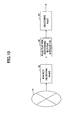
- FIG. 10 shows a configuration diagram of a receiving part of a packet voice communication apparatus employing the fluctuation absorbing buffer apparatus according to the present invention.
- a packet receiving part 60 is connected to a communication network 61, receives a voice packet directed thereto and transmitted from the network 61, and provides the same to the fluctuation absorbing buffer apparatus 62.
- the fluctuation absorbing buffer apparatus 62 is any one of those shown in FIGS. 4, 6 through 9, and absorbs a fluctuation in the voice packet provided from the packet receiving part 60.
- the voice packet output by the fluctuation absorbing buffer 62 is decoded by a decoding part 63, and is output as a corresponding voice signal.
- any one of the flag generating parts 12, 22, 32, 42 and 52 corresponds to a packet state notifying part; any one of the voice packet determining parts 14, 24, 34, 44 and 54 corresponds to a voice packet determining part; and any one of the voice reproduction control parts 16, 26, 36, 46 and 56, together with the packet selecting part 18, correspond to a voice reproduction control part.
Landscapes
- Engineering & Computer Science (AREA)
- Computer Networks & Wireless Communication (AREA)
- Signal Processing (AREA)
- Data Exchanges In Wide-Area Networks (AREA)
Abstract
Description
- The present invention relates to a voice packet communication system, and relates to a fluctuation absorbing buffer apparatus controlling fluctuation in transmission delay occurring in voice packet communication, and a packet voice communication apparatus employing it.
- Recently, against a background of a spread of a flat-rate broadband circuit of ADSL, optical communication or such, VoIP (Voice over Internet Protocol) transmitting voice in a form of a packet with the use of the Internet, has sharply spread as a device for achieving a reduction of the communication cost.
- Different from a conventional fixed phone system, a voice packet communication system such as VoIP has not a special band ensured therefor. Accordingly, a fluctuation may occur in a voice packet transmission delay time due to a communication network congestion or such. When voice packets arrive irregularly due to the transmission delay fluctuation, a voice interruption may occur since no voice to reproduce exists on the receiving side.
- Therefore, commonly, a method is applied in which, as shown in FIG. 1, a 'reproduction buffer' for temporarily storing received voice packets is provided in VoIP, and reproduction is actually started after a predetermined amount of voice packets have been stored there. In the specification of the present application, this predetermined amount to store is referred to as a 'reproduction reference value'.
- As long as the transmission fluctuation is smaller than the reproduction reference value, no voice interruption, caused by a lack of voice to reproduce (depletion from the buffer), occurs. That is, a resistance against the fluctuation is enhanced as the reproduction reference value is increased.
- However, when the reproduction reference value is increased, the delay increases accordingly. As a result, in consideration for a real-time performance of speech, the reproduction reference value cannot be increased much. As a result, for a case where the network condition is troublesome and a transmission delay fluctuates more than the reproduction reference value, the reproduction buffer may not be sufficient to absorb the fluctuation, voice packets in the buffer may be depleted and a voice interruption may occur. For solving such a problem of transmission delay fluctuation, the following technology may be applied:
- That is, as a voice quality improvement technology for solving the problem due to the depletion from the buffer occurring due to a fluctuation exceeding the reproduction reference value, Packet Loss Concealment (PLC) technology disclosed by, for example, Patent Document 1 (Untied States Patents
Nos. 6,973,425 ,6,961,697 and 6,952,668 to Kapilow) or such may be applied. This technology uses a fact that voice has a periodicity. According to the technology, a pitch (periodicity) is extracted from voice reproduced in the past, the past voice is repeated based on the extracted pitch, and thus, the voice can be interpolated without causing an unconformable feeling. By applying this technology for a case where voice packets in the reproduction buffer are depleted, the voice interruption can be avoided and the voice quality degradation can be reduced even when a fluctuation exceeding the reproduction reference value occurs. - Patent Document 2 (
Japanese Patent No. 3397191 - Next, the thus-obtained fluctuation is compared with a predetermined threshold, and, when the fluctuation is larger than a threshold, the no-voice packet in the reproduction buffer is repeatedly reproduced, the reproduction reference value is increased in such a manner that the voice quality is not affected, and thus, the fluctuation absorbing resistance is strengthened.
- Instead of repeating the no-voice packet as mentioned above, a voice packet having a high periodicity may be repeated. Further, when the fluctuation is very large, the packet may be repeated without regard to the voice characteristics. Further, when the fluctuation is small on the contrary, the no-voice packet may be deleted, the reproduction reference value may be reduced, and thus real-time performance for speech may be improved.
- The above-described method of
Patent Document 1 is advantageous when voice has a high periodicity. However, for a part of consonant having a low periodicity, as shown in FIG. 2, an unnatural pitch may be extracted and repeated, and thus, an abnormal noise may occur. - In the method of
Patent Document 2, determination for increasing the reproduction reference value is made based on the received packet transmission delay time fluctuation. That is, processing of increasing the reproduction reference value cannot be made until a packet actually arrives. For example, when a large delay occurs suddenly as shown in FIG. 3, voice packets in the reproduction buffer may be depleted, and a voice interruption may occur. - The present invention has been devised in consideration of the above-mentioned point, and an object of the present invention is to provide a fluctuation absorbing buffer apparatus in which a voice degradation due to an unnatural interpolation does not occur, a voice interruption may not occur even when a sudden delay occurs, and the delay fluctuation may be absorbed.
- According to one mode of carrying out the present invention, a fluctuation absorbing buffer apparatus configured to absorb, by means of a reproduction buffer, a transmission delay time fluctuation occurring in a voice packet communication system, has:
- a packet state notifying part carrying out decrease notification when the number of voice packets stored in the reproduction buffer decreases;
- a voice determining part carrying out a determination as to whether or not voice exists in the voice packet stored in the reproduction buffer; and
- a voice reproduction control part repeatedly reproducing the voice packet determined as not having voice when the decrease is notified by said packet state notifying part.
- Accordingly, a voice degradation due to an unnatural interpolation may not occur, a voice interruption may not occur even when a sudden delay occurs, and thus, a delay fluctuation may be absorbed.
- In the above-mentioned fluctuation absorbing buffer apparatus, the voice reproduction control part may repeat reproduction of the no-voice packet during a period in which the packet state notifying part notifies the decrease.
- Further, in the fluctuation absorbing buffer apparatus, the voice reproduction control part may insert the no-voice packet after a voice packet determined as including no voice.
- Further, in the fluctuation absorbing buffer apparatus, the packet state notifying part may carry out the decrease notification when the number of voice packets stored in the reproduction buffer decreases to be not more than a threshold.
- Further, in the fluctuation absorbing buffer apparatus, the voice packet determining part may determine that the packet has no voice when the packet has power not more than a reference value.
- Further, in the fluctuation absorbing buffer apparatus, the voice packet determining part may determine whether the voice packet has a constancy not less than a predetermined threshold, as well as determining whether or not the packet has voice; and
the voice reproduction control part may repeat reproduction of the packet determined as having no voice or the packet having the constancy more than the predetermined threshold. - Further, in the fluctuation absorbing buffer apparatus, the voice packet determining part may determine whether the voice packet has a maximum constancy, as well as determining whether or not the packet has voice; and
the voice reproduction control part may repeat reproduction of the packet determined as having no voice or the packet having the maximum constancy. - Further, in the fluctuation absorbing buffer apparatus, when there are no packets determined as having no voice, the voice reproduction control part may repeat reproduction of the voice packet having the constancy more than the predetermined threshold or the voice packet having the maximum constancy.
- Further, in the fluctuation absorbing buffer apparatus, the voice reproduction control part may insert interpolation voice generated according to a Packet Loss Concealment algorithm after the packet having the constancy more than the predetermined threshold or the packet having the maximum constancy.
- Further, in the fluctuation absorbing buffer apparatus, the voice packet determining part may use a maximum value of an autocorrelation function as the constancy of the voice packet.
- Further, in the fluctuation absorbing buffer apparatus, the voice packet determining part may use a magnitude of a pitch gain of the voice packet as the constancy of the voice packet.
- Further, in the fluctuation absorbing buffer apparatus, the packet state notifying part may carry out the decrease notification when the number of the voice packets stored in the reproduction buffer decreases, and carry out the increase notification when the number of the voice packets stored in the reproduction buffer increases;
the voice reproduction control part may repeat reproduction of the no-voice packet or insert the no-voice packet when the decrease notification is received from the packet state notifying part, while deleting the voice packet determined from the voice existence/absence determination result as having no voice from the reproduction buffer when the increase notification is received from the packet state notifying part. - The packet state notifying part may notify no-change in the number of packets when the number of voice packets stored in the reproduction buffer does not change during a predetermined period, and the voice reproduction control part may delete a voice packet determined as not having voice when no-change in the number of packets is notified of.
- According to the present invention, a voice degradation due to an unnatural interpolation may not occur, a voice interruption may not occur even when a sudden delay occurs, and a delay fluctuation may be well absorbed.
- Other objects and further features of the present invention will become more apparent from the following detailed description when read in conjunction with the accompanying drawings:
- FIG. 1 illustrates a reproduction buffer;
- FIG. 2 shows a waveform diagram for illustrating a voice interpolation in the prior art;
- FIG. 3 illustrates occurrence of a voice interruption due to a depletion from the reproduction buffer;
- FIG. 4 shows a configuration diagram of a first embodiment of a fluctuation absorbing buffer apparatus according to the present invention;
- FIG. 5 shows a state of a control in the first embodiment;
- FIG. 6 shows a configuration diagram of a second embodiment of a fluctuation absorbing buffer apparatus according to the present invention;
- FIG. 7 shows a configuration diagram of a third embodiment of a fluctuation absorbing buffer apparatus according to the present invention;
- FIG. 8 shows a configuration diagram of a fourth embodiment of a fluctuation absorbing buffer apparatus according to the present invention;
- FIG. 9 shows a configuration diagram of a fifth embodiment of a fluctuation absorbing buffer apparatus according to the present invention; and
- FIG. 10 shows a configuration diagram of one embodiment of a receiving part of a packet voice communication apparatus employing the fluctuation absorbing buffer apparatus according to the present invention.
- Based on figures, embodiments of the present invention are described next.
- FIG. 4 shows a configuration diagram of a first embodiment of a fluctuation absorbing buffer apparatus according to the present invention. In the figure, a
reproduction buffer 10 is a memory in a FIFO configuration and stores a voice packet provided at oneend 10a, and outputs the voice packet from theother end 10b. - When receiving a reproduction completion notification message msg indicating that one packet reproduction has been completed from a
packet selecting part 18, aflag generating part 12 determines the number N of packets in thereproduction buffer 10. Theflag generating part 12 holds the preceding-time voice packet number N (-), and determines whether or not the number of voice packets stored in thereproduction buffer 10 tends to decrease, from a different between the current-time voice packet number N and the preceding-time voice packet number N (-). When determining that a decrease tendency appears, from this determination result, theflag generating part 12 turns on a reproduction control flag F1, and notifies it to a voicereproduction control part 16. Further, when determining that the above-mentioned voice packet number increases or does not change, theflag generating part 12 turns off the reproduction control flag F1. - A voice
packet determining part 14 determines, for all the voice packets p(n) stored in thereproduction buffer 10, as to whether it has voice or not, and notifies the voicereproduction control part 16 of the thus-obtained voice existence/absence determination result uv(n). A specific method for the determination is such that, for example, when power of the voice packet is not more than a reference value, a determination that the voice packet has no voice is made. - The voice
reproduction control part 16 controls reproduction in such a manner that, voice packets in thereproduction buffer 10 may not be depleted, based on the voice existence/absence determination result uv(n), when the reproduction control flag F1 is turned on. That is, when the determination of no voice has been made, after the voice packet m determined to have no voice is output from thereproduction buffer 10, buffer control information for inserting a no-voice packet, generated as mentioned later, is transmitted to thepacket selecting part 18. Thus, reproduction is controlled in such a manner that voice packets in thereproduction buffer 10 may not be depleted. - When the reproduction control flag is turned off, buffer control information is transmitted to the
packet selecting part 18 such that normal reproduction should be carried out. - The above-mentioned insertion of no-voice packet is repeated during a period in which the turned on state of the reproduction control flag F1 is kept.
- Based on the buffer control information from the voice
reproduction control part 16, thepacket selecting part 18 takes a voice packet from thereproduction buffer 10 and outputs the same when carrying out the normal reproduction. When inserting a no-voice packet as mentioned above, thepacket selecting part 18 generates the no-voice packet and outputs the same as mentioned above. After the completion of outputting of the voice packets, thepacket selecting part 18 notifies theflag generating part 12 of the reproduction completion notification message msg. - FIG. 5 shows a manner of control in the above-described first embodiment. As shown in FIG. 5, (A), when, at a time t,
voice packets # 1 and #2 are stored in thereproduction buffer 10, and the number of voice packets in thereproduction buffer 10 tends to decrease, a determination is made as to whether or not thevoice packets # 1 and #2 correspond to no-voice packets. - Then, as shown in FIG. 5, (B), after the no-
voice packet # 1 is output at atime t+ 1; as shown in FIG. 5, (C), an extra no-voice packet, generated, is output at atime t+ 2; and as shown in FIG. 5, (D), another extra no-voice packet is output at a time t+3 at which a delayedvoice packet # 3 has arrived. - At a next
time t+ 4, the reproduction control flag is turned off when the delayedvoice packet # 3 has arrived, and thus, as shown in FIG. 5, (E), thevoice packet # 2 having voice is then output. - Thus, when the voice packet arrival is thus delayed and voice packets in the
reproduction buffer 10 tend to decrease, reproduction control is made such that extra no-voice packets are output and reproduction of the voice includingpacket # 2 is waited for until the delayedvoice packet # 3 has arrived and the decrease tendency in the voice packets in thereproduction buffer 10 is solved accordingly. - As a result, even when a large delay occurs and a voice packet does not arrive for a period, a control is made before the depletion of voice packets from the
reproduction buffer 10, and thus, a voice interruption due to the depletion from the buffer can be avoided. - FIG. 6 shows a configuration diagram of a second embodiment of a fluctuation absorbing buffer apparatus according to the present invention. In the figure, a
reproduction buffer 10 is a memory in a FIFO configuration and stores a voice packet provided at oneend 10a, and outputs the voice packet from theother end 10b. - When receiving a reproduction completion notification message msg indicating that one packet reproduction has been completed from a
packet selecting part 18, aflag generating part 22 determines the number N of voice packets in thereproduction buffer 10. Theflag generating part 22 determines whether the number N of voice packets stored in thereproduction buffer 10 is not more than or exceeds a threshold. When determining that this packet number N is not more than the threshold, theflag generating part 22 turns on a reproduction control flag F1, and notifies a voicereproduction control part 26 thereof. Further, when determining that this packet number N exceeds the threshold, theflag generating part 22 turns off the reproduction control flag F1, and notifies the voicereproduction control part 36 thereof. The above-mentioned threshold is determined, for example, as a value smaller, than the above-mentioned reproduction reference value, by two. - A voice
packet determining part 24 determines, for all the voice packets p(n) stored in thereproduction buffer 10, as to whether it has voice or not, and notifies the voicereproduction control part 26 of the thus-obtained voice existence/absence determination result uv(n). A specific method for the determination is such that, for example, when power of the voice packet is not more than a reference value, a determination that the voice packet has no voice is made. - When the reproduction control flag F1 is turned on, a voice
reproduction control part 26 transmits buffer control information to thepacket selecting part 18 such that an extra no-voice packet should be inserted after the voice packet m determined, based on the voice existence/absence determination result uv(n), as having no voice, and reproduction is made. - When the reproduction control flag is turned off, buffer control information is transmitted to the
packet selecting part 18 such that normal reproduction should be carried out. The above-mentioned insertion of extra no-voice packet is repeated during a period in which the turned on state of the reproduction control flag F1 is kept. - Based on the buffer control information from the voice
reproduction control part 26, thepacket selecting part 18 takes the voice packet from thereproduction buffer 10 and outputs the same when carrying out the normal reproduction. When inserting an extra no-voice packet as mentioned above, thepacket selecting part 18 generates the extra no-voice packet and outputs the same. After the completion of outputting of the packets, thepacket selecting part 18 notifies theflag generating part 22 of the reproduction completion notification message msg. - It is noted that, instead of inserting the extra no-voice packet after the voice packet m determined as having no voice, the voice
reproduction control part 26 may insert the same before the voice packet m. Further, instead of newly generating the extra no-voice packet, the voicereproduction control part 26 may repeatedly reproduce the voice packet m determined as having no voice. - Thus, according to the second embodiment of the present invention, a control is made before the depletion of voice packets from the
reproduction buffer 10, and thus, a voice interruption due to the depletion from the buffer can be avoided. Also, since voice is interpolated by such a no-voice packet part, the voice quality is prevented from degrading. - FIG. 7 shows a configuration diagram of a third embodiment of a fluctuation absorbing buffer apparatus according to the present invention. In the figure, a
reproduction buffer 10 is a memory in a FIFO configuration and stores a voice packet provided at oneend 10a, and outputs the voice packet from theother end 10b. - When receiving a reproduction completion notification message msg indicating that one packet reproduction has been completed from a
packet selecting part 18, aflag generating part 32 determines the number N of voice packets in thereproduction buffer 10. Theflag generating part 32 determines whether the number N of voice packets stored in thereproduction buffer 10 is not more than or exceeds a threshold. When determining that the packet number N is not more than the threshold, theflag generating part 32 turns on a reproduction control flag F1, and notifies a voicereproduction control part 36 thereof. Further, when determining that the packet number N exceeds the threshold, theflag generating part 32 turns off the reproduction control flag F1, and notifies the voicereproduction control part 36 thereof. The above-mentioned threshold is determined, for example, as a value smaller than the reproduction reference value by two. - A voice
packet determining part 34 determines, for all the voice packets p(n) stored in thereproduction buffer 10, as to whether it has voice or not, and notifies the voicereproduction control part 36 of the thus-obtained voice existence/absence determination result uv(n). A specific method for the determination is such that, for example, when power of the voice packet is not more than a reference value, a determination that the voice packet has no voice is made. Further, the voicepacket determining part 34 calculates, for each voice packet, a constancy u(n), and notifies the voicereproduction control part 36 thereof. The constancy u(n) is calculated as follows: - That is, for example, the maximum value of an autocorrelation function of the voice packet is regarded as the constancy u(n). For example, when the maximum value of the autocorrelation function is regarded as the constancy as mentioned above, the maximum value of the autocorrelation function φn(l) in a frame n given in the following formula (1) is regarded as the constancy u(n).

- In the formula (1), x(k) denotes a voice signal, K denotes a calculation range of the autocorrelation function, and L denotes a search range for the maximum value of the autocorrelation function.
- Further, depending on a voice Codec used in the voice communication, when a parameter indicating the constancy is included in a voice packet (i.e., a coded stream), a required arithmetic operation for actually obtaining the constancy can be reduced by using the parameter indicating the constancy. For example, when a CELP Codec such as ITU-T G.729 is applied, a pitch gain (degree of a periodicity of voice) in the coded stream may be regarded as the constancy u(n).
- When the reproduction control flag F1 is turned on, the voice
reproduction control part 26 transmits buffer control information to thepacket selecting part 18 such that an extra no-voice packet should be inserted after a voice packet m determined as having no voice, and reproduction should be made, when the voice packet m determined as having no voice exists, based on the voice existence/absence determination result uv(n). When no voice packet determined as having no voice exists, the voicereproduction control part 26 transmits buffer control information to thepacket selecting part 18 such that a voice packet having the constancy u(n) not less than a predetermined threshold should be repeatedly reproduced. Alternatively, control is made such that, after the voice packet having the constancy u(n) more than the predetermined threshold, an interpolation voice packet, generated with the use of a PLC algorithm, should be inserted, and reproduction should be made. - When the reproduction control flag is turned off, buffer control information is transmitted to the
packet selecting part 18 such that normal reproduction should be carried out. - The above-mentioned insertion of the extra no-voice packet, repetitive reproduction of the voice packet having the constancy u(n) not less than the predetermined threshold, or insertion of the interpolation voice packet, is repeated during a period in which the turned on state of the reproduction control flag F1 is kept.
- Based on the buffer control information from the voice
reproduction control part 36, thepacket selecting part 18 takes the voice packet from thereproduction buffer 10 and outputs the same when carrying out the normal reproduction. When inserting the extra no-voice packet, thepacket selecting part 18 generates the extra no-voice packet and outputs the same. After the completion of outputting of the packets, thepacket selecting part 18 notifies theflag generating part 32 of the reproduction completion notification message msg. - It is noted that although interpolation with the use of the extra non-voice packet is given priority in this embodiment, the priority order of the interpolation may be determined in any manner. For example, the priority order may be reversed. Further, interpolation may be made with the use of a packet, from among the candidates for the interpolation, which has arrived earliest. Further, the threshold for the constancy u(n) may not be provided, and a voice packet having the maximum constancy may be repeated, or, the interpolation by means of the PLC may be carried out after the voice packet having the maximum constancy u(n).
- Thus, according to the third embodiment of the present invention, even when no no-voice packet exists in the
reproduction buffer 10, voice can be interpolated. Further, with the use of a voice packet having the high constancy when interpolation is made with the use of such a voice including part, and thus, voice quality degradation can be minimized. - FIG. 8 shows a configuration diagram of a fourth embodiment of a fluctuation absorbing buffer apparatus according to the present invention. In the figure, a
reproduction buffer 10 is a memory in a FIFO configuration, stores a voice packet provided to oneend 10a and outputs the voice packet from theother end 10b. - A
flag generating part 42 receives a reproduction completion notification message msg indicating a completion of one packet reproduction from apacket selecting part 18, and, in response thereto, determines the number N of voice packets in thereproduction buffer 10. Then, when the number N of voice packets is not more than a threshold TH1, theflag generating part 42 makes a buffer increase/decrease flag F2 have a value 11 (increase instruction), while, when the number N of voice packets is not less than a threshold TH2 (TH1 ≤ TH2), theflag generating part 42 makes the buffer increase/decrease flag F2 have a value 00 (decrease instruction). Then theflag generating part 42 sends the buffer increase/decrease flag F2 to a voicereproduction control part 46. - A method of setting the thresholds TH1 and TH2 is, for example, such that a number smaller than the reproduction reference value by 2 is set as the threshold TH1, while a number larger than the reproduction reference value by 2 is set as the threshold TH2. Further, increasing/decreasing of the above-mentioned voice packet number N may be monitored, and, when the voice packet number N increases (or decreases) more than a predetermined value, the buffer increase/decrease flag F2 may be made to have the value 00 (or the value 11). When the value of the voice packet number N does not change for a predetermined period, the buffer increase/decrease flag F2 may be made to have the value 00 (decrease instruction).
- A voice
packet determining part 44 determines whether or not the voice packet p(n) in thereproduction buffer 10 has voice, and notifies the voicereproduction control part 46 of the thus-obtained voice existence/absence determination result uv(n). A method for the determination is such that, for example, a determination is made that the voice packet has no voice (voice absence) when power of the voice packet is not more than a reference value. - When the buffer increase/decrease flag F2 has the value 11 (increase instruction), the voice
reproduction control part 46 determines that a reproduction control flag is turned on, and, based on the voice existence/absence determination result uv(n), the voicereproduction control part 46 transmits buffer control information to thepacket selecting part 18 for inserting an extra no-voice packet after a voice packet m determined as having no voice and reproducing them. It is noted that, instead of inserting after the no-voice packet m, the insertion may be made before the no-voice packet m. Further, instead of newly generating an extra no-voice packet to insert, the voice packet determined as having no voice may be reproduced repeatedly. - On the other hand, when the buffer increase/decrease flag F2 has the value 00 (decrease instruction), the voice
reproduction control part 46 transmits buffer control information to thepacket selecting part 18 such as to carry out normal reproduction, after requesting a deletion of the voice packet determined as having no voice from the reproduction buffer, based on the voice existence/absence determination result uv(n). - When the buffer increase/decrease flag F2 has a value other than any one of the values 00 and 11, the voice
reproduction control part 46 transmits buffer control information to thepacket selecting part 18 such as to carry out the normal reproduction. - The above-mentioned insertion of extra no-voice packet is repeated during a period in which the buffer increase/decrease flag F2 has the value 11 (increase instruction).
- Based on the buffer control information from the voice
reproduction control part 46, thepacket selecting part 18 takes the voice packet from the reproducing buffer, outputs the same, and, when inserting an extra no-voice packet, thepacket selecting part 18 generates the extra no-voice packet and outputs the same. After the completion of the packet output, the reproduction completion notification message msg is notified of to theflag generating part 42. - According to the fourth embodiment, by reducing the no-voice packet in response to the decrease instruction, it is possible to reduce a delay when the reproduction buffer is stabilized, and thus, to improve speech real-time performance.
- FIG. 9 shows a configuration diagram of a fifth embodiment of a fluctuation absorbing buffer apparatus according to the present invention. In the figure, a
reproduction buffer 10 is a memory in a FIFO configuration, stores a voice packet provided to oneend 10a and outputs the voice packet from theother end 10b. - When receiving a reproduction completion notification message msg indicating a completion of one packet reproduction from a
packet selecting part 18, aflag generating part 52 determines the number N of voice packets in thereproduction buffer 10. Then, when this number N of voice packets is not more than a threshold TH1, theflag generating part 42 makes a buffer increase/decrease flag F2 have a value 11 (increase instruction), while, when the number N of voice packets is not less than a threshold TH2 (TH1 ≤ TH2), theflag generating part 42 makes the buffer increase/decrease flag F2 have a value 00 (decrease instruction). Then theflag generating part 42 sends the buffer increase/decrease flag F2 to a voicereproduction control part 56. - A method of setting the thresholds TH1 and TH2 is, for example, such that a number smaller than the reproduction reference value by 2 is set as the threshold TH1, while a number larger than the reproduction reference value by 2 is set as the threshold TH2. Further, increase/decrease in the voice packet number N may be monitored, and, when the voice packet number N increases (or decreases) more than a predetermined value, the buffer increase/decrease flag F2 may be made to have the value 00 (or the value 11). When the value of the voice packet number N does not change for a predetermined period, the buffer increase/decrease flag F2 may be made to have the value 00 (decrease instruction).
- A voice
packet determining part 54 determines whether or not the voice packet p(n) in thereproduction buffer 10 has voice, and notifies the voicereproduction control part 56 of the thus-obtained voice existence/absence determination result uv(n). A method for the determination is such that, for example, a determination is made that the voice packet has no voice (voice absence) when power of the voice packet is not more than a reference value. Further, the voicepacket determining part 54 calculates a constancy u(n) for each voice packet and notifies the voicereproduction control part 56 thereof. A method of calculating the constancy u(n) is such that, for example, the maximum value or a magnitude of a pitch gain of an autocorrelation function of the voice packet is regarded as the constancy. - When the buffer increase/decrease flag F2 has the value 11 (increase instruction), the voice
reproduction control part 56 determines that a reproduction control flag is turned on, and based on the voice existence/absence determination result uv(n) and the constancy u(n), the voicereproduction control part 56 transmits buffer control information to thepacket selecting part 18 for inserting an extra no-voice packet after a voice packet m determined as having no voice, when the voice packet m determined as having no voice exists, and reproducing them. When there is no voice packet determined as having no voice, the voicereproduction control part 56 transmits buffer control information to thepacket selecting part 18 such as to reproduce a voice packet having the constancy u(n) not less than a predetermined threshold repeatedly. Alternatively, control is made such that, after the voice packet having the constancy u(n) not less than the predetermined threshold, an interpolation voice packet may be reproduced with the use of the PLC algorithm, be inserted, and be reproduced. - On the other hand, when the buffer increase/decrease flag F2 has the value 00 (decrease instruction), the voice
reproduction control part 56 transmits buffer control information to thepacket selecting part 18 such as to carry out normal reproduction, after requesting a deletion of the voice packet determined as having no voice from the reproduction buffer, based on the voice existence/absence determination result uv(n). When there is no voice packet determined as having no voice, the voicereproduction control part 56 requests a deletion of a voice packet having the constancy u(n) not less than the predetermined threshold from the reproduction buffer, and then, transmits buffer control information to thepacket selecting part 18 such as to carry out the normal reproduction. - When the buffer increase/decrease flag F2 has a value other than any one of the value 00 or 11, the voice
reproduction control part 46 transmits buffer control information to thepacket selecting part 18 such as to carry out the normal reproduction. The above-mentioned insertion of extra no-voice packet or repeated reproduction of the voice packet having the constancy not less than the predetermined value or reproduction of the interpolation voice packet is repeated during a period in which the buffer increase/decrease flag F2 has the value 11 (increase instruction). - Based on the buffer control information from the voice
reproduction control part 56, thepacket selecting part 18 takes the voice packet from the reproducing buffer, outputs the same, and, when inserting an extra no-voice packet, thepacket selecting part 18 generates the extra no-voice packet and outputs the same. After the completion of the packet output, the reproduction completion notification message msg is notified of to theflag generating part 52. - In this embodiment, as described above, interpolation with the use of the extra no-voice packet is given priority. However, the priority of the interpolation may be determined in any manner, and, the priority order may be reversed, for example. Further, interpolation may be made with the use of a voice packet, from among candidates for the interpolation, which has arrived earliest. Further, the above-mentioned predetermined threshold for the constancy u(n) may not be provided, and a voice packet having the maximum constancy may be repeated, or, the interpolation by means of PLC may be carried out after the voice packet having the maximum constancy u(n) occurs.
- FIG. 10 shows a configuration diagram of a receiving part of a packet voice communication apparatus employing the fluctuation absorbing buffer apparatus according to the present invention. In the figure, a
packet receiving part 60 is connected to acommunication network 61, receives a voice packet directed thereto and transmitted from thenetwork 61, and provides the same to the fluctuation absorbingbuffer apparatus 62. - The fluctuation absorbing
buffer apparatus 62 is any one of those shown in FIGS. 4, 6 through 9, and absorbs a fluctuation in the voice packet provided from thepacket receiving part 60. The voice packet output by thefluctuation absorbing buffer 62 is decoded by adecoding part 63, and is output as a corresponding voice signal. - It is noted that, any one of the
flag generating parts packet determining parts reproduction control parts packet selecting part 18, correspond to a voice reproduction control part. - Further, the present invention is not limited to the above-described embodiments, and variations and modifications may be made without departing from the basic concept of the present invention claimed below.
- The present application is based on
Japanese Priority Application No. 2006-050789, filed on February 27, 2006
Claims (20)
- A fluctuation absorbing buffer apparatus configured to absorb, by means of a reproduction buffer, a transmission delay time fluctuation occurring in a voice packet communication system, comprising:a packet state notifying part making a decrease notification when the number of voice packets stored in the reproduction buffer decreases;a voice determining part making a determination as to whether or not voice exists in the voice packet stored in the reproduction buffer; anda voice reproduction control part repeatedly reproducing the voice packet determined as not having voice when the decrease is notified of by said packet state notifying part.
- The fluctuation absorbing buffer apparatus as claimed in claim 1, wherein:said voice reproduction control part repeats reproduction of the no-voice packet during a period in which said packet state notifying part notifies of the decrease.
- The fluctuation absorbing buffer apparatus as claimed in claim 1, wherein:said voice reproduction control part inserts the no-voice packet after a voice packet determined as having no voice.
- The fluctuation absorbing buffer apparatus as claimed in any one of claims 1-3, wherein:said packet state notifying part makes the decrease notification when the number of voice packets stored in said reproduction buffer decreases to be not more than a threshold.
- The fluctuation absorbing buffer apparatus as claimed in any one of claims 1-4, wherein:said voice packet determining part determines that the packet has no voice when said packet has power not more than a reference value.
- The fluctuation absorbing buffer apparatus as claimed in any one of claims 1-5, wherein:said voice packet determining part determines whether or not the voice packet has a constancy not less than a predetermined threshold, as well as determining as to whether or not the packet has voice; andsaid voice reproduction control part repeats reproduction of the packet determined as having no voice or the packet having the constancy more than the predetermined threshold.
- The fluctuation absorbing buffer apparatus as claimed in any one of claims 1-6, wherein:said voice packet determining part determines whether or not the voice packet has a maximum constancy, as well as determining as to whether or not the packet has voice; andsaid voice reproduction control part repeats reproduction of the packet determined as having no voice or the packet having the maximum constancy.
- The fluctuation absorbing buffer apparatus as claimed in claim 6, wherein:when there are no packets determined as having no voice, said voice reproduction control part repeats reproduction of the voice packet having the constancy more than the predetermined threshold.
- The fluctuation absorbing buffer apparatus as claimed in claim 7, wherein:when there are no packets determined as having no voice, said voice reproduction control part repeats reproduction of the voice packet having the maximum constancy.
- The fluctuation absorbing buffer apparatus as claimed in claim 6 or 8, wherein:said voice reproduction control part inserts interpolation voice generated according to a Packet Loss Concealment algorithm after the packet having the constancy more than the predetermined threshold.
- The fluctuation absorbing buffer apparatus as claimed in claim 7 or 9, wherein:said voice reproduction control part inserts interpolation voice generated according to a Packet Loss Concealment algorithm after the packet having the maximum constancy.
- The fluctuation absorbing buffer apparatus as claimed in any one of claims 6, 8 and 10, wherein:said voice packet determining part regards a maximum value of an autocorrelation function as the constancy of the voice packet.
- The fluctuation absorbing buffer apparatus as claimed in any one of claims 7, 9 and 11, wherein:said voice packet determining part regards a maximum value of an autocorrelation function as the constancy of the voice packet.
- The fluctuation absorbing buffer apparatus as claimed in any one of claims 6, 8, 10 and 12, wherein:said voice packet determining part regards a magnitude of a pitch gain of the voice packet as the constancy of said voice packet.
- The fluctuation absorbing buffer apparatus as claimed in any one of claims 7, 9, 11 and 13, wherein:said voice packet determining part regards a magnitude of a pitch gain of the voice packet as the constancy of said voice packet.
- The fluctuation absorbing buffer apparatus as claimed in any one of claims 1-15, wherein:said packet state notifying part makes the decrease notification when the number of the voice packets stored in said reproduction buffer decreases, and makes the increase notification when said number of voice packets increases; andsaid voice reproduction control part repeats reproduction of the no-voice packet or inserts the no-voice packet when the decrease notification is received from said packet state notifying part, while deleting the voice packet determined from the voice existence/absence determination result as having no voice when the increase notification is received from said packet state notifying part.
- The fluctuation absorbing buffer apparatus as claimed in claim 16, wherein:said voice reproduction control part deletes a voice packet having a constancy not less than a predetermined threshold when there is no packet determined as having no voice when the increase is notified of by said packet state notifying part.
- The fluctuation absorbing buffer apparatus as claimed in claim 16, wherein:said packet state notifying part makes the decrease notification when the number of the voice packets stored in said reproduction buffer decreases to be not more than a first predetermined threshed, and makes the increase notification when said number of voice packets increases to be not less than a second predetermined threshed.
- The fluctuation absorbing buffer apparatus as claimed in claim 16, wherein:said packet state notifying part notifies of no change in the number of packets when the number of the voice packets stored in said reproduction buffer does not change during a predetermined period, and said voice reproduction control part deletes a voice packet determined as having no voice when the no change in the number of packets is notified of.
- A packet voice communication apparatus having the fluctuation absorbing buffer apparatus as claimed in any one of claims 1-19, wherein:a voice packet received from a communication network is provided to said fluctuation absorbing buffer apparatus, andthe voice packet output from said fluctuation absorbing buffer apparatus is decoded.
Applications Claiming Priority (1)
| Application Number | Priority Date | Filing Date | Title |
|---|---|---|---|
| JP2006050789A JP2007235221A (en) | 2006-02-27 | 2006-02-27 | Fluctuation absorption buffer device |
Publications (2)
| Publication Number | Publication Date |
|---|---|
| EP1826959A1 true EP1826959A1 (en) | 2007-08-29 |
| EP1826959B1 EP1826959B1 (en) | 2009-04-15 |
Family
ID=36588920
Family Applications (1)
| Application Number | Title | Priority Date | Filing Date |
|---|---|---|---|
| EP20060008873 Expired - Lifetime EP1826959B1 (en) | 2006-02-27 | 2006-04-28 | Apparatus for absorbing fluctuations in the packet transmission rate of a communications network |
Country Status (4)
| Country | Link |
|---|---|
| US (1) | US20070201498A1 (en) |
| EP (1) | EP1826959B1 (en) |
| JP (1) | JP2007235221A (en) |
| DE (1) | DE602006006284D1 (en) |
Cited By (2)
| Publication number | Priority date | Publication date | Assignee | Title |
|---|---|---|---|---|
| WO2009027128A1 (en) * | 2007-08-31 | 2009-03-05 | International Business Machines Corporation | Method for synchronizing data flows |
| EP3240263A4 (en) * | 2014-12-22 | 2017-11-22 | Aisin AW Co., Ltd. | Voice information correction system, voice information correction method, and voice information correction program |
Families Citing this family (5)
| Publication number | Priority date | Publication date | Assignee | Title |
|---|---|---|---|---|
| US20120041761A1 (en) | 2009-03-13 | 2012-02-16 | Panasonic Corporation | Voice decoding apparatus and voice decoding method |
| JP5691721B2 (en) * | 2011-03-25 | 2015-04-01 | 三菱電機株式会社 | Audio data processing device |
| JP5517381B1 (en) * | 2013-09-30 | 2014-06-11 | レゾネッツ合同会社 | Fluctuation absorber, communication device, and control program |
| JP6656975B2 (en) * | 2016-03-25 | 2020-03-04 | アイホン株式会社 | Intercom system |
| EP4221002B1 (en) * | 2020-12-03 | 2025-07-09 | Mitsubishi Electric Corporation | Interface conversion device, control circuit, storage medium and network configuration method |
Citations (3)
| Publication number | Priority date | Publication date | Assignee | Title |
|---|---|---|---|---|
| US20050041644A1 (en) * | 2003-08-05 | 2005-02-24 | Matsushita Electric Industrial Co., Ltd. | Data communication apparatus and data communication method |
| US20050157708A1 (en) * | 2004-01-19 | 2005-07-21 | Joon-Sung Chun | System and method for providing unified messaging system service using voice over Internet protocol |
| US20050238013A1 (en) * | 2004-04-27 | 2005-10-27 | Yoshiteru Tsuchinaga | Packet receiving method and device |
Family Cites Families (17)
| Publication number | Priority date | Publication date | Assignee | Title |
|---|---|---|---|---|
| JPS57159192A (en) * | 1981-03-27 | 1982-10-01 | Hitachi Ltd | Audio packet exchange system |
| JPS61156949A (en) * | 1984-12-27 | 1986-07-16 | Matsushita Electric Ind Co Ltd | Packetized voice communication system |
| US5611018A (en) * | 1993-09-18 | 1997-03-11 | Sanyo Electric Co., Ltd. | System for controlling voice speed of an input signal |
| US6952668B1 (en) * | 1999-04-19 | 2005-10-04 | At&T Corp. | Method and apparatus for performing packet loss or frame erasure concealment |
| US6973425B1 (en) * | 1999-04-19 | 2005-12-06 | At&T Corp. | Method and apparatus for performing packet loss or Frame Erasure Concealment |
| US6961697B1 (en) * | 1999-04-19 | 2005-11-01 | At&T Corp. | Method and apparatus for performing packet loss or frame erasure concealment |
| US6658027B1 (en) * | 1999-08-16 | 2003-12-02 | Nortel Networks Limited | Jitter buffer management |
| JP3397191B2 (en) * | 1999-12-03 | 2003-04-14 | 日本電気株式会社 | Delay fluctuation absorbing device, delay fluctuation absorbing method |
| US7363232B2 (en) * | 2000-08-09 | 2008-04-22 | Thomson Licensing | Method and system for enabling audio speed conversion |
| JP4510251B2 (en) * | 2000-08-10 | 2010-07-21 | 富士通株式会社 | Packet fluctuation absorbing method and apparatus therefor |
| JP2002077233A (en) * | 2000-08-25 | 2002-03-15 | Matsushita Electric Ind Co Ltd | Real-time information receiver |
| JP2002271389A (en) * | 2001-03-07 | 2002-09-20 | Hitachi Telecom Technol Ltd | Packet processing device and packet processing method |
| US7453897B2 (en) * | 2001-10-03 | 2008-11-18 | Global Ip Solutions, Inc. | Network media playout |
| JP3825007B2 (en) * | 2003-03-11 | 2006-09-20 | 沖電気工業株式会社 | Jitter buffer control method |
| JP4364555B2 (en) * | 2003-05-28 | 2009-11-18 | 日本電信電話株式会社 | Voice packet transmitting apparatus and method |
| WO2005117366A1 (en) * | 2004-05-26 | 2005-12-08 | Nippon Telegraph And Telephone Corporation | Sound packet reproducing method, sound packet reproducing apparatus, sound packet reproducing program, and recording medium |
| US20070019931A1 (en) * | 2005-07-19 | 2007-01-25 | Texas Instruments Incorporated | Systems and methods for re-synchronizing video and audio data |
-
2006
- 2006-02-27 JP JP2006050789A patent/JP2007235221A/en active Pending
- 2006-04-26 US US11/411,991 patent/US20070201498A1/en not_active Abandoned
- 2006-04-28 DE DE200660006284 patent/DE602006006284D1/en not_active Expired - Lifetime
- 2006-04-28 EP EP20060008873 patent/EP1826959B1/en not_active Expired - Lifetime
Patent Citations (3)
| Publication number | Priority date | Publication date | Assignee | Title |
|---|---|---|---|---|
| US20050041644A1 (en) * | 2003-08-05 | 2005-02-24 | Matsushita Electric Industrial Co., Ltd. | Data communication apparatus and data communication method |
| US20050157708A1 (en) * | 2004-01-19 | 2005-07-21 | Joon-Sung Chun | System and method for providing unified messaging system service using voice over Internet protocol |
| US20050238013A1 (en) * | 2004-04-27 | 2005-10-27 | Yoshiteru Tsuchinaga | Packet receiving method and device |
Cited By (2)
| Publication number | Priority date | Publication date | Assignee | Title |
|---|---|---|---|---|
| WO2009027128A1 (en) * | 2007-08-31 | 2009-03-05 | International Business Machines Corporation | Method for synchronizing data flows |
| EP3240263A4 (en) * | 2014-12-22 | 2017-11-22 | Aisin AW Co., Ltd. | Voice information correction system, voice information correction method, and voice information correction program |
Also Published As
| Publication number | Publication date |
|---|---|
| DE602006006284D1 (en) | 2009-05-28 |
| JP2007235221A (en) | 2007-09-13 |
| US20070201498A1 (en) | 2007-08-30 |
| EP1826959B1 (en) | 2009-04-15 |
Similar Documents
| Publication | Publication Date | Title |
|---|---|---|
| US8937963B1 (en) | Integrated adaptive jitter buffer | |
| JP4933605B2 (en) | Method and apparatus for adaptive dejitter buffer | |
| US7881284B2 (en) | Method and apparatus for dynamically adjusting the playout delay of audio signals | |
| US6985501B2 (en) | Device and method for reducing delay jitter in data transmission | |
| US20150350099A1 (en) | Controlling A Jitter Buffer | |
| EP1458145A1 (en) | Error concealment apparatus and method | |
| US7349330B1 (en) | Packet receiver with the influence of jitter and packet losses reduced before a buffer becomes idle due to data delays and packet receiving method using the same | |
| US20040076191A1 (en) | Method and a communiction apparatus in a communication system | |
| US7787500B2 (en) | Packet receiving method and device | |
| JP2002077233A (en) | Real-time information receiver | |
| EP2140637B1 (en) | Method of transmitting data in a communication system | |
| EP1838066A2 (en) | Jitter buffer controller | |
| EP1826959B1 (en) | Apparatus for absorbing fluctuations in the packet transmission rate of a communications network | |
| JP2004274572A (en) | Jitter buffer control method and jitter buffer control device | |
| JP3397191B2 (en) | Delay fluctuation absorbing device, delay fluctuation absorbing method | |
| JP5691721B2 (en) | Audio data processing device | |
| US20060203822A1 (en) | Method and apparatus for routing voice packets in a voice-over IP communications network based on a relative packet location within a sequence | |
| KR101418354B1 (en) | Apparatus and method for playout scheduling in voice over internet protocol system | |
| JPS6268350A (en) | Voice packet communication system | |
| JP5806719B2 (en) | Voice packet reproducing apparatus, method and program thereof | |
| JP3813046B2 (en) | Packet receiver | |
| Narbutt et al. | Adaptive Playout Buffering for H. 323 Voice over IP applications | |
| JP4869882B2 (en) | Speech decoder | |
| KR101447666B1 (en) | Adaptive buffer management method and storage medium for increase of voice service capability considering voice traffic importance | |
| JP2004040825A (en) | Voice communication fluctuation absorber |
Legal Events
| Date | Code | Title | Description |
|---|---|---|---|
| PUAI | Public reference made under article 153(3) epc to a published international application that has entered the european phase |
Free format text: ORIGINAL CODE: 0009012 |
|
| AK | Designated contracting states |
Kind code of ref document: A1 Designated state(s): AT BE BG CH CY CZ DE DK EE ES FI FR GB GR HU IE IS IT LI LT LU LV MC NL PL PT RO SE SI SK TR |
|
| AX | Request for extension of the european patent |
Extension state: AL BA HR MK YU |
|
| 17P | Request for examination filed |
Effective date: 20070723 |
|
| AKX | Designation fees paid |
Designated state(s): DE FR GB |
|
| GRAP | Despatch of communication of intention to grant a patent |
Free format text: ORIGINAL CODE: EPIDOSNIGR1 |
|
| GRAS | Grant fee paid |
Free format text: ORIGINAL CODE: EPIDOSNIGR3 |
|
| RIN1 | Information on inventor provided before grant (corrected) |
Inventor name: MAKIUCHI, TAKASHI, C/O FUJITSU KYUSHU NETWORK TEC Inventor name: OTANI, TAKESHI Inventor name: SUZUKI, MASANAO Inventor name: TANAKA, MASAKIYO |
|
| GRAA | (expected) grant |
Free format text: ORIGINAL CODE: 0009210 |
|
| AK | Designated contracting states |
Kind code of ref document: B1 Designated state(s): DE FR GB |
|
| REG | Reference to a national code |
Ref country code: GB Ref legal event code: FG4D |
|
| REF | Corresponds to: |
Ref document number: 602006006284 Country of ref document: DE Date of ref document: 20090528 Kind code of ref document: P |
|
| PLBE | No opposition filed within time limit |
Free format text: ORIGINAL CODE: 0009261 |
|
| STAA | Information on the status of an ep patent application or granted ep patent |
Free format text: STATUS: NO OPPOSITION FILED WITHIN TIME LIMIT |
|
| 26N | No opposition filed |
Effective date: 20100118 |
|
| PGFP | Annual fee paid to national office [announced via postgrant information from national office to epo] |
Ref country code: DE Payment date: 20110420 Year of fee payment: 6 Ref country code: FR Payment date: 20110426 Year of fee payment: 6 |
|
| PGFP | Annual fee paid to national office [announced via postgrant information from national office to epo] |
Ref country code: GB Payment date: 20110427 Year of fee payment: 6 |
|
| GBPC | Gb: european patent ceased through non-payment of renewal fee |
Effective date: 20120428 |
|
| REG | Reference to a national code |
Ref country code: FR Ref legal event code: ST Effective date: 20121228 |
|
| PG25 | Lapsed in a contracting state [announced via postgrant information from national office to epo] |
Ref country code: GB Free format text: LAPSE BECAUSE OF NON-PAYMENT OF DUE FEES Effective date: 20120428 |
|
| REG | Reference to a national code |
Ref country code: DE Ref legal event code: R119 Ref document number: 602006006284 Country of ref document: DE Effective date: 20121101 |
|
| PG25 | Lapsed in a contracting state [announced via postgrant information from national office to epo] |
Ref country code: FR Free format text: LAPSE BECAUSE OF NON-PAYMENT OF DUE FEES Effective date: 20120430 |
|
| PG25 | Lapsed in a contracting state [announced via postgrant information from national office to epo] |
Ref country code: DE Free format text: LAPSE BECAUSE OF NON-PAYMENT OF DUE FEES Effective date: 20121101 |