EP1820882A1 - Self-healing layer on non-ferrous metals using polyoxometalates - Google Patents
Self-healing layer on non-ferrous metals using polyoxometalates Download PDFInfo
- Publication number
- EP1820882A1 EP1820882A1 EP06075365A EP06075365A EP1820882A1 EP 1820882 A1 EP1820882 A1 EP 1820882A1 EP 06075365 A EP06075365 A EP 06075365A EP 06075365 A EP06075365 A EP 06075365A EP 1820882 A1 EP1820882 A1 EP 1820882A1
- Authority
- EP
- European Patent Office
- Prior art keywords
- crack
- pom
- layer
- poms
- healing agent
- Prior art date
- Legal status (The legal status is an assumption and is not a legal conclusion. Google has not performed a legal analysis and makes no representation as to the accuracy of the status listed.)
- Withdrawn
Links
- 229910052751 metal Inorganic materials 0.000 title description 9
- 239000002184 metal Substances 0.000 title description 9
- -1 ferrous metals Chemical class 0.000 title description 3
- 238000000034 method Methods 0.000 claims abstract description 60
- 238000001907 polarising light microscopy Methods 0.000 claims abstract description 60
- 229920006324 polyoxymethylene Polymers 0.000 claims abstract description 60
- 239000013003 healing agent Substances 0.000 claims abstract description 51
- 239000000758 substrate Substances 0.000 claims abstract description 42
- 239000002245 particle Substances 0.000 claims abstract description 26
- 230000008569 process Effects 0.000 claims abstract description 26
- 239000007864 aqueous solution Substances 0.000 claims abstract description 21
- 238000007743 anodising Methods 0.000 claims abstract description 20
- 230000008021 deposition Effects 0.000 claims abstract description 14
- 239000004005 microsphere Substances 0.000 claims abstract description 12
- CWYNVVGOOAEACU-UHFFFAOYSA-N Fe2+ Chemical compound [Fe+2] CWYNVVGOOAEACU-UHFFFAOYSA-N 0.000 claims abstract description 11
- 238000007745 plasma electrolytic oxidation reaction Methods 0.000 claims abstract description 11
- 229920000642 polymer Polymers 0.000 claims abstract description 11
- VYPSYNLAJGMNEJ-UHFFFAOYSA-N Silicium dioxide Chemical compound O=[Si]=O VYPSYNLAJGMNEJ-UHFFFAOYSA-N 0.000 claims abstract description 10
- 229910052782 aluminium Inorganic materials 0.000 claims abstract description 8
- 229910044991 metal oxide Inorganic materials 0.000 claims abstract description 8
- 229910045601 alloy Inorganic materials 0.000 claims abstract description 7
- 239000000956 alloy Substances 0.000 claims abstract description 7
- 239000004927 clay Substances 0.000 claims abstract description 7
- 239000003822 epoxy resin Substances 0.000 claims abstract description 7
- 229920000647 polyepoxide Polymers 0.000 claims abstract description 7
- 229910052749 magnesium Inorganic materials 0.000 claims abstract description 6
- 229910052750 molybdenum Inorganic materials 0.000 claims abstract description 6
- 229910052719 titanium Inorganic materials 0.000 claims abstract description 6
- 229910052720 vanadium Inorganic materials 0.000 claims abstract description 6
- 239000002775 capsule Substances 0.000 claims abstract description 5
- 229910052681 coesite Inorganic materials 0.000 claims abstract description 5
- 229910052906 cristobalite Inorganic materials 0.000 claims abstract description 5
- 229910052748 manganese Inorganic materials 0.000 claims abstract description 5
- 239000000203 mixture Substances 0.000 claims abstract description 5
- 229910052698 phosphorus Inorganic materials 0.000 claims abstract description 5
- 229910052710 silicon Inorganic materials 0.000 claims abstract description 5
- 239000000377 silicon dioxide Substances 0.000 claims abstract description 5
- 229910052682 stishovite Inorganic materials 0.000 claims abstract description 5
- 229910052905 tridymite Inorganic materials 0.000 claims abstract description 5
- 229910052721 tungsten Inorganic materials 0.000 claims abstract description 5
- 239000011859 microparticle Substances 0.000 claims abstract description 3
- 239000002105 nanoparticle Substances 0.000 claims abstract description 3
- 229920000447 polyanionic polymer Polymers 0.000 claims abstract 3
- 239000010410 layer Substances 0.000 description 59
- 239000013460 polyoxometalate Substances 0.000 description 16
- 238000000151 deposition Methods 0.000 description 12
- 230000007797 corrosion Effects 0.000 description 9
- 238000005260 corrosion Methods 0.000 description 9
- 239000000243 solution Substances 0.000 description 8
- 239000003792 electrolyte Substances 0.000 description 7
- 238000005336 cracking Methods 0.000 description 6
- 238000004070 electrodeposition Methods 0.000 description 6
- 150000002500 ions Chemical class 0.000 description 6
- 238000001179 sorption measurement Methods 0.000 description 6
- 230000008901 benefit Effects 0.000 description 5
- PXHVJJICTQNCMI-UHFFFAOYSA-N Nickel Chemical compound [Ni] PXHVJJICTQNCMI-UHFFFAOYSA-N 0.000 description 4
- 230000015572 biosynthetic process Effects 0.000 description 4
- 238000006243 chemical reaction Methods 0.000 description 4
- 238000000576 coating method Methods 0.000 description 4
- 230000003647 oxidation Effects 0.000 description 4
- 238000007254 oxidation reaction Methods 0.000 description 4
- 239000000126 substance Substances 0.000 description 4
- 150000001768 cations Chemical class 0.000 description 3
- 230000000694 effects Effects 0.000 description 3
- 238000001962 electrophoresis Methods 0.000 description 3
- 239000011777 magnesium Substances 0.000 description 3
- 238000006722 reduction reaction Methods 0.000 description 3
- 239000010936 titanium Substances 0.000 description 3
- 229910000838 Al alloy Inorganic materials 0.000 description 2
- 150000001450 anions Chemical class 0.000 description 2
- 239000003795 chemical substances by application Substances 0.000 description 2
- 239000011248 coating agent Substances 0.000 description 2
- 229910052802 copper Inorganic materials 0.000 description 2
- 230000005684 electric field Effects 0.000 description 2
- 238000005538 encapsulation Methods 0.000 description 2
- 230000035876 healing Effects 0.000 description 2
- KWLMIXQRALPRBC-UHFFFAOYSA-L hectorite Chemical compound [Li+].[OH-].[OH-].[Na+].[Mg+2].O1[Si]2([O-])O[Si]1([O-])O[Si]([O-])(O1)O[Si]1([O-])O2 KWLMIXQRALPRBC-UHFFFAOYSA-L 0.000 description 2
- 229910000271 hectorite Inorganic materials 0.000 description 2
- 230000000887 hydrating effect Effects 0.000 description 2
- 238000010348 incorporation Methods 0.000 description 2
- 229910052742 iron Inorganic materials 0.000 description 2
- 150000002739 metals Chemical class 0.000 description 2
- 229910052759 nickel Inorganic materials 0.000 description 2
- 230000009467 reduction Effects 0.000 description 2
- 229920005989 resin Polymers 0.000 description 2
- 239000011347 resin Substances 0.000 description 2
- 238000003860 storage Methods 0.000 description 2
- 230000002522 swelling effect Effects 0.000 description 2
- 229910052723 transition metal Inorganic materials 0.000 description 2
- 150000003624 transition metals Chemical class 0.000 description 2
- 229910000861 Mg alloy Inorganic materials 0.000 description 1
- 229910020628 SiW12O40 Inorganic materials 0.000 description 1
- 229920001807 Urea-formaldehyde Polymers 0.000 description 1
- 239000003929 acidic solution Substances 0.000 description 1
- 230000002378 acidificating effect Effects 0.000 description 1
- 230000009471 action Effects 0.000 description 1
- 239000000853 adhesive Substances 0.000 description 1
- 230000001070 adhesive effect Effects 0.000 description 1
- 239000004411 aluminium Substances 0.000 description 1
- XAGFODPZIPBFFR-UHFFFAOYSA-N aluminium Chemical compound [Al] XAGFODPZIPBFFR-UHFFFAOYSA-N 0.000 description 1
- PNEYBMLMFCGWSK-UHFFFAOYSA-N aluminium oxide Inorganic materials [O-2].[O-2].[O-2].[Al+3].[Al+3] PNEYBMLMFCGWSK-UHFFFAOYSA-N 0.000 description 1
- 238000004458 analytical method Methods 0.000 description 1
- 125000004429 atom Chemical group 0.000 description 1
- 230000004888 barrier function Effects 0.000 description 1
- 230000015556 catabolic process Effects 0.000 description 1
- 238000006555 catalytic reaction Methods 0.000 description 1
- 230000008859 change Effects 0.000 description 1
- 239000003638 chemical reducing agent Substances 0.000 description 1
- 238000005352 clarification Methods 0.000 description 1
- 239000002131 composite material Substances 0.000 description 1
- 150000001875 compounds Chemical class 0.000 description 1
- 238000007739 conversion coating Methods 0.000 description 1
- 229910052593 corundum Inorganic materials 0.000 description 1
- 230000007423 decrease Effects 0.000 description 1
- 230000007547 defect Effects 0.000 description 1
- 238000006731 degradation reaction Methods 0.000 description 1
- 238000005137 deposition process Methods 0.000 description 1
- 238000009826 distribution Methods 0.000 description 1
- 239000002019 doping agent Substances 0.000 description 1
- 239000003814 drug Substances 0.000 description 1
- 238000001035 drying Methods 0.000 description 1
- 239000000975 dye Substances 0.000 description 1
- 239000007789 gas Substances 0.000 description 1
- 125000005842 heteroatom Chemical group 0.000 description 1
- 238000007654 immersion Methods 0.000 description 1
- 238000011065 in-situ storage Methods 0.000 description 1
- 230000000415 inactivating effect Effects 0.000 description 1
- 230000005764 inhibitory process Effects 0.000 description 1
- 239000011229 interlayer Substances 0.000 description 1
- 238000005461 lubrication Methods 0.000 description 1
- 239000000463 material Substances 0.000 description 1
- 230000007246 mechanism Effects 0.000 description 1
- 229910052758 niobium Inorganic materials 0.000 description 1
- 230000003000 nontoxic effect Effects 0.000 description 1
- 229910052760 oxygen Inorganic materials 0.000 description 1
- 239000001301 oxygen Substances 0.000 description 1
- 230000000737 periodic effect Effects 0.000 description 1
- 239000000049 pigment Substances 0.000 description 1
- ODGAOXROABLFNM-UHFFFAOYSA-N polynoxylin Chemical compound O=C.NC(N)=O ODGAOXROABLFNM-UHFFFAOYSA-N 0.000 description 1
- 239000011241 protective layer Substances 0.000 description 1
- 238000006479 redox reaction Methods 0.000 description 1
- 230000027756 respiratory electron transport chain Effects 0.000 description 1
- 239000013005 self healing agent Substances 0.000 description 1
- 238000000926 separation method Methods 0.000 description 1
- 239000007787 solid Substances 0.000 description 1
- 230000008961 swelling Effects 0.000 description 1
- 229910052715 tantalum Inorganic materials 0.000 description 1
- 239000002699 waste material Substances 0.000 description 1
- 229910001845 yogo sapphire Inorganic materials 0.000 description 1
- 229910006636 γ-AlOOH Inorganic materials 0.000 description 1
Images
Classifications
-
- C—CHEMISTRY; METALLURGY
- C23—COATING METALLIC MATERIAL; COATING MATERIAL WITH METALLIC MATERIAL; CHEMICAL SURFACE TREATMENT; DIFFUSION TREATMENT OF METALLIC MATERIAL; COATING BY VACUUM EVAPORATION, BY SPUTTERING, BY ION IMPLANTATION OR BY CHEMICAL VAPOUR DEPOSITION, IN GENERAL; INHIBITING CORROSION OF METALLIC MATERIAL OR INCRUSTATION IN GENERAL
- C23F—NON-MECHANICAL REMOVAL OF METALLIC MATERIAL FROM SURFACE; INHIBITING CORROSION OF METALLIC MATERIAL OR INCRUSTATION IN GENERAL; MULTI-STEP PROCESSES FOR SURFACE TREATMENT OF METALLIC MATERIAL INVOLVING AT LEAST ONE PROCESS PROVIDED FOR IN CLASS C23 AND AT LEAST ONE PROCESS COVERED BY SUBCLASS C21D OR C22F OR CLASS C25
- C23F11/00—Inhibiting corrosion of metallic material by applying inhibitors to the surface in danger of corrosion or adding them to the corrosive agent
- C23F11/08—Inhibiting corrosion of metallic material by applying inhibitors to the surface in danger of corrosion or adding them to the corrosive agent in other liquids
- C23F11/18—Inhibiting corrosion of metallic material by applying inhibitors to the surface in danger of corrosion or adding them to the corrosive agent in other liquids using inorganic inhibitors
- C23F11/185—Refractory metal-containing compounds
-
- C—CHEMISTRY; METALLURGY
- C23—COATING METALLIC MATERIAL; COATING MATERIAL WITH METALLIC MATERIAL; CHEMICAL SURFACE TREATMENT; DIFFUSION TREATMENT OF METALLIC MATERIAL; COATING BY VACUUM EVAPORATION, BY SPUTTERING, BY ION IMPLANTATION OR BY CHEMICAL VAPOUR DEPOSITION, IN GENERAL; INHIBITING CORROSION OF METALLIC MATERIAL OR INCRUSTATION IN GENERAL
- C23C—COATING METALLIC MATERIAL; COATING MATERIAL WITH METALLIC MATERIAL; SURFACE TREATMENT OF METALLIC MATERIAL BY DIFFUSION INTO THE SURFACE, BY CHEMICAL CONVERSION OR SUBSTITUTION; COATING BY VACUUM EVAPORATION, BY SPUTTERING, BY ION IMPLANTATION OR BY CHEMICAL VAPOUR DEPOSITION, IN GENERAL
- C23C18/00—Chemical coating by decomposition of either liquid compounds or solutions of the coating forming compounds, without leaving reaction products of surface material in the coating; Contact plating
- C23C18/02—Chemical coating by decomposition of either liquid compounds or solutions of the coating forming compounds, without leaving reaction products of surface material in the coating; Contact plating by thermal decomposition
-
- C—CHEMISTRY; METALLURGY
- C23—COATING METALLIC MATERIAL; COATING MATERIAL WITH METALLIC MATERIAL; CHEMICAL SURFACE TREATMENT; DIFFUSION TREATMENT OF METALLIC MATERIAL; COATING BY VACUUM EVAPORATION, BY SPUTTERING, BY ION IMPLANTATION OR BY CHEMICAL VAPOUR DEPOSITION, IN GENERAL; INHIBITING CORROSION OF METALLIC MATERIAL OR INCRUSTATION IN GENERAL
- C23C—COATING METALLIC MATERIAL; COATING MATERIAL WITH METALLIC MATERIAL; SURFACE TREATMENT OF METALLIC MATERIAL BY DIFFUSION INTO THE SURFACE, BY CHEMICAL CONVERSION OR SUBSTITUTION; COATING BY VACUUM EVAPORATION, BY SPUTTERING, BY ION IMPLANTATION OR BY CHEMICAL VAPOUR DEPOSITION, IN GENERAL
- C23C18/00—Chemical coating by decomposition of either liquid compounds or solutions of the coating forming compounds, without leaving reaction products of surface material in the coating; Contact plating
- C23C18/02—Chemical coating by decomposition of either liquid compounds or solutions of the coating forming compounds, without leaving reaction products of surface material in the coating; Contact plating by thermal decomposition
- C23C18/12—Chemical coating by decomposition of either liquid compounds or solutions of the coating forming compounds, without leaving reaction products of surface material in the coating; Contact plating by thermal decomposition characterised by the deposition of inorganic material other than metallic material
- C23C18/1204—Chemical coating by decomposition of either liquid compounds or solutions of the coating forming compounds, without leaving reaction products of surface material in the coating; Contact plating by thermal decomposition characterised by the deposition of inorganic material other than metallic material inorganic material, e.g. non-oxide and non-metallic such as sulfides, nitrides based compounds
- C23C18/1208—Oxides, e.g. ceramics
- C23C18/1216—Metal oxides
-
- C—CHEMISTRY; METALLURGY
- C23—COATING METALLIC MATERIAL; COATING MATERIAL WITH METALLIC MATERIAL; CHEMICAL SURFACE TREATMENT; DIFFUSION TREATMENT OF METALLIC MATERIAL; COATING BY VACUUM EVAPORATION, BY SPUTTERING, BY ION IMPLANTATION OR BY CHEMICAL VAPOUR DEPOSITION, IN GENERAL; INHIBITING CORROSION OF METALLIC MATERIAL OR INCRUSTATION IN GENERAL
- C23C—COATING METALLIC MATERIAL; COATING MATERIAL WITH METALLIC MATERIAL; SURFACE TREATMENT OF METALLIC MATERIAL BY DIFFUSION INTO THE SURFACE, BY CHEMICAL CONVERSION OR SUBSTITUTION; COATING BY VACUUM EVAPORATION, BY SPUTTERING, BY ION IMPLANTATION OR BY CHEMICAL VAPOUR DEPOSITION, IN GENERAL
- C23C18/00—Chemical coating by decomposition of either liquid compounds or solutions of the coating forming compounds, without leaving reaction products of surface material in the coating; Contact plating
- C23C18/02—Chemical coating by decomposition of either liquid compounds or solutions of the coating forming compounds, without leaving reaction products of surface material in the coating; Contact plating by thermal decomposition
- C23C18/12—Chemical coating by decomposition of either liquid compounds or solutions of the coating forming compounds, without leaving reaction products of surface material in the coating; Contact plating by thermal decomposition characterised by the deposition of inorganic material other than metallic material
- C23C18/1229—Composition of the substrate
- C23C18/1241—Metallic substrates
-
- C—CHEMISTRY; METALLURGY
- C23—COATING METALLIC MATERIAL; COATING MATERIAL WITH METALLIC MATERIAL; CHEMICAL SURFACE TREATMENT; DIFFUSION TREATMENT OF METALLIC MATERIAL; COATING BY VACUUM EVAPORATION, BY SPUTTERING, BY ION IMPLANTATION OR BY CHEMICAL VAPOUR DEPOSITION, IN GENERAL; INHIBITING CORROSION OF METALLIC MATERIAL OR INCRUSTATION IN GENERAL
- C23C—COATING METALLIC MATERIAL; COATING MATERIAL WITH METALLIC MATERIAL; SURFACE TREATMENT OF METALLIC MATERIAL BY DIFFUSION INTO THE SURFACE, BY CHEMICAL CONVERSION OR SUBSTITUTION; COATING BY VACUUM EVAPORATION, BY SPUTTERING, BY ION IMPLANTATION OR BY CHEMICAL VAPOUR DEPOSITION, IN GENERAL
- C23C18/00—Chemical coating by decomposition of either liquid compounds or solutions of the coating forming compounds, without leaving reaction products of surface material in the coating; Contact plating
- C23C18/02—Chemical coating by decomposition of either liquid compounds or solutions of the coating forming compounds, without leaving reaction products of surface material in the coating; Contact plating by thermal decomposition
- C23C18/12—Chemical coating by decomposition of either liquid compounds or solutions of the coating forming compounds, without leaving reaction products of surface material in the coating; Contact plating by thermal decomposition characterised by the deposition of inorganic material other than metallic material
- C23C18/125—Process of deposition of the inorganic material
- C23C18/1262—Process of deposition of the inorganic material involving particles, e.g. carbon nanotubes [CNT], flakes
- C23C18/127—Preformed particles
-
- C—CHEMISTRY; METALLURGY
- C23—COATING METALLIC MATERIAL; COATING MATERIAL WITH METALLIC MATERIAL; CHEMICAL SURFACE TREATMENT; DIFFUSION TREATMENT OF METALLIC MATERIAL; COATING BY VACUUM EVAPORATION, BY SPUTTERING, BY ION IMPLANTATION OR BY CHEMICAL VAPOUR DEPOSITION, IN GENERAL; INHIBITING CORROSION OF METALLIC MATERIAL OR INCRUSTATION IN GENERAL
- C23C—COATING METALLIC MATERIAL; COATING MATERIAL WITH METALLIC MATERIAL; SURFACE TREATMENT OF METALLIC MATERIAL BY DIFFUSION INTO THE SURFACE, BY CHEMICAL CONVERSION OR SUBSTITUTION; COATING BY VACUUM EVAPORATION, BY SPUTTERING, BY ION IMPLANTATION OR BY CHEMICAL VAPOUR DEPOSITION, IN GENERAL
- C23C22/00—Chemical surface treatment of metallic material by reaction of the surface with a reactive liquid, leaving reaction products of surface material in the coating, e.g. conversion coatings, passivation of metals
- C23C22/05—Chemical surface treatment of metallic material by reaction of the surface with a reactive liquid, leaving reaction products of surface material in the coating, e.g. conversion coatings, passivation of metals using aqueous solutions
- C23C22/06—Chemical surface treatment of metallic material by reaction of the surface with a reactive liquid, leaving reaction products of surface material in the coating, e.g. conversion coatings, passivation of metals using aqueous solutions using aqueous acidic solutions with pH less than 6
- C23C22/40—Chemical surface treatment of metallic material by reaction of the surface with a reactive liquid, leaving reaction products of surface material in the coating, e.g. conversion coatings, passivation of metals using aqueous solutions using aqueous acidic solutions with pH less than 6 containing molybdates, tungstates or vanadates
-
- C—CHEMISTRY; METALLURGY
- C23—COATING METALLIC MATERIAL; COATING MATERIAL WITH METALLIC MATERIAL; CHEMICAL SURFACE TREATMENT; DIFFUSION TREATMENT OF METALLIC MATERIAL; COATING BY VACUUM EVAPORATION, BY SPUTTERING, BY ION IMPLANTATION OR BY CHEMICAL VAPOUR DEPOSITION, IN GENERAL; INHIBITING CORROSION OF METALLIC MATERIAL OR INCRUSTATION IN GENERAL
- C23C—COATING METALLIC MATERIAL; COATING MATERIAL WITH METALLIC MATERIAL; SURFACE TREATMENT OF METALLIC MATERIAL BY DIFFUSION INTO THE SURFACE, BY CHEMICAL CONVERSION OR SUBSTITUTION; COATING BY VACUUM EVAPORATION, BY SPUTTERING, BY ION IMPLANTATION OR BY CHEMICAL VAPOUR DEPOSITION, IN GENERAL
- C23C26/00—Coating not provided for in groups C23C2/00 - C23C24/00
-
- C—CHEMISTRY; METALLURGY
- C23—COATING METALLIC MATERIAL; COATING MATERIAL WITH METALLIC MATERIAL; CHEMICAL SURFACE TREATMENT; DIFFUSION TREATMENT OF METALLIC MATERIAL; COATING BY VACUUM EVAPORATION, BY SPUTTERING, BY ION IMPLANTATION OR BY CHEMICAL VAPOUR DEPOSITION, IN GENERAL; INHIBITING CORROSION OF METALLIC MATERIAL OR INCRUSTATION IN GENERAL
- C23C—COATING METALLIC MATERIAL; COATING MATERIAL WITH METALLIC MATERIAL; SURFACE TREATMENT OF METALLIC MATERIAL BY DIFFUSION INTO THE SURFACE, BY CHEMICAL CONVERSION OR SUBSTITUTION; COATING BY VACUUM EVAPORATION, BY SPUTTERING, BY ION IMPLANTATION OR BY CHEMICAL VAPOUR DEPOSITION, IN GENERAL
- C23C30/00—Coating with metallic material characterised only by the composition of the metallic material, i.e. not characterised by the coating process
-
- C—CHEMISTRY; METALLURGY
- C23—COATING METALLIC MATERIAL; COATING MATERIAL WITH METALLIC MATERIAL; CHEMICAL SURFACE TREATMENT; DIFFUSION TREATMENT OF METALLIC MATERIAL; COATING BY VACUUM EVAPORATION, BY SPUTTERING, BY ION IMPLANTATION OR BY CHEMICAL VAPOUR DEPOSITION, IN GENERAL; INHIBITING CORROSION OF METALLIC MATERIAL OR INCRUSTATION IN GENERAL
- C23F—NON-MECHANICAL REMOVAL OF METALLIC MATERIAL FROM SURFACE; INHIBITING CORROSION OF METALLIC MATERIAL OR INCRUSTATION IN GENERAL; MULTI-STEP PROCESSES FOR SURFACE TREATMENT OF METALLIC MATERIAL INVOLVING AT LEAST ONE PROCESS PROVIDED FOR IN CLASS C23 AND AT LEAST ONE PROCESS COVERED BY SUBCLASS C21D OR C22F OR CLASS C25
- C23F11/00—Inhibiting corrosion of metallic material by applying inhibitors to the surface in danger of corrosion or adding them to the corrosive agent
- C23F11/08—Inhibiting corrosion of metallic material by applying inhibitors to the surface in danger of corrosion or adding them to the corrosive agent in other liquids
- C23F11/18—Inhibiting corrosion of metallic material by applying inhibitors to the surface in danger of corrosion or adding them to the corrosive agent in other liquids using inorganic inhibitors
- C23F11/187—Mixtures of inorganic inhibitors
-
- C—CHEMISTRY; METALLURGY
- C25—ELECTROLYTIC OR ELECTROPHORETIC PROCESSES; APPARATUS THEREFOR
- C25D—PROCESSES FOR THE ELECTROLYTIC OR ELECTROPHORETIC PRODUCTION OF COATINGS; ELECTROFORMING; APPARATUS THEREFOR
- C25D11/00—Electrolytic coating by surface reaction, i.e. forming conversion layers
- C25D11/02—Anodisation
- C25D11/026—Anodisation with spark discharge
-
- C—CHEMISTRY; METALLURGY
- C25—ELECTROLYTIC OR ELECTROPHORETIC PROCESSES; APPARATUS THEREFOR
- C25D—PROCESSES FOR THE ELECTROLYTIC OR ELECTROPHORETIC PRODUCTION OF COATINGS; ELECTROFORMING; APPARATUS THEREFOR
- C25D11/00—Electrolytic coating by surface reaction, i.e. forming conversion layers
- C25D11/02—Anodisation
- C25D11/04—Anodisation of aluminium or alloys based thereon
-
- C—CHEMISTRY; METALLURGY
- C25—ELECTROLYTIC OR ELECTROPHORETIC PROCESSES; APPARATUS THEREFOR
- C25D—PROCESSES FOR THE ELECTROLYTIC OR ELECTROPHORETIC PRODUCTION OF COATINGS; ELECTROFORMING; APPARATUS THEREFOR
- C25D11/00—Electrolytic coating by surface reaction, i.e. forming conversion layers
- C25D11/02—Anodisation
- C25D11/04—Anodisation of aluminium or alloys based thereon
- C25D11/06—Anodisation of aluminium or alloys based thereon characterised by the electrolytes used
-
- C—CHEMISTRY; METALLURGY
- C25—ELECTROLYTIC OR ELECTROPHORETIC PROCESSES; APPARATUS THEREFOR
- C25D—PROCESSES FOR THE ELECTROLYTIC OR ELECTROPHORETIC PRODUCTION OF COATINGS; ELECTROFORMING; APPARATUS THEREFOR
- C25D11/00—Electrolytic coating by surface reaction, i.e. forming conversion layers
- C25D11/02—Anodisation
- C25D11/26—Anodisation of refractory metals or alloys based thereon
-
- C—CHEMISTRY; METALLURGY
- C25—ELECTROLYTIC OR ELECTROPHORETIC PROCESSES; APPARATUS THEREFOR
- C25D—PROCESSES FOR THE ELECTROLYTIC OR ELECTROPHORETIC PRODUCTION OF COATINGS; ELECTROFORMING; APPARATUS THEREFOR
- C25D11/00—Electrolytic coating by surface reaction, i.e. forming conversion layers
- C25D11/02—Anodisation
- C25D11/30—Anodisation of magnesium or alloys based thereon
-
- C—CHEMISTRY; METALLURGY
- C25—ELECTROLYTIC OR ELECTROPHORETIC PROCESSES; APPARATUS THEREFOR
- C25D—PROCESSES FOR THE ELECTROLYTIC OR ELECTROPHORETIC PRODUCTION OF COATINGS; ELECTROFORMING; APPARATUS THEREFOR
- C25D13/00—Electrophoretic coating characterised by the process
- C25D13/02—Electrophoretic coating characterised by the process with inorganic material
Definitions
- the present invention relates to a method for applying a multifunctional layer on a substrate.
- the invention also relates to an aqueous solution comprising a polyoxometalate (POM) and/or a crack-healing agent.
- POM polyoxometalate
- the invention further relates to a coated non-ferrous substrate, preferably a coated non-ferrous metallic substrate obtained by the method according to the invention.
- multifunctional layers i.e. layers with at least two engineering properties
- HA hard anodising
- PEO plasma electrolytic oxidation
- electro(less)deposition The layers obtained are amorphous/crystalline oxides (HA/PEO) or metallic layers (electro(less)deposition) and have very good properties of hardness, wear (abrasive and adhesive), non-stick properties, etc.
- Extra treatment steps are often applied to further enhance the corrosion resistance or lubrication properties.
- a method to apply a multifunctional layer is known from US patent 3622473 . In this patent, a process is described for anodic oxidation of aluminium in an electrolyte to produce a durable oxide film thereon from 1-20 ⁇ m, followed by application of a resin coating by electrodeposition and curing of this resin coating.
- a disadvantage of the method of the state of the art is that in case of cracking of the resulting multifunctional layer, the underlying metal substrate may become exposed to the outer environment, in this way leading to local corrosion. This can be catastrophic for the product as is the case of coated magnesium alloys when severe galvanic corrosion occurs.
- Another disadvantage of the method of the state of the art is that in case of a crack of the resulting layer, this cannot be healed and remains as a weak area in the layer.
- the layers mentioned above from the state of the art are prone to cracking due to their brittleness, internal stresses, different coefficient of thermal expansion relative to the substrate, service conditions.
- the aim of the invention is to provide a method for applying a multifunctional layer on a substrate that overcomes at least one of the problems mentioned above.
- This aim is reached by a method according to claim 1.
- This method is characterised in that the layer is applied by means of a process by using an aqueous solution that comprises a POM and/or a crack-healing agent, which POM and/or a crack healing agent is/are incorporated in said layer during said process to obtain a self-healing layer.
- the invention proposes the incorporation of two types of healing agents during layer growth/deposition.
- POMs are proposed as healing agents.
- cracking several types of crack-healing agents are provided.
- protecting layers can result that comprise only POMs or only crack-healing agent or both POMs and crack-healing agents as healing agents.
- POMs represent a distinct class of complex metal oxygen anions with general formulae [M m O y ] p- or [X n M m O y ] x- (n ⁇ m, m and n >1) in which M (addenda atom) is a transition metal from the group Mo, V, W, and more rarely Nb, Ta in their highest oxidation state (the highest valence) and the heteroatom X can be almost any element from the periodic table except the rare gases.
- POM-complexes have a series of attractive properties that make them suitable for numerous applications such as catalysis, medicine, sensors, dopants, dyes/pigments, separations, clinical analysis, food chemistry, waste degradation, etc. These properties include: high stability of their redox states, adsorption ability on solid surfaces, multiple redox reactions without major changes in their structure, tunability of their redox potential by changing the heteroions and/or addenda ions without affecting their structure, multiple electron transfer, fully oxidized compounds, large size, non-toxic properties, etc.
- POMs for protecting a metal layer
- the use of POMs for protecting a metal layer is known from the state of the art ( Frontiers in Bioscience 9, 1759-1770, May 1, 2004, p1792 ).
- POMs are used as coatings per se on metallic substrates.
- the coatings are produced by immersion of the substrate in aqueous solutions containing POMs (i.e. chemical conversion coatings).
- the POMs are incorporated in a layer during layer growth/deposition.
- the method according to claim 1 is characterised in that said substrate comprises a metallic substrate, more preferred, a non-ferrous metallic substrate.
- Metallic substrates are commonly used in the fields of application of the present invention.
- the non-ferrous metal forming the substrate are Al, Mg, and Ti and the alloys thereof.
- other metals can also be included.
- Fe, Cu and their alloys can be used.
- aqueous solution in the present invention depends on the process used for layer growth/deposition, i.e. it can be either an anodizing electrolyte (HA/PEO), an electroless solution or the electrolyte used in the electrodeposition process.
- HA/PEO anodizing electrolyte
- electroless solution an electroless solution
- POMs include (SiMo 12 O 40 ) 4- , (CeMo 12 O 42 ) 8- , (SiW 12 O 40 ) 4- , (PW 12 O 40 ) 3- .
- the POMs to be incorporated in the layers are not limited to these mentioned above and other POMs or combinations thereof may also be included.
- Use of the POMs in the method according to the invention provides a stable layer. It provides excellent corrosion protection, as known in the state of the art.
- the POM is (XM 12 O 40 ) x- . These are called Keggin-type POMs and represent the most studied and important class of POMs due to their high (thermal) stability and availability.
- the trigger for POMs to react is the presence of (hydrothermal) corrosive environments (e.g. presence of Cl - , SO 4 2- ).
- the mechanism involves the ability of the POM to accept electrons from the corrosive ions, in this way inactivating these ions before reaching the underlying substrate.
- the valence of the transition metal present in the POM decreases, e.g. from VI to V, IV or III.
- the reduced form of POM can be oxidized in air to regenerate the initial state, the highest oxidation state, without changing its structure. In this way, a multiple self-healing effect is ensured. This multiple self-healing effect involves that the POM can react again for more successive times.
- the present invention proposes that in addition to POM, crack-healing agents are included in the layers. These have the possibility to fill-in the local cracks or defects that might appear during the service life of the product. Thereto also crack-healing agents have to be present in the solution according to the invention.
- the trigger to initiate crack healing is the appearance of a crack in the presence or absence of a hydrothermal environment. In the presence of a hydrothermal environment, the healing agent undergoes chemical or physical reactions with formation of new products with increased volume. In the absence of a hydrothermal environment they can fill-in the crack being released and fixed at the crack location.
- a method is provided that is characterised in that the crack-healing agent is selected from the group of particles of mixed oxides, clay particles, metallic oxide/epoxy resin microspheres or a mixture thereof.
- the invention is however not limited to these crack-healing agents.
- mixed oxides are CaO ⁇ Al 2 O 3 or CaO ⁇ 2Al 2 O 3 .
- Advantages of metallic oxides like Al and Ca oxides is that under hydrothermal conditions they undergo chemical reactions to form products with increased volume, like AlH(OH) 4 or ⁇ -AlOOH.
- Clay particles are advantageous for their good swelling properties, when contacted with hydrating environments, in this way filling-in the cavities/cracks and providing a barrier for the passage of ions inside the cavities/cracks.
- An example of clay particles is hectorite. Hectorite is described as a good swelling agent, in which swelling properties are provided by the layered structure of the material containing cations that become hydrated in the interlayer space.
- the third crack-healing agent proposed can fill-in the crack by the metallic oxide particles being freed during cracking of the microspheres and bound to the layer by the drying epoxy resin.
- the crack-healing characteristics of the three alternative agents described are functional at temperatures between room temperature (25°C) and circa 200°C.
- the conditions for incorporation of self-healing agents can be adjusted to create a tailored, i.e. uniform or gradient, distribution of the healing agents through the layer depending on the layer type and application (i.e. susceptibility to cracking and corrosion).
- the POMs and crack-healing agents can be present in the solution in several states.
- the POMs can for example be distributed in a free state. In this state POMs are present in the solution as unsupported anions.
- the POMs are present in a supported or immobilised state.
- the POMs are carried by media.
- POMs can be carried by particles like microparticles or nanoparticles, e.g. SiO 2 , to form clusters.
- SiO 2 provides a good adsorbance for POMs and therefore shows a good storage capacity of POMs. In this way the concentration of POM in the layer can be increased.
- the POMs can be encapsulated in polymer capsules. This would be advantageous when electrolytes are used in which POMs are not stable. Examples of polymers suitable for encapsulation known from the state of the art include the urea-formaldehyde based polymers.
- the particles carrying the POMs are the crack-healing particles.
- the advantage of this situation is that 1) both the POMs and the crack healing agent are present on the same location, 2) a higher storage capacity is reached for the POM, 3) the particles become better dispersed in the solution because the negatively charged POMs reject each other and 4) the crack-healing agent is protected from direct contact with solution thus being preserved in the layer.
- the crack-healing agents can be also encapsulated in microspheres.
- the main purpose is that they are preserved in a dry condition required for the crack healing effect.
- the crack-healing agent can comprise metallic oxide particles and an epoxy resin encapsulated in polymer microspheres.
- the substrate is protected by formation of an oxide or metallic protecting layer comprising at least the POMs and/or the crack-healing agent.
- the layers containing POMs and/or crack-healing agent can be deposited/grown on the substrate via the following processes: conventional anodising, hard anodising, plasma electrolytic oxidation and electro(less) deposition.
- the non-ferrous metallic substrate to be covered by the protecting layer i.e. Al, Mg, Ti and alloys thereof
- the protecting layer i.e. Al, Mg, Ti and alloys thereof
- the surface is oxidised under the electric field using appropriate electrolytes known in the state of the art.
- POMs are incorporated in the layer by electrophoresis or adsorption.
- the microspheres comprising the crack-healing agent are entrapped during formation of the layer.
- hard anodising of aluminium alloys results in a more dense layer that is less porous and has better wear resistance than a layer obtained by conventional anodising.
- Both processes may use a similar electrolyte.
- hard anodising is performed at ca. 0°C whereas conventional anodising is performed at room temperature.
- the current density for conventional anodizing is usually between 1-2 A/dm 2 , whereas for hard anodizing this can be higher, preferably between 2-4 A/dm 2 . Therefore, using hard anodising, thicker layers can be obtained.
- PEO During PEO, anodic oxidation under sparking (plasma discharges) occurs on the surface of the substrate made anode in the electrolytic cell.
- PEO has the advantage that more types of ions/phases can be incorporated in the layer.
- the resulting layer is a crystalline oxide, which has a very high hardness (e.g. 2000 HV vs 600 HV in hard anodising).
- the POM and/or crack-healing agents are incorporated by electrophoresis or adsorption.
- the layer is deposited onto the substrate made cathode in an electrolytic cell by reduction of cations under the electric field.
- the reaction is conducted in acidic pH conditions (e.g. 3.5 - 4 for a nickel Watts bath).
- acidic pH conditions e.g. 3.5 - 4 for a nickel Watts bath.
- the POM and/or crack-healing agents are incorporated by adsorption or electrophoresis.
- the protective layer is formed by chemical reduction of metal cations onto the substrates under appropriate conditions of pH and temperature.
- chemical, electroless deposition requires a pretreatment to activate the substrate for chemical nickel reduction (e.g. double-zyering in the case of aluminium alloys).
- the process is performed at about 88°C in an acidic solution (pH preferably between 4.5 and 5).
- the POM and/or crack-healing agents are incorporated by adsorption and subsequent entrapment in the growing layer.
- the POMs and/or the crack-healing agents are distributed throughout the layers including the interface with the substrate and the surface of the layers so that the corrosion inhibition and crack-healing effects can be ensured during the entire life lifetime of the product (under wear conditions or when cracks and damages appear in the layer). All the processes mentioned above for the growth/deposition of layers have the ability to incorporate particles or ions to form the composite or hybrid layers with tailored properties. Oxides and oxide-like properties of the healing agents proposed are compatible with layers structure and their functional properties.
- the invention also relates to the aqueous solutions used in the processes of anodising, hard anodising, plasma electrolytic deposition and electro(less) deposition, described above.
- the essential components for the electrolyte (HA, PEO, electrodeposition) and electroless (electroless deposition) solutions respectively are known to a person skilled in the art. It is clear that these known components can differ for the different requirements of the separate processes, as known in the art. In this way, the aqueous solution as described below can be applied for the methods according to the invention.
- an aqueous solution characterised in that it comprises a POM and/or a crack-healing agent.
- This solution can be applied advantageously in the methods of the invention.
- said POMs are Keggin (XM 12 O 40 ) x- POMs.
- the crack-healing agent in the aqueous solution is selected from particles of mixed oxides, clay particles, metallic oxide/epoxy resin microspheres or mixtures thereof and that the crack-healing agent can be encapsulated in polymer microspheres.
- the POMs are supported by media from the group of particles or polymer capsules.
- the invention is further related to a substrate on which a self-healing multifunctional layer is applied via the method of the invention.
- this substrate comprises a metallic substrate, more preferred, a non-ferrous metallic substrate.
- Metallic substrates are commonly used in the fields of application of the present invention.
- the non-ferrous metal forming the substrate are Al, Mg, and Ti and the alloys thereof.
- other metals can be used.
- Fe, Cu and their alloys can be used.
- the multifunctional self-healing layer resulting from the aqueous solution according to claim 1 will have a thickness of larger than 1 up to e.g. 50 ⁇ m, depending on the application and the process used. For example, in anodizing, a layer thickness of 20-25 ⁇ m is considered optimum for functional properties.
- the layer according to the invention provides multifunctional properties such as proper hardness, abrasive wear, low friction and non-stick properties at room temperature and higher temperatures (e.g. up to 200°C). By this invention, self-healing properties in case of corrosion and/or cracking are also provided.
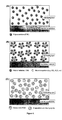
- Fig. 1 For clarification purposes, examples of self-healing layers provided by the present invention are included in Fig. 1.
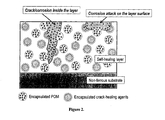
- the mode of action of the healing-agents is presented in Fig. 2.
Landscapes
- Chemical & Material Sciences (AREA)
- Engineering & Computer Science (AREA)
- Materials Engineering (AREA)
- Organic Chemistry (AREA)
- Metallurgy (AREA)
- Chemical Kinetics & Catalysis (AREA)
- Mechanical Engineering (AREA)
- Electrochemistry (AREA)
- Inorganic Chemistry (AREA)
- General Chemical & Material Sciences (AREA)
- Physics & Mathematics (AREA)
- Thermal Sciences (AREA)
- Nanotechnology (AREA)
- Ceramic Engineering (AREA)
- Other Surface Treatments For Metallic Materials (AREA)
Abstract
The invention relates to a method for applying a multifunctional layer on a substrate. Accordingly said layer is applied by means of a process by using an aqueous solution that comprises a POM and/or a crack-healing agent, which POM and/or a crack healing agent is/are incorporated in said layer during said process to obtain a self-healing layer. Generally, said substrate comprises a metallic substrate, preferably a non-ferrous metallic substrate, and most preferably Al, Mg, Ti and alloys thereof. Said POMs are heteropolyanions of the type (XnMmOy)x-, in which X=Si, P, Ce, B, Mn and in which M=Mo, W or V and y>1, m>1 and n≤m and x indicates the valence of the polyanion. A Keggin-type POM is preferred. Said crack-healing agent is selected from particles of mixed oxides, clay particles, metallic oxide/epoxy resin microspheres, or a mixture thereof. Preferably said POMs are supported by media selected from insoluble micro- or nanoparticles (e.g. SiO2) or polymer capsules. The application of said layer occurs by means of conventional anodising, hard anodising, plasma electrolytic oxidation, or electro(less) deposition. Further the invention relates to said POM and/or a crack-healing agent. Finally, the present invention relates to a coated substrate, obtained by the method according to the invention.
Description
- The present invention relates to a method for applying a multifunctional layer on a substrate. The invention also relates to an aqueous solution comprising a polyoxometalate (POM) and/or a crack-healing agent. The invention further relates to a coated non-ferrous substrate, preferably a coated non-ferrous metallic substrate obtained by the method according to the invention.
- Methods to produce multifunctional layers (i.e. layers with at least two engineering properties) are known in the state of the art and include hard anodising (HA), plasma electrolytic oxidation (PEO), electro(less)deposition. The layers obtained are amorphous/crystalline oxides (HA/PEO) or metallic layers (electro(less)deposition) and have very good properties of hardness, wear (abrasive and adhesive), non-stick properties, etc. Extra treatment steps are often applied to further enhance the corrosion resistance or lubrication properties. For example, a method to apply a multifunctional layer is known from
US patent 3622473 . In this patent, a process is described for anodic oxidation of aluminium in an electrolyte to produce a durable oxide film thereon from 1-20 µm, followed by application of a resin coating by electrodeposition and curing of this resin coating. - A disadvantage of the method of the state of the art is that in case of cracking of the resulting multifunctional layer, the underlying metal substrate may become exposed to the outer environment, in this way leading to local corrosion. This can be catastrophic for the product as is the case of coated magnesium alloys when severe galvanic corrosion occurs. Another disadvantage of the method of the state of the art is that in case of a crack of the resulting layer, this cannot be healed and remains as a weak area in the layer. The layers mentioned above from the state of the art are prone to cracking due to their brittleness, internal stresses, different coefficient of thermal expansion relative to the substrate, service conditions.
- The aim of the invention is to provide a method for applying a multifunctional layer on a substrate that overcomes at least one of the problems mentioned above. This aim is reached by a method according to claim 1. This method is characterised in that the layer is applied by means of a process by using an aqueous solution that comprises a POM and/or a crack-healing agent, which POM and/or a crack healing agent is/are incorporated in said layer during said process to obtain a self-healing layer.
- The invention proposes the incorporation of two types of healing agents during layer growth/deposition. For corrosion, POMs are proposed as healing agents. For cracking, several types of crack-healing agents are provided. According to the invention, protecting layers can result that comprise only POMs or only crack-healing agent or both POMs and crack-healing agents as healing agents.
- POMs represent a distinct class of complex metal oxygen anions with general formulae [MmOy]p- or [XnMmOy]x- (n ≤ m, m and n >1) in which M (addenda atom) is a transition metal from the group Mo, V, W, and more rarely Nb, Ta in their highest oxidation state (the highest valence) and the heteroatom X can be almost any element from the periodic table except the rare gases.
- These POM-complexes have a series of attractive properties that make them suitable for numerous applications such as catalysis, medicine, sensors, dopants, dyes/pigments, separations, clinical analysis, food chemistry, waste degradation, etc. These properties include: high stability of their redox states, adsorption ability on solid surfaces, multiple redox reactions without major changes in their structure, tunability of their redox potential by changing the heteroions and/or addenda ions without affecting their structure, multiple electron transfer, fully oxidized compounds, large size, non-toxic properties, etc.
- The use of POMs for protecting a metal layer is known from the state of the art (Frontiers in Bioscience 9, 1759-1770, May 1, 2004, p1792). However, in the state of the art POMs are used as coatings per se on metallic substrates. The coatings are produced by immersion of the substrate in aqueous solutions containing POMs (i.e. chemical conversion coatings). According to the invention, the POMs are incorporated in a layer during layer growth/deposition.
- In a preferred embodiment of the invention, the method according to claim 1 is characterised in that said substrate comprises a metallic substrate, more preferred, a non-ferrous metallic substrate. Metallic substrates are commonly used in the fields of application of the present invention. Examples of the non-ferrous metal forming the substrate are Al, Mg, and Ti and the alloys thereof. Depending on the process used for layer growth/deposition, other metals can also be included. For example, in the process of electroless and electrodeposition, as described below, also Fe, Cu and their alloys can be used.
- As will be more substantiated below, the type of aqueous solution in the present invention depends on the process used for layer growth/deposition, i.e. it can be either an anodizing electrolyte (HA/PEO), an electroless solution or the electrolyte used in the electrodeposition process.
- According to the present invention, a method is provided in which the POMs in the aqueous solution are heteropolyanions of the type [XnMmOy]x- in which X = Si, P, Ce, B, Mn and M = Mo, W, V and in which y > 1, m > 1 and n ≤ m. Examples of POMs include (SiMo12O40)4-, (CeMo12O42)8-, (SiW12O40)4-, (PW12O40)3-. However, the POMs to be incorporated in the layers are not limited to these mentioned above and other POMs or combinations thereof may also be included. Use of the POMs in the method according to the invention provides a stable layer. It provides excellent corrosion protection, as known in the state of the art.
- In a preferred embodiment, the POM is (XM12O40)x-. These are called Keggin-type POMs and represent the most studied and important class of POMs due to their high (thermal) stability and availability.
- The trigger for POMs to react is the presence of (hydrothermal) corrosive environments (e.g. presence of Cl-, SO4 2-). The mechanism involves the ability of the POM to accept electrons from the corrosive ions, in this way inactivating these ions before reaching the underlying substrate. The valence of the transition metal present in the POM decreases, e.g. from VI to V, IV or III. However, the reduced form of POM can be oxidized in air to regenerate the initial state, the highest oxidation state, without changing its structure. In this way, a multiple self-healing effect is ensured. This multiple self-healing effect involves that the POM can react again for more successive times.
- The present invention proposes that in addition to POM, crack-healing agents are included in the layers. These have the possibility to fill-in the local cracks or defects that might appear during the service life of the product. Thereto also crack-healing agents have to be present in the solution according to the invention. The trigger to initiate crack healing is the appearance of a crack in the presence or absence of a hydrothermal environment. In the presence of a hydrothermal environment, the healing agent undergoes chemical or physical reactions with formation of new products with increased volume. In the absence of a hydrothermal environment they can fill-in the crack being released and fixed at the crack location.
- According to the present invention, a method is provided that is characterised in that the crack-healing agent is selected from the group of particles of mixed oxides, clay particles, metallic oxide/epoxy resin microspheres or a mixture thereof. The invention is however not limited to these crack-healing agents. Examples of mixed oxides are CaO · Al2O3 or CaO · 2Al2O3. Advantages of metallic oxides like Al and Ca oxides is that under hydrothermal conditions they undergo chemical reactions to form products with increased volume, like AlH(OH)4 or γ-AlOOH. Clay particles are advantageous for their good swelling properties, when contacted with hydrating environments, in this way filling-in the cavities/cracks and providing a barrier for the passage of ions inside the cavities/cracks. An example of clay particles is hectorite. Hectorite is described as a good swelling agent, in which swelling properties are provided by the layered structure of the material containing cations that become hydrated in the interlayer space. In the absence of a hydrothermal environment, the third crack-healing agent proposed can fill-in the crack by the metallic oxide particles being freed during cracking of the microspheres and bound to the layer by the drying epoxy resin. An advantage is that this embodiment can be used in dry, non-hydrating environments.
- The crack-healing characteristics of the three alternative agents described are functional at temperatures between room temperature (25°C) and circa 200°C.
- The conditions for incorporation of self-healing agents can be adjusted to create a tailored, i.e. uniform or gradient, distribution of the healing agents through the layer depending on the layer type and application (i.e. susceptibility to cracking and corrosion).
- Therefore, according to the invention, the POMs and crack-healing agents can be present in the solution in several states. The POMs can for example be distributed in a free state. In this state POMs are present in the solution as unsupported anions.
- In another embodiment the POMs are present in a supported or immobilised state. In this form, the POMs are carried by media. According to the invention, POMs can be carried by particles like microparticles or nanoparticles, e.g. SiO2, to form clusters. SiO2 provides a good adsorbance for POMs and therefore shows a good storage capacity of POMs. In this way the concentration of POM in the layer can be increased. In another embodiment, the POMs can be encapsulated in polymer capsules. This would be advantageous when electrolytes are used in which POMs are not stable. Examples of polymers suitable for encapsulation known from the state of the art include the urea-formaldehyde based polymers.
- In a separate embodiment of the invention, the particles carrying the POMs are the crack-healing particles. The advantage of this situation is that 1) both the POMs and the crack healing agent are present on the same location, 2) a higher storage capacity is reached for the POM, 3) the particles become better dispersed in the solution because the negatively charged POMs reject each other and 4) the crack-healing agent is protected from direct contact with solution thus being preserved in the layer.
- The crack-healing agents can be also encapsulated in microspheres. The main purpose is that they are preserved in a dry condition required for the crack healing effect. As described above, the crack-healing agent can comprise metallic oxide particles and an epoxy resin encapsulated in polymer microspheres.
- Combinations of POMs and crack-healing agents according to one of the states described above are also incorporated in the invention.
- As described above, according to the invention, the substrate is protected by formation of an oxide or metallic protecting layer comprising at least the POMs and/or the crack-healing agent. According to preferred embodiments of the invention, the layers containing POMs and/or crack-healing agent can be deposited/grown on the substrate via the following processes: conventional anodising, hard anodising, plasma electrolytic oxidation and electro(less) deposition.
- In anodising, the non-ferrous metallic substrate to be covered by the protecting layer (i.e. Al, Mg, Ti and alloys thereof) is made anode in an electrolytic cell. In this way the surface is oxidised under the electric field using appropriate electrolytes known in the state of the art. During formation of the layer (amorphous oxides), POMs are incorporated in the layer by electrophoresis or adsorption. The microspheres comprising the crack-healing agent are entrapped during formation of the layer. As known by a person skilled in the art, hard anodising of aluminium alloys results in a more dense layer that is less porous and has better wear resistance than a layer obtained by conventional anodising. Both processes may use a similar electrolyte. However, hard anodising is performed at ca. 0°C whereas conventional anodising is performed at room temperature. The current density for conventional anodizing is usually between 1-2 A/dm2, whereas for hard anodizing this can be higher, preferably between 2-4 A/dm2. Therefore, using hard anodising, thicker layers can be obtained.
- During PEO, anodic oxidation under sparking (plasma discharges) occurs on the surface of the substrate made anode in the electrolytic cell. PEO has the advantage that more types of ions/phases can be incorporated in the layer. The resulting layer is a crystalline oxide, which has a very high hardness (e.g. 2000 HV vs 600 HV in hard anodising). During the process of PEO, the POM and/or crack-healing agents are incorporated by electrophoresis or adsorption.
- In electro-deposition, the layer is deposited onto the substrate made cathode in an electrolytic cell by reduction of cations under the electric field. The reaction is conducted in acidic pH conditions (e.g. 3.5 - 4 for a nickel Watts bath). The POM and/or crack-healing agents are incorporated by adsorption or electrophoresis.
- In electroless deposition processes, the protective layer is formed by chemical reduction of metal cations onto the substrates under appropriate conditions of pH and temperature. As known by a person skilled in the art, chemical, electroless deposition requires a pretreatment to activate the substrate for chemical nickel reduction (e.g. double-zincating in the case of aluminium alloys). The process is performed at about 88°C in an acidic solution (pH preferably between 4.5 and 5). The POM and/or crack-healing agents are incorporated by adsorption and subsequent entrapment in the growing layer.
- The POMs and/or the crack-healing agents are distributed throughout the layers including the interface with the substrate and the surface of the layers so that the corrosion inhibition and crack-healing effects can be ensured during the entire life lifetime of the product (under wear conditions or when cracks and damages appear in the layer). All the processes mentioned above for the growth/deposition of layers have the ability to incorporate particles or ions to form the composite or hybrid layers with tailored properties. Oxides and oxide-like properties of the healing agents proposed are compatible with layers structure and their functional properties.
- The invention also relates to the aqueous solutions used in the processes of anodising, hard anodising, plasma electrolytic deposition and electro(less) deposition, described above. The essential components for the electrolyte (HA, PEO, electrodeposition) and electroless (electroless deposition) solutions respectively are known to a person skilled in the art. It is clear that these known components can differ for the different requirements of the separate processes, as known in the art. In this way, the aqueous solution as described below can be applied for the methods according to the invention.
- According to the invention, an aqueous solution is provided, characterised in that it comprises a POM and/or a crack-healing agent. This solution can be applied advantageously in the methods of the invention.
- In a preferred embodiment, in this aqueous solution said POMs are heteropolyanions of the type (XnMmOy)x-, in which X=Si, P, Ce, B, Mn and in which M=Mo, W or V and n ≤ m, m > 1, y > 1, x = the valence of the selected anion. Preferably, said POMs are Keggin (XM12O40)x- POMs.
- In another preferred embodiment, in the aqueous solution the crack-healing agent is selected from particles of mixed oxides, clay particles, metallic oxide/epoxy resin microspheres or mixtures thereof and that the crack-healing agent can be encapsulated in polymer microspheres.
- In a further embodiment of the aqueous solution of the invention, the POMs are supported by media from the group of particles or polymer capsules.
- Above described embodiments of the aqueous solution are in particular advantageous for the methods described in this invention. All advantages of these methods also apply to these aqueous solutions.
- The invention is further related to a substrate on which a self-healing multifunctional layer is applied via the method of the invention. In a preferred embodiment of the invention, this substrate comprises a metallic substrate, more preferred, a non-ferrous metallic substrate. Metallic substrates are commonly used in the fields of application of the present invention. Examples of the non-ferrous metal forming the substrate are Al, Mg, and Ti and the alloys thereof. Depending on the application process used, also other metals can be used. For example, in the process of electroless and electrodeposition, also Fe, Cu and their alloys can be used.
- The multifunctional self-healing layer resulting from the aqueous solution according to claim 1 will have a thickness of larger than 1 up to e.g. 50 µm, depending on the application and the process used. For example, in anodizing, a layer thickness of 20-25 µm is considered optimum for functional properties. The layer according to the invention provides multifunctional properties such as proper hardness, abrasive wear, low friction and non-stick properties at room temperature and higher temperatures (e.g. up to 200°C). By this invention, self-healing properties in case of corrosion and/or cracking are also provided.
- For clarification purposes, examples of self-healing layers provided by the present invention are included in Fig. 1. The mode of action of the healing-agents is presented in Fig. 2.
- Figure 1 shows three examples of the states in which POMs and crack healing agents can be distributed in the layers resulting from aqueous solutions according to the invention. Figure la shows dispersed healing agents (POMs) inside the layers deposited in situ (i.e. during layer growth) in free, unsupported form. Figure 1b shows the POMs supported by adsorption on particles (e.g. SiO2) to form clusters. Figure 1c shows POMs and crack-healing agents supported by encapsulation.
- Figure 2 depicts a non-ferrous metallic substrate on which a layer according to the invention has been deposited. This layer shows a crack. Due to reactions initiated by the change in the environment, POMs stop the process of corrosion and crack-healing agents react to fill-in the crack. In this way, self-healing properties are provided to the multifunctional layer.
Claims (18)
1. A method for applying a multifunctional layer on a substrate, characterised in that said layer is applied by means of a process by using an aqueous solution that comprises a POM and/or a crack-healing agent, which POM and/or a crack healing agent is/are incorporated in said layer during said process to obtain a self-healing layer.
2. The method according to claim 1, characterised in that said substrate comprises a metallic substrate.
3. The method according to claim 2, characterised in that said metallic substrate comprises a non-ferrous metallic substrate, preferably Al, Mg, Ti and alloys thereof.
4. The method according to one of the claims 1 to 3, characterised in that said POMs are heteropolyanions of the type (XnMmOy)x-, in which X=Si, P, Ce, B, Mn and in which M=Mo, W or V and y>1, m>1 and n≤m and x indicates the valence of the polyanion.
5. The method according to claim 4, characterised in that said POM is a Keggin-type POM.
6. The method according to one of the claims 1 to 5, characterised in that said crack-healing agent is selected from particles of mixed oxides, clay particles, metallic oxide/epoxy resin microspheres, or a mixture thereof.
7. The method according to one of the claims 1 to 6, characterised in that said POMs are supported by media selected from insoluble micro- or nanoparticles (e.g. SiO2) or polymer capsules.
8. The method according to claim 7, characterised in that said particles are crack-healing agent particles.
9. The method according to one of the claims 1 to 8, characterised in that the crack-healing agent is encapsulated in polymer microspheres.
10. The method according to one of the claims 1 to 9, characterised in that said process comprises conventional anodising.
11. The method according to one of the claims 1 to 9, characterised in that said process comprises hard anodising.
12. The method according to one of the claims 1 to 9, characterised in that said process comprises plasma electrolytic oxidation.
13. The method according to one of the claims 1 to 9, characterised in that said process comprises electro(less) deposition.
14. An aqueous solution characterised in that it comprises a POM and/or a crack-healing agent.
15. The aqueous solution according to claim 14, characterised in that said POMs are heteropolyanions of the type (XnMmOy)x-, in which X=Si, P, Ce, B, Mn and in which M=Mo, W or V and y>1, m>1 and n≤m and x indicates the valence of the polyanion and said POM is preferably a Keggin-type POM.
16. The aqueous solution according to claim 14 or 15, characterised in that the crack-healing agent is selected from particles of mixed oxides, clay particles, metallic oxide/epoxy resin microspheres or mixture thereof, and that the crack-healing agent can be encapsulated in polymer microspheres.
17. The aqueous solution according to claim 14 to 16, characterised in that said POMs are supported by media from the group of particles or polymer capsules, said particles including the particles comprising the crack-healing agent.
19. A coated substrate, preferably a metallic substrate, more preferably a non-ferrous metallic substrate, preferably selected from the group of Al, Mg, Ti, obtained by the method according to one of the claims 1-13.
Priority Applications (1)
| Application Number | Priority Date | Filing Date | Title |
|---|---|---|---|
| EP06075365A EP1820882A1 (en) | 2006-02-21 | 2006-02-21 | Self-healing layer on non-ferrous metals using polyoxometalates |
Applications Claiming Priority (1)
| Application Number | Priority Date | Filing Date | Title |
|---|---|---|---|
| EP06075365A EP1820882A1 (en) | 2006-02-21 | 2006-02-21 | Self-healing layer on non-ferrous metals using polyoxometalates |
Publications (1)
| Publication Number | Publication Date |
|---|---|
| EP1820882A1 true EP1820882A1 (en) | 2007-08-22 |
Family
ID=36282834
Family Applications (1)
| Application Number | Title | Priority Date | Filing Date |
|---|---|---|---|
| EP06075365A Withdrawn EP1820882A1 (en) | 2006-02-21 | 2006-02-21 | Self-healing layer on non-ferrous metals using polyoxometalates |
Country Status (1)
| Country | Link |
|---|---|
| EP (1) | EP1820882A1 (en) |
Cited By (7)
| Publication number | Priority date | Publication date | Assignee | Title |
|---|---|---|---|---|
| CN102732929A (en) * | 2011-04-14 | 2012-10-17 | 亥姆霍兹中心盖斯特哈赫特材料及海岸研究中心有限公司 | Process for producing coating on the surface of substrate based on lightweight metals by plasma-electrolytic oxidation |
| KR101681195B1 (en) * | 2015-07-29 | 2016-12-12 | 창원대학교 산학협력단 | Thermal Barrier Coating System with Self-Healing Ability |
| CN110241452A (en) * | 2019-07-16 | 2019-09-17 | 嘉兴学院 | Magnesium alloy differential arc oxidation electrolyte and preparation method thereof and surface treatment method of Mg alloy |
| CN112974799A (en) * | 2021-02-05 | 2021-06-18 | 中国人民解放军陆军装甲兵学院 | Composite powder for preparing self-repairing coating, preparation method of composite powder, titanium-based wear-resistant self-repairing coating and preparation method of titanium-based wear-resistant self-repairing coating |
| EP4063540A2 (en) | 2021-12-30 | 2022-09-28 | Politechnika Slaska | Method of producing porous oxide layers on aluminum containing polymeric corrosion inhibitors |
| CN116516443A (en) * | 2023-05-30 | 2023-08-01 | 佛山科学技术学院 | Magnesium alloy corrosion-resistant micro-arc oxidation coating with self-repairing function and preparation method thereof |
| CN119593037A (en) * | 2024-11-28 | 2025-03-11 | 中国科学院兰州化学物理研究所 | Micro-arc oxidation electrolyte and micro-arc oxidation method |
Citations (3)
| Publication number | Priority date | Publication date | Assignee | Title |
|---|---|---|---|---|
| US3622473A (en) | 1964-10-15 | 1971-11-23 | Honny Chemicals Co Ltd | Method of providing aluminum surfaces with coatings |
| US20040216637A1 (en) * | 2003-01-21 | 2004-11-04 | The Ohio State University | Corrosion resistant coating with self-healing characteristics |
| US20050241934A1 (en) * | 2004-04-28 | 2005-11-03 | Valerie Sauvant-Moynot | Self-repairing structure and coating for corrosive medium |
-
2006
- 2006-02-21 EP EP06075365A patent/EP1820882A1/en not_active Withdrawn
Patent Citations (3)
| Publication number | Priority date | Publication date | Assignee | Title |
|---|---|---|---|---|
| US3622473A (en) | 1964-10-15 | 1971-11-23 | Honny Chemicals Co Ltd | Method of providing aluminum surfaces with coatings |
| US20040216637A1 (en) * | 2003-01-21 | 2004-11-04 | The Ohio State University | Corrosion resistant coating with self-healing characteristics |
| US20050241934A1 (en) * | 2004-04-28 | 2005-11-03 | Valerie Sauvant-Moynot | Self-repairing structure and coating for corrosive medium |
Non-Patent Citations (2)
| Title |
|---|
| FRONTIERS IN BIOSCIENCE, vol. 9, 1 May 2004 (2004-05-01), pages 1792 |
| S. V. LOMAKINA ET AL.: "Heteropoly Anions as Corrosion Inhibitors for Aluminium in High Temperature Water", CORROSION SCIENCE, vol. 36, no. 9, 1994, pages 1645 - 1651, XP002381422 * |
Cited By (12)
| Publication number | Priority date | Publication date | Assignee | Title |
|---|---|---|---|---|
| CN102732929A (en) * | 2011-04-14 | 2012-10-17 | 亥姆霍兹中心盖斯特哈赫特材料及海岸研究中心有限公司 | Process for producing coating on the surface of substrate based on lightweight metals by plasma-electrolytic oxidation |
| US20120261266A1 (en) * | 2011-04-14 | 2012-10-18 | Helmholtz-Zentrum Geesthacht Zentrum für Material-und Küstenforschung GmbH | Process for Producing A Coating On The Surface Of A Substrate Based On Lightweight Metals By Plasma-electrolytic Oxidation |
| EP2511401A3 (en) * | 2011-04-14 | 2014-05-14 | Helmholtz-Zentrum Geesthacht Zentrum für Material- und Küstenforschung GmbH | Method for producing a coating on the surface of a substrate on the basis of light metals by means of plasma electrolytic oxidation |
| US8828215B2 (en) * | 2011-04-14 | 2014-09-09 | Helmholtz-Zentrum Geesthacht Zentrum für Material-und Küstenforschung GmbH | Process for producing a coating on the surface of a substrate based on lightweight metals by plasma-electrolytic oxidation |
| CN102732929B (en) * | 2011-04-14 | 2016-04-06 | 亥姆霍兹中心盖斯特哈赫特材料及海岸研究中心有限公司 | Prepared the method for coating on light metallic substrate surface by plasma electrolysis oxidation |
| KR101681195B1 (en) * | 2015-07-29 | 2016-12-12 | 창원대학교 산학협력단 | Thermal Barrier Coating System with Self-Healing Ability |
| CN110241452A (en) * | 2019-07-16 | 2019-09-17 | 嘉兴学院 | Magnesium alloy differential arc oxidation electrolyte and preparation method thereof and surface treatment method of Mg alloy |
| CN110241452B (en) * | 2019-07-16 | 2020-05-12 | 嘉兴学院 | Magnesium alloy micro-arc oxidation electrolyte and preparation method thereof and magnesium alloy surface treatment method |
| CN112974799A (en) * | 2021-02-05 | 2021-06-18 | 中国人民解放军陆军装甲兵学院 | Composite powder for preparing self-repairing coating, preparation method of composite powder, titanium-based wear-resistant self-repairing coating and preparation method of titanium-based wear-resistant self-repairing coating |
| EP4063540A2 (en) | 2021-12-30 | 2022-09-28 | Politechnika Slaska | Method of producing porous oxide layers on aluminum containing polymeric corrosion inhibitors |
| CN116516443A (en) * | 2023-05-30 | 2023-08-01 | 佛山科学技术学院 | Magnesium alloy corrosion-resistant micro-arc oxidation coating with self-repairing function and preparation method thereof |
| CN119593037A (en) * | 2024-11-28 | 2025-03-11 | 中国科学院兰州化学物理研究所 | Micro-arc oxidation electrolyte and micro-arc oxidation method |
Similar Documents
| Publication | Publication Date | Title |
|---|---|---|
| Kaseem et al. | Electrochemical response of MgO/Co3O4 oxide layers produced by plasma electrolytic oxidation and post treatment using cobalt nitrate | |
| Ivanou et al. | Plasma anodized ZE41 magnesium alloy sealed with hybrid epoxy-silane coating | |
| Lee | Effects of copper additive on micro-arc oxidation coating of LZ91 magnesium-lithium alloy | |
| CN102677127B (en) | Magnesium alloy microarc oxidation-electrophoresis composite coating and preparation method thereof | |
| Li et al. | Corrosion and wear resistance of micro‐arc oxidation composite coatings on magnesium alloy AZ31—the influence of inclusions of carbon spheres | |
| An et al. | Investigation of mutual effects among additives in electrolyte for plasma electrolytic oxidation on magnesium alloys | |
| Yabuki et al. | Porous anodic oxide film with self-healing ability for corrosion protection of aluminum | |
| US3915837A (en) | Anode and method of production thereof | |
| Qi et al. | Microstructure and properties of a MAO/PA/MoS2 composite coating formed on 6063 aluminum alloy by micro arc oxidation | |
| TWI493581B (en) | Electrode material for electrolytic capacitor and its manufacturing method | |
| Daroonparvar et al. | Fabrication and properties of triplex NiCrAlY/nano Al2O3· 13% TiO2/nano TiO2 coatings on a magnesium alloy by atmospheric plasma spraying method | |
| US4252629A (en) | Electrode for electrochemical processes especially electrowinning and method for manufacturing same | |
| CN102797024B (en) | Method for carrying out micro-arc oxidation on blue-colored film layer by aluminum alloy | |
| Liang et al. | Synthesis of ZIF-67 film in micro-arc oxidation anticorrosion coating on AZ31 magnesium alloy | |
| JP2022051582A (en) | Titanium base material, manufacturing method of titanium base material, electrode for water electrolysis, water electrolysis device | |
| Lkhagvaa et al. | Post-anodization methods for improved anticorrosion properties: A review | |
| EP1820882A1 (en) | Self-healing layer on non-ferrous metals using polyoxometalates | |
| KR101177605B1 (en) | Oxide coating on magnesium alloy with anti-corrosion and anti-microbial properties and Manufacturing method thereof | |
| US3855084A (en) | Method of producing a coated anode | |
| EP2915905A1 (en) | Method for preparing of composition for surface treatment of metal, surface-treated steel sheet using same and method for manufacturing same | |
| US20030094377A1 (en) | Process for forming coatings on metallic bodies and an apparatus for carrying out the process | |
| EP1060291B1 (en) | Method for producing a corrosion protective coating and a coating system for substrates made of light metal | |
| US20110247939A1 (en) | Wear resistant ceramic coated aluminum alloy article | |
| CN1501989A (en) | Improvements on Metallic Coatings | |
| KR101213976B1 (en) | The method for fabricating corrosion-resistance ceramics film on the Mg-alloys substrate and materials comprising corrosion-resistance ceramics film prepared therefrom |
Legal Events
| Date | Code | Title | Description |
|---|---|---|---|
| PUAI | Public reference made under article 153(3) epc to a published international application that has entered the european phase |
Free format text: ORIGINAL CODE: 0009012 |
|
| AK | Designated contracting states |
Kind code of ref document: A1 Designated state(s): AT BE BG CH CY CZ DE DK EE ES FI FR GB GR HU IE IS IT LI LT LU LV MC NL PL PT RO SE SI SK TR |
|
| AX | Request for extension of the european patent |
Extension state: AL BA HR MK YU |
|
| AKX | Designation fees paid | ||
| REG | Reference to a national code |
Ref country code: DE Ref legal event code: 8566 |
|
| STAA | Information on the status of an ep patent application or granted ep patent |
Free format text: STATUS: THE APPLICATION HAS BEEN WITHDRAWN |
|
| 18W | Application withdrawn |
Effective date: 20080602 |