EP1819090B1 - Signature and verifying method, and signature and verifying device - Google Patents
Signature and verifying method, and signature and verifying device Download PDFInfo
- Publication number
- EP1819090B1 EP1819090B1 EP05806273A EP05806273A EP1819090B1 EP 1819090 B1 EP1819090 B1 EP 1819090B1 EP 05806273 A EP05806273 A EP 05806273A EP 05806273 A EP05806273 A EP 05806273A EP 1819090 B1 EP1819090 B1 EP 1819090B1
- Authority
- EP
- European Patent Office
- Prior art keywords
- storage medium
- signature
- calculation
- calculation result
- conversion means
- Prior art date
- Legal status (The legal status is an assumption and is not a legal conclusion. Google has not performed a legal analysis and makes no representation as to the accuracy of the status listed.)
- Expired - Lifetime
Links
Images




Classifications
-
- H—ELECTRICITY
- H04—ELECTRIC COMMUNICATION TECHNIQUE
- H04L—TRANSMISSION OF DIGITAL INFORMATION, e.g. TELEGRAPHIC COMMUNICATION
- H04L63/00—Network architectures or network communication protocols for network security
- H04L63/12—Applying verification of the received information
-
- H—ELECTRICITY
- H04—ELECTRIC COMMUNICATION TECHNIQUE
- H04L—TRANSMISSION OF DIGITAL INFORMATION, e.g. TELEGRAPHIC COMMUNICATION
- H04L63/00—Network architectures or network communication protocols for network security
- H04L63/12—Applying verification of the received information
- H04L63/123—Applying verification of the received information received data contents, e.g. message integrity
-
- H—ELECTRICITY
- H04—ELECTRIC COMMUNICATION TECHNIQUE
- H04L—TRANSMISSION OF DIGITAL INFORMATION, e.g. TELEGRAPHIC COMMUNICATION
- H04L9/00—Cryptographic mechanisms or cryptographic arrangements for secret or secure communications; Network security protocols
- H04L9/30—Public key, i.e. encryption algorithm being computationally infeasible to invert or user's encryption keys not requiring secrecy
- H04L9/3006—Public key, i.e. encryption algorithm being computationally infeasible to invert or user's encryption keys not requiring secrecy underlying computational problems or public-key parameters
- H04L9/302—Public key, i.e. encryption algorithm being computationally infeasible to invert or user's encryption keys not requiring secrecy underlying computational problems or public-key parameters involving the integer factorization problem, e.g. RSA or quadratic sieve [QS] schemes
-
- H—ELECTRICITY
- H04—ELECTRIC COMMUNICATION TECHNIQUE
- H04L—TRANSMISSION OF DIGITAL INFORMATION, e.g. TELEGRAPHIC COMMUNICATION
- H04L9/00—Cryptographic mechanisms or cryptographic arrangements for secret or secure communications; Network security protocols
- H04L9/32—Cryptographic mechanisms or cryptographic arrangements for secret or secure communications; Network security protocols including means for verifying the identity or authority of a user of the system or for message authentication, e.g. authorization, entity authentication, data integrity or data verification, non-repudiation, key authentication or verification of credentials
- H04L9/3247—Cryptographic mechanisms or cryptographic arrangements for secret or secure communications; Network security protocols including means for verifying the identity or authority of a user of the system or for message authentication, e.g. authorization, entity authentication, data integrity or data verification, non-repudiation, key authentication or verification of credentials involving digital signatures
- H04L9/3249—Cryptographic mechanisms or cryptographic arrangements for secret or secure communications; Network security protocols including means for verifying the identity or authority of a user of the system or for message authentication, e.g. authorization, entity authentication, data integrity or data verification, non-repudiation, key authentication or verification of credentials involving digital signatures using RSA or related signature schemes, e.g. Rabin scheme
Definitions
- the present invention relates to a signature method and verification method and a signature device and verification device, and more particularly, to a signature method and verification method and a signature device and verification device where the signature length does not depend on the number of signature devices when a plurality of signature devices are used for signatures.
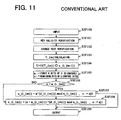
- FIG. 11 shows the procedure for this conventional signature method.
- ⁇ means the concatenation of bit strings.
- ⁇ means the exclusive OR on a bit basis.
- ⁇ represents the arithmetic operator for exponentiating the left operand by the exponent in the right operand.
- f ⁇ -1 ⁇ means f -1 .
- _ ⁇ x ⁇ represents that x is a subscript.
- u_ ⁇ i ⁇ means u i .
- the exclusive OR U between the hash value of T_ ⁇ m ⁇ and the signed text u_ ⁇ i_ ⁇ m-1 ⁇ is calculated (S3F104), the first k security parameter bits of the bit string U are assigned to a, and the remaining bits are assigned to s (S3F105).
- a is compared with the RSA modulus n_ ⁇ i_ ⁇ m ⁇ of the local signature device (S3F106) and, if a is smaller than the RSA modulus n_ ⁇ i_ ⁇ m ⁇ , the signed text u_ ⁇ i_ ⁇ m ⁇ is calculated for a using the private key d_ ⁇ i_ ⁇ m ⁇ according to the RSA method (S3F107), and the result is output (S3F109).
- one-bit information 0 is added to s as the control information. If a is larger than the RSA modulus n_ ⁇ i_ ⁇ m ⁇ , the RSA signature cannot be calculated for a number larger than the modulus and, therefore, n_ ⁇ i_ ⁇ m ⁇ is subtracted from a, the signed text u_ ⁇ i_ ⁇ m ⁇ is calculated for the resulting a (S3F108), and the result is output (S3F109). At this time, one-bit information 1 is added to s as the control information.
- the signature cannot be calculated for a number larger than the RSA modulus n_ ⁇ i_ ⁇ m ⁇ of a signature device when RSA is used as described above.
- the method according to the conventional technology described in the Non-Patent Document I subtracts the modulus n_(i_(m ⁇ from a number, which is larger, before the signature is added. At this time, to allow the verification to be performed later, one-bit control information (1 when the modulus is exceeded, and 0 when the modulus is not exceeded) is added at the end.
- the signed text u_ ⁇ i_ ⁇ m ⁇ is verified, the verification is repeated by using the public keys of the signature devices in reverse order of adding signatures and, when the predetermined initial value is finally obtained, the signatures are determined to be valid.
- Non-Patent Document 1 in which the total data length of signed texts is not proportional to the number of signature devices, can reduce the amount of memory for storing signed texts even if multiple signature devices add signature sequentially and can reduce the amount of communication when communication is performed.
- the signature length is determined by the fixed value + number of signatures, the problem is that the signature length is prolonged, though little by little, as the number of signatures increases.
- the signature device i_ ⁇ m ⁇ performs a first operation in which the device performs no operation if a received signed text u_ ⁇ i_ ⁇ m-1 ⁇ exceeds the modulus n_ ⁇ i_ ⁇ m ⁇ but, if not, adds an RSA-signature-based signature, a second operation in which the device multiplies the result of the first operation by a function that maps the result to a value larger by the modulus n_ ⁇ i_ ⁇ m ⁇ , and a third operation in which the device performs no operation if the result of the second operation exceeds the modulus n_ ⁇ i_ ⁇ m ⁇ but, if not, adds an RSA-signature-based signature.
- the modulus n_ ⁇ i_ ⁇ m ⁇ of the signed text u_ ⁇ i_(m-1 ⁇ and the signature device i_ ⁇ m ⁇ becomes a number smaller than 2 ⁇ .
- the value after the first operation is 0 to n_ ⁇ i_ ⁇ m ⁇ .
- the value after the first operation is n_ ⁇ i_ ⁇ m ⁇ to 2 ⁇ .
- the value after the second operation also becomes a number smaller than 2 ⁇ but, if the value after the first operation is n_ ⁇ i_ ⁇ m ⁇ to 2 ⁇ , the value after the second operation is 0 to n_ ⁇ i_ ⁇ m ⁇ .
- the first effect is that the signature length does not depend on the number of signature devices.
- the reason is that the number of bits of the data before the signature is equal to the number of bits of the data after the signature.
- the second effect is that the sequence of signature devices may be changed each time the signature is created.
- the reason is the same as that of the first effect, that is, the number of bits of the data before the signature is equal to the number of bits of the data after the signature. Therefore, the input to each signature device is fixed regardless of the sequence in which the signature device adds its signature, thus making it possible for the signature device to add the signature by performing the same operation regardless of the sequence.
- the third effect is that an attacker, who makes bad use of a signature device, cannot forge a signed text that has passed through honest signature devices along the path.
- the reason is that, whatever u is input to a signature device, u is changed by at least one of two RSA calculations that are performed up to two times at the signature time.
- the fourth effect is that there is no need to know the number (m) of signature devices when the system operation is started but that the operation can be performed without any problem even if the number (m) of signature devices is dynamically changed during the operation.
- the reason is that the signature procedure for m+1 signature devices is that another signature operation is performed in the same way after the signature procedure for m signature devices is performed, meaning that the signature operation method does not depend on the number m of signature devices.
- a first embodiment of the present invention comprises signature devices i_ ⁇ 1 ⁇ , ..., i_ ⁇ m ⁇ , verification devices i_ ⁇ 1 ⁇ -2, ..., i_ ⁇ m ⁇ -2, public key storage devices i_ ⁇ 1 ⁇ -3, ..., i_ ⁇ m ⁇ -3, key validity verification devices i_ ⁇ 1 ⁇ -4, ..., i_ ⁇ m ⁇ -4, and private key storage devices i_ ⁇ 1 ⁇ -5, ..., i_ ⁇ m ⁇ -5.
- the signature device i_ ⁇ m ⁇ comprises input means S1B100, T_ ⁇ m ⁇ calculation means S1B103, exclusive OR calculation means S1B104, first conversion means S1B105, bijective conversion means S1B106, second conversion means S1B107, a storage medium S1B108, and output means S1B109.
- Other signature devices have the same configuration as the signature device i_ ⁇ m ⁇ .
- the verification device i_ ⁇ m ⁇ -2 comprises input means V1B100, j initialization means V1B102, j checking means V1B103, second conversion means V1B104, bijective conversion means V1B105, first conversion means V1B106, T_ ⁇ j ⁇ calculation means V1B107, u calculation means V1B108, j decrease means V1B109, a storage medium V1B1010, u checking means V1B1011, accept output means V1B1012, and reject output means V1B1013.
- Other verification devices have the same configuration as the verification device i_ ⁇ m ⁇ -2.
- the public key/private key pair of the signature device i_ ⁇ 1 ⁇ , an initial value u_ ⁇ i_ ⁇ 0 ⁇ , and a message M_ ⁇ 1 ⁇ are entered into the signature device i_ ⁇ 1 ⁇ .
- the signature device i_ ⁇ 1 ⁇ uses u_ ⁇ i_ ⁇ 0 ⁇ to create a signed text u_ ⁇ i_ ⁇ 1 ⁇ for the message M_ ⁇ 1 ⁇ .
- the public key/private key pair of the signature device i_ ⁇ j ⁇ , signed text u_ ⁇ i_ ⁇ j-1 ⁇ output by the immediately preceding signature device, and a message M_ ⁇ j ⁇ are entered sequentially into the signature device i_ ⁇ j ⁇ , and the signature device i_ ⁇ j ⁇ uses them to create a signed text u_ ⁇ i_ ⁇ j ⁇ .
- the signed text u_ ⁇ i_ ⁇ j ⁇ is data representing that the signature device i_ ⁇ 1 ⁇ signs the message M_ ⁇ 1 ⁇ , the signature device i_ ⁇ 2 ⁇ sign the message M_ ⁇ 2 ⁇ , ..., and the signature device i_ ⁇ j ⁇ signs the message M_ ⁇ j ⁇ .
- the public keys and the messages M_ ⁇ 1 ⁇ , ..., M_ ⁇ j-1 ⁇ of the signature devices i_ ⁇ 1 ⁇ , ..., i_ ⁇ j ⁇ and the signed text u_ ⁇ i_ ⁇ j-1 ⁇ are entered into the verification device i_ ⁇ j ⁇ . Then, the verification device i_ ⁇ j ⁇ verifies whether or not the signed text u_ ⁇ i_ ⁇ j-1 ⁇ is a signed text created for the messages M_ ⁇ 1 ⁇ , ..., M_ ⁇ j-1 ⁇ using the private keys of the signature devices i_ ⁇ 1 ⁇ , ..., i_ ⁇ j-1 ⁇
- the goal of the system in this embodiment is to create a signed text u_ ⁇ i_ ⁇ m ⁇ , that is, data representing that the signature device i_ ⁇ 1 ⁇ signs the message M_ ⁇ 1 ⁇ , the signature device i_ ⁇ 2 ⁇ signs the message M_ ⁇ 2 ⁇ , ..., and the signature device i_ ⁇ m ⁇ signs the message M_ ⁇ m ⁇ .
- the number of signature devices, m may be dynamically changed during the operation.
- the signature devices i_ ⁇ 1 ⁇ , ..., i_ ⁇ m ⁇ perform the same operation.
- the verification devices, the public key storage devices, the key validity verification devices, and the private key storage devices also perform basically the same operation.
- the public key pk_ ⁇ i ⁇ and the private key sk_ ⁇ i ⁇ of the signature device i_ ⁇ j ⁇ are (n_ ⁇ i ⁇ , e_ ⁇ i ⁇ ) and (p_ ⁇ i_ ⁇ j ⁇ , q_ ⁇ i_ ⁇ j ⁇ , d_ ⁇ i_ ⁇ j ⁇ ) respectively and satisfy the following five properties.
- e_ ⁇ i_ ⁇ j ⁇ and ⁇ (n_ ⁇ i ⁇ ) are relatively prime.
- One of the methods for making this confirmation possible is to set e_ ⁇ i_ ⁇ j ⁇ to a prime number larger than n_ ⁇ i ⁇ .
- e_(i_ ⁇ j ⁇ need not always satisfy this property.
- the private key storage device i_ ⁇ j ⁇ -5 stores the private key sk_(i_ ⁇ j ⁇
- the public key storage device i_ ⁇ j ⁇ -3 stores the public keys pk_ ⁇ 1 ⁇ , ..., pk_ ⁇ m ⁇ .
- the following describes the operation of the signature device i_ ⁇ m ⁇ .
- the signature device i_ ⁇ m ⁇ signs the message M_ ⁇ m ⁇ when the messages M_ ⁇ 1 ⁇ , ..., M_ ⁇ m ⁇ and the signed text u_ ⁇ i_ ⁇ m-1 ⁇ for the messages M_ ⁇ 1 ⁇ , ..., M_ ⁇ m-1 ⁇ , created by the signature devices i_ ⁇ 1 ⁇ , ...., i_ ⁇ m-1 ⁇ using the public keys pk_ ⁇ i_ ⁇ 1 ⁇ , .... pk_ ⁇ i_ ⁇ m-1 ⁇ , are entered.
- the signature device i_ ⁇ m ⁇ sends u_ ⁇ i_ ⁇ m-1 ⁇ , M_ ⁇ 1 ⁇ , ..., M_ ⁇ m-1 ⁇ , and pk_ ⁇ i_ ⁇ 1 ⁇ , ..., pk_ ⁇ i_(m-1 ⁇ to the verification device i_ ⁇ m-2 ⁇ .
- the verification device i_ ⁇ m ⁇ -2 verifies the validity of the signed text u_ ⁇ i_ ⁇ m-1 ⁇ (S1B101, S1F102).
- the verification device i_ ⁇ m ⁇ -2 sends pk_ ⁇ i_ ⁇ 1 ⁇ , ..., pk_ ⁇ i_ ⁇ m-1 ⁇ to the key validity verification device i_ ⁇ m ⁇ -4.
- H is the hash function that outputs the hash value of the same number of bits as that of the input.
- the signature device i_ ⁇ m ⁇ reads u_ ⁇ i ⁇ m ⁇ from the storage medium S1B108 and outputs it (S1F1012).
- the signature device i_ ⁇ m ⁇ checks if the received signed text u_ ⁇ i_ ⁇ m-1 ⁇ exceeds the modulus n_ ⁇ i_ ⁇ m ⁇ .
- the signature device i_ ⁇ m ⁇ performs no operation if the received signed text u_ ⁇ i_ ⁇ m-1 ⁇ exceeds the modulus n_ ⁇ i_ ⁇ m ⁇ but performs the first operation, in which an RSA-based signature is added, if the received signed text u_ ⁇ i_ ⁇ m-1 ⁇ does not exceed the modulus n_ ⁇ i_ ⁇ m ⁇ .
- the signature device i_ ⁇ m ⁇ performs the second operation, in which the result of the first operation is multiplied by the function that maps the result to a value larger by modulus n_ ⁇ i_ ⁇ m ⁇ .
- the signature device i_ ⁇ m ⁇ checks if the result of the second operation exceeds modulus n_ ⁇ i_ ⁇ m ⁇ , and performs no operation if the result exceeds the modulus n_ ⁇ i_ ⁇ m ⁇ but performs the RSA-based third operation to add the signature if the result does not exceed the modulus n_ ⁇ i_ ⁇ m ⁇ .
- the RSA signature operation is redundantly performed twice depending upon the value of the signed text u_ ⁇ i_ ⁇ m-1 ⁇ , the signature operation that is performed can be uniquely determined by the value of the signature value u_ ⁇ i_ ⁇ m ⁇ and, therefore, there is no need to add control bits as in the method described in Non-Patent Document 1.
- the verification device i_ ⁇ m ⁇ -2 verifies the signed text u_ ⁇ m-1 ⁇ .
- the verification device i_ ⁇ m ⁇ -2 reads pk_ ⁇ i_ ⁇ 1 ⁇ , ..., pk_ ⁇ i_ ⁇ m-1 ⁇ from the public key storage device i_ ⁇ m ⁇ -3 and, in addition, reads messages M_ ⁇ 1 ⁇ , ..., M_ ⁇ m-1 ⁇ (V1F100).
- the data that is read is written into the storage medium V1B1010 by the input means V1B100.
- the verification device i_ ⁇ m ⁇ -2 sends the pk_ ⁇ i_ ⁇ 1 ⁇ , ..., pk_ ⁇ i_ ⁇ m-1 ⁇ to the key verification device i_ ⁇ m ⁇ -4 via the input means V1B100 to request it to verify the validity of the public keys pk_ ⁇ i_ ⁇ 1 ⁇ , ..., pk_ ⁇ i_ ⁇ m-1 ⁇ (V1B101, V1F101).
- the verification device i_ ⁇ m ⁇ -2 sets m-1 in the variable j, which manages which message in which signature device is being verified, via the j initialization means V1B102 (V1F102).
- the verification device i_ ⁇ m ⁇ -2 checks if j>0 via the j checking means V1B103 (V1F103).
- the verification device i_ ⁇ m ⁇ -2 first reads necessary data from the storage medium V1B1010 and checks if u_ ⁇ i_ ⁇ j ⁇ n_ ⁇ i_ ⁇ j ⁇ (V1F104).
- the verification device i_ ⁇ m ⁇ -2 reads necessary data from the storage medium V1B1010 and first checks if v ⁇ n_ ⁇ i_ ⁇ j ⁇ (V1F108).
- the verification device i_ ⁇ m ⁇ -2 checks if j>0 again via the j checking means V1B103 (V1F103).
- the verification device i_ ⁇ m ⁇ -2 performs the processing in step V1F104 and the following steps.
- the verification device i_ ⁇ m ⁇ -2 outputs accept, which indicates successful verification, via the accept output means V1B1012 (V1F1015); otherwise, the verification device i_ ⁇ m ⁇ -2 outputs reject, which indicates unsuccessful verification, via the reject output means V1B1013 (V1F1016).
- the signature device i_ ⁇ m ⁇ in this embodiment creates a signed text using the calculation expression u_ ⁇ i_ ⁇ m ⁇ -(g_ ⁇ m ⁇ -1 ⁇ ( ⁇ ⁇ -1 ⁇ (f_ ⁇ m ⁇ -1 ⁇ (H(T_ ⁇ m ⁇ ) ⁇ u_ ⁇ i_ ⁇ m-1 ⁇ )))).
- the first effect is that the signature length does not depend on the number of signature devices.
- the reason is that the number of bits of the data before the signature is equal to the number of bits of the data after the signature.
- the second effect is that the sequence of signature devices may be changed each time the signature is created.
- the reason is the same as that of the first effect, that is, the number of bits of the data before the signature is equal to the number of bits of the data after the signature. Therefore, the input to each signature device is fixed regardless of the sequence in which the signature device adds its signature, thus making it possible for the signature device to add the signature by performing the same operation regardless of the sequence. However, it is necessary to notify the verification device about the sequence in which the signature is added.
- the third effect is that an attacker, who makes bad use of a signature device, cannot forge a signed text that has passed through honest signature devices along the path.
- the reason is that, whatever u is input to a signature device, u is changed by at least one of two RSA calculations that are performed at the signature time.
- the fourth effect is that there is no need to know the number (m) of signature devices when the system operation is started but that the operation can be performed without any problem even if the number (m) of signature devices is dynamically changed during the operation.
- the reason is that the signature procedure for m+1 signature devices is that another signature operation is performed in the same way after the signature procedure for m signature devices is performed, meaning that the signature operation method does not depend on the number m of signature devices.
- the RSA function which is the most typical function, is used in the description. More generally, a signature method in which the signature length does not depend on the number of signers and which ensures safety can be implemented in the same way as in the first embodiment if there is a subset X having ⁇ 0,1 ⁇ ⁇ ⁇ and if the conditions (1) and (2) described below are satisfied.
- the trapdoor one-way replacement is a function that satisfies the following four properties:
- a second embodiment of the present invention comprises signature devices i_ ⁇ 1 ⁇ , ..., i_ ⁇ m ⁇ , verification devices i_ ⁇ 1 ⁇ -2, ..., i_ ⁇ m ⁇ -2, public key storage devices i_ ⁇ 1 ⁇ -3, ..., i_ ⁇ m ⁇ -3, key validity verification devices i_ ⁇ 1 ⁇ -4, ..., i_ ⁇ m ⁇ -4, and private key storage devices i_ ⁇ 1 ⁇ -5, ..., i_ ⁇ m ⁇ -5.
- the signature device i_ ⁇ m ⁇ comprises input means S1B100, T_ ⁇ m ⁇ calculation means S1B103, exclusive OR calculation means S1B104, first conversion means S1B105, bijective conversion means S1B106, second conversion means S1B107, a storage medium S1B108, output means S1B109, and w setting means S2B100.
- Other signature devices have the same configuration as the signature device i_ ⁇ m ⁇ .
- the verification device i_ ⁇ m ⁇ -2 comprises input means V2B200, T_ ⁇ m-1 ⁇ calculation means V2B202, v" calculation means V2B203, second conversion means V2B204, bijective conversion means V2B205, first conversion means V2B206, u checking means V2B207, accept output means V2B208, reject output means V2B209, and a storage medium V2B2010.
- Other verification devices have the same configuration as the verification device i_ ⁇ m ⁇ -2.
- the public key/private key pair of the signature device i_ ⁇ 1 ⁇ , an initial value u_ ⁇ i_ ⁇ 0 ⁇ , and a message M_ ⁇ 1 ⁇ are entered into the signature device i_ ⁇ 1 ⁇ .
- the signature device i_ ⁇ 1 ⁇ uses u_ ⁇ i_ ⁇ 0 ⁇ to create a signed text u_ ⁇ i_ ⁇ 1 ⁇ for the message M_ ⁇ 1 ⁇ , creates auxiliary information w_ ⁇ i_(1 ⁇ from the initial value u_ ⁇ i_ ⁇ 0 ⁇ , and outputs the pair of u_ ⁇ i_ ⁇ 1 ⁇ and w_ ⁇ i_ ⁇ 1 ⁇ .
- the public key/private key pair of the signature device i_ ⁇ 2 ⁇ , the pair of u_ ⁇ i_ ⁇ 1 ⁇ and w_ ⁇ i_ ⁇ 1 ⁇ , and a message M_ ⁇ 2 ⁇ are entered into the signature device i_ ⁇ 2 ⁇ .
- the signature device i_ ⁇ 2 ⁇ uses u_ ⁇ i_ ⁇ 1 ⁇ to create a signed text u_ ⁇ i_ ⁇ 2 ⁇ for the message M_ ⁇ 2 ⁇ , creates auxiliary information w_ ⁇ i_ ⁇ 2 ⁇ from u_ ⁇ i_ ⁇ 1 ⁇ , and outputs the pair of u_ ⁇ i_ ⁇ 2 ⁇ and w_ ⁇ i_ ⁇ 2 ⁇ .
- the public key/private key pair of the signature device i_ ⁇ j ⁇ , the signed text u_ ⁇ i_ ⁇ j-1 ⁇ and the auxiliary information w_ ⁇ i_ ⁇ j-1 ⁇ that are output by the immediately preceding signature device, and a message M_ ⁇ j ⁇ are entered sequentially into the signature device i_ ⁇ j ⁇ , and the signature device i_ ⁇ j ⁇ uses them to create the pair of a signed text u_ ⁇ i_ ⁇ j ⁇ and auxiliary information w_ ⁇ i_ ⁇ j ⁇ .
- u_ ⁇ i_ ⁇ j ⁇ which is the same signed text as that in the first embodiment, is data representing that the signature device i_ ⁇ 1 ⁇ signs the message M_ ⁇ 1 ⁇ , the signature device i_ ⁇ 2 ⁇ signs the message M_ ⁇ 2 ⁇ , ..., and the signature device i_ ⁇ j ⁇ signs the message M_ ⁇ j ⁇ .
- w_ ⁇ i_ ⁇ j ⁇ ⁇ is auxiliary information that makes the verification of signed text u_ ⁇ i_ ⁇ j ⁇ easy and, in this embodiment, the auxiliary information is the signed text u_ ⁇ i_ ⁇ j-1 ⁇ ⁇ that is the input to the signature device i_ ⁇ j ⁇ .
- the verification, device i_ ⁇ j ⁇ verifies if u_ ⁇ i_ ⁇ j-1 ⁇ is a signed text, created for the messages M_ ⁇ 1 ⁇ , ..., M_ ⁇ j-1 ⁇ ⁇ using the public keys of the signature devices i_ ⁇ 1 ⁇ , ..., i_ ⁇ j-1 ⁇ , based on the auxiliary information w_ ⁇ i_ ⁇ j-1 ⁇ .
- the goal of the system in this embodiment is to create a signed text u_ ⁇ i_ ⁇ m ⁇ ⁇ , that is, data representing that the signature device i_ ⁇ 1 ⁇ signs the message M_ ⁇ 1 ⁇ , the signature device i_ ⁇ 2 ⁇ signs the message M_ ⁇ 2 ⁇ , ..., and the signature device i_ ⁇ m ⁇ signs the message M_ ⁇ m ⁇ .
- the number of signature devices, m may be dynamically changed during the operation.
- the signature devices i_ ⁇ 1 ⁇ , ..., i_ ⁇ m ⁇ perform the same operation.
- the verification devices, the public key storage devices, the key validity verification devices, and the private key storage devices also perform basically the same operation.
- the public key pk_ ⁇ i ⁇ and the private key sk_ ⁇ i ⁇ of the signature device i_ ⁇ j ⁇ are created in the same way as in the first embodiment.
- the private key storage device i_ ⁇ j ⁇ -5 stores the private key sk_ ⁇ i_ ⁇ j ⁇
- the public key storage device i_ ⁇ j ⁇ -3 stores the public keys Pk_ ⁇ 1 ⁇ , ..., pk_ ⁇ m ⁇ .
- the key validity verification device performs the same operation as in the first embodiment.
- the method which is used by the signature device i_ ⁇ m ⁇ to sign the message M_ ⁇ m ⁇ when the messages M_ ⁇ 1 ⁇ , ..., M_ ⁇ m ⁇ , the signed text u_ ⁇ i - ⁇ m-1 ⁇ created by the signature devices I_(I), ..., , i_ ⁇ m-1 ⁇ for the messages M_ ⁇ 1 ⁇ , ..., M_ ⁇ m-1 ⁇ using the public keys pk_ ⁇ i_ ⁇ 1 ⁇ , ..., pk_ ⁇ i_ ⁇ m-1 ⁇ , and the auxiliary information w_ ⁇ i_m-1 ⁇ are entered into the signature device i_ ⁇ m ⁇ , is similar to that of the first embodiment except that the procedure for creating the auxiliary information is added. The following describes this method with reference to FIG. 7 and FIG.
- the verification device i_ ⁇ m ⁇ -2 reads pk_ ⁇ i_ ⁇ 1 ⁇ , ..., pk_ ⁇ i_ ⁇ m-1 ⁇ from the public key storage device i_ ⁇ m ⁇ -3, reads the messages M_ ⁇ 1 ⁇ , ..., M- ⁇ m-1 ⁇ , and saves them into the storage medium V2B2010 (V2F200).
- the verification device i_ ⁇ m ⁇ -2 sends pk_ ⁇ i_ ⁇ 1 ⁇ , ..., pk_ ⁇ i_ ⁇ m-1 ⁇ to the key verification device i_ ⁇ m ⁇ -4 and requests it to verify the validity of the public keys pk_ ⁇ i_ ⁇ 1 ⁇ , ..., pk_ ⁇ i ⁇ m-1 ⁇ (V2F201).
- the first effect is that the signature length does not depend on the number of signature devices.
- the reason is that the number of bits of the data before being signed is equal to the number of bits of the data after being signed. However, the data is longer than that in the first embodiment by the length of the auxiliary information.
- the second effect is that the calculation amount required for the verification calculation is less than that in the first embodiment.
- the reason is that, while the first embodiment requires the verification calculation proportional to the number of signature devices that have signed because the initial value must finally be obtained, this embodiment is required to perform verification calculation only for one signature device because the signed text that is input to the immediately preceding signature device is passed as the auxiliary information. Note that this embodiment assumes that the immediately preceding signature device is reliable. Therefore, the safety of this embodiment is lower than that of the first embodiment that assures safety without such an assumption.
- the signed text u_ ⁇ i_ ⁇ j-1 ⁇ that is input to the signature device i_ ⁇ j ⁇ is used as the auxiliary information w_ ⁇ i_ ⁇ j ⁇ , which is paired with the signed text u_ ⁇ i_ ⁇ j ⁇
- the hash value h(u_ ⁇ i_ ⁇ j-1 ⁇ ) of u_ ⁇ i_ ⁇ j-1 ⁇ is used as the auxiliary information w_ ⁇ i_ ⁇ j ⁇ where h is a predetermined hash function that outputs a hash value of the same number of bits as that of the input.
- h is a predetermined hash function that outputs a hash value of the same number of bits as that of the input.
- the function of the signature device and the verification device of the present invention can be implemented not only by hardware but also by a computer program.
- the program recorded in a computer readable recording medium such as a magnetic disk or semiconductor memory for distribution, is read by a computer when the computer is started.
- the operation of the computer is controlled to allow the computer to function as the signature device and the verification device described in the embodiments.
Landscapes
- Engineering & Computer Science (AREA)
- Computer Security & Cryptography (AREA)
- Computing Systems (AREA)
- Computer Networks & Wireless Communication (AREA)
- Signal Processing (AREA)
- Theoretical Computer Science (AREA)
- Computer Hardware Design (AREA)
- General Engineering & Computer Science (AREA)
- Storage Device Security (AREA)
- Information Retrieval, Db Structures And Fs Structures Therefor (AREA)
- Management, Administration, Business Operations System, And Electronic Commerce (AREA)
Abstract
Description
- The present invention relates to a signature method and verification method and a signature device and verification device, and more particularly, to a signature method and verification method and a signature device and verification device where the signature length does not depend on the number of signature devices when a plurality of signature devices are used for signatures.
- As computers and the Internet environment are widely used, more and more messages are sent and received electronically. In this case, it is desirable that an electronic signature be added to a message to prevent the message from being altered while the message is sent.
- However, when multiple signature devices create signatures using a well-known signature method such as RSA or DSA, all signature devices must individually create signed texts and save all those signed texts to indicate that all signature devices have signed. Therefore, because the total data length of the signed texts is proportional to the number of signature devices, the efficiency is degraded when there are many signature devices.
- One of the signature methods to solve this problem is proposed in
non-Patent Document 1.FIG. 11 shows the procedure for this conventional signature method. - The following defines the meaning of the symbols used in this specification. "∥" means the concatenation of bit strings. "○" means the exclusive OR on a bit basis. "^" represents the arithmetic operator for exponentiating the left operand by the exponent in the right operand. For example, f^{-1} means f-1. "_{x}" represents that x is a subscript. For example, u_{i} means ui.
- Referring to
FIG. 11 , when a signed text u_{i_{m-1}} to be signed is entered (S3F100), the verification of the validity of the key owned (S3F101) and the verification of the validity of the signed text u_{i_{m-1}} (S3F102) are performed and, after that, T_{m}, which is the concatenation of the public key of the local signature device and the public keys of the signature devices that have already signed, is calculated (S3F103). Next, the exclusive OR U between the hash value of T_{m} and the signed text u_{i_{m-1}} is calculated (S3F104), the first k security parameter bits of the bit string U are assigned to a, and the remaining bits are assigned to s (S3F105). Next, a is compared with the RSA modulus n_{i_{m}} of the local signature device (S3F106) and, if a is smaller than the RSA modulus n_{i_{m}}, the signed text u_{i_{m}} is calculated for a using the private key d_{i_{m} according to the RSA method (S3F107), and the result is output (S3F109). At this time, one-bit information 0 is added to s as the control information. If a is larger than the RSA modulus n_{i_{m}}, the RSA signature cannot be calculated for a number larger than the modulus and, therefore, n_{i_{m}} is subtracted from a, the signed text u_{i_{m}} is calculated for the resulting a (S3F108), and the result is output (S3F109). At this time, one-bit information 1 is added to s as the control information. - The signature cannot be calculated for a number larger than the RSA modulus n_{i_{m}} of a signature device when RSA is used as described above. To solve this problem, the method according to the conventional technology described in the Non-Patent Document I subtracts the modulus n_(i_(m}} from a number, which is larger, before the signature is added. At this time, to allow the verification to be performed later, one-bit control information (1 when the modulus is exceeded, and 0 when the modulus is not exceeded) is added at the end. When the signed text u_{i_{m}} is verified, the verification is repeated by using the public keys of the signature devices in reverse order of adding signatures and, when the predetermined initial value is finally obtained, the signatures are determined to be valid.
- Anna Lysyanskaya, Silvio Micali, Leonid Reyzin, Hovav Shacham. Sequential Aggregate Signatures from Trapdoor Permutations. In Advances in Cryptology -- EUROCRYPT 2004, vol. 3027 of LNCS, pp. 74-90. Springer-Verlag, 2004.
- "Alfred J. Menezes Paul C. van Oorschot, and Scott A. Vanstone. Handbook of Applied Cryptography. CRC Press." (http://www.cacr.math.uwaterloo.ca/hac /).
- The conventional signature method described in Non-Patent
Document 1, in which the total data length of signed texts is not proportional to the number of signature devices, can reduce the amount of memory for storing signed texts even if multiple signature devices add signature sequentially and can reduce the amount of communication when communication is performed. However, because the signature length is determined by the fixed value + number of signatures, the problem is that the signature length is prolonged, though little by little, as the number of signatures increases. - We have appreciated it would be desirable to improve the problems with the conventional signature method described above and to make the signature fixed-length regardless of the number of signature devices.
- The invention is defined in the independent claims to which reference should now be made. Advantageous features are set forth in the dependent claims.
- The signature device i_{m} performs a first operation in which the device performs no operation if a received signed text u_{i_{m-1}} exceeds the modulus n_{i_{m}} but, if not, adds an RSA-signature-based signature, a second operation in which the device multiplies the result of the first operation by a function that maps the result to a value larger by the modulus n_{i_{m}}, and a third operation in which the device performs no operation if the result of the second operation exceeds the modulus n_{i_{m}} but, if not, adds an RSA-signature-based signature. At this time, if the number of bits of the RSA modulus of each signature device is equal to the security parameter κ, the modulus n_{i_{m}} of the signed text u_{i_(m-1}} and the signature device i_{m} becomes a number smaller than 2^{κ}. In the first operation, because an RSA-signature-based signature is added to the signed text u_{i_{m-1}} whose value is 0 to n_{i_{m}}, the value after the first operation is 0 to n_{i_{m}}. On the other hand, because no operation is performed for the signed text u_{i_{m-1}} whose value is n_{i_{m}} to 2^{κ}, the value after the first operation is n_{i_{m}} to 2^{κ}. In the second operation, because n_{i_{m}} is added to the value after the first operation with 2^{κ} as the modulus, the value after the second operation also becomes a number smaller than 2^{κ} but, if the value after the first operation is n_{i_{m}} to 2^{κ}, the value after the second operation is 0 to n_{i_{m}}. Therefore, by adding an RSA-signaturc-based signature to a value after the second operation that is 0 to n_{i_{m}}, at least one RSA signature is added to the signed text u_{i_{m-1}} of any value. In addition, there is a one-to-one correspondence between the value after the third operation, that is, the signature value u_{i_m}}, and the received signed text u_{i_{m-1)}, the performed signature operation can be determined uniquely by the value of the signature value u_{i_{m}} and, therefore, there is no need to add control bits as in
Non-Patent Document 1. - The first effect is that the signature length does not depend on the number of signature devices. The reason is that the number of bits of the data before the signature is equal to the number of bits of the data after the signature.
- The second effect is that the sequence of signature devices may be changed each time the signature is created. The reason is the same as that of the first effect, that is, the number of bits of the data before the signature is equal to the number of bits of the data after the signature. Therefore, the input to each signature device is fixed regardless of the sequence in which the signature device adds its signature, thus making it possible for the signature device to add the signature by performing the same operation regardless of the sequence.
- The third effect is that an attacker, who makes bad use of a signature device, cannot forge a signed text that has passed through honest signature devices along the path. The reason is that, whatever u is input to a signature device, u is changed by at least one of two RSA calculations that are performed up to two times at the signature time.
- The fourth effect is that there is no need to know the number (m) of signature devices when the system operation is started but that the operation can be performed without any problem even if the number (m) of signature devices is dynamically changed during the operation. The reason is that the signature procedure for m+1 signature devices is that another signature operation is performed in the same way after the signature procedure for m signature devices is performed, meaning that the signature operation method does not depend on the number m of signature devices.
-
-
FIG. 1 is a block diagram of a first embodiment of the present invention. -
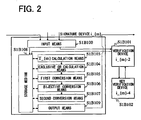
FIG. 2 is a block diagram showing the configuration of a signature device in the first embodiment of the present invention. -
FIG. 3 is a flowchart showing the operation of the signature device in the first embodiment of the present invention. -
FIG. 4 is a block diagram showing the configuration of a verification device in the first embodiment of the present invention. -
FIG. 5 is a flowchart showing the operation of the verification device in the first embodiment of the present invention. -
FIG. 6 is a block diagram of a second embodiment of the present invention. -
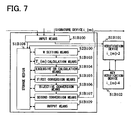
FIG. 7 is a block diagram showing the configuration of a signature device in the second embodiment of the present invention. -
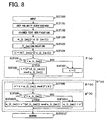
FIG. 8 is a flowchart showing the operation of the signature device in the second embodiment of the present invention. -
FIG. 9 is a block diagram showing the configuration of a verification device in the second embodiment of the present invention. -
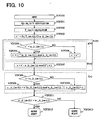
FIG. 10 is a flowchart showing the operation of the verification device in the second embodiment of the present invention. -
FIG. 11 is a flowchart showing the operation of a conventional signature device. -
- i_{1}, ..., i_{m-1} Signature device
- i_{1}-2, ..., i_{m-1}-2 Verification device
- i_{1 }-3, ..., i_{m-1}-3 Key storage device
- i_{1}-4, ..., i_{m-1}-4 Key validity verification device
- i_{1}-5, ..., i_{m-1}-5 Key generation device
- M_{1}, ... , M_{m} Message
- u_{i_{0}}, ..., u_{i_{m-1}} Signed text
- w_{i_{0}}, ..., w_{i_{m-1}} Auxiliary information
- Referring to
FIG. 1 , a first embodiment of the present invention comprises signature devices i_{1}, ..., i_{m}, verification devices i_{1}-2, ..., i_{m}-2, public key storage devices i_{1}-3, ..., i_{m}-3, key validity verification devices i_{1}-4, ..., i_{m}-4, and private key storage devices i_{1}-5, ..., i_{m}-5. - Referring to
FIG. 2 , the signature device i_{m} comprises input means S1B100, T_{m} calculation means S1B103, exclusive OR calculation means S1B104, first conversion means S1B105, bijective conversion means S1B106, second conversion means S1B107, a storage medium S1B108, and output means S1B109. Other signature devices have the same configuration as the signature device i_{m}. - Referring to
FIG. 4 , the verification device i_{m}-2 comprises input means V1B100, j initialization means V1B102, j checking means V1B103, second conversion means V1B104, bijective conversion means V1B105, first conversion means V1B106, T_{j} calculation means V1B107, u calculation means V1B108, j decrease means V1B109, a storage medium V1B1010, u checking means V1B1011, accept output means V1B1012, and reject output means V1B1013. Other verification devices have the same configuration as the verification device i_{m}-2. - The following describes the overview of this embodiment. First, the public key/private key pair of the signature device i_{1}, an initial value u_{i_{0}}, and a message M_{1} are entered into the signature device i_{1}. The signature device i_{1} uses u_{i_{0}} to create a signed text u_{i_{1}} for the message M_{1}. In the same manner, the public key/private key pair of the signature device i_{j}, signed text u_{i_{j-1}} output by the immediately preceding signature device, and a message M_{j} are entered sequentially into the signature device i_{j}, and the signature device i_{j} uses them to create a signed text u_{i_{j}}. The signed text u_{i_{j}} is data representing that the signature device i_{1} signs the message M_{1}, the signature device i_{2} sign the message M_{2}, ..., and the signature device i_{j} signs the message M_{j}.
- For each j, the public keys and the messages M_{1}, ..., M_{j-1} of the signature devices i_{1}, ..., i_{j} and the signed text u_{i_{j-1}} are entered into the verification device i_{j}. Then, the verification device i_{j} verifies whether or not the signed text u_{i_{j-1}} is a signed text created for the messages M_{1}, ..., M_{j-1} using the private keys of the signature devices i_{1}, ..., i_{j-1}
- The goal of the system in this embodiment is to create a signed text u_{i_{m}}, that is, data representing that the signature device i_{1} signs the message M_{1}, the signature device i_{2} signs the message M_{2}, ..., and the signature device i_{m} signs the message M_{m}.
- Note that there is no need to know the number of signature devices, m, when the operation of the system in this embodiment is started. The number of signature devices, m, may be dynamically changed during the operation. The signature devices i_{1}, ..., i_{m} perform the same operation. The verification devices, the public key storage devices, the key validity verification devices, and the private key storage devices also perform basically the same operation.
- Next, the following describes this embodiment more in detail.
- The public key pk_{i} and the private key sk_{i} of the signature device i_{j} are (n_{i}, e_{i}) and (p_{i_{j}}, q_{i_{j}}, d_{i_{j}}) respectively and satisfy the following five properties.
- 1. p_{i_{j}} and q_{i_{j}} are prime numbers.
- 2. n_{i_{j}}=p_{i_{j}}q_{i_{j}}
- 3. The number of bits of n_{i_{j}} is equal to the security parameter κ.
- 4. The number of bits of p_{i_{j}} is almost equal to the number of bits of q_{i_{j}}.
- 5. e_{i_{j}} and Φ (n_{i}) are relatively prime.
- 6. d_{i_{j}}=e_{i_{j}}-1 mod Φ (n_{i})
- From the viewpoint of safety, it is desirable that everyone can confirm that e_{i_{j}} and Φ (n_{i}) are relatively prime. One of the methods for making this confirmation possible is to set e_{i_{j}} to a prime number larger than n_{i}. However, e_(i_{j}} need not always satisfy this property.
- For each of j=1, ..., m, the private key storage device i_{j} -5 stores the private key sk_(i_{j}}, and the public key storage device i_{j}-3 stores the public keys pk_{1}, ..., pk_{m}.
- The following describes the operation of the key validity verification device i_{m}-4. The key validity verification device i_{m}-4 is a device that verifies the validity of the public keys pk_{i_{1}}, ..., pk_{i_{m-1}}. To confirm the validity, the key validity verification device first reads pk_{i_{1}}, ..., pk_{i_{m-1}} from the key storage device i_{m}-3 and confirms that pk_{i_{1}}, ..., pk_{i_{m-1}} are different to each other. When m=1, the key validity verification device does not perform any confirmation operation.
- From the viewpoint of safety, although it is desirable to confirm that e_{i_{j}} and Φ (n_{i}) are relatively prime, it is also possible to omit this confirmation.
- The following describes the operation of the signature device i_{m}. With reference to
FIG. 2 andFIG. 3 , the following describes how the signature device i_{m} signs the message M_{m} when the messages M_{1}, ..., M_{m} and the signed text u_{i_{m-1}} for the messages M_{1}, ..., M_{m-1}, created by the signature devices i_{1}, ...., i_{m-1}} using the public keys pk_{i_{1}}, .... pk_{i_{m-1}}, are entered. - First, via the input means S1B101, the signature device i_{m} reads M_{1}, ..., M_{m}, pk_{i_{1}}, ..., pk_{i_{m}}, sk_{i_{m}}, and u_{i_{m-1}} and stores them in the storage medium S1B100 (S1F100). Note that, when m=1, u_{i_{0}}=0 is assumed.
- Next, the signature device i_{m} sends u_{i_{m-1}}, M_{1}, ..., M_{m-1}, and pk_{i_{1}}, ..., pk_{i_(m-1}} to the verification device i_{m-2}. The verification device i_{m}-2 verifies the validity of the signed text u_{i_{m-1}} (S1B101, S1F102). At this time, the verification device i_{m}-2 sends pk_{i_{1}}, ..., pk_{i_{m-1}} to the key validity verification device i_{m}-4. The key validity verification device i_{m}-4 verifies the validity of the keys (S1B102, S1F101). Note that, when m=1, the key validity verification device i_{m}-4 only confirms that u_{i_{0}}=0.
- Although it is desirable to perform the verification of u_{i_{m-1}} and the verification of key validity described above from the viewpoint of safety, one of the operations or both operations may be omitted to increase efficiency.
- Next, via the T_{m} calculation means S1B103, the signature device i_{m} reads necessary data from the storage medium S1B108 and calculates T_{m}=M_{1}∥...∥M_{m}∥pk_{i_{1}}∥...∥pk_{i_{m}} (S1F103). After the calculation, the T_{m} calculation means S1B103 writes the calculation result into the storage medium S1B108.
- Next, via the exclusive OR means S1B104, the signature device i_{m} reads necessary data from the storage medium S1B108, calculates U=H(T_{m})○u_{i_{m-1}}, and writes the calculation result into the storage medium S1B108 (S1F104). H is the hash function that outputs the hash value of the same number of bits as that of the input.
- Next, via the first conversion means S1B105, the signature device i_{m} reads data, entered into the signature device i_{m}, from the storage medium S1B108 and first checks if U is smaller than n_{i_{m}} (S1F105). If U<n_{i_{m}}, the signature device i_{m} calculates v=u^{d_{i_{m}}} mod n_{i_{m}} via the first conversion means S1B105, and writes the calculation result into the storage medium S1B108 (S1F106). Conversely, if U≥n_{i_{m}}, the signature device i_{m} performs the calculation v=u via the first conversion means S1B105 and writes the calculation result into the storage medium S1B108 (S1F107).
- Next, via the bijective conversion means S1B106, the signature device i_{m} reads necessary data from the storage medium S1B108, calculates v'=v+n_{i_{m}}
mod 2^{κ}, and writes the calculation result into the storage medium S1B108 (S1F108). - Next, via the second conversion means S1B107, the signature device i_{m} reads necessary data from the storage medium S1B108 and checks if v' is smaller than n_{i_{m}} (S1F109). If v'<n_{i_{m}}, the signature device i_{m} calculates u_{i_{m}}=v'^{d_{i_{m}}} mod n_{i_{m}} and writes the calculation result into the storage medium S1B108 (S1F1010). Conversely, if v'≥n_{i_{m}}, the signature device i_{m} calculates u_{i_{m}}=v' via the second conversion means S1B107 and writes the calculation result into the storage medium S1B108 (S1F1011).
- Finally, via the output means S1B109, the signature device i_{m} reads u_{i {m}} from the storage medium S1B108 and outputs it (S1F1012).
- As described above, the signature device i_{m} checks if the received signed text u_{i_{m-1}} exceeds the modulus n_{i_{m}}. The signature device i_{m} performs no operation if the received signed text u_{i_{m-1}} exceeds the modulus n_{i_{m}} but performs the first operation, in which an RSA-based signature is added, if the received signed text u_{i_{m-1}} does not exceed the modulus n_{i_{m}}. The signature device i_{m} performs the second operation, in which the result of the first operation is multiplied by the function that maps the result to a value larger by modulus n_{i_{m}}. The signature device i_{m} checks if the result of the second operation exceeds modulus n_{i_{m}}, and performs no operation if the result exceeds the modulus n_{i_{m}} but performs the RSA-based third operation to add the signature if the result does not exceed the modulus n_{i_{m}}. Although the RSA signature operation is redundantly performed twice depending upon the value of the signed text u_{i_{m-1}}, the signature operation that is performed can be uniquely determined by the value of the signature value u_{i_{m}} and, therefore, there is no need to add control bits as in the method described in
Non-Patent Document 1. - Next, with reference to
FIG. 4 andFIG. 5 , the following describes how the verification device i_{m}-2 verifies the signed text u_{m-1}. - First, via the input means V1B100, the verification device i_{m}-2 reads pk_{i_{1}}, ..., pk_{i_{m-1}} from the public key storage device i_{m}-3 and, in addition, reads messages M_{1}, ..., M_{m-1} (V1F100). The data that is read is written into the storage medium V1B1010 by the input means V1B100.
- Next, the verification device i_{m}-2 sends the pk_{i_{1}}, ..., pk_{i_{m-1}} to the key verification device i_{m}-4 via the input means V1B100 to request it to verify the validity of the public keys pk_{i_{1}}, ..., pk_{i_{m-1}} (V1B101, V1F101).
- Next, to sequentially verify the signature devices in reverse order from the immediately-preceding signature device to the first signature device, the verification device i_{m}-2 sets m-1 in the variable j, which manages which message in which signature device is being verified, via the j initialization means V1B102 (V1F102).
- Next, the verification device i_{m}-2 checks if j>0 via the j checking means V1B103 (V1F103).
- The following describes the operation of the verification device i_{m}-2 when j>0. The operation performed when j>0 is not satisfied will be described later.
- Next, via the second conversion means V1B104, the verification device i_{m}-2 first reads necessary data from the storage medium V1B1010 and checks if u_{i_{j}}<n_{i_{j}} (V1F104).
- If u_{i_{j}}<n_{i_{j}}, the verification device i_{m}-2 calculates v'=u_{i_{j}}^{e_{i_{j}}} mod n_{i_{j}} and writes the calculation result into the storage medium V1B1010 (V1F105) via the second conversion means V1B104.
- Conversely, if u_{i_{j}}<n_{i_{j}} is not satisfied, the verification device i_{m}-2 sets v'=u_{i_{j} and writes the calculation result into the storage medium V1B1010 via the second conversion means V1B104 (V1F106).
- Next, via the bijective calculation means V1B105, the verification device i_{m}-2 reads necessary data from the storage medium V1B1010, calculates v=v'-n_{i_{m}}
mod 2^{κ }, and writes the calculation result into storage medium V1B1010 (V1F107). - Next, via the first conversion means V1B106, the verification device i_{m}-2 reads necessary data from the storage medium V1B1010 and first checks if v<n_{i_{j}} (V1F108).
- If v<n_{i_{j}}, the verification device i_{m}-2 calculates U=v^{e_{i_{j}}} mod n_{i_{j}} and writes the calculation result into the storage medium V1B1010 via the first conversion means V1B106 (V1F109).
- On the other hand, if v<n_{i_{j}} is not satisfied, the verification device i_{m}-2 performs the calculation U=v and writes the calculation result into the storage medium V1B1010 via the first conversion means V1B106 (V1F1010).
- Next, via the T_{j} calculation means V1B107, the verification device i_{m}-2 reads necessary data from the storage medium V1B1010, calculates T_{j}=M_{1}∥...∥M_{j}∥pk_{i_{1}}∥...∥pk_{i_{j}}, and writes the calculation result into the storage medium V1B1010 (V1F1011).
- Next, via the u calculation means V1B108, the verification device i_{m}-2 reads necessary data from the storage medium V1B1010, calculates u_{i_{j-1}}=H(T_{j})○ U, and writes the calculation result into the storage medium V1B1010 (V1F1012).
- Next, the verification device i_{m}-2 sets j=j-I via the j decrease means V1B109 (V1F1013).
- The verification device i_{m}-2 checks if j>0 again via the j checking means V1B103 (V1F103).
- If j>0, the verification device i_{m}-2 performs the processing in step V1F104 and the following steps.
- If j=0, the verification device i_{m}-2 reads necessary data from the storage medium V1B1010 and checks if u=0 via the u checking means V1B1011 (V1F1014).
- If u=0, the verification device i_{m}-2 outputs accept, which indicates successful verification, via the accept output means V1B1012 (V1F1015); otherwise, the verification device i_{m}-2 outputs reject, which indicates unsuccessful verification, via the reject output means V1B1013 (V1F1016).
- Now, let f(x), g(x), and Φ (x) be the operations enclosed by the dotted line in
FIG. 5 .
That is,


- Then, the operations f^{-1}(x), g^{-1} (x), h^{-1} (x), and φ ^{-1}(x) in the part enclosed by the dotted line in
FIG. 3 are the inverse functions of f(x), g(x), h(x), and φ (x), respectively. - Therefore, the signature device i_{m} in this embodiment creates a signed text using the calculation expression u_{i_{m}}-(g_{m}^{-1}( φ ^{-1}(f_{m}^{-1}(H(T_{m}) ○ u_{i_{m-1}})))). The verification device i_{m}-2 in this embodiment finds the signed text that is entered into the immediately preceding signature device using u_{i_{m-2}}=H(T_{m-1}) ○ (f_{m-1}(φ (g_{m-1}(u_{i_{m-1}})))), finds the initial value of the input by repeating the same processing until the first signature device is reached, and checks if the initial value that is found matches the predetermined initial value (value of 0 in this embodiment).
- Next, the following describes the effect of this embodiment.
- The first effect is that the signature length does not depend on the number of signature devices. The reason is that the number of bits of the data before the signature is equal to the number of bits of the data after the signature.
- The second effect is that the sequence of signature devices may be changed each time the signature is created. The reason is the same as that of the first effect, that is, the number of bits of the data before the signature is equal to the number of bits of the data after the signature. Therefore, the input to each signature device is fixed regardless of the sequence in which the signature device adds its signature, thus making it possible for the signature device to add the signature by performing the same operation regardless of the sequence. However, it is necessary to notify the verification device about the sequence in which the signature is added.
- The third effect is that an attacker, who makes bad use of a signature device, cannot forge a signed text that has passed through honest signature devices along the path. The reason is that, whatever u is input to a signature device, u is changed by at least one of two RSA calculations that are performed at the signature time.
- The fourth effect is that there is no need to know the number (m) of signature devices when the system operation is started but that the operation can be performed without any problem even if the number (m) of signature devices is dynamically changed during the operation. The reason is that the signature procedure for m+1 signature devices is that another signature operation is performed in the same way after the signature procedure for m signature devices is performed, meaning that the signature operation method does not depend on the number m of signature devices.
- In the first embodiment described above, the RSA function, which is the most typical function, is used in the description. More generally, a signature method in which the signature length does not depend on the number of signers and which ensures safety can be implemented in the same way as in the first embodiment if there is a subset X having {0,1} ^ {κ} and if the conditions (1) and (2) described below are satisfied.
- (1) f and g are trapdoor one-way replacements, and X is included in both the domain of f and the domain of g.
- (2) φ is a bijection on (0,1)^{κ} where both φ and φ ^{-1} can be calculated in polynomial time, and {0,1} ^ {κ} / X is mapped to X.
- The trapdoor one-way replacement is a function that satisfies the following four properties:
- 1) Is easy to calculate f.
- 2) Is difficult for a person, who does not know the trapdoor (also called a private key), to calculate f^{-1}.
- 3) Is easy for a person, who knows the trapdoor, to calculate f^{-1}.
- 4) Is a bijection.
- In addition, if there is a subset X having {0,1 }^{κ} and if the conditions (1) and (2) described below are satisfied, a signature method in which the signature length does not depend on the number of signers and which ensures safety can be implemented in the same way as in the first embodiment.
- (1) f is a trapdoor one-way replacement, and X is included in the domain of f.
- (2) h is a trapdoor one-way replacement, and {0,1}^{κ}\ X is included in the domain of h.
- Referring to
FIG. 6 , a second embodiment of the present invention comprises signature devices i_{1}, ..., i_{m}, verification devices i_{1}-2, ..., i_{m}-2, public key storage devices i_{1}-3, ..., i_{m}-3, key validity verification devices i_{1}-4, ..., i_{m}-4, and private key storage devices i_{1}-5, ..., i_{m}-5. - Referring to
FIG. 7 , the signature device i_{m} comprises input means S1B100, T_{m} calculation means S1B103, exclusive OR calculation means S1B104, first conversion means S1B105, bijective conversion means S1B106, second conversion means S1B107, a storage medium S1B108, output means S1B109, and w setting means S2B100. Other signature devices have the same configuration as the signature device i_{m}. - Referring to
FIG. 9 , the verification device i_{m}-2 comprises input means V2B200, T_{m-1} calculation means V2B202, v" calculation means V2B203, second conversion means V2B204, bijective conversion means V2B205, first conversion means V2B206, u checking means V2B207, accept output means V2B208, reject output means V2B209, and a storage medium V2B2010. Other verification devices have the same configuration as the verification device i_{m}-2. - The following describes the overview of this embodiment. First, the public key/private key pair of the signature device i_{1}, an initial value u_{i_{0}}, and a message M_{1} are entered into the signature device i_{1}. The signature device i_{1} uses u_{i_{0}} to create a signed text u_{i_{1}} for the message M_{1}, creates auxiliary information w_{i_(1}} from the initial value u_{i_{0}}, and outputs the pair of u_{i_{1}} and w_{i_{1}}. Next, the public key/private key pair of the signature device i_{2}, the pair of u_{i_{1}} and w_{i_{1}}, and a message M_{2} are entered into the signature device i_{2}. The signature device i_{2} uses u_{i_{1}} to create a signed text u_{i_{2}} for the message M_{2}, creates auxiliary information w_{i_{2}} from u_{i_{1}}, and outputs the pair of u_{i_{2}} and w_{i_{2}}. In the same manner, the public key/private key pair of the signature device i_{j}, the signed text u_{i_{j-1}} and the auxiliary information w_{i_{j-1}} that are output by the immediately preceding signature device, and a message M_{j} are entered sequentially into the signature device i_{j}, and the signature device i_{j} uses them to create the pair of a signed text u_{i_{j}} and auxiliary information w_{i_{j}}. u_{i_{j}}, which is the same signed text as that in the first embodiment, is data representing that the signature device i_{1} signs the message M_{1}, the signature device i_{2} signs the message M_{2}, ..., and the signature device i_{j} signs the message M_{j}.
- w_{i_{j} } is auxiliary information that makes the verification of signed text u_{i_{j}} easy and, in this embodiment, the auxiliary information is the signed text u_{i_{j-1} } that is the input to the signature device i_{j}. For each j, when the public keys of the signature devices i_{1}, ..., i_{j}, the messages M_{1}, ..., M_{j-1}, and u_{i_{j-1} } and w_{i_{j-1}} are entered into the verification device i_{j}, the verification, device i_{j} verifies if u_{i_{j-1}} is a signed text, created for the messages M_{1}, ..., M_{j-1} } using the public keys of the signature devices i_{1}, ..., i_{j-1}, based on the auxiliary information w_{i_{j-1}}.
- As in the first embodiment, the goal of the system in this embodiment is to create a signed text u_{i_{m} }, that is, data representing that the signature device i_{1} signs the message M_{1}, the signature device i_{2} signs the message M_{2}, ..., and the signature device i_{m} signs the message M_{m}.
- Note that, as in the first embodiment, there is no need to know the number of signature devices, m, when the operation of the system in this embodiment is started. The number of signature devices, m, may be dynamically changed during the operation. The signature devices i_{1}, ..., i_{m} perform the same operation. The verification devices, the public key storage devices, the key validity verification devices, and the private key storage devices also perform basically the same operation.
- Next, the following describes the detail of this embodiment with focus on the difference from the first embodiment.
- The public key pk_{i} and the private key sk_{i} of the signature device i_{j} are created in the same way as in the first embodiment. For each of j=1, ..., m, the private key storage device i_{j}-5 stores the private key sk_{i_{j}}, and the public key storage device i_{j}-3 stores the public keys Pk_{1}, ..., pk_{m}.
- The key validity verification device performs the same operation as in the first embodiment.
- The method, which is used by the signature device i_{m} to sign the message M_{m} when the messages M_{1}, ..., M_{m}, the signed text u_{i-{m-1}} created by the signature devices I_(I), ..., , i_{m-1} for the messages M_{1}, ..., M_{m-1} using the public keys pk_{i_{1}}, ..., pk_{i_{m-1}}, and the auxiliary information w_{i_m-1}} are entered into the signature device i_{m}, is similar to that of the first embodiment except that the procedure for creating the auxiliary information is added. The following describes this method with reference to
FIG. 7 andFIG. 8 . In this embodiment, the signature device i_{m} calculates w_{i_{m}}=u_{i_{m-1}} after the processing in step S1F102 via the w setting means S2B100 and writes the calculation result into the storage medium S1B108 (S2F100). The auxiliary information w_{i_{m}} written into the storage medium S1B108, as well as the signed text u_{i_{m}}, create according to the same procedure as that of the first embodiment and written into the storage medium S1B108, is read by the output means S1B109 and is output (S1F10102'). - Next, with reference to
FIG. 9 andFIG. 10 , the following describes the method used by the verification device i_{m}-2 to verify the signed text u_{m-1}. - First, via the input means V2B200, the verification device i_{m}-2 reads pk_{i_{1}}, ..., pk_{i_{m-1}} from the public key storage device i_{m}-3, reads the messages M_{1}, ..., M-{m-1}, and saves them into the storage medium V2B2010 (V2F200).
- Next, via the input means V2B200, the verification device i_{m}-2 sends pk_{i_{1}}, ..., pk_{i_{m-1}} to the key verification device i_{m}-4 and requests it to verify the validity of the public keys pk_{i_{1}}, ..., pk_{i{m-1}} (V2F201).
- Next, via the T_{m-1} calculation means V2B202, the verification device i_{m}-2 reads necessary data from the storage medium V2B2010, calculates T_{m-1} = M_{1}∥...∥M_{m-1}∥pk_{i_{1}}∥...∥pk_{i_{m-1}}. and saves the calculation result T_{m-1} into the storage medium V2B2010 (V2F202).
- Next, via the v" calculation means V2B203, the verification device i_{m}-2 reads necessary data from the storage medium V2B2010, calculates v"=H(T_{m-1}) ○ u_{i_{m-1}}, and saves the calculation result v" into the storage medium V2B2010 (V2F203).
- Next, via the second conversion means V2B204, the verification device i_{m}-2 reads necessary data from the storage medium V2B2010 and checks if v"<n_{i_{m-1}} (V2F204). If v"<n_{i_{m-1}}, the verification device i_{m}-2 calculates v'=v"^{e_{i_{m-1}}} mod n_{i_{m-1}} via second conversion means V2B204 and saves the calculation result v' into the storage medium V2B2010 (V2F205). On the other hand, if v"<n_{i_{m-1}} is not satisfied, the verification device i_{m}-2 performs the calculation with v'=v" and saves the calculation result v' into the storage medium V2B2010 (V2F206).
- Next, via the bijective conversion means V2B205, the verification device i_{m}-2 reads necessary data from the storage medium V2B2010, calculates v=v'-n_{i_{m-1}}
mod 2^{ κ }, and saves the calculation result v into the storage medium V2B2010 (V2F207). - Next, via the first conversion means V2B206, the verification device i_{m}-2 reads necessary data from the storage medium V2B2010 and checks if v<n_{i(m-1}} (V2F208). If v<n_{i-{m-1}}, the verification device i_{m}-2 calculates u_{i_{m-2}}=v^{e_{i_{m-1}} mod n_{i_{m-1}} via the first conversion means V2B206 and saves the calculation result u_{i_{m-2}} into the storage medium V2B2010 (V2F209). On the other hand, if u_{i_{m-2}}<n_{i_{{m-1}} is not satisfied, the verification device i_{m}-2 performs the calculation with u_{i_{m-1}}}=v and saves the calculation result u_{i_{m-2}} into the storage medium V2B2010 (V2F2010).
- Next, via the u checking means V2B2007, the verification device i_{m}-2 reads necessary data from the storage medium V2B2010 and checks if u_{i_{m-2}}}=w_{i_{m-1}} (V2F2011). If u_{i_{m-2}}}=w_{i_{m-1}}, the verification device i_{m}-2 outputs accept via the accept output means V2B208 (V2F2012); otherwise, the verification device i_{m}-2 outputs reject via the reject output means V2B209 (V2F2013).
- Next, the following describes the effects of this embodiment.
- The first effect is that the signature length does not depend on the number of signature devices. The reason is that the number of bits of the data before being signed is equal to the number of bits of the data after being signed. However, the data is longer than that in the first embodiment by the length of the auxiliary information.
- The second effect is that the calculation amount required for the verification calculation is less than that in the first embodiment. The reason is that, while the first embodiment requires the verification calculation proportional to the number of signature devices that have signed because the initial value must finally be obtained, this embodiment is required to perform verification calculation only for one signature device because the signed text that is input to the immediately preceding signature device is passed as the auxiliary information. Note that this embodiment assumes that the immediately preceding signature device is reliable. Therefore, the safety of this embodiment is lower than that of the first embodiment that assures safety without such an assumption.
- The other effects of the first embodiment are also achieved.
- Although the signed text u_{i_{j-1}} that is input to the signature device i_{j} is used as the auxiliary information w_{i_{j}}, which is paired with the signed text u_{i_{j}}, in this embodiment, it is also possible that the hash value h(u_{i_{j-1}}) of u_{i_{j-1}} is used as the auxiliary information w_{i_{j}} where h is a predetermined hash function that outputs a hash value of the same number of bits as that of the input. The additional changes that are made to the first embodiment are also possible in this embodiment.
- While the preferred embodiments of the present invention have been described, it is to be understood that the present invention is not limited to the embodiments but various additional changes are possible. The function of the signature device and the verification device of the present invention can be implemented not only by hardware but also by a computer program. The program, recorded in a computer readable recording medium such as a magnetic disk or semiconductor memory for distribution, is read by a computer when the computer is started. The operation of the computer is controlled to allow the computer to function as the signature device and the verification device described in the embodiments.
Claims (10)
- A signature method comprising the steps of:a) receiving, by input means, an initial value or a signed text u_{i {m-1}}, which is created by other plurality of signature devices that sequentially perform a signature operation, and messages M_{1}, ..., M_{m-1} entered into the signature devices, and saving the initial value or the signed text and the messages into a storage medium;b) calculating, by T_{m} calculation means, T_{m}= M_{1} ∥...∥ M_{m} ∥ pk_{i_{1}} ∥... ∥ pk_{i-{m}}, where pk_{i_{j}} is a public key of a signature device i_{j} and ∥ is a concatenation of bit strings, based on data the T_{m} calculation means read from said storage medium and a public key storage device, and saving the calculation result into said storage medium;c) calculating, by exclusive OR calculation means, , U=H(T_{m}) ○ u_(i_{m-1}}, where H is a hash function and ○is an exclusive OR, based on data the exclusive OR calculation means read from said storage medium, and saving the calculation result Into said storage medium;d) calculating , by first conversion means, v=u ^ {d_{i-{m}} mod n_{i_{m}}, if U<n_{i_{m}}, where n_{i_{m}} is an RSA modulus of said signature device, and calculating v=U if U ≥ n_{i_{m}}, based on data the first conversion means reads from said storage medium, and saving the calculation result into said storage medium;e) calculating, by bijective conversion means, v'-v+n_{i_{m}} mod 2 ^ {κ}, where κ is a security parameter, based on data the bijective conversion means reads from said storage medium and saving the calculation result into the storage medium;f) calculating, by second conversion means, u_{i_{m}}=v' " {d_{i_{m}}} mod n_{i_{m}}, if v'<n_{i_{m}}, or u_{i_{m}}=v' if v' ≥ n_{i_{m}}, based on data the second conversion means reads from said storage medium, and saving the calculation result into said storage medium; andg) reading u_{i_{m}} from said storage medium, by output means, and outputting u_{i_{m}} as the signed text.
- The signature method according to claim 1, further comprising the step of:calculating, by w setting means, w_{i_{m}}=u_{i_{m-1}} or w_{i_{m}} = h(u_{i_{m-1}}) where h is a hash function and saving the calculation result into said storage medium, wherein the created signed text u_{i_{m}}, which is paired with the calculated w_{i_{m}}, is output with w_{i_{m}} as auxiliary information.
- A verification method comprising the steps of:a) receiving, by input means, a signed text u_{i_{m-1}}, which is created by one or more other signature devices that sequentially perform a signature operation, messages M_{1}, ... , M_{m-1} entered into the signature devices, and public keys pk_{i_{1}}, ..., pk_{i_{m-1}} and saving the signed text, the messages, and the public keys into a storage medium;b) setting, by j initialization means, m-1 in a variable j;c)calculating, by second conversion means, v'=u_{i_{j}} ^ {e_{i_{j}}} mod n_{L{j}}, if u_{i_{j}} < n_{L{j}}, or v'=u_{i_{j} if u_{i_{j}} ≥ n_{i_{j}}, based on data the second conversion means reads from said storage medium, and saving the calculation result into said storage medium;d) calculating, by bijective calculation means, v=v'-n_{i_{m}} mod 2^{ κ }, based on data the bijective calculation means reads from said storage medium, and saving the calculation result into said storage medium;e) calculating, by first conversion means, U=v^ {e_{i_{j}}} mod n_{i_{j}}}, if v<n_{i_{j}}, or U=v if v ≥ n_{i_{j}}, based on data the first conversion means reads from said storage medium, and saving the calculation result into said storage medium;f) repeating, by said second conversion means, said bijection calculation means, and said first conversion means, the steps each time the variable j is decremented by one until the variable j reaches 0;g) calculating, by T_{j} calculation means, T_{j}=M_{1} ∥...∥ M_{j} ∥ pk_{i_{1}} ∥ ... ∥ pk_{i-{j}}, based on data the by T_{j} calculation means reads from said storage medium, and saving the calculation result into said storage medium;h) calculating, by u calculation means, u_{i_{j-1}} = H(T_{j}) ○ U, based on data the u calculation means reads from said storage medium, and saving the calculation result into said storage medium;i) checking, by u checking means, if u is a predetermined initial value; andj) outputting, by output means, a verification success notification if u is the predetermined initial value and, if not, outputting a verification failure notification.
- A signature device comprising:a readable/writable storage medium;input means adapted to receive an initial value or a signed text u_{i_{m-1}}, which is created by other plurality of signature devices that sequentially perform a signature operation, and messages M-{1}, ..., M_{m-1} entered into the signature devices and to save the initial value or the signed text and the messages into said storage medium;T_{m} calculation means adapted to calculate T_{m}=M_{1} ∥...∥ M_{m} ∥ pk_{L{1}} ∥...∥ pk_{i_{m}} where pk_{i_{j}} is a public key of a signature device i_{j} and ∥ is a concatenation of bit strings, based on data read by the T_{m} calculation means from said storage medium and a public key storage device, and to save the calculation result into said storage medium;exclusive GR calculation means adapted to calculate U=H(T_{m}) ○ u_{i_{m-1}} where H is a hash function and ○ is an exclusive OR, based on data read by the exclusive OR calculation means from said storage medium, and to save the calculation result into said storage medium;first conversion means adapted to calculate v=u^{d_{i_{m}}} mod n_m}} if U<n_{i_{m}} where n_{i_m}} is an RSA modulus of said signature device, or that calculates v=U if U ≥ n_{i_{m}}, based on data read by the first conversion means from said storage medium, and to save the calculation result into said storage medium;bijective conversion means adapted to calculate v'=v+n_{i_{m}} mod 2^ { κ } where κ is a security parameter, based on data read by the bijective conversion means from said storage medium, and to save the calculation result into the storage medium;second conversion means adapted to calculate u_{i_{m} }=v '^ {d_{1{m}} mod n_{i_{m} } if v'<n_{i_{m} }, and that calculates u_{i_{m}}=v' if ≥ v' n_{i_{m} }, based on data read by the second conversion means from said storage medium, and to save the calculation result into said storage medium; andoutput means adapted to read u_{i_{m}} from said storage medium and outputs u_{i_{m}} as the signed text.
- The signature device according to claim 4, further comprising w setting means adapted to calculate w_{i_{m} }=u_{i_{m-1} } or w_{i_{m}}=h(u_{i_{m-1}}) where h is a hash function and to save the calculation result into said storage medium, wherein the created signed text u_{i_{m} }, which is paired with the calculated w_{i_{m}}, is output with w_{i_{m}} as auxiliary information.
- A verification device comprising:a readable/writable storage medium:input means adapted to read a signed text u_{i_{m-1}}, which is created by one or more other signature devices that sequentially perform a signature operation, messages M_{1}, ..., M_{m-1} entered into the signature devices, and public keys pk_{i_{ 1 } }, ..., pk_{i_{m-1} } and to save the signed text, the messages, and the public keys into said storage medium; j initialization means that sets m-1 in a variable j;second conversion means adapted to calculate v'=u_{i_{j}}^{e_{i{j}}} mod n_{i_{j}} if u_{i_{j}} < n_{i_{j}}, and to calculate v'=u_{i_{j} if u_{i_{j}} ≥ n_{i_{j}}, based on data read by the second conversion means from said storage medium, and to save the calculation result into said storage medium;bijective calculation means adapted to calculate v=v'-n_{i_{m}} mod 2^{ κ }, based on data read by the bijective calculation means from said storage medium, and to save the calculation result into said storage medium;first conversion means adapted to calculate u=v ^ {e_{i_{j}}} mod n_{i_{j}} if v < n_{i_{j}}, and that calculates U=v if v ≥ n_{i_{j}}, based on data read by the first conversion means from said storage medium, and to save the calculation result into said storage medium;T_{j} calculation means adapted to calculate T_{j}=M_{1} ∥...∥ M_{j} ∥ pk_{i_{1}} ∥...∥ pk_{i_{j}}, based on data read by the T_{j} calculation means from said storage medium, and to save the calculation result into said storage medium after said second conversion means, said bijection calculation means, and said first conversion means repeat the steps each time the variable j is decremented by one until the variable j reaches 0;u calculation means adapted to calculate u_{i_{j-1}}=H(T_{j}) ○ U, based on data read by the first conversion means from said storage medium, and to save the calculation result into said storage medium;u checking means adapted to check if u is a predetermined initial value; andoutput means adapted to output a verification success notification if u is the predetermined initial value and, if not, to output a verification failure notification.
- A program that causes a computer having a readable/writable storage medium to function as:input means that receives an initial value og a signed text u_{i_{m-1}}, which is created by other plurality of signature devices that sequentially perform a signature operation, and messages M_{1}, ..., M_{m-1} entered into the signature devices and saves the initial value or the signed text and the messages into said storage medium;T_{m} calculation means that calculates T_{m} = M_{1} ∥...∥ M_{m} ∥ pk_{i_{1}{} ∥... ∥ pk_{i_{m}} where pk_{i_{j}} is a public key of a signature device i_{j} and ∥ is a concatenation of bit strings, based on data read by the T_{m}calculation means from said storage medium, and that saves the calculation result into said storage medium;exclusive OR calculation means that calculates U=H(T_{m}) ○ u_{i_{m-1}} where H is a hash function and ○is an exclusive OR, based on data read by the exclusive OR calculation means from said storage medium, and that saves the calculation result into said storage medium;first conversion means that calculates v=u ^ {d_{i_{m}}} mod n_{i_{m}} if U < n_{i-{m}} where n_{i_m}} is an RSA modulus of said signature device, and that calculates v=U if U ≥ n_{i_{m}}, based on data read by the first conversion means from said storage medium, and that saves the calculation result into said storage medium;bijective conversion means that calculates v'=v+n_{i_{m}} mod 2 ^ { κ } where κ is a security parameter, based on data read by the bijective conversion means from said storage medium, and that saves the calculation result into the storage medium;second conversion means that calculates u_{i_{m} }=v' ^ {d_{i_{m}}} mod n_{i_{m}} if v' < n_{i_{m}}, and that calculates u_{i_{m}}=v' if v' ≥ n_{i_{m}}, based on data read by the second conversion means from said storage medium, and that saves the calculation result into said storage medium; andoutput means that reads u_{i_{m}} from said storage medium and outputs u_{i_{m}} as the signed text.
- The program according to claim 7, further causing the computer to function as a w setting means that calculates w_{i_{m}}=u_{i_{m-1}} or w_{i_{m}}=h(u_{i_{m-1}}) where h is a hash function and saves the calculation result into said storage medium, wherein the created signed text u_{i_{m}}, which is paired with the calculated w_{i_{m}}, is output with w_{i_{m}} as auxiliary information.
- A program that causes a computer having a readable/writable storage medium to function as:input means that reads a signed text u_{i_{m-1}}, which is created by one or more other signature devices that sequentially perform a signature operation, messages M_{1}, ..., M_{m-1} entered into the signature devices, and public keys pk_{i_{1}}, ..., pk_{i_{m-1}} and saves the signed text, the messages, and the public keys into said storage medium; j initialization means that sets m-1 in a variable j;second conversion means that calculates v'=u_{i_{j}} ^ {e_{i_{j}}} mod n_{i_{j}} if u_{i_{j}} < n_{i_{j}}, and that calculates v'=u_{i_{i} if u-{i_{j}} ≥ n_{i-{j}}, based on data read by the second conversion means from said storage medium, and that saves the calculation result into said storage medium;bijective calculation means that calculates v=v'-n_{i_{m}} mod 2^{ κ }, based on data read by the bijective calculation means from said storage medium, and that saves the calculation result into said storage medium:first conversion means that calculates U=v ^ {e_{i_{j}}} mod n_{i_{j}} if v<n_{i_{j}}, and that calculates U=v if v n_{i_{j}}, based on data read by the first conversion means from said storage medium, and that saves the calculation result into said storage medium;T_{j} calculation means that calculates T_{j} = M_{1}∥...∥ M_{j} ∥ pk_{i_{1}} ∥ ... ∥ pk_{i_{i}}, based on data read by the T_{j} calculation means from said storage medium, and that saves the calculation result into said storage medium after said second conversion means, said bijection calculation means, and said first conversion means repeat the steps each time the variable j is decremented by one until the variable j reaches 0;u calculation means that calculates u_{i_{j-1}}= H(T_{j}) ○ U, based on data read by the u calculation means from said storage medium, and that saves the calculation result into said storage medium;u checking means that checks if u is a predetermined initial value; andoutput means that outputs a verification success notification if u is the predetermined initial value and, if not, outputs a verification failure notification.
- A system comprising the signature device of claim 4, and the verification device of claim 6.
Priority Applications (1)
| Application Number | Priority Date | Filing Date | Title |
|---|---|---|---|
| EP11169627A EP2381616B1 (en) | 2004-11-29 | 2005-11-11 | Signature and verifying method and signature and verifying device |
Applications Claiming Priority (2)
| Application Number | Priority Date | Filing Date | Title |
|---|---|---|---|
| JP2004343703 | 2004-11-29 | ||
| PCT/JP2005/020729 WO2006057171A1 (en) | 2004-11-29 | 2005-11-11 | Signature and verifying method, and signature and verifying device |
Related Child Applications (1)
| Application Number | Title | Priority Date | Filing Date |
|---|---|---|---|
| EP11169627.4 Division-Into | 2011-06-10 |
Publications (3)
| Publication Number | Publication Date |
|---|---|
| EP1819090A1 EP1819090A1 (en) | 2007-08-15 |
| EP1819090A4 EP1819090A4 (en) | 2010-12-22 |
| EP1819090B1 true EP1819090B1 (en) | 2012-07-11 |
Family
ID=36497909
Family Applications (2)
| Application Number | Title | Priority Date | Filing Date |
|---|---|---|---|
| EP05806273A Expired - Lifetime EP1819090B1 (en) | 2004-11-29 | 2005-11-11 | Signature and verifying method, and signature and verifying device |
| EP11169627A Expired - Lifetime EP2381616B1 (en) | 2004-11-29 | 2005-11-11 | Signature and verifying method and signature and verifying device |
Family Applications After (1)
| Application Number | Title | Priority Date | Filing Date |
|---|---|---|---|
| EP11169627A Expired - Lifetime EP2381616B1 (en) | 2004-11-29 | 2005-11-11 | Signature and verifying method and signature and verifying device |
Country Status (5)
| Country | Link |
|---|---|
| US (1) | US20090044017A1 (en) |
| EP (2) | EP1819090B1 (en) |
| JP (1) | JP4848957B2 (en) |
| CN (1) | CN101069381A (en) |
| WO (1) | WO2006057171A1 (en) |
Families Citing this family (4)
| Publication number | Priority date | Publication date | Assignee | Title |
|---|---|---|---|---|
| US11080433B2 (en) | 2018-04-29 | 2021-08-03 | Cryptowerk Corp. | Cryptographic data storage |
| US11601284B2 (en) * | 2019-06-14 | 2023-03-07 | Planetway Corporation | Digital signature system based on a cloud of dedicated local devices |
| CN112241328B (en) * | 2020-09-10 | 2024-01-23 | 长沙市到家悠享网络科技有限公司 | Data processing method, device and system |
| KR102568418B1 (en) * | 2021-08-26 | 2023-08-18 | 하이파이브랩 주식회사 | Electronic authentication system and method supporting multi-signature |
Family Cites Families (5)
| Publication number | Priority date | Publication date | Assignee | Title |
|---|---|---|---|---|
| JPH0620199B2 (en) * | 1984-09-22 | 1994-03-16 | 日本電信電話株式会社 | Signature document communication method |
| JPH02275983A (en) * | 1989-01-19 | 1990-11-09 | Nippon Telegr & Teleph Corp <Ntt> | Multiple digital signature system |
| JP3338088B2 (en) * | 1992-09-10 | 2002-10-28 | 株式会社東芝 | Electronic signature device and electronic signature system |
| JP3485222B2 (en) * | 1996-03-29 | 2004-01-13 | 日本電信電話株式会社 | Ordered multiple electronic signature method and ordering multiple electronic signature system using the same |
| JP3331328B2 (en) * | 1999-02-02 | 2002-10-07 | 日本電信電話株式会社 | Multiple digital signature method, system, apparatus and program recording medium |
-
2005
- 2005-11-11 EP EP05806273A patent/EP1819090B1/en not_active Expired - Lifetime
- 2005-11-11 EP EP11169627A patent/EP2381616B1/en not_active Expired - Lifetime
- 2005-11-11 CN CNA2005800409760A patent/CN101069381A/en active Pending
- 2005-11-11 WO PCT/JP2005/020729 patent/WO2006057171A1/en not_active Ceased
- 2005-11-11 US US11/719,798 patent/US20090044017A1/en not_active Abandoned
- 2005-11-11 JP JP2006547724A patent/JP4848957B2/en not_active Expired - Fee Related
Also Published As
| Publication number | Publication date |
|---|---|
| JPWO2006057171A1 (en) | 2008-06-05 |
| WO2006057171A1 (en) | 2006-06-01 |
| EP2381616B1 (en) | 2013-01-16 |
| US20090044017A1 (en) | 2009-02-12 |
| JP4848957B2 (en) | 2011-12-28 |
| EP1819090A1 (en) | 2007-08-15 |
| EP1819090A4 (en) | 2010-12-22 |
| CN101069381A (en) | 2007-11-07 |
| EP2381616A1 (en) | 2011-10-26 |
Similar Documents
| Publication | Publication Date | Title |
|---|---|---|
| US7372961B2 (en) | Method of public key generation | |
| McGrew et al. | Fundamental elliptic curve cryptography algorithms | |
| EP2323110A1 (en) | Data card verification system | |
| EP0503119A1 (en) | Public key cryptographic system using elliptic curves over rings | |
| EP2686978B1 (en) | Keyed pv signatures | |
| KR101099867B1 (en) | Signature device, verification device, authentication device, encryption device, and decryption device | |
| EP2082523B1 (en) | Compressed ecdsa signatures | |
| Zuccherato | Elliptic curve cryptography support in entrust | |
| EP2381616B1 (en) | Signature and verifying method and signature and verifying device | |
| KR100431047B1 (en) | Digital signature method using RSA public-key cryptographic based on CRT and apparatus therefor | |
| WO1999023781A1 (en) | Signature verification for elgamal schemes | |
| CN102013983A (en) | Digital signature method based on strong rivest-shamir-adleman (RSA) hypothesis | |
| US9054861B2 (en) | Enhanced key agreement and transport protocol | |
| US20090138718A1 (en) | Method of generating a signature with "tight" security proof, associated verification method and signature scheme based on the diffie-hellman model | |
| Zhang et al. | On the security of a convertible authenticated encryption | |
| Shao | Repairing efficient threshold group signature scheme | |
| WO2011033642A1 (en) | Signature generation device and signature verification device | |
| JP4802228B2 (en) | Key generation apparatus and program | |
| Kim et al. | Decryption speed up of RSA by pre-calculation | |
| Stephanides et al. | RSA-Padding Signatures with Attack Studies | |
| Shao | Improvement of efficient proxy signature schemes using self-certified public keys | |
| KR970011217B1 (en) | Electronic signature method | |
| McGrew et al. | RFC 6090: Fundamental Elliptic Curve Cryptography Algorithms | |
| von zur Gathen | Chapter 8 Signatures | |
| Nayak | Review on multisignature schemes based upon DLP |
Legal Events
| Date | Code | Title | Description |
|---|---|---|---|
| PUAI | Public reference made under article 153(3) epc to a published international application that has entered the european phase |
Free format text: ORIGINAL CODE: 0009012 |
|
| 17P | Request for examination filed |
Effective date: 20070529 |
|
| AK | Designated contracting states |
Kind code of ref document: A1 Designated state(s): FR GB |
|
| DAX | Request for extension of the european patent (deleted) | ||
| RBV | Designated contracting states (corrected) |
Designated state(s): FR GB |
|
| RBV | Designated contracting states (corrected) |
Designated state(s): FR GB |
|
| A4 | Supplementary search report drawn up and despatched |
Effective date: 20101118 |
|
| 17Q | First examination report despatched |
Effective date: 20110701 |
|
| GRAP | Despatch of communication of intention to grant a patent |
Free format text: ORIGINAL CODE: EPIDOSNIGR1 |
|
| RIC1 | Information provided on ipc code assigned before grant |
Ipc: H04L 29/06 20060101ALI20111115BHEP Ipc: H04L 9/32 20060101AFI20111115BHEP |
|
| GRAS | Grant fee paid |
Free format text: ORIGINAL CODE: EPIDOSNIGR3 |
|
| GRAA | (expected) grant |
Free format text: ORIGINAL CODE: 0009210 |
|
| AK | Designated contracting states |
Kind code of ref document: B1 Designated state(s): FR GB |
|
| REG | Reference to a national code |
Ref country code: GB Ref legal event code: FG4D |
|
| PLBE | No opposition filed within time limit |
Free format text: ORIGINAL CODE: 0009261 |
|
| STAA | Information on the status of an ep patent application or granted ep patent |
Free format text: STATUS: NO OPPOSITION FILED WITHIN TIME LIMIT |
|
| 26N | No opposition filed |
Effective date: 20130412 |
|
| PGFP | Annual fee paid to national office [announced via postgrant information from national office to epo] |
Ref country code: FR Payment date: 20141110 Year of fee payment: 10 |
|
| REG | Reference to a national code |
Ref country code: FR Ref legal event code: ST Effective date: 20160729 |
|
| PG25 | Lapsed in a contracting state [announced via postgrant information from national office to epo] |
Ref country code: FR Free format text: LAPSE BECAUSE OF NON-PAYMENT OF DUE FEES Effective date: 20151130 |
|
| PGFP | Annual fee paid to national office [announced via postgrant information from national office to epo] |
Ref country code: GB Payment date: 20211119 Year of fee payment: 17 |
|
| GBPC | Gb: european patent ceased through non-payment of renewal fee |
Effective date: 20221111 |
|
| PG25 | Lapsed in a contracting state [announced via postgrant information from national office to epo] |
Ref country code: GB Free format text: LAPSE BECAUSE OF NON-PAYMENT OF DUE FEES Effective date: 20221111 |