EP1818912A1 - System for giving intelligibility feedback to a speaker - Google Patents
System for giving intelligibility feedback to a speaker Download PDFInfo
- Publication number
- EP1818912A1 EP1818912A1 EP06075278A EP06075278A EP1818912A1 EP 1818912 A1 EP1818912 A1 EP 1818912A1 EP 06075278 A EP06075278 A EP 06075278A EP 06075278 A EP06075278 A EP 06075278A EP 1818912 A1 EP1818912 A1 EP 1818912A1
- Authority
- EP
- European Patent Office
- Prior art keywords
- intelligibility
- microphone
- signal
- speaker
- processing means
- Prior art date
- Legal status (The legal status is an assumption and is not a legal conclusion. Google has not performed a legal analysis and makes no representation as to the accuracy of the status listed.)
- Withdrawn
Links
Images

Classifications
-
- H—ELECTRICITY
- H04—ELECTRIC COMMUNICATION TECHNIQUE
- H04R—LOUDSPEAKERS, MICROPHONES, GRAMOPHONE PICK-UPS OR LIKE ACOUSTIC ELECTROMECHANICAL TRANSDUCERS; ELECTRIC HEARING AIDS; PUBLIC ADDRESS SYSTEMS
- H04R3/00—Circuits for transducers
- H04R3/005—Circuits for transducers for combining the signals of two or more microphones
-
- G—PHYSICS
- G10—MUSICAL INSTRUMENTS; ACOUSTICS
- G10L—SPEECH ANALYSIS TECHNIQUES OR SPEECH SYNTHESIS; SPEECH RECOGNITION; SPEECH OR VOICE PROCESSING TECHNIQUES; SPEECH OR AUDIO CODING OR DECODING
- G10L25/00—Speech or voice analysis techniques not restricted to a single one of groups G10L15/00 - G10L21/00
- G10L25/48—Speech or voice analysis techniques not restricted to a single one of groups G10L15/00 - G10L21/00 specially adapted for particular use
-
- H—ELECTRICITY
- H04—ELECTRIC COMMUNICATION TECHNIQUE
- H04R—LOUDSPEAKERS, MICROPHONES, GRAMOPHONE PICK-UPS OR LIKE ACOUSTIC ELECTROMECHANICAL TRANSDUCERS; ELECTRIC HEARING AIDS; PUBLIC ADDRESS SYSTEMS
- H04R2420/00—Details of connection covered by H04R, not provided for in its groups
- H04R2420/07—Applications of wireless loudspeakers or wireless microphones
-
- H—ELECTRICITY
- H04—ELECTRIC COMMUNICATION TECHNIQUE
- H04R—LOUDSPEAKERS, MICROPHONES, GRAMOPHONE PICK-UPS OR LIKE ACOUSTIC ELECTROMECHANICAL TRANSDUCERS; ELECTRIC HEARING AIDS; PUBLIC ADDRESS SYSTEMS
- H04R29/00—Monitoring arrangements; Testing arrangements
- H04R29/007—Monitoring arrangements; Testing arrangements for public address systems
Definitions
- the invention concerns a system for the improvement of the intelligibility of speakers addressing a target audience.
- One aim of the invention is to provide a system for giving intelligibility feedback to a speaker, speaking for a -real or imaginary (e.g. in a test or preparation situation) - audience, comprising an (at least) first microphone at the speaker's location and an (at least) second microphone at the audience's location, said first and second microphone being connected to processing means which are arranged to compute in real-time or nearly real-time, an intelligibility value based on the (at least) first microphone's signal and the (at least) second microphone's signal and to output an intelligibility feedback signal when the intelligibility value lies within a certain range or an intelligibility feedback signal when said intelligibility value lies outside a certain range.
- Said intelligibility feedback signal may be in the form of e.g. a green light, visible for the speaker concerned, when the intelligibility value lies within a range which corresponds to a good intelligibility, or e.g. a (for instance blinking) red light when the intelligibility value lies outside that range, corresponding to a insufficient intelligibility.
- a green light visible for the speaker concerned
- a red light when the intelligibility value lies outside that range, corresponding to a insufficient intelligibility.
- the algorithm which may be used by the processing means - arranged to compute a (near) real-time intelligibility value based on the signals of the first and second microphones - may be based on the so-called Speech Transmission Index (STI), varying from 0 (completely unintelligible) to 1 (perfect intelligibility).
- STI Speech Transmission Index
- speech may be modelled by a test signal with speech-like characteristics.
- speech can be described as a fundamental waveform that is modulated by low-frequency signals.
- STI employs a complex amplitude modulation scheme to generate its test signal.
- the depth of modulation of the received signal is compared with that of the test signal in a number of frequency bands. Reductions in the modulation depth are associated with loss of intelligibility.
- RASTI Rapid Speech Transmission Index
- SII Speech Intelligibility Index
- MTF Modulation Transfer Function
- crossspectrum the cross spectrum between speech signals at the input side (the speaker's location) and the output side (the audience's side) of the "communication channel” (viz. through the room), standardized with (the modulus of) the spectrum of the input signal (" autospectrum "). If speech is present at both ends of the transmission path (room, hall) - viz. the "official” speaker's speech and interfering speech e.g. within the audience or in the audience's environment -, the risk exists of scoring the MTF too high (too favourably). This drawback could be prevented by paying attention to the phase of the cross spectrum and counting only those parts of the signal between input and output that are sufficiently in phase.
- the method outlined here is stricter than previous methods in the "punishment” of phase shifts and thus is considerably more resistant to interfering speech ("babble"). Since interfering speech is one of the most important sources of reduced intelligibility, this method is very useful for application in the processing means of the present intelligibility feedback system ("intelligibility light”) as outlined above.
- the MTF will be calculated for modulation frequencies of 0.63 to 12.5 Hz and in the octave bands of 125 Hz to 9 kHz.
- the "intelligibility light” it may be preferred to make both frequency ranges narrower (1 to 3 Hz and 500 Hz to 2 kHz respectively). Due to this preferred restriction the intelligibility calculation time - performed by the processing means - could be reduced more than a factor 2, while the processing means could operate using a lower sampling frequency.
- the reliability of the measured MTF is important too. For instance, when pulse-like signals are registered (such as doors slamming shut or applause), the MTF may be greatly distorted.
- the processing means will thus have to determine whether the measured signals are speech indeed; if not, the measurement must be discarded as unreliable.
- This could be implemented by fitting the measured envelope spectra to an anticipated form, e.g. a parabola or another simple mathematical function. The fitting error between both could be used as a quality measure; if the fitting error is too high the intelligibility light could become red and/or the green light will go out.
- the processing means determine too low signal levels and process that situation into a non-intelligible signal ("red light").
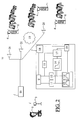
- the system for giving intelligibility feedback to a speaker 1, speaking for an audience 2, comprises a first microphone 3 at the speaker's side and a second microphone 4 at the audience's side.
- the first and second microphone are connected to a processing module which is arranged to compute a real-time or nearly real-time intelligibility value based on the signals originated by the first microphone and the second microphone.
- a signalling module 6 is connected (directly or remotely as will be discussed below) to the processing module 5 and is arranged to generate a (positive) intelligibility feedback signal - e.g. a green light 7 - when the intelligibility value lies within a certain (acceptable) range, or to generate a (negative) intelligibility feedback signal - e.g.
- the signalling module in this exemplary embodiment is thus arranged to generate the intelligibility feedback signal in an optical form, which is visible for the speaker 1.
- the green light 7 is green the speaker may assume that his intelligibility, as perceived by the audience, is good.
- the processing module 5 comprises an microphone interface 9.
- the signal of the first microphone 3 is fed to a module 11 in which the envelope spectrum the first microphone's signal is calculated.
- the signal of the second microphone 4 is fed to a module 12 in which the envelope spectrum the second microphone's signal is calculated.
- Both calculated envelopes are supplied to a module 16 in which the phase-weighted sMTF is calculated as discussed in the previous paragraph, which calculated phase-weighted sMTF value is fed to a module 17.
- a module 15, between the second microphone 4 and module 17 calculates a listening level value and feeds it to module 17.
- Module 17 computes an approximate STI value from phase-weighted sMTF value (module 16) and the listening level value (module 15) varying from 0 (completely unintelligible) to 1 (perfect intelligibility) and feeds is to a control module 10, to which the signalling module 6 is connected and which controls the status of signalling module 6 ("red"/"green”).
- the envelope spectra which are calculated in modules 11 and 12 are also fed to modules 13 and 14 respectively, in order to determine whether the measured signals are speech signals indeed and to discard the measurement if not.
- the measured envelope spectra are fit (matched) to an anticipated form, e.g. a parabola or another simple mathematical function.
- the fitting error between both is used as a second value for control module 10 to set the signalling module's status: if the fitting error is too high the red light 8 should go on and the green light 7 out.
- the signalling module is located at the side of the audience, especially in the neighbourhood of the second microphone 4 which, together with the first microphone 3, is responsible for the intelligibility rate which is computed by the processing module 5.
- the signalling module 6, the processing module 5 and the second microphone 4 could be integrated within one common housing. It is noted here that use might be made by several second microphones, located at several locations in a hall, each of which is connected to a common or individual processing module, responsible for the computation of an intelligibility value (rate), valid for that specific second microphone's environment.
- those second microphones 4 could, as well as the first microphones 3 and the (common) processing module 5, be interconnected by means of a wireless network 9 (all relevant system components should comprise wireless I/O interfaces, as indicated by antennas 10.
- the processing module 5 could, together with the relevant second microphone 4 and signalling module 6, be integrated in one common housing. In that case each second microphone 4 has its own processing and signalling means.
- it could be preferred to have a common processing module, connected with several second microphones 4. In that configuration the processing means could be used in a time-shared way, processing the signals from the second microphones (and the first microphone 3) in a cyclic way, one after the other. Using such a common processing module could result in cost reduction.
- the signalling module is located at the side of the speaker, e.g. in cases where the speaker can not or hardly see his audience, which may be the case at public address systems.
- the signalling module may comprise the display means (e.g. the lights 7 and 8 or other display means, e.g. an LCD or LED based screen) of several locations, which are controlled - via the processing means (local or common, as discussed above) - by the relevant second microphones.
- the system component may be interconnected by means of a wireless network 9.
- the relevant system components - the processing module, the first microphone(s), the second microphone(s) and the signalling module(s) - should comprise wireless I/O interfaces, as indicated by the antennas 10.
- the processing module 5 is arranged to estimate or calculate a Modulation Transfer Function (MTF) based on the speaker's speech - picked up by the first microphone 3 and transferred to the processing module 5 via a cable or via a wireless path 9, using the cross spectrum between the signal received by the first microphone 3 and the signal received by the relevant second microphone 4.
- MTF Modulation Transfer Function
- the cross spectrum is standardized with the auto spectrum of the first microphone's signal or a modulus of it.
- the processing module 5 detects the phase of the cross spectrum and counts only those parts of the signal of which the phase difference does not cross a certain value.
- the MTF may e.g. be calculated for modulation frequencies between 1 and 3 Hz and in the octave bands between 0.5 and 2 kHz.
- the processing module may be arranged to fit the measured enveloping spectra to an anticipated form - e.g. a parabola or another simple mathematical function - and to control the generation of the intelligibility feedback signal in dependency of the fitting error.
- the processing module 5 may be arranged to control the generation of the intelligibility feedback signal in dependency of the signal level output by the first or second microphone, to include the effect of (too low) speech level, which is uncomfortable for the listening audience and thus should be signalled by the relevant signalling module.
- the speaker 1 will address his speech via a public address system, which in figure 2 is indicated by a speech amplifier 20 to which the wireless microphone 3 is connected, and a number of loudspeakers 21 at the side of the audience.
Landscapes
- Engineering & Computer Science (AREA)
- Health & Medical Sciences (AREA)
- Physics & Mathematics (AREA)
- Acoustics & Sound (AREA)
- Signal Processing (AREA)
- General Health & Medical Sciences (AREA)
- Otolaryngology (AREA)
- Computational Linguistics (AREA)
- Audiology, Speech & Language Pathology (AREA)
- Human Computer Interaction (AREA)
- Multimedia (AREA)
- Circuit For Audible Band Transducer (AREA)
Abstract
System for giving intelligibility feedback to a speaker (1), speaking for an audience (2), comprising a first microphone (3) at the speaker's side and a second microphone (4) at the audience's side. Both microphones are connected to processing means (5) which are arranged to compute an intelligibility value based on both microphones' signals. Signalling means (6), preferably at the side of the audience, are arranged to generate an intelligibility feedback signal depending on the calculated intelligibility value. The signalling means being arranged to generate said intelligibility feedback signal in an optical form, visible for the speaker concerned. Wireless connection means (19) may interconnect the microphones, the processing means and the signalling means.
Description
- The invention concerns a system for the improvement of the intelligibility of speakers addressing a target audience.
- Speaking intelligibly in public is an art. Although every public speaking course devotes some attention to this aspect ("please think about the back row"), various reasons can be given for why a speaker may be poorly intelligible. In part this will have to do with the speaker himself (speech style, speaking speed, volume), but on the other hand it may have to do with the room (e.g. ventilation or traffic noise etc.) and the quality of the speaking facility. Everyone knows examples of lectures or speeches where the speaker was totally unintelligible to half of his audience.
- One aim of the invention is to provide a system for giving intelligibility feedback to a speaker, speaking for a -real or imaginary (e.g. in a test or preparation situation) - audience, comprising an (at least) first microphone at the speaker's location and an (at least) second microphone at the audience's location, said first and second microphone being connected to processing means which are arranged to compute in real-time or nearly real-time, an intelligibility value based on the (at least) first microphone's signal and the (at least) second microphone's signal and to output an intelligibility feedback signal when the intelligibility value lies within a certain range or an intelligibility feedback signal when said intelligibility value lies outside a certain range.
- Said intelligibility feedback signal may be in the form of e.g. a green light, visible for the speaker concerned, when the intelligibility value lies within a range which corresponds to a good intelligibility, or e.g. a (for instance blinking) red light when the intelligibility value lies outside that range, corresponding to a insufficient intelligibility. When the speaker sees that the light is green (s)he knows that (s)he is clearly understood. If the light turns red, then (s)he has to talk more clearly, louder, slower or better into the microphone. Such a "speech intelligibility light" (although the intelligibility feedback signal may be output in a different form then a green/red light), for example, can be placed in the rear of the auditorium or even in various places spread throughout the hall.
- The algorithm which may be used by the processing means - arranged to compute a (near) real-time intelligibility value based on the signals of the first and second microphones - may be based on the so-called Speech Transmission Index (STI), varying from 0 (completely unintelligible) to 1 (perfect intelligibility). In STI testing, speech may be modelled by a test signal with speech-like characteristics. According to the STI concept speech can be described as a fundamental waveform that is modulated by low-frequency signals. STI employs a complex amplitude modulation scheme to generate its test signal. At the receiving end of the transmission path, the depth of modulation of the received signal is compared with that of the test signal in a number of frequency bands. Reductions in the modulation depth are associated with loss of intelligibility. Derived from the STI method are the Rapid Speech Transmission Index (RASTI) and the Speech Intelligibility Index (SII).
- Since the use of artificial test signals is impossible when providing intelligibility feedback to a speaker in a live situation, only so-called speech-based STI measurements, which use real speech as a probe signal, will be applicable. From experiments it was learned that an improved STI method, called "Phase Weighting" (PW) STI, to be discussed below, is sufficiently resistant to e.g. disturbance by other speakers (e.g. within the audience) - an important factor for intelligibility - to be used within the intelligibility's processing means for discriminating between an acceptable and not acceptable intelligibility of the speaker at the audience's side.
- A so-called Modulation Transfer Function (MTF) is an important interim result in the determination of the (PW) STI. The MTF is normally estimated with the aid of modulated noise signals, e.g. simulated human speech. In the present case, however, for understandable reasons, the measurement has to performed in (nearly) real-time with natural speech, viz. the speaker's speech. The most common form of the MTF for STI-with-speech (sMTF) measurements is:

- In this case use is made of the cross spectrum ("crossspectrum") between speech signals at the input side (the speaker's location) and the output side (the audience's side) of the "communication channel" (viz. through the room), standardized with (the modulus of) the spectrum of the input signal ("autospectrum"). If speech is present at both ends of the transmission path (room, hall) - viz. the "official" speaker's speech and interfering speech e.g. within the audience or in the audience's environment -, the risk exists of scoring the MTF too high (too favourably). This drawback could be prevented by paying attention to the phase of the cross spectrum and counting only those parts of the signal between input and output that are sufficiently in phase. This is reproduced in the following comparison:

in which f(∠(crossspectrum)) denotes a function of the phase of the cross spectrum. Use could be made of weighting functions in the form of the following system
in which the value of alpha could be set at about 0.5. - The method outlined here is stricter than previous methods in the "punishment" of phase shifts and thus is considerably more resistant to interfering speech ("babble"). Since interfering speech is one of the most important sources of reduced intelligibility, this method is very useful for application in the processing means of the present intelligibility feedback system ("intelligibility light") as outlined above.
- In general the MTF will be calculated for modulation frequencies of 0.63 to 12.5 Hz and in the octave bands of 125 Hz to 9 kHz. For the "intelligibility light", however, it may be preferred to make both frequency ranges narrower (1 to 3 Hz and 500 Hz to 2 kHz respectively). Due to this preferred restriction the intelligibility calculation time - performed by the processing means - could be reduced more than a
factor 2, while the processing means could operate using a lower sampling frequency. Besides, estimation of the MTF at modulation frequencies above 3 Hz is inaccurate unless long speech fragments are used; in that case, however, the speaker would have to wait too long before the status of the light would updated, so that the light would "lag behind." Finally, higher modulation frequencies are of subordinate importance for the accuracy of the STI estimation. - Besides simple and quick STI measurement, the reliability of the measured MTF is important too. For instance, when pulse-like signals are registered (such as doors slamming shut or applause), the MTF may be greatly distorted. The processing means will thus have to determine whether the measured signals are speech indeed; if not, the measurement must be discarded as unreliable. This could be implemented by fitting the measured envelope spectra to an anticipated form, e.g. a parabola or another simple mathematical function. The fitting error between both could be used as a quality measure; if the fitting error is too high the intelligibility light could become red and/or the green light will go out.
- Finally, consideration should be given to the effect of the speech signal level. If the speech signal level is too low, listening may become uncomfortable, even if the STI indicates an (in principle) intelligible signal. For that reason, preferably, the processing means determine too low signal levels and process that situation into a non-intelligible signal ("red light").
-
- Figure 1 shows a first embodiment of the invention;
- Figure 2 shows a second embodiment of the invention.
- The system for giving intelligibility feedback to a speaker 1, speaking for an
audience 2, comprises a first microphone 3 at the speaker's side and a second microphone 4 at the audience's side. The first and second microphone are connected to a processing module which is arranged to compute a real-time or nearly real-time intelligibility value based on the signals originated by the first microphone and the second microphone. Asignalling module 6 is connected (directly or remotely as will be discussed below) to the processing module 5 and is arranged to generate a (positive) intelligibility feedback signal - e.g. a green light 7 - when the intelligibility value lies within a certain (acceptable) range, or to generate a (negative) intelligibility feedback signal - e.g. a red light 8 - when the intelligibility value lies outside a certain range. The signalling module in this exemplary embodiment is thus arranged to generate the intelligibility feedback signal in an optical form, which is visible for the speaker 1. When the green light 7 is green the speaker may assume that his intelligibility, as perceived by the audience, is good. - The processing module 5 comprises an
microphone interface 9. The signal of the first microphone 3 is fed to amodule 11 in which the envelope spectrum the first microphone's signal is calculated. The signal of the second microphone 4 is fed to amodule 12 in which the envelope spectrum the second microphone's signal is calculated. Both calculated envelopes are supplied to amodule 16 in which the phase-weighted sMTF is calculated as discussed in the previous paragraph, which calculated phase-weighted sMTF value is fed to amodule 17. Amodule 15, between the second microphone 4 andmodule 17 calculates a listening level value and feeds it tomodule 17.Module 17 computes an approximate STI value from phase-weighted sMTF value (module 16) and the listening level value (module 15) varying from 0 (completely unintelligible) to 1 (perfect intelligibility) and feeds is to acontrol module 10, to which thesignalling module 6 is connected and which controls the status of signalling module 6 ("red"/"green"). The envelope spectra which are calculated inmodules modules modules control module 10 to set the signalling module's status: if the fitting error is too high thered light 8 should go on and the green light 7 out. - It might be preferred that the signalling module is located at the side of the audience, especially in the neighbourhood of the second microphone 4 which, together with the first microphone 3, is responsible for the intelligibility rate which is computed by the processing module 5. The
signalling module 6, the processing module 5 and the second microphone 4 could be integrated within one common housing. It is noted here that use might be made by several second microphones, located at several locations in a hall, each of which is connected to a common or individual processing module, responsible for the computation of an intelligibility value (rate), valid for that specific second microphone's environment. As figure 2 shows, those second microphones 4 could, as well as the first microphones 3 and the (common) processing module 5, be interconnected by means of a wireless network 9 (all relevant system components should comprise wireless I/O interfaces, as indicated byantennas 10. The processing module 5 could, together with the relevant second microphone 4 andsignalling module 6, be integrated in one common housing. In that case each second microphone 4 has its own processing and signalling means. However, it could be preferred to have a common processing module, connected with several second microphones 4. In that configuration the processing means could be used in a time-shared way, processing the signals from the second microphones (and the first microphone 3) in a cyclic way, one after the other. Using such a common processing module could result in cost reduction. - In some situations it may be preferred that the signalling module is located at the side of the speaker, e.g. in cases where the speaker can not or hardly see his audience, which may be the case at public address systems. In that case the signalling module may comprise the display means (e.g. the
lights 7 and 8 or other display means, e.g. an LCD or LED based screen) of several locations, which are controlled - via the processing means (local or common, as discussed above) - by the relevant second microphones. - As discussed above, the system component may be interconnected by means of a
wireless network 9. In that case - illustrated in figure 2, the relevant system components - the processing module, the first microphone(s), the second microphone(s) and the signalling module(s) - should comprise wireless I/O interfaces, as indicated by theantennas 10. - The processing module 5 is arranged to estimate or calculate a Modulation Transfer Function (MTF) based on the speaker's speech - picked up by the first microphone 3 and transferred to the processing module 5 via a cable or via a
wireless path 9, using the cross spectrum between the signal received by the first microphone 3 and the signal received by the relevant second microphone 4. In the processing module 5 the cross spectrum is standardized with the auto spectrum of the first microphone's signal or a modulus of it. Subsequently, the processing module 5 detects the phase of the cross spectrum and counts only those parts of the signal of which the phase difference does not cross a certain value. The MTF may e.g. be calculated for modulation frequencies between 1 and 3 Hz and in the octave bands between 0.5 and 2 kHz. As discussed in the previous paragraph, the processing module may be arranged to fit the measured enveloping spectra to an anticipated form - e.g. a parabola or another simple mathematical function - and to control the generation of the intelligibility feedback signal in dependency of the fitting error. Moreover, as discussed before, the processing module 5 may be arranged to control the generation of the intelligibility feedback signal in dependency of the signal level output by the first or second microphone, to include the effect of (too low) speech level, which is uncomfortable for the listening audience and thus should be signalled by the relevant signalling module. - Finally, in most practical situations the speaker 1 will address his speech via a public address system, which in figure 2 is indicated by a
speech amplifier 20 to which the wireless microphone 3 is connected, and a number ofloudspeakers 21 at the side of the audience.
Claims (10)
- System for giving intelligibility feedback to a speaker (1), speaking for an audience (2), comprising a first microphone (3) at the speaker's side and a second microphone (4) at the audience's side, said first and second microphone being connected to processing means (5) which are arranged to compute a real-time or nearly real-time intelligibility value based on said first microphone's signal and said second microphone's signal and signalling means (6), connected to said processing means, which are arranged to generate an intelligibility feedback signal when said intelligibility value lies within a certain range or to generate an intelligibility feedback signal when said intelligibility value lies outside a certain range.
- System according to claim 1, said signalling means being arranged to generate said intelligibility feedback signal in an optical form, visible for the speaker concerned.
- System according to claim 1, said signalling means being located at the side of the audience.
- System according to claim 1, said signalling means being located at the side of the speaker.
- System according to claim 3 or 4, comprising wireless connection means (19), arranged to interconnect, at least in part, the processing means, the first microphone, the second microphone and the signalling means.
- System according to claim 1, the processing means being arranged to estimate or calculate a Modulation Transfer Function (MTF) based on the speaker's speech, using the cross spectrum between the signal received by the first microphone and the signal received by the second microphone, said cross spectrum being standardized with the auto spectrum of the first microphone's signal or a modulus of it.
- System according to claim 6, detecting the phase of said cross spectrum and counting only those parts of the signal of which the phase difference does not cross a certain value.
- System according to claim 6, the MTF being calculated for modulation frequencies of 1 to 3 Hz and in the octave bands of 500 Hz to 2 kHz.
- System according to claim 6, the processing means being arranged to fit the measured enveloping spectra to an anticipated form and to control the generation of said intelligibility feedback signal in dependency of the fitting error.
- System according to claim 1, the processing means being arranged to control the generation of said intelligibility feedback signal in dependency of the signal level output by the first or second microphone.
Priority Applications (3)
| Application Number | Priority Date | Filing Date | Title |
|---|---|---|---|
| EP06075278A EP1818912A1 (en) | 2006-02-08 | 2006-02-08 | System for giving intelligibility feedback to a speaker |
| PCT/NL2007/050050 WO2007091889A1 (en) | 2006-02-08 | 2007-02-08 | System for giving intelligibility feedback to a speaker |
| US12/278,839 US20090012794A1 (en) | 2006-02-08 | 2007-02-08 | System For Giving Intelligibility Feedback To A Speaker |
Applications Claiming Priority (1)
| Application Number | Priority Date | Filing Date | Title |
|---|---|---|---|
| EP06075278A EP1818912A1 (en) | 2006-02-08 | 2006-02-08 | System for giving intelligibility feedback to a speaker |
Publications (1)
| Publication Number | Publication Date |
|---|---|
| EP1818912A1 true EP1818912A1 (en) | 2007-08-15 |
Family
ID=36228777
Family Applications (1)
| Application Number | Title | Priority Date | Filing Date |
|---|---|---|---|
| EP06075278A Withdrawn EP1818912A1 (en) | 2006-02-08 | 2006-02-08 | System for giving intelligibility feedback to a speaker |
Country Status (3)
| Country | Link |
|---|---|
| US (1) | US20090012794A1 (en) |
| EP (1) | EP1818912A1 (en) |
| WO (1) | WO2007091889A1 (en) |
Cited By (3)
| Publication number | Priority date | Publication date | Assignee | Title |
|---|---|---|---|---|
| US20150269929A1 (en) * | 2014-03-21 | 2015-09-24 | International Business Machines Corporation | Dynamically providing to a person feedback pertaining to utterances spoken or sung by the person |
| CN114402388A (en) * | 2019-09-11 | 2022-04-26 | Dts公司 | Context aware speech intelligibility enhancement |
| CN115083444A (en) * | 2022-06-08 | 2022-09-20 | 浙江大学 | Real-time voice definition on-line detection and real-time feedback system |
Families Citing this family (11)
| Publication number | Priority date | Publication date | Assignee | Title |
|---|---|---|---|---|
| US20090018826A1 (en) * | 2007-07-13 | 2009-01-15 | Berlin Andrew A | Methods, Systems and Devices for Speech Transduction |
| DE102009038599B4 (en) * | 2009-08-26 | 2015-02-26 | Db Netz Ag | Method for measuring speech intelligibility in a digital transmission system |
| EP2708040B1 (en) | 2011-05-11 | 2019-03-27 | Robert Bosch GmbH | System and method for emitting and especially controlling an audio signal in an environment using an objective intelligibility measure |
| US9406310B2 (en) * | 2012-01-06 | 2016-08-02 | Nissan North America, Inc. | Vehicle voice interface system calibration method |
| US20150012265A1 (en) * | 2013-07-02 | 2015-01-08 | Sander Jeroen van Wijngaarden | Enhanced Speech Transmission Index measurements through combination of indirect and direct MTF estimation |
| JP6078461B2 (en) * | 2013-12-18 | 2017-02-08 | 本田技研工業株式会社 | Sound processing apparatus, sound processing method, and sound processing program |
| US10522053B2 (en) * | 2016-03-30 | 2019-12-31 | Intel Corporation | Speech clarity systems and techniques |
| US10446166B2 (en) | 2016-07-12 | 2019-10-15 | Dolby Laboratories Licensing Corporation | Assessment and adjustment of audio installation |
| JP6646001B2 (en) * | 2017-03-22 | 2020-02-14 | 株式会社東芝 | Audio processing device, audio processing method and program |
| JP2018159759A (en) * | 2017-03-22 | 2018-10-11 | 株式会社東芝 | Voice processor, voice processing method and program |
| WO2020229205A1 (en) * | 2019-05-13 | 2020-11-19 | Signify Holding B.V. | A lighting device |
Citations (1)
| Publication number | Priority date | Publication date | Assignee | Title |
|---|---|---|---|---|
| US20050135637A1 (en) * | 2003-12-18 | 2005-06-23 | Obranovich Charles R. | Intelligibility measurement of audio announcement systems |
-
2006
- 2006-02-08 EP EP06075278A patent/EP1818912A1/en not_active Withdrawn
-
2007
- 2007-02-08 WO PCT/NL2007/050050 patent/WO2007091889A1/en not_active Ceased
- 2007-02-08 US US12/278,839 patent/US20090012794A1/en not_active Abandoned
Patent Citations (1)
| Publication number | Priority date | Publication date | Assignee | Title |
|---|---|---|---|---|
| US20050135637A1 (en) * | 2003-12-18 | 2005-06-23 | Obranovich Charles R. | Intelligibility measurement of audio announcement systems |
Non-Patent Citations (5)
| Title |
|---|
| BACKMAN J: "A method for measuring modulation transmission in speech transmitted via a nonlinear channel", ACOUSTICS, SPEECH, AND SIGNAL PROCESSING, 1997. ICASSP-97., 1997 IEEE INTERNATIONAL CONFERENCE ON MUNICH, GERMANY 21-24 APRIL 1997, LOS ALAMITOS, CA, USA,IEEE COMPUT. SOC, US, vol. 3, 21 April 1997 (1997-04-21), pages 1715 - 1718, XP010226467, ISBN: 0-8186-7919-0 * |
| CHI TAISHIH ET AL: "Spectro-temporal modulation transfer functions and speech intelligibility", JOURNAL OF THE ACOUSTICAL SOCIETY OF AMERICA, AIP / ACOUSTICAL SOCIETY OF AMERICA, MELVILLE, NY, US, vol. 106, no. 5, November 1999 (1999-11-01), pages 2719 - 2732, XP012001302, ISSN: 0001-4966 * |
| SANCHEZ-BOTE J L ET AL: "A real-time auditory-based microphone array assessed with e-rasti evaluation proposal", 2003 IEEE INTERNATIONAL CONFERENCE ON ACOUSTICS, SPEECH, AND SIGNAL PROCESSING. PROCEEDINGS. (ICASSP). HONG KONG, APRIL 6 - 10, 2003, IEEE INTERNATIONAL CONFERENCE ON ACOUSTICS, SPEECH, AND SIGNAL PROCESSING (ICASSP), NEW YORK, NY : IEEE, US, vol. VOL. 1 OF 6, 6 April 2003 (2003-04-06), pages V477 - V480, XP010639312, ISBN: 0-7803-7663-3 * |
| STEENEKEN H J M ET AL: "RASTI: A TOOL FOR EVALUATING AUDITORIA", TECHNICAL REVIEW, BRUEL OG KJAER. NAERUM, DK, no. 3, 1985, pages 13 - 44, XP000763217 * |
| T HOUTGAST, HJM STEENEKEN: "A review of the MTF concept in room acoustics and its use for estimating speech intelligibility in auditoria", J. ACOUST. SOC. AM., vol. 77, no. 3, March 1985 (1985-03-01), pages 1069 - 1077, XP007900595 * |
Cited By (7)
| Publication number | Priority date | Publication date | Assignee | Title |
|---|---|---|---|---|
| US20150269929A1 (en) * | 2014-03-21 | 2015-09-24 | International Business Machines Corporation | Dynamically providing to a person feedback pertaining to utterances spoken or sung by the person |
| US9779761B2 (en) | 2014-03-21 | 2017-10-03 | International Business Machines Corporation | Dynamically providing to a person feedback pertaining to utterances spoken or sung by the person |
| US10395671B2 (en) | 2014-03-21 | 2019-08-27 | International Business Machines Corporation | Dynamically providing to a person feedback pertaining to utterances spoken or sung by the person |
| US11189301B2 (en) | 2014-03-21 | 2021-11-30 | International Business Machines Corporation | Dynamically providing to a person feedback pertaining to utterances spoken or sung by the person |
| CN114402388A (en) * | 2019-09-11 | 2022-04-26 | Dts公司 | Context aware speech intelligibility enhancement |
| CN114402388B (en) * | 2019-09-11 | 2025-06-06 | Dts公司 | Context-aware speech intelligibility enhancement |
| CN115083444A (en) * | 2022-06-08 | 2022-09-20 | 浙江大学 | Real-time voice definition on-line detection and real-time feedback system |
Also Published As
| Publication number | Publication date |
|---|---|
| US20090012794A1 (en) | 2009-01-08 |
| WO2007091889A1 (en) | 2007-08-16 |
Similar Documents
| Publication | Publication Date | Title |
|---|---|---|
| US20090012794A1 (en) | System For Giving Intelligibility Feedback To A Speaker | |
| Campbell et al. | A Matlab simulation of" shoebox" room acoustics for use in research and teaching | |
| EP3360250B1 (en) | A sound signal processing apparatus and method for enhancing a sound signal | |
| US7492908B2 (en) | Sound localization system based on analysis of the sound field | |
| EP3057333B1 (en) | Detection method and detection system for audio transmission characteristic of building intercom system | |
| Wen et al. | Blind estimation of reverberation time based on the distribution of signal decay rates | |
| EP2708040B1 (en) | System and method for emitting and especially controlling an audio signal in an environment using an objective intelligibility measure | |
| US20120093329A1 (en) | Localisation in a Bilateral Hearing Device System | |
| US20070121955A1 (en) | Room acoustics correction device | |
| CN106686520A (en) | Multi-channel audio system capable of tracking user and equipment with multi-channel audio system | |
| CN102438189A (en) | Sound source positioning method based on dual-channel acoustic signals | |
| Nordqvist et al. | An efficient robust sound classification algorithm for hearing aids | |
| Lavandier et al. | Binaural prediction of speech intelligibility in reverberant rooms with multiple noise sources | |
| EP1432137A2 (en) | Echo detection and monitoring | |
| Schimmel et al. | A fast and accurate “shoebox” room acoustics simulator | |
| EP1492085A2 (en) | Method of reflecting time/language distortion in objective speech quality assessment | |
| Roßbach et al. | Non-intrusive binaural prediction of speech intelligibility based on phoneme classification | |
| CN109257687A (en) | Hearing device and method with non-intrusive speech clarity | |
| US20110268285A1 (en) | Sound image localization estimating device, sound image localization control system, sound image localization estimation method, and sound image localization control method | |
| CN115512719B (en) | Voice quality evaluation method, device and system for local communication | |
| Bozzoli et al. | Balloons of directivity of real and artificial mouth used in determining speech transmission index | |
| Beit-On et al. | The Importance of Time-Frequency Averaging for Binaural Speaker Localization in Reverberant Environments. | |
| Geravanchizadeh et al. | Microscopic prediction of speech intelligibility in spatially distributed speech-shaped noise for normal-hearing listeners | |
| KR101073632B1 (en) | A zero-crossing-based multiple source localization apparatus in reverberant environments | |
| Sen | Predicting foreground SH, SL and BNH DAM scores for multidimensional objective measure of speech quality |
Legal Events
| Date | Code | Title | Description |
|---|---|---|---|
| PUAI | Public reference made under article 153(3) epc to a published international application that has entered the european phase |
Free format text: ORIGINAL CODE: 0009012 |
|
| AK | Designated contracting states |
Kind code of ref document: A1 Designated state(s): AT BE BG CH CY CZ DE DK EE ES FI FR GB GR HU IE IS IT LI LT LU LV MC NL PL PT RO SE SI SK TR |
|
| AX | Request for extension of the european patent |
Extension state: AL BA HR MK YU |
|
| AKX | Designation fees paid | ||
| REG | Reference to a national code |
Ref country code: DE Ref legal event code: 8566 |
|
| STAA | Information on the status of an ep patent application or granted ep patent |
Free format text: STATUS: THE APPLICATION IS DEEMED TO BE WITHDRAWN |
|
| 18D | Application deemed to be withdrawn |
Effective date: 20080216 |