EP1818386A2 - Process of regeneration of exhausted vegetable oil - Google Patents
Process of regeneration of exhausted vegetable oil Download PDFInfo
- Publication number
- EP1818386A2 EP1818386A2 EP06425788A EP06425788A EP1818386A2 EP 1818386 A2 EP1818386 A2 EP 1818386A2 EP 06425788 A EP06425788 A EP 06425788A EP 06425788 A EP06425788 A EP 06425788A EP 1818386 A2 EP1818386 A2 EP 1818386A2
- Authority
- EP
- European Patent Office
- Prior art keywords
- exhausted
- regeneration
- oil
- vegetable oil
- zeolitite
- Prior art date
- Legal status (The legal status is an assumption and is not a legal conclusion. Google has not performed a legal analysis and makes no representation as to the accuracy of the status listed.)
- Withdrawn
Links
Images

Classifications
-
- C—CHEMISTRY; METALLURGY
- C10—PETROLEUM, GAS OR COKE INDUSTRIES; TECHNICAL GASES CONTAINING CARBON MONOXIDE; FUELS; LUBRICANTS; PEAT
- C10L—FUELS NOT OTHERWISE PROVIDED FOR; NATURAL GAS; SYNTHETIC NATURAL GAS OBTAINED BY PROCESSES NOT COVERED BY SUBCLASSES C10G OR C10K; LIQUIFIED PETROLEUM GAS; USE OF ADDITIVES TO FUELS OR FIRES; FIRE-LIGHTERS
- C10L1/00—Liquid carbonaceous fuels
- C10L1/02—Liquid carbonaceous fuels essentially based on components consisting of carbon, hydrogen, and oxygen only
- C10L1/026—Liquid carbonaceous fuels essentially based on components consisting of carbon, hydrogen, and oxygen only for compression ignition
-
- C—CHEMISTRY; METALLURGY
- C11—ANIMAL OR VEGETABLE OILS, FATS, FATTY SUBSTANCES OR WAXES; FATTY ACIDS THEREFROM; DETERGENTS; CANDLES
- C11B—PRODUCING, e.g. BY PRESSING RAW MATERIALS OR BY EXTRACTION FROM WASTE MATERIALS, REFINING OR PRESERVING FATS, FATTY SUBSTANCES, e.g. LANOLIN, FATTY OILS OR WAXES; ESSENTIAL OILS; PERFUMES
- C11B3/00—Refining fats or fatty oils
- C11B3/10—Refining fats or fatty oils by adsorption
-
- Y—GENERAL TAGGING OF NEW TECHNOLOGICAL DEVELOPMENTS; GENERAL TAGGING OF CROSS-SECTIONAL TECHNOLOGIES SPANNING OVER SEVERAL SECTIONS OF THE IPC; TECHNICAL SUBJECTS COVERED BY FORMER USPC CROSS-REFERENCE ART COLLECTIONS [XRACs] AND DIGESTS
- Y02—TECHNOLOGIES OR APPLICATIONS FOR MITIGATION OR ADAPTATION AGAINST CLIMATE CHANGE
- Y02E—REDUCTION OF GREENHOUSE GAS [GHG] EMISSIONS, RELATED TO ENERGY GENERATION, TRANSMISSION OR DISTRIBUTION
- Y02E50/00—Technologies for the production of fuel of non-fossil origin
- Y02E50/10—Biofuels, e.g. bio-diesel
Landscapes
- Chemical & Material Sciences (AREA)
- Oil, Petroleum & Natural Gas (AREA)
- Life Sciences & Earth Sciences (AREA)
- Engineering & Computer Science (AREA)
- Chemical Kinetics & Catalysis (AREA)
- Organic Chemistry (AREA)
- Microbiology (AREA)
- Wood Science & Technology (AREA)
- General Chemical & Material Sciences (AREA)
- Fats And Perfumes (AREA)
- Solid Fuels And Fuel-Associated Substances (AREA)
Abstract
1. The process provides to eliminate from vegetable cooking oil the combustion inhibitors, in particular antioxidant components, and to increase its higher heat value.
2. The regeneration is done by mixing exhausted vegetable oil with zeolite cabasitico-phillipsitica by ionic exchange process and by surface absorption process.The zeolitite is a pyroclastic rock containing a zeolite value not below 50% by weight.
3. The zeolitite jointly used for the regeneration process are cabasite and phillipsite in no binding percentage.
4. The purpose of the regeneration process is the use of exhausted vegetable oil as renewable power source to produce energy. In addition to the economic benefit there is an advantage in the treatment of polluting elements avoiding environment damages.
2. The regeneration is done by mixing exhausted vegetable oil with zeolite cabasitico-phillipsitica by ionic exchange process and by surface absorption process.The zeolitite is a pyroclastic rock containing a zeolite value not below 50% by weight.
3. The zeolitite jointly used for the regeneration process are cabasite and phillipsite in no binding percentage.
4. The purpose of the regeneration process is the use of exhausted vegetable oil as renewable power source to produce energy. In addition to the economic benefit there is an advantage in the treatment of polluting elements avoiding environment damages.
Description
-
- 1. The present model has the following object: the exhausted vegetal oil treatment deriving from cooking of alimentary product and not alimentary. Actually being this product considered a rubbish is in large proportion dispel in the environment with damage to the ecosystems.
- 2. For the proportion which is heaped there isn't a well defined reutilization activity, being the product in large part exceedingly dirty and pong. After filtration too to eliminate the sediments it isn't useful as combustible because it doesn't produce combustion reaction or, if this reaction happen, it stops after a few time.
- 3. Of one palmitate oil sample deriving form a fried food it has been impossible to determine the calorific powerful, with the calorimetric bomb, also in relation 1/3 with benzoic acid as start.
The cause derives from the presence of antioxidant components in the exhausted vegetal oil formed as consequences of its use which stops the radicalic reaction which is the base of combustion process. - 4. The regeneration process here described has the purpose the recuperation of exhausted vegetal oil as combustible so that to produce energy form renewable source. Raw exhausted vegetal oil is mixed and kept in contact with zeolitite-cabasitic-phillipsite in powder.
- 5. This is pyroclastic rock whose content in cabasite and phillipsite, the sum of them, is not below 50% weigh.The cabasite as formula Ca2(Al4Si8O24). 12 H2O and the phillipsite as formula (Ca,Na2,K2)3(Al6Si10O32). 12H2O are both zeolite belonging to the class of Tectosillicate.
- 1. Chemically they are alluminosilicate hydrate of alcalinic elements (Na, K) and alcalinic - terrosi elements (Ca).
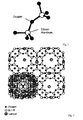
Their mineralogical structure is constituted by a 3-d scaffolding of tetraedros Si04- where the partial substitution of silica with aluminium give to the structure negative sign balanced by the presence of cations of alcalinic metal and alcalinic-terrosi. - 2. The figure 1 shows the scheme of base tetrahedros scaffolding.
The nature of the bond between the cations and the tetrahedros structures is of electrostatic kind producing in this way the ionic mobility that gives to the cabasite and phillipsite the property of ionic exchangers.
A particular type of ionic exchange is the acceptance of a proton that create the property of cabasite and phillipsite to behaviour as Bronsted acids. - 3. Also for this property the two zeolite eliminate the water residual from exhausted vegetal oil. The Fig. 2 shows the scheme of cations disposition inside the tetrahedros scaffolding.
The aggregation of tetrahedros scaffolding generate wide inside cavities communicating between themselves and with external by conduit of molecular size that give to cabasite and phillipsite an enormous surface till to 700 square metres/0.1 gram. - 4. This characteristic gives to cabasite and phillipsite exclusive property of surface absorption. The fig. 3 shows the aggregation of the tetrahedros scaffolding in the cabasite and the creation of conduit of molecular size. The fig. 4 shows the aggregation of tetrahedros scaffolding in the phillipsite and the creation of conduit of molecular size.
- 5. Both for ionic exchange and surface absorption the cabasite and phillipsite eliminate from raw exhausted vegetal oil the antioxidant components that inhibited the combustion.
- 1. Tab. 1 - Palmitate oil exhausted after process of regeneration and gasoline. Combustion in firebox with smoke tube made. Analysis of emission.
It showed that emission values relatives to the combustion of exhausted vegetal oil after regeneration process are more lower to the fixed value of Italian and European law on the matter as well as lower to the ones relatives to gasoline combustion, intended this one as traditional combustible. - 2. It has not being possible made the same test on exhausted palmitate oil non treated because it doesn't produce any combustion.
The zeolitite divided from the treatment process of exhausted vegetal oil is biomass that can be recovered.
1. By ionic exchange and surface absorption they eliminate also water, of which vegetal oil enriched after cooking alimentary products, due to the loss of water by warming of the food.
The elimination of water determine an increase of the calorific powerful superior to a value between 10 and 20% respect to the original raw exhausted vegetal oil.
2. The raw exhausted vegetal oil is mixed with zeolitite-cabasitic-phillipsite in powder in a quantity of 100-500 mg of zeolitite/ton of exhausted vegetal oil and maintained in contact by mechanical shaker for a variable time from 100 to 130 minutes.
3. After all there is the split of zeolitite from the oil by centrifuge and then micro-filtration. The treatment process is exclusively of mechanical and physical nature and it doesn't produce any emission.
Exhausted vegetal oil produced can be stocked and used as combustible so that.
4. Test in firebox with smoke tube made on palmitate oil exhausted deriving form fried food restaurant produced emission in atmosphere whose chemical parameters are showed in table 1, compared with value determined in the same conditions by combustion of gasoline.
5.
| Unit of measure | Palpitate oil exhausted after process of regeneration | Gasoline | |
| Ambient temperature | °C | 21,4 | 23,4 |
| Withdrawal temperature | °C | 206,7 | 197,5 |
| Powerful superior | Kcal/Kg | 10460 | 10826 |
| Duration withdrawal | Ore | 0,5 | 0,5 |
| Parameters | |||
| 02 | % | 8 | 10 |
| CO2 | % | 9,8 | 8 |
| SO2 | mg/nmc | 0 | 0 |
| NO | mg/nmc | 37 | 59 |
| NO2 | mglnmc | 0 | 0 |
| NOx | mglnmc | 56,7 | 90,1 |
| Hidrocarbon no burning | mglnmc | 3 | 149 |
| Work Parameter | |||
| Leak of chimney | 10,9 | 12,1 | |
| Energy performance ETA) | 89,1 | 87,9 | |
| Leak of no burning | 0 | 0 | |
| LAMDA(excess of air) | 1,62 | 1,86 |
Claims (2)
- The use of zeolitite-cabasitic-phillipsite in the treatment of exhausted vegetal oil for their reutilization as combustible.
- The use of mix of zeolite, cabasite and phillipsite in any relation between them in the treatment of exhausted vegetal oil for their reutilization as combustible.
Applications Claiming Priority (1)
| Application Number | Priority Date | Filing Date | Title |
|---|---|---|---|
| IT000009A ITFG20050009A1 (en) | 2005-11-28 | 2005-11-28 | REGENERATION PROCESS OF EXACTLY VEGETABLE OIL. |
Publications (1)
| Publication Number | Publication Date |
|---|---|
| EP1818386A2 true EP1818386A2 (en) | 2007-08-15 |
Family
ID=37891704
Family Applications (1)
| Application Number | Title | Priority Date | Filing Date |
|---|---|---|---|
| EP06425788A Withdrawn EP1818386A2 (en) | 2005-11-28 | 2006-11-20 | Process of regeneration of exhausted vegetable oil |
Country Status (2)
| Country | Link |
|---|---|
| EP (1) | EP1818386A2 (en) |
| IT (1) | ITFG20050009A1 (en) |
Cited By (1)
| Publication number | Priority date | Publication date | Assignee | Title |
|---|---|---|---|---|
| CN103556743A (en) * | 2013-10-14 | 2014-02-05 | 许庆华 | Calcination-free foam acoustic absorption board made of pyroclastic rock |
-
2005
- 2005-11-28 IT IT000009A patent/ITFG20050009A1/en unknown
-
2006
- 2006-11-20 EP EP06425788A patent/EP1818386A2/en not_active Withdrawn
Cited By (2)
| Publication number | Priority date | Publication date | Assignee | Title |
|---|---|---|---|---|
| CN103556743A (en) * | 2013-10-14 | 2014-02-05 | 许庆华 | Calcination-free foam acoustic absorption board made of pyroclastic rock |
| CN103556743B (en) * | 2013-10-14 | 2016-02-17 | 许庆华 | Calcination-free foam acoustic absorption board made of pyroclastic rock |
Also Published As
| Publication number | Publication date |
|---|---|
| ITFG20050009A1 (en) | 2007-05-29 |
Similar Documents
| Publication | Publication Date | Title |
|---|---|---|
| CN104622318B (en) | Clockwise and anticlockwise rotating lifting type automatic positioning barbecue oven | |
| CN100537727C (en) | A kind of solid alcohol fuel and preparation method thereof | |
| EP1818386A2 (en) | Process of regeneration of exhausted vegetable oil | |
| CN102486314A (en) | Novel biomass gasification furnace | |
| CN204245967U (en) | The smokeless water of lower-discharging type releases carbon barbecue box | |
| CN202267069U (en) | Tail gas treatment device for cremation machine | |
| Verhaart | On designing woodstoves | |
| CN2446927Y (en) | Pollutionless smokeless roasting oven | |
| CN204862752U (en) | Sheep stove is baked to charcoal fire | |
| WO2013181874A1 (en) | Biological methanol oil prepared from illegal cooking oil products | |
| CN203897143U (en) | Charcoal fire smokeless internal mutton leg roasting car | |
| CN201844451U (en) | Cooking device | |
| CN201596435U (en) | Barbecue smoke eliminator | |
| CN206831523U (en) | A kind of olefin separation chemical emission processing unit | |
| CN201316180Y (en) | Portable barbecue oven | |
| CN108350380A (en) | Utilize the environment-friendly solid fuel, preparation method and preparation system of agricultural wastes | |
| CN213955641U (en) | Organic heat carrier furnace | |
| CN204907667U (en) | Barbecuing oven with naked fire | |
| SÖZBİR et al. | Investigation of the Use of Biomass in Fossil Fuel Boilers | |
| Yamada et al. | Utility of coal-biomass briquette for remediation of indoor air pollution caused by coal burning in rural area, in China | |
| Mfundisi et al. | Clean cookstove technology use for energy efficiency in the school system | |
| CN201225670Y (en) | Non-dust furnace | |
| CN202267106U (en) | Combined type lampblack purifier | |
| CN205053852U (en) | Self -disposable oven of oven smog | |
| CN219720482U (en) | Supporting body for bottom of beefsteak stove |
Legal Events
| Date | Code | Title | Description |
|---|---|---|---|
| PUAI | Public reference made under article 153(3) epc to a published international application that has entered the european phase |
Free format text: ORIGINAL CODE: 0009012 |
|
| AK | Designated contracting states |
Kind code of ref document: A2 Designated state(s): AT BE BG CH CY CZ DE DK EE ES FI FR GB GR HU IE IS IT LI LT LU LV MC NL PL PT RO SE SI SK TR |
|
| AX | Request for extension of the european patent |
Extension state: AL BA HR MK YU |
|
| 17P | Request for examination filed |
Effective date: 20080215 |
|
| STAA | Information on the status of an ep patent application or granted ep patent |
Free format text: STATUS: THE APPLICATION IS DEEMED TO BE WITHDRAWN |
|
| 18D | Application deemed to be withdrawn |
Effective date: 20081202 |