EP1818335A1 - Phosphorylcholine group-containing compound and method for producing same - Google Patents
Phosphorylcholine group-containing compound and method for producing same Download PDFInfo
- Publication number
- EP1818335A1 EP1818335A1 EP05809145A EP05809145A EP1818335A1 EP 1818335 A1 EP1818335 A1 EP 1818335A1 EP 05809145 A EP05809145 A EP 05809145A EP 05809145 A EP05809145 A EP 05809145A EP 1818335 A1 EP1818335 A1 EP 1818335A1
- Authority
- EP
- European Patent Office
- Prior art keywords
- compound
- formula
- cation
- denotes
- chemical
- Prior art date
- Legal status (The legal status is an assumption and is not a legal conclusion. Google has not performed a legal analysis and makes no representation as to the accuracy of the status listed.)
- Granted
Links
Images


Classifications
-
- C—CHEMISTRY; METALLURGY
- C07—ORGANIC CHEMISTRY
- C07F—ACYCLIC, CARBOCYCLIC OR HETEROCYCLIC COMPOUNDS CONTAINING ELEMENTS OTHER THAN CARBON, HYDROGEN, HALOGEN, OXYGEN, NITROGEN, SULFUR, SELENIUM OR TELLURIUM
- C07F9/00—Compounds containing elements of Groups 5 or 15 of the Periodic Table
- C07F9/02—Phosphorus compounds
- C07F9/06—Phosphorus compounds without P—C bonds
- C07F9/08—Esters of oxyacids of phosphorus
- C07F9/09—Esters of phosphoric acids
-
- C—CHEMISTRY; METALLURGY
- C07—ORGANIC CHEMISTRY
- C07F—ACYCLIC, CARBOCYCLIC OR HETEROCYCLIC COMPOUNDS CONTAINING ELEMENTS OTHER THAN CARBON, HYDROGEN, HALOGEN, OXYGEN, NITROGEN, SULFUR, SELENIUM OR TELLURIUM
- C07F9/00—Compounds containing elements of Groups 5 or 15 of the Periodic Table
- C07F9/02—Phosphorus compounds
- C07F9/06—Phosphorus compounds without P—C bonds
- C07F9/08—Esters of oxyacids of phosphorus
- C07F9/09—Esters of phosphoric acids
- C07F9/091—Esters of phosphoric acids with hydroxyalkyl compounds with further substituents on alkyl
-
- C—CHEMISTRY; METALLURGY
- C07—ORGANIC CHEMISTRY
- C07F—ACYCLIC, CARBOCYCLIC OR HETEROCYCLIC COMPOUNDS CONTAINING ELEMENTS OTHER THAN CARBON, HYDROGEN, HALOGEN, OXYGEN, NITROGEN, SULFUR, SELENIUM OR TELLURIUM
- C07F1/00—Compounds containing elements of Groups 1 or 11 of the Periodic Table
- C07F1/04—Sodium compounds
-
- C—CHEMISTRY; METALLURGY
- C07—ORGANIC CHEMISTRY
- C07F—ACYCLIC, CARBOCYCLIC OR HETEROCYCLIC COMPOUNDS CONTAINING ELEMENTS OTHER THAN CARBON, HYDROGEN, HALOGEN, OXYGEN, NITROGEN, SULFUR, SELENIUM OR TELLURIUM
- C07F9/00—Compounds containing elements of Groups 5 or 15 of the Periodic Table
- C07F9/02—Phosphorus compounds
Definitions
- the present invention relates to a phosphorylcholine group-containing chemical compound and a method for manufacturing thereof.
- the phosphorylcholine group-containing chemical compound of the present invention is a useful compound as a surface treatment agent or a source material of a surface treatment agent for materials such as plastics, metal, and glass.
- the surface modifier consisting of the compound of the present invention can give biocompatibility, moisture retaining properties, hydrophilicity, and other various useful functions to objects.
- Phosphorylcholine group-containing chemical compounds are used as surface treatment agents to improve biocompatibility and such.
- they are used as surface treatment agents for diagnostic equipment and contact lenses for the purpose of decreasing the deposition of proteins and cells.
- the phosphorylcholine group-containing chemical compound used as a surface treatment agent is the compound of formula (I) in Claim 1 of the patent. This compound is obtained from a reaction of the carboxyl phosphorylcholine derivative shown in formula (V) in the right lower column of page 5. That is, an appropriate compound chosen from the carboxyl phosphorylcholine derivatives of general formula (V) is used.
- the appropriate carboxyl phosphorylcholine derivatives represented by formula (V) are compounds having chemical structures that are considered usable as a source material compound to manufacture the compound of surface treatment agent formula (I) and they are shown in the form of a general formula. In the right lower column of page 6 of the document, the following formula (4) is shown as the compound having the simplest structure that meets this general formula. From this it can be understood that the compound having the simplest structure that meets formula (V) is the most useful.
- This reaction formula (6) describes the compound of formula (4) as an ideal compound conceivable for use in a reaction to manufacture the compound of formula (I), a surface treatment agent; however, this is not an existing compound actually synthesized in Patent document 1: this is not a prior art compound actually synthesized. [Chemical formula 1] (CH 3 ) 3 NCH 2 CH 2 PO 4 C 2 H 4 COOH (4)
- Non-Patent document 1 For the carboxyl phosphorylcholine having a simple structure that is a prior art compound included in general formula (V), the compound of the following formula (5) is reported to have been bought from Molecular Probe Inc. (Non-Patent document 1). However, Non-Patent document 1 does not mention specific synthesis examples, and no corresponding chemical compound has been found on Molecular Probe's website. [Chemical formula 2] (CH 3 ) 3 NCH 2 CH 2 PO 4 C 5 H 10 COOH (5)
- the compound of formula (5) is not sufficient for endowing these materials with maximum biocompatibility because of the spacer (C 6 H 10 portion) that binds the phosphorylcholine group portion, which is involved in biocompatibility, and the material to be treated.
- Non-patent documents 2-4 Non-patent documents 2
- these methods use phosphorus oxychloride for the starting substance and therefore have a shortcoming in that they are cumbersome methods.
- the reaction must be carried out under strict moisture-free conditions. Therefore, moisture in the reaction atmosphere must be removed as well.
- the purification process for the target phosphorylcholine compound is cumbersome and its purification is quite difficult.
- the reaction yield is low as well.
- an organic solvent is used for the reaction solvent, which means purification of the reaction solvent (moisture removal) has to be carried out strictly and there are environmental problems due to the use of the organic solvent.
- Patent Document 1 Japanese Patent Laid-Open H5-505121 bulletin
- Patent Document 2 Japanese Patent Laid-Open S63-222183 bulletin
- Patent Document 3 Japanese Patent Laid-Open H7-10892 bulletin
- Patent Document 4 US Patent 5,648,442 bulletin
- Non-patent document 1 Journal of Protein Chemistry, 117 (10) 1 1991
- Non-patent document 2 Polymer Journal, vol.22 355-360 (1990)
- the present invention provides a newly synthesized carboxyl phosphorylcholine; it provides the most ideal compound that has a structure even simpler than the compound of formula (4), which is the ideal compound among carboxyl phosphorylcholine derivatives of formula (V) in said Patent document 1.
- the method for manufacturing this compound is not a conventional method that uses phosphorus oxychloride as the starting substance; it is a reaction in a water based solvent (a reaction that does not require moisture-free conditions) using glycerophosphorylcholine as the starting substance, thus brilliantly solving many problems that come with the conventional method.
- the chemical compound of the present invention is not only the source compound for manufacturing the compound of surface treatment agent formula (I) of Patent document 1 but also a compound that has been confirmed to be useful as a surface treatment agent by itself.
- the chemical compound of the present invention is used as a surface treatment agent; it allows the phosphorylcholine group portion, which gives biocompatibility, to reside closest to the material surface (the spacer is methylene, which is C1) and therefore various surface modification functions of phosphorylcholine groups including biocompatibility can be maximally manifested on the material surface.
- the present invention provides a phosphorylcholine group-containing chemical compound represented by the following general formula (1) or (2).
- the present invention provides a method for manufacturing the phosphorylcholine group-containing chemical compound represented by the following formula (1) or (3) in which glycerophosphorylcholine, periodic acid and/or periodate in the amount of 3 or more equivalents of that of glycerophosphorylcholine, and a trivalent ruthenium compound are reacted in an aqueous solution.
- [Chemical formula 5] (CH 3 ) 3 N + CH 2 CH 2 PO 4 - CH 2 COOH (1)
- M denotes a cation
- n denotes the valency of the cation.
- the present invention provides a method for manufacturing the phosphorylcholine group-containing chemical compound represented by the following formula (1) or (3) in which glycerophosphorylcholine, periodic acid and/or periodate in the amount of 3 or more equivalents of that of glycerophosphorylcholine, and a divalent ruthenium compound are reacted in an aqueous solution.
- [Chemical formula 7] (CH 3 ) 3 N + CH 2 CH 2 PO 4 - CH 2 COOH
- [Chemical formula 8] ((CH 3 ) 3 N + CH 2 CH 2 PO 4 - CH 2 COO - ) n M n+ (3)
- M denotes a cation
- n denotes the valency of the cation.
- the present invention provides a method for manufacturing the phosphorylcholine group-containing chemical compound represented by the following formula (1) or (3) in which glycerophosphorylcholine, and permanganic acid and/or permanganate are reacted in an aqueous solution.
- [Chemical formula 9] (CH 3 ) 3 N + CH 2 CH 2 PO 4 - CH 2 COOH (1)
- M denotes a cation
- n denotes the valency of the cation.
- the present invention provides a surface treatment agent composed of a phosphorylcholine group-containing chemical compound represented by the following general formula (1) or (3).
- a surface treatment agent composed of a phosphorylcholine group-containing chemical compound represented by the following general formula (1) or (3).
- [Chemical formula 11] (CH 3 ) 3 N + CH 2 CH 2 PO4 - CH 2 COOH (1)
- [Chemical formula 12] ((CH 3 ) 3 N + CH 2 CH 2 PO 4 - CH 2 COO - ) n M n+ (3)
- M denotes a cation
- n denotes the valency of the cation.
- the new chemical compound of the present invention is a carboxyl phosphorylcholine that has the simplest structure and it is a highly useful compound. It is on its own used as a surface treatment agent; it allows the phosphorylcholine group portion, which gives biocompatibility, to reside closest to the material surface (the spacer is methylene, which is C1) and therefore surface modification functions of phosphorylcholine groups including biocompatibility is maximally manifested on the material surface.
- a new surface treatment agent by reacting the new chemical compound of the present invention with a compound having a useful reactive group other than a carboxyl group.
- a silane coupler having a phosphorylcholine group can be easily obtained by reacting the new chemical compound of the present invention with aminopropyltrimethoxysilane, i.e. it is useful for a source material (intermediate) for a surface treatment agent as well.
- the manufacturing method of the present invention is a simple manufacturing method using glycerophosphorylcholine for the starting substance.
- Glycerophosphorylcholine comes from naturally existing raw materials such as lecithin and can be obtained commercially at a low cost and in large quantities. It can be manufactured in a water based solvent. The reaction proceeds quantitatively and the yield is very high. Furthermore, the purification process is simple.
- This compound can be prepared by stirring and reacting periodic acid and/or periodate in the amount of 3 equivalents or more of that of glycerophosphorylcholine, and a trivalent and/or divalent ruthenium compound in an aqueous solution (the reaction rate increases by addition of acetonitrile).
- glycerophosphorylcholine examples include orthoperiodic acid, metaperiodic acid, and hydrates thereof.
- examples of periodate include sodium periodate, potassium periodate, calcium periodate, and hydrates thereof.
- examples of trivalent ruthenium compounds include ruthenium trichloride, ruthenium tribromide, tris (acetylacetonato) ruthenium, and hydrates thereof.
- Examples of divalent ruthenium compounds include hexaammine ruthenium dichloride, potassium hexacyanoruthenate, and hydrates thereof.
- M denotes the cation corresponding to the periodate
- n denotes the valency of the cation.
- Representative cations are alkali metal ions, alkali earth metal ions, and ammonium ion.
- M denotes a cation
- n denotes the valency of the cation.
- the periodic acid and/or periodate is characteristically used in the amount of 3 equivalents or more of the glycerophosphorylcholine. Preferably 4 equivalents or more should be used. Four equivalents or more will give a yield of almost 100%. If it is 2 equivalents, then the yield is low even if the reaction time is long, which is not suitable for practical use.
- the necessary amount of the trivalent and/or divalent ruthenium compound is only a catalytic amount (approximately 0.02 mole %).
- the reaction solvent is water.
- Organic solvents are not used, which is environmentally significant for an industrial manufacturing method.
- the addition of acetonitrile will increase the reaction rate.
- the mixing ratio of water and acetonitrile is not limited in particular.
- An organic solvent can be freely added to the water.
- the reaction proceeds sufficiently at room temperature.
- the reaction time is not limited in particular; approximately 2 hours is sufficient to complete the reaction with a virtually 100% yield.
- the compound of the present invention can be extracted from the remaining solid by using methanol. Methanol is then removed to obtain the compound of the above formula (1) or (3).
- the compound of formula (1) or (2) of the present invention is obtained.
- the obtained compound can be recrystallized from a methanol solution at rest or by adding acetonitrile to obtain a higher purity target compound.
- the compound of formula (1) is 2[[[(carboxymethyl)oxy]hydroxyphosphinyl]oxy]-N,N,N-trimethyl-ethanaminium, and the compound of formula (2) is its sodium salt.
- the compounds of formula (1) and (2) can be separated by means of a prior art method.
- the compound of formula (1) alone can be obtained by treating a mixture of formulas (1) and (2) with hydrochloric acid and such. Also, the mixture can be turned into the compound of formula (2) alone by neutralizing it with sodium hydroxide and such. Even when formula (1) and formula (2) are mixed together, they can be used as a surface treatment agent or as the source material to manufacture other compounds (such as surface treatment agents).
- the compound of formula (1) can be obtained by an oxidative cleave reaction of the proximal diol by using, as a catalyst, lead tetraacetate or permanganic acid supported in silica gel, tungsten, iron, vanadium, or molybdenum.
- the compound of formula (1) or (3) can be prepared by stirring and reacting glycerophosphorylcholine and permanganic acid and/or permanganate in an aqueous solution.
- permanganate include potassium permanganate, sodium permanganate, and hydrates thereof.
- the compound of the present invention can give biocompatibility, moisture retaining properties, hydrophilicity, and other various useful functions to objects. It is a very useful compound as a surface treatment agent or a source material for a surface treatment agent for various materials such as plastic, metal, and glass.
- Glycerophosphorylcholine from Chemi
- Acetonitrile highest quality reagent from Wako Pure Chemical Industries, ltd.
- Sodium periodate highest quality reagent from Wako Pure Chemical Industries, ltd.
- Ruthenium n-hydrate highest quality reagent from Wako Pure Chemical Industries, ltd.
- Hexaammine ruthenium dichloride from Aldrich
- Potassium permanganate highest quality reagent from Wako Pure Chemical Industries, ltd.
- “Manufacturing method 1 A manufacturing method using a trivalent ruthenium compound (Claim 2)" 5 g (19.4 mmol) of glycerophosphorylcholine, 17 g (79.7 mmol, 4.1 eq) of sodium periodate, 81 mg (0.39 mmol, 0.02 mol%) of ruthenium trichloride n-hydrate, 70 g of ion-exchanged water, and 30 g of acetonitrile were added into a 200 ml flask. After stirring for two hours at room temperature, filtering was carried out and the solvent was removed from the filtrate. Methanol was used to extract the target compound from the obtained solid product; methanol was then removed to obtain the target compound. The reaction yield was almost 100%.
- Fig. 1 shows the 1 H NMR spectrum and Fig. 2 shows a mass spectrum. They indicate that the target compound of formula (1) or formula (2) was obtained.
- the reaction formula is shown in Fig. 3.
- “Manufacturing method 2 A manufacturing method using a divalent ruthenium compound (Claim 3)" 5 g (19.4 mmol) of glycerophosphorylcholine, 17 g (79.7 mmol, 4.1 eq) of sodium periodate, 107mg (0.39 mmol, 0.02 mol%) of hexaammine ruthenium dichloride, 70 g of ion-exchanged water, and 30 g of acetonitrile were added into a 200 ml flask. After stirring for two hours at room temperature, filtering was carried out and the solvent was removed from the filtrate. Methanol was used to extract the target compound from the obtained solid product; methanol was then removed to obtain the target compound. The reaction yield was almost 100%.
- Table 1 shows the results of the aforementioned manufacturing method used under different conditions in terms of the kind of the solvent, the amount (in equivalents) of sodium periodate, and the presence/absence of the ruthenium trichloride.
- Test numbers 1 and 2 When ion-exchanged water was used for the reaction solvent, sodium periodate was used for the oxidation agent, and ruthenium trichloride was not used, the target chemical compound was not obtained.
- Test number 3 When a mixed solvent of ion-exchanged water and acetonitrile was used for the reaction solvent, ruthenium trichloride was used for the oxidation agent, and sodium periodate was not used, the target chemical compound was not obtained.
- Test numbers 4 and 5" When a mixed solvent of ion-exchanged water and acetonitrile was used for the reaction solvent, sodium periodate was used for the oxidation agent, and ruthenium trichloride was added, the target chemical compound was not obtained when the amount of sodium periodate was 1 equivalent. When the amount of sodium periodate was 2 equivalents, the target chemical compound was partially obtained but not sufficiently.
- Test number 6 When a mixed solvent of ion-exchanged water and acetonitrile was used for the reaction solvent, ruthenium trichloride was added, and the amount of sodium periodate was 3 equivalents, the target chemical compound was obtained with a yield of 75%.
- the obtained compound can be recrystallized from a methanol solution at rest or by adding acetonitrile to obtain a higher purity target compound.
- "Test numbers 7 and 8" When a mixed solvent of ion-exchanged water and acetonitrile was used for the reaction solvent, ruthenium trichloride was added, and the amount of sodium periodate was 4 equivalents, the target chemical compound was obtained with a yield of 100%. The target chemical compound was also obtained with a yield of 100% when the reaction solvent was ion-exchanged water.
- the obtained compound can be recrystallized from a methanol solution at rest or by adding acetonitrile to obtain a higher purity target compound.
- Test numbers 9 and 10 The present invention.
- the reaction time of test number 8 was shortened to 1 hour
- the chemical compound was obtained with a yield of 80%.
- the reaction time of test number 7 was shortened to 1 hour
- the target chemical compound was obtained with a yield of 100%.
- the obtained compound can be recrystallized from a methanol solution at rest or by adding acetonitrile to obtain a higher purity target compound.
- Example of a surface treatment agent A quartz substrate was treated with plasma in the presence of hydrogen and nitrogen to obtain a quartz substrate having amino groups on the surface. This quartz substrate was immersed in water, to which compound (1) was added, and N-ethyl-N'-3-dimethylaminopropylcarbodiimide and N-hydroxysuccineimide were added, followed by 5 hours of stirring at room temperature. The quartz substrate was rinsed with water to obtain a quartz substrate whose surface was modified with phosphorylcholine groups.
- the phosphorylcholine group-containing chemical compound of the present invention is a useful new compound as a surface treatment agent or a source material for a surface treatment agent for materials such as plastics, metal, and glass.
- the surface modifier consisting of the compound of the present invention can give biocompatibility, moisture retaining properties, hydrophilicity, and other various useful functions to objects.
- the manufacturing method of the present invention is a method using a one-step reaction with a water based solvent; the reaction proceeds quantitatively and the yield is very high. Furthermore, the purification process is simple and therefore the industrial utility value is very high.
Landscapes
- Chemical & Material Sciences (AREA)
- Organic Chemistry (AREA)
- Health & Medical Sciences (AREA)
- Life Sciences & Earth Sciences (AREA)
- Biochemistry (AREA)
- General Health & Medical Sciences (AREA)
- Molecular Biology (AREA)
- Detergent Compositions (AREA)
- Saccharide Compounds (AREA)
- Polysaccharides And Polysaccharide Derivatives (AREA)
Abstract
(CH3)3N+CH2CH2PO4 -CH2COOH (1)
(CH3)3N+CH2CH2PO4 -CH2COONa (2)
Description
- The present invention relates to a phosphorylcholine group-containing chemical compound and a method for manufacturing thereof.
The phosphorylcholine group-containing chemical compound of the present invention is a useful compound as a surface treatment agent or a source material of a surface treatment agent for materials such as plastics, metal, and glass.
The surface modifier consisting of the compound of the present invention can give biocompatibility, moisture retaining properties, hydrophilicity, and other various useful functions to objects. - Phosphorylcholine group-containing chemical compounds are used as surface treatment agents to improve biocompatibility and such. For example, in Patent document 1 they are used as surface treatment agents for diagnostic equipment and contact lenses for the purpose of decreasing the deposition of proteins and cells.
In Patent document 1, the phosphorylcholine group-containing chemical compound used as a surface treatment agent is the compound of formula (I) in Claim 1 of the patent. This compound is obtained from a reaction of the carboxyl phosphorylcholine derivative shown in formula (V) in the right lower column of page 5. That is, an appropriate compound chosen from the carboxyl phosphorylcholine derivatives of general formula (V) is used. - The appropriate carboxyl phosphorylcholine derivatives represented by formula (V) are compounds having chemical structures that are considered usable as a source material compound to manufacture the compound of surface treatment agent formula (I) and they are shown in the form of a general formula. In the right lower column of page 6 of the document, the following formula (4) is shown as the compound having the simplest structure that meets this general formula. From this it can be understood that the compound having the simplest structure that meets formula (V) is the most useful. This reaction formula (6) describes the compound of formula (4) as an ideal compound conceivable for use in a reaction to manufacture the compound of formula (I), a surface treatment agent; however, this is not an existing compound actually synthesized in Patent document 1: this is not a prior art compound actually synthesized.
[Chemical formula 1] (CH3)3NCH2CH2PO4C2H4COOH (4)
- For the carboxyl phosphorylcholine having a simple structure that is a prior art compound included in general formula (V), the compound of the following formula (5) is reported to have been bought from Molecular Probe Inc. (Non-Patent document 1). However, Non-Patent document 1 does not mention specific synthesis examples, and no corresponding chemical compound has been found on Molecular Probe's website.
[Chemical formula 2] (CH3)3NCH2CH2PO4C5H10COOH (5)
- However, the compound of formula (5) is not sufficient for endowing these materials with maximum biocompatibility because of the spacer (C6H10 portion) that binds the phosphorylcholine group portion, which is involved in biocompatibility, and the material to be treated.
- With regards to methods for manufacturing phosphorylcholine compounds, several synthesis examples have been proposed (Patent documents 2-4, Non-patent documents 2).
However, these methods use phosphorus oxychloride for the starting substance and therefore have a shortcoming in that they are cumbersome methods.
For example, the reaction must be carried out under strict moisture-free conditions. Therefore, moisture in the reaction atmosphere must be removed as well.
Also, the purification process for the target phosphorylcholine compound is cumbersome and its purification is quite difficult. The reaction yield is low as well.
Furthermore, an organic solvent is used for the reaction solvent, which means purification of the reaction solvent (moisture removal) has to be carried out strictly and there are environmental problems due to the use of the organic solvent.
As described thus far, conventional methods to manufacture phosphorylcholine compounds that use phosphorus oxychloride as the starting substance have many problems as an industrial manufacturing method.
Patent Document 1:Japanese Patent Laid-Open H5-505121
Patent Document 2:Japanese Patent Laid-Open S63-222183
Patent Document 3:Japanese Patent Laid-Open H7-10892
Patent Document 4:US Patent 5,648,442 bulletin
Non-patent document 1: Journal of Protein Chemistry, 117 (10) 1 1991
Non-patent document 2: Polymer Journal, vol.22 355-360 (1990) - As described above, among the compounds included in general formula (V), those having the simplest structures are very useful.
In view of the problems described above, the present invention provides a newly synthesized carboxyl phosphorylcholine; it provides the most ideal compound that has a structure even simpler than the compound of formula (4), which is the ideal compound among carboxyl phosphorylcholine derivatives of formula (V) in said Patent document 1.
The method for manufacturing this compound is not a conventional method that uses phosphorus oxychloride as the starting substance; it is a reaction in a water based solvent (a reaction that does not require moisture-free conditions) using glycerophosphorylcholine as the starting substance, thus brilliantly solving many problems that come with the conventional method. - Also, the chemical compound of the present invention is not only the source compound for manufacturing the compound of surface treatment agent formula (I) of Patent document 1 but also a compound that has been confirmed to be useful as a surface treatment agent by itself. The chemical compound of the present invention is used as a surface treatment agent; it allows the phosphorylcholine group portion, which gives biocompatibility, to reside closest to the material surface (the spacer is methylene, which is C1) and therefore various surface modification functions of phosphorylcholine groups including biocompatibility can be maximally manifested on the material surface.
- That is, the present invention provides a phosphorylcholine group-containing chemical compound represented by the following general formula (1) or (2).
[Chemical formula 3] (CH3)3N+CH2CH2PO4 -CH2COOH (1)
[Chemical formula 4] (CH3)3N+CH2CH2PO4 -CH2COONa (2)
- Also, the present invention provides a method for manufacturing the phosphorylcholine group-containing chemical compound represented by the following formula (1) or (3) in which glycerophosphorylcholine, periodic acid and/or periodate in the amount of 3 or more equivalents of that of glycerophosphorylcholine, and a trivalent ruthenium compound are reacted in an aqueous solution.
[Chemical formula 5] (CH3)3N+CH2CH2PO4 -CH2COOH (1)
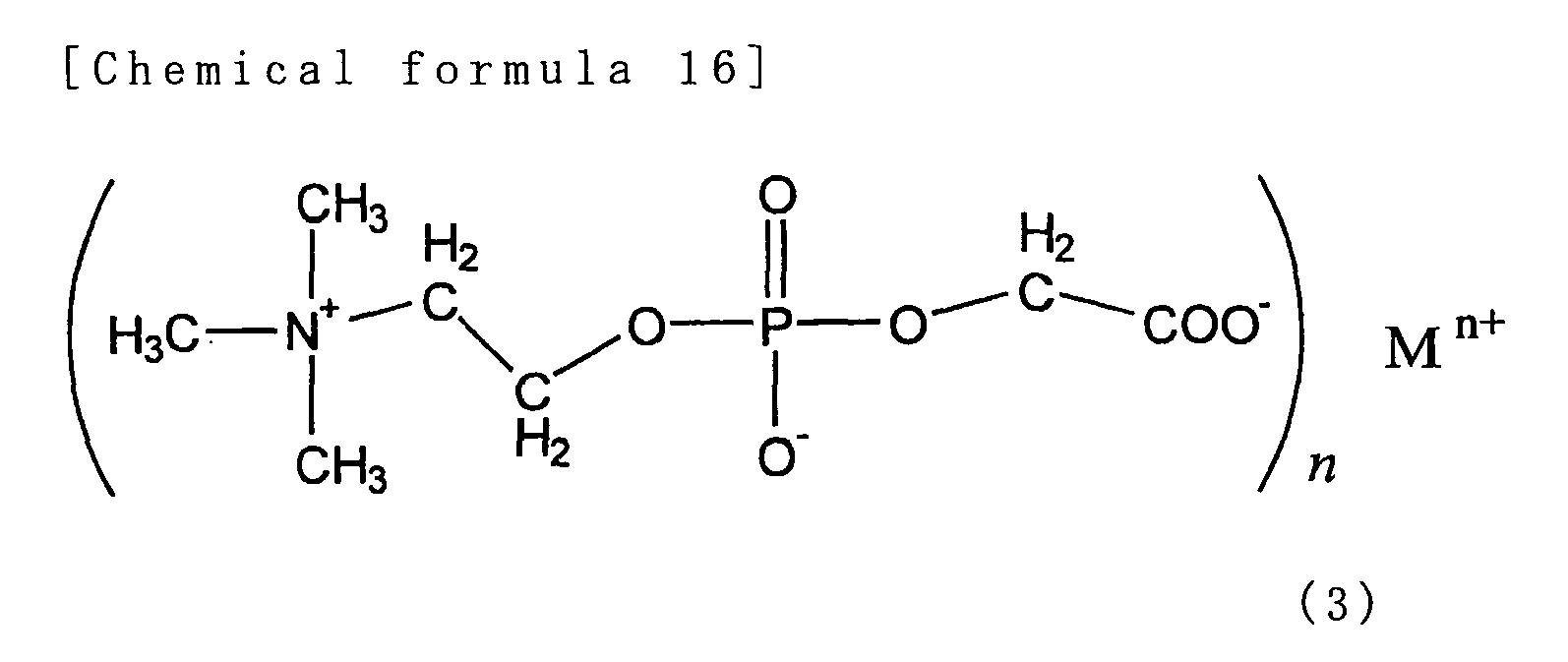
[Chemical formula 6] ((CH3)3N+CH2CH2PO4 -CH2COO-)nMn+ (3)
M denotes a cation, and n denotes the valency of the cation. - Furthermore, the present invention provides a method for manufacturing the phosphorylcholine group-containing chemical compound represented by the following formula (1) or (3) in which glycerophosphorylcholine, periodic acid and/or periodate in the amount of 3 or more equivalents of that of glycerophosphorylcholine, and a divalent ruthenium compound are reacted in an aqueous solution.
[Chemical formula 7] (CH3)3N+CH2CH2PO4 -CH2COOH (1)
[Chemical formula 8] ((CH3)3N+CH2CH2PO4 -CH2COO-)nMn+ (3)
M denotes a cation, and n denotes the valency of the cation. - Also, the present invention provides a method for manufacturing the phosphorylcholine group-containing chemical compound represented by the following formula (1) or (3) in which glycerophosphorylcholine, and permanganic acid and/or permanganate are reacted in an aqueous solution.
[Chemical formula 9] (CH3)3N+CH2CH2PO4 -CH2COOH (1)
[Chemical formula 10] ((CH3)3N+CH2CH2PO4 -CH2COO-)nMn+ (3)
M denotes a cation, and n denotes the valency of the cation. - Furthermore, the present invention provides a surface treatment agent composed of a phosphorylcholine group-containing chemical compound represented by the following general formula (1) or (3).
[Chemical formula 11] (CH3)3N+CH2CH2PO4-CH2COOH (1)
[Chemical formula 12]
((CH3)3N+CH2CH2PO4 -CH2COO-)nMn+ (3)
M denotes a cation, and n denotes the valency of the cation. - The new chemical compound of the present invention is a carboxyl phosphorylcholine that has the simplest structure and it is a highly useful compound. It is on its own used as a surface treatment agent; it allows the phosphorylcholine group portion, which gives biocompatibility, to reside closest to the material surface (the spacer is methylene, which is C1) and therefore surface modification functions of phosphorylcholine groups including biocompatibility is maximally manifested on the material surface.
- It is also possible to obtain a new surface treatment agent by reacting the new chemical compound of the present invention with a compound having a useful reactive group other than a carboxyl group. For example, a silane coupler having a phosphorylcholine group can be easily obtained by reacting the new chemical compound of the present invention with aminopropyltrimethoxysilane, i.e. it is useful for a source material (intermediate) for a surface treatment agent as well.
- The manufacturing method of the present invention is a simple manufacturing method using glycerophosphorylcholine for the starting substance. Glycerophosphorylcholine comes from naturally existing raw materials such as lecithin and can be obtained commercially at a low cost and in large quantities.
It can be manufactured in a water based solvent. The reaction proceeds quantitatively and the yield is very high. Furthermore, the purification process is simple. -
- Fig. 1 is a 1H-NMR spectrum of the chemical compound of the present invention prepared in Example.
- Fig. 2 is a mass spectrum of the chemical compound of the present invention prepared in Example.
- Fig. 3 shows the reaction formula of Manufacturing method 1.
- The structures of the new chemical compounds (1) and (2) of the present invention are as follows.


- This compound can be prepared by stirring and reacting periodic acid and/or periodate in the amount of 3 equivalents or more of that of glycerophosphorylcholine, and a trivalent and/or divalent ruthenium compound in an aqueous solution (the reaction rate increases by addition of acetonitrile).
- Commercial products can be used for the glycerophosphorylcholine, periodic acid, periodate, trivalent ruthenium compound, divalent ruthenium compound, and acetonitrile. Examples of periodic acid include orthoperiodic acid, metaperiodic acid, and hydrates thereof. Examples of periodate include sodium periodate, potassium periodate, calcium periodate, and hydrates thereof. Examples of trivalent ruthenium compounds include ruthenium trichloride, ruthenium tribromide, tris (acetylacetonato) ruthenium, and hydrates thereof. Examples of divalent ruthenium compounds include hexaammine ruthenium dichloride, potassium hexacyanoruthenate, and hydrates thereof.
When periodate is used, the compound of the following formula (1) or (3) can be prepared.
In formula (3), M denotes the cation corresponding to the periodate, and n denotes the valency of the cation. Representative cations are alkali metal ions, alkali earth metal ions, and ammonium ion.
- The periodic acid and/or periodate is characteristically used in the amount of 3 equivalents or more of the glycerophosphorylcholine. Preferably 4 equivalents or more should be used. Four equivalents or more will give a yield of almost 100%. If it is 2 equivalents, then the yield is low even if the reaction time is long, which is not suitable for practical use.
The necessary amount of the trivalent and/or divalent ruthenium compound is only a catalytic amount (approximately 0.02 mole %). - The reaction solvent is water. Organic solvents are not used, which is environmentally significant for an industrial manufacturing method. The addition of acetonitrile will increase the reaction rate. The mixing ratio of water and acetonitrile is not limited in particular. An organic solvent can be freely added to the water.
- The reaction proceeds sufficiently at room temperature.
- The reaction time is not limited in particular; approximately 2 hours is sufficient to complete the reaction with a virtually 100% yield.
- After completion of the reaction, the solvent is removed. The compound of the present invention can be extracted from the remaining solid by using methanol. Methanol is then removed to obtain the compound of the above formula (1) or (3). When sodium periodate is used, the compound of formula (1) or (2) of the present invention is obtained.
The obtained compound can be recrystallized from a methanol solution at rest or by adding acetonitrile to obtain a higher purity target compound.
The compound of formula (1) is 2[[[(carboxymethyl)oxy]hydroxyphosphinyl]oxy]-N,N,N-trimethyl-ethanaminium, and the compound of formula (2) is its sodium salt.
The compounds of formula (1) and (2) can be separated by means of a prior art method. For example, the compound of formula (1) alone can be obtained by treating a mixture of formulas (1) and (2) with hydrochloric acid and such. Also, the mixture can be turned into the compound of formula (2) alone by neutralizing it with sodium hydroxide and such.
Even when formula (1) and formula (2) are mixed together, they can be used as a surface treatment agent or as the source material to manufacture other compounds (such as surface treatment agents). - In addition to the methods described above, the compound of formula (1) can be obtained by an oxidative cleave reaction of the proximal diol by using, as a catalyst, lead tetraacetate or permanganic acid supported in silica gel, tungsten, iron, vanadium, or molybdenum.
- The compound of formula (1) or (3) can be prepared by stirring and reacting glycerophosphorylcholine and permanganic acid and/or permanganate in an aqueous solution. Examples of permanganate include potassium permanganate, sodium permanganate, and hydrates thereof.
- The compound of the present invention can give biocompatibility, moisture retaining properties, hydrophilicity, and other various useful functions to objects. It is a very useful compound as a surface treatment agent or a source material for a surface treatment agent for various materials such as plastic, metal, and glass.
- The invention is described in specific detail through Examples.
- "Materials used"
In the following preparation methods, the following commercially available products were used as source materials.
Glycerophosphorylcholine (from Chemi)
Acetonitrile (highest quality reagent from Wako Pure Chemical Industries, ltd.)
Sodium periodate (highest quality reagent from Wako Pure Chemical Industries, ltd.)
Ruthenium n-hydrate (highest quality reagent from Wako Pure Chemical Industries, ltd.)
Hexaammine ruthenium dichloride (from Aldrich)
Potassium permanganate (highest quality reagent from Wako Pure Chemical Industries, ltd.) - "Manufacturing method 1: A manufacturing method using a trivalent ruthenium compound (Claim 2)"
5 g (19.4 mmol) of glycerophosphorylcholine, 17 g (79.7 mmol, 4.1 eq) of sodium periodate, 81 mg (0.39 mmol, 0.02 mol%) of ruthenium trichloride n-hydrate, 70 g of ion-exchanged water, and 30 g of acetonitrile were added into a 200 ml flask. After stirring for two hours at room temperature, filtering was carried out and the solvent was removed from the filtrate. Methanol was used to extract the target compound from the obtained solid product; methanol was then removed to obtain the target compound. The reaction yield was almost 100%. - Fig. 1 shows the 1H NMR spectrum and Fig. 2 shows a mass spectrum. They indicate that the target compound of formula (1) or formula (2) was obtained. The reaction formula is shown in Fig. 3.
- "Manufacturing method 2: A manufacturing method using a divalent ruthenium compound (Claim 3)"
5 g (19.4 mmol) of glycerophosphorylcholine, 17 g (79.7 mmol, 4.1 eq) of sodium periodate, 107mg (0.39 mmol, 0.02 mol%) of hexaammine ruthenium dichloride, 70 g of ion-exchanged water, and 30 g of acetonitrile were added into a 200 ml flask. After stirring for two hours at room temperature, filtering was carried out and the solvent was removed from the filtrate. Methanol was used to extract the target compound from the obtained solid product; methanol was then removed to obtain the target compound. The reaction yield was almost 100%. - The following Table 1 shows the results of the aforementioned manufacturing method used under different conditions in terms of the kind of the solvent, the amount (in equivalents) of sodium periodate, and the presence/absence of the ruthenium trichloride.
"Test numbers 1 and 2"
When ion-exchanged water was used for the reaction solvent, sodium periodate was used for the oxidation agent, and ruthenium trichloride was not used, the target chemical compound was not obtained.
"Test number 3"
When a mixed solvent of ion-exchanged water and acetonitrile was used for the reaction solvent, ruthenium trichloride was used for the oxidation agent, and sodium periodate was not used, the target chemical compound was not obtained.
"Test numbers 4 and 5"
When a mixed solvent of ion-exchanged water and acetonitrile was used for the reaction solvent, sodium periodate was used for the oxidation agent, and ruthenium trichloride was added, the target chemical compound was not obtained when the amount of sodium periodate was 1 equivalent. When the amount of sodium periodate was 2 equivalents, the target chemical compound was partially obtained but not sufficiently.
"Test number 6"
When a mixed solvent of ion-exchanged water and acetonitrile was used for the reaction solvent, ruthenium trichloride was added, and the amount of sodium periodate was 3 equivalents, the target chemical compound was obtained with a yield of 75%. The obtained compound can be recrystallized from a methanol solution at rest or by adding acetonitrile to obtain a higher purity target compound.
"Test numbers 7 and 8"
When a mixed solvent of ion-exchanged water and acetonitrile was used for the reaction solvent, ruthenium trichloride was added, and the amount of sodium periodate was 4 equivalents, the target chemical compound was obtained with a yield of 100%. The target chemical compound was also obtained with a yield of 100% when the reaction solvent was ion-exchanged water. The obtained compound can be recrystallized from a methanol solution at rest or by adding acetonitrile to obtain a higher purity target compound. "Test numbers 9 and 10: The present invention"
When the reaction time oftest number 8 was shortened to 1 hour, the chemical compound was obtained with a yield of 80%. On the other hand, when the reaction time of test number 7 was shortened to 1 hour, the target chemical compound was obtained with a yield of 100%. The obtained compound can be recrystallized from a methanol solution at rest or by adding acetonitrile to obtain a higher purity target compound. -

- "Manufacturing method 3: A manufacturing method using permanganate (Claim 4)"
1.0 g of glycerophosphorylcholine was dissolved in 20 ml of water and 1.85 g of potassium permanganate was added, followed by 3 hours of heating and stirring at 60°C. The reaction solution was neutralized with hydrochloric acid, the solvent was removed by means of pressure reduction, and the desired product was extracted using methanol 1 and dried under a reduced pressure to obtain the target compound. The reaction yield was 82%. - "Example of a surface treatment agent"
A quartz substrate was treated with plasma in the presence of hydrogen and nitrogen to obtain a quartz substrate having amino groups on the surface. This quartz substrate was immersed in water, to which compound (1) was added, and N-ethyl-N'-3-dimethylaminopropylcarbodiimide and N-hydroxysuccineimide were added, followed by 5 hours of stirring at room temperature. The quartz substrate was rinsed with water to obtain a quartz substrate whose surface was modified with phosphorylcholine groups. - The phosphorylcholine group-containing chemical compound of the present invention is a useful new compound as a surface treatment agent or a source material for a surface treatment agent for materials such as plastics, metal, and glass.
The surface modifier consisting of the compound of the present invention can give biocompatibility, moisture retaining properties, hydrophilicity, and other various useful functions to objects.
The manufacturing method of the present invention is a method using a one-step reaction with a water based solvent; the reaction proceeds quantitatively and the yield is very high. Furthermore, the purification process is simple and therefore the industrial utility value is very high.
Claims (5)
- A phosphorylcholine group-containing chemical compound represented by the following formula (1) or (2).
[Chemical formula 1] (CH3)3N+CH2CH2PO4 -CH2COOH (1)
[Chemical formula 2] (CH3)3N+CH2CH2PO4 -CH2COONa (2)
- A method for manufacturing the phosphorylcholine group-containing chemical compound represented by the following formula (1) or (3) in which glycerophosphorylcholine, periodic acid and/or periodate in the amount of 3 or more equivalents of that of the glycerophosphorylcholine, and a trivalent ruthenium compound are reacted in an aqueous solution.
[Chemical formula 3] (CH3)3N+CH2CH2PO4 -CH2COOH (1)
[Chemical formula 4] ((CH3)N+CH2CH2PO4 -CH2COO-)nMn+ (3)
M denotes a cation, and n denotes the valency of the cation. - A method for manufacturing the phosphorylcholine group-containing chemical compound represented by the following formula (1) or (3) in which glycerophosphorylcholine, periodic acid and/or periodate in the amount of 3 or more equivalents of that of the glycerophosphorylcholine, and a divalent ruthenium compound are reacted in an aqueous solution.
[Chemical formula 5] (CH3)3N+CH2CH2PO4 -CH2COOH (1)
[Chemical formula 6] ((CH3)3N+CH2CH2PO4 -CH2COO-)nMn+ (3)
M denotes a cation, and n denotes the valency of the cation. - A method for manufacturing the phosphorylcholine group-containing chemical compound represented by the following formula (1) or (3) in which glycerophosphorylcholine, and permanganic acid and/or permanganate are reacted in an aqueous solution.
[Chemical formula 7] (CH3)3N+CH2CH2PO4 -CH2COOH (1)
[Chemical formula 8] ((CH3)3N+CH2CH2PO4 -CH2COO-)nMn+ (3)
M denotes a cation, and n denotes the valency of the cation. - A surface treatment agent composed of a phosphorylcholine group-containing chemical compound represented by the following formula (1) or (3).
[Chemical formula 9] (CH3)3N+CH2CH2PO4 -CH2COOH (1)
[Chemical formula 10] ( (CH3)3N+CH2CH2PO4 -CH2COO-)nMn+ (3)
M denotes a cation, and n denotes the valency of the cation.
Applications Claiming Priority (3)
| Application Number | Priority Date | Filing Date | Title |
|---|---|---|---|
| JP2004343375 | 2004-11-29 | ||
| PCT/JP2005/021795 WO2006057384A1 (en) | 2004-11-29 | 2005-11-28 | Phosphorylcholine group-containing compound and method for producing same |
| JP2005341934A JP3793546B1 (en) | 2004-11-29 | 2005-11-28 | Phosphorylcholine group-containing compound and method for producing the same |
Publications (3)
| Publication Number | Publication Date |
|---|---|
| EP1818335A1 true EP1818335A1 (en) | 2007-08-15 |
| EP1818335A4 EP1818335A4 (en) | 2007-11-07 |
| EP1818335B1 EP1818335B1 (en) | 2010-07-14 |
Family
ID=36498117
Family Applications (1)
| Application Number | Title | Priority Date | Filing Date |
|---|---|---|---|
| EP05809145A Expired - Lifetime EP1818335B1 (en) | 2004-11-29 | 2005-11-28 | Phosphorylcholine group-containing compound and method for producing same |
Country Status (7)
| Country | Link |
|---|---|
| US (1) | US7674782B2 (en) |
| EP (1) | EP1818335B1 (en) |
| KR (1) | KR101217010B1 (en) |
| CN (1) | CN101065387B (en) |
| AT (1) | ATE473989T1 (en) |
| DE (1) | DE602005022345D1 (en) |
| WO (1) | WO2006057384A1 (en) |
Families Citing this family (5)
| Publication number | Priority date | Publication date | Assignee | Title |
|---|---|---|---|---|
| JP4191225B2 (en) | 2007-01-18 | 2008-12-03 | 株式会社資生堂 | Surface modification method and surface modification material |
| US8242222B2 (en) * | 2008-03-31 | 2012-08-14 | Shiseido Company, Ltd. | Polysiloxane, acrylic compound and vinylic compound |
| CN114096567A (en) | 2019-04-29 | 2022-02-25 | 鲍希与洛姆伯股份有限公司 | Glycophospholipid polymer networks and uses thereof |
| US12012238B2 (en) | 2021-05-26 | 2024-06-18 | Bausch + Lomb Ireland Limited | Packaging solutions |
| US20250040673A1 (en) | 2023-07-28 | 2025-02-06 | Bausch + Lomb Ireland Limited | Packaging solutions |
Family Cites Families (6)
| Publication number | Priority date | Publication date | Assignee | Title |
|---|---|---|---|---|
| GB9004881D0 (en) | 1990-03-05 | 1990-05-02 | Biocompatibles Ltd | Method of improving the ocular of synthetic polymers haemo and biocompatibility |
| JP3647840B2 (en) | 2002-11-25 | 2005-05-18 | 株式会社資生堂 | Phosphorylcholine group-containing modified powder and method for producing the same |
| JP4086305B2 (en) | 2003-12-02 | 2008-05-14 | 株式会社資生堂 | Phosphorylcholine group-containing compound and surface modifier comprising the compound |
| JP3715309B1 (en) | 2004-05-24 | 2005-11-09 | 株式会社資生堂 | Ophthalmic lens material and manufacturing method thereof |
| JP3809177B2 (en) * | 2004-05-24 | 2006-08-16 | 株式会社資生堂 | Affinity particles and affinity separation method |
| JP3922648B2 (en) * | 2004-05-24 | 2007-05-30 | 株式会社資生堂 | Affinity particles and affinity separation method |
-
2005
- 2005-11-28 KR KR1020077005702A patent/KR101217010B1/en not_active Expired - Lifetime
- 2005-11-28 CN CN2005800407426A patent/CN101065387B/en not_active Expired - Lifetime
- 2005-11-28 US US11/664,670 patent/US7674782B2/en not_active Expired - Lifetime
- 2005-11-28 WO PCT/JP2005/021795 patent/WO2006057384A1/en not_active Ceased
- 2005-11-28 EP EP05809145A patent/EP1818335B1/en not_active Expired - Lifetime
- 2005-11-28 AT AT05809145T patent/ATE473989T1/en not_active IP Right Cessation
- 2005-11-28 DE DE602005022345T patent/DE602005022345D1/en not_active Expired - Lifetime
Also Published As
| Publication number | Publication date |
|---|---|
| CN101065387A (en) | 2007-10-31 |
| DE602005022345D1 (en) | 2010-08-26 |
| KR101217010B1 (en) | 2012-12-31 |
| US20080113942A1 (en) | 2008-05-15 |
| EP1818335B1 (en) | 2010-07-14 |
| US7674782B2 (en) | 2010-03-09 |
| KR20070083551A (en) | 2007-08-24 |
| ATE473989T1 (en) | 2010-07-15 |
| WO2006057384A1 (en) | 2006-06-01 |
| EP1818335A4 (en) | 2007-11-07 |
| CN101065387B (en) | 2012-05-30 |
Similar Documents
| Publication | Publication Date | Title |
|---|---|---|
| JP6673373B2 (en) | Pseudo-solid phase protecting groups and nucleotides | |
| US5252760A (en) | Method of using colored phosphorylating reagents | |
| EP1818335B1 (en) | Phosphorylcholine group-containing compound and method for producing same | |
| Tairov et al. | Symmetrical and inherently chiral water-soluble calix [4] arenes bearing dihydroxyphosphoryl groups | |
| CN101516898B (en) | Process for producing phosphorus-containing α-amino acid and its production intermediate | |
| WO2013126034A1 (en) | Synthesis of high purity dmt-c3-disulfide phosphoramidite | |
| JP3793546B1 (en) | Phosphorylcholine group-containing compound and method for producing the same | |
| Wu et al. | A highly efficient catalyst FeCl3 in the synthesis of α‐amino phosphonates via three‐component reactions | |
| WO2004101579A3 (en) | Substituted phosphonate fluorescent sensors and use thereof | |
| Arumuganathan et al. | Faster oxygen atom transfer catalysis with a tungsten dioxo complex than with its molybdenum analog | |
| US12479871B2 (en) | Method of preparing symmetrical phosphate-based compound | |
| CN115466294A (en) | High stereoselectivity synthetic method of 2-deoxy-thioglycoside | |
| JPH0327556B2 (en) | ||
| Chang et al. | The water-soluble Roussin's red ester acting as a potential photochemical NO-delivery agent: Photolysis reactions, DNA cleavage and anticancer activity | |
| JP2023088159A (en) | Method for producing zwitterionic compound | |
| RU2313521C1 (en) | Method for preparing 1-(4-quinolinamino)-1,2-dihydro[60]fullerene | |
| RU2135447C1 (en) | Method of synthesis of 1-aryl-(alkyl)-2-hydro[60]-fullerenes | |
| JP3658697B2 (en) | Artificial ribonuclease and method for producing the same | |
| SU1549957A1 (en) | Method of obtaining o-aryl-o-(carbamoylphenyl)aminomethylphosphates | |
| KR101886922B1 (en) | Oligoamine boronic acids for heparin receptors | |
| JP3992510B2 (en) | Novel lactosamine derivative and method for producing the same | |
| SU736591A1 (en) | O-(beta-alkylmercaptoethyl)-aryl-phosphonites as semiproducts for synthesis of biologically active iodomethylates of o-(beta-alkylmercaptoethyl/aryl)alpha-oxycyclohexylphosphinates possessing muscarinolytic activity o-(beta-alkylmercaptoethyl)arylphosphonates | |
| JP2649343B2 (en) | Method for producing phosphate ester | |
| CN121824609A (en) | Fluorogenic substrate 7-HC-P-E and preparation method and application thereof | |
| JP2004035639A (en) | Water absorption resin |
Legal Events
| Date | Code | Title | Description |
|---|---|---|---|
| PUAI | Public reference made under article 153(3) epc to a published international application that has entered the european phase |
Free format text: ORIGINAL CODE: 0009012 |
|
| 17P | Request for examination filed |
Effective date: 20070419 |
|
| AK | Designated contracting states |
Kind code of ref document: A1 Designated state(s): AT BE BG CH CY CZ DE DK EE ES FI FR GB GR HU IE IS IT LI LT LU LV MC NL PL PT RO SE SI SK TR |
|
| A4 | Supplementary search report drawn up and despatched |
Effective date: 20071010 |
|
| DAX | Request for extension of the european patent (deleted) | ||
| 17Q | First examination report despatched |
Effective date: 20080213 |
|
| GRAP | Despatch of communication of intention to grant a patent |
Free format text: ORIGINAL CODE: EPIDOSNIGR1 |
|
| GRAS | Grant fee paid |
Free format text: ORIGINAL CODE: EPIDOSNIGR3 |
|
| GRAA | (expected) grant |
Free format text: ORIGINAL CODE: 0009210 |
|
| AK | Designated contracting states |
Kind code of ref document: B1 Designated state(s): AT BE BG CH CY CZ DE DK EE ES FI FR GB GR HU IE IS IT LI LT LU LV MC NL PL PT RO SE SI SK TR |
|
| REG | Reference to a national code |
Ref country code: GB Ref legal event code: FG4D |
|
| REG | Reference to a national code |
Ref country code: CH Ref legal event code: EP |
|
| REG | Reference to a national code |
Ref country code: IE Ref legal event code: FG4D |
|
| REF | Corresponds to: |
Ref document number: 602005022345 Country of ref document: DE Date of ref document: 20100826 Kind code of ref document: P |
|
| REG | Reference to a national code |
Ref country code: NL Ref legal event code: VDEP Effective date: 20100714 |
|
| LTIE | Lt: invalidation of european patent or patent extension |
Effective date: 20100714 |
|
| PG25 | Lapsed in a contracting state [announced via postgrant information from national office to epo] |
Ref country code: NL Free format text: LAPSE BECAUSE OF FAILURE TO SUBMIT A TRANSLATION OF THE DESCRIPTION OR TO PAY THE FEE WITHIN THE PRESCRIBED TIME-LIMIT Effective date: 20100714 Ref country code: LT Free format text: LAPSE BECAUSE OF FAILURE TO SUBMIT A TRANSLATION OF THE DESCRIPTION OR TO PAY THE FEE WITHIN THE PRESCRIBED TIME-LIMIT Effective date: 20100714 Ref country code: FI Free format text: LAPSE BECAUSE OF FAILURE TO SUBMIT A TRANSLATION OF THE DESCRIPTION OR TO PAY THE FEE WITHIN THE PRESCRIBED TIME-LIMIT Effective date: 20100714 Ref country code: AT Free format text: LAPSE BECAUSE OF FAILURE TO SUBMIT A TRANSLATION OF THE DESCRIPTION OR TO PAY THE FEE WITHIN THE PRESCRIBED TIME-LIMIT Effective date: 20100714 |
|
| PG25 | Lapsed in a contracting state [announced via postgrant information from national office to epo] |
Ref country code: SI Free format text: LAPSE BECAUSE OF FAILURE TO SUBMIT A TRANSLATION OF THE DESCRIPTION OR TO PAY THE FEE WITHIN THE PRESCRIBED TIME-LIMIT Effective date: 20100714 Ref country code: PT Free format text: LAPSE BECAUSE OF FAILURE TO SUBMIT A TRANSLATION OF THE DESCRIPTION OR TO PAY THE FEE WITHIN THE PRESCRIBED TIME-LIMIT Effective date: 20101115 Ref country code: PL Free format text: LAPSE BECAUSE OF FAILURE TO SUBMIT A TRANSLATION OF THE DESCRIPTION OR TO PAY THE FEE WITHIN THE PRESCRIBED TIME-LIMIT Effective date: 20100714 Ref country code: IS Free format text: LAPSE BECAUSE OF FAILURE TO SUBMIT A TRANSLATION OF THE DESCRIPTION OR TO PAY THE FEE WITHIN THE PRESCRIBED TIME-LIMIT Effective date: 20101114 Ref country code: CY Free format text: LAPSE BECAUSE OF FAILURE TO SUBMIT A TRANSLATION OF THE DESCRIPTION OR TO PAY THE FEE WITHIN THE PRESCRIBED TIME-LIMIT Effective date: 20100714 Ref country code: BG Free format text: LAPSE BECAUSE OF FAILURE TO SUBMIT A TRANSLATION OF THE DESCRIPTION OR TO PAY THE FEE WITHIN THE PRESCRIBED TIME-LIMIT Effective date: 20101014 |
|
| PG25 | Lapsed in a contracting state [announced via postgrant information from national office to epo] |
Ref country code: GR Free format text: LAPSE BECAUSE OF FAILURE TO SUBMIT A TRANSLATION OF THE DESCRIPTION OR TO PAY THE FEE WITHIN THE PRESCRIBED TIME-LIMIT Effective date: 20101015 Ref country code: SE Free format text: LAPSE BECAUSE OF FAILURE TO SUBMIT A TRANSLATION OF THE DESCRIPTION OR TO PAY THE FEE WITHIN THE PRESCRIBED TIME-LIMIT Effective date: 20100714 Ref country code: LV Free format text: LAPSE BECAUSE OF FAILURE TO SUBMIT A TRANSLATION OF THE DESCRIPTION OR TO PAY THE FEE WITHIN THE PRESCRIBED TIME-LIMIT Effective date: 20100714 Ref country code: BE Free format text: LAPSE BECAUSE OF FAILURE TO SUBMIT A TRANSLATION OF THE DESCRIPTION OR TO PAY THE FEE WITHIN THE PRESCRIBED TIME-LIMIT Effective date: 20100714 |
|
| PG25 | Lapsed in a contracting state [announced via postgrant information from national office to epo] |
Ref country code: DK Free format text: LAPSE BECAUSE OF FAILURE TO SUBMIT A TRANSLATION OF THE DESCRIPTION OR TO PAY THE FEE WITHIN THE PRESCRIBED TIME-LIMIT Effective date: 20100714 |
|
| PLBE | No opposition filed within time limit |
Free format text: ORIGINAL CODE: 0009261 |
|
| STAA | Information on the status of an ep patent application or granted ep patent |
Free format text: STATUS: NO OPPOSITION FILED WITHIN TIME LIMIT |
|
| PG25 | Lapsed in a contracting state [announced via postgrant information from national office to epo] |
Ref country code: SK Free format text: LAPSE BECAUSE OF FAILURE TO SUBMIT A TRANSLATION OF THE DESCRIPTION OR TO PAY THE FEE WITHIN THE PRESCRIBED TIME-LIMIT Effective date: 20100714 Ref country code: RO Free format text: LAPSE BECAUSE OF FAILURE TO SUBMIT A TRANSLATION OF THE DESCRIPTION OR TO PAY THE FEE WITHIN THE PRESCRIBED TIME-LIMIT Effective date: 20100714 Ref country code: CZ Free format text: LAPSE BECAUSE OF FAILURE TO SUBMIT A TRANSLATION OF THE DESCRIPTION OR TO PAY THE FEE WITHIN THE PRESCRIBED TIME-LIMIT Effective date: 20100714 Ref country code: EE Free format text: LAPSE BECAUSE OF FAILURE TO SUBMIT A TRANSLATION OF THE DESCRIPTION OR TO PAY THE FEE WITHIN THE PRESCRIBED TIME-LIMIT Effective date: 20100714 |
|
| 26N | No opposition filed |
Effective date: 20110415 |
|
| PG25 | Lapsed in a contracting state [announced via postgrant information from national office to epo] |
Ref country code: ES Free format text: LAPSE BECAUSE OF FAILURE TO SUBMIT A TRANSLATION OF THE DESCRIPTION OR TO PAY THE FEE WITHIN THE PRESCRIBED TIME-LIMIT Effective date: 20101025 Ref country code: MC Free format text: LAPSE BECAUSE OF NON-PAYMENT OF DUE FEES Effective date: 20101130 |
|
| REG | Reference to a national code |
Ref country code: CH Ref legal event code: PL |
|
| REG | Reference to a national code |
Ref country code: DE Ref legal event code: R097 Ref document number: 602005022345 Country of ref document: DE Effective date: 20110415 |
|
| PG25 | Lapsed in a contracting state [announced via postgrant information from national office to epo] |
Ref country code: LI Free format text: LAPSE BECAUSE OF NON-PAYMENT OF DUE FEES Effective date: 20101130 Ref country code: CH Free format text: LAPSE BECAUSE OF NON-PAYMENT OF DUE FEES Effective date: 20101130 |
|
| PG25 | Lapsed in a contracting state [announced via postgrant information from national office to epo] |
Ref country code: IE Free format text: LAPSE BECAUSE OF NON-PAYMENT OF DUE FEES Effective date: 20101128 |
|
| PG25 | Lapsed in a contracting state [announced via postgrant information from national office to epo] |
Ref country code: HU Free format text: LAPSE BECAUSE OF FAILURE TO SUBMIT A TRANSLATION OF THE DESCRIPTION OR TO PAY THE FEE WITHIN THE PRESCRIBED TIME-LIMIT Effective date: 20110115 Ref country code: LU Free format text: LAPSE BECAUSE OF NON-PAYMENT OF DUE FEES Effective date: 20101128 |
|
| PG25 | Lapsed in a contracting state [announced via postgrant information from national office to epo] |
Ref country code: TR Free format text: LAPSE BECAUSE OF FAILURE TO SUBMIT A TRANSLATION OF THE DESCRIPTION OR TO PAY THE FEE WITHIN THE PRESCRIBED TIME-LIMIT Effective date: 20100714 |
|
| REG | Reference to a national code |
Ref country code: FR Ref legal event code: PLFP Year of fee payment: 11 |
|
| REG | Reference to a national code |
Ref country code: FR Ref legal event code: PLFP Year of fee payment: 12 |
|
| REG | Reference to a national code |
Ref country code: FR Ref legal event code: PLFP Year of fee payment: 13 |
|
| REG | Reference to a national code |
Ref country code: FR Ref legal event code: PLFP Year of fee payment: 14 |
|
| P01 | Opt-out of the competence of the unified patent court (upc) registered |
Effective date: 20230517 |
|
| PGFP | Annual fee paid to national office [announced via postgrant information from national office to epo] |
Ref country code: DE Payment date: 20241022 Year of fee payment: 20 |
|
| PGFP | Annual fee paid to national office [announced via postgrant information from national office to epo] |
Ref country code: GB Payment date: 20241022 Year of fee payment: 20 |
|
| PGFP | Annual fee paid to national office [announced via postgrant information from national office to epo] |
Ref country code: FR Payment date: 20241022 Year of fee payment: 20 |
|
| PGFP | Annual fee paid to national office [announced via postgrant information from national office to epo] |
Ref country code: IT Payment date: 20241022 Year of fee payment: 20 |
|
| REG | Reference to a national code |
Ref country code: DE Ref legal event code: R071 Ref document number: 602005022345 Country of ref document: DE |
|
| REG | Reference to a national code |
Ref country code: GB Ref legal event code: PE20 Expiry date: 20251127 |