EP1817857B1 - Method and system for reduction of PAPR - Google Patents
Method and system for reduction of PAPR Download PDFInfo
- Publication number
- EP1817857B1 EP1817857B1 EP05852750A EP05852750A EP1817857B1 EP 1817857 B1 EP1817857 B1 EP 1817857B1 EP 05852750 A EP05852750 A EP 05852750A EP 05852750 A EP05852750 A EP 05852750A EP 1817857 B1 EP1817857 B1 EP 1817857B1
- Authority
- EP
- European Patent Office
- Prior art keywords
- sub
- blocks
- ofdm
- papr
- polyphase sequences
- Prior art date
- Legal status (The legal status is an assumption and is not a legal conclusion. Google has not performed a legal analysis and makes no representation as to the accuracy of the status listed.)
- Expired - Lifetime
Links
Images



Classifications
-
- H—ELECTRICITY
- H04—ELECTRIC COMMUNICATION TECHNIQUE
- H04L—TRANSMISSION OF DIGITAL INFORMATION, e.g. TELEGRAPHIC COMMUNICATION
- H04L27/00—Modulated-carrier systems
- H04L27/26—Systems using multi-frequency codes
- H04L27/2601—Multicarrier modulation systems
- H04L27/2614—Peak power aspects
-
- H—ELECTRICITY
- H04—ELECTRIC COMMUNICATION TECHNIQUE
- H04L—TRANSMISSION OF DIGITAL INFORMATION, e.g. TELEGRAPHIC COMMUNICATION
- H04L27/00—Modulated-carrier systems
- H04L27/26—Systems using multi-frequency codes
- H04L27/2601—Multicarrier modulation systems
- H04L27/2614—Peak power aspects
- H04L27/2615—Reduction thereof using coding
-
- H—ELECTRICITY
- H04—ELECTRIC COMMUNICATION TECHNIQUE
- H04B—TRANSMISSION
- H04B7/00—Radio transmission systems, i.e. using radiation field
- H04B7/02—Diversity systems; Multi-antenna system, i.e. transmission or reception using multiple antennas
-
- H—ELECTRICITY
- H04—ELECTRIC COMMUNICATION TECHNIQUE
- H04B—TRANSMISSION
- H04B7/00—Radio transmission systems, i.e. using radiation field
- H04B7/02—Diversity systems; Multi-antenna system, i.e. transmission or reception using multiple antennas
- H04B7/04—Diversity systems; Multi-antenna system, i.e. transmission or reception using multiple antennas using two or more spaced independent antennas
- H04B7/0413—MIMO systems
-
- H—ELECTRICITY
- H04—ELECTRIC COMMUNICATION TECHNIQUE
- H04B—TRANSMISSION
- H04B7/00—Radio transmission systems, i.e. using radiation field
- H04B7/02—Diversity systems; Multi-antenna system, i.e. transmission or reception using multiple antennas
- H04B7/04—Diversity systems; Multi-antenna system, i.e. transmission or reception using multiple antennas using two or more spaced independent antennas
- H04B7/06—Diversity systems; Multi-antenna system, i.e. transmission or reception using multiple antennas using two or more spaced independent antennas at the transmitting station
- H04B7/0697—Diversity systems; Multi-antenna system, i.e. transmission or reception using multiple antennas using two or more spaced independent antennas at the transmitting station using spatial multiplexing
-
- H—ELECTRICITY
- H04—ELECTRIC COMMUNICATION TECHNIQUE
- H04L—TRANSMISSION OF DIGITAL INFORMATION, e.g. TELEGRAPHIC COMMUNICATION
- H04L1/00—Arrangements for detecting or preventing errors in the information received
- H04L1/004—Arrangements for detecting or preventing errors in the information received by using forward error control
- H04L1/0056—Systems characterized by the type of code used
- H04L1/0071—Use of interleaving
-
- H—ELECTRICITY
- H04—ELECTRIC COMMUNICATION TECHNIQUE
- H04L—TRANSMISSION OF DIGITAL INFORMATION, e.g. TELEGRAPHIC COMMUNICATION
- H04L1/00—Arrangements for detecting or preventing errors in the information received
- H04L1/02—Arrangements for detecting or preventing errors in the information received by diversity reception
- H04L1/06—Arrangements for detecting or preventing errors in the information received by diversity reception using space diversity
- H04L1/0606—Space-frequency coding
-
- H—ELECTRICITY
- H04—ELECTRIC COMMUNICATION TECHNIQUE
- H04L—TRANSMISSION OF DIGITAL INFORMATION, e.g. TELEGRAPHIC COMMUNICATION
- H04L1/00—Arrangements for detecting or preventing errors in the information received
- H04L1/02—Arrangements for detecting or preventing errors in the information received by diversity reception
- H04L1/06—Arrangements for detecting or preventing errors in the information received by diversity reception using space diversity
- H04L1/0618—Space-time coding
-
- H—ELECTRICITY
- H04—ELECTRIC COMMUNICATION TECHNIQUE
- H04L—TRANSMISSION OF DIGITAL INFORMATION, e.g. TELEGRAPHIC COMMUNICATION
- H04L1/00—Arrangements for detecting or preventing errors in the information received
- H04L1/02—Arrangements for detecting or preventing errors in the information received by diversity reception
- H04L1/06—Arrangements for detecting or preventing errors in the information received by diversity reception using space diversity
- H04L1/0618—Space-time coding
- H04L1/0637—Properties of the code
- H04L1/0643—Properties of the code block codes
Definitions
- This disclosure is related to communications.
- PAPR peak power to average power
- PAPR reduction is accomplished for an SFBC MIMO-OFDM system using polyphase interleaving and inversion (hereinafter, PII).
- PII polyphase interleaving and inversion
- SS-PII suboptimal successive PII
- MIMO-OFDM multiple input multiple output
- PAPR reduction schemes for OFDM systems are proposed. Among them, signal scrambling methods are attractive since OFDM signals are modified without distortion to provide better PAPR property with a relatively low complexity.
- MIMO-OFDM systems one approach for PAPR reduction applies these schemes for OFDM systems separately on different transmit antennas. However, this is not applicable if a space-frequency block coding (SFBC) is employed in MIMO-OFDM systems, since OFDM symbols transmitted substantially simultaneously from different antennas are dependent on the used space-frequency code, as discussed in more detail later.
- SFBC space-frequency block coding
- PII polyphase interleaving and inversion
- alternate embodiments may employ more than two antennas.
- an OFDM sequence is partitioned into M sub-blocks of equal sizes.
- a sub-block is decomposed into two polyphase sequences, and these polyphase sequences may be interleaved and inverted.
- polyphase interleaving and inversion may be applied to the sub-blocks independently. This may be done to find a combination that gives the highest or most PAPR reduction.
- suboptimal successive PII For complexity reduction, in an alternate embodiment, termed here suboptimal successive PII (SS-PII), a compromise between performance and complexity may be employed.
- SS-PII suboptimal successive PII
- an embodiment employing SS-PII may not produce the most PAPR reduction, but sufficient PAPR reduction with a reduction in complexity over an embodiment producing the most PAPR reduction that in some particular applications, depending on a variety of factors, it may be desirable.
- this is simply one embodiment and claimed subject matter is not limited to this embodiment or to SFBC.
- STBC or spatial multiplexing may alternately be employed.
- MIMO-OFDM has become a promising candidate for high performance 4G broadband wireless communications, as previously mentioned.
- two basic signaling modes have been employed namely Spatial Multiplexing (SM), see, for example, Gesbert and Paulraj, "On the capacity of OFDM-based spatial multiplexing systems," IEEE Trans. Commun., vol. 50, pp 225-234, Feb.
- SM Spatial Multiplexing
- PAPR peak-to-average power ratio
- the resulting baseband OFDM signal x(t) of a block can be expressed as (1) below"
- PAPR x t max 0 ⁇ i ⁇ N C ⁇ T ⁇ x t 2
- E x t 2 max 0 ⁇ i ⁇ N C ⁇ T ⁇ x t 2 1 N C ⁇ T ⁇ 0 N C ⁇ T x t 2 ⁇ dt .
- L denotes the oversampling factor.
- Oversampling may be implemented by adding (L - 1)N C zeros to the original OFDM block followed by the Inverse Fast Fourier Transform (IFFT).
- IFFT Inverse Fast Fourier Transform
- CCDF complementary cumulative distribution function
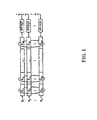
- a cross-antenna rotation and inversion (CARI) scheme such as depicted in Fig. 1 , for example, may be employed, which exploits such degrees of freedom, although, of course, claimed subject matter is not limited in scope in this respect.
- CARI cross-antenna rotation and inversion
- sub-blocks of m th group are circularly shifted in a vertical direction for r m positions and then multiplied by factor b m .
- Such operations produce interleaving and inverting of the OFDM sequence; however, this is merely one example. Interleaving and inverting of sub-blocks as used in this specification is much more general than this particular example.
- the resultant sequence set in frequency and corresponding time domain may be expressed as follows by (5) and (6) below, respectively:
- x i ' is the IFFT of X i ' and mod(a,b) denotes modulus of a to base b.
- a sequence set denoted as ⁇ X i , X 2 , ... X N ⁇ will have the smallest maximum PAPR among all other sequence sets ⁇ X' 1 , X' 2 , ... X' N ⁇ .
- the maximum PAPR in the set here, the maximum PAPR among the antennas, may be found.
- a sequence set that has the smallest maximum PAPR may be found, referred to here as a mini-max criterion.
- this particular embodiment utilizes an advantage of calculating IFFT for sub-blocks individually and improving PAPR in the time domain by (6). Additionally, certain side information bits may be transmitted to the receiver to undo data scrambling. However, for this embodiment, complexity may be large due to the number of trials to determine the appropriate factors to reduce PAPR.
- One sequence out of V with the lowest PAPR is chosen for transmission.
- N transmit antennas one can chose to perform PAPR reduction on each antenna separately, e.g., to generate N sets of V independent sequences and transmit one with the smallest PAPR from each set.
- overhead bits may be sent to the receiver notifying which one out of V random sequences is used for each antenna for data scrambling. It is assumed that the receiver has the knowledge of all V random sequences.
- the performance of PTS scheme is sensitive to w, e.g., the size of W.
- this particular embodiment employs twice as many number of trails compared to PTS, employs 9 side information bits, instead of 24, and gives good PAPR reduction and a steep slope.
- some advantage may be associated at least in part with employing rotation and inversion on the independent OFDM sub-blocks transmitted on different antennas.
- this approach produces higher degrees of freedom that may offset the possibility of encountering poor sequences with high PAPR, although, of course, claimed subject matter is not limited in scope in this respect.
- the number of trials may be relatively large for N > 2 and/or M > 4.
- Fig. 3 shows the PAPR performance of this embodiment for different number of transmit antennas N and sub-blocks M in comparison to SLM employing 10 6 independent OFDM symbols, for example.
- this embodiment gives some gain compared to SLM.
- performance differences are smaller.
- this embodiment employs the same number of N C -point IFFTs, but if the transforms may be used to exploit the fact that the large number of the input vectors contain zeros, an additional reduction in complexity may be achieved by employing this particular embodiment.
- PAPR reduction may be applied for the first symbol period.
- X 1 and X 2 such as, for example, by using an embodiment in accordance with claimed subject matter
- two modified sequences with good PAPR properties are obtained, which will be transmitted during the first symbol period.
- -X 2 * and X 1 * may be transmitted, having substantially the same PAPR properties.
- sequences X 1 and X 2 are independent, previously described results for the previously described embodiments are valid for this embodiment, involving an STBC-OFDM system.
- N 4
- a 1 ⁇ 2-rate complex orthogonal STB code see, for example, Tarokh, Jafarkhani, and Calderbank, "Space-time block codes from orthogonal designes," IEEE J. Select. Areas Commun., vol. 16, pp 1451-1458, Oct. 1998 , may be considered.
- Vectors X 1 and X 2 are fed to the IFFT/CP blocks and transmitted substantially simultaneously from antennas T X1 and T X2 , respectively.
- a SFBC-OFDM scheme as with an STBC-OFDM scheme, for example, also suffers from large PAPR. In this latter case, however, simple cross-antenna rotation cannot be performed since it would destroy the structure of Alamouti space-frequency block code. Thus, in an alternate embodiment, a modified scheme may be applied.
- X m have the size of the original sequence N C with the sub-carrier position set to zero if they belong to some other sub-block.
- non-zero sub-carriers in a sub-block span an integer number of space-frequency code words.
- r and b factors may be selected for transmission in this particular embodiment.
- claimed subject matter is, or course, not limited in scope in this respect.
- an alternate embodiment may be employed. Instead searching through all possible combinations of r and b, this may be done in successive fashion, as was described in connection with a previously described embodiment, for example.
- the desired r and b factors for this sub-block remain, in this particular embodiment.
- the process continues in this fashion, changing only m th sub-blocks at the time, until r and b factors have been found successively.
- the number of IFFTs for this particular embodiment are substantially the same as for previously described embodiments (see, for example, Table 1). Additional complexity may occur due to two matrix multiplication in (16). Multiplication of a vector by diagonal matrix D is element-wise multiplication of two vectors whereas multiplication of a vector by anti-diagonal matrix J involves reversing the order of the vector elements.
- the SLM scheme may be used in conjunction with the SFBC-OFDM by multiplying data vector X with V independent random sequences, applying Alamouti coding and calculating PAPR of the set ⁇ x' 1 , x' 2 ⁇ for V. Again, the set of sequences for which the maximum PAPR is smallest is selected.
- M V ⁇ ⁇ 4,16 ⁇ .
- the slope of SLM is steeper, the two curves will intersect below a 10 -6 PAPR level. Nevertheless, this probability is so small that this may be neglected in practice.
- a drawback of this particular embodiment is the higher number of side information bits compared to SLM.
- N 4
- 1 ⁇ 2-rate complex orthogonal STB code see, for example, Tarokh, Jafarkhani, and Calderbank, "Space-time block codes from orthogonal designes," IEEE J. Select. Areas Commun., vol. 16, pp 1451-1458, Oct. 1998 , may be considered.
- input symbol vector X [X 0 , X 1 ,..., X Nc-1 ] is decomposed into 4 polyphase components, for example.
- embodiments of claimed subject matter may be employed in a variety of contexts and claimed subject matter is not limited in scope in this respect.
- embodiments may be employed in a variety of possible communication devices, including, for example, cell phones, personal digital assistants, laptop computers, media players, and the like.
- claimed subject matter is not limited in scope to this example.
- Many other approaches and/or other types of devices employing a variety of software, firmware and/or hardware are possible and included within the scope of claimed subject matter. It will, of course, be understood that, although particular embodiments have just been described, the claimed subject matter is not limited in scope to a particular embodiment or implementation.
- one embodiment may be in hardware, such as implemented to operate on a device or combination of devices, for example, whereas another embodiment may be in software.
- an embodiment may be implemented in firmware, or as any combination of hardware, software, and/or firmware, for example.
- one embodiment may comprise one or more articles, such as a storage medium or storage media.
- This storage media such as, one or more CD-ROMs and/or disks, for example, may have stored thereon instructions, that when executed by a system, such as a computer system, computing platform, or other system, for example, may result in an embodiment of a method in accordance with claimed subject matter being executed, such as one of the embodiments previously described, for example.
- a computing platform may include one or more processing units or processors, one or more input/output devices, such as a display, a keyboard and/or a mouse, and/or one or more memories, such as static random access memory, dynamic random access memory, flash memory, and/or a hard drive.
- a display may be employed to display one or more queries, such as those that may be interrelated, and or one or more tree expressions, although, again, claimed subject matter is not limited in scope to this example.
Landscapes
- Engineering & Computer Science (AREA)
- Computer Networks & Wireless Communication (AREA)
- Signal Processing (AREA)
- Radio Transmission System (AREA)
- Analysing Materials By The Use Of Radiation (AREA)
Description
- This disclosure is related to communications.
- It is desirable in communications to have the ability to reduce the ratio of peak power to average power (hereinafter, PAPR) since a higher ratio may produce a greater amount of in-band and out-of-band distortion if the signal is passed through a non-linear device, such as a transmitter power amplifier.
- Subject matter is particularly pointed out and distinctly claimed in the concluding portion of the specification. Claimed subject matter, however, both as to organization and method of operation, together with objects, features, and advantages thereof, may best be understood by reference of the following detailed description if read with the accompanying drawings in which:
-
FIG. 1 is a schematic diagram illustrating an embodiment of a cross-antenna rotation and inversion scheme; -
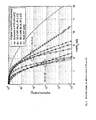
FIG. 2 is a plot comparing performance of different embodiment schemes employed to reduce PAPR; -
FIG. 3 is a plot comparing performance of different embodiment schemes for different values of antennas and sub-blocks; -
FIG. 4 is a schematic diagram illustrating an embodiment of an STBC-OFDM scheme; -
FIG. 5 is a schematic diagram illustrating an embodiment of an SFBC-OFDM scheme; and -
FIG. 6 is a plot comparing performance of different embodiment schemes for different values of sub-blocks. - In the following detailed description, numerous specific details are set forth to provide a thorough understanding of claimed subject matter. However, it will be understood by those skilled in the art that claimed subject matter may be practiced without these specific details. In other instances, well known methods, procedures, components and/or circuits have not been described in detail so as not to obscure claimed subject matter.
- Some portions of the detailed description which follow are presented in terms of algorithms and/or symbolic representations of operations on data bits and/or binary digital signals stored within a computing system, such as within a computer and/or computing system memory. These algorithmic descriptions and/or representations are the techniques used by those of ordinary skill in the data processing arts to convey the substance of their work to others skilled in the art. An algorithm is here, and generally, considered to be a self-consistent sequence of operations and/or similar processing leading to a desired result. The operations and/or processing may involve physical manipulations of physical quantities. Typically, although not necessarily, these quantities may take the form of electrical and/or magnetic signals capable of being stored, transferred, combined, compared and/or otherwise manipulated. It has proven convenient, at times, principally for reasons of common usage, to refer to these signals as bits, data, values, elements, symbols, characters, terms, numbers, numerals and/or the like. It should be understood, however, that all of these and similar terms are to be associated with appropriate physical quantities and are merely convenient labels. Unless specifically stated otherwise, as apparent from the following discussion, it is appreciated that throughout this specification discussions utilizing terms such as "processing", "computing", "calculating", "determining" and/or the like refer to the actions and/or processes of a computing platform, such as a computer or a similar electronic computing device, that manipulates and/or transforms data represented as physical electronic and/or magnetic quantities and/or other physical quantities within the computing platform's processors, memories, registers, and/or other information storage, transmission, and/or display devices.
- In an embodiment in accordance with claimed subject matter, PAPR reduction is accomplished for an SFBC MIMO-OFDM system using polyphase interleaving and inversion (hereinafter, PII). Furthermore, another embodiment employing reduced complexity, termed suboptimal successive PII (hereinafter SS-PII) is also described. These schemes or embodiments provide a good compromise between performance and complexity, although claimed subject matter is not limited in scope to these two particular embodiments. Many other embodiments are possible within the scope of claimed subject matter.
- Compared with the selective mapping (SLM) scheme that has been applied to STBC MIMO-OFDM and which can be adopted for SFBC-OFDM systems, these embodiments provide performance advantage, particularly under a small number of sub-blocks, although this is not a requirement, of course.
- The combination of FDM modulation with multiple input multiple output (MIMO) systems may increase the system capacity and reduce receiver complexity, such as for time-variant and frequency-selective channels, for example. Therefore, MIMO-OFDM has become a promising candidate for high performance future 4G broadband wireless communications. However, as for OFDM, one disadvantage of MIMO-OFDM is that the signals transmitted on different antennas might exhibit a relatively large peak-to-average power ratio (PAPR), which may result in an undesirable amount of in-band and out-of-band distortion, such as if passed through a nonlinear device, such as a transmitter power amplifier.
- Many PAPR reduction schemes for OFDM systems are proposed. Among them, signal scrambling methods are attractive since OFDM signals are modified without distortion to provide better PAPR property with a relatively low complexity. In MIMO-OFDM systems, one approach for PAPR reduction applies these schemes for OFDM systems separately on different transmit antennas. However, this is not applicable if a space-frequency block coding (SFBC) is employed in MIMO-OFDM systems, since OFDM symbols transmitted substantially simultaneously from different antennas are dependent on the used space-frequency code, as discussed in more detail later.
- Considering a MIMO-OFDM system with two transmit antennas and orthogonal SFBC, for example, one embodiment is provided here in which polyphase interleaving and inversion (PII) is employed. Likewise, alternate embodiments may employ more than two antennas. In this particular embodiment, however, using two antennas with this particular scheme, an OFDM sequence is partitioned into M sub-blocks of equal sizes. A sub-block is decomposed into two polyphase sequences, and these polyphase sequences may be interleaved and inverted. In this particular embodiment, polyphase interleaving and inversion may be applied to the sub-blocks independently. This may be done to find a combination that gives the highest or most PAPR reduction. For complexity reduction, in an alternate embodiment, termed here suboptimal successive PII (SS-PII), a compromise between performance and complexity may be employed. Thus, an embodiment employing SS-PII may not produce the most PAPR reduction, but sufficient PAPR reduction with a reduction in complexity over an embodiment producing the most PAPR reduction that in some particular applications, depending on a variety of factors, it may be desirable. Of course, this is simply one embodiment and claimed subject matter is not limited to this embodiment or to SFBC. For example, as described in more detail later, STBC or spatial multiplexing may alternately be employed.
- Compared with the SLM scheme, these embodiments present performance advantage, particularly with small number of sub-blocks M. Although, again, claimed subject matter is not limited in scope to these particular embodiments. Many other embodiments are included within the scope of claimed subject matter. However, simulation results for these embodiments are shown for 128 sub-carriers, QPSK modulation and over-sampling factor equal to 4, as described in more detail later.
- MIMO-OFDM has become a promising candidate for high performance 4G broadband wireless communications, as previously mentioned. In such systems, two basic signaling modes have been employed namely Spatial Multiplexing (SM), see, for example, Gesbert and Paulraj, "On the capacity of OFDM-based spatial multiplexing systems," IEEE Trans. Commun., vol. 50, pp 225-234, Feb. 2002 (hereinafter [1]), which aims at increasing the data rate by spatially multiplexing independent data streams, and spatial diversity coding with either Space-Time Block Coded OFDM (STBC-OFDM) or Space-Frequency Block Coded OFDM (SFBC-OFDM), see, for example, Lee and Williams, "A space-time coded transmitter diversity technique for frequency selective fading channels," Proc. IEEE Sensory Array and Multichannel Processing Workshop, Combridge, MA, 2000, pp149-152; Lee and Williams, "A space-frequency transmitter diversity technique for OFDM systems," in Proc. IEEE GLOBECOM, San Francisco, CA, 2000, pp1473-1477, (hereinafter, [2] and [3], respectively) which exploit the spatial degrees of freedom (at the cost of rate) to improve link reliability.
- As with OFDM, one disadvantage of MIMO-OFDM is that the signals transmitted on different antennas might exhibit a large peak-to-average power ratio (PAPR). However, different PAPR reduction techniques have been applied to both signaling modes and demonstrate performance advantage of CARI for different numbers of transmit antennas N.
- In an OFDM modulation technique, a block of Nc symbols, {Xn, n= 0,1,2,..., Nc -1} is formed with the symbol modulating the corresponding sub-carrier from a set { fn, n= 0,1,2,..., Nc -1}. The Nc subcarriers are chosen to be orthogonal, e.g., fn = nΔf, where Δf = 1/ NcT and T represents the original symbol period. The resulting baseband OFDM signal x(t) of a block can be expressed as (1) below"

- The PAPR of the transmitted signal in (1) can be defined as (2) below:

- Since most practical systems deal with discrete-time signals, instead of reducing the continuous-time peak max absolute value of x(t), the maximum amplitude of LNC samples of x(t) is reduced. Parameter L denotes the oversampling factor. The case of L = 1 is known as critical sampling or Nyquist rat sampling, whereas values of L>1 correspond to oversampling. Oversampling may be implemented by adding (L - 1)NC zeros to the original OFDM block followed by the Inverse Fast Fourier Transform (IFFT). The complementary cumulative distribution function (CCDF) of the PAPR of an OFDM signal for a given PAPR level, PAPR0, is the probability that the PAPR of a randomly generated OFDM symbol, composed of NC sub-carriers, exceeds the given threshold PAPR, e.g., this is expressed below as (3):

- For this embodiment, we may assume OFDM symbols with the number of carriers Nc = 128, Xn is an element of {+1, -1, +j, -j} or QPSK modulation and the oversampling factor L = 4 since it is sufficient for capturing the continuous-time peaks, see, for example, Tellambura, "Computation of the continuous-time PAR of an OFDM signal with BPSK subcarriers," IEEE Commun. Lett. Vol. 5, pp. 185-187, May 2001.
- Consider a spatial multiplexing mode where N independent data streams have been fed to IFFT/Cyclic Prefix (IFFT/CP) blocks and transmitted over N antennas. A way of reducing PAPR would be applying techniques such as PTS or SLM on each antenna separately. This kind of implementation, however, does not utilize all available degrees of freedom of having multiple transmit antennas. Another way of reducing PAPR is disclosed in M. Tan and Y. Bar-Ness, "OFDM Peak-to-Average Power Ratio Reduction by combined symbol Rotation and Inversion with limited Complexity", proceeding of Globecom 2003, pp. 605 - 609, where on OFDM sequence is divided into subblocks and symbol rotation and inversion are performed in each subblock. In one embodiment in accordance with claimed subject matter, a cross-antenna rotation and inversion (CARI) scheme, such as depicted in
Fig. 1 , for example, may be employed, which exploits such degrees of freedom, although, of course, claimed subject matter is not limited in scope in this respect. - A data vector (sequence) Xi, i= 1,2,..., N is first partitioned into M disjoint carrier sub-blocks in such a way that all sub-carrier positions in Xi,m are set to zero if they belong to other sub-blocks Xi,j, ∀j≠m. This may be represented as,


- When factors of rm and bm (hereinafter, factors r and b) take valid arbitrary values, the resultant sequence set in frequency and corresponding time domain may be expressed as follows by (5) and (6) below, respectively:


where xi' is the IFFT of Xi' and mod(a,b) denotes modulus of a to base b. A sequence set denoted as { X i, X 2, ... X N} will have the smallest maximum PAPR among all other sequence sets {X'1, X'2, ... X'N}. In other words, for a certain sequence set, e.g., certain r and b factors, the maximum PAPR in the set, here, the maximum PAPR among the antennas, may be found. Likewise, going through all possible combinations of factors r and b, a sequence set that has the smallest maximum PAPR may be found, referred to here as a mini-max criterion. The parameters for a given original set of sequences may be expressed by (7) below:
where x'i is defined in (6) and PAPR(x) denotes the peak-to-advantage ratio of time vector x defined in (2). This particular embodiment, therefore, reduces to the PTS scheme described in [1] for the case ofN = 1 and expanded set W = { +1, -1, +j, -j}. As in the case of a PTS technique, this particular embodiment utilizes an advantage of calculating IFFT for sub-blocks individually and improving PAPR in the time domain by (6). Additionally, certain side information bits may be transmitted to the receiver to undo data scrambling. However, for this embodiment, complexity may be large due to the number of trials to determine the appropriate factors to reduce PAPR. - For the SLM approach, described in [2], V statistically independent sequences are produced by multiplying the original information sequence by V different NC-long random sequences with values chosen from the set W = {-1,+1, -j, +j}. One sequence out of V with the lowest PAPR is chosen for transmission. In the case of N transmit antennas, one can chose to perform PAPR reduction on each antenna separately, e.g., to generate N sets of V independent sequences and transmit one with the smallest PAPR from each set. However, overhead bits may be sent to the receiver notifying which one out of V random sequences is used for each antenna for data scrambling. It is assumed that the receiver has the knowledge of all V random sequences.
- In the PTS approach, as described in [1], the input data block X is partitioned into M disjoint sub-blocks of equal size m = {1,2,...M}, which can be represented mathematically as


- In contrast to PTS and SLM schemes which treat antennas independently, this particular embodiment handles them jointly, although, again, claimed subject matter is not limited in scope to this particular embodiment. It has been shown in [1], for example, that PTS gives advantage over SLM for similar complexity, e.g., the same number of IFFT operations M = V. Table 1 gives an overview of considered schemes with respect to complexity, here, the number of IFFT operations, the number of trials and the number of side information bits.
TABLE 1 SCHEME OVERVIEW Scheme No. of IFFTs No. of Trials No. of Side Information bits ° PTS [1] NM Nw M-1 [N(M - 1) log2(w)] SLM [2] NV - [Nlog2(V)] Concurrent SLM [9] NV - [log2(V)] CARI [3] NM (Nw) M-1 [(M - 1) log2(Nw)] Successive PTS [10] NM NMw [NM log2(w)] SS-CARI [3] NM NMw [M log2(Nw)] MCARI NM (Nw) M [M log2(Nw)] SS-MCARI NM NMw [M log2(Nw)] ° The operation [x] rounds x upwards to the nearest integer. -
Fig. 2 shows the PAPR performance of this particular embodiment, versus PTS and SLM schemes for number of sub-blocks (random sequences) M = V = 4, the number of antennas N ∈ {2, 4} and using 105 independent OFDM symbols. It can be seen from the plot that this particular embodiment performs better than PTS. Furthermore, the slope is steeper if the number of antennas increases, resulting in a potential reduction of high PAPR values. Also note fromFig. 2 that, for N = 2, for this embodiment, better PAPR reduction takes place if compared to PTS even though the former employs half the number of trials and side information bits, as illustrated in Table 1, for example. For the case of N = 4, however, this particular embodiment employs twice as many number of trails compared to PTS, employs 9 side information bits, instead of 24, and gives good PAPR reduction and a steep slope. Another implementation advantage for this particular embodiment is that weighting factors are drawn from the set W = {+1, -1} and not from the set W = { +1, -1, +j, -j}, as in the case of PTS. Thus, these results imply that this particular embodiment reduces the PAPR of MIMO-OFDM more than SLM for the same number ofIFFTs. - For this particular embodiment, some advantage may be associated at least in part with employing rotation and inversion on the independent OFDM sub-blocks transmitted on different antennas. For example, this approach produces higher degrees of freedom that may offset the possibility of encountering poor sequences with high PAPR, although, of course, claimed subject matter is not limited in scope in this respect. However, in order to find the desired sequence set the number of trials may be relatively large for N > 2 and/or M > 4.
- Thus, an alternate embodiment within the scope of claimed subject matter, for example, with reduced complexity, may be employed. This may, for these purposes, be referred to as a successive suboptimal CARI (SS-CARI) scheme. Instead of searching through all possible combinations of factors r and b, the search may be performed in successive fashion, although, again, claimed subject matter is not limited in scope in this respect. Many other embodiments are possible within the scope of claimed subject matter.
- However, for this particular embodiment, first, assume that rm = 0 and bm = 1 for m (the original set of sequences), compute the PAPRs of the whole set of sequences (6) and store the maximum value in memory. Then, search through the possible combinations of r1 and b1, keeping coefficients for other sub-blocks unchanged. For each combination, find the maximum PAPR among the antennas. If it is less than the one stored in the memory, overwrite it with the new value, and keep corresponding r1 and b1. After all possible combinations are exhausted, we will obtain the best r1 and b1 factors. Then, the process continues in this fashion, changing one sub-block at the time, until all r and b factors have been found successively. Again, this is simply one approach and many other are possible and included within the scope of claimed subject matter.
-
Fig. 3 shows the PAPR performance of this embodiment for different number of transmit antennas N and sub-blocks M in comparison to SLM employing 106 independent OFDM symbols, for example. In the case of M = V = 4 and N = 2, this embodiment gives some gain compared to SLM. In the case of M = V = 16, performance differences are smaller. As with SLM, this embodiment employs the same number of NC-point IFFTs, but if the transforms may be used to exploit the fact that the large number of the input vectors contain zeros, an additional reduction in complexity may be achieved by employing this particular embodiment. - Whereas previously we considered an embodiment involving spatial multiplexing, likewise, embodiments for STBC coding and SFBC coding are possible and included within the scope of claimed subject matter. To illustrate operation, but for simplicity, let us consider a STBC-OFDM system that employs an Alamouti scheme, see, for example, Alamout, "A simple transmit diversity technique for wireless communications," IEEE J. Select Areas Commun., vol. 16, pp. 1451-1458, Oct., 1998 (hereinafter, [4]), as depicted in
Fig. 4 . Of course, this is merely an example and claimed subject matter is not limited in scope to this particular example. During the first symbol period, two independent OFDM symbols X1 and X2 are transmitted from antennas Tx1 and Tx2, respectively. During the next symbol period - X2* is transmitted from antenna Tx1, and X1* is transmitted from antenna Tx2, where ()* denotes the element-wise complex conjugate operation. In this example, we assume that the channel remains fixed for at least two OFDM symbols. - It is not difficult to show that Xi and Xi* above have substantially the same PAPR properties. Therefore, with orthogonal STBC, PAPR reduction may applied for the first symbol period. After performing PAPR reduction on X1 and X2, such as, for example, by using an embodiment in accordance with claimed subject matter, two modified sequences with good PAPR properties are obtained, which will be transmitted during the first symbol period. During the second symbol period -X2* and X1* may be transmitted, having substantially the same PAPR properties.
- Since sequences X1 and X2 are independent, previously described results for the previously described embodiments are valid for this embodiment, involving an STBC-OFDM system. As an example, for a system with N = 4, a ½-rate complex orthogonal STB code, see, for example, Tarokh, Jafarkhani, and Calderbank, "Space-time block codes from orthogonal designes," IEEE J. Select. Areas Commun., vol. 16, pp 1451-1458, Oct. 1998, may be considered.
- The previously described embodiments may be employed with a STBC-OFDM transmit diversity embodiment. However, such an environment may in at least some instances be impractical in mobile systems since OFDM symbol duration may be comparable to the channel coherence time. Instead, in fast fading environments, SFBC-OFDM transmit diversity technique may be applied to achieve better performance. For simplicity, in an alternate embodiment, let us consider a SFBC-OFDM system that employs an Alamouti scheme as described in [4]. A simplified block diagram of such an embodiment is shown in
Fig. 5 . A data symbol vector X = [X0, X1, ...,XNc-1] is coded into two vectors X1 and X2 by the space-frequency encoder as expressed below by (8):

- Vectors X1 and X2 are fed to the IFFT/CP blocks and transmitted substantially simultaneously from antennas TX1 and TX2, respectively. The operation of the space-frequency encoding/decoding may be elegantly expressed in terms of even Xe and odd Xo polyphase component vectors of the input data symbol vector X, as shown by (9) below, e.g.,


where the length of vectors Xe and Xo is NC/2. Equation (8) may be expressed in terms of even and odd component vectors (9) as shown below in (10):

- The demodulated signal at the receiver is given by below by (11):

where A1 and A2 represent diagonal matrices whose elements are the FFTs of the corresponding channel impulse responses h1 and h2. Equation (11) may be expressed in terms of even an odd vector components X1,e, X1,o, X2,e and X2,o ,as shown below by (12):

The space-frequency decoder gives an estimation according to the following metrics expressed below by (13):

- Substituting (12) into (13) and assuming that the complex channel gains between adjacent sub-carriers are approximately equal, results with (14) below:


- A SFBC-OFDM scheme, as with an STBC-OFDM scheme, for example, also suffers from large PAPR. In this latter case, however, simple cross-antenna rotation cannot be performed since it would destroy the structure of Alamouti space-frequency block code. Thus, in an alternate embodiment, a modified scheme may be applied.
- As was mentioned earlier, previous embodiments described for CARI and SS-CARI scheme cannot be applied directly to the sequences X1 and X2 of (8) since they are not independent, as in STBC-OFDM, even though, some implementation complexity reduction in IFFT calculations is possible due to that dependency. Instead of CARI (SS-CARI), however, for such an embodiment, the vector X may be decomposed into sequences X' and X" such that, as shown by (15) below:


where vectors Xe and Xo are defined by (9). By using linearity and basic properties of IFFT, as well as referring to (8), the time domain sequences on an antenna may be expressed in terms of x' and x", the IFFTs of X' and X", as shown by (16) below:

- where superscript (0) denotes unchanged order of decoded bits X̂ = [X̂0, X̂1, ..., X̂Nc-1] from (14), J is NC x NC reversal or anti-diagonal matrix and D is diagonal matrix coming from a single carrier shift, as shown by (17) below:


- Now there is a possibility of exchanging even and odd components of X or equivalently sending a vector X = [X1, X0, ..., XNc-1, XNc-2 ] instead of X = [X0, X1, ..., XNc-2, XNc-1]. This will affect previous equations starting from (8) including (16), with the values of x' and x" being swapped, resulting in a different set of sequences, denoted as X1 (1) and X2 (1). A set between {X1 (0),X2 (0)} and {X1 (1), x 2(1)} with the smallest maximum PAPR may be chosen for transmission. In the later case, bits are decoded in different order and would therefore be rearranged at the receiver, for example.
- Data symbol vector X = [X0, X1,...,XNc-1] may be further partitioned into M disjoint carrier sub-blocks Xm, m = 1,2,..., M and the previous process may be applied to each sub-block independently. Xm have the size of the original sequence NC with the sub-carrier position set to zero if they belong to some other sub-block. Also, non-zero sub-carriers in a sub-block span an integer number of space-frequency code words. Thus, the original sequence may be represented as


- Using the mini-max criterion (7) sequence set with the smallest maximum PAPR for all possible combinations, r and b factors may be selected for transmission in this particular embodiment. However, claimed subject matter is, or course, not limited in scope in this respect.
- Due to higher complexity of the MCARI scheme, as illustrated in Table 1, an alternate embodiment may be employed. Instead searching through all possible combinations of r and b, this may be done in successive fashion, as was described in connection with a previously described embodiment, for example. First, assume that r1 = 0 and b1 = 1 for m (the original set of sequences) and compute the PAPRs of the whole set of sequences (18) and store the maximum value in the memory. Search through all possible combinations of r and b, keeping coefficients for other sub-blocks unchanged. For each combination, find the maximum PAPR among antennas and if it is less than the one stored in the memory, overwrite it with the new value. After all possible combinations are exhausted, the desired r and b factors for this sub-block remain, in this particular embodiment. The process continues in this fashion, changing only mth sub-blocks at the time, until r and b factors have been found successively. Regarding complexity, the number of IFFTs for this particular embodiment are substantially the same as for previously described embodiments (see, for example, Table 1). Additional complexity may occur due to two matrix multiplication in (16). Multiplication of a vector by diagonal matrix D is element-wise multiplication of two vectors whereas multiplication of a vector by anti-diagonal matrix J involves reversing the order of the vector elements.
- Alternatively, the SLM scheme may be used in conjunction with the SFBC-OFDM by multiplying data vector X with V independent random sequences, applying Alamouti coding and calculating PAPR of the set {x'1, x'2} for V. Again, the set of sequences for which the maximum PAPR is smallest is selected.
-
Fig. 6 shows the performance advantage of the previously described embodiment over SLM for similar complexity, e.g., 106 independent OFDM symbols and M = V ∈ {4,16}. However, since the slope of SLM is steeper, the two curves will intersect below a 10-6 PAPR level. Nevertheless, this probability is so small that this may be neglected in practice. A drawback of this particular embodiment, however, is the higher number of side information bits compared to SLM. - In the case of N = 4, as mentioned with a previous embodiment, ½-rate complex orthogonal STB code, see, for example, Tarokh, Jafarkhani, and Calderbank, "Space-time block codes from orthogonal designes," IEEE J. Select. Areas Commun., vol. 16, pp 1451-1458, Oct. 1998, may be considered. However, to use this particular embodiment for PAPR reduction, input symbol vector X = [X0, X1,..., XNc-1] is decomposed into 4 polyphase components, for example.
- It is worth noting that embodiments of claimed subject matter may be employed in a variety of contexts and claimed subject matter is not limited in scope in this respect. For example, embodiments may be employed in a variety of possible communication devices, including, for example, cell phones, personal digital assistants, laptop computers, media players, and the like. Of course, claimed subject matter is not limited in scope to this example. Many other approaches and/or other types of devices employing a variety of software, firmware and/or hardware are possible and included within the scope of claimed subject matter. It will, of course, be understood that, although particular embodiments have just been described, the claimed subject matter is not limited in scope to a particular embodiment or implementation. For example, one embodiment may be in hardware, such as implemented to operate on a device or combination of devices, for example, whereas another embodiment may be in software. Likewise, an embodiment may be implemented in firmware, or as any combination of hardware, software, and/or firmware, for example. Likewise, although claimed subject matter is not limited in scope in this respect, one embodiment may comprise one or more articles, such as a storage medium or storage media. This storage media, such as, one or more CD-ROMs and/or disks, for example, may have stored thereon instructions, that when executed by a system, such as a computer system, computing platform, or other system, for example, may result in an embodiment of a method in accordance with claimed subject matter being executed, such as one of the embodiments previously described, for example. As one potential example, a computing platform may include one or more processing units or processors, one or more input/output devices, such as a display, a keyboard and/or a mouse, and/or one or more memories, such as static random access memory, dynamic random access memory, flash memory, and/or a hard drive. For example, a display may be employed to display one or more queries, such as those that may be interrelated, and or one or more tree expressions, although, again, claimed subject matter is not limited in scope to this example.
- In the preceding description, various aspects of claimed subject matter have been described. For purposes of explanation, specific numbers, systems and/or configurations were set forth to provide a thorough understanding of claimed subject matter. However, it should be apparent to one skilled in the art having the benefit of this disclosure that claimed subject matter may be practiced without the specific details. In other instances, well known features were omitted and/or simplified so as not to obscure the claimed subject matter. While certain features have been illustrated and/or described herein, many modifications, substitutions, changes and/or equivalents will now occur to those skilled in the art.
Claims (25)
- A method of transmitting a signal comprising:transmitting, using a plurality of transmit antennas, an OFDM sequence for an MIMO scheme in which polyphase sequences of at least some sub-blocks of said OFDM sequence have been interleaved and inverted so as to reduce PAPR, said interleaving comprising rotating symbols of the polyphase sequences between the transmit antennas.
- The method of claim 1, wherein the sub-blocks comprise partitions of said OFDM sequence of equal sizes.
- The method of claim 1, wherein the sub-blocks comprise two polyphase sequences.
- The method of claim 1, wherein the sub-blocks of the OFDM sequence having polyphase sequences that are interleaved and inverted are selected so that out of the possible combinations of interleaving and inverting of polyphase sequences of sub-blocks that combination of interleaving and inverting that reduces PAPR the most is transmitted.
- The method of claim 1, wherein the sub-blocks of the OFDM sequence having polyphase sequences that are interleaved and inverted are selected by computing sequentially by sub-block those in which interleaving and inverting the polyphase sequences will reduce PAPR.
- The method of claim 1, wherein the OFDM sequence is transmitted using at least two antennas.
- The method of claim 1, wherein the scheme employs STBC coding.
- The method of claim 1, wherein the scheme employs SFBC coding.
- The method of claim 1, wherein the scheme employs spatial multiplexing.
- An apparatus comprising:a transmitter employing an MIMO-OFDM scheme;said transmitter adapted to transmit, using multiple transmit antennas, an OFDM sequence in which polyphase sequences of at least some sub-blocks of said OFDM sequence have been interleaved and inverted so as to reduce PAPR, said interleaving comprising rotating symbols of the polyphase sequences between the transmit antennas.
- The apparatus of claim 7, wherein the sub-blocks comprise partitions of said OFDM sequence of equal sizes.
- The apparatus of claim 7, wherein the sub-blocks comprise two polyphase sequences.
- The apparatus of claim 7, wherein the transmitter is adapted to select the sub-blocks of the OFDM sequence having polyphase sequences that are interleaved and inverted so that out of the possible combinations of interleaving and inverting of polyphase sequences of sub-blocks that combination of interleaving and inverting that reduces PAPR the most is transmitted.
- The apparatus of claim 7, wherein the transmitter is adapted to select the sub-blocks of the OFDM sequence having polyphase sequences that are interleaved and inverted by computing sequentially by sub-block those in which interleaving and inverting the polyphase sequences will reduce PAPR.
- The apparatus of claim 7, wherein the transmitter is capable of applying STBC coding.
- The apparatus of claim 7, wherein the transmitter is capable of applying SFBC coding.
- The apparatus of claim 7, wherein the transmitter is capable of applying spatial multiplexing.
- An apparatus comprising:a computing device; said computing device adapted to compute an OFDM sequence for transmission, using multiple transmit antennas, via an MIMO scheme in which polyphase sequences of at least some sub-blocks of said OFDM sequence have been interleaved and inverted so as to reduce PAPR, said interleaving comprising rotating symbols of the polyphase sequences between the transmit antennas.
- The apparatus of claim 12, wherein the sub-blocks comprise partitions of said OFDM sequence of equal sizes.
- The apparatus of claim 12, wherein the sub-blocks comprise two polyphase sequences.
- The apparatus of claim 12, wherein said computing device is adapted to select the sub-blocks of the OFDM sequence having polyphase sequences that are interleaved and inverted so that out of the possible combinations of interleaving and inverting of polyphase sequences of sub-blocks that combination of interleaving and inverting that reduces PAPR the most is selected for transmission.
- The apparatus of claim 12, wherein said computing device is adapted to select the sub-blocks of the OFDM sequence having polyphase sequences that are interleaved and inverted by computing sequentially by sub-block those in which interleaving and inverting the polyphase sequences will reduce PAPR.
- The apparatus of claim 12, wherein said computing device is adapted to apply STBC coding.
- The apparatus of claim 12, wherein said computing device is adapted to apply SFBC coding.
- The apparatus of claim 12, wherein said computing device is adapted to apply spatial multiplexing.
Applications Claiming Priority (2)
| Application Number | Priority Date | Filing Date | Title |
|---|---|---|---|
| US63255604P | 2004-12-02 | 2004-12-02 | |
| PCT/US2005/043615 WO2006060651A2 (en) | 2004-12-02 | 2005-12-02 | Method and/or system for reduction of papr |
Publications (3)
| Publication Number | Publication Date |
|---|---|
| EP1817857A2 EP1817857A2 (en) | 2007-08-15 |
| EP1817857A4 EP1817857A4 (en) | 2011-10-19 |
| EP1817857B1 true EP1817857B1 (en) | 2012-10-31 |
Family
ID=36565766
Family Applications (1)
| Application Number | Title | Priority Date | Filing Date |
|---|---|---|---|
| EP05852750A Expired - Lifetime EP1817857B1 (en) | 2004-12-02 | 2005-12-02 | Method and system for reduction of PAPR |
Country Status (6)
| Country | Link |
|---|---|
| US (1) | US8040787B2 (en) |
| EP (1) | EP1817857B1 (en) |
| JP (1) | JP4680264B2 (en) |
| KR (2) | KR20090086139A (en) |
| CN (1) | CN101103570B (en) |
| WO (1) | WO2006060651A2 (en) |
Families Citing this family (49)
| Publication number | Priority date | Publication date | Assignee | Title |
|---|---|---|---|---|
| US10931338B2 (en) | 2001-04-26 | 2021-02-23 | Genghiscomm Holdings, LLC | Coordinated multipoint systems |
| US10644916B1 (en) | 2002-05-14 | 2020-05-05 | Genghiscomm Holdings, LLC | Spreading and precoding in OFDM |
| WO2004054164A1 (en) * | 2002-12-12 | 2004-06-24 | Koninklijke Philips Electronics N.V. | A backward compatible transmitter diversity scheme for use in an ofdm communication system |
| US11381285B1 (en) | 2004-08-02 | 2022-07-05 | Genghiscomm Holdings, LLC | Transmit pre-coding |
| KR20090086139A (en) | 2004-12-02 | 2009-08-10 | 뉴저지 인스티튜트 오브 테크놀로지 | Methods and / or Systems for Reducing PAP |
| US7339884B2 (en) * | 2004-12-08 | 2008-03-04 | New Jersey Institute Of Technology | STBC MIMO-OFDM peak-to-average power ratio reduction by cross-antenna rotation and inversion |
| WO2006102745A1 (en) | 2005-03-30 | 2006-10-05 | Nortel Networks Limited | Method and system for combining ofdm and transformed ofdm |
| WO2006102744A1 (en) | 2005-03-30 | 2006-10-05 | Nortel Networks Limited | Systems and methods for ofdm channelization |
| KR100817497B1 (en) * | 2006-03-10 | 2008-03-27 | 한국전자통신연구원 | Apparatus and method for generating simbol for multiple antennas |
| GB0619490D0 (en) * | 2006-10-03 | 2006-11-08 | Lucent Technologies Inc | Method for peak-to-avaerage power ratio reduction in telecommunications |
| US8130846B2 (en) | 2006-12-11 | 2012-03-06 | New Jersey Institute Of Technology | System and method for single-carrier space-frequency block coded transmission over frequency selective and fast fading channels |
| WO2008095334A1 (en) * | 2007-02-02 | 2008-08-14 | Huawei Technologies Co., Ltd. | Peak to average power ratio reduction in multi- carrier systems |
| KR101314254B1 (en) | 2007-02-16 | 2013-10-02 | 삼성전자주식회사 | OFDM transmitting and receiving systems and methods thereof |
| KR100878720B1 (en) * | 2007-05-29 | 2009-02-05 | 재단법인서울대학교산학협력재단 | A Method for Reducing the Ratio of Maximum Power to Average Power in Orthogonal Frequency Division Multiplexing Systems |
| TW200926655A (en) * | 2007-12-10 | 2009-06-16 | Univ Nat Taiwan | Method of using unitary transformation to solve high peak-to-average power ratio problem for multi-carrier modulation communication system |
| EP2251997A1 (en) * | 2008-02-20 | 2010-11-17 | Sharp Kabushiki Kaisha | Wireless transmitter, wireless receiver, wireless communication system, and wireless transmission method |
| JPWO2009118777A1 (en) * | 2008-03-25 | 2011-07-21 | 富士通株式会社 | Wireless communication method, terminal device, base station device, and wireless communication system |
| JP2010004143A (en) * | 2008-06-18 | 2010-01-07 | Fujitsu Ltd | Transmitter and receiver, and transmission method and reception method |
| EP2356789A1 (en) * | 2008-11-12 | 2011-08-17 | Telefonaktiebolaget L M Ericsson (publ) | A method and a transmitter in a wireless communication network |
| KR101067644B1 (en) * | 2009-03-10 | 2011-09-27 | 서울대학교산학협력단 | Reduction Method of Maximum Power to Average Power of Orthogonal Frequency Division Multiplexing System Using Partial Bit Inversion Selection Mapping Technique |
| WO2012030319A2 (en) | 2009-06-26 | 2012-03-08 | Hypres, Inc. | System and method for controlling combined radio signals |
| US8385443B2 (en) | 2009-07-17 | 2013-02-26 | Qualcomm Incorporated | Constructing very high throughput long training field sequences |
| US8917784B2 (en) * | 2009-07-17 | 2014-12-23 | Qualcomm Incorporated | Method and apparatus for constructing very high throughput long training field sequences |
| TWI423629B (en) * | 2010-10-25 | 2014-01-11 | Univ Nat Sun Yat Sen | A method of reducing peak-to-average power ratio for an ofdm systems |
| CA2803906C (en) | 2010-12-10 | 2018-10-30 | Panasonic Corporation | Signal generation method and signal generation device |
| CN102263765B (en) * | 2011-08-22 | 2013-07-10 | 宁波大学 | Robust transmission method of digital broadcast mobile signals |
| CN102263761B (en) * | 2011-08-22 | 2013-06-12 | 宁波大学 | Method for modulating framing of multimedia wireless broadcast signals |
| US9450659B2 (en) * | 2011-11-04 | 2016-09-20 | Alcatel Lucent | Method and apparatus to generate virtual sector wide static beams using phase shift transmit diversity |
| US8787873B1 (en) | 2011-11-04 | 2014-07-22 | Plusn Llc | System and method for communicating using bandwidth on demand |
| US8675769B1 (en) | 2012-06-20 | 2014-03-18 | MagnaCom Ltd. | Constellation map optimization for highly spectrally efficient communications |
| CN103312652B (en) * | 2013-05-15 | 2016-01-20 | 西南石油大学 | A kind of space-frequency coding SFBC MIMO-OFDM system based on F matrix carries out the method for selected mapping method SLM |
| US9118519B2 (en) | 2013-11-01 | 2015-08-25 | MagnaCom Ltd. | Reception of inter-symbol-correlated signals using symbol-by-symbol soft-output demodulator |
| CN105814856B (en) | 2013-11-26 | 2019-02-12 | 普鲁斯恩公司 | Method, apparatus and system for controlling combined waveforms, apparatus for combining multiple signals |
| US9008223B1 (en) | 2013-12-24 | 2015-04-14 | Freescale Semiconductor, Inc. | Transmitter and method for reducing the peak-to-average power ratio of a digitally modulated communication signal |
| US12224860B1 (en) | 2014-01-30 | 2025-02-11 | Genghiscomm Holdings, LLC | Linear coding in decentralized networks |
| US9496900B2 (en) | 2014-05-06 | 2016-11-15 | MagnaCom Ltd. | Signal acquisition in a multimode environment |
| CN104022993B (en) * | 2014-06-16 | 2017-05-10 | 电子科技大学 | SLM method for lowering peak-to-average power ratio of SFBC MIMO-OFDM system |
| US9246523B1 (en) | 2014-08-27 | 2016-01-26 | MagnaCom Ltd. | Transmitter signal shaping |
| US9819526B2 (en) | 2015-11-05 | 2017-11-14 | Huawei Technologies Co., Ltd. | Apparatus and methods for low PAPR transmission in MIMO systems |
| CN108270708B (en) | 2016-12-30 | 2020-07-07 | 维沃移动通信有限公司 | A kind of information transmission method, sender and receiver for reducing PAPR |
| US10243773B1 (en) | 2017-06-30 | 2019-03-26 | Genghiscomm Holdings, LLC | Efficient peak-to-average-power reduction for OFDM and MIMO-OFDM |
| US10637705B1 (en) | 2017-05-25 | 2020-04-28 | Genghiscomm Holdings, LLC | Peak-to-average-power reduction for OFDM multiple access |
| EP3659309A4 (en) * | 2017-07-25 | 2021-04-21 | Genghiscomm Holdings, LLC | EFFICIENT TO MEDIUM PEAK POWER REDUCTION FOR OFDM AND MIMO-OFDM |
| US10637544B1 (en) | 2018-04-24 | 2020-04-28 | Genghiscomm Holdings, LLC | Distributed radio system |
| CN112425127B (en) | 2018-06-17 | 2024-09-20 | 珍吉斯科姆控股有限责任公司 | Distributed radio system |
| US12206535B1 (en) | 2018-06-17 | 2025-01-21 | Tybalt, Llc | Artificial neural networks in wireless communication systems |
| US12580800B2 (en) | 2019-01-25 | 2026-03-17 | Tybalt, Llc | Orthogonal multiple access and non-orthogonal multiple access |
| WO2020242898A1 (en) | 2019-05-26 | 2020-12-03 | Genghiscomm Holdings, LLC | Non-orthogonal multiple access |
| US11765011B2 (en) | 2021-07-06 | 2023-09-19 | Huawei Technologies Co., Ltd. | Method and apparatus for transmitting and receiving data |
Family Cites Families (31)
| Publication number | Priority date | Publication date | Assignee | Title |
|---|---|---|---|---|
| DE19635813A1 (en) * | 1996-09-04 | 1998-03-05 | Johannes Prof Dr Ing Huber | Process for reducing the peak value factor in digital transmission processes |
| US6445747B1 (en) * | 1998-07-14 | 2002-09-03 | At&T Corporation | Method and apparatus to reduce peak to average power ratio in multi-carrier modulation |
| US6614861B1 (en) * | 1999-04-16 | 2003-09-02 | Nokia Networks Oy | Method and apparatus for higher dimensional modulation |
| DE60027123T2 (en) * | 1999-12-28 | 2006-09-07 | Ntt Docomo Inc. | Circuit for compressing the dynamic range of a signal |
| US20080095121A1 (en) * | 2002-05-14 | 2008-04-24 | Shattil Steve J | Carrier interferometry networks |
| US20030086363A1 (en) * | 2001-05-31 | 2003-05-08 | David Hernandez | System and apparatus for block segmentation procedure for reduction of peak-to- average power ratio effects in orthogonal frequency-division multiplexing modulation |
| US7269224B2 (en) * | 2001-09-17 | 2007-09-11 | Bae Systems Information And Electronic Systems Integration Inc. | Apparatus and methods for providing efficient space-time structures for preambles, pilots and data for multi-input, multi-output communications systems |
| KR100754721B1 (en) | 2002-04-26 | 2007-09-03 | 삼성전자주식회사 | Multiplexed Data Transceiver and Method in Orthogonal Frequency Division Multiplexed Communication System |
| US8194770B2 (en) * | 2002-08-27 | 2012-06-05 | Qualcomm Incorporated | Coded MIMO systems with selective channel inversion applied per eigenmode |
| GB2393618B (en) * | 2002-09-26 | 2004-12-15 | Toshiba Res Europ Ltd | Transmission signals methods and apparatus |
| JP4073753B2 (en) * | 2002-10-24 | 2008-04-09 | 正哉 太田 | Multi-carrier communication method and multi-carrier communication apparatus |
| US20050239488A1 (en) | 2002-11-01 | 2005-10-27 | Matsushita Electric Industrial Co., Ltd | Multi-carrier communication method and multi-carrier communication method |
| JP4291669B2 (en) * | 2002-11-01 | 2009-07-08 | パナソニック株式会社 | Multi-carrier communication apparatus and multi-carrier communication method |
| US7933343B2 (en) * | 2002-12-30 | 2011-04-26 | Motorola Mobility, Inc. | Enhanced OFDM by use of alternating polarization states |
| JP4373339B2 (en) * | 2003-02-13 | 2009-11-25 | 株式会社エヌ・ティ・ティ・ドコモ | Space, time and frequency diversity in multi-carrier systems |
| KR100552680B1 (en) * | 2003-02-17 | 2006-02-20 | 삼성전자주식회사 | Method for reducing PRA in multi-antenna OMD communication system and multi-antenna OMD communication system using same |
| WO2004077777A1 (en) * | 2003-02-28 | 2004-09-10 | Nortel Networks Limited | Sub-carrier allocation for ofdm |
| EP1488589B1 (en) * | 2003-03-27 | 2005-08-10 | DoCoMo Communications Laboratories Europe GmbH | Apparatus and method for estimating a plurality of channels |
| US9325532B2 (en) * | 2003-06-30 | 2016-04-26 | Avago Technologies General Ip (Singapore) Pte. Ltd. | Method and apparatus for communicating symbols in a multiple input multiple output communication system using interleaved subcarriers across a plurality of antennas |
| WO2005006701A1 (en) * | 2003-06-30 | 2005-01-20 | Agere Systems Inc. | Method and apparatus for communicating symbols in a multiple input multiple output communication system using interleaved subcarriers across a plurality of antennas |
| US7539269B2 (en) * | 2003-08-07 | 2009-05-26 | Nokia Corporation | Method and apparatus for discrete power synthesis of multicarrier signals with constant envelope power amplifiers |
| US20050041693A1 (en) * | 2003-08-22 | 2005-02-24 | Paolo Priotti | Method and apparatus for frequency synchronization in MIMO-OFDM wireless communication systems |
| US20070121939A1 (en) * | 2004-01-13 | 2007-05-31 | Interdigital Technology Corporation | Watermarks for wireless communications |
| US20050220322A1 (en) * | 2004-01-13 | 2005-10-06 | Interdigital Technology Corporation | Watermarks/signatures for wireless communications |
| CN1951050B (en) * | 2004-03-15 | 2013-10-30 | 苹果公司 | Pilot Design for OFDM System with Four Transmit Antennas |
| TWI246273B (en) * | 2004-06-28 | 2005-12-21 | Ind Tech Res Inst | Method and apparatus for high-order PAPR reduction of an OFDM signal |
| WO2006002550A1 (en) * | 2004-07-07 | 2006-01-12 | Nortel Networks Limited | System and method for mapping symbols for mimo transmission |
| JP4707071B2 (en) * | 2004-08-03 | 2011-06-22 | エージェンシー フォー サイエンス, テクノロジー アンド リサーチ | Signal detection method, detector and computer program product |
| US7376202B2 (en) * | 2004-11-12 | 2008-05-20 | New Jersey Institute Of Technology | OFDM peak-to-average power ratio reduction by combined symbol rotation and inversion with limited complexity |
| KR20090086139A (en) | 2004-12-02 | 2009-08-10 | 뉴저지 인스티튜트 오브 테크놀로지 | Methods and / or Systems for Reducing PAP |
| US7339884B2 (en) * | 2004-12-08 | 2008-03-04 | New Jersey Institute Of Technology | STBC MIMO-OFDM peak-to-average power ratio reduction by cross-antenna rotation and inversion |
-
2005
- 2005-12-02 KR KR1020097016011A patent/KR20090086139A/en not_active Withdrawn
- 2005-12-02 KR KR1020077015187A patent/KR101118772B1/en not_active Expired - Fee Related
- 2005-12-02 EP EP05852750A patent/EP1817857B1/en not_active Expired - Lifetime
- 2005-12-02 JP JP2007544538A patent/JP4680264B2/en not_active Expired - Fee Related
- 2005-12-02 WO PCT/US2005/043615 patent/WO2006060651A2/en not_active Ceased
- 2005-12-02 CN CN2005800453161A patent/CN101103570B/en not_active Expired - Fee Related
- 2005-12-02 US US11/293,852 patent/US8040787B2/en active Active
Also Published As
| Publication number | Publication date |
|---|---|
| US20060245346A1 (en) | 2006-11-02 |
| KR20070119608A (en) | 2007-12-20 |
| WO2006060651A3 (en) | 2006-11-23 |
| US8040787B2 (en) | 2011-10-18 |
| WO2006060651A2 (en) | 2006-06-08 |
| CN101103570B (en) | 2013-04-10 |
| EP1817857A4 (en) | 2011-10-19 |
| EP1817857A2 (en) | 2007-08-15 |
| CN101103570A (en) | 2008-01-09 |
| KR20090086139A (en) | 2009-08-10 |
| JP4680264B2 (en) | 2011-05-11 |
| KR101118772B1 (en) | 2012-03-21 |
| JP2008522560A (en) | 2008-06-26 |
Similar Documents
| Publication | Publication Date | Title |
|---|---|---|
| US8040787B2 (en) | Method and/or system for reduction of PAPR | |
| CN101019340B (en) | Sending method, transmitter, receiving method and receiver of digital data stream | |
| Tan et al. | STBC MIMO-OFDM peak-to-average power ratio reduction by cross-antenna rotation and inversion | |
| Latinovic et al. | SFBC MIMO-OFDM peak-to-average power ratio reduction by polyphase interleaving and inversion | |
| EP0966133B1 (en) | Orthogonal transformations for interference reduction in multicarrier systems | |
| US8027398B2 (en) | Method for solving high PAPR problem of MCM communication system using unitary transform | |
| USRE41433E1 (en) | STBC MIMO-OFDM peak-to-average power ratio reduction by cross-antenna rotation and inversion | |
| US20060262714A1 (en) | Method of reducing papr in multiple antenna ofdm communication system and multiple antenna ofdm communication system using the method | |
| Ku | Low-complexity PTS-based schemes for PAPR reduction in SFBC MIMO-OFDM systems | |
| Wang et al. | A low-complexity SLM based PAPR reduction scheme for SFBC MIMO-OFDM systems | |
| Seo et al. | Comparative study of OFDM system with carrier interferometry code and STBC in flat fading channels | |
| Somasekhar et al. | Modified SLM and PTS approach to reduce PAPR in MIMO OFDM | |
| Tan et al. | OFDM peak-to-average power ratio reduction by combined symbol rotation and inversion with limited complexity | |
| Naeiny et al. | PAPR reduction of space-frequency coded OFDM systems using active constellation extension | |
| Arunjeeva et al. | A novel complexity PAPR reduction scheme for MIMO-OFDM systems | |
| Jing et al. | A new concurrent SLM algorithm for STBC MIMO-OFDM systems | |
| Wu et al. | MIMO-OFDM PAPR Reduction by space-frequency permutation and inversion | |
| Nguyen et al. | Partial transmit sequences for peak-to-average power ratio reduction of OFDM with space-time/frequency coding | |
| Ahirwar et al. | Low PAPR full-diversity space-frequency codes for MIMO-OFDM systems | |
| Li et al. | MIMO-OFDM systems based on space-time coding and OFDM carrier block spreading | |
| Yi | Inter-antenna and subblock shifting and inversion for peak-to-average power ratio reduction in MIMO-OFDM systems | |
| Jaganathan et al. | Peak-to-average power reduction in MIMO OFDM by spatial nulling | |
| Wang et al. | OFDM peak-to-average power ratio reduction by time-frequency processing | |
| Deepa et al. | Alamouti Space Time Coded Design for OFDMA Systems Based Layered FFT Structure | |
| Otsu et al. | A DBOASTBC-OFDM system for wireless communications |
Legal Events
| Date | Code | Title | Description |
|---|---|---|---|
| PUAI | Public reference made under article 153(3) epc to a published international application that has entered the european phase |
Free format text: ORIGINAL CODE: 0009012 |
|
| 17P | Request for examination filed |
Effective date: 20070619 |
|
| AK | Designated contracting states |
Kind code of ref document: A2 Designated state(s): AT BE BG CH CY CZ DE DK EE ES FI FR GB GR HU IE IS IT LI LT LU LV MC NL PL PT RO SE SI SK TR |
|
| DAX | Request for extension of the european patent (deleted) | ||
| A4 | Supplementary search report drawn up and despatched |
Effective date: 20110915 |
|
| RIC1 | Information provided on ipc code assigned before grant |
Ipc: H04J 11/00 20060101AFI20110909BHEP Ipc: H04L 27/26 20060101ALI20110909BHEP |
|
| REG | Reference to a national code |
Ref country code: DE Ref legal event code: R079 Ref document number: 602005036846 Country of ref document: DE Free format text: PREVIOUS MAIN CLASS: H04J0011000000 Ipc: H04L0027260000 |
|
| GRAP | Despatch of communication of intention to grant a patent |
Free format text: ORIGINAL CODE: EPIDOSNIGR1 |
|
| RIC1 | Information provided on ipc code assigned before grant |
Ipc: H04L 27/26 20060101AFI20120430BHEP Ipc: H04B 7/02 20060101ALN20120430BHEP |
|
| GRAS | Grant fee paid |
Free format text: ORIGINAL CODE: EPIDOSNIGR3 |
|
| GRAA | (expected) grant |
Free format text: ORIGINAL CODE: 0009210 |
|
| AK | Designated contracting states |
Kind code of ref document: B1 Designated state(s): AT BE BG CH CY CZ DE DK EE ES FI FR GB GR HU IE IS IT LI LT LU LV MC NL PL PT RO SE SI SK TR |
|
| REG | Reference to a national code |
Ref country code: GB Ref legal event code: FG4D Ref country code: CH Ref legal event code: EP |
|
| REG | Reference to a national code |
Ref country code: AT Ref legal event code: REF Ref document number: 582524 Country of ref document: AT Kind code of ref document: T Effective date: 20121115 |
|
| REG | Reference to a national code |
Ref country code: IE Ref legal event code: FG4D |
|
| REG | Reference to a national code |
Ref country code: DE Ref legal event code: R096 Ref document number: 602005036846 Country of ref document: DE Effective date: 20130103 |
|
| REG | Reference to a national code |
Ref country code: AT Ref legal event code: MK05 Ref document number: 582524 Country of ref document: AT Kind code of ref document: T Effective date: 20121031 |
|
| REG | Reference to a national code |
Ref country code: LT Ref legal event code: MG4D |
|
| REG | Reference to a national code |
Ref country code: NL Ref legal event code: VDEP Effective date: 20121031 |
|
| PG25 | Lapsed in a contracting state [announced via postgrant information from national office to epo] |
Ref country code: SE Free format text: LAPSE BECAUSE OF FAILURE TO SUBMIT A TRANSLATION OF THE DESCRIPTION OR TO PAY THE FEE WITHIN THE PRESCRIBED TIME-LIMIT Effective date: 20121031 Ref country code: NL Free format text: LAPSE BECAUSE OF FAILURE TO SUBMIT A TRANSLATION OF THE DESCRIPTION OR TO PAY THE FEE WITHIN THE PRESCRIBED TIME-LIMIT Effective date: 20121031 Ref country code: ES Free format text: LAPSE BECAUSE OF FAILURE TO SUBMIT A TRANSLATION OF THE DESCRIPTION OR TO PAY THE FEE WITHIN THE PRESCRIBED TIME-LIMIT Effective date: 20130211 Ref country code: LT Free format text: LAPSE BECAUSE OF FAILURE TO SUBMIT A TRANSLATION OF THE DESCRIPTION OR TO PAY THE FEE WITHIN THE PRESCRIBED TIME-LIMIT Effective date: 20121031 Ref country code: IS Free format text: LAPSE BECAUSE OF FAILURE TO SUBMIT A TRANSLATION OF THE DESCRIPTION OR TO PAY THE FEE WITHIN THE PRESCRIBED TIME-LIMIT Effective date: 20130228 Ref country code: FI Free format text: LAPSE BECAUSE OF FAILURE TO SUBMIT A TRANSLATION OF THE DESCRIPTION OR TO PAY THE FEE WITHIN THE PRESCRIBED TIME-LIMIT Effective date: 20121031 |
|
| PG25 | Lapsed in a contracting state [announced via postgrant information from national office to epo] |
Ref country code: SI Free format text: LAPSE BECAUSE OF FAILURE TO SUBMIT A TRANSLATION OF THE DESCRIPTION OR TO PAY THE FEE WITHIN THE PRESCRIBED TIME-LIMIT Effective date: 20121031 Ref country code: GR Free format text: LAPSE BECAUSE OF FAILURE TO SUBMIT A TRANSLATION OF THE DESCRIPTION OR TO PAY THE FEE WITHIN THE PRESCRIBED TIME-LIMIT Effective date: 20130201 Ref country code: PT Free format text: LAPSE BECAUSE OF FAILURE TO SUBMIT A TRANSLATION OF THE DESCRIPTION OR TO PAY THE FEE WITHIN THE PRESCRIBED TIME-LIMIT Effective date: 20130228 Ref country code: CY Free format text: LAPSE BECAUSE OF FAILURE TO SUBMIT A TRANSLATION OF THE DESCRIPTION OR TO PAY THE FEE WITHIN THE PRESCRIBED TIME-LIMIT Effective date: 20121031 Ref country code: PL Free format text: LAPSE BECAUSE OF FAILURE TO SUBMIT A TRANSLATION OF THE DESCRIPTION OR TO PAY THE FEE WITHIN THE PRESCRIBED TIME-LIMIT Effective date: 20121031 Ref country code: LV Free format text: LAPSE BECAUSE OF FAILURE TO SUBMIT A TRANSLATION OF THE DESCRIPTION OR TO PAY THE FEE WITHIN THE PRESCRIBED TIME-LIMIT Effective date: 20121031 Ref country code: BE Free format text: LAPSE BECAUSE OF FAILURE TO SUBMIT A TRANSLATION OF THE DESCRIPTION OR TO PAY THE FEE WITHIN THE PRESCRIBED TIME-LIMIT Effective date: 20121031 |
|
| PG25 | Lapsed in a contracting state [announced via postgrant information from national office to epo] |
Ref country code: AT Free format text: LAPSE BECAUSE OF FAILURE TO SUBMIT A TRANSLATION OF THE DESCRIPTION OR TO PAY THE FEE WITHIN THE PRESCRIBED TIME-LIMIT Effective date: 20121031 |
|
| PG25 | Lapsed in a contracting state [announced via postgrant information from national office to epo] |
Ref country code: SK Free format text: LAPSE BECAUSE OF FAILURE TO SUBMIT A TRANSLATION OF THE DESCRIPTION OR TO PAY THE FEE WITHIN THE PRESCRIBED TIME-LIMIT Effective date: 20121031 Ref country code: MC Free format text: LAPSE BECAUSE OF NON-PAYMENT OF DUE FEES Effective date: 20121231 Ref country code: EE Free format text: LAPSE BECAUSE OF FAILURE TO SUBMIT A TRANSLATION OF THE DESCRIPTION OR TO PAY THE FEE WITHIN THE PRESCRIBED TIME-LIMIT Effective date: 20121031 Ref country code: BG Free format text: LAPSE BECAUSE OF FAILURE TO SUBMIT A TRANSLATION OF THE DESCRIPTION OR TO PAY THE FEE WITHIN THE PRESCRIBED TIME-LIMIT Effective date: 20130131 Ref country code: CZ Free format text: LAPSE BECAUSE OF FAILURE TO SUBMIT A TRANSLATION OF THE DESCRIPTION OR TO PAY THE FEE WITHIN THE PRESCRIBED TIME-LIMIT Effective date: 20121031 Ref country code: DK Free format text: LAPSE BECAUSE OF FAILURE TO SUBMIT A TRANSLATION OF THE DESCRIPTION OR TO PAY THE FEE WITHIN THE PRESCRIBED TIME-LIMIT Effective date: 20121031 |
|
| REG | Reference to a national code |
Ref country code: CH Ref legal event code: PL |
|
| PG25 | Lapsed in a contracting state [announced via postgrant information from national office to epo] |
Ref country code: RO Free format text: LAPSE BECAUSE OF FAILURE TO SUBMIT A TRANSLATION OF THE DESCRIPTION OR TO PAY THE FEE WITHIN THE PRESCRIBED TIME-LIMIT Effective date: 20121031 Ref country code: IT Free format text: LAPSE BECAUSE OF FAILURE TO SUBMIT A TRANSLATION OF THE DESCRIPTION OR TO PAY THE FEE WITHIN THE PRESCRIBED TIME-LIMIT Effective date: 20121031 |
|
| PLBE | No opposition filed within time limit |
Free format text: ORIGINAL CODE: 0009261 |
|
| STAA | Information on the status of an ep patent application or granted ep patent |
Free format text: STATUS: NO OPPOSITION FILED WITHIN TIME LIMIT |
|
| REG | Reference to a national code |
Ref country code: IE Ref legal event code: MM4A |
|
| 26N | No opposition filed |
Effective date: 20130801 |
|
| PG25 | Lapsed in a contracting state [announced via postgrant information from national office to epo] |
Ref country code: IE Free format text: LAPSE BECAUSE OF NON-PAYMENT OF DUE FEES Effective date: 20121202 Ref country code: LI Free format text: LAPSE BECAUSE OF NON-PAYMENT OF DUE FEES Effective date: 20121231 Ref country code: CH Free format text: LAPSE BECAUSE OF NON-PAYMENT OF DUE FEES Effective date: 20121231 |
|
| REG | Reference to a national code |
Ref country code: DE Ref legal event code: R097 Ref document number: 602005036846 Country of ref document: DE Effective date: 20130801 |
|
| PG25 | Lapsed in a contracting state [announced via postgrant information from national office to epo] |
Ref country code: TR Free format text: LAPSE BECAUSE OF FAILURE TO SUBMIT A TRANSLATION OF THE DESCRIPTION OR TO PAY THE FEE WITHIN THE PRESCRIBED TIME-LIMIT Effective date: 20121031 |
|
| PG25 | Lapsed in a contracting state [announced via postgrant information from national office to epo] |
Ref country code: LU Free format text: LAPSE BECAUSE OF NON-PAYMENT OF DUE FEES Effective date: 20121202 |
|
| PG25 | Lapsed in a contracting state [announced via postgrant information from national office to epo] |
Ref country code: HU Free format text: LAPSE BECAUSE OF FAILURE TO SUBMIT A TRANSLATION OF THE DESCRIPTION OR TO PAY THE FEE WITHIN THE PRESCRIBED TIME-LIMIT Effective date: 20051202 |
|
| REG | Reference to a national code |
Ref country code: FR Ref legal event code: PLFP Year of fee payment: 11 |
|
| REG | Reference to a national code |
Ref country code: FR Ref legal event code: PLFP Year of fee payment: 12 |
|
| REG | Reference to a national code |
Ref country code: FR Ref legal event code: PLFP Year of fee payment: 13 |
|
| PGFP | Annual fee paid to national office [announced via postgrant information from national office to epo] |
Ref country code: GB Payment date: 20231108 Year of fee payment: 19 |
|
| PGFP | Annual fee paid to national office [announced via postgrant information from national office to epo] |
Ref country code: FR Payment date: 20231108 Year of fee payment: 19 Ref country code: DE Payment date: 20231108 Year of fee payment: 19 |
|
| REG | Reference to a national code |
Ref country code: DE Ref legal event code: R119 Ref document number: 602005036846 Country of ref document: DE |
|
| GBPC | Gb: european patent ceased through non-payment of renewal fee |
Effective date: 20241202 |
|
| PG25 | Lapsed in a contracting state [announced via postgrant information from national office to epo] |
Ref country code: DE Free format text: LAPSE BECAUSE OF NON-PAYMENT OF DUE FEES Effective date: 20250701 |
|
| PG25 | Lapsed in a contracting state [announced via postgrant information from national office to epo] |
Ref country code: GB Free format text: LAPSE BECAUSE OF NON-PAYMENT OF DUE FEES Effective date: 20241202 |
|
| PG25 | Lapsed in a contracting state [announced via postgrant information from national office to epo] |
Ref country code: FR Free format text: LAPSE BECAUSE OF NON-PAYMENT OF DUE FEES Effective date: 20241231 |