EP1817330B1 - Protein allergen derivatives - Google Patents
Protein allergen derivatives Download PDFInfo
- Publication number
- EP1817330B1 EP1817330B1 EP05812763A EP05812763A EP1817330B1 EP 1817330 B1 EP1817330 B1 EP 1817330B1 EP 05812763 A EP05812763 A EP 05812763A EP 05812763 A EP05812763 A EP 05812763A EP 1817330 B1 EP1817330 B1 EP 1817330B1
- Authority
- EP
- European Patent Office
- Prior art keywords
- allergen
- wild
- allergens
- type
- rder
- Prior art date
- Legal status (The legal status is an assumption and is not a legal conclusion. Google has not performed a legal analysis and makes no representation as to the accuracy of the status listed.)
- Revoked
Links
- 239000013566 allergen Substances 0.000 title claims abstract description 270
- 108090000623 proteins and genes Proteins 0.000 title claims abstract description 59
- 102000004169 proteins and genes Human genes 0.000 title claims abstract description 54
- 239000012634 fragment Substances 0.000 claims abstract description 80
- 230000002009 allergenic effect Effects 0.000 claims abstract description 50
- 230000002829 reductive effect Effects 0.000 claims abstract description 21
- 238000004519 manufacturing process Methods 0.000 claims abstract description 15
- 229960004784 allergens Drugs 0.000 claims description 93
- 208000026935 allergic disease Diseases 0.000 claims description 85
- 206010020751 Hypersensitivity Diseases 0.000 claims description 84
- 230000007815 allergy Effects 0.000 claims description 81
- 102000011195 Profilin Human genes 0.000 claims description 70
- 108050001408 Profilin Proteins 0.000 claims description 70
- 230000027455 binding Effects 0.000 claims description 64
- 108010061608 Dermatophagoides pteronyssinus antigen p 2 Proteins 0.000 claims description 44
- 230000005764 inhibitory process Effects 0.000 claims description 41
- 239000000203 mixture Substances 0.000 claims description 31
- 230000014509 gene expression Effects 0.000 claims description 30
- 238000000034 method Methods 0.000 claims description 27
- 238000002649 immunization Methods 0.000 claims description 22
- 241000746983 Phleum pratense Species 0.000 claims description 16
- 230000009467 reduction Effects 0.000 claims description 16
- 238000009169 immunotherapy Methods 0.000 claims description 15
- 230000003053 immunization Effects 0.000 claims description 14
- 235000018185 Betula X alpestris Nutrition 0.000 claims description 13
- 235000018212 Betula X uliginosa Nutrition 0.000 claims description 13
- 239000003814 drug Substances 0.000 claims description 13
- 238000002360 preparation method Methods 0.000 claims description 13
- 125000003275 alpha amino acid group Chemical group 0.000 claims description 12
- 239000000428 dust Substances 0.000 claims description 12
- 108020004414 DNA Proteins 0.000 claims description 9
- 125000000539 amino acid group Chemical group 0.000 claims description 9
- 238000011282 treatment Methods 0.000 claims description 9
- 229960005486 vaccine Drugs 0.000 claims description 8
- 229940074608 allergen extract Drugs 0.000 claims description 7
- 206010070834 Sensitisation Diseases 0.000 claims description 6
- 230000002265 prevention Effects 0.000 claims description 6
- 108010008281 Recombinant Fusion Proteins Proteins 0.000 claims description 5
- 102000007056 Recombinant Fusion Proteins Human genes 0.000 claims description 5
- 239000002435 venom Substances 0.000 claims description 5
- 210000001048 venom Anatomy 0.000 claims description 5
- 231100000611 venom Toxicity 0.000 claims description 5
- 102000053602 DNA Human genes 0.000 claims description 4
- 239000000546 pharmaceutical excipient Substances 0.000 claims description 4
- 239000000825 pharmaceutical preparation Substances 0.000 claims description 4
- 235000009109 Betula pendula Nutrition 0.000 claims description 3
- 241000219430 Betula pendula Species 0.000 claims description 3
- 241000209082 Lolium Species 0.000 claims description 3
- 239000002671 adjuvant Substances 0.000 claims description 3
- 229940001442 combination vaccine Drugs 0.000 claims description 3
- 230000000069 prophylactic effect Effects 0.000 claims description 3
- 238000003786 synthesis reaction Methods 0.000 claims description 3
- 241000392928 Parachromis friedrichsthalii Species 0.000 claims description 2
- 239000008557 Parietaria judaica pollen Substances 0.000 claims description 2
- 241001124650 Polistes annularis Species 0.000 claims description 2
- 241000256834 Vespula vulgaris Species 0.000 claims description 2
- 239000003085 diluting agent Substances 0.000 claims description 2
- 239000003755 preservative agent Substances 0.000 claims description 2
- 230000008313 sensitization Effects 0.000 claims description 2
- 238000003860 storage Methods 0.000 claims description 2
- 230000001131 transforming effect Effects 0.000 claims description 2
- 239000012646 vaccine adjuvant Substances 0.000 claims description 2
- 229940124931 vaccine adjuvant Drugs 0.000 claims description 2
- 235000018102 proteins Nutrition 0.000 description 43
- 208000010668 atopic eczema Diseases 0.000 description 36
- 241000283973 Oryctolagus cuniculus Species 0.000 description 27
- 230000000172 allergic effect Effects 0.000 description 26
- 210000004027 cell Anatomy 0.000 description 26
- 241000699666 Mus <mouse, genus> Species 0.000 description 23
- 210000003651 basophil Anatomy 0.000 description 23
- 238000012512 characterization method Methods 0.000 description 21
- 210000002966 serum Anatomy 0.000 description 21
- NTYJJOPFIAHURM-UHFFFAOYSA-N Histamine Chemical compound NCCC1=CN=CN1 NTYJJOPFIAHURM-UHFFFAOYSA-N 0.000 description 20
- 230000009257 reactivity Effects 0.000 description 19
- 238000002965 ELISA Methods 0.000 description 18
- 239000000872 buffer Substances 0.000 description 18
- 210000001744 T-lymphocyte Anatomy 0.000 description 16
- 239000002299 complementary DNA Substances 0.000 description 16
- 241000196324 Embryophyta Species 0.000 description 15
- 238000010367 cloning Methods 0.000 description 15
- 238000002955 isolation Methods 0.000 description 15
- 238000002983 circular dichroism Methods 0.000 description 14
- 229940046528 grass pollen Drugs 0.000 description 14
- 230000000774 hypoallergenic effect Effects 0.000 description 12
- 238000004458 analytical method Methods 0.000 description 11
- 241000699670 Mus sp. Species 0.000 description 10
- XSQUKJJJFZCRTK-UHFFFAOYSA-N Urea Chemical compound NC(N)=O XSQUKJJJFZCRTK-UHFFFAOYSA-N 0.000 description 10
- LOKCTEFSRHRXRJ-UHFFFAOYSA-I dipotassium trisodium dihydrogen phosphate hydrogen phosphate dichloride Chemical compound P(=O)(O)(O)[O-].[K+].P(=O)(O)([O-])[O-].[Na+].[Na+].[Cl-].[K+].[Cl-].[Na+] LOKCTEFSRHRXRJ-UHFFFAOYSA-I 0.000 description 10
- 235000013305 food Nutrition 0.000 description 10
- 229960001340 histamine Drugs 0.000 description 10
- 239000002953 phosphate buffered saline Substances 0.000 description 10
- 241000588724 Escherichia coli Species 0.000 description 9
- 208000006673 asthma Diseases 0.000 description 9
- 230000000694 effects Effects 0.000 description 9
- DHMQDGOQFOQNFH-UHFFFAOYSA-N Glycine Chemical compound NCC(O)=O DHMQDGOQFOQNFH-UHFFFAOYSA-N 0.000 description 8
- FAPWRFPIFSIZLT-UHFFFAOYSA-M Sodium chloride Chemical compound [Na+].[Cl-] FAPWRFPIFSIZLT-UHFFFAOYSA-M 0.000 description 8
- 102000007478 beta-N-Acetylhexosaminidases Human genes 0.000 description 8
- 108010085377 beta-N-Acetylhexosaminidases Proteins 0.000 description 8
- UQLDLKMNUJERMK-UHFFFAOYSA-L di(octadecanoyloxy)lead Chemical compound [Pb+2].CCCCCCCCCCCCCCCCCC([O-])=O.CCCCCCCCCCCCCCCCCC([O-])=O UQLDLKMNUJERMK-UHFFFAOYSA-L 0.000 description 8
- 238000010790 dilution Methods 0.000 description 8
- 239000012895 dilution Substances 0.000 description 8
- 239000000284 extract Substances 0.000 description 8
- 238000011533 pre-incubation Methods 0.000 description 8
- 238000012163 sequencing technique Methods 0.000 description 8
- 238000001228 spectrum Methods 0.000 description 8
- 240000007817 Olea europaea Species 0.000 description 7
- 238000003556 assay Methods 0.000 description 7
- 238000006243 chemical reaction Methods 0.000 description 7
- 230000009260 cross reactivity Effects 0.000 description 7
- 238000002474 experimental method Methods 0.000 description 7
- 238000000746 purification Methods 0.000 description 7
- 230000003827 upregulation Effects 0.000 description 7
- 238000002255 vaccination Methods 0.000 description 7
- WEVYAHXRMPXWCK-UHFFFAOYSA-N Acetonitrile Chemical compound CC#N WEVYAHXRMPXWCK-UHFFFAOYSA-N 0.000 description 6
- 244000036975 Ambrosia artemisiifolia Species 0.000 description 6
- 235000003261 Artemisia vulgaris Nutrition 0.000 description 6
- 240000006891 Artemisia vulgaris Species 0.000 description 6
- 240000004296 Lolium perenne Species 0.000 description 6
- 235000002725 Olea europaea Nutrition 0.000 description 6
- 241000238675 Periplaneta americana Species 0.000 description 6
- 229920000037 Polyproline Polymers 0.000 description 6
- 235000001014 amino acid Nutrition 0.000 description 6
- 229940024606 amino acid Drugs 0.000 description 6
- 150000001413 amino acids Chemical class 0.000 description 6
- 210000004369 blood Anatomy 0.000 description 6
- 239000008280 blood Substances 0.000 description 6
- 238000005119 centrifugation Methods 0.000 description 6
- 108010026466 polyproline Proteins 0.000 description 6
- 108090000765 processed proteins & peptides Proteins 0.000 description 6
- AJPJDKMHJJGVTQ-UHFFFAOYSA-M sodium dihydrogen phosphate Chemical compound [Na+].OP(O)([O-])=O AJPJDKMHJJGVTQ-UHFFFAOYSA-M 0.000 description 6
- 238000002415 sodium dodecyl sulfate polyacrylamide gel electrophoresis Methods 0.000 description 6
- 229910000162 sodium phosphate Inorganic materials 0.000 description 6
- 108091006905 Human Serum Albumin Proteins 0.000 description 5
- 102000008100 Human Serum Albumin Human genes 0.000 description 5
- 230000004913 activation Effects 0.000 description 5
- 230000000903 blocking effect Effects 0.000 description 5
- 239000004202 carbamide Substances 0.000 description 5
- 238000001142 circular dichroism spectrum Methods 0.000 description 5
- 230000028993 immune response Effects 0.000 description 5
- 238000001727 in vivo Methods 0.000 description 5
- 238000011534 incubation Methods 0.000 description 5
- 238000010369 molecular cloning Methods 0.000 description 5
- 239000006228 supernatant Substances 0.000 description 5
- 238000005406 washing Methods 0.000 description 5
- JKMHFZQWWAIEOD-UHFFFAOYSA-N 2-[4-(2-hydroxyethyl)piperazin-1-yl]ethanesulfonic acid Chemical compound OCC[NH+]1CCN(CCS([O-])(=O)=O)CC1 JKMHFZQWWAIEOD-UHFFFAOYSA-N 0.000 description 4
- 235000003129 Ambrosia artemisiifolia var elatior Nutrition 0.000 description 4
- 241001225321 Aspergillus fumigatus Species 0.000 description 4
- 241000238740 Dermatophagoides pteronyssinus Species 0.000 description 4
- 241000282326 Felis catus Species 0.000 description 4
- 101000897042 Homo sapiens Nucleotide pyrophosphatase Proteins 0.000 description 4
- TWRXJAOTZQYOKJ-UHFFFAOYSA-L Magnesium chloride Chemical compound [Mg+2].[Cl-].[Cl-] TWRXJAOTZQYOKJ-UHFFFAOYSA-L 0.000 description 4
- 240000005561 Musa balbisiana Species 0.000 description 4
- 235000018290 Musa x paradisiaca Nutrition 0.000 description 4
- 239000000020 Nitrocellulose Substances 0.000 description 4
- 102100021969 Nucleotide pyrophosphatase Human genes 0.000 description 4
- 206010068355 Oral allergy syndrome Diseases 0.000 description 4
- UIIMBOGNXHQVGW-UHFFFAOYSA-M Sodium bicarbonate Chemical compound [Na+].OC([O-])=O UIIMBOGNXHQVGW-UHFFFAOYSA-M 0.000 description 4
- DTQVDTLACAAQTR-UHFFFAOYSA-N Trifluoroacetic acid Chemical compound OC(=O)C(F)(F)F DTQVDTLACAAQTR-UHFFFAOYSA-N 0.000 description 4
- 230000002052 anaphylactic effect Effects 0.000 description 4
- 230000005875 antibody response Effects 0.000 description 4
- 229940091771 aspergillus fumigatus Drugs 0.000 description 4
- 238000010828 elution Methods 0.000 description 4
- 230000001900 immune effect Effects 0.000 description 4
- 230000002163 immunogen Effects 0.000 description 4
- 238000005259 measurement Methods 0.000 description 4
- 229920001220 nitrocellulos Polymers 0.000 description 4
- 102000004196 processed proteins & peptides Human genes 0.000 description 4
- 230000001681 protective effect Effects 0.000 description 4
- 230000004044 response Effects 0.000 description 4
- 239000011780 sodium chloride Substances 0.000 description 4
- 238000012360 testing method Methods 0.000 description 4
- 229940046536 tree pollen allergenic extract Drugs 0.000 description 4
- 244000226021 Anacardium occidentale Species 0.000 description 3
- 241001674044 Blattodea Species 0.000 description 3
- UXVMQQNJUSDDNG-UHFFFAOYSA-L Calcium chloride Chemical compound [Cl-].[Cl-].[Ca+2] UXVMQQNJUSDDNG-UHFFFAOYSA-L 0.000 description 3
- 241000283707 Capra Species 0.000 description 3
- 240000009226 Corylus americana Species 0.000 description 3
- 235000001543 Corylus americana Nutrition 0.000 description 3
- 235000007466 Corylus avellana Nutrition 0.000 description 3
- 108010075031 Cytochromes c Proteins 0.000 description 3
- 244000000626 Daucus carota Species 0.000 description 3
- 235000002767 Daucus carota Nutrition 0.000 description 3
- 239000004471 Glycine Substances 0.000 description 3
- 235000010469 Glycine max Nutrition 0.000 description 3
- 244000068988 Glycine max Species 0.000 description 3
- 239000007995 HEPES buffer Substances 0.000 description 3
- 101000750404 Phoneutria keyserlingi CRISP-1 Proteins 0.000 description 3
- 108010029485 Protein Isoforms Proteins 0.000 description 3
- 102000001708 Protein Isoforms Human genes 0.000 description 3
- 239000013504 Triton X-100 Substances 0.000 description 3
- 229920004890 Triton X-100 Polymers 0.000 description 3
- 102000005937 Tropomyosin Human genes 0.000 description 3
- 108010030743 Tropomyosin Proteins 0.000 description 3
- 208000003455 anaphylaxis Diseases 0.000 description 3
- 239000003659 bee venom Substances 0.000 description 3
- 230000004071 biological effect Effects 0.000 description 3
- 230000008033 biological extinction Effects 0.000 description 3
- 210000004899 c-terminal region Anatomy 0.000 description 3
- 239000001110 calcium chloride Substances 0.000 description 3
- 229910001628 calcium chloride Inorganic materials 0.000 description 3
- 235000020226 cashew nut Nutrition 0.000 description 3
- 238000000502 dialysis Methods 0.000 description 3
- 208000037265 diseases, disorders, signs and symptoms Diseases 0.000 description 3
- 238000005516 engineering process Methods 0.000 description 3
- 238000013467 fragmentation Methods 0.000 description 3
- 238000006062 fragmentation reaction Methods 0.000 description 3
- 238000010353 genetic engineering Methods 0.000 description 3
- 230000009610 hypersensitivity Effects 0.000 description 3
- 210000004201 immune sera Anatomy 0.000 description 3
- 229940042743 immune sera Drugs 0.000 description 3
- 230000006698 induction Effects 0.000 description 3
- 208000032839 leukemia Diseases 0.000 description 3
- 238000009630 liquid culture Methods 0.000 description 3
- 239000011159 matrix material Substances 0.000 description 3
- 230000035772 mutation Effects 0.000 description 3
- 239000013612 plasmid Substances 0.000 description 3
- 238000001742 protein purification Methods 0.000 description 3
- 230000002797 proteolythic effect Effects 0.000 description 3
- 238000002560 therapeutic procedure Methods 0.000 description 3
- 229920000936 Agarose Polymers 0.000 description 2
- 235000003133 Ambrosia artemisiifolia Nutrition 0.000 description 2
- 206010002199 Anaphylactic shock Diseases 0.000 description 2
- 241000256837 Apidae Species 0.000 description 2
- 240000007087 Apium graveolens Species 0.000 description 2
- 235000015849 Apium graveolens Dulce Group Nutrition 0.000 description 2
- 235000010591 Appio Nutrition 0.000 description 2
- 244000140786 Brassica hirta Species 0.000 description 2
- 235000011371 Brassica hirta Nutrition 0.000 description 2
- 108010004032 Bromelains Proteins 0.000 description 2
- 244000025254 Cannabis sativa Species 0.000 description 2
- 241001149956 Cladosporium herbarum Species 0.000 description 2
- 108020004635 Complementary DNA Proteins 0.000 description 2
- 102100030497 Cytochrome c Human genes 0.000 description 2
- 241000238710 Dermatophagoides Species 0.000 description 2
- 102000004190 Enzymes Human genes 0.000 description 2
- 108090000790 Enzymes Proteins 0.000 description 2
- 238000012413 Fluorescence activated cell sorting analysis Methods 0.000 description 2
- WQZGKKKJIJFFOK-GASJEMHNSA-N Glucose Natural products OC[C@H]1OC(O)[C@H](O)[C@@H](O)[C@@H]1O WQZGKKKJIJFFOK-GASJEMHNSA-N 0.000 description 2
- 241000237367 Helix aspersa Species 0.000 description 2
- 108010003272 Hyaluronate lyase Proteins 0.000 description 2
- 102000001974 Hyaluronidases Human genes 0.000 description 2
- 206010024570 Lip swelling Diseases 0.000 description 2
- 101100185263 Neurospora crassa (strain ATCC 24698 / 74-OR23-1A / CBS 708.71 / DSM 1257 / FGSC 987) mde-1 gene Proteins 0.000 description 2
- PXHVJJICTQNCMI-UHFFFAOYSA-N Nickel Chemical compound [Ni] PXHVJJICTQNCMI-UHFFFAOYSA-N 0.000 description 2
- 108091028043 Nucleic acid sequence Proteins 0.000 description 2
- 238000012408 PCR amplification Methods 0.000 description 2
- 241000209049 Poa pratensis Species 0.000 description 2
- 229920001213 Polysorbate 20 Polymers 0.000 description 2
- 208000003251 Pruritus Diseases 0.000 description 2
- 108020004511 Recombinant DNA Proteins 0.000 description 2
- 244000004774 Sabina virginiana Species 0.000 description 2
- 102000012479 Serine Proteases Human genes 0.000 description 2
- 108010022999 Serine Proteases Proteins 0.000 description 2
- 108010071390 Serum Albumin Proteins 0.000 description 2
- 102000007562 Serum Albumin Human genes 0.000 description 2
- PXIPVTKHYLBLMZ-UHFFFAOYSA-N Sodium azide Chemical compound [Na+].[N-]=[N+]=[N-] PXIPVTKHYLBLMZ-UHFFFAOYSA-N 0.000 description 2
- 101710123661 Venom allergen 5 Proteins 0.000 description 2
- 241000256856 Vespidae Species 0.000 description 2
- 239000000427 antigen Substances 0.000 description 2
- 108091007433 antigens Proteins 0.000 description 2
- 102000036639 antigens Human genes 0.000 description 2
- 238000000376 autoradiography Methods 0.000 description 2
- 210000003719 b-lymphocyte Anatomy 0.000 description 2
- 230000008901 benefit Effects 0.000 description 2
- 239000013575 birch pollen allergen Substances 0.000 description 2
- 239000007979 citrate buffer Substances 0.000 description 2
- 230000003297 denaturating effect Effects 0.000 description 2
- 238000003795 desorption Methods 0.000 description 2
- 238000001514 detection method Methods 0.000 description 2
- 239000010432 diamond Substances 0.000 description 2
- 230000029087 digestion Effects 0.000 description 2
- 231100000673 dose–response relationship Toxicity 0.000 description 2
- 229940088598 enzyme Drugs 0.000 description 2
- 210000003527 eukaryotic cell Anatomy 0.000 description 2
- 239000013604 expression vector Substances 0.000 description 2
- 230000037406 food intake Effects 0.000 description 2
- 210000003714 granulocyte Anatomy 0.000 description 2
- 239000013574 grass pollen allergen Substances 0.000 description 2
- 229960002773 hyaluronidase Drugs 0.000 description 2
- 230000005847 immunogenicity Effects 0.000 description 2
- 238000000338 in vitro Methods 0.000 description 2
- 210000003000 inclusion body Anatomy 0.000 description 2
- 230000007803 itching Effects 0.000 description 2
- 229910001629 magnesium chloride Inorganic materials 0.000 description 2
- 239000003550 marker Substances 0.000 description 2
- 230000001404 mediated effect Effects 0.000 description 2
- 210000004877 mucosa Anatomy 0.000 description 2
- 230000036961 partial effect Effects 0.000 description 2
- 239000008188 pellet Substances 0.000 description 2
- 239000013573 pollen allergen Substances 0.000 description 2
- 239000000256 polyoxyethylene sorbitan monolaurate Substances 0.000 description 2
- 235000010486 polyoxyethylene sorbitan monolaurate Nutrition 0.000 description 2
- 239000000047 product Substances 0.000 description 2
- 239000009342 ragweed pollen Substances 0.000 description 2
- 239000011347 resin Substances 0.000 description 2
- 229920005989 resin Polymers 0.000 description 2
- 238000013207 serial dilution Methods 0.000 description 2
- 229910000030 sodium bicarbonate Inorganic materials 0.000 description 2
- DAEPDZWVDSPTHF-UHFFFAOYSA-M sodium pyruvate Chemical compound [Na+].CC(=O)C([O-])=O DAEPDZWVDSPTHF-UHFFFAOYSA-M 0.000 description 2
- 239000000243 solution Substances 0.000 description 2
- 241000894007 species Species 0.000 description 2
- 238000010186 staining Methods 0.000 description 2
- 230000000638 stimulation Effects 0.000 description 2
- 238000010257 thawing Methods 0.000 description 2
- 239000013598 vector Substances 0.000 description 2
- DGVVWUTYPXICAM-UHFFFAOYSA-N β‐Mercaptoethanol Chemical compound OCCS DGVVWUTYPXICAM-UHFFFAOYSA-N 0.000 description 2
- 108091032973 (ribonucleotides)n+m Proteins 0.000 description 1
- GZCWLCBFPRFLKL-UHFFFAOYSA-N 1-prop-2-ynoxypropan-2-ol Chemical compound CC(O)COCC#C GZCWLCBFPRFLKL-UHFFFAOYSA-N 0.000 description 1
- RAXXELZNTBOGNW-UHFFFAOYSA-N 1H-imidazole Chemical compound C1=CNC=N1 RAXXELZNTBOGNW-UHFFFAOYSA-N 0.000 description 1
- PZEUTLIKVUEDLB-UHFFFAOYSA-N 2-[[[2-[[6-amino-2-[[2-[[6-amino-2-[[2-[[2-[[2-[[2-[[2-[2-[[1-[2-[[2-[[2-[[2-[[2-[[2-[[6-amino-2-[[2-[[2-[2-[[2-[[2-[(2-aminoacetyl)amino]-3-methylpentanoyl]amino]acetyl]amino]propanoylamino]-3-methylbutanoyl]amino]-4-methylpentanoyl]amino]hexanoyl]amino]-3-methylbutanoyl]amino]-4-methylpentanoyl]amino]-3-hydroxybutanoyl]amino]-3-methylbutanoyl]amino]acetyl]amino]-4-methylpentanoyl]pyrrolidine-2-carbonyl]amino]propanoylamino]-4-methylpentanoyl]amino]-3-methylpentanoyl]amino]-3-hydroxypropanoyl]amino]-3-(1H-indol-3-yl)propanoyl]amino]-3-methylpentanoyl]amino]hexanoyl]amino]-5-carbamimidamidopentanoyl]amino]hexanoyl]amino]-3-(carbamoylamino)propanoyl]-(3-amino-3-oxopropyl)carbamoyl]amino]pentanediamide Chemical compound CCC(C)C(NC(=O)CN)C(=O)NCC(=O)NC(C)C(=O)NC(C(C)C)C(=O)NC(CC(C)C)C(=O)NC(CCCCN)C(=O)NC(C(C)C)C(=O)NC(CC(C)C)C(=O)NC(C(C)O)C(=O)NC(C(C)C)C(=O)NCC(=O)NC(CC(C)C)C(=O)N1CCCC1C(=O)NC(C)C(=O)NC(CC(C)C)C(=O)NC(C(C)CC)C(=O)NC(CO)C(=O)NC(Cc1c[nH]c2ccccc12)C(=O)NC(C(C)CC)C(=O)NC(CCCCN)C(=O)NC(CCCNC(N)=N)C(=O)NC(CCCCN)C(=O)NC(CNC(N)=O)C(=O)N(CCC(N)=O)C(=O)NC(CCC(N)=O)C(N)=O PZEUTLIKVUEDLB-UHFFFAOYSA-N 0.000 description 1
- WFVBWSTZNVJEAY-UHFFFAOYSA-L 3-[8,13-bis[1-[2-amino-3-(methylamino)-3-oxopropyl]sulfanylethyl]-18-(2-carboxyethyl)-3,7,12,17-tetramethylporphyrin-21,24-diid-2-yl]propanoic acid;iron(2+) Chemical compound [Fe+2].[N-]1C(C=C2C(=C(CCC(O)=O)C(C=C3C(=C(C)C(=C4)[N-]3)CCC(O)=O)=N2)C)=C(C)C(C(C)SCC(N)C(=O)NC)=C1C=C1C(C)=C(C(C)SCC(N)C(=O)NC)C4=N1 WFVBWSTZNVJEAY-UHFFFAOYSA-L 0.000 description 1
- 108010051457 Acid Phosphatase Proteins 0.000 description 1
- 102000013563 Acid Phosphatase Human genes 0.000 description 1
- 241000251468 Actinopterygii Species 0.000 description 1
- 108020004774 Alkaline Phosphatase Proteins 0.000 description 1
- 102000002260 Alkaline Phosphatase Human genes 0.000 description 1
- 241000219498 Alnus glutinosa Species 0.000 description 1
- 241000223602 Alternaria alternata Species 0.000 description 1
- 101000578197 Ambrosia artemisiifolia Non-specific lipid-transfer protein Proteins 0.000 description 1
- 244000144730 Amygdalus persica Species 0.000 description 1
- 241000244023 Anisakis Species 0.000 description 1
- 241000244021 Anisakis simplex Species 0.000 description 1
- 206010003645 Atopy Diseases 0.000 description 1
- 238000012935 Averaging Methods 0.000 description 1
- 238000011725 BALB/c mouse Methods 0.000 description 1
- 238000009020 BCA Protein Assay Kit Methods 0.000 description 1
- 241000219495 Betulaceae Species 0.000 description 1
- 241000238657 Blattella germanica Species 0.000 description 1
- 241001415255 Bombus terrestris Species 0.000 description 1
- 241000283690 Bos taurus Species 0.000 description 1
- 241000167854 Bourreria succulenta Species 0.000 description 1
- 108091003079 Bovine Serum Albumin Proteins 0.000 description 1
- 240000002791 Brassica napus Species 0.000 description 1
- 235000004977 Brassica sinapistrum Nutrition 0.000 description 1
- 241000222122 Candida albicans Species 0.000 description 1
- 241000726768 Carpinus Species 0.000 description 1
- 241000726811 Carpinus betulus Species 0.000 description 1
- 102000014914 Carrier Proteins Human genes 0.000 description 1
- 241000255930 Chironomidae Species 0.000 description 1
- 208000017667 Chronic Disease Diseases 0.000 description 1
- 101000749287 Clitocybe nebularis Clitocypin Proteins 0.000 description 1
- 101000767029 Clitocybe nebularis Clitocypin-1 Proteins 0.000 description 1
- 108020004705 Codon Proteins 0.000 description 1
- 206010010741 Conjunctivitis Diseases 0.000 description 1
- 240000005109 Cryptomeria japonica Species 0.000 description 1
- 102000001493 Cyclophilins Human genes 0.000 description 1
- 108010068682 Cyclophilins Proteins 0.000 description 1
- 102000015833 Cystatin Human genes 0.000 description 1
- 229940094664 Cysteine protease inhibitor Drugs 0.000 description 1
- 102000004127 Cytokines Human genes 0.000 description 1
- 108090000695 Cytokines Proteins 0.000 description 1
- 241000238557 Decapoda Species 0.000 description 1
- 102000007260 Deoxyribonuclease I Human genes 0.000 description 1
- 108010008532 Deoxyribonuclease I Proteins 0.000 description 1
- 201000004624 Dermatitis Diseases 0.000 description 1
- 206010012438 Dermatitis atopic Diseases 0.000 description 1
- 101000797833 Dermatophagoides pteronyssinus Mite group 2 allergen Der p 2 Proteins 0.000 description 1
- 229920002307 Dextran Polymers 0.000 description 1
- 241000255925 Diptera Species 0.000 description 1
- 241000256868 Dolichovespula maculata Species 0.000 description 1
- 241000283074 Equus asinus Species 0.000 description 1
- 241001198387 Escherichia coli BL21(DE3) Species 0.000 description 1
- LFQSCWFLJHTTHZ-UHFFFAOYSA-N Ethanol Chemical compound CCO LFQSCWFLJHTTHZ-UHFFFAOYSA-N 0.000 description 1
- 108010001517 Galectin 3 Proteins 0.000 description 1
- 102100039558 Galectin-3 Human genes 0.000 description 1
- 102000005720 Glutathione transferase Human genes 0.000 description 1
- 108010070675 Glutathione transferase Proteins 0.000 description 1
- 108700032786 Glycine max HPS Proteins 0.000 description 1
- 102000003886 Glycoproteins Human genes 0.000 description 1
- 108090000288 Glycoproteins Proteins 0.000 description 1
- 241001489066 Haliotis midae Species 0.000 description 1
- 102000002812 Heat-Shock Proteins Human genes 0.000 description 1
- 108010004889 Heat-Shock Proteins Proteins 0.000 description 1
- 102000001554 Hemoglobins Human genes 0.000 description 1
- 108010054147 Hemoglobins Proteins 0.000 description 1
- 241000238631 Hexapoda Species 0.000 description 1
- 108091006054 His-tagged proteins Proteins 0.000 description 1
- HNDVDQJCIGZPNO-UHFFFAOYSA-N Histidine Chemical group OC(=O)C(N)CC1=CN=CN1 HNDVDQJCIGZPNO-UHFFFAOYSA-N 0.000 description 1
- 240000005979 Hordeum vulgare Species 0.000 description 1
- 235000007340 Hordeum vulgare Nutrition 0.000 description 1
- 108010001336 Horseradish Peroxidase Proteins 0.000 description 1
- 108060003951 Immunoglobulin Proteins 0.000 description 1
- 206010061218 Inflammation Diseases 0.000 description 1
- 241000235058 Komagataella pastoris Species 0.000 description 1
- ZDXPYRJPNDTMRX-VKHMYHEASA-N L-glutamine Chemical compound OC(=O)[C@@H](N)CCC(N)=O ZDXPYRJPNDTMRX-VKHMYHEASA-N 0.000 description 1
- 229930182816 L-glutamine Natural products 0.000 description 1
- 108010032926 Lep d I allergen Proteins 0.000 description 1
- 102100037611 Lysophospholipase Human genes 0.000 description 1
- 102000018697 Membrane Proteins Human genes 0.000 description 1
- 108010052285 Membrane Proteins Proteins 0.000 description 1
- 102000016943 Muramidase Human genes 0.000 description 1
- 108010014251 Muramidase Proteins 0.000 description 1
- 108010062010 N-Acetylmuramoyl-L-alanine Amidase Proteins 0.000 description 1
- 230000004988 N-glycosylation Effects 0.000 description 1
- 125000001429 N-terminal alpha-amino-acid group Chemical group 0.000 description 1
- 229910052779 Neodymium Inorganic materials 0.000 description 1
- 240000007594 Oryza sativa Species 0.000 description 1
- 235000007164 Oryza sativa Nutrition 0.000 description 1
- 108090000526 Papain Proteins 0.000 description 1
- 241001494479 Pecora Species 0.000 description 1
- 241000228143 Penicillium Species 0.000 description 1
- 241000745991 Phalaris Species 0.000 description 1
- 235000005632 Phalaris canariensis Nutrition 0.000 description 1
- 108010058864 Phospholipases A2 Proteins 0.000 description 1
- 102000012288 Phosphopyruvate Hydratase Human genes 0.000 description 1
- 108010022181 Phosphopyruvate Hydratase Proteins 0.000 description 1
- 108010064851 Plant Proteins Proteins 0.000 description 1
- 241000209048 Poa Species 0.000 description 1
- 239000004365 Protease Substances 0.000 description 1
- 235000009827 Prunus armeniaca Nutrition 0.000 description 1
- 244000018633 Prunus armeniaca Species 0.000 description 1
- 235000006040 Prunus persica var persica Nutrition 0.000 description 1
- 241001062357 Psilocybe cubensis Species 0.000 description 1
- 241001671983 Pusa Species 0.000 description 1
- 241000219492 Quercus Species 0.000 description 1
- 235000009137 Quercus alba Nutrition 0.000 description 1
- 244000274906 Quercus alba Species 0.000 description 1
- 241000269435 Rana <genus> Species 0.000 description 1
- 206010039085 Rhinitis allergic Diseases 0.000 description 1
- 241000223254 Rhodotorula mucilaginosa Species 0.000 description 1
- 102000004285 Ribosomal Protein L3 Human genes 0.000 description 1
- 108090000894 Ribosomal Protein L3 Proteins 0.000 description 1
- 239000006146 Roswell Park Memorial Institute medium Substances 0.000 description 1
- 235000008691 Sabina virginiana Nutrition 0.000 description 1
- 241001231950 Thaumetopoea pityocampa Species 0.000 description 1
- 108700019146 Transgenes Proteins 0.000 description 1
- 241001480048 Trichophyton tonsurans Species 0.000 description 1
- 239000007983 Tris buffer Substances 0.000 description 1
- 235000021307 Triticum Nutrition 0.000 description 1
- 244000098338 Triticum aestivum Species 0.000 description 1
- 229940122618 Trypsin inhibitor Drugs 0.000 description 1
- 101710162629 Trypsin inhibitor Proteins 0.000 description 1
- 241000251539 Vertebrata <Metazoa> Species 0.000 description 1
- 238000010521 absorption reaction Methods 0.000 description 1
- 238000009825 accumulation Methods 0.000 description 1
- 238000001042 affinity chromatography Methods 0.000 description 1
- 201000010105 allergic rhinitis Diseases 0.000 description 1
- 102000004139 alpha-Amylases Human genes 0.000 description 1
- 108090000637 alpha-Amylases Proteins 0.000 description 1
- 229940024171 alpha-amylase Drugs 0.000 description 1
- AVKUERGKIZMTKX-NJBDSQKTSA-N ampicillin Chemical compound C1([C@@H](N)C(=O)N[C@H]2[C@H]3SC([C@@H](N3C2=O)C(O)=O)(C)C)=CC=CC=C1 AVKUERGKIZMTKX-NJBDSQKTSA-N 0.000 description 1
- 229960000723 ampicillin Drugs 0.000 description 1
- 230000003321 amplification Effects 0.000 description 1
- 235000003484 annual ragweed Nutrition 0.000 description 1
- 230000002072 anti-mutant effect Effects 0.000 description 1
- 230000002788 anti-peptide Effects 0.000 description 1
- 230000000890 antigenic effect Effects 0.000 description 1
- 238000013459 approach Methods 0.000 description 1
- 201000008937 atopic dermatitis Diseases 0.000 description 1
- 230000001580 bacterial effect Effects 0.000 description 1
- 108091008324 binding proteins Proteins 0.000 description 1
- 230000015572 biosynthetic process Effects 0.000 description 1
- 229940098773 bovine serum albumin Drugs 0.000 description 1
- 235000019835 bromelain Nutrition 0.000 description 1
- 235000006263 bur ragweed Nutrition 0.000 description 1
- 229940095731 candida albicans Drugs 0.000 description 1
- 150000001720 carbohydrates Chemical group 0.000 description 1
- 239000006143 cell culture medium Substances 0.000 description 1
- 230000001413 cellular effect Effects 0.000 description 1
- 235000019693 cherries Nutrition 0.000 description 1
- 238000004587 chromatography analysis Methods 0.000 description 1
- 230000002759 chromosomal effect Effects 0.000 description 1
- 230000003366 colagenolytic effect Effects 0.000 description 1
- 235000003488 common ragweed Nutrition 0.000 description 1
- 150000001875 compounds Chemical class 0.000 description 1
- 210000000795 conjunctiva Anatomy 0.000 description 1
- 238000010276 construction Methods 0.000 description 1
- 238000012937 correction Methods 0.000 description 1
- 230000037029 cross reaction Effects 0.000 description 1
- 238000012258 culturing Methods 0.000 description 1
- 108050004038 cystatin Proteins 0.000 description 1
- XUJNEKJLAYXESH-UHFFFAOYSA-N cysteine Natural products SCC(N)C(O)=O XUJNEKJLAYXESH-UHFFFAOYSA-N 0.000 description 1
- 235000018417 cysteine Nutrition 0.000 description 1
- 230000009089 cytolysis Effects 0.000 description 1
- 230000006378 damage Effects 0.000 description 1
- 230000003247 decreasing effect Effects 0.000 description 1
- 238000012217 deletion Methods 0.000 description 1
- 230000037430 deletion Effects 0.000 description 1
- 238000002405 diagnostic procedure Methods 0.000 description 1
- 201000010099 disease Diseases 0.000 description 1
- BNIILDVGGAEEIG-UHFFFAOYSA-L disodium hydrogen phosphate Chemical compound [Na+].[Na+].OP([O-])([O-])=O BNIILDVGGAEEIG-UHFFFAOYSA-L 0.000 description 1
- 229910000397 disodium phosphate Inorganic materials 0.000 description 1
- 239000012154 double-distilled water Substances 0.000 description 1
- 239000012636 effector Substances 0.000 description 1
- 238000001962 electrophoresis Methods 0.000 description 1
- 230000007613 environmental effect Effects 0.000 description 1
- 210000003608 fece Anatomy 0.000 description 1
- 235000013312 flour Nutrition 0.000 description 1
- 239000012530 fluid Substances 0.000 description 1
- 230000002538 fungal effect Effects 0.000 description 1
- 108020001507 fusion proteins Proteins 0.000 description 1
- 102000037865 fusion proteins Human genes 0.000 description 1
- 210000001035 gastrointestinal tract Anatomy 0.000 description 1
- 210000004907 gland Anatomy 0.000 description 1
- 239000011521 glass Substances 0.000 description 1
- 229940066369 honey bee venom Drugs 0.000 description 1
- 238000004191 hydrophobic interaction chromatography Methods 0.000 description 1
- 239000003783 hymenoptera venom Substances 0.000 description 1
- 238000003018 immunoassay Methods 0.000 description 1
- 230000000984 immunochemical effect Effects 0.000 description 1
- 230000002998 immunogenetic effect Effects 0.000 description 1
- 102000018358 immunoglobulin Human genes 0.000 description 1
- 238000009776 industrial production Methods 0.000 description 1
- 230000004054 inflammatory process Effects 0.000 description 1
- 239000004615 ingredient Substances 0.000 description 1
- 239000003112 inhibitor Substances 0.000 description 1
- 230000002401 inhibitory effect Effects 0.000 description 1
- 238000002347 injection Methods 0.000 description 1
- 239000007924 injection Substances 0.000 description 1
- 230000003834 intracellular effect Effects 0.000 description 1
- 238000011835 investigation Methods 0.000 description 1
- 229960000274 lysozyme Drugs 0.000 description 1
- 239000004325 lysozyme Substances 0.000 description 1
- 235000010335 lysozyme Nutrition 0.000 description 1
- 238000004949 mass spectrometry Methods 0.000 description 1
- 238000001819 mass spectrum Methods 0.000 description 1
- 238000000816 matrix-assisted laser desorption--ionisation Methods 0.000 description 1
- 238000001840 matrix-assisted laser desorption--ionisation time-of-flight mass spectrometry Methods 0.000 description 1
- 230000007246 mechanism Effects 0.000 description 1
- 239000002609 medium Substances 0.000 description 1
- 239000012528 membrane Substances 0.000 description 1
- 210000001806 memory b lymphocyte Anatomy 0.000 description 1
- 238000001823 molecular biology technique Methods 0.000 description 1
- 239000003147 molecular marker Substances 0.000 description 1
- 238000010172 mouse model Methods 0.000 description 1
- 239000013642 negative control Substances 0.000 description 1
- QEFYFXOXNSNQGX-UHFFFAOYSA-N neodymium atom Chemical compound [Nd] QEFYFXOXNSNQGX-UHFFFAOYSA-N 0.000 description 1
- 229910052759 nickel Inorganic materials 0.000 description 1
- 210000001331 nose Anatomy 0.000 description 1
- 238000003199 nucleic acid amplification method Methods 0.000 description 1
- 239000002773 nucleotide Substances 0.000 description 1
- 125000003729 nucleotide group Chemical group 0.000 description 1
- 230000003287 optical effect Effects 0.000 description 1
- 210000004789 organ system Anatomy 0.000 description 1
- 239000000123 paper Substances 0.000 description 1
- 244000045947 parasite Species 0.000 description 1
- 230000001991 pathophysiological effect Effects 0.000 description 1
- 238000010647 peptide synthesis reaction Methods 0.000 description 1
- 102000013415 peroxidase activity proteins Human genes 0.000 description 1
- 108040007629 peroxidase activity proteins Proteins 0.000 description 1
- 210000003800 pharynx Anatomy 0.000 description 1
- 235000021118 plant-derived protein Nutrition 0.000 description 1
- 102000054765 polymorphisms of proteins Human genes 0.000 description 1
- 230000017854 proteolysis Effects 0.000 description 1
- 238000011002 quantification Methods 0.000 description 1
- 239000010453 quartz Substances 0.000 description 1
- 238000003127 radioimmunoassay Methods 0.000 description 1
- 235000009736 ragweed Nutrition 0.000 description 1
- 230000001105 regulatory effect Effects 0.000 description 1
- 238000011160 research Methods 0.000 description 1
- 230000000717 retained effect Effects 0.000 description 1
- 238000010839 reverse transcription Methods 0.000 description 1
- 230000002441 reversible effect Effects 0.000 description 1
- 235000009566 rice Nutrition 0.000 description 1
- 235000001520 savin Nutrition 0.000 description 1
- 235000014102 seafood Nutrition 0.000 description 1
- 238000004062 sedimentation Methods 0.000 description 1
- VYPSYNLAJGMNEJ-UHFFFAOYSA-N silicon dioxide Inorganic materials O=[Si]=O VYPSYNLAJGMNEJ-UHFFFAOYSA-N 0.000 description 1
- 238000002741 site-directed mutagenesis Methods 0.000 description 1
- 210000003491 skin Anatomy 0.000 description 1
- 229940054269 sodium pyruvate Drugs 0.000 description 1
- 238000004611 spectroscopical analysis Methods 0.000 description 1
- 239000000126 substance Substances 0.000 description 1
- 210000004243 sweat Anatomy 0.000 description 1
- 208000024891 symptom Diseases 0.000 description 1
- 230000009885 systemic effect Effects 0.000 description 1
- 230000008685 targeting Effects 0.000 description 1
- 210000001519 tissue Anatomy 0.000 description 1
- 230000009466 transformation Effects 0.000 description 1
- 239000013638 trimer Substances 0.000 description 1
- LENZDBCJOHFCAS-UHFFFAOYSA-N tris Chemical compound OCC(N)(CO)CO LENZDBCJOHFCAS-UHFFFAOYSA-N 0.000 description 1
- 239000002753 trypsin inhibitor Substances 0.000 description 1
- 238000011144 upstream manufacturing Methods 0.000 description 1
- 208000034280 venom allergy Diseases 0.000 description 1
- 108010001724 wheat omega-5 gliadin Proteins 0.000 description 1
Images




Classifications
-
- C—CHEMISTRY; METALLURGY
- C07—ORGANIC CHEMISTRY
- C07K—PEPTIDES
- C07K14/00—Peptides having more than 20 amino acids; Gastrins; Somatostatins; Melanotropins; Derivatives thereof
- C07K14/415—Peptides having more than 20 amino acids; Gastrins; Somatostatins; Melanotropins; Derivatives thereof from plants
-
- A—HUMAN NECESSITIES
- A61—MEDICAL OR VETERINARY SCIENCE; HYGIENE
- A61P—SPECIFIC THERAPEUTIC ACTIVITY OF CHEMICAL COMPOUNDS OR MEDICINAL PREPARATIONS
- A61P37/00—Drugs for immunological or allergic disorders
- A61P37/08—Antiallergic agents
-
- C—CHEMISTRY; METALLURGY
- C12—BIOCHEMISTRY; BEER; SPIRITS; WINE; VINEGAR; MICROBIOLOGY; ENZYMOLOGY; MUTATION OR GENETIC ENGINEERING
- C12N—MICROORGANISMS OR ENZYMES; COMPOSITIONS THEREOF; PROPAGATING, PRESERVING, OR MAINTAINING MICROORGANISMS; MUTATION OR GENETIC ENGINEERING; CULTURE MEDIA
- C12N15/00—Mutation or genetic engineering; DNA or RNA concerning genetic engineering, vectors, e.g. plasmids, or their isolation, preparation or purification; Use of hosts therefor
- C12N15/09—Recombinant DNA-technology
- C12N15/11—DNA or RNA fragments; Modified forms thereof; Non-coding nucleic acids having a biological activity
- C12N15/62—DNA sequences coding for fusion proteins
Definitions
- the present invention relates to a method for reducing allergenic activity of wild-type protein allergens, novel allergen derivatives and allergy vaccination strategies.
- Allergy is the inherited or acquired specific alternation of the reaction capability against foreign (i.e. non-self) substances which are normally harmless (“allergens"). Allergy is connected with inflammatory reactions in the affected organ systems (skin, conjunctiva, nose, pharynx, bronchial mucosa, gastrointestinal tract), immediate disease symptoms, such as allergic rhinitis, conjunctivitis, dermatitis, anaphylactic shock and asthma, and chronic disease manifestations, such as late stage reactions in asthma and atopic dermatitis.
- Type I allergy represents a genetically determined hypersensitivity disease which affects about 20 % of the industrialised world population.
- the pathophysiological hallmark of Type I allergy is the production of immunoglobulin E (IgE) antibodies against otherwise harmless antigens (allergens).
- IgE immunoglobulin E
- allergen-specific immunotherapy wherein increasing allergen doses are administered to the patient in order to induce allergen-specific unresponsiveness. While several studies have shown clinical effectiveness of allergen-specific immunotherapy, the underlying mechanisms are not fully understood.
- allergen-specific immunotherapy is the dependency on the use of natural allergen extracts which are difficult, if not impossible to standardise, at least to an industrial production level.
- natural allergen extracts consist of different allergenic and non allergenic compounds and due to this fact it is possible that certain allergens are not present in the administered extract or - even worse - that patients can develop new IgE-specificities to components in the course of the treatment.
- Another disadvantage of extract-based therapy results from the fact that the administration of biologically active allergen preparations can induce anaphylactic side effects.
- the recombinant allergens closely mimick the allergenic activity of the wild-type allergens, all the drawbacks connected with this allergenic activity in immunotherapy applying natural allergens are also present for recombinant allergens.
- the allergenic activity of the recombinant allergens has to be reduced so that the dose of the administered allergens can be increased with only a low risk of anaphylactic side effects.
- T cell epitopes represent small peptides which result from the proteolytic digestion of intact allergens by antigen representing cells. Such T cell epitopes can be produced as synthetic peptides. Tests conducted so far with T cell epitopes, however, only showed poor results and low efficacy. Several explanations for the low efficacy of T cell peptide-based immunotherapy have been considered: first, it may be difficult to administer the optimal dose to achieve T cell tolerance instead of activation. Second, small T cell epitope peptides will have a short half-life in the body.
- IgE production in atopic individuals represents a memory immune response which does not require de novo class switching and thus cannot be controlled by T cell-derived cytokines.
- Therapy forms which are based exclusively on the administration of T cell epitopes may therefore modulate the activity of allergen-specific T cells but may have little influence on the production of allergen-specific IgE antibodies by already switched memory B cells.
- hypoallergenic allergen derivates or fragments by recombinant DNA technology or peptide synthesis. Such derivatives or fragments bear T cell epitopes and can induce IgG antibodies that compete with IgE recognition of the native allergen. It was demonstrated more than 20 years ago that proteolytic digestion of allergens yielded small allergen fragments which in part retained their IgE binding capacity but failed to elicit immediate type reactions. While proteolysis of allergens is difficult to control and standardise, molecular biology has opened up new avenues for the production of IgE binding haptens. Such IgE binding haptens have been suggested to be useful for active immunisation with reduced risks of anaphylactic effects and for passive therapy to saturate effector cell-bound IgE prior to allergen contact and thus block allergen-induced mediator release.
- hypoallergenic allergen versions by genetic engineering based on the observation that allergens can naturally occur as isoforms with differ in only a few amino acid residues and/or in conformations with low IgE binding capacity.
- oligomerisation of the major birch pollen allergen, Bet v 1 by genetic engineering yielded a recombinant trimer with greatly reduced allergenic activity.
- introduction of point mutations has been suggested to either lead to conformational changes in the allergen structure and thus disrupt discontinuous IgE epitopes or directly affect the IgE binding capacity ( Valenta et al., Biol.Chem.380 (1999), 815-824 ).
- EP 1 403 280 relates to vaccines comprising a hypoallergenic molecule derived from timothy grass pollen allergen Phl p 7.
- the present invention provides a method for producing derivatives of wild-type protein allergens with reduced allergenic activity, which is characterized in by the following steps:
- the present method is based on the fact that fragmentation of proteins containing primarily discontinuous/conformational IgE epitopes leads to a substantial reduction of the allergen's IgE binding capacity. However, fragments of certain allergens were too less immunogenic to induce a protective antibody response (Westritschnig et al., (2004)).
- the optimal results can be obtained with the structure which - with respect to completeness of structure elements - most closely resembles the wild-type allergen (i.e. with all amino acids of the wild-type allergen), however, without its allergenic activity (or with a sufficiently reduced allergenic activity).
- the advantages according to the present invention are still present. This reduction or abolishment of allergenic activity is achieved by the known and general principle of dividing the allergen into defined fragments.
- the present invention rejoins the two parts of the allergen obtained in inverse orientation which leads to allergen derivatives which contain essentially all relevant structural information of the allergen (because the amino acid sequence is contained in full or almost in full in the allergen derivates according to the present invention) but with only low (or no) remaining allergenic activity compared to the wild-type allergen.
- head-to tail derivatives enable a suitable, individual and efficient immunotherapy for allergy patients which is easily up-scaleable with routine steps.
- the derivates according to the present invention induce protective IgG antibodies which can block patient's IgE binding to wild-type allergens and inhibit allergen-induced basophil degranulation.
- the present method is specifically suitable for recombinant DNA technology.
- the derivative Once the derivative is constructed by genetic engineering, it can easily be obtained in considerable amounts by transgene expression on an industrial scale in suitable hosts.
- the allergen derivatives according to the present invention can preferably be produced in a host with high expression capacity.
- Preferred allergens to be modified by the present invention include all major protein allergens available e.g. under www.allergen.org/List.htm .
- Specifically preferred groups of allergens according to the present invention include profilins, especially Phl p 12, birch allergens, especially Bet v 4, dust mite allergens, especially Der p2, storage mite allergens, especially Lep d 2, timothy grass allergens, especially Phl p 7, and the allergens listed in table A.
- reduction in allergenic activity is measured by a reduction of inhibition of IgE binding capacity of at least 10 %, preferably at least 20 %, especially at least 30 %, compared to the wild-type allergen.
- a preferred method is shown in the example section below.
- An alternative, but also preferred way for defining the reduction in allergenic activity uses measurement of IgE binding. Lack of binding of IgE antibodies of allergen sensitised patient's sera to a dot blot of said derivative is taken as an indication of most significant reduction. Also this method is shown in the example section below.
- the derivatives obtained according to the present invention may be easily combined with a pharmaceutically acceptable excipient and finished to a pharmaceutical preparation.
- the derivatives are combined with a suitable vaccine adjuvant and finished to a pharmaceutically acceptable vaccine preparation.
- the derivatives according to the present invention are combined with further allergens to a combination vaccine.
- allergens are preferably wild-type allergens, especially a mixture of wild-type allergens, recombinant wild-type allergens, derivatives of wild-type protein allergens or mixtures thereof.
- Such mixtures may be made specifically for the needs (allergen profile) of a certain patient.
- such a pharmaceutical preparation further contains an allergen extract.
- an allergen derivative of a wild-type protein allergen having an amino acid sequence of 1 to Z, characterized in that said derivative adjacently contains - in N-terminus to C-terminus orientation - the two wild-type allergen fragments X to Z and 1 to X, said two wild-type allergen fragments having reduced allergenic activity or lacking allergenic activity.
- the allergen derivative according to the present invention is characterized in that X to Z and 1 to X are at least 30 amino acid residues long, preferably at least 50 amino acid residues, especially at least 60 amino acid residues.
- X to Z and 1 to X differ in length by 50 % or less, preferably by 30 % or less, especially by 20 % or less.
- Specifically preferred allergen derivatives according to the present invention are selected from a type I allergen, preferably from an allergen of table A, more preferred of timothy grass (Phelum pratense) pollen, especially Ph1 p 12, birch (Betula verrucosa) pollen, especially Bet v 2 and Bet v 4, yellow jacket (Vespula vulgaris) venom, paper wasp (Polistes annularis) venom, Parietaria judaica pollen, ryegrass pollen, dustmite allergens, especially Der p 2, etc..
- timothy grass Phelum pratense
- Ph1 p 12 birch
- Bet v 2 and Bet v 4 yellow jacket
- Vespula vulgaris venom
- paper wasp Polyistes annularis
- Parietaria judaica pollen Parietaria judaica pollen
- ryegrass pollen dustmite allergens, especially Der p 2, etc.
- the derivatives according to the present invention are provided as a allergen composition wherein not only one allergen is present, but two or more.
- the present derivatives may also be mixed with allergen extracts which are supplemented by the derivatives of the present invention to substitute for the lack of sufficient amounts of specific allergens in the natural extracts. Mixtures of allergens are specifically needed in patients which have allergenic reactions to not only one allergen. It is therefore preferred to provide the present derivatives as in combination with further (other) allergens to a combination vaccine.
- the allergen derivatives according to the present invention may therefore be preferably combined with wild-type allergen to an allergen composition, especially a mixture of a wild-type allergens, recombinant wild-type allergens, derivatives of wild-type protein allergens or mixtures thereof (each of the same and/or different allergen and/or isoforms or mutants thereof; as long as an overall reduction of allergenic activity, compared to the wild-type protein or recombinant allergen is given in the preparation as a whole).
- the present preparation further contains an allergen extract.
- the allergen or allergen composition according to the present invention preferably contains a pharmaceutically acceptable excipient.
- Another aspect of the present invention relates to the use of an allergen derivative according to the present invention for the preparation of an allergen specific immunotherapy medicament.
- Yet another aspect of the present invention relates to the use of an allergen derivative or an allergen composition according to the present invention for the preparation of a medicament for the passive immunisation.
- Another aspect of the present invention relates to the use of an allergen derivative or an allergen composition according to the present invention for the preparation of a medicament for the prophylactic immunisation.
- the allergen derivatives and compositions according to the present invention can be used for the prophylactic immunisation of individuals leading to an effective prevention of allergy. Since the allergen derivatives and compositions according to the present invention, like Der p 2 allergen derivatives, show a reduced allergic immune response compared to the wild-type allergen, they do not lead to undesired side effects.
- a medicament may be administered to children at the age of 1 to 3 years. Such a vaccination before said child will get in contact with allergens prevents the formation of allergen specific IgE antibodies in said child.
- the medicament further contains other suitable ingredients, such as adjuvants, diluents, preservatives, etc..
- suitable ingredients such as adjuvants, diluents, preservatives, etc.
- the medicament comprises 10 ng to 1 g, preferably 100 ng to 10 mg, especially 0,5 ⁇ g to 200 ⁇ g of said recombinant allergen derivative per application dose.
- Preferred ways of administration include all standard administration regimes described and suggested for vaccination in general and allergy immunotherapy specifically (orally, transdermally, intraveneously, intranasally, via mucosa, etc).
- the present invention includes a method for treating and preventing allergy by administering an effective amount of the pharmaceutical preparations according to the present invention.
- said host is a host with high expression capacity.
- a "host with high expression capacity” is a host which expresses a protein of interest in an amount of at least 10mg/l culture, preferably of at least 15mg/l, more preferably of at least 20mg/l.
- the expression capacity depends also on the selected host and expression system (e.g. vector).
- Preferred hosts according to the present invention are E.coli, Pichia pastoris, Baciullus subtilis, pant cells (e.g. derived form tabacco) etc..
- allergen derivatives according to the present invention can also be produced by any other suitable method, especially chemical synthesis or semi-chemical synthesis.
- Another aspect of the present invention relates to the use of a profilin derivative obtainable from a first wild-type profilin molecule by a method according to the present invention or an allergen derivative of a first wild-type profilin molecule according to the present invention for the manufacture of a medicament for the prevention or the treatment of allergic diseases caused by a second wild-type profilin molecule.
- profilin derivatives of a first wild-type profilin molecule bind also to other wild-type profilin molecules. Therefore said derivatives can be employed for the treatment or prevention of a number of allergic diseases.
- profilin derivatives may be used as broad spectrum vaccines which allow to immunize individuals with only one or two immunogenic molecules.
- Profilin represents an allergen that is expressed in all eukaryotic cells and thus represents a pan-allergen that might induce inhalative allergies (e.g. rhinoconjunctivits, asthma) as well as oral allergy syndromes after oral ingestion (itching and swelling of lips and the tounge) in sensitized patients.
- the reshuffled Phl p 12-derivative, MP12 induces IgG antibodies after immunization that recognize profilins from both pollens as well as form plant-derived food.
- MP 12-induced antibodies inhibit patients' serum IgE binding to profilins from pollens and also to plant food-derived profilin.
- the MP12 as well as other reshuffled profilin molecules are suitable for the treatment of pollen-food cross-sensitization attributable to profilin allergy.
- said first and said second profilin molecules are selected from the group consisting of Phl p 12, Bet v 2, Art v 4, Ana c, Api g 4, Mus xp 1, Cor a 2, and Dau c 4.
- allergens are suited to be used according to the present invention because of their structural similarities. However, it is obvious that also other allergens which share structural similarities among each other can be used accordingly.
- Said first profilin molecule is preferably Phl p 12 and said second profilin molecule is preferably selected from the group consisting of Bet v 2, Art v 4, Ana c, Api g 4, Mus xp 1, Cor a 2, and Dau c 4.
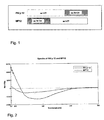
- a particular preferred derivative consists of a fusion protein, wherein amino acids 1 to 77 of the wild-type Phl p 12 are N-terminally fused to amino acids 78 to 131 (see Fig. 1 ).
- Profilin derivatives of Bet v 2, Art v 4, Ana c, Api g 4, Mus xp 1, Cor a 2, and Dau c 4 as disclosed herein and obtainable by a method according to the present invention are preferably used for the treatment and/or prevention of pollen-food sensitization attributable to profilin allergy.
- the present invention is further described by the following examples and the drawing figures, yet without being restricted thereto.
- examples 1 to 5 the principles of the present invention are exemplified by a profilin allergen, timothy grass pollen profilin Phl p 12.
- Examples 6 to 11 relate to the main mite (Dermatophagoides pteronyssinus) allergen, Der p 2.
- Examples 12 and 13 show the cross reactivity of Phl p 12 with profilins of other sources than timothy grass pollen, demonstrating consequently the suitability for using Phl p 12 derivatives as vaccines for allergic diseases caused by other profilins.
- PCR template was the cDNA coding for timothy grass pollen profilin, Phl p 12, subcloned in pet17b expression vector.
- the following primers were used to generate two PCR fragments containing overlapping sequences as well as NdeI and EcoRI restriction sites and a sequence coding for a C-terminal 6x Histidin residue for protein purification.
- primer MDE-1 5'CATATGAGGCCCGGCGCGGTCATC3' and primer MDE-2: 5'GTACGTCTGCCACGCCATCATGCCTTGTTCAAC3' were used, for fragment 2, primer MABC-1: 5'GTTGAACAAGGCATGATGTCGTG-GCAGACG3' and primer MABC-2: 5'GAATTCTTAATGGTGATGGTGATGGTGACCCT-GGATGACCATGTA3' were used.
- both PCR products obtained as described were used as templates for the overlapping PCR reaction using primer MDE-1 and MABC-2 to generate the DNA coding for the Phl p 12 derivative (i.e., MP12) (schematically represented in Fig. 1 ).
- the MP-12 encoding DNA was cloned into pBluescript vector system (Stratagene) and DNA sequence was confirmed by double-strand sequencing (MWG Biotech, Germany).
- MP12-encoding cDNA had to be subcloned into an pet17b expression vector system using NdeI and EcoRI restricition enzymes and the DNA sequence was again confirmed by double-strand sequencing (MWG Biotech).
- MP-12 was expressed in Escherichia coli BL21 (DE3) (Stratagene, East Kew, Australia) in liquid culture. E.coli were grown to an OD 600 of 0.4 in LB-medium containing 100 mg/l ampicillin. The expression of recombinant proteins was induced by adding isopropyl-b-thiogalactopyranoside to a final concentration of 1 mM and further culturing for additional 4 hours at 37°C. E.coli cells from a 500 ml culture were harvested by centrifugation, resuspended in buffer A (100mM NaH 2 PO 4 , 10mM Tris, 8M Urea, pH 7.5).
- buffer A 100mM NaH 2 PO 4 , 10mM Tris, 8M Urea, pH 7.5.
- Protein purity was confirmed by SDS PAGE and quantification was performed using a Micro BCA kit (Pierce, USA).
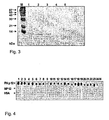
- Circular dichroism (CD) measurements were carried out on a Jasco J-715 spectropolarimeter using a 0.1 cm pathlength cell equilibrated at 20°C. Spectra were recorded with 0.5 nm resolution at a scan speed of 100nm/min and resulted from averaging 3 scans. The final spectra were baseline-corrected by substracting the corresponding MilliQ spectra obtained under identical conditions. Results were fitted with the secondary structure estimation program J-700.
- Affinity to polyproline is a feature common to profilins from various organisms. It was demonstrated that the hypoallergenic Phl p 12 derivative, MP12, does not bind polyproline and thus exhibits altered biochemical properties.
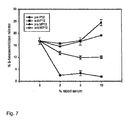
- the IgE binding capacity of recombinant MP12 was compared to that of recombinant Phl p 12 wild-type by dot blot analysis using sera from 24 profilin sensitised patients ( Fig. 4 ).
- Phl p 12 and MP12 as well as human serum albumin (HSA) for control purposes were dotted onto nitrocellulose and probed with sera from 24 profilin-sensitised patients.
- Bound IgE antibodies were detected using 125 I-labeled anti-human-IgE antibodies. All patients showed IgE reactivity with Phl p 12 wild-type, whereas none of the 24 patients reacted with MP12 or with the control protein HSA ( Fig. 4 ).
- Phl p 12 was compared with Phl p 12 wild-type for its capacity to induce histamine release from basophils from profilin allergic patients.
- Granulocytes were isolated from heparinised blood samples of timothy grass pollen allergic patients by Dextran sedimentation. After isolation, cells were incubated with various concentrations of Phl p 12, MP12 or, for control purposes, with a monoclonal anti-human IgE antibody (Immunotech, Marseille, France). Histamine released into the supernatant was measured by radioimmunoassay (Immunotech). Total histamine was determined after freeze thawing of cells. Results are expressed as mean values of duplicate determinations, and represent the percentage of total histamine.
- Phl p 12 induced strong and dose-dependent histamine release in basophils from both patients, yielding maximal histamine release at concentrations between 10 -5 -10 -4 ⁇ g/ml, whereas no histamine release was observed with MP12 at concentrations up to 10 -2 ⁇ g/ml indicating more than 1000-fold reduction of allergenic activity. Moreover, the maximum histamine release from basophils after adding MP12 was considerable lower than that achieved with Phl p 12 wild-type.
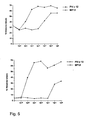
- Example 3 Immunization with MP12 induces IgG antibodies that recognize Phl p 12 wild-type as well as profilins from other pollens.
- Example 5 Anti-MP12 antiserum inhibits basophil degranulation
- RBL rat basophil leukaemia
- RBL-2H3 cells were plated in 96 well tissue culture plates (4x10 4 cells/well), incubated for 24 h at 37°C using 7% CO 2 . Passive sensitisation was performed with mouse sera containing profilin-reactive IgE at a final dilution of 1:30 for 2 h. Unbound antibodies were removed by washing the cell layer 2 times in Tyrode 's buffer (137mM NaCl, 2.7mM KCl, 0.5mM MgCl 2 , 1.8mM CaCl 2 , 0.4mM NaH 2 PO 4 , 5.6mM D-glucose, 12mM NaHCO 3 , 10mM HEPES and 0.1% w/v BSA, pH 7.2).
- Tyrode 's buffer 137mM NaCl, 2.7mM KCl, 0.5mM MgCl 2 , 1.8mM CaCl 2 , 0.4mM NaH 2 PO 4 , 5.6mM D-glucose,
- Phl p 12-specific mouse IgE were exposed to rPhl p 12 (0.005 ⁇ g/ml).
- Phl p 12 was preincubated in Tyrode's buffer with 0, 2, 5, 7.5 or 10% v/v of rabbit antiserum from a Phl p 12-immunized rabbit, a MP12-immunized rabbit or the corresponding preimmune sera for 2h at 37°C.
- Phl p 12 was added to the RBL cells for 30 min in a humidified atmosphere at 37°C and their supernatants were analyzed for ⁇ -hexosaminidase activity by incubation with 80 ⁇ M 4-methylumbelliferyl-N-acetyl- ⁇ -D-glucosamide (Sigma-Aldrich, Vienna, Austria) in citrate buffer (0.1M, pH 4.5) for 1 h at 37°C.
- the reaction was stopped by addition of 100 ⁇ l glycine buffer (0.2M glycine, 0.2M NaCl, pH 10.7) and the fluorescence was measured at ⁇ ex : 360/ ⁇ em : 465 nm using a fluorescence microplate reader (Spectrafluor, Tecan, Austria). Results are reported as fluorescence units and percentage of total ⁇ -hexosaminidase released after lysis of cells with 1% Triton X-100.
- House dust mite (HDM) allergy belongs to the most common allergies worldwide which affects more than 50% of all allergic patients. Dermatophogoides pteronyssinus was identified as the most important source of allergens in house dust in Europe.
- Group 2 allergens were identified as the major mite allergens, against which more than 80% of mite allergic patients are sensitized and they are mainly localized in mite faeces.
- Group 2 allergens were first characterized as 14000-18000 Da allergens with a high IgE-binding activity. Isolation and analysis of cDNA clones coding for Der p 2, revealed then that Der p 2 comprises an allergen with 129 amino acid residues, a calculated molecular weight of 14000 Da and without N-glycosylation sites.
- Group 2 allergens contain three disulfide bonds and are composed of two anti-parallel ⁇ -sheets. T-cell epitopes of Der p 2 are located in all regions of the protein and IgE-epitopes were shown to be conformational.
- cDNAs coding for His-tagged Der p 2, Der p 2 fragments (aa 1-53 and aa 54-129) and Der p 2 hybrid (aa 54-129+1-53) were generated by PCR amplification using primers (MWG, Ebersberg, Germany) as indicated in Table 4 and a Der p 2 cDNA was obtained by reverse transcription from Der p RNA.
- Primers 1 and 4 were used for the amplification of the rDer p 2 cDNA, primers 1 and 2 for the cDNA coding for rDer p 2 fragment 1 (aa 1-53) and primers 3 and 4 for the cDNA of the rDer p 2 fragment 2 (aa 54-129).
- rDer p 2 hybrid was generated by PCR-based gene-SOEing using primers 2 and 3 and the two overlapping primers 5 and 6. Upstream primers contained an NdeI and EcoRI site and downstream primers contained an EcoRI site as well as six His codons.
- PCR products were cut with NdeI/EcoRI, gel-purified and subcloned into the NdeI/EcoRI sites of plasmid pET17b.
- Calcium chloride method was used for the transformation of the plasmids into E.coli strain XL-1 Blue.
- Plasmid DNA was isolated by NuceloBond AX kit - maxi-prep (Macherey-Nagel, Germany) and the sequence of the cDNA inserts was confirmed by sequencing of both DNA strands on an automated sequencing system (MWG, Germany).
- Recombinant proteins containing C-terminal Hexahistidine-tails were expressed in E.coli strain BL21 (DE3) in liquid culture by induction with 0.5mM isopropyl- ⁇ -thiogalactopyranoside (IPTG) at an OD600 of 1 for 5h at 37°C. Cells were harvested by centrifugation at 4,000 x g for 15 minutes at 4°C.
- IPTG isopropyl- ⁇ -thiogalactopyranoside
- the bacterial pellets obtained from 11 liquid culture were resuspended in 10ml 25mM imidazol, pH 7.4, 0.1% v/v Triton X-100 and treated with 100 ⁇ g lysozyme for 30 minutes at room temperature.
- Cells were lysed by 3 freeze/thawing cycles (-70°C/+50°C), DNA was degraded by incubation with 1 ⁇ g DNase I for 10 minutes at room temperature and cell debris were removed by centrifugation at 10,000 x g for 30 minutes at 4°C.
- rDer p 2 fragment 1 was found in the soluble fraction and purified under native conditions over Ni-NTA resin affinity columns (QIAGEN, Germany).
- rDer p 2, rDer p 2 fragment 2 and rDer p 2 hybrid were found in the pellet in the inclusion body fraction, which was solubilized with 8M urea, 100mM NaH 2 PO 4 , 10mM Tris-Cl, pH 8 for 60 minutes at room temperature. Insoluble residues were removed by centrifugation (10,000 x g, 15min, 4°C) and rDer p 2, rDer p 2 fragment 2 and rDer p 2 hybrid were purified under denaturating conditions over Ni-NTA resin affinity columns (QIAGEN).
- Fractions, containing recombinant proteins of more than 90% purity were dialysed against 50mM NaH 2 PO 4 pH 7 and the final protein concentrations were determined by Micro BCA Protein Assay Kit (Pierce, USA).
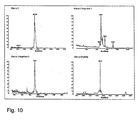
- Laser desorption mass spectra were acquired in a linear mode with a time of-flight Compact MALDI II instrument (Kratos, U.K.; piCHEM, Austria). Samples were dissolved in 10% acetonitrile, 0.1% trifluoroacetic acid and Alfa-cyano-4 hydroxy-cinnamic acid (dissolved in 60% acetonitrile, 0.1% trifluoroacetic acid) was used as a matrix. For sample preparation, a 1:1 mixture of protein and matrix solution was deposited onto the target and air-dried.
- the far ultraviolet CD spectrum of the purified recombinant Der p 2 shows a negative band at 217nm, indicating a ⁇ -sheet conformation ( Fig. 11 ).
- the CD spectra of the rDer p 2 derivatives indicate that these proteins are mainly unfolded.
- rDer p 2 fragment 1 shows a typical random coil conformation, identified by a negative band at ⁇ 200nm.
- rDer p 2 fragment 2 shows a predominant random coil conformation, although the intensity of the signal was very low.
- rDer p 2 hybrid spectrum adsorbed mainly random coil conformation with small amounts of ⁇ -sheet structures ( Fig. 11 ). The destruction of the three-dimensional conformation could be confirmed by circular dicroism analysis, showing a loss or reduction of ⁇ -sheet structure in the rDer p 2 derivatives compared to rDer p 2 wild-type.
- Nitrocellulose strips containing the dot-blotted proteins were blocked in buffer A (40mM Na 2 HPO 4 , 0.6mM NaH 2 PO 4 , pH 7.5, 0.5% [v/v] Tween 20, 0.5% [w/v] BSA, 0.05% [w/v] NaN 3 ) and incubated with sera from mite-allergic patients, serum from a non-allergic person (dilutions 1:10) or buffer A without serum.
- Bound IgE antibodies were detected with 125I-labeled anti-human IgE antibodies and visualized by autoradiography.
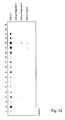
- the IgE-binding capacity of rDer p 2 wild-type allergen was compared with the two rDer p 2 fragments and rDer p 2 hybrid by non-denaturing dot blot assays.
- Sera from 17 mite allergic individuals (lanes 1-17) showed varying IgE reactivity to nitrocellulose dotted rDer p 2, whereas almost no IgE reactivity to rDer p 2 fragment 1 could be detected.
- Only 3 sera showed very weak binding to rDer p 2 fragment 2 and 2 sera reacted with rDer p 2 hybrid ( Fig. 12 ).
- Serum from a non-allergic person as well as buffer without serum showed no IgE reactivity to rDer p 2 or to rDer p 2 derivatives ( Fig. 12 lanes 18, 19).
- BSA control protein
- Example 8 Reduced allergenic activity of rDer p 2 derivatives as determined by CD 203c expression
- Heparinized blood samples were obtained from allergic patients. Blood samples (100 ⁇ l) were incubated with various concentrations of rDer p 2, rDer p 2 fragments, rDer p 2 hybrid, a monoclonal anti-IgE antibody (Immunotech, Marseille, France), or PBS for 15 minutes (37°C). CD 203c expression was determined as described (Hauswirth, A. W., et al. (2002) J Allergy Clin Immunol 110:102.).
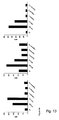
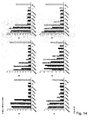
- CD 203c The upregulation of CD 203c has been described as a surrogate marker for allergen-induced basophil activation and degranulation (Hauswirth, A. W., et al. (2002)). Therefore the allergenic activity of recombinant Der p 2, rDer p 2 fragments and rDer p 2 hybrid by measuring CD 203c upregulation on basophils from house dust mite allergic patients was compared ( Fig. 13 , 14 ). Fig. 13 shows representative results from 3 patients.
- rDer p 2 hybrid Exposure of basophils with rDer p 2 hybrid resulted in an upregulation of CD 203c expression at concentrations between 40ng/ml and 5000ng/ml, whereas rDer p 2 wild-type induced upregulation of CD 203c already at concentrations between 8 - 200ng/ml. In 8 out of 10 patients, rDer p 2 hybrid had a more than 10-fold reduced capacity to activate basophils compared to rDer p 2.
- Anti-human IgE antibodies induced upregulation of CD 203c expression on basophils from all patients, whereas no upregulation was obtained with buffer alone ( Fig. 13 + 14).
- Determination of CD 203c expression on basophils from mite-allergic patients indicates a reduced biological activity of rDer p 2 hybrid compared to rDer p 2 wild-type and no biological activity can be observed with the rDer p 2 fragments.
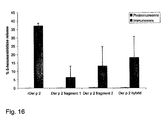
- basophil activation assays using RBL cells indicate that IgE Abs induced with the derivatives were less anaphylactic.
- Example 9 rDer p 2 derivatives induce rDer p 2-specific IgG antibodies in mice similar as rDer p 2 wild-type allergen
- mice Groups of five eight-week-old female BALB/c mice each were immunized with 5 ⁇ g of purified proteins (rDer p 2, rDer p 2 fragment 1, rDer p 2 fragment 2 or rDer p 2 hybrid), adsorbed to 200 ⁇ l of AluGel-S (SERVA Electrophoresis, Germany) subcutaneously in the neck in 4 weeks intervals over a period of 20 weeks. Blood samples were collected one day before each immunization and stored at -20°C.
- purified proteins rDer p 2, rDer p 2 fragment 1, rDer p 2 fragment 2 or rDer p 2 hybrid
- the plates were washed twice with PBST (PBS; 0.05% v/v Tween 20) and blocked with blocking buffer (PBST; 1% w/v BSA) for 3h at room temperature.
- Mouse sera were diluted 1:1000 for measurement of Der p 2-specific IgG1 in PBST; 0.5% w/v BSA and 100 ⁇ l of this dilution was added per well overnight at 4°C.
- IgG1 antibodies were detected with a monoclonal rat anti-mouse IgG1 antibody (BD Pharmingen, USA), followed by the addition of horseradish peroxidase-labeled goat anti-rat IgG antibodies (Amersham Bioscience, Sweden) as described ( Vrtala, S., et al. (1996) J Allergy Clin Immunol 98:913 ).
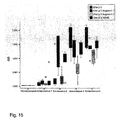
- the Der p 2 specific IgG 1 levels were determined in serum samples obtained from mice after immunization with rDer p 2 and rDer p 2 derivatives ( Fig. 15 ).
- rDer p 2 as well as the rDer p 2 derivatives were immunogenic and induced IgG 1 responses in the mice after the second immunization (week 8) ( Fig. 15 ).
- the IgG 1 responses induced with rDer p 2 fragment 1 and rDer p 2 hybrid were even higher than that induced with rDer p 2 ( Fig. 15 ).
- IgG 1 responses induced with the rDer p 2 derivatives were comparable to those induced with the rDer p 2 wild-type molecule ( Fig. 15 ).
- Example 10 IgG1 antibodies induced by immunization with rDer p 2 derivatives inhibit mite-allergic patients' IgE binding to rDer p 2 wild-type
- ELISA plates (Greiner, Austria) were coated with 100 ⁇ l purified rDer p 2, diluted with PBS to a concentration of 5 ⁇ g/ml, over night at 4°C. After washing twice with PBST and blocking with blocking buffer (PBST; 1% w/v BSA) for 3h at room temperature, plates were incubated overnight at 4°C with anti-rDer p 2, anti-rDer p 2 fragment 1, anti-rDer p 2 fragment 2 or anti-rDer p 2 hybrid antisera or the corresponding preimmune sera. Mouse anti-sera were diluted 1:20 and rabbit antisera were diluted 1:100 in PBST; 0.5% w/v BSA.
- Mouse IgG1 antibodies induced by immunization with rDer p 2 and the rDer p 2 derivatives were investigated for their ability to inhibit mite-allergic patients' IgE binding to rDer p 2 in ELISA competition experiments.
- mouse anti-rDer p 2 antibodies The inhibition obtained with mouse anti-rDer p 2 antibodies was between 61 and 87% (mean 75%), whereas mouse anti-rDer p 2 hybrid antibodies, anti-Der p 2 fragment 1 antibodies and anti-Der p 2 fragment 2 antibodies inhibited serum IgE binding to rDer p 2 wild-type between 47 and 76% (mean 62%), between 48 and 66% (mean 54%) and between 24 and 52% (mean 41%), respectively (Table 5).
- Table 5 % Inhibition of IgE binding Antibodies
- Patient 1 Patient 2
- Patient 3 Patient 4 mean rDer p 2 fragment 1 48 66 53 50 54 rDer p 2 fragment 2 39 50 52 24 41 rDer p 2 hybrid 59 76 64 47 62 rDer p 2 61 87 77 73 75
- rabbits were immunized with purified rDer p 2 and the three rDer p 2 derivatives.
- the ability of rabbit anti-sera to inhibit mite-allergic patients' IgE binding to rDer p 2 was also tested by ELISA inhibition assays with an outcome similar as obtained for the mouse sera (Table 6).
- Rabbit anti-rDer p 2 antibodies inhibited patients' IgE binding to rDer p 2 between 47 and 89% (mean 66%), whereas anti-rDer p 2 hybrid antibodies inhibited human IgE binding between 20 and 86% (mean 59%).
- the inhibition obtained with rabbit anti-rDer p 2 fragment 1 antibodies was between 26 and 70% (mean 52%) and the inhibition with rabbit anti-rDer p 2 fragment 2 antibodies was between 32 and 54% (mean 42%).
- Using a mixture of the anti-fragment 1 and anti-fragment 2 antibodies the inhibition of patients' IgE binding to rDer p 2 wild-type was only slightly increased to a mean of 55% (Table 6).
- Table 6 %Inhibition of IgE binding Antibodies
- Patient 1 Patient 2
- Patient 3 Patient 4
- Patient 5 mean rDer p 2 fragment 1 59 70 49 26 57 52 rDer p 2 fragment 2 40 49 33 32 54
- 42 fragment 1 + fragment 2 60 69 44
- 38 55
- mice showed the immunogenicity of all three rDer p 2 derivatives by their capacity to induce IgG antibody responses.
- IgE-binding from mite-allergic patients to Der p 2 was inhibited by IgG antibodies induced with each of the rDer p 2 derivatives but rDer p 2 hybrid-induced IgG antibodies indicated a better inhibitory capacity compared to IgG antibodies induced with the two individual fragments and even to a mixture of fragment 1 and 2 induced IgG antibodies.
- Anti-rDer p 2 and anti-rDerp 2 derivative antibodies induced by immunisation of mice inhibit allergic patients' IgE binding to rDer p 2 as shown in an ELISA inhibition assay.
- Der p 2 Hybrid induces blocking antibodies in the present mouse model; immunogenicity is significantly increased by reshuffling the fragments.
- Example 11 Vaccines based on rDer p 2 derivatives have a reduced allergenicity in vivo compared to a rDer p 2-wild-type-based vaccine
- Rat basophil leukemia (RBL) cells (subline RBL-2H3) were plated on ELISA plates (Nunc, Denmark) (100 ⁇ l: 4 x 10⁴ cells) in cell culture medium (100ml RPMI 1649, 10% FCS, 4mM L-Glutamine, 2mM Sodium Pyruvate, 10mM HEPES, 100 ⁇ M 2-Mercaptoethanol, 1% Pen/Strep) over night at 37°C, 5% CO 2 .
- 50 ⁇ l assay solution 80 ⁇ M 4-methylumbelliferyl-N-acetyl- p - D-glucosaminide in 0.1M citrate buffer, pH 4.5
- 50 ⁇ l supernatant for 1h at 37°C, 5%CO 2 .
- the reaction was stopped by adding 100 ⁇ l glycin buffer (0.2M glycine, 0.2M NaCl, pH 10.7) and fluorescence was measured at ⁇ ex: 360nm ⁇ em: 465nm using a fluorescence microplate reader (Dynatech MR 7000, Dynatech Laboratories, USA). Results are shown as mean percentages of total ⁇ -hexosaminidase release.
- mice were immunized with rDer p 2, rDer p 2 fragment 1, rDer p 2 fragment 2 and rDer p 2 hybrid, respectively. Then serum samples from the mice were used to load RBL cells to quantify the allergenic immune response to rDer p 2 wild-type allergen by RBL degranulation experiments.
- Example 12 MP 12 induced IgG antibodies that recognize Phl p 12 wild-type, profilins from other pollens and plant -food derived profilins.
- MP 12 induced an IgG antibody response that was comparable with that induced with Phl p 12 wild-type ( Fig. 17 ). Both, Phl p 12 and MP12-induced IgG antibodies cross-reacted with profilins from pollens (grass, trees, weeds) and plant-derived food profilins ( Fig. 17 ).
- Example 13 Anti-MP 12 antibodies inhibit the binding of serum IgE from grass pollen allergic patients to complete Phl p 12 as well as to profilins from other pollens (trees and weeds) and to plant food-profilins.
- ELISA plates (Nunc Maxisorp, Denmark) were coated with profilins from timothy grass (rPhl p 12), birch pollen (rBet v 1), carrot (rDau c 4), hazelnut (rCor a 2), banana (rMus xp 1) and cashew nut (rAna c 1) and preincubated with a 1:50 dilution of the anti-Phl p 12 antiserum, the anti-MP 12-antiserum and, for control purposes, with the corresponding preimmune sera.
- Profilin represents an allergen that is expressed in all eukaryotic cells and thus represents a pan-allergen that might induce inhalative allergies (e.g., rhinoconjunctivits, asthma) as well as oral allergy syndromes after oral ingestion (itching and swelling of lips and the tounge) in sensitized patients.
- inhalative allergies e.g., rhinoconjunctivits, asthma
- oral allergy syndromes after oral ingestion (itching and swelling of lips and the tounge) in sensitized patients.
- the reshuffled Phl p 12-derivative, MP12 induces IgG antibodies after immunization that recognize profilins from both pollens as well as from plant-derived food.
- MP 12-induced antibodies inhibit patients' serum IgE binding to profilins from pollens and also to plant food-derived profilins.
- the MP12 is suitable for the treatment of pollen- food cross-sensitization attributable to profilin allergy.
Landscapes
- Health & Medical Sciences (AREA)
- Life Sciences & Earth Sciences (AREA)
- Genetics & Genomics (AREA)
- Chemical & Material Sciences (AREA)
- Organic Chemistry (AREA)
- Engineering & Computer Science (AREA)
- Molecular Biology (AREA)
- Biomedical Technology (AREA)
- General Health & Medical Sciences (AREA)
- Bioinformatics & Cheminformatics (AREA)
- Wood Science & Technology (AREA)
- Biotechnology (AREA)
- General Engineering & Computer Science (AREA)
- Zoology (AREA)
- Biophysics (AREA)
- Biochemistry (AREA)
- Medicinal Chemistry (AREA)
- Gastroenterology & Hepatology (AREA)
- Proteomics, Peptides & Aminoacids (AREA)
- Microbiology (AREA)
- Plant Pathology (AREA)
- Botany (AREA)
- Physics & Mathematics (AREA)
- General Chemical & Material Sciences (AREA)
- Immunology (AREA)
- Pharmacology & Pharmacy (AREA)
- Animal Behavior & Ethology (AREA)
- Chemical Kinetics & Catalysis (AREA)
- Public Health (AREA)
- Veterinary Medicine (AREA)
- Nuclear Medicine, Radiotherapy & Molecular Imaging (AREA)
- Pulmonology (AREA)
- Peptides Or Proteins (AREA)
- Medicines Containing Antibodies Or Antigens For Use As Internal Diagnostic Agents (AREA)
- Preparation Of Compounds By Using Micro-Organisms (AREA)
- Medicines That Contain Protein Lipid Enzymes And Other Medicines (AREA)
- Micro-Organisms Or Cultivation Processes Thereof (AREA)
Abstract
Description
- The present invention relates to a method for reducing allergenic activity of wild-type protein allergens, novel allergen derivatives and allergy vaccination strategies.
- Allergy is the inherited or acquired specific alternation of the reaction capability against foreign (i.e. non-self) substances which are normally harmless ("allergens"). Allergy is connected with inflammatory reactions in the affected organ systems (skin, conjunctiva, nose, pharynx, bronchial mucosa, gastrointestinal tract), immediate disease symptoms, such as allergic rhinitis, conjunctivitis, dermatitis, anaphylactic shock and asthma, and chronic disease manifestations, such as late stage reactions in asthma and atopic dermatitis.
- Type I allergy represents a genetically determined hypersensitivity disease which affects about 20 % of the industrialised world population. The pathophysiological hallmark of Type I allergy is the production of immunoglobulin E (IgE) antibodies against otherwise harmless antigens (allergens).
- Currently, the only causative form of allergy treatment is an allergen-specific immunotherapy wherein increasing allergen doses are administered to the patient in order to induce allergen-specific unresponsiveness. While several studies have shown clinical effectiveness of allergen-specific immunotherapy, the underlying mechanisms are not fully understood.
- The major disadvantage of allergen-specific immunotherapy is the dependency on the use of natural allergen extracts which are difficult, if not impossible to standardise, at least to an industrial production level. Such natural allergen extracts consist of different allergenic and non allergenic compounds and due to this fact it is possible that certain allergens are not present in the administered extract or - even worse - that patients can develop new IgE-specificities to components in the course of the treatment. Another disadvantage of extract-based therapy results from the fact that the administration of biologically active allergen preparations can induce anaphylactic side effects.
- The application of molecular biology techniques in the field of allergen characterisation has allowed to isolate the cDNAs coding for all relevant environmental allergens and allowed the production of recombinant allergens. Using such recombinant allergens has made it possible to determine the individual patient's reactivity profile either by in vitro diagnostic methods (i.e. detection of allergen-specific IgE antibodies in serum) or by in vivo testing. Based on this technology, the possibility to develop novel component-based vaccination strategies against allergy, especially against Type I allergy, which are tailored to the patient's sensitisation profile appeared to be possible. However, due to the similarity of the recombinant allergens to their natural counterparts, also recombinant allergens exhibit significant allergenic activity. Since the recombinant allergens closely mimick the allergenic activity of the wild-type allergens, all the drawbacks connected with this allergenic activity in immunotherapy applying natural allergens are also present for recombinant allergens. In order to improve immunotherapy the allergenic activity of the recombinant allergens has to be reduced so that the dose of the administered allergens can be increased with only a low risk of anaphylactic side effects.
- It has been suggested to influence exclusively the activity of allergen-specific T cells by administration of peptides containing T cell epitopes only. T cell epitopes represent small peptides which result from the proteolytic digestion of intact allergens by antigen representing cells. Such T cell epitopes can be produced as synthetic peptides. Tests conducted so far with T cell epitopes, however, only showed poor results and low efficacy. Several explanations for the low efficacy of T cell peptide-based immunotherapy have been considered: first, it may be difficult to administer the optimal dose to achieve T cell tolerance instead of activation. Second, small T cell epitope peptides will have a short half-life in the body. Third, there is considerable evidence that IgE production in atopic individuals represents a memory immune response which does not require de novo class switching and thus cannot be controlled by T cell-derived cytokines. Therapy forms which are based exclusively on the administration of T cell epitopes may therefore modulate the activity of allergen-specific T cells but may have little influence on the production of allergen-specific IgE antibodies by already switched memory B cells.
- It has further been suggested to produce hypoallergenic allergen derivates or fragments by recombinant DNA technology or peptide synthesis. Such derivatives or fragments bear T cell epitopes and can induce IgG antibodies that compete with IgE recognition of the native allergen. It was demonstrated more than 20 years ago that proteolytic digestion of allergens yielded small allergen fragments which in part retained their IgE binding capacity but failed to elicit immediate type reactions. While proteolysis of allergens is difficult to control and standardise, molecular biology has opened up new avenues for the production of IgE binding haptens. Such IgE binding haptens have been suggested to be useful for active immunisation with reduced risks of anaphylactic effects and for passive therapy to saturate effector cell-bound IgE prior to allergen contact and thus block allergen-induced mediator release.
- Another suggestion was to produce hypoallergenic allergen versions by genetic engineering based on the observation that allergens can naturally occur as isoforms with differ in only a few amino acid residues and/or in conformations with low IgE binding capacity. For example, oligomerisation of the major birch pollen allergen, Bet
v 1, by genetic engineering yielded a recombinant trimer with greatly reduced allergenic activity. Alternatively, introduction of point mutations has been suggested to either lead to conformational changes in the allergen structure and thus disrupt discontinuous IgE epitopes or directly affect the IgE binding capacity (Valenta et al., Biol.Chem.380 (1999), 815-824). - It has also been shown that fragmentation of the allergen into few parts (e.g. into two parts) leads to an almost complete loss of IgE binding capacity and allergenic activity of the allergen due to a loss of their native-like folds (Vrtala et al. (J.Clin.Invest.99 (1997), 1673-1681) for Bet v 1, Twardosz et al. (BBRC 239 (1997), 197-204) for Bet
v 4, Hayek et al. (J. Immunol.161 (1998), 7031-7039) for Alng 4, Zeiler et al. (J.Allergy Clin. Immunol.100 (1997), 721-727) for bovine dander allergen, Elfman (Int.Arch.Allergy Immunol.117 (1998), 167-173) for Lep d2), Westritschnig (J.Immunol.172 (2004), 5684-5692) for Phlp 7),...). Fragmentation of proteins containing primarily discontinuous/conformational IgE epitopes leads to a substantial reduction of the allergen's IgE binding capacity. Based on this knowledge, it was investigated in the prior art whether such hypoallergenic allergen fragments can induce protective immune responses in vivo (Westritschnig et al. (Curr. Opinion in Allergy and Clin. Immunol. 3 (2003), 495-500)). - In Vrtala S. et al. (Methods (2004) 32:313-320) strategies for converting allergens into hypoallergenic molecules are described. These strategies involve the production of allergen fragments, allergen mutants and chemically modified allergen derivatives.
-
EP 1 403 280allergen Phl p 7. - In the article of Niederberger V. et al. (PNAS (2004) 101:14677-14682) the use of genetically engineered allergens, in particular of recombinant Bet v 1 fragments for vaccination, is described.
- In Valenta R. et al. (Science (1991) 253:557-560) the identification of a birch pollen allergen having high sequence homology to profilins is disclosed. The authors of this article discovered that IgE antibodies from allergic individuals are able to bind the birch profilin as well as the human profilin.
- It is an object of the present invention to provide means and methods for improved allergy immunotherapy based on the above mentioned knowledge. Such methods and means should be effective, connected with a low risk for anaphylactic shock, easily applicable and adapted to the needs of an individual patient and easily transformable into industrial scales.
- Therefore the present invention provides a method for producing derivatives of wild-type protein allergens with reduced allergenic activity, which is characterized in by the following steps:
- providing a wild-type protein allergen with an allergenic activity,
- splicing said wild-type protein allergen into two parts said two parts having a reduced allergenic activity or lacking allergenic activity and
- rejoining said two fragments in inverse orientation.
- The present method is based on the fact that fragmentation of proteins containing primarily discontinuous/conformational IgE epitopes leads to a substantial reduction of the allergen's IgE binding capacity. However, fragments of certain allergens were too less immunogenic to induce a protective antibody response (Westritschnig et al., (2004)).
- With the present method, new and defined protein allergen derivatives are provided which combine the advantages of the T cell and B cell epitope-based approaches. At the same time, the disadvantages of vaccination with fragments only or sophisticated arrangements of fragments (such as IgE binding haptens and shuffling with three or more fragments) are not present for the allergen derivatives of the present invention.
- In fact it could be shown with the present invention that the optimal results can be obtained with the structure which - with respect to completeness of structure elements - most closely resembles the wild-type allergen (i.e. with all amino acids of the wild-type allergen), however, without its allergenic activity (or with a sufficiently reduced allergenic activity). Of course, if only a few amino acid residues are lost (deleted) or added (inserted) in the course of generation of the allergen derivatives or if the parts are combined by a linker instead of a direct combination, the advantages according to the present invention are still present. This reduction or abolishment of allergenic activity is achieved by the known and general principle of dividing the allergen into defined fragments. In addition to this general principle, the present invention rejoins the two parts of the allergen obtained in inverse orientation which leads to allergen derivatives which contain essentially all relevant structural information of the allergen (because the amino acid sequence is contained in full or almost in full in the allergen derivates according to the present invention) but with only low (or no) remaining allergenic activity compared to the wild-type allergen.
- These "head-to tail" derivatives according to the present invention enable a suitable, individual and efficient immunotherapy for allergy patients which is easily up-scaleable with routine steps. The derivates according to the present invention induce protective IgG antibodies which can block patient's IgE binding to wild-type allergens and inhibit allergen-induced basophil degranulation.
- The present method is specifically suitable for recombinant DNA technology. Once the derivative is constructed by genetic engineering, it can easily be obtained in considerable amounts by transgene expression on an industrial scale in suitable hosts. The allergen derivatives according to the present invention can preferably be produced in a host with high expression capacity.
- Preferred allergens to be modified by the present invention include all major protein allergens available e.g. under www.allergen.org/List.htm. Specifically preferred groups of allergens according to the present invention include profilins, especially
Phl p 12, birch allergens, especially Bet v 4, dust mite allergens, especially Der p2, storage mite allergens, especiallyLep d 2, timothy grass allergens, especiallyPhl p 7, and the allergens listed in table A.




-
- 1. Marsh, D.G., and L.R. Freidhoff. 1992. ALBE, an allergen database. IUIS, Baltimore, MD, Edition 1.0.
- 2. Marsh, D. G., L. Goodfriend, T. P. King, H. Lowenstein, and T. A. E. Platts-Mills. 1986. Allergen nomenclature. Bull WHO 64:767-770.
- 3. King, T.P., P.S. Norman, and J.T. Cornell. 1964. Isolation and characterization of allergen from ragweed pollen. II. Biochemistry 3:458-468.
- 4. Lowenstein, H. 1980. Timothy pollen allergens. Allergy 35:188-191.
- 5. Aukrust, L. 1980. Purification of allergens in Cladosporium herbarum. Allergy 35:206-207.
- 6. Demerec, M., E. A. Adelberg, A. J. Clark, and P. E. Hartman. 1966. A proposal for a uniform nomenclature in bacterial genetics. Genetics 54:61-75.
- 7. Bodmer, J. G., E. D. Albert, W. F. Bodmer, B. Dupont, H. A. Erlich, B. Mach, S. G. E. Marsh, W. R. Mayr, P. Parham, T. Sasuki, G. M. Th. Schreuder, J. L. Strominger, A. Svejgaard, and P. I. Terasaki. 1991. Nomenclature for factors of the HLA system, 1990. Immunogenetics 33:301-309.
- 8. Griffith, I.J., J. Pollock, D.G. Klapper, B.L. Rogers, and A.K. Nault. 1991. Sequence polymorphism of Amb a I and Amb a II, the major allergens in Ambrosia artemisiifolia (short ragweed). Int. Arch. Allergy Appl. Immunol. 96:296-304.
- 9. Roebber, M., D. G. Klapper, L. Goodfriend, W. B. Bias, S. H. Hsu, and D. G. Marsh. 1985. Immunochemical and genetic studies of Amb t V (Ra5G), an Ra5 homologue from giant ragweed pollen. J. Immunol. 134:3062-3069.
- 10. Metzler, W. J., K. Valentine, M. Roebber, M. Friedrichs, D. G. Marsh, and L. Mueller. 1992. Solution structures of ragweed allergen Amb t V. Biochemistry 31:5117-5127.
- 11. Metzler, W. J., K. Valentine, M. Roebber, D. G. Marsh, and L. Mueller. 1992. Proton resonance assignments and three-dimensional solution structure of the ragweed allergen Amb a V by nuclear magnetic resonance spectroscopy. Biochemistry 31:8697-8705.
- 12. Goodfriend, L., A.M. Choudhury, J. Del Carpio, and T.P. King. 1979. Cytochromes C: New ragweed pollen allergens. Fed. Proc. 38:1415.
- 13. Ekramoddoullah, A. K. M., F. T. Kisil, and A. H. Sehon. 1982. Allergenic cross reactivity of cytochrome c from Kentucky bluegrass and perennial ryegrass pollens. Mol. Immunol. 19:1527-1534.
- 14. Ansari, A. A., E. A. Killoran, and D. G. Marsh. 1987. An investigation of human response to perennial ryegrass (Lolium perenne) pollen cytochrome c (Lol p X). J. Allergy Clin. Immunol. 80:229-235.
- 15. Morgenstern, J.P., I.J. Griffith, A.W. Brauer, B.L. Rogers, J.F. Bond, M.D. Chapman, and M. Kuo. 1991. Amino acid sequence of Fel d I, the major allergen of the domestic cat: protein sequence analysis and cDNA cloning. Proc. Natl. Acad. Sci. USA 88:9690-9694.
- 16. Griffith, I.J., S. Craig, J. Pollock, X. Yu, J.P. Morgenstern, and B.L.Rogers. 1992. Expression and genomic structure of the genes encoding FdI, the major allergen from the domestic cat. Gene 113:263-268.
- 17. Weber, A., L. Marz, and F. Altmann. 1986. Characteristics of the asparagine-linked oligosaccharide from honey-bee venom phospholipase A2. Comp. Biochem. Physiol. 83B:321-324.
- 18. Weber, A., H. Schroder, K. Thalberg, and L. Marz. 1987. Specific interaction of IgE antibodies with a carbohydrate epitope of honey bee venom phospholipase A2. Allergy 42:464-470.
- 19. Stanworth, D. R., K. J. Dorrington, T. E. Hugli, K. Reid, and M. W. Turner. 1990. Nomenclature for synthetic peptides representative of immunoglobulin chain sequences. Bulletin WHO 68:109-111.
- 20. Rafnar, T., I. J. Griffith, M. C. Kuo, J. F. Bond, B. L. Rogers, and D.G. Klapper. 1991. Cloning of Amb a I (Antigen E), the major allergen family of short ragweed pollen. J. Biol. Chem. 266: 1229-1236.
- 21. Rogers, B.L., J.P. Morgenstern, I.J. Griffith, X.B. Yu, C.M. Counsell, A.W. Brauer, T.P. King, R.D. Garman, and M.C. Kuo. 1991. Complete sequence of the allergen Amb a II: recombinant expression and reactivity with T cells from ragweed allergic patients. J. Immunol. 147:2547-2552.
- 22. Klapper, D.G., L. Goodfriend, and J.D. Capra. 1980. Amino acid sequence of ragweed allergen Ra3. Biochemistry 19:5729-5734.
- 23. Ghosh, B., M.P. Perry, T. Rafnar, and D.G. Marsh. 1993. Cloning and expression of immunologically active recombinant Amb a V allergen of short ragweed (Ambrosia artemisiifolia) pollen. J. Immunol. 150:5391-5399.
- 24. Roebber, M., R. Hussain, D. G. Klapper, and D. G. Marsh. 1983. Isolation and properties of a new short ragweed pollen allergen, Ra6. J. Immunol. 131:706-711.
- 25. Lubahn, B., and D.G. Klapper. 1993. Cloning and characterization of ragweed allergen Amb a VI (abst). J. Allergy Clin. Immunol. 91:338.
- 26. Roebber, M., and D.G. Marsh. 1991. Isolation and characterization of allergen Amb a VII from short ragweed pollen. J. Allergy Clin. Immunol. 87:324.
- 27 Goodfriend L, Choudhury AM, Klapper DG, Coulter KM, Dorval G, DelCarpio J, Osterland CK. Ra5G, a homologue of Ra5 in giant ragweed pollen: isolation, HLA-DR-associated activity and amino acid sequence. Mol Immunol 22: 899-906, 1985.
- 28 Himly M, Jahn-Schmid B, Dedic A, Kelemen P, Wopfner N, Altmann F, van Ree R, Briza P, Richter K, Ebner C, Ferreira .
- 28A Nilsen, B. M., K. Sletten, M. O'Neill, B. Smestead Paulsen, and H. van Halbeek. 1991. Structural analysis of the glycoprotein allergen Art v II from pollen of mugwort (Artemesia vulgaris). J. Biol. Chem. 266:2660-2668.
- 29 Wopfner N, Willeroidee M, Hebenstreit D, van Ree R, Aalbers M, Briza P, Thalhamer J, Ebner C, Richter K, Ferreira F. Molecular and immunological characterization of profilin from mugwort pollen. Biol Chem 383: 1779-1789, 2002.
- 29A Jimenez A, Moreno C, Martinez J, Martinez A, Bartolome B, Guerra F, Palacios R 1994. Sensitization to sunflower pollen: only an occupational allergy? Int Arch Allergy Immunol 105:297-307. 29B Barderas R, Villalba M, Lombardero M, Rodriguez R. Identification and characterization of Che a 1 allergen from Chenopodium album pollen. Int Arch Allergy Immunol 127: 47-54, 2002.
- 29C Carnés J, Fernández-Caldas E, Casanovas M, Lahoz C, Colás C. Immunochemical characterization of Salsola kali pollen extracts. Allergy 56, Supplement 68: 274, 2001.
- 29D Giuliani A, Pini C, Bonini S, Mucci N, Ferroni L, Vicari G: Isolation and purification of a major allergen from Parietaria officinalis pollen. Allergy 42: 434-440, 1987.
- 30 Smith,P.M., Suphioglu,C., Griffith,I.J., Theriault,K., Knox,R.B. and Singh,M.B. 1996. Cloning and expression in yeast Pichia pastoris of a biologically active form of .
- 31 Suphioglu,C., Ferreira,F. and Knox,R.B. 1997. Molecular cloning and immunological characterisation of .
- 31a. Asturias JA, Arilla MC, Gomez-Bayon N, Martinez J, Martinez A, and Palacios R. 1997. Cloning and high level expression of Cynodon dactylon (Bermuda grass) pollen profilin (Cyn d 12) in Escherichia coli: purification and characterization of the allergen. Clin Exp Allergy 27:1307-1313.
- 32. Mecheri, S., G. Peltre, and B. David. 1985. Purification and characterization of a major allergen from Dactylis glomerata pollen: The .
- 33. Roberts, A.M., L.J. Bevan, P.S. Flora, I. Jepson, and M.R. Walker. 1993. Nucleotide sequence of cDNA encoding the Group II allergen of Cocksfoot/Orchard grass (Dactylis glomerata), Dac g II. Allergy 48:615-623.
- 33a. Guerin-Marchand,C., Senechal,H., Bouin,A.P., Leduc-Brodard,V., Taudou,G., Weyer,A., Peltre,G. and David,B. 1996. Cloning, sequencing and immunological characterization of .
- 34. Klysner, S., K. Welinder, H. Lowenstein, and F. Matthiesen. 1992. Group V allergens in grass pollen IV. Similarities in amino acid compositions and amino terminal sequences of the group V allergens from Lolium perenne, Poa pratensis and Dactylis glomerata. Clin. Exp. Allergy 22: 491-497.
- 35. Perez, M., G. Y. Ishioka, L. E. Walker, and R. W. Chesnut. 1990. cDNA cloning and immunological characterization of the rye grass allergen Lol p I. J. Biol. Chem. 265:16210-16215.
- 36. Griffith, I. J., P. M. Smith, J. Pollock, P. Theerakulpisut, A. Avjioglu, S. Davies, T. Hough, M. B. Singh, R. J. Simpson, L. D. Ward, and R. B. Knox. 1991. Cloning and sequencing of Lol p I, the major allergenic protein of rye-grass pollen. FEBS Letters 279:210-215.
- 37. Ansari, A. A., P. Shenbagamurthi, and D.G. Marsh. 1989. Complete amino acid sequence of a Lolium perenne (perennial rye grass) pollen allergen, Lol p II. J. Biol. Chem. 264:11181-11185.
- 37a. Sidoli,A., Tamborini,E., Giuntini,I., Levi,S., Volonte,G., Paini,C., De Lalla,C., Siccardi,A.G., Baralle,F.E., Galliani,S. and Arosio,P. 1993. Cloning, expression, and immunological characterization of recombinant Lolium perenne allergen Lol p II. J. Biol. Chem. 268:21819-21825.
- 38. Ansari, A. A., P. Shenbagamurthi, and D. G. Marsh. 1989. Complete primary structure of a Lolium perenne (perennial rye grass) pollen allergen, Lol p III: Comparison with known Lol p I and II sequences. Biochemistry 28:8665-8670.
- 39. Singh, M. B., T. Hough, P. Theerakulpisut, A. Avjioglu, S. Davies, P. M. Smith, P. Taylor, R. J. Simpson, L. D. Ward, J. McCluskey, R. Puy, and R.B. Knox. 1991. Isolation of cDNA encoding a newly identified major allergenic protein of rye-grass pollen: Intracellular targeting to the amyloplost. Proc. Natl. Acad. Sci. 88:1384-1388.
- 39a. van Ree R, Hoffman DR, van Dijk W, Brodard V, Mahieu K, Koeleman CA, Grande M, van Leeuwen WA, Aalberse RC. 1995. Lol p XI, a new major grass pollen allergen, is a member of a family of soybean trypsin inhibitor-related proteins. J Allergy Clin Immunol 95:970-978.
- 40. Suphioglu,C. and Singh,M.B. 1995. Cloning, sequencing and expression in Escherichia coli of Pha a 1 and four isoforms of Pha a 5, the major allergens of canary grass pollen. Clin. Exp. Allergy 25:853-865.
- 41 Dolecek,C., Vrtala,S., Laffer,S., Steinberger,P., Kraft,D., Scheiner,o. and Valenta,R. 1993. Molecular characterization of Phl p II, a major timothy grass (Phleum pratense) pollen allergen. FEBS Lett. 335:299-304.
- 41A Fischer S, Grote M, Fahlbusch B, Muller WD, Kraft D, Valenta R. 1996. Characterization of .
- 42 Matthiesen, F., and H. Lowenstein. 1991. Group V allergens in grass pollens. I. Purification and characterization of the group V allergen from Phleum pratense pollen, Phl p V. Clin. Exp. Allergy 21:297-307.
- 43 Petersen,A., Bufe,A., Schramm,G., Schlaak,M. and Becker,W.M. 1995. Characterization of the allergen group VI in timothy grass pollen (Phl p 6). II. cDNA cloning of .
- 43A Marknell DeWitt A, Niederberger V, Lehtonen P, Spitzauer S, Sperr WR, Valent P, Valenta R, Lidholm J. Molecular and immunological characterization of a novel timothy grass (Phleum pratense) pollen allergen, .
- 44 Valenta,R., Ball,T., Vrtala,S., Duchene,M., Kraft,D. and Scheiner,O. 1994. cDNA cloning and expression of timothy grass (Phleum pratense) pollen profilin in Escherichia coli: comparison with birch pollen profilin. Biochem. Biophys. Res. Commun. 199:106-118.
- 46 Esch, R. E., and D. G. Klapper. 1989. Isolation and characterization of a major cross-reactive grass group I allergenic determinant. Mol. Immunol. 26:557-561.
- 47. Olsen, E., L. Zhang, R. D. Hill, F. T. Kisil, A. H. Sehon, and S. Mohapatra. 1991. Identification and characterization of the Poa p IX group of basic allergens of Kentucky bluegrass pollen. J. Immunol. 147:205-211.
- 48. Avjioglu, A., M. Singh, and R.B. Knox. 1993. Sequence analysis of Sor h I, the group I allergen of Johnson grass pollen and it comparison to rye-grass Lol p I (abst). J. Allergy Clin. Immunol. 91:340.
- 52. Kos T, Hoffmann-Sommergruber K, Ferreira F, Hirschwehr R, Ahorn H, Horak F, Jager S, Sperr W, Kraft D, Scheiner O. 1993. Purification, characterization and N-terminal amino acid sequence of a new major allergen from European chestnut pollen--.
- 53. Diaz-Perales A, Lombardero M, Sánchez-Monge R, Garcia-Sellés FJ, Pernas M, Fernández-Rivas M, Barber D, Salcedo G. 2000. Lipid-transfer proteins as potential plant panallergens: cross-reactivity among proteins of Artemisia pollen, Castaneae nut and Rosaceae fruits, with different IgE-binding capacities. Clin Exp Allergy 30:1403-1410.
- 54. Ipsen, H., and O.C. Hansen. 1991. The NH2-terminal amino acid sequence of the immunochemically partial identical major allergens of alder (Alnus glutinosa) Aln g I, birch (Betula verrucosa) Bet v I, hornbeam (Carpinus betulus) Car b I and oak (Quercus alba) Que a I pollens. Mol. Immunol. 28: 1279-1288.
- 55. Taniai, M., S. Ando, M. Usui, M. Kurimoto, M. Sakaguchi, S. Inouye, and T. Matuhasi. 1988. N-terminal amino acid sequence of a major allergen of Japanese cedar pollen (Cry j I). FEBS Lett. 239:329-332.
- 56. Griffith, I.J., A. Lussier, R. Garman, R. Koury, H. Yeung, and J. Pollock. 1993. The cDNA cloning of Cry j I, the major allergen of Cryptomeria japonica (Japanese cedar) (abst). J. Allergy Clin. Immunol. 91:339.
- 57. Sakaguchi, M., S. Inouye, M. Taniai, S. Ando, M. Usui, and T. Matuhasi. Identification of the second major allergen of Japanese cedar pollen. Allergy 45: 309-312, 1990.
- 57A Yokoyama M, Miyahara M, Shimizu K, Kino K, Tsunoo H. Purification, identification, and cDNA cloning of Jun a 2, the second major allergen of mountain cedar pollen. Biochem Biophys Res Commun 275: 195-202, 2000.
- 57B Midoro-Horiuti T, Goldblum RM, Kurosky A, Wood TG, Brooks EG. Variable Expression of Pathogenesis-Related Protein Allergen in Mountain Cedar (Juniperus ashei) Pollen. J Immunol 164: 2188-2192, 2000.
- 57C Tinghino R., Barletta B., Palumbo S., Afferni C., Iacovacci P., Mari A., Di Felice G., Pini,C. Molecular characterization of a cross-reactive Juniperus oxycedrus pollen allergen, Jun o 2: a novel calcium-binding allergen J. Allergy Clin. Immunol. 101: 772-777, 1998.
- 58 Gross GN, Zimburean JM, Capra JD. Isolation and partial characterization of the allergen in mountain cedar pollen. Scand J Immunol 8: 437-441, 1978.
- 58A Obispo TM, Melero JA, Carpizo JA, Carreira J, Lombardero M. The main allergen of Olea europaea (Ole e I) is also present in other species of the oleaceae family. Clin Exp Allergy 23: 311-316, 1993.
- 58B Midoro-Horiuti T, Goldblum RM, Brooks EG. Identification of mutations in the genes for the pollen allergens of eastern red cedar (Juniperus virginiana). Clin Exp Allergy 31: 771-778, 2001. 59 Lombardero M., Barbas J.A., Moscoso del Prado J., Carreira J. cDNA sequence analysis of the main olive allergen, Ole e I. Clin. Exp. Allergy 24: 765-770, 1994.
- 60 Villalba, M., E. Batanero, C. Lopez-Otin, L.M. Sanchez, R.I. Monsalve, M.A. Gonzalez de la Pena, C. Lahoz, and R. Rodriguez. Amino acid sequence of Ole e I, the major allergen from olive tree pollen (Olea europaea). Eur. J. Biochem. 216: 863-869, 1993.
- 60A Asturias JA, Arilla MC, Gomez-Bayon N, Martinez J, Martinez A, Palacios R. Cloning and expression of the panallergen profilin and the major allergen (Ole e 1) from olive tree pollen. J Allergy Clin Immunol 100: 365-372, 1997.
- 60B Batanero E, Villalba M, Ledesma A Puente XS, Rodriguez .
- 60C Batanero E, Ledesma A, Villalba M, Rodriguez R. Purification, amino acid sequence and immunological characterization of .
- 60D Tejera ML, Villalba M, Batanero E, Rodriguez R. Identification, isolation, and characterization of . 60E Ledesma A, Villalba M, Rodriguez R. Cloning, expression and characterization of a novel four EF-hand Ca(2+)-binding protein from olive pollen with allergenic activity. FEBS Lett 466: 192-196, 2000.
- 60F Barral P, Batanero E, Palomares O, Quiralte J, Villalba M, Rodriguez R. A major allergen from pollen defines a novel family of plant proteins and shows intra- and interspecies [correction of interspecie] cross-reactivity. J Immunol 172: 3644-3651, 2004.
- 61 Yi FC, Cheong N, Shek PC, Wang DY, Chua KY, Lee BW. Identification of shared and unique immunoglobulin E epitopes of the highly conserved tropomyosins in Blomia tropicalis and Dermatophagoides pteronyssinus. Clin Exp Allergy 32: 1203-1210, 2002.
- 61A Ramos JD, Cheong N, Lee BW, Chua KY. cDNA cloning and expression of .
- 62 Chua, K. Y., G. A. Stewart, and W. R. Thomas. Sequence analysisof cDNA encoding for a major house dust mite allergen, Der p I. J. Exp. Med. 167: 175-182, 1988.
- 62A Chua, K. Y., C. R. Doyle, R. J. Simpson, K. J. Turner, G. A. Stewart, and W. R. Thomas. Isolation of cDNA coding for the major mite allergen Der p II by IgE plaque immunoassay. Int. Arch. Allergy Appl. Immunol. 91: 118-123, 1990.
- 62B Smith AM, Benjamin DC, Derewenda U, Smith WA , Thomas WR, Chapman MD. Sequence polymorphisms and antibody binding to the .
- 62C Smith AM, Benjamin DC, Hozic N, Derewenda U, Smith WA, Thomas WR, Gafvelin G, van Hage-Hamsten M, Chapman MD. The molecular basis of antigenic cross-reactivity between the .
- 63 Smith WA, Thomas WR. Comparative analysis of the .
- 64 Lake, F.R., L.D. Ward, R.J. Simpson, P.J. Thompson, and G.A. Stewart. House dust mite-derived amylase: Allergenicity and physicochemical characterisation. J. Allergy Clin. Immunol. 87: 1035-1042, 1991.
- 65 Tovey, E. R., M. C. Johnson, A. L. Roche, G. S. Cobon, and B. A. Baldo. Cloning and sequencing of a cDNA expressing a recombinant house dust mite protein that binds human IgE and corresponds to an important low molecular weight allergen. J. Exp. Med. 170: 1457-1462, 1989.
- 66 Yasueda, H., T. Shida, T. Ando, S. Sugiyama, and H. Yamakawa. 1991. Allergenic and proteolytic properties of fourth allergens from Dermatophagoides mites. In: "Dust Mite Allergens and Asthma. Report of the 2nd international workshop" A. Todt, Ed., UCB Institute of Allergy, Brussels, Belgium, pp. 63-64.
- 67 Shen, H.-D., K.-Y. Chua, K.-.L. Lin, K.-H. Hsieh, and W.R. Thomas. Molecular cloning of a house dust mite allergen with common antibody binding specificities with multiple components in mite extracts. Clin. Exp. Allergy 23: 934-940, 1993.
- 67A O'Neil GM, Donovan GR, Baldo BA. Cloning and charaterisation of a major allergen of the house dust mite Dermatophagoides pteronyssinus, homologous with glutathione S-transferase. Biochim Biophys Acta,1219: 521-528, 1994.
- 67B King C, Simpson RJ, Moritz RL, Reed GE, Thompson PJ, Stewart GA. The isolation and characterization of a novel collagenolytic serine protease allergen (Der p 9) from the dust mite Dermatophagoides pteronyssinus. J Allergy Clin Immunol 98: 739-747, 1996.
- 68 Lind P, Hansen OC, Horn N. The binding of mouse hybridoma and human IgE antibodies to the major fecal allergen, Der p I of D. pteronyssinus. J. Immunol. 140: 4256-4262, 1988.
- 69 Dilworth, R. J., K. Y. Chua, and W. R. Thomas. Sequence analysis of cDNA coding for a mojor house dust allergn Der f I. Clin. Exp. Allergy 21: 25-32, 1991.
- 70 Nishiyama, C., T. Yunki, T. Takai, Y. Okumura, and H. Okudaira. Determination of three disulfide bonds in a major house dust mite allergen, Der f II. Int. Arch. Allergy Immunol. 101: 159-166, 1993.
- 70A Trudinger, M., K. Y. Chua, and W. R. Thomas. cDNA encoding the major dust mite allergen Der f II. Clin. Exp. Allergy 21: 33-38, 1991.
- 71 Shen HD, Chua KY, Lin WL, Hsieh KH, Thomas WR. Molecular cloning and immunological characterization of the house dust mite .
- 71A Tategaki A, Kawamoto S, Aki T, Jyo T, Suzuki O, Shigeta S, Ono K. Newly described house dust mite allergens. ACI International suppl. 1: 74-76, 2000.
- 72 Aki T, Kodama T, Fujikawa A, Miura K, Shigeta S, Wada T, Jyo T, Murooka Y, Oka S, Ono K. Immunochemical characteristion of recombinant and native tropomyosins as a new allergen from the house dust mite Dermatophagoides farinae. J Allergy Clin Immunol 96: 74-83, 1995.
- 72A Tsai L, Sun Y, Chao P, Ng H, Hung M, Hsieh K, Liaw S, Chua K. Sequence analysis and expression of a cDNA clone encoding a 98-kDa allergen in Dermatophagoides farinae. Clin Exp Allergy 29: 1606-1613, 1999.
- 72B Gafvelin G, Johansson E, Lundin A, Smith AM, Chapman MD, Benjamin DC, Derewenda U, Van Hage-Hamsten M. Cross-reactivity studies of a .
- 73 van Hage-Hamsten, M., T. Bergman, E. Johansson, B. Persson, H. Jornvall, B. Harfast, and S.G.O. Johansson. N-terminal amino acid sequence of major allergen of the mite lepidoglyphus destructor (abst). J. Allergy Clin. Immunol. 91:353, 1993.
- 74 Varela J, Ventas P, Carreira J, Barbas JA, Gimenez-Gallego G, Polo F. Primary structure of Lep d I, the main Lepidoglyphus destructor allergen. Eur J Biochem 225: 93-98, 1994.
- 74A Schmidt M, van der Ploeg I, Olsson S, van Hage Hamsten M. The complete cDNA encoding the Lepidoglyphus destructor major .
- 75 Eriksson TLJ, Rasool O, Huecas S, Whitley P, Crameri R, Appenzeller U, Gafvelin G, van Hage-Hamsten M. Cloning of three new allergens from the dust mite Lepidoglyphus destructor using phage surface display technology. Eur. J. Biochem. 268: 287-294, 2001.
- 75A Saarne T, Kaiser L, Rasool O, Huecas S, van Hage-Hamsten M, Gafvelin G: Cloning and characterisation of two IgE-binding proteins, homologous to tropomyosin and a-tubulin, from the mite Lepidoglyphus destructor. Int Arch Allergy Immunol 130: 258-265, 2003.
- 75B Eriksson TL, Johansson E, Whitley P, Schmidt M, Elsayed S, van Hage-Hamsten M. Cloning and characterisation of a group II allergen from the dust mite Tyrophagus putrescentiae. Eur. J. Biochem. 251 (1-2), 443-447, 1998.
- 76. Rautiainen J, Rytkonen M, Pelkonen J, Pentikainen J, Perola O, Virtanen T, Zeiler T, Mantyjarvi R. BDA20, a major bovine dander allergen characterized at the sequence level is .
- 77. Gjesing B, Lowenstein H. Immunochemistry of food antigens. Ann Allergy 53:602, 1984.
- 78. de Groot, H., K.G.H. Goei, P. van Swieten, and R.C. Aalberse. Affinity purification of a major and a minor allergen from dog extract: Serologic activity of affiity-purified Can f I and Can f I-depleted extract. J. Allergy Clin. Immunol. 87:1056-1065, 1991.
- 79. Konieczny, A. Personal communication; Immunologic Pharmaceutical Corp.
- 79A. Bulone, V. Separation of horse dander allergen proteins by two-dimensional electrophoresis. Molecular characterisation and identification of Equ c 2.0101 and Equ c 2.0102 as lipocalin proteins. Eur J Biochem 253: 202-211, 1998.
- 79B. Swiss-Prot acc. P81216, P81217.
- 79C. Dandeu J. P., Rabillon J., Divanovic A., Carmi-Leroy A., David B. (1993). Hydrophobic interaction chromatography for isolation and purification of .
- 79D. Goubran Botros H., Rabillon J., Grégoire C., David B., Dandeu J.P. 1998. Thiophilic absorption chromatography: purification of .
- 79E. Hilger C, Kohnen M, Grigioni F, Lehners C, Hentges F. Allergic cross-reactions between cat and pig serum albumin. Allergy 52:179-187, 1997; and Hilger C, Grigioni F, Hentges F. Sequence of the gene encoding cat (Felis domesticus) serum albumin. Gene 169:295-296, 1996.
- 79F. Ichikawa K, Vailes LD, Pomes A, Chapman MD. Molecular cloning, expression and modeling of cat allergen, cystatin (Fel d 3), a cysteine protease inhibitor. Clin Exp Allergy, In Press 2001.
- 80 Fahlbusch B, Rudeschko O, Szilagyi U, Schlott B, Henzgen M, Schlenvoigt G, Schubert H. Purification and partial characterization of the major allergen, .
- 81 McDonald, B., M. C. Kuo, J. L. Ohman, and L. J. Rosenwasser. 1988. A 29 amino acid peptide derived from .
- 81A Clarke, A. J., P. M. Cissold, R. A. Shawi, P. Beattie, and J. Bishop. 1984. Structure of mouse urinary protein genes: differential splicing configurations in the 3'-non-coding region. EMBO J 3:1045-1052.
- 82. Longbottom, J. L. 1983. Chracterization of allergens from the urines of experimental animals. McMillan Press, London, pp. 525-529.
- 83. Laperche, Y., K. R. Lynch, K. P. Dolans, and P. Feigelsen. 1983. Tissue-specific control of alpha 2u globulin gene expression: constitutive synthesis in submaxillary gland. Cell 32:453-460.
- 83A. Bush RK, Sanchez H, Geisler D. 1999. Molecular cloning of a major Alternaria alternata allergen, rAlt a 2. J Allergy Clin Immunol 104:665-671.
- 83B. Aukrust L, Borch SM. 1979. Partial purification and characterization of two Cladosporium herbarum allergens. Int Arch Allergy Appl Immunol 60:68-79.
- 83C. Sward-Nordmo M, Paulsen BS, Wold JK. 1988. The glycoprotein allergen Ag-54 (Cla h II) from Cladosporium herbarum. Structural studies of the carbohydrate moiety. Int Arch Allergy Appl Immunol 85:288-294.
- 84 Shen, et al. J. Allergy Clin. Immunol. 103:S157, 1999.
- 84A Crameri R. Epidemiology and molecular basis of the involvement of Aspergillus fumigatus in allergic diseases. Contrib. Microbiol. Vol. 2, Karger, Basel (in press).
- 84B Shen, et al. (manuscript submitted), 1999
- 84C Shen HD, Ling WL, Tan MF, Wang SR, Chou H, Han SIH. Vacuolar serine proteinase: A major allergen of Aspergillus fumigatus. 10th International Congress of Immunology, Abstract, 1998.
- 85 Kumar A, Reddy LV, Sochanik A, Kurup VP. 1993. Isolation and characterization of a recombinant heat shock protein of Aspergillus fumigatus. J. Allergy Clin. Immunol. 91:1024-1030.
- 85A Saxena S, Madan T, Muralidhar K, Sarma PU. 2003. cDNA cloning, expression and characterization of an allergenic L3 ribosomal protein of Aspergillus fumigatus. Clin Exp Immunol 134:86-91.
- 85B Baur X, Melching-Kollmuss S, Koops F, Strassburger K, Zober A. IgE-mediated allergy to phytase -- a new animal feed additive. Allergy 57: 943-945, 2002.
- 86A Shen HD, Lin WL, Tsai JJ, Liaw SF, Han SH. 1996. Allergenic components in three different species of Penicillium: crossreactivity among major allergens. Clin Exp Allergy 26:444-451.
- 86B. Shen, et al. Abstract; The XVIII Congress of the European Academy of Allergology and Clinical Immunology, Brussels, Belgium, 3-7 July 1999.
- 87 Shen HD, Lin WL, Tam MF, Wang SR, Tzean SS, Huang MH, Han SH. Characterization of allergens from Penicillium oxalicum and P. notatum by immunoblotting and N-terminal amino acid sequence analysis. Clin Exp Allergy 29: 642-651, 1999.
- 87A Shen HD, Liaw SF, Lin WL, Ro LH, Yang HL, Han SH. Molecular cloning of cDNA coding for the 68 kDa allergen of Penicillium notatum using MoAbs. Clin Exp Allergy 25: 350-356, 1995.
- 87B Shen HD, Wang CW, Lin WL, Lai HY, Tam MF, Chou H, Wang SR, Han SH. cDNA cloning and immunologic characterization of .
- 88 Woodfolk JA, Wheatley LM, Piyasena RV, Benjamin DC, Platts-Mills TA.1998. Trichophyton antigens associated with IgE antibodies and delayed type hypersensitivity. Sequence homology to two families of serine proteinases. J Biol Chem 273:29489-96.
- 88A Deuell, B., L.K. Arruda, M.L. Hayden, M.D. Chapman and T.A.E. Platts-Mills. 1991. Trichophyton tonsurans Allergen I. J. Immunol. 147:96-101.
- 89 Shen, H.D., K.B. Choo, H.H. Lee, J.C. Hsieh, and S.H. Han. 1991. The 40 kd allergen of Candida albicans is an alcohol dehydrogenease: molecular cloning and immunological analysis using monoclonal antibodies. Clin. Exp. Allergy 21:675-681.
- 89A Horner WE, Reese G, Lehrer SB. 1995. Identification of the .
- 89B Chang CY, Chou H, Tam MF, Tang RB, Lai HY, Shen HD. Characterization of Enolase Allergen from Rhodotorula mucilaginosa. J Biomed Sci 9: 645-655, 2002.
- 90 Yasueda H, Hashida-Okado T, Saito A, Uchida K, Kuroda M, Onishi Y, Takahashi K, Yamaguchi H, Takesako K, Akiyama K. Identification and cloning of two novel allergens from the lipophilic yeast, Malassezia furfur. Biochem Biophys Res Commun 248: 240-244, 1998. NB:strain TIMM2782 (Teikyo University Institute for Medical Mycology) equal to strain CBS1878 (Central Bureau von Schimmelkulturen).
- 90A Onishi Y, Kuroda M, Yasueda H, Saito A, Sono-Koyama E, Tunasawa S, Hashida-Okado T, Yagihara T, Uchida K, Yamaguchi H, Akiyama K, Kato I, Takesako K. Two-dimensional electrophoresis of Malassezia allergens for atopic dermatitis and isolation of . NB: strain TIMM2782 (Teikyo University Institute for Medical Mycology) equal to strain CBS1878 (Central Bureau von Schimmelkulturen).
- 91 Schmidt M, Zargari A, Holt P, Lindbom L, Hellman U, Whitley P, van der Ploeg I, Harfast B, Scheynius A. The complete cDNA sequence and expression of the first major allergenic protein of Malassezia furfur, . NB: strain ATCC no. 42132 (American Type Culture Collection).
- 91A Rasool O, Zargari A, Almqvist J, Eshaghi H, Whitley P, Scheynius A. Cloning, characterization and expression of complete coding sequences of three IgE binding Malassezia furfur allergens, . NB: strain ATCC no. 42132 (American Type Culture Collection).
- 91B NB: ; strain 4625 (Indian Agricultural Research Institute, PUSA; New Delhi , India ).
- 92 Kuchler, K., M. Gmachl, M. J. Sippl, and G. Kreil. 1989. Analysis of the cDNA for phospholipase A2 from honey bee venom glands: The deduced amino acid sequence reveals homology to the corresponding vertebrate enzymes. Eur. J. Biochem. 184:249-254.
- 93 Gmachl, M., and G. Kreil. 1993. Bee venom hyaluronidase is homologous to a membrane protein of mammalian sperm. Proc. Natl. Acad. Sci. USA 90:3569-3573.
- 93A Hoffman DR. 1977. Allergens in bee venom III. Identification of allergen B as an acid phosphatase. J Allergy Clin. Immunol. 59:364-366.
- 94 Habermann, E. 1972. Bee and wasp venoms. Science 177:314-322.
- 95 Hoffman DR, Jacobson RS. 1996. Allergens in Hymenoptera venom XXVII: Bumblebee venom allergy and allergens. J. Allergy Clin. Immunol. 97:812-821.
- 95A Hoffman DR, El-Choufani AE, Smith MM, de Groot H. 2001. Occupational allergy to bumblebee venom: Allergens of Bombus terrestris. J Allergy Clin Immunol In press.
- 95B Helm R, Cockrell G, Stanley JS, Brenner RJ, Burks W, Bannon GA. 1996. Isolation and characterization of a clone encoding a majore allergen (Bla g Bd90K) involved in IgE mediated cockroach hypersensitivity. J Allerg Clin Immunol 98:172-180.
- 95C Pomes A, Melen E, Vailes LD, Retief JD, Arruda LK, Chapman MD. 1998. Novel allergen structures with tandem amino acid repeats derived from German and American cockroach. J Biol Chem 273:30801-30807.
- 96 Arruda LK, Vailes LD, Mann BJ, Shannon J, Fox JW, Vedvick TS, Hayden ML, Chapman MD. Molecular cloning of a major cockroach (Blattella germanica) allergen, .
- 97 Arruda LK, Vailes LD, Hayden ML, Benjamin DC, Chapman MD. Cloning of cockroach allergen, .
- 98 Arruda LK, Vailes LD, Benjamin DC, Chapman MD. Molecular cloning of German Cockroach (Blattella germanica) allergens. Int Arch Allergy Immunol 107:295-297, 1995.
- 98A Wu CH, Wang NM, Lee MF, Kao CYY, Luo SF. 1998. Cloning of the American cockroach Cr-PII allergens: Evidence for the existence of cross-reactive allergens between species. J Allergy Clin Immunol 101:832-840.
- 98B Melen E, Pomés A, Vailes LD, Arruda LK, Chapman MD. 1999. Molecular cloning of Per a 1 and definition of the .
- 98C Wu CH, Lee MF, Liao SC, Luo SF. Sequencing analysis of cDNA clones encoding the American cockroach Cr-PI allergens. J Biol Chem 271:17937-17943, 1996.
- 98D Wu CH, Lee MF, Wang NM, Luo SF. Sequencing and immunochemical characterization of the American cockroach Per a 3 (Cr-PI) isoallergenic variants. Molecular Immunol 34:1-8, 1997.
- 98E Santos ABR, Chapman MD, Aalberse RC, Vailes LD, Ferriani VPL, Oliver C, Rizzo MC, Naspitz CK, Arruda LK. 1999. Cockroach allergens and asthma in Brazil: Identification of tropomyosin as a major allergen with potential cross-reactivity with mite and shrimp allergens. J Allergy Clin Immunol 104:329-337.
- 98F Asturias JA, Gómez-Bayón N, Arilla MC, Martinez A, Palacios R, Sánchez-Gascón, Martinez J. 1999. Molecular characterization of American cockroach tropomyosin (Periplaneta americana allergen 7), a cross-reactive allergen. J Immunol 162:4342-4348.
- 99 Mazur, G., X. Baur, and V. Liebers. 1990. Hypersensitivity to hemoglobins of the Diptera family Chironomidae: Structural and functional studies of their immunogenic/allergenic sites. Monog. Allergy 28:121-137.
- 99A Moneo I, Vega JM, Caballero ML, Vega J, Alday E. Isolation and characterization of .
- 100 Soldatova, L., L. Kochoumian, and T.P. King. 1993. Sequence similarity of a hornet (D. maculata) venom allergen phospholipase A1 with mammalian lipases. FEBS Letters 320:145-149.
- 101 Lu, G., L. Kochoumian and T.P. King. Whiteface hornet venom allergen hyaluronidase: cloning and its sequence similarity with other proteins (abst.). 1994. J. Allergy Clin. Immunol. 93:224.
- 102 Fang, K. S. F., M. Vitale, P. Fehlner, and T. P. King. 1988. cDNA cloning and primary structure of a white-faced hornet venom allergen, .
- 103 King, T. P., D. C. Moran, D. F. Wang, L. Kochoumian, and B.T. Chait. 1990. Structural studies of a hornet .
- 104. Lu, G., M. Villalba, M.R. Coscia, D.R. Hoffman, and T.P. King. 1993. Sequence analysis and antigen cross reactivity of a .
- 105. King, T. P. and Lu, G. 1997. Unpublished data.
- 105A. King TP, Lu G, Gonzalez M, Qian N and Soldatova L. 1996. Yellow jacket venom allergens, hyaluronidase and phospholipase: sequence similarity and antigenic cross-reactivity with their hornet and wasp homologs and possible implications for clinical allergy. J. Allergy Clin. Immunol. 98:588-600.
- 106. Hoffman, D.R. 1993. Allergens in hymenoptera venom XXV: The amino acid sequences of .
- 107. Hoffman DR. 1992. Unpublished data.
- 108. Hoffman DR. The complete amino acid sequence of a yellowjacket venom phospholipase (abst). J. Allergy Clin. Immunol. 91:187, 1993.
- 109. Jacobson RS, Hoffman DR, Kemeny DM. The cross-reactivity between bee and vespid hyaluronidases has a structural basis (abst). J. Allergy Clin. Immunol. 89:292, 1992.
- 110. Hoffman DR. Allergens in Hymenoptera venom XXIV: The amino acid sequences of imported fire ant venom allergens Sol i II, Sol i III, and Sol i IV. J. Allergy Clin. Immunol 91: 71-78, 1993.
- 111. Schmidt M, Walker RB, Hoffman DR, McConnell TJ. Nucleotide sequence of cDNA encoding the fire ant venom protein Sol i II. FEBS Letters 319: 138-140, 1993.
- 111A. Paddock CD, McKerrow JH, Hansell E, Foreman KW, Hsieh I, Marshall N. Identification, cloning, and recombinant expression of procalin, a major triatomine allergen. J Immunol 167: 2694-2699, 2001.
- 112. Elsayed S, Bennich H. The primary structure of Allergen M from cod. Scand J Immunol 3: 683-686, 1974.
- 113. Elsayed S, Aas K, Sletten K, Johansson SGO. Tryptic cleavage of a homogeneous cod fish allergen and isolation of two active polypeptide fragments. Immunochemistry 9: 647-661, 1972.
- 114. Hoffman, D. R. 1983. Immunochemical identification of the allergens in egg white. J. Allergy Clin. Immunol. 71: 481-486.
- 115. Langeland, T. 1983. A clinical and immunological study of allergy to hen's egg white. IV. specific IgE antibodies to individual allergens in hen's egg white related to clinical and immunolgical parameters in egg-allergic patients. Allergy 38:493-500.
- 116 Daul CB, Slattery M, Morgan JE, Lehrer SB. 1993. Common crustacea allergens: identification of B cell epitopes with the shrimp specific monoclonal antibodies. In: "Molecular Biology and Immunology of Allergens" (D. Kraft and A. Sehon, eds.). CRC Press, Boca Raton. pp. 291-293.
- 116A Shanti KN, Martin BM, Nagpal S, Metcalfe DD, Subba Rao PV. Identification of tropomyosin as the major shrimp allergen and characterization of its IgE-binding epitopes. J. Immunol. 151: 5354-5363, 1993.
- 117 Yu CJ, Lin YF, Chiang BL, Chow LP. Proteomics and Immunological Analysis of a Novel Shrimp Allergen, .
- 117A Miyazawa M, Fukamachi H, Inagaki Y, Reese G, Daul CB, Lehrer SB, Inouye S, Sakaguchi M. Identification of the first major allergen of a squid (Todarodes pacificus). J. Allergy Clin. Immunol. 98: 948-953, 1996.
- 117B Asturias JA, Eraso E, Arilla MC, Gomez-Bayon N, Inacio F, Martinez A. Cloning, isolation, and IgE-binding properties of Helix aspersa (brown garden snail) tropomyosin. Int Arch Allergy Immunol 128: 90-96, 2002.
- 117C Lopata AL, Zinn C, Potter PC. Characteristics of hypersensitivity reactions and identification of a unique 49 kd IgE-binding protein (Hal-m-1) in abalone (Haliotis midae). J. Allergy Clin. Immunol. 100: 642-648, 1997.
- 117D Hoffmann-Sommergruber K, O'Riordain G, Ahorn H, Ebner C, Laimer Da Camara Machado M, Pühringer H, Scheiner O, Breiteneder H. Molecular characterization of .
- 118 Monsalve RI, Gonzalez de la Pena MA, Menendez-Arias L, Lopez-Otin C, Villalba M, Rodriguez R. Characterization of a new mustard allergen, Bra j IE. Detection of an allergenic epitope. Biochem. J. 293: 625-632 1993.
- 118A. Monsalve RI, Gonzalez de la Pena MA, Lopez-Otin C, Fiandor A, Fernandez C, Villalba M, Rodriguez R. 1997. Detection, isolation and complete amino acid sequence of an aeroallergenic protein from rapeseed flour. Clin Exp Allergy 27:833-841.
- 119. Mena, M., R. Sanchez-Monge, L. Gomez, G. Salcedo, and P. Carbonero. A major barley allergen associated with baker's asthma disease is a glycosylated monomeric inhibitor of insect alpha-amylase: cDNA cloning and chromosomal location of the gene. Plant Molec. Biol. 20: 451-458, 1992.
- 119A. Palosuo K, Varjonen E, Kekki OM, Klemola T, Kalkkinen N, Alenius H, Reunala T. Wheat omega-5 gliadin is a major allergen in children with immediate allergy to ingested wheat. J. Allergy Clin. Immunol. 108: 634-638, 2001.
- 119B. Xu H, Theerakulpisut P, Goulding N, Suphioglu C, Singh M. B. Bhalla P. L. Cloning expression and immunological characterization of Ory s 1, the major allergen of rice pollen. Gene 164: 255-259, 1995.
- 119C. Pastorello EA, Ortolani C, Farioli L, Pravettoni V, Ispano M, Borga A, Bengtsson A, Incorvaia C, Berti C, Zanussi C. Allergenic cross-reactivity among peach, apricot, plum, and cherry in patients with oral allergy syndrome: an in vivo and in vitro study. J. Allergy Clin. Immunol. 94: 699-707, 1994.
- 119D. Diaz-Perales A, Tabar AI, Sanchez-Monge R, Garcia BE, Gomez B, Barber D, Salcedo G. Characterization of asparagus allergens: a relevant role of lipid transfer proteins. J Allergy Clin Immunol 110: 790-796, 2002.
- 119E Galleguillos F, Rodriguez JC. Asthma caused by bromelin inhalation. Clin Allergy 8: 21-24, 1978.
- 119F Baur X. Studies on the specificity of human IgE-antibodies to the plant proteases papain and bromelain. Clin Allergy 9: 451-457, 1979.
- 119G Gailhofer G, Wilders-Truschnig M, Smolle J, Ludvan M. Asthma caused by bromelain: an occupational allergy. Clin Allergy 18: 445-450, 1988.
- 120. Menendez-Arias, L., I. Moneo, J. Dominguez, and R. Rodriguez. 1988. Primary structure of the major allergen of yellow mustard (Sinapis alba L.) seed, Sin a I. Eur. J. Biochem. 177:159-166.
- 120A Gonzalez R, Varela J, Carreira J, Polo F. Soybean hydrophobic protein and soybean hull allergy. Lancet 346:48-49, 1995.
- 120B Kleine-Tebbe J, Vogel L, Crowell DN, Haustein UF, Vieths S. Severe oral allergy syndrome and anaphylactic reactions caused by a Bet v 1- related PR-10 protein in soybean, SAM22. J Allergy Clin Immun ol 110: 797-804, 2002.
- 120C Sanchez-Monge R, Pascual CY, Diaz-Perales A, Fernandez-Crespo J, Martin-Esteban M, Salcedo G. Isolation and characterization of relevant allergens from boiled lentils. J. Allergy Clin. Immunol. 106: 955-961, 2000.
- 121 Gavrovic-Jankulovic M, cIrkovic T, Vuckovic O, Atanaskovic-Markovic M, Petersen A, Gojgic G, Burazer L, Jankov RM. Isolation and biochemical characterization of a thaumatin-like kiwi allergen. J Allergy Clin Immun ol 110: 805-810, 2002.
- 121A Pastorello EA, Varin E, Farioli L, Pravettoni V, Ortolani C, Trambaioli C, Fortunato D, Giuffrida MG, Rivolta F, Robino A, Calamari AM, Lacava L, Conti A. The major allergen of sesame seeds (Sesamum indicum) is a 2S albumin. J. Chromatogr. B Biomed. Sci. Appl. 756: 85-93, 2001.
- 121B Moneo I, Caballero ML, Gomez F, Ortega E, Alonso MJ. Isolation and characterization of a major allergen from the fish parasite Anisakis simplex. J. Allergy Clin. Immunol. 106: 177-182, 2000.
- 121C Asturias JA, Eraso E, Martinez A. 2000. Is tropomysoin an allergen in Anisakis? Allergy 55:898-890.
- 122 Christie, J. F., B. Dunbar, I. Davidson, and M. W. Kennedy. 1990. N-terminal amino acid sequence identity between a major allergen of Ascaris lumbricoides and Ascaris suum and MHC-restricted IgE responses to it. Immunology 69:596-602.
- 122A Baur X, Konig G, Bencze K, Fruhmann G. Clinical symptoms and results of skin test, RAST and bronchial provocation test in thirty-three papain workers: evidence for strong immunogenic potency and clinically relevant 'proteolytic effects of airborne papain'. Clin Allergy 12: 9-17, 1982.
- 122B Onizuka R, Kamiya H, Muramoto K, Goto R, Inoue K, Kumamoto K, Nakajima Y, Iida S, Ishigami F. Purification of the major allergen of red soft coral (Dendronephthya nipponica). Int Arch Allergy Immunol 125: 135-143, 2001.
- 123. Czuppon AB, Chen Z, Rennert S, Engelke T, Meyer HE, Heber M, Baur X. The rubber elongation factor of rubber trees (Hevea brasiliensis) is the major allergen in latex. J Allergy Clin Immunol 92:690-697, 1993.
- 124. Attanayaka DPSTG, Kekwick RGO, Franklin FCH. 1991. Molecular cloning and nucleotide sequencing of the rubber elongation factor gene from hevea brasiliensis. Plant Mol Biol 16:1079-1081.
- 125. Chye ML, Cheung KY. 1995. .
- 126. Alenius H, Palosuo T, Kelly K, Kurup V, Reunala T, Makinen-Kiljunen S, Turjanmaa K Fink J. 1993. IgE reactivity to 14-kD and 27-kD natural rubber proteins in Latex-allergic children with Spina bifida and other congenital anomalies. Int Arch Allergy Immunol 102:61-66.
- 127. Yeang HY, Cheong KF, Sunderasan E, Hamzah S, Chew NP, Hamid S, Hamilton RG, Cardosa MJ. 1996. The 14.6 kD (REF, Hev b 1) and 24 kD (Hev b 3) rubber particle proteins are recognized by IgE from Spina Bifida patients with Latex allergy. J Allerg Clin Immunol in press.
- 128. Sunderasan E, Hamzah S, Hamid S, Ward MA, Yeang HY, Cardosa MJ. 1995. Latex B-serum J-1,3-glucanase (Hev b 2) and a component of the microhelix (Hev b 4) are major Latex allergens. J nat Rubb Res 10:82-99.
- With the present splicing/head to tail modification significant reduction in allergenic activity can be obtained. Depending on the method, this activity can mostly be extinguished from the wild-type protein allergen. According to a preferred embodiment of the present invention, reduction in allergenic activity is measured by a reduction of inhibition of IgE binding capacity of at least 10 %, preferably at least 20 %, especially at least 30 %, compared to the wild-type allergen. A preferred method is shown in the example section below.
- An alternative, but also preferred way for defining the reduction in allergenic activity uses measurement of IgE binding. Lack of binding of IgE antibodies of allergen sensitised patient's sera to a dot blot of said derivative is taken as an indication of most significant reduction. Also this method is shown in the example section below.
- The derivatives obtained according to the present invention may be easily combined with a pharmaceutically acceptable excipient and finished to a pharmaceutical preparation.
- Preferably, the derivatives are combined with a suitable vaccine adjuvant and finished to a pharmaceutically acceptable vaccine preparation.
- According to a preferred embodiment, the derivatives according to the present invention are combined with further allergens to a combination vaccine. Such allergens are preferably wild-type allergens, especially a mixture of wild-type allergens, recombinant wild-type allergens, derivatives of wild-type protein allergens or mixtures thereof. Such mixtures may be made specifically for the needs (allergen profile) of a certain patient.
- In a preferred embodiment, such a pharmaceutical preparation further contains an allergen extract.
- According to another aspect of the present invention, an allergen derivative of a wild-type protein allergen is provided, said wild-type protein allergen having an amino acid sequence of 1 to Z, characterized in that said derivative adjacently contains - in N-terminus to C-terminus orientation - the two wild-type allergen fragments X to Z and 1 to X, said two wild-type allergen fragments having reduced allergenic activity or lacking allergenic activity.
- Preferably, the allergen derivative according to the present invention is characterized in that X to Z and 1 to X are at least 30 amino acid residues long, preferably at least 50 amino acid residues, especially at least 60 amino acid residues.
- It is even more preferred, if X to Z and 1 to X differ in length by 50 % or less, preferably by 30 % or less, especially by 20 % or less.
- Specifically preferred allergen derivatives according to the present invention are selected from a type I allergen, preferably from an allergen of table A, more preferred of timothy grass (Phelum pratense) pollen, especially
Ph1 p 12, birch (Betula verrucosa) pollen, especiallyBet v 2 andBet v 4, yellow jacket (Vespula vulgaris) venom, paper wasp (Polistes annularis) venom, Parietaria judaica pollen, ryegrass pollen, dustmite allergens, especiallyDer p 2, etc.. - Preferably, the derivatives according to the present invention are provided as a allergen composition wherein not only one allergen is present, but two or more. The present derivatives may also be mixed with allergen extracts which are supplemented by the derivatives of the present invention to substitute for the lack of sufficient amounts of specific allergens in the natural extracts. Mixtures of allergens are specifically needed in patients which have allergenic reactions to not only one allergen. It is therefore preferred to provide the present derivatives as in combination with further (other) allergens to a combination vaccine.
- The allergen derivatives according to the present invention may therefore be preferably combined with wild-type allergen to an allergen composition, especially a mixture of a wild-type allergens, recombinant wild-type allergens, derivatives of wild-type protein allergens or mixtures thereof (each of the same and/or different allergen and/or isoforms or mutants thereof; as long as an overall reduction of allergenic activity, compared to the wild-type protein or recombinant allergen is given in the preparation as a whole).
- Preferably, the present preparation further contains an allergen extract.
- The allergen or allergen composition according to the present invention preferably contains a pharmaceutically acceptable excipient.
- Another aspect of the present invention relates to the use of an allergen derivative according to the present invention for the preparation of an allergen specific immunotherapy medicament.
- Yet another aspect of the present invention relates to the use of an allergen derivative or an allergen composition according to the present invention for the preparation of a medicament for the passive immunisation.
- Another aspect of the present invention relates to the use of an allergen derivative or an allergen composition according to the present invention for the preparation of a medicament for the prophylactic immunisation.
- The allergen derivatives and compositions according to the present invention can be used for the prophylactic immunisation of individuals leading to an effective prevention of allergy. Since the allergen derivatives and compositions according to the present invention, like
Der p 2 allergen derivatives, show a reduced allergic immune response compared to the wild-type allergen, they do not lead to undesired side effects. Advantageously such a medicament may be administered to children at the age of 1 to 3 years. Such a vaccination before said child will get in contact with allergens prevents the formation of allergen specific IgE antibodies in said child. - Preferably, the medicament further contains other suitable ingredients, such as adjuvants, diluents, preservatives, etc..
- According to a preferred embodiment of the present invention the medicament comprises 10 ng to 1 g, preferably 100 ng to 10 mg, especially 0,5 µg to 200 µg of said recombinant allergen derivative per application dose. Preferred ways of administration include all standard administration regimes described and suggested for vaccination in general and allergy immunotherapy specifically (orally, transdermally, intraveneously, intranasally, via mucosa, etc). The present invention includes a method for treating and preventing allergy by administering an effective amount of the pharmaceutical preparations according to the present invention.
- Another aspect of the present invention relates to a method for producing an allergen derivative according to the present invention which is characterized in by the following steps:
- providing a DNA molecule encoding an allergen derivative according to the present invention,
- transforming a host cell with said DNA molecule and
- expressing said derivative in said host cell and isolating said derivative.
- Preferably, said host is a host with high expression capacity.
- As used herein, a "host with high expression capacity" is a host which expresses a protein of interest in an amount of at least 10mg/l culture, preferably of at least 15mg/l, more preferably of at least 20mg/l. Of course, the expression capacity depends also on the selected host and expression system (e.g. vector). Preferred hosts according to the present invention are E.coli, Pichia pastoris, Baciullus subtilis, pant cells (e.g. derived form tabacco) etc..
- Of course, the allergen derivatives according to the present invention can also be produced by any other suitable method, especially chemical synthesis or semi-chemical synthesis.
- Another aspect of the present invention relates to the use of a profilin derivative obtainable from a first wild-type profilin molecule by a method according to the present invention or an allergen derivative of a first wild-type profilin molecule according to the present invention for the manufacture of a medicament for the prevention or the treatment of allergic diseases caused by a second wild-type profilin molecule.
- It turned surprisingly out that antibodies induced by an directed to profilin derivatives of a first wild-type profilin molecule according to the present invention bind also to other wild-type profilin molecules. Therefore said derivatives can be employed for the treatment or prevention of a number of allergic diseases. Such profilin derivatives may be used as broad spectrum vaccines which allow to immunize individuals with only one or two immunogenic molecules. Profilin represents an allergen that is expressed in all eukaryotic cells and thus represents a pan-allergen that might induce inhalative allergies (e.g. rhinoconjunctivits, asthma) as well as oral allergy syndromes after oral ingestion (itching and swelling of lips and the tounge) in sensitized patients.
- For instance, the reshuffled Phl p 12-derivative, MP12, induces IgG antibodies after immunization that recognize profilins from both pollens as well as form plant-derived food. MP 12-induced antibodies inhibit patients' serum IgE binding to profilins from pollens and also to plant food-derived profilin. Thus, the MP12 as well as other reshuffled profilin molecules are suitable for the treatment of pollen-food cross-sensitization attributable to profilin allergy.
- According to a preferred embodiment said first and said second profilin molecules are selected from the group consisting of
Phl p 12,Bet v 2,Art v 4, Ana c,Api g 4,Mus xp 1, Cor a 2, andDau c 4. - Especially these allergens are suited to be used according to the present invention because of their structural similarities. However, it is obvious that also other allergens which share structural similarities among each other can be used accordingly.
- Said first profilin molecule is preferably
Phl p 12 and said second profilin molecule is preferably selected from the group consisting ofBet v 2,Art v 4, Ana c,Api g 4,Mus xp 1, Cor a 2, andDau c 4. - Experiments revealed that especially derivatives of
Phl p 12 can be used as broad spectrum vaccines. A particular preferred derivative consists of a fusion protein, whereinamino acids 1 to 77 of the wild-type Phl p 12 are N-terminally fused to amino acids 78 to 131 (seeFig. 1 ). - Profilin derivatives of
Bet v 2,Art v 4, Ana c,Api g 4,Mus xp 1, Cor a 2, andDau c 4 as disclosed herein and obtainable by a method according to the present invention are preferably used for the treatment and/or prevention of pollen-food sensitization attributable to profilin allergy.
The present invention is further described by the following examples and the drawing figures, yet without being restricted thereto. -
Fig. 1 shows a schematic representation of the primary structure of MP12 (a reshuffledPhl p 12 allergen according to the present invention) compared toPhl p 12 wild-type; -
Fig. 2 shows CD spectra ofPhl p 12 wild-type and MP12. The mean residue ellipticity [Θ] (y-axis) ofPhl p 12 and the derivative MP12 is shown for a range of wavelengths (x-axis); -
Fig. 3 shows Coomassie staining of a 14% SDS PAGE loaded with fractions of recombinant MP12 that was exposed to a polyproline column. Lane M represents the molecular weight marker,lane 1 represents the flow-through fraction, lanes 2-4 wash fractions, lanes 5-6 elution fractions. Molecular weights (kDa) are indicated on the left margin; -
Fig. 4 shows IgE reactivity of nitrocellulose-dottedPhl p 12 and MP12. Dotted proteins, as well as human serum albumin (HSA) for negative control purposes, were exposed to sera from 24 Phl p 12-allergic patients (lanes 1-24). Lane N represents serum from a non-allergic control individual. Bound IgE antibodies were detected with anti-human IgE antibodies; -
Fig. 5 shows induction of basophil histamine release in two Phl p 12-allergic patients. Patients' granulocytes were incubated with various concentrations (x-axis) of Phl p 12 (squares) and MP12 (circles). The percentage of total histamine released into the supernatant is displayed on the y-axis; -
Fig. 6 shows reactivity of rabbit antisera with profilins from timothy grass, birch and mugwort pollen. Rabbit antisera raised against Phl p 12 (diamonds) and MP12 (squares) were tested for reactivity to Phl p 12 (A), Bet v 2 (B), and mugwort profilin (C) by ELISA. Dilutions of sera are shown on the x-axis, the corresponding OD values on the y-axis. The corresponding preimmune sera did not display any reactivity; -
Fig. 7 shows inhibition of rPhl p 12-induced basophil degranulation by anti-rPhl p 12 (P12) and anti-MP12-induced IgG. Rat basophils had been loaded with Phl p 12-specific mouse IgE; -
Fig. 8 shows a schematic representation of the primary structure and generation ofDer p 2 Hybrid (a reshuffledDer p 2 allergen according to the present invention) compared toDer p 2 wild-type; -
Fig. 9 shows Coomassie-stained SDS-PAGE containing protein extracts of BL21 (DE3) expressingrDer p 2 andrDer p 2 derivatives as his-tagged proteins (lanes 1), purifiedrDer p 2,rDer p 2 fragments andrDer p 2 hybrid (lanes 2), and a molecular marker (lanes M). -
Fig. 10 shows a mass spectroscopical analysis of purifiedrDer p 2 andrDer p 2 derivatives. The x-axes show the mass/charge ratios and the signal intensities are displayed on the y-axes as percentages of the most intensive signals. -
Fig. 11 shows far ultraviolet CD spectra of purifiedrecombinant Der p 2,rDer p 2 fragments andrDer p 2 hybrid. The spectra of the proteins are expressed as mean residue ellipticities (y-axis) at given wavelengths (x-axis). -
Fig. 12 shows IgE-recognition ofrecombinant Der p 2 andrecombinant Der p 2 derivatives. Sera from 17 mite allergic individuals (lanes 1-17), a non-allergic individual (lane 18) and buffer without serum (lane 19) were tested for IgE reactivity with dot-blottedrecombinant Der p 2,rDer p 2 fragments,rDer p 2 hybrid and BSA. Bound IgE was detected with 125I-labeled anti-human IgE antibodies and visualized by autoradiography. -
Fig. 13 shows basophil activation byrecombinant Der p 2 andrDer p 2 derivatives as measured by CD203c expression. Blood samples from 10 mite-allergic patients were exposed to 10µg/mlrecombinant rDer p 2, each of theDer p 2 fragments, a mixture of the fragments, αIgE or buffer. The results of three representative patients are shown. CD203c expression was determined by FACS analysis and is displayed as mean fluorescence index (MFI). -
Fig. 14 shows basophil activation byrecombinant Der p 2 andrDer p 2 derivatives as measured by CD203c expression. Blood samples from the same 10 mite allergic patients were exposed to several concentrations ofrDer p 2 andrDer p 2 hybrid, aIgE or buffer (x-axes). The results of six representative patients are shown. CD203c expression was determined by FACS analysis and is displayed as stimulation index (SI). -
Fig. 15 shows the evolution of Der p 2-specific IgG1 induced by immunisation of mice withrDer p 2 andrDer p 2 derivatives. Groups of five mice each were immunized with purifiedrDer p 2 orrDer p 2 derivatives and induced IgG1 antibodies were determined by ELISA. The optical density values (OD 405nm) displayed on the y-axis correspond to the level of IgG1 antibodies in the mouse sera. The results are shown as box plots where 50% of the values are within the boxes and non-outliers between the bars. Lines within the boxes indicate the median values. Open circles and stars indicate outliers and extremes of each mouse group. -
Fig. 16 shows the low in vivo allergenic activity ofrDer p 2 derivatives visualized by β-hexosaminidase release from RBL cells. Rat basophil leukemia (RBL) cells were loaded with mouse sera obtained before (Preimmunesera) and after (Immunesera) immunization withrDer p 2 wild-type allergen andrDer p 2 derivatives. Release of β-hexosaminidase was induced withrDer p 2 and is displayed as percentage of total β-hexosaminidase release (mean values ±SD for the five sera from each mouse group) (y-axis). -
Fig. 17 shows reactivity of rabbit antisera with profilins from timothy grass pollen (Phl p 12), birch pollen (Bet v 2), mugwort pollen (Art v 4), cashew nut (Ana c ), celery (Api g 4), banana (Mus xp 1), hazelnut (Cor a 2), and carrot (Dau c 4). Rabbit antisera raised against Phl p 12 (diamonds) and MP12 (squares) were tested for reactivity to said profilins by ELISA. Dilutions of sera are shown on the x-axis, the corresponding OD values on the y-axis. The corresponding preimmune sera did not display any reactivity. - In examples 1 to 5 the principles of the present invention are exemplified by a profilin allergen, timothy grass pollen
profilin Phl p 12. Examples 6 to 11 relate to the main mite (Dermatophagoides pteronyssinus) allergen,Der p 2. Examples 12 and 13 show the cross reactivity ofPhl p 12 with profilins of other sources than timothy grass pollen, demonstrating consequently the suitability for usingPhl p 12 derivatives as vaccines for allergic diseases caused by other profilins. - Overlapping PCR technique was used for engineering a reshuffled Phl p 12-derivative. PCR template was the cDNA coding for timothy grass pollen profilin,
Phl p 12, subcloned in pet17b expression vector. The following primers were used to generate two PCR fragments containing overlapping sequences as well as NdeI and EcoRI restriction sites and a sequence coding for a C-terminal 6x Histidin residue for protein purification. Forfragment 1 primer MDE-1: 5'CATATGAGGCCCGGCGCGGTCATC3' and primer MDE-2: 5'GTACGTCTGCCACGCCATCATGCCTTGTTCAAC3' were used, forfragment 2, primer MABC-1: 5'GTTGAACAAGGCATGATGTCGTG-GCAGACG3' and primer MABC-2: 5'GAATTCTTAATGGTGATGGTGATGGTGACCCT-GGATGACCATGTA3' were used. In the next step, both PCR products obtained as described were used as templates for the overlapping PCR reaction using primer MDE-1 and MABC-2 to generate the DNA coding for thePhl p 12 derivative (i.e., MP12) (schematically represented inFig. 1 ). The MP-12 encoding DNA was cloned into pBluescript vector system (Stratagene) and DNA sequence was confirmed by double-strand sequencing (MWG Biotech, Germany). - For protein purification, MP12-encoding cDNA had to be subcloned into an pet17b expression vector system using NdeI and EcoRI restricition enzymes and the DNA sequence was again confirmed by double-strand sequencing (MWG Biotech).
- For protein purification MP-12 was expressed in Escherichia coli BL21 (DE3) (Stratagene, East Kew, Australia) in liquid culture. E.coli were grown to an OD600 of 0.4 in LB-medium containing 100 mg/l ampicillin. The expression of recombinant proteins was induced by adding isopropyl-b-thiogalactopyranoside to a final concentration of 1 mM and further culturing for additional 4 hours at 37°C. E.coli cells from a 500 ml culture were harvested by centrifugation, resuspended in buffer A (100mM NaH2PO4, 10mM Tris, 8M Urea, pH 7.5). After centrifugation at 20.000rpm, 30 min, the supernatant was transferred to a Ni-NTA agarose column (Quiagen, Hilden, Germany) and elution of the 6x His-tagged MP12 protein was performed using buffer A with decreasing pH values. The protein eluted at a pH of 4.9 and was subsequently refolded by stepwise dialysis against buffer A, pH 7.5, containing 6 - 0 M Urea. The final dialysis step was done against phosphate buffered saline (PBS), where MP12 was soluble as shown by centrifugation experiments.
- Protein purity was confirmed by SDS PAGE and quantification was performed using a Micro BCA kit (Pierce, USA).
- Circular dichroism (CD) measurements were carried out on a Jasco J-715 spectropolarimeter using a 0.1 cm pathlength cell equilibrated at 20°C. Spectra were recorded with 0.5 nm resolution at a scan speed of 100nm/min and resulted from averaging 3 scans. The final spectra were baseline-corrected by substracting the corresponding MilliQ spectra obtained under identical conditions. Results were fitted with the secondary structure estimation program J-700.
- The results indicate a considerable amount of secondary structure of the derivative. The spectrum of
Phl p 12 is characterized with a minimum at 218nm and a strong maximum below 200nm, whereas the minimum of the derivative is shifted to a smaller wavelength and the zero-crossing of the curve is below 200nm (Fig. 2 ). These findings are indicative for an increasing portion of random-coil secondary structure within the derivative. - Affinity to polyproline is a feature common to profilins from various organisms. It was demonstrated that the
hypoallergenic Phl p 12 derivative, MP12, does not bind polyproline and thus exhibits altered biochemical properties. - Approximately 5 µg of purified recombinant MP12 in PBS was subjected to a polyproline-loaded CnBr-activated agarose column (Amersham Bioscience, Uppsala, Sweden) equilibrated with PBS. After collecting the flow-through, the column was washed with 3 volumes (PBS) and elution was performed with 5x 1ml PBS containg 2M or 6M Urea, respectively. Ten µl aliquots of the flow-through, the wash fractions and elution fractions were subjected to a 14% sodium dodecyl sulfate-polyacrylamide gel electrophoresis (SDS PAGE) and proteins were visualized by Commassie staining (
Fig. 3 ). The results indicate a loss of the polyproline binding site due to reorganisation of the primary structure ofPhl p 12. - The IgE binding capacity of recombinant MP12 was compared to that of
recombinant Phl p 12 wild-type by dot blot analysis using sera from 24 profilin sensitised patients (Fig. 4 ).Phl p 12 and MP12 as well as human serum albumin (HSA) for control purposes, were dotted onto nitrocellulose and probed with sera from 24 profilin-sensitised patients. Bound IgE antibodies were detected using 125I-labeled anti-human-IgE antibodies. All patients showed IgE reactivity withPhl p 12 wild-type, whereas none of the 24 patients reacted with MP12 or with the control protein HSA (Fig. 4 ). - To quantify the reduction of IgE binding capacity of MP12, fluid phase inhibitions were performed. For this purpose serum from six profilin-sensitised patients were preincubated with either 10µg of
Phl p 12 and of MP12 and subconsequently incubated with ELISA plate-bound Phl p 12 (5µg/ml). Bound IgE antibodies were detected with an alkaline phosphatase-labeled anti-human IgE antibody (Pharmingen). Inhibition of IgE binding was calculated with the following formula: Inhibition%= 100x[(A-B)/A]; A representing OD values obtained after incubation of serum with BSA, B representing OD values after incubation of serum withPhl p 12 or MP12, respectively. - The ability of MP12 to inhibit binding of IgE to
Phl p 12 is shown as percentage inhibition in Table 2, ranging from 20-40% with mean inhibition of 31.2% for MP12, whereas inhibition achieved withPhl p 12 ranged from 76-91% (mean 86%).Table 2: Inhibition of antibody binding to immobilised Phl 12 usingPhl p 12 and MP12. IgE antibody binding was inhibited by preincubation of sera from 6 profilin-sensitised patients withPhl p 12 wild-type or MP12. Mean inhibition of antibody binding was calculated and is displayed.Protein name Amino acid sequence number of amino acids calculated Pi MW (kDa) structural integrity Phl p 12 
131 4.92 14.1 + MP 12
137 5.68 15 + - Next, the reshuffled
Phl p 12 was compared withPhl p 12 wild-type for its capacity to induce histamine release from basophils from profilin allergic patients. - Granulocytes were isolated from heparinised blood samples of timothy grass pollen allergic patients by Dextran sedimentation. After isolation, cells were incubated with various concentrations of
Phl p 12, MP12 or, for control purposes, with a monoclonal anti-human IgE antibody (Immunotech, Marseille, France). Histamine released into the supernatant was measured by radioimmunoassay (Immunotech). Total histamine was determined after freeze thawing of cells. Results are expressed as mean values of duplicate determinations, and represent the percentage of total histamine. - As exemplified in
Fig. 5 ,Phl p 12 induced strong and dose-dependent histamine release in basophils from both patients, yielding maximal histamine release at concentrations between 10-5-10-4 µg/ml, whereas no histamine release was observed with MP12 at concentrations up to 10-2 µg/ml indicating more than 1000-fold reduction of allergenic activity. Moreover, the maximum histamine release from basophils after adding MP12 was considerable lower than that achieved withPhl p 12 wild-type. - In order to test, whether immunisation with reshuffled
Phl p 12 will induce IgG antibodies that react withPhl p 12 wild-type and profilins from other pollens, rabbits were immunized three times withPhl p 12 or MP12 using Freund's complete and incomplete adjuvants (200µg/injection) (Charles River, Kisslegg, Germany). Serum samples were obtained in four weeks intervals. Sera were stored at -20°C until analysis. - Reactivity of MP12 and Phl p 12-induced IgG antibodies was studied by ELISA (
Fig. 6 ).Phl p 12 as well as profilins from birch (Bet v 2) and mugwort were coated onto ELISA plates (5 µg/ml) and incubated with serial dilutions of rabbit antisera (1:2000-1:64000). Bound rabbit antibodies were detected with a 1:1000 diluted peroxidase-labeled donkey anti-rabbit antiserum (Amersham Pharmacia Biotech). - MP12 induced an
IgG anti-Phl p 12 antibody response, that was comparable to that induced withPhl p 12 wild-type (Fig. 6A ). Moreover, both, Phl p 12- and MP12-induced IgG antibodies, cross-reacted with profilins from birch and mugwort(Fig. 6B, C ). - The ability of MP12-induced rabbit IgG to inhibit the binding of allergic patients' IgE to
Phl p 12 was investigated by ELISA competition assay. ELISA plates (Nunc Maxisorp, Rosklide, Denmark) were coated with Phl p 12 (1µg/ml) and preincubated either with a 1:250 dilution of each of the anti-MP12 antiserum or the Phl p 12-antiserum and, for control purposes, with the corresponding preimmune sera. After washing, plates were incubated with 1:3 diluted sera from seven Phl p 12-sensitised grass pollen allergic patients and bound IgE antibodies were detected with a monoclonal rat anti-human IgE antibody (Pharmingen, San Diego, CA), diluted 1:1000, followed by a 1:2000 diluted HRP-coupled sheep anti-rat Ig antiserum (Amersham). The percentage inhibition of IgE binding achieved by preincubation with the anti-peptide or anti-mutant antisera was calculated as follows: % inhibition of IgE binding= 100-ODI/ODPX100. ODI and ODP represent the extinctions after preincubation with the rabbits' immune sera and the corresponding preimmune sera, respectively. As shown in Table 3, inhibition of patients' IgE binding toPhl p 12 achieved withanti-Phl p 12 antibodies was between 30.2-66.7% (49.8% mean inhibition). Likewise, considerable reduction ofanti-Phl p 12 IgE reactivity was observed, ranging from 10.8-27.6% (20.8% mean inhibition) with antibodies raised against MP12 (Table 3).Table 3: Inhibition of allergic patients' IgE binding to rPhl p 12 by rabbit antibodies. The percentage inhibition of IgE binding torPhl p 12 achieved by preincubation with rabbit antisera (rabbit anti-Phl p 12, anti-MP12) for seven Phl p 12-allergic patients and the calculated mean inhibition are displayed.Patient % inhibition anti-Phl p 12 anti-MP12 1 66.7 27.6 2 53.8 18.8 3 46.0 16.2 4 43.2 18.9 5 45.7 27.0 6 30.2 10.8 7 63.0 26.1 mean 49.8 20.8 - RBL-2H3 cells were plated in 96 well tissue culture plates (4x10⁴ cells/well), incubated for 24 h at 37°C using 7% CO2. Passive sensitisation was performed with mouse sera containing profilin-reactive IgE at a final dilution of 1:30 for 2 h. Unbound antibodies were removed by washing the
cell layer 2 times in Tyrode 's buffer (137mM NaCl, 2.7mM KCl, 0.5mM MgCl2, 1.8mM CaCl2, 0.4mM NaH2PO4, 5.6mM D-glucose, 12mM NaHCO3, 10mM HEPES and 0.1% w/v BSA, pH 7.2). RBL cells, preloaded with Phl p 12-specific mouse IgE were exposed to rPhl p 12 (0.005 µg/ml).Phl p 12 was preincubated in Tyrode's buffer with 0, 2, 5, 7.5 or 10% v/v of rabbit antiserum from a Phl p 12-immunized rabbit, a MP12-immunized rabbit or the corresponding preimmune sera for 2h at 37°C. -
Preincubated Phl p 12 was added to the RBL cells for 30 min in a humidified atmosphere at 37°C and their supernatants were analyzed for β-hexosaminidase activity by incubation with 80 µM 4-methylumbelliferyl-N-acetyl-β-D-glucosamide (Sigma-Aldrich, Vienna, Austria) in citrate buffer (0.1M, pH 4.5) for 1 h at 37°C. The reaction was stopped by addition of 100 µl glycine buffer (0.2M glycine, 0.2M NaCl, pH 10.7) and the fluorescence was measured at λex: 360/λem: 465 nm using a fluorescence microplate reader (Spectrafluor, Tecan, Austria). Results are reported as fluorescence units and percentage of total β-hexosaminidase released after lysis of cells with 1% Triton X-100. - As exemplified in
Fig. 7 , both, preincubation ofPhl p 12 with increasing concentrations (2-10% v/v) of rabbit anti-MP12 anti-bodies and withrabbit anti-Phl p 12 antibodies led to a dose-dependent inhibition of rPhl p 12-induced mediator release from RBLs that had been preloaded with Phl p 12-specific mouse IgE. No inhibition of basophil degranulation was observed when the allergen was preincubated with the same concentrations of preimmune Ig. - House dust mite (HDM) allergy belongs to the most common allergies worldwide which affects more than 50% of all allergic patients. Dermatophogoides pteronyssinus was identified as the most important source of allergens in house dust in Europe.
- Twenty groups of mite allergens have been characterized so far, and
group 2 allergens were identified as the major mite allergens, against which more than 80% of mite allergic patients are sensitized and they are mainly localized in mite faeces.Group 2 allergens were first characterized as 14000-18000 Da allergens with a high IgE-binding activity. Isolation and analysis of cDNA clones coding forDer p 2, revealed then thatDer p 2 comprises an allergen with 129 amino acid residues, a calculated molecular weight of 14000 Da and without N-glycosylation sites.Group 2 allergens contain three disulfide bonds and are composed of two anti-parallel β-sheets. T-cell epitopes ofDer p 2 are located in all regions of the protein and IgE-epitopes were shown to be conformational. - Immunotherapy studies with crude mite extracts have demonstrated that dangerous systemic side effects may occur during immunotherapy with HDM-extracts (Akcakaya, N., et al. (2000) Ann Allergy Asthma Immunol 85:317) as well as the induction of new IgE reactivities to sea-foods (van Ree, R., et al. (1996) Allergy 51:108).
- To overcome the disadvantages of extract-based immunotherapy, several strategies have been applied to develop hypoallergenic allergen derivatives. In case of
Der p 2, variants were developed with reduced IgE reactivity by destroying disulfide bonds by site-directed mutagenesis, by destroying the disulfide bonds through N- and C-terminal deletion, or by introducing mutations. However, their biological activity is questionable. - In the following examples two recombinant fragments of the
group 2 allergen of Dermatophagoides pteronyssinusm (Der p 2) comprising aa 1-53 and aa 54-129, to destroy conformational B-cell epitopes and to retain the major T-cell epitopes, were produced. Additionally, arecombinant Der p 2 hybrid molecule (aa 54-129 + 1-53), in which the tworDer p 2 fragments were recombined in inverse order by PCR-based gene-SOEing, was constructed. - Two recombinant fragments of
Der p 2 comprising amino acids (aa) 1-53 and aa 54-129 were constructed by PCR-amplification as outlined in example 1 (seeFig. 8 ). ADer p 2 Hybrid molecule was generated in inverse order (aa 54-129 + 1-53) by PCR-based gene-SOEing (Linhart et al., FASEB J.16 (2002), 1301-1303). - cDNAs coding for His-tagged
Der p 2,Der p 2 fragments (aa 1-53 and aa 54-129) andDer p 2 hybrid (aa 54-129+1-53) were generated by PCR amplification using primers (MWG, Ebersberg, Germany) as indicated in Table 4 and aDer p 2 cDNA was obtained by reverse transcription from Der p RNA.Table 4: Primer Sequence 1 (F) 5'-GGAATTCCATATGGATCAAGTCGATGTC-3' 2 (R) 5'-GGAATTCCTTA GTGATGGTGATGGTGATG TTCAATTTTAGCGGT-3' 3 (F) 5'-GGAATTCCATATGATCAAAGCCTCAAT-3' 4 (R) 5'-GGAATTCCTTA GTGATGGTGATGGTGATG ATCGCGGATTTTA-3' 5 (overlapping) 5'-CTTTGACATCGACTTGATCATCGCGGATTTTAGCAT-3' 6 (overlapping) 5'-CATGCTAAAATCCGCGATGATCAAGTCGATGTCAAA-3' - Forward (F), reverse (R) and overlapping primers are indicated. The EcoRI sites and NdeI sites are underlined. Nucleotides coding for the His-tags are shown in bold/italic letters.
-
Primers rDer p 2 cDNA,primers rDer p 2 fragment 1 (aa 1-53) andprimers rDer p 2 fragment 2 (aa 54-129).rDer p 2 hybrid was generated by PCR-based gene-SOEing using primers primers - Recombinant proteins containing C-terminal Hexahistidine-tails were expressed in E.coli strain BL21 (DE3) in liquid culture by induction with 0.5mM isopropyl-β-thiogalactopyranoside (IPTG) at an OD600 of 1 for 5h at 37°C. Cells were harvested by centrifugation at 4,000 x g for 15 minutes at 4°C.
- The bacterial pellets obtained from 11 liquid culture were resuspended in 10ml 25mM imidazol, pH 7.4, 0.1% v/v Triton X-100 and treated with 100µg lysozyme for 30 minutes at room temperature. Cells were lysed by 3 freeze/thawing cycles (-70°C/+50°C), DNA was degraded by incubation with 1 µg DNase I for 10 minutes at room temperature and cell debris were removed by centrifugation at 10,000 x g for 30 minutes at 4°
C. rDer p 2fragment 1 was found in the soluble fraction and purified under native conditions over Ni-NTA resin affinity columns (QIAGEN, Germany). -
rDer p 2,rDer p 2fragment 2 andrDer p 2 hybrid were found in the pellet in the inclusion body fraction, which was solubilized with 8M urea, 100mM NaH2PO4, 10mM Tris-Cl,pH 8 for 60 minutes at room temperature. Insoluble residues were removed by centrifugation (10,000 x g, 15min, 4°C) andrDer p 2,rDer p 2fragment 2 andrDer p 2 hybrid were purified under denaturating conditions over Ni-NTA resin affinity columns (QIAGEN). - Fractions, containing recombinant proteins of more than 90% purity were dialysed against 50mM NaH2PO4 pH 7 and the final protein concentrations were determined by Micro BCA Protein Assay Kit (Pierce, USA).
- The construction of a hybrid molecule as outlined above disrupted at least one of the two β-sheets of
Der p 2 and the disulfide bond between C8 and C119 and thus the conformational IgE epitopes ofDer p 2 destroyed and major T-cell epitopes preserved. TherDer p 2 derivatives were overexpressed as visible bands in E. coli yielded a distinct accumulation (Fig. 9 , lanes 1).rDer p 2fragment 1 was found in the soluble fraction, whereas the other proteins accumulated in the insoluble inclusion body fractions but could be solubilized in urea.rDer p 2 andrDer p 2 derivatives were purified by nickel affinity chromatography (Fig. 9 , lanes 2) yielding 20 to 30mg protein /1 E. coli culture. After refolding by dialysis,rDer p 2,rDer p 2fragment 1 andrDer p 2 hybrid remained soluble in physiological buffers at concentrations from 0.5mg/ml to 1mg/ml, whereasrDer p 2fragment 2 only remained soluble at a concentration below 0.1mg/ml. SDS-PAGE analysis indicated a more than 90% purity of the proteins, which migrated as monomeric form and dimeric forms (Fig. 9 , lanes 2). - Laser desorption mass spectra were acquired in a linear mode with a time of-flight Compact MALDI II instrument (Kratos, U.K.; piCHEM, Austria). Samples were dissolved in 10% acetonitrile, 0.1% trifluoroacetic acid and Alfa-cyano-4 hydroxy-cinnamic acid (dissolved in 60% acetonitrile, 0.1% trifluoroacetic acid) was used as a matrix. For sample preparation, a 1:1 mixture of protein and matrix solution was deposited onto the target and air-dried.
- Analysis of the four proteins by MALDI-TOF mass spectrometry revealed molecular masses of 15072.9 Da, 6806.7 Da, 9216.3 Da and 15001.8 Da for
rDer p 2,rDer p 2fragment 1,rDer p 2fragment 2 andrDer p 2 hybrid, respectively, which are in agreement with the theoretical masses of the proteins calculated from their amino acid sequences (Fig. 10 ). - The CD spectra of the purified recombinant proteins were recorded on a JASCO J715 spectropolarimeter that had been wavelength calibrated with neodymium glass in accordance with the manufacturer's suggestions. CD measurements were performed with
rDer p 2 andrDer p 2 derivatives (c = 0.1 to 0.5mg/ml) dissolved in double distilled water at room temperature. A circular quartz cuvette with a path length of 0.1cm was used and the spectra were recorded with 0.2nm resolution at a scan speed of 50nm/min. The spectra were signal-averaged by accumulating at least three scans and the results are expressed as the mean residue ellipticity at a given wavelength. - The far ultraviolet CD spectrum of the purified
recombinant Der p 2 shows a negative band at 217nm, indicating a β-sheet conformation (Fig. 11 ). In contrast, the CD spectra of therDer p 2 derivatives indicate that these proteins are mainly unfolded.rDer p 2fragment 1 shows a typical random coil conformation, identified by a negative band at ∼200nm. AlsorDer p 2fragment 2 shows a predominant random coil conformation, although the intensity of the signal was very low.rDer p 2 hybrid spectrum adsorbed mainly random coil conformation with small amounts of β-sheet structures (Fig. 11 ). The destruction of the three-dimensional conformation could be confirmed by circular dicroism analysis, showing a loss or reduction of β-sheet structure in therDer p 2 derivatives compared torDer p 2 wild-type. - Purified
recombinant Der p 2, the tworDer p 2 fragments, fragment 1 (aa 1-53) and fragment 2 (aa 54-129), andrDer p 2 hybrid were tested for IgE reactivity by non-denaturating dot blot assays. Two microlitres of the purified proteins (0.1mg/ml) and, for control purposes, BSA were dotted onto nitrocellulose membrane strips (Schleicher & Schuell, Germany). Nitrocellulose strips containing the dot-blotted proteins were blocked in buffer A (40mM Na2HPO4, 0.6mM NaH2PO4, pH 7.5, 0.5% [v/v]Tween 20, 0.5% [w/v] BSA, 0.05% [w/v] NaN3) and incubated with sera from mite-allergic patients, serum from a non-allergic person (dilutions 1:10) or buffer A without serum. Bound IgE antibodies were detected with 125I-labeled anti-human IgE antibodies and visualized by autoradiography. - The IgE-binding capacity of
rDer p 2 wild-type allergen was compared with the tworDer p 2 fragments andrDer p 2 hybrid by non-denaturing dot blot assays. Sera from 17 mite allergic individuals (lanes 1-17) showed varying IgE reactivity to nitrocellulose dottedrDer p 2, whereas almost no IgE reactivity torDer p 2fragment 1 could be detected. Only 3 sera showed very weak binding torDer p 2fragment rDer p 2 hybrid (Fig. 12 ). Serum from a non-allergic person as well as buffer without serum showed no IgE reactivity torDer p 2 or torDer p 2 derivatives (Fig. 12 lanes 18, 19). No IgE reactivity to the control protein, BSA, was found (Fig. 12 ). As a consequence of the loss of the conformation and thus the conformational IgE-epitopes (see example 7), it could be shown that therDer p 2 derivatives have almost completely lost their IgE-binding capacity compared torDer p 2 wild-type. - Heparinized blood samples were obtained from allergic patients. Blood samples (100µl) were incubated with various concentrations of
rDer p 2,rDer p 2 fragments,rDer p 2 hybrid, a monoclonal anti-IgE antibody (Immunotech, Marseille, France), or PBS for 15 minutes (37°C). CD 203c expression was determined as described (Hauswirth, A. W., et al. (2002) J Allergy Clin Immunol 110:102.). - The upregulation of CD 203c has been described as a surrogate marker for allergen-induced basophil activation and degranulation (Hauswirth, A. W., et al. (2002)). Therefore the allergenic activity of
recombinant Der p 2,rDer p 2 fragments andrDer p 2 hybrid by measuring CD 203c upregulation on basophils from house dust mite allergic patients was compared (Fig. 13 ,14 ).Fig. 13 shows representative results from 3 patients. Incubation of basophils with 10µg/ml ofrDer p 2 wild-type significantly up-regulated CD 203c expression in each of the tested patients, whereas no upregulation was obtained with the same concentration of the individual fragments or with an equimolar mixture of the two fragments (Fig. 13 ). Additionally, basophils from the same 10 patients were exposed to different concentrations (5µg/ml - 0.32ng/ml) ofrDer p 2 andrDer p 2 hybrid in 1:5 dilution steps.Fig. 14 shows the results from 6 representative patients. Exposure of basophils withrDer p 2 hybrid resulted in an upregulation of CD 203c expression at concentrations between 40ng/ml and 5000ng/ml, whereasrDer p 2 wild-type induced upregulation of CD 203c already at concentrations between 8 - 200ng/ml. In 8 out of 10 patients,rDer p 2 hybrid had a more than 10-fold reduced capacity to activate basophils compared torDer p 2. - Anti-human IgE antibodies induced upregulation of CD 203c expression on basophils from all patients, whereas no upregulation was obtained with buffer alone (
Fig. 13 + 14). - Determination of CD 203c expression on basophils from mite-allergic patients indicates a reduced biological activity of
rDer p 2 hybrid compared torDer p 2 wild-type and no biological activity can be observed with therDer p 2 fragments. Moreover, basophil activation assays using RBL cells indicate that IgE Abs induced with the derivatives were less anaphylactic. These results indicate thathypoallergenic rDer p 2 derivatives will induce less IgE-mediated side-effects than theDer p 2 wild-type allergen when used for immunotherapy. - Groups of five eight-week-old female BALB/c mice each were immunized with 5µg of purified proteins (
rDer p 2,rDer p 2fragment 1,rDer p 2fragment 2 orrDer p 2 hybrid), adsorbed to 200µl of AluGel-S (SERVA Electrophoresis, Germany) subcutaneously in the neck in 4 weeks intervals over a period of 20 weeks. Blood samples were collected one day before each immunization and stored at -20°C. - ELISA plates (Greiner, Austria) were coated with
rDer p 2 diluted in PBS (c = 5µg/ml) over night at 4°C. The plates were washed twice with PBST (PBS; 0.05% v/v Tween 20) and blocked with blocking buffer (PBST; 1% w/v BSA) for 3h at room temperature. Mouse sera were diluted 1:1000 for measurement of Der p 2-specific IgG1 in PBST; 0.5% w/v BSA and 100µl of this dilution was added per well overnight at 4°C. - Plates were washed 5 times with PBST and bound IgG1 antibodies were detected with a monoclonal rat anti-mouse IgG1 antibody (BD Pharmingen, USA), followed by the addition of horseradish peroxidase-labeled goat anti-rat IgG antibodies (Amersham Bioscience, Sweden) as described (Vrtala, S., et al. (1996) J Allergy Clin Immunol 98:913).
- The
Der p 2 specific IgG1 levels were determined in serum samples obtained from mice after immunization withrDer p 2 andrDer p 2 derivatives (Fig. 15 ).rDer p 2 as well as therDer p 2 derivatives were immunogenic and induced IgG1 responses in the mice after the second immunization (week 8) (Fig. 15 ). After the second immunization the IgG1 responses induced withrDer p 2fragment 1 andrDer p 2 hybrid were even higher than that induced with rDer p 2 (Fig. 15 ). After the last immunization, IgG1 responses induced with therDer p 2 derivatives were comparable to those induced with therDer p 2 wild-type molecule (Fig. 15 ). - ELISA plates (Greiner, Austria) were coated with 100µl purified
rDer p 2, diluted with PBS to a concentration of 5µg/ml, over night at 4°C. After washing twice with PBST and blocking with blocking buffer (PBST; 1% w/v BSA) for 3h at room temperature, plates were incubated overnight at 4°C withanti-rDer p 2,anti-rDer p 2fragment 1,anti-rDer p 2fragment 2 oranti-rDer p 2 hybrid antisera or the corresponding preimmune sera. Mouse anti-sera were diluted 1:20 and rabbit antisera were diluted 1:100 in PBST; 0.5% w/v BSA. After washing, the plates were incubated with 1:10 diluted sera from mite allergic patients overnight at 4°C and bound human IgE antibodies were detected with HRP-coupled goat anti-human IgE antibodies (KPL, USA) diluted 1:2500 in PBST; 0.5% w/v BSA as described (44, 45). The percentage of inhibition of IgE binding was calculated as follows: 100 - (ODs/ODp) x 100, where ODs and ODp represent the extinction coefficients after preincubation with the immune serum and the preimmune serum, respectively. - Mouse IgG1 antibodies induced by immunization with
rDer p 2 and therDer p 2 derivatives were investigated for their ability to inhibit mite-allergic patients' IgE binding torDer p 2 in ELISA competition experiments. - The percentage of inhibition of allergic patients' IgE binding to
rDer p 2 wild-type by mouse IgG antibodies is shown in Tables 5 and 6. - The inhibition obtained with
mouse anti-rDer p 2 antibodies was between 61 and 87% (mean 75%), whereasmouse anti-rDer p 2 hybrid antibodies,anti-Der p 2fragment 1 antibodies andanti-Der p 2fragment 2 antibodies inhibited serum IgE binding torDer p 2 wild-type between 47 and 76% (mean 62%), between 48 and 66% (mean 54%) and between 24 and 52% (mean 41%), respectively (Table 5).Table 5: % Inhibition of IgE binding Antibodies Patient 1 Patient 2Patient 3Patient 4mean rDer p 2fragment 148 66 53 50 54 rDer p 2fragment 239 50 52 24 41 rDer p 2 hybrid59 76 64 47 62 rDer p 261 87 77 73 75 - In additional experiments, rabbits were immunized with purified
rDer p 2 and the threerDer p 2 derivatives. The ability of rabbit anti-sera to inhibit mite-allergic patients' IgE binding torDer p 2 was also tested by ELISA inhibition assays with an outcome similar as obtained for the mouse sera (Table 6).Rabbit anti-rDer p 2 antibodies inhibited patients' IgE binding torDer p 2 between 47 and 89% (mean 66%), whereasanti-rDer p 2 hybrid antibodies inhibited human IgE binding between 20 and 86% (mean 59%). The inhibition obtained withrabbit anti-rDer p 2fragment 1 antibodies was between 26 and 70% (mean 52%) and the inhibition withrabbit anti-rDer p 2fragment 2 antibodies was between 32 and 54% (mean 42%). Using a mixture of theanti-fragment 1 andanti-fragment 2 antibodies the inhibition of patients' IgE binding torDer p 2 wild-type was only slightly increased to a mean of 55% (Table 6).Table 6: %Inhibition of IgE binding Antibodies Patient 1 Patient 2Patient 3Patient 4Patient 5mean rDer p 2fragment 159 70 49 26 57 52 rDer p 2fragment 240 49 33 32 54 42 fragment 1 +fragment 260 69 44 38 66 55 rDer p 2 hybrid61 86 61 20 67 59 rDer p 260 89 53 47 78 66 - Immunization of mice showed the immunogenicity of all three
rDer p 2 derivatives by their capacity to induce IgG antibody responses. IgE-binding from mite-allergic patients toDer p 2 was inhibited by IgG antibodies induced with each of therDer p 2 derivatives butrDer p 2 hybrid-induced IgG antibodies indicated a better inhibitory capacity compared to IgG antibodies induced with the two individual fragments and even to a mixture offragment -
Anti-rDer p 2 and anti-rDerp 2 derivative antibodies induced by immunisation of mice inhibit allergic patients' IgE binding torDer p 2 as shown in an ELISA inhibition assay. -
Der p 2 Hybrid induces blocking antibodies in the present mouse model; immunogenicity is significantly increased by reshuffling the fragments. - Rat basophil leukemia (RBL) cells (subline RBL-2H3) were plated on ELISA plates (Nunc, Denmark) (100µl: 4 x 10⁴ cells) in cell culture medium (100ml
RPMI 1649, 10% FCS, 4mM L-Glutamine, 2mM Sodium Pyruvate, 10mM HEPES, 100µM 2-Mercaptoethanol, 1% Pen/Strep) over night at 37°C, 5% CO2. - Cells were loaded with 2µl of serum obtained from mice immunized with
rDer p 2,rDer p 2fragment 1,rDer p 2fragment 2 andrDer p 2 hybrid for 2h at 37°C, washed twice with 200µl Tyrode/BSA buffer (137mM NaCl, 2.7mM KCl, 0.5mM MgCl2, 1.8mM CaCl2, 0.4mM NaH2PO4, 5.6mM D-glucose, 12mM NaHCO3, 10mM N-2-hydroxyethylpiperazine-N'-2-ethanesulfonic acid (HEPES), 0.1% bovine serum albumin, pH 7.2) (Sigma-Aldrich, Austria) and stimulated with rDer p 2 (c = 0.3µg/ml). Total β-hexosaminidase release was induced by addition of 10µl 10% v/v Triton X-100 (Merck, Germany). - For measuring the release of β-hexosaminidase, 50µl assay solution (80µM 4-methylumbelliferyl-N-acetyl- p - D-glucosaminide in 0.1M citrate buffer, pH 4.5) was incubated with 50µl supernatant for 1h at 37°C, 5%CO2.
- The reaction was stopped by adding 100µl glycin buffer (0.2M glycine, 0.2M NaCl, pH 10.7) and fluorescence was measured at λex: 360nm λem: 465nm using a fluorescence microplate reader (Dynatech MR 7000, Dynatech Laboratories, USA). Results are shown as mean percentages of total β-hexosaminidase release.
- To investigate whether vaccination with
rDer p 2 derivates induces allergic immune responses toDer p 2 wild-type allergen, mice were immunized withrDer p 2,rDer p 2fragment 1,rDer p 2fragment 2 andrDer p 2 hybrid, respectively. Then serum samples from the mice were used to load RBL cells to quantify the allergenic immune response torDer p 2 wild-type allergen by RBL degranulation experiments. The release obtained withrDer p 2 wild-type allergen in RBLs loaded withmouse anti-rDer p 2fragment 1,anti-rDer p 2fragment 2 andanti-rDer p 2 hybrid antibodies was between 0 and 16.6% (mean 6.4%), between 0.2 and 28.6% (mean 13.2%) and between 4.7 and 37.1% (mean 18.3%), whereas RBLs, loaded withanti-rDer p 2 wild-type antibodies released between 35 and 39% (mean 37%) after stimulation withrDer p 2 wild-type (Fig. 16 ). - In order to test whether antibodies induced after immunization with
MP 12 recognize profilins from pollens as well as from plant derived food, ELISA experiments were performed. - Profilins from timothy grass pollen (Phl p 12), birch pollen (Bet v 2), mugwort pollen (Art v 4) and from different plant foods (cashew nut (Ana c ), celery (Api g 4), banana (Mus xp 1), hazelnut (Cor a 2), and carrot (Dau c 4) were coated onto ELISA plates (5µg/ml) and incubated with serial dilutions of rabbit antisera (1:2000- 1:64000). Bound rabbit antibodies were detected with a POX-labeled donkey-anti-rabbit antiserum.
-
MP 12 induced an IgG antibody response that was comparable with that induced withPhl p 12 wild-type (Fig. 17 ). Both,Phl p 12 and MP12-induced IgG antibodies cross-reacted with profilins from pollens (grass, trees, weeds) and plant-derived food profilins (Fig. 17 ). - The ability of MP12-induced rabbit IgG to inhibit the binding of allergic patients' IgE to
Phl p 12, to profilins from distinct pollens and to plant food-derived profilins was investigated by ELISA competition experiments. - ELISA plates (Nunc Maxisorp, Denmark) were coated with profilins from timothy grass (rPhl p 12), birch pollen (rBet v 1), carrot (rDau c 4), hazelnut (rCor a 2), banana (rMus xp 1) and cashew nut (rAna c 1) and preincubated with a 1:50 dilution of the
anti-Phl p 12 antiserum, the anti-MP 12-antiserum and, for control purposes, with the corresponding preimmune sera. After washing, plates were incubated with 1:3 diluted sera from eight profilin-sensitized patients and bound IgE antibodies were detected with a HRP-labeled anti-human IgE antiserum from goat (KPL, USA), diluted 1:2500. The percentage inhibition of IgE binding achieved by preincubation with theanti-Phl p 12 and anti-MP 12-antisera was calculated as follows: % inhibition of IgE binding= 100-ODI/ODPx100. ODI and ODP represent the extinctions after preincubation with the rabbits' immune sera and the corresponding preimmune sera, respectively (Table 7).Table 7: Percentage Inhibition of IgE binding to Patient Phl p 12 Bet v 2 Cor a 2 Mus xp 1 Dau c 4 Ana c1 α-Phl p 12 α-MP 12 α-Phl p 12 α-MP 12 α-Phl p 12 α-MP 12 α-Phl p 12 α-MP 12 α-Phl p 12 α-MP 12 α-Phl p 12 α-MP 12 1 91 82,7 88,3 84,4 61,3 58,7 70,6 46,4 82,7 83,3 70 71,7 2 82,5 72,8 74,9 77,6 73,3 60,3 74,4 50,8 75,5 83,2 62,3 45,1 3 89,4 72,3 75,4 76,4 58,8 61,6 74,4 33,5 65,4 63,1 61,6 56 4 77,4 72 69 69,6 56,00 52 57,2 39,8 65 66,8 71,5 41,5 5 86,3 65,2 35 66,4 68,6 52 75,5 27,2 97,5 93,8 59,5 56,2 6 71,2 84,7 54,4 72 57 62,7 73,9 25,6 58,5 68,3 44,3 42,6 7 83,6 70,4 60,2 70,8 69,7 59,7 72,5 35,6 72,4 71,3 28,1 32,2 8 89,1 57,4 61 79 57,8 57,8 73 29,6 70 67 mean 83,8 72,3 64,8 74,5 62,3 58,1 71,4 36,1 73,3 74,6 56,8 53,6 - The mean inhibition of IgE binding to timothy grass pollen profilin achieved with Phl p 12-induced antibodies and MP 12-induced antibodies was comparable with 83.8% and 72.3%, respectively (Table 7). IgE binding to birch pollen profilin,
Bet v 2, was even stronger inhibited with MP 12-specific antibodies (mean inhibition 74.5%) than with Phl p 12-induced antibodies (mean inhibition 64.8%). IgE binding to plant food profilins were inhibited with both antisera to a very similar degree (Cor a 2: 62.3% average inhibition with anti-Phl p 12-IgG, 58.1% with anti-MP 12-IgG; Dau c 4: 73,3% average inhibition with anti-Phl p 12-IgG, 74.6% with anti-MP 12-IgG; Ana c 1: 56.8% average inhibition with anti-Phl p 12-IgG, 53.6% with anti-MP 12-IgG). Only IgE binding to banana profilin,Mus xp 1, was less inhibited with anti-Mp 12- IgG (36.1%) than with anti-Phl p 12-induced IgG (71.4%) (Table 7). - Profilin represents an allergen that is expressed in all eukaryotic cells and thus represents a pan-allergen that might induce inhalative allergies (e.g., rhinoconjunctivits, asthma) as well as oral allergy syndromes after oral ingestion (itching and swelling of lips and the tounge) in sensitized patients.
- The reshuffled Phl p 12-derivative, MP12, induces IgG antibodies after immunization that recognize profilins from both pollens as well as from plant-derived food. MP 12-induced antibodies inhibit patients' serum IgE binding to profilins from pollens and also to plant food-derived profilins. Thus, the MP12 is suitable for the treatment of pollen- food cross-sensitization attributable to profilin allergy.
Claims (29)
- Method for producing derivatives of wild-type protein allergens with reduced allergenic activity, characterized by the following steps:- providing a wild-type protein allergen with an allergenic activity,- splicing said wild-type protein allergen into two parts, said two parts having a reduced allergenic activity or lacking allergenic activity and- rejoining said two fragments in inverse orientation.
- Method according to claim 1, characterized in that said derivative is produced in a host as a recombinant protein, especially with a host with high expression capacity.
- Method according to claim 1 or 2, characterized in that said wild-type allergen is selected from the group of profilins, especially Phl p 12, birch allergens, especially Bet v 4, dust mite allergens, especially Der p2, storage mite allergens, especially Lep d 2, timothy grass allergens, especially Phl p 7.
- Method according to any one of claims 1 to 3, characterized in that reduction in allergenic activity is measured by a reduction of inhibition of IgE binding capacity of at least 10 %, preferably at least 20 %, especially at least 30 %, compared to the wild-type allergen.
- Method according to any one of claims 1 to 4, characterized in that reduction in allergenic activity is measured by lack of binding of IgE antibodies of allergen sensitised patient's sera to a dot blot of said derivative.
- : Method according to any one of claims 1 to 5, characterized in that said derivatives are combined with a pharmaceutically acceptable excipient and finished to a pharmaceutical preparation.
- Method according to any one of claims 1 to 6, characterized in that said derivatives are combined with a suitable vaccine adjuvant and finished to a pharmaceutically acceptable vaccine preparation.
- Method according to claim 7, characterized in that said derivatives are combined with further allergens to a combination vaccine.
- Method according to claim 8, characterized in that said allergen is a wild-type allergen, especially a mixture of wild-type allergens, recombinant wild-type allergens, derivatives of wild-type protein allergens or mixtures thereof.
- Method according to any one of claims 6 to 9, characterized in that said preparation further contains an allergen extract.
- Allergen derivative of a wild-type protein allergen, said wild-type protein allergen having an amino acid sequence of 1 to Z, characterized in that said derivative adjacently contains - in N-terminus to C-terminus orientation - the two wild-type allergen fragments X to Z and 1 to X, said two wild-type allergen fragments having reduced allergenic activity or lacking allergenic activity.
- Allergen derivative according to claim 11, characterized in that X to Z and 1 to X are at least 30 amino acid residues long, preferably at least 50 amino acid residues, especially at least 60 amino acid residues.
- Allergen derivative according to claim 11 or 12, characterized in that X to Z and 1 to X differ in length by 50 % or less, preferably by 30 % or less, especially by 20 % or less.
- Allergen derivative according to any one of claims 11 to 13, characterized in that said wild-type allergen is selected from a type I allergen, preferably from table A, more preferred an allergen of timothy grass (Phelum pratense) pollen, especially Phl p 12, birch (Betula verrucosa) pollen, especially Bet v 4, yellow jacket (Vespula vulgaris) venom, paper wasp (Polistes annularis) venom, Parietaria judaica pollen, ryegrass pollen, dust mite allergens, especially Der p 2, or mixtures thereof.
- Allergen composition comprising an allergen derivative according to any one of claims 11 to 14 and further allergens, preferably wild-type allergens, especially a mixture of wild-type allergens, recombinant wild-type allergens, derivatives of wild-type protein allergens or mixtures thereof.
- Allergen composition according to claim 15, characterized in that said composition further contains an allergen extract.
- Allergen composition according to claims 15 to 16, characterized in that it contains a pharmaceutically acceptable excipient.
- Use of an allergen derivative or an allergen composition according to any one of claims 11 to 17 for the preparation of an allergen specific immunotherapy medicament.
- Use of an allergen derivative or an allergen composition according to any one of claims 11 to 17 for the preparation of a medicament for the passive immunisation.
- Use of an allergen derivative or an allergen composition according to any one of claims 11 to 17 for the preparation of a medicament for the prophylactic immunization.
- Use according to any one of claims 18 to 20, characterized in that said medicament further contains adjuvants, diluents, preservatives or mixtures thereof.
- Use according to any one of claims 18 to 21, characterized in that it comprises 10 ng to 1 g, preferably 100 ng to 10 mg, especially 0,5 µg to 200 µg of said recombinant allergen derivative.
- Method for producing an allergen derivative according to any one of claims 11 to 17, characterized by the following steps:- providing a DNA molecule encoding an allergen derivative according to any one of claims 11 to 17,- transforming a host cell with said DNA molecule and- expressing said derivative in said host cell and isolating said derivative.
- Method according to claim 23, characterized in that said host is a host with high expression capacity.
- Method for producing an allergen derivative according to any one of claims 11 to 17, characterized in that it is produced by chemical synthesis.
- Use of a profilin derivative obtainable from a first wild-type profilin molecule by a method according to any one of claims 1 to 10 or 23 to 25 or an allergen derivative of a first wild-type profilin molecule according to claims 11 to 14 for the manufacture of a medicament for the prevention or the treatment of allergic diseases caused by a second wild-type profilin molecule.
- Use according to claim 26, characterized in that said first and said second profilin molecules are selected from the group consisting of Phl p 12, Bet v 2, Art v 4, Ana c, Api g 4, Mus xp 1, Cor a 2, and Dau c 4.
- Use according to claims 26, characterized in that said first profilin molecule is Phl p 12 and said second profilin molecule is selected from the group consisting of Bet v 2, Art v 4, Ana c, Api g 4, Mus xp 1, Cor a 2, and Dau c 4.
- Use according to claim 27 or 28 for the manufacture of a medicament for the treatment and/or prevention of pollen-food cross sensitization attributable to profilin allergy.
Priority Applications (2)
| Application Number | Priority Date | Filing Date | Title |
|---|---|---|---|
| PL05812763T PL1817330T3 (en) | 2004-12-02 | 2005-12-02 | Protein allergen derivatives |
| AT05812763T ATE417060T1 (en) | 2004-12-02 | 2005-12-02 | PROTEIN ALLERGEN DERIVATIVES |
Applications Claiming Priority (2)
| Application Number | Priority Date | Filing Date | Title |
|---|---|---|---|
| AT0202804A AT501101B1 (en) | 2004-12-02 | 2004-12-02 | PROTEIN ALLERGEN DERIVATIVE |
| PCT/AT2005/000486 WO2006058359A2 (en) | 2004-12-02 | 2005-12-02 | Protein allergen derivatives |
Publications (2)
| Publication Number | Publication Date |
|---|---|
| EP1817330A2 EP1817330A2 (en) | 2007-08-15 |
| EP1817330B1 true EP1817330B1 (en) | 2008-12-10 |
Family
ID=36202602
Family Applications (1)
| Application Number | Title | Priority Date | Filing Date |
|---|---|---|---|
| EP05812763A Revoked EP1817330B1 (en) | 2004-12-02 | 2005-12-02 | Protein allergen derivatives |
Country Status (11)
| Country | Link |
|---|---|
| US (1) | US20080286311A1 (en) |
| EP (1) | EP1817330B1 (en) |
| JP (1) | JP2008521837A (en) |
| CN (1) | CN101068830B (en) |
| AT (2) | AT501101B1 (en) |
| AU (1) | AU2005312324B2 (en) |
| CA (1) | CA2589187A1 (en) |
| DE (1) | DE602005011667D1 (en) |
| ES (1) | ES2319218T3 (en) |
| PL (1) | PL1817330T3 (en) |
| WO (1) | WO2006058359A2 (en) |
Cited By (1)
| Publication number | Priority date | Publication date | Assignee | Title |
|---|---|---|---|---|
| WO2011029869A1 (en) | 2009-09-10 | 2011-03-17 | Biomay Ag | Hypoallergenic hybrid polypeptides for the treatment of allergy |
Families Citing this family (9)
| Publication number | Priority date | Publication date | Assignee | Title |
|---|---|---|---|---|
| US8709435B2 (en) | 2003-01-21 | 2014-04-29 | Biomay Ag | Hypallergenic mosaic antigens and methods of making same |
| ES2307381B1 (en) | 2006-04-12 | 2009-10-23 | Bial Industrial Farmaceutica S.A. | HYPOALLERGENIC CHEMICAL PROTEINS BELONGING TO THE FAMILY OF TRANSPORTERS OF JUDAICA PARIETARY LIPIDS USED FOR THE TREATMENT OF ALLERGIES. |
| AT503690A1 (en) * | 2006-06-09 | 2007-12-15 | Biomay Ag | HYPOALLERGENIC MOLECULES |
| EP1872792A1 (en) * | 2006-06-29 | 2008-01-02 | Biotech Tools S.A. | A method for the production of hydrolyzed allergen |
| EP2436691B1 (en) * | 2008-03-25 | 2017-08-02 | Bial Industrial Farmaceutica, S.A. | Hypoallergenic hybrid proteins of major group 1 and 2 mite allergens for use in the treatment of allergies |
| EP2110383A1 (en) | 2008-04-14 | 2009-10-21 | Biomay AG | Hypoallergenic variants |
| CA2870399A1 (en) * | 2012-04-16 | 2013-10-24 | Alk-Abello A/S | Plant profilin polypeptides for use in non-specific allergy immunotherapy |
| CN110055340B (en) * | 2019-04-11 | 2021-01-01 | 中国农业大学 | Method and kit for rapidly detecting bovine-derived components in food |
| CN113173982B (en) * | 2021-04-14 | 2022-09-06 | 中国海洋大学 | Rap v 2 protein-related epitope peptides and their applications |
Family Cites Families (10)
| Publication number | Priority date | Publication date | Assignee | Title |
|---|---|---|---|---|
| WO1988010297A1 (en) * | 1987-06-17 | 1988-12-29 | Princess Margaret Children's Medical Research Foun | Cloning of mite allergens |
| US5433948A (en) * | 1990-02-13 | 1995-07-18 | Thomas; Wayne R. | Cloning and sequencing of allergens of dermatophagoides (house dust mite) |
| CA2066801A1 (en) * | 1991-04-26 | 1992-10-27 | Shyam S Mohapatra | Determination of dna sequences of a novel group of major grass pollen allergens and the synthesis of their correspsonding recombinant proteins |
| JPH1075783A (en) * | 1996-09-04 | 1998-03-24 | Fumakilla Ltd | Recombinant mite allergen |
| JP2001231563A (en) * | 2000-02-18 | 2001-08-28 | Asahi Breweries Ltd | Modified mite allergen (cysteine mutant) and method for producing the same |
| US7265208B2 (en) * | 2001-05-01 | 2007-09-04 | The Regents Of The University Of California | Fusion molecules and treatment of IgE-mediated allergic diseases |
| US7279295B2 (en) * | 2002-03-27 | 2007-10-09 | Phadia Ab | Allergen |
| DE60205907T2 (en) * | 2002-09-27 | 2006-02-16 | Biomay Produktions- Und Handels-Aktiengesellschaft | Hypoallergenic allergy vaccines based on Timothy grass pollen allergen Phl p 7 |
| US7384635B2 (en) * | 2002-11-01 | 2008-06-10 | Alk-Abello A/S | Protein variants of naturally occurring allergens |
| ATE307141T1 (en) * | 2003-01-21 | 2005-11-15 | Biomay Prod & Handel | METHOD FOR PREPARING HYPOALLERGENIC MOSAIC PROTEINS |
-
2004
- 2004-12-02 AT AT0202804A patent/AT501101B1/en not_active IP Right Cessation
-
2005
- 2005-12-02 EP EP05812763A patent/EP1817330B1/en not_active Revoked
- 2005-12-02 US US11/720,598 patent/US20080286311A1/en not_active Abandoned
- 2005-12-02 AT AT05812763T patent/ATE417060T1/en not_active IP Right Cessation
- 2005-12-02 CA CA002589187A patent/CA2589187A1/en not_active Abandoned
- 2005-12-02 JP JP2007543647A patent/JP2008521837A/en active Pending
- 2005-12-02 AU AU2005312324A patent/AU2005312324B2/en not_active Ceased
- 2005-12-02 WO PCT/AT2005/000486 patent/WO2006058359A2/en not_active Ceased
- 2005-12-02 DE DE602005011667T patent/DE602005011667D1/en not_active Expired - Lifetime
- 2005-12-02 PL PL05812763T patent/PL1817330T3/en unknown
- 2005-12-02 CN CN2005800416270A patent/CN101068830B/en not_active Expired - Fee Related
- 2005-12-02 ES ES05812763T patent/ES2319218T3/en not_active Expired - Lifetime
Cited By (1)
| Publication number | Priority date | Publication date | Assignee | Title |
|---|---|---|---|---|
| WO2011029869A1 (en) | 2009-09-10 | 2011-03-17 | Biomay Ag | Hypoallergenic hybrid polypeptides for the treatment of allergy |
Also Published As
| Publication number | Publication date |
|---|---|
| WO2006058359A3 (en) | 2006-07-27 |
| PL1817330T3 (en) | 2009-06-30 |
| JP2008521837A (en) | 2008-06-26 |
| AT501101A1 (en) | 2006-06-15 |
| CA2589187A1 (en) | 2006-06-08 |
| DE602005011667D1 (en) | 2009-01-22 |
| AT501101B1 (en) | 2008-01-15 |
| AU2005312324B2 (en) | 2011-05-12 |
| ES2319218T3 (en) | 2009-05-05 |
| CN101068830A (en) | 2007-11-07 |
| EP1817330A2 (en) | 2007-08-15 |
| AU2005312324A1 (en) | 2006-06-08 |
| WO2006058359A2 (en) | 2006-06-08 |
| ATE417060T1 (en) | 2008-12-15 |
| CN101068830B (en) | 2012-05-09 |
| US20080286311A1 (en) | 2008-11-20 |
Similar Documents
| Publication | Publication Date | Title |
|---|---|---|
| US8246945B2 (en) | Methods and reagents for decreasing clinical reaction to allergy | |
| EP2035457B1 (en) | Vaccine carrier | |
| King et al. | Allergen nomenclature | |
| US20120283421A1 (en) | Methods and reagents for decreasing clinical reaction to allergy | |
| EP2717910B1 (en) | Peptide carrier fusion proteins as allergy vaccines | |
| US20050063994A1 (en) | Methods and reagents for decreasing clinical reaction to allergy | |
| AU2005312324B2 (en) | Protein allergen derivatives | |
| EP2475386B1 (en) | Hypoallergenic hybrid polypeptides for the treatment of allergy | |
| AT501347A1 (en) | METHOD AND SET FOR EVALUATING THE ALLERGENSIBILITY OF AN INDIVIDUAL | |
| WO2002074250A2 (en) | Methods and reagents for decreasing clinical reaction to allergy | |
| US8709435B2 (en) | Hypallergenic mosaic antigens and methods of making same | |
| Weeds | Official list of allergens IUIS Allergen Nomenclature Sub-Committee 2005.03. 12 | |
| Weeds | Official list of allergens IUIS Allergen Nomenclature Sub-Committee 2003.03. 02 | |
| AU2013222053B2 (en) | Vaccine carrier | |
| ITMI20112301A1 (en) | HYPOALLERGENIC VARIATIONS OF THE ALLERGEN HIGHER PHL P 5 OF PHLEUM PRATENSE |
Legal Events
| Date | Code | Title | Description |
|---|---|---|---|
| PUAI | Public reference made under article 153(3) epc to a published international application that has entered the european phase |
Free format text: ORIGINAL CODE: 0009012 |
|
| 17P | Request for examination filed |
Effective date: 20070601 |
|
| AK | Designated contracting states |
Kind code of ref document: A2 Designated state(s): AT BE BG CH CY CZ DE DK EE ES FI FR GB GR HU IE IS IT LI LT LU LV MC NL PL PT RO SE SI SK TR |
|
| DAX | Request for extension of the european patent (deleted) | ||
| GRAP | Despatch of communication of intention to grant a patent |
Free format text: ORIGINAL CODE: EPIDOSNIGR1 |
|
| GRAS | Grant fee paid |
Free format text: ORIGINAL CODE: EPIDOSNIGR3 |
|
| GRAS | Grant fee paid |
Free format text: ORIGINAL CODE: EPIDOSNIGR3 |
|
| GRAA | (expected) grant |
Free format text: ORIGINAL CODE: 0009210 |
|
| AK | Designated contracting states |
Kind code of ref document: B1 Designated state(s): AT BE BG CH CY CZ DE DK EE ES FI FR GB GR HU IE IS IT LI LT LU LV MC NL PL PT RO SE SI SK TR |
|
| REG | Reference to a national code |
Ref country code: GB Ref legal event code: FG4D |
|
| REG | Reference to a national code |
Ref country code: CH Ref legal event code: EP |
|
| REG | Reference to a national code |
Ref country code: IE Ref legal event code: FG4D |
|
| REF | Corresponds to: |
Ref document number: 602005011667 Country of ref document: DE Date of ref document: 20090122 Kind code of ref document: P |
|
| REG | Reference to a national code |
Ref country code: SE Ref legal event code: TRGR |
|
| PG25 | Lapsed in a contracting state [announced via postgrant information from national office to epo] |
Ref country code: LT Free format text: LAPSE BECAUSE OF FAILURE TO SUBMIT A TRANSLATION OF THE DESCRIPTION OR TO PAY THE FEE WITHIN THE PRESCRIBED TIME-LIMIT Effective date: 20081210 |
|
| REG | Reference to a national code |
Ref country code: ES Ref legal event code: FG2A Ref document number: 2319218 Country of ref document: ES Kind code of ref document: T3 |
|
| PG25 | Lapsed in a contracting state [announced via postgrant information from national office to epo] |
Ref country code: LV Free format text: LAPSE BECAUSE OF FAILURE TO SUBMIT A TRANSLATION OF THE DESCRIPTION OR TO PAY THE FEE WITHIN THE PRESCRIBED TIME-LIMIT Effective date: 20081210 Ref country code: SI Free format text: LAPSE BECAUSE OF FAILURE TO SUBMIT A TRANSLATION OF THE DESCRIPTION OR TO PAY THE FEE WITHIN THE PRESCRIBED TIME-LIMIT Effective date: 20081210 |
|
| REG | Reference to a national code |
Ref country code: PL Ref legal event code: T3 |
|
| PG25 | Lapsed in a contracting state [announced via postgrant information from national office to epo] |
Ref country code: RO Free format text: LAPSE BECAUSE OF FAILURE TO SUBMIT A TRANSLATION OF THE DESCRIPTION OR TO PAY THE FEE WITHIN THE PRESCRIBED TIME-LIMIT Effective date: 20081210 Ref country code: BE Free format text: LAPSE BECAUSE OF FAILURE TO SUBMIT A TRANSLATION OF THE DESCRIPTION OR TO PAY THE FEE WITHIN THE PRESCRIBED TIME-LIMIT Effective date: 20081210 Ref country code: BG Free format text: LAPSE BECAUSE OF FAILURE TO SUBMIT A TRANSLATION OF THE DESCRIPTION OR TO PAY THE FEE WITHIN THE PRESCRIBED TIME-LIMIT Effective date: 20090310 Ref country code: EE Free format text: LAPSE BECAUSE OF FAILURE TO SUBMIT A TRANSLATION OF THE DESCRIPTION OR TO PAY THE FEE WITHIN THE PRESCRIBED TIME-LIMIT Effective date: 20081210 |
|
| REG | Reference to a national code |
Ref country code: HU Ref legal event code: AG4A Ref document number: E005333 Country of ref document: HU |
|
| PG25 | Lapsed in a contracting state [announced via postgrant information from national office to epo] |
Ref country code: IS Free format text: LAPSE BECAUSE OF FAILURE TO SUBMIT A TRANSLATION OF THE DESCRIPTION OR TO PAY THE FEE WITHIN THE PRESCRIBED TIME-LIMIT Effective date: 20090410 Ref country code: PT Free format text: LAPSE BECAUSE OF FAILURE TO SUBMIT A TRANSLATION OF THE DESCRIPTION OR TO PAY THE FEE WITHIN THE PRESCRIBED TIME-LIMIT Effective date: 20090511 Ref country code: CZ Free format text: LAPSE BECAUSE OF FAILURE TO SUBMIT A TRANSLATION OF THE DESCRIPTION OR TO PAY THE FEE WITHIN THE PRESCRIBED TIME-LIMIT Effective date: 20081210 Ref country code: AT Free format text: LAPSE BECAUSE OF FAILURE TO SUBMIT A TRANSLATION OF THE DESCRIPTION OR TO PAY THE FEE WITHIN THE PRESCRIBED TIME-LIMIT Effective date: 20081210 |
|
| PLBI | Opposition filed |
Free format text: ORIGINAL CODE: 0009260 |
|
| PG25 | Lapsed in a contracting state [announced via postgrant information from national office to epo] |
Ref country code: SK Free format text: LAPSE BECAUSE OF FAILURE TO SUBMIT A TRANSLATION OF THE DESCRIPTION OR TO PAY THE FEE WITHIN THE PRESCRIBED TIME-LIMIT Effective date: 20081210 |
|
| PLAX | Notice of opposition and request to file observation + time limit sent |
Free format text: ORIGINAL CODE: EPIDOSNOBS2 |
|
| 26 | Opposition filed |
Opponent name: ALK-ABELLO A/S Effective date: 20090908 |
|
| PG25 | Lapsed in a contracting state [announced via postgrant information from national office to epo] |
Ref country code: DK Free format text: LAPSE BECAUSE OF FAILURE TO SUBMIT A TRANSLATION OF THE DESCRIPTION OR TO PAY THE FEE WITHIN THE PRESCRIBED TIME-LIMIT Effective date: 20081210 |
|
| NLR1 | Nl: opposition has been filed with the epo |
Opponent name: ALK-ABELLO A/S |
|
| PLAF | Information modified related to communication of a notice of opposition and request to file observations + time limit |
Free format text: ORIGINAL CODE: EPIDOSCOBS2 |
|
| PLBB | Reply of patent proprietor to notice(s) of opposition received |
Free format text: ORIGINAL CODE: EPIDOSNOBS3 |
|
| PG25 | Lapsed in a contracting state [announced via postgrant information from national office to epo] |
Ref country code: MC Free format text: LAPSE BECAUSE OF NON-PAYMENT OF DUE FEES Effective date: 20100701 |
|
| REG | Reference to a national code |
Ref country code: CH Ref legal event code: PL |
|
| PG25 | Lapsed in a contracting state [announced via postgrant information from national office to epo] |
Ref country code: GR Free format text: LAPSE BECAUSE OF FAILURE TO SUBMIT A TRANSLATION OF THE DESCRIPTION OR TO PAY THE FEE WITHIN THE PRESCRIBED TIME-LIMIT Effective date: 20090311 Ref country code: CH Free format text: LAPSE BECAUSE OF NON-PAYMENT OF DUE FEES Effective date: 20091231 Ref country code: LI Free format text: LAPSE BECAUSE OF NON-PAYMENT OF DUE FEES Effective date: 20091231 Ref country code: IE Free format text: LAPSE BECAUSE OF NON-PAYMENT OF DUE FEES Effective date: 20091202 |
|
| PGFP | Annual fee paid to national office [announced via postgrant information from national office to epo] |
Ref country code: PL Payment date: 20100929 Year of fee payment: 6 |
|
| PGFP | Annual fee paid to national office [announced via postgrant information from national office to epo] |
Ref country code: FI Payment date: 20101220 Year of fee payment: 6 Ref country code: HU Payment date: 20101014 Year of fee payment: 6 |
|
| PG25 | Lapsed in a contracting state [announced via postgrant information from national office to epo] |
Ref country code: IT Free format text: LAPSE BECAUSE OF NON-PAYMENT OF DUE FEES Effective date: 20091202 |
|
| PGFP | Annual fee paid to national office [announced via postgrant information from national office to epo] |
Ref country code: SE Payment date: 20101214 Year of fee payment: 6 Ref country code: NL Payment date: 20101216 Year of fee payment: 6 Ref country code: GB Payment date: 20101230 Year of fee payment: 6 |
|
| PG25 | Lapsed in a contracting state [announced via postgrant information from national office to epo] |
Ref country code: LU Free format text: LAPSE BECAUSE OF NON-PAYMENT OF DUE FEES Effective date: 20091202 |
|
| PGFP | Annual fee paid to national office [announced via postgrant information from national office to epo] |
Ref country code: DE Payment date: 20100930 Year of fee payment: 6 Ref country code: FR Payment date: 20110119 Year of fee payment: 6 |
|
| PGFP | Annual fee paid to national office [announced via postgrant information from national office to epo] |
Ref country code: ES Payment date: 20101103 Year of fee payment: 6 |
|
| RDAD | Information modified related to despatch of communication that patent is revoked |
Free format text: ORIGINAL CODE: EPIDOSCREV1 |
|
| RDAF | Communication despatched that patent is revoked |
Free format text: ORIGINAL CODE: EPIDOSNREV1 |
|
| REG | Reference to a national code |
Ref country code: DE Ref legal event code: R064 Ref document number: 602005011667 Country of ref document: DE Ref country code: DE Ref legal event code: R103 Ref document number: 602005011667 Country of ref document: DE |
|
| PGFP | Annual fee paid to national office [announced via postgrant information from national office to epo] |
Ref country code: IT Payment date: 20101104 Year of fee payment: 6 |
|
| PGRI | Patent reinstated in contracting state [announced from national office to epo] |
Ref country code: IT Effective date: 20110616 |
|
| PG25 | Lapsed in a contracting state [announced via postgrant information from national office to epo] |
Ref country code: TR Free format text: LAPSE BECAUSE OF FAILURE TO SUBMIT A TRANSLATION OF THE DESCRIPTION OR TO PAY THE FEE WITHIN THE PRESCRIBED TIME-LIMIT Effective date: 20081210 |
|
| PG25 | Lapsed in a contracting state [announced via postgrant information from national office to epo] |
Ref country code: CY Free format text: LAPSE BECAUSE OF FAILURE TO SUBMIT A TRANSLATION OF THE DESCRIPTION OR TO PAY THE FEE WITHIN THE PRESCRIBED TIME-LIMIT Effective date: 20081210 |
|
| RDAG | Patent revoked |
Free format text: ORIGINAL CODE: 0009271 |
|
| STAA | Information on the status of an ep patent application or granted ep patent |
Free format text: STATUS: PATENT REVOKED |
|
| 27W | Patent revoked |
Effective date: 20110716 |
|
| GBPR | Gb: patent revoked under art. 102 of the ep convention designating the uk as contracting state |
Effective date: 20110716 |
|
| REG | Reference to a national code |
Ref country code: DE Ref legal event code: R107 Ref document number: 602005011667 Country of ref document: DE Effective date: 20120112 |
|
| REG | Reference to a national code |
Ref country code: SE Ref legal event code: ECNC |