EP1816461A1 - Method and device for collecting and preserving cells for analysis - Google Patents
Method and device for collecting and preserving cells for analysis Download PDFInfo
- Publication number
- EP1816461A1 EP1816461A1 EP07008752A EP07008752A EP1816461A1 EP 1816461 A1 EP1816461 A1 EP 1816461A1 EP 07008752 A EP07008752 A EP 07008752A EP 07008752 A EP07008752 A EP 07008752A EP 1816461 A1 EP1816461 A1 EP 1816461A1
- Authority
- EP
- European Patent Office
- Prior art keywords
- cells
- less
- tube
- compounds
- volume
- Prior art date
- Legal status (The legal status is an assumption and is not a legal conclusion. Google has not performed a legal analysis and makes no representation as to the accuracy of the status listed.)
- Granted
Links
Images

Classifications
-
- B—PERFORMING OPERATIONS; TRANSPORTING
- B01—PHYSICAL OR CHEMICAL PROCESSES OR APPARATUS IN GENERAL
- B01L—CHEMICAL OR PHYSICAL LABORATORY APPARATUS FOR GENERAL USE
- B01L3/00—Containers or dishes for laboratory use, e.g. laboratory glassware; Droppers
- B01L3/50—Containers for the purpose of retaining a material to be analysed, e.g. test tubes
- B01L3/508—Rigid containers without fluid transport within
- B01L3/5082—Test tubes per se
-
- B—PERFORMING OPERATIONS; TRANSPORTING
- B01—PHYSICAL OR CHEMICAL PROCESSES OR APPARATUS IN GENERAL
- B01L—CHEMICAL OR PHYSICAL LABORATORY APPARATUS FOR GENERAL USE
- B01L1/00—Enclosures; Chambers
- B01L1/52—Transportable laboratories; Field kits
Definitions
- the present invention relates to a method and device or collecting and preserving cells for analysis and to a device and kit for carrying out the same.
- biological tissues i.e., cells and cellular components
- the collected and preserved cells are often utilized-in a wide variety of applications, including but not limited to instructional aids and the diagnosis-and treatment of diseases.
- such cells are often utilized in histological, cytological, immunological, and proteinaceous studies and the like.
- Flow cytometry and flow cytometers are generally described in Keran's text, Flow cytometry in Clinical Diagnosis (1989).
- Flow cytometers operate in principle by multiparameter analysis of heterogeneous cell populations (or cellular components) on a cell-by-cell basis.
- Flow cytometry allows biological and physical properties of cells and cellular components to be determined.
- cells in suspension are forced single file, via hydrodynamic focusing, through the path of a laser beam. Interaction of the cells with the laser beam scatters some of the light and causes excitation and emission from fluorescent molecules present on the surface or interior of the cell.
- a series of lenses collect the scattered or emitted light and pass it to a photomultiplier. Each photomultiplier measures a separate parameter.
- Parameters measured include: forward light scatter, which measures relative particle size; side light scatter, which measures relative granularity or other internal structure; and fluorescence emission.
- the optical signals are converted by a computer to a data display for analysis and interpretation.
- Cells collected and preserved using conventional methods and instruments generally require further dilution and/or treatment before they can be analyzed by flow cytometry.
- tissue preservation The primary objective of tissue preservation is to provide as much structural detail of cells and components thereof as possible. To do this, it is necessary to maintain the cells in their original unaltered morphology so that maximum cellular detail may be observed. With the clinical application of immunostaining, there is also the requirement that antigens are not altered by the method of preservation. Thus, it is desirable in the art to obtain a method and a collection device that maintain the cells in their original unaltered morphology and preserve their antigenic sites.
- the usual formulations for preservation of cells contain one or more agents, which react vigorously with the proteins of the cells to denature and insolubilize the components of the cell.
- Typical of this type of agent is picric acid, mercuric ions, formaldehyde and glutaraldehyde.
- some less toxic compounds can also be utilized which denature and stabilize the proteins such as acetic and formic acid.
- the toxicity associated with such compounds renders their use less than satisfactory. For example, a-37% solution of formaldehyde, the most common of these fixatives, is a noxious gas which is also toxic, flammable, and carcinogenic.
- the claimed subject matter addresses many of the challenges encountered when using conventional methods and instruments to collect and preserve cells by providing a method and a collection device that are capable of maintaining the cells in their original unaltered morphology; preserving the cell antigenic sites; and allowing the cells to be transported at ambient temperature, to be handled in a low toxicity and non-flammable environment, and to be directly analyzed by flow cytometry without further dilution and/or treatment.
- the claimed subject matter more specifically relates to a method and a device that allow cells (e.g., whole blood, epithelial cells, spinal fluid, and the like.) to be collected and preserved for analysis and addresses many of the challenges encountered when using conventional methods and instruments.
- the claimed subject matter describes a method and a collection device that (1) use a less toxic and non-flammable reagent for fixing and stabilizing cells; (2) allow the cells to stay in their original unaltered morphology; (3) allow the cell antigenic sites to be preserved for a useful period of time; (4) allow the cells to be transported at ambient temperature; and/or (5) allow the cells to be directly analyzed by flow cytometry without further dilution and/or treatment.
- the claimed subject matter includes a device to collect and preserve cells comprising of: (1) a collection container comprised of a tube having an open end and a closed end, a closure in the open end of the tube, a vacuum drawn to a predetermined level inside the container; and (2) compounds including an anticoagulant agent and a fixative agent selected from the group consisting of: diazolidinyl urea, imidazolidinyl urea, dimethoylol-5,5-dimethylhydantoin, dimethylol urea, 2-bromo-2-nitropropane-1,3-diol, oxazolidines, sodium hydroxymethyl glycinate, 5-hydroxymethoxymethyl-1-laza-3, 7-dioxabicyclo[3.3.0]octane, 5-hydroxymethyl-1-laza-3,7-dioxabicyclo[3.3.0]octane, 5-hydroxypoly[methyleneoxy]methyl-1-laza-3,7-di
- the claimed subject matter may optionally include polyacrylic acid or a suitable acid having a pH ranging from about one to about seven inside the tube.
- the compounds of the device must be in a sufficient amount to preserve the collected cells' original morphology and antigenic sites without significant dilution of the cells (i.e., in a volume that is not clinically significant), and thereby allowing the cells, stored with the compounds, to be directly analyzed by a flow cytometer.
- the claimed subject matter also includes a method comprised of (1) providing a tube with an open end and a closed end, (2) preloading the tube with compounds including: an anticoagulant agent, a fixative agent selected from the group consisting of diazolidinyl urea, imidazolidinyl urea, dimethoylol-5,5-dimethylhydantoin, dimethylol urea, 2-bromo-2-nitropropane-1,3-diol, oxazolidines, sodium hydroxymethyl glycinate, 5-hydroxymethoxymethyl-1-laza-3,7-dioxabicyclo[3.3.0]octane, 5-hydroxymethyl-1-laza-3,7-dioxabicyclo[3.3.0]octane, 5-hydroxypoly[methyleneoxy]methyl-1-1aza-3,7-dioxabicyclo[3.3.0]octane, and quaternary adamantine, and optionally a
- the method and device of the claimed subject matter may also optionally include other art-disclosed components conventionally used in cell collection and analysis such as gauze, glove, tourniquet, lancet, needle, test strip (e.g., immunoassay), alcohol swab, tube holder, additional cell collection tubes (with or without conventional cell analysis additives inside these tubes), adhesive strip, syringe, glass or plastic strip, packaging means to store the desired components and the device, and packaging means to transport at least the collected and preserved cells stored in the device.
- the method of the claimed subject matter may also optionally include additional art disclosed methods and instruments used for cell analysis such as a flow cytometer, a hematology analyzer, and other hematology instruments, etc.
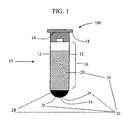
- FIG. 1 shows a cross-sectional illustration of a device 100 that incorporates a preferred embodiment of this claimed subject matter and can be used to collect and preserve biological tissues such as cells and cellular components for analysis.
- the device 100 is particularly useful in the collection of whole blood, but can be use to collect other types of bodily fluids and/or biological tissues (e.g., epithelial cells, bone marrow, spinal fluid and the like) including, without limitation, abnormal tissue samples such as leukemias, cancer tissue cancer, and the like as long as the tissue samples-can be transformed into a cellular suspension.
- bodily fluids and/or biological tissues e.g., epithelial cells, bone marrow, spinal fluid and the like
- abnormal tissue samples such as leukemias, cancer tissue cancer, and the like as long as the tissue samples-can be transformed into a cellular suspension.
- the device 100 includes an evacuated collection container 10 comprised of (1) a tube 12 having an open end 14 and a closed end 16; a closure (e.g., stopper) 18 in the open end of the tube 12, and a predetermined level of vacuum (not shown) inside the container 10.
- the tube 12 is made of a transparent material such as glass or plastic for better visibility.
- the tube 12 has an interior surface that is sterile and resists adherence to the cells 20 (not shown) during collection, storage, and analysis.
- the closure 18 is preferably puncturable by a needle and resealable allowing easy transfer of the cells 20 (e.g., the cells 20 from its host to the container 10 and from the container 10 to another substrate if desired).
- the closure 18 and the tube 12 together form a seal capable of maintaining a pressure differential between atmospheric pressure and a pressure less than atmospheric pressure within the tube 12.
- the size of the container 10 is not narrowly critical and is dependent upon the cell sample volume that is desired to be collected and preserved.
- a typical size for the container 10 may have an internal volume of between 100 ⁇ l to 10 ml.
- the container 10 can be constructed using art-disclosed methods and is commercially available (e.g., Vacutainer Plus Plastic Tubes with Hemogard Closure available from Becton Dickinson and Company located in Franklin Lakes, New Jersey; the evacuated sample collection tube described in U.S. Patent No. 5,860,937 , which is incorporated by reference).
- Vacutainer Plus Plastic Tubes with Hemogard Closure available from Becton Dickinson and Company located in Franklin Lakes, New Jersey
- the evacuated sample collection tube described in U.S. Patent No. 5,860,937 , which is incorporated by reference.
- the device 100 further includes compounds 22 including an anticoagulant agent 24, a fixative agent 26 selected from the group consisting of: diazolidinyl urea, imidazolidinyl urea, dimethoylol-5,5-dimethylhydantoin, dimethylol urea, 2-bromo-2-nitropropane-1,3-diol, oxaizolidines, sodium hydroxymethyl glycinate, 5-hydroxymethoxymethyl-1-1aza-3,7-dioxabicyclo[3.3.0]octane, 5-hydroxymethyl-1-1aza-3,7-dioxabicyclo[3.3.0]octane, 5-hydroxypoly[methyleneoxy]methyl-1-1aza-3,7-dioxabicyclo[3.3.0]octane, and quaternary adamantine, and optionally a polyacrylic acid 28 or any suitable acid
- a suitable amount of any art-disclosed anticoagulant agent such as ethylene diamine tetra acetic acid (EDT A) and its salts, ethylene glycol tetra acetic acid (EGTA) and its salts, hirudin, heparin, citric acid, salts of citric acid, oxalic acid, salts of oxalic acid, or mixtures thereof may be used.
- EDT A ethylene diamine tetra acetic acid
- EGTA ethylene glycol tetra acetic acid
- hirudin heparin
- citric acid salts of citric acid, oxalic acid, salts of oxalic acid, or mixtures thereof
- a preferred anticoagulant agent 24 is K 3 EDTA.
- the suitable amount of the anticoagulant agent 24 for the claimed subject matter is that effective to prevent coagulation of the cells 20 (e.g., whole blood) without causing significant dilution of the cells 20 (i.e., not clinically significant), and thereby allowing the cells 20, stored with the compounds 22, to be directly analyzed by a flow cytometer).
- K 3 EDTA is the anticoagulant agent 24 and its concentration weight/volume is preferably less than about 0.3 g/ml, more preferably less than about 0.2 g/ml, and most preferably about less than about 0.15 g/ml.
- the preferred fixative agent 26 is a heterocyclic urea (e.g., diazolidinyl urea (known as DU), imidazolidinyl urea (known as IDU) or a mixture thereof).
- the most preferred fixative agent is diazolidinyl urea.
- the suitable amount of the fixative agent 26 for the claimed subject matter is that effective to fix or stabilize the cells 20 without causing significant dilution of the cells 20 (i.e., not clinically significant), and thereby allowing the cells 20, stored with the compounds 22, to be directly analyzed by a flow cytometer.
- diazolidinyl urea is the fixative agent 26 and its concentration weight/volume is preferably about less than about 1 g/ml, more preferably less than about 0.75 g/ml, and most preferably less than about 0.5 g/ml. (concentration of solution of DU before blood sample is added.)
- the acid 28 may rise signal to noise ratio during flow cytometry; and therefore, the acid 28 may be optionally added as one of the compounds 22 in the device 100.
- the preferred acid 28 is a polycarboxylic acid, and more preferably a polyacrylic acid with a molecular weight of 5,000.
- the suitable amount of the acid 28 for the claimed subject matter is that effective to rise signal to noise ratio during flow cytometry but without causing significant dilution to the cells 20 (i.e., not clinically significant) so that the cells 20, stored with the compounds 22, can be directly analyzed by a flow cytometry.
- polyacrylic acid with a molecular weight of 5,000 is included in the container 10.
- Additional compounds may optionally be added as one of the compounds 22 in the device 100.
- additional and optional compounds may include: cell permeabilizing agents for substantially gaining access to intracellular analytes/epitopes and/or for lysing red blood cells; proteins that substantially protect the cells during processing and/or substantially reduce non-specific binding of probes; serum/lipoproteins that substantially protect cells during processing and/or substantially reduce non-specific binding of probes; RNAse inhibitors which substantially inhibit digestion of RNA and/or substantially maintain RNA integrity; nucleic acid stabilizers which substantially inhibit the degradation of nucleic acids and nucleic acid containing compounds; amino acids / polypeptides which substantially enhance binding of probes/antibodies to epitopes and/or substantially increases the observable signal; fixatives which substantially preserve cell integrity especially for permeabilization agents, and may preserve some epitopes; anticoagulants which substantially decreases clotting of red blood cells, chelates calcium and / or may help maintain WBC integrity/viability; protease inhibitors
- additional and optional compounds may be more specifically include: Cell permeabilizing agents such as: DMSO (Dimethyl Sulfoxide), Ethylene glycol, Polyethylene glycol, Glycerin, Cellosolves (ethylene glycol dimethyl ether) (phenoxyethanol), Triton X 100, Triton X 705 (non-ionic detergents), 1-methyl-2-pyrrolidinone, Tween 20, Tween 40 (non-ionic), Brij 35 (detergent), Polyoxyethylene ether (Polyox) , Sodium cholate, Ethylene oxide polymers, Monensin, Monactin, Pentachlorophenol, 2,4 dinitrophenol, saponin, SDS (sodium dodecyl sulfate); Proteins such as: Biotin, Albumins (egg, bovine), Gelatin, and similar such compounds
- the claimed subject matter allows the final composition 30 to be transported in ambient temperature. Thereafter, it is preferred that the final composition 30 be stored at temperature less than about 40°C.
- the cells 20 stored in the final composition 30 have more than about 3 days, preferably more than about 5 days, more preferably more than about 7 days stability.
- the claimed subject matter allows the cells 20 stored in the final composition 30 to be directly analyzed by a flow cytometer without further dilution and/or treatment because the compounds 22 can preserve the cells 20 without significantly diluting the cells 20. Any significant dilution of the cells 20 is likely to cause error in flow cytometry measurements (e.g., lowering the lymphocytes' count).
- the compounds 22 are in concentrated forms, preferably in a ratio with the final composition 30 that is less than about 2:100, more preferably less than about 1.5:100, and most preferably less than about 1:100.
- the device 100 may be included in a kit of the claimed subject matter containing components 32 (not shown) conventionally used to collect and analyze the cells 20 such as alcohol swab, gauze, tube holder, tourniquet, glove, other cell collection tube (with or without conventional cell analysis additives inside such tube), needle (with hub, part of a syringe assembly including barrel and plunger, or with wings connected via a hub and tubing to another needle for delivery to the device 100 or other collection tubes), lancet, adhesive strip, syringe, test strip (allowing the cells 20 to flow directly onto a glass or plastic strip containing reagents for cell analysis), glass or plastic strip containing reagents for cell analysis (e.g., immunoassay), packaging means (e.g., plastic bag, compartmentalized plastic enclosure, and the like) to store the desired components 32 and the device 100, and packaging means to transport the cells 20 stored in the device 100 after collection. It is preferred that the packaging means and any other components 32 that may become in physical contact with the cells 20 be steriliz
- the fixative agent 26 of the claimed subject matter has extremely low toxicity.
- toxicity studies comparing diazolidinyl urea with formaldehyde of the prior art show the following: INHALATION TOXICITY DERMAL TOXICITY LD50 Formaldehyde 500 mg/kg 270 mg/kg 800 mg/kg Diazolidinyl Urea None 2000 mg/kg 2570 mg/kg
- fixative agent 26 Another advantage offered by the fixative agent 26 is the fact that it is not flammable and therefore does not present a fire hazard as do many of the prior art fixative agents.
- fixative agent 26 provides the desired tissue and cell membrane stabilization. It is believed that the fixative agent binds in some fashion to the cell membrane or tissue. This hypothesis is drawn because many members of the active agent are known disinfectants, which kill bacteria by binding to cell structure. This is not a full explanation of the mechanism responsible for the results of the claimed subject matter since many other disinfectants such as KATHON and OMADINE fail to provide tissue and cell stabilizing effects.
- fixative agent 26 to preserve antigenic sites is also not understood but it is probably due to a difference in the reaction between proteins and the fixative agent 26 compared to prior art preservatives such as formaldehyde. Formaldehyde cross-links with itself and proteins to obscure the antigen. To determine if this is true, diazolidinyl urea was added to the protein, albumin. After incubation of the diazolidinyl urea and protein mixture for 24 hours, disc-gel electrophoresis indicated no change in the rate of migration of the protein. When this experiment is conducted with formaldehyde, a large number of insoluble proteins result and the electrophoretic migration is altered.
- a method of making the device 100 of the claimed subject matter is comprised of providing the tube 12 having the open end 14 and the closed end 16 (202). It is preferred that the tube 12 is sterile.
- the method is further comprised of preloading (i.e., introducing) the compounds 22 comprising of the anticoagulant agent 24, the fixative agent 26, and optionally the acid 28 into the tube 12 using art-disclosed methods (204).
- the types and amounts of the anticoagulant agent 24, the fixative agent 26, and optionally, the acid 28 including the ratio between the compounds 22 and the final composition 30 are the same as described above for the device 100 of the claimed subject matter. It is preferred the compounds have been sterilized (e.g., by sterile filtration).
- the method of the preloading step 204 may optionally include freeze drying the compounds in the tube 12.
- the method 200 further includes inserting the closure 1-8 into the open end 14 of the tube 12 (206).
- the method 200 further includes drawing a vacuum inside the tube 12 to a predetermined level (208) using art-disclosed methods.
- the amount of vacuum to be drawn is dependent upon the nature and volume of the cells desired to be collected and preserved. For example, for whole blood collection, the vacuum should be drawn to a level that allows the pressure of the whole blood to cause it to flow into and fill the tube 12 to the desired level.
- the method 200 may optionally include providing the components 32 conventionally used to collect and analyze the cells 20.
- the components 32 are the same as for the device 100 of the claimed subject matter as described above.
- the method may also optionally include collecting the cells 20 using art-disclosed methods (e.g., venipuncture, use of a lancet, etc.). It may optionally include screening the cells 20 using art-disclosed instruments such as flow cytometers (eg., FACScan, FACSCalibur by BD and EPICS by Beckman Coulter), other hematology instruments (e.g., H3 by Bayer Corporation, the Beckman Coulter STKS or Gen-S Systems, the Abbott Cell-Dyn 4000 Hematology System, Bayer ADVIA 120 System, the Sysmex XE2100 System, and the like.
- art-disclosed instruments such as flow cytometers (eg., FACScan, FACSCalibur by BD and EPICS by Beckman Coulter), other hematology instruments (e.g., H3 by Bayer Corporation, the Beckman Coulter STKS or Gen-S Systems, the Abbott Cell-Dyn 4000 Hematology System, Bayer AD
- the screening of the cells may be for any purpose including, without limitation, for HIV, HPV, hepatitis, leukemia, cancer, and the like; other art-disclosed screening such as immunoassay, AIDS panel, and the like; and screening by methods disclosed in commonly owned United States Patent No. 4,788,139 (Ryan ) titled "Platelet aggregation reagent, reagent container and method of determining platelet aggregation in EDTA-anticoagulated blood", which is hereby incorporated by reference.
- Cells 20 collected and preserved using the claimed subject matter may undergo histological study in any known conventional manner, such as through the use of paraffin sectioning equipment, staining, mounting on slides, or other common steps utilized prior to microscopic or other examination. The claimed subject matter thus provides a safe, convenient, and effective solution to collect and preserve cells for analysis.
- the method and device of the claimed subject matter may be used by those skilled in the art to preserve antigenic sites on or within cells (or components thereof) derived from any source including normal blood, bone marrow, lymph, or solid tissues, or may be derived from abnormal tissues such as leukemias or solid tissue cancers.
- the claimed subject matter may also be utilized with any cellular component or biological material that has at least one antigenic site.
- cell clumping is prevented, light scattering properties are preserved, antigenic sites are preserved, and nucleic acids may be analyzed.
Landscapes
- Health & Medical Sciences (AREA)
- Chemical & Material Sciences (AREA)
- Analytical Chemistry (AREA)
- General Health & Medical Sciences (AREA)
- Hematology (AREA)
- Clinical Laboratory Science (AREA)
- Chemical Kinetics & Catalysis (AREA)
- Investigating Or Analysing Biological Materials (AREA)
Abstract
Description
- The present invention relates to a method and device or collecting and preserving cells for analysis and to a device and kit for carrying out the same.
- In-biological and biochemical analysis, and related arts, it is often necessary to collect and preserve biological tissues (i.e., cells and cellular components), for useful periods of time. The collected and preserved cells are often utilized-in a wide variety of applications, including but not limited to instructional aids and the diagnosis-and treatment of diseases. For example, such cells are often utilized in histological, cytological, immunological, and proteinaceous studies and the like.
- Various methods are known in the art for analyzing histological, cytological, immunological, and proteinaceous materials. For example, surface marker analysis has developed as a laboratory tool, which is particularly useful for clinical diagnosis through the investigation of immunodeficiency states, differentiation of cell types and development stages, and other cell processes. The expansion of uses for surface marker analysis has resulted in the use of flow cytometry and antibody probes to evaluate cellular properties. While other means of assaying for surface marker analysis exist, flow cytometry provides rapid, objective and quantitative assessment of surface markers. Furthermore, even though the microscope is still the conventional means for examining preserved and stained biological materials, biological materials may also be examined with a flow cytometer. The flow cytometer is an important method for examining a plurality of cells in a brief time.
- Flow cytometry and flow cytometers are generally described in Keran's text, Flow cytometry in Clinical Diagnosis (1989). Flow cytometers operate in principle by multiparameter analysis of heterogeneous cell populations (or cellular components) on a cell-by-cell basis. Flow cytometry allows biological and physical properties of cells and cellular components to be determined. In flow cytometry, cells in suspension are forced single file, via hydrodynamic focusing, through the path of a laser beam. Interaction of the cells with the laser beam scatters some of the light and causes excitation and emission from fluorescent molecules present on the surface or interior of the cell. A series of lenses collect the scattered or emitted light and pass it to a photomultiplier. Each photomultiplier measures a separate parameter. Parameters measured include: forward light scatter, which measures relative particle size; side light scatter, which measures relative granularity or other internal structure; and fluorescence emission. The optical signals are converted by a computer to a data display for analysis and interpretation. Cells collected and preserved using conventional methods and instruments generally require further dilution and/or treatment before they can be analyzed by flow cytometry. Thus, it is desirable in the art to obtain a method and a collection device that allow the cells to be directly analyzed by flow cytometry without further dilution and/or treatment. (There is need for a method to collect and transport human blood specimens for flow cytometric analysis. Current methods are inadequate in that the samples have to be analyzed soon after collection.)
- The primary objective of tissue preservation is to provide as much structural detail of cells and components thereof as possible. To do this, it is necessary to maintain the cells in their original unaltered morphology so that maximum cellular detail may be observed. With the clinical application of immunostaining, there is also the requirement that antigens are not altered by the method of preservation. Thus, it is desirable in the art to obtain a method and a collection device that maintain the cells in their original unaltered morphology and preserve their antigenic sites.
- The usual formulations for preservation of cells contain one or more agents, which react vigorously with the proteins of the cells to denature and insolubilize the components of the cell. Typical of this type of agent is picric acid, mercuric ions, formaldehyde and glutaraldehyde. In addition, some less toxic compounds can also be utilized which denature and stabilize the proteins such as acetic and formic acid. Unfortunately, the toxicity associated with such compounds renders their use less than satisfactory. For example, a-37% solution of formaldehyde, the most common of these fixatives, is a noxious gas which is also toxic, flammable, and carcinogenic. Although efforts are made when this chemical is used to protect workers and avoid contamination of the drainage system when disposed, these efforts are usually both expensive and inconvenient, and fixatives such as formaldehyde still present a danger to laboratory workers and health care professionals. Thus, it is highly desirable to develop a method and a collection device, which can preserve the cells in a low toxicity and non-flammable environment so that it can be used safely, effectively and conveniently in histological and other studies.
- For even easier handling, it is also desirable to develop a method and a collection device that allow transportation (e.g., from the collection site to the analysis site) of the cells in ambient temperature.
- The claimed subject matter addresses many of the challenges encountered when using conventional methods and instruments to collect and preserve cells by providing a method and a collection device that are capable of maintaining the cells in their original unaltered morphology; preserving the cell antigenic sites; and allowing the cells to be transported at ambient temperature, to be handled in a low toxicity and non-flammable environment, and to be directly analyzed by flow cytometry without further dilution and/or treatment. The claimed subject matter more specifically relates to a method and a device that allow cells (e.g., whole blood, epithelial cells, spinal fluid, and the like.) to be collected and preserved for analysis and addresses many of the challenges encountered when using conventional methods and instruments. Specifically, the claimed subject matter describes a method and a collection device that (1) use a less toxic and non-flammable reagent for fixing and stabilizing cells; (2) allow the cells to stay in their original unaltered morphology; (3) allow the cell antigenic sites to be preserved for a useful period of time; (4) allow the cells to be transported at ambient temperature; and/or (5) allow the cells to be directly analyzed by flow cytometry without further dilution and/or treatment.
- The claimed subject matter includes a device to collect and preserve cells comprising of: (1) a collection container comprised of a tube having an open end and a closed end, a closure in the open end of the tube, a vacuum drawn to a predetermined level inside the container; and (2) compounds including an anticoagulant agent and a fixative agent selected from the group consisting of: diazolidinyl urea, imidazolidinyl urea, dimethoylol-5,5-dimethylhydantoin, dimethylol urea, 2-bromo-2-nitropropane-1,3-diol, oxazolidines, sodium hydroxymethyl glycinate, 5-hydroxymethoxymethyl-1-laza-3, 7-dioxabicyclo[3.3.0]octane, 5-hydroxymethyl-1-laza-3,7-dioxabicyclo[3.3.0]octane, 5-hydroxypoly[methyleneoxy]methyl-1-laza-3,7-dioxabicyclo[3.3.0]octane, quaternary adamantine and combinations thereof. The claimed subject matter may optionally include polyacrylic acid or a suitable acid having a pH ranging from about one to about seven inside the tube. The compounds of the device must be in a sufficient amount to preserve the collected cells' original morphology and antigenic sites without significant dilution of the cells (i.e., in a volume that is not clinically significant), and thereby allowing the cells, stored with the compounds, to be directly analyzed by a flow cytometer.
- The claimed subject matter also includes a method comprised of (1) providing a tube with an open end and a closed end, (2) preloading the tube with compounds including: an anticoagulant agent, a fixative agent selected from the group consisting of diazolidinyl urea, imidazolidinyl urea, dimethoylol-5,5-dimethylhydantoin, dimethylol urea, 2-bromo-2-nitropropane-1,3-diol, oxazolidines, sodium hydroxymethyl glycinate, 5-hydroxymethoxymethyl-1-laza-3,7-dioxabicyclo[3.3.0]octane, 5-hydroxymethyl-1-laza-3,7-dioxabicyclo[3.3.0]octane, 5-hydroxypoly[methyleneoxy]methyl-1-1aza-3,7-dioxabicyclo[3.3.0]octane, and quaternary adamantine, and optionally a polyacrylic acid or a suitable acid having a pH ranging from about one to about seven, wherein the compounds are in a sufficient amount to preserve the collected cells' original morphology and antigenic sites without significant dilution of the cells, and thereby allowing the cells, stored with the compounds, to be directly analyzed by a flow cytometer; inserting a closure into the open end of the tube; and drawing a vacuum to a predetermined level inside the tube.
- The method and device of the claimed subject matter may also optionally include other art-disclosed components conventionally used in cell collection and analysis such as gauze, glove, tourniquet, lancet, needle, test strip (e.g., immunoassay), alcohol swab, tube holder, additional cell collection tubes (with or without conventional cell analysis additives inside these tubes), adhesive strip, syringe, glass or plastic strip, packaging means to store the desired components and the device, and packaging means to transport at least the collected and preserved cells stored in the device. The method of the claimed subject matter may also optionally include additional art disclosed methods and instruments used for cell analysis such as a flow cytometer, a hematology analyzer, and other hematology instruments, etc.
- Embodiments of the present invention will now be described, by way of examples only have reference to the accompanying drawings, in which:
- FIG. 1. A cross-sectional illustration of an exemplary embodiment of the collection device of the claimed subject matter; and
- FIG. 2 A flow diagram illustrating a method for making the collection device illustrated in the FIG. 1.
- The claimed subject matter can be satisfied by embodiments in many different forms, the drawings and the description herein describe in detail a preferred embodiment of the claimed subject matter. It is understood that the present disclosure is to be considered exemplary of the principles of the claimed subject matter and is not intended to limit the claimed subject matter to the embodiment illustrated. The scope of the claimed subject matter is measured by the appended claims and their equivalents.
- Turning now to the drawings, FIG. 1 shows a cross-sectional illustration of a
device 100 that incorporates a preferred embodiment of this claimed subject matter and can be used to collect and preserve biological tissues such as cells and cellular components for analysis. Thedevice 100 is particularly useful in the collection of whole blood, but can be use to collect other types of bodily fluids and/or biological tissues (e.g., epithelial cells, bone marrow, spinal fluid and the like) including, without limitation, abnormal tissue samples such as leukemias, cancer tissue cancer, and the like as long as the tissue samples-can be transformed into a cellular suspension. - The
device 100 includes an evacuatedcollection container 10 comprised of (1) atube 12 having anopen end 14 and a closedend 16; a closure (e.g., stopper) 18 in the open end of thetube 12, and a predetermined level of vacuum (not shown) inside thecontainer 10. It is preferred that thetube 12 is made of a transparent material such as glass or plastic for better visibility. It is also preferred that thetube 12 has an interior surface that is sterile and resists adherence to the cells 20 (not shown) during collection, storage, and analysis. Theclosure 18 is preferably puncturable by a needle and resealable allowing easy transfer of the cells 20 (e.g., thecells 20 from its host to thecontainer 10 and from thecontainer 10 to another substrate if desired). It is also preferred that theclosure 18 and thetube 12 together form a seal capable of maintaining a pressure differential between atmospheric pressure and a pressure less than atmospheric pressure within thetube 12. - The size of the
container 10 is not narrowly critical and is dependent upon the cell sample volume that is desired to be collected and preserved. For example, a typical size for thecontainer 10 may have an internal volume of between 100µl to 10 ml. Thecontainer 10 can be constructed using art-disclosed methods and is commercially available (e.g., Vacutainer Plus Plastic Tubes with Hemogard Closure available from Becton Dickinson and Company located in Franklin Lakes, New Jersey; the evacuated sample collection tube described inU.S. Patent No. 5,860,937 , which is incorporated by reference). Of course, it should be understood that a wide range of changes and modifications can be made to the preferred embodiment described above for thecontainer 10. - For preservation (e.g., fixation, stabilization and the like) of the
cells 20, thedevice 100 further includescompounds 22 including ananticoagulant agent 24, afixative agent 26 selected from the group consisting of: diazolidinyl urea, imidazolidinyl urea, dimethoylol-5,5-dimethylhydantoin, dimethylol urea, 2-bromo-2-nitropropane-1,3-diol, oxaizolidines, sodium hydroxymethyl glycinate, 5-hydroxymethoxymethyl-1-1aza-3,7-dioxabicyclo[3.3.0]octane, 5-hydroxymethyl-1-1aza-3,7-dioxabicyclo[3.3.0]octane, 5-hydroxypoly[methyleneoxy]methyl-1-1aza-3,7-dioxabicyclo[3.3.0]octane, and quaternary adamantine, and optionally apolyacrylic acid 28 or any suitable acid having a pH ranging from about one to about seven, wherein the compounds are in a sufficient amount to preserve the collected cells' original morphology and antigenic sites without significant dilution of thecells 20, and thereby allowing thecells 20, stored with thecompounds 22, to be directly analyzed by a flow cytometer. It is preferred that thecompounds 22 have been sterilized (e.g., by sterilizing filtration). - A suitable amount of any art-disclosed anticoagulant agent such as ethylene diamine tetra acetic acid (EDT A) and its salts, ethylene glycol tetra acetic acid (EGTA) and its salts, hirudin, heparin, citric acid, salts of citric acid, oxalic acid, salts of oxalic acid, or mixtures thereof may be used. A preferred
anticoagulant agent 24 is K3EDTA. The suitable amount of theanticoagulant agent 24 for the claimed subject matter is that effective to prevent coagulation of the cells 20 (e.g., whole blood) without causing significant dilution of the cells 20 (i.e., not clinically significant), and thereby allowing thecells 20, stored with thecompounds 22, to be directly analyzed by a flow cytometer). For example, in a preferred embodiment, K3EDTA is theanticoagulant agent 24 and its concentration weight/volume is preferably less than about 0.3 g/ml, more preferably less than about 0.2 g/ml, and most preferably about less than about 0.15 g/ml. - The preferred
fixative agent 26 is a heterocyclic urea (e.g., diazolidinyl urea (known as DU), imidazolidinyl urea (known as IDU) or a mixture thereof). The most preferred fixative agent is diazolidinyl urea. The suitable amount of thefixative agent 26 for the claimed subject matter is that effective to fix or stabilize thecells 20 without causing significant dilution of the cells 20 (i.e., not clinically significant), and thereby allowing thecells 20, stored with thecompounds 22, to be directly analyzed by a flow cytometer. For example, in a preferred embodiment, diazolidinyl urea is thefixative agent 26 and its concentration weight/volume is preferably about less than about 1 g/ml, more preferably less than about 0.75 g/ml, and most preferably less than about 0.5 g/ml. (concentration of solution of DU before blood sample is added.) - It is known that the
acid 28 may rise signal to noise ratio during flow cytometry; and therefore, theacid 28 may be optionally added as one of thecompounds 22 in thedevice 100. Thepreferred acid 28 is a polycarboxylic acid, and more preferably a polyacrylic acid with a molecular weight of 5,000. The suitable amount of theacid 28 for the claimed subject matter is that effective to rise signal to noise ratio during flow cytometry but without causing significant dilution to the cells 20 (i.e., not clinically significant) so that thecells 20, stored with thecompounds 22, can be directly analyzed by a flow cytometry. For example, in a preferred embodiment, polyacrylic acid with a molecular weight of 5,000 is included in thecontainer 10. - Additional compounds may optionally be added as one of the
compounds 22 in thedevice 100. Such additional and optional compounds- may include: cell permeabilizing agents for substantially gaining access to intracellular analytes/epitopes and/or for lysing red blood cells; proteins that substantially protect the cells during processing and/or substantially reduce non-specific binding of probes; serum/lipoproteins that substantially protect cells during processing and/or substantially reduce non-specific binding of probes; RNAse inhibitors which substantially inhibit digestion of RNA and/or substantially maintain RNA integrity; nucleic acid stabilizers which substantially inhibit the degradation of nucleic acids and nucleic acid containing compounds; amino acids / polypeptides which substantially enhance binding of probes/antibodies to epitopes and/or substantially increases the observable signal; fixatives which substantially preserve cell integrity especially for permeabilization agents, and may preserve some epitopes; anticoagulants which substantially decreases clotting of red blood cells, chelates calcium and / or may help maintain WBC integrity/viability; protease inhibitors which substantially decreases degradation of protein epitopes; antioxidants/ reducing agents which substantially prevent hemolysis of red blood cells and/ or substantially prevent oxidation of peptides, and/ or substantially maintain epitopes; nucleic acid dyes that generally serve to label/identify nucleic acid; carbohydrates which substantially maintain cellular integrity and/or osmolarity; and, polyacrylic acids which substantially enhance the binding of probes and/or antibodies to epitopes; and /or substantially increases signal. One of skill in the art should be able to determine the usefulness and quantities of such optional compounds by routine testing and knowledge of the art. Within multiple specific embodiments the above additional and optional compounds may be more specifically include: Cell permeabilizing agents such as: DMSO (Dimethyl Sulfoxide), Ethylene glycol, Polyethylene glycol, Glycerin, Cellosolves (ethylene glycol dimethyl ether) (phenoxyethanol), Triton X 100, Triton X 705 (non-ionic detergents), 1-methyl-2-pyrrolidinone, Tween 20, Tween 40 (non-ionic), Brij 35 (detergent), Polyoxyethylene ether (Polyox) , Sodium cholate, Ethylene oxide polymers, Monensin, Monactin, Pentachlorophenol, 2,4 dinitrophenol, saponin, SDS (sodium dodecyl sulfate); Proteins such as: Biotin, Albumins (egg, bovine), Gelatin, and similar such compounds as should be known to one of skill in the art; RNAse inhibitors such as: human placenta derived RNAse inhibitor, and similar such compounds should be known to one of skill in the art; Nucleic acid stabilizers such as: Guanidinium hydrochloride, Polycations such as Polyethylenimine), and similar such compounds as should be known to one of skill in the art; Amino acids/polypeptides such as: Glutamic acid, Glycine, Aspartic acid, and similar such compounds as should be known to one of skill in the art; Fixatives such as: Aldehydes (formaldehyde and glutaraldehyde), Alcohols (ethanol, methanol), and similar such compounds as should be known to one of skill in the art; Anticoagulants such as: EDTA (Ethylene Diamine Tetra acetic acid.), and similar such compounds as should be known to one of skill in the art; ACD (Acid Citrate Dextrose), Heparin; and similar such compounds as should be known to one of skill in the art; Protease -Inhibitors such as: EDTA, PMSF (phenyl methyl sulfonyl fluoride), AEBSF (2-Aminoethyl benzene sulfonyl fluoride), and similar such compounds as should be known to one of skill in the art; Antioxidants/ Reducing agents such as: Trolox, a-tocopherol, B-mercaptoethanol, and similar such compounds as should be known to one of skill in the art; Nucleic Acid Dyes such as: DAPI (Diamidino 2-phenylindole), Propidium Iodide, Fluorescein diacetate, and similar such compounds as should be known to one of skill in the art; Carbohydrates such as: Sugars (sucrose), cellulose, and similar such compounds as should be known to one of skill in the art. It should be appreciated that the above specific listings of compounds may contain a measure of overlap, which recognizes the sometimes-overlapping function of certain specific compounds. One of skill in the art should understand and appreciate this aspect of the disclosure. - The claimed subject matter allows the
final composition 30 to be transported in ambient temperature. Thereafter, it is preferred that thefinal composition 30 be stored at temperature less than about 40°C. Thecells 20 stored in thefinal composition 30 have more than about 3 days, preferably more than about 5 days, more preferably more than about 7 days stability. The claimed subject matter allows thecells 20 stored in thefinal composition 30 to be directly analyzed by a flow cytometer without further dilution and/or treatment because thecompounds 22 can preserve thecells 20 without significantly diluting thecells 20. Any significant dilution of thecells 20 is likely to cause error in flow cytometry measurements (e.g., lowering the lymphocytes' count). To avoid significant dilution, the compounds 22 (comprising of theanticoagulant agent 24, thefixative agent 26, and optionally, the acid 28) are in concentrated forms, preferably in a ratio with thefinal composition 30 that is less than about 2:100, more preferably less than about 1.5:100, and most preferably less than about 1:100. - The
device 100 may be included in a kit of the claimed subject matter containing components 32 (not shown) conventionally used to collect and analyze thecells 20 such as alcohol swab, gauze, tube holder, tourniquet, glove, other cell collection tube (with or without conventional cell analysis additives inside such tube), needle (with hub, part of a syringe assembly including barrel and plunger, or with wings connected via a hub and tubing to another needle for delivery to thedevice 100 or other collection tubes), lancet, adhesive strip, syringe, test strip (allowing thecells 20 to flow directly onto a glass or plastic strip containing reagents for cell analysis), glass or plastic strip containing reagents for cell analysis (e.g., immunoassay), packaging means (e.g., plastic bag, compartmentalized plastic enclosure, and the like) to store the desired components 32 and thedevice 100, and packaging means to transport thecells 20 stored in thedevice 100 after collection. It is preferred that the packaging means and any other components 32 that may become in physical contact with thecells 20 be sterilized and the packaging means is constructed to maintain this sterile environment - Unlike the typical histological fixing agents, the
fixative agent 26 of the claimed subject matter has extremely low toxicity. For example, toxicity studies comparing diazolidinyl urea with formaldehyde of the prior art show the following:INHALATION TOXICITY DERMAL TOXICITY LD50 Formaldehyde 500 mg/kg 270 mg/kg 800 mg/kg Diazolidinyl Urea None 2000 mg/kg 2570 mg/kg - This reduced toxicity makes disposal and handling less of a problem. In addition, since there is no inhalation toxicity, there are no badge detection devices required as there are for formaldehyde.
- Another advantage offered by the
fixative agent 26 is the fact that it is not flammable and therefore does not present a fire hazard as do many of the prior art fixative agents. - The mechanism by which the
fixative agent 26 provides the desired tissue and cell membrane stabilization is not known for certain. It is believed that the fixative agent binds in some fashion to the cell membrane or tissue. This hypothesis is drawn because many members of the active agent are known disinfectants, which kill bacteria by binding to cell structure. This is not a full explanation of the mechanism responsible for the results of the claimed subject matter since many other disinfectants such as KATHON and OMADINE fail to provide tissue and cell stabilizing effects. - The ability of the
fixative agent 26 to preserve antigenic sites is also not understood but it is probably due to a difference in the reaction between proteins and thefixative agent 26 compared to prior art preservatives such as formaldehyde. Formaldehyde cross-links with itself and proteins to obscure the antigen. To determine if this is true, diazolidinyl urea was added to the protein, albumin. After incubation of the diazolidinyl urea and protein mixture for 24 hours, disc-gel electrophoresis indicated no change in the rate of migration of the protein. When this experiment is conducted with formaldehyde, a large number of insoluble proteins result and the electrophoretic migration is altered. - Referring to FIG. 2, a method of making the
device 100 of the claimed subject matter is comprised of providing thetube 12 having theopen end 14 and the closed end 16 (202). It is preferred that thetube 12 is sterile. The method is further comprised of preloading (i.e., introducing) thecompounds 22 comprising of theanticoagulant agent 24, thefixative agent 26, and optionally theacid 28 into thetube 12 using art-disclosed methods (204). The types and amounts of theanticoagulant agent 24, thefixative agent 26, and optionally, theacid 28 including the ratio between thecompounds 22 and thefinal composition 30 are the same as described above for thedevice 100 of the claimed subject matter. It is preferred the compounds have been sterilized (e.g., by sterile filtration). The method of the preloadingstep 204 may optionally include freeze drying the compounds in thetube 12. The method 200 further includes inserting the closure 1-8 into theopen end 14 of the tube 12 (206). The method 200 further includes drawing a vacuum inside thetube 12 to a predetermined level (208) using art-disclosed methods. The amount of vacuum to be drawn is dependent upon the nature and volume of the cells desired to be collected and preserved. For example, for whole blood collection, the vacuum should be drawn to a level that allows the pressure of the whole blood to cause it to flow into and fill thetube 12 to the desired level. The method 200 may optionally include providing the components 32 conventionally used to collect and analyze thecells 20. The components 32 are the same as for thedevice 100 of the claimed subject matter as described above. - The method may also optionally include collecting the
cells 20 using art-disclosed methods (e.g., venipuncture, use of a lancet, etc.). It may optionally include screening thecells 20 using art-disclosed instruments such as flow cytometers (eg., FACScan, FACSCalibur by BD and EPICS by Beckman Coulter), other hematology instruments (e.g., H3 by Bayer Corporation, the Beckman Coulter STKS or Gen-S Systems, the Abbott Cell-Dyn 4000 Hematology System, Bayer ADVIA 120 System, the Sysmex XE2100 System, and the like. The screening of the cells may be for any purpose including, without limitation, for HIV, HPV, hepatitis, leukemia, cancer, and the like; other art-disclosed screening such as immunoassay, AIDS panel, and the like; and screening by methods disclosed in commonly ownedUnited States Patent No. 4,788,139 (Ryan ) titled "Platelet aggregation reagent, reagent container and method of determining platelet aggregation in EDTA-anticoagulated blood", which is hereby incorporated by reference.Cells 20 collected and preserved using the claimed subject matter may undergo histological study in any known conventional manner, such as through the use of paraffin sectioning equipment, staining, mounting on slides, or other common steps utilized prior to microscopic or other examination. The claimed subject matter thus provides a safe, convenient, and effective solution to collect and preserve cells for analysis. - It should be noted that the method and device of the claimed subject matter may be used by those skilled in the art to preserve antigenic sites on or within cells (or components thereof) derived from any source including normal blood, bone marrow, lymph, or solid tissues, or may be derived from abnormal tissues such as leukemias or solid tissue cancers. The claimed subject matter may also be utilized with any cellular component or biological material that has at least one antigenic site.
- It should be noted that in preferred embodiments of the claimed subject matter cell clumping is prevented, light scattering properties are preserved, antigenic sites are preserved, and nucleic acids may be analyzed.
- The foregoing detailed description has discussed only a few of the many forms that the claimed subject matter can take. For this reason, this detailed description is intended only by way of illustration. It is only the following claims, including all equivalents that are intended to define the scope of the claimed subject matter.
Claims (36)
- A device (100) for collecting cells (20), comprising:(a) a collection container (10) having an open end (14) and a closed end (16), a closure (18) at said open end (14) of said container (10), wherein said container has an internal pressure less than atmospheric pressure outside said container; and(b) compounds (22) positioned within said container (10), wherein said compounds include an anticoagulant agent (24) and a fixative agent (26) selected from the group consisting of: diazolidinyl urea, imidazolidinyl urea, dimethoylol-5,5 dimethylhydantoin, dimethylol urea, 2-bromo-2.-nitropropane-1,3-diol, oxazolidines, sodium hydroxymethyl glycinate, 5-hydroxymethoxymethyl-1-laza-3, 7-dioxabicyclo [3.3.0]octane, 5-hydroxymethyl-1-laza-3,7-dioxabicyclo [3.3.0]octane, 5-hydroxypoly[methyleneoxy]methyl-1-laza-3,7-dioxabicyclo [3.3.0]octane, quaternary adamantine and combinations thereof,wherein ratio of said compounds (22) over a final composition (30) comprising said cells (20) and said compounds (22) is less than about 2:100 (volume/volume).
- The device according to claim 1, wherein said ratio is less than 1.5:100 (volume/volume).
- The device according to claim 2, where said ratio is less than 1:100 (volume/volume).
- The device according to any one of claims 1 to 3, wherein said anticoagulant agent (24) is selected from the group consisting of ethylene diamine tetra acetic acid (EDTA), salts of EDTA, ethylene glycol tetra acetic acid- (EGTA), salts of EGTA, hirudin, heparin, citric acid, salts of citric acid, oxalic acid, salts of oxalic acid, and a-combination thereof.
- The device according to claim 4, wherein concentration of said anticoagulant agent (24) positioned within said container (10) is less than about 0.3 g/ml.
- The device according to claim 5, wherein said concentration of said anticoagulant agent (24) is less than about 0.2 g/ml.
- The device according to claim 6, wherein said concentration of said anticoagulant agent (24) is less than about 0.15 g/ml.
- The device according to any one of claims 1 to 3, wherein concentration of said fixative agent (26) positioned within said container (10) is less than about 1 g/ml.
- The device according to claim 8, wherein said concentration of said fixative agent (26) is less than about 0.75 g/ml.
- The device according to claim 9, wherein said concentration of said fixative agent (26) is less than about 0.5 g/ml.
- The device according to any one of claims 1 to 10, wherein said compounds (22) further include a polyacrylic acid (28).
- The device according to any one of claims 1 to 11, wherein said cells are selected from the group consisting of whole blood, epithelial cells, bone marrow, spinal fluid, abnormal tissue sample in a cellular suspension, and a combination thereof.
- The device according to any one of claims 1 to 12, wherein said compounds (22) are sterile.
- The device according to any one of claims 1 to 13, wherein at least all surface areas of said tube (12) and said closure (18) that can come into physical contact with said cells (20) are sterile.
- The device according to any one of claims 1 to 14, wherein said device (100) is used along with an instrument selected from the group consisting of a flow cytometer, a hematology analyzer, H3 by Bayer Corporation, the Beckman Coulter STKS System, the Beckman Coulter Gen-S System, the Abbott Cell-Dyn 4000 Hematology System, Bayer ADVIA 120 System, the Sysmex XE2100 System, and a combination thereof to provide screening of said cells.
- A kit comprising the device according to any of claims 1 to 14, and at least one component (32) selected from the group consisting of an alcohol swab, a gauze, a tube holder, a tourniquet, a glove, other cell collection tube, a needle, a lancet, adhesive strip, syringe, a test strip, a strip containing reagents for cell analysis, a packaging means for storing said at least one component and said collection device to form a kit, and a packaging means for transporting said collection device.
- A method of screening a subject for abnormal cells or tissues thereby diagnosing and/or further treating a disease, comprising the steps-of(a) collecting a cell or tissue sample from said subject using the device (100) according to any one of claims 1 to 14;(b) analyzing collected cell or tissue sample for abnormality using an instrument selected from the group consisting of a flow cytometer, a hematology analyzer, H3 by Bayer Corporation, the Beckman Coulter STKS System, the Beckman Coulter Gen-S System, the Abbott Cell-Dyn 4000 Hematology System, Bayer ADVIA 120 System, the Sysmex XE2100 System, and a combination thereof,
thereby diagnosing a disease that is associated with said abnormality, and/or further treating said disease. - The method according to claim 17, wherein said disease includes HIV, HPV, hepatitis, leukemia, cancer, and a combination thereof.
- A method for preparing cells for analysis, comprising the steps of:(a) providing a closed collection container (10) having an internal pressure less than atmospheric pressure outside said container, wherein said collection container (10) contains compounds (22) including an anticoagulant agent (24) and a fixative agent (26) selected from the group consisting of: diazolidinyl urea, imidazolidinyl urea, dimethoylol-5,5 dimethylhydantoin, dimethylol urea, 2-bromo-2.-nitropropane-1,3-diol, oxazolidines, sodium hydroxymethyl glycinate, 5-hydroxymethoxymethyl-1-laza-3, 7-dioxabicyclo [3.3.0]octane, 5-hydroxymethyl-1-laza-3,7-dioxabicyclo [3.3.0]octane, 5-hydroxypoly[methyleneoxy]methyl-1-laza-3,7-dioxabicyclo [3.3.0]octane, quaternary adamantine and combinations thereof inside said tube, wherein ratio of said compounds (22) over a final composition (30) comprising said cells (20) and said compounds (22) is less than about 2:100 (volume/volume); and(b) collecting said cells in said container (10).
- The method according to claim 19, wherein said ratio is less than 1.5:100 (volume/volume).
- The method according to claim 20, wherein said ratio is less than 1:100 (volume/volume).
- A method of making a device (100) for collecting cells (20), comprising the steps of:(a) providing a tube (12) having an open end (14) and a closed end (16);(b) preloading compounds (22) including:an anticoagulant agent (24), anda fixative agent (26) into said tube (-12), said fixative agent (26) selected from the groupconsisting of: diazolidinyl urea, imidazolidinyl urea, dimethoylol-5,5 dimethylhydantoin,dimethylol urea, 2-bromo-2-nitropropane-1,3-diol, oxazolidines, sodium hydroxymethyl glycinate, 5-hydroxymethoxymethyl-1-laza-3, 7-dioxabicyclo [3.3.0]octane, 5-hydroxymethyl-1-laza-3,7-dioxabicyclo [3.3.0]octane, 5-hydroxypoly[methyleneoxy]methyl-1-laza-3,7-dioxabicyclo [3.3.0]octane, quaternary adamantine and combinations thereof,wherein ratio of said compounds (22) over a final composition (30) comprising said cells (20) and said compounds (22) is less than about 2:100 (volume/volume);(c) placing a closure (18) at said open end (14) of said tube (12); and(d) creating and maintaining a pressure differential between atmospheric pressure and a pressure less than atmospheric pressure within said tube (12).
- The method according to claim 22, wherein said ratio is less than 1.5:100 (volume/volume).
- The method according to claim 23, wherein said ratio is less than 1:100 (volume/volume).
- The method according to any one of claims 22 to 24, wherein said anticoagulant agent (24) is selected from the group consisting of ethylene diamine tetra acetic acid (EDTA), salts of EDTA, ethylene glycol tetra acetic acid (EGTA), salts of EGTA, hirudin, heparin, citric acid, salts of citric acid, oxalic acid, salts of oxalic acid, and a combination thereof.
- The method according to claim 25, wherein concentration of said anticoagulant agent (24) preloaded in said tube (12) is less than about 0.3 g/ml.
- The method according to claim 26, wherein concentration of said anticoagulant agent (24) preloaded in said tube (12) is less than about 0.2 g/ml.
- The method according to claim 27, wherein concentration of said anticoagulant agent (24) preloaded in said tube (12) is less than about 0.15 g/ml.
- The method according to any one of claims 22 to 24, wherein concentration of said fixative agent (26) preloaded in said tube (12) is less than about 1 g/ml.
- The method according to claim 29, wherein concentration of said fixative agent (26) preloaded in said tube (12) is less than about 0.75 g/ml.
- The method according to claim 30, wherein concentration of said fixative agent (26) preloaded in said tube (12) is less than about 0.5 g/ml.
- The method according to any one of claims 22 to 31, wherein said preloading step further includes preloading a polyacrylic acid (28) into said tube (12).
- The method according to any one of claims 22 to 32, wherein said cells are selected from the group consisting of whole blood, epithelial cells, bone marrow, spinal fluid, abnormal tissue sample in a cellular suspension, and a combination thereof.
- The method according to any one of claims 22 to 33, further comprising the step of sterilizing said compounds (22) prior to preloading step.
- The method according to any one of claims 22 to 34, further comprising the step of sterilizing at least all surface areas of said tube (12) and said closure (18) that can come into physical contact with said collected cells (20) prior to preloading step.
- The method according to any one of claims 22 to 35, further comprising the step of providing at least one component (32) selected from the group consisting of an alcohol swab, a gauze, a tube holder, a tourniquet, a glove, other cell collection tube, a needle, a lancet, adhesive strip, syringe, a test strip, a strip containing reagents for cell analysis, a packaging means for storing said at least one component and said collection device to form a kit, and a packaging means for transporting said collection device.
Applications Claiming Priority (2)
| Application Number | Priority Date | Filing Date | Title |
|---|---|---|---|
| US41897802P | 2002-10-16 | 2002-10-16 | |
| EP20030256535 EP1413874A1 (en) | 2002-10-16 | 2003-10-16 | Method and device for collecting and preserving cells for analysis |
Related Parent Applications (1)
| Application Number | Title | Priority Date | Filing Date |
|---|---|---|---|
| EP20030256535 Division EP1413874A1 (en) | 2002-10-16 | 2003-10-16 | Method and device for collecting and preserving cells for analysis |
Publications (2)
| Publication Number | Publication Date |
|---|---|
| EP1816461A1 true EP1816461A1 (en) | 2007-08-08 |
| EP1816461B1 EP1816461B1 (en) | 2020-01-08 |
Family
ID=38226808
Family Applications (1)
| Application Number | Title | Priority Date | Filing Date |
|---|---|---|---|
| EP07008752.3A Expired - Lifetime EP1816461B1 (en) | 2002-10-16 | 2003-10-16 | Method and device for collecting and preserving cells for analysis |
Country Status (1)
| Country | Link |
|---|---|
| EP (1) | EP1816461B1 (en) |
Cited By (13)
| Publication number | Priority date | Publication date | Assignee | Title |
|---|---|---|---|---|
| EP2228453A1 (en) * | 2009-01-21 | 2010-09-15 | Streck Inc. | Preservation of fetal nucleic acids in maternal plasma |
| US8304187B2 (en) | 2009-02-18 | 2012-11-06 | Streck, Inc. | Preservation of cell-free RNA in blood samples |
| US9137983B2 (en) | 2011-12-22 | 2015-09-22 | Aalborg Universitet | Dispensing unit |
| US9956281B2 (en) | 2011-05-04 | 2018-05-01 | Streck, Inc. | Inactivated virus compositions and methods of preparing such compositions |
| US10091984B2 (en) | 2013-07-24 | 2018-10-09 | Streck, Inc. | Compositions and methods for stabilizing circulating tumor cells |
| CN109090104A (en) * | 2018-09-27 | 2018-12-28 | 广州新诚生物科技有限公司 | Preservative solution and its preparation method and application |
| CN110520045A (en) * | 2017-02-03 | 2019-11-29 | 斯特里克公司 | Sampling pipe with preservative |
| US10966421B2 (en) | 2002-10-16 | 2021-04-06 | Streck, Inc. | Method and device for collecting and preserving cells for analysis |
| US11168351B2 (en) | 2015-03-05 | 2021-11-09 | Streck, Inc. | Stabilization of nucleic acids in urine |
| US11299764B2 (en) | 2015-11-20 | 2022-04-12 | Streck, Inc. | Single spin process for blood plasma separation and plasma composition including preservative |
| US11506655B2 (en) | 2016-07-29 | 2022-11-22 | Streck, Inc. | Suspension composition for hematology analysis control |
| US11882823B2 (en) | 2017-01-22 | 2024-01-30 | Chryos, Llc | Composition and method of use of the same for preserving cells for analysis |
| US12378543B2 (en) | 2017-10-19 | 2025-08-05 | Streck Llc | Compositions for hemolysis and coagulation regulation and stabilization of extracellular vesicles |
Citations (6)
| Publication number | Priority date | Publication date | Assignee | Title |
|---|---|---|---|---|
| US4675159A (en) * | 1985-09-29 | 1987-06-23 | Al Sioufi Habib | Method and device for disinfecting biological fluids and container for same |
| US4788139A (en) | 1987-08-06 | 1988-11-29 | Streck Laboratories, Inc. | Platelet aggregation reagent, reagent container and method of determining platelet aggregation in EDTA-anticoagulated blood |
| US5260048A (en) * | 1991-05-08 | 1993-11-09 | Streck Laboratories, Inc. | Tissue fixative solution and method |
| US5849517A (en) * | 1991-05-08 | 1998-12-15 | Streck Laboratories, Inc. | Method and composition for preserving antigens and nucleic acids and process for utilizing cytological material produced by same |
| US5860937A (en) | 1997-04-30 | 1999-01-19 | Becton, Dickinson & Company | Evacuated sample collection tube with aqueous additive |
| US5977153A (en) * | 1991-09-20 | 1999-11-02 | Camiener; Gerald W. | Solid aldehyde and antimicrobial compositions useful as fixatives, preservatives and embalming agents |
Family Cites Families (1)
| Publication number | Priority date | Publication date | Assignee | Title |
|---|---|---|---|---|
| GB9223035D0 (en) * | 1992-11-03 | 1992-12-16 | Kiessling Cooper Ann A | Preservation of peripheral blood & semen in fixatives that inactivate human pathogens |
-
2003
- 2003-10-16 EP EP07008752.3A patent/EP1816461B1/en not_active Expired - Lifetime
Patent Citations (6)
| Publication number | Priority date | Publication date | Assignee | Title |
|---|---|---|---|---|
| US4675159A (en) * | 1985-09-29 | 1987-06-23 | Al Sioufi Habib | Method and device for disinfecting biological fluids and container for same |
| US4788139A (en) | 1987-08-06 | 1988-11-29 | Streck Laboratories, Inc. | Platelet aggregation reagent, reagent container and method of determining platelet aggregation in EDTA-anticoagulated blood |
| US5260048A (en) * | 1991-05-08 | 1993-11-09 | Streck Laboratories, Inc. | Tissue fixative solution and method |
| US5849517A (en) * | 1991-05-08 | 1998-12-15 | Streck Laboratories, Inc. | Method and composition for preserving antigens and nucleic acids and process for utilizing cytological material produced by same |
| US5977153A (en) * | 1991-09-20 | 1999-11-02 | Camiener; Gerald W. | Solid aldehyde and antimicrobial compositions useful as fixatives, preservatives and embalming agents |
| US5860937A (en) | 1997-04-30 | 1999-01-19 | Becton, Dickinson & Company | Evacuated sample collection tube with aqueous additive |
Cited By (29)
| Publication number | Priority date | Publication date | Assignee | Title |
|---|---|---|---|---|
| US11647743B2 (en) | 2002-10-16 | 2023-05-16 | Streck Llc | Method and device for collecting and preserving cells for analysis |
| US10966421B2 (en) | 2002-10-16 | 2021-04-06 | Streck, Inc. | Method and device for collecting and preserving cells for analysis |
| EP2228453A1 (en) * | 2009-01-21 | 2010-09-15 | Streck Inc. | Preservation of fetal nucleic acids in maternal plasma |
| EP2626438A1 (en) * | 2009-01-21 | 2013-08-14 | Streck Inc. | Preservation of fetal nucleic acids in maternal plasma |
| US11634747B2 (en) | 2009-01-21 | 2023-04-25 | Streck Llc | Preservation of fetal nucleic acids in maternal plasma |
| EP3708676A1 (en) * | 2009-01-21 | 2020-09-16 | Streck, Inc. | Preservation of fetal nucleic acids in maternal plasma |
| US20180216165A1 (en) | 2009-02-18 | 2018-08-02 | Streck, Inc. | Preservation of cell-free nucleic acids |
| US9657227B2 (en) | 2009-02-18 | 2017-05-23 | Streck, Inc. | Preservation of cell-free RNA in blood samples |
| US10144955B2 (en) | 2009-02-18 | 2018-12-04 | Streck, Inc. | Methods for preservation of cell-free nucleic acids |
| US8304187B2 (en) | 2009-02-18 | 2012-11-06 | Streck, Inc. | Preservation of cell-free RNA in blood samples |
| US10294513B2 (en) | 2009-02-18 | 2019-05-21 | Streck, Inc. | Preservation of cell-free nucleic acids |
| US11761025B2 (en) | 2009-02-18 | 2023-09-19 | Streck Llc | Preservation of cell-free nucleic acids |
| US10689686B2 (en) | 2009-02-18 | 2020-06-23 | Streck, Inc. | Preservation of cell-free nucleic acids |
| US9926590B2 (en) | 2009-02-18 | 2018-03-27 | Streck, Inc. | Devices and compositions for preservation of cell-free nucleic acids |
| US9956281B2 (en) | 2011-05-04 | 2018-05-01 | Streck, Inc. | Inactivated virus compositions and methods of preparing such compositions |
| US9137983B2 (en) | 2011-12-22 | 2015-09-22 | Aalborg Universitet | Dispensing unit |
| US12114654B2 (en) | 2013-07-24 | 2024-10-15 | Streck Llc | Compositions and methods for stabilizing circulating tumor cells |
| US10674721B2 (en) | 2013-07-24 | 2020-06-09 | Streck, Inc. | Compositions and methods for stabilizing circulating tumor cells |
| US11547111B2 (en) | 2013-07-24 | 2023-01-10 | Streck, Inc. | Compositions and methods for stabilizing circulating tumor cells |
| US10091984B2 (en) | 2013-07-24 | 2018-10-09 | Streck, Inc. | Compositions and methods for stabilizing circulating tumor cells |
| US11168351B2 (en) | 2015-03-05 | 2021-11-09 | Streck, Inc. | Stabilization of nucleic acids in urine |
| US12584161B2 (en) | 2015-03-05 | 2026-03-24 | Streck Llc | Stabilization of nucleic acids in urine |
| US11299764B2 (en) | 2015-11-20 | 2022-04-12 | Streck, Inc. | Single spin process for blood plasma separation and plasma composition including preservative |
| US11506655B2 (en) | 2016-07-29 | 2022-11-22 | Streck, Inc. | Suspension composition for hematology analysis control |
| US12429478B2 (en) | 2016-07-29 | 2025-09-30 | Streck Llc | Suspension composition for hematology analysis control |
| US11882823B2 (en) | 2017-01-22 | 2024-01-30 | Chryos, Llc | Composition and method of use of the same for preserving cells for analysis |
| CN110520045A (en) * | 2017-02-03 | 2019-11-29 | 斯特里克公司 | Sampling pipe with preservative |
| US12378543B2 (en) | 2017-10-19 | 2025-08-05 | Streck Llc | Compositions for hemolysis and coagulation regulation and stabilization of extracellular vesicles |
| CN109090104A (en) * | 2018-09-27 | 2018-12-28 | 广州新诚生物科技有限公司 | Preservative solution and its preparation method and application |
Also Published As
| Publication number | Publication date |
|---|---|
| EP1816461B1 (en) | 2020-01-08 |
Similar Documents
| Publication | Publication Date | Title |
|---|---|---|
| US20210267191A1 (en) | Method and device for collecting and preserving cells for analysis | |
| EP1816461B1 (en) | Method and device for collecting and preserving cells for analysis | |
| US9029076B2 (en) | Tissue preservation and fixation method | |
| US10774359B2 (en) | Cellular analysis of body fluids | |
| AU2007203372B2 (en) | Universal collection medium | |
| US7419832B2 (en) | Blood collection tube with surfactant | |
| US20100099074A1 (en) | Collection device and method for stimulating and stabilizing a biological sample | |
| JP3523883B2 (en) | How to perform a blood test | |
| Tammen | Specimen collection and handling: standardization of blood sample collection | |
| CN113330315A (en) | Microsampling detection of diabetes | |
| JP3759512B2 (en) | Automated method for assaying body fluid samples such as cerebrospinal fluid and reagents therefor | |
| Newman | Practical Tips on Sample Handling for Hematology, Chemistry, and Cytology Testing for Equine Patients:: Getting More Bang for your Buck | |
| KR20240035628A (en) | APPARATUS AND METHOD FOR PREPARATION OF A BIOLOGICAL SAMPLE FOR ANALYTICAL OR DIAGNOSTIC PURPOSES | |
| CN111194241A (en) | Collecting and preparing blood samples for immediate diagnosis | |
| JPH11304665A (en) | Transport, protection and storage case | |
| McCoy Jr | Preparation of cells from blood | |
| JP2025514006A (en) | Cuvettes for analyzing biological samples | |
| JP2025509758A (en) | Composition for coating a cuvette and method for producing a composition for coating a cuvette - Patents.com | |
| JP2025509762A (en) | Method for acquiring an image of a biological sample in a cuvette | |
| Freemont et al. | Techniques for the Examination of Synovial Fluid—General Remarks | |
| Ormerod | Flow cytometric analysis of cells using an antibody to a surface antigen | |
| HK40048617A (en) | Microsampling detection in diabetes | |
| Fritsma | PART I Introduction to Hematology |
Legal Events
| Date | Code | Title | Description |
|---|---|---|---|
| PUAI | Public reference made under article 153(3) epc to a published international application that has entered the european phase |
Free format text: ORIGINAL CODE: 0009012 |
|
| 17P | Request for examination filed |
Effective date: 20070430 |
|
| AC | Divisional application: reference to earlier application |
Ref document number: 1413874 Country of ref document: EP Kind code of ref document: P |
|
| AK | Designated contracting states |
Kind code of ref document: A1 Designated state(s): AT BE BG CH CY CZ DE DK EE ES FI FR GB GR HU IE IT LI LU MC NL PT RO SE SI SK TR |
|
| AKX | Designation fees paid |
Designated state(s): AT BE BG CH CY CZ DE DK EE ES FI FR GB GR HU IE IT LI LU MC NL PT RO SE SI SK TR |
|
| 17Q | First examination report despatched |
Effective date: 20080408 |
|
| STAA | Information on the status of an ep patent application or granted ep patent |
Free format text: STATUS: EXAMINATION IS IN PROGRESS |
|
| GRAP | Despatch of communication of intention to grant a patent |
Free format text: ORIGINAL CODE: EPIDOSNIGR1 |
|
| STAA | Information on the status of an ep patent application or granted ep patent |
Free format text: STATUS: GRANT OF PATENT IS INTENDED |
|
| INTG | Intention to grant announced |
Effective date: 20190524 |
|
| GRAJ | Information related to disapproval of communication of intention to grant by the applicant or resumption of examination proceedings by the epo deleted |
Free format text: ORIGINAL CODE: EPIDOSDIGR1 |
|
| STAA | Information on the status of an ep patent application or granted ep patent |
Free format text: STATUS: EXAMINATION IS IN PROGRESS |
|
| GRAP | Despatch of communication of intention to grant a patent |
Free format text: ORIGINAL CODE: EPIDOSNIGR1 |
|
| STAA | Information on the status of an ep patent application or granted ep patent |
Free format text: STATUS: GRANT OF PATENT IS INTENDED |
|
| INTC | Intention to grant announced (deleted) | ||
| INTG | Intention to grant announced |
Effective date: 20191030 |
|
| GRAS | Grant fee paid |
Free format text: ORIGINAL CODE: EPIDOSNIGR3 |
|
| GRAA | (expected) grant |
Free format text: ORIGINAL CODE: 0009210 |
|
| STAA | Information on the status of an ep patent application or granted ep patent |
Free format text: STATUS: THE PATENT HAS BEEN GRANTED |
|
| REG | Reference to a national code |
Ref country code: DE Ref legal event code: R081 Ref document number: 60352358 Country of ref document: DE Owner name: STRECK INC., LA VISTA, US Free format text: FORMER OWNER: STRECK LABORATORIES, INC., LA VISTA, NEV., US |
|
| AC | Divisional application: reference to earlier application |
Ref document number: 1413874 Country of ref document: EP Kind code of ref document: P |
|
| AK | Designated contracting states |
Kind code of ref document: B1 Designated state(s): AT BE BG CH CY CZ DE DK EE ES FI FR GB GR HU IE IT LI LU MC NL PT RO SE SI SK TR |
|
| REG | Reference to a national code |
Ref country code: GB Ref legal event code: FG4D |
|
| REG | Reference to a national code |
Ref country code: CH Ref legal event code: EP |
|
| REG | Reference to a national code |
Ref country code: DE Ref legal event code: R096 Ref document number: 60352358 Country of ref document: DE |
|
| REG | Reference to a national code |
Ref country code: IE Ref legal event code: FG4D |
|
| REG | Reference to a national code |
Ref country code: AT Ref legal event code: REF Ref document number: 1223294 Country of ref document: AT Kind code of ref document: T Effective date: 20200215 |
|
| REG | Reference to a national code |
Ref country code: DK Ref legal event code: T3 Effective date: 20200408 |
|
| REG | Reference to a national code |
Ref country code: NL Ref legal event code: FP |
|
| REG | Reference to a national code |
Ref country code: CH Ref legal event code: NV Representative=s name: KIRKER AND CIE S.A., CH |
|
| REG | Reference to a national code |
Ref country code: CH Ref legal event code: PFA Owner name: STRECK INC., US Free format text: FORMER OWNER: STRECK LABORATORIES, INC., US |
|
| RAP2 | Party data changed (patent owner data changed or rights of a patent transferred) |
Owner name: STRECK, INC. |
|
| REG | Reference to a national code |
Ref country code: SK Ref legal event code: T3 Ref document number: E 34101 Country of ref document: SK |
|
| REG | Reference to a national code |
Ref country code: DE Ref legal event code: R082 Ref document number: 60352358 Country of ref document: DE Representative=s name: SCHUMACHER & WILLSAU PATENTANWALTSGESELLSCHAFT, DE Ref country code: DE Ref legal event code: R081 Ref document number: 60352358 Country of ref document: DE Owner name: STRECK INC., LA VISTA, US Free format text: FORMER OWNER: STRECK LABORATORIES, INC., LA VISTA, NEV., US |
|
| PG25 | Lapsed in a contracting state [announced via postgrant information from national office to epo] |
Ref country code: FI Free format text: LAPSE BECAUSE OF FAILURE TO SUBMIT A TRANSLATION OF THE DESCRIPTION OR TO PAY THE FEE WITHIN THE PRESCRIBED TIME-LIMIT Effective date: 20200108 Ref country code: PT Free format text: LAPSE BECAUSE OF FAILURE TO SUBMIT A TRANSLATION OF THE DESCRIPTION OR TO PAY THE FEE WITHIN THE PRESCRIBED TIME-LIMIT Effective date: 20200531 |
|
| REG | Reference to a national code |
Ref country code: NL Ref legal event code: HC Owner name: STRECK, INC.; US Free format text: DETAILS ASSIGNMENT: CHANGE OF OWNER(S), CHANGE OF OWNER(S) NAME; FORMER OWNER NAME: STRECK LABORATORIES, INC. Effective date: 20200616 |
|
| REG | Reference to a national code |
Ref country code: BE Ref legal event code: HC Owner name: STRECK, INC.; US Free format text: DETAILS ASSIGNMENT: CHANGE OF OWNER(S), CHANGEMENT DE NOM DU PROPRIETAIRE; FORMER OWNER NAME: STRECK LABORATORIES, INC. Effective date: 20200617 |
|
| PG25 | Lapsed in a contracting state [announced via postgrant information from national office to epo] |
Ref country code: BG Free format text: LAPSE BECAUSE OF FAILURE TO SUBMIT A TRANSLATION OF THE DESCRIPTION OR TO PAY THE FEE WITHIN THE PRESCRIBED TIME-LIMIT Effective date: 20200408 Ref country code: GR Free format text: LAPSE BECAUSE OF FAILURE TO SUBMIT A TRANSLATION OF THE DESCRIPTION OR TO PAY THE FEE WITHIN THE PRESCRIBED TIME-LIMIT Effective date: 20200409 Ref country code: SE Free format text: LAPSE BECAUSE OF FAILURE TO SUBMIT A TRANSLATION OF THE DESCRIPTION OR TO PAY THE FEE WITHIN THE PRESCRIBED TIME-LIMIT Effective date: 20200108 |
|
| REG | Reference to a national code |
Ref country code: ES Ref legal event code: FG2A Ref document number: 2784011 Country of ref document: ES Kind code of ref document: T3 Effective date: 20200921 |
|
| REG | Reference to a national code |
Ref country code: DE Ref legal event code: R097 Ref document number: 60352358 Country of ref document: DE |
|
| PG25 | Lapsed in a contracting state [announced via postgrant information from national office to epo] |
Ref country code: CZ Free format text: LAPSE BECAUSE OF FAILURE TO SUBMIT A TRANSLATION OF THE DESCRIPTION OR TO PAY THE FEE WITHIN THE PRESCRIBED TIME-LIMIT Effective date: 20200108 Ref country code: RO Free format text: LAPSE BECAUSE OF FAILURE TO SUBMIT A TRANSLATION OF THE DESCRIPTION OR TO PAY THE FEE WITHIN THE PRESCRIBED TIME-LIMIT Effective date: 20200108 Ref country code: EE Free format text: LAPSE BECAUSE OF FAILURE TO SUBMIT A TRANSLATION OF THE DESCRIPTION OR TO PAY THE FEE WITHIN THE PRESCRIBED TIME-LIMIT Effective date: 20200108 |
|
| PLBE | No opposition filed within time limit |
Free format text: ORIGINAL CODE: 0009261 |
|
| STAA | Information on the status of an ep patent application or granted ep patent |
Free format text: STATUS: NO OPPOSITION FILED WITHIN TIME LIMIT |
|
| 26N | No opposition filed |
Effective date: 20201009 |
|
| PG25 | Lapsed in a contracting state [announced via postgrant information from national office to epo] |
Ref country code: SI Free format text: LAPSE BECAUSE OF FAILURE TO SUBMIT A TRANSLATION OF THE DESCRIPTION OR TO PAY THE FEE WITHIN THE PRESCRIBED TIME-LIMIT Effective date: 20200108 |
|
| REG | Reference to a national code |
Ref country code: AT Ref legal event code: HC Ref document number: 1223294 Country of ref document: AT Kind code of ref document: T Owner name: STRECK, INC., US Effective date: 20210122 |
|
| PG25 | Lapsed in a contracting state [announced via postgrant information from national office to epo] |
Ref country code: MC Free format text: LAPSE BECAUSE OF FAILURE TO SUBMIT A TRANSLATION OF THE DESCRIPTION OR TO PAY THE FEE WITHIN THE PRESCRIBED TIME-LIMIT Effective date: 20200108 Ref country code: LU Free format text: LAPSE BECAUSE OF NON-PAYMENT OF DUE FEES Effective date: 20201016 |
|
| PG25 | Lapsed in a contracting state [announced via postgrant information from national office to epo] |
Ref country code: IE Free format text: LAPSE BECAUSE OF NON-PAYMENT OF DUE FEES Effective date: 20201016 |
|
| PG25 | Lapsed in a contracting state [announced via postgrant information from national office to epo] |
Ref country code: TR Free format text: LAPSE BECAUSE OF FAILURE TO SUBMIT A TRANSLATION OF THE DESCRIPTION OR TO PAY THE FEE WITHIN THE PRESCRIBED TIME-LIMIT Effective date: 20200108 Ref country code: CY Free format text: LAPSE BECAUSE OF FAILURE TO SUBMIT A TRANSLATION OF THE DESCRIPTION OR TO PAY THE FEE WITHIN THE PRESCRIBED TIME-LIMIT Effective date: 20200108 |
|
| PGFP | Annual fee paid to national office [announced via postgrant information from national office to epo] |
Ref country code: SK Payment date: 20220914 Year of fee payment: 20 Ref country code: NL Payment date: 20220916 Year of fee payment: 20 Ref country code: GB Payment date: 20220908 Year of fee payment: 20 |
|
| PGFP | Annual fee paid to national office [announced via postgrant information from national office to epo] |
Ref country code: FR Payment date: 20220908 Year of fee payment: 20 Ref country code: BE Payment date: 20220916 Year of fee payment: 20 |
|
| PGFP | Annual fee paid to national office [announced via postgrant information from national office to epo] |
Ref country code: IT Payment date: 20220913 Year of fee payment: 20 Ref country code: ES Payment date: 20221104 Year of fee payment: 20 Ref country code: DK Payment date: 20221011 Year of fee payment: 20 Ref country code: DE Payment date: 20220914 Year of fee payment: 20 Ref country code: AT Payment date: 20220926 Year of fee payment: 20 |
|
| PGFP | Annual fee paid to national office [announced via postgrant information from national office to epo] |
Ref country code: CH Payment date: 20221010 Year of fee payment: 20 |
|
| REG | Reference to a national code |
Ref country code: AT Ref legal event code: UEP Ref document number: 1223294 Country of ref document: AT Kind code of ref document: T Effective date: 20200108 |
|
| P01 | Opt-out of the competence of the unified patent court (upc) registered |
Effective date: 20230523 |
|
| REG | Reference to a national code |
Ref country code: DE Ref legal event code: R071 Ref document number: 60352358 Country of ref document: DE |
|
| REG | Reference to a national code |
Ref country code: NL Ref legal event code: MK Effective date: 20231015 |
|
| REG | Reference to a national code |
Ref country code: DK Ref legal event code: EUP Expiry date: 20231016 |
|
| REG | Reference to a national code |
Ref country code: CH Ref legal event code: PL |
|
| REG | Reference to a national code |
Ref country code: SK Ref legal event code: MK4A Ref document number: E 34101 Country of ref document: SK Expiry date: 20231016 Ref country code: GB Ref legal event code: PE20 Expiry date: 20231015 |
|
| REG | Reference to a national code |
Ref country code: BE Ref legal event code: MK Effective date: 20231016 |
|
| REG | Reference to a national code |
Ref country code: ES Ref legal event code: FD2A Effective date: 20231204 |
|
| REG | Reference to a national code |
Ref country code: AT Ref legal event code: MK07 Ref document number: 1223294 Country of ref document: AT Kind code of ref document: T Effective date: 20231016 |
|
| PG25 | Lapsed in a contracting state [announced via postgrant information from national office to epo] |
Ref country code: SK Free format text: LAPSE BECAUSE OF EXPIRATION OF PROTECTION Effective date: 20231016 |
|
| PG25 | Lapsed in a contracting state [announced via postgrant information from national office to epo] |
Ref country code: GB Free format text: LAPSE BECAUSE OF EXPIRATION OF PROTECTION Effective date: 20231015 |
|
| PG25 | Lapsed in a contracting state [announced via postgrant information from national office to epo] |
Ref country code: ES Free format text: LAPSE BECAUSE OF EXPIRATION OF PROTECTION Effective date: 20231017 |
|
| PG25 | Lapsed in a contracting state [announced via postgrant information from national office to epo] |
Ref country code: SK Free format text: LAPSE BECAUSE OF EXPIRATION OF PROTECTION Effective date: 20231016 Ref country code: GB Free format text: LAPSE BECAUSE OF EXPIRATION OF PROTECTION Effective date: 20231015 Ref country code: ES Free format text: LAPSE BECAUSE OF EXPIRATION OF PROTECTION Effective date: 20231017 |