EP1815908A1 - Exhaust gas purification catalyst - Google Patents
Exhaust gas purification catalyst Download PDFInfo
- Publication number
- EP1815908A1 EP1815908A1 EP07000044A EP07000044A EP1815908A1 EP 1815908 A1 EP1815908 A1 EP 1815908A1 EP 07000044 A EP07000044 A EP 07000044A EP 07000044 A EP07000044 A EP 07000044A EP 1815908 A1 EP1815908 A1 EP 1815908A1
- Authority
- EP
- European Patent Office
- Prior art keywords
- compound oxide
- matter
- catalytic
- oxide
- lanthanum
- Prior art date
- Legal status (The legal status is an assumption and is not a legal conclusion. Google has not performed a legal analysis and makes no representation as to the accuracy of the status listed.)
- Withdrawn
Links
Images

Classifications
-
- B—PERFORMING OPERATIONS; TRANSPORTING
- B01—PHYSICAL OR CHEMICAL PROCESSES OR APPARATUS IN GENERAL
- B01J—CHEMICAL OR PHYSICAL PROCESSES, e.g. CATALYSIS OR COLLOID CHEMISTRY; THEIR RELEVANT APPARATUS
- B01J23/00—Catalysts comprising metals or metal oxides or hydroxides, not provided for in group B01J21/00
- B01J23/38—Catalysts comprising metals or metal oxides or hydroxides, not provided for in group B01J21/00 of noble metals
- B01J23/54—Catalysts comprising metals or metal oxides or hydroxides, not provided for in group B01J21/00 of noble metals combined with metals, oxides or hydroxides provided for in groups B01J23/02 - B01J23/36
- B01J23/56—Platinum group metals
- B01J23/63—Platinum group metals with rare earths or actinides
-
- B—PERFORMING OPERATIONS; TRANSPORTING
- B01—PHYSICAL OR CHEMICAL PROCESSES OR APPARATUS IN GENERAL
- B01D—SEPARATION
- B01D53/00—Separation of gases or vapours; Recovering vapours of volatile solvents from gases; Chemical or biological purification of waste gases, e.g. engine exhaust gases, smoke, fumes, flue gases, aerosols
- B01D53/34—Chemical or biological purification of waste gases
- B01D53/92—Chemical or biological purification of waste gases of engine exhaust gases
- B01D53/94—Chemical or biological purification of waste gases of engine exhaust gases by catalytic processes
- B01D53/9445—Simultaneously removing carbon monoxide, hydrocarbons or nitrogen oxides making use of three-way catalysts [TWC] or four-way-catalysts [FWC]
- B01D53/945—Simultaneously removing carbon monoxide, hydrocarbons or nitrogen oxides making use of three-way catalysts [TWC] or four-way-catalysts [FWC] characterised by a specific catalyst
-
- B—PERFORMING OPERATIONS; TRANSPORTING
- B01—PHYSICAL OR CHEMICAL PROCESSES OR APPARATUS IN GENERAL
- B01J—CHEMICAL OR PHYSICAL PROCESSES, e.g. CATALYSIS OR COLLOID CHEMISTRY; THEIR RELEVANT APPARATUS
- B01J23/00—Catalysts comprising metals or metal oxides or hydroxides, not provided for in group B01J21/00
- B01J23/002—Mixed oxides other than spinels, e.g. perovskite
-
- B—PERFORMING OPERATIONS; TRANSPORTING
- B01—PHYSICAL OR CHEMICAL PROCESSES OR APPARATUS IN GENERAL
- B01J—CHEMICAL OR PHYSICAL PROCESSES, e.g. CATALYSIS OR COLLOID CHEMISTRY; THEIR RELEVANT APPARATUS
- B01J23/00—Catalysts comprising metals or metal oxides or hydroxides, not provided for in group B01J21/00
- B01J23/10—Catalysts comprising metals or metal oxides or hydroxides, not provided for in group B01J21/00 of rare earths
-
- B—PERFORMING OPERATIONS; TRANSPORTING
- B01—PHYSICAL OR CHEMICAL PROCESSES OR APPARATUS IN GENERAL
- B01J—CHEMICAL OR PHYSICAL PROCESSES, e.g. CATALYSIS OR COLLOID CHEMISTRY; THEIR RELEVANT APPARATUS
- B01J37/00—Processes, in general, for preparing catalysts; Processes, in general, for activation of catalysts
- B01J37/02—Impregnation, coating or precipitation
- B01J37/03—Precipitation; Co-precipitation
-
- C—CHEMISTRY; METALLURGY
- C01—INORGANIC CHEMISTRY
- C01G—COMPOUNDS CONTAINING METALS NOT COVERED BY SUBCLASSES C01D OR C01F
- C01G25/00—Compounds of zirconium
- C01G25/006—Compounds containing zirconium, with or without oxygen or hydrogen, and containing two or more other elements
-
- B—PERFORMING OPERATIONS; TRANSPORTING
- B01—PHYSICAL OR CHEMICAL PROCESSES OR APPARATUS IN GENERAL
- B01D—SEPARATION
- B01D2255/00—Catalysts
- B01D2255/20—Metals or compounds thereof
- B01D2255/206—Rare earth metals
-
- B—PERFORMING OPERATIONS; TRANSPORTING
- B01—PHYSICAL OR CHEMICAL PROCESSES OR APPARATUS IN GENERAL
- B01D—SEPARATION
- B01D2255/00—Catalysts
- B01D2255/20—Metals or compounds thereof
- B01D2255/207—Transition metals
- B01D2255/20715—Zirconium
-
- B—PERFORMING OPERATIONS; TRANSPORTING
- B01—PHYSICAL OR CHEMICAL PROCESSES OR APPARATUS IN GENERAL
- B01D—SEPARATION
- B01D2255/00—Catalysts
- B01D2255/20—Metals or compounds thereof
- B01D2255/209—Other metals
- B01D2255/2092—Aluminium
-
- B—PERFORMING OPERATIONS; TRANSPORTING
- B01—PHYSICAL OR CHEMICAL PROCESSES OR APPARATUS IN GENERAL
- B01D—SEPARATION
- B01D2255/00—Catalysts
- B01D2255/90—Physical characteristics of catalysts
- B01D2255/908—O2-storage component incorporated in the catalyst
-
- B—PERFORMING OPERATIONS; TRANSPORTING
- B01—PHYSICAL OR CHEMICAL PROCESSES OR APPARATUS IN GENERAL
- B01J—CHEMICAL OR PHYSICAL PROCESSES, e.g. CATALYSIS OR COLLOID CHEMISTRY; THEIR RELEVANT APPARATUS
- B01J2523/00—Constitutive chemical elements of heterogeneous catalysts
-
- Y—GENERAL TAGGING OF NEW TECHNOLOGICAL DEVELOPMENTS; GENERAL TAGGING OF CROSS-SECTIONAL TECHNOLOGIES SPANNING OVER SEVERAL SECTIONS OF THE IPC; TECHNICAL SUBJECTS COVERED BY FORMER USPC CROSS-REFERENCE ART COLLECTIONS [XRACs] AND DIGESTS
- Y02—TECHNOLOGIES OR APPLICATIONS FOR MITIGATION OR ADAPTATION AGAINST CLIMATE CHANGE
- Y02T—CLIMATE CHANGE MITIGATION TECHNOLOGIES RELATED TO TRANSPORTATION
- Y02T10/00—Road transport of goods or passengers
- Y02T10/10—Internal combustion engine [ICE] based vehicles
- Y02T10/12—Improving ICE efficiencies
Definitions
- the present invention relates generally to an exhaust gas purification catalyst, and more particularly to a catalytic converter having an oxide layer loaded with catalytic metal.
- a catalytic converter is conventionally used for removing hydrocarbon (hereinafter referred to HC), carbon monoxide (CO) and nitrogen oxide (NOx) in exhaust gas flowing from e.g. an internal combustion engine of an automotive vehicle. It has a substrate or support, and an oxygen storage material coated on a carrier, such as a honeycomb shaped carrier made of cordierite.
- the substrate loads a catalytic metal, such as rhodium (Rh) and platinum (Pt), thereon.
- It may be made of metal oxide, such as alumina (Al 2 O 3 ), and be porous, or in other words, have a greater specific surface area. Therefore, it can load the catalytic metal in a highly dispersed state, and prevent aggregation or sintering of the catalytic metal that may be exposed to a high temperature exhaust gas.
- the oxygen storage material may store and release oxygen depending on a change of oxygen concentration caused by variation of air fuel ratio of exhaust gas flowing from an internal combustion engine for controlling an oxidized state of the catalytic metal or supplying active oxygen to the catalytic metal. It may be made of metal oxide, such as ceria (CeO 2 ), and load the catalytic metal thereon. It may not have such a great specific surface area as alumina does, and catalytic metal loaded thereon may be less dispersed and more vulnerable to aggregation or sintering. Therefore, the oxygen storage material may have less heat durability.
- U.S. Patent No. 6,335,305 describes a substrate including a mixture containing a porous oxide and a compound oxide.
- the porous oxide may be alumina.
- the compound oxide contains aluminum (Al), cerium (Ce), zirconium (Zr), yttrium (Y), and lanthanum (La). It is prepared by adding a basic solution such as ammonia water to a salt solution containing Al, Ce, Zr, Y, and La, co-precipitating a precursor of the compound oxide, and calcining the co-precipitated precursor. It has oxygen storage capacity because of ceria (CeO 2 ) contained therein. It may also improve the heat durability because of greater specific surface area of alumina (Al 2 O 3 ) contained therein, and lanthanum that has a superior heat resistance.
- the oxygen storage material, such as ceria, of the '305 patent is a part of the compound oxide including alumina, and there may be lesser amount of the oxygen storage material on a particle surface of the compound oxide so that there may be less amount of catalytic metal loaded on or closer to the oxygen storage material. Consequently, it may degrade the activity of the catalytic metal due to lack of enough oxygen stored in the proximity. Therefore, there is a need to increase the amount of the oxygen storage material on the surface of the substrate particle.
- a catalytic matter comprising alumina particles.
- a compound oxide is dispersedly loaded on surfaces of the alumina particles.
- the compound oxide contains cerium, zirconium, and lanthanum, but not aluminum.
- a catalytic metal is loaded on the surfaces of the alumina particles.
- said compound oxide further contains yttrium.
- the amount of the oxygen storage material on the alumina particles may be increased, and the catalytic metal may be loaded on or in the proximity of the oxygen storage material. Therefore, the catalytic metal may be supplied with sufficient amount of active oxygen to purify the exhaust gas.
- a method of manufacturing catalytic matter comprises preparing a first acidic solution containing aluminum, adding a first basic solution to the first acidic solution, thereby obtaining a second basic solution and precipitating a first hydroxide in the second basic solution, preparing a second acidic solution containing cerium, zirconium and lanthanum, adding the second acidic solution to the first hydroxide, thereby precipitating a second hydroxide on the first hydroxide, drying and calcining the first and second hydroxides to obtain an oxide matter, and loading a catalytic metal on the oxide matter.
- the compound oxide is dispersedly loaded on the surfaces of the alumina particles, the amount of the oxygen storage material on the alumina particles may be increased, and the catalytic metal may be loaded on or in the proximity of the oxygen storage material. Therefore, the catalytic matter having the catalytic metal supplied with sufficient amount of active oxygen to purify the exhaust gas can be manufactured.
- the catalyst bricks of the embodiment may be installed in an exhaust passage of an internal combustion engine.
- the internal combustion engine may be a four stroke engine using fossil fuel such as gasoline as its fuel, and mounted on an automotive vehicle for propelling it.
- An aluminum nitrate 9 hydrate (111.35g) and lanthanum nitrate 6 hydrate (4.09g) are dissolved in ion exchange water (480 ml) to prepare a first salt solution.
- the first salt solution or nitrate solution is mixed with a first basic solution or 28% ammonia water that is diluted by eight times (1600 ml), and a second basic solution is obtained.
- first co-precipitated matter or first hydroxide of aluminum and lanthanum hereafter may be referred to as "Al-La-OH"
- Al-La-OH first co-precipitated matter or first hydroxide of aluminum and lanthanum
- the first hydroxide is a precursor of La containing alumina or compound oxide of aluminum and lanthanum (hereafter may be referred to as "Al-La-O") as a catalyst support material.
- Al-La-O a precursor of La containing alumina or compound oxide of aluminum and lanthanum
- a cerium nitrate 6 hydrate (7.52g), a zirconium nitrate solution of 25.13 wt% (8.49g), a lanthanum nitrate 6 hydrate (0.46g), and a yttrium nitrate 6 hydrate (0.32g) are dissolved into ion exchange water (400ml) to prepare a second salt solution.
- the second salt solution or nitrate solution is mixed with the basic slurry of the first hydroxide (Al-La-OH), thereby precipitating second co-precipitated matter on the first hydroxide (Al-La-OH).
- the second co-precipitated matter is a second hydroxide of cerium, zirconium, lanthanum and yttrium (hereafter may be referred to as "Ce-Zr-Y-La-OH”), which is a precursor of an oxygen storage material or compound oxide of cerium, zirconium, lanthanum and yttrium (hereafter may be referred to as "Ce-Zr-Y-La-O").
- the resulting slurry containing the first hydroxide (Al-La-OH) and the second hydroxide (Ce-Zr-Y-La-OH) is dehydrated by a centrifugal separation method, and thereafter dried in air at 300°C for 10 hours, thereby obtaining solid matter containing the first compound oxide (Al-La-O) and the second compound oxide (Ce-Zr-Y-La-O). Then, the solid matter (Al-La-O + Ce-Zr-Y-La-O) is crushed, and calcined in air at 500°C for 2 hours, thereby obtaining support material powder.
- This support material powder (20g) is mixed with an aqueous solution to make a slurry, and thereafter it is mixed with a palladium nitrate solution (4.33 wt%) of 4.62g.
- Palladium as a catalytic metal is fixed and loaded onto the support material through evaporation, drying and solidification, and thereafter it is calcined in air at 500°C for 2 hours, thereby obtaining catalyst powder.
- the catalyst powder (10g) and a 10.3 wt% zirconia binder are added to ion exchange water to make a slurry solution, and it is wash-coated on a honeycomb carrier (volume: 25ml, core density: 3mil/600cpsi) made of cordierite. Thereafter, the wash-coated carrier is calcined in air at 500°C for 2 hours, and aged in air at 1100°C for 24 hours.
- An amount of the catalyst powder carried onto the honeycomb carrier is 100g/L (100g of catalyst powder is carried on 1 L of carrier), and an amount of palladium carried on the carrier is 1.0g/L.
- the catalyst powder as schematically shown in Figure 1, comprises a particle of the first compound oxide 1 (AI-La-O) and particles of the second compound oxide 2 (Ce-Zr-Y-La-O), which are loaded on the Al-La-O particle 1, and further comprises the catalytic metal (Pt) not shown loaded on the particles of the first and second compound oxides.
- black fine particles of the second compound oxide (Ce-Zr-Y-La-O) are dispersed on surfaces of the porous particles of the first compound oxide (Al-La-0) at a proper density.
- Both of the first compound oxide (Al-La-O) and the second compound oxide (Ce-Zr-Y-La-O) contain La 2 O 3 .
- a weight ratio between La 2 O 3 in the first compound oxide (Al-La-O) and La 2 O 3 in the second compound oxide (Ce-Zr-Y-La-O) is 9:1 in Example 1.
- Catalyst matter and catalyst bricks of Examples 2 through 5 are prepared in the same way as Example 1 was prepared.
- the amount of lanthanum nitrate 6 hydrate to be dissolved in the ion exchange water to prepare the first salt solution and that to prepare the second salt solution are varied while the amounts of all other starting materials are kept the same, as shown in Table 1. Consequently, a ratio between weights of lanthanum oxide (La 2 O 3 in the first compound oxide (Al-La-O) and the second compound oxide (Ce-Zr-Y-La-O) ranges from 7:3 (Example 2) through 1:9 (Example 5), as shown in Table 1.
- Catalyst matter and a catalyst brick of Example 6 are prepared in the same way as the Example 1 was prepared except that the amount of lanthanum nitrate 6 hydrate to be dissolved in the ion exchange water is changed. Specifically, that to prepare the first salt solution is zero, and that to prepare the second salt solution is 4.37g (rather than respectively 4.09 g and 0.46g in Example 1).
- the catalyst powder of Comparative Example 2 has the same structure as the Example 1 does as shown in Figure 1.
- it comprises a particle of the first oxide 1 (Al-O), which does not contain La 2 O 3 , and particles of the second compound oxide 2 (Ce-Zr-Y-La-O), which are loaded on the Al-O particle 1, and further comprises the catalytic metal (Pt) not shown loaded on the particles of the first oxide and the second compound oxide.
- Catalyst matter and a catalyst brick of Comparative Example 1 are prepared in the same way as the Example 1 was prepared except that the amount of lanthanum nitrate 6 hydrate to be dissolved in the ion exchange water is changed. Specifically, that to prepare the first salt solution is 4.57g, and that to prepare the second salt solution is zero (rather than respectively 4.09 g and 0.46g in Example 1).
- the catalyst powder of Comparative Example 1 has the same structure as the Example 1 does as shown in Figure 1.
- it comprises a particle of the first compound oxide 1 (Al-La-O) and particles of the second compound oxide 2 (Ce-Zr-Y-O), which are loaded on the Al-La-O particle 1 and does not contain La 2 O 3 , and further comprises the catalytic metal (Pt) not shown loaded on the particles of the first and second compound oxides.
- Table 1 Oxides in Al-La-O (wt%) Oxides in Ce-Zr-Y-La-O (wt%) La 2 O 3 Weight Ratio La 2 O 3 Al 2 O 3 CeO 2 ZrO 2 La 2 O 3 Y 2 O 3 Comp.
- Example 1 5.70 76.9 9.9 7.1 0.00 0.3 10:0
- Example 1 5.10 76.9 9.9 7.1 0.60 0.3 9:1
- Example 2 4.00 76.9 9.9 7.1 1.70 0.3 7:3
- Example 3 2.85 76.9 9.9 7.1 2.85 0.3 5:5
- Example 4 1.70 76.9 9.9 7.1 4.00 0.3 3:7
- Example 5 0.60 76.9 9.9 7.1 5.10 0.3 1:9
- Example 6 0.00 76.9 9.9 7.1 5.70 0.3 0:10
- An aluminum nitrate 9 hydrate (111.35g) and lanthanum nitrate 6 hydrate (3.20g) are dissolved in ion exchange water (380 ml) to prepare a first nitrate solution.
- the first nitrate solution is mixed with a 28% ammonia water that is diluted by eight times (1200 ml), and neutralized, and first co-precipitated matter (Al-La-OH) is obtained in the alkaline solution.
- the first co-precipitated matter is filtrated, dehydrated, dried in air at 300°C for 10 hours, and calcined at 500°C for 10 hours, and a first compound oxide (Al-La-O) is obtained.
- a cerium nitrate 6 hydrate (7.52g), a zirconium nitrate solution of 25.13 wt% (8.49g), a lanthanum nitrate 6 hydrate (1.37g), and a yttrium nitrate 6 hydrate (0.32g) are dissolved into ion exchange water (100ml) to prepare a second nitrate solution.
- the second nitrate solution is mixed with a 28% ammonia water that is diluted by eight times (400 ml), and neutralized, and second co-precipitated matter (Ce-Zr-La-Y-OH) is obtained in the basic solution.
- the second co-precipitated matter is filtrated, dehydrated, dried in air at 300°C for 10 hours, and calcined at 500°C for 10 hours, and a second compound oxide (Ce-Zr-La-Y-O) is obtained.
- the first compound oxide (Al-La-O) and the second compound oxide (Ce-Zr-La-Y-O) are respectively weighed 16.16g and 3.84g totaling 20g, and mixed with each other to obtain physically mixed powder. Then, the mixed powder is added to an aqueous solution to obtain a slurry. Thereafter, a palladium nitrate solution (4.33 wt%) of 4.62 g is added to the solution, and then the palladium is fixed and loaded onto the mixed powder through evaporation, drying and solidification. Then, it is calcined in air at 500°C for 2 hours, thereby obtaining catalyst powder.
- the catalyst powder (10g) and a 10.3 wt% zirconia binder are added to ion exchange water to make a slurry solution, and it is wash-coated on a honeycomb carrier (volume: 25ml, core density: 3mil/600cpsi) made of cordierite. Thereafter, the wash-coated carrier is calcined in air at 500°C for 2 hours, and aged in air at 1100°C for 24 hours.
- An amount of the catalyst powder carried onto the honeycomb carrier is 100g/L (100g of catalyst powder is carried on 1 L of carrier), and an amount of palladium carried on the carrier is 1.0g/L.
- the first compound oxide (Al-La-O) and the second compound oxide (Ce-Zr-La-Y-O) are physically mixed randomly, while the La 2 O 3 weight ratio between the first and second oxides is 7:3, which is the same as in Example 2.
- a cerium nitrate 6 hydrate (39.21 g), a zirconium nitrate solution of 25.13 wt% (44.28g), a lanthanum nitrate 6 hydrate (7.14g), and a yttrium nitrate 6 hydrate (1.67g) are dissolved into ion exchange water (400ml) to prepare a nitrate solution.
- the nitrate solution is mixed with a 28% ammonia water that is diluted by eight times (1600 ml), and neutralized, and co-precipitated matter (Ce-Zr-La-Y-OH) is obtained in the basic solution.
- the co-precipitated matter is filtrated, dehydrated, dried in air at 300°C for 10 hours, and calcined at 500°C for 10 hours, and a compound oxide (Ce-Zr-La-Y-O) is obtained.
- Powder of the compound oxide of 20g is added to an aqueous solution to obtain a slurry. Thereafter, a palladium nitrate solution (4.33 wt%) of 4.62 g is added to the solution, and then the palladium is fixed and loaded onto the mixed powder through evaporation, drying and solidification. Then, it is calcined in air at 500°C for 2 hours, thereby obtaining catalyst powder.
- the catalyst powder (10g) and a 10.3 wt% zirconia binder are added to ion exchange water to make a slurry solution, and it is wash-coated on a honeycomb carrier (volume: 25ml, core density: 3mil/600cpsi) made of cordierite. Thereafter, the wash-coated carrier is calcined in air at 500°C for 2 hours, and aged in air at 1100°C for 24 hours.
- An amount of the catalyst powder carried onto the honeycomb carrier is 100g/L (100g of catalyst powder is carried on 1 L of carrier), and an amount of palladium carried on the carrier is 1.0g/L.
- Comparative Example 3 In the catalytic matter of Comparative Example 3, there is no alumina substrate like the first compound oxides (Al-La-O) of Examples 1 through 5 and Comparative Examples 1 and 2 and the first oxide (Al-O) of Example 2.
- the compound oxide of Comparative Example 4 has the same composition as the second compound oxide (Ce-Zr-La-Y-O) of Example 2.
- the catalyst bricks prepared as described above are attached to a fixed-floor through-flow type model gas reactor. Tests of purification performance for simulated exhaust gas (rig test) are performed on the model gas reactor.
- the simulated exhaust gas flows at space velocity (S/V) of 60,000/hr.
- a temperature of the simulated exhaust gas is 100-500°C at the inlet of the catalyst brick with the temperature rising rate of 30°C/min.
- the air fuel ratio of the gas cyclically varies within 14.7 ⁇ 0.9 at a frequency of 1.0Hz, and its composition is shown in Table 2. Compositions of the gas upstream and downstream are detected and analyzed using an exhaust gas analyzer. Table 2 A/F 13.8 14.7 15.6 C 3 H 6 (wt.
- Example 2 has better HC and CO conversion rates than Comparative Examples 2 and 3.
- T50 a temperature at which a conversion rate is 50%
- T50 of HC for Examples 1 through 6 and Comparative Examples 1 through 3 are measured, and shown in Table 5.
- Table 5 La 2 O 3 Weight Ratio in Al-La-O : Ce-Zr-La-Y-O HC T50 (°C) Comparative Example 1 10:0 340
- Example 2 shows lower CO and NOx T50s than Comparative Examples 2 and 3 do.
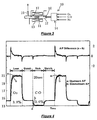
- the apparatus 10 comprises a glass tube 12 that holds a specimen 11 therein, an electric heater 13 that heats the specimen of catalyst brick 11, a pulse gas generator 14 that is arranged upstream of the specimen 11 and capable of supplying pulsed gases of oxygen (O 2 ), carbon monoxide (CO), and nitrogen (N 2 ), and a capillary column 15 coupled to the glass tube 12 as its outlet.
- the apparatus 10 further comprises an oxygen sensor 16 arranged between the pulse gas generator 14 and the specimen 11 in the glass tube 12, and an oxygen sensor 17 arranged between the specimen 11 and the capillary column 15 in the glass tube 12.
- the oxygen sensors 16 and 17 can detect oxygen concentration of the model gas.
- a lower graph of Figure 7 shows an upstream air fuel ratio a that is converted from the output of the upstream oxygen sensor 16, and a downstream air fuel ratio b that is converted from the output of the downstream oxygen sensor 17.
- An upper graph of Figure 4 shows the difference between the air fuel ratios a and b.
- an amount of oxygen released from a time of switching from the stoichiometric to the fuel-rich until the stored oxygen is fully released is estimated by integrating a difference between the outputs of the upstream and downstream oxygen sensors 16 and 17 during that period.
- the oxygen release amount for Examples 1 through 6 and Comparative Example 1 are estimated, and shown in Table 7 in 10 -6 mol per 1 liter of catalyst brick volume.
- a temperature at the inlet of the catalyst brick is set 400°C and 500°C.
- Examples 1 through 6 show higher oxygen release amount than Comparative Example 1 does. It can be seen that La 2 O 3 contained in the second compound oxide increases the oxygen storage capacity, presumably because it enhances the prevention of aggregation or sintering of the second compound oxide.
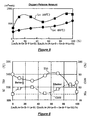
- Graphs of Figure 5 depict the oxygen storage capacity or release amount versus weight percent of La 2 O 3 in the second compound oxide (Ce-Zr-La-Y-O) with respect to the total weight of La 2 O 3 contained in the catalytic matter.
- the 0% corresponds to 10:0 of the previously described La 2 O 3 weight ratio, and the 100% corresponds to 0:10.
- the oxygen storage capacity is constantly improved as the La 2 O 3 weight ratio in the second compound oxide (Ce-Zr-La-Y-O) increases.
- La 2 O 3 weight ratio in the second compound oxide is preferably between 7 and 44% or between 65 and 100% of the total weight of La 2 O 3 contained in the catalyst matter.
- Graphs of Figure 6 depict the NOx C500 and the HC T50 for Comparative Example 1 and Examples 1 through 6 versus the La 2 O 3 weight ratio between the first compound oxide (Al-La-O) and the second compound oxide (Ce-Zr-La-Y-O).
- the La 2 O 3 weight ratio in the second compound oxide is preferred to be between 1 and 42% or between 60 and 100% of the total weight of La 2 O 3 contained in the catalyst matter, more preferably between 7 and 40% or between 70 and 95%.
- the La 2 O 3 weight ratio in the second compound oxide is preferred to be between 1 and 50% or between 75 and 100% of the total weight of La 2 O 3 contained in the catalyst matter.
Landscapes
- Chemical & Material Sciences (AREA)
- Engineering & Computer Science (AREA)
- Organic Chemistry (AREA)
- Materials Engineering (AREA)
- Chemical Kinetics & Catalysis (AREA)
- Biomedical Technology (AREA)
- Combustion & Propulsion (AREA)
- Health & Medical Sciences (AREA)
- Inorganic Chemistry (AREA)
- Environmental & Geological Engineering (AREA)
- Analytical Chemistry (AREA)
- General Chemical & Material Sciences (AREA)
- Oil, Petroleum & Natural Gas (AREA)
- Catalysts (AREA)
- Exhaust Gas Treatment By Means Of Catalyst (AREA)
- Exhaust Gas After Treatment (AREA)
Abstract
A catalytic matter comprises alumina particles. A compound oxide is dispersedly loaded on surfaces of the alumina particles. The compound oxide contains cerium, zirconium, and lanthanum, but not aluminum. A catalytic metal is loaded on the surfaces of the alumina particles. The catalytic matter may be manufactured by preparing a first acidic solution containing aluminum, adding a first basic solution to the first acidic solution, thereby obtaining a second basic solution and precipitating a first hydroxide in the second basic solution, preparing a second acidic solution containing cerium, zirconium and lanthanum, adding the second acidic solution to the first hydroxide, thereby precipitating a second hydroxide on the first hydroxide, drying the first and second hydroxides to obtain an oxide matter, and loading a catalytic metal on the oxide matter. By dispersedly loading the compound oxide containing cerium as an oxygen storage material on the alumina particle surfaces, the amount of the oxygen storage material on the surfaces of alumina particles may be increased, and the catalytic metal may be loaded on or in the proximity of the oxygen storage material. Therefore, the catalytic metal may be supplied with sufficient amount of active oxygen to purify the exhaust gas.
Description
- The present invention relates generally to an exhaust gas purification catalyst, and more particularly to a catalytic converter having an oxide layer loaded with catalytic metal.
- A catalytic converter is conventionally used for removing hydrocarbon (hereinafter referred to HC), carbon monoxide (CO) and nitrogen oxide (NOx) in exhaust gas flowing from e.g. an internal combustion engine of an automotive vehicle. It has a substrate or support, and an oxygen storage material coated on a carrier, such as a honeycomb shaped carrier made of cordierite. The substrate loads a catalytic metal, such as rhodium (Rh) and platinum (Pt), thereon. It may be made of metal oxide, such as alumina (Al2O3), and be porous, or in other words, have a greater specific surface area. Therefore, it can load the catalytic metal in a highly dispersed state, and prevent aggregation or sintering of the catalytic metal that may be exposed to a high temperature exhaust gas.
- The oxygen storage material may store and release oxygen depending on a change of oxygen concentration caused by variation of air fuel ratio of exhaust gas flowing from an internal combustion engine for controlling an oxidized state of the catalytic metal or supplying active oxygen to the catalytic metal. It may be made of metal oxide, such as ceria (CeO2), and load the catalytic metal thereon. It may not have such a great specific surface area as alumina does, and catalytic metal loaded thereon may be less dispersed and more vulnerable to aggregation or sintering. Therefore, the oxygen storage material may have less heat durability.
-
U.S. Patent No. 6,335,305 describes a substrate including a mixture containing a porous oxide and a compound oxide. The porous oxide may be alumina. The compound oxide contains aluminum (Al), cerium (Ce), zirconium (Zr), yttrium (Y), and lanthanum (La). It is prepared by adding a basic solution such as ammonia water to a salt solution containing Al, Ce, Zr, Y, and La, co-precipitating a precursor of the compound oxide, and calcining the co-precipitated precursor. It has oxygen storage capacity because of ceria (CeO2) contained therein. It may also improve the heat durability because of greater specific surface area of alumina (Al2O3) contained therein, and lanthanum that has a superior heat resistance. - However, the oxygen storage material, such as ceria, of the '305 patent is a part of the compound oxide including alumina, and there may be lesser amount of the oxygen storage material on a particle surface of the compound oxide so that there may be less amount of catalytic metal loaded on or closer to the oxygen storage material. Consequently, it may degrade the activity of the catalytic metal due to lack of enough oxygen stored in the proximity. Therefore, there is a need to increase the amount of the oxygen storage material on the surface of the substrate particle.
- Accordingly, there is provided, in one aspect of the present invention, a catalytic matter comprising alumina particles. A compound oxide is dispersedly loaded on surfaces of the alumina particles. The compound oxide contains cerium, zirconium, and lanthanum, but not aluminum. A catalytic metal is loaded on the surfaces of the alumina particles. Preferably, said compound oxide further contains yttrium.
- By dispersedly loading the compound oxide containing cerium as an oxygen storage material on the alumina particle surfaces, the amount of the oxygen storage material on the alumina particles may be increased, and the catalytic metal may be loaded on or in the proximity of the oxygen storage material. Therefore, the catalytic metal may be supplied with sufficient amount of active oxygen to purify the exhaust gas.
- There is provided, in a second aspect of the present description, a method of manufacturing catalytic matter. The method comprises preparing a first acidic solution containing aluminum, adding a first basic solution to the first acidic solution, thereby obtaining a second basic solution and precipitating a first hydroxide in the second basic solution, preparing a second acidic solution containing cerium, zirconium and lanthanum, adding the second acidic solution to the first hydroxide, thereby precipitating a second hydroxide on the first hydroxide, drying and calcining the first and second hydroxides to obtain an oxide matter, and loading a catalytic metal on the oxide matter.
- By precipitating the second hydroxide, which is a precursor of a compound oxide containing cerium, zirconium and lanthanum or a part of the oxide matter, on the first hydroxide, which is a precursor of the alumina particles or another part of the oxide matter, the compound oxide is dispersedly loaded on the surfaces of the alumina particles, the amount of the oxygen storage material on the alumina particles may be increased, and the catalytic metal may be loaded on or in the proximity of the oxygen storage material. Therefore, the catalytic matter having the catalytic metal supplied with sufficient amount of active oxygen to purify the exhaust gas can be manufactured.
- The advantages described herein will be more fully understood by the following examples which are not intended to limit the present invention, with further reference to the drawings wherein:
- Figure 1 is a schematic view showing a structure of a La containing alumina particle and a compound oxide;
- Figure 2 is a photograph taken by a transmission electron microscope (TEM) and showing a surface of a La containing alumina particle and a dispersedly loaded compound oxide containing Ce, Zr, Y, and La on the alumina particle;
- Figure 3 is a schematic view of an apparatus measuring oxygen concentration in model gas upstream and downstream of a catalyst specimen;
- Figure 4 is a graph showing oxygen concentration measured by the apparatus of Figure 3 and transferred into an air fuel ratio, and a difference of the air fuel ratio between upstream and downstream of the catalyst specimen;
- Figure 5 is a graph showing oxygen release amount versus weight percent of La2O3 contained in Ce-Zr-Y-La compound oxide with respect to a total weight of La2O3 contained in the catalytic matter; and
- Figure 6 is a graph showing NOx conversion rate at 500°C (NOx C500) and HC light-off temperature (HC T50) versus weight percent of La2O3 contained in Ce-Zr-Y-La compound oxide with respect to the total weight of La2O3 contained in the catalytic matter.
- Catalytic matter and catalyst bricks according to an embodiment of the present invention will now be described by first describing a preparation method of catalytic matter of Example 1.
- The catalyst bricks of the embodiment may be installed in an exhaust passage of an internal combustion engine. The internal combustion engine may be a four stroke engine using fossil fuel such as gasoline as its fuel, and mounted on an automotive vehicle for propelling it.
- An aluminum nitrate 9 hydrate (111.35g) and lanthanum nitrate 6 hydrate (4.09g) are dissolved in ion exchange water (480 ml) to prepare a first salt solution. The first salt solution or nitrate solution is mixed with a first basic solution or 28% ammonia water that is diluted by eight times (1600 ml), and a second basic solution is obtained. Then, first co-precipitated matter or first hydroxide of aluminum and lanthanum (hereafter may be referred to as "Al-La-OH") is precipitated in the second basic solution. The first hydroxide is a precursor of La containing alumina or compound oxide of aluminum and lanthanum (hereafter may be referred to as "Al-La-O") as a catalyst support material. Basic slurry of the first hydroxide (pH = 9 or greater) is obtained.
- On the other hand, a cerium nitrate 6 hydrate (7.52g), a zirconium nitrate solution of 25.13 wt% (8.49g), a lanthanum nitrate 6 hydrate (0.46g), and a yttrium nitrate 6 hydrate (0.32g) are dissolved into ion exchange water (400ml) to prepare a second salt solution. The second salt solution or nitrate solution is mixed with the basic slurry of the first hydroxide (Al-La-OH), thereby precipitating second co-precipitated matter on the first hydroxide (Al-La-OH). The second co-precipitated matter is a second hydroxide of cerium, zirconium, lanthanum and yttrium (hereafter may be referred to as "Ce-Zr-Y-La-OH"), which is a precursor of an oxygen storage material or compound oxide of cerium, zirconium, lanthanum and yttrium (hereafter may be referred to as "Ce-Zr-Y-La-O").
- The resulting slurry containing the first hydroxide (Al-La-OH) and the second hydroxide (Ce-Zr-Y-La-OH) is dehydrated by a centrifugal separation method, and thereafter dried in air at 300°C for 10 hours, thereby obtaining solid matter containing the first compound oxide (Al-La-O) and the second compound oxide (Ce-Zr-Y-La-O). Then, the solid matter (Al-La-O + Ce-Zr-Y-La-O) is crushed, and calcined in air at 500°C for 2 hours, thereby obtaining support material powder.
- This support material powder (20g) is mixed with an aqueous solution to make a slurry, and thereafter it is mixed with a palladium nitrate solution (4.33 wt%) of 4.62g. Palladium as a catalytic metal is fixed and loaded onto the support material through evaporation, drying and solidification, and thereafter it is calcined in air at 500°C for 2 hours, thereby obtaining catalyst powder.
- The catalyst powder (10g) and a 10.3 wt% zirconia binder are added to ion exchange water to make a slurry solution, and it is wash-coated on a honeycomb carrier (volume: 25ml, core density: 3mil/600cpsi) made of cordierite. Thereafter, the wash-coated carrier is calcined in air at 500°C for 2 hours, and aged in air at 1100°C for 24 hours. An amount of the catalyst powder carried onto the honeycomb carrier is 100g/L (100g of catalyst powder is carried on 1 L of carrier), and an amount of palladium carried on the carrier is 1.0g/L.
- The catalyst powder, as schematically shown in Figure 1, comprises a particle of the first compound oxide 1 (AI-La-O) and particles of the second compound oxide 2 (Ce-Zr-Y-La-O), which are loaded on the Al-La-
O particle 1, and further comprises the catalytic metal (Pt) not shown loaded on the particles of the first and second compound oxides. - As shown in the photograph of Figure 3 observed by a transmission electron microscope (TEM), black fine particles of the second compound oxide (Ce-Zr-Y-La-O) are dispersed on surfaces of the porous particles of the first compound oxide (Al-La-0) at a proper density.
- Both of the first compound oxide (Al-La-O) and the second compound oxide (Ce-Zr-Y-La-O) contain La2O3. A weight ratio between La2O3 in the first compound oxide (Al-La-O) and La2O3 in the second compound oxide (Ce-Zr-Y-La-O) is 9:1 in Example 1.
- Catalyst matter and catalyst bricks of Examples 2 through 5 are prepared in the same way as Example 1 was prepared. However, the amount of lanthanum nitrate 6 hydrate to be dissolved in the ion exchange water to prepare the first salt solution and that to prepare the second salt solution are varied while the amounts of all other starting materials are kept the same, as shown in Table 1. Consequently, a ratio between weights of lanthanum oxide (La2O3 in the first compound oxide (Al-La-O) and the second compound oxide (Ce-Zr-Y-La-O) ranges from 7:3 (Example 2) through 1:9 (Example 5), as shown in Table 1.
- Catalyst matter and a catalyst brick of Example 6 are prepared in the same way as the Example 1 was prepared except that the amount of lanthanum nitrate 6 hydrate to be dissolved in the ion exchange water is changed. Specifically, that to prepare the first salt solution is zero, and that to prepare the second salt solution is 4.37g (rather than respectively 4.09 g and 0.46g in Example 1). The catalyst powder of Comparative Example 2 has the same structure as the Example 1 does as shown in Figure 1. In other words, it comprises a particle of the first oxide 1 (Al-O), which does not contain La2O3, and particles of the second compound oxide 2 (Ce-Zr-Y-La-O), which are loaded on the Al-
O particle 1, and further comprises the catalytic metal (Pt) not shown loaded on the particles of the first oxide and the second compound oxide. - Catalyst matter and a catalyst brick of Comparative Example 1 are prepared in the same way as the Example 1 was prepared except that the amount of lanthanum nitrate 6 hydrate to be dissolved in the ion exchange water is changed. Specifically, that to prepare the first salt solution is 4.57g, and that to prepare the second salt solution is zero (rather than respectively 4.09 g and 0.46g in Example 1). The catalyst powder of Comparative Example 1 has the same structure as the Example 1 does as shown in Figure 1. In other words, it comprises a particle of the first compound oxide 1 (Al-La-O) and particles of the second compound oxide 2 (Ce-Zr-Y-O), which are loaded on the Al-La-
O particle 1 and does not contain La2O3, and further comprises the catalytic metal (Pt) not shown loaded on the particles of the first and second compound oxides.Table 1 Oxides in Al-La-O (wt%) Oxides in Ce-Zr-Y-La-O (wt%) La2O3 Weight Ratio La2O3 Al2O3 CeO 2 ZrO2 La2O3 Y2O3 Comp. Ex. 1 5.70 76.9 9.9 7.1 0.00 0.3 10:0 Example 1 5.10 76.9 9.9 7.1 0.60 0.3 9:1 Example 2 4.00 76.9 9.9 7.1 1.70 0.3 7:3 Example 3 2.85 76.9 9.9 7.1 2.85 0.3 5:5 Example 4 1.70 76.9 9.9 7.1 4.00 0.3 3:7 Example 5 0.60 76.9 9.9 7.1 5.10 0.3 1:9 Example 6 0.00 76.9 9.9 7.1 5.70 0.3 0:10 - An aluminum nitrate 9 hydrate (111.35g) and lanthanum nitrate 6 hydrate (3.20g) are dissolved in ion exchange water (380 ml) to prepare a first nitrate solution. The first nitrate solution is mixed with a 28% ammonia water that is diluted by eight times (1200 ml), and neutralized, and first co-precipitated matter (Al-La-OH) is obtained in the alkaline solution. The first co-precipitated matter is filtrated, dehydrated, dried in air at 300°C for 10 hours, and calcined at 500°C for 10 hours, and a first compound oxide (Al-La-O) is obtained.
- On the other hand, a cerium nitrate 6 hydrate (7.52g), a zirconium nitrate solution of 25.13 wt% (8.49g), a lanthanum nitrate 6 hydrate (1.37g), and a yttrium nitrate 6 hydrate (0.32g) are dissolved into ion exchange water (100ml) to prepare a second nitrate solution. The second nitrate solution is mixed with a 28% ammonia water that is diluted by eight times (400 ml), and neutralized, and second co-precipitated matter (Ce-Zr-La-Y-OH) is obtained in the basic solution. The second co-precipitated matter is filtrated, dehydrated, dried in air at 300°C for 10 hours, and calcined at 500°C for 10 hours, and a second compound oxide (Ce-Zr-La-Y-O) is obtained.
- The first compound oxide (Al-La-O) and the second compound oxide (Ce-Zr-La-Y-O) are respectively weighed 16.16g and 3.84g totaling 20g, and mixed with each other to obtain physically mixed powder. Then, the mixed powder is added to an aqueous solution to obtain a slurry. Thereafter, a palladium nitrate solution (4.33 wt%) of 4.62 g is added to the solution, and then the palladium is fixed and loaded onto the mixed powder through evaporation, drying and solidification. Then, it is calcined in air at 500°C for 2 hours, thereby obtaining catalyst powder.
- The catalyst powder (10g) and a 10.3 wt% zirconia binder are added to ion exchange water to make a slurry solution, and it is wash-coated on a honeycomb carrier (volume: 25ml, core density: 3mil/600cpsi) made of cordierite. Thereafter, the wash-coated carrier is calcined in air at 500°C for 2 hours, and aged in air at 1100°C for 24 hours. An amount of the catalyst powder carried onto the honeycomb carrier is 100g/L (100g of catalyst powder is carried on 1 L of carrier), and an amount of palladium carried on the carrier is 1.0g/L.
- In the catalytic matter of Comparative Example 2, the first compound oxide (Al-La-O) and the second compound oxide (Ce-Zr-La-Y-O) are physically mixed randomly, while the La2O3 weight ratio between the first and second oxides is 7:3, which is the same as in Example 2.
- A cerium nitrate 6 hydrate (39.21 g), a zirconium nitrate solution of 25.13 wt% (44.28g), a lanthanum nitrate 6 hydrate (7.14g), and a yttrium nitrate 6 hydrate (1.67g) are dissolved into ion exchange water (400ml) to prepare a nitrate solution. The nitrate solution is mixed with a 28% ammonia water that is diluted by eight times (1600 ml), and neutralized, and co-precipitated matter (Ce-Zr-La-Y-OH) is obtained in the basic solution. The co-precipitated matter is filtrated, dehydrated, dried in air at 300°C for 10 hours, and calcined at 500°C for 10 hours, and a compound oxide (Ce-Zr-La-Y-O) is obtained.
- Powder of the compound oxide of 20g is added to an aqueous solution to obtain a slurry. Thereafter, a palladium nitrate solution (4.33 wt%) of 4.62 g is added to the solution, and then the palladium is fixed and loaded onto the mixed powder through evaporation, drying and solidification. Then, it is calcined in air at 500°C for 2 hours, thereby obtaining catalyst powder.
- The catalyst powder (10g) and a 10.3 wt% zirconia binder are added to ion exchange water to make a slurry solution, and it is wash-coated on a honeycomb carrier (volume: 25ml, core density: 3mil/600cpsi) made of cordierite. Thereafter, the wash-coated carrier is calcined in air at 500°C for 2 hours, and aged in air at 1100°C for 24 hours. An amount of the catalyst powder carried onto the honeycomb carrier is 100g/L (100g of catalyst powder is carried on 1 L of carrier), and an amount of palladium carried on the carrier is 1.0g/L.
- In the catalytic matter of Comparative Example 3, there is no alumina substrate like the first compound oxides (Al-La-O) of Examples 1 through 5 and Comparative Examples 1 and 2 and the first oxide (Al-O) of Example 2. On the other hand, the compound oxide of Comparative Example 4 has the same composition as the second compound oxide (Ce-Zr-La-Y-O) of Example 2.
- The catalyst bricks prepared as described above are attached to a fixed-floor through-flow type model gas reactor. Tests of purification performance for simulated exhaust gas (rig test) are performed on the model gas reactor. The simulated exhaust gas flows at space velocity (S/V) of 60,000/hr. A temperature of the simulated exhaust gas is 100-500°C at the inlet of the catalyst brick with the temperature rising rate of 30°C/min. The air fuel ratio of the gas cyclically varies within 14.7±0.9 at a frequency of 1.0Hz, and its composition is shown in Table 2. Compositions of the gas upstream and downstream are detected and analyzed using an exhaust gas analyzer.
Table 2 A/F 13.8 14.7 15.6 C3H6 (wt. ppm) 541 555 548 CO (wt%) 2.35 0.6 0.592 NO (wt. ppm) 975 1000 980 CO2 (wt%) 13.55 13.9 13.73 H2 (wt%) 0.85 0.2 0.2 O2 (wt%) 0.58 0.6 1.85 H2O (vol.%) 10 10 10 - NOx conversion rates when the inlet temperature is 500°C (NOx C500) for Examples 1 through 5 and Comparative Examples 1 through 4 are measured, and
Table 3 La2O3 Weight Ratio in Al-La-O : Ce-Zr-La-Y-O NOx C500 (%) Comparative Example 1 10:0 74.5 Example 1 9:1 78.9 Example 2 7:3 80.0 Example 3 5:5 75.1 Example 4 3:7 78.5 Example 5 1:9 82.4 Example 6 0:10 76.3 Comparative Example 2 7:3 (physical mix) 70.3 Comparative Example 3 0:10 (no alumina) 55.3 - As can be seen from Table 3, all the Examples 1 through 6 have better NOx conversion rates than Comparative Examples 1 through 3.
- Further HC and CO conversion rates when the inlet temperature is 500°C (HC C500 and CO C500) for Example 2 and Comparative Example 2 and 3 are measured, and shown in Table 4.
Table 4 Substrate Structure HC C500 (%) CO C500 Example 2 Ce-Zr-La-Y-O on Al-La-O 98.3 89.32 Comparative Example 2 Ce-Zr-La-Y-O + Al-La-O (Physical Mixture) 97.3 83.1 Comparative Example 3 Ce-Zr-La-Y-O only 90.2 73.1 - As can be seen from Table 2, Example 2 has better HC and CO conversion rates than Comparative Examples 2 and 3.
- Therefore, it can be seen that dispersedly loading the second compound oxide (Ce-Zr-Y-La-O) on the surface of the first oxide (Al-La-O or Al-O) in Examples 1 through 6 causes the second compound oxide (Ce-Zr-Y-La-O) to be more exposed to the exhaust gas, and improves the oxygen storage capacity. Further, it can be seen that La2O3 contained in the second compound oxide improves heat resistance of the second compound oxide, which prevents aggregation or sintering of the catalytic metal loaded on or in the proximity of the second compound oxide, and improves the catalytic activity. Therefore, it can be seen that the conversion rates are improved over the Comparative Examples.
- Using the model gas reactor and the exhaust gas analyzer, a temperature at which a conversion rate is 50% (T50) is measured. T50 of HC for Examples 1 through 6 and Comparative Examples 1 through 3 are measured, and shown in Table 5.
Table 5 La2O3 Weight Ratio in Al-La-O : Ce-Zr-La-Y-O HC T50 (°C) Comparative Example 1 10:0 340 Example 1 9:1 337 Example 2 7:3 335 Example 3 5:5 339 Example 4 3:7 341 Example 5 1:9 331 Example 6 0:10 334 Comparative Example 2 7:3 (physical mix) 345 Comparative Example 3 0:10 (no alumina) 395 - As can be seen from Table 5, Examples 1 through 6 and Comparative Example 1 show lower HC T50s than Comparative Examples 2 and 3 do.
- Further T50s of CO and NOx for Example 2 and Comparative Example 2 and 3 are measured, and shown in Table 6.
Table 6 Physical Structure CO T50 (°C) NOx T50 (°C) Example 2 Ce-Zr-La-Y-O on Al-La-O 333 376 Comparative Example 2 Ce-Zr-La-Y-O + Al-La-O (Physical Mixture) 346 390 Comparative Example 3 Ce-Zr-La-Y-O only 400 445 - As can be seen from Table 6, Example 2 shows lower CO and NOx T50s than Comparative Examples 2 and 3 do.
- Therefore, it can be seen that dispersedly loading the second compound oxide (Ce-Zr-Y-La-O) on the surface of the first oxide (Al-La-O or Al-O) in Examples 1 through 6 and Comparative Example 1 causes the second compound oxide (Ce-Zr-Y-La-O) to be more exposed to the exhaust gas, and improves the oxygen storage capacity, so that the active oxide is more supplied to the catalytic metal loaded on or in the proximity to the second compound oxide, and enhances the activity of the catalytic metal thereby lowering the T50 and improving the light-off performance.
- Oxygen storage capacity is evaluated using an
apparatus 10 shown in Figure 3. Theapparatus 10 comprises aglass tube 12 that holds aspecimen 11 therein, anelectric heater 13 that heats the specimen ofcatalyst brick 11, apulse gas generator 14 that is arranged upstream of thespecimen 11 and capable of supplying pulsed gases of oxygen (O2), carbon monoxide (CO), and nitrogen (N2), and acapillary column 15 coupled to theglass tube 12 as its outlet. Theapparatus 10 further comprises anoxygen sensor 16 arranged between thepulse gas generator 14 and thespecimen 11 in theglass tube 12, and anoxygen sensor 17 arranged between thespecimen 11 and thecapillary column 15 in theglass tube 12. Theoxygen sensors - Base gas or nitrogen gas is supplied to the glass tube 22 at a constant rate, while oxygen gas and carbon monoxide gas are supplied intermittently so as to simulate cycles of fuel-rich, stoichiometric and fuel-lean exhaust gases for 20 seconds each. Then, the outputs of the
oxygen sensors upstream oxygen sensor 16, and a downstream air fuel ratio b that is converted from the output of thedownstream oxygen sensor 17. An upper graph of Figure 4 shows the difference between the air fuel ratios a and b. - For estimating the oxygen storage capacity, an amount of oxygen released from a time of switching from the stoichiometric to the fuel-rich until the stored oxygen is fully released is estimated by integrating a difference between the outputs of the upstream and
downstream oxygen sensors Table 7 La2O3 Weight Ratio in Al-La-O : Ce-Zr-La-Y-O Oxygen Release Amount (10-6 mol/L) at 400°C at 500°C Comparative Example 1 10:0 230 358 Example 1 9:1 282 730 Example 2 7:3 343 730 Example 3 5:5 381 557 Example 4 3:7 420 675 Example 5 1:9 527 839 Example 6 0:10 595 818 - As can be seen from Table 7, Examples 1 through 6 show higher oxygen release amount than Comparative Example 1 does. It can be seen that La2O3 contained in the second compound oxide increases the oxygen storage capacity, presumably because it enhances the prevention of aggregation or sintering of the second compound oxide.
- Graphs of Figure 5 depict the oxygen storage capacity or release amount versus weight percent of La2O3 in the second compound oxide (Ce-Zr-La-Y-O) with respect to the total weight of La2O3 contained in the catalytic matter. The 0% corresponds to 10:0 of the previously described La2O3 weight ratio, and the 100% corresponds to 0:10. When the inlet temperature is 400°C, the oxygen storage capacity is constantly improved as the La2O3 weight ratio in the second compound oxide (Ce-Zr-La-Y-O) increases. On the other hand, when the inlet temperature is 500°C, the oxygen storage capacity is improved as the La2O3 weight ratio in the second compound oxide (Ce-Zr-La-Y-O) increases, but it is once decreased around the ratio of 50% (5:5) although it is still much better than that of Comparative Example 1.
- It can be presumed that in a range of the La2O3 weight ratio between 7 and 44% where more La2O3 is contained in the first compound oxide or substrate, the heat resistance of the substrate is increased, and the heat resistance of the second compound oxide loaded on the substrate is further improved, and aggregation or sintering of the second compound oxide is prevented. Then, eventually the oxygen storage capacity of the second compound oxide is improved. In a range between 65 and 100% where more La2O3 is contained in the second compound oxide, the heat resistance of the second compound oxide is directly increased, and the oxygen storage capacity of the second compound oxide is improved. But, in the intermediate range between 45 and 64%, either of the heat resistance of the first and second compound oxides is not improved enough for 500°C.
- Consequently, from the viewpoint of the oxygen storage capacity at 500°C, La2O3 weight ratio in the second compound oxide is preferably between 7 and 44% or between 65 and 100% of the total weight of La2O3 contained in the catalyst matter.
- Graphs of Figure 6 depict the NOx C500 and the HC T50 for Comparative Example 1 and Examples 1 through 6 versus the La2O3 weight ratio between the first compound oxide (Al-La-O) and the second compound oxide (Ce-Zr-La-Y-O). In terms of NOx C500, the La2O3 weight ratio in the second compound oxide is preferred to be between 1 and 42% or between 60 and 100% of the total weight of La2O3 contained in the catalyst matter, more preferably between 7 and 40% or between 70 and 95%.
- In terms of HC T50, the La2O3 weight ratio in the second compound oxide is preferred to be between 1 and 50% or between 75 and 100% of the total weight of La2O3 contained in the catalyst matter.
- It is needless to say that the present invention is not limited to the embodiments and the examples described above and that various improvements and alternative designs are possible without departing from the substance of this invention as claimed in the attached claims. For example, although in the above embodiment palladium is solely adopted as catalytic metal, any other metal having a catalytic activity such as other precious metal, for example platinum (Pt) or rhodium (Rh) instead of or in addition to palladium.
Claims (11)
- Catalytic matter comprising:alumina particles;a compound oxide which is dispersedly loaded on surfaces of said alumina particles, and contains cerium, zirconium, and lanthanum, but not aluminum; anda catalytic metal loaded on said alumina particles.
- The catalytic matter as described in claim 1, wherein said alumina particles are composed of a compound oxide containing lanthanum.
- The catalytic matter as described in claim 1 or 2, wherein the weight of lanthanum oxide contained in said compound oxide is 1% or greater of total weight of lanthanum oxide contained in said catalytic matter.
- The catalytic matter as described in claim 3, wherein the weight of lanthanum oxide contained in said compound oxide is between 1 and 50 % of the total weight of lanthanum oxide contained in said catalytic matter.
- The catalytic matter as described in claim 4, wherein the weight of lanthanum oxide contained in said compound oxide is between 7 and 40 % of the total weight of lanthanum oxide contained in said catalytic matter.
- The catalytic matter as described in claim 3, wherein the weight of lanthanum oxide contained in said compound oxide is 75% or greater of the total weight of lanthanum oxide contained in said catalytic matter.
- The catalytic matter as described in any one of the preceding claims, wherein said oxygen storage material of said compound oxide further contains yttrium.
- A method of manufacturing catalytic matter comprising the steps of:preparing a first acidic solution containing aluminum;adding a first basic solution to said first acidic solution, thereby obtaining a second basic solution and precipitating a first hydroxide in said second basic solution;preparing a second acidic solution containing cerium, zirconium and lanthanum;adding said second acidic solution to said first hydroxide, thereby precipitating a second hydroxide on said first hydroxide;drying said first and second hydroxides to obtain a first oxide; andloading a catalytic metal on said first oxide.
- The method as described in claim 8, wherein said first acidic solution is prepared by dissolving an aluminum nitrate hydrate into water.
- The method as described in claim 9, wherein said first acidic solution is prepared by further dissolving a lanthanum nitrate hydrate into water.
- The method as described in claim 8, 9 or 10, wherein said second acidic solution further contains yttrium.
Applications Claiming Priority (1)
| Application Number | Priority Date | Filing Date | Title |
|---|---|---|---|
| JP2006025582A JP2007203208A (en) | 2006-02-02 | 2006-02-02 | Catalyst for cleaning exhaust gas |
Publications (1)
| Publication Number | Publication Date |
|---|---|
| EP1815908A1 true EP1815908A1 (en) | 2007-08-08 |
Family
ID=37900113
Family Applications (1)
| Application Number | Title | Priority Date | Filing Date |
|---|---|---|---|
| EP07000044A Withdrawn EP1815908A1 (en) | 2006-02-02 | 2007-01-02 | Exhaust gas purification catalyst |
Country Status (4)
| Country | Link |
|---|---|
| US (1) | US20070179054A1 (en) |
| EP (1) | EP1815908A1 (en) |
| JP (1) | JP2007203208A (en) |
| CN (1) | CN101053831A (en) |
Cited By (1)
| Publication number | Priority date | Publication date | Assignee | Title |
|---|---|---|---|---|
| EP2213622A4 (en) * | 2007-10-31 | 2012-08-15 | Toyota Chuo Kenkyusho Kk | MIXED INORGANIC OXIDE AND EXHAUST GAS PURIFICATION CATALYSTS USING THE SAME |
Families Citing this family (11)
| Publication number | Priority date | Publication date | Assignee | Title |
|---|---|---|---|---|
| JP5176727B2 (en) * | 2008-07-02 | 2013-04-03 | マツダ株式会社 | Exhaust gas purification catalyst material manufacturing method and exhaust gas purification catalyst |
| US8568675B2 (en) * | 2009-02-20 | 2013-10-29 | Basf Corporation | Palladium-supported catalyst composites |
| JP5690736B2 (en) | 2009-09-10 | 2015-03-25 | 株式会社キャタラー | Exhaust gas purification catalyst and method for producing the same |
| CN103260747B (en) | 2010-11-16 | 2016-06-22 | 罗地亚管理公司 | Alumina catalyst carrier |
| EP2952251B1 (en) * | 2013-01-31 | 2022-06-01 | Umicore Shokubai Japan Co., Ltd. | Exhaust-gas purification catalyst and its use |
| CN103977783B (en) * | 2013-02-07 | 2016-11-09 | 有研稀土新材料股份有限公司 | A kind of zirconium class rare earth oxygen storage material and preparation method thereof |
| CN103920485A (en) * | 2013-12-26 | 2014-07-16 | 湖北航特科技有限责任公司 | Modified active alumina material for motor vehicle tail gas purification |
| CN105149015B (en) * | 2015-08-14 | 2019-02-26 | 江苏万路达环保科技有限公司 | Automobile exhaust purifier repairs coating and preparation method thereof |
| JP6759272B2 (en) * | 2018-04-24 | 2020-09-23 | 株式会社豊田中央研究所 | Oxygen storage material and its manufacturing method |
| BR112020026548A2 (en) * | 2018-07-27 | 2021-03-23 | Johnson Matthey Public Limited Company | CATALYST COMPOSITION, CATALYST ARTICLE FOR THE TREATMENT OF EXHAUST GAS, EMISSION TREATMENT SYSTEM TO TREAT A FLOW FROM A COMBUSTION EXHAUST GAS, AND, METHOD OF TREATING AN INTERNAL COMBUSTION ENGINE EXHAUST GAS |
| US10919026B2 (en) * | 2018-08-07 | 2021-02-16 | GM Global Technology Operations LLC | Methods for preparing catalyst systems |
Citations (4)
| Publication number | Priority date | Publication date | Assignee | Title |
|---|---|---|---|---|
| US6335305B1 (en) * | 1999-01-18 | 2002-01-01 | Kabushiki Kaisha Toyota Chuo Kenkyusho | Catalyst for purifying exhaust gas |
| EP1175935A2 (en) * | 2000-07-27 | 2002-01-30 | Kabushiki Kaisha Toyota Chuo Kenkyusho | Composite oxide, process for producing the same, catalyst for purifying exhaust gas, and process for producing the same |
| US20030207759A1 (en) * | 2002-05-02 | 2003-11-06 | Nissan Motor Co., Ltd. | Exhaust gas purifying catalyst and method for manufacturing the same |
| US20050255993A1 (en) * | 2002-07-09 | 2005-11-17 | Hiroshisa Tanaka | Method for producing catalyst for clarifying exhaust gas |
Family Cites Families (1)
| Publication number | Priority date | Publication date | Assignee | Title |
|---|---|---|---|---|
| DE69703840T3 (en) * | 1996-06-10 | 2010-08-26 | Hitachi, Ltd. | Exhaust gas purification device for an internal combustion engine and catalyst for purifying the exhaust gas of the internal combustion engine |
-
2006
- 2006-02-02 JP JP2006025582A patent/JP2007203208A/en active Pending
-
2007
- 2007-01-02 EP EP07000044A patent/EP1815908A1/en not_active Withdrawn
- 2007-01-31 CN CNA2007100063547A patent/CN101053831A/en active Pending
- 2007-02-01 US US11/669,998 patent/US20070179054A1/en not_active Abandoned
Patent Citations (4)
| Publication number | Priority date | Publication date | Assignee | Title |
|---|---|---|---|---|
| US6335305B1 (en) * | 1999-01-18 | 2002-01-01 | Kabushiki Kaisha Toyota Chuo Kenkyusho | Catalyst for purifying exhaust gas |
| EP1175935A2 (en) * | 2000-07-27 | 2002-01-30 | Kabushiki Kaisha Toyota Chuo Kenkyusho | Composite oxide, process for producing the same, catalyst for purifying exhaust gas, and process for producing the same |
| US20030207759A1 (en) * | 2002-05-02 | 2003-11-06 | Nissan Motor Co., Ltd. | Exhaust gas purifying catalyst and method for manufacturing the same |
| US20050255993A1 (en) * | 2002-07-09 | 2005-11-17 | Hiroshisa Tanaka | Method for producing catalyst for clarifying exhaust gas |
Cited By (1)
| Publication number | Priority date | Publication date | Assignee | Title |
|---|---|---|---|---|
| EP2213622A4 (en) * | 2007-10-31 | 2012-08-15 | Toyota Chuo Kenkyusho Kk | MIXED INORGANIC OXIDE AND EXHAUST GAS PURIFICATION CATALYSTS USING THE SAME |
Also Published As
| Publication number | Publication date |
|---|---|
| JP2007203208A (en) | 2007-08-16 |
| US20070179054A1 (en) | 2007-08-02 |
| CN101053831A (en) | 2007-10-17 |
Similar Documents
| Publication | Publication Date | Title |
|---|---|---|
| US20070179054A1 (en) | Exhaust gas purification catalyst | |
| KR102467798B1 (en) | Monometal rhodium-containing quaternary conversion catalysts for gasoline engine emission treatment systems | |
| KR102852325B1 (en) | TWC system for fuel cut-off NOx control | |
| JP6906624B2 (en) | Oxygen absorption and release materials, catalysts, exhaust gas purification systems, and exhaust gas treatment methods | |
| KR102483435B1 (en) | Nitrous oxide removal catalysts for exhaust systems | |
| RU2753835C2 (en) | Catalyst containing bimetallic nanoparticles of platinum group metals | |
| EP3260189B1 (en) | Exhaust gas purifying catalyst | |
| KR101520983B1 (en) | Catalyst compositions | |
| KR101621110B1 (en) | NOx STORAGE MATERIALS AND TRAPS RESISTANT TO THERMAL AGING | |
| KR101868176B1 (en) | Catalyst for gasoline lean burn engines with improved no oxidation activity | |
| US5814576A (en) | Catalyst for purifying exhaust gas and method of producing same | |
| EP1967263B1 (en) | Catalytic Material And Catalyst For Purifying Exhaust Gas Component | |
| CN103157516B (en) | Exhaust gas purification catalyst | |
| US10753248B2 (en) | Exhaust gas purification catalyst | |
| US20130310248A1 (en) | Double layered exhaust gas purification catalyst | |
| KR101859786B1 (en) | Catalyst for gasoline lean burn engines with improved nh3-formation activity | |
| US8975204B2 (en) | Exhaust-gas-purifying catalyst | |
| EP1985354B1 (en) | Exhaust gas purification catalyst and manufacturing method thereof | |
| KR20070094493A (en) | Catalyst for purification of exhaust gas, method for producing same and method for purification of exhaust gas using such catalyst | |
| JP5876475B2 (en) | NOx storage catalyst with reduced Rh load | |
| KR20150131017A (en) | Catalytic article with segregated washcoat and methods of making same | |
| WO2023143493A1 (en) | Gasoline particulate filter | |
| EP4134161B1 (en) | Exhaust gas purification catalyst | |
| JP2026039719A (en) | Catalyst-equipped particulate filter and manufacturing method thereof | |
| JP2025528286A (en) | Catalytic article for treating engine exhaust gas |
Legal Events
| Date | Code | Title | Description |
|---|---|---|---|
| PUAI | Public reference made under article 153(3) epc to a published international application that has entered the european phase |
Free format text: ORIGINAL CODE: 0009012 |
|
| AK | Designated contracting states |
Kind code of ref document: A1 Designated state(s): AT BE BG CH CY CZ DE DK EE ES FI FR GB GR HU IE IS IT LI LT LU LV MC NL PL PT RO SE SI SK TR |
|
| AX | Request for extension of the european patent |
Extension state: AL BA HR MK YU |
|
| AKX | Designation fees paid | ||
| STAA | Information on the status of an ep patent application or granted ep patent |
Free format text: STATUS: THE APPLICATION IS DEEMED TO BE WITHDRAWN |
|
| 18D | Application deemed to be withdrawn |
Effective date: 20080208 |
|
| REG | Reference to a national code |
Ref country code: DE Ref legal event code: 8566 |