EP1815834A2 - Slidably collapsible two arm wheelchair lift - Google Patents
Slidably collapsible two arm wheelchair lift Download PDFInfo
- Publication number
- EP1815834A2 EP1815834A2 EP06016605A EP06016605A EP1815834A2 EP 1815834 A2 EP1815834 A2 EP 1815834A2 EP 06016605 A EP06016605 A EP 06016605A EP 06016605 A EP06016605 A EP 06016605A EP 1815834 A2 EP1815834 A2 EP 1815834A2
- Authority
- EP
- European Patent Office
- Prior art keywords
- platform
- assembly
- wheelchair lift
- fold
- vertical
- Prior art date
- Legal status (The legal status is an assumption and is not a legal conclusion. Google has not performed a legal analysis and makes no representation as to the accuracy of the status listed.)
- Granted
Links
Images







Classifications
-
- B—PERFORMING OPERATIONS; TRANSPORTING
- B60—VEHICLES IN GENERAL
- B60P—VEHICLES ADAPTED FOR LOAD TRANSPORTATION OR TO TRANSPORT, TO CARRY, OR TO COMPRISE SPECIAL LOADS OR OBJECTS
- B60P1/00—Vehicles predominantly for transporting loads and modified to facilitate loading, consolidating the load, or unloading
- B60P1/44—Vehicles predominantly for transporting loads and modified to facilitate loading, consolidating the load, or unloading having a loading platform thereon raising the load to the level of the load-transporting element
- B60P1/4414—Vehicles predominantly for transporting loads and modified to facilitate loading, consolidating the load, or unloading having a loading platform thereon raising the load to the level of the load-transporting element and keeping the loading platform parallel to the ground when raising the load
- B60P1/4442—Vehicles predominantly for transporting loads and modified to facilitate loading, consolidating the load, or unloading having a loading platform thereon raising the load to the level of the load-transporting element and keeping the loading platform parallel to the ground when raising the load the raising device, when not in use, being stored inside the load-transporting compartment
-
- A—HUMAN NECESSITIES
- A61—MEDICAL OR VETERINARY SCIENCE; HYGIENE
- A61G—TRANSPORT, PERSONAL CONVEYANCES, OR ACCOMMODATION SPECIALLY ADAPTED FOR PATIENTS OR DISABLED PERSONS; OPERATING TABLES OR CHAIRS; CHAIRS FOR DENTISTRY; FUNERAL DEVICES
- A61G3/00—Ambulance aspects of vehicles; Vehicles with special provisions for transporting patients or disabled persons, or their personal conveyances, e.g. for facilitating access of, or for loading, wheelchairs
- A61G3/02—Loading or unloading personal conveyances; Facilitating access of patients or disabled persons to, or exit from, vehicles
- A61G3/06—Transfer using ramps, lifts or the like
- A61G3/062—Transfer using ramps, lifts or the like using lifts connected to the vehicle
-
- A—HUMAN NECESSITIES
- A61—MEDICAL OR VETERINARY SCIENCE; HYGIENE
- A61G—TRANSPORT, PERSONAL CONVEYANCES, OR ACCOMMODATION SPECIALLY ADAPTED FOR PATIENTS OR DISABLED PERSONS; OPERATING TABLES OR CHAIRS; CHAIRS FOR DENTISTRY; FUNERAL DEVICES
- A61G3/00—Ambulance aspects of vehicles; Vehicles with special provisions for transporting patients or disabled persons, or their personal conveyances, e.g. for facilitating access of, or for loading, wheelchairs
- A61G3/02—Loading or unloading personal conveyances; Facilitating access of patients or disabled persons to, or exit from, vehicles
- A61G3/06—Transfer using ramps, lifts or the like
- A61G3/063—Transfer using ramps, lifts or the like using lifts separate from the vehicle, e.g. fixed on the pavement
-
- Y—GENERAL TAGGING OF NEW TECHNOLOGICAL DEVELOPMENTS; GENERAL TAGGING OF CROSS-SECTIONAL TECHNOLOGIES SPANNING OVER SEVERAL SECTIONS OF THE IPC; TECHNICAL SUBJECTS COVERED BY FORMER USPC CROSS-REFERENCE ART COLLECTIONS [XRACs] AND DIGESTS
- Y10—TECHNICAL SUBJECTS COVERED BY FORMER USPC
- Y10S—TECHNICAL SUBJECTS COVERED BY FORMER USPC CROSS-REFERENCE ART COLLECTIONS [XRACs] AND DIGESTS
- Y10S414/00—Material or article handling
- Y10S414/134—Handicapped person handling
Definitions
- the present invention relates to a lift assembly for aiding wheelchair users to get into and out of a van or the like.
- a lift assembly of this type comprises a platform laterally supported by an armature and carried from a vertical stored position inside the vehicle to a horizontal position exteriorly of the vehicle level with the vehicle floor and to a ground position.
- the user wheels himself onto the platform and actuates means to displace the platform from the vehicle level to the ground or inversely.
- a wheelchair lift for use in conjunction with a vehicle having a floor.
- the lift includes a power actuating system, a platform assembly having first and second platform sections, a linking assembly having first and second vertical arms connected to the platform assembly, and first and second fold-facilitating links connecting the first and second vertical arms respectively to the first and second platform sections.
- the linking assembly connects the power actuating system to the platform assembly.
- the first and second fold-facilitating links cause the first platform section to pivot with respect to the second platform section and the first vertical arm to move with respect to the second vertical arm.
- the first and second sections of the platform each have a top surface and a.bottom surface.
- the bottom surfaces of the first and second sections face the same direction and in a stowed position, the bottom surface of the first section faces the bottom surface of the second section.
- the method includes the steps of providing a wheelchair lift having a power actuating system, a platform assembly and a linking assembly with first and second vertical arms connected to the platform assembly connecting the power actuating system to the platform assembly, and moving the platform assembly from a floor level position to a stowed position while simultaneously folding the platform assembly along a longitudinally oriented fold perpendicular to an extended edge of the vehicle floor.
- one of the vertical arms is pulled toward the other vertical arm during the folding process.
- a wheelchair lift for use in conjunction with a vehicle having a floor.
- the lift includes a power actuating system, a platform assembly including first and second platform sections, a linking assembly having first and second vertical arms connected to the platform assembly connecting the power actuating system to the platform assembly, and at least one fold-facilitating link disposed between the first vertical arm and the first platform section.
- At least one of the first and second vertical arms is movable toward the other vertical arm.
- the at least one fold-facilitating link causes the platform to fold along a longitudinally oriented fold pivotally connecting the first and second platform sections.
- the track assembly includes at least one track and the linking assembly includes at least one roller.
- the at least one roller and at least one track cooperate to make at least one of the first and second vertical arms movable.
- the linking assembly includes a movable tower to which the first vertical arm is secured, and the at least one roller is rotatably mounted on the movable tower.
- the movable tower defines a slot through which the at least one track extends.
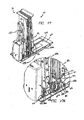
- FIG. 1 there is depicted at 10 the powered wheelchair lift of the present invention in its stowed position where a foldable platform assembly 12 is fully folded and stowed.
- the wheelchair lift 10 is installed inside a vehicle 2 (shown in dashed lines) adjacent an opening 4 such as a side door of the vehicle 2.
- a rear door opening not shown
- the lift 10 is firmly secured on the doorway of the vehicle 2 by a mounting assembly 14 which includes an anchoring plate 16 that is secured on the vehicle floor 6 by conventional means.
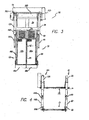
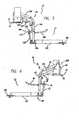
- FIGS. 2-6 there is depicted a wheelchair lift 10, where the foldable platform assembly 12 is in a ground level position with outer roll stops 18a and 18b fully opened that allows a person in a wheelchair (not shown) to roll off the platform assembly 12 to the ground level (outside of the vehicle) and inversely.
- the outer roll stops 18a and 18b are self-engaged mechanisms for preventing the wheelchair from rolling-off the front of the platform assembly before the platform assembly reaches the ground level position as shown.
- the platform assembly 12 can be lifted upwardly and downwardly between a stowed position (see FIGS. 17-21) and a fully extended configuration (see FIGS. 2-11) by a power actuating system.
- the fully extended configuration includes both a floor level position (see FIGS. 7-11) and the ground level position (see FIGS. 2-6).
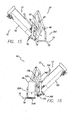
- FIGS. 12-16 show the platform assembly 12 in what is referred to herein as a mid-stow position, between the floor level and stowed positions.
- FIG. 34 shows the platform assembly in the ground level position; floor level position, mid-stow position and stowed position.
- the actuating system may be controlled electrically, hydraulically or in any other conventional way known to one skilled in the art. For demonstration purposes only, a hydraulic actuating system is described herewith.
- the hydraulic actuating system includes a hydraulic pump (not shown), a hydraulic power unit (not shown), and hydraulic cylinders 22 and 122.
- the hydraulic actuating system can include a single hydraulic cylinder.
- the hydraulic cylinders 22 and 122 are each mounted in one of two relative parallelogram actuating linkage structures 26 and 126 which are mounted to a track assembly 200, which includes the anchoring plate 16.
- the track assembly 200 will be described more fully hereinbelow.
- the platform assembly 12 includes a platform 13 that comprises a substantially flat and rigid surface made of first and second sections 13a and 13b having a combined area sufficient to support a wheel chair.
- the first and second sections 13a and 13b are pivotally connected along their inner longitudinally adjacent edges (which is perpendicular to an extended edge of the vehicle floor).
- the platform sections 13a and 13b are connected via hinges 15 (as shown in FIG. 3).
- the first and second sections 13a and 13b are collapsed longitudinally and folded against each other such that their undersides or bottom surfaces abut against each other and are oriented in a substantially vertical low profile arrangement relative to the vehicle doorway (see FIG. 17).
- FIGS. 7-11 there is shown the present invention wheelchair lift 10 deployed at the floor level position (which is flush with the vehicle floor), thereby allowing the person in the wheelchair to roll on or off between the vehicle floor and the platform assembly 12 of the lift 10.
- the platform assembly 12 is.unfolded such that the first and second sections 13a and 13b are substantially horizontal and in fully coplanar alignment to each other.
- a bridge plate 34 is used for bridging the gap space between the vehicle floor and the platform assembly 12 at the floor level.
- the bridge plate 34 is pivotally mounted to mounting bracket members 40 and 140, via arcuate slots 35 and 135 (as shown in FIGS. 27 and 27a) defined in a plate fastened to the mounting bracket members 40 and 140.
- the bridge plate 34 can be mounted to anchor plate 16 or mounting assembly 14. It does not travel up and down with the platform 13 (however, it may in an alternative embodiment). It always stays at the vehicle floor level. When the platform 13 is stowed.(as described below), the bridge plate pivots vertically, and folds into three sections to wrap around the platform 13 (as best shown in FIG. 18).
- FIGS. 2-21 there are shown the pair of actuating linkage structures 26 and 126 in different states of actuation.
- actuating linkage structure 26 will be described in detail, since it should be understood that the actuating linkage structure 126 is identical and identical parts are numbered correspondingly with 100 added to each number.
- the actuating linkage structure.26 includes a top actuating arm 36 and a bottom actuating arm 38 which are located substantially parallel to each other.
- the rear ends of the top and bottom actuating arms 36 and 38 are pivotally connected to a mounting bracket member. 40.
- mounting bracket member 40 is part of movable tower 202.
- Mounting bracket member 140 is secured to the anchoring plate 16 by conventional means.
- Each front end of the top and bottom actuating arms 36 and 38 are pivotally connected to an upper portion of an elongated vertical arm 42.
- a pair of opposite handrails 44 and 144 are provided with the present invention wheelchair lift 10 and move with respect to the extension and retraction of the hydraulic cylinder 122.
- the means include a pair of opposite pivotable linkage assemblies 46 and 146, and a pair of opposite saddle assemblies 68 and 168.
- the pivotable linkage assemblies 46 and 146 (also referred to herein as the folding mechanism) are utilized for the movements of the platform assembly 12 between its stowed position (a substantially vertical and folded position) and its floor level position (a substantially horizontal and unfolded position).
- the pivotable linkage assembly 46 and the saddle assembly 68 will be described since it should be understood that the pivotable linkage assembly 146 and the saddle assembly 168 are respectively identical and identical parts are numbered correspondingly with 100 added to each number.
- pivotable linkage assemblies 46 and 146 maintain the platform 13 in a horizontal position. In movement from the floor level position to the stowed position, pivotable linkage assemblies 46 and 146 are also respectively forcing the first and second platform sections 13a and 13b from a position where they lie in the same plane to a transverse position as seen in FIG. 17.
- pivotable linkage assembly 46 includes a turnbuckle 47 and a bracket 48.
- Turnbuckle 47 includes two socket and ball joints 47a and 47b and a rod 47c disposed therebetween and bracket 48 includes first portion 48a, which is secured to the bottom of the platform 13, and a second portion 48b that extends at a substantially right angle from first section 48a.
- Socket and ball joint 47b is secured to second portion 48b of bracket 48.
- Socket and ball joint 47a is secured.to elongated vertical arm 42. This arrangement allows an angular movement and a rotation of the bracket 48.
- the saddle assembly 68 includes a substantially horizontal knuckle link 70, a substantially vertical knuckle link 72, and a saddle block 74.
- One end of the horizontal knuckle link 70 may be connected to the elongated vertical arm 42 while the other end is pivotally connected to the saddle block 74.
- One end of the vertical knuckle link 72 is pivotally connected to the horizontal knuckle link 70 and the saddle block 74 while the other end is pivotally connected to the rear end of the platform 13.
- the saddle block 74 may have a smooth contacting surface or have a knuckle piece 76 as shown in FIG. 2 for engaging with an opening underneath the bottom actuating arm 38 when the lift moves between the floor level position and the stowed position.
- the motions of the platform assembly 12 are well controlled and especially prevent the platform assembly 12 from free falling or free deploying movement during the lift's swing-up and swing-down motions.
- the platform assembly 12 is away from its entry position to the ground level position (see FIG. 2), the knuckle pieces 76 and 176 are disengaged with the underneath sides of the bottom actuating arms 38 and 138.
- the present invention is not limited to the saddle assemblies 68 and 168. It is emphasized that while the saddle assemblies are the preferred embodiments, it is also within the spirit and scope of the present invention to utilize roller assemblies (not shown).
- the platform assembly 12 As the platform assembly 12 is lifted up from its floor level position towards its stowed position, the saddle blocks 74 and 174 or the knuckle pieces 76 and 176 come into contact with the bottom actuating arms 38 and 138 which push down the vertical knuckle links 72 and 172, and the platform 13 is raised through the pivot connection. As this happens, the pivotable linkage assemblies 46 and 146 cause the first and second platform connections 13a and 13b to start to fold. Because the pivotable linkage assemblies 46 and 146 are not flexible, the platform sections 13a and 13b have to pivot, as shown in the mid-stow position FIGS. 12-16.
- the pivotable linkage assemblies 46 and 146 cause the platform sections 13a and 13b to fold along the longitudinally oriented fold (preferably made pivotable by hinges 15). As this happens, the first elongated vertical arm 42 is pulled toward the second elongated vertical arm 142, thereby shortening the distance between the two arms 42 and 142.
- the lift may include means for pushing the first vertical arm 42 toward the second vertical arm 142, thereby causing the platform sections 13a and 13b to fold.
- first and second platform sections 13a and 13b causes parallelogram actuating linkage structure 26 to move inwardly towards parallelogram actuating linkage structure 126.
- parallelogram actuating linkage structure 26, via movable tower 202, is movably or slidably connected to mounting assembly 14 (including anchor plate 16), which is described below. This provides an automatic stowing of the platform assembly 12.
- platform 13 includes side panels 55 and 155 affixed to the outer peripheral edges thereof.
- the side panels 55 and 155 prevent the wheelchair from rolling off the sides of the platform 13.
- the side panels 55 and 155 are pivotally connected (e.g., by a hinge) to the platform sections 13a and 13b. However, they also may be rigidly connected thereto. Also, it should be pointed out that the height of the side panels 55 and 155 may differ.
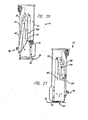
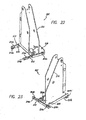
- Figs. 22-31 show the details of the track assembly 200 and movable tower 202. It will be understood that any method for moving elongated vertical arm 42 toward elongated vertical arm 142 is within the scope of the present invention. Those skilled in the art will be able to make numerous modifications to the embodiments described herein to provide movement of the elongated vertical arms 42 and 142 and the associated parallelogram actuating linkage structures 26 and 126.
- elongated vertical arm 42 is movable via track assembly 200 in cooperation with movable tower 202 (best shown in Fig. 22).
- the track assembly 200 includes anchoring plate 16, top plate 204, which is spaced from anchoring plate 16, and tracks 206.
- the tracks 206 are part of the top plate 204, as described more fully hereinbelow.
- FIGS. 27-31 the top plate 204 (and therefore the tracks 206) have been omitted to show the detail inside the mounting assembly 14 and track assembly.
- the top plate 204 is shown in FIG. 31.
- FIGS. 29 and 30a portions of a hose retraction system 256 can be seen.
- This system prevents the hydraulic hose (not shown) that connects the hydraulic cylinder 22 to the hydraulic pump (not shown) from tangling while the movable tower moves.
- the hose retraction system includes a pneumatic cylinder 256a or gas spring and a number of other components that will be readily familiar to those skilled in the art. Accordingly, the details of the hose retraction system will not be described herein. It will be understood that any components labeled 256 in the figures are a part of the hose retraction system.
- the movable tower 202 includes base plate 208, frame 210, arms 212, and a plurality of rollers 214.
- the rollers will be designated herein as large horizontal roller 214a, small horizontal rollers 214b and small vertical rollers 214c.
- the moveable tower 202 also defines a slot 216 that receives the top plate 204 and tracks 206.
- the track assembly includes top plate 204, which incorporates the tracks 206.
- dashed lines have been added to show the portion of the top plate 204 that is used as the track 206 for the rollers 214.
- the interaction of the rollers 214 and track 216 is similar to the interaction of rollercoaster wheels and their associated track.
- small vertical rollers 214c ride against the side edge of top plate 204 (as can be seen in FIGS. 17a and 31a)
- small horizontal rollers 214b ride against the underside of top plate 204 (as can be seen in FIG. 31a)
- the large horizontal roller 214a rides on the top of top plate 204 (as can be seen in FIG. 31a).
- elongated vertical arm 42 may be movable toward elongated vertical arm 142 (or the first and second elongated vertical arms may be movable toward one another) via rollers, a track, sliding, a foldable mechanism, telescoping members, etc.
- this collapsing can be done manually or automatically, for example, hydraulically, electrically, pneumatically, etc.
- the platform 13 may include more than two foldable sections.
- the stow lock mechanism 240 secures the platform assembly 12 in place when it is in the stowed position. It will be understood that any type of locking mechanism that keeps the platform assembly 12 from drifting or unfolding is within the scope of the present invention.
- the stow lock mechanism of FIG. 32 is used.
- the stow lock mechanism 240 preferably includes a frame 242, paddle wheel 244, spring 246, solenoid 248, lock member 250 and a lever 252.
- vertical arm 142 includes a plurality of ratchet teeth 254 extending therefrom. The ratchet teeth 254 engage corresponding teeth on the paddle wheel 244. The paddle wheel is prevented from turning by lock member 250. This holds the platform assembly 12 in place.
- the spring 246 is deformed or pulled, thereby causing columnar failure that pulls the lock member 250 (to which the bottom of spring 246 is attached). A portion of lock member 250 is in contact with and extends under the paddle wheel 244. When lock member 250 is moved by spring 246, it is no longer engaged with the paddle wheel 244, thereby allowing paddle wheel 244 to turn. Once it turns, the ratchet teeth 254 disengage with the paddle wheel teeth, thus unlocking the platform assembly 12.
- the spring 236 can be deformed in one of two ways, by the solenoid 248, when electric power is present, and by the lever 252, when electric power is not present (or at any other time that a user wants to unlock the platform assembly manually).
- a user pulls on the lever, thereby deforming the spring 246 and unlocking the platform assembly 12 as described above.
- the solenoid 248 it is actuated by the.power actuating system (see plug 248a, which connects to the power actuating system).
- the U-clip 248b pulls on and deforms the spring to unlock the platform assembly 12 and linkage assembly.
- the solenoid 248 includes a coil spring (not shown) for positively returning the plunger to its starting position.
- the present invention wheelchair lift 10 has a unique motion pattern. From the stowed position to the floor level position, the lift 10 deploys from a substantially vertical position to a substantially horizontal position along with the unfolding movement of the platform assembly 12 from a fully folded condition to a fully unfolded condition. From the floor level position to the ground level position, the.lift 10 moves downwardly along an arc path while the platform assembly 12 keeps its unfolded and substantially horizontal condition. When the lift 10 moves back from the ground level position to the stowed position, it goes through the reverse motions.
- the present invention is a wheelchair lift for use in conjunction with a vehicle having an opening and a floor
- the wheelchair lift comprising: (a) a power actuating system; (b) a platform assembly having at least two plates pivotally connected along their longitudinal adjacent edges; (c) a linking assembly connected to the power actuating system and the platform assembly for automatically moving the platform assembly from a stowed position inside the vehicle to a floor level position at the vehicle opening and inversely, and moving the platform assembly from the floor level position to a ground level position outside the vehicle and inversely; and (d) means for automatically facilitating the unfolding of the at least two plates of the platform assembly in a longitudinal direction as the platform assembly is moving between the stowed position to the floor level position, and also automatically folding of the at least two plates of the platform assembly in the longitudinal direction as the platform assembly is moving between the floor level position to the stowed position; (e) whereby the platform assembly can be automatically unfolded and deployed at the floor level position in a substantially horizontal orientation, and further
- the present invention is a wheelchair lift for use in conjunction with a vehicle having an opening, the wheelchair lift comprising a power actuating system and a foldable platform assembly having at least two plates pivotally connected at their longitudinal adjacent edges which automatically unfold during a swing-down-deployment motion of the platform assembly, and also automatically fold during a swing-up stowaway motion of the platform assembly actuated by the power actuating system to form a vertical low profile arrangement (as shown in FIG. 17) adjacent to the opening.
Landscapes
- Health & Medical Sciences (AREA)
- Public Health (AREA)
- Engineering & Computer Science (AREA)
- Life Sciences & Earth Sciences (AREA)
- Animal Behavior & Ethology (AREA)
- General Health & Medical Sciences (AREA)
- Veterinary Medicine (AREA)
- Transportation (AREA)
- Mechanical Engineering (AREA)
- Vehicle Step Arrangements And Article Storage (AREA)
Abstract
Description
- The present invention relates to a lift assembly for aiding wheelchair users to get into and out of a van or the like.
- A lift assembly of this type comprises a platform laterally supported by an armature and carried from a vertical stored position inside the vehicle to a horizontal position exteriorly of the vehicle level with the vehicle floor and to a ground position.
- The user wheels himself onto the platform and actuates means to displace the platform from the vehicle level to the ground or inversely.
- This type of known lift assembly (see
U.S. Patent 3,651,965 dated May 28, 1972 to Clever Industries) is stored in the vehicle but uses a relatively large percentage of the floor area; and, moreover, the platform 4, when in stored position, obstructs the door opening, thus preventing an ambulatory person from using it. Also, the hydraulic systems used to raise or lower the platform are generally bulky and complex. -
- Therefore, a need exists for a lift assembly mounted in a vehicle and foldable into a compact position within the latter.
- In accordance with a preferred embodiment of the present invention there is provided a wheelchair lift for use in conjunction with a vehicle having a floor. The lift includes a power actuating system, a platform assembly having first and second platform sections, a linking assembly having first and second vertical arms connected to the platform assembly, and first and second fold-facilitating links connecting the first and second vertical arms respectively to the first and second platform sections. The linking assembly connects the power actuating system to the platform assembly. During a folding process, the first and second fold-facilitating links cause the first platform section to pivot with respect to the second platform section and the first vertical arm to move with respect to the second vertical arm.
- In a preferred embodiment, the first and second sections of the platform each have a top surface and a.bottom surface. In a fully extended configuration, the bottom surfaces of the first and second sections face the same direction and in a stowed position, the bottom surface of the first section faces the bottom surface of the second section.
In accordance with another preferred embodiment of the present invention there is provided a method of stowing a wheelchair lift in a vehicle having a floor. The method includes the steps of providing a wheelchair lift having a power actuating system, a platform assembly and a linking assembly with first and second vertical arms connected to the platform assembly connecting the power actuating system to the platform assembly, and moving the platform assembly from a floor level position to a stowed position while simultaneously folding the platform assembly along a longitudinally oriented fold perpendicular to an extended edge of the vehicle floor. In a preferred embodiment, one of the vertical arms is pulled toward the other vertical arm during the folding process. - In accordance with yet another preferred embodiment of the present invention there is provided a wheelchair lift for use in conjunction with a vehicle having a floor. The lift includes a power actuating system, a platform assembly including first and second platform sections, a linking assembly having first and second vertical arms connected to the platform assembly connecting the power actuating system to the platform assembly, and at least one fold-facilitating link disposed between the first vertical arm and the first platform section. At least one of the first and second vertical arms is movable toward the other vertical arm. During movement of at least one of the vertical arms towards the other vertical arm, the at least one fold-facilitating link causes the platform to fold along a longitudinally oriented fold pivotally connecting the first and second platform sections.
- In a preferred embodiment, the track assembly includes at least one track and the linking assembly includes at least one roller. The at least one roller and at least one track cooperate to make at least one of the first and second vertical arms movable. The linking assembly includes a movable tower to which the first vertical arm is secured, and the at least one roller is rotatably mounted on the movable tower. The movable tower defines a slot through which the at least one track extends.
-
- Figure 1 is an illustrative view of the present invention, a powered wheelchair lift mounted in a vehicle, showing a foldable platform assembly in a stowed position;
- FIG. 2 is a perspective view of the powered wheelchair lift of FIG. 1, showing the foldable platform assembly when it is in a ground level position;
- FIG. 3 is a top view of the powered wheelchair lift of FIG. 1 in the ground level position;
- FIG. 4 is a front view of the powered wheelchair lift of FIG. 1 in the ground level position;
- FIG. 5 is a right side view of the powered wheelchair lift of FIG. 1 in the ground level position;
- FIG. 6 is a left side view of the powered wheelchair lift of FIG. 1 in the ground level position;
- FIG. 7 is a perspective view of the powered wheelchair lift of FIG. 1, showing the foldable platform assembly when it is in a floor level position;
- FIG. 8 is a top view of the powered wheelchair lift of FIG. 1 in the floor level position;
- FIG. 9 is a front view of the powered wheelchair lift of FIG. 1 in the floor level position;
- FIG. 10 is a right side view of the powered wheelchair lift of FIG. 1 in the floor level position;
- FIG. 11 is a left side view of the powered wheelchair lift of FIG. 1 in the floor level position;
- FIG. 12 is a perspective view of the powered wheelchair lift of FIG. 1, showing the foldable platform assembly when it is in a mid-stow position;
- FIG. 13 is a top view of the powered wheelchair lift of FIG. 1 in the mid-stow position;
- FIG. 14 is a front view of the powered wheelchair lift of FIG. 1 in the mid-stow position;
- FIG. 15 is a right side view of the powered wheelchair lift of FIG. 1 in the mid-stow position;
- FIG. 16 is a left side view of the powered wheelchair lift of FIG. 1 in the mid-stow position;
- FIG. 17 is a perspective view of the powered wheelchair lift of FIG. 1, showing the foldable platform assembly when it is in a stowed position;
- FIG. 17a is a perspective view showing the detail of the folding mechanism of the platform assembly;
- FIG. 18 is a top view of the powered wheelchair lift of FIG. 1 in the stowed position;
- FIG. 19 is a front view of the powered wheelchair lift of FIG. 1 in the stowed position;
- FIG. 20 is a right side view of the powered wheelchair lift of FIG. 1 in the stowed position;
- FIG. 21 is a left side view of the powered wheelchair lift of FIG. 1 in the stowed position;.
- FIG. 22 is a perspective view of a movable tower in accordance with an embodiment of the present invention;
- FIG. 23 is another perspective view of the movable tower of FIG. 22 from the opposite side;
- FIG. 24 is a top view of the movable tower of FIG. 22;
- FIG. 25 is a front view of the movable tower of FIG. 22;
- FIG. 26 is a left side view of the movable tower of FIG. 22;
- FIG. 27 is a perspective view of the track assembly and movable tower in accordance with an embodiment of the present invention;
- FIG. 27a is a detailed perspective view showing the stow lock mechanism in place;
- FIG. 28 is a top view of the track assembly and movable tower showing the movable tower after it has been moved part way across the track assembly;
- FIG. 29 is a top view of the track assembly and movable tower with the movable tower in its outermost position on the track assembly;
- FIG. 29a is a detailed top view of the movable tower in its outermost position on the track assembly;
- FIG. 30 is a left side view of the track assembly and movable tower;
- FIG. 30a is a detailed side view of the interaction of the track assembly and movable tower;
- FIG. 31 is a front view of the track assembly and movable tower;
- FIG. 32 is a perspective view of the stow lock mechanism in accordance with an embodiment of the present invention;
- FIG. 33 is a left side view of the stow lock mechanism of FIG. 32; and
- FIG. 34 is a right side view of the powered wheelchair lift of FIG. 1 showing the platform assembly in the ground level, floor level, mid-stow and stowed positions.
- Although specific embodiments of the present invention will now be described with reference to the drawings, it should be understood that such embodiments are by way of example only and are merely illustrative of but a small number of the many possible specific embodiments which can represent applications of the principles of the present invention. Various changes and modifications obvious to one skilled in the art to which the present invention pertains are deemed to be within the spirit, scope and contemplation of the present invention as further defined in the appended claims.
- Referring to FIG. 1, there is depicted at 10 the powered wheelchair lift of the present invention in its stowed position where a
foldable platform assembly 12 is fully folded and stowed. Thewheelchair lift 10 is installed inside a vehicle 2 (shown in dashed lines) adjacent an opening 4 such as a side door of thevehicle 2. However, it is also within the spirit and scope of the present invention to install thewheelchair lift 10 adjacent to a rear door opening (not shown) or.any other opening of thevehicle 2. Thelift 10 is firmly secured on the doorway of thevehicle 2 by a mountingassembly 14 which includes an anchoringplate 16 that is secured on the vehicle floor 6 by conventional means. - Referring to FIGS. 2-6, there is depicted a
wheelchair lift 10, where thefoldable platform assembly 12 is in a ground level position with outer roll stops 18a and 18b fully opened that allows a person in a wheelchair (not shown) to roll off theplatform assembly 12 to the ground level (outside of the vehicle) and inversely. The outer roll stops 18a and 18b are self-engaged mechanisms for preventing the wheelchair from rolling-off the front of the platform assembly before the platform assembly reaches the ground level position as shown. - The
platform assembly 12 can be lifted upwardly and downwardly between a stowed position (see FIGS. 17-21) and a fully extended configuration (see FIGS. 2-11) by a power actuating system. The fully extended configuration includes both a floor level position (see FIGS. 7-11) and the ground level position (see FIGS. 2-6). FIGS. 12-16 show theplatform assembly 12 in what is referred to herein as a mid-stow position, between the floor level and stowed positions. FIG. 34 shows the platform assembly in the ground level position; floor level position, mid-stow position and stowed position. - The actuating system may be controlled electrically, hydraulically or in any other conventional way known to one skilled in the art. For demonstration purposes only, a hydraulic actuating system is described herewith. The hydraulic actuating system includes a hydraulic pump (not shown), a hydraulic power unit (not shown), and
hydraulic cylinders - The
hydraulic cylinders actuating linkage structures track assembly 200, which includes the anchoringplate 16. Thetrack assembly 200 will be described more fully hereinbelow. - The
platform assembly 12 includes aplatform 13 that comprises a substantially flat and rigid surface made of first andsecond sections second sections platform sections second sections - Referring to FIGS. 7-11, there is shown the present
invention wheelchair lift 10 deployed at the floor level position (which is flush with the vehicle floor), thereby allowing the person in the wheelchair to roll on or off between the vehicle floor and theplatform assembly 12 of thelift 10. At this position theplatform assembly 12 is.unfolded such that the first andsecond sections bridge plate 34 is used for bridging the gap space between the vehicle floor and theplatform assembly 12 at the floor level. In a preferred embodiment, thebridge plate 34 is pivotally mounted to mountingbracket members bracket members bridge plate 34 can be mounted to anchorplate 16 or mountingassembly 14. It does not travel up and down with the platform 13 (however, it may in an alternative embodiment). It always stays at the vehicle floor level. When theplatform 13 is stowed.(as described below), the bridge plate pivots vertically, and folds into three sections to wrap around the platform 13 (as best shown in FIG. 18). - Referring to FIGS. 2-21 there are shown the pair of
actuating linkage structures actuating linkage structure 26 will be described in detail, since it should be understood that theactuating linkage structure 126 is identical and identical parts are numbered correspondingly with 100 added to each number. - The actuating linkage structure.26 includes a
top actuating arm 36 and abottom actuating arm 38 which are located substantially parallel to each other. The rear ends of the top and bottom actuatingarms bracket member 40 is part ofmovable tower 202. Mountingbracket member 140 is secured to the anchoringplate 16 by conventional means. Each front end of the top and bottom actuatingarms vertical arm 42. A pair ofopposite handrails invention wheelchair lift 10 and move with respect to the extension and retraction of thehydraulic cylinder 122. - When the
hydraulic cylinder 122 is extended, it causes thevertical arms vertical arms platform assembly 12 upwardly. When thehydraulic cylinder 122 is retracted, it causes thevertical arms vertical arms platform assembly 12 downwardly. - Referring to FIGS. 14 and 17a, there is shown means.for facilitating the unfolding and folding of the
platform assembly 12. The means include a pair of oppositepivotable linkage assemblies opposite saddle assemblies pivotable linkage assemblies 46 and 146 (also referred to herein as the folding mechanism) are utilized for the movements of theplatform assembly 12 between its stowed position (a substantially vertical and folded position) and its floor level position (a substantially horizontal and unfolded position). For ease of understanding, only thepivotable linkage assembly 46 and thesaddle assembly 68 will be described since it should be understood that thepivotable linkage assembly 146 and thesaddle assembly 168 are respectively identical and identical parts are numbered correspondingly with 100 added to each number. - The
pivotable linkage assemblies platform 13 in a horizontal position. In movement from the floor level position to the stowed position,pivotable linkage assemblies second platform sections - As best shown in FIG. 17a,
pivotable linkage assembly 46 includes aturnbuckle 47 and abracket 48.Turnbuckle 47 includes two socket and ball joints 47a and 47b and a rod 47c disposed therebetween andbracket 48 includes first portion 48a, which is secured to the bottom of theplatform 13, and a second portion 48b that extends at a substantially right angle from first section 48a. Socket and ball joint 47b is secured to second portion 48b ofbracket 48. Socket and ball joint 47a is secured.to elongatedvertical arm 42. This arrangement allows an angular movement and a rotation of thebracket 48. - The
saddle assembly 68 includes a substantiallyhorizontal knuckle link 70, a substantiallyvertical knuckle link 72, and asaddle block 74. One end of thehorizontal knuckle link 70 may be connected to the elongatedvertical arm 42 while the other end is pivotally connected to thesaddle block 74. One end of thevertical knuckle link 72 is pivotally connected to thehorizontal knuckle link 70 and thesaddle block 74 while the other end is pivotally connected to the rear end of theplatform 13..Thesaddle block 74 may have a smooth contacting surface or have aknuckle piece 76 as shown in FIG. 2 for engaging with an opening underneath thebottom actuating arm 38 when the lift moves between the floor level position and the stowed position. - By this arrangement, the motions of the
platform assembly 12 are well controlled and especially prevent theplatform assembly 12 from free falling or free deploying movement during the lift's swing-up and swing-down motions. When theplatform assembly 12 is away from its entry position to the ground level position (see FIG. 2), theknuckle pieces bottom actuating arms saddle assemblies - As the
platform assembly 12 is lifted up from its floor level position towards its stowed position, the saddle blocks 74 and 174 or theknuckle pieces bottom actuating arms platform 13 is raised through the pivot connection. As this happens, thepivotable linkage assemblies second platform connections pivotable linkage assemblies platform sections platform 13 starts to pivot upwardly from a horizontal position, the socket and ball joints 47a and 47b start approaching each other as a result of the angle created. This causes theturnbuckle 47 to push against thebracket 48 and swing it in. In other words, the turnbuckle rod 47c would have to shrink (if it could) in order for the platform sections to remain coplanar. But, because rod 47c is rigid, it pushes on thebracket 48 and, geometrically described, the end of thebracket 48 traces an arc on the surface of a sphere. Because thebracket 48 is secured toplatform section 13b, theplatform section 13b follows this same path (as doesplatform section 13a and bracket 148), thereby causing theplatform 13 to fold. - As the
platform assembly 12 is raised by the linkage assembly, thepivotable linkage assemblies platform sections vertical arm 42 is pulled toward the second elongatedvertical arm 142, thereby shortening the distance between the twoarms vertical arm 42 toward the secondvertical arm 142, thereby causing theplatform sections - As described, the folding action of the first and
second platform sections actuating linkage structure 26 to move inwardly towards parallelogram actuatinglinkage structure 126. This is possible because parallelogramactuating linkage structure 26, viamovable tower 202, is movably or slidably connected to mounting assembly 14 (including anchor plate 16), which is described below. This provides an automatic stowing of theplatform assembly 12. - In a preferred embodiment, as is shown in FIG. 2,
platform 13 includesside panels side panels platform 13. In a preferred embodiment, theside panels platform sections side panels - Figs. 22-31 show the details of the
track assembly 200 andmovable tower 202. It will be understood that any method for moving elongatedvertical arm 42 toward elongatedvertical arm 142 is within the scope of the present invention. Those skilled in the art will be able to make numerous modifications to the embodiments described herein to provide movement of the elongatedvertical arms actuating linkage structures - Accordingly, in a preferred embodiment, elongated
vertical arm 42 is movable viatrack assembly 200 in cooperation with movable tower 202 (best shown in Fig. 22). Thetrack assembly 200 includes anchoringplate 16,top plate 204, which is spaced from anchoringplate 16, and tracks 206.. It will be understood, that in a preferred embodiment, thetracks 206 are part of thetop plate 204, as described more fully hereinbelow. In FIGS. 27-31, the top plate 204 (and therefore the tracks 206) have been omitted to show the detail inside the mountingassembly 14 and track assembly. Thetop plate 204 is shown in FIG. 31. - In FIGS. 29 and 30a portions of a
hose retraction system 256 can be seen.. This system prevents the hydraulic hose (not shown) that connects thehydraulic cylinder 22 to the hydraulic pump (not shown) from tangling while the movable tower moves. The hose retraction system includes apneumatic cylinder 256a or gas spring and a number of other components that will be readily familiar to those skilled in the art. Accordingly, the details of the hose retraction system will not be described herein. It will be understood that any components labeled 256 in the figures are a part of the hose retraction system. - The
movable tower 202 includesbase plate 208,frame 210,arms 212, and a plurality of rollers 214. The rollers will be designated herein as largehorizontal roller 214a, smallhorizontal rollers 214b and smallvertical rollers 214c. Themoveable tower 202 also defines aslot 216 that receives thetop plate 204 and tracks 206. - The track assembly includes
top plate 204, which incorporates thetracks 206. In FIG. 18, dashed lines have been added to show the portion of thetop plate 204 that is used as thetrack 206 for the rollers 214. The interaction of the rollers 214 and track 216 is similar to the interaction of rollercoaster wheels and their associated track. In operation, smallvertical rollers 214c ride against the side edge of top plate 204 (as can be seen in FIGS. 17a and 31a), smallhorizontal rollers 214b ride against the underside of top plate 204 (as can be seen in FIG. 31a), and the largehorizontal roller 214a rides on the top of top plate 204 (as can be seen in FIG. 31a). This allows the movingtower 202 to travel from one end of thetrack assembly 200 to the other. As is described above, this rolling movement takes place when theplatform 13 is folded and pulls the firstvertical arm 42, and, therefore, the movingtower 202 inwardly. - It will be understood that any method for collapsing the first and second elongated
vertical arms vertical arm 42 may be movable toward elongated vertical arm 142 (or the first and second elongated vertical arms may be movable toward one another) via rollers, a track, sliding, a foldable mechanism, telescoping members, etc. Furthermore, it is anticipated that this collapsing can be done manually or automatically, for example, hydraulically, electrically, pneumatically, etc. Theplatform 13 may include more than two foldable sections. - Referring to FIGS. 17a, 32 and 33, the
stow lock mechanism 240 is shown. Thestow lock mechanism 240 secures theplatform assembly 12 in place when it is in the stowed position. It will be understood that any type of locking mechanism that keeps theplatform assembly 12 from drifting or unfolding is within the scope of the present invention. In a preferred embodiment, the stow lock mechanism of FIG. 32 is used. Thestow lock mechanism 240 preferably includes aframe 242,paddle wheel 244,spring 246,solenoid 248,lock member 250 and alever 252. As can be seen in FIG. 17a,vertical arm 142 includes a plurality of ratchet teeth 254 extending therefrom. The ratchet teeth 254 engage corresponding teeth on thepaddle wheel 244. The paddle wheel is prevented from turning bylock member 250. This holds theplatform assembly 12 in place. - To unlock the
platform assembly 12, thespring 246 is deformed or pulled, thereby causing columnar failure that pulls the lock member 250 (to which the bottom ofspring 246 is attached). A portion oflock member 250 is in contact with and extends under thepaddle wheel 244. Whenlock member 250 is moved byspring 246, it is no longer engaged with thepaddle wheel 244, thereby allowingpaddle wheel 244 to turn. Once it turns, the ratchet teeth 254 disengage with the paddle wheel teeth, thus unlocking theplatform assembly 12. - The spring 236 can be deformed in one of two ways, by the
solenoid 248, when electric power is present, and by thelever 252, when electric power is not present (or at any other time that a user wants to unlock the platform assembly manually). To unlock theplatform assembly 12 using thelever 252, a user pulls on the lever, thereby deforming thespring 246 and unlocking theplatform assembly 12 as described above. As for thesolenoid 248, it is actuated by the.power actuating system (see plug 248a, which connects to the power actuating system). When actuated, the U-clip 248b pulls on and deforms the spring to unlock theplatform assembly 12 and linkage assembly. In a preferred embodiment, thesolenoid 248 includes a coil spring (not shown) for positively returning the plunger to its starting position. - The present
invention wheelchair lift 10 has a unique motion pattern. From the stowed position to the floor level position, thelift 10 deploys from a substantially vertical position to a substantially horizontal position along with the unfolding movement of theplatform assembly 12 from a fully folded condition to a fully unfolded condition. From the floor level position to the ground level position,the.lift 10 moves downwardly along an arc path while theplatform assembly 12 keeps its unfolded and substantially horizontal condition. When thelift 10 moves back from the ground level position to the stowed position, it goes through the reverse motions. - Defined broadly, the present invention is a wheelchair lift for use in conjunction with a vehicle having an opening and a floor, the wheelchair lift comprising: (a) a power actuating system; (b) a platform assembly having at least two plates pivotally connected along their longitudinal adjacent edges; (c) a linking assembly connected to the power actuating system and the platform assembly for automatically moving the platform assembly from a stowed position inside the vehicle to a floor level position at the vehicle opening and inversely, and moving the platform assembly from the floor level position to a ground level position outside the vehicle and inversely; and (d) means for automatically facilitating the unfolding of the at least two plates of the platform assembly in a longitudinal direction as the platform assembly is moving between the stowed position to the floor level position, and also automatically folding of the at least two plates of the platform assembly in the longitudinal direction as the platform assembly is moving between the floor level position to the stowed position; (e) whereby the platform assembly can be automatically unfolded and deployed at the floor level position in a substantially horizontal orientation, and further moved to the ground level position in the unfolded condition and inversely, and automatically folded and stowed at the.stowed position to form a vertically low profile arrangement in a substantially vertical orientation adjacent to the vehicle opening.
- Defined more broadly, the present invention is a wheelchair lift for use in conjunction with a vehicle having an opening, the wheelchair lift comprising a power actuating system and a foldable platform assembly having at least two plates pivotally connected at their longitudinal adjacent edges which automatically unfold during a swing-down-deployment motion of the platform assembly, and also automatically fold during a swing-up stowaway motion of the platform assembly actuated by the power actuating system to form a vertical low profile arrangement (as shown in FIG. 17) adjacent to the opening.
- Of course the present invention is not intended to be restricted to any particular form or arrangement, or any specific embodiment disclosed.herein, or any specific use, since the same may be modified in various particulars or relations without departing from the spirit or scope of the claimed invention hereinabove shown and described of which the apparatus shown is intended only for illustration and for disclosure of an operative embodiment and not to show all of the various forms or modifications.in which the present invention might be embodied or operated.
- The present invention has been described in considerable detail in order to comply with the patent laws by providing full public disclosure of at least one of its forms. However, such detailed description is not intended in any way to limit the broad features or principles of the present invention, or the scope of patent monopoly to be granted.
Claims (20)
- A wheelchair lift for use in conjunction with a vehicle having a floor, the lift comprising:a power actuating system;a platform assembly comprising at least first and second platform sections;a linking assembly connecting the power actuating system to the platform assembly, the linking assembly having first and second vertical arms connected to the platform assembly; andfirst-and second fold-facilitating links connected to the first and second vertical arms respectively and the first and second platform sections;wherein during a folding process, the first and second fold-facilitating links cause the first platform section to pivot with respect to the second platform section and the first vertical arm to move with respect to the second vertical arm.
- The wheelchair lift of claim 1 wherein the first and second sections of the platform each have a top surface and a bottom surface, wherein in the fully extended configuration, the bottom surfaces of the first and second sections face the same direction and wherein in a stowed position, the bottom surface of the first section faces the bottom surface of the second section.
- The wheelchair lift of claim 1 wherein the first and second sections of the platform are pivotally connected at and foldable along their adjacent longitudinal edges perpendicular to an extended edge of the vehicle floor.
- The wheelchair lift of claim 1 wherein the fold-facilitating link includes a turnbuckle.
- The wheelchair lift of claim 4 wherein the linking assembly comprises a parallelogram actuating structure connected to the power actuating system to rotate about a fixed axis and actuate the first and second vertical arms.
- The wheelchair lift of claim 5 further comprising a saddle assembly connected to the vertical arm and configured to engage the parallelogram actuating structure, wherein during the folding process, the saddle assembly engages the parallelogram actuating structure.
- A method of stowing a wheelchair lift in a vehicle having a floor, the method comprising the steps of:a. providing a wheelchair lift having a power actuating system, a platform assembly and a linking assembly connecting the power actuating system to the platform assembly, the linking assembly having first and second vertical arms connected to the platform assembly; andb. moving the platform assembly from a floor level position to a stowed position while simultaneously folding the platform assembly along a longitudinally oriented fold perpendicular to an extended edge of the vehicle floor.
- The method of claim 7 wherein one of the vertical arms moves toward the other vertical arm during the folding process.
- The method of claim 7 wherein one of the vertical arms is pulled toward the other vertical arm during the folding process.
- The method of claim 7 wherein the first and second vertical arms are a first distance apart before the folding process and a second distance apart after the folding process, wherein the second distance is lesser than the first distance.
- The method of claim 7 wherein the platform assembly includes first and second platform sections that are pivotally connected along longitudinally adjacent edges.
- A wheelchair lift for use in conjunction with a vehicle having a floor, the lift comprising:a power actuating system;a platform assembly including first and second platform sections;a linking assembly connecting the power actuating system to the platform assembly, the linking assembly having first and second vertical arms connected to the platform assembly, wherein at least one of the first and second vertical arms is movable toward the other vertical arm;at least one fold-facilitating link disposed between the first vertical arm and the first platform section, wherein during movement of at least one of the vertical arms towards the other vertical arm, the at least one fold-facilitating link causes the platform to fold along a longitudinally oriented fold pivotally connecting the first and second platform sections.
- The wheelchair lift of claim 12 further comprising first and second fold-facilitating links connecting the first and second vertical arms respectively to the first and second platform sections.
- The wheelchair lift of claim 12 further comprising a track assembly, wherein the track assembly includes at least one track and the linking assembly includes at least one roller, and wherein the at least one roller and at least one track cooperate to make at least one of the first and second vertical arms movable.
- The wheelchair lift of claim 14 wherein the linking assembly comprises a movable tower to which the first vertical arm is secured, and wherein the at least one roller is rotatably mounted on the movable tower.
- The wheelchair lift of 15 wherein the movable tower defines a slot through which the at least one track extends.
- The wheelchair lift of claim 12 further comprising a foldable bridge plate pivotally connected thereto.
- In a wheelchair lift having a platform, a power actuating system and two vertical arms connecting the power actuating system to the platform, the improvement comprising at least one fold-facilitating link for folding the platform along a longitudinally oriented fold pivotally connecting a first platform section to a second platform section.
- The wheelchair lift of claim 18 wherein the at least one fold-facilitating link comprises a bracket secured to the first platform section and a turnbuckle secured to the first vertical arm.
- The wheelchair lift of claim 18 wherein at least one of the vertical arms is movable toward the other vertical arm.
Applications Claiming Priority (1)
| Application Number | Priority Date | Filing Date | Title |
|---|---|---|---|
| US11/347,360 US7467917B2 (en) | 2006-02-03 | 2006-02-03 | Slidably collapsible two arm wheelchair lift |
Publications (3)
| Publication Number | Publication Date |
|---|---|
| EP1815834A2 true EP1815834A2 (en) | 2007-08-08 |
| EP1815834A3 EP1815834A3 (en) | 2007-10-31 |
| EP1815834B1 EP1815834B1 (en) | 2011-09-28 |
Family
ID=38016815
Family Applications (1)
| Application Number | Title | Priority Date | Filing Date |
|---|---|---|---|
| EP06016605A Active EP1815834B1 (en) | 2006-02-03 | 2006-08-09 | Slidably collapsible two arm wheelchair lift |
Country Status (5)
| Country | Link |
|---|---|
| US (2) | US7467917B2 (en) |
| EP (1) | EP1815834B1 (en) |
| JP (1) | JP2007203045A (en) |
| AT (1) | ATE525998T1 (en) |
| ES (1) | ES2373452T3 (en) |
Cited By (2)
| Publication number | Priority date | Publication date | Assignee | Title |
|---|---|---|---|---|
| GB2480489A (en) * | 2010-05-20 | 2011-11-23 | Ratcliff Palfinger Ltd | Tail lift for a vehicle |
| CN108756382A (en) * | 2018-08-23 | 2018-11-06 | 大连理工大学 | A kind of Double-deck lift type stereo garage |
Families Citing this family (24)
| Publication number | Priority date | Publication date | Assignee | Title |
|---|---|---|---|---|
| US7726446B1 (en) * | 2005-01-28 | 2010-06-01 | Vernon Roger Buchanan | Mobile hunting blind |
| USD595471S1 (en) * | 2008-08-11 | 2009-06-30 | Novis John P | Lift |
| US8235644B2 (en) * | 2009-03-27 | 2012-08-07 | Hoveround Corporation | Personal mobility vehicle lift |
| WO2011130431A2 (en) * | 2010-04-14 | 2011-10-20 | Bruno Independent Living Aids, Inc. | Platform lift trailer and coupling system |
| CN103303838B (en) * | 2012-03-06 | 2016-08-17 | 富世达股份有限公司 | jacking device |
| DE202012002832U1 (en) * | 2012-03-21 | 2013-06-25 | Gustav Bruns Maschinenbau und Förderanlagen GmbH & Co. KG | Vehicle lift with pretensioner |
| USD708412S1 (en) * | 2012-10-23 | 2014-07-01 | Amf-Bruns Gmbh & Co. Kg | Support arm for a wheel chair lift |
| US9101519B2 (en) | 2013-02-07 | 2015-08-11 | Dallas Smith Corporation | Leveling ramp for a wheelchair |
| BE1021650B1 (en) * | 2013-04-11 | 2015-12-22 | Brustor, Naamloze Vennootschap | ELEVATOR FOR A BIKE OR LUGGAGE RACK |
| EP2818148B1 (en) * | 2013-06-24 | 2019-01-23 | Autolift S.r.l. | Wheelchair lift |
| JP6186254B2 (en) * | 2013-11-19 | 2017-08-23 | アイシン軽金属株式会社 | Slope device for vehicle |
| US10117795B2 (en) * | 2016-01-07 | 2018-11-06 | Gabriele De Rossi | Wheeled load transfer device with automatically-foldable barriers |
| US10881561B2 (en) | 2016-09-16 | 2021-01-05 | Fenton Mobility Products, Inc. | Shiftable assembly for a platform wheelchair lift |
| US10695238B2 (en) | 2018-09-17 | 2020-06-30 | Charlie Homer Thompson | Mountable elevator |
| US10568786B1 (en) * | 2018-09-25 | 2020-02-25 | Creative Carriage Ltd. | Pivotal handle for folding a ramp of a vehicle |
| CN111195177B (en) * | 2019-12-30 | 2024-07-23 | 天津丰宁机电制品有限公司 | Wheelchair lifting platform protection arm and side baffle linkage mechanism |
| CA3165525A1 (en) * | 2020-01-21 | 2021-07-29 | The Braun Corporation | Interchangeable pump mount for a wheelchair lift |
| AU2021203078B2 (en) * | 2020-05-14 | 2022-03-17 | Clearview Property Management Pty Ltd | Apparatus for moving an item |
| CN112141971B (en) * | 2020-10-14 | 2025-06-10 | 唐山德润达科技有限公司 | Lifting device for disabled person getting on bus |
| KR102409363B1 (en) * | 2021-02-16 | 2022-06-15 | 김종근 | Lift gate for freight loading and unloading of cargo truck |
| KR102620648B1 (en) * | 2021-12-08 | 2024-01-03 | 주식회사 휠라인 | Wheelchair pool lift and platform |
| DE202023100421U1 (en) * | 2023-01-30 | 2023-02-09 | Bruns Holding Gmbh & Co. Kg | lift device |
| KR102876534B1 (en) * | 2023-07-12 | 2025-10-30 | 한국기계연구원 | Unloading device for delivery robot and delivery robot having the same |
| US20250152437A1 (en) * | 2023-11-09 | 2025-05-15 | Stryker Corporation | Patient Transport System Including A Patient Transport Apparatus And Loading System For The Same |
Family Cites Families (42)
| Publication number | Priority date | Publication date | Assignee | Title |
|---|---|---|---|---|
| US3651965A (en) * | 1970-05-01 | 1972-03-28 | Clover Ind Inc | Wheel chair ramp for automotive vehicles |
| US4015725A (en) * | 1975-08-28 | 1977-04-05 | Marion County Muscular Dystrophy Foundation | Pivotable and extendable apparatus for lifting a person to and from a vehicle |
| US4140230A (en) * | 1977-05-12 | 1979-02-20 | Pearson Marvin R | Powered loading platform |
| US4252491A (en) * | 1979-03-30 | 1981-02-24 | Jelco Service Co., Inc. | Material lift platform |
| NL190574C (en) | 1979-07-13 | 1994-05-02 | Shell Int Research | Process for the preparation of iron magnesium catalysts and their use in the preparation of hydrocarbons. |
| US4353436A (en) | 1980-04-16 | 1982-10-12 | Ricon Corp. | Manual wheelchair lift |
| US4534450A (en) * | 1984-04-30 | 1985-08-13 | Pierre Savaria | Invalid lift |
| JP2725006B2 (en) * | 1987-08-18 | 1998-03-09 | 和光工業株式会社 | Vehicle lifting device |
| DE68925368T2 (en) | 1988-11-05 | 1996-08-14 | Ricon Uk Ltd | VEHICLES AND LIFTBOARDS |
| US5956335A (en) * | 1991-01-25 | 1999-09-21 | Cabletron Systems, Inc. | Many to few group address translation through a network bridge |
| US5234311A (en) * | 1991-07-17 | 1993-08-10 | Ricon Corporation | Wheelchair lift with adjustable posts |
| US5228538A (en) * | 1992-02-12 | 1993-07-20 | Ricon Corporation | Passenger lift with an electric safety interlock |
| US5228539A (en) * | 1992-05-04 | 1993-07-20 | Sheldon Wertheim | Article retrieval apparatus |
| US5308215A (en) * | 1992-07-28 | 1994-05-03 | Ricon Corporation | Passenger lift movable at variable speeds |
| US5605431A (en) * | 1992-07-28 | 1997-02-25 | Ricon Corporation | Locking wheelchair lift |
| US5445488A (en) * | 1992-07-28 | 1995-08-29 | Ricon Corporation | Locking wheelchair lift |
| US5393192A (en) * | 1993-10-01 | 1995-02-28 | Reb Manufacturing Co., Inc. | Underfloor extendible ramp for vehicles |
| US5564884A (en) * | 1994-01-06 | 1996-10-15 | Farsai; Ali J. | Wheelchair lift with automated folding platform |
| US5401135A (en) * | 1994-01-14 | 1995-03-28 | Crow River Industries | Foldable platform wheelchair lift with safety barrier |
| US5425615A (en) * | 1994-09-30 | 1995-06-20 | All American Transit Parts | Combination folding stair and platform wheelchair lift |
| US5679515A (en) * | 1994-10-03 | 1997-10-21 | Pathogenesis Corporation | Mycobacterial reporter strains and uses thereof |
| US5672041A (en) * | 1994-12-22 | 1997-09-30 | Crow River Industries, Inc. | Collapsible, powered platform for lifting wheelchair |
| US5542811A (en) * | 1995-01-04 | 1996-08-06 | Vartanian; Roger | Wheelchair lift with laterally displaceable support post for vertical and rotational displacement |
| US5636399A (en) * | 1995-02-27 | 1997-06-10 | Ricon Corporation | Movable ramp assembly |
| US5832555A (en) * | 1995-02-27 | 1998-11-10 | Ricon Corporation | Compact moveable ramp assembly |
| US5676515A (en) * | 1996-06-03 | 1997-10-14 | Haustein; Norman E. | Low floor vehicle ramp |
| US6086314A (en) * | 1997-08-15 | 2000-07-11 | Ricon Corporation | Foldable platform wheelchair lift |
| US6102648A (en) * | 1997-09-05 | 2000-08-15 | Ricon Corporation | Driving mechanism for vehicle lifts |
| US6203266B1 (en) * | 1997-10-27 | 2001-03-20 | Ricon Corporation | Power safety barrier for wheelchair lift |
| US6042327A (en) * | 1998-05-13 | 2000-03-28 | Ricon Corporation | Arm lever adaptor for adapting a handrail of a wheelchair lift |
| US6043741A (en) * | 1998-05-15 | 2000-03-28 | Ricon Corporation | Threshold warning system for wheelchair lifts |
| WO1999060976A1 (en) * | 1998-05-29 | 1999-12-02 | Ricon Corporation | Wheelchair lift with foldable platform |
| US6062805A (en) * | 1998-10-16 | 2000-05-16 | Ricon Corporation | Vehicular wheelchair step lift |
| US6236905B1 (en) * | 1999-01-28 | 2001-05-22 | Ricon Corporation | Method of and apparatus for providing self-learning correction to platform positioning movement |
| US6173737B1 (en) * | 1999-07-01 | 2001-01-16 | Ricon Corporation | Bidirectional flow control valve |
| US6179545B1 (en) * | 1999-11-04 | 2001-01-30 | Ricon Corporation | Flip-over ramp |
| US6293748B1 (en) * | 2000-06-13 | 2001-09-25 | Pierre Savaria | Storable ramp assembly |
| US6802095B1 (en) * | 2002-01-25 | 2004-10-12 | Ricon Corporation | Ramp assembly having a lift and lock mechanism |
| US6698998B2 (en) * | 2002-05-08 | 2004-03-02 | Ricon Corp. | Foldable ramp |
| US7001132B2 (en) * | 2002-05-08 | 2006-02-21 | Ricon Corp. | Foldable ramp |
| US6971967B2 (en) * | 2002-06-06 | 2005-12-06 | Ricon Corporation | Clutch-driven limited force actuator |
| US7445416B2 (en) * | 2006-02-03 | 2008-11-04 | Ricon Corp. | Wheelchair lift with slidable support arm |
-
2006
- 2006-02-03 US US11/347,360 patent/US7467917B2/en active Active
- 2006-08-09 EP EP06016605A patent/EP1815834B1/en active Active
- 2006-08-09 ES ES06016605T patent/ES2373452T3/en active Active
- 2006-08-09 AT AT06016605T patent/ATE525998T1/en not_active IP Right Cessation
-
2007
- 2007-01-29 JP JP2007018593A patent/JP2007203045A/en not_active Withdrawn
-
2008
- 2008-11-07 US US12/267,052 patent/US7815413B2/en not_active Expired - Lifetime
Cited By (4)
| Publication number | Priority date | Publication date | Assignee | Title |
|---|---|---|---|---|
| GB2480489A (en) * | 2010-05-20 | 2011-11-23 | Ratcliff Palfinger Ltd | Tail lift for a vehicle |
| WO2011144903A1 (en) | 2010-05-20 | 2011-11-24 | Ratcliff Palfinger Ltd | Tail lift for a vehicle |
| GB2480489B (en) * | 2010-05-20 | 2012-10-10 | Ratcliff Palfinger Ltd | Tail lift for a vehicle |
| CN108756382A (en) * | 2018-08-23 | 2018-11-06 | 大连理工大学 | A kind of Double-deck lift type stereo garage |
Also Published As
| Publication number | Publication date |
|---|---|
| US7467917B2 (en) | 2008-12-23 |
| EP1815834B1 (en) | 2011-09-28 |
| ES2373452T3 (en) | 2012-02-03 |
| US20070183880A1 (en) | 2007-08-09 |
| US20090129906A1 (en) | 2009-05-21 |
| ATE525998T1 (en) | 2011-10-15 |
| EP1815834A3 (en) | 2007-10-31 |
| US7815413B2 (en) | 2010-10-19 |
| JP2007203045A (en) | 2007-08-16 |
Similar Documents
| Publication | Publication Date | Title |
|---|---|---|
| US7815413B2 (en) | Method of stowing wheelchair lift | |
| EP1079787B1 (en) | Wheelchair lift with foldable platform | |
| US6086314A (en) | Foldable platform wheelchair lift | |
| AU2004207781B2 (en) | Wheelchair access system with stacking platform | |
| US8562279B2 (en) | Lifts | |
| EP0915778B1 (en) | Under floor wheelchair lift | |
| US8359691B2 (en) | Compact folding slide-out ramp assembly | |
| US7445416B2 (en) | Wheelchair lift with slidable support arm | |
| EP2571721A1 (en) | Tail lift for a vehicle | |
| US20040028513A1 (en) | Single arm wheelchair lift | |
| GB2488921A (en) | Wheelchair lift with fluid actuation system for controlling lifting and extension of an extendible lift platform | |
| WO2003104133A2 (en) | Single arm wheelchair lift | |
| WO2004056300A2 (en) | Vehicle lift | |
| JP2001180891A (en) | Wheel chair lifting device | |
| AU2006100956A5 (en) | Wheelchair access system with stacking platform | |
| BR202015032463U2 (en) | ELEVATOR FOR ACCESSIBILITY FOR PUBLIC TRANSPORT VEHICLES |
Legal Events
| Date | Code | Title | Description |
|---|---|---|---|
| PUAI | Public reference made under article 153(3) epc to a published international application that has entered the european phase |
Free format text: ORIGINAL CODE: 0009012 |
|
| AK | Designated contracting states |
Kind code of ref document: A2 Designated state(s): AT BE BG CH CY CZ DE DK EE ES FI FR GB GR HU IE IS IT LI LT LU LV MC NL PL PT RO SE SI SK TR |
|
| AX | Request for extension of the european patent |
Extension state: AL BA HR MK YU |
|
| PUAL | Search report despatched |
Free format text: ORIGINAL CODE: 0009013 |
|
| AK | Designated contracting states |
Kind code of ref document: A3 Designated state(s): AT BE BG CH CY CZ DE DK EE ES FI FR GB GR HU IE IS IT LI LT LU LV MC NL PL PT RO SE SI SK TR |
|
| AX | Request for extension of the european patent |
Extension state: AL BA HR MK YU |
|
| 17P | Request for examination filed |
Effective date: 20080430 |
|
| 17Q | First examination report despatched |
Effective date: 20080606 |
|
| AKX | Designation fees paid |
Designated state(s): AT BE BG CH CY CZ DE DK EE ES FI FR GB GR HU IE IS IT LI LT LU LV MC NL PL PT RO SE SI SK TR |
|
| GRAP | Despatch of communication of intention to grant a patent |
Free format text: ORIGINAL CODE: EPIDOSNIGR1 |
|
| GRAS | Grant fee paid |
Free format text: ORIGINAL CODE: EPIDOSNIGR3 |
|
| RAP1 | Party data changed (applicant data changed or rights of an application transferred) |
Owner name: RICON CORP. |
|
| GRAA | (expected) grant |
Free format text: ORIGINAL CODE: 0009210 |
|
| AK | Designated contracting states |
Kind code of ref document: B1 Designated state(s): AT BE BG CH CY CZ DE DK EE ES FI FR GB GR HU IE IS IT LI LT LU LV MC NL PL PT RO SE SI SK TR |
|
| REG | Reference to a national code |
Ref country code: GB Ref legal event code: FG4D |
|
| REG | Reference to a national code |
Ref country code: CH Ref legal event code: EP |
|
| REG | Reference to a national code |
Ref country code: IE Ref legal event code: FG4D |
|
| REG | Reference to a national code |
Ref country code: DE Ref legal event code: R096 Ref document number: 602006024650 Country of ref document: DE Effective date: 20111215 |
|
| REG | Reference to a national code |
Ref country code: SE Ref legal event code: TRGR |
|
| REG | Reference to a national code |
Ref country code: NL Ref legal event code: VDEP Effective date: 20110928 |
|
| PG25 | Lapsed in a contracting state [announced via postgrant information from national office to epo] |
Ref country code: FI Free format text: LAPSE BECAUSE OF FAILURE TO SUBMIT A TRANSLATION OF THE DESCRIPTION OR TO PAY THE FEE WITHIN THE PRESCRIBED TIME-LIMIT Effective date: 20110928 Ref country code: LT Free format text: LAPSE BECAUSE OF FAILURE TO SUBMIT A TRANSLATION OF THE DESCRIPTION OR TO PAY THE FEE WITHIN THE PRESCRIBED TIME-LIMIT Effective date: 20110928 |
|
| REG | Reference to a national code |
Ref country code: ES Ref legal event code: FG2A Ref document number: 2373452 Country of ref document: ES Kind code of ref document: T3 Effective date: 20120203 |
|
| LTIE | Lt: invalidation of european patent or patent extension |
Effective date: 20110928 |
|
| PG25 | Lapsed in a contracting state [announced via postgrant information from national office to epo] |
Ref country code: GR Free format text: LAPSE BECAUSE OF FAILURE TO SUBMIT A TRANSLATION OF THE DESCRIPTION OR TO PAY THE FEE WITHIN THE PRESCRIBED TIME-LIMIT Effective date: 20111229 Ref country code: AT Free format text: LAPSE BECAUSE OF FAILURE TO SUBMIT A TRANSLATION OF THE DESCRIPTION OR TO PAY THE FEE WITHIN THE PRESCRIBED TIME-LIMIT Effective date: 20110928 Ref country code: CY Free format text: LAPSE BECAUSE OF FAILURE TO SUBMIT A TRANSLATION OF THE DESCRIPTION OR TO PAY THE FEE WITHIN THE PRESCRIBED TIME-LIMIT Effective date: 20110928 Ref country code: SI Free format text: LAPSE BECAUSE OF FAILURE TO SUBMIT A TRANSLATION OF THE DESCRIPTION OR TO PAY THE FEE WITHIN THE PRESCRIBED TIME-LIMIT Effective date: 20110928 Ref country code: LV Free format text: LAPSE BECAUSE OF FAILURE TO SUBMIT A TRANSLATION OF THE DESCRIPTION OR TO PAY THE FEE WITHIN THE PRESCRIBED TIME-LIMIT Effective date: 20110928 |
|
| REG | Reference to a national code |
Ref country code: AT Ref legal event code: MK05 Ref document number: 525998 Country of ref document: AT Kind code of ref document: T Effective date: 20110928 |
|
| PG25 | Lapsed in a contracting state [announced via postgrant information from national office to epo] |
Ref country code: BE Free format text: LAPSE BECAUSE OF FAILURE TO SUBMIT A TRANSLATION OF THE DESCRIPTION OR TO PAY THE FEE WITHIN THE PRESCRIBED TIME-LIMIT Effective date: 20110928 |
|
| PG25 | Lapsed in a contracting state [announced via postgrant information from national office to epo] |
Ref country code: SK Free format text: LAPSE BECAUSE OF FAILURE TO SUBMIT A TRANSLATION OF THE DESCRIPTION OR TO PAY THE FEE WITHIN THE PRESCRIBED TIME-LIMIT Effective date: 20110928 Ref country code: IS Free format text: LAPSE BECAUSE OF FAILURE TO SUBMIT A TRANSLATION OF THE DESCRIPTION OR TO PAY THE FEE WITHIN THE PRESCRIBED TIME-LIMIT Effective date: 20120128 Ref country code: CZ Free format text: LAPSE BECAUSE OF FAILURE TO SUBMIT A TRANSLATION OF THE DESCRIPTION OR TO PAY THE FEE WITHIN THE PRESCRIBED TIME-LIMIT Effective date: 20110928 |
|
| PG25 | Lapsed in a contracting state [announced via postgrant information from national office to epo] |
Ref country code: RO Free format text: LAPSE BECAUSE OF FAILURE TO SUBMIT A TRANSLATION OF THE DESCRIPTION OR TO PAY THE FEE WITHIN THE PRESCRIBED TIME-LIMIT Effective date: 20110928 Ref country code: NL Free format text: LAPSE BECAUSE OF FAILURE TO SUBMIT A TRANSLATION OF THE DESCRIPTION OR TO PAY THE FEE WITHIN THE PRESCRIBED TIME-LIMIT Effective date: 20110928 Ref country code: PT Free format text: LAPSE BECAUSE OF FAILURE TO SUBMIT A TRANSLATION OF THE DESCRIPTION OR TO PAY THE FEE WITHIN THE PRESCRIBED TIME-LIMIT Effective date: 20120130 Ref country code: EE Free format text: LAPSE BECAUSE OF FAILURE TO SUBMIT A TRANSLATION OF THE DESCRIPTION OR TO PAY THE FEE WITHIN THE PRESCRIBED TIME-LIMIT Effective date: 20110928 |
|
| PG25 | Lapsed in a contracting state [announced via postgrant information from national office to epo] |
Ref country code: DK Free format text: LAPSE BECAUSE OF FAILURE TO SUBMIT A TRANSLATION OF THE DESCRIPTION OR TO PAY THE FEE WITHIN THE PRESCRIBED TIME-LIMIT Effective date: 20110928 |
|
| PLBE | No opposition filed within time limit |
Free format text: ORIGINAL CODE: 0009261 |
|
| STAA | Information on the status of an ep patent application or granted ep patent |
Free format text: STATUS: NO OPPOSITION FILED WITHIN TIME LIMIT |
|
| PG25 | Lapsed in a contracting state [announced via postgrant information from national office to epo] |
Ref country code: PL Free format text: LAPSE BECAUSE OF FAILURE TO SUBMIT A TRANSLATION OF THE DESCRIPTION OR TO PAY THE FEE WITHIN THE PRESCRIBED TIME-LIMIT Effective date: 20110928 |
|
| 26N | No opposition filed |
Effective date: 20120629 |
|
| REG | Reference to a national code |
Ref country code: DE Ref legal event code: R097 Ref document number: 602006024650 Country of ref document: DE Effective date: 20120629 |
|
| REG | Reference to a national code |
Ref country code: CH Ref legal event code: PL |
|
| PG25 | Lapsed in a contracting state [announced via postgrant information from national office to epo] |
Ref country code: MC Free format text: LAPSE BECAUSE OF NON-PAYMENT OF DUE FEES Effective date: 20120831 |
|
| PG25 | Lapsed in a contracting state [announced via postgrant information from national office to epo] |
Ref country code: CH Free format text: LAPSE BECAUSE OF NON-PAYMENT OF DUE FEES Effective date: 20120831 Ref country code: LI Free format text: LAPSE BECAUSE OF NON-PAYMENT OF DUE FEES Effective date: 20120831 |
|
| REG | Reference to a national code |
Ref country code: IE Ref legal event code: MM4A |
|
| PG25 | Lapsed in a contracting state [announced via postgrant information from national office to epo] |
Ref country code: BG Free format text: LAPSE BECAUSE OF FAILURE TO SUBMIT A TRANSLATION OF THE DESCRIPTION OR TO PAY THE FEE WITHIN THE PRESCRIBED TIME-LIMIT Effective date: 20111228 |
|
| PG25 | Lapsed in a contracting state [announced via postgrant information from national office to epo] |
Ref country code: IE Free format text: LAPSE BECAUSE OF NON-PAYMENT OF DUE FEES Effective date: 20120809 |
|
| PG25 | Lapsed in a contracting state [announced via postgrant information from national office to epo] |
Ref country code: TR Free format text: LAPSE BECAUSE OF FAILURE TO SUBMIT A TRANSLATION OF THE DESCRIPTION OR TO PAY THE FEE WITHIN THE PRESCRIBED TIME-LIMIT Effective date: 20110928 |
|
| PG25 | Lapsed in a contracting state [announced via postgrant information from national office to epo] |
Ref country code: LU Free format text: LAPSE BECAUSE OF NON-PAYMENT OF DUE FEES Effective date: 20120809 |
|
| PG25 | Lapsed in a contracting state [announced via postgrant information from national office to epo] |
Ref country code: HU Free format text: LAPSE BECAUSE OF FAILURE TO SUBMIT A TRANSLATION OF THE DESCRIPTION OR TO PAY THE FEE WITHIN THE PRESCRIBED TIME-LIMIT Effective date: 20060809 |
|
| REG | Reference to a national code |
Ref country code: FR Ref legal event code: PLFP Year of fee payment: 10 |
|
| REG | Reference to a national code |
Ref country code: FR Ref legal event code: PLFP Year of fee payment: 11 |
|
| REG | Reference to a national code |
Ref country code: FR Ref legal event code: PLFP Year of fee payment: 12 |
|
| P01 | Opt-out of the competence of the unified patent court (upc) registered |
Effective date: 20230530 |
|
| PGFP | Annual fee paid to national office [announced via postgrant information from national office to epo] |
Ref country code: ES Payment date: 20250911 Year of fee payment: 20 |
|
| PGFP | Annual fee paid to national office [announced via postgrant information from national office to epo] |
Ref country code: DE Payment date: 20250714 Year of fee payment: 20 |
|
| PGFP | Annual fee paid to national office [announced via postgrant information from national office to epo] |
Ref country code: IT Payment date: 20250714 Year of fee payment: 20 |
|
| PGFP | Annual fee paid to national office [announced via postgrant information from national office to epo] |
Ref country code: GB Payment date: 20250717 Year of fee payment: 20 |
|
| PGFP | Annual fee paid to national office [announced via postgrant information from national office to epo] |
Ref country code: FR Payment date: 20250722 Year of fee payment: 20 |
|
| PGFP | Annual fee paid to national office [announced via postgrant information from national office to epo] |
Ref country code: SE Payment date: 20250718 Year of fee payment: 20 |