EP1813051B1 - Identity based encryption - Google Patents
Identity based encryption Download PDFInfo
- Publication number
- EP1813051B1 EP1813051B1 EP05805745.6A EP05805745A EP1813051B1 EP 1813051 B1 EP1813051 B1 EP 1813051B1 EP 05805745 A EP05805745 A EP 05805745A EP 1813051 B1 EP1813051 B1 EP 1813051B1
- Authority
- EP
- European Patent Office
- Prior art keywords
- processor
- public key
- recipient
- master public
- pairing
- Prior art date
- Legal status (The legal status is an assumption and is not a legal conclusion. Google has not performed a legal analysis and makes no representation as to the accuracy of the status listed.)
- Expired - Lifetime
Links
Classifications
-
- H—ELECTRICITY
- H04—ELECTRIC COMMUNICATION TECHNIQUE
- H04L—TRANSMISSION OF DIGITAL INFORMATION, e.g. TELEGRAPHIC COMMUNICATION
- H04L9/00—Cryptographic mechanisms or cryptographic arrangements for secret or secure communications; Network security protocols
- H04L9/30—Public key, i.e. encryption algorithm being computationally infeasible to invert or user's encryption keys not requiring secrecy
- H04L9/3066—Public key, i.e. encryption algorithm being computationally infeasible to invert or user's encryption keys not requiring secrecy involving algebraic varieties, e.g. elliptic or hyper-elliptic curves
- H04L9/3073—Public key, i.e. encryption algorithm being computationally infeasible to invert or user's encryption keys not requiring secrecy involving algebraic varieties, e.g. elliptic or hyper-elliptic curves involving pairings, e.g. identity based encryption [IBE], bilinear mappings or bilinear pairings, e.g. Weil or Tate pairing
Definitions
- the invention relates to identity based encryption (IBE) processing for communication of information.
- IBE identity based encryption
- IBE The use of IBE is described for example in US2004/0179684 .
- the concept behind IBE is that a public key can be easily derived from any arbitrary string such as a recipients email address. This public key can then be used to send an encrypted message to the recipient.
- a key generation centre (KGC) issues system parameters and a master public key. This master public key is derived from some secret information that only the KGC knows. This secret information cannot reasonably be determined from the master public key.
- the KGC distributes this master public key to users of the system. It is consistent for the lifetime of the system, and so may be distributed just once to each user the first time they use the system.
- the KGC calculates and distributes to the recipient the private key to be used for decrypting received messages.
- Public keys may have a lifetime much shorter than that of the system. For example a system could append today's date to the identifier and use this value as the basis of a public key. The recipient would have to communicate with the KGC to get a new corresponding private key every day.
- One KGC master public key may be used with many different strings to encrypt to many different recipients.
- EP1379024 describes generation of a cryptographic key from multiple data sets, each related to a respective association of a trusted party.
- WO03/17559 describes encryption such that both sender and receiver can compute a key using IBE and a bilinear map.
- One object of the invention is to provide for less intensive processing to implement IBE. Another object is to provide processing on a restricted device, with the assistance of a more powerful computing device.
- the processor comprises means for transferring information to a linked second processor for performing some of the calculations.
- the processor comprises means for transferring information to the second processor for performing the calculation ê(sP_c, A ').
- the invention provides a method as set out in claim 5, with embodiments as mentioned in the dependent claims.
- the processor stores the fresh master public key in a read only memory.
- the processor dynamically generates the fresh master public key. In one embodiment, the processor is incorporated into a hand-held card.
- the processor transfers information to a linked second processor for performing some of the calculations.
- a processor computes a public key which is different from that which would be computed using conventional IBE (Boneh and Franklin, "B&F") processing, and which a KGC expects to be used.
- IBE Bill and Franklin, "B&F”
- a message which is encrypted using this public key can still be decrypted by the recipient using the private key provided by the KGC.
- the different public key can be computed using much less processing capacity than required for the conventional method.
- the specification describes IBE processing by a low-capacity device such as a smartcard, by utilising processing capacity of a linked device such as a mobile phone or terminal. This is achieved without passing secret information such as nonces, private keys, or secret keys to the linked device.
- the linked device may or may not be trusted to the extent that it honestly carries out its computation and the result can be assumed to be correct and different security measures may be provided for each situation.
- a "card” is a computationally restricted device, however, it may be any other device in other examples.
- the term "terminal” is used to represent a linked and more powerful device. This more powerful device may be linked directly or through a computer network, such as the Internet.
- a public key A is generated by hashing the recipient's email address to provide the Y co-ordinate A' y .
- the X co-ordinate is then computed by solving the elliptic curve equation using the Y co-ordinate, thus providing the intermediate public key point A'.
- the final public key point A is then computed by multiplying A' by the curve co-factor.
- A' the intermediate point may be computed in many different, equally suitable, ways.
- step 2 simply involves solving the curve equation.
- This value is used together with A' to encrypt messages to a recipient, in a way that the KGC does not have to alter the private keys that are issued.
- This table describes masking a point to allow a trusted terminal to calculate a pairing in such a way that the terminal does not learn the point that the card (constrained device) has passed to it.
- the terminal can be trusted to perform its calculations honestly and to return the correct result.
- A is some sensitive information that the card hides from the terminal. For example, it could be a B&F IBE private key.
- A is randomised by a random value x and therefore M can be any element of the group generated by A. Therefore M can be safely passed to the terminal and the terminal will have no advantage in calculating A.
- a random point Q and a value alpha e(Q,sP) are stored on the card. Q and alpha are not available off the card. This method can be applied in any situation where both points are public knowledge.
- IBE encryption as an example is just for clarity of exposition.
- the point sA must also remain secret (it is Alice's private key), however the point rP is not secret, it is included in the cipher-text which is public knowledge.
- the pairing value itself is checked as a central part of B&F IBE decryption. This is to check if the cipher-text has been manipulated by an active attacker on the communications channel. This means that if we want to off-load the computation of this pairing to the card reader we only have to keep the point sA and the result of the pairing secret, fault attacks and devious terminals will cause the decryption to fail.
- the last row in Table 3 is a slightly faster variation on the verification that is carried out as part of B&F IBE decryption.
- the method suggested by Boneh and Franklin may be used.
- the invention provides for performance of IBE cryptography with a requirement for considerably less processor capacity than heretofore. This allows computationally restricted devices such as smartcards to be used.
Landscapes
- Engineering & Computer Science (AREA)
- Theoretical Computer Science (AREA)
- Mathematical Physics (AREA)
- General Physics & Mathematics (AREA)
- Mathematical Analysis (AREA)
- Mathematical Optimization (AREA)
- Physics & Mathematics (AREA)
- Pure & Applied Mathematics (AREA)
- Algebra (AREA)
- Computing Systems (AREA)
- Computer Security & Cryptography (AREA)
- Computer Networks & Wireless Communication (AREA)
- Signal Processing (AREA)
- Storage Device Security (AREA)
Description
- The invention relates to identity based encryption (IBE) processing for communication of information.
- The use of IBE is described for example in
US2004/0179684 . The concept behind IBE is that a public key can be easily derived from any arbitrary string such as a recipients email address. This public key can then be used to send an encrypted message to the recipient. A key generation centre (KGC) issues system parameters and a master public key. This master public key is derived from some secret information that only the KGC knows. This secret information cannot reasonably be determined from the master public key. The KGC distributes this master public key to users of the system. It is consistent for the lifetime of the system, and so may be distributed just once to each user the first time they use the system. The KGC calculates and distributes to the recipient the private key to be used for decrypting received messages. There is a new private key issued for each new public key. Public keys may have a lifetime much shorter than that of the system. For example a system could append today's date to the identifier and use this value as the basis of a public key. The recipient would have to communicate with the KGC to get a new corresponding private key every day. One KGC master public key may be used with many different strings to encrypt to many different recipients. -
EP1379024 describes generation of a cryptographic key from multiple data sets, each related to a respective association of a trusted party. -
WO03/17559 - The processing required to generate the public key is quite intensive and this presents a barrier to use of IBE by processors with restricted capacity, such as smartcards or mobile phone SIM cards.
- One object of the invention is to provide for less intensive processing to implement IBE. Another object is to provide processing on a restricted device, with the assistance of a more powerful computing device.
- According to the invention, there is provided a processor as set out in claim 1.
- In one embodiment, the processor comprises means for transferring information to a linked second processor for performing some of the calculations.
- In one embodiment, the processor comprises means for transferring information to the second processor for performing the calculation ê(sP_c,A').
- In one embodiment, the processor comprises means for hiding sensitive information from the second processor, said sensitive information including a random point Q and a value alpha = e(Q,sP).
- In another aspect, the invention provides a method as set out in claim 5, with embodiments as mentioned in the dependent claims. In one embodiment, the processor stores the fresh master public key in a read only memory.
- In one embodiment, the processor dynamically generates the fresh master public key. In one embodiment, the processor is incorporated into a hand-held card.
- In one embodiment, the processor transfers information to a linked second processor for performing some of the calculations.
- The invention will be more clearly understood from the following description of some embodiments thereof, given by way of example only.
- In the invention a processor computes a public key which is different from that which would be computed using conventional IBE (Boneh and Franklin, "B&F") processing, and which a KGC expects to be used. However, a message which is encrypted using this public key can still be decrypted by the recipient using the private key provided by the KGC. The different public key can be computed using much less processing capacity than required for the conventional method.
- Also, the specification describes IBE processing by a low-capacity device such as a smartcard, by utilising processing capacity of a linked device such as a mobile phone or terminal. This is achieved without passing secret information such as nonces, private keys, or secret keys to the linked device. The linked device may or may not be trusted to the extent that it honestly carries out its computation and the result can be assumed to be correct and different security measures may be provided for each situation.
- In this description, a "card" is a computationally restricted device, however, it may be any other device in other examples. The term "terminal" is used to represent a linked and more powerful device. This more powerful device may be linked directly or through a computer network, such as the Internet.
- We use the standard bilinear map notation for the modified Tate pairing as set out below, but any pairing can be used. Go is a group of order large order q. G1 is a group of the same order q. Important properties of pairings are bilinearity and non-degeneracy, as set out in the expressions below.
- Bilinear: ê(aP, bP) = ê(P, P)ab for all


- Non-degenerate: If P is a generator of , then ê(P, P) is a generator of
 .
.
- Prior Art B&F public key generation is set out below. There may be several equally valid ways to compute a suitable intermediate point A'.


- The following glossary applies.
- A is a point of order q.
- A'y is a result of a hashing algorithm on Alice's online identifier. The identifier is constructed from her (online) identity (email address, phone number etc) and maybe other publicly available information, under a set of rules outlined by the KGC and made public.
- A' is the point on a suitable elliptic curve, that has A'y as its y co-ordinate.
- A' may be constructed in many different equally valid ways. The precise way will be decided by the KGC.
- Finally A' is multiplied by a curve cofactor to produce a point A.
- In the Boneh & Franklin (B&F) IBE specification a public key A is generated by hashing the recipient's email address to provide the Y co-ordinate A'y, The X co-ordinate is then computed by solving the elliptic curve equation using the Y co-ordinate, thus providing the intermediate public key point A'. The final public key point A is then computed by multiplying A' by the curve co-factor. A', the intermediate point may be computed in many different, equally suitable, ways.
- The first two steps are very quick, that is, the calculation of A' is very quick. H is a full domain hash returning an element in {1 ... (p-1)}, and step 2 simply involves solving the curve equation. However the co-factor, cof = (p+1))/q (for example for a super-singular curve, but is not restricted to), can be very large and so generating the public key from the identifier can, be very time consuming on a computationally restricted device.
- In the invention, a processor performs public key generation much quicker while still maintaining compatibility with B&F IBE. Any public key is always paired with the KGC's master public key sP for encryption. All identifiers are multiplied by this same constant co-factor. Therefore the processor calculates a new master public key sP_c = (cof)sP, and uses this in place of the existing master public key sP. This value can be calculated off the card and burnt onto the card at the manufacturing stage. Even if it is calculated on the card it will happen much less frequently than public key generation, typically, only once in the lifetime of the system, as the master public key does not change over the lifetime of the system. This then allows use of A' as the new recipient public key and sP_c as the new KGC master public key.
- The operations performed by the processor are set out below.
- Using the intermediate point A' as the new recipient's public key, calculating a new value for the KGC's master public key, from the original KGC master public key sPc = (cof)sP, and using the KGC's traditional private key sA.

- This constructs a new KGC master public key sPc as (cof)sP, where sP was the old KGC public key. This value is used together with A' to encrypt messages to a recipient, in a way that the KGC does not have to alter the private keys that are issued. A', however it is derived, is used as the public key and not A = (cof) A' as before. Importantly, however the private key remains unchanged as sA = s(cof)A'. Therefore the KGC does not need to be re-configured. This makes public key generation from the identifier 20 times quicker, while still being backwardly compatible.
- The following table describes off-loading a pairing calculation, involving a secret point, to a trusted terminal.
Table I Smartcard Terminal 
M = xA → ← P = ê(M,P) ê(A,P) = px -1 - This table describes masking a point to allow a trusted terminal to calculate a pairing in such a way that the terminal does not learn the point that the card (constrained device) has passed to it. Depending on the trust model, a small additional check may be used. The terminal can be trusted to perform its calculations honestly and to return the correct result. A is some sensitive information that the card hides from the terminal. For example, it could be a B&F IBE private key. A is randomised by a random value x and therefore M can be any element of the group generated by A. Therefore M can be safely passed to the terminal and the terminal will have no advantage in calculating A.
- Rather than the situation above, we show below how to perform a pairing with a terminal that cannot be trusted to perform its part of the protocol correctly. A cheating terminal will be discovered. Off-loading a pairing computation where all points are publicly known, to an un-trusted terminal, and validating the correct result. A point Q and a value α = ê(Q, sP) are stored on the card. Q and α are not available off the card.
Table II Smartcard Terminal 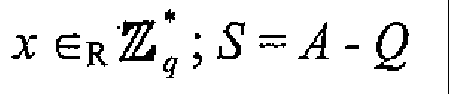
xS → p1 = ê(xS, sP); p2 = ê(A, sP) 


- It is common to calculate the pairing involved in IBE encryption as e(sPc,A')T rather than e(rsPc,A') since pairing exponentiation is quicker than point scalar multiplication. Also, if encrypting to Alice repeatedly the interim result e(sPc,A') can be pre-computed and stored. We note that e(sPc,A') is not a secret value, both of the points A' and sPc are public knowledge, so we do not have to protect these values from the terminal - if we off-load this computation to a card-reader we only have to verify that the correct value has been returned. A random point Q and a value alpha = e(Q,sP) are stored on the card. Q and alpha are not available off the card. This method can be applied in any situation where both points are public knowledge. The use of IBE encryption as an example is just for clarity of exposition.
- If the verification on card verifies, then p2 is the correct result of the pairing. On a reasonably powerful computer the computation of p1 and p2 should take about 40ms.
- Now we look at the pairing used in Boneh and Franklin IBE decryption.
- This pairing is computed as follows:
e(sA,rP)
- In this case we need to keep the pairing result secret (this is the basis for a symmetric encryption key), the point sA must also remain secret (it is Alice's private key), however the point rP is not secret, it is included in the cipher-text which is public knowledge. We note that the pairing value itself is checked as a central part of B&F IBE decryption. This is to check if the cipher-text has been manipulated by an active attacker on the communications channel. This means that if we want to off-load the computation of this pairing to the card reader we only have to keep the point sA and the result of the pairing secret, fault attacks and devious terminals will cause the decryption to fail. The idea is to allow the IBE decryption to fail if the pairing result is not correct, rather than putting extra validation steps into the pairing protocol. We assume also that a value g = e(A,P)s (which is public knowledge e(A,sP)) has been pre-computed and stored on the card. Therefore to check this pairing the smartcard and terminal perform the operations set out below.
Table III Smartcard Terminal 
y(sA) → p1 = ê(y(sA),rP) 
← r' = H3(V⊕H2(p),M) 
ê(sA, rP) = ρ - The above describes loading Boneh and Franklin IBE decryption, in which the result of the pairing is not validated. Rather, the Boneh and Franklin IBE decryption will fail if the correct value is not returned.
- The last row in Table 3 is a slightly faster variation on the verification that is carried out as part of B&F IBE decryption. Alternatively, the method suggested by Boneh and Franklin may be used.
- If this verification does not succeed then the pairing computation has been compromised as the result of a fault attack or cipher-text has been tampered with.
- Off-loading a pairing computation to a terminal, where one point is publicly known. The value β = ê(sA, Q) is stored on the card, again Q, sA and β are not available off the card
Table IV Smartcard Terminal 
xS, y(sA), z(sA) → p1 = ê(y(sA),xS); p2 = ê(z(sA), R) 
← 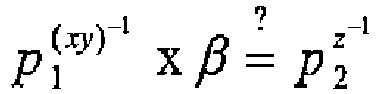

- The above describes P off-loading a pairing to a server where one point is secret and one point is public, and validating the result.
- Off-loading a pairing computation to a terminal, where neither point is publicly known. The value β = ê(sA, Q) stored on the card, again Q, sA and β are not available off the card.
Table V Smartcard Terminal 
wR, xS, y(sA), z(sA) → p1 = ê(y(sA),xS); p2 = ê(z(sA), wR) 
← 

- The above describes off-loading a pairing to a server where both points are secret and validating the result.
- The only other pairings that are of interest are where one point is secret and the result of the pairing may or may not remain secret, but where the pairing does not undergo a separate validation as in IBE decryption above. We note at this stage that it is generally very easy to append a verification stage to most protocols (simply encrypting a redundant value with an established session key, means that the techniques onlined in the section "IBE Encryption Pairing with the Assistance of an Untrusted Terminal", with some appended verification stage, above might be sufficient for most needs). Again we use sA to denote Alice's private key and sP to denote the KGC master public key. Since we are doing decryption, Alice's private key sA (a value we want to mask) will be constant across all pairings (all messages encrypted to Alice will need her private key to decrypt them). This yeilds the following, with the value beta = e(sA,Q) stored on the card, again Q, sA and beta are not available off the card. Consider the card wants to compute the pairing of e(sA,R). R is publicly known. Again the use of IBE decryption here is for clarity of exposition, any scenario whereby one point is to remain secret could benefit from this method.
- We note that in protocols where there is a requirement to mask at least one point (Tables III, IV, and V) the result of the pairing will not be revealed to the terminal during the protocol. This is unavoidable, but generally desirable. If the terminal should need to know the result of the pairing it can always be passed back to the terminal from the card at the end of the protocol. We notice that there is a quick variation on Table IV that allows both points and the result of the pairing to be masked, as set out in Table V for details.
- It will be appreciated that the invention provides for performance of IBE cryptography with a requirement for considerably less processor capacity than heretofore. This allows computationally restricted devices such as smartcards to be used.
Claims (9)
- A processor for identity based encryption,
said processor comprising means for encrypting messages for a recipient,
said means for encrypting comprising a master public key sP, and a recipient private key sA, characterized in that the processor comprises means for:providing as a recipient's public key A' = (A'x, A'y), where A'y is a hash of public information of the recipient and A'x is computed by solving an elliptic curve equation using A'y;generating a new master public key sP_c by multiplying the master public key sP by a co-factor cof of said elliptic curve;using the new master public key sP_c together with the new recipient's public key A' to encrypt messages for said recipient by performing the calculation ê(sP_c, A'),where e is a bilinear map. - A processor as claimed in claim 1, wherein the processor comprises means for transferring information to a linked second processor for performing some of the calculations.
- A processor as claimed in claim 2, wherein the processor comprises means for transferring information to the second processor for performing the calculation ê(sP_c,A').
- A processor as claimed in claim 3, wherein the processor comprises means for hiding sensitive information from the second processor, said sensitive information including a random point Q and a value alpha = e(Q,sP).
- A method for identity based encryption,
said method being performed by a processor for encrypting messages for a recipient,
said processor comprising a master public key sP, and a recipient private key sA, characterized in that the method comprises the processor performing the steps of:providing as a recipient's public key A' = (A'x, A'y), where A'y is a hash of public information of the recipient and A'x is computed by solving an elliptic curve equation using A'y; generating a new master public key sP_c by multiplying the master public key sP by a co-factor cof of said elliptic curve;using the new master public key sP_c together with the new recipient's public key A' to encrypt messages for said recipient by performing the calculation ê(sP_c, A'),where e is a bilinear map. - A method as claimed in claim 5, wherein the processor stores the fresh master public key in a read only memory.
- A method as claimed in claim 5, wherein the processor dynamically generates the new master public key.
- A method as claimed in any of claims 5 to 7, wherein the processor is incorporated into a hand-held card.
- A method as claimed in any of claims 5 to 8, wherein the processor transfers information to a linked second processor for performing some of the calculations.
Applications Claiming Priority (2)
| Application Number | Priority Date | Filing Date | Title |
|---|---|---|---|
| US62689004P | 2004-11-12 | 2004-11-12 | |
| PCT/IE2005/000128 WO2006051517A1 (en) | 2004-11-12 | 2005-11-14 | Identity based encryption |
Publications (2)
| Publication Number | Publication Date |
|---|---|
| EP1813051A1 EP1813051A1 (en) | 2007-08-01 |
| EP1813051B1 true EP1813051B1 (en) | 2017-09-13 |
Family
ID=35583350
Family Applications (1)
| Application Number | Title | Priority Date | Filing Date |
|---|---|---|---|
| EP05805745.6A Expired - Lifetime EP1813051B1 (en) | 2004-11-12 | 2005-11-14 | Identity based encryption |
Country Status (3)
| Country | Link |
|---|---|
| US (1) | US7860247B2 (en) |
| EP (1) | EP1813051B1 (en) |
| WO (1) | WO2006051517A1 (en) |
Families Citing this family (18)
| Publication number | Priority date | Publication date | Assignee | Title |
|---|---|---|---|---|
| US8145718B1 (en) * | 2005-10-21 | 2012-03-27 | Voltage Security, Inc. | Secure messaging system with personalization information |
| DE102007033848A1 (en) | 2007-07-18 | 2009-01-22 | Freisleben, Bernd, Prof. Dr. | Method for verification of ownership of terminal address of communications device in network, involves verifying ownership of terminal address by communications device belonging to it, by private cryptographic key |
| DE102007033846A1 (en) | 2007-07-18 | 2009-01-22 | Freisleben, Bernd, Prof. Dr. | Cryptographic key generating method for encrypted digital communication between communication devices, involves converting end product address of communication device into part of key, and utilizing address for key agreement |
| DE102007033847A1 (en) | 2007-07-18 | 2009-01-22 | Bernd Prof. Dr. Freisleben | Method for cryptographic key agreement between two communication devices in Internet protocol communications networks, involves arranging one or multiple Network address translation routers between two communication devices |
| DE102007033845A1 (en) | 2007-07-18 | 2009-01-22 | Bernd Prof. Dr. Freisleben | Public/private cryptographic key producing method for executing key agreement in digital data carrier, involves converting terminal end point address into key portion by applying inverse function of trap door one-way function for agreement |
| KR101490687B1 (en) * | 2007-08-20 | 2015-02-06 | 삼성전자주식회사 | Method for devices to share secret information in home network and apparatus therefor |
| US8091119B2 (en) * | 2007-08-22 | 2012-01-03 | Novell, Inc. | Identity based network mapping |
| CN101459506B (en) * | 2007-12-14 | 2011-09-14 | 华为技术有限公司 | Cipher key negotiation method, system, customer terminal and server for cipher key negotiation |
| CN101567784B (en) * | 2008-04-21 | 2016-03-30 | 华为数字技术(成都)有限公司 | A kind of method, system and equipment obtaining key |
| KR100970552B1 (en) | 2008-06-30 | 2010-07-16 | 경희대학교 산학협력단 | How to generate a security key using a non-certificate public key |
| US9154302B2 (en) | 2012-01-25 | 2015-10-06 | CertiVox Ltd. | System and method for secure two-factor authenticated ID-based key exchange and remote login using an insecure token and simple second-factor such as a PIN number |
| US8868910B2 (en) * | 2012-02-09 | 2014-10-21 | Hewlett-Packard Development Company, L.P. | Elliptic curve cryptographic signature |
| US8559631B1 (en) | 2013-02-09 | 2013-10-15 | Zeutro Llc | Systems and methods for efficient decryption of attribute-based encryption |
| GB201309702D0 (en) | 2013-05-30 | 2013-07-17 | Certivox Ltd | Security |
| US9106644B2 (en) | 2013-05-30 | 2015-08-11 | CertiVox Ltd. | Authentication |
| CN104158797B (en) * | 2014-07-14 | 2017-03-08 | 武汉理工大学 | The password User logs in mutually integrated with identification type password differentiates implementation |
| CN108307244B (en) * | 2018-01-09 | 2020-06-16 | 武汉斗鱼网络科技有限公司 | Bullet screen speaking time control method, storage medium, electronic device and system |
| US12010231B2 (en) * | 2021-06-23 | 2024-06-11 | Pqsecure Technologies, Llc | Computer processing architecture and method for supporting multiple public-key cryptosystems based on exponentiation |
Family Cites Families (14)
| Publication number | Priority date | Publication date | Assignee | Title |
|---|---|---|---|---|
| US7334127B2 (en) * | 1995-04-21 | 2008-02-19 | Certicom Corp. | Key agreement and transport protocol |
| US20020116337A1 (en) * | 2001-02-20 | 2002-08-22 | Ariel Peled | System for anonymous distribution and delivery of digital goods |
| DE60236094D1 (en) | 2001-08-13 | 2010-06-02 | Univ R | Identity-based encryption systems and methods and related cryptographic techniques |
| GB0215524D0 (en) | 2002-07-05 | 2002-08-14 | Hewlett Packard Co | Method and apparatus for generating a cryptographic key |
| US6886096B2 (en) * | 2002-11-14 | 2005-04-26 | Voltage Security, Inc. | Identity-based encryption system |
| US7392399B2 (en) * | 2003-05-05 | 2008-06-24 | Sun Microsystems, Inc. | Methods and systems for efficiently integrating a cryptographic co-processor |
| AU2004201807A1 (en) * | 2003-05-09 | 2004-11-25 | Nor Azman Bin Abu | Method and apparatus for the generation of public key based on a user-defined ID in a cryptosystem |
| KR100581440B1 (en) * | 2003-07-04 | 2006-05-23 | 학교법인 한국정보통신학원 | An apparatus and method for proxy signature based on personal identification information using overlapping pairs |
| JP4611305B2 (en) * | 2003-10-03 | 2011-01-12 | パナソニック株式会社 | Information transmission system, encryption device, and decryption device |
| GB2407948B (en) | 2003-11-08 | 2006-06-21 | Hewlett Packard Development Co | Smartcard with cryptographic functionality and method and system for using such cards |
| US8139770B2 (en) * | 2003-12-23 | 2012-03-20 | Wells Fargo Bank, N.A. | Cryptographic key backup and escrow system |
| US7646872B2 (en) * | 2004-04-02 | 2010-01-12 | Research In Motion Limited | Systems and methods to securely generate shared keys |
| US8050409B2 (en) * | 2004-04-02 | 2011-11-01 | University Of Cincinnati | Threshold and identity-based key management and authentication for wireless ad hoc networks |
| US7639799B2 (en) * | 2004-12-14 | 2009-12-29 | Microsoft Corporation | Cryptographically processing data based on a Cassels-Tate pairing |
-
2005
- 2005-11-14 WO PCT/IE2005/000128 patent/WO2006051517A1/en not_active Ceased
- 2005-11-14 US US11/667,555 patent/US7860247B2/en not_active Expired - Fee Related
- 2005-11-14 EP EP05805745.6A patent/EP1813051B1/en not_active Expired - Lifetime
Non-Patent Citations (1)
| Title |
|---|
| None * |
Also Published As
| Publication number | Publication date |
|---|---|
| EP1813051A1 (en) | 2007-08-01 |
| US20080144837A1 (en) | 2008-06-19 |
| WO2006051517A1 (en) | 2006-05-18 |
| US7860247B2 (en) | 2010-12-28 |
Similar Documents
| Publication | Publication Date | Title |
|---|---|---|
| US11552792B2 (en) | Systems and methods for generating signatures | |
| US20200213113A1 (en) | Threshold digital signature method and system | |
| Hwang et al. | Short dynamic group signature scheme supporting controllable linkability | |
| US7860247B2 (en) | Identity based encryption | |
| US9705683B2 (en) | Verifiable implicit certificates | |
| Chang et al. | A threshold signature scheme for group communications without a shared distribution center | |
| US20090217041A1 (en) | Provisional signature schemes | |
| Hsieh et al. | Anonymous authentication protocol based on elliptic curve Diffie–Hellman for wireless access networks | |
| US9800418B2 (en) | Signature protocol | |
| JP2005141200A (en) | Use of isogeny for design of cryptosystem | |
| Bai et al. | Elliptic curve cryptography based security framework for Internet of Things (IoT) enabled smart card | |
| JP2004208263A (en) | Apparatus and method of blind signature based on individual identification information employing bilinear pairing | |
| JPWO2020174515A1 (en) | Cryptographic system, key generator, key generator, key generator, and homomorphic arithmetic unit | |
| US12489620B2 (en) | Threshold secret share generation for distributed symmetric cryptography | |
| CN103493428B (en) | data encryption | |
| US20180091302A1 (en) | Improvements on multivariate digital signature schemes based on hfev- and new applications of multivariate digital signature schemes for white-box encryption | |
| Tsai et al. | An ECC‐based blind signcryption scheme for multiple digital documents | |
| US12206767B2 (en) | Methods and devices for secured identity-based encryption systems with two trusted centers | |
| US20150006900A1 (en) | Signature protocol | |
| Blanton et al. | Improved signature schemes for secure multi-party computation with certified inputs | |
| Feng et al. | White-box implementation of Shamir’s identity-based signature scheme | |
| JP4563037B2 (en) | ENCRYPTION APPARATUS, DECRYPTION APPARATUS, ENCRYPTION SYSTEM HAVING THEM, ENCRYPTION METHOD, AND DECRYPTION METHOD | |
| CN108055134A (en) | Elliptic curve, which is counted, multiplies and matches the cooperated computing method and system of computing | |
| Kwon | Virtual software tokens-a practical way to secure PKI roaming | |
| Andreevich et al. | On Using Mersenne Primes in Designing Cryptoschemes |
Legal Events
| Date | Code | Title | Description |
|---|---|---|---|
| PUAI | Public reference made under article 153(3) epc to a published international application that has entered the european phase |
Free format text: ORIGINAL CODE: 0009012 |
|
| 17P | Request for examination filed |
Effective date: 20070529 |
|
| AK | Designated contracting states |
Kind code of ref document: A1 Designated state(s): AT BE BG CH CY CZ DE DK EE ES FI FR GB GR HU IE IS IT LI LT LU LV MC NL PL PT RO SE SI SK TR |
|
| 17Q | First examination report despatched |
Effective date: 20070927 |
|
| DAX | Request for extension of the european patent (deleted) | ||
| GRAP | Despatch of communication of intention to grant a patent |
Free format text: ORIGINAL CODE: EPIDOSNIGR1 |
|
| INTG | Intention to grant announced |
Effective date: 20170531 |
|
| GRAS | Grant fee paid |
Free format text: ORIGINAL CODE: EPIDOSNIGR3 |
|
| GRAA | (expected) grant |
Free format text: ORIGINAL CODE: 0009210 |
|
| AK | Designated contracting states |
Kind code of ref document: B1 Designated state(s): AT BE BG CH CY CZ DE DK EE ES FI FR GB GR HU IE IS IT LI LT LU LV MC NL PL PT RO SE SI SK TR |
|
| REG | Reference to a national code |
Ref country code: GB Ref legal event code: FG4D |
|
| REG | Reference to a national code |
Ref country code: CH Ref legal event code: EP |
|
| REG | Reference to a national code |
Ref country code: CH Ref legal event code: NV Representative=s name: ISLER AND PEDRAZZINI AG, CH |
|
| REG | Reference to a national code |
Ref country code: IE Ref legal event code: FG4D |
|
| REG | Reference to a national code |
Ref country code: AT Ref legal event code: REF Ref document number: 929147 Country of ref document: AT Kind code of ref document: T Effective date: 20171015 |
|
| REG | Reference to a national code |
Ref country code: DE Ref legal event code: R096 Ref document number: 602005052727 Country of ref document: DE |
|
| REG | Reference to a national code |
Ref country code: FR Ref legal event code: PLFP Year of fee payment: 13 |
|
| REG | Reference to a national code |
Ref country code: NL Ref legal event code: MP Effective date: 20170913 |
|
| REG | Reference to a national code |
Ref country code: LT Ref legal event code: MG4D |
|
| PG25 | Lapsed in a contracting state [announced via postgrant information from national office to epo] |
Ref country code: SE Free format text: LAPSE BECAUSE OF FAILURE TO SUBMIT A TRANSLATION OF THE DESCRIPTION OR TO PAY THE FEE WITHIN THE PRESCRIBED TIME-LIMIT Effective date: 20170913 Ref country code: FI Free format text: LAPSE BECAUSE OF FAILURE TO SUBMIT A TRANSLATION OF THE DESCRIPTION OR TO PAY THE FEE WITHIN THE PRESCRIBED TIME-LIMIT Effective date: 20170913 Ref country code: LT Free format text: LAPSE BECAUSE OF FAILURE TO SUBMIT A TRANSLATION OF THE DESCRIPTION OR TO PAY THE FEE WITHIN THE PRESCRIBED TIME-LIMIT Effective date: 20170913 |
|
| REG | Reference to a national code |
Ref country code: AT Ref legal event code: MK05 Ref document number: 929147 Country of ref document: AT Kind code of ref document: T Effective date: 20170913 |
|
| PG25 | Lapsed in a contracting state [announced via postgrant information from national office to epo] |
Ref country code: LV Free format text: LAPSE BECAUSE OF FAILURE TO SUBMIT A TRANSLATION OF THE DESCRIPTION OR TO PAY THE FEE WITHIN THE PRESCRIBED TIME-LIMIT Effective date: 20170913 Ref country code: BG Free format text: LAPSE BECAUSE OF FAILURE TO SUBMIT A TRANSLATION OF THE DESCRIPTION OR TO PAY THE FEE WITHIN THE PRESCRIBED TIME-LIMIT Effective date: 20171213 Ref country code: GR Free format text: LAPSE BECAUSE OF FAILURE TO SUBMIT A TRANSLATION OF THE DESCRIPTION OR TO PAY THE FEE WITHIN THE PRESCRIBED TIME-LIMIT Effective date: 20171214 Ref country code: ES Free format text: LAPSE BECAUSE OF FAILURE TO SUBMIT A TRANSLATION OF THE DESCRIPTION OR TO PAY THE FEE WITHIN THE PRESCRIBED TIME-LIMIT Effective date: 20170913 |
|
| PG25 | Lapsed in a contracting state [announced via postgrant information from national office to epo] |
Ref country code: NL Free format text: LAPSE BECAUSE OF FAILURE TO SUBMIT A TRANSLATION OF THE DESCRIPTION OR TO PAY THE FEE WITHIN THE PRESCRIBED TIME-LIMIT Effective date: 20170913 |
|
| PG25 | Lapsed in a contracting state [announced via postgrant information from national office to epo] |
Ref country code: CZ Free format text: LAPSE BECAUSE OF FAILURE TO SUBMIT A TRANSLATION OF THE DESCRIPTION OR TO PAY THE FEE WITHIN THE PRESCRIBED TIME-LIMIT Effective date: 20170913 Ref country code: PL Free format text: LAPSE BECAUSE OF FAILURE TO SUBMIT A TRANSLATION OF THE DESCRIPTION OR TO PAY THE FEE WITHIN THE PRESCRIBED TIME-LIMIT Effective date: 20170913 Ref country code: RO Free format text: LAPSE BECAUSE OF FAILURE TO SUBMIT A TRANSLATION OF THE DESCRIPTION OR TO PAY THE FEE WITHIN THE PRESCRIBED TIME-LIMIT Effective date: 20170913 |
|
| PG25 | Lapsed in a contracting state [announced via postgrant information from national office to epo] |
Ref country code: IS Free format text: LAPSE BECAUSE OF FAILURE TO SUBMIT A TRANSLATION OF THE DESCRIPTION OR TO PAY THE FEE WITHIN THE PRESCRIBED TIME-LIMIT Effective date: 20180113 Ref country code: SK Free format text: LAPSE BECAUSE OF FAILURE TO SUBMIT A TRANSLATION OF THE DESCRIPTION OR TO PAY THE FEE WITHIN THE PRESCRIBED TIME-LIMIT Effective date: 20170913 Ref country code: AT Free format text: LAPSE BECAUSE OF FAILURE TO SUBMIT A TRANSLATION OF THE DESCRIPTION OR TO PAY THE FEE WITHIN THE PRESCRIBED TIME-LIMIT Effective date: 20170913 Ref country code: IT Free format text: LAPSE BECAUSE OF FAILURE TO SUBMIT A TRANSLATION OF THE DESCRIPTION OR TO PAY THE FEE WITHIN THE PRESCRIBED TIME-LIMIT Effective date: 20170913 Ref country code: EE Free format text: LAPSE BECAUSE OF FAILURE TO SUBMIT A TRANSLATION OF THE DESCRIPTION OR TO PAY THE FEE WITHIN THE PRESCRIBED TIME-LIMIT Effective date: 20170913 |
|
| REG | Reference to a national code |
Ref country code: DE Ref legal event code: R097 Ref document number: 602005052727 Country of ref document: DE |
|
| PG25 | Lapsed in a contracting state [announced via postgrant information from national office to epo] |
Ref country code: MC Free format text: LAPSE BECAUSE OF FAILURE TO SUBMIT A TRANSLATION OF THE DESCRIPTION OR TO PAY THE FEE WITHIN THE PRESCRIBED TIME-LIMIT Effective date: 20170913 |
|
| PLBE | No opposition filed within time limit |
Free format text: ORIGINAL CODE: 0009261 |
|
| STAA | Information on the status of an ep patent application or granted ep patent |
Free format text: STATUS: NO OPPOSITION FILED WITHIN TIME LIMIT |
|
| PG25 | Lapsed in a contracting state [announced via postgrant information from national office to epo] |
Ref country code: DK Free format text: LAPSE BECAUSE OF FAILURE TO SUBMIT A TRANSLATION OF THE DESCRIPTION OR TO PAY THE FEE WITHIN THE PRESCRIBED TIME-LIMIT Effective date: 20170913 |
|
| 26N | No opposition filed |
Effective date: 20180614 |
|
| PG25 | Lapsed in a contracting state [announced via postgrant information from national office to epo] |
Ref country code: LU Free format text: LAPSE BECAUSE OF NON-PAYMENT OF DUE FEES Effective date: 20171114 |
|
| REG | Reference to a national code |
Ref country code: FR Ref legal event code: PLFP Year of fee payment: 14 Ref country code: BE Ref legal event code: MM Effective date: 20171130 |
|
| REG | Reference to a national code |
Ref country code: IE Ref legal event code: MM4A |
|
| PG25 | Lapsed in a contracting state [announced via postgrant information from national office to epo] |
Ref country code: IE Free format text: LAPSE BECAUSE OF NON-PAYMENT OF DUE FEES Effective date: 20171114 |
|
| PG25 | Lapsed in a contracting state [announced via postgrant information from national office to epo] |
Ref country code: BE Free format text: LAPSE BECAUSE OF NON-PAYMENT OF DUE FEES Effective date: 20171130 Ref country code: SI Free format text: LAPSE BECAUSE OF FAILURE TO SUBMIT A TRANSLATION OF THE DESCRIPTION OR TO PAY THE FEE WITHIN THE PRESCRIBED TIME-LIMIT Effective date: 20170913 |
|
| PG25 | Lapsed in a contracting state [announced via postgrant information from national office to epo] |
Ref country code: HU Free format text: LAPSE BECAUSE OF FAILURE TO SUBMIT A TRANSLATION OF THE DESCRIPTION OR TO PAY THE FEE WITHIN THE PRESCRIBED TIME-LIMIT; INVALID AB INITIO Effective date: 20051114 |
|
| PG25 | Lapsed in a contracting state [announced via postgrant information from national office to epo] |
Ref country code: CY Free format text: LAPSE BECAUSE OF NON-PAYMENT OF DUE FEES Effective date: 20170913 |
|
| PGFP | Annual fee paid to national office [announced via postgrant information from national office to epo] |
Ref country code: DE Payment date: 20191113 Year of fee payment: 15 |
|
| PGFP | Annual fee paid to national office [announced via postgrant information from national office to epo] |
Ref country code: FR Payment date: 20191118 Year of fee payment: 15 |
|
| PG25 | Lapsed in a contracting state [announced via postgrant information from national office to epo] |
Ref country code: TR Free format text: LAPSE BECAUSE OF FAILURE TO SUBMIT A TRANSLATION OF THE DESCRIPTION OR TO PAY THE FEE WITHIN THE PRESCRIBED TIME-LIMIT Effective date: 20170913 |
|
| PGFP | Annual fee paid to national office [announced via postgrant information from national office to epo] |
Ref country code: CH Payment date: 20191105 Year of fee payment: 15 |
|
| PGFP | Annual fee paid to national office [announced via postgrant information from national office to epo] |
Ref country code: GB Payment date: 20191105 Year of fee payment: 15 |
|
| PG25 | Lapsed in a contracting state [announced via postgrant information from national office to epo] |
Ref country code: PT Free format text: LAPSE BECAUSE OF FAILURE TO SUBMIT A TRANSLATION OF THE DESCRIPTION OR TO PAY THE FEE WITHIN THE PRESCRIBED TIME-LIMIT Effective date: 20170913 |
|
| REG | Reference to a national code |
Ref country code: DE Ref legal event code: R119 Ref document number: 602005052727 Country of ref document: DE |
|
| REG | Reference to a national code |
Ref country code: CH Ref legal event code: PL |
|
| GBPC | Gb: european patent ceased through non-payment of renewal fee |
Effective date: 20201114 |
|
| PG25 | Lapsed in a contracting state [announced via postgrant information from national office to epo] |
Ref country code: LI Free format text: LAPSE BECAUSE OF NON-PAYMENT OF DUE FEES Effective date: 20201130 Ref country code: CH Free format text: LAPSE BECAUSE OF NON-PAYMENT OF DUE FEES Effective date: 20201130 |
|
| PG25 | Lapsed in a contracting state [announced via postgrant information from national office to epo] |
Ref country code: FR Free format text: LAPSE BECAUSE OF NON-PAYMENT OF DUE FEES Effective date: 20201130 |
|
| PG25 | Lapsed in a contracting state [announced via postgrant information from national office to epo] |
Ref country code: DE Free format text: LAPSE BECAUSE OF NON-PAYMENT OF DUE FEES Effective date: 20210601 Ref country code: GB Free format text: LAPSE BECAUSE OF NON-PAYMENT OF DUE FEES Effective date: 20201114 |