EP1812452B1 - Thermosensitive and biocompatible amphiphilic cyclic phosphazene trimer and preparation method thereof - Google Patents
Thermosensitive and biocompatible amphiphilic cyclic phosphazene trimer and preparation method thereof Download PDFInfo
- Publication number
- EP1812452B1 EP1812452B1 EP05792971A EP05792971A EP1812452B1 EP 1812452 B1 EP1812452 B1 EP 1812452B1 EP 05792971 A EP05792971 A EP 05792971A EP 05792971 A EP05792971 A EP 05792971A EP 1812452 B1 EP1812452 B1 EP 1812452B1
- Authority
- EP
- European Patent Office
- Prior art keywords
- group
- coor
- formula
- trimer
- cyclic phosphazene
- Prior art date
- Legal status (The legal status is an assumption and is not a legal conclusion. Google has not performed a legal analysis and makes no representation as to the accuracy of the status listed.)
- Not-in-force
Links
- 239000013638 trimer Substances 0.000 title claims description 54
- GKTNLYAAZKKMTQ-UHFFFAOYSA-N n-[bis(dimethylamino)phosphinimyl]-n-methylmethanamine Chemical compound CN(C)P(=N)(N(C)C)N(C)C GKTNLYAAZKKMTQ-UHFFFAOYSA-N 0.000 title claims description 40
- 125000004122 cyclic group Chemical group 0.000 title claims description 21
- 238000002360 preparation method Methods 0.000 title description 14
- -1 CH2C6H5 Chemical group 0.000 claims description 29
- ZMANZCXQSJIPKH-UHFFFAOYSA-N Triethylamine Chemical compound CCN(CC)CC ZMANZCXQSJIPKH-UHFFFAOYSA-N 0.000 claims description 29
- 238000000034 method Methods 0.000 claims description 21
- WYURNTSHIVDZCO-UHFFFAOYSA-N Tetrahydrofuran Chemical compound C1CCOC1 WYURNTSHIVDZCO-UHFFFAOYSA-N 0.000 claims description 18
- 108010038807 Oligopeptides Proteins 0.000 claims description 13
- 102000015636 Oligopeptides Human genes 0.000 claims description 13
- 229920001223 polyethylene glycol Polymers 0.000 claims description 13
- 125000002496 methyl group Chemical group [H]C([H])([H])* 0.000 claims description 11
- 150000002148 esters Chemical class 0.000 claims description 10
- VLKZOEOYAKHREP-UHFFFAOYSA-N n-Hexane Chemical compound CCCCCC VLKZOEOYAKHREP-UHFFFAOYSA-N 0.000 claims description 9
- YLQBMQCUIZJEEH-UHFFFAOYSA-N tetrahydrofuran Natural products C=1C=COC=1 YLQBMQCUIZJEEH-UHFFFAOYSA-N 0.000 claims description 9
- XLYOFNOQVPJJNP-UHFFFAOYSA-N water Chemical compound O XLYOFNOQVPJJNP-UHFFFAOYSA-N 0.000 claims description 9
- HEDRZPFGACZZDS-UHFFFAOYSA-N Chloroform Chemical compound ClC(Cl)Cl HEDRZPFGACZZDS-UHFFFAOYSA-N 0.000 claims description 8
- RTZKZFJDLAIYFH-UHFFFAOYSA-N Diethyl ether Chemical compound CCOCC RTZKZFJDLAIYFH-UHFFFAOYSA-N 0.000 claims description 8
- UBIJTWDKTYCPMQ-UHFFFAOYSA-N hexachlorophosphazene Chemical compound ClP1(Cl)=NP(Cl)(Cl)=NP(Cl)(Cl)=N1 UBIJTWDKTYCPMQ-UHFFFAOYSA-N 0.000 claims description 7
- UHOVQNZJYSORNB-UHFFFAOYSA-N Benzene Chemical compound C1=CC=CC=C1 UHOVQNZJYSORNB-UHFFFAOYSA-N 0.000 claims description 6
- YXFVVABEGXRONW-UHFFFAOYSA-N Toluene Chemical compound CC1=CC=CC=C1 YXFVVABEGXRONW-UHFFFAOYSA-N 0.000 claims description 6
- 125000000959 isobutyl group Chemical group [H]C([H])([H])C([H])(C([H])([H])[H])C([H])([H])* 0.000 claims description 6
- 239000002244 precipitate Substances 0.000 claims description 6
- 125000002914 sec-butyl group Chemical group [H]C([H])([H])C([H])([H])C([H])(*)C([H])([H])[H] 0.000 claims description 6
- 159000000000 sodium salts Chemical class 0.000 claims description 6
- 239000012153 distilled water Substances 0.000 claims description 5
- 239000000047 product Substances 0.000 claims description 4
- 239000011541 reaction mixture Substances 0.000 claims description 4
- 125000001797 benzyl group Chemical group [H]C1=C([H])C([H])=C(C([H])=C1[H])C([H])([H])* 0.000 claims description 3
- 239000012141 concentrate Substances 0.000 claims description 3
- 125000001495 ethyl group Chemical group [H]C([H])([H])C([H])([H])* 0.000 claims description 3
- 239000000706 filtrate Substances 0.000 claims description 3
- 239000000203 mixture Substances 0.000 claims description 3
- 238000001556 precipitation Methods 0.000 claims description 3
- 239000002904 solvent Substances 0.000 claims description 3
- 238000001914 filtration Methods 0.000 claims 2
- 230000001939 inductive effect Effects 0.000 claims 1
- 239000003814 drug Substances 0.000 description 42
- 229940079593 drug Drugs 0.000 description 42
- 239000000693 micelle Substances 0.000 description 33
- 239000000243 solution Substances 0.000 description 20
- 230000002209 hydrophobic effect Effects 0.000 description 18
- 238000012377 drug delivery Methods 0.000 description 14
- 230000003595 spectral effect Effects 0.000 description 14
- 239000007864 aqueous solution Substances 0.000 description 13
- 229920000642 polymer Polymers 0.000 description 13
- 238000005481 NMR spectroscopy Methods 0.000 description 12
- 239000011557 critical solution Substances 0.000 description 12
- 238000006243 chemical reaction Methods 0.000 description 11
- 229920001427 mPEG Polymers 0.000 description 11
- 102000002265 Human Growth Hormone Human genes 0.000 description 10
- 108010000521 Human Growth Hormone Proteins 0.000 description 10
- 239000000854 Human Growth Hormone Substances 0.000 description 10
- OAICVXFJPJFONN-UHFFFAOYSA-N Phosphorus Chemical compound [P] OAICVXFJPJFONN-UHFFFAOYSA-N 0.000 description 10
- 229910052698 phosphorus Inorganic materials 0.000 description 10
- 239000011574 phosphorus Substances 0.000 description 9
- 238000005160 1H NMR spectroscopy Methods 0.000 description 8
- KEAYESYHFKHZAL-UHFFFAOYSA-N Sodium Chemical compound [Na] KEAYESYHFKHZAL-UHFFFAOYSA-N 0.000 description 8
- 238000000921 elemental analysis Methods 0.000 description 8
- 239000012467 final product Substances 0.000 description 8
- 102000004169 proteins and genes Human genes 0.000 description 8
- 108090000623 proteins and genes Proteins 0.000 description 8
- 150000001413 amino acids Chemical class 0.000 description 7
- 125000001165 hydrophobic group Chemical group 0.000 description 6
- 229930012538 Paclitaxel Natural products 0.000 description 5
- 230000036760 body temperature Effects 0.000 description 5
- 229910052739 hydrogen Inorganic materials 0.000 description 5
- 229960001592 paclitaxel Drugs 0.000 description 5
- 239000002245 particle Substances 0.000 description 5
- RCINICONZNJXQF-MZXODVADSA-N taxol Chemical compound O([C@@H]1[C@@]2(C[C@@H](C(C)=C(C2(C)C)[C@H](C([C@]2(C)[C@@H](O)C[C@H]3OC[C@]3([C@H]21)OC(C)=O)=O)OC(=O)C)OC(=O)[C@H](O)[C@@H](NC(=O)C=1C=CC=CC=1)C=1C=CC=CC=1)O)C(=O)C1=CC=CC=C1 RCINICONZNJXQF-MZXODVADSA-N 0.000 description 5
- 206010061218 Inflammation Diseases 0.000 description 4
- FAPWRFPIFSIZLT-UHFFFAOYSA-M Sodium chloride Chemical compound [Na+].[Cl-] FAPWRFPIFSIZLT-UHFFFAOYSA-M 0.000 description 4
- 229920001400 block copolymer Polymers 0.000 description 4
- RBHJBMIOOPYDBQ-UHFFFAOYSA-N carbon dioxide;propan-2-one Chemical compound O=C=O.CC(C)=O RBHJBMIOOPYDBQ-UHFFFAOYSA-N 0.000 description 4
- 238000000502 dialysis Methods 0.000 description 4
- 239000001257 hydrogen Substances 0.000 description 4
- 230000004054 inflammatory process Effects 0.000 description 4
- 239000002547 new drug Substances 0.000 description 4
- 238000002296 dynamic light scattering Methods 0.000 description 3
- 230000000694 effects Effects 0.000 description 3
- 125000004494 ethyl ester group Chemical group 0.000 description 3
- 238000000338 in vitro Methods 0.000 description 3
- 230000003993 interaction Effects 0.000 description 3
- 229910052757 nitrogen Inorganic materials 0.000 description 3
- 150000007524 organic acids Chemical class 0.000 description 3
- 108090000765 processed proteins & peptides Proteins 0.000 description 3
- 238000004007 reversed phase HPLC Methods 0.000 description 3
- 238000010254 subcutaneous injection Methods 0.000 description 3
- 239000007929 subcutaneous injection Substances 0.000 description 3
- IJGRMHOSHXDMSA-UHFFFAOYSA-N Atomic nitrogen Chemical compound N#N IJGRMHOSHXDMSA-UHFFFAOYSA-N 0.000 description 2
- 239000012591 Dulbecco’s Phosphate Buffered Saline Substances 0.000 description 2
- 108010009504 Gly-Phe-Leu-Gly Proteins 0.000 description 2
- 206010040914 Skin reaction Diseases 0.000 description 2
- 239000012300 argon atmosphere Substances 0.000 description 2
- 238000011888 autopsy Methods 0.000 description 2
- 238000006065 biodegradation reaction Methods 0.000 description 2
- 239000006227 byproduct Substances 0.000 description 2
- 239000003795 chemical substances by application Substances 0.000 description 2
- 150000001875 compounds Chemical class 0.000 description 2
- 238000002474 experimental method Methods 0.000 description 2
- 238000001727 in vivo Methods 0.000 description 2
- 239000012528 membrane Substances 0.000 description 2
- 210000003205 muscle Anatomy 0.000 description 2
- 239000002105 nanoparticle Substances 0.000 description 2
- 229920000620 organic polymer Polymers 0.000 description 2
- 229920000747 poly(lactic acid) Polymers 0.000 description 2
- 239000004626 polylactic acid Substances 0.000 description 2
- 238000003998 size exclusion chromatography high performance liquid chromatography Methods 0.000 description 2
- 230000035483 skin reaction Effects 0.000 description 2
- 231100000430 skin reaction Toxicity 0.000 description 2
- 239000011734 sodium Substances 0.000 description 2
- 239000011780 sodium chloride Substances 0.000 description 2
- 229910000104 sodium hydride Inorganic materials 0.000 description 2
- 238000001228 spectrum Methods 0.000 description 2
- 239000000126 substance Substances 0.000 description 2
- 125000001424 substituent group Chemical class 0.000 description 2
- 238000006467 substitution reaction Methods 0.000 description 2
- 238000012360 testing method Methods 0.000 description 2
- 230000007704 transition Effects 0.000 description 2
- WEZDRVHTDXTVLT-GJZGRUSLSA-N 2-[[(2s)-2-[[(2s)-2-[(2-aminoacetyl)amino]-3-phenylpropanoyl]amino]-4-methylpentanoyl]amino]acetic acid Chemical compound OC(=O)CNC(=O)[C@H](CC(C)C)NC(=O)[C@@H](NC(=O)CN)CC1=CC=CC=C1 WEZDRVHTDXTVLT-GJZGRUSLSA-N 0.000 description 1
- 239000004254 Ammonium phosphate Substances 0.000 description 1
- OKTJSMMVPCPJKN-UHFFFAOYSA-N Carbon Chemical compound [C] OKTJSMMVPCPJKN-UHFFFAOYSA-N 0.000 description 1
- 102000018997 Growth Hormone Human genes 0.000 description 1
- 108010051696 Growth Hormone Proteins 0.000 description 1
- 208000032843 Hemorrhage Diseases 0.000 description 1
- UFHFLCQGNIYNRP-UHFFFAOYSA-N Hydrogen Chemical compound [H][H] UFHFLCQGNIYNRP-UHFFFAOYSA-N 0.000 description 1
- DGAQECJNVWCQMB-PUAWFVPOSA-M Ilexoside XXIX Chemical compound C[C@@H]1CC[C@@]2(CC[C@@]3(C(=CC[C@H]4[C@]3(CC[C@@H]5[C@@]4(CC[C@@H](C5(C)C)OS(=O)(=O)[O-])C)C)[C@@H]2[C@]1(C)O)C)C(=O)O[C@H]6[C@@H]([C@H]([C@@H]([C@H](O6)CO)O)O)O.[Na+] DGAQECJNVWCQMB-PUAWFVPOSA-M 0.000 description 1
- 241001465754 Metazoa Species 0.000 description 1
- 206010028851 Necrosis Diseases 0.000 description 1
- 206010030113 Oedema Diseases 0.000 description 1
- 241000283973 Oryctolagus cuniculus Species 0.000 description 1
- 229920000805 Polyaspartic acid Polymers 0.000 description 1
- 239000002253 acid Substances 0.000 description 1
- 230000002378 acidificating effect Effects 0.000 description 1
- 229910000148 ammonium phosphate Inorganic materials 0.000 description 1
- 235000019289 ammonium phosphates Nutrition 0.000 description 1
- 229920000469 amphiphilic block copolymer Polymers 0.000 description 1
- 239000002246 antineoplastic agent Substances 0.000 description 1
- 229920002988 biodegradable polymer Polymers 0.000 description 1
- 239000004621 biodegradable polymer Substances 0.000 description 1
- 239000008280 blood Substances 0.000 description 1
- 210000004369 blood Anatomy 0.000 description 1
- 229910052799 carbon Inorganic materials 0.000 description 1
- 150000007942 carboxylates Chemical group 0.000 description 1
- 230000008859 change Effects 0.000 description 1
- 238000007385 chemical modification Methods 0.000 description 1
- 239000007810 chemical reaction solvent Substances 0.000 description 1
- 125000001309 chloro group Chemical group Cl* 0.000 description 1
- 238000013267 controlled drug release Methods 0.000 description 1
- 230000001186 cumulative effect Effects 0.000 description 1
- 238000004925 denaturation Methods 0.000 description 1
- 230000036425 denaturation Effects 0.000 description 1
- 238000011161 development Methods 0.000 description 1
- MNNHAPBLZZVQHP-UHFFFAOYSA-N diammonium hydrogen phosphate Chemical compound [NH4+].[NH4+].OP([O-])([O-])=O MNNHAPBLZZVQHP-UHFFFAOYSA-N 0.000 description 1
- 229920000359 diblock copolymer Polymers 0.000 description 1
- 125000004177 diethyl group Chemical group [H]C([H])([H])C([H])([H])* 0.000 description 1
- 239000013583 drug formulation Substances 0.000 description 1
- 238000005538 encapsulation Methods 0.000 description 1
- 230000001747 exhibiting effect Effects 0.000 description 1
- 125000000524 functional group Chemical group 0.000 description 1
- 239000000122 growth hormone Substances 0.000 description 1
- 230000007062 hydrolysis Effects 0.000 description 1
- 238000006460 hydrolysis reaction Methods 0.000 description 1
- 229920001600 hydrophobic polymer Polymers 0.000 description 1
- 238000010348 incorporation Methods 0.000 description 1
- 239000000543 intermediate Substances 0.000 description 1
- 230000009878 intermolecular interaction Effects 0.000 description 1
- 239000000463 material Substances 0.000 description 1
- 238000005259 measurement Methods 0.000 description 1
- 125000000956 methoxy group Chemical group [H]C([H])([H])O* 0.000 description 1
- 239000011859 microparticle Substances 0.000 description 1
- 239000004005 microsphere Substances 0.000 description 1
- 238000002156 mixing Methods 0.000 description 1
- 239000002077 nanosphere Substances 0.000 description 1
- 230000017074 necrotic cell death Effects 0.000 description 1
- 125000004433 nitrogen atom Chemical group N* 0.000 description 1
- 238000010534 nucleophilic substitution reaction Methods 0.000 description 1
- 235000005985 organic acids Nutrition 0.000 description 1
- 125000004437 phosphorous atom Chemical group 0.000 description 1
- 108010064470 polyaspartate Proteins 0.000 description 1
- 230000008569 process Effects 0.000 description 1
- 239000012264 purified product Substances 0.000 description 1
- 239000000376 reactant Substances 0.000 description 1
- 230000009467 reduction Effects 0.000 description 1
- 238000001338 self-assembly Methods 0.000 description 1
- 229910052708 sodium Inorganic materials 0.000 description 1
- 239000012312 sodium hydride Substances 0.000 description 1
- 239000007787 solid Substances 0.000 description 1
- 230000007928 solubilization Effects 0.000 description 1
- 238000005063 solubilization Methods 0.000 description 1
- 239000004094 surface-active agent Substances 0.000 description 1
- 208000024891 symptom Diseases 0.000 description 1
- 230000008685 targeting Effects 0.000 description 1
- 210000001519 tissue Anatomy 0.000 description 1
- 231100000419 toxicity Toxicity 0.000 description 1
- 230000001988 toxicity Effects 0.000 description 1
- 229920000428 triblock copolymer Polymers 0.000 description 1
- ZIBGPFATKBEMQZ-UHFFFAOYSA-N triethylene glycol Chemical compound OCCOCCOCCO ZIBGPFATKBEMQZ-UHFFFAOYSA-N 0.000 description 1
- 238000002211 ultraviolet spectrum Methods 0.000 description 1
- 230000003313 weakening effect Effects 0.000 description 1
Images


Classifications
-
- C—CHEMISTRY; METALLURGY
- C07—ORGANIC CHEMISTRY
- C07F—ACYCLIC, CARBOCYCLIC OR HETEROCYCLIC COMPOUNDS CONTAINING ELEMENTS OTHER THAN CARBON, HYDROGEN, HALOGEN, OXYGEN, NITROGEN, SULFUR, SELENIUM OR TELLURIUM
- C07F9/00—Compounds containing elements of Groups 5 or 15 of the Periodic Table
- C07F9/02—Phosphorus compounds
- C07F9/28—Phosphorus compounds with one or more P—C bonds
-
- C—CHEMISTRY; METALLURGY
- C07—ORGANIC CHEMISTRY
- C07F—ACYCLIC, CARBOCYCLIC OR HETEROCYCLIC COMPOUNDS CONTAINING ELEMENTS OTHER THAN CARBON, HYDROGEN, HALOGEN, OXYGEN, NITROGEN, SULFUR, SELENIUM OR TELLURIUM
- C07F9/00—Compounds containing elements of Groups 5 or 15 of the Periodic Table
- C07F9/02—Phosphorus compounds
- C07F9/547—Heterocyclic compounds, e.g. containing phosphorus as a ring hetero atom
- C07F9/6564—Heterocyclic compounds, e.g. containing phosphorus as a ring hetero atom having phosphorus atoms, with or without nitrogen, oxygen, sulfur, selenium or tellurium atoms, as ring hetero atoms
- C07F9/6581—Heterocyclic compounds, e.g. containing phosphorus as a ring hetero atom having phosphorus atoms, with or without nitrogen, oxygen, sulfur, selenium or tellurium atoms, as ring hetero atoms having phosphorus and nitrogen atoms with or without oxygen or sulfur atoms, as ring hetero atoms
- C07F9/65812—Cyclic phosphazenes [P=N-]n, n>=3
- C07F9/65815—Cyclic phosphazenes [P=N-]n, n>=3 n = 3
Definitions
- the present invention relates to a thermosensitive and biocompatible amphiphilic cyclic phosphazene trimer and a preparation method thereof.
- amphiphilic block copolymers have advantages in that they can form micelles in aqueous solution, in which the hydrophobic polymer blocks are subjected to intermolecular hydrophobic interactions to form the inner spatial core of the micelles capable of entrapping hydrophobic drug molecules, and its outer part (corona) is surrounded by hydrophilic groups, thereby making the micelles hydrophilic, and accordingly, they can effectively deliver hydrophobic drugs into the body.
- a micelle is prepared from a diblock or triblock copolymer, in which a hydrophilic block and a hydrophobic block are alternately copolymerized.
- Poly(ethylene glycol) (PEG) has been most commonly used as a hydrophilic block polymer, and various hydrophobic organic acid polymers such as polylactic acid, polyaspartic acid, etc. have been used as hydrophobic block polymers ( V. P. Torchilin, J. Control. Release, 73, 137-172 (2001 )).
- block copolymers having a backbone of such hydrophobic organic acid polymers are biodegradable, organic acids are formed during biodegradation, which may cause denaturation of the drug, and therefore, they cannot be used for delivering acid-sensitive biodrugs such as peptide and protein drugs.
- such conventional block polymers generally have a simple molecular structure, and thus, serious changes in their physico-chemical properties are accompanied when a new functional group such as a target-directing agent is introduced or when their molecular structure is even slightly modified. Therefore, such conventional block polymers are faced with many limitations in designing required properties. Furthermore, most micelles that are formed from such block copolymers do not generally exhibit thermosensitivity near body temperature.
- the basic requirements for a drug delivery system include solubilization of hardly soluble drugs, controlled drug release, enhanced drug stability in vivo, efficient drug delivery to the target sites, and minimum side effects of the drug, in addition to biocompatibility of the drug delivery system itself.
- most of the conventional organic polymers used as a drug delivery system generally lack of biodegradability and have inherent limitation in designing properties, as above-mentioned.
- Some biodegradable polymers such as polylactic acid become acidic during biodegradation, which makes them unsuitable for delivery of biodrugs such as protein drugs, peptide drugs and the like.
- the conventional organic polymers can hardly satisfy the above-mentioned requirements at the same time, and therefore, development of new drug delivery systems is highly desired.
- thermosensitive phosphazene trimers substituted with a poly(ethylene glycol) (PEG) as a hydrophilic group and an amino acid as a hydrophobic group ( Youn Soo Sohn et al., J. Am. Chem. Soc, 2000, 122, 8315 ). Even though these trimers using an amino acid as a hydrophobic group are thermosensitive, micelles were not formed due to their low hydrophobicity. Furthermore, they are unstable in aqueous solution because the terminal carboxylate group of the amino acid substituent are located close to the phosphazene backbone.
- PEG poly(ethylene glycol)
- thermosensitive cyclotriphosphazene-oligopeptide conjugates synthesized by introducing a variety of hydrophobic oligopeptides along with various hydrophilic methoxy poly(ethylene glycols) as a solubilising group ( Abstract of the 93rd National Meeting of more a chemical Society, 22 April 2004-23 April (2004), p180 )
- an object of the present invention Is to provide a thermosensitive and biocompatible cyclic phosphazene trimer, in which a poly(ethylene glycol) as a hydrophilic group and an oligopeptide ester that is more hydrophobic than amino acid but enzymatically degradable as a hydrophobic group are introduced, producing thermosensitve micelles in aqueous solution with a phase transition temperature suitable for a drug delivery system, and to provide a preparation method thereof.
- the present inventors have discovered that the above-mentioned objects can be achieved by introduction of FDA-approved poly(ethylene glycols) having a molecular weight of 100 or more as a hydrophilic group and oligopeptide esters having broader and stronger hydrophobicity than amino acids as a hydrophobic group into the cyclic phosphazene trimer, producing thermosensitive organic/inorganic hybrid phosphazene trimers which can form micelles having a size of 10-100 nm in an aqueous solution and form precipitate of nano- or micro-sized particles at around body temperature (31-42°C).
- the present invention relates to a cyclic phosphazene trimer represented by the following Formula 1, which has amphiphilic properties of hydrophilicity and hydrophobicity, thereby forming thermosensitive micelles in an aqueous solution, and to a preparation method thereof.
- x is the number of repeating unit of the poly(ethylene glycol) and is selected from the Integers of 3, 4, 7, 12 and 16;
- R is methyl, ethyl or benzyl group;
- R 1 is selected from the group consisting of CH 2 CH(CH 3 ) 2 , CH 2 C 6 H 5 , CH(CH 3 )CH 2 CH 3 and CH 3 ;
- R 2 is selected from the group consisting of CH 2 COOR, CH 2 CH 2 COOR, CH 2 CH(CH 3 ) 2 and CH(CH 3 )CH 2 CH 3 ;
- R 3 and R 4 are independently selected from the group consisting of CH 2 COOR, CH 2 CH 2 COOR and H, wherein said R is the same as defined above;
- the cyclic phosphazene trimer of Formula 1 is an amphiphilic oligomer containing both hydrophobic (lipophilic) and hydrophilic side groups.
- thermalsensitivity means that below a certain temperature, the hydrophobic groups (oligopeptide esters) of the cyclic phosphazene trimer are subject to strong Intermolecular Interactions to orient toward the core while the hydrophilic groups (PEG) of the trimer surround the core to form a micelle, and thus, the outer hydrophilic groups form hydrogen bonding with the solvent water molecules so as to make the micelles soluble in water, but above a certain temperature, the hydrogen bonding between water molecules and the hydrophilic groups of the trimer are critically weakened, resulting in a considerable reduction of solubility so as to make the micelles aggregated to precipitate (i.e., microspheres or nanospheres).
- the temperature at which such phase transition occurs is called “lower critical solution temperature (LCST).”
- the micelles formed by self-assembly of the amphiphilic phosphazene trimers according to the present invention are nano particles ranging from 10 to a few hundred nanometers in size. Because the interior of the micelle core consists of lipophilic oligopepetide groups, hydrophobic drugs with low water-solubility can be efficiently entrapped within the core of the micelle, and thus, the present micellar phosphazene trimers are practically applicable to the drug delivery of hardly water-soluble drugs such as proteins or Taxol.
- the cyclic phosphazene trimer of the present invention is an oligomer, it is monodisperse with a definite molecular weight.
- a phosphorus atom and a nitrogen atom are connected by alternate conjugated bonds to form a hexagonal ring plane, and the cyclic phosphazene trimer was designed to have a cis-nongeminal conformation such that three hydrophilic PEGs were oriented in the same direction with respect to the ring plane with the three hydrophobic oligopeptide esters in the opposite direction, and thus, the hydrophilicity and hydrophobicity of the molecule were maximized.
- stable micelles can be formed in an aqueous solution, and these micelles exhibit thermosensitivity at around the body temperature. Accordingly, they are suitable to be used as a drug delivery system for various drugs via subcutaneous injections or a local delivery to biological tissues.
- a protein drug such as a growth hormone
- the micelles of the phosphazene trimer precipitate with most of the dissolved protein drug entrapped in the core.
- the drug solution prepared by such method when administered via subcutaneous injections, it is precipitated locally in the administered site and then slowly released therein without being spread in the entire blood stream of the body.
- the bioavailability of drug in the body can be maximized and the side effects of the drug can be minimized.
- oligopeptide esters grafted to the phosphazene trimers of the present invention are advantageous in that they can be designed to have various desired properties without causing significant changes in their hydrophilicity or lipophilicity, and that they can be functionalized by hydrolysis and then be directly conjugated with any targeting agents or drugs, so that they can be used as a conjugate type drug delivery system.
- a methoxy poly(ethylene glycol) (MPEG) represented by Formula 2 is vacuum dried and then is dissolved in thoroughly-dried tetrahydrofuran (THF) in a reaction flask, to which 1.0 to 1.1 equivalents of sodium (Na) or sodium hydride (NaH) is added, and then the reaction mixture in the flask is stirred in an oil bath at 70°C for 10 to 24 hours, to obtain the sodium salt of poly(ethylene glycol) represented by Formula 3.
- THF tetrahydrofuran
- x is the same as defined in Formula 1.
- R, R 1 , R 2 , R 3 , R 4 , a, b, c, d and e are identical to those as defined in Formula 1, respectively.
- benzene, toluene, chloroform or mixtures thereof can be used as a reaction solvent.
- Elemental analysis of carbon, hydrogen and nitrogen for the compounds of the present invention was performed by the Perkin-Elmer C, H, N analyzer.
- Proton nuclear magnetic resonance ( 1 H NMR) spectra were obtained by Bruker DPX-250 NMR spectrometer, and phosphorus nuclear magnetic resonance (PMR) spectra were obtained by Varian Gemini-400 NMR spectrometer.
- Methoxy poly(ethylene glycol) having a molecular weight of 350 (3.62g, 10.3 mmol) (MPEG350) and sodium metal (0.24g, 10.4 mmol) was dissolved in dried tetrahydrofuran, and the resulting mixture was refluxed under argon atmosphere for 24 hours to obtain the sodium salt of MPEG350.
- hexachlorocyclotriphosphazene (1.00g, 2.88 mmol) was dissolved in dried tetrahydrofuran in a separate reaction vessel, which was cooled in a dry ice-acetone bath (at -78 °C). To this chlorotrimer solution was slowly added for 30 minutes the previously prepared sodium salt of methoxy poly(ethylene glycol).
- amphiphilic phosphazene trimers of the present invention are self-assembled to form micelles was determined using dynamic light scattering (DLS) method as described below.
- the particle size of the trimer of Example 2 in aqueous solution was measured using its aqueous solutions containing 0.1 to 0.5% polymer only ( Figure 1 ) and the same polymer solutions containing Taxol (3 wt % of the trimer) ( Figure 2 ).
- the micellar diameters are in the range of 30 ⁇ 50 nm, and Figure 2 shows that the hydrophobic Taxol can be efficiently entrapped within the hydrophobic oligopeptide core of the micelle by strong hydrophobic Interaction.
- the lower critical solution temperature of the polymer was not observed at lower concentration than 0.2 %, it was found that the micelles formed exhibit relatively uniform size of about 50 nm in diameter. However, It was confirmed by UV spectrum that the lower critical solution temperature (LCST) was observed for the polymer solutions at 0.2 % or higher polymer concentration. When the particle size of such concentrated polymer solution was measured using DLS method, contrary to the dilute polymer solution, the phosphazene trimer was found to form a secondary structure of a large aggregate having a uniform diameter of 200 ⁇ 10 nm.
- LCST lower critical solution temperature
- the micelles of the phosphazene trimer formed are stable at a lower temperature than LCST but they aggregate to form a secondary structure probably due to weakening of the hydrogen bonding between the outer hydrophilic PEGs of the micelle and water molecules.
- the phosphazene trimers of the present invention form micelles at a low concentration (0.1%) without LCST, but at a higher concentration (0.2% or higher) these micelles aggregate to form microparticles or nanoparticles at around LCST. Furthermore, it was found that hydrophobic drugs can be efficiently entrapped within the core of the micelle.
- hGH hGH at a concentration of 1 mg/ml
- the drug solution was heated to 37°C to precipitate the hGH-entrapped trimer, which exhibited high entrapment efficiency (>95%).
- the drug-containing trimer precipitate was dissolved in Dulbecco's phosphate buffered saline (DPBS) solution, and then the released amounts of hGH from the DPBS-solution were measured using size exclusion high performance liquid chromatography (SEC-HPLC).
- DPBS Dulbecco's phosphate buffered saline
- a phosphazene trimer and a protein drug (human growth hormone, hGH) were combined, and the stability of the drug and its local inflammation were tested.
- the protein drug (7.5 mg/ml) was added to the 12.5% aqueous solution of the trimer of Example 3, and whether or not there is any interaction between the drug and the trimer was determined using reversed phase high performance liquid chromatography (RP-HPLC). Comparing the chromatograms in Figure 4 measured before and after the trimer and drug were mixed, it is shown that the trimer of the present invention does not affect the stability of the drug.
- a new class of biocompatible cyclic phosphazene trimers in which poly(ethylene glycols) as a hydrophilic group and oligopeptide esters that have a stronger and broader hydrophobicity than amino acids as a hydrophobic group were introduced, thereby affording amphiphilicity and thermosensitivity of the trimers to form thermosensitive micells in aqueous solution, and a preparation method thereof are provided for a new drug delivery system.
Landscapes
- Chemical & Material Sciences (AREA)
- Organic Chemistry (AREA)
- Health & Medical Sciences (AREA)
- Life Sciences & Earth Sciences (AREA)
- Biochemistry (AREA)
- General Health & Medical Sciences (AREA)
- Molecular Biology (AREA)
- Medicinal Preparation (AREA)
- Pharmaceuticals Containing Other Organic And Inorganic Compounds (AREA)
- Peptides Or Proteins (AREA)
Description
- The present invention relates to a thermosensitive and biocompatible amphiphilic cyclic phosphazene trimer and a preparation method thereof.
- A recently published article in Science magazine (Radoslav Savic, et al. Science 300, 615-618 (2003)) reported that selective drug delivery to the specific sites of the body using micelles can afford to alleviate effectively the toxicity problem of the drugs. In order to overcome the shortcoming of instability of the conventional surfactant based micelles, new types of micelles having in vivo stability, high capacity of drug encapsulation, and tolerant to chemical modifications have been developed as new drug delivery systems. In particular, a variety of micelles using block copolymers composed of both hydrophilic and hydrophobic blocks have been intensively studied. Such amphiphilic block copolymers have advantages in that they can form micelles in aqueous solution, in which the hydrophobic polymer blocks are subjected to intermolecular hydrophobic interactions to form the inner spatial core of the micelles capable of entrapping hydrophobic drug molecules, and its outer part (corona) is surrounded by hydrophilic groups, thereby making the micelles hydrophilic, and accordingly, they can effectively deliver hydrophobic drugs into the body.
- Typically, a micelle is prepared from a diblock or triblock copolymer, in which a hydrophilic block and a hydrophobic block are alternately copolymerized. Poly(ethylene glycol) (PEG) has been most commonly used as a hydrophilic block polymer, and various hydrophobic organic acid polymers such as polylactic acid, polyaspartic acid, etc. have been used as hydrophobic block polymers (V. P. Torchilin, J. Control. Release, 73, 137-172 (2001)).
- Even though the block copolymers having a backbone of such hydrophobic organic acid polymers are biodegradable, organic acids are formed during biodegradation, which may cause denaturation of the drug, and therefore, they cannot be used for delivering acid-sensitive biodrugs such as peptide and protein drugs. Moreover, such conventional block polymers generally have a simple molecular structure, and thus, serious changes in their physico-chemical properties are accompanied when a new functional group such as a target-directing agent is introduced or when their molecular structure is even slightly modified. Therefore, such conventional block polymers are faced with many limitations in designing required properties. Furthermore, most micelles that are formed from such block copolymers do not generally exhibit thermosensitivity near body temperature.
- In general, the basic requirements for a drug delivery system include solubilization of hardly soluble drugs, controlled drug release, enhanced drug stability in vivo, efficient drug delivery to the target sites, and minimum side effects of the drug, in addition to biocompatibility of the drug delivery system itself. However, most of the conventional organic polymers used as a drug delivery system generally lack of biodegradability and have inherent limitation in designing properties, as above-mentioned. Some biodegradable polymers such as polylactic acid become acidic during biodegradation, which makes them unsuitable for delivery of biodrugs such as protein drugs, peptide drugs and the like. In other words, the conventional organic polymers can hardly satisfy the above-mentioned requirements at the same time, and therefore, development of new drug delivery systems is highly desired.
- The present inventors have previously reported thermosensitive phosphazene trimers substituted with a poly(ethylene glycol) (PEG) as a hydrophilic group and an amino acid as a hydrophobic group (Youn Soo Sohn et al., J. Am. Chem. Soc, 2000, 122, 8315). Even though these trimers using an amino acid as a hydrophobic group are thermosensitive, micelles were not formed due to their low hydrophobicity. Furthermore, they are unstable in aqueous solution because the terminal carboxylate group of the amino acid substituent are located close to the phosphazene backbone.
- Toti et al have disclosed thermosensitive cyclotriphosphazene-oligopeptide conjugates synthesized by introducing a variety of hydrophobic oligopeptides along with various hydrophilic methoxy poly(ethylene glycols) as a solubilising group (Abstract of the 93rd National Meeting of more a chemical Society, 22 April 2004-23 April (2004), p180)
- Therefore, an object of the present invention Is to provide a thermosensitive and biocompatible cyclic phosphazene trimer, in which a poly(ethylene glycol) as a hydrophilic group and an oligopeptide ester that is more hydrophobic than amino acid but enzymatically degradable as a hydrophobic group are introduced, producing thermosensitve micelles in aqueous solution with a phase transition temperature suitable for a drug delivery system, and to provide a preparation method thereof.
- The aforementioned and other objects of the present invention will become more apparent from the following detailed description of the invention when taken in conjunction with the accompanying drawings.
- The accompanying drawings, which are included to provide a further understanding of the invention and are incorporated in and constitute a part of this specification, illustrate embodiments of the invention and together with the description to explain the principles of the invention.
- In the drawings:
-
Figure 1 illustrates particle size distribution of the micelles formed from the cyclic phosphazene trimer prepared in Example 2; -
Figure 2 illustrates particle size distribution of the micelles formed from the cyclic phosphazene trimer prepared in Example 2 and taxol; -
Figure 3 shows the results of in vitro drug releasing experiments for the cyclic phososphazene trimer prepared in Example 2; and -
Figure 4 is a chromatogram (RP-HPLC) showing drug stability resulting from mixing the cyclic phosphazene trimer prepared in Example 2 and a protein drug (hGH). - The present inventors have discovered that the above-mentioned objects can be achieved by introduction of FDA-approved poly(ethylene glycols) having a molecular weight of 100 or more as a hydrophilic group and oligopeptide esters having broader and stronger hydrophobicity than amino acids as a hydrophobic group into the cyclic phosphazene trimer, producing thermosensitive organic/inorganic hybrid phosphazene trimers which can form micelles having a size of 10-100 nm in an aqueous solution and form precipitate of nano- or micro-sized particles at around body temperature (31-42°C).
- In more detail, the present inventors have developed an ideal new drug delivery material which can be used as a drug delivery system for hardly soluble drugs such as protein- or peptide-based drugs and antitumor agent Taxol, by stepwise nucleophilic substitutions of the chlorine atoms of hexachlorocyclotriphosphazene, (N=PCl2)3, with poly(ethylene glycols) as a hydrophilic substituent and oligopeptide esters as a hydrophobic (lipophilic) substituents so as to render amphiphilicity to the resultant cyclic phosphazene trimers, which have been found to form micelles exhibiting thermosensitivity in a wide range of temperature including body temperature.
- Accordingly, the present invention relates to a cyclic phosphazene trimer represented by the following
Formula 1, which has amphiphilic properties of hydrophilicity and hydrophobicity, thereby forming thermosensitive micelles in an aqueous solution, and to a preparation method thereof.
- In
Formula 1, x is the number of repeating unit of the poly(ethylene glycol) and is selected from the Integers of 3, 4, 7, 12 and 16; R is methyl, ethyl or benzyl group; R1 is selected from the group consisting of CH2CH(CH3)2, CH2C6H5, CH(CH3)CH2CH3 and CH3; R2 is selected from the group consisting of CH2COOR, CH2CH2COOR, CH2CH(CH3)2 and CH(CH3)CH2CH3; R3 and R4 are independently selected from the group consisting of CH2COOR, CH2CH2COOR and H, wherein said R is the same as defined above; a, b, c and d are equal to 1, respectively (i.e., a=b=c=d=1); and e is 0 or 1. - The cyclic phosphazene trimer of
Formula 1 according to the present invention is an amphiphilic oligomer containing both hydrophobic (lipophilic) and hydrophilic side groups. According to the present invention, "thermosensitivity" means that below a certain temperature, the hydrophobic groups (oligopeptide esters) of the cyclic phosphazene trimer are subject to strong Intermolecular Interactions to orient toward the core while the hydrophilic groups (PEG) of the trimer surround the core to form a micelle, and thus, the outer hydrophilic groups form hydrogen bonding with the solvent water molecules so as to make the micelles soluble in water, but above a certain temperature, the hydrogen bonding between water molecules and the hydrophilic groups of the trimer are critically weakened, resulting in a considerable reduction of solubility so as to make the micelles aggregated to precipitate (i.e., microspheres or nanospheres). The temperature at which such phase transition occurs is called "lower critical solution temperature (LCST)." The micelles formed by self-assembly of the amphiphilic phosphazene trimers according to the present invention are nano particles ranging from 10 to a few hundred nanometers in size. Because the interior of the micelle core consists of lipophilic oligopepetide groups, hydrophobic drugs with low water-solubility can be efficiently entrapped within the core of the micelle, and thus, the present micellar phosphazene trimers are practically applicable to the drug delivery of hardly water-soluble drugs such as proteins or Taxol. - Furthermore, even though the cyclic phosphazene trimer of the present invention is an oligomer, it is monodisperse with a definite molecular weight. In addition, as can be seen from
Formula 1, a phosphorus atom and a nitrogen atom are connected by alternate conjugated bonds to form a hexagonal ring plane, and the cyclic phosphazene trimer was designed to have a cis-nongeminal conformation such that three hydrophilic PEGs were oriented in the same direction with respect to the ring plane with the three hydrophobic oligopeptide esters in the opposite direction, and thus, the hydrophilicity and hydrophobicity of the molecule were maximized. Therefore, compared to the conventional block copolymers, stable micelles can be formed in an aqueous solution, and these micelles exhibit thermosensitivity at around the body temperature. Accordingly, they are suitable to be used as a drug delivery system for various drugs via subcutaneous injections or a local delivery to biological tissues. For example, when a protein drug such as a growth hormone is uniformly dissolved in an aqueous solution of the cyclic phosphazene trimer of the present invention having a lower critical solution temperature below body temperature and the solution temperature is elevated to 37°C, the micelles of the phosphazene trimer precipitate with most of the dissolved protein drug entrapped in the core. Therefore, when the drug solution prepared by such method is administered via subcutaneous injections, it is precipitated locally in the administered site and then slowly released therein without being spread in the entire blood stream of the body. Thus, the bioavailability of drug in the body can be maximized and the side effects of the drug can be minimized. - Furthermore, according to the animal tolerance test for the phosphazene trimer of the present invention, their superiority in biocompatibility has been proved. This is probably because the phosphazene backbone is converted into ammonium phosphate harmless to human when it is degraded in the body (Kathryn E. Uhrich, Chem. Rev., 1999, 99, 3198); the side group, poly(ethylene glycols) with a molecular weight of 100 or more were already approved by FDA to be safe; and the amino acids degraded from the oligopeptides are among the essential components found in the body.
- In addition, the oligopeptide esters grafted to the phosphazene trimers of the present invention are advantageous in that they can be designed to have various desired properties without causing significant changes in their hydrophilicity or lipophilicity, and that they can be functionalized by hydrolysis and then be directly conjugated with any targeting agents or drugs, so that they can be used as a conjugate type drug delivery system.
- Hereinafter, a preparation method of the cyclic phosphazene trimer represented by
Formula 1 of the present invention will be described. Although the final product of Formula 1 is stable in the air, all the intermediates are very unstable in the air. Therefore, it is necessary to use thoroughly-dried reactants and solvents and to perform all the preparation procedures under argon atmosphere so as to avoid even a trace of moisture. - In the first step, a methoxy poly(ethylene glycol) (MPEG) represented by
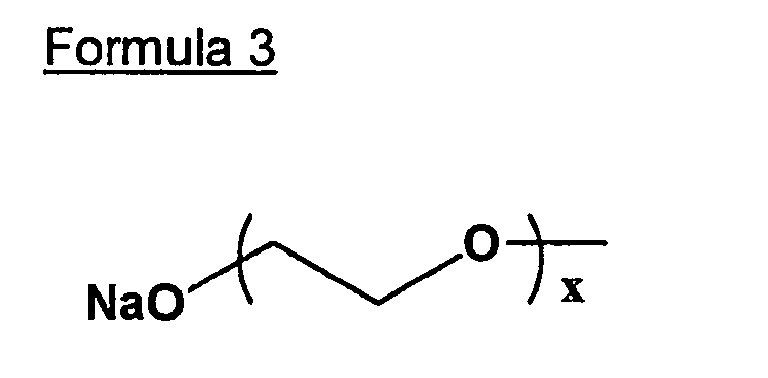
Formula 2 is vacuum dried and then is dissolved in thoroughly-dried tetrahydrofuran (THF) in a reaction flask, to which 1.0 to 1.1 equivalents of sodium (Na) or sodium hydride (NaH) is added, and then the reaction mixture in the flask is stirred in an oil bath at 70°C for 10 to 24 hours, to obtain the sodium salt of poly(ethylene glycol) represented by Formula 3.

- In
Formulae - In the second step, dried hexachlorocyclotriphosphazene represented by Formula 4 is dissolved in dried tetrahydrofuran, and the resulting solution is cooled to -78°C using a dry ice-acetone bath. To this chlorotrimer solution the previously prepared sodium salt of poly(ethylene glycol) represented by
Formula 3 is gradually added in a mole ratio of 1 : 3.3 over a period of 30 minutes to 1 hour, and the resulting reaction solution is additionally stirred for 30 minutes to 1 hour. After the dry ice-acetone bath is removed, the reaction is further continued for 8 to 12 hours at room temperature. - In the final step, 3.3 to 3.9 moles of oligopeptide ester represented by
Formula 5 per mole of the trimer and an excessive amount of triethylamine (6 to 12 moles) are dissolved in chloroform, which was added to the reaction mixture of the previous step. The resulting solution is then refluxed for 1 to 3 days to obtain the compound ofFormula 1.

- In
Formulae 4 and 5, R, R1, R2, R3, R4, a, b, c, d and e are identical to those as defined inFormula 1, respectively. In carrying out the reactions described above, benzene, toluene, chloroform or mixtures thereof can be used as a reaction solvent. - During the above described substitution procedure, it is necessary to monitor the extent of the progress of the substitution reaction by phosphorus (31P) nuclear magnetic resonance spectroscopy. After the reaction is completed, the reaction solution is filtered to remove precipitates of by-products (NaCl and NEt3·HCl), and the filtrate is concentrated under vacuum. The concentrate is then dissolved in tetrahydrofuran, and an excessive amount of ethyl ether or hexane is added to induce precipitation. This procedure is repeated at least twice to purify the product. Subsequently, thusly purified product is dissolved in a minimum amount of distilled water and placed into a dialysis membrane, thereby undergoing dialysis for 12 to 24 hours in distilled water. The dialyzed solution is freeze-dried to obtain a highly viscous cyclic phosphazene trimer with at least 60% yield. The above described reaction procedures are summarized into the following
Reaction Scheme 1.
- Hereinafter, the present invention will be further illustrated in detail by the following examples, but is not limited to the examples given.
- Elemental analysis of carbon, hydrogen and nitrogen for the compounds of the present invention was performed by the Perkin-Elmer C, H, N analyzer. Proton nuclear magnetic resonance (1H NMR) spectra were obtained by Bruker DPX-250 NMR spectrometer, and phosphorus nuclear magnetic resonance (PMR) spectra were obtained by Varian Gemini-400 NMR spectrometer.
- Methoxy poly(ethylene glycol) having a molecular weight of 350 (3.62g, 10.3 mmol) (MPEG350) and sodium metal (0.24g, 10.4 mmol) was dissolved in dried tetrahydrofuran, and the resulting mixture was refluxed under argon atmosphere for 24 hours to obtain the sodium salt of MPEG350. In the meantime, hexachlorocyclotriphosphazene (1.00g, 2.88 mmol) was dissolved in dried tetrahydrofuran in a separate reaction vessel, which was cooled in a dry ice-acetone bath (at -78 °C). To this chlorotrimer solution was slowly added for 30 minutes the previously prepared sodium salt of methoxy poly(ethylene glycol). After 30 minutes, the dry ice-acetone bath was removed, and then the reaction was continued at room temperature for 8 hours. To the resulting solution was added a solution (100ml) of triethylamine (2.61g, 25.80 mmol) and tetrapeptide (GlyPheLeuGly(Et)) (5.44g, 12.9 mmol) in chloroform, and then the reaction mixture was stirred at 50 °C for 12 hours. The reaction solution was filtered to remove the solid byproducts (NEt3· HCl and NaCl), and the filtrate was concentrated under a reduced pressure. The concentrate was dissolved in tetrahydrofuran and an excessive amount of ether or hexane was added to induce precipitation. This process was repeated twice. Then, the resultant product was dissolved in a small amount of distilled water (20 ml) for dialysis for over 24 hours using the dialysis membrane (MWCO: 1000) in distilled water and then freeze-dried to obtain the phosphazene trimer, [NP(MPEG350)(GlyPheLeuGlyEt)]3 (74% yield). The resultant product was further purified by reprecipitating from its aqueous solution (10%) at its lower critical solution temperature and then finally was freeze-dried to obtain the final product in 64% yield.
Empirical formula: C36H62N5O13P1
Elemental Analysis:
Found: C, 53.23; H, 7.91; N, 8.60, Calculated: C, 53.79; H, 7.77; N, 8.71
1H NMR spectral data (in D2O, ppm):
δ 0.87 (d, 3H, Leu-(CH 3 ) 2 )
δ 1.12 (t, 3H, Gly-OCH2 CH 3 )
δ 1.2-1.3 (m, Leu-CHCH 2 (CH3)2
δ 2.95 (dd, 2H, Phe-CH 2 )
δ 3.2 (s, 3H, MPEG350-OCH 3 )
δ 3.25-3.6 (b, 30H, MPEG350-OCH 2 CH 2 )
δ 3.65 (d, 2H, Gly-CH 2 )
δ 3.83 (d, 2H, Gly-CH 2 )
δ 3.82 (m, 2H,Gly-OCH 2 CH3)
δ 4.1 (dd, 1H, Leu-CH)
δ 4.42 (t, 1H, Phe-CH)
δ 7.14 (m, 5H, Phe-arom),
Lower critical solution temperature: 36 °C
Phosphorus nuclear magnetic resonance spectral data (in D2O, ppm): δ 22.03 - By using MPEG350 (3.62g, 10.3 mmol), sodium metal (0.24g, 10.4 mmol), triethyleneglycol (2.61g, 25.80 mmol) and a tetrapeptide (GlyPheLeuAspEt2) (6.56g, 12.9 mmol), the final product, N3P3(MPEG350)3(GlyPheLeuAspEt2)3, (64% yield) was obtained by the same method as described in Example 1.
Empirical formula: C120H204N15O45P3
Elemental Analysis:
Found: C, 53.77; H, 7.85; N, 7.86, Calculated: C, 53.98; H, 7.70; N, 7.87
1H NMR spectral data (in D2O, ppm):
δ 0.87 (d, 6H, Leu-(CH 3 ) 2 )
δ 1.12 (t, 3H, Gly-OCH2 CH 3 )
δ 1.2-1.3 (m, 3H, Leu-CHCH 2 )
δ 2.95 (dd, 2H, Phe-CH 2 )
δ 3.2 (s, 3H, MPEG350-OCH 3 )
δ 3.25-3.6 (b, 30H, MPEG350-OCH 2 CH 2 )
δ 3.65 (d, 2H, Gly-CH 2 )
δ 4.1 (dd, 1 H, Leu-CH)
δ 4.2 (d, 2H, Asp-CH 2 )
δ 4.42 (t, 1 H, Phe-CH)
δ 7.14 (m, Phe-arom)
Lower critical solution temperature: 33 °C
Phosphorus Nuclear magnetic resonance spectral data (in D2O, ppm): δ 22.03 - By using MPEG350 (3.62g, 10.3 mmol), sodium metal (0.24g, 10.4 mmol), triethylamine (2.61g, 25.80 mmol) and a tetrapeptide (GlyPheLeuGluEt2) (6.73g, 12.9 mmol), the final product, N3P3(MPEG350)3(GlyPheLeuGluEt2)3, (67% yield) was obtained by the same method as described in Example 1.
Empirical formula: C123H210N15O45P3
Elemental Analysis:
Found: C, 54.51; H, 7.94; N, 7.82, Calculated: C, 54.47; H, 7.80; N, 7.75
1H NMR spectral data (D2O, ppm):
δ 0.87 (d, 6H,Leu-(CH 3 ) 2 )
δ 1.11-1.21 (t, 3H, Glu-OCH2 CH 3 )
δ 1.2-1.3 (m, 3H, Leu-CH 3 )
δ 1.8-2.0 (m, 1H, Glu-NHCHCOOCH 2 CH2 C OO-)
δ 2.0-2.2 (m, 1 H, Glu-CH 2 )
δ 2.38 (t, 2H, Glu-CH 2)
δ 2.95 (dd, 2H, Phe-CH 2 )
δ 3.20 (s, 3H, MPEG350-OCH 3 )
δ 3.25-3.6 (b, 30H,MPEG350-OCH 2 CH 2 )
δ 3.65 (d, 2H, Gly-CH 2 )
δ 4.00-4.11 (m, 2H,Glu-CH 2 )
δ 4.17 (m, 1H, Leu-CH)
δ 4.41 (dd, 1H, Glu-CH)
δ 4.41-4.50 (m, 1 H, Leu-CH)
δ 4.7 (m, 1H, Phe-CH)
δ 7.14 (m, 5H, Phe-arom)
Lower critical solution temperature: 31 °C
Phosphorus Nuclear magnetic resonance spectral data (in D2O, ppm): δ 22.03 - By using MPEG550 (5.67g, 10.3 mmol), sodium metal (0.24g, 10.4 mmol), triethylamine (2.61g, 25.80 mmol) and a tetrapeptide (GlyPheLeuAspEt2) (6.56g, 12.9 mmol), the final product, N3P3(MPEG550)3(GlyPheLeuAspEt2)3, (61% yield) was obtained by the same method as described in Example 1.
Empirical formula: C150H237N15O48P3
Elemental Analysis:
Found: C, 57.26; H, 7.57; N, 7.66, Calculated: C, 57.13; H, 7.58; N, 7.99
1H NMR spectral data (in D2O, ppm):
δ 0.87 (d, 6H, Leu-(CH 3 ) 2 )
δ 1.12 (t, 6H, Asp-OCH2 CH 3 )
δ 1.47-1.80 (m, 3H, Leu-CHCH 2 )
δ 2.95 (dd, 2H, Phe-CH 2 )
δ 3.20 (s, 3H, MPEG50-OCH 3 )
δ 3.25-3.6 (b, 48H, MPEG550-OCH 2 CH 2 )
δ 3.82 (m, 2H, Gly-OCH 2 CH3)
δ 4.12-4.21 (m, 4H, Asp-OCH 2 CH3)
δ 4.41-4.50 (m, 1H, Leu-CH)
δ 4.53 (m, 1H, Phe-CH)
δ 4.8-4.9 (m, 1H, Asp-CH)
δ 7.14 -7.29(m, 5H, Phe-arom)
Lower critical solution temperature: 53°C
Phosphorus Nuclear magnetic resonance spectral data (in D2O, ppm): δ 22.03 - By using MPEG550 (5.67g, 10.3 mmol), sodium metal (0.24g, 10.4 mmol), triethylamine (2.61g, 25.80 mmol) and a pentapeptide (GlyPheLeuPheGluEt2) (8.28g, 12.9 mmol), the final product, N3P3(MPEG550)3(GLyPheLeuPheGlu(Et))3, (62% yield) was obtained by the same method as described in Example 1.
Empirical formula: C120H297N18O63P3
Elemental Analysis:
Found: C, 57,32; H, 8.02; N, 6.50, Calculated: C, 56.68; H, 7.85; N, 6.61
1H NMR spectral data (in D2O, ppm):
δ 0.76-0.90 (d, 6H, Leu-(CH 3 ) 2
δ 1.11-1.21 (t, 3H, Glu-OCH2 CH 3)
δ 1.8-2.0 (m, 1 H, Glu-CH 2 )
δ 2.0-2.2 (m, 1H, Glu-CH 2 )
δ 2.38 (t, 2H, Glu-CH 2 )
δ 2.95 (dd, 2H, Phe-CH 2 )
δ 3.20 (s, 3H, MPEG350-OCH 3 )
δ 3.25-3.6 (b, 48H, MPEG550-OCH 2 CH 2 )
δ 3.65 (d, 2H, Gly-CH 2 )
δ 4.00-4.11 (m, 2H,Glu-CH 2 )
δ 4.17 (m, 1H, Leu-CH)
δ 4.41 (dd, 1H, Glu-CH)
δ 4.41-4.50 (m, 1H, Leu-CH)
δ 4.68 (m, 1H, Phe-CH)
δ 4.82(m, 1 H, Phe-CH)
δ 7.14 (m, 5H, Phe-arom)
Lower critical solution temperature: 35°C
Phosphorus Nuclear magnetic resonance spectral data (in D2O, ppm): δ 22.13 - By using MPEG550 (5.44g, 10.3 mmol), sodium metal (0.24g, 10.4 mmol), triethylamine (2.61g, 25.80 mmol) and a pentapeptide (GlyPheLeuGlyGluEt2) (7.48g, 12.9 mmol), the final product, N3P3(MPEG550)3(GlyPheLeuGlyGluEt2)3, (60% yield) was obtained by the same method as described in Example 1.
Empirical formula: C159H279N18O63P3
Elemental Analysis:
Found: C, 54.21; H, 8.22; N, 6.98, Calculated: C, 53.89; H, 7.94; N, 7.11.
1H NMR spectral data (in D2O, ppm):
δ 0.87 (d, 6H, Leu-(CH3)2)
δ 1.11-1.21 (t, 6H, Glu-OCH2 CH 3 )
δ 1.8-2.0 (m, 1H, Glu-CH 2 )
δ 2.0-2.2 (m, 1H, Glu-CH 2 )
δ 2.38 (t, 2H, Glu-CH 2 )
δ 2.95 (dd, 2H, Phe-CH 2 )
δ 3.20 (s, 3H, MPEG350-OCH 3 )
δ 3.25-3.6 (b, 48H, MPEG550-OCH 2 CH 2 )
δ 3.65 (d, 2H, Gly-CH 2 )
δ 3.85-3.98 (d, 4H, Gly-CH 2 )
δ 4.00-4.11 (m, 2H,Glu-OCH 2 CH3)
δ 4.17 (m, 1H, Leu-CH)
δ 4.41 (dd, 1 H, Glu-CH)
δ 4.68 (m, 1H, Phe-CH)
δ 7.14 (m, 5H, Phe-arom)
Lower critical solution temperature: 42°C
Phosphorus Nuclear magnetic resonance spectral data (in D2O, ppm): δ 22.03 - By using MPEG750 (7.74g, 10.3 mmol), sodium metal (0.24g, 10.4 mmol), triethylamine (2.61g, 25.80 mmol) and a pentapeptide (GlyPheLeuPheGluEt2) (8.28g, 12.94 mmol), the final product, N3P3(MPEG750)3(GlyPheLeuPheGluEt2)3, (58% yield) was obtained by the same method as described in Example 1.
Empirical formula: C204H345N18O75P3
Elemental Analysis:
Found: C, 55.92; H, 7.90; N, 5.51, Calculated: C, 56.42; H, 8.01; N, 5.81
1H NMR spectral data (in D2O, ppm):
δ 0.80-1.0 (d, 6H, Leu-CH 3 )
δ 1.11-1.21 (t, 3H, Glu-OCH2 CH 3 )
δ 1.2-1.3 (m, 3H, Leu-CHCH 2
δ 1.8-2.0 (m, 1H, Glu-CH 2 )
δ 2.0-2.2 (m, 1H, Glu-CH 2 )
δ 2.38 (t, 2H, Glu-CH 2 )
δ 2.95 (dd, 2H, Phe-CH 2 )
δ 3.20 (s, 3H, MPEG750-OCH 3 )
δ 3.25-3.6 (b, 64H, MPEG750-OCH 2 CH 2 )
δ 3.65 (d, 4H, Gly-CH 2 )
δ 4.00-4.11(m, 2H,Glu-CH 2 )
δ 4.17 (m, 1H, Leu-CH)
δ 4.41 (dd, 1 H, Glu-CH)
δ 4.41-4.50 (m, 1H, Leu-CH)
δ 4.68 (m, 1H, Phe-CH)
δ 4.82(m, 1 H, Phe-CH)
δ 7.14 (m, 5H, Phe-arom)
Lower critical solution temperature: 45°C
Phosphorus Nuclear magnetic resonance spectral data (in D2O, ppm): δ
22.03 - Whether or not the amphiphilic phosphazene trimers of the present invention are self-assembled to form micelles was determined using dynamic light scattering (DLS) method as described below.
- The particle size of the trimer of Example 2 in aqueous solution was measured using its aqueous solutions containing 0.1 to 0.5% polymer only (
Figure 1 ) and the same polymer solutions containing Taxol (3 wt % of the trimer) (Figure 2 ). As shown in the figures, the micellar diameters are in the range of 30 ∼ 50 nm, andFigure 2 shows that the hydrophobic Taxol can be efficiently entrapped within the hydrophobic oligopeptide core of the micelle by strong hydrophobic Interaction. - Although the lower critical solution temperature of the polymer was not observed at lower concentration than 0.2 %, it was found that the micelles formed exhibit relatively uniform size of about 50 nm in diameter. However, It was confirmed by UV spectrum that the lower critical solution temperature (LCST) was observed for the polymer solutions at 0.2 % or higher polymer concentration. When the particle size of such concentrated polymer solution was measured using DLS method, contrary to the dilute polymer solution, the phosphazene trimer was found to form a secondary structure of a large aggregate having a uniform diameter of 200 ± 10 nm. Thus, it is believed that the micelles of the phosphazene trimer formed are stable at a lower temperature than LCST but they aggregate to form a secondary structure probably due to weakening of the hydrogen bonding between the outer hydrophilic PEGs of the micelle and water molecules.
- It could be confirmed from such results that the phosphazene trimers of the present invention form micelles at a low concentration (0.1%) without LCST, but at a higher concentration (0.2% or higher) these micelles aggregate to form microparticles or nanoparticles at around LCST. Furthermore, it was found that hydrophobic drugs can be efficiently entrapped within the core of the micelle.
- The drug-releasing experiment of a phosphazene trimer of the present invention containing human growth hormone (hGH) was performed in vitro, and the results are shown in
Figure 3 . - To 12.5% aqueous solution of the present phosphazene trimer of Example 3 was added hGH at a concentration of 1 mg/ml, and then the drug solution was heated to 37°C to precipitate the hGH-entrapped trimer, which exhibited high entrapment efficiency (>95%). The drug-containing trimer precipitate was dissolved in Dulbecco's phosphate buffered saline (DPBS) solution, and then the released amounts of hGH from the DPBS-solution were measured using size exclusion high performance liquid chromatography (SEC-HPLC). The results are shown in
Figure 3 , which shows that the initial burst effect (30.8%) was not so high and the drug was controlled-releasing during a period of 7 days with the total amount of cumulative release of 100 % over a period of 7 days. Therefore, it was found that the phosphazene trimer of Example 3 shows drug-releasing behavior suitable for a one-week drug formulation. - A phosphazene trimer and a protein drug (human growth hormone, hGH) were combined, and the stability of the drug and its local inflammation were tested.
- The protein drug (7.5 mg/ml) was added to the 12.5% aqueous solution of the trimer of Example 3, and whether or not there is any interaction between the drug and the trimer was determined using reversed phase high performance liquid chromatography (RP-HPLC). Comparing the chromatograms in
Figure 4 measured before and after the trimer and drug were mixed, it is shown that the trimer of the present invention does not affect the stability of the drug. - Moreover, 1 ml of the trimer solutions with the drug (+hGH) and without the drug (-hGH) were respectively administered via subcutaneous injection to the shoulders of rabbits, and any inflammation on the skin and muscle was examined. The results of such observations summarized in Table 1 showed no skin reaction (e.g. hemorrhage, edema, necrosis, etc.), and according to the autopsy opinion, no changes (color change, adhesion, spot, etc.) related to the inflammation were observed. Therefore, the phosphazene trimer of the present invention does not have local inflammation and was identified to have biocompatibility.
Table 1 Number of Days Classification Symptoms and Skin Reactions Autopsy Opinion Remarks Muscle Skin 3 T1(-hGH) - Sample was slightly distributed - No difference whether or not the drug was contained in the sample T2(+hGH) - Sample was slightly distributed - 7 T1(-hGH) - Sample was slightly distributed - T2(+hGH) - Sample was slightly distributed - - According to the present invention, a new class of biocompatible cyclic phosphazene trimers, in which poly(ethylene glycols) as a hydrophilic group and oligopeptide esters that have a stronger and broader hydrophobicity than amino acids as a hydrophobic group were introduced, thereby affording amphiphilicity and thermosensitivity of the trimers to form thermosensitive micells in aqueous solution, and a preparation method thereof are provided for a new drug delivery system.
Claims (8)
- A cyclic phosphazene trimer represented by the following Formula 1:

- A method for preparing a cyclic phosphazene trimer represented by Formula 1, comprising the consecutive steps of:(1) reacting a sodium salt of poly(ethylene glycol) represented by Formula 3 with hexachlorocyclotriphosphazene represented by Formula 4; and(2) reacting the resultant product from step (1) with an oligopeptide ester represented by Formula 5.



- The method according to claim 2, wherein step (2) is carried out in the presence of triethylamine.
- The method according to claim 2, wherein in steps (1) and (2), a solvent is selected from the group consisting of tetrahydrofuran, benzene, toluene, chloroform and mixtures thereof.
- The method according to claim 2, wherein in step (1), 3.0 - 3.3 moles of the sodium salt of poly(ethylene glycol) are used per 1 mole of hexachlorocyclotriphosphazene.
- The method according to claim 2, wherein in step (2), 3.3 - 3.9 moles of oligopeptide ester are used per 1 mole of hexachlorocyclotriphosphazene from step (1).
- The method according to claim 3, wherein 6 - 12 moles of triethylamine are used per 1 mole of hexachlorocyclotriphosphazene from step (1).
- The method according to claim 2, wherein subsequent to step (2), further comprising the steps of:(a) filtering the reaction mixture;(b) concentrating the filtrate obtained in step (a);(c) redissolving the concentrate obtained in step (b) in tetrahydrofuran;(d) inducing precipitation by adding ethyl ether or hexane to the solution obtained from step (c);(e) filtering the precipitate obtained in step (d); and(f) dialyzing the filtered precipitate in distilled water, thereby obtaining purified cyclic phosphazene trimer.
Applications Claiming Priority (2)
| Application Number | Priority Date | Filing Date | Title |
|---|---|---|---|
| KR1020040083742A KR100567397B1 (en) | 2004-10-19 | 2004-10-19 | Amphiphilic cyclic phosphazene trimers having temperature sensitivity and biocompatibility, and methods for preparing the same |
| PCT/KR2005/003217 WO2006043757A1 (en) | 2004-10-19 | 2005-09-28 | Thermosensitive and biocompatible amphiphilic cyclic phosphazene trimer and preparation method thereof |
Publications (3)
| Publication Number | Publication Date |
|---|---|
| EP1812452A1 EP1812452A1 (en) | 2007-08-01 |
| EP1812452A4 EP1812452A4 (en) | 2007-11-07 |
| EP1812452B1 true EP1812452B1 (en) | 2009-07-22 |
Family
ID=36181263
Family Applications (1)
| Application Number | Title | Priority Date | Filing Date |
|---|---|---|---|
| EP05792971A Not-in-force EP1812452B1 (en) | 2004-10-19 | 2005-09-28 | Thermosensitive and biocompatible amphiphilic cyclic phosphazene trimer and preparation method thereof |
Country Status (6)
| Country | Link |
|---|---|
| US (1) | US20060084171A1 (en) |
| EP (1) | EP1812452B1 (en) |
| JP (1) | JP4314229B2 (en) |
| KR (1) | KR100567397B1 (en) |
| DE (1) | DE602005015611D1 (en) |
| WO (1) | WO2006043757A1 (en) |
Families Citing this family (6)
| Publication number | Priority date | Publication date | Assignee | Title |
|---|---|---|---|---|
| KR100784485B1 (en) * | 2006-01-18 | 2007-12-11 | 한국과학기술연구원 | Biodegradable and thermosensitive polyorganophosphazene hydrogel, preparation method thereof and use thereof |
| KR100773029B1 (en) * | 2006-06-16 | 2007-11-05 | 이화여자대학교 산학협력단 | Biodegradable cyclic trimeric phosphazene-taxol conjugate anti-cancer agent forming water-soluble micelle and method for preparing the same |
| KR100807358B1 (en) * | 2007-04-18 | 2008-02-28 | (주)나노하이브리드 | Cyclic trimeric phosphazene-platinum (II) complex conjugate anticancer agent having cancer tissue selectivity and biodegradability and preparation method thereof |
| KR101083419B1 (en) | 2008-04-28 | 2011-11-14 | (주)씨앤팜 | Dendritic oligopeptide-grafted cyclotriphosphazene, a process for the preparation therof, and a drug delivery system containing the same |
| KR101427781B1 (en) | 2010-12-20 | 2014-08-13 | (주)씨앤팜 | Amphiphilic cyclic phosphazene trimer and hydrophobic drugs micelle-encapsulated by the trimer |
| CN102408560B (en) * | 2011-10-20 | 2013-05-01 | 同济大学 | Preparation method of environment response type radial copolymer |
Family Cites Families (3)
| Publication number | Priority date | Publication date | Assignee | Title |
|---|---|---|---|---|
| KR100259367B1 (en) * | 1998-06-23 | 2000-06-15 | 박호군 | Thermosensitive degradable polyphosphagens and their preparation method |
| KR100363394B1 (en) * | 2000-08-21 | 2002-12-05 | 한국과학기술연구원 | Temperature-sensitive cyclotriphosphazene-platinum complex, its preparation method and anticancer agent containing the same |
| RU2298000C2 (en) * | 2001-10-08 | 2007-04-27 | Клариант Файненс (Бви) Лимитед | Trisazo-compounds comprising halogen-substituted pyrimidine reactive groups and their using for coloring |
-
2004
- 2004-10-19 KR KR1020040083742A patent/KR100567397B1/en not_active Expired - Lifetime
-
2005
- 2005-09-28 EP EP05792971A patent/EP1812452B1/en not_active Not-in-force
- 2005-09-28 WO PCT/KR2005/003217 patent/WO2006043757A1/en not_active Ceased
- 2005-09-28 DE DE602005015611T patent/DE602005015611D1/en active Active
- 2005-10-14 US US11/249,257 patent/US20060084171A1/en not_active Abandoned
- 2005-10-19 JP JP2005304370A patent/JP4314229B2/en not_active Expired - Fee Related
Also Published As
| Publication number | Publication date |
|---|---|
| JP2006117674A (en) | 2006-05-11 |
| WO2006043757A1 (en) | 2006-04-27 |
| KR100567397B1 (en) | 2006-04-04 |
| DE602005015611D1 (en) | 2009-09-03 |
| EP1812452A4 (en) | 2007-11-07 |
| JP4314229B2 (en) | 2009-08-12 |
| EP1812452A1 (en) | 2007-08-01 |
| US20060084171A1 (en) | 2006-04-20 |
Similar Documents
| Publication | Publication Date | Title |
|---|---|---|
| CA2636599C (en) | Modified macromolecule | |
| EP2206502B1 (en) | Polymer conjugate of steroid | |
| US6322805B1 (en) | Biodegradable polymeric micelle-type drug composition and method for the preparation thereof | |
| KR101444274B1 (en) | Block copolymers and pharmaceutical compositions for pharmaceutical complexes | |
| US20220064384A1 (en) | Novel cationic polyphosphazene compound, polyphosphazenes-drug conjugate compound and method for preparing same | |
| CN102120036A (en) | Nano micelle of biodegradable macromolecular-bonding Pt(IV) anti-cancer medicament and preparation method thereof | |
| KR101743399B1 (en) | Biarmed PEG-TPP Conjugate as Self-Assembling Nano-drug Delivery System for Targeting Mitochondria | |
| KR20130024254A (en) | Nanoparticles using pegylated chitosan-cholanic acid complex and a process for the preparation thereof | |
| US20060084171A1 (en) | Thermosensitive and biocompatible amphiphilic cyclic phosphazene trimer and preparation method thereof | |
| KR100489197B1 (en) | Amphiphilic polymer combined with physiologically active agent, method for producing the same and sustained releasing material using the same | |
| US20070292384A1 (en) | Water soluble micelle-forming and biodegradable cyclotriphosphazene-taxol conjugate anticancer agent and preparation method thereof | |
| CN102526755A (en) | Reducibly biodegradable release controlled camptothecin nano micelle pre-medicament and preparation method | |
| KR20120126356A (en) | Nanoparticles comprising amphiphilic low molecular weight hyaluronic acid complex and a process for the preparation thereof | |
| KR100807358B1 (en) | Cyclic trimeric phosphazene-platinum (II) complex conjugate anticancer agent having cancer tissue selectivity and biodegradability and preparation method thereof | |
| Jun et al. | A micellar prodrug of paclitaxel conjugated to cyclotriphosphazene | |
| EP4547278A1 (en) | Self-assembling amphiphilic polymers as anti-covid-19 agents | |
| CN116999408B (en) | Cathepsin B-sensitive fatty acid-doxorubicin prodrug and its albumin nanoparticles, preparation methods and applications | |
| US12458701B2 (en) | Bis (hydroxy benzylidene) cyclic ketone based tetra-aza corand | |
| CN115887376B (en) | Harmine modified medicine, preparation method and application | |
| KR101495652B1 (en) | Core cross-linked polymeric micelle and method of manufacturing the same | |
| CN103936979B (en) | A kind of poly-(L-glutamic acid-co-lactic acid)-phosphatidylethanolamine graftomer and its preparation method and application | |
| WO2022084929A1 (en) | Nanoparticles for transport across the blood-brain barrier | |
| HUP2400378A1 (en) | Compounds, process for their preparation and their use for the preparation of lipid nanoparticles |
Legal Events
| Date | Code | Title | Description |
|---|---|---|---|
| PUAI | Public reference made under article 153(3) epc to a published international application that has entered the european phase |
Free format text: ORIGINAL CODE: 0009012 |
|
| 17P | Request for examination filed |
Effective date: 20070514 |
|
| AK | Designated contracting states |
Kind code of ref document: A1 Designated state(s): DE FR GB |
|
| A4 | Supplementary search report drawn up and despatched |
Effective date: 20071010 |
|
| RIC1 | Information provided on ipc code assigned before grant |
Ipc: C07F 9/6581 20060101AFI20071002BHEP |
|
| DAX | Request for extension of the european patent (deleted) | ||
| RBV | Designated contracting states (corrected) |
Designated state(s): DE FR GB |
|
| 17Q | First examination report despatched |
Effective date: 20080304 |
|
| RIN1 | Information on inventor provided before grant (corrected) |
Inventor name: KIM, JIN-KYU,KUNYOUNG APT. 102-1806 Inventor name: TOTI, UDAYA,NANO SCIENCE DIV, EWHA WOMANS UNIV. Inventor name: JUN, YONG-JOO,HANYANG APT. 101-1007 Inventor name: KIM, HYE-YOUNG Inventor name: SOHN, YOUN-SOO,HYUNDAI APT. 93-1003 Inventor name: KIM, HAE-JIN |
|
| RAP1 | Party data changed (applicant data changed or rights of an application transferred) |
Owner name: NANOHAIBRIDE CO., LTD |
|
| GRAP | Despatch of communication of intention to grant a patent |
Free format text: ORIGINAL CODE: EPIDOSNIGR1 |
|
| GRAS | Grant fee paid |
Free format text: ORIGINAL CODE: EPIDOSNIGR3 |
|
| GRAA | (expected) grant |
Free format text: ORIGINAL CODE: 0009210 |
|
| AK | Designated contracting states |
Kind code of ref document: B1 Designated state(s): DE FR GB |
|
| REG | Reference to a national code |
Ref country code: GB Ref legal event code: FG4D |
|
| REF | Corresponds to: |
Ref document number: 602005015611 Country of ref document: DE Date of ref document: 20090903 Kind code of ref document: P |
|
| PLBE | No opposition filed within time limit |
Free format text: ORIGINAL CODE: 0009261 |
|
| STAA | Information on the status of an ep patent application or granted ep patent |
Free format text: STATUS: NO OPPOSITION FILED WITHIN TIME LIMIT |
|
| 26N | No opposition filed |
Effective date: 20100423 |
|
| PGFP | Annual fee paid to national office [announced via postgrant information from national office to epo] |
Ref country code: DE Payment date: 20110322 Year of fee payment: 6 |
|
| PGFP | Annual fee paid to national office [announced via postgrant information from national office to epo] |
Ref country code: FR Payment date: 20111005 Year of fee payment: 7 Ref country code: GB Payment date: 20110926 Year of fee payment: 7 |
|
| GBPC | Gb: european patent ceased through non-payment of renewal fee |
Effective date: 20120928 |
|
| REG | Reference to a national code |
Ref country code: FR Ref legal event code: ST Effective date: 20130531 |
|
| PG25 | Lapsed in a contracting state [announced via postgrant information from national office to epo] |
Ref country code: DE Free format text: LAPSE BECAUSE OF NON-PAYMENT OF DUE FEES Effective date: 20130403 Ref country code: GB Free format text: LAPSE BECAUSE OF NON-PAYMENT OF DUE FEES Effective date: 20120928 |
|
| PG25 | Lapsed in a contracting state [announced via postgrant information from national office to epo] |
Ref country code: FR Free format text: LAPSE BECAUSE OF NON-PAYMENT OF DUE FEES Effective date: 20121001 |
|
| REG | Reference to a national code |
Ref country code: DE Ref legal event code: R119 Ref document number: 602005015611 Country of ref document: DE Effective date: 20130403 |