EP1811528A1 - Ion conductor - Google Patents
Ion conductor Download PDFInfo
- Publication number
- EP1811528A1 EP1811528A1 EP05790607A EP05790607A EP1811528A1 EP 1811528 A1 EP1811528 A1 EP 1811528A1 EP 05790607 A EP05790607 A EP 05790607A EP 05790607 A EP05790607 A EP 05790607A EP 1811528 A1 EP1811528 A1 EP 1811528A1
- Authority
- EP
- European Patent Office
- Prior art keywords
- group
- formula
- fluorine
- crosslinkable functional
- unit
- Prior art date
- Legal status (The legal status is an assumption and is not a legal conclusion. Google has not performed a legal analysis and makes no representation as to the accuracy of the status listed.)
- Withdrawn
Links
Classifications
-
- C—CHEMISTRY; METALLURGY
- C08—ORGANIC MACROMOLECULAR COMPOUNDS; THEIR PREPARATION OR CHEMICAL WORKING-UP; COMPOSITIONS BASED THEREON
- C08G—MACROMOLECULAR COMPOUNDS OBTAINED OTHERWISE THAN BY REACTIONS ONLY INVOLVING UNSATURATED CARBON-TO-CARBON BONDS
- C08G65/00—Macromolecular compounds obtained by reactions forming an ether link in the main chain of the macromolecule
- C08G65/02—Macromolecular compounds obtained by reactions forming an ether link in the main chain of the macromolecule from cyclic ethers by opening of the heterocyclic ring
- C08G65/04—Macromolecular compounds obtained by reactions forming an ether link in the main chain of the macromolecule from cyclic ethers by opening of the heterocyclic ring from cyclic ethers only
- C08G65/22—Cyclic ethers having at least one atom other than carbon and hydrogen outside the ring
-
- C—CHEMISTRY; METALLURGY
- C08—ORGANIC MACROMOLECULAR COMPOUNDS; THEIR PREPARATION OR CHEMICAL WORKING-UP; COMPOSITIONS BASED THEREON
- C08J—WORKING-UP; GENERAL PROCESSES OF COMPOUNDING; AFTER-TREATMENT NOT COVERED BY SUBCLASSES C08B, C08C, C08F, C08G or C08H
- C08J5/00—Manufacture of articles or shaped materials containing macromolecular substances
- C08J5/20—Manufacture of shaped structures of ion-exchange resins
-
- H—ELECTRICITY
- H01—ELECTRIC ELEMENTS
- H01B—CABLES; CONDUCTORS; INSULATORS; SELECTION OF MATERIALS FOR THEIR CONDUCTIVE, INSULATING OR DIELECTRIC PROPERTIES
- H01B1/00—Conductors or conductive bodies characterised by the conductive materials; Selection of materials as conductors
- H01B1/06—Conductors or conductive bodies characterised by the conductive materials; Selection of materials as conductors mainly consisting of other non-metallic substances
- H01B1/12—Conductors or conductive bodies characterised by the conductive materials; Selection of materials as conductors mainly consisting of other non-metallic substances organic substances
- H01B1/122—Ionic conductors
-
- H—ELECTRICITY
- H01—ELECTRIC ELEMENTS
- H01G—CAPACITORS; CAPACITORS, RECTIFIERS, DETECTORS, SWITCHING DEVICES, LIGHT-SENSITIVE OR TEMPERATURE-SENSITIVE DEVICES OF THE ELECTROLYTIC TYPE
- H01G11/00—Hybrid capacitors, i.e. capacitors having different positive and negative electrodes; Electric double-layer [EDL] capacitors; Processes for the manufacture thereof or of parts thereof
- H01G11/54—Electrolytes
- H01G11/56—Solid electrolytes, e.g. gels; Additives therein
-
- H—ELECTRICITY
- H01—ELECTRIC ELEMENTS
- H01G—CAPACITORS; CAPACITORS, RECTIFIERS, DETECTORS, SWITCHING DEVICES, LIGHT-SENSITIVE OR TEMPERATURE-SENSITIVE DEVICES OF THE ELECTROLYTIC TYPE
- H01G9/00—Electrolytic capacitors, rectifiers, detectors, switching devices, light-sensitive or temperature-sensitive devices; Processes of their manufacture
- H01G9/004—Details
- H01G9/022—Electrolytes; Absorbents
- H01G9/025—Solid electrolytes
- H01G9/028—Organic semiconducting electrolytes, e.g. TCNQ
-
- H—ELECTRICITY
- H01—ELECTRIC ELEMENTS
- H01G—CAPACITORS; CAPACITORS, RECTIFIERS, DETECTORS, SWITCHING DEVICES, LIGHT-SENSITIVE OR TEMPERATURE-SENSITIVE DEVICES OF THE ELECTROLYTIC TYPE
- H01G9/00—Electrolytic capacitors, rectifiers, detectors, switching devices, light-sensitive or temperature-sensitive devices; Processes of their manufacture
- H01G9/20—Light-sensitive devices
- H01G9/2004—Light-sensitive devices characterised by the electrolyte, e.g. comprising an organic electrolyte
-
- H—ELECTRICITY
- H01—ELECTRIC ELEMENTS
- H01M—PROCESSES OR MEANS, e.g. BATTERIES, FOR THE DIRECT CONVERSION OF CHEMICAL ENERGY INTO ELECTRICAL ENERGY
- H01M10/00—Secondary cells; Manufacture thereof
- H01M10/05—Accumulators with non-aqueous electrolyte
- H01M10/056—Accumulators with non-aqueous electrolyte characterised by the materials used as electrolytes, e.g. mixed inorganic/organic electrolytes
- H01M10/0564—Accumulators with non-aqueous electrolyte characterised by the materials used as electrolytes, e.g. mixed inorganic/organic electrolytes the electrolyte being constituted of organic materials only
- H01M10/0565—Polymeric materials, e.g. gel-type or solid-type
-
- C—CHEMISTRY; METALLURGY
- C08—ORGANIC MACROMOLECULAR COMPOUNDS; THEIR PREPARATION OR CHEMICAL WORKING-UP; COMPOSITIONS BASED THEREON
- C08K—Use of inorganic or non-macromolecular organic substances as compounding ingredients
- C08K5/00—Use of organic ingredients
- C08K5/0008—Organic ingredients according to more than one of the "one dot" groups of C08K5/01 - C08K5/59
- C08K5/0025—Crosslinking or vulcanising agents; including accelerators
-
- C—CHEMISTRY; METALLURGY
- C08—ORGANIC MACROMOLECULAR COMPOUNDS; THEIR PREPARATION OR CHEMICAL WORKING-UP; COMPOSITIONS BASED THEREON
- C08K—Use of inorganic or non-macromolecular organic substances as compounding ingredients
- C08K5/00—Use of organic ingredients
- C08K5/16—Nitrogen-containing compounds
- C08K5/34—Heterocyclic compounds having nitrogen in the ring
-
- H—ELECTRICITY
- H01—ELECTRIC ELEMENTS
- H01M—PROCESSES OR MEANS, e.g. BATTERIES, FOR THE DIRECT CONVERSION OF CHEMICAL ENERGY INTO ELECTRICAL ENERGY
- H01M10/00—Secondary cells; Manufacture thereof
- H01M10/05—Accumulators with non-aqueous electrolyte
- H01M10/052—Li-accumulators
-
- H—ELECTRICITY
- H01—ELECTRIC ELEMENTS
- H01M—PROCESSES OR MEANS, e.g. BATTERIES, FOR THE DIRECT CONVERSION OF CHEMICAL ENERGY INTO ELECTRICAL ENERGY
- H01M2300/00—Electrolytes
- H01M2300/0017—Non-aqueous electrolytes
- H01M2300/0065—Solid electrolytes
- H01M2300/0082—Organic polymers
-
- Y—GENERAL TAGGING OF NEW TECHNOLOGICAL DEVELOPMENTS; GENERAL TAGGING OF CROSS-SECTIONAL TECHNOLOGIES SPANNING OVER SEVERAL SECTIONS OF THE IPC; TECHNICAL SUBJECTS COVERED BY FORMER USPC CROSS-REFERENCE ART COLLECTIONS [XRACs] AND DIGESTS
- Y02—TECHNOLOGIES OR APPLICATIONS FOR MITIGATION OR ADAPTATION AGAINST CLIMATE CHANGE
- Y02E—REDUCTION OF GREENHOUSE GAS [GHG] EMISSIONS, RELATED TO ENERGY GENERATION, TRANSMISSION OR DISTRIBUTION
- Y02E10/00—Energy generation through renewable energy sources
- Y02E10/50—Photovoltaic [PV] energy
- Y02E10/542—Dye sensitized solar cells
-
- Y—GENERAL TAGGING OF NEW TECHNOLOGICAL DEVELOPMENTS; GENERAL TAGGING OF CROSS-SECTIONAL TECHNOLOGIES SPANNING OVER SEVERAL SECTIONS OF THE IPC; TECHNICAL SUBJECTS COVERED BY FORMER USPC CROSS-REFERENCE ART COLLECTIONS [XRACs] AND DIGESTS
- Y02—TECHNOLOGIES OR APPLICATIONS FOR MITIGATION OR ADAPTATION AGAINST CLIMATE CHANGE
- Y02E—REDUCTION OF GREENHOUSE GAS [GHG] EMISSIONS, RELATED TO ENERGY GENERATION, TRANSMISSION OR DISTRIBUTION
- Y02E60/00—Enabling technologies; Technologies with a potential or indirect contribution to GHG emissions mitigation
- Y02E60/10—Energy storage using batteries
-
- Y—GENERAL TAGGING OF NEW TECHNOLOGICAL DEVELOPMENTS; GENERAL TAGGING OF CROSS-SECTIONAL TECHNOLOGIES SPANNING OVER SEVERAL SECTIONS OF THE IPC; TECHNICAL SUBJECTS COVERED BY FORMER USPC CROSS-REFERENCE ART COLLECTIONS [XRACs] AND DIGESTS
- Y02—TECHNOLOGIES OR APPLICATIONS FOR MITIGATION OR ADAPTATION AGAINST CLIMATE CHANGE
- Y02E—REDUCTION OF GREENHOUSE GAS [GHG] EMISSIONS, RELATED TO ENERGY GENERATION, TRANSMISSION OR DISTRIBUTION
- Y02E60/00—Enabling technologies; Technologies with a potential or indirect contribution to GHG emissions mitigation
- Y02E60/13—Energy storage using capacitors
Definitions
- the present invention relates to an ion conductor comprising a non-crystalline fluorine-containing polyether compound having a fluoroether group in its side chain.
- the ion conductor is useful as high molecular weight electrolytes for lithium secondary batteries, solar cells, capacitors, etc.
- organic molecular compounds are mainly used for lithium secondary batteries, solar cells and capacitors. From the point of avoiding leakage of an electrolytic solution, technical development is moving toward high molecular weight electrolytes.
- high molecular weight electrolytes are those prepared in combination of a polymer containing an ethylene oxide (EO) unit with an electrolytic salt (metal salt) and those prepared in combination of a polymer containing an ethylene oxide (EO) unit and an electrolytic salt with an organic solvent.
- EO ethylene oxide
- metal salt electrolytic salt
- EO-electrolytic salt-based ion conductors have essential problems such that because a viscosity thereof is high, transfer of dissociated ions is not smooth, and because the electrolytic salt is dissolved in a poly phase crystalline polymer, an ionic conductivity is affected by a phase change, particularly by melting of an EO crystal phase, resulting in a low ionic conductivity at a temperature near room temperature, and further because a crystallization speed is slow, an ionic conductivity changes as time elapses.
- JP-A-8-22270 proposes an ion conductor which comprises a fluorine-containing polyether compound comprising a unit of: and a unit of: ( ⁇ OCH 2 CH 2 ) ⁇ , an alkali metal salt and an organic solvent.
- JP-A-9-48832 discloses an ion conductor comprising a crosslinked diacrylate containing a fluorine-containing polyether represented by: where n is from 10 to 20, a metal salt and an organic solvent.
- JP-A-11-53937 proposes to use a copolymer comprising a fluoroolefin unit and an alkyl vinyl ether or alkyl allyl ether unit having a carbonate bond.
- the present inventors have found an ion conductor which can obtain 10 ⁇ -6 S/cm even in a state of containing no organic solvent by introducing a fluoroether unit and a fluorine-containing alkyl group in a side chain of an EO unit and combining the ion conductor having a unit for enhancing solubility of an electrolytic salt with the electrolytic salt, and thus have completed the present invention.
- the present invention relates to an ion conductor comprising an ion conducting compound (I) and an electrolytic salt (II), and the ion conducting compound (I) is a non-crystalline fluorine-containing polyether compound having a fluorine-containing group in its side chain or a crosslinked product thereof and is represented by the formula (1): A-(D)-B (1) wherein D is represented by the formula (2): -(D1) n -(FAE) m -(AE) p -(Y)q - (2) where D 1 is an ether unit having a fluoroether group in its side chain and represented by the formula (2a): where Rf is a fluoroether group which may have a crosslinkable functional group; R 1 is a group or bond bonding Rf to a trunk chain; FAE is an ether unit having a fluorine-containing alkyl group in its side chain and represented by the formula (2b): where Rfa is a fluorine-containing alkyl group which may
- the ion conductor of the present invention comprises the specific ion conducting compound (I) and the electrolytic salt (II).
- the specific ion conducting compound (I) used in the present invention is a non-crystalline fluorine-containing polyether compound which has a fluorine-containing group in its side chain and is represented by the formula (1): A-(D)-B (1) wherein D is represented by the formula (2): -(D1) n -(FAE) m -(AE) p -(Y) q - (2) where D 1 is a an ether unit having a fluoroether group in its side chain and represented by the formula (2a): where Rf is a fluoroether group which may have a crosslinkable functional group; R 1 is a group or bond bonding Rf to the trunk chain; FAE is an ether unit having a fluorine-containing alkyl group in its side chain and represented by the formula (2b): where Rfa is a fluorine-containing alkyl group which may have a crosslinkable functional group; R 1 is a group or bond bonding Rfa to the trunk chain; AE is an ether
- non-crystalline fluorine-containing polyether compound (1) having a fluorine-containing group in its side chain non-crystallinity of the compound is enhanced and a viscosity of the compound is decreased by introducing a fluoroether side chain and/or a fluorine-containing alkyl group to a conventional ethylene oxide (EO) unit, and further an ability of holding an electrolyte can be enhanced by introducing a unit for enhancing solubility of the electrolyte.
- EO ethylene oxide
- fluoroether group Rf and the fluorine-containing alkyl group Rfa are excellent in oxidation resistance and are nonflammable, and therefore an excellent stability is exhibited in the case of use at high temperature.
- the unit Y to be introduced as a unit for highly dissolving the electrolyte is a unit containing the carbonate portion, the sulfonate portion and/or the phosphonate portion represented by the formulae (2d-1), (2d-2) or (2d-3), respectively:
- Example of the formula (2d-1-1) is: obtained by copolymerization with carbon dioxide
- examples of the formula (2d-1-2) are: obtained by ring-opening polymerization of: obtained by ring-opening polymerization with ethylene carbonate, obtained by ring-opening polymerization with propylene carbonate, obtained by condensation reaction with diethyl carbonate, and the like
- Examples of the unit containing the formula (2d-2): are, for instance: obtained by polycondensation reaction with SO 2 and and the like.
- Examples of the unit containing the formula (2d-3): are, for instance: obtained by polycondensation reaction with POCl 3 and and the like.
- units containing the formula (2d-1) from the viewpoint of cost and excellent reactivity, thermal stability and low hydrolyzability, and specifically: and are preferable.
- the unit D 1 having a fluoroether group which is represented by the formula (2a) is an optional unit, and at least either of this unit D 1 or the ether unit FAE having a fluorine-containing alkyl group is contained in the ion conducting compound.
- -Rf 1 - is a fluoroether unit having at least one kind selected from the group consisting of -(OCF 2 CF 2 CF 2 ) n1 -, -(CF 2 CF 2 CF 2 O) n1 -, -(OCFZ 1 CF 2 ) n1 -, -(OCF 2 CFZ 1 ) n1 -, -(OCFZ 2 ) n1 -, -(CFZ 2 O) n1 -, -(OCH 2 CF 2 CF 2 ) n1 -, -(OCF 2 CF 2 CH 2 ) n1 -, -(OCH 2 CH 2 CF 2 ) n1 -, -(OCF 2 CH 2 CH 2 ) n1 -, -(OCF 2 CF 2 CF 2 ) n1 -, -(OCF 2 CH 2 CH 2 ) n1 -, -(OCF 2 CF 2
- -Rf 1 - is preferably one or two or more kinds of repeat units selected from -(OCFZ 1 CF 2 ) n1 -, -(OCF 2 CF 2 CF 2 ) n1 -, -(OCH 2 CF 2 CF 2 ) n1 -, -(OCFZ 2 ) n1 -, -(OCZ3 2 ) n1 -, -(CFZ 1 CF 2 O) n1 -, -(CF 2 CF 2 CF 2 O) n1 -, -(CH 2 CF 2 CF 2 O) n1 -, -(CFZ 2 O) n1 - and -(CZ 3 2 O) n1 -, and particularly preferably one or two or more kinds of repeat units selected from -(OCFZ 1 CF 2 ) n1 -, -(OCF 2 CF 2 CF 2 ) n1 -, -(OCH 2 n
- n1 is preferable.
- Suitable examples thereof are, for instance, -(OCF 2 CF 2 )-, -(OCF 2 CF 2 CF 2 )-, -(OCF 2 )-, -(OCH 2 CF 2 CF 2 )-, -(OCF(CF 3 )CF 2 )-, -(OCF(CF 3 ))-, -(C(CF 3 ) 2 )O)-, -(OCFHCF 2 )-, -(OCFH)-, -(CF 2 CF 2 O)-, -(CF 2 CF 2 CF 2 O)-, -(CF 2 O)-, -(CF 2 O)-, -(CH 2 CF 2 CF 2 O)-, -(CF(CF 3 )CF 2 O)-, -(CF(CF 3 )O)-, -(OC(CF 3 ) 2 ))-, -(CFHCF 2 O)-, -(CFHO)- and the like
- X is at least one selected from hydrogen atom, halogen atom or a fluorine-containing alkyl group which has 1 to 20 carbon atoms and may have an ether bond and/or a crosslinkable functional group, and is characterized in that X does not have the above-mentioned Rf 1 and a -O-O- structure is not contained in the Rf 1 .
- Rf 1 a -O-O- structure
- -CH 2 OH, -COOCH 3 , -COOH, -CONH 2 , -CON(CH 3 ) 2 are preferable.
- Example of preferable -Rf in the formula (2a) is a fluoroether group represented by the formula (2a-2): wherein n2 is 0 or an integer of 1 or 2. This group is preferable because synthesis is easy, cost is low and a viscosity can be decreased by the introduction of branched CF 3 .
- R 1 bonding the trunk chain to Rf, Rfa or R is preferably a bonding group represented by the formula: wherein n3 is 0 or 1, n4 is 0 or 1, n5 is 0 or an integer of 1 or 2.
- R 1 are as follows (represented by Rf).
- Rf-R 1 - are: and where n2 is as defined above.
- the unit FAE having a fluorine-containing alkyl group and represented by the formula (2b) is an optional unit, and at least either of the FAE unit and the ether unit D 1 having a fluoroether group is contained without fail.
- the unit FAE having a fluorine-containing alkyl group By the introduction of the unit FAE having a fluorine-containing alkyl group, a mechanical strength, oxidation resistance, thermal stability, copolymerizability and the like are improved.
- Rfa is a fluorine-containing alkyl group which may have a crosslinkable functional group or a fluorine-containing linear or branched alkyl group which has 1 to 20 carbon atoms and may have a crosslinkable functional group.
- crosslinkable functional group are X (H and F are excluded) in the above described formula (2a-1) and preferable examples thereof.
- Rfa are preferably linear or branched perfluoroalkyl groups (Rfa 1 ) having 1 to 10 carbon atoms such as -CF 3 , -C 2 F 5 , -C 3 F 7 or -C 4 F 9 , and ⁇ Rfa 1 that is a group in which ⁇ atom of Rfa 1 is hydrogen atom such as -CF 2 H, -CF 2 CF 2 H or -(CF 2 CF 2 ) 2 H.
- Rfa 1 perfluoroalkyl groups having 1 to 10 carbon atoms such as -CF 3 , -C 2 F 5 , -C 3 F 7 or -C 4 F 9 , and ⁇ Rfa 1 that is a group in which ⁇ atom of Rfa 1 is hydrogen atom such as -CF 2 H, -CF 2 CF 2 H or -(CF 2 CF 2 ) 2 H.
- fluorine-containing alkyl groups in which at least one of fluorine atom
- the ether unit AE represented by the formula (2c) is an optional unit. By the introduction of this ether unit AE, a strength, solubility of the electrolyte and the like can be improved.
- R is hydrogen atom, an alkyl group which may have a crosslinkable functional group, an aliphatic cyclic hydrocarbon group which may have a crosslinkable functional group, or an aromatic hydrocarbon group which may have a crosslinkable functional group.
- alkyl group are linear or branched alkyl groups having 1 to 20 carbon atoms, for example, methyl and ethyl.
- aliphatic cyclic hydrocarbon group are cycloalkyl groups having 4 to 8 carbon atoms, for example, cyclopentyl and cyclohexyl.
- aromatic hydrocarbon group are, for instance, phenyl, benzyl and the like.
- crosslinkable functional group which may be introduced in those groups as a substituent are X (H, F and a fluorine-containing group are excluded) in the above described formula (2a-1) and preferable examples thereof.
- R are linear or branched alkyl groups having 1 to 20 carbon atoms from the viewpoint of excellent polymerizability, strength and solubility of the electrolyte, and methyl and ethyl are particularly preferable.
- Suitable examples of AE are, for instance,
- a and B are the same or different and each is hydrogen atom, an alkyl group which may have fluorine atom and/or a crosslinkable functional group, particularly an alkyl group which has 1 to 10 carbon atoms and may have fluorine atom and/or a crosslinkable functional group, a phenyl group which may have fluorine atom and/or a crosslinkable functional group, a -COOH group, -OR 2 where R 2 is hydrogen atom, an alkyl group which may have fluorine atom and/or a crosslinkable functional group, particularly an alkyl group which has 1 to 10 carbon atoms and may have fluorine atom and/or a crosslinkable functional group, an ester group or a carbonate group.
- a and B are not a -COOH group, -OR 2 , an ester group or a carbonate group.
- n7 is an integer of 1 to 10
- n8 is an integer of 1 to 5.
- n9 is an integer of 1 to 10
- n 10 is an integer of 1 to 5.
- the ratio of n/q is preferably 90/10 to 10/90, particularly 80/20 to 20/80 from the viewpoint of enhancement of a dielectric constant.
- the compounds thereof are, for example, combinations of six kinds of D1 of the above-mentioned formulae (2a-2-1) to (2a-2-6) and two kinds of Y of the above-mentioned formulae (2d-1-1) and (2d-1-2).
- the ratio of n/q is preferably 99/1 to 1/99, and the ratio of (n + q)/p is preferably 0.1/99.9 to 90 / 10.
- the compounds thereof are, for example, combinations of six kinds of D 1 raised in (1a) above, three kinds of AE of the above-mentioned formulae (2c-1) to (2c-3) and the above-mentioned two kinds of Y.
- the ratio of m/q is preferably 90/10 to 10/90, particularly 80/20 to 20/80 from the viewpoint of enhancement of a mechanical strength.
- the compounds thereof are, for example, combinations of eight kinds of FAE of the above-mentioned formulae (2b-1-1) to (2b-4-2) and the above-mentioned two kinds of Y.
- the ratio of m/q is preferably 90/10 to 10/90, particularly 80/20 to 20/80, and the ratio of (m + q) / p is preferably 0.1/99.9 to 50/50, particularly 1 / 99 to 40/60 from the viewpoint of enhancement of a mechanical strength.
- the compounds thereof are, for example, combinations of the above-mentioned eight kinds of FAE, the above-mentioned three kinds of AE and the above-mentioned two kinds of Y.
- the ratio of n/m/q is preferably 1/1/90 to 70/20/10, and the ratio of (n + m + q)/p is preferably 0.1/99.9 to 90/10 from the viewpoint of enhancement of a mechanical strength.
- the compounds thereof are, for example, combinations of the above-mentioned six kinds of D1, the above-mentioned eight kinds of FAE, the above-mentioned three kinds of AE and the above-mentioned two kinds of Y.
- a number average molecular weight of the non-crystalline fluorine-containing polyether compound (1) having a fluorine-containing group in its side chain is preferably not less than 500, further not less than 1,000, particularly not less than 1,500 from the point that a mechanical strength can be enhanced. It is preferable that an upper limit thereof is 100,000, further 80,000, particularly 50,000 from the point that solubility of an electrolyte can be enhanced.
- the non-crystalline fluorine-containing polyether compound (1) having a fluorine-containing group in its side chain which is used in the present invention can be prepared, for example, by an anionic polymerization reaction using, as an initiator, anions such as O - , C - and N - ; a cationic polymerization reaction using, as an initiator, a Lewis acid and a Bronsted acid; an anionic polymerization reaction or a cationic polymerization reaction using, as an initiator, a low molecular weight polymer containing the above-mentioned D1, FAE, AE or a derivative thereof; a polycondensation reaction or a polyaddition reaction using, as a precursor, a low molecular weight polymer containing the above-mentioned D1, FAE, AE or a derivative thereof.
- the solid ion-conducting compound (I) may be a crosslinked product.
- the crosslinked product can be prepared by introducing a crosslinkable functional group to the non-crystalline fluorine-containing polyether compound (1) having a fluoroether group in its side chain and as case demands, by crosslinking using a crosslinking agent.
- a crosslinkable functional group to the non-crystalline fluorine-containing polyether compound (1) having a fluoroether group in its side chain and as case demands, by crosslinking using a crosslinking agent.
- crosslinkable functional group examples include, for instance, a vinyl group, an acryl group, a glycidyl group, an epoxy group, a hydroxyl group, a carboxyl group, an acryloyl group, a cyano group, an alkoxysilyl group and the like which may be introduced to A and/or B of the formula (1), Rf of the formula (2a), Rfa of the formula (2b) and/or R of the formula (2c). Additionally there can be employed a process for post-modification by reacting a compound having a crosslinkable functional group.
- the crosslinking agent may be selected from polyfunctional compounds having, in one molecule thereof, two or more crosslinkable functional groups mentioned above.
- crosslinking agent examples include, for instance, and the like n11 is an integer of 1 to 8, and because a crosslinking reaction is good and enhancement of a mechanical strength is excellent, preferable are:
- crosslinking agents described in JP-A-2002-100405 , JP-A-9-48832 , JP-A-2002-279826 , etc. can also be used.
- the crosslinking may be carried out by a known crosslinking system suitable for a combination of the crosslinkable functional group and the crosslinking agent.
- Examples of the electrolyte (II) usable in the present invention are known metal salts, ionic liquids, inorganic polymer type salts, organic polymer type salts, and the like.
- electrolyte there are particularly suitable compounds as the electrolyte depending on an object of the ion conductor. Raised next are examples of electrolytes classified by applications of the ion conductor, but the electrolyte is not limited to them. Also in other applications, the electrolytes exemplified below can be optionally used.
- various organic metal salts of a boron anion type, an oxygen anion type, a nitrogen anion type, a carbon anion type and a phosphorous anion type can be used as a metal salt for a solid electrolyte for a lithium secondary battery, and an oxygen anion type and a nitrogen anion type can be used preferably.
- CF 3 SO 3 Li, C 4 F 9 SO 3 Li, C 8 F l7 SO 3 Li, CH 3 SO 3 Li, C 6 H 5 SO 3 Li, LiSO 3 C 2 F 4 SO 3 Li, CF 3 CO 2 Li, C 6 H 5 CO 2 Li, Li 2 C 4 O 4 and the like may be used as a metal salt of oxygen anion type, and it is particularly preferable to use CF 3 SO 3 Li, C 4 F 9 SO 3 Li and C 8 F 17 SO 3 Li.
- Examples of a metal salt of nitrogen anion type to be used are (CF 3 SO 2 ) 2 NLi (TFSI), (C 2 F 5 SO 2 ) 2 NLi (BETI), (CF 3 SO 2 )(C 4 F 9 SO 2 )NLi, (CF 3 SO 2 )(C 8 F 17 SO 2 )NLi, (CF 3 CO) 2 NLi, (CF 3 CO)(CF 3 CO 2 )NLi, ((CF 3 ) 2 CHOSO 2 ) 2 NLi, (C 2 F 5 CH 2 OSO 2 ) 2 NLi and the like, and it is particularly preferable to use (CF 3 SO 2 ) 2 NLi (TFSI) and (C 2 F 5 SO 2 ) 2 NLi (BETI).
- Metal salts which can be used as an inorganic metal salt are LiPF 6 , LiBF 4 , LiAsF6, LiClO 4 and the like, and it is particularly preferable to use LiPF 6 and LiBF 4 .
- Examples of an organic metal salt for a solid electrolyte for capacitors are Et 4 NBF 4 (Et denotes ethylene, hereinafter the same), Et 4 NClO 4 , Et 4 NPF 6 , Et 4 NAsF 6 , Et 4 NCF 3 SO 3 , Et 4 N(CF 3 SO 2 ) 2 N and Et 4 NC 4 F 9 SO 3 , and it is particularly preferable to use Et 4 NBF 4 and Et 4 NPF 6 .
- Metal salts which can be used as an inorganic metal salt are LiPF 6 , LiBF 4 , LiAsF 6 , LiClO 4 , NaPF 6 , NaBF 4 , NaAsF 6 , NaClO 4 , KPF 6 , KBF 4 , KAsF6, KClO 4 and the like, and it is particularly preferable to use LiPF 6 , LiBF 4 , NaPF 6 and NaBF4.
- metal salts for a solid electrolyte for a dye sensitizing solar cell are R 1a R 2a R 3a R 4a NI (R 1a to R 4a are the same or different, and each is an alkyl group having 1 to 3 carbon atoms), LiI, NaI, KI, and the like.
- examples of a solid electrolyte for lithium secondary batteries, capacitors and dye sensitizing solar cells are salts of an organic or inorganic anion with polyalkylimidazolium cation, N-alkylpyridinium cation, tetraalkylammonium cation or tetraalkylphosphonium cation, and particularly preferable is 1,3-dialkylimidazolium salt.
- polyalkylimidazolium cation are 1,3-dialkylimidazolium cations such as 1-ethyl-3-methylimidazolium cation (EMI + ) and 1-butyl-3-methylimidazolium cation (BMI + ); trialkylimidazolium cation such as 1,2-dimethyl-3-propylimidazolium cation (DMPI + ); and the like.
- 1,3-dialkylimidazolium cations such as 1-ethyl-3-methylimidazolium cation (EMI + ) and 1-butyl-3-methylimidazolium cation (BMI + ); trialkylimidazolium cation such as 1,2-dimethyl-3-propylimidazolium cation (DMPI + ); and the like.
- EMI + 1-ethyl-3-methylimidazolium cation
- BMI + 1-butyl-3-methylimidazolium
- inorganic anions are, for instance, AlCl 4 - , BF 4 - , PF 6 - , AsF 6 - , I - , and the like
- organic anions are, for instance, CH 3 COO - , CF 3 COO - , C 3 F 7 COO - , CF 3 SO 3 - , C 4 H 9 SO 3 - , (CF 3 SO 2 ) 2 N - , (C 2 F 5 SO 2 ) 2 N - and the like.
- EMIAlCl 4 examples thereof are EMIAlCl 4 , EMIBF 4 , EMIPF 6 , EMIAsF6, EMII, EMICH 3 COO, EMICF 3 COO, EMIC 3 F 7 COO, EMICF 3 SO 3 , EMIC 4 F 9 SO 3 , EMI(CF 3 SO 2 ) 2 N, EMI(C 2 F 5 SO 2 ) 2 N, BMIAlCl 4 , BMIBF 4 , BMIPF 6 , BMIAsF 6 , BMII, BMICH 3 COO, BMICF 3 COO, BMIC 3 F 7 COO, BMICF 3 SO 3 , BMIC 4 FgSO 3 , BMI(CF 3 SO 2 ) 2 N, BMI(C 2 F 5 SO 2 ) 2 N, DMPIAlCl 4 , DMPIBF 4 , DMPIPF 6 , DMPIAsF 6 , DMPII, DMPICH 3 COO, DMPICF 3
- iodides such as EMII, BMII and DMPII.
- the blended amount of the electrolyte (II) varies depending on required current density, application, kind of the electrolyte, etc., and is preferably not less than 0.1 part by mass based on 100 parts by mass of the high molecular weight ion conducting compound (I), further not less than 1 part by mass, particularly not less than 2 parts by mass, and not more than 200 parts by mass, further not more than 100 parts by mass, particularly not more than 50 parts by mass.
- the electrolyte (II) is held by impregnation and dissolution in the non-crystalline fluorine-containing polyether compound (1) constituting the high molecular weight ion conducting compound (I).
- a method of kneading the electrolyte (II) and the high molecular weight ion conducting compound (I) there can be employed a method of kneading the electrolyte (II) and the high molecular weight ion conducting compound (I); a method of mixing the high molecular weight ion conducting compound (I) in a solution prepared by dissolving the electrolyte (II) in a solvent and then distilling off the solvent; a method of melting the high molecular weight ion conducting compound (I) by heating and then kneading the electrolyte (II) therewith; or the like method.
- the non-crystalline fluorine-containing polyether compound (1) is in the form of solid but is low in viscosity, and therefore the ionic conductivity is high even as it is.
- an aprotic organic solvent (III) may be blended to make a gel electrolyte in the form of gel (plasticized).
- Examples of the organic solvent (III) to be used for the gel electrolyte are ethylene carbonate, propylene carbonate, butylene carbonate, ⁇ -butyrolactone, 1,2-dimethoxyethane, tetrahydrofuran, 2-methyltetrahydrofuran, 1,3-dioxolan, 4-methyl-1,3-dioxolan, methyl formate, methyl acetate, methyl propionate, dimethyl carbonate, ethyl methyl carbonate, diethyl carbonate, acetonitrile, dimethyl sulfoxide, methylpyrrolidone and the like.
- ethylene carbonate, propylene carbonate, diethyl carbonate, ⁇ -butyrolactone, 1,2-dimethoxyethane, 1,3-dioxolan and acetonitrile are preferable.
- the organic solvent (III) in such an amount that the solid content in the ion conductor is not less than 10 % by mass, further not less than 50 % by mass, particularly 100 % by mass.
- additives for instance, metal oxides, glass and the like.
- the ion conductor of the present invention is useful for a high molecular weight electrolyte for lithium secondary batteries, a high molecular weight electrolyte for capacitors, and a high molecular weight electrolyte for solar cells (particularly dye sensitizing solar cells) from the viewpoint of a high ionic conductivity and an excellent oxidation resistance and mechanical strength. Additionally the ion conductor of the present invention can be used as an electrolyte for various sensors, an electrolyte for electrochromic devices and an ion conductor to be used for various electrolyses.
- NMR AC-300 available from BRUCKER CO., LTD. is used.
- F-NMR 19 F-NMR:
- the number average molecular weight is calculated from the data obtained by measuring by gel permeation chromatography (GPC) by using GPC HLC-8020 available from Toso Kabushiki Kaisha and columns available from Shodex (one GPC KF-801, one GPC KF-802 and two GPC KF-806M are connected in series) and flowing tetrahydrofuran (THF) as a solvent at a flowing rate of 1 ml/ min.
- GPC gel permeation chromatography
- T d1.0 A 1.0 % thermal decomposition temperature (T d1.0 ) is calculated from the data obtained when heating up from room temperature at a rate of 20°C/min by using TG/DTA-6200 available from Seiko Instruments Kabushiki Kaisha.
- DSC differential scanning calorimeter
- temperature is raised up to 200°C at a temperature elevating rate of 10°C/min, followed by maintaining at 200°C for one minute and cooling down to 25°C at a temperature decreasing rate of 10°C/min, and then a center point of heat absorption curve obtained in the 2nd run of heating at a temperature elevating rate of 10°C/min is assumed to be Tg.
- the used differential scanning calorimeter is one available from Seiko Instruments Kabushiki Kaisha.
- Measurement is carried out at room temperature with a Fourier-transform infrared spectrophotometer 1760X available from Perkin Elmer Co., Ltd.
- Measurement is carried out by using a VISCONE CV series cone plate type rotational viscometer available from Misec Corporation with a cone having a measurable viscosity range of 50 to 8,000 mPa.s at 94 rpm at 80°C.
- An ionic conductivity is measured at room temperature at a frequency of 10 4 Hz to 10 1 Hz according to AC 4-terminal method.
- SI1280B available from TOYO Corporation is used as an impedance meter.
- HCFC141b/chloroform 80/20: volume ratio
- 0.065 ml of BF 3 .OEt 2 was added dropwise at 0°C in a nitrogen gas stream, followed by 24-hour stirring.
- HCFC141b/chloroform was distilled off, and the obtained liquid was poured into hexane for separation. Then the obtained liquid was poured into pure water for separation, followed by vacuum drying to obtain 4.8 g of a colorless transparent polymer.
- the polymer was found to be a polymer comprising the unit (I-1) having a fluorine-containing ether at an end of its side chain and the unit of 1,3-dioxirane-2-one at the percent by mole ratio of 74/26. Also the number average molecular weight measured by a GPC analysis using tetrahydrofuran (THF) as a solvent was 1,637, and the weight average molecular weight was 1,881. Further as a result of measurement of TGA and DSC in the air, Td 1.0 was 119.0°C and Tg was -62.5°C.
- the viscosity of this polymer measured with a cone plate type rotational viscometer was 9.2 mPa ⁇ s.
- the polymer was found to be a polymer comprising the unit (I-2) having a fluorine-containing ether at an end of its side chain and the unit of 1,3-dioxirane-2-one at the percent by mole ratio of 85/15. Also the number average molecular weight measured by a GPC analysis using tetrahydrofuran (THF) as a solvent was 1,981, and the weight average molecular weight was 2,184. Further as a result of measurement of TGA and DSC in the air, Td 1.0 was 118.8°C and Tg was -66.5°C.
- the viscosity of this polymer measured with a cone plate type rotational viscometer was 45.4 mPa ⁇ s.
- the viscosity of this polymer measured with a cone plate type rotational viscometer was 137 mPa ⁇ s.
- LiClO 4 as an electrolyte in a super-saturated amount, followed by allowing to stand overnight in a 6 ml sample bottle. After allowing to stand overnight, a transparent polymer phase was precipitated in an upper layer, and a solid was precipitated in a lower layer. The upper layer was taken out, and after forming a rectangular film, an ionic conductivity was measured. The ionic conductivity was 2.4 ⁇ 10 -8 S/cm.
- a viscosity and ionic conductivity thereof were measured.
- the viscosity was 148 mPa ⁇ s and the ionic conductivity was 7.5 ⁇ 10 -8 S/cm.
- the high molecular weight ion conductor of the present invention itself has a high ionic conductivity even at a temperature near room temperature, is low in a viscosity, is non-flammable and is excellent in oxidation resistance, and can satisfy properties required for high molecular weight electrolytes for lithium batteries, capacitors and solar cells.
Landscapes
- Chemical & Material Sciences (AREA)
- Engineering & Computer Science (AREA)
- Chemical Kinetics & Catalysis (AREA)
- Electrochemistry (AREA)
- Power Engineering (AREA)
- Manufacturing & Machinery (AREA)
- Microelectronics & Electronic Packaging (AREA)
- Physics & Mathematics (AREA)
- General Chemical & Material Sciences (AREA)
- Polymers & Plastics (AREA)
- Inorganic Chemistry (AREA)
- Dispersion Chemistry (AREA)
- Condensed Matter Physics & Semiconductors (AREA)
- Health & Medical Sciences (AREA)
- Medicinal Chemistry (AREA)
- General Physics & Mathematics (AREA)
- Organic Chemistry (AREA)
- Spectroscopy & Molecular Physics (AREA)
- Materials Engineering (AREA)
- Secondary Cells (AREA)
- Conductive Materials (AREA)
- Polyethers (AREA)
- Electric Double-Layer Capacitors Or The Like (AREA)
- Hybrid Cells (AREA)
Abstract
There is provided a high molecular weight ion conductor which has a high ionic conductivity even around room temperature, is low in a viscosity, is nonflammable, is excellent in oxidation resistance, and can satisfy characteristics required for a solid electrolyte of lithium secondary batteries, a solid electrolyte of capacitors and a solid electrolyte of solar cells. The high molecular weight ion conductor comprises an ion conducting compound (I) and an electrolytic salt (II), and the ion conducting compound (I) is a non-crystalline fluorine-containing polyether compound having a fluorine-containing group in its side chain and a unit dissolving an electrolyte, or a crosslinked product thereof.
Description
- The present invention relates to an ion conductor comprising a non-crystalline fluorine-containing polyether compound having a fluoroether group in its side chain. The ion conductor is useful as high molecular weight electrolytes for lithium secondary batteries, solar cells, capacitors, etc.
- At the present time, organic molecular compounds are mainly used for lithium secondary batteries, solar cells and capacitors. From the point of avoiding leakage of an electrolytic solution, technical development is moving toward high molecular weight electrolytes.
- Known as such high molecular weight electrolytes are those prepared in combination of a polymer containing an ethylene oxide (EO) unit with an electrolytic salt (metal salt) and those prepared in combination of a polymer containing an ethylene oxide (EO) unit and an electrolytic salt with an organic solvent.
- However EO-electrolytic salt-based ion conductors have essential problems such that because a viscosity thereof is high, transfer of dissociated ions is not smooth, and because the electrolytic salt is dissolved in a poly phase crystalline polymer, an ionic conductivity is affected by a phase change, particularly by melting of an EO crystal phase, resulting in a low ionic conductivity at a temperature near room temperature, and further because a crystallization speed is slow, an ionic conductivity changes as time elapses.
- Accordingly, in order to decrease a viscosity and also to increase an ionic conductivity at a temperature near room temperature, various trials for enhancing non-crystallinity have been made by changing kind of polyethers. As a result, dependency on temperature is considerably reduced, but actually an ionic conductivity is not so enhanced and is not in a practical level.
- As a trial for decreasing a viscosity, it is proposed to introduce bulky CF3 group to EO. For example,
JP-A-8-22270 
(̵OCH2CH2)̵,
an alkali metal salt and an organic solvent. - Also
JP-A-9-48832 
- Further
JP-A-11-53937 - Additionally use of a compound containing a polyfluoroether unit in its trunk chain as an ion conductor is disclosed in
JP-A-2003-257240 - However in any of the compounds containing a fluorine-containing ether unit which are disclosed in those Patent Documents, a large ionic conductivity can be obtained only by gelation with an organic solvent because an action of decreasing a viscosity is insufficient.
- It is an object of the present invention to provide an ion conductor which can achieve an ionic conductivity larger than that of the above described conventional ion conductors.
- The present inventors have found an ion conductor which can obtain 10 × -6 S/cm even in a state of containing no organic solvent by introducing a fluoroether unit and a fluorine-containing alkyl group in a side chain of an EO unit and combining the ion conductor having a unit for enhancing solubility of an electrolytic salt with the electrolytic salt, and thus have completed the present invention.
- Namely, the present invention relates to an ion conductor comprising an ion conducting compound (I) and an electrolytic salt (II), and the ion conducting compound (I) is a non-crystalline fluorine-containing polyether compound having a fluorine-containing group in its side chain or a crosslinked product thereof and is represented by the formula (1):
A-(D)-B (1)
wherein D is represented by the formula (2):
-(D1)n-(FAE)m-(AE)p-(Y)q- (2)
where D 1 is an ether unit having a fluoroether group in its side chain and represented by the formula (2a):

AE is an ether unit represented by the formula (2c):


- The ion conductor of the present invention comprises the specific ion conducting compound (I) and the electrolytic salt (II).
- The specific ion conducting compound (I) used in the present invention is a non-crystalline fluorine-containing polyether compound which has a fluorine-containing group in its side chain and is represented by the formula (1):
A-(D)-B (1)
wherein D is represented by the formula (2):
-(D1)n-(FAE)m-(AE)p-(Y)q- (2)
where D 1 is a an ether unit having a fluoroether group in its side chain and represented by the formula (2a):


- In this non-crystalline fluorine-containing polyether compound (1) having a fluorine-containing group in its side chain, non-crystallinity of the compound is enhanced and a viscosity of the compound is decreased by introducing a fluoroether side chain and/or a fluorine-containing alkyl group to a conventional ethylene oxide (EO) unit, and further an ability of holding an electrolyte can be enhanced by introducing a unit for enhancing solubility of the electrolyte.
- Further the fluoroether group Rf and the fluorine-containing alkyl group Rfa are excellent in oxidation resistance and are nonflammable, and therefore an excellent stability is exhibited in the case of use at high temperature.
- The unit Y to be introduced as a unit for highly dissolving the electrolyte is a unit containing the carbonate portion, the sulfonate portion and/or the phosphonate portion represented by the formulae (2d-1), (2d-2) or (2d-3), respectively:
- Examples of the units containing the formula (2d-1):

the formula (2d-1-1):
the formula (2d-1-2):
- Example of the formula (2d-1-1) is:

examples of the formula (2d-1-2) are:


- Examples of the unit containing the formula (2d-2):


- Examples of the unit containing the formula (2d-3):


- Of these units, preferable are units containing the formula (2d-1) from the viewpoint of cost and excellent reactivity, thermal stability and low hydrolyzability, and specifically:


- The unit D 1 having a fluoroether group which is represented by the formula (2a) is an optional unit, and at least either of this unit D 1 or the ether unit FAE having a fluorine-containing alkyl group is contained in the ion conducting compound.
- In the formula (2a), preferable examples of -Rf are groups represented by the formula (2a-1):
-Rf1-X (2a-1)
wherein -Rf1- is a fluoroether unit having at least one kind selected from the group consisting of -(OCF2CF2CF2)n1-, -(CF2CF2CF2O)n1-, -(OCFZ1CF2)n1-, -(OCF2CFZ1)n1-, -(OCFZ2)n1-, -(CFZ2O)n1-, -(OCH2CF2CF2)n1-, -(OCF2CF2CH2)n1-, -(OCH2CH2CF2)n1-, -(OCF2CH2CH2)n1-, -(OCF2CF2CF2CF2)n1-, -(CF2CF2CF2CF2O)n1-, -(OCFZ2CH2)n1-, -(CH2CFZ2O)n1-, -(OCH(CH3)CF2CF2)n1-, -(OCF2CF2CH(CH3))n1-, -(CFZ1CF2O)n1-, -(CF2CF2CF2O)n1-, -(CH2CF2CF2O)n1-, -(OCZ3 2)n1- and -(CZ3 2O)n1- where Z1 and Z2 may be the same or different and each is H, F or CF3; Z3 is CF3; n1 is an integer of 1 to 3; X is at least one kind selected from hydrogen atom, halogen atom or a fluorine-containing alkyl group which has 1 to 20 carbon atoms and may have an ether bond and/or a crosslinkable functional group, and X does not have the above-mentioned Rf1 and a -O-O- structure is not contained in the Rf1. - Specifically -Rf1- is preferably one or two or more kinds of repeat units selected from -(OCFZ1CF2)n1-, -(OCF2CF2CF2)n1-, -(OCH2CF2CF2)n1-, -(OCFZ2)n1-, -(OCZ32)n1-, -(CFZ1CF2O)n1-, -(CF2CF2CF2O)n1-, -(CH2CF2CF2O)n1-, -(CFZ2O)n1- and -(CZ3 2O)n1-, and particularly preferably one or two or more kinds of repeat units selected from -(OCFZ1CF2)n1-, -(OCF2CF2CF2)n1-, -(OCH2CF2CF2)n1-, -(CFZ1CF2O)n1-, -(CF2CF2CF2O)n1- and -(CH2CF2CF2O)n1-, further preferably one or two or more kinds of repeat units selected from -(OCFZ1CF2)n1-, -(OCF2CF2CF2)n1-, -(CFZ1CF2O)n1- and -(CF2CF2CF2O)n1-.
- Since the fluoroether group tends to decrease a dielectric constant, smaller n1 is preferable.
- Suitable examples thereof are, for instance, -(OCF2CF2)-, -(OCF2CF2CF2)-, -(OCF2)-, -(OCH2CF2CF2)-, -(OCF(CF3)CF2)-, -(OCF(CF3))-, -(C(CF3)2)O)-, -(OCFHCF2)-, -(OCFH)-, -(CF2CF2O)-, -(CF2CF2CF2O)-, -(CF2O)-, -(CH2CF2CF2O)-, -(CF(CF3)CF2O)-, -(CF(CF3)O)-, -(OC(CF3)2))-, -(CFHCF2O)-, -(CFHO)- and the like, and from the viewpoint of excellent thermal stability and oxidation resistance and easy synthesis, specifically preferable are -(OCF2CF2)-, -(OCF2CF2CF2)-, -(OCF2)-, -(OCH2CF2CF2)-, -(OCF(CF3)CF2)-, -(OCF(CF3))-, -(CF2CF2O)-, -(CF2CF2CF2O)-, -(CF2O)-, -(CH2CF2CF2O)-, -(CF(CF3)CF2O)- and -(CF(CF3)O)-.
- Also X is at least one selected from hydrogen atom, halogen atom or a fluorine-containing alkyl group which has 1 to 20 carbon atoms and may have an ether bond and/or a crosslinkable functional group, and is characterized in that X does not have the above-mentioned Rf1 and a -O-O- structure is not contained in the Rf1. Examples thereof are H, F, -CH2OH, -CH=CH2, -CH2CH=CH2, -COOCH3, -COOH, -CONH2, -CON(CH3)2,



-C≡N, -CH2NH2
and the like. Among them, from the viewpoint of excellent crosslinkability and enhancement of a dielectric constant, -CH2OH, -COOCH3, -COOH, -CONH2, -CON(CH3)2,

- Example of preferable -Rf in the formula (2a) is a fluoroether group represented by the formula (2a-2):

- In the above-mentioned formulae (2a), (2b) and (2c), R1 bonding the trunk chain to Rf, Rfa or R is preferably a bonding group represented by the formula:

- Preferable R1 are as follows (represented by Rf).
- In this type, n3=n4=n5=0 and R1 is a bond.
- -(CH2)m1-Rf (m1 is an integer of 1 to 3)
- -CH2-O-CH2-Rf or -CH2-O-CH2-(CH2)m2-Rf (m2 is an integer of 1 to 5)
-

- Next, suitable examples of D 1 are, for instance,
- (i) Direct bonding type:
- for example, the formula (2a-2-1):

- for example, the formula (2a-2-1):
- (ii) Alkylene type:
- for example, the formula (2a-2-2):

- the formula (2a-2-3):

- for example, the formula (2a-2-2):
- (iii) Ether type:
- for example, the formula (2a-2-4):

- the formula (2a-2-5):

- for example, the formula (2a-2-4):
- (iv) Ester type:
- for example, the formula (2a-2-6):

- for example, the formula (2a-2-6):
- In these, from the viewpoint of excellent reactivity and easy synthesis, preferable examples of Rf-R1- are:


- The unit FAE having a fluorine-containing alkyl group and represented by the formula (2b) is an optional unit, and at least either of the FAE unit and the ether unit D 1 having a fluoroether group is contained without fail.
- By the introduction of the unit FAE having a fluorine-containing alkyl group, a mechanical strength, oxidation resistance, thermal stability, copolymerizability and the like are improved.
- In the formula (2b), Rfa is a fluorine-containing alkyl group which may have a crosslinkable functional group or a fluorine-containing linear or branched alkyl group which has 1 to 20 carbon atoms and may have a crosslinkable functional group.
- Preferable examples of the crosslinkable functional group are X (H and F are excluded) in the above described formula (2a-1) and preferable examples thereof.
- Rfa are preferably linear or branched perfluoroalkyl groups (Rfa1) having 1 to 10 carbon atoms such as -CF3, -C2F5, -C3F7 or -C4F9, and ωRfa1 that is a group in which ω atom of Rfa1 is hydrogen atom such as -CF2H, -CF2CF2H or -(CF2CF2)2H. Examples thereof are fluorine-containing alkyl groups in which at least one of fluorine atoms or hydrogen atom is replaced by the above described crosslinkable functional group.
- Also in the formula (2b), as a type of bond to the trunk chain by R1, the above described four types can be adopted.
- Next, suitable examples of FAE are, for instance,
- (i) Direct bonding type:
- for example, the formula (2b-1-1):

- the formula (2b-1-2):

- for example, the formula (2b-1-1):
- (ii) Alkylene type:
- for example, the formula (2b-2-1):

- the formula (2b-2-2):

- the formula (2b-2-3):
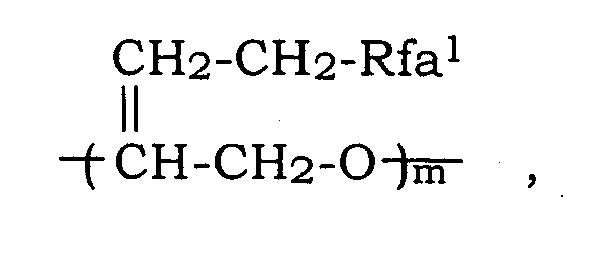
- the formula (2b-2-4):

- for example, the formula (2b-2-1):
- (iii) Ether type
for example, the formula (2b-3-1):

- (iv) Ester type
for example, the formula (2b-4-1):

- The ether unit AE represented by the formula (2c) is an optional unit. By the introduction of this ether unit AE, a strength, solubility of the electrolyte and the like can be improved.
- In the formula (2c), R is hydrogen atom, an alkyl group which may have a crosslinkable functional group, an aliphatic cyclic hydrocarbon group which may have a crosslinkable functional group, or an aromatic hydrocarbon group which may have a crosslinkable functional group.
- Preferable examples of the alkyl group are linear or branched alkyl groups having 1 to 20 carbon atoms, for example, methyl and ethyl.
- Preferable examples of the aliphatic cyclic hydrocarbon group are cycloalkyl groups having 4 to 8 carbon atoms, for example, cyclopentyl and cyclohexyl.
- Preferable examples of the aromatic hydrocarbon group are, for instance, phenyl, benzyl and the like.
- Preferable examples of the crosslinkable functional group which may be introduced in those groups as a substituent are X (H, F and a fluorine-containing group are excluded) in the above described formula (2a-1) and preferable examples thereof.
- Preferable examples of R are linear or branched alkyl groups having 1 to 20 carbon atoms from the viewpoint of excellent polymerizability, strength and solubility of the electrolyte, and methyl and ethyl are particularly preferable.
- Additionally also in the formula (2c), as a type of bond to the trunk chain by R1, the above described four types can be adopted, and particularly preferable are a direct bonding type and an ether type.
- Next, suitable examples of AE are, for instance,
- (i) Direct bonding type:
- for example, the formula (2c-1):

- for example, the formula (2c-1):
- (ii) Alkylene type:
- This type is included in the direct bonding type (i).
- (iii) Ether type:
- for example, the formula (2c-2):

- for example, the formula (2c-2):
- (iv) Ester type:
- for example, the formula (2c-3):

- for example, the formula (2c-3):
- Examples thereof are, for instance,


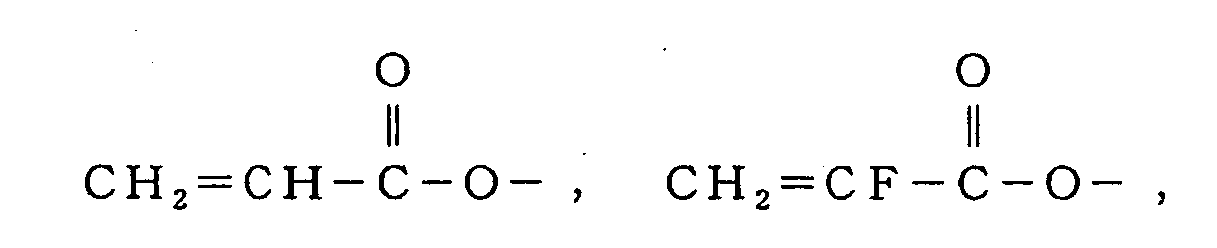
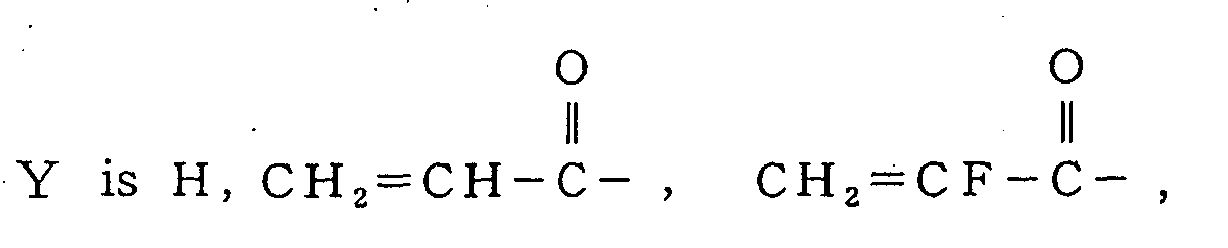
- In the non-crystalline fluorine-containing polyether compound (1) having, in its side chain, a fluoroether group which is used in the present invention, A and B are the same or different and each is hydrogen atom, an alkyl group which may have fluorine atom and/or a crosslinkable functional group, particularly an alkyl group which has 1 to 10 carbon atoms and may have fluorine atom and/or a crosslinkable functional group, a phenyl group which may have fluorine atom and/or a crosslinkable functional group, a -COOH group, -OR2 where R2 is hydrogen atom, an alkyl group which may have fluorine atom and/or a crosslinkable functional group, particularly an alkyl group which has 1 to 10 carbon atoms and may have fluorine atom and/or a crosslinkable functional group, an ester group or a carbonate group. When an end of D is oxygen atom, A and B are not a -COOH group, -OR2, an ester group and a carbonate group.
- Preferable examples of A are, for instance,




- Preferable examples of B are, for instance,



- In the non-crystalline fluorine-containing polyether compound (1) having a fluorine-containing group in its side chain, the proportions of each unit (percentages of n, m, p and q, assuming that n + m +p + q is 100) are preferably n = 0.1 to 90 %, m = 10 to 90 %, p = 10 to 99 %, and q = 10 to 90 %.
- Then the following compounds are raised as the examples of the non-crystalline fluorine-containing polyether compound having a fluorine-containing group in its side chain which is represented by the formula (1), in view of a combination of the units thereof.
- This combination is excellent because both of decrease in a viscosity and enhancement of a dielectric constant can be achieved. The ratio of n/q is preferably 90/10 to 10/90, particularly 80/20 to 20/80 from the viewpoint of enhancement of a dielectric constant.
- Specifically the compounds thereof are, for example, combinations of six kinds of D1 of the above-mentioned formulae (2a-2-1) to (2a-2-6) and two kinds of Y of the above-mentioned formulae (2d-1-1) and (2d-1-2).
- This combination is excellent from the viewpoint of enhancement of a mechanical strength and enhancement of solubility of an electrolyte. The ratio of n/q is preferably 99/1 to 1/99, and the ratio of (n + q)/p is preferably 0.1/99.9 to 90 / 10.
- Specifically the compounds thereof are, for example, combinations of six kinds of D 1 raised in (1a) above, three kinds of AE of the above-mentioned formulae (2c-1) to (2c-3) and the above-mentioned two kinds of Y.
- This combination is excellent from the viewpoint of enhancement of a mechanical strength, oxidation resistance and a dielectric constant. The ratio of m/q is preferably 90/10 to 10/90, particularly 80/20 to 20/80 from the viewpoint of enhancement of a mechanical strength.
- Specifically the compounds thereof are, for example, combinations of eight kinds of FAE of the above-mentioned formulae (2b-1-1) to (2b-4-2) and the above-mentioned two kinds of Y.
- This combination is excellent from the viewpoint of enhancement of a mechanical strength and oxidation resistance. The ratio of m/q is preferably 90/10 to 10/90, particularly 80/20 to 20/80, and the ratio of (m + q) / p is preferably 0.1/99.9 to 50/50, particularly 1 / 99 to 40/60 from the viewpoint of enhancement of a mechanical strength.
- Specifically the compounds thereof are, for example, combinations of the above-mentioned eight kinds of FAE, the above-mentioned three kinds of AE and the above-mentioned two kinds of Y.
- This combination is excellent from the viewpoint of decrease in a viscosity and enhancement of a mechanical strength and oxidation resistance. The ratio of n/m/q is preferably 1/1/90 to 70/20/10, and the ratio of (n + m + q)/p is preferably 0.1/99.9 to 90/10 from the viewpoint of enhancement of a mechanical strength.
- Specifically the compounds thereof are, for example, combinations of the above-mentioned six kinds of D1, the above-mentioned eight kinds of FAE, the above-mentioned three kinds of AE and the above-mentioned two kinds of Y.
- A number average molecular weight of the non-crystalline fluorine-containing polyether compound (1) having a fluorine-containing group in its side chain is preferably not less than 500, further not less than 1,000, particularly not less than 1,500 from the point that a mechanical strength can be enhanced. It is preferable that an upper limit thereof is 100,000, further 80,000, particularly 50,000 from the point that solubility of an electrolyte can be enhanced.
- The non-crystalline fluorine-containing polyether compound (1) having a fluorine-containing group in its side chain which is used in the present invention can be prepared, for example, by an anionic polymerization reaction using, as an initiator, anions such as O-, C- and N-; a cationic polymerization reaction using, as an initiator, a Lewis acid and a Bronsted acid; an anionic polymerization reaction or a cationic polymerization reaction using, as an initiator, a low molecular weight polymer containing the above-mentioned D1, FAE, AE or a derivative thereof; a polycondensation reaction or a polyaddition reaction using, as a precursor, a low molecular weight polymer containing the above-mentioned D1, FAE, AE or a derivative thereof.
- In the present invention, the solid ion-conducting compound (I) may be a crosslinked product. The crosslinked product can be prepared by introducing a crosslinkable functional group to the non-crystalline fluorine-containing polyether compound (1) having a fluoroether group in its side chain and as case demands, by crosslinking using a crosslinking agent. By using the crosslinked product, a mechanical strength of the ion conductor is remarkably enhanced.
- Examples of the crosslinkable functional group are, for instance, a vinyl group, an acryl group, a glycidyl group, an epoxy group, a hydroxyl group, a carboxyl group, an acryloyl group, a cyano group, an alkoxysilyl group and the like which may be introduced to A and/or B of the formula (1), Rf of the formula (2a), Rfa of the formula (2b) and/or R of the formula (2c). Additionally there can be employed a process for post-modification by reacting a compound having a crosslinkable functional group.
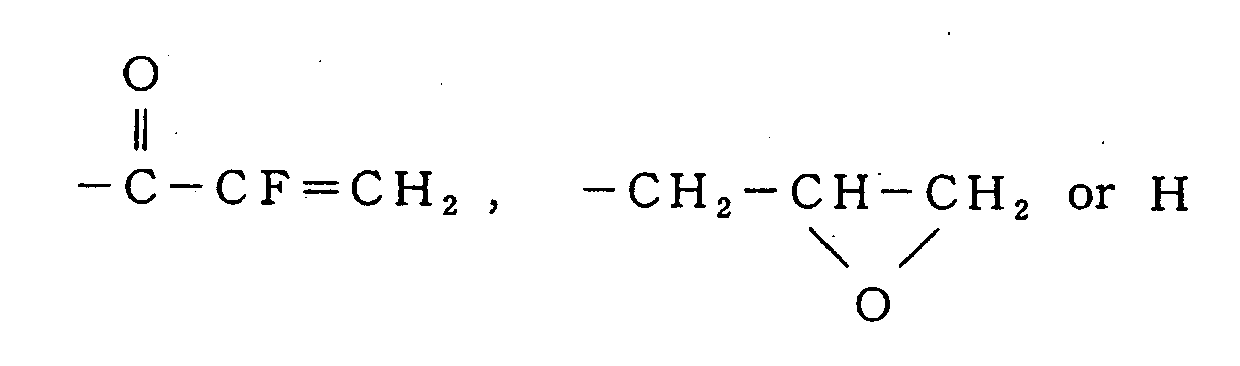
- The crosslinking agent may be selected from polyfunctional compounds having, in one molecule thereof, two or more crosslinkable functional groups mentioned above.
- Examples of the crosslinking agent are, for instance,




- Additionally crosslinking agents described in
JP-A-2002-100405 JP-A-9-48832 JP-A-2002-279826 - The crosslinking may be carried out by a known crosslinking system suitable for a combination of the crosslinkable functional group and the crosslinking agent.
- Next, the electrolyte (II) which is another component of the ion conductor of the present invention is explained.
- Examples of the electrolyte (II) usable in the present invention are known metal salts, ionic liquids, inorganic polymer type salts, organic polymer type salts, and the like.
- There are particularly suitable compounds as the electrolyte depending on an object of the ion conductor. Raised next are examples of electrolytes classified by applications of the ion conductor, but the electrolyte is not limited to them. Also in other applications, the electrolytes exemplified below can be optionally used.
- First, various organic metal salts of a boron anion type, an oxygen anion type, a nitrogen anion type, a carbon anion type and a phosphorous anion type can be used as a metal salt for a solid electrolyte for a lithium secondary battery, and an oxygen anion type and a nitrogen anion type can be used preferably.
- Specifically CF3SO3Li, C4F9SO3Li, C8Fl7SO3Li, CH3SO3Li, C6H5SO3Li, LiSO3C2F4SO3Li, CF3CO2Li, C6H5CO2Li, Li2C4O4 and the like may be used as a metal salt of oxygen anion type, and it is particularly preferable to use CF3SO3Li, C4F9SO3Li and C8F17SO3Li.
- Examples of a metal salt of nitrogen anion type to be used are (CF3SO2)2NLi (TFSI), (C2F5SO2)2NLi (BETI), (CF3SO2)(C4F9SO2)NLi, (CF3SO2)(C8F17SO2)NLi, (CF3CO)2NLi, (CF3CO)(CF3CO2)NLi, ((CF3)2CHOSO2)2NLi, (C2F5CH2OSO2)2NLi and the like, and it is particularly preferable to use (CF3SO2)2NLi (TFSI) and (C2F5SO2)2NLi (BETI).
- Metal salts which can be used as an inorganic metal salt are LiPF6, LiBF4, LiAsF6, LiClO4 and the like, and it is particularly preferable to use LiPF6 and LiBF4.
- Examples of an organic metal salt for a solid electrolyte for capacitors are Et4NBF4 (Et denotes ethylene, hereinafter the same), Et4NClO4, Et4NPF6, Et4NAsF6, Et4NCF3SO3, Et4N(CF3SO2)2N and Et4NC4F9SO3, and it is particularly preferable to use Et4NBF4 and Et4NPF6.
- Metal salts which can be used as an inorganic metal salt are LiPF6, LiBF4, LiAsF6, LiClO4, NaPF6, NaBF4, NaAsF6, NaClO4, KPF6, KBF4, KAsF6, KClO4 and the like, and it is particularly preferable to use LiPF6, LiBF4, NaPF6 and NaBF4.
- Examples of metal salts for a solid electrolyte for a dye sensitizing solar cell are R1aR2aR3aR4aNI (R1a to R4a are the same or different, and each is an alkyl group having 1 to 3 carbon atoms), LiI, NaI, KI,

- When an ionic liquid is used as the electrolyte (II), examples of a solid electrolyte for lithium secondary batteries, capacitors and dye sensitizing solar cells are salts of an organic or inorganic anion with polyalkylimidazolium cation, N-alkylpyridinium cation, tetraalkylammonium cation or tetraalkylphosphonium cation, and particularly preferable is 1,3-dialkylimidazolium salt.
- Preferable examples of polyalkylimidazolium cation are 1,3-dialkylimidazolium cations such as 1-ethyl-3-methylimidazolium cation (EMI+) and 1-butyl-3-methylimidazolium cation (BMI+); trialkylimidazolium cation such as 1,2-dimethyl-3-propylimidazolium cation (DMPI+); and the like.
- Preferable examples of inorganic anions are, for instance, AlCl4 -, BF4 -, PF6 -, AsF6 -, I-, and the like, and preferable examples of organic anions are, for instance, CH3COO-, CF3COO-, C3F7COO-, CF3SO3 -, C4H9SO3 -, (CF3SO2)2N-, (C2F5SO2)2N- and the like.
- Examples thereof are EMIAlCl4, EMIBF4, EMIPF6, EMIAsF6, EMII, EMICH3COO, EMICF3COO, EMIC3F7COO, EMICF3SO3, EMIC4F9SO3, EMI(CF3SO2)2N, EMI(C2F5SO2)2N, BMIAlCl4, BMIBF4, BMIPF6, BMIAsF6, BMII, BMICH3COO, BMICF3COO, BMIC3F7COO, BMICF3SO3, BMIC4FgSO3, BMI(CF3SO2)2N, BMI(C2F5SO2)2N, DMPIAlCl4, DMPIBF4, DMPIPF6, DMPIAsF6, DMPII, DMPICH3COO, DMPICF3COO, DMPIC3F7COO, DMPICF3SO3, DMPIC4F9SO3, DMPI(CF3SO2)2N, DMPI(C2F5SO2)2N and the like.
- Particularly for a solid electrolyte for dye sensitizing solar cells, suitable are iodides such as EMII, BMII and DMPII.
- The blended amount of the electrolyte (II) varies depending on required current density, application, kind of the electrolyte, etc., and is preferably not less than 0.1 part by mass based on 100 parts by mass of the high molecular weight ion conducting compound (I), further not less than 1 part by mass, particularly not less than 2 parts by mass, and not more than 200 parts by mass, further not more than 100 parts by mass, particularly not more than 50 parts by mass.
- In the present invention, the electrolyte (II) is held by impregnation and dissolution in the non-crystalline fluorine-containing polyether compound (1) constituting the high molecular weight ion conducting compound (I).
- For holding the electrolyte (II) in the high molecular weight ion conducting compound (I), there can be employed a method of kneading the electrolyte (II) and the high molecular weight ion conducting compound (I); a method of mixing the high molecular weight ion conducting compound (I) in a solution prepared by dissolving the electrolyte (II) in a solvent and then distilling off the solvent; a method of melting the high molecular weight ion conducting compound (I) by heating and then kneading the electrolyte (II) therewith; or the like method.
- In the ion conductor of the present invention, the non-crystalline fluorine-containing polyether compound (1) is in the form of solid but is low in viscosity, and therefore the ionic conductivity is high even as it is. However in the case where the ionic conductivity need be increased further, an aprotic organic solvent (III) may be blended to make a gel electrolyte in the form of gel (plasticized).
- Examples of the organic solvent (III) to be used for the gel electrolyte are ethylene carbonate, propylene carbonate, butylene carbonate, γ-butyrolactone, 1,2-dimethoxyethane, tetrahydrofuran, 2-methyltetrahydrofuran, 1,3-dioxolan, 4-methyl-1,3-dioxolan, methyl formate, methyl acetate, methyl propionate, dimethyl carbonate, ethyl methyl carbonate, diethyl carbonate, acetonitrile, dimethyl sulfoxide, methylpyrrolidone and the like. Particularly from the viewpoint of enhancement of a dielectric constant, oxidation resistance and electrochemical stability, ethylene carbonate, propylene carbonate, diethyl carbonate, γ-butyrolactone, 1,2-dimethoxyethane, 1,3-dioxolan and acetonitrile are preferable.
- It is preferable to use the organic solvent (III) in such an amount that the solid content in the ion conductor is not less than 10 % by mass, further not less than 50 % by mass, particularly 100 % by mass.
- To the ion conductor of the present invention may be blended other additives as case demands. Examples of the other additives are, for instance, metal oxides, glass and the like.
- The ion conductor of the present invention is useful for a high molecular weight electrolyte for lithium secondary batteries, a high molecular weight electrolyte for capacitors, and a high molecular weight electrolyte for solar cells (particularly dye sensitizing solar cells) from the viewpoint of a high ionic conductivity and an excellent oxidation resistance and mechanical strength. Additionally the ion conductor of the present invention can be used as an electrolyte for various sensors, an electrolyte for electrochromic devices and an ion conductor to be used for various electrolyses.
- The present invention is then explained by means of Examples and Comparative Examples, but is not limited to them.
- The methods of measurement adopted in the present invention are as follows.
NMR: AC-300 available from BRUCKER CO., LTD. is used.
19F-NMR: - Measuring conditions: 282 MHz (trichlorofluoromethane = 0 ppm)
- Measuring conditions: 300 MHz (tetramethylsilane = 0 ppm)
- The number average molecular weight is calculated from the data obtained by measuring by gel permeation chromatography (GPC) by using GPC HLC-8020 available from Toso Kabushiki Kaisha and columns available from Shodex (one GPC KF-801, one GPC KF-802 and two GPC KF-806M are connected in series) and flowing tetrahydrofuran (THF) as a solvent at a flowing rate of 1 ml/ min.
- A 1.0 % thermal decomposition temperature (Td1.0) is calculated from the data obtained when heating up from room temperature at a rate of 20°C/min by using TG/DTA-6200 available from Seiko Instruments Kabushiki Kaisha.
- By using DSC (differential scanning calorimeter), in the 1st run, temperature is raised up to 200°C at a temperature elevating rate of 10°C/min, followed by maintaining at 200°C for one minute and cooling down to 25°C at a temperature decreasing rate of 10°C/min, and then a center point of heat absorption curve obtained in the 2nd run of heating at a temperature elevating rate of 10°C/min is assumed to be Tg. The used differential scanning calorimeter is one available from Seiko Instruments Kabushiki Kaisha.
- Measurement is carried out at room temperature with a Fourier-transform infrared spectrophotometer 1760X available from Perkin Elmer Co., Ltd.
- Measurement is carried out by using a VISCONE CV series cone plate type rotational viscometer available from Misec Corporation with a cone having a measurable viscosity range of 50 to 8,000 mPa.s at 94 rpm at 80°C.
- An ionic conductivity is measured at room temperature at a frequency of 104 Hz to 101 Hz according to AC 4-terminal method. SI1280B available from TOYO Corporation is used as an impedance meter.
- Into a 100 ml eggplant type glass flask equipped with a stirrer were poured 20 g of a compound having a fluorine-containing ether in its side chain and represented by the following formula (I-1):


- Then 87 g of HCFC141b/chloroform (80/20: volume ratio) was added thereto, and 0.065 ml of BF3.OEt2 was added dropwise at 0°C in a nitrogen gas stream, followed by 24-hour stirring. After completion of a reaction, HCFC141b/chloroform was distilled off, and the obtained liquid was poured into hexane for separation. Then the obtained liquid was poured into pure water for separation, followed by vacuum drying to obtain 4.8 g of a colorless transparent polymer. According to 19F-NMR and 1H-NMR analyses, the polymer was found to be a polymer comprising the unit (I-1) having a fluorine-containing ether at an end of its side chain and the unit of 1,3-dioxirane-2-one at the percent by mole ratio of 74/26. Also the number average molecular weight measured by a GPC analysis using tetrahydrofuran (THF) as a solvent was 1,637, and the weight average molecular weight was 1,881. Further as a result of measurement of TGA and DSC in the air, Td1.0 was 119.0°C and Tg was -62.5°C. Also a stretching vibration of a carbonyl group measured by IR was recognized at 1,751.7 cm-1 and 1,805.1 cm-1.
19F-NMR: (CD3COCD3): -80.2 to -81.0 ppm (1F), -81.0 to -81.7 ppm (3F), -81.7 to -82.5 ppm (3F), -82.5 to -84.3 ppm (1F), -128.9 to -130.4 ppm (2F), -132.3 to -134.1 ppm (1F)
1H-NMR: (CD3COCD3): 1.8 to 2.2 ppm (2H), 3.3 to 4.8 ppm (24H) - The viscosity of this polymer measured with a cone plate type rotational viscometer was 9.2 mPa·s.
- To the polymer obtained in Preparation Example 1 was dissolved LiClO4 as an electrolyte in a super-saturated amount, followed by allowing to stand overnight in a 6 ml sample bottle. After allowing to stand overnight, a transparent polymer phase was precipitated in an upper layer, and a solid was precipitated in a lower layer. The upper layer was taken out, and after forming a rectangular film, an ionic conductivity was measured. The ionic conductivity was 4.8 × 10⁻³ S/cm.
- After sufficiently replacing the inside of a 100 ml eggplant type glass flask equipped with a stirrer with nitrogen, 7.4 g of a compound having a fluorine-containing ether in its side chain and represented by the following formula (I-2):


- Then 40 g of HCFC141b/chloroform (80/20: volume ratio) was poured into the flask and 0.017 ml of BF3·OEt2 was added thereto dropwise at 0°C in a nitrogen gas stream, followed by stirring for 24 hours. After completion of a reaction, HCFC141b/chloroform was distilled off, and the obtained liquid was poured into hexane for separation. Then the obtained liquid was poured into pure water for separation, followed by vacuum drying to obtain 4.7 g of a colorless transparent polymer. According to 19F-NMR and 1H-NMR analyses, the polymer was found to be a polymer comprising the unit (I-2) having a fluorine-containing ether at an end of its side chain and the unit of 1,3-dioxirane-2-one at the percent by mole ratio of 85/15. Also the number average molecular weight measured by a GPC analysis using tetrahydrofuran (THF) as a solvent was 1,981, and the weight average molecular weight was 2,184. Further as a result of measurement of TGA and DSC in the air, Td1.0 was 118.8°C and Tg was -66.5°C. Also a stretching vibration of a carbonyl group measured by IR was recognized at 1,752.3 cm-1 and 1,825.9 cm-1.
19F-NMR: (CD3COCD3): -79.7 to -80.4 ppm (3F), -80.9 to -81.3 ppm (2F), -81.3 to -81.9 ppm (5F), -82.2 to -83.8 ppm (3F), -128.9 to -130.5 ppm (2F), -132.0 to -134.0 ppm (1F), -144.0 to -146.0 ppm (1F)
1H-NMR: (CD3COCD3): 1.7 to 2.0 ppm (2H), 3.2 to 4.4 ppm (44.6H) - The viscosity of this polymer measured with a cone plate type rotational viscometer was 45.4 mPa·s.
- To the polymer obtained in Preparation Example 2 was dissolved LiClO4 as an electrolyte in a super-saturated amount, followed by allowing to stand overnight in a 6 ml sample bottle. After allowing to stand overnight, a transparent polymer phase was precipitated in an upper layer, and a solid was precipitated in a lower layer. The upper layer was taken out, and after forming a rectangular film, an ionic conductivity was measured. The ionic conductivity was 1.2 × 10⁻³ S/cm.
- After sufficiently replacing the inside of a 100 ml eggplant type glass flask equipped with a stirrer with nitrogen, 0.19 g of CH3ONa and 70 g of dimethylformamide were added in a nitrogen gas stream, followed by 15-minute stirring at room temperature. After completion of the stirring, 20 g of the following compound (I-3) having a trifluoromethyl group in its side chain:

19F-NMR: (CD3COCD3): -73.2 to -76.7 ppm (3F)
1H-NMR: (CD3COCD3): 3.5 to 4.1 ppm (1H), 4.1 to 4.2 ppm (1H), 4.2 to 4.5 ppm (1H) - The viscosity of this polymer measured with a cone plate type rotational viscometer was 137 mPa·s.
- To the polymer obtained in Preparation Example 3 was dissolved LiClO4 as an electrolyte in a super-saturated amount, followed by allowing to stand overnight in a 6 ml sample bottle. After allowing to stand overnight, a transparent polymer phase was precipitated in an upper layer, and a solid was precipitated in a lower layer. The upper layer was taken out, and after forming a rectangular film, an ionic conductivity was measured. The ionic conductivity was 2.4 × 10⁻⁸ S/cm.
- With respect to a polyethylene oxide having a weight average molecular weight of 4,000, a viscosity and ionic conductivity thereof were measured. The viscosity was 148 mPa·s and the ionic conductivity was 7.5 × 10⁻⁸ S/cm.
- To a mixture of 2 g of the polymer obtained in Preparation Example 2 and 0.2 g of propylene carbonate was dissolved LiClO4 as an electrolyte in a super-saturated amount, followed by allowing to stand overnight in a 6 ml sample bottle. After allowing to stand overnight, a transparent polymer mixture phase was precipitated in an upper layer, and a solid was precipitated in a lower layer. The upper layer was taken out, and after forming a rectangular film, an ionic conductivity was measured. The ionic conductivity was 9.2 × 10⁻³ S/cm.
- The high molecular weight ion conductor of the present invention itself has a high ionic conductivity even at a temperature near room temperature, is low in a viscosity, is non-flammable and is excellent in oxidation resistance, and can satisfy properties required for high molecular weight electrolytes for lithium batteries, capacitors and solar cells.
Claims (7)
- An ion conductor comprising an ion conducting compound (I) and an electrolytic salt (II), said ion conducting compound being a non-crystalline fluorine-containing polyether compound or a crosslinked product thereof in which said compound has a fluorine-containing group in its side chain and is represented by the formula (1):
A-(D)-B (1)
wherein D is represented by the formula (2):
-(D1)n-(FAE)m-(AE)p-(Y)q (2)
where D 1 is a an ether unit having a fluoroether group in its side chain and represented by the formula (2a):
FAE is an ether unit having a fluorine-containing alkyl group in its side chain and represented by the formula (2b):
AE is an ether unit represented by the formula (2c):
Y is a unit having at least one of the formulae (2d-1) to (2d-3):


A and B are the same or different and each is hydrogen atom, an alkyl group which may have fluorine atom and/or a crosslinkable functional group, a phenyl group which may have fluorine atom and/or a crosslinkable functional group, -COOH group, -OR2 where R2 is hydrogen atom or an alkyl group which may have fluorine atom and/or a crosslinkable functional group, an ester group or a carbonate group (when an end of D is oxygen atom, A and B are not a -COOH group, -OR2, an ester group and a carbonate group). - The ion conductor of Claim 1, wherein in said formula (2a), -Rf is represented by the formula (2a-1):
-Rf1-X (2a-1)
wherein -Rf1- is a fluoroether unit having at least one kind selected from the group consisting of -(OCF2CF2CF2)n1-, -(CF2CF2CF2O)n1-, -(OCFZ1CF2)n1-, -(OCF2CFZ1)n1-, -(OCFZ2)n1-, -(CFZ2O)n1-, -(OCH2CF2CF2)n1-, -(OCF2CF2CH2)n1-, -(OCH2CH2CF2)n1-, -(OCF2CH2CH2)n1-, -(OCF2CF2CF2CF2)n1-, -(CF2CF2CF2CF2O)n1-, -(OCFZ2CH2)n1-, -(CH2CFZ2O)n1-, -(OCH(CH3)CF2CF2)n1-, -(OCF2CF2CH(CH3))n1-, -(CFZ1CF2O)n1-, -(CF2CF2CF2O)n1-, -(CH2CF2CF2O)n1-, -(OCZ3 2)n1- and -(CZ3 2O)n1- where Z1 and Z2 may be the same or different and each is H, F or CF3; Z3 is CF3; n1 is an integer of 1 to 3; X is at least one kind selected from hydrogen atom, halogen atom or a fluorine-containing alkyl group which has 1 to 20 carbon atoms and may have an ether bond and/or a crosslinkable functional group, and X does not have said Rf1 and a -O-O- structure is not contained in the Rf1. - The ion conductor of Claim 1, wherein in said formula (2a), -Rf is a fluoroether group represented by the formula (2a-2):

- The ion conductor of any of Claims 1 to 3, wherein in said formulae (2a), (2b) and (2c), R1 is a bonding group represented by the formula:

- The ion conductor of any of Claims 1 to 4, wherein said unit Y is a unit containing the formula (2d-1).
- The ion conductor of any of Claims 1 to 5, which further contains an organic solvent (III).
- A high molecular weight electrolyte comprising the ion conductor of any of Claims 1 to 6.
Applications Claiming Priority (2)
| Application Number | Priority Date | Filing Date | Title |
|---|---|---|---|
| JP2004301934A JP4506403B2 (en) | 2004-10-15 | 2004-10-15 | Ionic conductor |
| PCT/JP2005/018542 WO2006041008A1 (en) | 2004-10-15 | 2005-10-06 | Ion conductor |
Publications (2)
| Publication Number | Publication Date |
|---|---|
| EP1811528A1 true EP1811528A1 (en) | 2007-07-25 |
| EP1811528A4 EP1811528A4 (en) | 2008-11-12 |
Family
ID=36148303
Family Applications (1)
| Application Number | Title | Priority Date | Filing Date |
|---|---|---|---|
| EP05790607A Withdrawn EP1811528A4 (en) | 2004-10-15 | 2005-10-06 | IONIC DRIVER |
Country Status (6)
| Country | Link |
|---|---|
| US (1) | US7846587B2 (en) |
| EP (1) | EP1811528A4 (en) |
| JP (1) | JP4506403B2 (en) |
| KR (1) | KR100874300B1 (en) |
| CN (1) | CN101040350B (en) |
| WO (1) | WO2006041008A1 (en) |
Cited By (1)
| Publication number | Priority date | Publication date | Assignee | Title |
|---|---|---|---|---|
| WO2012054964A1 (en) * | 2010-10-26 | 2012-05-03 | Dyesol Industries Pty Ltd | An electrolyte formulation for use in photoelectrochemical devices |
Families Citing this family (8)
| Publication number | Priority date | Publication date | Assignee | Title |
|---|---|---|---|---|
| US20100028784A1 (en) * | 2008-07-29 | 2010-02-04 | 3M Innovative Properties Company | Electrolyte composition, lithium-containing electrochemical cell, battery pack, and device including the same |
| WO2012133701A1 (en) | 2011-03-31 | 2012-10-04 | ダイキン工業株式会社 | Electric double-layer capacitor and non-aqueous electrolyte for electric double-layer capacitor |
| US9484123B2 (en) | 2011-09-16 | 2016-11-01 | Prc-Desoto International, Inc. | Conductive sealant compositions |
| JP6315769B2 (en) * | 2012-01-27 | 2018-04-25 | 国立大学法人東京工業大学 | Solid ion capacitor and method of using solid ion capacitor |
| US9601279B2 (en) | 2012-09-04 | 2017-03-21 | Daikin Industries, Ltd. | Electrolyte solution and electrochemical device |
| US10326166B2 (en) * | 2016-08-15 | 2019-06-18 | GM Global Technology Operations LLC | Gel electrolytes and precursors thereof |
| KR102101271B1 (en) | 2018-08-16 | 2020-04-16 | 아주대학교산학협력단 | Ion conductive solid electrolyte compound, method of manufacturing the ion conductive solid electrolyte compound, and electrochemical apparatus having the electrolyte compound |
| CN110931273A (en) * | 2019-11-15 | 2020-03-27 | 北京纳米能源与系统研究所 | Gel electrolyte and preparation method thereof, supercapacitor and application thereof |
Family Cites Families (9)
| Publication number | Priority date | Publication date | Assignee | Title |
|---|---|---|---|---|
| JPH0948832A (en) * | 1995-08-03 | 1997-02-18 | Japan Energy Corp | Ion conductor |
| US6100324A (en) | 1998-04-16 | 2000-08-08 | E. I. Du Pont De Nemours And Company | Ionomers and ionically conductive compositions |
| JP4150867B2 (en) * | 1998-05-13 | 2008-09-17 | ダイキン工業株式会社 | Materials for solid polymer electrolytes suitable for use in fuel cells |
| JP2000234020A (en) | 1998-12-17 | 2000-08-29 | Nisshinbo Ind Inc | Polymer for polymer electrolyte and composition for ionic conductive polymer electrolyte |
| US6287722B1 (en) * | 1999-03-02 | 2001-09-11 | E. I. Du Pont Nemours And Co. | Continuous melt process for fabricating ionically conductive articles |
| ATE229551T1 (en) | 1999-03-03 | 2002-12-15 | Du Pont | CONTINUOUS MELTING PROCESS FOR PRODUCING IONIC CONDUCTIVE OBJECTS |
| JP2003007337A (en) | 2001-06-21 | 2003-01-10 | Daiso Co Ltd | Secondary polymer battery |
| JP4187586B2 (en) * | 2002-05-31 | 2008-11-26 | 株式会社日本触媒 | Fluorine-containing polyaryl ether |
| JP4374980B2 (en) | 2002-12-25 | 2009-12-02 | ダイキン工業株式会社 | Solid electrolyte comprising a fluorine-containing polymer containing a fluorine-containing ether chain |
-
2004
- 2004-10-15 JP JP2004301934A patent/JP4506403B2/en not_active Expired - Fee Related
-
2005
- 2005-10-06 KR KR1020077010899A patent/KR100874300B1/en not_active Expired - Fee Related
- 2005-10-06 EP EP05790607A patent/EP1811528A4/en not_active Withdrawn
- 2005-10-06 WO PCT/JP2005/018542 patent/WO2006041008A1/en not_active Ceased
- 2005-10-06 CN CN2005800352993A patent/CN101040350B/en not_active Expired - Fee Related
- 2005-10-06 US US11/664,538 patent/US7846587B2/en not_active Expired - Fee Related
Cited By (2)
| Publication number | Priority date | Publication date | Assignee | Title |
|---|---|---|---|---|
| WO2012054964A1 (en) * | 2010-10-26 | 2012-05-03 | Dyesol Industries Pty Ltd | An electrolyte formulation for use in photoelectrochemical devices |
| CN103190024A (en) * | 2010-10-26 | 2013-07-03 | 戴索工业有限公司 | An electrolyte formulation for use in photoelectrochemical devices |
Also Published As
| Publication number | Publication date |
|---|---|
| CN101040350A (en) | 2007-09-19 |
| WO2006041008A1 (en) | 2006-04-20 |
| US7846587B2 (en) | 2010-12-07 |
| JP4506403B2 (en) | 2010-07-21 |
| EP1811528A4 (en) | 2008-11-12 |
| US20080020275A1 (en) | 2008-01-24 |
| KR20070084200A (en) | 2007-08-24 |
| JP2006114401A (en) | 2006-04-27 |
| CN101040350B (en) | 2011-04-13 |
| KR100874300B1 (en) | 2008-12-18 |
Similar Documents
| Publication | Publication Date | Title |
|---|---|---|
| Huo et al. | Challenges of polymer electrolyte with wide electrochemical window for high energy solid‐state lithium batteries | |
| US8329344B2 (en) | Electrolytic solution | |
| Ahmad | RETRACTED ARTICLE: Polymer electrolytes: characteristics and peculiarities | |
| US7854855B2 (en) | Electrolytic solution | |
| US20150270574A1 (en) | Halogenosilane functionalized carbonate electrolyte material, preparation method thereof and use in electrolyte for lithium ion battery | |
| CN101156215B (en) | Electrolyte solution | |
| JP5067728B2 (en) | Polymer electrolyte and method for producing the same | |
| EP1577900A1 (en) | Solid electrolyte containing fluoropolymer having fluorinated ether chain | |
| CN101331556B (en) | Ion conductor | |
| US7846587B2 (en) | Ion conductor | |
| CN101156217B (en) | Electrolyte solution | |
| EP1057846B1 (en) | Polymeric compound, polymer for polyelectrolyte, and composition for ionically conductive polyelectrolyte | |
| JP4982943B2 (en) | Ionic conductor | |
| JP6213908B2 (en) | Polymer electrolyte material | |
| US20160301107A1 (en) | Functionalized perfluoroalkanes and electrolyte compositions | |
| Kumar et al. | Peristaltic Ion-Conduction Mechanism in Sodium Polymer Electrolytes Based on Perfluoropolyethers, DMSO, and Sodium Bis (trifluoromethanesulfonyl) imide |
Legal Events
| Date | Code | Title | Description |
|---|---|---|---|
| PUAI | Public reference made under article 153(3) epc to a published international application that has entered the european phase |
Free format text: ORIGINAL CODE: 0009012 |
|
| 17P | Request for examination filed |
Effective date: 20070322 |
|
| AK | Designated contracting states |
Kind code of ref document: A1 Designated state(s): AT BE BG CH CY CZ DE DK EE ES FI FR GB GR HU IE IS IT LI LT LU LV MC NL PL PT RO SE SI SK TR |
|
| DAX | Request for extension of the european patent (deleted) | ||
| A4 | Supplementary search report drawn up and despatched |
Effective date: 20081010 |
|
| 17Q | First examination report despatched |
Effective date: 20090130 |
|
| STAA | Information on the status of an ep patent application or granted ep patent |
Free format text: STATUS: THE APPLICATION IS DEEMED TO BE WITHDRAWN |
|
| 18D | Application deemed to be withdrawn |
Effective date: 20090610 |