EP1810539B1 - Congestion control in a wireless mobile system - Google Patents
Congestion control in a wireless mobile system Download PDFInfo
- Publication number
- EP1810539B1 EP1810539B1 EP04800292.7A EP04800292A EP1810539B1 EP 1810539 B1 EP1810539 B1 EP 1810539B1 EP 04800292 A EP04800292 A EP 04800292A EP 1810539 B1 EP1810539 B1 EP 1810539B1
- Authority
- EP
- European Patent Office
- Prior art keywords
- mobile stations
- control device
- mobile
- amount
- threshold level
- Prior art date
- Legal status (The legal status is an assumption and is not a legal conclusion. Google has not performed a legal analysis and makes no representation as to the accuracy of the status listed.)
- Expired - Lifetime
Links
- 238000000034 method Methods 0.000 claims description 22
- 230000005540 biological transmission Effects 0.000 description 5
- 230000008901 benefit Effects 0.000 description 4
- 239000000872 buffer Substances 0.000 description 4
- 230000002452 interceptive effect Effects 0.000 description 3
- 238000010586 diagram Methods 0.000 description 2
- 230000008569 process Effects 0.000 description 2
- 230000000630 rising effect Effects 0.000 description 2
- 230000011664 signaling Effects 0.000 description 2
- 238000001228 spectrum Methods 0.000 description 2
- 108010003272 Hyaluronate lyase Proteins 0.000 description 1
- 230000009471 action Effects 0.000 description 1
- 230000003139 buffering effect Effects 0.000 description 1
- 230000001413 cellular effect Effects 0.000 description 1
- 230000000295 complement effect Effects 0.000 description 1
- 230000001419 dependent effect Effects 0.000 description 1
- 238000001514 detection method Methods 0.000 description 1
- 238000005516 engineering process Methods 0.000 description 1
- 238000007667 floating Methods 0.000 description 1
- 230000002401 inhibitory effect Effects 0.000 description 1
- 238000013507 mapping Methods 0.000 description 1
- 230000007246 mechanism Effects 0.000 description 1
- 238000010295 mobile communication Methods 0.000 description 1
- 230000011218 segmentation Effects 0.000 description 1
- 238000000926 separation method Methods 0.000 description 1
- 230000007480 spreading Effects 0.000 description 1
Images
Classifications
-
- H—ELECTRICITY
- H04—ELECTRIC COMMUNICATION TECHNIQUE
- H04L—TRANSMISSION OF DIGITAL INFORMATION, e.g. TELEGRAPHIC COMMUNICATION
- H04L47/00—Traffic control in data switching networks
- H04L47/10—Flow control; Congestion control
- H04L47/11—Identifying congestion
-
- H—ELECTRICITY
- H04—ELECTRIC COMMUNICATION TECHNIQUE
- H04L—TRANSMISSION OF DIGITAL INFORMATION, e.g. TELEGRAPHIC COMMUNICATION
- H04L47/00—Traffic control in data switching networks
- H04L47/10—Flow control; Congestion control
-
- H—ELECTRICITY
- H04—ELECTRIC COMMUNICATION TECHNIQUE
- H04W—WIRELESS COMMUNICATION NETWORKS
- H04W28/00—Network traffic management; Network resource management
- H04W28/02—Traffic management, e.g. flow control or congestion control
-
- H—ELECTRICITY
- H04—ELECTRIC COMMUNICATION TECHNIQUE
- H04W—WIRELESS COMMUNICATION NETWORKS
- H04W28/00—Network traffic management; Network resource management
- H04W28/02—Traffic management, e.g. flow control or congestion control
- H04W28/0284—Traffic management, e.g. flow control or congestion control detecting congestion or overload during communication
-
- H—ELECTRICITY
- H04—ELECTRIC COMMUNICATION TECHNIQUE
- H04W—WIRELESS COMMUNICATION NETWORKS
- H04W8/00—Network data management
- H04W8/02—Processing of mobility data, e.g. registration information at HLR [Home Location Register] or VLR [Visitor Location Register]; Transfer of mobility data, e.g. between HLR, VLR or external networks
- H04W8/04—Registration at HLR or HSS [Home Subscriber Server]
-
- H—ELECTRICITY
- H04—ELECTRIC COMMUNICATION TECHNIQUE
- H04W—WIRELESS COMMUNICATION NETWORKS
- H04W72/00—Local resource management
- H04W72/50—Allocation or scheduling criteria for wireless resources
- H04W72/51—Allocation or scheduling criteria for wireless resources based on terminal or device properties
Definitions
- the invention refers to a method for improved congestion control in a wireless mobile system and a control device arranged to carry out the method.
- the method is used in a wireless mobile system where a high speed packet data access has been established between a node and a number of mobile stations by dedicating a high speed physical downlink shared channel to all mobile stations and one associated dedicated channel per each mobile station.
- the 3rd Generation Partnership Project (3GPP) specification is a standard for the third generation mobile telephony system.
- the system supports different user data rates for different users.
- the transmission power used for a certain user is determined by interference level in a certain cell, user data rate, channel quality and requested quality of the data transmission in the cell.
- Control channels and traffic channels are referred to as logical channels. These logical channels are mapped onto physical channels.
- a physical channel can be a radio broadcasting frequency, a pair of frequencies (including duplex separation) in an analog mobile system or a time slot on a pair of frequencies in a digital mobile system.
- a physical channel may, for example, be a time slot on a particular frequency channel in a TDMA system and may also be said to be a carrier of a logical channel, such as a traffic channel (sometimes abbreviated TCH), or several logical channels, such as various control channels in a multi frame structure.
- a logical channel such as a traffic channel (sometimes abbreviated TCH), or several logical channels, such as various control channels in a multi frame structure.
- mapping process means that a time slot and a frequency are allocated to the traffic burst.
- the traffic channels convey voice or data (such as Internet traffic) between the mobile and base station.
- the channels are allocated on a per call basis. Ordinarily, a time slot is used for one call only (full rate), but an alternative with two calls per time slot (half rate) has also been specified.
- All the present mobile systems are based on multiple access, which means that all users have simultaneous access to the medium. This requires a number of rules to prevent situations in which mobiles "all talk at the same time".
- the medium which is a common resource, must satisfy the needs of all users.
- Traffic channels are assigned through control-channel signalling.
- Each cell in a cellular system can be regarded as an individual medium because a mobile leaving the cell loses contact with that cell's base station. However, all mobiles in the cell utilise the same radio resource, namely, that portion of the frequency spectrum which has been assigned to the cell.
- CDMA Code division multiple access
- a typical feature of the CDMA technique is that all mobiles in the network are assigned a unique code: a chip sequence.
- a mobile wishes to transmit a bit stream, it replaces every bit with its code (for ones) or with the code's ones complement (for zeros).
- a number of air interface bits (referred to as a "chip"), depending on the spreading factor used, are transmitted for every payload bit.
- the chip will be modulated over approximately 3.84 MHz. That is why this technique is also referred to as a spread-spectrum technique.
- the mobile telephone system may, for example, be a WCDMA system which has a downlink transport channel called High Speed Downlink Shared Channel (HS-DSCH) mapped onto a set of physical channels called High Speed Physical Downlink Shared CHannels (HS-PDSCH).
- HS-DSCH High Speed Downlink Shared Channel
- HS-PDSCH High Speed Physical Downlink Shared CHannels
- the HS-DSCH provides enhanced support for interactive, background, and, to some extent streaming radio-access-bearer (RAB) services in the downlink direction.
- RAB radio-access-bearer
- every user that is given access to a HS-PDSCH (High Speed Physical Downlink Shared Channel) channel must also have an associated dedicated Physical Channel A-DPCH used, for example, for communicating control information.
- HS-PDSCH High Speed Physical Downlink Shared Channel
- a typical action in case of overload consists of the Radio Network Controller RNC releasing certain channels to reduce the load on the particular resource that is in shortage, for example DL Power, UL interference, DL Codes, etc. It is possible that also A-DPCHs will be released, especially if all interactive/background traffic is carried on HS-PDSCH and there's a need to make more DL Codes available to handle a sharp increase in conversational traffic (speech, video, ...) or if it turns out that A-DPCHs consume a significant amount of power.
- the invention intends to remedy the above problems by a method for improved congestion control and a control device arranged for carrying out the method.
- the method is used in a wireless mobile system where a high speed packet data access HSDPA has been established between a node and a number of mobile stations MS by dedicating a high speed physical downlink shared channel HS-PDSCH to all mobile stations MS and one associated dedicated channel A-DPCH per each mobile station MS.
- the above HSDPA setup may be performed by the node.
- the method comprises the steps of:
- the advantage of the invention lies in that the mobile stations that are almost finished downloading, are allowed to finish downloading, instead of as in prior art being randomly thrown out regardless of status.
- the threshold level is an amount of download data to be downloaded by one or several second mobile stations MS using the same high speed physical downlink shared channel HS-PDSCH as the first mobile station(s).
- the threshold is set by comparing all mobile stations and to release the A-DPCH for one or several user units having more data to be downloaded than at least another mobile station. The comparison may give a hierarchy with the mobile station having the most data to be downloaded at the top and the mobile station with the least data at the bottom.
- the threshold may here be a floating value that is always set at the mobile station having the second most data to download, i.e. mobile station No two in the hierarchy.
- the advantage here is that the mobile station having the most still to download will be thrown out in a first round, and during the next round the next in order is thrown out if more recourses have to be liberated, while all the other mobile stations may continue downloading and the mobile stations having the least to download is thus given a chance to finish downloading.
- the threshold level may also be set at a level indicating a specific mobile station in the hierarchy and all the mobile stations above that mobile station in the hierarchy may be subject to the release of the associated the A-DPCH.
- the threshold level is a preset value, for example, all mobile stations having downloaded more than a certain percentage of an intended amount may continue and the other mobile stations may be subject to the release of the associated the A-DPCH .
- the wireless mobile system may be a WCDMA based system wherein the node being an RNC.
- the invention is applicable on all systems using a downlink shared channel and an associated dedicated channel that always consumes an amount of the total system recourse, for example for control information.
- HS-PDSCH and A-DPCH refers to a WCDMA system, but the present invention may be applicable in, for example, CDMA 2000 1x, EVDO (EVolution Data Only) and EVDV (EVolution Data/Voice), where the HS-PDSCH is denoted F-PDCH (Forward link Packet Data CHannel) and the corresponding A-DPCH is denoted F-FCH (Forward link Fundamental CHannel).
- CDMA 2000 refers to the 3GPP2 and the EVDO and EVDV corresponds to the HSDPA system in the 3GPP3 based WCDMA system.
- the invention may also be used in any other FDMA and/or a TDMA based system with a similar channel configuration as the WCDMA or CDMA 2000.
- the threshold level is a preset value of not yet acknowledged data in an RLC in the RNC.
- the not yet acknowledged data may be detected by looking in the RLC buffers, where it would be possible to find users with low amounts of not yet acknowledged data.
- the threshold may then be defined in bytes. The most straightforward way to use this information would be to define the threshold such that mobile stations with less remaining data than this threshold are protected at least in a first round of releasing A-DPCHs.
- radio resource management function is preferably a part of the RNC.
- the basic idea of the invention is thus to find/detect users that have very little data waiting for transmission and the benefits is an improved end user experience for wireless data services in a WCDMA or another similar system using a HSDPA supporting network or a network similar to HSDPA.
- the invention refers also to a control device for improved congestion control in a wireless mobile system where a high speed packet data access (HSDPA) between a node and a number of mobile stations (MS) have been established by a high speed physical downlink shared channel (HS-PDSCH) being dedicated to all mobile stations (MS) and one associated dedicated channel (A-DPCH) being dedicated per each mobile station (MS),
- HSDPA packet data access
- MS mobile stations
- A-DPCH dedicated channel
- the control device is preferably a part of the RNC and may be arranged to carry out all the above stated method steps.
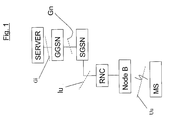
- FIG. 1 schematically shows a TCP/IP based network in a GPRS standard according to one embodiment of the present invention.
- the network comprises a landline based network a wireless radio network.
- the land line based network comprises a host in the form of a SERVER and a GGSN and a SGSN.
- the radio network comprises an RNC, a Node B and a client in the form of an MS, all based on WCDMA, see also figure 2 .
- the interface between the GGSN and the SGSN is called Gn, and the interface between the SGSN and the RNC is called lu.
- the interface between the MS and the Node-B in the second radio network is called U v .
- the interface between the GGSN and the SERVER is called G i .
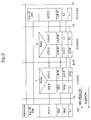
- FIG 2 schematically shows different stacked protocols of the GGSN over the Gn interface to the SGSN and the SGSN over the lu interface to the MS.
- UTRAN refers to the RNC and the Node-B in figure 1 .
- the GGSN refers to a gateway GPRS support node acting as an interface between the GPRS backbone network and the external packet data networks (radio network and the IP network). It converts the GPRS packets coming from the SGSN into the appropriate packet data protocol (PDP) format (e.g. IP) and sends them out on the corresponding packet data network. In the other direction, PDP addresses of incoming data packets are converted to the GSM address of the destination user. The readdressed packets are sent to the responsible SGSN. For this purpose, the GGSN stores the current SGSN address of the user and his or her profile in its location register. The GGSN also performs authentication and charging functions towards external systems, whereas SGSN may perform authentication.
- PDP packet data protocol
- the function of the SGSN is as a router in the interface between the wireless network and the land line based network and has been explained above.
- WCDMA technology is used for UTRAN air interface.
- UMTS WCDMA is a Direct Sequence CDMA system where user data is multiplied with quasi-random bits derived from WCDMA Spreading codes.
- Codes are used for synchronisation and scrambling.
- WCDMA has two basic modes of operation: Frequency Division Duplex (FDD) and Time Division Duplex (TDD).
- the functions of the Node-B are:
- the functions of the RNC are:
- concentration is performed in the radio air interface lu, because the number of traffic channels is limited.
- the invention refers to a method for congestion control where the dedicated channel A-DPCH is released for some specific mobile stations. These mobile stations have an amount of information to download above a set threshold level. In order to find those mobile stations, a search for mobile stations below the threshold level reveals mobile stations that shall not be released, at least not in a first round of sorting out. By looking at RLC buffers in the RNC (See for example figure 2 and 3 .), it is possible to find mobile stations with low amounts of not yet acknowledged data, which is a sign that the mobile stations have downloaded the main part of the information, and that these mobile stations should be prioritised and not be thrown out by releasing the mobile stations corresponding A-DPCH if there are other mobile stations having a higher amount of not yet acknowledged data.
- proxy in the RNC, information from this proxy could be passed over some RNC internal interface to the radio resource management function.
- the proxy is sometimes proposed as a means to hide the radio network from the application by intermediate buffering of data.
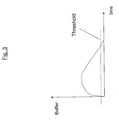
- Figure 3 shows a diagram over a buffer versus time in an RLC for a not yet acknowledged data.
- the Amount of not yet acknowledged data is rising considerably in the first part of the downloading process and then attenuates towards zero.
- a threshold is set at a predetermined level. All the mobile stations MS having not yet acknowledged data above the threshold is subject for being disrupted by cancelling the corresponding A-DPCH for that user.
- the mobile stations just started to download is also below the threshold and will not be thrown out. This is of course not a desired situation, but the not yet acknowledged data is rising very fast so the mobile station will quickly be one of the mobile stations above the threshold level and thus subject for releasing the corresponding A-DPCH.
Landscapes
- Engineering & Computer Science (AREA)
- Computer Networks & Wireless Communication (AREA)
- Signal Processing (AREA)
- Databases & Information Systems (AREA)
- Mobile Radio Communication Systems (AREA)
- Small-Scale Networks (AREA)
Description
- The invention refers to a method for improved congestion control in a wireless mobile system and a control device arranged to carry out the method. The method is used in a wireless mobile system where a high speed packet data access has been established between a node and a number of mobile stations by dedicating a high speed physical downlink shared channel to all mobile stations and one associated dedicated channel per each mobile station.
-
- 3GPP-3rd Generation Partnership Project (standards body)
- A-DPCH-Associated Dedicated Physical Channel
- DL-DownLink
- FDD-Frequency Division Duplex
- GGSN-Gateway GPRS Support Node
- GPRS-General Packet Radio System
- GSM-Global System for Mobile Communications
- HSDPA-High Speed Downlink Packet Access
- HS-PDSCH High Speed Physical Downlink Shared CHannel
- LLC-Logical Link Control
- MAC- Medium Access Code
- MS-Mobile station
- PDP-Packet Data Protocol
- RLC- Radio Link Control
- RNC-Radio Network Controller
- SGSN-Serving GPRS Support Node
- SNDCP-Sub Network Dependent Convergence Protocol
- TCP-Transport
- TDD-Time Division Duplex
- UL-UpLink
- UMTS-Universal Mobile Telecommunications System
- UTRAN- UMTS Terrestrial Radio Access Network
- WCDMA- Wide band Code Division Multiple Access
- The 3rd Generation Partnership Project (3GPP) specification is a standard for the third generation mobile telephony system. The system supports different user data rates for different users. The transmission power used for a certain user is determined by interference level in a certain cell, user data rate, channel quality and requested quality of the data transmission in the cell.
- Control channels and traffic channels are referred to as logical channels. These logical channels are mapped onto physical channels.
- A physical channel can be a radio broadcasting frequency, a pair of frequencies (including duplex separation) in an analog mobile system or a time slot on a pair of frequencies in a digital mobile system.
- A physical channel may, for example, be a time slot on a particular frequency channel in a TDMA system and may also be said to be a carrier of a logical channel, such as a traffic channel (sometimes abbreviated TCH), or several logical channels, such as various control channels in a multi frame structure.
- In digital systems based on TDMA the mapping process means that a time slot and a frequency are allocated to the traffic burst.
- The traffic channels convey voice or data (such as Internet traffic) between the mobile and base station. The channels are allocated on a per call basis. Ordinarily, a time slot is used for one call only (full rate), but an alternative with two calls per time slot (half rate) has also been specified.
- All the present mobile systems are based on multiple access, which means that all users have simultaneous access to the medium. This requires a number of rules to prevent situations in which mobiles "all talk at the same time". The medium, which is a common resource, must satisfy the needs of all users.
- Traffic channels are assigned through control-channel signalling.
- Each cell in a cellular system can be regarded as an individual medium because a mobile leaving the cell loses contact with that cell's base station. However, all mobiles in the cell utilise the same radio resource, namely, that portion of the frequency spectrum which has been assigned to the cell.
- One technique for channel multiplexing using multiple access is CDMA (Code division multiple access). CDMA systems are capable of transmitting and receiving over the entire frequency band and a "third dimension" is used to separate traffic channels, namely coding.
- A typical feature of the CDMA technique is that all mobiles in the network are assigned a unique code: a chip sequence. When a mobile wishes to transmit a bit stream, it replaces every bit with its code (for ones) or with the code's ones complement (for zeros). The result is that a number of air interface bits (referred to as a "chip"), depending on the spreading factor used, are transmitted for every payload bit. Provided that the same modulation methods are used as those used in TDMA, the required bandwidth will be correspondingly larger. Instead of using some tens of kHz for a voice channel, the chip will be modulated over approximately 3.84 MHz. That is why this technique is also referred to as a spread-spectrum technique.
- The mobile telephone system may, for example, be a WCDMA system which has a downlink transport channel called High Speed Downlink Shared Channel (HS-DSCH) mapped onto a set of physical channels called High Speed Physical Downlink Shared CHannels (HS-PDSCH). The HS-DSCH provides enhanced support for interactive, background, and, to some extent streaming radio-access-bearer (RAB) services in the downlink direction.
- In a HSDPA supporting WCDMA system (e.g. according to 3GPP release 5) every user that is given access to a HS-PDSCH (High Speed Physical Downlink Shared Channel) channel must also have an associated dedicated Physical Channel A-DPCH used, for example, for communicating control information.
- Such a system is known for instance from
EP-A2-1448012 . - A typical action in case of overload (congestion) consists of the Radio Network Controller RNC releasing certain channels to reduce the load on the particular resource that is in shortage, for example DL Power, UL interference, DL Codes, etc. It is possible that also A-DPCHs will be released, especially if all interactive/background traffic is carried on HS-PDSCH and there's a need to make more DL Codes available to handle a sharp increase in conversational traffic (speech, video, ...) or if it turns out that A-DPCHs consume a significant amount of power.
- Current congestion control randomly selects the A-DPCHs to be released for certain mobile stations and thereby inhibiting the downlink information flow in the HS-PDSCH for the thereby randomly chosen mobile station. This can lead to a situation where a user that is almost done with a download is thrown out of the system at the expense of a user that has just got into the system. As an end user, this can be very annoying, especially if the application gives some kind of indication of the progress of the download (one case could be that the end user can see that the down load is 95% completed and then interrupted).
- Therefore, there is a need for an improved congestion control in a HSDPA based system or the like, with enhanced data transmission flow control giving more pleased users.
- The invention intends to remedy the above problems by a method for improved congestion control and a control device arranged for carrying out the method.
- The method is used in a wireless mobile system where a high speed packet data access HSDPA has been established between a node and a number of mobile stations MS by dedicating a high speed physical downlink shared channel HS-PDSCH to all mobile stations MS and one associated dedicated channel A-DPCH per each mobile station MS. The above HSDPA setup may be performed by the node.
- The method comprises the steps of:
- in case of congestion, a control device detecting the amount of download data still to be downloaded by each of the mobile stations MS and,
- based on the amount of download data still to be downloaded, the control device releasing the associated dedicated channel A-DPCH for one or more first mobile stations MS having an amount of data above a predetermined threshold level.
- The advantage of the invention lies in that the mobile stations that are almost finished downloading, are allowed to finish downloading, instead of as in prior art being randomly thrown out regardless of status.
- In one embodiment of the invention, the threshold level is an amount of download data to be downloaded by one or several second mobile stations MS using the same high speed physical downlink shared channel HS-PDSCH as the first mobile station(s). In this embodiment the threshold is set by comparing all mobile stations and to release the A-DPCH for one or several user units having more data to be downloaded than at least another mobile station. The comparison may give a hierarchy with the mobile station having the most data to be downloaded at the top and the mobile station with the least data at the bottom. The threshold may here be a floating value that is always set at the mobile station having the second most data to download, i.e. mobile station No two in the hierarchy. The advantage here is that the mobile station having the most still to download will be thrown out in a first round, and during the next round the next in order is thrown out if more recourses have to be liberated, while all the other mobile stations may continue downloading and the mobile stations having the least to download is thus given a chance to finish downloading. The threshold level may also be set at a level indicating a specific mobile station in the hierarchy and all the mobile stations above that mobile station in the hierarchy may be subject to the release of the associated the A-DPCH.
- In one embodiment of the invention, the threshold level is a preset value, for example, all mobile stations having downloaded more than a certain percentage of an intended amount may continue and the other mobile stations may be subject to the release of the associated the A-DPCH .
- The wireless mobile system may be a WCDMA based system wherein the node being an RNC. However, the invention is applicable on all systems using a downlink shared channel and an associated dedicated channel that always consumes an amount of the total system recourse, for example for control information. As referred to in the prior art description, HS-PDSCH and A-DPCH refers to a WCDMA system, but the present invention may be applicable in, for example, CDMA 2000 1x, EVDO (EVolution Data Only) and EVDV (EVolution Data/Voice), where the HS-PDSCH is denoted F-PDCH (Forward link Packet Data CHannel) and the corresponding A-DPCH is denoted F-FCH (Forward link Fundamental CHannel). CDMA 2000 refers to the 3GPP2 and the EVDO and EVDV corresponds to the HSDPA system in the 3GPP3 based WCDMA system. The invention may also be used in any other FDMA and/or a TDMA based system with a similar channel configuration as the WCDMA or CDMA 2000.
- In one embodiment the threshold level is a preset value of not yet acknowledged data in an RLC in the RNC. The not yet acknowledged data may be detected by looking in the RLC buffers, where it would be possible to find users with low amounts of not yet acknowledged data. The threshold may then be defined in bytes. The most straightforward way to use this information would be to define the threshold such that mobile stations with less remaining data than this threshold are protected at least in a first round of releasing A-DPCHs.
- If there's a proxy in the RNC, information from this proxy could be passed over an RNC internal interface to a radio resource management function in a control device taking the decision on which A-DPCH to be released. The radio resource management function is preferably a part of the RNC.
- It would of course also be possible to combine this criterion with other criteria such as detection of power usage of the individual Radio Link. The not yet acknowledged data may also be used for the above described comparison between different mobile stations.
- The basic idea of the invention is thus to find/detect users that have very little data waiting for transmission and the benefits is an improved end user experience for wireless data services in a WCDMA or another similar system using a HSDPA supporting network or a network similar to HSDPA.
- In principle the same mechanisms can be considered also for interactive or background traffic on dedicated channels as well, but the gain is assumed to be lower.
- The invention refers also to a control device for improved congestion control in a wireless mobile system where a high speed packet data access (HSDPA) between a node and a number of mobile stations (MS) have been established by a high speed physical downlink shared channel (HS-PDSCH) being dedicated to all mobile stations (MS) and one associated dedicated channel (A-DPCH) being dedicated per each mobile station (MS),
- in case of congestion, the control device being arranged to detect the amount of download data still to be downloaded by each of the mobile stations (MS) and,
- the control device being arranged to, based on the amount of download data still to be downloaded, release the associated dedicated channel (A-DPCH) for one or more first mobile stations (MS) having an amount of data above the predetermined threshold level.
- All the above stated advantages with the method is also valid for the control device.
- The control device is preferably a part of the RNC and may be arranged to carry out all the above stated method steps.
- The invention will below be described in more details in connection to a number of drawings, where;
-
Figure 1 schematically shows a TCP/IP based network in a GPRS standard according to one embodiment of the present invention; -
Figure 2 schematically shows different stacked protocols of the GGSN over the Gn interface to the SGSN and the SGSN over the lu interface to the MS, and where; -
Figure 3 shows a diagram over a buffer versus time. -
Figure 1 schematically shows a TCP/IP based network in a GPRS standard according to one embodiment of the present invention. The network comprises a landline based network a wireless radio network. The land line based network comprises a host in the form of a SERVER and a GGSN and a SGSN. The radio network comprises an RNC, a Node B and a client in the form of an MS, all based on WCDMA, see alsofigure 2 . The interface between the GGSN and the SGSN is called Gn, and the interface between the SGSN and the RNC is called lu. The interface between the MS and the Node-B in the second radio network is called Uv. The interface between the GGSN and the SERVER is called Gi. - When discussing
figure 1 , cross-references are made tofigure 2. Figure 2 schematically shows different stacked protocols of the GGSN over the Gn interface to the SGSN and the SGSN over the lu interface to the MS. Infigure 3 , UTRAN refers to the RNC and the Node-B infigure 1 . - The GGSN refers to a gateway GPRS support node acting as an interface between the GPRS backbone network and the external packet data networks (radio network and the IP network). It converts the GPRS packets coming from the SGSN into the appropriate packet data protocol (PDP) format (e.g. IP) and sends them out on the corresponding packet data network. In the other direction, PDP addresses of incoming data packets are converted to the GSM address of the destination user. The readdressed packets are sent to the responsible SGSN. For this purpose, the GGSN stores the current SGSN address of the user and his or her profile in its location register. The GGSN also performs authentication and charging functions towards external systems, whereas SGSN may perform authentication.
- The function of the SGSN is as a router in the interface between the wireless network and the land line based network and has been explained above.
- WCDMA technology is used for UTRAN air interface. UMTS WCDMA is a Direct Sequence CDMA system where user data is multiplied with quasi-random bits derived from WCDMA Spreading codes. In UMTS, in addition to channelisation, Codes are used for synchronisation and scrambling. WCDMA has two basic modes of operation: Frequency Division Duplex (FDD) and Time Division Duplex (TDD).
- The functions of the Node-B are:
- Air interface Transmission / Reception
- Modulation / Demodulation
- CDMA Physical Channel coding
- Micro Diversity
- Error Handing
- Closed loop power control
- The functions of the RNC are:
- Radio Resource Control
- Admission Control
- Channel Allocation
- Power Control Settings
- Handover Control
- Macro Diversity
- Ciphering
- Segmentation / Reassembly
- Broadcast Signalling
- Open Loop Power Control
- In the radio interface lu in the RNC for UMTS GPRS, concentration is performed in the radio air interface lu, because the number of traffic channels is limited.
- The invention refers to a method for congestion control where the dedicated channel A-DPCH is released for some specific mobile stations. These mobile stations have an amount of information to download above a set threshold level. In order to find those mobile stations, a search for mobile stations below the threshold level reveals mobile stations that shall not be released, at least not in a first round of sorting out. By looking at RLC buffers in the RNC (See for example
figure 2 and3 .), it is possible to find mobile stations with low amounts of not yet acknowledged data, which is a sign that the mobile stations have downloaded the main part of the information, and that these mobile stations should be prioritised and not be thrown out by releasing the mobile stations corresponding A-DPCH if there are other mobile stations having a higher amount of not yet acknowledged data. - If there's a proxy in the RNC, information from this proxy could be passed over some RNC internal interface to the radio resource management function. The proxy is sometimes proposed as a means to hide the radio network from the application by intermediate buffering of data.
-
Figure 3 shows a diagram over a buffer versus time in an RLC for a not yet acknowledged data. The Amount of not yet acknowledged data is rising considerably in the first part of the downloading process and then attenuates towards zero. Infigure 3 a threshold is set at a predetermined level. All the mobile stations MS having not yet acknowledged data above the threshold is subject for being disrupted by cancelling the corresponding A-DPCH for that user. As can be seen infigure 3 , the mobile stations just started to download is also below the threshold and will not be thrown out. This is of course not a desired situation, but the not yet acknowledged data is rising very fast so the mobile station will quickly be one of the mobile stations above the threshold level and thus subject for releasing the corresponding A-DPCH.
Claims (10)
- A method for improved congestion control in a wireless mobile system where a high speed packet data access (HSDPA) has been established between a node and a number of mobile stations (MS) by dedicating a high speed physical downlink shared channel (HS-PDSCH) to all mobile stations (MS) and one associated dedicated channel (A-DPCH) per each mobile station (MS),- in case of congestion, a control device detecting the amount of download data still to be downloaded by each of the mobile stations (MS) and,- based on the amount of download data still to be downloaded, the control device releasing the associated dedicated channel (A-DPCH) for one or more first mobile stations (MS) having an amount of data above a predetermined threshold level.
- A method according to claim 1, wherein the threshold level being an amount of download data to be downloaded by one or more second mobile stations (MS) using the same high speed physical downlink shared channel (HS-PDSCH) as the first mobile station(s) (MS).
- A method according to claim 1, wherein the threshold level being a preset value.
- A method according to claim 1, wherein the threshold level being a preset value of not yet acknowledged data in an RLC (Radio Link control).
- A method according to any one of the preceding claims, wherein the wireless mobile system being a WCDMA based system wherein the node being an RNC (Radio Network Controller) comprising the control device.
- A control device for improved congestion control in a wireless mobile system where a high speed packet data access (HSDPA) between a node and a number of mobile stations (MS) have been established by a high speed physical downlink shared channel (HS-PDSCH) being dedicated to all mobile stations (MS) and one associated dedicated channel (A-DPCH) being dedicated per each mobile station (MS),- in case of congestion, the control device being arranged to detect the amount of download data still to be downloaded by each of the mobile stations (MS) and,- the control device being arranged to, based on the amount of download data still to be downloaded, release the associated dedicated channel (A-DPCH) for one or more first mobile stations (MS) having an amount of data above the predetermined threshold level.
- A control device according to claim 6, wherein the threshold level being an amount of download data to be downloaded by one or more second mobile stations (MS) using the same high speed physical downlink shared channel (HS-PDSCH) as the first mobile station(s) (MS).
- A control device according to claim 6, wherein the threshold level being a preset value.
- A control device according to claim 6, wherein the threshold level being a preset value of not yet acknowledged data in an RLC.
- A control device according to any one of claims 6-9, wherein the wireless mobile system being a WCDMA based system and the node being an RNC.
Applications Claiming Priority (1)
| Application Number | Priority Date | Filing Date | Title |
|---|---|---|---|
| PCT/SE2004/001629 WO2006052169A1 (en) | 2004-11-10 | 2004-11-10 | Congestion control in a wireless mobile system |
Publications (2)
| Publication Number | Publication Date |
|---|---|
| EP1810539A1 EP1810539A1 (en) | 2007-07-25 |
| EP1810539B1 true EP1810539B1 (en) | 2016-08-24 |
Family
ID=36336773
Family Applications (1)
| Application Number | Title | Priority Date | Filing Date |
|---|---|---|---|
| EP04800292.7A Expired - Lifetime EP1810539B1 (en) | 2004-11-10 | 2004-11-10 | Congestion control in a wireless mobile system |
Country Status (6)
| Country | Link |
|---|---|
| US (1) | US7710875B2 (en) |
| EP (1) | EP1810539B1 (en) |
| JP (1) | JP4468991B2 (en) |
| CN (1) | CN101057513B (en) |
| AU (1) | AU2004324709B2 (en) |
| WO (1) | WO2006052169A1 (en) |
Families Citing this family (4)
| Publication number | Priority date | Publication date | Assignee | Title |
|---|---|---|---|---|
| US7885662B2 (en) * | 2005-08-30 | 2011-02-08 | Telefonaktiebolaget Lm Ericsson (Publ) | Selection of channel for radio resource control signaling in HSDPA |
| KR100827615B1 (en) | 2006-11-17 | 2008-05-07 | 삼성전자주식회사 | Apparatus and Method for Resolving Congestion in Broadband Code Division Multiple Access Systems |
| CN104521279B (en) * | 2013-08-14 | 2019-03-01 | 华为技术有限公司 | Method and apparatus for allocating data transmission resources |
| CN112598447B (en) * | 2020-12-28 | 2023-10-10 | 加和(北京)信息科技有限公司 | Order information processing method and device, electronic equipment and processor |
Family Cites Families (10)
| Publication number | Priority date | Publication date | Assignee | Title |
|---|---|---|---|---|
| KR100255564B1 (en) | 1997-12-23 | 2000-05-01 | 정선종 | Channel Allocation and Decommissioning Method Considering Traffic Characteristics of Code Division Multiple Access Mobile Communication System |
| KR20030023082A (en) | 2001-09-12 | 2003-03-19 | 주식회사 텔루션 | Traffic resource management method in mobile communication system |
| JP4022744B2 (en) * | 2002-08-01 | 2007-12-19 | 日本電気株式会社 | Mobile communication system, best cell changing method, and base station control apparatus used therefor |
| JP4378967B2 (en) * | 2003-02-10 | 2009-12-09 | 日本電気株式会社 | Mobile communication system, radio network control apparatus, and resource allocation control method used therefor |
| US7349338B2 (en) * | 2003-04-15 | 2008-03-25 | Lucent Technologies Inc | Scheduler and method for scheduling transmissions in a communication network |
| KR200323082Y1 (en) | 2003-05-13 | 2003-08-14 | 이원섭 | The Urinal with a Foothold |
| GB2405289B (en) * | 2003-08-20 | 2006-10-25 | Ipwireless Inc | Method,base station,remote station and system for HSDPA communication |
| US7773502B2 (en) * | 2003-11-19 | 2010-08-10 | Telefonaktiebolaget Lm Ericsson (Publ) | Dynamic voice over data prioritization for wireless communication networks |
| WO2005053344A1 (en) * | 2003-11-28 | 2005-06-09 | Telecom Italia S.P.A. | Method for evaluating the performances of a mobile telephony network |
| US7292825B2 (en) * | 2004-10-19 | 2007-11-06 | Ipwireless, Inc. | Retransmission scheme in a cellular communication system |
-
2004
- 2004-11-10 WO PCT/SE2004/001629 patent/WO2006052169A1/en not_active Ceased
- 2004-11-10 EP EP04800292.7A patent/EP1810539B1/en not_active Expired - Lifetime
- 2004-11-10 CN CN2004800443803A patent/CN101057513B/en not_active Expired - Fee Related
- 2004-11-10 JP JP2007540277A patent/JP4468991B2/en not_active Expired - Fee Related
- 2004-11-10 US US11/719,021 patent/US7710875B2/en not_active Expired - Lifetime
- 2004-11-10 AU AU2004324709A patent/AU2004324709B2/en not_active Ceased
Non-Patent Citations (1)
| Title |
|---|
| None * |
Also Published As
| Publication number | Publication date |
|---|---|
| JP2008520126A (en) | 2008-06-12 |
| WO2006052169A1 (en) | 2006-05-18 |
| CN101057513A (en) | 2007-10-17 |
| JP4468991B2 (en) | 2010-05-26 |
| AU2004324709A1 (en) | 2006-05-18 |
| AU2004324709B2 (en) | 2009-08-13 |
| US7710875B2 (en) | 2010-05-04 |
| CN101057513B (en) | 2011-01-26 |
| US20080089229A1 (en) | 2008-04-17 |
| EP1810539A1 (en) | 2007-07-25 |
Similar Documents
| Publication | Publication Date | Title |
|---|---|---|
| US6519461B1 (en) | Channel-type switching from a common channel to a dedicated channel based on common channel load | |
| US6594241B1 (en) | Channel-type switching control | |
| CN1860808B (en) | method of transferring data | |
| US8983480B2 (en) | Multiplexing on the reverse link feedbacks for multiple forward link frequencies | |
| EP1875624B1 (en) | Multiplexing on the reverse link feedbacks for multiple forward link frequencies | |
| US20030012217A1 (en) | Channel-type switching to a common channel based on common channel load | |
| EP2165480A1 (en) | Congestion control in a transmission node | |
| CN100553358C (en) | Method and apparatus for feedback reporting in wireless communication system | |
| EP1900161B1 (en) | Scheduling information at serving cell change | |
| US7710875B2 (en) | Congestion control in a wireless mobile system | |
| US8411697B2 (en) | Method and arrangement for improving media transmission quality using robust representation of media frames | |
| WO2007091968A2 (en) | Method and arrangement for improving media transmission quality using robust representation of media frames | |
| KR100914819B1 (en) | Congestion control in a wireless mobile system | |
| WO2007135236A1 (en) | Managing quality-of-service profiles in a mobile telecommunications system | |
| US20060270410A1 (en) | Mobile communication method and radio network controller | |
| Sachs et al. | Congestion control in WCDMA with respect to different service classes |
Legal Events
| Date | Code | Title | Description |
|---|---|---|---|
| PUAI | Public reference made under article 153(3) epc to a published international application that has entered the european phase |
Free format text: ORIGINAL CODE: 0009012 |
|
| 17P | Request for examination filed |
Effective date: 20070509 |
|
| AK | Designated contracting states |
Kind code of ref document: A1 Designated state(s): AT BE BG CH CY CZ DE DK EE ES FI FR GB GR HU IE IS IT LI LU MC NL PL PT RO SE SI SK TR |
|
| DAX | Request for extension of the european patent (deleted) | ||
| REG | Reference to a national code |
Ref country code: DE Ref legal event code: R079 Ref document number: 602004049840 Country of ref document: DE Free format text: PREVIOUS MAIN CLASS: H04Q0007380000 Ipc: H04W0028020000 |
|
| GRAP | Despatch of communication of intention to grant a patent |
Free format text: ORIGINAL CODE: EPIDOSNIGR1 |
|
| RIC1 | Information provided on ipc code assigned before grant |
Ipc: H04W 28/02 20090101AFI20160601BHEP |
|
| GRAS | Grant fee paid |
Free format text: ORIGINAL CODE: EPIDOSNIGR3 |
|
| GRAA | (expected) grant |
Free format text: ORIGINAL CODE: 0009210 |
|
| INTG | Intention to grant announced |
Effective date: 20160704 |
|
| AK | Designated contracting states |
Kind code of ref document: B1 Designated state(s): AT BE BG CH CY CZ DE DK EE ES FI FR GB GR HU IE IS IT LI LU MC NL PL PT RO SE SI SK TR |
|
| REG | Reference to a national code |
Ref country code: GB Ref legal event code: FG4D |
|
| REG | Reference to a national code |
Ref country code: CH Ref legal event code: EP |
|
| REG | Reference to a national code |
Ref country code: AT Ref legal event code: REF Ref document number: 824039 Country of ref document: AT Kind code of ref document: T Effective date: 20160915 |
|
| REG | Reference to a national code |
Ref country code: IE Ref legal event code: FG4D |
|
| REG | Reference to a national code |
Ref country code: NL Ref legal event code: FP |
|
| REG | Reference to a national code |
Ref country code: DE Ref legal event code: R096 Ref document number: 602004049840 Country of ref document: DE |
|
| REG | Reference to a national code |
Ref country code: AT Ref legal event code: MK05 Ref document number: 824039 Country of ref document: AT Kind code of ref document: T Effective date: 20160824 |
|
| PG25 | Lapsed in a contracting state [announced via postgrant information from national office to epo] |
Ref country code: FI Free format text: LAPSE BECAUSE OF FAILURE TO SUBMIT A TRANSLATION OF THE DESCRIPTION OR TO PAY THE FEE WITHIN THE PRESCRIBED TIME-LIMIT Effective date: 20160824 Ref country code: IT Free format text: LAPSE BECAUSE OF FAILURE TO SUBMIT A TRANSLATION OF THE DESCRIPTION OR TO PAY THE FEE WITHIN THE PRESCRIBED TIME-LIMIT Effective date: 20160824 |
|
| PG25 | Lapsed in a contracting state [announced via postgrant information from national office to epo] |
Ref country code: GR Free format text: LAPSE BECAUSE OF FAILURE TO SUBMIT A TRANSLATION OF THE DESCRIPTION OR TO PAY THE FEE WITHIN THE PRESCRIBED TIME-LIMIT Effective date: 20161125 Ref country code: AT Free format text: LAPSE BECAUSE OF FAILURE TO SUBMIT A TRANSLATION OF THE DESCRIPTION OR TO PAY THE FEE WITHIN THE PRESCRIBED TIME-LIMIT Effective date: 20160824 Ref country code: BE Free format text: LAPSE BECAUSE OF NON-PAYMENT OF DUE FEES Effective date: 20161130 Ref country code: ES Free format text: LAPSE BECAUSE OF FAILURE TO SUBMIT A TRANSLATION OF THE DESCRIPTION OR TO PAY THE FEE WITHIN THE PRESCRIBED TIME-LIMIT Effective date: 20160824 Ref country code: SE Free format text: LAPSE BECAUSE OF FAILURE TO SUBMIT A TRANSLATION OF THE DESCRIPTION OR TO PAY THE FEE WITHIN THE PRESCRIBED TIME-LIMIT Effective date: 20160824 |
|
| PG25 | Lapsed in a contracting state [announced via postgrant information from national office to epo] |
Ref country code: RO Free format text: LAPSE BECAUSE OF FAILURE TO SUBMIT A TRANSLATION OF THE DESCRIPTION OR TO PAY THE FEE WITHIN THE PRESCRIBED TIME-LIMIT Effective date: 20160824 Ref country code: EE Free format text: LAPSE BECAUSE OF FAILURE TO SUBMIT A TRANSLATION OF THE DESCRIPTION OR TO PAY THE FEE WITHIN THE PRESCRIBED TIME-LIMIT Effective date: 20160824 |
|
| REG | Reference to a national code |
Ref country code: DE Ref legal event code: R097 Ref document number: 602004049840 Country of ref document: DE |
|
| PG25 | Lapsed in a contracting state [announced via postgrant information from national office to epo] |
Ref country code: BG Free format text: LAPSE BECAUSE OF FAILURE TO SUBMIT A TRANSLATION OF THE DESCRIPTION OR TO PAY THE FEE WITHIN THE PRESCRIBED TIME-LIMIT Effective date: 20161124 Ref country code: CZ Free format text: LAPSE BECAUSE OF FAILURE TO SUBMIT A TRANSLATION OF THE DESCRIPTION OR TO PAY THE FEE WITHIN THE PRESCRIBED TIME-LIMIT Effective date: 20160824 Ref country code: SK Free format text: LAPSE BECAUSE OF FAILURE TO SUBMIT A TRANSLATION OF THE DESCRIPTION OR TO PAY THE FEE WITHIN THE PRESCRIBED TIME-LIMIT Effective date: 20160824 Ref country code: BE Free format text: LAPSE BECAUSE OF FAILURE TO SUBMIT A TRANSLATION OF THE DESCRIPTION OR TO PAY THE FEE WITHIN THE PRESCRIBED TIME-LIMIT Effective date: 20160824 Ref country code: DK Free format text: LAPSE BECAUSE OF FAILURE TO SUBMIT A TRANSLATION OF THE DESCRIPTION OR TO PAY THE FEE WITHIN THE PRESCRIBED TIME-LIMIT Effective date: 20160824 Ref country code: PL Free format text: LAPSE BECAUSE OF FAILURE TO SUBMIT A TRANSLATION OF THE DESCRIPTION OR TO PAY THE FEE WITHIN THE PRESCRIBED TIME-LIMIT Effective date: 20160824 |
|
| PLBE | No opposition filed within time limit |
Free format text: ORIGINAL CODE: 0009261 |
|
| REG | Reference to a national code |
Ref country code: CH Ref legal event code: PL |
|
| STAA | Information on the status of an ep patent application or granted ep patent |
Free format text: STATUS: NO OPPOSITION FILED WITHIN TIME LIMIT |
|
| PG25 | Lapsed in a contracting state [announced via postgrant information from national office to epo] |
Ref country code: CH Free format text: LAPSE BECAUSE OF NON-PAYMENT OF DUE FEES Effective date: 20161130 Ref country code: LI Free format text: LAPSE BECAUSE OF NON-PAYMENT OF DUE FEES Effective date: 20161130 |
|
| 26N | No opposition filed |
Effective date: 20170526 |
|
| REG | Reference to a national code |
Ref country code: IE Ref legal event code: MM4A |
|
| REG | Reference to a national code |
Ref country code: FR Ref legal event code: ST Effective date: 20170731 |
|
| PG25 | Lapsed in a contracting state [announced via postgrant information from national office to epo] |
Ref country code: SI Free format text: LAPSE BECAUSE OF FAILURE TO SUBMIT A TRANSLATION OF THE DESCRIPTION OR TO PAY THE FEE WITHIN THE PRESCRIBED TIME-LIMIT Effective date: 20160824 |
|
| PG25 | Lapsed in a contracting state [announced via postgrant information from national office to epo] |
Ref country code: LU Free format text: LAPSE BECAUSE OF NON-PAYMENT OF DUE FEES Effective date: 20161130 |
|
| PG25 | Lapsed in a contracting state [announced via postgrant information from national office to epo] |
Ref country code: FR Free format text: LAPSE BECAUSE OF NON-PAYMENT OF DUE FEES Effective date: 20161130 |
|
| PG25 | Lapsed in a contracting state [announced via postgrant information from national office to epo] |
Ref country code: IE Free format text: LAPSE BECAUSE OF NON-PAYMENT OF DUE FEES Effective date: 20161110 |
|
| PG25 | Lapsed in a contracting state [announced via postgrant information from national office to epo] |
Ref country code: HU Free format text: LAPSE BECAUSE OF FAILURE TO SUBMIT A TRANSLATION OF THE DESCRIPTION OR TO PAY THE FEE WITHIN THE PRESCRIBED TIME-LIMIT; INVALID AB INITIO Effective date: 20041110 Ref country code: CY Free format text: LAPSE BECAUSE OF FAILURE TO SUBMIT A TRANSLATION OF THE DESCRIPTION OR TO PAY THE FEE WITHIN THE PRESCRIBED TIME-LIMIT Effective date: 20160824 |
|
| PG25 | Lapsed in a contracting state [announced via postgrant information from national office to epo] |
Ref country code: PT Free format text: LAPSE BECAUSE OF FAILURE TO SUBMIT A TRANSLATION OF THE DESCRIPTION OR TO PAY THE FEE WITHIN THE PRESCRIBED TIME-LIMIT Effective date: 20160824 Ref country code: MC Free format text: LAPSE BECAUSE OF FAILURE TO SUBMIT A TRANSLATION OF THE DESCRIPTION OR TO PAY THE FEE WITHIN THE PRESCRIBED TIME-LIMIT Effective date: 20160824 Ref country code: IS Free format text: LAPSE BECAUSE OF FAILURE TO SUBMIT A TRANSLATION OF THE DESCRIPTION OR TO PAY THE FEE WITHIN THE PRESCRIBED TIME-LIMIT Effective date: 20160824 Ref country code: TR Free format text: LAPSE BECAUSE OF FAILURE TO SUBMIT A TRANSLATION OF THE DESCRIPTION OR TO PAY THE FEE WITHIN THE PRESCRIBED TIME-LIMIT Effective date: 20160824 |
|
| PGFP | Annual fee paid to national office [announced via postgrant information from national office to epo] |
Ref country code: NL Payment date: 20181126 Year of fee payment: 15 |
|
| PGFP | Annual fee paid to national office [announced via postgrant information from national office to epo] |
Ref country code: DE Payment date: 20181128 Year of fee payment: 15 |
|
| PGFP | Annual fee paid to national office [announced via postgrant information from national office to epo] |
Ref country code: GB Payment date: 20181127 Year of fee payment: 15 |
|
| REG | Reference to a national code |
Ref country code: DE Ref legal event code: R119 Ref document number: 602004049840 Country of ref document: DE |
|
| REG | Reference to a national code |
Ref country code: NL Ref legal event code: MM Effective date: 20191201 |
|
| GBPC | Gb: european patent ceased through non-payment of renewal fee |
Effective date: 20191110 |
|
| PG25 | Lapsed in a contracting state [announced via postgrant information from national office to epo] |
Ref country code: NL Free format text: LAPSE BECAUSE OF NON-PAYMENT OF DUE FEES Effective date: 20191201 |
|
| PG25 | Lapsed in a contracting state [announced via postgrant information from national office to epo] |
Ref country code: GB Free format text: LAPSE BECAUSE OF NON-PAYMENT OF DUE FEES Effective date: 20191110 Ref country code: DE Free format text: LAPSE BECAUSE OF NON-PAYMENT OF DUE FEES Effective date: 20200603 |