EP1810452B1 - A method of controlling one or more terminals from a base station - Google Patents
A method of controlling one or more terminals from a base station Download PDFInfo
- Publication number
- EP1810452B1 EP1810452B1 EP05801340A EP05801340A EP1810452B1 EP 1810452 B1 EP1810452 B1 EP 1810452B1 EP 05801340 A EP05801340 A EP 05801340A EP 05801340 A EP05801340 A EP 05801340A EP 1810452 B1 EP1810452 B1 EP 1810452B1
- Authority
- EP
- European Patent Office
- Prior art keywords
- scheduling command
- terminal
- identifier
- scheduling
- priority
- Prior art date
- Legal status (The legal status is an assumption and is not a legal conclusion. Google has not performed a legal analysis and makes no representation as to the accuracy of the status listed.)
- Expired - Lifetime
Links
Images

Classifications
-
- H—ELECTRICITY
- H04—ELECTRIC COMMUNICATION TECHNIQUE
- H04B—TRANSMISSION
- H04B7/00—Radio transmission systems, i.e. using radiation field
- H04B7/005—Control of transmission; Equalising
-
- H—ELECTRICITY
- H04—ELECTRIC COMMUNICATION TECHNIQUE
- H04W—WIRELESS COMMUNICATION NETWORKS
- H04W52/00—Power management, e.g. Transmission Power Control [TPC] or power classes
- H04W52/04—Transmission power control [TPC]
- H04W52/54—Signalisation aspects of the TPC commands, e.g. frame structure
-
- H—ELECTRICITY
- H04—ELECTRIC COMMUNICATION TECHNIQUE
- H04W—WIRELESS COMMUNICATION NETWORKS
- H04W72/00—Local resource management
- H04W72/20—Control channels or signalling for resource management
- H04W72/23—Control channels or signalling for resource management in the downlink direction of a wireless link, i.e. towards a terminal
-
- H—ELECTRICITY
- H04—ELECTRIC COMMUNICATION TECHNIQUE
- H04W—WIRELESS COMMUNICATION NETWORKS
- H04W28/00—Network traffic management; Network resource management
- H04W28/16—Central resource management; Negotiation of resources or communication parameters, e.g. negotiating bandwidth or QoS [Quality of Service]
- H04W28/18—Negotiating wireless communication parameters
- H04W28/22—Negotiating communication rate
-
- H—ELECTRICITY
- H04—ELECTRIC COMMUNICATION TECHNIQUE
- H04W—WIRELESS COMMUNICATION NETWORKS
- H04W36/00—Hand-off or reselection arrangements
- H04W36/16—Performing reselection for specific purposes
- H04W36/18—Performing reselection for specific purposes for allowing seamless reselection, e.g. soft reselection
-
- H—ELECTRICITY
- H04—ELECTRIC COMMUNICATION TECHNIQUE
- H04W—WIRELESS COMMUNICATION NETWORKS
- H04W52/00—Power management, e.g. Transmission Power Control [TPC] or power classes
- H04W52/04—Transmission power control [TPC]
- H04W52/06—TPC algorithms
- H04W52/14—Separate analysis of uplink or downlink
- H04W52/146—Uplink power control
-
- H—ELECTRICITY
- H04—ELECTRIC COMMUNICATION TECHNIQUE
- H04W—WIRELESS COMMUNICATION NETWORKS
- H04W72/00—Local resource management
- H04W72/04—Wireless resource allocation
- H04W72/044—Wireless resource allocation based on the type of the allocated resource
- H04W72/0473—Wireless resource allocation based on the type of the allocated resource the resource being transmission power
-
- H—ELECTRICITY
- H04—ELECTRIC COMMUNICATION TECHNIQUE
- H04W—WIRELESS COMMUNICATION NETWORKS
- H04W72/00—Local resource management
- H04W72/50—Allocation or scheduling criteria for wireless resources
- H04W72/56—Allocation or scheduling criteria for wireless resources based on priority criteria
- H04W72/566—Allocation or scheduling criteria for wireless resources based on priority criteria of the information or information source or recipient
-
- H—ELECTRICITY
- H04—ELECTRIC COMMUNICATION TECHNIQUE
- H04W—WIRELESS COMMUNICATION NETWORKS
- H04W8/00—Network data management
- H04W8/26—Network addressing or numbering for mobility support
Definitions
- This invention relates to a method of controlling one or more terminals from a base station.
- UMTS universal mobile telecommunication system
- UE user equipment
- Node B by the Node B scheduling the interference
- HARQ hybrid automatic repeat request
- ACK acknowledgements
- NACK non-acknowledgements
- TTI transmission time interval
- W02004/064426 describes using two or more reverse link rate controls at the same time in one or more sectors of a radio base station of a wireless communications network.
- a method of controlling one or more terminals from a base station using scheduling commands comprises transmitting a data block from the base station to the, or each, terminal, including the scheduling command and an identifier; wherein each terminal indicated by the identifier adapts its power level or data rate in accordance with the scheduling command; characterized in that the method further comprises setting two identifiers for each terminal; allocating a priority ranking to each identifier to determine priority of one scheduling command relative to any other scheduling command; wherein each terminal only adapts its power level or data rate in accordance with the scheduling command if the priority of the identifier received with a scheduling command in a data block is higher than the priority of an existing valid scheduling command.
- each scheduling command includes a validity period.
- the default value could be one which is preset for all terminals, but preferably, each terminal indicated by an identifier in a scheduling command reverts to the power level and data rate of its lowest priority identifier, on expiry of the validity period of that scheduling command.
- Certain terminals may have a need for a higher basic power level and data rate, so this can be set individually, as the lowest priority identifier.
- the terminal could respond substantially instantaneously to a change indicated by a scheduling command, but preferably, each terminal indicated by an identifier in a new scheduling command changes its power level or data rate in accordance with the new scheduling command, only when a validity period for a previous scheduling command for that terminal expires.
- the scheduling command could set a relative change, such as increase or decrease power by a fixed amount, preferably, the scheduling command sets an absolute power level or data rate.
- the terminal could be a static terminal, but preferably, the terminal comprises a mobile terminal.
- the identifiers for a terminal in soft handover are identifiers from different base stations and their relative priorities.
- the terminal may receive scheduling information from more than one base station, so it needs to know which takes precedence.
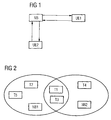
- a node B NB schedules a pair of terminals UE1 and UE2, typically mobile terminals within a cell. If UE1 is causing interference, the node B can send a scheduling command to UE1 which reduces its data rate and power level to the specified lower ones, without affecting UE2. Alternatively, ifNB has spare resources it can send a command, indicating to both UE1 and UE2 that they can increase their power levels and data rate to the same, higher, value.
- Fig. 2 illustrates the problem of soft handover, where terminals T1 and T3 might receive scheduling commands from both NB1 and NB2. Using the method of the present invention, the terminals will be given an identifier and priority ranking, so that they know which node B to follow.
- An absolute scheduling grant indicates an absolute setting of UL transmit power limit or UL transport format limit
- a relative scheduling grant gives an up or hold or down command for setting UL transmit power limit or UL transport format limit.
- a corresponding scheduling identification is sent together with the command to indicate the UE to which the scheduling grant applies.
- the scheduling grants can affect an individual UE (individual scheduling identification), a configured group of UEs ('group scheduling identification'), or all UEs which are under control of the scheduling Node B ('common scheduling identification').
- the UE receives configuration information (e.g. when the E-DCH channel is set up or reconfigured) in which a prioritized list of scheduling identifications is provided to indicate which scheduling identification has a higher priority, if the UE has or receives different grants with overlapping validity periods.
- the absolute grants may remain valid until the next absolute grant occurs, rather than being given a specific validity period.
- One example of using a list of prioritised UE IDs is one in which one of the IDs is used for scheduling a group of UEs. All of the UEs in the group are given a common ID as one of their UE IDs and individual Ids as another of their UE IDs. Their behaviour on receiving an absolute grant containing a UE ID will differ depending on whether the grant contains the common ID or an individual ID and the priority of the common/individual IDs.
- a UE e.g. UE1 is allocated 2 IDs with different priorities.
- the higher priority is UE1D1 and the lower priority is UE1D2, i.e. ID1 has a higher priority than ID2.
- the UE receives an absolute grant for UEID1, which has priority 1, so the UE responds. It also receives an absolute grant for UEID2, with priority 2, but the UE does not respond to this because it already has a valid grant with a higher priority number.
- Advantages of the proposed invention include a reduction and simplification of scheduling grants.
- a group or all UEs can be addressed by one grant only which is quicker in overload situations and saves downlink power and radio resources in general.
- the scheduler in the Node B is implementation specific, corresponding signalling for the configuration is needed in the standard and cost savings in the sense of radio resources can be achieved.
Landscapes
- Engineering & Computer Science (AREA)
- Computer Networks & Wireless Communication (AREA)
- Signal Processing (AREA)
- Mobile Radio Communication Systems (AREA)
Abstract
Description
- This invention relates to a method of controlling one or more terminals from a base station.
- In the third generation partnership project (3GPP) work is ongoing relating to enhanced uplink (or enhanced dedicated channel (E-DCH)) for frequency division duplex (FDD). Improvements provide a feature for universal mobile telecommunication system (UMTS) that enhances uplink (UL) transmissions from the mobile station or user equipment (UE) to the base station, or Node B by the Node B scheduling the interference, transmit power received at the Node B and transport formats used. These three parameters are coupled. Furthermore, a hybrid automatic repeat request (HARQ) mechanism sends acknowledgements (ACK) or non-acknowledgements (NACK) from a Node B, or in case of soft handover, more than one Node B, to the UE to trigger retransmissions. There is also some consideration of implementing a shorter transmission time interval (TTI) of 2ms, rather than a 10ms TTI which is more usually considered to be standard. The effect of all these changes is to improve coverage and throughput, as well as to reduce delay in the UL.
-
W02004/064426 describes using two or more reverse link rate controls at the same time in one or more sectors of a radio base station of a wireless communications network. - However, it is necessary to provide a way of scheduling commands from the base station to the terminal.
- In accordance with a first aspect of the present invention, a method of controlling one or more terminals from a base station using scheduling commands comprises transmitting a data block from the base station to the, or each, terminal, including the scheduling command and an identifier; wherein each terminal indicated by the identifier adapts its power level or data rate in accordance with the scheduling command; characterized in that the method further comprises setting two identifiers for each terminal; allocating a priority ranking to each identifier to determine priority of one scheduling command relative to any other scheduling command; wherein each terminal only adapts its power level or data rate in accordance with the scheduling command if the priority of the identifier received with a scheduling command in a data block is higher than the priority of an existing valid scheduling command.
- This ensures that changes in power level or data rate of a terminal can be controlled without having to apply the same changes to all terminals.
- Preferably, each scheduling command includes a validity period.
- This reduces the need for the base station to send commands, because the terminal will automatically revert to a default value on expiry of the validity period.
- The default value could be one which is preset for all terminals, but preferably, each terminal indicated by an identifier in a scheduling command reverts to the power level and data rate of its lowest priority identifier, on expiry of the validity period of that scheduling command.
- Certain terminals may have a need for a higher basic power level and data rate, so this can be set individually, as the lowest priority identifier.
- The terminal could respond substantially instantaneously to a change indicated by a scheduling command, but preferably, each terminal indicated by an identifier in a new scheduling command changes its power level or data rate in accordance with the new scheduling command, only when a validity period for a previous scheduling command for that terminal expires.
- This allows the base station to plan ahead in terms of resources.
- Although the scheduling command could set a relative change, such as increase or decrease power by a fixed amount, preferably, the scheduling command sets an absolute power level or data rate.
- The terminal could be a static terminal, but preferably, the terminal comprises a mobile terminal.
- Preferably, the identifiers for a terminal in soft handover are identifiers from different base stations and their relative priorities.
- When in soft handover, the terminal may receive scheduling information from more than one base station, so it needs to know which takes precedence.
- A method of scheduling one or more terminals from a base station will now be described, with reference to the accompanying drawings in which:
-
Figure 1 is a block diagram of a first example of the present invention; -
Figure 2 shows the invention applied during soft handover; and -
Figure 3 illustrates how priorities are allocated and used according to the present invention. - In
Fig. 1 , a node B NB schedules a pair of terminals UE1 and UE2, typically mobile terminals within a cell. If UE1 is causing interference, the node B can send a scheduling command to UE1 which reduces its data rate and power level to the specified lower ones, without affecting UE2. Alternatively, ifNB has spare resources it can send a command, indicating to both UE1 and UE2 that they can increase their power levels and data rate to the same, higher, value. -
Fig. 2 illustrates the problem of soft handover, where terminals T1 and T3 might receive scheduling commands from both NB1 and NB2. Using the method of the present invention, the terminals will be given an identifier and priority ranking, so that they know which node B to follow. - Different ways of scheduling commands, or grants, sent from the Node B to the UE are possible. An absolute scheduling grant indicates an absolute setting of UL transmit power limit or UL transport format limit, whereas a relative scheduling grant gives an up or hold or down command for setting UL transmit power limit or UL transport format limit.
- For the absolute scheduling grant, a corresponding scheduling identification, currently called UE Id, is sent together with the command to indicate the UE to which the scheduling grant applies. The scheduling grants can affect an individual UE (individual scheduling identification), a configured group of UEs ('group scheduling identification'), or all UEs which are under control of the scheduling Node B ('common scheduling identification'). Thus, there is a hierarchical scheduling identification giving different levels of grants. The UE receives configuration information (e.g. when the E-DCH channel is set up or reconfigured) in which a prioritized list of scheduling identifications is provided to indicate which scheduling identification has a higher priority, if the UE has or receives different grants with overlapping validity periods. Alternatively, the absolute grants may remain valid until the next absolute grant occurs, rather than being given a specific validity period.
- One example of using a list of prioritised UE IDs is one in which one of the IDs is used for scheduling a group of UEs. All of the UEs in the group are given a common ID as one of their UE IDs and individual Ids as another of their UE IDs. Their behaviour on receiving an absolute grant containing a UE ID will differ depending on whether the grant contains the common ID or an individual ID and the priority of the common/individual IDs.
- In
Fig. 3 , a UE, e.g. UE1 is allocated 2 IDs with different priorities. The higher priority is UE1D1 and the lower priority is UE1D2, i.e. ID1 has a higher priority than ID2. The UE receives an absolute grant for UEID1, which has priority 1, so the UE responds. It also receives an absolute grant for UEID2, with priority 2, but the UE does not respond to this because it already has a valid grant with a higher priority number. - The present discussion assumes that absolute scheduling grants are received only from the serving Node B and relative grants from all cells/Node Bs. Hence non-serving Node Bs could stop interference increasing absolute grants from serving cell/Node B e.g. by an overload indication provided via their relative grants.
- Advantages of the proposed invention include a reduction and simplification of scheduling grants. A group or all UEs can be addressed by one grant only which is quicker in overload situations and saves downlink power and radio resources in general. Although the scheduler in the Node B is implementation specific, corresponding signalling for the configuration is needed in the standard and cost savings in the sense of radio resources can be achieved.
Claims (7)
- A method of controlling one or more terminals (T1-T5) from a base station (NB1, NB2) using scheduling commands, the method comprising transmitting a data block from the base station to the, or each, terminal, including the scheduling command and an identifier (UEID); wherein each terminal indicated by the identifier adapts its power level or data rate in accordance with the scheduling command; characterized in that the method further comprises setting two or more identifiers (UEID1, UEID2) for each terminal (T1-T5); allocating a priority ranking to each identifier to determine priority of one scheduling command relative to any other scheduling command; and wherein each terminal only adapts its power level or data rate in accordance with the scheduling command if the priority of the identifier received with a scheduling command in a data block is higher than the priority of an existing valid scheduling command.
- A method according to claim 1, wherein each scheduling command includes a validity period.
- A method according to claim 2, wherein each terminal (T1-T5) indicated by an identifier in a scheduling command reverts to the power level and data rate of its lowest priority identifier, on expiry of the validity period of that scheduling command.
- A method according to claim 2, wherein each terminal (T1-T5) indicated by an identifier (UEID) in a new scheduling command changes its power level or data rate in accordance with the new scheduling command, only when a validity period for a previous scheduling command for that terminal expires.
- A method according to any preceding claim, wherein the scheduling command sets an absolute power level or data rate.
- A method according to any preceding claim, wherein the terminal (T1-T5) is a mobile terminal.
- A method according to claim 6, wherein the identifiers for a terminal in soft handover are identifiers from different base stations and their relative priorities.
Priority Applications (1)
| Application Number | Priority Date | Filing Date | Title |
|---|---|---|---|
| PL05801340T PL1810452T3 (en) | 2004-11-10 | 2005-10-19 | A method of controlling one or more terminals from a base station |
Applications Claiming Priority (2)
| Application Number | Priority Date | Filing Date | Title |
|---|---|---|---|
| GB0424779A GB2420247B (en) | 2004-11-10 | 2004-11-10 | A method of scheduling one or more terminals from a base station |
| PCT/GB2005/004018 WO2006051256A1 (en) | 2004-11-10 | 2005-10-19 | A method of controlling one or more terminals from a base station |
Publications (2)
| Publication Number | Publication Date |
|---|---|
| EP1810452A1 EP1810452A1 (en) | 2007-07-25 |
| EP1810452B1 true EP1810452B1 (en) | 2011-07-06 |
Family
ID=33523452
Family Applications (1)
| Application Number | Title | Priority Date | Filing Date |
|---|---|---|---|
| EP05801340A Expired - Lifetime EP1810452B1 (en) | 2004-11-10 | 2005-10-19 | A method of controlling one or more terminals from a base station |
Country Status (8)
| Country | Link |
|---|---|
| US (1) | US8238892B2 (en) |
| EP (1) | EP1810452B1 (en) |
| AR (1) | AR051666A1 (en) |
| AT (1) | ATE515918T1 (en) |
| ES (1) | ES2369232T3 (en) |
| GB (1) | GB2420247B (en) |
| PL (1) | PL1810452T3 (en) |
| WO (1) | WO2006051256A1 (en) |
Families Citing this family (8)
| Publication number | Priority date | Publication date | Assignee | Title |
|---|---|---|---|---|
| GB0509162D0 (en) | 2005-05-04 | 2005-06-15 | Koninkl Philips Electronics Nv | Method of operating a radio terminal |
| GB0600870D0 (en) * | 2006-01-17 | 2006-02-22 | Siemens Ag | A Method Of Scheduling Groups Of Mobile Users |
| US7944868B2 (en) * | 2006-12-04 | 2011-05-17 | Nec Laboratories America, Inc. | Method and system for dynamic power management in wireless local area networks |
| KR101169145B1 (en) * | 2007-06-20 | 2012-07-30 | 노키아 지멘스 네트웍스 오와이 | Avoiding collisions between semi-persistent allocation and dynamic allocation in radio access networks |
| EP2224755B1 (en) * | 2007-12-10 | 2017-02-22 | ZTE Corporation | A method of configuring the absolute grant mapping table for base station |
| CN101848493B (en) * | 2009-03-25 | 2012-11-07 | 电信科学技术研究院 | Uplink scheduling cache determining method and base station |
| JP7268189B2 (en) * | 2019-03-29 | 2023-05-02 | テレフオンアクチーボラゲット エルエム エリクソン(パブル) | Wireless device, first network node, second network node, and methods performed by them for handling transmission power |
| US11588876B2 (en) | 2020-06-16 | 2023-02-21 | T-Mobile Usa, Inc. | Device-side playback restrictions on high throughput networks |
Family Cites Families (8)
| Publication number | Priority date | Publication date | Assignee | Title |
|---|---|---|---|---|
| DK96686D0 (en) * | 1986-03-03 | 1986-03-03 | Storno As | PROCEDURES FOR OPERATING MOBILE PHONES, MOBILE PHONES AND MOBILE PHONES |
| EP1005243A1 (en) | 1998-11-24 | 2000-05-31 | TELEFONAKTIEBOLAGET LM ERICSSON (publ) | Access method for mobile telecommunication system |
| GB2363689A (en) * | 2000-05-08 | 2002-01-02 | Motorola Inc | Improving usage of CDMA system capacity |
| AU2003249451A1 (en) * | 2002-07-31 | 2004-02-23 | Nortel Networks Limited | Adaptive dual-mode reverse link scheduling method for wireless telecommunications networks |
| BRPI0406654A (en) * | 2003-01-10 | 2005-12-06 | Ericsson Telefon Ab L M | Wireless communication system including a base station, and reverse link control method without a wireless network base station system |
| AU2004200541B2 (en) * | 2003-02-15 | 2006-06-01 | Samsung Electronics Co., Ltd. | Scheduling apparatus and method in a CDMA mobile communication system |
| GB2402579B (en) * | 2003-06-06 | 2005-09-14 | Roke Manor Research | A method of communication in a cellular communication system |
| US7420939B2 (en) * | 2003-08-13 | 2008-09-02 | Qualcomm Incorporated | Methods and apparatus of power control in wireless communication systems |
-
2004
- 2004-11-10 GB GB0424779A patent/GB2420247B/en not_active Expired - Lifetime
-
2005
- 2005-10-19 US US11/667,454 patent/US8238892B2/en active Active
- 2005-10-19 WO PCT/GB2005/004018 patent/WO2006051256A1/en not_active Ceased
- 2005-10-19 AT AT05801340T patent/ATE515918T1/en active
- 2005-10-19 ES ES05801340T patent/ES2369232T3/en not_active Expired - Lifetime
- 2005-10-19 PL PL05801340T patent/PL1810452T3/en unknown
- 2005-10-19 EP EP05801340A patent/EP1810452B1/en not_active Expired - Lifetime
- 2005-11-09 AR ARP050104685A patent/AR051666A1/en active IP Right Grant
Also Published As
| Publication number | Publication date |
|---|---|
| EP1810452A1 (en) | 2007-07-25 |
| GB2420247A (en) | 2006-05-17 |
| PL1810452T3 (en) | 2011-12-30 |
| ES2369232T3 (en) | 2011-11-28 |
| US20080248760A1 (en) | 2008-10-09 |
| ATE515918T1 (en) | 2011-07-15 |
| US8238892B2 (en) | 2012-08-07 |
| GB2420247B (en) | 2008-02-27 |
| WO2006051256A1 (en) | 2006-05-18 |
| GB0424779D0 (en) | 2004-12-08 |
| AR051666A1 (en) | 2007-01-31 |
Similar Documents
| Publication | Publication Date | Title |
|---|---|---|
| EP1864405B1 (en) | Method and apparatus for signaling maximum ue transmitter power information to base station for scheduling of uplink packet transmission in a mobile communication system | |
| EP1838125B1 (en) | Efficient rise over thermal (RoT) control during soft handover | |
| JP5530993B2 (en) | Base station apparatus and radio resource management method using the same | |
| EP2053896B1 (en) | Radio communication system, radio communication method, base station and radio terminal | |
| JP4882775B2 (en) | Wireless terminal communication control method and wireless terminal | |
| EP2088816A2 (en) | Radio communication system, radio communication method, and base station | |
| KR100735271B1 (en) | Terminal device and its rate control method | |
| US8238892B2 (en) | Method of controlling at least one terminal from a base station | |
| RU2420040C2 (en) | Improvement of srb along hs-dsch in process of cell replacement | |
| EP1879303A1 (en) | Wireless communication control system, radio base station and wireless communication control method | |
| EP2094041B1 (en) | Radio communication system, radio communication method, and base station | |
| EP1757153B1 (en) | A method of scheduling a mobile terminal in soft handover | |
| EP2068590A2 (en) | Radio communication system, radio communication method and base station | |
| EP2045979B1 (en) | Radio communication system, radio communication method and base station | |
| US20120026907A1 (en) | Base station, radio communication system, and radio communication method | |
| KR101565883B1 (en) | Method and apparatus for the transmission and reception of downlink control signalling in mobile telecommunication system | |
| EP2590461A1 (en) | HS-DPCCH transmission method, base station and mobile station to carry out the method |
Legal Events
| Date | Code | Title | Description |
|---|---|---|---|
| PUAI | Public reference made under article 153(3) epc to a published international application that has entered the european phase |
Free format text: ORIGINAL CODE: 0009012 |
|
| 17P | Request for examination filed |
Effective date: 20070418 |
|
| AK | Designated contracting states |
Kind code of ref document: A1 Designated state(s): AT BE BG CH CY CZ DE DK EE ES FI FR GB GR HU IE IS IT LI LT LU LV MC NL PL PT RO SE SI SK TR |
|
| DAX | Request for extension of the european patent (deleted) | ||
| 17Q | First examination report despatched |
Effective date: 20090119 |
|
| RIC1 | Information provided on ipc code assigned before grant |
Ipc: H04W 72/14 20090101AFI20101118BHEP |
|
| GRAP | Despatch of communication of intention to grant a patent |
Free format text: ORIGINAL CODE: EPIDOSNIGR1 |
|
| GRAS | Grant fee paid |
Free format text: ORIGINAL CODE: EPIDOSNIGR3 |
|
| GRAA | (expected) grant |
Free format text: ORIGINAL CODE: 0009210 |
|
| AK | Designated contracting states |
Kind code of ref document: B1 Designated state(s): AT BE BG CH CY CZ DE DK EE ES FI FR GB GR HU IE IS IT LI LT LU LV MC NL PL PT RO SE SI SK TR |
|
| REG | Reference to a national code |
Ref country code: GB Ref legal event code: FG4D |
|
| REG | Reference to a national code |
Ref country code: CH Ref legal event code: EP |
|
| REG | Reference to a national code |
Ref country code: IE Ref legal event code: FG4D |
|
| REG | Reference to a national code |
Ref country code: DE Ref legal event code: R096 Ref document number: 602005028900 Country of ref document: DE Effective date: 20110825 |
|
| REG | Reference to a national code |
Ref country code: NL Ref legal event code: VDEP Effective date: 20110706 |
|
| REG | Reference to a national code |
Ref country code: ES Ref legal event code: FG2A Ref document number: 2369232 Country of ref document: ES Kind code of ref document: T3 Effective date: 20111128 |
|
| PG25 | Lapsed in a contracting state [announced via postgrant information from national office to epo] |
Ref country code: SI Free format text: LAPSE BECAUSE OF FAILURE TO SUBMIT A TRANSLATION OF THE DESCRIPTION OR TO PAY THE FEE WITHIN THE PRESCRIBED TIME-LIMIT Effective date: 20110706 |
|
| REG | Reference to a national code |
Ref country code: PL Ref legal event code: T3 |
|
| PG25 | Lapsed in a contracting state [announced via postgrant information from national office to epo] |
Ref country code: LT Free format text: LAPSE BECAUSE OF FAILURE TO SUBMIT A TRANSLATION OF THE DESCRIPTION OR TO PAY THE FEE WITHIN THE PRESCRIBED TIME-LIMIT Effective date: 20110706 Ref country code: NL Free format text: LAPSE BECAUSE OF FAILURE TO SUBMIT A TRANSLATION OF THE DESCRIPTION OR TO PAY THE FEE WITHIN THE PRESCRIBED TIME-LIMIT Effective date: 20110706 Ref country code: SE Free format text: LAPSE BECAUSE OF FAILURE TO SUBMIT A TRANSLATION OF THE DESCRIPTION OR TO PAY THE FEE WITHIN THE PRESCRIBED TIME-LIMIT Effective date: 20110706 Ref country code: IS Free format text: LAPSE BECAUSE OF FAILURE TO SUBMIT A TRANSLATION OF THE DESCRIPTION OR TO PAY THE FEE WITHIN THE PRESCRIBED TIME-LIMIT Effective date: 20111106 Ref country code: FI Free format text: LAPSE BECAUSE OF FAILURE TO SUBMIT A TRANSLATION OF THE DESCRIPTION OR TO PAY THE FEE WITHIN THE PRESCRIBED TIME-LIMIT Effective date: 20110706 |
|
| PG25 | Lapsed in a contracting state [announced via postgrant information from national office to epo] |
Ref country code: GR Free format text: LAPSE BECAUSE OF FAILURE TO SUBMIT A TRANSLATION OF THE DESCRIPTION OR TO PAY THE FEE WITHIN THE PRESCRIBED TIME-LIMIT Effective date: 20111007 Ref country code: CY Free format text: LAPSE BECAUSE OF FAILURE TO SUBMIT A TRANSLATION OF THE DESCRIPTION OR TO PAY THE FEE WITHIN THE PRESCRIBED TIME-LIMIT Effective date: 20110706 Ref country code: LV Free format text: LAPSE BECAUSE OF FAILURE TO SUBMIT A TRANSLATION OF THE DESCRIPTION OR TO PAY THE FEE WITHIN THE PRESCRIBED TIME-LIMIT Effective date: 20110706 |
|
| PG25 | Lapsed in a contracting state [announced via postgrant information from national office to epo] |
Ref country code: SK Free format text: LAPSE BECAUSE OF FAILURE TO SUBMIT A TRANSLATION OF THE DESCRIPTION OR TO PAY THE FEE WITHIN THE PRESCRIBED TIME-LIMIT Effective date: 20110706 |
|
| PLBE | No opposition filed within time limit |
Free format text: ORIGINAL CODE: 0009261 |
|
| STAA | Information on the status of an ep patent application or granted ep patent |
Free format text: STATUS: NO OPPOSITION FILED WITHIN TIME LIMIT |
|
| PG25 | Lapsed in a contracting state [announced via postgrant information from national office to epo] |
Ref country code: RO Free format text: LAPSE BECAUSE OF FAILURE TO SUBMIT A TRANSLATION OF THE DESCRIPTION OR TO PAY THE FEE WITHIN THE PRESCRIBED TIME-LIMIT Effective date: 20110706 Ref country code: EE Free format text: LAPSE BECAUSE OF FAILURE TO SUBMIT A TRANSLATION OF THE DESCRIPTION OR TO PAY THE FEE WITHIN THE PRESCRIBED TIME-LIMIT Effective date: 20110706 Ref country code: MC Free format text: LAPSE BECAUSE OF NON-PAYMENT OF DUE FEES Effective date: 20111031 |
|
| REG | Reference to a national code |
Ref country code: CH Ref legal event code: PL |
|
| 26N | No opposition filed |
Effective date: 20120411 |
|
| PG25 | Lapsed in a contracting state [announced via postgrant information from national office to epo] |
Ref country code: DK Free format text: LAPSE BECAUSE OF FAILURE TO SUBMIT A TRANSLATION OF THE DESCRIPTION OR TO PAY THE FEE WITHIN THE PRESCRIBED TIME-LIMIT Effective date: 20110706 |
|
| PG25 | Lapsed in a contracting state [announced via postgrant information from national office to epo] |
Ref country code: CH Free format text: LAPSE BECAUSE OF NON-PAYMENT OF DUE FEES Effective date: 20111031 Ref country code: LI Free format text: LAPSE BECAUSE OF NON-PAYMENT OF DUE FEES Effective date: 20111031 Ref country code: DE Free format text: LAPSE BECAUSE OF NON-PAYMENT OF DUE FEES Effective date: 20120501 |
|
| REG | Reference to a national code |
Ref country code: IE Ref legal event code: MM4A |
|
| REG | Reference to a national code |
Ref country code: DE Ref legal event code: R097 Ref document number: 602005028900 Country of ref document: DE Effective date: 20120411 |
|
| REG | Reference to a national code |
Ref country code: DE Ref legal event code: R119 Ref document number: 602005028900 Country of ref document: DE Effective date: 20120501 |
|
| PG25 | Lapsed in a contracting state [announced via postgrant information from national office to epo] |
Ref country code: IE Free format text: LAPSE BECAUSE OF NON-PAYMENT OF DUE FEES Effective date: 20111019 |
|
| PG25 | Lapsed in a contracting state [announced via postgrant information from national office to epo] |
Ref country code: LU Free format text: LAPSE BECAUSE OF NON-PAYMENT OF DUE FEES Effective date: 20111019 |
|
| PG25 | Lapsed in a contracting state [announced via postgrant information from national office to epo] |
Ref country code: BG Free format text: LAPSE BECAUSE OF FAILURE TO SUBMIT A TRANSLATION OF THE DESCRIPTION OR TO PAY THE FEE WITHIN THE PRESCRIBED TIME-LIMIT Effective date: 20111006 |
|
| PG25 | Lapsed in a contracting state [announced via postgrant information from national office to epo] |
Ref country code: HU Free format text: LAPSE BECAUSE OF FAILURE TO SUBMIT A TRANSLATION OF THE DESCRIPTION OR TO PAY THE FEE WITHIN THE PRESCRIBED TIME-LIMIT Effective date: 20110706 |
|
| PG25 | Lapsed in a contracting state [announced via postgrant information from national office to epo] |
Ref country code: PT Free format text: LAPSE BECAUSE OF FAILURE TO SUBMIT A TRANSLATION OF THE DESCRIPTION OR TO PAY THE FEE WITHIN THE PRESCRIBED TIME-LIMIT Effective date: 20110706 |
|
| REG | Reference to a national code |
Ref country code: FR Ref legal event code: PLFP Year of fee payment: 11 |
|
| REG | Reference to a national code |
Ref country code: FR Ref legal event code: PLFP Year of fee payment: 12 |
|
| REG | Reference to a national code |
Ref country code: FR Ref legal event code: PLFP Year of fee payment: 13 |
|
| REG | Reference to a national code |
Ref country code: FR Ref legal event code: PLFP Year of fee payment: 14 |
|
| P01 | Opt-out of the competence of the unified patent court (upc) registered |
Effective date: 20230510 |
|
| PGFP | Annual fee paid to national office [announced via postgrant information from national office to epo] |
Ref country code: BE Payment date: 20241021 Year of fee payment: 20 Ref country code: PL Payment date: 20241011 Year of fee payment: 20 |
|
| PGFP | Annual fee paid to national office [announced via postgrant information from national office to epo] |
Ref country code: GB Payment date: 20241104 Year of fee payment: 20 |
|
| PGFP | Annual fee paid to national office [announced via postgrant information from national office to epo] |
Ref country code: FR Payment date: 20241016 Year of fee payment: 20 Ref country code: AT Payment date: 20240906 Year of fee payment: 20 |
|
| PGFP | Annual fee paid to national office [announced via postgrant information from national office to epo] |
Ref country code: CZ Payment date: 20241014 Year of fee payment: 20 |
|
| PGFP | Annual fee paid to national office [announced via postgrant information from national office to epo] |
Ref country code: IT Payment date: 20241028 Year of fee payment: 20 |
|
| PGFP | Annual fee paid to national office [announced via postgrant information from national office to epo] |
Ref country code: TR Payment date: 20241011 Year of fee payment: 20 |
|
| PGFP | Annual fee paid to national office [announced via postgrant information from national office to epo] |
Ref country code: ES Payment date: 20250129 Year of fee payment: 20 |
|
| REG | Reference to a national code |
Ref country code: ES Ref legal event code: FD2A Effective date: 20251028 |
|
| REG | Reference to a national code |
Ref country code: GB Ref legal event code: PE20 Expiry date: 20251018 |
|
| REG | Reference to a national code |
Ref country code: BE Ref legal event code: MK Effective date: 20251019 |
|
| REG | Reference to a national code |
Ref country code: AT Ref legal event code: MK07 Ref document number: 515918 Country of ref document: AT Kind code of ref document: T Effective date: 20251019 |
|
| PG25 | Lapsed in a contracting state [announced via postgrant information from national office to epo] |
Ref country code: CZ Free format text: LAPSE BECAUSE OF EXPIRATION OF PROTECTION Effective date: 20251019 |
|
| PG25 | Lapsed in a contracting state [announced via postgrant information from national office to epo] |
Ref country code: ES Free format text: LAPSE BECAUSE OF EXPIRATION OF PROTECTION Effective date: 20251020 |