EP1810152B1 - Method and system for adaptive rule-based content scanners - Google Patents
Method and system for adaptive rule-based content scanners Download PDFInfo
- Publication number
- EP1810152B1 EP1810152B1 EP05775457.4A EP05775457A EP1810152B1 EP 1810152 B1 EP1810152 B1 EP 1810152B1 EP 05775457 A EP05775457 A EP 05775457A EP 1810152 B1 EP1810152 B1 EP 1810152B1
- Authority
- EP
- European Patent Office
- Prior art keywords
- parser
- rules
- tokens
- analyzer
- programming language
- Prior art date
- Legal status (The legal status is an assumption and is not a legal conclusion. Google has not performed a legal analysis and makes no representation as to the accuracy of the status listed.)
- Expired - Lifetime
Links
Images



Classifications
-
- G—PHYSICS
- G06—COMPUTING OR CALCULATING; COUNTING
- G06F—ELECTRIC DIGITAL DATA PROCESSING
- G06F21/00—Security arrangements for protecting computers, components thereof, programs or data against unauthorised activity
- G06F21/50—Monitoring users, programs or devices to maintain the integrity of platforms, e.g. of processors, firmware or operating systems
- G06F21/55—Detecting local intrusion or implementing counter-measures
- G06F21/56—Computer malware detection or handling, e.g. anti-virus arrangements
- G06F21/562—Static detection
- G06F21/563—Static detection by source code analysis
-
- G—PHYSICS
- G06—COMPUTING OR CALCULATING; COUNTING
- G06F—ELECTRIC DIGITAL DATA PROCESSING
- G06F21/00—Security arrangements for protecting computers, components thereof, programs or data against unauthorised activity
- G06F21/50—Monitoring users, programs or devices to maintain the integrity of platforms, e.g. of processors, firmware or operating systems
- G06F21/55—Detecting local intrusion or implementing counter-measures
- G06F21/56—Computer malware detection or handling, e.g. anti-virus arrangements
- G06F21/562—Static detection
-
- G—PHYSICS
- G06—COMPUTING OR CALCULATING; COUNTING
- G06F—ELECTRIC DIGITAL DATA PROCESSING
- G06F8/00—Arrangements for software engineering
- G06F8/40—Transformation of program code
- G06F8/41—Compilation
- G06F8/42—Syntactic analysis
- G06F8/427—Parsing
-
- H—ELECTRICITY
- H04—ELECTRIC COMMUNICATION TECHNIQUE
- H04L—TRANSMISSION OF DIGITAL INFORMATION, e.g. TELEGRAPHIC COMMUNICATION
- H04L63/00—Network architectures or network communication protocols for network security
- H04L63/02—Network architectures or network communication protocols for network security for separating internal from external traffic, e.g. firewalls
- H04L63/0227—Filtering policies
-
- G—PHYSICS
- G06—COMPUTING OR CALCULATING; COUNTING
- G06F—ELECTRIC DIGITAL DATA PROCESSING
- G06F2221/00—Indexing scheme relating to security arrangements for protecting computers, components thereof, programs or data against unauthorised activity
- G06F2221/21—Indexing scheme relating to G06F21/00 and subgroups addressing additional information or applications relating to security arrangements for protecting computers, components thereof, programs or data against unauthorised activity
- G06F2221/2119—Authenticating web pages, e.g. with suspicious links
-
- H—ELECTRICITY
- H04—ELECTRIC COMMUNICATION TECHNIQUE
- H04L—TRANSMISSION OF DIGITAL INFORMATION, e.g. TELEGRAPHIC COMMUNICATION
- H04L63/00—Network architectures or network communication protocols for network security
- H04L63/02—Network architectures or network communication protocols for network security for separating internal from external traffic, e.g. firewalls
- H04L63/0227—Filtering policies
- H04L63/0245—Filtering by information in the payload
-
- H—ELECTRICITY
- H04—ELECTRIC COMMUNICATION TECHNIQUE
- H04L—TRANSMISSION OF DIGITAL INFORMATION, e.g. TELEGRAPHIC COMMUNICATION
- H04L63/00—Network architectures or network communication protocols for network security
- H04L63/14—Network architectures or network communication protocols for network security for detecting or protecting against malicious traffic
- H04L63/1441—Countermeasures against malicious traffic
- H04L63/145—Countermeasures against malicious traffic the attack involving the propagation of malware through the network, e.g. viruses, trojans or worms
-
- H—ELECTRICITY
- H04—ELECTRIC COMMUNICATION TECHNIQUE
- H04L—TRANSMISSION OF DIGITAL INFORMATION, e.g. TELEGRAPHIC COMMUNICATION
- H04L63/00—Network architectures or network communication protocols for network security
- H04L63/16—Implementing security features at a particular protocol layer
- H04L63/168—Implementing security features at a particular protocol layer above the transport layer
Definitions
- the present invention relates to network security, and in particular to scanning of mobile content for exploits.
- Conventional anti-virus software scans a computer file system by searching for byte patterns, referred to as signatures that are present within known viruses. If a virus signature is discovered within a file, the file is designated as infected.
- Content that enters a computer from the Internet poses additional security threats, as such content executes upon entry into a client computer, without being saved into the computer's file system.
- Content such as JavaScript and VBScript is executed by an Internet browser, as soon as the content is received within a web page.
- virus signatures for mobile content tend to be over-conservative, which results in significant over-blocking of content.
- Over-blocking refers to false positives; i.e., in addition to blocking of malicious content, prior art technologies also block a significant amount of content that is not malicious.
- US 2002/0073330 A1 describes a method and apparatus for detecting script language viruses.
- the apparatus includes a script language processor, a detection data processor and a detection engine.
- the script language processor prepares language description data corresponding to at least one script language.
- the detection data processor prepares detection data for viral code corresponding to the script language virus.
- the detection engine lexically analyzes a data stream using the language description data and the detection data to detect the viral code.
- the language description data may correspond to language definition rules and language check rules.
- the data stream may be converted to a stream of tokens, wherein the lexical analysis is performed on the token stream.
- the script language virus detection apparatus may be a computer program stored on a computer readable medium and/or transmitted via a computer network or other transmission medium.
- a computer-readable storage medium storing program code as set out in Claim 16.
- Appendix A is a source listing of an ARB rule file for the JavaScript language, in accordance with a preferred embodiment of the present invention.
- the present invention concerns scanning of content that contains mobile code, to protect an enterprise against viruses and other malicious code.
- the following describes a method and system for scanning content that includes mobile code, to produce a diagnostic analysis of potential exploits within the content.
- the invention is applicable for use within a network gateway or proxy, to protect an intranet against viruses and other malicious mobile code.
- ARB scanners are able to adapt itself dynamically to scan a specific type of content, such as inter alia JavaScript, VBScript, URI, URL and HTML.
- ARB scanners differ from prior art scanners that are hard-coded for one particular type of content.
- ARB scanners are data-driven, and can be enabled to scan any specific type of content by providing appropriate rule files , without the need to modify source code.
- Rule files are text files that describe lexical characteristics of a particular language.
- Rule files for a language describe character encodings, sequences of characters that form lexical constructs of the language, referred to as tokens , patterns of tokens that form syntactical constructs of program code, referred to as parsing rules , and patterns of tokens that correspond to potential exploits, referred to as analyzer rules . Rules files thus serve as adaptors, to adapt an ARB content scanner to a specific type of content.
- This description language enables an engineer to describe exploits as logical combinations of patterns of tokens.
- the described technique is able to diagnose incoming content. As such, the described technique achieves very accurate blocking of content, with minimal over-blocking as compared with prior art scanning technologies.
- a method for scanning content including identifying tokens within an incoming byte stream, the tokens being lexical constructs for a specific language, identifying patterns of tokens, generating a parse tree from the identified patterns of tokens, and identifying the presence of potential exploits within the parse tree, wherein said identifying tokens, identifying patters of tokens, and identifying the presence of potential exploits are based upon a set of rules for the specific language.
- a system for scanning content including a tokenizer for identifying tokens within an incoming byte stream, the tokens being lexical constructs for a specific language, a parser operatively coupled to the tokenizer for identifying patterns of tokens, and generating a parse tree therefrom, and an analyzer operatively coupled to the parser for analyzing the parse tree and identifying the presence of potential exploits therewithin, wherein the tokenizer, the parser and the analyzer use a set of rules for the specific language to identify tokens, patterns and potential exploits, respectively.
- a computer-readable storage medium storing program code for causing a computer to perform the steps of identifying tokens within an incoming byte stream, the tokens being lexical constructs for a specific language, identifying patterns of tokens, generating a parse tree from the identified patterns of tokens, and identifying the presence of potential exploits within the parse tree, wherein said identifying tokens, identifying patters of tokens, and identifying the presence of potential exploits are based upon a set of rules for the specific language.
- a method for scanning content including expressing an exploit in terms of patterns of tokens and rules, where tokens are lexical constructs of a specific programming language, and rules are sequences of tokens that form programmatical constructs, and parsing an incoming byte source to determine if an exploit is present therewithin, based on said expressing.
- a system for scanning content including a parser for parsing an incoming byte source to determine if an exploit is present therewithin, based on a formal description of the exploit expressed in terms of patterns of tokens and rules, where tokens are lexical constructs of a specific programming language, and rules are sequences of tokens that form programmatical constructs.
- a computer-readable storage medium storing program code for causing a computer to perform the steps of expressing an exploit in terms of patterns of tokens and rules, where tokens are lexical constructs of a specific programming language, and rules are sequences of tokens that form programmatical constructs, and parsing an incoming byte source to determine if an exploit is present therewithin, based on said expressing.
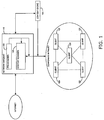
- FIG. 1 is a simplified block diagram of an overall gateway security system that uses an adaptive rule-based (ARB) content scanner, in accordance with a preferred embodiment of the present invention.
- a network gateway 110 that acts as a conduit for content from the Internet entering into a corporate intranet, and for content from the corporate intranet exiting to the Internet.
- One of the functions of network gateway 110 is to protect client computers 120 within the corporate intranet from malicious mobile code originating from the Internet.
- Mobile code is program code that executes on a client computer. Mobile code can take many diverse forms, including inter alia JavaScript, Visual Basic script, HTML pages, as well as a Uniform Resource Identifier (URI).
- URI Uniform Resource Identifier
- Mobile code can be detrimental to a client computer.
- Mobile code can access a client computer's operating system and file system, can open sockets for transmitting data to and from a client computer, and can tie up a client computer's processing and memory resources.
- Such malicious mobile code cannot be detected using conventional anti-virus scanners, which scan a computer's file system, since mobile code is able to execute as soon as it enters a client computer from the Internet, before being saved to a file.
- exploits portions of code that are malicious are referred to as exploits .
- one such exploit uses JavaScript to create a window that fills an entire screen. The user is then unable to access any windows lying underneath the filler window. The following sample code shows such an exploit.
- network gateway 110 includes a content scanner 130, whose purpose is to scan mobile code and identify potential exploits.
- Content scanner 130 receives as input content containing mobile code in the form of byte source, and generates a security profile for the content.
- the security profile indicates whether or not potential exploits have been discovered within the content, and, if so, provides a diagnostic list of one or more potential exploits and their respective locations within the content.
- the corporate intranet uses a security policy to decide whether or not to block incoming content based on the content's security profile.
- a security policy may block content that may be severely malicious, say, content that accesses an operating system or a file system, and may permit content that is less malicious, such as content that can consume a user's computer screen as in the example above.
- the diagnostics within a content security profile are compared with the intranet security policy, and a decision is made to allow or block the content.
- one or more alternative actions can be taken, such as replacing suspicious portions of the content with innocuous code and allowing the modified content, and sending a notification to an intranet administrator.
- Scanned content and their corresponding security profiles are preferably stored within a content cache 140.
- network gateway 110 checks if incoming content is already resident in cache 140, and, if so, bypasses content scanner 130. Use of cache 140 saves content scanner 130 the task of re-scanning the same content.
- a hash value of scanned content can be cached instead of caching the content itself.
- content arrives at scanner 130 preferably its hash value is computed and checked against cached hash values. If a match is found with a cached hash value, then the content does not have to be re-scanned and its security profile can be obtained directly from cache.
- cache 140 may reside at network gateway 110. However, it is often advantageous to place cache 140 as close as possible to the corporate intranet, in order to transmit content to the intranet as quickly as possible. However, in order for the security profiles within cache 140 to be up to date, it is important that network gateway 110 notify cache 140 whenever content scanner 130 is updated. Updates to content scanner 130 can occur inter alia when content scanner 130 is expanded (i) to cover additional content languages; (ii) to cover additional exploits; or (iii) to correct for bugs.
- cache 140 clears its cache, so that content that was in cache 140 is re-scanned upon arrival at network gateway 110.
- pre-scanner 150 that uses conventional signature technology to scan content.
- pre-scanner 150 can quickly determine if content is innocuous, but over-blocks on the safe side.
- pre-scanner 150 is useful for recognizing content that poses no security threat.
- pre-scanner 150 is a simple signature matching scanner, and processes incoming content at a rate of approximately 100 mega-bits per second.
- ARB scanner 130 performs much more intensive processing than pre-scanner 150, and processes incoming content at a rate of approximately 1 mega-bit per second.
- pre-scanner 150 acts as a first-pass filter, to filter content that can be quickly recognized as innocuous. Content that is screened by pre-scanner 150 as being potentially malicious is passed along to ARB scanner 130 for further diagnosis. Content that is screened by pre-scanner 150 as being innocuous bypasses ARB scanner 130. It is expected that pre-scanner 150 filters 90% of incoming content, and that only 10% of the content requires extensive scanning by ARB scanner 130. As such, the combined effect of ARB scanner 130 and pre-scanner 150 provides an average scanning throughout of approximately 9 mega-bits per second.
- FIG. 2 is a simplified block diagram of an adaptive rule-based content scanner system 200, in accordance with a preferred embodiment of the present invention.
- An ARB scanner system is preferably designed as a generic architecture that is language-independent, and is customized for a specific language through use of a set of language-specific rules.
- a scanner system is customized for JavaScript by means of a set of JavaScript rules, and is customized for HTML by means of a set of HTML rules.
- each set of rules acts as an adaptor, to adapt the scanner system to a specific language.
- a sample rule file for JavaScript is provided in Appendix A, and is described hereinbelow.
- exploits security violations, referred to as exploits , are described using a generic syntax, which is also language-independent. It is noted that the same generic syntax used to describe exploits is also used to describe languages. Thus, referring to Appendix A, the same syntax is used to describe the JavaScript parser rules and the analyzer exploit rules.
- the present invention provides a flexible content scanning method and system, which can be adapted to any language syntax by means of a set of rules that serve to train the content scanner how to interpret the language.
- a scanning system is referred to herein as an adaptive rule-based (ARB) scanner.
- ARB adaptive rule-based
- Advantages of an ARB scanner include inter alia:
- the system of FIG. 2 includes three main components: a tokenizer 210, a parser 220 and an analyzer 230.
- the function of tokenizer 210 is to recognize and identify constructs, referred to as tokens, within a byte source, such as JavaScript source code.
- a token is generally a sequence of characters delimited on both sides by a punctuation character, such as a white space.
- Tokens includes inter alia language keywords, values, names for variables or functions, operators, and punctuation characters, many of which are of interest to parser 220 and analyzer 230.
- tokenizer 210 reads bytes sequentially from a content source, and builds up the bytes until it identifies a complete token. For each complete token identified, tokenizer 210 preferably provides both a token ID and the token sequence.
- the tokenizer is implemented as a finite state machine (FSM) that takes input in the form of character codes.
- FSM finite state machine
- Tokens for the language are encoded in the FSM as a sequence of transitions for appropriate character codes, as described hereinbelow with reference to FIG. 3 .
- a punctuation character which normally indicates the end of a token, is expected.
- the token is complete, and the tokenizer provides an appropriate ID. If a punctuation character is not received, the sequence is considered to be part of a longer sequence, and no ID is provided at this point.
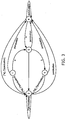
- FIG. 3 is an illustration of a simple finite state machine for detecting tokens "a” and “ab", used in accordance with a preferred embodiment of the present invention. Shown in FIG. 3 are five states, 1-5, with labeled and directed transitions therebetween. As tokenizer reads successive characters, a transition is made from a current state to a next state accordingly. State 1 is an entry state, where tokenizer 210 begins. State 4 is a generic state for punctuation. Specifically, whenever a punctuation character is encountered, a transition is made from the current state to state 4. The "a” token is identified whenever a transition is made from state 3 to state 4. Similarly, the "ab” token is identified whenever a transition is made from state 5 to state 4.
- tokenizer 210 preferably includes a normalizer 240 and a decoder 250.
- normalizer 240 translates a raw input stream into a reduced set of character codes. Normalized output thus becomes the input for tokenizer 210. Examples of normalization rules includes, inter alia
- normalizer 240 is also implemented as a finite-state machine. Each successive input is either translated immediately according to normalization rules, or handled as part of a longer sequence. If the sequence ends unexpectedly, the bytes are preferably normalized as individual bytes, and not as part of the sequence.
- normalizer 240 operates in conjunction with decoder 250.
- decoder 250 decodes character sequences in accordance with one or more character encoding schemes, including inter alia (i) SGML entity sets, including named sets and numerical sets; (ii) URL escape encoding scheme; (iii) ECMA script escape sequences, including named sets, octal, hexadecimal and Unicode sets; and (iv) character-encoding switches.
- character encoding schemes including inter alia (i) SGML entity sets, including named sets and numerical sets; (ii) URL escape encoding scheme; (iii) ECMA script escape sequences, including named sets, octal, hexadecimal and Unicode sets; and (iv) character-encoding switches.
- decoder 250 takes normalized input from normalizer 240.
- decoder 250 is implemented as a finite-state machine. The FSM for decoder 250 terminates when it reaches a state that produces a decoded character. If decoder 250 fails to decode a sequence, then each character is processed by tokenizer 210 individually, and not as part of the sequence.
- a plurality of decoders 250 can be pipelined to enable decoding of text that is encoded by one escape scheme over another, such as text encoded with a URL scheme and then encoded with ECMA script scheme inside of JavaScript strings.
- Tokenizer 210 and normalizer 240 are generic modules that can be adapted to process any content language, by providing a description of the content language within a rule file.
- the rule file describes text characters used within the content language, and the composition of constructs of the content language, referred to as tokens.
- Tokens may include inter alia, an IDENT token for the name of a variable or function, various punctuation tokens, and tokens for keywords such as NEW, DELETE, FOR and IF.
- a sample rule file for JavaScript is provided in Appendix A, and is described hereinbelow.
- parser 220 controls the process of scanning incoming content.
- parser 220 invokes tokenizer 210, giving it a callback function to call when a token is ready.
- Tokenizer 210 uses the callback function to pass parser 220 the tokens it needs to parse the incoming content.
- parser 220 uses a parse tree data structure to represent scanned content.
- a parse tree contains a node for each token identified while parsing, and uses parsing rules to identify groups of tokens as a single pattern. Examples of parsing rules appear in Appendix A, and are described hereinbelow.
- the parse tree generated by parser 220 is dynamically built using a shift-and-reduce algorithm. Successive tokens provided to parser 220. by tokenizer 210 are positioned as siblings. When parser 220 discovers that a parsing rule identifies a group of siblings as a single pattern, the siblings are reduced to a single parent node by positioning a new parent node, which represents the pattern, in their place, and moving them down one generation under the new parent note.
- each node contains data indicating inter alia an ID number, the token or rule that the node represents, a character string name as a value for the node, and a numerical list of attributes. For example, if the node represents an IDENT token for the name of a variable, then the value of the node is the variable name; and if the node represents a rule regarding a pattern for a function signature, then the value of the node is the function name.
- information about the pattern may be stored within an internal symbol table, for later use.
- parsing rules are implemented as finite-state machines. These FSMs preferably return an indicator for (i) an exact match, (ii) an indicator to continue with another sibling node, or (iii) an indicator of a mis-match that serves as an exit.
- parsing rules may be implemented using a hybrid mix of matching algorithms.
- it may use a deterministic finite automaton (DFA) for quick identification of rule candidates, and a non-deterministic finite automaton (NFA) engine for exact evaluation of the candidate rules.
- DFA deterministic finite automaton
- NFA non-deterministic finite automaton
- a parser rule optionally includes one or more actions to be performed if an exact pattern match is discovered. Actions that can be performed include inter alia creating a new node in the parse tree, as described hereinabove with respect to the shift and reduce algorithm; setting internal variables; invoking a sub-scanner 270, as described hereinbelow; and searching the parse tree for nodes satisfying specific conditions.
- parser 220 automatically performs a reduce operation by creating a new node and moving token nodes underneath the new node.
- a rule may be assigned a NoCreate attribute, in which case the default is changed to not performing the reduction operation upon a match, unless an explicit addnode command is specified in an action for the rule.
- Sub-scanner 270 is another ARB scanner, similar to scanner 200 illustrated in FIG. 2 but for a different type of content.
- sub-scanner 270 is used to scan a sub-section of input being processed by scanner 200.
- an HTML scanner encounters a script element that contains JavaScript code, then there will be a rule in the HTML scanner whose action includes invoking a JavaScript scanner.
- the JavaScript scanner may invoke a URI scanner.
- Use of sub-scanner 270 is particularly efficient for scanning content of one type that contains content of another type embedded therein.
- Analyzer 230 searches for specific patterns of content that indicate an exploit.
- parser 220 passes to analyzer 230 a newly-created parsing node.
- Analyzer 230 uses a set of analyzer rules to perform its analysis.
- An analyzer rule specifies a generic syntax pattern in the node's children that indicates a potential exploit.
- An analyzer rule optionally also includes one or more actions to be performed when the pattern of the rule is matched.
- an analyzer rule optionally includes a description of nodes for which the analyzer rule should be examined. Such a description enables analyzer 230 to skip nodes that are not to be analyzed.
- rules are provided to analyzer 230 for each known exploit. Examples of analyzer rules appear in Appendix A, and are described hereinbelow.
- the nodes of the parse tree also include data for analyzer rules that are matched. Specifically, if analyzer 230 discovers that one or more analyzer rules are matched at a specific parsing tree node, then the matched rules are added to a list of matched rules stored within the node.
- An advantage of the present invention is that both parser 220 and analyzer 230 use a common ARB regular expression syntax.
- a common pattern matching engine 260 performs pattern matching for both parser 220 and analyzer 230.
- pattern matching engine 260 accepts as input (i) a list of ARB regular expression elements describing a pattern of interest; and (ii) a list of nodes from the parse tree to be matched against the pattern of interest.
- pattern matching engine 260 returns as output (i) a Boolean flag indicating whether or not a pattern is matched; and (ii) if the pattern is matched, positional variables that match grouped portions of the pattern.
- $1 is preferably set to a reference to the nodes involved in the IDENT token. That is, if a matched pattern is "(1 2 3) 4 5", then $1 refers to the nodes 1, 2 and 3 as a single group.
- the ARB regular expression that is input to pattern matching engine 260 is pre-processed in the form of a state machine for the pattern.
- FIG. 4 is an illustration of a simple finite state machine, used in accordance with a preferred embodiment of the present invention, for a pattern
- Appendix A is a source listing of an ARB rule file for the JavaScript language, in accordance with a preferred embodiment of the present invention.
- the listing in Appendix A is divided into six main sections, as follows: (i) vchars, (ii) tokens, (iii) token_pairs, (iv) attribs, (v) parser_rules and (vi) analyzer_rules.
- the vchars section includes entries for virtual characters. Each such entry preferably conforms to the syntax For example, the entry
- the vchars section also includes entries for aliases, which are names for special virtual characters. Each such entry preferably conforms to the syntax For example, the entry
- the tokens section includes entries for language tokens for a scanner language; namely, JavaScript for Appendix A. Each such entry preferably conforms to the syntax
- a CDATA token for identifying strings or commented text, preferably conforms to the syntax
- the token pairs section defines tokens that can validly appear in juxtaposition, and tokens that cannot validly appear in juxtaposition, in conformance with the language rules. Generally, when the tokenizer encounters an invalid juxtaposition, it inserts a virtual semi-colon. An entry for a token-pair preferably conforms to the syntax
- the parser-rules section has entries defining rules for the parser. Such entries preferably conform to the syntax
- a pattern is a regular expression of IDs, preferably conforming to the syntax
- An action prescribes an action to perform when a pattern is matched.
- the action in the rule for FuncSig is matched.
- the symbol table mentioned hereinabove is an internal table, for rules to store and access variables.
- the analyzer-rules section has entries defining rules for the parser. Such entries preferably conform to the syntax Patterns and actions for analyzer rules are similar to patterns and actions for parser rules. For example, the pattern
- parser 220 After performing the actions associated with the specific rule, parser 220 preferably calls analyzer 230, and passes it the newly-created parser node of the parse tree. However, if the rule has a "noanalyzer" attribute, then analyzer 230 is not called.
- analyzer 230 finds a pattern match for a specific analyzer rule, it preferably adds the matched rule to the parse tree. However, if the rule has a "nomatch" attribute, then the matched rule is not added to the parse tree.
- FIG. 5 is a simplified flowchart of operation of a parser for a specific content language, such as parser 220 ( FIG. 2 ), within an ARB content scanner, such as content scanner 130 ( FIG. 1 ), in accordance with a preferred embodiment of the present invention.
- the parser Prior to beginning the flowchart in FIG. 5 , it is assumed that the parser has initialized a parse tree with a root node.
- the parser calls a tokenizer, such as tokenizer 210, to retrieve a next token from an incoming byte stream.
- the parser adds the token retrieved by the tokenizer as a new node to a parse tree.
- new nodes are added as siblings until a match with a parser rule is discovered.
- Nodes within the parse tree are preferably named; i.e., they have an associated value that corresponds to a name for the node.
- new nodes added as siblings are named according to the name of the token they represent.
- the parser checks whether or not a pattern is matched, based on parser rules within a rule file for the specific content language. If not, then control returns to step 500, for processing the next token. If a match with a parser rule is discovered at step 520, then at step 530 the parser checks whether or not the matched parser rule has a "nonode” attribute. If so, then control returns to step 500. If the matched parser rule does not have a "nonode” attribute, then at step 540 the parser performs the matched parser rule's action.
- Such action can include inter alia creation of a new node, naming the new node according to the matched parser rule, and placing the matching nodes underneath the new node, as indicated at step 540.
- nodes within the parse tree have names that correspond either to names of tokens, or names of parser rules.
- the parser checks whether or not the matched parser rule has a "noanalyze” attribute. If so, then control returns to step 520. If the matched parser rule does not have a "noanalyze” attribute, then at step 560 the parser calls an analyzer, such as analyzer 230, to determine if a potential exploit is present within the current parse tree. It may thus be appreciated that the analyzer is called repeatedly, while the parse tree is being dynamically built up.
- the analyzer After checking the analyzer rules, the analyzer returns its diagnostics to the parser. At step 570 the parser checks whether or not the analyzer found a match for an analyzer rule. If not, then control returns to step 500. If the analyzer did find a match, then at step 580 the parser performs the matched analyzer rule's action. Such action can include inter alia recording the analyzer rule as data associated with the current node in the parse tree; namely, the parent node that was created at step 540, as indicated at step 580.
- binary class instances of ARB scanners are packaged serially, for transmission to and installation at a client site.
- FIG. 6 is a simplified block diagram of a system for serializing binary instances of ARB content scanners, transmitting them to a client site, and regenerating them back into binary instances at the client site.
- the workflow in FIG. 6 begins with a set of rule files for one or more content languages.
- the rule files are generated by one or more people who are familiar with the content languages.
- a rule-to-XML convertor 610 converts rule files from ARB syntax into XML documents, for internal use. Thereafter a builder module 620 is invoked. Preferably, builder module 620 generates a serialized rule data file, referred to herein as an archive file .
- ARB scanner factory module 630 is responsible for producing an ARB scanner on demand.
- an ARB scanner factory module has a public interface as follows:
- ARB scanner factory module 630 instantiates a scanner repository 640.
- Repository 640 produces a single instance of each ARB scanner defined in the archive file.
- each instance of an ARB scanner is able to initialize itself and populate itself with the requisite data.
- FIG. 7 illustrates a representative hierarchy of objects created by builder module 620, in accordance with a preferred embodiment of the present invention. Shown in FIG. 7 are three types of content scanners: a scanner for HTML content, a scanner for JavaScript content, and a scanner for URI content.
- An advantage of the present invention is the ability to generate such a multitude of content scanners within a unified framework.
- builder module 620 calls a serialize( ) function.
- the serialize( ) function called by builder module 620 causes all relevant classes to serialize themselves to the archive file recursively. Thereafter the archive file is sent to a client site.
- the client After receiving the archive file, the client deserializes the archive file, and creates a global singleton object encapsulating an ARB scanner factory instance 650.
- the singleton is initialized by passing it a path to the archive file.
- Each thread object stores its ARB scanner factory instance 650 as member data.
- a thread object requests an appropriate ARB scanner 660 from its ARB scanner factory object 650.
- the thread passes content and calls the requisite API functions to scan and process the content.
- the thread returns the ARB scanner instance 660 to its ARB scanner factory 650, to enable pooling the ARB scanner for later re-use.
- FIG. 5 describes a method in which a complete diagnostic of all match analyzer rules is produced, in an alternative embodiment the method may stop as soon as a first analyzer rule is matched. The parser would produce an incomplete diagnostic, but enough of a diagnostic to determine that the scanned content contains a potential exploit.
- Tokens can be defined for binary content. Unlike tokens for text files that are generally delimited by punctuation characters, tokens for binary content generally have different characteristics.
Landscapes
- Engineering & Computer Science (AREA)
- Computer Security & Cryptography (AREA)
- General Engineering & Computer Science (AREA)
- Theoretical Computer Science (AREA)
- Software Systems (AREA)
- Computer Hardware Design (AREA)
- Physics & Mathematics (AREA)
- General Physics & Mathematics (AREA)
- Virology (AREA)
- Health & Medical Sciences (AREA)
- General Health & Medical Sciences (AREA)
- Computing Systems (AREA)
- Computer Networks & Wireless Communication (AREA)
- Signal Processing (AREA)
- Devices For Executing Special Programs (AREA)
- Information Retrieval, Db Structures And Fs Structures Therefor (AREA)
Description
- The present invention relates to network security, and in particular to scanning of mobile content for exploits.
- Conventional anti-virus software scans a computer file system by searching for byte patterns, referred to as signatures that are present within known viruses. If a virus signature is discovered within a file, the file is designated as infected.
- Content that enters a computer from the Internet poses additional security threats, as such content executes upon entry into a client computer, without being saved into the computer's file system. Content such as JavaScript and VBScript is executed by an Internet browser, as soon as the content is received within a web page.
- Conventional network security software also scans such mobile content by searching for heuristic virus signatures. However, in order to be as protective as possible, virus signatures for mobile content tend to be over-conservative, which results in significant over-blocking of content. Over-blocking refers to false positives; i.e., in addition to blocking of malicious content, prior art technologies also block a significant amount of content that is not malicious.
- Another drawback with prior art network security software is that it is unable to recognize combined attacks, in which an exploit is split among different content streams. Yet another drawback is that prior art network security software is unable to scan content containers, such as URI within JavaScript.
- All of the above drawbacks with conventional network security software are due to an inability to diagnose mobile code. Diagnosis is a daunting task, since it entails understanding incoming byte source code. The same malicious exploit can be encoded in an endless variety of ways, so it is not sufficient to look for specific signatures.
- Nevertheless, in order to accurately block malicious code with minimal over-blocking, a thorough diagnosis is required.
- In "Securing Web Application Code by Static Analysis and Runtime Protection", (ACM, 2 PENN PLAZA, SUITE 701 - NEW YORK USA, 22 May 2004, pages 40-51, XP040180026) YAO-WEN HUANG ET AL describe a holistic approach to ensuring Web application security. Viewing Web application vulnerabilities as a secure information flow problem, a lattice-based static analysis algorithm derived from type systems and typestate, was created. During the analysis, sections of code considered vulnerable were instrumented with runtime guards, thus securing Web applications in the absence of user intervention. With sufficient annotations, runtime overhead could be reduced to zero. A tool named WebSSARI (Web application Security by Static Analysis and Runtime Inspection) was created to test the algorithm. Statistics show that static analysis reduced potential runtime overhead by 98.4%.
-
US 2002/0073330 A1 describes a method and apparatus for detecting script language viruses. The apparatus includes a script language processor, a detection data processor and a detection engine. The script language processor prepares language description data corresponding to at least one script language. The detection data processor prepares detection data for viral code corresponding to the script language virus. The detection engine lexically analyzes a data stream using the language description data and the detection data to detect the viral code. The language description data may correspond to language definition rules and language check rules. The data stream may be converted to a stream of tokens, wherein the lexical analysis is performed on the token stream. The script language virus detection apparatus may be a computer program stored on a computer readable medium and/or transmitted via a computer network or other transmission medium. - According to a first aspect of the invention, there is provided a computer system for scanning incoming mobile code as set out in
Claim 1. - According to a second aspect of the invention, there is provided a computer processor-based method for scanning incoming mobile code as set out in Claim 11.
- According to a third aspect of the invention, there is provided a computer-readable storage medium storing program code as set out in Claim 16.
- The present invention will be more fully understood and appreciated from the following detailed description, taken in conjunction with the drawings in which:
-
FIG. 1 is a simplified block diagram of an overall gateway security system that uses an adaptive rule-based (ARB) content scanner, in accordance with a preferred embodiment of the present invention; -
FIG. 2 is a simplified block diagram of an adaptive rule-based content scanner system, in accordance with a preferred embodiment of the present invention; -
FIG. 3 is an illustration of a simple finite state machine for detecting tokens "a" and "ab", used in accordance with a preferred embodiment of the present invention; -
FIG. 4 is an illustration of a simple finite state machine for a pattern, used in accordance with a preferred embodiment of the present invention; -
FIG. 5 is a simplified flowchart of operation of a parser for a specific content language within an ARB content scanner, in accordance with a preferred embodiment of the present invention; -
FIG. 6 is a simplified block diagram of a system for serializing binary instances of ARB content scanners, transmitting them to a client site, and regenerating them back into binary instances at the client site, in accordance with a preferred embodiment of the present invention; and -
FIG. 7 illustrates a representative hierarchy of objects created by a builder module, in accordance with a preferred embodiment of the present invention. - Appendix A is a source listing of an ARB rule file for the JavaScript language, in accordance with a preferred embodiment of the present invention.
- The present invention concerns scanning of content that contains mobile code, to protect an enterprise against viruses and other malicious code.
- The following describes a method and system for scanning content that includes mobile code, to produce a diagnostic analysis of potential exploits within the content. The invention is applicable for use within a network gateway or proxy, to protect an intranet against viruses and other malicious mobile code.
- The content scanners described herein are referred to as adaptive rule-based (ARB) scanners. An ARB scanner is able to adapt itself dynamically to scan a specific type of content, such as inter alia JavaScript, VBScript, URI, URL and HTML. ARB scanners differ from prior art scanners that are hard-coded for one particular type of content. In distinction, ARB scanners are data-driven, and can be enabled to scan any specific type of content by providing appropriate rule files, without the need to modify source code. Rule files are text files that describe lexical characteristics of a particular language. Rule files for a language describe character encodings, sequences of characters that form lexical constructs of the language, referred to as tokens, patterns of tokens that form syntactical constructs of program code, referred to as parsing rules, and patterns of tokens that correspond to potential exploits, referred to as analyzer rules. Rules files thus serve as adaptors, to adapt an ARB content scanner to a specific type of content.
- The following also describes a novel description language for efficiently describing exploits. This description language enables an engineer to describe exploits as logical combinations of patterns of tokens.
- Thus it may be appreciated that the described technique is able to diagnose incoming content. As such, the described technique achieves very accurate blocking of content, with minimal over-blocking as compared with prior art scanning technologies.
- There is thus provided in accordance with a preferred embodiment of the present invention a method for scanning content, including identifying tokens within an incoming byte stream, the tokens being lexical constructs for a specific language, identifying patterns of tokens, generating a parse tree from the identified patterns of tokens, and identifying the presence of potential exploits within the parse tree, wherein said identifying tokens, identifying patters of tokens, and identifying the presence of potential exploits are based upon a set of rules for the specific language.
- There is moreover provided in accordance with a preferred embodiment of the present invention a system for scanning content, including a tokenizer for identifying tokens within an incoming byte stream, the tokens being lexical constructs for a specific language, a parser operatively coupled to the tokenizer for identifying patterns of tokens, and generating a parse tree therefrom, and an analyzer operatively coupled to the parser for analyzing the parse tree and identifying the presence of potential exploits therewithin, wherein the tokenizer, the parser and the analyzer use a set of rules for the specific language to identify tokens, patterns and potential exploits, respectively.
- There is further provided in accordance with a preferred embodiment of the present invention a computer-readable storage medium storing program code for causing a computer to perform the steps of identifying tokens within an incoming byte stream, the tokens being lexical constructs for a specific language, identifying patterns of tokens, generating a parse tree from the identified patterns of tokens, and identifying the presence of potential exploits within the parse tree, wherein said identifying tokens, identifying patters of tokens, and identifying the presence of potential exploits are based upon a set of rules for the specific language.
- There is yet further provided in accordance with a preferred embodiment of the present invention a method for scanning content, including expressing an exploit in terms of patterns of tokens and rules, where tokens are lexical constructs of a specific programming language, and rules are sequences of tokens that form programmatical constructs, and parsing an incoming byte source to determine if an exploit is present therewithin, based on said expressing.
- There is additionally provided in accordance with a preferred embodiment of the present invention a system for scanning content, including a parser for parsing an incoming byte source to determine if an exploit is present therewithin, based on a formal description of the exploit expressed in terms of patterns of tokens and rules, where tokens are lexical constructs of a specific programming language, and rules are sequences of tokens that form programmatical constructs.
- There is moreover provided in accordance with a preferred embodiment of the present invention a computer-readable storage medium storing program code for causing a computer to perform the steps of expressing an exploit in terms of patterns of tokens and rules, where tokens are lexical constructs of a specific programming language, and rules are sequences of tokens that form programmatical constructs, and parsing an incoming byte source to determine if an exploit is present therewithin, based on said expressing.
- Reference is now made to
FIG. 1 , which is a simplified block diagram of an overall gateway security system that uses an adaptive rule-based (ARB) content scanner, in accordance with a preferred embodiment of the present invention. Shown inFIG. 1 is anetwork gateway 110 that acts as a conduit for content from the Internet entering into a corporate intranet, and for content from the corporate intranet exiting to the Internet. One of the functions ofnetwork gateway 110 is to protectclient computers 120 within the corporate intranet from malicious mobile code originating from the Internet. Mobile code is program code that executes on a client computer. Mobile code can take many diverse forms, including inter alia JavaScript, Visual Basic script, HTML pages, as well as a Uniform Resource Identifier (URI). - Mobile code can be detrimental to a client computer. Mobile code can access a client computer's operating system and file system, can open sockets for transmitting data to and from a client computer, and can tie up a client computer's processing and memory resources. Such malicious mobile code cannot be detected using conventional anti-virus scanners, which scan a computer's file system, since mobile code is able to execute as soon as it enters a client computer from the Internet, before being saved to a file.
- Many examples of malicious mobile code are known today. Portions of code that are malicious are referred to as exploits. For example, one such exploit uses JavaScript to create a window that fills an entire screen. The user is then unable to access any windows lying underneath the filler window. The following sample code shows such an exploit.
 <!DOCTYPE HTML PUBLIC "-//W3C//DTD HTML 4.0 Transitional//EN">
 <HTML>
 <HEAD>
 <TITLE>BID-3469</TITLE>
 <SCRIPT>
     op=window.createPopup( );
     s='<body>foobar</body>';
     op.document.body.innerHTML=s;
     function oppop( )
     {
     it (!op.isOpen)
    {
          w = screen.width;
          h = screen.height;
          op.show(0,0,w,h,document. body);
    }
    }
    function doit ( )
    {
    oppop( );
    setlnterval("window.focus( ); {oppop( );}",10);
    }
    </SCRIPT>
    </HEAD>
    <BODY>
    <H1>BID-3469</H1>
    <FORM method=POST action="">
    <INPUT type="button" name="btnDolt" value="Do It" onclick="doit( )">
    </FORM>
    </BODY>
    </HTML>
Thus it may be appreciated that the security function of - the ability to re-use software code for many different languages;
- the ability to re-use software code for binary content and EXE files;
- the ability to focus optimization efforts in one project, rather than across multiple projects; and
- the ability to describe exploits using a generic syntax, which can be interpreted by any ARB scanner.
- skipping character ranges that are irrelevant;
- assigning special values to character codes that are irrelevant for the language structure but important for the content scanner;
- translating, such as to lowercase if the language is case-insensitive, in order to reduce input for
tokenizer 210; - merging several character codes, such as white spaces and line ends, into one; and
- translating sequences of raw bytes, such as trailing spaces, into a single character code.
(IDENT <val=="foo" & match(*) :Rulel> | List <val=="bar">) EQUALS NUMBERSpecifically, the pattern of interest specifies either an IDENT token with value "foo" and that matches Rule1, or a List with value "bar", followed by an EQUALS token and a NUMBER token.

 vchar nl 0x0d
 {
 [0x0d]+;
 [0x0a] +
 }
converts a sequence of one or more CRs (carriage-returns) and a sequence of one or more LFs (line-feeds) to a newline meta-character.

 Vchar_alias underscore
 {
 0x5F;
 }
identifies the hexadecimal number 0x5F with the name "underscore".
token-entry* (cdata) ;For example, the entry
LBRACE "[!left_curly_bracket!]" punct;defines identifies a punctuation token, LBRACE, as a "left_curly_bracket", which is an alias for 0x7B as defined in the previous vchars section. Note that aliases are preferably surrounded by exclamation points.
"start" "end" ["escape-pattern] "skip-pattern";For example, the entry
 DOUBLE_QUOTE DOUBLE_QUOTE "[!backslash!] [!double_quote]?"
 "[^[!backslash!] [!double_quote!]]+" ;
identifies a string as beginning and ending with a DOUBLE-QUOTE token, as previously defined, with an escape pattern that has a "backslash" followed by zero or one "double_quote", and a skip pattern that has one or more characters other than "backlash" and "double_quote".
{valid | invalid} [(] token-ID | token-ID]* [)]
 [(] token-ID | token-ID]* [)];
For example, the entry
invalid IF (ELSE | FOR | WHILE | DOT);indicates that an IF token cannot validly be followed by an ELSE, FOR, WHILE or DOT token. Thus, if an IF token followed by an ELSE, FOR, WHILE, or DOT token is encountered in the input,
rule rule-name [nonode] [noanalyzel [nomatch]

ID1-expr ID2-expr ... IDn-exprPreferably, ID-expr is one of the following:
- ID
- (ID [ID]*)
- ID <val==val>
- ID <id==rule-ID>
- ID <match(n): rule-ID>
- ID <match(*): rule-ID>
- ID <match (m,n): rule-ID>
- '*' zero or more occurrences
- '+' one or more occurrences
- '?' zero or one occurrence
- '{m}' exactly m occurrences
- '{m,n}' between m and n occurrences, inclusive
(LPAREN) ((Expr) (COMMA Expr)*)? (RPAREN)describes a LPAREN token and a RPAREN token surrounding a list of zero or more Expr's separated by COMMA tokens. In turn, the pattern in the rule for Expr
 ([ExprDelimTokens ExprLdelimTokens ExprLdelimRules]?
 ([^ ExprDelimTokens ExprLdelimTokens ExprLdelimRules ExprExcludeRules
 ExprRdelimTokens]+) [ExprDelimTokens ExprRdelimTokens]) |
 ([ExprStmntRules]);
describes a general definition of what qualifies as an expression, involving delimiter tokens and other rules.
this.val=$(2).val;
 @("FUNCNAME").val=$(2).val;
assigns a value to FuncSig, which is the value of the second parameter in the pattern for FuncSig; namely, the value of the IDENT token. In addition, the action assigns this same value to an entry in a symbol table called "FUNCNAME", as described hereinbelow. It may thus be appreciated that certain rules have values associated therewith, which are assigned by the parser as it processes the tokens.

(IDENT) ASSIGNMENT IDENT <val=="screen"> DOT IDENT <val=="width">;within the rule for ScrWidAssign describes a five-token pattern; namely, (i) an IDENT token, followed by (ii) an ASSIGNMENT token, followed by (iii) an IDENT token that has a value equal to "screen", followed by (iv) a DOT token, and followed by (v) an IDENT token that has a value equal to "width". Such a pattern indicates use of a member reference "screen.width" within an assignment statement, and corresponds to the example exploit listed above in the discussion of
@($(1).val).attr += ATTR_SCRWID;within the ScrWidAssign rule assigns the attribute ATTR_SCRWID to the symbol table entry whose name is the value of the IDENT token on the left side of the pattern.
Similarly, the pattern
 (IDENT) ASSIGNMENT IDENT <@(val).aftr?=ATTR-WINDOW>
               DOT FuncCall <val=="createPopup"> $;
in the rule for CreatePopup1 corresponds to the command
op=window.createPopup( );in the example exploit above. It may thus be appreciated that exploits are often described in terms of composite pattern matches, involving logical combinations of more than one pattern.
Node patterns within analyzer rules preferably specify nodes for which an analyzer rule should be evaluated. Node patterns serve to eliminate unnecessary analyses.
Referring back to
 class arbScannerFactory
 {
    INT32 createScanner(const std::string& mimetype, arbScanner** scanner);
    INT32 retireScanner(arbScanner *scanner, INT32& factoryStillActive);
    Bool hasScannerType(const std::string& mimeType);
    }
ARB be defined for binary content. Unlike tokens for text files that are generally delimited by punctuation characters, tokens for binary content generally have different characteristics.
 vchars
 {
 vchar ignore 0x00 "ignore"
 {
    [0x00-0xFF]+;
 }
 vchar ws 0x20
 {
   [0x09 0x0B 0x0C 0x20 0xA0]+;
 }
 vchar nl 0x0d
 {
   [0x0d]+;
   [0x0a]+;
 }
 vchar alphanum '?' "raw"
 {
   [0x21-0x2f 0x30-0x39 0x3a-0x40 0x41-0x5A 0x5b-0x60 0x61-0x7A 0x7B-
   0x7E 0x7f-0x9F 0xA1-0xff];
 }
 vchar_alias underscore
 {
   0x5F;
 }
 vchar_alias equals
 {
   0x3D;
 }
 vchar_alias hash
 {
   0x23;
 }
 vchar_alias at
 {
   0x40;
 }
 tokens,
 {
 TOKENIZER_DEFAULT ".+";
 WS "[!ws!]" punct not-a-token;
 EOL "[!nl!]" punct not-a-token;
 IDENT "[A-Za-z[!underscore!] [!dollarsign!] [A-Za-z0-
 9[!underscore!] ['dollarsign']]*";
 LBRACE "[!left_curly_bracket!]" punct;
 RBRACE "[!right_curly_bracket!]" punct;
 LPAREN "[!left_parenthesis!]" punct ;
 RPAREN "[!right_parenthesis!]" punct;
 LBRACKET "[!left_square_bracket!]" punct;
 RBRACKET "[!right_square_bracket!]" punct;
 SINGLE_QUOTE "[!single_quote!]" punct;
 DOUBLE_QUOTE "[!double_quote!]" punct;
 COMMENT_OPEN "[!slash!] [!asterisk!]" punct;
 COMMENT_CLOSE "[!asterisk!] [!slash!]" punct;
 DOUBLE_SLASH "[!slash!] [!slash!]" punct;
 INTEGER_DECIMAL "[0-9]+";
 INTEGER_HEX "0 [xX] [0-9A-Fa-f]+";
 cdata CDATA
 {
   DOUBLE_QUOTE DOUBLE_QUOTE "[!backslash!] [!double_quote!]?"
   "[^[!backslash!] [!double_quote!]]+";
   SINGLE_QUOTE SINGLE_QUOTE "[!backslash!] [!single_quote!]?"
   "[^[lbackslash!][!single-quote!]]+";
   COMMENT_OPEN COMMENT_CLOSE "[^[!asterisk!]]+";
   DOUBLE_SLASH EOL "[^[!nl!]]+";
 }
 VSEMICOLON vdelim;
 }
 #define OP PLUS | MINUS | SLASH | MULTIPLY | MOD
 token_pairs
 {
 invalid IDENT IDENT;
 invalid IF (ELSE | FOR | WHILE | DOT);
 invalid (OP) (OP);
 valid (PLUS | MINUS) (PLUS | MINUS);
 invalid INTEGER_DECIMAL IDENT;
 }
 #define Semicolon (SEMICOLON | VSEMICOLON)
 #define Semicolon_ SEMICOLON VSEMICOLON
 #define ActionClause (((Expr) Semicolon) | (Block))
 parser_rules
 {
 rule Eval
 {
   patterns
   {
      EVAL List;
   }
 }
 rule FuncSig
 {
   patterns
   {
      (FUNCTION) (IDENT?) (List);
   }
   actions
   {
      this.val=$(2).val;
      @("FUNCNAME").val = $(2).val;
   }
 }
 rule FuncDecl
 {
   patterns
   {
      (FuncSig) Block;
   }
   actions
   {
      this.val=$(1).val;
      ∼@ ("FUNCNAME");
   }
 }
 rule FuncCall
 {
   patterns
   {
      (IDENT) List;
   }
   actions
   {
      this.val=$(1).val;
 } } . . .
 #define ExprDelimTokens Semicolon_ COMMA COLON
 #define ExprLdelimTokens LPAREN LBRACE ELSE DO IN THROW RETURN CASE
 VAR
 #define ExprRdelimTokens RPAREN RBRACE
 #define ExprLdelimRules IfClause WhileClause ForClause ForInClause
 WithClause
 #define ExprExcludeRules IfStmnt Expr
 #define ExprStmntRules FuncDecl IfElseStmnt IfNoElseStmnt WhileStmnt
 DoWhileStmnt ForStmnt ForInStmnt SwitchStmnt WithStmnt TryCatchFinallyStmnt
 TryCatchNoFinallyStmnt TryNoCatchFinallyStmnt ThrowStmnt ReturnStmnt
 LabelStmnt CaseStmnt DefaultStmnt BreakStmnt ContinueStmnt VarStmnt
 DebuggerStmnt NakedBlockStmnt NakedListStmnt
 rule Expr nonode
 {
   patterns
   {
      (
         [ExprDelimTokens ExprLdelimTokens ExprLdelimRules]?
         ([^ ExprDelimTokens ExprLdelimTokens ExprLdelimRules
         ExprExcludeRules ExprRdelimTokens]+) [ExprDelimTokens ExprRdelimTokens] ) |
         ([ExprStmntRules]);
   }
   actions
   {
      addnode (children="2 3");
   }
   }
   rule BlockBegin nonode
   {
   patterns
   {
      LBRACE;
   }
   actions
   {
     @level++;
   }
   }
   rule Block
   {
  patterns
   {
      (LBRACE) (Expr Semicolon?)* (RBRACE);
   }
   actions
   {
     @level--;
     } }
     rule List
     {
  patterns
   {
      (LPAREN) ((Expr) (COMMA Expr)*)? (RPAREN);
   }
   }
   analyzer_rules
   {
   RULE_DECL (Begin) nomatch
  patterns
   {
     BEGIN;
   }
  actions
   {
     @("window", 0).attr += ATTR_WINDOW;
     @("self", 0).attr += ATTR_WINDOW;
     @("parent", 0).attr += ATTR_WINDOW;
     }
     RULE_DECL (ScrWidAssign)
  patterns
  {
     (IDENT) ASSIGNMENT IDENT <val=="screen"> DOT IDENT <val=="width">;
  actions
  {
     @($(1).val).attr += ATTR_SCRWID;
  }
  RULE_DECL (ScrHgtAssign)
  {
  patterns
  {
     (IDENT) ASSIGNMENT IDENT <val=="screen"> DOT IDENT
     <val=="height">;
  }
  actions
  {
  @($(1).val).attr += ATTR_SCRHGT;
  }
  RULE_DECL (ScrWidHgtList)
 {
   patterns
   {
      LPAREN Expr COMMA Expr COMMA
         Expr <attr?=ATTR_SCRWID> COMMA
         Expr <attr?=ATTR_SCRHGT>;
   }
   RULE_DECL (EXPLOIT) exploit
 {
   patterns
   {
      . <(matches(*):RULE(CreatePopup1) &
      matches(*):RULE(WndShowScrnWidHgt1)) |
         (matches(*):RULE(CreatePopup2) &
         matches(*):RULE(WndShowScrnWidHgt2))>;
   }
 }
 RULE_DECL (CreatePopup1)
 {
   patterns
   {
      (IDENT) ASSIGNMENT IDENT <@(val).attr?=ATTR_WINDOW>
           DOT FuncCall <val=="createPopup"> $;
   }
   actions
   {
      @($(1).val).attr += ATTR_WINDOW;
 }
 }
Claims (16)
- A computer system (130; 200) for scanning incoming mobile code, comprising:a receiver for receiving an incoming stream of mobile code for a specific programming language;parser rules and analyzer rules for the specific programming language, wherein the parser rules define certain patterns in terms of tokens, tokens being lexical constructs for the specific programming language, and wherein the analyzer rules identify certain combinations of tokens and patterns as being indicators of potential exploits, exploits being portions of mobile code that are malicious;a tokenizer (210) operatively coupled to said receiver for identifying individual tokens within the incoming stream;a parser (220) operatively coupled to said tokenizer and operable to use said parser rules for dynamically building, while said receiver is receiving the incoming stream, a parse tree whose nodes represent tokens or patterns in accordance with the parser rules;an analyzer (230) operatively coupled to said parser and operable to use said analyzer rules for dynamically detecting, while said parser is dynamically building the parse tree, combinations of nodes in the parse tree which are indicators of potential exploits, based on the analyzer rules; andmeans for generating a security profile for the stream indicating whether or not potential exploits have been discovered within the stream, and, if so, providing a diagnostic list of one or more potential exploits and their respective locations within the stream.
- The system of claim 1, further comprising a pre-scanner for identifying mobile code that is innocuous and for routing the innocuous mobile code so as to bypass said tokenizer, said parser and said analyzer.
- The system of claim 1 or 2, wherein said parser is operable to dynamically build the parse tree using a shift-and-reduce algorithm.
- The system of any preceding claim, further comprising a pattern-matching engine operatively coupled to said parser, for matching a pattern within a sequence of tokens in accordance with the parser rules.
- The system of claim 4, wherein the parser rules are represented as finite-state machines.
- The system of claim 4, wherein the parser rules are represented as pattern expression trees.
- The system of any one of claims 4 to 6, wherein parser rules are merged into a single deterministic finite automaton (DFA).
- The system of any preceding claim, wherein the parser and analyzer rules include actions to be performed when corresponding rules are matched.
- The system of any preceding claim, further comprising a scripting engine operatively coupled to said parser and said analyzer for implementing the actions to be performed.
- The system of any preceding claim, wherein the specific programming language is at least one of JavaScript, Visual Basic, HyperText Markup Language (HTML) and Uniform Resource Identifier (URI).
- A computer processor-based method for scanning incoming mobile code, comprising:receiving, by a computer, an incoming stream of mobile code for a specific programming language;identifying (500), by the computer, individual tokens within the incoming stream, tokens being lexical constructs for the specific programming language;dynamically building (510), by the computer while said receiving receives the incoming stream, a parse tree whose nodes represent tokens or patterns in accordance with parser rules for the specific programming language, wherein the parser rules define certain patterns in terms of tokens;dynamically detecting (560), by the computer while said dynamically building builds the parse tree, combinations of nodes in the parse tree, which are indicators of potential exploits, based on analyzer rules for the specific programming language, wherein the analyzer rules identify certain combinations of tokens and patterns as being indicators of potential exploits, exploits being portions of mobile code that are malicious; andgenerating a security profile for the stream indicating whether or not potential exploits have been discovered within the stream, and, if so, the security profile further providing a diagnostic list of one or more potential exploits and their respective locations within the stream.
- The method of claim 11, wherein said dynamically building a parse tree is based upon a shift-and-reduce algorithm.
- The method of claim 11 or 12, wherein the parser and analyzer rules include actions to be performed when rules are matched.
- The method of any one of claims 11 to 13, wherein the specific programming language is at least one of JavaScript, Visual Basic VBScript, HyperText Markup Language (HTML) and Uniform Resource Identifier (URI).
- The method of any one of claims 11 to 14, wherein the incoming stream of mobile code includes embedded mobile code for another programming language different than the specific programming language, the method further comprising repeating said identifying, said dynamically building, said dynamically detecting and said generating for the embedded mobile code, based on the parser and analyzer rules for the other programming language.
- A computer-readable storage medium storing program code for causing a computer to perform the steps of:receiving an incoming stream of mobile code for a specific programming language;identifying individual tokens within the incoming stream, tokens being lexical constructs for the specific programming language;dynamically building, while said receiving receives the incoming stream, a parse tree whose nodes represent tokens or patterns in accordance with parser rules for the specific programming language, wherein the parser rules define certain patterns in terms of tokens;dynamically detecting, while said dynamically building builds the parse tree, combinations of nodes in the parse tree, which are indicators of potential exploits, based on analyzer rules for the specific programming language, wherein the analyzer rules identify certain combinations of tokens and patterns as being indicators of potential exploits, exploits being portions of mobile code that are malicious; andgenerating a security profile for the stream indicating whether or not potential exploits have been discovered within the stream, and, if so, the security profile further providing a diagnostic list of one or more potential exploits and their respective locations within the stream.
Applications Claiming Priority (2)
| Application Number | Priority Date | Filing Date | Title |
|---|---|---|---|
| US10/930,884 US8225408B2 (en) | 1997-11-06 | 2004-08-30 | Method and system for adaptive rule-based content scanners |
| PCT/IL2005/000915 WO2006025050A2 (en) | 2004-08-30 | 2005-08-24 | Method and system for adaptive rule-based content scanners |
Publications (3)
| Publication Number | Publication Date |
|---|---|
| EP1810152A2 EP1810152A2 (en) | 2007-07-25 |
| EP1810152A4 EP1810152A4 (en) | 2013-05-01 |
| EP1810152B1 true EP1810152B1 (en) | 2016-10-05 |
Family
ID=36000431
Family Applications (1)
| Application Number | Title | Priority Date | Filing Date |
|---|---|---|---|
| EP05775457.4A Expired - Lifetime EP1810152B1 (en) | 2004-08-30 | 2005-08-24 | Method and system for adaptive rule-based content scanners |
Country Status (4)
| Country | Link |
|---|---|
| US (1) | US8225408B2 (en) |
| EP (1) | EP1810152B1 (en) |
| CA (2) | CA2578792C (en) |
| WO (1) | WO2006025050A2 (en) |
Families Citing this family (83)
| Publication number | Priority date | Publication date | Assignee | Title |
|---|---|---|---|---|
| US7058822B2 (en) | 2000-03-30 | 2006-06-06 | Finjan Software, Ltd. | Malicious mobile code runtime monitoring system and methods |
| US8079086B1 (en) | 1997-11-06 | 2011-12-13 | Finjan, Inc. | Malicious mobile code runtime monitoring system and methods |
| US9219755B2 (en) | 1996-11-08 | 2015-12-22 | Finjan, Inc. | Malicious mobile code runtime monitoring system and methods |
| US7716742B1 (en) | 2003-05-12 | 2010-05-11 | Sourcefire, Inc. | Systems and methods for determining characteristics of a network and analyzing vulnerabilities |
| WO2006113722A2 (en) * | 2005-04-18 | 2006-10-26 | The Regents Of The University Of California | High-performance context-free parser for polymorphic malware detection |
| US8060860B2 (en) * | 2005-04-22 | 2011-11-15 | Apple Inc. | Security methods and systems |
| US8078740B2 (en) | 2005-06-03 | 2011-12-13 | Microsoft Corporation | Running internet applications with low rights |
| GB2427048A (en) | 2005-06-09 | 2006-12-13 | Avecho Group Ltd | Detection of unwanted code or data in electronic mail |
| US8799515B1 (en) * | 2005-06-27 | 2014-08-05 | Juniper Networks, Inc. | Rewriting of client-side executed scripts in the operation of an SSL VPN |
| US8239939B2 (en) * | 2005-07-15 | 2012-08-07 | Microsoft Corporation | Browser protection module |
| US8225392B2 (en) * | 2005-07-15 | 2012-07-17 | Microsoft Corporation | Immunizing HTML browsers and extensions from known vulnerabilities |
| US20070039053A1 (en) * | 2005-08-03 | 2007-02-15 | Aladdin Knowledge Systems Ltd. | Security server in the cloud |
| US7698695B2 (en) * | 2005-08-31 | 2010-04-13 | International Business Machines Corporation | Search technique for design patterns in Java source code |
| US20070107057A1 (en) * | 2005-11-10 | 2007-05-10 | Docomo Communications Laboratories Usa, Inc. | Method and apparatus for detecting and preventing unsafe behavior of javascript programs |
| US8046833B2 (en) | 2005-11-14 | 2011-10-25 | Sourcefire, Inc. | Intrusion event correlation with network discovery information |
| US8015182B2 (en) * | 2005-11-30 | 2011-09-06 | Finjan, Inc. | System and method for appending security information to search engine results |
| GB0605117D0 (en) * | 2006-03-14 | 2006-04-26 | Streamshield Networks Ltd | A method and apparatus for providing network security |
| US8185737B2 (en) | 2006-06-23 | 2012-05-22 | Microsoft Corporation | Communication across domains |
| US20080083012A1 (en) * | 2006-06-26 | 2008-04-03 | Dachuan Yu | Program instrumentation method and apparatus for constraining the behavior of embedded script in documents |
| JP2010503257A (en) * | 2006-09-01 | 2010-01-28 | パクバイト ソフトウエア プロプライアタリー リミティド | Method and system for transmitting data files over a data network |
| US7999124B2 (en) * | 2006-11-27 | 2011-08-16 | Zach System S.P.A. | Process for preparing nebivolol |
| US9729513B2 (en) | 2007-11-08 | 2017-08-08 | Glasswall (Ip) Limited | Using multiple layers of policy management to manage risk |
| US7992206B1 (en) * | 2006-12-14 | 2011-08-02 | Trend Micro Incorporated | Pre-scanner for inspecting network traffic for computer viruses |
| US8069352B2 (en) | 2007-02-28 | 2011-11-29 | Sourcefire, Inc. | Device, system and method for timestamp analysis of segments in a transmission control protocol (TCP) session |
| EP2156290B1 (en) | 2007-04-30 | 2020-03-25 | Cisco Technology, Inc. | Real-time awareness for a computer network |
| US9686288B2 (en) | 2008-01-25 | 2017-06-20 | Ntt Docomo, Inc. | Method and apparatus for constructing security policies for web content instrumentation against browser-based attacks |
| US8474043B2 (en) | 2008-04-17 | 2013-06-25 | Sourcefire, Inc. | Speed and memory optimization of intrusion detection system (IDS) and intrusion prevention system (IPS) rule processing |
| US8001329B2 (en) | 2008-05-19 | 2011-08-16 | International Business Machines Corporation | Speculative stream scanning |
| US8745703B2 (en) * | 2008-06-24 | 2014-06-03 | Microsoft Corporation | Identifying exploitation of vulnerabilities using error report |
| US20100023924A1 (en) * | 2008-07-23 | 2010-01-28 | Microsoft Corporation | Non-constant data encoding for table-driven systems |
| US8584085B2 (en) * | 2008-09-24 | 2013-11-12 | Accenture Global Services Limited | Identification of concepts in software |
| WO2010045089A1 (en) | 2008-10-08 | 2010-04-22 | Sourcefire, Inc. | Target-based smb and dce/rpc processing for an intrusion detection system or intrusion prevention system |
| US8161556B2 (en) * | 2008-12-17 | 2012-04-17 | Symantec Corporation | Context-aware real-time computer-protection systems and methods |
| US8756215B2 (en) * | 2009-12-02 | 2014-06-17 | International Business Machines Corporation | Indexing documents |
| WO2011130510A1 (en) | 2010-04-16 | 2011-10-20 | Sourcefire, Inc. | System and method for near-real time network attack detection, and system and method for unified detection via detection routing |
| CA2704863A1 (en) | 2010-06-10 | 2010-08-16 | Ibm Canada Limited - Ibm Canada Limitee | Injection attack mitigation using context sensitive encoding of injected input |
| US8433790B2 (en) | 2010-06-11 | 2013-04-30 | Sourcefire, Inc. | System and method for assigning network blocks to sensors |
| US8914879B2 (en) | 2010-06-11 | 2014-12-16 | Trustwave Holdings, Inc. | System and method for improving coverage for web code |
| US8671182B2 (en) | 2010-06-22 | 2014-03-11 | Sourcefire, Inc. | System and method for resolving operating system or service identity conflicts |
| US9507940B2 (en) * | 2010-08-10 | 2016-11-29 | Salesforce.Com, Inc. | Adapting a security tool for performing security analysis on a software application |
| US8499348B1 (en) | 2010-12-28 | 2013-07-30 | Amazon Technologies, Inc. | Detection of and responses to network attacks |
| US8601034B2 (en) | 2011-03-11 | 2013-12-03 | Sourcefire, Inc. | System and method for real time data awareness |
| US8650170B2 (en) * | 2011-06-22 | 2014-02-11 | Verisign, Inc. | Systems and methods for inter-object pattern matching |
| US8893278B1 (en) | 2011-07-12 | 2014-11-18 | Trustwave Holdings, Inc. | Detecting malware communication on an infected computing device |
| US10474811B2 (en) * | 2012-03-30 | 2019-11-12 | Verisign, Inc. | Systems and methods for detecting malicious code |
| US8838579B2 (en) * | 2012-04-26 | 2014-09-16 | Sap Ag | Data flow graph optimization using adaptive rule chaining |
| WO2014000819A1 (en) * | 2012-06-29 | 2014-01-03 | Telefonaktiebolaget Lm Ericsson (Publ) | A method of and network server for detecting data patterns in an input data stream |
| US9495342B2 (en) * | 2012-09-05 | 2016-11-15 | Salesforce.Com, Inc. | System and method for automatically inserting correct escaping functions for field references in a multi-tenant computing environment |
| US9141807B2 (en) * | 2012-09-28 | 2015-09-22 | Synopsys, Inc. | Security remediation |
| US9225737B2 (en) | 2013-03-15 | 2015-12-29 | Shape Security, Inc. | Detecting the introduction of alien content |
| GB2518880A (en) * | 2013-10-04 | 2015-04-08 | Glasswall Ip Ltd | Anti-Malware mobile content data management apparatus and method |
| US9225729B1 (en) | 2014-01-21 | 2015-12-29 | Shape Security, Inc. | Blind hash compression |
| US8997226B1 (en) | 2014-04-17 | 2015-03-31 | Shape Security, Inc. | Detection of client-side malware activity |
| US9680797B2 (en) * | 2014-05-28 | 2017-06-13 | Oracle International Corporation | Deep packet inspection (DPI) of network packets for keywords of a vocabulary |
| US9405910B2 (en) * | 2014-06-02 | 2016-08-02 | Shape Security, Inc. | Automatic library detection |
| US10298599B1 (en) | 2014-09-19 | 2019-05-21 | Shape Security, Inc. | Systems for detecting a headless browser executing on a client computer |
| US9954893B1 (en) | 2014-09-23 | 2018-04-24 | Shape Security, Inc. | Techniques for combating man-in-the-browser attacks |
| US9419991B2 (en) | 2014-09-30 | 2016-08-16 | Juniper Networks, Inc. | De-obfuscating scripted language for network intrusion detection using a regular expression signature |
| US9330264B1 (en) | 2014-11-26 | 2016-05-03 | Glasswall (Ip) Limited | Statistical analytic method for the determination of the risk posed by file based content |
| US9986058B2 (en) | 2015-05-21 | 2018-05-29 | Shape Security, Inc. | Security systems for mitigating attacks from a headless browser executing on a client computer |
| WO2017007705A1 (en) | 2015-07-06 | 2017-01-12 | Shape Security, Inc. | Asymmetrical challenges for web security |
| WO2017007936A1 (en) | 2015-07-07 | 2017-01-12 | Shape Security, Inc. | Split serving of computer code |
| US10375026B2 (en) | 2015-10-28 | 2019-08-06 | Shape Security, Inc. | Web transaction status tracking |
| US10212130B1 (en) | 2015-11-16 | 2019-02-19 | Shape Security, Inc. | Browser extension firewall |
| US10032021B2 (en) * | 2015-11-25 | 2018-07-24 | Leidos Innovations Technology, Inc. | Method for detecting a threat and threat detecting apparatus |
| WO2017139709A1 (en) | 2016-02-12 | 2017-08-17 | Shape Security, Inc. | Reverse proxy computer: deploying countermeasures in response to detecting an autonomous browser executing on a client computer |
| US10855696B2 (en) | 2016-03-02 | 2020-12-01 | Shape Security, Inc. | Variable runtime transpilation |
| US10567363B1 (en) | 2016-03-03 | 2020-02-18 | Shape Security, Inc. | Deterministic reproduction of system state using seeded pseudo-random number generators |
| US9917850B2 (en) | 2016-03-03 | 2018-03-13 | Shape Security, Inc. | Deterministic reproduction of client/server computer state or output sent to one or more client computers |
| US10129289B1 (en) | 2016-03-11 | 2018-11-13 | Shape Security, Inc. | Mitigating attacks on server computers by enforcing platform policies on client computers |
| US10061859B2 (en) | 2016-05-06 | 2018-08-28 | Trutek Corp. | Computer implemented systems and methods for dynamic and heuristically-generated search returns of particular relevance |
| US9529922B1 (en) * | 2016-05-06 | 2016-12-27 | Ashok Wahi | Computer implemented systems and methods for dynamic and heuristically-generated search returns of particular relevance |
| US10873589B2 (en) | 2017-08-08 | 2020-12-22 | Sonicwall Inc. | Real-time prevention of malicious content via dynamic analysis |
| US11151252B2 (en) | 2017-10-13 | 2021-10-19 | Sonicwall Inc. | Just in time memory analysis for malware detection |
| US10685110B2 (en) | 2017-12-29 | 2020-06-16 | Sonicwall Inc. | Detection of exploitative program code |
| US10902122B2 (en) | 2018-01-31 | 2021-01-26 | Sonicwall Inc. | Just in time memory analysis for malware detection |
| US11232201B2 (en) | 2018-05-14 | 2022-01-25 | Sonicwall Inc. | Cloud based just in time memory analysis for malware detection |
| US11526553B2 (en) * | 2020-07-23 | 2022-12-13 | Vmware, Inc. | Building a dynamic regular expression from sampled data |
| CN111933227B (en) * | 2020-08-11 | 2021-08-03 | 上海亿锎智能科技有限公司 | Method for realizing data butt joint of internal and external systems of hospital based on dynamic configuration rule |
| US11467809B2 (en) * | 2020-12-16 | 2022-10-11 | Palo Alto Networks, Inc. | Evaluation of JavaScript object notation (JSON) queries with first-order logic using context-free grammar |
| US11716310B2 (en) * | 2020-12-31 | 2023-08-01 | Proofpoint, Inc. | Systems and methods for in-process URL condemnation |
| US11921850B2 (en) * | 2021-06-23 | 2024-03-05 | Acronis International Gmbh | Iterative memory analysis for malware detection |
| US20240171605A1 (en) * | 2022-11-17 | 2024-05-23 | Qatar Foundation For Education, Science And Community Development | Scalable darkweb analytics |
Family Cites Families (71)
| Publication number | Priority date | Publication date | Assignee | Title |
|---|---|---|---|---|
| US5077677A (en) * | 1989-06-12 | 1991-12-31 | Westinghouse Electric Corp. | Probabilistic inference gate |
| US5579509A (en) * | 1991-02-08 | 1996-11-26 | International Business Machines Corporation | Apparatus and method for verifying compatibility of system components |
| US5485409A (en) * | 1992-04-30 | 1996-01-16 | International Business Machines Corporation | Automated penetration analysis system and method |
| US5359659A (en) * | 1992-06-19 | 1994-10-25 | Doren Rosenthal | Method for securing software against corruption by computer viruses |
| US5361359A (en) * | 1992-08-31 | 1994-11-01 | Trusted Information Systems, Inc. | System and method for controlling the use of a computer |
| US5414833A (en) * | 1993-10-27 | 1995-05-09 | International Business Machines Corporation | Network security system and method using a parallel finite state machine adaptive active monitor and responder |
| JPH07146788A (en) * | 1993-11-22 | 1995-06-06 | Fujitsu Ltd | System and method for creating virus diagnostic mechanism, and virus diagnostic mechanism and method |
| US5606668A (en) * | 1993-12-15 | 1997-02-25 | Checkpoint Software Technologies Ltd. | System for securing inbound and outbound data packet flow in a computer network |
| US5675711A (en) * | 1994-05-13 | 1997-10-07 | International Business Machines Corporation | Adaptive statistical regression and classification of data strings, with application to the generic detection of computer viruses |
| US5724425A (en) * | 1994-06-10 | 1998-03-03 | Sun Microsystems, Inc. | Method and apparatus for enhancing software security and distributing software |
| US5720033A (en) * | 1994-06-30 | 1998-02-17 | Lucent Technologies Inc. | Security platform and method using object oriented rules for computer-based systems using UNIX-line operating systems |
| US5864683A (en) * | 1994-10-12 | 1999-01-26 | Secure Computing Corporartion | System for providing secure internetwork by connecting type enforcing secure computers to external network for limiting access to data based on user and process access rights |
| US5485575A (en) * | 1994-11-21 | 1996-01-16 | International Business Machines Corporation | Automatic analysis of a computer virus structure and means of attachment to its hosts |
| US5748964A (en) * | 1994-12-20 | 1998-05-05 | Sun Microsystems, Inc. | Bytecode program interpreter apparatus and method with pre-verification of data type restrictions |
| US5638446A (en) * | 1995-08-28 | 1997-06-10 | Bell Communications Research, Inc. | Method for the secure distribution of electronic files in a distributed environment |
| US5623600A (en) * | 1995-09-26 | 1997-04-22 | Trend Micro, Incorporated | Virus detection and removal apparatus for computer networks |
| US5859966A (en) * | 1995-10-10 | 1999-01-12 | Data General Corporation | Security system for computer systems |
| US5572643A (en) * | 1995-10-19 | 1996-11-05 | Judson; David H. | Web browser with dynamic display of information objects during linking |
| US5692047A (en) * | 1995-12-08 | 1997-11-25 | Sun Microsystems, Inc. | System and method for executing verifiable programs with facility for using non-verifiable programs from trusted sources |
| US5765205A (en) * | 1995-12-27 | 1998-06-09 | International Business Machines Corporation | Method and system for on-demand software distribution |
| US5761421A (en) * | 1996-03-25 | 1998-06-02 | Sun Microsystems, Inc. | System and method for secure peer-to-peer communication between downloaded programs |
| US5978484A (en) * | 1996-04-25 | 1999-11-02 | Microsoft Corporation | System and method for safety distributing executable objects |
| US5884033A (en) * | 1996-05-15 | 1999-03-16 | Spyglass, Inc. | Internet filtering system for filtering data transferred over the internet utilizing immediate and deferred filtering actions |
| US5850559A (en) * | 1996-08-07 | 1998-12-15 | Compaq Computer Corporation | Method and apparatus for secure execution of software prior to a computer system being powered down or entering a low energy consumption mode |
| US5784459A (en) * | 1996-08-15 | 1998-07-21 | International Business Machines Corporation | Method and apparatus for secure, remote swapping of memory resident active entities |
| US5692124A (en) * | 1996-08-30 | 1997-11-25 | Itt Industries, Inc. | Support of limited write downs through trustworthy predictions in multilevel security of computer network communications |
| US5832208A (en) * | 1996-09-05 | 1998-11-03 | Cheyenne Software International Sales Corp. | Anti-virus agent for use with databases and mail servers |
| US5805829A (en) * | 1996-10-01 | 1998-09-08 | International Business Machines Corp | Process for running applets over non-IP networks |
| US5951698A (en) * | 1996-10-02 | 1999-09-14 | Trend Micro, Incorporated | System, apparatus and method for the detection and removal of viruses in macros |
| US5832274A (en) * | 1996-10-09 | 1998-11-03 | Novell, Inc. | Method and system for migrating files from a first environment to a second environment |
| GB2318479B (en) * | 1996-10-21 | 2001-04-04 | Northern Telecom Ltd | Problem model for alarm correlation |
| US6154844A (en) * | 1996-11-08 | 2000-11-28 | Finjan Software, Ltd. | System and method for attaching a downloadable security profile to a downloadable |
| US6167520A (en) * | 1996-11-08 | 2000-12-26 | Finjan Software, Inc. | System and method for protecting a client during runtime from hostile downloadables |
| US7058822B2 (en) * | 2000-03-30 | 2006-06-06 | Finjan Software, Ltd. | Malicious mobile code runtime monitoring system and methods |
| US5841870A (en) * | 1996-11-12 | 1998-11-24 | Cheyenne Property Trust | Dynamic classes of service for an international cryptography framework |
| US5892904A (en) * | 1996-12-06 | 1999-04-06 | Microsoft Corporation | Code certification for network transmission |
| US5987611A (en) * | 1996-12-31 | 1999-11-16 | Zone Labs, Inc. | System and methodology for managing internet access on a per application basis for client computers connected to the internet |
| US6088801A (en) * | 1997-01-10 | 2000-07-11 | Grecsek; Matthew T. | Managing the risk of executing a software process using a capabilities assessment and a policy |
| US5956481A (en) * | 1997-02-06 | 1999-09-21 | Microsoft Corporation | Method and apparatus for protecting data files on a computer from virus infection |
| US6370571B1 (en) * | 1997-03-05 | 2002-04-09 | At Home Corporation | System and method for delivering high-performance online multimedia services |
| US5796952A (en) * | 1997-03-21 | 1998-08-18 | Dot Com Development, Inc. | Method and apparatus for tracking client interaction with a network resource and creating client profiles and resource database |
| US5974549A (en) * | 1997-03-27 | 1999-10-26 | Soliton Ltd. | Security monitor |
| US5963742A (en) * | 1997-09-08 | 1999-10-05 | Lucent Technologies, Inc. | Using speculative parsing to process complex input data |
| US5983348A (en) * | 1997-09-10 | 1999-11-09 | Trend Micro Incorporated | Computer network malicious code scanner |
| US7418731B2 (en) * | 1997-11-06 | 2008-08-26 | Finjan Software, Ltd. | Method and system for caching at secure gateways |
| US6088803A (en) * | 1997-12-30 | 2000-07-11 | Intel Corporation | System for virus-checking network data during download to a client device |
| US6339829B1 (en) * | 1998-07-30 | 2002-01-15 | International Business Machines Corporation | Method and apparatus to store extended security information in a data structure which shadows a java class object |
| US6487666B1 (en) * | 1999-01-15 | 2002-11-26 | Cisco Technology, Inc. | Intrusion detection signature analysis using regular expressions and logical operators |
| US6519679B2 (en) * | 1999-06-11 | 2003-02-11 | Dell Usa, L.P. | Policy based storage configuration |
| US6425058B1 (en) * | 1999-09-07 | 2002-07-23 | International Business Machines Corporation | Cache management mechanism to enable information-type dependent cache policies |
| US6434668B1 (en) * | 1999-09-07 | 2002-08-13 | International Business Machines Corporation | Method of cache management to store information in particular regions of the cache according to information-type |
| US6434669B1 (en) * | 1999-09-07 | 2002-08-13 | International Business Machines Corporation | Method of cache management to dynamically update information-type dependent cache policies |
| EP1091276A1 (en) | 1999-10-06 | 2001-04-11 | Alcatel | Authentication of hypertext kind of resources through signature handling protocol |
| EP1132796A1 (en) | 2000-03-08 | 2001-09-12 | Universite Catholique De Louvain | Mobile code and method for resource management for mobile code |
| US7636945B2 (en) * | 2000-07-14 | 2009-12-22 | Computer Associates Think, Inc. | Detection of polymorphic script language viruses by data driven lexical analysis |
| US7210041B1 (en) * | 2001-04-30 | 2007-04-24 | Mcafee, Inc. | System and method for identifying a macro virus family using a macro virus definitions database |
| US7409714B2 (en) * | 2001-06-13 | 2008-08-05 | Mcafee, Inc. | Virtual intrusion detection system and method of using same |
| US7003764B2 (en) * | 2001-10-12 | 2006-02-21 | Sun Microsystems, Inc. | Method and apparatus for dynamic configuration of a lexical analysis parser |
| US7143444B2 (en) * | 2001-11-28 | 2006-11-28 | Sri International | Application-layer anomaly and misuse detection |
| US6917953B2 (en) * | 2001-12-17 | 2005-07-12 | International Business Machines Corporation | System and method for verifying database security across multiple platforms |
| US20040073811A1 (en) * | 2002-10-15 | 2004-04-15 | Aleksey Sanin | Web service security filter |
| US20040088425A1 (en) * | 2002-10-31 | 2004-05-06 | Comverse, Ltd. | Application level gateway based on universal parser |
| US7308648B1 (en) * | 2002-11-27 | 2007-12-11 | Microsoft Corporation | Method, system, and computer-readable medium for filtering harmful HTML in an electronic document |
| US7464254B2 (en) | 2003-01-09 | 2008-12-09 | Cisco Technology, Inc. | Programmable processor apparatus integrating dedicated search registers and dedicated state machine registers with associated execution hardware to support rapid application of rulesets to data |
| US7343604B2 (en) * | 2003-07-25 | 2008-03-11 | International Business Machines Corporation | Methods and apparatus for creation of parsing rules |
| US20050050334A1 (en) * | 2003-08-29 | 2005-03-03 | Trend Micro Incorporated, A Japanese Corporation | Network traffic management by a virus/worm monitor in a distributed network |
| US20050108630A1 (en) * | 2003-11-19 | 2005-05-19 | Wasson Mark D. | Extraction of facts from text |
| US7707634B2 (en) * | 2004-01-30 | 2010-04-27 | Microsoft Corporation | System and method for detecting malware in executable scripts according to its functionality |
| US7523102B2 (en) * | 2004-06-12 | 2009-04-21 | Getty Images, Inc. | Content search in complex language, such as Japanese |
| US20060048224A1 (en) * | 2004-08-30 | 2006-03-02 | Encryptx Corporation | Method and apparatus for automatically detecting sensitive information, applying policies based on a structured taxonomy and dynamically enforcing and reporting on the protection of sensitive data through a software permission wrapper |
| US8938783B2 (en) * | 2006-09-11 | 2015-01-20 | Microsoft Corporation | Security language expressions for logic resolution |
-
2004
- 2004-08-30 US US10/930,884 patent/US8225408B2/en not_active Expired - Fee Related
-
2005
- 2005-08-24 CA CA2578792A patent/CA2578792C/en not_active Expired - Lifetime
- 2005-08-24 EP EP05775457.4A patent/EP1810152B1/en not_active Expired - Lifetime
- 2005-08-24 CA CA2842218A patent/CA2842218C/en not_active Expired - Lifetime
- 2005-08-24 WO PCT/IL2005/000915 patent/WO2006025050A2/en not_active Ceased
Also Published As
| Publication number | Publication date |
|---|---|
| WO2006025050A2 (en) | 2006-03-09 |
| US8225408B2 (en) | 2012-07-17 |
| EP1810152A2 (en) | 2007-07-25 |
| CA2578792A1 (en) | 2006-03-09 |
| US20050108554A1 (en) | 2005-05-19 |
| EP1810152A4 (en) | 2013-05-01 |
| CA2842218A1 (en) | 2006-03-09 |
| CA2578792C (en) | 2016-12-06 |
| WO2006025050A3 (en) | 2006-04-13 |
| CA2842218C (en) | 2019-03-05 |
Similar Documents
| Publication | Publication Date | Title |
|---|---|---|
| CA2578792C (en) | Method and system for adaptive rule-based content scanners | |
| US7975305B2 (en) | Method and system for adaptive rule-based content scanners for desktop computers | |
| Sarmah et al. | A survey of detection methods for XSS attacks | |
| US7590644B2 (en) | Method and apparatus of streaming data transformation using code generator and translator | |
| US11314862B2 (en) | Method for detecting malicious scripts through modeling of script structure | |
| US8015208B2 (en) | Systems and methods for processing regular expressions | |
| Pang et al. | binpac: A yacc for writing application protocol parsers | |
| US7313822B2 (en) | Application-layer security method and system | |
| US10325097B2 (en) | Static detection of context-sensitive cross-site scripting vulnerabilities | |
| US20050091251A1 (en) | Applications of an appliance in a data center | |
| Almorsy et al. | Supporting automated vulnerability analysis using formalized vulnerability signatures | |
| US8386530B2 (en) | Systems and methods for processing regular expressions | |
| US20030135758A1 (en) | System and method for detecting network events | |
| AU2002252371A1 (en) | Application layer security method and system | |
| US20050102601A1 (en) | Static code image modeling and recognition | |
| WO2005082102A2 (en) | Method and apparatus of streaming data transformation using code generator and translator | |
| US8484232B2 (en) | Method, computer arrangement, computer program and computer program product for checking for the presence of control statements in a data value | |
| IL181611A (en) | Method and system for adaptive rule-based content scanners | |
| CN116167048B (en) | Webshell detection method and device for EL expression | |
| Abed et al. | Feature Engineering for Cross-Site Scripting (XSS) Detection: A Machine Learning-Based Approach | |
| Anantharaman et al. | A format-aware reducer for scriptable rewriting of PDF files | |
| Eckmann et al. | STATL definition | |
| Pandey | Securing web applications from application-level attack | |
| Niranjane | Buffer Overflow Detection and Avoidance Technique | |
| Antonsson et al. | Capability of Security Scanners |
Legal Events
| Date | Code | Title | Description |
|---|---|---|---|
| PUAI | Public reference made under article 153(3) epc to a published international application that has entered the european phase |
Free format text: ORIGINAL CODE: 0009012 |
|
| 17P | Request for examination filed |
Effective date: 20070227 |
|
| AK | Designated contracting states |
Kind code of ref document: A2 Designated state(s): AT BE BG CH CY CZ DE DK EE ES FI FR GB GR HU IE IS IT LI LT LU LV MC NL PL PT RO SE SI SK TR |
|
| RIN1 | Information on inventor provided before grant (corrected) |
Inventor name: SHAKED, AMIT Inventor name: YERMAKOV, ALEXANDER Inventor name: TOUBOUL, SHLOMO Inventor name: MELNICK, ARTEM Inventor name: MATITYA, MOSHE Inventor name: RUBIN, MOSHE |
|
| DAX | Request for extension of the european patent (deleted) | ||
| RIN1 | Information on inventor provided before grant (corrected) |
Inventor name: SHAKED, AMIT Inventor name: YERMAKOV, ALEXANDER Inventor name: TOUBOUL, SHLOMO Inventor name: MELNICK, ARTEM Inventor name: MATITYA, MOSHE Inventor name: RUBIN, MOSHE |
|
| RAP1 | Party data changed (applicant data changed or rights of an application transferred) |
Owner name: FINJAN, INC. |
|
| A4 | Supplementary search report drawn up and despatched |
Effective date: 20130402 |
|
| RIC1 | Information provided on ipc code assigned before grant |
Ipc: G06F 11/30 20060101ALI20130325BHEP Ipc: H04L 29/06 20060101AFI20130325BHEP |
|
| 17Q | First examination report despatched |
Effective date: 20150311 |
|
| RAP1 | Party data changed (applicant data changed or rights of an application transferred) |
Owner name: FINJAN, INC. |
|
| REG | Reference to a national code |
Ref country code: DE Ref legal event code: R079 Ref document number: 602005050369 Country of ref document: DE Free format text: PREVIOUS MAIN CLASS: G06F0011300000 Ipc: H04L0029060000 |
|
| GRAP | Despatch of communication of intention to grant a patent |
Free format text: ORIGINAL CODE: EPIDOSNIGR1 |
|
| RIC1 | Information provided on ipc code assigned before grant |
Ipc: G06F 21/56 20130101ALI20160331BHEP Ipc: H04L 29/06 20060101AFI20160331BHEP Ipc: G06F 11/30 20060101ALI20160331BHEP Ipc: G06F 9/45 20060101ALI20160331BHEP |
|
| INTG | Intention to grant announced |
Effective date: 20160422 |
|
| GRAS | Grant fee paid |
Free format text: ORIGINAL CODE: EPIDOSNIGR3 |
|
| GRAA | (expected) grant |
Free format text: ORIGINAL CODE: 0009210 |
|
| AK | Designated contracting states |
Kind code of ref document: B1 Designated state(s): AT BE BG CH CY CZ DE DK EE ES FI FR GB GR HU IE IS IT LI LT LU LV MC NL PL PT RO SE SI SK TR |
|
| REG | Reference to a national code |
Ref country code: GB Ref legal event code: FG4D |
|
| REG | Reference to a national code |
Ref country code: CH Ref legal event code: EP |
|
| REG | Reference to a national code |
Ref country code: AT Ref legal event code: REF Ref document number: 835452 Country of ref document: AT Kind code of ref document: T Effective date: 20161015 |
|
| REG | Reference to a national code |
Ref country code: IE Ref legal event code: FG4D |
|
| REG | Reference to a national code |
Ref country code: NL Ref legal event code: FP |
|
| REG | Reference to a national code |
Ref country code: DE Ref legal event code: R096 Ref document number: 602005050369 Country of ref document: DE |
|
| REG | Reference to a national code |
Ref country code: LT Ref legal event code: MG4D |
|
| PG25 | Lapsed in a contracting state [announced via postgrant information from national office to epo] |
Ref country code: LV Free format text: LAPSE BECAUSE OF FAILURE TO SUBMIT A TRANSLATION OF THE DESCRIPTION OR TO PAY THE FEE WITHIN THE PRESCRIBED TIME-LIMIT Effective date: 20161005 |
|
| REG | Reference to a national code |
Ref country code: AT Ref legal event code: MK05 Ref document number: 835452 Country of ref document: AT Kind code of ref document: T Effective date: 20161005 |
|
| PG25 | Lapsed in a contracting state [announced via postgrant information from national office to epo] |
Ref country code: GR Free format text: LAPSE BECAUSE OF FAILURE TO SUBMIT A TRANSLATION OF THE DESCRIPTION OR TO PAY THE FEE WITHIN THE PRESCRIBED TIME-LIMIT Effective date: 20170106 Ref country code: SE Free format text: LAPSE BECAUSE OF FAILURE TO SUBMIT A TRANSLATION OF THE DESCRIPTION OR TO PAY THE FEE WITHIN THE PRESCRIBED TIME-LIMIT Effective date: 20161005 Ref country code: LT Free format text: LAPSE BECAUSE OF FAILURE TO SUBMIT A TRANSLATION OF THE DESCRIPTION OR TO PAY THE FEE WITHIN THE PRESCRIBED TIME-LIMIT Effective date: 20161005 |
|
| PG25 | Lapsed in a contracting state [announced via postgrant information from national office to epo] |
Ref country code: BE Free format text: LAPSE BECAUSE OF FAILURE TO SUBMIT A TRANSLATION OF THE DESCRIPTION OR TO PAY THE FEE WITHIN THE PRESCRIBED TIME-LIMIT Effective date: 20161005 Ref country code: AT Free format text: LAPSE BECAUSE OF FAILURE TO SUBMIT A TRANSLATION OF THE DESCRIPTION OR TO PAY THE FEE WITHIN THE PRESCRIBED TIME-LIMIT Effective date: 20161005 Ref country code: PL Free format text: LAPSE BECAUSE OF FAILURE TO SUBMIT A TRANSLATION OF THE DESCRIPTION OR TO PAY THE FEE WITHIN THE PRESCRIBED TIME-LIMIT Effective date: 20161005 Ref country code: ES Free format text: LAPSE BECAUSE OF FAILURE TO SUBMIT A TRANSLATION OF THE DESCRIPTION OR TO PAY THE FEE WITHIN THE PRESCRIBED TIME-LIMIT Effective date: 20161005 Ref country code: FI Free format text: LAPSE BECAUSE OF FAILURE TO SUBMIT A TRANSLATION OF THE DESCRIPTION OR TO PAY THE FEE WITHIN THE PRESCRIBED TIME-LIMIT Effective date: 20161005 Ref country code: IS Free format text: LAPSE BECAUSE OF FAILURE TO SUBMIT A TRANSLATION OF THE DESCRIPTION OR TO PAY THE FEE WITHIN THE PRESCRIBED TIME-LIMIT Effective date: 20170205 |
|
| REG | Reference to a national code |
Ref country code: DE Ref legal event code: R097 Ref document number: 602005050369 Country of ref document: DE |
|
| PG25 | Lapsed in a contracting state [announced via postgrant information from national office to epo] |
Ref country code: DK Free format text: LAPSE BECAUSE OF FAILURE TO SUBMIT A TRANSLATION OF THE DESCRIPTION OR TO PAY THE FEE WITHIN THE PRESCRIBED TIME-LIMIT Effective date: 20161005 Ref country code: SK Free format text: LAPSE BECAUSE OF FAILURE TO SUBMIT A TRANSLATION OF THE DESCRIPTION OR TO PAY THE FEE WITHIN THE PRESCRIBED TIME-LIMIT Effective date: 20161005 Ref country code: CZ Free format text: LAPSE BECAUSE OF FAILURE TO SUBMIT A TRANSLATION OF THE DESCRIPTION OR TO PAY THE FEE WITHIN THE PRESCRIBED TIME-LIMIT Effective date: 20161005 Ref country code: EE Free format text: LAPSE BECAUSE OF FAILURE TO SUBMIT A TRANSLATION OF THE DESCRIPTION OR TO PAY THE FEE WITHIN THE PRESCRIBED TIME-LIMIT Effective date: 20161005 Ref country code: RO Free format text: LAPSE BECAUSE OF FAILURE TO SUBMIT A TRANSLATION OF THE DESCRIPTION OR TO PAY THE FEE WITHIN THE PRESCRIBED TIME-LIMIT Effective date: 20161005 |
|
| PLBE | No opposition filed within time limit |
Free format text: ORIGINAL CODE: 0009261 |
|
| STAA | Information on the status of an ep patent application or granted ep patent |
Free format text: STATUS: NO OPPOSITION FILED WITHIN TIME LIMIT |
|
| REG | Reference to a national code |
Ref country code: FR Ref legal event code: PLFP Year of fee payment: 13 |
|
| PG25 | Lapsed in a contracting state [announced via postgrant information from national office to epo] |
Ref country code: BG Free format text: LAPSE BECAUSE OF FAILURE TO SUBMIT A TRANSLATION OF THE DESCRIPTION OR TO PAY THE FEE WITHIN THE PRESCRIBED TIME-LIMIT Effective date: 20170105 |
|
| 26N | No opposition filed |
Effective date: 20170706 |
|
| PG25 | Lapsed in a contracting state [announced via postgrant information from national office to epo] |
Ref country code: SI Free format text: LAPSE BECAUSE OF FAILURE TO SUBMIT A TRANSLATION OF THE DESCRIPTION OR TO PAY THE FEE WITHIN THE PRESCRIBED TIME-LIMIT Effective date: 20161005 |
|
| REG | Reference to a national code |
Ref country code: CH Ref legal event code: PL |
|
| PG25 | Lapsed in a contracting state [announced via postgrant information from national office to epo] |
Ref country code: MC Free format text: LAPSE BECAUSE OF FAILURE TO SUBMIT A TRANSLATION OF THE DESCRIPTION OR TO PAY THE FEE WITHIN THE PRESCRIBED TIME-LIMIT Effective date: 20161005 |
|
| PG25 | Lapsed in a contracting state [announced via postgrant information from national office to epo] |
Ref country code: LI Free format text: LAPSE BECAUSE OF NON-PAYMENT OF DUE FEES Effective date: 20170831 Ref country code: CH Free format text: LAPSE BECAUSE OF NON-PAYMENT OF DUE FEES Effective date: 20170831 |
|
| REG | Reference to a national code |
Ref country code: IE Ref legal event code: MM4A |
|
| PG25 | Lapsed in a contracting state [announced via postgrant information from national office to epo] |
Ref country code: LU Free format text: LAPSE BECAUSE OF NON-PAYMENT OF DUE FEES Effective date: 20170824 |
|
| PG25 | Lapsed in a contracting state [announced via postgrant information from national office to epo] |
Ref country code: IE Free format text: LAPSE BECAUSE OF NON-PAYMENT OF DUE FEES Effective date: 20170824 |
|
| REG | Reference to a national code |
Ref country code: FR Ref legal event code: PLFP Year of fee payment: 14 |
|
| PG25 | Lapsed in a contracting state [announced via postgrant information from national office to epo] |
Ref country code: HU Free format text: LAPSE BECAUSE OF FAILURE TO SUBMIT A TRANSLATION OF THE DESCRIPTION OR TO PAY THE FEE WITHIN THE PRESCRIBED TIME-LIMIT; INVALID AB INITIO Effective date: 20050824 |
|
| PG25 | Lapsed in a contracting state [announced via postgrant information from national office to epo] |
Ref country code: CY Free format text: LAPSE BECAUSE OF NON-PAYMENT OF DUE FEES Effective date: 20161005 |
|
| PG25 | Lapsed in a contracting state [announced via postgrant information from national office to epo] |
Ref country code: TR Free format text: LAPSE BECAUSE OF FAILURE TO SUBMIT A TRANSLATION OF THE DESCRIPTION OR TO PAY THE FEE WITHIN THE PRESCRIBED TIME-LIMIT Effective date: 20161005 |
|
| PG25 | Lapsed in a contracting state [announced via postgrant information from national office to epo] |
Ref country code: PT Free format text: LAPSE BECAUSE OF FAILURE TO SUBMIT A TRANSLATION OF THE DESCRIPTION OR TO PAY THE FEE WITHIN THE PRESCRIBED TIME-LIMIT Effective date: 20161005 |
|
| REG | Reference to a national code |
Ref country code: DE Ref legal event code: R079 Ref document number: 602005050369 Country of ref document: DE Free format text: PREVIOUS MAIN CLASS: H04L0029060000 Ipc: H04L0065000000 |
|
| PGFP | Annual fee paid to national office [announced via postgrant information from national office to epo] |
Ref country code: NL Payment date: 20240705 Year of fee payment: 20 |
|
| PGFP | Annual fee paid to national office [announced via postgrant information from national office to epo] |
Ref country code: DE Payment date: 20240702 Year of fee payment: 20 |
|
| PGFP | Annual fee paid to national office [announced via postgrant information from national office to epo] |
Ref country code: GB Payment date: 20240701 Year of fee payment: 20 |
|
| PGFP | Annual fee paid to national office [announced via postgrant information from national office to epo] |
Ref country code: FR Payment date: 20240702 Year of fee payment: 20 |
|
| PGFP | Annual fee paid to national office [announced via postgrant information from national office to epo] |
Ref country code: IT Payment date: 20240710 Year of fee payment: 20 |
|
| REG | Reference to a national code |
Ref country code: DE Ref legal event code: R071 Ref document number: 602005050369 Country of ref document: DE |
|
| REG | Reference to a national code |
Ref country code: NL Ref legal event code: MK Effective date: 20250823 |