EP1806935A1 - Method and base station for bandwidth allocation in wireless single-hop self-backhaul networks - Google Patents
Method and base station for bandwidth allocation in wireless single-hop self-backhaul networks Download PDFInfo
- Publication number
- EP1806935A1 EP1806935A1 EP06021898A EP06021898A EP1806935A1 EP 1806935 A1 EP1806935 A1 EP 1806935A1 EP 06021898 A EP06021898 A EP 06021898A EP 06021898 A EP06021898 A EP 06021898A EP 1806935 A1 EP1806935 A1 EP 1806935A1
- Authority
- EP
- European Patent Office
- Prior art keywords
- uplink
- bandwidth
- subscriber stations
- downlink bandwidth
- station
- Prior art date
- Legal status (The legal status is an assumption and is not a legal conclusion. Google has not performed a legal analysis and makes no representation as to the accuracy of the status listed.)
- Withdrawn
Links
- 238000000034 method Methods 0.000 title claims abstract description 29
- 238000004891 communication Methods 0.000 claims description 14
- 230000001413 cellular effect Effects 0.000 description 9
- 230000007423 decrease Effects 0.000 description 8
- 238000010586 diagram Methods 0.000 description 2
- 230000004075 alteration Effects 0.000 description 1
- 230000006866 deterioration Effects 0.000 description 1
- 238000012986 modification Methods 0.000 description 1
- 230000004048 modification Effects 0.000 description 1
Images





Classifications
-
- H—ELECTRICITY
- H04—ELECTRIC COMMUNICATION TECHNIQUE
- H04W—WIRELESS COMMUNICATION NETWORKS
- H04W72/00—Local resource management
- H04W72/50—Allocation or scheduling criteria for wireless resources
- H04W72/52—Allocation or scheduling criteria for wireless resources based on load
-
- H—ELECTRICITY
- H04—ELECTRIC COMMUNICATION TECHNIQUE
- H04W—WIRELESS COMMUNICATION NETWORKS
- H04W72/00—Local resource management
- H04W72/04—Wireless resource allocation
- H04W72/044—Wireless resource allocation based on the type of the allocated resource
- H04W72/0453—Resources in frequency domain, e.g. a carrier in FDMA
-
- H—ELECTRICITY
- H04—ELECTRIC COMMUNICATION TECHNIQUE
- H04W—WIRELESS COMMUNICATION NETWORKS
- H04W92/00—Interfaces specially adapted for wireless communication networks
- H04W92/04—Interfaces between hierarchically different network devices
- H04W92/12—Interfaces between hierarchically different network devices between access points and access point controllers
Definitions
- the present invention relates to wireless communication networks, and particularly to a method and base station for bandwidth allocation in wireless self-backhaul networks (especially wireless single-hop self-backhaul networks).
- P2MP point-to-multipoint
- a cellular network as shown in Fig. 1
- subscriber stations access a base station by sharing wireless links, and the base station broadcasts information to every subscriber station through the wireless links.
- bandwidth allocation methods for general cellular networks are all based on the following supposition: bandwidth allocation for uplink traffic is independent of bandwidth allocation for downlink traffic. This supposition is reasonable to the above cellular networks, such as 802.16 networks or UMTS/W-CDMA networks. Since uplink traffic resources do not have a direct bearing on downlink traffic resources in general cellular networks, uplink bandwidth allocation and downlink bandwidth allocation are performed on the basis of uplink traffic resources and downlink traffic resources respectively and independently.
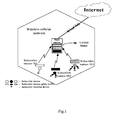
- Fig. 2 shows a wireless single-hop self-backhaul network.
- the network comprises a base station (BS), a plurality of subscriber stations (SS) and a backhaul station (BHS).
- the base station (BS) and the plurality of subscriber stations form a wireless cellular network in a traditional sense, the base station is connected with each of the subscriber stations and the backhaul station via wireless links, and BHS accesses the Internet through a wired link.
- wireless self backhaul means that in the wireless communication network, the base station transmits backhaul transactions with the backhaul station through its own radio resources (frequency, sub-band, slot, etc.).
- the wireless self-backhaul network differs from the traditional cellular network in that the base station does not access the Internet directly through a wired link any more, but it accesses the Internet through a wireless link provided by the backhaul station as its subscriber stations. Therefore, the backhaul station not only provides a wireless link for BS to access the Internet but also receives radio resources allocated by BS as a subscriber station of BS.
- the present invention proposes a bandwidth allocation scheme in a wireless self-backhaul network (especially a wireless single-hop self-backhaul network), which allocates bandwidth for subscriber stations and backhaul station after taking into joint consideration uplink and downlink bandwidth requests from subscriber stations, so that a relatively high bandwidth utilization ratio and ideal fairness for uplink and downlink bandwidth can be ensured even if the wireless single-hop self-backhaul network is overloaded.
- a wireless self-backhaul network especially a wireless single-hop self-backhaul network
- a method for bandwidth allocation in a base station of a wireless communication network that further comprises a plurality of subscriber stations and a backhaul station is proposed, comprising the steps of: a) receiving uplink and downlink bandwidth allocation request messages from said subscriber stations; b) allocating bandwidth for said subscriber stations through joint processing on uplink and downlink bandwidth requests of said subscriber stations, to obtain uplink and downlink bandwidth allocation result of each of said subscriber stations; and c) notifying the corresponding subscriber station of said uplink and downlink bandwidth allocation result of each of said subscriber stations.
- a base station for bandwidth allocation in the wireless communication network comprising:
- Fig. 3 is a schematic view of a bandwidth request in the wireless single-hop self-backhaul network according to an embodiment of the present invention.
- the service configuration is as follows: in a cellular network there are two video conference services and forty VoIP speech services, and other subscriber services include four common services, namely FTTP, HTTP, database access and Email.
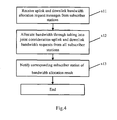
- Fig. 4 is a flowchart of a method for bandwidth allocation in a base station of a wireless communication network according to an embodiment of the present invention, wherein said wireless communication network further comprises a plurality of subscriber stations and a backhaul station.
- uplink and downlink bandwidth allocation request messages from the subscriber stations is received in step S11, wherein the subscriber station's bandwidth request message may be transferred as control message.
- step S12 bandwidth is allocated to said each of the subscriber stations through joint processing on uplink and downlink bandwidth requests of said subscriber stations, to obtain uplink and downlink bandwidth allocation result of each of the subscriber stations.
- the corresponding subscriber station is notified of said uplink and down bandwidth allocation result of each of the subscriber stations in step S13.
- a wireless backhaul station 3 (as shown in Fig. 2) is further comprised, wherein a wireless base station 2 transmits backhaul traffic with the wireless backhaul station by using its own radio resources.
- Wireless backhaul station 3 not only provides a wireless link for the base station to access a core network but also receives as a subscriber station of the base station radio resources allocated by the base station. However, generally, wireless backhaul station 3 does not request bandwidth allocation.
- BS U is the base station's overall uplink bandwidth
- BS D is the base station's overall downlink bandwidth
- SS Ui SS Di is uplink and downlink bandwidth which the i th subscriber station requests
- SS UGi SS DGi is uplink and downlink bandwidth allocated to the i th subscriber station
- BH UG BH DG is uplink and downlink backhaul traffic bandwidth allocated to the backhaul station, and 1 ⁇ i ⁇ N.
- the backhaul station does not send bandwidth allocation request information in the present embodiment.
- Fig. 5 shows a base station in the wireless communication network according to an embodiment of the present invention.
- the base station comprises a receiving means 11, a bandwidth allocation processing means 12 and a sending means 13.
- receiving means 11 is used for receiving an uplink and downlink bandwidth allocation request message from said each of the subscriber stations.
- Bandwidth allocation processing means 12 is used for allocating bandwidth for said each of the subscriber stations through joint processing on uplink and downlink bandwidth request from each of said subscriber stations.
- Sending means 13 is used for notifying the corresponding subscriber station of a bandwidth allocation result of said each of the subscriber stations.
- the bandwidth request message may be transferred as control message, so that it can be processed by using existing corresponding transmitting and receiving units in the wireless base station.
- a wireless backhaul station 3 (as shown in Fig. 2) is further comprised, wherein a wireless base station 2 transmit backhaul traffic with the wireless backhaul station by using its own radio resources.
- Wireless backhaul station 3 not only provides a wireless link for the base station to access a core network but also receives as a subscriber station of the base station radio resources allocated by the base station. However, generally, wireless backhaul station 3 does not request bandwidth allocation.
- Fig. 6 shows the block diagram of bandwidth allocation processing means 12 in a wireless self-backhaul network according to an embodiment of the present invention.
- bandwidth allocation processing means 12 performs joint processing on uplink and downlink bandwidth requests from all of the subscriber stations by using the above equations (1) to (4), to obtain an uplink and downlink bandwidth allocation result for each of the subscriber stations.
- bandwidth allocation processing means 12 comprises: adding means 121, first comparing means 122, first dividing means 123, first multiplying means 124, first accumulating means 125, first subtracting means 126, second comparing means 127, second dividing means 128, second multiplying means 129, second accumulating means 130, and second subtracting means 131.
- Said adding means 121 is used for adding up uplink and downlink bandwidth requests of all of the subscriber stations, to obtain a sum of uplink and downlink bandwidth requests of all of the subscriber stations;
- Said first comparing means 122 is used for comparing the base station's overall uplink bandwidth with the sum of uplink and downlink bandwidth requests of all of the subscriber stations, to obtain the minimum value between the base station's overall uplink bandwidth and the sum of uplink and downlink bandwidth requests of all of the subscriber stations;
- Said first dividing means 123 is used for dividing uplink bandwidth request of each of the subscriber stations by said sum of uplink and downlink bandwidth request of all of the subscriber stations, to obtain a ratio of uplink bandwidth requests of each of the subscriber stations to the sum of uplink and downlink bandwidth requests of all of the subscriber stations;
- Said first multiplying means 124 is used for multiplying the ratio of uplink bandwidth requests of each of the subscriber stations to the sum of uplink and downlink bandwidth requests of all of the subscriber stations by the minimum value between the base station's overall uplink bandwidth and the sum of uplink and downlink bandwidth requests of all of the subscriber stations, to obtain the uplink bandwidth allocation result of said subscriber station;
- Said second comparing means 127 is used for comparing the base station's overall downlink bandwidth with the sum of uplink and downlink bandwidth requests of all of the subscriber stations, to obtain the minimum value between the base station's overall downlink bandwidth with the sum of uplink and downlink bandwidth requests of all of the subscriber stations;
- Said second dividing means 128 is used for dividing downlink bandwidth request of each of the subscriber stations by said sum of uplink and downlink bandwidth requests of all of the subscriber stations, to obtain a ratio of downlink bandwidth request of each of the subscriber stations to the sum of uplink and downlink bandwidth requests of all of the subscriber stations;
- Said second multiplying means 129 is used for multiplying the ratio of downlink bandwidth requests of each of the subscriber stations to the sum of uplink and downlink bandwidth requests of all of the subscriber stations by the minimum value between the base station's overall downlink bandwidth and the sum of uplink and downlink bandwidth requests of all of the subscriber stations, to obtain the downlink bandwidth allocation result of said subscriber station;
- Said first accumulating means 125 is used for accumulating uplink bandwidth allocated for all of the subscriber stations, to obtain a sum of uplink bandwidth allocated for all of the subscriber stations;
- Said first subtracting means 126 is used for subtracting the sum of uplink bandwidth allocated for all of the subscriber stations from said base station's overall uplink bandwidth, to obtain the uplink bandwidth allocation result of said wireless backhaul station;
- Said second accumulating means 130 is used for accumulating downlink bandwidth allocated for all of the subscriber stations, to obtain a sum of downlink bandwidth allocated for all of the subscriber stations;
- Said second subtracting means 131 is used for subtracting the sum of downlink bandwidth allocated for all of the subscriber stations from said base station's overall downlink bandwidth, to obtain the downlink bandwidth allocation result of said wireless backhaul station;
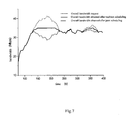
- Fig. 7 shows the bandwidth allocation situation in the wireless single-hop self-backhaul network after the adoption of the traditional bandwidth allocation method and the adoption of the bandwidth allocation method according to the present invention. It can be seen from Fig. 7 that after bandwidth requests exceed a threshold, with the traditional bandwidth allocation method, the overall bandwidth allocated for the system decreases with the increase in overall bandwidth requests, and as bandwidth requests reach the peak, the overall bandwidth allocated reaches the bottom at the same time, and then, as overall bandwidth requests decrease, the overall bandwidth allocated begins to increase.
- the overall bandwidth allocated and overall bandwidth requests are always on both sides of the threshold. That is, the bandwidth utilization ratio decreases with the increase in overload.
- the base station is required to allocate more bandwidth for uplink traffic. Since the uplink bandwidth capacity is equal to a sum of the bandwidth allocated for uplink traffic and the uplink bandwidth allocated for wireless self-backhaul link, the uplink bandwidth which wireless self-backhaul link obtains will decrease correspondingly. Since the uplink bandwidth of self-backhaul link is downlink bandwidth used for transmitting all traffic, that means the downlink bandwidth allocated for traffic will decrease. In short, when the uplink bandwidth allocated for traffic increases, the downlink bandwidth allocated for traffic will decrease, and vice versa. Meanwhile, uplink and downlink bandwidth for traffic is asymmetric. Then, these two factors result in that after bandwidth requests exceed a threshold, the overall bandwidth which the base station allocates for subscribers will decrease with the increase in bandwidth requests.
- Fig. 7 further shows the bandwidth situation allocated for the subscriber station and the backhaul station by the base station in the wireless single-hop self-backhaul network after the adoption of the bandwidth allocation method according to the present invention.
- the overall bandwidth allocated for the system by using the bandwidth allocation method according to the present invention is always larger than the overall bandwidth allocated for the system by using the traditional bandwidth allocation method.
- the system bandwidth utilization ratio can only reach a maximum of 50%, a limit of bandwidth utilization in such network environment.
- the network performance with the bandwidth allocation method according to the present invention is basically the same as the one with the traditional bandwidth allocation method in the case that the network is not overloaded, whereas the system bandwidth utilization ratio with the above methods will greatly differ from each other in the case that the network is overloaded.
- Fig. 8 shows a situation in which the fairness of uplink and downlink traffic bandwidth for asymmetric traffic of the subscriber station changes after the adoption of the traditional bandwidth allocation method and in different overload conditions of the wireless single-hop self-backhaul network according to an embodiment of the present invention.
- the more the network is overloaded the worse the fairness of uplink and downlink traffic bandwidth allocated for asymmetric traffic of the subscriber station deteriorates with the traditional bandwidth allocation scheme will be, and such deterioration becomes more and more serious with the increase in the asymmetry degree of uplink and downlink traffic bandwidth of the subscriber station.
- the ratio of uplink bandwidth to downlink bandwidth for traffic with the overall uplink and downlink bandwidth of 38Mbps is allowed to be between 0.5 and 6.0 in order to keep the relative fairness of uplink and downlink traffic bandwidth.
- the ratio of uplink bandwidth to downlink bandwidth for the asymmetric traffic is between 0.7 and 1.5 in order to keep the fairness. If the ratio is outside this range, the fairness of uplink and downlink bandwidth of the asymmetric traffic becomes impossible.
- the new bandwidth allocation method the present invention has proposed is used, it can be seen from equation (6) that for the wireless single-hop self-backhaul network, as long as the system's (i.e. base station) overall uplink bandwidth is equal to the overall downlink bandwidth thereof, it is possible to ensure hundred-percent fairness of uplink and downlink bandwidth for asymmetric traffic of the subscriber station even if the network is overloaded. That is, in relation to the change curve of the uplink-to-downlink bandwidth ratio, the fairness factor F is a straight line that is parallel to the horizontal axis, and the corresponding F value is constantly equal to 1.
Landscapes
- Engineering & Computer Science (AREA)
- Computer Networks & Wireless Communication (AREA)
- Signal Processing (AREA)
- Mobile Radio Communication Systems (AREA)
Abstract
Description
- The present invention relates to wireless communication networks, and particularly to a method and base station for bandwidth allocation in wireless self-backhaul networks (especially wireless single-hop self-backhaul networks).
- In a general point-to-multipoint (P2MP) wireless communications network, such as a cellular network (as shown in Fig. 1), subscriber stations (SS) access a base station by sharing wireless links, and the base station broadcasts information to every subscriber station through the wireless links.
- In the prior art, bandwidth allocation methods for general cellular networks are all based on the following supposition: bandwidth allocation for uplink traffic is independent of bandwidth allocation for downlink traffic. This supposition is reasonable to the above cellular networks, such as 802.16 networks or UMTS/W-CDMA networks. Since uplink traffic resources do not have a direct bearing on downlink traffic resources in general cellular networks, uplink bandwidth allocation and downlink bandwidth allocation are performed on the basis of uplink traffic resources and downlink traffic resources respectively and independently.
- However, the traditional allocation method, namely independent allocation of uplink and downlink bandwidth, does not apply to wireless single-hop self-backhaul networks.
- Fig. 2 shows a wireless single-hop self-backhaul network. The network comprises a base station (BS), a plurality of subscriber stations (SS) and a backhaul station (BHS). The base station (BS) and the plurality of subscriber stations form a wireless cellular network in a traditional sense, the base station is connected with each of the subscriber stations and the backhaul station via wireless links, and BHS accesses the Internet through a wired link. Wherein, wireless self backhaul means that in the wireless communication network, the base station transmits backhaul transactions with the backhaul station through its own radio resources (frequency, sub-band, slot, etc.).
- Apparently, the wireless self-backhaul network differs from the traditional cellular network in that the base station does not access the Internet directly through a wired link any more, but it accesses the Internet through a wireless link provided by the backhaul station as its subscriber stations. Therefore, the backhaul station not only provides a wireless link for BS to access the Internet but also receives radio resources allocated by BS as a subscriber station of BS.
- This importantly difference makes the traditional bandwidth allocation method unsuitable for wireless single-hop self-backhaul networks. Main problems are as follows: when the traditional bandwidth allocation method is applied to the network, if a sum of uplink and downlink traffic bandwidth exceeds a given threshold (i.e. network overload), the system bandwidth utilization ratio will decrease sharply with the increase in network overload; meanwhile, bandwidth fairness of uplink and downlink traffic for asymmetric service will be utterly destroyed.
- Therefore, we need a new bandwidth allocation method for wireless self-backhaul networks in order to solve the above problems, so that a high bandwidth utilization ratio can be achieved and uplink and downlink bandwidth fairness for asymmetric service can be ensured.
- To this end, the present invention proposes a bandwidth allocation scheme in a wireless self-backhaul network (especially a wireless single-hop self-backhaul network), which allocates bandwidth for subscriber stations and backhaul station after taking into joint consideration uplink and downlink bandwidth requests from subscriber stations, so that a relatively high bandwidth utilization ratio and ideal fairness for uplink and downlink bandwidth can be ensured even if the wireless single-hop self-backhaul network is overloaded.
- According to the first aspect of the present invention, a method for bandwidth allocation in a base station of a wireless communication network that further comprises a plurality of subscriber stations and a backhaul station is proposed, comprising the steps of: a) receiving uplink and downlink bandwidth allocation request messages from said subscriber stations; b) allocating bandwidth for said subscriber stations through joint processing on uplink and downlink bandwidth requests of said subscriber stations, to obtain uplink and downlink bandwidth allocation result of each of said subscriber stations; and c) notifying the corresponding subscriber station of said uplink and downlink bandwidth allocation result of each of said subscriber stations.
- According to the second aspect of the present invention, a base station for bandwidth allocation in the wireless communication network is proposed, comprising:
- a receiving means for receiving uplink and downlink bandwidth allocation request messages from said subscriber stations; a bandwidth allocation processing means for allocating bandwidth for said subscriber stations through joint processing on uplink and downlink bandwidth requests of said subscriber stations; a sending means for notifying the corresponding subscriber station of bandwidth allocation result of each of said subscriber stations.
- In the present invention, since joint bandwidth allocation is used, i.e. uplink and downlink bandwidth requests of the subscriber stations are taken into joint consideration, the problems which the wireless self-backhaul network is confronted with when adopting the traditional bandwidth allocation method and which will occur during network overload is solved, i.e. the system bandwidth utilization ratio is very low and fairness of uplink and downlink bandwidth for asymmetric traffic is destroyed.
-
- Fig. 1 is a schematic view of a general cellular network;
- Fig. 2 is a schematic view of a wireless single-hop self-backhaul network;
- Fig. 3 is a schematic view of a bandwidth request from a subscriber station in the wireless single-hop self-backhaul network according to an embodiment of the present invention;
- Fig. 4 is a flowchart of a method for bandwidth allocation in the wireless single-hop self-backhaul network according to an embodiment of the present invention;
- Fig. 5 is a schematic view of a base station for bandwidth allocation in the wireless single-hop self-backhaul network according to an embodiment of the present invention;
- Fig. 6 shows a block diagram of a bandwidth allocation processing means 12 in a wireless self-backhaul network according to an embodiment of the present invention;
- Fig. 7 is a schematic view of the bandwidth allocation situation for subscriber stations and a backhaul station by the base station in the wireless single-hop self-backhaul network according to an embodiment of the present invention; and
- Fig. 8 shows the change situation for uplink and downlink bandwidth fairness in the wireless single-hop self-backhaul network after the adoption of the traditional bandwidth allocation method.
- Referring to the accompanying drawings, a detailed description will be given to the present invention in terms of embodiments. It should be understood that the present invention is not limited to the embodiments.
- Fig. 3 is a schematic view of a bandwidth request in the wireless single-hop self-backhaul network according to an embodiment of the present invention. In the present embodiment, the service configuration is as follows: in a cellular network there are two video conference services and forty VoIP speech services, and other subscriber services include four common services, namely FTTP, HTTP, database access and Email.
- Fig. 4 is a flowchart of a method for bandwidth allocation in a base station of a wireless communication network according to an embodiment of the present invention, wherein said wireless communication network further comprises a plurality of subscriber stations and a backhaul station.
- As shown in Fig. 4, uplink and downlink bandwidth allocation request messages from the subscriber stations is received in step S11, wherein the subscriber station's bandwidth request message may be transferred as control message.
- In step S12, bandwidth is allocated to said each of the subscriber stations through joint processing on uplink and downlink bandwidth requests of said subscriber stations, to obtain uplink and downlink bandwidth allocation result of each of the subscriber stations.
- Subsequently, the corresponding subscriber station is notified of said uplink and down bandwidth allocation result of each of the subscriber stations in step S13.
- When the wireless communication network may be a wireless single-hop self-backhaul network, a wireless backhaul station 3 (as shown in Fig. 2) is further comprised, wherein a
wireless base station 2 transmits backhaul traffic with the wireless backhaul station by using its own radio resources.Wireless backhaul station 3 not only provides a wireless link for the base station to access a core network but also receives as a subscriber station of the base station radio resources allocated by the base station. However, generally,wireless backhaul station 3 does not request bandwidth allocation. - In an embodiment, after a base station 1 receives uplink and downlink bandwidth request information from each of the subscriber stations, the bandwidth allocation method of joint processing on bandwidth requests may allocate bandwidth through the following equations:


- Suppose there are a total of N subscriber stations, BSU is the base station's overall uplink bandwidth, BSD is the base station's overall downlink bandwidth, SSUi, SSDi is uplink and downlink bandwidth which the ith subscriber station requests, SSUGi, SSDGi is uplink and downlink bandwidth allocated to the ith subscriber station, and BHUG, BHDG is uplink and downlink backhaul traffic bandwidth allocated to the backhaul station, and 1≤i≤N.
- As seen from equations (1) to (4), the backhaul station does not send bandwidth allocation request information in the present embodiment.
- Fig. 5 shows a base station in the wireless communication network according to an embodiment of the present invention. As shown in Fig. 5, the base station comprises a
receiving means 11, a bandwidth allocation processing means 12 and a sending means 13. - Wherein, receiving
means 11 is used for receiving an uplink and downlink bandwidth allocation request message from said each of the subscriber stations. - Bandwidth allocation processing means 12 is used for allocating bandwidth for said each of the subscriber stations through joint processing on uplink and downlink bandwidth request from each of said subscriber stations.
-
Sending means 13 is used for notifying the corresponding subscriber station of a bandwidth allocation result of said each of the subscriber stations. Wherein, the bandwidth request message may be transferred as control message, so that it can be processed by using existing corresponding transmitting and receiving units in the wireless base station. - When the wireless communication network may be a wireless single-hop self-backhaul network, a wireless backhaul station 3 (as shown in Fig. 2) is further comprised, wherein a
wireless base station 2 transmit backhaul traffic with the wireless backhaul station by using its own radio resources.Wireless backhaul station 3 not only provides a wireless link for the base station to access a core network but also receives as a subscriber station of the base station radio resources allocated by the base station. However, generally,wireless backhaul station 3 does not request bandwidth allocation. - Fig. 6 shows the block diagram of bandwidth allocation processing means 12 in a wireless self-backhaul network according to an embodiment of the present invention. Wherein, bandwidth allocation processing means 12 performs joint processing on uplink and downlink bandwidth requests from all of the subscriber stations by using the above equations (1) to (4), to obtain an uplink and downlink bandwidth allocation result for each of the subscriber stations.
- As shown in Fig. 8, bandwidth allocation processing means 12 comprises: adding
means 121, first comparing means 122, first dividing means 123, first multiplying means 124, first accumulating means 125, first subtracting means 126,second comparing means 127, second dividing means 128, second multiplying means 129, second accumulating means 130, andsecond subtracting means 131. - Said adding
means 121 is used for adding up uplink and downlink bandwidth requests of all of the subscriber stations, to obtain a sum of uplink and downlink bandwidth requests of all of the subscriber stations; - Said first comparing means 122 is used for comparing the base station's overall uplink bandwidth with the sum of uplink and downlink bandwidth requests of all of the subscriber stations, to obtain the minimum value between the base station's overall uplink bandwidth and the sum of uplink and downlink bandwidth requests of all of the subscriber stations;
- Said first dividing means 123 is used for dividing uplink bandwidth request of each of the subscriber stations by said sum of uplink and downlink bandwidth request of all of the subscriber stations, to obtain a ratio of uplink bandwidth requests of each of the subscriber stations to the sum of uplink and downlink bandwidth requests of all of the subscriber stations;
- Said first multiplying means 124 is used for multiplying the ratio of uplink bandwidth requests of each of the subscriber stations to the sum of uplink and downlink bandwidth requests of all of the subscriber stations by the minimum value between the base station's overall uplink bandwidth and the sum of uplink and downlink bandwidth requests of all of the subscriber stations, to obtain the uplink bandwidth allocation result of said subscriber station;
- Said
second comparing means 127 is used for comparing the base station's overall downlink bandwidth with the sum of uplink and downlink bandwidth requests of all of the subscriber stations, to obtain the minimum value between the base station's overall downlink bandwidth with the sum of uplink and downlink bandwidth requests of all of the subscriber stations; - Said second dividing
means 128 is used for dividing downlink bandwidth request of each of the subscriber stations by said sum of uplink and downlink bandwidth requests of all of the subscriber stations, to obtain a ratio of downlink bandwidth request of each of the subscriber stations to the sum of uplink and downlink bandwidth requests of all of the subscriber stations; - Said second multiplying means 129 is used for multiplying the ratio of downlink bandwidth requests of each of the subscriber stations to the sum of uplink and downlink bandwidth requests of all of the subscriber stations by the minimum value between the base station's overall downlink bandwidth and the sum of uplink and downlink bandwidth requests of all of the subscriber stations, to obtain the downlink bandwidth allocation result of said subscriber station;
- Said first accumulating means 125 is used for accumulating uplink bandwidth allocated for all of the subscriber stations, to obtain a sum of uplink bandwidth allocated for all of the subscriber stations;
- Said first subtracting means 126 is used for subtracting the sum of uplink bandwidth allocated for all of the subscriber stations from said base station's overall uplink bandwidth, to obtain the uplink bandwidth allocation result of said wireless backhaul station;
- Said second accumulating means 130 is used for accumulating downlink bandwidth allocated for all of the subscriber stations, to obtain a sum of downlink bandwidth allocated for all of the subscriber stations;
- Said second subtracting means 131 is used for subtracting the sum of downlink bandwidth allocated for all of the subscriber stations from said base station's overall downlink bandwidth, to obtain the downlink bandwidth allocation result of said wireless backhaul station;
- Suppose that the downlink traffic overall bandwidth request is k times as large as the uplink traffic overall bandwidth request, i.e.


- Suppose that the sum of uplink traffic bandwidth which all of the subscriber stations request is A, and that the sum of downlink traffic bandwidth which all of the subscriber stations request is B, then B = A × k. After bandwidth allocation, the sum of the allocated uplink traffic bandwidth is A', the sum of the allocated downlink traffic bandwidth is B', and B' = A' × k'. It is defined the parameter for measuring fairness F = k'/k. After bandwidth allocation, if F = 1, then it means that the uplink and downlink traffic of the subscriber station achieves hundred-percent fairness after bandwidth allocation; if F deviates from 1, it means that the uplink and downlink traffic of the subscriber stations does not achieve hundred-percent fairness after bandwidth allocation. The more F deviates from 1, the worse the fairness of the uplink and downlink traffic is after allocation.
- It can be derived from equation (5) that

- It can be seen from equation (6) that in the present embodiment, in order to achieve a high system bandwidth utilization ratio while ensuring fairness of the uplink and downlink traffic bandwidth during network overload, the base station must allocate the system's uplink and downlink bandwidth in a ratio of 0.5 : 0.5, i.e. BSD =BSU =BSALL /2, in which BSALL is the overall bandwidth of the cellular network.
- Fig. 7 shows the bandwidth allocation situation in the wireless single-hop self-backhaul network after the adoption of the traditional bandwidth allocation method and the adoption of the bandwidth allocation method according to the present invention. It can be seen from Fig. 7 that after bandwidth requests exceed a threshold, with the traditional bandwidth allocation method, the overall bandwidth allocated for the system decreases with the increase in overall bandwidth requests, and as bandwidth requests reach the peak, the overall bandwidth allocated reaches the bottom at the same time, and then, as overall bandwidth requests decrease, the overall bandwidth allocated begins to increase. Around the threshold, the overall bandwidth allocated and overall bandwidth requests are always on both sides of the threshold. That is, the bandwidth utilization ratio decreases with the increase in overload. Due to the particularity of wireless self backhaul, when overall bandwidth requests exceed a certain threshold, corresponding uplink bandwidth requests increase with the increase in overall bandwidth requests. Thus, the base station is required to allocate more bandwidth for uplink traffic. Since the uplink bandwidth capacity is equal to a sum of the bandwidth allocated for uplink traffic and the uplink bandwidth allocated for wireless self-backhaul link, the uplink bandwidth which wireless self-backhaul link obtains will decrease correspondingly. Since the uplink bandwidth of self-backhaul link is downlink bandwidth used for transmitting all traffic, that means the downlink bandwidth allocated for traffic will decrease. In short, when the uplink bandwidth allocated for traffic increases, the downlink bandwidth allocated for traffic will decrease, and vice versa. Meanwhile, uplink and downlink bandwidth for traffic is asymmetric. Then, these two factors result in that after bandwidth requests exceed a threshold, the overall bandwidth which the base station allocates for subscribers will decrease with the increase in bandwidth requests.
- Fig. 7 further shows the bandwidth situation allocated for the subscriber station and the backhaul station by the base station in the wireless single-hop self-backhaul network after the adoption of the bandwidth allocation method according to the present invention. Apparently, the overall bandwidth allocated for the system by using the bandwidth allocation method according to the present invention is always larger than the overall bandwidth allocated for the system by using the traditional bandwidth allocation method. Moreover, due to the particularity of the wireless single-hop self-backhaul network (that is, the backhaul station not only serves as a subscriber station of the base station, for which the base station allocates radio resources, but also provides backhaul support for the subscriber stations), the system bandwidth utilization ratio can only reach a maximum of 50%, a limit of bandwidth utilization in such network environment.
- As seen from Fig. 7, for the wireless self-backhaul network, the network performance with the bandwidth allocation method according to the present invention is basically the same as the one with the traditional bandwidth allocation method in the case that the network is not overloaded, whereas the system bandwidth utilization ratio with the above methods will greatly differ from each other in the case that the network is overloaded.
- Fig. 8 shows a situation in which the fairness of uplink and downlink traffic bandwidth for asymmetric traffic of the subscriber station changes after the adoption of the traditional bandwidth allocation method and in different overload conditions of the wireless single-hop self-backhaul network according to an embodiment of the present invention. Apparently, the more the network is overloaded, the worse the fairness of uplink and downlink traffic bandwidth allocated for asymmetric traffic of the subscriber station deteriorates with the traditional bandwidth allocation scheme will be, and such deterioration becomes more and more serious with the increase in the asymmetry degree of uplink and downlink traffic bandwidth of the subscriber station. In the figure, through traditional bandwidth allocation, the ratio of uplink bandwidth to downlink bandwidth for traffic with the overall uplink and downlink bandwidth of 38Mbps is allowed to be between 0.5 and 6.0 in order to keep the relative fairness of uplink and downlink traffic bandwidth. As for traffic with the overall uplink and downlink bandwidth of 50Mbps, through traditional bandwidth allocation, the ratio of uplink bandwidth to downlink bandwidth for the asymmetric traffic is between 0.7 and 1.5 in order to keep the fairness. If the ratio is outside this range, the fairness of uplink and downlink bandwidth of the asymmetric traffic becomes impossible.
- If the new bandwidth allocation method the present invention has proposed is used, it can be seen from equation (6) that for the wireless single-hop self-backhaul network, as long as the system's (i.e. base station) overall uplink bandwidth is equal to the overall downlink bandwidth thereof, it is possible to ensure hundred-percent fairness of uplink and downlink bandwidth for asymmetric traffic of the subscriber station even if the network is overloaded. That is, in relation to the change curve of the uplink-to-downlink bandwidth ratio, the fairness factor F is a straight line that is parallel to the horizontal axis, and the corresponding F value is constantly equal to 1.
- As the embodiments of the present invention have been described above, it should be understood that the present invention is not limited to the above specific embodiments. Various modifications or alterations can be made by those skilled in the art without departing from the scope as defined by the appended claims.
Claims (8)
- A method for bandwidth allocation in a base station of a wireless communication network that further comprises a plurality of subscriber stations and a backhaul station, comprising the steps of:a) receiving uplink and downlink bandwidth allocation request messages from said subscriber stations;b) allocating bandwidth for said respective subscriber stations through joint processing on uplink and downlink bandwidth requests of said respective subscriber stations, to obtain uplink and downlink bandwidth allocation result of each of said subscriber stations; andc) notifying the corresponding subscriber station of said uplink and downlink bandwidth allocation result of each of said subscriber stations.
- The method according to claim 1, characterized in that step b) comprises:obtaining the uplink bandwidth allocation result of said subscriber station through multiplying the ratio of uplink bandwidth request of each subscriber station to the sum of uplink and downlink bandwidth requests of all subscriber stations by the minimum value between the base station's overall uplink bandwidth and the sum of uplink and downlink bandwidth requests of all subscriber stations.
- The method according to claim 1 or 2, characterized in that step b) further comprises:allocating downlink bandwidth for said subscriber station through multiplying the ratio of downlink bandwidth request of each subscriber station to the sum of uplink and downlink bandwidth requests of all subscriber stations by the minimum value between the base station's overall downlink bandwidth and the sum of uplink anddownlink bandwidth requests of all subscriber stations.
- The method according to any one of claims 1 to 3, characterized in that said wireless communication network is a wireless backhaul network, wherein said base station transmits backhaul traffic with a wireless backhaul station by using its own radio resources, wherein step b) further comprises:obtaining the uplink bandwidth allocation result of said wireless backhaul station through subtracting the sum of uplink bandwidth allocated for all subscriber stations from said base station's overall uplink bandwidth; andobtaining the downlink bandwidth allocation result of said wireless backhaul station through subtracting the sum of downlink bandwidth allocated for all subscriber stations from said base station's overall downlink bandwidth;wherein step c) further comprises:notifying said wireless backhaul station of the uplink and downlink bandwidth allocation results of said wireless backhaul station.
- A base station for bandwidth allocation in a wireless communication network, comprising:a receiving means for receiving uplink and downlink bandwidth allocation request messages from said subscriber stations;a bandwidth allocation processing means for allocating bandwidth for said subscriber stations through joint processing on uplink and downlink bandwidth requests of said subscriber stations; anda sending means for notifying the corresponding subscriber station of bandwidth allocation result of each of said subscriber stations.
- The base station according to claim 5, characterized in that said bandwidth allocation processing means comprises:an adding means for adding up uplink and downlink bandwidth requests of all subscriber stations, to obtain the sum of uplink and downlink bandwidth requests of all subscriber stations;a first comparing means for comparing the base station's overall uplink bandwidth with the sum of uplink and downlink bandwidth request of all subscriber stations, to obtain the minimum value between the base station's overall uplink bandwidth and the sum of uplink and downlink bandwidth requests of all of the subscriber stations;a first dividing means for dividing uplink bandwidth request of each subscriber station by said sum of uplink and downlink bandwidth requests of all subscriber stations, to obtain the ratio of uplink bandwidth request of each subscriber station to the sum of uplink and downlink bandwidth requests of all subscriber stations; anda first multiplying means for multiplying the ratio of uplink bandwidth request of each subscriber station to the sum of uplink and downlink bandwidth requests of all subscriber stations by the minimum value between the base station's overall uplink bandwidth and the sum of uplink and downlink bandwidth requests of all subscriber stations, to obtain the uplink bandwidth allocation result of said subscriber station.
- The base station according to claim 6, characterized in that said bandwidth allocation processing means further comprises:a second comparing means for comparing the base station's overall downlink bandwidth with the sum of uplink and downlink bandwidth requests of all subscriber stations, to obtain the minimum value between the base station's overall downlink bandwidth with the sum of uplink and downlink bandwidth requests of all subscriber stations;a second dividing means for dividing downlink bandwidth request of each subscriber station by said sum of uplink and downlink bandwidth requests of all subscriber stations, to obtain the ratio of downlink bandwidth request of each subscriber station to the sum of uplink and downlink bandwidth requests of all subscriber stations; anda second multiplying means for multiplying the ratio of downlink bandwidth request of each subscriber station to the sum of uplink and downlink bandwidth requests of all subscriber stations by the minimum value between the base station's overall downlink bandwidth and the sum of uplink and downlink bandwidth requests of all subscriber stations, to obtain the downlink bandwidth allocation result of said subscriber station.
- The base station according to any one of claims 5 to 7, characterized in that said wireless communication network is a wireless backhaul network, wherein said base station transmits backhaul traffic with a wireless backhaul station by using its own radio resources; wherein said bandwidth allocation processing means further comprises:a first accumulating means for accumulating uplink bandwidth allocated for all subscriber stations, to obtain the sum of uplink bandwidth allocated for all subscriber stations;a first subtracting means for subtracting the sum of uplink bandwidth allocated for all subscriber stations from said base station's overall uplink bandwidth, to obtain the uplink bandwidth allocation result of said wireless backhaul station;a second accumulating means for accumulating downlink bandwidth allocated for all subscriber stations, to obtain the sum of downlink bandwidth allocated for all subscriber stations; anda second subtracting means for subtracting the sum of downlink bandwidth allocated for all subscriber stations from said base station's overall downlink bandwidth, to obtain the downlink bandwidth allocation result of said wireless backhaul station;wherein said sending means is further used for notifying said wireless backhaul station of the uplink and downlink bandwidth allocation results of said wireless backhaul station.
Applications Claiming Priority (1)
| Application Number | Priority Date | Filing Date | Title |
|---|---|---|---|
| CN200510110322.2A CN100551119C (en) | 2005-11-11 | 2005-11-11 | The method and the base station that are used for allocated bandwidth in the wireless single-hop self-return network |
Publications (1)
| Publication Number | Publication Date |
|---|---|
| EP1806935A1 true EP1806935A1 (en) | 2007-07-11 |
Family
ID=37913651
Family Applications (1)
| Application Number | Title | Priority Date | Filing Date |
|---|---|---|---|
| EP06021898A Withdrawn EP1806935A1 (en) | 2005-11-11 | 2006-10-19 | Method and base station for bandwidth allocation in wireless single-hop self-backhaul networks |
Country Status (3)
| Country | Link |
|---|---|
| US (1) | US7969949B2 (en) |
| EP (1) | EP1806935A1 (en) |
| CN (1) | CN100551119C (en) |
Cited By (1)
| Publication number | Priority date | Publication date | Assignee | Title |
|---|---|---|---|---|
| WO2012000046A1 (en) * | 2010-06-30 | 2012-01-05 | Commonwealth Scientific And Industrial Research Organisation | Dynamic frequency allocation in wireless backhaul networks |
Families Citing this family (26)
| Publication number | Priority date | Publication date | Assignee | Title |
|---|---|---|---|---|
| CN1964521B (en) * | 2005-11-11 | 2010-05-12 | 上海贝尔阿尔卡特股份有限公司 | A wireless self-backhaul method and device in a wireless communication network |
| US7929942B2 (en) * | 2006-03-20 | 2011-04-19 | Alcatel-Lucent Usa Inc. | Completing emergency calls over a network with a malfunctioning backhaul communications link |
| JP4893747B2 (en) * | 2006-11-10 | 2012-03-07 | 富士通株式会社 | Wireless communication system |
| CN101237278A (en) * | 2007-01-30 | 2008-08-06 | 西门子通信技术(北京)有限公司 | Method, system, relay station and base station for transmitting data in mobile communication |
| US20090029714A1 (en) * | 2007-07-25 | 2009-01-29 | Rudrapatna Ashok N | Method of allocating bandwidth for transmission of channel quality information |
| CN101365185B (en) * | 2007-08-07 | 2012-07-11 | 中兴通讯股份有限公司 | Base station, method and mobile communication system implementing return data transmission |
| CN101785330B (en) * | 2007-08-31 | 2014-08-06 | 富士通株式会社 | Message switching method, wireless communication system, wireless terminal device, and wireless base station device |
| US8442003B2 (en) * | 2007-09-06 | 2013-05-14 | Qualcomm Incorporated | Routing in a mesh network |
| US8559381B2 (en) * | 2008-01-07 | 2013-10-15 | Nokia Corporation | Method, apparatus and computer program to map a downlink resource to a related uplink transmission |
| JP5052404B2 (en) * | 2008-05-01 | 2012-10-17 | 株式会社エヌ・ティ・ティ・ドコモ | Radio base station and mobile communication method |
| CN101938794A (en) * | 2009-07-02 | 2011-01-05 | 华为技术有限公司 | Handover processing method and device for wireless self-backhaul transmission |
| US8948085B2 (en) * | 2010-03-17 | 2015-02-03 | Qualcomm Incorporated | Methods and apparatus for best-effort radio backhaul among cells on unlicensed or shared spectrum |
| US9055512B2 (en) * | 2010-04-15 | 2015-06-09 | Nokia Technologies Oy | Methods and apparatus for secondary bandwidth detection and allocation |
| US8509787B2 (en) * | 2011-07-07 | 2013-08-13 | Cygnus Broadband, Inc. | Communications base station with decision function for distributing traffic across multiple backhauls |
| US20140187252A1 (en) * | 2012-12-27 | 2014-07-03 | Vivek G. Gupta | Distributed policy architecture |
| US10158457B2 (en) * | 2014-12-02 | 2018-12-18 | Avago Technologies International Sales Pte. Limited | Coordinating frequency division multiplexing transmissions |
| WO2018082078A1 (en) * | 2016-11-05 | 2018-05-11 | Apple Inc. | Asymmetric bandwidth support and dynamic bandwidth adjustment |
| US10433179B2 (en) * | 2017-04-12 | 2019-10-01 | Qualcomm Incorporated | Spatial-division multiple access (SDMA) across multiple operators |
| CN106888509B (en) * | 2017-04-26 | 2019-09-10 | 重庆邮电大学 | A kind of frequency spectrum resource allocation method in isomery band in self-return network |
| EP3706392B1 (en) * | 2017-11-03 | 2023-04-26 | Beijing Xiaomi Mobile Software Co., Ltd. | Backhaul bandwidth adjusting method and apparatus |
| CN109995575B (en) * | 2018-01-03 | 2023-05-02 | 中兴通讯股份有限公司 | A bandwidth processing method, device and storage medium |
| US11490363B2 (en) | 2018-04-18 | 2022-11-01 | Google Llc | User device-initiated bandwidth request |
| US10609681B2 (en) | 2018-04-24 | 2020-03-31 | Google Llc | User device-initiated request for resource configuration |
| US10827547B2 (en) | 2018-05-11 | 2020-11-03 | At&T Intellectual Property I, L.P. | Radio resource configuration and measurements for integrated access backhaul for 5G or other next generation network |
| US11291067B2 (en) | 2019-03-01 | 2022-03-29 | At&T Intellectual Property I, L.P. | Detection of failure in a backhaul communications link |
| US11006291B2 (en) * | 2019-07-11 | 2021-05-11 | At&T Intellectual Property I, L.P. | Dynamic self-backhaul reconnection using an enhanced radio resource control messaging for 5G and other next generation networks |
Citations (1)
| Publication number | Priority date | Publication date | Assignee | Title |
|---|---|---|---|---|
| US5974325A (en) * | 1991-09-24 | 1999-10-26 | Motorola, Inc. | Cellular radio system using common radio backbone |
Family Cites Families (8)
| Publication number | Priority date | Publication date | Assignee | Title |
|---|---|---|---|---|
| US6016311A (en) | 1997-11-19 | 2000-01-18 | Ensemble Communications, Inc. | Adaptive time division duplexing method and apparatus for dynamic bandwidth allocation within a wireless communication system |
| US6925068B1 (en) * | 1999-05-21 | 2005-08-02 | Wi-Lan, Inc. | Method and apparatus for allocating bandwidth in a wireless communication system |
| US20020072375A1 (en) | 2000-11-13 | 2002-06-13 | Huslig Daniel J. | Apparatus, system and method for allocating upstream and downstream channels in a cellular communication system having a wireless backhaul |
| US6459687B1 (en) * | 2001-03-05 | 2002-10-01 | Ensemble Communications, Inc. | Method and apparatus for implementing a MAC coprocessor in a communication system |
| CA2704041C (en) | 2001-03-30 | 2013-09-03 | M&Fc Holding, Llc | Enhanced wireless packet data communication system, method, and apparatus applicable to both wide area networks and local area networks |
| US7321571B2 (en) | 2002-09-27 | 2008-01-22 | Telefonaktiebolaget Lm Ericsson (Publ) | In-band wireless communication network backhaul |
| US7400856B2 (en) | 2003-09-03 | 2008-07-15 | Motorola, Inc. | Method and apparatus for relay facilitated communications |
| US7466985B1 (en) * | 2005-09-30 | 2008-12-16 | Nortel Networks Limited | Network element for implementing scheduled high-power PTP and low-power PTMP transmissions |
-
2005
- 2005-11-11 CN CN200510110322.2A patent/CN100551119C/en not_active Expired - Lifetime
-
2006
- 2006-10-19 EP EP06021898A patent/EP1806935A1/en not_active Withdrawn
- 2006-11-09 US US11/558,055 patent/US7969949B2/en not_active Expired - Fee Related
Patent Citations (1)
| Publication number | Priority date | Publication date | Assignee | Title |
|---|---|---|---|---|
| US5974325A (en) * | 1991-09-24 | 1999-10-26 | Motorola, Inc. | Cellular radio system using common radio backbone |
Non-Patent Citations (2)
| Title |
|---|
| GAMBIROZA V ET AL: "END-TO-END PERFORMANCE AND FAIRNESS IN MULTIHOP WIRELESS BACKHAUL NETWORKS", 26 September 2004, PROCEEDINGS OF THE 10TH. ANNUAL INTERNATIONAL CONFERENCE ON MOBILE COMPUTING AND NETWORKING. MOBICOM 2004. PHLADELPHIA, PA, SEPT. 26 - OCT. 1, 2004, ANNUAL INTERNATIONAL CONFERENCE ON MOBILE COMPUTING AND NETWORKING, NEW YORK, NY : ACM, US, PAGE(S) 2, ISBN: 1-58113-868-7, XP001235039 * |
| TZU-JANE TSAI ET AL: "IEEE 802.11 MAC Protocol over Wireless Mesh Networks: Problems and Perspectives", 25 March 2005, ADVANCED INFORMATION NETWORKING AND APPLICATIONS, 2005. AINA 2005. 19TH INTERNATIONAL CONFERENCE ON TAIPEI, TAIWAN 25-30 MARCH 2005, PISCATAWAY, NJ, USA,IEEE, PAGE(S) 60-63, ISBN: 0-7695-2249-1, XP010789968 * |
Cited By (3)
| Publication number | Priority date | Publication date | Assignee | Title |
|---|---|---|---|---|
| WO2012000046A1 (en) * | 2010-06-30 | 2012-01-05 | Commonwealth Scientific And Industrial Research Organisation | Dynamic frequency allocation in wireless backhaul networks |
| US9007900B2 (en) | 2010-06-30 | 2015-04-14 | Commonwealth Scientific And Industrial Research Organisation | Dynamic frequency allocation in wireless backhaul networks |
| AU2011274320B2 (en) * | 2010-06-30 | 2016-08-04 | Commonwealth Scientific And Industrial Research Organisation | Dynamic frequency allocation in wireless backhaul networks |
Also Published As
| Publication number | Publication date |
|---|---|
| US7969949B2 (en) | 2011-06-28 |
| US20070110004A1 (en) | 2007-05-17 |
| CN100551119C (en) | 2009-10-14 |
| CN1964553A (en) | 2007-05-16 |
Similar Documents
| Publication | Publication Date | Title |
|---|---|---|
| US7969949B2 (en) | Method and base station for bandwidth allocation in wireless single-hop self-backhaul networks | |
| EP1844575B1 (en) | Method and system for evaluating number of additional admissible calls for use in call admission control | |
| US7426385B2 (en) | Communication device and method for communicating over a digital mobile network | |
| US9307446B2 (en) | Method and apparatus for distributing load in wireless communication system | |
| US20040203828A1 (en) | Selective channel assignment in a wireless data communications network | |
| US7860514B2 (en) | Method for transmitting common control information in a wireless mobile communication system | |
| EP2394482B1 (en) | Transmission band determination method for bandwidth aggregation system | |
| US8462807B2 (en) | Telecommunications systems | |
| KR20060036803A (en) | Method and system for transmitting / receiving neighboring base station information message in broadband wireless access system | |
| US9265013B2 (en) | Methods and arrangements for scheduling based on power consumption | |
| US20100061256A1 (en) | Methods of Determining Whether a Frequency Channel is Available for Data Transmission for a Communication Device | |
| EP1452065B1 (en) | A method and arrangement for allocation the quantity of a channel to a mobile station as a function of the measured quality | |
| US8170574B2 (en) | Method and apparatus for controlling interference between cells in mobile communication network | |
| Chiang et al. | Adaptive downlink/uplink bandwidth allocation in IEEE 802.16 (WiMAX) wireless networks: A cross-layer approach | |
| US9681441B2 (en) | Systems and methods for coexistence of MBMS and VoIP services | |
| US8009609B2 (en) | Maintaining quality of service for wireless communications | |
| US9179357B2 (en) | Systems and methods for buffer status reporting in wireless communication systems | |
| Lee et al. | A novel inter-FA handover scheme for load balancing in IEEE 802.16 e system | |
| US7342911B2 (en) | Network element and a method for traffic management | |
| KR100921492B1 (en) | Packet Scheduling Method in Wireless Data Communication System | |
| KR101390344B1 (en) | Method and appatus for transmitting common control information in a wireless communication system | |
| Steppler | Maximum number of users which can be served by TETRA systems | |
| CN116017706A (en) | Symmetric service delay scheduling method, device, equipment and storage medium | |
| CN121126546A (en) | Carrier configuration methods, apparatus, devices, storage media, and program products | |
| Aninyie | COLLEGE OF ENGINEERING FACULTY OF ELECTRICAL AND COMPUTER ENGINEERING DEPARTMENT OF TELECOMMUNICATION ENGINEERING |
Legal Events
| Date | Code | Title | Description |
|---|---|---|---|
| PUAI | Public reference made under article 153(3) epc to a published international application that has entered the european phase |
Free format text: ORIGINAL CODE: 0009012 |
|
| AK | Designated contracting states |
Kind code of ref document: A1 Designated state(s): AT BE BG CH CY CZ DE DK EE ES FI FR GB GR HU IE IS IT LI LT LU LV MC NL PL PT RO SE SI SK TR |
|
| AX | Request for extension of the european patent |
Extension state: AL BA HR MK YU |
|
| 17P | Request for examination filed |
Effective date: 20070822 |
|
| 17Q | First examination report despatched |
Effective date: 20070919 |
|
| AKX | Designation fees paid |
Designated state(s): AT BE BG CH CY CZ DE DK EE ES FI FR GB GR HU IE IS IT LI LT LU LV MC NL PL PT RO SE SI SK TR |
|
| RAP1 | Party data changed (applicant data changed or rights of an application transferred) |
Owner name: ALCATEL LUCENT |
|
| 111Z | Information provided on other rights and legal means of execution |
Free format text: AT BE BG CH CY CZ DE DK EE ES FI FR GB GR HU IE IS IT LI LT LU LV MC NL PL PT RO SE SI SK TR Effective date: 20130410 |
|
| RAP1 | Party data changed (applicant data changed or rights of an application transferred) |
Owner name: ALCATEL LUCENT |
|
| D11X | Information provided on other rights and legal means of execution (deleted) | ||
| RIC1 | Information provided on ipc code assigned before grant |
Ipc: H04W 72/04 20090101AFI20151005BHEP Ipc: H04W 92/12 20090101ALI20151005BHEP |
|
| GRAP | Despatch of communication of intention to grant a patent |
Free format text: ORIGINAL CODE: EPIDOSNIGR1 |
|
| INTG | Intention to grant announced |
Effective date: 20151126 |
|
| GRAS | Grant fee paid |
Free format text: ORIGINAL CODE: EPIDOSNIGR3 |
|
| STAA | Information on the status of an ep patent application or granted ep patent |
Free format text: STATUS: THE APPLICATION IS DEEMED TO BE WITHDRAWN |
|
| 18D | Application deemed to be withdrawn |
Effective date: 20160407 |