EP1806881A1 - Method and apparatus for processing data units - Google Patents
Method and apparatus for processing data units Download PDFInfo
- Publication number
- EP1806881A1 EP1806881A1 EP06290040A EP06290040A EP1806881A1 EP 1806881 A1 EP1806881 A1 EP 1806881A1 EP 06290040 A EP06290040 A EP 06290040A EP 06290040 A EP06290040 A EP 06290040A EP 1806881 A1 EP1806881 A1 EP 1806881A1
- Authority
- EP
- European Patent Office
- Prior art keywords
- unit
- processing
- traffic
- data
- units
- Prior art date
- Legal status (The legal status is an assumption and is not a legal conclusion. Google has not performed a legal analysis and makes no representation as to the accuracy of the status listed.)
- Granted
Links
- 238000000034 method Methods 0.000 title claims abstract description 17
- 230000002776 aggregation Effects 0.000 claims abstract description 31
- 238000004220 aggregation Methods 0.000 claims abstract description 31
- 230000005540 biological transmission Effects 0.000 claims abstract description 22
- 230000004931 aggregating effect Effects 0.000 claims description 2
- 241001522296 Erithacus rubecula Species 0.000 description 1
- 125000004122 cyclic group Chemical group 0.000 description 1
- 239000004744 fabric Substances 0.000 description 1
- 230000007704 transition Effects 0.000 description 1
Images


Classifications
-
- H—ELECTRICITY
- H04—ELECTRIC COMMUNICATION TECHNIQUE
- H04L—TRANSMISSION OF DIGITAL INFORMATION, e.g. TELEGRAPHIC COMMUNICATION
- H04L69/00—Network arrangements, protocols or services independent of the application payload and not provided for in the other groups of this subclass
- H04L69/22—Parsing or analysis of headers
-
- H—ELECTRICITY
- H04—ELECTRIC COMMUNICATION TECHNIQUE
- H04L—TRANSMISSION OF DIGITAL INFORMATION, e.g. TELEGRAPHIC COMMUNICATION
- H04L47/00—Traffic control in data switching networks
- H04L47/50—Queue scheduling
-
- H—ELECTRICITY
- H04—ELECTRIC COMMUNICATION TECHNIQUE
- H04L—TRANSMISSION OF DIGITAL INFORMATION, e.g. TELEGRAPHIC COMMUNICATION
- H04L47/00—Traffic control in data switching networks
- H04L47/50—Queue scheduling
- H04L47/62—Queue scheduling characterised by scheduling criteria
- H04L47/621—Individual queue per connection or flow, e.g. per VC
-
- H—ELECTRICITY
- H04—ELECTRIC COMMUNICATION TECHNIQUE
- H04L—TRANSMISSION OF DIGITAL INFORMATION, e.g. TELEGRAPHIC COMMUNICATION
- H04L67/00—Network arrangements or protocols for supporting network services or applications
- H04L67/50—Network services
- H04L67/60—Scheduling or organising the servicing of application requests, e.g. requests for application data transmissions using the analysis and optimisation of the required network resources
- H04L67/62—Establishing a time schedule for servicing the requests
Definitions
- the present invention relates to a network unit adapted to process and transmit data units belonging to distinct traffic flows, and comprising:
- the network unit may refer to an access unit (or edge node) such as a Digital subscriber Line Access Multiplexer (DSLAM), a switch such as an Ethernet or Asynchronous Transfer Mode (ATM) or Multi-Protocol Label switched (MPLS) switch, a core or edge router such as an Internet Protocol (IP) router, a modem or a set top box, an access server such as a Broadband Remote Access Server (BRAS), an application server such as a video server, etc.
- DSLAM Digital subscriber Line Access Multiplexer
- ATM Asynchronous Transfer Mode
- MPLS Multi-Protocol Label switched
- IP Internet Protocol
- IP Internet Protocol
- BRAS Broadband Remote Access Server
- application server such as a video server, etc.
- Example of data units are Ethernet frames, IP or MPLS packets, ATM cells, etc, which data units forming part of distinct traffic flows (or data flows or application flows) between distinct applications running on distinct communicating devices (or hosts).
- the traffic (or packet) processing units are adapted for instance to classify the data units (e.g., to further decide about which particular action to carry out), and/or to filter the data units (e.g., dropping unauthorized traffic), and/or to modify their content (e.g., adding or removing a virtual Local Area Network (VLAN) tag, setting or modifying a Quality of service (QoS) tag).
- VLAN virtual Local Area Network
- QoS Quality of service
- Data units are typically processed in a pipelined way so as to conform to the initial packet order, which is defined by applying global and fair rules taking into account the complete traffic transiting through the network unit.
- the initial packet order is for instance determined by schedulers of the network unit that schedule traffic according to e.g. traffic priorities.
- Processing data units in parallel then implies that data units are dispatched for processing in one way, e.g. in a cyclic or round robin way, and fetched after being processed in the same way.
- a problem the skilled person would be confronted with is that, on account of traffic diversity in terms of payload type, packet length, packet structure, etc, and on account of of various actions carried out over a packet, a long processing over a single packet can stall the complete pipeline, while other packets could be ready to go.
- said network unit further comprises:
- a traffic flow is essentially defined as a group of packets that all comply to a particular and arbitrary set of rules, or that all share the same properties.
- a processing unit that is busy with a data unit shall recognize the identity of the flow to which the data unit belongs. This piece of information is shared with the arbitration unit, which can then decide to egress a data unit, the processing of which is completed, as long as it does not disturb the order within that flow, or alternatively speaking as long as the reordering affects data units belonging to different flows.
- a network unit according to the invention is advantageous in that packet processing and forwarding is made more efficient.
- the re-ordering has no operational consequence as the initial order per flow is conformed to.
- An embodiment of a network unit according to the invention is characterized in that said particular traffic flow is identified by means of a particular source address and/or a particular destination address.
- Examples of a source or destination address is a Medium Access Control (MAC) address, an network IP address, an ATM virtual Path Identifier (VPI) or virtual Channel Identifier (VCI), an MPLS label, etc.
- MAC Medium Access Control
- VPN virtual Path Identifier
- VCI virtual Channel Identifier
- This embodiment is particularly advantageous in that the initial packet order between two communicating devices is conformed with, while allowing releasing of ready-to-go packets originating from and/or bound to another communicating device.
- Another embodiment of a network unit according to the invention is characterized in that said particular traffic flow is identified by means of a particular payload type.
- a particular payload type is typically identified by means of a corresponding Service Access Point Identifier (SAPI) such as a User Datagram Protocol (UDP) or Transmission Control Protocol (TCP) port number, or a protocol value, or an Ethernet type value, at a particular protocol layer such as the TCP or UDP or IP or Ethernet layer, in a particular protocol suite such as the IP protocol suite.
- SAPI Service Access Point Identifier
- UDP User Datagram Protocol
- TCP Transmission Control Protocol
- Ethernet type value at a particular protocol layer such as the TCP or UDP or IP or Ethernet layer, in a particular protocol suite such as the IP protocol suite.
- This embodiment is advantageous in that particular application flows (e.g., video flows) can be differentiated, and processed independently, from the remaining flows.
- particular application flows e.g., video flows
- Still another embodiment of a network unit according to the invention is characterized in that said particular traffic flow is identified by means of a particular traffic priority.
- Examples of traffic priority information encoded into data units are a Differentiated Service Code Point (DSCP) encoded into the IPv4 Type of service (TOS) octet or the IPv6 Traffic class octet, or a priority level encoded into the user Priority Field of a VLAN tag, etc.
- DSCP Differentiated Service Code Point
- TOS IPv4 Type of service
- IPv6 Traffic class octet IPv6 Traffic class
- Traffic priority may also refer to e.g. an ATM service category negotiated during a connection set up and associated with a particular VPI and/or VCI, or to a service Level Agreement (SLA) negotiated between a service provider and a customer.
- SLA service Level Agreement
- This embodiment is further advantageous in that application flows having different traffic priority can be differentiated, and processed independently, from each other.
- Traffic flow discriminations can be thought of, such a combination of a particular source and/or destination address together with a particular payload type and/or traffic priority and/or further distinguishable packet/flow/customer information.
- a further embodiment of a network unit according to the invention is characterized in that said arbitration unit is further adapted to compare transmit or schedule sequence numbers of said particular data unit and said further data unit, thereby determining whether said further data unit precedes said particular data unit within said particular traffic flow.
- This embodiment relies upon a transmit sequence number as encoded into a packet by a remote transmitting unit, such as a TCP sequence number, or upon a schedule sequence number as determined by a scheduler forming part of the network unit, thereby easing the implementation of the arbitration algorithm.
- the network unit may also compare receive sequence numbers as determined by e.g. a receiving unit forming part of the network unit.
- the present invention also relates to a method for processing and transmitting data units belonging to distinct traffic flows, and comprising the steps of:
- a method according to the invention further comprises, for a particular processed data unit that is ready in a particular processing unit for further aggregation and transmission, the steps of:
- Embodiments of a method according to the invention correspond with the embodiments of a network unit according to the invention.
- the term 'coupled' should not be interpreted as being restricted to direct connections only.
- the scope of the expression 'a device A coupled to a device B' should not be limited to devices or systems wherein an output of device A is directly connected to an input of device B, and/or vice-versa. It means that there exists a path between an output of A and an input of B, and/or vice-versa, which may be a path including other devices or means.
- IP-based network unit 1 comprising:
- An input of the processing units 11 to 13 is coupled to an output of the dispatching unit 14.
- An output of the processing units 11 to 13 is coupled to an input of the aggregation unit 15.
- An input of the dispatching unit 14 is coupled to an output of the scheduler 18.
- An output of the aggregation unit 15 is coupled to the output port 17.
- the arbitration unit is bi-directionally coupled to the processing units 11 to 13.
- the output of the aggregation unit 15 may, as an alternative embodiment, be coupled to an input of a switch fabric, or to an input of a further processing stage, etc, and the input of the dispatching unit 14 may be coupled to an output of an ingress scheduler, or to an output of a receiving unit, etc.
- the egress scheduler 18 is adapted to schedule outgoing IP packets according to traffic priorities. As such, the scheduler 18 determines a particular schedule packet order.
- the dispatching unit 14 is adapted to dispatch IP packets towards the processing units 11 to 13.
- the dispatching unit 14 supplies the next scheduled IP packet to a processing unit that is done with a prior packet and that is ready to accept a new packet.
- the processing units 11 to 13 may fetch the IP packets directly from the dispatching unit 14, in which case the dispatching unit 14 makes the packets available by means of e.g. a shared First In First out (FIFO) queue.
- FIFO First In First out
- the processing units 11 to 13 refer to distinct programmable packet processors and/or distinct logic circuitry (hardly or softly configured) and/or distinct binary codes (running on one or more processor) featuring relatively efficient packet processing capabilities.
- the processing units 11 to 13 are adapted to process IP packets based on a set of rules. For instance, the processing units 11 to 13 are adapted to classify IP packets (e.g., to further decide about which particular action to carry out), and/or to filter out IP packets (e.g., dropping unauthorized traffic), and/or to modify the content of IP packets (e.g., adding or removing a virtual Local Area Network (VLAN) tag, setting or modifying a Quality of service (QoS) tag, changing the destination and/or source IP address).
- VLAN virtual Local Area Network
- QoS Quality of service
- a data flow is defined by the following combination:
- processing units 11 to 13 are further adapted to identify the traffic flow to which an IP packet belongs by looking at the corresponding fields within the IP packet.
- the processing units 11 to 13 may also look at further fields, such as the TCP/UDP client/server port number, the ToS field, the IP protocol value, the Ethertype value, etc, or at further contextual information, such as a customer profile, etc, thereby allowing discrimination of traffic flows at a further extent.
- further fields such as the TCP/UDP client/server port number, the ToS field, the IP protocol value, the Ethertype value, etc.
- the processing units 11 to 13 are further supplied with the schedule sequence number of an IP packet.
- the processing units 11 to 13 may be alternatively supplied with the absolute receive sequence number of an IP packet, such as determined by e.g. a receiving unit of the network unit 1, or with the receive sequence number of an IP packet relative to a particular flow, such as determined by e.g. a packet classification unit, or may decode a transmit sequence number from the packet directly, such as a TCP sequence number encoded by a TCP sending host (provided the considered data flow reduces at least to a TCP flow).
- the processing units 11 to 13 supply, for each packet that is being processed (no matter whether the packet is being fetched, or is being processed, or is ready to go), the following pieces of information to the arbitration unit 16 (see [flow_id, seq_nbr, Y/N] triplets in fig. 1):
- the aggregation unit 15 is adapted to aggregate IP packets from the processing units 11 to 13 into a single packet stream transmitted through the output port 17 towards a further network unit (not shown).
- the arbitration unit 16 is adapted to elect a particular packet, the processing of which is completed, for further aggregation and transmission through the output port 17.
- the arbitration unit 16 sends a control signal, further referred to as a go signal, whereby a particular processing unit is allowed to egress a ready-to-go packet towards the aggregation unit 15.
- the election algorithm makes use of the aforementioned information supplied by the processing units 11 to 13. More specifically, the arbitration unit 16 checks, for a particular packet that is ready to go in a particular processing unit, whether a further data packet handled by a further processing unit belongs to the same data flow, and if so, compares their respective sequence number to determine whether this further data packet precedes the ready-to-go packet in the data flow. If no such further packet is found, a go signal is sent to the processing unit that handles the ready-to-go packet, thereby causing its transmission towards the aggregation unit 15, and further towards the output port 17. Else, the ready-to-go packet is not allowed to be delivered as long as the processing and transmission of the preceding packet is not completed.
- IP traffic bound towards the output port 17 comprises 3 traffic flows FlowA, FlowB and FlowC. More specifically, the outgoing traffic comprises IP packets 21 to 26 with respective schedule sequence numbers n to n+5, n being an arbitrary positive integer. IP packets 21 and 23 belong to the traffic flow FlowA, IP packets 22 and 25 belong to the traffic flow FlowB, and IP packets 24 and 26 belong to the traffic flow FlowC.
- IP packets 21, 22 and 23 are dispatched towards the processing units 11, 12 and 13 respectively for further processing.
- Packets 21 and 22 have been processed and transmitted through the output port 17 towards the further network unit.
- processing units 11 and 12 are done with packets 21 and 22, they are supplied with new packets 24 and 25 respectively.
- packet 24 is completed, which packet being ready to go in the processing unit 11, while packets 23 and 25 are still being processed (packet 23 is for instance a particular packet that asks for a particularly time-consuming treatment).
- the processing unit 11 notifies the arbitration unit 15 that packet 24 is ready to go (see [c,n+3,Y] signal in fig. 1), while the processing units 12 and 13 notify the arbitration unit 15 that packets 25 and 23 are being processed (see [B,n+4,N] and [A,n+2,N] signals respectively in fig. 1).
- the arbitration unit waits for the processing and transmission of packet 23 before allowing packet 24 to be egressed (so as to comply with the initial packet schedule order), although packet 24 was ready to go ahead of time.
- the arbitration unit 15 checks, upon receipt of the [C,n+3,N] to [c,n+3,Y] signal transition from the processing unit 11 (meaning that processing of packet 24 just completes), whether another packet belonging to the same traffic flow, presently FlowC, and preceding packet 24 within that traffic flow, presently having a schedule sequence number lower than n+3, is handled by another processing unit, presently the processing units 12 and 13.
- the arbitration unit 15 sends a go signal to the processing unit 11 (see go in fig. 1), whereby the processing unit 11 is allowed to egress packet 24 towards the aggregation unit 15, which packet being then further transmitted through the output port 17 towards the further network unit.
- the processing unit 11 can proceed immediately with a new packet, presently packet 26, without waiting for the processing and transmission of packet 23 by the processing unit 13, thereby speeding up the processing of packets (and thus their forwarding) within the network unit 1.
- aggregation unit 15 is adapted to fetch processed packets directly from the processing units 11 to 13 (by means of e.g. a shared memory area), and wherein the arbitration unit 16 is integrated into the aggregation unit 15 for closer collaboration and greater efficiency.
- the arbitration unit 16 supplies the aggregation unit 15 with the identity of the processing unit, from which the next ready-to-go packet shall be fetched for further transmission towards the output port 17.
- the aggregation unit 15 fetches the packets from the processing units 11 to 13 in the sequence order specified by the arbitration unit 16.
- the arbitration unit 16 may be built as a separate unit, in which case a new signal needs to be sent to the aggregation unit 15, whereby the next elected processing unit is identified.
- FIG. 3 Another embodiment of the network unit 1, wherein the arbitration unit is distributed over the processing units 11 to 13, such as embodied by the arbitration logics 16a to 16c respectively.
- Each arbitration logic supplies the other arbitration logics with the triplet [flow_id, seq_nbr, Y/N] (see above definition), thereby allowing each processing unit to decide whether a packet can be egressed, or whether another packet shall be awaited for.
- the arbitration logics 16a to 16c further include the necessary means for avoiding and/or resolving packet collision, the aggregation unit 15 reducing to a single shared medium, such as an Ethernet bus or alike.
Landscapes
- Engineering & Computer Science (AREA)
- Computer Networks & Wireless Communication (AREA)
- Signal Processing (AREA)
- Computer Security & Cryptography (AREA)
- Data Exchanges In Wide-Area Networks (AREA)
- Hardware Redundancy (AREA)
- Small-Scale Networks (AREA)
- Communication Control (AREA)
Abstract
- a dispatching unit (14) adapted to dispatch the data units for further parallel processing,
- traffic processing units (11 to 13) adapted to process the data units in parallel,
- an aggregation unit (15) adapted to aggregate the processed data units for further transmission.
- an arbitration unit adapted, for a particular processed data unit (24) that is ready in a particular processing unit (11) for further aggregation and transmission, to identify a particular traffic flow (FlowC) to which the particular data unit belongs,
to check whether a further data unit (23; 25) handled by a further traffic processing unit (12; 13) belongs to the particular traffic flow and precedes the particular data unit within that flow,
and if none, to allow (go) delivery of the particular data unit for further aggregation and transmission.
Description
- The present invention relates to a network unit adapted to process and transmit data units belonging to distinct traffic flows, and comprising:
- a dispatching unit adapted to dispatch said data units for further parallel processing,
- traffic processing units coupled to said dispatching unit, and adapted to process said data units in parallel,
- an aggregation unit coupled to said traffic processing units, and adapted to aggregate said processed data units for further transmission.
- Such a network unit is of common general knowledge. For instance, the network unit may refer to an access unit (or edge node) such as a Digital subscriber Line Access Multiplexer (DSLAM), a switch such as an Ethernet or Asynchronous Transfer Mode (ATM) or Multi-Protocol Label switched (MPLS) switch, a core or edge router such as an Internet Protocol (IP) router, a modem or a set top box, an access server such as a Broadband Remote Access Server (BRAS), an application server such as a video server, etc.
- Example of data units (or data packets) are Ethernet frames, IP or MPLS packets, ATM cells, etc, which data units forming part of distinct traffic flows (or data flows or application flows) between distinct applications running on distinct communicating devices (or hosts).
- The traffic (or packet) processing units are adapted for instance to classify the data units (e.g., to further decide about which particular action to carry out), and/or to filter the data units (e.g., dropping unauthorized traffic), and/or to modify their content (e.g., adding or removing a virtual Local Area Network (VLAN) tag, setting or modifying a Quality of service (QoS) tag).
- Data units are typically processed in a pipelined way so as to conform to the initial packet order, which is defined by applying global and fair rules taking into account the complete traffic transiting through the network unit. The initial packet order is for instance determined by schedulers of the network unit that schedule traffic according to e.g. traffic priorities.
- Processing data units in parallel then implies that data units are dispatched for processing in one way, e.g. in a cyclic or round robin way, and fetched after being processed in the same way.
- A problem the skilled person would be confronted with is that, on account of traffic diversity in terms of payload type, packet length, packet structure, etc, and on account of of various actions carried out over a packet, a long processing over a single packet can stall the complete pipeline, while other packets could be ready to go.
- It is an object of the present invention to improve parallel processing and forwarding of data units within a network unit.
- According to the invention, this object is achieved due to the fact that said network unit further comprises:
- an arbitration unit coupled to said traffic processing units, and adapted, for a particular processed data unit that is ready in a particular processing unit for further aggregation and transmission, to identify a particular traffic flow to which said particular data unit belongs,
to check whether a further data unit handled by a further traffic processing unit belongs to said particular traffic flow and precedes said particular data unit within said particular traffic flow,
and if none, to allow delivery of said particular data unit for further aggregation and transmission. - A traffic flow is essentially defined as a group of packets that all comply to a particular and arbitrary set of rules, or that all share the same properties.
- A processing unit that is busy with a data unit shall recognize the identity of the flow to which the data unit belongs. This piece of information is shared with the arbitration unit, which can then decide to egress a data unit, the processing of which is completed, as long as it does not disturb the order within that flow, or alternatively speaking as long as the reordering affects data units belonging to different flows.
- A network unit according to the invention is advantageous in that packet processing and forwarding is made more efficient. The re-ordering has no operational consequence as the initial order per flow is conformed to.
- An embodiment of a network unit according to the invention is characterized in that said particular traffic flow is identified by means of a particular source address and/or a particular destination address.
- Examples of a source or destination address is a Medium Access Control (MAC) address, an network IP address, an ATM virtual Path Identifier (VPI) or virtual Channel Identifier (VCI), an MPLS label, etc.
- This embodiment is particularly advantageous in that the initial packet order between two communicating devices is conformed with, while allowing releasing of ready-to-go packets originating from and/or bound to another communicating device.
- Another embodiment of a network unit according to the invention is characterized in that said particular traffic flow is identified by means of a particular payload type.
- A particular payload type is typically identified by means of a corresponding Service Access Point Identifier (SAPI) such as a User Datagram Protocol (UDP) or Transmission Control Protocol (TCP) port number, or a protocol value, or an Ethernet type value, at a particular protocol layer such as the TCP or UDP or IP or Ethernet layer, in a particular protocol suite such as the IP protocol suite.
- This embodiment is advantageous in that particular application flows (e.g., video flows) can be differentiated, and processed independently, from the remaining flows.
- Still another embodiment of a network unit according to the invention is characterized in that said particular traffic flow is identified by means of a particular traffic priority.
- Examples of traffic priority information encoded into data units are a Differentiated Service Code Point (DSCP) encoded into the IPv4 Type of service (TOS) octet or the IPv6 Traffic class octet, or a priority level encoded into the user Priority Field of a VLAN tag, etc.
- Traffic priority may also refer to e.g. an ATM service category negotiated during a connection set up and associated with a particular VPI and/or VCI, or to a service Level Agreement (SLA) negotiated between a service provider and a customer.
- This embodiment is further advantageous in that application flows having different traffic priority can be differentiated, and processed independently, from each other.
- Other traffic flow discriminations can be thought of, such a combination of a particular source and/or destination address together with a particular payload type and/or traffic priority and/or further distinguishable packet/flow/customer information.
- A further embodiment of a network unit according to the invention is characterized in that said arbitration unit is further adapted to compare transmit or schedule sequence numbers of said particular data unit and said further data unit, thereby determining whether said further data unit precedes said particular data unit within said particular traffic flow.
- This embodiment relies upon a transmit sequence number as encoded into a packet by a remote transmitting unit, such as a TCP sequence number, or upon a schedule sequence number as determined by a scheduler forming part of the network unit, thereby easing the implementation of the arbitration algorithm.
- The network unit may also compare receive sequence numbers as determined by e.g. a receiving unit forming part of the network unit.
- Further characterizing embodiments are mentioned in the appended claims.
- The present invention also relates to a method for processing and transmitting data units belonging to distinct traffic flows, and comprising the steps of:
- dispatching said data units for further parallel processing,
- processing, in traffic processing units, said data units in parallel,
- aggregating said processed data units for further transmission.
- A method according to the invention further comprises, for a particular processed data unit that is ready in a particular processing unit for further aggregation and transmission, the steps of:
- identifying a particular traffic flow to which said particular data unit belongs,
- checking whether a further data unit handled by a further traffic processing unit belongs to said particular traffic flow and precedes said particular data unit within said particular traffic flow,
- if none, allowing delivery of said particular data unit for further aggregation and transmission.
- Embodiments of a method according to the invention correspond with the embodiments of a network unit according to the invention.
- It is to be noticed that the term 'comprising', also used in the claims, should not be interpreted as being restricted to the means or steps listed thereafter. Thus, the scope of the expression 'a device comprising means A and B' or 'a method comprising steps A and B' should not be limited to devices or methods consisting only of components or steps A and B. It means that with respect to the present invention, the relevant components of the device or the relevant steps of the method are A and B.
- Similarly, it is to be noticed that the term 'coupled', also used in the claims, should not be interpreted as being restricted to direct connections only. Thus, the scope of the expression 'a device A coupled to a device B' should not be limited to devices or systems wherein an output of device A is directly connected to an input of device B, and/or vice-versa. It means that there exists a path between an output of A and an input of B, and/or vice-versa, which may be a path including other devices or means.
- The above and other objects and features of the invention will become more apparent and the invention itself will be best understood by referring to the following description of an embodiment taken in conjunction with the accompanying drawings wherein:
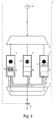
- fig. 1 represents a first embodiment of a network unit according to the invention,
- fig. 2 represents a second embodiment of a network unit according to the invention,
- fig. 3 represents a third embodiment of a network unit according to the invention.
- There is seen in fig. 1 an IP-based
network unit 1 comprising: - an egress
scheduler 18, - a
dispatching unit 14, -
packet processing units 11 to 13, - an
aggregation unit 15, - an
arbitration unit 16, - an
output port 17. - An input of the
processing units 11 to 13 is coupled to an output of thedispatching unit 14. An output of theprocessing units 11 to 13 is coupled to an input of theaggregation unit 15. An input of thedispatching unit 14 is coupled to an output of thescheduler 18. An output of theaggregation unit 15 is coupled to theoutput port 17. The arbitration unit is bi-directionally coupled to theprocessing units 11 to 13. - The output of the
aggregation unit 15 may, as an alternative embodiment, be coupled to an input of a switch fabric, or to an input of a further processing stage, etc, and the input of the dispatchingunit 14 may be coupled to an output of an ingress scheduler, or to an output of a receiving unit, etc. - The
egress scheduler 18 is adapted to schedule outgoing IP packets according to traffic priorities. As such, thescheduler 18 determines a particular schedule packet order. - The dispatching
unit 14 is adapted to dispatch IP packets towards the processingunits 11 to 13. The dispatchingunit 14 supplies the next scheduled IP packet to a processing unit that is done with a prior packet and that is ready to accept a new packet. - As an alternative solution, the
processing units 11 to 13 may fetch the IP packets directly from the dispatchingunit 14, in which case the dispatchingunit 14 makes the packets available by means of e.g. a shared First In First out (FIFO) queue. - The
processing units 11 to 13 refer to distinct programmable packet processors and/or distinct logic circuitry (hardly or softly configured) and/or distinct binary codes (running on one or more processor) featuring relatively efficient packet processing capabilities. - The
processing units 11 to 13 are adapted to process IP packets based on a set of rules. For instance, theprocessing units 11 to 13 are adapted to classify IP packets (e.g., to further decide about which particular action to carry out), and/or to filter out IP packets (e.g., dropping unauthorized traffic), and/or to modify the content of IP packets (e.g., adding or removing a virtual Local Area Network (VLAN) tag, setting or modifying a Quality of service (QoS) tag, changing the destination and/or source IP address). After being processed (rightmost part ofblocks 11 to 13), the IP packets are ready for delivery to the aggregation unit 15 (leftmost part ofblocks 11 to 13). - In a preferred embodiment of the present invention, a data flow is defined by the following combination:
- a particular source IP network address, and
- a particular destination IP network address.
- Following this definition, the
processing units 11 to 13 are further adapted to identify the traffic flow to which an IP packet belongs by looking at the corresponding fields within the IP packet. - The
processing units 11 to 13 may also look at further fields, such as the TCP/UDP client/server port number, the ToS field, the IP protocol value, the Ethertype value, etc, or at further contextual information, such as a customer profile, etc, thereby allowing discrimination of traffic flows at a further extent. - The
processing units 11 to 13 are further supplied with the schedule sequence number of an IP packet. - The
processing units 11 to 13 may be alternatively supplied with the absolute receive sequence number of an IP packet, such as determined by e.g. a receiving unit of thenetwork unit 1, or with the receive sequence number of an IP packet relative to a particular flow, such as determined by e.g. a packet classification unit, or may decode a transmit sequence number from the packet directly, such as a TCP sequence number encoded by a TCP sending host (provided the considered data flow reduces at least to a TCP flow). - Finally, the
processing units 11 to 13 supply, for each packet that is being processed (no matter whether the packet is being fetched, or is being processed, or is ready to go), the following pieces of information to the arbitration unit 16 (see [flow_id, seq_nbr, Y/N] triplets in fig. 1): - an identifier of the traffic flow to which the current IP packet belongs (flow_id),
- the sequence number of the current IP packet (seq_nbr),
- and whether processing over the current IP packet is completed, that is to say whether this packet is ready to be transmitted to the aggregation unit 15 (Yes/No).
- The
aggregation unit 15 is adapted to aggregate IP packets from theprocessing units 11 to 13 into a single packet stream transmitted through theoutput port 17 towards a further network unit (not shown). - The
arbitration unit 16 is adapted to elect a particular packet, the processing of which is completed, for further aggregation and transmission through theoutput port 17. - To do so, the
arbitration unit 16 sends a control signal, further referred to as a go signal, whereby a particular processing unit is allowed to egress a ready-to-go packet towards theaggregation unit 15. - The election algorithm makes use of the aforementioned information supplied by the
processing units 11 to 13. More specifically, thearbitration unit 16 checks, for a particular packet that is ready to go in a particular processing unit, whether a further data packet handled by a further processing unit belongs to the same data flow, and if so, compares their respective sequence number to determine whether this further data packet precedes the ready-to-go packet in the data flow. If no such further packet is found, a go signal is sent to the processing unit that handles the ready-to-go packet, thereby causing its transmission towards theaggregation unit 15, and further towards theoutput port 17. Else, the ready-to-go packet is not allowed to be delivered as long as the processing and transmission of the preceding packet is not completed. - An operation of the preferred embodiment follows.
- There is seen still in fig. 1 traffic entering, being processed by, and leaving the
network unit 1. - As an illustrative example, IP traffic bound towards the
output port 17 comprises 3 traffic flows FlowA, FlowB and FlowC. More specifically, the outgoing traffic comprises IP packets 21 to 26 with respective schedule sequence numbers n to n+5, n being an arbitrary positive integer.IP packets 21 and 23 belong to the traffic flow FlowA,IP packets 22 and 25 belong to the traffic flow FlowB, andIP packets - Initially,
IP packets 21, 22 and 23 are dispatched towards the processingunits output port 17 towards the further network unit. When processingunits new packets - At a particular instant of time (gray highlighted), the processing of
packet 24 is completed, which packet being ready to go in theprocessing unit 11, whilepackets packet 23 is for instance a particular packet that asks for a particularly time-consuming treatment). - At this instant of time, the
processing unit 11 notifies thearbitration unit 15 thatpacket 24 is ready to go (see [c,n+3,Y] signal in fig. 1), while theprocessing units arbitration unit 15 thatpackets - In prior art systems, the arbitration unit waits for the processing and transmission of
packet 23 before allowingpacket 24 to be egressed (so as to comply with the initial packet schedule order), althoughpacket 24 was ready to go ahead of time. - In a network unit according to the invention, the
arbitration unit 15 checks, upon receipt of the [C,n+3,N] to [c,n+3,Y] signal transition from the processing unit 11 (meaning that processing ofpacket 24 just completes), whether another packet belonging to the same traffic flow, presently FlowC, and precedingpacket 24 within that traffic flow, presently having a schedule sequence number lower than n+3, is handled by another processing unit, presently theprocessing units - As
packets packet arbitration unit 15 sends a go signal to the processing unit 11 (see go in fig. 1), whereby theprocessing unit 11 is allowed to egresspacket 24 towards theaggregation unit 15, which packet being then further transmitted through theoutput port 17 towards the further network unit. - As a consequence, the
processing unit 11 can proceed immediately with a new packet, presentlypacket 26, without waiting for the processing and transmission ofpacket 23 by theprocessing unit 13, thereby speeding up the processing of packets (and thus their forwarding) within thenetwork unit 1. - There is seen in fig. 2 an alternative embodiment of the
network unit 1, wherein theaggregation unit 15 is adapted to fetch processed packets directly from theprocessing units 11 to 13 (by means of e.g. a shared memory area), and wherein thearbitration unit 16 is integrated into theaggregation unit 15 for closer collaboration and greater efficiency. - In this embodiment, no go signal is sent to the
processing units 11 to 13. Instead, thearbitration unit 16 supplies theaggregation unit 15 with the identity of the processing unit, from which the next ready-to-go packet shall be fetched for further transmission towards theoutput port 17. - The
aggregation unit 15 fetches the packets from theprocessing units 11 to 13 in the sequence order specified by thearbitration unit 16. - As an alternative solution, the
arbitration unit 16 may be built as a separate unit, in which case a new signal needs to be sent to theaggregation unit 15, whereby the next elected processing unit is identified. - There is seen in fig. 3 another embodiment of the
network unit 1, wherein the arbitration unit is distributed over theprocessing units 11 to 13, such as embodied by thearbitration logics 16a to 16c respectively. - Each arbitration logic supplies the other arbitration logics with the triplet [flow_id, seq_nbr, Y/N] (see above definition), thereby allowing each processing unit to decide whether a packet can be egressed, or whether another packet shall be awaited for.
- The
arbitration logics 16a to 16c further include the necessary means for avoiding and/or resolving packet collision, theaggregation unit 15 reducing to a single shared medium, such as an Ethernet bus or alike. - A final remark is that embodiments of the present invention are described above in terms of functional blocks. From the functional description of these blocks, given above, it will be apparent for a person skilled in the art of designing electronic devices how embodiments of these blocks can be manufactured with well-known electronic components. A detailed architecture of the contents of the functional blocks hence is not given.
- While the principles of the invention have been described above in connection with specific apparatus, it is to be clearly understood that this description is made only by way of example and not as a limitation on the scope of the invention, as defined in the appended claims.
Claims (8)
- A network unit (1) adapted to process and transmit data units (21 to 26) belonging to distinct traffic flows (FlowA; FlowB; FlowC), and comprising:- a dispatching unit (14) adapted to dispatch said data units for further parallel processing,- traffic processing units (11 to 13) coupled to said dispatching unit, and adapted to process said data units in parallel,- an aggregation unit (15) coupled to said traffic processing units, and adapted to aggregate said processed data units for further transmission,characterized in that said network unit further comprises:- an arbitration unit (16) coupled to said traffic processing units, and adapted, for a particular processed data unit (24) that is ready in a particular processing unit (11) for further aggregation and transmission, to identify a particular traffic flow (FlowC) to which said particular data unit belongs,
to check whether a further data unit (23; 25) handled by a further traffic processing unit (12; 13) belongs to said particular traffic flow and precedes said particular data unit within said particular traffic flow,
and if none, to allow (go) delivery of said particular data unit for further aggregation and transmission. - A network unit according to claim 1, characterized in that said particular traffic flow is identified by means of a particular source address and/or a particular destination address.
- A network unit according to claim 1, characterized in that said particular traffic flow is identified by means of a particular payload type.
- A network unit according to claim 1, characterized in that said particular traffic flow is identified by means of a particular traffic priority.
- A network unit according to claim 1, characterized in that said arbitration unit is further adapted to compare transmit or schedule sequence numbers of said particular data unit and said further data unit, thereby determining whether said further data unit precedes said particular data unit within said particular traffic flow.
- A network unit according to claim 1, characterized in that said arbitration unit is centralized into said aggregation unit.
- A network unit according to claim 1, characterized in that said arbitration unit is distributed over said processing units.
- A method for processing and transmitting data units (21 to 26) belonging to distinct traffic flows (FlowA; FlowB; FlowC), and comprising the steps of:- dispatching said data units for further parallel processing,- processing, in traffic processing units (11 to 13), said data units in parallel,- aggregating said processed data units for further transmission,characterized in that said method further comprises, for a particular processed data unit (24) that is ready in a particular processing unit (11) for further aggregation and transmission, the steps of:- identifying a particular traffic flow (FlowC) to which said particular data unit belongs,- checking whether a further data unit (23; 25) handled by a further traffic processing unit (12; 13) belongs to said particular traffic flow and precedes said particular data unit within said particular traffic flow,- if none, allowing (go) delivery of said particular data unit for further aggregation and transmission.
Priority Applications (3)
| Application Number | Priority Date | Filing Date | Title |
|---|---|---|---|
| DE602006010317T DE602006010317D1 (en) | 2006-01-05 | 2006-01-05 | Method and device for processing data units |
| AT06290040T ATE448618T1 (en) | 2006-01-05 | 2006-01-05 | METHOD AND DEVICE FOR PROCESSING DATA UNITS |
| EP06290040A EP1806881B1 (en) | 2006-01-05 | 2006-01-05 | Method and apparatus for processing data units |
Applications Claiming Priority (1)
| Application Number | Priority Date | Filing Date | Title |
|---|---|---|---|
| EP06290040A EP1806881B1 (en) | 2006-01-05 | 2006-01-05 | Method and apparatus for processing data units |
Publications (2)
| Publication Number | Publication Date |
|---|---|
| EP1806881A1 true EP1806881A1 (en) | 2007-07-11 |
| EP1806881B1 EP1806881B1 (en) | 2009-11-11 |
Family
ID=36218211
Family Applications (1)
| Application Number | Title | Priority Date | Filing Date |
|---|---|---|---|
| EP06290040A Expired - Lifetime EP1806881B1 (en) | 2006-01-05 | 2006-01-05 | Method and apparatus for processing data units |
Country Status (3)
| Country | Link |
|---|---|
| EP (1) | EP1806881B1 (en) |
| AT (1) | ATE448618T1 (en) |
| DE (1) | DE602006010317D1 (en) |
Citations (3)
| Publication number | Priority date | Publication date | Assignee | Title |
|---|---|---|---|---|
| US6338078B1 (en) * | 1998-12-17 | 2002-01-08 | International Business Machines Corporation | System and method for sequencing packets for multiprocessor parallelization in a computer network system |
| US20030021269A1 (en) * | 2001-07-25 | 2003-01-30 | International Business Machines Corporation | Sequence-preserving deep-packet processing in a multiprocessor system |
| US20030058878A1 (en) * | 2001-09-25 | 2003-03-27 | Linden Minnick | Method and apparatus for minimizing spinlocks and retaining packet order in systems utilizing multiple transmit queues |
-
2006
- 2006-01-05 EP EP06290040A patent/EP1806881B1/en not_active Expired - Lifetime
- 2006-01-05 AT AT06290040T patent/ATE448618T1/en not_active IP Right Cessation
- 2006-01-05 DE DE602006010317T patent/DE602006010317D1/en not_active Expired - Lifetime
Patent Citations (3)
| Publication number | Priority date | Publication date | Assignee | Title |
|---|---|---|---|---|
| US6338078B1 (en) * | 1998-12-17 | 2002-01-08 | International Business Machines Corporation | System and method for sequencing packets for multiprocessor parallelization in a computer network system |
| US20030021269A1 (en) * | 2001-07-25 | 2003-01-30 | International Business Machines Corporation | Sequence-preserving deep-packet processing in a multiprocessor system |
| US20030058878A1 (en) * | 2001-09-25 | 2003-03-27 | Linden Minnick | Method and apparatus for minimizing spinlocks and retaining packet order in systems utilizing multiple transmit queues |
Also Published As
| Publication number | Publication date |
|---|---|
| ATE448618T1 (en) | 2009-11-15 |
| DE602006010317D1 (en) | 2009-12-24 |
| EP1806881B1 (en) | 2009-11-11 |
Similar Documents
| Publication | Publication Date | Title |
|---|---|---|
| US7924860B1 (en) | Maintaining data unit order in a network switching device | |
| CN1310485C (en) | Method and system for open-loop congestion control in a system fabric | |
| EP2283618B1 (en) | Transport multiplexer - mechanisms to force ethernet traffic from one domain to be switched in a different (external) domain | |
| US7929433B2 (en) | Manipulating data streams in data stream processors | |
| US7298756B1 (en) | System and method for programming cell packet headers | |
| US7621162B2 (en) | Hierarchical flow-characterizing multiplexor | |
| US6473434B1 (en) | Scaleable and robust solution for reducing complexity of resource identifier distribution in a large network processor-based system | |
| CN112953854B (en) | Device and method for switching network traffic | |
| US8284789B2 (en) | Methods and apparatus for providing dynamic data flow queues | |
| US20100150164A1 (en) | Flow-based queuing of network traffic | |
| EP1650905A1 (en) | Method for bandwidth profile management in a Metro Ethernet network | |
| EP1645086A1 (en) | Method and system for packet labeling, queuing, scheduling, and encapsulation | |
| WO2007088525A2 (en) | Method and system for internal data loop back in a high data rate switch | |
| EP1314285A1 (en) | Content processor | |
| CN1972248A (en) | Network node with control plane processor overload protection | |
| CN114631290B (en) | Transmission of data packets | |
| JP2002044139A (en) | Router device and priority control method used therefor | |
| JP2018500851A5 (en) | ||
| JP2018500851A (en) | Method and network node for traffic management in a network node in a packet switched network | |
| US7423975B2 (en) | Method, apparatus and computer program product for performing data packet classification | |
| US6356548B1 (en) | Pooled receive and transmit queues to access a shared bus in a multi-port switch asic | |
| US7751319B2 (en) | Method and processor for classifying data packet units | |
| EP1806881B1 (en) | Method and apparatus for processing data units | |
| CN1783846B (en) | Stream Aware Ethernet Digital Subscriber Line Access Multiplexer | |
| CN117240795A (en) | Scheduling method and system supporting multi-mode processing logic |
Legal Events
| Date | Code | Title | Description |
|---|---|---|---|
| PUAI | Public reference made under article 153(3) epc to a published international application that has entered the european phase |
Free format text: ORIGINAL CODE: 0009012 |
|
| AK | Designated contracting states |
Kind code of ref document: A1 Designated state(s): AT BE BG CH CY CZ DE DK EE ES FI FR GB GR HU IE IS IT LI LT LU LV MC NL PL PT RO SE SI SK TR |
|
| AX | Request for extension of the european patent |
Extension state: AL BA HR MK YU |
|
| 17P | Request for examination filed |
Effective date: 20080111 |
|
| 17Q | First examination report despatched |
Effective date: 20080219 |
|
| AKX | Designation fees paid |
Designated state(s): AT BE BG CH CY CZ DE DK EE ES FI FR GB GR HU IE IS IT LI LT LU LV MC NL PL PT RO SE SI SK TR |
|
| GRAP | Despatch of communication of intention to grant a patent |
Free format text: ORIGINAL CODE: EPIDOSNIGR1 |
|
| GRAS | Grant fee paid |
Free format text: ORIGINAL CODE: EPIDOSNIGR3 |
|
| GRAA | (expected) grant |
Free format text: ORIGINAL CODE: 0009210 |
|
| AK | Designated contracting states |
Kind code of ref document: B1 Designated state(s): AT BE BG CH CY CZ DE DK EE ES FI FR GB GR HU IE IS IT LI LT LU LV MC NL PL PT RO SE SI SK TR |
|
| REG | Reference to a national code |
Ref country code: GB Ref legal event code: FG4D |
|
| REG | Reference to a national code |
Ref country code: CH Ref legal event code: EP |
|
| REG | Reference to a national code |
Ref country code: IE Ref legal event code: FG4D |
|
| REF | Corresponds to: |
Ref document number: 602006010317 Country of ref document: DE Date of ref document: 20091224 Kind code of ref document: P |
|
| NLV1 | Nl: lapsed or annulled due to failure to fulfill the requirements of art. 29p and 29m of the patents act | ||
| LTIE | Lt: invalidation of european patent or patent extension |
Effective date: 20091111 |
|
| PG25 | Lapsed in a contracting state [announced via postgrant information from national office to epo] |
Ref country code: IS Free format text: LAPSE BECAUSE OF FAILURE TO SUBMIT A TRANSLATION OF THE DESCRIPTION OR TO PAY THE FEE WITHIN THE PRESCRIBED TIME-LIMIT Effective date: 20100311 Ref country code: PT Free format text: LAPSE BECAUSE OF FAILURE TO SUBMIT A TRANSLATION OF THE DESCRIPTION OR TO PAY THE FEE WITHIN THE PRESCRIBED TIME-LIMIT Effective date: 20100311 Ref country code: FI Free format text: LAPSE BECAUSE OF FAILURE TO SUBMIT A TRANSLATION OF THE DESCRIPTION OR TO PAY THE FEE WITHIN THE PRESCRIBED TIME-LIMIT Effective date: 20091111 Ref country code: SE Free format text: LAPSE BECAUSE OF FAILURE TO SUBMIT A TRANSLATION OF THE DESCRIPTION OR TO PAY THE FEE WITHIN THE PRESCRIBED TIME-LIMIT Effective date: 20091111 Ref country code: LT Free format text: LAPSE BECAUSE OF FAILURE TO SUBMIT A TRANSLATION OF THE DESCRIPTION OR TO PAY THE FEE WITHIN THE PRESCRIBED TIME-LIMIT Effective date: 20091111 Ref country code: ES Free format text: LAPSE BECAUSE OF FAILURE TO SUBMIT A TRANSLATION OF THE DESCRIPTION OR TO PAY THE FEE WITHIN THE PRESCRIBED TIME-LIMIT Effective date: 20100222 |
|
| PG25 | Lapsed in a contracting state [announced via postgrant information from national office to epo] |
Ref country code: LV Free format text: LAPSE BECAUSE OF FAILURE TO SUBMIT A TRANSLATION OF THE DESCRIPTION OR TO PAY THE FEE WITHIN THE PRESCRIBED TIME-LIMIT Effective date: 20091111 Ref country code: PL Free format text: LAPSE BECAUSE OF FAILURE TO SUBMIT A TRANSLATION OF THE DESCRIPTION OR TO PAY THE FEE WITHIN THE PRESCRIBED TIME-LIMIT Effective date: 20091111 Ref country code: CY Free format text: LAPSE BECAUSE OF FAILURE TO SUBMIT A TRANSLATION OF THE DESCRIPTION OR TO PAY THE FEE WITHIN THE PRESCRIBED TIME-LIMIT Effective date: 20091111 Ref country code: SI Free format text: LAPSE BECAUSE OF FAILURE TO SUBMIT A TRANSLATION OF THE DESCRIPTION OR TO PAY THE FEE WITHIN THE PRESCRIBED TIME-LIMIT Effective date: 20091111 |
|
| PG25 | Lapsed in a contracting state [announced via postgrant information from national office to epo] |
Ref country code: AT Free format text: LAPSE BECAUSE OF FAILURE TO SUBMIT A TRANSLATION OF THE DESCRIPTION OR TO PAY THE FEE WITHIN THE PRESCRIBED TIME-LIMIT Effective date: 20091111 Ref country code: BE Free format text: LAPSE BECAUSE OF FAILURE TO SUBMIT A TRANSLATION OF THE DESCRIPTION OR TO PAY THE FEE WITHIN THE PRESCRIBED TIME-LIMIT Effective date: 20091111 |
|
| PG25 | Lapsed in a contracting state [announced via postgrant information from national office to epo] |
Ref country code: DK Free format text: LAPSE BECAUSE OF FAILURE TO SUBMIT A TRANSLATION OF THE DESCRIPTION OR TO PAY THE FEE WITHIN THE PRESCRIBED TIME-LIMIT Effective date: 20091111 Ref country code: BG Free format text: LAPSE BECAUSE OF FAILURE TO SUBMIT A TRANSLATION OF THE DESCRIPTION OR TO PAY THE FEE WITHIN THE PRESCRIBED TIME-LIMIT Effective date: 20100211 Ref country code: EE Free format text: LAPSE BECAUSE OF FAILURE TO SUBMIT A TRANSLATION OF THE DESCRIPTION OR TO PAY THE FEE WITHIN THE PRESCRIBED TIME-LIMIT Effective date: 20091111 Ref country code: RO Free format text: LAPSE BECAUSE OF FAILURE TO SUBMIT A TRANSLATION OF THE DESCRIPTION OR TO PAY THE FEE WITHIN THE PRESCRIBED TIME-LIMIT Effective date: 20091111 |
|
| PG25 | Lapsed in a contracting state [announced via postgrant information from national office to epo] |
Ref country code: SK Free format text: LAPSE BECAUSE OF FAILURE TO SUBMIT A TRANSLATION OF THE DESCRIPTION OR TO PAY THE FEE WITHIN THE PRESCRIBED TIME-LIMIT Effective date: 20091111 Ref country code: MC Free format text: LAPSE BECAUSE OF NON-PAYMENT OF DUE FEES Effective date: 20100131 Ref country code: CZ Free format text: LAPSE BECAUSE OF FAILURE TO SUBMIT A TRANSLATION OF THE DESCRIPTION OR TO PAY THE FEE WITHIN THE PRESCRIBED TIME-LIMIT Effective date: 20091111 |
|
| REG | Reference to a national code |
Ref country code: CH Ref legal event code: PL |
|
| PLBE | No opposition filed within time limit |
Free format text: ORIGINAL CODE: 0009261 |
|
| STAA | Information on the status of an ep patent application or granted ep patent |
Free format text: STATUS: NO OPPOSITION FILED WITHIN TIME LIMIT |
|
| 26N | No opposition filed |
Effective date: 20100812 |
|
| PG25 | Lapsed in a contracting state [announced via postgrant information from national office to epo] |
Ref country code: GR Free format text: LAPSE BECAUSE OF FAILURE TO SUBMIT A TRANSLATION OF THE DESCRIPTION OR TO PAY THE FEE WITHIN THE PRESCRIBED TIME-LIMIT Effective date: 20100212 Ref country code: LI Free format text: LAPSE BECAUSE OF NON-PAYMENT OF DUE FEES Effective date: 20100131 Ref country code: CH Free format text: LAPSE BECAUSE OF NON-PAYMENT OF DUE FEES Effective date: 20100131 |
|
| PG25 | Lapsed in a contracting state [announced via postgrant information from national office to epo] |
Ref country code: IE Free format text: LAPSE BECAUSE OF NON-PAYMENT OF DUE FEES Effective date: 20100105 |
|
| PG25 | Lapsed in a contracting state [announced via postgrant information from national office to epo] |
Ref country code: IT Free format text: LAPSE BECAUSE OF FAILURE TO SUBMIT A TRANSLATION OF THE DESCRIPTION OR TO PAY THE FEE WITHIN THE PRESCRIBED TIME-LIMIT Effective date: 20091111 |
|
| PG25 | Lapsed in a contracting state [announced via postgrant information from national office to epo] |
Ref country code: NL Free format text: LAPSE BECAUSE OF FAILURE TO SUBMIT A TRANSLATION OF THE DESCRIPTION OR TO PAY THE FEE WITHIN THE PRESCRIBED TIME-LIMIT Effective date: 20091111 Ref country code: LU Free format text: LAPSE BECAUSE OF NON-PAYMENT OF DUE FEES Effective date: 20100105 Ref country code: HU Free format text: LAPSE BECAUSE OF FAILURE TO SUBMIT A TRANSLATION OF THE DESCRIPTION OR TO PAY THE FEE WITHIN THE PRESCRIBED TIME-LIMIT Effective date: 20100512 |
|
| PG25 | Lapsed in a contracting state [announced via postgrant information from national office to epo] |
Ref country code: TR Free format text: LAPSE BECAUSE OF FAILURE TO SUBMIT A TRANSLATION OF THE DESCRIPTION OR TO PAY THE FEE WITHIN THE PRESCRIBED TIME-LIMIT Effective date: 20091111 |
|
| REG | Reference to a national code |
Ref country code: FR Ref legal event code: GC Effective date: 20131018 |
|
| REG | Reference to a national code |
Ref country code: FR Ref legal event code: RG Effective date: 20141016 |
|
| REG | Reference to a national code |
Ref country code: FR Ref legal event code: PLFP Year of fee payment: 10 |
|
| REG | Reference to a national code |
Ref country code: FR Ref legal event code: CA Effective date: 20150521 |
|
| REG | Reference to a national code |
Ref country code: FR Ref legal event code: CA Effective date: 20150521 |
|
| REG | Reference to a national code |
Ref country code: FR Ref legal event code: PLFP Year of fee payment: 11 |
|
| PGFP | Annual fee paid to national office [announced via postgrant information from national office to epo] |
Ref country code: DE Payment date: 20160120 Year of fee payment: 11 |
|
| PGFP | Annual fee paid to national office [announced via postgrant information from national office to epo] |
Ref country code: FR Payment date: 20160121 Year of fee payment: 11 Ref country code: GB Payment date: 20160120 Year of fee payment: 11 |
|
| REG | Reference to a national code |
Ref country code: DE Ref legal event code: R119 Ref document number: 602006010317 Country of ref document: DE |
|
| GBPC | Gb: european patent ceased through non-payment of renewal fee |
Effective date: 20170105 |
|
| REG | Reference to a national code |
Ref country code: FR Ref legal event code: ST Effective date: 20170929 |
|
| PG25 | Lapsed in a contracting state [announced via postgrant information from national office to epo] |
Ref country code: FR Free format text: LAPSE BECAUSE OF NON-PAYMENT OF DUE FEES Effective date: 20170131 |
|
| PG25 | Lapsed in a contracting state [announced via postgrant information from national office to epo] |
Ref country code: GB Free format text: LAPSE BECAUSE OF NON-PAYMENT OF DUE FEES Effective date: 20170105 Ref country code: DE Free format text: LAPSE BECAUSE OF NON-PAYMENT OF DUE FEES Effective date: 20170801 |