EP1806420A1 - Steel sheet for extremely thin container and method for production thereof - Google Patents
Steel sheet for extremely thin container and method for production thereof Download PDFInfo
- Publication number
- EP1806420A1 EP1806420A1 EP04773152A EP04773152A EP1806420A1 EP 1806420 A1 EP1806420 A1 EP 1806420A1 EP 04773152 A EP04773152 A EP 04773152A EP 04773152 A EP04773152 A EP 04773152A EP 1806420 A1 EP1806420 A1 EP 1806420A1
- Authority
- EP
- European Patent Office
- Prior art keywords
- less
- steel sheet
- steel
- nitriding
- sheet
- Prior art date
- Legal status (The legal status is an assumption and is not a legal conclusion. Google has not performed a legal analysis and makes no representation as to the accuracy of the status listed.)
- Withdrawn
Links
Images

Classifications
-
- C—CHEMISTRY; METALLURGY
- C22—METALLURGY; FERROUS OR NON-FERROUS ALLOYS; TREATMENT OF ALLOYS OR NON-FERROUS METALS
- C22C—ALLOYS
- C22C38/00—Ferrous alloys, e.g. steel alloys
- C22C38/004—Very low carbon steels, i.e. having a carbon content of less than 0,01%
-
- C—CHEMISTRY; METALLURGY
- C21—METALLURGY OF IRON
- C21D—MODIFYING THE PHYSICAL STRUCTURE OF FERROUS METALS; GENERAL DEVICES FOR HEAT TREATMENT OF FERROUS OR NON-FERROUS METALS OR ALLOYS; MAKING METAL MALLEABLE, e.g. BY DECARBURISATION OR TEMPERING
- C21D8/00—Modifying the physical properties of ferrous metals or ferrous alloys by deformation combined with, or followed by, heat treatment
- C21D8/12—Modifying the physical properties of ferrous metals or ferrous alloys by deformation combined with, or followed by, heat treatment during manufacturing of articles with special electromagnetic properties
- C21D8/1216—Modifying the physical properties of ferrous metals or ferrous alloys by deformation combined with, or followed by, heat treatment during manufacturing of articles with special electromagnetic properties characterised by the working steps
-
- C—CHEMISTRY; METALLURGY
- C21—METALLURGY OF IRON
- C21D—MODIFYING THE PHYSICAL STRUCTURE OF FERROUS METALS; GENERAL DEVICES FOR HEAT TREATMENT OF FERROUS OR NON-FERROUS METALS OR ALLOYS; MAKING METAL MALLEABLE, e.g. BY DECARBURISATION OR TEMPERING
- C21D9/00—Heat treatment, e.g. annealing, hardening, quenching or tempering, adapted for particular articles; Furnaces therefor
- C21D9/46—Heat treatment, e.g. annealing, hardening, quenching or tempering, adapted for particular articles; Furnaces therefor for sheet metals
-
- C—CHEMISTRY; METALLURGY
- C22—METALLURGY; FERROUS OR NON-FERROUS ALLOYS; TREATMENT OF ALLOYS OR NON-FERROUS METALS
- C22C—ALLOYS
- C22C38/00—Ferrous alloys, e.g. steel alloys
- C22C38/02—Ferrous alloys, e.g. steel alloys containing silicon
-
- C—CHEMISTRY; METALLURGY
- C22—METALLURGY; FERROUS OR NON-FERROUS ALLOYS; TREATMENT OF ALLOYS OR NON-FERROUS METALS
- C22C—ALLOYS
- C22C38/00—Ferrous alloys, e.g. steel alloys
- C22C38/04—Ferrous alloys, e.g. steel alloys containing manganese
-
- C—CHEMISTRY; METALLURGY
- C22—METALLURGY; FERROUS OR NON-FERROUS ALLOYS; TREATMENT OF ALLOYS OR NON-FERROUS METALS
- C22C—ALLOYS
- C22C38/00—Ferrous alloys, e.g. steel alloys
- C22C38/06—Ferrous alloys, e.g. steel alloys containing aluminium
-
- C—CHEMISTRY; METALLURGY
- C22—METALLURGY; FERROUS OR NON-FERROUS ALLOYS; TREATMENT OF ALLOYS OR NON-FERROUS METALS
- C22C—ALLOYS
- C22C38/00—Ferrous alloys, e.g. steel alloys
- C22C38/12—Ferrous alloys, e.g. steel alloys containing tungsten, tantalum, molybdenum, vanadium, or niobium
-
- C—CHEMISTRY; METALLURGY
- C22—METALLURGY; FERROUS OR NON-FERROUS ALLOYS; TREATMENT OF ALLOYS OR NON-FERROUS METALS
- C22C—ALLOYS
- C22C38/00—Ferrous alloys, e.g. steel alloys
- C22C38/60—Ferrous alloys, e.g. steel alloys containing lead, selenium, tellurium, or antimony, or more than 0.04% by weight of sulfur
-
- C—CHEMISTRY; METALLURGY
- C23—COATING METALLIC MATERIAL; COATING MATERIAL WITH METALLIC MATERIAL; CHEMICAL SURFACE TREATMENT; DIFFUSION TREATMENT OF METALLIC MATERIAL; COATING BY VACUUM EVAPORATION, BY SPUTTERING, BY ION IMPLANTATION OR BY CHEMICAL VAPOUR DEPOSITION, IN GENERAL; INHIBITING CORROSION OF METALLIC MATERIAL OR INCRUSTATION IN GENERAL
- C23C—COATING METALLIC MATERIAL; COATING MATERIAL WITH METALLIC MATERIAL; SURFACE TREATMENT OF METALLIC MATERIAL BY DIFFUSION INTO THE SURFACE, BY CHEMICAL CONVERSION OR SUBSTITUTION; COATING BY VACUUM EVAPORATION, BY SPUTTERING, BY ION IMPLANTATION OR BY CHEMICAL VAPOUR DEPOSITION, IN GENERAL
- C23C8/00—Solid state diffusion of only non-metal elements into metallic material surfaces; Chemical surface treatment of metallic material by reaction of the surface with a reactive gas, leaving reaction products of surface material in the coating, e.g. conversion coatings, passivation of metals
- C23C8/06—Solid state diffusion of only non-metal elements into metallic material surfaces; Chemical surface treatment of metallic material by reaction of the surface with a reactive gas, leaving reaction products of surface material in the coating, e.g. conversion coatings, passivation of metals using gases
- C23C8/08—Solid state diffusion of only non-metal elements into metallic material surfaces; Chemical surface treatment of metallic material by reaction of the surface with a reactive gas, leaving reaction products of surface material in the coating, e.g. conversion coatings, passivation of metals using gases only one element being applied
- C23C8/24—Nitriding
- C23C8/26—Nitriding of ferrous surfaces
Definitions
- the present invention relates to a steel sheet used for a metal container such as a beverage can and a method for manufacturing the same.
- a steel sheet for a container as typified by a beverage can, a food can and the like has reached a stage where thinning of the steel sheet to reduce the cost of the container is making a progress, and a raw material of 0.2 mm or less in thickness has come to be adopted.
- One of the problems that become obvious when the container is manufactured with such an ultrathin material is deformation of the container.
- these techniques lack viewpoints as to how to suitably control the hardness of the surface and inner layers for the ultrathin raw material particularly by considering steel sheet components and nitriding conditions, and when the can is manufactured based on the ultathin raw material by these techniques, can moldability of the raw material and the resistance to deformation of the can are not necessarily satisfied.
- a technique has been put to practical use, in which, to secure can strength by using the design of the can, for example, small peak portions and valley portions (beads) are formed on a can body portion so as to improve flexural rigidity.
- the shape of peak portions and valley portions affects the strength of the can, when the raw material is soft or the sheet thickness is thin, a process of providing the peak portions and valley portions is required to be severe, but by this process, a surface-treated film is damaged, so that the deterioration of corrosion resistance occurs, and this creates problems.
- the hard material is used, even while the raw material remains thin, a processing amount to provide the peak portions and valley portions can be reduced, and the deterioration of corrosion resistance can be avoided.
- the use of the hard material is desired, but the conventional hard material is not sufficient in ductility, and a defect occurs in a flange forming process to wind up a can lid and the like, and therefore, the use of the hard material is limited.
- An object of the present invention is to solve the above-described problems of the conventional technique, and to provide a steel sheet and its manufacturing method, in which, with respect to the problematic deformation of the container manufactured by an ultrathin raw material, the qualities of materials of the surface layer and the inner layer of a raw material are controlled by adopting nitriding, and are changed to a large extent, and at the same time, good ductility is provided even in the case of the hard material.
- the present inventor and others during their research study of the components of the steel sheet of 0.4 mm or less in thickness which is manufactured particularly by being subjected to a nitriding process and the relationship between the nitriding condition and the material quality, have found that the component, particularly, a N content is limited to a specific range, and moreover, the nitriding conditions can be most suitably adjusted, whereby it is possible to preferably control the nitride form of the surface layer portion and the inner layer portion of the material, and as a result, the problematic deformation in the container using the ultrathin steel sheet as a raw material can be controlled to a large extent.
- the present inventors have found that the resistance to deformation of the can does not improve substantially by simply providing a surface hardness by performing the nitriding processing after cold rolling, and increasing the content of nitrogen in the steel, and that there exist nitriding conditions required to improve the resistance to deformation of the can made of the ultrathin raw material, and the control method of the conditions, the outline of which will be shown as follows.
- a first aspect of the steel sheet for an ultrathin container according to the present invention contains, in terms of mass %, C of 0.0800% or less, N of 0.600% or less, Si of 2.0% or less, Mn of 2.0% or less, P of 0.10% or less, S of 0.05% or less, and Al of 2.0% or less, and has a region, in which nitrides of 1 ⁇ m or less and 0.02 ⁇ m or more in diameter exist in a surface layer within 1/8 thickness of a steel sheet at a number density of 0.2 pieces/ ⁇ m 3 or more, and satisfying the following formula (A).
- the number density at the 1 / 8 sheet thickness position of the steel sheet > the number density at the 1 / 4 sheet thickness position of the steel sheet
- a second aspect of the steel sheet for an ultrathin container according to the present invention contains , in terms of mass %, C of 0.0800% or less, N of 0.600% or less, Si of 2.0% or less, Mn of 2.0% or less, P of 0.10% or less, S of 0.05% or less, and Al of 2.0% or less, wherein nitrides of 1 ⁇ m or less and 0.02 ⁇ m or more in diameter satisfy the following formula (B). the number density at the 1 / 20 sheet thickness position of the steel sheet / the number density at the 1 / 4 sheet thickness position of the steel sheet > 1.5
- the resistance to deformation and the can formability of the container are compatible with each other without sacrificing either of them, and can be remarkably improved.
- the thickness of 0.400 mm or less remarkably good can characteristics can be realized.
- the number density of nitrides of 1 ⁇ m or less and 0.02 ⁇ m or more in diameter at the 1/4 sheet thickness position of the steel sheet may be 10 pieces/ ⁇ m 3 or less.
- the steel sheet may further contain, in terms of mass %, one or two or more selected from Ti of 0.08% or less, Nb of 0.08% or less, B of 0.015% or less, and Cr of 2.0% or less.
- the steel sheet may further contain , in terms of mass %, 0.1% or less in total of Sn, Sb, Mo, Ta, V, and W.
- the remainder of the steel component may be Fe and unavoidable impurities.
- a first aspect of the method for manufacturing a steel sheet for an ultrathin container according to the present invention includes subjecting a steel containing, in terms of mass %, C of 0.0800% or less, N of 0.0300% or less, Si of 2.0% or less, Mn of 2.0% or less, P of 0.10% or less, S of 0.05% or less, and Al of 2.0% or less to cold rolling and then subjecting the steel to nitriding processing at the same time as recrystallization annealing or after the recrystallization annealing so as to form a region in which nitrides of 1 ⁇ m or less and 0.02 ⁇ m or more in diameter exist in a surface layer within 1/8 thickness of a steel sheet at a number density of 0.2 pieces/ ⁇ m 3 or more and to make N content in the steel sheet be 0.0600% or less by mass %.
- a second aspect of the method for manufacturing a steel sheet for an ultrathin container according to the present invention includes subjecting a steel containing, in terms of mass %, C of 0.0800% or less, N of 0.0300% or less, Si of 2.0% or less, Mn of 2.0% or less, P of 0.10% or less, S of 0.05% or less, and A1 of 2.0% or less to cold rolling and then subjecting the steel to nitriding processing at the same time as recrystallization annealing or after the recrystallization annealing so as to satisfy the following formula (B) with respect to nitrides of 1 ⁇ m or less and 0.02 ⁇ m or more in diameter a surface layer within 1/8 thickness of the steel sheet and to make N content in the steel sheet be 0.600% or less by mass %.
- B formula
- a third aspect of the method for manufacturing a steel sheet for an ultrathin container according to the present invention includes subjecting a steel containing, in terms of mass %, C of 0.0800% or less, N of 0.0300% or less, Si of 2.0% or less, Mn of 2.0% or less, P of 0.10% or less, S of 0.05% or less, and Al of 2,0% or less to cold rolling and then subjecting the steel to nitriding processing at the same time as recrystallization annealing or after the recrystallization annealing so as to satisfy the following formula (C) with respect to nitrides of 1 ⁇ m or less and 0.02 ⁇ m or more in diameter and to make N content in the steel sheet be 0.600% or less by mass %.
- the number density at the 1 / 20 sheet thickness position of the steel sheet after the nitriding processing > the number density at the 1 / 20 sheet thickness position of the steel sheet before the nitriding processing > 1.5
- the ultrathin container steel sheet which remarkably improves the resistance to deformation of the container and the can formability without sacrificing either of them but making them compatible to each other at high productivity.
- the steel sheet for an ultrathin container having remarkably good can characteristics can be manufactured at high productivity.
- the steel containing, in terms of mass %, C of 0.0800% or less, N of 0.0300% or less, Si of 2.0% or less, Mn of 2.0% or less, P of 0.10% or less, S of 0.05% or less, Al of 2.0% or less, and Fe and unavoidable impurities as reminder may be subjected to cold rolling and then be subjected to nitriding processing at the same time as the recrystallization annealing or after the recrystallization annealing, thereby, the number density of nitrides of 1 ⁇ m or less and 0.02 ⁇ m or more in diameter at the thickness 1/4 position of the steel sheet may made to be 10 pieces/ ⁇ m 3 or less, and N content in the steel sheet may be made to be 0.600% or less by mass %.
- the steel When the nitriding processing is performed at the same time as the recrystallization annealing or after the recrystallization annealing, the steel may be held for 0.1 second or more and 360 seconds or less in the atmosphere containing ammonia gas of 0.02% or more in a state where the sheet temperature is 550°C to 800°C, and after the nitriding processing, a product of the temperature and the time in the temperature region of 550°C or more may be made to be 48000(°C.sec) or less, or the average cooling rate from 550°C to 300°C may be set to 10°C/sec or more.
- re-cold rolling may be performed at a rolling reduction of 20% or less before the nitriding processing or after the nitriding processing.
- steel material components in the present invention will be described.
- the components are all shown in terms of mass percent.
- An upper limit of C content is required in order to avoid the deterioration of workability, and the C content shall be 0.0800% or less. Preferably it is 0.0600% or less, and more preferably 0.040% or less.
- the C content necessary in view of securing strength may be low. Even if the C content is 0.0050% or less, necessary strength can be secured, and the C content may be 0.0020% or less. Again, if the C content is 0.0015% or less, though the nitriding amount has to be taken into consideration, it is possible to manufacture an ultrasoft material. From the viewpoint that a value r is improved and a drawing formability is maintained high, the C content is preferably low.
- N content before nitriding is also necessary in order to avoid deterioration of the workability, and the N content shall be below 0.0300%.
- the N content is 0.0200% or less, and more preferably, the N content is 0.0150% or less, and more preferably, the N content is 0.0100% or less, and more preferably, the N content is 0.0100% or less, and more preferably, the N content is 0.0050% or less, and more preferably, the N content is 0.0030% or less.
- the N content before nitriding is preferably low.
- N which is contained by nitriding to be described later exists in a different content depending on the sheet thickness positions of the steel sheet in order to bestow resistance to deformation of the can and the like, and it is slightly different in the effect of N which exists before nitriding.
- the upper limit of the N content after nitriding is required not only to avoid the deterioration of the workability but also to avoid the deterioration of surface treatment properties such as plating, and the N content shall be 0.600% or less.
- the N content is 0.300% or less, and more preferably, the N content is 0.0150% or less, and more preferably, the N content is 0.100% or less, and more preferably, the N content is 0.050% or less, and more preferably, the N content is 0.030% or less.
- the N content is preferably higher.
- Si content is 2.0% or less due to the fact that, though it is added for strength adjustment, if the content to be added is too high, the workability is deteriorated.
- N which is infiltrated into the steel by nitriding in a grain boundary and nitrides are formed, but it is often the case that they not only cause fragile breakage, but also harm the effect of the present invention, and therefore, the necessity often arises where the Si content is 1.5% or less, and further 1.0% or less.
- the Si content is preferably low, and 0.5% or less, and further 0.1 % or less, thereby improving formability.
- Mn content is 2.0% or less due to the fact that, though it is added for strength adjustment, if the content to be added is too high, the workability is deteriorated. From the viewpoint that formability is maintained high, the Mn content is preferably low, and 0.6% or less, and further 0.2% or less, thereby improving formability.
- the P content is 0.10% or less due to the fact that, though it is added for strength adjustment, if the content to be added is too high, the workability is deteriorated. From the viewpoint that formability is maintained high, the P content is preferably low, and 0.05% or less, and further 0.01% or less, thereby improving formability.
- S content is 0.05% or less due to the fact that it deteriorates hot rolling and is a cause of failure of casting and hot rolling. From the viewpoint that formability is maintained, the S content is preferably low, and 0.02% or less, and further 0.01% or less, thereby improving formability.
- Al is an element to be added for deoxidation, but if its content is high, casting becomes difficult. Since it causes some harm such as an increase of scratches on the surface, it is 2.0% or less. Further, when the Al content is higher than 0.2%, it has an effect of combining with N which is infiltrated into the steel sheet by nitriding, forming a large amount of AlN in the steel sheet, and hardening a nitriding portion. From the viewpoint that the formability in the steel sheet thickness center portion low in the extent of nitriding is maintained high, the Al content is preferably low, and if the Al content is 0.2% or less, and further, 0.1 % or less, the formability of the region low in the extent of nitriding is improved.
- Ti raises recrystallization temperatures of the steel sheet, and remarkably deteriorates annealing stability of rolling of the target ultrathin steel sheet of the present invention.
- Ti is 0.080% or less.
- Ti is not required to be added, and it is 0.04% or less, and preferably 0.01% or less.
- Ti which is dissolved into the steel before nitriding has a strong effect of combining with N which is infiltrated into the steel sheet by nitriding, and forming a fine TiN in the steel, and hardening the nitride portion.
- the Ti content is preferably low and 0.005% or less, and more preferably 0.003% or less, so that inadvertent hardening of the steel sheet can be inhibited.
- Nb also has the same affect as Ti, and raises the recrystallization temperatures of the steel sheet, and remarkably deteriorates stability of rolling of the target ultrathin steel sheet of the present invention.
- Nb is 0.08% or less.
- Nb is not required to be added, and it is 0.04% or less, and preferably 0.01 % or less.
- Nb which is dissolved into the steel before nitriding has a strong effect of combining with N which is infiltrated into the steel sheet by nitriding, and forming a fine NbN in the steel, and hardening the nitriding portion.
- the Nb content is preferably low and 0.005% or less, and more preferably 0.003% or less, so that inadvertent hardening of the steel sheet can be inhibited.
- B when added to the steel sheet which contains Ti and Nb of approximately 0.01% or more, raises the recrystallization temperatures of the steel sheet, and remarkably deteriorates annealing stability of rolling of the target ultrathin steel sheet of the present invention.
- the content of Ti and Nb is low, an adverse effect in this point is low, but rather causes a drop in recrystallization temperatures, and therefore, the recrystallization annealing at low temperatures becomes possible, and this has an effect of improving the annealing stability of rolling, so that B can be positively added.
- an excessive amount of B allows the breakage of a casting piece at the casting time to remarkably occur, and therefore, the upper limit of B is 0.015% or less.
- the ratio of the content B and the content N before nitriding may be further set to B/N ⁇ 0.8, and more severely to B/N ⁇ 0.1.
- the Cr content is preferably 2.0% or less, and if it is 0.6% or less, the increase of recrystallization temperatures can be inhibited to the extent that no problem practically occurs.
- Cr is preferably 30% or less, Ni is 15% or less, and Cu is 5% or less, and more preferably, it should be confined to the extent that Cr is 15% or less, Ni is 5% or less, and Cu is 2% or less.
- the "surface layer within 1/8 thickness” represents a corresponding region in FIG. 1.
- the region corresponding to the "surface layer within 1/8 thickness” exists in both surfaces of the steel sheet, and in the present invention, with respect to either of the surfaces, the one falling into a limited range of the present invention is taken as a target.
- the present invention includes the steel sheet having such front and rear different layers also as a target. This is because it is possible to obtain the resistance to deformation, which is the target of the present invention, only by a single surface.
- the "1/8 sheet thickness position” represents a corresponding region in FIG. 1. Further, the region corresponding to the "1/4 sheet thickness position” represents the corresponding position in FIG. 1. Incidentally, though the positions corresponding to them exist in both surfaces of the steel sheet, the present invention includes either surface of them as a target which falls into a limited range of the present invention.
- the present invention includes the steel sheet having such front and rear different surface layers also as a target. This is because it is possible to obtain the resistance to deformation, which is the target of the present invention, only by a single surface.
- the "1/20 sheet thickness position” similarly to the "1/8 sheet thickness position", designates a position of the 1/20 depth of the sheet thickness from the steel sheet surface.
- the size and number density of nitrides existing in a specific position or a specific layer in the thickness direction of the steel sheet are defined, while the existing precipitates can be identified by diffraction patterns of an electron microscope and a suitable X-ray instrument. Of course, identification can be made by a method other than the chemical analysis and the like.
- An average diameter of the nitride taken as a target by the present invention is 0.1 ⁇ m or less.
- this average diameter is preferably 0.40 ⁇ m or less, and more preferably 0.20 ⁇ m or less, and still more preferably 0.10 ⁇ m or less.
- This control of the size and number density of nitrides is very important in light of the compatibility of high intensification and workability retention. The reason is because they not only affect the intensity and workability, respectively, but also the behaviors by which the intensity and the workability are changed. That is, they are required to be controlled to a region where an intensity rising effect is high and a degree of workability deterioration is low. To this end, it is effective to suitably control the temperature and the time in the above-described temperature range of 450 to 700°C and a cooling rate immediately before entering this temperature region, and this effect is the same as the general precipitates formation if under ordinary conditions.
- the precipitates of nitride rather than the precipitates of nitride only, the precipitates combined with oxide, carbide, sulfide and the like are also included as the target.
- the combined precipitates are formed, while it is difficult to specify the type of one precipitate and the size of each compound, except in the case where one precipitate can be apparently separated into a nitride portion and other portions, the precipitates are determined as one nitride.
- an extraction replica obtained by a SPEED method is observed by electron microscopy with EDX; thereby, nitrides are basically observed, when it is considered that nitride is very fine and extraction is not good, the thin film may be observed by transmission electron microscopy.
- the determination of the composition is performed by analysis by EDX, and when a non-metallic element mainly observed is N, it is taken as nitride.
- the size is small, even if the characteristic spectrum of N is not distinct, Fe, Ti, Nb, B, Cr, and the like are detected, and moreover, distinct spectra such as O and S are not observed, and yet from the shape comparison with other precipitates specifiable as nitride, the precipitates approximately determinable as nitride are also taken into consideration as nitride in the present invention. Further, for the analysis of the precipitates, electron diffraction patterns and the like may be used. The identification of nitride is not only made by the EDX technique and electron diffraction patterns, and any type of analytical instruments may be used, which are currently remarkably improved in performance.
- the identification may be determined by a method in which the type, size, and number density of the precipitates are recognized as appropriate.
- discrimination between carbonate and nitride may be difficult depending on the precipitates, those whose types are not suitably determined by ordinary analytical instruments are excluded from the present invention.
- Nitrides whose size is extremely fine and not definable by an EDX spectrum and ordinary analytical instruments are excluded from nitrides to be considered by the present invention.
- the smallest size was approximately 0.02 ⁇ m, and therefore, in the present invention, the size of 0.02 ⁇ m was taken as the lower limit. It goes without saying that if an analytical instrument of a higher order is used, and the determination of much finer nitrides is considered, the number density should be increased.
- the magnifications are set such that the number of nitrides whose diameter is taken as a target becomes approximately 500 pieces within one visual field, and ten visual fields are randomly selected, and the number density is obtained such that the number of target nitrides is divided by the field of view area and the electrolytic thickness by the SPEED method at that time, and the average diameter is obtained such that a total of the diameter of individual nitrides is divided by the number of pieces.
- the number density is obtained such that the number of target nitrides is divided by the field of view area and the electrolytic thickness by the SPEED method at that time
- the average diameter is obtained such that a total of the diameter of individual nitrides is divided by the number of pieces.
- the number density of the precipitate is calculated on assumption that, in an electrolytic process in a replica preparing process, all the charges energizing a test piece surface are spent for electrolyzing the steel sheet as bivalent ions of Fe (Fe 2+ ), and the precipitates that remain as residuum at the electrolyzing time are all added on the replica.
- electrolysis is performed using a quantity of electricity of 50C (crone)/cm 2 in the test piece surface area, precipitates located within the thickness of 18 ⁇ m from the test piece surface are observed on the replica.
- the electrolytic thickness in the SPEED method is not limited to 18 ⁇ m.
- the precipitates existing on the surface of 0 in thickness ought to be observed, but this likely causes an apprehension that measurement errors may become large.
- the electrolytic thickness should be approximately 5 to 20 ⁇ m, and a grinding is performed such that a target sheet thickness position becomes the same as a thickness center of the electrolytic portion.
- the electrolysis is performed not from the sheet surface to the direction of the sheet thickness but from the sheet thickness section to the in-plane direction, and a replica containing information on the direction to the sheet thickness is prepared, and a distribution of the number density of nitride in the direction of the sheet thickness on the replica is measured, and from this distribution, it is also possible to decide the number density of nitrides at a specific sheet thickness position.
- the target technique of the present invention is basically adapted to the ultrathin steel sheet for a container excellent in can characteristics adequately controlled in components and qualities of materials of the surface layer and the center layer, which is filed by the present inventor in Japanese Patent Application, First Publication No. 2002-337647 , and displays an extremely excellent effect, but is not limited to this.
- the states of nitride within the region of the "surface layer within 1/8 thickness” and at the "1/20 sheet thickness position", the "1/8 sheet thickness position", and the “1/4 sheet thickness position” are mainly used, and therefore, the main effect of the present invention is to control the state of nitride so as to vary at the sheet thickness position, and by controlling the state of nitride in this manner, it is possible more preferably to obtain the effect of Japanese Patent Application, First Publication No. 2000-337647 .
- the present invention mainly distributes nitrides of the surface layer portion in larger quantities and more minutely as compared to the center portion, and is based on the assumption that, in light of the general nitriding method assumed to be one of the manufacturing methods of the present invention, basically the steel sheet surface is preferentially nitrided, and accompanied with this nitriding, the amount of nitrides to be generated is supposed to be increased as compared to the center layer.
- nitrides formed, at this time are rather not preferable if coarse in view of the object of the present invention, and nitrides are preferably minutely distributed according to heating history after nitriding, particularly according to cooling conditions and the like, and therefore, in the present invention, a control on minute nitrides is performed.
- one of the features of the present invention is to allow the state of nitrides at the steel sheet thickness position to be different.
- This difference has a region existing by the number density of 0.2 pieces/ ⁇ m 3 or more in (the surface layer within 1/8 thickness) of the steel sheet with respect to nitride taken as a target of the present invention, and moreover, it is limited by (the number density at (the 1/8 sheet thickness position) of the steel sheet) > (the number density at (the 1/4 sheet thickness position) of the steel sheet)).
- the number density of nitrides is preferably 0.2 pieces/ ⁇ m 3 or more, and more preferably 2 pieces/ ⁇ m 3 or more, and further, 20 pieces/ ⁇ m 3 or more, and more preferably 200 pieces/ ⁇ m 3 or more, and if preferably 1000 pieces/ ⁇ m 3 or more, it is very effective in terms of hardness.
- this difference is also limited by (the number density at (the 1/20 sheet thickness position) of the steel sheet) /(the number density at (the 1/4 sheet thickness position) of the steel sheet)), and this ratio is made to be 1.5 or more, and preferably 3 or more, and more preferably 6 or more, and more preferably 10 or more, and more preferably 30 or more, and more preferably 100 or more.
- this ratio is small, the effect of the present invention becomes small, and the target steel sheet cannot be obtained.
- the ratio can be defined by (the number density at (the 1/20 sheet thickness position) of the steel sheet after the nitriding processing) / (the number density at (the 1/20 sheet thickness position) of the steel sheet before the nitriding processing), and in this case also, similarly to the above-described, this ratio is made to be 1.5 or more, and preferably 3 or more, and more preferably 6 or more, and more preferably 10 or more, and more preferably 30 or more, and more preferably 100 or more. It goes without saying that the larger this ratio, the larger the effect of the present invention becomes.
- the main control object of the present invention is to distribute fine nitrides in large quantities in the surface layer of the steel sheet as compared to the center layer of the steel sheet, distribution of the fine nitrides in large quantities in the steel sheet center layer is not preferable from the viewpoint of the preferable effect of the present invention.
- the number density of the nitride of 1 ⁇ m or less and 0.02 ⁇ m or more in diameter at (the 1/4 sheet thickness position) of the steel sheet is preferably 10 pieces/ ⁇ m 3 or less.
- a nitriding condition will be described. It is convenient in view of the productivity to perform the nitriding processing continuously with the recrystallization annealing in parallel with or after the recrystallization annealing after cold rolling. However, it is not limited. A method of annealing is applicable regardless of using a batch method or continuous annealing.
- the continuous annealing method is by far the most advantageous.
- the nitriding processing is at least preferably performed by a continuous annealing facility. Unless there is any specific reason, the continuous annealing shall be applied.
- a process of partially controlling the atmosphere in a furnace and performing recrystallization in a first half and nitriding in a last half has many merits such as uniformity of productivity and materials and easy control of the state of nitriding.
- the nitriding processing is decided by taking into consideration not only an increasing content of N of the steel sheet by nitriding, but also the steel components and the recrystallization annealing conditions, and moreover, a heating history and the like after nitriding, the diffusion of N from the steel sheet surface into the interior and the change of nitrides in the sheet thickness section.
- a heating history and the like after nitriding the diffusion of N from the steel sheet surface into the interior and the change of nitrides in the sheet thickness section.
- nitriding is required to be performed in a state in which the sheet temperature is 550 to 800°C. This can be performed, similarly to the ordinary annealing, by setting the nitriding atmosphere to this temperature and allowing the steel sheet to pass through this atmosphere so as to make the sheet temperature be within this range, and at the same time to perform nitriding. This may be also performed by keeping the nitriding atmosphere at a lower temperature and introducing the steel sheet heated to that temperature range into the nitriding atmosphere so as to allow nitriding to advance.
- the sheet temperature is set to 550 to 750°C. Preferably, it is set to 600 to 700°C, and more preferably 630 to 680°C.
- the nitriding atmosphere contains a nitrogen gas of 10% or more in volume ratio, and preferably 20% or more, and more preferably 40% or more, and most preferably 60% or more, and according to needs, contains a hydrogen gas of 90% or less, and preferably 80% or less, and more preferably 60% or less, and most preferably 20% or less, and further, according to needs, contains an ammonia gas of 0.02% or more, and the remainder is taken as an oxygen gas, hydrogen gas, carbon dioxide gas, hydrocarbon gas or various types of inactive gases.
- the ammonia gas is high in efficiency at raising the nitriding efficiency, and since it is possible to obtain a predetermined nitriding amount within a short period of time, the diffusion into the steel sheet center of N is inhibited, and a favorable effect can be obtained for the present invention. This effect is sufficient even if the ammonia gas is 0.02% or less, but if preferably 0.
- the annealing is performed under the conditions not nitrided in the atmosphere mainly including nitrogen gas and hydrogen gas, but if a person has an ordinary skill in the art, it is possible, after adequate trials, to change the conditions to those in which the nitriding occurs not only by the above-described mixture of the ammonia gas, but also by a change of dew point, the mixture of a minute amount of gas, a change of the gas ratio, and the like.
- Those conditions that can detect the nitriding realized at least by the heat treatment including annealing by the current analytical capability are included as a target of the present invention.
- a holding time in the nitriding atmosphere is not particularly limited, when it is considered that the thickness of the steel sheet is 0.400 mm at the maximum based on the temperature condition of the present invention, which is 550°C or more, and N which has infiltrated from the steel sheet surface by nitriding reaches the steel sheet center layer due to diffusion of N into the steel while being held so that the N distribution or the nitride distribution which are the object of the present invention end up being unobtainable, it is desirable that 360 seconds are taken as the upper limit of the holding time.
- At least 0.1 seconds is required and preferably 1 to 60 seconds, and more preferably 2 to 20 seconds, and most preferably 3 to 10 seconds is required.
- the heating history of the steel sheet after nitriding is also very important.
- the diffusion of nitrogen in the steel, and the formation and growth of nitrides, holding for a long time at high temperatures is not preferable.
- the heating history at the temperature region of 550°C or more is important, and a product of the temperature and time in this temperature region is preferably 48000 or less.
- a product of the temperature and time in this temperature region is preferably 48000 or less.
- nitriding conditions are set so that the distribution of nitrogen into the steel is approximately decided at the end of nitriding, and in the cooling process after that, the generation of nitrides is preferably controlled.
- Nitriding which is a target of the present invention, is performed in a state in which large quantities ofN are dissolved, and large quantities of nitrides arise accompanied with the temperature drop after that, and therefore, control of the cooling process after nitriding is important. In association with the heating history in this cooling process, the cooling rate after nitriding remarkably affects the effect of the invention.
- the cooling rate is set to 20°C/s or more, and more preferably 50°C/s or more.
- the cooling rate is set to 20°C/s or more, and more preferably 50°C/s or more.
- re-cold rolling is often performed for hardening adjustment and sheet thickness adjustment after recrystallization annealing.
- the rolling reduction of this re-cold rolling is put to practical use from the extent of several percentages close to a skin pass performed for shape adjustment to 50% or more similarly to cold rolling.
- the surface layer portion which is rather high in N content and hard is rather preferentially hardened, the hardness difference between the surface layer and the inner layer, which is the feature of the present invention, becomes even more apparent.
- the surface layer preferentially tends to work hardening due to large quantities of solid solution N and nitrides, and on the other hand, since the inner layer is constrained by the surface layer, it cannot be preferentially deformed, and cannot be selectively hardened by that much exceeding the surface layer.
- the time for rc-cold rolling is after the nitriding processing in the process of continuously performing the recrystallization annealing and the nitride processing which is preferable in view of the productivity, but when the recrystallization annealing and the nitriding processing are performed in a separate process, it is possible to perform re-cold rolling before the nitriding processing.
- the present invention is applied to the steel sheet of 0.400 mm or less in sheet thickness. This is because, in the steel sheet thicker than this in sheet thickness, deformation of the forming member rarely becomes a problem. Further, when the sheet thickness is thicker, the thickness of the surface layer hardened layer by nitriding becomes relatively smaller, thereby making it difficult for the effect of the invention to manifest itself.
- the steel sheet of 0.300 mm or less, and more preferably 0.240 mm or less is made as a target, and in the steel sheet of 0.190 mm or less, and further, 0.160 mm or less, it is possible to obtain a very remarkable effect.
- a mechanism is not clear which realizes a material quality unique to the steel of the present invention by controlling a state of nitride after nitriding such that a surface layer and a center layer are distinguished and its distribution in the direction of the sheet thickness is taken into consideration, and the material quality does not exist in a steel simply containing N and a steel nitrided for the only purpose of varying the surface hardness.
- the reason seems to be that resistibility to the bending deformation of the steel surface layer portion accompanied with deformation of the can is effectively enhanced by nitrides.
- this effect is assumed to be due to very effective manifestation of the resistance to deformation by an external force when deformation of the sheet thickness of the target material occurs, a stress state involved with the conditions such as an inner pressure and a shape of the container, and the size and the number density of nitrides conscious of the difference between the surface layer and the center layer combined with nitriding conditions defined by the present invention.
- the effect of the present invention does not depend on the heating history and manufacturing history subsequent to component adjustment and before annealing.
- Slabs when hot rolling is performed are not limited to the manufacturing method such as an ingot method and a continuous casting method, and also do not depend on the heating history until reaching hot rolling. Therefore, the effect of the present invention can also be obtained by a slab reheating method, a CC-DR method which directly hot rolls without reheating a cast slab, and moreover, a thin slab casting which omits a coarse rolling and the like.
- the effect of the present invention can also be obtained even by a two-phase region rolling in which finishing temperature is set to in the two phase region of ⁇ + ⁇ and the continuous hot rolling in which rough rolled bars are bonded together and then rolled.
- the steel of the present invention when used as a raw material for a container having a welding portion, softening of a heat effect portion is inhibited, and particularly, the surface layer portion having large quantities of nitrides is quickly heated and quickly cooled, so that nitrides are dissolved, and are re-precipitated as much finer nitrides, some of which remain as solid solution N and are hardened, and this provides an effect of improving the strength of the welding portion. This becomes more remarkable when elements ordinarily inhibiting the softening of the heat effect portion such as B and Nb are added.
- the sheet surface is hardened; thereby, a hardening effect is obtained in which the coefficient of friction with a metal mold is reduced and formability is improved since the sheet surface is hardened. Moreover, since the surface layer is hardened and resistance to bending deformation is strengthened, flexural buckling of the steel sheet during molding rarely occurs. That is, the effect of inhibiting the generation of creases also manifests itself.
- the steel sheet of the present invention is used as an original sheet for the surface treatment, but the effect of the present invention is not harmed at all due to the surface treatment.
- the surface treatment for a can nickel, tin, chrome (Tin free), and the like are usually bestowed.
- an original sheet for a laminate steel plate coated with an organic coating film which has come to be used in recent years, it can be used without harming the effect of the present invention.
- a three-piece can body For a three-piece can formed by welding a can body, a three-piece can body was manufactured by a steel sheet in which nitriding conditions were changed and control of nitrides was performed. A deformation resistance when the body portion of this can was compressed by a cylindrical die of 10 mm ⁇ and 40 mm in length was measured, and at the same time, a can end portion was flange-shaped similarly to winding up a lid.
- FIG. 2 a relationship between a compressing amount of a die and a compressing load is shown FIG. 2, and a point of inflection is generated by a certain load.
- This load which became the point of inflection was utilized as an index of a resistance to deformation. The higher this value, the smaller deformation by an external force is, and the resistance to deformation will become good.
- Nitriding was performed subsequent to the midst of annealing, and it is considered as a condition that recrystallization had been terminated before nitriding occurred.
- the N content in Table 1 is an average N content over a sheet thickness before nitriding. Since the steel sheet was manufactured by an ordinary method, the change of components in the direction of the sheet thickness and the change of a state of nitrides are low before nitriding, which are changes to the extent of being negligible for the effect of the present invention. That is, with respect to components of the steel sheet and the size and number density of nitrides before nitriding, the values of the surface layer within 1/20 thickness range, the surface layer within 1/8 thickness range, and the center layer within 1/4 thickness range are all the same.
- symbol A shows the highest number density within (the 1/8 sheet thickness)
- symbol B shows (the number density in the surface layer within 1/20 thickness) / (the number density in the center layer within 1/4 thickness)
- symbol C shows (the number density in the surface layer within 1/20 thickness after the nitriding processing) / (the number density in the surface layer within 1/20 thickness before the nitriding processing).
- a steel slab of 250 mm in thickness containing, in terms of mass %, C of 0.02%, Si of 0.02%, Mn of 0.2%, P of 0.01%, S of 0.01%, Al of 0.04%, and N of 0.002% was manufactured by continuous casting, and was made into a hot rolled sheet of 2.0 mm at a slab heating temperature of 1100°C, a finishing temperature of 880°C, and a winding up temperature of 600°C.
- the hot rolled sheet was subjected to acid wash, cold rolled to be 0.17 mm, and recrystallization annealing at 650°C for 30 seconds in a continuous annealing line.
- Some of the steels were rolled through a nitriding processing furnace which was filled up with an ammonia-containing atmosphere and was extended to the annealing furnace of a continuous annealing line, thereby performing the nitriding processing. Inside the nitriding processing furnace, a heating facility was not provided, and the sheet heated in the recrystallization annealing furnace was passed into the nitriding processing furnace at 650°C, so that the nitriding was performed.
- the drop in the sheet temperature during the nitriding processing was not so large, and the temperature of the sheet coming out from the nitriding processing furnace was approximately 600°C, depending on the nitriding processing time.
- the steel sheets thus manufactured were subjected to ordinary electric Sn plating after the skin pass of 1.5%, and then, tinned-steel sheets were manufactured.
- three-piece cans were manufactured by the same method as performed in an ordinary can manufacture, and can strength was estimated by the same method as the first example.
- can strength was estimated by the same method as the first example.
- no problem of welding, winding up of the lid, and the like occurred.
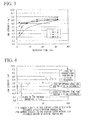
- the obtained can strength depending on ammonia concentration in the nitriding processing atmosphere, the cooling rate after the nitriding processing, and the nitriding processing time is shown in FIG. 3.
- symbol A shows the cases in which the ammonia concentration is 4% and the cooling rate is 20°C/sec after the nitriding
- symbol B shows the cases in which the ammonia concentration is 4% and the cooling rate is 120°C/sec after the nitriding
- symbol C shows the cases in which the ammonia concentration is 10% and the cooling rate is 20°C/sec after the nitriding
- symbol D shows the cases in which the ammonia concentration is 20% and the cooling rate is 20°C/sec after the nitriding
- the cooling rate after the nitriding is an average cooling rate from 550°C to 300°C.
- the can strength depending on (the number density in (the surface layer within 1/20 thickness) of the steel sheet after the nitriding processing) / (the number density in (the surface layer within 1/20 thickness) of the steel sheet before the nitriding processing) is shown in FIG. 4.
- the can strength can be remarkably increased by the present invention.
- the can strength of steels which were manufactured by using the same components and changing the cold rolling coefficient only before recrystallization annealing and of which the thicknesses were different are also shown. From the present invention, it can be seen that the steel can be made thin while maintaining the target can strength.
- the present invention can provide a steel sheet for an ultrathin container at high productivity which can improve both of the resistance to deformation and the can formability of the container remarkably without sacrificing either thereof.
- a steel sheet is not only made thin, but also a processing amount of the peak portions and valley portions processing can be reduced, and therefore, it is possible not only to make the can light in weight but also to improve corrosion resistance.
- it can be applied as a steel sheet for a container as typified by a beverage can and food can.
Landscapes
- Chemical & Material Sciences (AREA)
- Engineering & Computer Science (AREA)
- Mechanical Engineering (AREA)
- Organic Chemistry (AREA)
- Metallurgy (AREA)
- Materials Engineering (AREA)
- Physics & Mathematics (AREA)
- Crystallography & Structural Chemistry (AREA)
- Thermal Sciences (AREA)
- Manufacturing & Machinery (AREA)
- Electromagnetism (AREA)
- Chemical Kinetics & Catalysis (AREA)
- Heat Treatment Of Sheet Steel (AREA)
Abstract
This steel sheet for an ultrathin container contains, in terms of mass %, C of 0.0800% or less, N of 0.600% or less, Si of 2.0% or less, Mn of 2.0% or less, P of 0.10% or less, S of 0.05% or less, and Al of 2.0% or less. The steel sheet has a. region in which nitrides of 1 µm or less and 0.02 µm or more in diameter exist in a surface layer within 1/8 thickness of the steel sheet at the number density of 0.2 piece/µm3 or more, and satisfies the formula (A) (the number density at the 1/8 sheet thickness position of the steel sheet) > (the number density at the 1/4 sheet thickness position of the steel sheet) ... (A). Alternatively, in the steel sheet, nitrides of 1 µm or less and 0.02 µm or more in diameter satisfy the formula (B) (the number density at the 1/20 sheet thickness position of the steel sheet) / (the number density at the 1/4 sheet thickness position of the steel sheet) > 1.5 ... (B).
Description
- The present invention relates to a steel sheet used for a metal container such as a beverage can and a method for manufacturing the same.
- In general, a steel sheet for a container as typified by a beverage can, a food can and the like has reached a stage where thinning of the steel sheet to reduce the cost of the container is making a progress, and a raw material of 0.2 mm or less in thickness has come to be adopted. One of the problems that become obvious when the container is manufactured with such an ultrathin material is deformation of the container.
- This refers to deformation of the container not only due to external forces applied in the handling of the container in general after the manufacturing and filling of the container, but also due to an increase or a decrease of the internal pressure of the container, that is, a pressure increase at the time of heat treatment of the contents or a decompression processing for conservation of the contents or a pressure increase which becomes essential depending on the contents such as a carbonated drink, and moreover, due to temperature changes during distribution and storage.
- In order to improve resistance to deformation, it is necessary to use a much harder raw material not only design-wise, but also as a raw material. However, in general, hard material is low in ductility, and causes a problem of material rupture and the like at the time of the can formation.
- Furthermore, in the ultrathin raw material, since material rupture occurs by a relatively lower distortion than in a thick material, a material having a better ductility than that for a thick material is required for the ultrathin raw material. Further, in the can forming, after welding the steel sheet, a welding unit is sometimes further formed, and in such a case, concentration of deformation at a specific region is prone to easily occur, and even from this point of view, good ductility is required.
- In the process after annealing, as a method of making the steel sheet highly strong without substantially impairing ductility, a technique by nitriding at the annealing time is disclosed in
Japanese Patent Application, First Publication No. H08-170122 Japanese Patent Application, First Publication No. H08-176788 Japanese Patent Application, First Publication No. 2001-107148 Japanese Patent Application, First Publication No. 2002-012948 - However, these techniques lack viewpoints as to how to suitably control the hardness of the surface and inner layers for the ultrathin raw material particularly by considering steel sheet components and nitriding conditions, and when the can is manufactured based on the ultathin raw material by these techniques, can moldability of the raw material and the resistance to deformation of the can are not necessarily satisfied.
- Further, a technique has been put to practical use, in which, to secure can strength by using the design of the can, for example, small peak portions and valley portions (beads) are formed on a can body portion so as to improve flexural rigidity. In this case, since the shape of peak portions and valley portions affects the strength of the can, when the raw material is soft or the sheet thickness is thin, a process of providing the peak portions and valley portions is required to be severe, but by this process, a surface-treated film is damaged, so that the deterioration of corrosion resistance occurs, and this creates problems. If the hard material is used, even while the raw material remains thin, a processing amount to provide the peak portions and valley portions can be reduced, and the deterioration of corrosion resistance can be avoided. Thus, the use of the hard material is desired, but the conventional hard material is not sufficient in ductility, and a defect occurs in a flange forming process to wind up a can lid and the like, and therefore, the use of the hard material is limited.
- An object of the present invention is to solve the above-described problems of the conventional technique, and to provide a steel sheet and its manufacturing method, in which, with respect to the problematic deformation of the container manufactured by an ultrathin raw material, the qualities of materials of the surface layer and the inner layer of a raw material are controlled by adopting nitriding, and are changed to a large extent, and at the same time, good ductility is provided even in the case of the hard material.
- In order to solve the above-described problems, the present inventor and others, during their research study of the components of the steel sheet of 0.4 mm or less in thickness which is manufactured particularly by being subjected to a nitriding process and the relationship between the nitriding condition and the material quality, have found that the component, particularly, a N content is limited to a specific range, and moreover, the nitriding conditions can be most suitably adjusted, whereby it is possible to preferably control the nitride form of the surface layer portion and the inner layer portion of the material, and as a result, the problematic deformation in the container using the ultrathin steel sheet as a raw material can be controlled to a large extent.
- That is, the present inventors have found that the resistance to deformation of the can does not improve substantially by simply providing a surface hardness by performing the nitriding processing after cold rolling, and increasing the content of nitrogen in the steel, and that there exist nitriding conditions required to improve the resistance to deformation of the can made of the ultrathin raw material, and the control method of the conditions, the outline of which will be shown as follows.
- A first aspect of the steel sheet for an ultrathin container according to the present invention contains, in terms of mass %, C of 0.0800% or less, N of 0.600% or less, Si of 2.0% or less, Mn of 2.0% or less, P of 0.10% or less, S of 0.05% or less, and Al of 2.0% or less, and has a region, in which nitrides of 1 µm or less and 0.02 µm or more in diameter exist in a surface layer within 1/8 thickness of a steel sheet at a number density of 0.2 pieces/µm3 or more, and satisfying the following formula (A).

- A second aspect of the steel sheet for an ultrathin container according to the present invention contains , in terms of mass %, C of 0.0800% or less, N of 0.600% or less, Si of 2.0% or less, Mn of 2.0% or less, P of 0.10% or less, S of 0.05% or less, and Al of 2.0% or less, wherein nitrides of 1 µm or less and 0.02 µm or more in diameter satisfy the following formula (B).

- In accordance with the steel sheet for an ultrathin container of the present invention, the resistance to deformation and the can formability of the container are compatible with each other without sacrificing either of them, and can be remarkably improved. Particularly, at the thickness of 0.400 mm or less, remarkably good can characteristics can be realized.
- In the steel sheet for an ultrathin container of the present invention, the number density of nitrides of 1 µm or less and 0.02 µm or more in diameter at the 1/4 sheet thickness position of the steel sheet may be 10 pieces/µm3 or less.
- As a. steel component, the steel sheet may further contain, in terms of mass %, one or two or more selected from Ti of 0.08% or less, Nb of 0.08% or less, B of 0.015% or less, and Cr of 2.0% or less.
- As a steel component, the steel sheet may further contain , in terms of mass %, 0.1% or less in total of Sn, Sb, Mo, Ta, V, and W.
- The remainder of the steel component may be Fe and unavoidable impurities.
- A first aspect of the method for manufacturing a steel sheet for an ultrathin container according to the present invention includes subjecting a steel containing, in terms of mass %, C of 0.0800% or less, N of 0.0300% or less, Si of 2.0% or less, Mn of 2.0% or less, P of 0.10% or less, S of 0.05% or less, and Al of 2.0% or less to cold rolling and then subjecting the steel to nitriding processing at the same time as recrystallization annealing or after the recrystallization annealing so as to form a region in which nitrides of 1 µm or less and 0.02 µm or more in diameter exist in a surface layer within 1/8 thickness of a steel sheet at a number density of 0.2 pieces/µm3 or more and to make N content in the steel sheet be 0.0600% or less by mass %.
- A second aspect of the method for manufacturing a steel sheet for an ultrathin container according to the present invention includes subjecting a steel containing, in terms of mass %, C of 0.0800% or less, N of 0.0300% or less, Si of 2.0% or less, Mn of 2.0% or less, P of 0.10% or less, S of 0.05% or less, and A1 of 2.0% or less to cold rolling and then subjecting the steel to nitriding processing at the same time as recrystallization annealing or after the recrystallization annealing so as to satisfy the following formula (B) with respect to nitrides of 1 µm or less and 0.02 µm or more in diameter a surface layer within 1/8 thickness of the steel sheet and to make N content in the steel sheet be 0.600% or less by mass %.
- A third aspect of the method for manufacturing a steel sheet for an ultrathin container according to the present invention includes subjecting a steel containing, in terms of mass %, C of 0.0800% or less, N of 0.0300% or less, Si of 2.0% or less, Mn of 2.0% or less, P of 0.10% or less, S of 0.05% or less, and Al of 2,0% or less to cold rolling and then subjecting the steel to nitriding processing at the same time as recrystallization annealing or after the recrystallization annealing so as to satisfy the following formula (C) with respect to nitrides of 1 µm or less and 0.02 µm or more in diameter and to make N content in the steel sheet be 0.600% or less by mass %.

- In accordance with the method for manufacturing a steel sheet for an ultrathin container of the present invention, it is possible to obtain the ultrathin container steel sheet which remarkably improves the resistance to deformation of the container and the can formability without sacrificing either of them but making them compatible to each other at high productivity. Particularly, at the thickness of 0.400 mm or less, the steel sheet for an ultrathin container having remarkably good can characteristics can be manufactured at high productivity.
- In the method for manufacturing a steel sheet for an ultrathin container of the present invention, the steel containing, in terms of mass %, C of 0.0800% or less, N of 0.0300% or less, Si of 2.0% or less, Mn of 2.0% or less, P of 0.10% or less, S of 0.05% or less, Al of 2.0% or less, and Fe and unavoidable impurities as reminder may be subjected to cold rolling and then be subjected to nitriding processing at the same time as the recrystallization annealing or after the recrystallization annealing, thereby, the number density of nitrides of 1 µm or less and 0.02 µm or more in diameter at the
thickness 1/4 position of the steel sheet may made to be 10 pieces/µm3 or less, and N content in the steel sheet may be made to be 0.600% or less by mass %. - When the nitriding processing is performed at the same time as the recrystallization annealing or after the recrystallization annealing, the steel may be held for 0.1 second or more and 360 seconds or less in the atmosphere containing ammonia gas of 0.02% or more in a state where the sheet temperature is 550°C to 800°C, and after the nitriding processing, a product of the temperature and the time in the temperature region of 550°C or more may be made to be 48000(°C.sec) or less, or the average cooling rate from 550°C to 300°C may be set to 10°C/sec or more.
- After the recrystallization annealing, re-cold rolling may be performed at a rolling reduction of 20% or less before the nitriding processing or after the nitriding processing.
-
- FIG. 1 is a view showing positions in the thickness direction of a steel sheet.
- FIG. 2 is a view showing the relationship between a mold driving amount and a driving load in a deformation test.
- FIG. 3 is a view showing the relationship between a nitriding time and a can strength.
- FIG.4 is a view showing the relationship between a ratio of the number of nitrides before and after the nitriding and the can strength.
- Hereinafter, the present invention will be described in detail.
- First, steel material components in the present invention will be described. The components are all shown in terms of mass percent. An upper limit of C content is required in order to avoid the deterioration of workability, and the C content shall be 0.0800% or less. Preferably it is 0.0600% or less, and more preferably 0.040% or less.
- In the steel of the present invention to allow N having the same property as C to be increased in content by nitriding, the C content necessary in view of securing strength may be low. Even if the C content is 0.0050% or less, necessary strength can be secured, and the C content may be 0.0020% or less. Again, if the C content is 0.0015% or less, though the nitriding amount has to be taken into consideration, it is possible to manufacture an ultrasoft material. From the viewpoint that a value r is improved and a drawing formability is maintained high, the C content is preferably low.
- An upper limit of N content before nitriding is also necessary in order to avoid deterioration of the workability, and the N content shall be below 0.0300%. Preferably, the N content is 0.0200% or less, and more preferably, the N content is 0.0150% or less, and more preferably, the N content is 0.0100% or less, and more preferably, the N content is 0.0100% or less, and more preferably, the N content is 0.0050% or less, and more preferably, the N content is 0.0030% or less. From the viewpoint that a value r is improved and a drawing formability is maintained high, the N content before nitriding is preferably low. It is necessary to be careful that N which is contained by nitriding to be described later exists in a different content depending on the sheet thickness positions of the steel sheet in order to bestow resistance to deformation of the can and the like, and it is slightly different in the effect of N which exists before nitriding.
- The upper limit of the N content after nitriding is required not only to avoid the deterioration of the workability but also to avoid the deterioration of surface treatment properties such as plating, and the N content shall be 0.600% or less. Preferably, the N content is 0.300% or less, and more preferably, the N content is 0.0150% or less, and more preferably, the N content is 0.100% or less, and more preferably, the N content is 0.050% or less, and more preferably, the N content is 0.030% or less. However, from the viewpoint that a hard portion by nitriding is made much harder, it goes without saying that the N content is preferably higher.
- Si content is 2.0% or less due to the fact that, though it is added for strength adjustment, if the content to be added is too high, the workability is deteriorated. In the steel of the present invention, N which is infiltrated into the steel by nitriding in a grain boundary and nitrides are formed, but it is often the case that they not only cause fragile breakage, but also harm the effect of the present invention, and therefore, the necessity often arises where the Si content is 1.5% or less, and further 1.0% or less. Particularly, from the viewpoint that formability is maintained high, the Si content is preferably low, and 0.5% or less, and further 0.1 % or less, thereby improving formability.
- Mn content is 2.0% or less due to the fact that, though it is added for strength adjustment, if the content to be added is too high, the workability is deteriorated. From the viewpoint that formability is maintained high, the Mn content is preferably low, and 0.6% or less, and further 0.2% or less, thereby improving formability.
- P content is 0.10% or less due to the fact that, though it is added for strength adjustment, if the content to be added is too high, the workability is deteriorated. From the viewpoint that formability is maintained high, the P content is preferably low, and 0.05% or less, and further 0.01% or less, thereby improving formability.
- S content is 0.05% or less due to the fact that it deteriorates hot rolling and is a cause of failure of casting and hot rolling. From the viewpoint that formability is maintained, the S content is preferably low, and 0.02% or less, and further 0.01% or less, thereby improving formability.
- Al is an element to be added for deoxidation, but if its content is high, casting becomes difficult. Since it causes some harm such as an increase of scratches on the surface, it is 2.0% or less. Further, when the Al content is higher than 0.2%, it has an effect of combining with N which is infiltrated into the steel sheet by nitriding, forming a large amount of AlN in the steel sheet, and hardening a nitriding portion. From the viewpoint that the formability in the steel sheet thickness center portion low in the extent of nitriding is maintained high, the Al content is preferably low, and if the Al content is 0.2% or less, and further, 0.1 % or less, the formability of the region low in the extent of nitriding is improved.
- Other than the above-described basic elements, the effect of the elements considered in the ordinary container steel sheet and its control will be described below.
- Ti raises recrystallization temperatures of the steel sheet, and remarkably deteriorates annealing stability of rolling of the target ultrathin steel sheet of the present invention. Hence, Ti is 0.080% or less. Particularly, in the ordinary application, which does not require a high value r, Ti is not required to be added, and it is 0.04% or less, and preferably 0.01% or less. Further, Ti which is dissolved into the steel before nitriding has a strong effect of combining with N which is infiltrated into the steel sheet by nitriding, and forming a fine TiN in the steel, and hardening the nitride portion. Hence, even in the steel sheet thickness center layer which is low in the extent of nitriding, it is often the case that hardening of the material occurs more than necessary, and therefore, when it is necessary to obtain a soft steel sheet, the Ti content is preferably low and 0.005% or less, and more preferably 0.003% or less, so that inadvertent hardening of the steel sheet can be inhibited.
- Nb also has the same affect as Ti, and raises the recrystallization temperatures of the steel sheet, and remarkably deteriorates stability of rolling of the target ultrathin steel sheet of the present invention. Hence, Nb is 0.08% or less. Particularly, in the ordinary application, which does not require a high value r, Nb is not required to be added, and it is 0.04% or less, and preferably 0.01 % or less. Further, Nb which is dissolved into the steel before nitriding has a strong effect of combining with N which is infiltrated into the steel sheet by nitriding, and forming a fine NbN in the steel, and hardening the nitriding portion. Hence, even in the steel sheet thickness center layer also which is low in the extent of nitriding, it is often the case that hardening of the material occurs more than necessary, and therefore, when it is necessary to obtain a soft steel sheet, the Nb content is preferably low and 0.005% or less, and more preferably 0.003% or less, so that inadvertent hardening of the steel sheet can be inhibited.
- B, when added to the steel sheet which contains Ti and Nb of approximately 0.01% or more, raises the recrystallization temperatures of the steel sheet, and remarkably deteriorates annealing stability of rolling of the target ultrathin steel sheet of the present invention. However, when the content of Ti and Nb is low, an adverse effect in this point is low, but rather causes a drop in recrystallization temperatures, and therefore, the recrystallization annealing at low temperatures becomes possible, and this has an effect of improving the annealing stability of rolling, so that B can be positively added. However, an excessive amount of B allows the breakage of a casting piece at the casting time to remarkably occur, and therefore, the upper limit of B is 0.015% or less. With a view to reduce the recrystallization temperatures and improve the annealing stability of rolling, if the relationship with the N content before nitriding satisfies B/N = 0.6 to 1.5, it is sufficient. Further, B which is dissolved into the steel before nitriding has a strong effect of combining with N which is infiltrated into the steel sheet by nitriding, forming a fine BN in the steel, and hardening a nitriding portion. When this surface layer hardening by BN is put to practical use, a ratio of the content B and the content N before nitriding is preferably set to B/N > 0.8. By making this ratio 1.5 or more, and further 2.5 or more, the hardening by BN formation becomes apparent. On the other hand, when the hardening of the material appears more than necessary due to the BN formation, the formability is often deteriorated, and therefore, caution is required. In the steel of the present invention, if the hardening by the BN formation is not particularly utilized, the ratio of the content B and the content N before nitriding may be further set to B/N < 0.8, and more severely to B/N < 0.1.
- Cr which is dissolved into the steel before nitriding has an effect of combining with N which is infiltrated into the steel sheet by nitriding, forming a fine Cr nitride in the steel, and hardening the nitriding portion. Hence, it is often the case that the hardening of the material occurs more than necessary, but on the contrary, by utilizing this nitride, the hardness of the nitriding portion can be effectively increased. With this view, it is preferable to add Cr of 0.01% or more. However, on the other hand, Cr increases the recrystallization temperatures of the steel sheet, and if it is execessively added, it often remarkably deteriorates annealing stability of rolling of the target ultrathin steel sheet of the present invention. To avoid the deterioration of annealing stability of rolling of the ultrathin steel sheet due to an increase of recrystallization temperatures, the Cr content is preferably 2.0% or less, and if it is 0.6% or less, the increase of recrystallization temperatures can be inhibited to the extent that no problem practically occurs.
- Further, while it is possible to add Cr, Ni, and Cu and the like in order to provide a characteristic such as increasing the corrosion resistance, which is not defined by the present invention, since the excessive addition of them often decreases nitriding performance indispensable for the steel of the present invention, Cr is preferably 30% or less, Ni is 15% or less, and Cu is 5% or less, and more preferably, it should be confined to the extent that Cr is 15% or less, Ni is 5% or less, and Cu is 2% or less.
- Further, while it is possible to contain Sn, Sb, Mo, Ta, V, and W at a total content of 0.1% or less in order to provide the characteristics not defined by the present invention, since the excessive addition of them often decreases nitriding performance indispensable for the steel of the present invention, caution is required. Particularly, since Sn and Sb inclusion often decreases nitriding efficiency, to perform a control of nitride by applying nitriding, caution is required. In order not to hinder nitriding efficiency remarkably with respect to Sn and Sb, each of them is in 0.06% or less, and preferably 0.02% or less.
- Here, the segments of a region of the steel sheet thickness direction used in the present specification will be described with reference to FIG. 1.
- The "surface layer within 1/8 thickness" represents a corresponding region in FIG. 1. Incidentally, the region corresponding to the "surface layer within 1/8 thickness" exists in both surfaces of the steel sheet, and in the present invention, with respect to either of the surfaces, the one falling into a limited range of the present invention is taken as a target. Although it is relatively easy to change a nitride distribution of the front face and the rear face by a method of nitriding and surface treatment before nitriding and further some treatment after nitriding and the like, the present invention includes the steel sheet having such front and rear different layers also as a target. This is because it is possible to obtain the resistance to deformation, which is the target of the present invention, only by a single surface.
- Further, the "1/8 sheet thickness position" represents a corresponding region in FIG. 1. Further, the region corresponding to the "1/4 sheet thickness position" represents the corresponding position in FIG. 1. Incidentally, though the positions corresponding to them exist in both surfaces of the steel sheet, the present invention includes either surface of them as a target which falls into a limited range of the present invention.
- Although it is relatively easy to change a nitride distribution of the front face and the rear face by a method of nitriding and surface treatment before nitriding and further some treatment after nitriding, the present invention includes the steel sheet having such front and rear different surface layers also as a target. This is because it is possible to obtain the resistance to deformation, which is the target of the present invention, only by a single surface.
- Although not illustrated, the "1/20 sheet thickness position", similarly to the "1/8 sheet thickness position", designates a position of the 1/20 depth of the sheet thickness from the steel sheet surface.
- In the present invention, the size and number density of nitrides existing in a specific position or a specific layer in the thickness direction of the steel sheet are defined, while the existing precipitates can be identified by diffraction patterns of an electron microscope and a suitable X-ray instrument. Of course, identification can be made by a method other than the chemical analysis and the like. An average diameter of the nitride taken as a target by the present invention is 0.1 µm or less.
- If the diameter is more than this value, the efficiency of high intensification is not only remarkably reduced, but also it becomes a starting point of the breakage at the process time, and deteriorates ductility, and at the same time, when a coarse nitride is exposed on the surface of the steel sheet, surface treatment such as plating is adversely affected. In light of these characteristics, this average diameter is preferably 0.40 µm or less, and more preferably 0.20 µm or less, and still more preferably 0.10 µm or less. These diameters and number densities to be described later can be determined, for example, by electron microscopy.
- This control of the size and number density of nitrides is very important in light of the compatibility of high intensification and workability retention. The reason is because they not only affect the intensity and workability, respectively, but also the behaviors by which the intensity and the workability are changed. That is, they are required to be controlled to a region where an intensity rising effect is high and a degree of workability deterioration is low. To this end, it is effective to suitably control the temperature and the time in the above-described temperature range of 450 to 700°C and a cooling rate immediately before entering this temperature region, and this effect is the same as the general precipitates formation if under ordinary conditions.
- That is, the higher the cooling rate, and the lower the temperature, the finer nitride size and the higher the density become, and due to taking a long time, the size becomes coarse.
- Incidentally, rather than the precipitates of nitride only, the precipitates combined with oxide, carbide, sulfide and the like are also included as the target. When the combined precipitates are formed, while it is difficult to specify the type of one precipitate and the size of each compound, except in the case where one precipitate can be apparently separated into a nitride portion and other portions, the precipitates are determined as one nitride.
- Although in the present invention, an extraction replica obtained by a SPEED method is observed by electron microscopy with EDX; thereby, nitrides are basically observed, when it is considered that nitride is very fine and extraction is not good, the thin film may be observed by transmission electron microscopy. The determination of the composition is performed by analysis by EDX, and when a non-metallic element mainly observed is N, it is taken as nitride. Further, because the size is small, even if the characteristic spectrum of N is not distinct, Fe, Ti, Nb, B, Cr, and the like are detected, and moreover, distinct spectra such as O and S are not observed, and yet from the shape comparison with other precipitates specifiable as nitride, the precipitates approximately determinable as nitride are also taken into consideration as nitride in the present invention. Further, for the analysis of the precipitates, electron diffraction patterns and the like may be used. The identification of nitride is not only made by the EDX technique and electron diffraction patterns, and any type of analytical instruments may be used, which are currently remarkably improved in performance. That is, the identification may be determined by a method in which the type, size, and number density of the precipitates are recognized as appropriate. Although it is conceivable that discrimination between carbonate and nitride may be difficult depending on the precipitates, those whose types are not suitably determined by ordinary analytical instruments are excluded from the present invention. Nitrides whose size is extremely fine and not definable by an EDX spectrum and ordinary analytical instruments are excluded from nitrides to be considered by the present invention. According to the analytical instruments ordinarily used by the inventor at the time of filing the present application, the smallest size was approximately 0.02 µm, and therefore, in the present invention, the size of 0.02 µm was taken as the lower limit. It goes without saying that if an analytical instrument of a higher order is used, and the determination of much finer nitrides is considered, the number density should be increased.
- Further, it is considered important to clarify the lower limit of the nitride size which is taken as a target since a problem is involved as to how far an extremely fine atomic coalescence of N and metal atoms can be determined as nitride when even an individual atomic layout is clarified by an instrument not accustomed to the inventor.
- A measurement is conducted on a visual field to the extent that the diameter and number of nitrides are not biased. In the present invention, the magnifications are set such that the number of nitrides whose diameter is taken as a target becomes approximately 500 pieces within one visual field, and ten visual fields are randomly selected, and the number density is obtained such that the number of target nitrides is divided by the field of view area and the electrolytic thickness by the SPEED method at that time, and the average diameter is obtained such that a total of the diameter of individual nitrides is divided by the number of pieces. Here, it goes without saying that nitrides which become the target within the visual field are all required to be measured. Incidentally, by using image analysis and the like, the number and the diameter of nitrides can be also determined.
- Further, though there are some nitrides whose shapes are elongated, with respect to nitrides whose shapes are not isotropic, an average of the major axis and the minor axis is taken as a diameter of the precipitate.
- The number density of the precipitate is calculated on assumption that, in an electrolytic process in a replica preparing process, all the charges energizing a test piece surface are spent for electrolyzing the steel sheet as bivalent ions of Fe (Fe2+), and the precipitates that remain as residuum at the electrolyzing time are all added on the replica. For example, in the preparation of the replica, if electrolysis is performed using a quantity of electricity of 50C (crone)/cm2 in the test piece surface area, precipitates located within the thickness of 18 µm from the test piece surface are observed on the replica. However, when the steel sheet which is a target of the measurement is extremely thin, in the case where the precipitates located within the thickness of 18 µm are collectively observed, it is not clear as to which position of the sheet thickness the observing position corresponds, and the meaning of the definition on the "1/8 thickness" or the "1/4 position", and the "1/8 position", the "1/20 position", and the like defined by the present invention becomes obscure, and therefore, the electrolytic thickness in the SPEED method is not limited to 18 µm. Ideally, the precipitates existing on the surface of 0 in thickness ought to be observed, but this likely causes an apprehension that measurement errors may become large. Although depending on the sheet thickness, the electrolytic thickness should be approximately 5 to 20 µm, and a grinding is performed such that a target sheet thickness position becomes the same as a thickness center of the electrolytic portion.
- Further, the electrolysis is performed not from the sheet surface to the direction of the sheet thickness but from the sheet thickness section to the in-plane direction, and a replica containing information on the direction to the sheet thickness is prepared, and a distribution of the number density of nitride in the direction of the sheet thickness on the replica is measured, and from this distribution, it is also possible to decide the number density of nitrides at a specific sheet thickness position.
- Hereinafter, the state of nitriding, which is an important factor of the present invention, will be described. The target technique of the present invention is basically adapted to the ultrathin steel sheet for a container excellent in can characteristics adequately controlled in components and qualities of materials of the surface layer and the center layer, which is filed by the present inventor in
Japanese Patent Application, First Publication No. 2002-337647 - However, in the description of the present invention, the states of nitride within the region of the "surface layer within 1/8 thickness" and at the "1/20 sheet thickness position", the "1/8 sheet thickness position", and the "1/4 sheet thickness position" are mainly used, and therefore, the main effect of the present invention is to control the state of nitride so as to vary at the sheet thickness position, and by controlling the state of nitride in this manner, it is possible more preferably to obtain the effect of
Japanese Patent Application, First Publication No. 2000-337647 - This is in line with information that, in the raw material for an ultrathin container, the state of the surface layer portion is important in terms of use characteristics as a can, and for the purpose of expressing a distribution state of the precipitates of the steel sheet having variations in characteristics in the direction of the sheet thickness, the size and number density of nitrides at the sheet thickness position are used.
- The present invention mainly distributes nitrides of the surface layer portion in larger quantities and more minutely as compared to the center portion, and is based on the assumption that, in light of the general nitriding method assumed to be one of the manufacturing methods of the present invention, basically the steel sheet surface is preferentially nitrided, and accompanied with this nitriding, the amount of nitrides to be generated is supposed to be increased as compared to the center layer. Further, nitrides formed, at this time are rather not preferable if coarse in view of the object of the present invention, and nitrides are preferably minutely distributed according to heating history after nitriding, particularly according to cooling conditions and the like, and therefore, in the present invention, a control on minute nitrides is performed.
- Thus, one of the features of the present invention is to allow the state of nitrides at the steel sheet thickness position to be different. This difference has a region existing by the number density of 0.2 pieces/µm3 or more in (the surface layer within 1/8 thickness) of the steel sheet with respect to nitride taken as a target of the present invention, and moreover, it is limited by (the number density at (the 1/8 sheet thickness position) of the steel sheet) > (the number density at (the 1/4 sheet thickness position) of the steel sheet)). The number density of nitrides, though limited in the range obtainable by the relationship between N content and the size of nitride, is preferably 0.2 pieces/µm3 or more, and more preferably 2 pieces/µm3 or more, and further, 20 pieces/µm3 or more, and more preferably 200 pieces/µm3 or more, and if preferably 1000 pieces/µm3 or more, it is very effective in terms of hardness.
- Further, this difference is also limited by (the number density at (the 1/20 sheet thickness position) of the steel sheet) /(the number density at (the 1/4 sheet thickness position) of the steel sheet)), and this ratio is made to be 1.5 or more, and preferably 3 or more, and more preferably 6 or more, and more preferably 10 or more, and more preferably 30 or more, and more preferably 100 or more. When this ratio is small, the effect of the present invention becomes small, and the target steel sheet cannot be obtained. Further, when nitriding is applied as a method of increasing the number density of nitrides of the surface layer portion in this manner, the ratio can be defined by (the number density at (the 1/20 sheet thickness position) of the steel sheet after the nitriding processing) / (the number density at (the 1/20 sheet thickness position) of the steel sheet before the nitriding processing), and in this case also, similarly to the above-described, this ratio is made to be 1.5 or more, and preferably 3 or more, and more preferably 6 or more, and more preferably 10 or more, and more preferably 30 or more, and more preferably 100 or more. It goes without saying that the larger this ratio, the larger the effect of the present invention becomes.
- Further, as is evident from the fact that the main control object of the present invention is to distribute fine nitrides in large quantities in the surface layer of the steel sheet as compared to the center layer of the steel sheet, distribution of the fine nitrides in large quantities in the steel sheet center layer is not preferable from the viewpoint of the preferable effect of the present invention. To make the effect of the present invention remarkable, the number density of the nitride of 1 µm or less and 0.02 µm or more in diameter at (the 1/4 sheet thickness position) of the steel sheet is preferably 10 pieces/µm3 or less.
- Next, a nitriding condition will be described. It is convenient in view of the productivity to perform the nitriding processing continuously with the recrystallization annealing in parallel with or after the recrystallization annealing after cold rolling. However, it is not limited. A method of annealing is applicable regardless of using a batch method or continuous annealing.
- However, in view of the productivity of the nitriding processing and uniformity of the coil inner material of the nitriding member, the continuous annealing method is by far the most advantageous. Further, as defined by the present invention, to control the qualities of the materials of the surface and inner layers so as to obtain a large effect, it is disadvantageous for the nitriding time and the subsequent heating history to take a long time, and therefore, the nitriding processing is at least preferably performed by a continuous annealing facility. Unless there is any specific reason, the continuous annealing shall be applied. Particularly, in the continuous annealing process, a process of partially controlling the atmosphere in a furnace and performing recrystallization in a first half and nitriding in a last half has many merits such as uniformity of productivity and materials and easy control of the state of nitriding.
- Further, when the nitriding processing is performed before the recrystallization is terminated, the recrystallization is remarkably inhibited, and non-recrystallized areas remain, so that remarkable deterioration of the workability likely occurs, and caution is required. Although this limit is intricately decided by the steel components, nitriding conditions, recrystallization annealing conditions, and the like, if a person has an ordinary skill in the art, it should be easy to determine under which conditions the non-recrystallized areas remain after adequate trials.
- The nitriding processing is decided by taking into consideration not only an increasing content of N of the steel sheet by nitriding, but also the steel components and the recrystallization annealing conditions, and moreover, a heating history and the like after nitriding, the diffusion of N from the steel sheet surface into the interior and the change of nitrides in the sheet thickness section. To simply take the material quality only decided by Rockwell hardness, tension test, and the like as a reference mark does not enable a favorable resistance to deformation to be obtained, which is the target of the present invention.
- Although this condition is required to be decided with reference to an adequate number of trials in actual operations, a basic idea is as follows, and the present invention will be defined based on this idea. That is, nitriding is required to be performed in a state in which the sheet temperature is 550 to 800°C. This can be performed, similarly to the ordinary annealing, by setting the nitriding atmosphere to this temperature and allowing the steel sheet to pass through this atmosphere so as to make the sheet temperature be within this range, and at the same time to perform nitriding. This may be also performed by keeping the nitriding atmosphere at a lower temperature and introducing the steel sheet heated to that temperature range into the nitriding atmosphere so as to allow nitriding to advance.
- When the nitriding atmosphere is raised to that temperature, it is often the case that, due to alternation and decomposition of the atmosphere unrelated to nitriding of the steel sheet, nitriding efficiency of the steel sheet is reduced. Therefore, the sheet temperature is set to 550 to 750°C. Preferably, it is set to 600 to 700°C, and more preferably 630 to 680°C.
- The nitriding atmosphere contains a nitrogen gas of 10% or more in volume ratio, and preferably 20% or more, and more preferably 40% or more, and most preferably 60% or more, and according to needs, contains a hydrogen gas of 90% or less, and preferably 80% or less, and more preferably 60% or less, and most preferably 20% or less, and further, according to needs, contains an ammonia gas of 0.02% or more, and the remainder is taken as an oxygen gas, hydrogen gas, carbon dioxide gas, hydrocarbon gas or various types of inactive gases. Particularly, the ammonia gas is high in efficiency at raising the nitriding efficiency, and since it is possible to obtain a predetermined nitriding amount within a short period of time, the diffusion into the steel sheet center of N is inhibited, and a favorable effect can be obtained for the present invention. This effect is sufficient even if the ammonia gas is 0.02% or less, but if preferably 0. 1% or more, and more preferably 0.2% or more, and more preferably 1.0% or more, and more preferably 5% or more, and if the ammonia gas is 10% or more, even the nitriding processing for five seconds or less can obtain a sufficient effect, and if the ammonia gas is 20% or more, and further, if 40% or more, though depending on nitriding temperatures and the sheet thickness, even a short nitriding processing for one second or less, remarkable effect can be obtained.
- Further, with respect to a ratio other than the ammonia gas, particularly in the case in which nitrogen gas and hydrogen gas are main gas components, it is favorable to make (the nitrogen gas) / (the hydrogen gas) into 1 or more in volume, from the viewpoint of the nitriding efficiency, and making this ratio into 2 or more can further provide an efficient nitriding.
- Further, in the ordinary annealing, the annealing is performed under the conditions not nitrided in the atmosphere mainly including nitrogen gas and hydrogen gas, but if a person has an ordinary skill in the art, it is possible, after adequate trials, to change the conditions to those in which the nitriding occurs not only by the above-described mixture of the ammonia gas, but also by a change of dew point, the mixture of a minute amount of gas, a change of the gas ratio, and the like. Those conditions that can detect the nitriding realized at least by the heat treatment including annealing by the current analytical capability are included as a target of the present invention.
- Although a holding time in the nitriding atmosphere is not particularly limited, when it is considered that the thickness of the steel sheet is 0.400 mm at the maximum based on the temperature condition of the present invention, which is 550°C or more, and N which has infiltrated from the steel sheet surface by nitriding reaches the steel sheet center layer due to diffusion of N into the steel while being held so that the N distribution or the nitride distribution which are the object of the present invention end up being unobtainable, it is desirable that 360 seconds are taken as the upper limit of the holding time. Further, even if the nitriding efficiency is improved, in order to obtain the nitriding amount and the nitrogen and hardness distribution in the direction of the steel sheet thickness, which are required by the present invention, at least 0.1 seconds is required and preferably 1 to 60 seconds, and more preferably 2 to 20 seconds, and most preferably 3 to 10 seconds is required.
- In order to control the nitride distribution in the direction of the steel sheet thickness, the heating history of the steel sheet after nitriding is also very important. When considering the sheet thickness of the target steel sheet, the diffusion of nitrogen in the steel, and the formation and growth of nitrides, holding for a long time at high temperatures is not preferable.
- However, by making the nitrogen distribution adequately smooth by this heat processing, it is possible to make the effect of the present invention even more remarkable. For this purpose, the heating history at the temperature region of 550°C or more is important, and a product of the temperature and time in this temperature region is preferably 48000 or less. Although this is equivalent to 80 seconds at 600°C, and 60 seconds at 800°C, when the temperature continuously changes, it is split into a time region of 5 seconds each and the temperature change is recorded, so that the effect can be suitably estimated, and even by determining a product of the temperature and time for each region, it is possible to make an estimation.
- Of course, this may be estimated by splitting into temperature regions having certain temperature widths, and it is preferably 24000 or less, more preferably 12000 or less, and most preferably 6000 or less. Usually, nitriding conditions are set so that the distribution of nitrogen into the steel is approximately decided at the end of nitriding, and in the cooling process after that, the generation of nitrides is preferably controlled.
- Nitriding, which is a target of the present invention, is performed in a state in which large quantities ofN are dissolved, and large quantities of nitrides arise accompanied with the temperature drop after that, and therefore, control of the cooling process after nitriding is important. In association with the heating history in this cooling process, the cooling rate after nitriding remarkably affects the effect of the invention.
- That is, even in a short period of time at a low temperature in which the nitrogen distribution hardly changes, a forming state of nitrides at the cooling process often remarkably changes. By setting the average cooling rate from 550°C to 300°C to 10°C/s or more, it is possible to generate fine nitrides in large quantities in the surface layer portion in which N density is relatively high and the cooling rate is high particularly as compared to the center layer. Preferably, the cooling rate is set to 20°C/s or more, and more preferably 50°C/s or more. However, if the cooling rate is too fast, the dissolved nitrides excessively remain, and depending on the applications, a problem of aging property arises, and therefore, caution is required.
- In the manufacturing of the thin container steel sheet, re-cold rolling is often performed for hardening adjustment and sheet thickness adjustment after recrystallization annealing. The rolling reduction of this re-cold rolling is put to practical use from the extent of several percentages close to a skin pass performed for shape adjustment to 50% or more similarly to cold rolling.
- In the present invention also, the application of re-cold rolling similarly to the convention steel is possible. Simply considering the case in which re-cold rolling is applied in the steel of the present invention which is hard in the surface layer, and soft in the inner layer, it seems that the soft inner layer alone is preferentially vvork-hardened, and the change in the hardness distribution in the direction of the sheet thickness, which is a feature of the present invention, ends up disappearing, but this is not in fact the case. That is, in the steel of the present invention, even if it is a re-cold rolling coefficient to the ordinary extent, by re-cold rolling, the surface layer portion which is rather high in N content and hard is rather preferentially hardened, the hardness difference between the surface layer and the inner layer, which is the feature of the present invention, becomes even more apparent. This is because the surface layer preferentially tends to work hardening due to large quantities of solid solution N and nitrides, and on the other hand, since the inner layer is constrained by the surface layer, it cannot be preferentially deformed, and cannot be selectively hardened by that much exceeding the surface layer.
- Granting that, if the re-cold rolling coefficient becomes remarkably high, the steel sheet itself becomes hardened, and even without controlling the material, distribution in the direction of the sheet thickness like the technique of the present invention, it is possible to obtain sufficient can strength, and at the same time, since the effect of the present invention tends to be reduced, the significance of increasing the re-cold rolling coefficient even by exceeding the ordinary application range is small. From this, when re-cold rolling is applied to the steel of the present invention, its rolling reduction is preferably up to the extent of 70%.
- Further, when a welding portion is considered, if it is hardened by the process distortion of re-cold rolling, it is softened by the heat of welding, and the process distortion is concentrated in the flange forming and the like, and a problem of the deterioration of formability may occur. However, in the steel containing large quantities of N of the present invention, softening due to this welding heat is inhibited, and therefore, with respect to formability of the welding portion, it is also possible to obtain an advantageous of re-cold rolling material.
- The time for rc-cold rolling is after the nitriding processing in the process of continuously performing the recrystallization annealing and the nitride processing which is preferable in view of the productivity, but when the recrystallization annealing and the nitriding processing are performed in a separate process, it is possible to perform re-cold rolling before the nitriding processing.
- The present invention is applied to the steel sheet of 0.400 mm or less in sheet thickness. This is because, in the steel sheet thicker than this in sheet thickness, deformation of the forming member rarely becomes a problem. Further, when the sheet thickness is thicker, the thickness of the surface layer hardened layer by nitriding becomes relatively smaller, thereby making it difficult for the effect of the invention to manifest itself. Preferably, the steel sheet of 0.300 mm or less, and more preferably 0.240 mm or less is made as a target, and in the steel sheet of 0.190 mm or less, and further, 0.160 mm or less, it is possible to obtain a very remarkable effect.
- A mechanism is not clear which realizes a material quality unique to the steel of the present invention by controlling a state of nitride after nitriding such that a surface layer and a center layer are distinguished and its distribution in the direction of the sheet thickness is taken into consideration, and the material quality does not exist in a steel simply containing N and a steel nitrided for the only purpose of varying the surface hardness. However, the reason seems to be that resistibility to the bending deformation of the steel surface layer portion accompanied with deformation of the can is effectively enhanced by nitrides.
- Moreover, this effect is assumed to be due to very effective manifestation of the resistance to deformation by an external force when deformation of the sheet thickness of the target material occurs, a stress state involved with the conditions such as an inner pressure and a shape of the container, and the size and the number density of nitrides conscious of the difference between the surface layer and the center layer combined with nitriding conditions defined by the present invention.
- The effect of the present invention does not depend on the heating history and manufacturing history subsequent to component adjustment and before annealing. Slabs when hot rolling is performed are not limited to the manufacturing method such as an ingot method and a continuous casting method, and also do not depend on the heating history until reaching hot rolling. Therefore, the effect of the present invention can also be obtained by a slab reheating method, a CC-DR method which directly hot rolls without reheating a cast slab, and moreover, a thin slab casting which omits a coarse rolling and the like.
- Further, without depending on hot rolling conditions, the effect of the present invention can also be obtained even by a two-phase region rolling in which finishing temperature is set to in the two phase region of α + γ and the continuous hot rolling in which rough rolled bars are bonded together and then rolled.
- Further, when the steel of the present invention is used as a raw material for a container having a welding portion, softening of a heat effect portion is inhibited, and particularly, the surface layer portion having large quantities of nitrides is quickly heated and quickly cooled, so that nitrides are dissolved, and are re-precipitated as much finer nitrides, some of which remain as solid solution N and are hardened, and this provides an effect of improving the strength of the welding portion. This becomes more remarkable when elements ordinarily inhibiting the softening of the heat effect portion such as B and Nb are added.
- On the other hand, as for a so-called two piece can manufactured through drawing, a drawing with ironing and the like, the sheet surface is hardened; thereby, a hardening effect is obtained in which the coefficient of friction with a metal mold is reduced and formability is improved since the sheet surface is hardened. Moreover, since the surface layer is hardened and resistance to bending deformation is strengthened, flexural buckling of the steel sheet during molding rarely occurs. That is, the effect of inhibiting the generation of creases also manifests itself.
- Usually, the steel sheet of the present invention is used as an original sheet for the surface treatment, but the effect of the present invention is not harmed at all due to the surface treatment. As the surface treatment for a can, nickel, tin, chrome (Tin free), and the like are usually bestowed. Further, as an original sheet for a laminate steel plate coated with an organic coating film which has come to be used in recent years, it can be used without harming the effect of the present invention.
- For a three-piece can formed by welding a can body, a three-piece can body was manufactured by a steel sheet in which nitriding conditions were changed and control of nitrides was performed. A deformation resistance when the body portion of this can was compressed by a cylindrical die of 10 mmφ and 40 mm in length was measured, and at the same time, a can end portion was flange-shaped similarly to winding up a lid.
- In a deformation test, a relationship between a compressing amount of a die and a compressing load is shown FIG. 2, and a point of inflection is generated by a certain load. This load which became the point of inflection was utilized as an index of a resistance to deformation. The higher this value, the smaller deformation by an external force is, and the resistance to deformation will become good.
- Further, in a flange forming, a length of the flange until breakage occurred was measured. The longer this length, the better the flange formability is, and a defect at the winding up time of the lid will rarely occur.
- With respect to the steel of each component shown in Table 1, after hot rolling, cold rolling, and annealing accompanied with nitriding, skin pass or re-cold rolling was performed so as to manufacture a steel sheet, and estimation was made on the resistance to deformation and the flange formability. Hot rolling, cold rolling, annealing, nitriding conditions and the like are shown in Table 1.
- Nitriding was performed subsequent to the midst of annealing, and it is considered as a condition that recrystallization had been terminated before nitriding occurred. The N content in Table 1 is an average N content over a sheet thickness before nitriding. Since the steel sheet was manufactured by an ordinary method, the change of components in the direction of the sheet thickness and the change of a state of nitrides are low before nitriding, which are changes to the extent of being negligible for the effect of the present invention. That is, with respect to components of the steel sheet and the size and number density of nitrides before nitriding, the values of the surface layer within 1/20 thickness range, the surface layer within 1/8 thickness range, and the center layer within 1/4 thickness range are all the same.
- The materials qualities for these steel sheets are shown in Table 2. In the steel sheet according to the manufacturing method of the present invention, it can be confirmed that both good resistance to deformation and flange formability are compatible.
- Here, in Table 2, symbol A shows the highest number density within (the 1/8 sheet thickness), and symbol B shows (the number density in the surface layer within 1/20 thickness) / (the number density in the center layer within 1/4 thickness), and symbol C shows (the number density in the surface layer within 1/20 thickness after the nitriding processing) / (the number density in the surface layer within 1/20 thickness before the nitriding processing).
- A steel slab of 250 mm in thickness containing, in terms of mass %, C of 0.02%, Si of 0.02%, Mn of 0.2%, P of 0.01%, S of 0.01%, Al of 0.04%, and N of 0.002% was manufactured by continuous casting, and was made into a hot rolled sheet of 2.0 mm at a slab heating temperature of 1100°C, a finishing temperature of 880°C, and a winding up temperature of 600°C. The hot rolled sheet was subjected to acid wash, cold rolled to be 0.17 mm, and recrystallization annealing at 650°C for 30 seconds in a continuous annealing line.
- Some of the steels were rolled through a nitriding processing furnace which was filled up with an ammonia-containing atmosphere and was extended to the annealing furnace of a continuous annealing line, thereby performing the nitriding processing. Inside the nitriding processing furnace, a heating facility was not provided, and the sheet heated in the recrystallization annealing furnace was passed into the nitriding processing furnace at 650°C, so that the nitriding was performed. Since the atmosphere inside the nitriding processing furnace was heated by the heat of the sheet, the drop in the sheet temperature during the nitriding processing was not so large, and the temperature of the sheet coming out from the nitriding processing furnace was approximately 600°C, depending on the nitriding processing time.
- The steel sheets thus manufactured were subjected to ordinary electric Sn plating after the skin pass of 1.5%, and then, tinned-steel sheets were manufactured. By using these, three-piece cans were manufactured by the same method as performed in an ordinary can manufacture, and can strength was estimated by the same method as the first example. Incidentally, in all the steels used for can manufacture, no problem of welding, winding up of the lid, and the like occurred. The obtained can strength depending on ammonia concentration in the nitriding processing atmosphere, the cooling rate after the nitriding processing, and the nitriding processing time is shown in FIG. 3.
- In FIG. 3, symbol A shows the cases in which the ammonia concentration is 4% and the cooling rate is 20°C/sec after the nitriding, symbol B shows the cases in which the ammonia concentration is 4% and the cooling rate is 120°C/sec after the nitriding, symbol C shows the cases in which the ammonia concentration is 10% and the cooling rate is 20°C/sec after the nitriding, symbol D shows the cases in which the ammonia concentration is 20% and the cooling rate is 20°C/sec after the nitriding, and the cooling rate after the nitriding is an average cooling rate from 550°C to 300°C.
- Further, the can strength depending on (the number density in (the surface layer within 1/20 thickness) of the steel sheet after the nitriding processing) / (the number density in (the surface layer within 1/20 thickness) of the steel sheet before the nitriding processing) is shown in FIG. 4. The can strength can be remarkably increased by the present invention. In the Figure, the can strength of steels which were manufactured by using the same components and changing the cold rolling coefficient only before recrystallization annealing and of which the thicknesses were different are also shown. From the present invention, it can be seen that the steel can be made thin while maintaining the target can strength.


- The present invention can provide a steel sheet for an ultrathin container at high productivity which can improve both of the resistance to deformation and the can formability of the container remarkably without sacrificing either thereof. In accordance with the present invention, as for a can in which beads are formed on the can body, for example, a steel sheet is not only made thin, but also a processing amount of the peak portions and valley portions processing can be reduced, and therefore, it is possible not only to make the can light in weight but also to improve corrosion resistance. Hence, it can be applied as a steel sheet for a container as typified by a beverage can and food can.
Claims (12)
- A steel sheet for an ultrathin container, containing, in terms of mass %, C of 0.0800% or less, N of 0.600% or less, Si of 2.0% or less, Mn of 2.0% or less, P of 0.10% or less, S of 0.05% or less, and Al of 2.0% or less, and
comprising a region, in which nitrides of 1 µm or less and 0.02 µm or more in diameter exist in a surface layer within 1/8 thickness of a steel sheet at a number density of 0.2 pieces/µm3 or more, and satisfying the following formula (A).
- A steel sheet for an ultrathin container, containing, in terms of mass %, C of 0.0800% or less, N of 0.600% or less, Si of 2.0% or less, Mn of 2.0% or less, P of 0.10% or less, S of 0.05% or less, and Al of 2.0% or less,
wherein nitrides of 1 µm or less and 0.02 µm or more in diameter satisfy the following formula (B).
- The steel sheet for an ultrathin container according to claim 1 or 2, wherein the number density of nitrides of 1 µm or less and 0.02 µm or more in diameter at the 1/4 sheet thickness position of the steel sheet is 10 pieces/µm3 or less.
- The steel sheet for an ultrathin container according to claim 1 or 2, which further contains, in terms of mass %, one or two or more selected from Ti of 0.08% or less, Nb of 0.08% or less, B of 0.015% or less, and Cr of 2.0% or less, as a steel component.
- The steel sheet for an ultrathin container according to claim 1 or 2, which further contains, in terms of mass %, 0.1% or less in total of Sn, Sb, Mo, Ta, V, and W, as a steel component.
- The steel sheet for an ultrathin container according to claim 1 or 2, wherein the remainder of the steel component is Fe and unavoidable impurities.
- A method for manufacturing a steel sheet for an ultrathin container, the method comprising subjecting a steel containing, in terms of mass %, C of 0.0800% or less, N of 0.0300% or less, Si of 2.0% or less, Mn of 2.0% or less, P of 0.10% or less, S of 0.05% or less, and Al of 2.0% or less to cold rolling and then subjecting the steel to nitriding processing at the same time as recrystallization annealing or after the recrystallization annealing so as to form a region in which nitrides of 1 µm or less and 0.02 µm or more in diameter exist in a surface layer within 1/8 thickness of a steel sheet at a number density of 0.2 pieces/µm3 or more and to make N content in the steel sheet be 0.0600% or less by mass %.
- A method for manufacturing a steel sheet for an ultrathin container, the method comprising subjecting a steel containing, in terms of mass %, C of 0.0800% or less, N of 0.0300% or less, Si of 2.0% or less, Mn of 2.0% or less, P of 0.10% or less, S of 0.05% or less, and Al of 2.0% or less to cold rolling and then subjecting the steel to nitriding processing at the same time as recrystallization annealing or after the recrystallization annealing so as to satisfy the following formula (B) with respect to nitrides of 1 µm or less and 0.02 µm or more in diameter in a surface layer within 1/8 thickness of the steel sheet and to make N content in the steel sheet be 0.600% or less by mass %.

- A method for manufacturing a steel sheet for an ultrathin container, the method comprising subjecting a steel containing, in terms of mass %, C of 0.0800% or less, N of 0.0300% or less, Si of 2.0% or less, Mn of 2.0% or less, P of 0.10% or less, S of 0.05% or less, and Al of 2.0% or less to cold rolling and then subjecting the steel to nitriding processing at the same time as recrystallization annealing or after the recrystallization annealing so as to satisfy the following formula (C) with respect to nitrides of 1 µm or less and 0.02 µm or more in diameter and to make N content in the steel sheet be 0.600% or less by mass %.

- The method for manufacturing a steel sheet for an ultrathin container according to any one of claims 7 to 9, wherein the steel containing, in terms of mass %, C of 0.0800% or less, N of 0.0300% or less, Si of 2.0% or less, Mn of 2.0% or less, P of 0.10% or less, S of 0.05% or less, Al of 2.0% or less, and Fe and unavoidable impurities as reminder is subjected to cold rolling and then is subjected to nitriding processing at the same time as the recrystallization annealing or after the recrystallization annealing, thereby, the number density of nitrides of 1 µm or less and 0.02 µm or more in diameter at the thickness 1/4 position of the steel sheet is made to be 10 pieces/µm3 or less, and N content in the steel sheet is made to be 0.600% or less by mass %.
- The method for manufacturing a steel sheet for an ultrathin container according to any one of claims 7 to 9, wherein when the nitriding processing is performed at the same time as the recrystallization annealing or after the recrystallization annealing, the steel is held for 0.1 second or more and 360 seconds or less in the atmosphere containing ammonia gas of 0.02% or more in a state where the sheet temperature is 550°C to 800°C, and after the nitriding processing, a product of the temperature and the time in the temperature region of 550°C or more is made to be 48000(°C·sec) or less, or the average cooling rate from 550°C to 300°C is set to 10°C/sec or more.
- The method for manufacturing a steel sheet for an ultrathin container according to any one of claims 7 to 9, wherein after the recrystallization annealing, re-cold rolling is performed at a rolling reduction of 20% or less before the nitriding processing or after the nitriding processing.
Applications Claiming Priority (1)
| Application Number | Priority Date | Filing Date | Title |
|---|---|---|---|
| PCT/JP2004/013493 WO2006027854A1 (en) | 2004-09-09 | 2004-09-09 | Steel sheet for extremely thin container and method for production thereof |
Publications (2)
| Publication Number | Publication Date |
|---|---|
| EP1806420A1 true EP1806420A1 (en) | 2007-07-11 |
| EP1806420A4 EP1806420A4 (en) | 2008-04-23 |
Family
ID=36036151
Family Applications (1)
| Application Number | Title | Priority Date | Filing Date |
|---|---|---|---|
| EP04773152A Withdrawn EP1806420A4 (en) | 2004-09-09 | 2004-09-09 | STEEL SHEET FOR EXTREMELY THIN RECIPIENT AND PROCESS FOR PRODUCING THE SAME |
Country Status (3)
| Country | Link |
|---|---|
| EP (1) | EP1806420A4 (en) |
| CN (1) | CN101014727A (en) |
| WO (1) | WO2006027854A1 (en) |
Cited By (5)
| Publication number | Priority date | Publication date | Assignee | Title |
|---|---|---|---|---|
| US20120067469A1 (en) * | 2009-05-18 | 2012-03-22 | Hidekuni Murakami | Very thin steel sheet and production method thereof |
| EP2003221A4 (en) * | 2006-04-04 | 2014-12-03 | Nippon Steel & Sumitomo Metal Corp | VERY THIN STEEL OF HARD STEEL AND METHOD FOR MANUFACTURING THE SAME |
| DE102015122453A1 (en) * | 2015-12-21 | 2017-06-22 | Thyssenkrupp Ag | Process for producing a fine-grained surface layer in a flat steel product and flat steel product with a fine-grained surface layer |
| US11578379B2 (en) | 2017-12-26 | 2023-02-14 | Posco | Cold-rolled steel sheet having excellent high-temperature properties and room-temperature workability |
| US12129535B2 (en) | 2018-12-20 | 2024-10-29 | Jfe Steel Corporation | Steel sheet for cans and method of producing same |
Families Citing this family (4)
| Publication number | Priority date | Publication date | Assignee | Title |
|---|---|---|---|---|
| TW200827460A (en) * | 2006-08-11 | 2008-07-01 | Nippon Steel Corp | DR steel sheet and manufacturing method thereof |
| CN101591755B (en) * | 2009-07-14 | 2011-06-15 | 武汉钢铁(集团)公司 | Uncoated tinplate base for acidic food can and manufacturing method thereof |
| CN106086643B (en) * | 2016-06-23 | 2018-03-30 | 宝山钢铁股份有限公司 | The uncoated tinplate base and its secondary cold-rolling method of a kind of high-strength high-elongation |
| ES2986743T3 (en) * | 2020-03-06 | 2024-11-12 | Thyssenkrupp Rasselstein Gmbh | Sheet metal product for packaging |
Family Cites Families (9)
| Publication number | Priority date | Publication date | Assignee | Title |
|---|---|---|---|---|
| JP3105380B2 (en) * | 1993-06-21 | 2000-10-30 | 新日本製鐵株式会社 | Manufacturing method of cold-rolled steel sheet for deep drawing with excellent dent resistance and surface distortion resistance |
| JP3777049B2 (en) * | 1998-04-30 | 2006-05-24 | 新日本製鐵株式会社 | Manufacturing method of BH cold-rolled steel sheet for deep drawing excellent in dent resistance and surface strain resistance |
| JP2001107189A (en) * | 1999-10-06 | 2001-04-17 | Nippon Steel Corp | Ultra-thin steel sheet excellent in homogeneity of material in coil and method of manufacturing the same |
| JP4374196B2 (en) * | 2002-02-19 | 2009-12-02 | 新日本製鐵株式会社 | High-strength steel sheet having fine structure excellent in workability, plating property and toughness, and method for producing the same |
| JP4133520B2 (en) * | 2002-11-21 | 2008-08-13 | 新日本製鐵株式会社 | Steel plate for containers with extremely good deformation resistance and method for producing the same |
| JP4328124B2 (en) * | 2003-04-24 | 2009-09-09 | 新日本製鐵株式会社 | Steel sheet for ultra-thin containers with extremely good can characteristics and manufacturing method thereof |
| JP4291611B2 (en) * | 2003-04-24 | 2009-07-08 | 新日本製鐵株式会社 | Manufacturing method of steel plate for partially dissimilar material container |
| JP4299859B2 (en) * | 2003-12-09 | 2009-07-22 | 新日本製鐵株式会社 | Steel plate for container and method for producing the same |
| WO2005068667A1 (en) * | 2004-01-19 | 2005-07-28 | Nippon Steel Corporation | Steel sheet for use in containers and manufacturing method therefor |
-
2004
- 2004-09-09 EP EP04773152A patent/EP1806420A4/en not_active Withdrawn
- 2004-09-09 CN CNA2004800439390A patent/CN101014727A/en active Pending
- 2004-09-09 WO PCT/JP2004/013493 patent/WO2006027854A1/en not_active Ceased
Cited By (7)
| Publication number | Priority date | Publication date | Assignee | Title |
|---|---|---|---|---|
| EP2003221A4 (en) * | 2006-04-04 | 2014-12-03 | Nippon Steel & Sumitomo Metal Corp | VERY THIN STEEL OF HARD STEEL AND METHOD FOR MANUFACTURING THE SAME |
| US20120067469A1 (en) * | 2009-05-18 | 2012-03-22 | Hidekuni Murakami | Very thin steel sheet and production method thereof |
| US9689052B2 (en) * | 2009-05-18 | 2017-06-27 | Nippon Steel & Sumitomo Metal Corporation | Very thin steel sheet and production method thereof |
| DE102015122453A1 (en) * | 2015-12-21 | 2017-06-22 | Thyssenkrupp Ag | Process for producing a fine-grained surface layer in a flat steel product and flat steel product with a fine-grained surface layer |
| DE102015122453B4 (en) | 2015-12-21 | 2019-01-24 | Thyssenkrupp Ag | Process for producing a fine-grained surface layer in a flat steel product and flat steel product with a fine-grained surface layer |
| US11578379B2 (en) | 2017-12-26 | 2023-02-14 | Posco | Cold-rolled steel sheet having excellent high-temperature properties and room-temperature workability |
| US12129535B2 (en) | 2018-12-20 | 2024-10-29 | Jfe Steel Corporation | Steel sheet for cans and method of producing same |
Also Published As
| Publication number | Publication date |
|---|---|
| WO2006027854A1 (en) | 2006-03-16 |
| EP1806420A4 (en) | 2008-04-23 |
| CN101014727A (en) | 2007-08-08 |
Similar Documents
| Publication | Publication Date | Title |
|---|---|---|
| CN112004955B (en) | Steel member and method for manufacturing same | |
| JP5058978B2 (en) | Hard ultra-thin steel plate and manufacturing method thereof | |
| US10563281B2 (en) | Heat-treated steel sheet member and method for producing the same | |
| EP3282030B1 (en) | Heat-treated steel sheet member, and production method therefor | |
| CN100587097C (en) | High-strength cold-rolled steel sheet and plated steel sheet having excellent balance between strength and workability | |
| EP2762602B1 (en) | Alloyed hot-dip galvanized steel sheet | |
| EP2762603B1 (en) | High-strength hot-dip galvanized steel sheet | |
| EP2138600B1 (en) | High-strength hot-dip zinc-coated steel sheet | |
| EP3282029B1 (en) | Steel sheet for heat treatment | |
| EP3550047A1 (en) | High strength steel sheet | |
| EP3415653A1 (en) | High-strength galvanized steel sheet and method for producing same | |
| EP2530180A1 (en) | Steel sheet and process for producing steel sheet | |
| TWI493056B (en) | A hot rolled steel sheet for nitriding with excellent fatigue strength, a cold rolled steel sheet for nitriding and the like, and an automobile part having excellent fatigue strength | |
| KR102850876B1 (en) | Cold-Rolled Flat Steel Product for Packaging Materials | |
| US20230175092A1 (en) | Steel sheet and method of manufacturing a steel sheet for packaging | |
| JP4328124B2 (en) | Steel sheet for ultra-thin containers with extremely good can characteristics and manufacturing method thereof | |
| US20130294963A1 (en) | Steel sheet for can having high strength and high formability, and method for manufacturing the same | |
| RU2511000C2 (en) | Cold-rolled steel plate with excellent formability and its manufacturing method | |
| JP4299858B2 (en) | Steel plate for container and method for producing the same | |
| KR101570755B1 (en) | Steel sheet for can having high strength and high formability, and method for manufacturing the same | |
| JP5251255B2 (en) | Hard ultrathin steel sheet with small local deformability and method for producing the same | |
| JP5453748B2 (en) | Easy open end with very good openability and method for producing the same | |
| WO2006027854A1 (en) | Steel sheet for extremely thin container and method for production thereof | |
| KR20090007783A (en) | Steel sheet for ultrathin container and its manufacturing method | |
| JP2021139046A (en) | Sheet metal product for packaging |
Legal Events
| Date | Code | Title | Description |
|---|---|---|---|
| PUAI | Public reference made under article 153(3) epc to a published international application that has entered the european phase |
Free format text: ORIGINAL CODE: 0009012 |
|
| 17P | Request for examination filed |
Effective date: 20070319 |
|
| AK | Designated contracting states |
Kind code of ref document: A1 Designated state(s): AT BE BG CH CY CZ DE DK EE ES FI FR GB GR HU IE IT LI LU MC NL PL PT RO SE SI SK TR |
|
| DAX | Request for extension of the european patent (deleted) | ||
| A4 | Supplementary search report drawn up and despatched |
Effective date: 20080327 |
|
| 17Q | First examination report despatched |
Effective date: 20100707 |
|
| STAA | Information on the status of an ep patent application or granted ep patent |
Free format text: STATUS: THE APPLICATION IS DEEMED TO BE WITHDRAWN |
|
| 18D | Application deemed to be withdrawn |
Effective date: 20120110 |