EP1806351A2 - Amino acid-derived cyclic phosphonamides and methods of synthesizing the same - Google Patents
Amino acid-derived cyclic phosphonamides and methods of synthesizing the same Download PDFInfo
- Publication number
- EP1806351A2 EP1806351A2 EP07008428A EP07008428A EP1806351A2 EP 1806351 A2 EP1806351 A2 EP 1806351A2 EP 07008428 A EP07008428 A EP 07008428A EP 07008428 A EP07008428 A EP 07008428A EP 1806351 A2 EP1806351 A2 EP 1806351A2
- Authority
- EP
- European Patent Office
- Prior art keywords
- groups
- group
- branched
- compound
- unbranched
- Prior art date
- Legal status (The legal status is an assumption and is not a legal conclusion. Google has not performed a legal analysis and makes no representation as to the accuracy of the status listed.)
- Granted
Links
- 238000000034 method Methods 0.000 title claims abstract description 38
- 150000001413 amino acids Chemical class 0.000 title description 8
- 230000002194 synthesizing effect Effects 0.000 title 1
- 150000001875 compounds Chemical class 0.000 claims abstract description 61
- 108090000765 processed proteins & peptides Proteins 0.000 claims abstract description 29
- 102000004196 processed proteins & peptides Human genes 0.000 claims abstract description 25
- 125000005541 phosphonamide group Chemical group 0.000 claims abstract description 19
- 239000011984 grubbs catalyst Substances 0.000 claims abstract description 16
- PNPBGYBHLCEVMK-UHFFFAOYSA-N benzylidene(dichloro)ruthenium;tricyclohexylphosphanium Chemical compound Cl[Ru](Cl)=CC1=CC=CC=C1.C1CCCCC1[PH+](C1CCCCC1)C1CCCCC1.C1CCCCC1[PH+](C1CCCCC1)C1CCCCC1 PNPBGYBHLCEVMK-UHFFFAOYSA-N 0.000 claims abstract description 13
- 239000003054 catalyst Substances 0.000 claims abstract description 7
- 125000003275 alpha amino acid group Chemical group 0.000 claims abstract 7
- YMWUJEATGCHHMB-UHFFFAOYSA-N Dichloromethane Chemical compound ClCCl YMWUJEATGCHHMB-UHFFFAOYSA-N 0.000 claims description 68
- 239000001257 hydrogen Substances 0.000 claims description 24
- 229910052739 hydrogen Inorganic materials 0.000 claims description 24
- -1 phosphonamide compound Chemical class 0.000 claims description 19
- 125000000217 alkyl group Chemical group 0.000 claims description 17
- 125000001797 benzyl group Chemical group [H]C1=C([H])C([H])=C(C([H])=C1[H])C([H])([H])* 0.000 claims description 15
- 125000003903 2-propenyl group Chemical group [H]C([*])([H])C([H])=C([H])[H] 0.000 claims description 14
- 125000003342 alkenyl group Chemical group 0.000 claims description 14
- 125000000304 alkynyl group Chemical group 0.000 claims description 14
- 125000003118 aryl group Chemical group 0.000 claims description 14
- 239000000203 mixture Substances 0.000 claims description 14
- 125000002252 acyl group Chemical group 0.000 claims description 13
- WEVYAHXRMPXWCK-UHFFFAOYSA-N Acetonitrile Chemical compound CC#N WEVYAHXRMPXWCK-UHFFFAOYSA-N 0.000 claims description 9
- QVGXLLKOCUKJST-UHFFFAOYSA-N atomic oxygen Chemical compound [O] QVGXLLKOCUKJST-UHFFFAOYSA-N 0.000 claims description 9
- 239000001301 oxygen Substances 0.000 claims description 9
- 229910052760 oxygen Inorganic materials 0.000 claims description 9
- 239000002904 solvent Substances 0.000 claims description 9
- RTZKZFJDLAIYFH-UHFFFAOYSA-N Diethyl ether Chemical compound CCOCC RTZKZFJDLAIYFH-UHFFFAOYSA-N 0.000 claims description 8
- UHOVQNZJYSORNB-UHFFFAOYSA-N Benzene Chemical compound C1=CC=CC=C1 UHOVQNZJYSORNB-UHFFFAOYSA-N 0.000 claims description 6
- YXFVVABEGXRONW-UHFFFAOYSA-N Toluene Chemical compound CC1=CC=CC=C1 YXFVVABEGXRONW-UHFFFAOYSA-N 0.000 claims description 6
- IMDXZWRLUZPMDH-UHFFFAOYSA-N dichlorophenylphosphine Chemical compound ClP(Cl)C1=CC=CC=C1 IMDXZWRLUZPMDH-UHFFFAOYSA-N 0.000 claims description 5
- MVPPADPHJFYWMZ-UHFFFAOYSA-N chlorobenzene Chemical compound ClC1=CC=CC=C1 MVPPADPHJFYWMZ-UHFFFAOYSA-N 0.000 claims description 4
- XTHFKEDIFFGKHM-UHFFFAOYSA-N Dimethoxyethane Chemical compound COCCOC XTHFKEDIFFGKHM-UHFFFAOYSA-N 0.000 claims description 3
- 125000004432 carbon atom Chemical group C* 0.000 claims description 3
- 125000004433 nitrogen atom Chemical group N* 0.000 claims description 3
- 229910052698 phosphorus Inorganic materials 0.000 claims description 3
- OCJBOOLMMGQPQU-UHFFFAOYSA-N 1,4-dichlorobenzene Chemical compound ClC1=CC=C(Cl)C=C1 OCJBOOLMMGQPQU-UHFFFAOYSA-N 0.000 claims description 2
- 150000001412 amines Chemical class 0.000 claims description 2
- 229940117389 dichlorobenzene Drugs 0.000 claims description 2
- 229910052736 halogen Inorganic materials 0.000 claims description 2
- 150000002367 halogens Chemical class 0.000 claims description 2
- 125000001997 phenyl group Chemical group [H]C1=C([H])C([H])=C(*)C([H])=C1[H] 0.000 claims description 2
- 125000004437 phosphorous atom Chemical group 0.000 claims description 2
- 150000003335 secondary amines Chemical class 0.000 claims description 2
- 125000004435 hydrogen atom Chemical class [H]* 0.000 claims 11
- 238000006798 ring closing metathesis reaction Methods 0.000 abstract description 4
- 125000000524 functional group Chemical group 0.000 abstract description 2
- BHEPBYXIRTUNPN-UHFFFAOYSA-N hydridophosphorus(.) (triplet) Chemical compound [PH] BHEPBYXIRTUNPN-UHFFFAOYSA-N 0.000 abstract 2
- HEDRZPFGACZZDS-MICDWDOJSA-N Trichloro(2H)methane Chemical compound [2H]C(Cl)(Cl)Cl HEDRZPFGACZZDS-MICDWDOJSA-N 0.000 description 172
- 239000013256 coordination polymer Substances 0.000 description 125
- XEKOWRVHYACXOJ-UHFFFAOYSA-N Ethyl acetate Chemical compound CCOC(C)=O XEKOWRVHYACXOJ-UHFFFAOYSA-N 0.000 description 122
- VLKZOEOYAKHREP-UHFFFAOYSA-N n-Hexane Chemical compound CCCCCC VLKZOEOYAKHREP-UHFFFAOYSA-N 0.000 description 73
- 235000019439 ethyl acetate Nutrition 0.000 description 61
- 239000000243 solution Substances 0.000 description 54
- HEDRZPFGACZZDS-UHFFFAOYSA-N Chloroform Chemical compound ClC(Cl)Cl HEDRZPFGACZZDS-UHFFFAOYSA-N 0.000 description 52
- 238000006243 chemical reaction Methods 0.000 description 43
- XLYOFNOQVPJJNP-UHFFFAOYSA-N water Substances O XLYOFNOQVPJJNP-UHFFFAOYSA-N 0.000 description 38
- 238000005160 1H NMR spectroscopy Methods 0.000 description 32
- 238000005033 Fourier transform infrared spectroscopy Methods 0.000 description 32
- ZMANZCXQSJIPKH-UHFFFAOYSA-N Triethylamine Chemical compound CCN(CC)CC ZMANZCXQSJIPKH-UHFFFAOYSA-N 0.000 description 32
- 238000001644 13C nuclear magnetic resonance spectroscopy Methods 0.000 description 31
- 238000003818 flash chromatography Methods 0.000 description 26
- 238000002360 preparation method Methods 0.000 description 26
- 238000004679 31P NMR spectroscopy Methods 0.000 description 23
- 229910001868 water Inorganic materials 0.000 description 18
- WYURNTSHIVDZCO-UHFFFAOYSA-N Tetrahydrofuran Chemical compound C1CCOC1 WYURNTSHIVDZCO-UHFFFAOYSA-N 0.000 description 16
- 239000010410 layer Substances 0.000 description 16
- 0 *C(*)N(CCCCN1C(*)*)P1(*)=O Chemical compound *C(*)N(CCCCN1C(*)*)P1(*)=O 0.000 description 15
- OAKJQQAXSVQMHS-UHFFFAOYSA-N Hydrazine Chemical compound NN OAKJQQAXSVQMHS-UHFFFAOYSA-N 0.000 description 15
- OKKJLVBELUTLKV-UHFFFAOYSA-N Methanol Chemical compound OC OKKJLVBELUTLKV-UHFFFAOYSA-N 0.000 description 15
- 239000012230 colorless oil Substances 0.000 description 15
- 238000010992 reflux Methods 0.000 description 15
- VHYFNPMBLIVWCW-UHFFFAOYSA-N 4-Dimethylaminopyridine Chemical compound CN(C)C1=CC=NC=C1 VHYFNPMBLIVWCW-UHFFFAOYSA-N 0.000 description 14
- XKRFYHLGVUSROY-UHFFFAOYSA-N Argon Chemical compound [Ar] XKRFYHLGVUSROY-UHFFFAOYSA-N 0.000 description 14
- IAZDPXIOMUYVGZ-UHFFFAOYSA-N Dimethylsulphoxide Chemical compound CS(C)=O IAZDPXIOMUYVGZ-UHFFFAOYSA-N 0.000 description 14
- 239000011541 reaction mixture Substances 0.000 description 14
- 230000005764 inhibitory process Effects 0.000 description 13
- 239000007832 Na2SO4 Substances 0.000 description 12
- PMZURENOXWZQFD-UHFFFAOYSA-L Sodium Sulfate Chemical compound [Na+].[Na+].[O-]S([O-])(=O)=O PMZURENOXWZQFD-UHFFFAOYSA-L 0.000 description 12
- 150000002431 hydrogen Chemical class 0.000 description 12
- 229910052938 sodium sulfate Inorganic materials 0.000 description 12
- 108091005804 Peptidases Proteins 0.000 description 10
- FAPWRFPIFSIZLT-UHFFFAOYSA-M Sodium chloride Chemical compound [Na+].[Cl-] FAPWRFPIFSIZLT-UHFFFAOYSA-M 0.000 description 10
- ZMXDDKWLCZADIW-UHFFFAOYSA-N N,N-Dimethylformamide Chemical compound CN(C)C=O ZMXDDKWLCZADIW-UHFFFAOYSA-N 0.000 description 9
- 239000004365 Protease Substances 0.000 description 9
- 102100037486 Reverse transcriptase/ribonuclease H Human genes 0.000 description 9
- 239000012044 organic layer Substances 0.000 description 9
- 238000012512 characterization method Methods 0.000 description 8
- 150000004985 diamines Chemical class 0.000 description 8
- 239000002002 slurry Substances 0.000 description 8
- YLQBMQCUIZJEEH-UHFFFAOYSA-N tetrahydrofuran Natural products C=1C=COC=1 YLQBMQCUIZJEEH-UHFFFAOYSA-N 0.000 description 8
- 229910052786 argon Inorganic materials 0.000 description 7
- 239000012267 brine Substances 0.000 description 7
- 125000004122 cyclic group Chemical group 0.000 description 7
- CEMZBWPSKYISTN-YFKPBYRVSA-N methyl (2s)-2-amino-3-methylbutanoate Chemical compound COC(=O)[C@@H](N)C(C)C CEMZBWPSKYISTN-YFKPBYRVSA-N 0.000 description 7
- QVDXUKJJGUSGLS-LURJTMIESA-N methyl L-leucinate Chemical compound COC(=O)[C@@H](N)CC(C)C QVDXUKJJGUSGLS-LURJTMIESA-N 0.000 description 7
- HPALAKNZSZLMCH-UHFFFAOYSA-M sodium;chloride;hydrate Chemical compound O.[Na+].[Cl-] HPALAKNZSZLMCH-UHFFFAOYSA-M 0.000 description 7
- 102000004190 Enzymes Human genes 0.000 description 5
- 108090000790 Enzymes Proteins 0.000 description 5
- 108010010369 HIV Protease Proteins 0.000 description 5
- VYPSYNLAJGMNEJ-UHFFFAOYSA-N Silicium dioxide Chemical compound O=[Si]=O VYPSYNLAJGMNEJ-UHFFFAOYSA-N 0.000 description 5
- 239000013078 crystal Substances 0.000 description 5
- VSDUZFOSJDMAFZ-VIFPVBQESA-N methyl L-phenylalaninate Chemical compound COC(=O)[C@@H](N)CC1=CC=CC=C1 VSDUZFOSJDMAFZ-VIFPVBQESA-N 0.000 description 5
- 239000003921 oil Substances 0.000 description 5
- 239000011780 sodium chloride Substances 0.000 description 5
- NHQDETIJWKXCTC-UHFFFAOYSA-N 3-chloroperbenzoic acid Chemical compound OOC(=O)C1=CC=CC(Cl)=C1 NHQDETIJWKXCTC-UHFFFAOYSA-N 0.000 description 4
- 125000002015 acyclic group Chemical group 0.000 description 4
- 235000013877 carbamide Nutrition 0.000 description 4
- 239000007789 gas Substances 0.000 description 4
- RHUCQDQRNUUMKY-UHFFFAOYSA-N n-benzylprop-2-en-1-amine Chemical compound C=CCNCC1=CC=CC=C1 RHUCQDQRNUUMKY-UHFFFAOYSA-N 0.000 description 4
- XHXFXVLFKHQFAL-UHFFFAOYSA-N phosphoryl trichloride Chemical compound ClP(Cl)(Cl)=O XHXFXVLFKHQFAL-UHFFFAOYSA-N 0.000 description 4
- NAYYNDKKHOIIOD-UHFFFAOYSA-N phthalamide Chemical compound NC(=O)C1=CC=CC=C1C(N)=O NAYYNDKKHOIIOD-UHFFFAOYSA-N 0.000 description 4
- 229920006395 saturated elastomer Polymers 0.000 description 4
- XSQUKJJJFZCRTK-UHFFFAOYSA-N urea group Chemical group NC(=O)N XSQUKJJJFZCRTK-UHFFFAOYSA-N 0.000 description 4
- HOGIQTACRLIOHC-JTQLQIEISA-N (2s)-2-(dimethylazaniumyl)-3-phenylpropanoate Chemical compound CN(C)[C@H](C(O)=O)CC1=CC=CC=C1 HOGIQTACRLIOHC-JTQLQIEISA-N 0.000 description 3
- CSCPPACGZOOCGX-UHFFFAOYSA-N Acetone Chemical compound CC(C)=O CSCPPACGZOOCGX-UHFFFAOYSA-N 0.000 description 3
- 101000761509 Homo sapiens Cathepsin K Proteins 0.000 description 3
- 241000725303 Human immunodeficiency virus Species 0.000 description 3
- KZSNJWFQEVHDMF-BYPYZUCNSA-N L-valine Chemical compound CC(C)[C@H](N)C(O)=O KZSNJWFQEVHDMF-BYPYZUCNSA-N 0.000 description 3
- KDLHZDBZIXYQEI-UHFFFAOYSA-N Palladium Chemical compound [Pd] KDLHZDBZIXYQEI-UHFFFAOYSA-N 0.000 description 3
- KZSNJWFQEVHDMF-UHFFFAOYSA-N Valine Natural products CC(C)C(N)C(O)=O KZSNJWFQEVHDMF-UHFFFAOYSA-N 0.000 description 3
- 238000003556 assay Methods 0.000 description 3
- 230000015572 biosynthetic process Effects 0.000 description 3
- 150000002009 diols Chemical class 0.000 description 3
- 239000006260 foam Substances 0.000 description 3
- 102000049698 human CTSK Human genes 0.000 description 3
- 239000012280 lithium aluminium hydride Substances 0.000 description 3
- 238000013207 serial dilution Methods 0.000 description 3
- 238000003786 synthesis reaction Methods 0.000 description 3
- 239000004474 valine Substances 0.000 description 3
- RYHBNJHYFVUHQT-UHFFFAOYSA-N 1,4-Dioxane Chemical compound C1COCCO1 RYHBNJHYFVUHQT-UHFFFAOYSA-N 0.000 description 2
- VVJKKWFAADXIJK-UHFFFAOYSA-N Allylamine Chemical compound NCC=C VVJKKWFAADXIJK-UHFFFAOYSA-N 0.000 description 2
- UFHFLCQGNIYNRP-UHFFFAOYSA-N Hydrogen Chemical compound [H][H] UFHFLCQGNIYNRP-UHFFFAOYSA-N 0.000 description 2
- BVMWIXWOIGJRGE-UHFFFAOYSA-N NP(O)=O Chemical compound NP(O)=O BVMWIXWOIGJRGE-UHFFFAOYSA-N 0.000 description 2
- 229910019213 POCl3 Inorganic materials 0.000 description 2
- WQDUMFSSJAZKTM-UHFFFAOYSA-N Sodium methoxide Chemical compound [Na+].[O-]C WQDUMFSSJAZKTM-UHFFFAOYSA-N 0.000 description 2
- XXROGKLTLUQVRX-UHFFFAOYSA-N allyl alcohol Chemical compound OCC=C XXROGKLTLUQVRX-UHFFFAOYSA-N 0.000 description 2
- 238000013459 approach Methods 0.000 description 2
- MHDVGSVTJDSBDK-UHFFFAOYSA-N dibenzyl ether Chemical compound C=1C=CC=CC=1COCC1=CC=CC=C1 MHDVGSVTJDSBDK-UHFFFAOYSA-N 0.000 description 2
- 239000004030 hiv protease inhibitor Substances 0.000 description 2
- 239000003112 inhibitor Substances 0.000 description 2
- 239000010446 mirabilite Substances 0.000 description 2
- 239000000816 peptidomimetic Substances 0.000 description 2
- KIDHWZJUCRJVML-UHFFFAOYSA-N putrescine Chemical compound NCCCCN KIDHWZJUCRJVML-UHFFFAOYSA-N 0.000 description 2
- 150000003839 salts Chemical class 0.000 description 2
- 229960001852 saquinavir Drugs 0.000 description 2
- WRIKHQLVHPKCJU-UHFFFAOYSA-N sodium bis(trimethylsilyl)amide Chemical compound C[Si](C)(C)N([Na])[Si](C)(C)C WRIKHQLVHPKCJU-UHFFFAOYSA-N 0.000 description 2
- RSIJVJUOQBWMIM-UHFFFAOYSA-L sodium sulfate decahydrate Chemical compound O.O.O.O.O.O.O.O.O.O.[Na+].[Na+].[O-]S([O-])(=O)=O RSIJVJUOQBWMIM-UHFFFAOYSA-L 0.000 description 2
- 239000007787 solid Substances 0.000 description 2
- 239000000126 substance Substances 0.000 description 2
- 238000012360 testing method Methods 0.000 description 2
- 238000012546 transfer Methods 0.000 description 2
- 238000010792 warming Methods 0.000 description 2
- 239000012224 working solution Substances 0.000 description 2
- ZLYYJUJDFKGVKB-OWOJBTEDSA-N (e)-but-2-enedioyl dichloride Chemical compound ClC(=O)\C=C\C(Cl)=O ZLYYJUJDFKGVKB-OWOJBTEDSA-N 0.000 description 1
- MLSZIADXWDYFKM-UHFFFAOYSA-N 1-dichlorophosphorylethene Chemical compound ClP(Cl)(=O)C=C MLSZIADXWDYFKM-UHFFFAOYSA-N 0.000 description 1
- 208000030507 AIDS Diseases 0.000 description 1
- RZVAJINKPMORJF-UHFFFAOYSA-N Acetaminophen Chemical compound CC(=O)NC1=CC=C(O)C=C1 RZVAJINKPMORJF-UHFFFAOYSA-N 0.000 description 1
- NLXLAEXVIDQMFP-UHFFFAOYSA-N Ammonia chloride Chemical compound [NH4+].[Cl-] NLXLAEXVIDQMFP-UHFFFAOYSA-N 0.000 description 1
- VALCKDZOCLGRRZ-UHFFFAOYSA-N CC(C)C(C(OC)=O)N(CC=C)P(NCC=C)(Cl)=O Chemical compound CC(C)C(C(OC)=O)N(CC=C)P(NCC=C)(Cl)=O VALCKDZOCLGRRZ-UHFFFAOYSA-N 0.000 description 1
- LFXPMCUHBVEFNO-UHFFFAOYSA-N CC(C)C(C(OC)=O)N(CC=C)P(OCC=C)(OCC=C)=O Chemical compound CC(C)C(C(OC)=O)N(CC=C)P(OCC=C)(OCC=C)=O LFXPMCUHBVEFNO-UHFFFAOYSA-N 0.000 description 1
- 108010016626 Dipeptides Proteins 0.000 description 1
- IMROMDMJAWUWLK-UHFFFAOYSA-N Ethenol Chemical group OC=C IMROMDMJAWUWLK-UHFFFAOYSA-N 0.000 description 1
- VHJLVAABSRFDPM-IMJSIDKUSA-N L-1,4-dithiothreitol Chemical compound SC[C@H](O)[C@@H](O)CS VHJLVAABSRFDPM-IMJSIDKUSA-N 0.000 description 1
- ROHFNLRQFUQHCH-YFKPBYRVSA-N L-leucine Chemical compound CC(C)C[C@H](N)C(O)=O ROHFNLRQFUQHCH-YFKPBYRVSA-N 0.000 description 1
- ROHFNLRQFUQHCH-UHFFFAOYSA-N Leucine Natural products CC(C)CC(N)C(O)=O ROHFNLRQFUQHCH-UHFFFAOYSA-N 0.000 description 1
- HOGIQTACRLIOHC-UHFFFAOYSA-N N,N-Dimethylphenylalanine Natural products CN(C)C(C(O)=O)CC1=CC=CC=C1 HOGIQTACRLIOHC-UHFFFAOYSA-N 0.000 description 1
- 229910019142 PO4 Inorganic materials 0.000 description 1
- 102000035195 Peptidases Human genes 0.000 description 1
- XYFCBTPGUUZFHI-UHFFFAOYSA-N Phosphine Chemical class P XYFCBTPGUUZFHI-UHFFFAOYSA-N 0.000 description 1
- OAICVXFJPJFONN-UHFFFAOYSA-N Phosphorus Chemical compound [P] OAICVXFJPJFONN-UHFFFAOYSA-N 0.000 description 1
- 239000005700 Putrescine Substances 0.000 description 1
- 241000700584 Simplexvirus Species 0.000 description 1
- VMHLLURERBWHNL-UHFFFAOYSA-M Sodium acetate Chemical compound [Na+].CC([O-])=O VMHLLURERBWHNL-UHFFFAOYSA-M 0.000 description 1
- 230000000840 anti-viral effect Effects 0.000 description 1
- 239000012300 argon atmosphere Substances 0.000 description 1
- FYXKZNLBZKRYSS-UHFFFAOYSA-N benzene-1,2-dicarbonyl chloride Chemical compound ClC(=O)C1=CC=CC=C1C(Cl)=O FYXKZNLBZKRYSS-UHFFFAOYSA-N 0.000 description 1
- SNRRZRWIWHSYLU-DQEYMECFSA-N benzyl N-[(2S)-1-[[(2S)-5-(diaminomethylideneamino)-1-(4-nitroanilino)-1-oxopentan-2-yl]amino]-1-oxo-3-phenylpropan-2-yl]carbamate Chemical compound C([C@@H](C(=O)N[C@@H](CCCN=C(N)N)C(=O)NC=1C=CC(=CC=1)[N+]([O-])=O)NC(=O)OCC=1C=CC=CC=1)C1=CC=CC=C1 SNRRZRWIWHSYLU-DQEYMECFSA-N 0.000 description 1
- AGEZXYOZHKGVCM-UHFFFAOYSA-N benzyl bromide Chemical compound BrCC1=CC=CC=C1 AGEZXYOZHKGVCM-UHFFFAOYSA-N 0.000 description 1
- 108010085937 benzyloxycarbonyl-phenylalanylarginine-4-methylcoumaryl-7-amide Proteins 0.000 description 1
- 125000002619 bicyclic group Chemical group 0.000 description 1
- 230000004071 biological effect Effects 0.000 description 1
- 244000309464 bull Species 0.000 description 1
- 239000004202 carbamide Substances 0.000 description 1
- 238000002512 chemotherapy Methods 0.000 description 1
- 229910052681 coesite Inorganic materials 0.000 description 1
- 238000010276 construction Methods 0.000 description 1
- 229910052906 cristobalite Inorganic materials 0.000 description 1
- 239000012043 crude product Substances 0.000 description 1
- 150000001923 cyclic compounds Chemical class 0.000 description 1
- TXFOLHZMICYNRM-UHFFFAOYSA-N dichlorophosphoryloxybenzene Chemical compound ClP(Cl)(=O)OC1=CC=CC=C1 TXFOLHZMICYNRM-UHFFFAOYSA-N 0.000 description 1
- 238000010790 dilution Methods 0.000 description 1
- 239000012895 dilution Substances 0.000 description 1
- 231100000676 disease causative agent Toxicity 0.000 description 1
- 238000010494 dissociation reaction Methods 0.000 description 1
- 230000005593 dissociations Effects 0.000 description 1
- 239000012153 distilled water Substances 0.000 description 1
- 229940079593 drug Drugs 0.000 description 1
- 239000003814 drug Substances 0.000 description 1
- 229940000406 drug candidate Drugs 0.000 description 1
- 238000009510 drug design Methods 0.000 description 1
- LHWWETDBWVTKJO-UHFFFAOYSA-N et3n triethylamine Chemical compound CCN(CC)CC.CCN(CC)CC LHWWETDBWVTKJO-UHFFFAOYSA-N 0.000 description 1
- 125000001495 ethyl group Chemical group [H]C([H])([H])C([H])([H])* 0.000 description 1
- OJCSPXHYDFONPU-UHFFFAOYSA-N etoac etoac Chemical compound CCOC(C)=O.CCOC(C)=O OJCSPXHYDFONPU-UHFFFAOYSA-N 0.000 description 1
- 238000001914 filtration Methods 0.000 description 1
- 150000002391 heterocyclic compounds Chemical class 0.000 description 1
- 239000012678 infectious agent Substances 0.000 description 1
- 125000005647 linker group Chemical group 0.000 description 1
- 229920002521 macromolecule Polymers 0.000 description 1
- 125000002496 methyl group Chemical group [H]C([H])([H])* 0.000 description 1
- 238000002156 mixing Methods 0.000 description 1
- 238000012986 modification Methods 0.000 description 1
- 230000004048 modification Effects 0.000 description 1
- 230000035772 mutation Effects 0.000 description 1
- 239000008177 pharmaceutical agent Substances 0.000 description 1
- 239000010452 phosphate Substances 0.000 description 1
- 239000011574 phosphorus Substances 0.000 description 1
- FAIAAWCVCHQXDN-UHFFFAOYSA-N phosphorus trichloride Chemical compound ClP(Cl)Cl FAIAAWCVCHQXDN-UHFFFAOYSA-N 0.000 description 1
- 108700004029 pol Genes Proteins 0.000 description 1
- 101150088264 pol gene Proteins 0.000 description 1
- 230000003389 potentiating effect Effects 0.000 description 1
- 230000002797 proteolythic effect Effects 0.000 description 1
- 239000005297 pyrex Substances 0.000 description 1
- 239000012066 reaction slurry Substances 0.000 description 1
- 230000003362 replicative effect Effects 0.000 description 1
- QWAXKHKRTORLEM-UGJKXSETSA-N saquinavir Chemical compound C([C@@H]([C@H](O)CN1C[C@H]2CCCC[C@H]2C[C@H]1C(=O)NC(C)(C)C)NC(=O)[C@H](CC(N)=O)NC(=O)C=1N=C2C=CC=CC2=CC=1)C1=CC=CC=C1 QWAXKHKRTORLEM-UGJKXSETSA-N 0.000 description 1
- 239000000377 silicon dioxide Substances 0.000 description 1
- 150000003384 small molecules Chemical class 0.000 description 1
- 239000012279 sodium borohydride Substances 0.000 description 1
- 229910000033 sodium borohydride Inorganic materials 0.000 description 1
- 238000003756 stirring Methods 0.000 description 1
- 229910052682 stishovite Inorganic materials 0.000 description 1
- 239000011550 stock solution Substances 0.000 description 1
- NVBFHJWHLNUMCV-UHFFFAOYSA-N sulfamide Chemical class NS(N)(=O)=O NVBFHJWHLNUMCV-UHFFFAOYSA-N 0.000 description 1
- 230000007704 transition Effects 0.000 description 1
- 229910052905 tridymite Inorganic materials 0.000 description 1
- 150000003672 ureas Chemical class 0.000 description 1
- 125000000391 vinyl group Chemical group [H]C([*])=C([H])[H] 0.000 description 1
- 229920002554 vinyl polymer Polymers 0.000 description 1
- 230000003612 virological effect Effects 0.000 description 1
Classifications
-
- C—CHEMISTRY; METALLURGY
- C07—ORGANIC CHEMISTRY
- C07F—ACYCLIC, CARBOCYCLIC OR HETEROCYCLIC COMPOUNDS CONTAINING ELEMENTS OTHER THAN CARBON, HYDROGEN, HALOGEN, OXYGEN, NITROGEN, SULFUR, SELENIUM OR TELLURIUM
- C07F9/00—Compounds containing elements of Groups 5 or 15 of the Periodic Table
- C07F9/02—Phosphorus compounds
- C07F9/06—Phosphorus compounds without P—C bonds
- C07F9/22—Amides of acids of phosphorus
- C07F9/24—Esteramides
- C07F9/2454—Esteramides the amide moiety containing a substituent or a structure which is considered as characteristic
- C07F9/2462—Esteramides the amide moiety containing a substituent or a structure which is considered as characteristic of unsaturated acyclic amines
-
- C—CHEMISTRY; METALLURGY
- C07—ORGANIC CHEMISTRY
- C07F—ACYCLIC, CARBOCYCLIC OR HETEROCYCLIC COMPOUNDS CONTAINING ELEMENTS OTHER THAN CARBON, HYDROGEN, HALOGEN, OXYGEN, NITROGEN, SULFUR, SELENIUM OR TELLURIUM
- C07F9/00—Compounds containing elements of Groups 5 or 15 of the Periodic Table
- C07F9/02—Phosphorus compounds
- C07F9/06—Phosphorus compounds without P—C bonds
- C07F9/22—Amides of acids of phosphorus
- C07F9/26—Amides of acids of phosphorus containing P-halide groups
-
- C—CHEMISTRY; METALLURGY
- C07—ORGANIC CHEMISTRY
- C07F—ACYCLIC, CARBOCYCLIC OR HETEROCYCLIC COMPOUNDS CONTAINING ELEMENTS OTHER THAN CARBON, HYDROGEN, HALOGEN, OXYGEN, NITROGEN, SULFUR, SELENIUM OR TELLURIUM
- C07F9/00—Compounds containing elements of Groups 5 or 15 of the Periodic Table
- C07F9/02—Phosphorus compounds
- C07F9/547—Heterocyclic compounds, e.g. containing phosphorus as a ring hetero atom
- C07F9/6564—Heterocyclic compounds, e.g. containing phosphorus as a ring hetero atom having phosphorus atoms, with or without nitrogen, oxygen, sulfur, selenium or tellurium atoms, as ring hetero atoms
- C07F9/6581—Heterocyclic compounds, e.g. containing phosphorus as a ring hetero atom having phosphorus atoms, with or without nitrogen, oxygen, sulfur, selenium or tellurium atoms, as ring hetero atoms having phosphorus and nitrogen atoms with or without oxygen or sulfur atoms, as ring hetero atoms
- C07F9/6584—Heterocyclic compounds, e.g. containing phosphorus as a ring hetero atom having phosphorus atoms, with or without nitrogen, oxygen, sulfur, selenium or tellurium atoms, as ring hetero atoms having phosphorus and nitrogen atoms with or without oxygen or sulfur atoms, as ring hetero atoms having one phosphorus atom as ring hetero atom
-
- C—CHEMISTRY; METALLURGY
- C07—ORGANIC CHEMISTRY
- C07F—ACYCLIC, CARBOCYCLIC OR HETEROCYCLIC COMPOUNDS CONTAINING ELEMENTS OTHER THAN CARBON, HYDROGEN, HALOGEN, OXYGEN, NITROGEN, SULFUR, SELENIUM OR TELLURIUM
- C07F9/00—Compounds containing elements of Groups 5 or 15 of the Periodic Table
- C07F9/02—Phosphorus compounds
- C07F9/547—Heterocyclic compounds, e.g. containing phosphorus as a ring hetero atom
- C07F9/6564—Heterocyclic compounds, e.g. containing phosphorus as a ring hetero atom having phosphorus atoms, with or without nitrogen, oxygen, sulfur, selenium or tellurium atoms, as ring hetero atoms
- C07F9/6581—Heterocyclic compounds, e.g. containing phosphorus as a ring hetero atom having phosphorus atoms, with or without nitrogen, oxygen, sulfur, selenium or tellurium atoms, as ring hetero atoms having phosphorus and nitrogen atoms with or without oxygen or sulfur atoms, as ring hetero atoms
- C07F9/6584—Heterocyclic compounds, e.g. containing phosphorus as a ring hetero atom having phosphorus atoms, with or without nitrogen, oxygen, sulfur, selenium or tellurium atoms, as ring hetero atoms having phosphorus and nitrogen atoms with or without oxygen or sulfur atoms, as ring hetero atoms having one phosphorus atom as ring hetero atom
- C07F9/65842—Cyclic amide derivatives of acids of phosphorus, in which one nitrogen atom belongs to the ring
-
- C—CHEMISTRY; METALLURGY
- C07—ORGANIC CHEMISTRY
- C07F—ACYCLIC, CARBOCYCLIC OR HETEROCYCLIC COMPOUNDS CONTAINING ELEMENTS OTHER THAN CARBON, HYDROGEN, HALOGEN, OXYGEN, NITROGEN, SULFUR, SELENIUM OR TELLURIUM
- C07F9/00—Compounds containing elements of Groups 5 or 15 of the Periodic Table
- C07F9/02—Phosphorus compounds
- C07F9/547—Heterocyclic compounds, e.g. containing phosphorus as a ring hetero atom
- C07F9/6564—Heterocyclic compounds, e.g. containing phosphorus as a ring hetero atom having phosphorus atoms, with or without nitrogen, oxygen, sulfur, selenium or tellurium atoms, as ring hetero atoms
- C07F9/6581—Heterocyclic compounds, e.g. containing phosphorus as a ring hetero atom having phosphorus atoms, with or without nitrogen, oxygen, sulfur, selenium or tellurium atoms, as ring hetero atoms having phosphorus and nitrogen atoms with or without oxygen or sulfur atoms, as ring hetero atoms
- C07F9/6584—Heterocyclic compounds, e.g. containing phosphorus as a ring hetero atom having phosphorus atoms, with or without nitrogen, oxygen, sulfur, selenium or tellurium atoms, as ring hetero atoms having phosphorus and nitrogen atoms with or without oxygen or sulfur atoms, as ring hetero atoms having one phosphorus atom as ring hetero atom
- C07F9/65848—Cyclic amide derivatives of acids of phosphorus, in which two nitrogen atoms belong to the ring
Definitions
- the present invention is directed towards new phosphonamide compounds and methods of forming those compounds via ring-closing metathesis reactions carried out in the presence of a ring-closing catalyst (e.g., a Grubbs catalyst), or via reacting a template structure with a phosphorus (III) compound to yield complex phosphonamides.
- a ring-closing catalyst e.g., a Grubbs catalyst
- the compounds have a number of uses including as inhibitors of enzymes such as HIV proteases.
- Small peptides are excellent starting points for drug design because they have the potential to overcome the pharmacokinetic shortcomings of larger peptides, yet retain the desirable quality of molecular recognition.
- a number of dipeptides are currently being developed as novel pharmaceutical agents (see e.g., Blackburn et al., Bioorg. Med. Chem. Lett., 7:823-26 (1997) ; Schullek et al., Anal. Biochem., 246:20-29 (1997) , each incorporated by reference herein). Unfortunately, even small peptides suffer from proteolytic instability which limits their use as drug candidates.
- Peptide mimics have been developed which utilize the urea moiety as a non-hydrolyzable linker and/or a hydrogen bond acceptor. Further modifications to cyclic ureas have led to the generation of a new sub-class of biologically active compounds.
- a number of cyclic HIV protease inhibitors have been developed that incorporate ureas, sulfamides, and other urea surrogates as the central linchpin. In these cases, it has been shown that the H-bonding urea moieties may serve to replace the water molecule exclusive to the active site of HIV protease.
- Ring-closing metathesis (RCM) reactions have become a highly effective strategy for the construction of a number of important heterocyclic compounds (see e.g., Fu et al., J. Am. Chem. Soc., 115:9856 (1993 ), incorporated by reference herein) and constrained peptides (see e.g., Miller et al., J. Am. Chem. Soc., 117:5855-5856 (1995) ; Miller et al., J. Am. Chem. Soc., 118:9606-9614 (1996) ; Blackwell et al., Angew. Chem., Int. Ed, 37:3281-3284 (1998) , each incorporated by reference herein).
- RCM Ring-closing metathesis
- HIV protease inhibitors Since its discovery as the causative agent of AIDS, considerable effort has been placed on understanding the biomolecular replicative process of the human immunodeficiency virus (HIV), with primary focus being placed on the inhibition of a key virally encoded protease enzyme of the pol gene. Many synthetic approaches to the inhibition of HIV protease are based on the synthesis of peptidomimetics which replace a key scissile amide bond by a non-hydrolyzable transition state isostere. This strategy has been employed to synthesize a number of novel nonpeptidal HIV protease inhibitors.
- HIV human immunodeficiency virus
- the present invention is broadly concerned with new phosphonamide compounds and methods of forming such compounds.
- At least one R 1 group comprises an amino acid side chain selected from the group consisting of wherein each R 2 is individually selected from the group consisting of hydrogen, branched and unbranched alkyl groups (preferably C 1 -C 18 , more preferably C 1 -C 8 ), branched and unbranched alkenyl groups (preferably C 2 -C 18 , more preferably C 2 -C 8 ), branched and unbranched alkynyl groups (preferably C 2 -C 18 , more preferably C 2 -C 8 ), allyl groups, aryl groups (preferably C 6 -C 12 ), acyl groups (preferably C 1 -C 18 , more preferably C 1 -C 8 ), and benzyl groups.
- each R 2 is individually selected from the group consisting of hydrogen, branched and unbranched alkyl groups (preferably C 1 -C 18 , more preferably C 1 -C 8 ), branched and unbranched alkenyl groups (preferably C 2 -C 18
- inventive compounds comprise a formula selected from the group consisting of
- Some of the inventive compounds are formed by reacting a template phosphonamide compound which comprises an opened-ring structure (i.e., a partially-formed ring comprising at least half, but not all of the sides necessary to form a cyclic compound) with a ring-closing catalyst to yield the closed-ring phosphonamide compound.
- a template phosphonamide compound which comprises an opened-ring structure (i.e., a partially-formed ring comprising at least half, but not all of the sides necessary to form a cyclic compound) with a ring-closing catalyst to yield the closed-ring phosphonamide compound.
- Preferred ring-closing catalysts are Grubbs catalysts (see e.g., U.S. Patent Nos. 6,048,993 , 5,917,071 , 5,750,815 , 5,710,298 , 5,342,909 , and 5,312,940 , each incorporated by reference herein) as well as those disclosed by the following references, each
- Grubbs catalysts are those selected from the group consisting of
- Preferred template opened-ringed structures comprise an allylated phosphonamide, with particularly preferred template structures being those selected from the group consisting of wherein:
- Preferred closed-ring phosphonamide compounds formed by this inventive method are those selected from the group consisting of wherein:
- the reacting step is carried out at a temperature of from about 15-80°C, and more preferably from about 30-55°C.
- the reacting step should be carried out in a solvent system comprising a solvent selected from the group consisting of toluene, benzene, chlorobenzene, dichlorobenzene, methylene chloride, dimethoxyethane (DME), and mixtures thereof.
- a solvent system comprising a solvent selected from the group consisting of toluene, benzene, chlorobenzene, dichlorobenzene, methylene chloride, dimethoxyethane (DME), and mixtures thereof.
- Preparing the phosphonamide compounds according to the inventive methods should result in a yield of those compounds of at least about 80%, and preferably at least about 95%, wherein the theoretical yield is taken as 100%.
- the sterically demanding inventive compounds can be prepared with relative ease by providing a template compound comprising two secondary amines bonded to an alkyl chain with the nitrogen atoms of the respective amines being separated by at least two carbon atoms, and preferably at least four carbon atoms, on the alkyl chain.
- the template compound is then reacted with a phosphorus (III) compound under conditions to cause the phosphorus atom thereof to bond with each of the amine nitrogen atoms, thus forming a cyclic phosphonamide.
- Preferred phosphorus (III) compounds have the formula R 3 PY 2 , wherein:
- Preferred templates have a general formula selected from the group consisting of wherein:
- Preferred cyclic phosphonamides formed according to this method include those selected from the group consisting of wherein:
- the reacting step is carried out at a temperature of from about -10-25 °C, and more preferably from about -10-0°C.
- the reacting step should be carried out in a solvent system comprising a solvent selected from the group consisting of methylene chloride, acetonitrile, diethyl ether, and mixtures thereof.
- a solvent system comprising a solvent selected from the group consisting of methylene chloride, acetonitrile, diethyl ether, and mixtures thereof.
- Preparing the phosphonamide compounds according to this embodiment of the inventive methods should result in a yield of those compounds of at least about 80%, and preferably at least about 95%, wherein the theoretical yield is taken as 100%.
- inventive methods allow for the synthesis of a wide array of both symmetric and unsymmetric cyclic phosphonamide compounds. Furthermore, the inventive methods allow for preparation of, or selection of, templates having particular functional groups bonded thereto which are then readily formed into the desired phosphonamide in a controlled and repeatable manner. Because the method can be adapted to form phosphonamide compounds comprising one or more amino acid side chains or peptides bonded thereto, the inventive compounds can be used to inhibit enzymes such as HIV protease.
- Scheme A depicts the general overall reaction scheme followed in Parts I-V below.
- valine methyl ester (11) (3.80 g, 28.9 mmol), Et 3 N (5.24 mL, 37.7 mmol), and dimethyl formamide (DMF) (30 mL) was cooled in a -10°C (NaCl saturated) ice bath.
- Fumaryl Chloride (1.42 mL, 13.2 mmol) was added drop-wise over a 1.5 hour period. After addition was complete, the reaction was warmed to room temperature and stirred for 15 minutes. The resulting slurry was portioned between EtOAc (100 mL) and water (100 mL). The water layer was extracted twice with EtOAc (30 mL), and the combined organic layers were dried (Na 2 SO 4 ) and concentrated under reduced pressure.
- Lithium aluminum hydride (LAH) (316 mg, 8.3 mmol) was added to a solution of compound (13) (193 mg, 0.42 mmol) and dioxane (2 mL) at room temperature.
- the flask was equipped with a condenser and heated to reflux for 3 hours.
- the reaction was cooled to room temperature and quenched over a 30-minute period with water and Glauber's salt (Na 2 SO 4 ⁇ 10 H 2 O).
- the reaction mixture was stirred for an additional 30 minutes and filtered over a pad of Celite (EtOAc).
- the solution was concentrated and subjected to flash chromatography (SiO 2 , 10% MeOH in EtOAc) to afford 164 mg (91%) of (14) as a colorless oil.
- Scheme B depicts the reaction scheme of this example upon attempting to form a valine-derived cyclic phosphonamide (1).
- Scheme C depicts the reaction scheme followed in Parts I-III of this example.
- N , N- dimethyl phenylalanine (15) (1.19 g, 6.2 mmol), Et 3 N (1.29 ml, 9.3 mmol), and 1,4-diamino butane (303 ⁇ l, 3.0 mmol) were dissolved in CH 3 CN (50 mL).
- O-benzotriole-N,N,N',N'-tetramethyl-uronium-hexafluoro-phosphate (HBTU) was added, and the reaction mixture was stirred at room temperature for 30 minutes, and then concentrated under reduced pressure.
- Scheme D depicts the reaction scheme followed in Parts I-III of this example.
- Scheme E depicts the reaction scheme followed in this example to prepare valine-derived phosphonamidic dichloridate (10).
- Scheme F depicts the reaction schemes followed in Parts I-IV of this example.
- Scheme G depicts the reaction schemes followed in Parts I-III of this example.
- Scheme H depicts the reaction schemes followed in Parts I-II of this example.
- Scheme I depicts the reaction schemes followed in Parts I-III of this example.
- Scheme J depicts the reaction schemes followed in Parts I-II of this example.
- Grubbs Catalyst 3 An alternative approach using the Grubbs Catalyst 3 is as follows: A solution of compound (19) (6.2 mg, 18.4 ⁇ mol) and degassed CH 2 Cl 2 (600 ⁇ L, CH 2 Cl 2 was degassed by passing through a fritted filter under vacuum) was prepared. Grubbs Catalyst 3 (0.8 mg, 0.92 ⁇ mol) was added, and the solution was brought to reflux for 90 minutes and monitored by TLC. The reaction was concentrated under reduced pressure and subjected to flash chromatography (2:1 Hexanes/EtOAc, then 1:2 Hexanes/EtOAc) to afford 5.0 mg (88%) of (20) as a white foam.
- Herpes Simplex Virus Protease The inhibition of Herpes Simplex Virus Protease by three different compounds was determined according to the procedure described by Waxman et al., Antiviral Chemistry and Chemotherapy, 11:1-22 (1999) ; Qiu et al., Proteases of Infectious Agents, Academic Press, 93-115 (1999 ); and U.S. Patent NO. 6,008,033 , each incorporated by reference herein.
- the Scheme K compound resulted in a 25.5% inhibition of the protease.
- the Scheme L compound resulted in a 34.7% inhibition of the protease.
- the Scheme M compound resulted in a 33.5% inhibition of the protease
- the Scheme N compound resulted in a 44.4% inhibition of the protease
- the Scheme O compound resulted in a 44.7% inhibition of the protease.
- the final assay conditions were 100 mMNaOAc, pH of 5.5,10 mM (R,R)-dithiothreitol (DTT), 10% DMSO, 120mMNaCl, 10 ⁇ molar of the peptide, and 12.5-0.012 ⁇ molar inhibitor in twofold serial dilutions from 20X stocks in 100% DMSO.
- the enzyme working solution was a 1:3000 dilution of 8.75 mM human cathepsin K into 100 mM of NaOAc, pH of 5.5, 10 mM DTT, 1.2 M NaCl.
- Serial dilutions were performed in 100% DMSO. Columns 2-12 of an intermediate plate were filled with 100 mL/well of 100% DMSO and column 1 was filled with 195 mL/well. Next, 5 mL of a 10 mM solution was added to column 1. A twofold serial dilution was prepared in columns 1-11 of the intermediate plate by sequential transfer of 100 mL of the contents of each well in a column to the corresponding well of the next column, with mixing between each transfer.
- Samples of 11.7 mL from each well of the intermediate plate were transferred to another intermediate plate and 200 mL of a peptide buffer (105 mMNaOAc, pH of 5.5,10.5 mM DTT, 5.8% DMSO, 12 mM peptide) was added.
- Samples (20 ⁇ L) of enzyme working solution were placed in each well of an empty assay plate, and 180 ⁇ L/well of the test compound-peptide mixture was added to the enzyme to initial the assay.
- the compound resulted in a 34% inhibition of human cathepsin K.
Landscapes
- Chemical & Material Sciences (AREA)
- Organic Chemistry (AREA)
- Health & Medical Sciences (AREA)
- Life Sciences & Earth Sciences (AREA)
- Biochemistry (AREA)
- General Health & Medical Sciences (AREA)
- Molecular Biology (AREA)
- Catalysts (AREA)
- Organic Low-Molecular-Weight Compounds And Preparation Thereof (AREA)
- Low-Molecular Organic Synthesis Reactions Using Catalysts (AREA)
Abstract
Description
- The present invention is directed towards new phosphonamide compounds and methods of forming those compounds via ring-closing metathesis reactions carried out in the presence of a ring-closing catalyst (e.g., a Grubbs catalyst), or via reacting a template structure with a phosphorus (III) compound to yield complex phosphonamides. The compounds have a number of uses including as inhibitors of enzymes such as HIV proteases.
- Small peptides are excellent starting points for drug design because they have the potential to overcome the pharmacokinetic shortcomings of larger peptides, yet retain the desirable quality of molecular recognition. A number of dipeptides are currently being developed as novel pharmaceutical agents (see e.g., Blackburn et al., Bioorg. Med. Chem. Lett., 7:823-26 (1997); Schullek et al., Anal. Biochem., 246:20-29 (1997), each incorporated by reference herein). Unfortunately, even small peptides suffer from proteolytic instability which limits their use as drug candidates.
- Peptide mimics have been developed which utilize the urea moiety as a non-hydrolyzable linker and/or a hydrogen bond acceptor. Further modifications to cyclic ureas have led to the generation of a new sub-class of biologically active compounds. A number of cyclic HIV protease inhibitors have been developed that incorporate ureas, sulfamides, and other urea surrogates as the central linchpin. In these cases, it has been shown that the H-bonding urea moieties may serve to replace the water molecule exclusive to the active site of HIV protease. Ring-closing metathesis (RCM) reactions have become a highly effective strategy for the construction of a number of important heterocyclic compounds (see e.g., Fu et al., J. Am. Chem. Soc., 115:9856 (1993), incorporated by reference herein) and constrained peptides (see e.g., Miller et al., J. Am. Chem. Soc., 117:5855-5856 (1995); Miller et al., J. Am. Chem. Soc., 118:9606-9614 (1996); Blackwell et al., Angew. Chem., Int. Ed, 37:3281-3284 (1998), each incorporated by reference herein).
- Since its discovery as the causative agent of AIDS, considerable effort has been placed on understanding the biomolecular replicative process of the human immunodeficiency virus (HIV), with primary focus being placed on the inhibition of a key virally encoded protease enzyme of the pol gene. Many synthetic approaches to the inhibition of HIV protease are based on the synthesis of peptidomimetics which replace a key scissile amide bond by a non-hydrolyzable transition state isostere. This strategy has been employed to synthesize a number of novel nonpeptidal HIV protease inhibitors. Among the more effective peptidomimetics, the synthesis of cyclic ureas (see e.g., Lucca et al., Drugs of the Future, 23:987 (1998)), cyclic sulfamides (see e.g., Jadhav et al., Tetrahedron Lett., 36:6383 (1995)), hydroxyethylene/hydroxyethylamine isosteres (see e.g., Thomas et al., Biorg. Med. Chem Lett., 4:2759 (1994)) have been reported.
- Finally, phosphorus-containing compounds have gained considerable attention due to their diverse biological and chemical profiles. A number of P-heterocycles have shown potent biological activity and have thus become attractive targets as rationally designed small molecules (see e.g., Zon, Progr. Med. Che., 19:205-46 (1982); Nachev, Bull. Chem. Soc. Jpn., 61:3705-9 (1988); and Stec, J. Organophosphorus Chem., 13:145-74 (1982), each incorporated by reference herein).
- The present invention is broadly concerned with new phosphonamide compounds and methods of forming such compounds.
- In more detail, the preferred compounds are represented by a formula selected from the group consisting of
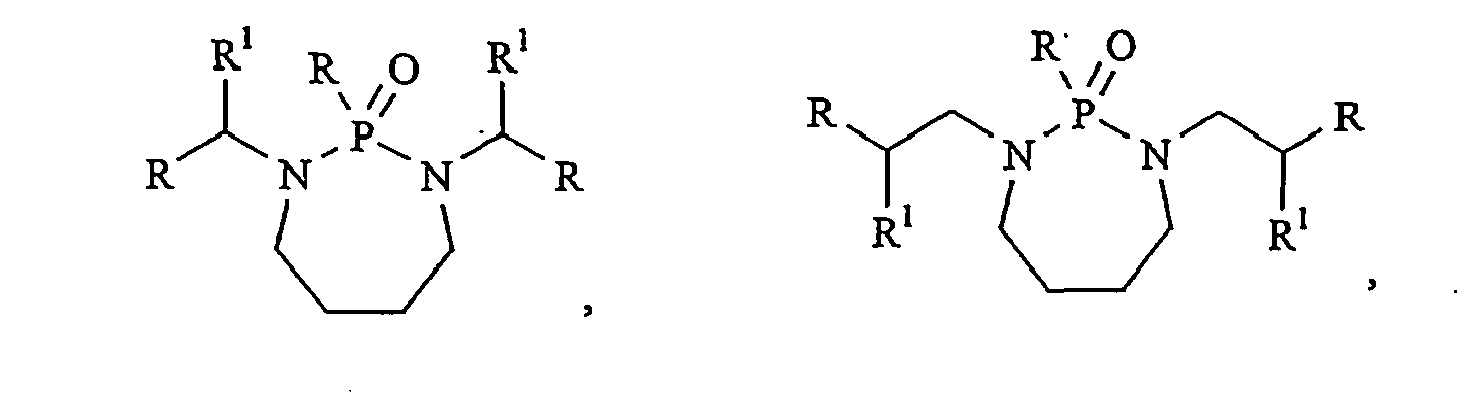


- each X is individually selected from the group consisting of oxygen, NH, and -NOR;
- each R is individually selected from the group consisting of hydrogen, branched and unbranched alkyl groups (preferably C1-C18, more preferably C1-C8), branched and unbranched alkenyl groups (preferably C2-C18, more preferably C2-C8), branched and unbranched alkynyl groups (preferably C2-C18, more preferably C2-C8), allyl groups, acyl groups (preferably C1-C18, more preferably C1-C8), aryl groups (preferably C6-C12, 2-15 mer peptides, and benzyl groups; and
- each R1 is individually selected from the group consisting of hydrogen, amino acid side chains, and 2-15 mer peptides.
- Preferably at least one R1 group comprises an amino acid side chain selected from the group consisting of


- In a preferred embodiment, the inventive compounds comprise a formula selected from the group consisting of


- Some of the inventive compounds are formed by reacting a template phosphonamide compound which comprises an opened-ring structure (i.e., a partially-formed ring comprising at least half, but not all of the sides necessary to form a cyclic compound) with a ring-closing catalyst to yield the closed-ring phosphonamide compound. Preferred ring-closing catalysts are Grubbs catalysts (see e.g.,
U.S. Patent Nos. 6,048,993 ,5,917,071 ,5,750,815 ,5,710,298 ,5,342,909 , and5,312,940 , each incorporated by reference herein) as well as those disclosed by the following references, each also incorporated by reference herein: Matthias, Org. Ltrs., 1(6):953-56 (1999); Schrock, Macromolecules, 29(19):6114-25 (1996); Zhu et al., J. Amer. Chem. Soc., 121(36):8251-59 (1999); Alexander et al., J. Amer. Chem. Soc., 120(16):4041-42 (1998); and Kingsbury et al., J. Amer. Chem. Soc., 121(4):791-99 (1999). - Particularly preferred Grubbs catalysts are those selected from the group consisting of


- Preferred template opened-ringed structures comprise an allylated phosphonamide, with particularly preferred template structures being those selected from the group consisting of


- each X is individually selected from the group consisting of oxygen, -NH, and -NOR;
- each R is individually selected from the group consisting of hydrogen, branched and unbranched alkyl groups (preferably C1-C18, more preferably C1-C8), branched and unbranched alkenyl groups (preferably C2-C18, more preferably C2-C8), branched and unbranched alkynyl groups (preferably C2-C18, more preferably C2-C8), allyl groups, acyl groups (preferably C1-C18, more preferably C1-C8), aryl groups (preferably C6-C12), 2-15 mer peptides, and benzyl groups; and
- each R1 is individually selected from the group consisting of hydrogen, amino acid side chains, and 2-15 mer peptides.
- Preferred closed-ring phosphonamide compounds formed by this inventive method are those selected from the group consisting of
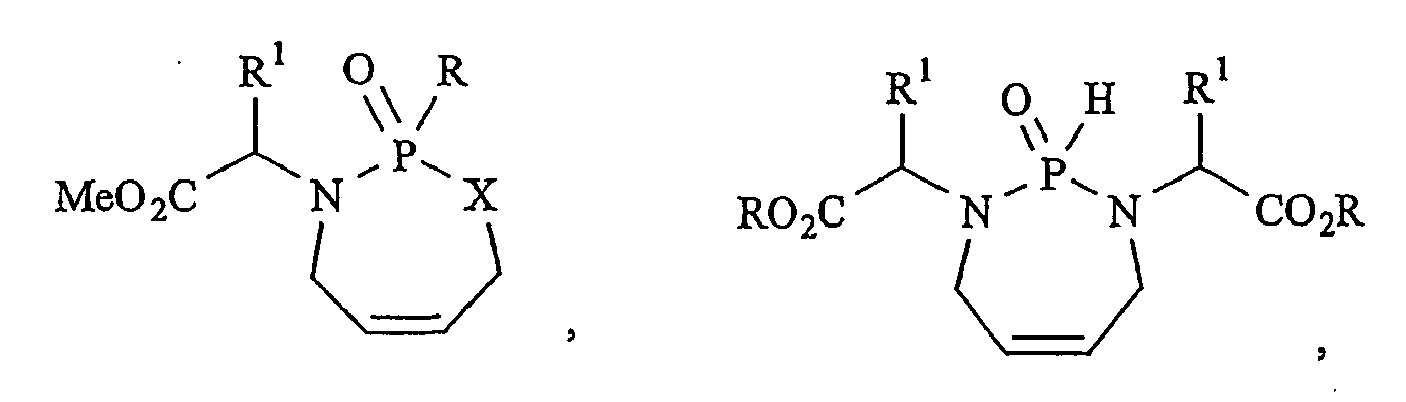


- each X is individually selected from the group consisting of oxygen, -NH, and -NOR;
- each R is individually selected from the group consisting of hydrogen, branched and unbranched alkyl groups (preferably C1-C18, more preferably C1-C8), branched and unbranched alkenyl groups (preferably C2-C18, more preferably C2-C8), branched and unbranched alkynyl groups (preferably C2-C18, more preferably C2-C8), allyl groups, acyl groups (preferably C1-C18, more preferably C1-C8), aryl groups (preferably C6-C12), 2-15 mer peptides, and benzyl groups; and
- each R1 is individually selected from the group consisting of hydrogen, amino acid side chains, and 2-15 mer peptides.
- Preferably the reacting step is carried out at a temperature of from about 15-80°C, and more preferably from about 30-55°C. Furthermore, the reacting step should be carried out in a solvent system comprising a solvent selected from the group consisting of toluene, benzene, chlorobenzene, dichlorobenzene, methylene chloride, dimethoxyethane (DME), and mixtures thereof. Preparing the phosphonamide compounds according to the inventive methods should result in a yield of those compounds of at least about 80%, and preferably at least about 95%, wherein the theoretical yield is taken as 100%.
- In another embodiment, the sterically demanding inventive compounds can be prepared with relative ease by providing a template compound comprising two secondary amines bonded to an alkyl chain with the nitrogen atoms of the respective amines being separated by at least two carbon atoms, and preferably at least four carbon atoms, on the alkyl chain. The template compound is then reacted with a phosphorus (III) compound under conditions to cause the phosphorus atom thereof to bond with each of the amine nitrogen atoms, thus forming a cyclic phosphonamide.
- Preferred phosphorus (III) compounds have the formula R3PY2, wherein:
- R3 is selected from the group consisting of hydrogen, branched and unbranched alkyl groups (preferably C1-C18, more preferably C1-C8), branched and unbranched alkenyl groups (preferably C2-C18, more preferably C2-C8), branched and unbranched alkynyl groups (preferably C2-C18, more preferably C2-C8), allyl groups, acyl groups (preferably C1-C18, more preferably C1-C8), aryl groups (Preferably C6-C12), and benzyl groups; and
- each Y is individually selected from the group consisting of the halogens.
- Preferred templates have a general formula selected from the group consisting of


- each X is individually selected from the group consisting of oxygen, -NH, and -NOR;
- each R is individually selected from the group consisting of 2-15 mer peptides, hydrogen, branched and unbranched alkyl groups (preferably C1-C18, more preferably C1-C8), branched and unbranched alkenyl groups (preferably C2-C18, more preferably C2-C8), branched and unbranched alkynyl groups (preferably C2-C18, more preferably C2-C8), allyl groups, acyl groups (preferably C1-C18, more preferably C1-C8), aryl groups (preferably C6-C12), and benzyl groups; and
- each R1 is individually selected from the group consisting of hydrogen, amino acid side chains, and 2-15 mer peptides.
- Preferred cyclic phosphonamides formed according to this method include those selected from the group consisting of


- each X is individually selected from the group consisting of oxygen, -NH, and -NOR;
- each R is individually selected from the group consisting of hydrogen, branched and unbranched alkyl groups (preferably C1-C18, more preferably C1-C8), branched and unbranched alkenyl groups (preferably C2-C18, more preferably C2-C8), branched and unbranched alkynyl groups (preferably C2-C18, more preferably C2-C8), allyl groups, acyl groups (preferably C1-C18, more preferably C1-C8), aryl groups (preferably C6-C12), 2-15 mer peptides, and benzyl groups; and
- each R1 is individually selected from the group consisting of hydrogen, amino acid side chains, and 2-15 mer peptides.
- Preferably the reacting step is carried out at a temperature of from about -10-25 °C, and more preferably from about -10-0°C. Furthermore, the reacting step should be carried out in a solvent system comprising a solvent selected from the group consisting of methylene chloride, acetonitrile, diethyl ether, and mixtures thereof. Preparing the phosphonamide compounds according to this embodiment of the inventive methods should result in a yield of those compounds of at least about 80%, and preferably at least about 95%, wherein the theoretical yield is taken as 100%.
- It will be appreciated that the inventive methods allow for the synthesis of a wide array of both symmetric and unsymmetric cyclic phosphonamide compounds. Furthermore, the inventive methods allow for preparation of, or selection of, templates having particular functional groups bonded thereto which are then readily formed into the desired phosphonamide in a controlled and repeatable manner. Because the method can be adapted to form phosphonamide compounds comprising one or more amino acid side chains or peptides bonded thereto, the inventive compounds can be used to inhibit enzymes such as HIV protease.
- The following examples set forth preferred methods in accordance with the invention. It is to be understood, however, that these examples are provided by way of illustration and nothing therein should be taken as a limitation upon the overall scope of the invention.
- A number of abbreviations are used herein. These abbreviations and the term or terms that they represent are set forth in Table A.
Table A Abbreviation Term(s) hex hexane Bn benzyl Ph phenyl Me methyl Et ethyl EtOAc ethyl acetate Et3N triethyl amine - Grubbs Catalysts were used in some of the following Examples. These catalysts are referred to as follows:


- Scheme A depicts the general overall reaction scheme followed in Parts I-V below.

- In this and the following procedure descriptions, the number/letter abbreviation depicted in the particular reaction scheme follows the chemical name of the particular compound (e.g., "(11)" follows "valine methyl ester").
- A solution of valine methyl ester (11) (3.80 g, 28.9 mmol), Et3N (5.24 mL, 37.7 mmol), and dimethyl formamide (DMF) (30 mL) was cooled in a -10°C (NaCl saturated) ice bath. Fumaryl Chloride (1.42 mL, 13.2 mmol) was added drop-wise over a 1.5 hour period. After addition was complete, the reaction was warmed to room temperature and stirred for 15 minutes. The resulting slurry was portioned between EtOAc (100 mL) and water (100 mL). The water layer was extracted twice with EtOAc (30 mL), and the combined organic layers were dried (Na2SO4) and concentrated under reduced pressure. The resulting white solid was dissolved in minimal, hot CH2Cl2, and crystallized from hexanes to afford 4.43 g (98%) of (12a) as white crystals. [α]25 = +8.3 (c = 0.47, CHCl3); FTIR (neat) 1740, 1637, 1540, 1436, 1355 cm-1; 1H NMR (400 MHz, CDCl3) δ 7.06 (s, 2H), 7.05 (d, J= 10.3 Hz, 2H), 4.69 (dd, J = 9.0, 5.3 Hz, 2H), 3.74 (s, 6H), 2.20 (m, 2H), 0.94 (d, J= 6.9 Hz, 6H), 0.91 (d, J = 6.9 Hz, 6H); 13C NMR (100 MHz, CDCl3) δ 172.44, 164.24, 133.25, 57.34, 52.26, 31.29, 18.92, 17.84; HRMS calculated for C16H27N2O6(M+H)+ required 343.1869, found 343.1840.
- Compound (12a) (970 mg, 3.8 mmol) was dissolved in CH2Cl2 (50mL) in a 100 mL flask under argon atmosphere. Next, 10% palladium on charcoal (Pd/C, 440 mg) was added to the solution and hydrogen gas was purged over the reaction mixture for 5 minutes. The solution was then stirred at room temperature under 1 atm of hydrogen gas for 30 minutes. Filtration of the solution over a pad of Celite followed by concentration thereof yielded 973 mg (99%) of (12) as white crystals. [α]25 +13.0, (c = 0.83; CHCl3); FTIR (neat) 1748, 1641, 1436, 1374 cm-1; 1H NMR (400 MHz, CDCl3) δ 6.53 (d, J= 8.6 Hz, 2H), 4.50 (dd, J= 8.7, 5.1 Hz, 2H), 3.70 (s, 6H), 2.67-2.49 (m, 4H), 2.16-2.07 (m, 2H), 0.90 (d, J= 6.9 Hz, 6H), 0.87 (d, J= 6.9 Hz, 6H); 13C NMR (100 MHz, CDCl3) δ 172.42, 172.01, 57.16, 52.03, 31.46, 31.05, 18.89, 17.76; HRMS calculated for C16H29N2O6 (M+H)+ required 345.2026, found 34.2042.
- NaBH4 (669 mg, 17.6 mmol) was added at room temperature to a solution of compound (12) (1.21 g, 3.5 mmol) and tetrahydrofuran (THF) (17 ml), and the reaction vessel was equipped with a condenser and heated to 55°C. MeOH was added drop-wise over a 20 minute period, and the reaction was monitored by TLC. The reaction mixture was cooled to room temperature and quenched slowly with a minimal amount of distilled water. The reaction slurry was then subjected to flash chromatography (10% MeOH in EtOAc) to afford 954 mg (95%) of (13a) as white crystals. [α]25 = -18.2 (c = 0.49, 1:1 CH3CN:H2O); FTIR (neat) 1635, 1543, 1457, 1418 cm-1; 1H NMR (400 MHz, CDCl3) δ 6.63 (d, J= 8.9 Hz, 2H), 3.99 (s, 2H), 3.76-3.67 (m, 4H), 3.50 (dd, J = 10.9, 7.8 Hz, 2H), 2.71 (d, J= 9.8 Hz, 2H), 2.49 (d, J= 9.9 Hz, 2H), 1.82-1.74 (m, 2H), 0.93 (d, J= 6.8 Hz, 6H), 0.91 (d, J= 6.8 Hz, 6H); 13C NMR (100 MHz, CDCl3) δ 173.63, 63.29, 57.06, 32.27, 29.30, 19.48, 18.79; HRMS calculated for C14H29N2O4 (M+H)+ required 289.2127, found 289.2152.
- A solution of compound (13a) (20 mg, 0.07 mmol) and DMF (150 µl) was cooled in a 0°C ice bath. NaH (8.4 mg, 0.22 mmol) was added, and the reaction was warmed to room temperature. After gas evolution was complete, the reaction was recooled in a 0°C ice bath, and benzyl bromide (18.4 µl, 0.16 mmol) was added. The reaction was warmed to room temperature and allowed to stir for 10 minutes. The slurry was partitioned between EtOAc (2 mL) and water (2 mL), the layers were separated, and the aqueous layer was reextracted twice with 2 mL of EtOAc. The organic layers were combined, washed once with brine, dried (Na2SO4), and concentrated under reduced pressure. Flash chromatography (1:1 Hexanes/EtOAc, then 10% MeOH in EtOAc) afforded 31 mg (95%) of (13) as white crystals. [α]25 = -57.7 (c = 0.052, CHCl3); FTIR (neat) 1629, 1540, 1465, 1437, 1387, 1357, 737, 694 cm-1; 1H NMR (400 MHz, CDCl3) δ 7.37-7.27 (m, 10H), 6.06 (d, J= 9.3 Hz, 2H), 4.50 (d, J= 12.0 Hz, 2H), 4.45 (d, J= 12.0 Hz, 2H), 3.87-3.82 (m, 2H), 3.55 (dd, J= 9.7, 4.0 Hz, 2H), 3.40 (dd, J= 9.7, 4.2 Hz, 2H), 2.59-2.42 (m, 4H), 1.95-1.86 (m, 2H), 0.90 (d, J = 7.0 Hz, 6H), 0.88 (d, J= 7.0 Hz, 6H); 13C NMR (100 MHz, CDCl3) δ 171.74, 138.14, 128.39, 127.61, 127.65, 73.16, 70.03, 54.11, 32.04, 29.26, 19.49, 18.85; HRMS calculated for C28H41N2O4 (M+H)+ required 469.3066, found 469.3076.
- Lithium aluminum hydride (LAH) (316 mg, 8.3 mmol) was added to a solution of compound (13) (193 mg, 0.42 mmol) and dioxane (2 mL) at room temperature. The flask was equipped with a condenser and heated to reflux for 3 hours. The reaction was cooled to room temperature and quenched over a 30-minute period with water and Glauber's salt (Na2SO4·10 H2O). The reaction mixture was stirred for an additional 30 minutes and filtered over a pad of Celite (EtOAc). The solution was concentrated and subjected to flash chromatography (SiO2, 10% MeOH in EtOAc) to afford 164 mg (91%) of (14) as a colorless oil. [α]25 = +5.8 (c = 1.36, CHCl3); FTIR (neat) 1466, 1383, 1364, 735, 697 cm-1; 1H NMR(400 MHz, CDCl3) δ 7.36-7.26 (m, 10H), 4.51 (s, 6H), 3.50 (dd, J = 9.4, 4.4 Hz, 2H), 3.77 (dd, J= 9.4, 6.8 Hz, 2H), 2.62-2.56 (m, 4H), 2.53 (dt, J= 6.6, 4.7 Hz, 2H), 1.54-1.47 (m, 4H), 1.23 (bs, 2H), 0.91 (d, J= 6.9 Hz, 6H), 0.89 (d, J= 6.9 Hz, 6H); 13C NMR (100 MHz, CDCl3) δ 138.45,128.27,127.54, 127.45, 73.14, 70.33, 62.62, 48.00, 28.86, 28.36, 18.91, 18.25; HRMS calculated for C28H45N2O2 (M+H)+ required 441.3481, found 441.3504.
- Scheme B depicts the reaction scheme of this example upon attempting to form a valine-derived cyclic phosphonamide (1).

- A solution of compound (14) (6.5 mg, 0.048 mmol) and CH2Cl2 (100 µl) was cooled in a 0°C ice bath, and Et3N (23 µl, 0.17 mmol) was slowly added. Dichlorophenylphosphine (6.5 µl, 48.0 µmol) was dissolved in CH2Cl2 (100 µl) and added drop-wise over 1 minute. The reaction was warmed to room temperature for 5 minutes, then recooled in a 0°C ice bath. Next, m-chloroperbenzoic acid (mCPBA) (17.7 mg, 0.072 mmol) was added to the salt slurry. After warming to room temperature, the reaction was concentrated under reduced pressure, and the slurry was subjected to flash chromatography (EtOAc) to afford 18.5 mg (75%) of (1) as a colorless oil. [α]25 = -54.1 (c = 0.15, CHCl3); FTIR (neat) 1468, 1453, 1384, 1362, 1207 (P=O), 725, 698 cm-1; 1H NMR (400 MHz, CDCl3) δ 7.92-7.69 (m, 2H), 7.41-7.24 (m, 13H), 4.61 (d, J = 11.8 Hz, 1H), 4.37, (d, J = 13.0 Hz, 1H), 4.36 (s, 2H), 3.77-3.67 (m, 2H), 3.66-3.58 (in, 1H), 3.53 (dd, J= 10.0, 7.0 Hz, 1H), 3.47-3.38 (m, 2H), 3.34-3.17 (m, 3H), 2.92 (dddd, J HH= 14.2 Hz, J HP =10.4 Hz, J HH = 7.0, 3.2 Hz, 1H), 1.98-1.87 (m, 2H), 1.78-1.54 (m, 4H), 1.01 (d, J= 6.7 Hz, 3H), 0.80 (d, J= 6.5 Hz, 3H), 0.80 (d, J= 6.5 Hz, 3H), 0.44 (d, J= 6.7 Hz, 3H); 13C NMR (100 MHz, CDCl3) d 138.70, 138.39, 133.71 (d, J CP= 145.7 Hz), 130.64 (d, J CP = 2.8 Hz), 128.27, 128.14, 127.73, 127.68, 127.60, 127.55, 127.51, 127.27, 73.09, 72.76, 71.57, 71.52, 62.46 (d, J CP = 7.0 Hz), 61.44 (d, J CP = 6.4 Hz), 42.23,42.45,29.32,28.36,27.14,27.09,21.42,21.09.20.37, 20.26; 31P NMR(162 MHz, CDCl3) δ 29.05; HRMS calculated for C34H48N2O3P (M+H)+ required 563.3403, found 563.3417.
- Scheme C depicts the reaction scheme followed in Parts I-III of this example.

- N,N-dimethyl phenylalanine (15) (1.19 g, 6.2 mmol), Et3N (1.29 ml, 9.3 mmol), and 1,4-diamino butane (303 µl, 3.0 mmol) were dissolved in CH3CN (50 mL). O-benzotriole-N,N,N',N'-tetramethyl-uronium-hexafluoro-phosphate (HBTU) was added, and the reaction mixture was stirred at room temperature for 30 minutes, and then concentrated under reduced pressure. The mixture was vacuum filtered (EtOAc), further concentrated under reduced pressure, and subjected to flash chromatography (EtOAc, then 10% Et3N in EtOAc) to afford 1.06 g (80%, non-optimized) of (16a) as white crystals. [α]25 = -105.7 (c = 0.19, CHCl3); FTIR (neat) 1649, 1455, 1384, 748, 700 cm-1; 1H NMR (400 MHz, CDCl3) δ 7.19-7.16 (m, 8H), 6.89 (t, J= 5.7 Hz, 2H), 6.40 (s, 1H), 5.90 (s, 1H), 3.13-3.04 (m, 6H), 3.12 (dd, J = 12.7, 5.3 Hz, 2H), 2.79 (dd, J= 13.4, 5.1 Hz, 2H), 2.23 (s, 12H), 1.24 (s, 4H); 13C NMR (100 MHz, CDCl3) δ 171.68, 139.44, 128.88, 127.91, 125.69, 70.61, 41.91, 38.25, 32.84, 26.52; HRMS calculated for C26H39N4O2(M+H)+ required 439.3073, found 439.3074.
- LAH (304 mg, 8.0 mmol) was added to a solution of compound (16a) (433 mg, 0.99 mmol) and dioxane (5 mL) at room temperature. The flask was equipped with a condenser and heated to reflux for 3 hours. The reaction was cooled to room temperature and quenched over a 30 minute period with water and Glauber's salt (Na2SO4• 10 H2O). The reaction mixture was stirred for an additional 30 minutes, and filtered over a pad of Celite (CH2Cl2). The CH2Cl2 was washed with brine, dried (Na2SO4), and concentrated under reduced pressure to afford 338 mg (83%, non-optimized) of (16) as a colorless oil. [α]25 = +18.8 (c = 2.43, CHCl3); FTIR (neat) 1495, 1454,1373, 740, 699 cm-1; 1H NMR (400 MHz, CDCl3) δ 7.25-7.21 (m, 4H), 7.15-7.10 (m, 6H), 2.92-2.82 (m, 4H), 2.52-2.42 (m, 6H), 2.28 (s, 12H), 1.44-1.40 (m, 4H); 13CNMR(100 MHz, CDCl3) δ 140.02, 128.94, 128.23, 125.71, 64.84, 49.50, 49.46, 40.05, 31.40, 27.63; HRMS calculated for C26H43N4 (M+H)+ required 411.3488, found 411.3495.
- A solution of compound (16) (47 mg, 0.12 mmol) and CH2Cl2 (500 µl) was cooled in a 0°C ice bath, and Et3N (66 µl, 0.48 mmol) was added, and the mixture was stirred for 5 minutes. Dichlorophenylphosphine (19 µl, 0.14 mmol) was added, and the reaction was warmed briefly to room temperature, and then recooled in a 0°C ice bath. Next, mCPBA (35 mg, 0.21 mmol) was added in one portion to the salt slurry. After warming to room temperature, the reaction was concentrated under reduced pressure and the slurry was subjected to flash chromatography (10% Et3N in EtOAc, then 20% Et3N in CH3CN) to afford 48 mg (68%, non-optimized) of (2) as a colorless oil. [α]25 =+18.5 (c = 0.054, CHCl3); FTIR(neat) 1453,1437,1378,1201 (P=O), 737, 698 cm-1; 1HNMR (400 MHz, CDCl3) δ 7.83-7.78 (m, 2H), 7.52-6.96 (m,13H), 3.29-2.92 (m, 6H), 2.84-2.55 (m, 5H), 2.35-2.27 (m, 3H), 2.18 (s, 6H), 2.06 (s, 6H), 1.81-1.48 (m, 4H); 13C NMR (100 MHz, CDCl3) δ 140.93, 140.85, 132.37 (d, J CP = 8.5 Hz), 130.64, 129.59 (d, J CP = 212.0 Hz), 128.99, 128.85, 128.25, 128.11, 127.79 (d, J CP = 13.3 Hz), 125.61, 125.50, 65.25, 65.21, 64.79, 64.79, 64.76, 47.08, 46.94, 40.34, 40.29, 33.00, 32.36, 28.39, 28.02; 31PNMR(162 MHz, CDCl3) δ 29.14; HRMS calculated for C32H46N4OP (M+H)+ required 533.3409, found 533.3427.
- Scheme D depicts the reaction scheme followed in Parts I-III of this example.

- A solution of allylated leucine methyl ester (8) (308 mg, 1.67 mmol), 4-dimethylaminopyridine (DMAP) (20 mg, 0.17 mmol), Et3N (405 µl, 2.91 mmol) and CH2Cl2 (7 mL) was cooled in a 0°C ice bath. Phthaloyl dichloride (120 µl, 0.83 mmol) was added drop-wise, and the slurry was warmed to room temperature. After 30 minutes, the reaction was partitioned between EtOAc (10 mL) and H2O (10 mL), and the water layer was extracted twice with EtOAc (5 mL). The organic layers were combined, washed with brine, dried (Na2SO4), and concentrated under reduced pressure. Flash chromatography (2:1 Hexanes/EtOAc) afforded both a single spot (TLC) and a single peak (GC, 97%) of 398 mg (96%) of (17a) as a mixture of rotamers. [α]25 = -64.8 (c = 0.66, CHCl3); FTIR (neat) 1743, 1647, 1456, 143 6,1410, 754 cm-1; 1H NMR (400 MHz, CDCl3) δ 7.40-7.32 (m, 4H), 5.93-5.79 (m, 2H), 5.23-5.10 (m, 4H), 4.32 (bs,2H), 3.97-3.87 (m, 2H), 3.78-3.68 (m, 8H), 2.11-1.60 (m, 6H), 0.96-0.70 (m, 12H); 13C NNM (100 MHz, CDCl3) δ 171.97, 170.75, 136.44, 135.21, 129.07, 126.80, 117.83, 56.78, 52.10, 46.86, 38.74, 25.79, 23.18, 22.99; HRMS calculated for C28H41N2O6 (M+H)+ required 501.2965, found 501.2971.
- A solution of compound (17a) (70 mg, 0.14 mmol) and CH2Cl2 (14 mL) was purged with argon gas for 5 minutes. The solution was brought to reflux and Grubbs catalyst (18 mg, 21.9 µmol) was added in three 6 mg portions over a 24-hour period. After 36 hours, the reaction was concentrated under reduced pressure and subjected to flash chromatography (1:1 Hexanes/EtOAc) to afford 64 mg (97%) of (17) as a colorless oil. [α]25 = -43.6 (c = 0.51, CHCl3); FTIR (neat) 1741, 1650, 1430, 1412, 1367, 1331, 756 cm-1; 1HNMR (400 MHz, CDCl3) δ 7.46-7.44 (m, 2H), 7.39-7.37 (m, 1H), 7.31-7.28 (m, 1H), 5.85 (s, 1H), 5.75 (s, 1H), 5.09 (s, 1H), 4.35 (s, 1H), 4.09-4.01 (m, 1H), 3.96 (dd, J = 15.2, 6.0 Hz, 1H), 3.75 (s, 3H), 3.75 (s, 3H), 3.70-3.57 (m, 2H), 2.20-2.13 (m, 1H), 1.98-1.86(m, 1H), 1.75-1.61 (m, 4H), 1.00-0.96 (m, 12H); 13CNMR (100 MHz, CDCl3) δ 172.25, 171.75, 169.93, 169.47, 134.62, 134.49, 131.59, 129.54, 129.42, 129.24, 127.44, 126.73, 56.92, 56.02, 52.18, 52.18, 45.66, 42.83, 39.27, 38.37, 25.36, 25.11, 22.76,22.64,22.30,22.18; HRMS calculated for C26H37N2O6 (M+H)+ required 473.2652, found 473.2646.
- In a sealable pyrex test tube, compound (17) (100 mg, 0.21 mmol) was dissolved in HCl saturated MeOH (3 mL), capped, and heated in a 115°C oil bath. After 72 hours, the reaction mixture was cooled to room temperature and then concentrated under reduced pressure. EtOAc (2 mL) was added, and the reaction mixture was cooled in a 0°C ice bath. Et3N (1 mL) was added, and the reaction mixture was slowly warmed to room temperature and stirred for 1 hour. The reaction mixture was concentrated under reduced pressure and subjected to flash chromatography (1:1 Hexanes/EtOAc) to afford 24 mg (36%) of (18) as a colorless oil. [α]25 = +12.0, (c= 0.05, CHCl3); FTIR(neat) 1737,1468,1433,1368 cm-1; 1H NMR(400 MHz, CDCl3) δ 5.56 (dd, J= 4.5, 4.5 Hz, 2H), 3.72 (s, 6H), 3.29-3.21 (m, 4H), 3.09 (dd, J = 13.2, 4.8 Hz, 2H), 1.76-1.66 (m, 2H), 1.54 (bs, 2H), 1.47-1.43 (m, 4H), 0.92 (d, J= 6.6 Hz, 6H), 0.89 (d, J= 6.6 Hz, 6H); 13C NMR (100 MHz, CDCl3) δ 176.44, 130.17. 59.34, 51.60, 44.62, 42.85, 24.90, 22.66, 22.35; HRMS calculated for C18H35N2O4 (M+H)+ required 343.2597, found 343.2619.
- Compound (18) (10.5 mg, 30.7 µmol), CH2Cl2 (1 mL), Et3N (20 µl, 0.14 mmol), dichlorophenylphosphine (54 µl, 39.9 µmol) and mCPBA (12 mg, 0.05 mmol) afforded a slurry that was subjected to flash chromatography (EtOAc) to yield 12.3 mg (86%) of a colorless oil. [α]25 =+108.3 (c = 0.072, CHCl3); FTIR (neat) 1731, 1430, 1388,1368, 1204 (P=O), 748, 702 cm-1; 1H NMR (400 MHz, CDCl3) δ 7.86 (dd, J HP = 12.1 Hz, J HH= 6.8 Hz, 2H), 7.55-7.50 (m, 1H), 7.47-7.43 (m, 2H), 5.75-5.64 (m, 2H), 4.18 (ddd, J= 9.1, 6.3, 6.3 Hz, 1H), 4.08 (ddd, J HP =13.3 Hz, J HH= 5.8, 5.8 Hz, 1H), 4.02-3.81 (m, 3H), 3.76-3.70 (m, 1H), 3.68 (s, 3H), 3.46 (s, 3H), 1.78-1.66 (m, 2H), 1.65-1.57 (m, 2H), 1.55 (ddd, J= 14.3,7.2,7.2 Hz, 1H), 1.40 (ddd, J= 13.9, 6.3, 6.3 Hz, 1H), 0.90 (d, J = 6.4 Hz, 3H), 0.86 (d, J= 6.6 Hz, 3H), 0.73 (d, J= 6.6 Hz, 3H), 0.68 (d, J = 6.6 Hz, 3H); 13C NMR (100 MHz, CDCl3) δ 173.49,173.16,132.71 (d, J CP = 9.0 Hz), 131.81, 131.78, 129.2 (d, J CP = 181.1 Hz), 128.23 (d, J CP = 13.4Hz), 128.22,56.43 (d, J CP = 7.0 Hz), 55.80 (d, J CP = 6.0 Hz), 51.88, 51.46, 41.37 (d, J CP = 2.8 Hz), 40.53 (d, J CP = 2.8 Hz), 39.47, 39.15 (d, J CP = 4.9 Hz), 24.62, 24.42, 22.97, 22.61, 22.30, 21.96; 31P NMR (162 MHz, CDCl3) δ 29.56; HRMS calculated for C24H38N2O5P (M+H)+ required 465.2518, found 465.2521.
- Scheme E depicts the reaction scheme followed in this example to prepare valine-derived phosphonamidic dichloridate (10).

- A solution of POCl3 (1.14 g, 7.45 mmol) and CH2Cl2 (7.5 mL) was cooled in a 0°C ice bath. Next, Et3N (2.26 g, 22.35 mmol) and DMAP (46 mg, 0.37 mmol) were added slowly, and the solution was warmed to room temperature and stirred for 15 minutes. Allylated valine methyl ester (9) (1.40 g, 8.19 mmol) was added, and the reaction was brought to reflux and stirred overnight. The reaction was concentrated under reduced pressure and partitioned between EtOAc (25 mL) and water (25 mL). The layers were separated, and the aqueous layer was washed with EtOAc (3 x 5 mL). The organic layers were combined, washed with brine, dried (Na2SO4), and further concentrated under reduced pressure. Flash chromatography (10:1 Hexanes/EtOAc) afforded 1.61 g (75%) of (10) as a colorless oil. [α]25 = -44.9 (c = 0.55, CHCl3); FTIR (neat) 1745, 1437, 1373, 1276 (P=O) cm-1; 1H NMR (400 MHz, CDCl3) δ 5.86 (dddd, J= 16.8,10.1,6.6,6.6 Hz, 1H), 5.26 (dd, J=17.0, 0.8 Hz, 1H), 5.20 (d, J= 10.1 Hz, 1H), 3.99-3.75 (m, 2H), 3.96 (dd, J HH = 18.0 Hz, J HP = 10.6 Hz, 1H), 3.71 (s, 3H), 2.39-2.27 (m, 1H), 0.98 (d, J= 6.6 Hz, 3H), 0.95 (d, J= 6.6 Hz, 3H); 13C NMR (100 MHz, CDCl3) δ 170.48 (d, J CP = 3.1 Hz), 132.48 (d, J CP = 2.5 Hz), 119.63, 65.73 (d, J CP = 2.1 Hz), 51.96, 48.44 (d, J CP = 4.6 Hz), 27.70 (d, J CP = 4.2 Hz), 19.70, 19.60; 31P NMR (162 MHz, CDCl3) δ 19.57; HRMS calculated for C9H17Cl2NO3P (M+H)+ required 288.0323, found 288.0337.
- Scheme F depicts the reaction schemes followed in Parts I-IV of this example.

- A solution of compound (10) (499 mg, 1.73 mmol) and CH2Cl2 (3.5 mL) was cooled in a 0°C ice bath. Next, Et3N (526 mg, 5.20 mmol) and DMAP (21 mg, 0.17 mmol) were added slowly, and the solution was warmed to room temperature, stirred for 15 minutes, then cooled in a -78°C acetone/CO2(s) bath. Allyl amine (99 mg, 1.73 mmol) was added drop-wise, and the reaction slowly warmed to room temperature over the course of 12 hours. The crude reaction mixture was partitioned between CH2Cl2 (25 mL) and water (25 mL), the layers were separated, and the aqueous layer was washed with CH2Cl2 (3 x 5 mL). The organic layers were combined, washed with brine, dried (Na2SO4), and concentrated under reduced pressure. Flash chromatography (4:1 Hexanes/EtOAc, then 2:1 Hexanes/EtOAc) afforded 144 mg (27%) of (10a) as a mixture of inseparable diastereomers (ds = 3.8:1.0 as determined by 31P NMR) as a yellow oil. FTIR (neat) 1740, 1435, 1371, 1231 (P=O) cm-1; 1H NMR (400 MHz, CDCl3) δ 5.94-5.80 (m, 4H), 5.25-5.12 (m, 8H), 4.02-3.73 (m, 5H), 3.70 (s, 3H), 3.69 (s, 3H), 3.67-3.59 (m, 7H), 2.32-2.20 (m, 2H), 1.01 (d, J= 6.6 Hz, 3H),1.00 (d, J= 6.4 Hz, 3H), 0.93 (d, J= 6.5 Hz, 3H), 0.92 (d, J= 6.5 Hz, 3H); 13C NMR (100 MHz, CDCl3) δ 171.93, 171.91, 134.86, 134.86, 134.77, 134.77,118.15,118.15,116.55,116.50,64.91 (d, J CP = 3.3 Hz), 64.67 (d, J CP = 3.0 Hz), 51.80, 51.70, 47.53 (d, J CP = 3.6 Hz), 47.27 (d, J CP = 3.7 Hz), 43.79, 43.73, 27.52 (d, J CP = 5.1 Hz), 27.26 (d, J CP = 2.9 Hz), 19.85, 19.76, 19.71, 19.43; 31P NMR (162 MHz, CDCl3) δ 25.44, 25.05; HRMS calculated for C12H23CIN2O3P (M+H)+ required 309.1135, found 309.1125.
- A solution of compound (10a) (105 mg, 0.34 mmol) and CH2Cl2 (12 mL) was purged with argon for 10 minutes. Grubbs Catalyst 1 (8 mg, 10 µmol) was added, and the solution was brought to reflux and monitored by TLC. The reaction was concentrated under reduced pressure and subj ected to flash chromatography (3:1 Hexanes/EtOAc, then 2:1 Hexanes/EtOAc) to afford 36 mg (38%) of one diastereomer (11a) and 14 mg (15%) of the other diastereomer (11b), both as white solids.
- Characterization of the single diastereomer (11a) was as follows: mp 87-88 °C; Rf = 0.46 (1:2 Hexanes/EtOAc); [α]25=-87.6 (c=0.45, CHCl3); FTIR (neat) 1737, 1450, 1436, 1370, 1249 (P=O) cm-1; 1HNMR (400 MHz, CDCl3) δ 5.75-5.71 (m, 1H), 5.61-5.57 (m, 1H), 4.01-3.73 (m, 3H), 3.99 (dd, J HH = 10.1Hz, J HP = 10.1 Hz, 1H), 3.71 (s, 3H), 3.68-3.42 (m, 2H), 2.12-2.03 (m, 1H), 1.00 (d, J= 6.7 Hz, 3H), 0.92 (d, J= 6.6 Hz, 3H); 13C NMR (100 MHz, CDCl3) δ 171.75, 128.20,127.19,64.24 (d, J CP = 2.1 Hz), 51.62,40.69 (d, J CP = 3.7 Hz), 40.16, 28.34 (d, J CP = 6.9 Hz), 19.20, 19.01; 31P NMR (162 MHz, CDCl3) δ 27.41; HRMS calculated for C10H19ClN2O5P (M+H)+ required 281.0822, found 281.0815.
- Characterization of the single diastereomer (11b) was as follows: mp 115-117 ° C; Rf = 0.32 (1:2 Hexanes/EtOAc); [α]25 =-37.4 (c= 0.19, CHCl3); FTIR (neat) 1738,1469,1437,1389, 1241 (P=O) cm-1; 1HNMR (400 MHz, CDCl3) δ 5.65-5.60 (m, 1H), 5.55-5.50 (m, 1H), 4.04-3.88 (m, 2H), 4.02 (dd, J HH = 11.4 Hz, J HP = 11.4 Hz, 1H), 3.66 (s, 3H), 3.64-3.39 (m, 3H), 2.27-2.17 (m, 1H), 0.98 (d, J = 6.8 Hz, 3H), 0.92 (d, J = 6.5 Hz, 3H); 13C NMR (100 MHz, CDCl3) δ 171.80 (d, J CP = 7.9 Hz), 127.40, 127.22, 63.94 (d, J CP = 4.0 Hz), 51.78, 39.77, 39.67 (d, J CP = 5.1 Hz), 26.72, 19.37, 19.22; 31P NMR (162 MHz, CDCl3) δ 27.81; HRMS calculated for C10H19ClN2O5P (M+H)+ required 281.0822, found 281.0831.
- A solution of allyl alcohol (210 mg, 3.61 mmol) and THF (1.8 mL) was cooled in a 0°C ice bath. Sodium bis(trimethylsilyl)amide (3.5 mL of 1.0 M solution in THF) was added, and the solution was warmed to room temperature and stirred for 30 minutes. In separate flask, a solution of (10) (506 mg, 1.76 mmol) and THF (1.8 mL) was cooled in a -10 °C (NaCl saturated) ice bath. The allyloxide solution was cannulated into the solution of (10) at -10°C, and the solution was stirred for 1 hour. The reaction was quenched with NH4Cl (aq) and concentrated under reduced pressure. The crude reactionmixture was partitioned between EtOAc (25 mL) and water (25 mL), the layers were separated, and the aqueous layer was washed with EtOAc (3 x 5 mL). The organic layers were combined, washed with brine, dried (Na2SO4), and further concentrated under reduced pressure. Flash chromatography (6:1 Hexanes/EtOAc, then 5:1 Hexanes/EtOAc) afforded 401 mg (69%) of (10b) as a colorless oil. TLC Rf = 0.46 (1:1 Hexanes/EtOAc); [α]25 = -25.7 (c=0.46, CHCl3); FTIR(neat) 1738, 1434, 1370, 1262 (P=O) cm-1; 1HNMR (400 MHz, CDCl3) δ 5.98-5.88 (m, 2H), 5.84 (dddd, J = 16.8, 10.1, 6.6, 6.6 Hz, 1H), 5.36-5.31 (m, 2H), 5.23-5.20 (m, 2H), 5.14 (dd, J = 17.1, 1.2 Hz, 1H), 5.05 (d, J = 10.1 Hz, 1H), 4.60-4.41 (m, 4H), 3.80 (dd, J HH = 11.4 Hz, J HP = 11.4 Hz, 1H), 3.81-3.58 (m, 2H), 3.68 (s, 3H), 2.31-2.19 (m, 1H), 1.00 (d, J= 6.7 Hz, 3H), 0.91 (d, J= 6.5 Hz, 3H); 13C NMR (100 MHz, CDCl3) δ 172.42 (d, J CP = 3.2 Hz), 135.66, 133.08 (d, J CP = 7.2 Hz), 133.01 (d, J CP = 7.5 Hz), 117.37,117.33,117.00,67.01 (d, J CP = 5.4 Hz), 66.68 (d, J CP = 5.0 Hz), 64.85 (d, J CP = 4.9 Hz), 51.23,46.63 (d, J CP = 3.4 Hz), 27.44 (d, J CP = 3.4 Hz), 19.82, 19.23; 31P NMR (162 MHz, CDCl3) δ 10.95; HRMS calculated for C15H27NO5P (M+H)+ required 332.1627, found 332.1614.
- A solution of (10b) (43 mg, 0.13 mmol) and CH2Cl2 (7 mL) was purged with argon for 10 minutes. Grubbs Catalyst 1 (3 mg, 4 µmol) was added, and the solution was brought to reflux and monitored by TLC. The reaction was concentrated under reduced pressure and subj ected to flash chromatography (4:1, then 2:1 Hexanes/EtOAc) to afford 23 mg (59%) of one diastereomer (12a) and 16 mg (41%) of the other diastereomer (12b), both as colorless oils.
- Characterization of the single diastereomer (12a) was as follows: Rf = 0.54 (1:2 Hexanes/EtOAc); [a]25=-10.7 (c=0.15, CHCl3); FTIR(neat) 1737,1457,1394,1263 (P=O)cm-1; 1HNMR (400 MHz, CDCl3) δ 5.92 (dddd,J= 15.9,10.6,5.4,5.4 Hz, 1H), 5.79-5.75 (m, 1H), 5.63 (dddd, J = 11.5,4.7,2.2,2.2 Hz, 1H), 5.33 (ddd, J =17.0, 3.0, 1.5 Hz, 1H), 5.21 (dd, J= 10.5,1.2 Hz, 1H), 4.99-4.92 (m, 1H), 4.55-4.52 (m, 2H), 4.48-4.36 (m, 1H), 3.88 (dd, J HH = 9.9 Hz, J HP = 9.9 Hz, 1H), 3.88-3.63 (m, 2H), 3.69 (s, 3H), 2.11-2.02 (m, 1H), 1.03 (d, J= 6.6 Hz, 3H), 0.91 (d, J = 6.6 Hz, 3H); 13C NMR (100 MHz, CDCl3) δ 172.42,133.02 (d, J CP = 7.4 Hz), 128.66, 125.91, 117.23, 67.37 (d, J CP = 5.5 Hz), 64.49 (d, J CP = 4.3 Hz), 63.81 (d, J CP = 4.8 Hz), 51.50, 40.40 (d, J CP = 3.0 Hz), 28.30 (d, J CP = 5.5 Hz), 19.23, 19.09; 31P NMR (162 MHz, CDCl3) δ 15.04; HRMS calculated for C13H23NO5P (M+H)+ required 304.1314, found 304.1335.
- Characterization of the single diastereomer (12b) was as follows: Rf = 0.51 (1:2 Hexanes/EtOAc); [α]25 = +17.5 (c = 0.04, CHCl3); FTIR (neat) 1737,1462, 1370, 1264 (P=O) cm-1; 1H NMR (400 MHz, CDCl3) δ 5.94 (dddd, J = 16.1, 10.6, 5.4, 5.4 Hz, 1H), 5.65-5.60 (m, 1H), 5.55 (dddd, J = 11.4, 4.7, 2.1, 2.1 Hz, 1H), 5.34 (ddd, J = 17.2, 3.0,1.4 Hz, 1H), 5.22 (dd, J = 10.4, 1.3 Hz, 1H), 4.94-4.87 (m, 1H), 4.59-4.55 (m, 2H), 4.35 (ddd, J HH = 25.7 Hz, J HP =16.0 Hz, J HH 5.0 Hz, 1H), 3.89 (dd, J HH = 11.0 Hz, J HP = 11:0 Hz, 1H), 3.92-3.83 (m, 1H), 3.64 (s, 3H), 3.50 (ddd, J HH = 23.7 Hz, J HP =17.8 Hz, J HH = 6.2 Hz, 1H), 2.24-2.13 (m, 1H), 0.96 (d, J= 6.8 Hz, 3H), 0.89 (d, J= 6.5 Hz, 3H); 13C NMR (100 MHz, CDCl3) δ 172.18 (d, J CP = 5.6 Hz), 133.01 (d, J CP = 7.4 Hz), 128.95, 125.37, 117.52, 67.74 (d, J CP = 5.2 Hz), 64.11 (d, J CP = 5.6 Hz), 62.98 (4, J CP = 4.6 Hz), 51.60, 39.60 (d, J CP = 3.7 Hz), 26.70,19.30,18.83; 31P NMR (162 MHz, CDCl3)δ 15.39; HRMS calculated for C13H23NO5P (M+H)+ required 304.1314, found 304.1296.
- Scheme G depicts the reaction schemes followed in Parts I-III of this example.

- A solution of POCl3 (165 mg, 1.08 mmol) and CH2Cl2 (1.4 mL) was cooled in a 0°C ice bath. Next, Et3N (708 mg, 6.99 mmol) and DMAP (13 mg, 0.11 mmol) were added slowly, and the solution was warmed to room temperature and stirred for 15 minutes. Benzyl allyl amine (6) (325 mg, 2.21 mmol) was added, and the reaction mixture was brought to reflux and stirred overnight. The crude reaction mixture was partitioned between CH2Cl2 (20 mL) and water (20 mL), the layers were separated, and the aqueous layer was washed with CH2Cl2 (3 x 5 mL). The organic layers were combined, washed with brine, dried (Na2SO4), and concentrated under reduced pressure. Flash chromatography (10:1 Hexanes/EtOAc) afforded 332 mg (82%) of (7) as a yellow oil. FTIR (neat) 1641, 1242 (P=O), 735, 699 cm-1; 1H NMR (400 MHz, CDCl3) δ 7.3 6-7.26 (m, 10H), 5.82 (dddd, J = 16.7, 10.2, 6.5, 6.5 Hz, 2H), 5.25 (d, J = 10.1 Hz, 2H), 5.14 (dd, J = 17.1, 1.4 Hz, 2H), 4.39 (dd, J HH = 15.1 Hz, J HP = 12.1 Hz, 2H), 4.32 (dd, J HH =15.2 Hz, J HP = 11.0 Hz, 2H), 3.63-3.58 (m, 4H); 13C NMR (100 MHz, CDCl3) δ 136.37 (d, J CP = 4.4 Hz), 132.81 (d, J CP = 2.8 Hz), 128.63, 128.57, 127.64, 119.56, 48.94 (d, J CP = 4.5 Hz), 48.17 (d, J CP = 3.7 Hz); 31P NMR (162 MHz, CDCl3) δ 29.14; HRMS calculated for C20H25ClN2OP (M+H)+ required 375.1393, found 375.1391.
- A solution of compound (7) (160 mg, 0.43 mmol) and CH2Cl2 (15 mL) was purged with argon for 10 minutes. Grubbs Catalyst 1 (11 mg, 13 µmol) was added, and the solution was brought to reflux for 45 minutes and monitored by TLC. The reaction was concentrated under reduced pressure and subjected to flash chromatography (8:1 Hexanes/EtOAc, then 4:1 Hexanes/EtOAc) to afford 147 mg (99%) of (8a) as a yellow oil. FTIR (neat) 1243 (P=O), 765, 720, 697 cm-1; 1HNMR (400MHz, CDCl3) δ 7.38-7.28 (m, 10H), 5.51 (dd, J=2.4, 2.4 Hz, 2H), 4.47 (dd, J HH = 15.4 Hz, J HP = 10.2 Hz, 2H), 4.36 (dd, J HH = 15.4 Hz, J HP = 10.2 Hz, 2H), 3.79 (ddd, J HP =17.9 Hz, J HH = 17.9,2.1 Hz, 2H), 3.60 (ddd, J HH = 18.5 Hz, J HP =16.4 Hz, J HH = 2.2 Hz, 2H); 13C NMR (100 MHz, CDCl3) δ 137.13 (d, J CP = 5.5 Hz), 128.50, 127.95, 127.52, 126.90, 52.29 (d, J CP = 5.2 Hz), 44.89 (d, J CP = 4.5 Hz); 31P NMR (162 MHz, CDCl3) δ 32.52; HRMS calculated for C18H21ClN2OP (M+H)+ required 347.1080, found 347.1098.
- A solution ofMeOH (11 mg, 0.35 mmol) and THF (88 µL) was cooled in a 0°C ice bath. Sodium bis(trimethylsilyl)amide (175 µL of 1.0 M solution in THF) was added, and the solution was warmed to room temperature and stirred for 15 minutes. In a separate flask, a solution of compound (8a) (60 mg, 0.17 mmol) and THF (88 µL) was cooled in a 0 °C ice bath. The sodium methoxide solution was cannulated into the solution of compound (8a) at 0 °C, and the solution was warmed to room temperature and stirred for 2 hours. The crude reaction mixture was partitioned between EtOAc (10 mL) and water (10 mL), the layers were separated, and the aqueous layer was washed with EtOAc (3 x 2 mL). The organic layers were combined, dried (Na2SO4), and concentrated under reduced pressure. Flash chromatography (3:1 Hexanes/EtOAc, then 1:2 Hexanes/EtOAc) afforded 58 mg (100%) of (8b) as a yellow oil. FTIR (neat) 1454, 1358,1231 (P=O), 761, 725, 697, 670 cm-1; 1H NMR(400 MHz, CDCl3) δ 7.37-7.24 (m, 10H), 5.50 (dd, J = 2.3, 2.3 Hz, 2H), 4.48 (dd, J HH = 15.3 Hz, J HP=9.1 Hz, 2H), 4.08 (dd, J HH =15.3 Hz, J HP = 5.9Hz, 2H), 3.78(d, J HP=11.0Hz, 3H), 3.60(ddd, J HP=17.6Hz, J HH = 17.6, 2.3 Hz, 2H), 3.49 (ddd, J HP =17.7 Hz, J HH =17.7, 2.3 Hz, 2H); 13C NMR (100 MHz, CDCl3) δ 138.82 (d, J CP = 4.6 Hz),128.40,127.92,127.36,127.15, 52.49 (d, J CP = 5.0 Hz), 51.43 (d, J CP = 4.0 Hz), 43.55 (d, J CP = 5.6 Hz); 31P NMR (162 MHz, CDCl3) δ 22.99; HRMS calculated for C19H24N2O2P (M+H)+ required 343.1575, found 343.1579.
- Scheme H depicts the reaction schemes followed in Parts I-II of this example.

- A solution of PCl3 (50 µL, 0.57 mmol) and Et2O (5 mL) was cooled in a -10°C (NaCl saturated) ice bath. Allylated leucine methyl ester (13) (477 mg, 2.58 mmol) in Et2O (2 mL) was added via cannulae. After addition, the solution was warmed to reflux and heated overnight. The reaction was concentrated under reduced pressure and subjected to flash chromatography (1:1 Hexanes/EtOAc) to afford 112 mg (47%) of (14) as a colorless oil. [α]25 = +8.9 (c = 0.12, CHCl3); FTIR (neat) 1740,1436,1369,1219 (P=O) cm-1; 1HNMR(400 MHz, CDCl3) δ 6.99 (d, J HP = 593.4 Hz, 1H), 5.83-5.72 (m, 2H), 5.16-5:01 (m, 4H), 4.18-4.08 (m, 2H), 3.74-3.53 (m, 4H), 3.65 (s, 3H), 3.64 (s, 3H), 1.75-1.64 (m, 6H), 0.91-0.88 (m, 12H); 13C NMR (100 MHz, CDCl3) δ 173.55 (d, J CP = 2.2 Hz), 173.44 (d, J CP = 4.2 Hz), 135.84 (d, J CP = 2.2 Hz), 135.47 (d, J CP = 2.5 Hz), 117.64, 117.06, 55.31 (d, J CP = 4.9 Hz), 55.64 (d, J CP = 7.3 Hz), 51.82, 51.82, 46.91 (d, J CP = 5.9 Hz), 45.17 (d, J CP = 4.4 Hz), 39.91 (d, J CP = 3.0 Hz), 37.95 (d, J CP = 3.0 Hz), 24.61, 24.08, 22.76, 22.58, 21.84, 21.40; 31PNMR (100 MHz, CDCl3) δ 21.92; HRMS calculated for C20H38N2O5P (M+H)+ required 417.2518, found 417.2525.
- A solution of compound (14) (101 mg, 0.24 mmol) and CH2Cl2 (50 mL) was purged with argon gas for 10 minutes. Grubbs Catalyst 1 (7.4 mg, 7.5 µmol) was added in one portion, and the reaction was heated to reflux and monitored by TLC. The reaction was concentrated under reduced pressure and subjected to flash chromatography (1:1 Hexanes/EtOAc) to afford 93 mg (99%) of (15) as a colorless oil. [α]25 = -42.8 (c = 1.55, CHCl3); FTIR (neat) 1738, 1457, 1387, 1369,1227 (P=O) cm-1; 1H NMR (400 MHz, CDCl3) δ 7.02 (d, J HP = 592.1 Hz, 1H), 5.54 (s, 2H), 4.28 (ddd, J HP = 10.2, J HH = 5.9 Hz, 5.9 Hz, 1H), 4.03-3.96 (m, 2H), 3.77-3.69 (m, 1H), 3.65 (s, 3H), 3.64 (s, 3H), 3.56-3.41 (m, 2H), 1.70-1.54 (m, 6H), 0.92 (d, J= 6.4 Hz, 3H), 0.90-0.87 (m, 9H); 13C NMR (100 MHz, CDCl3) δ 173.47 (d, J CP = 2.62 Hz), 172.90, 128.10, 127.79, 56.35 (d, J CP = 9.0 Hz), 56.16 (d, J CP = 6.9 Hz), 52.09, 52.02,40.17 (d, J CP = 3.5 Hz), 40.04 (d, J CP = 5.2 Hz), 39.23 (d, J CP = 5.4 Hz), 38.20 (d, J CP = 3.3 Hz), 24.59, 24.55, 23.30, 22.96, 21.81, 21.38; 31P NMR (162 MHz, CDCl3) δ 24.79; HRMS calculated for C18H34N2O5P (M+H)+ required 389.2205, found 389.2206.
- Scheme I depicts the reaction schemes followed in Parts I-III of this example.

- A solution of vinylphosphonic dichloride (345 mg, 2.38 mmol) and CH2Cl2 (10 mL) was cooled in a-10°C (NaCl saturated) ice bath. Next, Et3N (827 µL, 5.95 mmol) was added slowly, followed by the addition of allylated phenylalanine methyl ester (16) (471 mg, 2.14 mmol), and the mixture was warmed to reflux. The reaction was concentrated under reduced pressure and subjected to flash chromatography (2:1 Hexanes/EtOAc) to afford 703 mg (99%) of (16a) as a mixture of inseparable diastereomers as a colorless oil. FTIR (neat) 1741, 1437, 1397, 1240 (P=O), 751, 701 cm-1; 1H NMR (400 MHz, CDCl3) δ 7.30-7.19 (m, 10H), 6.27-5.89 (m, 6H), 5.63 (dddd, J=17.0, 10.1, 6.3, 6.3 Hz, 1H), 5.57 (dddd, J = 16.9, 10.1, 6.6, 6.6 Hz, 1H), 5.19-5.11 (m, 4H), 4.66 (ddd, J HH = 15.1 Hz, J HP = 9.6 Hz, J HH 6.2 Hz, 1H), 4.49 (ddd, J HH = 15.9 Hz, J HP = 9.8 Hz, J HH = 6.1 Hz, 1H) 3.70 (s, 3H), 3.70 (s, 3H), 3.67-3.44 (m, 4H), 3.38 (ddd, J HH = 14.7,6.0 Hz, J HP = 6.0 Hz, 2H), 3.13 (m, 2H); 13C NMR (100 MHz, CDCl3) δ 171.63, 171.43 (d, J CP = 5.3 Hz), 136.98, 136.96, 134.45, 134.29, 133.44 (d, J CP = 4.4 Hz), 133.37 (d, J CP = 2.9 Hz), 130.44 (d, J CP = 159.3 Hz), 130.41 (d, J CP = 158.6 Hz), 129.32, 129.17, 128.39, 128.36, 126.71, 126.64, 118.87, 118.87, 59.46 (d, J CP = 1.9 Hz), 58.46, 52.14, 52.14, 48.19 (d, J CP = 5.0 Hz), 47.50 (d, J CP = 5.2 Hz), 35.88, 35.75 (d, J CP = 4.2 Hz); 31P NMR (162 MHz, CDCl3) δ 37.78, 36.95; HRMS calculated for C15H20ClNO3P (M+H)+ required 328.0869, found 328.0868.
- A solution of compound (16) (211 mg, 0.64 mmol) and CH2Cl2 (20 mL) was purged with argon gas for 10 minutes. Grubbs Catalyst 1(1.6 mg, 19.2 µmol) was added and the reaction was heated to reflux and monitored by TLC. The reaction was concentrated under reduced pressure and subjected to flash chromatography (2:1 Hexanes/EtOAc) to afford 187 mg (98%) of (17a) as a separable mixture of two diastereomers (17a1 and 17a2 ), both as colorless oils.
- Characterization of the isolated diastereomer (17a1) was as follows: Rf = 0.30 (1:1 Hexanes/EtOAc); [α]25 =+13.4; (c = 0.15, CHCl3); FTIR (neat) 1736, 1455, 1385, 1253 (P=O), 750, 692 cm-1; 1H NMR (400 MHz, CDCl3) δ 7.30-7.21 (m, 5H), 7.08 (dddd, J HP = 50.0, J HH= 8.8, 1.9, 1.9 Hz, 1H), 6.29 (dddd, J HP=35.0Hz, J HH=8.8, 2.1, 2.1 Hz, 1H), 4.58 (ddd, J HH = 7.7, 7.7 Hz, J HP= 7.7 Hz, 1H), 3.34 (ddd, J HH =17.6, 2.0 Hz, J HP = 2.0 Hz, 1H), 3.98 (dddd, J HH = 17.8, 15.7, 2.2 Hz, J HP = 2.2 Hz, 1H), 3.34 (s, 3H), 3.30 (dd, J= 14.0, 8.1 Hz, 1H), 3.09 (dd, J =14.0, 7.7 Hz, 1H); 13C NMR (100 MHz, CDCl3) δ 171.35 (d, J CP = 4.0 Hz), 145.69 (d, J CP= 16.8 Hz), 135.34, 128.68, 128.59, 127.09, 121.54 (d, J CP = 148.8 Hz), 54.67 (d, J CP = 4.4 Hz), 52.06,48.30 (d, J CP = 30.8 Hz), 36.81 (d, J CP = 4.6 Hz); 31P NMR (162 MHz, CDCl3) δ 42.60; HRMS calculated for C13H16ClNO3P (M+H)+ required 300.0556, found 300.0583.
- Characterization of the isolated diastereomer (17a2) was as follows: Rf = 0.17 (1:1 Hexanes/EtOAc); [α]25 = -10.4; (c = 0.08, CHCl3); FTIR (neat) 1743,1455,1387,1249 (P=O), 751,700 cm-1; 1H NMR (400 MHz, CDCl3) δ 7.32-7.22 (m, 5H), 7.10 (dddd, J HP = 51.6 Hz, J HH = 8.7, 1.9, 1.9 Hz, 1H), 6.32 (dddd, J HP = 35.7 Hz, J HH = 8.8, 2.1, 2.1 Hz, 1H), 4.53 (ddd, J HH= 8.0, 8.0 Hz, J HP = 8.0 Hz, 1H), 4.30 (dddd, J HH = 17.4, 12.9,2.2 Hz, J HP = 2.2 Hz, 1H), 3.97 (dd, J = 17.5, 2.0 Hz, 1H), 3.67 (s, 3H), 3.35 (dd, J = 13.8, 7.4 Hz, 1H), 3.09 (dd, J= 13.8, 8.2 Hz, 1H); 13C NMR (100 MHz, CDCl3) δ 171.00 (d, J CP = 4.4 Hz), 145.50 (d, J CP =16.6 Hz), 136.11, 128.94,128.66, 127.09, 121.92 (d, J CP =148.9 Hz), 56.24 (d, J CP = 4.7 Hz), 52.31, 48.88 (d, J CP = 31.2 Hz), 36.55 (d, J CP = 2.3 Hz); 31P NMR (162 MHz, CDCl3) δ 44.00; HRMS calculated for C13H16ClNO3P (M+H)+ required 300.0556, found 300.0569.
- A solution of compound (17a) (108 mg, 0.36 mmol) and CH2Cl2 (3 mL) was cooled in a 0°C ice bath. Next, Et3N (120 µL, 0.90 mmol) and DMAP (4.4 mg, 0.036 mmol) were added, followed by MeOH (36 µL, 0.90 mol). The reaction was warmed to room temperature and monitored by TLC. The reaction was concentrated under reduced pressure and subj ected to flash chromatography (1:1 Hexanes/EtOAc) to afford 105 mg (99%) of (17b) as a separable mixture of two diastereomers (17b1 and 17b2) as colorless oils.
- Characterization of the isolated diastereomer (17b1) was as follows: Rf= 0.56 (EtOAc); [α]25 =+118.5; (c = 0.29, CHCl3); FTIR (neat) 1740, 1455, 1385, 1347, 1228 (P=O), 751, 701 cm-1; 1H NMR (400 MHz, CDCl3) δ 7.28-7.18 (m, 5H), 7.02 (dddd, J HP = 43.0 Hz, J HH = 9.0, 2.0, 2.0 Hz, 1H), 6.00 (dddd, J HP=29.8 Hz, J HH = 9.0, 2.1, 2.1 Hz, 1H), 4.36 (ddd, J HP = 8.8 Hz, J HH = 7.0, 7.0 Hz, 1H), 4.10-4.03 (m, 1H), 3.87 (dddd, J HH = 17.3, 6.2, 2.2 Hz, J HP = 2.2 Hz, 1H), 3.59 (s, 3H), 3.50 (d, J HP = 13.3 Hz, 3H), 3.27 (dd, J = 13.7, 9.1 Hz, 1H), 3.05 (dd, J = 13.7, 6.6 Hz, 1H); 13C NMR (100 MHz, CDCl3) δ 171.95 (d, J CP = 3.2 Hz), 146.10 (d, J CP = 15.6 Hz), 136.12,128.84, 128.42, 126.79, 117.49 (d, J CP = 159.2 Hz), 55.38 (d, J CP = 4.8 Hz), 52.89 (d, J CP = 6.5 Hz), 51.76, 48.12 (d, J CP = 29.0 Hz), 36.88 (d, J CP = 2.4 Hz); 31P NMR (162 MHz, CDCl3) δ 41.20; HRMS calculated for C14H19NO3P (M+H)+ required 296.1052, found 296.1057.
- Characterization of the isolated diastereomer (17b2) was as follows: Rf = 0.30 (EtOAc); [α]25 =-96.6; (c = 0.47, CHCl3); FTIR (neat) 1743,1456,1387,1347,1232 (P=O), 751, 702 cm-1; 1H NMR (400 MHz, CDCl3) δ 7.27-7.16 (m, 5H), 7.00 (dd, J HP = 43.0 Hz, J HH = 8.9 Hz, 1H), 5.94 (dddd, J HP = 29.6 Hz, J HH = 8.8, 2.0, 2.0 Hz, 1H), 4.31 (ddd, J HP =10.1 Hz, J HH = 6.4, 6.4 Hz, 1H), 4.13 (dddd, J HH = 17.0, 4.1, 2.0 Hz, J HP = 2.0 Hz, 1H), 3.80 (dddd, J HH = 17.0, 5.3, 2.2 Hz, J HP = 2.2 Hz, 1H), 3.66 (s, 3H), 3.29 (dd, J=14.0, 5.4 Hz, 1H), 3.01 (dd, J=13.9,10.2 Hz, 1H), 2.93 (d, J HP = 12.4 Hz, 3H); 13C NMR (100 MHz, CDCl3) δ 171.84, 146.20 (d, J CP = 15.8 Hz), 137.08, 128.78, 128.56, 126.83, 117.64 (d, J CP = 158.0 Hz), 56.72 (d, J CP = 4.4 Hz), 52.14 (d, J CP = 6.5 Hz), 52.08, 48.55 (d, J CP = 28.5 Hz), 36.66 (d, J CP = 3.9 Hz); 31P NMR (162 MHz, CDCl3) δ 41.91; HRMS calculated for C14H19NO3P (M+H)+ required 296.1052, found 296.1062.
-

- A solution of phenyl dichlorophosphate (49 mg, 0.23 mmol) and CH2Cl2 (0.75 mL) was cooled in a 0°C ice bath. Next, Et3N (186 mg, 1.84 mmol) and DMAP (3 mg, 25 µmol) were added slowly, and the solution was warmed to room temperature and stirred for 15 minutes. Valine-derived allylic ammonium salt (18) (68 mg, 0.50 mmol) was added, and the solution was stirred at room temperature for 2 hours, then brought to reflux for 90 minutes. The solvent was removed under reduced pressure, and the crude product was partitioned between EtOAc (10 mL) and water (10 mL). The layers were separated, and the aqueous layer was washed with EtOAc (3 x 2 mL). The organic layers were combined, dried (Na2SO4), and further concentrated under reduced pressure. Flash chromatography (2:1 Hexanes/EtOAc) afforded 76 mg (99%) of (19) as a white foam. [α]25 = +28.3 (c = 0.12, CHCl3); FTIR (neat) 1645, 1219 (P=O), 771, 690 cm-1; 1H NMR (400 MHz, CDCl3) δ 7.31-7.22 (m, 4H), 7.09 (t, J= 7.3 Hz, 1H), 5.77 (ddd, J= 16.9, 10.4, 6.4 Hz, 1H), 5.77 (ddd, J=16.9, 10.4, 6.4 Hz, 1H), 5.19 (d,J= 17.1 Hz, 1H), 5.19 (d, J= 17.1 Hz, 1H), 5.15-5.12 (m, 2H), 3.70-3.59 (m, 2H), 2.70 (dd, J HH = 10.2 Hz, J HP = 10.2Hz, 1H), 2.66 (dd, J HH= 10.4 Hz, J HP = 10.4 Hz, 1H), 1.84-1.72 (m, 2H), 0.88 (d, J= 6.9 Hz, 3H), 0.87 (d, J= 6.6 Hz, 3H), 0.86 (d, J= 7.0 Hz, 3H), 0.86 (d, J= 6.5 Hz, 3H); 13C NMR (100 MHz, CDCl3) δ 151.69 (d, J CP = 6.3 Hz), 13 8.65 (d, J CP = 3.4 Hz), 13 8.47 (d, J CP = 3.5 Hz), 129.40, 123.99, 120.28 (d, J CP = 5.1 Hz), 115.49, 115.45, 59.69, 59.38, 33.41 (d, J CP =1.3 Hz), 33.35 (d, J CP = 2.1 Hz), 18.26, 18.12, 18.09, 18.02; 31P NMR (162 MHz, CDCl3) δ 10.26; HRMS calculated for C18H30N2O2P (M+H)+ required 337.2045, found 337.2052.
- A solution of compound (19) (143 mg, 0.43 mmol) and CH2Cl2 (14 mL) was purged with argon for 10 minutes. The solution was brought to reflux, and the Grubbs Catalyst 1 was added in three 5 mol% portions (17 mg, 21 µmol) over a 20-hour period. After 48 hours, the reaction was concentrated under reduced pressure and subjected to flash chromatography (2:1 Hexanes/EtOAc, then 1:2 Hexanes/EtOAc) to afford 47 mg (33%) of (19) and 61 mg (47%) of (20) as a white foam. An alternative approach using the Grubbs Catalyst 3 is as follows: A solution of compound (19) (6.2 mg, 18.4 µmol) and degassed CH2Cl2 (600 µL, CH2Cl2 was degassed by passing through a fritted filter under vacuum) was prepared. Grubbs Catalyst 3 (0.8 mg, 0.92 µmol) was added, and the solution was brought to reflux for 90 minutes and monitored by TLC. The reaction was concentrated under reduced pressure and subjected to flash chromatography (2:1 Hexanes/EtOAc, then 1:2 Hexanes/EtOAc) to afford 5.0 mg (88%) of (20) as a white foam. [α]25 = -22.5 (c = 0.08, CHCl3); FTIR (neat) 1593,1224 (P=O), 769, 691 cm-1; 1HNMR (400 MHz, CDCl3) δ 7.33-7.22 (m, 4H), 7.13 (t, J= 7.5 Hz, 1H), 5.58-5.51 (m, 2H), 4.06 (ddd, J HP =11.2 Hz, J HH = 7.2, 3.7 Hz, 1H), 3.87 (ddd, J HP =11.4, J HH = 7.6, 3.9 Hz, 1H), 3.00 (dd, J HH = 8.3, J HP = 8.3 Hz, 1H), 2.86 (dd, J HH = 6.2, J HP = 6.2 Hz, 1H), 1.94-1.86 (m, 1H), 1.86-1.77 (m, 1H), 1.01 (d, J= 6.8 Hz, 3H), 0.96 (d, J= 6.9 Hz, 3H), 0.89 (d, J= 6.1 Hz, 3H), 0.87 (d, J= 6.5 Hz, 3H); 13C NMR (100 MHz, CDCl3) δ 150.94 (d, J CP = 6.4 Hz), 133.06, 132.31, 129.49, 124.41, 120.58 (d, J CP = 4.6 Hz), 54.86, 54.01 (d, J CP =1.8 Hz), 33.41 (d, J CP =12.3 Hz), 33.17 (d, J CP = 11.5 Hz), 18.78, 18.29, 17.55, 17.04; 31P NMR (162 MHz, CDCl3) δ 16.42; HRMS calculated for C16H26N2O2P (M+H)+ required 309.1732, found 309.1731.
- The inhibition of Herpes Simplex Virus Protease by three different compounds was determined according to the procedure described by Waxman et al., Antiviral Chemistry and Chemotherapy, 11:1-22 (1999); Qiu et al., Proteases of Infectious Agents, Academic Press, 93-115 (1999); and
U.S. Patent NO. 6,008,033 , each incorporated by reference herein. - The compounds tested are shown in Schemes K, L, M, N, and O with the concentrations of each of the compounds being 200 µmolar.

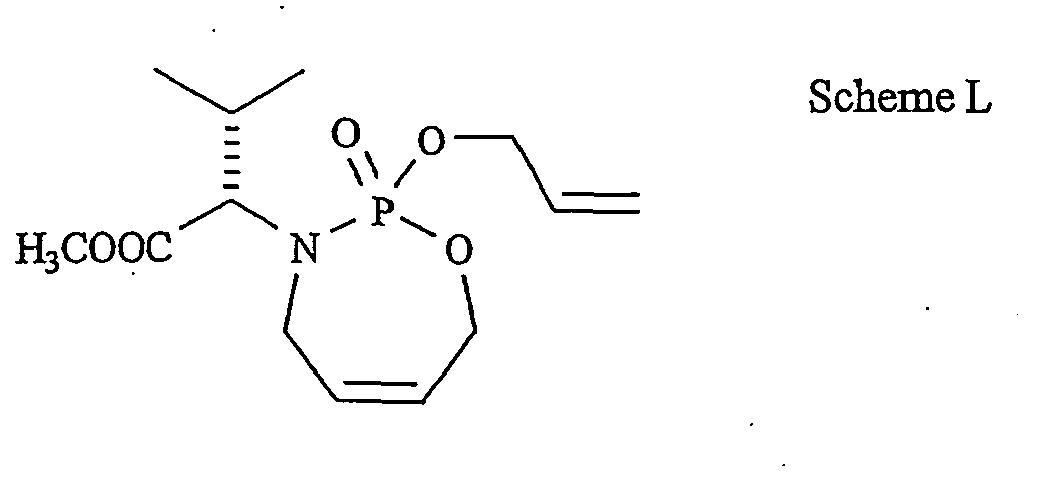


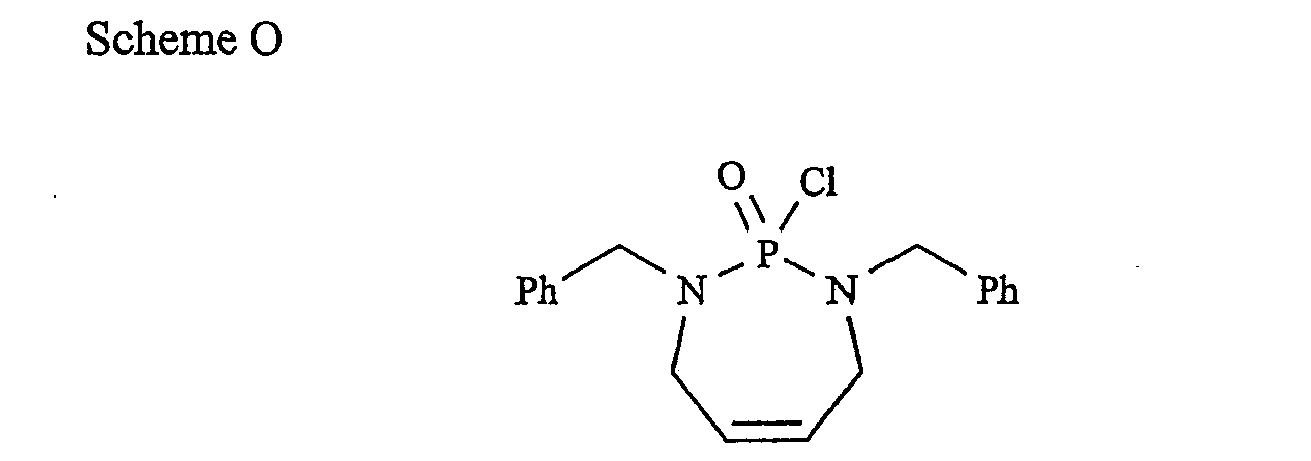
- The Scheme K compound resulted in a 25.5% inhibition of the protease. The Scheme L compound resulted in a 34.7% inhibition of the protease. Finally, the Scheme M compound resulted in a 33.5% inhibition of the protease, the Scheme N compound resulted in a 44.4% inhibition of the protease, and the Scheme O compound resulted in a 44.7% inhibition of the protease.
- The inhibition of HIV protease by the compounds shown in Scheme N (99 µmolar) and Scheme O (99 µmolar) was determined following the procedure described by Maschera et al., Human Immunodeficiency Virus: Mutations in the Viral Protease that Confer Resistance to Saquinavir Increase the Dissociation Rate Constant for the Protease-Saquinavir Complex, J. Biol. Chem., 271:33231-35 (1996), incorporated by reference herein.
- The compound of Scheme N resulted in a 23% inhibition of the protease, while the compound of Scheme O resulted in a 36% inhibition.
- The inhibition of human cathepsin K by the compound shown in Scheme N (106 µmolar) was determined. The peptides utilized were chromophoric Z-Phe-Arg-pNA*HCl and fluorogenic Z-Phe-Arg-AMC (each available from BACHEM Bioscience, Inc.). Stock solutions were prepared with 100% dimethylsulfoxide (DMSO) and stored at -20°C.
- The final assay conditions were 100 mMNaOAc, pH of 5.5,10 mM (R,R)-dithiothreitol (DTT), 10% DMSO, 120mMNaCl, 10 µmolar of the peptide, and 12.5-0.012 µmolar inhibitor in twofold serial dilutions from 20X stocks in 100% DMSO. The enzyme working solution was a 1:3000 dilution of 8.75 mM human cathepsin K into 100 mM of NaOAc, pH of 5.5, 10 mM DTT, 1.2 M NaCl.
- Serial dilutions were performed in 100% DMSO. Columns 2-12 of an intermediate plate were filled with 100 mL/well of 100% DMSO and column 1 was filled with 195 mL/well. Next, 5 mL of a 10 mM solution was added to column 1. A twofold serial dilution was prepared in columns 1-11 of the intermediate plate by sequential transfer of 100 mL of the contents of each well in a column to the corresponding well of the next column, with mixing between each transfer. Samples of 11.7 mL from each well of the intermediate plate were transferred to another intermediate plate and 200 mL of a peptide buffer (105 mMNaOAc, pH of 5.5,10.5 mM DTT, 5.8% DMSO, 12 mM peptide) was added. Samples (20 µL) of enzyme working solution were placed in each well of an empty assay plate, and 180 µL/well of the test compound-peptide mixture was added to the enzyme to initial the assay. The fluorescence was monitored every 6 minutes for 72 minutes using a CytoFluor Series 4000 PerSeptive Biosystems multi-well fluorescence plate reader with the following settings: gain=50; 20 reads/well; 32 ° C; lex=360±20 nm; and lem=440±20 nm.
- The compound resulted in a 34% inhibition of human cathepsin K.
Claims (23)
- A compound according to a formula selected from the group consisting of

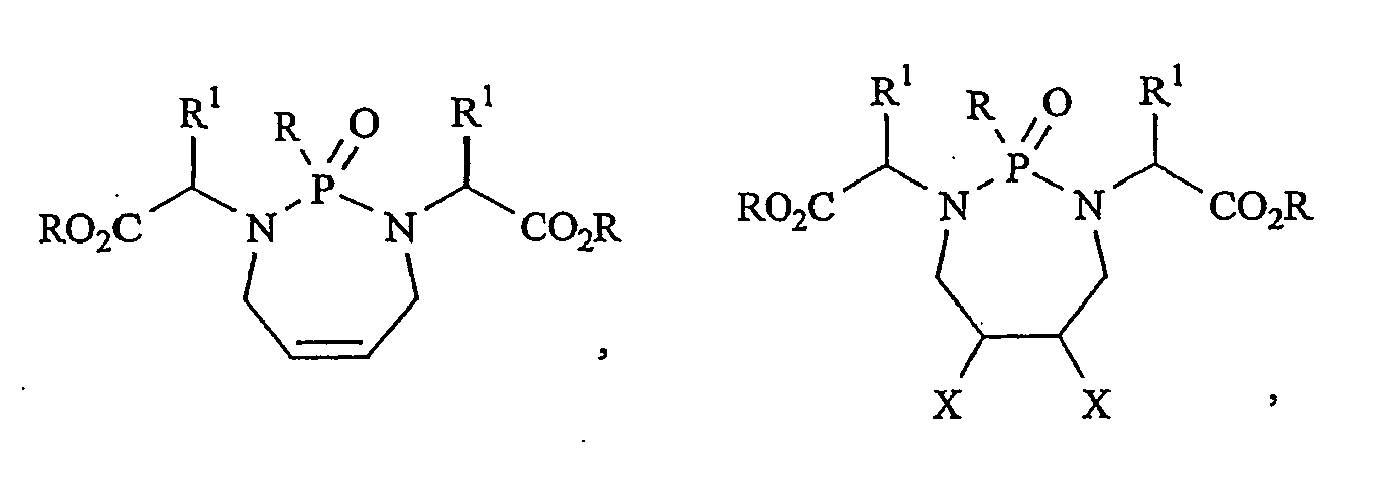


 each X is individually selected from the group consisting of oxygen, -NH, and -NOR;each R is individually selected from the group consisting of hydrogen, branched and unbranched alkyl groups, branched and unbranched alkenyl groups, branched and unbranched alkynyl groups, allyl groups, aryl groups, acyl groups, 2-15 mer peptides, and benzyl groups; andeach R1 is individually selected from the group consisting of hydrogen, amino acid side chains, and 2-15 mer peptides.
 - The compound of claim 1, wherein at least one R1 comprises an amino acid side chain selected from the group consisting of


- The compound of claim 1, wherein said formula is selected from the group consisting of


- A method of forming aphosphonamide compound comprising the step of reacting a phosphonamide comprising an opened-ring structure with a ring-closing catalyst to yield a closed-ring phosphonamide compound.
- The method of claim 4, wherein said closed-ring phosphonamide compound is selected from the group consisting of


 each X is individually selected from the group consisting of oxygen, -NH, and - NOR;each R is individually selected from the group consisting of hydrogen, branched and unbranched alkyl groups, branched and unbranched alkenyl groups, branched and unbranched alkynyl groups, allyl groups, aryl groups, acyl groups, 2-15 mer peptides, and benzyl groups; andeach R1 is individually selected from the group consisting of hydrogen, amino acid side chains, and 2-15 mer peptides.
 - The method of claim 4, wherein said catalyst is a Grubbs catalyst selected from the group consisting of


- The method of claim 6, wherein said Grubbs catalyst is

- The method of claim 4, wherein said opened-ring structure comprises an allylated phosphonamide.
- The method of claim 8, wherein said allylated phosphonamide is selected from the group consisting of


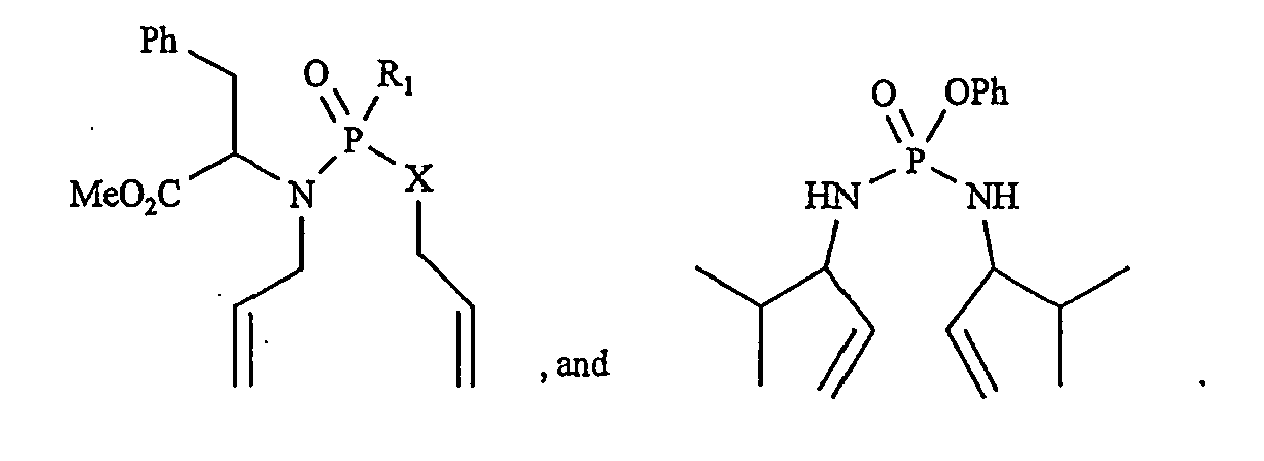
- The method of claim 5, wherein at least one R1 comprises an amino acid side chain selected from the group consisting of

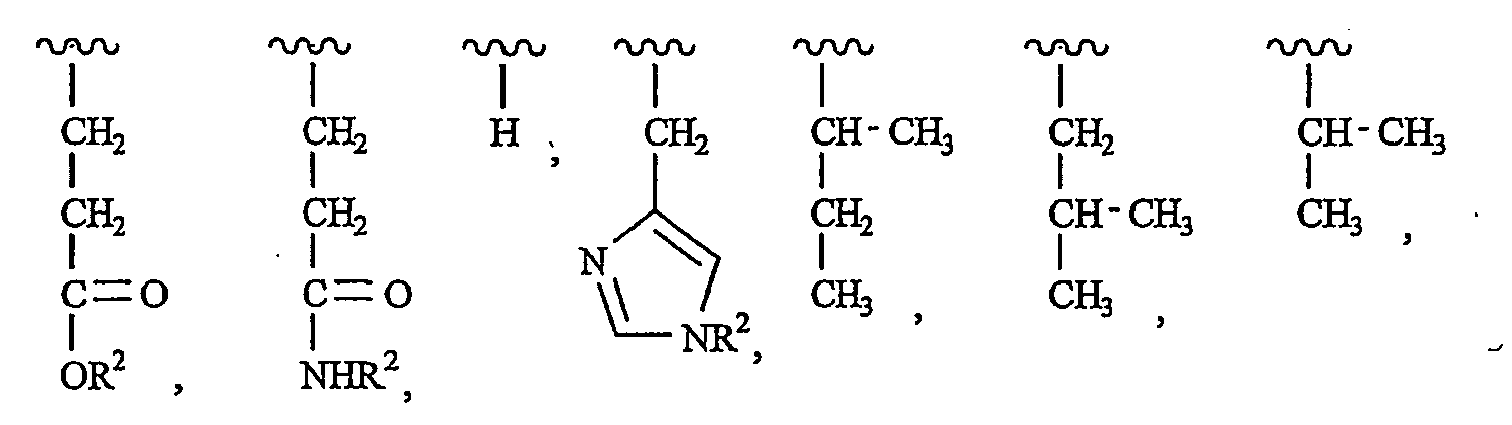

- The method of claim 4, wherein said reacting step is carried out at a temperature of from about 15-80°C.
- The method of claim 4, wherein said reacting step is carried out in a solvent system comprising a solvent selected from the group consisting of toluene, benzene, chlorobenzene, dichlorobenzene, methylene chloride, dimethoxyethane, and mixtures thereof.
- The method of claim 4, wherein said reacting step results in a closed-ring structure yield of at least about 80%.
- A method of forming a cyclic phosphonamide comprising the steps of:providing a template compound comprising two secondary amines, with the nitrogen atoms of each of said amines being bonded to an alkyl chain comprising at least two carbon atoms; andreacting said template compound with a phosphorus (III) compound under conditions to cause the phosphorus atom of said phosphorus (III) compound to bond with each of the nitrogen atoms of the template compound so as to yield the cyclic phosphonamide.
- The method of claim 14, wherein said phosphorus (III) compound comprises the formula R3PY2, wherein:R3 is selected from the group consisting of hydrogen, branched and unbranched alkyl groups, branched and unbranched alkenyl groups, branched and unbranched alkynyl groups, allyl groups, aryl groups, phenyl groups, and benzyl groups; andeach Y is individually selected from the group consisting of the halogens.
- The method of claim 14, wherein said phosphorus (III) compound comprises the formula PhPCl2.
- The method of claim 14, wherein said template compound is according to a formula selected from the group consisting of

 each X is individually selected from the group consisting of oxygen, -NH, and -NOR;each R is individually selected from the group consisting of 2-15 mer peptides, hydrogen, branched and unbranched alkyl groups, branched and unbranched alkenyl groups, branched and unbranched alkynyl groups, allyl groups, acyl groups, aryl groups, and benzyl groups; andeach R1 is individually selected from the group consisting of hydrogen, amino acid side chains, and 2-15 mer peptides.
 - The method of claim 17, wherein said template compound is according to a formula selected from the group consisting of


- The method of claim 14, wherein said cyclic phosphonamide is according to a formula selected from the group consisting of

 each X is individually selected from the group consisting of oxygen, -NH, and - NOR;each R is individually selected from the group consisting of hydrogen, branched and unbranched alkyl groups, branched and unbranched alkenyl groups, branched and unbranched alkynyl groups, allyl groups, acyl groups, aryl groups, 2-15 mer peptides, and benzyl groups; andeach R1 is individually selected from the group consisting of hydrogen, amino acid side chains, and 2-15 mer peptides.
 - The method of claim 19, wherein said cyclic phosphonamide is according to a formula selected from the group consisting of


- The method of claim 14, wherein said reacting step is carried out at a temperature of from about -10-25 ° C.
- The method of claim 14, wherein said reacting step is carried out in a solvent system comprising a solvent selected from the group consisting of methylene chloride, acetonitrile, diethyl ether, and mixtures thereof.
- The method of claim 14, wherein said reacting step results in a closed-ring structure yield of at least about 80%.
Applications Claiming Priority (2)
| Application Number | Priority Date | Filing Date | Title |
|---|---|---|---|
| US09/639,051 US6420586B1 (en) | 2000-08-15 | 2000-08-15 | Amino acid-derived cyclic phosphonamides and methods of synthesizing the same |
| EP01964579A EP1311515B1 (en) | 2000-08-15 | 2001-08-06 | Amino acid-derived cyclic phosphonamides and methods of synthesizing the same |
Related Parent Applications (2)
| Application Number | Title | Priority Date | Filing Date |
|---|---|---|---|
| EP01964579A Division EP1311515B1 (en) | 2000-08-15 | 2001-08-06 | Amino acid-derived cyclic phosphonamides and methods of synthesizing the same |
| EP01964579.5 Division | 2001-08-06 |
Publications (3)
| Publication Number | Publication Date |
|---|---|
| EP1806351A2 true EP1806351A2 (en) | 2007-07-11 |
| EP1806351A3 EP1806351A3 (en) | 2007-09-26 |
| EP1806351B1 EP1806351B1 (en) | 2011-03-30 |
Family
ID=24562532
Family Applications (2)
| Application Number | Title | Priority Date | Filing Date |
|---|---|---|---|
| EP01964579A Expired - Lifetime EP1311515B1 (en) | 2000-08-15 | 2001-08-06 | Amino acid-derived cyclic phosphonamides and methods of synthesizing the same |
| EP07008428A Expired - Lifetime EP1806351B1 (en) | 2000-08-15 | 2001-08-06 | Amino acid-derived cyclic phosphonamides and methods of synthesizing the same |
Family Applications Before (1)
| Application Number | Title | Priority Date | Filing Date |
|---|---|---|---|
| EP01964579A Expired - Lifetime EP1311515B1 (en) | 2000-08-15 | 2001-08-06 | Amino acid-derived cyclic phosphonamides and methods of synthesizing the same |
Country Status (9)
| Country | Link |
|---|---|
| US (1) | US6420586B1 (en) |
| EP (2) | EP1311515B1 (en) |
| JP (1) | JP5249486B2 (en) |
| AT (2) | ATE463500T1 (en) |
| AU (1) | AU2001285418A1 (en) |
| CA (1) | CA2419775C (en) |
| DE (2) | DE60144349D1 (en) |
| DK (2) | DK1806351T3 (en) |
| WO (1) | WO2002014344A2 (en) |
Families Citing this family (22)
| Publication number | Priority date | Publication date | Assignee | Title |
|---|---|---|---|---|
| ES2228906T3 (en) * | 2000-07-18 | 2005-04-16 | Leo Pharma A/S | INHIBITORS OF METALOPROTEINASES OF MATRIX. |
| IL162017A0 (en) * | 2002-01-18 | 2005-11-20 | Leo Pharma As | Mmp inhibitors |
| WO2003091264A2 (en) * | 2002-04-26 | 2003-11-06 | Gilead Sciences, Inc. | Non nucleoside reverse transcriptase inhibitors |
| EA014685B1 (en) | 2003-04-25 | 2010-12-30 | Джилид Сайэнс, Инк. | Phosphonate-containing antiviral compounds (variants) and pharmaceutical composition based thereon |
| US7300924B2 (en) | 2003-04-25 | 2007-11-27 | Gilead Sciences, Inc. | Anti-infective phosphonate analogs |
| US7432261B2 (en) | 2003-04-25 | 2008-10-07 | Gilead Sciences, Inc. | Anti-inflammatory phosphonate compounds |
| US7452901B2 (en) | 2003-04-25 | 2008-11-18 | Gilead Sciences, Inc. | Anti-cancer phosphonate analogs |
| KR20060022647A (en) | 2003-04-25 | 2006-03-10 | 길리애드 사이언시즈, 인코포레이티드 | Kinase Inhibition Phosphonate Analogs |
| US7407965B2 (en) | 2003-04-25 | 2008-08-05 | Gilead Sciences, Inc. | Phosphonate analogs for treating metabolic diseases |
| US7470724B2 (en) | 2003-04-25 | 2008-12-30 | Gilead Sciences, Inc. | Phosphonate compounds having immuno-modulatory activity |
| US7427636B2 (en) | 2003-04-25 | 2008-09-23 | Gilead Sciences, Inc. | Inosine monophosphate dehydrogenase inhibitory phosphonate compounds |
| WO2005002626A2 (en) | 2003-04-25 | 2005-01-13 | Gilead Sciences, Inc. | Therapeutic phosphonate compounds |
| WO2005044308A1 (en) | 2003-10-24 | 2005-05-19 | Gilead Sciences, Inc. | Phosphonate analogs of antimetabolites |
| WO2005042773A1 (en) | 2003-10-24 | 2005-05-12 | Gilead Sciences, Inc. | Methods and compositions for identifying therapeutic compounds |
| WO2005044279A1 (en) | 2003-10-24 | 2005-05-19 | Gilead Sciences, Inc. | Purine nucleoside phosphonate conjugates |
| BRPI0417988A (en) | 2003-12-22 | 2007-04-27 | Gilead Sciences Inc | antiviral phosphonate analogs |
| AU2005330489B2 (en) | 2004-07-27 | 2011-08-25 | Gilead Sciences, Inc. | Nucleoside phosphonate conjugates as anti HIV agents |
| EP2010318B1 (en) | 2006-04-11 | 2014-04-02 | Agency for Science, Technology and Research | Catalysts for ring closing metathesis |
| US8592336B2 (en) | 2006-04-11 | 2013-11-26 | Agency For Science, Technology And Research | Catalysts for ring-closing metathesis |
| US8658617B2 (en) | 2008-07-08 | 2014-02-25 | Gilead Sciences, Inc. | Salts of HIV inhibitor compounds |
| JP2013023454A (en) * | 2011-07-19 | 2013-02-04 | Katayama Kagaku Kogyo Kk | Method for producing halogenated organophosphorus compound |
| SI3661937T1 (en) | 2017-08-01 | 2021-11-30 | Gilead Sciences, Inc. | Crystalline forms of ethyl ((s)-((((2r,5r)-5-(6-amino-9h-purin-9-yl)-4-fluoro-2,5-dihydrofuran-2-yl)oxy)methyl)(phenoxy)phosphoryl)-l-alaninate (gs-9131) for treating viral infections |
Citations (3)
| Publication number | Priority date | Publication date | Assignee | Title |
|---|---|---|---|---|
| WO1994019329A1 (en) | 1993-02-26 | 1994-09-01 | The Du Pont Merck Pharmaceutical Company | Substituted cyclic carbonyls and derivatives thereof useful as retroviral protease inhibitors |
| US5543517A (en) | 1994-01-13 | 1996-08-06 | The Dupont Merck Pharmaceutical Company | Substituted bicyclic phosphoramides and derivatives thereof |
| AU703962B2 (en) | 1993-02-26 | 1999-04-01 | Du Pont Pharmaceuticals Company | Substituted cyclic carbonyls and derivatives |
Family Cites Families (7)
| Publication number | Priority date | Publication date | Assignee | Title |
|---|---|---|---|---|
| US3329687A (en) | 1964-01-16 | 1967-07-04 | Sandoz Ag | Thiadiazepinedioxides and their preparation |
| JP3067031B2 (en) | 1992-04-03 | 2000-07-17 | カリフォルニア インスティチュート オブ テクノロジー | Olefin metathesis polymerization method |
| US5710298A (en) | 1992-04-03 | 1998-01-20 | California Institute Of Technology | Method of preparing ruthenium and osmium carbene complexes |
| US5312940A (en) | 1992-04-03 | 1994-05-17 | California Institute Of Technology | Ruthenium and osmium metal carbene complexes for olefin metathesis polymerization |
| US6083711A (en) | 1996-05-15 | 2000-07-04 | Smithkline Beecham Corporation | Proteases compositions capable of binding to said site, and methods of use thereof |
| US5917071A (en) | 1996-11-15 | 1999-06-29 | California Institute Of Technology | Synthesis of ruthenium or osmium metathesis catalysts |
| WO1999037643A1 (en) | 1998-01-26 | 1999-07-29 | Yamanouchi Pharmaceutical Co., Ltd. | Novel benzene-fused heterocyclic derivatives or salts thereof |
-
2000
- 2000-08-15 US US09/639,051 patent/US6420586B1/en not_active Expired - Lifetime
-
2001
- 2001-08-06 AT AT01964579T patent/ATE463500T1/en not_active IP Right Cessation
- 2001-08-06 AU AU2001285418A patent/AU2001285418A1/en not_active Abandoned
- 2001-08-06 DK DK07008428.0T patent/DK1806351T3/en active
- 2001-08-06 DE DE60144349T patent/DE60144349D1/en not_active Expired - Lifetime
- 2001-08-06 DK DK01964579.5T patent/DK1311515T3/en active
- 2001-08-06 CA CA2419775A patent/CA2419775C/en not_active Expired - Fee Related
- 2001-08-06 EP EP01964579A patent/EP1311515B1/en not_active Expired - Lifetime
- 2001-08-06 DE DE60141757T patent/DE60141757D1/en not_active Expired - Lifetime
- 2001-08-06 AT AT07008428T patent/ATE503761T1/en not_active IP Right Cessation
- 2001-08-06 EP EP07008428A patent/EP1806351B1/en not_active Expired - Lifetime
- 2001-08-06 WO PCT/US2001/041606 patent/WO2002014344A2/en not_active Ceased
- 2001-08-06 JP JP2002519481A patent/JP5249486B2/en not_active Expired - Lifetime
Patent Citations (5)
| Publication number | Priority date | Publication date | Assignee | Title |
|---|---|---|---|---|
| US5610294A (en) | 1991-10-11 | 1997-03-11 | The Du Pont Merck Pharmaceutical Company | Substituted cyclic carbonyls and derivatives thereof useful as retroviral protease inhibitors |
| US5811422A (en) | 1991-10-11 | 1998-09-22 | The Dupont Merck Pharmaceutical Company | Substituted cyclic carbonyls and derivatives thereof useful as retroviral protease inhibitors |
| WO1994019329A1 (en) | 1993-02-26 | 1994-09-01 | The Du Pont Merck Pharmaceutical Company | Substituted cyclic carbonyls and derivatives thereof useful as retroviral protease inhibitors |
| AU703962B2 (en) | 1993-02-26 | 1999-04-01 | Du Pont Pharmaceuticals Company | Substituted cyclic carbonyls and derivatives |
| US5543517A (en) | 1994-01-13 | 1996-08-06 | The Dupont Merck Pharmaceutical Company | Substituted bicyclic phosphoramides and derivatives thereof |
Non-Patent Citations (7)
| Title |
|---|
| HANSON ET AL., ABSTRACTS OF PAPERS, AMERICAN CHEMICAL SOCIETY, vol. 218, no. 1-2, 1999, pages 305 |
| HANSON ET AL., ABSTRACTS OF PAPERS, AMERICAN CHEMICAL SOCIETY, vol. 219, no. 1-2, 2000, pages 17 |
| HANSON ET AL., TETRAHEDRON LETTERS, vol. 40, no. 17, 23 April 1999 (1999-04-23), pages 3297 - 3300 |
| NIFANFEV ET AL., JOURNAL OF GENERAL CHEMISTRY OF THE USSR (ENGLISH TRANSLATION), vol. 59, no. 11, 1989, pages 2233 - 2238 |
| SMALLHEER ET AL., HETEROCYCLES, vol. 43, no. 11, 1996, pages 2367 - 2376 |
| SPROTT ET AL., ABSTRACTS OF PAPERS, AMERICAN CHEMICAL SOCIETY, vol. 219, no. 1-2, 2000, pages 825 |
| SPROTT, J. ORG. CHEM., vol. 65, no. 15, 6 July 2000 (2000-07-06), pages 4721 - 4728 |
Also Published As
| Publication number | Publication date |
|---|---|
| DE60144349D1 (en) | 2011-05-12 |
| JP2004506646A (en) | 2004-03-04 |
| WO2002014344A2 (en) | 2002-02-21 |
| JP5249486B2 (en) | 2013-07-31 |
| US6420586B1 (en) | 2002-07-16 |
| ATE463500T1 (en) | 2010-04-15 |
| EP1806351A3 (en) | 2007-09-26 |
| EP1311515A4 (en) | 2003-12-03 |
| EP1311515A2 (en) | 2003-05-21 |
| EP1806351B1 (en) | 2011-03-30 |
| CA2419775A1 (en) | 2002-02-21 |
| CA2419775C (en) | 2014-12-02 |
| EP1311515B1 (en) | 2010-04-07 |
| DK1806351T3 (en) | 2011-07-18 |
| AU2001285418A1 (en) | 2002-02-25 |
| ATE503761T1 (en) | 2011-04-15 |
| WO2002014344A3 (en) | 2002-09-06 |
| DK1311515T3 (en) | 2010-07-19 |
| DE60141757D1 (en) | 2010-05-20 |
Similar Documents
| Publication | Publication Date | Title |
|---|---|---|
| EP1806351B1 (en) | Amino acid-derived cyclic phosphonamides and methods of synthesizing the same | |
| US6596857B1 (en) | Preparation of phosphorothioate oligomers | |
| CA2900902C (en) | Methods for the synthesis of sphingomyelins and dihydrosphingomyelins | |
| US6084082A (en) | Lactam nucleic acids | |
| Hetherington et al. | Ring-closing olefin metathesis for the synthesis of phosphorus containing heterocycles | |
| CA2081320A1 (en) | Phosphoramidite derivatives, their preparation and the use thereof in the incorporation of reporter groups on synthetic oligonucleotides | |
| Beaton et al. | Synthesis of oligonucleotide phosphorodithioates | |
| EP0739351B1 (en) | Monomeric diols and phosphate linked oligomers formed therefrom | |
| AU601257B2 (en) | 5'-protected nucleoside phosphonites and process for their preparation | |
| AU4961601A (en) | Phosphoramidate prodrugs | |
| US6476216B1 (en) | Preparation of phosphorothioate oligomers | |
| Kaboudin et al. | Diastereoselective addition of α-substituted α-amino-H-phosphinates to imines using Yb (OTf) 3 as an efficient Lewis acid catalyst | |
| US4916249A (en) | Glycero-3(2)-phospho-L-serine derivatives and salts thereof | |
| Kaczmarek et al. | Pyrrolidine and oxazolidine ring transformations in proline and serine derivatives of α-hydroxyphosphonates induced by deoxyfluorinating reagents | |
| CA2301104C (en) | Process for the preparation of oxazaphosphorine-2-amines | |
| Błaszczyk et al. | Direct synthesis of protected diethyl 1, 2-diaminoalkylphosphonates | |
| Lemmen et al. | A synthesis of phospholipids using a phosphite-triester approach and uniformly cleavable β-halogenated protecting groups | |
| US6420592B1 (en) | Amino acid-derived phosponamidic anhydrides and methods of preparing the same | |
| EP2625181B1 (en) | Method of preparation of antiviral compounds and useful intermediates thereof | |
| Kuźnik et al. | A method for the synthesis of unsymmetric bisphosphoric analogs of α-amino acids | |
| Sprott et al. | Ring-closing metathesis strategies to amino acid-derived P-heterocycles | |
| Wróblewski et al. | Synthesis of four enantiomers of 2-acetamido-1-hydroxypropylphosphonates | |
| Cheviet et al. | Synthesis of N-methylene phosphonate aziridines: reaction scope and mechanistic insights | |
| US4565659A (en) | Substituted aminoalkanol phospholipids | |
| Dabkowski et al. | O-Methyl-bis-O-(4-nitrophenyl) phosphite: a novel chemoselective O-phosphitylating reagent |
Legal Events
| Date | Code | Title | Description |
|---|---|---|---|
| PUAI | Public reference made under article 153(3) epc to a published international application that has entered the european phase |
Free format text: ORIGINAL CODE: 0009012 |
|
| 17P | Request for examination filed |
Effective date: 20070425 |
|
| AC | Divisional application: reference to earlier application |
Ref document number: 1311515 Country of ref document: EP Kind code of ref document: P |
|
| AK | Designated contracting states |
Kind code of ref document: A2 Designated state(s): AT BE CH CY DE DK ES FI FR GB GR IE IT LI LU MC NL PT SE TR |
|
| PUAL | Search report despatched |
Free format text: ORIGINAL CODE: 0009013 |
|
| AK | Designated contracting states |
Kind code of ref document: A3 Designated state(s): AT BE CH CY DE DK ES FI FR GB GR IE IT LI LU MC NL PT SE TR |
|
| RIN1 | Information on inventor provided before grant (corrected) |
Inventor name: MCREYNOLDS, MATTHEW D. Inventor name: SPROTT, KEVIN T. Inventor name: HANSON, PAUL R. |
|
| RIN1 | Information on inventor provided before grant (corrected) |
Inventor name: SPROTT, KEVIN T.,C/O MICROBIA, INC. Inventor name: MCREYNOLDS, MATTHEW D.,C/O PFIZER, INC. Inventor name: HANSON, PAUL R. |
|
| 17Q | First examination report despatched |
Effective date: 20080221 |
|
| AKX | Designation fees paid |
Designated state(s): AT BE CH CY DE DK ES FI FR GB GR IE IT LI LU MC NL PT SE TR |
|
| GRAP | Despatch of communication of intention to grant a patent |
Free format text: ORIGINAL CODE: EPIDOSNIGR1 |
|
| GRAS | Grant fee paid |
Free format text: ORIGINAL CODE: EPIDOSNIGR3 |
|
| GRAA | (expected) grant |
Free format text: ORIGINAL CODE: 0009210 |
|
| AC | Divisional application: reference to earlier application |
Ref document number: 1311515 Country of ref document: EP Kind code of ref document: P |
|
| AK | Designated contracting states |
Kind code of ref document: B1 Designated state(s): AT BE CH CY DE DK ES FI FR GB GR IE IT LI LU MC NL PT SE TR |
|
| REG | Reference to a national code |
Ref country code: GB Ref legal event code: FG4D |
|
| REG | Reference to a national code |
Ref country code: CH Ref legal event code: EP |
|
| REG | Reference to a national code |
Ref country code: IE Ref legal event code: FG4D |
|
| REF | Corresponds to: |
Ref document number: 60144349 Country of ref document: DE Date of ref document: 20110512 Kind code of ref document: P |
|
| REG | Reference to a national code |
Ref country code: DE Ref legal event code: R096 Ref document number: 60144349 Country of ref document: DE Effective date: 20110512 |
|
| REG | Reference to a national code |
Ref country code: SE Ref legal event code: TRGR |
|
| REG | Reference to a national code |
Ref country code: NL Ref legal event code: T3 |
|
| REG | Reference to a national code |
Ref country code: DK Ref legal event code: T3 |
|
| PG25 | Lapsed in a contracting state [announced via postgrant information from national office to epo] |
Ref country code: GR Free format text: LAPSE BECAUSE OF FAILURE TO SUBMIT A TRANSLATION OF THE DESCRIPTION OR TO PAY THE FEE WITHIN THE PRESCRIBED TIME-LIMIT Effective date: 20110701 |
|
| REG | Reference to a national code |
Ref country code: CH Ref legal event code: NV Representative=s name: SCHMAUDER & PARTNER AG PATENT- UND MARKENANWAELTE |
|
| PG25 | Lapsed in a contracting state [announced via postgrant information from national office to epo] |
Ref country code: CY Free format text: LAPSE BECAUSE OF FAILURE TO SUBMIT A TRANSLATION OF THE DESCRIPTION OR TO PAY THE FEE WITHIN THE PRESCRIBED TIME-LIMIT Effective date: 20110330 Ref country code: AT Free format text: LAPSE BECAUSE OF FAILURE TO SUBMIT A TRANSLATION OF THE DESCRIPTION OR TO PAY THE FEE WITHIN THE PRESCRIBED TIME-LIMIT Effective date: 20110330 Ref country code: FI Free format text: LAPSE BECAUSE OF FAILURE TO SUBMIT A TRANSLATION OF THE DESCRIPTION OR TO PAY THE FEE WITHIN THE PRESCRIBED TIME-LIMIT Effective date: 20110330 |
|
| PG25 | Lapsed in a contracting state [announced via postgrant information from national office to epo] |
Ref country code: PT Free format text: LAPSE BECAUSE OF FAILURE TO SUBMIT A TRANSLATION OF THE DESCRIPTION OR TO PAY THE FEE WITHIN THE PRESCRIBED TIME-LIMIT Effective date: 20110801 |
|
| PG25 | Lapsed in a contracting state [announced via postgrant information from national office to epo] |
Ref country code: ES Free format text: LAPSE BECAUSE OF FAILURE TO SUBMIT A TRANSLATION OF THE DESCRIPTION OR TO PAY THE FEE WITHIN THE PRESCRIBED TIME-LIMIT Effective date: 20110711 |
|
| PLBE | No opposition filed within time limit |
Free format text: ORIGINAL CODE: 0009261 |
|
| STAA | Information on the status of an ep patent application or granted ep patent |
Free format text: STATUS: NO OPPOSITION FILED WITHIN TIME LIMIT |
|
| 26N | No opposition filed |
Effective date: 20120102 |
|
| PG25 | Lapsed in a contracting state [announced via postgrant information from national office to epo] |
Ref country code: MC Free format text: LAPSE BECAUSE OF NON-PAYMENT OF DUE FEES Effective date: 20110831 |
|
| REG | Reference to a national code |
Ref country code: DE Ref legal event code: R097 Ref document number: 60144349 Country of ref document: DE Effective date: 20120102 |
|
| REG | Reference to a national code |
Ref country code: IE Ref legal event code: MM4A |
|
| PG25 | Lapsed in a contracting state [announced via postgrant information from national office to epo] |
Ref country code: IT Free format text: LAPSE BECAUSE OF FAILURE TO SUBMIT A TRANSLATION OF THE DESCRIPTION OR TO PAY THE FEE WITHIN THE PRESCRIBED TIME-LIMIT Effective date: 20110330 |
|
| PG25 | Lapsed in a contracting state [announced via postgrant information from national office to epo] |
Ref country code: IE Free format text: LAPSE BECAUSE OF NON-PAYMENT OF DUE FEES Effective date: 20110806 |
|
| PG25 | Lapsed in a contracting state [announced via postgrant information from national office to epo] |
Ref country code: LU Free format text: LAPSE BECAUSE OF NON-PAYMENT OF DUE FEES Effective date: 20110806 |
|
| PG25 | Lapsed in a contracting state [announced via postgrant information from national office to epo] |
Ref country code: TR Free format text: LAPSE BECAUSE OF FAILURE TO SUBMIT A TRANSLATION OF THE DESCRIPTION OR TO PAY THE FEE WITHIN THE PRESCRIBED TIME-LIMIT Effective date: 20110330 |
|
| PGFP | Annual fee paid to national office [announced via postgrant information from national office to epo] |
Ref country code: NL Payment date: 20150826 Year of fee payment: 15 |
|
| PGFP | Annual fee paid to national office [announced via postgrant information from national office to epo] |
Ref country code: DK Payment date: 20150825 Year of fee payment: 15 |
|
| PGFP | Annual fee paid to national office [announced via postgrant information from national office to epo] |
Ref country code: SE Payment date: 20150827 Year of fee payment: 15 |
|
| REG | Reference to a national code |
Ref country code: FR Ref legal event code: PLFP Year of fee payment: 16 |
|
| REG | Reference to a national code |
Ref country code: DK Ref legal event code: EBP Effective date: 20160831 |
|
| REG | Reference to a national code |
Ref country code: SE Ref legal event code: EUG |
|
| REG | Reference to a national code |
Ref country code: NL Ref legal event code: MM Effective date: 20160901 |
|
| PG25 | Lapsed in a contracting state [announced via postgrant information from national office to epo] |
Ref country code: SE Free format text: LAPSE BECAUSE OF NON-PAYMENT OF DUE FEES Effective date: 20160807 |
|
| PG25 | Lapsed in a contracting state [announced via postgrant information from national office to epo] |
Ref country code: NL Free format text: LAPSE BECAUSE OF NON-PAYMENT OF DUE FEES Effective date: 20160901 |
|
| PG25 | Lapsed in a contracting state [announced via postgrant information from national office to epo] |
Ref country code: DK Free format text: LAPSE BECAUSE OF NON-PAYMENT OF DUE FEES Effective date: 20160831 |
|
| REG | Reference to a national code |
Ref country code: FR Ref legal event code: PLFP Year of fee payment: 17 |
|
| REG | Reference to a national code |
Ref country code: FR Ref legal event code: PLFP Year of fee payment: 18 |
|
| PGFP | Annual fee paid to national office [announced via postgrant information from national office to epo] |
Ref country code: FR Payment date: 20180827 Year of fee payment: 18 Ref country code: DE Payment date: 20180829 Year of fee payment: 18 |
|
| PGFP | Annual fee paid to national office [announced via postgrant information from national office to epo] |
Ref country code: GB Payment date: 20180828 Year of fee payment: 18 Ref country code: BE Payment date: 20180827 Year of fee payment: 18 Ref country code: CH Payment date: 20180905 Year of fee payment: 18 |
|
| REG | Reference to a national code |
Ref country code: DE Ref legal event code: R119 Ref document number: 60144349 Country of ref document: DE |
|
| GBPC | Gb: european patent ceased through non-payment of renewal fee |
Effective date: 20190806 |
|
| PG25 | Lapsed in a contracting state [announced via postgrant information from national office to epo] |
Ref country code: CH Free format text: LAPSE BECAUSE OF NON-PAYMENT OF DUE FEES Effective date: 20190831 Ref country code: LI Free format text: LAPSE BECAUSE OF NON-PAYMENT OF DUE FEES Effective date: 20190831 |
|
| REG | Reference to a national code |
Ref country code: BE Ref legal event code: MM Effective date: 20190831 |
|
| PG25 | Lapsed in a contracting state [announced via postgrant information from national office to epo] |
Ref country code: DE Free format text: LAPSE BECAUSE OF NON-PAYMENT OF DUE FEES Effective date: 20200303 Ref country code: FR Free format text: LAPSE BECAUSE OF NON-PAYMENT OF DUE FEES Effective date: 20190831 |
|
| PG25 | Lapsed in a contracting state [announced via postgrant information from national office to epo] |
Ref country code: BE Free format text: LAPSE BECAUSE OF NON-PAYMENT OF DUE FEES Effective date: 20190831 Ref country code: GB Free format text: LAPSE BECAUSE OF NON-PAYMENT OF DUE FEES Effective date: 20190806 |