EP1804794B1 - Spiropiperidine compounds useful as beta-secretase inhibitors for the treatment of alzhermer s disease - Google Patents
Spiropiperidine compounds useful as beta-secretase inhibitors for the treatment of alzhermer s disease Download PDFInfo
- Publication number
- EP1804794B1 EP1804794B1 EP05812233.4A EP05812233A EP1804794B1 EP 1804794 B1 EP1804794 B1 EP 1804794B1 EP 05812233 A EP05812233 A EP 05812233A EP 1804794 B1 EP1804794 B1 EP 1804794B1
- Authority
- EP
- European Patent Office
- Prior art keywords
- alkyl
- optionally substituted
- halogen
- dec
- aryl
- Prior art date
- Legal status (The legal status is an assumption and is not a legal conclusion. Google has not performed a legal analysis and makes no representation as to the accuracy of the status listed.)
- Expired - Lifetime
Links
- 0 CC(C)(*1)C(C)(C)OB1c(cc1)ccc1C(NC)=O Chemical compound CC(C)(*1)C(C)(C)OB1c(cc1)ccc1C(NC)=O 0.000 description 3
- IJPWADJZMJAQQJ-UHFFFAOYSA-N Bc(cc1)ccc1S(C)(=O)=O Chemical compound Bc(cc1)ccc1S(C)(=O)=O IJPWADJZMJAQQJ-UHFFFAOYSA-N 0.000 description 1
- QBMUFYMRTFWQPZ-UHFFFAOYSA-N Bc(cc1)ccc1S(N(C)C)(=O)=O Chemical compound Bc(cc1)ccc1S(N(C)C)(=O)=O QBMUFYMRTFWQPZ-UHFFFAOYSA-N 0.000 description 1
- CVLMZAKWBJBDTP-LEGLMEKPSA-N C/C=C(\C=C(/C)\F)/N(C1(CCN(Cc2c(NC)nccc2)CC1)C(NC1CCCCC1)=N1)C1=O Chemical compound C/C=C(\C=C(/C)\F)/N(C1(CCN(Cc2c(NC)nccc2)CC1)C(NC1CCCCC1)=N1)C1=O CVLMZAKWBJBDTP-LEGLMEKPSA-N 0.000 description 1
- XYYWAGHHWAGQBF-UHFFFAOYSA-N C=Cc1ccccc1-c1cccc(CN(CC2)CCC2(C(NC2CCCCC2)=NC2=O)N2c2cccc(F)c2)c1 Chemical compound C=Cc1ccccc1-c1cccc(CN(CC2)CCC2(C(NC2CCCCC2)=NC2=O)N2c2cccc(F)c2)c1 XYYWAGHHWAGQBF-UHFFFAOYSA-N 0.000 description 1
- ALWXJBQAEMOEJN-UHFFFAOYSA-N CC(C)(C)OC(N(CC1)CCC1(C(NC1CCCCC1)=NC1=O)N1c1cc(F)ccc1)=O Chemical compound CC(C)(C)OC(N(CC1)CCC1(C(NC1CCCCC1)=NC1=O)N1c1cc(F)ccc1)=O ALWXJBQAEMOEJN-UHFFFAOYSA-N 0.000 description 1
- ROUYFJUVMYHXFJ-UHFFFAOYSA-N CC(C)(C)OC(N(CC1)CCC1=O)=O Chemical compound CC(C)(C)OC(N(CC1)CCC1=O)=O ROUYFJUVMYHXFJ-UHFFFAOYSA-N 0.000 description 1
- RKDGYYVUOYUHTK-UHFFFAOYSA-O CC(C)(C)OC(Nc1ncc(CN(CC2)CCC2(C(NC2CCCCC2)=NC2=[OH+])N2c2cccc(F)c2)cc1)=O Chemical compound CC(C)(C)OC(Nc1ncc(CN(CC2)CCC2(C(NC2CCCCC2)=NC2=[OH+])N2c2cccc(F)c2)cc1)=O RKDGYYVUOYUHTK-UHFFFAOYSA-O 0.000 description 1
- PICDOCGXNKBVJA-UHFFFAOYSA-N CC(C)NC(C1(CCN(Cc2ccccc2)CC1)N1c2cccc(F)c2)=NC1=O Chemical compound CC(C)NC(C1(CCN(Cc2ccccc2)CC1)N1c2cccc(F)c2)=NC1=O PICDOCGXNKBVJA-UHFFFAOYSA-N 0.000 description 1
- PXAHFIBGNBKLEW-UHFFFAOYSA-N CC(C)NC(C1(CCN(Cc2ccccc2)CC1)N1c2ccccc2)=NC1=O Chemical compound CC(C)NC(C1(CCN(Cc2ccccc2)CC1)N1c2ccccc2)=NC1=O PXAHFIBGNBKLEW-UHFFFAOYSA-N 0.000 description 1
- LBCVVJYBXXETGB-UHFFFAOYSA-N CC(C)Nc1ccc(CN(CC2)CCC2(C(NC2CCCCC2)=NC2=O)N2c2cc(F)ccc2)cn1 Chemical compound CC(C)Nc1ccc(CN(CC2)CCC2(C(NC2CCCCC2)=NC2=O)N2c2cc(F)ccc2)cn1 LBCVVJYBXXETGB-UHFFFAOYSA-N 0.000 description 1
- LIAZHWWLTJKBCR-UHFFFAOYSA-O CC(C)Oc1cc(CN(CC2)CCC2(C(NCCc2cc[nH+]cc2)=NC2=O)N2c2cc(F)ccc2)ccc1 Chemical compound CC(C)Oc1cc(CN(CC2)CCC2(C(NCCc2cc[nH+]cc2)=NC2=O)N2c2cc(F)ccc2)ccc1 LIAZHWWLTJKBCR-UHFFFAOYSA-O 0.000 description 1
- AACPBYXQQREMRY-UHFFFAOYSA-N CC(C)Oc1cc(CN(CC2)CCC2(C(Nc2ccccc2)=NC2=O)N2c2cccc(F)c2)ccc1 Chemical compound CC(C)Oc1cc(CN(CC2)CCC2(C(Nc2ccccc2)=NC2=O)N2c2cccc(F)c2)ccc1 AACPBYXQQREMRY-UHFFFAOYSA-N 0.000 description 1
- GBUXEHAVACNLER-UHFFFAOYSA-N CC(C)Oc1cccc(CN(CC2)CCC2(C(NC2CCCCC2)=NC2=O)N2c(cccc2)c2-c(cc2)ccc2OC(F)(F)F)c1 Chemical compound CC(C)Oc1cccc(CN(CC2)CCC2(C(NC2CCCCC2)=NC2=O)N2c(cccc2)c2-c(cc2)ccc2OC(F)(F)F)c1 GBUXEHAVACNLER-UHFFFAOYSA-N 0.000 description 1
- RPSVWKMWQKVADH-QHPSHKFUSA-N CC(C)Oc1cccc(CN(CC2)CCC2(C(N[C@H](CCC2)C[C@@H]2O)=NC2O)N2c2cccc(F)c2)c1 Chemical compound CC(C)Oc1cccc(CN(CC2)CCC2(C(N[C@H](CCC2)C[C@@H]2O)=NC2O)N2c2cccc(F)c2)c1 RPSVWKMWQKVADH-QHPSHKFUSA-N 0.000 description 1
- RIDDWZVNFUOWSC-UHFFFAOYSA-N CC(Oc1cc(CN(CC2)CCC2(C(NC2CCCCC2)=NC2=O)N2c2cccc(F)c2)ccc1)=O Chemical compound CC(Oc1cc(CN(CC2)CCC2(C(NC2CCCCC2)=NC2=O)N2c2cccc(F)c2)ccc1)=O RIDDWZVNFUOWSC-UHFFFAOYSA-N 0.000 description 1
- IVJDYJFSHDCNHX-UHFFFAOYSA-N CCCCNc1ccc(CN(CC2)CCC2(C(NC2CCCCC2)=NC2=O)N2c2cccc(F)c2)cn1 Chemical compound CCCCNc1ccc(CN(CC2)CCC2(C(NC2CCCCC2)=NC2=O)N2c2cccc(F)c2)cn1 IVJDYJFSHDCNHX-UHFFFAOYSA-N 0.000 description 1
- GCFAJWSQIABNCG-UHFFFAOYSA-N CCOc1cc(CN(CC2)CCC2(C(NC2CCCCC2)=NC2=O)N2c2cc(F)ccc2)ccc1 Chemical compound CCOc1cc(CN(CC2)CCC2(C(NC2CCCCC2)=NC2=O)N2c2cc(F)ccc2)ccc1 GCFAJWSQIABNCG-UHFFFAOYSA-N 0.000 description 1
- AAFFKVMMEZZOQT-UHFFFAOYSA-N CN(C)S(c(cc1)ccc1-c(c(N(C1(CCN(CC2CC2)CC1)C(NC1CCCCC1)=N1)C1=O)c1)ccc1F)(=O)=O Chemical compound CN(C)S(c(cc1)ccc1-c(c(N(C1(CCN(CC2CC2)CC1)C(NC1CCCCC1)=N1)C1=O)c1)ccc1F)(=O)=O AAFFKVMMEZZOQT-UHFFFAOYSA-N 0.000 description 1
- WAAFUAYLYPZUNQ-UHFFFAOYSA-N CNC(c(cc1)ccc1Br)O Chemical compound CNC(c(cc1)ccc1Br)O WAAFUAYLYPZUNQ-UHFFFAOYSA-N 0.000 description 1
- ZMLJSZWSJISFBD-UHFFFAOYSA-N COc(cccc1)c1-c1cccc(CN(CC2)CCC2(C(NC2CCCCC2)=NC2=O)N2c2cccc(F)c2)c1 Chemical compound COc(cccc1)c1-c1cccc(CN(CC2)CCC2(C(NC2CCCCC2)=NC2=O)N2c2cccc(F)c2)c1 ZMLJSZWSJISFBD-UHFFFAOYSA-N 0.000 description 1
- OMJQGWUQPFMVLL-UHFFFAOYSA-N COc1cc(CN(CC2)CCC2(C(NC2CCCCC2)=NC2=O)N2c2cc(F)ccc2)ccc1 Chemical compound COc1cc(CN(CC2)CCC2(C(NC2CCCCC2)=NC2=O)N2c2cc(F)ccc2)ccc1 OMJQGWUQPFMVLL-UHFFFAOYSA-N 0.000 description 1
- ZQAUMGJFUOYCJJ-UHFFFAOYSA-N Cc(ccnc1)c1-c1cccc(CN(CC2)CCC2(C(NC2CCCCC2)=NC2=O)N2c2cc(F)ccc2)c1 Chemical compound Cc(ccnc1)c1-c1cccc(CN(CC2)CCC2(C(NC2CCCCC2)=NC2=O)N2c2cc(F)ccc2)c1 ZQAUMGJFUOYCJJ-UHFFFAOYSA-N 0.000 description 1
- BZNYQHIMFAHJDN-UHFFFAOYSA-N Cc1c(CN(CC2)CCC2(C(NC2CCCCC2)=NC2=O)N2c2cc(F)ccc2)cccc1 Chemical compound Cc1c(CN(CC2)CCC2(C(NC2CCCCC2)=NC2=O)N2c2cc(F)ccc2)cccc1 BZNYQHIMFAHJDN-UHFFFAOYSA-N 0.000 description 1
- OBHUOGXGGUUPLL-UHFFFAOYSA-N Cc1ncc[n]1-c1cccc(CN(CC2)CCC2(C(NC2CCCCC2)=NC2=O)N2c2cc(F)ccc2)c1 Chemical compound Cc1ncc[n]1-c1cccc(CN(CC2)CCC2(C(NC2CCCCC2)=NC2=O)N2c2cc(F)ccc2)c1 OBHUOGXGGUUPLL-UHFFFAOYSA-N 0.000 description 1
- ISZMSIDYCDNZBY-UHFFFAOYSA-N N#Cc1ccccc1-c1cccc(CN(CC2)CCC2(C(NC2CCCCC2)=NC2=O)N2c2cccc(F)c2)c1 Chemical compound N#Cc1ccccc1-c1cccc(CN(CC2)CCC2(C(NC2CCCCC2)=NC2=O)N2c2cccc(F)c2)c1 ISZMSIDYCDNZBY-UHFFFAOYSA-N 0.000 description 1
- QZVQQUVWFIZUBQ-UHFFFAOYSA-N Nc1cccc(F)c1 Chemical compound Nc1cccc(F)c1 QZVQQUVWFIZUBQ-UHFFFAOYSA-N 0.000 description 1
- HUSHFKZJGSKLAJ-UHFFFAOYSA-N O=C(N(C12CCN(Cc3cc(-c4c(C(F)(F)F)cccc4)ccc3)CC1)c1cc(F)ccc1)N=C2NC1CCCCC1 Chemical compound O=C(N(C12CCN(Cc3cc(-c4c(C(F)(F)F)cccc4)ccc3)CC1)c1cc(F)ccc1)N=C2NC1CCCCC1 HUSHFKZJGSKLAJ-UHFFFAOYSA-N 0.000 description 1
- LWXAOYFVAFPVPY-UHFFFAOYSA-N O=C(N(C12CCN(Cc3cc(Br)ccc3)CC1)c1cccc(F)c1)N=C2NC1CCCCC1 Chemical compound O=C(N(C12CCN(Cc3cc(Br)ccc3)CC1)c1cccc(F)c1)N=C2NC1CCCCC1 LWXAOYFVAFPVPY-UHFFFAOYSA-N 0.000 description 1
- WUWOQGHBJCKSEW-UHFFFAOYSA-N O=C(N(C12CCN(Cc3cc(CCC=C4)c4[nH]3)CC1)C1=CCCC(F)=C1)N=C2NC1CCCCC1 Chemical compound O=C(N(C12CCN(Cc3cc(CCC=C4)c4[nH]3)CC1)C1=CCCC(F)=C1)N=C2NC1CCCCC1 WUWOQGHBJCKSEW-UHFFFAOYSA-N 0.000 description 1
- OVEQKPHILPBKDJ-UHFFFAOYSA-N O=C(N(C12CCN(Cc3cc(F)ccc3)CC1)c1cccc(F)c1)N=C2NC1CCCCC1 Chemical compound O=C(N(C12CCN(Cc3cc(F)ccc3)CC1)c1cccc(F)c1)N=C2NC1CCCCC1 OVEQKPHILPBKDJ-UHFFFAOYSA-N 0.000 description 1
- LGTQFZLUXGMGRD-UHFFFAOYSA-N O=C(N(C12CCN(Cc3ccc(NCC4CC4)nc3)CC1)c1cc(F)ccc1)N=C2NC1CCCCC1 Chemical compound O=C(N(C12CCN(Cc3ccc(NCC4CC4)nc3)CC1)c1cc(F)ccc1)N=C2NC1CCCCC1 LGTQFZLUXGMGRD-UHFFFAOYSA-N 0.000 description 1
- MCOUASXVLGZEGJ-UHFFFAOYSA-N O=C(N(C12CCN(Cc3ccc4NCCCc4c3)CC1)c1cc(F)ccc1)N=C2NC1CCCCC1 Chemical compound O=C(N(C12CCN(Cc3ccc4NCCCc4c3)CC1)c1cc(F)ccc1)N=C2NC1CCCCC1 MCOUASXVLGZEGJ-UHFFFAOYSA-N 0.000 description 1
- YZWDODWOIDICJR-UHFFFAOYSA-N O=C(N(C12CCN(Cc3ccc[nH]3)CC1)c1cccc(F)c1)N=C2NC1CCCCC1 Chemical compound O=C(N(C12CCN(Cc3ccc[nH]3)CC1)c1cccc(F)c1)N=C2NC1CCCCC1 YZWDODWOIDICJR-UHFFFAOYSA-N 0.000 description 1
- BEZNWZAOAWSNPK-UHFFFAOYSA-N O=C(N(C12CCN(Cc3cccc(Cl)c3)CC1)c1cc(F)ccc1)N=C2NC1CCCCC1 Chemical compound O=C(N(C12CCN(Cc3cccc(Cl)c3)CC1)c1cc(F)ccc1)N=C2NC1CCCCC1 BEZNWZAOAWSNPK-UHFFFAOYSA-N 0.000 description 1
- FTQPVBFRTIAXKO-UHFFFAOYSA-N O=C(N(C12CCN(Cc3cccc(OCc4ccccc4)c3)CC1)c1cc(F)ccc1)N=C2NC1CCCCC1 Chemical compound O=C(N(C12CCN(Cc3cccc(OCc4ccccc4)c3)CC1)c1cc(F)ccc1)N=C2NC1CCCCC1 FTQPVBFRTIAXKO-UHFFFAOYSA-N 0.000 description 1
- VRNFIOGYTKAPTF-UHFFFAOYSA-N O=C(N(C12CCN(Cc3ccccc3)CC1)c1cc(F)cc(F)c1)N=C2NC1CCCCC1 Chemical compound O=C(N(C12CCN(Cc3ccccc3)CC1)c1cc(F)cc(F)c1)N=C2NC1CCCCC1 VRNFIOGYTKAPTF-UHFFFAOYSA-N 0.000 description 1
- CLSHIGIZZCVNHG-UHFFFAOYSA-N O=C(N(C12CCNCC1)c1cccc(F)c1)N=C2NC1CCCCC1 Chemical compound O=C(N(C12CCNCC1)c1cccc(F)c1)N=C2NC1CCCCC1 CLSHIGIZZCVNHG-UHFFFAOYSA-N 0.000 description 1
- HUMNYLRZRPPJDN-UHFFFAOYSA-N O=Cc1ccccc1 Chemical compound O=Cc1ccccc1 HUMNYLRZRPPJDN-UHFFFAOYSA-N 0.000 description 1
- UOIPLNJVIXMEJY-UHFFFAOYSA-N OC(N(C12CCN(Cc3cccc(Br)c3)CC1)c1cc(F)ccc1)N=C2NC1CCCCC1 Chemical compound OC(N(C12CCN(Cc3cccc(Br)c3)CC1)c1cc(F)ccc1)N=C2NC1CCCCC1 UOIPLNJVIXMEJY-UHFFFAOYSA-N 0.000 description 1
- VUOXFIBKDYOQOV-UHFFFAOYSA-N OC(c(cc1)ccc1Br)O Chemical compound OC(c(cc1)ccc1Br)O VUOXFIBKDYOQOV-UHFFFAOYSA-N 0.000 description 1
Classifications
-
- C—CHEMISTRY; METALLURGY
- C07—ORGANIC CHEMISTRY
- C07D—HETEROCYCLIC COMPOUNDS
- C07D471/00—Heterocyclic compounds containing nitrogen atoms as the only ring hetero atoms in the condensed system, at least one ring being a six-membered ring with one nitrogen atom, not provided for by groups C07D451/00 - C07D463/00
- C07D471/02—Heterocyclic compounds containing nitrogen atoms as the only ring hetero atoms in the condensed system, at least one ring being a six-membered ring with one nitrogen atom, not provided for by groups C07D451/00 - C07D463/00 in which the condensed system contains two hetero rings
- C07D471/10—Spiro-condensed systems
-
- A—HUMAN NECESSITIES
- A61—MEDICAL OR VETERINARY SCIENCE; HYGIENE
- A61P—SPECIFIC THERAPEUTIC ACTIVITY OF CHEMICAL COMPOUNDS OR MEDICINAL PREPARATIONS
- A61P25/00—Drugs for disorders of the nervous system
- A61P25/28—Drugs for disorders of the nervous system for treating neurodegenerative disorders of the central nervous system, e.g. nootropic agents, cognition enhancers, drugs for treating Alzheimer's disease or other forms of dementia
-
- A—HUMAN NECESSITIES
- A61—MEDICAL OR VETERINARY SCIENCE; HYGIENE
- A61P—SPECIFIC THERAPEUTIC ACTIVITY OF CHEMICAL COMPOUNDS OR MEDICINAL PREPARATIONS
- A61P43/00—Drugs for specific purposes, not provided for in groups A61P1/00-A61P41/00
Definitions
- the invention is directed to compounds useful as inhibitors of the beta secretase enzyme, and useful in the treatment of diseases in which the beta secretase enzyme is involved, such as Alzheimer's Disease.
- Alzheimer's disease is characterized by the abnormal deposition of amyloid in the brain in the form of extra-cellular plaques and intra-cellular neurofibrillary tangles.
- the rate of amyloid accumulation is a combination of the rates of formation, aggregation and egress from the brain. It is generally accepted that the main constituent of amyloid plaques is the 4kD amyloid protein ( ⁇ A4, also referred to as A ⁇ , ⁇ -protein and ⁇ AP) which is a proteolytic product of a precursor protein of much larger size.
- the amyloid precursor protein (APP or A ⁇ PP) has a receptor-like structure with a large ectodomain, a membrane spanning region and a short cytoplasmic tail.
- the A ⁇ domain encompasses parts of both extra-cellular and transmembrane domains of APP, thus its release implies the existence of two distinct proteolytic events to generate its NH 2 - and COOH-termini. At least two secretory mechanisms exist which release APP from the membrane and generate soluble, COOH-truncated forms of APP (APP s ). Proteases that release APP and its fragments from the membrane are termed "secretases.” Most APP s is released by a putative ⁇ -secretase which cleaves within the A ⁇ protein to release ⁇ -APP s and precludes the release of intact A ⁇ .
- ⁇ -secretase a ⁇ -secretase
- CTFs COOH-terminal fragments
- BACE amyloid precursor protein-cleaving enzyme
- US 5 221 675 disclose aza-spirocyclic compounds useful for the treatment of Alzheimer's disease which differ from those presently claimed in that the imine moiety is replaced by a ketone.
- D2 does not disclose specific compounds in the overlapping area.
- the compound of D2 the closest to those presently claimed differs in that Z is S instead of O.
- the compounds of D2 are shown to be mAChR (muscarinic receptors) agonists whereas the present compounds are shown to be BACE1 ( ⁇ -secretase) antagonists.
- the compounds of the present invention are useful for treating Alzheimer's disease by inhibiting the activity of ⁇ -secretase or BACE, thus preventing the formation of insoluble A ⁇ and arresting the production of A ⁇ .
- the present invention is directed to novel spiropiperidine compounds represented by general formula (I) or its tautomer (I') and pharmaceutically acceptable salts thereof, which are useful as inhibitors of the ⁇ -secretase enzyme.
- the invention is also directed to pharmaceutical compositions which include an effective amount of a compound of formula (I), or pharmaceutically acceptable salts thereof, and a pharmaceutically acceptable carrier.
- the invention is also directed to methods of treating mammals for diseases in which the ⁇ -secretase enzyme is involved, such as Alzheimer's disease, and the use of the compounds and pharmaceutical compositions of the invention in the treatment of such diseases.
- the present invention is directed to methods of treating mammals for diseases in which the ⁇ -secretase enzyme is involved, such as Alzheimer's disease, by administering a compound of formula (I) or its tautomer (I') and pharmaceutically acceptable salts thereof, and individual enantiomers and diastereomers thereof, wherein:
- compositions which include an effective amount of a compound of formula (I), or pharmaceutically acceptable salts thereof, and a pharmaceutically acceptable carrier.
- the present invention is further directed to a method for the manufacture of a medicament or a composition for inhibiting ⁇ -secretase enzyme activity in humans and animals.
- the invention is also directed to a method for the manufacture of a medicament for the treatment of Alzheimer's Disease in humans, comprising combining a compound of the present invention with a pharmaceutical carrier or diluent.
- the invention is directed to novel spiropiperidine compounds of formula (I) above, provided that when X is N; Z is O; R 1 is unsubstituted cyclohexyl; and R 2 is unsubstituted phenyl, then R 3 is not unsubstituted benzyl.
- the invention is directed to compounds of formula (I) wherein X is N and X' is NH .
- R 1 is -C 1-6 alkyl or-C 0-3 alkyl-C 3-12 carbocyclic wherein said alkyl or carbocyclic is optionally substituted with one or more
- R 1 carbocyclic groups include-C 3-8 carbocyclic groups, including cyclobutyl, cyclopentyl, cyclohexyl, morpholinyl, tetrahydropyran and pyrrolidinyl.
- R 1 is -C 0-3 alkyl -C 6-10 aryl, preferably phenyl or benzyl.
- the R 1 aryl moiety is optionally substituted with one or more
- R 1 is C 0-3 alkyl-C 5-12 heteroaryl, wherein the heteroaryl moiety is optionally substituted with one or more
- R 1 heteroaryl groups include pyridinyl, thienyl, furanyl and imidazolyl.
- R 2 is selected from the group consisting of
- R 2 is -C 0-3 alkyl-C 6-10 aryl, preferably the aryl moiety is optionally substituted with one or more
- R 3 is preferably
- R 3 is -C 0-3 alkyl-heteroaryl
- the heteroaryl is selected from the group consisting of pyridyl, pyrrolyl, furanyl, thienyl, dihydrobenzofuran, indolyl, isoquinolinyl, imidazolyl, isoxazolyl, quinolinyl, tetrahydroquinolinyl, dihydroindolyl and pyridyl.
- the heteroaryl is substituted with one or more
- the invention is directed to compounds of formula (III): or its tautomer (III') and pharmaceutically acceptable salts thereof, and individual enantiomers and diastereomers thereof, wherein X, X', Z, R 1 , and R 2 are as defined above, and R 16 is selected from the group consisting of
- alkyl by itself or as part of another substituent, means a saturated straight or branched chain hydrocarbon radical having the number of carbon atoms designated (e.g. , C 1 - 10 alkyl means an alkyl group having from one to ten carbon atoms).
- Preferred alkyl groups for use in the invention are C 1-6 alkyl groups, having from one to six carbon atoms.
- Exemplary alkyl groups include methyl, ethyl, n-propyl, isopropyl, n-butyl, isobutyl, tert-butyl, pentyl, hexyl, and the like.
- C 0 alkyl means a bond.
- alkoxy by itself or as part of another substituent, means the group - O- alkyl, wherein alkyl is defined above, having the number of carbon atoms designated (e.g., C 1-10 alkoxy means an alkoxy group having from one to ten carbon atoms.
- Preferred alkoxy groups for use in the invention are C 1-6 alkoxy groups, having from one to six carbon atoms.
- Exemplary preferred alkoxy groups include methoxy, ethoxy, propoxy, butoxy, sec-butoxy and pentoxy.
- Especially preferred alkoxy groups are C 1-3 alkoxy.
- alkenyl by itself or as part of another substituent, means a straight or branched chain hydrocarbon radical having a single carbon-carbon double bond and the number of carbon atoms designated (e.g. , C 2-10 alkenyl means an alkenyl group having from two to ten carbon atoms).
- Preferred alkenyl groups for use in the invention are C 2-6 alkenyl groups, having from two to six carbon atoms.
- Exemplary alkenyl groups include ethenyl and propenyl.
- alkynyl by itself or as part of another substituent, means a straight or branched chain hydrocarbon radical having a single carbon-carbon triple bond and the number of carbon atoms designated (e.g. , C 2-10 alkynyl means an alkynyl group having from two to ten carbon atoms).
- Preferred alkynyl groups for use in the invention are C 2-6 alkynyl groups, having from two to six carbon atoms.
- Exemplary alkynyl groups include ethynyl and propynyl.
- cycloalkyl by itself or as part of another substituent, means a saturated cyclic hydrocarbon radical having the number of carbon atoms designated (e.g. , C 3-12 cycloalkyl means a cycloalkyl group having from three to twelve carbon atoms).
- cycloalkyl as used herein includes mono-, bi- and tricyclic saturated carbocycles, as well as bridged and fused ring carbocycles, such as spiro fused ring systems.
- Preferred cycloalkyl groups for use in the invention are monocyclic C 3-8 cycloalkyl groups, having from three to eight carbon atoms.
- Exemplary monocyclic cycloalkyl groups include cyclopropyl, cyclobutyl, cyclopentyl, cyclohexyl and the like.
- Exemplary bridged cycloalkyl groups include adamantly and norbornyl.
- Exemplary fused cycloalkyl groups include decahydronaphthalene.
- the term "carbocyclic,” by itself or as part of another substituent, means a cycloalkyl group as defined above, or a non-aromatic heterocyclic group.
- a non-aromatic heterocyclic group, by itself or as part of another substituent means a cycloalkyl group as defined above in which one or more of the ring carbon atoms is replaced with a heteroatom (such as N, S or O).
- Suitable non-aromatic heterocyclic groups for use in the invention include piperidinyl, piperazinyl, morpholinyl, tetrahydrofuranyl, tetrahydrothienyl, pyrrolidinyl, pyrazolidinyl, azetidinyl, tetrahydropyranyl and imidazolildinyl.
- Preferred non-aromatic heterocyclic groups are piperidinyl, piperazinyl, tetrahydrofuranyl, tetrahydropyranyl, pyrrolidinyl, morpholinyl and azetidinyl.
- the substituent When a non-aromatic heterocyclic group as defined herein is substituted, the substituent may be bonded to a ring carbon atom of the heterocyclic group, or on a ring heteroatom ( i.e. , a nitrogen, oxygen or sulfur), which has a valence which permits substitution. Preferably, the substituent is bonded to a ring carbon atom.
- the point of attachment may be at a ring carbon atom of the heterocyclic group or on a ring heteroatom (i.e., a nitrogen, oxygen or sulfur), which has a valence which permits substitution.
- the attachment is at a ring carbon atom.
- aryl by itself or as part of another substituent, means an aromatic cyclic hydrocarbon radical having the number of carbon atoms designated (e.g., C 6-10 aryl means an aryl group having from six to ten carbons atoms).
- aryl includes multiple ring systems as well as single ring systems. Preferred aryl groups for use in the invention include phenyl and naphthyl.
- aryl also includes fused cyclic hydrocarbon rings which are partially aromatic (i.e., one of the fused rings is aromatic and the other is non-aromatic).
- An exemplary aryl group which is partially aromatic is indanyl.
- halo or halogen includes fluoro, chloro, bromo and iodo.
- heteroaryl by itself or as part of another substituent, means an aromatic cyclic group having at least one ring heteroatom (O, N or S). ).
- heteroaryl includes multiple ring systems as well as single ring systems.
- heteroaryl groups for use in the invention include furyl, pyranyl, benzofuranyl, isobenzofuranyl, chromenyl, thienyl, benzothiophenyl, pyrrolyl, pyrazolyl, imidazolyl, pyridyl, pyrazinyl, pyrimidinyl, pyridazinyl, indolyl, benzimidazolyl, quinolinyl, isoquinolinyl, tetrazolyl, indazolyl, napthyridinyl, triazolyl, oxazolyl, oxadiazolyl, thiazolyl, thiadiazolyl, isoxazolyl, tetrahydroquinolinyl, tetrahydroisoquinolinyl and dihydroindolyl.
- heteroaryl also includes fused aromatic cyclic groups which are partially aromatic (i.e. , one of the fused rings is aromatic and the other is non-aromatic).
- exemplary heteroaryl groups which are partially aromatic include tetrahydroquinolyl, dihydrobenzofuran and dihydroindolyl.
- the substituent When a heteroaryl group as defined herein is substituted, the substituent may be bonded to a ring carbon atom of the heteroaryl group, or on a ring heteroatom (i.e., a nitrogen, oxygen or sulfur), which has a valence which permits substitution. Preferably, the substituent is bonded to a ring carbon atom.
- the point of attachment may be at a ring carbon atom of the heteroaryl group, or on a ring heteroatom (i.e., a nitrogen, oxygen or sulfur), which has a valence which permits attachment.
- the attachment is at a ring carbon atom.
- Some of the compounds of the instant invention have at least one asymmetric center. Additional asymmetric centers may be present depending upon the nature of the various substituents on the molecule. Compounds with asymmetric centers give rise to enantiomers (optical isomers), diastereomers (configurational isomers) or both, and it is intended that all of the possible enantiomers and diastereomers in mixtures and as pure or partially purified compounds are included within the scope of this invention. The present invention is meant to encompass all such isomeric forms of these compounds.
- tautomer refers to a compound which exists in an equilibrium mixture and which can be isolated in either form and react through either form.
- the tatutomers may differ in linkage, bond, or connections between atoms, and the position or distribution of the atoms in the molecule.
- compounds of formula (I) may be present in the enamine form depicted above, or in the tautomeric imine form (I'), as shown below: and pharmaceutically acceptable salts thereof, and individual enantiomers and diastereomers thereof, wherein X', Z, R 1 , R 2 and R 3 are as defined above.
- compounds of formula (II) may be present in the enamine form depicted above, or in the tautomeric imine form (II'), as shown below: and pharmaceutically acceptable salts thereof, and individual enantiomers and diastereomers thereof, wherein X', Z, R 1 , R 3 and R 15 are as defined above.
- Compounds of formula (III) may be present in the enamine form depicted above, or in the tautomeric imine form (III'), as shown below: and pharmaceutically acceptable salts thereof, and individual enantiomers and diastereomers thereof, wherein X', Z, R 1 , R 2 and R 16 are as defined above.
- Compounds described herein may contain one or more double bonds, and may thus give rise to cisltrans isomers as well as other conformational isomers.
- the present invention includes all such possible isomers as well as mixtures of such isomers.
- Formulas (I) to (III) are shown above without a definite stereochemistry at certain positions.
- the present invention includes all stereoisomers of Formulas (I) to (III) and pharmaceutically acceptable salts thereof.
- racemic mixtures of the compounds may be separated so that the individual enantiomers are isolated.
- the separation can be carried out by methods well known in the art, such as the coupling of a racemic mixture of compounds to an enantiomerically pure compound to form a diastereomeric mixture, followed by separation of the individual diastereomers by standard methods, such as fractional crystallization or chromatography.
- the coupling reaction is often the formation of salts using an enantiomerically pure acid or base.
- the diastereomeric derivatives may then be converted to the pure enantiomers by cleavage of the added chiral residue.
- the racemic mixture of the compounds can also be separated directly by chromatographic methods using chiral stationary phases, which methods are well known in the art.
- any enantiomer of a compound may be obtained by stereoselective synthesis using optically pure starting materials or reagents of known configuration by methods well known in the art.
- the compounds claimed in this invention can be prepared according to the following general procedure methods (Schemes 1 and 2).
- Scheme 1 depicts an Ugi four-component coupling reaction between a piperidone derivative, amine, isonitrile, and cyanate, which assembles the core structure 1-1. Further elaboration of 1-1 is possible, for example, removal of a temporary R 3 group to give 1-2, followed by alkylation with a different R 3 to give new structures 1-3.
- substantially pure means that the isolated material is at least 90% pure, and preferably 95% pure, and even more preferably 99% pure as assayed by analytical techniques known in the art.
- salts refers to salts prepared from pharmaceutically acceptable non-toxic bases or acids including inorganic or organic bases and inorganic or organic acids.
- the compounds of the invention may be mono, di or tris salts, depending on the number of acid functionalities present in the free base form of the compound.
- Free bases and salts derived from inorganic bases include aluminum, ammonium, calcium, copper, ferric, ferrous, lithium, magnesium, manganic salts, manganous, potassium, sodium, zinc, and the like. Particularly preferred are the ammonium, calcium, magnesium, potassium, and sodium salts. Salts in the solid form may exist in more than one crystal structure, and may also be in the form of hydrates.
- Salts derived from pharmaceutically acceptable organic non-toxic bases include salts of primary, secondary, and tertiary amines, substituted amines including naturally occurring substituted amines, cyclic amines, and basic ion exchange resins, such as arginine, betaine, caffeine, choline, N,N'-dibenzylethylene-diamine, diethylamine, 2-diethylaminoethanol, 2-dimethylaminoethanol, ethanolamine, ethylenediamine, N-ethyl-morpholine, N-ethylpiperidine, glucamine, glucosamine, histidine, hydrabamine, isopropylamine, lysine, methylglucamine, morpholine, piperazine, piperidine, polyamine resins, procaine, purines, theobromine, triethylamine, trimethylamine, tripropylamine, tromethamine, and the like.
- basic ion exchange resins such
- salts may be prepared from pharmaceutically acceptable non-toxic acids, including inorganic and organic acids.
- acids include acetic, trifluoroacetic, benzenesulfonic, benzoic, camphorsulfonic, citric, ethanesulfonic, fumaric, gluconic, glutamic, hydrobromic, hydrochloric, isethionic, lactic, maleic, malic, mandelic, methanesulfonic, mucic, nitric, pamoic, pantothenic, phosphoric, succinic, sulfuric, tartaric, p-toluenesulfonic acid, and the like.
- Particularly preferred are citric, hydrobromic, hydrochloric, trifluoroacetic, maleic, phosphoric, sulfuric, fumaric, and tartaric acids.
- the present invention is directed to the use of the compounds of formulas (I) to (III) disclosed herein as inhibitors of ⁇ -secretase enzyme activity or ⁇ -site amyloid precursor protein-cleaving enzyme ("BACE") activity, in a patient or subject such as a mammal in need of such inhibition, comprising the administration of an effective amount of the compound.
- BACE ⁇ -secretase enzyme
- ⁇ -site amyloid precursor protein-cleaving enzyme and “BACE” are used interchangeably in this specification.
- ⁇ -secretase enzyme ⁇ -site amyloid precursor protein-cleaving enzyme
- BACE ⁇ -site amyloid precursor protein-cleaving enzyme
- the compounds of the present invention have utility in treating, ameliorating, controlling or reducing the risk of Alzheimer's disease.
- the compounds may be useful for the prevention of dementia of the Alzheimer's type, as well as for the treatment of early stage, intermediate stage or late stage dementia of the Alzheimer's type.
- the compounds may also be useful in treating, ameliorating, controlling or reducing the risk of diseases mediated by abnormal cleavage of amyloid precursor protein (also referred to as APP), and other conditions that may be treated or prevented by inhibition of ⁇ -secretase.
- APP amyloid precursor protein
- Such conditions include mild cognitive impairment, Trisomy 21 (Down Syndrome), cerebral amyloid angiopathy, degenerative dementia, Hereditary Cerebral Hemorrhage with Amyloidosis of the Dutch-Type (HCHWA-D), Creutzfeld-Jakob disease, prion disorders, amyotrophic lateral sclerosis, progressive supranuclear palsy, head trauma, stroke, pancreatitis, inclusion body myositis, other peripheral amyloidoses, diabetes and atherosclerosis.
- the subject or patient to whom the compounds of the present invention is administered is generally a human being, male or female, in whom inhibition of ⁇ -secretase enzyme activity is desired, but may also encompass other mammals, such as dogs, cats, mice, rats, cattle, horses, sheep, rabbits, monkeys, chimpanzees or other apes or primates, for which inhibition of ⁇ -secretase enzyme activity or treatment of the above noted disorders is desired.
- the compounds of the present invention may be used in combination with one or more other drugs in the treatment of diseases or conditions for which the compounds of the present invention have utility, where the combination of the drugs together are safer or more effective than either drug alone. Additionally, the compounds of the present invention may be used in combination with one or more other drugs that treat, prevent, control, ameliorate, or reduce the risk of side effects or toxicity of the compounds of the present invention. Such other drugs may be administered, by a route and in an amount commonly used therefor, contemporaneously or sequentially with the compounds of the present invention. Accordingly, the pharmaceutical compositions of the present invention include those that contain one or more other active ingredients, in addition to the compounds of the present invention. The combinations may be administered as part of a unit dosage form combination product, or as a kit or treatment protocol wherein one or more additional drugs are administered in separate dosage forms as part of a treatment regimen.
- combinations of the compounds of the present invention with other drugs in either unit dose or kit form include combinations with anti-Alzheimer's agents, for example other beta-secretase inhibitors or gamma-secretase inhibitors; tau phpsphorylation inhibitors; M1 receptor positive allosteric modulators; blockers of A ⁇ oligomer formation; 5-HT modulators, such as PRX-03140, GSK 742467, SGS-518, FK-962, SL-65.0155, SRA-333 and xaliproden; p25/CDK5 inhibitors; NK1/NK3 receptor antagonists; COX-2 inhibitors; HMG-CoA reductase inhibitors; NSAIDs including ibuprofen; vitamin E; anti-amyloid antibodies, including anti-amyloid humanized monoclonal antibodies; anti-inflammatory compounds such as (R)-flurbiprofen, nitroflurbiprofen, rosiglitazone, ND-1251, VP-
- composition as used herein is intended to encompass a product comprising specified ingredients in predetermined amounts or proportions, as well as any product which results, directly or indirectly, from combination of the specified ingredients in the specified amounts.
- This term in relation to pharmaceutical compositions is intended to encompass a product comprising one or more active ingredients, and an optional carrier comprising inert ingredients, as well as any product which results, directly or indirectly, from combination, complexation or aggregation of any two or more of the ingredients, or from dissociation of one or more of the ingredients, or from other types of reactions or interactions of one or more of the ingredients.
- compositions are prepared by uniformly and intimately bringing the active ingredient into association with a liquid carrier or a finely divided solid carrier or both, and then, if necessary, shaping the product into the desired formulation.
- the active compound which is a compound of formulas (I) to (III)
- the pharmaceutical compositions of the present invention encompass any composition made by admixing a compound of the present invention and a pharmaceutically acceptable carrier.
- the carrier may take a wide variety of forms depending on the form of preparation desired for administration, e.g., oral or parenteral (including intravenous).
- the pharmaceutical compositions of the present invention can be presented as discrete units suitable for oral administration such as capsules, cachets or tablets each containing a predetermined amount of the active ingredient.
- the compositions can be presented as a powder, as granules, as a solution, as a suspension in an aqueous liquid, as a non-aqueous liquid, as an oil-in-water emulsion or as a water-in-oil liquid emulsion.
- the compounds represented by Formulas (I) to (VII), or pharmaceutically acceptable salts thereof may also be administered by controlled release means and/or delivery devices.
- compositions intended for oral use may be prepared according to any method known to the art for the manufacture of pharmaceutical compositions and such compositions may contain one or more agents selected from the group consisting of sweetening agents, flavoring agents, coloring agents and preserving agents in order to provide pharmaceutically elegant and palatable preparations.
- Tablets may contain the active ingredient in admixture with non-toxic pharmaceutically acceptable excipients which are suitable for the manufacture of tablets.
- excipients may be, for example, inert diluents, such as calcium carbonate, sodium carbonate, lactose, calcium phosphate or sodium phosphate; granulating and disintegrating agents, for example, corn starch, or alginic acid; binding agents, for example starch, gelatin or acacia, and lubricating agents, for example magnesium stearate, stearic acid or talc.
- the tablets may be uncoated or they may be coated by known techniques to delay disintegration and absorption in the gastrointestinal tract and thereby provide a sustained action over a longer period.
- a tablet containing the composition of this invention may be prepared by compression or molding, optionally with one or more accessory ingredients or adjuvants.
- Compressed tablets may be prepared by compressing, in a suitable machine, the active ingredient in a free-flowing form such as powder or granules, optionally mixed with a binder, lubricant, inert diluent, surface active or dispersing agent. Molded tablets may be made by molding in a suitable machine, a mixture of the powdered compound moistened with an inert liquid diluent.
- Each tablet preferably contains from about 0.1 mg to about 500 mg of the active ingredient and each cachet or capsule preferably containing from about 0.1 mg to about 500 mg of the active ingredient.
- compositions for oral use may also be presented as hard gelatin capsules wherein the active ingredient is mixed with an inert solid diluent, for example, calcium carbonate, calcium phosphate or kaolin, or as soft gelatin capsules wherein the active ingredient is mixed with water or an oil medium, for example peanut oil, liquid paraffin, or olive oil.
- an inert solid diluent for example, calcium carbonate, calcium phosphate or kaolin
- water or an oil medium for example peanut oil, liquid paraffin, or olive oil.
- compositions include aqueous suspensions, which contain the active materials in admixture with excipients suitable for the manufacture of aqueous suspensions.
- oily suspensions may be formulated by suspending the active ingredient in a vegetable oil, for example arachis oil, olive oil, sesame oil or coconut oil, or in a mineral oil such as liquid paraffin. Oily suspensions may also contain various excipients.
- the pharmaceutical compositions of the invention may also be in the form of oil-in-water emulsions, which may also contain excipients such as sweetening and flavoring agents.
- the pharmaceutical compositions may be in the form of a sterile injectable aqueous or oleaginous suspension, or in the form of sterile powders for the extemporaneous preparation of such sterile injectable solutions or dispersions.
- the final injectable form must be sterile and must be effectively fluid for easy syringability.
- the pharmaceutical compositions must be stable under the conditions of manufacture and storage; thus, preferably should be preserved against the contaminating action of microorganisms such as bacteria and fungi.
- compositions of the present invention can be in a form suitable for topical use such as, for example, an aerosol, cream, ointment, lotion, dusting powder, or the like. Further, the compositions can be in a form suitable for use in transdermal devices. These formulations may be prepared via conventional processing methods. As an example, a cream or ointment is prepared by mixing hydrophilic material and water, together with about 5wt% to about 10wt% of the compound, to produce a cream or ointment having a desired consistency.
- compositions of this invention can also be in a form suitable for rectal administration wherein the carrier is a solid. It is preferable that the mixture forms unit dose suppositories.
- suitable carriers include cocoa butter and other materials commonly used in the art.
- pharmaceutically acceptable it is meant the carrier, diluent or excipient must be compatible with the other ingredients of the formulation and not deleterious to the recipient thereof.
- administering should be understood to mean providing a compound of the invention to the individual in need of treatment in a form that can be introduced into that individual's body in a therapeutically useful form and therapeutically useful amount, including, but not limited to: oral dosage forms, such as tablets, capsules, syrups, suspensions, and the like; injectable dosage forms, such as IV, IM, or IP, and the like; transdermal dosage forms, including creams, jellies, powders, or patches; buccal dosage forms; inhalation powders, sprays, suspensions, and the like; and rectal suppositories.
- oral dosage forms such as tablets, capsules, syrups, suspensions, and the like
- injectable dosage forms such as IV, IM, or IP, and the like
- transdermal dosage forms including creams, jellies, powders, or patches
- buccal dosage forms inhalation powders, sprays, suspensions, and the like
- rectal suppositories rectal suppositories.
- an effective amount or “therapeutically effective amount” means the amount of the subject compound that will elicit the biological or medical response of a tissue, system, animal or human that is being sought by the researcher, veterinarian, medical doctor or other clinician.
- treatment means any administration of a compound of the present invention and includes (1) inhibiting the disease in an animal that is experiencing or displaying the pathology or symptomatology of the diseased (i.e., arresting further development of the pathology and/or symptomatology), or (2) ameliorating the disease in an animal that is experiencing or displaying the pathology or symptomatology of the diseased (i.e., reversing the pathology and/or symptomatology).
- controlling includes preventing treating, eradicating, ameliorating or otherwise reducing the severity of the condition being controlled.
- compositions containing compounds of the present invention may conveniently be presented in unit dosage form and may be prepared by any of the methods well known in the art of pharmacy.
- unit dosage form is taken to mean a single dose wherein all active and inactive ingredients are combined in a suitable system, such that the patient or person administering the drug to the patient can open a single container or package with the entire dose contained therein, and does not have to mix any components together from two or more containers or packages.
- Typical examples of unit dosage forms are tablets or capsules for oral administration, single dose vials for injection, or suppositories for rectal administration. This list of unit dosage forms is not intended to be limiting in any way, but merely to represent typical examples of unit dosage forms.
- compositions containing compounds of the present invention may conveniently be presented as a kit, whereby two or more components, which may be active or inactive ingredients, carriers, diluents, and the like, are provided with instructions for preparation of the actual dosage form by the patient or person adminstering the drug to the patient.
- kits may be provided with all necessary materials and ingredients contained therein, or they may contain instructions for using or making materials or components that must be obtained independently by the patient or person administering the drug to the patient.
- the compounds of the present invention are administered at a daily dosage of from about 0.1 mg to about 100 mg per kg of animal body weight, preferably given as a single daily dose or in divided doses two to six times a day, or in sustained release form.
- the total daily dosage is from about 1.0 mg to about 2000 mg, preferably from about 0.1 mg to about 20 mg per kg of body weight. In the case of a 70 kg adult human, the total daily dose will generally be from about 7 mg to about 1,400 mg. This dosage regimen may be adjusted to provide the optimal therapeutic response.
- the compounds may be administered on a regimen of 1 to 4 times per day, preferably once or twice per day.
- the amount of active ingredient that may be combined with the carrier materials to produce a single dosage form will vary depending upon the host treated and the particular mode of administration.
- a formulation intended for the oral administration to humans may conveniently contain from about 0.005 mg to about 2.5 g of active agent, compounded with an appropriate and convenient amount of carrier materia.
- Unit dosage forms will generally contain between from about 0.005 mg to about 1000 mg of the active ingredient, typically 0.005, 0.01 mg, 0.05 mg, 0.25 mg, 1 mg, 5 mg, 25 mg, 50 mg, 100 mg, 200 mg, 300 mg, 400 mg, 500 mg, 600 mg, 800 mg or 1000 mg, administered once, twice or three times a day.
- ECL Assay A homogeneous end point electrochemiluminescence (ECL) assay is employed using a biotinylated BACE substrate.
- the Km of the substrate is greater than 100 ⁇ M and can not be determined due to the limit of solubility of the substrate.
- a typical reaction contains approximately 0.1 nM enzyme, 0.25 ⁇ M of the substrate, and buffer (50 mM NaOAc, pH 4.5 or 6.5, 0.1 mg/ml BSA, 0.2% CHAPS, 15 mM EDTA and 1 mM deferoxamine) in a total reaction volume of 100 ⁇ l. The reaction proceeds for 30 min and is then stopped by the addition of 25 ⁇ L of 1 M Tris-HCl, pH 8.0.
- the resulting enzymatic product is assayed by adding a ruthenylated antibody which specifically recognizes the C-terminal residue of the product. Streptavidin coated magnetic beads are added into the solution and the samples are subjected to M-384 (Igen Inc., Gaithersburg, MD) analysis. Under these conditions, less than 10% of substrate is processed by BACE 1.
- the enzyme used in these studies is soluble (transmembrane domain and cytoplasmic extension excluded) human protein produced in a baculovirus expression system.
- 12 concentrations of inhibitors are prepared starting from 100 ⁇ M with three fold series dilution. Solutions of the inhibitor in DMSO are included in the reaction mixture (final DMSO concentration is 10 %). All experiments are conducted at rt using the standard reaction conditions described above. To determine the IC 50 of the compound, a four parameter equation is used for curve fitting. The errors in reproducing the dissociation constants are typically less than two-fold.
- HPLC assay A homogeneous end point HPLC assay is used with the substrate (coumarin-CO-REVNFEVEFR), which is cleaved by BACE 1 to release the N-terminal fragment attached with coumarin.
- the Km of the substrate is greater than 100 ⁇ M and can not be determined due to the limit of solubility of the substrate.
- a typical reaction contains approximately 2 nM enzyme, 1.0 ⁇ M of the substrate, and buffer (50 mM NaOAc, pH 4.5 or 6.5, 0.1 mg/ml BSA, 0.2% CHAPS, 15 mM EDTA and 1 mM deferoxamine) in a total reaction volume of 100 ⁇ l.
- the reaction is proceeded for 30 min and the reaction is stopped by the addition of 25 ⁇ L of 1 M Tris-HCl, pH 8.0.
- the resulting reaction mixture is loaded on the HPLC and the product is separated from substrate with 5 min linear gradient. Under these conditions, less than 10% of substrate is processed by BACE 1.
- the enzyme used in these studies is soluble (transmembrane domain and cytoplasmic extension excluded) human protein produced in a baculovirus expression system.
- 12 concentrations of inhibitors are prepared, and the concentration rage is dependent on the potency predicted by ECL. Solutions of inhibitor in DMSO are included in the reaction mixture (final DMSO concentration is 10 %). All experiments are conducted at rt using the standard reaction conditions described above. To determine the IC 50 of the compound, four parameters equation is employed for curve fitting. The errors in reproducing the dissociation constants are typically less than two-fold.
- the compounds of the following examples had activity in inhibiting the beta-secretase enzyme in the aforementioned assays, generally with an IC 50 from about 1 nM to 500 ⁇ M, preferably 1 nM to 100 ⁇ M. Such a result is indicative of the intrinsic activity of the compounds in use as inhibitors of beta-secretase enzyme activity.
- N-benzyl piperidinone (833 mg, 4.41 mmol) and benzyl isocyanide (500 mg, 4.2 mmol) were dissolved in MeOH (2.2mL).
- Aniline hydrochloride was added in portions over 5 min. After stirring for 1h the crude product precipitated from solution.
- the resulting solid was isolated via vacuum filtration, rinsed with H 2 O followed by Et 2 O, and dried in vacuo to give 150 mg of a white solid. A portion of this solid was further purified by RP-HPLC.
- Scheme 5 depicts a method for synthesizing compounds with alternative R 3 groups, such as Example (5-3) below (Example (5-3) is depicted in enamine form, but may also exist in tautomeric imine form).
- Step1 tert-Butyl 4-(cyclohexylamino)-1-(3-fluorophenyl)-2-oxo-1,3,8-triazaspiro[4.5]dec-3-ene-8-carboxylate (5-1)
- Step 2 2: 4-(Cyclohexylamino)-1-(3-fluorophenyl)-2-oxo-1,3,8-triazaspiro[4.5]dec-3-ene dihydrochloride 5-2
- Step 3 8-(3-Bromobenzyl)-4-(cyclohexylamino)-1-(3-fluorophenyl)-1,3,8-triazaspiro[4.5]dec-3-en-2-one (5-3)
- Step 2 4-(cyclohexylamino)-1-(3-fluorophenyl)-8- ⁇ 3-[(1-methylprop-2-enyl)oxy]benzyl ⁇ -1,3,8-triazaspiro[4.5]dec-3-en-2-one
- Step 2 4-(cyclohexylamino)-1-(3-fluorophenyl)-8-(3-isopropoxybenzyl)-1,3,8-triazaspiro[4.5]dec-3-en-2-one (5-6)
- Scheme 6 depicts a method for preparing compounds wherein R 1 is methyl, such as Examples (6-3) - (6-6) below.
- Examples (6-3)-(6-6) are depicted in enamine form, but may also exist in tautomeric imine form as described above.
- Scheme 7 demonstrates another method for preparing compounds with alternate R 3 groups (such as Example (7-2) and (7-3).
- Example (7-2) and (7-3) are depicted in enamine form but may also exist in tautomeric imine form.
- Step 1 3- ⁇ [4-(cyclohexylamino)-1-(3-fluorophenyl)-2-oxo-1,3,8-triazaspiro[4.5]dec-3-en-8-yl]methyl ⁇ phenylboronic acid ( 7-1 )
- Step 2 4-(cyclohexylamino)-1-(3-fluorophenyl)-8-[3-(4-methylpyridin-3-yl)benzyl]-1,3,8-triazaspiro[4.5]dec-3-en-2-one ( 7-3 )
- Examples (7-4)- (7-109) listed below in Table 3 were prepared in a manner similar to that described in Schemes 3, 5 and 7.
- Examples (7-4) - (7-109) and their pharmaceutically acceptable salts are depicted in enamine form, but may also exist in tautomeric imine form.
- Table 3- Compounds (or salts thereof) Synthesized According to Schemes 5 and 7, using methods similar to that described for Examples (5-3) - (5-5) and (7-2) - (7-3).
- Scheme 8 describes a method for preparation of compounds containing an aminopyridine R3 substituent, such as Examples (8-1) - (8-4).
- Examples (8-1) - (8-4) are depicted in enamine form, but may also exist in tautomeric imine form.
- reaction vessel was capped and warmed to 110 °C overnight.
- the clear toluene layer was decanted and the residue extracted (2x hot toluene).
- the combined organic extracts were concentrated to dryness in vacuo, the residue dissolved in 900 ⁇ L DMF and purified by preparative HPLC (5->95% CH 3 CN/H 2 O over 30m, 0.05% added TFA, C18 PRO YMC 20x150 mm)to afford, after lyophilization, 8- ⁇ [6-(benzylamino)pyridinium-3-yl]methyl ⁇ -4-(cyclohexylamino)-1-(3-fluorophenyl)-2-oxo-1,3-diaza-8-azoniaspiro[4.5]dec-3-ene bis(trifluoroacetate) as a white fluffy solid.
- Example (8-5) - (8-25) listed below in Table 4 were prepared in a manner similar to that described in Scheme 8.
- Examples (8-5) - (8-25) and their pharmaceutically acceptable salts are depicted in enamine form, but may also exist in tautomeric imine form.
- Example (8-26) was prepared in the same manner as (8-5)-(8-25) starting with 8-[(6-bromophenyl)methyl]-4-(cyclohexylamino)-1-(3-fluorophenyl)-1,3,8-triazaspiro[4.5]dec-3-en-2-one.
- tert-Butyl 2-hydroxypropylcarbamate (2) Biorg. Med Chem., 6, 1998 2405-2419 Added Boc anyhdride (8.19g, 37.4 mmole) in CH 2 Cl 2 (30mL) to a solution of 1-amino-2-propanol in 77 mL of 10% Et3N in MeOH. Let stir at rt under Argon. After 6 hr, concentrated in vacuo. Purified on a 120g redisep coumn eluting with 1-1 EtOAc Hex. Concentrated clean fractions in vacuo.
- Step 2 t-Butyl 2,3-(formylphenoxy)propylcarbamate ( 9-3 )
- Methanesulfonyl chloride (.019 mL, 0.245 mmole) was added dropwise to a solution of 8- ⁇ 3-[(6-aminohexyl)oxy]benzyl ⁇ -4-(cyclohexylamino)-1-(3-fluorophenyl)-1,3,8-triazaspiro[4.5]dec-3-en-2-one (0.116 mg, 0.222 mmole)in 5 mL CH 2 Cl 2 at rt, and Et 3 N (0.034 mL, 0.245 mmole. After stirring for 0.5 hr at rt, the reaction was concentrated in vacuo.
- Method Z A 5ml dichloroethane suspension of 0.05g(0.11mmol) 4-(cyclohexylamino)-8-[3-aminobenzyl]-1-(3-fluorophenyl)-1,3,8-triazaspiro[4.5]dec-3-en-2-one (Example 11-2), 0.01 mL(0.13mmol) 2-methylpentan-1-al, 0.05mL HOAc, and 0.05g (0.22mmol) sodium triacetoxyborohydride was allowed to stir at rt overnight. The reaction was quenched with saturated aqueous NaHCO 3 , diluted with CH 2 Cl 2 and allowed to stir vigorously for 15 min.
- Example (12-4) is depicted below in enamine form, but may also exist in tautorneric imine form, as described above
- Step 1 3-(3-bromophenyl)-2-methylpropanenitrile (12-2).
- Step 2 3-(3-formylphenyl)-2-methylpropanenitrile (12-3).
- a 3-neck flask equipped with a condenser and 2 septa was flushed with N 2 , then the flask was charged with 0.6g(2.7mmol) 3-(3-bromophenyl)-2-methylpropionitrile(9-2), 0.275g(4mmol) sodium formate, 0.155g(0.13mmol) tetrakis(triphenylphospine)Palladium and flushed with CO from a balloon for 5 min.
- the solids were suspended in 10mL DMF and CO continued to bubble into the liquid.
- the flask was heated in an oil bath at 100' for 20min then 110' while stirring.
- Step 3 3-(3- ⁇ [4-(cyclohexylamino)-1-(3-fluorophenyl)-2-oxo-1,3,8-triazaspiro[4.5]dec-3-en-8-yl]methyl ⁇ phenyl)-2-methylpropanenitrile (12-4).
- the compound was prepared in a manner similar to that described in WO 02/076983 (page 80). Dry isopropanol (25 mL, 42.2 mmole) was placed in an oven-dried 250 ml 3 necked flask under nitrogen, sodium spheres (0.5g, 21.1 mmol) were added and the reaction was heated to 80° C to dissolve the sodium. 2,6 dibromopyridine (10g, 42.2 mmole) was added as a solid and the reaction was heated at 95 °C . After heating for ⁇ 2.5 hr the reaction was cooled and partitioned between ether and water. The organic layer was evaporated to give a solid plus oil, the mixture was suspended in hexanes, cooled, and filtered to remove the solid.
- 6-isopropoxypyridine-2-carbaldehyde was prepared in a manner similar to that described in D. L Comins, M.O. Killpack, J. Org. Chem. 1990 55 69-73 for the methoxy analog.
- 2-bromo-6-isopropoxypyridine (1g, 4.6 mmole) was dissolved in 10ml dry THF under argon, cooled to -78° C and treated with added 2.5 M n-Butyl lithium (1.9 mL, 4.8 mmole) keeping the temperature of the reaction below -65° C.
- Step 3 4-(cyclohexylamino)-1-(3-fluorophenyl)-8-[(6-isopropoxypyridin-2-yl)methyl]-1,3,8-triazaspiro[4.5]dec-3-en-2-one.
- Scheme 14A depicts a method for preparing 8-Benzyl-1-phenyl-4-thioxo-1,3,8-triaza-spiro[4.5]decan-2-one 14A-5 intermediates useful for making compounds of the invention.
- the commercially available 14A-1 may be alkylated with an appropriate alkyl halide like benzyl chloride using a suitable base like potassium carbonate in a suitable solvent like acetonitrile to afford 14A-2.
- a similar method is described by M. E. Kopach et. al. J. Org.Chem. 2003 68 5739-5741 .
- 14A-3 A modified Strecker reaction of A-2 yields 14A-3; and followed by the treatment of chlorosulfonyl isocyanate in methylene chloride to afford 14A-4.
- 14A-5 is obtained by the thiolation of 14A-4 by Na 2 S.
- Step 3 4-(3-Fluoro-phenyl)-1-(3-isopropoxy-benzyl)-piperidine-4-carbonitrile (14-5)
- Step 4 1-(3-Fluoro-phenyl)-8-(3-isopropoxy-benzyl)-4-thioxo-1,3,8-triaza-spiro[4.5]decan-2-one (14-7)
- Step 6 1-(3-Fluorophenyl)-4-isobutylamino-8-(3-isopropoxy-benzyl)-1,3,8-triaza-spiro[4.5]dec-3-en-2-one (14-8).
- R 2 elaboration can be prepared by the methods described in Scheme 3, Scheme 14-A with various substituted aniline or by Suzuki coupling of 15-1 with a various of boronic acid or boronate ester.
- a representative procedure for elaboration of the R 2 substituent, as depicted in Scheme 15 below, can be used in the synthesis of various compounds of the invention, including Examples (15-2) - (15-42) below.
- the boronate ester can be prepared as describe in Scheme 15-A. Examples (15-2) - (15-42) are depicted below in enamine form, but may also exist in tautomeric imine form, as described above.
- the crude 15-B-2 (0.050g, 0.20 mmol), potassium acetate (0.059g 0.60mmol), bis(pinacolato)diboron (0.046g, 0.18 mmol) and PdCl 2 (dppf) (0.016g 0.020mmol) were added to a round bottom flask. Dry DMF (3 ml) was then added, and the flask was flushed with nitrogen, then capped. The resultant mixture was stirred and placed into an 80°C oil bath. The reaction was followed by LCMS. Upon consumption of starting material, the reaction mixture was extracted with ethyl acetate / water 3-4 times, then washed with brine twice.
- Example 15-35 The Suzuki coupling was carried out using the standard conditions already described with the Boykin catalyst.
- boronate ester 15-D-2 (91.1 mg, 61.0%).
- the final compound, example 15-14 was prepared from the boronate ester 15-D-2 using the representative Suzuki coupling conditions and the Boykin catalyst.
- 4-Bromophenylsulfonyl chloride (3.33 g, 13.0 mmol, 1.0 eq.) and dimethylamine hydrochloride (1.58g, 19.4 mmol, 1.49 eq.) were weighed into a flask. THF (25 mL) was added, followed by DIEA (5.2 mL, 29.9 mmol, 2.3 eq.).
- the reaction was stirred hard at rt for 5.5 h, then diluted with diethyl ether, washed with 1N hydrochloric acid, then with saturated sodium bicarbonate solution. The resulting solution was dried over magnesium sulfate, filtered and concentrated to provide the crude product.
- the crude material was purified by recrystallization from methylene chloride:hexanes to provide the sulfonamide 15-E-1 (1.1788 g, 34%).
- Step 2 2'-[4-Cyclohexylamino-8-(3-isopropoxy-benzyl)-2-oxo-1,3,8-triaza-spiro[4.5]dec-3-en-1-yl]-4'-fluoro-biphenyl-4-sulfonic acid dimethylamide (15-2)
- the vial was capped, and placed to stir in a 90° C aluminum block over a hot plate.
- the reaction showed black palladium precipitate (approximately 3 hr)
- the reaction was cooled to rt.
- the reaction was then filtered through celite, and the resulting solution was purified directly by reverse phase HPLC in acetonitrile: water with 0.1% TFA, to provide the desired diaryl product as the TFA salt.
- N-(t-butyloxycarbonyl)-4-piperidone (10.13 g, 50.8 mmol, 1.0 eq) and the 2-bromo-5-fluoroaniline (11.60g, 61.0 mmol, 1.2 eq.) were weighed into a flask.
- Acetic acid 75 mL was added, followed by trimethylsilyl cyanide (7.75 mL, 58.1 mmol, 1.14 eq.). The mixture was stirred at rt for 24 hr, and was then added to a mixture of 200 mL ice and 200 mL saturated ammonium hydroxide solution.
- the crude aminohydantoin was purified by filtration through a 600 mL silica plug in 2 L fritted funnel, using 70% ethyl acetate in hexanes, followed by 100% ethyl acetate, as the elution solvents. This procedure yielded (2.0971g, 23%)of the desired product as a dark green semi-solid.
- a portion of the aminohydantoin (528.6mg) was dissolved into dioxane (4 mL).
- a 4N solution of hydrogen chloride in dioxane (5 mL) was added, and the reaction was left to sit for 3 hr, then concentrated.
- the crude product was treated with dichloromethane, and washed with saturated sodium bicarbonate solution.
- the product was extracted three times with ethyl acetate, washed with water, then with aqueous 1M HCl, and then with brine. The organic solution was dried over magnesium sulfate, filtered, and concentrated to dryness. The product was purified using prep-TLC (elution with 1% methanol/99% ethyl acetate) to provide the cyclopropylmethyl piperidine aryl bromide (52.6mg, 36.8%). The final compound example 15-43 MS (MH+) 582.3 was prepared from the above aryl bromide via the standard Suzuki coupling conditions already described, using the Boykin catalyst.
- Boc removal of E (30mg, 0.43mmol) was carried out using 0.5 ml 25%TFA/DCM at rt for 10 min.
- the TFA amine salt was dried in vacuo and redissolved in 0.5mL tetrahydrofuran.
- Triethylamine (0.09mmol, 12.5 ⁇ L) was added to the reaction solution, followed by acetyl chloride ( ⁇ 4.0 ⁇ L, 0.052mmol), and the reaction was then stirred at rt for 15 min.
- the crude reaction was purified by preparative reverse phase HPLC and lyophilized to provide 15-45 (6.4mg, 23.6%) MS (MH+) 633.3, as a fine yellow powder.
Landscapes
- Organic Chemistry (AREA)
- Chemical & Material Sciences (AREA)
- Health & Medical Sciences (AREA)
- Bioinformatics & Cheminformatics (AREA)
- Engineering & Computer Science (AREA)
- Life Sciences & Earth Sciences (AREA)
- Veterinary Medicine (AREA)
- Nuclear Medicine, Radiotherapy & Molecular Imaging (AREA)
- General Chemical & Material Sciences (AREA)
- Pharmacology & Pharmacy (AREA)
- Chemical Kinetics & Catalysis (AREA)
- Animal Behavior & Ethology (AREA)
- General Health & Medical Sciences (AREA)
- Public Health (AREA)
- Medicinal Chemistry (AREA)
- Biomedical Technology (AREA)
- Neurosurgery (AREA)
- Neurology (AREA)
- Hospice & Palliative Care (AREA)
- Psychiatry (AREA)
- Pharmaceuticals Containing Other Organic And Inorganic Compounds (AREA)
- Nitrogen Condensed Heterocyclic Rings (AREA)
Description
- This application claims priority under 35 U.S.C. § 119(e) of
U.S. provisional application serial no. 60/618,420, filed October 13, 2004 - The invention is directed to compounds useful as inhibitors of the beta secretase enzyme, and useful in the treatment of diseases in which the beta secretase enzyme is involved, such as Alzheimer's Disease.
- Alzheimer's disease is characterized by the abnormal deposition of amyloid in the brain in the form of extra-cellular plaques and intra-cellular neurofibrillary tangles. The rate of amyloid accumulation is a combination of the rates of formation, aggregation and egress from the brain. It is generally accepted that the main constituent of amyloid plaques is the 4kD amyloid protein (βA4, also referred to as Aβ, β-protein and βAP) which is a proteolytic product of a precursor protein of much larger size. The amyloid precursor protein (APP or AβPP) has a receptor-like structure with a large ectodomain, a membrane spanning region and a short cytoplasmic tail. The Aβ domain encompasses parts of both extra-cellular and transmembrane domains of APP, thus its release implies the existence of two distinct proteolytic events to generate its NH2- and COOH-termini. At least two secretory mechanisms exist which release APP from the membrane and generate soluble, COOH-truncated forms of APP (APPs). Proteases that release APP and its fragments from the membrane are termed "secretases." Most APPs is released by a putative α-secretase which cleaves within the Aβ protein to release α-APPs and precludes the release of intact Aβ. A minor portion of APPs is released by a β-secretase ("β-secretase"), which cleaves near the NH2-terminus of APP and produces COOH-terminal fragments (CTFs) which contain the whole Aβ domain.
- Thus, the activity of β-secretase or β-site amyloid precursor protein-cleaving enzyme ("BACE") leads to the cleavage of APP, production of Aβ, and accumulation of β amyloid plaques in the brain, which is characteristic of Alzheimer's disease (see R. N. Rosenberg, Arch. Neurol., vol. 59, Sep 2002, pp. 1367-1368; H. Fukumoto et al, Arch. Neurol., vol. 59, Sep 2002, pp. 1381-1389; J.T. Huse et al, J. Biol. Chem., vol 277, No. 18, issue of May 3, 2002, pp. 16278-16284; K.C. Chen and W.J. Howe, Biochem. Biophys. Res. Comm, vol. 292, pp 702-708, 2002). Therefore, therapeutic agents that can inhibit β-secretase or BACE may be useful for the treatment of Alzheimer's disease.
-
US 5 221 675 disclose aza-spirocyclic compounds useful for the treatment of Alzheimer's disease which differ from those presently claimed in that the imine moiety is replaced by a ketone. -
WO 95/03303 - The compounds of the present invention are useful for treating Alzheimer's disease by inhibiting the activity of β-secretase or BACE, thus preventing the formation of insoluble Aβ and arresting the production of Aβ.
- The present invention is directed to novel spiropiperidine compounds represented by general formula (I)


- The invention is also directed to pharmaceutical compositions which include an effective amount of a compound of formula (I), or pharmaceutically acceptable salts thereof, and a pharmaceutically acceptable carrier. The invention is also directed to methods of treating mammals for diseases in which the β-secretase enzyme is involved, such as Alzheimer's disease, and the use of the compounds and pharmaceutical compositions of the invention in the treatment of such diseases.
- In one embodiment, the present invention is directed to methods of treating mammals for diseases in which the β-secretase enzyme is involved, such as Alzheimer's disease, by administering a compound of formula (I)


- X is N;
- X' is NH;
- Z is O;
- R1 is selected from the group consisting of
- (1) hydrogen,
- (2) -C1-6 alkyl,
- (3) -C0-6 alkyl-C6-10 aryl,
- (4) -C0-6 alkyl-C5-12 heteroaryl,
- (5) - C0-6 alkyl-C3-12 carbocyclic, wherein the carbocyclic group optionally has from one to three ring heteroatoms selected from the group consisting of S, N and O,
- (6) -O-R6, and
- (7) -C0-6 alkyl-Q1-R6,
- (a) -OR4,
- (b) halogen,
- (c) cyano, and
- (d) -NR4R4',
- (a) -OR4,
- (b) =O,
- (c) halogen,
- (d) cyano,
- (e) -C(=O)-NR4R4',
- (f) -C1-6 alkyl, wherein said alkyl is optionally substituted with one or more
- (I) halogen,
- (II) -OH, and
- (III) -C6-10 aryl,
- (g) -NR4-SO2-R4',
- (h) -SO2-R4,
- (i) -NR4-C(=O)-R4',
- (j) -C(=O)-OR4,
- (k) -NR4R4',
- (l) -C(=O)-R4, and
- (m) -SO2-NR4R4',
- (a) halogen,
- (b) -C1-6 alkyl,
- (c) -C2-6 alkenyl,
- (d) -C2-6 alkynyl,
- (e) -C0-3 alkyl-C6-10 aryl,
- (f) cyano,
- (g) -O-C0-3 alkyl-C6-10 aryl,
- (h) -O-R4,
- (i) -C(=O)-NR4R4',
- (j) -NR4R4',
- (k) -Q2-R7, and
- (l) -C0-3 alkyl-C5-12 heteroaryl,
- (a) -C(=O)-,
- (b) -C(=O)-O-,
- (c) -C(=O)-NR8-,
- (d) -NR8-C(=O)-,
- (e) -S(=O)n- ,
- (f) -Si(R8R9)-,
- (g) -S(=O)2-R8-,
- (h) -R8-S(=O)2-,
- (i) -O-C(=O)-,
- (j) NR8-C(=O)-O-,
- (k) -SO2-NR4-,
- (l) NR4SO2-,
- (m) -NR4-
- wherein n is 0, 1 or 2;
- R2 is selected from the group consisting of
- (1) hydrogen,
- (2) -C1-6 alkyl,
- (3) -C0-6 alkyl-C3-12 carbocyclic, wherein the carbocyclic group optionally has from one to three ring heteroatoms selected from the group consisting of S, N and O,
- (4) -C0-6 alkyl-C6-10 aryl,
- (5) -C0-6 alkyl-Q3-C1-6 alkyl,
- (6) -C0-6 alkyl-C5-12 heteroaryl,
wherein said R2 alkyl moiety is optionally substituted with one or more- (a) halogen
- (b) cyano
- (c) -C3-8 cycloalkyl
- (d) -O-C1-6 alkyl,
- (e) OH,
and said R2 aryl or heteroaryl moiety is optionally substituted with one or more- (a) -OR10,
- (b) halogen,
- (c) -cyano,
- (d) -NO2,
- (e) -Q4-C1-6 alkyl,
- (f) - C1-6 alkyl, wherein said alkyl is optionally subsitituted with one or more
- (I) halogen, and
- (II) cyano,
- (g) -C0-3 alkyl-C6-10 aryl, wherein said aryl is optionally substituted with one or more
- (I) halogen,
- (II) -C1-6 alkyl,
- (III) -C2-6 alkenyl,
- (IV) -C2-6 alkynyl,
- (V) -O-C1-6 alkyl,
- (VI) -SO2 -C1-6 alkyl,
- (VII) cyano,
- (VIII) -C3-8 cycloalkyl,
- (IX) -NO2,
- (X) -SO2-NR4R4'
- (h) -SO2 -C1-6 alkyl,
- (i) -SO2 -NR4R4',
- (j) -NR4R4',
- (k) -C3-8 cycloalkyl,
- (l) -C2-6 alkenyl,
- (m) -NHC(=O)-C1-6 alkyl, wherein said alkyl is optionally substituted with one or more
- (I) -NR4R4'
- (II) OH
- (III) -SO2R4, and
- (IV) -NHSO2R4,
- (n) -NHC(=O)-C0-3 alkyl-C6-10 aryl, wherein said aryl is optionally substituted with one or more
- (I) NR4R4',
- (II) OH,
- (III) -SO2R4, and
- (IV) -NHSO2R4,
- (o) -C0-3 alkyl-C5-12 heteroaryl, wherein said heteroaryl is optionally substituted with one or more
- (I) halogen,
- (II) -C1-6 alkyl, and
- (III)=O,
- (p) -S(=O)m-C0-6 alkyl-C6-10 aryl,
- (q) -CO2-R4,
- (r) -C(=O)-NR4R4',
- (s) -C0-6 alkyl-NR4 SO2-R4,
- (t) -O-C2-6 alkenyl,
- R3 is selected from the group consisting of
- (1) hydrogen,
- (2) -C0-3 alkyl-C6-10 aryl,
- (3) -C0-3 alkyl-C5-12 heteroaryl,
- (4) - C0-3 alkyl-C3-10 carbocyclic, wherein the carbocyclic group optionally has from one to three ring heteroatoms selected from the group consisting of S, N and O,
wherein said R3 alkyl moiety is optionally substituted with one or more- (a) -OR11,
- (b) halogen,
- (c) cyano,
- (d) -C(=O)-NR4R4',
- (e) -Q5-C1-6 alkyl,
- (f) -Q5-H;
- (a) -C1-6 alkyl,
- (b) -C0-3 alkyl-C6-10 aryl,
- (a) -OR12,
- (b) -NR4R4',
- (c) halogen,
- (d) cyano,
- (f) -NO2,
- (g) -Q6-R4, and
- (h) -C1-6 alkyl, wherein said alkyl is optionally substituted with one or more
- (I) halogen,
- (II) cyano,
- (III) -C1-6 alkyl,
- (IV) -O-C1-6 alkyl,
- (V) -C3-8 cycloalkyl,
- (VI) -C(=O)-C1-6 alkyl,
- (i) -C2-6 alkenyl,
- (j) -C2-6 alkynyl,
- (k) -C0-3 alkyl-C5-12 heteroaryl,
- (l) -O-C2-6 alkenyl,
- (m) -C0-3 alkyl-C6-10 aryl, wherein said aryl moiety is optionally substituted with one or more
- (I) -C1-6 alkyl,
- (II) -C2-6 alkenyl,
- (III) -C2-6 alkynyl,
- (IV) halogen,
- (V) cyano,
- (VI) -C3-8 cycloalkyl, and
- (VIII) NO2,
- (I) hydrogen,
- (II) -C1-6 alkyl,
- (III) -C2-6 alkenyl,
- (IV) -C2-6 alkynyl,
- (V) -C3-8 cycloalkyl, and (VI)-C0-3 alkyl-C6-10 aryl,
- (A) halogen,
- (B) hydroxyl,
- (C) cyano,
- (D) -O-C1-6 alkyl, wherein said alkyl is optionally substituted with one or more halogen,
- (E) -NR4R4',
- (F) -NR4-S(=O)2-R4',
- (G) -NR4-C(=O)-R4',
- (H) -NR4-C(=O)-OR4',
- (I) -S(=O)2-NR4-,
- (A) halogen,
- (B) hydroxyl,
- (C) -cyano,
- (D)-O-C1-6 alkyl, and
- (E) -C1-6 alkyl, wherein said alkyl is optionally substituted one or more halogen;
- (A) halogen,
- (B) cyano,
- (C) -O-C1-6 alkyl, and
- (D) -C1-6 alkyl, wherein said alkyl is optionally
- Q5 and Q6 are selected from the same group as Q1 and Q2;
- R4 and R4' are selected from the group consisting of
- (1) hydrogen,
- (2) -C1-8 alkyl, wherein said alkyl is optionally substituted with
- (a) halogen,
- (b) -C3-8 cycloalkyl
- (c) -CO2C1-6 alkyl
- (d) -OC1-6 alkyl, wherein said alkyl is optionally substituted with one or more
- (I) halogen, or
- (II) cyano,
- (3) -C2-8 alkenyl, and
- (4) -C0-3 alkyl-C6-10aryl;
- R5 is selected from the group csoonsisting of
- (1) hydrogen,
- (2) -C 1-6 alkyl,
- (3) halogen, and
- (4) -CO2-R4,
- R6, R7, R8, R9, R10 and R11 are independently selected from the group consisting of:
- (1) hydrogen,
- (2) -C1-6 alkyl,
- (3) -C3-8 cycloalkyl,
- (4) -C0-3 alkyl-C6-10 aryl,
wherein said alkyl is optionally substituted with one or more- (A) halogen,
- (B) hydroxyl,
- (C) cyano,
- (D) -O-C1-6 alkyl, wherein said alkyl is optionally substituted with one or more halogen,
- (A) halogen,
- (B) hydroxyl,
- (C) cyano,
- (D) -O-C1-6 alkyl, and
- (E) -C1-6 alkyl, wherein said alkyl is optionally substituted one or more halogen.
- The invention is also directed to pharmaceutical compositions which include an effective amount of a compound of formula (I), or pharmaceutically acceptable salts thereof, and a pharmaceutically acceptable carrier.
- The present invention is further directed to a method for the manufacture of a medicament or a composition for inhibiting β-secretase enzyme activity in humans and animals. The invention is also directed to a method for the manufacture of a medicament for the treatment of Alzheimer's Disease in humans, comprising combining a compound of the present invention with a pharmaceutical carrier or diluent.
- The invention is directed to novel spiropiperidine compounds of formula (I) above, provided that when X is N; Z is O; R1 is unsubstituted cyclohexyl; and R2 is unsubstituted phenyl, then R3 is not unsubstituted benzyl.
- Z is O.
- the invention is directed to compounds of formula (I) wherein X is N and X' is NH .
- In another embodiment of the compounds of formula (I), R1 is -C1-6 alkyl or-C0-3 alkyl-C3-12 carbocyclic wherein said alkyl or carbocyclic is optionally substituted with one or more
- (a) -OR4,
- (b) halogen,
- (c) cyano,
- (d) -NR4R4', and
- (e) -C1-6 alkyl.
- Preferred R1 carbocyclic groups include-C3-8 carbocyclic groups, including cyclobutyl, cyclopentyl, cyclohexyl, morpholinyl, tetrahydropyran and pyrrolidinyl.
- In another embodiment of the compounds of formula (I), R1 is -C0-3 alkyl -C6-10 aryl, preferably phenyl or benzyl. Preferably, the R1 aryl moiety is optionally substituted with one or more
- (a) halogen, or
- (b) -C1-6 alkyl.
- In another embodiment, R1 is C0-3 alkyl-C5-12 heteroaryl, wherein the heteroaryl moiety is optionally substituted with one or more
- (a) halogen, or
- (b) -C1-6 alkyl.
- Preferred R1 heteroaryl groups include pyridinyl, thienyl, furanyl and imidazolyl.
- In another embodiment, R2 is selected from the group consisting of
- (1) -C1-6 alkyl,
- (2) -C0-6 alkyl-C3-8 carbocyclic, and
- (3) -C0-3 alkyl-C6-10 aryl, which are optionally substituted as described above.
- When R2 is -C0-3 alkyl-C6-10 aryl, preferably the aryl moiety is optionally substituted with one or more
- (a) -OR10,
- (b) halogen,
- (c) -C1-6 alkyl, wherein said alkyl is optionally substituted with one or more
- (I) halogen,
- (II) cyano,
- (III) -C1-6 alkyl,
- (IV) -O-C1-6 alkyl,
- (V) -C3-8 cycloalkyl,
- (VI) -C(=O) -C1-6 alkyl,
- (d) -C0-3 alkyl-C6-10 aryl, wherein said aryl moiety is optionally substituted with one or more
- (I) -C1-6 alkyl,
- (II) -C2-6 alkenyl,
- (III) -C2-6 alkynyl,
- (IV) halogen,
- (V) cyano,
- (VI) -C3-8 cycloalkyl,
- (VII) NO2,
- (e) -SO2-C1-6 alkyl, and
- (f) -NHC(=O) -C1-6 alkyl, wherein said alkyl is optionally substituted withone or more
- (I) -NR4R4', and
- (II) -OH.
- Within this embodiment, there is a sub-genus of compounds of formula (II)


- (a) -OR10,
- (b) halogen,
- (c) -cyano,
- (d) -Q4-C1-6 alkyl,
- (e) - C1-6 alkyl, wherein said alkyl is optionally subsitituted with one or more
- (I) halogen, and
- (II) cyano,
- (f) -C0-3 alkyl-C6-10 aryl, wherein said aryl is optionally substituted with one or more
- (I) halogen,
- (II) -C1-6 alkyl,
- (V) -O-C1-6 alkyl,
- (VI) -SO2-C1-6 alkyl,
- (VII) cyano,
- (VIII) -C3-8 cycloalkyl,
- (X) -SO2-NR4R4'
- (g) -SO2-C1-6 alkyl,
- (h) -SO2 -NR4R4',
- (i) -C3-8 cycloalkyl,
- (j) -NHC(=O)-C1-6 alkyl, wherein said alkyl is optionally substituted with one or more
- (I) -NR4R4'
- (II) OH
- (III) -SO2R4, and
- (IV) -NHSO2R4,
- (k) -C0-3 alkyl-C5-12 heteroaryl, wherein said heteroaryl is optionally substituted with one or more
- (I) halogen,
- (II) -C1-6 alkyl, and
- (III) =O,
- (l) -S(=O)m-C0-6 alkyl-C6-10 aryl,
- (m) -CO2-R4,
- (n) -C(=O)-NR4R4',
- (o) -C0-6 alkyl-NR4 SO2-R4.
- Within this sub-genus of compounds of formula (II), R3 is preferably
- (1) -C0-3 alkyl-C6-10 aryl, or
- (2) -C0-3 alkyl-C5-12 heteroaryl, and said aryl and heteroaryl are optionally substituted with one or more
- (a) -OR12,
- (b) -NR4R4',
- (c) halogen,
- (d) cyano,
- (f) -NO2,
- (g) -Q6- R4, and
- (h) -C1-6 alkyl, wherein said alkyl is optionally substituted with one or more
- (I) halogen,
- (II) cyano,
- (III) -C1-6 alkyl,
- (IV) -O-C1-6 alkyl,
- (V) -C3-8 cycloalkyl,
- (VI) -C(=O)-C1-6 alkyl,
- (i) -C2-6 alkenyl,
- (j) -C2-6 alkynyl,
- (k) -C0-3 alkyl-C5-12 heteroaryl,
- (l) -C0-3 alkyl-C6-10 aryl, and said aryl moiety is optionally substituted with one or more
- (I) -C1-6 alkyl,
- (II) -C2-6 alkenyl,
- (III) -C2-6 alkynyl,
- (IV) halogen,
- (V) cyano,
- (VI) -C3-8 cycloalkyl, and
- (VII) NO2.
- When R3 is -C0-3 alkyl-heteroaryl, preferably the heteroaryl is selected from the group consisting of pyridyl, pyrrolyl, furanyl, thienyl, dihydrobenzofuran, indolyl, isoquinolinyl, imidazolyl, isoxazolyl, quinolinyl, tetrahydroquinolinyl, dihydroindolyl and pyridyl. Preferably, when R3 is -C0-3 alkyl-heteroaryl, the heteroaryl is substituted with one or more
- (a) -OR12,
- (b) halogen,
- (c) cyano,
- (d) -C(=O)-NR4R4',
- (e) -C1-6 alkyl, and
- (f) -NR4R4'.
- In compounds of formula (II), X is N and Z is O.
- In another sub-genus of the embodiment of compounds of formula (I), the invention is directed to compounds of formula (III):


- (a) -OR12,
- (b) NR4R4',
- (c) halogen,
- (d) cyano,
- (f) -NO2,
- (g)-Q6-R4, and
- (h) -C1-6 alkyl, wherein said alkyl is optionally substituted with one or more
- (I) halogen,
- (II) cyano,
- (III) -C1-6 alkyl,
- (IV) -O-C1-6 alkyl,
- (V) -C3-8 cycloalkyl,
- (VI) -C(=O) -C1-6 alkyl,
- (i) -C2-6 alkenyl,
- (j) -C2-6 alkynyl,
- (k) -C0-3 alkyl-C5-12 heteroaryl, and
- (l) -C0-3 alkyl-C6-10 aryl, wherein said aryl moiety is
optionally substituted with one or more- (I) -C1-6 alkyl,
- (II) -C2-6 alkenyl,
- (III) -C2-6 alkynyl,
- (IV) halogen,
- (V) cyano,
- (VI) -C3-8 cycloalkyl, and
- (VII) NO2.
- In compounds of formula (III), X is N and Z is O.
- As used herein, the term "alkyl," by itself or as part of another substituent, means a saturated straight or branched chain hydrocarbon radical having the number of carbon atoms designated (e.g., C1-10 alkyl means an alkyl group having from one to ten carbon atoms). Preferred alkyl groups for use in the invention are C1-6 alkyl groups, having from one to six carbon atoms. Exemplary alkyl groups include methyl, ethyl, n-propyl, isopropyl, n-butyl, isobutyl, tert-butyl, pentyl, hexyl, and the like.C0 alkyl means a bond.
- As used herein, the term "alkoxy," by itself or as part of another substituent, means the group - O- alkyl, wherein alkyl is defined above, having the number of carbon atoms designated (e.g., C1-10 alkoxy means an alkoxy group having from one to ten carbon atoms. Preferred alkoxy groups for use in the invention are C1-6 alkoxy groups, having from one to six carbon atoms. Exemplary preferred alkoxy groups include methoxy, ethoxy, propoxy, butoxy, sec-butoxy and pentoxy. Especially preferred alkoxy groups are C1-3 alkoxy.
- As used herein, the term "alkenyl," by itself or as part of another substituent, means a straight or branched chain hydrocarbon radical having a single carbon-carbon double bond and the number of carbon atoms designated (e.g., C2-10 alkenyl means an alkenyl group having from two to ten carbon atoms). Preferred alkenyl groups for use in the invention are C2-6 alkenyl groups, having from two to six carbon atoms. Exemplary alkenyl groups include ethenyl and propenyl.
- As used herein, the term "alkynyl," by itself or as part of another substituent, means a straight or branched chain hydrocarbon radical having a single carbon-carbon triple bond and the number of carbon atoms designated (e.g., C2-10 alkynyl means an alkynyl group having from two to ten carbon atoms). Preferred alkynyl groups for use in the invention are C2-6 alkynyl groups, having from two to six carbon atoms. Exemplary alkynyl groups include ethynyl and propynyl.
- As used herein, the term "cycloalkyl," by itself or as part of another substituent, means a saturated cyclic hydrocarbon radical having the number of carbon atoms designated (e.g., C3-12 cycloalkyl means a cycloalkyl group having from three to twelve carbon atoms). The term cycloalkyl as used herein includes mono-, bi- and tricyclic saturated carbocycles, as well as bridged and fused ring carbocycles, such as spiro fused ring systems.
- Preferred cycloalkyl groups for use in the invention are monocyclic C3-8 cycloalkyl groups, having from three to eight carbon atoms. Exemplary monocyclic cycloalkyl groups include cyclopropyl, cyclobutyl, cyclopentyl, cyclohexyl and the like. Exemplary bridged cycloalkyl groups include adamantly and norbornyl. Exemplary fused cycloalkyl groups include decahydronaphthalene.
- As used herein, the term "carbocyclic," by itself or as part of another substituent, means a cycloalkyl group as defined above, or a non-aromatic heterocyclic group. A non-aromatic heterocyclic group, by itself or as part of another substituent, means a cycloalkyl group as defined above in which one or more of the ring carbon atoms is replaced with a heteroatom (such as N, S or O). Suitable non-aromatic heterocyclic groups for use in the invention include piperidinyl, piperazinyl, morpholinyl, tetrahydrofuranyl, tetrahydrothienyl, pyrrolidinyl, pyrazolidinyl, azetidinyl, tetrahydropyranyl and imidazolildinyl. Preferred non-aromatic heterocyclic groups are piperidinyl, piperazinyl, tetrahydrofuranyl, tetrahydropyranyl, pyrrolidinyl, morpholinyl and azetidinyl.
- When a non-aromatic heterocyclic group as defined herein is substituted, the substituent may be bonded to a ring carbon atom of the heterocyclic group, or on a ring heteroatom (i.e., a nitrogen, oxygen or sulfur), which has a valence which permits substitution. Preferably, the substituent is bonded to a ring carbon atom. Similarly, when a non-aromatic heterocyclic group is defined as a substituent herein, the point of attachment may be at a ring carbon atom of the heterocyclic group or on a ring heteroatom (i.e., a nitrogen, oxygen or sulfur), which has a valence which permits substitution. Preferably, the attachment is at a ring carbon atom.
- As used herein, the term "aryl," by itself or as part of another substituent, means an aromatic cyclic hydrocarbon radical having the number of carbon atoms designated (e.g., C6-10 aryl means an aryl group having from six to ten carbons atoms). The term "aryl" includes multiple ring systems as well as single ring systems. Preferred aryl groups for use in the invention include phenyl and naphthyl.
- The term "aryl" also includes fused cyclic hydrocarbon rings which are partially aromatic (i.e., one of the fused rings is aromatic and the other is non-aromatic). An exemplary aryl group which is partially aromatic is indanyl.
- The term "halo" or "halogen" includes fluoro, chloro, bromo and iodo.
- As used herein, the term "heteroaryl," by itself or as part of another substituent, means an aromatic cyclic group having at least one ring heteroatom (O, N or S). ). The term "heteroaryl" includes multiple ring systems as well as single ring systems. Exemplary heteroaryl groups for use in the invention include furyl, pyranyl, benzofuranyl, isobenzofuranyl, chromenyl, thienyl, benzothiophenyl, pyrrolyl, pyrazolyl, imidazolyl, pyridyl, pyrazinyl, pyrimidinyl, pyridazinyl, indolyl, benzimidazolyl, quinolinyl, isoquinolinyl, tetrazolyl, indazolyl, napthyridinyl, triazolyl, oxazolyl, oxadiazolyl, thiazolyl, thiadiazolyl, isoxazolyl, tetrahydroquinolinyl, tetrahydroisoquinolinyl and dihydroindolyl.
- The term "heteroaryl" also includes fused aromatic cyclic groups which are partially aromatic (i.e., one of the fused rings is aromatic and the other is non-aromatic). Exemplary heteroaryl groups which are partially aromatic include tetrahydroquinolyl, dihydrobenzofuran and dihydroindolyl.
- When a heteroaryl group as defined herein is substituted, the substituent may be bonded to a ring carbon atom of the heteroaryl group, or on a ring heteroatom (i.e., a nitrogen, oxygen or sulfur), which has a valence which permits substitution. Preferably, the substituent is bonded to a ring carbon atom. Similarly, when a heteroaryl group is defined as a substituent herein, the point of attachment may be at a ring carbon atom of the heteroaryl group, or on a ring heteroatom (i.e., a nitrogen, oxygen or sulfur), which has a valence which permits attachment. Preferably, the attachment is at a ring carbon atom.
- Some of the compounds of the instant invention have at least one asymmetric center. Additional asymmetric centers may be present depending upon the nature of the various substituents on the molecule. Compounds with asymmetric centers give rise to enantiomers (optical isomers), diastereomers (configurational isomers) or both, and it is intended that all of the possible enantiomers and diastereomers in mixtures and as pure or partially purified compounds are included within the scope of this invention. The present invention is meant to encompass all such isomeric forms of these compounds.
- As used herein, the term "tautomer" refers to a compound which exists in an equilibrium mixture and which can be isolated in either form and react through either form. The tatutomers may differ in linkage, bond, or connections between atoms, and the position or distribution of the atoms in the molecule. One common form of tautomerism occurs when an enamine group, for example a group R2C=CR-NHR, exists in equilibrium with its tautomeric imine form, for example R2CH-CR=NR. In the context of this invention, compounds of formula (I) may be present in the enamine form depicted above, or in the tautomeric imine form (I'), as shown below:

- Additionally, compounds of formula (II) may be present in the enamine form depicted above, or in the tautomeric imine form (II'), as shown below:

- Compounds of formula (III) may be present in the enamine form depicted above, or in the tautomeric imine form (III'), as shown below:

- Compounds described herein may contain one or more double bonds, and may thus give rise to cisltrans isomers as well as other conformational isomers. The present invention includes all such possible isomers as well as mixtures of such isomers.
- Formulas (I) to (III) are shown above without a definite stereochemistry at certain positions. The present invention includes all stereoisomers of Formulas (I) to (III) and pharmaceutically acceptable salts thereof.
- The independent syntheses of the enantiomerically or diastereomerically enriched compounds, or their chromatographic separations, may be achieved as known in the art by appropriate modification of the methodology disclosed herein. Their absolute stereochemistry may be determined by the x-ray crystallography of crystalline products or crystalline intermediates that are derivatized, if necessary, with a reagent containing an asymmetric center of known absolute configuration.
- If desired, racemic mixtures of the compounds may be separated so that the individual enantiomers are isolated. The separation can be carried out by methods well known in the art, such as the coupling of a racemic mixture of compounds to an enantiomerically pure compound to form a diastereomeric mixture, followed by separation of the individual diastereomers by standard methods, such as fractional crystallization or chromatography. The coupling reaction is often the formation of salts using an enantiomerically pure acid or base. The diastereomeric derivatives may then be converted to the pure enantiomers by cleavage of the added chiral residue. The racemic mixture of the compounds can also be separated directly by chromatographic methods using chiral stationary phases, which methods are well known in the art.
- Alternatively, any enantiomer of a compound may be obtained by stereoselective synthesis using optically pure starting materials or reagents of known configuration by methods well known in the art.
- The compounds claimed in this invention can be prepared according to the following general procedure methods (Schemes 1 and 2).
- Scheme 1 below depicts an Ugi four-component coupling reaction between a piperidone derivative, amine, isonitrile, and cyanate, which assembles the core structure 1-1. Further elaboration of 1-1 is possible, for example, removal of a temporary R3 group to give 1-2, followed by alkylation with a different R3 to give new structures 1-3.

- Specific embodiments of the compounds of the invention, and methods of making them, are described in Examples (3-1)- (15-45) herein, and in Schemes 3-15.
- The term "substantially pure" means that the isolated material is at least 90% pure, and preferably 95% pure, and even more preferably 99% pure as assayed by analytical techniques known in the art.
- The term "pharmaceutically acceptable salts" refers to salts prepared from pharmaceutically acceptable non-toxic bases or acids including inorganic or organic bases and inorganic or organic acids. The compounds of the invention may be mono, di or tris salts, depending on the number of acid functionalities present in the free base form of the compound. Free bases and salts derived from inorganic bases include aluminum, ammonium, calcium, copper, ferric, ferrous, lithium, magnesium, manganic salts, manganous, potassium, sodium, zinc, and the like. Particularly preferred are the ammonium, calcium, magnesium, potassium, and sodium salts. Salts in the solid form may exist in more than one crystal structure, and may also be in the form of hydrates. Salts derived from pharmaceutically acceptable organic non-toxic bases include salts of primary, secondary, and tertiary amines, substituted amines including naturally occurring substituted amines, cyclic amines, and basic ion exchange resins, such as arginine, betaine, caffeine, choline, N,N'-dibenzylethylene-diamine, diethylamine, 2-diethylaminoethanol, 2-dimethylaminoethanol, ethanolamine, ethylenediamine, N-ethyl-morpholine, N-ethylpiperidine, glucamine, glucosamine, histidine, hydrabamine, isopropylamine, lysine, methylglucamine, morpholine, piperazine, piperidine, polyamine resins, procaine, purines, theobromine, triethylamine, trimethylamine, tripropylamine, tromethamine, and the like. When the compound of the present invention is basic, salts may be prepared from pharmaceutically acceptable non-toxic acids, including inorganic and organic acids. Such acids include acetic, trifluoroacetic, benzenesulfonic, benzoic, camphorsulfonic, citric, ethanesulfonic, fumaric, gluconic, glutamic, hydrobromic, hydrochloric, isethionic, lactic, maleic, malic, mandelic, methanesulfonic, mucic, nitric, pamoic, pantothenic, phosphoric, succinic, sulfuric, tartaric, p-toluenesulfonic acid, and the like. Particularly preferred are citric, hydrobromic, hydrochloric, trifluoroacetic, maleic, phosphoric, sulfuric, fumaric, and tartaric acids.
- The present invention is directed to the use of the compounds of formulas (I) to (III) disclosed herein as inhibitors of β-secretase enzyme activity or β-site amyloid precursor protein-cleaving enzyme ("BACE") activity, in a patient or subject such as a mammal in need of such inhibition, comprising the administration of an effective amount of the compound. The terms "β-secretase enzyme," "β-site amyloid precursor protein-cleaving enzyme," and "BACE" are used interchangeably in this specification. In addition to humans, a variety of other mammals can be treated according to the method of the present invention.
- The compounds of the present invention have utility in treating, ameliorating, controlling or reducing the risk of Alzheimer's disease. For example, the compounds may be useful for the prevention of dementia of the Alzheimer's type, as well as for the treatment of early stage, intermediate stage or late stage dementia of the Alzheimer's type. The compounds may also be useful in treating, ameliorating, controlling or reducing the risk of diseases mediated by abnormal cleavage of amyloid precursor protein (also referred to as APP), and other conditions that may be treated or prevented by inhibition of β-secretase. Such conditions include mild cognitive impairment, Trisomy 21 (Down Syndrome), cerebral amyloid angiopathy, degenerative dementia, Hereditary Cerebral Hemorrhage with Amyloidosis of the Dutch-Type (HCHWA-D), Creutzfeld-Jakob disease, prion disorders, amyotrophic lateral sclerosis, progressive supranuclear palsy, head trauma, stroke, pancreatitis, inclusion body myositis, other peripheral amyloidoses, diabetes and atherosclerosis.
- The subject or patient to whom the compounds of the present invention is administered is generally a human being, male or female, in whom inhibition of β-secretase enzyme activity is desired, but may also encompass other mammals, such as dogs, cats, mice, rats, cattle, horses, sheep, rabbits, monkeys, chimpanzees or other apes or primates, for which inhibition of β-secretase enzyme activity or treatment of the above noted disorders is desired.
- The compounds of the present invention may be used in combination with one or more other drugs in the treatment of diseases or conditions for which the compounds of the present invention have utility, where the combination of the drugs together are safer or more effective than either drug alone. Additionally, the compounds of the present invention may be used in combination with one or more other drugs that treat, prevent, control, ameliorate, or reduce the risk of side effects or toxicity of the compounds of the present invention. Such other drugs may be administered, by a route and in an amount commonly used therefor, contemporaneously or sequentially with the compounds of the present invention. Accordingly, the pharmaceutical compositions of the present invention include those that contain one or more other active ingredients, in addition to the compounds of the present invention. The combinations may be administered as part of a unit dosage form combination product, or as a kit or treatment protocol wherein one or more additional drugs are administered in separate dosage forms as part of a treatment regimen.
- Examples of combinations of the compounds of the present invention with other drugs in either unit dose or kit form include combinations with anti-Alzheimer's agents, for example other beta-secretase inhibitors or gamma-secretase inhibitors; tau phpsphorylation inhibitors; M1 receptor positive allosteric modulators; blockers of Aβ oligomer formation; 5-HT modulators, such as PRX-03140, GSK 742467, SGS-518, FK-962, SL-65.0155, SRA-333 and xaliproden; p25/CDK5 inhibitors; NK1/NK3 receptor antagonists; COX-2 inhibitors; HMG-CoA reductase inhibitors; NSAIDs including ibuprofen; vitamin E; anti-amyloid antibodies, including anti-amyloid humanized monoclonal antibodies; anti-inflammatory compounds such as (R)-flurbiprofen, nitroflurbiprofen, rosiglitazone, ND-1251, VP-025, HT-0712 and EHT-202; CB-1 receptor antagonists or CB-1 receptor inverse agonists; antibiotics such as doxycycline and rifampin; N-methyl-D-aspartate (NMDA) receptor antagonists, such as memantine and neramexane; cholinesterase inhibitors such as galantamine, rivastigmine, donepezil, tacrine, phenserine, ladostigil and ABT-089; growth hormone secretagogues such as ibutamoren, ibutamoren mesylate, and capromorelin; histamine H3 antagonists such as ABT-834, ABT 829 and GSK 189254; AMPA agonists or AMPA modulators, such as CX-717, LY 451395 and S-18986; PDE IV inhibitors; GABAA inverse agonists; neuronal nicotinic agonists; selective M1 agonists; microtobubule affinity regulating kinase (MARK) ligands; P-450 inhibitors, such as ritonavir, or other drugs that affect receptors or enzymes that either increase the efficacy, safety, convenience, or reduce unwanted side effects or toxicity of the compounds of the present invention. The foregoing list of combinations is illustrative only and not intended to be limiting in any way.
- The term "composition" as used herein is intended to encompass a product comprising specified ingredients in predetermined amounts or proportions, as well as any product which results, directly or indirectly, from combination of the specified ingredients in the specified amounts. This term in relation to pharmaceutical compositions is intended to encompass a product comprising one or more active ingredients, and an optional carrier comprising inert ingredients, as well as any product which results, directly or indirectly, from combination, complexation or aggregation of any two or more of the ingredients, or from dissociation of one or more of the ingredients, or from other types of reactions or interactions of one or more of the ingredients.
- In general, pharmaceutical compositions are prepared by uniformly and intimately bringing the active ingredient into association with a liquid carrier or a finely divided solid carrier or both, and then, if necessary, shaping the product into the desired formulation. In the pharmaceutical composition the active compound, which is a compound of formulas (I) to (III), is included in an amount sufficient to produce the desired effect upon the process or condition of diseases. Accordingly, the pharmaceutical compositions of the present invention encompass any composition made by admixing a compound of the present invention and a pharmaceutically acceptable carrier.
- The carrier may take a wide variety of forms depending on the form of preparation desired for administration, e.g., oral or parenteral (including intravenous). Thus, the pharmaceutical compositions of the present invention can be presented as discrete units suitable for oral administration such as capsules, cachets or tablets each containing a predetermined amount of the active ingredient. Further, the compositions can be presented as a powder, as granules, as a solution, as a suspension in an aqueous liquid, as a non-aqueous liquid, as an oil-in-water emulsion or as a water-in-oil liquid emulsion.. In addition to the common dosage forms set out above, the compounds represented by Formulas (I) to (VII), or pharmaceutically acceptable salts thereof, may also be administered by controlled release means and/or delivery devices.
- Pharmaceutical compositions intended for oral use may be prepared according to any method known to the art for the manufacture of pharmaceutical compositions and such compositions may contain one or more agents selected from the group consisting of sweetening agents, flavoring agents, coloring agents and preserving agents in order to provide pharmaceutically elegant and palatable preparations. Tablets may contain the active ingredient in admixture with non-toxic pharmaceutically acceptable excipients which are suitable for the manufacture of tablets. These excipients may be, for example, inert diluents, such as calcium carbonate, sodium carbonate, lactose, calcium phosphate or sodium phosphate; granulating and disintegrating agents, for example, corn starch, or alginic acid; binding agents, for example starch, gelatin or acacia, and lubricating agents, for example magnesium stearate, stearic acid or talc. The tablets may be uncoated or they may be coated by known techniques to delay disintegration and absorption in the gastrointestinal tract and thereby provide a sustained action over a longer period.
- A tablet containing the composition of this invention may be prepared by compression or molding, optionally with one or more accessory ingredients or adjuvants. Compressed tablets may be prepared by compressing, in a suitable machine, the active ingredient in a free-flowing form such as powder or granules, optionally mixed with a binder, lubricant, inert diluent, surface active or dispersing agent. Molded tablets may be made by molding in a suitable machine, a mixture of the powdered compound moistened with an inert liquid diluent. Each tablet preferably contains from about 0.1 mg to about 500 mg of the active ingredient and each cachet or capsule preferably containing from about 0.1 mg to about 500 mg of the active ingredient.
- Compositions for oral use may also be presented as hard gelatin capsules wherein the active ingredient is mixed with an inert solid diluent, for example, calcium carbonate, calcium phosphate or kaolin, or as soft gelatin capsules wherein the active ingredient is mixed with water or an oil medium, for example peanut oil, liquid paraffin, or olive oil.
- Other pharmaceutical compositions include aqueous suspensions, which contain the active materials in admixture with excipients suitable for the manufacture of aqueous suspensions. In addition, oily suspensions may be formulated by suspending the active ingredient in a vegetable oil, for example arachis oil, olive oil, sesame oil or coconut oil, or in a mineral oil such as liquid paraffin. Oily suspensions may also contain various excipients. The pharmaceutical compositions of the invention may also be in the form of oil-in-water emulsions, which may also contain excipients such as sweetening and flavoring agents.
- The pharmaceutical compositions may be in the form of a sterile injectable aqueous or oleaginous suspension, or in the form of sterile powders for the extemporaneous preparation of such sterile injectable solutions or dispersions. In all cases, the final injectable form must be sterile and must be effectively fluid for easy syringability. The pharmaceutical compositions must be stable under the conditions of manufacture and storage; thus, preferably should be preserved against the contaminating action of microorganisms such as bacteria and fungi.
- Pharmaceutical compositions of the present invention can be in a form suitable for topical use such as, for example, an aerosol, cream, ointment, lotion, dusting powder, or the like. Further, the compositions can be in a form suitable for use in transdermal devices. These formulations may be prepared via conventional processing methods. As an example, a cream or ointment is prepared by mixing hydrophilic material and water, together with about 5wt% to about 10wt% of the compound, to produce a cream or ointment having a desired consistency.
- Pharmaceutical compositions of this invention can also be in a form suitable for rectal administration wherein the carrier is a solid. It is preferable that the mixture forms unit dose suppositories. Suitable carriers include cocoa butter and other materials commonly used in the art.
- By "pharmaceutically acceptable" it is meant the carrier, diluent or excipient must be compatible with the other ingredients of the formulation and not deleterious to the recipient thereof.
- The terms "administration of" or "administering a" compound should be understood to mean providing a compound of the invention to the individual in need of treatment in a form that can be introduced into that individual's body in a therapeutically useful form and therapeutically useful amount, including, but not limited to: oral dosage forms, such as tablets, capsules, syrups, suspensions, and the like; injectable dosage forms, such as IV, IM, or IP, and the like; transdermal dosage forms, including creams, jellies, powders, or patches; buccal dosage forms; inhalation powders, sprays, suspensions, and the like; and rectal suppositories.
- The terms "effective amount" or "therapeutically effective amount" means the amount of the subject compound that will elicit the biological or medical response of a tissue, system, animal or human that is being sought by the researcher, veterinarian, medical doctor or other clinician.
- As used herein, the term "treatment" or "treating" means any administration of a compound of the present invention and includes (1) inhibiting the disease in an animal that is experiencing or displaying the pathology or symptomatology of the diseased (i.e., arresting further development of the pathology and/or symptomatology), or (2) ameliorating the disease in an animal that is experiencing or displaying the pathology or symptomatology of the diseased (i.e., reversing the pathology and/or symptomatology). The term "controlling" includes preventing treating, eradicating, ameliorating or otherwise reducing the severity of the condition being controlled.
- The compositions containing compounds of the present invention may conveniently be presented in unit dosage form and may be prepared by any of the methods well known in the art of pharmacy. The term "unit dosage form" is taken to mean a single dose wherein all active and inactive ingredients are combined in a suitable system, such that the patient or person administering the drug to the patient can open a single container or package with the entire dose contained therein, and does not have to mix any components together from two or more containers or packages. Typical examples of unit dosage forms are tablets or capsules for oral administration, single dose vials for injection, or suppositories for rectal administration. This list of unit dosage forms is not intended to be limiting in any way, but merely to represent typical examples of unit dosage forms.
- The compositions containing compounds of the present invention may conveniently be presented as a kit, whereby two or more components, which may be active or inactive ingredients, carriers, diluents, and the like, are provided with instructions for preparation of the actual dosage form by the patient or person adminstering the drug to the patient. Such kits may be provided with all necessary materials and ingredients contained therein, or they may contain instructions for using or making materials or components that must be obtained independently by the patient or person administering the drug to the patient.
- When treating, ameliorating, controlling or reducing the risk of Alzheimer's disease or other diseases for which compounds of the present invention are indicated, generally satisfactory results are obtained when the compounds of the present invention are administered at a daily dosage of from about 0.1 mg to about 100 mg per kg of animal body weight, preferably given as a single daily dose or in divided doses two to six times a day, or in sustained release form. The total daily dosage is from about 1.0 mg to about 2000 mg, preferably from about 0.1 mg to about 20 mg per kg of body weight. In the case of a 70 kg adult human, the total daily dose will generally be from about 7 mg to about 1,400 mg. This dosage regimen may be adjusted to provide the optimal therapeutic response. The compounds may be administered on a regimen of 1 to 4 times per day, preferably once or twice per day.
- The amount of active ingredient that may be combined with the carrier materials to produce a single dosage form will vary depending upon the host treated and the particular mode of administration. For example, a formulation intended for the oral administration to humans may conveniently contain from about 0.005 mg to about 2.5 g of active agent, compounded with an appropriate and convenient amount of carrier materia. Unit dosage forms will generally contain between from about 0.005 mg to about 1000 mg of the active ingredient, typically 0.005, 0.01 mg, 0.05 mg, 0.25 mg, 1 mg, 5 mg, 25 mg, 50 mg, 100 mg, 200 mg, 300 mg, 400 mg, 500 mg, 600 mg, 800 mg or 1000 mg, administered once, twice or three times a day.
- It will be understood, however, that the specific dose level and frequency of dosage for any particular patient may be varied and will depend upon a variety of factors including the activity of the specific compound employed, the metabolic stability and length of action of that compound, the age, body weight, general health, sex, diet, mode and time of administration, rate of excretion, drug combination, the severity of the particular condition, and the host undergoing therapy.
- The utility of the compounds in accordance with the present invention as inhibitors of β-secretase enzyme activity may be demonstrated by methodology known in the art. Enzyme inhibition is determined as follows.
- ECL Assay: A homogeneous end point electrochemiluminescence (ECL) assay is employed using a biotinylated BACE substrate. The Km of the substrate is greater than 100 µM and can not be determined due to the limit of solubility of the substrate. A typical reaction contains approximately 0.1 nM enzyme, 0.25 µM of the substrate, and buffer (50 mM NaOAc, pH 4.5 or 6.5, 0.1 mg/ml BSA, 0.2% CHAPS, 15 mM EDTA and 1 mM deferoxamine) in a total reaction volume of 100 µl. The reaction proceeds for 30 min and is then stopped by the addition of 25 µL of 1 M Tris-HCl, pH 8.0. The resulting enzymatic product is assayed by adding a ruthenylated antibody which specifically recognizes the C-terminal residue of the product. Streptavidin coated magnetic beads are added into the solution and the samples are subjected to M-384 (Igen Inc., Gaithersburg, MD) analysis. Under these conditions, less than 10% of substrate is processed by BACE 1. The enzyme used in these studies is soluble (transmembrane domain and cytoplasmic extension excluded) human protein produced in a baculovirus expression system. To measure the inhibitory potency for compounds, 12 concentrations of inhibitors are prepared starting from 100 µM with three fold series dilution. Solutions of the inhibitor in DMSO are included in the reaction mixture (final DMSO concentration is 10 %). All experiments are conducted at rt using the standard reaction conditions described above. To determine the IC50 of the compound, a four parameter equation is used for curve fitting. The errors in reproducing the dissociation constants are typically less than two-fold.
- HPLC assay: A homogeneous end point HPLC assay is used with the substrate (coumarin-CO-REVNFEVEFR), which is cleaved by BACE 1 to release the N-terminal fragment attached with coumarin. The Km of the substrate is greater than 100 µM and can not be determined due to the limit of solubility of the substrate. A typical reaction contains approximately 2 nM enzyme, 1.0 µM of the substrate, and buffer (50 mM NaOAc, pH 4.5 or 6.5, 0.1 mg/ml BSA, 0.2% CHAPS, 15 mM EDTA and 1 mM deferoxamine) in a total reaction volume of 100 µl. The reaction is proceeded for 30 min and the reaction is stopped by the addition of 25 µL of 1 M Tris-HCl, pH 8.0. The resulting reaction mixture is loaded on the HPLC and the product is separated from substrate with 5 min linear gradient. Under these conditions, less than 10% of substrate is processed by BACE 1. The enzyme used in these studies is soluble (transmembrane domain and cytoplasmic extension excluded) human protein produced in a baculovirus expression system. To measure the inhibitory potency for compounds, 12 concentrations of inhibitors are prepared, and the concentration rage is dependent on the potency predicted by ECL. Solutions of inhibitor in DMSO are included in the reaction mixture (final DMSO concentration is 10 %). All experiments are conducted at rt using the standard reaction conditions described above. To determine the IC50 of the compound, four parameters equation is employed for curve fitting. The errors in reproducing the dissociation constants are typically less than two-fold.
- In particular, the compounds of the following examples had activity in inhibiting the beta-secretase enzyme in the aforementioned assays, generally with an IC50 from about 1 nM to 500 µM, preferably 1 nM to 100 µM. Such a result is indicative of the intrinsic activity of the compounds in use as inhibitors of beta-secretase enzyme activity.
- Several methods for preparing the compounds of this invention are illustrated in the schemes and examples herein. Starting materials are made according to procedures known in the art or as illustrated herein. The following examples are provided so that the invention might be more fully understood. These examples are illustrative only and should not be construed as limiting the invention in any way.
- The following abbreviations are used throughout the text:
- Me:
- methyl
- Et:
- ethyl
- t-Bu:
- tert-butyl
- Ar:
- aryl
- Ph:
- phenyl
- Bn:
- benzyl
- Ac:
- acetyl
- THF:
- tetrahydrofuran
- DMSO:
- dimethylsulfoxide
- EDTA:
- ethylene diamine tetraacetic acid
- Boc:
- tert-butyloxy carbonyl
- CHAPS:
- 3-[(3-cholamidopropyl)dimethylammonio]-2-hydroxy-1-propanesulfonate
- DCM:
- dichloromethane
- DCE:
- dichloroethane
- BSA:
- bovine serum albumin
- TFA:
- trifluoracetic acid
- DMF:
- N,N-dimethylformamide
- TMSCN:
- trimethylsilylnitrile
- PS-DIEA:
- N,N (diisopropyl) aminomethylpolystyrene
- DEA:
- diethylamine
- DMA:
- N,N dimethylacetamide
- LDA:
- lithium diisopropylamide
- DEAD:
- diethylazole dicarboxylate
- rt:
- room temperature
- HPLC:
- high performance liquid chromatography
- A representative procedure for the Ugi four-component coupling, as depicted in Scheme 3 below, can be used in the synthesis of various compounds of the invention, including Examples (3-1) - (3-46) below. Examples (3-1) - (3-46) are depicted below in enamine form, but may also exist in tautomeric imine form, as described above.

-

- The following examples were prepared in a similar manner, substituting the appropriately substituted isocyanide and/or the amine, to give the products in Table 1. For example 3-45, potassium thiocyanate was substituted for potassium cyanate. Examples (3-37)- (3-40) were prepare using 4-Boc amino analine followed by deprotection and acylation with an appropriate acylating reagent.
TABLE 1 - Compounds (or salts thereof) Synthesized According to Scheme 3 EX Structure Chemical Name Mass spec 3-1 
8-benzyl-4-(benzylamino)-1-phenyl-1,3,8-triazaspiro[4.5]dec-3-en-2-one 425 3-2 
8-benzyl-4-(cyclohexylamino)-1-phenyl-1,3,8 triazaspiro[4.5]dec-3-en-2-one 417 3-3 
8-benzyl-4-(cyclohexylamino)-1-methyl-1,3,8-triazaspiro[4.5]dec-3-en-2-one 355 3-4 
8-benzyl-4-(cyclohexylamino)-1-(3-fluorophenyl)-1,3,8-triazaspiro[4.5]dec-3-en-2-one 435 3-5 
8-benzyl-4-(cyclohexylamino)-1-(3-methylbutyl)-2-oxo-1,3-diaza-8-azoniaspiro[4.5]dec-3-ene trifluoroacetate 411.2 3-8 
8-benzyl-4-(tert-butylamino)-1-phenyl-1,3,8-triazaspiro[4.5]dec-3-en-2-one 391.2 3-9 
8-benzyl-4-(isopropylamino)-1-phenyl-1,3,8-triazaspiro[4.5]dec-3-en-2-one 377.2 3-12 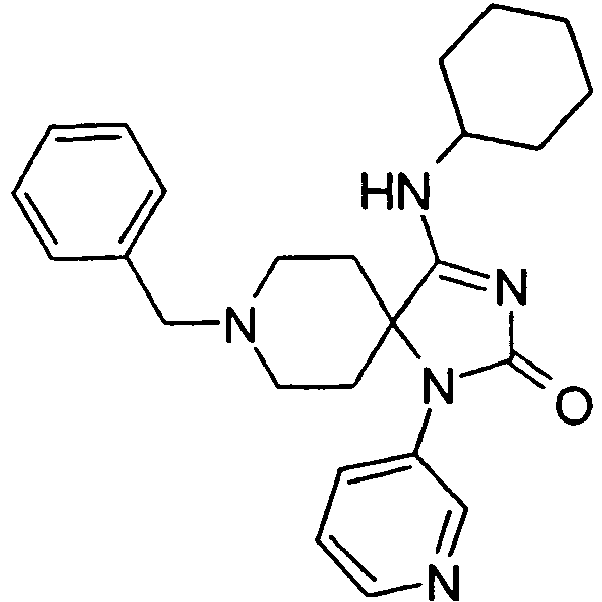
8-benzyl-4-(cyclohexylamino)-1-(3-pyridyl)-1,3,8-triazaspiro[4.5]dec-3-en-2-one 418.1 3-13 
8-benzyl-4-(butylamino)-1-phenyl-1,3,8-triazaspiro[4.5]dec-3-en-2-one 388.2 3-14 
8-benzyl-4-(cymohexylmxino)-1-(3,5-dimethylphenyl)-1,3,8-triazaspiro[4.5]dec-3-en-2-one 445.2 3-15 
8-benzyl-4-(1-methylbutylamino)-1-phenyl-1,3,8-triazaspiro[4.5]dec-3-en-2-one 405.2 3-16 
8-benzyl-4-(cyclohexylamino)-1-(4-chlorophenyl)-1,3,8-triazaspiro[4.5]dec-3-en-2-one 451.1 3-17 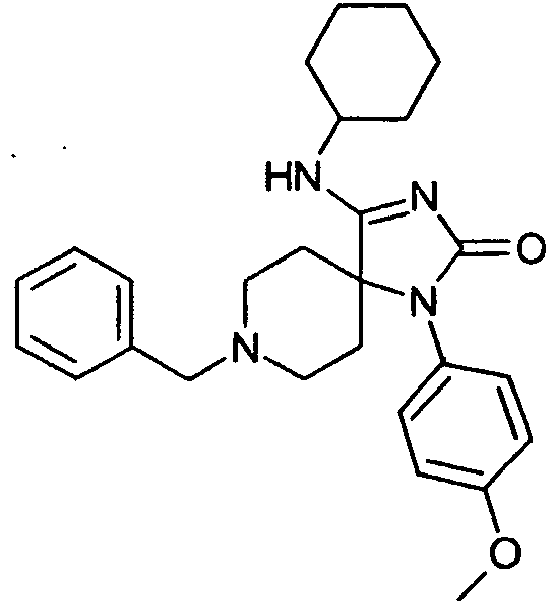
8-benzyl-4-(cyclohexylamino)-1-(4-methoxyphenyl)-1,3,8-triazaspiro[4.5]dec-3-en-2-one 447.2 3-18 
8-benzyl-4-(cyclohexylamino)-1-(4-methoxy-3-fluorophenyl)-1,3,8-triazaspiro[4.5]dec-3-en-2-one 465.1 3-19 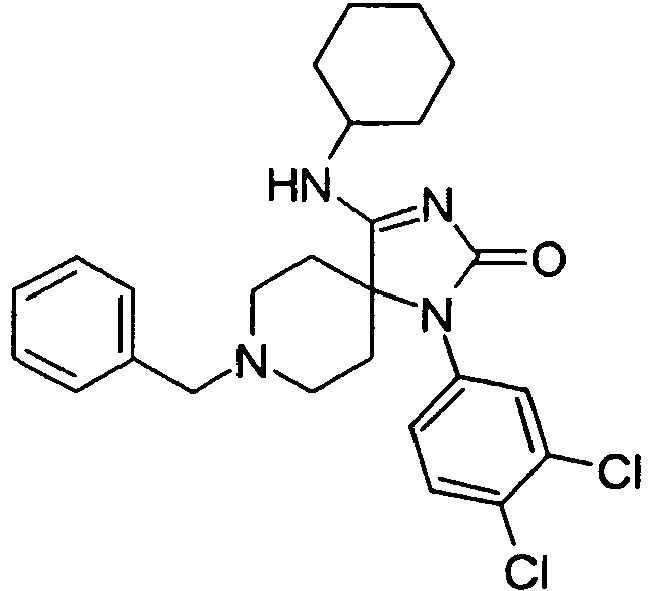
8-benzyl-4-(cyclohexylamino)-1-(3,4-difluorophenyl)-1,3,8-triazaspiro[4.5]dec-3-en-2-one 485.1 3-20 
8-benzyl-4-(cyclohexylamino)-1-(3-trifluoromethylphenyl)-1,3,8-triazaspiro[4.5]dec-3-en-2-one 485.2 3-23 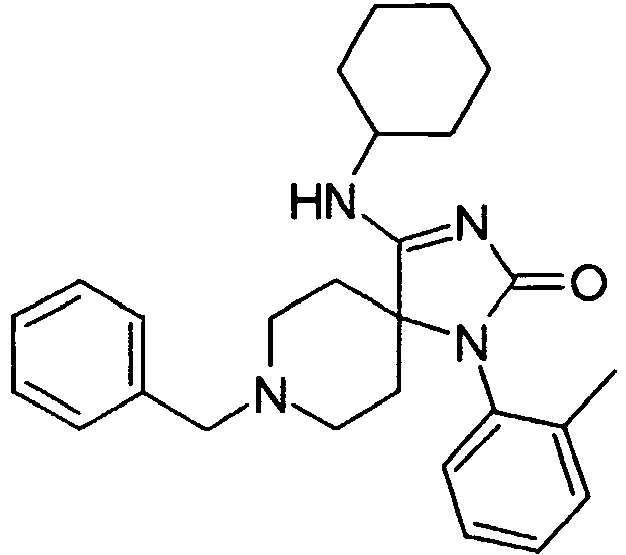
8-benzyl-4-(cyclohexylamino)-1-(2-methylphenyl)-1,3,8-triazaspiro[4.5]dec-3-en-2-one 431.2 3-24 
8-benzyl-4-(cyclohexylamino)- 1 -(3-methoxyphenyl)-1,3,8-triazaspiro[4.5]dec-3-en-2-one 447.3 3-25 
8-benzyl-4-(cyclohexylamino)-1-(3,4-dichlorophenyl)-1,3,8-triazaspiro[4.5]dec-3-en-2-one 453.2 3-26 
8-benzyl-4-(cyclohexylamino)-1-(4-trifluoromethylphenyl)-1,3,8-triazaspiro[4.5]dec-3-en-2-one 485.2 3-27 
8-benzyl-4-(cyclohexylamino)-1-(3-chlorophenyl)-1,3,8-triazaspiro[4.5]dec-3-en-2-one 451.2 3-28 
8-benzyl-4-(cyclohexylamino)-1-(2-chlorophenyl)-1,3,8-triazaspiro[4.5]dec-3-en-2-one 451.2 3-29 
8-benzyl-4-(cyclohexylamino)-1-(2,4-dichlorophenyl)-1,3,8-triazaspiro[4.5]dec-3-en-2-one 485.1 3-30 
8-benzyl-4-(cyclohexylamino)-1-(3-cyanophenyl)-1,3,8-triazaspiro[4.5]dec-3-en-2-one 442.3 3-31 
8-benzyl-4-(cyclohexylamino)-1-(2-trifluoromethyl-4-methoxyphenyl)-1,3,8-triazaspiro[4.5]dec-3-en-2-one 515.2 3-32 
8-benzyl-4-(cyclohexylamino)-1-(2-methyl-4-methoxyphenyl)-1,3,8-triazaspiro[4.5]dec-3-en-2-one 461.2 3-33 
8-benzyl-4-(cyclohexylamino)-1-(1,3-benzodioxo-5-yl)-1,3,8-triazaspiro[4.5]dec-3-en-2-one 461.2 3-34 
8-benzyl-4-(cyclohexylamino)-1-(4-acetylaminophenyl)-1,3,8-triazaspiro[4.5]dec-3-en-2-one 474.2 3-35 
8-benzyl-4-(cyclohexylamino)-1-(3,5-difluorophenyl)-1,3,8-triazaspiro[4.5]dec-3-en-2-one 453.2 3-36 
8-benzyl-4-((2-phenethyl)amino)-1-(3-fluorophenyl)-1,3,8-triazaspiro[4.5]dec-3-en-2-one 457.2 3-37 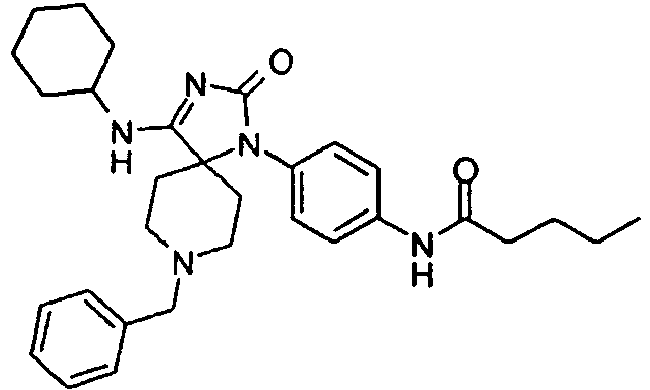
8-benzyl-4-(cyclohexylamino)-1-(4-pentanoylaminophenyl)-1,3,8-triazaspiro[4.5]dec-3-en-2-one 516.3 3-38 
8-benzyl-4-(cyclohexylamino)-1-(4-(4-dimethylamino)butanoylaminophenyl )-1,3,8-triazaspiro[4.5]dec-3-en-2-one 545.4 3-39 
N-{4-[8-benzyl-4-(cyclohexylamino)-2-oxo-1,3,8-triazaspiro[4.5]dec-3-en-1-yl]phenyl}butanamide 502.4 3-40 
N-{4-[8-benzyl-4-(cyclohexylamino)-2-oxo-1,3,8-triazaspiro[4.5]dec-3-en-1-yl]phenyl}-3-hydroxypropanamide 504.3 3-42 
ethyl N-[8-benzyl-1-(3-fluorophenyl)-2-oxo-1,3,8-triazaspiro[4.5]dec-3-en-4-yl]-beta-alaninate 453.3 3-43 
8-benzyl-4-(cyclohexylamino)-1-[3'-(methylsulfonyl)biphenyl-2-yl]-1,3,8-triazaspiro[4.5]dec-3-en-2-one 571.3 3-44 
8-benzyl-4-(isopropylamino)-1-phenyl-1,3,8-triazaspiro[4.5]dec-3-en-2-one 395.2 3-46 
N-{4-[8-benzyl-4-(cyclohexylamino)-2-oxo-1,3,8-triazaspiro[4.5]dec-3-en-1-yl]-2-chlorophenyl}acetamide 510.0 - Scheme 5 depicts a method for synthesizing compounds with alternative R3 groups, such as Example (5-3) below (Example (5-3) is depicted in enamine form, but may also exist in tautomeric imine form).

-

- To a 10 mL MeOH suspension of 4.05g (20.3 mmol) N-boc piperidinone and 2.11g (19.3 mmol) cyclohexyl isocyanide was added a solution of 2.06g (25.4 mmol) potassium isocyanate in 2.8 mL H2O in one portion with stirring followed by 3.0g (20.3mmol) 3-fluoroaniline hydrochloride in portions over 5m. After stirring for 2h the reaction was treated with 250 ml CH2Cl2. The organic layer was washed with water (2x50 ml), brine (1x50 ml), dried over Na2SO4, filtered and concentrated to dryness in vacuo to give a crude oil (9.68 g). Purification by automated flash chromatography (0-5.5% MeOH in CH2Cl2 over 28m) afforded tert-butyl 4-(cyclohexylamino)-1-(3-fluorophenyl)-2-oxo-1,3,8-triazaspiro[4.5]dec-3-ene-8-carboxylate as a white solid. 1H NMR (CDCl3, 400MHz): δ 7.41 (m, 1H), 7.11 (m, 1H), 7.05 (d, J = 7.88 Hz, 1H), 6.99 (m, 1H), 5.40 (br s, 1H), 4.02 (m, 1H), 3.58 (m, 2H), 3.27 (m, 2H), 2.05 (m, 4H), 1.92 (m, 2H), 1.71 (m, 4H), 1.44 (m, 12H), 1.24 (m, 2H). Electrospray mass spectrum: M+H = 445.2
- To a suspension of 2.74g (6.16 mmol) tert-butyl 4-(cyclohexylamino)-1-(3-fluorophenyl)-2-oxo-1,3,8-triazaspiro[4.5]dec-3-ene-8-carboxylate in 50 mL EtOAc at 0 °C was bubbled in HCl gas until the solvent was saturated. The reaction was stirred in the cold for 30m and concentrated in vacuo. The solid residue was reconcentrated to dryness (2x ethyl ether) and dried under high vacuum to give 4-(cyclohexylamino)-1-(3-fluorophenyl)-2-oxo-1,3-triazaspiro[4.5]dec-3-ene as its dihydrochloride salt as a fine white solid.
1H NMR (DMSO, 400MHz): δ 10.73 (br s, 1H), 9.58 (br s,1H), 9.21 (s, 1H), 8.36 (br s, 1H), 7.46 (m, 4H), 3.82 (br m, 1H), 3.36 (br s, 2H), 2.92 (br s, 2H), 2.55 (m, 2H), 2.33 (br m, 2H), 1.87 (br s, 2H), 1.75 (br s, 2H), 1.52 (br m, 3H), 1.29 (br m, 2H), 1.16 (m, 1H). Electrospray mass spectrum: M+H = 345.2 - To a suspension of 600 mg (1.44 mmol) 4-(cyclohexylammonio)-1-(3-fluorophenyl)-2-oxo-1,3-diaza-8-azoniaspiro[4.5]dec-3-ene dihydrochloride, 376µL (2.16 mmol) diisopropylethylamine, and 427 mg (2.01 mmol) triacetoxy sodium borohydride in 20 mL DCE was added dropwise a 4mL DCE solution of 251 µL (2.16 mmol) 3-bromobenzaldehyde and the resulting heterogeneous mixture was stirred at rt overnight under a nitrogen atmosphere. The reaction mixture was treated with 50mL CH2Cl2 and washed with 20mL saturated NaHCO3 (aq), 20mL brine, dried over Na2SO4, filtered, and concentrated in vacuo. Purification by automated flash chromatography (0-5% MeOH in CH2Cl2 over 25m) afforded the product as a white solid. 1H NMR (CDCl3, 400 MHz): δ 7.75 (d, J= 8.15 Hz, 1H), 7.45 (m, 2H), 7.36 (m, 1H), 7.22 (m, 1H), 7.15 (d, J = 7.69 Hz, 1H), 7.02 (m, 3H), 3.97 (m, 1H), 3.50 (s, 2H), 2.76 (m, 2H), 2.43 (m, 2H), 2.09 (m, 4H), 1.95 (m, 2H), 1.75 (m, 2H), 1.68 (m, 1H), 1.41 (m, 2H), 1.23 (m, 3H). High resolution mass spec (FT/ICR): calc M+H = 513.1660, found 513.1697
-

-
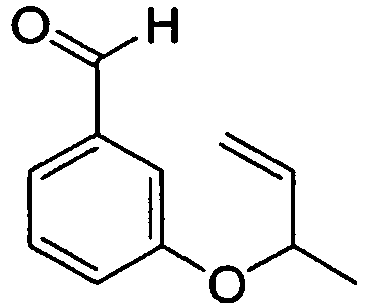
- Added DEAD (0.964 mL, 6.142 mmole) dropwise to a solution of triphenylphosphine (0.1.611 g, 6.142 mmole), 3-buten-2-ol (Fluka, 0.423 mL, 4.91 mmole), and 3-hydroxy benzaldehyde (0.5g, 4.09 mmole) in 10 mL dry THF, at rt, under Argon. After 10 min, the reaction was concentrated in vacuo and was purified on a 35g Redisep column eluting with a gradient of 5%-30% EtOAc in hexanes.
- The compound was prepared as described for Example (5-3) using the above aldehyde.
1H NMR (CDCl3, 400 Mh), δ 8.07 (d, J=7.9 Hz, 1H); 7.34 (m, 1H); 7.23 (t, J=8.24, 8.06 Hz, 1H); 7.00 (m, 3H); 6.84 (m, 3H); 5.89 (ddd, J=6.4, 5.9, 11.0, 21.9 Hz, 1H); 5.25 (dd, J=1.1, 17.4 Hz, 1H); 5.17 (d, J=10.6 Hz, 1H); 4.80 (m, 1H); 3.95 (m, 1H); 3.49 (s, 2H); 2.78 (m, 2H); 2.44 (m, 2H); 2.12 (m, 2H); 2.07 (m, 2H); 1.94 (m, 2H); 1.74 (m, 2H); 1.67 (m, 2H); 1.43 (d, J=6.5 Hz, 3H); 1.39 (m, 1H); 1.22 (m, 3H). Mass spec (m+1) = 505. -

-

- This method of alkylation is similar to that described in J Med Chem (2002), 45(18), 3891-3904. Dissolved 3-Hydroxy benzaldehyde (0.500g, 4.094 mmole) in 10 mL EtOH at rt, under Argon, and magnetically stirred. Added K2CO3. (1.132g, 8.189mmole), then 2-iodopropane (0.819 mL, 8.819 mmole). Warmed to 60°C. After 18 hr, added a second equivalent of alkyl iodide of (0.819 mL, 8.189 mmole) and continued heating at 60°C. After 4 hr, cooled to rt and concentrated in vacuo. Partitioned residue between EtOAc, and H2O. Washed organic layer with 1 M NaOH, 2x 20mL , dried organic layer over MgSO4, filtered and concentrated in vacuo to give the aldehyde.
- Suspended 4-(cyclohexylamino)-1-(3-fluorophenyl)-2-oxo-1,3-triazaspiro[4.5]dec-3-ene dihydrochloride salt (5-2, 0.500g, 1.198 mMole) and 3-isopropoxyaldehyde (0.197g, 1.198 mmole)in 5 mL of CHCl3. Added Hunigs Base (0.313 mL, 1.795 mmole). Let stir for 0.5 hr, then added cyanoborohydride silica bound (1 mmole/g, 1.318g, 1.318mmole) (Aldrich), then 0.034mL HOAc. Let sit for 1 hr, then heated in microwave for 20 min at 150°C. Filtered off silica gel and concentrated in vacuo. Purified using a Redisep 40g silica gel column eluting with 0-5% methanol / CH2Cl2 saturated with NH3 and collected impure product as a solid. Rinsed solid with EtOAc, and collected purified solids to give product.
1H NMR (CDCl3, 400 Mh), δ 8.11 (d, J=7.4 Hz, 1H); 7.40 (m, 1H); 7.24 (m, 1H); 7.02 (m, 3H); 6.80 (m, 3H); 4.55 (quintet, J=6.04Hz, 1H); 3.98 (m, 1H); 3.50 (s, 2H); 2.79 (m, 2H); 2.43 (m, 2H); 2.10 (m, 2H); 2.02 (m, 2H); 1.97 (m, 2H); 1.74 (m, 2H); 1.64 (m, 2H); 1.38 (m, 1H); 1.33(d, J=6.0 Hz, 6H); 1.23 (m, 3H).
Mass Spec (m+1) = 493. - Scheme 6 depicts a method for preparing compounds wherein R1 is methyl, such as Examples (6-3) - (6-6) below. Examples (6-3)-(6-6) are depicted in enamine form, but may also exist in tautomeric imine form as described above.

-

- Intermediate 6-1 was prepared in the same manner as Intermediate 5-1 above.
- To a 50 ml THF solution of 1.04g (2.41 mmol) tert-butyl 1-(3-fluorophenyl)-2-oxo-4-{[(trimethylsilyl)methyl]amino}-1,3,8-triazaspiro[4.5]dec-3-ene-8-carboxylate (prepared in the same manner as Intermediate 5-1 above) was added 3.61mL (3.61 mmol) of a 1.0M tetrabutylammonium fluoride in THF solution over 5m and the reaction warmed to 60 °C overnight. The reaction was concentrated to dryness in vacuo and the residue treated with 100mL CH2Cl2. The organic layer was washed with water (1x25mL), brine (1x25mL), dried over Na2SO4, filtered and concentrated to dryness in vacuo to give a crude oil (1.6 g). Purification by flash chromatography (0-7.5% MeOH in CH2Cl2 over 25 m) afforded tert-butyl 1-(3-fluorophenyl)-4-(methylamino)-2-oxo-1,3,8-triazaspiro[4.5]dec-3-ene-8-carboxylate 6-2 as a white solid. 1H NMR (CDCl3, 400MHz) δ 7.39 (m, 1H), 7.12 (m, 1H), 7.03 (d, J = 7.95 Hz, 1H), 6.97 (m, 1H), 5.70 (br s, 1H), 3.54 (m, 2H), 3.11 (d, J = 4.76 Hz, 3H), 2.02 (m, 2H), 1.92 (m, 2H), 1.42 (s, 9H). High resolution mass spec (FT/ICR): calc M+H = 377.1984, found 377.2010
- 4-methyl-1-(3-fluorophenyl)-2-oxo-1,3,8-triazaspiro[4.5]dec-3-ene (6-3) was prepared in analogy to Intermediate 5-2 and the following examples in Table 2 and their pharmaceutically acceptable salts were prepared according to Scheme 6 and in analogy to Intermediate 5-3.
Table 2 - Compounds (or salts thereof) Synthesized According to a manner similar to that described in Scheme 6 EX Structure Chemical Name Mass spec 6-4 
1-(3-fluorophenyl)-4-(methylamino)-8-[(2'-methylbiphenyl-3-yl)methyl]-1,3,8-triazaspiro[4.5]dec-3-en-2-one 457.2 6-5 
8-benzyl-1-(3-fluorophenyl)-4-(methylamino)-1,3,8-triazaspiro[4.5]dec-3-en-2-one 367.1 6-6 
N-(4-{[1-(3-fluorophenyl)-4-(methylamino)-2-oxo-1,3,8-triazaspiro[4.5]dec-3-en-8-yl]methyl}phenyl)acetamide 424.2 - Scheme 7 demonstrates another method for preparing compounds with alternate R3 groups (such as Example (7-2) and (7-3). Example (7-2) and (7-3) are depicted in enamine form but may also exist in tautomeric imine form.

-

- To a solution of 0.020g (0.039mmol) 8-(3-bromobenzyl)-4-(cyclohexylamino)-1-(3-fluorophenyl)-1,3,8-triazaspiro[4.5]dec-3-en-2-one (5-3) in 0.5 mL degassed DMF:H2O (4:1) was added 0.006 g (0.039mmol) (2-vinylphenyl) boronic acid and 0.003g (0.006mmol) 3,3',3"-Phosphinidynetris(benzene sulfonic acid) and 0.001g (0.002mmol) palladium II acetate and 16µL (.117mmol) diisopropylamine. The reaction was heated in the microwave at 100 °C for 10 mins. Purification by preparative HPLC (5-95% CH3CN/H2O over 30min, 0.05% added TFA, C18 PRO YMC 20x150 mm) afforded 4-(cyclohexylamino)-1-(3-fluorophenyl)-8-[(2'-vinyl-1,1'-biphenyl-3-yl)methyl]-1,3,8-triazaspiro[4.5]dec-3-en-2-one as a white solid. NMR 1H NMR (CD3OD) δ 7.65 (dd, J= 6.8 Hz, 2.2 Hz, 1H), 7.43 (dt, J= 7.96 Hz, 6.32 Hz, 1H), 7.34(m, 3H) 7.17 (m, 7H), 6.61 (dd, J= 17.49 Hz, 10.99 Hz, 1H), 5.70 (d, J= 17.58, 1H), 5.15 (d, J = 10.99 Hz, 1H), 3.75 (m, 1H), 3.46 (s, 1H), 2.78 (m, 2H), 2.14 (m, 6H), 1.93 (m, 2H), 1.74 (m, 2H), 1.63 (m, 1H), 1.34 (m, 4H), 1.17 (m, 1H). High resolution mass spec (FT/ICR) calc M+H=537.3024 found 537.3038.
-

-

- To a solution of 3.0g (7.188mmol) 4-(cyclohexylamino)-1-(3-fluorophenyl)-2-oxo-1,3-diaza-8-azoniaspiro[4.5]dec-3-ene dihydrochloride in 30 mL THF:AcOH (9:1) was added 1.8 g (12.005mmol) 3-formylphenylboronic acid and 5.53g (21.567mmol) PS-DIEA resin and 5.97g (14.388mmol) MP-cyanoborohydride resin. The heterogeneous reaction mixture was stirred at rt for 24 hrs, then filtered, washed with 100mL methanol, and concentrated. Purification by automated flash chromatography (8-30% CH3CN/H2O over 41 min, 0.05% added TFA reverse phase YMC ODSA 120Å, 15-30µM particle size,) afforded 3-{[4-(cyclohexylamino)-1-(3-fluorophenyl)-2-oxo-1,3,8-triazaspiro[4.5]dec-3-en-8-yl]methyl}phenylboronic acid as a solid. 1H NMR (CD3OD, 400MHz) δ 7.44 (m, 1H), 7.38 (d, J=7.32 Hz, 1H), 7.29 (s, 1H), 7.18 (m, 1H), 7.09 (m, 3H) 6.93 (m, 1H), 3.75 (m, 1H), 3.31 (s, 2H), 2.78 (m, 2H), 2.12 (m, 4H), 1.97 (m, 4H), 1.78 (m, 2H), 1.65 (m, 1H), 1.35 (m, 5H). High resolution mass spec (FT/ICR) calc M+H=478.2661 found 478.2709.
- To a solution of 0.100g (0.209mmol) 3-{[4-(cyclohexylamino)-1-(3-fluorophenyl)-2-oxo-1,3,8-triazaspiro[4.5]dec-3-en-8-yl]methyl}phenylboronic acid (7-1) in 1 mL CH3CN:H2O was added 0.030 g (0.174mmol) 3-bromo-4-methylpyridine and 0.007g (0.011mmol) Tris(4,6-dimethyl-3sulfanatophenyl)phosphine and 0.001g (0.004mmol) palladium II acetate and 0.037g (0.349mmol) sodium carbonate. The reaction was heated in the microwave at 120 °C for 20 mins. Purification by preparative HPLC (5-95% CH3CN/H2O over 30min, 0.05% added TFA, C18 PRO YMC 20x150 mm) afforded 4-(cyclohexylamino)-1-(3-fluorophenyl)-8-[3-(4-methylpyridin-3-yl)benzyl]-1,3,8-triazaspiro[4.5]dec-3-en-2-one as a white solid. NMR 1H NMR (CD3OD) δ 8.37 (d, J= 5.04 Hz, 1H), 8.29 (s, 1H), 7.42 (m, 3H) 7.19 (m, 6H), 3.76 (m, 1H), 3.47 (s, 2H), 2.77 (m, 2H), 2.29 (s, 3H), 2.14 (m, 6H), 1.95 (m, 2H), 1.77 (m, 2H), 1.66 (m, 1H), 1.36 (m, 4H), 1.18 (m, 1H). High resolution mass spec (FT/ICR) calc M+H=526.2977 found 526.3012.
- Examples (7-4)- (7-109) listed below in Table 3 were prepared in a manner similar to that described in Schemes 3, 5 and 7. Examples (7-4) - (7-109) and their pharmaceutically acceptable salts are depicted in enamine form, but may also exist in tautomeric imine form.
Table 3- Compounds (or salts thereof) Synthesized According to Schemes 5 and 7, using methods similar to that described for Examples (5-3) - (5-5) and (7-2) - (7-3). EX Structure Chemical Name Mass spec 7-4 
8-benzyl-4-(cyclohexylamino)-1-(3-fluorophenyl)-1,3,8-triazaspiro[4.5]dec-3-en-2-one 435.2 7-5 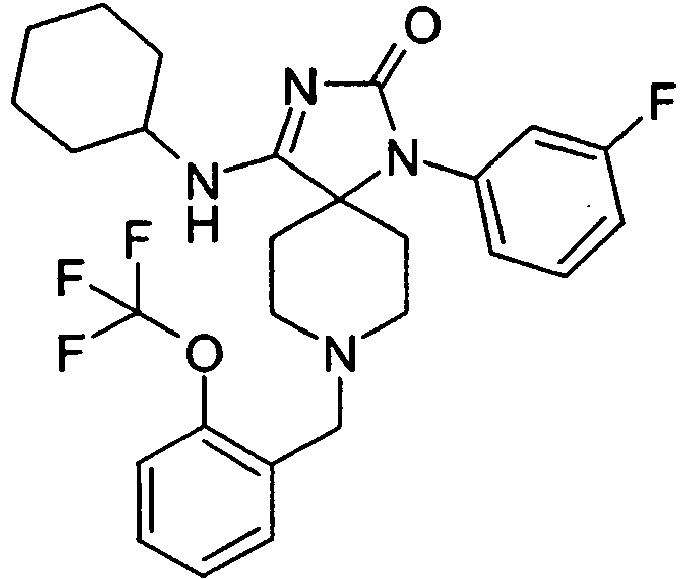
8-(2-trifluoromethoxybenzyl)-4-(cyclohexylamino)-1-(3-fluorophenyl)-1,3,8-triazaspiro[4.5]dec-3-en-2-one 519.2 7-6 
4-(cyclohexylamino)-8-[2-(difluoromethoxy)benzyl]-1-(3-fluorophenyl)-1,3,8-triazaspiro[4.5]dec-3-en-2-one 501.2 7-7 
8-[2-(tert-butylthio)benzyl]-4-(cyclohexylamino)-1-(3-fluorophenyl)-1,3,8-triazaspiro[4.5]dec-3-en-2-one 523.2 7-8 
8-[2-methylbenzyl]-4-(cyclohexylamino)-1-(3-fluorophenyl)-1,3,8-triazaspiro[4.5]dec-3-en-2-one 449.2 7-9 
8-[2-nitrobenzyl]-4-(cyclohexylamino)-1-(3-fluorophenyl)-1,3,8-triazaspiro[4.5]dec-3-en-2-one 480.2 7-10 
N-(4-{[4-(cyclohexylamino)-1-(3-fluorophenyl)-2-oxo-1,3,8-triazaspiro[4.5]dec-3-en-8-yl]methyl}phenyl)acetamide 492.3 7-11 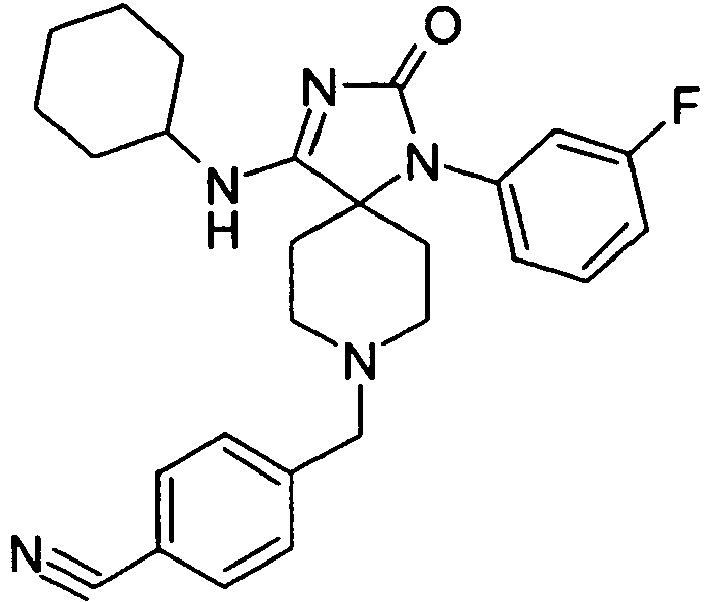
8-[4-cyanobenzyl]-4-(cyclohexylamino)-1-(3-fluorophenyl)-1,3,8-triazaspiro[4.5]dec-3-en-2-one 460.2 7-12 
8-[3-cyanobenzyl]-4-(cyclohexylamino)-1-(3-fluorophenyl)-1,3,8-triazaspiro[4.5]dec-3-en-2-one 460.2 7-13 
8-[2-propoxybenzyl]-4-(cyclohexylamino)-1-(3-fluorophenyl)-1,3,8-triazaspiro[4.5]dec-3-en-2-one 493.2 7-14 
8-[3-phenylpropyl]-4-(cyclohexylamino)-1-(3-fluorophenyl)-1,3,8-triazaspiro[4.5]dec-3-en-2-one 463.3 7-15 
8-[3-fluorobenzyl]-4-(cyclohexylamino)-1-(3-fluorophenyl)-1,3,8-triazaspiro[4.5]dec-3-en-2-one 453.3 7-16 
8-[2-cyanobenzyl]-4-(cyclohexylamino)-1-(3-fluorophenyl)-1,3,8-triazaspiro[4.5]dec-3-en-2-one 460.2 7-17 
4-(cyclohexylamino)-1-(3-fluorophenyl)-8-(2-thienylmethyl)-1,3,8-triazaspiro[4.5]dec-3-en-2-one 441.2 7-18 
4-(cyclohexylamino)-1-(3-fluorophenyl)-8-(1-phenylethyl)-1,3,8-triazaspiro[4.5]dec-3-en-2-one 449.2 7-19 
8-[(2-benzyl-1H-indol-7-yl)methyl]-4-(cyclohexylamino)-1-(3-fluorophenyl)-1,3,8-triazaspiro[4.5]dec-3-en-2-one 564.3 7-20 
8-[(2-benzyl-2,3-dihydro-1H-indol-7-yl)methyl]-4-(cyclohexylamino)-1-(3-fluorophenyl)-1,3,8-triazaspiro[4.5]dec-3-en-2-one 566.3 7-21 
4-(cyclohexylamino)-1-(3-fluorophenyl)-8-(1H-pyrrol-2-ylmethyl)-1,3,8-triazaspiro[4.5]dec-3-en-2-one 424.2 7-22 
4-(cyclohexylamino)-1-(3-fluorophenyl)-8-(1H-indol-2-ylmethyl)-1,3,8-triazaspiro[4.5]dec-3-en-2-one 474.2 7-23 
8-[(3-aminopyridin-4-yl)methyl]-4-(cyclohexylamino)-1-(3-fluorophenyl)-1,3,8-triazaspiro[4.5]dec-3-en-2-one 451.2 7-24 
4-(cyclohexylamino)-1-(3-fluorophenyl)-8-(quinolin-6-ylmethyl)-1,3,8-triazaspiro[4.5]dec-3-en-2-one 486.2 7-25 
4-(cyclohexylamino)-1-(3-fluorophenyl)-8-(1,2,3,4-tetrahydroquinolin-6-ylmethyl)-1,3,8-triazaspiro[4.5]dec-3-en-2-one 490.3 7-26 
4-(cyclohexylamino)-1-(3-fluorophenyl)-8-(1H-indol-7-ylmethyl)-1,3,8-triazaspiro[4.5]dec-3-en-2-one 474.2 7-27 
8-[(2-aminopyridin-3-yl)methyl]-4-(cyclohexylamino)-1-(3-fluorophenyl)-1,3,8-triazaspiro[4.5]dec-3-en-2-one 451.2 7-28 
4-(cyclohexylamino)-1-(3-fluorophenyl)-8-(1H-indol-5-ylmethyl)-1,3,8-triazaspiro[4.5]dec-3-en-2-one 474.2 7-30 
4-(cyclohexylamino)-8-(2,3-dihydro-1H-indol-5-ylmethyl)-1-(3-fluorophenyl)-1,3,8-triazaspiro[4.5]dec-3-en-2-one 476.2 7-31 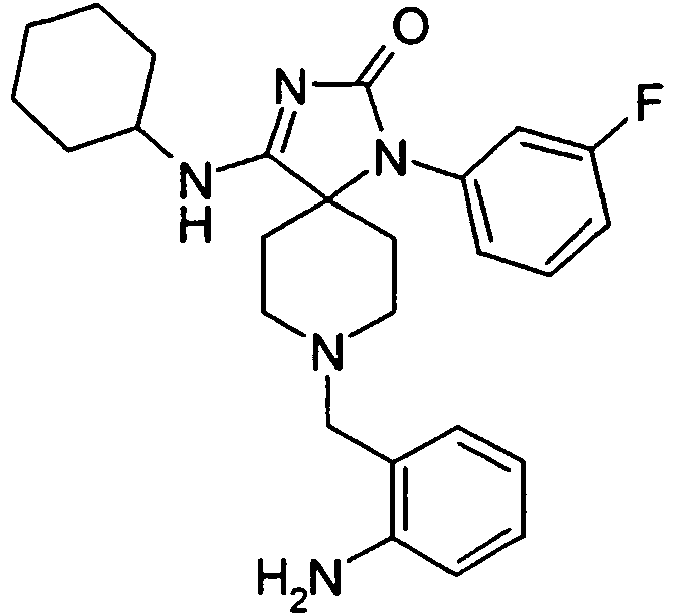
8-(2-aminobenzyl)-4-(cyclohexylamino)-1-(3-fluorophenyl)-1,3,8-triazaspiro[4.5]dec-3-en-2-one 450.2 7-32 
4-(cyclohexylamino)-8-(2,3-dihydro-1H-indol-7-ylmethyl)-1-(3-fluorophenyl)-1,3,8-triazaspiro[4.5]dec-3-en-2-one 476.2 7-33 
4-(cyclohexylamino)-8-(2,3-dihydro-1H-inden-2-yl)-1-(3-fluorophenyl)-1,3,8-triazaspiro[4.5]dec-3-en-2-one 461.2 7-34 
4-(cyclohexylamino)-1-(3-fluorophenyl)-8-(3-phenylcyclohexyl)-1,3,8-triazaspiro[4.5]dec-3-en-2-one 503.4 7-35 
4-(cyclohexylamino)-1-(3-fluorophenyl)-8-(1-phenyl-2,3-dihydro-1H-inden-2-yl)-1,3,8-triazaspiro[4.5]dec-3-en-2-one 537.3 7-36 
4-(cyclohexylamino)-1-(3-fluorophenyl)-8-(3-phenylcyclohexyl)-1,3,8-triazaspiro[4.5]dec-3-en-2-one 503.3 7-37 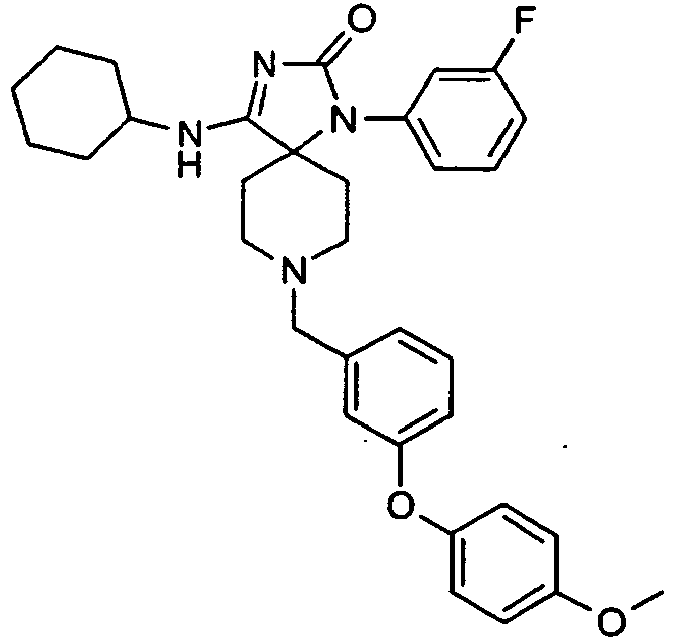
4-(cyclohexylamino)-1-(3-fluorophenyl)-8-[3-(4-methoxyphenoxy)benzyl]-1,3,8-triazaspiro[4.5]dec-3-en-2-one 557.2942 7-38 
4-(cyclohexylamino)-1-(3-fluorophenyl)-8-{4-[(4-methoxybenzyl)oxy]benzyl}-1,3,8-triazaspiro[4.5]dec-3-en-2-one 571.3099 7-39 
8-(biphenyl-3-ylmethyl)-4-(cyclohexylamino)-l -(3-fluorophenyl)-1,3,8-triazaspiro[4.5]dec-3-en-2-one 511.2866 7-40 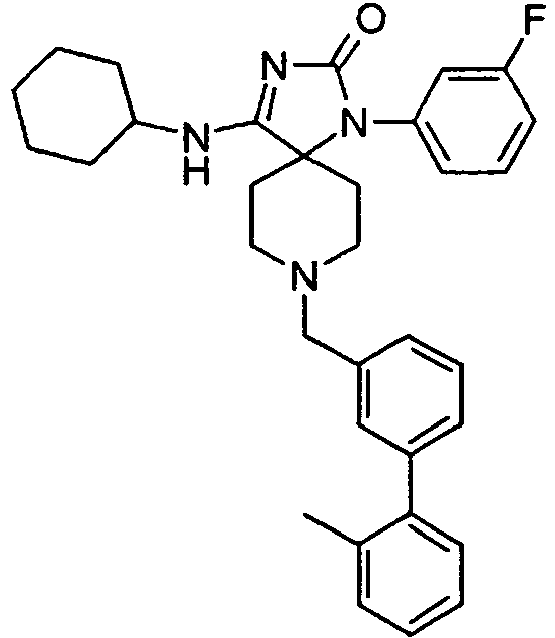
4-(cyclohexylamino)-1-(3-fluorophenyl)-8-[(2'-methylbiphenyl-3-yl)methyl]-1,3,8-triazaspiro[4.5]dec-3-en-2-one 525.3 7-41 
8-(3-chlorobenzyl)-4-(cyclohexylamino)-1-(3-fluorophenyl)-1,3,8-triazaspiro[4.5]dec-3-en-2-one 469.2 7-42 
4-(cyclohexylamino)-1-(3-fluorophenyl)-8-(3-methylbenzyl)-1,3,8-triazaspiro[4.5]dec-3-en-2-one 449.2 7-43 
4-(cyclohexylamino)-1-(3-fluorophenyl)-8-[3-(trifluoromethyl)benzyl]-1,3,8-triazaspiro[4.5]dec-3-en-2-one 503.3 7-44 
4-(cyclohexylamino)-1-(3-fluorophenyl)-8-(3-vinylbenzyl)-1,3,8-triazaspiro[4.5]dec-3-en-2-one 461.2 7-45 
methyl 3-{[4-(cyclohexylamino)-1-(3-fluorophenyl)-2-oxo-1,3,8-triazaspiro[4.5]dec-3-en-8-yl]methyl}benzoate 493.2 7-46 
4-(cyclohexylamino)-1-(3-fluorophenyl)-8-(3-hydroxybenzyl)-1,3,8-triazaspiro[4.5]dec-3-en-2-one 451.2 7-47 
4-(cyclohexylamino)-1-(3-fluorophenyl)-8-(3-methoxybenzyl)-1,3,8-triazaspiro[4.5]dec-3-en-2-one 465.2 7-48 
4-(cyclohexylamino)-8-(3-ethoxybenzyl)-1-(3-fluorophenyl)-1,3,8-triazaspiro[4.5]dec-3-en-2-one 479.2 7-49 
4-(cyclohexylamino)-8-[3-(cyclopentyloxy)benzyl]-1-(3-fluorophenyl)-1,3,8-triazaspiro[4.5]dec-3-en-2-one 519.3 7-50 
4-(cyclohexylamino)-1-(3-fluorophenyl)-8-[3-(1,1,2,2-tetrafluoroethoxy)benzyl]-1,3,8-triazaspiro[4.5]dec-3-en-2-one 551.2 7-51 
4-(cyclohexylamino)-1-(3-fluorophenyl)-8-(3-phenoxybenzyl)-1,3,8-triazaspiro[4.5]dec-3-en-2-one 527.2 7-52 
8-[3-(4-tert-butylphenoxy)benzyl]-4-(cyclohexylamino)-1-(3-fluorophenyl)-1,3,8-triazaspiro[4.5]dec-3-en-2-one 583.3 7-53 
4-(cyclohexylamino)-8-[3-(3,5-dichlorophenoxy)benzyl]-1-(3-fluorophenyl)-1,3,8-triazaspiro[4.5]dec-3-en-2-one 595.2 7-54 
8-[3-(benzyloxy)benzyl]-4-(cyclohexylamino)-1-(3-fluorophenyl)-1,3,8-triazaspiro[4.5]dec-3-en-2-one 541.3 7-55 
4-(cyclohexylamino)-1-(3-fluorophenyl)-8-(3-nitrobenzyl)-1,3,8-triazaspiro[4.5]dec-3-en-2-one 480.2 7-56 
3-{[4-(cyclohexylamino)-1-(3-fluorophenyl)-2-oxo-1,3,8-triazaspiro[4.5]dec-3-en-8-yl]methyl}phenyl acetate 493.2 7-57 
4-(cyclohexylamino)-1-(3-fluorophenyl)-8-[3-(2-methyl-1H-imidazol-1-yl)benzyl]-1,3,8-triazaspiro[4.5]dec-3-en-2-one 515.2 7-58 
4-(cyclohexylamino)-8-[3-(2-ethyl-1H-imidazol-1-yl)benzyl]-1-(3-fluorophenyl)-1,3,8-triazaspiro[4.5]dec-3-en-2-one 529.3 7-59 
3'-{[4-(cyclohexylamino)-1-(3-fluorophenyl)-2-oxo-1,3,8-triazaspiro[4.5]dec-3-en-8-yl]methyl}biphenyl-2-carbonitrile 536.3 7-60 
4-(cyclohexylamino)-8-[(2'-ethylbiphenyl-3-yl)methyl]-1-(3-fluorophenyl)-1,3,8-triazaspiro[4.5]dec-3-en-2-one 539.3 7-61 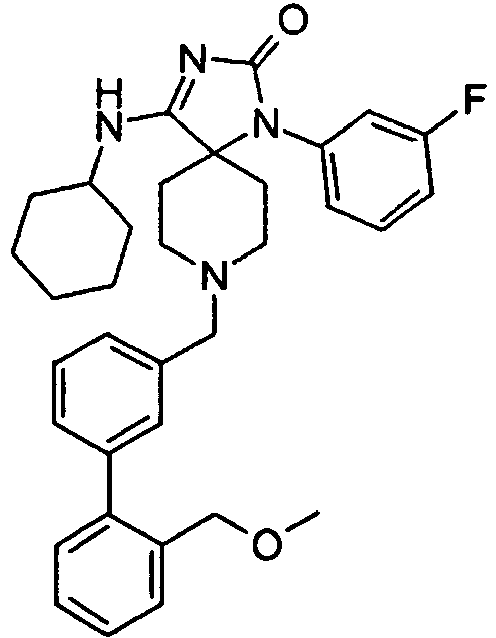
4-(cyclohexylamino)-1-(3-fluorophenyl)-8-{[2'-(methoxymethyl)biphenyl-3-yl]methyl}-1,3,8-triazaspiro[4.5]dec-3-en-2-one 555.3 7-62 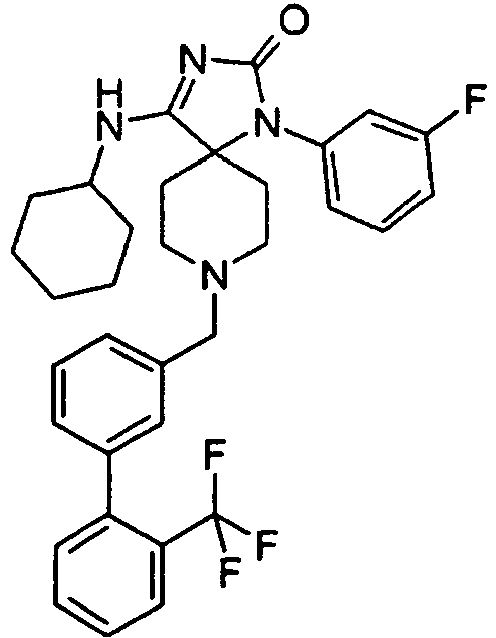
4-(cyclohexylamino)-1-(3-fluorophenyl)-8-{[2'-(trifluoromethyl)biphenyl-3-yl]methyl}-1,3,8-triazaspiro[4.5]dec-3-en-2-one 579.2 7-63 
4-(cyclohexylamino)-1-(3-fluorophenyl)-8-[(2'-vinylbiphenyl-3-yl)methyl]-1,3,8-triazaspiro[4.5]dec-3-en-2-one 537.3 7-64 
4-(cyclohexylamino)-1-(3-fluorophenyl)-8-[(2'-methoxybiphenyl-3-yl)methyl]-1,3,8-triazaspiro[4.5]dec-3-en-2-one 541.3 7-65 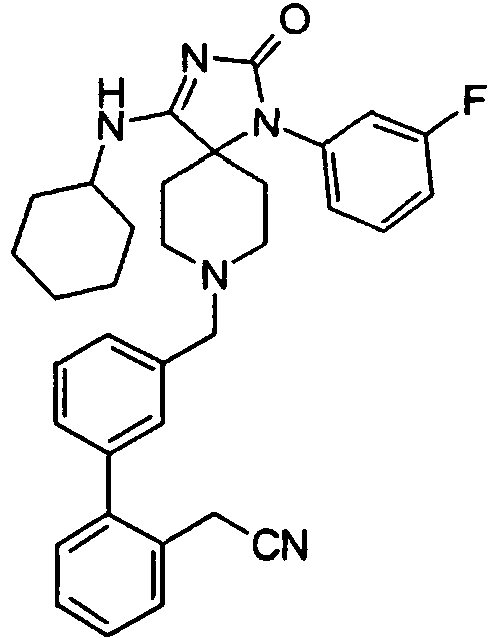
(3'-{[4-(cyclohexylamino)-1-(3-fluorophenyl)-2-oxo-1,3,8-triazaspiro[4.5]dec-3-en-8-yl]methyl}biphenyl-2-yl)acetonitrile 550.3 7-66 
4-(cyclohexylamino)-1-(3-fluorophenyl)-8-[3-(2-fluoropyridin-3-yl)benzyl]-1,3,8-triazaspiro[4.5]dec-3-en-2-one 530.2 7-67 
4-(cyclohexylamino)-1-(3-fluorophenyl)-8-[3-(3-methylpyridin-4-yl)benzyl]-1,3,8-triazaspiro[4.5]dec-3-en-2-one 526.2 7-68 
4-(cyclohexylamino)-1-(3-fluorophenyl)-8-[(4'-methylbiphenyl-3-yl)methyl]-1,3,8-triazaspiro[4.5]dec-3-en-2-one 525.3 7-69 
4-(cyclohexylamino)-1-(3-fluorophenyl)-8-[(3'-methylbiphenyl-3-yl)methyl]-1,3,8-triazaspiro[4.5]dec-3-en-2-one 525.3 7-70 
4-(cyclohexylamino)-8-{[6-(2-ethylphenyl)pyridin-2-yl]methyl}-1-(3-fluorophenyl)-1,3,8-triazaspiro[4.5]dec-3-en-2-one 540.3 7-71 
4-(cyclohexylamino)-8-[(2'-cyclopropylbiphenyl-3-yl)methyl]-1-(3-fluorophenyl)-1,3,8-triazaspiro[4.5]dec-3-en-2-one 551.3 7-72 
4-(cyclohexylamino)-1-(3-fluorophenyl)-8-[3-(5-methyl-2-furyl)benzyl]-1,3,8-triazaspiro[4.5]dec-3-en-2-one 515.2 7-73 
8-[(2'-allylbiphenyl-3-yl)methyl]-4-(cyclohexylamino)-1-(3-fluorophenyl)-1,3,8-triazaspiro[4.5]dec-3-en-2-one 551.3 7-74 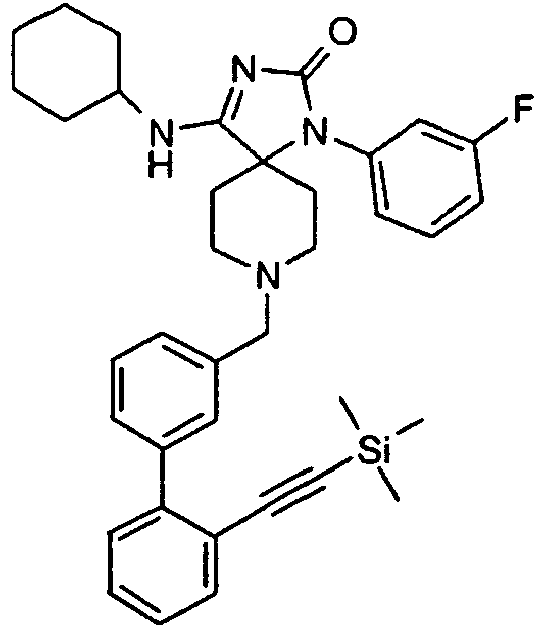
4-(cyclohexylamino)-1-(3-fluorophenyl)-8-({2'-[(trimethylsilyl)ethynyl]biphenyl-3-yl}methyl)-1,3,8-triazaspiro[4.5]dec-3-en-2-one 607.3 7-75 
4-(cyclohexylamino)-1-(3-fluorophenyl)-8-[3-(2-methylpyridin-3-yl)benzyl]-1,3,8-triazaspiro[4.5]dec-3-en-2-one 526.3 7-76 
4-(cyclohexylamino)-8-[3-(3,5-dimethylisoxazol-4-yl)benzyl]-1-(3-fluorophenyl)-1,3,8-triazaspiro[4.5]dec-3-en-2-one 530.3 7-77 
4-(cyclohexylamino)-8-[(2'-ethynylbiphenyl-3-yl)methyl]-1-(3-fluorophenyl)-1,3,8-triazaspiro[4.5]dec-3-en-2-one 535.2 7-78 
8-[(2'-but-3-en-1-ylbiphenyl-3-yl)methyl]-4-(cyclohexylamino)-1-(3-fluorophenyl)-1,3,8-triazaspiro[4.5]dec-3-en-2-one 565.3 7-79 
4-(cyclohexylamino)-1-(3-fluorophenyl)-8-[(2'-isopropylbiphenyl-3-yl)methyl]-1,3,8-triazaspiro[4.5]dec-3-en-2-one 553.3 7-80 
4-(cyclohexylamino)-1-(3-fluorophenyl)-8-[3-(3-methylpyridin-2-yl)benzyl]-1,3,8-triazaspiro[4.5]dec-3-en-2-one 526.3 7-81 
4-(cyclohexylamino)-1-(3-fluorophenyl)-8-[3-(1-methyl-1H-imidazol-2-yl)benzyl]-1,3,8-triazaspiro[4.5]dec-3-en-2-one 515.3 7-82 
4-(cyclohexylamino)-1-(3-fluorophenyl)-8-[3-(4-methylpyridin-3-yl)benzyl]-1,3,8-triazaspiro[4.5]dec-3-en-2-one 526.3 7-83 
4-(cyclohexylamino)-1-(3-fluorophenyl)-8-[3-(1-methyl-1H-imidazol-5-yl)benzyl]-1,3,8-triazaspiro[4.5]dec-3-en-2-one 515.2 7-84 
4-(cyclohexylamino)-1-(3-fluorophenyl)-8-[3-(1-methyl-1H-imidazol-4-yl)benzyl]-1,3,8-triazaspiro[4.5]dec-3-en-2-one 515.3 7-85 
4-(cyclohexylamino)-1-(3-fluorophenyl)-8-[3-(4-methyl-1-oxidopyridin-3-yl)benzyl]-1,3,8-triazaspiro[4.5]dec-3-en-2-one 542.3 7-86 
4-(cyclohexylamino)-8-[(2',4'-dimethoxy-6'-methylbiphenyl-3-yl)methyl]-1-(3-fluorophenyl)-1,3,8-triazaspiro[4.5]dec-3-en-2-one 585.3 7-87 
4-(cyclohexylamino)-1-(3-fluorophenyl)-8- {[2'-(2-methylprop-2-en-1-yl)biphenyl-3-yl]methyl}-1,3,8-triazaspiro[4.5]dec-3-en-2-one 565.3 7-88 
4-(cyclohexylamino)-1-(3-fluorophenyl)-8-[(2'-methyl-5'-nitrobiphenyl-3-yl)methyl]-1,3,8-triazaspiro[4.5]dec-3-en-2-one 570.3 7-89 
4-(cyclohexylamino)-8-[(5'-fluoro-2'-methylbiphenyl-3-yl)methyl]-1-(3-fluorophenyl)-1,3,8-triazaspiro[4.5]dec-3-en-2-one 543.2 7-90 
8-[(5'-chloro-2'-methylbiphenyl-3-yl)methyl]-4-(cyclohexylamino)-1-(3-fluorophenyl)-1,3,8-triazaspiro[4.5]dec-3-en-2-one 559.2 7-91 
8-[(5'-amino-2'-methylbiphenyl-3-yl)methyl]-4-(cyclohexylamino)-1-(3-fluorophenyl)-1,3,8-triazaspiro[4.5]dec-3-en-2-one 540.3 7-92 
4-(cyclohexylamino)-1-(3-fluorophenyl)-8-(3-hydroxybenzyl)-1,3,8-triazaspiro[4.5]dec-3-en-2-one 451 7-93 
8-(3-tert-butoxybenzyl)-4-(cyclohexylamino)-1-(3-fluorophenyl)-1,3,8-triazaspiro[4.5]dec-3-en-2-one 507 7-94 
8-[3-(allyloxy)benzyl]-4-(cyclohexylamino)-1-(3-fluorophenyl)-1,3,8-triazaspiro[4.5]dec-3-en-2-one 491 7-95 
8-[3-(but-3-enyloxy)benzyl]-4-(cyclohexylamino)-1-(3-fluorophenyl)-1,3,8-triazaspiro[4.5]dec-3-en-2-one 505 7-96 
4-(cyclohexylamino)-8-(2,3-dihydro-1-benzofuran-7-ylmethyl)-1-(3-fluorophenyl)-1,3,8-triazaspiro[4.5]dec-3-en-2-one 477 7-97 
8-[3-(allyloxy)benzyl]-4-(cyclohexylamino)-1-phenyl-1,3,8-triazaspiro[4.5]dec-3-en-2-one 473 7-98 
4-(cyclohexylamino)-1-(3-fluorophenyl)-8-[3-(prop-2-ynyloxy)benzyl]-1,3,8-triazaspiro[4.5]dec-3-en-2-one 489 7-99 
4-(cyclohexylamino)-8-[3-(cyclopropylmethoxy)benzyl]-1-(3-fluorophenyl)-1,3,8-triazaspiro[4.5]dec-3-en-2-one 505 7-100 
4-(cyclohexylamino)-1-(3-fluorophenyl)-8-(3-propoxybenzyl)-1,3,8-triazaspiro[4.5]dec-3-en-2-one 493 7-101 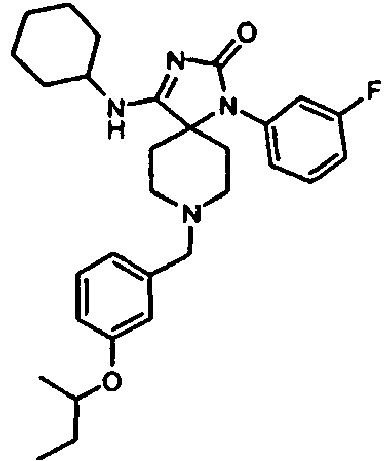
8-(3-sec-butoxybenzyl)-4-(cyclohexylamino)-1-(3-fluorophenyl)-1,3,8-triazaspiro[4.5]dec-3-en-2-one 507 7-102 
4-(cyclohexylamino)-1-(3-fluorophenyl)-8-[3-(2-methoxy-1-methylethoxy)benzyl]-1,3,8-triazaspiro[4.5]dec-3-en-2-one 523 7-103 
4-(cyclohexylamino)-1-(3-fluorophenyl)-8-[3-(pentyloxy)benzyl]-1,3,8-triazaspiro[4.5]dec-3-en-2-one 521 7-104 
4-(cyclohexylamino)-8-[3-(1-ethylpropoxy)benzyl]-1-(3-fluorophenyl)-1,3,8-triazaspiro[4.5]dec-3-en-2-one 521 7-105 
4-(cyclohexylamino)-1-(3-fluorophenyl)-8-[3-(trifluoromethoxy)benzyl]-1,3,8-triazaspiro[4.5]dec-3-en-2-one 519 7-106 
4-(cyclohexylamino)-1-(3-fluorophenyl)-8-[3-(1H-pyrrol-1-yl)benzyl]-1,3,8-triazaspiro[4.5]dec-3-en-2-one 500.1 7-107 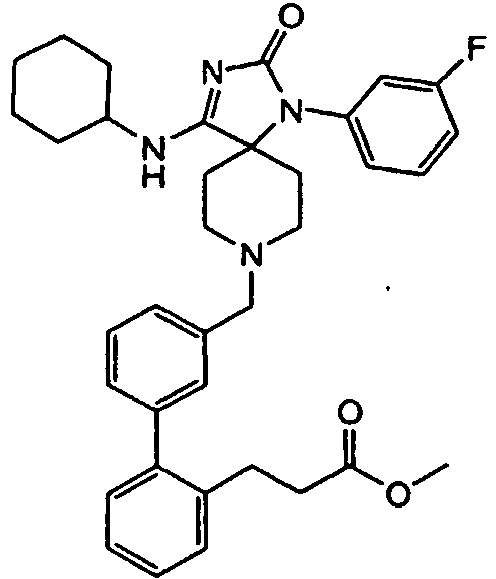
methyl 3-(3'-{[4-(cyclohexylamino)-1-(3-fluorophenyl)-2-oxo-1,3,8-triazaspiro[4.5]dec-3-en-8-yl]methyl}biphenyl-2-yl)propanoate 597.5 7-108 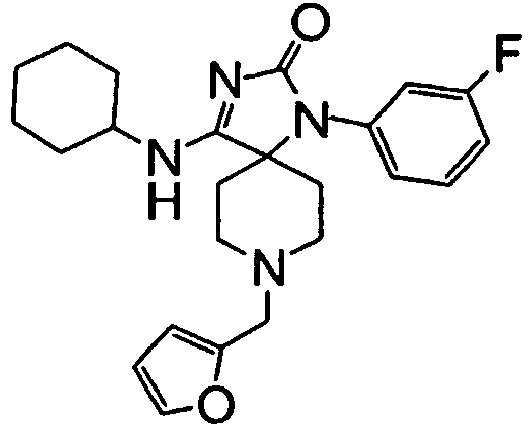
4-(cyclohexylamino)-1-(3-fluorophenyl)-8-(2-furylmethyl)-1,3,8-triazaspiro[4.5]dec-3-en-2-one 425.1 7-109 
1-(3-fluorophenyl)-8-(3-isopropoxybenzyl)-4-(isopropylamino)-1,3,8-triazaspiro[4.5]dec-3-en-2-one 453.2 - Scheme 8 describes a method for preparation of compounds containing an aminopyridine R3 substituent, such as Examples (8-1) - (8-4). Examples (8-1) - (8-4) are depicted in enamine form, but may also exist in tautomeric imine form.

-

-

-

PCT application WO 00/0665570 -

- The aminopyridine Examples (8-5) - (8-25) listed below in Table 4 were prepared in a manner similar to that described in Scheme 8. Examples (8-5) - (8-25) and their pharmaceutically acceptable salts are depicted in enamine form, but may also exist in tautomeric imine form. Example (8-26) was prepared in the same manner as (8-5)-(8-25) starting with 8-[(6-bromophenyl)methyl]-4-(cyclohexylamino)-1-(3-fluorophenyl)-1,3,8-triazaspiro[4.5]dec-3-en-2-one.
Table 4- Compounds (or salts thereof) Synthesized According to Scheme 8 EX Structure Chemical Name Mass spec 8-5 
4-(cyclohexylamino)-1-(3-fluorophenyl)-8-{[6-(isobutylamino)pyridin-3-yl]methyl}-1,3,8-triazaspiro[4.5]dec-3-en-2-one 507.4 8-6 
4-(cyclohexylamino)-1-(3-fluorophenyl)-8-{[6-(isopropylamino)pyridin-3-yl]methyl}-1,3,8-triazaspiro[4.5]dec-3-en-2-one 493.2 8-7 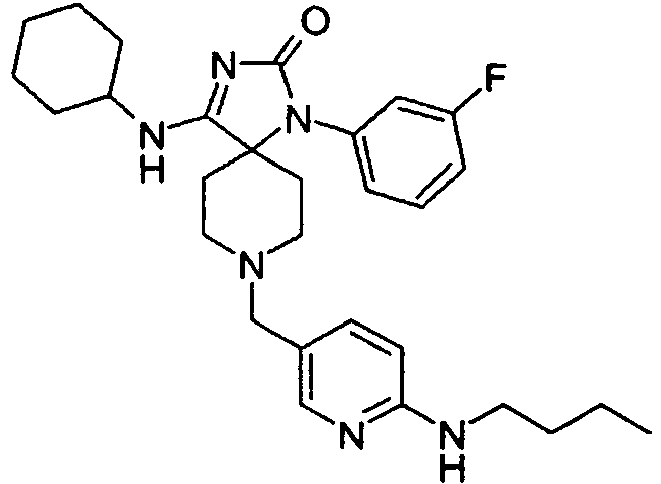
8- {[6-(butylamino)pyridin-3-yl]methyl}-4-(cyclohexylamino)-1-(3-fluorophenyl)-1,3,8-triazaspiro[4.5]dec-3-en-2-one 507.4 8-8 
4-(cyclohexylamino)-1-(3-fluorophenyl)-8-({6-[(2-methoxyethyl)amino]pyridin-3-yl}methyl)-1,3,8-triazaspiro[4.5]dec-3-en-2-one 509.3 8-9 
4-(cyclohexylamino)-8-({6-[(cyclopropylmethyl)amino]pyridin-3-yl}methyl)-1-(3-fluorophenyl)-1,3,8-triazaspiro[4.5]dec-3-en-2-one 505.3 8-10 
4-(cyclohexylamino)-1-(3-fluorophenyl)-8-({6-[(3-phenylpropyl)amino]pyridin-3-yl}methyl)-1,3,8-triazaspiro[4.5]dec-3-en-2-one 569.3 8-12 
4-(cyclohexylamino)-1-(3-fluorophenyl)-8-{[2-(methylamino)pyridin-3-yl]methyl}-1,3,8-triazaspiro[4.5]dec-3-en-2-one 465.2 8-13 
4-(cyclohexylamino)-1-(3-fluorophenyl)-8-{[2-(isopropylamino)pyridin-3-yl]methyl}-1,3,8-triazaspiro[4.5]dec-3-en-2-one 493.3 8-15 
4-(cyclohexylamino)-1-(3-fluorophenyl)-8-({2-[(2-methoxyethyl)amino]pyridin-3-yl}methyl)-1,3,8-triazaspiro[4.5]dec-3-en-2-one 509.2 8-16 
4-(cyclohexylamino)-1-(3-fluorophenyl)-8- {[2-(isobutylamino)pyridin-3-yl]methyl}-1,3,8-triazaspiro[4.5]dec-3-en-2-one 507.3 8-17 
4-(cyclohexylamino)-8-({2-[(cyclopropylmethyl) amino]pyridin-3-yl}methyl)-1-(3-fluorophenyl)-1,3,8-triazaspiro[4.5]dec-3-en-2-one 505.3 8-18 
4-(cyclohexylamino)-1-(3-fluorophenyl)-8-({2-[(3-phenylpropyl) amino]pyridin-3-yl}methyl)-1,3,8-triazaspiro[4.5]dec-3-en-2-one 569.3 8-19 
8- {[2-(sec-butylamino)pyridin-3-yl]methyl}-4-(cyclohexylamino)-1-(3-fluorophenyl)-1,3,8-triazaspiro[4.5]dec-3-en-2-one 507.3 8-20 
4-(cyclohexylamino)-8-({2-[(2,2-dimethylpropyl)amino]pyridin-3-yl}methyl)-1-(3-fluorophenyl)-1,3,8-triazaspiro[4.5]dec-3-en-2-one 521.1 8-21 
4-(cyclohexylamino)-8-{[2-(ethylamino)pyridin-3-yl]methyl}-1-(3-fluorophenyl)-1,3,8-triazaspiro[4.5]dec-3-en-2-one 479.3 8-22 
4-(cyclohexylamino)-8-{[2-(cyclopropylamino)pyridin-3-yl]methyl}-1-(3-fluorophenyl)-1,3,8-triazaspiro[4.5]dec-3-en-2-one 491.3 8-23 
4-(cyclohexylamino)-8-({2-[(2,2-difluoroethyl)amino]pyridin-3-yl} methyl)-1-(3-fluorophenyl)-1,3, 8-triazaspiro[4.5]dec-3-en-2-one 515.4 8-24 
4-(cyclohexylamino)-8-{2-[(2,2-difluoroethyl)amino]benzyl}-1-(3-fluorophenyl)-1,3,8-triazaspiro[4.5]dec-3-en-2-one 514.1 - A representative procedure for elaboration of the R3 substituent, as depicted in Scheme 3 below, can be used in the synthesis of various compounds of the invention, including Examples (9-4) - (9-11) below. Examples (9-4) - (9-11) are depicted below in enamine form, but may also exist in tautomeric imine form, as described above

-

- tert-Butyl 2-hydroxypropylcarbamate (2): Biorg. Med Chem., 6, 1998 2405-2419
Added Boc anyhdride (8.19g, 37.4 mmole) in CH2Cl2 (30mL) to a solution of 1-amino-2-propanol in 77 mL of 10% Et3N in MeOH. Let stir at rt under Argon. After 6 hr, concentrated in vacuo. Purified on a 120g redisep coumn eluting with 1-1 EtOAc Hex. Concentrated clean fractions in vacuo. - Dissolved triphenylphosphine (0.805g, 3.07 mmole), 3-hydroxybenzaldehyde (0.25g, 2.047 mmole) and t-butyl 2-hydroxypropylcarbamate(0.395g, 2.25 mmole,) in dry toluene (5 mL) at rt. Added ADDP (azodicarbonyldipiperdine) (0.755g, 3.07 mmole) at once. Warmed quickly to 80°C. After 5 hr, cooled to rt. Diluted with CH2Cl2 and filtered off solids, washing with CH2Cl2. Concentrated filtrate in vacuo. Dissolved in 50 mL CH2Cl2. Washed with 1 N NaOH (2x20 mL), and then with brine. Dried over Na2SO4, filtered and conc in vacuo. Purified using a 120g isco redisep column eluting with 5% EtOAc to 25 % EtOAc in hexanes to give the aldehyde.
- t-Butyl 2,3-(formylphenoxy)propylcarbamate and 4-(cyclohexylamino)-1-(3-fluorophenyl)-2-oxo-1,3-triazaspiro[4.5]dec-3-ene dihydrochloride salt (5-2) were coupled using a procedure similar to that described for Example (5-6).
1H NMR (CDCl3, 400 Mh), δ 7.98 (bd, J=8.05 Hz, 1H); 7.35 (m, 1H); 7.24 (m, 1H); 7.03 (m, 2H); 6.97 (m, 1H); 6.82 (m, 3H); 4.88 (bs, 1H); 4.50 (bs, 1H); 3.97 (m, 1H); 3.49 (s, 2H); 3.44 (m, 2H); 3.25 (m, 1H); 2.78 (m, 2H); 2.44 (m, 2H); 2.07 (m, 4H); 1.95 (m, 2H); 1.72 (m, 3H); 1.44 (s, 9H); 1.39 (m, 2H); 1.27 (d, J=6.0 Hz, 3H); 1.19 (m, 3H).
Mass Spec (m+1) = 608. -

1H NMR (CDCl3, 400 Mh), δ 8.01 (bd, J=8.5 Hz, 1H); 7.35 (m, 1H); 7.25 (m, 1H); 7.01 (m, 3H); 6.86 (d, J=9.3 Hz, 1H); 6.81 (m, 2H); 4.37 (q, J=5.8, 5.4, 1H); 3.97 (m, 1H); 3.51 (d, J=2.4 Hz, 2H); 2.9 (m, 2H); 2.79 (m, 4H); 2.41 (m, 2H); 2.13 (m, 2H); 2.03 (m, 4H); 1.72 (m, 2H); 1.65 (m, 1H); 1.45 (m, 2H); 1.28 (d, J=6.0 Hz, 3H); 1.24 (m, 3H).
Mass spec (m+1) = 508
8-[3-(2-amino-1-(R)- methylethoxy)benzyl]-4-(cyclohexylamino)-1-(3-fluorophenyl)-1,3,8-triazaspiro[4.5]dec-3-en-2-one and 8-[3-(2-amino-1-(S)- methylethoxy)benzyl]-4-(cyclohexylamino)-1-(3-fluorophenyl)-1,3,8-triazaspiro[4.5]dec-3-en-2-one (9-5 and 9-5)
The racemic mixture of 8-[3-(2-amino-1-methylethoxy) benzyl]-4-(cyclohexylamino)-1-(3-fluorophenyl)-1,3,8-triazaspiro[4.5]dec-3-en-2-one (100 mg) was submitted for separation via chiral chromatography. The compound was eluted with 20% EtOH in Hexanes with 1 mL/L of DEA on a Chiral Pak AD column. Mass spec (m+1) = 508 -

1H NMR (CDCl3, 400 Mh), δ 7.73 (bd, J=8.0 Hz, 1H); 7.35 (dd, J=8.1, 14.6 Hz, 1H); 7.23 (m, 1H); 7.01 (m, 3H); 6.83 (m, 3H); 4.70 (m, 1H); 4.55 (m, 1H); 3.97 (m, 1H); 3.49 (d, J=3.8 Hz, 2H); 3.41 (m, 1H); 3.27 (m, 1H); 2.99 (s, 3H); 2.74 (m, 2H); 2.40 (m, 2H); 2.09 (m, 4H); 1.97 (m, 2H); 1.72 (m, 3H); 1.41 (m, 2H); 1.30 (d, J=6.1 Hz, 3H); 1.24 (m, 3H).
Mass spec (m+1) = 600Table 5: The following compounds (or salts thereof) of Table 5 were prepared by methods similar to that described for 9-4, 9-5, and 9-6, utilizing the appropriate reagents. Ex # Structure Chemical Name Mass Spec 9-7 
tert-butyl 3-(3-{[4-(cyclohexylamino)-1-(3-fluorophenyl)-2-oxo-1,3,8-triazaspiro[4.5]dec-3-en-8-yl]methyl}phenoxy)butylcarba mate 622 9-8 
8-[3-(3-amino-1-methylpropoxy)benzyl]-4-(cyclohexylamino)-1-(3-fluorophenyl)-1,3,8-triazaspiro[4.5]dec-3-en-2-one 522 9-9 
tert-butyl 2-(3-{[4-(cyclohexylamino)-1-(3-fluorophenyl)-2-oxo-1,3,8-triazaspiro[4.5]dec-3-en-8-yl]methyl }phenoxy)butylcarba mate 622 9-10 
8-{3-[1-(aminomethyl)propoxy]benzyl} -4-(cyclohexylamino)-1-(3-fluorophenyl)-1,3,8-triazaspiro[4.5]dec-3-en-2-one 522 9-11 
8-[3-(2-aminoethoxy)benzyl]-4-(cyclohexylamino)-1-(3-fluorophenyl)-1,3,8-triazaspiro[4.5]dec-3-en-2-one 494 - A representative procedure for elaboration of the R3 substituent, as depicted in Scheme 10 below, can be used in the synthesis of various compounds of the invention, including Examples (10-1)-(10-3) below. Examples (10-1) - (10-3) are depicted below in enamine form, but may also exist in tautomeric imine form, as described above

-

exact MS found 464.2806 theory 464.2820 -

MS 542.4 - A representative procedure for elaboration of the R3 substituent, as depicted in Scheme 11 below, can be used in the synthesis of various compounds of the invention, including Examples (11-2)-(11-8) below. Examples (11-2) - (11-8) are depicted below in enamine form, but may also exist in tautomeric imine form, as described above

-

1H NMR (400MHz, CDCl3) δ 8.09-8.11 (m, 1H), 7.32-7.36 (m, 1H), 7.10-7.13 (m, 1H), 6.96-7.03 (m, 3H), 6.60-6.63 (m, 2H), 6.53 (s, 1H), 3.95-4.0 (m, 1H), 3.43 (s, 2H), 2.75-2.80 (m, 2H), 2.37-2.42 (m, 2H), 1.93-2.12 (m, 5H), 1.64-1.75 (m, 3H), 1.35-1.41 (m, 2H), 1.16-1.27 (m, 4H).
MS 450.4 -

1H NMR (400MHz, CDCl3) δ 7.88-7.90 (m, 1H), 7.63-7.70 (m, 2H), 7.30-7.35 (m, 1H), 7.19-7.24 (m, 1H), 6.92-7.04 (m, 4H), 3.90-3.94 (m, 1H), 3.47 (s, 2H), 2.72-2.78 (m, 2H), 2.29-2.36 (m, 4H), 2.14 (s, 3H), 1.98-2.1 (m, 6H), 1.62-1.73 (m, 2H), 1.13-1.41 (m, 4H).MS 492.4 -

MS 528.1 -

1H NMR (400MHz, CDCl3) δ 8.22-8.24 (m, 1H), 7.31-7.37 (m, 1H), 7.11-7.15 (m, 1H), 6.94-7.02 (m, 3H), 6.52-6.56 (m, 2H), 6.43 (s, 1H), 3.94-3.97 (m, 1H), 3.65-3.70 (m, 1H), 3.45 (s, 2H), 3.00-3.06 (m, 1H), 2.77-2.90 (m, 3H), 2.39-2.45 (m, 2H), 1.87-2.14 (m, 7H), 1.64-1.74 (m, 3H), 1.13-1.44 (m, 8H), 0.89-0.97 (m, 6H).MS 534.3 -

MS 492.4 -

-

1H NMR (400MHz, CDCl3) δ 7.31-7.42 (m, 1H), 6.83-7.18 (m, 5H), 6.57-6.70 (m, 2H), 4.6-4.8 (br m, 1H), 3.57-3.97 (m, 6H), 3.28 (m, 1H), 2.65-2.70 (m, 1H), 2.39-2.58 (m, 4H), 2.21-2.25 (m, 1H), 1.67-2.08 (m, 9H), 1.26-1.43 (m, 4H).
MS 517.1 - A representative procedure for elaboration of the R3 substituent, as depicted in Scheme 12 below, can be used in the synthesis of various compounds of the invention, including Example (12-4) below. Example (12-4) is depicted below in enamine form, but may also exist in tautorneric imine form, as described above

-

- To a 10mL THF solution of 2.5mL (5mmol) LDA (2M in THF) on a dry ice - acetone bath went 0.7mL (4.76mmol) 3-bromopropionitrile(9-1) dropwise. The solution was allowed to stir for 15min, then transferred by cannula to a 10mL THF solution of 0.31mL(5mmol) MeI also cooled to -78°C. The bath was removed and the reaction was allowed to warm to rt and stir for 30min. The reaction was quenched with saturated aqueous NH4Cl and the product was extracted into EtOAc. The organic layer was dried over Na2SO4, filtered and concentrated. The remaining oil was dissolved in 1mL CH2Cl2 and purified on an Isco automated system affixed with a Biotage Flash 40(M) cartridge eluted with 50-100% EtOAc in hexane. The product eluted last. MS 224.0 NB#212867-102
- A 3-neck flask equipped with a condenser and 2 septa was flushed with N2, then the flask was charged with 0.6g(2.7mmol) 3-(3-bromophenyl)-2-methylpropionitrile(9-2), 0.275g(4mmol) sodium formate, 0.155g(0.13mmol) tetrakis(triphenylphospine)Palladium and flushed with CO from a balloon for 5 min. The solids were suspended in 10mL DMF and CO continued to bubble into the liquid. The flask was heated in an oil bath at 100' for 20min then 110' while stirring. The color changed from yellow to a deep orange color after 1.5 h, and HPLC/MS analysis showed no starting material and one major product. The reaction was cooled and quenched with brine. The product was extracted into EtOAc, dried over Na2SO4, filtered and concentrated. The product was dissolved in 1mL CH2Cl2 and purified on an Isco automated system affixed with a Biotage Flash 25(M) cartridge eluted with 0-50% EtOAc in hexane at 25mL/min over 15 min and hold for 30 min. The product eluted last. MS 174.1 NB#212867-104
- To a 20mL dichloroethane solution of 0.35g(0.92mmol) 4-(cyclohexylamino)-1-(3-fluorophenyl)-1,3,8-triazaspiro[4.5]dec-3-en-2-one and 0.25mL(1.4mmol) DIEA went 0.16g(0.92mmol) 3-(3-formylphenyl)-2-methylpropanenitrile(9-3). The suspension was allowed to stir for 10 min then 0.4g(1.9mmol) sodium triacetoxyborohydride was added and the reaction was allowed to stir at rt overnight. HPLC/MS showed no starting material so the reaction was quenched with 100mL sat NaHCO3 and diluted with CH2Cl2. The organic layer was washed with brine, dried over Na2SO4, filtered and concentrated. The remaining oil was purified on an Isco automated system affixed with a Biotage Flash 25(M) cartridge eluted with 5% MeOH + 0.5M NH3 in CH2Cl2 at 25mL/min over 30min. The product eluted second.
1H NMR (400MHz, CDCl3) δ 7.80-7.82 (d, 1H J=8Hz), 7.28-7.37 (m, 2H), 7.14-7.19 (m, 3H), 6.96-7.04 (m, 3H), 3.94-3.97 (m, 1H), 3.51 (s, 2H), 2.84-2.87 (m, 3H), 2.71-2.78 (m, 2H), 2.34-2.41 (m, 2H), 1.97-2.11 (m, 6H), 1.65-1.75 (m, 3H), 1.33-1.41 (m, 5H), 1.17-1.25 (m, 3H).
MS 502.0
- A representative procedure for elaboration of the R3 substituent, as depicted in Scheme 13 below, can be used in the synthesis of various compounds of the invention, including Examples (13-4) - (13-5) below. Examples (13-4) - (13-5) are depicted below in enamine form, but may also exist in tautomeric imine form, as described above
-

- The compound was prepared in a manner similar to that described in
WO 02/076983
1H NMR (400MHz, CDCl3) δ 8.23 (d, J = 7.8 Hz, 1H), 7.53 (t, J= 8.2 Hz, 1H), 7.33 (dd, J= 8.0, 14.7 Hz, 1H), 7.0 (m, 3H), 6.75 (d, J=7.2 Hz, 1H), 6.60 (d, J = 8.3 Hz, 1H), 5.22 (m, 1H), 3.93 (m, 1H), 3.59 (s, 2H), 2.90 (m, 2H), 2.55 (m, 2H), 2.12 (m, 2H), 2.0 (m, 4H), 1.7-1.5 (m, 4H), 1.4-1.3 (m, 2H), 1.33 (d, J= 6.2 Hz, 6H), 1.15 (m, 3H).
LCMS (m+1) = 215.1, 217.1 - 6-isopropoxypyridine-2-carbaldehyde was prepared in a manner similar to that described in D. L Comins, M.O. Killpack, J. Org. Chem. 1990 55 69-73 for the methoxy analog. 2-bromo-6-isopropoxypyridine (1g, 4.6 mmole) was dissolved in 10ml dry THF under argon, cooled to -78° C and treated with added 2.5 M n-Butyl lithium (1.9 mL, 4.8 mmole) keeping the temperature of the reaction below -65° C. After the reaction had stirred 45 min DMF (0.717 mL, 9.25 mmole) was added, again keeping temp below -60° C, the reaction was stirred for 15 min, then quenched with saturated bicarbonate solution. The layers were separated, the aqueous extracted with CHCl3 the organic layers dried over Na2SO4, filtered and evap carefully, and the residue chromatographed in 0-50% Ether / hexanes to give the product as an oil. LCMS(m+1)= 165.2
- This compound was prepare in a manner similar to that described for example (5-6) using the intermediate from scheme 13 step 2 and compound (5-2).
LCMS (m+1) = 494.1 -

LCMS (m+1)= 508.1 - Scheme 14A depicts a method for preparing 8-Benzyl-1-phenyl-4-thioxo-1,3,8-triaza-spiro[4.5]decan-2-one 14A-5 intermediates useful for making compounds of the invention. The commercially available 14A-1 may be alkylated with an appropriate alkyl halide like benzyl chloride using a suitable base like potassium carbonate in a suitable solvent like acetonitrile to afford 14A-2. A similar method is described by M. E. Kopach et. al. J. Org.Chem. 2003 68 5739-5741. A modified Strecker reaction of A-2 yields 14A-3; and followed by the treatment of chlorosulfonyl isocyanate in methylene chloride to afford 14A-4. A similar method is described by P.L. Feldman and M. F. Brackeen J. Org. Chem. 1990, 55, 4207-4209 at reference therein. 14A-5 is obtained by the thiolation of 14A-4 by Na2S. The treatment of the intermediates 14A-5 with various amines in a suitable solvent like in DMSO or DMF with heat yields the invention compounds 14A-6.


-

- To a solution of 3-Isopropoxy-benzaldehyde 14-1 (20 g, 122 mmol) in methanol (400 mL), sodium borohydride (5g) is added in several portions at 0° C. The resulting mixture is then stirred at rt for 3 h. The reaction is quenched by addition of saturated NH4OH. Extracted (EtOAc), concentrated, a colorless oil 14-2 (MH+, 166) is obtained and use without purification. Re- dissolve (3-Isopropoxy-phenyl)-methanol 14-2 in ether (244 mL) PBr3 (11.5 mL, 122 mmol) is added dropwise at 0 °C. The reaction mixture is stirred at 0°C then rt for 3 h, quenched (MeOH), extracted (EtOAc), concentrated, a colorless oil 14-3 is obtained. (MH+, 288)
- A mixture of 4-piperidone hydrochloride monohydrate (19.52g, 127.12 mmol), 1-Bromomethyl-3-isopropoxy-benzene (19.41g, 84.76 mmol) and K2CO3 in DMF (150 mL) is stirred at rt for 16 hr. Solvent is removed in vacco, the residue is extract (EtOAc/ Brine), dried (Na2SO4), concentrated, and purified by chromatography (silica gel, EtoAc / hexanes, 2/3) to afford 14-4. (MH+, 266)
- To a solution of 1-(3-Isopropoxy-benzyl)-piperidin-4-one monohydrate 14-4 (7.98g, 30 mmol) and aniline (3.67g, 33mmol) in glacial acetic acid (30 mL) is added TMSCN (2.98g, 30 mmol) dropwise over a 10 min period, maintaining the temperature below 40°C. The reaction mixture is stirred an additional 30 min and than poured into a cold NH4OH mixture (30 mL NH4OH and 30 g of ice). Additional of NH4OH is slowly added until pH =10 is reach. Extracted (CHCl3), Dried (Na2SO4), Concentrated, and Purified by silica gel to afford 14-5. LCMS (MH+ 368.3)
- The 4-(3-Fluoro-phenyl)-1-(3-isopropoxy-benzyl)-piperidine-4-carbonitrile 14-5 (5.28 g, 15.0 mmole) was dissolved into chloroform (15 mL). The solution was stirred and cooled to 0° C, at which point chlorosulfonyl isocyanate (Acros, 1.75 mL, 20.1 mmole, 1.25 eq) was added dropwise, causing formation of a large amount of white precipitate. The ice bath was removed, and the slurry was stirred hard with a magnetic stirrer for 10 min. LCMS (MH+ 411.2) indicated consumption of the nitrile at this point. Water (15 mL) was added, and the heterogeneous mixture was stirred hard at rt for 1 hr. In a 500 mL Erlenmeyer flask (used to accommodate a large stir bar), sodium sulfide (anhydrous, Aldrich, 22.5 g, 288 mmole) was dissolved into water (200 mL) and cooled to an internal temperature below 0° C with an ice/isopropanol bath. Acetic acid (approx 28 mL) was added dropwise to the stirred solution, over a period of about 10 min, ensuring that the internal temperature stayed close to 0° C. (During the addition, there is a formation of a large amount of light-colored precipitate and the mixture becomes thick. The thickness diminishes as the addition of acetic acid nears completion.) The addition was stopped when pH paper indicated that the pH was ∼ 6, and the solution had assumed a slight greenish color. At this point, the above slurry of imine was added to the sulfide solution, using dichloromethane (∼ 30 mL) to assist the transfer. Isopropanol (50 mL) was added, and the flask was sealed with a balloon, removed from the ice bath, and stirred hard for 16 hr. The reaction was then diluted with dichloromethane, and washed with water plus sufficient saturated sodium bicarbonate solution to ensure basic pH. The organic layer was then removed, and the aqueous layer was extracted with 2X dichloromethane. The combined organic layers were dried (MgSO4), filtered, and concentrated to a yellow solid. The solid was resuspended into dichloromethane, and deposited onto silica gel for chromatography. The sample was purified by flash chromatography over silica gel using a Combiflash system (80 g column), with 50% ethyl acetate/hexanes as the eluent (product Rf∼ 0.25), providing the product 14-7. LCMS (MH+ 428.2).
- To a solution of 1-(3-Fluoro-phenyl)-8-(3-isopropoxy-benzyl)-4-thioxo-1,3,8-triaza-spiro[4.5]decan-2-one SNS-1 (21.4 mg, 0.05mmol) in DMSO (1 mL) was added isobutyl amine (36.5 mg, 0.5 mmol). The reaction mixture was heated at 110°C for 12 hr. The crude was purified by preparative HPLC to provide (14-8).
1H NMR (CD3OD): δ 7.29 (br s, 1H), 7.18 (m, 1H), 7.05 (m, 3H), 6.90 (d, J = 8.31Hz, 1H), 6.76 (br m, 2H), 4.50 (m, 1H), 4.06 (br s, 2H), 3.00-3.20 (br, 2H), 2.2-2.8 (br, 4H), 1.92 ( br, 1H), 1.19 (d, J = 5.87Hz), 0.86 (m, 6H). EI-MS mlz: 467.25 (MH+).Table 6: The following compounds (or salts thereof) of table 6 were prepared in a manner similar to that described for scheme 14. Example # Structure Chemical Name Mass Spec 14-9 
1-(3-Fluoro-phenyl)-8-(3-isopropoxy-benzyl)-4-(2-methyl-cyclohexylamino)-2-oxo-1,3-diaza-8-azonia-spiro[4.5]dec-3-ene 507.3 14-10 
4-(1,2-Dimethyl-propylamino)-1-(3-fluoro-phenyl)-8-(3-isopropoxy-benzyl)-2-oxo-1,3-diaza-8-azonia-spiro[4.5]dec-3-ene 481.25 14-11 
4-(2-Fluoro-cyclohexylamino)-1-(3-fluoro-phenyl)-8-(3-isopropoxy-benzyl)-2-oxo-1,3-diaza-8-azonia-spiro[4.5]dec-3-ene 511.2 14-12 
4-Cycloheptylamino-1-(3-fluoro-phenyl)-8-(3-isopropoxy-benzyl)-2-oxo-1,3-diaza-8-azonia-spiro[4.5]dec-3-ene 507.3 14-13 
4-(Bicyclo[2.2.1]hept-2-ylamino)-1-(3-fluoro-phenyl)-8-(3-isopropoxy-benzyl)-2-oxo-1,3-diaza-8-azonia-spiro[4.5]dec-3-ene 505.3 14-14 
4-Cyclopentylamino-1-(3-fluoro-phenyl)-8-(3-isopropoxy-benzyl)-2-oxo-1,3-diaza-8-azonia-spiro[4.5]dec-3-ene 479.25 14-15 
1-(3-Fluoro-phenyl)-8-(3-isopropoxy-benzyl)-2-oxo-4-(tetrahydropyran-4-ylamino)-1,3-diaza-8-azonia-spiro[4.5]dec-3-ene 495.25 14-16 
4-Cyclobutylamino-1-(3-fluoro-phenyl)-8-(3-isopropoxy-benzyl)-2-oxo-1,3-diaza-8-azonia-spiro[4.5]dec-3-ene 465.3 14-17 
1-(3-Fluoro-phenyl)-8-(3-isopropoxy-benzyl)-2-oxo-4-(2-pyridin-4-yl-ethylamino)-1,3-diaza-8-azonia-spiro[4.5]dec-3-ene 516.3 14-18 
1-(3-Fluoro-phenyl)-4-(3-hydroxy-cyclohexylamino)-8-(3-isopropoxy-benzyl)-2-oxo-1,3-diaza-8-azonia-spiro[4.5]dec-3-ene 509.35 14-19 
1-(3-Fluoro-phenyl)-4-(1-hydroxymethyl-2-methyl-propylamino)-8-(3-isopropoxy-benzyl)-2-oxo-1,3-diaza-8-azonia-spiro[4.5]dec-3-ene 497.25 14-20 
1-(3-Fluoro-phenyl)-8-(3-isopropoxy-benzyl)-4-(3-methyl-butylamino)-2-oxo-1,3-diaza-8-azonia-spiro[4.5]dec-3-ene 481.3 14-21 
4-(Cyclopropylmethyl-amino)-1-(3-fluorophenyl)-8-(3-isopropoxy-benzyl)-2-oxo-1,3-diaza-8-azonia-spiro[4.5]dec-3-en 465.3 14-22 
1-(3-Fluoro-phenyl)-8-(3-isopropoxy-benzyl)-4-(1-methanesulfonyl-pyrrolidin-3-ylamino)-2-oxo-1,3-diaza-8-azonia-spiro[4.5]dec-3-ene 558.3 14-23 
4-Benzylamino-1-(3-fluoro-phenyl)-8-(3-isopropoxy-benzyl)-2-oxo-1,3-diaza-8-azonia-spiro[4.5]dec-3-ene 501.3 14-24 
4-(1-Acetyl-pyrrolidin-3-ylamino)-1-(3-fluoro-phenyl)-8-(3-isopropoxy-benzyl)-2-oxo-1,3-diaza-8-azonia-spiro[4.5]dec-3-ene 522.3 14-25 
1-(3-Fluoro-phenyl)-8-(3-isopropoxy-benzyl)-2-oxo-4-(3-phenyl-propylamino)-1,3-diaza-8-azonia-spiro[4.5]dec-3-ene 529.3 14-26 
1-(3-Fluoro-phenyl)-4-(3-hydroxy-cyclohexylamino)-8-(3-isopropoxy-benzyl)-2-oxo-1,3-diaza-8-azonia-spiro[4.5]dec-3-ene 509.35 14-27 
4-(2-Dimethylcarbamoyl-ethylamino)-1-(3-fluoro-phenyl)-8-(3-isopropoxy-benzyl)-2-oxo-1,3-diaza-8-azonia-spiro[4.5]dec-3-ene 510.3 14-28 
4-(2-Fluoro-ethylamino)-1-(3-fluoro-phenyl)-8-(3-isopropoxy-benzyl)-2-oxo-1,3-diaza-8-azonia-spiro[4.5]dec-3-ene 457 14-29 
1-(3-Fluoro-phenyl)-4-[(furan-2-ylmethyl)-amino]-8-(3-isopropoxy-benzyl)-2-oxo-1,3-diaza-8-azonia-spiro[4.5]dec-3-ene 491.2 14-30 
1-(3-Fluoro-phenyl)-8-(3-isopropoxy-benzyl)-2-oxo-4-(2-thiophen-2-yl-ethylamino)-1,3-diaza-8-azonia-spiro[4.5]dec-3-ene 521 14-31 
1-(3-Fluoro-phenyl)-8-(3-isopropoxy-benzyl)-4-(2-methylsulfanyl-ethylamino)-2-oxo-1,3-diaza-8-azonia-spiro[4.5]dec-3-ene 485.2 14-32 
1-(3-Fluoro-phenyl)-8-(3-isopropoxy-benzyl)-4-(2-morpholin-4-yl-ethylamino)-2-oxo-1,3-diaza-8-azonia-spiro[4.5]dec-3-ene 524.35 14-33 
1-(3-Fluoro-phenyl)-4-[2-(1H-imidazol-4-yl)-ethylamino]-8-(3-isopropoxy-benzyl)-2-oxo-1,3-diaza-8-azonia-spiro[4.5]dec-3-ene 504.6 14-34 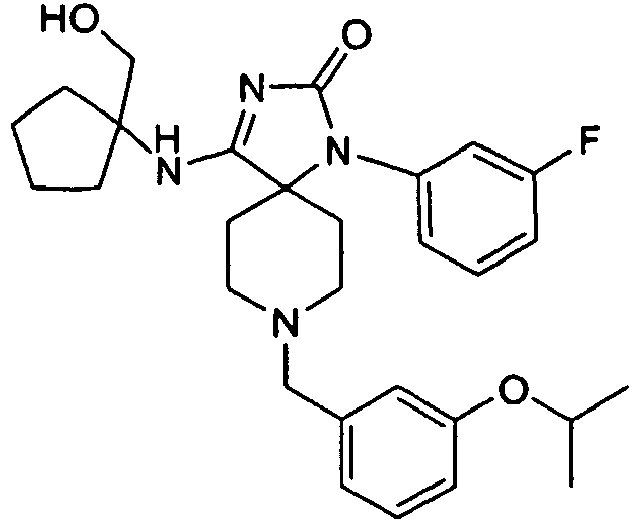
1-(3-Fluoro-phenyl)-4-(1-hydroxymethyl-cyclopentylamino)-8-(3-isopropoxy-benzyl)-2-oxo-1,3-diaza-8-azonia-spiro[4.5]dec-3-ene 509.35 14-35 
1-(3-Fluoro-phenyl)-8-(3-isopropoxy-benzyl)-4-(2-methanesulfonyl-ethylamino)-2-oxo-1,3-diaza-8-azonia-spiro[4.5]dec-3-ene 517.25 14-36 
1-(3-Fluoro-phenyl)-8-(3-isopropoxy-benzyl)-2-oxo-4-phenylamino-1,3-diaza-8-azonia-spiro[4.5]dec-3-ene 487.2 - R2 elaboration can be prepared by the methods described in Scheme 3, Scheme 14-A with various substituted aniline or by Suzuki coupling of 15-1 with a various of boronic acid or boronate ester. A representative procedure for elaboration of the R2 substituent, as depicted in Scheme 15 below, can be used in the synthesis of various compounds of the invention, including Examples (15-2) - (15-42) below. The boronate ester can be prepared as describe in Scheme 15-A. Examples (15-2) - (15-42) are depicted below in enamine form, but may also exist in tautomeric imine form, as described above.


- This procedure is based on conditions developed by Miyaura et. al.(J. Org. Chem. 1995, 60, 7508-7510). The aryl halide 15-A-1 (0.20 mmol, leq), potassium acetate (0.60mmol, 3 eq.), bis(pinacolato)diboron (0.18 mmol, 0.9 eq.) and PdCl2(dppf) (0.020mmol), 0.1 eq.) were added to a round bottom flask. Dry DMF (3 ml) was added, and the flask was flushed with nitrogen, then capped. The resultant mixture was stirred and placed into an 80°C oil bath. The reaction was followed by LCMS. Upon consumption of aryl bromide (several hours), the reaction mixture was extracted with ethyl acetate / water 3-4 times, then washed with brine twice. The resultant organic solution was dried over MgSO4 and concentrated to afford crude boronate ester 15-A-2, which was used directly for the subsequent Suzuki coupling reactions. A series of representative Procedure for Synthesis of Boronate Esters from Aryl Halides is described in Scheme 15-B-E

- Compound 15-B-1 (0.230g 0.90mmol) was added to a stirred solution of methylamine hydrochloride (0.091g 1.35mmol) and pyridine (0.364ml 4.50 mmol) in dichloromethane (10 ml) at 0°C. The reaction mixture was allowed to warm to room temperature and the reaction was followed by LCMS. Upon consumption of starting material (about 3hrs), the mixture was extracted twice with diethyl ether / saturated sodium bicarbonate solution. The organic solution was washed twice with an aqueous sodium dihydrogen phosphate (pH=3-4) solution, twice with brine, and then the organic solution was dried over MgSO4 and concentrated to afford the crude sulfonamide 15-B-2.
- The crude 15-B-2 (0.050g, 0.20 mmol), potassium acetate (0.059g 0.60mmol), bis(pinacolato)diboron (0.046g, 0.18 mmol) and PdCl2(dppf) (0.016g 0.020mmol) were added to a round bottom flask. Dry DMF (3 ml) was then added, and the flask was flushed with nitrogen, then capped. The resultant mixture was stirred and placed into an 80°C oil bath. The reaction was followed by LCMS. Upon consumption of starting material, the reaction mixture was extracted with ethyl acetate / water 3-4 times, then washed with brine twice. The resultant organic solution was dried over MgSO4 and concentrated to afford crude boronate ester 15-B-3 which was used directly for the Suzuki coupling without further purification, to provide Example 15-35. The Suzuki coupling was carried out using the standard conditions already described with the Boykin catalyst.
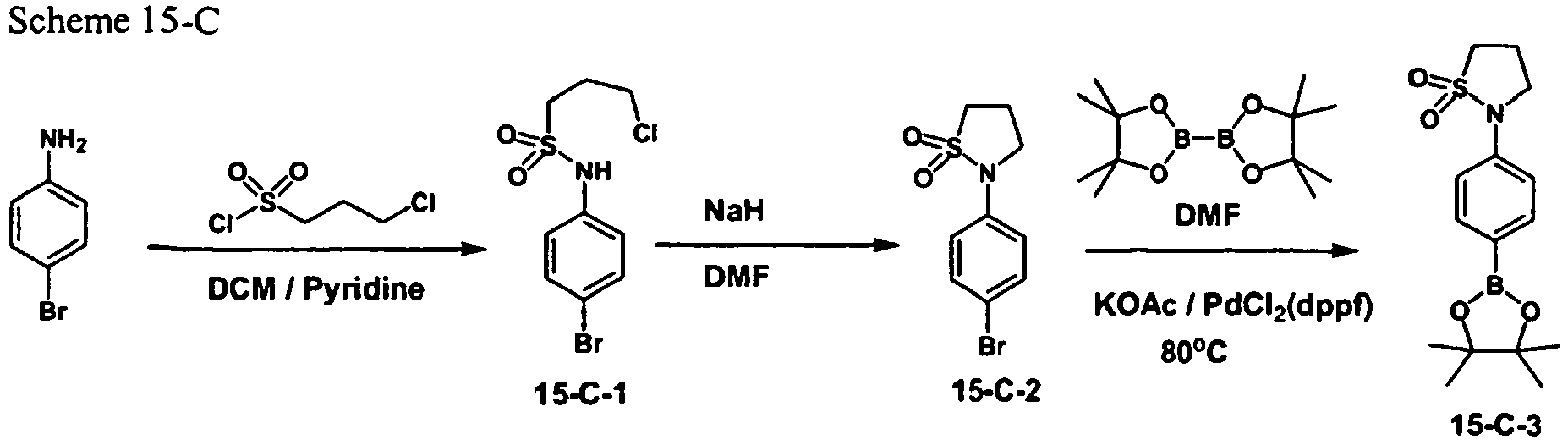
- 3-Chloropropylsulfonyl chloride (1.200g, 0.00678mol) was added dropwise to a stirred solution of p-bromoaniline (1.032g 0.00600mol) and pyridine (5ml) in dichloromethane (90ml) at 0°C under nitrogen. The mixture was allowed to warm to rt and stirred overnight. The resultant mixture was concentrated and extracted with Et2O / aqueous sodium dihydrogen phosphate (pH=3-4) solution. The organic solution was then washed twice with saturated sodium bicarbonate solution, twice with brine, then dried with MgSO4 and concentrated to afford crude 15-C-1 (1.630g 87%).
- Crude 15-C-1 (1.630g, 0.0052mol) was dissolved in 10ml DMF. The resultant solution was added dropwise to a stirred mixture of NaH 60% dispersion in mineral oil (0.480g, 0.0104mol) and DMF (30ml) at 0°C. The reaction mixture was allowed to warm up to rt and stirred overnight. Upon completion, the reaction was quenched with saturated NH4Cl aqueous solution and extracted twice with diethyl ether. The resultant ethereal solution was washed twice with an aqueous sodium dihydrogen phosphate (pH=3-4) solution, then twice with a saturated NaHCO3 aqueous solution, then twice with brine. The organic solution was dried over MgSO4 and concentrated to afford crude 15-C-2 (1.295g, 90%).
- Crude 15-C-2 (0.156g, 0.566 mmol), potassium acetate (0.167g, 1.698mmol), bis(pinacolato)diboron (0.144g, 0.509 mmol), and PdCl2(dppf) (0.046g, 0.0566mmol) were added to a round bottom flask. Dry DMF (10 ml) was then added and the flask was flushed with nitrogen. The resultant mixture was stirred and placed into an 80°C oil bath. The reaction was followed by LCMS. Upon consumption of starting material (1-2hr), the reaction mixture was diluted with ethyl acetate, washed twice with water and twice with brine. The resultant organic solution was then dried over MgSO4 and concentrated to afford the crude boronate ester 15-c-3, which was used directly for the next step without further purification. The Suzuki coupling was carried out using the standard conditions already described with the Boykin catalyst. See example 15-36 as product.

- To a solution of 4-bromobenzoic acid (402.0mg, 2mmol) in DMF (10 mL), was added HATU (836.5mg, 2.2 mmol) and DIEA (697.0µL, 4mmol). After stirring for 5 minutes at room temperature, methylamine hydrochloride salt (135.0mg, 2mmol) was added. The solution was stirred at rt overnight. The reaction mixture was diluted with water and extracted two times with ethyl acetate. The combined extract was washed with saturated sodium bicarbonate, 1M HCl and brine, dried over magnesium sulfate, filtered and concentrated to dryness to provide 15-D-1 (181.1mg, 42.0%) as white crystals.
- A solution of 15-D-1 (107.0mg, 0.5mmol), bis(pinacolato)diboron (139.7mg, 0.55mmol) and potassium acetate (245.4mg, 2.5mmol) in 2.5mL DMF, was purged with nitrogen gas, then PdCl2(dppf) (11.0mg, 0.015mmol) was added. The solution was heated at 80°C for two hr, then cooled to rt. The reaction was quenched with water, then extracted twice with ethyl acetate. The organic solution was washed with water, then with saturated sodium bicarbonate, then with brine. The organic solution was then dried over magnesium sulfate, filtered and concentrated to dryness to provide boronate ester 15-D-2 (91.1 mg, 61.0%). The final compound, example 15-14, was prepared from the boronate ester 15-D-2 using the representative Suzuki coupling conditions and the Boykin catalyst.

- The N,N-dimethyl-4-bromophenyl sulfonamide above (0.486 g, 1.84 mmol, 1.0 eq.), the bis(pinacolato)diboron (538.5 mg, 2.12 mmol, 1.15 eq.), potassium acetate (881.2 mg, 8.98 mmol, 4.88 eq.), and the PdCl2(dppf) (11.0mg, 0.015mmol) were weighed into a 20 mL scintillation vial. DMF (6 mL) was added, the vial was flushed with nitrogen, capped, and placed to stir in an 80 deg C aluminum block. After 2 hr, the reaction was cooled to rt, diluted with diethyl ether, and washed with water. The organic solution was dried over magnesium sulfate, filtered, and concentrated. The crude product was purified by flash chromatography over silica gel (20% ethyl acetate/ hexanes) to provide the desired boronate ester 15-E-2 (256.2 mg, 45%), which was used in preparation of example 15-2 describe in below.
-

- The bromide (15-1, prepared in a manner similar to that described for Example 14) (60.4 mg, 0.106 mmol, 1.0 eq.), the boronic acid (51.8 mg, 0.166 mmol, 1.57 eq.), the palladium catalyst (26.7 mg, 0.045 mmol, 0.43 eq. For catalyst preparation, see Boykin et. al., J. Org. Chem. 2004, 69, 13, 4330-4335), and the tribasic potassium phosphate (70.6 mg, 0.333 mmol, 3.1 eq.) were weighed into a 1 dram vial. A magnetic stir bar was added, followed by absolute ethanol (1 mL). The vial was capped, and placed to stir in a 90° C aluminum block over a hot plate. When the reaction showed black palladium precipitate (approximately 3 hr), the reaction was cooled to rt. The reaction was then filtered through celite, and the resulting solution was purified directly by reverse phase HPLC in acetonitrile: water with 0.1% TFA, to provide the desired diaryl product as the TFA salt. 1H NMR (400 MHz, MeOH-d4): δ 7.83 (d, J = 8.3 Hz, 2H), 7.59 (m, 2H), 7.33 (m, 4H), 7.11 (br s, 1H), 6.84 (m, 2H), 4.75-4.50 (m, 1H), 4.14 (s, 2H), 2.68 (s, 6H), 2.50-2.00 (m, 2H), 2.00-1.60 (m, 6H), 1.50-1.20 (m, 10H). EI-MS m/z: 676 (M + H)+.
Table 7 : The compounds (or salts thereof) in table 7 were prepared in a manner similar to that described for Schemes 14 and 15. Example # Structure Chemical Name Mass Spec 15-3 
4-Cyclohexylamino-1-(3'-methoxy-biphenyl-2-yl)-8-(2'-methyl-biphenyl-3-ylmethyl)-2-oxo-1,3-diaza-8-azonia-spiro[4.5]dec-3-ene 613.3 15-4 
1-(4'-Cyano-biphenyl-2-yl)-4-cyclohexylamino-8-(2'-methylbiphenyl-3-ylmethyl)-2-oxo-1,3-diaza-8-azonia-spiro[4.5]dec-3-ene 608.3 5 15-5 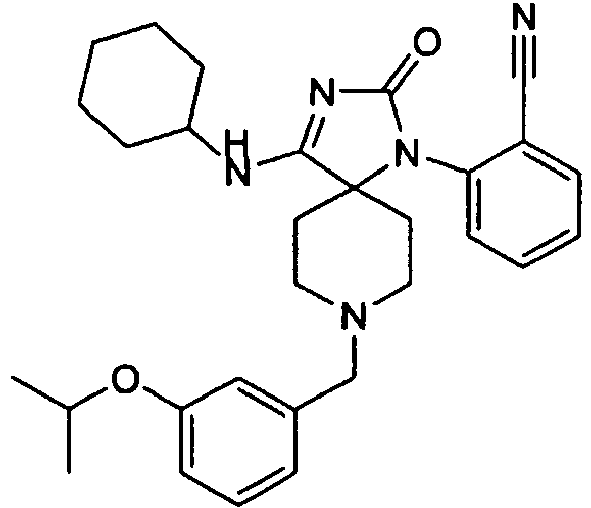
1-(2-Cyano-phenyl)-4-cyclohexylamino-8-(3-isopropoxy-benzyl)-2-oxo-1,3-diaza-8-azonia-spiro[4.5]dec-3-ene 500.1 15-6 
1-(2-Bromo-5-fluoro-phenyl)-4-cyclohexylamino-8-(3-isopropoxy-benzyl)-2-oxo-1,3-diaza-8-azonia-spiro[4.5]dec-3-ene 573.15 15-7 
4-Cyclohexylamino-8-(3-isopropoxy-benzyl)-2-oxo- 1-(2-phenylsulfanyl-phenyl)-1,3-diaza-8-azonia-spiro[4.5]dec-3-ene 583.35 15-8 
4-Cyclohexylamino-8-(3-isopropoxy-benzyl)-2-oxo-1-(3'-trifluoromethyl-biphenyl-2-yl)-1,3-diaza-8-azonia-spiro[4.5]dec-3-ene 619.35 15-9 
1-(2-Benzyl-phenyl)-4-cyclohexylamino-8-(3-isopropoxy-benzyl)-2-oxo-1,3-diaza-8-azonia-spiro[4.5]dec-3-ene 565.35 15-10 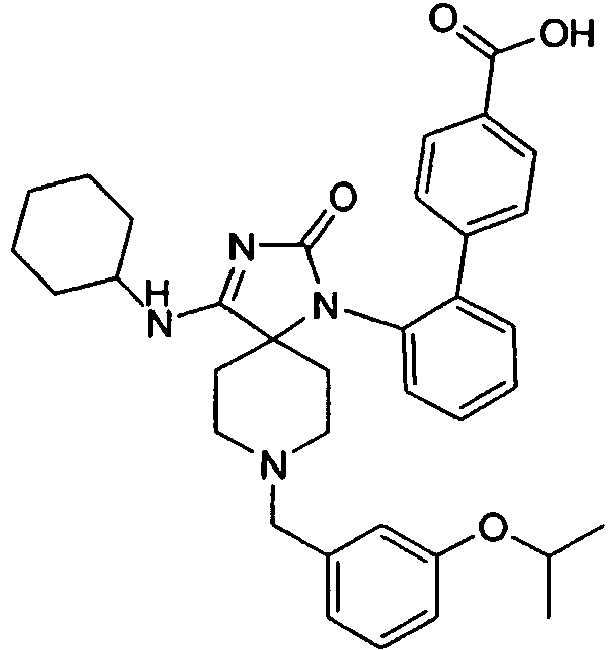
1-(4'-Carboxy-biphenyl-2-yl)-4-cyclohexylamino-8-(3-isopropoxy-benzyl)-2-oxo-1,3-diaza-8-azonia-spiro[4.5]dec-3-ene 595.35 15-11 
4-Cyclohexylamino-8-(3-isopropoxy-benzyl)-2-oxo-1-(4'-trifluoromethoxy-biphenyl-2-yl)-1,3-diaza-8-azonia-spiro[4.5]dec-3-ene 635.25 15-12 
4-Cyclohexylamino-1-[2-(1H-indol-5-yl)-phenyl]-8-(3-isopropoxy-benzyl)-2-oxo-1,3-diaza-8-azonia-spiro[4.5]dec-3-ene 590.4 15-13 
1-[2-(5-Carboxy-thiophen-2-yl)-phenyl]-4-cyclohexylamino-8-(3-isopropoxy-benzyl)-2-oxo-1,3-diaza-8-azonia-spiro[4.5]dec-3-ene 601.3 15-14 
4-Cyclohexylamino-8-(3-isopropoxy-benzyl)-1-(4'-methylcarbamoyl-biphenyl-2-yl)-2-oxo-1,3-diaza-8-azonia-spiro[4.5]dec-3-ene 608.35 15-15 
4-Cyclohexylamino-8-(3-isopropoxy-benzyl)-1-[3'-(2-methyl-cyclopropylmethoxy)-biphenyl-2-yl]-1,3,8-triaza-spiro[4.5]dec-3-en-2-one 635.4 15-16 
1-(4'-Cyanomethyl-biphenyl-2-yl)-4-cyclohexylamino-8-(3-isopropoxy-benzyl)-2-oxo-1,3-diaza-8-azonia-spiro[4.5]dec-3-ene 590.25 15-17 
4-Cyclohexylamino-1-(4'-dimethylsulfamoyl-biphenyl-2-yl)-8-(3-isopropoxy-benzyl)-2-oxo-1,3-diaza-8-azonia-spiro[4.5]dec-3-ene 658.35 15-18 
4-Cyclohexylamino-8-(3-isopropoxy-benzyl)-1-(4'-isopropoxycarbonyl-biphenyl-2-yl)-2-oxo-1,3-diaza-8-azonia-spiro[4.5]dec-3-ene 637.35 15-19 
4-Cyclohexylamino-1-(4'-ethanesulfonyl-4-fluoro-biphenyl-2-yl)-8-(3-isopropoxy-benzyl)-2-oxo-1,3-diaza-8-azonia-spiro[4.5]dec-3-ene 661.35 15-20 
1-(4'-Ethanesulfonyl-4-fluoro-biphenyl-2-yl)-8-(3-isopropoxy-benzyl)-4-isopropylamino-2-oxo-1,3-diaza-8-azonia-spiro[4.5]dec-3-ene 621.3 15-21 
4-Cyclohexylamino-8-(3-isopropoxy-benzyl)-1-[4'-(methanesulfonylamino-methyl)-biphenyl-2-yl]-2-oxo-1,3-diaza-8-azonia-spiro[4.5]dec-3-ene 658.35 15-22 
4-Cyclobexylamino-1-[5-fluoro-2-(1-methyl-1H-pyrazol-4-yl)-phenyl]-8-(3-isopropoxy-benzyl)-1,3,8-triaza-spiro[4.5]dec-3-en-2-one 573.3 15-23 
4-Cyclohexylamino-1-(5-fluoro-2-pyridin-3-yl-phenyl)-8-(3-isopropoxy-benzyl)-2-oxo-1,3-diaza-8-azonia-spiro[4.5]dec-3-ene 570.3 15-24 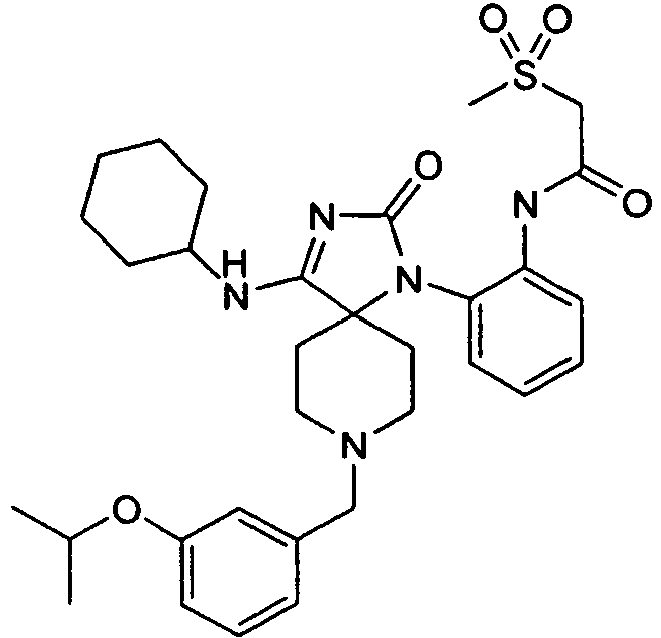
4-Cyclohexylamino-8-(3-isopropoxy-benzyl)-1-[2-(2-methanesulfonyl-acetylamino)-phenyl]-2-oxo-1,3-diaza-8-azonia-spiro[4.5]dec-3-ene 610.3 15-25 
4-Cyclohexylamino-8-(3-isopropoxy-benzyl)-1-[3-(4-methanesulfonyl-benzoylamino)-phenyl]-2-oxo-1,3-diaza-8-azonia-spiro[4.5]dec-3-ene 672.3 15-26 
1-(4'-Ethanesulfonyl-4-fluoro-biphenyl-2-yl)-8-(3-isopropoxy-benzyl)-2-oxo-4-(tetrahydro-pyran-4-ylamino)-1,3-diaza-8-azonia-spiro[4.5]dec-3-ene 663.3 15-27 
4-Cyclohexylamino-1-(4-fluoro-4'-methylsulfamoyl-biphenyl-2-yl)-8-(3-isopropoxy-benzyl)-2-oxo-1,3-diaza-8-azonia-spiro[4.5]dec-3-ene 662.25 15-28 
4-Cyclopropylamino-1-(4'-ethanesulfonyl-4-fluoro-biphenyl-2-yl)-8-(3-isopropoxy-benzyl)-2-oxo-1,3-diaza-8-azonia-spiro[4.5]dec-3-ene 619.2 15-29 
4-Cyclohexylamino-1-[5-fluoro-2-(1-methanesulfonyl-1H-pyrazol-4-yl)-phenyl]-8-(3-isopropoxy-benzyl)-2-oxo-1,3-diaza-8-azonia-spiro[4.5]dec-3-ene 637.3 15-30 
Ethanesulfonic acid {2'-[4-cyclohexylamino-8-(3-isopropoxy-benzyl)-2-oxo-1,3,8-triaza-spiro[4.5]dec-3-en-1-yl]-4'-fluoro-biphenyl-4-yl)-amide 676.35 15-31 
4-Cyclohexylamino-1-[4-fluoro-4'-(pyrrolidine-1-sulfonyl)-biphenyl-2-yl]-8-(3-isopropoxy-benzyl)-2-oxo-1,3-diaza-8-azonia-spiro[4.5]dec-3-ene 702.3 15-32 
1-(4'-Dimethylsulfamoyl-4-fluoro-biphenyl-2-yl)-8-(3-isopropoxy-benzyl)-4-isopropylamino-2-oxo-1,3-diaza-8-azonia-spiro[4.5]dec-3-ene 636.3 15-33 
4-Cyclohexylamino-1-(5-fluoro-3'-trifluoromethanesulfonylamino -biphenyl-3-yl)-8-(3-isopropoxy-benzyl)-2-oxo-1,3-diaza-8-azonia-spiro[4.5]dec-3-ene 716.3 15-34 
1-[3'-(Butane-2-sulfonylamino)-5-fluoro-biphenyl-3-yl]-4-cyclohexylamino-8-(3-isopropoxy-benzyl)-2-oxo-1,3-diaza-8-azonia-spiro[4.5]dec-3-ene 704.3 15-35 
2'-[4-Cyclohexylamino-8-(3-isopropoxy-benzyl)-2-oxo-1,3,8-triaza-spiro[4.5]dec-3-en-1-yl]-4'-fluoro-biphenyl-3-sulfonic acid methylamide 662.25 15-36 
4-Cyclohexylamino-1-[4'-(1,1-dioxo-116-isothiazolidin-2-yl)-4-fluoro-biphenyl-2-yl]-8-(3-isopropoxy-benzyl)-1,3,8-triaza-spiro[4.5]dec-3-en-2-one 688.3 15-37 
4-Cyclohexylamino-8-(3-isopropoxy-benzyl)-1-[3-(5-methyl-[1,2,4]oxadiazol-3-yl)-phenyl]-2-oxo-1,3-diaza-8-azonia-spiro[4.5]dec-3-ene 577.25 15-38 
4-Cyclohexylamino-1-[3-(3,5-dimethyl-isoxazol-4-yl)-5-fluoro-phenyl]-8-(3-isopropoxy-benzyl)-2-oxo-1,3-diaza-8-azonia-spiro[4.5]dec-3-ene 588.35 15-39 
1-[3-(5-Carboxy-thiophen-2-yl)-5-fluoro-phenyl]-4-cyclohexylamino-8-(3-isopropoxy-benzyl)-2-oxo-1,3-diaza-8-azonia-spiro[4.5]dec-3-ene 619.3 15-40 
4-Cyclopentylamino-1-(4-fluoro-4'-methanesulfonyl-biphenyl-2-yl)-8-(3-isopropoxy-benzyl)-2-oxo-1,3-diaza-8-azonia-spiro[4.5]dec-3-ene 633.3 15-41 
4-sec-Butylamino-1-(4-fluoro-4'-methanesulfonyl-biphenyl-2-yl)-8-(3-isopropoxy-benzyl)-2-oxo-1,3-diaza-8-azonia-spiro[4.5]dec-3-ene 621.3 15-42 
1-[2-(4-Acetylamino-piperidin-1-yl)-5-fluoro-phenyl]-4-cyclohexylamino-8-(3-isopropoxy-benzyl)-2-oxo-1,3-diaza-8-azonia-spiro[4.5]dec-3-ene 633.3 15-43 
4-Cyclohexylamino-8-cyclopropylmethyl-1-(4'-dimethylsulfamoyl-4-fluoro-biphenyl-2-yl)-2-oxo-1,3-diaza-8-azonia-spiro[4.5]dec-3-ene 582.3 15-44 
4-Cyclohexylamino-8-(3-isopropoxy-benzyl)-1-(2-pyrazol-1-yl-phenyl)-1,3,8-triaza-spiro[4.5]dec-3-en-2-one 541.35 15-45 
1-[3'-(3-Amino-propionylamino)-5-fluoro-biphenyl-3-yl]-8-isobutyl-4-isopropylamino-2-oxo-1,3-diaza-8-azonia-spiro[4.5]dec-3-ene hydrochloride 523.3 -


This amino nitrile was converted to the thiohydantoin via the standard procedure already described. - Crude thiol from the standard thiolation conditions (8.47g, 17.5 mmol, 1.0 eq.) and cyclohexylamine (8.0mL, 70 mmol, 4.0 eq.) were dissolved into DMSO (32 mL). The solution was stirred and heated to 115° C in an oil bath for 24 hr, then cooled to rt. The resulting solution was diluted with diethyl ether, and washed with 1 N hydrochloric acid, then dried over magnesium sulfate, filtered and concentrated. The crude aminohydantoin was purified by filtration through a 600 mL silica plug in 2 L fritted funnel, using 70% ethyl acetate in hexanes, followed by 100% ethyl acetate, as the elution solvents. This procedure yielded (2.0971g, 23%)of the desired product as a dark green semi-solid.
A portion of the aminohydantoin (528.6mg) was dissolved into dioxane (4 mL). A 4N solution of hydrogen chloride in dioxane (5 mL) was added, and the reaction was left to sit for 3 hr, then concentrated. The crude product was treated with dichloromethane, and washed with saturated sodium bicarbonate solution. The organic solution was dried over magnesium sulfate, filtered and concentrated. The crude free base was then purified by flash chromatography over silica gel using 5% of 2N ammonia(methanol) : 95% dichloromethane to provide the desired, deprotected piperidine (241mg, 56%).
To the deprotected piperidine (127.0mg, 0.3mmol) in DMF (3 mL) was added potassium carbonate (45.6mg, 0.33mmol), followed by cyclopropane methyl bromide (32.3µL, 0.33mmol). The solution was heated at 80°C for 15 hours, cooled to rt and then quenched with water. The product was extracted three times with ethyl acetate, washed with water, then with aqueous 1M HCl, and then with brine. The organic solution was dried over magnesium sulfate, filtered, and concentrated to dryness. The product was purified using prep-TLC (elution with 1% methanol/99% ethyl acetate) to provide the cyclopropylmethyl piperidine aryl bromide (52.6mg, 36.8%).
The final compound example 15-43 MS (MH+) 582.3 was prepared from the above aryl bromide via the standard Suzuki coupling conditions already described, using the Boykin catalyst. -


- To a solution of 3-amino-benzonitrile (4.7g, 40.0 mmol) in 200mL THF, was added triethylamine (5.6mL, 40.0 mmol), followed by di-tert-butyl dicarbonate (8.7g, 40.0 mmol). After two days of heating at reflux, the solution was cooled, then partitioned between water and and ethyl acetate. The product was extracted three times with ethyl acetate, washed with aqueous 1M HCl and brine, dried over magnesium sulfate, filtered, and concentrated to dryness. The product was purified using silica gel chromatography (elution with 10% hexane/90% ethyl acetate) to provide A (8.31g, 93.2%).
- A combined solution of A (6.54g, 30mmol), 50% w/w aqueous hydroxylamine (3.6mL, 60mmol), and 60mL ethanol was refluxed for three hours. Ethanol was removed under high vacuum to yield B (7.3g, 96.9%) as a brittle foam.
- A solution of B (1.7g, 7.0mmol), acetyl chloride (746.5µL, 10.5mmol) in 35.0mL pyridine was refluxed for one day. Pyridine was removed under high vacuum. The crude material was partitioned between ethyl acetate and water. The product was extracted three times with ethyl acetate, washed with aqueous 1M HCl, then with brine, and then dried over magnesium sulfate, filtered, and concentrated to dryness. The product was purified using silica gel chromatography (elution with 15% hexane/85% ethyl acetate) to provide C. Removal of the Boc protecting group was accomplished by stirring a solution of C in 50mL of 4M HCl/dioxane for 30 minutes at rt. Dioxane was evaporated in vacuo to yield the aniline hydrochloric salt D (944.8mg, 64.3%) as an off-white solid. The aniline was converted to the desired product Example 15-47 MS (MH+) 577.25 using the standard Ugi reaction conditions as described in Scheme 3.
-


- 4-t-butoxycarbonylamino-piperidine (804.4 mg, 4.02 mmol, 1.0 eq.) and 2,5-difluoronitrobenzene (679.5 mg, 4.27 mmol, 1.06 eq.) were dissolved into DMSO (4mL) in a 20 mL scintillation vial with a stir bar. Diisopropylethylamine (DIEA, 1mL, 7.75 mmol, 1.93 eq.) was added, and the vial was capped and placed to stir in a 70° C aluminum block for 3.5h. The solution was then cooled to rt, diluted with diethyl ether, and washed with 1N hydrochloric acid. The organic solution was dried over MgSO4, filtered, and concentrated to provide the aryl piperidine A (1.5261 g, 112%), which was carried on directly to the next step.
- To a solution of A (339.36mg, 1.0 mmol) in 2.5mL methanol and 2.5 mL water, was added ammonium chloride (266.5mg, 5mmol), followed by zinc dust (327mg, 5mmol). The reaction mixture was stirred at room temperature for one hour, then filtered through a celite plug. Hydrochloric acid (1 mmol) was added to the free amine to obtain the amine hydrochloride salt. The filtrate was concentrated to yield B (307.5 mg, 89.0%) as a white solid.
- To an ice-cold solution of 1-(3-Isopropoxy-benzyl)-piperidine-4,4-diol (132.5mg, 0.5mmol) and B (169.9mg, 0.55mmol) in glacial acetic acid (0.5mL), was added slowly trimethylsilyl cyanide (73.4µL, 0.55mmol). The reaction mixture was kept at 0°C for 5 min then allowed to warm to rt over 30 min. The resulting mixture was quenched with a saturated ammonium hydroxide:ice mixture until the pH reached 10, and was then extracted twice with dichloromethane. The combined dichloromethane extracts were washed with brine, dried over magnesium sulfate and concentrated. The crude material was purified by preparative TLC (20% ethyl acetate/60% hexanes) to provide C (234.5mg, 83.0%) as an oily residue.
- To an ice cold solution of C (234.5mg, 0.415mmol) in 1.5mL chloroform, was added dropwise chlorosulfonyl isocyanate (39.7µL, 0.46mmol). The reaction was stirred at rt for 30 min, then quenched by addition of 830µL of water. The reaction mixture was stirred for another one hr at rt, then added to a 0° C aqueous solution of H2S (622.5mg Na2S + 313.0mL H2O + 622.5-650.0µL acetic acid), which was prepared immediately before use. The resulting mixture was stirred at room temperature for 24 hr, then made alkaline with saturated sodium bicarbonate solution until pH>7, then extracted two times with ethyl acetate. The combined extracts was washed with brine, dried over magnesium sulfate and concentrated. The crude material was purified by preparative TLC (40% ethylacetate/60% hexane) to provide D (98.8mg, 38.0%) as an oil residue.
- To a solution of D (98.8mg, 0.158mmol) in 2mL DMSO was added cyclohexyl amine (200µL, 1.58mmol). The reaction mixture was heated at 110°C for two days. The crude product was purified by preparative reverse phase HPLC to provide E (59.7mg, 54.7%) as the TFA salt, a fine yellow powder after being lyophilized.
- Boc removal of E (30mg, 0.43mmol) was carried out using 0.5 ml 25%TFA/DCM at rt for 10 min. The TFA amine salt was dried in vacuo and redissolved in 0.5mL tetrahydrofuran. Triethylamine (0.09mmol, 12.5µL) was added to the reaction solution, followed by acetyl chloride (∼4.0µL, 0.052mmol), and the reaction was then stirred at rt for 15 min. The crude reaction was purified by preparative reverse phase HPLC and lyophilized to provide 15-45 (6.4mg, 23.6%) MS (MH+) 633.3, as a fine yellow powder.
Claims (12)
- A compound of formula (I):

 X is N;X' is NH;Z is O;R1 is selected from the group consisting of(1) hydrogen,(2) -C1-6alkyl,(3) -C0-6 alkyl-C6-10 aryl,(4) -C0-6 alkyl-C5-12 heteroaryl,(5) - C0-6 alkyl-C3-12 carbocyclic, wherein the carbocyclic group optionally has from one to three ring heteroatoms selected from the group consisting of S, N and O,(6) - O-R6, and(7) - C0-6 alkyl-Q1-R6,
wherein said R1 alkyl moiety is optionally substituted with one or more(a) -OR4,(b) halogen,(c) cyano, and(d) -NR4R4',said R1 carbocyclic moiety is optionally substituted with one or more(a) -OR4,(b) =O,(c) halogen,(d) cyano,(e) -C(=O)-NR4R4',(f) -C1-6 alkyl, wherein said alkyl is optionally substituted with one or more(I) halogen,(II) -OH, and(III) -C6-10 aryl,(g) -NR4-SO2-R4',(h) -SO2-R4,(i) -NR4-C(=O)-R4',(j) -C(=O)-OR4,(k) -NR4R4',(l) -C(=O)-R4, and(m) -SO2-NR4R4',and said R1 aryl and heteroaryl moieties are optionally substituted with one or more(a) halogen,(b) -C1-6alkyl,(c) -C2-6 alkenyl,(d) -C2-6 alkynyl,(e) -C0-3 alkyl-C6-10 aryl,(f) cyano,(g) -0-C0-3 alkyl-C6-10 aryl,(h) -O-R4,(i) -C(=O)-NR4R4',(j) -NR4R4',(k) -Q2-R7, and(l) -C0-3 alkyl-C5-12 heteroaryl,Q1 and Q2 are selected from the group consisting of(a) -C(=O)-,(b) -C(=O)-O-,(c) -C(=O)-NR8-,(d) -NR8-C(=O)-,(e) -S(=O)n- ,(f) -Si(R8R9)-,(g) -S(=O)2-R8-,(h) -R8-S(=O)2-,(i) -O-C(=O)-,(j) -NR8-C(=O)-O-,(k) -SO2-NR4-,(l) -NR4SO2-,(m) -NR4-wherein n is 0, 1 or 2;R2 is selected from the group consisting of(1) hydrogen,(2) -C1-6 alkyl,(3) - C0-6 alkyl-C3-12 carbocyclic, wherein the carbocyclic group optionally has from one to three ring heteroatoms selected from the group consisting of S, N and O,(4) -C0-6 alkyl-C6-10 aryl,(5) -C0-6 alkyl-Q3-C1-6 alkyl,(6) -C0-6 alky1-C5-12 heteroaryl,and Q3 and Q4 are selected from the same group as Q1 and Q2;
wherein said R2 alkyl moiety is optionally substituted with one or
more(a) halogen(b) cyano(c) -C3-8 cycloalkyl(d) -O-C1-6 alkyl,(e) OH,and said R2 cycloalkyl moiety is optionally substituted with one or more -C1-6 alkyl,
and said R2 aryl or heteroaryl moiety is optionally substituted with one or more(a) -OR10,(b) halogen,(c) -cyano,(d) -NO2,(e) -Q4-C1-6 alkyl,(f) -C1-6 alkyl, wherein said alkyl is optionally subsitituted with one or more(I) halogen, and(II) cyano,(g) -C0-3 alkyl-C6-10 aryl, wherein said aryl is optionally substituted with one or more(I) halogen,(II) -C1-6 alkyl,(III) -C2-6 alkenyl,(IV) -C2-6 alkynyl,(V) -O-C1-6 alkyl,(VI) -SO2-C1-6 alkyl,(VII) cyano,(VIII) -C3-8 cycloalkyl,(IX) -NO2,(X) -SO2-NR4R4'(h) -SO2-C1-6 alkyl,(i) -SO2 -NR4R4',(j) -NR4R4',(k) -C3-8 cycloalkyl,(l) -C2-6 alkenyl,(m) -NHC(=O)-C1-6 alkyl, wherein said alkyl is optionally substituted with one or more(I) -NR4R4'(II) OH(III) -SO2R4, and(IV) -NHSO2R4,(n) -NHC(=O)-C0-3 alkyl-C6-10 aryl, wherein said aryl is optionally substituted with one or more(I) NR4R4',(II) OH,(III) -SO2R4, and(IV)-NHSO2R4,(o) -C0-3 alkyl-C5-12 heteroaryl, wherein said heteroaryl is optionally substituted with one or more(I) halogen,(II) -C1-6 alkyl, and(III) =O,(p) -S(=O)m--C0-6 alkyl-C6-10 aryl,(q) -CO2-R4,(r) -C(=O)-NR4R4',(s) -C0-6 alkyl-NR4 SO2-R4,(t) -O-C2-6 alkenyl,
and m is 0, 1 or 2;R3 is selected from the group consisting of(1) hydrogen,(2) -C0-3 alkyl-C6-10 aryl,(3) -C0-3 alkyl-C5-12 heteroaryl,(4) - C0-3 alkyl-C3-10 carbocyclic, wherein the carbocyclic group optionally has from one to three ring heteroatoms selected from the group consisting of S, N and O,
wherein said R3 alkyl moiety is optionally substituted with one or more(a) -OR11,(b) halogen,(c) cyano,(d) -C(=O)-NR4R4',(e) -Q5-C1-6 alkyl,(f) -Q5-H;and said R3 cycloalkyl moiety is optionally substituted with one or more(a) -C1-6 alkyl,(b) -C0-3 alkyl-C6-10 aryl,and said R3 aryl and heteroaryl moiety is optionally substituted with one or more(a) -OR12,(b) -NR4R4',(c) halogen,(d) cyano,(f) -N02,(g) -Q6-R4, and(h) -C1-6 alkyl, wherein said alkyl is optionally substituted with one or more(I) halogen,(II) cyano,(III) -C1-6 alkyl,(IV) -O-C1-6 alkyl,(V) -C3-8 cycloalkyl,(VI) -C(=O)-C1-6 alkyl,(i) -C2-6 alkenyl,(j) -C2-6 alkynyl,(k) -C0-3 alkyl-C5-12 heteroaryl,(l) -O-C2-6 alkenyl,(m) -C0-3 alkyl-C6-10 aryle, wherein said aryl moiety is optionally substituted with one or more(I) -C1-6 alkyl,(II) -C2-6 alkenyl,(III) -C2-6 alkynyl,(IV) halogen,(V) cyano,(VI) -C3-8 cycloalkyl, and(VII) N02,and R12 is selected from the group consisting of(I) hydrogen,(II) -C1-6 alkyl,(III) -C2-6 alkenyl,(IV) -C2-6 alkynyl,(V) -C3-8 cycloalkyl, and(VI)-C0-3 alkyl-C6-10 aryl,
and said R12 alkyl, alkenyl and alkenyl moiety is optionally substituted with one or more(A) halogen,(B) hydroxyl,(C) cyano,(D) -O-C1-6 alkyl, wherein said alkyl is optionally substituted with one or more halogen,(E) -NR4R4',(F) -NR4-S(=O)2-R4',(G) -NR4-C(=O)-R4',(H) -NR4-C(=O)-OR4',(I) -S(=O)2-NR4-,and said R10 cycloalkyl moiety is optionally substituted with one or more(A) halogen,(B) hydroxyl,(C) -cyano,(D) -O-C1-6 alkyl, and(E) -C1-6 alkyl, wherein said alkyl is optionally substituted one or more halogen;and said R12 aryl moiety is optionally substituted with one or more(A) halogen,(B) cyano,(C)-O-C1-6 alkyl, and(D) -C1-6 alkyl, wherein said alkyl is optionallysubstituted one or more halogen;Q5 and Q6 are selected from the same group as Q1 and Q2;R4 and R4' are selected from the group consisting of(1) hydrogen,(2) -C1-8 alkyl, wherein said alkyl is optionally substituted with(a) halogen,(b) -C3-8 cycloalkyl(c) -CO2C1-6 alkyl(d) -OC1-6 alkyl, wherein said alkyl is optionally substituted with one or more(I) halogen, or(II) cyano,(3) -C2-8 alkenyl, and(4) -C0-3 alkyl-C6-10aryl;R5 is selected from the group csoonsisting of(1) hydrogen,(2) -C1-6 alkyl,(3) halogen, and(4) -CO2-R4,R6, R7, R8, R9, R10 and R11 are independently selected from the group consisting of:provided that when X is N or X1 is NH; R1 is unsubstituted cyclohexyl; and R2 is unsubstituted phenyl, then R3 is not unsubstituted benzyl;(1) hydrogen,(2) -C1-6 alkyl,(3) -C3-8 cycloalkyl,(4) -C0-3 alkyl-C6-10 aryl,
wherein said alkyl is optionally substituted with one or more(A) halogen,(B) hydroxyl,(C) cyano,(D) -O-C1-6 alkyl, wherein said alkyl is optionally substituted with one or more halogen,and said cycloalkyl and aryl are optionally substituted with one or more(A) halogen,(B) hydroxyl,(C) cyano,(D) -O-C1-6 alkyl, and(E) -C1-6 alkyl, wherein said alkyl is optionally substituted one or more halogen;
and pharmaceutically acceptable salts thereof, and individual enantiomers and diastereomers thereof. - The compound of Claim 1 wherein R1 -C1-6 alkyl or -C0-3 alkyl-C3-12 carbocyclic, wherein said alkyl or carbocyclic is optionally substituted as in Claim 1.
- The compound of Claim 1 wherein R1 is -C0-3 alkyl-C6-10 aryl, and said aryl moiety is optionally substituted with one or more(a) halogen, or(b) -C1-6alkyl.
- The compound of Claim 1 wherein R1 is -C0-3 alkyl-C5-12 heteroaryl, and said heteroaryl is optionally substituted withone or more(a) halogen, or(b) -C1-6alkyl.
- The compound of any of Claims 1 to 4 wherein R2 is selected from the group consisting of(1) -C1-6 alkyl,(2) -C0-6 alkyl-C3-8 carbocyclic, and(3) -C0-3 alkyl-C6-10 aryl,wherein said alky, carbocyclic or aryl moieties are optionally substituted as in claim 1.
- The compound of claim 5, wherein R2 is phenyl or benzyl, and said phenyl or benzyl are optionally substituted as in claim 1.
- The compound of Claim 1 which is a compound of formula (II)

 (a) -OR10,(b) halogen,(c) -cyano,(d) -Q4-C1-6 alkyl,(e) - C1-6 alkyl, wherein said alkyl is optionally subsitituted with one or more(I) halogen, and(II) cyano,(f) -C0-3 alkyl-C6-10 aryl, wherein said aryl is optionally substituted with one or more(I) halogen,(II) -C1-6 alkyl,(V) -O-C1-6 alkyl,(VI) -SO2 -C 1-6 alkyl,(VII) cyano,(VIII) -C3-8 cycloalkyl,(X) -SO2-NR4R4'(g) -SO2-C1-6 alkyl,(h) -SO2-NR4R4',(i) -C3-8 cycloalkyl,(j) -NHC(=O)-C1-6 alkyl, wherein said alkyl is optionally substituted with one or more(I) -NR4R4'(II) OH(III) -SO2R4, and(IV) -NHSO2R4,(k) -C0-3 alkyl-C5-12 heteroaryl, wherein said heteroaryl is optionally substituted with one or more(I) halogen,(II)-C1-6 alkyl, and(III) =O,(l) -S(=O)m-C0-6alkyl-C6-10aryl,(m) -CO2-R4,(n) -C(=O)-NR4R4',(o) -C0-6 alkyl-NR4 SO2-R4.
 - The compound of Claim 7 wherein R3 is selected from the group consisting of(1) -C0-3 alkyl-C6-10 aryl, or(2) -C0-3 alkyl-C5-12 heteroaryl, and said aryl and heteroaryl are optionally substituted with one or more(a) -OR12,(b) -NR4R4',(c) halogen,(d) cyano,(e) -N02,(f) -Q6- R4, and(g) -C1-6 alkyl, wherein said alkyl is optionally substituted with one or more(I) halogen,(II) cyano,(III) -C 1-6 alkyl,(IV) -O-C1-6 alkyl,(V) -C3-8cycloalkyl,(VI) -C(=O) -C1-6 alkyl,(h) -C2-6 alkenyl,(i) -C2-6 alkynyl,(j) -C0-3 alkyl-C5-12 heteroaryl,(k) -C0-3 alkyl-C6-10 aryl, and said aryl moiety is optionally substituted with one or more(I) -C1-6 alkyl,(II) -C2-6 alkenyl,(III) -C2-6 alkynyl,(IV) halogen,(V) cyano,(VI) -C3-8 cycloalkyl, and(VII) NO2.
- The compound of Claim 8 wherein R3 is benzyl, which is optionally substituted with one or more(a) -OR12,(b) NR4R4',(c) halogen,(d) cyano,(f) -N02,(g) -Q6- R4, and(h) -C 1-6 alkyl, wherein said alkyl is optionally substituted with one or more(I) halogen,(II) cyano,(III) -C1-6 alkyl,(IV) -O-C1-6 alkyl,(V) -C3-8 cycloalkyl,(VI) -C(=O) -C1-6 alkyl,(i) -C2-6 alkenyl,(j) -C2-6 alkynyl,(k) -C0-3 alkyl-C5-12 heteroaryl,(l) -C0-3 alkyl-C6-10 aryl, wherein p is 0 or 1, and said aryl moiety is optionally substituted with one or more(I) -C1-6 alkyl,(II) -C2-6 alkenyl,(III) -C2-6 alkynyl,(IV) halogen,(V) cyano,(VI) -C3-8 cycloalkyl, and(VII) NO2.
- The compound of Claim 1 which is a compound of formula (III)

 (a) -OR12,(b) NR4R4',(c) halogen,(d) cyano,(f) -NO2,(g) -Q6- R4, and(h) -C1-6 alkyl, wherein said alkyl is optionally substituted with one or more(I) halogen,(II) cyano,(III) -C1-6 alkyl,(IV) -O-C1-6 alkyl,(V) -C3-8 cycloalkyl,(VI) -C(=O)-C1-6 alkyl,(i) -C2-6 alkenyl,(j) -C2-6 alkynyl,(k) -C0-3 alkyl-C5-12 heteroaryl,(l) -C0-3 alkyl-C6-10 aryl, wherein said aryl moiety is optionally substituted with one or more(I) -C1-6 alkyl,(II) -C2-6 alkenyl,(III) -C2-6 alkynyl,(IV) halogen,(V) cyano,(VI) -C3-8 cycloalkyl, and(VII) NO2.
 - A pharmaceutical composition comprising a therapeutically effective amount of a compound according to any previous claim and a pharmaceutically acceptable carrier or diluent.
- A compound according to any of claims 1-10 for use in a method of treating Alzheimer's disease in a patient in need thereof comprising administering to the patient a therapeutically effective amount of said compound.
Applications Claiming Priority (2)
| Application Number | Priority Date | Filing Date | Title |
|---|---|---|---|
| US61842004P | 2004-10-13 | 2004-10-13 | |
| PCT/US2005/036752 WO2006044497A2 (en) | 2004-10-13 | 2005-10-12 | Spiropiperidine compounds useful as beta-secretase inhibitors for the treatment of alzhermer’s disease |
Publications (3)
| Publication Number | Publication Date |
|---|---|
| EP1804794A2 EP1804794A2 (en) | 2007-07-11 |
| EP1804794A4 EP1804794A4 (en) | 2010-03-31 |
| EP1804794B1 true EP1804794B1 (en) | 2013-07-31 |
Family
ID=36203499
Family Applications (1)
| Application Number | Title | Priority Date | Filing Date |
|---|---|---|---|
| EP05812233.4A Expired - Lifetime EP1804794B1 (en) | 2004-10-13 | 2005-10-12 | Spiropiperidine compounds useful as beta-secretase inhibitors for the treatment of alzhermer s disease |
Country Status (7)
| Country | Link |
|---|---|
| US (1) | US8114887B2 (en) |
| EP (1) | EP1804794B1 (en) |
| JP (1) | JP2008515989A (en) |
| CN (1) | CN101068545A (en) |
| AU (1) | AU2005295814A1 (en) |
| CA (1) | CA2583342A1 (en) |
| WO (1) | WO2006044497A2 (en) |
Families Citing this family (41)
| Publication number | Priority date | Publication date | Assignee | Title |
|---|---|---|---|---|
| US7700603B2 (en) | 2003-12-15 | 2010-04-20 | Schering Corporation | Heterocyclic aspartyl protease inhibitors |
| US7592348B2 (en) | 2003-12-15 | 2009-09-22 | Schering Corporation | Heterocyclic aspartyl protease inhibitors |
| US7763609B2 (en) | 2003-12-15 | 2010-07-27 | Schering Corporation | Heterocyclic aspartyl protease inhibitors |
| AR054510A1 (en) | 2005-06-14 | 2007-06-27 | Schering Corp | HETEROCICLICAL COMPOUNDS AS INHIBITORS OF ASPARTIL PROTEASAS AND PHARMACEUTICAL COMPOSITIONS THAT UNDERSTAND THEM. |
| CA2610828A1 (en) | 2005-06-14 | 2006-12-28 | Schering Corporation | Heterocyclic aspartyl protease inhibitors, preparation and use thereof |
| US7759354B2 (en) | 2005-06-14 | 2010-07-20 | Schering Corporation | Bicyclic guanidine derivatives as asparyl protease inhibitors, compositions, and uses thereof |
| JP2008543844A (en) | 2005-06-14 | 2008-12-04 | シェーリング コーポレイション | Aspartyl protease inhibitor |
| US8211904B2 (en) * | 2005-07-18 | 2012-07-03 | Merck, Sharp & Dohme Corp. | Spiropiperidine beta-secretase inhibitors for the treatment of alzheimer's disease |
| US8506474B2 (en) | 2005-08-19 | 2013-08-13 | Bioventrix, Inc. | Method and device for treating dysfunctional cardiac tissue |
| WO2007130383A2 (en) * | 2006-04-28 | 2007-11-15 | Northwestern University | Compositions and treatments using pyridazine compounds and secretases |
| AU2007293416A1 (en) * | 2006-09-07 | 2008-03-13 | Merck & Co., Inc. | Spiropiperidine beta-secretase inhibitors for the treatment of Alzheimer's disease |
| EP2073635B1 (en) * | 2006-10-06 | 2012-03-21 | Merck Sharp & Dohme Corp. | Macrocyclic spiropiperidine beta-secretase inhibitors for the treatment of alzheimer's disease |
| ATE538651T1 (en) * | 2006-10-30 | 2012-01-15 | Merck Sharp & Dohme | SPIROPIPERIDINE INHIBITORS OF BETA-SECRETASE FOR THE TREATMENT OF ALZHEIMER'S DISEASE |
| EP2091945B1 (en) * | 2006-11-09 | 2014-01-15 | Probiodrug AG | Novel inhibitors of glutaminyl cyclase |
| US8278345B2 (en) | 2006-11-09 | 2012-10-02 | Probiodrug Ag | Inhibitors of glutaminyl cyclase |
| JP5523107B2 (en) | 2006-11-30 | 2014-06-18 | プロビオドルグ エージー | Novel inhibitors of glutaminyl cyclase |
| JP2010512389A (en) | 2006-12-12 | 2010-04-22 | シェーリング コーポレイション | Aspartyl protease inhibitor |
| AU2007342368A1 (en) | 2007-01-04 | 2008-07-17 | Merck & Co., Inc. | Bicyclic spiropiperidine beta-secretase inhibitors for the treatment of Alzheimer's disease |
| EP2481408A3 (en) | 2007-03-01 | 2013-01-09 | Probiodrug AG | New use of glutaminyl cyclase inhibitors |
| WO2008128985A1 (en) | 2007-04-18 | 2008-10-30 | Probiodrug Ag | Thiourea derivatives as glutaminyl cyclase inhibitors |
| CL2008003120A1 (en) * | 2007-11-01 | 2009-10-09 | Acucela Inc | Compounds derived from phenylalkyl-, phenylalkenyl-, phenylalkynyl amine, phenylthioalkylamine, phenylaminoalkylamine, phenylalkoxyamine and phenylalkylguanidine; pharmaceutical composition; and use of the compounds to treat an ophthalmological disorder or disease such as retinopathy, maculopathy, retinitis pigmentosa, uveitis, among others. |
| KR20110000749A (en) * | 2008-05-05 | 2011-01-05 | 화이자 인코포레이티드 | Spiro piperidines for the treatment of neurodegenerative diseases |
| CA2743584A1 (en) * | 2008-11-23 | 2010-05-27 | Pfizer Inc. | Lactams as beta secretase inhibitors |
| KR101908255B1 (en) | 2009-03-13 | 2018-10-15 | 비타이 파마슈티컬즈, 인코포레이티드 | Inhibitors of beta-secretase |
| MX2012002993A (en) | 2009-09-11 | 2012-04-19 | Probiodrug Ag | Heterocylcic derivatives as inhibitors of glutaminyl cyclase. |
| UA108363C2 (en) | 2009-10-08 | 2015-04-27 | IMINOTIADIASIADIOXIDE OXIDES AS BACE INHIBITORS, COMPOSITIONS THEREOF AND THEIR APPLICATIONS | |
| JP5828848B2 (en) | 2010-02-24 | 2015-12-09 | ヴァイティー ファーマシューティカルズ,インコーポレイテッド | Beta-secretase inhibitor |
| JP6026284B2 (en) | 2010-03-03 | 2016-11-16 | プロビオドルグ エージー | Inhibitors of glutaminyl cyclase |
| US8269019B2 (en) | 2010-03-10 | 2012-09-18 | Probiodrug Ag | Inhibitors |
| WO2011125006A2 (en) * | 2010-04-09 | 2011-10-13 | Pfizer Inc. | Novel sultam compounds |
| WO2011131748A2 (en) | 2010-04-21 | 2011-10-27 | Probiodrug Ag | Novel inhibitors |
| ES2570167T3 (en) | 2011-03-16 | 2016-05-17 | Probiodrug Ag | Benzimidazole derivatives as glutaminyl cyclase inhibitors |
| WO2012138734A1 (en) | 2011-04-07 | 2012-10-11 | Merck Sharp & Dohme Corp. | C5-c6 oxacyclic-fused thiadiazine dioxide compounds as bace inhibitors, compositions, and their use |
| US9145426B2 (en) | 2011-04-07 | 2015-09-29 | Merck Sharp & Dohme Corp. | Pyrrolidine-fused thiadiazine dioxide compounds as BACE inhibitors, compositions, and their use |
| KR20140054295A (en) | 2011-08-22 | 2014-05-08 | 머크 샤프 앤드 돔 코포레이션 | 2-spiro-substituted iminothiazines and their mono- and dioxides as bace inhibitors, compositions and their use |
| EP2776437B1 (en) * | 2011-11-07 | 2018-09-26 | Sunovion Pharmaceuticals Inc. | Modulators of opioid receptors and methods of use thereof |
| TWI557112B (en) | 2012-03-05 | 2016-11-11 | 百靈佳殷格翰國際股份有限公司 | --secretase inhibitor |
| TW201422592A (en) | 2012-08-27 | 2014-06-16 | Boehringer Ingelheim Int | Inhibitors of beta-secretase |
| US9290477B2 (en) | 2012-09-28 | 2016-03-22 | Vitae Pharmaceuticals, Inc. | Inhibitors of β-secretase |
| KR20150105302A (en) | 2012-11-05 | 2015-09-16 | 난트 홀딩스 아이피, 엘엘씨 | Cyclic sulfonamide containing derivatives as inhibitors of hedgehog signaling pathway |
| PL3461819T3 (en) | 2017-09-29 | 2020-11-30 | Probiodrug Ag | Inhibitors of glutaminyl cyclase |
Family Cites Families (15)
| Publication number | Priority date | Publication date | Assignee | Title |
|---|---|---|---|---|
| US3639409A (en) | 1967-06-22 | 1972-02-01 | Sankyo Co | 1 3 8-triaza-2-oxo- or thioxo-3-substituted-4-oxo or imin 7 9 9-tetraalkyl spiro(4 o-75)decanes |
| US3542729A (en) | 1968-03-19 | 1970-11-24 | Sankyo Co | Stabilization of synthetic polymers |
| JPS4920973B1 (en) | 1970-05-28 | 1974-05-29 | ||
| US4066615A (en) | 1971-06-05 | 1978-01-03 | Sankyo Company Limited | Polymer compositions containing piperidine derivatives as stabilizers |
| DE3643890A1 (en) | 1986-12-22 | 1988-06-30 | Basf Ag | NEW POLYALKYLPIPERIDE INDEXIVES WITH ALKYLENE BRIDGES, THEIR USE AS A STABILIZER AND INTERMEDIATE PRODUCTS |
| US5221675A (en) * | 1989-12-15 | 1993-06-22 | Abbott Laboratories | Aza-spirocyclic compounds that enhance cholinergic neurotransmission |
| JP2893097B2 (en) | 1989-12-20 | 1999-05-17 | 富士写真フイルム株式会社 | Silver halide color photographic materials |
| US5534520A (en) | 1990-04-10 | 1996-07-09 | Fisher; Abraham | Spiro compounds containing five-membered rings |
| US5852029A (en) | 1990-04-10 | 1998-12-22 | Israel Institute For Biological Research | Aza spiro compounds acting on the cholinergic system with muscarinic agonist activity |
| AU4562799A (en) | 1998-06-15 | 2000-01-05 | Merck & Co., Inc. | Inhibitors of prenyl-protein transferase |
| US20040067950A1 (en) | 1998-07-27 | 2004-04-08 | Schering-Plough Corporation | High affinity ligands for nociceptin receptor ORL-1 |
| DE10012859A1 (en) | 1999-03-19 | 2000-09-21 | Ciba Sc Holding Ag | New (poly)ethers prepared by reacting hydroxy-2,2,6,6-tetramethyl-piperidine or -piperazine hindered amine light stabilizer with methylene halide are used for stabilizing organic material, e.g. polymer or lacquer |
| KR100974901B1 (en) | 2001-12-28 | 2010-08-10 | 아카디아 파마슈티칼스 인코포레이티드 | Spiroazacyclic Compounds as Monoamine Receptor Modulators |
| US7439251B2 (en) | 2002-05-03 | 2008-10-21 | Israel Institute For Biological Research | Methods and compositions for treatment of central and peripheral nervous system disorders and novel compounds useful therefor |
| EP1554260A1 (en) | 2002-10-22 | 2005-07-20 | Glaxo Group Limited | Aryloxyalkylamine derivatives as h3 receptor ligands |
-
2005
- 2005-10-12 CA CA002583342A patent/CA2583342A1/en not_active Abandoned
- 2005-10-12 EP EP05812233.4A patent/EP1804794B1/en not_active Expired - Lifetime
- 2005-10-12 WO PCT/US2005/036752 patent/WO2006044497A2/en not_active Ceased
- 2005-10-12 CN CNA2005800343960A patent/CN101068545A/en active Pending
- 2005-10-12 US US11/663,388 patent/US8114887B2/en active Active
- 2005-10-12 AU AU2005295814A patent/AU2005295814A1/en not_active Abandoned
- 2005-10-12 JP JP2007536860A patent/JP2008515989A/en active Pending
Non-Patent Citations (1)
| Title |
|---|
| THOLE Z�CHNER ET AL: "Beta-secretase BACE1 is differentially controlled through muscarinic acetylcholine receptor signaling", JOURNAL OF NEUROSCIENCE RESEARCH, vol. 77, no. 2, 15 July 2004 (2004-07-15), pages 250 - 257, XP055053491, ISSN: 0360-4012, DOI: 10.1002/jnr.20152 * |
Also Published As
| Publication number | Publication date |
|---|---|
| CN101068545A (en) | 2007-11-07 |
| WO2006044497A2 (en) | 2006-04-27 |
| CA2583342A1 (en) | 2006-04-27 |
| US20070197571A1 (en) | 2007-08-23 |
| EP1804794A2 (en) | 2007-07-11 |
| US8114887B2 (en) | 2012-02-14 |
| JP2008515989A (en) | 2008-05-15 |
| AU2005295814A1 (en) | 2006-04-27 |
| EP1804794A4 (en) | 2010-03-31 |
| WO2006044497A3 (en) | 2006-09-08 |
Similar Documents
| Publication | Publication Date | Title |
|---|---|---|
| US8114887B2 (en) | Spiropiperidine compounds useful as beta-secretase inhibitors for the treatment of alzheimer's disease | |
| US8211904B2 (en) | Spiropiperidine beta-secretase inhibitors for the treatment of alzheimer's disease | |
| EP1841426B1 (en) | Tertiary carbinamines having substituted heterocycles, which are active as inhibitors of beta-secretase, for the treatment of alzheimer's disease | |
| US20100298342A1 (en) | Spiropiperidine beta-secretase inhibitors for the treatment of Alzheimer's Disease | |
| AU2004293416B2 (en) | Benzylether and benzylamino beta-secretase inhibitors for the treatment of Alzheimer's disease | |
| EP2091328B1 (en) | Spiropiperidine beta-secretase inhibitors for the treatment of alzheimer's disease | |
| KR20190117006A (en) | Aminotriazolopyridine as kinase inhibitor | |
| US20080287523A1 (en) | Pyrrolidin-3-Yl Compounds Useful as Beta-Secretase Inhibitors for the Treatment of Alzheimer's Disease | |
| CN113490668B (en) | Compounds and compositions for treating diseases associated with APJ receptor activity | |
| CA3093706A1 (en) | Jak inhibitors | |
| EP4175624A1 (en) | Kcnt1 inhibitors and methods of use | |
| EP1855679B1 (en) | Aminomethyl beta-secretase inhibitors for the treatment of alzheimer's disease | |
| EP1817312B1 (en) | Macrocyclic aminopyridyl beta-secretase inhibitors for the treatment of alzheimer's disease | |
| CA2673888A1 (en) | Bicyclic spiropiperidine beta-secretase inhibitors for the treatment of alzheimer's disease | |
| WO2007019078A2 (en) | Tricyclic beta-secretase inhibitors for the treatment of alzheimer's disease | |
| EP1912963B1 (en) | Cyclic ketal beta-secretase inhibitors for the treatment of alzheimer's disease | |
| JP2025539264A (en) | Compounds and compositions as eIF4E inhibitors and their uses | |
| WO2025207665A1 (en) | Quinolinone compounds and uses thereof |
Legal Events
| Date | Code | Title | Description |
|---|---|---|---|
| PUAI | Public reference made under article 153(3) epc to a published international application that has entered the european phase |
Free format text: ORIGINAL CODE: 0009012 |
|
| 17P | Request for examination filed |
Effective date: 20070514 |
|
| AK | Designated contracting states |
Kind code of ref document: A2 Designated state(s): AT BE BG CH CY CZ DE DK EE ES FI FR GB GR HU IE IS IT LI LT LU LV MC NL PL PT RO SE SI SK TR |
|
| DAX | Request for extension of the european patent (deleted) | ||
| RAP1 | Party data changed (applicant data changed or rights of an application transferred) |
Owner name: MERCK SHARP & DOHME CORP. Owner name: SUNESIS PHARMACEUTICALS, INC. |
|
| A4 | Supplementary search report drawn up and despatched |
Effective date: 20100226 |
|
| 17Q | First examination report despatched |
Effective date: 20100427 |
|
| RAP1 | Party data changed (applicant data changed or rights of an application transferred) |
Owner name: SUNESIS PHARMACEUTICALS, INC. Owner name: SCHERING CORPORATION |
|
| RAP1 | Party data changed (applicant data changed or rights of an application transferred) |
Owner name: MERCK SHARP & DOHME CORP. Owner name: SUNESIS PHARMACEUTICALS, INC. |
|
| GRAP | Despatch of communication of intention to grant a patent |
Free format text: ORIGINAL CODE: EPIDOSNIGR1 |
|
| GRAS | Grant fee paid |
Free format text: ORIGINAL CODE: EPIDOSNIGR3 |
|
| GRAA | (expected) grant |
Free format text: ORIGINAL CODE: 0009210 |
|
| AK | Designated contracting states |
Kind code of ref document: B1 Designated state(s): AT BE BG CH CY CZ DE DK EE ES FI FR GB GR HU IE IS IT LI LT LU LV MC NL PL PT RO SE SI SK TR |
|
| REG | Reference to a national code |
Ref country code: GB Ref legal event code: FG4D Ref country code: CH Ref legal event code: EP |
|
| REG | Reference to a national code |
Ref country code: AT Ref legal event code: REF Ref document number: 624202 Country of ref document: AT Kind code of ref document: T Effective date: 20130815 |
|
| REG | Reference to a national code |
Ref country code: IE Ref legal event code: FG4D |
|
| REG | Reference to a national code |
Ref country code: DE Ref legal event code: R096 Ref document number: 602005040681 Country of ref document: DE Effective date: 20130926 |
|
| REG | Reference to a national code |
Ref country code: AT Ref legal event code: MK05 Ref document number: 624202 Country of ref document: AT Kind code of ref document: T Effective date: 20130731 |
|
| REG | Reference to a national code |
Ref country code: NL Ref legal event code: VDEP Effective date: 20130731 |
|
| REG | Reference to a national code |
Ref country code: LT Ref legal event code: MG4D |
|
| PG25 | Lapsed in a contracting state [announced via postgrant information from national office to epo] |
Ref country code: IS Free format text: LAPSE BECAUSE OF FAILURE TO SUBMIT A TRANSLATION OF THE DESCRIPTION OR TO PAY THE FEE WITHIN THE PRESCRIBED TIME-LIMIT Effective date: 20131130 Ref country code: PT Free format text: LAPSE BECAUSE OF FAILURE TO SUBMIT A TRANSLATION OF THE DESCRIPTION OR TO PAY THE FEE WITHIN THE PRESCRIBED TIME-LIMIT Effective date: 20131202 Ref country code: CY Free format text: LAPSE BECAUSE OF FAILURE TO SUBMIT A TRANSLATION OF THE DESCRIPTION OR TO PAY THE FEE WITHIN THE PRESCRIBED TIME-LIMIT Effective date: 20130717 Ref country code: SE Free format text: LAPSE BECAUSE OF FAILURE TO SUBMIT A TRANSLATION OF THE DESCRIPTION OR TO PAY THE FEE WITHIN THE PRESCRIBED TIME-LIMIT Effective date: 20130731 Ref country code: BE Free format text: LAPSE BECAUSE OF FAILURE TO SUBMIT A TRANSLATION OF THE DESCRIPTION OR TO PAY THE FEE WITHIN THE PRESCRIBED TIME-LIMIT Effective date: 20130731 Ref country code: LT Free format text: LAPSE BECAUSE OF FAILURE TO SUBMIT A TRANSLATION OF THE DESCRIPTION OR TO PAY THE FEE WITHIN THE PRESCRIBED TIME-LIMIT Effective date: 20130731 Ref country code: AT Free format text: LAPSE BECAUSE OF FAILURE TO SUBMIT A TRANSLATION OF THE DESCRIPTION OR TO PAY THE FEE WITHIN THE PRESCRIBED TIME-LIMIT Effective date: 20130731 |
|
| PG25 | Lapsed in a contracting state [announced via postgrant information from national office to epo] |
Ref country code: NL Free format text: LAPSE BECAUSE OF FAILURE TO SUBMIT A TRANSLATION OF THE DESCRIPTION OR TO PAY THE FEE WITHIN THE PRESCRIBED TIME-LIMIT Effective date: 20130731 Ref country code: FI Free format text: LAPSE BECAUSE OF FAILURE TO SUBMIT A TRANSLATION OF THE DESCRIPTION OR TO PAY THE FEE WITHIN THE PRESCRIBED TIME-LIMIT Effective date: 20130731 Ref country code: GR Free format text: LAPSE BECAUSE OF FAILURE TO SUBMIT A TRANSLATION OF THE DESCRIPTION OR TO PAY THE FEE WITHIN THE PRESCRIBED TIME-LIMIT Effective date: 20131101 Ref country code: LV Free format text: LAPSE BECAUSE OF FAILURE TO SUBMIT A TRANSLATION OF THE DESCRIPTION OR TO PAY THE FEE WITHIN THE PRESCRIBED TIME-LIMIT Effective date: 20130731 Ref country code: PL Free format text: LAPSE BECAUSE OF FAILURE TO SUBMIT A TRANSLATION OF THE DESCRIPTION OR TO PAY THE FEE WITHIN THE PRESCRIBED TIME-LIMIT Effective date: 20130731 Ref country code: SI Free format text: LAPSE BECAUSE OF FAILURE TO SUBMIT A TRANSLATION OF THE DESCRIPTION OR TO PAY THE FEE WITHIN THE PRESCRIBED TIME-LIMIT Effective date: 20130731 Ref country code: ES Free format text: LAPSE BECAUSE OF FAILURE TO SUBMIT A TRANSLATION OF THE DESCRIPTION OR TO PAY THE FEE WITHIN THE PRESCRIBED TIME-LIMIT Effective date: 20130731 |
|
| PG25 | Lapsed in a contracting state [announced via postgrant information from national office to epo] |
Ref country code: CY Free format text: LAPSE BECAUSE OF FAILURE TO SUBMIT A TRANSLATION OF THE DESCRIPTION OR TO PAY THE FEE WITHIN THE PRESCRIBED TIME-LIMIT Effective date: 20130731 |
|
| PG25 | Lapsed in a contracting state [announced via postgrant information from national office to epo] |
Ref country code: DK Free format text: LAPSE BECAUSE OF FAILURE TO SUBMIT A TRANSLATION OF THE DESCRIPTION OR TO PAY THE FEE WITHIN THE PRESCRIBED TIME-LIMIT Effective date: 20130731 Ref country code: SK Free format text: LAPSE BECAUSE OF FAILURE TO SUBMIT A TRANSLATION OF THE DESCRIPTION OR TO PAY THE FEE WITHIN THE PRESCRIBED TIME-LIMIT Effective date: 20130731 Ref country code: EE Free format text: LAPSE BECAUSE OF FAILURE TO SUBMIT A TRANSLATION OF THE DESCRIPTION OR TO PAY THE FEE WITHIN THE PRESCRIBED TIME-LIMIT Effective date: 20130731 Ref country code: RO Free format text: LAPSE BECAUSE OF FAILURE TO SUBMIT A TRANSLATION OF THE DESCRIPTION OR TO PAY THE FEE WITHIN THE PRESCRIBED TIME-LIMIT Effective date: 20130731 Ref country code: CZ Free format text: LAPSE BECAUSE OF FAILURE TO SUBMIT A TRANSLATION OF THE DESCRIPTION OR TO PAY THE FEE WITHIN THE PRESCRIBED TIME-LIMIT Effective date: 20130731 |
|
| PG25 | Lapsed in a contracting state [announced via postgrant information from national office to epo] |
Ref country code: IT Free format text: LAPSE BECAUSE OF FAILURE TO SUBMIT A TRANSLATION OF THE DESCRIPTION OR TO PAY THE FEE WITHIN THE PRESCRIBED TIME-LIMIT Effective date: 20130731 Ref country code: MC Free format text: LAPSE BECAUSE OF FAILURE TO SUBMIT A TRANSLATION OF THE DESCRIPTION OR TO PAY THE FEE WITHIN THE PRESCRIBED TIME-LIMIT Effective date: 20130731 |
|
| REG | Reference to a national code |
Ref country code: CH Ref legal event code: PL |
|
| PLBE | No opposition filed within time limit |
Free format text: ORIGINAL CODE: 0009261 |
|
| STAA | Information on the status of an ep patent application or granted ep patent |
Free format text: STATUS: NO OPPOSITION FILED WITHIN TIME LIMIT |
|
| 26N | No opposition filed |
Effective date: 20140502 |
|
| REG | Reference to a national code |
Ref country code: IE Ref legal event code: MM4A |
|
| PG25 | Lapsed in a contracting state [announced via postgrant information from national office to epo] |
Ref country code: CH Free format text: LAPSE BECAUSE OF NON-PAYMENT OF DUE FEES Effective date: 20131031 Ref country code: LI Free format text: LAPSE BECAUSE OF NON-PAYMENT OF DUE FEES Effective date: 20131031 |
|
| REG | Reference to a national code |
Ref country code: DE Ref legal event code: R097 Ref document number: 602005040681 Country of ref document: DE Effective date: 20140502 |
|
| PG25 | Lapsed in a contracting state [announced via postgrant information from national office to epo] |
Ref country code: IE Free format text: LAPSE BECAUSE OF NON-PAYMENT OF DUE FEES Effective date: 20131012 |
|
| PG25 | Lapsed in a contracting state [announced via postgrant information from national office to epo] |
Ref country code: TR Free format text: LAPSE BECAUSE OF FAILURE TO SUBMIT A TRANSLATION OF THE DESCRIPTION OR TO PAY THE FEE WITHIN THE PRESCRIBED TIME-LIMIT Effective date: 20130731 |
|
| PG25 | Lapsed in a contracting state [announced via postgrant information from national office to epo] |
Ref country code: LU Free format text: LAPSE BECAUSE OF NON-PAYMENT OF DUE FEES Effective date: 20131012 Ref country code: BG Free format text: LAPSE BECAUSE OF FAILURE TO SUBMIT A TRANSLATION OF THE DESCRIPTION OR TO PAY THE FEE WITHIN THE PRESCRIBED TIME-LIMIT Effective date: 20130731 Ref country code: HU Free format text: LAPSE BECAUSE OF FAILURE TO SUBMIT A TRANSLATION OF THE DESCRIPTION OR TO PAY THE FEE WITHIN THE PRESCRIBED TIME-LIMIT; INVALID AB INITIO Effective date: 20051012 |
|
| REG | Reference to a national code |
Ref country code: FR Ref legal event code: PLFP Year of fee payment: 12 |
|
| REG | Reference to a national code |
Ref country code: FR Ref legal event code: PLFP Year of fee payment: 13 |
|
| REG | Reference to a national code |
Ref country code: FR Ref legal event code: PLFP Year of fee payment: 14 |
|
| PGFP | Annual fee paid to national office [announced via postgrant information from national office to epo] |
Ref country code: FR Payment date: 20210921 Year of fee payment: 17 |
|
| PGFP | Annual fee paid to national office [announced via postgrant information from national office to epo] |
Ref country code: GB Payment date: 20210929 Year of fee payment: 17 |
|
| PGFP | Annual fee paid to national office [announced via postgrant information from national office to epo] |
Ref country code: DE Payment date: 20210916 Year of fee payment: 17 |
|
| REG | Reference to a national code |
Ref country code: DE Ref legal event code: R119 Ref document number: 602005040681 Country of ref document: DE |
|
| GBPC | Gb: european patent ceased through non-payment of renewal fee |
Effective date: 20221012 |
|
| PG25 | Lapsed in a contracting state [announced via postgrant information from national office to epo] |
Ref country code: FR Free format text: LAPSE BECAUSE OF NON-PAYMENT OF DUE FEES Effective date: 20221031 Ref country code: DE Free format text: LAPSE BECAUSE OF NON-PAYMENT OF DUE FEES Effective date: 20230503 |
|
| PG25 | Lapsed in a contracting state [announced via postgrant information from national office to epo] |
Ref country code: GB Free format text: LAPSE BECAUSE OF NON-PAYMENT OF DUE FEES Effective date: 20221012 |