EP1803780A1 - Contrast dyes for inkjet lithographic printing plates - Google Patents
Contrast dyes for inkjet lithographic printing plates Download PDFInfo
- Publication number
- EP1803780A1 EP1803780A1 EP05112508A EP05112508A EP1803780A1 EP 1803780 A1 EP1803780 A1 EP 1803780A1 EP 05112508 A EP05112508 A EP 05112508A EP 05112508 A EP05112508 A EP 05112508A EP 1803780 A1 EP1803780 A1 EP 1803780A1
- Authority
- EP
- European Patent Office
- Prior art keywords
- dye
- acid
- group
- contrast
- printing
- Prior art date
- Legal status (The legal status is an assumption and is not a legal conclusion. Google has not performed a legal analysis and makes no representation as to the accuracy of the status listed.)
- Granted
Links
- 238000007639 printing Methods 0.000 title claims abstract description 139
- 239000000994 contrast dye Substances 0.000 title claims abstract description 94
- 125000001931 aliphatic group Chemical group 0.000 claims abstract description 33
- 125000004432 carbon atom Chemical group C* 0.000 claims abstract description 29
- BHEPBYXIRTUNPN-UHFFFAOYSA-N hydridophosphorus(.) (triplet) Chemical compound [PH] BHEPBYXIRTUNPN-UHFFFAOYSA-N 0.000 claims abstract description 11
- 239000000975 dye Substances 0.000 claims description 47
- 125000002496 methyl group Chemical group [H]C([H])([H])* 0.000 claims description 13
- 125000003118 aryl group Chemical group 0.000 claims description 9
- 239000000987 azo dye Substances 0.000 claims description 9
- 125000001153 fluoro group Chemical group F* 0.000 claims description 7
- NINIDFKCEFEMDL-UHFFFAOYSA-N Sulfur Chemical compound [S] NINIDFKCEFEMDL-UHFFFAOYSA-N 0.000 claims description 6
- 239000001000 anthraquinone dye Substances 0.000 claims description 6
- 229910018828 PO3H2 Inorganic materials 0.000 claims description 4
- ZYGHJZDHTFUPRJ-UHFFFAOYSA-N coumarin Chemical compound C1=CC=C2OC(=O)C=CC2=C1 ZYGHJZDHTFUPRJ-UHFFFAOYSA-N 0.000 claims description 4
- 125000001072 heteroaryl group Chemical group 0.000 claims description 4
- 229920006395 saturated elastomer Polymers 0.000 claims description 4
- 125000001495 ethyl group Chemical group [H]C([H])([H])C([H])([H])* 0.000 claims description 3
- GPYLCFQEKPUWLD-UHFFFAOYSA-N 1h-benzo[cd]indol-2-one Chemical compound C1=CC(C(=O)N2)=C3C2=CC=CC3=C1 GPYLCFQEKPUWLD-UHFFFAOYSA-N 0.000 claims description 2
- AUNGANRZJHBGPY-SCRDCRAPSA-N Riboflavin Chemical compound OC[C@@H](O)[C@@H](O)[C@@H](O)CN1C=2C=C(C)C(C)=CC=2N=C2C1=NC(=O)NC2=O AUNGANRZJHBGPY-SCRDCRAPSA-N 0.000 claims description 2
- PJANXHGTPQOBST-VAWYXSNFSA-N Stilbene Natural products C=1C=CC=CC=1/C=C/C1=CC=CC=C1 PJANXHGTPQOBST-VAWYXSNFSA-N 0.000 claims description 2
- QVGXLLKOCUKJST-UHFFFAOYSA-N atomic oxygen Chemical compound [O] QVGXLLKOCUKJST-UHFFFAOYSA-N 0.000 claims description 2
- 230000008033 biological extinction Effects 0.000 claims description 2
- 125000005626 carbonium group Chemical group 0.000 claims description 2
- 235000001671 coumarin Nutrition 0.000 claims description 2
- 229960000956 coumarin Drugs 0.000 claims description 2
- 125000000664 diazo group Chemical group [N-]=[N+]=[*] 0.000 claims description 2
- PPSZHCXTGRHULJ-UHFFFAOYSA-N dioxazine Chemical compound O1ON=CC=C1 PPSZHCXTGRHULJ-UHFFFAOYSA-N 0.000 claims description 2
- 125000001434 methanylylidene group Chemical group [H]C#[*] 0.000 claims description 2
- VMGAPWLDMVPYIA-HIDZBRGKSA-N n'-amino-n-iminomethanimidamide Chemical compound N\N=C\N=N VMGAPWLDMVPYIA-HIDZBRGKSA-N 0.000 claims description 2
- 239000001005 nitro dye Substances 0.000 claims description 2
- 229910052760 oxygen Inorganic materials 0.000 claims description 2
- 239000001301 oxygen Substances 0.000 claims description 2
- 239000001007 phthalocyanine dye Substances 0.000 claims description 2
- BOLDJAUMGUJJKM-LSDHHAIUSA-N renifolin D Natural products CC(=C)[C@@H]1Cc2c(O)c(O)ccc2[C@H]1CC(=O)c3ccc(O)cc3O BOLDJAUMGUJJKM-LSDHHAIUSA-N 0.000 claims description 2
- PJANXHGTPQOBST-UHFFFAOYSA-N stilbene Chemical compound C=1C=CC=CC=1C=CC1=CC=CC=C1 PJANXHGTPQOBST-UHFFFAOYSA-N 0.000 claims description 2
- 235000021286 stilbenes Nutrition 0.000 claims description 2
- 125000005504 styryl group Chemical group 0.000 claims description 2
- 229910052717 sulfur Inorganic materials 0.000 claims description 2
- 239000011593 sulfur Substances 0.000 claims description 2
- 229910052731 fluorine Inorganic materials 0.000 claims 1
- 239000000976 ink Substances 0.000 description 100
- 239000000243 solution Substances 0.000 description 58
- OKKJLVBELUTLKV-UHFFFAOYSA-N Methanol Chemical compound OC OKKJLVBELUTLKV-UHFFFAOYSA-N 0.000 description 51
- 238000006243 chemical reaction Methods 0.000 description 50
- 150000001875 compounds Chemical class 0.000 description 48
- ZMANZCXQSJIPKH-UHFFFAOYSA-N Triethylamine Chemical compound CCN(CC)CC ZMANZCXQSJIPKH-UHFFFAOYSA-N 0.000 description 45
- 239000000203 mixture Substances 0.000 description 44
- 229920000642 polymer Polymers 0.000 description 41
- YMWUJEATGCHHMB-UHFFFAOYSA-N Dichloromethane Chemical compound ClCCl YMWUJEATGCHHMB-UHFFFAOYSA-N 0.000 description 39
- 239000002253 acid Substances 0.000 description 37
- 238000000034 method Methods 0.000 description 36
- XLYOFNOQVPJJNP-UHFFFAOYSA-N water Substances O XLYOFNOQVPJJNP-UHFFFAOYSA-N 0.000 description 34
- XEKOWRVHYACXOJ-UHFFFAOYSA-N Ethyl acetate Chemical compound CCOC(C)=O XEKOWRVHYACXOJ-UHFFFAOYSA-N 0.000 description 33
- -1 N-mono and N Chemical class 0.000 description 30
- 150000002148 esters Chemical class 0.000 description 29
- 239000000178 monomer Substances 0.000 description 26
- 238000001914 filtration Methods 0.000 description 25
- MTHSVFCYNBDYFN-UHFFFAOYSA-N diethylene glycol Chemical compound OCCOCCO MTHSVFCYNBDYFN-UHFFFAOYSA-N 0.000 description 23
- LYCAIKOWRPUZTN-UHFFFAOYSA-N Ethylene glycol Chemical compound OCCO LYCAIKOWRPUZTN-UHFFFAOYSA-N 0.000 description 22
- DNIAPMSPPWPWGF-UHFFFAOYSA-N Propylene glycol Chemical compound CC(O)CO DNIAPMSPPWPWGF-UHFFFAOYSA-N 0.000 description 22
- 230000002829 reductive effect Effects 0.000 description 22
- 239000003795 chemical substances by application Substances 0.000 description 21
- 150000003839 salts Chemical class 0.000 description 21
- QTBSBXVTEAMEQO-UHFFFAOYSA-N Acetic acid Chemical compound CC(O)=O QTBSBXVTEAMEQO-UHFFFAOYSA-N 0.000 description 20
- 238000011282 treatment Methods 0.000 description 17
- 241001479434 Agfa Species 0.000 description 16
- FXHOOIRPVKKKFG-UHFFFAOYSA-N N,N-Dimethylacetamide Chemical compound CN(C)C(C)=O FXHOOIRPVKKKFG-UHFFFAOYSA-N 0.000 description 16
- 230000008569 process Effects 0.000 description 16
- 239000002904 solvent Substances 0.000 description 16
- NIXOWILDQLNWCW-UHFFFAOYSA-M Acrylate Chemical compound [O-]C(=O)C=C NIXOWILDQLNWCW-UHFFFAOYSA-M 0.000 description 15
- HEMHJVSKTPXQMS-UHFFFAOYSA-M Sodium hydroxide Chemical compound [OH-].[Na+] HEMHJVSKTPXQMS-UHFFFAOYSA-M 0.000 description 15
- 229940113088 dimethylacetamide Drugs 0.000 description 15
- 239000004094 surface-active agent Substances 0.000 description 15
- 229940086542 triethylamine Drugs 0.000 description 15
- 230000000007 visual effect Effects 0.000 description 15
- VEXZGXHMUGYJMC-UHFFFAOYSA-N Hydrochloric acid Chemical compound Cl VEXZGXHMUGYJMC-UHFFFAOYSA-N 0.000 description 14
- 230000000052 comparative effect Effects 0.000 description 14
- 239000003960 organic solvent Substances 0.000 description 14
- 239000011541 reaction mixture Substances 0.000 description 14
- QAOWNCQODCNURD-UHFFFAOYSA-N Sulfuric acid Chemical compound OS(O)(=O)=O QAOWNCQODCNURD-UHFFFAOYSA-N 0.000 description 13
- 230000015572 biosynthetic process Effects 0.000 description 13
- 239000000758 substrate Substances 0.000 description 13
- 238000003786 synthesis reaction Methods 0.000 description 13
- CSCPPACGZOOCGX-UHFFFAOYSA-N Acetone Chemical compound CC(C)=O CSCPPACGZOOCGX-UHFFFAOYSA-N 0.000 description 12
- WEVYAHXRMPXWCK-UHFFFAOYSA-N Acetonitrile Chemical compound CC#N WEVYAHXRMPXWCK-UHFFFAOYSA-N 0.000 description 12
- 229910052782 aluminium Inorganic materials 0.000 description 12
- XAGFODPZIPBFFR-UHFFFAOYSA-N aluminium Chemical compound [Al] XAGFODPZIPBFFR-UHFFFAOYSA-N 0.000 description 12
- NBIIXXVUZAFLBC-UHFFFAOYSA-N Phosphoric acid Chemical compound OP(O)(O)=O NBIIXXVUZAFLBC-UHFFFAOYSA-N 0.000 description 11
- XSQUKJJJFZCRTK-UHFFFAOYSA-N Urea Chemical compound NC(N)=O XSQUKJJJFZCRTK-UHFFFAOYSA-N 0.000 description 11
- 229940093499 ethyl acetate Drugs 0.000 description 11
- 235000019439 ethyl acetate Nutrition 0.000 description 11
- 239000012530 fluid Substances 0.000 description 11
- 238000007641 inkjet printing Methods 0.000 description 11
- 150000007524 organic acids Chemical class 0.000 description 11
- 239000000126 substance Substances 0.000 description 11
- CSNNHWWHGAXBCP-UHFFFAOYSA-L Magnesium sulfate Chemical compound [Mg+2].[O-][S+2]([O-])([O-])[O-] CSNNHWWHGAXBCP-UHFFFAOYSA-L 0.000 description 10
- ABLZXFCXXLZCGV-UHFFFAOYSA-N Phosphorous acid Chemical class OP(O)=O ABLZXFCXXLZCGV-UHFFFAOYSA-N 0.000 description 10
- IXCSERBJSXMMFS-UHFFFAOYSA-N hydrogen chloride Substances Cl.Cl IXCSERBJSXMMFS-UHFFFAOYSA-N 0.000 description 10
- 229910000041 hydrogen chloride Inorganic materials 0.000 description 10
- 239000010410 layer Substances 0.000 description 10
- 239000007788 liquid Substances 0.000 description 10
- 239000002243 precursor Substances 0.000 description 10
- 229960004418 trolamine Drugs 0.000 description 10
- MUBZPKHOEPUJKR-UHFFFAOYSA-N Oxalic acid Chemical compound OC(=O)C(O)=O MUBZPKHOEPUJKR-UHFFFAOYSA-N 0.000 description 9
- 229910019142 PO4 Inorganic materials 0.000 description 9
- KRKNYBCHXYNGOX-UHFFFAOYSA-N citric acid Chemical compound OC(=O)CC(O)(C(O)=O)CC(O)=O KRKNYBCHXYNGOX-UHFFFAOYSA-N 0.000 description 9
- 235000021317 phosphate Nutrition 0.000 description 9
- PEDCQBHIVMGVHV-UHFFFAOYSA-N Glycerine Chemical compound OCC(O)CO PEDCQBHIVMGVHV-UHFFFAOYSA-N 0.000 description 8
- 229920003171 Poly (ethylene oxide) Polymers 0.000 description 8
- GSEJCLTVZPLZKY-UHFFFAOYSA-N Triethanolamine Chemical compound OCCN(CCO)CCO GSEJCLTVZPLZKY-UHFFFAOYSA-N 0.000 description 8
- 150000007513 acids Chemical class 0.000 description 8
- IYYIVELXUANFED-UHFFFAOYSA-N bromo(trimethyl)silane Chemical compound C[Si](C)(C)Br IYYIVELXUANFED-UHFFFAOYSA-N 0.000 description 8
- 230000036961 partial effect Effects 0.000 description 8
- 238000000039 preparative column chromatography Methods 0.000 description 8
- 235000013772 propylene glycol Nutrition 0.000 description 8
- 229960004063 propylene glycol Drugs 0.000 description 8
- CERQOIWHTDAKMF-UHFFFAOYSA-N Methacrylic acid Chemical compound CC(=C)C(O)=O CERQOIWHTDAKMF-UHFFFAOYSA-N 0.000 description 7
- 239000002518 antifoaming agent Substances 0.000 description 7
- 229920001577 copolymer Polymers 0.000 description 7
- 229940093476 ethylene glycol Drugs 0.000 description 7
- 229910052500 inorganic mineral Inorganic materials 0.000 description 7
- 239000011707 mineral Substances 0.000 description 7
- 235000010755 mineral Nutrition 0.000 description 7
- LFQSCWFLJHTTHZ-UHFFFAOYSA-N Ethanol Chemical compound CCO LFQSCWFLJHTTHZ-UHFFFAOYSA-N 0.000 description 6
- KFZMGEQAYNKOFK-UHFFFAOYSA-N Isopropanol Chemical compound CC(C)O KFZMGEQAYNKOFK-UHFFFAOYSA-N 0.000 description 6
- JGFZNNIVVJXRND-UHFFFAOYSA-N N,N-Diisopropylethylamine (DIPEA) Chemical compound CCN(C(C)C)C(C)C JGFZNNIVVJXRND-UHFFFAOYSA-N 0.000 description 6
- YXFVVABEGXRONW-UHFFFAOYSA-N Toluene Chemical compound CC1=CC=CC=C1 YXFVVABEGXRONW-UHFFFAOYSA-N 0.000 description 6
- 239000002585 base Substances 0.000 description 6
- 229910017053 inorganic salt Inorganic materials 0.000 description 6
- 239000000463 material Substances 0.000 description 6
- VLKZOEOYAKHREP-UHFFFAOYSA-N n-Hexane Chemical compound CCCCCC VLKZOEOYAKHREP-UHFFFAOYSA-N 0.000 description 6
- OFOBLEOULBTSOW-UHFFFAOYSA-N Propanedioic acid Natural products OC(=O)CC(O)=O OFOBLEOULBTSOW-UHFFFAOYSA-N 0.000 description 5
- 125000002723 alicyclic group Chemical group 0.000 description 5
- 229910000147 aluminium phosphate Inorganic materials 0.000 description 5
- 150000001412 amines Chemical class 0.000 description 5
- 239000003945 anionic surfactant Substances 0.000 description 5
- 239000012954 diazonium Substances 0.000 description 5
- 239000003480 eluent Substances 0.000 description 5
- 230000001747 exhibiting effect Effects 0.000 description 5
- 239000000706 filtrate Substances 0.000 description 5
- 239000003906 humectant Substances 0.000 description 5
- 230000002209 hydrophobic effect Effects 0.000 description 5
- 229910052943 magnesium sulfate Inorganic materials 0.000 description 5
- NBIIXXVUZAFLBC-UHFFFAOYSA-K phosphate Chemical compound [O-]P([O-])([O-])=O NBIIXXVUZAFLBC-UHFFFAOYSA-K 0.000 description 5
- 239000010452 phosphate Substances 0.000 description 5
- 150000003009 phosphonic acids Chemical class 0.000 description 5
- 230000001681 protective effect Effects 0.000 description 5
- 238000003756 stirring Methods 0.000 description 5
- UMGDCJDMYOKAJW-UHFFFAOYSA-N thiourea Chemical compound NC(N)=S UMGDCJDMYOKAJW-UHFFFAOYSA-N 0.000 description 5
- 239000000080 wetting agent Substances 0.000 description 5
- 125000001140 1,4-phenylene group Chemical group [H]C1=C([H])C([*:2])=C([H])C([H])=C1[*:1] 0.000 description 4
- DURPTKYDGMDSBL-UHFFFAOYSA-N 1-butoxybutane Chemical compound CCCCOCCCC DURPTKYDGMDSBL-UHFFFAOYSA-N 0.000 description 4
- SMZOUWXMTYCWNB-UHFFFAOYSA-N 2-(2-methoxy-5-methylphenyl)ethanamine Chemical compound COC1=CC=C(C)C=C1CCN SMZOUWXMTYCWNB-UHFFFAOYSA-N 0.000 description 4
- NIXOWILDQLNWCW-UHFFFAOYSA-N 2-Propenoic acid Natural products OC(=O)C=C NIXOWILDQLNWCW-UHFFFAOYSA-N 0.000 description 4
- JOOXCMJARBKPKM-UHFFFAOYSA-N 4-oxopentanoic acid Chemical compound CC(=O)CCC(O)=O JOOXCMJARBKPKM-UHFFFAOYSA-N 0.000 description 4
- QOSSAOTZNIDXMA-UHFFFAOYSA-N Dicylcohexylcarbodiimide Chemical compound C1CCCCC1N=C=NC1CCCCC1 QOSSAOTZNIDXMA-UHFFFAOYSA-N 0.000 description 4
- RTZKZFJDLAIYFH-UHFFFAOYSA-N Diethyl ether Chemical compound CCOCC RTZKZFJDLAIYFH-UHFFFAOYSA-N 0.000 description 4
- QUSNBJAOOMFDIB-UHFFFAOYSA-N Ethylamine Chemical compound CCN QUSNBJAOOMFDIB-UHFFFAOYSA-N 0.000 description 4
- ZMXDDKWLCZADIW-UHFFFAOYSA-N N,N-Dimethylformamide Chemical compound CN(C)C=O ZMXDDKWLCZADIW-UHFFFAOYSA-N 0.000 description 4
- LRHPLDYGYMQRHN-UHFFFAOYSA-N N-Butanol Chemical compound CCCCO LRHPLDYGYMQRHN-UHFFFAOYSA-N 0.000 description 4
- KYQCOXFCLRTKLS-UHFFFAOYSA-N Pyrazine Chemical compound C1=CN=CC=N1 KYQCOXFCLRTKLS-UHFFFAOYSA-N 0.000 description 4
- BUGBHKTXTAQXES-UHFFFAOYSA-N Selenium Chemical group [Se] BUGBHKTXTAQXES-UHFFFAOYSA-N 0.000 description 4
- PPBRXRYQALVLMV-UHFFFAOYSA-N Styrene Chemical compound C=CC1=CC=CC=C1 PPBRXRYQALVLMV-UHFFFAOYSA-N 0.000 description 4
- 101100388071 Thermococcus sp. (strain GE8) pol gene Proteins 0.000 description 4
- 150000001252 acrylic acid derivatives Chemical class 0.000 description 4
- 150000001448 anilines Chemical class 0.000 description 4
- 125000000129 anionic group Chemical group 0.000 description 4
- 238000007743 anodising Methods 0.000 description 4
- YCIMNLLNPGFGHC-UHFFFAOYSA-N catechol Chemical compound OC1=CC=CC=C1O YCIMNLLNPGFGHC-UHFFFAOYSA-N 0.000 description 4
- 239000013522 chelant Substances 0.000 description 4
- 239000000412 dendrimer Substances 0.000 description 4
- 229920000736 dendritic polymer Polymers 0.000 description 4
- 150000001989 diazonium salts Chemical class 0.000 description 4
- 238000005516 engineering process Methods 0.000 description 4
- 235000011187 glycerol Nutrition 0.000 description 4
- JVTAAEKCZFNVCJ-UHFFFAOYSA-N lactic acid Chemical compound CC(O)C(O)=O JVTAAEKCZFNVCJ-UHFFFAOYSA-N 0.000 description 4
- 125000005647 linker group Chemical group 0.000 description 4
- YIXJRHPUWRPCBB-UHFFFAOYSA-N magnesium nitrate Chemical compound [Mg+2].[O-][N+]([O-])=O.[O-][N+]([O-])=O YIXJRHPUWRPCBB-UHFFFAOYSA-N 0.000 description 4
- FPYJFEHAWHCUMM-UHFFFAOYSA-N maleic anhydride Chemical compound O=C1OC(=O)C=C1 FPYJFEHAWHCUMM-UHFFFAOYSA-N 0.000 description 4
- 229910052757 nitrogen Inorganic materials 0.000 description 4
- 125000004433 nitrogen atom Chemical group N* 0.000 description 4
- 239000002736 nonionic surfactant Substances 0.000 description 4
- 230000003287 optical effect Effects 0.000 description 4
- 235000005985 organic acids Nutrition 0.000 description 4
- 150000007530 organic bases Chemical class 0.000 description 4
- TWNQGVIAIRXVLR-UHFFFAOYSA-N oxo(oxoalumanyloxy)alumane Chemical compound O=[Al]O[Al]=O TWNQGVIAIRXVLR-UHFFFAOYSA-N 0.000 description 4
- 125000004437 phosphorous atom Chemical group 0.000 description 4
- 238000006116 polymerization reaction Methods 0.000 description 4
- 230000000379 polymerizing effect Effects 0.000 description 4
- 229920002451 polyvinyl alcohol Polymers 0.000 description 4
- 229910052711 selenium Inorganic materials 0.000 description 4
- LPXPTNMVRIOKMN-UHFFFAOYSA-M sodium nitrite Chemical compound [Na+].[O-]N=O LPXPTNMVRIOKMN-UHFFFAOYSA-M 0.000 description 4
- 229910052714 tellurium Inorganic materials 0.000 description 4
- PORWMNRCUJJQNO-UHFFFAOYSA-N tellurium atom Chemical group [Te] PORWMNRCUJJQNO-UHFFFAOYSA-N 0.000 description 4
- JOXIMZWYDAKGHI-UHFFFAOYSA-N toluene-4-sulfonic acid Chemical compound CC1=CC=C(S(O)(=O)=O)C=C1 JOXIMZWYDAKGHI-UHFFFAOYSA-N 0.000 description 4
- VMZOBROUFBEGAR-UHFFFAOYSA-N tris(trimethylsilyl) phosphite Chemical compound C[Si](C)(C)OP(O[Si](C)(C)C)O[Si](C)(C)C VMZOBROUFBEGAR-UHFFFAOYSA-N 0.000 description 4
- 238000011179 visual inspection Methods 0.000 description 4
- ONDPHDOFVYQSGI-UHFFFAOYSA-N zinc nitrate Chemical compound [Zn+2].[O-][N+]([O-])=O.[O-][N+]([O-])=O ONDPHDOFVYQSGI-UHFFFAOYSA-N 0.000 description 4
- MZZQBSHNCYWSTL-UHFFFAOYSA-N (3-aminophenyl)phosphonic acid Chemical compound NC1=CC=CC(P(O)(O)=O)=C1 MZZQBSHNCYWSTL-UHFFFAOYSA-N 0.000 description 3
- HYVGFUIWHXLVNV-UHFFFAOYSA-N 2-(n-ethylanilino)ethanol Chemical compound OCCN(CC)C1=CC=CC=C1 HYVGFUIWHXLVNV-UHFFFAOYSA-N 0.000 description 3
- ZWEHNKRNPOVVGH-UHFFFAOYSA-N 2-Butanone Chemical compound CCC(C)=O ZWEHNKRNPOVVGH-UHFFFAOYSA-N 0.000 description 3
- UHGULLIUJBCTEF-UHFFFAOYSA-N 2-aminobenzothiazole Chemical compound C1=CC=C2SC(N)=NC2=C1 UHGULLIUJBCTEF-UHFFFAOYSA-N 0.000 description 3
- 238000004679 31P NMR spectroscopy Methods 0.000 description 3
- 241000894006 Bacteria Species 0.000 description 3
- UHOVQNZJYSORNB-UHFFFAOYSA-N Benzene Chemical compound C1=CC=CC=C1 UHOVQNZJYSORNB-UHFFFAOYSA-N 0.000 description 3
- 0 CCC(c([s]c(N=Nc(cc1)ccc1N(CC)CCOC(CCC(C(C(*)(C(*)(C(C(*)(C(C(C(C)F)(F)IC)(F)[Fl])F)(F)I)[Fl])F)([Fl])[Fl])(F)I)=O)n1)c1Cl)P(OC)(OCC)=O Chemical compound CCC(c([s]c(N=Nc(cc1)ccc1N(CC)CCOC(CCC(C(C(*)(C(*)(C(C(*)(C(C(C(C)F)(F)IC)(F)[Fl])F)(F)I)[Fl])F)([Fl])[Fl])(F)I)=O)n1)c1Cl)P(OC)(OCC)=O 0.000 description 3
- 241000233866 Fungi Species 0.000 description 3
- DGAQECJNVWCQMB-PUAWFVPOSA-M Ilexoside XXIX Chemical compound C[C@@H]1CC[C@@]2(CC[C@@]3(C(=CC[C@H]4[C@]3(CC[C@@H]5[C@@]4(CC[C@@H](C5(C)C)OS(=O)(=O)[O-])C)C)[C@@H]2[C@]1(C)O)C)C(=O)O[C@H]6[C@@H]([C@H]([C@@H]([C@H](O6)CO)O)O)O.[Na+] DGAQECJNVWCQMB-PUAWFVPOSA-M 0.000 description 3
- SECXISVLQFMRJM-UHFFFAOYSA-N N-Methylpyrrolidone Chemical compound CN1CCCC1=O SECXISVLQFMRJM-UHFFFAOYSA-N 0.000 description 3
- UEEJHVSXFDXPFK-UHFFFAOYSA-N N-dimethylaminoethanol Chemical compound CN(C)CCO UEEJHVSXFDXPFK-UHFFFAOYSA-N 0.000 description 3
- UFWIBTONFRDIAS-UHFFFAOYSA-N Naphthalene Chemical compound C1=CC=CC2=CC=CC=C21 UFWIBTONFRDIAS-UHFFFAOYSA-N 0.000 description 3
- GRYLNZFGIOXLOG-UHFFFAOYSA-N Nitric acid Chemical compound O[N+]([O-])=O GRYLNZFGIOXLOG-UHFFFAOYSA-N 0.000 description 3
- ZLMJMSJWJFRBEC-UHFFFAOYSA-N Potassium Chemical compound [K] ZLMJMSJWJFRBEC-UHFFFAOYSA-N 0.000 description 3
- XUIMIQQOPSSXEZ-UHFFFAOYSA-N Silicon Chemical group [Si] XUIMIQQOPSSXEZ-UHFFFAOYSA-N 0.000 description 3
- 125000000217 alkyl group Chemical group 0.000 description 3
- 239000004411 aluminium Substances 0.000 description 3
- 238000002048 anodisation reaction Methods 0.000 description 3
- 230000002421 anti-septic effect Effects 0.000 description 3
- 239000007864 aqueous solution Substances 0.000 description 3
- BTANRVKWQNVYAZ-UHFFFAOYSA-N butan-2-ol Chemical compound CCC(C)O BTANRVKWQNVYAZ-UHFFFAOYSA-N 0.000 description 3
- 239000004202 carbamide Substances 0.000 description 3
- 125000003178 carboxy group Chemical group [H]OC(*)=O 0.000 description 3
- 150000001732 carboxylic acid derivatives Chemical class 0.000 description 3
- 125000002843 carboxylic acid group Chemical group 0.000 description 3
- 150000001735 carboxylic acids Chemical class 0.000 description 3
- 229960002887 deanol Drugs 0.000 description 3
- JQCXWCOOWVGKMT-UHFFFAOYSA-N diheptyl phthalate Chemical compound CCCCCCCOC(=O)C1=CC=CC=C1C(=O)OCCCCCCC JQCXWCOOWVGKMT-UHFFFAOYSA-N 0.000 description 3
- 239000012972 dimethylethanolamine Substances 0.000 description 3
- JRBPAEWTRLWTQC-UHFFFAOYSA-N dodecylamine Chemical compound CCCCCCCCCCCCN JRBPAEWTRLWTQC-UHFFFAOYSA-N 0.000 description 3
- 238000001035 drying Methods 0.000 description 3
- 230000000694 effects Effects 0.000 description 3
- 239000003792 electrolyte Substances 0.000 description 3
- 238000010828 elution Methods 0.000 description 3
- 238000011156 evaluation Methods 0.000 description 3
- 229920001477 hydrophilic polymer Polymers 0.000 description 3
- 229920000587 hyperbranched polymer Polymers 0.000 description 3
- 238000003384 imaging method Methods 0.000 description 3
- 150000002576 ketones Chemical class 0.000 description 3
- NWQPERNHNMYVPS-UHFFFAOYSA-N n'-ethyl-n'-phenylethane-1,2-diamine Chemical compound NCCN(CC)C1=CC=CC=C1 NWQPERNHNMYVPS-UHFFFAOYSA-N 0.000 description 3
- 229910017604 nitric acid Inorganic materials 0.000 description 3
- 239000003921 oil Substances 0.000 description 3
- 235000006408 oxalic acid Nutrition 0.000 description 3
- 125000004430 oxygen atom Chemical group O* 0.000 description 3
- WQEPLUUGTLDZJY-UHFFFAOYSA-N pentadecanoic acid Chemical compound CCCCCCCCCCCCCCC(O)=O WQEPLUUGTLDZJY-UHFFFAOYSA-N 0.000 description 3
- 150000003013 phosphoric acid derivatives Chemical class 0.000 description 3
- 229920006255 plastic film Polymers 0.000 description 3
- 239000002985 plastic film Substances 0.000 description 3
- 235000019422 polyvinyl alcohol Nutrition 0.000 description 3
- 229910052700 potassium Inorganic materials 0.000 description 3
- 239000011591 potassium Substances 0.000 description 3
- 238000002360 preparation method Methods 0.000 description 3
- 239000011241 protective layer Substances 0.000 description 3
- 238000000746 purification Methods 0.000 description 3
- 229910052710 silicon Inorganic materials 0.000 description 3
- 239000011734 sodium Substances 0.000 description 3
- 229910052708 sodium Inorganic materials 0.000 description 3
- 150000003871 sulfonates Chemical class 0.000 description 3
- 238000012360 testing method Methods 0.000 description 3
- LDHQCZJRKDOVOX-UHFFFAOYSA-N trans-crotonic acid Natural products CC=CC(O)=O LDHQCZJRKDOVOX-UHFFFAOYSA-N 0.000 description 3
- IMFACGCPASFAPR-UHFFFAOYSA-N tributylamine Chemical compound CCCCN(CCCC)CCCC IMFACGCPASFAPR-UHFFFAOYSA-N 0.000 description 3
- BJEPYKJPYRNKOW-REOHCLBHSA-N (S)-malic acid Chemical compound OC(=O)[C@@H](O)CC(O)=O BJEPYKJPYRNKOW-REOHCLBHSA-N 0.000 description 2
- 238000005160 1H NMR spectroscopy Methods 0.000 description 2
- COBPKKZHLDDMTB-UHFFFAOYSA-N 2-[2-(2-butoxyethoxy)ethoxy]ethanol Chemical compound CCCCOCCOCCOCCO COBPKKZHLDDMTB-UHFFFAOYSA-N 0.000 description 2
- OJPDDQSCZGTACX-UHFFFAOYSA-N 2-[n-(2-hydroxyethyl)anilino]ethanol Chemical compound OCCN(CCO)C1=CC=CC=C1 OJPDDQSCZGTACX-UHFFFAOYSA-N 0.000 description 2
- POAOYUHQDCAZBD-UHFFFAOYSA-N 2-butoxyethanol Chemical compound CCCCOCCO POAOYUHQDCAZBD-UHFFFAOYSA-N 0.000 description 2
- SVTBMSDMJJWYQN-UHFFFAOYSA-N 2-methylpentane-2,4-diol Chemical compound CC(O)CC(C)(C)O SVTBMSDMJJWYQN-UHFFFAOYSA-N 0.000 description 2
- PYSRRFNXTXNWCD-UHFFFAOYSA-N 3-(2-phenylethenyl)furan-2,5-dione Chemical compound O=C1OC(=O)C(C=CC=2C=CC=CC=2)=C1 PYSRRFNXTXNWCD-UHFFFAOYSA-N 0.000 description 2
- UNSAJINGUOTTRA-UHFFFAOYSA-N 3-(3-bromophenyl)prop-2-yn-1-ol Chemical compound OCC#CC1=CC=CC(Br)=C1 UNSAJINGUOTTRA-UHFFFAOYSA-N 0.000 description 2
- IKJRWECQFPJUKR-UHFFFAOYSA-N 4-(diethoxyphosphorylmethyl)aniline;hypochlorous acid Chemical compound ClO.CCOP(=O)(OCC)CC1=CC=C(N)C=C1 IKJRWECQFPJUKR-UHFFFAOYSA-N 0.000 description 2
- FUGYGGDSWSUORM-UHFFFAOYSA-N 4-hydroxystyrene Chemical compound OC1=CC=C(C=C)C=C1 FUGYGGDSWSUORM-UHFFFAOYSA-N 0.000 description 2
- HRPVXLWXLXDGHG-UHFFFAOYSA-N Acrylamide Chemical compound NC(=O)C=C HRPVXLWXLXDGHG-UHFFFAOYSA-N 0.000 description 2
- QGZKDVFQNNGYKY-UHFFFAOYSA-N Ammonia Chemical compound N QGZKDVFQNNGYKY-UHFFFAOYSA-N 0.000 description 2
- USFZMSVCRYTOJT-UHFFFAOYSA-N Ammonium acetate Chemical compound N.CC(O)=O USFZMSVCRYTOJT-UHFFFAOYSA-N 0.000 description 2
- 239000005695 Ammonium acetate Substances 0.000 description 2
- VHUUQVKOLVNVRT-UHFFFAOYSA-N Ammonium hydroxide Chemical compound [NH4+].[OH-] VHUUQVKOLVNVRT-UHFFFAOYSA-N 0.000 description 2
- IRIAEXORFWYRCZ-UHFFFAOYSA-N Butylbenzyl phthalate Chemical compound CCCCOC(=O)C1=CC=CC=C1C(=O)OCC1=CC=CC=C1 IRIAEXORFWYRCZ-UHFFFAOYSA-N 0.000 description 2
- FEWJPZIEWOKRBE-JCYAYHJZSA-N Dextrotartaric acid Chemical compound OC(=O)[C@H](O)[C@@H](O)C(O)=O FEWJPZIEWOKRBE-JCYAYHJZSA-N 0.000 description 2
- MQIUGAXCHLFZKX-UHFFFAOYSA-N Di-n-octyl phthalate Chemical compound CCCCCCCCOC(=O)C1=CC=CC=C1C(=O)OCCCCCCCC MQIUGAXCHLFZKX-UHFFFAOYSA-N 0.000 description 2
- QXNVGIXVLWOKEQ-UHFFFAOYSA-N Disodium Chemical compound [Na][Na] QXNVGIXVLWOKEQ-UHFFFAOYSA-N 0.000 description 2
- WSFSSNUMVMOOMR-UHFFFAOYSA-N Formaldehyde Chemical compound O=C WSFSSNUMVMOOMR-UHFFFAOYSA-N 0.000 description 2
- VZCYOOQTPOCHFL-OWOJBTEDSA-N Fumaric acid Chemical compound OC(=O)\C=C\C(O)=O VZCYOOQTPOCHFL-OWOJBTEDSA-N 0.000 description 2
- AVXURJPOCDRRFD-UHFFFAOYSA-N Hydroxylamine Chemical compound ON AVXURJPOCDRRFD-UHFFFAOYSA-N 0.000 description 2
- IMQLKJBTEOYOSI-GPIVLXJGSA-N Inositol-hexakisphosphate Chemical compound OP(O)(=O)O[C@H]1[C@H](OP(O)(O)=O)[C@@H](OP(O)(O)=O)[C@H](OP(O)(O)=O)[C@H](OP(O)(O)=O)[C@@H]1OP(O)(O)=O IMQLKJBTEOYOSI-GPIVLXJGSA-N 0.000 description 2
- UEZVMMHDMIWARA-UHFFFAOYSA-N Metaphosphoric acid Chemical compound OP(=O)=O UEZVMMHDMIWARA-UHFFFAOYSA-N 0.000 description 2
- YNAVUWVOSKDBBP-UHFFFAOYSA-N Morpholine Chemical compound C1COCCN1 YNAVUWVOSKDBBP-UHFFFAOYSA-N 0.000 description 2
- IMNFDUFMRHMDMM-UHFFFAOYSA-N N-Heptane Chemical compound CCCCCCC IMNFDUFMRHMDMM-UHFFFAOYSA-N 0.000 description 2
- AMQJEAYHLZJPGS-UHFFFAOYSA-N N-Pentanol Chemical compound CCCCCO AMQJEAYHLZJPGS-UHFFFAOYSA-N 0.000 description 2
- CTQNGGLPUBDAKN-UHFFFAOYSA-N O-Xylene Chemical compound CC1=CC=CC=C1C CTQNGGLPUBDAKN-UHFFFAOYSA-N 0.000 description 2
- ZQPPMHVWECSIRJ-UHFFFAOYSA-N Oleic acid Natural products CCCCCCCCC=CCCCCCCCC(O)=O ZQPPMHVWECSIRJ-UHFFFAOYSA-N 0.000 description 2
- PCNDJXKNXGMECE-UHFFFAOYSA-N Phenazine Natural products C1=CC=CC2=NC3=CC=CC=C3N=C21 PCNDJXKNXGMECE-UHFFFAOYSA-N 0.000 description 2
- ISWSIDIOOBJBQZ-UHFFFAOYSA-N Phenol Chemical compound OC1=CC=CC=C1 ISWSIDIOOBJBQZ-UHFFFAOYSA-N 0.000 description 2
- IMQLKJBTEOYOSI-UHFFFAOYSA-N Phytic acid Natural products OP(O)(=O)OC1C(OP(O)(O)=O)C(OP(O)(O)=O)C(OP(O)(O)=O)C(OP(O)(O)=O)C1OP(O)(O)=O IMQLKJBTEOYOSI-UHFFFAOYSA-N 0.000 description 2
- 239000004372 Polyvinyl alcohol Substances 0.000 description 2
- 229910006074 SO2NH2 Inorganic materials 0.000 description 2
- 240000004808 Saccharomyces cerevisiae Species 0.000 description 2
- 229920005654 Sephadex Polymers 0.000 description 2
- 239000012507 Sephadex™ Substances 0.000 description 2
- VMHLLURERBWHNL-UHFFFAOYSA-M Sodium acetate Chemical compound [Na+].CC([O-])=O VMHLLURERBWHNL-UHFFFAOYSA-M 0.000 description 2
- 229920002125 Sokalan® Polymers 0.000 description 2
- 229920000147 Styrene maleic anhydride Polymers 0.000 description 2
- FEWJPZIEWOKRBE-UHFFFAOYSA-N Tartaric acid Natural products [H+].[H+].[O-]C(=O)C(O)C(O)C([O-])=O FEWJPZIEWOKRBE-UHFFFAOYSA-N 0.000 description 2
- XTXRWKRVRITETP-UHFFFAOYSA-N Vinyl acetate Chemical compound CC(=O)OC=C XTXRWKRVRITETP-UHFFFAOYSA-N 0.000 description 2
- 238000010521 absorption reaction Methods 0.000 description 2
- YRKCREAYFQTBPV-UHFFFAOYSA-N acetylacetone Chemical compound CC(=O)CC(C)=O YRKCREAYFQTBPV-UHFFFAOYSA-N 0.000 description 2
- 150000001298 alcohols Chemical class 0.000 description 2
- 239000003513 alkali Substances 0.000 description 2
- 229910052784 alkaline earth metal Inorganic materials 0.000 description 2
- 150000005215 alkyl ethers Chemical class 0.000 description 2
- BJEPYKJPYRNKOW-UHFFFAOYSA-N alpha-hydroxysuccinic acid Natural products OC(=O)C(O)CC(O)=O BJEPYKJPYRNKOW-UHFFFAOYSA-N 0.000 description 2
- 125000000320 amidine group Chemical group 0.000 description 2
- 229940043376 ammonium acetate Drugs 0.000 description 2
- 235000019257 ammonium acetate Nutrition 0.000 description 2
- 239000000908 ammonium hydroxide Substances 0.000 description 2
- MWPLVEDNUUSJAV-UHFFFAOYSA-N anthracene Chemical compound C1=CC=CC2=CC3=CC=CC=C3C=C21 MWPLVEDNUUSJAV-UHFFFAOYSA-N 0.000 description 2
- 239000004599 antimicrobial Substances 0.000 description 2
- YZXBAPSDXZZRGB-DOFZRALJSA-N arachidonic acid Chemical compound CCCCC\C=C/C\C=C/C\C=C/C\C=C/CCCC(O)=O YZXBAPSDXZZRGB-DOFZRALJSA-N 0.000 description 2
- 150000004945 aromatic hydrocarbons Chemical class 0.000 description 2
- 230000008901 benefit Effects 0.000 description 2
- CSKNSYBAZOQPLR-UHFFFAOYSA-N benzenesulfonyl chloride Chemical compound ClS(=O)(=O)C1=CC=CC=C1 CSKNSYBAZOQPLR-UHFFFAOYSA-N 0.000 description 2
- SESFRYSPDFLNCH-UHFFFAOYSA-N benzyl benzoate Chemical compound C=1C=CC=CC=1C(=O)OCC1=CC=CC=C1 SESFRYSPDFLNCH-UHFFFAOYSA-N 0.000 description 2
- GWYFCOCPABKNJV-UHFFFAOYSA-N beta-methyl-butyric acid Natural products CC(C)CC(O)=O GWYFCOCPABKNJV-UHFFFAOYSA-N 0.000 description 2
- BJQHLKABXJIVAM-UHFFFAOYSA-N bis(2-ethylhexyl) phthalate Chemical compound CCCCC(CC)COC(=O)C1=CC=CC=C1C(=O)OCC(CC)CCCC BJQHLKABXJIVAM-UHFFFAOYSA-N 0.000 description 2
- 239000001045 blue dye Substances 0.000 description 2
- 238000009835 boiling Methods 0.000 description 2
- 229910052799 carbon Inorganic materials 0.000 description 2
- 239000004359 castor oil Substances 0.000 description 2
- 230000008859 change Effects 0.000 description 2
- 239000002738 chelating agent Substances 0.000 description 2
- 238000011109 contamination Methods 0.000 description 2
- 238000001816 cooling Methods 0.000 description 2
- 238000005260 corrosion Methods 0.000 description 2
- 230000007797 corrosion Effects 0.000 description 2
- 230000008878 coupling Effects 0.000 description 2
- 238000010168 coupling process Methods 0.000 description 2
- 238000005859 coupling reaction Methods 0.000 description 2
- LDHQCZJRKDOVOX-NSCUHMNNSA-N crotonic acid Chemical compound C\C=C\C(O)=O LDHQCZJRKDOVOX-NSCUHMNNSA-N 0.000 description 2
- 239000012043 crude product Substances 0.000 description 2
- 125000004122 cyclic group Chemical group 0.000 description 2
- JHIVVAPYMSGYDF-UHFFFAOYSA-N cyclohexanone Chemical compound O=C1CCCCC1 JHIVVAPYMSGYDF-UHFFFAOYSA-N 0.000 description 2
- GHVNFZFCNZKVNT-UHFFFAOYSA-N decanoic acid Chemical compound CCCCCCCCCC(O)=O GHVNFZFCNZKVNT-UHFFFAOYSA-N 0.000 description 2
- 239000003975 dentin desensitizing agent Substances 0.000 description 2
- 229940061607 dibasic sodium phosphate Drugs 0.000 description 2
- DOIRQSBPFJWKBE-UHFFFAOYSA-N dibutyl phthalate Chemical compound CCCCOC(=O)C1=CC=CC=C1C(=O)OCCCC DOIRQSBPFJWKBE-UHFFFAOYSA-N 0.000 description 2
- 235000014113 dietary fatty acids Nutrition 0.000 description 2
- UAOMVDZJSHZZME-UHFFFAOYSA-N diisopropylamine Chemical compound CC(C)NC(C)C UAOMVDZJSHZZME-UHFFFAOYSA-N 0.000 description 2
- XQRLCLUYWUNEEH-UHFFFAOYSA-N diphosphonic acid Chemical compound OP(=O)OP(O)=O XQRLCLUYWUNEEH-UHFFFAOYSA-N 0.000 description 2
- SZXQTJUDPRGNJN-UHFFFAOYSA-N dipropylene glycol Chemical compound OCCCOCCCO SZXQTJUDPRGNJN-UHFFFAOYSA-N 0.000 description 2
- BNIILDVGGAEEIG-UHFFFAOYSA-L disodium hydrogen phosphate Chemical compound [Na+].[Na+].OP([O-])([O-])=O BNIILDVGGAEEIG-UHFFFAOYSA-L 0.000 description 2
- 238000009826 distribution Methods 0.000 description 2
- UKMSUNONTOPOIO-UHFFFAOYSA-N docosanoic acid Chemical compound CCCCCCCCCCCCCCCCCCCCCC(O)=O UKMSUNONTOPOIO-UHFFFAOYSA-N 0.000 description 2
- POULHZVOKOAJMA-UHFFFAOYSA-N dodecanoic acid Chemical compound CCCCCCCCCCCC(O)=O POULHZVOKOAJMA-UHFFFAOYSA-N 0.000 description 2
- ICAIHSUWWZJGHD-UHFFFAOYSA-N dotriacontanoic acid Chemical compound CCCCCCCCCCCCCCCCCCCCCCCCCCCCCCCC(O)=O ICAIHSUWWZJGHD-UHFFFAOYSA-N 0.000 description 2
- ZQPPMHVWECSIRJ-MDZDMXLPSA-N elaidic acid Chemical compound CCCCCCCC\C=C\CCCCCCCC(O)=O ZQPPMHVWECSIRJ-MDZDMXLPSA-N 0.000 description 2
- 239000000194 fatty acid Substances 0.000 description 2
- 229930195729 fatty acid Natural products 0.000 description 2
- LEQAOMBKQFMDFZ-UHFFFAOYSA-N glyoxal Chemical compound O=CC=O LEQAOMBKQFMDFZ-UHFFFAOYSA-N 0.000 description 2
- VXZBFBRLRNDJCS-UHFFFAOYSA-N heptacosanoic acid Chemical compound CCCCCCCCCCCCCCCCCCCCCCCCCCC(O)=O VXZBFBRLRNDJCS-UHFFFAOYSA-N 0.000 description 2
- KEMQGTRYUADPNZ-UHFFFAOYSA-N heptadecanoic acid Chemical compound CCCCCCCCCCCCCCCCC(O)=O KEMQGTRYUADPNZ-UHFFFAOYSA-N 0.000 description 2
- 150000002391 heterocyclic compounds Chemical class 0.000 description 2
- XMHIUKTWLZUKEX-UHFFFAOYSA-N hexacosanoic acid Chemical compound CCCCCCCCCCCCCCCCCCCCCCCCCC(O)=O XMHIUKTWLZUKEX-UHFFFAOYSA-N 0.000 description 2
- IPCSVZSSVZVIGE-UHFFFAOYSA-N hexadecanoic acid Chemical compound CCCCCCCCCCCCCCCC(O)=O IPCSVZSSVZVIGE-UHFFFAOYSA-N 0.000 description 2
- FUZZWVXGSFPDMH-UHFFFAOYSA-N hexanoic acid Chemical compound CCCCCC(O)=O FUZZWVXGSFPDMH-UHFFFAOYSA-N 0.000 description 2
- 239000012456 homogeneous solution Substances 0.000 description 2
- 150000004679 hydroxides Chemical class 0.000 description 2
- 125000002887 hydroxy group Chemical group [H]O* 0.000 description 2
- WGCNASOHLSPBMP-UHFFFAOYSA-N hydroxyacetaldehyde Natural products OCC=O WGCNASOHLSPBMP-UHFFFAOYSA-N 0.000 description 2
- 230000002401 inhibitory effect Effects 0.000 description 2
- 150000007529 inorganic bases Chemical class 0.000 description 2
- QXJSBBXBKPUZAA-UHFFFAOYSA-N isooleic acid Natural products CCCCCCCC=CCCCCCCCCC(O)=O QXJSBBXBKPUZAA-UHFFFAOYSA-N 0.000 description 2
- 125000001449 isopropyl group Chemical group [H]C([H])([H])C([H])(*)C([H])([H])[H] 0.000 description 2
- 239000004310 lactic acid Substances 0.000 description 2
- 235000014655 lactic acid Nutrition 0.000 description 2
- 229960000448 lactic acid Drugs 0.000 description 2
- 229940040102 levulinic acid Drugs 0.000 description 2
- 235000019341 magnesium sulphate Nutrition 0.000 description 2
- 239000001630 malic acid Substances 0.000 description 2
- 235000011090 malic acid Nutrition 0.000 description 2
- 229940099690 malic acid Drugs 0.000 description 2
- 238000004519 manufacturing process Methods 0.000 description 2
- XJRBAMWJDBPFIM-UHFFFAOYSA-N methyl vinyl ether Chemical compound COC=C XJRBAMWJDBPFIM-UHFFFAOYSA-N 0.000 description 2
- 229940045641 monobasic sodium phosphate Drugs 0.000 description 2
- 229910000403 monosodium phosphate Inorganic materials 0.000 description 2
- 235000019799 monosodium phosphate Nutrition 0.000 description 2
- 125000004108 n-butyl group Chemical group [H]C([H])([H])C([H])([H])C([H])([H])C([H])([H])* 0.000 description 2
- 230000007935 neutral effect Effects 0.000 description 2
- LGQLOGILCSXPEA-UHFFFAOYSA-L nickel sulfate Chemical compound [Ni+2].[O-]S([O-])(=O)=O LGQLOGILCSXPEA-UHFFFAOYSA-L 0.000 description 2
- 229940053662 nickel sulfate Drugs 0.000 description 2
- 229910000363 nickel(II) sulfate Inorganic materials 0.000 description 2
- FBUKVWPVBMHYJY-UHFFFAOYSA-N nonanoic acid Chemical compound CCCCCCCCC(O)=O FBUKVWPVBMHYJY-UHFFFAOYSA-N 0.000 description 2
- UTOPWMOLSKOLTQ-UHFFFAOYSA-N octacosanoic acid Chemical compound CCCCCCCCCCCCCCCCCCCCCCCCCCCC(O)=O UTOPWMOLSKOLTQ-UHFFFAOYSA-N 0.000 description 2
- WWZKQHOCKIZLMA-UHFFFAOYSA-N octanoic acid Chemical compound CCCCCCCC(O)=O WWZKQHOCKIZLMA-UHFFFAOYSA-N 0.000 description 2
- 239000012044 organic layer Substances 0.000 description 2
- 239000003208 petroleum Substances 0.000 description 2
- 125000000843 phenylene group Chemical group C1(=C(C=CC=C1)*)* 0.000 description 2
- 229940068041 phytic acid Drugs 0.000 description 2
- 235000002949 phytic acid Nutrition 0.000 description 2
- 239000000467 phytic acid Substances 0.000 description 2
- 239000004584 polyacrylic acid Substances 0.000 description 2
- 229920002503 polyoxyethylene-polyoxypropylene Polymers 0.000 description 2
- 229920001451 polypropylene glycol Polymers 0.000 description 2
- 238000012545 processing Methods 0.000 description 2
- 239000000047 product Substances 0.000 description 2
- WQGWDDDVZFFDIG-UHFFFAOYSA-N pyrogallol Chemical compound OC1=CC=CC(O)=C1O WQGWDDDVZFFDIG-UHFFFAOYSA-N 0.000 description 2
- HNJBEVLQSNELDL-UHFFFAOYSA-N pyrrolidin-2-one Chemical compound O=C1CCCN1 HNJBEVLQSNELDL-UHFFFAOYSA-N 0.000 description 2
- 230000005855 radiation Effects 0.000 description 2
- 229910052761 rare earth metal Inorganic materials 0.000 description 2
- 150000002910 rare earth metals Chemical class 0.000 description 2
- 230000000717 retained effect Effects 0.000 description 2
- YGSDEFSMJLZEOE-UHFFFAOYSA-N salicylic acid Chemical compound OC(=O)C1=CC=CC=C1O YGSDEFSMJLZEOE-UHFFFAOYSA-N 0.000 description 2
- 238000001542 size-exclusion chromatography Methods 0.000 description 2
- 150000003384 small molecules Chemical class 0.000 description 2
- 239000001632 sodium acetate Substances 0.000 description 2
- 235000017281 sodium acetate Nutrition 0.000 description 2
- AJPJDKMHJJGVTQ-UHFFFAOYSA-M sodium dihydrogen phosphate Chemical compound [Na+].OP(O)([O-])=O AJPJDKMHJJGVTQ-UHFFFAOYSA-M 0.000 description 2
- GCLGEJMYGQKIIW-UHFFFAOYSA-H sodium hexametaphosphate Chemical compound [Na]OP1(=O)OP(=O)(O[Na])OP(=O)(O[Na])OP(=O)(O[Na])OP(=O)(O[Na])OP(=O)(O[Na])O1 GCLGEJMYGQKIIW-UHFFFAOYSA-H 0.000 description 2
- 235000019982 sodium hexametaphosphate Nutrition 0.000 description 2
- 159000000000 sodium salts Chemical class 0.000 description 2
- 235000019832 sodium triphosphate Nutrition 0.000 description 2
- RGTIBVZDHOMOKC-UHFFFAOYSA-N stearolic acid Chemical compound CCCCCCCCC#CCCCCCCCC(O)=O RGTIBVZDHOMOKC-UHFFFAOYSA-N 0.000 description 2
- 150000003890 succinate salts Chemical class 0.000 description 2
- 150000003460 sulfonic acids Chemical class 0.000 description 2
- 150000003467 sulfuric acid derivatives Chemical class 0.000 description 2
- 239000011975 tartaric acid Substances 0.000 description 2
- 235000002906 tartaric acid Nutrition 0.000 description 2
- 229960001367 tartaric acid Drugs 0.000 description 2
- 239000001577 tetrasodium phosphonato phosphate Substances 0.000 description 2
- FYSNRJHAOHDILO-UHFFFAOYSA-N thionyl chloride Chemical compound ClS(Cl)=O FYSNRJHAOHDILO-UHFFFAOYSA-N 0.000 description 2
- VZCYOOQTPOCHFL-UHFFFAOYSA-N trans-butenedioic acid Natural products OC(=O)C=CC(O)=O VZCYOOQTPOCHFL-UHFFFAOYSA-N 0.000 description 2
- URAYPUMNDPQOKB-UHFFFAOYSA-N triacetin Chemical compound CC(=O)OCC(OC(C)=O)COC(C)=O URAYPUMNDPQOKB-UHFFFAOYSA-N 0.000 description 2
- VHOCUJPBKOZGJD-UHFFFAOYSA-N triacontanoic acid Chemical compound CCCCCCCCCCCCCCCCCCCCCCCCCCCCCC(O)=O VHOCUJPBKOZGJD-UHFFFAOYSA-N 0.000 description 2
- SZHOJFHSIKHZHA-UHFFFAOYSA-N tridecanoic acid Chemical compound CCCCCCCCCCCCC(O)=O SZHOJFHSIKHZHA-UHFFFAOYSA-N 0.000 description 2
- ILWRPSCZWQJDMK-UHFFFAOYSA-N triethylazanium;chloride Chemical compound Cl.CCN(CC)CC ILWRPSCZWQJDMK-UHFFFAOYSA-N 0.000 description 2
- ZDPHROOEEOARMN-UHFFFAOYSA-N undecanoic acid Chemical compound CCCCCCCCCCC(O)=O ZDPHROOEEOARMN-UHFFFAOYSA-N 0.000 description 2
- 229940117958 vinyl acetate Drugs 0.000 description 2
- 239000008096 xylene Substances 0.000 description 2
- PUPZLCDOIYMWBV-UHFFFAOYSA-N (+/-)-1,3-Butanediol Chemical compound CC(O)CCO PUPZLCDOIYMWBV-UHFFFAOYSA-N 0.000 description 1
- JAMNSIXSLVPNLC-UHFFFAOYSA-N (4-ethenylphenyl) acetate Chemical compound CC(=O)OC1=CC=C(C=C)C=C1 JAMNSIXSLVPNLC-UHFFFAOYSA-N 0.000 description 1
- DTRGDWOPRCXRET-UHFFFAOYSA-N (9Z,11E,13E)-4-Oxo-9,11,13-octadecatrienoic acid Natural products CCCCC=CC=CC=CCCCCC(=O)CCC(O)=O DTRGDWOPRCXRET-UHFFFAOYSA-N 0.000 description 1
- OYHQOLUKZRVURQ-NTGFUMLPSA-N (9Z,12Z)-9,10,12,13-tetratritiooctadeca-9,12-dienoic acid Chemical compound C(CCCCCCC\C(=C(/C\C(=C(/CCCCC)\[3H])\[3H])\[3H])\[3H])(=O)O OYHQOLUKZRVURQ-NTGFUMLPSA-N 0.000 description 1
- DTRGDWOPRCXRET-SUTYWZMXSA-N (9e,11e,13e)-4-oxooctadeca-9,11,13-trienoic acid Chemical compound CCCC\C=C\C=C\C=C\CCCCC(=O)CCC(O)=O DTRGDWOPRCXRET-SUTYWZMXSA-N 0.000 description 1
- WRIDQFICGBMAFQ-UHFFFAOYSA-N (E)-8-Octadecenoic acid Natural products CCCCCCCCCC=CCCCCCCC(O)=O WRIDQFICGBMAFQ-UHFFFAOYSA-N 0.000 description 1
- WSLDOOZREJYCGB-UHFFFAOYSA-N 1,2-Dichloroethane Chemical compound ClCCCl WSLDOOZREJYCGB-UHFFFAOYSA-N 0.000 description 1
- LRMDXTVKVHKWEK-UHFFFAOYSA-N 1,2-diaminoanthracene-9,10-dione Chemical compound C1=CC=C2C(=O)C3=C(N)C(N)=CC=C3C(=O)C2=C1 LRMDXTVKVHKWEK-UHFFFAOYSA-N 0.000 description 1
- 229940015975 1,2-hexanediol Drugs 0.000 description 1
- ADFXKUOMJKEIND-UHFFFAOYSA-N 1,3-dicyclohexylurea Chemical compound C1CCCCC1NC(=O)NC1CCCCC1 ADFXKUOMJKEIND-UHFFFAOYSA-N 0.000 description 1
- RLPSARLYTKXVSE-UHFFFAOYSA-N 1-(1,3-thiazol-5-yl)ethanamine Chemical compound CC(N)C1=CN=CS1 RLPSARLYTKXVSE-UHFFFAOYSA-N 0.000 description 1
- IAUGBVWVWDTCJV-UHFFFAOYSA-N 1-(prop-2-enoylamino)propane-1-sulfonic acid Chemical compound CCC(S(O)(=O)=O)NC(=O)C=C IAUGBVWVWDTCJV-UHFFFAOYSA-N 0.000 description 1
- MKRBAPNEJMFMHU-UHFFFAOYSA-N 1-benzylpyrrole-2,5-dione Chemical compound O=C1C=CC(=O)N1CC1=CC=CC=C1 MKRBAPNEJMFMHU-UHFFFAOYSA-N 0.000 description 1
- GYWMBZVNDOFYSY-UHFFFAOYSA-N 1-diethoxyphosphoryldodecan-1-amine Chemical compound CCCCCCCCCCCC(N)P(=O)(OCC)OCC GYWMBZVNDOFYSY-UHFFFAOYSA-N 0.000 description 1
- WCYBMPJEJRBOMP-UHFFFAOYSA-N 1-diethoxyphosphorylpentan-1-amine Chemical compound CCCCC(N)P(=O)(OCC)OCC WCYBMPJEJRBOMP-UHFFFAOYSA-N 0.000 description 1
- OSSNTDFYBPYIEC-UHFFFAOYSA-N 1-ethenylimidazole Chemical compound C=CN1C=CN=C1 OSSNTDFYBPYIEC-UHFFFAOYSA-N 0.000 description 1
- HIDBROSJWZYGSZ-UHFFFAOYSA-N 1-phenylpyrrole-2,5-dione Chemical compound O=C1C=CC(=O)N1C1=CC=CC=C1 HIDBROSJWZYGSZ-UHFFFAOYSA-N 0.000 description 1
- IGGDKDTUCAWDAN-UHFFFAOYSA-N 1-vinylnaphthalene Chemical compound C1=CC=C2C(C=C)=CC=CC2=C1 IGGDKDTUCAWDAN-UHFFFAOYSA-N 0.000 description 1
- 238000004293 19F NMR spectroscopy Methods 0.000 description 1
- DODRSIDSXPMYQJ-UHFFFAOYSA-N 1h-benzimidazol-4-ol Chemical class OC1=CC=CC2=C1N=CN2 DODRSIDSXPMYQJ-UHFFFAOYSA-N 0.000 description 1
- XYHKNCXZYYTLRG-UHFFFAOYSA-N 1h-imidazole-2-carbaldehyde Chemical compound O=CC1=NC=CN1 XYHKNCXZYYTLRG-UHFFFAOYSA-N 0.000 description 1
- VBHXIMACZBQHPX-UHFFFAOYSA-N 2,2,2-trifluoroethyl prop-2-enoate Chemical compound FC(F)(F)COC(=O)C=C VBHXIMACZBQHPX-UHFFFAOYSA-N 0.000 description 1
- AQQBRCXWZZAFOK-UHFFFAOYSA-N 2,2,3,3,4,4,5,5,6,6,7,7,8,8,8-pentadecafluorooctanoyl chloride Chemical compound FC(F)(F)C(F)(F)C(F)(F)C(F)(F)C(F)(F)C(F)(F)C(F)(F)C(Cl)=O AQQBRCXWZZAFOK-UHFFFAOYSA-N 0.000 description 1
- 150000003923 2,5-pyrrolediones Chemical class 0.000 description 1
- STMDPCBYJCIZOD-UHFFFAOYSA-N 2-(2,4-dinitroanilino)-4-methylpentanoic acid Chemical compound CC(C)CC(C(O)=O)NC1=CC=C([N+]([O-])=O)C=C1[N+]([O-])=O STMDPCBYJCIZOD-UHFFFAOYSA-N 0.000 description 1
- QFPKSTNFHFEHJL-UHFFFAOYSA-N 2-(2-methylprop-2-enoyloxy)benzoic acid Chemical compound CC(=C)C(=O)OC1=CC=CC=C1C(O)=O QFPKSTNFHFEHJL-UHFFFAOYSA-N 0.000 description 1
- JAHNSTQSQJOJLO-UHFFFAOYSA-N 2-(3-fluorophenyl)-1h-imidazole Chemical compound FC1=CC=CC(C=2NC=CN=2)=C1 JAHNSTQSQJOJLO-UHFFFAOYSA-N 0.000 description 1
- YEVQZPWSVWZAOB-UHFFFAOYSA-N 2-(bromomethyl)-1-iodo-4-(trifluoromethyl)benzene Chemical compound FC(F)(F)C1=CC=C(I)C(CBr)=C1 YEVQZPWSVWZAOB-UHFFFAOYSA-N 0.000 description 1
- XNWFRZJHXBZDAG-UHFFFAOYSA-N 2-METHOXYETHANOL Chemical compound COCCO XNWFRZJHXBZDAG-UHFFFAOYSA-N 0.000 description 1
- LCZVSXRMYJUNFX-UHFFFAOYSA-N 2-[2-(2-hydroxypropoxy)propoxy]propan-1-ol Chemical compound CC(O)COC(C)COC(C)CO LCZVSXRMYJUNFX-UHFFFAOYSA-N 0.000 description 1
- URDCARMUOSMFFI-UHFFFAOYSA-N 2-[2-[bis(carboxymethyl)amino]ethyl-(2-hydroxyethyl)amino]acetic acid Chemical compound OCCN(CC(O)=O)CCN(CC(O)=O)CC(O)=O URDCARMUOSMFFI-UHFFFAOYSA-N 0.000 description 1
- KJRBYUWRYRRPKN-UHFFFAOYSA-N 2-amino-4-chloro-1,3-thiazole-5-carbaldehyde Chemical compound NC1=NC(Cl)=C(C=O)S1 KJRBYUWRYRRPKN-UHFFFAOYSA-N 0.000 description 1
- MFGPNEUUGFDZDX-UHFFFAOYSA-N 2-diethoxyphosphoryltetradecanoyl chloride Chemical compound CCCCCCCCCCCCC(C(Cl)=O)P(=O)(OCC)OCC MFGPNEUUGFDZDX-UHFFFAOYSA-N 0.000 description 1
- 125000004493 2-methylbut-1-yl group Chemical group CC(C*)CC 0.000 description 1
- QCDWFXQBSFUVSP-UHFFFAOYSA-N 2-phenoxyethanol Chemical compound OCCOC1=CC=CC=C1 QCDWFXQBSFUVSP-UHFFFAOYSA-N 0.000 description 1
- AGBXYHCHUYARJY-UHFFFAOYSA-N 2-phenylethenesulfonic acid Chemical compound OS(=O)(=O)C=CC1=CC=CC=C1 AGBXYHCHUYARJY-UHFFFAOYSA-N 0.000 description 1
- ZKFOEDSYSPDTEB-UHFFFAOYSA-N 2-prop-2-enoyloxybenzoic acid Chemical compound OC(=O)C1=CC=CC=C1OC(=O)C=C ZKFOEDSYSPDTEB-UHFFFAOYSA-N 0.000 description 1
- 125000003903 2-propenyl group Chemical group [H]C([*])([H])C([H])=C([H])[H] 0.000 description 1
- LQJBNNIYVWPHFW-UHFFFAOYSA-N 20:1omega9c fatty acid Natural products CCCCCCCCCCC=CCCCCCCCC(O)=O LQJBNNIYVWPHFW-UHFFFAOYSA-N 0.000 description 1
- JMTMSDXUXJISAY-UHFFFAOYSA-N 2H-benzotriazol-4-ol Chemical class OC1=CC=CC2=C1N=NN2 JMTMSDXUXJISAY-UHFFFAOYSA-N 0.000 description 1
- GWYFCOCPABKNJV-UHFFFAOYSA-M 3-Methylbutanoic acid Natural products CC(C)CC([O-])=O GWYFCOCPABKNJV-UHFFFAOYSA-M 0.000 description 1
- PRNMXSACOXQQRF-UHFFFAOYSA-N 3-amino-3-oxoprop-1-ene-2-sulfonic acid Chemical compound NC(=O)C(=C)S(O)(=O)=O PRNMXSACOXQQRF-UHFFFAOYSA-N 0.000 description 1
- MXRGSJAOLKBZLU-UHFFFAOYSA-N 3-ethenylazepan-2-one Chemical compound C=CC1CCCCNC1=O MXRGSJAOLKBZLU-UHFFFAOYSA-N 0.000 description 1
- PIFPCDRPHCQLSJ-WYIJOVFWSA-N 4,8,12,15,19-Docosapentaenoic acid Chemical compound CC\C=C\CC\C=C\C\C=C\CC\C=C\CC\C=C\CCC(O)=O PIFPCDRPHCQLSJ-WYIJOVFWSA-N 0.000 description 1
- ZVAYUUUQOCPZCZ-UHFFFAOYSA-N 4-(diethoxyphosphorylmethyl)aniline Chemical compound CCOP(=O)(OCC)CC1=CC=C(N)C=C1 ZVAYUUUQOCPZCZ-UHFFFAOYSA-N 0.000 description 1
- JLBJTVDPSNHSKJ-UHFFFAOYSA-N 4-Methylstyrene Chemical compound CC1=CC=C(C=C)C=C1 JLBJTVDPSNHSKJ-UHFFFAOYSA-N 0.000 description 1
- RXQNKKRGJJRMKD-UHFFFAOYSA-N 5-bromo-2-methylaniline Chemical compound CC1=CC=C(Br)C=C1N RXQNKKRGJJRMKD-UHFFFAOYSA-N 0.000 description 1
- 150000004325 8-hydroxyquinolines Chemical class 0.000 description 1
- QSBYPNXLFMSGKH-UHFFFAOYSA-N 9-Heptadecensaeure Natural products CCCCCCCC=CCCCCCCCC(O)=O QSBYPNXLFMSGKH-UHFFFAOYSA-N 0.000 description 1
- 244000215068 Acacia senegal Species 0.000 description 1
- NLHHRLWOUZZQLW-UHFFFAOYSA-N Acrylonitrile Chemical compound C=CC#N NLHHRLWOUZZQLW-UHFFFAOYSA-N 0.000 description 1
- QGZKDVFQNNGYKY-UHFFFAOYSA-O Ammonium Chemical compound [NH4+] QGZKDVFQNNGYKY-UHFFFAOYSA-O 0.000 description 1
- 235000021357 Behenic acid Nutrition 0.000 description 1
- BVKZGUZCCUSVTD-UHFFFAOYSA-M Bicarbonate Chemical compound OC([O-])=O BVKZGUZCCUSVTD-UHFFFAOYSA-M 0.000 description 1
- ZOXJGFHDIHLPTG-UHFFFAOYSA-N Boron Chemical compound [B] ZOXJGFHDIHLPTG-UHFFFAOYSA-N 0.000 description 1
- DPUOLQHDNGRHBS-UHFFFAOYSA-N Brassidinsaeure Natural products CCCCCCCCC=CCCCCCCCCCCCC(O)=O DPUOLQHDNGRHBS-UHFFFAOYSA-N 0.000 description 1
- GBLYJZDWWBSGBZ-RTDLDRDPSA-N CC[C@H](C)C(NCCN(C)c(cc1)ccc1/N=N/c1cc(P(O)(O)=O)ccc1)=O Chemical compound CC[C@H](C)C(NCCN(C)c(cc1)ccc1/N=N/c1cc(P(O)(O)=O)ccc1)=O GBLYJZDWWBSGBZ-RTDLDRDPSA-N 0.000 description 1
- RQRISTDEISKPJB-LBPRGKRZSA-N CC[C@H](C)C(NCCNc(ccc(O)c1C(c2c3cccc2)=O)c1C3=O)=O Chemical compound CC[C@H](C)C(NCCNc(ccc(O)c1C(c2c3cccc2)=O)c1C3=O)=O RQRISTDEISKPJB-LBPRGKRZSA-N 0.000 description 1
- GAWIXWVDTYZWAW-UHFFFAOYSA-N C[CH]O Chemical group C[CH]O GAWIXWVDTYZWAW-UHFFFAOYSA-N 0.000 description 1
- BHPQYMZQTOCNFJ-UHFFFAOYSA-N Calcium cation Chemical compound [Ca+2] BHPQYMZQTOCNFJ-UHFFFAOYSA-N 0.000 description 1
- 239000005632 Capric acid (CAS 334-48-5) Substances 0.000 description 1
- 239000005635 Caprylic acid (CAS 124-07-2) Substances 0.000 description 1
- 229920002134 Carboxymethyl cellulose Polymers 0.000 description 1
- KRKNYBCHXYNGOX-UHFFFAOYSA-K Citrate Chemical compound [O-]C(=O)CC(O)(CC([O-])=O)C([O-])=O KRKNYBCHXYNGOX-UHFFFAOYSA-K 0.000 description 1
- PIFPCDRPHCQLSJ-UHFFFAOYSA-N Clupanodonic acid Natural products CCC=CCCC=CCC=CCCC=CCCC=CCCC(O)=O PIFPCDRPHCQLSJ-UHFFFAOYSA-N 0.000 description 1
- XZMCDFZZKTWFGF-UHFFFAOYSA-N Cyanamide Chemical compound NC#N XZMCDFZZKTWFGF-UHFFFAOYSA-N 0.000 description 1
- XDTMQSROBMDMFD-UHFFFAOYSA-N Cyclohexane Chemical compound C1CCCCC1 XDTMQSROBMDMFD-UHFFFAOYSA-N 0.000 description 1
- 229920001353 Dextrin Polymers 0.000 description 1
- 239000004375 Dextrin Substances 0.000 description 1
- PYGXAGIECVVIOZ-UHFFFAOYSA-N Dibutyl decanedioate Chemical compound CCCCOC(=O)CCCCCCCCC(=O)OCCCC PYGXAGIECVVIOZ-UHFFFAOYSA-N 0.000 description 1
- KCXVZYZYPLLWCC-UHFFFAOYSA-N EDTA Chemical class OC(=O)CN(CC(O)=O)CCN(CC(O)=O)CC(O)=O KCXVZYZYPLLWCC-UHFFFAOYSA-N 0.000 description 1
- 239000004593 Epoxy Substances 0.000 description 1
- URXZXNYJPAJJOQ-UHFFFAOYSA-N Erucic acid Natural products CCCCCCC=CCCCCCCCCCCCC(O)=O URXZXNYJPAJJOQ-UHFFFAOYSA-N 0.000 description 1
- JOYRKODLDBILNP-UHFFFAOYSA-N Ethyl urethane Chemical compound CCOC(N)=O JOYRKODLDBILNP-UHFFFAOYSA-N 0.000 description 1
- DBVJJBKOTRCVKF-UHFFFAOYSA-N Etidronic acid Chemical compound OP(=O)(O)C(O)(C)P(O)(O)=O DBVJJBKOTRCVKF-UHFFFAOYSA-N 0.000 description 1
- 239000001293 FEMA 3089 Substances 0.000 description 1
- 244000068988 Glycine max Species 0.000 description 1
- 235000010469 Glycine max Nutrition 0.000 description 1
- 229920000028 Gradient copolymer Polymers 0.000 description 1
- 229920000084 Gum arabic Polymers 0.000 description 1
- 239000005057 Hexamethylene diisocyanate Substances 0.000 description 1
- WRYCSMQKUKOKBP-UHFFFAOYSA-N Imidazolidine Chemical group C1CNCN1 WRYCSMQKUKOKBP-UHFFFAOYSA-N 0.000 description 1
- 239000005639 Lauric acid Substances 0.000 description 1
- 235000021353 Lignoceric acid Nutrition 0.000 description 1
- CQXMAMUUWHYSIY-UHFFFAOYSA-N Lignoceric acid Natural products CCCCCCCCCCCCCCCCCCCCCCCC(=O)OCCC1=CC=C(O)C=C1 CQXMAMUUWHYSIY-UHFFFAOYSA-N 0.000 description 1
- WHXSMMKQMYFTQS-UHFFFAOYSA-N Lithium Chemical compound [Li] WHXSMMKQMYFTQS-UHFFFAOYSA-N 0.000 description 1
- NTIZESTWPVYFNL-UHFFFAOYSA-N Methyl isobutyl ketone Chemical compound CC(C)CC(C)=O NTIZESTWPVYFNL-UHFFFAOYSA-N 0.000 description 1
- UIHCLUNTQKBZGK-UHFFFAOYSA-N Methyl isobutyl ketone Natural products CCC(C)C(C)=O UIHCLUNTQKBZGK-UHFFFAOYSA-N 0.000 description 1
- QPCDCPDFJACHGM-UHFFFAOYSA-N N,N-bis{2-[bis(carboxymethyl)amino]ethyl}glycine Chemical class OC(=O)CN(CC(O)=O)CCN(CC(=O)O)CCN(CC(O)=O)CC(O)=O QPCDCPDFJACHGM-UHFFFAOYSA-N 0.000 description 1
- WHNWPMSKXPGLAX-UHFFFAOYSA-N N-Vinyl-2-pyrrolidone Chemical compound C=CN1CCCC1=O WHNWPMSKXPGLAX-UHFFFAOYSA-N 0.000 description 1
- GHAZCVNUKKZTLG-UHFFFAOYSA-N N-ethyl-succinimide Natural products CCN1C(=O)CCC1=O GHAZCVNUKKZTLG-UHFFFAOYSA-N 0.000 description 1
- HDFGOPSGAURCEO-UHFFFAOYSA-N N-ethylmaleimide Chemical compound CCN1C(=O)C=CC1=O HDFGOPSGAURCEO-UHFFFAOYSA-N 0.000 description 1
- 239000007832 Na2SO4 Substances 0.000 description 1
- SUHOOTKUPISOBE-UHFFFAOYSA-N O-phosphoethanolamine Chemical compound NCCOP(O)(O)=O SUHOOTKUPISOBE-UHFFFAOYSA-N 0.000 description 1
- IONNJVQITCVNHK-UHFFFAOYSA-N O=C(CC1)N(Cc2ccccc2)C1=O Chemical compound O=C(CC1)N(Cc2ccccc2)C1=O IONNJVQITCVNHK-UHFFFAOYSA-N 0.000 description 1
- 239000005642 Oleic acid Substances 0.000 description 1
- ZCQWOFVYLHDMMC-UHFFFAOYSA-N Oxazole Chemical compound C1=COC=N1 ZCQWOFVYLHDMMC-UHFFFAOYSA-N 0.000 description 1
- 235000021314 Palmitic acid Nutrition 0.000 description 1
- 239000005643 Pelargonic acid Substances 0.000 description 1
- 239000002202 Polyethylene glycol Substances 0.000 description 1
- 241000083869 Polyommatus dorylas Species 0.000 description 1
- 239000004793 Polystyrene Substances 0.000 description 1
- 239000004373 Pullulan Substances 0.000 description 1
- 229920001218 Pullulan Polymers 0.000 description 1
- 239000004115 Sodium Silicate Substances 0.000 description 1
- PMZURENOXWZQFD-UHFFFAOYSA-L Sodium Sulfate Chemical compound [Na+].[Na+].[O-]S([O-])(=O)=O PMZURENOXWZQFD-UHFFFAOYSA-L 0.000 description 1
- 239000004288 Sodium dehydroacetate Substances 0.000 description 1
- 235000021355 Stearic acid Nutrition 0.000 description 1
- YSMRWXYRXBRSND-UHFFFAOYSA-N TOTP Chemical compound CC1=CC=CC=C1OP(=O)(OC=1C(=CC=CC=1)C)OC1=CC=CC=C1C YSMRWXYRXBRSND-UHFFFAOYSA-N 0.000 description 1
- UWHCKJMYHZGTIT-UHFFFAOYSA-N Tetraethylene glycol, Natural products OCCOCCOCCOCCO UWHCKJMYHZGTIT-UHFFFAOYSA-N 0.000 description 1
- FZWLAAWBMGSTSO-UHFFFAOYSA-N Thiazole Chemical compound C1=CSC=N1 FZWLAAWBMGSTSO-UHFFFAOYSA-N 0.000 description 1
- ZJCCRDAZUWHFQH-UHFFFAOYSA-N Trimethylolpropane Chemical compound CCC(CO)(CO)CO ZJCCRDAZUWHFQH-UHFFFAOYSA-N 0.000 description 1
- 238000003848 UV Light-Curing Methods 0.000 description 1
- QYKIQEUNHZKYBP-UHFFFAOYSA-N Vinyl ether Chemical class C=COC=C QYKIQEUNHZKYBP-UHFFFAOYSA-N 0.000 description 1
- YDONNITUKPKTIG-UHFFFAOYSA-N [Nitrilotris(methylene)]trisphosphonic acid Chemical compound OP(O)(=O)CN(CP(O)(O)=O)CP(O)(O)=O YDONNITUKPKTIG-UHFFFAOYSA-N 0.000 description 1
- 239000000205 acacia gum Substances 0.000 description 1
- 235000010489 acacia gum Nutrition 0.000 description 1
- 150000001241 acetals Chemical class 0.000 description 1
- 150000003926 acrylamides Chemical class 0.000 description 1
- 125000002252 acyl group Chemical group 0.000 description 1
- 230000010933 acylation Effects 0.000 description 1
- 238000005917 acylation reaction Methods 0.000 description 1
- WNLRTRBMVRJNCN-UHFFFAOYSA-L adipate(2-) Chemical compound [O-]C(=O)CCCCC([O-])=O WNLRTRBMVRJNCN-UHFFFAOYSA-L 0.000 description 1
- 230000002411 adverse Effects 0.000 description 1
- 150000001338 aliphatic hydrocarbons Chemical class 0.000 description 1
- 229910052783 alkali metal Inorganic materials 0.000 description 1
- 150000001340 alkali metals Chemical class 0.000 description 1
- 150000003973 alkyl amines Chemical class 0.000 description 1
- 125000005037 alkyl phenyl group Chemical group 0.000 description 1
- 125000002947 alkylene group Chemical group 0.000 description 1
- DTOSIQBPPRVQHS-PDBXOOCHSA-N alpha-linolenic acid Chemical compound CC\C=C/C\C=C/C\C=C/CCCCCCCC(O)=O DTOSIQBPPRVQHS-PDBXOOCHSA-N 0.000 description 1
- 235000020661 alpha-linolenic acid Nutrition 0.000 description 1
- 229920005603 alternating copolymer Polymers 0.000 description 1
- PNEYBMLMFCGWSK-UHFFFAOYSA-N aluminium oxide Inorganic materials [O-2].[O-2].[O-2].[Al+3].[Al+3] PNEYBMLMFCGWSK-UHFFFAOYSA-N 0.000 description 1
- 125000003368 amide group Chemical group 0.000 description 1
- 150000001408 amides Chemical class 0.000 description 1
- 125000003277 amino group Chemical group 0.000 description 1
- 229910021529 ammonia Inorganic materials 0.000 description 1
- 238000004458 analytical method Methods 0.000 description 1
- 150000008064 anhydrides Chemical class 0.000 description 1
- 229940027991 antiseptic and disinfectant quinoline derivative Drugs 0.000 description 1
- 229940064004 antiseptic throat preparations Drugs 0.000 description 1
- 238000013459 approach Methods 0.000 description 1
- 235000021342 arachidonic acid Nutrition 0.000 description 1
- 229940114079 arachidonic acid Drugs 0.000 description 1
- 125000004429 atom Chemical group 0.000 description 1
- 229940116226 behenic acid Drugs 0.000 description 1
- SRSXLGNVWSONIS-UHFFFAOYSA-N benzenesulfonic acid Chemical compound OS(=O)(=O)C1=CC=CC=C1 SRSXLGNVWSONIS-UHFFFAOYSA-N 0.000 description 1
- 229940092714 benzenesulfonic acid Drugs 0.000 description 1
- DMSMPAJRVJJAGA-UHFFFAOYSA-N benzo[d]isothiazol-3-one Chemical compound C1=CC=C2C(=O)NSC2=C1 DMSMPAJRVJJAGA-UHFFFAOYSA-N 0.000 description 1
- 150000001558 benzoic acid derivatives Chemical class 0.000 description 1
- QRUDEWIWKLJBPS-UHFFFAOYSA-N benzotriazole Chemical class C1=CC=C2N[N][N]C2=C1 QRUDEWIWKLJBPS-UHFFFAOYSA-N 0.000 description 1
- 229960002903 benzyl benzoate Drugs 0.000 description 1
- 125000001797 benzyl group Chemical group [H]C1=C([H])C([H])=C(C([H])=C1[H])C([H])([H])* 0.000 description 1
- 239000011230 binding agent Substances 0.000 description 1
- UFKUIRFKRGKUKS-UHFFFAOYSA-N bis(2-ethylhexyl) decanedioate;dioctyl decanedioate Chemical compound CCCCCCCCOC(=O)CCCCCCCCC(=O)OCCCCCCCC.CCCCC(CC)COC(=O)CCCCCCCCC(=O)OCC(CC)CCCC UFKUIRFKRGKUKS-UHFFFAOYSA-N 0.000 description 1
- ZFMQKOWCDKKBIF-UHFFFAOYSA-N bis(3,5-difluorophenyl)phosphane Chemical compound FC1=CC(F)=CC(PC=2C=C(F)C=C(F)C=2)=C1 ZFMQKOWCDKKBIF-UHFFFAOYSA-N 0.000 description 1
- 229920001400 block copolymer Polymers 0.000 description 1
- 229910052796 boron Inorganic materials 0.000 description 1
- 150000001642 boronic acid derivatives Chemical class 0.000 description 1
- CDQSJQSWAWPGKG-UHFFFAOYSA-N butane-1,1-diol Chemical class CCCC(O)O CDQSJQSWAWPGKG-UHFFFAOYSA-N 0.000 description 1
- 239000002021 butanolic extract Substances 0.000 description 1
- 125000000484 butyl group Chemical group [H]C([*])([H])C([H])([H])C([H])([H])C([H])([H])[H] 0.000 description 1
- 229910001424 calcium ion Inorganic materials 0.000 description 1
- PFKFTWBEEFSNDU-UHFFFAOYSA-N carbonyldiimidazole Chemical compound C1=CN=CN1C(=O)N1C=CN=C1 PFKFTWBEEFSNDU-UHFFFAOYSA-N 0.000 description 1
- 239000001768 carboxy methyl cellulose Substances 0.000 description 1
- 235000010948 carboxy methyl cellulose Nutrition 0.000 description 1
- 229920003064 carboxyethyl cellulose Polymers 0.000 description 1
- 239000008112 carboxymethyl-cellulose Substances 0.000 description 1
- 235000019438 castor oil Nutrition 0.000 description 1
- 239000003054 catalyst Substances 0.000 description 1
- 239000001913 cellulose Substances 0.000 description 1
- 229920002678 cellulose Polymers 0.000 description 1
- 235000010980 cellulose Nutrition 0.000 description 1
- 229920002301 cellulose acetate Polymers 0.000 description 1
- KJDZDTDNIULJBE-QXMHVHEDSA-N cetoleic acid Chemical compound CCCCCCCCCC\C=C/CCCCCCCCCC(O)=O KJDZDTDNIULJBE-QXMHVHEDSA-N 0.000 description 1
- ZBNARPCCDMHDDV-UHFFFAOYSA-N chembl1206040 Chemical compound C1=C(S(O)(=O)=O)C=C2C=C(S(O)(=O)=O)C(N=NC3=CC=C(C=C3C)C=3C=C(C(=CC=3)N=NC=3C(=CC4=CC(=CC(N)=C4C=3O)S(O)(=O)=O)S(O)(=O)=O)C)=C(O)C2=C1N ZBNARPCCDMHDDV-UHFFFAOYSA-N 0.000 description 1
- KRVSOGSZCMJSLX-UHFFFAOYSA-L chromic acid Substances O[Cr](O)(=O)=O KRVSOGSZCMJSLX-UHFFFAOYSA-L 0.000 description 1
- 238000003776 cleavage reaction Methods 0.000 description 1
- 238000001246 colloidal dispersion Methods 0.000 description 1
- 239000000084 colloidal system Substances 0.000 description 1
- 239000003086 colorant Substances 0.000 description 1
- 230000002860 competitive effect Effects 0.000 description 1
- 239000000356 contaminant Substances 0.000 description 1
- 229910052593 corundum Inorganic materials 0.000 description 1
- 239000013078 crystal Substances 0.000 description 1
- 238000001723 curing Methods 0.000 description 1
- 125000000753 cycloalkyl group Chemical group 0.000 description 1
- 125000000113 cyclohexyl group Chemical group [H]C1([H])C([H])([H])C([H])([H])C([H])(*)C([H])([H])C1([H])[H] 0.000 description 1
- 238000000151 deposition Methods 0.000 description 1
- 238000013461 design Methods 0.000 description 1
- 235000019425 dextrin Nutrition 0.000 description 1
- IJGRMHOSHXDMSA-UHFFFAOYSA-O diazynium Chemical compound [NH+]#N IJGRMHOSHXDMSA-UHFFFAOYSA-O 0.000 description 1
- PUFGCEQWYLJYNJ-UHFFFAOYSA-N didodecyl benzene-1,2-dicarboxylate Chemical compound CCCCCCCCCCCCOC(=O)C1=CC=CC=C1C(=O)OCCCCCCCCCCCC PUFGCEQWYLJYNJ-UHFFFAOYSA-N 0.000 description 1
- ZBCBWPMODOFKDW-UHFFFAOYSA-N diethanolamine Chemical compound OCCNCCO ZBCBWPMODOFKDW-UHFFFAOYSA-N 0.000 description 1
- 229940043237 diethanolamine Drugs 0.000 description 1
- GGSUCNLOZRCGPQ-UHFFFAOYSA-N diethylaniline Chemical compound CCN(CC)C1=CC=CC=C1 GGSUCNLOZRCGPQ-UHFFFAOYSA-N 0.000 description 1
- 229940105990 diglycerin Drugs 0.000 description 1
- GPLRAVKSCUXZTP-UHFFFAOYSA-N diglycerol Chemical compound OCC(O)COCC(O)CO GPLRAVKSCUXZTP-UHFFFAOYSA-N 0.000 description 1
- LVTYICIALWPMFW-UHFFFAOYSA-N diisopropanolamine Chemical compound CC(O)CNCC(C)O LVTYICIALWPMFW-UHFFFAOYSA-N 0.000 description 1
- 229940043276 diisopropanolamine Drugs 0.000 description 1
- 238000007865 diluting Methods 0.000 description 1
- DROMNWUQASBTFM-UHFFFAOYSA-N dinonyl benzene-1,2-dicarboxylate Chemical compound CCCCCCCCCOC(=O)C1=CC=CC=C1C(=O)OCCCCCCCCC DROMNWUQASBTFM-UHFFFAOYSA-N 0.000 description 1
- XWVQUJDBOICHGH-UHFFFAOYSA-N dioctyl nonanedioate Chemical compound CCCCCCCCOC(=O)CCCCCCCC(=O)OCCCCCCCC XWVQUJDBOICHGH-UHFFFAOYSA-N 0.000 description 1
- 235000019329 dioctyl sodium sulphosuccinate Nutrition 0.000 description 1
- 150000002009 diols Chemical class 0.000 description 1
- USIUVYZYUHIAEV-UHFFFAOYSA-N diphenyl ether Chemical class C=1C=CC=CC=1OC1=CC=CC=C1 USIUVYZYUHIAEV-UHFFFAOYSA-N 0.000 description 1
- YHAIUSTWZPMYGG-UHFFFAOYSA-L disodium;2,2-dioctyl-3-sulfobutanedioate Chemical compound [Na+].[Na+].CCCCCCCCC(C([O-])=O)(C(C([O-])=O)S(O)(=O)=O)CCCCCCCC YHAIUSTWZPMYGG-UHFFFAOYSA-L 0.000 description 1
- DLTISZOGPVEGJT-UHFFFAOYSA-L disodium;4-dodecyl-3-phenoxybenzene-1,2-disulfonate Chemical compound [Na+].[Na+].CCCCCCCCCCCCC1=CC=C(S([O-])(=O)=O)C(S([O-])(=O)=O)=C1OC1=CC=CC=C1 DLTISZOGPVEGJT-UHFFFAOYSA-L 0.000 description 1
- 239000006185 dispersion Substances 0.000 description 1
- GVGUFUZHNYFZLC-UHFFFAOYSA-N dodecyl benzenesulfonate;sodium Chemical compound [Na].CCCCCCCCCCCCOS(=O)(=O)C1=CC=CC=C1 GVGUFUZHNYFZLC-UHFFFAOYSA-N 0.000 description 1
- 239000003814 drug Substances 0.000 description 1
- 238000005868 electrolysis reaction Methods 0.000 description 1
- 239000000839 emulsion Substances 0.000 description 1
- 125000003700 epoxy group Chemical group 0.000 description 1
- DPUOLQHDNGRHBS-KTKRTIGZSA-N erucic acid Chemical compound CCCCCCCC\C=C/CCCCCCCCCCCC(O)=O DPUOLQHDNGRHBS-KTKRTIGZSA-N 0.000 description 1
- 125000004185 ester group Chemical group 0.000 description 1
- 230000032050 esterification Effects 0.000 description 1
- 238000005886 esterification reaction Methods 0.000 description 1
- AZHSSKPUVBVXLK-UHFFFAOYSA-N ethane-1,1-diol Chemical class CC(O)O AZHSSKPUVBVXLK-UHFFFAOYSA-N 0.000 description 1
- MEGHWIAOTJPCHQ-UHFFFAOYSA-N ethenyl butanoate Chemical compound CCCC(=O)OC=C MEGHWIAOTJPCHQ-UHFFFAOYSA-N 0.000 description 1
- BEFDCLMNVWHSGT-UHFFFAOYSA-N ethenylcyclopentane Chemical compound C=CC1CCCC1 BEFDCLMNVWHSGT-UHFFFAOYSA-N 0.000 description 1
- 125000001033 ether group Chemical group 0.000 description 1
- 150000002170 ethers Chemical class 0.000 description 1
- FARYTWBWLZAXNK-WAYWQWQTSA-N ethyl (z)-3-(methylamino)but-2-enoate Chemical compound CCOC(=O)\C=C(\C)NC FARYTWBWLZAXNK-WAYWQWQTSA-N 0.000 description 1
- 238000001704 evaporation Methods 0.000 description 1
- 230000008020 evaporation Effects 0.000 description 1
- 150000004665 fatty acids Chemical class 0.000 description 1
- 229960004279 formaldehyde Drugs 0.000 description 1
- 239000001530 fumaric acid Substances 0.000 description 1
- 125000000524 functional group Chemical group 0.000 description 1
- AWJWCTOOIBYHON-UHFFFAOYSA-N furo[3,4-b]pyrazine-5,7-dione Chemical compound C1=CN=C2C(=O)OC(=O)C2=N1 AWJWCTOOIBYHON-UHFFFAOYSA-N 0.000 description 1
- 150000004676 glycans Chemical class 0.000 description 1
- ZEMPKEQAKRGZGQ-XOQCFJPHSA-N glycerol triricinoleate Natural products CCCCCC[C@@H](O)CC=CCCCCCCCC(=O)OC[C@@H](COC(=O)CCCCCCCC=CC[C@@H](O)CCCCCC)OC(=O)CCCCCCCC=CC[C@H](O)CCCCCC ZEMPKEQAKRGZGQ-XOQCFJPHSA-N 0.000 description 1
- 239000001087 glyceryl triacetate Substances 0.000 description 1
- 235000013773 glyceryl triacetate Nutrition 0.000 description 1
- 125000003055 glycidyl group Chemical group C(C1CO1)* 0.000 description 1
- 150000002334 glycols Chemical class 0.000 description 1
- 229940015043 glyoxal Drugs 0.000 description 1
- 229920000578 graft copolymer Polymers 0.000 description 1
- 150000002357 guanidines Chemical class 0.000 description 1
- 229940083094 guanine derivative acting on arteriolar smooth muscle Drugs 0.000 description 1
- 150000008282 halocarbons Chemical class 0.000 description 1
- 125000005843 halogen group Chemical group 0.000 description 1
- 238000010438 heat treatment Methods 0.000 description 1
- 125000000623 heterocyclic group Chemical group 0.000 description 1
- VBZWSGALLODQNC-UHFFFAOYSA-N hexafluoroacetone Chemical compound FC(F)(F)C(=O)C(F)(F)F VBZWSGALLODQNC-UHFFFAOYSA-N 0.000 description 1
- RRAMGCGOFNQTLD-UHFFFAOYSA-N hexamethylene diisocyanate Chemical compound O=C=NCCCCCCN=C=O RRAMGCGOFNQTLD-UHFFFAOYSA-N 0.000 description 1
- ACCCMOQWYVYDOT-UHFFFAOYSA-N hexane-1,1-diol Chemical class CCCCCC(O)O ACCCMOQWYVYDOT-UHFFFAOYSA-N 0.000 description 1
- FHKSXSQHXQEMOK-UHFFFAOYSA-N hexane-1,2-diol Chemical compound CCCCC(O)CO FHKSXSQHXQEMOK-UHFFFAOYSA-N 0.000 description 1
- 125000004051 hexyl group Chemical group [H]C([H])([H])C([H])([H])C([H])([H])C([H])([H])C([H])([H])C([H])([H])* 0.000 description 1
- 229940051250 hexylene glycol Drugs 0.000 description 1
- 229920001519 homopolymer Polymers 0.000 description 1
- 229930195733 hydrocarbon Natural products 0.000 description 1
- 150000002430 hydrocarbons Chemical class 0.000 description 1
- 125000004435 hydrogen atom Chemical group [H]* 0.000 description 1
- 125000002768 hydroxyalkyl group Chemical group 0.000 description 1
- VKOBVWXKNCXXDE-UHFFFAOYSA-N icosanoic acid Chemical compound CCCCCCCCCCCCCCCCCCCC(O)=O VKOBVWXKNCXXDE-UHFFFAOYSA-N 0.000 description 1
- 150000002460 imidazoles Chemical class 0.000 description 1
- YAMHXTCMCPHKLN-UHFFFAOYSA-N imidazolidin-2-one Chemical compound O=C1NCCN1 YAMHXTCMCPHKLN-UHFFFAOYSA-N 0.000 description 1
- 150000002462 imidazolines Chemical class 0.000 description 1
- 239000012535 impurity Substances 0.000 description 1
- 238000002329 infrared spectrum Methods 0.000 description 1
- 229910001506 inorganic fluoride Inorganic materials 0.000 description 1
- 229940079865 intestinal antiinfectives imidazole derivative Drugs 0.000 description 1
- 125000003010 ionic group Chemical group 0.000 description 1
- 125000000959 isobutyl group Chemical group [H]C([H])([H])C([H])(C([H])([H])[H])C([H])([H])* 0.000 description 1
- LDHQCZJRKDOVOX-IHWYPQMZSA-N isocrotonic acid Chemical compound C\C=C/C(O)=O LDHQCZJRKDOVOX-IHWYPQMZSA-N 0.000 description 1
- IQPQWNKOIGAROB-UHFFFAOYSA-N isocyanate group Chemical group [N-]=C=O IQPQWNKOIGAROB-UHFFFAOYSA-N 0.000 description 1
- JMMWKPVZQRWMSS-UHFFFAOYSA-N isopropanol acetate Natural products CC(C)OC(C)=O JMMWKPVZQRWMSS-UHFFFAOYSA-N 0.000 description 1
- 229940011051 isopropyl acetate Drugs 0.000 description 1
- MGIYRDNGCNKGJU-UHFFFAOYSA-N isothiazolinone Chemical class O=C1C=CSN1 MGIYRDNGCNKGJU-UHFFFAOYSA-N 0.000 description 1
- 239000003350 kerosene Substances 0.000 description 1
- 229960004488 linolenic acid Drugs 0.000 description 1
- KQQKGWQCNNTQJW-UHFFFAOYSA-N linolenic acid Natural products CC=CCCC=CCC=CCCCCCCCC(O)=O KQQKGWQCNNTQJW-UHFFFAOYSA-N 0.000 description 1
- 229910052744 lithium Inorganic materials 0.000 description 1
- VZCYOOQTPOCHFL-UPHRSURJSA-N maleic acid Chemical compound OC(=O)\C=C/C(O)=O VZCYOOQTPOCHFL-UPHRSURJSA-N 0.000 description 1
- 239000011976 maleic acid Substances 0.000 description 1
- 238000000691 measurement method Methods 0.000 description 1
- 230000007246 mechanism Effects 0.000 description 1
- WSFSSNUMVMOOMR-NJFSPNSNSA-N methanone Chemical compound O=[14CH2] WSFSSNUMVMOOMR-NJFSPNSNSA-N 0.000 description 1
- 229920000609 methyl cellulose Polymers 0.000 description 1
- STZCRXQWRGQSJD-GEEYTBSJSA-M methyl orange Chemical compound [Na+].C1=CC(N(C)C)=CC=C1\N=N\C1=CC=C(S([O-])(=O)=O)C=C1 STZCRXQWRGQSJD-GEEYTBSJSA-M 0.000 description 1
- 229940012189 methyl orange Drugs 0.000 description 1
- 239000001923 methylcellulose Substances 0.000 description 1
- LVHBHZANLOWSRM-UHFFFAOYSA-N methylenebutanedioic acid Natural products OC(=O)CC(=C)C(O)=O LVHBHZANLOWSRM-UHFFFAOYSA-N 0.000 description 1
- 230000004048 modification Effects 0.000 description 1
- 238000012986 modification Methods 0.000 description 1
- 229940113083 morpholine Drugs 0.000 description 1
- 238000007040 multi-step synthesis reaction Methods 0.000 description 1
- LNOPIUAQISRISI-UHFFFAOYSA-N n'-hydroxy-2-propan-2-ylsulfonylethanimidamide Chemical compound CC(C)S(=O)(=O)CC(N)=NO LNOPIUAQISRISI-UHFFFAOYSA-N 0.000 description 1
- DGYRVXQIGUEFFK-UHFFFAOYSA-N n,n-dihexylaniline Chemical compound CCCCCCN(CCCCCC)C1=CC=CC=C1 DGYRVXQIGUEFFK-UHFFFAOYSA-N 0.000 description 1
- PSHKMPUSSFXUIA-UHFFFAOYSA-N n,n-dimethylpyridin-2-amine Chemical compound CN(C)C1=CC=CC=N1 PSHKMPUSSFXUIA-UHFFFAOYSA-N 0.000 description 1
- 235000021290 n-3 DPA Nutrition 0.000 description 1
- 125000000740 n-pentyl group Chemical group [H]C([H])([H])C([H])([H])C([H])([H])C([H])([H])C([H])([H])* 0.000 description 1
- 125000004123 n-propyl group Chemical group [H]C([H])([H])C([H])([H])C([H])([H])* 0.000 description 1
- PSZYNBSKGUBXEH-UHFFFAOYSA-N naphthalene-1-sulfonic acid Chemical class C1=CC=C2C(S(=O)(=O)O)=CC=CC2=C1 PSZYNBSKGUBXEH-UHFFFAOYSA-N 0.000 description 1
- 150000002790 naphthalenes Chemical class 0.000 description 1
- 125000001624 naphthyl group Chemical group 0.000 description 1
- 125000001971 neopentyl group Chemical group [H]C([*])([H])C(C([H])([H])[H])(C([H])([H])[H])C([H])([H])[H] 0.000 description 1
- MGFYIUFZLHCRTH-UHFFFAOYSA-N nitrilotriacetic acid Chemical compound OC(=O)CN(CC(O)=O)CC(O)=O MGFYIUFZLHCRTH-UHFFFAOYSA-N 0.000 description 1
- QIQXTHQIDYTFRH-UHFFFAOYSA-N octadecanoic acid Chemical compound CCCCCCCCCCCCCCCCCC(O)=O QIQXTHQIDYTFRH-UHFFFAOYSA-N 0.000 description 1
- OQCDKBAXFALNLD-UHFFFAOYSA-N octadecanoic acid Natural products CCCCCCCC(C)CCCCCCCCC(O)=O OQCDKBAXFALNLD-UHFFFAOYSA-N 0.000 description 1
- WTBAHSZERDXKKZ-UHFFFAOYSA-N octadecanoyl chloride Chemical compound CCCCCCCCCCCCCCCCCC(Cl)=O WTBAHSZERDXKKZ-UHFFFAOYSA-N 0.000 description 1
- 229960002446 octanoic acid Drugs 0.000 description 1
- 150000004893 oxazines Chemical class 0.000 description 1
- 239000003002 pH adjusting agent Substances 0.000 description 1
- FJKROLUGYXJWQN-UHFFFAOYSA-N papa-hydroxy-benzoic acid Natural products OC(=O)C1=CC=C(O)C=C1 FJKROLUGYXJWQN-UHFFFAOYSA-N 0.000 description 1
- UWJJYHHHVWZFEP-UHFFFAOYSA-N pentane-1,1-diol Chemical class CCCCC(O)O UWJJYHHHVWZFEP-UHFFFAOYSA-N 0.000 description 1
- 229960003330 pentetic acid Drugs 0.000 description 1
- 125000005010 perfluoroalkyl group Chemical group 0.000 description 1
- 230000002085 persistent effect Effects 0.000 description 1
- 229960005323 phenoxyethanol Drugs 0.000 description 1
- 125000001997 phenyl group Chemical group [H]C1=C([H])C([H])=C(*)C([H])=C1[H] 0.000 description 1
- UEZVMMHDMIWARA-UHFFFAOYSA-M phosphonate Chemical compound [O-]P(=O)=O UEZVMMHDMIWARA-UHFFFAOYSA-M 0.000 description 1
- ZJAOAACCNHFJAH-UHFFFAOYSA-N phosphonoformic acid Chemical compound OC(=O)P(O)(O)=O ZJAOAACCNHFJAH-UHFFFAOYSA-N 0.000 description 1
- 150000003014 phosphoric acid esters Chemical class 0.000 description 1
- 239000004014 plasticizer Substances 0.000 description 1
- 229920006289 polycarbonate film Polymers 0.000 description 1
- 229920001223 polyethylene glycol Polymers 0.000 description 1
- 229920006290 polyethylene naphthalate film Polymers 0.000 description 1
- 229920000139 polyethylene terephthalate Polymers 0.000 description 1
- 239000005020 polyethylene terephthalate Substances 0.000 description 1
- 239000005056 polyisocyanate Substances 0.000 description 1
- 229920001228 polyisocyanate Polymers 0.000 description 1
- 229920001282 polysaccharide Polymers 0.000 description 1
- 239000005017 polysaccharide Substances 0.000 description 1
- 229920001296 polysiloxane Polymers 0.000 description 1
- 229920002223 polystyrene Polymers 0.000 description 1
- 159000000001 potassium salts Chemical class 0.000 description 1
- 125000002924 primary amino group Chemical group [H]N([H])* 0.000 description 1
- BDERNNFJNOPAEC-UHFFFAOYSA-N propan-1-ol Chemical compound CCCO BDERNNFJNOPAEC-UHFFFAOYSA-N 0.000 description 1
- LBUSGXDHOHEPQQ-UHFFFAOYSA-N propane-1,1,1-triol Chemical class CCC(O)(O)O LBUSGXDHOHEPQQ-UHFFFAOYSA-N 0.000 description 1
- ULWHHBHJGPPBCO-UHFFFAOYSA-N propane-1,1-diol Chemical class CCC(O)O ULWHHBHJGPPBCO-UHFFFAOYSA-N 0.000 description 1
- 125000001436 propyl group Chemical group [H]C([*])([H])C([H])([H])C([H])([H])[H] 0.000 description 1
- UORVCLMRJXCDCP-UHFFFAOYSA-N propynoic acid Chemical compound OC(=O)C#C UORVCLMRJXCDCP-UHFFFAOYSA-N 0.000 description 1
- 235000019423 pullulan Nutrition 0.000 description 1
- 150000003222 pyridines Chemical class 0.000 description 1
- 229940079877 pyrogallol Drugs 0.000 description 1
- 150000003232 pyrogallols Chemical class 0.000 description 1
- 150000003242 quaternary ammonium salts Chemical class 0.000 description 1
- MCJGNVYPOGVAJF-UHFFFAOYSA-N quinolin-8-ol Chemical group C1=CN=C2C(O)=CC=CC2=C1 MCJGNVYPOGVAJF-UHFFFAOYSA-N 0.000 description 1
- 150000003248 quinolines Chemical class 0.000 description 1
- 239000005871 repellent Substances 0.000 description 1
- 238000012552 review Methods 0.000 description 1
- 229960004889 salicylic acid Drugs 0.000 description 1
- 230000007017 scission Effects 0.000 description 1
- 125000000467 secondary amino group Chemical group [H]N([*:1])[*:2] 0.000 description 1
- 235000019259 sodium dehydroacetate Nutrition 0.000 description 1
- 229940079839 sodium dehydroacetate Drugs 0.000 description 1
- 229940080264 sodium dodecylbenzenesulfonate Drugs 0.000 description 1
- NTHWMYGWWRZVTN-UHFFFAOYSA-N sodium silicate Chemical compound [Na+].[Na+].[O-][Si]([O-])=O NTHWMYGWWRZVTN-UHFFFAOYSA-N 0.000 description 1
- 229910052911 sodium silicate Inorganic materials 0.000 description 1
- 229910052938 sodium sulfate Inorganic materials 0.000 description 1
- DSOWAKKSGYUMTF-GZOLSCHFSA-M sodium;(1e)-1-(6-methyl-2,4-dioxopyran-3-ylidene)ethanolate Chemical compound [Na+].C\C([O-])=C1/C(=O)OC(C)=CC1=O DSOWAKKSGYUMTF-GZOLSCHFSA-M 0.000 description 1
- 238000007711 solidification Methods 0.000 description 1
- 230000008023 solidification Effects 0.000 description 1
- 239000004334 sorbic acid Substances 0.000 description 1
- 235000010199 sorbic acid Nutrition 0.000 description 1
- 229940075582 sorbic acid Drugs 0.000 description 1
- 238000001228 spectrum Methods 0.000 description 1
- 239000008117 stearic acid Substances 0.000 description 1
- 125000001424 substituent group Chemical group 0.000 description 1
- SEEPANYCNGTZFQ-UHFFFAOYSA-N sulfadiazine Chemical compound C1=CC(N)=CC=C1S(=O)(=O)NC1=NC=CC=N1 SEEPANYCNGTZFQ-UHFFFAOYSA-N 0.000 description 1
- BDHFUVZGWQCTTF-UHFFFAOYSA-N sulfonic acid Chemical compound OS(=O)=O BDHFUVZGWQCTTF-UHFFFAOYSA-N 0.000 description 1
- 229940042055 systemic antimycotics triazole derivative Drugs 0.000 description 1
- 239000003760 tallow Substances 0.000 description 1
- GVZXZHWIIXHZOB-UHFFFAOYSA-N tariric acid Chemical compound CCCCCCCCCCCC#CCCCCC(O)=O GVZXZHWIIXHZOB-UHFFFAOYSA-N 0.000 description 1
- GDBJCCBRRCYCEG-UHFFFAOYSA-N tariric acid Natural products CCCCCCCCCCCCC#CCCCC(O)=O GDBJCCBRRCYCEG-UHFFFAOYSA-N 0.000 description 1
- 125000000999 tert-butyl group Chemical group [H]C([H])([H])C(*)(C([H])([H])[H])C([H])([H])[H] 0.000 description 1
- 125000001973 tert-pentyl group Chemical group [H]C([H])([H])C([H])([H])C(*)(C([H])([H])[H])C([H])([H])[H] 0.000 description 1
- TUNFSRHWOTWDNC-HKGQFRNVSA-N tetradecanoic acid Chemical compound CCCCCCCCCCCCC[14C](O)=O TUNFSRHWOTWDNC-HKGQFRNVSA-N 0.000 description 1
- 150000003568 thioethers Chemical class 0.000 description 1
- 125000003396 thiol group Chemical group [H]S* 0.000 description 1
- 231100000027 toxicology Toxicity 0.000 description 1
- 229960002622 triacetin Drugs 0.000 description 1
- 150000003626 triacylglycerols Chemical class 0.000 description 1
- 125000005270 trialkylamine group Chemical group 0.000 description 1
- ZIBGPFATKBEMQZ-UHFFFAOYSA-N triethylene glycol Chemical compound OCCOCCOCCO ZIBGPFATKBEMQZ-UHFFFAOYSA-N 0.000 description 1
- JLGLQAWTXXGVEM-UHFFFAOYSA-N triethylene glycol monomethyl ether Chemical compound COCCOCCOCCO JLGLQAWTXXGVEM-UHFFFAOYSA-N 0.000 description 1
- YXZRCLVVNRLPTP-UHFFFAOYSA-J turquoise blue Chemical compound [Na+].[Na+].[Na+].[Na+].[Cu+2].NC1=NC(Cl)=NC(NC=2C=C(NS(=O)(=O)C3=CC=4C(=C5NC=4NC=4[N-]C(=C6C=CC(=CC6=4)S([O-])(=O)=O)NC=4NC(=C6C=C(C=CC6=4)S([O-])(=O)=O)NC=4[N-]C(=C6C=CC(=CC6=4)S([O-])(=O)=O)N5)C=C3)C(=CC=2)S([O-])(=O)=O)=N1 YXZRCLVVNRLPTP-UHFFFAOYSA-J 0.000 description 1
- 238000002211 ultraviolet spectrum Methods 0.000 description 1
- 125000004417 unsaturated alkyl group Chemical group 0.000 description 1
- 229920001567 vinyl ester resin Polymers 0.000 description 1
- 125000000391 vinyl group Chemical group [H]C([*])=C([H])[H] 0.000 description 1
- 229920002554 vinyl polymer Polymers 0.000 description 1
- ZTWTYVWXUKTLCP-UHFFFAOYSA-N vinylphosphonic acid Chemical compound OP(O)(=O)C=C ZTWTYVWXUKTLCP-UHFFFAOYSA-N 0.000 description 1
- NLVXSWCKKBEXTG-UHFFFAOYSA-N vinylsulfonic acid Chemical compound OS(=O)(=O)C=C NLVXSWCKKBEXTG-UHFFFAOYSA-N 0.000 description 1
- 229910001845 yogo sapphire Inorganic materials 0.000 description 1
Classifications
-
- C—CHEMISTRY; METALLURGY
- C09—DYES; PAINTS; POLISHES; NATURAL RESINS; ADHESIVES; COMPOSITIONS NOT OTHERWISE PROVIDED FOR; APPLICATIONS OF MATERIALS NOT OTHERWISE PROVIDED FOR
- C09B—ORGANIC DYES OR CLOSELY-RELATED COMPOUNDS FOR PRODUCING DYES, e.g. PIGMENTS; MORDANTS; LAKES
- C09B29/00—Monoazo dyes prepared by diazotising and coupling
- C09B29/06—Monoazo dyes prepared by diazotising and coupling from coupling components containing amino as the only directing group
- C09B29/08—Amino benzenes
- C09B29/0801—Amino benzenes containing acid groups, e.g. COOH, SO3H, PO3H2, OSO3H, OPO3H2; SO2NHSO2R or salts thereof, R being hydrocarbonyls
- C09B29/0804—Amino benzenes containing acid groups, e.g. COOH, SO3H, PO3H2, OSO3H, OPO3H2; SO2NHSO2R or salts thereof, R being hydrocarbonyls containing PO3H2, OPO3H2
-
- B—PERFORMING OPERATIONS; TRANSPORTING
- B41—PRINTING; LINING MACHINES; TYPEWRITERS; STAMPS
- B41C—PROCESSES FOR THE MANUFACTURE OR REPRODUCTION OF PRINTING SURFACES
- B41C1/00—Forme preparation
- B41C1/10—Forme preparation for lithographic printing; Master sheets for transferring a lithographic image to the forme
- B41C1/1066—Forme preparation for lithographic printing; Master sheets for transferring a lithographic image to the forme by spraying with powders, by using a nozzle, e.g. an ink jet system, by fusing a previously coated powder, e.g. with a laser
-
- C—CHEMISTRY; METALLURGY
- C09—DYES; PAINTS; POLISHES; NATURAL RESINS; ADHESIVES; COMPOSITIONS NOT OTHERWISE PROVIDED FOR; APPLICATIONS OF MATERIALS NOT OTHERWISE PROVIDED FOR
- C09B—ORGANIC DYES OR CLOSELY-RELATED COMPOUNDS FOR PRODUCING DYES, e.g. PIGMENTS; MORDANTS; LAKES
- C09B1/00—Dyes with anthracene nucleus not condensed with any other ring
- C09B1/16—Amino-anthraquinones
- C09B1/20—Preparation from starting materials already containing the anthracene nucleus
- C09B1/201—Dyes with no other substituents than the amino groups
-
- C—CHEMISTRY; METALLURGY
- C09—DYES; PAINTS; POLISHES; NATURAL RESINS; ADHESIVES; COMPOSITIONS NOT OTHERWISE PROVIDED FOR; APPLICATIONS OF MATERIALS NOT OTHERWISE PROVIDED FOR
- C09B—ORGANIC DYES OR CLOSELY-RELATED COMPOUNDS FOR PRODUCING DYES, e.g. PIGMENTS; MORDANTS; LAKES
- C09B1/00—Dyes with anthracene nucleus not condensed with any other ring
- C09B1/16—Amino-anthraquinones
- C09B1/20—Preparation from starting materials already containing the anthracene nucleus
- C09B1/202—Preparation from starting materials already containing the anthracene nucleus sulfonated
- C09B1/203—Preparation from starting materials already containing the anthracene nucleus sulfonated only sulfonated in the anthracene nucleus
-
- C—CHEMISTRY; METALLURGY
- C09—DYES; PAINTS; POLISHES; NATURAL RESINS; ADHESIVES; COMPOSITIONS NOT OTHERWISE PROVIDED FOR; APPLICATIONS OF MATERIALS NOT OTHERWISE PROVIDED FOR
- C09B—ORGANIC DYES OR CLOSELY-RELATED COMPOUNDS FOR PRODUCING DYES, e.g. PIGMENTS; MORDANTS; LAKES
- C09B29/00—Monoazo dyes prepared by diazotising and coupling
- C09B29/0003—Monoazo dyes prepared by diazotising and coupling from diazotized anilines
- C09B29/0007—Monoazo dyes prepared by diazotising and coupling from diazotized anilines containing acid groups, e.g. CO2H, SO3H, PO3H2, OSO3H, OPO2H2; Salts thereof
-
- C—CHEMISTRY; METALLURGY
- C09—DYES; PAINTS; POLISHES; NATURAL RESINS; ADHESIVES; COMPOSITIONS NOT OTHERWISE PROVIDED FOR; APPLICATIONS OF MATERIALS NOT OTHERWISE PROVIDED FOR
- C09B—ORGANIC DYES OR CLOSELY-RELATED COMPOUNDS FOR PRODUCING DYES, e.g. PIGMENTS; MORDANTS; LAKES
- C09B29/00—Monoazo dyes prepared by diazotising and coupling
- C09B29/0025—Monoazo dyes prepared by diazotising and coupling from diazotized amino heterocyclic compounds
- C09B29/0074—Monoazo dyes prepared by diazotising and coupling from diazotized amino heterocyclic compounds the heterocyclic ring containing nitrogen and sulfur as heteroatoms
- C09B29/0077—Monoazo dyes prepared by diazotising and coupling from diazotized amino heterocyclic compounds the heterocyclic ring containing nitrogen and sulfur as heteroatoms containing a five-membered heterocyclic ring with one nitrogen and one sulfur as heteroatoms
- C09B29/0085—Thiazoles or condensed thiazoles
-
- C—CHEMISTRY; METALLURGY
- C09—DYES; PAINTS; POLISHES; NATURAL RESINS; ADHESIVES; COMPOSITIONS NOT OTHERWISE PROVIDED FOR; APPLICATIONS OF MATERIALS NOT OTHERWISE PROVIDED FOR
- C09B—ORGANIC DYES OR CLOSELY-RELATED COMPOUNDS FOR PRODUCING DYES, e.g. PIGMENTS; MORDANTS; LAKES
- C09B29/00—Monoazo dyes prepared by diazotising and coupling
- C09B29/0025—Monoazo dyes prepared by diazotising and coupling from diazotized amino heterocyclic compounds
- C09B29/0074—Monoazo dyes prepared by diazotising and coupling from diazotized amino heterocyclic compounds the heterocyclic ring containing nitrogen and sulfur as heteroatoms
- C09B29/0077—Monoazo dyes prepared by diazotising and coupling from diazotized amino heterocyclic compounds the heterocyclic ring containing nitrogen and sulfur as heteroatoms containing a five-membered heterocyclic ring with one nitrogen and one sulfur as heteroatoms
- C09B29/0085—Thiazoles or condensed thiazoles
- C09B29/0088—Benzothiazoles
-
- C—CHEMISTRY; METALLURGY
- C09—DYES; PAINTS; POLISHES; NATURAL RESINS; ADHESIVES; COMPOSITIONS NOT OTHERWISE PROVIDED FOR; APPLICATIONS OF MATERIALS NOT OTHERWISE PROVIDED FOR
- C09B—ORGANIC DYES OR CLOSELY-RELATED COMPOUNDS FOR PRODUCING DYES, e.g. PIGMENTS; MORDANTS; LAKES
- C09B29/00—Monoazo dyes prepared by diazotising and coupling
- C09B29/0025—Monoazo dyes prepared by diazotising and coupling from diazotized amino heterocyclic compounds
- C09B29/0074—Monoazo dyes prepared by diazotising and coupling from diazotized amino heterocyclic compounds the heterocyclic ring containing nitrogen and sulfur as heteroatoms
- C09B29/0092—Monoazo dyes prepared by diazotising and coupling from diazotized amino heterocyclic compounds the heterocyclic ring containing nitrogen and sulfur as heteroatoms containing a five-membered heterocyclic ring with two nitrogen and one sulfur as heteroatoms
-
- C—CHEMISTRY; METALLURGY
- C09—DYES; PAINTS; POLISHES; NATURAL RESINS; ADHESIVES; COMPOSITIONS NOT OTHERWISE PROVIDED FOR; APPLICATIONS OF MATERIALS NOT OTHERWISE PROVIDED FOR
- C09B—ORGANIC DYES OR CLOSELY-RELATED COMPOUNDS FOR PRODUCING DYES, e.g. PIGMENTS; MORDANTS; LAKES
- C09B29/00—Monoazo dyes prepared by diazotising and coupling
- C09B29/24—Monoazo dyes prepared by diazotising and coupling from coupling components containing both hydroxyl and amino directing groups
- C09B29/28—Amino naphthols
- C09B29/30—Amino naphtholsulfonic acid
-
- C—CHEMISTRY; METALLURGY
- C09—DYES; PAINTS; POLISHES; NATURAL RESINS; ADHESIVES; COMPOSITIONS NOT OTHERWISE PROVIDED FOR; APPLICATIONS OF MATERIALS NOT OTHERWISE PROVIDED FOR
- C09B—ORGANIC DYES OR CLOSELY-RELATED COMPOUNDS FOR PRODUCING DYES, e.g. PIGMENTS; MORDANTS; LAKES
- C09B31/00—Disazo and polyazo dyes of the type A->B->C, A->B->C->D, or the like, prepared by diazotising and coupling
- C09B31/02—Disazo dyes
- C09B31/025—Disazo dyes containing acid groups, e.g. -COOH, -SO3H, -PO3H2, -OSO3H, -OPO2H2; Salts thereof
-
- C—CHEMISTRY; METALLURGY
- C09—DYES; PAINTS; POLISHES; NATURAL RESINS; ADHESIVES; COMPOSITIONS NOT OTHERWISE PROVIDED FOR; APPLICATIONS OF MATERIALS NOT OTHERWISE PROVIDED FOR
- C09B—ORGANIC DYES OR CLOSELY-RELATED COMPOUNDS FOR PRODUCING DYES, e.g. PIGMENTS; MORDANTS; LAKES
- C09B31/00—Disazo and polyazo dyes of the type A->B->C, A->B->C->D, or the like, prepared by diazotising and coupling
- C09B31/02—Disazo dyes
- C09B31/08—Disazo dyes from a coupling component "C" containing directive hydroxyl and amino groups
-
- C—CHEMISTRY; METALLURGY
- C09—DYES; PAINTS; POLISHES; NATURAL RESINS; ADHESIVES; COMPOSITIONS NOT OTHERWISE PROVIDED FOR; APPLICATIONS OF MATERIALS NOT OTHERWISE PROVIDED FOR
- C09B—ORGANIC DYES OR CLOSELY-RELATED COMPOUNDS FOR PRODUCING DYES, e.g. PIGMENTS; MORDANTS; LAKES
- C09B43/00—Preparation of azo dyes from other azo compounds
- C09B43/12—Preparation of azo dyes from other azo compounds by acylation of amino groups
- C09B43/124—Preparation of azo dyes from other azo compounds by acylation of amino groups with monocarboxylic acids, carbamic esters or halides, mono- isocyanates, or haloformic acid esters
- C09B43/128—Aliphatic, cycloaliphatic or araliphatic acids
-
- C—CHEMISTRY; METALLURGY
- C09—DYES; PAINTS; POLISHES; NATURAL RESINS; ADHESIVES; COMPOSITIONS NOT OTHERWISE PROVIDED FOR; APPLICATIONS OF MATERIALS NOT OTHERWISE PROVIDED FOR
- C09B—ORGANIC DYES OR CLOSELY-RELATED COMPOUNDS FOR PRODUCING DYES, e.g. PIGMENTS; MORDANTS; LAKES
- C09B43/00—Preparation of azo dyes from other azo compounds
- C09B43/18—Preparation of azo dyes from other azo compounds by acylation of hydroxyl group or of mercapto group
- C09B43/20—Preparation of azo dyes from other azo compounds by acylation of hydroxyl group or of mercapto group with monocarboxylic acids, carbamic acid esters or halides, mono- isocyanates or haloformic acid esters
- C09B43/202—Aliphatic, cycloaliphatic, araliphatic carboxylic acids
-
- C—CHEMISTRY; METALLURGY
- C09—DYES; PAINTS; POLISHES; NATURAL RESINS; ADHESIVES; COMPOSITIONS NOT OTHERWISE PROVIDED FOR; APPLICATIONS OF MATERIALS NOT OTHERWISE PROVIDED FOR
- C09B—ORGANIC DYES OR CLOSELY-RELATED COMPOUNDS FOR PRODUCING DYES, e.g. PIGMENTS; MORDANTS; LAKES
- C09B55/00—Azomethine dyes
- C09B55/009—Azomethine dyes, the C-atom of the group -C=N- being part of a ring (Image)
-
- C—CHEMISTRY; METALLURGY
- C09—DYES; PAINTS; POLISHES; NATURAL RESINS; ADHESIVES; COMPOSITIONS NOT OTHERWISE PROVIDED FOR; APPLICATIONS OF MATERIALS NOT OTHERWISE PROVIDED FOR
- C09B—ORGANIC DYES OR CLOSELY-RELATED COMPOUNDS FOR PRODUCING DYES, e.g. PIGMENTS; MORDANTS; LAKES
- C09B69/00—Dyes not provided for by a single group of this subclass
- C09B69/007—Dyestuffs containing phosphonic or phosphinic acid groups and derivatives
-
- C—CHEMISTRY; METALLURGY
- C09—DYES; PAINTS; POLISHES; NATURAL RESINS; ADHESIVES; COMPOSITIONS NOT OTHERWISE PROVIDED FOR; APPLICATIONS OF MATERIALS NOT OTHERWISE PROVIDED FOR
- C09B—ORGANIC DYES OR CLOSELY-RELATED COMPOUNDS FOR PRODUCING DYES, e.g. PIGMENTS; MORDANTS; LAKES
- C09B69/00—Dyes not provided for by a single group of this subclass
- C09B69/10—Polymeric dyes; Reaction products of dyes with monomers or with macromolecular compounds
- C09B69/101—Polymeric dyes; Reaction products of dyes with monomers or with macromolecular compounds containing an anthracene dye
-
- C—CHEMISTRY; METALLURGY
- C09—DYES; PAINTS; POLISHES; NATURAL RESINS; ADHESIVES; COMPOSITIONS NOT OTHERWISE PROVIDED FOR; APPLICATIONS OF MATERIALS NOT OTHERWISE PROVIDED FOR
- C09B—ORGANIC DYES OR CLOSELY-RELATED COMPOUNDS FOR PRODUCING DYES, e.g. PIGMENTS; MORDANTS; LAKES
- C09B69/00—Dyes not provided for by a single group of this subclass
- C09B69/10—Polymeric dyes; Reaction products of dyes with monomers or with macromolecular compounds
- C09B69/106—Polymeric dyes; Reaction products of dyes with monomers or with macromolecular compounds containing an azo dye
-
- C—CHEMISTRY; METALLURGY
- C09—DYES; PAINTS; POLISHES; NATURAL RESINS; ADHESIVES; COMPOSITIONS NOT OTHERWISE PROVIDED FOR; APPLICATIONS OF MATERIALS NOT OTHERWISE PROVIDED FOR
- C09B—ORGANIC DYES OR CLOSELY-RELATED COMPOUNDS FOR PRODUCING DYES, e.g. PIGMENTS; MORDANTS; LAKES
- C09B69/00—Dyes not provided for by a single group of this subclass
- C09B69/10—Polymeric dyes; Reaction products of dyes with monomers or with macromolecular compounds
- C09B69/107—Polymeric dyes; Reaction products of dyes with monomers or with macromolecular compounds containing an azomethine dye
-
- C—CHEMISTRY; METALLURGY
- C09—DYES; PAINTS; POLISHES; NATURAL RESINS; ADHESIVES; COMPOSITIONS NOT OTHERWISE PROVIDED FOR; APPLICATIONS OF MATERIALS NOT OTHERWISE PROVIDED FOR
- C09D—COATING COMPOSITIONS, e.g. PAINTS, VARNISHES OR LACQUERS; FILLING PASTES; CHEMICAL PAINT OR INK REMOVERS; INKS; CORRECTING FLUIDS; WOODSTAINS; PASTES OR SOLIDS FOR COLOURING OR PRINTING; USE OF MATERIALS THEREFOR
- C09D11/00—Inks
- C09D11/30—Inkjet printing inks
- C09D11/32—Inkjet printing inks characterised by colouring agents
- C09D11/328—Inkjet printing inks characterised by colouring agents characterised by dyes
Definitions
- the present invention relates to lithographic printing plates and a method for their preparation by means of inkjet. More specifically, it relates to a method to generate a visual contrast on the printing plate precursor using contrast dyes that are persistent to gumming and other post treatments of an imaged printing plate precursor.
- US 6742886 discloses a method of preparing a printing plate by imagewise application onto a substrate of an inkjettable composition consisting essentially of an oleophilic polymer in an organic solvent.
- US 5511477 discloses a method for the production of printing plates by inkjet printing with a photopolymeric ink composition on a substrate and subjecting the resulting printed substrate to UV radiation thereby curing the ink composition.
- An inkjet ink for direct plate making by inkjet has to meet several requirements at the same time.
- the chemistry in the ink should allow:
- EP 1157826 A discloses an aqueous inkjet fluid containing a oleophilizing compound having in its chemical structure a 1,2-dihydroxy aryl functional group, such as a catechol, a pyrogallol, and a salicylic acid.
- EP 1157827 A discloses an aqueous inkjet fluid containing an oleophilizing compound having an 8-hydroxyquinoline moiety.
- Preferred compounds are 8-hydroxyquinolines, 7-hydroxybenzimidazoles, and 7-hydroxybenztriazoles.
- EP 1157828 A discloses an inkjet fluid containing an oleophilizing compound containing a 1,3-dicarbonyl group in its chemical formula.
- EP 1211063 A discloses an inkjet fluid containing an oleophilizing compound having in its chemical structure a boron containing group capable of reacting with said surface of said lithographic receiver.
- EP 1219415 A discloses an inkjet fluid containing an oleophilizing compound having in its chemical structure a functional amidine group capable of reacting with the surface of a lithographic receiver.
- the amidine group is an imidazolidine group.
- None of the above disclosed inkjet fluids containing a hydrophobizing or oleophilizing compound generate the necessary plate contrast for allowing visual inspection of the plate before mounting on the press, or produces a printing plate still exhibiting good contrast in the lithographic image after gumming or similar post-treatments.
- the presence of a dye is required for good contrast.
- EP 1157825 A discloses an aqueous inkjet fluid containing an oleophilizing compound having in its chemical structure a phosphorous containing group capable of reacting with the surface of a lithographic receiver.
- Acid Black Cl20470 is used as a dye.
- EP 0882584 A discloses a method of preparing a printing plate comprising producing an oleophilic image on the surface of a support by inkjet printing the image on the surface using an aqueous solution or aqueous colloidal dispersion of a salt of a hydrophobic organic acid.
- the dye Acid Blue 92 was used in the aqueous inkjet ink to make the inkjet image more visible.
- lithographic images exhibiting good contrast which persisted after gumming were obtained by using an inkjet ink comprising a special type of contrast dye having in its chemical structure a phosphorous containing group capable of reacting with the surface of a lithographic receiver, a chromophore group absorbing in the visual spectrum and a hydrophobic aliphatic chain.
- a contrast dye for preparing a lithographic printing plate comprising at least one A, D and B group wherein A represents a phosphorous containing group capable of reacting with the surface of a lithographic receiver; D represents a chromophore group absorbing light between 400 and 700 nm; and B represents an aliphatic group of at least 6 carbon atoms.
- Objects of the present invention are also realized with a lithographic printing plate comprising such a contrast dye.
- lithographic printing plate as used in disclosing the present invention, means a plate having a lithographic image on its surface.
- lithographic image as used in disclosing the present invention means an image on a lithographic printing plate consisting of printing areas and non-printing areas.
- printing areas means the areas of the image on a lithographic printing plate that are ink-receptive.
- non-printing areas means the areas of the image on a lithographic printing plate that are ink-repellent.
- lithographic printing plate precursor as used in disclosing the present invention means any plate with a surface capable of forming a lithographic image.
- die as used in disclosing the present invention, means a colorant having a solubility of 10 mg/L or more in the medium in which it is applied and under the ambient conditions pertaining.
- chromophore group means a group with an absorption between 400 nm and 700 nm.
- DP degree of polymerization
- degree of polymerization i.e. the number of structural units (monomers) in the average polymer molecule.
- alkyl means all variants possible for each number of carbon atoms in the alkyl group i.e. for three carbon atoms: n-propyl and isopropyl; for four carbon atoms: n-butyl, isobutyl and tertiary-butyl; for five carbon atoms: n-pentyl, 1,1-dimethyl-propyl, 2,2-dimethylpropyl and 2-methyl-butyl etc.
- aliphatic group means saturated straight chain, branched chain and alicyclic hydrocarbon groups.
- unsaturated aliphatic group means straight chain, branched chain and alicyclic hydrocarbon groups which contain at least one double or triple bond.
- aromatic group as used in disclosing the present invention means an assemblage of cyclic conjugated carbon atoms, which are characterized by large resonance energies, e.g. benzene, naphthalene and anthracene.
- alicyclic hydrocarbon group means an assemblage of cyclic carbon atoms, which do not form an aromatic group, e.g. cyclohexane.
- substituted means that one or more of the carbon atoms and/or hydrogen atoms of one or more of carbon atoms in an aliphatic group, an aromatic group or an alicyclic hydrocarbon group, are replaced by another atom, e.g. a halogen atom, an oxygen atom, a nitrogen atom, a silicon atom, a sulphur atom, a phosphorous atom, selenium atom or a tellurium atom.
- substituents include hydroxyl groups, ether groups, carboxylic acid groups, ester groups, amide groups and amine groups.
- heteromatic group means an aromatic group wherein at least one of the cyclic conjugated carbon atoms is replaced by a non-carbon atom such as a nitrogen atom, a sulphur atom, a phosphorous atom, selenium atom and a tellurium atom.
- heterocyclic group means an alicyclic hydrocarbon group wherein at least one of the cyclic carbon atoms is replaced by an oxygen atom, a nitrogen atom, a phosphorous atom, a silicon atom, a sulphur atom, a selenium atom or a tellurium atom.
- the inkjet ink for preparing a lithographic printing plate contains at least one contrast dye according to the present invention, but a mixture of two, three or more contrast dyes may also be used.
- the inkjet ink contains preferably water a liquid carrier for the contrast dye.
- the inkjet ink may further contain at least one organic solvent.
- the inkjet ink may have a liquid carrier of organic solvent(s) but the liquid carrier is preferably aqueous for better control of dotsize on a printing plate.
- the inkjet ink may further contain at least one oleophilizing compound.
- the inkjet ink may further contain at least one pH adjuster.
- the viscosity of the inkjet ink is preferably lower than 100 mPa.s, more preferably lower than 30 mPa.s, and most preferably lower than 15 mPa.s at a shear rate of 100 s -1 and a temperature between 20 and 70°C.
- the contrast dye is preferably used in the inkjet ink for preparing a lithographic printing plate in an amount of 0.1 to 20 wt%, more preferably 0.2 to 10 wt% and most preferably 0.5 to 5 wt% based on the weight of the inkjet ink.
- the contrast dye according to the present invention comprises at least one A, D and B group wherein A represents a phosphorous containing group capable of reacting with the surface of a lithographic receiver; D represents a chromophore group absorbing light between 400 and 700 nm; and B represents an aliphatic group of at least 6 carbon atoms.
- the contrast dye may be a low molecular weight compound containing preferably one or two A, D and B groups or may be a contrast dye having a polymeric backbone comprising a plurality of A, D and B groups.
- the contrast dye may have the structure A x D y B z wherein x, y and z are each independently chosen integers from 1 to 10 and the A and B groups are covalently bonded to the chromophore group D.
- x and z are each independently chosen integers from 1 to 8 and y is 1 or 2.
- X, Y and Z all represent the integer 1.
- the phosphorous containing group capable of reacting with the surface of a lithographic receiver is represented by Formula (I): wherein X 1 , X 2 , X 3 and X 4 are independently selected from oxygen or sulfur; q represents 0 or 1; M 1 is a proton or a counterion to compensate the negative charge of X 4 ; M 2 is a proton or a counterion to compensate the negative charge of X 3 or represents a substituted or unsubstituted, saturated or unsaturated aliphatic chain, a substituted or unsubstituted aryl or hetero-aryl group.
- Formula (I) wherein X 1 , X 2 , X 3 and X 4 are independently selected from oxygen or sulfur; q represents 0 or 1; M 1 is a proton or a counterion to compensate the negative charge of X 4 ; M 2 is a proton or a counterion to compensate the negative charge of X 3 or represents a substituted or unsubstit
- the phosphorous containing group capable of reacting with the surface of a lithographic receiver represented by Formula (I) is selected from the group consisting of -O-PO 3 H 2 , -O-PO 3 HR, -PO 3 H 2 or -PO 3 HR with R representing methyl or ethyl.
- the group B functions as an oleophilizing group.
- the group B represents an aliphatic group of at least 6 carbon atoms, more preferably at least 8 carbon atoms and most preferably at least 10 carbon atoms.
- the carbon atoms form a straight chain aliphatic group of at least 6 carbon atoms, more preferably at least 8 carbon atoms and most preferably at least 10 carbon atoms.
- the aliphatic group preferably contains one or more fluorine atoms, preferably the aliphatic group is a fluorinated straight chain aliphatic group containing at least 6 carbon atoms, more preferably at least 8 carbon atoms and most preferably at least 10 carbon atoms.
- the aliphatic group B contains at least 5 fluorine atoms, more preferably at least 9 fluorine atoms and most preferably at least 13 fluorine atoms.
- the straight chain aliphatic group B may be represented by -(CH 2 -CH 2 ) n CH 3 wherein n is an integer between 3 and 20, more preferably between 4 and 16, and most preferably between 5 and 14.
- the straight chain aliphatic group B may be represented by -(CF 2 -CF 2 ) n CF 3 wherein n is an integer between 3 and 20, more preferably between 3 and 10.
- any dye absorbing light between 400 and 700 nm may be used for the chromophore group D in the contrast dye.
- the dye may have a wavelength of maximum absorption ⁇ max located outside the wavelength region of 400 and 700 nm, for example at 320 nm or at 830 nm, as long as a sufficient portion of light is absorbed between 400 and 700 nm, such that it allows the human eye to differentiate printing areas from non-printing areas on the lithographic printing plate.
- Suitable dyes may be selected from the group consisting of an azo dye with a molar extinction coefficient larger than 10 3 / mol -1 cm -1 , an anthraquinone dye, a (poly)methine dye, an azomethine dye, a disazo dye, a carbonium dye, a styryl dye, a stilbene dye, a phthalocyanine dye, a coumarin dye, an aryl-carbonium dye, a nitro dye, a naphtholactam dye, a dioxazine dye, a flavin dye and a formazan dye.
- an azo dye with a molar extinction coefficient larger than 10 3 / mol -1 cm -1 an anthraquinone dye, a (poly)methine dye, an azomethine dye, a disazo dye, a carbonium dye, a styryl dye, a stilbene dye, a phthalocyanine dye,
- Suitable examples of low molecular weight contrast dyes according to the preferred embodiment of the present invention are given in Table 1 , without being limited thereto.
- a contrast dye having a polymeric backbone is used in the inkjet ink for preparing a lithographic printing plate according to the present invention wherein the A, D and B groups are either directly or indirectly covalently bonded to the polymeric backbone according to one or more structures selected from the group consisting of A x D y B z , A x D y , A x B z , D y B z , A, D and B; and wherein x and z are each independently chosen integers from 1 to 8 and y is 1 or 2.
- contrast dyes having a polymeric backbone are given in Table 2 , without being limited thereto.
- Table 2 CPOL-1 CPOL-2 CPOL-3 CPOL-4 CPOL-5 CPOL-6 CPOL-7 CPOL-8 CPOL-9 CPOL-10
- contrast dye having a polymeric backbone is exemplified by contrast dye CPOL-5: the chromophore group D is covalently bonded to the polymeric backbone and one or more A and B groups are covalently bonded to the chromophore group D.
- contrast dye having a polymeric backbone exemplified by contrast dyes CPOL-1 and CPOL-2
- the chromophore group D is covalently bonded to the polymeric backbone and one or more A groups are covalently bonded to the chromophore group D, while the B groups are directly covalently bonded to the polymeric backbone.
- contrast dye having a polymeric backbone exemplified by contrast dye CPOL-4
- the chromophore group D is covalently bonded to the polymeric backbone and one or more B groups are covalently bonded to the chromophore group D, while the A groups are covalently bonded to the polymeric backbone.
- contrast dye having a polymeric backbone exemplified by contrast dye CPOL-3
- the chromophore group D is: the group A and group B are all separately covalently bonded to the polymeric backbone.
- Suitable contrast dyes having a polymeric backbone may combine several different structures selected from the group consisting of A x D y B z , A x D y , A x B z , D y B z , A, D and B, wherein x and z are each independently chosen integers from 1 to 8 and y is 1 or 2.
- the contrast dye CPOL-6 has a polymeric backbone substituted with x D groups, y A 1 B 1 groups and p A groups.
- a contrast dye having a polymeric backbone is preferably used in the inkjet ink for preparing a lithographic printing plate according to the present invention in an amount of 1 to 10 wt%, preferably 2 to 6 wt% based on the weight of the inkjet ink.
- the polymeric backbone of the contrast dye according to the present invention contains monomers with the group A x D y B z , A x D y , A x B z , D y B z , A, D and/or B attached to it and optionally other monomers.
- the groups A x D y B z , A x D y , A x B z , D y B z , A, D and/or B may be linked to the monomer by any linking group.
- the linking group contains at least one carbon atom, one nitrogen atom, one oxygen atom, one phosphorous atom, one silicon atom, one sulphur atom, one selenium atom or one tellurium atom.
- the linking group may be the result of modification of a monomer with the group A x D y B z , A x D y , A x B z , D y B z , A, D or B having a reactive group.
- Suitable reactive groups include thiol groups, primary or secondary amino groups, carboxylic acid groups or salts thereof, hydroxyl groups, isocyanate groups and epoxy groups.
- Typical covalent bonds formed by reaction include an amide, an ester, a urethane, an ether and a thioether.
- the contrast dye having a polymeric backbone may have a polymer composition obtained by randomly polymerizing monomers, alternating polymerizing monomers, gradient (tapered) polymerizing monomers, polymerizing as block copolymers or graft copolymers and also mixed forms, e.g. blocky gradient copolymers.
- the polymeric backbone can have different polymer architectures including linear, comb/branched, star, dendritic (including dendrimers and hyperbranched polymers) polymer architectures.
- Comb/branched polymers have side branches of linked monomer molecules protruding from various central branch points along the main polymer chain (at least 3 branch points).
- Star polymers are branched polymers in which three or more either similar or different linear homopolymers or copolymers are linked together to a single core.
- Dendritic polymers comprise the classes of dendrimers and hyperbranched polymers; in dendrimers with well-defined mono-disperse structures all branch points are used (multi-step synthesis), while hyperbranched polymers means polymers having a plurality of branch points and multifunctional branches that lead to further branching with polymer growth (one-step polymerisation process).
- Monomers lacking the group A x D y B z , A x D y , A x B z , D y B z , A, D or B may be included in the polymeric backbone for various purposes. Sometimes it is necessary to include a number of monomers to improve the solubility in the inkjet ink or to lower its viscosity. In other cases specific monomers are included to further enhance the chemical resistance of the printing plate during the printing process when gum solutions and other solutions containing aggressive organic solvents are used.
- the polymeric backbone consists preferably of no more than 2, 3 or 4 monomer species.
- the monomers lacking the group A x D y B z , A x D y , A x B z , D y B z , A, D or B used to prepare the contrast dye can be any monomer and/or oligomer found in the Polymer Handbook, Vol. 1 + 2. 4th edition. Edited by J. BRANDRUP, et al. Wiley-Interscience , 1999 .
- Suitable examples of monomers include: acrylic acid, methacrylic acid, maleic acid, acryloyloxybenzoic acid and methacryloyloxybenzoic acid (or their salts), maleic anhydride; alkyl(meth)acrylates (linear, branched and cycloalkyl) such as methyl(meth)acrylate, n-butyl(meth)acrylate, tert-butyl(meth)acrylate, cyclohexyl(meth)acrylate and 2-ethylhexyl(meth)acrylate; aryl(meth)acrylates such as benzyl(meth)acrylate and phenyl(meth)acrylate; hydroxyalkyl(meth)acrylates such as hydroxyethyl(meth)acrylate and hydroxypropyl(meth)acrylate; (meth)acrylates with other types of functionalities (e.g.
- oxirane amino, fluoro, polyethylene oxide, phosphate-substituted
- glycidyl (meth)acrylate dimethylaminoethyl(meth)acrylate, trifluoroethyl acrylate, methoxypolyethyleneglycol (meth)acrylate and tripropyleneglycol(meth)acrylate phosphate
- allyl derivatives such as allyl glycidyl ether
- styrenics such as styrene, 4-methylstyrene, 4-hydroxystyrene, and 4-acetoxystyrene
- (meth)acrylamides including N-mono and N,N-disubstituted) such as N-benzyl (meth)acrylamide
- maleimides such as N-phenyl maleimide, N-benzyl maleimide and N-ethyl maleimide
- vinyl derivatives such as vinylcaprol
- Specific monomers to further enhance the chemical resistance of the printing plate during the printing process include a monomer represented by the general formula: in which R is -H or -CH 3 ; X is a bivalent linking group; Y is a substituted or unsubstituted bivalent aromatic group; and Z is -OH, -COOH, or -SO 2 NH 2 .
- R is preferably CH 3 .
- X is a substituted or unsubstituted alkylene group, substituted or unsubstituted phenylene [C 6 H 4 ] group, or substituted or unsubstituted naphthalene [C 10 H 6 ] group; such as -(CH2) n -, in which n is 2 to 8; 1,2-, 1,3-, and 1,4-phenylene; and 1,4-, 2,7-, and 1,8-naphthalene. More preferably X is unsubstituted and even more preferably n is 2 or 3; most preferably X is -(CH 2 CH 2 )-.
- Y is a substituted or unsubstituted phenylene group or substituted or unsubstituted naphthalene group; such as 1,2-, 1,3-, and 1,4-phenylene; and 1,4-, 2,7-, and 1,8-naphthalene. More preferably Y is unsubstituted, most preferably unsubstituted 1,4-phenylene.
- Z is -OH, -COOH, or -SO2 NH2, preferably -OH.
- a preferred monomer is: in which Z is -OH, -COOH, or -SO 2 NH 2 , preferably -OH.
- R1 is -H or -CH 3
- R2 is -NH-R3 or -NCH 3 -R3
- R3 is a substituted or unsubstituted, saturated or unsaturated alkyl, a substituted or unsubstituted aryl or hetero-aryl group.
- R1 is -CH 3
- R2 is selected from the group consisting of -NH 2 ,
- R is -H or -CH 3 .
- R is -CH 3 .
- the contrast dye having a polymeric backbone according to the present invention preferably has a polymeric backbone with a polymerization degree DP between 5 and 1000, more preferably between 10 and 500 and most preferably between 10 and 100.
- the contrast dye having a polymeric backbone according to the present invention preferably has a number average molecular weight Mn between 500 and 30,000, more preferably between 1,500 and 10,000.
- An oleophilizing compound or hydrophobizing compound may be added to the inkjet ink, to form in combination with the contrast dye the printing areas of the lithographic image.
- the oleophilizing compound on its own is not capable of delivering a good contrast between the printing and the non-printing areas of the lithographic image.
- the hydrophobizing compound is preferably selected from the group consisting of a phosphate or salt thereof, a phosphonate or salt thereof, a boronic acid derivative, a 1,3-dicarbonyl compound, an imidazoline derivative and a catechol or pyrogallol derivative. Phosphates and phosphonates are particularly preferred.
- Suitable hydrophobizing compounds may be selected from those disclosed in EP 1157825 A (AGFA ) , EP 1157826 A (AGFA ) , EP 1157827 A (AGFA ), EP 1157828 A (AGFA ), EP 1211063 A (AGFA ), EP 1219415 A (AGFA ), US 6532871 (KPG ) and EP 0882584 A (KODAK ).
- the inkjet ink contains a fluorosurfactant as an oleophilizing compound.
- fluorosurfactants useful as oleophilizing compound are FLUORAD TM surfactants and ZONYL TM surfactants.
- FLUORAD surfactants are commercially available from 3M Company and have a narrow distribution of the hydrophobic chain length.
- ZONYL TM surfactants are commercially available from E. I. du Pont de Nemours & Co. and have a distribution of perfluoroalkyl chain length.
- Suitable ZONYL TM surfactants include ZONYL TM FSA, ZONYL TM FSP, ZONYL TM FSE and ZONYLTM FSN.
- Particularly preferred fluorosurfactants are selected from the group consisting of (F(CF 2 CF 2 ) 3-8 CH 2 CH 2 O) 1,2 P(O)(ONH 4 ) 2,1 .
- the inkjet ink may further contain at least one organic solvent, for example, to dissolve the contrast dye better.
- the organic solvent is preferably added to the inkjet ink in an amount of 1 to 40 wt%, more preferably 2 to 20 wt%, and most preferably 5 to 10 wt% each based on the total weight of the inkjet ink.
- Suitable organic solvents include alcohols, aromatic hydrocarbons, ketones, esters, aliphatic hydrocarbons, higher fatty acids, carbitols, cellosolves, higher fatty acid esters.
- Suitable alcohols include, methanol, ethanol, propanol and 1-butanol, 1-pentanol, 2-butanol, t.-butanol.
- Suitable aromatic hydrocarbons include toluene, and xylene.
- Suitable ketones include methyl ethyl ketone, methyl isobutyl ketone, 2,4-pentanedione and hexafluoroacetone.
- glycol, glycolethers, N-methylpyrrolidone, 2-pyrrolidone, N,N-dimethylacetamid, N, N-dimethylformamid may be used.
- An organic solvent can also be present in the inkjet ink as a humectant to prevent the clogging of the nozzle, due to its ability to slow down the evaporation rate of ink.
- Suitable humectants include triacetin, N-methyl-2-pyrrolidone, glycerol, urea, thiourea, ethylene urea, alkyl urea, alkyl thiourea, dialkyl urea and dialkyl thiourea, diols, including ethanediols, propanediols, propanetriols, butanediols, pentanediols, and hexanediols; glycols, including propylene glycol, polypropylene glycol, ethylene glycol, polyethylene glycol, diethylene glycol, tetraethylene glycol, and mixtures and derivatives thereof.
- Preferred humectants are ethylene glycol, propylene glycol, diethylene glycol, dipropylene glycol, triethylene glycol mono methyl ether, triethylene glycol mono butylether, glycerol and 1,2-hexanediol.
- the humectant is preferably added to the inkjet ink in an amount of 0.1 to 40 wt%, more preferably 2 to 35 wt%, and most preferably approximately 10 to 30 wt% each based on the total weight of the inkjet ink.
- the total amount of organic solvent and humectant in the inkjet ink is preferably in the range of 5 to 40 wt%, more preferably 15 to 30 wt% each based on the total weight of the inkjet ink. pH control agents
- a pH control agent may also be present in the inkjet ink.
- the inkjet ink has preferably a pH from 3 to 8, more preferably from 4 to 6.
- the pH of the inkjet ink is usually adjusted with an acid or a base such as a mineral acid, an organic acid, an organic base or an inorganic salt.
- Examples of the mineral acids include nitric acid, sulfuric acid, phosphoric acid and metaphosphoric acid.
- organic acids are used as pH control agents and as desensitizing agents.
- Examples of the organic acids include carboxylic acids, sulfonic acids, phosphonic acids or salts thereof, e.g. succinates, phosphates, phosphonates, sulfates and sulfonates.
- Specific examples of the organic acid include citric acid, acetic acid, oxalic acid, malonic acid, p-toluenesulfonic acid, tartaric acid, malic acid, lactic acid, levulinic acid, phytic acid and organic phosphonic acid.
- inorganic bases are hydroxides of alkali or rare earth metals, ammonium hydroxide, hydroxylamine.
- organic bases are amines as e.g. triethanolamine, triethylamine, tributylamine, dimethylethanolamine, diisopropylamin and heterocyclic compounds such as pyrazine.
- inorganic salt examples include magnesium nitrate, monobasic sodium phosphate, dibasic sodium phosphate, nickel sulfate, sodium hexametaphosphate and sodium tripolyphosphate.
- Other inorganic salts can be used as corrosion inhibiting agents, e.g. magnesium sulfate or zinc nitrate.
- the mineral acid, organic acid or inorganic salt may be used singly or in combination with one or more thereof.
- Lithographic printing plates
- the lithographic printing plate contains a contrast dye comprising A, D and B groups wherein A represents a phosphorous containing group capable of reacting with the surface of a lithographic receiver; D represents a chromophore group absorbing light between 400 and 700 nm; and B represents an aliphatic group of at least 6 carbon atoms.
- the lithographic printing plate can be obtained by a method for direct plate making by jetting on a printing plate precursor an inkjet ink comprising a contrast dye according to the present invention.
- the lithographic printing plate may be a sheet-like material such as a plate or it may be a cylindrical element such as a sleeve which can be slid around a print cylinder of a printing press.
- a gum solution is jetted on at least the lithographic non-image, but preferably the gum solution is jetted only on the non-printing areas of the lithographic printing plate.
- a particularly preferred lithographic support is an electrochemically grained and anodized aluminum support. Graining an anodizing of aluminum supports is well known.
- the acid used for graining can be e.g. nitric acid or sulfuric acid.
- the acid used for graining preferably comprises hydrogen chloride. Also mixtures of e.g. hydrogen chloride and acetic acid can be used.
- electrochemical graining and anodizing parameters such as electrode voltage, nature and concentration of the acid electrolyte or power consumption on the one hand and the obtained lithographic quality in terms of Ra and anodic weight (g/m 2 of Al 2 O 3 formed on the aluminum surface) on the other hand is well known.
- anodizing treatment methods that have been conventionally used in this field can be used. Specifically, when direct or alternative current is fed to the aluminum plates in aqueous solution or non aqueous solution, alone or in combination , of sulfuric acid, phosphoric acid, chromic acid, oxalic acid, sulfamic acid, benzenesulfonic acid and the like, an anodized layer can be formed on the surface of the aluminum plate.
- the concentration of electrolyte is 1 to 80 wt%
- temperature of solution is 8 to 70°C, preferably 25 to 55°C
- current density is 0.5 to 70 A/dm 2 , preferably 15 to 60 A/dm 2
- voltage is 1 to 200 V
- time for electrolysis is 1 to 100 seconds, preferably 5 to 60 seconds.
- the anodized aluminum support may be subject to a so-called post-anodic treatment to improve the hydrophilic properties of its surface.
- the aluminum support may be silicated by treating its surface with a sodium silicate solution at elevated temperature, e.g. 95°C.
- a phosphate treatment may be applied which involves treating the aluminum oxide surface with a phosphate solution that may further contain an inorganic fluoride.
- the aluminum oxide surface may be rinsed with a citric acid or citrate solution. This treatment may be carried out at room temperature or may be carried out at a slightly elevated temperature of about 30 to 50°C.
- a further interesting treatment involves rinsing the aluminum oxide surface with a bicarbonate solution.
- the aluminum oxide surface may be treated with polyvinylphosphonic acid, polyvinylmethylphosphonic acid, phosphoric acid esters of polyvinyl alcohol, polyvinylsulfonic acid, polyvinylbenzenesulfonic acid, sulfuric acid esters of polyvinyl alcohol, and acetals of polyvinyl alcohols formed by reaction with a sulfonated aliphatic aldehyde.
- Another useful post-anodic treatment may be carried out with a solution of polyacrylic acid or a polymer comprising at least 30 mol% of acrylic acid monomeric units, e.g. GLASCOL E15, a polyacrylic acid, commercially available from ALLIED COLLOIDS.
- a solution of polyacrylic acid or a polymer comprising at least 30 mol% of acrylic acid monomeric units e.g. GLASCOL E15, a polyacrylic acid, commercially available from ALLIED COLLOIDS.
- the grained and anodized aluminum support may be a sheet-like material such as a plate or it may be a cylindrical element such as a sleeve which can be slid around a print cylinder of a printing press.
- the support can also be a flexible support, which may be provided with a hydrophilic layer, hereinafter called 'base layer'.
- the flexible support is e.g. paper, plastic film or aluminum.
- Preferred examples of plastic film are polyethylene terephthalate film, polyethylene naphthalate film, cellulose acetate film, polystyrene film, polycarbonate film, etc.
- the plastic film support may be opaque or transparent.
- the base layer is preferably a cross-linked hydrophilic layer obtained from a hydrophilic binder cross-linked with a hardening agent such as formaldehyde, glyoxal, polyisocyanate or a hydrolyzed tetra-alkylorthosilicate.
- a hardening agent such as formaldehyde, glyoxal, polyisocyanate or a hydrolyzed tetra-alkylorthosilicate.
- the thickness of the hydrophilic base layer may vary in the range of 0.2 to 25 ⁇ m and is preferably 1 to 10 ⁇ m. More details of preferred embodiments of the base layer can be found in e.g. EP 1025992 A (AGFA ).
- ink jet printing tiny drops of ink fluid are projected directly onto an ink receptor surface without physical contact between the printing device and the receptor.
- the printing device stores the printing data electronically and controls a mechanism for ejecting the drops image-wise. Printing may be accomplished by moving the print head across the lithographic receiver or vice versa.
- the inkjet printing may also be a "single pass printing process". This is a printing mode, which can be performed by using page wide inkjet printing heads or multiple staggered inkjet printing heads that cover the entire width of the ink-receiver surface. In a single pass printing process the inkjet printing heads usually remain stationary and the ink-receiver surface is transported under the inkjet printing heads.
- An example of such a single pass inkjet printer is "The Dot Factory" manufactured by AGFA DOTRIX.
- the jetting of the ink droplets can be performed in several different ways.
- a continuous droplet stream is created by applying a pressure wave pattern. This process is known as continuous ink jet printing.
- the droplet stream is divided into droplets that are electrostatically charged, deflected and recollected, and into droplets that remain uncharged, continue their way undeflected, and form the image.
- the charged deflected stream forms the image and the uncharged undeflected jet is recollected.
- several jets are deflected to a different degree and thus record the image (multideflection system).
- the ink droplets can be created “on demand” (“DOD” or “drop on demand” method) whereby the printing device ejects the droplets only when they are used in imaging on a receiver thereby avoiding the complexity of drop charging, deflection hardware, and ink recollection.
- the ink droplet can be formed by means of a pressure wave created by a mechanical motion of a piezoelectric transducer (so-called “piezo method”), or by means of discrete thermal pushes (so-called “bubble jet” method, or “thermal jet” method).
- the inkjet printer is mounted on the printing press.
- the printing press usually comprises four print cylinders.
- a plate is mounted on each print cylinder for each of the four printing inks (CMYK); in this case each print cylinder may have its own inkjet printer.
- the hue of the jetted printing areas on the printing plate precursor corresponds with the hue of the printing ink to be used with the printing plate.
- the printing plate having the lithographic image for printing with the cyan printing ink has a cyan hue
- the printing plate having the lithographic image for printing with the magenta printing ink has a magenta hue
- the printing plate having the lithographic image for printing with the yellow printing ink has a yellow hue
- the printing plate having the lithographic image for printing with the black printing ink has a dark hue.
- a gum solution is jetted on the lithographic non-image, i.e. the non-printing areas of the lithographic image.
- the inkjet printer has at least one print head ejecting small droplets of gum solution in a controlled manner through nozzles onto the surface of a lithographic printing plate, which is moving relative to the printing head(s).
- the jetted gum solution forms a hydrophilic protective layer on the non-printing areas and optionally the printing areas of the lithographic printing plate.
- the gum solution for the non-printing areas is jetted in the same printing process with the inkjet ink used to form the printing areas of a lithographic image on a lithographic printing plate.
- the gum solution for the non-printing areas and the inkjet ink used to form the printing areas of lithographic image on the lithographic printing plate are jetted by the same inkjet print head.
- the gum solution suitable for use in a method for direct plate making is an aqueous liquid, which comprises one or more surface protective compounds that are capable of protecting the lithographic image of a printing plate against contamination or damaging. Suitable examples of such compounds are film-forming hydrophilic polymers and surfactants.
- the hydrophilic protective layer that remains on the plate after treatment with the gum solution preferably comprises between 0.1 and 20 g/m 2 of the surface protective compound, particularly preferably between 0.15 and 0.3 g/m 2 of the surface protective compound.
- the viscosity of the gum solution is preferably lower than 100 mPa.s, more preferably lower than 50 mPa.s, and most preferably lower than 30 mPa.s at a shear rate of 100 s -1 and a temperature between 20 and 110°C.
- a special type of gum solution is a baking gum solution, having a similar composition as a standard gum solution, but with the additional preference towards compounds that do not evaporate at the usual bake temperatures.
- baking gum solutions are described in e.g. US 4983478 (HOECHST ), EP 1025992 A (AGFA ), GB 1555233 (HOECHST ) and US 4786581 (HOECHST ).
- the plate After applying the baking gum solution, the plate can be dried before baking or is dried during the baking process itself.
- the baking process can proceed at a temperature between 100°C and 230°C for a period of 5 to 40 minutes.
- a lithographic printing plate jetted upon with a baking gum can be baked at a temperature of 230°C for 5 minutes, at a temperature of 150°C for 10 minutes or at a temperature of 120°C for 30 minutes. Baking can be done in conventional hot air ovens or by irradiation with lamps emitting in the infrared or ultraviolet spectrum.
- hydrophilic polymers suitable as surface protective compounds in the gum solution are polymers comprising ionic or ionisable groups or containing polyethyleneoxide groups.
- ionic or ionizable groups are acid groups or salts thereof such as carboxylic acid group, sulphonic acid, phosphoric acid or phosphonic acid.
- the acid groups in the polymer may be neutralized with an organic amine (e.g. ammonia, triethylamine, tributylamine, dimethylethanolamine, diisopropanolamine, morpholine, diethanolamine or triethanolamine) or an alkali metal (e.g. lithium, sodium or potassium).
- the polymer may be composed of a monomer comprising an anionic group.
- the polymer may also be composed of two or more different types of monomers comprising anionic and/or non-ionic groups.
- monomers comprising anionic groups are (meth)acrylic acid, crotonic acid, (meth)acrylic acid, propyl(meth)acrylic acid, isopropyl(meth)acrylic acid, itaconic acid, fumaric acid, sulfoethyl(meth)acrylate, butyl(meth)acrylamidesulfonic acid and phosphoethyl(meth)acrylate.
- the number average molecular weight of the polymer is preferably in the range of about 1,000 to 3,000,000 g/mol.
- Preferred polymers for use as protective compound in the gum solution are gum arabic, pullulan, cellulose derivatives such as carboxymethylcellulose, carboxyethylcellulose or methylcellulose, (cyclo)dextrin, poly(vinyl alcohol), poly(vinyl pyrrolidone), polysaccharide, homo- and copolymers of acrylic acid, methacrylic acid or acrylamide, a copolymer of vinyl methyl ether and maleic anhydride, a copolymer of vinyl acetate and maleic anhydride or a copolymer of styrene and maleic anhydride.
- Highly preferred polymers are homo- or copolymers of monomers containing carboxylic, sulfonic or phosphonic groups or the salts thereof, e.g. (meth)acrylic acid, styrene sulfonic acid, vinyl sulfonic acid, vinyl phosphonic acid or acrylamidopropane sulfonic acid.
- the gum solution may include one or more surfactants to improve the surface properties of the jetted hydrophilic protective layer.
- the surfactant may be an anionic or a non-ionic surfactant.
- anionic surfactants include aliphates, abietates, hydroxyalkanesulfonates, alkanesulfonates, dialkylsulfosuccinates, straight-chain alkylbenzenesulfonates, branched alkylbenzenesulfonates, alkylnaphthalenesulfonates, alkylphenoxypolyoxyethylenepropylsulfonates, salts of polyoxyethylene alkylsulfophenyl ethers, sodium N-methyl-N-oleyltaurates, monoamide disodium N-alkylsulfosuccinates, petroleum sulfonates, sulfated castor oil, sulfated tallow oil, salts of sulfuric esters of aliphatic alkylesters, salts of alkylsulfuric esters, sulfuric esters of polyoxyethylenealkylethers, salts of sulfuric esters of aliphatic monoglycerides
- anionic surfactants include sodium dodecylphenoxybenzene disulfonate, the sodium salt of alkylated naphthalenesulfonate, disodium methylene-dinaphtalene-disulfonate, sodium dodecyl-benzenesulfonate, sulfonated alkyl-diphenyloxide, ammonium or potassium perfluoroalkylsulfonate and sodium dioctyl-sulfosuccinate.
- non-ionic surfactants include polyoxyethylene alkyl ethers, polyoxyethylene alkyl phenyl ethers, polyoxyethylene polystyryl phenyl ethers, polyoxyethylene polyoxypropylene alkyl ethers, polyoxyethylene polyoxypropylene block polymers, partial esters of glycerinaliphatic acids, partial esters of sorbitanaliphatic acid, partial esters of pentaerythritolaliphatic acid, propyleneglycolmonoaliphatic esters, partial esters of sucrosealiphatic acids, partial esters of polyoxyethylenesorbitanaliphatic acid, partial esters of polyoxyethylenesorbitolaliphatic acids, polyethyleneglycolaliphatic esters, partial esters of poly-glycerinaliphatic acids, polyoxyethylenated castor oils, partial esters of polyoxyethyleneglycerinaliphatic acids, aliphatic diethanolamides, N,N-bis-2-hydroxyalkyl
- Two or more of the above surfactants may be used in combination.
- a combination of two or more different anionic surfactants or a combination of an anionic surfactant and a non-ionic surfactant may be preferred.
- the amount of such a surfactant is not specifically limited but is preferably from 0.01 to 20 wt%.
- the surface tension of the gum solution is preferably from 20 to 50 mN/m, more preferably from 25 to 35 mN/m.
- pH control agents preferably from 20 to 50 mN/m, more preferably from 25 to 35 mN/m.
- a pH control agent may also be present in the gum solution.
- the pH of the gum solution is usually adjusted with an acid or a base such as a mineral acid, an organic acid , an organic base or an inorganic salt.
- Examples of the mineral acids include nitric acid, sulfuric acid, phosphoric acid and metaphosphoric acid.
- organic acids are used as pH control agents and as desensitizing agents.
- Examples of the organic acids include carboxylic acids, sulfonic acids, phosphonic acids or salts thereof, e.g. succinates, phosphates, phosphonates, sulfates and sulfonates.
- Specific examples of the organic acid include citric acid, acetic acid, oxalic acid, malonic acid, p-toluenesulfonic acid, tartaric acid, malic acid, lactic acid, levulinic acid, phytic acid and organic phosphonic acid.
- inorganic bases are hydroxides of alkali or rare earth metals, ammonium hydroxide, hydroxylamine.
- organic bases are amines as e.g. triethanolamine, triethylamine, tributylamine, dimethylethanolamine, diisopropylamin and heterocyclic compounds such as pyrazine.
- inorganic salt examples include magnesium nitrate, monobasic sodium phosphate, dibasic sodium phosphate, nickel sulfate, sodium hexametaphosphate and sodium tripolyphosphate.
- Other inorganic salts can be used as corrosion inhibiting agents, e.g. magnesium sulfate or zinc nitrate.
- the mineral acid, organic acid or inorganic salt may be used singly or in combination with one or more thereof.
- a wetting agent may also be present in the gum solution.
- the wetting agent include ethylene glycol, propylene glycol, triethylene glycol, butylene glycol, hexylene glycol, diethylene glycol, dipropylene glycol, glycerin, trimethylol propane and diglycerin.
- the wetting agent may be used singly or in combination with one or more thereof.
- the foregoing wetting agent is preferably used in an amount of from 0.1 to 25 wt%.
- a chelate compound may also be present in the gum solution. Calcium ion and other impurities contained in the gum solution can have adverse effects on printing and thus cause the contamination of printed matter. Adding a chelate compound to the gum solution can eliminate this problem.
- Preferred examples of such a chelate compound include organic phosphonic acids or phosphonoalkanetricarboxylic acids.
- Specific examples are potassium or sodium salts of ethylenediaminetetraacetic acid, diethylenetriaminepentaacetic acid, triethylenetetraminehexaacetic acid, hydroxyethylethylenediaminetriacetic acid, nitrilotriacetic acid, 1-hydroxyethane-1,1-diphosphonic acid and aminotri(methylenephosphonic acid).
- organic amine salts are useful.
- the preferred amount of such a chelating agent to be added is from 0.001 to 1.0 wt% relative to the gum solution.
- An antiseptic agent may also be present in the gum solution.
- examples of such an antiseptic include phenol, derivatives thereof, formalin, imidazole derivatives, sodium dehydroacetate, 4-isothiazoline-3-one derivatives, benzoisothiazoline-3-one, benztriazole derivatives, amidineguanidine derivatives, quaternary ammonium salts, pyridine derivatives, quinoline derivatives, guanidine derivatives, diazine, triazole derivatives, oxazole and oxazine derivatives.
- the preferred amount of such an antiseptic to be added is such that it can exert a stable effect on bacteria, fungi, yeast or the like. Though depending on the kind of bacteria, fungi and yeast, it is preferably from 0.01 to 4 wt% relative to the gum solution.
- two or more antiseptics may be used in combination to exert an aseptic effect on various fungi and bacteria.
- An anti-foaming agent may also be present in the gum solution.
- the anti-foaming agent is preferably a silicone anti-foaming agent.
- these anti-foaming agents either an emulsion dispersion type or a solubilized type anti-foaming agent may be used.
- the proper amount of such an anti-foaming agent to be added is from 0.001 to 1.0 wt% relative to the gum solution.
- an ink receptivity agent may also be present in the gum solution to ensure a rapid adhesion of printing ink. If the gum solution is solely jetted on the non-printing areas, then preferably no ink receptivity agent is present in the gum solution.
- Examples of such an ink receptivity agent include turpentine oil, xylene, toluene, low heptane, solvent naphtha, kerosine, mineral spirit, hydrocarbons such as petroleum fraction having a boiling point of about 120°C to about 250°C, diester phthalates (e.g., dibutyl phthalate, diheptyl phthalate, di-n-octyl phthalate, di(2-ethylhexyl) phthalate, dinonyl phthalate, didecyl phthalate, dilauryl phthalate, butylbenzyl phthalate), aliphatic dibasic esters (e.g., dioctyl adipate, butylglycol adipate, dioctyl azelate, dibutyl sebacate, di(2-ethylhexyl) sebacate dioctyl sebacate), epoxidated t
- ink receptivity agents examples include ketones (e.g., cyclohexanone), halogenated hydrocarbons (e.g., ethylene dichloride), ethylene glycol ethers (e.g., ethylene glycol monomethyl ether, ethylene glycol monophenyl ether, ethylene glycol monobutyl ether), aliphatic acids (e.g., caproic acid, enathic acid, caprylic acid, pelargonic acid, capric acid, undecylic acid, lauric acid, tridecylic acid, myristic acid, pentadecylic acid, palmitic acid, heptadecylic acid, stearic acid, nonadecanic acid, arachic acid, behenic acid, lignoceric acid, cerotic acid, heptacosanoic acid, montanic acid, melissic acid, lacceric acid, isovaleric acid) and unsaturated aliphatic acids (
- the ink receptivity agent may be used singly or in combination with one or more thereof.
- the ink receptivity agent is preferably used in an amount of from 0.01 to 10 wt%, more preferably from 0.05 to 5 wt%.
- the foregoing ink receptivity agent may be present as an oil-in-water.
- a visual evaluation of the contrast in the lithographic image was performed by depositing a series of 2 or 3 dots of inkjet ink onto a lithographic printing plate precursor at room temperature using a 2 ⁇ L pipette. SAA and MAA were used as lithographic plate precursors. After drying the dots using a heat treatment of 15 minutes at 120°C, the contrast was evaluated in accordance with a criterion described below. Criterion:
- a gum solution was prepared by diluting the gum RC 795 from AGFA with water to 50% of the original concentration.
- the gum solution was applied to the printing plate using a custom built clean-out unit.
- the printing plate was transported by a pair of driving rollers at a speed of one meter per minute. Gum was sprayed through a number of openings in three tubes. One of those tubes sprayed directly onto the printing plate, two other sprayed against a cylindrical brush situated further in the transportation path. This brush made contact with the printing plate.
- the printing plate was transported by a roller pair into a drying zone where the applied gum solution was dried with air of 47°C.
- the contrast was evaluated in accordance with a criterion described below. Criterion:
- the printing quality was investigated by mounting the printing plate on a Heidelberg sheet fed GTO46 offset press using a mixture of 3% FS101 TM and 10% isopropanol as a fountain solution. Skinnex X800 black ink was used for printing on Rey Today Office Paper 80 g/m 2 delivered by GPG Textil NV. The optical density of the unprinted paper was 0.09.
- a good printing quality requires a thorough clean-out in the non-printing areas and a rapid ink-uptake in the printing areas, i.e. the series of dots.
- a thorough clean-out means that, after a low number of prints, the optical density of a non-printing area on the paper was approximately equal to that of the unprinted paper.
- the ink-uptake was evaluated by visual inspection of the printing area on the paper after a number of prints.
- a rapid ink-uptake means that a high optical print density was obtained after a low number of prints.
- the ink-uptake was evaluated in accordance with a criterion described below. Criterion:
- This example describes the synthesis of contrast dye CD-1 and CD-2.
- the starting black blue dye was prepared according to Example A of EP 0771860 A (SEIKO EPSON ).
- Contrast dye CD-2 was prepared according to the same procedure, using stearoyl chloride in stead of myristoyl chloride.
- This example describes the synthesis of contrast dye CD-3.
- N-(2-aminoethyl)-N-ethyl-aniline was prepared according to Fazio M. , J. Org. Chem. (1984), 49(25), 4889-4893 .
- the crude fluorinated aniline precipitated as a brown oil.
- the brown oil was redissolved in 300 mL methylene chloride.
- the methylene chloride was extracted 3 times with 0.1 M NaOH and 5 times with water until neutral pH.
- the methylene chloride was dried over MgSO 4 and evaporated under reduced pressure.
- the isolated fluorinated aniline was used without further purification.
- This example describes the synthesis of contrast dye CD-4.
- the carboxyphophonic ester was prepared as described in example 18 of WO 9619484 (PIERRE FABRE MEDICANIENT ).
- the formed dicyclohexyl urea was removed by filtration and the solvent was removed under reduced pressure.
- the intermediate acylated aniline was isolated by preparative column chromatography (eluent : ethyl acetate on Kromasil Si 60 ⁇ 10, 10 ⁇ m).
- Contrast dye CD-4 was isolated as a mixture of diastereoisomers.
- This example describes the synthesis of contrast dye CD-5.
- the solvent was removed under reduced pressure and the residue was purified by preparative column chromatography, using a Varian Mega BE-C18 flash column and a gradient elution from 50 % methanol/ 50 % 0.2M ammonium acetate, adjusted to pH 8.5 with triethanol amine, to pure methanol. 1.35 g of the anthraquinone dye was isolated. Analysis showed the presence of some residual esters and the product was treated again with 2 g of trimethylsilyl bromide in 100 mL of methylene chloride. The solvent was removed under reduced pressure and 100 mL of methanol was added. The reaction was allowed to continue for 48 hours. The solvent was removed under reduced pressure and the dye proved to be sufficiently pure for evaluation.
- This example describes the synthesis of contrast dye CD-11.
- contrast dyes CD-12 and DYE-4 This example describes the synthesis of contrast dyes CD-12 and DYE-4.
- the contrast dye DYE-4 was synthesized for a comparative inkjet ink having a contrast dye with two shorter aliphatic groups than the contrast dye CD-12, i.e. ethyl instead of hexyl.
- the starting azo dye was prepared in a similar matter as described above for contrast dye CD-11, using dihexyl aniline instead of 2-hydroxyethyl-ethyl-aniline.
- the starting azo dye was prepared in a similar matter as described above for contrast dye CD-11, using diethyl aniline in stead of 2-hydroxyethyl-ethyl-aniline.
- the contrast dye DYE-1 is widely commercially available.
- the reference dyes DYE-2 and DYE-3 were prepared by conventional diazonium chemistry as described in Vogel's Textbook of Practical Organic Chemistry, fourth edition (Longman, London and New York ). The synthesis of DYE-4 is described above in Example 6.
- a first colourless oleophilizing compound contains two A groups and two phosphonic acids groups (A groups) but no chromophore group.
- the precipitated triethyl amine hydrochloride was removed by filtration and the acetone was evaporated under reduced pressure.
- the crude product was purified by preparative column chromatography, using methylene chloride/methanol 95/5 as eluent on Kromasil Si 60A 10 ⁇ m. 9.2 g of the intermediate was isolated as a mixture of diastereoisomers.
- a second colourless oleophilizing compound contains two phosphonic acid groups (A groups) connected by 6 carbon atoms and lacking again a chromophore group D.
- the intermediate was purified by preparative column chromatography, using methylene chloride/ ethanol 93/7 as eluent on Kromasil Si 60A 10 ⁇ m.
- 1.8 g (2.7 mmol) of the purified intermediate was dissolved in 40 mL of methylene chloride and 2.5 g (16.2 mmol) of trimethylsilyl bromide was added.
- the reaction was allowed to continue for several days at room temperature.
- the solvent was removed under reduced pressure and 50 mL of water and 5 mL of 1 N HCl were added.
- the reaction is allowed to continue for 24 hours at room temperature.
- the crude bis-phosphonic acid was isolated by filtration, treated with acetone and dried. 0.7 g of the oleophilizing compound OLEO-2 was isolated.
- the liquid carrier composition optimized for jetting performance was prepared under stirring at room temperature by adding the organic solvents, i.e. alkylene glycol(ether) and when applicable the 2-pyrolidone or isopropanol, to demineralised water. Stirring was continued until a homogeneous solution was obtained. Then the low molecular weight contrast dye was introduced into this carrier. Some contrast dyes required addition of triethanolamine to improve the solubility of the contrast dye in the liquid carrier (see table). In a number of cases the inkjet ink composition was completed by addition of an oleophilizing compound: Zonyl TM FSE, OLEO-1 or OLEO-2.
- an oleophilizing compound Zonyl TM FSE, OLEO-1 or OLEO-2.
- This example describes the synthesis of contrast dye CPOL-1.
- 10.2 g of SMA1000P was dissolved in 50 mL of dimethyl acetamide.
- the mixture was heated to 50°C and a solution of 4.6 g of dodecyl amine and 4.4 mL of diisopropyl ethyl amine was added dropwise.
- the reaction was allowed to continue for 2 hours at 50°C.
- a solution of 5.1 g of the blue black dye in 20 mL of dimethyl acetamide and 5.5 mL of 5 N NaOH was added.
- the reaction was allowed to continue for 16 hours at 60°C.
- the polymer was reactivated by adding 5.2 g of dicyclohexyl carbodiimide to the reaction mixture.
- the reaction was allowed to continue for 2 hours at 65 °C.
- the polymer was reactivated for a second time using 5.2 g of dicyclohexyl carbodiimide.
- the reaction was allowed to continue for 2 hours at 65°C.
- the reaction mixture was allowed to cool down to room temperature and the formed dicyclohexyl ureum was removed by filtration. 400 mL of water was added to the filtrate and an extra amount of dicyclohexyl ureum precipitated. The precipitated ureum was removed by filtration and the solvent was removed under reduced pressure.
- Contrast dye CPOL-1 was isolated by preparative size exclusion chromatography using a Sephadex G25 chromatographic phase, supplied by Pharmacia.
- This example describes the synthesis of contrast dye CPOL-6.
- This example describes the synthesis of contrast dye CPOL-7.
- contrast dyes having a polymeric backbone in accordance with the present invention not only produce a clearly visible lithographic image that remains visible after gumming, but is suitable for printing in the absence of a traditional oleophilizing agent.
- the liquid carrier composition optimized for jetting performance was prepared under stirring at room temperature by adding the organic solvents, i.e. propylene glycol and diethylene glycol, to demineralised water. Stirring was continued until a homogeneous solution was obtained. Then the contrast dye (DYE-5 for the comparative inkjet inks C-8 and C-9 and CPOL-1, CPOL-6 or CPOL-7 for the inventive inkjet inks I-7 to I-10) was introduced into this carrier.
- the contrast dye DYE-5 required addition of triethanol amine to improve the solubility of the contrast dye in the liquid carrier.
- the composition of the inventive inkjet ink I-9 was completed by addition of Zonyl TM FSE as an oleophilizing compound.
- the comparative inkjet inks C-8 and C-9 and the inventive inkjet inks I-7 to I-10 were evaluated on their image contrast and printing properties. The results are shown in Table 7 .
- the comparative inkjet inks C-8 and C-9 retained no visual contrast in the lithographic image after a gumming treatment.
- the inventive inkjet inks I-7 to I-10 all exhibited good visual contrast after gumming treatment, as well as a rapid ink-uptake.
- the inventive inkjet inks I-7, I-8 and I-10 show that for these contrast dyes the presence of an extra oleophilizing compound, such as Zonyl TM FSE in the inventive inkjet ink I-9, was not required.
Landscapes
- Chemical & Material Sciences (AREA)
- Organic Chemistry (AREA)
- Engineering & Computer Science (AREA)
- Life Sciences & Earth Sciences (AREA)
- Manufacturing & Machinery (AREA)
- Optics & Photonics (AREA)
- Physics & Mathematics (AREA)
- Materials Engineering (AREA)
- Wood Science & Technology (AREA)
- Inks, Pencil-Leads, Or Crayons (AREA)
- Manufacture Or Reproduction Of Printing Formes (AREA)
- Printing Plates And Materials Therefor (AREA)
- Ink Jet Recording Methods And Recording Media Thereof (AREA)
Abstract
A represents a phosphorous containing group capable of reacting with the surface of a lithographic receiver;
D represents a chromophore group absorbing light between 400 and 700 nm; and
B represents an aliphatic group of at least 6 carbon atoms.
Description
- The present invention relates to lithographic printing plates and a method for their preparation by means of inkjet. More specifically, it relates to a method to generate a visual contrast on the printing plate precursor using contrast dyes that are persistent to gumming and other post treatments of an imaged printing plate precursor.
- Over the last decade, the graphic arts workflow has changed dramatically, evolving from a computer to film work flow to a computer to plate workflow. Direct plate making is becoming the dominating technology in the market, preferentially using thermal or photo-polymerization technology. The majority of the commercial systems are processing required systems, using an alkaline developer to process the plates after imaging. In recent years, there is a clear tendency towards printing plates requiring no processing, such as for example a developing step to obtain the lithographic image.
- Also over the last decade, the image quality of inkjet systems has evolved to a level where it becomes an option for direct imaging of printing plate precursors, competitive with the classical workflow. Direct plate making by inkjet has been described in the patent literature. Several conceptual approaches have been described. Directly hydrophobizing lithographic printing plate precursors, using a hydrophobic ink is a clearly preferred option.
- Several types of hydrophobic inks have been described in the patent literature.
US 6742886 (KPG ) discloses a method of preparing a printing plate by imagewise application onto a substrate of an inkjettable composition consisting essentially of an oleophilic polymer in an organic solvent.
US 5511477 (IDANIT TECH LTD ) discloses a method for the production of printing plates by inkjet printing with a photopolymeric ink composition on a substrate and subjecting the resulting printed substrate to UV radiation thereby curing the ink composition. - Inkjet systems as the ones of the foregoing patents make use of organic solvent inks or UV-curing technology. However, aqueous based inkjet inks, requiring only a drying step after jetting thereby greatly reducing problems related to toxicology or to complexity of design of plate setters, have become the preferred choice for designing new inkjet plate setters.
- An inkjet ink for direct plate making by inkjet has to meet several requirements at the same time. The chemistry in the ink should allow:
- dot spread control on the surface of the printing plate precursor to guarantee the initial image quality,
- a high run length under several press conditions,
- a good resistance against press chemicals, and
- a good visual contrast on the plate to allow visual inspection of the printing plate before mounting on the press and in future re-use of the printing plate.
- Several aqueous based inks have been disclosed for preparing printing plates by inkjet.
-
EP 1157826 A (AGFA ) discloses an aqueous inkjet fluid containing a oleophilizing compound having in its chemical structure a 1,2-dihydroxy aryl functional group, such as a catechol, a pyrogallol, and a salicylic acid. -
EP 1157827 A (AGFA ) discloses an aqueous inkjet fluid containing an oleophilizing compound having an 8-hydroxyquinoline moiety. Preferred compounds are 8-hydroxyquinolines, 7-hydroxybenzimidazoles, and 7-hydroxybenztriazoles. -
EP 1157828 A (AGFA ) discloses an inkjet fluid containing an oleophilizing compound containing a 1,3-dicarbonyl group in its chemical formula. -
EP 1211063 A (AGFA ) discloses an inkjet fluid containing an oleophilizing compound having in its chemical structure a boron containing group capable of reacting with said surface of said lithographic receiver. -
EP 1219415 A (AGFA ) discloses an inkjet fluid containing an oleophilizing compound having in its chemical structure a functional amidine group capable of reacting with the surface of a lithographic receiver. Preferably the amidine group is an imidazolidine group. -
US 6532871 (KPG ) discloses a method of controlling the resolution of an image formed on a substrate, comprising: - (a) providing a substrate; and
- (b) applying an image to the substrate by imagewise directly applying upon the substrate a fluid composition comprising at least one surfactant which is interfacially matched to the substrate, in which the dot size of the fluid composition on the substrate in the presence of the surfactant is less than the dot size of the fluid composition on the substrate in the absence of the surfactant, wherein an ink-absorbing layer is not applied to the substrate. In a preferred embodiment fluorinated surfactants on an anodized aluminium support are disclosed.
- None of the above disclosed inkjet fluids containing a hydrophobizing or oleophilizing compound generate the necessary plate contrast for allowing visual inspection of the plate before mounting on the press, or produces a printing plate still exhibiting good contrast in the lithographic image after gumming or similar post-treatments. For good contrast, the presence of a dye is required.
-
EP 1157825 A (AGFA ) discloses an aqueous inkjet fluid containing an oleophilizing compound having in its chemical structure a phosphorous containing group capable of reacting with the surface of a lithographic receiver. In the example Acid Black (Cl20470 is used as a dye. -
EP 0882584 A (KODAK ) discloses a method of preparing a printing plate comprising producing an oleophilic image on the surface of a support by inkjet printing the image on the surface using an aqueous solution or aqueous colloidal dispersion of a salt of a hydrophobic organic acid. In example 3 the dye Acid Blue 92 was used in the aqueous inkjet ink to make the inkjet image more visible. - However, it has been found that Acid Black (C120470), Acid Blue 92 and other dyes, such as crystal violet or Direct Blue 199 that are frequently used in conventional lithographic plates, are not resistant against gumming solutions used on printing plates prepared by inkjet. As a result, the plate looses contrast upon gumming and visual inspection of the plate is no longer possible.
- Therefore, it would be desirable to have a method of preparing lithographic printing plates using inkjet technology, which delivers printing plates exhibiting good contrast of the lithographic image even after gumming or other post-treatments and which avoids the use of radiation curable materials or high concentrations of organic solvents.
- It is an object of the present invention to provide contrast dyes for preparing lithographic printing plates exhibiting good contrast of the lithographic image even after gumming or other post-treatments.
- It is a further object of the present invention to provide a lithographic printing plate exhibiting good contrast of the lithographic image.
- These and other objects of the invention will become apparent from the description hereinafter.
- It was found that lithographic images exhibiting good contrast which persisted after gumming, were obtained by using an inkjet ink comprising a special type of contrast dye having in its chemical structure a phosphorous containing group capable of reacting with the surface of a lithographic receiver, a chromophore group absorbing in the visual spectrum and a hydrophobic aliphatic chain.
- Moreover it was found that it was possible to print with a lithographic image derived from the inkjet ink comprising that special type contrast dye without the need of adding an oleophilizing or ink-uptaking compound.
- Objects of the present invention are realized with a contrast dye for preparing a lithographic printing plate comprising at least one A, D and B group wherein
A represents a phosphorous containing group capable of reacting with the surface of a lithographic receiver;
D represents a chromophore group absorbing light between 400 and 700 nm; and
B represents an aliphatic group of at least 6 carbon atoms. - Objects of the present invention are also realized with a lithographic printing plate comprising such a contrast dye.
- Further advantages and embodiments of the present invention will become apparent from the following description.
- The term "lithographic printing plate" as used in disclosing the present invention, means a plate having a lithographic image on its surface.
- The term "lithographic image" as used in disclosing the present invention means an image on a lithographic printing plate consisting of printing areas and non-printing areas.
- The term "printing areas" as used in disclosing the present invention, means the areas of the image on a lithographic printing plate that are ink-receptive.
- The term "non-printing areas" as used in disclosing the present invention, means the areas of the image on a lithographic printing plate that are ink-repellent.
- The term "lithographic printing plate precursor" as used in disclosing the present invention means any plate with a surface capable of forming a lithographic image.
- The term "dye", as used in disclosing the present invention, means a colorant having a solubility of 10 mg/L or more in the medium in which it is applied and under the ambient conditions pertaining.
- The term "chromophore group", as used in disclosing the present invention, means a group with an absorption between 400 nm and 700 nm.
- The term "DP" is used in disclosing the present application as an abbreviation for degree of polymerization, i.e. the number of structural units (monomers) in the average polymer molecule.
- The term "alkyl" means all variants possible for each number of carbon atoms in the alkyl group i.e. for three carbon atoms: n-propyl and isopropyl; for four carbon atoms: n-butyl, isobutyl and tertiary-butyl; for five carbon atoms: n-pentyl, 1,1-dimethyl-propyl, 2,2-dimethylpropyl and 2-methyl-butyl etc.
- The term "acyl group" means a -(C=O)-aryl group, a -(C=O)-alkyl group, a -(C=O)-heteroaryl group and -(C=O)-heterocyclic group.
- The term "aliphatic group" means saturated straight chain, branched chain and alicyclic hydrocarbon groups.
- The term "unsaturated aliphatic group" means straight chain, branched chain and alicyclic hydrocarbon groups which contain at least one double or triple bond.
- The term "aromatic group" as used in disclosing the present invention means an assemblage of cyclic conjugated carbon atoms, which are characterized by large resonance energies, e.g. benzene, naphthalene and anthracene.
- The term "alicyclic hydrocarbon group" means an assemblage of cyclic carbon atoms, which do not form an aromatic group, e.g. cyclohexane.
- The term "substituted" as used in disclosing this present invention means that one or more of the carbon atoms and/or hydrogen atoms of one or more of carbon atoms in an aliphatic group, an aromatic group or an alicyclic hydrocarbon group, are replaced by another atom, e.g. a halogen atom, an oxygen atom, a nitrogen atom, a silicon atom, a sulphur atom, a phosphorous atom, selenium atom or a tellurium atom. Such substituents include hydroxyl groups, ether groups, carboxylic acid groups, ester groups, amide groups and amine groups.
- The term "heteroaromatic group" means an aromatic group wherein at least one of the cyclic conjugated carbon atoms is replaced by a non-carbon atom such as a nitrogen atom, a sulphur atom, a phosphorous atom, selenium atom and a tellurium atom.
- The term "heterocyclic group" means an alicyclic hydrocarbon group wherein at least one of the cyclic carbon atoms is replaced by an oxygen atom, a nitrogen atom, a phosphorous atom, a silicon atom, a sulphur atom, a selenium atom or a tellurium atom.
- The inkjet ink for preparing a lithographic printing plate contains at least one contrast dye according to the present invention, but a mixture of two, three or more contrast dyes may also be used.
- The inkjet ink contains preferably water a liquid carrier for the contrast dye.
- The inkjet ink may further contain at least one organic solvent. The inkjet ink may have a liquid carrier of organic solvent(s) but the liquid carrier is preferably aqueous for better control of dotsize on a printing plate.
- The inkjet ink may further contain at least one oleophilizing compound.
- The inkjet ink may further contain at least one pH adjuster.
- The viscosity of the inkjet ink is preferably lower than 100 mPa.s, more preferably lower than 30 mPa.s, and most preferably lower than 15 mPa.s at a shear rate of 100 s-1 and a temperature between 20 and 70°C.
- The contrast dye is preferably used in the inkjet ink for preparing a lithographic printing plate in an amount of 0.1 to 20 wt%, more preferably 0.2 to 10 wt% and most preferably 0.5 to 5 wt% based on the weight of the inkjet ink.
- The contrast dye according to the present invention comprises at least one A, D and B group wherein
A represents a phosphorous containing group capable of reacting with the surface of a lithographic receiver;
D represents a chromophore group absorbing light between 400 and 700 nm; and
B represents an aliphatic group of at least 6 carbon atoms. - The contrast dye may be a low molecular weight compound containing preferably one or two A, D and B groups or may be a contrast dye having a polymeric backbone comprising a plurality of A, D and B groups.
- In the case of a low molecular weight compound, the contrast dye may have the structure AxDyBz wherein x, y and z are each independently chosen integers from 1 to 10 and the A and B groups are covalently bonded to the chromophore group D. In a preferred embodiment x and z are each independently chosen integers from 1 to 8 and y is 1 or 2. In another preferred embodiment X, Y and Z all represent the integer 1.
- In a preferred embodiment the phosphorous containing group capable of reacting with the surface of a lithographic receiver is represented by Formula (I):

X1, X2, X3 and X4 are independently selected from oxygen or sulfur;
q represents 0 or 1;
M1 is a proton or a counterion to compensate the negative charge of X4;
M2 is a proton or a counterion to compensate the negative charge of X3 or represents a substituted or unsubstituted, saturated or unsaturated aliphatic chain, a substituted or unsubstituted aryl or hetero-aryl group. - Preferably the phosphorous containing group capable of reacting with the surface of a lithographic receiver represented by Formula (I) is selected from the group consisting of -O-PO3H2, -O-PO3HR, -PO3H2 or -PO3HR with R representing methyl or ethyl.
- The group B functions as an oleophilizing group. The group B represents an aliphatic group of at least 6 carbon atoms, more preferably at least 8 carbon atoms and most preferably at least 10 carbon atoms. In a preferred embodiment the carbon atoms form a straight chain aliphatic group of at least 6 carbon atoms, more preferably at least 8 carbon atoms and most preferably at least 10 carbon atoms.
- The aliphatic group preferably contains one or more fluorine atoms, preferably the aliphatic group is a fluorinated straight chain aliphatic group containing at least 6 carbon atoms, more preferably at least 8 carbon atoms and most preferably at least 10 carbon atoms. In a preferred embodiment the aliphatic group B contains at least 5 fluorine atoms, more preferably at least 9 fluorine atoms and most preferably at least 13 fluorine atoms.
- In a preferred embodiment the straight chain aliphatic group B may be represented by -(CH2-CH2)nCH3 wherein n is an integer between 3 and 20, more preferably between 4 and 16, and most preferably between 5 and 14.
- In another preferred embodiment the straight chain aliphatic group B may be represented by -(CF2-CF2)nCF3 wherein n is an integer between 3 and 20, more preferably between 3 and 10.
- Any dye absorbing light between 400 and 700 nm may be used for the chromophore group D in the contrast dye. The dye may have a wavelength of maximum absorption λmax located outside the wavelength region of 400 and 700 nm, for example at 320 nm or at 830 nm, as long as a sufficient portion of light is absorbed between 400 and 700 nm, such that it allows the human eye to differentiate printing areas from non-printing areas on the lithographic printing plate.
- Suitable dyes may be selected from the group consisting of an azo dye with a molar extinction coefficient larger than 103/ mol-1 cm-1, an anthraquinone dye, a (poly)methine dye, an azomethine dye, a disazo dye, a carbonium dye, a styryl dye, a stilbene dye, a phthalocyanine dye, a coumarin dye, an aryl-carbonium dye, a nitro dye, a naphtholactam dye, a dioxazine dye, a flavin dye and a formazan dye.
- Suitable examples of low molecular weight contrast dyes according to the preferred embodiment of the present invention are given in Table 1, without being limited thereto.
-
Table 1 CD-1 
CD-2 
CD-3 
CD-4 
CD-5 
CD-6 
CD-7 
CD-8 
CD-9 
CD-10 
CD-11 
CD-12 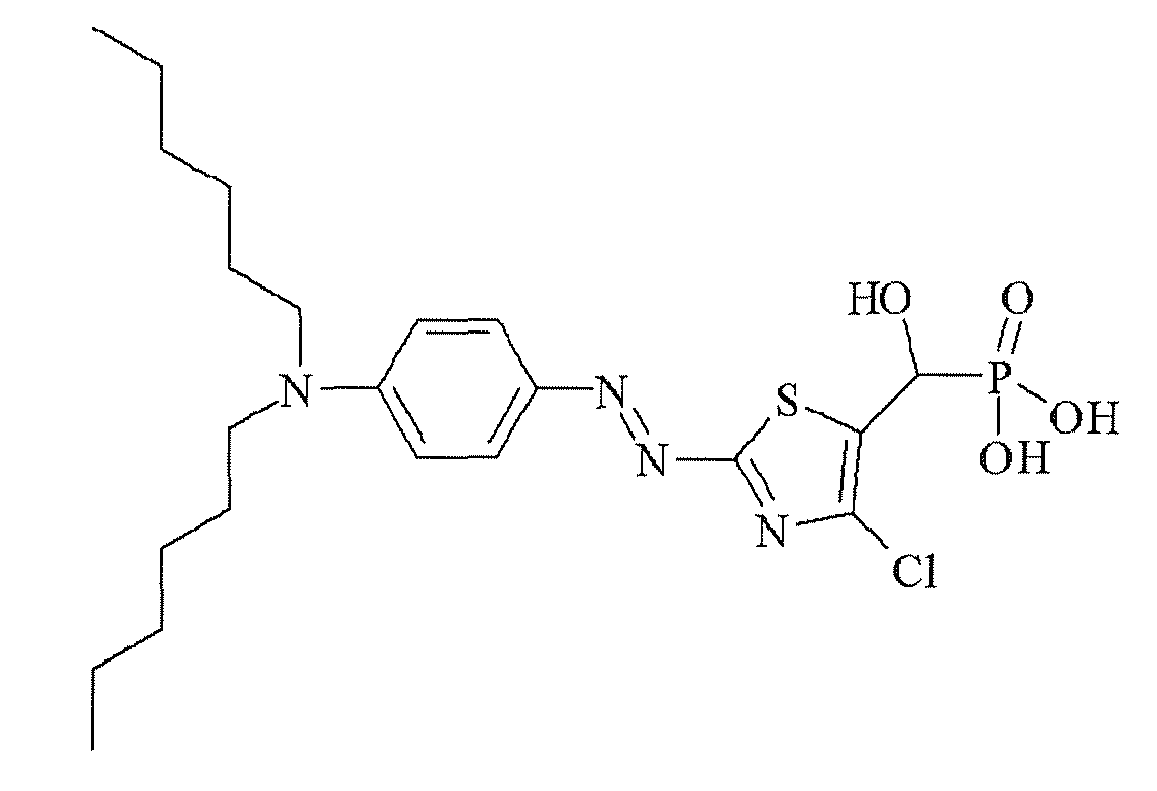
CD-13 
CD-14 
CD-15 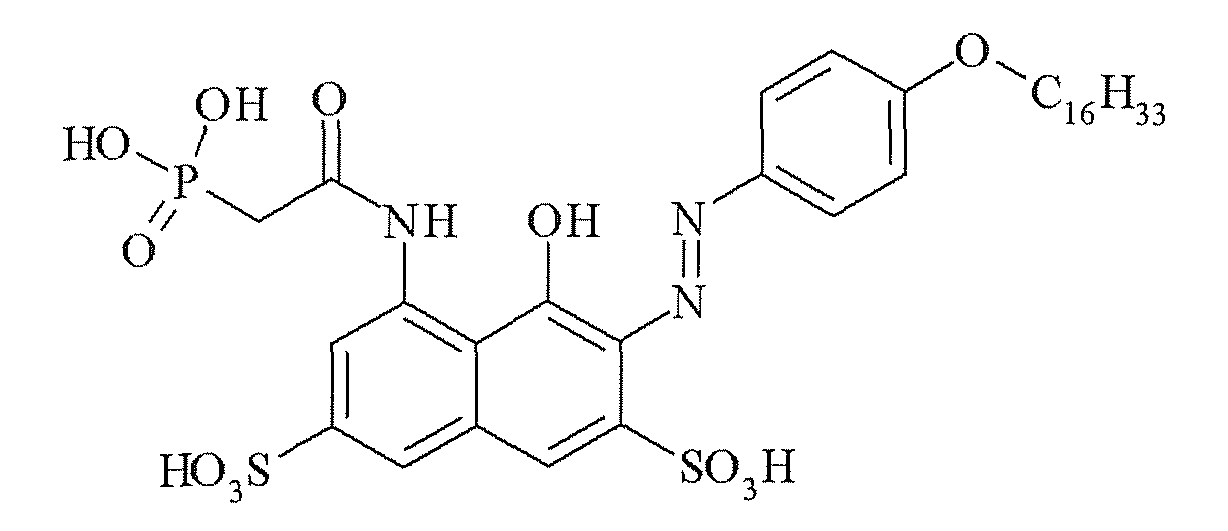
CD-16 
CD-17 
CD-18 
CD-19 
CD-20 
CD-21 
CD-22 
- In another preferred embodiment a contrast dye having a polymeric backbone is used in the inkjet ink for preparing a lithographic printing plate according to the present invention wherein the A, D and B groups are either directly or indirectly covalently bonded to the polymeric backbone according to one or more structures selected from the group consisting of AxDyBz, AxDy, AxBz, DyBz, A, D and B; and
wherein x and z are each independently chosen integers from 1 to 8 and y is 1 or 2. - Examples of contrast dyes having a polymeric backbone are given in Table 2, without being limited thereto.
Table 2 CPOL-1 
CPOL-2 
CPOL-3 
CPOL-4 
CPOL-5 
CPOL-6 
CPOL-7 
CPOL-8 
CPOL-9 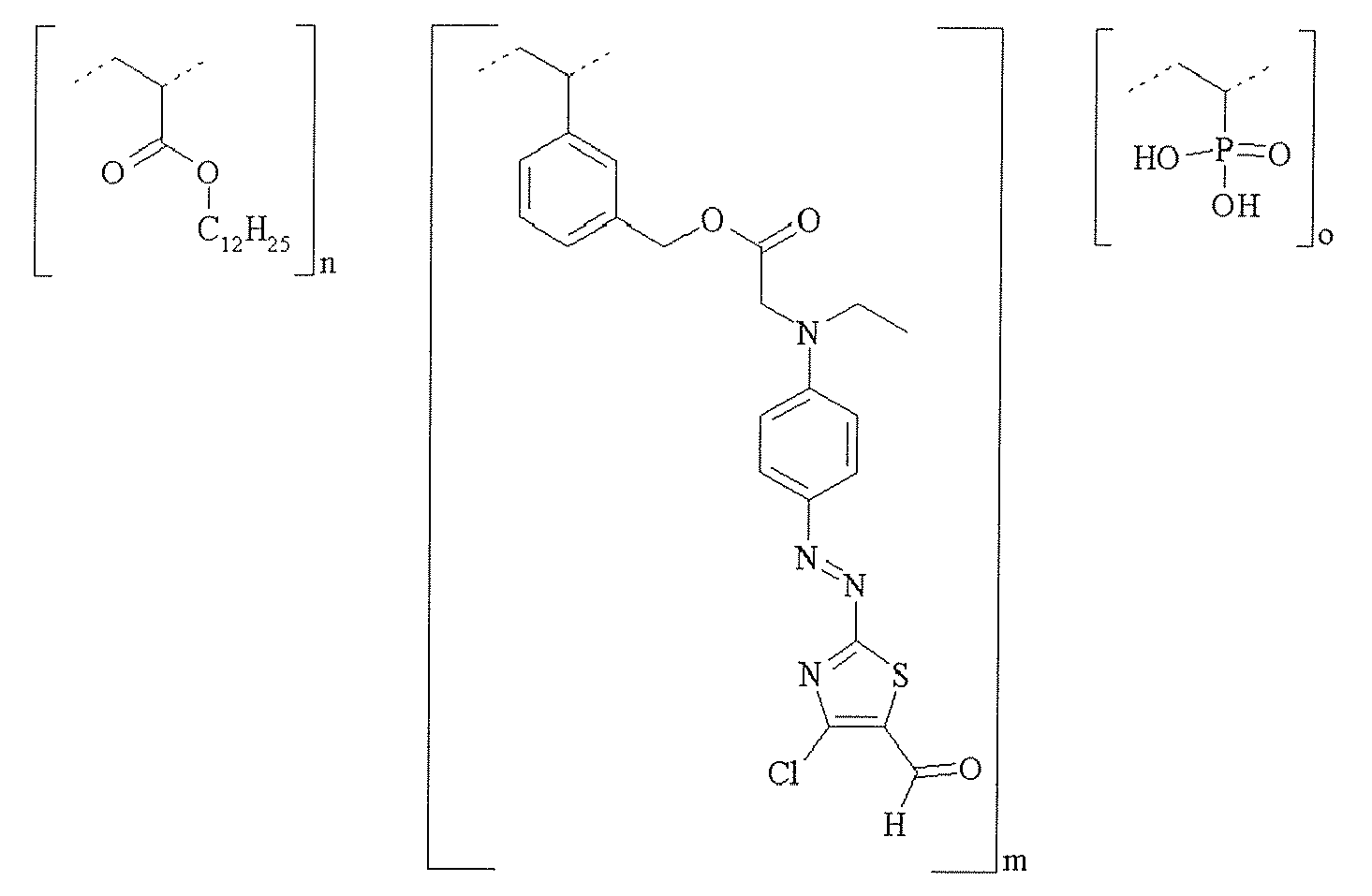
CPOL-10 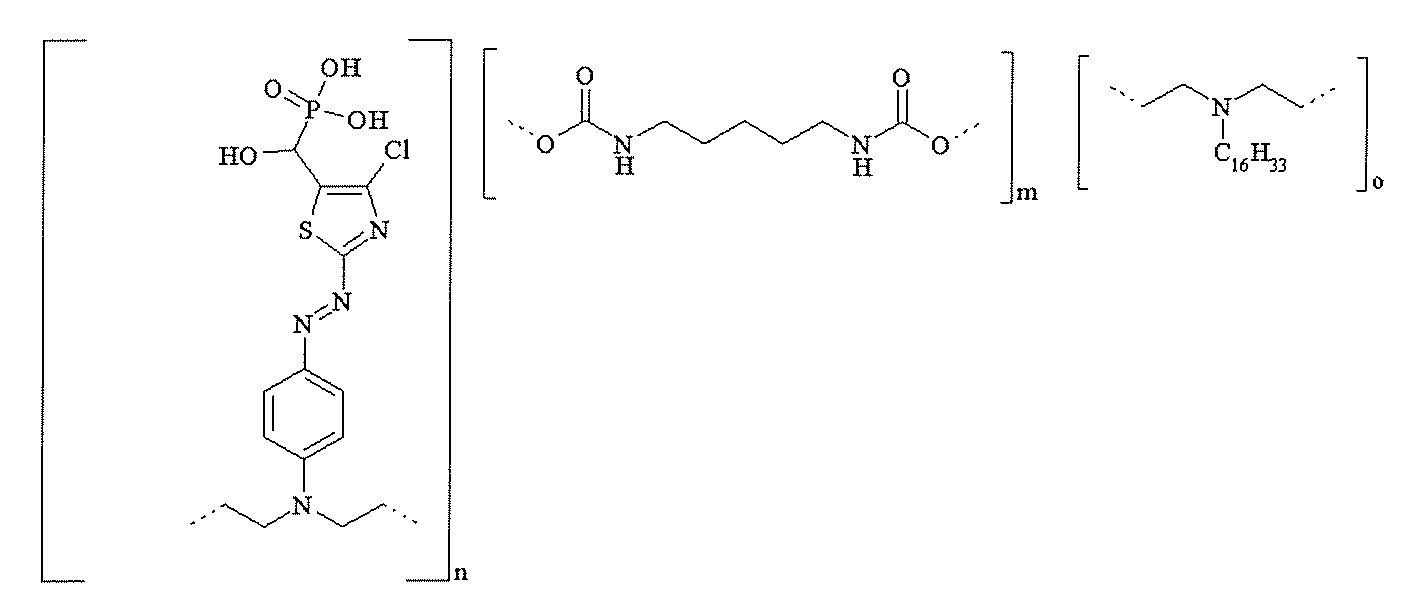
- A preferred embodiment for the contrast dye having a polymeric backbone is exemplified by contrast dye CPOL-5: the chromophore group D is covalently bonded to the polymeric backbone and one or more A and B groups are covalently bonded to the chromophore group D.
- Another preferred embodiment for the contrast dye having a polymeric backbone, exemplified by contrast dyes CPOL-1 and CPOL-2, is: the chromophore group D is covalently bonded to the polymeric backbone and one or more A groups are covalently bonded to the chromophore group D, while the B groups are directly covalently bonded to the polymeric backbone.
- Another preferred embodiment for the contrast dye having a polymeric backbone, exemplified by contrast dye CPOL-4, is: the chromophore group D is covalently bonded to the polymeric backbone and one or more B groups are covalently bonded to the chromophore group D, while the A groups are covalently bonded to the polymeric backbone.
- Another preferred embodiment for the contrast dye having a polymeric backbone, exemplified by contrast dye CPOL-3, is: the chromophore group D, the group A and group B are all separately covalently bonded to the polymeric backbone.
- Suitable contrast dyes having a polymeric backbone may combine several different structures selected from the group consisting of AxDyBz, AxDy, AxBz, DyBz, A, D and B, wherein x and z are each independently chosen integers from 1 to 8 and y is 1 or 2. For example the contrast dye CPOL-6 has a polymeric backbone substituted with x D groups, y A1B1 groups and p A groups.
- A contrast dye having a polymeric backbone is preferably used in the inkjet ink for preparing a lithographic printing plate according to the present invention in an amount of 1 to 10 wt%, preferably 2 to 6 wt% based on the weight of the inkjet ink.
- The polymeric backbone of the contrast dye according to the present invention contains monomers with the group AxDyBz, AxDy, AxBz, DyBz, A, D and/or B attached to it and optionally other monomers. The groups AxDyBz, AxDy, AxBz, DyBz, A, D and/or B may be linked to the monomer by any linking group. Preferably the linking group contains at least one carbon atom, one nitrogen atom, one oxygen atom, one phosphorous atom, one silicon atom, one sulphur atom, one selenium atom or one tellurium atom.
- The linking group may be the result of modification of a monomer with the group AxDyBz, AxDy, AxBz, DyBz, A, D or B having a reactive group. Suitable reactive groups include thiol groups, primary or secondary amino groups, carboxylic acid groups or salts thereof, hydroxyl groups, isocyanate groups and epoxy groups. Typical covalent bonds formed by reaction include an amide, an ester, a urethane, an ether and a thioether.
- The contrast dye having a polymeric backbone may have a polymer composition obtained by randomly polymerizing monomers, alternating polymerizing monomers, gradient (tapered) polymerizing monomers, polymerizing as block copolymers or graft copolymers and also mixed forms, e.g. blocky gradient copolymers.
- The polymeric backbone can have different polymer architectures including linear, comb/branched, star, dendritic (including dendrimers and hyperbranched polymers) polymer architectures.
- Comb/branched polymers have side branches of linked monomer molecules protruding from various central branch points along the main polymer chain (at least 3 branch points).
- Star polymers are branched polymers in which three or more either similar or different linear homopolymers or copolymers are linked together to a single core.
- Dendritic polymers comprise the classes of dendrimers and hyperbranched polymers; in dendrimers with well-defined mono-disperse structures all branch points are used (multi-step synthesis), while hyperbranched polymers means polymers having a plurality of branch points and multifunctional branches that lead to further branching with polymer growth (one-step polymerisation process).
- A general review on the architecture of polymers is given by ODIAN, George, Principles Of Polymerization, 4th edition, Wiley-Interscience, 2004, p. 1-19.
- Monomers lacking the group AxDyBz, AxDy, AxBz, DyBz, A, D or B may be included in the polymeric backbone for various purposes. Sometimes it is necessary to include a number of monomers to improve the solubility in the inkjet ink or to lower its viscosity. In other cases specific monomers are included to further enhance the chemical resistance of the printing plate during the printing process when gum solutions and other solutions containing aggressive organic solvents are used.
- The polymeric backbone consists preferably of no more than 2, 3 or 4 monomer species.
- The monomers lacking the group AxDyBz, AxDy, AxBz, DyBz, A, D or B used to prepare the contrast dye can be any monomer and/or oligomer found in the Polymer Handbook, Vol. 1 + 2. 4th edition. Edited by J. BRANDRUP, et al. Wiley-Interscience , 1999.
- Suitable examples of monomers include: acrylic acid, methacrylic acid, maleic acid, acryloyloxybenzoic acid and methacryloyloxybenzoic acid (or their salts), maleic anhydride; alkyl(meth)acrylates (linear, branched and cycloalkyl) such as methyl(meth)acrylate, n-butyl(meth)acrylate, tert-butyl(meth)acrylate, cyclohexyl(meth)acrylate and 2-ethylhexyl(meth)acrylate; aryl(meth)acrylates such as benzyl(meth)acrylate and phenyl(meth)acrylate; hydroxyalkyl(meth)acrylates such as hydroxyethyl(meth)acrylate and hydroxypropyl(meth)acrylate; (meth)acrylates with other types of functionalities (e.g. oxirane, amino, fluoro, polyethylene oxide, phosphate-substituted) such as glycidyl (meth)acrylate, dimethylaminoethyl(meth)acrylate, trifluoroethyl acrylate, methoxypolyethyleneglycol (meth)acrylate and tripropyleneglycol(meth)acrylate phosphate; allyl derivatives such as allyl glycidyl ether; styrenics such as styrene, 4-methylstyrene, 4-hydroxystyrene, and 4-acetoxystyrene; (meth)acrylonitrile; (meth)acrylamides (including N-mono and N,N-disubstituted) such as N-benzyl (meth)acrylamide; maleimides such as N-phenyl maleimide, N-benzyl maleimide and N-ethyl maleimide; vinyl derivatives such as vinylcaprolactam, vinylpyrrolidone, vinylimidazole, vinylnaphthalene and vinyl halides; vinylethers such as vinylmethyl ether; and vinylesters of carboxylic acids such as vinylacetate and vinylbutyrate.
- Specific monomers to further enhance the chemical resistance of the printing plate during the printing process include a monomer represented by the general formula:

- A preferred monomer is:

- Other suitable monomers to further enhance the chemical resistance of the printing plate during the printing process include a monomer represented by the general formula:


- Other suitable monomers to further enhance the chemical resistance of the


in which R is -H or -CH3. Preferably R is -CH3. - The contrast dye having a polymeric backbone according to the present invention preferably has a polymeric backbone with a polymerization degree DP between 5 and 1000, more preferably between 10 and 500 and most preferably between 10 and 100.
- The contrast dye having a polymeric backbone according to the present invention preferably has a number average molecular weight Mn between 500 and 30,000, more preferably between 1,500 and 10,000.
- An oleophilizing compound or hydrophobizing compound may be added to the inkjet ink, to form in combination with the contrast dye the printing areas of the lithographic image. The oleophilizing compound on its own is not capable of delivering a good contrast between the printing and the non-printing areas of the lithographic image.
- The hydrophobizing compound is preferably selected from the group consisting of a phosphate or salt thereof, a phosphonate or salt thereof, a boronic acid derivative, a 1,3-dicarbonyl compound, an imidazoline derivative and a catechol or pyrogallol derivative. Phosphates and phosphonates are particularly preferred.
- Suitable hydrophobizing compounds may be selected from those disclosed in
EP 1157825 A (AGFA ) ,EP 1157826 A (AGFA ) ,EP 1157827 A (AGFA ),EP 1157828 A (AGFA ),EP 1211063 A (AGFA ),EP 1219415 A (AGFA ),US 6532871 (KPG ) andEP 0882584 A (KODAK ). - In a preferred embodiment, the inkjet ink contains a fluorosurfactant as an oleophilizing compound.
- Illustrative examples of fluorosurfactants useful as oleophilizing compound are FLUORAD™ surfactants and ZONYL™ surfactants. FLUORAD surfactants are commercially available from 3M Company and have a narrow distribution of the hydrophobic chain length. ZONYL™ surfactants are commercially available from E. I. du Pont de Nemours & Co. and have a distribution of perfluoroalkyl chain length. Suitable ZONYL™ surfactants include ZONYL™ FSA, ZONYL™ FSP, ZONYL™ FSE and ZONYLTM FSN.
- Particularly preferred fluorosurfactants are selected from the group consisting of (F(CF2CF2)3-8CH2CH2O)1,2P(O)(ONH4)2,1.
- The inkjet ink may further contain at least one organic solvent, for example, to dissolve the contrast dye better. The organic solvent is preferably added to the inkjet ink in an amount of 1 to 40 wt%, more preferably 2 to 20 wt%, and most preferably 5 to 10 wt% each based on the total weight of the inkjet ink.
- Suitable organic solvents include alcohols, aromatic hydrocarbons, ketones, esters, aliphatic hydrocarbons, higher fatty acids, carbitols, cellosolves, higher fatty acid esters. Suitable alcohols include, methanol, ethanol, propanol and 1-butanol, 1-pentanol, 2-butanol, t.-butanol. Suitable aromatic hydrocarbons include toluene, and xylene. Suitable ketones include methyl ethyl ketone, methyl isobutyl ketone, 2,4-pentanedione and hexafluoroacetone. Also glycol, glycolethers, N-methylpyrrolidone, 2-pyrrolidone, N,N-dimethylacetamid, N, N-dimethylformamid may be used.
- An organic solvent can also be present in the inkjet ink as a humectant to prevent the clogging of the nozzle, due to its ability to slow down the evaporation rate of ink.
- Suitable humectants include triacetin, N-methyl-2-pyrrolidone, glycerol, urea, thiourea, ethylene urea, alkyl urea, alkyl thiourea, dialkyl urea and dialkyl thiourea, diols, including ethanediols, propanediols, propanetriols, butanediols, pentanediols, and hexanediols; glycols, including propylene glycol, polypropylene glycol, ethylene glycol, polyethylene glycol, diethylene glycol, tetraethylene glycol, and mixtures and derivatives thereof. Preferred humectants are ethylene glycol, propylene glycol, diethylene glycol, dipropylene glycol, triethylene glycol mono methyl ether, triethylene glycol mono butylether, glycerol and 1,2-hexanediol. The humectant is preferably added to the inkjet ink in an amount of 0.1 to 40 wt%, more preferably 2 to 35 wt%, and most preferably approximately 10 to 30 wt% each based on the total weight of the inkjet ink. The total amount of organic solvent and humectant in the inkjet ink is preferably in the range of 5 to 40 wt%, more preferably 15 to 30 wt% each based on the total weight of the inkjet ink. pH control agents
- A pH control agent may also be present in the inkjet ink. The inkjet ink has preferably a pH from 3 to 8, more preferably from 4 to 6. The pH of the inkjet ink is usually adjusted with an acid or a base such as a mineral acid, an organic acid, an organic base or an inorganic salt.
- Examples of the mineral acids include nitric acid, sulfuric acid, phosphoric acid and metaphosphoric acid. Especially organic acids are used as pH control agents and as desensitizing agents. Examples of the organic acids include carboxylic acids, sulfonic acids, phosphonic acids or salts thereof, e.g. succinates, phosphates, phosphonates, sulfates and sulfonates. Specific examples of the organic acid include citric acid, acetic acid, oxalic acid, malonic acid, p-toluenesulfonic acid, tartaric acid, malic acid, lactic acid, levulinic acid, phytic acid and organic phosphonic acid.
- Examples of inorganic bases are hydroxides of alkali or rare earth metals, ammonium hydroxide, hydroxylamine. Suitable examples of organic bases are amines as e.g. triethanolamine, triethylamine, tributylamine, dimethylethanolamine, diisopropylamin and heterocyclic compounds such as pyrazine.
- Examples of the inorganic salt include magnesium nitrate, monobasic sodium phosphate, dibasic sodium phosphate, nickel sulfate, sodium hexametaphosphate and sodium tripolyphosphate. Other inorganic salts can be used as corrosion inhibiting agents, e.g. magnesium sulfate or zinc nitrate.
- The mineral acid, organic acid or inorganic salt may be used singly or in combination with one or more thereof. Lithographic printing plates
- The lithographic printing plate contains a contrast dye comprising A, D and B groups wherein
A represents a phosphorous containing group capable of reacting with the surface of a lithographic receiver;
D represents a chromophore group absorbing light between 400 and 700 nm; and
B represents an aliphatic group of at least 6 carbon atoms. The lithographic printing plate can be obtained by a method for direct plate making by jetting on a printing plate precursor an inkjet ink comprising a contrast dye according to the present invention. - The lithographic printing plate may be a sheet-like material such as a plate or it may be a cylindrical element such as a sleeve which can be slid around a print cylinder of a printing press.
- In a preferred embodiment a gum solution is jetted on at least the lithographic non-image, but preferably the gum solution is jetted only on the non-printing areas of the lithographic printing plate.
- A particularly preferred lithographic support is an electrochemically grained and anodized aluminum support. Graining an anodizing of aluminum supports is well known. The acid used for graining can be e.g. nitric acid or sulfuric acid. The acid used for graining preferably comprises hydrogen chloride. Also mixtures of e.g. hydrogen chloride and acetic acid can be used. The relation between electrochemical graining and anodizing parameters such as electrode voltage, nature and concentration of the acid electrolyte or power consumption on the one hand and the obtained lithographic quality in terms of Ra and anodic weight (g/m2 of Al2O3 formed on the aluminum surface) on the other hand is well known. More details about the relation between various production parameters and Ra or anodic weight can be found in e.g. the article "Management of Change in the Aluminium Printing Industry" by F. R. Mayers, published in the ATB Metallurgie Journal, volume 42 nr. 1-2 (2002) pag. 69.
- With regard to the anodizing treatment, methods that have been conventionally used in this field can be used. Specifically, when direct or alternative current is fed to the aluminum plates in aqueous solution or non aqueous solution, alone or in combination , of sulfuric acid, phosphoric acid, chromic acid, oxalic acid, sulfamic acid, benzenesulfonic acid and the like, an anodized layer can be formed on the surface of the aluminum plate. Since conditions for anodizing treatment change variously depending on the electrolyte being used, those are not decided unconditionally, but it is generally appropriate that the concentration of electrolyte is 1 to 80 wt%, temperature of solution is 8 to 70°C, preferably 25 to 55°C, current density is 0.5 to 70 A/dm2, preferably 15 to 60 A/dm2, voltage is 1 to 200 V, and time for electrolysis is 1 to 100 seconds, preferably 5 to 60 seconds.
- The anodized aluminum support may be subject to a so-called post-anodic treatment to improve the hydrophilic properties of its surface. For example, the aluminum support may be silicated by treating its surface with a sodium silicate solution at elevated temperature, e.g. 95°C. Alternatively, a phosphate treatment may be applied which involves treating the aluminum oxide surface with a phosphate solution that may further contain an inorganic fluoride. Further, the aluminum oxide surface may be rinsed with a citric acid or citrate solution. This treatment may be carried out at room temperature or may be carried out at a slightly elevated temperature of about 30 to 50°C. A further interesting treatment involves rinsing the aluminum oxide surface with a bicarbonate solution. Still further, the aluminum oxide surface may be treated with polyvinylphosphonic acid, polyvinylmethylphosphonic acid, phosphoric acid esters of polyvinyl alcohol, polyvinylsulfonic acid, polyvinylbenzenesulfonic acid, sulfuric acid esters of polyvinyl alcohol, and acetals of polyvinyl alcohols formed by reaction with a sulfonated aliphatic aldehyde.
- Another useful post-anodic treatment may be carried out with a solution of polyacrylic acid or a polymer comprising at least 30 mol% of acrylic acid monomeric units, e.g. GLASCOL E15, a polyacrylic acid, commercially available from ALLIED COLLOIDS.
- The grained and anodized aluminum support may be a sheet-like material such as a plate or it may be a cylindrical element such as a sleeve which can be slid around a print cylinder of a printing press.
- The support can also be a flexible support, which may be provided with a hydrophilic layer, hereinafter called 'base layer'. The flexible support is e.g. paper, plastic film or aluminum. Preferred examples of plastic film are polyethylene terephthalate film, polyethylene naphthalate film, cellulose acetate film, polystyrene film, polycarbonate film, etc. The plastic film support may be opaque or transparent.
- The base layer is preferably a cross-linked hydrophilic layer obtained from a hydrophilic binder cross-linked with a hardening agent such as formaldehyde, glyoxal, polyisocyanate or a hydrolyzed tetra-alkylorthosilicate. The latter is particularly preferred. The thickness of the hydrophilic base layer may vary in the range of 0.2 to 25 µm and is preferably 1 to 10 µm. More details of preferred embodiments of the base layer can be found in e.g.
EP 1025992 A (AGFA ). - In ink jet printing tiny drops of ink fluid are projected directly onto an ink receptor surface without physical contact between the printing device and the receptor. The printing device stores the printing data electronically and controls a mechanism for ejecting the drops image-wise. Printing may be accomplished by moving the print head across the lithographic receiver or vice versa. The inkjet printing may also be a "single pass printing process". This is a printing mode, which can be performed by using page wide inkjet printing heads or multiple staggered inkjet printing heads that cover the entire width of the ink-receiver surface. In a single pass printing process the inkjet printing heads usually remain stationary and the ink-receiver surface is transported under the inkjet printing heads. An example of such a single pass inkjet printer is "The Dot Factory" manufactured by AGFA DOTRIX.
- The jetting of the ink droplets can be performed in several different ways. In a first type of process a continuous droplet stream is created by applying a pressure wave pattern. This process is known as continuous ink jet printing. In a first embodiment the droplet stream is divided into droplets that are electrostatically charged, deflected and recollected, and into droplets that remain uncharged, continue their way undeflected, and form the image. Alternatively, the charged deflected stream forms the image and the uncharged undeflected jet is recollected. In this variant of continuous ink jet printing several jets are deflected to a different degree and thus record the image (multideflection system).
- According to a second process the ink droplets can be created "on demand " ("DOD" or "drop on demand" method) whereby the printing device ejects the droplets only when they are used in imaging on a receiver thereby avoiding the complexity of drop charging, deflection hardware, and ink recollection. In drop-on-demand the ink droplet can be formed by means of a pressure wave created by a mechanical motion of a piezoelectric transducer (so-called "piezo method"), or by means of discrete thermal pushes (so-called "bubble jet" method, or "thermal jet" method).
- In a preferred embodiment of the method for direct plate making, the inkjet printer is mounted on the printing press. For coloured printing matter, the printing press usually comprises four print cylinders. A plate is mounted on each print cylinder for each of the four printing inks (CMYK); in this case each print cylinder may have its own inkjet printer.
- In another preferred embodiment, the hue of the jetted printing areas on the printing plate precursor corresponds with the hue of the printing ink to be used with the printing plate. For example for a CMYK printing process, the printing plate having the lithographic image for printing with the cyan printing ink has a cyan hue, the printing plate having the lithographic image for printing with the magenta printing ink has a magenta hue, the printing plate having the lithographic image for printing with the yellow printing ink has a yellow hue, and the printing plate having the lithographic image for printing with the black printing ink has a dark hue. The advantage of this method is that errors in mounting a printing plate on the wrong printing press are eliminated and that no extra markings on the printing plate are required for identifying the colour selection with which the printing plate corresponds.
- In another embodiment of the method for direct plate making, a gum solution is jetted on the lithographic non-image, i.e. the non-printing areas of the lithographic image. In this case the inkjet printer has at least one print head ejecting small droplets of gum solution in a controlled manner through nozzles onto the surface of a lithographic printing plate, which is moving relative to the printing head(s). The jetted gum solution forms a hydrophilic protective layer on the non-printing areas and optionally the printing areas of the lithographic printing plate. Preferably the gum solution for the non-printing areas is jetted in the same printing process with the inkjet ink used to form the printing areas of a lithographic image on a lithographic printing plate. According to another embodiment, the gum solution for the non-printing areas and the inkjet ink used to form the printing areas of lithographic image on the lithographic printing plate are jetted by the same inkjet print head.
- The gum solution suitable for use in a method for direct plate making is an aqueous liquid, which comprises one or more surface protective compounds that are capable of protecting the lithographic image of a printing plate against contamination or damaging. Suitable examples of such compounds are film-forming hydrophilic polymers and surfactants. The hydrophilic protective layer that remains on the plate after treatment with the gum solution preferably comprises between 0.1 and 20 g/m2 of the surface protective compound, particularly preferably between 0.15 and 0.3 g/m2 of the surface protective compound.
- For jetting with an inkjet printer, the viscosity of the gum solution is preferably lower than 100 mPa.s, more preferably lower than 50 mPa.s, and most preferably lower than 30 mPa.s at a shear rate of 100 s-1 and a temperature between 20 and 110°C.
- A special type of gum solution is a baking gum solution, having a similar composition as a standard gum solution, but with the additional preference towards compounds that do not evaporate at the usual bake temperatures.
- Specific examples of suitable baking gum solutions are described in e.g.
US 4983478 (HOECHST ),EP 1025992 A (AGFA ),GB 1555233 (HOECHST US 4786581 (HOECHST ). - After applying the baking gum solution, the plate can be dried before baking or is dried during the baking process itself. The baking process can proceed at a temperature between 100°C and 230°C for a period of 5 to 40 minutes. For example, a lithographic printing plate jetted upon with a baking gum can be baked at a temperature of 230°C for 5 minutes, at a temperature of 150°C for 10 minutes or at a temperature of 120°C for 30 minutes. Baking can be done in conventional hot air ovens or by irradiation with lamps emitting in the infrared or ultraviolet spectrum.
- The hydrophilic polymers suitable as surface protective compounds in the gum solution are polymers comprising ionic or ionisable groups or containing polyethyleneoxide groups.
- Examples of ionic or ionizable groups are acid groups or salts thereof such as carboxylic acid group, sulphonic acid, phosphoric acid or phosphonic acid. The acid groups in the polymer may be neutralized with an organic amine (e.g. ammonia, triethylamine, tributylamine, dimethylethanolamine, diisopropanolamine, morpholine, diethanolamine or triethanolamine) or an alkali metal (e.g. lithium, sodium or potassium). The polymer may be composed of a monomer comprising an anionic group. The polymer may also be composed of two or more different types of monomers comprising anionic and/or non-ionic groups. Specific examples of monomers comprising anionic groups are (meth)acrylic acid, crotonic acid, (meth)acrylic acid, propyl(meth)acrylic acid, isopropyl(meth)acrylic acid, itaconic acid, fumaric acid, sulfoethyl(meth)acrylate, butyl(meth)acrylamidesulfonic acid and phosphoethyl(meth)acrylate. In general, the number average molecular weight of the polymer is preferably in the range of about 1,000 to 3,000,000 g/mol.
- Preferred polymers for use as protective compound in the gum solution are gum arabic, pullulan, cellulose derivatives such as carboxymethylcellulose, carboxyethylcellulose or methylcellulose, (cyclo)dextrin, poly(vinyl alcohol), poly(vinyl pyrrolidone), polysaccharide, homo- and copolymers of acrylic acid, methacrylic acid or acrylamide, a copolymer of vinyl methyl ether and maleic anhydride, a copolymer of vinyl acetate and maleic anhydride or a copolymer of styrene and maleic anhydride. Highly preferred polymers are homo- or copolymers of monomers containing carboxylic, sulfonic or phosphonic groups or the salts thereof, e.g. (meth)acrylic acid, styrene sulfonic acid, vinyl sulfonic acid, vinyl phosphonic acid or acrylamidopropane sulfonic acid.
- The gum solution may include one or more surfactants to improve the surface properties of the jetted hydrophilic protective layer. The surfactant may be an anionic or a non-ionic surfactant.
- Examples of anionic surfactants include aliphates, abietates, hydroxyalkanesulfonates, alkanesulfonates, dialkylsulfosuccinates, straight-chain alkylbenzenesulfonates, branched alkylbenzenesulfonates, alkylnaphthalenesulfonates, alkylphenoxypolyoxyethylenepropylsulfonates, salts of polyoxyethylene alkylsulfophenyl ethers, sodium N-methyl-N-oleyltaurates, monoamide disodium N-alkylsulfosuccinates, petroleum sulfonates, sulfated castor oil, sulfated tallow oil, salts of sulfuric esters of aliphatic alkylesters, salts of alkylsulfuric esters, sulfuric esters of polyoxyethylenealkylethers, salts of sulfuric esters of aliphatic monoglycerides, salts of sulfuric esters of polyoxyethylenealkylphenylethers, salts of sulfuric esters of polyoxyethylenestyrylphenylethers, salts of alkylphosphoric esters, salts of phosphoric esters of polyox-yethylenealkylethers, salts of phosphoric esters of polyoxyethylenealkylphenylethers, partially saponified compounds of styrenemaleic anhydride copolymers, partially saponified compounds of olefin-maleic anhydride copolymers, and naphthalenesulfonateformalin condensates. Particularly preferred among these anionic surfactants are dialkylsulfosuccinates, salts of alkylsulfuric esters and alkylnaphthalenesulfonates.
- Specific examples of suitable anionic surfactants include sodium dodecylphenoxybenzene disulfonate, the sodium salt of alkylated naphthalenesulfonate, disodium methylene-dinaphtalene-disulfonate, sodium dodecyl-benzenesulfonate, sulfonated alkyl-diphenyloxide, ammonium or potassium perfluoroalkylsulfonate and sodium dioctyl-sulfosuccinate.
- Suitable examples of the non-ionic surfactants include polyoxyethylene alkyl ethers, polyoxyethylene alkyl phenyl ethers, polyoxyethylene polystyryl phenyl ethers, polyoxyethylene polyoxypropylene alkyl ethers, polyoxyethylene polyoxypropylene block polymers, partial esters of glycerinaliphatic acids, partial esters of sorbitanaliphatic acid, partial esters of pentaerythritolaliphatic acid, propyleneglycolmonoaliphatic esters, partial esters of sucrosealiphatic acids, partial esters of polyoxyethylenesorbitanaliphatic acid, partial esters of polyoxyethylenesorbitolaliphatic acids, polyethyleneglycolaliphatic esters, partial esters of poly-glycerinaliphatic acids, polyoxyethylenated castor oils, partial esters of polyoxyethyleneglycerinaliphatic acids, aliphatic diethanolamides, N,N-bis-2-hydroxyalkylamines, polyoxyethylene alkylamines, triethanolaminealiphatic esters, and trialkylamine oxides. Particularly preferred among these non-ionic surfactants are polyoxyethylene alkylphenyl ethers and poloxyethylene-polyoxypropylene block polymers.
- Two or more of the above surfactants may be used in combination. For example, a combination of two or more different anionic surfactants or a combination of an anionic surfactant and a non-ionic surfactant may be preferred. The amount of such a surfactant is not specifically limited but is preferably from 0.01 to 20 wt%.
- The surface tension of the gum solution is preferably from 20 to 50 mN/m, more preferably from 25 to 35 mN/m. pH control agents
- A pH control agent may also be present in the gum solution. The pH of the gum solution is usually adjusted with an acid or a base such as a mineral acid, an organic acid , an organic base or an inorganic salt.
- Examples of the mineral acids include nitric acid, sulfuric acid, phosphoric acid and metaphosphoric acid. Especially organic acids are used as pH control agents and as desensitizing agents. Examples of the organic acids include carboxylic acids, sulfonic acids, phosphonic acids or salts thereof, e.g. succinates, phosphates, phosphonates, sulfates and sulfonates. Specific examples of the organic acid include citric acid, acetic acid, oxalic acid, malonic acid, p-toluenesulfonic acid, tartaric acid, malic acid, lactic acid, levulinic acid, phytic acid and organic phosphonic acid.
- Examples of inorganic bases are hydroxides of alkali or rare earth metals, ammonium hydroxide, hydroxylamine. Suitable examples of organic bases are amines as e.g. triethanolamine, triethylamine, tributylamine, dimethylethanolamine, diisopropylamin and heterocyclic compounds such as pyrazine.
- Examples of the inorganic salt include magnesium nitrate, monobasic sodium phosphate, dibasic sodium phosphate, nickel sulfate, sodium hexametaphosphate and sodium tripolyphosphate. Other inorganic salts can be used as corrosion inhibiting agents, e.g. magnesium sulfate or zinc nitrate.
- The mineral acid, organic acid or inorganic salt may be used singly or in combination with one or more thereof.
- A wetting agent may also be present in the gum solution. Examples of the wetting agent include ethylene glycol, propylene glycol, triethylene glycol, butylene glycol, hexylene glycol, diethylene glycol, dipropylene glycol, glycerin, trimethylol propane and diglycerin.
- The wetting agent may be used singly or in combination with one or more thereof.
- In general, the foregoing wetting agent is preferably used in an amount of from 0.1 to 25 wt%.
- A chelate compound may also be present in the gum solution. Calcium ion and other impurities contained in the gum solution can have adverse effects on printing and thus cause the contamination of printed matter. Adding a chelate compound to the gum solution can eliminate this problem.
- Preferred examples of such a chelate compound include organic phosphonic acids or phosphonoalkanetricarboxylic acids. Specific examples are potassium or sodium salts of ethylenediaminetetraacetic acid, diethylenetriaminepentaacetic acid, triethylenetetraminehexaacetic acid, hydroxyethylethylenediaminetriacetic acid, nitrilotriacetic acid, 1-hydroxyethane-1,1-diphosphonic acid and aminotri(methylenephosphonic acid). Besides these sodium or potassium salts of these chelating agents, organic amine salts are useful.
- The preferred amount of such a chelating agent to be added is from 0.001 to 1.0 wt% relative to the gum solution.
- An antiseptic agent may also be present in the gum solution. Examples of such an antiseptic include phenol, derivatives thereof, formalin, imidazole derivatives, sodium dehydroacetate, 4-isothiazoline-3-one derivatives, benzoisothiazoline-3-one, benztriazole derivatives, amidineguanidine derivatives, quaternary ammonium salts, pyridine derivatives, quinoline derivatives, guanidine derivatives, diazine, triazole derivatives, oxazole and oxazine derivatives.
- The preferred amount of such an antiseptic to be added is such that it can exert a stable effect on bacteria, fungi, yeast or the like. Though depending on the kind of bacteria, fungi and yeast, it is preferably from 0.01 to 4 wt% relative to the gum solution.
- Further, preferably, two or more antiseptics may be used in combination to exert an aseptic effect on various fungi and bacteria.
- An anti-foaming agent may also be present in the gum solution. The anti-foaming agent is preferably a silicone anti-foaming agent. Among these anti-foaming agents, either an emulsion dispersion type or a solubilized type anti-foaming agent may be used.
- The proper amount of such an anti-foaming agent to be added is from 0.001 to 1.0 wt% relative to the gum solution.
- When gum solution is also jetted on the printing areas of the lithographic printing plate, an ink receptivity agent may also be present in the gum solution to ensure a rapid adhesion of printing ink. If the gum solution is solely jetted on the non-printing areas, then preferably no ink receptivity agent is present in the gum solution.
- Examples of such an ink receptivity agent include turpentine oil, xylene, toluene, low heptane, solvent naphtha, kerosine, mineral spirit, hydrocarbons such as petroleum fraction having a boiling point of about 120°C to about 250°C, diester phthalates (e.g., dibutyl phthalate, diheptyl phthalate, di-n-octyl phthalate, di(2-ethylhexyl) phthalate, dinonyl phthalate, didecyl phthalate, dilauryl phthalate, butylbenzyl phthalate), aliphatic dibasic esters (e.g., dioctyl adipate, butylglycol adipate, dioctyl azelate, dibutyl sebacate, di(2-ethylhexyl) sebacate dioctyl sebacate), epoxidated triglycerides (e.g., epoxy soyabean oil), ester phosphates (e.g., tricresyl phosphate, trioctyl phosphate, trischloroethyl phosphate) and plasticizers having a solidification point of 15°C or less and a boiling point of 300°C or more at one atmospheric pressure such as esters of benzoates (e.g., benzyl benzoate).
- Examples of other ink receptivity agents include ketones (e.g., cyclohexanone), halogenated hydrocarbons (e.g., ethylene dichloride), ethylene glycol ethers (e.g., ethylene glycol monomethyl ether, ethylene glycol monophenyl ether, ethylene glycol monobutyl ether), aliphatic acids (e.g., caproic acid, enathic acid, caprylic acid, pelargonic acid, capric acid, undecylic acid, lauric acid, tridecylic acid, myristic acid, pentadecylic acid, palmitic acid, heptadecylic acid, stearic acid, nonadecanic acid, arachic acid, behenic acid, lignoceric acid, cerotic acid, heptacosanoic acid, montanic acid, melissic acid, lacceric acid, isovaleric acid) and unsaturated aliphatic acids (e.g., acrylic acid, crotonic acid, isocrotonic acid, undecyclic acid, oleic acid, elaidic acid, cetoleic acid, erucic acid, butecidic acid, sorbic acid, linoleic acid, linolenic acid, arachidonic acid, propiolic acid, stearolic acid, clupanodonic acid, tariric acid, licanic acid). Preferably, it is an aliphatic acid, which is liquid at a temperature of 50°C, more preferably it has from 5 to 25 carbon atoms, most preferably it has from 8 to 21 carbon atoms.
- The ink receptivity agent may be used singly or in combination with one or more thereof. The ink receptivity agent is preferably used in an amount of from 0.01 to 10 wt%, more preferably from 0.05 to 5 wt%. The foregoing ink receptivity agent may be present as an oil-in-water.
- The present invention will now be illustrated by the following examples without however being limited thereto.
- All materials used in the following examples were readily available from Aldrich Chemical Co. (Belgium) unless otherwise specified. The "water" used in the examples was demineralized water. The following materials were used:
- Zonyl™ FSE from DuPont.
- DYE-1 is methylorange from MERCK.
- DYE-5 is C.I. Direct Blue 199 for which DuasynTM Direct Turquoise Blue FRL-SF from CLARIANT Benelux NV was used.
- (4-aminobenzyl)-phosphonic acid diethyl ester from ALDRICH.
- Propyleneglycol from CALDIC Belgium NV.
- Diethyleneglycol from BASF Belgium NV.
- 2-pyrrolidone from BASF.
- Ethyleneglycol from UCB.
- TEGMBE is an abbreviation for Triethyleneglycolmonobutylether from VEL.
- SMA1000P is a styrene maleic anhydride alternating copolymer supplied
- by CRAY VALLEY.
- SAA is a grained and anodized aluminium substrate. Graining was carried out in a 2 cell grainer using HCl (9.5 and 9.7g/L respectively)/ CH3COOH (17.6 and 18.5g/L respectively) as an acid mixture, at a temperature of 26.5 ° and 25.3 °C and voltages of 21 and 22V. Anodisation was carried out in 2 cells containing sulfuric acid (129 g/L and 119 g/L respectively) at 45°C and 46.1 °C and voltages of 25.9V and 25V resulting in an anodic weight of 6.6g/m2.
- MAA differs from the method for preparing SAA substrate in that the anodisation was carried out in a mixture of H3PO4 and H2SO4 (resp.332 g/L and 52.9 g/L). The temperature of the anodisation liquid was 44°C and the resulting anodic weight was 2.43 g/m2.
- A visual evaluation of the contrast in the lithographic image was performed by depositing a series of 2 or 3 dots of inkjet ink onto a lithographic printing plate precursor at room temperature using a 2 µL pipette. SAA and MAA were used as lithographic plate precursors. After drying the dots using a heat treatment of 15 minutes at 120°C, the contrast was evaluated in accordance with a criterion described below.
Criterion: - OK =
- a clear visual image of dots was observed.
- Not OK =
- a poor image of dots was observed.
- None =
- no image of dots could be observed
- The same lithographic plates having a series of dots used to evaluate the visual contrast were subsequently used to evaluate the contrast again after a gumming treatment.
- A gum solution was prepared by diluting the gum RC 795 from AGFA with water to 50% of the original concentration. The gum solution was applied to the printing plate using a custom built clean-out unit. The printing plate was transported by a pair of driving rollers at a speed of one meter per minute. Gum was sprayed through a number of openings in three tubes. One of those tubes sprayed directly onto the printing plate, two other sprayed against a cylindrical brush situated further in the transportation path. This brush made contact with the printing plate. After the gum was applied, the printing plate was transported by a roller pair into a drying zone where the applied gum solution was dried with air of 47°C. The contrast was evaluated in accordance with a criterion described below.
Criterion: - OK = the clear visual image of dots was still observed.
- Not OK = a poor image of dots was observed.
- None = no image of dots could be observed
- The same lithographic plates having a series of dots used to evaluate the visual contrast and the gum contrast were subsequently used to evaluate the printing quality.
- The printing quality was investigated by mounting the printing plate on a Heidelberg sheet fed GTO46 offset press using a mixture of 3% FS101™ and 10% isopropanol as a fountain solution. Skinnex X800 black ink was used for printing on Rey Today Office Paper 80 g/m2 delivered by GPG Papier NV. The optical density of the unprinted paper was 0.09.
- A good printing quality requires a thorough clean-out in the non-printing areas and a rapid ink-uptake in the printing areas, i.e. the series of dots. A thorough clean-out means that, after a low number of prints, the optical density of a non-printing area on the paper was approximately equal to that of the unprinted paper. The ink-uptake was evaluated by visual inspection of the printing area on the paper after a number of prints. A rapid ink-uptake means that a high optical print density was obtained after a low number of prints. The ink-uptake was evaluated in accordance with a criterion described below.
Criterion: - OK = rapid ink-uptake, printed image of high optical density after 10 revolutions of the offset press.
- Not OK = no printed image or a poor printed mage was observed after 100 revolutions of the offset press
- This example describes the synthesis of contrast dye CD-1 and CD-2.
-
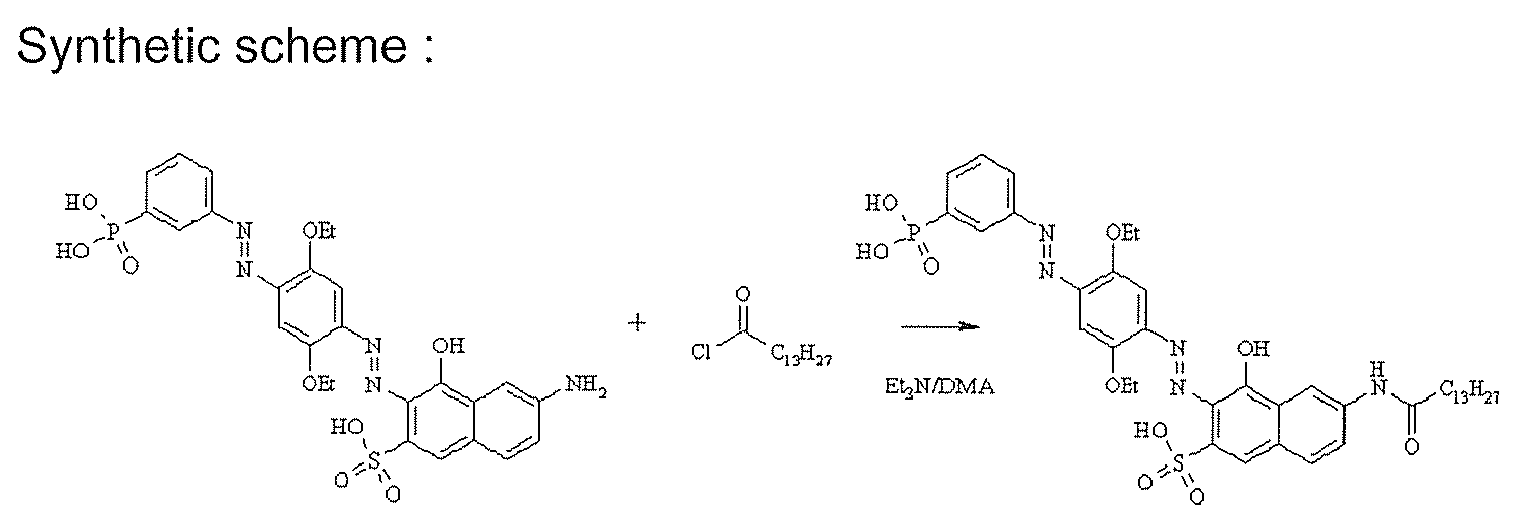
- The starting black blue dye was prepared according to Example A of
EP 0771860 A (SEIKO EPSON ). - 5 g of the starting black blue dye (8 mmol) was dissolved in 30 mL dimethyl acetamide. Then 1.4 mL (9.7 mmol) triethylamine was added. 2.8 g (11.3 mmol) of myristoyl chloride was added dropwise to the reaction mixture. The reaction was allowed to continue for 1 hour at room temperature. Contrast dye CD-1 partially precipitated from the medium, was isolated by filtration and washed with a small amount of dimethyl acetamide and ethylacetate. The filtrate was diluted with 300 mL ethyl acetate and a second fraction of contrast dye 1 precipitated. The second fraction was isolated by filtration and washed several times with 50 mL ethyl acetate. The pooled fractions were dried under vacuum.
- Contrast dye CD-2 was prepared according to the same procedure, using stearoyl chloride in stead of myristoyl chloride.
- This example describes the synthesis of contrast dye CD-3.
-

- N-(2-aminoethyl)-N-ethyl-aniline was prepared according to Fazio M. , J. Org. Chem. (1984), 49(25), 4889-4893.
- 20 g (0.12 mol) of N-(2-aminoethyl)-N-ethyl-aniline was dissolved in 100 mL of acetonitrile. 16.9 mL (0.12 mol) of triethylamine was added to this solution. A solution of 32 g (0.076 mol) of pentadecafluorooctanoyl chloride in 65 mL acetonitrile is added dropwise over 30 minutes. The reaction was allowed to continue for an additional 2 hours at room temperature. The precipitated triethylamine chlorohydrate was removed by filtration and the filtrate was diluted with 400 mL of a 1.2 N hydrochloric acid solution. The crude fluorinated aniline precipitated as a brown oil. The brown oil was redissolved in 300 mL methylene chloride. The methylene chloride was extracted 3 times with 0.1 M NaOH and 5 times with water until neutral pH. The methylene chloride was dried over MgSO4 and evaporated under reduced pressure. The isolated fluorinated aniline was used without further purification.
- 13.6 g (78 mmol) of 3-aminophenyl phosphonic acid was dissolved in 20 mL HCl (conc.). The reaction mixture was cooled to 0°C. A solution of 5.3 g of NaNO2 in 10 mL water was added while keeping the temperature below 5°C. The mixture was stirred at 5 °C for 90 minutes, before adding to the mixture described below.
- 20 g (36 mmol) of the fluorinated aniline was dissolved in 76 mL acetic acid. 8.75 g of sodium acetate was added and the mixture was cooled to 0 °C. The solution of the above prepared diazonium salt was added portion wise, while keeping the pH of the mixture around pH=7. If the pH dropped below 7, NaOH was added to the mixture until the pH was neutral. After the addition of the diazonium salt was completed, the pH was raised further to pH 12. The mixture was stirred for an additional hour at room temperature. The crude contrast dye CD-3 precipitated form the medium and was isolated by filtration. The isolated dye was treated with 200 mL methyl t.butyl ether and dried. 6.9 g of contrast dye CD-3 was isolated.
- This example describes the synthesis of contrast dye CD-4.
-

- The carboxyphophonic ester was prepared as described in example 18 of
WO 9619484 (PIERRE FABRE MEDICANIENT - 21.9 g (006 mol) of the carboxyphosphonic ester was dissolved in 150 mL methylene chloride. 13.61 g (0.066 mol) of dicyclohexyl carbodiimide in 100 mL methylene chloride was added and the mixture was stirred for 30 minutes at room temperature. 5.43 g (0.03 mol) of N,N-bis-(2-hydroxyethyl)aniline in 60 mL methylene chloride was added and the reaction was allowed to continue for 30 minutes at room temperature. After stirring over night, an additional 6.18 g of dicyclohexyl carbodiimide and 10.9 g of carboxyphosphonic acid were added and the reaction was allowed to continue at room temperature for an additional 30 minutes. The formed dicyclohexyl urea was removed by filtration and the solvent was removed under reduced pressure. The intermediate acylated aniline was isolated by preparative column chromatography (eluent : ethyl acetate on Kromasil Si 60 Å 10, 10 µm).
- 4.35 g (5 mmol) of the intermediate anilino-phosphonate ester was dissolved in 40 mL methylene chloride. 5 g of trimethylsilyl bromide was added and the reaction was allowed to continue at room temperature for 2 hours. The solvent was removed under reduced pressure and the residue was treated over night with a mixture of 35 mL water, 30 mL methanol and 3 mL 2 N hydrochloric acid. The solvent was evaporated under reduced pressure. The residue was treated with a mixture of 40 mL methyl t.butyl ether and re-evaporated. The isolated diphosphonic acid was used without further purification.
- 0.19 g (1.3 mmol) of 2-aminobenzothiazole was dissolved in 7.8 mL acetic acid and 2.6 mL concentrated sulfuric acid. The mixture was cooled to 0°C and a solution of 98 mg of NaNO2 in 4 mL water was added. The reaction was allowed to continue for 2 hours at 0°C.
- 1 g (1.3 mmol) of the diphosphonic acid was dissolved in 25 mL acetic acid. 1.4 g of sodium acetate was added. The diazotated 2-aminobenzothiazole was added to this mixture and reaction was allowed to continue at room temperature for 3 hours. The reaction mixture was pourred into 150 mL water and acidified with 10 mL 6 N HCl. The mixture was extracted 3 times with 100 mL n.- butanol. The pooled butanol extracts were dried over Na2SO4. The solvent was removed under reduced pressure and contrast dye CD-4 was purified by preparative column chromatography. (gradient elution form a mixture of 0.2 M ammonium acetate, adjusted to pH 8.7 with triethanol amine/ methanol 90/10 to 100% MeOH on a Varian Mega BE-C18 column).
- Contrast dye CD-4 was isolated as a mixture of diastereoisomers.
- This example describes the synthesis of contrast dye CD-5.
-

- 4 g (11 mmol) of the carboxyphosphonic ester, prepared according to
WO 9619484 (PF MEDICAMENT ET AL EP 0154117 A (AMERICAN CYANAMID CO ), in 80 mL of dimethyl acetamide was added to the reaction mixture and the reaction was allowed to continue for 16 hours at room temperature. The solvent was evaporated under reduced pressure and the residue was dissolved in 250 mL of ethyl acetate. The organic layer was washed twice with 250 mL of water, dried over MgSO4 and evaporated under reduced pressure. The crude mixture was dissolved in 100 mL of methylene chloride and treated with 3.06 g (20 mmol) of trimethylsilyl bromide. The reaction was allowed to continue for 5 hours at room temperature. The solvent was removed under reduced pressure and 100 mL of methanol was added. Two drops of HCl (conc.) were added and the reaction was allowed to continue for 14 hours at room temperature. The solvent was removed under reduced pressure and the residue was purified by preparative column chromatography, using a Varian Mega BE-C18 flash column and a gradient elution from 50 % methanol/ 50 % 0.2M ammonium acetate, adjusted to pH 8.5 with triethanol amine, to pure methanol. 1.35 g of the anthraquinone dye was isolated. Analysis showed the presence of some residual esters and the product was treated again with 2 g of trimethylsilyl bromide in 100 mL of methylene chloride. The solvent was removed under reduced pressure and 100 mL of methanol was added. The reaction was allowed to continue for 48 hours. The solvent was removed under reduced pressure and the dye proved to be sufficiently pure for evaluation. - This example describes the synthesis of contrast dye CD-11.

- 6.5 g (40 mmol) of 2-amino-4-chloro-thiazole-5-carbaldehyde was dissolved in 50 mL of phosphoric acid. The mixture was cooled to 0°C and 5.1 g (40 mmol) of nitrosylsulfuric acid was added while the temperature was kept at 0°C.
- 7.5 g (45 mmol) of 2-hydroxyethyl-ethyl aniline was dissolved in a mixture 100 g of ice and 50 mL of ethyl acetate. The diazotated thiazole was added slowly to this mixture. The magenta dye was formed immediately. 500 mL of water was added to the reaction mixture and the dye precipitated from the medium. The dye was isolated by filtration and washed twice with water and dried. 6.8 g of the dye was isolated.

- 24.6 g (50 mmol) of the fluorinated carboxylic acid was dissolved in 50 mL of ethyl acetate. 7 mL (50 mmol) of triethyl amine was added dropwise followed by the addition of 4.4 g (25 mmol) of benzene sulfochloride. The reaction was allowed to continue for 30 minutes at room temperature. 9.7 g (25 mmol) of the in step 1 prepared azo dye, dissolved in 50 mL of dimethyl acetamide, was added and the reaction was allowed to continue for 16 hours at room temperature. After 16 hours 10 mol% of dimethylaminopyridine and an extra equivalent of the symmetrical anhydride, prepared from the fluorinated carboxylic acid, triethyl amine and benzenesulfochloride as described above, were added. The reaction was allowed to continue for an extra 24 hours. The solvent was evaporated under reduced pressure and the residue was dissolved in 100 mL of methyl t.butyl ether. The organic layer was extracted twice with 100 mL of water, dried over MgSO4 and evaporated under reduced pressure. The fluorinated azo dye was isolated by preparative column chromatography on a Varian Mega Bond Elut Si column, using ethyl acetate/hexane 50/50 as eluent. 5.6 g of the dye was isolated.
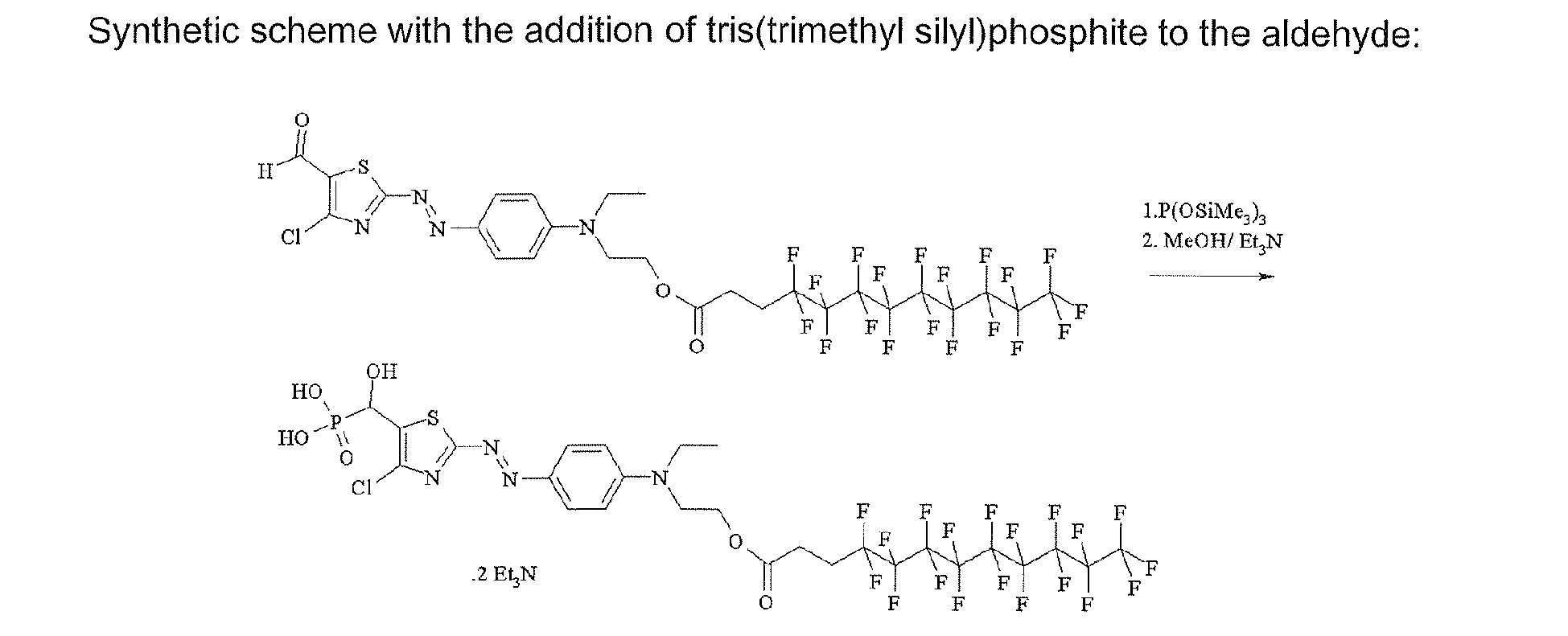
- 5 g (6 mmol) of the fluorinated azo dye was dissolved in 40 mL of THF. 3 g (10 mmol) of tris(trimethylsilyl)phosphite was added and the reaction was allowed to continue for 24 hours at room temperature. 1.4 mL (10 mmol) of triethyl amine and 40 mL of methanol were added and the reaction was allowed to continue for 24 hours at room temperature. The solvents were removed under reduced pressure and the phosphonated dye was isolated by preparative column chromatography on a Varian Mega BE-C18 flash column using methanol/water as eluent. 0.9 g of the dye was isolated.
- This example describes the synthesis of contrast dyes CD-12 and DYE-4. The contrast dye DYE-4 was synthesized for a comparative inkjet ink having a contrast dye with two shorter aliphatic groups than the contrast dye CD-12, i.e. ethyl instead of hexyl.


- The starting azo dye was prepared in a similar matter as described above for contrast dye CD-11, using dihexyl aniline instead of 2-hydroxyethyl-ethyl-aniline.
- 4.4 g (10 mmol) of the azo dye was dissolved in 25 mL of THF. 3 g (10 mmol) of tris(trimethylsilyl)phosphite was added and the reaction was allowed to continue at room temperature for 6 hours. 10 % excess of tris(trimethylsilyl)phosphite was added and the reaction was allowed to continue for an extra 12 hours. 50 mL of methanol and 10 mL of triethyl amine were added and the reaction was allowed to continue at room temperature for 12 hours. The reaction mixture was evaporated under reduced pressure and the dye was isolated by preparative column chromatography on a Varian Mega BE-C18 flash column, using a gradient elution from 100 % water to methanol/ water 80/20. 4.4 g of the contrast dye CD-12 was isolated.

- The starting azo dye was prepared in a similar matter as described above for contrast dye CD-11, using diethyl aniline in stead of 2-hydroxyethyl-ethyl-aniline.
- 3.2 g (10 mmol) of the azo dye was dissolved in 25 mL of THF. 3 g (10 mmol) tris(trimethylsilyl)phosphite was added and the reaction was allowed to continue at room temperature for 16 hours. 60 mL of methanol and 5 mL of triethyl amine were added and the reaction was allowed to continue at room temperature for 12 hours. The solvent was removed under reduced pressure and the residue was redissolved in 100 mL of water. The aqueous layer was extracted twice with 100 mL of ethylacetate to remove residual organic contaminants and the aqueous layer was evaporated under reduced pressure. The residue was treated with 100 mL of hexane, isolated by filtration and dried. 3.7 g of the contrast dye DYE-4 was isolated and used for evaluation without further purification.
- This example illustrates that low molecular weight contrast dyes in accordance with the present invention not only produce a clearly visible lithographic image that remains visible after gumming, but are also suitable for printing in the absence of a traditional oleophilizing agent.
- The following dyes were used to prepare comparative inkjet inks:


- The contrast dye DYE-1 is widely commercially available. The reference dyes DYE-2 and DYE-3 were prepared by conventional diazonium chemistry as described in Vogel's Textbook of Practical Organic Chemistry, fourth edition (Longman, London and New York). The synthesis of DYE-4 is described above in Example 6.
- A first colourless oleophilizing compound contains two A groups and two phosphonic acids groups (A groups) but no chromophore group.

- The synthetic scheme:

- 9.2 g (11.5 mmol) of the purified intermediate was dissolved in 200 mL of methylene chloride. 10.6 g (69 mmol) of trimethylsilyl bromide was added and the reaction was allowed to continue for 3 days at room temperature. The solvent is removed under reduced pressure and 100 mL of water and 1 mL of HCl 1N was added. The reaction was allowed to continue for 24 hours at room temperature. The precipitated bis-phosphonic acid was isolated by filtration, washed with 60 mL of water and dried. The crude product was treated with 80 mL of methyl t.butyl ether, isolated by filtration and dried. 6.8 g of the oleophilizing compound OLEO-1was isolated.
- A second colourless oleophilizing compound contains two phosphonic acid groups (A groups) connected by 6 carbon atoms and lacking again a chromophore group D.

- The synthetic scheme
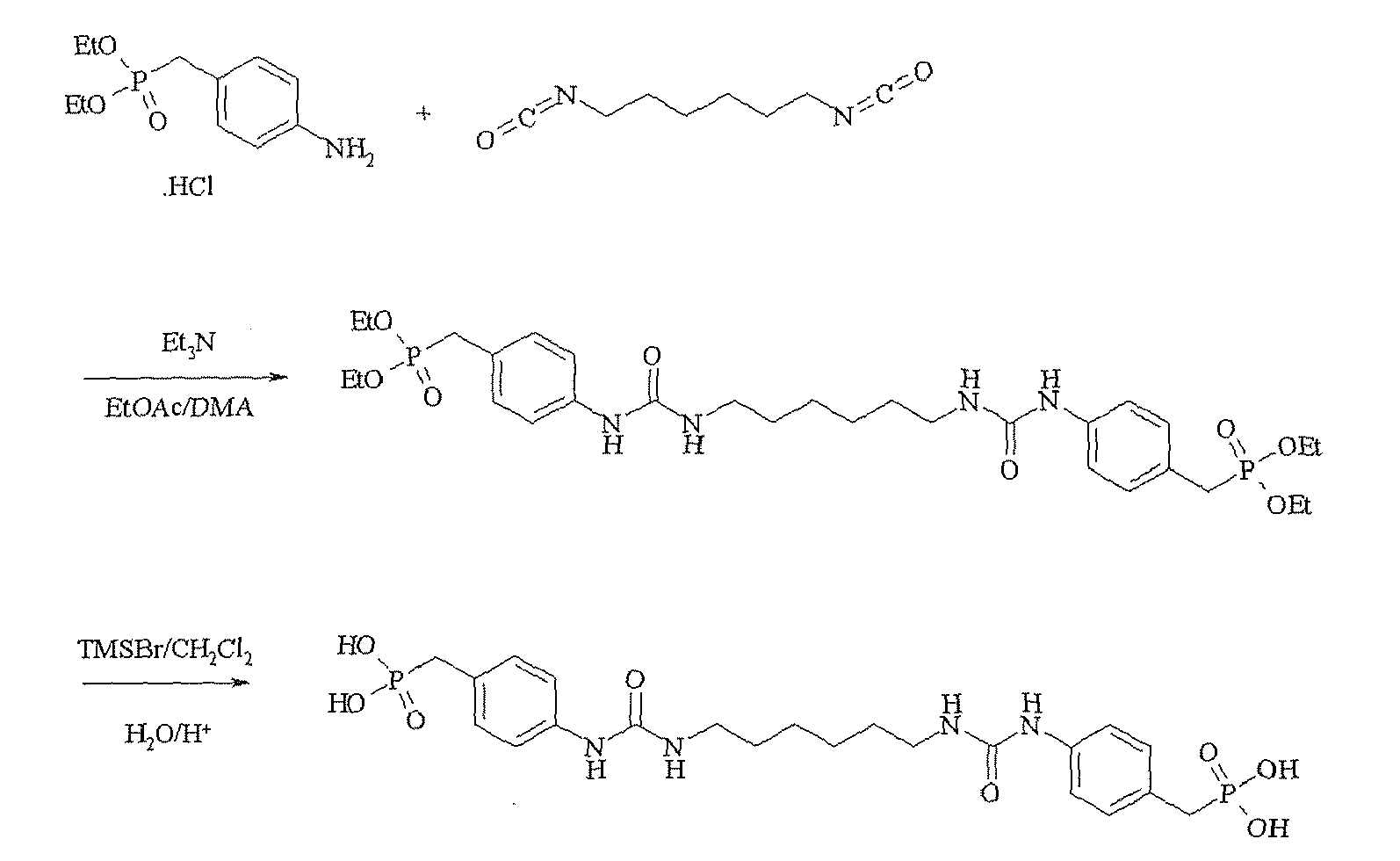
- 1.6 g (10 mmol) of hexamethylene diisocyanate and 2 g of (4-aminobenzyl)-phosphonic acid diethyl ester chlorohydrate were added to 100 mL of ethyl acetate. 3.2 g of (4-aminobenzyl)-phosphonic acid diethyl ester chlorohydrate was suspended in 50 mL of dimethyl acetamide and added to the mixture. 2.8 mL of triethyl amine was added and all compounds dissolved into the mixture. The reaction was allowed to continue for 16 hours at room temperature. The crude intermediate precipitated from the medium and was isolated by filtration. The intermediate was purified by preparative column chromatography, using methylene chloride/ ethanol 93/7 as eluent on Kromasil Si 60A 10µm. 1.8 g (2.7 mmol) of the purified intermediate was dissolved in 40 mL of methylene chloride and 2.5 g (16.2 mmol) of trimethylsilyl bromide was added. The reaction was allowed to continue for several days at room temperature. The solvent was removed under reduced pressure and 50 mL of water and 5 mL of 1 N HCl were added. The reaction is allowed to continue for 24 hours at room temperature. The crude bis-phosphonic acid was isolated by filtration, treated with acetone and dried. 0.7 g of the oleophilizing compound OLEO-2 was isolated.
- All inkjet inks were prepared in the same manner to obtain a composition as described in Table 3 for the comparative inkjet inks and in Table 4 for the inventive inkjet inks.
Table 3 wt% of Compound Comparative inkjet inks C-1 C-2 C-3 C-4 C-5 C-6 C-7 DYE-1 --- 1.00 --- --- --- --- --- DYE-2 --- --- 0.95 --- --- --- --- DYE-3 --- --- --- 1.00 --- --- --- DYE-4 --- --- --- --- 2.00 --- --- DYE-5 --- --- --- --- --- 1.00 1.00 Propylene glycol 21.00 --- --- --- 21.00 21.00 --- Diethylene glycol 7.00 --- --- --- 7.00 7.00 --- Ethylene glycol 3.40 4.00 5.20 2.30 --- --- --- 2-pyrrolidone --- 8.00 7.60 8.00 --- --- --- TEGMBE --- 6.00 5.70 6.00 --- --- --- Triethanol amine --- --- --- --- 1.45 2.55 0.71 Isopropanol --- --- --- --- --- --- 10.00 Zonyl™ FSE 2.00 1.00 0.82 1.00 --- --- --- OLEO-1 --- --- --- --- --- 2.00 --- OLEO-2 --- --- --- --- --- --- 1.00 water 66.60 80.00 79.73 81.70 68.55 66.45 87.29 -
Table 4 wt% of Compound Inventive inkjet inks I-1 I-2 I-3 I-4 I-5 I-6 CD-3 1.00 --- 1.00 --- --- --- CD-5 --- --- --- --- --- 2.00 CD-11 --- 2.50 --- 1.21 --- --- CD-12 --- --- --- --- 2.00 --- Propylene glycol --- 21.00 --- 21.00 21.00 21.00 Diethylene glycol --- 7.00 --- 7.00 7.00 7.00 Ethylene glycol 4.00 --- 4.00 --- --- --- 2-pyrrolidone 8.00 --- 8.00 --- --- --- TEGMBE 6.00 --- 6.00 --- --- --- Triethanol amine --- --- --- --- --- 1.29 Zonyl™ FSE --- --- 1.00 0.48 --- --- water 81.00 69.50 80.00 70.31 70.00 68.71 - First the liquid carrier composition optimized for jetting performance was prepared under stirring at room temperature by adding the organic solvents, i.e. alkylene glycol(ether) and when applicable the 2-pyrolidone or isopropanol, to demineralised water. Stirring was continued until a homogeneous solution was obtained. Then the low molecular weight contrast dye was introduced into this carrier. Some contrast dyes required addition of triethanolamine to improve the solubility of the contrast dye in the liquid carrier (see table). In a number of cases the inkjet ink composition was completed by addition of an oleophilizing compound: Zonyl™ FSE, OLEO-1 or OLEO-2.
- The comparative inkjet inks C-1 to C-7 and the inventive inkjet inks I-1 to I-6 were evaluated on their image contrast and on their printing properties. The results are shown in Table 5.
Table 5 Inkjet Ink Oleophilizing compound Dye Visual contrast Gum Contrast Printing test C-1 Zonyl™ FSE None None None OK C-2 Zonyl™ FSE DYE-1 OK Not OK OK C-3 Zonyl™ FSE DYE-2 OK Not OK OK C-4 Zonyl™ FSE DYE-3 OK Not OK OK C-5 No DYE-4 OK OK Not OK C-6 OLEO-1 DYE-5 OK Not OK OK C-7 OLEO-2 DYE-5 OK Not OK Not OK I-1 No CD-3 OK OK OK I-2 No CD-11 OK OK OK I-3 Zonyl™ FSE CD-3 OK OK OK I-4 Zonyl™ FSE CD-11 OK OK OK I-5 No CD-12 OK OK OK I-6 No CD-5 OK OK OK - From Table 5, it can be seen that none of the comparative inkjet inks C-1 to C-7 retained a visual contrast in the lithographic image after a gumming treatment with the exception of comparative inkjet ink C-5 which contained a contrast dye DYE-4 with aliphatic groups that are too short for ink-uptake. On the other hand the inventive inkjet inks I-1 to I-6 all exhibited good visual contrast after gumming treatment. The inventive inkjet inks I-1, I-2, I-5 and I-6 show that for these contrast dyes the presence of an extra oleophilizing compound in the ink was not required.
- This example describes the synthesis of contrast dye CPOL-1.


- This example describes the synthesis of contrast dye CPOL-6.

- 8.2 g of SMA1000P was dissolved in 40 mL of dimethyl acetamide 4.2 g of the anthraquinone dye (Hydroparabromesaure, supplied by Bayer AG) and 2 mL oftriethyl amine were added. The reaction was allowed to continue at room temperature for 16 hours. The reaction mixture was heated to 100°C for an hour to drive the reaction to completion. After cooling down to room temperature, 2.2 g of (1-aminopentyl)-phosphonic acid diethyl ester was added and the reaction was allowed to continue for one hour at room temperature, followed by the addition of 8 g of the fluorinated amine. The reaction was allowed to continue for 16 hours at room temperature. 15 g of trimethylsilyl bromide was added and the reaction was allowed to continue for 24 hours at room temperature. 150 mL of methanol was added and the reaction mixture was stirred for 16 hours at room temperature. The polymer was precipitated in water, isolated by filtration and dried. 31P-NMR clearly proved the presence of deprotected phosphonic acids, while 19F-NMR proved the presence of polymer bound fluorinated aliphatic chains.
- This example describes the synthesis of contrast dye CPOL-7.


- 4.0 g of SMA1000P was dissolved in 40 mL of dimethyl acetamide. 4.2 g of the anthraquinone dye (Hydroparabromesaure, supplied by Bayer AG) and 1.4 mL of triethyl amine were added. The reaction was allowed to continue at room temperature for 16 hours. The reaction mixture was heated to 100°C for an hour to drive the reaction to completion. After cooling down to room temperature 2.8 g of (1-aminododecyl)-phosphonic acid diethyl ester (prepared according to the method described by Kudzin et al., Synthesis 1980, 1028) and 1 g of triethyl amine were added and the reaction was allowed to continue for 16 hours at room temperature. 12.4 g of trimethylsilyl bromide was added and the reaction was allowed to continue 24 hours. 100 mL of methanol was added and the reaction was allowed to continue for 48 hours. The polymer was precipitated in water and was isolated by filtration. The crude polymer was purified using preparative size exclusion chromatography on Sephadex G25 (Pharmacia). 5 g of the polymer was isolated. 31P-NMR proved the presence of mainly uncleaved phosphonate esters. The polymer was redissolved in 40 mL of dimethyl acetamide and treated with 10 mL of trimethylsilyl bromide. The reaction was allowed to continue for 16 hours. 100 mL of methanol was added and the reaction mixture was stirred for 16 hours. The polymer was precipitated with water, isolated by filtration and dried. 31P-NMR clearly proved the presence of fully deprotected phosphonic acids. The experimental n/x/y ratio proved to be 50/25/25.
- This example illustrates that contrast dyes having a polymeric backbone in accordance with the present invention not only produce a clearly visible lithographic image that remains visible after gumming, but is suitable for printing in the absence of a traditional oleophilizing agent.
-

- 10.2 g of SMA1000P was dissolved in 50 mL of dimethyl acetamide. 4.6 g of dodecyl amine and 4.4 mL of diispropyl ethyl amine were added dropwise at 50°C. The reaction was allowed to continue at room temperature for 2 hours. A solution of phosphoric acid mono-(2-amino-ethyl)-ester in 10 mL of dimethyl acetamide, 7 mL of 5N NaOH and 4.4 mL of diisopropyl ethyl amine was added at 50°C. The reaction was allowed to continue for 16 hours at room temperature. A small fraction of precipitated product was removed by filtration. 100 mL of water was added to the filtrate and the mixture was acidified with 15 mL of 5M HCl. The polymer precipitated from the medium and was isolated by filtration. The polymer was resuspended in 100 mL of water, isolated by filtration and dried. 17.9 g of the polymer POL-1 was isolated. The experimental n/x/y ratio based on 1H-NMR spectroscopy proved to be 56/19/25.
-

- 10.2 g of SMA1000P was dissolved in 50 mL of dimethyl acetamide. 4.6 g of dodecyl amine and 4.4 mL of diisopropyl ethyl amine were added dropwise at 50°C. The reaction was allowed to continue at 50°C for 2 hours. A solution of 4.3 g (3-aminophenyl)-phosphonic acid in 10 mL of dimethyl acetamide, 4.4 mL of diispropyl ethyl amine and 5 mL of 5 N NaOH was added at 50°C. The reaction was allowed to continue for 2 hours at 50°C and further over night at room temperature. 100 mL of water was added to the reaction mixture and the mixture was acidified with 20 mL of 5N HCl. The polymer precipitated from the medium and was isolated by filtration. The polymer was treated with 200 mL of water, isolated by filtration and treated with 150 mL of isopropyl acetate. The undissolved residue was removed by filtration and washed with 50 mL of ethylacetate. The filtrate was evaporated under reduced pressure and the residue was treated with 200 mL of acetonitrile for 1 hour. The polymer POL-2 was isolated by filtration, treated for a second time with 150 mL of acetonitrile, isolated by filtration and dried. 15.8 g of the polymer POL-2 was isolated. Th n/x/y ratio proved to be 53/20/27 based on 1H-NMR-spectroscopy.
- All inkjet inks were prepared in the same manner to obtain a composition as described in Table 6 for the comparative inkjet inks C-8 and C-9 and for the inventive inkjet inks I-7 to I-10.
Table 6 wt% of Compound C-8 C-9 I-7 I-8 I-9 I-10 POL-1 1.87 --- --- --- --- --- POL-2 --- 1.89 --- --- --- --- CPOL-1 --- --- 2.00 --- --- --- CPOL-7 --- --- --- 2.50 1.21 --- CPOL-6 --- --- --- --- --- 2.50 DYE-5 0.94 0.94 --- --- --- --- Propylene glycol 19.60 19.80 21.00 21.00 21.00 21.00 Diethylene glycol 6.50 6.60 7.00 7.00 7.00 7.00 Triethanol amine 6.55 5.57 --- --- --- --- Zonyl™ FSE --- --- --- --- 0.48 --- Water 64.54 65.20 70.00 69.50 70.31 69.50 - First the liquid carrier composition optimized for jetting performance was prepared under stirring at room temperature by adding the organic solvents, i.e. propylene glycol and diethylene glycol, to demineralised water. Stirring was continued until a homogeneous solution was obtained. Then the contrast dye (DYE-5 for the comparative inkjet inks C-8 and C-9 and CPOL-1, CPOL-6 or CPOL-7 for the inventive inkjet inks I-7 to I-10) was introduced into this carrier. The contrast dye DYE-5 required addition of triethanol amine to improve the solubility of the contrast dye in the liquid carrier. The composition of the inventive inkjet ink I-9 was completed by addition of Zonyl™ FSE as an oleophilizing compound.
- The comparative inkjet inks C-8 and C-9 and the inventive inkjet inks I-7 to I-10 were evaluated on their image contrast and printing properties. The results are shown in Table 7.
-
Table 7 Inkjet Ink Visual contrast Gum contrast Printing test C-8 OK Not OK OK C-9 OK Not OK OK I-7 OK OK OK I-8 OK OK OK I-9 OK OK OK I-10 OK OK OK - From Table 7, it can be seen that the comparative inkjet inks C-8 and C-9 retained no visual contrast in the lithographic image after a gumming treatment. On the other hand the inventive inkjet inks I-7 to I-10 all exhibited good visual contrast after gumming treatment, as well as a rapid ink-uptake. The inventive inkjet inks I-7, I-8 and I-10 show that for these contrast dyes the presence of an extra oleophilizing compound, such as Zonyl™ FSE in the inventive inkjet ink I-9, was not required.
Claims (13)
- A contrast dye for preparing a lithographic printing plate comprising at least one A, D and B group wherein
A represents a phosphorous containing group capable of reacting with the surface of a lithographic receiver;
D represents a chromophore group absorbing light between 400 and 700 nm; and
B represents an aliphatic group of at least 6 carbon atoms. - A contrast dye according to claim 1 wherein said aliphatic group B contains at least one fluorine atom.
- A contrast dye according to claim 1 or 2 wherein said contrast dye has the structure AxDyBz wherein x, y and z are each independently chosen integers from 1 to 10000 and the A and B groups are covalently bonded to the chromophore group D.
- A contrast dye according to claim 3 wherein x and z are each independently chosen integers from 1 to 8 and y is 1 or 2.
- A contrast dye according to claim 1 or 2 wherein said contrast dye has a polymeric backbone and the groups A, D and B are covalently bonded to the polymeric backbone according to one or more structures selected from the group consisting AxDyBz, AxDy, AxBz, DyBz, A, D and B; and
wherein x and z are each independently chosen integers from 1 to 8 and y is 1 or 2. - A contrast dye according to any of claims 1 to 5 wherein said phosphorous containing group capable of reacting with the surface of a lithographic receiver is represented by Formula (I):

X1, X2, X3 and X4 are independently selected from oxygen or sulfur;
q represents 0 or 1;
M1 is a proton or a counterion to compensate the negative charge of X4;
M2 is a proton or a counterion to compensate the negative charge of X3 or represents a substituted or unsubstituted, saturated or unsaturated aliphatic chain, a substituted or unsubstituted aryl or hetero-aryl group. - A contrast dye according to claim 6 wherein said phosphorous containing group capable of reacting with the surface of a lithographic receiver represented by Formula (I) is selected from the group consisting of -O-PO3H2, -O-PP3HR, -PO3H2 or -PO3HR with R representing methyl or ethyl.
- A contrast dye according to any of claims 1 to 7 wherein said aliphatic group contains at least 5 fluorine atoms.
- A contrast dye according to any of claims 1 to 8 wherein said aliphatic group comprises a fluorinated straight chain aliphatic group containing at least 6 carbon atoms.
- A contrast dye according to claim 9 wherein said straight chain aliphatic group is represented by -(CF2-CF2)nCF3 with n representing an integer between 3 and 20.
- A contrast dye according to any of claims 1 to 7 wherein said aliphatic group is represented by -(CH2-CH2)nCH3 with n representing an integer between 3 and 20.
- A contrast dye according to any of claims 1 to 7 wherein said chromophore group D is selected from the group consisting of an azo dye with a molar extinction coefficient larger than 103/ mol-1 cm-1, an anthraquinone dye, a (poly)methine dye, an azomethine dye, a disazo dye, a carbonium dye, a styryl dye, a stilbene dye, a phthalocyanine dye, a coumarin dye, an aryl-carbonium dye, a nitro dye, a naphtholactam dye, a dioxazine dye, a flavin dye and a formazan dye.
- A lithographic printing plate containing a contrast dye according to any of claims 1 to 12.
Priority Applications (4)
| Application Number | Priority Date | Filing Date | Title |
|---|---|---|---|
| EP05112508A EP1803780B1 (en) | 2005-12-20 | 2005-12-20 | Contrast dyes for inkjet lithographic printing plates |
| DE602005013555T DE602005013555D1 (en) | 2005-12-20 | 2005-12-20 | Contrast dyes for inkjet lithographic printing plates |
| US12/158,097 US20090036638A1 (en) | 2005-12-20 | 2006-12-05 | Contrast Dyes for Inkjet Lithographic Printing Plates |
| PCT/EP2006/069296 WO2007071552A2 (en) | 2005-12-20 | 2006-12-05 | Contrast dyes for inkjet lithographic printing plates |
Applications Claiming Priority (1)
| Application Number | Priority Date | Filing Date | Title |
|---|---|---|---|
| EP05112508A EP1803780B1 (en) | 2005-12-20 | 2005-12-20 | Contrast dyes for inkjet lithographic printing plates |
Publications (2)
| Publication Number | Publication Date |
|---|---|
| EP1803780A1 true EP1803780A1 (en) | 2007-07-04 |
| EP1803780B1 EP1803780B1 (en) | 2009-03-25 |
Family
ID=36997257
Family Applications (1)
| Application Number | Title | Priority Date | Filing Date |
|---|---|---|---|
| EP05112508A Expired - Lifetime EP1803780B1 (en) | 2005-12-20 | 2005-12-20 | Contrast dyes for inkjet lithographic printing plates |
Country Status (4)
| Country | Link |
|---|---|
| US (1) | US20090036638A1 (en) |
| EP (1) | EP1803780B1 (en) |
| DE (1) | DE602005013555D1 (en) |
| WO (1) | WO2007071552A2 (en) |
Cited By (1)
| Publication number | Priority date | Publication date | Assignee | Title |
|---|---|---|---|---|
| US8034538B2 (en) | 2009-02-13 | 2011-10-11 | Eastman Kodak Company | Negative-working imageable elements |
Families Citing this family (1)
| Publication number | Priority date | Publication date | Assignee | Title |
|---|---|---|---|---|
| US20120090486A1 (en) | 2010-10-18 | 2012-04-19 | Celin Savariar-Hauck | Lithographic printing plate precursors and methods of use |
Citations (13)
| Publication number | Priority date | Publication date | Assignee | Title |
|---|---|---|---|---|
| EP0347803A2 (en) * | 1988-06-20 | 1989-12-27 | Orient Chemical Industries, Ltd. | Aqueous ink composition |
| EP0771860A2 (en) * | 1995-11-02 | 1997-05-07 | Seiko Epson Corporation | Ink composition excellent in reproduction of black color and ink jet recording method using the same |
| US5830912A (en) * | 1996-11-15 | 1998-11-03 | Molecular Probes, Inc. | Derivatives of 6,8-difluoro-7-hydroxycoumarin |
| WO2001042211A2 (en) * | 1999-12-13 | 2001-06-14 | The Regents Of The University Of California | Detection of transmembrane potentials by optical methods |
| WO2001054915A1 (en) * | 2000-01-27 | 2001-08-02 | Kodak Polychrome Graphics Co. Ltd. | Lithographic printing plates by inkjet and control of image resolution |
| EP1157825A1 (en) * | 2000-05-25 | 2001-11-28 | Agfa-Gevaert N.V. | Computer-to-plate by ink jet |
| EP1157826A1 (en) * | 2000-05-26 | 2001-11-28 | Agfa-Gevaert N.V. | Computer-to-plate by ink jet |
| EP1157828A1 (en) * | 2000-05-26 | 2001-11-28 | Agfa-Gevaert N.V. | Computer-to-plate by ink jet |
| EP1157827A1 (en) * | 2000-05-26 | 2001-11-28 | Agfa-Gevaert N.V. | Computer-to-plate by ink jet |
| EP1211063A1 (en) * | 2000-11-30 | 2002-06-05 | Agfa-Gevaert | Process for making lithographic printing plates by ink jet printing |
| EP1219415A1 (en) * | 2000-12-28 | 2002-07-03 | Agfa-Gevaert | Ink-jet method for preparing lithographic printing plates |
| US6742886B1 (en) * | 2003-01-21 | 2004-06-01 | Kodak Polychrome Graphics Lle | Ink jet compositions for lithographic printing |
| EP1577356A1 (en) * | 2001-10-25 | 2005-09-21 | Agfa-Gevaert | Ink composition containing a particular type of dye, and corresponding ink jet printing process. |
Family Cites Families (2)
| Publication number | Priority date | Publication date | Assignee | Title |
|---|---|---|---|---|
| US4666819A (en) * | 1985-03-11 | 1987-05-19 | Minnesota Mining And Manufacturing Company | Optical information storage based on polymeric dyes |
| US5362812A (en) * | 1993-04-23 | 1994-11-08 | Minnesota Mining And Manufacturing Company | Reactive polymeric dyes |
-
2005
- 2005-12-20 DE DE602005013555T patent/DE602005013555D1/en not_active Expired - Lifetime
- 2005-12-20 EP EP05112508A patent/EP1803780B1/en not_active Expired - Lifetime
-
2006
- 2006-12-05 WO PCT/EP2006/069296 patent/WO2007071552A2/en not_active Ceased
- 2006-12-05 US US12/158,097 patent/US20090036638A1/en not_active Abandoned
Patent Citations (13)
| Publication number | Priority date | Publication date | Assignee | Title |
|---|---|---|---|---|
| EP0347803A2 (en) * | 1988-06-20 | 1989-12-27 | Orient Chemical Industries, Ltd. | Aqueous ink composition |
| EP0771860A2 (en) * | 1995-11-02 | 1997-05-07 | Seiko Epson Corporation | Ink composition excellent in reproduction of black color and ink jet recording method using the same |
| US5830912A (en) * | 1996-11-15 | 1998-11-03 | Molecular Probes, Inc. | Derivatives of 6,8-difluoro-7-hydroxycoumarin |
| WO2001042211A2 (en) * | 1999-12-13 | 2001-06-14 | The Regents Of The University Of California | Detection of transmembrane potentials by optical methods |
| WO2001054915A1 (en) * | 2000-01-27 | 2001-08-02 | Kodak Polychrome Graphics Co. Ltd. | Lithographic printing plates by inkjet and control of image resolution |
| EP1157825A1 (en) * | 2000-05-25 | 2001-11-28 | Agfa-Gevaert N.V. | Computer-to-plate by ink jet |
| EP1157826A1 (en) * | 2000-05-26 | 2001-11-28 | Agfa-Gevaert N.V. | Computer-to-plate by ink jet |
| EP1157828A1 (en) * | 2000-05-26 | 2001-11-28 | Agfa-Gevaert N.V. | Computer-to-plate by ink jet |
| EP1157827A1 (en) * | 2000-05-26 | 2001-11-28 | Agfa-Gevaert N.V. | Computer-to-plate by ink jet |
| EP1211063A1 (en) * | 2000-11-30 | 2002-06-05 | Agfa-Gevaert | Process for making lithographic printing plates by ink jet printing |
| EP1219415A1 (en) * | 2000-12-28 | 2002-07-03 | Agfa-Gevaert | Ink-jet method for preparing lithographic printing plates |
| EP1577356A1 (en) * | 2001-10-25 | 2005-09-21 | Agfa-Gevaert | Ink composition containing a particular type of dye, and corresponding ink jet printing process. |
| US6742886B1 (en) * | 2003-01-21 | 2004-06-01 | Kodak Polychrome Graphics Lle | Ink jet compositions for lithographic printing |
Cited By (1)
| Publication number | Priority date | Publication date | Assignee | Title |
|---|---|---|---|---|
| US8034538B2 (en) | 2009-02-13 | 2011-10-11 | Eastman Kodak Company | Negative-working imageable elements |
Also Published As
| Publication number | Publication date |
|---|---|
| DE602005013555D1 (en) | 2009-05-07 |
| WO2007071552A3 (en) | 2007-11-01 |
| WO2007071552A2 (en) | 2007-06-28 |
| US20090036638A1 (en) | 2009-02-05 |
| EP1803780B1 (en) | 2009-03-25 |
Similar Documents
| Publication | Publication Date | Title |
|---|---|---|
| EP1243623B1 (en) | Water-based ink for ink-jet recording | |
| JP5258237B2 (en) | Ink composition, inkjet recording method, lithographic printing plate production method, and lithographic printing plate | |
| EP1197535B1 (en) | Ink-jet ink composition containing a pyrazoleazoindole dye | |
| JPH06107990A (en) | Aqueous ink and recording method using the same | |
| EP2899033B1 (en) | Ink composition, ink set, and image formation method | |
| JPWO2008007550A1 (en) | Plate making method and planographic printing plate | |
| EP1800861B1 (en) | Method for making a lithographic printing plate | |
| EP1801170B1 (en) | Inkjet ink for preparing lithographic printing plates and method for their preparation | |
| EP1803780B1 (en) | Contrast dyes for inkjet lithographic printing plates | |
| EP2977413B1 (en) | Ink composition, ink set, and image formation method | |
| EP1050563B1 (en) | Dye for ink jet ink | |
| WO2007071550A1 (en) | Inkjet ink for preparing lithographic printing plates and method for their preparation | |
| US6464767B1 (en) | Ink jet printing method | |
| US6457822B1 (en) | Ink jet printing method | |
| JP2002363470A (en) | Ink jet ink composition | |
| JP2004143387A (en) | Water-based ink | |
| US6136080A (en) | Cationic azo dye for ink jet ink | |
| US20110139026A1 (en) | Ink-jet platemaking method | |
| US7273897B2 (en) | Ink jet ink composition | |
| EP1048701B1 (en) | Delocalized cationic azo dye for ink jet ink | |
| EP1048703A1 (en) | Dye for ink jet ink | |
| JP3275671B2 (en) | Ink jet recording liquid and method for producing the same | |
| JP3687795B2 (en) | Water-based ink for inkjet recording | |
| JP2019089989A (en) | Ink set and inkjet recording method | |
| JP4277390B2 (en) | Ink jet ink composition |
Legal Events
| Date | Code | Title | Description |
|---|---|---|---|
| PUAI | Public reference made under article 153(3) epc to a published international application that has entered the european phase |
Free format text: ORIGINAL CODE: 0009012 |
|
| AK | Designated contracting states |
Kind code of ref document: A1 Designated state(s): AT BE BG CH CY CZ DE DK EE ES FI FR GB GR HU IE IS IT LI LT LU LV MC NL PL PT RO SE SI SK TR |
|
| AX | Request for extension of the european patent |
Extension state: AL BA HR MK YU |
|
| 17P | Request for examination filed |
Effective date: 20080104 |
|
| AKX | Designation fees paid |
Designated state(s): DE FR GB |
|
| 17Q | First examination report despatched |
Effective date: 20080215 |
|
| GRAP | Despatch of communication of intention to grant a patent |
Free format text: ORIGINAL CODE: EPIDOSNIGR1 |
|
| RIN1 | Information on inventor provided before grant (corrected) |
Inventor name: VERDONCK, EMIEL Inventor name: LOCCUFIER, JOHAN |
|
| GRAS | Grant fee paid |
Free format text: ORIGINAL CODE: EPIDOSNIGR3 |
|
| GRAA | (expected) grant |
Free format text: ORIGINAL CODE: 0009210 |
|
| AK | Designated contracting states |
Kind code of ref document: B1 Designated state(s): DE FR GB |
|
| REG | Reference to a national code |
Ref country code: GB Ref legal event code: FG4D |
|
| REF | Corresponds to: |
Ref document number: 602005013555 Country of ref document: DE Date of ref document: 20090507 Kind code of ref document: P |
|
| PLBE | No opposition filed within time limit |
Free format text: ORIGINAL CODE: 0009261 |
|
| STAA | Information on the status of an ep patent application or granted ep patent |
Free format text: STATUS: NO OPPOSITION FILED WITHIN TIME LIMIT |
|
| 26N | No opposition filed |
Effective date: 20091229 |
|
| PGFP | Annual fee paid to national office [announced via postgrant information from national office to epo] |
Ref country code: GB Payment date: 20101012 Year of fee payment: 6 |
|
| PGFP | Annual fee paid to national office [announced via postgrant information from national office to epo] |
Ref country code: DE Payment date: 20101007 Year of fee payment: 6 |
|
| PGFP | Annual fee paid to national office [announced via postgrant information from national office to epo] |
Ref country code: FR Payment date: 20111021 Year of fee payment: 7 |
|
| GBPC | Gb: european patent ceased through non-payment of renewal fee |
Effective date: 20121220 |
|
| REG | Reference to a national code |
Ref country code: FR Ref legal event code: ST Effective date: 20130830 |
|
| REG | Reference to a national code |
Ref country code: DE Ref legal event code: R119 Ref document number: 602005013555 Country of ref document: DE Effective date: 20130702 |
|
| PG25 | Lapsed in a contracting state [announced via postgrant information from national office to epo] |
Ref country code: DE Free format text: LAPSE BECAUSE OF NON-PAYMENT OF DUE FEES Effective date: 20130702 |
|
| PG25 | Lapsed in a contracting state [announced via postgrant information from national office to epo] |
Ref country code: GB Free format text: LAPSE BECAUSE OF NON-PAYMENT OF DUE FEES Effective date: 20121220 Ref country code: FR Free format text: LAPSE BECAUSE OF NON-PAYMENT OF DUE FEES Effective date: 20130102 |