EP1801757A1 - Abnormal action detector and abnormal action detecting method - Google Patents
Abnormal action detector and abnormal action detecting method Download PDFInfo
- Publication number
- EP1801757A1 EP1801757A1 EP05778592A EP05778592A EP1801757A1 EP 1801757 A1 EP1801757 A1 EP 1801757A1 EP 05778592 A EP05778592 A EP 05778592A EP 05778592 A EP05778592 A EP 05778592A EP 1801757 A1 EP1801757 A1 EP 1801757A1
- Authority
- EP
- European Patent Office
- Prior art keywords
- data
- feature data
- frame
- partial space
- abnormal
- Prior art date
- Legal status (The legal status is an assumption and is not a legal conclusion. Google has not performed a legal analysis and makes no representation as to the accuracy of the status listed.)
- Withdrawn
Links
Images




Classifications
-
- G—PHYSICS
- G08—SIGNALLING
- G08B—SIGNALLING SYSTEMS, e.g. PERSONAL CALLING SYSTEMS; ORDER TELEGRAPHS; ALARM SYSTEMS
- G08B21/00—Alarms responsive to a single specified undesired or abnormal condition and not otherwise provided for
- G08B21/02—Alarms for ensuring the safety of persons
- G08B21/04—Alarms for ensuring the safety of persons responsive to non-activity, e.g. of elderly persons
- G08B21/0438—Sensor means for detecting
- G08B21/0476—Cameras to detect unsafe condition, e.g. video cameras
-
- G—PHYSICS
- G06—COMPUTING OR CALCULATING; COUNTING
- G06T—IMAGE DATA PROCESSING OR GENERATION, IN GENERAL
- G06T7/00—Image analysis
- G06T7/20—Analysis of motion
- G06T7/254—Analysis of motion involving subtraction of images
-
- G—PHYSICS
- G06—COMPUTING OR CALCULATING; COUNTING
- G06V—IMAGE OR VIDEO RECOGNITION OR UNDERSTANDING
- G06V20/00—Scenes; Scene-specific elements
- G06V20/50—Context or environment of the image
- G06V20/52—Surveillance or monitoring of activities, e.g. for recognising suspicious objects
-
- G—PHYSICS
- G06—COMPUTING OR CALCULATING; COUNTING
- G06V—IMAGE OR VIDEO RECOGNITION OR UNDERSTANDING
- G06V40/00—Recognition of biometric, human-related or animal-related patterns in image or video data
- G06V40/20—Movements or behaviour, e.g. gesture recognition
- G06V40/23—Recognition of whole body movements, e.g. for sport training
-
- G—PHYSICS
- G08—SIGNALLING
- G08B—SIGNALLING SYSTEMS, e.g. PERSONAL CALLING SYSTEMS; ORDER TELEGRAPHS; ALARM SYSTEMS
- G08B13/00—Burglar, theft or intruder alarms
- G08B13/18—Actuation by interference with heat, light, or radiation of shorter wavelength; Actuation by intruding sources of heat, light, or radiation of shorter wavelength
- G08B13/189—Actuation by interference with heat, light, or radiation of shorter wavelength; Actuation by intruding sources of heat, light, or radiation of shorter wavelength using passive radiation detection systems
- G08B13/194—Actuation by interference with heat, light, or radiation of shorter wavelength; Actuation by intruding sources of heat, light, or radiation of shorter wavelength using passive radiation detection systems using image scanning and comparing systems
- G08B13/196—Actuation by interference with heat, light, or radiation of shorter wavelength; Actuation by intruding sources of heat, light, or radiation of shorter wavelength using passive radiation detection systems using image scanning and comparing systems using television cameras
- G08B13/19602—Image analysis to detect motion of the intruder, e.g. by frame subtraction
- G08B13/1961—Movement detection not involving frame subtraction, e.g. motion detection on the basis of luminance changes in the image
Definitions
- the present invention relates to an abnormal action detector and an abnormal action detecting method for capturing moving images to detect unusual actions.
- Non-Patent Document 1 cited below, published by one of the inventors and one other, which discloses a technology for performing the action recognition using cubic higher-order local auto-correlation features (hereinafter called "CHLAC" as well) which are an extended version of higher-order local auto-correlation features that are effective for face image recognition and the like, and additionally include a correlation in a time direction.
- CHLAC cubic higher-order local auto-correlation features
- the cubic higher-order local auto-correlation features can be said to be statistical features and action features which are derived by calculating local auto-correlation features at each point in voxel data (three-dimensional data) which comprises images arranged in time series, and integrating the local features over the entire voxel data. The features are analyzed for discrimination into four actions to provide a recognition result which is as high as nearly 100 %.
- Non-Patent Document 1 T. Kobayashi and N. Otsu, "Action and Simultaneous Multiple-Person Identification Using Cubic Higher-Order Local Auto-Correlation," Proceeding of 17th International Conference on Pattern Recognition, 2004
- An abnormal action detector of the present invention is mainly characterized by comprising difference data generating means for generating frame difference data from moving image data composed of a plurality of image frame data, feature data extracting means for extracting feature data from the inter-frame differential data through higher-order local auto-correlation, distance calculating means for calculating the distance between a subs pace spanned by principal component vectors derived through a principal component analysis approach from a plurality of feature data extracted in the past by said feature data extracting means, and the feature data extracted by said feature data extracting means, abnormality determining means for determining an abnormality when the distance is larger than a predetermined value, and outputting means for outputting the result of the determination when said abnormality determining means determines an abnormality.
- the abnormal action detector described above may further comprise capturing means for capturing moving image frame data in real time, frame data preserving means for preserving the captured frame data, preserving means for preserving the feature data extracted from said feature data extracting means for a given period of time, and partial space updating means for finding a partial space based on principal component vectors derived from the feature data preserved in said preserving means through the principal component analysis approach to update partial space information.
- An abnormal action detecting method is mainly characterized by comprising a first step of generating inter-frame differential data from moving image data composed of a plurality of image frame data, a second step of extracting feature data from the inter-frame differential data through higher-order local auto-correlation, a third step of calculating the distance between a partial space based on principal component vectors derived through a principal component analysis approach from a plurality of feature data extracted in the past, and the feature data, a fourth step of determining abnormality when the distance is larger than a predetermined value, and a fifth step of outputting the result of the determination when abnormality is determined.
- said first step may include the steps of capturing moving image frame data in real time, and preserving the captured frame data
- said third step may include the steps of preserving the feature data extracted by feature data extracting means for a given period of time, and finding a partial space based on principal component vectors derived from the preserved feature data through the principal component analysis approach to update partial space information.
- the present invention employs the (cubic) higher-order local auto-correlation features, which do not depend on the position and the like of the object and have values invariant to position, as action features.
- an overall feature value is the sum of individual feature values of the respective objects, normal actions available in abundance as normal data are statistically learned as a partial space, and abnormal actions are detected as deviations therefrom.
- an abnormal action of even one person can be advantageously detected without extraction or tracking of the individual persons, which have been conventionally employed by most of schemes.
- a reduced amount of calculations is involved in the feature extraction and abnormality determination, the amount of calculations is constant irrespective of the number of intended persons, and the processing can be performed in real time.
- normal actions are statistically learned without defining them as positive, no definition is required as to what normal actions are like at a designing stage, and a natural detection can be made in conformity to an object under monitoring.
- any assumption is not needed for an object under monitoring, a variety of objects under monitoring can be determined, not limited to actions of persons, whether they are normal or abnormal.
- slow changes in normal actions can be tracked by capturing moving images in real time and updating the partial space of normal operations.
- abnormal actions In regard to the definition of "abnormal actions,” abnormalities themselves cannot be defined in much the same fashion as all abnormal events cannot be enumerated. In this specification, accordingly, abnormal actions are defined to be “those which do not belong to normal actions.” When the normal actions refer to those actions which concentrate in a statistical distribution of motion, features, they can be learned from the statistical distribution. Thus, the abnormal actions refer to those actions which largely deviate from the distribution.
- a security camera learns and recognizes general actions such as a walking action as normal actions, but recognizes suspicious actions as abnormal actions because they do not involve periodic motions such as the walking action and are hardly observed in distributions.
- the inventors made experiments on the assumption that a "walking" action is regarded as normal, while a "running” action and a “falling” action as abnormal.
- a specific approach for detecting abnormal actions involves generating a partial space of normal action features within an action feature space based on the cubic higher-order local auto-correlation features, and detecting abnormal actions using a distance from the partial space as an abnormal value.
- a principal component analysis approach is used in the generation of the normal action partial space, where a principal component partial space comprises, for example, a principal component vector which presents a cumulative contribution ratio of 0.99.
- the cubic higher-order local auto-correlation features have the nature of not requiring the segmentation of an object and exhibiting the additivity on a screen. Due to this additivity, in a defined normal action partial space, a feature vector falls within the normal action partial space irrespective of how many persons perform normal actions on a screen, but when even one of these persons performs an abnormal action, the feature vector extends beyond the partial space and can be detected as an abnormal value. Since persons need not be individually segmented and tracked for calculations, the amount of calculations is constant, not proportional to the number of intended persons, making it possible to make the calculations at high speeds.
- the present invention finds principal component vectors of CHLAC features to be learned, and uses the principal component vectors to constitute a partial space, where the importance lies in that there is high compatibility with the additive nature of the CHLAC features. Belonging to a normal action partial space (the distance is equal to or smaller than a predetermined threshold value) does not depend on the magnitude of the vector. In other words, only the direction of the vector is a factor to determine the belonging to the normal action partial space or not.
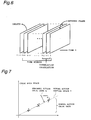
- Fig. 7 is an explanatory diagram showing the additivity of the CHLAC features and the nature of a partial space.
- a CHLAC feature data space is two-dimensional (251-dimensions in actuality), and a partial space of normal actions is one-dimensional (in embodiments, around three to twelve dimensions with a cumulative contribution ratio being set equal to 0.99, by way of example), where CHLAC feature data of normal actions form groups of respective individuals under monitoring.
- a normal action partial space S found by a principal component analysis exists in the vicinity in such a form that it contains CHLAC feature data of normal actions.
- CHLAC feature data A of a deviating abnormal action presents a larger vertical distance d ⁇ to the normal action partial space S, so that an abnormality is determined from this vertical distance d ⁇ .
- Fig. 8 is an explanatory diagram showing an example of the additivity of the CHLAC features and the partial space.
- Fig. 8(a) shows a CHLAC feature vector associated with a normal action (walking) of one person, where the CHLAC feature vector is present in (in close proximity to) the normal action partial space S.
- Fig. 8(b) shows a CHLAC feature vector associated with an abnormal action (falling) of one person, where the CHLAC feature vector is spaced by the vertical distance d ⁇ from the normal action partial space S.
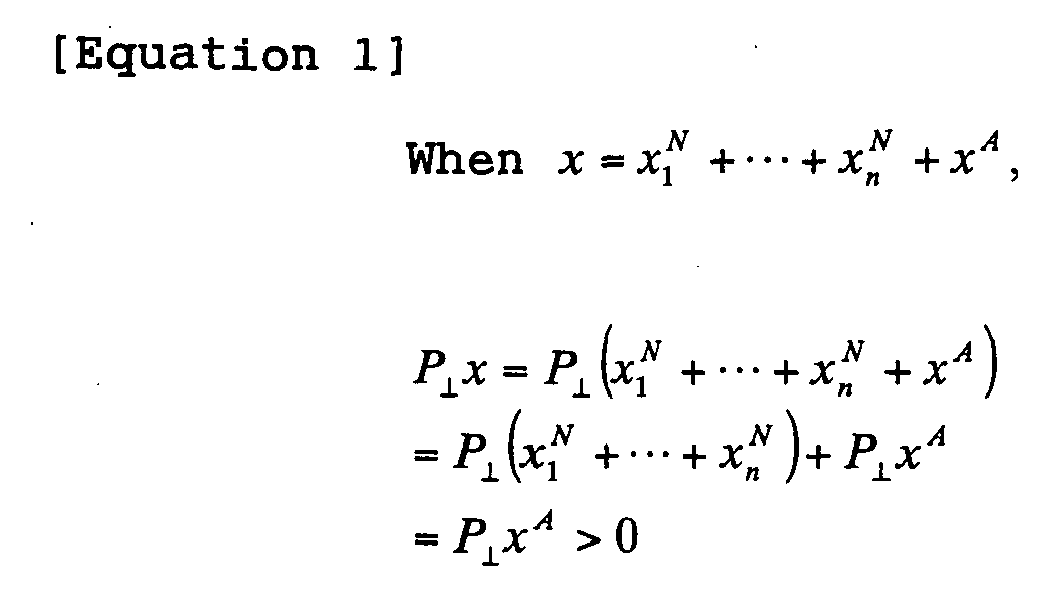
- Fig. 8(c) shows a CHLAC feature vector associated with a mixture of normal actions (walking) of two persons with an abnormal action (falling) of one person, where the CHLAC feature vector is likewise spaced by the vertical distance d ⁇ from the normal action partial space, as is the case with (b).
- N represents normal
- a abnormal The projector will be defined later.
- Fig. 1 is a block diagram illustrating the configuration of an abnormal action detector according to the present invention.
- a video camera 10 outputs moving image frame data of an objective person or device in real time.
- the video camera 10 may be a monochrome or a color camera.
- a computer 11 may be, for example, a well known personal computer (PC) which comprises a video capture circuit for capturing moving images.
- PC personal computer
- the present invention is implemented by creating a program, later described, installing the program into the well-known arbitrary computer 11 such as a personal computer, and running the program thereon.
- a monitoring device 12 is a known output device of the computer 11, and is used, for example, in order to display a detected abnormal action to an operator.
- methods which can be employed for informing and displaying detected abnormalities may include a method of informing and displaying abnormalities on a remote monitoring device through the Internet, a method of drawing attention through an audible alarm, a method of placing a call to a wired telephone or a mobile telephone to audibly inform abnormalities, and the like.
- a keyboard 13 and a mouse 14 are known input devices for use by the operator for entry.
- motion image data entered, for example, from the video camera 10 may be processed in real time, or may be once preserved in an image file and then sequentially read therefrom for processing.
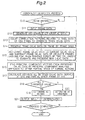
- Fig. 2 is a flow chart illustrating details of an abnormal action detection process according to the present invention.
- the process waits until frame data has been fully entered from the video camera 10.
- the frame data is input (read into a memory).
- image data is, for example, gray scale data at 256 levels.
- differential data is generated for purposes of removing still images such as the background.
- the process employs an inter-frame differential scheme which extracts a change in luminance between pixels at the same position in two adjacent frames, but may alternatively employ an edge differential scheme which extracts portions of a frame in which the luminance changes, or both.
- edge differential scheme which extracts portions of a frame in which the luminance changes, or both.
- the data is binarized through automatic threshold selection in order to remove color information and noise irrelevant to the "motion."
- the foregoing pre-processing transforms the input moving image data into a sequence of frame data (binary images), each of which has a pixel value equal to a logical value "1" (with motion) or "0" (without motion).
- Non-Patent Document 2 Noriyuki Otsu, "Automatic Threshold Selection Based on Discriminant and Least-Squares Criteria," Transactions D of the Institute of Electronics, Information and Communication Engineers, J63-D-4, p348-356, 1980 .
- the process counts correlation patterns related to cubic pixel data on a frame-by-frame basis to generate frame CHLAC data corresponding to frames.
- the process performs CHLAC extraction for generating 251-dimensional feature data.
- the cubic higher-order local auto-correlation (CHLAC) features are used for extracting action features from time-series binary differential data.
- N-the order CHLAC is expressed by the following Equation (2):
- f represents a time-series pixel value (differential value)
- a range of integration in the time direction serves as a parameter indicative of an extent to which the correlation is taken in the time direction.
- the frame CHLAC data at S13 is data on a frame-by-frame basis, and is integrated (added) for a predetermined period of time in the time direction to derive the CHLAC feature data.
- the higher-order local auto-correlation function refers to such a function which is limited to a local area.
- the cubic higher-order local auto-correlation features limit the displacement directions within a local area of 3x3x3 pixels centered at the reference point r, i.e., 26 pixels around the reference point r.
- the displacement directions in which the cubic higher-order local auto-correlation features are taken are not necessarily adjacent pixels, but may be spaced apart.
- an integrated value derived by Equation 1 for a set of displacement directions constitutes one feature amount. Therefore, feature amounts are generated as many as the number of combinations of the displacement directions (mask patterns).
- the number of feature amounts i.e, dimensions of feature vector is comparable to the types of mask patterns.
- a binary image one is derived by multiplying the pixel value "1" whichever number of times, so that terms of second and higher powers are deleted on the assumption that they are regarded as duplicates of a first-power term only with different multipliers.
- a representative one is maintained, while the rest is deleted.
- the right side of Equation 1 necessarily contains the reference point (f(r): the center of the local area), so that a representative pattern to be selected should include the center point and be exactly fitted in the local area of 3x3x3 pixels.
- a correlation value is a (zero-the order) ? axa (first order) ? axaxa (second order), so that duplicated patterns with different multipliers cannot be deleted even if they have the same selected pixels. Accordingly, two mask patterns are added to those associated with the binary image when one pixel is selected, and 26 mask patterns are added when two pixels are selected, so that there are a total of 279 types of mask patterns.
- the cubic higher-order local auto-correlation features have an additive nature to data because the displacement directions are limited within a local area, and also have data position invariance because a whole cubic data area is integrated including a whole screen and time. Further, the cubic higher-order local auto-correlation features are robust to noise because the auto-correlation is taken.
- the frame CHLAC data is preserved on a frame-by-frame basis.
- the latest frame CHLAC data calculated at S13 is added to the current CHLAC data, and frame CHLAC data corresponding to frames which have existed for a predetermined period of time or longer are subtracted from the current CHLAC data to generate new CHLAC data which is then preserved.
- Fig. 6 is an explanatory diagram illustrating details of moving image real-time processing according to the present invention.
- Data of moving images are in the form of sequential frames.
- a time window having a constant width is set in the time direction, and a set of frames within the window is designated as one three-dimensional data. Then, each time a new frame is entered, the time window is moved, and an obsolete frame is deleted to produce finite three-dimensional data.
- the length of the time window is preferably set to be equal to or longer than one period of an action which is to be recognized.
- frame CHLAC data corresponding to the (t-1) frame is generated using t newly entered frames and added to the CHLAC data. Also, frame CHLAC data corresponding to the most obsolete (t-n-1) frame is subtracted from the CHLAC data. CHLAC feature data corresponding to the time window is updated through such processing.
- main vector components are found from all CHLAC data so far preserved or a predetermined number of preceding data by a principal component analysis approach, and is defined to be a partial space of normal actions.
- the principal component analysis approach per se is well known and will therefore be described in brief.
- the matrix U which has the principal component vectors arranged in a row is derived in the following manner.
- a covariance matrix ⁇ is expressed by the following equation:
- the matrix U is derived from an eigenvalue problem expressed by the following equation using the covariance matrix ⁇ .
- an optimal value for the cumulative contribution ratio ⁇ k is determined by an experiment or the like because it may depend on an object under monitoring and a detection accuracy.
- the partial space of normal actions is generated by performing the foregoing calculations.
- a vertical distance d ⁇ is calculated between the CHLAC feature data derived at S15 and the partial space found at S16.
- U' is a transposed matrix of the matrix U
- I M is a M-th order unit matrix.
- a square distance in the orthogonal auxiliary space, i.e., a square distance d 2 ⁇ of a normal to the partial space U can be expressed by:
- this vertical distance d ⁇ is used as an index indicative of whether or not an action is normal.
- Fig. 3 is a flow chart illustrating details of the cubic higher-order local auto-correlation feature extraction process at S13.
- 251 correlation pattern counters are cleared.
- one of unprocessed target pixels (reference points) is selected (by scanning the target pixels in order within a frame).
- one of unprocessed mask patterns is selected.
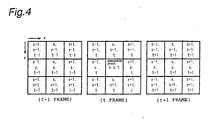
- Fig. 4 is an explanatory diagram showing auto-correlation processing coordinates in a three-dimensional pixel space.
- Fig. 4 shows xy-planes of three differential frames, i.e., (t-1) frame, t frame, (t+1) frame side by side.
- a mask pattern is information indicative of a combination of the pixels which are correlated. Data on pixels selected by the mask pattern is used to calculate a correlation value, whereas pixels not selected by the mask pattern is neglected.
- the target pixel (center pixel) is selected by the mask pattern without fail. Considering zero-th order to second order correlation values in a binary image, there are 251 patterns after duplicates are eliminated from a cube of 3x3x3 pixels.
- Fig. 5 is an explanatory diagram illustrating examples of auto-correlation mask patterns.
- Fig. 5(1) is the simplest zero-th order mask pattern which comprises only a target pixel.
- (2) is an exemplary first-order mask pattern for selecting two hatched pixels.
- (3), (4) are exemplary second-order mask patterns for selecting three hatched pixels. Other than those, there are a multiplicity of patterns.
- Equation 2 the correlation value is calculated using the aforementioned Equation 1.
- f(f)f(r+a 1 ) ... f(r+a N ) in Equation 2 is comparable to a multiplication of pixel values of differential binarized three-dimensional data at corresponding coordinates corresponding to a mask pattern.
- the integration in Equation 1 is comparable to the addition of correlation values by a counter corresponding to a mask pattern by moving (scanning) target pixels within a frame.
- the process goes to S35 when the result of the determination is affirmative, whereas the process goes to S46 when negative. It should be noted that in the actual calculation, it is first determined after S31 whether or not the pixel value at the reference point is one before the correlation value is calculated at S33 in order to reduce the amount of calculations, and the process jumps to S37 when the pixel value is zero because zero will result from the calculation of the correlation.
- the correlation pattern counter corresponding to the mask pattern is incremented by one.
- Image data used in the experiment was a moving image in which a plurality of persons went back and forth.
- This moving image is composed of several thousands of frames, and includes images of a "falling" action, which is an abnormal action, in an extremely small number of frames.
- normal actions are statistically learned as a partial space, using the additivity of the CHLAC features and the partial space method, such that abnormal actions can be detected as deviations therefrom.
- This approach can also be applied to a plurality of persons, where if even one person presents an abnormal action within a screen, this abnormal action can be detected.
- no object need be extracted, and the amount of calculation is constant irrespective of the number of persons, thus making the approach effective and highly practical.
- this approach statistically learns normal actions without defining them as positive, no definition is required as to what normal actions are like at a designing stage, and a natural detection can be made in conformity to an object under monitoring.
- this since any assumption or knowledge is needed for an object under monitoring, this is a generic approach which can determine a variety of objects under monitoring, not limited to actions of persons, whether they are normal or abnormal.
- abnormal actions can be detected in real time through on-line learning.
- a learning method for updating the partial space in real time employed herein may be a method of approximately finding eigenvectors from input data in sequence without solving an eigenvalue problem through the principal component analysis, as disclosed in the following Non-Patent Document 3:
- the configuration of the embodiment can fail to highly correctly define the normal action partial space, resulting in a lower detection accuracy of abnormal actions. Accordingly, it is contemplated that the normal action partial space is clustered as well, and then the distance is measured therefrom, such that a multimodal distribution can also be supported.
- a plurality of abnormality determinations may be made using the respective partial spaces, the results of the plurality of determinations are logically ANDed to determine an abnormality when all patterns are determined as abnormal.
- the embodiment uses even frames determined as abnormal actions in the generation of the partial space of normal actions, the frames determined as abnormal actions may be excluded from the generation of the partial space. In this way, the detection accuracy is increased when abnormal actions are present at a high proportion, or when there are a small number of image samples, or the like.
- two-dimensional higher-order local auto-correlation features may be calculated from each differential frame, instead of three-dimensional CHLAC, to generate a partial space of normal operations from the resulting data to detect abnormal actions. In doing so, abnormal actions can be still detected in periodic actions such as walking, though errors are increased due to the lack of integration in the time direction. Since the resulting data has 25 dimensions instead of 251-dimensional CHLAC, calculations can be largely reduced. This is therefore effective depending on applications.
Landscapes
- Engineering & Computer Science (AREA)
- Physics & Mathematics (AREA)
- General Physics & Mathematics (AREA)
- Multimedia (AREA)
- Theoretical Computer Science (AREA)
- Computer Vision & Pattern Recognition (AREA)
- Health & Medical Sciences (AREA)
- General Health & Medical Sciences (AREA)
- Psychiatry (AREA)
- Social Psychology (AREA)
- Human Computer Interaction (AREA)
- Gerontology & Geriatric Medicine (AREA)
- Business, Economics & Management (AREA)
- Emergency Management (AREA)
- Image Analysis (AREA)
- Image Processing (AREA)
Abstract
An abnormal action detecting device and method for detecting an abnormal action from a moving picture. An abnormal action detecting device (11) creates from-to-frame difference data from moving picture data inputted from a video camera (10), extracts feature data from three-dimensional data composed of frame-to-frame difference data by using a stereoscopic high-order local cross-correlation, computes the distance between a partial space based on a main component vector determined by a main component analysis technique from the past feature data and the latest feature data, and judges that an action is abnormal if the distance is greater than a predetermined value. By learning a normal action as a partial space and detecting an abnormal action as a deviation from the normal one, for example, even if several persons are present in the screen, an abnormal action of a person can be detected. The computational complexity is low and the real-time processing is possible.
Description
- The present invention relates to an abnormal action detector and an abnormal action detecting method for capturing moving images to detect unusual actions.
- Currently, camera-based monitoring systems are often used in video monitoring in the field of security, an elderly care monitoring system, and the like. However, manual detection of abnormal actions from moving images requires much labor, and a computer substituted for the manual operation would lead to a significant reduction in labor. Also, in the elderly care, an automatic alarm system for accesses, if any, would reduce a burden on care personnel, so that camera-based monitoring systems are required for informing abnormal actions and the like.
- Thus, actions must be recognized from moving images to extract action features for an object. Studies on the action recognition include, among others, Non-Patent
Document 1 cited below, published by one of the inventors and one other, which discloses a technology for performing the action recognition using cubic higher-order local auto-correlation features (hereinafter called "CHLAC" as well) which are an extended version of higher-order local auto-correlation features that are effective for face image recognition and the like, and additionally include a correlation in a time direction.
Specifically, the cubic higher-order local auto-correlation features can be said to be statistical features and action features which are derived by calculating local auto-correlation features at each point in voxel data (three-dimensional data) which comprises images arranged in time series, and integrating the local features over the entire voxel data. The features are analyzed for discrimination into four actions to provide a recognition result which is as high as nearly 100 %.
Non-Patent Document 1: T. Kobayashi and N. Otsu, "Action and Simultaneous Multiple-Person Identification Using Cubic Higher-Order Local Auto-Correlation," Proceeding of 17th International Conference on Pattern Recognition, 2004 - When an attempt is made to apply the conventional action recognition method described above to the detection of abnormal actions, feature data must have been previously generated and registered for all abnormal actions. However, abnormal actions of persons and devices are difficult to predict, leading to a problem of the inability to accurately generate feature data for all abnormal actions. It is an object of the present invention to solve such a problem and provide an abnormal action detector and an abnormal action detecting method for detecting abnormal actions using the cubic higher-order local auto-correlation features which are features extracted from moving images.
- An abnormal action detector of the present invention is mainly characterized by comprising difference data generating means for generating frame difference data from moving image data composed of a plurality of image frame data, feature data extracting means for extracting feature data from the inter-frame differential data through higher-order local auto-correlation, distance calculating means for calculating the distance between a subs pace spanned by principal component vectors derived through a principal component analysis approach from a plurality of feature data extracted in the past by said feature data extracting means, and the feature data extracted by said feature data extracting means, abnormality determining means for determining an abnormality when the distance is larger than a predetermined value, and outputting means for outputting the result of the determination when said abnormality determining means determines an abnormality.
- The abnormal action detector described above may further comprise capturing means for capturing moving image frame data in real time, frame data preserving means for preserving the captured frame data, preserving means for preserving the feature data extracted from said feature data extracting means for a given period of time, and partial space updating means for finding a partial space based on principal component vectors derived from the feature data preserved in said preserving means through the principal component analysis approach to update partial space information.
- An abnormal action detecting method according to the present invention is mainly characterized by comprising a first step of generating inter-frame differential data from moving image data composed of a plurality of image frame data, a second step of extracting feature data from the inter-frame differential data through higher-order local auto-correlation, a third step of calculating the distance between a partial space based on principal component vectors derived through a principal component analysis approach from a plurality of feature data extracted in the past, and the feature data, a fourth step of determining abnormality when the distance is larger than a predetermined value, and a fifth step of outputting the result of the determination when abnormality is determined.
Also, in the abnormal action detecting method described above, said first step may include the steps of capturing moving image frame data in real time, and preserving the captured frame data, and said third step may include the steps of preserving the feature data extracted by feature data extracting means for a given period of time, and finding a partial space based on principal component vectors derived from the preserved feature data through the principal component analysis approach to update partial space information. - The present invention employs the (cubic) higher-order local auto-correlation features, which do not depend on the position and the like of the object and have values invariant to position, as action features. Taking advantage of the nature of additivity that when there are a plurality of objects, an overall feature value is the sum of individual feature values of the respective objects, normal actions available in abundance as normal data are statistically learned as a partial space, and abnormal actions are detected as deviations therefrom. In this way, when there are a plurality of persons on a screen, an abnormal action of even one person can be advantageously detected without extraction or tracking of the individual persons, which have been conventionally employed by most of schemes.
Also advantageously, a reduced amount of calculations is involved in the feature extraction and abnormality determination, the amount of calculations is constant irrespective of the number of intended persons, and the processing can be performed in real time. - Further, since normal actions are statistically learned without defining them as positive, no definition is required as to what normal actions are like at a designing stage, and a natural detection can be made in conformity to an object under monitoring. Further advantageously, since any assumption is not needed for an object under monitoring, a variety of objects under monitoring can be determined, not limited to actions of persons, whether they are normal or abnormal. Further advantageously, slow changes in normal actions can be tracked by capturing moving images in real time and updating the partial space of normal operations.
-
- [Fig. 1]
Fig. 1 is a block diagram illustrating the configuration of an abnormal action detector according to the present invention. - [Fig. 2]
Fig. 2 is a flow chart illustrating details of an abnormal action detection process according to the present invention. - [Fig. 3]
Fig. 3 is a flow chart illustrating details of a cubic higher-order local auto-correlation feature extraction process at S13. - [Fig. 4]
Fig. 4 is an explanatory diagram showing auto-correlation processing coordinates in a three-dimensional pixel space. - [Fig. 5]
Fig. 5 is an explanatory diagram illustrating exemplary auto-correlation mask patterns. - [Fig. 6]
Fig. 6 is an explanatory diagram illustrating details of real-time motion image processing according to the present invention. - [Fig. 7]
Fig. 7 is an explanatory diagram showing the additivity of CHLAC features and the nature of a partial space. - [Fig. 8] .
Fig. 8 is an explanatory diagram showing an example of the additivity of CHLAC features and the partial space. Description of Reference Numerals -
- 10 ...
- Video Camera
- 11 ...
- Computer
- 12 ...
- Monitoring Device
- 13 ...
- Keyboard
- 14 ...
- Mouse
- First, in regard to the definition of "abnormal actions," abnormalities themselves cannot be defined in much the same fashion as all abnormal events cannot be enumerated. In this specification, accordingly, abnormal actions are defined to be "those which do not belong to normal actions." When the normal actions refer to those actions which concentrate in a statistical distribution of motion, features, they can be learned from the statistical distribution. Thus, the abnormal actions refer to those actions which largely deviate from the distribution.
- For example, a security camera learns and recognizes general actions such as a walking action as normal actions, but recognizes suspicious actions as abnormal actions because they do not involve periodic motions such as the walking action and are hardly observed in distributions. In this connection, the inventors made experiments on the assumption that a "walking" action is regarded as normal, while a "running" action and a "falling" action as abnormal.
- A specific approach for detecting abnormal actions involves generating a partial space of normal action features within an action feature space based on the cubic higher-order local auto-correlation features, and detecting abnormal actions using a distance from the partial space as an abnormal value. A principal component analysis approach is used in the generation of the normal action partial space, where a principal component partial space comprises, for example, a principal component vector which presents a cumulative contribution ratio of 0.99.
- Here, the cubic higher-order local auto-correlation features have the nature of not requiring the segmentation of an object and exhibiting the additivity on a screen. Due to this additivity, in a defined normal action partial space, a feature vector falls within the normal action partial space irrespective of how many persons perform normal actions on a screen, but when even one of these persons performs an abnormal action, the feature vector extends beyond the partial space and can be detected as an abnormal value. Since persons need not be individually segmented and tracked for calculations, the amount of calculations is constant, not proportional to the number of intended persons, making it possible to make the calculations at high speeds.
- The present invention finds principal component vectors of CHLAC features to be learned, and uses the principal component vectors to constitute a partial space, where the importance lies in that there is high compatibility with the additive nature of the CHLAC features. Belonging to a normal action partial space (the distance is equal to or smaller than a predetermined threshold value) does not depend on the magnitude of the vector. In other words, only the direction of the vector is a factor to determine the belonging to the normal action partial space or not.
- Fig. 7 is an explanatory diagram showing the additivity of the CHLAC features and the nature of a partial space. For simplifying the description in Fig. 7, a CHLAC feature data space is two-dimensional (251-dimensions in actuality), and a partial space of normal actions is one-dimensional (in embodiments, around three to twelve dimensions with a cumulative contribution ratio being set equal to 0.99, by way of example), where CHLAC feature data of normal actions form groups of respective individuals under monitoring. A normal action partial space S found by a principal component analysis exists in the vicinity in such a form that it contains CHLAC feature data of normal actions. CHLAC feature data A of a deviating abnormal action presents a larger vertical distance d⊥ to the normal action partial space S, so that an abnormality is determined from this vertical distance d⊥.
- Fig. 8 is an explanatory diagram showing an example of the additivity of the CHLAC features and the partial space. Fig. 8(a) shows a CHLAC feature vector associated with a normal action (walking) of one person, where the CHLAC feature vector is present in (in close proximity to) the normal action partial space S. Fig. 8(b) shows a CHLAC feature vector associated with an abnormal action (falling) of one person, where the CHLAC feature vector is spaced by the vertical distance d┴ from the normal action partial space S.
- Fig. 8(c) shows a CHLAC feature vector associated with a mixture of normal actions (walking) of two persons with an abnormal action (falling) of one person, where the CHLAC feature vector is likewise spaced by the vertical distance d⊥ from the normal action partial space, as is the case with (b). Generally, when normal actions of n persons mix with an abnormal action of one person, the following equation is given using a projector. In the equation, N represents normal, and A abnormal. The projector will be defined later.
-
- Fig. 1 is a block diagram illustrating the configuration of an abnormal action detector according to the present invention. A
video camera 10 outputs moving image frame data of an objective person or device in real time. Thevideo camera 10 may be a monochrome or a color camera. Acomputer 11 may be, for example, a well known personal computer (PC) which comprises a video capture circuit for capturing moving images. The present invention is implemented by creating a program, later described, installing the program into the well-knownarbitrary computer 11 such as a personal computer, and running the program thereon. - A
monitoring device 12 is a known output device of thecomputer 11, and is used, for example, in order to display a detected abnormal action to an operator. In this connection, methods which can be employed for informing and displaying detected abnormalities may include a method of informing and displaying abnormalities on a remote monitoring device through the Internet, a method of drawing attention through an audible alarm, a method of placing a call to a wired telephone or a mobile telephone to audibly inform abnormalities, and the like.
Akeyboard 13 and amouse 14 are known input devices for use by the operator for entry. In the embodiment,motion image data entered, for example, from thevideo camera 10 may be processed in real time, or may be once preserved in an image file and then sequentially read therefrom for processing. - Fig. 2 is a flow chart illustrating details of an abnormal action detection process according to the present invention. At S10, the process waits until frame data has been fully entered from the
video camera 10. At S11, the frame data is input (read into a memory). In this event, image data is, for example, gray scale data at 256 levels. - At S12, "motion" information is detected from moving image data, and differential data is generated for purposes of removing still images such as the background. For generating the differential data, the process employs an inter-frame differential scheme which extracts a change in luminance between pixels at the same position in two adjacent frames, but may alternatively employ an edge differential scheme which extracts portions of a frame in which the luminance changes, or both. When each pixel has RGB color data, the distance between two RGB color vectors may be calculated as differential data between two pixels.
- Further, the data is binarized through automatic threshold selection in order to remove color information and noise irrelevant to the "motion." A method which can be employed for the binarization may be a constant threshold, a discriminant least-square automatic threshold method disclosed in the following
Non-Patent Document 2, or a zero-threshold and noise processing scheme (a method which regards all portions other than those having no difference in a contrast image as having motions (=1), and removes noise by a known noise removing method). The foregoing pre-processing transforms the input moving image data into a sequence of frame data (binary images), each of which has a pixel value equal to a logical value "1" (with motion) or "0" (without motion).
Non-Patent Document 2: Noriyuki Otsu, "Automatic Threshold Selection Based on Discriminant and Least-Squares Criteria," Transactions D of the Institute of Electronics, Information and Communication Engineers, J63-D-4, p348-356, 1980. - At S13, the process counts correlation patterns related to cubic pixel data on a frame-by-frame basis to generate frame CHLAC data corresponding to frames. As will be later described in greater detail, the process performs CHLAC extraction for generating 251-dimensional feature data. The cubic higher-order local auto-correlation (CHLAC) features are used for extracting action features from time-series binary differential data. N-the order CHLAC is expressed by the following Equation (2):
-

- where f represents a time-series pixel value (differential value), and a reference point (target pixel) r and N displacements ai (i=1, ..., N) viewed from the reference point are three-dimensional vectors which also has a time as a component in two-dimensional coordinates within a differential frame. Further, a range of integration in the time direction serves as a parameter indicative of an extent to which the correlation is taken in the time direction. However, the frame CHLAC data at S13 is data on a frame-by-frame basis, and is integrated (added) for a predetermined period of time in the time direction to derive the CHLAC feature data.
- An infinite number of higher-order auto-correlation functions can be contemplated depending on displacement directions and an employed order number, and the higher-order local auto-correlation function refers to such a function which is limited to a local area. The cubic higher-order local auto-correlation features limit the displacement directions within a local area of 3x3x3 pixels centered at the reference point r, i.e., 26 pixels around the reference point r. In this connection, generally, the displacement directions in which the cubic higher-order local auto-correlation features are taken are not necessarily adjacent pixels, but may be spaced apart. In calculating a feature amount, an integrated value derived by
Equation 1 for a set of displacement directions constitutes one feature amount. Therefore, feature amounts are generated as many as the number of combinations of the displacement directions (mask patterns). - The number of feature amounts, i.e, dimensions of feature vector is comparable to the types of mask patterns. With a binary image, one is derived by multiplying the pixel value "1" whichever number of times, so that terms of second and higher powers are deleted on the assumption that they are regarded as duplicates of a first-power term only with different multipliers. Also, in regard to the duplicated patterns resulting from the integration of Equation 1 (translation: scan), a representative one is maintained, while the rest is deleted. The right side of
Equation 1 necessarily contains the reference point (f(r): the center of the local area), so that a representative pattern to be selected should include the center point and be exactly fitted in the local area of 3x3x3 pixels. - As a result, there are a total of 352 types of mask patterns which include the center points, i.e., mask patterns with one selected pixel: one, mask patterns with two selected pixels: 26, and mask patterns with three selected pixels: 26x25/2=325. However, with the exclusion of duplicated mask patterns resulting from the integration in
Equation 1, there is a 251-dimensional cubic higher-order local auto-correlation feature vector for one three-dimensional data. - In a contrast image made up of multi-value pixels, for example, when a pixel value is represented by "a," a correlation value is a (zero-the order) ? axa (first order) ? axaxa (second order), so that duplicated patterns with different multipliers cannot be deleted even if they have the same selected pixels. Accordingly, two mask patterns are added to those associated with the binary image when one pixel is selected, and 26 mask patterns are added when two pixels are selected, so that there are a total of 279 types of mask patterns.
- The cubic higher-order local auto-correlation features have an additive nature to data because the displacement directions are limited within a local area, and also have data position invariance because a whole cubic data area is integrated including a whole screen and time. Further, the cubic higher-order local auto-correlation features are robust to noise because the auto-correlation is taken.
- At S14, the frame CHLAC data is preserved on a frame-by-frame basis. At S15, the latest frame CHLAC data calculated at S13 is added to the current CHLAC data, and frame CHLAC data corresponding to frames which have existed for a predetermined period of time or longer are subtracted from the current CHLAC data to generate new CHLAC data which is then preserved.
- Fig. 6 is an explanatory diagram illustrating details of moving image real-time processing according to the present invention. Data of moving images are in the form of sequential frames. As such, a time window having a constant width is set in the time direction, and a set of frames within the window is designated as one three-dimensional data. Then, each time a new frame is entered, the time window is moved, and an obsolete frame is deleted to produce finite three-dimensional data. The length of the time window is preferably set to be equal to or longer than one period of an action which is to be recognized.
- Actually, only one frame of the image frame data is preserved for taking a difference, and the difference is taken between the one frame and next entered image frame data. Only two frames of differential frame data are preserved, such that frame CHLAC data is generated from three frames of differential frames, including differential frame data based on next entered image frame data. Then, the frame CHLAC data corresponding to the frames are preserved only for the time window. Specifically, in Fig. 6, at the time a new frame is entered at time t, frame CHLAC data corresponding to the preceding time windows (t-1, t-n-1) have been already calculated. Notably, three immediately adjacent differential frames are required for calculating frame CHLAC data, but since a (t-1) frame is located at the end, the frame CHLAC data are calculated up to that corresponding to a (t-2) frame.
- Thus, frame CHLAC data corresponding to the (t-1) frame is generated using t newly entered frames and added to the CHLAC data. Also, frame CHLAC data corresponding to the most obsolete (t-n-1) frame is subtracted from the CHLAC data. CHLAC feature data corresponding to the time window is updated through such processing.
- Turning back to Fig. 2, at S16, main vector components are found from all CHLAC data so far preserved or a predetermined number of preceding data by a principal component analysis approach, and is defined to be a partial space of normal actions. The principal component analysis approach per se is well known and will therefore be described in brief.
- First, for defining the partial space of normal actions, principal component vectors are found from the CHLAC feature data by a principal component analysis. An M-dimensional CHLAC feature vector x is expressed in the following manner:
-

where M=251. Also, the principal component vectors (eigenvectors) are arranged in a row to generate a matrix U expressed in the following manner: -

where M=251. The matrix U which has the principal component vectors arranged in a row is derived in the following manner. A covariance matrix Σ is expressed by the following equation: -
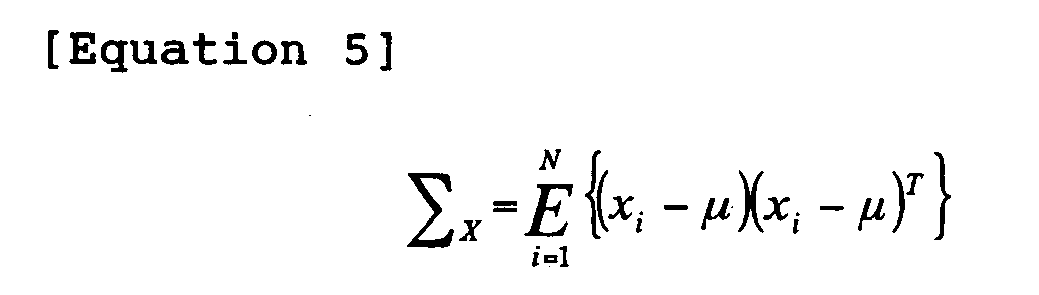
where µ represents an average vector of feature vectors x, E an operator symbol for calculating an expected value (E=(1/N)Σ). The matrix U is derived from an eigenvalue problem expressed by the following equation using the covariance matrix Σ. -

- When a diagonal matrix A of eigenvalues is expressed by the following equation,
-

a cumulative contribution ratio ηk up to a K-th eigenvalue is expressed in the following manner: -

- Now, a space defined by eigenvectors u1, ..., uk up to a dimension in which the cumulative contribution ratio ηk reaches a predetermined value (for example, ηk =0.99) is applied as the partial space of normal actions. It should be noted that an optimal value for the cumulative contribution ratio ηk is determined by an experiment or the like because it may depend on an object under monitoring and a detection accuracy. The partial space of normal actions is generated by performing the foregoing calculations.
- At S17, a vertical distance d⊥ is calculated between the CHLAC feature data derived at S15 and the partial space found at S16. A projector P to the partial space defined by a resulting principal component orthogonal base Uk = [u1, ..., uk], and a projector P⊥ to an orthogonal ortho-complement subspace to that are expressed by:
-

where U' is a transposed matrix of the matrix U, and IM is a M-th order unit matrix. A square distance in the orthogonal auxiliary space, i.e., a square distance d2⊥ of a normal to the partial space U can be expressed by: -

In this embodiment, this vertical distance d⊥ is used as an index indicative of whether or not an action is normal. - At S18, it is determined whether or not the vertical distance d⊥ is larger than a predetermined threshold value, and the process goes to S19 when the result of the determination is negative, whereas the process goes to S20 when the result is affirmative. At S19, the action of this frame is determined to be normal. At S20, in turn, the action of this frame is determined to be abnormal. At S21, the result of the determination is output to a monitoring device or the like. At S22, it is determined whether or not the process should be terminated, for example, in accordance with whether or not an ending manipulation by the operator is detected. When the result of the determination is negative, the process returns to S10, whereas the process is terminated when affirmative. With the foregoing method, abnormal actions can be detected in real time.
- Fig. 3 is a flow chart illustrating details of the cubic higher-order local auto-correlation feature extraction process at S13. At S30, 251 correlation pattern counters are cleared. At S31, one of unprocessed target pixels (reference points) is selected (by scanning the target pixels in order within a frame). At S32, one of unprocessed mask patterns is selected.
- Fig. 4 is an explanatory diagram showing auto-correlation processing coordinates in a three-dimensional pixel space. Fig. 4 shows xy-planes of three differential frames, i.e., (t-1) frame, t frame, (t+1) frame side by side.
- The present invention correlates pixels within a cube composed of 3x3x3 (=27) pixels centered at a target pixel. A mask pattern is information indicative of a combination of the pixels which are correlated. Data on pixels selected by the mask pattern is used to calculate a correlation value, whereas pixels not selected by the mask pattern is neglected. As mentioned above, the target pixel (center pixel) is selected by the mask pattern without fail. Considering zero-th order to second order correlation values in a binary image, there are 251 patterns after duplicates are eliminated from a cube of 3x3x3 pixels.
- Fig. 5 is an explanatory diagram illustrating examples of auto-correlation mask patterns. Fig. 5(1) is the simplest zero-th order mask pattern which comprises only a target pixel. (2) is an exemplary first-order mask pattern for selecting two hatched pixels. (3), (4) are exemplary second-order mask patterns for selecting three hatched pixels. Other than those, there are a multiplicity of patterns.
- Turning back to Fig. 3, at S33, the correlation value is calculated using the
aforementioned Equation 1. f(f)f(r+a1) ... f(r+aN) inEquation 2 is comparable to a multiplication of pixel values of differential binarized three-dimensional data at corresponding coordinates corresponding to a mask pattern. On the other hand, the integration inEquation 1 is comparable to the addition of correlation values by a counter corresponding to a mask pattern by moving (scanning) target pixels within a frame. - At S34, it is determined whether or not the correlation value is one. The process goes to S35 when the result of the determination is affirmative, whereas the process goes to S46 when negative. It should be noted that in the actual calculation, it is first determined after S31 whether or not the pixel value at the reference point is one before the correlation value is calculated at S33 in order to reduce the amount of calculations, and the process jumps to S37 when the pixel value is zero because zero will result from the calculation of the correlation. At S35, the correlation pattern counter corresponding to the mask pattern is incremented by one. At S36, it is determined whether or not all patterns have been processed. The process goes to S37 when the result of the determination is affirmative, whereas the process goes to S32 when negative.
- At S37, it is determined whether or not all pixels have been processed. The process goes to S38 when the result of the determination is affirmative, whereas the process goes to S31 when negative. At S38, a set of pattern counter values are output as 251-dimensional frame CHLAC data.
- Next, a description will be given of the result of an experiment made by the inventors. Image data used in the experiment was a moving image in which a plurality of persons went back and forth. This moving image is composed of several thousands of frames, and includes images of a "falling" action, which is an abnormal action, in an extremely small number of frames. It was confirmed from the result of the experiment that a new sample image always protruded into a different dimension to result in a slightly large value of the vertical distance d⊥ until the dimensions of the partial space of normal actions were stabilized, but at the midpoint where a certain amount of feature data were accumulated, the vertical distance d⊥ remained stable at small values for images of normal actions, while the value of the vertical distance d⊥ increased only in the "falling" frames, which represented an abnormal action, so that the abnormal action could be correctly detected. It should be noted that the dimensions of the normal action partial space is always changing approximately over as small as four dimensions.
- As described above, in the embodiment, normal actions are statistically learned as a partial space, using the additivity of the CHLAC features and the partial space method, such that abnormal actions can be detected as deviations therefrom. This approach can also be applied to a plurality of persons, where if even one person presents an abnormal action within a screen, this abnormal action can be detected. Moreover, no object need be extracted, and the amount of calculation is constant irrespective of the number of persons, thus making the approach effective and highly practical. Also, since this approach statistically learns normal actions without defining them as positive, no definition is required as to what normal actions are like at a designing stage, and a natural detection can be made in conformity to an object under monitoring. Further, since any assumption or knowledge is needed for an object under monitoring, this is a generic approach which can determine a variety of objects under monitoring, not limited to actions of persons, whether they are normal or abnormal. Also, abnormal actions can be detected in real time through on-line learning.
- While the embodiment has been described in connection with the detection of abnormal actions, the following variations can be contemplated in the present invention by way of example. While the embodiment has disclosed an example in which abnormal actions are detected while updating the partial space of normal actions, the partial space of the normal actions may have been previously generated by a learning phase, or the partial space of normal actions may be generated and updated at a predetermined period longer than a frame interval, for example, at intervals of one minute, one hour or one day, such that a fixed partial space may be used to detect abnormal actions until the next update. In this way, the amount of processing is further reduced.
Further, a learning method for updating the partial space in real time employed herein may be a method of approximately finding eigenvectors from input data in sequence without solving an eigenvalue problem through the principal component analysis, as disclosed in the following Non-Patent Document 3: - Non-Patent Document 3: Juyang Weng, Yuli Zhang and Wey-Shiuan Hwang, "Candid Covariance-Free Incremental Principal Component Analysis," IEEE Transactions on Pattern Analysis and Machine Intelligence, Vol. 25, No. 8, pp.1034-1040, 2003.
- When normal actions exist in a plurality of patterns, the configuration of the embodiment can fail to highly correctly define the normal action partial space, resulting in a lower detection accuracy of abnormal actions. Accordingly, it is contemplated that the normal action partial space is clustered as well, and then the distance is measured therefrom, such that a multimodal distribution can also be supported.
Alternatively, when partial spaces can be generated for a plurality of normal action patterns, respectively, a plurality of abnormality determinations may be made using the respective partial spaces, the results of the plurality of determinations are logically ANDed to determine an abnormality when all patterns are determined as abnormal. - While the embodiment uses even frames determined as abnormal actions in the generation of the partial space of normal actions, the frames determined as abnormal actions may be excluded from the generation of the partial space. In this way, the detection accuracy is increased when abnormal actions are present at a high proportion, or when there are a small number of image samples, or the like.
- While the embodiment has disclosed an example of calculating three-dimensional CHLAC, two-dimensional higher-order local auto-correlation features may be calculated from each differential frame, instead of three-dimensional CHLAC, to generate a partial space of normal operations from the resulting data to detect abnormal actions. In doing so, abnormal actions can be still detected in periodic actions such as walking, though errors are increased due to the lack of integration in the time direction. Since the resulting data has 25 dimensions instead of 251-dimensional CHLAC, calculations can be largely reduced. This is therefore effective depending on applications.
Claims (5)
- An abnormal action detector characterized by comprising:differential data generating means for generating inter-frame differential data from moving image data composed of a plurality of image frame data;feature data extracting means for extracting feature data from the inter-frame differential data through higher-order local auto-correlation;distance calculating means for calculating a distance between a partial space based on principal component vectors derived through a principal component analysis approach from a plurality of feature data extracted in the past by said feature data extracting means, and the feature data extracted by said feature data extracting means;abnormality determining means for determining an abnormality when the distance is larger than a predetermined value; andoutputting means for outputting a determined result when said abnormality determining means determines an abnormality.
- An abnormal action detector according to claim 1, wherein said feature data extracting means extracts the feature data from three-dimensional data including a plurality of the inter-frame differential data immediately adjacent to one another through cubic higher-order local auto-correlation.
- An abnormal action detector according to claim 2, further comprising:capturing means for capturing moving image frame data in real time;frame data preserving means for preserving the captured frame data;preserving means for preserving the feature data extracted from said feature data extracting means for a given period of time; andpartial space updating means for finding a partial space based on principal component vectors derived from the feature data preserved in said preserving means through the principal component analysis approach to update partial space information.
- An abnormal action detecting method comprising:a first step of generating inter-frame differential data from moving image data composed of a plurality of image frame data;a second step of extracting feature data from the inter-frame differential data through higher-order local auto-correlation;a third step of calculating the distance between a partial space based on principal component vectors derived through a principal component analysis approach from a plurality of feature data extracted in the past, and the feature data;a fourth step of determining abnormality when the distance is larger than a predetermined value; anda fifth step of outputting a determined result when abnormality is determined.
- An abnormal action detecting method according to claim 4, wherein:said first step includes the steps of capturing moving image frame data in real time, and preserving the captured frame data, andsaid third step includes the steps of preserving the feature data extracted by feature data extracting means for a given period of time, and finding a partial space based on principal component vectors derived from the preserved feature data through the principal component analysis approach to update partial space information.
Applications Claiming Priority (2)
| Application Number | Priority Date | Filing Date | Title |
|---|---|---|---|
| JP2004261179A JP4368767B2 (en) | 2004-09-08 | 2004-09-08 | Abnormal operation detection device and abnormal operation detection method |
| PCT/JP2005/016380 WO2006028106A1 (en) | 2004-09-08 | 2005-09-07 | Abnormal action detector and abnormal action detecting method |
Publications (2)
| Publication Number | Publication Date |
|---|---|
| EP1801757A1 true EP1801757A1 (en) | 2007-06-27 |
| EP1801757A4 EP1801757A4 (en) | 2012-02-01 |
Family
ID=36036387
Family Applications (1)
| Application Number | Title | Priority Date | Filing Date |
|---|---|---|---|
| EP05778592A Withdrawn EP1801757A4 (en) | 2004-09-08 | 2005-09-07 | ABNORMAL ACTION DETECTOR AND METHOD FOR DETECTING ABNORMAL ACTIONS |
Country Status (4)
| Country | Link |
|---|---|
| US (1) | US20080123975A1 (en) |
| EP (1) | EP1801757A4 (en) |
| JP (1) | JP4368767B2 (en) |
| WO (1) | WO2006028106A1 (en) |
Cited By (2)
| Publication number | Priority date | Publication date | Assignee | Title |
|---|---|---|---|---|
| CN102317978A (en) * | 2009-12-22 | 2012-01-11 | 松下电器产业株式会社 | Motion analysis device and motion analysis method |
| EP3223238A4 (en) * | 2014-11-19 | 2017-11-15 | Fujitsu Limited | Abnormality detection device, abnormality detection method, and abnormality detection program |
Families Citing this family (42)
| Publication number | Priority date | Publication date | Assignee | Title |
|---|---|---|---|---|
| JP4701100B2 (en) * | 2006-02-17 | 2011-06-15 | 株式会社日立製作所 | Abnormal behavior detection device |
| JP4215781B2 (en) * | 2006-06-16 | 2009-01-28 | 独立行政法人産業技術総合研究所 | Abnormal operation detection device and abnormal operation detection method |
| JP4603512B2 (en) * | 2006-06-16 | 2010-12-22 | 独立行政法人産業技術総合研究所 | Abnormal region detection apparatus and abnormal region detection method |
| JP4429298B2 (en) * | 2006-08-17 | 2010-03-10 | 独立行政法人産業技術総合研究所 | Object number detection device and object number detection method |
| JP5121258B2 (en) | 2007-03-06 | 2013-01-16 | 株式会社東芝 | Suspicious behavior detection system and method |
| JP4842197B2 (en) * | 2007-04-17 | 2011-12-21 | 財団法人ソフトピアジャパン | Abnormal operation detection device using multiple divided images, abnormal operation detection method, and abnormal operation detection program |
| JP4769983B2 (en) * | 2007-05-17 | 2011-09-07 | 独立行政法人産業技術総合研究所 | Abnormality detection apparatus and abnormality detection method |
| JP4573857B2 (en) * | 2007-06-20 | 2010-11-04 | 日本電信電話株式会社 | Sequential update type non-stationary detection device, sequential update type non-stationary detection method, sequential update type non-stationary detection program, and recording medium recording the program |
| JP4925120B2 (en) * | 2007-07-02 | 2012-04-25 | 独立行政法人産業技術総合研究所 | Object recognition apparatus and object recognition method |
| JP4654347B2 (en) * | 2007-12-06 | 2011-03-16 | 株式会社融合技術研究所 | Abnormal operation monitoring device |
| JP4953211B2 (en) * | 2007-12-13 | 2012-06-13 | 独立行政法人産業技術総合研究所 | Feature extraction apparatus and feature extraction method |
| CN102449660B (en) * | 2009-04-01 | 2015-05-06 | I-切塔纳私人有限公司 | Systems and methods for detecting data |
| DE102009021765A1 (en) * | 2009-05-18 | 2010-11-25 | Deutsches Zentrum für Luft- und Raumfahrt e.V. | Method for automatic detection of a situation change |
| JP2011048547A (en) * | 2009-08-26 | 2011-03-10 | Toshiba Corp | Abnormal-behavior detecting device, monitoring system, and abnormal-behavior detecting method |
| JP5190968B2 (en) * | 2009-09-01 | 2013-04-24 | 独立行政法人産業技術総合研究所 | Moving image compression method and compression apparatus |
| JP5131863B2 (en) * | 2009-10-30 | 2013-01-30 | 独立行政法人産業技術総合研究所 | HLAC feature extraction method, abnormality detection method and apparatus |
| JP5455787B2 (en) | 2010-05-27 | 2014-03-26 | パナソニック株式会社 | Motion analysis apparatus and motion analysis method |
| JP5675229B2 (en) | 2010-09-02 | 2015-02-25 | キヤノン株式会社 | Image processing apparatus and image processing method |
| JP6099645B2 (en) * | 2011-07-28 | 2017-03-22 | パウル・シェラー・インスティトゥート | Image fusion method based on principal component analysis and x-ray apparatus |
| US9824296B2 (en) | 2011-11-10 | 2017-11-21 | Canon Kabushiki Kaisha | Event detection apparatus and event detection method |
| CN103106394A (en) * | 2012-12-24 | 2013-05-15 | 厦门大学深圳研究院 | Human body action recognition method in video surveillance |
| CN103902966B (en) * | 2012-12-28 | 2018-01-05 | 北京大学 | Video interactive affair analytical method and device based on sequence space-time cube feature |
| CN103310463B (en) * | 2013-06-18 | 2016-01-20 | 西北工业大学 | Based on the online method for tracking target of Probabilistic Principal Component Analysis and compressed sensing |
| JP6285116B2 (en) * | 2013-07-02 | 2018-02-28 | Necプラットフォームズ株式会社 | Operation evaluation apparatus, operation evaluation method, and operation evaluation program |
| US10846536B2 (en) * | 2014-06-27 | 2020-11-24 | Nec Corporation | Abnormality detection device and abnormality detection method |
| JP6464635B2 (en) * | 2014-09-26 | 2019-02-06 | 株式会社リコー | Image processing apparatus, image processing apparatus control method, and program |
| US10786227B2 (en) * | 2014-12-01 | 2020-09-29 | National Institute Of Advanced Industrial Science And Technology | System and method for ultrasound examination |
| CN106157326B (en) * | 2015-04-07 | 2020-10-27 | 中国科学院深圳先进技术研究院 | Group abnormal behavior detection method and system |
| JP6703279B2 (en) * | 2015-09-02 | 2020-06-03 | 富士通株式会社 | Abnormality detection device, abnormality detection method, and abnormality detection program |
| JP6708385B2 (en) | 2015-09-25 | 2020-06-10 | キヤノン株式会社 | Discriminator creating device, discriminator creating method, and program |
| JP6336952B2 (en) * | 2015-09-30 | 2018-06-06 | セコム株式会社 | Crowd analysis device |
| SG10201510337RA (en) * | 2015-12-16 | 2017-07-28 | Vi Dimensions Pte Ltd | Video analysis methods and apparatus |
| CN105513095B (en) * | 2015-12-30 | 2019-04-09 | 山东大学 | An Unsupervised Temporal Segmentation Method for Behavioral Video |
| EP3410416B1 (en) * | 2016-01-28 | 2021-08-04 | Ricoh Company, Ltd. | Image processing device, imaging device, mobile entity apparatus control system, image processing method, and program |
| JP6884517B2 (en) | 2016-06-15 | 2021-06-09 | キヤノン株式会社 | Information processing equipment, information processing methods and programs |
| JP7035395B2 (en) * | 2017-09-13 | 2022-03-15 | 沖電気工業株式会社 | Anomaly detection system, information processing device, and anomaly detection method |
| EP3686840A4 (en) | 2017-09-21 | 2020-10-28 | Adacotech Incorporated | ANOMALY DETECTION APPARATUS AND ANOMALY DETECTION METHOD |
| CN110276398A (en) * | 2019-06-21 | 2019-09-24 | 北京滴普科技有限公司 | A kind of video abnormal behaviour automatic judging method |
| US11526958B2 (en) | 2019-06-26 | 2022-12-13 | Halliburton Energy Services, Inc. | Real-time analysis of bulk material activity |
| CN112822434A (en) * | 2019-11-15 | 2021-05-18 | 西安科芮智盈信息技术有限公司 | Anti-theft photo processing method, equipment and system |
| KR102770773B1 (en) * | 2022-07-25 | 2025-02-24 | 주식회사 아임토리 | Ai-based robot arm image data processing method |
| CN116884187B (en) * | 2023-06-25 | 2026-02-06 | 吉林金域医学检验所有限公司 | Laboratory monitoring method, laboratory monitoring device, electronic equipment and storage medium |
Family Cites Families (20)
| Publication number | Priority date | Publication date | Assignee | Title |
|---|---|---|---|---|
| EP0363828B1 (en) * | 1988-10-11 | 1999-01-07 | Kabushiki Kaisha Ouyo Keisoku Kenkyusho | Method and apparatus for adaptive learning type general purpose image measurement and recognition |
| US6545115B2 (en) * | 1996-12-11 | 2003-04-08 | Rhodia Chimie | Process for preparing a stable silicone oil containing SiH groups and hydrosilylable functions |
| US6466685B1 (en) * | 1998-07-14 | 2002-10-15 | Kabushiki Kaisha Toshiba | Pattern recognition apparatus and method |
| JP4226730B2 (en) * | 1999-01-28 | 2009-02-18 | 株式会社東芝 | Object region information generation method, object region information generation device, video information processing method, and information processing device |
| US7522186B2 (en) * | 2000-03-07 | 2009-04-21 | L-3 Communications Corporation | Method and apparatus for providing immersive surveillance |
| US6985620B2 (en) * | 2000-03-07 | 2006-01-10 | Sarnoff Corporation | Method of pose estimation and model refinement for video representation of a three dimensional scene |
| US7110569B2 (en) * | 2001-09-27 | 2006-09-19 | Koninklijke Philips Electronics N.V. | Video based detection of fall-down and other events |
| US7016884B2 (en) * | 2002-06-27 | 2006-03-21 | Microsoft Corporation | Probability estimate for K-nearest neighbor |
| CN100477745C (en) * | 2002-08-09 | 2009-04-08 | 夏普株式会社 | Image combination device and image combination method |
| JP3954484B2 (en) * | 2002-12-12 | 2007-08-08 | 株式会社東芝 | Image processing apparatus and program |
| JP4090388B2 (en) * | 2003-05-27 | 2008-05-28 | 三洋電機株式会社 | Radio wave receiver |
| US7616782B2 (en) * | 2004-05-07 | 2009-11-10 | Intelliview Technologies Inc. | Mesh based frame processing and applications |
| US20060018516A1 (en) * | 2004-07-22 | 2006-01-26 | Masoud Osama T | Monitoring activity using video information |
| JP3970877B2 (en) * | 2004-12-02 | 2007-09-05 | 独立行政法人産業技術総合研究所 | Tracking device and tracking method |
| US7739284B2 (en) * | 2005-04-20 | 2010-06-15 | International Business Machines Corporation | Method and apparatus for processing data streams |
| US7376246B2 (en) * | 2005-06-27 | 2008-05-20 | Mitsubishi Electric Research Laboratories, Inc. | Subspace projection based non-rigid object tracking with particle filters |
| US7760911B2 (en) * | 2005-09-15 | 2010-07-20 | Sarnoff Corporation | Method and system for segment-based optical flow estimation |
| JP4603512B2 (en) * | 2006-06-16 | 2010-12-22 | 独立行政法人産業技術総合研究所 | Abnormal region detection apparatus and abnormal region detection method |
| JP4215781B2 (en) * | 2006-06-16 | 2009-01-28 | 独立行政法人産業技術総合研究所 | Abnormal operation detection device and abnormal operation detection method |
| JP4429298B2 (en) * | 2006-08-17 | 2010-03-10 | 独立行政法人産業技術総合研究所 | Object number detection device and object number detection method |
-
2004
- 2004-09-08 JP JP2004261179A patent/JP4368767B2/en not_active Expired - Lifetime
-
2005
- 2005-09-07 WO PCT/JP2005/016380 patent/WO2006028106A1/en not_active Ceased
- 2005-09-07 EP EP05778592A patent/EP1801757A4/en not_active Withdrawn
- 2005-09-07 US US11/662,366 patent/US20080123975A1/en not_active Abandoned
Non-Patent Citations (3)
| Title |
|---|
| NANRI TAKUYA ET AL: "Detection of Abnormal Motion from a Scene Containing Multiple Persons' Moves", DENSHI JOUHOU TSUUSHIN GAKKAI GIJUTSU KENKYUU HOUKOKU // INSTITUTE OF ELECTRONICS, INFORMATION AND COMMUNICATION ENGINEERS. TECHNICAL REPORT, DENSHI JOUHOU TSUUSHIN GAKKAI, JP, vol. 104, no. 291, 4 September 2004 (2004-09-04), pages 9-16, XP008136980, ISSN: 0913-5685 * |
| Nanri, T. and Otsu, N.: "Unsupervised abnormality detection in video surveillance", IAPR Conference on Machine Vision Applications , 16 May 2005 (2005-05-16), XP002644191, Retrieved from the Internet: URL:http://citeseerx.ist.psu.edu/viewdoc/download?doi=10.1.1.144.4723&rep=rep1&type=pdf [retrieved on 2011-06-22] * |
| See also references of WO2006028106A1 * |
Cited By (4)
| Publication number | Priority date | Publication date | Assignee | Title |
|---|---|---|---|---|
| CN102317978A (en) * | 2009-12-22 | 2012-01-11 | 松下电器产业株式会社 | Motion analysis device and motion analysis method |
| CN102317978B (en) * | 2009-12-22 | 2014-11-12 | 松下电器产业株式会社 | Motion analysis device and motion analysis method |
| EP3223238A4 (en) * | 2014-11-19 | 2017-11-15 | Fujitsu Limited | Abnormality detection device, abnormality detection method, and abnormality detection program |
| US10467745B2 (en) | 2014-11-19 | 2019-11-05 | Fujitsu Limited | Abnormality detection device, abnormality detection method and non-transitory computer-readable recording medium |
Also Published As
| Publication number | Publication date |
|---|---|
| EP1801757A4 (en) | 2012-02-01 |
| WO2006028106A1 (en) | 2006-03-16 |
| JP2006079272A (en) | 2006-03-23 |
| US20080123975A1 (en) | 2008-05-29 |
| JP4368767B2 (en) | 2009-11-18 |
Similar Documents
| Publication | Publication Date | Title |
|---|---|---|
| US20080123975A1 (en) | Abnormal Action Detector and Abnormal Action Detecting Method | |
| US7957560B2 (en) | Unusual action detector and abnormal action detecting method | |
| JP7130368B2 (en) | Information processing device and information processing system | |
| US8098888B1 (en) | Method and system for automatic analysis of the trip of people in a retail space using multiple cameras | |
| EP2905724B1 (en) | Object detection system and method | |
| KR100474848B1 (en) | System and method for detecting and tracking a plurality of faces in real-time by integrating the visual ques | |
| US8989442B2 (en) | Robust feature fusion for multi-view object tracking | |
| US7167578B2 (en) | Probabilistic exemplar-based pattern tracking | |
| JP4061377B2 (en) | Feature extraction device from 3D data | |
| JP4742370B2 (en) | Abnormality detection apparatus and abnormality detection method | |
| EP1835462A1 (en) | Tracing device, and tracing method | |
| KR20060097074A (en) | Apparatus and method for generating shape model of object and automatic search for feature point of object using same | |
| US20030095707A1 (en) | Computer vision method and system for blob-based analysis using a probabilistic pramework | |
| US11475669B2 (en) | Image/video analysis with activity signatures | |
| Zhang et al. | A coarse-to-fine leaf detection approach based on leaf skeleton identification and joint segmentation | |
| JP2010061376A (en) | Operation evaluating device and operation evaluation method | |
| JP4682820B2 (en) | Object tracking device, object tracking method, and program | |
| Wu et al. | In situ evaluation of tracking algorithms using time reversed chains | |
| KR101467360B1 (en) | Method and apparatus for counting pedestrians by moving directions | |
| Aiordachioaie et al. | Change Detection by Feature Extraction and Processing from Time-Frequency Images | |
| JP4682365B2 (en) | Method and apparatus for extracting features from three-dimensional data | |
| Baumgartner et al. | A new approach to image segmentation with two-dimensional hidden Markov models | |
| Lu et al. | Coarse-to-fine pedestrian localization and silhouette extraction for the gait challenge data sets | |
| WO2020139071A1 (en) | System and method for detecting aggressive behaviour activity | |
| Bicego et al. | Probabilistic face authentication using hidden markov models |
Legal Events
| Date | Code | Title | Description |
|---|---|---|---|
| PUAI | Public reference made under article 153(3) epc to a published international application that has entered the european phase |
Free format text: ORIGINAL CODE: 0009012 |
|
| 17P | Request for examination filed |
Effective date: 20070404 |
|
| AK | Designated contracting states |
Kind code of ref document: A1 Designated state(s): AT BE BG CH CY CZ DE DK EE ES FI FR GB GR HU IE IS IT LI LT LU LV MC NL PL PT RO SE SI SK TR |
|
| DAX | Request for extension of the european patent (deleted) | ||
| A4 | Supplementary search report drawn up and despatched |
Effective date: 20111230 |
|
| RIC1 | Information provided on ipc code assigned before grant |
Ipc: G06T 7/20 20060101AFI20111223BHEP |
|
| STAA | Information on the status of an ep patent application or granted ep patent |
Free format text: STATUS: THE APPLICATION IS DEEMED TO BE WITHDRAWN |
|
| 18D | Application deemed to be withdrawn |
Effective date: 20120328 |