EP1801731A1 - Adaptive scene dependent filters in online learning environments - Google Patents
Adaptive scene dependent filters in online learning environments Download PDFInfo
- Publication number
- EP1801731A1 EP1801731A1 EP05028259A EP05028259A EP1801731A1 EP 1801731 A1 EP1801731 A1 EP 1801731A1 EP 05028259 A EP05028259 A EP 05028259A EP 05028259 A EP05028259 A EP 05028259A EP 1801731 A1 EP1801731 A1 EP 1801731A1
- Authority
- EP
- European Patent Office
- Prior art keywords
- mask
- map
- topographic
- adaptive
- training data
- Prior art date
- Legal status (The legal status is an assumption and is not a legal conclusion. Google has not performed a legal analysis and makes no representation as to the accuracy of the status listed.)
- Granted
Links
Images



Classifications
-
- G—PHYSICS
- G06—COMPUTING OR CALCULATING; COUNTING
- G06V—IMAGE OR VIDEO RECOGNITION OR UNDERSTANDING
- G06V10/00—Arrangements for image or video recognition or understanding
- G06V10/40—Extraction of image or video features
- G06V10/44—Local feature extraction by analysis of parts of the pattern, e.g. by detecting edges, contours, loops, corners, strokes or intersections; Connectivity analysis, e.g. of connected components
- G06V10/443—Local feature extraction by analysis of parts of the pattern, e.g. by detecting edges, contours, loops, corners, strokes or intersections; Connectivity analysis, e.g. of connected components by matching or filtering
- G06V10/449—Biologically inspired filters, e.g. difference of Gaussians [DoG] or Gabor filters
- G06V10/451—Biologically inspired filters, e.g. difference of Gaussians [DoG] or Gabor filters with interaction between the filter responses, e.g. cortical complex cells
- G06V10/454—Integrating the filters into a hierarchical structure, e.g. convolutional neural networks [CNN]
Definitions
- the unsupervised step consists of generating a hierarchy of segments ordered in a tree and a successive optimization procedure to label the segments as belonging to the object with respect to a cost function based on the top-level information.
- the complexity of this method is linear in the number of pixels, but still not sufficiently fast to allow real-time performance processing with several frames per second.
- the method or system is sufficiently fast to allow real-time processing e.g. with several frames per second.
- a method for determining an object segment in an electronic image may comprise the steps of unsupervised learning of a multi-feature segmentation and of forming a relevance map.
- the method may further comprise the step of estimating the probability of a segment belonging to an object by the overlap of the segment and the relevance map.
- the step of unsupervised learning of a multi-feature segmentation may further comprise the steps of forming training data vectors using basic filter maps, obtaining codebook vectors from the training data vectors using a vector quantization network, generating adaptive topographic activation maps from the training data vectors and the codebook vectors and binarising the adaptive topographic activation maps to obtain binarised adaptive topographic activation maps.
- the generation of the activation maps may employ a standard vector quantization network with a fixed number of training steps.
- the vector quantization method that is applied may also be a k-means method, a flavor of the self-organizing map or a growing network like growing neural gas or the instantaneous topological map.
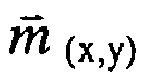
- training data vectors m ⁇ x ⁇ y may include the pixel positions (x,y) as features.
- Each component of the training data vectors may be normalized by its variance ⁇ (m i ) 2 .
- Each component of the training data vectors may further be weighted by an additional weighting factor.
- the additional weighting factor may be heuristically determined.
- the initial codebook vectors c ⁇ j are obtained by the steps of drawing a random (x,y)-position from an image, generating the feature vector at this position, computing the minimal distance of this vector to all codebook vectors in the current codebook and assigning a new codebook vector.
- the new codebook vector may be equal to randomly drawn vector if the minimal distance is larger than a threshold value and a new feature vector is drawn otherwise. For subsequent input images the already existing codebook vectors are adapted using standard VQ learning steps.
- the scene dependent adaptive topographic activation maps (V j ) may be binarised by a winner-take-all competition over all j.
- the relevance mask may be computed as an additive superposition from a center map and a disparity map.
- the relevance map may be used to find out which combination of the adaptive scene dependent filters (ASDF) should be selected.
- the method may further comprise the step of forming a skin color mask/detecting skin color.
- An adaptive skin color segmentation may further exclude skin color regions from the final mask.
- the number of pixels of the intersection between the relevance mask and the binarised topographic activation map and the number of pixels of the binarised topographic activation map without the relevance mask may be used for selecting the suitable masks.
- the probability of a mask belonging to the object is estimated by the overlap between the relevance mask and the topographic activation map.
- the mask may be included in the final segment mask, if the relative frequency is larger than a given threshold.
- the final mask may be computed as the additive superposition of the selected activation maps and the skin color pixels may be removed from this mask.
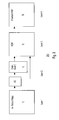
- Figure 1 shows an overview of a multi-stage and multi-path ASDF processing scheme for image segmentation and object recognition, using adaptive scene dependent filters (ASDF) 110, a relevance map 120 and skin color detection 130 as inputs for an object map determination module 140.
- ASDF adaptive scene dependent filters
- the object map determination module 140 determines a segmentation mask, which is subsequently used in an object recognition module 150.
- the dotted vertical line indicates, that the processing scheme is two-fold.
- the present invention is mainly concerned with the first steps of obtaining the above three inputs 110, 120 and 130 and of combining them in order to derive such a segmentation mask.
- (x, y) is the respective pixel index
- Each component is normalized by its variance ⁇ (m i ) 2 .
- ⁇ i is an additional heuristically determined weighting factor, which can be used to weight the relative importance of different map.
- the challenge for the Determine Object Map-Unit 140 is then to find out the combination of the ASDF's to segment the focused object. This is done in a recombination step, using an appropriate selection criterion.
- the probability of mask B i belonging to the object may be estimated by the relative frequency outPix/inPix.
- the mask may then be included in the final segment mask I Final if outPix/inP ix ⁇ 0.2.
- An adaptive skin color segmentation may exclude skin color regions from the final mask.
- Figure 4 shows binarised ASDF segments B i .
- a combination of segments 5,7,9,11,12 and 13 constitutes the object mask for the shown object.
- mask Nr. 9 gives parts of the contour and is not specialized to color features.
- Figure 5 shows the segmentation results of the architecture (the input image, the disparity mask and the final segmentation).
Landscapes
- Engineering & Computer Science (AREA)
- Artificial Intelligence (AREA)
- Evolutionary Computation (AREA)
- Health & Medical Sciences (AREA)
- Life Sciences & Earth Sciences (AREA)
- Biodiversity & Conservation Biology (AREA)
- Biomedical Technology (AREA)
- General Health & Medical Sciences (AREA)
- Molecular Biology (AREA)
- Computer Vision & Pattern Recognition (AREA)
- Physics & Mathematics (AREA)
- General Physics & Mathematics (AREA)
- Multimedia (AREA)
- Theoretical Computer Science (AREA)
- Image Analysis (AREA)
Abstract


Description
- The present invention relates to the field of digital image processing by a machine. In particular, it relates to the problems of attention control, scene segmentation and objection recognition by a machine in real-world scenes.
- To enable intelligent man-machine interaction, attention control and object recognition are widely recognized as important issues. Due to the difficulty of scene segmentation and object recognition in real-world scenes, most work in this area has concentrated on explicitly or implicitly constrained scenarios, e.g. uncluttered background, homogenous coloring of foreground objects, or predefined objects classes. It remains difficult, however, to bridge the gap between the low level perceptual cues and the symbolic levels of object representations.
- The currently most powerful approaches for object learning are based on probabilistic and Bayesian methods (Krishnapuram B., C. M. Bishop, and M. Szummer. Generative models and Bayesian model comparison for shape recognition. In Proceedings Ninth International Workshop on Frontiers in Handwriting Recognition, 2004). J. Winn and N. Joijic (Locus: Learning object classes with unsupervised segmentation. In Intl. Conf. on Computer Vision, 2005) demonstrate learning prototypic object categories together with their varying shape from natural images, but their methods are computationally extremely demanding and are not suitable for online and interactive learning.
- To facilitate visual processing and to reduce search spaces, many cognitive vision systems use attention based vision control to generate fixations. On the lower level, attention control is often based on topographically ordered maps to focus the system resources to certain points of interest (Joseph A. Driscoll, Richard Alan Peters II, and Kyle R. Cave. A visual attention network for a humanoid robot. In Proceedings of the IEEE/RSJ International Conference on Intelligent Robots and Systems (IROS-98), Victoria, B.C., October 12-16 1998.). These maps mostly use simple stimuli like color, oriented edges, or intensity, although mechanisms to integrate higher level information have also been proposed (J. J. Steil, G. Heidemann, J. Jockusch, R. Rae, N. Jungclaus, and H. Ritter. Guiding attention for grasping tasks by gestural instruction: The gravis-robot architecture. In Proc. IROS 2001, pages 1570-1577. IEEE, 2001.). One approach to reach the semantic level is to search for known objects at the current fixation point with a holistic object classification system (J. J. Steil and H. Ritter. Learning issues in a multi-modal robot-instruction scenario. In IEEE Int. Conf. Robotics, Intelligent Systems and Signal Processing, 2003.) and to store objects recognized in a symbolic memory (G. Heidemann. A multi-purpose visual classification system. In B. Reusch, Editor, Proc. 7th Fuzzy Days, Dortmund, 2001, pages 305-312. Springer-Verlag, 2001; G. Heidemann and H. Ritter. Combining multiple neural nets for visual feature selection and classification. In Proceedings of ICANN 99, 1999.). Due to the need for a large amount of training images from different views, the object classification itself has to be trained offline beforehand.
- It is generally believed that segmentation and recognition are closely connected and some authors try to solve both approaches concurrently (cf. e.g. Stella X. Yu, Ralph Gross, and Jianbo Shi. Concurrent object recognition and segmentation by graph partitioning. Online proceedings of the Neural Information Processing Systems conference, 2002.), which results in rather complex architectures without online capabilities: In more classical approaches, segmentation is treated as an independent preprocessing step towards recognition. However, in such learning contexts it is crucial to use unsupervised segmentation, because a priori knowledge about the object to segment is not available.
- To enable unsupervised segmentation, several cluster based segmentation approaches (Guo Dong and Ming Xie. Color clustering and learning for image segmentation based on neural networks. IEEE Transactions on Neural Networks, 16(14):925- 936, 2005; Y. Jiang and Z.-H. Zhou. Some ensemble-based image segmentation. Neural Processing Letters, 20(3): 171-178, 2004) use different color spaces and sometimes the pixel coordinates as feature space. They apply a vector quantization method like k-means or self organizing maps (SOM) to partition this space and segment the image with respect to the codebook vectors. Similarly, some approaches index the colors, quantize this index space, and back project this quantization to segments (Jung Kim Robert Li. Image compression using fast transformed vector quantization. In Applied Imagery Pattern Recognition Workshop, page 141, 2000; Dorin Comaniciu and Richard Grisel. Image coding using transform vector quantization with training set synthesis. Signal Process., 82(11):1649-1663, 2002). Though such quantization methods can potentially be fast, they assume that objects have to be homogeneously colored and can be covered by one segment. If stereo images are available, disparity information can be used as segmentation cue (N. H. Kim and Jai Song Park. Segmentation of object regions using depth information. In ICIP, pages 231-234, 2004) and some approaches try to support unreliable disparity information by additional color segmentation (Hai Tao and Harpreet S. Sawhney. Global matching criterion and color segmentation based stereo. In Workshop on the Application of Computer Vision, pages 246-253, 2000). In these schemes color segmentation is not learned and uses strong underlying homogeneity assumptions. Implicitly it is also assumed in these approaches that the objects to segment are isolated from each other, which in real scenarios often not the case, in particular not if humans manipulate and present objects to be learned to the machine.
- Some approaches have been made to combine unsupervised color clustering methods with top down information about the object derived from other sources (E. Borenstein, E. Sharon, and S. Ullman. Combining top-down and bottom-up segmentation. 2004 Conference on Computer Vision and Pattern Recognition Workshop (CVPRW'04), 4:46, 2004; M.J. Bravo and H. Farid. Object segmentation by top-down processes. Visual Cognition, 10(4):471-491, 2003). This approach has the advantage that in the unsupervised step smaller segments can be generated which may over-segment the objects. Thus homogeneity assumptions can be relaxed, however, the top down information must be sufficient to resolve the resulting ambiguities.
- In (E. Borenstein, E. Sharon, and S. Ullman. Combining top-down and bottom-up Segmentation, c.f. above) therefore, the unsupervised step consists of generating a hierarchy of segments ordered in a tree and a successive optimization procedure to label the segments as belonging to the object with respect to a cost function based on the top-level information.
- The complexity of this method is linear in the number of pixels, but still not sufficiently fast to allow real-time performance processing with several frames per second.
- It is therefore an object of the invention to provide a fast method and a system for determining an object segment in an electronic image. Preferably the method or system is sufficiently fast to allow real-time processing e.g. with several frames per second.
- This problem is solved by a method according to
claim 1, a software according to independent claim 21 and a computer program product according to independent claim 22. Advantageous embodiments are defined in the dependent claims. - A method for determining an object segment in an electronic image may comprise the steps of unsupervised learning of a multi-feature segmentation and of forming a relevance map.
- The method may further comprise the step of estimating the probability of a segment belonging to an object by the overlap of the segment and the relevance map.
- In the method, the step of unsupervised learning of a multi-feature segmentation may further comprise the steps of forming training data vectors using basic filter maps, obtaining codebook vectors from the training data vectors using a vector quantization network, generating adaptive topographic activation maps from the training data vectors and the codebook vectors and binarising the adaptive topographic activation maps to obtain binarised adaptive topographic activation maps.
- In this method, the generation of the activation maps may employ a standard vector quantization network with a fixed number of training steps. The vector quantization method that is applied may also be a k-means method, a flavor of the self-organizing map or a growing network like growing neural gas or the instantaneous topological map.
- Furthermore, the training data vectors

- Each component of the training data vectors may be normalized by its variance σ(mi)2. Each component of the training data vectors may further be weighted by an additional weighting factor. The additional weighting factor may be heuristically determined.
- The initial codebook vectors

- Moreover, the scene dependent adaptive topographic activation map (Vj) may be computed as

- The relevance map may be used to find out which combination of the adaptive scene dependent filters (ASDF) should be selected. The method may further comprise the step of forming a skin color mask/detecting skin color. An adaptive skin color segmentation may further exclude skin color regions from the final mask.
- The number of pixels of the intersection between the relevance mask and the binarised topographic activation map and the number of pixels of the binarised topographic activation map without the relevance mask may be used for selecting the suitable masks. The probability of a mask belonging to the object is estimated by the overlap between the relevance mask and the topographic activation map. The mask may be included in the final segment mask, if the relative frequency is larger than a given threshold. The final mask may be computed as the additive superposition of the selected activation maps and the skin color pixels may be removed from this mask.
- Further aspects and advantages of the invention will become apparent when reading the following detailed description in connection with the annexed drawing, in which
- Fig. 1
- shows a multi-path ASDF processing scheme for image segmentation and object recognition using adaptive filters, a relevance map, skin color detection and an object recognition module.
- Fig. 2
- shows a multistage ASDF architecture.
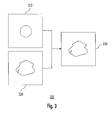
- Fig. 3
- shows the components of a relevance map.
- Fig. 4
- shows binarised ASDF segments Bi.
- Fig. 5
- shows the segmentation results of the architecture (the input image, the disparity mask and the final segmentation).
- Figure 1 shows an overview of a multi-stage and multi-path ASDF processing scheme for image segmentation and object recognition, using adaptive scene dependent filters (ASDF) 110, a
relevance map 120 andskin color detection 130 as inputs for an objectmap determination module 140. The objectmap determination module 140 determines a segmentation mask, which is subsequently used in anobject recognition module 150. - The dotted vertical line indicates, that the processing scheme is two-fold. First, a segmentation mask is derived. Second, the obtained segmentation mask is used by the object recognition module.
- The present invention is mainly concerned with the first steps of obtaining the above three
inputs - With reference to Figure 2, the process of obtaining the adaptive scene-
dependent filters 110 will be explained first. - It is assumed that in earlier stages of a complete vision architecture, low level filter operations or basic filter maps on an input image are provided. As opposed to pure color segmentation schemes, combinations of all kinds of topographic feature maps like edge maps, intensity, difference images, velocity fields, disparity, image position, or different color spaces for forming a combined feature space are allowed. In the present invention, M such basic filter maps Fi with features


where (x, y) is the respective pixel index and

- In
layer 2, a vector quantization network (VQ) is employed to obtain N prototypic codebook vectors

equation 1 above). - In each step, the minimal distance
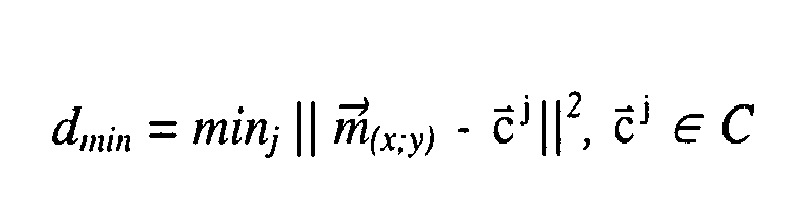
is calculated and the winning codebook vector with minimal distance is adapted through the standard VQ rules. - The initialization of the VQ codebook C may start with an empty codebook and incrementally assign new codebook vectors by the following procedure:
- Draw a random (x, y)-position from the image, generate the feature vector


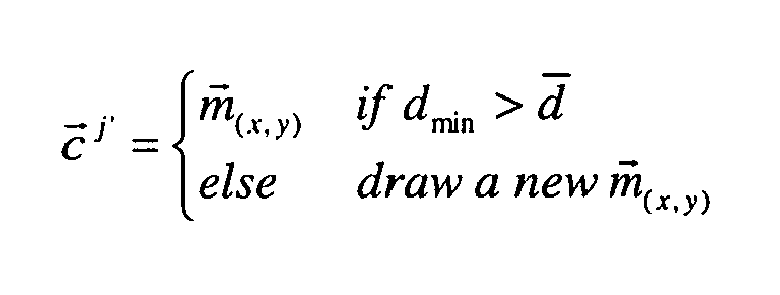
whered is a threshold value to ensure a good distribution of the codebook vectors. This procedure may be done before each adaptation step of the VQ until the maximum number of codebook vectors is reached. - The above-described steps may be embodied in the following algorithm (written in pseudocode):

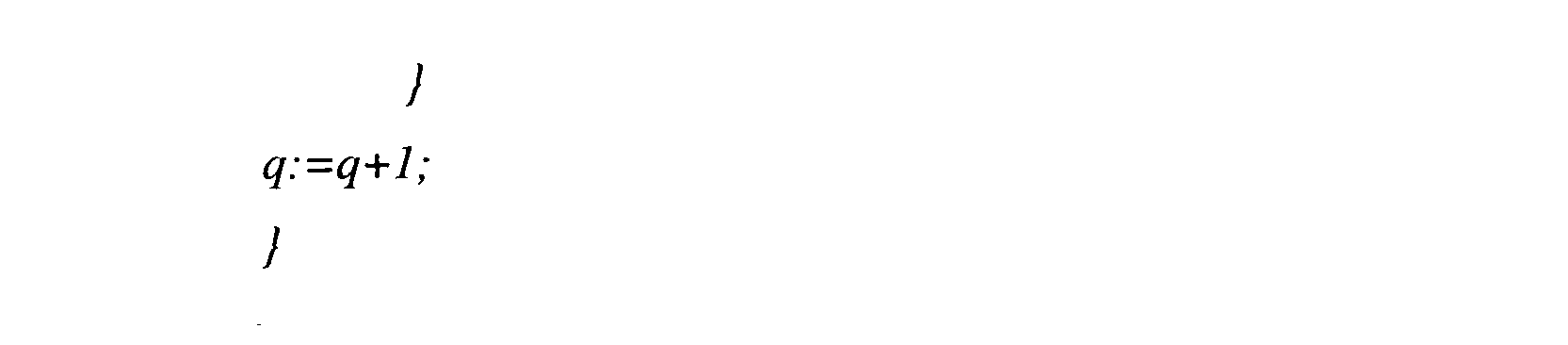
- The algorithm carries out Q iteration steps. Within each step, a standard VQ learning step is carried out for the existing codebook vectors. New codebook vectors are added, if a randomly drawn

- In
layer 3, the partition of the feature space then generates for each codebook vector a new adaptive feature map by assigning to each pixel position the distance of the original feature vector to the codebook vector. - The input for
layer 3 consists of the adaptive codebook C and the basic filter maps Fi. Based on the codebook, N scene dependent activation maps Vj are computed as A further winner-take-all competition among the adaptive maps is then used to obtain disjoint segments. This is achieved by binarising the maps Vj as
- The challenge for the Determine Object Map-
Unit 140 is then to find out the combination of the ASDF's to segment the focused object. This is done in a recombination step, using an appropriate selection criterion. - A relevance map may be used as an appropriate selection criterion. The relevance map may serve as a prediction mask for a rough region around the focused object. This region may be used as a cue to find the appropriate filters out of a set of adaptive scene dependent filters.
- As can be seen from Figure 3, a relevance map may be computed as an additive superposition from the center map IC, designated by
reference 310,and the disparity map IDisp, designated byreference 320. The output of the relevance map consists of an image mask IRel. designated byreference 330. - The recombination step uses information from a relevance map to determine which segments belong to the object. As opposed to the approach by E. Borenstein, E. Sharon, and S. Ullman (Combining top-down and bottom-up segmentation, cf. above), this recombination step does not use an explicit hypothesis about the object to be learned and only relies on information from the attentional system to define a region of interest, which can be refined by disparity information or other cues if available. To speed up processing, the probability of a segment belonging to the object, which is assumed to be in the region of interest, may be estimated by the overlap of the segment with the relevance map.
- The relevance map also allows to specifically exclude segments be setting regions to zero relevance. This may be used to subtract regions representing skin and hand color that are detected in a separate specialized processing path. Always complete segments or connected components of segments are accepted and thus also pixels which fall outside the initial interest region can be included in the final mask.
- Objects present in the input image but outside the interest region may not be segmented, which may save computation time. The architecture may be applied to all kinds of images in order to segment objects in the focus of attention defined by the relevance map, in particular it may be used in the context of online-learning of "objects-in-hand" presented by a human partner in front of an arbitrary background.
- For this purpose, the number of pixels inPix of the intersection IRel and Bi (inPix = #(Bi \ IRel)) and the number of pixels outPix, Bi without IRel (outPix = #(Bi \ IRel)) are computed. These two parameters may be used for selecting the suitable masks. The probability of mask Bi belonging to the object may be estimated by the relative frequency outPix/inPix. The mask may then be included in the final segment mask IFinal if outPix/inP ix < 0.2.
- An adaptive skin color segmentation may exclude skin color regions from the final mask. The final mask IFinal may then be computed as the additive superposition of the selected Bi and the skin color pixels are removed from this mask:

- Figure 4 shows binarised ASDF segments Bi. A combination of
segments - Figure 5 shows the segmentation results of the architecture (the input image, the disparity mask and the final segmentation).
Claims (22)
- Method for determining an object segment in an electronic image, comprising the steps of- unsupervised learning of a multi-feature segmentation and- forming a relevance map.
- Method according to claim 1, further comprising the step of- estimating the probability of a segment belonging to an object by the overlap of the segment and the relevance map.
- Method according to claim 1 or 2, wherein the step of unsupervised learning of a multi-feature segmentation comprises the steps of- forming training data vectors
 - obtaining codebook vectors
 - generating adaptive topographic activation maps (VJ) from the training data vectors
 - binarising the adaptive topographic activation maps (VJ) to obtain binarised adaptive topographic activation maps (Bi).
 - Method according to claim 3, wherein the generation of the activation maps employs a standard vector quantization network VQ with a fixed number of training steps.
- Method according to claim 3, wherein the training data vectors

- Method according to claim 3, wherein each component of the training data vectors

- Method according to claim 3, wherein each component of the training data vectors is weighted by an additional weighting factor (ξI).
- Method according to claim 3, wherein the additional weighting factor (ξI ) is heuristically determined.
- Method according to claim 3, wherein the codebook vectors CJ are obtained by the steps of:- drawing a random (x,y)-position from an image- generating the vector
 - compute the minimal distance (dmin) of m(x,y) to all CJ in the current codebook- assigning a new codebook vector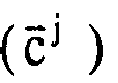
- Method according to claim 9, wherein the new codebook vector


- Method according to claim 3, wherein the scene dependent adaptive topographic activation map (VJ) is computed as

- Method according to claim 11,
wherein the scene dependent adaptive topographic activation map (VJ) is binarised by the formula:
- Method according to claim 1,
wherein the relevance mask (IREL) is computed as an additive superposition from a center map IC and a disparity map IDISP. - Method according to claim 1,
wherein the relevance map is used to find out which combination of the ASDF's should be selected. - Method according to claim1,
further comprising the step:- Forming a skin color mask/detecting skin color; - Method according to claim 2,
wherein an adaptive skin color segmentation further excludes skin color regions from the final mask. - Method according to claim 1,
wherein the number of pixels (inPix) of the intersection between the relevance mask and the binarised topographic activation map (Bi) and the number of pixels (outPix) of the binarised topographic activation map (Bi) without the relevance mask (IRel) are used for selecting the suitable masks. - Method according to claim 2,
wherein the probability of mask (Bi) belonging to the object is estimated by the relative frequency outPix/inPix. - Method according to claim 1,
wherein the mask is included in the final segment mask (Ifinal), if the relative frequency is larger than a given threshold. - Method according to claim 1,
wherein the final mask (IFinal) is computed as the additive superposition of the selected Bi and the skin color pixels are removed from this mask (IFinal = ΣiBi- ISkin). - Software that, when loaded into and executed by a computer, carries out one of the methods according to claims 1 to 20.
- Computer-readable medium, on which a software according to claim 21 is stored.
Priority Applications (4)
| Application Number | Priority Date | Filing Date | Title |
|---|---|---|---|
| EP05028259A EP1801731B1 (en) | 2005-12-22 | 2005-12-22 | Adaptive scene dependent filters in online learning environments |
| DE602005007370T DE602005007370D1 (en) | 2005-12-22 | 2005-12-22 | Adaptive scene-dependent filters in online learning environments |
| US11/610,261 US8238650B2 (en) | 2005-12-22 | 2006-12-13 | Adaptive scene dependent filters in online learning environments |
| JP2006343950A JP4567660B2 (en) | 2005-12-22 | 2006-12-21 | A method for determining a segment of an object in an electronic image. |
Applications Claiming Priority (1)
| Application Number | Priority Date | Filing Date | Title |
|---|---|---|---|
| EP05028259A EP1801731B1 (en) | 2005-12-22 | 2005-12-22 | Adaptive scene dependent filters in online learning environments |
Publications (2)
| Publication Number | Publication Date |
|---|---|
| EP1801731A1 true EP1801731A1 (en) | 2007-06-27 |
| EP1801731B1 EP1801731B1 (en) | 2008-06-04 |
Family
ID=36602749
Family Applications (1)
| Application Number | Title | Priority Date | Filing Date |
|---|---|---|---|
| EP05028259A Expired - Lifetime EP1801731B1 (en) | 2005-12-22 | 2005-12-22 | Adaptive scene dependent filters in online learning environments |
Country Status (4)
| Country | Link |
|---|---|
| US (1) | US8238650B2 (en) |
| EP (1) | EP1801731B1 (en) |
| JP (1) | JP4567660B2 (en) |
| DE (1) | DE602005007370D1 (en) |
Families Citing this family (14)
| Publication number | Priority date | Publication date | Assignee | Title |
|---|---|---|---|---|
| US8452599B2 (en) * | 2009-06-10 | 2013-05-28 | Toyota Motor Engineering & Manufacturing North America, Inc. | Method and system for extracting messages |
| US8269616B2 (en) * | 2009-07-16 | 2012-09-18 | Toyota Motor Engineering & Manufacturing North America, Inc. | Method and system for detecting gaps between objects |
| US8337160B2 (en) * | 2009-10-19 | 2012-12-25 | Toyota Motor Engineering & Manufacturing North America, Inc. | High efficiency turbine system |
| US8237792B2 (en) * | 2009-12-18 | 2012-08-07 | Toyota Motor Engineering & Manufacturing North America, Inc. | Method and system for describing and organizing image data |
| US8424621B2 (en) | 2010-07-23 | 2013-04-23 | Toyota Motor Engineering & Manufacturing North America, Inc. | Omni traction wheel system and methods of operating the same |
| FI20106387L (en) * | 2010-12-30 | 2012-07-01 | Zenrobotics Oy | Method, computer program and device for determining the point of infection |
| US10395138B2 (en) | 2016-11-11 | 2019-08-27 | Microsoft Technology Licensing, Llc | Image segmentation using user input speed |
| US11205103B2 (en) | 2016-12-09 | 2021-12-21 | The Research Foundation for the State University | Semisupervised autoencoder for sentiment analysis |
| SE544090C2 (en) | 2018-04-22 | 2021-12-21 | Zenrobotics Oy | Waste Sorting Gantry Robot |
| SE544165C2 (en) | 2020-06-24 | 2022-02-15 | Zenrobotics Oy | Waste Sorting Robot |
| SE544103C2 (en) | 2020-10-28 | 2021-12-21 | Zenrobotics Oy | Waste Sorting Robot with gripper that releases waste object at a throw position |
| KR20240062450A (en) | 2022-11-01 | 2024-05-09 | 삼성전자주식회사 | The method of outputting feature vector, the method of outputting feature map, the electronic device performing the methods |
| US12106298B1 (en) * | 2024-02-02 | 2024-10-01 | switstack, Inc. | Development environment for payment solutions using software-defined card processing |
| US20260170847A1 (en) * | 2024-12-18 | 2026-06-18 | Mercedes-Benz Group AG | System and method for performing object detection based on disparity image information |
Citations (2)
| Publication number | Priority date | Publication date | Assignee | Title |
|---|---|---|---|---|
| US20050047647A1 (en) * | 2003-06-10 | 2005-03-03 | Ueli Rutishauser | System and method for attentional selection |
| EP1542153A1 (en) * | 2003-12-11 | 2005-06-15 | Sony United Kingdom Limited | Object detection |
Family Cites Families (4)
| Publication number | Priority date | Publication date | Assignee | Title |
|---|---|---|---|---|
| US6807286B1 (en) * | 2000-04-13 | 2004-10-19 | Microsoft Corporation | Object recognition using binary image quantization and hough kernels |
| US6826316B2 (en) * | 2001-01-24 | 2004-11-30 | Eastman Kodak Company | System and method for determining image similarity |
| US7583831B2 (en) * | 2005-02-10 | 2009-09-01 | Siemens Medical Solutions Usa, Inc. | System and method for using learned discriminative models to segment three dimensional colon image data |
| US7574069B2 (en) * | 2005-08-01 | 2009-08-11 | Mitsubishi Electric Research Laboratories, Inc. | Retargeting images for small displays |
-
2005
- 2005-12-22 DE DE602005007370T patent/DE602005007370D1/en not_active Expired - Lifetime
- 2005-12-22 EP EP05028259A patent/EP1801731B1/en not_active Expired - Lifetime
-
2006
- 2006-12-13 US US11/610,261 patent/US8238650B2/en not_active Expired - Fee Related
- 2006-12-21 JP JP2006343950A patent/JP4567660B2/en not_active Expired - Fee Related
Patent Citations (2)
| Publication number | Priority date | Publication date | Assignee | Title |
|---|---|---|---|---|
| US20050047647A1 (en) * | 2003-06-10 | 2005-03-03 | Ueli Rutishauser | System and method for attentional selection |
| EP1542153A1 (en) * | 2003-12-11 | 2005-06-15 | Sony United Kingdom Limited | Object detection |
Non-Patent Citations (22)
| Title |
|---|
| ANDREW L L H ET AL: "A new adaptive image sequence coding scheme using Kohonen's SOFM", NEURAL NETWORKS, 1995. PROCEEDINGS., IEEE INTERNATIONAL CONFERENCE ON PERTH, WA, AUSTRALIA 27 NOV.-1 DEC. 1995, NEW YORK, NY, USA,IEEE, US, vol. 4, 27 November 1995 (1995-11-27), pages 2071 - 2076, XP010156116, ISBN: 0-7803-2768-3 * |
| BOEHME H-J ET AL: "User localisation for visually-based human-machine-interaction", AUTOMATIC FACE AND GESTURE RECOGNITION, 1998. PROCEEDINGS. THIRD IEEE INTERNATIONAL CONFERENCE ON NARA, JAPAN 14-16 APRIL 1998, LOS ALAMITOS, CA, USA,IEEE COMPUT. SOC, US, 14 April 1998 (1998-04-14), pages 486 - 491, XP010277597, ISBN: 0-8186-8344-9 * |
| CYNTHIA BREAZEAL ET AL: "Active Vision for Sociable Robots", IEEE TRANSACTIONS ON SYSTEMS, MAN AND CYBERNETICS. PART A: SYSTEMS AND HUMANS, IEEE SERVICE CENTER, PISCATAWAY, NJ, US, vol. 31, no. 5, September 2001 (2001-09-01), XP011056411, ISSN: 1083-4427 * |
| DORIN COMANICIU; RICHARD GRISEL: "Image coding using transform vector quantization with training set synthesis", SIGNAL PROCESS., vol. 82, no. 11, 2002, pages 1649 - 1663 |
| E. BORENSTEIN; E. SHARON; S. ULLMAN: "Combining top-down and bottom-up segmentation", 2004 CONFERENCE ON COMPUTER VISION AND PATTERN RECOGNITION WORKSHOP (CVPRW'04, vol. 4, 2004, pages 46 |
| G. HEIDEMANN: "PROC. 7TH FUZZY DAYS", 2001, SPRINGER-VERLAG, article "A multi-purpose visual classification system", pages: 305 - 312 |
| G. HEIDEMANN; H. RITTER: "Combining multiple neural nets for visual feature selection and classification", PROCEEDINGS OF ICANN 99, 1999 |
| GOERICK C ET AL.: "Peripersonal space and object recognition for humanoids", PROC. IEEE/RSJ INT. CONF. ON HUMANOID ROBOTS (HUMANOIDS 2005),, 5 December 2005 (2005-12-05) - 7 December 2005 (2005-12-07), TSUKUBA, JAPAN, XP002388594 * |
| GUO DONG; MING XIE: "Color clustering and learning for image segmentation based on neural networks", IEEE TRANSACTIONS ON NEURAL NETWORKS, vol. 16, no. 14, 2005, pages 925 - 936 |
| HAI TAO; HARPREET S. SAWHNEY: "Global matching criterion and color segmentation based stereo", WORKSHOP ON THE APPLICATION OF COMPUTER VISION, 2000, pages 246 - 253 |
| J. J. STEIL ET AL.: "PROC. IROS 2001", 2001, IEEE, article "Guiding attention for grasping tasks by gestural instruction: The gravis-robot a", pages: 1570 - 1577 |
| J. J. STEIL; H. RITTER: "Learning issues in a multi-modal robot-instruction scenario", IEEE INT. CONF. ROBOTICS, INTELLIGENT SYSTEMS AND SIGNAL PROCESSING, 2003 |
| J. WINN; N. JOIJIC: "Locus: Learning object classes with unsupervised segmentation", INTL. CONF. ON COMPUTER VISION, 2005 |
| JOSEPH A. DRISCOLL; RICHARD ALAN PETERS II; KYLE R. CAVE: "A visual attention network for a humanoid robot", PROCEEDINGS OF THE IEEE/RSJ INTERNATIONAL CONFERENCE ON INTELLIGENT ROBOTS AND SYSTEMS (IROS-98, 12 October 1998 (1998-10-12) |
| JUNG KIM ROBERT LI: "Image compression using fast transformed vector quantization", APPLIED IMAGERY PATTERN RECOGNITION WORKSHOP, 2000, pages 141 |
| KRISHNAPURAM B.; C. M. BISHOP; M. SZUMMER: "Generative models and Bayesian model comparison for shape recognition", PROCEEDINGS NINTH INTERNATIONAL WORKSHOP ON FRONTIERS IN HANDWRITING RECOGNITION, 2004 |
| M.J. BRAVO; H. FARID: "Object segmentation by top-down processes", VISUAL COGNITION, vol. 10, no. 4, 2003, pages 471 - 491 |
| N. H. KIM; JAI SONG PARK: "Segmentation of object regions using depth information", ICIP, 2004, pages 231 - 234 |
| STELLA X. YU; RALPH GROSS; JIANBO SHI: "Concurrent object recognition and segmentation by graph partitioning", ONLINE PROCEEDINGS OF THE NEURAL INFORMATION PROCESSING SYSTEMS CONFERENCE, 2002 |
| TRIESCH J: "The Role of a priori Biases in Unsupervised Learning of Visual Representations: A Robotics Experiment", PROC. WORKSHOP DEVELOPMENTAL EMBODIED COGNITION DECO-2001, 31 July 2001 (2001-07-31), edinburgh, pages 1 - 5, XP002388595 * |
| VICTOR BOSKOVITZ ET AL: "An Adaptive Neuro-Fuzzy System for Automatic Image Segmentation and Edge Detection", IEEE TRANSACTIONS ON FUZZY SYSTEMS, IEEE SERVICE CENTER, PISCATAWAY, NJ, US, vol. 10, no. 2, April 2002 (2002-04-01), XP011072949, ISSN: 1063-6706 * |
| Y. JIANG; Z.-H. ZHOU: "Some ensemble-based image segmentation", NEURAL PROCESSING LETTERS, vol. 20, no. 3, 2004, pages 171 - 178 |
Also Published As
| Publication number | Publication date |
|---|---|
| DE602005007370D1 (en) | 2008-07-17 |
| US20070147678A1 (en) | 2007-06-28 |
| US8238650B2 (en) | 2012-08-07 |
| JP4567660B2 (en) | 2010-10-20 |
| JP2007172627A (en) | 2007-07-05 |
| EP1801731B1 (en) | 2008-06-04 |
Similar Documents
| Publication | Publication Date | Title |
|---|---|---|
| Han et al. | Dynamic scene semantics SLAM based on semantic segmentation | |
| Jenkins et al. | Automated derivation of behavior vocabularies for autonomous humanoid motion | |
| CN113269089A (en) | Real-time gesture recognition method and system based on deep learning | |
| EP1934941B1 (en) | Bi-directional tracking using trajectory segment analysis | |
| EP1801731B1 (en) | Adaptive scene dependent filters in online learning environments | |
| Zhan et al. | Facial expression recognition based on Gabor wavelet transformation and elastic templates matching | |
| CN111158491A (en) | A Human-Computer Interaction Method for Gesture Recognition Applied to Vehicle HUD | |
| CN118212463A (en) | Target tracking method based on fractional-order hybrid network | |
| CN115661246A (en) | A Pose Estimation Method Based on Self-Supervised Learning | |
| CN111158457A (en) | A vehicle HUD human-computer interaction system based on gesture recognition | |
| Pham et al. | Pencilnet: Zero-shot sim-to-real transfer learning for robust gate perception in autonomous drone racing | |
| Zeng et al. | Deep stereo matching with hysteresis attention and supervised cost volume construction | |
| Naseer et al. | Multimodal deep learning framework for enhanced semantic scene classification using RGB-D images | |
| Gargesha et al. | Facial expression recognition using artificial neural networks | |
| Zhang et al. | MFFSSD: an enhanced SSD for underwater object detection | |
| Lin et al. | Robot grasping based on object shape approximation and LightGBM | |
| Song et al. | Multi-signal gesture recognition using temporal smoothing hidden conditional random fields | |
| CN116543021A (en) | Siamese network video single-target tracking method based on feature fusion | |
| Tang et al. | Two-stage filtering method to improve the performance of object detection trained by synthetic dataset in heavily cluttered industry scenes: P. Tang et al. | |
| Gu et al. | Vtst: efficient visual tracking with a stereoscopic transformer | |
| Islam et al. | A comprehensive review on object detection in the context of autonomous driving | |
| Gepperth et al. | Real-time detection and classification of cars in video sequences | |
| Huang et al. | Emotion recognition based on a novel triangular facial feature extraction method | |
| Cai et al. | Vehicle detection based on visual saliency and deep sparse convolution hierarchical model | |
| Wilson et al. | Classification of mouth gestures in German sign language using 3D convolutional neural networks |
Legal Events
| Date | Code | Title | Description |
|---|---|---|---|
| PUAI | Public reference made under article 153(3) epc to a published international application that has entered the european phase |
Free format text: ORIGINAL CODE: 0009012 |
|
| 17P | Request for examination filed |
Effective date: 20061207 |
|
| AK | Designated contracting states |
Kind code of ref document: A1 Designated state(s): AT BE BG CH CY CZ DE DK EE ES FI FR GB GR HU IE IS IT LI LT LU LV MC NL PL PT RO SE SI SK TR |
|
| AX | Request for extension of the european patent |
Extension state: AL BA HR MK YU |
|
| GRAP | Despatch of communication of intention to grant a patent |
Free format text: ORIGINAL CODE: EPIDOSNIGR1 |
|
| GRAS | Grant fee paid |
Free format text: ORIGINAL CODE: EPIDOSNIGR3 |
|
| AKX | Designation fees paid |
Designated state(s): DE FR GB |
|
| GRAA | (expected) grant |
Free format text: ORIGINAL CODE: 0009210 |
|
| AK | Designated contracting states |
Kind code of ref document: B1 Designated state(s): DE FR GB |
|
| REG | Reference to a national code |
Ref country code: GB Ref legal event code: FG4D |
|
| REF | Corresponds to: |
Ref document number: 602005007370 Country of ref document: DE Date of ref document: 20080717 Kind code of ref document: P |
|
| PLBE | No opposition filed within time limit |
Free format text: ORIGINAL CODE: 0009261 |
|
| STAA | Information on the status of an ep patent application or granted ep patent |
Free format text: STATUS: NO OPPOSITION FILED WITHIN TIME LIMIT |
|
| 26N | No opposition filed |
Effective date: 20090305 |
|
| REG | Reference to a national code |
Ref country code: DE Ref legal event code: R084 Ref document number: 602005007370 Country of ref document: DE |
|
| REG | Reference to a national code |
Ref country code: DE Ref legal event code: R084 Ref document number: 602005007370 Country of ref document: DE Effective date: 20150116 |
|
| REG | Reference to a national code |
Ref country code: GB Ref legal event code: 746 Effective date: 20150330 |
|
| REG | Reference to a national code |
Ref country code: FR Ref legal event code: PLFP Year of fee payment: 11 |
|
| PGFP | Annual fee paid to national office [announced via postgrant information from national office to epo] |
Ref country code: GB Payment date: 20151221 Year of fee payment: 11 |
|
| PGFP | Annual fee paid to national office [announced via postgrant information from national office to epo] |
Ref country code: FR Payment date: 20151218 Year of fee payment: 11 |
|
| PGFP | Annual fee paid to national office [announced via postgrant information from national office to epo] |
Ref country code: DE Payment date: 20160225 Year of fee payment: 11 |
|
| REG | Reference to a national code |
Ref country code: DE Ref legal event code: R119 Ref document number: 602005007370 Country of ref document: DE |
|
| GBPC | Gb: european patent ceased through non-payment of renewal fee |
Effective date: 20161222 |
|
| REG | Reference to a national code |
Ref country code: FR Ref legal event code: ST Effective date: 20170831 |
|
| PG25 | Lapsed in a contracting state [announced via postgrant information from national office to epo] |
Ref country code: FR Free format text: LAPSE BECAUSE OF NON-PAYMENT OF DUE FEES Effective date: 20170102 |
|
| PG25 | Lapsed in a contracting state [announced via postgrant information from national office to epo] |
Ref country code: DE Free format text: LAPSE BECAUSE OF NON-PAYMENT OF DUE FEES Effective date: 20170701 Ref country code: GB Free format text: LAPSE BECAUSE OF NON-PAYMENT OF DUE FEES Effective date: 20161222 |