EP1801611A1 - Method for extracting a semantic parameter, computer system and computer program product - Google Patents
Method for extracting a semantic parameter, computer system and computer program product Download PDFInfo
- Publication number
- EP1801611A1 EP1801611A1 EP05077970A EP05077970A EP1801611A1 EP 1801611 A1 EP1801611 A1 EP 1801611A1 EP 05077970 A EP05077970 A EP 05077970A EP 05077970 A EP05077970 A EP 05077970A EP 1801611 A1 EP1801611 A1 EP 1801611A1
- Authority
- EP
- European Patent Office
- Prior art keywords
- envelope
- velocity data
- time dependent
- velocity
- radar signal
- Prior art date
- Legal status (The legal status is an assumption and is not a legal conclusion. Google has not performed a legal analysis and makes no representation as to the accuracy of the status listed.)
- Withdrawn
Links
- 238000000034 method Methods 0.000 title claims abstract description 31
- 238000004590 computer program Methods 0.000 title claims description 5
- 230000036962 time dependent Effects 0.000 claims abstract description 31
- 238000001914 filtration Methods 0.000 claims description 4
- 230000011218 segmentation Effects 0.000 claims description 3
- 241001465754 Metazoa Species 0.000 description 2
- 238000001228 spectrum Methods 0.000 description 2
- 241000283153 Cetacea Species 0.000 description 1
- 230000001133 acceleration Effects 0.000 description 1
- 230000001186 cumulative effect Effects 0.000 description 1
- 230000001419 dependent effect Effects 0.000 description 1
- 230000002708 enhancing effect Effects 0.000 description 1
- 238000000605 extraction Methods 0.000 description 1
- 238000009499 grossing Methods 0.000 description 1
- 238000007781 pre-processing Methods 0.000 description 1
- 230000003595 spectral effect Effects 0.000 description 1
- 230000003068 static effect Effects 0.000 description 1
- 230000009182 swimming Effects 0.000 description 1
- 230000009466 transformation Effects 0.000 description 1
- 230000001052 transient effect Effects 0.000 description 1
- 230000000007 visual effect Effects 0.000 description 1
Images



Classifications
-
- G—PHYSICS
- G01—MEASURING; TESTING
- G01S—RADIO DIRECTION-FINDING; RADIO NAVIGATION; DETERMINING DISTANCE OR VELOCITY BY USE OF RADIO WAVES; LOCATING OR PRESENCE-DETECTING BY USE OF THE REFLECTION OR RERADIATION OF RADIO WAVES; ANALOGOUS ARRANGEMENTS USING OTHER WAVES
- G01S7/00—Details of systems according to groups G01S13/00, G01S15/00, G01S17/00
- G01S7/02—Details of systems according to groups G01S13/00, G01S15/00, G01S17/00 of systems according to group G01S13/00
- G01S7/41—Details of systems according to groups G01S13/00, G01S15/00, G01S17/00 of systems according to group G01S13/00 using analysis of echo signal for target characterisation; Target signature; Target cross-section
- G01S7/415—Identification of targets based on measurements of movement associated with the target
Definitions
- the invention relates to a method for extracting a semantic parameter of an object from a radar signal, comprising a step of retrieving time dependent velocity data of the object from the radar signal.
- Radar signals serve as a useful sensing technique for observing objects, such as persons, animals and/or vehicles. By analyzing radar signals such objects can also be observed in situations where they are not or less visible for the human eye, e.g. behind walls or at great distances.
- the method according to the invention further comprises the step of determining an envelope of the time dependent velocity data of the object and the step of processing the envelope for obtaining a semantic parameter of the object.
- determining an envelope of the time dependent velocity data of the object can e.g. be performed directly in time domain.
- an envelope can also be obtained by performing a Fourier transformation with respect to the time parameter and by processing the spectral data.
- a further alternative comprises performing a numerical analysis on the velocity data using the so-called principle component analysis.
- the step of determining an envelope of the time dependent velocity data of the object comprises a step of segmentation of the velocity data of the object, so that velocity data having an amplitude that is greater than a noise level, can be clustered and separated from useless information in the velocity data. Also other methods for separating useful information from useless information in the velocity data can be applied, such as general or specific noise removal filtering.
- the step of processing the envelope for obtaining a semantic parameter of the object comprises determining a lower and/or an upper velocity bound in the velocity dependent velocity data.
- semantic parameters such as a lower and/or upper velocity of the object or part of the object can be obtained.
- other types of processing the envelope for obtaining a semantic parameter of the object can be applied, alone or in combination, such as determining a repetition frequency and/or a phase of the envelope.
- the method according to the invention can e.g. be applied to an object representing a human body.
- an extracted lower and/or upper velocity of the objects can be interpreted as time dependent velocities of legs and/or arms of the human body.
- a repetition frequency and a phase of the envelope can be interpreted as a walking (or swinging) frequency and phase of a limb movement, respectively. The latter might lead to information of an actual position of the limb. Such information can be processed to determine if the human body in question is walking, biking, riding, skating, swimming, creeping, falling, standing up, etc.
- the object might not only represent human bodies, but also other types of objects, such as animals or vehicles.
- the radar signal can advantageously be visualized in such a way that a human observer can easily interpret the data.
- the invention relates to a computer system to perform the method of claim 1.
- the invention relates to a computer program product for extracting a semantic parameter of an object from a radar signal, which computer program product comprises instructions for causing a processor to perform the steps of retrieving time dependent velocity data of the object from the radar signal; determining an envelope of the time dependent velocity data of the object and processing the envelope for obtaining a semantic parameter of the object.
- FIG. 1 shows velocity-time data of a radar signal.
- the radar signal is generated by a radar scanning a region.
- the radar is e.g. of the frequency modulated continuous wave (FMCW) type and generates information with respect to object range information and object velocity components. From the radar signal, time dependent velocity data of the object is retrieved.
- FMCW frequency modulated continuous wave
- the step of retrieving the time dependent velocity data of the object comprises selecting an object from the range information data, so that data with respect to a particular object can be analyzed.
- the step of retrieving the time dependent velocity data of the object comprises filtering range information of the object from the radar signal, thereby reducing the amount of radar signal data to be analyzed.
- time dependent velocity data also called the spectrum of the object from the radar signal
- the horizontal axis 1 denotes the time parameter
- the vertical axis 2 denotes the velocity.
- the amplitude 3, or power, of the radar signal is depicted in a grey scale.
- the method according to the invention further comprises determining an envelope of the time dependent velocity data of the object.
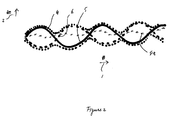
- Such an envelope is in simplified form shown in Figure 2 as a dotted line 4. Further, the envelope is processed for obtaining a semantic parameter of the object.
- the data shown in Figures 1 and 2 are based upon a radar signal from an object that represents a human body, in particular a walking person.
- parts of the human body such as the torso, limbs, etc.
- the time dependent velocity data of the walking person contains information with respect to an average velocity of the torso of the body, as well information with respect to limbs, such as legs and/or arms.
- the time dependent velocities of the legs are depicted in Figure 2 as a solid line 5 and as a discontinuous line 6, representing a left and right leg, respectively.
- a time-dependent average velocity 4a is calculated from the velocity data of the object.
- the average velocity is interpreted as the average speed of the torso.
- the average velocity denoted by a line with multiple asterixes, comprises a frequency component at a frequency that is approximately twice the frequency of the limbs. This double frequency represents a waddling frequency of the hips.
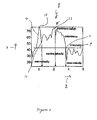
- Figure 3 shows a graph 8 of velocity data at a fixed instant, also called a time slice from the velocity spectrum from Figure 1.
- the horizontal axis denotes the velocity 2
- the vertical axis denotes the amplitude 7, or power, of the velocity data.
- the method comprises a segmentation step of the velocity data of the object to cluster useful information of the velocity data. All components lower than a predetermined value, the threshold 9, are ignored. Further, artificial components, such as zero speed clutter 12 can be removed. The components higher than the threshold 9 are considered as useful information with respect to velocity information of the object. In this way a lower velocity bound 10 and an upper velocity bound 11 of the velocity data are determined.
- the envelope By collecting the lower and upper velocity bounds per time instant, the envelope is obtained. It is noted that the envelope could be further processed, e.g. by smoothing the time dependent envelope. A centre velocity is estimated by determining the velocity with the highest amplitude 13. By collecting the centre velocities per time instant, an average velocity is estimated.
- an amplitude distribution 22 of the velocity data is calculated as shown in Figure 4, wherein the horizontal axis denotes the velocity 20, while the vertical axis denotes a cumulative sum 21 of the data.
- a lower and an upper velocity bound 23 and 24 are determined by choosing a lower and upper percentage, respectively, of the whole data set. Further, an average velocity 25 is determined at a percentage of 50%. This method is also known as the percentiles method.
- the amplitude 7 of the velocity data is mapped to a hat function with variable width.
- Figure 5 shows several hat functions 30a, 30b, 30c with variable width. From the hat function which in some sense maps optimal with the velocity data, see e.g. Recognizing transient low-frequency whale sounds by spectrogram correlation by D.K. Mellinger and C.H. Clark, Acoustical Society of America, Volume 107 (No. 6), pages 3518-3529, June 2000 , a lower and an upper velocity bound is obtained by determining e.g. a double width distance or another distance from the centre of the hat function. Again the centre is selected as an average velocity.
- the envelope is processed for obtaining semantic parameters, such as a repetition frequency representing a leg frequency, and a phase of the envelope for deduction of a leg position.
- leg and the torso behave as a sinusoidal function
- estimation of the frequency and phase can be improved.
- an estimation of the leg and torso parameters can be computed without using a priori information.
- the radar signal is preprocessed, e.g. for suppressing of artificial information and noise. This might be accomplished by using e.g. a Kalman filter. Also other filters might be used, such as a Wiener filter. Also other pre-processing steps can be performed, e.g. processing steps enhancing edges of objects.
- the extracted semantic parameters are employed as input parameters of a human body model.
- object information from the radar signal is visualized.
- An example of a human body model is shown in Figure 6.
- the position of the torso, legs and arms is determined by several input parameters.
- some global parameters completely describe the human motion, see e.g. A global human walking model with real time kinematic personifaction, by R. Boulic, M.N. Thalmann and D. Thalmann, Visual Computing, Volume 6: pages 344-356, 1990 .
- some parameters such as the torso frequency and torso phase, as well as a leg frequency and a leg phase are input to the human body model for animation of a human walking model.
- model features being extracted from the radar data are input in a body model to obtain a personified human model, e.g. a Nancy model, see e.g. VRML Humanoid Animation Working Group, http://www.h-anim.org , 1997, wherein other model features, e.g. the position of the arms, remain static.
- radar types can be employed and/or combined for retrieving data from objects.
- data types comprise e.g. scanning radars and/or multiple beam radars generating azimuth and/or elevation data. Further, multiple radars at different positions can be employed to obtain different data sets to be combined.
- the method according to the invention might also be applied for extracting a semantic parameter of a non-moving object, such as a standing person having swinging arms. If only moving objects are of interest, information with respect to objects having a constant position can be filtered from the signal data.
Landscapes
- Engineering & Computer Science (AREA)
- Computer Networks & Wireless Communication (AREA)
- Physics & Mathematics (AREA)
- General Physics & Mathematics (AREA)
- Radar, Positioning & Navigation (AREA)
- Remote Sensing (AREA)
- Radar Systems Or Details Thereof (AREA)
Abstract
The invention relates to a method for extracting a semantic parameter of an object from a radar signal. The method comprises the step of retrieving time dependent velocity data of the object from the radar signal. Further, the method comprises the steps of determining an envelope of the time dependent velocity data of the object and processing the envelope for obtaining a semantic parameter of the object.
Description
- The invention relates to a method for extracting a semantic parameter of an object from a radar signal, comprising a step of retrieving time dependent velocity data of the object from the radar signal.
- Radar signals serve as a useful sensing technique for observing objects, such as persons, animals and/or vehicles. By analyzing radar signals such objects can also be observed in situations where they are not or less visible for the human eye, e.g. behind walls or at great distances.
- From the scientific paper Human walking estimation with radar, by P. van Dorp en F.C.A. Groen, IEE Proc. - Radar Sonar Navigation, Volume 150 (No. 5), pages 356-365, October 2003, a method is known to estimate a semantic parameter, such as an average torso velocity or a moving leg frequency of a walking person that is represented by the object in the radar signal. Thereto time dependent velocity data of the object from the radar signal is retrieved and analysed e.g. for extraction of an average velocity of a walking person.
- It is an object of the invention to improve such a method for extracting a semantic parameter of an object from a radar signal. Thereto, the method according to the invention further comprises the step of determining an envelope of the time dependent velocity data of the object and the step of processing the envelope for obtaining a semantic parameter of the object.
- By determining an envelope of the time dependent velocity data of the object, interesting information of the object can be deduced in an elegant and relatively easy way, such as a minimum and maximum velocity of the object or one or more parts of the object. Further, by processing the envelope for obtaining a semantic parameter of the object a numerical estimation of the semantic parameter can be obtained.
- It is noted that determining an envelope of the time dependent velocity data of the object can e.g. be performed directly in time domain. However, an envelope can also be obtained by performing a Fourier transformation with respect to the time parameter and by processing the spectral data. A further alternative comprises performing a numerical analysis on the velocity data using the so-called principle component analysis.
- In an advantageous embodiment the step of determining an envelope of the time dependent velocity data of the object comprises a step of segmentation of the velocity data of the object, so that velocity data having an amplitude that is greater than a noise level, can be clustered and separated from useless information in the velocity data. Also other methods for separating useful information from useless information in the velocity data can be applied, such as general or specific noise removal filtering.
- Preferably, the step of processing the envelope for obtaining a semantic parameter of the object comprises determining a lower and/or an upper velocity bound in the velocity dependent velocity data. Thereby, semantic parameters such as a lower and/or upper velocity of the object or part of the object can be obtained. However, also other types of processing the envelope for obtaining a semantic parameter of the object can be applied, alone or in combination, such as determining a repetition frequency and/or a phase of the envelope.
- The method according to the invention can e.g. be applied to an object representing a human body. In doing so, an extracted lower and/or upper velocity of the objects can be interpreted as time dependent velocities of legs and/or arms of the human body. Further, a repetition frequency and a phase of the envelope can be interpreted as a walking (or swinging) frequency and phase of a limb movement, respectively. The latter might lead to information of an actual position of the limb. Such information can be processed to determine if the human body in question is walking, biking, riding, skating, swimming, creeping, falling, standing up, etc.
- It is noted however, that the object might not only represent human bodies, but also other types of objects, such as animals or vehicles.
- By using the one or more extracted semantic parameters as input parameters of a human body model, the radar signal can advantageously be visualized in such a way that a human observer can easily interpret the data.
- Further, the invention relates to a computer system to perform the method of
claim 1. - Additionally, the invention relates to a computer program product for extracting a semantic parameter of an object from a radar signal, which computer program product comprises instructions for causing a processor to perform the steps of retrieving time dependent velocity data of the object from the radar signal; determining an envelope of the time dependent velocity data of the object and processing the envelope for obtaining a semantic parameter of the object.
- Other advantageous embodiments according to the invention are described in the following claims.
- By way of example only, embodiments of the present invention will now be described with reference to the accompanying figures in which
- Fig. 1 shows a velocity-time data of a radar signal;
- Fig. 2 shows an envelope of the velocity data of Fig. 1;
- Fig. 3 shows a graph of velocity data at a fixed time instant;
- Fig. 4 shows an amplitude distribution of velocity data at a fixed time instant;
- Fig. 5 shows hat functions with varying width; and
- Fig. 6 shows a human body model.
- The figures are merely schematic views of preferred embodiments according to the invention. In the figures, the same reference numbers refer to equal or corresponding parts.
- Figure 1 shows velocity-time data of a radar signal. The radar signal is generated by a radar scanning a region. The radar is e.g. of the frequency modulated continuous wave (FMCW) type and generates information with respect to object range information and object velocity components. From the radar signal, time dependent velocity data of the object is retrieved.
- Advantageously, the step of retrieving the time dependent velocity data of the object comprises selecting an object from the range information data, so that data with respect to a particular object can be analyzed.
- Preferably, the step of retrieving the time dependent velocity data of the object comprises filtering range information of the object from the radar signal, thereby reducing the amount of radar signal data to be analyzed. In Figure 1, time dependent velocity data, also called the spectrum of the object from the radar signal, is shown. The
horizontal axis 1 denotes the time parameter, while thevertical axis 2 denotes the velocity. The amplitude 3, or power, of the radar signal is depicted in a grey scale. - The method according to the invention further comprises determining an envelope of the time dependent velocity data of the object. Such an envelope is in simplified form shown in Figure 2 as a
dotted line 4. Further, the envelope is processed for obtaining a semantic parameter of the object. - The data shown in Figures 1 and 2 are based upon a radar signal from an object that represents a human body, in particular a walking person. As parts of the human body, such as the torso, limbs, etc., in general have different instant velocities, also different velocity components are caused in the radar signal. As a consequence, the time dependent velocity data of the walking person contains information with respect to an average velocity of the torso of the body, as well information with respect to limbs, such as legs and/or arms. The time dependent velocities of the legs are depicted in Figure 2 as a
solid line 5 and as adiscontinuous line 6, representing a left and right leg, respectively. - Further, a time-dependent average velocity 4a is calculated from the velocity data of the object. The average velocity is interpreted as the average speed of the torso. As can be seen from Figure 2, the average velocity, denoted by a line with multiple asterixes, comprises a frequency component at a frequency that is approximately twice the frequency of the limbs. This double frequency represents a waddling frequency of the hips.
- In the following, one embodiment of the step of determining the envelope of the time dependent velocity data of the objects is explained in more detail. Figure 3 shows a graph 8 of velocity data at a fixed instant, also called a time slice from the velocity spectrum from Figure 1. Again, the horizontal axis denotes the
velocity 2, while the vertical axis denotes the amplitude 7, or power, of the velocity data. The method comprises a segmentation step of the velocity data of the object to cluster useful information of the velocity data. All components lower than a predetermined value, thethreshold 9, are ignored. Further, artificial components, such as zerospeed clutter 12 can be removed. The components higher than thethreshold 9 are considered as useful information with respect to velocity information of the object. In this way a lower velocity bound 10 and an upper velocity bound 11 of the velocity data are determined. By collecting the lower and upper velocity bounds per time instant, the envelope is obtained. It is noted that the envelope could be further processed, e.g. by smoothing the time dependent envelope. A centre velocity is estimated by determining the velocity with the highest amplitude 13. By collecting the centre velocities per time instant, an average velocity is estimated. - In Figures 4 and 5 other methods according to the invention for determining a lower velocity bound, an upper velocity bound and/or an average velocity at a particular time instant are illustrated.
- According to a second method an
amplitude distribution 22 of the velocity data is calculated as shown in Figure 4, wherein the horizontal axis denotes thevelocity 20, while the vertical axis denotes a cumulative sum 21 of the data. A lower and an upper velocity bound 23 and 24 are determined by choosing a lower and upper percentage, respectively, of the whole data set. Further, anaverage velocity 25 is determined at a percentage of 50%. This method is also known as the percentiles method. - According to a third method the amplitude 7 of the velocity data is mapped to a hat function with variable width. Figure 5 shows
several hat functions 30a, 30b, 30c with variable width. From the hat function which in some sense maps optimal with the velocity data, see e.g. Recognizing transient low-frequency whale sounds by spectrogram correlation by D.K. Mellinger and C.H. Clark, Acoustical Society of America, Volume 107 (No. 6), pages 3518-3529, June 2000, a lower and an upper velocity bound is obtained by determining e.g. a double width distance or another distance from the centre of the hat function. Again the centre is selected as an average velocity. - The envelope is processed for obtaining semantic parameters, such as a repetition frequency representing a leg frequency, and a phase of the envelope for deduction of a leg position.
- Further processing of the envelope of the time dependent velocity data of the object might lead to further semantic parameters, such as a torso frequency, a torso phase, a torso offset, as well as a leg deviation and/or a leg offset.
- By assuming that the legs and the torso behave as a sinusoidal function, estimation of the frequency and phase can be improved. However, also an estimation of the leg and torso parameters can be computed without using a priori information.
- In order to obtain a more accurate result, the radar signal is preprocessed, e.g. for suppressing of artificial information and noise. This might be accomplished by using e.g. a Kalman filter. Also other filters might be used, such as a Wiener filter. Also other pre-processing steps can be performed, e.g. processing steps enhancing edges of objects.
- The extracted semantic parameters are employed as input parameters of a human body model. Thereby object information from the radar signal is visualized. An example of a human body model is shown in Figure 6. The position of the torso, legs and arms is determined by several input parameters. In the Boulic model some global parameters completely describe the human motion, see e.g. A global human walking model with real time kinematic personifaction, by R. Boulic, M.N. Thalmann and D. Thalmann, Visual Computing, Volume 6: pages 344-356, 1990. Optionally, some parameters such as the torso frequency and torso phase, as well as a leg frequency and a leg phase are input to the human body model for animation of a human walking model. Alternatively, only the model features being extracted from the radar data are input in a body model to obtain a personified human model, e.g. a Nancy model, see e.g. VRML Humanoid Animation Working Group, http://www.h-anim.org, 1997, wherein other model features, e.g. the position of the arms, remain static.
- The invention is not restricted to the embodiments described herein. It will be understood that many variants are possible.
- Instead of filtering velocity information from the radar signal, it is also possible to combine velocity data with range data and/or acceleration data to optimally employ the radar data.
- As the person skilled in the art knows, different radar types can be employed and/or combined for retrieving data from objects. Such data types comprise e.g. scanning radars and/or multiple beam radars generating azimuth and/or elevation data. Further, multiple radars at different positions can be employed to obtain different data sets to be combined.
- In addition, it is noted that instead of analysing time dependent velocity data of a moving object, such as a walking person, the method according to the invention might also be applied for extracting a semantic parameter of a non-moving object, such as a standing person having swinging arms. If only moving objects are of interest, information with respect to objects having a constant position can be filtered from the signal data.
- Other such variants will be obvious for the person skilled in the art and are considered to lie within the scope of the invention as formulated in the following claims.
Claims (12)
- A method for extracting a semantic parameter of an object from a radar signal, comprising the steps of- retrieving time dependent velocity data of the object from the radar signal;- determining an envelope of the time dependent velocity data of the object; and- processing the envelope for obtaining a semantic parameter of the object.
- A method according to claim 1, wherein the step of retrieving the time dependent velocity data of the object comprises selecting an object from range information data from the radar signal.
- A method according to claim 1 and/or 2, wherein the step of retrieving the time dependent velocity data of the object comprises filtering range information of the object from the radar signal.
- A method according to any of the previous claims, further comprising calculating an average velocity from the velocity data of the object.
- A method according to any of the previous claims, wherein the step of determining an envelope of the time dependent velocity data of the object comprises a step of segmentation of the velocity data of the object.
- A method according to any of the previous claims, wherein the step of processing the envelope for obtaining a semantic parameter of the object comprises determining a lower and/or an upper velocity bound in the time dependent velocity data.
- A method according to any of the previous claims, wherein the step of processing the envelope for obtaining a semantic parameter of the object comprises determining a repetition frequency.
- A method according to any of the previous claims, wherein the step of processing the envelope for obtaining a semantic parameter of the object comprises determining a phase of the envelope.
- A method according to any of the previous claims, wherein the moving object represents a human body.
- A method according to any of the previous claims, wherein a semantic parameter of the object is input in a human body model.
- Computer system arranged to perform the method of claim 1.
- Computer program product for extracting a semantic parameter of an object from a radar signal, which computer program product comprises instructions for causing a processor to perform the steps of- retrieving time dependent velocity data of the object from the radar signal;- determining an envelope of the time dependent velocity data of the object; and- processing the envelope for obtaining a semantic parameter of the object.
Priority Applications (4)
| Application Number | Priority Date | Filing Date | Title |
|---|---|---|---|
| EP05077970A EP1801611A1 (en) | 2005-12-23 | 2005-12-23 | Method for extracting a semantic parameter, computer system and computer program product |
| AT06835678T ATE528661T1 (en) | 2005-12-23 | 2006-12-22 | METHOD FOR EXTRACTING A SEMANTIC PARAMETER, COMPUTER SYSTEM AND COMPUTER PROGRAM PRODUCT |
| PCT/NL2006/000656 WO2007073173A1 (en) | 2005-12-23 | 2006-12-22 | Method for extracting a semantic parameter, computer system and computer program product |
| EP06835678A EP1969389B1 (en) | 2005-12-23 | 2006-12-22 | Method for extracting a semantic parameter, computer system and computer program product |
Applications Claiming Priority (1)
| Application Number | Priority Date | Filing Date | Title |
|---|---|---|---|
| EP05077970A EP1801611A1 (en) | 2005-12-23 | 2005-12-23 | Method for extracting a semantic parameter, computer system and computer program product |
Publications (1)
| Publication Number | Publication Date |
|---|---|
| EP1801611A1 true EP1801611A1 (en) | 2007-06-27 |
Family
ID=36500500
Family Applications (2)
| Application Number | Title | Priority Date | Filing Date |
|---|---|---|---|
| EP05077970A Withdrawn EP1801611A1 (en) | 2005-12-23 | 2005-12-23 | Method for extracting a semantic parameter, computer system and computer program product |
| EP06835678A Active EP1969389B1 (en) | 2005-12-23 | 2006-12-22 | Method for extracting a semantic parameter, computer system and computer program product |
Family Applications After (1)
| Application Number | Title | Priority Date | Filing Date |
|---|---|---|---|
| EP06835678A Active EP1969389B1 (en) | 2005-12-23 | 2006-12-22 | Method for extracting a semantic parameter, computer system and computer program product |
Country Status (3)
| Country | Link |
|---|---|
| EP (2) | EP1801611A1 (en) |
| AT (1) | ATE528661T1 (en) |
| WO (1) | WO2007073173A1 (en) |
Cited By (2)
| Publication number | Priority date | Publication date | Assignee | Title |
|---|---|---|---|---|
| CN102540161A (en) * | 2011-12-01 | 2012-07-04 | 宁波成电泰克电子信息技术发展有限公司 | Sea cluster parameter obtaining method for ship radar |
| CN107247253A (en) * | 2017-06-27 | 2017-10-13 | 中国电子科技集团公司第三十八研究所 | A kind of phased-array radar beam dispath information visuallization system and method |
Families Citing this family (4)
| Publication number | Priority date | Publication date | Assignee | Title |
|---|---|---|---|---|
| EP2209018A1 (en) | 2009-01-15 | 2010-07-21 | Nederlandse Organisatie voor toegepast-natuurwetenschappelijk Onderzoek TNO | A method for estimating an object motion characteristic from a radar signal, a computer system and a computer program product |
| JP5642770B2 (en) * | 2009-05-01 | 2014-12-17 | パルティ、ヨーラム | Flow measurement based on Doppler |
| US7924212B2 (en) | 2009-08-10 | 2011-04-12 | Robert Bosch Gmbh | Method for human only activity detection based on radar signals |
| CN103605129B (en) * | 2013-11-26 | 2015-06-03 | 桂林电子科技大学 | Ultra wide band through-the-wall radar imaging method based on oval envelope curve |
-
2005
- 2005-12-23 EP EP05077970A patent/EP1801611A1/en not_active Withdrawn
-
2006
- 2006-12-22 AT AT06835678T patent/ATE528661T1/en not_active IP Right Cessation
- 2006-12-22 WO PCT/NL2006/000656 patent/WO2007073173A1/en not_active Ceased
- 2006-12-22 EP EP06835678A patent/EP1969389B1/en active Active
Non-Patent Citations (9)
| Title |
|---|
| D.K. MELLINGER; C.H. CLARK, ACOUSTICAL SOCIETY OF AMERICA, vol. 107, no. 6, June 2000 (2000-06-01), pages 3518 - 3529 |
| GEISHEIMER J L ET AL INSTITUTE OF ELECTRICAL AND ELECTRONICS ENGINEERS: "A continuous-wave (cw) radar for gait analysis", CONFERENCE RECORD OF THE 35TH. ASILOMAR CONFERENCE ON SIGNALS, SYSTEMS, & COMPUTERS. PACIFIC GROOVE, CA, NOV. 4 - 7, 2001, ASILOMAR CONFERENCE ON SIGNALS, SYSTEMS AND COMPUTERS, NEW YORK, NY : IEEE, US, vol. VOL. 1 OF 2. CONF. 35, 4 November 2001 (2001-11-04), pages 834 - 838, XP010581035, ISBN: 0-7803-7147-X * |
| GEISHEIMER J L ET AL: "A high-resolution Doppler model of the human gait", PROCEEDINGS OF THE SPIE - THE INTERNATIONAL SOCIETY FOR OPTICAL ENGINEERING SPIE-INT. SOC. OPT. ENG USA, vol. 4744, 2002, pages 8 - 18, XP002384570, ISSN: 0277-786X * |
| GRENEKER G III: "Very low cost stand-off suicide bomber detection system using human gait analysis to screen potential bomb carrying individuals", PROCEEDINGS OF THE SPIE - THE INTERNATIONAL SOCIETY FOR OPTICAL ENGINEERING SPIE-INT. SOC. OPT. ENG USA, vol. 5788, no. 1, May 2005 (2005-05-01), pages 46 - 56, XP002384572, ISSN: 0277-786X * |
| OTERO M: "Application of a continuous wave radar for human gait recognition", PROCEEDINGS OF THE SPIE - THE INTERNATIONAL SOCIETY FOR OPTICAL ENGINEERING SPIE-INT. SOC. OPT. ENG USA, vol. 5809, no. 1, May 2005 (2005-05-01), pages 538 - 548, XP002384571, ISSN: 0277-786X * |
| P. VAN DORP; F.C.A. GROEN, IEE PROC. ÔÇÒ RADAR SONAR NAVIGATION, vol. 150, no. 5, October 2003 (2003-10-01), pages 356 - 365 |
| R. BOULIC; M.N. THALMANN; D. THALMANN, VISUAL COMPUTING, vol. 6, 1990, pages 344 - 356 |
| VAN DORP P ET AL: "Human walking estimation with radar", IEE PROCEEDINGS: RADAR, SONAR & NAVIGATION, INSTITUTION OF ELECTRICAL ENGINEERS, GB, vol. 150, no. 5, 2 October 2003 (2003-10-02), pages 356 - 365, XP006024229, ISSN: 1350-2395 * |
| VRML HUMANOID ANIMATION WORKING GROUP, 1997, Retrieved from the Internet <URL:http://www.h-anim.org> |
Cited By (4)
| Publication number | Priority date | Publication date | Assignee | Title |
|---|---|---|---|---|
| CN102540161A (en) * | 2011-12-01 | 2012-07-04 | 宁波成电泰克电子信息技术发展有限公司 | Sea cluster parameter obtaining method for ship radar |
| CN102540161B (en) * | 2011-12-01 | 2013-09-04 | 宁波成电泰克电子信息技术发展有限公司 | Sea cluster parameter obtaining method for ship radar |
| CN107247253A (en) * | 2017-06-27 | 2017-10-13 | 中国电子科技集团公司第三十八研究所 | A kind of phased-array radar beam dispath information visuallization system and method |
| CN107247253B (en) * | 2017-06-27 | 2020-06-26 | 中国电子科技集团公司第三十八研究所 | Visualization system and method for phased array radar beam scheduling information |
Also Published As
| Publication number | Publication date |
|---|---|
| EP1969389A1 (en) | 2008-09-17 |
| EP1969389B1 (en) | 2011-10-12 |
| WO2007073173A1 (en) | 2007-06-28 |
| ATE528661T1 (en) | 2011-10-15 |
Similar Documents
| Publication | Publication Date | Title |
|---|---|---|
| CN104360336B (en) | Novel method for extracting radar target micro-motion cycle in self-adaptive mode | |
| CN109414245A (en) | Display method of ultrasonic blood flow motion spectrum and ultrasonic imaging system thereof | |
| Qiao et al. | Separation of human micro-Doppler signals based on short-time fractional Fourier transform | |
| Fei et al. | Human gait recognition using micro-Doppler features | |
| EP1969389B1 (en) | Method for extracting a semantic parameter, computer system and computer program product | |
| Ramkumar et al. | A Survey On Sar Images Using Image Processing Techniques | |
| Held et al. | Radar-based analysis of pedestrian micro-doppler signatures using motion capture sensors | |
| Miller et al. | Micro-Doppler based target classification using multi-feature integration | |
| US11494702B2 (en) | Task estimation method and information processing apparatus | |
| CN114027805B (en) | A method and system for measuring vital signs based on microwave radar | |
| WO2018003158A1 (en) | Correlation function generation device, correlation function generation method, correlation function generation program, and wave source direction estimation device | |
| Rippl et al. | Analysis of pedestrian gait patterns using radar based micro-Doppler signatures for the protection of vulnerable road users | |
| KR102475219B1 (en) | Apparatus, method, computer-readable storage medium and computer program for classifying target of synthetic aperture radar based on data augment in the form of video | |
| Groot et al. | Human motion classification using a particle filter approach: multiple model particle filtering applied to the micro-Doppler spectrum | |
| Erol et al. | Hyperbolically-warped cepstral coefficients for improved micro-Doppler classification | |
| Nguyen et al. | Improving human activity classification based on micro-doppler signatures separation of fmcw radar | |
| JP4257421B2 (en) | Motion body motion data segmentation processing device. | |
| CN117647788B (en) | Dangerous behavior identification method and device based on human body 3D point cloud | |
| Kupilik et al. | Acoustic tracking of migrating salmon | |
| Sharma et al. | Detection of various vehicles using wireless seismic sensor network | |
| Andrić et al. | Acoustic experimental data analysis of moving targets echoes observed by Doppler radars | |
| CN115390058A (en) | Single-channel ultra-wideband radar human pose estimation method based on micro-Doppler features | |
| JP3311663B2 (en) | Thundercloud observation system | |
| CN119291676B (en) | A human perception detection method based on FMCW millimeter wave radar | |
| Tahmoush | Micro-range micro-Doppler for classification |
Legal Events
| Date | Code | Title | Description |
|---|---|---|---|
| PUAI | Public reference made under article 153(3) epc to a published international application that has entered the european phase |
Free format text: ORIGINAL CODE: 0009012 |
|
| AK | Designated contracting states |
Kind code of ref document: A1 Designated state(s): AT BE BG CH CY CZ DE DK EE ES FI FR GB GR HU IE IS IT LI LT LU LV MC NL PL PT RO SE SI SK TR |
|
| AX | Request for extension of the european patent |
Extension state: AL BA HR MK YU |
|
| AKX | Designation fees paid | ||
| REG | Reference to a national code |
Ref country code: DE Ref legal event code: 8566 |
|
| STAA | Information on the status of an ep patent application or granted ep patent |
Free format text: STATUS: THE APPLICATION IS DEEMED TO BE WITHDRAWN |
|
| 18D | Application deemed to be withdrawn |
Effective date: 20071228 |