EP1801137A1 - Surfactantless synthesis of amphiphilic cationic block copolymers - Google Patents
Surfactantless synthesis of amphiphilic cationic block copolymers Download PDFInfo
- Publication number
- EP1801137A1 EP1801137A1 EP06126183A EP06126183A EP1801137A1 EP 1801137 A1 EP1801137 A1 EP 1801137A1 EP 06126183 A EP06126183 A EP 06126183A EP 06126183 A EP06126183 A EP 06126183A EP 1801137 A1 EP1801137 A1 EP 1801137A1
- Authority
- EP
- European Patent Office
- Prior art keywords
- vinylpyridine
- poly
- raft
- free radical
- surfactant
- Prior art date
- Legal status (The legal status is an assumption and is not a legal conclusion. Google has not performed a legal analysis and makes no representation as to the accuracy of the status listed.)
- Withdrawn
Links
- 229920001400 block copolymer Polymers 0.000 title description 9
- 230000015572 biosynthetic process Effects 0.000 title description 7
- 238000003786 synthesis reaction Methods 0.000 title description 5
- 125000002091 cationic group Chemical group 0.000 title description 2
- -1 poly(4-vinylpyridine) Polymers 0.000 claims abstract description 97
- 238000006116 polymerization reaction Methods 0.000 claims abstract description 52
- 239000004094 surface-active agent Substances 0.000 claims abstract description 44
- 239000000178 monomer Substances 0.000 claims abstract description 41
- 229920000075 poly(4-vinylpyridine) Polymers 0.000 claims abstract description 36
- 238000000034 method Methods 0.000 claims abstract description 34
- 238000006243 chemical reaction Methods 0.000 claims abstract description 32
- 150000003254 radicals Chemical class 0.000 claims abstract description 23
- 239000003999 initiator Substances 0.000 claims abstract description 20
- 238000011065 in-situ storage Methods 0.000 claims abstract description 18
- 229920000469 amphiphilic block copolymer Polymers 0.000 claims abstract description 16
- KFDVPJUYSDEJTH-UHFFFAOYSA-N 4-ethenylpyridine Chemical compound C=CC1=CC=NC=C1 KFDVPJUYSDEJTH-UHFFFAOYSA-N 0.000 claims abstract description 15
- 239000012987 RAFT agent Substances 0.000 claims abstract description 15
- AISZNMCRXZWVAT-UHFFFAOYSA-N 2-ethylsulfanylcarbothioylsulfanyl-2-methylpropanenitrile Chemical compound CCSC(=S)SC(C)(C)C#N AISZNMCRXZWVAT-UHFFFAOYSA-N 0.000 claims abstract description 14
- HIZCIEIDIFGZSS-UHFFFAOYSA-L trithiocarbonate Chemical compound [S-]C([S-])=S HIZCIEIDIFGZSS-UHFFFAOYSA-L 0.000 claims abstract description 14
- 239000012989 trithiocarbonate Substances 0.000 claims abstract description 14
- 239000002609 medium Substances 0.000 claims abstract description 13
- 239000003995 emulsifying agent Substances 0.000 claims abstract description 11
- 239000012190 activator Substances 0.000 claims abstract description 10
- 230000000379 polymerizing effect Effects 0.000 claims abstract description 6
- 239000012736 aqueous medium Substances 0.000 claims abstract description 3
- PPBRXRYQALVLMV-UHFFFAOYSA-N Styrene Chemical compound C=CC1=CC=CC=C1 PPBRXRYQALVLMV-UHFFFAOYSA-N 0.000 claims description 47
- 239000004816 latex Substances 0.000 claims description 26
- 229920000126 latex Polymers 0.000 claims description 26
- KAKZBPTYRLMSJV-UHFFFAOYSA-N butadiene group Chemical group C=CC=C KAKZBPTYRLMSJV-UHFFFAOYSA-N 0.000 claims description 24
- 229920000642 polymer Polymers 0.000 claims description 20
- 239000003795 chemical substances by application Substances 0.000 claims description 16
- 125000004432 carbon atom Chemical group C* 0.000 claims description 9
- 125000000217 alkyl group Chemical group 0.000 claims description 8
- 239000001257 hydrogen Substances 0.000 claims description 8
- 229910052739 hydrogen Inorganic materials 0.000 claims description 8
- 125000004435 hydrogen atom Chemical group [H]* 0.000 claims description 8
- RRHGJUQNOFWUDK-UHFFFAOYSA-N Isoprene Chemical compound CC(=C)C=C RRHGJUQNOFWUDK-UHFFFAOYSA-N 0.000 claims description 6
- 125000001797 benzyl group Chemical group [H]C1=C([H])C([H])=C(C([H])=C1[H])C([H])([H])* 0.000 claims description 6
- 125000003178 carboxy group Chemical group [H]OC(*)=O 0.000 claims description 5
- 125000000524 functional group Chemical group 0.000 claims description 4
- 125000000999 tert-butyl group Chemical group [H]C([H])([H])C(*)(C([H])([H])[H])C([H])([H])[H] 0.000 claims description 4
- OEPOKWHJYJXUGD-UHFFFAOYSA-N 2-(3-phenylmethoxyphenyl)-1,3-thiazole-4-carbaldehyde Chemical compound O=CC1=CSC(C=2C=C(OCC=3C=CC=CC=3)C=CC=2)=N1 OEPOKWHJYJXUGD-UHFFFAOYSA-N 0.000 claims description 3
- NLHHRLWOUZZQLW-UHFFFAOYSA-N Acrylonitrile Chemical compound C=CC#N NLHHRLWOUZZQLW-UHFFFAOYSA-N 0.000 claims description 3
- VGGSQFUCUMXWEO-UHFFFAOYSA-N Ethene Chemical compound C=C VGGSQFUCUMXWEO-UHFFFAOYSA-N 0.000 claims description 3
- 239000005977 Ethylene Substances 0.000 claims description 3
- GYCMBHHDWRMZGG-UHFFFAOYSA-N Methylacrylonitrile Chemical compound CC(=C)C#N GYCMBHHDWRMZGG-UHFFFAOYSA-N 0.000 claims description 3
- XTXRWKRVRITETP-UHFFFAOYSA-N Vinyl acetate Chemical compound CC(=O)OC=C XTXRWKRVRITETP-UHFFFAOYSA-N 0.000 claims description 3
- BZHJMEDXRYGGRV-UHFFFAOYSA-N Vinyl chloride Chemical compound ClC=C BZHJMEDXRYGGRV-UHFFFAOYSA-N 0.000 claims description 3
- 229930195733 hydrocarbon Natural products 0.000 claims description 3
- 150000002430 hydrocarbons Chemical class 0.000 claims description 3
- FQPSGWSUVKBHSU-UHFFFAOYSA-N methacrylamide Chemical compound CC(=C)C(N)=O FQPSGWSUVKBHSU-UHFFFAOYSA-N 0.000 claims description 3
- HRPVXLWXLXDGHG-UHFFFAOYSA-N Acrylamide Chemical compound NC(=O)C=C HRPVXLWXLXDGHG-UHFFFAOYSA-N 0.000 claims description 2
- OKTJSMMVPCPJKN-UHFFFAOYSA-N Carbon Chemical compound [C] OKTJSMMVPCPJKN-UHFFFAOYSA-N 0.000 claims description 2
- 239000004215 Carbon black (E152) Substances 0.000 claims description 2
- 230000003213 activating effect Effects 0.000 claims description 2
- 125000005250 alkyl acrylate group Chemical class 0.000 claims description 2
- 125000002178 anthracenyl group Chemical group C1(=CC=CC2=CC3=CC=CC=C3C=C12)* 0.000 claims description 2
- 229910052799 carbon Inorganic materials 0.000 claims description 2
- 125000001997 phenyl group Chemical group [H]C1=C([H])C([H])=C(*)C([H])=C1[H] 0.000 claims description 2
- 125000001725 pyrenyl group Chemical group 0.000 claims description 2
- 125000004076 pyridyl group Chemical group 0.000 claims description 2
- 238000007342 radical addition reaction Methods 0.000 claims description 2
- 229920003048 styrene butadiene rubber Polymers 0.000 claims description 2
- 150000003440 styrenes Chemical class 0.000 claims description 2
- 125000000547 substituted alkyl group Chemical class 0.000 claims description 2
- 125000002348 vinylic group Chemical group 0.000 claims description 2
- 239000002174 Styrene-butadiene Substances 0.000 claims 1
- 239000011115 styrene butadiene Substances 0.000 claims 1
- 125000003011 styrenyl group Chemical group [H]\C(*)=C(/[H])C1=C([H])C([H])=C([H])C([H])=C1[H] 0.000 claims 1
- IJGRMHOSHXDMSA-UHFFFAOYSA-N Atomic nitrogen Chemical compound N#N IJGRMHOSHXDMSA-UHFFFAOYSA-N 0.000 description 28
- OKKJLVBELUTLKV-UHFFFAOYSA-N Methanol Chemical compound OC OKKJLVBELUTLKV-UHFFFAOYSA-N 0.000 description 24
- XLYOFNOQVPJJNP-UHFFFAOYSA-N water Substances O XLYOFNOQVPJJNP-UHFFFAOYSA-N 0.000 description 24
- 239000000243 solution Substances 0.000 description 22
- 239000000203 mixture Substances 0.000 description 15
- 229910052757 nitrogen Inorganic materials 0.000 description 14
- 238000002360 preparation method Methods 0.000 description 14
- 239000007787 solid Substances 0.000 description 13
- VEXZGXHMUGYJMC-UHFFFAOYSA-N Hydrochloric acid Chemical compound Cl VEXZGXHMUGYJMC-UHFFFAOYSA-N 0.000 description 12
- 150000001875 compounds Chemical class 0.000 description 11
- 238000004945 emulsification Methods 0.000 description 11
- CERQOIWHTDAKMF-UHFFFAOYSA-M Methacrylate Chemical compound CC(=C)C([O-])=O CERQOIWHTDAKMF-UHFFFAOYSA-M 0.000 description 10
- 229940048053 acrylate Drugs 0.000 description 10
- NIXOWILDQLNWCW-UHFFFAOYSA-M Acrylate Chemical compound [O-]C(=O)C=C NIXOWILDQLNWCW-UHFFFAOYSA-M 0.000 description 9
- KWYUFKZDYYNOTN-UHFFFAOYSA-M Potassium hydroxide Chemical compound [OH-].[K+] KWYUFKZDYYNOTN-UHFFFAOYSA-M 0.000 description 9
- 239000002253 acid Substances 0.000 description 9
- 239000000839 emulsion Substances 0.000 description 9
- 239000007864 aqueous solution Substances 0.000 description 8
- 239000004793 Polystyrene Substances 0.000 description 7
- 238000007720 emulsion polymerization reaction Methods 0.000 description 7
- USHAGKDGDHPEEY-UHFFFAOYSA-L potassium persulfate Chemical compound [K+].[K+].[O-]S(=O)(=O)OOS([O-])(=O)=O USHAGKDGDHPEEY-UHFFFAOYSA-L 0.000 description 7
- 239000002904 solvent Substances 0.000 description 7
- KFZMGEQAYNKOFK-UHFFFAOYSA-N Isopropanol Chemical compound CC(C)O KFZMGEQAYNKOFK-UHFFFAOYSA-N 0.000 description 6
- 238000010438 heat treatment Methods 0.000 description 6
- 238000010526 radical polymerization reaction Methods 0.000 description 6
- 239000002585 base Substances 0.000 description 5
- 230000002051 biphasic effect Effects 0.000 description 5
- 229920001577 copolymer Polymers 0.000 description 5
- 230000002209 hydrophobic effect Effects 0.000 description 5
- 239000000693 micelle Substances 0.000 description 5
- 239000002245 particle Substances 0.000 description 5
- 238000001223 reverse osmosis Methods 0.000 description 5
- NUYCHXKKLKGUMP-UHFFFAOYSA-N CCCCCCCCCCCC[SH2]C([SH2]CC1=CC=CC=C1)=S Chemical compound CCCCCCCCCCCC[SH2]C([SH2]CC1=CC=CC=C1)=S NUYCHXKKLKGUMP-UHFFFAOYSA-N 0.000 description 4
- 238000005481 NMR spectroscopy Methods 0.000 description 4
- LAKYXBYUROTWBI-UHFFFAOYSA-N bis(benzylsulfanyl)methanethione Chemical compound C=1C=CC=CC=1CSC(=S)SCC1=CC=CC=C1 LAKYXBYUROTWBI-UHFFFAOYSA-N 0.000 description 4
- 238000007334 copolymerization reaction Methods 0.000 description 4
- 230000007246 mechanism Effects 0.000 description 4
- 229920000867 polyelectrolyte Polymers 0.000 description 4
- 229920002223 polystyrene Polymers 0.000 description 4
- 239000012258 stirred mixture Substances 0.000 description 4
- CIHOLLKRGTVIJN-UHFFFAOYSA-N tert‐butyl hydroperoxide Chemical compound CC(C)(C)OO CIHOLLKRGTVIJN-UHFFFAOYSA-N 0.000 description 4
- YMWUJEATGCHHMB-UHFFFAOYSA-N Dichloromethane Chemical compound ClCCl YMWUJEATGCHHMB-UHFFFAOYSA-N 0.000 description 3
- HEMHJVSKTPXQMS-UHFFFAOYSA-M Sodium hydroxide Chemical compound [OH-].[Na+] HEMHJVSKTPXQMS-UHFFFAOYSA-M 0.000 description 3
- YXFVVABEGXRONW-UHFFFAOYSA-N Toluene Chemical compound CC1=CC=CC=C1 YXFVVABEGXRONW-UHFFFAOYSA-N 0.000 description 3
- 238000004458 analytical method Methods 0.000 description 3
- 230000008901 benefit Effects 0.000 description 3
- 239000003153 chemical reaction reagent Substances 0.000 description 3
- 238000002474 experimental method Methods 0.000 description 3
- 230000000977 initiatory effect Effects 0.000 description 3
- 239000004530 micro-emulsion Substances 0.000 description 3
- QNILTEGFHQSKFF-UHFFFAOYSA-N n-propan-2-ylprop-2-enamide Chemical compound CC(C)NC(=O)C=C QNILTEGFHQSKFF-UHFFFAOYSA-N 0.000 description 3
- 239000012071 phase Substances 0.000 description 3
- 230000005588 protonation Effects 0.000 description 3
- 239000000344 soap Substances 0.000 description 3
- WRIDQFICGBMAFQ-UHFFFAOYSA-N (E)-8-Octadecenoic acid Natural products CCCCCCCCCC=CCCCCCCC(O)=O WRIDQFICGBMAFQ-UHFFFAOYSA-N 0.000 description 2
- OZAIFHULBGXAKX-UHFFFAOYSA-N 2-(2-cyanopropan-2-yldiazenyl)-2-methylpropanenitrile Chemical compound N#CC(C)(C)N=NC(C)(C)C#N OZAIFHULBGXAKX-UHFFFAOYSA-N 0.000 description 2
- LQJBNNIYVWPHFW-UHFFFAOYSA-N 20:1omega9c fatty acid Natural products CCCCCCCCCCC=CCCCCCCCC(O)=O LQJBNNIYVWPHFW-UHFFFAOYSA-N 0.000 description 2
- FRIBMENBGGCKPD-UHFFFAOYSA-N 3-(2,3-dimethoxyphenyl)prop-2-enal Chemical compound COC1=CC=CC(C=CC=O)=C1OC FRIBMENBGGCKPD-UHFFFAOYSA-N 0.000 description 2
- QSBYPNXLFMSGKH-UHFFFAOYSA-N 9-Heptadecensaeure Natural products CCCCCCCC=CCCCCCCCC(O)=O QSBYPNXLFMSGKH-UHFFFAOYSA-N 0.000 description 2
- SOGAXMICEFXMKE-UHFFFAOYSA-N Butylmethacrylate Chemical compound CCCCOC(=O)C(C)=C SOGAXMICEFXMKE-UHFFFAOYSA-N 0.000 description 2
- LXFWTNQJTCAWTO-UHFFFAOYSA-N CCCCCCCCC(C[SH2]C([SH2]CC1=CC=CC=C1)=S)O Chemical compound CCCCCCCCC(C[SH2]C([SH2]CC1=CC=CC=C1)=S)O LXFWTNQJTCAWTO-UHFFFAOYSA-N 0.000 description 2
- MHAJPDPJQMAIIY-UHFFFAOYSA-N Hydrogen peroxide Chemical compound OO MHAJPDPJQMAIIY-UHFFFAOYSA-N 0.000 description 2
- BAPJBEWLBFYGME-UHFFFAOYSA-N Methyl acrylate Chemical compound COC(=O)C=C BAPJBEWLBFYGME-UHFFFAOYSA-N 0.000 description 2
- 239000005642 Oleic acid Substances 0.000 description 2
- ZQPPMHVWECSIRJ-UHFFFAOYSA-N Oleic acid Natural products CCCCCCCCC=CCCCCCCCC(O)=O ZQPPMHVWECSIRJ-UHFFFAOYSA-N 0.000 description 2
- CDBYLPFSWZWCQE-UHFFFAOYSA-L Sodium Carbonate Chemical compound [Na+].[Na+].[O-]C([O-])=O CDBYLPFSWZWCQE-UHFFFAOYSA-L 0.000 description 2
- UIIMBOGNXHQVGW-UHFFFAOYSA-M Sodium bicarbonate Chemical compound [Na+].OC([O-])=O UIIMBOGNXHQVGW-UHFFFAOYSA-M 0.000 description 2
- WQDUMFSSJAZKTM-UHFFFAOYSA-N Sodium methoxide Chemical compound [Na+].[O-]C WQDUMFSSJAZKTM-UHFFFAOYSA-N 0.000 description 2
- YRKCREAYFQTBPV-UHFFFAOYSA-N acetylacetone Chemical compound CC(=O)CC(C)=O YRKCREAYFQTBPV-UHFFFAOYSA-N 0.000 description 2
- 125000005262 alkoxyamine group Chemical group 0.000 description 2
- ROOXNKNUYICQNP-UHFFFAOYSA-N ammonium peroxydisulfate Substances [NH4+].[NH4+].[O-]S(=O)(=O)OOS([O-])(=O)=O ROOXNKNUYICQNP-UHFFFAOYSA-N 0.000 description 2
- VAZSKTXWXKYQJF-UHFFFAOYSA-N ammonium persulfate Chemical compound [NH4+].[NH4+].[O-]S(=O)OOS([O-])=O VAZSKTXWXKYQJF-UHFFFAOYSA-N 0.000 description 2
- 229910001870 ammonium persulfate Inorganic materials 0.000 description 2
- 238000000149 argon plasma sintering Methods 0.000 description 2
- 238000010923 batch production Methods 0.000 description 2
- WPYMKLBDIGXBTP-UHFFFAOYSA-N benzoic acid Chemical compound OC(=O)C1=CC=CC=C1 WPYMKLBDIGXBTP-UHFFFAOYSA-N 0.000 description 2
- CQEYYJKEWSMYFG-UHFFFAOYSA-N butyl acrylate Chemical compound CCCCOC(=O)C=C CQEYYJKEWSMYFG-UHFFFAOYSA-N 0.000 description 2
- 229920000359 diblock copolymer Polymers 0.000 description 2
- 239000006185 dispersion Substances 0.000 description 2
- SUPCQIBBMFXVTL-UHFFFAOYSA-N ethyl 2-methylprop-2-enoate Chemical compound CCOC(=O)C(C)=C SUPCQIBBMFXVTL-UHFFFAOYSA-N 0.000 description 2
- 238000001914 filtration Methods 0.000 description 2
- 238000010528 free radical solution polymerization reaction Methods 0.000 description 2
- 230000009477 glass transition Effects 0.000 description 2
- IPCSVZSSVZVIGE-UHFFFAOYSA-N hexadecanoic acid Chemical compound CCCCCCCCCCCCCCCC(O)=O IPCSVZSSVZVIGE-UHFFFAOYSA-N 0.000 description 2
- 150000002432 hydroperoxides Chemical class 0.000 description 2
- 150000004679 hydroxides Chemical class 0.000 description 2
- QXJSBBXBKPUZAA-UHFFFAOYSA-N isooleic acid Natural products CCCCCCCC=CCCCCCCCCC(O)=O QXJSBBXBKPUZAA-UHFFFAOYSA-N 0.000 description 2
- 229910052751 metal Inorganic materials 0.000 description 2
- 239000002184 metal Substances 0.000 description 2
- 238000002156 mixing Methods 0.000 description 2
- 238000006386 neutralization reaction Methods 0.000 description 2
- ZQPPMHVWECSIRJ-KTKRTIGZSA-N oleic acid Chemical compound CCCCCCCC\C=C/CCCCCCCC(O)=O ZQPPMHVWECSIRJ-KTKRTIGZSA-N 0.000 description 2
- JRKICGRDRMAZLK-UHFFFAOYSA-L peroxydisulfate Chemical compound [O-]S(=O)(=O)OOS([O-])(=O)=O JRKICGRDRMAZLK-UHFFFAOYSA-L 0.000 description 2
- 229920000885 poly(2-vinylpyridine) Polymers 0.000 description 2
- 230000035484 reaction time Effects 0.000 description 2
- 238000010992 reflux Methods 0.000 description 2
- KDYFGRWQOYBRFD-UHFFFAOYSA-N succinic acid Chemical compound OC(=O)CCC(O)=O KDYFGRWQOYBRFD-UHFFFAOYSA-N 0.000 description 2
- 229920000428 triblock copolymer Polymers 0.000 description 2
- WRXCBRHBHGNNQA-UHFFFAOYSA-N (2,4-dichlorobenzoyl) 2,4-dichlorobenzenecarboperoxoate Chemical compound ClC1=CC(Cl)=CC=C1C(=O)OOC(=O)C1=CC=C(Cl)C=C1Cl WRXCBRHBHGNNQA-UHFFFAOYSA-N 0.000 description 1
- QEQBMZQFDDDTPN-UHFFFAOYSA-N (2-methylpropan-2-yl)oxy benzenecarboperoxoate Chemical compound CC(C)(C)OOOC(=O)C1=CC=CC=C1 QEQBMZQFDDDTPN-UHFFFAOYSA-N 0.000 description 1
- PSGCQDPCAWOCSH-UHFFFAOYSA-N (4,7,7-trimethyl-3-bicyclo[2.2.1]heptanyl) prop-2-enoate Chemical compound C1CC2(C)C(OC(=O)C=C)CC1C2(C)C PSGCQDPCAWOCSH-UHFFFAOYSA-N 0.000 description 1
- BLKRGXCGFRXRNQ-SNAWJCMRSA-N (z)-3-carbonoperoxoyl-4,4-dimethylpent-2-enoic acid Chemical compound OC(=O)/C=C(C(C)(C)C)\C(=O)OO BLKRGXCGFRXRNQ-SNAWJCMRSA-N 0.000 description 1
- HSLFISVKRDQEBY-UHFFFAOYSA-N 1,1-bis(tert-butylperoxy)cyclohexane Chemical compound CC(C)(C)OOC1(OOC(C)(C)C)CCCCC1 HSLFISVKRDQEBY-UHFFFAOYSA-N 0.000 description 1
- XSZYESUNPWGWFQ-UHFFFAOYSA-N 1-(2-hydroperoxypropan-2-yl)-4-methylcyclohexane Chemical compound CC1CCC(C(C)(C)OO)CC1 XSZYESUNPWGWFQ-UHFFFAOYSA-N 0.000 description 1
- UXKQGJYFPNFUJY-UHFFFAOYSA-N 1-(2-methylbutan-2-yldiazenyl)cyclohexane-1-carbonitrile Chemical compound CCC(C)(C)N=NC1(C#N)CCCCC1 UXKQGJYFPNFUJY-UHFFFAOYSA-N 0.000 description 1
- FJLUATLTXUNBOT-UHFFFAOYSA-N 1-Hexadecylamine Chemical compound CCCCCCCCCCCCCCCCN FJLUATLTXUNBOT-UHFFFAOYSA-N 0.000 description 1
- PBLNBZIONSLZBU-UHFFFAOYSA-N 1-bromododecane Chemical compound CCCCCCCCCCCCBr PBLNBZIONSLZBU-UHFFFAOYSA-N 0.000 description 1
- JNPCNDJVEUEFBO-UHFFFAOYSA-N 1-butylpyrrole-2,5-dione Chemical compound CCCCN1C(=O)C=CC1=O JNPCNDJVEUEFBO-UHFFFAOYSA-N 0.000 description 1
- LGJCFVYMIJLQJO-UHFFFAOYSA-N 1-dodecylperoxydodecane Chemical compound CCCCCCCCCCCCOOCCCCCCCCCCCC LGJCFVYMIJLQJO-UHFFFAOYSA-N 0.000 description 1
- OSSNTDFYBPYIEC-UHFFFAOYSA-N 1-ethenylimidazole Chemical compound C=CN1C=CN=C1 OSSNTDFYBPYIEC-UHFFFAOYSA-N 0.000 description 1
- HIDBROSJWZYGSZ-UHFFFAOYSA-N 1-phenylpyrrole-2,5-dione Chemical compound O=C1C=CC(=O)N1C1=CC=CC=C1 HIDBROSJWZYGSZ-UHFFFAOYSA-N 0.000 description 1
- HQOVXPHOJANJBR-UHFFFAOYSA-N 2,2-bis(tert-butylperoxy)butane Chemical compound CC(C)(C)OOC(C)(CC)OOC(C)(C)C HQOVXPHOJANJBR-UHFFFAOYSA-N 0.000 description 1
- SMZOUWXMTYCWNB-UHFFFAOYSA-N 2-(2-methoxy-5-methylphenyl)ethanamine Chemical compound COC1=CC=C(C)C=C1CCN SMZOUWXMTYCWNB-UHFFFAOYSA-N 0.000 description 1
- XMNIXWIUMCBBBL-UHFFFAOYSA-N 2-(2-phenylpropan-2-ylperoxy)propan-2-ylbenzene Chemical compound C=1C=CC=CC=1C(C)(C)OOC(C)(C)C1=CC=CC=C1 XMNIXWIUMCBBBL-UHFFFAOYSA-N 0.000 description 1
- JAHNSTQSQJOJLO-UHFFFAOYSA-N 2-(3-fluorophenyl)-1h-imidazole Chemical compound FC1=CC=CC(C=2NC=CN=2)=C1 JAHNSTQSQJOJLO-UHFFFAOYSA-N 0.000 description 1
- SJIXRGNQPBQWMK-UHFFFAOYSA-N 2-(diethylamino)ethyl 2-methylprop-2-enoate Chemical compound CCN(CC)CCOC(=O)C(C)=C SJIXRGNQPBQWMK-UHFFFAOYSA-N 0.000 description 1
- JKNCOURZONDCGV-UHFFFAOYSA-N 2-(dimethylamino)ethyl 2-methylprop-2-enoate Chemical compound CN(C)CCOC(=O)C(C)=C JKNCOURZONDCGV-UHFFFAOYSA-N 0.000 description 1
- DPBJAVGHACCNRL-UHFFFAOYSA-N 2-(dimethylamino)ethyl prop-2-enoate Chemical compound CN(C)CCOC(=O)C=C DPBJAVGHACCNRL-UHFFFAOYSA-N 0.000 description 1
- PYKCEDJHRUUDRK-UHFFFAOYSA-N 2-(tert-butyldiazenyl)-2-methylpropanenitrile Chemical compound CC(C)(C)N=NC(C)(C)C#N PYKCEDJHRUUDRK-UHFFFAOYSA-N 0.000 description 1
- WGUWOLAXPCRPKH-UHFFFAOYSA-N 2-(tert-butyldiazenyl)cyclohexane-1-carbonitrile Chemical compound CC(C)(C)N=NC1CCCCC1C#N WGUWOLAXPCRPKH-UHFFFAOYSA-N 0.000 description 1
- GOXQRTZXKQZDDN-UHFFFAOYSA-N 2-Ethylhexyl acrylate Chemical compound CCCCC(CC)COC(=O)C=C GOXQRTZXKQZDDN-UHFFFAOYSA-N 0.000 description 1
- NIXOWILDQLNWCW-UHFFFAOYSA-N 2-Propenoic acid Natural products OC(=O)C=C NIXOWILDQLNWCW-UHFFFAOYSA-N 0.000 description 1
- MZGMQAMKOBOIDR-UHFFFAOYSA-N 2-[2-(2-hydroxyethoxy)ethoxy]ethyl 2-methylprop-2-enoate Chemical compound CC(=C)C(=O)OCCOCCOCCO MZGMQAMKOBOIDR-UHFFFAOYSA-N 0.000 description 1
- VETIYACESIPJSO-UHFFFAOYSA-N 2-[2-(2-hydroxyethoxy)ethoxy]ethyl prop-2-enoate Chemical compound OCCOCCOCCOC(=O)C=C VETIYACESIPJSO-UHFFFAOYSA-N 0.000 description 1
- WBIQQQGBSDOWNP-UHFFFAOYSA-N 2-dodecylbenzenesulfonic acid Chemical compound CCCCCCCCCCCCC1=CC=CC=C1S(O)(=O)=O WBIQQQGBSDOWNP-UHFFFAOYSA-N 0.000 description 1
- XUDBVJCTLZTSDC-UHFFFAOYSA-N 2-ethenylbenzoic acid Chemical compound OC(=O)C1=CC=CC=C1C=C XUDBVJCTLZTSDC-UHFFFAOYSA-N 0.000 description 1
- WDQMWEYDKDCEHT-UHFFFAOYSA-N 2-ethylhexyl 2-methylprop-2-enoate Chemical compound CCCCC(CC)COC(=O)C(C)=C WDQMWEYDKDCEHT-UHFFFAOYSA-N 0.000 description 1
- GCVQVCAAUXFNGJ-UHFFFAOYSA-N 2-hexadecylbutanedioic acid Chemical compound CCCCCCCCCCCCCCCCC(C(O)=O)CC(O)=O GCVQVCAAUXFNGJ-UHFFFAOYSA-N 0.000 description 1
- IEVADDDOVGMCSI-UHFFFAOYSA-N 2-hydroxybutyl 2-methylprop-2-enoate Chemical compound CCC(O)COC(=O)C(C)=C IEVADDDOVGMCSI-UHFFFAOYSA-N 0.000 description 1
- OMIGHNLMNHATMP-UHFFFAOYSA-N 2-hydroxyethyl prop-2-enoate Chemical compound OCCOC(=O)C=C OMIGHNLMNHATMP-UHFFFAOYSA-N 0.000 description 1
- IXPWKHNDQICVPZ-UHFFFAOYSA-N 2-methylhex-1-en-3-yne Chemical compound CCC#CC(C)=C IXPWKHNDQICVPZ-UHFFFAOYSA-N 0.000 description 1
- KGIGUEBEKRSTEW-UHFFFAOYSA-N 2-vinylpyridine Chemical compound C=CC1=CC=CC=N1 KGIGUEBEKRSTEW-UHFFFAOYSA-N 0.000 description 1
- GNSFRPWPOGYVLO-UHFFFAOYSA-N 3-hydroxypropyl 2-methylprop-2-enoate Chemical compound CC(=C)C(=O)OCCCO GNSFRPWPOGYVLO-UHFFFAOYSA-N 0.000 description 1
- QZPSOSOOLFHYRR-UHFFFAOYSA-N 3-hydroxypropyl prop-2-enoate Chemical compound OCCCOC(=O)C=C QZPSOSOOLFHYRR-UHFFFAOYSA-N 0.000 description 1
- OFNISBHGPNMTMS-UHFFFAOYSA-N 3-methylideneoxolane-2,5-dione Chemical compound C=C1CC(=O)OC1=O OFNISBHGPNMTMS-UHFFFAOYSA-N 0.000 description 1
- XDQWJFXZTAWJST-UHFFFAOYSA-N 3-triethoxysilylpropyl prop-2-enoate Chemical compound CCO[Si](OCC)(OCC)CCCOC(=O)C=C XDQWJFXZTAWJST-UHFFFAOYSA-N 0.000 description 1
- XDLMVUHYZWKMMD-UHFFFAOYSA-N 3-trimethoxysilylpropyl 2-methylprop-2-enoate Chemical compound CO[Si](OC)(OC)CCCOC(=O)C(C)=C XDLMVUHYZWKMMD-UHFFFAOYSA-N 0.000 description 1
- KBQVDAIIQCXKPI-UHFFFAOYSA-N 3-trimethoxysilylpropyl prop-2-enoate Chemical compound CO[Si](OC)(OC)CCCOC(=O)C=C KBQVDAIIQCXKPI-UHFFFAOYSA-N 0.000 description 1
- NDWUBGAGUCISDV-UHFFFAOYSA-N 4-hydroxybutyl prop-2-enoate Chemical compound OCCCCOC(=O)C=C NDWUBGAGUCISDV-UHFFFAOYSA-N 0.000 description 1
- 239000005711 Benzoic acid Substances 0.000 description 1
- 239000004342 Benzoyl peroxide Substances 0.000 description 1
- OMPJBNCRMGITSC-UHFFFAOYSA-N Benzoylperoxide Chemical compound C=1C=CC=CC=1C(=O)OOC(=O)C1=CC=CC=C1 OMPJBNCRMGITSC-UHFFFAOYSA-N 0.000 description 1
- BVKZGUZCCUSVTD-UHFFFAOYSA-M Bicarbonate Chemical class OC([O-])=O BVKZGUZCCUSVTD-UHFFFAOYSA-M 0.000 description 1
- JIGUQPWFLRLWPJ-UHFFFAOYSA-N Ethyl acrylate Chemical compound CCOC(=O)C=C JIGUQPWFLRLWPJ-UHFFFAOYSA-N 0.000 description 1
- WOBHKFSMXKNTIM-UHFFFAOYSA-N Hydroxyethyl methacrylate Chemical compound CC(=C)C(=O)OCCO WOBHKFSMXKNTIM-UHFFFAOYSA-N 0.000 description 1
- AVXURJPOCDRRFD-UHFFFAOYSA-N Hydroxylamine Chemical class ON AVXURJPOCDRRFD-UHFFFAOYSA-N 0.000 description 1
- CERQOIWHTDAKMF-UHFFFAOYSA-N Methacrylic acid Chemical compound CC(=C)C(O)=O CERQOIWHTDAKMF-UHFFFAOYSA-N 0.000 description 1
- VVQNEPGJFQJSBK-UHFFFAOYSA-N Methyl methacrylate Chemical compound COC(=O)C(C)=C VVQNEPGJFQJSBK-UHFFFAOYSA-N 0.000 description 1
- CNCOEDDPFOAUMB-UHFFFAOYSA-N N-Methylolacrylamide Chemical compound OCNC(=O)C=C CNCOEDDPFOAUMB-UHFFFAOYSA-N 0.000 description 1
- WHNWPMSKXPGLAX-UHFFFAOYSA-N N-Vinyl-2-pyrrolidone Chemical compound C=CN1CCCC1=O WHNWPMSKXPGLAX-UHFFFAOYSA-N 0.000 description 1
- 235000021314 Palmitic acid Nutrition 0.000 description 1
- JUJWROOIHBZHMG-UHFFFAOYSA-N Pyridine Chemical group C1=CC=NC=C1 JUJWROOIHBZHMG-UHFFFAOYSA-N 0.000 description 1
- 229920002125 Sokalan® Polymers 0.000 description 1
- IAXXETNIOYFMLW-COPLHBTASA-N [(1s,3s,4s)-4,7,7-trimethyl-3-bicyclo[2.2.1]heptanyl] 2-methylprop-2-enoate Chemical compound C1C[C@]2(C)[C@@H](OC(=O)C(=C)C)C[C@H]1C2(C)C IAXXETNIOYFMLW-COPLHBTASA-N 0.000 description 1
- KYIKRXIYLAGAKQ-UHFFFAOYSA-N abcn Chemical compound C1CCCCC1(C#N)N=NC1(C#N)CCCCC1 KYIKRXIYLAGAKQ-UHFFFAOYSA-N 0.000 description 1
- 239000000011 acetone peroxide Substances 0.000 description 1
- 235000019401 acetone peroxide Nutrition 0.000 description 1
- 150000007513 acids Chemical class 0.000 description 1
- 238000004220 aggregation Methods 0.000 description 1
- 230000002776 aggregation Effects 0.000 description 1
- 229910052783 alkali metal Inorganic materials 0.000 description 1
- 229910001413 alkali metal ion Inorganic materials 0.000 description 1
- 150000001340 alkali metals Chemical class 0.000 description 1
- 230000029936 alkylation Effects 0.000 description 1
- 238000005804 alkylation reaction Methods 0.000 description 1
- XYLMUPLGERFSHI-UHFFFAOYSA-N alpha-Methylstyrene Chemical compound CC(=C)C1=CC=CC=C1 XYLMUPLGERFSHI-UHFFFAOYSA-N 0.000 description 1
- 150000001412 amines Chemical class 0.000 description 1
- 239000003945 anionic surfactant Substances 0.000 description 1
- 239000008346 aqueous phase Substances 0.000 description 1
- 235000010233 benzoic acid Nutrition 0.000 description 1
- 235000019400 benzoyl peroxide Nutrition 0.000 description 1
- AOJOEFVRHOZDFN-UHFFFAOYSA-N benzyl 2-methylprop-2-enoate Chemical compound CC(=C)C(=O)OCC1=CC=CC=C1 AOJOEFVRHOZDFN-UHFFFAOYSA-N 0.000 description 1
- GCTPMLUUWLLESL-UHFFFAOYSA-N benzyl prop-2-enoate Chemical compound C=CC(=O)OCC1=CC=CC=C1 GCTPMLUUWLLESL-UHFFFAOYSA-N 0.000 description 1
- 238000009835 boiling Methods 0.000 description 1
- 125000000484 butyl group Chemical group [H]C([*])([H])C([H])([H])C([H])([H])C([H])([H])[H] 0.000 description 1
- 150000004649 carbonic acid derivatives Chemical class 0.000 description 1
- 150000007942 carboxylates Chemical class 0.000 description 1
- 150000001732 carboxylic acid derivatives Chemical class 0.000 description 1
- 235000019993 champagne Nutrition 0.000 description 1
- YACLQRRMGMJLJV-UHFFFAOYSA-N chloroprene Chemical compound ClC(=C)C=C YACLQRRMGMJLJV-UHFFFAOYSA-N 0.000 description 1
- 239000000701 coagulant Substances 0.000 description 1
- 238000010924 continuous production Methods 0.000 description 1
- 239000000599 controlled substance Substances 0.000 description 1
- LDHQCZJRKDOVOX-NSCUHMNNSA-N crotonic acid Chemical compound C\C=C\C(O)=O LDHQCZJRKDOVOX-NSCUHMNNSA-N 0.000 description 1
- 238000002425 crystallisation Methods 0.000 description 1
- 230000008025 crystallization Effects 0.000 description 1
- BSVQJWUUZCXSOL-UHFFFAOYSA-N cyclohexylsulfonyl ethaneperoxoate Chemical compound CC(=O)OOS(=O)(=O)C1CCCCC1 BSVQJWUUZCXSOL-UHFFFAOYSA-N 0.000 description 1
- XJOBOFWTZOKMOH-UHFFFAOYSA-N decanoyl decaneperoxoate Chemical compound CCCCCCCCCC(=O)OOC(=O)CCCCCCCCC XJOBOFWTZOKMOH-UHFFFAOYSA-N 0.000 description 1
- 230000003247 decreasing effect Effects 0.000 description 1
- 230000001419 dependent effect Effects 0.000 description 1
- 238000013461 design Methods 0.000 description 1
- LSXWFXONGKSEMY-UHFFFAOYSA-N di-tert-butyl peroxide Chemical compound CC(C)(C)OOC(C)(C)C LSXWFXONGKSEMY-UHFFFAOYSA-N 0.000 description 1
- 235000014113 dietary fatty acids Nutrition 0.000 description 1
- IEXRYDPZNWLKLE-UHFFFAOYSA-N dihexadecoxy(oxo)phosphanium Chemical compound CCCCCCCCCCCCCCCCO[P+](=O)OCCCCCCCCCCCCCCCC IEXRYDPZNWLKLE-UHFFFAOYSA-N 0.000 description 1
- 238000012674 dispersion polymerization Methods 0.000 description 1
- 238000004090 dissolution Methods 0.000 description 1
- 238000009826 distribution Methods 0.000 description 1
- 125000003438 dodecyl group Chemical group [H]C([H])([H])C([H])([H])C([H])([H])C([H])([H])C([H])([H])C([H])([H])C([H])([H])C([H])([H])C([H])([H])C([H])([H])C([H])([H])C([H])([H])* 0.000 description 1
- MOTZDAYCYVMXPC-UHFFFAOYSA-N dodecyl hydrogen sulfate Chemical compound CCCCCCCCCCCCOS(O)(=O)=O MOTZDAYCYVMXPC-UHFFFAOYSA-N 0.000 description 1
- 229940043264 dodecyl sulfate Drugs 0.000 description 1
- 229940060296 dodecylbenzenesulfonic acid Drugs 0.000 description 1
- 238000012377 drug delivery Methods 0.000 description 1
- 238000001035 drying Methods 0.000 description 1
- 150000002148 esters Chemical class 0.000 description 1
- HARQWLDROVMFJE-UHFFFAOYSA-N ethyl 3,3-bis(tert-butylperoxy)butanoate Chemical compound CCOC(=O)CC(C)(OOC(C)(C)C)OOC(C)(C)C HARQWLDROVMFJE-UHFFFAOYSA-N 0.000 description 1
- 125000001495 ethyl group Chemical group [H]C([H])([H])C([H])([H])* 0.000 description 1
- 239000000194 fatty acid Substances 0.000 description 1
- 229930195729 fatty acid Natural products 0.000 description 1
- 150000004665 fatty acids Chemical class 0.000 description 1
- 239000008394 flocculating agent Substances 0.000 description 1
- 239000012634 fragment Substances 0.000 description 1
- 238000013467 fragmentation Methods 0.000 description 1
- 238000006062 fragmentation reaction Methods 0.000 description 1
- VOZRXNHHFUQHIL-UHFFFAOYSA-N glycidyl methacrylate Chemical compound CC(=C)C(=O)OCC1CO1 VOZRXNHHFUQHIL-UHFFFAOYSA-N 0.000 description 1
- 229920000578 graft copolymer Polymers 0.000 description 1
- 238000003306 harvesting Methods 0.000 description 1
- SSILHZFTFWOUJR-UHFFFAOYSA-N hexadecane-1-sulfonic acid Chemical compound CCCCCCCCCCCCCCCCS(O)(=O)=O SSILHZFTFWOUJR-UHFFFAOYSA-N 0.000 description 1
- QWVBGCWRHHXMRM-UHFFFAOYSA-N hexadecoxycarbonyloxy hexadecyl carbonate Chemical compound CCCCCCCCCCCCCCCCOC(=O)OOC(=O)OCCCCCCCCCCCCCCCC QWVBGCWRHHXMRM-UHFFFAOYSA-N 0.000 description 1
- 229920001519 homopolymer Polymers 0.000 description 1
- 230000007062 hydrolysis Effects 0.000 description 1
- 238000006460 hydrolysis reaction Methods 0.000 description 1
- 229910052500 inorganic mineral Inorganic materials 0.000 description 1
- 230000005865 ionizing radiation Effects 0.000 description 1
- 159000000014 iron salts Chemical class 0.000 description 1
- 229940119545 isobornyl methacrylate Drugs 0.000 description 1
- FPYJFEHAWHCUMM-UHFFFAOYSA-N maleic anhydride Chemical compound O=C1OC(=O)C=C1 FPYJFEHAWHCUMM-UHFFFAOYSA-N 0.000 description 1
- 239000000463 material Substances 0.000 description 1
- 230000001404 mediated effect Effects 0.000 description 1
- ZQMHJBXHRFJKOT-UHFFFAOYSA-N methyl 2-[(1-methoxy-2-methyl-1-oxopropan-2-yl)diazenyl]-2-methylpropanoate Chemical compound COC(=O)C(C)(C)N=NC(C)(C)C(=O)OC ZQMHJBXHRFJKOT-UHFFFAOYSA-N 0.000 description 1
- LVHBHZANLOWSRM-UHFFFAOYSA-N methylenebutanedioic acid Natural products OC(=O)CC(=C)C(O)=O LVHBHZANLOWSRM-UHFFFAOYSA-N 0.000 description 1
- 239000011707 mineral Substances 0.000 description 1
- 235000010755 mineral Nutrition 0.000 description 1
- DPLUMPJQXVYXBH-UHFFFAOYSA-N n,n-diethyl-2-phenylethenamine Chemical compound CCN(CC)C=CC1=CC=CC=C1 DPLUMPJQXVYXBH-UHFFFAOYSA-N 0.000 description 1
- 229940088644 n,n-dimethylacrylamide Drugs 0.000 description 1
- YLGYACDQVQQZSW-UHFFFAOYSA-N n,n-dimethylprop-2-enamide Chemical compound CN(C)C(=O)C=C YLGYACDQVQQZSW-UHFFFAOYSA-N 0.000 description 1
- DNTMQTKDNSEIFO-UHFFFAOYSA-N n-(hydroxymethyl)-2-methylprop-2-enamide Chemical compound CC(=C)C(=O)NCO DNTMQTKDNSEIFO-UHFFFAOYSA-N 0.000 description 1
- WQEPLUUGTLDZJY-UHFFFAOYSA-N n-Pentadecanoic acid Natural products CCCCCCCCCCCCCCC(O)=O WQEPLUUGTLDZJY-UHFFFAOYSA-N 0.000 description 1
- VQGWOOIHSXNRPW-UHFFFAOYSA-N n-butyl-2-methylprop-2-enamide Chemical compound CCCCNC(=O)C(C)=C VQGWOOIHSXNRPW-UHFFFAOYSA-N 0.000 description 1
- YRVUCYWJQFRCOB-UHFFFAOYSA-N n-butylprop-2-enamide Chemical compound CCCCNC(=O)C=C YRVUCYWJQFRCOB-UHFFFAOYSA-N 0.000 description 1
- YPHQUSNPXDGUHL-UHFFFAOYSA-N n-methylprop-2-enamide Chemical compound CNC(=O)C=C YPHQUSNPXDGUHL-UHFFFAOYSA-N 0.000 description 1
- QQZXAODFGRZKJT-UHFFFAOYSA-N n-tert-butyl-2-methylprop-2-enamide Chemical compound CC(=C)C(=O)NC(C)(C)C QQZXAODFGRZKJT-UHFFFAOYSA-N 0.000 description 1
- XFHJDMUEHUHAJW-UHFFFAOYSA-N n-tert-butylprop-2-enamide Chemical compound CC(C)(C)NC(=O)C=C XFHJDMUEHUHAJW-UHFFFAOYSA-N 0.000 description 1
- 230000006911 nucleation Effects 0.000 description 1
- 238000010899 nucleation Methods 0.000 description 1
- 229960002969 oleic acid Drugs 0.000 description 1
- 238000006384 oligomerization reaction Methods 0.000 description 1
- RPQRDASANLAFCM-UHFFFAOYSA-N oxiran-2-ylmethyl prop-2-enoate Chemical compound C=CC(=O)OCC1CO1 RPQRDASANLAFCM-UHFFFAOYSA-N 0.000 description 1
- 229940098695 palmitic acid Drugs 0.000 description 1
- QUPCNWFFTANZPX-UHFFFAOYSA-M paramenthane hydroperoxide Chemical compound [O-]O.CC(C)C1CCC(C)CC1 QUPCNWFFTANZPX-UHFFFAOYSA-M 0.000 description 1
- PNJWIWWMYCMZRO-UHFFFAOYSA-N pent‐4‐en‐2‐one Natural products CC(=O)CC=C PNJWIWWMYCMZRO-UHFFFAOYSA-N 0.000 description 1
- QIWKUEJZZCOPFV-UHFFFAOYSA-N phenyl 2-methylprop-2-enoate Chemical compound CC(=C)C(=O)OC1=CC=CC=C1 QIWKUEJZZCOPFV-UHFFFAOYSA-N 0.000 description 1
- WRAQQYDMVSCOTE-UHFFFAOYSA-N phenyl prop-2-enoate Chemical compound C=CC(=O)OC1=CC=CC=C1 WRAQQYDMVSCOTE-UHFFFAOYSA-N 0.000 description 1
- 238000006552 photochemical reaction Methods 0.000 description 1
- 229920001495 poly(sodium acrylate) polymer Polymers 0.000 description 1
- NTTOTNSKUYCDAV-UHFFFAOYSA-N potassium hydride Chemical compound [KH] NTTOTNSKUYCDAV-UHFFFAOYSA-N 0.000 description 1
- 229910000105 potassium hydride Inorganic materials 0.000 description 1
- 125000002924 primary amino group Chemical group [H]N([H])* 0.000 description 1
- 230000008569 process Effects 0.000 description 1
- 238000012545 processing Methods 0.000 description 1
- 230000001902 propagating effect Effects 0.000 description 1
- NHARPDSAXCBDDR-UHFFFAOYSA-N propyl 2-methylprop-2-enoate Chemical compound CCCOC(=O)C(C)=C NHARPDSAXCBDDR-UHFFFAOYSA-N 0.000 description 1
- 125000001436 propyl group Chemical group [H]C([*])([H])C([H])([H])C([H])([H])[H] 0.000 description 1
- PNXMTCDJUBJHQJ-UHFFFAOYSA-N propyl prop-2-enoate Chemical compound CCCOC(=O)C=C PNXMTCDJUBJHQJ-UHFFFAOYSA-N 0.000 description 1
- 239000000376 reactant Substances 0.000 description 1
- 239000011541 reaction mixture Substances 0.000 description 1
- 239000012966 redox initiator Substances 0.000 description 1
- 230000002441 reversible effect Effects 0.000 description 1
- 238000012552 review Methods 0.000 description 1
- 239000006254 rheological additive Substances 0.000 description 1
- XWGJFPHUCFXLBL-UHFFFAOYSA-M rongalite Chemical compound [Na+].OCS([O-])=O XWGJFPHUCFXLBL-UHFFFAOYSA-M 0.000 description 1
- 238000005070 sampling Methods 0.000 description 1
- 238000007086 side reaction Methods 0.000 description 1
- ODZPKZBBUMBTMG-UHFFFAOYSA-N sodium amide Chemical compound [NH2-].[Na+] ODZPKZBBUMBTMG-UHFFFAOYSA-N 0.000 description 1
- 229910000030 sodium bicarbonate Inorganic materials 0.000 description 1
- 235000017557 sodium bicarbonate Nutrition 0.000 description 1
- 229910000029 sodium carbonate Inorganic materials 0.000 description 1
- 159000000000 sodium salts Chemical class 0.000 description 1
- 238000005063 solubilization Methods 0.000 description 1
- 230000007928 solubilization Effects 0.000 description 1
- 238000000527 sonication Methods 0.000 description 1
- 230000006641 stabilisation Effects 0.000 description 1
- 238000011105 stabilization Methods 0.000 description 1
- 239000003381 stabilizer Substances 0.000 description 1
- 239000007858 starting material Substances 0.000 description 1
- 238000003756 stirring Methods 0.000 description 1
- ZCCKUOITFYNSQG-UHFFFAOYSA-N styrene;hydrate Chemical compound O.C=CC1=CC=CC=C1 ZCCKUOITFYNSQG-UHFFFAOYSA-N 0.000 description 1
- 239000001384 succinic acid Substances 0.000 description 1
- SWAXTRYEYUTSAP-UHFFFAOYSA-N tert-butyl ethaneperoxoate Chemical compound CC(=O)OOC(C)(C)C SWAXTRYEYUTSAP-UHFFFAOYSA-N 0.000 description 1
- LDHQCZJRKDOVOX-UHFFFAOYSA-N trans-crotonic acid Natural products CC=CC(O)=O LDHQCZJRKDOVOX-UHFFFAOYSA-N 0.000 description 1
- 238000012546 transfer Methods 0.000 description 1
- 230000007704 transition Effects 0.000 description 1
- NLVXSWCKKBEXTG-UHFFFAOYSA-N vinylsulfonic acid Chemical compound OS(=O)(=O)C=C NLVXSWCKKBEXTG-UHFFFAOYSA-N 0.000 description 1
- 238000005406 washing Methods 0.000 description 1
Classifications
-
- C—CHEMISTRY; METALLURGY
- C08—ORGANIC MACROMOLECULAR COMPOUNDS; THEIR PREPARATION OR CHEMICAL WORKING-UP; COMPOSITIONS BASED THEREON
- C08F—MACROMOLECULAR COMPOUNDS OBTAINED BY REACTIONS ONLY INVOLVING CARBON-TO-CARBON UNSATURATED BONDS
- C08F293/00—Macromolecular compounds obtained by polymerisation on to a macromolecule having groups capable of inducing the formation of new polymer chains bound exclusively at one or both ends of the starting macromolecule
- C08F293/005—Macromolecular compounds obtained by polymerisation on to a macromolecule having groups capable of inducing the formation of new polymer chains bound exclusively at one or both ends of the starting macromolecule using free radical "living" or "controlled" polymerisation, e.g. using a complexing agent
-
- C—CHEMISTRY; METALLURGY
- C08—ORGANIC MACROMOLECULAR COMPOUNDS; THEIR PREPARATION OR CHEMICAL WORKING-UP; COMPOSITIONS BASED THEREON
- C08F—MACROMOLECULAR COMPOUNDS OBTAINED BY REACTIONS ONLY INVOLVING CARBON-TO-CARBON UNSATURATED BONDS
- C08F293/00—Macromolecular compounds obtained by polymerisation on to a macromolecule having groups capable of inducing the formation of new polymer chains bound exclusively at one or both ends of the starting macromolecule
-
- C—CHEMISTRY; METALLURGY
- C08—ORGANIC MACROMOLECULAR COMPOUNDS; THEIR PREPARATION OR CHEMICAL WORKING-UP; COMPOSITIONS BASED THEREON
- C08L—COMPOSITIONS OF MACROMOLECULAR COMPOUNDS
- C08L53/00—Compositions of block copolymers containing at least one sequence of a polymer obtained by reactions only involving carbon-to-carbon unsaturated bonds; Compositions of derivatives of such polymers
-
- C—CHEMISTRY; METALLURGY
- C08—ORGANIC MACROMOLECULAR COMPOUNDS; THEIR PREPARATION OR CHEMICAL WORKING-UP; COMPOSITIONS BASED THEREON
- C08L—COMPOSITIONS OF MACROMOLECULAR COMPOUNDS
- C08L53/00—Compositions of block copolymers containing at least one sequence of a polymer obtained by reactions only involving carbon-to-carbon unsaturated bonds; Compositions of derivatives of such polymers
- C08L53/02—Compositions of block copolymers containing at least one sequence of a polymer obtained by reactions only involving carbon-to-carbon unsaturated bonds; Compositions of derivatives of such polymers of vinyl-aromatic monomers and conjugated dienes
-
- C—CHEMISTRY; METALLURGY
- C08—ORGANIC MACROMOLECULAR COMPOUNDS; THEIR PREPARATION OR CHEMICAL WORKING-UP; COMPOSITIONS BASED THEREON
- C08F—MACROMOLECULAR COMPOUNDS OBTAINED BY REACTIONS ONLY INVOLVING CARBON-TO-CARBON UNSATURATED BONDS
- C08F2438/00—Living radical polymerisation
- C08F2438/03—Use of a di- or tri-thiocarbonylthio compound, e.g. di- or tri-thioester, di- or tri-thiocarbamate, or a xanthate as chain transfer agent, e.g . Reversible Addition Fragmentation chain Transfer [RAFT] or Macromolecular Design via Interchange of Xanthates [MADIX]
Definitions
- a typical mixture in emulsion polymerization consists of water, monomer(s), an initiator (usually water-soluble) and an emulsifier.
- the role of the emulsifier is critical and multifaceted. Initially it serves to form and stabilize an emulsion of the starting materials. Later, some of the initial micelles and/or emulsified droplets serve as the locus for polymer particle nucleation. Lastly, the emulsifier serves in the stabilization of the final latex. Most commonly, the emulsifier is a low molar mass surfactant, however, variations include systems such as "emulsifier-free" recipes wherein the surfactants are created in-situ.
- polymeric surfactants As an alternative to the previously discussed systems are polymeric surfactants. Many different molecular architectures are possible with polymeric surfactants such as amphiphilic block and graft copolymers which contain hydrophobic and hydrophilic segments, and "polysoaps" which consist of polymerized reactive surfactants. Polysoaps in many ways are similar to polyelectrolytes in that both are charged polymeric species. The primary difference between them is that the reduced specific viscosity of polysoaps in aqueous solution is far lower than that of normal polyelectrolytes of comparable molecular weight. This critical difference is due to the compact molecular structure of polysoaps attributed to intramolecular micelle formation.
- micelles have the ability to solublize hydrocarbons but unlike conventional surfactants, no critical micelle concentration is required.
- Typical polyelectrolytes such as poly(4-vinylpyridine) can transition to a polysoap by alkylation of a portion of the pyridine groups with dodecyl bromide. The dodecyl groups then undergo intramolecular aggregation due to hydrophobic attraction resulting in micelle formation and a sharp drop in intrinsic viscosity.
- block copolymers as polymeric surfactants in emulsion and dispersion polymerization has a long history.
- the practical challenge has been to develop simple, economical synthetic techniques to "tailor-make" the precise molecular characteristics required of block copolymer surfactants.
- This goal is now being realized by the remarkable progress made in recent years by controlled free radical polymerization (CFRP) such as reversible addition-fragmentation chain transfer (RAFT).
- CFRP free radical polymerization
- the NMP initiator is first used to prepare an aloxyamine-terminated poly(arcylic acid) macroinitiator with a defined molecular weight and polydispersity by solution free radical polymerization at 120°C.
- the poly(acrylic acid) macroinitiator is then dissolved at room temperature in aqueous sodium hydroxide solution to obtain the polyelectrolyte macroinitiator; alkoxyamine-terminated poly(sodium acrylate).
- Addition of either styrene or butyl acrylate to the aqueous solution yields an unstable biphasic system.
- heating this stirred mixture to 120°C for 8 hrs under nitrogen produced stable latexes with over 90 percent monomer conversion. It is also important to realize that the latexes produced by this technique are anionically stabilized by surface negative charges.
- the present invention is directed to a method of producing an amphiphilic block copolymer according to claim 1, to a polymer produced with this method according to claim 10, and the use of such a polymer in a tire according to claim 11.
- the present invention is directed toward the surfactant-free synthesis of amphiphilic block copolymers cationic latexes (stabilized by surface positive charges) using a RAFT macroinitiator system and temperatures below 100°C.
- Amphiphilic block copolymers which consist of a hydrophobic block that is water insoluble and a water-soluble hydrophilic block, are broadly referred to as "macrosurfactants”. They have been investigated in a wide variety of applications such as rheology modifiers, emulsifers, stabilizing agents for latex, demulsifers, flocculants, controlled drug delivery and light harvesting systems.
- amphiphilic block copolymers One example of how such amphiphilic block copolymers can be prepared is shown as follows:
- the present invention is therefore directed to a method of producing an amphiphilic block copolymer, comprising the steps of:
- the method of the present invention involves two RAFT controlled polymerizations, first, a RAFT controlled polymerization of 4-vinylpyridine following by protonation to produce a protonated poly(4-vinylpyridine) RAFT macroinitiator, and second, a RAFT controlled polymerization of the protonated poly(4-vinylpyridine) RAFT macroinitiator with a second monomer containing ethylenic unsaturation to produce an amphiphilic block copolymer.
- the RAFT controlled polymerizations can be a batch, semi-batch, or continuous process which provides excellent control of the polymer composition and morphology.
- the controlled polymerization will normally be carried out as an emulsion polymerization process.
- a trithiocarbonate RAFT agent is used in the RAFT controlled polymerization of 4-vinylpyridine. Any of the trithiocarbonate RAFT agents as are known in the art may be used, for example, in one embodiment the trithiocarbonate RAFT agent may be as disclosed in US-B- 6,992,156 , fully incorporated herein by reference.
- the trithiocarbonate RAFT agent is of the structural formula: wherein R 1 is a divalent alkyl group of 1 to 12 carbon atoms, R 2 and R 3 are each independently hydrogen or an alkyl group of 1 to 12 carbon atoms, and R 4 is - OH or -COOH, with the proviso that the total carbon atoms of R 1 ,R 2 , and R 3 is no greater than 12; and wherein Y represents a functional group that is capable of activating a vinylic carbon toward free radical addition.
- Y represents a functional group selected from the group consisting of -C(R') 2 CN, -C(CH 3 ) 2 Ar, -C(CH 3 ) 2 COOR", -C(CH 3 ) 2 CONHR", -C(CH 3 ) 2 CH 2 C(CH 3 ), -CH(CH 3 )Ar, -CH 2 Ar, -C(CH 3 ) 3 , -CR' 2 COOH, -C(R')(CN)-(CH 2 ) n -COOH, and -C(R')(CN)-(CH 2 ) n -OH; wherein R' represents a linear or branched hydrocarbon containing from 1 to 12 carbon atoms; wherein Ar represents an unsubstituted or substituted phenyl, napthyl, anthracenyl, pyrenyl or pyridyl group; and wherein n represents an integer from 1 to 8.
- Y represents a function group selected from the group consisting of benzyl, picolyl, or t-butyl.
- R 1 is a divalent alkyl group of 1 to 4 carbon atoms, i.e., R 1 is (CH 2 ) m where m ranges from 1 to 4.
- R 1 is (CH 2 ) 9
- R 2 and R 3 are hydrogen
- R 4 is - COOH
- Y is benzyl
- the free radical control agent is S-benzyl-S'-(11-undecanoic acid) trithiocarbonate.
- R 1 is CH 2
- R 2 is (CH 2 ) 8
- R 3 is hydrogen
- R 4 is - OH
- Y is benzyl
- the free radical control agent is S-benzyl-S'-(2-hydroxydecyl) trithiocarbonate.
- R 1 is CH 2
- R 2 is (CH 2 ) 8
- R 3 is hydrogen
- R 4 is - OH
- Y is 4-picolyl
- the free radical control agent is S-(4 -picolyl)-S'-(2-hydroxydecyl) trithiocarbonate.
- the RAFT controlled polymerization requires the presence of a free radical control agent to control the course of polymerization while minimizing undesirable side reactions, such as chain termination.
- the control agent has characteristics that depend greatly on the details of the polymerization, including the mechanism for polymerization, the types of monomers being used, the type of initiation, the solvent system and the reaction conditions.
- the control agent may be introduced into the emulsion system by many different methods, and the preferred method depends greatly on the particular embodiment being practiced.
- the active control agent may be added directly to the reaction vessel in the form of a pure compound or as a component of a solution or mixture.
- the active control agent may be generated in situ from chemical reactions occurring prior to, during or after emulsification.
- control agents suitable for the present invention offer one or more of the benefits associated with "living" polymerization kinetics. These benefits may include:
- initiation may be accomplished by adding an agent to trigger one or more chemical reactions that ultimately produces an intermediate capable of propagating polymerization. These agents often are referred to as "initiators.”
- the type of initiators suitable for the present invention depend greatly on the details of the polymerization, including the mechanism for polymerization, the types of monomers being used, the type of control agent, the solvent system and the reaction conditions. Many different types of initiators have been investigated.
- the initiator may be an initiator for polymerization by a free radical mechanism, such as RAFT or a related mechanism involving stable free radicals.
- a free radical mechanism such as RAFT or a related mechanism involving stable free radicals.
- suitable initiators for free radical polymerization are reagents or combinations of reagents that are capable of producing free radicals.
- Other methods for producing free radicals, including exposure to ionizing radiation ( 60 Co ⁇ -rays), photochemical reactions, or sonication, will be evident to those of skill in the art as suitable methods for initiating free radical polymerization.
- free radical initiators which are commonly used include the various peroxygen compounds such as potassium persulfate, ammonium persulfate, benzoyl peroxide, hydrogen peroxide, di-t-butyl peroxide, dicumyl peroxide, 2,4-dichlorobenzoyl peroxide, decanoyl peroxide, lauryl peroxide, cumene hydroperoxide, p-menthane hydroperoxide, t-butyl hydroperoxide, acetyl acetone peroxide, dicetyl peroxydicarbonate, t-butyl peroxyacetate, t-butyl peroxymaleic acid, t-butyl peroxybenzoate, acetyl cyclohexyl sulfonyl peroxide, and the like; the various azo compounds such as 2-t-butylazo-2-cyanopropane, dimethyl azodiisobutyrate, azodiiso
- Polymerization can also be initiated with free radicals that are generated utilizing redox initiators, such as combinations of chelated iron salts, sodium formaldehyde sulfoxylate, and organic hydroperoxides.
- redox initiators such as combinations of chelated iron salts, sodium formaldehyde sulfoxylate, and organic hydroperoxides.
- organic hydroperoxides include cumene hydroperoxide, paramenthane hydroperoxide, and tertiary butyl hydroperoxide.
- Tertiary butyl hydroperoxide (t-BHP), tertiary butyl peracetate (t-BPA) and "azo" initiators, such as azobisiobutyronitrile (AIBN) are preferred for use in generating free radicals.
- the polymerization time can be varied as desired; it may vary, for example, from a few minutes to several days. Polymerization in batch processes may be terminated when monomer is no longer absorbed, or earlier, if desired, e.g., if the reaction mixture becomes too viscous.
- the polymerization mixture may be passed through a reactor system of any suitable design. The polymerization reactions in such cases are suitably adjusted by varying the residence time. Residence times vary with the type of reactor system and the size of the reactors, for example, from 10 to 15 minutes to 24 or more hours.
- an important aspect of the present invention is in-situ emulsification, which is achieved by reacting a "latent surfactant" with a “surfactant activator” to produce the surfactant for controlled emulsion polymerization.
- latent surfactant refers to a compound or mixture of compounds that: (i) is soluble in a monomer-containing solution that is not miscible with water; and (ii) is not independently capable of producing a stabilized colloidal microemulsion at conventional surfactant levels from simple gentle mixing of the compound or mixture of compounds with monomer-containing solution and water.
- surfactant activator is used herein to describe a compound or mixture of compounds that: (i) is soluble in water; and (ii) is not independently capable of producing a stabilized colloidal microemulsion at conventional surfactant levels from simple gentle mixing of the compound or mixture of compounds with monomer-containing solution and water.
- water can be a reactant for in-situ emulsification reactions, but water alone cannot be the surfactant activator.
- in-situ emulsification technique in a controlled polymerization process that can be used in accordance with this invention is described in US-B- 6,992,156 . Teachings are incorporated herein by reference in their entirety.
- the surfactant for controlled polymerization may be produced by an acid/base neutralization reaction at the monomer/water interface.
- anionic surfactants this may be accomplished, for example, via reaction of a monomer-soluble acid with an aqueous base, where the monomer-soluble acid is the latent surfactant and the base is the surfactant activator for in-situ emulsification.
- Suitable monomer-soluble acids include, for example, palmitic acid, oleic acid, dodecylbenzene sulfonic acid, lauryl sulfate, hexadecylsulfonic acid, dihexadecylphosphonic acid, hexadecylsuccinate half ester, and the monohexadecylamide of succinic acid.
- Suitable bases include, for example, hydroxides, carbonates and bicarbonates of alkali metal ions and quaternary ammonium ions, substituted and unsubstituted amines, and basic nitrogen-containing heterocycles.
- any aqueous base with a pKb less than about the pKa of the monomer-soluble acid also may be suitable.
- hydroxides generated in situ via hydrolysis of moisture-sensitive compounds such as sodium methoxide, sodium amide, potassium hydride and the like, also may be suitable as surfactant activators.
- the poly(4-vinylpyridine) produced by RAFT controlled polymerization in the presence of the RAFT agent may be isolated from the first polymerization medium using methods as are known in the art, including but not limited to filtration, dissolution and crystallization.
- the poly(4-vinylpyridine) is then protonated to produce a protonated poly(4-vinylpyridine) RAFT macroinitiator.
- Protonation of the poly(4-vinylpyridiene) may be accomplished, for example, using strong mineral acid such as hydrochloric acid and the like.
- the protonation may be accomplished by solubilization of the poly(4-vinylpyridine) in aqueous solution of the acid.
- the protonated poly(4-vinylpyridine) RAFT macroinitiator is utilized in a second polymerization with at least one monomer containing ethylenic unsaturation to produce an amphiphilic block copolymer.
- Suitable monomers containing ethylenic unsaturation for use in the second polymerization include at least one monomer selected from the group consisting of styrene, substituted styrene, alkyl acrylate, substituted alkyl acrylate, alkyl methacrylate, substituted alkyl methacrylate, acrylonitrile, methacrylonitrile, acrylamide, methacrylamide, N,N-dialkylacrylamide, N,N-dialkylmethacrylamide, isoprene, 1,3-butadiene, ethylene, vinyl acetate, vinyl chloride, vinylidene chloride, and combinations thereof. Functionalized versions of these monomers may also be used.
- Specific monomers or co-monomers that may be used in this invention and from which M is derivable include methyl methacrylate, ethyl methacrylate, propyl methacrylate (all isomers), butyl methacrylate (all isomers), 2-ethylhexyl methacrylate, isobornyl methacrylate, methacrylic acid, benzyl methacrylate, phenyl methacrylate, methacrylonitrile, ⁇ -methylstyrene, methyl acrylate, ethyl acrylate, propyl acrylate (all isomers), butyl acrylate (all isomers), 2-ethylhexyl acrylate, isobornyl acrylate, acrylic acid, benzyl acrylate, phenyl acrylate, acrylonitrile, styrene, glycidyl methacrylate, 2-hydroxyethyl methacrylate, hydroxypropyl me
- the monomer including ethylenic unsaturation is selected from styrene, isoprene and butadiene. In one embodiment, the monomer including ethylenic unsaturation is selected from styrene and butadiene.
- An important aspect of the present invention lies in the "surfactantless" nature of the second polymerization step. That is, no additional surfactant either generated in-situ or otherwise, is present in the second polymerization step.
- the protonated poly(4-vinylpyridine) RAFT macroinitiator acts during the polymerization to produce a self-stabilizing block copolymer latex, without the need for additional surfactants as is the usual case.
- the second polymerization is carried out at a temperature less than 100°C. This is an advantage over systems requiring higher reaction temperatures, owing to their more costly processing equipment and higher energy input.
- a 500ml three-necked round bottom flask equipped with a mechanical paddle stirrer, a nitrogen inlet, a pot thermometer, heating mantle and condenser was charged with 1.33g ( ⁇ 0.00459 moles) of dibenzyltrithiocarbonate, 60.0g ( ⁇ 0.57 moles) of distilled 4-vinylpyridine and 3.6g ( ⁇ 0.0127 moles) of oleic acid.
- the stirred reactor was then purged with a slow bleed of nitrogen before adding an aqueous solution prepared by dissolving 0.36g ( ⁇ 0.00133 moles) of potassium persulfate, 0.88g ( ⁇ 0.0083 moles) of sodium carbonate, 0.88g ( ⁇ 0.010 moles) of sodium bicarbonate and 0.82g ( ⁇ 0.0126 moles) of potassium hydroxide in 158g of reverse osmosis (RO) treated water.
- RO reverse osmosis
- the biphasic stirred mixture was then rapidly heated to 65°C under nitrogen for 8 hrs.
- the final latex solids were determined to be 26.7 percent (theory 27.1 percent) or 98.5 percent conversion.
- a small portion of the final latex was coagulated in dilute potassium hydroxide solution for analysis.
- NMR indicated a composition of 25.8 percent poly(4-VP) and 74.2 percent polystyrene (theory 25 percent poly(4-VP) and 75 percent PS). Latex particle size was ⁇ 182 nm.
- the bottle was then capped and tumbled in a 65°C water bath.
- the progress of the reaction was monitored gravimetrically by periodically sampling solids content by means of a syringe needle through a gasketed hole in the metal cap.
- the bottle was removed from the bath and cooled to room temperature to stop polymerization.
- the solids content was determined to be 32.3 percent or ⁇ 70 percent conversion of the styrene and butadiene.
- Experiment was similar to Ex. 10 except 11.25g of poly(4-vinylpyridine) was charged. The final solids were 10wt percent or 28 percent conversion of styrene and butadiene. Samples were combined and vented to release butadiene. Then 1000mL water added and stripped under vacuum to remove residual styrene. The latex had a volume average particle diameter of 121 nm by light scattering.
- the latex had a volume average particle diameter of 127nm by light scattering. Isolated 64 grams block copolymer. The Mn was 11,200 g/mol with PDI of 1.38. The glass transition range was -45.9 to -34.5°C.
Landscapes
- Chemical & Material Sciences (AREA)
- Health & Medical Sciences (AREA)
- Chemical Kinetics & Catalysis (AREA)
- Medicinal Chemistry (AREA)
- Polymers & Plastics (AREA)
- Organic Chemistry (AREA)
- Graft Or Block Polymers (AREA)
- Polymerisation Methods In General (AREA)
- Tires In General (AREA)
- Addition Polymer Or Copolymer, Post-Treatments, Or Chemical Modifications (AREA)
Abstract
Description
- A typical mixture in emulsion polymerization consists of water, monomer(s), an initiator (usually water-soluble) and an emulsifier. The role of the emulsifier is critical and multifaceted. Initially it serves to form and stabilize an emulsion of the starting materials. Later, some of the initial micelles and/or emulsified droplets serve as the locus for polymer particle nucleation. Lastly, the emulsifier serves in the stabilization of the final latex. Most commonly, the emulsifier is a low molar mass surfactant, however, variations include systems such as "emulsifier-free" recipes wherein the surfactants are created in-situ. This is accomplished by either copolymerization of a hydrophilic co-monomer or by oligomerization of the hydrophobic monomer by a hydrophilic, generally an ionic initiator fragment. Additionally, copolymerizable surfactants have been used as well and represent a middle ground between classical and emulsifer-free systems.
- As an alternative to the previously discussed systems are polymeric surfactants. Many different molecular architectures are possible with polymeric surfactants such as amphiphilic block and graft copolymers which contain hydrophobic and hydrophilic segments, and "polysoaps" which consist of polymerized reactive surfactants. Polysoaps in many ways are similar to polyelectrolytes in that both are charged polymeric species. The primary difference between them is that the reduced specific viscosity of polysoaps in aqueous solution is far lower than that of normal polyelectrolytes of comparable molecular weight. This critical difference is due to the compact molecular structure of polysoaps attributed to intramolecular micelle formation. These micelles have the ability to solublize hydrocarbons but unlike conventional surfactants, no critical micelle concentration is required. Typical polyelectrolytes such as poly(4-vinylpyridine) can transition to a polysoap by alkylation of a portion of the pyridine groups with dodecyl bromide. The dodecyl groups then undergo intramolecular aggregation due to hydrophobic attraction resulting in micelle formation and a sharp drop in intrinsic viscosity.
- The use of block copolymers as polymeric surfactants in emulsion and dispersion polymerization has a long history. The practical challenge has been to develop simple, economical synthetic techniques to "tailor-make" the precise molecular characteristics required of block copolymer surfactants. This goal is now being realized by the remarkable progress made in recent years by controlled free radical polymerization (CFRP) such as reversible addition-fragmentation chain transfer (RAFT). With CFRP, block copolymers of defined structure, molecular weight and polydispersity are becoming commonplace. Many block copolymers formed in this way have already been demonstrated to function as polymeric surfactants for emulsion polymerization.
- While many examples of emulsion polymerizations carried out with both polysoaps and block copolymeric surfactants exist, we have found only one example where a polyelectroyte homopolymer could be directly used in an aqueous solution to prepare a self-stablizing block copolymer latex using one or more relatively hydrophobic free-radically polymerizable monomers in the presence of an initiator without the aid of additional surfactant. This example doesn't use a RAFT system but rather a nitroxide-mediated (NMP) controlled free radical technique based on a water soluble alkoxyamine initiator. The NMP initiator is first used to prepare an aloxyamine-terminated poly(arcylic acid) macroinitiator with a defined molecular weight and polydispersity by solution free radical polymerization at 120°C. The poly(acrylic acid) macroinitiator is then dissolved at room temperature in aqueous sodium hydroxide solution to obtain the polyelectrolyte macroinitiator; alkoxyamine-terminated poly(sodium acrylate). Addition of either styrene or butyl acrylate to the aqueous solution yields an unstable biphasic system. However, heating this stirred mixture to 120°C for 8 hrs under nitrogen produced stable latexes with over 90 percent monomer conversion. It is also important to realize that the latexes produced by this technique are anionically stabilized by surface negative charges.
- The primary disadvantages of this system are the synthesis of the required alkoxyamine and the temperature of polymerization being above the boiling point of water.
- The present invention is directed to a method of producing an amphiphilic block copolymer according to claim 1, to a polymer produced with this method according to claim 10, and the use of such a polymer in a tire according to claim 11.
- Dependent claims cover preferred embodiments of the invention.
- In one aspect, the present invention is directed toward the surfactant-free synthesis of amphiphilic block copolymers cationic latexes (stabilized by surface positive charges) using a RAFT macroinitiator system and temperatures below 100°C.
- More specifically, the ability to perform this type emulsion copolymerization with a polyelectroyte derived from protonated poly-(4-vinylpyridine); [P-(4-VP+)] RAFT macroinitiator and free radically polymerizable monomers is unknown. While there are a limited number of references to the CFRP polymerization of 4-vinylpyridine and its copolymerization with styrene, there appear to be no references demonstrating the RAFT copolymerization of protonated 4-VP monomer with styrene or any other monomers to yield stable surfactantless latexes.
- Amphiphilic block copolymers, which consist of a hydrophobic block that is water insoluble and a water-soluble hydrophilic block, are broadly referred to as "macrosurfactants". They have been investigated in a wide variety of applications such as rheology modifiers, emulsifers, stabilizing agents for latex, demulsifers, flocculants, controlled drug delivery and light harvesting systems.
- One example of how such amphiphilic block copolymers can be prepared is shown as follows:

- The present invention is therefore directed to a method of producing an amphiphilic block copolymer, comprising the steps of:
- (1) preparing a first aqueous polymerization medium which is comprised of
- (a) 4-vinylpyridine,
- (b) a trithiocarbonate RAFT agent, and an emulsifier, wherein the emulsifier is prepared in-situ within the aqueous polymerization medium by the reaction of a latent surfactant with a surfactant activator;
- (2) polymerizing the 4-vinylpyridine within the first aqueous polymerization medium in the presence of a first free radical initiator to produce a poly(4-vinylpyridine);
- (3) protonating the poly(4-vinylpyridine) to form a protonated poly(4-vinylpyridine) RAFT macroinitiator;
- (4) preparing a second aqueous polymerization medium which is comprised of the protonated poly(4-vinylpyridine) RAFT macroinitiator and a monomer containing ethylenic unsaturation but is exclusive of a surfactant; and
- (5) polymerizing the protonated poly(4-vinylpyridine) RAFT macroinitiator and monomer containing ethylenic unsaturation within the second aqueous medium in the presence of a second free radical initiator and a temperature less than 100°C to produce an amphiphilic block copolymer of the 4-vinylpyridine and monomer containing ethylenic unsaturation.
- The method of the present invention involves two RAFT controlled polymerizations, first, a RAFT controlled polymerization of 4-vinylpyridine following by protonation to produce a protonated poly(4-vinylpyridine) RAFT macroinitiator, and second, a RAFT controlled polymerization of the protonated poly(4-vinylpyridine) RAFT macroinitiator with a second monomer containing ethylenic unsaturation to produce an amphiphilic block copolymer.
- The RAFT controlled polymerizations can be a batch, semi-batch, or continuous process which provides excellent control of the polymer composition and morphology. The controlled polymerization will normally be carried out as an emulsion polymerization process.
- In the RAFT controlled polymerization of 4-vinylpyridine, a trithiocarbonate RAFT agent is used. Any of the trithiocarbonate RAFT agents as are known in the art may be used, for example, in one embodiment the trithiocarbonate RAFT agent may be as disclosed in
US-B- 6,992,156 , fully incorporated herein by reference. In another embodiment, the trithiocarbonate RAFT agent is of the structural formula:
- In one embodiment, Y represents a functional group selected from the group consisting of -C(R')2CN, -C(CH3)2Ar, -C(CH3)2COOR", -C(CH3)2CONHR", -C(CH3)2CH2C(CH3), -CH(CH3)Ar, -CH2Ar, -C(CH3)3, -CR'2COOH, -C(R')(CN)-(CH2)n-COOH, and -C(R')(CN)-(CH2)n-OH; wherein R' represents a linear or branched hydrocarbon containing from 1 to 12 carbon atoms; wherein Ar represents an unsubstituted or substituted phenyl, napthyl, anthracenyl, pyrenyl or pyridyl group; and wherein n represents an integer from 1 to 8.
- In another embodiment, Y represents a function group selected from the group consisting of benzyl, picolyl, or t-butyl.
- In another embodiment, R1 is a divalent alkyl group of 1 to 4 carbon atoms, i.e., R1 is (CH2)m where m ranges from 1 to 4.
- In another embodiment, R1 is (CH2)9, R2 and R3 are hydrogen, R4 is - COOH, Y is benzyl, and the free radical control agent is S-benzyl-S'-(11-undecanoic acid) trithiocarbonate.
- In another embodiment, R1 is CH2, R2 is (CH2)8, R3 is hydrogen, R4 is - OH, Y is benzyl, and the free radical control agent is S-benzyl-S'-(2-hydroxydecyl) trithiocarbonate.
- In another embodiment, R1 is CH2, R2 is (CH2)8, R3 is hydrogen, R4 is - OH, Y is 4-picolyl, and the free radical control agent is S-(4 -picolyl)-S'-(2-hydroxydecyl) trithiocarbonate.
- The RAFT controlled polymerization requires the presence of a free radical control agent to control the course of polymerization while minimizing undesirable side reactions, such as chain termination. The control agent has characteristics that depend greatly on the details of the polymerization, including the mechanism for polymerization, the types of monomers being used, the type of initiation, the solvent system and the reaction conditions. The control agent may be introduced into the emulsion system by many different methods, and the preferred method depends greatly on the particular embodiment being practiced. In some embodiments, the active control agent may be added directly to the reaction vessel in the form of a pure compound or as a component of a solution or mixture. In other embodiments, the active control agent may be generated in situ from chemical reactions occurring prior to, during or after emulsification.
- Regardless of the method used to introduce or generate a control agent, the control agents suitable for the present invention offer one or more of the benefits associated with "living" polymerization kinetics. These benefits may include:
- (1) a linear dependence of the degree of polymerization as a function of time;
- (2) a linear dependence of the number-average molecular weight (Mn) on the extent of polymerization;
- (3) a constant number of polymer molecules and active centers that is sensibly independent of conversion;
- (4) a narrow molecular weight distribution, with Mw/Mn generally less than 2, preferably between 1.1 and 1.8, and often below 1.4; and
- (5) essentially complete conversion of monomer to polymer with the ability to continue polymerization upon addition of more monomer.
- All polymerization reactions must be initiated. For some monomers, such as styrene for example, thermal self-initiation can occur without the need for additional reagents. For many other monomers, initiation may be accomplished by adding an agent to trigger one or more chemical reactions that ultimately produces an intermediate capable of propagating polymerization. These agents often are referred to as "initiators."
- The type of initiators suitable for the present invention depend greatly on the details of the polymerization, including the mechanism for polymerization, the types of monomers being used, the type of control agent, the solvent system and the reaction conditions. Many different types of initiators have been investigated.
- The initiator may be an initiator for polymerization by a free radical mechanism, such as RAFT or a related mechanism involving stable free radicals. Typically, suitable initiators for free radical polymerization are reagents or combinations of reagents that are capable of producing free radicals. Other methods for producing free radicals, including exposure to ionizing radiation (60Co γ-rays), photochemical reactions, or sonication, will be evident to those of skill in the art as suitable methods for initiating free radical polymerization.
- Some representative examples of free radical initiators which are commonly used include the various peroxygen compounds such as potassium persulfate, ammonium persulfate, benzoyl peroxide, hydrogen peroxide, di-t-butyl peroxide, dicumyl peroxide, 2,4-dichlorobenzoyl peroxide, decanoyl peroxide, lauryl peroxide, cumene hydroperoxide, p-menthane hydroperoxide, t-butyl hydroperoxide, acetyl acetone peroxide, dicetyl peroxydicarbonate, t-butyl peroxyacetate, t-butyl peroxymaleic acid, t-butyl peroxybenzoate, acetyl cyclohexyl sulfonyl peroxide, and the like; the various azo compounds such as 2-t-butylazo-2-cyanopropane, dimethyl azodiisobutyrate, azodiisobutyronitrile, 2-t-butylazo-1-cyanocyclohexane, 1-t-amylazo-1-cyanocyclohexane, and the like; the various alkyl perketals, such as 2,2-bis-(t-butylperoxy)butane, ethyl 3,3-bis(t-butylperoxy)butyrate, 1,1-di-(t-butylperoxy)cyclohexane, and the like. Persulfate initiators, such as potassium persulfate and ammonium persulfate, are especially useful in such aqueous emulsion polymerizations.
- Polymerization can also be initiated with free radicals that are generated utilizing redox initiators, such as combinations of chelated iron salts, sodium formaldehyde sulfoxylate, and organic hydroperoxides. Some representative examples of such organic hydroperoxides include cumene hydroperoxide, paramenthane hydroperoxide, and tertiary butyl hydroperoxide. Tertiary butyl hydroperoxide (t-BHP), tertiary butyl peracetate (t-BPA) and "azo" initiators, such as azobisiobutyronitrile (AIBN), are preferred for use in generating free radicals.
- In batch operations, the polymerization time can be varied as desired; it may vary, for example, from a few minutes to several days. Polymerization in batch processes may be terminated when monomer is no longer absorbed, or earlier, if desired, e.g., if the reaction mixture becomes too viscous. In continuous operations, the polymerization mixture may be passed through a reactor system of any suitable design. The polymerization reactions in such cases are suitably adjusted by varying the residence time. Residence times vary with the type of reactor system and the size of the reactors, for example, from 10 to 15 minutes to 24 or more hours.
- An important aspect of the present invention is in-situ emulsification, which is achieved by reacting a "latent surfactant" with a "surfactant activator" to produce the surfactant for controlled emulsion polymerization. As used herein, the term "latent surfactant" refers to a compound or mixture of compounds that: (i) is soluble in a monomer-containing solution that is not miscible with water; and (ii) is not independently capable of producing a stabilized colloidal microemulsion at conventional surfactant levels from simple gentle mixing of the compound or mixture of compounds with monomer-containing solution and water. The term "surfactant activator" is used herein to describe a compound or mixture of compounds that: (i) is soluble in water; and (ii) is not independently capable of producing a stabilized colloidal microemulsion at conventional surfactant levels from simple gentle mixing of the compound or mixture of compounds with monomer-containing solution and water. For the present invention, water can be a reactant for in-situ emulsification reactions, but water alone cannot be the surfactant activator. The use of an in-situ emulsification technique in a controlled polymerization process that can be used in accordance with this invention is described in
US-B- 6,992,156 . Teachings are incorporated herein by reference in their entirety. - The fundamental principles for in-situ microemulsification are described by Prokopov and Gritskova (Russ. Chem. Rev 2001, 70, 791), who review its use in conventional free-radical polymerization of styrene using alkali-metal soaps prepared in situ via neutralization of fatty acids. As explained by Prokopov and Gritskova, the preparation of a carboxylate soap at a styrene-water interface during emulsification can produce a fine microemulsion because interfacial tension is decreased significantly by an abundance of emulsifier produced at the interface. By varying the nature of the carboxylic acid and the metal counter-ion used in the surfactant synthesis at the interface, it was possible to control the degree of dispersion and stability of the emulsion, as well as the resulting polystyrene latex produced via conventional free radical polymerization. In the present invention, the principles of in-situ microemulsification are expanded broadly to produce emulsions suitable for controlled polymerization via a wide range of methods utilizing conventional soap levels without added hydrophobes or specialized emulsification equipment.
- In some embodiments, the surfactant for controlled polymerization may be produced by an acid/base neutralization reaction at the monomer/water interface. For some types of anionic surfactants, this may be accomplished, for example, via reaction of a monomer-soluble acid with an aqueous base, where the monomer-soluble acid is the latent surfactant and the base is the surfactant activator for in-situ emulsification. Suitable monomer-soluble acids include, for example, palmitic acid, oleic acid, dodecylbenzene sulfonic acid, lauryl sulfate, hexadecylsulfonic acid, dihexadecylphosphonic acid, hexadecylsuccinate half ester, and the monohexadecylamide of succinic acid. Suitable bases include, for example, hydroxides, carbonates and bicarbonates of alkali metal ions and quaternary ammonium ions, substituted and unsubstituted amines, and basic nitrogen-containing heterocycles. It will be evident to those skilled in the art that any aqueous base with a pKb less than about the pKa of the monomer-soluble acid also may be suitable. It also will be evident that hydroxides generated in situ via hydrolysis of moisture-sensitive compounds, such as sodium methoxide, sodium amide, potassium hydride and the like, also may be suitable as surfactant activators.
- Many other reactions can be used to synthesize surfactants in situ, including for example those described in
US-B- 6,992,156 and the specific embodiments illustrated above are not intended to preclude any combination of latent surfactant/surfactant activator that produces a surfactant during emulsification. It will be evident to those skilled in the art that other latent surfactant/surfactant activator combinations may be suitable when the chemistries of surfactant synthesis and controlled polymerization are compatible. - The poly(4-vinylpyridine) produced by RAFT controlled polymerization in the presence of the RAFT agent may be isolated from the first polymerization medium using methods as are known in the art, including but not limited to filtration, dissolution and crystallization. The poly(4-vinylpyridine) is then protonated to produce a protonated poly(4-vinylpyridine) RAFT macroinitiator. Protonation of the poly(4-vinylpyridiene) may be accomplished, for example, using strong mineral acid such as hydrochloric acid and the like. The protonation may be accomplished by solubilization of the poly(4-vinylpyridine) in aqueous solution of the acid.
- The protonated poly(4-vinylpyridine) RAFT macroinitiator is utilized in a second polymerization with at least one monomer containing ethylenic unsaturation to produce an amphiphilic block copolymer.
- Suitable monomers containing ethylenic unsaturation for use in the second polymerization include at least one monomer selected from the group consisting of styrene, substituted styrene, alkyl acrylate, substituted alkyl acrylate, alkyl methacrylate, substituted alkyl methacrylate, acrylonitrile, methacrylonitrile, acrylamide, methacrylamide, N,N-dialkylacrylamide, N,N-dialkylmethacrylamide, isoprene, 1,3-butadiene, ethylene, vinyl acetate, vinyl chloride, vinylidene chloride, and combinations thereof. Functionalized versions of these monomers may also be used. Specific monomers or co-monomers that may be used in this invention and from which M is derivable include methyl methacrylate, ethyl methacrylate, propyl methacrylate (all isomers), butyl methacrylate (all isomers), 2-ethylhexyl methacrylate, isobornyl methacrylate, methacrylic acid, benzyl methacrylate, phenyl methacrylate, methacrylonitrile, α-methylstyrene, methyl acrylate, ethyl acrylate, propyl acrylate (all isomers), butyl acrylate (all isomers), 2-ethylhexyl acrylate, isobornyl acrylate, acrylic acid, benzyl acrylate, phenyl acrylate, acrylonitrile, styrene, glycidyl methacrylate, 2-hydroxyethyl methacrylate, hydroxypropyl methacrylate (all isomers), hydroxybutyl methacrylate (all isomers), N,N-dimethylaminoethyl methacrylate, N,N-diethylaminoethyl methacrylate, triethyleneglycol methacrylate, itaconic anhydride, itaconic acid, glycidyl acrylate, 2-hydroxyethyl acrylate, hydroxypropyl acrylate (all isomers), hydroxybutyl acrylate (all isomers), N,N-dimethylaminoethyl acrylate, N,N-diethylaminoethyl acrylate, triethyleneglycol acrylate, methacrylamide, N-methylacrylamide, N,N-dimethylacrylamide, N-tert-butylmethacrylamide, N-n-butylmethacrylamide, N-methylolmethacrylamide, N-ethylolmethacrylamide, N-tert-butylacrylamide, N-n-butylacrylamide, N-methylolacrylamide, N-ethylolacrylamide, vinyl benzoic acid (all isomers), diethylaminostyrene (all isomers), α-methylvinyl benzoic acid (all isomers), diethylamino alpha-methylstyrene (all isomers), p-vinylbenzene sulfonic acid, p-vinylbenzene sulfonic sodium salt, trimethoxysilylpropyl methacrylate, triethoxysilylpropyl methacrylate, tributoxysilylpropyl methacrylate, dimethoxymethylsilylpropyl methacrylate, diethoxymethylsilylpropyl methacrylate, dibutoxymethylsilylpropyl methacrylate, diisopropoxymethylsilylpropyl methacrylate, dimethoxysilylpropyl methacrylate, diethoxysilylpropyl methacrylate, dibutoxysilylpropyl methacrylate, diisopropoxysilylpropyl methacrylate, trimethoxysilylpropyl acrylate, triethoxysilylpropyl acrylate, tributoxysilylpropyl acrylate, dimethoxymethylsilylpropyl acrylate, diethoxymethylsilylpropyl acrylate, dibutoxymethylsilylpropyl acrylate, diisopropoxymethylsilylpropyl acrylate, dimethoxysilylpropyl acrylate, diethoxysilylpropyl acrylate, dibutoxysilylpropyl acrylate, diisopropoxysilylpropyl acrylate, maleic anhydride, N-phenylmaleimide, N-butylmaleimide, chloroprene, ethylene, vinyl acetate, vinyl chloride, vinylidene chloride, 2-(2-oxo-1-imidazolidinyl)ethyl 2-methyl-2-propenoate, 1-[2-[2-hydroxy-3-(2-propyl)propyl]amino]ethyl]-2-imidazolidinone, N-vinyl pyrrolidone, N-vinyl imidazole, crotonic acid, vinyl sulfonic acid, and combinations thereof.
- In one embodiment, the monomer including ethylenic unsaturation is selected from styrene, isoprene and butadiene. In one embodiment, the monomer including ethylenic unsaturation is selected from styrene and butadiene.
- An important aspect of the present invention lies in the "surfactantless" nature of the second polymerization step. That is, no additional surfactant either generated in-situ or otherwise, is present in the second polymerization step. The protonated poly(4-vinylpyridine) RAFT macroinitiator acts during the polymerization to produce a self-stabilizing block copolymer latex, without the need for additional surfactants as is the usual case.
- The second polymerization is carried out at a temperature less than 100°C. This is an advantage over systems requiring higher reaction temperatures, owing to their more costly processing equipment and higher energy input.
- The practice of this invention is further illustrated by the following examples which are intended to be representative rather than restrictive of the scope of the subject invention. Unless indicated otherwise, all parts and percentages are given by weight.
- A 500ml three-necked round bottom flask equipped with a mechanical paddle stirrer, a nitrogen inlet, a pot thermometer, heating mantle and condenser was charged with 1.33g (~0.00459 moles) of dibenzyltrithiocarbonate, 60.0g (~0.57 moles) of distilled 4-vinylpyridine and 3.6g (~0.0127 moles) of oleic acid. The stirred reactor was then purged with a slow bleed of nitrogen before adding an aqueous solution prepared by dissolving 0.36g (~0.00133 moles) of potassium persulfate, 0.88g (~0.0083 moles) of sodium carbonate, 0.88g (~0.010 moles) of sodium bicarbonate and 0.82g (~0.0126 moles) of potassium hydroxide in 158g of reverse osmosis (RO) treated water. A yellow emulsion forms immediately. The emulsion is then rapidly heated to 65°C and held there with the aid of a thermowatch controller. The progress of the polymerization was followed gravimetrically. After one hour the percent latex solids were 22.6 percent or 75 percent conversion. After 1.5 hours, the emulsion began to destabilized. Heating was continued for a total of 4 hrs. The resulting mixture was biphasic with a very viscous orange polymeric lower phase and an almost clear upper aqueous phase. The upper was decanted off and the lower polymer phase washed several times with water. After removing the excess water, the lower polymer phase was dissolved in ~200 ml of methanol. 290g of methanol solution were isolated with a solids content of 20.0 percent. This represents a polymer yield of 58.0g or 94.5 percent conversion of the 4-vinylpyridine. The theoretical Mn is 13,300 while the approximate Mn determined by NMR was ~11,000.
- Procedure: same as Ex. 1 except that 1.80g (~0.00464 moles) of BHDTTC RAFT agent used in place of DBTTC. After a 4 hr. reaction time at 65°C, the reaction was worked up in an identical manner to Ex. 1. 289g of methanol solution at 19.66 percent solids represents 56.8g of poly(4-vinylpyridine) or 92 percent conversion.
- 50.0g of 20 percent poly(4-vinylpyridine) methanol solution from Ex. 1 (~10.0g of polymer) was placed in a 500 ml single neck flask and stripped of solvent on a rotary evaporator. To the dried polymer was then added 110g of RO water and 10.0g of con. hydrochloric acid. The mixture was stirred until a uniform pale yellow aqueous solution was obtained. This solution was then charged into a 500ml three-necked round bottom flask equipped with a mechanical paddle stirrer, a nitrogen inlet, a pot thermometer, heating mantle and condenser. 0.6g of potassium persulfate was then added followed by 30.0g (~0.288 moles)of styrene. The biphasic stirred mixture was then rapidly heated to 65°C under nitrogen for 8 hrs. The final latex solids were determined to be 26.7 percent (theory 27.1 percent) or 98.5 percent conversion. A small portion of the final latex was coagulated in dilute potassium hydroxide solution for analysis. NMR indicated a composition of 25.8 percent poly(4-VP) and 74.2 percent polystyrene (theory 25 percent poly(4-VP) and 75 percent PS). Latex particle size was ~182 nm.
- 50.5g of 19.66 percent poly(4-vinylpyridine) methanol solution from Ex. 2 (~10.0g of polymer) was placed in a 500 ml single neck flask and stripped of solvent on a rotary evaporator. To the dried polymer was then added 110g of RO water and 10.0g of con. hydrochloric acid. The mixture was stirred until a uniform pale yellow aqueous solution was obtained. This solution was then charged into a 500ml three-necked round bottom flask equipped with a mechanical paddle stirrer, a nitrogen inlet, a pot thermometer, heating mantle and condenser. 0.43g of potassium persulfate was then added followed by 30.0g (~0.288 moles)of styrene. The biphasic stirred mixture was then rapidly heated to 65°C under nitrogen. After only 2 hrs., the latex solids were determined to be 27 percent (theory 27.1 percent) or ~100 percent conversion. A small portion of the final latex was coagulated in dilute potassium hydroxide solution for analysis. NMR indicated a composition of 24.8 percent poly(4-VP) and 75.2 percent polystyrene (theory 25 percent poly(4-VP) and 75 percent PS). Latex particle size was ~150 nm.
- Procedure: same as Ex. 2 except at 2.23 scale factor. After a 4 hr. reaction time at 65°C, the reaction was worked up in an identical manner to Ex. 1. 505g of methanol solution at 24.4 percent solids represents 123.2g of poly(4-vinylpyridine) or 92 percent conversion.
- 41 g of 24.4 percent poly(4-vinylpyridine) methanol solution from Ex. 5 (~10.0g of polymer) was placed in a 500 ml single neck flask and stripped of solvent on a rotary evaporator. To the dried polymer was then added 110g of RO water and 10.0g of con. hydrochloric acid. The mixture was stirred until a uniform pale yellow aqueous solution was obtained. This solution was then charged into a 500ml three-necked round bottom flask equipped with a mechanical paddle stirrer, a nitrogen inlet, a pot thermometer, heating mantle and condenser. 0.43g of potassium persulfate was then added followed by 30.0g (~0.288 moles)of styrene. The biphasic stirred mixture was then rapidly heated to 70°C under nitrogen. After 3 hrs., the latex solids were 28.1 percent indicating essentially complete styrene conversion. At this point, 10.0g (0.088 moles) of N-isopropylacrylamide monomer (NIPAM) were added to the hot latex and the reaction continued for an additional 2.5 hrs. The latex became very thick and was allowed to stand at room temperature overnight. The latex was then diluted with 100ml of water and coagulated in dilute potassium hydroxide solution. After filtering, washing and drying, 47.5g of polymer was isolated (theory 50.0g) or 95 percent conversion. Dried material was completely soluble in dichloromethane. NMR analysis gave a wt percent composition of 18.7 percent 4-VP; 61.9 percent styrene; and 19.4 percent NIPAM. Calculated values are 20/60/20. SEC analysis against a polystyrene standard showed a unimodal peak with an Mn of 374,000 and a PDI of 1.47.
- 483g of the methanol solution from Ex. 5 were stripped of the solvent and the residue dissolved in 1300ml of RO water containing 118g of conc. hydrochloric acid to prepare a 9.9 percent aq. solution of the protonated water-soluble poly(4-vinylpyridine) RAFT macroinitiator. One gram of potasssium persulfate was then dissolved in 252.5g of the 9.9 percent aq. macroinitiator solution (~25g polymer). This solution was then charged into a one quart heavy-walled bottle preflushed with nitrogen, followed by the addition of 60.0g (0.577 moles) of styrene and 90.0g (~1.67 moles) of butadiene. The bottle was then capped and tumbled in a 65°C water bath. The progress of the reaction was monitored gravimetrically by periodically sampling solids content by means of a syringe needle through a gasketed hole in the metal cap. After 23 hrs., the bottle was removed from the bath and cooled to room temperature to stop polymerization. The solids content was determined to be 32.3 percent or ~70 percent conversion of the styrene and butadiene.
- To a 500 mL round bottom flask equipped with mechanical stirrer, thermometer, and nitrogen inlet was charged 133g 2-propanol, 65.5g (620 mmoles) of 2-vinylpyridine, and 11.5g (42 mmoles) of S-benzyl-S'-(dodecyl)trithiocarbonate. Flask was flushed with nitrogen and 1.5g (6.1 mmoles) of 1,1'-azobis(cyclohexanecarbonitrile) in 23g toluene. Solution was heated to reflux for 210 minutes. The final solids was 31.7 percent or a conversion of 95 percent, theoretical Mn was 2,470 experimental SEC Mn 2,940 g/mol.
- To a 500 mL round bottom flask equipped with mechanical stirrer, thermometer, and nitrogen inlet was charged 150g 2-propanol, 55g (524 mmoles) of 4-vinylpyridine, and 9.25g (25 mmoles) of S-benzyl-S'-(dodecyl)trithiocarbonate and 0.63 g (4.4 mmoles) of 2,2'-azobis(2-methylpropionitrile). Solution was heated to reflux for 180 minutes. Solvent was evaporated off, yield 58.1 (91 percent). The theoretical Mn was 2,570, experimental SEC Mn 2,738 g/mol.
- Experiment was run in duplicate. To a 750 milliliter champagne bottle was charged a solution of 11.25g of poly(2-vinylpyridine), 11.25g of concentrated hydrochloric acid, 175g of water, 1.5g of potassium persulfate. The bottle was flushed with nitrogen and 60g styrene followed by 90g of butadiene was added. The bottles were capped, placed in a 65°C water bath and tumbled for 21 hours. Percent solids were unchanged indicating no reaction occurred.
- Similar to Ex. 10 except 75g styrene and 75g of butadiene were charged. Percent solids were unchanged indicating no reaction occurred.
- Experiment was similar to Ex. 10 except 11.25g of poly(4-vinylpyridine) was charged. The final solids were 10wt percent or 28 percent conversion of styrene and butadiene. Samples were combined and vented to release butadiene. Then 1000mL water added and stripped under vacuum to remove residual styrene. The latex had a volume average particle diameter of 121 nm by light scattering.
- To isolate the polymer 250g latex was added with stirring to a coagulant of one part of Wingstay L dispersion, 20g potassium hydroxide and 1200 mL of water. The crumb was filtered and dried under vacuum 25 millimeter Hg and 45°C. Isolated 58 grams of block copolymer. The Mn was 10,500 g/mol with PDI of 1.23. The glass transition range was -56.2 to - 47.7°C.
- Experiment was similar to Ex. 12. The latex had a volume average particle diameter of 127nm by light scattering. Isolated 64 grams block copolymer. The Mn was 11,200 g/mol with PDI of 1.38. The glass transition range was -45.9 to -34.5°C.
Claims (11)
- A method of producing an amphiphilic block copolymer, comprising the steps of:(1) preparing a first aqueous polymerization medium which is comprised of(a) 4-vinylpyridine,(b) a trithiocarbonate RAFT agent, and an emulsifier, wherein the emulsifier is prepared in-situ within the aqueous polymerization medium by the reaction of a latent surfactant with a surfactant activator;(2) polymerizing the 4-vinylpyridine within the first aqueous polymerization medium in the presence of a first free radical initiator to produce a poly(4-vinylpyridine);(3) protonating the poly(4-vinylpyridine) to form a protonated poly(4-vinylpyridine) RAFT macroinitiator;(4) preparing a second aqueous polymerization medium which is comprised of the protonated poly(4-vinylpyridine) RAFT macroinitiator and a monomer containing ethylenic unsaturation but is exclusive of a surfactant; and(5) polymerizing the protonated poly(4-vinylpyridine) RAFT macroinitiator and monomer containing ethylenic unsaturation within the second aqueous medium in the presence of a second free radical initiator and a temperature less than 100°C to produce an amphiphilic block copolymer of the 4-vinylpyridine and monomer containing ethylenic unsaturation.
- The method of claim 1, wherein the trithiocarbonate RAFT agent is of the structural formula:
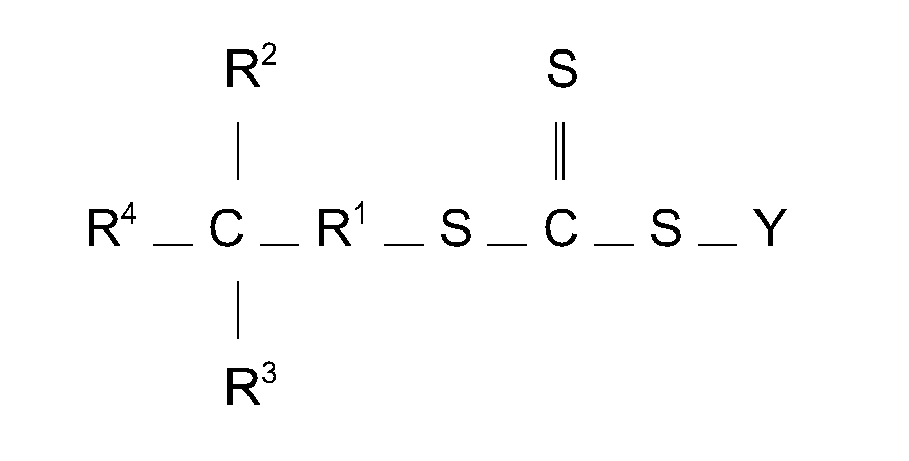
- The method of claim 2 wherein Y represents a functional group selected from the group consisting -C(R')2CN, -C(CH3)2Ar, -C(CH3)2COOR", -C(CH3)2CONHR", -C(CH3)2CH2C(CH3), -CH(CH3)Ar, -CH2Ar, -C(CH3)3, -CR'2COOH, -C(R')(CN)-(CH2)n-COOH, and -C(R')(CN)-(CH2)n-OH; wherein R' represents a linear or branched hydrocarbon containing from 1 to 12 carbon atoms; wherein Ar represents an unsubstituted or substituted phenyl, napthyl, anthracenyl, pyrenyl or pyridyl group; and wherein n represents an integer from 1 to 8.
- The method of claims 2, wherein R1 is (CH2)m where m ranges from 1 to 4; and/or Y represents a function group selected from the group consisting of benzyl, picolyl, and t-butyl.
- The method of claim 2, wherein R1 is (CH2)9, R2 and R3 are hydrogen, R4 is -COOH, Y is benzyl, and the free radical control agent is S-benzyl-S'-(11-undecanoic acid) trithiocarbonate.
- The method of claim 2, wherein R1 is CH2, R2 is (CH2)8, R3 is hydrogen, R4 is -OH, Y is benzyl, and the free radical control agent is S-benzyl-S'-(2-hydroxydecyl) trithiocarbonate.
- The method of claim 2, wherein R1 is CH2, R2 is (CH2)8, R3 is hydrogen, R4 is -OH, Y is 4-picolyl, and the free radical control agent is S-(4-Picolyl)-S'-(2-hydroxydecyl) trithiocarbonate.
- The method of claim 2, wherein the at least one monomer is butadiene and the amphiphilic block copolymer is poly(4-vinylpyridene-b-butadiene); or wherein the at least one monomer comprises butadiene and styrene and the amphiphilic block copolymer is poly (4-vinylpyridene-b-styrenebutadiene).
- The method of claim 1 wherein the amphiphilic block copolymer is in the form of a stable latex that does not contain additional surfactant.
- A polymer produced using the method of claim 1, wherein the monomer is selected from the group consisting of styrene, substituted styrene, alkyl acrylate, substituted alkyl acrylate, alkyl methacrylate, substituted alkyl methacrylate, acrylonitrile, methacrylonitrile, acrylamide, methacrylamide, N-alkylacrylamide, N-alkylmethacrylamide, N,N-dialkylacrylamide, N,N-dialkylmethacrylamide, isoprene, 1,3-butadiene, ethylene, vinyl acetate, vinyl chloride, and vinylidene chloride.
- A tire comprising the polymer of claim 10.
Applications Claiming Priority (1)
| Application Number | Priority Date | Filing Date | Title |
|---|---|---|---|
| US75313205P | 2005-12-22 | 2005-12-22 |
Publications (1)
| Publication Number | Publication Date |
|---|---|
| EP1801137A1 true EP1801137A1 (en) | 2007-06-27 |
Family
ID=37857173
Family Applications (1)
| Application Number | Title | Priority Date | Filing Date |
|---|---|---|---|
| EP06126183A Withdrawn EP1801137A1 (en) | 2005-12-22 | 2006-12-14 | Surfactantless synthesis of amphiphilic cationic block copolymers |
Country Status (4)
| Country | Link |
|---|---|
| US (1) | US7671152B2 (en) |
| EP (1) | EP1801137A1 (en) |
| JP (1) | JP2007169636A (en) |
| BR (1) | BRPI0605279A (en) |
Cited By (14)
| Publication number | Priority date | Publication date | Assignee | Title |
|---|---|---|---|---|
| WO2009090253A1 (en) * | 2008-01-17 | 2009-07-23 | Dsm Ip Assets B.V. | Solvent borne crosslinkable block copolymers obtained using raft |
| WO2009090252A1 (en) * | 2008-01-17 | 2009-07-23 | Dsm Ip Assets B.V. | Water borne crosslinkable block copolymers obtained using raft |
| FR2931154A1 (en) * | 2008-05-14 | 2009-11-20 | Univ Paris Curie | AMPHIPHILIC BLOCK COPOLYMER, PROCESS FOR ITS PREPARATION |
| CN102746474A (en) * | 2012-08-27 | 2012-10-24 | 同济大学 | Preparation method of temperature and pH sensitive shell cross-linked polymeric micelle |
| CN103073466A (en) * | 2012-12-21 | 2013-05-01 | 江西科技师范大学 | Cardanol trithiocarbonate and synthesis method and application thereof |
| CN103172871A (en) * | 2011-12-21 | 2013-06-26 | 固特异轮胎和橡胶公司 | Rubber composition and pneumatic tire |
| EP2735451A1 (en) * | 2012-11-27 | 2014-05-28 | The Goodyear Tire & Rubber Company | Polymer blend and article of manufacture such as a tire comprising such a blend |
| CN104262217A (en) * | 2014-09-25 | 2015-01-07 | 陕西师范大学 | Trithio-bis(pentafluorobenzyl) carbonate as well as preparation method and application thereof |
| CN104844746A (en) * | 2015-05-05 | 2015-08-19 | 南开大学 | Water-soluble polymer with multi-stimulative-responsibility and preparation method thereof |
| CN105294524A (en) * | 2015-11-11 | 2016-02-03 | 陕西师范大学 | Dithiocarboxylic acid pentafluorobenzyl ester, preparation method and application thereof |
| WO2018089810A1 (en) * | 2016-11-10 | 2018-05-17 | Regents Of The University Of Minnesota | Surfactants and methods for making same |
| CN113831484A (en) * | 2021-08-16 | 2021-12-24 | 宇昂科技有限公司 | VP block copolymer and preparation method and application thereof |
| CN114195962A (en) * | 2021-12-29 | 2022-03-18 | 三明学院 | Amphiphilic fluorine-containing block polymer and preparation method and application thereof |
| CN119463200A (en) * | 2024-11-12 | 2025-02-18 | 复旦大学 | Preparation method, product and application of dandelion-shaped single-chain particles |
Families Citing this family (15)
| Publication number | Priority date | Publication date | Assignee | Title |
|---|---|---|---|---|
| US7625985B1 (en) * | 2005-12-22 | 2009-12-01 | The Goodyear Tire & Rubber Company | Water-based process for the preparation of polymer-clay nanocomposites |
| US7230063B1 (en) * | 2005-12-22 | 2007-06-12 | The Goodyear Tire & Rubber Company | Functional trithiocarbonate RAFT agents |
| DE102007006492A1 (en) | 2007-02-09 | 2008-08-14 | Bayer Materialscience Ag | UV-curable dispersions based on polyisocyanates |
| NO20084094L (en) * | 2007-11-29 | 2009-06-02 | Rohm & Haas | Compositions comprising aqueous emulsion copolymer |
| KR101750907B1 (en) | 2008-03-20 | 2017-06-27 | 애버리 데니슨 코포레이션 | Acrylic polymers having controlled placement of functional groups |
| JP5334157B2 (en) * | 2008-07-01 | 2013-11-06 | ハイモ株式会社 | Block copolymer, viscosity modifier and coagulant aid |
| JP5252492B2 (en) * | 2008-09-01 | 2013-07-31 | 国立大学法人福井大学 | Production method of block copolymer |
| US9309329B2 (en) * | 2010-04-07 | 2016-04-12 | Arkema Inc. | Method for preparing pH-insensitive surfactant free polymer particle dispersion in aqueous medium |
| KR101849686B1 (en) * | 2010-05-19 | 2018-04-17 | 애버리 데니슨 코포레이션 | Ordered architectures in acrylic polymers |
| KR101939108B1 (en) | 2011-10-14 | 2019-01-16 | 애버리 데니슨 코포레이션 | Controlled architecture polymers |
| US8759451B2 (en) | 2011-12-21 | 2014-06-24 | The Goodyear Tire & Rubber Company | Method of making a graft copolymer |
| US9133310B2 (en) | 2011-12-21 | 2015-09-15 | The Goodyear Tire & Rubber Company | Graft copolymer |
| EP2794695B1 (en) * | 2011-12-21 | 2016-03-16 | Solvay Sa | Process for the preparation of a vinylidene chloride polymer |
| US8536266B2 (en) | 2011-12-21 | 2013-09-17 | The Goodyear Tire & Rubber Company | Pneumatic tire |
| US8883884B2 (en) | 2012-11-27 | 2014-11-11 | The Goodyear Tire & Rubber Company | Pneumatic tire |
Citations (7)
| Publication number | Priority date | Publication date | Assignee | Title |
|---|---|---|---|---|
| US5763548A (en) * | 1995-03-31 | 1998-06-09 | Carnegie-Mellon University | (Co)polymers and a novel polymerization process based on atom (or group) transfer radical polymerization |
| US6162882A (en) * | 1996-07-10 | 2000-12-19 | Carnegie Mellon University | Preparation of novel homo- and copolymers using atom transfer radical polymerization |
| WO2001060792A1 (en) * | 2000-02-16 | 2001-08-23 | Noveon Ip Holdings Corp. | S,S'-BIS-(α,α'-DISUBSTITUTED-α'-ACETIC ACID)-TRITHIOCARBONATES AND DERIVATIVES AS INITIATOR - CHAIN TRANSFER AGENT - TERMINATOR FOR CONTROLLED RADICAL POLYMERIZATIONS AND THE PROCESS FOR MAKING THE SAME |
| WO2001077198A1 (en) | 2000-04-07 | 2001-10-18 | E.I. Dupont De Nemours And Company | Process of microgel synthesis and products produced therefrom |
| US6369158B1 (en) * | 1999-12-22 | 2002-04-09 | The Goodyear Tire & Rubber Company | Dibenzyltrithiocarbonate molecular weight regulator for emulsion polymerization |
| US20040073056A1 (en) * | 2000-02-16 | 2004-04-15 | Lai John Ta-Yuan | S-(alpha, alpha'-disubstituted-alpha"-acetic acid) substituted dithiocarbonate derivatives for controlled radical polymerizations, process and polymers made therefrom |
| WO2005113493A1 (en) * | 2004-05-12 | 2005-12-01 | E.I. Dupont De Nemours And Company | Synthesis of trithiocarbonate raft gents and intermediates thereof |
Family Cites Families (8)
| Publication number | Priority date | Publication date | Assignee | Title |
|---|---|---|---|---|
| US3916969A (en) * | 1973-10-26 | 1975-11-04 | Goodyear Tire & Rubber | Method of building a radial tire |
| FR2270268B1 (en) * | 1974-05-07 | 1978-04-21 | Anvar | |
| JP3431284B2 (en) * | 1993-06-30 | 2003-07-28 | 株式会社ブリヂストン | Method for producing block copolymer |
| DE60110903T2 (en) | 2000-03-31 | 2006-01-12 | Rhodia Inc. | POLYMERIZABLE COMPOUNDS AND THEIR USE |
| US6992156B2 (en) * | 2002-12-31 | 2006-01-31 | The Goodyear Tire & Rubber Company | Controlled polymerization |
| BRPI0408020A (en) * | 2003-03-03 | 2006-02-14 | Polymers Australia Pty Ltd | nanocomposite dispersing agents |
| DE10322830A1 (en) * | 2003-05-19 | 2004-12-09 | Tesa Ag | Process for the continuous production of polymers from vinyl compounds by bulk or solvent polymerization |
| US7625985B1 (en) * | 2005-12-22 | 2009-12-01 | The Goodyear Tire & Rubber Company | Water-based process for the preparation of polymer-clay nanocomposites |
-
2006
- 2006-10-19 US US11/583,424 patent/US7671152B2/en not_active Expired - Fee Related
- 2006-12-11 BR BRPI0605279-7A patent/BRPI0605279A/en not_active IP Right Cessation
- 2006-12-14 EP EP06126183A patent/EP1801137A1/en not_active Withdrawn
- 2006-12-19 JP JP2006340654A patent/JP2007169636A/en not_active Ceased
Patent Citations (8)
| Publication number | Priority date | Publication date | Assignee | Title |
|---|---|---|---|---|
| US5763548A (en) * | 1995-03-31 | 1998-06-09 | Carnegie-Mellon University | (Co)polymers and a novel polymerization process based on atom (or group) transfer radical polymerization |
| US6162882A (en) * | 1996-07-10 | 2000-12-19 | Carnegie Mellon University | Preparation of novel homo- and copolymers using atom transfer radical polymerization |
| US6369158B1 (en) * | 1999-12-22 | 2002-04-09 | The Goodyear Tire & Rubber Company | Dibenzyltrithiocarbonate molecular weight regulator for emulsion polymerization |
| WO2001060792A1 (en) * | 2000-02-16 | 2001-08-23 | Noveon Ip Holdings Corp. | S,S'-BIS-(α,α'-DISUBSTITUTED-α'-ACETIC ACID)-TRITHIOCARBONATES AND DERIVATIVES AS INITIATOR - CHAIN TRANSFER AGENT - TERMINATOR FOR CONTROLLED RADICAL POLYMERIZATIONS AND THE PROCESS FOR MAKING THE SAME |
| US20040073056A1 (en) * | 2000-02-16 | 2004-04-15 | Lai John Ta-Yuan | S-(alpha, alpha'-disubstituted-alpha"-acetic acid) substituted dithiocarbonate derivatives for controlled radical polymerizations, process and polymers made therefrom |
| US20050267274A1 (en) * | 2000-02-16 | 2005-12-01 | Lai John T | S,s' -bis-(alpha, alpha' - disubstituted - alpha' - acetic acid) - trithiocarbonates and derivatives as initiator - chain transfer agent - terminator for controlled radical polymerizations and the process for making the same |
| WO2001077198A1 (en) | 2000-04-07 | 2001-10-18 | E.I. Dupont De Nemours And Company | Process of microgel synthesis and products produced therefrom |
| WO2005113493A1 (en) * | 2004-05-12 | 2005-12-01 | E.I. Dupont De Nemours And Company | Synthesis of trithiocarbonate raft gents and intermediates thereof |
Cited By (28)
| Publication number | Priority date | Publication date | Assignee | Title |
|---|---|---|---|---|
| WO2009090252A1 (en) * | 2008-01-17 | 2009-07-23 | Dsm Ip Assets B.V. | Water borne crosslinkable block copolymers obtained using raft |
| US9567476B2 (en) | 2008-01-17 | 2017-02-14 | Dsm Ip Assets B.V. | Water-borne crosslinkable block copolymers obtained using raft |
| WO2009090253A1 (en) * | 2008-01-17 | 2009-07-23 | Dsm Ip Assets B.V. | Solvent borne crosslinkable block copolymers obtained using raft |
| FR2931154A1 (en) * | 2008-05-14 | 2009-11-20 | Univ Paris Curie | AMPHIPHILIC BLOCK COPOLYMER, PROCESS FOR ITS PREPARATION |
| WO2009147338A1 (en) * | 2008-05-14 | 2009-12-10 | Universite Pierre Et Marie Curie Paris Vi | Amphiphilic block copolymer and method for preparing same |
| US8598289B2 (en) | 2008-05-14 | 2013-12-03 | Universite Pierre Et Marie Curie | Amphiphilic block copolymer and method for preparing same |
| CN103172871B (en) * | 2011-12-21 | 2015-07-15 | 固特异轮胎和橡胶公司 | Rubber composition and pneumatic tire |
| CN103172871A (en) * | 2011-12-21 | 2013-06-26 | 固特异轮胎和橡胶公司 | Rubber composition and pneumatic tire |
| EP2610295A1 (en) * | 2011-12-21 | 2013-07-03 | The Goodyear Tire & Rubber Company | Rubber composition and pneumatic tire |
| CN102746474A (en) * | 2012-08-27 | 2012-10-24 | 同济大学 | Preparation method of temperature and pH sensitive shell cross-linked polymeric micelle |
| CN102746474B (en) * | 2012-08-27 | 2014-07-16 | 同济大学 | Preparation method of temperature and pH sensitive shell cross-linked polymeric micelle |
| EP2735451A1 (en) * | 2012-11-27 | 2014-05-28 | The Goodyear Tire & Rubber Company | Polymer blend and article of manufacture such as a tire comprising such a blend |
| US9133333B2 (en) | 2012-11-27 | 2015-09-15 | The Goodyear Tire & Rubber Company | Blend of a graft copolymer and a second polymer miscible with sidechains of the graft copolymer |
| CN103073466B (en) * | 2012-12-21 | 2014-10-29 | 江西科技师范大学 | Cardanol trithiocarbonate and synthesis method and application thereof |
| CN103073466A (en) * | 2012-12-21 | 2013-05-01 | 江西科技师范大学 | Cardanol trithiocarbonate and synthesis method and application thereof |
| CN104262217A (en) * | 2014-09-25 | 2015-01-07 | 陕西师范大学 | Trithio-bis(pentafluorobenzyl) carbonate as well as preparation method and application thereof |
| CN104262217B (en) * | 2014-09-25 | 2016-04-06 | 陕西师范大学 | Trithiocarbonic acid-two (PFBBR) ester and its preparation method and application |
| CN104844746A (en) * | 2015-05-05 | 2015-08-19 | 南开大学 | Water-soluble polymer with multi-stimulative-responsibility and preparation method thereof |
| CN104844746B (en) * | 2015-05-05 | 2017-03-29 | 南开大学 | A kind of water-soluble polymer with multiple stimulation response and preparation method thereof |
| CN105294524A (en) * | 2015-11-11 | 2016-02-03 | 陕西师范大学 | Dithiocarboxylic acid pentafluorobenzyl ester, preparation method and application thereof |
| CN105294524B (en) * | 2015-11-11 | 2017-10-20 | 陕西师范大学 | Carbodithioic acid PFBBR ester and its preparation method and application |
| WO2018089810A1 (en) * | 2016-11-10 | 2018-05-17 | Regents Of The University Of Minnesota | Surfactants and methods for making same |
| CN110267684A (en) * | 2016-11-10 | 2019-09-20 | 明尼苏达大学董事会 | Surfactant and its preparation method |
| CN113831484A (en) * | 2021-08-16 | 2021-12-24 | 宇昂科技有限公司 | VP block copolymer and preparation method and application thereof |
| CN113831484B (en) * | 2021-08-16 | 2024-04-02 | 宇昂科技有限公司 | VP block copolymer and preparation method and application thereof |
| CN114195962A (en) * | 2021-12-29 | 2022-03-18 | 三明学院 | Amphiphilic fluorine-containing block polymer and preparation method and application thereof |
| CN114195962B (en) * | 2021-12-29 | 2023-06-27 | 三明学院 | Amphiphilic fluorine-containing block polymer and preparation method and application thereof |
| CN119463200A (en) * | 2024-11-12 | 2025-02-18 | 复旦大学 | Preparation method, product and application of dandelion-shaped single-chain particles |
Also Published As
| Publication number | Publication date |
|---|---|
| US20070149709A1 (en) | 2007-06-28 |
| BRPI0605279A (en) | 2007-10-09 |
| US7671152B2 (en) | 2010-03-02 |
| JP2007169636A (en) | 2007-07-05 |
Similar Documents
| Publication | Publication Date | Title |
|---|---|---|
| US7671152B2 (en) | Surfactantless synthesis of amphiphilic cationic block copolymers | |
| US7767775B2 (en) | Controlled polymerization | |
| US7812108B2 (en) | Hydrogenation and epoxidation of polymers made by controlled polymerization | |
| US7230063B1 (en) | Functional trithiocarbonate RAFT agents | |
| US7064151B1 (en) | Process of microgel synthesis and products produced therefrom | |
| KR100796053B1 (en) | Microgel Synthesis Method and Products Produced therefrom | |
| US7635740B2 (en) | Method for radical emulsion polymerisation using hydrosoluble alkoxyamines | |
| Tajbakhsh et al. | Nitroxide-mediated miniemulsion polymerization of bio-based methacrylates | |
| RU2276161C2 (en) | Aqueous composition comprising chemical microgel bound with aqueous polymer | |
| WO2005047354A1 (en) | Process for producing homo-and co-polymers by raft emulsion polymerization | |
| US7462674B2 (en) | Oxathiazaphospholidine free radical control agent | |
| CN100354313C (en) | Controlled polymerization | |
| Apostolovic et al. | Ab initio emulsion polymerization by RAFT (reversible addition–fragmentation chain transfer) through the addition of cyclodextrins | |
| JP7465165B2 (en) | Method for producing aqueous dispersion of polymer-containing particles, and method for producing block polymer | |
| Lubnin et al. | RAFT emulsions, microemulsions and dispersions | |
| Simms | Living/controlled Polymerization Conducted in Aqueous Based Systems |
Legal Events
| Date | Code | Title | Description |
|---|---|---|---|
| PUAI | Public reference made under article 153(3) epc to a published international application that has entered the european phase |
Free format text: ORIGINAL CODE: 0009012 |
|
| AK | Designated contracting states |
Kind code of ref document: A1 Designated state(s): AT BE BG CH CY CZ DE DK EE ES FI FR GB GR HU IE IS IT LI LT LU LV MC NL PL PT RO SE SI SK TR |
|
| AX | Request for extension of the european patent |
Extension state: AL BA HR MK YU |
|
| 17P | Request for examination filed |
Effective date: 20071227 |
|
| AKX | Designation fees paid |
Designated state(s): DE FR GB IT |
|
| 17Q | First examination report despatched |
Effective date: 20080222 |
|
| STAA | Information on the status of an ep patent application or granted ep patent |
Free format text: STATUS: THE APPLICATION IS DEEMED TO BE WITHDRAWN |
|
| 18D | Application deemed to be withdrawn |
Effective date: 20100701 |