EP1801105A1 - Dibenzo[b]perhydroheterocyclic amines and lubricating oil compositions - Google Patents
Dibenzo[b]perhydroheterocyclic amines and lubricating oil compositions Download PDFInfo
- Publication number
- EP1801105A1 EP1801105A1 EP06256246A EP06256246A EP1801105A1 EP 1801105 A1 EP1801105 A1 EP 1801105A1 EP 06256246 A EP06256246 A EP 06256246A EP 06256246 A EP06256246 A EP 06256246A EP 1801105 A1 EP1801105 A1 EP 1801105A1
- Authority
- EP
- European Patent Office
- Prior art keywords
- compound according
- alkyl
- hydrogen
- carbon atoms
- oxygen
- Prior art date
- Legal status (The legal status is an assumption and is not a legal conclusion. Google has not performed a legal analysis and makes no representation as to the accuracy of the status listed.)
- Granted
Links
- 239000000203 mixture Substances 0.000 title claims abstract description 25
- 239000010687 lubricating oil Substances 0.000 title claims abstract description 17
- 150000001412 amines Chemical class 0.000 title claims description 10
- UZVGSSNIUNSOFA-UHFFFAOYSA-N dibenzofuran-1-carboxylic acid Chemical compound O1C2=CC=CC=C2C2=C1C=CC=C2C(=O)O UZVGSSNIUNSOFA-UHFFFAOYSA-N 0.000 title abstract description 14
- 150000001875 compounds Chemical class 0.000 claims abstract description 66
- 239000003921 oil Substances 0.000 claims abstract description 46
- 239000003963 antioxidant agent Substances 0.000 claims abstract description 14
- 230000003078 antioxidant effect Effects 0.000 claims abstract description 5
- 125000000217 alkyl group Chemical group 0.000 claims description 49
- 229910052727 yttrium Inorganic materials 0.000 claims description 45
- 239000001257 hydrogen Substances 0.000 claims description 42
- 229910052739 hydrogen Inorganic materials 0.000 claims description 42
- 229910052760 oxygen Inorganic materials 0.000 claims description 38
- IJGRMHOSHXDMSA-UHFFFAOYSA-N Atomic nitrogen Chemical compound N#N IJGRMHOSHXDMSA-UHFFFAOYSA-N 0.000 claims description 37
- QVGXLLKOCUKJST-UHFFFAOYSA-N atomic oxygen Chemical compound [O] QVGXLLKOCUKJST-UHFFFAOYSA-N 0.000 claims description 36
- 239000001301 oxygen Substances 0.000 claims description 36
- 125000004432 carbon atom Chemical group C* 0.000 claims description 33
- UFHFLCQGNIYNRP-UHFFFAOYSA-N Hydrogen Chemical compound [H][H] UFHFLCQGNIYNRP-UHFFFAOYSA-N 0.000 claims description 30
- 125000005842 heteroatom Chemical group 0.000 claims description 29
- 229910052757 nitrogen Inorganic materials 0.000 claims description 24
- 229910052717 sulfur Inorganic materials 0.000 claims description 24
- NINIDFKCEFEMDL-UHFFFAOYSA-N Sulfur Chemical compound [S] NINIDFKCEFEMDL-UHFFFAOYSA-N 0.000 claims description 20
- 239000011593 sulfur Substances 0.000 claims description 20
- 125000004435 hydrogen atom Chemical group [H]* 0.000 claims description 12
- 230000001050 lubricating effect Effects 0.000 claims description 12
- QGZKDVFQNNGYKY-UHFFFAOYSA-O ammonium group Chemical group [NH4+] QGZKDVFQNNGYKY-UHFFFAOYSA-O 0.000 claims description 6
- MCQWYERVNYSOPT-UHFFFAOYSA-N n-quinolin-6-ylquinolin-8-amine Chemical group C1=CN=C2C(NC=3C=C4C=CC=NC4=CC=3)=CC=CC2=C1 MCQWYERVNYSOPT-UHFFFAOYSA-N 0.000 claims description 4
- WFJQAQAUTNJPRF-UHFFFAOYSA-N n-(1,2,3,4-tetrahydroquinolin-6-yl)-1,2,3,4-tetrahydroquinolin-8-amine Chemical group N1CCCC2=CC(NC3=CC=CC4=C3NCCC4)=CC=C21 WFJQAQAUTNJPRF-UHFFFAOYSA-N 0.000 claims description 3
- GLBZKSWYHQKJPJ-UHFFFAOYSA-N n-(1,3-benzodioxol-5-yl)-1,3-benzodioxol-5-amine Chemical group C1=C2OCOC2=CC(NC2=CC=C3OCOC3=C2)=C1 GLBZKSWYHQKJPJ-UHFFFAOYSA-N 0.000 claims description 3
- KJCJZULWRAZGNB-UHFFFAOYSA-N n-(2,3-dihydro-1-benzofuran-5-yl)-2,3-dihydro-1-benzofuran-5-amine Chemical group C1=C2OCCC2=CC(NC=2C=C3CCOC3=CC=2)=C1 KJCJZULWRAZGNB-UHFFFAOYSA-N 0.000 claims description 3
- -1 amine compounds Chemical class 0.000 abstract description 44
- 239000012760 heat stabilizer Substances 0.000 abstract description 3
- 239000004611 light stabiliser Substances 0.000 abstract description 3
- 239000003381 stabilizer Substances 0.000 abstract description 3
- 235000019198 oils Nutrition 0.000 description 43
- 239000002199 base oil Substances 0.000 description 28
- XEKOWRVHYACXOJ-UHFFFAOYSA-N Ethyl acetate Chemical compound CCOC(C)=O XEKOWRVHYACXOJ-UHFFFAOYSA-N 0.000 description 27
- 238000000034 method Methods 0.000 description 20
- VLKZOEOYAKHREP-UHFFFAOYSA-N n-Hexane Chemical compound CCCCCC VLKZOEOYAKHREP-UHFFFAOYSA-N 0.000 description 15
- 238000007254 oxidation reaction Methods 0.000 description 14
- 239000000047 product Substances 0.000 description 14
- 230000003647 oxidation Effects 0.000 description 13
- VYPSYNLAJGMNEJ-UHFFFAOYSA-N Silicium dioxide Chemical compound O=[Si]=O VYPSYNLAJGMNEJ-UHFFFAOYSA-N 0.000 description 12
- 239000007787 solid Substances 0.000 description 12
- 238000006243 chemical reaction Methods 0.000 description 11
- DMBHHRLKUKUOEG-UHFFFAOYSA-N diphenylamine Chemical compound C=1C=CC=CC=1NC1=CC=CC=C1 DMBHHRLKUKUOEG-UHFFFAOYSA-N 0.000 description 11
- 150000002430 hydrocarbons Chemical class 0.000 description 11
- HEDRZPFGACZZDS-MICDWDOJSA-N Trichloro(2H)methane Chemical compound [2H]C(Cl)(Cl)Cl HEDRZPFGACZZDS-MICDWDOJSA-N 0.000 description 10
- 125000000623 heterocyclic group Chemical group 0.000 description 10
- 229930195733 hydrocarbon Natural products 0.000 description 10
- 239000003112 inhibitor Substances 0.000 description 10
- 239000000741 silica gel Substances 0.000 description 10
- 229910002027 silica gel Inorganic materials 0.000 description 10
- YMWUJEATGCHHMB-UHFFFAOYSA-N Dichloromethane Chemical compound ClCCl YMWUJEATGCHHMB-UHFFFAOYSA-N 0.000 description 9
- YXFVVABEGXRONW-UHFFFAOYSA-N Toluene Chemical compound CC1=CC=CC=C1 YXFVVABEGXRONW-UHFFFAOYSA-N 0.000 description 9
- 230000015572 biosynthetic process Effects 0.000 description 9
- 230000008569 process Effects 0.000 description 9
- 238000003786 synthesis reaction Methods 0.000 description 9
- 150000002148 esters Chemical class 0.000 description 8
- 230000009467 reduction Effects 0.000 description 8
- 239000004215 Carbon black (E152) Substances 0.000 description 7
- 229920003171 Poly (ethylene oxide) Polymers 0.000 description 7
- CYPYTURSJDMMMP-WVCUSYJESA-N (1e,4e)-1,5-diphenylpenta-1,4-dien-3-one;palladium Chemical compound [Pd].[Pd].C=1C=CC=CC=1\C=C\C(=O)\C=C\C1=CC=CC=C1.C=1C=CC=CC=1\C=C\C(=O)\C=C\C1=CC=CC=C1.C=1C=CC=CC=1\C=C\C(=O)\C=C\C1=CC=CC=C1 CYPYTURSJDMMMP-WVCUSYJESA-N 0.000 description 6
- LBUJPTNKIBCYBY-UHFFFAOYSA-N 1,2,3,4-tetrahydroquinoline Chemical compound C1=CC=C2CCCNC2=C1 LBUJPTNKIBCYBY-UHFFFAOYSA-N 0.000 description 6
- QTBSBXVTEAMEQO-UHFFFAOYSA-N Acetic acid Chemical compound CC(O)=O QTBSBXVTEAMEQO-UHFFFAOYSA-N 0.000 description 6
- HEMHJVSKTPXQMS-UHFFFAOYSA-M Sodium hydroxide Chemical compound [OH-].[Na+] HEMHJVSKTPXQMS-UHFFFAOYSA-M 0.000 description 6
- 239000000654 additive Substances 0.000 description 6
- 230000000052 comparative effect Effects 0.000 description 6
- 229920000642 polymer Polymers 0.000 description 6
- 238000002360 preparation method Methods 0.000 description 6
- MFRIHAYPQRLWNB-UHFFFAOYSA-N sodium tert-butoxide Chemical compound [Na+].CC(C)(C)[O-] MFRIHAYPQRLWNB-UHFFFAOYSA-N 0.000 description 6
- KZNICNPSHKQLFF-UHFFFAOYSA-N succinimide Chemical compound O=C1CCC(=O)N1 KZNICNPSHKQLFF-UHFFFAOYSA-N 0.000 description 6
- 238000005160 1H NMR spectroscopy Methods 0.000 description 5
- 239000003054 catalyst Substances 0.000 description 5
- 238000006388 chemical passivation reaction Methods 0.000 description 5
- 238000005859 coupling reaction Methods 0.000 description 5
- 230000000977 initiatory effect Effects 0.000 description 5
- 239000000314 lubricant Substances 0.000 description 5
- MWUXSHHQAYIFBG-UHFFFAOYSA-N nitrogen oxide Inorganic materials O=[N] MWUXSHHQAYIFBG-UHFFFAOYSA-N 0.000 description 5
- 229920013639 polyalphaolefin Polymers 0.000 description 5
- 150000003254 radicals Chemical class 0.000 description 5
- 239000010689 synthetic lubricating oil Substances 0.000 description 5
- 239000001993 wax Substances 0.000 description 5
- MHAJPDPJQMAIIY-UHFFFAOYSA-N Hydrogen peroxide Chemical compound OO MHAJPDPJQMAIIY-UHFFFAOYSA-N 0.000 description 4
- 229940111121 antirheumatic drug quinolines Drugs 0.000 description 4
- 229920001577 copolymer Polymers 0.000 description 4
- 238000010168 coupling process Methods 0.000 description 4
- 125000005266 diarylamine group Chemical group 0.000 description 4
- 239000012530 fluid Substances 0.000 description 4
- 125000000524 functional group Chemical group 0.000 description 4
- 229910052751 metal Inorganic materials 0.000 description 4
- 239000002184 metal Substances 0.000 description 4
- 125000006239 protecting group Chemical group 0.000 description 4
- 150000003248 quinolines Chemical class 0.000 description 4
- 239000000243 solution Substances 0.000 description 4
- 239000002904 solvent Substances 0.000 description 4
- 125000001424 substituent group Chemical group 0.000 description 4
- 238000006467 substitution reaction Methods 0.000 description 4
- HBEDSQVIWPRPAY-UHFFFAOYSA-N 2,3-dihydrobenzofuran Chemical compound C1=CC=C2OCCC2=C1 HBEDSQVIWPRPAY-UHFFFAOYSA-N 0.000 description 3
- LFQSCWFLJHTTHZ-UHFFFAOYSA-N Ethanol Chemical compound CCO LFQSCWFLJHTTHZ-UHFFFAOYSA-N 0.000 description 3
- 150000001298 alcohols Chemical class 0.000 description 3
- 125000005605 benzo group Chemical group 0.000 description 3
- 239000003795 chemical substances by application Substances 0.000 description 3
- 230000008878 coupling Effects 0.000 description 3
- 235000014113 dietary fatty acids Nutrition 0.000 description 3
- 239000002270 dispersing agent Substances 0.000 description 3
- 238000004821 distillation Methods 0.000 description 3
- 230000032050 esterification Effects 0.000 description 3
- 238000005886 esterification reaction Methods 0.000 description 3
- 239000000194 fatty acid Substances 0.000 description 3
- 229930195729 fatty acid Natural products 0.000 description 3
- 238000009472 formulation Methods 0.000 description 3
- 229910052750 molybdenum Inorganic materials 0.000 description 3
- 239000011733 molybdenum Substances 0.000 description 3
- 125000004433 nitrogen atom Chemical group N* 0.000 description 3
- QJGQUHMNIGDVPM-UHFFFAOYSA-N nitrogen group Chemical group [N] QJGQUHMNIGDVPM-UHFFFAOYSA-N 0.000 description 3
- 239000012044 organic layer Substances 0.000 description 3
- 238000000746 purification Methods 0.000 description 3
- 239000000376 reactant Substances 0.000 description 3
- 238000010992 reflux Methods 0.000 description 3
- 230000006641 stabilisation Effects 0.000 description 3
- 238000011105 stabilization Methods 0.000 description 3
- 239000000758 substrate Substances 0.000 description 3
- 229960002317 succinimide Drugs 0.000 description 3
- 238000012360 testing method Methods 0.000 description 3
- 150000003530 tetrahydroquinolines Chemical class 0.000 description 3
- IRFSXVIRXMYULF-UHFFFAOYSA-N 1,2-dihydroquinoline Chemical class C1=CC=C2C=CCNC2=C1 IRFSXVIRXMYULF-UHFFFAOYSA-N 0.000 description 2
- FTNJQNQLEGKTGD-UHFFFAOYSA-N 1,3-benzodioxole Chemical compound C1=CC=C2OCOC2=C1 FTNJQNQLEGKTGD-UHFFFAOYSA-N 0.000 description 2
- BVUXDWXKPROUDO-UHFFFAOYSA-N 2,6-di-tert-butyl-4-ethylphenol Chemical compound CCC1=CC(C(C)(C)C)=C(O)C(C(C)(C)C)=C1 BVUXDWXKPROUDO-UHFFFAOYSA-N 0.000 description 2
- IUVCFHHAEHNCFT-INIZCTEOSA-N 2-[(1s)-1-[4-amino-3-(3-fluoro-4-propan-2-yloxyphenyl)pyrazolo[3,4-d]pyrimidin-1-yl]ethyl]-6-fluoro-3-(3-fluorophenyl)chromen-4-one Chemical compound C1=C(F)C(OC(C)C)=CC=C1C(C1=C(N)N=CN=C11)=NN1[C@@H](C)C1=C(C=2C=C(F)C=CC=2)C(=O)C2=CC(F)=CC=C2O1 IUVCFHHAEHNCFT-INIZCTEOSA-N 0.000 description 2
- SZAQZZKNQILGPU-UHFFFAOYSA-N 2-[1-(2-hydroxy-3,5-dimethylphenyl)-2-methylpropyl]-4,6-dimethylphenol Chemical compound C=1C(C)=CC(C)=C(O)C=1C(C(C)C)C1=CC(C)=CC(C)=C1O SZAQZZKNQILGPU-UHFFFAOYSA-N 0.000 description 2
- RYGMFSIKBFXOCR-UHFFFAOYSA-N Copper Chemical compound [Cu] RYGMFSIKBFXOCR-UHFFFAOYSA-N 0.000 description 2
- RTZKZFJDLAIYFH-UHFFFAOYSA-N Diethyl ether Chemical compound CCOCC RTZKZFJDLAIYFH-UHFFFAOYSA-N 0.000 description 2
- XEEYBQQBJWHFJM-UHFFFAOYSA-N Iron Chemical compound [Fe] XEEYBQQBJWHFJM-UHFFFAOYSA-N 0.000 description 2
- 239000005909 Kieselgur Substances 0.000 description 2
- CSNNHWWHGAXBCP-UHFFFAOYSA-L Magnesium sulfate Chemical compound [Mg+2].[O-][S+2]([O-])([O-])[O-] CSNNHWWHGAXBCP-UHFFFAOYSA-L 0.000 description 2
- ZOKXTWBITQBERF-UHFFFAOYSA-N Molybdenum Chemical compound [Mo] ZOKXTWBITQBERF-UHFFFAOYSA-N 0.000 description 2
- KDLHZDBZIXYQEI-UHFFFAOYSA-N Palladium Chemical compound [Pd] KDLHZDBZIXYQEI-UHFFFAOYSA-N 0.000 description 2
- ISWSIDIOOBJBQZ-UHFFFAOYSA-N Phenol Chemical compound OC1=CC=CC=C1 ISWSIDIOOBJBQZ-UHFFFAOYSA-N 0.000 description 2
- SMWDFEZZVXVKRB-UHFFFAOYSA-N Quinoline Chemical compound N1=CC=CC2=CC=CC=C21 SMWDFEZZVXVKRB-UHFFFAOYSA-N 0.000 description 2
- 239000002253 acid Substances 0.000 description 2
- 239000008186 active pharmaceutical agent Substances 0.000 description 2
- YKIOKAURTKXMSB-UHFFFAOYSA-N adams's catalyst Chemical compound O=[Pt]=O YKIOKAURTKXMSB-UHFFFAOYSA-N 0.000 description 2
- 230000000996 additive effect Effects 0.000 description 2
- 239000008346 aqueous phase Substances 0.000 description 2
- 238000006701 autoxidation reaction Methods 0.000 description 2
- MUALRAIOVNYAIW-UHFFFAOYSA-N binap Chemical group C1=CC=CC=C1P(C=1C(=C2C=CC=CC2=CC=1)C=1C2=CC=CC=C2C=CC=1P(C=1C=CC=CC=1)C=1C=CC=CC=1)C1=CC=CC=C1 MUALRAIOVNYAIW-UHFFFAOYSA-N 0.000 description 2
- 239000012267 brine Substances 0.000 description 2
- DKVNPHBNOWQYFE-UHFFFAOYSA-N carbamodithioic acid Chemical compound NC(S)=S DKVNPHBNOWQYFE-UHFFFAOYSA-N 0.000 description 2
- 230000015556 catabolic process Effects 0.000 description 2
- 238000004517 catalytic hydrocracking Methods 0.000 description 2
- 239000003153 chemical reaction reagent Substances 0.000 description 2
- 238000003776 cleavage reaction Methods 0.000 description 2
- 239000003245 coal Substances 0.000 description 2
- 229910052802 copper Inorganic materials 0.000 description 2
- 239000010949 copper Substances 0.000 description 2
- 125000004856 decahydroquinolinyl group Chemical group N1(CCCC2CCCCC12)* 0.000 description 2
- 230000001419 dependent effect Effects 0.000 description 2
- 239000003599 detergent Substances 0.000 description 2
- 150000001991 dicarboxylic acids Chemical class 0.000 description 2
- LTYMSROWYAPPGB-UHFFFAOYSA-N diphenyl sulfide Chemical class C=1C=CC=CC=1SC1=CC=CC=C1 LTYMSROWYAPPGB-UHFFFAOYSA-N 0.000 description 2
- 239000012990 dithiocarbamate Substances 0.000 description 2
- 239000010696 ester oil Substances 0.000 description 2
- 150000004665 fatty acids Chemical class 0.000 description 2
- 238000005984 hydrogenation reaction Methods 0.000 description 2
- 150000002432 hydroperoxides Chemical class 0.000 description 2
- 230000006872 improvement Effects 0.000 description 2
- 239000000543 intermediate Substances 0.000 description 2
- 150000002576 ketones Chemical class 0.000 description 2
- 239000010410 layer Substances 0.000 description 2
- 239000003607 modifier Substances 0.000 description 2
- RVJJZHKQWHETKL-UHFFFAOYSA-N n-(1,2,3,4-tetrahydroquinolin-8-yl)-1,2,3,4-tetrahydroquinolin-8-amine Chemical compound C1CCNC2=C1C=CC=C2NC1=CC=CC2=C1NCCC2 RVJJZHKQWHETKL-UHFFFAOYSA-N 0.000 description 2
- 125000004430 oxygen atom Chemical group O* 0.000 description 2
- 239000003208 petroleum Substances 0.000 description 2
- 238000006116 polymerization reaction Methods 0.000 description 2
- 229920005862 polyol Polymers 0.000 description 2
- 230000007017 scission Effects 0.000 description 2
- 229910000033 sodium borohydride Inorganic materials 0.000 description 2
- 239000012279 sodium borohydride Substances 0.000 description 2
- HPALAKNZSZLMCH-UHFFFAOYSA-M sodium;chloride;hydrate Chemical compound O.[Na+].[Cl-] HPALAKNZSZLMCH-UHFFFAOYSA-M 0.000 description 2
- 239000000126 substance Substances 0.000 description 2
- XLYOFNOQVPJJNP-UHFFFAOYSA-N water Substances O XLYOFNOQVPJJNP-UHFFFAOYSA-N 0.000 description 2
- FFJCNSLCJOQHKM-CLFAGFIQSA-N (z)-1-[(z)-octadec-9-enoxy]octadec-9-ene Chemical compound CCCCCCCC\C=C/CCCCCCCCOCCCCCCCC\C=C/CCCCCCCC FFJCNSLCJOQHKM-CLFAGFIQSA-N 0.000 description 1
- KZPYGQFFRCFCPP-UHFFFAOYSA-N 1,1'-bis(diphenylphosphino)ferrocene Chemical compound [Fe+2].C1=CC=C[C-]1P(C=1C=CC=CC=1)C1=CC=CC=C1.C1=CC=C[C-]1P(C=1C=CC=CC=1)C1=CC=CC=C1 KZPYGQFFRCFCPP-UHFFFAOYSA-N 0.000 description 1
- SSEWGJUYSOIDMK-UHFFFAOYSA-N 1,2,3,4-tetrahydroquinolin-6-amine Chemical compound N1CCCC2=CC(N)=CC=C21 SSEWGJUYSOIDMK-UHFFFAOYSA-N 0.000 description 1
- XGNXYCFREOZBOL-UHFFFAOYSA-N 1,3-benzodioxol-5-amine Chemical compound NC1=CC=C2OCOC2=C1 XGNXYCFREOZBOL-UHFFFAOYSA-N 0.000 description 1
- AIUOUEPKBRDPLG-UHFFFAOYSA-N 1,3-benzoxathiole Chemical compound C1=CC=C2SCOC2=C1 AIUOUEPKBRDPLG-UHFFFAOYSA-N 0.000 description 1
- LDVVTQMJQSCDMK-UHFFFAOYSA-N 1,3-dihydroxypropan-2-yl formate Chemical compound OCC(CO)OC=O LDVVTQMJQSCDMK-UHFFFAOYSA-N 0.000 description 1
- RUFPHBVGCFYCNW-UHFFFAOYSA-N 1-naphthylamine Chemical class C1=CC=C2C(N)=CC=CC2=C1 RUFPHBVGCFYCNW-UHFFFAOYSA-N 0.000 description 1
- KGRVJHAUYBGFFP-UHFFFAOYSA-N 2,2'-Methylenebis(4-methyl-6-tert-butylphenol) Chemical compound CC(C)(C)C1=CC(C)=CC(CC=2C(=C(C=C(C)C=2)C(C)(C)C)O)=C1O KGRVJHAUYBGFFP-UHFFFAOYSA-N 0.000 description 1
- QVXGKJYMVLJYCL-UHFFFAOYSA-N 2,3-di(nonyl)-N-phenylaniline Chemical compound C(CCCCCCCC)C=1C(=C(C=CC1)NC1=CC=CC=C1)CCCCCCCCC QVXGKJYMVLJYCL-UHFFFAOYSA-N 0.000 description 1
- WOHLSTOWRAOMSG-UHFFFAOYSA-N 2,3-dihydro-1,3-benzothiazole Chemical compound C1=CC=C2SCNC2=C1 WOHLSTOWRAOMSG-UHFFFAOYSA-N 0.000 description 1
- NHSOOAWURRKYMM-UHFFFAOYSA-N 2,3-dihydro-1,4-benzoxathiine Chemical compound C1=CC=C2OCCSC2=C1 NHSOOAWURRKYMM-UHFFFAOYSA-N 0.000 description 1
- YJMADHMYUJFMQE-UHFFFAOYSA-N 2,3-dihydro-1-benzofuran-5-amine Chemical compound NC1=CC=C2OCCC2=C1 YJMADHMYUJFMQE-UHFFFAOYSA-N 0.000 description 1
- FXNDIJDIPNCZQJ-UHFFFAOYSA-N 2,4,4-trimethylpent-1-ene Chemical compound CC(=C)CC(C)(C)C FXNDIJDIPNCZQJ-UHFFFAOYSA-N 0.000 description 1
- OPLCSTZDXXUYDU-UHFFFAOYSA-N 2,4-dimethyl-6-tert-butylphenol Chemical compound CC1=CC(C)=C(O)C(C(C)(C)C)=C1 OPLCSTZDXXUYDU-UHFFFAOYSA-N 0.000 description 1
- GSOYMOAPJZYXTB-UHFFFAOYSA-N 2,6-ditert-butyl-4-(3,5-ditert-butyl-4-hydroxyphenyl)phenol Chemical compound CC(C)(C)C1=C(O)C(C(C)(C)C)=CC(C=2C=C(C(O)=C(C=2)C(C)(C)C)C(C)(C)C)=C1 GSOYMOAPJZYXTB-UHFFFAOYSA-N 0.000 description 1
- QHPKIUDQDCWRKO-UHFFFAOYSA-N 2,6-ditert-butyl-4-[2-(3,5-ditert-butyl-4-hydroxyphenyl)propan-2-yl]phenol Chemical compound CC(C)(C)C1=C(O)C(C(C)(C)C)=CC(C(C)(C)C=2C=C(C(O)=C(C=2)C(C)(C)C)C(C)(C)C)=C1 QHPKIUDQDCWRKO-UHFFFAOYSA-N 0.000 description 1
- XQESJWNDTICJHW-UHFFFAOYSA-N 2-[(2-hydroxy-5-methyl-3-nonylphenyl)methyl]-4-methyl-6-nonylphenol Chemical compound CCCCCCCCCC1=CC(C)=CC(CC=2C(=C(CCCCCCCCC)C=C(C)C=2)O)=C1O XQESJWNDTICJHW-UHFFFAOYSA-N 0.000 description 1
- FUIQBJHUESBZNU-UHFFFAOYSA-N 2-[(dimethylazaniumyl)methyl]phenolate Chemical compound CN(C)CC1=CC=CC=C1O FUIQBJHUESBZNU-UHFFFAOYSA-N 0.000 description 1
- AKNMPWVTPUHKCG-UHFFFAOYSA-N 2-cyclohexyl-6-[(3-cyclohexyl-2-hydroxy-5-methylphenyl)methyl]-4-methylphenol Chemical compound OC=1C(C2CCCCC2)=CC(C)=CC=1CC(C=1O)=CC(C)=CC=1C1CCCCC1 AKNMPWVTPUHKCG-UHFFFAOYSA-N 0.000 description 1
- MUHFRORXWCGZGE-KTKRTIGZSA-N 2-hydroxyethyl (z)-octadec-9-enoate Chemical compound CCCCCCCC\C=C/CCCCCCCC(=O)OCCO MUHFRORXWCGZGE-KTKRTIGZSA-N 0.000 description 1
- YFHKLSPMRRWLKI-UHFFFAOYSA-N 2-tert-butyl-4-(3-tert-butyl-4-hydroxy-5-methylphenyl)sulfanyl-6-methylphenol Chemical compound CC(C)(C)C1=C(O)C(C)=CC(SC=2C=C(C(O)=C(C)C=2)C(C)(C)C)=C1 YFHKLSPMRRWLKI-UHFFFAOYSA-N 0.000 description 1
- BGWNOSDEHSHFFI-UHFFFAOYSA-N 2-tert-butyl-4-[(3-tert-butyl-4-hydroxy-5-methylphenyl)methylsulfanylmethyl]-6-methylphenol Chemical compound CC(C)(C)C1=C(O)C(C)=CC(CSCC=2C=C(C(O)=C(C)C=2)C(C)(C)C)=C1 BGWNOSDEHSHFFI-UHFFFAOYSA-N 0.000 description 1
- PFANXOISJYKQRP-UHFFFAOYSA-N 2-tert-butyl-4-[1-(5-tert-butyl-4-hydroxy-2-methylphenyl)butyl]-5-methylphenol Chemical compound C=1C(C(C)(C)C)=C(O)C=C(C)C=1C(CCC)C1=CC(C(C)(C)C)=C(O)C=C1C PFANXOISJYKQRP-UHFFFAOYSA-N 0.000 description 1
- MQWCQFCZUNBTCM-UHFFFAOYSA-N 2-tert-butyl-6-(3-tert-butyl-2-hydroxy-5-methylphenyl)sulfanyl-4-methylphenol Chemical compound CC(C)(C)C1=CC(C)=CC(SC=2C(=C(C=C(C)C=2)C(C)(C)C)O)=C1O MQWCQFCZUNBTCM-UHFFFAOYSA-N 0.000 description 1
- BKZXZGWHTRCFPX-UHFFFAOYSA-N 2-tert-butyl-6-methylphenol Chemical compound CC1=CC=CC(C(C)(C)C)=C1O BKZXZGWHTRCFPX-UHFFFAOYSA-N 0.000 description 1
- YBBLSBDJIKMXNQ-UHFFFAOYSA-N 3,4-dihydro-2h-1,4-benzothiazine Chemical compound C1=CC=C2NCCSC2=C1 YBBLSBDJIKMXNQ-UHFFFAOYSA-N 0.000 description 1
- YRLORWPBJZEGBX-UHFFFAOYSA-N 3,4-dihydro-2h-1,4-benzoxazine Chemical compound C1=CC=C2NCCOC2=C1 YRLORWPBJZEGBX-UHFFFAOYSA-N 0.000 description 1
- MDWVSAYEQPLWMX-UHFFFAOYSA-N 4,4'-Methylenebis(2,6-di-tert-butylphenol) Chemical compound CC(C)(C)C1=C(O)C(C(C)(C)C)=CC(CC=2C=C(C(O)=C(C=2)C(C)(C)C)C(C)(C)C)=C1 MDWVSAYEQPLWMX-UHFFFAOYSA-N 0.000 description 1
- FBOYMIDCHINJKC-UHFFFAOYSA-N 5-bromo-1,3-benzodioxole Chemical compound BrC1=CC=C2OCOC2=C1 FBOYMIDCHINJKC-UHFFFAOYSA-N 0.000 description 1
- UDWFSJAYXTXMLM-UHFFFAOYSA-N 5-bromo-2,3-dihydro-1-benzofuran Chemical compound BrC1=CC=C2OCCC2=C1 UDWFSJAYXTXMLM-UHFFFAOYSA-N 0.000 description 1
- 125000004070 6 membered heterocyclic group Chemical group 0.000 description 1
- IFIHYLCUKYCKRH-UHFFFAOYSA-N 6-bromoquinoline Chemical compound N1=CC=CC2=CC(Br)=CC=C21 IFIHYLCUKYCKRH-UHFFFAOYSA-N 0.000 description 1
- WREVVZMUNPAPOV-UHFFFAOYSA-N 8-aminoquinoline Chemical compound C1=CN=C2C(N)=CC=CC2=C1 WREVVZMUNPAPOV-UHFFFAOYSA-N 0.000 description 1
- LSNNMFCWUKXFEE-UHFFFAOYSA-M Bisulfite Chemical compound OS([O-])=O LSNNMFCWUKXFEE-UHFFFAOYSA-M 0.000 description 1
- NLZUEZXRPGMBCV-UHFFFAOYSA-N Butylhydroxytoluene Chemical compound CC1=CC(C(C)(C)C)=C(O)C(C(C)(C)C)=C1 NLZUEZXRPGMBCV-UHFFFAOYSA-N 0.000 description 1
- OYPRJOBELJOOCE-UHFFFAOYSA-N Calcium Chemical compound [Ca] OYPRJOBELJOOCE-UHFFFAOYSA-N 0.000 description 1
- UGFAIRIUMAVXCW-UHFFFAOYSA-N Carbon monoxide Chemical compound [O+]#[C-] UGFAIRIUMAVXCW-UHFFFAOYSA-N 0.000 description 1
- HBEMHMNHYDTVRE-UHFFFAOYSA-N ClC(CCCCCCCCCCCCCCCCC(=O)OC)(Cl)Cl Chemical compound ClC(CCCCCCCCCCCCCCCCC(=O)OC)(Cl)Cl HBEMHMNHYDTVRE-UHFFFAOYSA-N 0.000 description 1
- FBPFZTCFMRRESA-FSIIMWSLSA-N D-Glucitol Natural products OC[C@H](O)[C@H](O)[C@@H](O)[C@H](O)CO FBPFZTCFMRRESA-FSIIMWSLSA-N 0.000 description 1
- MYMOFIZGZYHOMD-UHFFFAOYSA-N Dioxygen Chemical group O=O MYMOFIZGZYHOMD-UHFFFAOYSA-N 0.000 description 1
- VGGSQFUCUMXWEO-UHFFFAOYSA-N Ethene Chemical compound C=C VGGSQFUCUMXWEO-UHFFFAOYSA-N 0.000 description 1
- 239000005977 Ethylene Substances 0.000 description 1
- KMTRUDSVKNLOMY-UHFFFAOYSA-N Ethylene carbonate Chemical compound O=C1OCCO1 KMTRUDSVKNLOMY-UHFFFAOYSA-N 0.000 description 1
- IAYPIBMASNFSPL-UHFFFAOYSA-N Ethylene oxide Chemical compound C1CO1 IAYPIBMASNFSPL-UHFFFAOYSA-N 0.000 description 1
- 241000337544 Limnoriidae Species 0.000 description 1
- XQVWYOYUZDUNRW-UHFFFAOYSA-N N-Phenyl-1-naphthylamine Chemical compound C=1C=CC2=CC=CC=C2C=1NC1=CC=CC=C1 XQVWYOYUZDUNRW-UHFFFAOYSA-N 0.000 description 1
- BPQQTUXANYXVAA-UHFFFAOYSA-N Orthosilicate Chemical compound [O-][Si]([O-])([O-])[O-] BPQQTUXANYXVAA-UHFFFAOYSA-N 0.000 description 1
- 241001061036 Otho Species 0.000 description 1
- 229910019142 PO4 Inorganic materials 0.000 description 1
- OAICVXFJPJFONN-UHFFFAOYSA-N Phosphorus Chemical compound [P] OAICVXFJPJFONN-UHFFFAOYSA-N 0.000 description 1
- 239000002202 Polyethylene glycol Substances 0.000 description 1
- 229920002367 Polyisobutene Polymers 0.000 description 1
- 230000002292 Radical scavenging effect Effects 0.000 description 1
- 235000019484 Rapeseed oil Nutrition 0.000 description 1
- XUIMIQQOPSSXEZ-UHFFFAOYSA-N Silicon Chemical compound [Si] XUIMIQQOPSSXEZ-UHFFFAOYSA-N 0.000 description 1
- 235000021355 Stearic acid Nutrition 0.000 description 1
- WYURNTSHIVDZCO-UHFFFAOYSA-N Tetrahydrofuran Chemical class C1CCOC1 WYURNTSHIVDZCO-UHFFFAOYSA-N 0.000 description 1
- ATJFFYVFTNAWJD-UHFFFAOYSA-N Tin Chemical compound [Sn] ATJFFYVFTNAWJD-UHFFFAOYSA-N 0.000 description 1
- HRKAMJBPFPHCSD-UHFFFAOYSA-N Tri-isobutylphosphate Chemical compound CC(C)COP(=O)(OCC(C)C)OCC(C)C HRKAMJBPFPHCSD-UHFFFAOYSA-N 0.000 description 1
- HCHKCACWOHOZIP-UHFFFAOYSA-N Zinc Chemical compound [Zn] HCHKCACWOHOZIP-UHFFFAOYSA-N 0.000 description 1
- WERKSKAQRVDLDW-ANOHMWSOSA-N [(2s,3r,4r,5r)-2,3,4,5,6-pentahydroxyhexyl] (z)-octadec-9-enoate Chemical compound CCCCCCCC\C=C/CCCCCCCC(=O)OC[C@H](O)[C@@H](O)[C@H](O)[C@H](O)CO WERKSKAQRVDLDW-ANOHMWSOSA-N 0.000 description 1
- 230000002378 acidificating effect Effects 0.000 description 1
- 150000007513 acids Chemical class 0.000 description 1
- 150000001299 aldehydes Chemical class 0.000 description 1
- 150000001336 alkenes Chemical class 0.000 description 1
- 125000003342 alkenyl group Chemical group 0.000 description 1
- 125000002877 alkyl aryl group Chemical group 0.000 description 1
- 150000004996 alkyl benzenes Chemical class 0.000 description 1
- 150000005215 alkyl ethers Chemical class 0.000 description 1
- 230000002152 alkylating effect Effects 0.000 description 1
- 125000002947 alkylene group Chemical group 0.000 description 1
- 150000001408 amides Chemical class 0.000 description 1
- 239000010775 animal oil Substances 0.000 description 1
- 239000013556 antirust agent Substances 0.000 description 1
- 150000004982 aromatic amines Chemical class 0.000 description 1
- 125000001769 aryl amino group Chemical group 0.000 description 1
- 125000003118 aryl group Chemical group 0.000 description 1
- 239000010426 asphalt Substances 0.000 description 1
- 239000012298 atmosphere Substances 0.000 description 1
- MXMZCLLIUQEKSN-UHFFFAOYSA-N benzimidazoline Chemical compound C1=CC=C2NCNC2=C1 MXMZCLLIUQEKSN-UHFFFAOYSA-N 0.000 description 1
- BNBQRQQYDMDJAH-UHFFFAOYSA-N benzodioxan Chemical compound C1=CC=C2OCCOC2=C1 BNBQRQQYDMDJAH-UHFFFAOYSA-N 0.000 description 1
- 239000004327 boric acid Substances 0.000 description 1
- 125000005619 boric acid group Chemical group 0.000 description 1
- 244000309464 bull Species 0.000 description 1
- 235000010354 butylated hydroxytoluene Nutrition 0.000 description 1
- 239000011575 calcium Substances 0.000 description 1
- 229910052791 calcium Inorganic materials 0.000 description 1
- 229910002091 carbon monoxide Inorganic materials 0.000 description 1
- 150000001733 carboxylic acid esters Chemical class 0.000 description 1
- 150000001735 carboxylic acids Chemical class 0.000 description 1
- 239000004359 castor oil Substances 0.000 description 1
- 238000009903 catalytic hydrogenation reaction Methods 0.000 description 1
- 239000007795 chemical reaction product Substances 0.000 description 1
- VZWXIQHBIQLMPN-UHFFFAOYSA-N chromane Chemical compound C1=CC=C2CCCOC2=C1 VZWXIQHBIQLMPN-UHFFFAOYSA-N 0.000 description 1
- 238000011109 contamination Methods 0.000 description 1
- 238000006731 degradation reaction Methods 0.000 description 1
- 238000011161 development Methods 0.000 description 1
- 150000004985 diamines Chemical class 0.000 description 1
- LMODBLQHQHXPEI-UHFFFAOYSA-N dibutylcarbamothioylsulfanylmethyl n,n-dibutylcarbamodithioate Chemical compound CCCCN(CCCC)C(=S)SCSC(=S)N(CCCC)CCCC LMODBLQHQHXPEI-UHFFFAOYSA-N 0.000 description 1
- 125000005594 diketone group Chemical group 0.000 description 1
- 125000000118 dimethyl group Chemical group [H]C([H])([H])* 0.000 description 1
- USIUVYZYUHIAEV-UHFFFAOYSA-N diphenyl ether Chemical class C=1C=CC=CC=1OC1=CC=CC=C1 USIUVYZYUHIAEV-UHFFFAOYSA-N 0.000 description 1
- 229920001971 elastomer Polymers 0.000 description 1
- 238000005516 engineering process Methods 0.000 description 1
- 238000006266 etherification reaction Methods 0.000 description 1
- 229940117927 ethylene oxide Drugs 0.000 description 1
- 238000000605 extraction Methods 0.000 description 1
- 150000002191 fatty alcohols Chemical class 0.000 description 1
- 238000001914 filtration Methods 0.000 description 1
- 239000006260 foam Substances 0.000 description 1
- 239000000446 fuel Substances 0.000 description 1
- 239000007789 gas Substances 0.000 description 1
- 238000007429 general method Methods 0.000 description 1
- 125000002887 hydroxy group Chemical group [H]O* 0.000 description 1
- LPAGFVYQRIESJQ-UHFFFAOYSA-N indoline Chemical compound C1=CC=C2NCCC2=C1 LPAGFVYQRIESJQ-UHFFFAOYSA-N 0.000 description 1
- 230000006698 induction Effects 0.000 description 1
- 230000005764 inhibitory process Effects 0.000 description 1
- XJTQJERLRPWUGL-UHFFFAOYSA-N iodomethylbenzene Chemical compound ICC1=CC=CC=C1 XJTQJERLRPWUGL-UHFFFAOYSA-N 0.000 description 1
- 229910052742 iron Inorganic materials 0.000 description 1
- JEIPFZHSYJVQDO-UHFFFAOYSA-N iron(III) oxide Inorganic materials O=[Fe]O[Fe]=O JEIPFZHSYJVQDO-UHFFFAOYSA-N 0.000 description 1
- 238000006317 isomerization reaction Methods 0.000 description 1
- 239000010699 lard oil Substances 0.000 description 1
- GIWKOZXJDKMGQC-UHFFFAOYSA-L lead(2+);naphthalene-2-carboxylate Chemical compound [Pb+2].C1=CC=CC2=CC(C(=O)[O-])=CC=C21.C1=CC=CC2=CC(C(=O)[O-])=CC=C21 GIWKOZXJDKMGQC-UHFFFAOYSA-L 0.000 description 1
- 239000007788 liquid Substances 0.000 description 1
- 238000005461 lubrication Methods 0.000 description 1
- WPBNNNQJVZRUHP-UHFFFAOYSA-L manganese(2+);methyl n-[[2-(methoxycarbonylcarbamothioylamino)phenyl]carbamothioyl]carbamate;n-[2-(sulfidocarbothioylamino)ethyl]carbamodithioate Chemical compound [Mn+2].[S-]C(=S)NCCNC([S-])=S.COC(=O)NC(=S)NC1=CC=CC=C1NC(=S)NC(=O)OC WPBNNNQJVZRUHP-UHFFFAOYSA-L 0.000 description 1
- 238000004519 manufacturing process Methods 0.000 description 1
- 239000000463 material Substances 0.000 description 1
- 230000007246 mechanism Effects 0.000 description 1
- 230000001404 mediated effect Effects 0.000 description 1
- 229910021645 metal ion Inorganic materials 0.000 description 1
- 150000002739 metals Chemical class 0.000 description 1
- 238000005555 metalworking Methods 0.000 description 1
- 239000002480 mineral oil Substances 0.000 description 1
- 230000000116 mitigating effect Effects 0.000 description 1
- QOYTZFAMZZDHPF-UHFFFAOYSA-N n-phenyl-n-(1-phenylprop-1-en-2-yl)aniline Chemical compound C=1C=CC=CC=1N(C=1C=CC=CC=1)C(C)=CC1=CC=CC=C1 QOYTZFAMZZDHPF-UHFFFAOYSA-N 0.000 description 1
- NSCFHVXOVBMGAK-UHFFFAOYSA-N n-phenylquinolin-2-amine Chemical class C=1C=C2C=CC=CC2=NC=1NC1=CC=CC=C1 NSCFHVXOVBMGAK-UHFFFAOYSA-N 0.000 description 1
- GHGSLBQODZJZRV-UHFFFAOYSA-N n-quinolin-8-ylquinolin-8-amine Chemical compound C1=CN=C2C(NC=3C4=NC=CC=C4C=CC=3)=CC=CC2=C1 GHGSLBQODZJZRV-UHFFFAOYSA-N 0.000 description 1
- 150000002790 naphthalenes Chemical class 0.000 description 1
- 125000005609 naphthenate group Chemical group 0.000 description 1
- QIQXTHQIDYTFRH-UHFFFAOYSA-N octadecanoic acid Chemical compound CCCCCCCCCCCCCCCCCC(O)=O QIQXTHQIDYTFRH-UHFFFAOYSA-N 0.000 description 1
- OQCDKBAXFALNLD-UHFFFAOYSA-N octadecanoic acid Natural products CCCCCCCC(C)CCCCCCCCC(O)=O OQCDKBAXFALNLD-UHFFFAOYSA-N 0.000 description 1
- 229920002114 octoxynol-9 Polymers 0.000 description 1
- 238000006384 oligomerization reaction Methods 0.000 description 1
- 238000005457 optimization Methods 0.000 description 1
- 150000002894 organic compounds Chemical class 0.000 description 1
- 230000004792 oxidative damage Effects 0.000 description 1
- 238000010525 oxidative degradation reaction Methods 0.000 description 1
- MUMZUERVLWJKNR-UHFFFAOYSA-N oxoplatinum Chemical compound [Pt]=O MUMZUERVLWJKNR-UHFFFAOYSA-N 0.000 description 1
- 229910052763 palladium Inorganic materials 0.000 description 1
- 238000005325 percolation Methods 0.000 description 1
- 239000012071 phase Substances 0.000 description 1
- 239000010452 phosphate Substances 0.000 description 1
- 229910052698 phosphorus Inorganic materials 0.000 description 1
- 239000011574 phosphorus Substances 0.000 description 1
- 229910003446 platinum oxide Inorganic materials 0.000 description 1
- 229920003229 poly(methyl methacrylate) Polymers 0.000 description 1
- 229920001223 polyethylene glycol Polymers 0.000 description 1
- 229920000193 polymethacrylate Polymers 0.000 description 1
- 239000004926 polymethyl methacrylate Substances 0.000 description 1
- 150000003077 polyols Chemical class 0.000 description 1
- 229920000259 polyoxyethylene lauryl ether Polymers 0.000 description 1
- 229920006389 polyphenyl polymer Polymers 0.000 description 1
- 230000003389 potentiating effect Effects 0.000 description 1
- 238000012545 processing Methods 0.000 description 1
- RJSRSRITMWVIQT-UHFFFAOYSA-N quinolin-6-amine Chemical compound N1=CC=CC2=CC(N)=CC=C21 RJSRSRITMWVIQT-UHFFFAOYSA-N 0.000 description 1
- 238000007670 refining Methods 0.000 description 1
- 239000005060 rubber Substances 0.000 description 1
- 150000003839 salts Chemical class 0.000 description 1
- 238000012216 screening Methods 0.000 description 1
- 239000003079 shale oil Substances 0.000 description 1
- 239000010703 silicon Substances 0.000 description 1
- 229910052710 silicon Inorganic materials 0.000 description 1
- 229920005573 silicon-containing polymer Polymers 0.000 description 1
- 239000010802 sludge Substances 0.000 description 1
- 239000000344 soap Substances 0.000 description 1
- 238000000638 solvent extraction Methods 0.000 description 1
- 239000000600 sorbitol Substances 0.000 description 1
- 238000001228 spectrum Methods 0.000 description 1
- 239000008117 stearic acid Substances 0.000 description 1
- 150000005846 sugar alcohols Polymers 0.000 description 1
- BDHFUVZGWQCTTF-UHFFFAOYSA-M sulfonate Chemical compound [O-]S(=O)=O BDHFUVZGWQCTTF-UHFFFAOYSA-M 0.000 description 1
- 239000004094 surface-active agent Substances 0.000 description 1
- 239000011275 tar sand Substances 0.000 description 1
- 238000012546 transfer Methods 0.000 description 1
- STCOOQWBFONSKY-UHFFFAOYSA-N tributyl phosphate Chemical compound CCCCOP(=O)(OCCCC)OCCCC STCOOQWBFONSKY-UHFFFAOYSA-N 0.000 description 1
- WMYJOZQKDZZHAC-UHFFFAOYSA-H trizinc;dioxido-sulfanylidene-sulfido-$l^{5}-phosphane Chemical compound [Zn+2].[Zn+2].[Zn+2].[O-]P([O-])([S-])=S.[O-]P([O-])([S-])=S WMYJOZQKDZZHAC-UHFFFAOYSA-H 0.000 description 1
- 239000010913 used oil Substances 0.000 description 1
- 229910052720 vanadium Inorganic materials 0.000 description 1
- 239000002966 varnish Substances 0.000 description 1
- 235000015112 vegetable and seed oil Nutrition 0.000 description 1
- 239000008158 vegetable oil Substances 0.000 description 1
- 229910052725 zinc Inorganic materials 0.000 description 1
- 239000011701 zinc Substances 0.000 description 1
- MBBWTVUFIXOUBE-UHFFFAOYSA-L zinc;dicarbamodithioate Chemical compound [Zn+2].NC([S-])=S.NC([S-])=S MBBWTVUFIXOUBE-UHFFFAOYSA-L 0.000 description 1
Classifications
-
- C—CHEMISTRY; METALLURGY
- C07—ORGANIC CHEMISTRY
- C07D—HETEROCYCLIC COMPOUNDS
- C07D215/00—Heterocyclic compounds containing quinoline or hydrogenated quinoline ring systems
- C07D215/02—Heterocyclic compounds containing quinoline or hydrogenated quinoline ring systems having no bond between the ring nitrogen atom and a non-ring member or having only hydrogen atoms or carbon atoms directly attached to the ring nitrogen atom
- C07D215/16—Heterocyclic compounds containing quinoline or hydrogenated quinoline ring systems having no bond between the ring nitrogen atom and a non-ring member or having only hydrogen atoms or carbon atoms directly attached to the ring nitrogen atom with hetero atoms or with carbon atoms having three bonds to hetero atoms with at the most one bond to halogen, e.g. ester or nitrile radicals, directly attached to ring carbon atoms
- C07D215/38—Nitrogen atoms
- C07D215/40—Nitrogen atoms attached in position 8
-
- C—CHEMISTRY; METALLURGY
- C07—ORGANIC CHEMISTRY
- C07D—HETEROCYCLIC COMPOUNDS
- C07D307/00—Heterocyclic compounds containing five-membered rings having one oxygen atom as the only ring hetero atom
- C07D307/77—Heterocyclic compounds containing five-membered rings having one oxygen atom as the only ring hetero atom ortho- or peri-condensed with carbocyclic rings or ring systems
- C07D307/78—Benzo [b] furans; Hydrogenated benzo [b] furans
- C07D307/82—Benzo [b] furans; Hydrogenated benzo [b] furans with hetero atoms or with carbon atoms having three bonds to hetero atoms with at the most one bond to halogen, e.g. ester or nitrile radicals, directly attached to carbon atoms of the hetero ring
-
- C—CHEMISTRY; METALLURGY
- C07—ORGANIC CHEMISTRY
- C07D—HETEROCYCLIC COMPOUNDS
- C07D317/00—Heterocyclic compounds containing five-membered rings having two oxygen atoms as the only ring hetero atoms
- C07D317/08—Heterocyclic compounds containing five-membered rings having two oxygen atoms as the only ring hetero atoms having the hetero atoms in positions 1 and 3
- C07D317/44—Heterocyclic compounds containing five-membered rings having two oxygen atoms as the only ring hetero atoms having the hetero atoms in positions 1 and 3 ortho- or peri-condensed with carbocyclic rings or ring systems
- C07D317/46—Heterocyclic compounds containing five-membered rings having two oxygen atoms as the only ring hetero atoms having the hetero atoms in positions 1 and 3 ortho- or peri-condensed with carbocyclic rings or ring systems condensed with one six-membered ring
- C07D317/48—Methylenedioxybenzenes or hydrogenated methylenedioxybenzenes, unsubstituted on the hetero ring
- C07D317/62—Methylenedioxybenzenes or hydrogenated methylenedioxybenzenes, unsubstituted on the hetero ring with hetero atoms or with carbon atoms having three bonds to hetero atoms with at the most one bond to halogen, e.g. ester or nitrile radicals, directly attached to atoms of the carbocyclic ring
- C07D317/66—Nitrogen atoms not forming part of a nitro radical
Definitions
- Dibenzo[b]perhydroheterocyclic amines compounds have demonstrated utility in mitigating oxidation in functional fluids. Accordingly, the present invention is directed to substituted and unsubstituted dibenzo[b]perhydroheterocyclic amines compounds and lubricating compositions containing such.
- Diarylamine antioxidants are known and have been widely used to improve the thermal-oxidative stability and/or light induced degradation in numerous products used in engineering; for example, they can improve the performance properties in lubricants, hydraulic fluids, metal working fluids, fuels or polymers, just to name a few.
- diarylamines have been alkylated, see for example, U.S. Pat. No. 2,943,112 which discloses an improved process for alkylating diphenylamine and U.S. Pat. No. 3,655,559 which discloses alkylated diphenylamines as stabilizers.
- Alkaryl substituted diphenylamines and phenylnapthylamines (such as ⁇ -methylstyryl-diphenylamine) are disclosed for example in U.S. Pat. Nos. 3,533,992 ; 3,452,056 and 3,660,290 .
- Substittued paraphenylene diamines have also been disclosed as antioxidants for lubricants in which iron-catalyzed oxidation reaction can occur, see U.S. Pat. No 5,232,614 .
- alkyl substituted 1,2-dihydroquinoline and polymers thereof have been employed as antioxidants, see U.S. Pat. Nos. 3,910,918 .
- U.S. Pat. No. 5,310,491 discloses the reaction product of an alkyl substituted 1,2-dihydroquinoline with a diarylamine.
- Tetrahydroquinones and substituted tetrahydroquinones have also have also been disclosed as antioxidants, see for example U.S. Pat. Nos. 2,794,020 ; 3,362,929 ; 4,692,258 and 4,965,006 .
- decahydroquinolines and substituted decahydroquinolines have been employed as antioxidants, see U.S. Pat. Nos. 2,998,468 and 4,069,195 .
- the compounds of the present invention demonstrate superior performance in an organic substrate and thus may serve the continued need.
- the present invention is directed in part to compounds which may serve as antioxidants, antiozoants, heat stabilizers and ultraviolet light stabilizers and such compounds are oil soluble, thus particularly suited for use as an antioxidant in a lubricating oil composition. Accordingly, the present invention discloses a compound according to formula I: wherein
- Each benzo[b]perhydroheterocyclic ring can contain one or two heteroatoms, thus the compound can contain two, three or four heteroatoms.
- X and Y are the heteroatoms, they can be selected from group Z (N,N; N,O; N,S; O,O; O,S and S,S).
- X and X' may be the heteroatoms of group Z and Y may be a single heteroatom selected from N, O, or S; or X, X' and Y,Y' may each be independently selected from group Z.
- Particularly preferred heteroatoms are nitrogen and oxygen, and mixtures thereof.
- At least one of X and X' is oxygen or NR 4 , where R 4 is hydrogen or alkyl from 1 to 6 carbon atoms, the heterocycle may contain a single heteroatom; thus one of X or X' is CHR 3 -, and be unsubstituted or alkyl substituted with from one to 6 carbon atoms.
- each R 2 is hydrogen.
- at least one of Y and Y' is oxygen or NR 6 , where R 6 is hydrogen or alkyl from 1 to 6 carbon atoms and in this regard preferable each R 1 is hydrogen. Even more preferably, at least one of Y and Y' is -CHR 5 - with -CH 2 - being particularly preferred.
- Each benzo[b]perhydroheterocyclic ring can contain a five or six membered heterocycle.
- the heterocyclic rings may be the same size and can have the same heteroatoms.
- m is equal to n, and more specifically they are both one, and preferred are when X and Y are oxygen and moreover wherein X' and Y' are independently oxygen or -CH 2 -.
- X and X' are independently selected from -CHR 3 - and NR 4 wherein R 3 and R 4 are independently hydrogen or alkyl from 1 to 6 carbon atoms. Particularly preferred compounds are defined when both m and n are two. Moreover preferably in this aspect, Y and Y' are independently selected from -CHR 5 - and NR 6 wherein R 5 and R 6 are independently hydrogen or alkyl from 1 to 6 carbon atoms. With unsubstitiuted compounds being particularly preferred.
- preferred compounds of the present invention are defined in part by the examples, thus particularly preferred compounds of Formula I are selected from unsubstituted and alkyl substituted with from one to six carbon atoms with the group consisting of: N -quinolin-8-ylquinolin-6-amine; N -(1,2,3,4-tetrahydroquinolin-8-yl)-1,2,3,4-tetrahydroquinolin-6-amine; N -(2,3-dihydro-1-benzofuran-5-yl)-2,3-dihydro-1-benzofuran-5-amine; N -1,3-benzodioxol-5-yl-1,3-benzodioxol-5-amine.
- the present invention is further directed to lubricating compositions comprising an oil of lubricating viscosity and a compound of the present invention.
- the lubricating oil is present in a major amount and the composition contains a minor amount of the compound of the present invention. More particularly, the composition contains an antioxidant effective amount of the compound of the present invention.
- the lubricating composition can comprise further additives for their intended use, such as detergents, dispersants, additional antioxidants, antiwear agents, friction modifiers, etc.
- the present invention is directed to a method for improving the oxidation inhibition of an organic substrate by adding an effective amount of the compound of the present invention.
- Inhibition of free radical-mediated oxidation is one of the most important reactions in organic substrates and is commonly used in rubbers, polymers and lubrication oils; namely, since these chemical products may undergo oxidative damage by the autoxidation process.
- Hydrocarbon oxidation is a three step process which comprises: initiation, propagation and termination. Oxidative degradation and the reaction mechanisms are dependent upon the specific hydrocarbons, temperatures, operating conditions, catalysts such as metals, etc., which more detail can be found in Chapter 4 of Mortier R.M. et al., 1992, “Chemistry and Technology of Lubricants Initiation", VCH Publishers, Inc. ; incorporated herein by reference in its entirety.
- Initiation involves the reaction of oxygen or nitrogen oxides (NO x ) on a hydrocarbon molecule.
- initiation starts by the abstraction of hydrocarbon proton. This may result in the formation of hydrogen peroxide (HOOH) and radicals such as alkyl radicals (R • ) and peroxy radicals (ROO • ).
- HOOH hydrogen peroxide
- R • alkyl radicals
- ROO • peroxy radicals
- hydroperoxides may decompose, either on their own or in the presence of catalysts such as metal ions, to alkoxy radicals (RO • ) and peroxy radicals.
- These radicals can react with the hydrocarbons to form a variety of additional radicals and reactive oxygen containing compounds such as alcohols, aldehydes, ketones and carboxylic acids; which again can further polymerize or continue chain propagation. Termination results from the self termination of radicals or by reacting with oxidation inhibitors.
- the uncatalyzed oxidation of hydrocarbons at temperatures of up to about 120° C primarily leads to alkyl-hydroperoxides, dialkylperoxides, alcohols, ketones; as well as the products which result from cleavage of dihydroperoxides such as diketones, keto-aldehydes hydroxyketones and so forth.
- the reaction rates are increased and cleavage of the hydroperoxides plays a more important role.
- the viscosity of the bulk medium increases as a result of the polycondesation of the difunctional oxgenated products formed in the primary oxidation phase. Further polycondesation and polymerization reaction of these high molecular weight intermediates results in products which are no longer soluble in the hydrocarbon and form varnish like deposits and sludge.
- autoxidation is a free-radical chain reaction, it therefore, can be inhibited at the initiation and/or propagation steps.
- Typical oxidation inhibition by diarylamines such as dialkyldiphenylamine and N-phenyl- ⁇ -napthylamine, also involves radical scavenging.
- the transfer of hydrogen from the NH group of the amine to the peroxide radicals results in the formation of a diarylamino radical which is resonance stabilized, thus prevents new chains from forming.
- a secondary peroxy radical or hydroperoxide can react with the diarylamino radical to form the nitroxy radical, which is also a very potent inhibitor. Increased demands have been placed on many functional fluids which have in-turn placed emphasis on new inhibitors.
- the present invention is directed in part to aryl-amino bridged dibenzo[b]perhydroheterocyclic compounds particularly useful as stabilizers.
- the compounds may serve as antioxidants, antiozoants, heat stabilizers and ultraviolet light stabilizers and such compounds are oil soluble, thus particularly suited for use an antioxidant in a lubricating oil composition.
- R 1 and R 2 are each independently selected from hydrogen and alkyl from 1 to 20 carbon atoms;
- X and X' are independently selected from -CHR 3 -, oxygen, sulfur or NR 4 , wherein R 3 and R 4 are independently hydrogen or alkyl from 1 to 6 carbon atoms, with the proviso that at least one of X or X' is a heteroatom positioned ortho or para to the bridging ring nitrogen;
- Y and Y' are independently selected from - CHR 5 -, oxygen, sulfur or NR 6 wherein R 5 and R 6 are independently hydrogen or alkyl from 1 to 6 carbon atoms; with the proviso that at least one of Y or Y' is a heteroatom positioned ortho or para to the bridging ring nitrogen; and
- m and n are independently integers from 1 to 2.
- At least one heterocyclic ring is alkyl substituted.
- Preferred substituents are at R 1 or R 2 , or when present R 3 or R 4 .
- Oil solubility is dependent upon the type and degree of heteroatom content in the compound, thus alkyl substitution may be optional when X' and Y' are not heteroatoms. With increasing the heteroatoms in the compound, for example if X, X', Y and Y' are nitrogen, then preferably at least one alkyl substituent can be imparted for oil solubility.
- one embodiment of the invention is directed to oil soluble compounds of Formula I and lubricating oil compositions containing such.
- An aspect of the present invention is directed to where X' and Y' are -CHR 3 - and -CHR 5 - respectively.
- at least one X or Y is selected to have a nitrogen atom or an oxygen atom, and more particularly X and Y are selected to both contain nitrogen atoms or to both contain oxygen atoms.
- X and Y selected from NR 4 and NR 6 although each heterocyclic ring may have different substituent groups; or X and Y are both oxygen.
- X and Y are selected to be the heteroatoms
- the othro / ortho and para / para positions of X and Y to the bridging ring nitrogen atom are depicted below.
- otho / para and para / ortho are contemplated.
- fused ring benzo[b]perhydroheterocylic moieties include substituted and unsubstituted: 2,3-dihydro-indole, 2,3-dihydrobenzofuran, 2,3-dihydro-benzoimidazole, 2,3dihydro-benzooxaole, 2,3-dihydro-benzothiazole, benzo[1,3]oxathiole and benzo[1,3]dioxole; as well as the larger substituted and unsubstituted heterocyclic rings consisting of the group: 1,2,3,4-tetrahydroquinoline; 1,2,3,4-tetrahydroqinoxaline; 3,4-dihydro-2H-
- Particularly preferred perhydroheterocylic moieties are selected so that X' and Y' are -CH- or -C(alkyl from 1 to 6 carbon atoms) and thus the substituted and unsubstituted perhydroheterocylic moieties selected from the group consisting of 2,3,-dihydrobenzofuran, benzo[1,3]dioxole and 1,2,3,4-tetrahydroquinoline.
- One aspect of the invention is characterized by compounds of Formula II wherein
- Alkyl substitituents have an increasing importance with regard to the degree of heteroatoms in the compound.
- at least one heterocyclic ring is alkyl substituted.
- Preferred substituents are at R 1 or R 2 , or when present R 3 or R 4 .
- R 3 and R 4 are hydrogen.
- a subset of compounds contain at least two nitrogen heteroatoms is characterized by Formula IIa: wherein
- Another aspect of the invention is characterized by compounds of Formula III wherein
- Alkyl substitituents have an increasing importance with regard to the degree of heteroatoms in the compound.
- at least one heterocyclic ring is alkyl substituted.
- Preferred substituents are at R 1 or R 2 , or when present R 3 or R 4 .
- R 3 and R 4 are hydrogen.
- the compounds of Formula I are particularly useful when employed in a lubricating composition comprising the compound of Formula I with an oil of lubricating viscosity.
- the lubricant compositions of this invention include a major amount of base oil of lubricating viscosity.
- Base Oil as used herein is defined as a base stock or blend of base stocks which is a lubricant component that is produced by a single manufacturer to the same specifications (independent of feed source or manufacturer's location): that meets the same manufacturer's specification; and that is identified by a unique formula, product identification number, or both.
- Base stocks may be manufactured using a variety of different processes including but not limited to distillation, solvent refining, hydrogen processing, oligomerization, esterification, and rerefining. Rerefined stock shall be substantially free from materials introduced through manufacturing, contamination, or previous use.
- the base oil of this invention may be any natural or synthetic lubricating base oil fraction particularly those having a kinematic viscosity at 100 degrees Centigrade (C) and about 5 centistokes (cSt) to about 20 cSt, preferably about 7 cSt to about 16 cSt, more preferably about 9 cSt to about 15 cSt.
- Hydrocarbon synthetic oils may include, for example, oils prepared from the polymerization of ethylene, i.e., polyalphaolefin or PAO, or from hydrocarbon synthesis procedures using carbon monoxide and hydrogen gases such as in a Fisher-Tropsch process.
- a preferred base oil is one that comprises little, if any, heavy fraction; e.g., little, if any, lube oil fraction of viscosity 20 cSt or higher at 100 degrees C.
- the base oil may be derived from natural lubricating oils, synthetic lubricating oils or mixtures thereof.
- Suitable base oil includes base stocks obtained by isomerization of synthetic wax and slack wax, as well as hydrocrackate base stocks produced by hydrocracking (rather than solvent extracting) the aromatic and polar components of the crude.
- Suitable base oils include those in all API categories I, II, III, IV and V as defined in API Publication 1509, 14th Edition, Addendum I, December 1998 . Saturates levels and viscosity indices for Group I, II and III base oils are listed in Table 1.
- Group IV base oils are polyalphaolefins (PAO).
- Group V base oils include all other base oils not included in Group I, II, III, or IV.
- Group II, III and IV base oils are preferred for use in this invention, these preferred base oils may be prepared by combining one or more of Group I, II, III, IV and V base stocks or base oils.
- Group Saturates, Sulfur and Viscosity Index of Group I, II and III Base Stocks Group Saturates Viscosity Index (As determined by ASTM D 2007) (As determined by ASTM D 4294, ASTM D 4297 or ASTM D 3120) Sulfur (As determined by ASTM D 2007) I Less than 90 % saturates and/or Greater than to 0.03 % sulfur Greater than or equal to 80 and less than 120 II Greater than or equal 90 % saturates and less than or equal to 0.03 % sulfur Greater than or equal to 80 and less than 120 III Greater than or equal 90 % saturates and less than or equal to 0.03 % sulfur Greater than or equal to 120
- Natural lubricating oils may include animal oils, vegetable oils (e.g., rapeseed oils, castor oils and lard oil), petroleum oils, mineral oils, and oils derived from coal or shale.
- vegetable oils e.g., rapeseed oils, castor oils and lard oil
- petroleum oils e.g., mineral oils, and oils derived from coal or shale.
- Synthetic oils may include hydrocarbon oils and halo-substituted hydrocarbon oils such as polymerized and inter-polymerized olefins, alkylbenzenes, polyphenyls, alkylated diphenyl ethers, alkylated diphenyl sulfides, as well as their derivatives, analogues and homologues thereof, and the like.
- Synthetic lubricating oils also include alkylene oxide polymers, interpolymers, copolymers and derivatives thereof wherein the terminal hydroxyl groups have been modified by esterification, etherification, etc.
- Another suitable class of synthetic lubricating oils comprises the esters of dicarboxylic acids with a variety of alcohols.
- Esters useful as synthetic oils also include those made from C 5 to C 12 monocarboxylic acids and polyols and polyol ethers.
- Tri-alkyl phosphate ester oils such as those exemplified by tri-n-butyl phosphate and tri-iso-butyl phosphate are also suitable for use as base oils.
- Silicon-based oils (such as the polyakyl-, polyaryl-, polyalkoxy-, or polyaryloxy-siloxane oils and silicate oils) comprise another useful class of synthetic lubricating oils.
- Other synthetic lubricating oils include liquid esters of phosphorus-containing acids, polymeric tetrahydrofurans, polyalphaolefins, and the like.
- the base oil may be derived from unrefined, refined, rerefined oils, or mixtures thereof.
- Unrefined oils are obtained directly from a natural source or synthetic source (e.g., coal, shale, or tar sand bitumen) without further purification or treatment.
- Examples of unrefined oils include a shale oil obtained directly from a retorting operation, a petroleum oil obtained directly from distillation, or an ester oil obtained directly from an esterification process, each of which may then be used without further treatment.
- Refined oils are similar to the unrefined oils except that refined oils have been treated in one or more purification steps to improve one or more properties.
- Suitable purification techniques include distillation, hydrocracking, hydrotreating, dewaxing, solvent extraction, acid or base extraction, filtration, and percolation, all of which are known to those skilled in the art.
- Rerefined oils are obtained by treating used oils in processes similar to those used to obtain the refined oils. These rerefined oils are also known as reclaimed or reprocessed oils and often are additionally processed by techniques for removal of spent additives and oil breakdown products.
- Base oil derived from the hydroisomerization of wax may also be used, either alone or in combination with the aforesaid natural and/or synthetic base oil.
- Such wax isomerate oil is produced by the hydroisomerization of natural or synthetic waxes or mixtures thereof over a hydroisomerization catalyst.
- a major amount of base oil as defined herein comprises 40 wt. % or more.
- Preferred amounts of base oil comprise about 40 wt. % to about 97 wt. % of at least one of Group II, III and IV base oil or preferably greater than about 50 wt. % to about 97 wt. % of at least one of Group II, III and IV base oil or more preferably about 60 wt. % to about 97 wt. % of at least one of Group II, III and IV base oil.
- a more preferred embodiment of this invention may comprise an amount of base oil that comprises about 85 wt. % to about 95 wt. % of the lubricating oil.
- the amount of dibenzo[b]perhydroheterocyclic amine compounds of the present invention in the lubricating oil composition will be in a minor amount compared to the base oil of lubricating viscosity. Generally, it will be in an amount from about 0.01 to 10 wt %, preferably from about 0.1 to about 2.0 wt %, more preferably from about 0.3 to about 1.8 wt % and even more preferably from about 0.5 to about 1.5 wt %, based on the total weight of the lubricating oil composition.
- additive components are examples of components that can be favorably employed in combination with the lubricating additive of the present invention. These examples of additives are provided to illustrate the present invention, but they are not intended to limit it.
- Ashless dispersants alkenyl succinimides, alkenyl succinimides modified with other organic compounds such as ethylene carbonate, polysuccinimides, and alkenyl succinimides modified with boric acid, alkenyl succinic ester.
- Phenol type phenolic oxidation inhibitors 4,4'-methylenebis(2,6-di-tertbutylphenol), 4,4'-bis(2,6-di-tert-butylphenol), 4,4'-bis(2-methyl-6-tert-butylphenol), 2,2'-(methylenebis(4-methyl-6-tert-butyl-phenol)), 4,4'-butylidenebis(3-methyl-6-tertbutylphenol), 4,4'-isopropylidenebis(2,6-di-tert-butylphenol), 2,2'-methylenebis(4-methyl-6-nonylphenol), 2,2'-isobutylidene-bis(4,6-dimethylphenol), 2,2'-methylenebis(4-methyl-6-cyclohexylphenol), 2,6-di-tert-butyl4-methylphenol, 2,6-di-tert-butyl4-ethylphenol, 2,4-dimethyl-6-
- Diphenylamine type oxidation inhibitor alkylated diphenylamine, phenyl- ⁇ -naphthylamine, and alkylated ⁇ -naphthylamine.
- metal dithiocarbamate e.g., zinc dithiocarbamate
- Nonionic polyoxyethylene surface active agents polyoxyethylene lauryl ether, polyoxyethylene higher alcohol ether, polyoxyethylene nonylphenyl ether, polyoxyethylene octylphenyl ether, polyoxyethylene octyl stearyl ether, polyoxyethylene oleyl ether, polyoxyethylene sorbitol monostearate, polyoxyethylene sorbitol mono-oleate, and polyethylene glycol monooleate.
- Demulsifiers addition product of alkylphenol and ethyleneoxide, polyoxyethylene alkyl ether, and polyoxyethylene sorbitane ester.
- E Extreme pressure agents:, sulfurized oils, diphenyl sulfide, methyl trichlorostearate, chlorinated naphthalene, benzyl iodide, fluoroalkylpolysiloxane, and lead naphthenate.
- Friction modifiers fatty alcohol, fatty acid, amine, borated ester, and other esters
- Multifunctional additives sulfurized oxymolybdenum dithiocarbamate, sulfurized oxymolybdenum organo phosphorodithioate, oxymolybdenum monoglyceride, oxymolybdenum diethylate amide, amine-molybdenum complex compound, and sulfur-containing molybdenum complex compound
- Viscosity Index improvers polymethacrylate type polymers, ethylenepropylene copolymers, styrene-isoprene copolymers, hydrated styrene-isoprene copolymers, polyisobutylene, and dispersant type viscosity index improvers.
- (K) Foam Inhibitors alkyl methacrylate polymers and dimethyl silicone polymers.
- (L) Wear inhibitors zinc dialkyldithiophosphate (Zn-DTP, primary alkyl type & secondary alkyl type).
- the dibenzo[b]perhydroheterocyclic amines of this invention may be prepared by the following general methods and procedures. It should be appreciated that where typical or preferred process conditions (e.g., reaction temperatures, times, mole ratios of reactants, solvents, pressures, etc.) are given; other process conditions may also be used unless otherwise stated. Optimum reaction conditions may vary with the particular reactants or solvents used, but such conditions can be determined by one skilled in the art by routine optimization procedures.
- the protecting group will serve to protect the functional group from undesired reactions or to block its undesired reaction with other functional groups or with the reagents used to carry out the desired chemical transformations.
- the proper choice of a protecting group for a particular functional group will be readily apparent to one skilled in the art.
- Various protecting groups and their introduction and removal are described, for example, in T. W. Greene and P. G. M. Wuts, Protective Groups in Organic Synthesis, Second Edition, Wiley, New York, 1991 , and references cited therein.
- the dibenzo[b]perhydrohetocylic amines of the present invention can be prepared by the reduction of dibenzo[b]hetocylic amines as illustrated in sequence (I).
- the dibenzo[b]hetocylic amines may be prepared by the reaction sequences depicted in (II) and (III)
- R 1 , R 2 , m, n, X ,X', Y and Y' are as defined herein and Z is -OH, - NH 2 , Cl, Br or I.
- 6-aminoquinoline has been hydrogenated to 6-aminotetrahydroquinoline with a platinum oxide catalyst in Example 2 of WO 92/05173 .
- the reduction of quinolines to tetrahydroquinolines with sodium borohydride - nickelous chloride is described by Nose and Kudo, Chem. Pharm. Bull., 1984, 32, 2421-2425 .
- the reduction of quinolines to tetrahydroquinolines with sodium borohydride in acidic media is described by Gribble and Heald, Synthesis, 1975, 650-652 .
- the compounds of this invention can be prepared by reversing this sequence.
- the reduction step would precede the coupling.
- the coupling would be done as depicted in (1V) and (V).
- proton-magnetic resonance spectrum (p.m.r. or n.m.r) were determined at 300 mHz, signals are assigned as singlets(s), braod singlets (bs), doublets (d), double doublets (dd), triplets (t), double triplets (dt), quartets (q), and multiplets (m), and cps refers to cycles per second.
- Step B Preparation of N -(1,2,3,4-tetrahydroquinolin-8-yl)-1,2,3,4-tetrahydroquinolin-6-amine
- Oxidation studies of the products of selected Examples were carried out in a bulk oil oxidation bench test as described by E. S. Yamaguchi et al. in Tribology Transactions, Vol. 42(4), 895-901 (1999) .
- the rate of oxygen uptake at constant pressure by a given weight of oil was monitored.
- the time required (induction time) for rapid oxygen uptake per 25 grams of sample was measured at 171°C under 1.0 atmosphere of oxygen pressure.
- the sample was stirred at 1000 revolutions per minute. The results are reported, however, as time for rapid oxygen uptake per 100 grams of sample.
- the oil contained a catalyst added as oil soluble naphthenates to provide 26 ppm iron, 45 ppm copper, 512 ppm lead, 2.3 ppm manganese, and 24 ppm tin.
- the screening formulation contained in a Group 2+ base oil 7.0 mmoles/kg dialkyl zinc dithiophosphate, 4.0% polyisobutenyl succinimide, 0.5% dinonyldiphenylamine, 0.25% polyisobutenyl succinimide (this polyisobutenyl succinimide also contains 5.5 weight percent molybdenum, 48.5 mmoles/kg overbased calcium sulfonate detergent and 0.3% V.I. improver. Oxidation bench test results are presented in Table 1.
Landscapes
- Chemical & Material Sciences (AREA)
- Organic Chemistry (AREA)
- Lubricants (AREA)
- Furan Compounds (AREA)
- Quinoline Compounds (AREA)
Abstract
Description
- Dibenzo[b]perhydroheterocyclic amines compounds have demonstrated utility in mitigating oxidation in functional fluids. Accordingly, the present invention is directed to substituted and unsubstituted dibenzo[b]perhydroheterocyclic amines compounds and lubricating compositions containing such.
- Diarylamine antioxidants are known and have been widely used to improve the thermal-oxidative stability and/or light induced degradation in numerous products used in engineering; for example, they can improve the performance properties in lubricants, hydraulic fluids, metal working fluids, fuels or polymers, just to name a few.
- Commonly, these diarylamines have been alkylated, see for example,
U.S. Pat. No. 2,943,112 which discloses an improved process for alkylating diphenylamine andU.S. Pat. No. 3,655,559 which discloses alkylated diphenylamines as stabilizers. Alkaryl substituted diphenylamines and phenylnapthylamines (such as α-methylstyryl-diphenylamine) are disclosed for example inU.S. Pat. Nos. 3,533,992 ;3,452,056 and3,660,290 . Substittued paraphenylene diamines have also been disclosed as antioxidants for lubricants in which iron-catalyzed oxidation reaction can occur, seeU.S. Pat. No 5,232,614 . - Additionally, alkyl substituted 1,2-dihydroquinoline and polymers thereof, have been employed as antioxidants, see
U.S. Pat. Nos. 3,910,918 . While,U.S. Pat. No. 5,310,491 discloses the reaction product of an alkyl substituted 1,2-dihydroquinoline with a diarylamine. Tetrahydroquinones and substituted tetrahydroquinones have also have also been disclosed as antioxidants, see for exampleU.S. Pat. Nos. 2,794,020 ;3,362,929 ;4,692,258 and4,965,006 . Likewise decahydroquinolines and substituted decahydroquinolines have been employed as antioxidants, seeU.S. Pat. Nos. 2,998,468 and4,069,195 . - In order to satisfy the more severe operating conditions and new applications which require improved oxidation inhibition, continued development of new compounds to mitigate oxidation is of paramount interest. The compounds of the present invention demonstrate superior performance in an organic substrate and thus may serve the continued need.
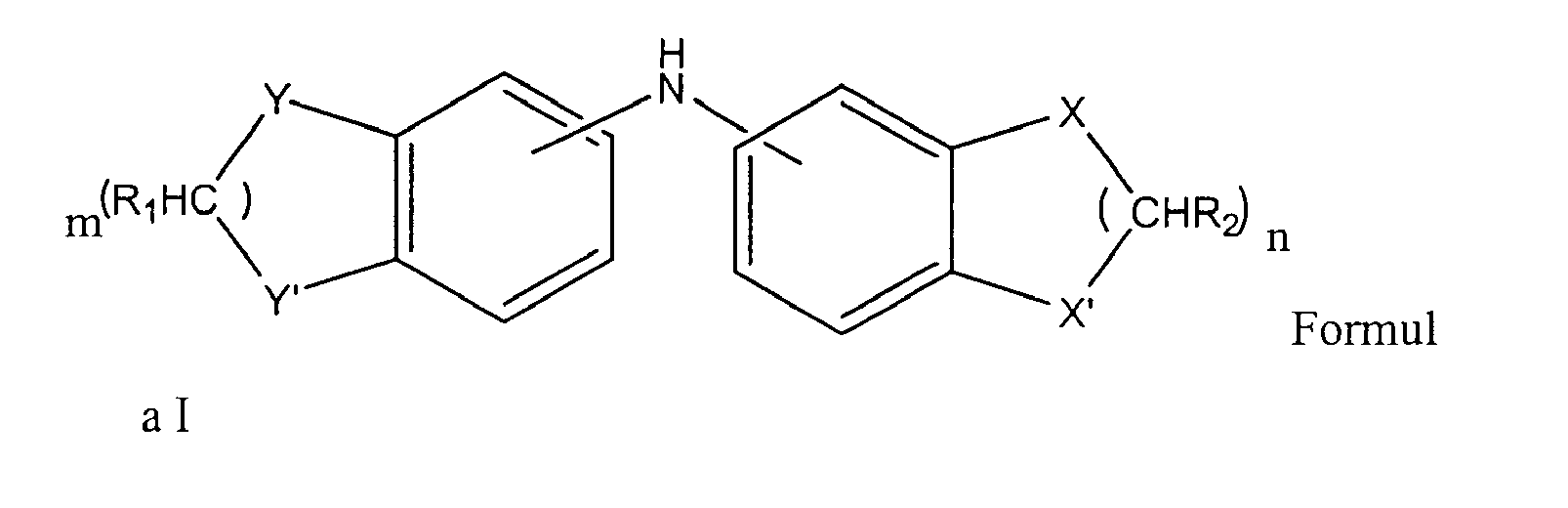
- The present invention is directed in part to compounds which may serve as antioxidants, antiozoants, heat stabilizers and ultraviolet light stabilizers and such compounds are oil soluble, thus particularly suited for use as an antioxidant in a lubricating oil composition. Accordingly, the present invention discloses a compound according to formula I:wherein

- R1 and R2 are each independently selected from hydrogen and alkyl from 1 to 20 carbon atoms; X and X' are independently selected from -CHR3-, oxygen, sulfur or NR4, wherein R3 and R4 are independently hydrogen or alkyl from 1 to 6 carbon atoms, with the proviso that at least one of X or X' is a heteroatom positioned ortho or para to the bridging ring nitrogen; and
- Y and Y' are independently selected from -CHR5-, oxygen, sulfur or NR6 wherein R5 and R6 are independently hydrogen or alkyl from 1 to 6 carbon atoms; with the proviso that at least one of Y or Y' is a heteroatom positioned ortho or para to the bridging ring nitrogen; and
- m and n are independently integers from 1 to 2.
- Each benzo[b]perhydroheterocyclic ring can contain one or two heteroatoms, thus the compound can contain two, three or four heteroatoms. Thus for example if X and Y are the heteroatoms, they can be selected from group Z (N,N; N,O; N,S; O,O; O,S and S,S). Alternatively, X and X' may be the heteroatoms of group Z and Y may be a single heteroatom selected from N, O, or S; or X, X' and Y,Y' may each be independently selected from group Z. Particularly preferred heteroatoms are nitrogen and oxygen, and mixtures thereof.
- Therefore in one aspect, at least one of X and X' is oxygen or NR4, where R4 is hydrogen or alkyl from 1 to 6 carbon atoms, the heterocycle may contain a single heteroatom; thus one of X or X' is CHR3-, and be unsubstituted or alkyl substituted with from one to 6 carbon atoms. In this regard preferable each R2 is hydrogen. In the above aspect, it is also preferred that at least one of Y and Y' is oxygen or NR6, where R6 is hydrogen or alkyl from 1 to 6 carbon atoms and in this regard preferable each R1 is hydrogen. Even more preferably, at least one of Y and Y' is -CHR5- with -CH2- being particularly preferred.
- Each benzo[b]perhydroheterocyclic ring can contain a five or six membered heterocycle. The heterocyclic rings may be the same size and can have the same heteroatoms. In this aspect for example, m is equal to n, and more specifically they are both one, and preferred are when X and Y are oxygen and moreover wherein X' and Y' are independently oxygen or -CH2-.
- In another aspect, X and X' are independently selected from -CHR3- and NR4 wherein R3 and R4 are independently hydrogen or alkyl from 1 to 6 carbon atoms. Particularly preferred compounds are defined when both m and n are two. Moreover preferably in this aspect, Y and Y' are independently selected from -CHR5- and NR6 wherein R5 and R6 are independently hydrogen or alkyl from 1 to 6 carbon atoms. With unsubstitiuted compounds being particularly preferred.
- Other preferred compounds of the present invention are defined in part by the examples, thus particularly preferred compounds of Formula I are selected from unsubstituted and alkyl substituted with from one to six carbon atoms with the group consisting of: N-quinolin-8-ylquinolin-6-amine; N-(1,2,3,4-tetrahydroquinolin-8-yl)-1,2,3,4-tetrahydroquinolin-6-amine; N-(2,3-dihydro-1-benzofuran-5-yl)-2,3-dihydro-1-benzofuran-5-amine; N-1,3-benzodioxol-5-yl-1,3-benzodioxol-5-amine.
- The present invention is further directed to lubricating compositions comprising an oil of lubricating viscosity and a compound of the present invention. Preferably the lubricating oil is present in a major amount and the composition contains a minor amount of the compound of the present invention. More particularly, the composition contains an antioxidant effective amount of the compound of the present invention. The lubricating composition can comprise further additives for their intended use, such as detergents, dispersants, additional antioxidants, antiwear agents, friction modifiers, etc. In yet another aspect, the present invention is directed to a method for improving the oxidation inhibition of an organic substrate by adding an effective amount of the compound of the present invention.
- Inhibition of free radical-mediated oxidation is one of the most important reactions in organic substrates and is commonly used in rubbers, polymers and lubrication oils; namely, since these chemical products may undergo oxidative damage by the autoxidation process. Hydrocarbon oxidation is a three step process which comprises: initiation, propagation and termination. Oxidative degradation and the reaction mechanisms are dependent upon the specific hydrocarbons, temperatures, operating conditions, catalysts such as metals, etc., which more detail can be found in Chapter 4 of Mortier R.M. et al., 1992, "Chemistry and Technology of Lubricants Initiation", VCH Publishers, Inc.; incorporated herein by reference in its entirety. Initiation involves the reaction of oxygen or nitrogen oxides (NOx) on a hydrocarbon molecule. Typically, initiation starts by the abstraction of hydrocarbon proton. This may result in the formation of hydrogen peroxide (HOOH) and radicals such as alkyl radicals (R•) and peroxy radicals (ROO•). During the propagation stage, hydroperoxides may decompose, either on their own or in the presence of catalysts such as metal ions, to alkoxy radicals (RO•) and peroxy radicals. These radicals can react with the hydrocarbons to form a variety of additional radicals and reactive oxygen containing compounds such as alcohols, aldehydes, ketones and carboxylic acids; which again can further polymerize or continue chain propagation. Termination results from the self termination of radicals or by reacting with oxidation inhibitors.
- The uncatalyzed oxidation of hydrocarbons at temperatures of up to about 120° C primarily leads to alkyl-hydroperoxides, dialkylperoxides, alcohols, ketones; as well as the products which result from cleavage of dihydroperoxides such as diketones, keto-aldehydes hydroxyketones and so forth. At higher temperatures (above 120° C) the reaction rates are increased and cleavage of the hydroperoxides plays a more important role. Additionally, at the higher temperatures, the viscosity of the bulk medium increases as a result of the polycondesation of the difunctional oxgenated products formed in the primary oxidation phase. Further polycondesation and polymerization reaction of these high molecular weight intermediates results in products which are no longer soluble in the hydrocarbon and form varnish like deposits and sludge.
- Since autoxidation is a free-radical chain reaction, it therefore, can be inhibited at the initiation and/or propagation steps. Typical oxidation inhibition by diarylamines, such as dialkyldiphenylamine and N-phenyl-α-napthylamine, also involves radical scavenging. The transfer of hydrogen from the NH group of the amine to the peroxide radicals results in the formation of a diarylamino radical which is resonance stabilized, thus prevents new chains from forming. A secondary peroxy radical or hydroperoxide can react with the diarylamino radical to form the nitroxy radical, which is also a very potent inhibitor. Increased demands have been placed on many functional fluids which have in-turn placed emphasis on new inhibitors.
- The present invention is directed in part to aryl-amino bridged dibenzo[b]perhydroheterocyclic compounds particularly useful as stabilizers. The compounds may serve as antioxidants, antiozoants, heat stabilizers and ultraviolet light stabilizers and such compounds are oil soluble, thus particularly suited for use an antioxidant in a lubricating oil composition. Disclosed are particularly suited resonance stabilized inhibitor compounds according to formula I:
- Improved oil solubility and resonance stabilization may be accomplished by alkyl substitution on the heterocyclic ring. Thus in one aspect, at least one heterocyclic ring is alkyl substituted. Preferred substituents are at R1 or R2, or when present R3 or R4.
- Oil solubility is dependent upon the type and degree of heteroatom content in the compound, thus alkyl substitution may be optional when X' and Y' are not heteroatoms. With increasing the heteroatoms in the compound, for example if X, X', Y and Y' are nitrogen, then preferably at least one alkyl substituent can be imparted for oil solubility. Thus one embodiment of the invention is directed to oil soluble compounds of Formula I and lubricating oil compositions containing such.
- An aspect of the present invention is directed to where X' and Y' are -CHR3- and -CHR5- respectively. In this regard, preferably at least one X or Y is selected to have a nitrogen atom or an oxygen atom, and more particularly X and Y are selected to both contain nitrogen atoms or to both contain oxygen atoms. In this aspect, X and Y selected from NR4 and NR6 although each heterocyclic ring may have different substituent groups; or X and Y are both oxygen.
- By way of an example, when X and Y are selected to be the heteroatoms, the othro/ortho and para/para positions of X and Y to the bridging ring nitrogen atom are depicted below. As is evident, otho/para and para/ortho are contemplated.


- Particularly robust properties have been demonstrated for oxygen and nitrogen heterocycles. Thus particularly preferred compounds of formula I are depicted when X and Y are selected from oxygen, -NH- and -N(alkyl from 1 to 6 carbon atoms)-. Therefore, particularly suited fused ring benzo[b]perhydroheterocylic moieties include substituted and unsubstituted: 2,3-dihydro-indole, 2,3-dihydrobenzofuran, 2,3-dihydro-benzoimidazole, 2,3dihydro-benzooxaole, 2,3-dihydro-benzothiazole, benzo[1,3]oxathiole and benzo[1,3]dioxole; as well as the larger substituted and unsubstituted heterocyclic rings consisting of the group: 1,2,3,4-tetrahydroquinoline; 1,2,3,4-tetrahydroqinoxaline; 3,4-dihydro-2H-benzo[1,4]thiazine; 3,4-dihydro-2H-benzo[1,4]oxazine; 2,3-dihydro-benzo[1,4]oxathiine; 2,3-dihydro-benzo[1,4]dioxine and chroman. Particularly preferred perhydroheterocylic moieties are selected so that X' and Y' are -CH- or -C(alkyl from 1 to 6 carbon atoms) and thus the substituted and unsubstituted perhydroheterocylic moieties selected from the group consisting of 2,3,-dihydrobenzofuran, benzo[1,3]dioxole and 1,2,3,4-tetrahydroquinoline.
- One aspect of the invention is characterized by compounds of Formula II

- R1 and R2 are each independently selected from hydrogen and alkyl from 1 to 20 carbon atoms; X' is selected from -CHR3-, oxygen, sulfur or NR4, wherein R3 and each R4 are independently hydrogen or alkyl from 1 to 6 carbon atoms, with the proviso that at least one heteroatom in the ring defined along with X' is attached at a position ortho or para to the bridging ring nitrogen; and Y and Y' are independently selected from -CHR5-, oxygen, sulfur or NR6 wherein R5 and R6 are independently hydrogen or alkyl from 1 to 6 carbon atoms; with the proviso that at least one of Y or
- Y' is a heteroatom positioned ortho or para to the bridging ring nitrogen; and m and n are independently integers from 1 to 2.
- Improved oil solubility and resonance stabilization may be accomplished by alkyl substitution on the heterocyclic ring. Alkyl substitituents have an increasing importance with regard to the degree of heteroatoms in the compound. Thus in one aspect, at least one heterocyclic ring is alkyl substituted. Preferred substituents are at R1 or R2, or when present R3 or R4. Thus in one aspect, R3 and R4 are hydrogen.
- In one aspect, performance has demonstrated improved results when the heteroatom is nitrogen, which in some regard has shown improvement over oxygen of which, both are thought to be better than sulfur. Thus another aspect is directed to the compounds of Formula II wherein X', Y and Y' are independently selected from - CH2-, -CH(alk)-, oxygen, -NH-, or N(alk) where alk is alkyl from one to six carbon atoms. More preferred is wherein X', Y and Y' are independently selected from - CH2-, oxygen or -NH- group. In the above particularly preferred compounds are m = n and moreover when m = 2. In this aspect particularly preferred compounds are defined when R1 and R2 are hydrogen.
- A subset of compounds contain at least two nitrogen heteroatoms is characterized by Formula IIa:

- R1 and R2 are each independently selected from hydrogen and alkyl from 1 to 20 carbon atoms; X' is selected from -CHR3-, oxygen, sulfur or NR4, wherein R3 and each R4 are independently hydrogen or alkyl from 1 to 6 carbon atoms, with the proviso that at least one heteroatom in the ring defined along with X' is attached at a position ortho or para to the bridging ring nitrogen; and Y' is selected from -CHR5-, oxygen, sulfur or NR6 wherein R5 and R6 are independently hydrogen or alkyl from 1 to 6 carbon atoms; with the proviso that at least one heteroatom in the ring defined along with Y' is attached at a position ortho or para to the bridging ring nitrogen; and
- m and n are independently integers from 1 to 2.
- Another aspect of the invention is characterized by compounds of Formula III

- R1 and R2 are each independently selected from hydrogen and alkyl from 1 to 20 carbon atoms; X' is selected from -CHR3-, oxygen, sulfur or NR4, wherein R3 and R4 are independently hydrogen or alkyl from 1 to 6 carbon atoms, with the proviso that at least one heteroatom in the ring defined along with X' is attached at a position ortho or para to the bridging ring nitrogen; and Y and Y' are independently selected from - CHR5-, oxygen, sulfur or NR6 wherein R5 and R6 are independently hydrogen or alkyl from 1 to 6 carbon atoms; with the proviso that at least one of Y or Y' is a heteroatom positioned ortho or para to the bridging ring nitrogen; and m and n are independently integers from 1 to 2.
- Improved oil solubility and resonance stabilization may be accomplished by alkyl substitution on the heterocyclic ring. Alkyl substitituents have an increasing importance with regard to the degree of heteroatoms in the compound. Thus in one aspect, at least one heterocyclic ring is alkyl substituted. Preferred substituents are at R1 or R2, or when present R3 or R4. Thus in one aspect, R3 and R4 are hydrogen.
- In one aspect, performance has demonstrated improved results when the heteroatom is nitrogen, which in some regard has shown improvement over oxygen of which, both are thought to be better than sulfur. Thus another aspect is directed to the compounds of Formula III wherein X', Y and Y' are independently selected from - CH2-, -CH(alk)-, oxygen, -NH-, or N(alk) where alk is alkyl from one to six carbon atoms. More preferred is wherein X', Y and Y' are independently selected from - CH2-, oxygen or -NH- group. In the above particularly preferred compounds are m=n and moreover when m=1, such intermediates are readily commercially available. In this aspect particularly preferred compounds are defined when R1 and R2 are hydrogen.
- The compounds of Formula I are particularly useful when employed in a lubricating composition comprising the compound of Formula I with an oil of lubricating viscosity.
- The lubricant compositions of this invention include a major amount of base oil of lubricating viscosity. Base Oil as used herein is defined as a base stock or blend of base stocks which is a lubricant component that is produced by a single manufacturer to the same specifications (independent of feed source or manufacturer's location): that meets the same manufacturer's specification; and that is identified by a unique formula, product identification number, or both. Base stocks may be manufactured using a variety of different processes including but not limited to distillation, solvent refining, hydrogen processing, oligomerization, esterification, and rerefining. Rerefined stock shall be substantially free from materials introduced through manufacturing, contamination, or previous use. The base oil of this invention may be any natural or synthetic lubricating base oil fraction particularly those having a kinematic viscosity at 100 degrees Centigrade (C) and about 5 centistokes (cSt) to about 20 cSt, preferably about 7 cSt to about 16 cSt, more preferably about 9 cSt to about 15 cSt. Hydrocarbon synthetic oils may include, for example, oils prepared from the polymerization of ethylene, i.e., polyalphaolefin or PAO, or from hydrocarbon synthesis procedures using carbon monoxide and hydrogen gases such as in a Fisher-Tropsch process. A preferred base oil is one that comprises little, if any, heavy fraction; e.g., little, if any, lube oil fraction of viscosity 20 cSt or higher at 100 degrees C.
- The base oil may be derived from natural lubricating oils, synthetic lubricating oils or mixtures thereof. Suitable base oil includes base stocks obtained by isomerization of synthetic wax and slack wax, as well as hydrocrackate base stocks produced by hydrocracking (rather than solvent extracting) the aromatic and polar components of the crude. Suitable base oils include those in all API categories I, II, III, IV and V as defined in API Publication 1509, 14th Edition, Addendum I, December 1998. Saturates levels and viscosity indices for Group I, II and III base oils are listed in Table 1. Group IV base oils are polyalphaolefins (PAO). Group V base oils include all other base oils not included in Group I, II, III, or IV. Although Group II, III and IV base oils are preferred for use in this invention, these preferred base oils may be prepared by combining one or more of Group I, II, III, IV and V base stocks or base oils.
TABLE 1 Saturates, Sulfur and Viscosity Index of Group I, II and III Base Stocks Group Saturates Viscosity Index (As determined by ASTM D 2007) (As determined by ASTM D 4294, ASTM D 4297 or ASTM D 3120) Sulfur (As determined by ASTM D 2007) I Less than 90 % saturates and/or Greater than to 0.03 % sulfur Greater than or equal to 80 and less than 120 II Greater than or equal 90 % saturates and less than or equal to 0.03 % sulfur Greater than or equal to 80 and less than 120 III Greater than or equal 90 % saturates and less than or equal to 0.03 % sulfur Greater than or equal to 120 - Natural lubricating oils may include animal oils, vegetable oils (e.g., rapeseed oils, castor oils and lard oil), petroleum oils, mineral oils, and oils derived from coal or shale.
- Synthetic oils may include hydrocarbon oils and halo-substituted hydrocarbon oils such as polymerized and inter-polymerized olefins, alkylbenzenes, polyphenyls, alkylated diphenyl ethers, alkylated diphenyl sulfides, as well as their derivatives, analogues and homologues thereof, and the like. Synthetic lubricating oils also include alkylene oxide polymers, interpolymers, copolymers and derivatives thereof wherein the terminal hydroxyl groups have been modified by esterification, etherification, etc. Another suitable class of synthetic lubricating oils comprises the esters of dicarboxylic acids with a variety of alcohols. Esters useful as synthetic oils also include those made from C5 to C12 monocarboxylic acids and polyols and polyol ethers. Tri-alkyl phosphate ester oils such as those exemplified by tri-n-butyl phosphate and tri-iso-butyl phosphate are also suitable for use as base oils.
- Silicon-based oils (such as the polyakyl-, polyaryl-, polyalkoxy-, or polyaryloxy-siloxane oils and silicate oils) comprise another useful class of synthetic lubricating oils. Other synthetic lubricating oils include liquid esters of phosphorus-containing acids, polymeric tetrahydrofurans, polyalphaolefins, and the like.
- The base oil may be derived from unrefined, refined, rerefined oils, or mixtures thereof. Unrefined oils are obtained directly from a natural source or synthetic source (e.g., coal, shale, or tar sand bitumen) without further purification or treatment. Examples of unrefined oils include a shale oil obtained directly from a retorting operation, a petroleum oil obtained directly from distillation, or an ester oil obtained directly from an esterification process, each of which may then be used without further treatment. Refined oils are similar to the unrefined oils except that refined oils have been treated in one or more purification steps to improve one or more properties. Suitable purification techniques include distillation, hydrocracking, hydrotreating, dewaxing, solvent extraction, acid or base extraction, filtration, and percolation, all of which are known to those skilled in the art. Rerefined oils are obtained by treating used oils in processes similar to those used to obtain the refined oils. These rerefined oils are also known as reclaimed or reprocessed oils and often are additionally processed by techniques for removal of spent additives and oil breakdown products.
- Base oil derived from the hydroisomerization of wax may also be used, either alone or in combination with the aforesaid natural and/or synthetic base oil. Such wax isomerate oil is produced by the hydroisomerization of natural or synthetic waxes or mixtures thereof over a hydroisomerization catalyst.
- It is preferred to use a major amount of base oil in the lubricating oil of this invention. A major amount of base oil as defined herein comprises 40 wt. % or more. Preferred amounts of base oil comprise about 40 wt. % to about 97 wt. % of at least one of Group II, III and IV base oil or preferably greater than about 50 wt. % to about 97 wt. % of at least one of Group II, III and IV base oil or more preferably about 60 wt. % to about 97 wt. % of at least one of Group II, III and IV base oil. (When wt. % is used herein, it is referring to wt. % of the lubricating oil unless otherwise specified.) A more preferred embodiment of this invention may comprise an amount of base oil that comprises about 85 wt. % to about 95 wt. % of the lubricating oil.
- The amount of dibenzo[b]perhydroheterocyclic amine compounds of the present invention in the lubricating oil composition will be in a minor amount compared to the base oil of lubricating viscosity. Generally, it will be in an amount from about 0.01 to 10 wt %, preferably from about 0.1 to about 2.0 wt %, more preferably from about 0.3 to about 1.8 wt % and even more preferably from about 0.5 to about 1.5 wt %, based on the total weight of the lubricating oil composition.
- The following additive components are examples of components that can be favorably employed in combination with the lubricating additive of the present invention. These examples of additives are provided to illustrate the present invention, but they are not intended to limit it.
- (A) Ashless dispersants: alkenyl succinimides, alkenyl succinimides modified with other organic compounds such as ethylene carbonate, polysuccinimides, and alkenyl succinimides modified with boric acid, alkenyl succinic ester.
- (B) Oxidation inhibitors:
- 1) Phenol type phenolic oxidation inhibitors: 4,4'-methylenebis(2,6-di-tertbutylphenol), 4,4'-bis(2,6-di-tert-butylphenol), 4,4'-bis(2-methyl-6-tert-butylphenol), 2,2'-(methylenebis(4-methyl-6-tert-butyl-phenol)), 4,4'-butylidenebis(3-methyl-6-tertbutylphenol), 4,4'-isopropylidenebis(2,6-di-tert-butylphenol), 2,2'-methylenebis(4-methyl-6-nonylphenol), 2,2'-isobutylidene-bis(4,6-dimethylphenol), 2,2'-methylenebis(4-methyl-6-cyclohexylphenol), 2,6-di-tert-butyl4-methylphenol, 2,6-di-tert-butyl4-ethylphenol, 2,4-dimethyl-6-tert-butyl-phenol, 2,6-di-tert-α-dimethylamino-p-cresol, 2,6-di-tert-4(N,N' dimethylaminomethylphenol), 4,4'-thiobis(2-methyl-6-tert-butylphenol), 2,2'-thiobis(4-methyl-6-tert-butylphenol), bis(3-methyl-4-hydroxy-5-tert-butylbenzyl)-sulfide, and bis (3,5-di-tert-butyl4-hydroxybenzyl).
- 2) Diphenylamine type oxidation inhibitor: alkylated diphenylamine, phenyl-α-naphthylamine, and alkylated α-naphthylamine.
- 3) Other types: metal dithiocarbamate (e.g., zinc dithiocarbamate), and methylenebis(dibutyldithiocarbamate).
- (C) Rust inhibitors (Anti-rust agents):
- 1) Nonionic polyoxyethylene surface active agents: polyoxyethylene lauryl ether, polyoxyethylene higher alcohol ether, polyoxyethylene nonylphenyl ether, polyoxyethylene octylphenyl ether, polyoxyethylene octyl stearyl ether, polyoxyethylene oleyl ether, polyoxyethylene sorbitol monostearate, polyoxyethylene sorbitol mono-oleate, and polyethylene glycol monooleate.
- 2) Other compounds: stearic acid and other fatty acids, dicarboxylic acids, metal soaps, fatty acid amine salts, metal salts of heavy sulfonic acid, partial carboxylic acid ester of polyhydric alcohol, and phosphoric ester.
- (D) Demulsifiers: addition product of alkylphenol and ethyleneoxide, polyoxyethylene alkyl ether, and polyoxyethylene sorbitane ester.
- (E) Extreme pressure agents (EP agents):, sulfurized oils, diphenyl sulfide, methyl trichlorostearate, chlorinated naphthalene, benzyl iodide, fluoroalkylpolysiloxane, and lead naphthenate.
- (F) Friction modifiers: fatty alcohol, fatty acid, amine, borated ester, and other esters
- (G) Multifunctional additives: sulfurized oxymolybdenum dithiocarbamate, sulfurized oxymolybdenum organo phosphorodithioate, oxymolybdenum monoglyceride, oxymolybdenum diethylate amide, amine-molybdenum complex compound, and sulfur-containing molybdenum complex compound
- (H) Viscosity Index improvers: polymethacrylate type polymers, ethylenepropylene copolymers, styrene-isoprene copolymers, hydrated styrene-isoprene copolymers, polyisobutylene, and dispersant type viscosity index improvers.
- (I) Pour point depressants: polymethyl methacrylate.
- (K) Foam Inhibitors: alkyl methacrylate polymers and dimethyl silicone polymers.
- (L) Wear inhibitors: zinc dialkyldithiophosphate (Zn-DTP, primary alkyl type & secondary alkyl type).
- General Synthetic Procedures
- The the dibenzo[b]perhydroheterocyclic amines of this invention may be prepared by the following general methods and procedures. It should be appreciated that where typical or preferred process conditions (e.g., reaction temperatures, times, mole ratios of reactants, solvents, pressures, etc.) are given; other process conditions may also be used unless otherwise stated. Optimum reaction conditions may vary with the particular reactants or solvents used, but such conditions can be determined by one skilled in the art by routine optimization procedures.
- Those skilled in the art will also recognize that it may be necessary to block or protect certain functional groups while conducting the following synthetic procedures. In such cases, the protecting group will serve to protect the functional group from undesired reactions or to block its undesired reaction with other functional groups or with the reagents used to carry out the desired chemical transformations. The proper choice of a protecting group for a particular functional group will be readily apparent to one skilled in the art. Various protecting groups and their introduction and removal are described, for example, in T. W. Greene and P. G. M. Wuts, Protective Groups in Organic Synthesis, Second Edition, Wiley, New York, 1991, and references cited therein.
- Synthesis
- The dibenzo[b]perhydrohetocylic amines of the present invention can be prepared by the reduction of dibenzo[b]hetocylic amines as illustrated in sequence (I).

- The dibenzo[b]hetocylic amines may be prepared by the reaction sequences depicted in (II) and (III)


- wherein R1, R2, m, n, X ,X', Y and Y' are as defined herein and Z is -OH, - NH2, Cl, Br or I.
- The coupling reactions shown in (II) and (III) are known in the art for the synthesis of diphenylamines. These coupling methods are applicable to the synthesis of dibenzo[b]heterocyclic amines. Particularly noteworthy coupling reactions for the synthesis of anilinoquinolines are described by Buu-Hoi, Royer and Hubert-Habart, J. Chem. Soc., 1956, 2048-2051 and Okada, Suzuki, Hirose, Toda and Ozawa, Chem. Commun., 2001, 2492-2493. Buchwald and Hartwig have developed a palladium catalyzed coupling of aromatic amines and aromatic halides which is applicable to the synthesis of dibenzo[b]heterocyclic amines (Wolfe, Wagaw, Marcoux and Buchwald, Acc. Chem. Res., 1998, 805-818 and references cited therein and J. C. Peters, S. B. Harkins, S. D. Brown and M. DW. Day, Inorg. Chem., 2001, 40, 5083-5091). A copper catalyzed method has been developed by Patil, Kelkar, Nabi, and Chaudhari, Chem. Commun., 2003, 2460-2461.
- There are several methods to reduce the dibenzo[b]heterocyclic amines to dibenzo[b]perhydroheterocyclic amines. The methods that can be employed are the same as those for the reduction of quinoline to tetrahydroquinoline provided that any functionality which is sensitive towards reduction is protected. Hydrogenation conditions that can be used are those as described for quinolines in Rylander, Catalytic Hydrogenation in Organic Synthesis, 1979, 213-230, Academic Press. Hydrogenation of quinolines to tetrahydroquinolines as well as other methods of reduction is described in Hudlicky, Reductions in Organic Chemistry Second Edition, 1996, 72-74, American Chemical Society. 6-aminoquinoline has been hydrogenated to 6-aminotetrahydroquinoline with a platinum oxide catalyst in Example 2 of
WO 92/05173 - Alternatively, when X, X', Y and Y' are not amines the compounds of this invention can be prepared by reversing this sequence. Thus the reduction step would precede the coupling. The coupling would be done as depicted in (1V) and (V).


- The invention is further illustrated by the following examples, which are not to be considered as limitative of its scope. A further understanding of the invention can be had in the following nonlimiting Preparations and Examples. Wherein unless expressly stated in the contraty, all temperatures and temperatures ranges refer to the Centigrade system and the term "ambient" or "room temperature" refers to about 20 to 25° C. The term "percent or %" refers to weight percent, and the term "mole" or "moles" refers to gram moles. The term "equivalent" refers to a quantity of reagent equal in moles, to the moles of the preceding or succeeding reactant recited in that example in terms of finite moles or finite weight or volume. Where given, proton-magnetic resonance spectrum (p.m.r. or n.m.r) were determined at 300 mHz, signals are assigned as singlets(s), braod singlets (bs), doublets (d), double doublets (dd), triplets (t), double triplets (dt), quartets (q), and multiplets (m), and cps refers to cycles per second.
- Preparation of N-(1,2,3,4-tetrahydroquinolin-8-yl)-1,2,3,4-tetrahydroquinolin-8-amine
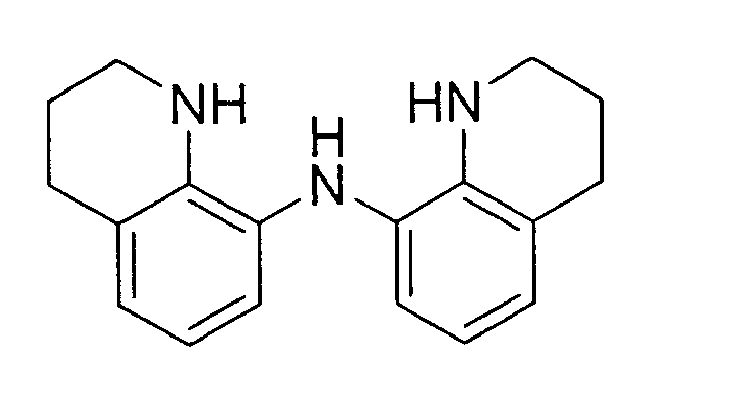
- A solution of 1.24 grams of bis(8-quinolinyl)amine (prepared as described in J. C. Peters, S. B. Harkins, S. D. Brown and M. DW. Day, Inorg. Chem., 2001, 40, 5083-5091) in 100 mL of acetic acid containing 0.07 grams of platinum(IV) oxide was hydrogenated at 45 psi for 1.5 hours on a Parr low-pressure hydrogenator. The solution was filtered through diatomaceous earth; concentrated in vacuo; and neutralized with 6N aqueous sodium hydroxide. The aqueous phase was diluted with water and extracted three times with ethyl acetate. The combined ethyl acetate layers were washed with brine; dried over anhydrous magnesium sulfate, filtered and concentrated in vacuo to yield 1.25 grams of brown oil which was the desired product. 1H NMR (CDCl3 ) δ 6.5 - 6.75 (m, 6H), 4.8 (bs, 1H), 3.7 (bs, 1H), 3.25 (t, 4H), 2.8 (t, 4H), 1.95 (p, 4H), 1.6 (bs, 1H).
- Step A - Preparation of N-quinolin-8-ylquinolin-6-amine

- To a flask equipped with a magnetic stirrer, reflux condensor, and nitrogen inlet was added 8-aminoquinoline (4.2 grams, 29.0 mmoles), 6-bromoquinoline (6.0 grams, 29.0 mmoles), tris(dibenzylideneacetone)dipalladium (0) (0.4 grams, 0.48 mmoles), rac-2,2'-bis(diphenylphosphino)-1,1'-binapthyl (0.6 grams, 0.60 mmoles), sodium tert-butoxide (4.7 grams, 49.0 mmoles) and anhydrous toluene (80 mL). The contents of the flask were refluxed for three days; cooled to room temperature; and filtered through a pad of silica gel. The silica gel pad was then eluted with dichloromethane (60 mL) and ethyl acetate (60 mL). The combined organic layers were concentrated in vacuo to yield a yellow solid. The solid was chromatographed on silica gel, eluting with a hexane/ethyl acetate gradient to afford 4.4 grams of the desired product as a yellow solid. 1H NMR (CDCl3) δ 8.8 (d, 2H), 8.6 (bs, 1H), 8.0-8.2 (m, 3H), 7.2-7.8 (m, 7H).
- Step B - Preparation of N-(1,2,3,4-tetrahydroquinolin-8-yl)-1,2,3,4-tetrahydroquinolin-6-amine

- A solution of 3.68 grams of N-quinolin-8-ylquinolin-6-amine from above in 60 mL of acetic acid containing 0.22 grams of platinum(IV) oxide was hydrogenated at 40 psi for 2.0 hours on a Parr low-pressure hydrogenator. The solution was filtered through diatomaceous earth; concentrated in vacuo; and neutralized with 3N aqueous sodium hydroxide. The aqueous phase was diluted with water and extracted three times with ethyl acetate. The combined ethyl acetate layers were washed with brine; dried over anhydrous magnesium sulfate, filtered and concentrated in vacuo to yield 1.6 grams of brown solid. The solid was chromatographed on silica gel, eluting with hexane/ethyl acetate gradient to afford 0.8 grams of the desired product as a purple solid. 1H NMR (CDCl3/D2O) δ 6.4-6.9 (m, 6H), 3.2-3.4 (m, 4H), 2.6-2.9 (m, 4H), 1.8-2.1 (m, 4H).
- Preparation of N-(2,3-dihydro-1-benzofuran-5-yl)-2,3-dihydro-1-benzofuran-5-amine

- To a flask equipped with a magnetic stirrer, reflux condensor, and nitrogen inlet was added 2,3-dihydro-1-benzofuran-5-amine (4.53 grams, 33.3 mmoles, prepared as in Example 23 of
U.S. Pat. No. 20040029932 ), 5-bromo-2,3-dihydrobenzofuran (6.63 grams, 32.9 mmoles), tris(dibenzylideneacetone)dipalladium (0) (0.61 grams, 0.67 mmoles), rac-2,2'-bis(diphenylphosphino)-1,1'-binapthyl (0.83 grams, 1.33 mmoles), sodium tert-butoxide (6.44 grams, 66.6 mmoles) and anhydrous toluene (60 mL). The contents of the flask were refluxed for three days; cooled to room temperature; and filtered through a pad of silica gel. The silica gel pad was then eluted with dichloromethane (200 mL). The combined organic layers were concentrated in vacuo to yield a dark yellow oil. The solid was chromatographed on silica gel, eluting with a hexane/ethyl acetate gradient. The resulting solid was recrystallized from ethanol to afford 1.8 grams of the desired product as a white solid. 1H NMR (CDCl3/D2O) δ 6.55-6.95 (m, 6H), 4.5 (t, 4H), 3.15 (t, 4H). - Preparation of N-1,3-benzodioxol-5-yl-1,3-benzodioxol-5-amine

- To a flask equipped with a magnetic stirrer, reflux condensor, and nitrogen inlet was added 3,4-(methylenedioxy) aniline (5.34 grams, 38.9 mmoles), 4-bromo-1,2-(methylenedioxy) benzene (6.41 grams, 31.9 mmoles), tris(dibenzylideneacetone)dipalladium (0) (0.71 grams, 0.8 mmoles), 1,1'-bis(diphenylphosphino)-ferrocene (1.29 grams, 2.3 mmoles), sodium tert-butoxide (4.20 grams, 43.7 mmoles) and anhydrous toluene (40 mL). The contents of the flask were heated to 80°C for three days; cooled to room temperature; and filtered through a pad of silica gel. The silica gel pad was then eluted with dichloromethane (240 mL). The combined organic layers were concentrated in vacuo to yield a dark yellow oil. The oil was chromatographed on silica gel, eluting with a hexane/ethyl acetate gradient to afford 6 grams of yellow solid. The solid was triturated with hexane and filtered to afford 3.9 grams of the desired product as a white solid. 1H NMR (CDCl3) δ 6.7 (d, 2H), 6.55 (s, 2H), 6.35 (d, 2H), 5.85 (s, 4H), 5.35 (bs, 1H).
- Oxidation studies of the products of selected Examples were carried out in a bulk oil oxidation bench test as described by E. S. Yamaguchi et al. in Tribology Transactions, Vol. 42(4), 895-901 (1999). In this test the rate of oxygen uptake at constant pressure by a given weight of oil was monitored. The time required (induction time) for rapid oxygen uptake per 25 grams of sample was measured at 171°C under 1.0 atmosphere of oxygen pressure. The sample was stirred at 1000 revolutions per minute. The results are reported, however, as time for rapid oxygen uptake per 100 grams of sample. The oil contained a catalyst added as oil soluble naphthenates to provide 26 ppm iron, 45 ppm copper, 512 ppm lead, 2.3 ppm manganese, and 24 ppm tin.
- The screening formulation contained in a Group 2+ base oil 7.0 mmoles/kg dialkyl zinc dithiophosphate, 4.0% polyisobutenyl succinimide, 0.5% dinonyldiphenylamine, 0.25% polyisobutenyl succinimide (this polyisobutenyl succinimide also contains 5.5 weight percent molybdenum, 48.5 mmoles/kg overbased calcium sulfonate detergent and 0.3% V.I. improver. Oxidation bench test results are presented in Table 1.
Table 1 Performance Example Sample Concentration of added Sample (weight percent) Hr to rapid O2 uptake (0.5 weight percent) Base - 0 14.1 α Comparative Example A1 0.5% 32.5 β Comparative Example A1 1.0% 41.0 γ Comparative Example B2 0.5% 41.9 δ Comparative Example B2 1.0% 83.5 ε Example 1 0.5% 85.0 ζ Example 1 1.0% 111.0 η Example 2 0.5% 117.0 θ Example 3 0.5% 51.5 
Example 3 1.0% 94.8 κ Example 4 0.5% 36.4 1Irganox® L57 (diphenylamine alkylated with 2,4,4-trimethylpentene) available commercially from Ciba-Geigy
24-(2-octylamino)dlphenylamine available from TCI America - The excellent oxidation inhibition performance of Performance Examples ε through κ which contained formulations top treated to the baseline formulation with compounds of Examples 1 through 4, as compared to Performance Examples α and β which were top treated with Comparative Example A, an alkylated diphenylamine, is shown in the table. The perhydro cyclic amines of this invention in Examples 1 and 2 (performance examples ε, ζ and η) perform better than the non cyclic amine of Comparative Example B. The advantages on oxidation inhibition can be seen when constraining the heteroatom into a ring.
Claims (23)
- A compound according to formula I:
 R1 and R2 are each independently selected from hydrogen and alkyl from 1 to 20 carbon atoms; X and X' are independently selected from - CHR3-, oxygen, sulfur or NR4, wherein R3 and R4 are independently hydrogen or alkyl from 1 to 6 carbon atoms, with the proviso that at least one of X or X' is a heteroatom positioned ortho or para to the bridging ring nitrogen; andY and Y' are independently selected from -CHR5-, oxygen, sulfur or NR6 wherein R5 and R6 are independently hydrogen or alkyl from 1 to 6 carbon atoms; with the proviso that at least one of Y or Y' is a heteroatom positioned ortho or para to the bridging ring nitrogen; andm and n are independently integers from 1 to 2.
 - The compound according to Claim 1, wherein at least one of X and X' is oxygen or NR4, where R4 is hydrogen or alkyl from 1 to 6 carbon atoms.
- The compound according to Claim 2, wherein each R2 is hydrogen.
- The compound according to Claim 2, wherein at least one of X and X' is -CHR3- where R3 is hydrogen or alkyl from 1 to 6 carbon atoms.
- The compound according to Claim 4, wherein R3 is hydrogen.
- The compound according to Claim 2, wherein at least one Y and Y' are oxygen or NR6, where R6 is hydrogen or alkyl from 1 to 6 carbon atoms.
- The compound according to Claim 6, wherein each R1 is hydrogen.
- The compound according to Claim 6, wherein at least one Y and Y' is -CHR5- where R5 is hydrogen or alkyl from 1 to 6 carbon atoms.
- The compound according to Claim 8, wherein R5 is hydrogen.
- The compound according to Claim 1, wherein m = n.
- The compound according to Claim 10, wherein m is one.
- The compound according to Claim 11, wherein X and Y are oxygen.
- The compound according to Claim 12, wherein X' and Y' are independently selected from oxygen and -CH2-.
- The compound according top Claim 13, wherein X' and Y' are -CH2-.
- The compound according to Claim 1, wherein X and X' are independently selected from -CHR3- and NR4 wherein R3 and R4 are independently hydrogen or alkyl from 1 to 6 carbon atoms.
- The compound according to Claim 15, wherein m = n.
- The compound according to Claim 16, wherein m is two.
- The compound according to Claim 17, wherein Y and Y' are independently selected from -CHR5- and NR6 wherein R5 and R6 are independently hydrogen or alkyl from 1 to 6 carbon atoms.
- The compound according to Claim 18, wherein R3, R4, R5 and R6 are hydrogen.
- The compound according to Claim 1, wherein the compound comprises unsubstituted and alkyl substituted dibenzoperhydroheterocylic amines of Formula I selected from the group consisting of: N-quinolin-8-ylquinolin-6-amine; N-(1,2,3,4-tetrahydroquinolin-8-yl)-1,2,3,4-tetrahydroquinolin-6-amine; N-(2,3-dihydro-1-benzofuran-5-yl)-2,3-dihydro-1-benzofuran-5-amine; N-1,3-benzodioxol-5-yl-1,3-benzodioxol-5-amine and alkyl substituted derivatives thereof.
- A lubricating oil composition comprising a major amount of an oil of lubricating viscosity and a minor amount of the compound according to any one of claims 1 to 20.
- A lubricating oil composition comprising an oil of lubricating viscosity and a compound according to claim 20.
- Use of a compound according to any one of claims 1 to 20 as an antioxidant in a lubricating oil composition.
Applications Claiming Priority (1)
| Application Number | Priority Date | Filing Date | Title |
|---|---|---|---|
| US11/316,099 US7285518B2 (en) | 2005-12-21 | 2005-12-21 | Dibenzo[b]perhydroheterocyclic amines and lubricating oil compositions |
Publications (2)
| Publication Number | Publication Date |
|---|---|
| EP1801105A1 true EP1801105A1 (en) | 2007-06-27 |
| EP1801105B1 EP1801105B1 (en) | 2012-01-25 |
Family
ID=37946482
Family Applications (1)
| Application Number | Title | Priority Date | Filing Date |
|---|---|---|---|
| EP06256246A Ceased EP1801105B1 (en) | 2005-12-21 | 2006-12-07 | Dibenzo[b]perhydroheterocyclic amines and lubricating oil compositions |
Country Status (5)
| Country | Link |
|---|---|
| US (1) | US7285518B2 (en) |
| EP (1) | EP1801105B1 (en) |
| JP (2) | JP5642915B2 (en) |
| CA (1) | CA2570680C (en) |
| SG (1) | SG133559A1 (en) |
Families Citing this family (2)
| Publication number | Priority date | Publication date | Assignee | Title |
|---|---|---|---|---|
| US7285518B2 (en) * | 2005-12-21 | 2007-10-23 | Chevron Oronite Company Llc | Dibenzo[b]perhydroheterocyclic amines and lubricating oil compositions |
| US7879934B2 (en) * | 2007-08-16 | 2011-02-01 | Chemtura Corporation | Rubber compositions |
Citations (3)
| Publication number | Priority date | Publication date | Assignee | Title |
|---|---|---|---|---|
| US2366018A (en) * | 1943-10-15 | 1944-12-26 | Goodrich Co B F | Antioxidant |
| EP0273868A2 (en) * | 1986-12-30 | 1988-07-06 | Ciba-Geigy Ag | N-substituted tetrahydroquinolines as antioxidants for lubricants |
| EP0497735A1 (en) * | 1991-01-31 | 1992-08-05 | Ciba-Geigy Ag | Hydroquinoline compounds |
Family Cites Families (38)
| Publication number | Priority date | Publication date | Assignee | Title |
|---|---|---|---|---|
| US1896461A (en) * | 1927-02-14 | 1933-02-07 | Gen Aniline Works Inc | Indophenols and leucoindophenols of the azine series |
| US2283388A (en) * | 1939-06-28 | 1942-05-19 | Us Rubber Co | Antioxidant |
| US2342135A (en) * | 1941-08-07 | 1944-02-22 | Goodrich Co B F | Arylamino dihydrobenzofurane |
| US2365018A (en) | 1943-10-01 | 1944-12-12 | Gen Electric | Driving mechanism |
| US2718501A (en) * | 1952-03-01 | 1955-09-20 | California Research Corp | Oils stable against oxidation |
| US2794020A (en) * | 1953-08-03 | 1957-05-28 | Monsanto Chemicals | 6-amino substituted 1, 2, 3, 4-tetrahydroquinolines |
| US2998468A (en) * | 1954-10-11 | 1961-08-29 | Monsanto Chemicals | Method of preserving natural rubber by adding thereto 2:2:4-trimethyl-decahydroquinoline and a substituted phenol |
| US2943112A (en) * | 1957-11-06 | 1960-06-28 | Pennsalt Chemicals Corp | Alkylation of diphenylamine |
| NL240511A (en) * | 1958-06-25 | |||
| US3345992A (en) * | 1965-08-04 | 1967-10-10 | Vacudyne Corp | Method for conditioning tobacco |
| US3362930A (en) * | 1966-03-01 | 1968-01-09 | Goodrich Co B F | Composition resistant to ozone |
| US3452056A (en) * | 1966-04-07 | 1969-06-24 | Uniroyal Inc | Substituted diphenylamines |
| US3533992A (en) * | 1966-04-07 | 1970-10-13 | Uniroyal Inc | Conjugated diolefin polymer rubber containing substituted diphenylamines as antioxidant |
| US3944492A (en) * | 1966-04-07 | 1976-03-16 | Uniroyal, Inc. | Lubricant compositions containing N-substituted naphthylamines as antioxidants |
| US3480635A (en) * | 1966-09-28 | 1969-11-25 | Universal Oil Prod Co | N-piperidyl substituted phenylenediamines |
| GB1236740A (en) * | 1969-04-11 | 1971-06-23 | Geigy Uk Ltd | Tertiary alkylated diphenylamines and their uses as antioxidants |
| BE756024A (en) * | 1969-09-22 | 1971-03-11 | Shell Int Research | ALKYL-SUBSTITUTED PHENYLNAFTYLAMINS AND LUBRICANT COMPOSITIONS THESE CONTAIN |
| US3910918A (en) * | 1971-04-26 | 1975-10-07 | Heliodoro Monroy | 1,2-Dihydroquinolines and process and apparatus for the obtention thereof |
| US4089792A (en) * | 1976-04-01 | 1978-05-16 | Chevron Research Company | Synergistic antioxidant additive composition |
| US4069195A (en) * | 1976-06-18 | 1978-01-17 | The B.F. Goodrich Company | Substituted decahydroquinolines and their use as ultraviolet light stabilizer |
| DE3276326D1 (en) * | 1981-08-10 | 1987-06-19 | Ciba Geigy Ag | Tetrahydroquinoline as an antioxidant for lubricants |
| US5232614A (en) * | 1989-02-23 | 1993-08-03 | Exxon Chemical Patents Inc. | Lubricating oil compositions and additives for use therein |
| US5198134A (en) * | 1991-05-07 | 1993-03-30 | Ciba-Geigy Corporation | Substituted naphthalenediamine stabilizers |
| US5310491A (en) * | 1993-04-13 | 1994-05-10 | Uniroyal Chemical Company, Inc. | Lubricant composition containing antioxidant |
| US5451702A (en) * | 1993-04-26 | 1995-09-19 | Monsanto Company | Process for preparing substituted aromatic amines |
| ATE157697T1 (en) * | 1993-12-15 | 1997-09-15 | Goodrich Co B F | STABILIZER MIXTURE FOR SYNTHETIC ESTER LUBRICANT |
| US5420354A (en) * | 1994-10-06 | 1995-05-30 | Uniroyal Chemical Company, Inc. | Process of preparing para phenylamines |
| US5595963A (en) * | 1994-12-05 | 1997-01-21 | Exxon Chemical Patents Inc. | Synergistic antioxidant combinations for lubricating oils |
| KR100239817B1 (en) * | 1994-12-09 | 2000-01-15 | 만셀 케이쓰 로드니 | A method for improving the antioxidant properties of a lubricating oil composition using a lubricating oil composition comprising a lubricating oil and an additive combination, a concentrate containing an additive combination and an additive combination |
| SG65759A1 (en) * | 1997-06-06 | 1999-06-22 | Ciba Sc Holding Ag | Nonylated diphenylamines |
| US5834544A (en) * | 1997-10-20 | 1998-11-10 | Uniroyal Chemical Company, Inc. | Organic materials stabilized by compounds containing both amine and hindered phenol functional functionalities |
| US6174842B1 (en) * | 1999-03-30 | 2001-01-16 | Ethyl Corporation | Lubricants containing molybdenum compounds, phenates and diarylamines |
| WO2002079207A2 (en) * | 2001-04-02 | 2002-10-10 | California Institute Of Technology | Tri-and bidentate amido ligands prepared by palladium0 coupling and metallation thereof to form metal-amido catalysts |
| EP1468063B1 (en) * | 2001-09-21 | 2017-12-13 | Vanderbilt Chemicals, LLC | Improved antioxidant additive compositions and lubricating compositions containing the same |
| CN101283031B (en) * | 2005-10-11 | 2012-10-10 | 科聚亚公司 | Diarylamine |
| US8003583B2 (en) * | 2005-12-21 | 2011-08-23 | Chevron Oronite Company Llc | Benzo[b]perhydroheterocyclic arylamines and lubricating oil compositions |
| US7285518B2 (en) * | 2005-12-21 | 2007-10-23 | Chevron Oronite Company Llc | Dibenzo[b]perhydroheterocyclic amines and lubricating oil compositions |
| US7501386B2 (en) * | 2005-12-21 | 2009-03-10 | Chevron Oronite Company, Llc | Synergistic lubricating oil composition containing a mixture of a benzo[b]perhydroheterocyclic arylamine and a diarylamine |
-
2005
- 2005-12-21 US US11/316,099 patent/US7285518B2/en not_active Expired - Lifetime
-
2006
- 2006-12-07 EP EP06256246A patent/EP1801105B1/en not_active Ceased
- 2006-12-11 CA CA2570680A patent/CA2570680C/en not_active Expired - Fee Related
- 2006-12-20 JP JP2006343422A patent/JP5642915B2/en not_active Expired - Fee Related
- 2006-12-21 SG SG200608906-4A patent/SG133559A1/en unknown
-
2014
- 2014-08-11 JP JP2014163756A patent/JP5911536B2/en not_active Expired - Fee Related
Patent Citations (3)
| Publication number | Priority date | Publication date | Assignee | Title |
|---|---|---|---|---|
| US2366018A (en) * | 1943-10-15 | 1944-12-26 | Goodrich Co B F | Antioxidant |
| EP0273868A2 (en) * | 1986-12-30 | 1988-07-06 | Ciba-Geigy Ag | N-substituted tetrahydroquinolines as antioxidants for lubricants |
| EP0497735A1 (en) * | 1991-01-31 | 1992-08-05 | Ciba-Geigy Ag | Hydroquinoline compounds |
Non-Patent Citations (1)
| Title |
|---|
| J. C. PETERS, S. B. HARKINS, S. D. BROWN, M. DW. DAY, INORG. CHEM., vol. 40, 2001, pages 5083 - 5091 |
Also Published As
| Publication number | Publication date |
|---|---|
| JP2014218512A (en) | 2014-11-20 |
| JP5642915B2 (en) | 2014-12-17 |
| US20070142245A1 (en) | 2007-06-21 |
| SG133559A1 (en) | 2007-07-30 |
| EP1801105B1 (en) | 2012-01-25 |
| JP2007169281A (en) | 2007-07-05 |
| JP5911536B2 (en) | 2016-04-27 |
| CA2570680C (en) | 2014-09-16 |
| US7285518B2 (en) | 2007-10-23 |
| CA2570680A1 (en) | 2007-06-21 |
Similar Documents
| Publication | Publication Date | Title |
|---|---|---|
| EP2009082B1 (en) | Synergistic lubricating oil composition containing a mixture of a nitro-substituted diarylamine and a diarylamine | |
| KR101753932B1 (en) | Lubricant composition for internal combustion engines | |
| RU2659788C1 (en) | Polyalkylene glycol based industrial lubricant compositions | |
| EP1801189B1 (en) | Synergistic lubricating oil composition containing a mixture of a benzo[b]perhydroheterocyclic arylamine and a diarylamine | |
| EP1801104B1 (en) | Benzo[b]perhydroheterocyclic arylamines and lubricating oil compositions | |
| JP5911536B2 (en) | Dibenzo [b] perhydroheterocyclic amine and lubricating oil composition | |
| RU2492217C2 (en) | Method of producing lubricating composition | |
| CN111088095A (en) | Air compressor oil composition and preparation method thereof | |
| KR20110053230A (en) | Antioxidant | |
| JPH07304772A (en) | Condensation product of melamine with (benzo)-thiazole and aldehyde | |
| JP2026022913A (en) | lubricating oil composition | |
| TW201718839A (en) | Novel alkylated diphenylamine derivatives of triazole and lubricating compositions containing the same | |
| JP2026022916A (en) | lubricating oil composition | |
| JPH02268169A (en) | Stabilized organic material |
Legal Events
| Date | Code | Title | Description |
|---|---|---|---|
| PUAI | Public reference made under article 153(3) epc to a published international application that has entered the european phase |
Free format text: ORIGINAL CODE: 0009012 |
|
| AK | Designated contracting states |
Kind code of ref document: A1 Designated state(s): AT BE BG CH CY CZ DE DK EE ES FI FR GB GR HU IE IS IT LI LT LU LV MC NL PL PT RO SE SI SK TR |
|
| AX | Request for extension of the european patent |
Extension state: AL BA HR MK YU |
|
| 17P | Request for examination filed |
Effective date: 20071219 |
|
| AKX | Designation fees paid |
Designated state(s): DE FR GB NL |
|
| 17Q | First examination report despatched |
Effective date: 20080213 |
|
| GRAP | Despatch of communication of intention to grant a patent |
Free format text: ORIGINAL CODE: EPIDOSNIGR1 |
|
| GRAS | Grant fee paid |
Free format text: ORIGINAL CODE: EPIDOSNIGR3 |
|
| GRAA | (expected) grant |
Free format text: ORIGINAL CODE: 0009210 |
|
| AK | Designated contracting states |
Kind code of ref document: B1 Designated state(s): DE FR GB NL |
|
| REG | Reference to a national code |
Ref country code: GB Ref legal event code: FG4D |
|
| REG | Reference to a national code |
Ref country code: DE Ref legal event code: R096 Ref document number: 602006027293 Country of ref document: DE Effective date: 20120322 |
|
| REG | Reference to a national code |
Ref country code: NL Ref legal event code: T3 |
|
| PLBE | No opposition filed within time limit |
Free format text: ORIGINAL CODE: 0009261 |
|
| STAA | Information on the status of an ep patent application or granted ep patent |
Free format text: STATUS: NO OPPOSITION FILED WITHIN TIME LIMIT |
|
| 26N | No opposition filed |
Effective date: 20121026 |
|
| REG | Reference to a national code |
Ref country code: DE Ref legal event code: R097 Ref document number: 602006027293 Country of ref document: DE Effective date: 20121026 |
|
| REG | Reference to a national code |
Ref country code: FR Ref legal event code: PLFP Year of fee payment: 10 |
|
| REG | Reference to a national code |
Ref country code: FR Ref legal event code: PLFP Year of fee payment: 11 |
|
| REG | Reference to a national code |
Ref country code: FR Ref legal event code: PLFP Year of fee payment: 12 |
|
| PGFP | Annual fee paid to national office [announced via postgrant information from national office to epo] |
Ref country code: NL Payment date: 20191212 Year of fee payment: 14 |
|
| REG | Reference to a national code |
Ref country code: DE Ref legal event code: R082 Ref document number: 602006027293 Country of ref document: DE Representative=s name: HL KEMPNER PATENTANWAELTE, SOLICITORS (ENGLAND, DE Ref country code: DE Ref legal event code: R082 Ref document number: 602006027293 Country of ref document: DE Representative=s name: HL KEMPNER PATENTANWALT, RECHTSANWALT, SOLICIT, DE |
|
| REG | Reference to a national code |
Ref country code: NL Ref legal event code: MM Effective date: 20210101 |
|
| PG25 | Lapsed in a contracting state [announced via postgrant information from national office to epo] |
Ref country code: NL Free format text: LAPSE BECAUSE OF NON-PAYMENT OF DUE FEES Effective date: 20210101 |
|
| PGFP | Annual fee paid to national office [announced via postgrant information from national office to epo] |
Ref country code: GB Payment date: 20221103 Year of fee payment: 17 Ref country code: FR Payment date: 20221110 Year of fee payment: 17 Ref country code: DE Payment date: 20221102 Year of fee payment: 17 |
|
| P01 | Opt-out of the competence of the unified patent court (upc) registered |
Effective date: 20230522 |
|
| REG | Reference to a national code |
Ref country code: DE Ref legal event code: R119 Ref document number: 602006027293 Country of ref document: DE |
|
| GBPC | Gb: european patent ceased through non-payment of renewal fee |
Effective date: 20231207 |
|
| PG25 | Lapsed in a contracting state [announced via postgrant information from national office to epo] |
Ref country code: DE Free format text: LAPSE BECAUSE OF NON-PAYMENT OF DUE FEES Effective date: 20240702 |
|
| PG25 | Lapsed in a contracting state [announced via postgrant information from national office to epo] |
Ref country code: GB Free format text: LAPSE BECAUSE OF NON-PAYMENT OF DUE FEES Effective date: 20231207 |
|
| PG25 | Lapsed in a contracting state [announced via postgrant information from national office to epo] |
Ref country code: FR Free format text: LAPSE BECAUSE OF NON-PAYMENT OF DUE FEES Effective date: 20231231 |
|
| PG25 | Lapsed in a contracting state [announced via postgrant information from national office to epo] |
Ref country code: GB Free format text: LAPSE BECAUSE OF NON-PAYMENT OF DUE FEES Effective date: 20231207 Ref country code: FR Free format text: LAPSE BECAUSE OF NON-PAYMENT OF DUE FEES Effective date: 20231231 Ref country code: DE Free format text: LAPSE BECAUSE OF NON-PAYMENT OF DUE FEES Effective date: 20240702 |