EP1801103A1 - Preparation of 2-((2,3- dihydro-benzo(1,4) dioxin-5-YL)-(2-hydroxyethyl)-amino)-ethanol and related intermediates - Google Patents
Preparation of 2-((2,3- dihydro-benzo(1,4) dioxin-5-YL)-(2-hydroxyethyl)-amino)-ethanol and related intermediates Download PDFInfo
- Publication number
- EP1801103A1 EP1801103A1 EP07007755A EP07007755A EP1801103A1 EP 1801103 A1 EP1801103 A1 EP 1801103A1 EP 07007755 A EP07007755 A EP 07007755A EP 07007755 A EP07007755 A EP 07007755A EP 1801103 A1 EP1801103 A1 EP 1801103A1
- Authority
- EP
- European Patent Office
- Prior art keywords
- compound
- formula
- alkyl
- aroyl
- aryl
- Prior art date
- Legal status (The legal status is an assumption and is not a legal conclusion. Google has not performed a legal analysis and makes no representation as to the accuracy of the status listed.)
- Granted
Links
- 239000000543 intermediate Substances 0.000 title abstract description 7
- YWWMGXGZLQWZGA-UHFFFAOYSA-N 2-[2,3-dihydro-1,4-benzodioxin-5-yl(2-hydroxyethyl)amino]ethanol Chemical compound O1CCOC2=C1C=CC=C2N(CCO)CCO YWWMGXGZLQWZGA-UHFFFAOYSA-N 0.000 title abstract 3
- 238000002360 preparation method Methods 0.000 title description 4
- 238000000034 method Methods 0.000 claims abstract description 32
- 150000001875 compounds Chemical class 0.000 claims description 47
- -1 and R' is H Chemical group 0.000 claims description 36
- 125000004169 (C1-C6) alkyl group Chemical group 0.000 claims description 16
- LNOPIUAQISRISI-UHFFFAOYSA-N n'-hydroxy-2-propan-2-ylsulfonylethanimidamide Chemical compound CC(C)S(=O)(=O)CC(N)=NO LNOPIUAQISRISI-UHFFFAOYSA-N 0.000 claims description 15
- LMBFAGIMSUYTBN-MPZNNTNKSA-N teixobactin Chemical compound C([C@H](C(=O)N[C@@H]([C@@H](C)CC)C(=O)N[C@@H](CO)C(=O)N[C@H](CCC(N)=O)C(=O)N[C@H]([C@@H](C)CC)C(=O)N[C@@H]([C@@H](C)CC)C(=O)N[C@@H](CO)C(=O)N[C@H]1C(N[C@@H](C)C(=O)N[C@@H](C[C@@H]2NC(=N)NC2)C(=O)N[C@H](C(=O)O[C@H]1C)[C@@H](C)CC)=O)NC)C1=CC=CC=C1 LMBFAGIMSUYTBN-MPZNNTNKSA-N 0.000 claims description 13
- 125000000217 alkyl group Chemical group 0.000 claims description 10
- 125000001424 substituent group Chemical group 0.000 claims description 10
- 125000000172 C5-C10 aryl group Chemical group 0.000 claims description 8
- 125000003118 aryl group Chemical group 0.000 claims description 7
- 125000005433 dihydrobenzodioxinyl group Chemical group O1C(COC2=C1C=CC=C2)* 0.000 claims description 7
- SZIFAVKTNFCBPC-UHFFFAOYSA-N 2-chloroethanol Chemical compound OCCCl SZIFAVKTNFCBPC-UHFFFAOYSA-N 0.000 claims description 6
- WOBXIZDZSBFOEN-UHFFFAOYSA-N aniline 2,3-dihydro-1,4-benzodioxine Chemical compound NC1=CC=CC=C1.O1CCOC2=C1C=CC=C2 WOBXIZDZSBFOEN-UHFFFAOYSA-N 0.000 claims description 6
- 150000005690 diesters Chemical class 0.000 claims description 6
- 125000005843 halogen group Chemical group 0.000 claims description 6
- AFVFQIVMOAPDHO-UHFFFAOYSA-N Methanesulfonic acid Chemical group CS(O)(=O)=O AFVFQIVMOAPDHO-UHFFFAOYSA-N 0.000 claims description 5
- 125000003545 alkoxy group Chemical group 0.000 claims description 5
- 125000004453 alkoxycarbonyl group Chemical group 0.000 claims description 5
- 125000003282 alkyl amino group Chemical group 0.000 claims description 5
- 125000000928 benzodioxinyl group Chemical group O1C(=COC2=C1C=CC=C2)* 0.000 claims description 5
- 125000004432 carbon atom Chemical group C* 0.000 claims description 5
- 125000006371 dihalo methyl group Chemical group 0.000 claims description 5
- 125000004982 dihaloalkyl group Chemical group 0.000 claims description 5
- 150000002009 diols Chemical class 0.000 claims description 5
- 125000001188 haloalkyl group Chemical group 0.000 claims description 5
- 229910052736 halogen Inorganic materials 0.000 claims description 5
- 150000002367 halogens Chemical class 0.000 claims description 5
- 125000004970 halomethyl group Chemical group 0.000 claims description 5
- 125000000956 methoxy group Chemical group [H]C([H])([H])O* 0.000 claims description 5
- 150000002825 nitriles Chemical group 0.000 claims description 5
- 125000001997 phenyl group Chemical group [H]C1=C([H])C([H])=C(*)C([H])=C1[H] 0.000 claims description 5
- 125000004385 trihaloalkyl group Chemical group 0.000 claims description 5
- 125000004953 trihalomethyl group Chemical group 0.000 claims description 5
- 125000006273 (C1-C3) alkyl group Chemical group 0.000 claims description 4
- 125000006272 (C3-C7) cycloalkyl group Chemical group 0.000 claims description 4
- 125000002252 acyl group Chemical group 0.000 claims description 4
- 125000003435 aroyl group Chemical group 0.000 claims description 4
- 125000000753 cycloalkyl group Chemical group 0.000 claims description 4
- 125000004663 dialkyl amino group Chemical group 0.000 claims description 4
- 229910052739 hydrogen Inorganic materials 0.000 claims description 4
- 125000002496 methyl group Chemical group [H]C([H])([H])* 0.000 claims description 4
- ZZVUWRFHKOJYTH-UHFFFAOYSA-N diphenhydramine Chemical group C=1C=CC=CC=1C(OCCN(C)C)C1=CC=CC=C1 ZZVUWRFHKOJYTH-UHFFFAOYSA-N 0.000 claims description 3
- 125000004801 4-cyanophenyl group Chemical group [H]C1=C([H])C(C#N)=C([H])C([H])=C1* 0.000 claims description 2
- 125000001797 benzyl group Chemical group [H]C1=C([H])C([H])=C(C([H])=C1[H])C([H])([H])* 0.000 claims description 2
- PQJJJMRNHATNKG-UHFFFAOYSA-N ethyl bromoacetate Chemical group CCOC(=O)CBr PQJJJMRNHATNKG-UHFFFAOYSA-N 0.000 claims description 2
- 230000003287 optical effect Effects 0.000 claims description 2
- 238000005903 acid hydrolysis reaction Methods 0.000 claims 2
- 150000004885 piperazines Chemical class 0.000 abstract description 8
- 229940066771 systemic antihistamines piperazine derivative Drugs 0.000 abstract description 2
- XEKOWRVHYACXOJ-UHFFFAOYSA-N Ethyl acetate Chemical compound CCOC(C)=O XEKOWRVHYACXOJ-UHFFFAOYSA-N 0.000 description 15
- 239000000203 mixture Substances 0.000 description 13
- IAZDPXIOMUYVGZ-UHFFFAOYSA-N Dimethylsulphoxide Chemical compound CS(C)=O IAZDPXIOMUYVGZ-UHFFFAOYSA-N 0.000 description 12
- LFQSCWFLJHTTHZ-UHFFFAOYSA-N Ethanol Chemical compound CCO LFQSCWFLJHTTHZ-UHFFFAOYSA-N 0.000 description 12
- VEXZGXHMUGYJMC-UHFFFAOYSA-N Hydrochloric acid Chemical compound Cl VEXZGXHMUGYJMC-UHFFFAOYSA-N 0.000 description 12
- GLUUGHFHXGJENI-UHFFFAOYSA-N diethylenediamine Natural products C1CNCCN1 GLUUGHFHXGJENI-UHFFFAOYSA-N 0.000 description 12
- 239000007787 solid Substances 0.000 description 12
- BWHMMNNQKKPAPP-UHFFFAOYSA-L potassium carbonate Chemical compound [K+].[K+].[O-]C([O-])=O BWHMMNNQKKPAPP-UHFFFAOYSA-L 0.000 description 10
- 239000000243 solution Substances 0.000 description 10
- WEVYAHXRMPXWCK-UHFFFAOYSA-N Acetonitrile Chemical compound CC#N WEVYAHXRMPXWCK-UHFFFAOYSA-N 0.000 description 9
- HEMHJVSKTPXQMS-UHFFFAOYSA-M Sodium hydroxide Chemical compound [OH-].[Na+] HEMHJVSKTPXQMS-UHFFFAOYSA-M 0.000 description 9
- YXFVVABEGXRONW-UHFFFAOYSA-N Toluene Chemical compound CC1=CC=CC=C1 YXFVVABEGXRONW-UHFFFAOYSA-N 0.000 description 9
- 239000011541 reaction mixture Substances 0.000 description 9
- HEDRZPFGACZZDS-UHFFFAOYSA-N Chloroform Chemical compound ClC(Cl)Cl HEDRZPFGACZZDS-UHFFFAOYSA-N 0.000 description 8
- 239000010410 layer Substances 0.000 description 8
- 239000012044 organic layer Substances 0.000 description 7
- 238000005160 1H NMR spectroscopy Methods 0.000 description 6
- QGZKDVFQNNGYKY-UHFFFAOYSA-N Ammonia Chemical compound N QGZKDVFQNNGYKY-UHFFFAOYSA-N 0.000 description 6
- 239000002253 acid Substances 0.000 description 6
- 235000019439 ethyl acetate Nutrition 0.000 description 6
- 239000007832 Na2SO4 Substances 0.000 description 5
- PMZURENOXWZQFD-UHFFFAOYSA-L Sodium Sulfate Chemical compound [Na+].[Na+].[O-]S([O-])(=O)=O PMZURENOXWZQFD-UHFFFAOYSA-L 0.000 description 5
- 238000006243 chemical reaction Methods 0.000 description 5
- 229910000027 potassium carbonate Inorganic materials 0.000 description 5
- 229910052938 sodium sulfate Inorganic materials 0.000 description 5
- 239000002904 solvent Substances 0.000 description 5
- PAYRUJLWNCNPSJ-UHFFFAOYSA-N Aniline Chemical compound NC1=CC=CC=C1 PAYRUJLWNCNPSJ-UHFFFAOYSA-N 0.000 description 4
- RTZKZFJDLAIYFH-UHFFFAOYSA-N Diethyl ether Chemical compound CCOCC RTZKZFJDLAIYFH-UHFFFAOYSA-N 0.000 description 4
- HEDRZPFGACZZDS-MICDWDOJSA-N Trichloro(2H)methane Chemical compound [2H]C(Cl)(Cl)Cl HEDRZPFGACZZDS-MICDWDOJSA-N 0.000 description 4
- 239000002585 base Substances 0.000 description 4
- AMXOYNBUYSYVKV-UHFFFAOYSA-M lithium bromide Chemical compound [Li+].[Br-] AMXOYNBUYSYVKV-UHFFFAOYSA-M 0.000 description 4
- HBAQYPYDRFILMT-UHFFFAOYSA-N 8-[3-(1-cyclopropylpyrazol-4-yl)-1H-pyrazolo[4,3-d]pyrimidin-5-yl]-3-methyl-3,8-diazabicyclo[3.2.1]octan-2-one Chemical class C1(CC1)N1N=CC(=C1)C1=NNC2=C1N=C(N=C2)N1C2C(N(CC1CC2)C)=O HBAQYPYDRFILMT-UHFFFAOYSA-N 0.000 description 3
- QTBSBXVTEAMEQO-UHFFFAOYSA-N Acetic acid Chemical compound CC(O)=O QTBSBXVTEAMEQO-UHFFFAOYSA-N 0.000 description 3
- 229910021529 ammonia Inorganic materials 0.000 description 3
- 230000015572 biosynthetic process Effects 0.000 description 3
- KRKNYBCHXYNGOX-UHFFFAOYSA-N citric acid Chemical compound OC(=O)CC(O)(C(O)=O)CC(O)=O KRKNYBCHXYNGOX-UHFFFAOYSA-N 0.000 description 3
- MGHPNCMVUAKAIE-UHFFFAOYSA-N diphenylmethanamine Chemical compound C=1C=CC=CC=1C(N)C1=CC=CC=C1 MGHPNCMVUAKAIE-UHFFFAOYSA-N 0.000 description 3
- JOXIMZWYDAKGHI-UHFFFAOYSA-N toluene-4-sulfonic acid Chemical compound CC1=CC=C(S(O)(=O)=O)C=C1 JOXIMZWYDAKGHI-UHFFFAOYSA-N 0.000 description 3
- XLYOFNOQVPJJNP-UHFFFAOYSA-N water Substances O XLYOFNOQVPJJNP-UHFFFAOYSA-N 0.000 description 3
- 238000001644 13C nuclear magnetic resonance spectroscopy Methods 0.000 description 2
- BMYNFMYTOJXKLE-UHFFFAOYSA-N 3-azaniumyl-2-hydroxypropanoate Chemical compound NCC(O)C(O)=O BMYNFMYTOJXKLE-UHFFFAOYSA-N 0.000 description 2
- USEDMAWWQDFMFY-UHFFFAOYSA-N 4-cyanobenzoyl chloride Chemical compound ClC(=O)C1=CC=C(C#N)C=C1 USEDMAWWQDFMFY-UHFFFAOYSA-N 0.000 description 2
- IJGRMHOSHXDMSA-UHFFFAOYSA-N Atomic nitrogen Chemical compound N#N IJGRMHOSHXDMSA-UHFFFAOYSA-N 0.000 description 2
- OKKJLVBELUTLKV-MZCSYVLQSA-N Deuterated methanol Chemical compound [2H]OC([2H])([2H])[2H] OKKJLVBELUTLKV-MZCSYVLQSA-N 0.000 description 2
- CSNNHWWHGAXBCP-UHFFFAOYSA-L Magnesium sulfate Chemical compound [Mg+2].[O-][S+2]([O-])([O-])[O-] CSNNHWWHGAXBCP-UHFFFAOYSA-L 0.000 description 2
- OKKJLVBELUTLKV-UHFFFAOYSA-N Methanol Chemical compound OC OKKJLVBELUTLKV-UHFFFAOYSA-N 0.000 description 2
- JGFZNNIVVJXRND-UHFFFAOYSA-N N,N-Diisopropylethylamine (DIPEA) Chemical compound CCN(C(C)C)C(C)C JGFZNNIVVJXRND-UHFFFAOYSA-N 0.000 description 2
- NBIIXXVUZAFLBC-UHFFFAOYSA-N Phosphoric acid Chemical compound OP(O)(O)=O NBIIXXVUZAFLBC-UHFFFAOYSA-N 0.000 description 2
- VYPSYNLAJGMNEJ-UHFFFAOYSA-N Silicium dioxide Chemical compound O=[Si]=O VYPSYNLAJGMNEJ-UHFFFAOYSA-N 0.000 description 2
- QAOWNCQODCNURD-UHFFFAOYSA-N Sulfuric acid Chemical compound OS(O)(=O)=O QAOWNCQODCNURD-UHFFFAOYSA-N 0.000 description 2
- 150000007513 acids Chemical class 0.000 description 2
- 230000029936 alkylation Effects 0.000 description 2
- 238000005804 alkylation reaction Methods 0.000 description 2
- WGQKYBSKWIADBV-UHFFFAOYSA-N benzylamine Chemical compound NCC1=CC=CC=C1 WGQKYBSKWIADBV-UHFFFAOYSA-N 0.000 description 2
- 239000012267 brine Substances 0.000 description 2
- 229910052799 carbon Inorganic materials 0.000 description 2
- 210000003169 central nervous system Anatomy 0.000 description 2
- 239000003153 chemical reaction reagent Substances 0.000 description 2
- 230000008878 coupling Effects 0.000 description 2
- 238000010168 coupling process Methods 0.000 description 2
- 238000005859 coupling reaction Methods 0.000 description 2
- XBDQKXXYIPTUBI-UHFFFAOYSA-N dimethylselenoniopropionate Natural products CCC(O)=O XBDQKXXYIPTUBI-UHFFFAOYSA-N 0.000 description 2
- XMBWDFGMSWQBCA-UHFFFAOYSA-N hydrogen iodide Chemical compound I XMBWDFGMSWQBCA-UHFFFAOYSA-N 0.000 description 2
- 238000005984 hydrogenation reaction Methods 0.000 description 2
- 229940071870 hydroiodic acid Drugs 0.000 description 2
- 238000004895 liquid chromatography mass spectrometry Methods 0.000 description 2
- 150000007522 mineralic acids Chemical class 0.000 description 2
- 150000007524 organic acids Chemical class 0.000 description 2
- 235000005985 organic acids Nutrition 0.000 description 2
- XNGIFLGASWRNHJ-UHFFFAOYSA-N phthalic acid Chemical compound OC(=O)C1=CC=CC=C1C(O)=O XNGIFLGASWRNHJ-UHFFFAOYSA-N 0.000 description 2
- 102000005962 receptors Human genes 0.000 description 2
- 108020003175 receptors Proteins 0.000 description 2
- 238000010992 reflux Methods 0.000 description 2
- QZAYGJVTTNCVMB-UHFFFAOYSA-N serotonin Chemical compound C1=C(O)C=C2C(CCN)=CNC2=C1 QZAYGJVTTNCVMB-UHFFFAOYSA-N 0.000 description 2
- HPALAKNZSZLMCH-UHFFFAOYSA-M sodium;chloride;hydrate Chemical compound O.[Na+].[Cl-] HPALAKNZSZLMCH-UHFFFAOYSA-M 0.000 description 2
- 238000003756 stirring Methods 0.000 description 2
- IIACRCGMVDHOTQ-UHFFFAOYSA-N sulfamic acid group Chemical class S(N)(O)(=O)=O IIACRCGMVDHOTQ-UHFFFAOYSA-N 0.000 description 2
- MIOPJNTWMNEORI-GMSGAONNSA-N (S)-camphorsulfonic acid Chemical compound C1C[C@@]2(CS(O)(=O)=O)C(=O)C[C@@H]1C2(C)C MIOPJNTWMNEORI-GMSGAONNSA-N 0.000 description 1
- BJEPYKJPYRNKOW-REOHCLBHSA-N (S)-malic acid Chemical compound OC(=O)[C@@H](O)CC(O)=O BJEPYKJPYRNKOW-REOHCLBHSA-N 0.000 description 1
- 0 *C(*)CN(c1nc(CC(*)*[C@@](CN2c3ccccn3)OS2(=O)=O)ccc1)S(O)(=O)=O Chemical compound *C(*)CN(c1nc(CC(*)*[C@@](CN2c3ccccn3)OS2(=O)=O)ccc1)S(O)(=O)=O 0.000 description 1
- LBLYYCQCTBFVLH-UHFFFAOYSA-N 2-Methylbenzenesulfonic acid Chemical compound CC1=CC=CC=C1S(O)(=O)=O LBLYYCQCTBFVLH-UHFFFAOYSA-N 0.000 description 1
- OULBFTVYYKRYRX-UHFFFAOYSA-N 5-methyl-3-pyridin-2-yloxathiazolidine 2,2-dioxide Chemical compound O=S1(=O)OC(C)CN1C1=CC=CC=N1 OULBFTVYYKRYRX-UHFFFAOYSA-N 0.000 description 1
- PKQLFFBKVVYVGA-FKHAVUOCSA-N C[C@H](CN(C(C1C=CC(C#N)=CC1)=O)c1ccccn1)N(CC1)CCN1c1c2OCCOc2ccc1 Chemical compound C[C@H](CN(C(C1C=CC(C#N)=CC1)=O)c1ccccn1)N(CC1)CCN1c1c2OCCOc2ccc1 PKQLFFBKVVYVGA-FKHAVUOCSA-N 0.000 description 1
- OKTJSMMVPCPJKN-UHFFFAOYSA-N Carbon Chemical compound [C] OKTJSMMVPCPJKN-UHFFFAOYSA-N 0.000 description 1
- CURLTUGMZLYLDI-UHFFFAOYSA-N Carbon dioxide Chemical compound O=C=O CURLTUGMZLYLDI-UHFFFAOYSA-N 0.000 description 1
- FEWJPZIEWOKRBE-JCYAYHJZSA-N Dextrotartaric acid Chemical compound OC(=O)[C@H](O)[C@@H](O)C(O)=O FEWJPZIEWOKRBE-JCYAYHJZSA-N 0.000 description 1
- GRYLNZFGIOXLOG-UHFFFAOYSA-N Nitric acid Chemical compound O[N+]([O-])=O GRYLNZFGIOXLOG-UHFFFAOYSA-N 0.000 description 1
- KDLHZDBZIXYQEI-UHFFFAOYSA-N Palladium on carbon Substances [Pd] KDLHZDBZIXYQEI-UHFFFAOYSA-N 0.000 description 1
- OFOBLEOULBTSOW-UHFFFAOYSA-N Propanedioic acid Natural products OC(=O)CC(O)=O OFOBLEOULBTSOW-UHFFFAOYSA-N 0.000 description 1
- FAPWRFPIFSIZLT-UHFFFAOYSA-M Sodium chloride Chemical class [Na+].[Cl-] FAPWRFPIFSIZLT-UHFFFAOYSA-M 0.000 description 1
- KDYFGRWQOYBRFD-UHFFFAOYSA-N Succinic acid Natural products OC(=O)CCC(O)=O KDYFGRWQOYBRFD-UHFFFAOYSA-N 0.000 description 1
- FEWJPZIEWOKRBE-UHFFFAOYSA-N Tartaric acid Natural products [H+].[H+].[O-]C(=O)C(O)C(O)C([O-])=O FEWJPZIEWOKRBE-UHFFFAOYSA-N 0.000 description 1
- 230000010933 acylation Effects 0.000 description 1
- 238000005917 acylation reaction Methods 0.000 description 1
- 238000007259 addition reaction Methods 0.000 description 1
- BJEPYKJPYRNKOW-UHFFFAOYSA-N alpha-hydroxysuccinic acid Natural products OC(=O)C(O)CC(O)=O BJEPYKJPYRNKOW-UHFFFAOYSA-N 0.000 description 1
- 229910000147 aluminium phosphate Inorganic materials 0.000 description 1
- 150000001412 amines Chemical class 0.000 description 1
- 150000003927 aminopyridines Chemical class 0.000 description 1
- 239000007864 aqueous solution Substances 0.000 description 1
- SRSXLGNVWSONIS-UHFFFAOYSA-N benzenesulfonic acid Chemical compound OS(=O)(=O)C1=CC=CC=C1 SRSXLGNVWSONIS-UHFFFAOYSA-N 0.000 description 1
- 229940092714 benzenesulfonic acid Drugs 0.000 description 1
- 239000011230 binding agent Substances 0.000 description 1
- 125000001246 bromo group Chemical group Br* 0.000 description 1
- ROIPBPWWXWOVSW-UHFFFAOYSA-N bromo(chloro)methanesulfonic acid Chemical compound OS(=O)(=O)C(Cl)Br ROIPBPWWXWOVSW-UHFFFAOYSA-N 0.000 description 1
- KDYFGRWQOYBRFD-NUQCWPJISA-N butanedioic acid Chemical compound O[14C](=O)CC[14C](O)=O KDYFGRWQOYBRFD-NUQCWPJISA-N 0.000 description 1
- 150000001721 carbon Chemical group 0.000 description 1
- 235000011089 carbon dioxide Nutrition 0.000 description 1
- 125000001309 chloro group Chemical group Cl* 0.000 description 1
- 238000001816 cooling Methods 0.000 description 1
- 239000012043 crude product Substances 0.000 description 1
- 230000000694 effects Effects 0.000 description 1
- 239000000706 filtrate Substances 0.000 description 1
- 238000001914 filtration Methods 0.000 description 1
- 239000006260 foam Substances 0.000 description 1
- 238000002290 gas chromatography-mass spectrometry Methods 0.000 description 1
- 238000010438 heat treatment Methods 0.000 description 1
- 125000001072 heteroaryl group Chemical group 0.000 description 1
- 239000001257 hydrogen Substances 0.000 description 1
- 125000004435 hydrogen atom Chemical group [H]* 0.000 description 1
- 230000007062 hydrolysis Effects 0.000 description 1
- 238000006460 hydrolysis reaction Methods 0.000 description 1
- CVVIJWRCGSYCMB-UHFFFAOYSA-N hydron;piperazine;dichloride Chemical compound Cl.Cl.C1CNCCN1 CVVIJWRCGSYCMB-UHFFFAOYSA-N 0.000 description 1
- 125000002887 hydroxy group Chemical group [H]O* 0.000 description 1
- 239000012535 impurity Substances 0.000 description 1
- 229910052943 magnesium sulfate Inorganic materials 0.000 description 1
- VZCYOOQTPOCHFL-UPHRSURJSA-N maleic acid Chemical compound OC(=O)\C=C/C(O)=O VZCYOOQTPOCHFL-UPHRSURJSA-N 0.000 description 1
- 239000011976 maleic acid Substances 0.000 description 1
- 239000001630 malic acid Substances 0.000 description 1
- 235000011090 malic acid Nutrition 0.000 description 1
- 238000004519 manufacturing process Methods 0.000 description 1
- 230000002503 metabolic effect Effects 0.000 description 1
- 229940098779 methanesulfonic acid Drugs 0.000 description 1
- 239000012452 mother liquor Substances 0.000 description 1
- 229910017604 nitric acid Inorganic materials 0.000 description 1
- 229910052757 nitrogen Inorganic materials 0.000 description 1
- 230000000269 nucleophilic effect Effects 0.000 description 1
- 239000012074 organic phase Substances 0.000 description 1
- 230000003389 potentiating effect Effects 0.000 description 1
- 150000003141 primary amines Chemical class 0.000 description 1
- 235000019260 propionic acid Nutrition 0.000 description 1
- 125000006239 protecting group Chemical group 0.000 description 1
- IUVKMZGDUIUOCP-BTNSXGMBSA-N quinbolone Chemical compound O([C@H]1CC[C@H]2[C@H]3[C@@H]([C@]4(C=CC(=O)C=C4CC3)C)CC[C@@]21C)C1=CCCC1 IUVKMZGDUIUOCP-BTNSXGMBSA-N 0.000 description 1
- 239000002464 receptor antagonist Substances 0.000 description 1
- 229940044551 receptor antagonist Drugs 0.000 description 1
- 238000007142 ring opening reaction Methods 0.000 description 1
- 150000003839 salts Chemical group 0.000 description 1
- 150000003335 secondary amines Chemical class 0.000 description 1
- 229940076279 serotonin Drugs 0.000 description 1
- 239000007858 starting material Substances 0.000 description 1
- 230000000707 stereoselective effect Effects 0.000 description 1
- 125000003107 substituted aryl group Chemical group 0.000 description 1
- 239000000725 suspension Substances 0.000 description 1
- 238000003786 synthesis reaction Methods 0.000 description 1
- 230000002194 synthesizing effect Effects 0.000 description 1
- 239000006188 syrup Substances 0.000 description 1
- 235000020357 syrup Nutrition 0.000 description 1
- 239000011975 tartaric acid Substances 0.000 description 1
- 235000002906 tartaric acid Nutrition 0.000 description 1
- VZCYOOQTPOCHFL-UHFFFAOYSA-N trans-butenedioic acid Natural products OC(=O)C=CC(O)=O VZCYOOQTPOCHFL-UHFFFAOYSA-N 0.000 description 1
Classifications
-
- C—CHEMISTRY; METALLURGY
- C07—ORGANIC CHEMISTRY
- C07D—HETEROCYCLIC COMPOUNDS
- C07D213/00—Heterocyclic compounds containing six-membered rings, not condensed with other rings, with one nitrogen atom as the only ring hetero atom and three or more double bonds between ring members or between ring members and non-ring members
- C07D213/02—Heterocyclic compounds containing six-membered rings, not condensed with other rings, with one nitrogen atom as the only ring hetero atom and three or more double bonds between ring members or between ring members and non-ring members having three double bonds between ring members or between ring members and non-ring members
- C07D213/04—Heterocyclic compounds containing six-membered rings, not condensed with other rings, with one nitrogen atom as the only ring hetero atom and three or more double bonds between ring members or between ring members and non-ring members having three double bonds between ring members or between ring members and non-ring members having no bond between the ring nitrogen atom and a non-ring member or having only hydrogen or carbon atoms directly attached to the ring nitrogen atom
- C07D213/60—Heterocyclic compounds containing six-membered rings, not condensed with other rings, with one nitrogen atom as the only ring hetero atom and three or more double bonds between ring members or between ring members and non-ring members having three double bonds between ring members or between ring members and non-ring members having no bond between the ring nitrogen atom and a non-ring member or having only hydrogen or carbon atoms directly attached to the ring nitrogen atom with hetero atoms or with carbon atoms having three bonds to hetero atoms with at the most one bond to halogen, e.g. ester or nitrile radicals, directly attached to ring carbon atoms
- C07D213/72—Nitrogen atoms
- C07D213/74—Amino or imino radicals substituted by hydrocarbon or substituted hydrocarbon radicals
-
- A—HUMAN NECESSITIES
- A61—MEDICAL OR VETERINARY SCIENCE; HYGIENE
- A61P—SPECIFIC THERAPEUTIC ACTIVITY OF CHEMICAL COMPOUNDS OR MEDICINAL PREPARATIONS
- A61P25/00—Drugs for disorders of the nervous system
-
- C—CHEMISTRY; METALLURGY
- C07—ORGANIC CHEMISTRY
- C07D—HETEROCYCLIC COMPOUNDS
- C07D213/00—Heterocyclic compounds containing six-membered rings, not condensed with other rings, with one nitrogen atom as the only ring hetero atom and three or more double bonds between ring members or between ring members and non-ring members
- C07D213/02—Heterocyclic compounds containing six-membered rings, not condensed with other rings, with one nitrogen atom as the only ring hetero atom and three or more double bonds between ring members or between ring members and non-ring members having three double bonds between ring members or between ring members and non-ring members
- C07D213/04—Heterocyclic compounds containing six-membered rings, not condensed with other rings, with one nitrogen atom as the only ring hetero atom and three or more double bonds between ring members or between ring members and non-ring members having three double bonds between ring members or between ring members and non-ring members having no bond between the ring nitrogen atom and a non-ring member or having only hydrogen or carbon atoms directly attached to the ring nitrogen atom
- C07D213/60—Heterocyclic compounds containing six-membered rings, not condensed with other rings, with one nitrogen atom as the only ring hetero atom and three or more double bonds between ring members or between ring members and non-ring members having three double bonds between ring members or between ring members and non-ring members having no bond between the ring nitrogen atom and a non-ring member or having only hydrogen or carbon atoms directly attached to the ring nitrogen atom with hetero atoms or with carbon atoms having three bonds to hetero atoms with at the most one bond to halogen, e.g. ester or nitrile radicals, directly attached to ring carbon atoms
- C07D213/72—Nitrogen atoms
- C07D213/75—Amino or imino radicals, acylated by carboxylic or carbonic acids, or by sulfur or nitrogen analogues thereof, e.g. carbamates
-
- C—CHEMISTRY; METALLURGY
- C07—ORGANIC CHEMISTRY
- C07D—HETEROCYCLIC COMPOUNDS
- C07D213/00—Heterocyclic compounds containing six-membered rings, not condensed with other rings, with one nitrogen atom as the only ring hetero atom and three or more double bonds between ring members or between ring members and non-ring members
- C07D213/02—Heterocyclic compounds containing six-membered rings, not condensed with other rings, with one nitrogen atom as the only ring hetero atom and three or more double bonds between ring members or between ring members and non-ring members having three double bonds between ring members or between ring members and non-ring members
- C07D213/04—Heterocyclic compounds containing six-membered rings, not condensed with other rings, with one nitrogen atom as the only ring hetero atom and three or more double bonds between ring members or between ring members and non-ring members having three double bonds between ring members or between ring members and non-ring members having no bond between the ring nitrogen atom and a non-ring member or having only hydrogen or carbon atoms directly attached to the ring nitrogen atom
- C07D213/60—Heterocyclic compounds containing six-membered rings, not condensed with other rings, with one nitrogen atom as the only ring hetero atom and three or more double bonds between ring members or between ring members and non-ring members having three double bonds between ring members or between ring members and non-ring members having no bond between the ring nitrogen atom and a non-ring member or having only hydrogen or carbon atoms directly attached to the ring nitrogen atom with hetero atoms or with carbon atoms having three bonds to hetero atoms with at the most one bond to halogen, e.g. ester or nitrile radicals, directly attached to ring carbon atoms
- C07D213/72—Nitrogen atoms
- C07D213/76—Nitrogen atoms to which a second hetero atom is attached
-
- C—CHEMISTRY; METALLURGY
- C07—ORGANIC CHEMISTRY
- C07D—HETEROCYCLIC COMPOUNDS
- C07D405/00—Heterocyclic compounds containing both one or more hetero rings having oxygen atoms as the only ring hetero atoms, and one or more rings having nitrogen as the only ring hetero atom
- C07D405/02—Heterocyclic compounds containing both one or more hetero rings having oxygen atoms as the only ring hetero atoms, and one or more rings having nitrogen as the only ring hetero atom containing two hetero rings
- C07D405/12—Heterocyclic compounds containing both one or more hetero rings having oxygen atoms as the only ring hetero atoms, and one or more rings having nitrogen as the only ring hetero atom containing two hetero rings linked by a chain containing hetero atoms as chain links
Definitions
- This invention relates to the field of processes for preparing N-aryl piperazines and intermediates therefor.
- Piperazines of formula A wherein R is a lower alkyl, Ar is an unsubstituted or substituted aryl or heteroaryl, and Q is a hydrogen, CO-(lower) alkyl, CO-cycloaklyl, or CO-aryl, and * indicates a chiral center are potent 5HT 1A receptor binding agents.
- U.S. Patent No. 6,127,357 teaches piperazine derivatives that are useful in the treatment of Central Nervous System (CNS) disorders. Enantiomers of such piperazines can display diffemet binding abilities to 5HT 1A receptors. Therefore, their potency, selectivity, and metabolic effects may be different.
- WO 9703982 teaches that certain enantiomers of such piperazines display improved 5HT 1A binding affinity and bioavailability. Therefore, an efficient, operationally facile, inexpensive and safe alternative process for making the optically preferred piperazines is desirable.
- WO 9533725 teaches a method for synthesizing some chiral piperazines of formula A by alkylation of the corresponding 1-aryl-piperazine with enantiomerically pure 2-(5-methyl-2,2-dioxido-1,2,3-oxathiazolidin-3-yl)pyridine.
- WO 9533725 also teaches nucleophilic ring openings of sulfamidates with 1-aryl-piperazine and opening with various primary and secondary amines is known form L. T. Boulton, J. Chem. Soc., Perkin Trans. 1, 1999, 1421-1429 .
- the present invention is a process for making an N1-(2'-pyridyl)-1,2-alkanediamine sulfamic acid of formula II comprising reacting a compound of formula I with NH 2 R' wherein R is selected form the group consisting of C 1 -C 3 alkyl, and R' is H, C 1 -C 6 alkyl, C 3 -C 7 cycloalkyl, C 2 -C 7 acyl, C 5 -C 10 aryl C 6 -C 11 aroyl, (C 3 -C 7 )cycloalkyl(C 1 -C 6 )alkyl, di-(C 3 -C 7 )cycloalkyl -(C 1 -C 6 )alkyl, (C 5 -C 10 )aryl(C 1 -C 6 )alkyl, and di-(C 5 -C 10 )aryl-(C 1 -C 6 )alkyl.
- the invention further comprises the compound
- the invention also includes processes that comprise one or more of the following reaction steps:
- the compound of formula V may be treated an with aroyl compound selected from aroyl chloride, aroyl bromide and aroyl anhydride, in the presence of a base, to form a compound of formula VI wherein Aryl represents a C 6 -C 12 aromatic group optionally substituted with up to three substituents independently selected from the group consisting of halogen atoms, alkyl, alkoxy, alkoxycarbonyl, nitro, amino, alkylamino, dialkylamino, haloalkyl, dihaloalkyl, trihaloalkyl, nitrile and amido substituents each having no more than six carbon atoms.
- Aryl represents a C 6 -C 12 aromatic group optionally substituted with up to three substituents independently selected from the group consisting of halogen atoms, alkyl, alkoxy, alkoxycarbonyl, nitro, amino, alkylamino, dialkylamino, haloalkyl, dihalo
- a preferred embodiment of this invention is a new process for preparing N-aryl piperazines using N1-(2'-pyridyl)-1,2-propanediamine sulfamic acid, particularly to a method of preparing N-aryl piperazine with formula VI where Aryl is 4-cyanophenyl.
- Another preferred embodiment of the present invention is a process for making N1-(2'-pyridyl)-1,2-propanediamine sulfamic acid, a novel, easy to isolate solid intermediate for the preparation of N-aryl piperazines, and novel derivatives thereof which are also useful for the preparation of N-aryl piperazines.
- Certain compounds in the processes of the present invention contain one asymmetric carbon atom, giving rise to enantiomeric forms of the compounds. It is to be understood that the invention encompasses the enantiomers thereof including racemic mixtures. Compounds possessing basic nitrogen can form complexes with many different acids (both protic and non-protic). The invention also includes acceptable salt forms formed from the addition reaction with either inorganic or organic acids.
- Inorganic acids such as hydrochloric acid (HCl), hydrobromic acid (HBr), hydroiodic acid (HI), sulfuric acid, phosphoric acid, nitric acid are useful as well as organic acids such as acetic acid, propionic acid, citric acid, maleic acid, malic acid, tartaric acid, phthalic acid, succinic acid, methanesulfonic acid, toluenesulfonic acid, napthalenesulfonic acid, camphorsulfonic acid, benzenesulfonic acid are useful.
- a compound of formula IV where Ar is dihydrobenzodioxinyl is prepared by dialkylation of an aniline in the presence of excess chloroethanol followed by conversion of the resulting hydroxyl moiety to a suitable leaving group, e.g., Cl, Br, mesylate, or tosylate:
- compound of formula IV where Ar is dihydrobenzodioxinyl is prepared by dialkylation of an aniline with alkyl haloacetate followed by reduction.
- the sulfamidate of formula I is opened with amines such as benzyl amine or benzhydryl amine to give the corresponding sulfamic acids.
- the resulting compound can then be hydrogenated under hydrogenation condition to give a sulfamic acid.
- R' is benzhydryl or benzyl.
- N1-(2'-pyridyl)-1,2-propanediamine sulfamic acid is coupled with a dimesylate to form a piperazine: where * indicates an asymmetric carbon stereocenter.
- the sulfamic acid moiety may also function as a protecting group in the coupling step with the dimesylate to form the piperazine.
- the chirality of the piperazine compound remains intact throughout the synthetic sequence.
- This invention provides a process using N1-(2'pyridyl)-1,2-propane-diamine sulfamic acid that would be useful in the synthesis of optically active N, N'-disubstituted piperazines in a one-step, stereoselective and convergent manner.
- the optically active N.N'-disubstituted piperazines have activity as 5-HT 1A (serotonin) receptor antagonists.
- L may be any suitable leaving group.
- suitable leaving groups include chloro, bromo, mesylate, tosylate and p-bromophenylsulfonyloxy groups.
- the aqueous layer is washed with CHCl 3 (2 x 75 mL) to remove the less polar impurities, then basified to pH - 14 with 5 N NaOH (250 mL).
- the basic aqueous layer is then extracted with CHCl 3 (3 x 150 mL).
- the combined organic layers are dried over Na 2 SO 4 , filtered, concentrated in vacuo to give 23 g (92%) of the compound of formula XI as a brown syrup.
- a mixture of diester (24 g, 74.3 mmol) in THF (240 mL) was cooled to 0-5 °C before LAH pallets (9.9 g, 260 mmol) were added slowly while maintaining reaction temperature below 10°C. After the addition of LAH, the cooling bath was removed and stirring was continued at rt overnight. After 18 h of stirring, the reaction mixture was cooled to 0 ⁇ 5°C in dry ice/IPA bath. Water (10 mL) was added to reaction mixture slowly, followed by 15% aq, sodium hydroxide (10 mL) and water (30 mL). The resulted mixture was stirred for 30 min then filtered. The solids were washed with THF (100 ml).
Landscapes
- Chemical & Material Sciences (AREA)
- Organic Chemistry (AREA)
- Health & Medical Sciences (AREA)
- Medicinal Chemistry (AREA)
- Pharmacology & Pharmacy (AREA)
- Biomedical Technology (AREA)
- Neurology (AREA)
- Neurosurgery (AREA)
- Chemical Kinetics & Catalysis (AREA)
- General Chemical & Material Sciences (AREA)
- Engineering & Computer Science (AREA)
- Nuclear Medicine, Radiotherapy & Molecular Imaging (AREA)
- Bioinformatics & Cheminformatics (AREA)
- Life Sciences & Earth Sciences (AREA)
- Animal Behavior & Ethology (AREA)
- General Health & Medical Sciences (AREA)
- Public Health (AREA)
- Veterinary Medicine (AREA)
- Plural Heterocyclic Compounds (AREA)
- Pharmaceuticals Containing Other Organic And Inorganic Compounds (AREA)
- Pyridine Compounds (AREA)
- Organic Low-Molecular-Weight Compounds And Preparation Thereof (AREA)
- Heterocyclic Carbon Compounds Containing A Hetero Ring Having Nitrogen And Oxygen As The Only Ring Hetero Atoms (AREA)
Abstract
Description
- This invention relates to the field of processes for preparing N-aryl piperazines and intermediates therefor.
- Piperazines of formula A

U.S. Patent No. 6,127,357 teaches piperazine derivatives that are useful in the treatment of Central Nervous System (CNS) disorders. Enantiomers of such piperazines can display diffemet binding abilities to 5HT1A receptors. Therefore, their potency, selectivity, and metabolic effects may be different.WO 9703982 -
WO 9533725 WO 9533725 -
WO 97/37655 - The present invention is a process for making an N1-(2'-pyridyl)-1,2-alkanediamine sulfamic acid of formula II comprising reacting a compound of formula I with NH2R'

- The invention also includes processes that comprise one or more of the following reaction steps:
- The compound of formula II may be hydrogenated to convert R' to H, if it is not already H, and then hydrolyzed using an acid to form the compound of formula III


- The compound of formula V may be treated an with aroyl compound selected from aroyl chloride, aroyl bromide and aroyl anhydride, in the presence of a base, to form a compound of formula VI

- It is an object of the present invention to provide a novel intermediate compound of formula II useful in preparing N-aryl piperazines.
- It is a further object of this invention to provide a novel process for making N-aryl piperazines and intermediates therefor.
- It is another object of the invention to provide a novel process for making a compound of formula II.
- Other objects and advantages of the present invention will be apparent to those skilled in the art from consideration of the detailed description of the invention provided herein, and from the appended claims.
- A preferred embodiment of this invention is a new process for preparing N-aryl piperazines using N1-(2'-pyridyl)-1,2-propanediamine sulfamic acid, particularly to a method of preparing N-aryl piperazine with formula VI where Aryl is 4-cyanophenyl. Another preferred embodiment of the present invention is a process for making N1-(2'-pyridyl)-1,2-propanediamine sulfamic acid, a novel, easy to isolate solid intermediate for the preparation of N-aryl piperazines, and novel derivatives thereof which are also useful for the preparation of N-aryl piperazines.
- Certain compounds in the processes of the present invention contain one asymmetric carbon atom, giving rise to enantiomeric forms of the compounds. It is to be understood that the invention encompasses the enantiomers thereof including racemic mixtures. Compounds possessing basic nitrogen can form complexes with many different acids (both protic and non-protic). The invention also includes acceptable salt forms formed from the addition reaction with either inorganic or organic acids. Inorganic acids such as hydrochloric acid (HCl), hydrobromic acid (HBr), hydroiodic acid (HI), sulfuric acid, phosphoric acid, nitric acid are useful as well as organic acids such as acetic acid, propionic acid, citric acid, maleic acid, malic acid, tartaric acid, phthalic acid, succinic acid, methanesulfonic acid, toluenesulfonic acid, napthalenesulfonic acid, camphorsulfonic acid, benzenesulfonic acid are useful.
- In one preferred embodiment of this invention, a compound of formula IV where Ar is dihydrobenzodioxinyl is prepared by dialkylation of an aniline in the presence of excess chloroethanol followed by conversion of the resulting hydroxyl moiety to a suitable leaving group, e.g., Cl, Br, mesylate, or tosylate:

- Alternatively, compound of formula IV where Ar is dihydrobenzodioxinyl is prepared by dialkylation of an aniline with alkyl haloacetate followed by reduction.

- In a preferred embodiment of the present invention, a compound of formula I where R = CH3 is opened with ammonia, with inversion of the stereocenter, to give N1-(2'-pyridyl)-1,2-propane-diamine sulfamic acid as an easily isolated solid. In other embodiments, the sulfamidate of formula I is opened with amines such as benzyl amine or benzhydryl amine to give the corresponding sulfamic acids. The resulting compound can then be hydrogenated under hydrogenation condition to give a sulfamic acid. One such embodiment is illustrated below:

- In another preferred aspect of this invention, N1-(2'-pyridyl)-1,2-propanediamine sulfamic acid is coupled with a dimesylate to form a piperazine:

- The sulfamic acid moiety may also function as a protecting group in the coupling step with the dimesylate to form the piperazine. The chirality of the piperazine compound remains intact throughout the synthetic sequence.
- This invention provides a process using N1-(2'pyridyl)-1,2-propane-diamine sulfamic acid that would be useful in the synthesis of optically active N, N'-disubstituted piperazines in a one-step, stereoselective and convergent manner. The optically active N.N'-disubstituted piperazines have activity as 5-HT1A (serotonin) receptor antagonists.
- In the compound of formula IV, L may be any suitable leaving group. Those skilled in the art will readily be able to determine which groups are suitable in the practice of the invention. Examples of such suitable leaving groups include chloro, bromo, mesylate, tosylate and p-bromophenylsulfonyloxy groups.
- Where the presence of an acid, base, or solvent is needed in a reaction of the present invention, any suitable acid, base or solvent known in the art may be used. Those skilled in the art will readily be able to identify suitable solvents, acids and bases to use in the practice of this invention.
- The following examples are presented to illustrate certain embodiments of the present invention, but should not be construed as limiting the scope of this invention. The reagents and solvents for the individual step are given for illustrative purposes only and may be replaced by reagents and solvents known to those skilled in the art.
-
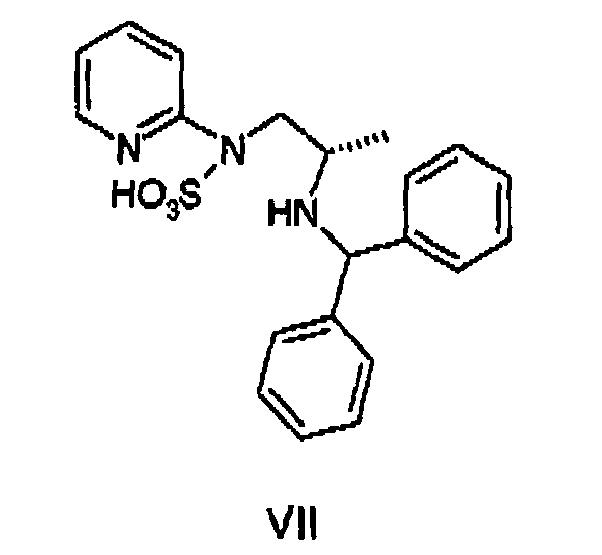
R f = 0.31 (10:1 CHCl3:CH3OH);
1H NMR (DMSO) δ 9.77 (bs, 1H, OH), 7.15-8.0 (m, 13H), 6.7-6.8 (m, 1 H), 5.81 (bs, 1 H, NH), 4.1-4.3 (m, 2H), 3.4 (m, 2H), 1.3 (d, J=4.8 Hz, 2H);
13C NMR (DMSO) δ 155.2, 146.5, 137.4, 136.4, 129.4, 129.3, 129.2, 129.0, 128.8, 128.1, 127.8, 127.7, 127.5, 127.5, 126.3, 116.0, 114.8, 62.4, 57.3, 53.2, 50.1, 14.4; IR (KBr): υmax 3432, 3057, 3010, 2931, 2836, 2663, 2508, 2330, 1599, 1565, 1500, 1474, 1433 cm-1;
CHN (calculated) C 63.48 H 5.79 N 10.57, CHN (observed) C 63.38 H 5.74 N 10.52; MP = 203.5-208 °C. -

- A mixture of benzhydryl protected sulfamic acid of formula VII (5.0 g, 12 mmol), 10% Pd/C (2.1 g) in EtOH (100 mL) is stirred at ambient temperature under a balloon of H2. After 2 days, the reaction mixture is filtered through a bed of celite, washed with hot EtOH (100 mL) and concentrated in vacuo to provide 1.98 g (72%) of the compound of formula VIII as an off-white solid. 1H NMR (DMSO) δ 8.17 (d, J=3 Hz, 1H), 7.5-7.9 (m, 5H), 6.82 (t, J=4.5 Hz, 1H), 4.03 (dd, J=10.8 Hz, 3.6 Hz, 1H), 3.94 (dd, J=10.8 Hz, 5.7 Hz, 1H), 3.4-3.6 (m, 1H) 1.18 (d, J=5.1 Hz, 3H); 13C NMR (DMSO) δ 156.1, 146.8, 136.9, 115.7, 114.6, 50.1, 47.9, 16.7; IR (KBr): υmax 3426, 3137, 3073, 2980, 2518, 1629, 1588, 1520, 1465, 1432, 1366, 1286, 1234, 1197, 1146, 1117, 1063, 1042 cm-1; CHN (calculated) C 41.6 H 5.62 N 18.2, CHN (observed) C 41.1 H 5.49 N 17.7; MP = 175.5-179 °C
-

- A mixture of sulfamidate of formula I (R=methyl) (22 g, 0.11 mol) in a 2 N ammonia in EtOH solution (216 mL, 0.432 mol) is stirred at ambient temperature under N2 for 2 days. This mixture is then concentrated to ¼ its original volume. The mixture is filtered, washed with Et2O (50 mL) and air-dried to give 17 g (72 %) of sulfamic acid of formula VIII as an off-white solid.
-

- A solution of sulfamic acid of formula VIII (0.97 g, 4.2 mmol) in 3 N HCl (10 mL) is stirred at ambient temperature for 18 h. After this time, the reaction mixture is basified to pH 13-14 with 6 N NaOH (5 mL) and extracted with Et2O (3 x 40 mL). The combined organic layers is dried over Na2SO4, filtered and concentrated in vacuo to give 0.49 g (78%) of N1-(2'-pyridyl)-1,2-propanediamine as a yellow oil. 1H NMR (CD3OD) δ 7.8-8.0 (m, 2H), 7.3-7.5 (m, 2H), 6.5-6.7 (m, 2H), 3.0-3.4 (m, 3H).
-

- To a solution of dimesylate of formula X (57 mg, 0.14 mmol) in anhydrous acetonitrile (1 mL) is added aminopyridine (20 mg, 0.13 mmol), potassium carbonate (52 mg, 0.38 mmol) and lithium bromide (26 mg, 0.30 mmol). The reaction mixture is heated to reflux for 15 h under N2 then cooled to room temperature before filtering through a pad of celite. The pad is then washed with acetonitrile. The combined organic layers are dried over Na2SO4, filtered, and concentrated in vacuo to give 52 g (105%) of piperazine XI as a yellow oil (92% area% by GC/MS).
-

- To piperazine XI (23 g, 65 mmol), a 1 M solution of HCl in EtOH (125 mL, 125 mmol) is added. This mixture is concentrated in vacuo, then redissolved in CH3OH (25 mL). Et2O (15 mL) is added slowly. After 18 h at ambient temperature, off-white solids form. The solid is filtered, washed with cold EtOH (5 mL) and air-dried to provide 4.6 g of the dihydrochloride of compound XI as an off-white solid. The mother liquor is set aside. After an additional 5 days, more solid forms. This is filtered, washed with cold EtOH (5 mL) and air-dried to give an additional 3.7 g of the dihydrochloride of compound XI as an off-white solid.
-

- To a solution of potassium carbonate (3.4 g, 24.6 mmol) in H2O (5 mL), is added the dihydrochloride made in Example 7 (3.0 g, 7.0 mmol), followed by EtOAc (17 mL). The mixture is stirred in a 0-5 °C ice-bath for 15 min before the addition of 4-cyanobenzoyl chloride (1.3 g, 7.9 mmol) in EtOAc (3.5 mL) is added slowly. After 1 h, TLC indicates a small amount of starting material. Additional 4-cyanobenzoyl chloride (100 mg, 0.60 mmol) is added. After an additional 1 h, H2O (10 mL) is added. The two layers are separated. The organic layer is extracted with a saturated NaCl solution (10 mL), H2O (10 mL). The aqueous layers are back extracted with EtOAc (2 x 10 mL). The combined organic layers are dried over Na2SO4, filtered, concentrated in vacuo to give 3.0 g (88%) of the compound of formula XII as a yellow foam.
-

-

-

- Many variations of the present invention not illustrated herein will occur to those skilled in the art. The present invention is not limited to the embodiments illustrate and described herein, but encompasses all the subject matter within the scope of the appended claims and equivalents thereof.
Claims (21)
- A process for making a compound of the formula

- The process of Claim 1 wherein the chloroethanol is 2-chloroethanol.
- A process for making a compound of the formula

- The process of Claim 3 wherein the alkyl haloacetate is ethyl bromoacetate.
- The process of Claim 3 or Claim 4 wherein the diester is reduced in the presence of LAH.
- The process of any one of Claims 1 to 5 further comprising converting the diol to mesylate groups to form a compound having the formula

- A process for making an N1-(2'-pyridyl)-1,2-alkanediamine sulfamic acid of formula II comprising reacting a compound of formula I with NH2R'

- The process of claim 7 wherein R is methyl.
- The process of claim 7 further comprising the steps of:a) where R' is not H, hydrogenating the compound of formula II to convert R' to H; and,b) acid hydrolysis of the compound of formula II in which R' is H, to form a compound of formula III

- The process of claim 9 further comprising reacting the compound of formula III with a compound of formula IV to form a compound of formula V

- The process of claim 10 further comprising treating the compound of formula V with an aroyl compound selected from aroyl chloride, aroyl bromide and aroyl anhydride, in the presence of a base, to form a compound of formula VI

- The process of claim 7 further comprising reacting the compound of formula II with a compound of formula IV to form a compound of formula V

- The process of claim 12 further comprising treating the compound of formula V with an aroyl compound selected from aroyl chloride, aroyl bromide and aroyl anhydride, in the presence of a base, to form a compound of formula VI

- The process of claim 13 wherein Aryl is 4-cyanophenyl.
- A process for converting a compound of formula II

 a) where R' is not H, hydrogenating the compound of formula II to convert R' to H; and,b) acid hydrolysis of the compound of formula II in which R' is H, to form a compound of formula III.
 - The process of claim 15 further comprising reacting the compound of formula III with a compound of formula IV to form a compound of formula V

- The process of claim 16 further comprising treating the compound of formula V with an aroyl compound selected from aroyl chloride, aroyl bromide and aroyl anhydride, in the presence of a base, to form a compound of formula VI

- A process comprising reacting the compound of formula II with a compound of formula IV to form a compound of formula V

- The process of claim 18 further comprising treating the compound of formula V with an aroyl compound selected from aroyl chloride, aroyl bromide and aroyl anhydride, in the presence of a base, to form a compound of formula VI

- A compound of formula II

- The compound of claim 20 wherein R' is selected from the group consisting of H, benzyl and benzhydryl.
Applications Claiming Priority (2)
| Application Number | Priority Date | Filing Date | Title |
|---|---|---|---|
| US36345702P | 2002-03-12 | 2002-03-12 | |
| EP03716415A EP1483243B1 (en) | 2002-03-12 | 2003-03-10 | Preparation of n1-(2'-pyridyl)-1,2-propanediamine sulfamic acid and its use in the synthesis of biologically active piperazines |
Related Parent Applications (1)
| Application Number | Title | Priority Date | Filing Date |
|---|---|---|---|
| EP03716415A Division EP1483243B1 (en) | 2002-03-12 | 2003-03-10 | Preparation of n1-(2'-pyridyl)-1,2-propanediamine sulfamic acid and its use in the synthesis of biologically active piperazines |
Publications (2)
| Publication Number | Publication Date |
|---|---|
| EP1801103A1 true EP1801103A1 (en) | 2007-06-27 |
| EP1801103B1 EP1801103B1 (en) | 2009-11-18 |
Family
ID=28041771
Family Applications (2)
| Application Number | Title | Priority Date | Filing Date |
|---|---|---|---|
| EP07007755A Expired - Lifetime EP1801103B1 (en) | 2002-03-12 | 2003-03-10 | Preparation of 2-((2,3- dihydro-benzo(1,4) dioxin-5-YL)-(2-hydroxyethyl)-amino)-ethanol and related intermediates |
| EP03716415A Expired - Lifetime EP1483243B1 (en) | 2002-03-12 | 2003-03-10 | Preparation of n1-(2'-pyridyl)-1,2-propanediamine sulfamic acid and its use in the synthesis of biologically active piperazines |
Family Applications After (1)
| Application Number | Title | Priority Date | Filing Date |
|---|---|---|---|
| EP03716415A Expired - Lifetime EP1483243B1 (en) | 2002-03-12 | 2003-03-10 | Preparation of n1-(2'-pyridyl)-1,2-propanediamine sulfamic acid and its use in the synthesis of biologically active piperazines |
Country Status (26)
| Country | Link |
|---|---|
| US (1) | US6784294B2 (en) |
| EP (2) | EP1801103B1 (en) |
| JP (1) | JP4397693B2 (en) |
| KR (1) | KR20040091720A (en) |
| CN (1) | CN100341854C (en) |
| AR (1) | AR038932A1 (en) |
| AT (2) | ATE360002T1 (en) |
| AU (1) | AU2003220122A1 (en) |
| BR (1) | BR0308315A (en) |
| CA (1) | CA2477886A1 (en) |
| CY (1) | CY1106677T1 (en) |
| DE (2) | DE60313301T2 (en) |
| DK (1) | DK1483243T3 (en) |
| EC (1) | ECSP045291A (en) |
| ES (2) | ES2283762T3 (en) |
| IL (1) | IL163829A0 (en) |
| MX (1) | MXPA04008731A (en) |
| NO (1) | NO20044049L (en) |
| NZ (1) | NZ535170A (en) |
| PT (1) | PT1483243E (en) |
| RU (1) | RU2314294C2 (en) |
| SI (1) | SI1483243T1 (en) |
| TW (1) | TWI288642B (en) |
| UA (1) | UA80272C2 (en) |
| WO (1) | WO2003078396A1 (en) |
| ZA (1) | ZA200408213B (en) |
Families Citing this family (12)
| Publication number | Priority date | Publication date | Assignee | Title |
|---|---|---|---|---|
| US20060223824A1 (en) * | 2000-11-28 | 2006-10-05 | Wyeth | Serotonergic agents |
| US7504395B2 (en) * | 2001-07-20 | 2009-03-17 | Psychogenics, Inc. | Treatment for attention-deficit hyperactivity disorder |
| KR20040091720A (en) | 2002-03-12 | 2004-10-28 | 와이어쓰 | Preparation of N1-(2'-pyridyl)-1,2-propanediamine sulfamic acid and its use in the synthesis of biologically active piperazines |
| US7361773B2 (en) * | 2002-03-12 | 2008-04-22 | Wyeth | Preparation of N1-(2'-pyridyl)-1,2-propanediamine sulfamic acid and its use in the synthesis of biologically active piperazines |
| CN101492383A (en) * | 2002-03-12 | 2009-07-29 | 惠氏公司 | Process for making chiral 1,4-disubstituted piperazines |
| US20050215561A1 (en) * | 2004-03-19 | 2005-09-29 | Krishnendu Ghosh | Pharmaceutical dosage forms and compositions |
| US20050209245A1 (en) * | 2004-03-19 | 2005-09-22 | Wyeth | Process for preparing N-aryl-piperazine derivatives |
| US20070099931A1 (en) * | 2004-03-19 | 2007-05-03 | Wyeth | Pharmaceutical dosage forms and compositions |
| KR20070112797A (en) * | 2005-03-01 | 2007-11-27 | 와이어쓰 | Crystalline and amorphous 4-cyano-N-((2R) -2- [4- (2,3-dihydro-benzo [1,4] dioxin-5-yl) -piperazin-1-yl]- Propyl) -N-pyridin-2-yl-benzamide hydrochloride |
| CN104072483B (en) | 2010-03-12 | 2016-04-13 | 日本曹达株式会社 | The manufacture method of the compound containing pyridine ring and halogenated methyl pyridine derivate and tetrazyl 9 oxime derivate |
| EP2602248A1 (en) | 2011-12-05 | 2013-06-12 | University Of Leicester | Novel pyrrole compounds |
| GB201310126D0 (en) * | 2013-06-06 | 2013-07-24 | Univ Leicester | Novel pyrrole derivatives |
Citations (6)
| Publication number | Priority date | Publication date | Assignee | Title |
|---|---|---|---|---|
| WO1995033725A1 (en) | 1994-06-03 | 1995-12-14 | John Wyeth & Brother Limited | Novel processes and intermediates for the preparation of piperazine derivatives |
| WO1997003982A1 (en) * | 1995-07-20 | 1997-02-06 | American Home Products Corporation | Piperazine derivatives and their use as 5-ht1a antagonists |
| WO1997037655A1 (en) | 1996-04-10 | 1997-10-16 | Merck & Co., Inc. | αvβ3 ANTAGONISTS |
| US6127357A (en) | 1991-05-02 | 2000-10-03 | John Wyeth & Brother, Ltd. | N-((phenyl, benzodioxinyl or N-heteroarylpiperazinyl)alkyl)-N-(N-heteroaryl)substituted carboxamides |
| WO2003078417A1 (en) * | 2002-03-12 | 2003-09-25 | Wyeth, A Corporation Of The State Of Delaware | Process for synthesizing chiral n-aryl piperazines |
| EP1483243B1 (en) | 2002-03-12 | 2007-04-18 | Wyeth | Preparation of n1-(2'-pyridyl)-1,2-propanediamine sulfamic acid and its use in the synthesis of biologically active piperazines |
Family Cites Families (5)
| Publication number | Priority date | Publication date | Assignee | Title |
|---|---|---|---|---|
| ATE81975T1 (en) | 1984-12-21 | 1992-11-15 | Duphar Int Res | MEDICATIONS WITH PSYCHOTROPIC EFFECTS. |
| JPH01125357A (en) | 1987-11-06 | 1989-05-17 | Dainippon Pharmaceut Co Ltd | Tripeptide derivative |
| WO1994024115A1 (en) | 1993-04-16 | 1994-10-27 | Santen Pharmaceutical Co., Ltd. | Novel piperazine derivative |
| RU2118322C1 (en) * | 1993-07-05 | 1998-08-27 | Дюфар Интернэшнл Рисерч Б.В. | 2,3-dihydro-1,4-benzodioxine-5-yl-pyrerazine derivatives and salts thereof |
| GB9411099D0 (en) * | 1994-06-03 | 1994-07-27 | Wyeth John & Brother Ltd | Piperazine derivatives |
-
2003
- 2003-03-10 KR KR10-2004-7014252A patent/KR20040091720A/en not_active Abandoned
- 2003-03-10 ES ES03716415T patent/ES2283762T3/en not_active Expired - Lifetime
- 2003-03-10 ES ES07007755T patent/ES2334836T3/en not_active Expired - Lifetime
- 2003-03-10 CN CNB038058421A patent/CN100341854C/en not_active Expired - Fee Related
- 2003-03-10 MX MXPA04008731A patent/MXPA04008731A/en active IP Right Grant
- 2003-03-10 RU RU2004130314/04A patent/RU2314294C2/en not_active IP Right Cessation
- 2003-03-10 PT PT03716415T patent/PT1483243E/en unknown
- 2003-03-10 AT AT03716415T patent/ATE360002T1/en not_active IP Right Cessation
- 2003-03-10 NZ NZ535170A patent/NZ535170A/en unknown
- 2003-03-10 US US10/385,337 patent/US6784294B2/en not_active Expired - Fee Related
- 2003-03-10 BR BR0308315-2A patent/BR0308315A/en not_active IP Right Cessation
- 2003-03-10 DK DK03716415T patent/DK1483243T3/en active
- 2003-03-10 AU AU2003220122A patent/AU2003220122A1/en not_active Abandoned
- 2003-03-10 IL IL16382903A patent/IL163829A0/en unknown
- 2003-03-10 CA CA002477886A patent/CA2477886A1/en not_active Abandoned
- 2003-03-10 SI SI200330817T patent/SI1483243T1/en unknown
- 2003-03-10 WO PCT/US2003/007228 patent/WO2003078396A1/en not_active Ceased
- 2003-03-10 EP EP07007755A patent/EP1801103B1/en not_active Expired - Lifetime
- 2003-03-10 EP EP03716415A patent/EP1483243B1/en not_active Expired - Lifetime
- 2003-03-10 DE DE60313301T patent/DE60313301T2/en not_active Expired - Lifetime
- 2003-03-10 JP JP2003576402A patent/JP4397693B2/en not_active Expired - Fee Related
- 2003-03-10 TW TW092105099A patent/TWI288642B/en not_active IP Right Cessation
- 2003-03-10 AT AT07007755T patent/ATE449073T1/en not_active IP Right Cessation
- 2003-03-10 DE DE60330199T patent/DE60330199D1/en not_active Expired - Lifetime
- 2003-03-11 AR ARP030100833A patent/AR038932A1/en unknown
- 2003-10-03 UA UA20041008214A patent/UA80272C2/en unknown
-
2004
- 2004-09-10 EC EC2004005291A patent/ECSP045291A/en unknown
- 2004-09-24 NO NO20044049A patent/NO20044049L/en not_active Application Discontinuation
- 2004-10-11 ZA ZA200408213A patent/ZA200408213B/en unknown
-
2007
- 2007-06-26 CY CY20071100843T patent/CY1106677T1/en unknown
Patent Citations (6)
| Publication number | Priority date | Publication date | Assignee | Title |
|---|---|---|---|---|
| US6127357A (en) | 1991-05-02 | 2000-10-03 | John Wyeth & Brother, Ltd. | N-((phenyl, benzodioxinyl or N-heteroarylpiperazinyl)alkyl)-N-(N-heteroaryl)substituted carboxamides |
| WO1995033725A1 (en) | 1994-06-03 | 1995-12-14 | John Wyeth & Brother Limited | Novel processes and intermediates for the preparation of piperazine derivatives |
| WO1997003982A1 (en) * | 1995-07-20 | 1997-02-06 | American Home Products Corporation | Piperazine derivatives and their use as 5-ht1a antagonists |
| WO1997037655A1 (en) | 1996-04-10 | 1997-10-16 | Merck & Co., Inc. | αvβ3 ANTAGONISTS |
| WO2003078417A1 (en) * | 2002-03-12 | 2003-09-25 | Wyeth, A Corporation Of The State Of Delaware | Process for synthesizing chiral n-aryl piperazines |
| EP1483243B1 (en) | 2002-03-12 | 2007-04-18 | Wyeth | Preparation of n1-(2'-pyridyl)-1,2-propanediamine sulfamic acid and its use in the synthesis of biologically active piperazines |
Non-Patent Citations (4)
| Title |
|---|
| CIGNARELLA ET AL., FARMACO ED. SCI., vol. 31, 1976, pages 194 |
| CIGNARELLA G ET AL: "2,6-DIALKYLPIPERAZINES VII - SYNTHESIS OF N4-(2'-PYRIDYL)-2,6-DIMETHY LPIPERAZINE AND SEPARATION OF ITS GEOMETRICAL ISOMERS", FARMACO, EDIZIONE SCIENTIFICA, SOCIETA CHIMICA ITALIANA, PAVIA, IT, vol. 31, no. FASC 3, 1976, pages 194 - 200, XP001095753, ISSN: 0430-0920 * |
| L. T. BOULTON, J. CHEM. SOC., PERKIN-TRANS., vol. 1, 1999, pages 1421 - 1429 |
| Z. ZUBOVICS ET AL.: "Synthesis and antiarrhythmic activity of N-aryl alkylenediamines", EUROPEAN JOURNAL OF MEDICINAL CHEMISTRY. CHIMICA THERAPEUTICA, vol. 21, no. 5, 1986, EDITIONS SCIENTIFIQUE ELSEVIER, PARIS., FR, pages 370 - 378, XP002248531, ISSN: 0223-5234 * |
Also Published As
Similar Documents
| Publication | Publication Date | Title |
|---|---|---|
| FI109122B (en) | Process for the preparation of [(benzodioxane, benzofuran or benzopyran) -alkylamino] -alkyl-substituted guanidines useful as a vasoconstrictive substance | |
| EP1483243B1 (en) | Preparation of n1-(2'-pyridyl)-1,2-propanediamine sulfamic acid and its use in the synthesis of biologically active piperazines | |
| EP1483255B1 (en) | Process for synthesizing chiral n-aryl piperazines | |
| US7361773B2 (en) | Preparation of N1-(2'-pyridyl)-1,2-propanediamine sulfamic acid and its use in the synthesis of biologically active piperazines | |
| US7091349B2 (en) | Process for synthesizing N-aryl piperazines with chiral N′-1-[benzoyl(2-pyridyl)amino]-2-propane substitution | |
| US7256289B2 (en) | Process for making chiral 1,4-disubstituted piperazines | |
| HK1104816A (en) | Preparation of 2-((2,3- dihydro-benzo(1,4) dioxin-5-yl)-(2-hydroxyethyl)-amino)-ethanol and related intermediates | |
| HK1068618B (en) | Preparation of n1-(2'-pyridyl)-1,2-propanediamine sulfamic acid and its use in the synthesis of biologically active piperazines | |
| US5322944A (en) | Process for the synthesis of enantiomers of 3-aminochroman compounds | |
| US6063784A (en) | Heteroaryloxyethylamines, method of preparation, application as medicine and pharmaceutical compositions containing them |
Legal Events
| Date | Code | Title | Description |
|---|---|---|---|
| PUAI | Public reference made under article 153(3) epc to a published international application that has entered the european phase |
Free format text: ORIGINAL CODE: 0009012 |
|
| 17P | Request for examination filed |
Effective date: 20070417 |
|
| AC | Divisional application: reference to earlier application |
Ref document number: 1483243 Country of ref document: EP Kind code of ref document: P |
|
| AK | Designated contracting states |
Kind code of ref document: A1 Designated state(s): AT BE BG CH CY CZ DE DK EE ES FI FR GB GR HU IE IT LI LU MC NL PT RO SE SI SK TR |
|
| AX | Request for extension of the european patent |
Extension state: AL LT LV MK |
|
| REG | Reference to a national code |
Ref country code: HK Ref legal event code: DE Ref document number: 1104816 Country of ref document: HK |
|
| AKX | Designation fees paid |
Designated state(s): AT BE BG CH CY CZ DE DK EE ES FI FR GB GR HU IE IT LI LU MC NL PT RO SE SI SK TR |
|
| 17Q | First examination report despatched |
Effective date: 20080325 |
|
| GRAP | Despatch of communication of intention to grant a patent |
Free format text: ORIGINAL CODE: EPIDOSNIGR1 |
|
| GRAS | Grant fee paid |
Free format text: ORIGINAL CODE: EPIDOSNIGR3 |
|
| GRAA | (expected) grant |
Free format text: ORIGINAL CODE: 0009210 |
|
| RIN1 | Information on inventor provided before grant (corrected) |
Inventor name: FEIGELSON, GREGG B Inventor name: ZELDIS, JOSEPH Inventor name: CHAN, ANITA W. Inventor name: JIRKOVSKY, IVO |
|
| AC | Divisional application: reference to earlier application |
Ref document number: 1483243 Country of ref document: EP Kind code of ref document: P |
|
| AK | Designated contracting states |
Kind code of ref document: B1 Designated state(s): AT BE BG CH CY CZ DE DK EE ES FI FR GB GR HU IE IT LI LU MC NL PT RO SE SI SK TR |
|
| REG | Reference to a national code |
Ref country code: GB Ref legal event code: FG4D |
|
| REG | Reference to a national code |
Ref country code: CH Ref legal event code: EP |
|
| REG | Reference to a national code |
Ref country code: IE Ref legal event code: FG4D |
|
| REF | Corresponds to: |
Ref document number: 60330199 Country of ref document: DE Date of ref document: 20091231 Kind code of ref document: P |
|
| REG | Reference to a national code |
Ref country code: ES Ref legal event code: FG2A Ref document number: 2334836 Country of ref document: ES Kind code of ref document: T3 |
|
| REG | Reference to a national code |
Ref country code: NL Ref legal event code: VDEP Effective date: 20091118 |
|
| PG25 | Lapsed in a contracting state [announced via postgrant information from national office to epo] |
Ref country code: FI Free format text: LAPSE BECAUSE OF FAILURE TO SUBMIT A TRANSLATION OF THE DESCRIPTION OR TO PAY THE FEE WITHIN THE PRESCRIBED TIME-LIMIT Effective date: 20091118 Ref country code: PT Free format text: LAPSE BECAUSE OF FAILURE TO SUBMIT A TRANSLATION OF THE DESCRIPTION OR TO PAY THE FEE WITHIN THE PRESCRIBED TIME-LIMIT Effective date: 20100318 Ref country code: SE Free format text: LAPSE BECAUSE OF FAILURE TO SUBMIT A TRANSLATION OF THE DESCRIPTION OR TO PAY THE FEE WITHIN THE PRESCRIBED TIME-LIMIT Effective date: 20091118 |
|
| PGFP | Annual fee paid to national office [announced via postgrant information from national office to epo] |
Ref country code: CH Payment date: 20100218 Year of fee payment: 8 Ref country code: ES Payment date: 20100325 Year of fee payment: 8 Ref country code: IE Payment date: 20100114 Year of fee payment: 8 Ref country code: LU Payment date: 20100323 Year of fee payment: 8 |
|
| PG25 | Lapsed in a contracting state [announced via postgrant information from national office to epo] |
Ref country code: SI Free format text: LAPSE BECAUSE OF FAILURE TO SUBMIT A TRANSLATION OF THE DESCRIPTION OR TO PAY THE FEE WITHIN THE PRESCRIBED TIME-LIMIT Effective date: 20091118 Ref country code: CY Free format text: LAPSE BECAUSE OF FAILURE TO SUBMIT A TRANSLATION OF THE DESCRIPTION OR TO PAY THE FEE WITHIN THE PRESCRIBED TIME-LIMIT Effective date: 20091118 |
|
| PGFP | Annual fee paid to national office [announced via postgrant information from national office to epo] |
Ref country code: FR Payment date: 20100318 Year of fee payment: 8 |
|
| PG25 | Lapsed in a contracting state [announced via postgrant information from national office to epo] |
Ref country code: AT Free format text: LAPSE BECAUSE OF FAILURE TO SUBMIT A TRANSLATION OF THE DESCRIPTION OR TO PAY THE FEE WITHIN THE PRESCRIBED TIME-LIMIT Effective date: 20091118 Ref country code: DK Free format text: LAPSE BECAUSE OF NON-PAYMENT OF DUE FEES Effective date: 20091118 Ref country code: BE Free format text: LAPSE BECAUSE OF FAILURE TO SUBMIT A TRANSLATION OF THE DESCRIPTION OR TO PAY THE FEE WITHIN THE PRESCRIBED TIME-LIMIT Effective date: 20091118 |
|
| PGFP | Annual fee paid to national office [announced via postgrant information from national office to epo] |
Ref country code: GB Payment date: 20100208 Year of fee payment: 8 |
|
| PG25 | Lapsed in a contracting state [announced via postgrant information from national office to epo] |
Ref country code: EE Free format text: LAPSE BECAUSE OF FAILURE TO SUBMIT A TRANSLATION OF THE DESCRIPTION OR TO PAY THE FEE WITHIN THE PRESCRIBED TIME-LIMIT Effective date: 20091118 Ref country code: NL Free format text: LAPSE BECAUSE OF FAILURE TO SUBMIT A TRANSLATION OF THE DESCRIPTION OR TO PAY THE FEE WITHIN THE PRESCRIBED TIME-LIMIT Effective date: 20091118 Ref country code: RO Free format text: LAPSE BECAUSE OF FAILURE TO SUBMIT A TRANSLATION OF THE DESCRIPTION OR TO PAY THE FEE WITHIN THE PRESCRIBED TIME-LIMIT Effective date: 20091118 Ref country code: BG Free format text: LAPSE BECAUSE OF FAILURE TO SUBMIT A TRANSLATION OF THE DESCRIPTION OR TO PAY THE FEE WITHIN THE PRESCRIBED TIME-LIMIT Effective date: 20100218 |
|
| PG25 | Lapsed in a contracting state [announced via postgrant information from national office to epo] |
Ref country code: SK Free format text: LAPSE BECAUSE OF FAILURE TO SUBMIT A TRANSLATION OF THE DESCRIPTION OR TO PAY THE FEE WITHIN THE PRESCRIBED TIME-LIMIT Effective date: 20091118 Ref country code: CZ Free format text: LAPSE BECAUSE OF FAILURE TO SUBMIT A TRANSLATION OF THE DESCRIPTION OR TO PAY THE FEE WITHIN THE PRESCRIBED TIME-LIMIT Effective date: 20091118 |
|
| PGFP | Annual fee paid to national office [announced via postgrant information from national office to epo] |
Ref country code: DE Payment date: 20100331 Year of fee payment: 8 Ref country code: IT Payment date: 20100324 Year of fee payment: 8 Ref country code: NL Payment date: 20100402 Year of fee payment: 8 |
|
| PLBE | No opposition filed within time limit |
Free format text: ORIGINAL CODE: 0009261 |
|
| STAA | Information on the status of an ep patent application or granted ep patent |
Free format text: STATUS: NO OPPOSITION FILED WITHIN TIME LIMIT |
|
| 26N | No opposition filed |
Effective date: 20100819 |
|
| PG25 | Lapsed in a contracting state [announced via postgrant information from national office to epo] |
Ref country code: MC Free format text: LAPSE BECAUSE OF NON-PAYMENT OF DUE FEES Effective date: 20100331 Ref country code: GR Free format text: LAPSE BECAUSE OF FAILURE TO SUBMIT A TRANSLATION OF THE DESCRIPTION OR TO PAY THE FEE WITHIN THE PRESCRIBED TIME-LIMIT Effective date: 20100219 |
|
| REG | Reference to a national code |
Ref country code: CH Ref legal event code: PL |
|
| GBPC | Gb: european patent ceased through non-payment of renewal fee |
Effective date: 20110310 |
|
| REG | Reference to a national code |
Ref country code: FR Ref legal event code: ST Effective date: 20111130 |
|
| REG | Reference to a national code |
Ref country code: IE Ref legal event code: MM4A |
|
| PG25 | Lapsed in a contracting state [announced via postgrant information from national office to epo] |
Ref country code: FR Free format text: LAPSE BECAUSE OF NON-PAYMENT OF DUE FEES Effective date: 20110331 Ref country code: DE Free format text: LAPSE BECAUSE OF NON-PAYMENT OF DUE FEES Effective date: 20111001 Ref country code: LI Free format text: LAPSE BECAUSE OF NON-PAYMENT OF DUE FEES Effective date: 20110331 Ref country code: IE Free format text: LAPSE BECAUSE OF NON-PAYMENT OF DUE FEES Effective date: 20110310 Ref country code: CH Free format text: LAPSE BECAUSE OF NON-PAYMENT OF DUE FEES Effective date: 20110331 |
|
| REG | Reference to a national code |
Ref country code: DE Ref legal event code: R119 Ref document number: 60330199 Country of ref document: DE Effective date: 20111001 |
|
| PG25 | Lapsed in a contracting state [announced via postgrant information from national office to epo] |
Ref country code: IT Free format text: LAPSE BECAUSE OF NON-PAYMENT OF DUE FEES Effective date: 20110310 Ref country code: GB Free format text: LAPSE BECAUSE OF NON-PAYMENT OF DUE FEES Effective date: 20110310 |
|
| REG | Reference to a national code |
Ref country code: ES Ref legal event code: FD2A Effective date: 20120424 |
|
| PG25 | Lapsed in a contracting state [announced via postgrant information from national office to epo] |
Ref country code: ES Free format text: LAPSE BECAUSE OF NON-PAYMENT OF DUE FEES Effective date: 20110311 |
|
| PG25 | Lapsed in a contracting state [announced via postgrant information from national office to epo] |
Ref country code: HU Free format text: LAPSE BECAUSE OF FAILURE TO SUBMIT A TRANSLATION OF THE DESCRIPTION OR TO PAY THE FEE WITHIN THE PRESCRIBED TIME-LIMIT Effective date: 20100519 |
|
| PG25 | Lapsed in a contracting state [announced via postgrant information from national office to epo] |
Ref country code: TR Free format text: LAPSE BECAUSE OF FAILURE TO SUBMIT A TRANSLATION OF THE DESCRIPTION OR TO PAY THE FEE WITHIN THE PRESCRIBED TIME-LIMIT Effective date: 20091118 |
|
| PG25 | Lapsed in a contracting state [announced via postgrant information from national office to epo] |
Ref country code: LU Free format text: LAPSE BECAUSE OF NON-PAYMENT OF DUE FEES Effective date: 20110310 |
|
| REG | Reference to a national code |
Ref country code: HK Ref legal event code: WD Ref document number: 1104816 Country of ref document: HK |