EP1801100A1 - Functional trithiocarbonate RAFT agents - Google Patents
Functional trithiocarbonate RAFT agents Download PDFInfo
- Publication number
- EP1801100A1 EP1801100A1 EP06126188A EP06126188A EP1801100A1 EP 1801100 A1 EP1801100 A1 EP 1801100A1 EP 06126188 A EP06126188 A EP 06126188A EP 06126188 A EP06126188 A EP 06126188A EP 1801100 A1 EP1801100 A1 EP 1801100A1
- Authority
- EP
- European Patent Office
- Prior art keywords
- free radical
- control agent
- moles
- group
- polymerization
- Prior art date
- Legal status (The legal status is an assumption and is not a legal conclusion. Google has not performed a legal analysis and makes no representation as to the accuracy of the status listed.)
- Withdrawn
Links
- 239000012989 trithiocarbonate Substances 0.000 title claims description 22
- HIZCIEIDIFGZSS-UHFFFAOYSA-L trithiocarbonate Chemical compound [S-]C([S-])=S HIZCIEIDIFGZSS-UHFFFAOYSA-L 0.000 title claims description 19
- 239000012987 RAFT agent Substances 0.000 title description 16
- 239000003795 chemical substances by application Substances 0.000 claims abstract description 36
- 150000003254 radicals Chemical class 0.000 claims abstract description 36
- 125000004432 carbon atom Chemical group C* 0.000 claims abstract description 16
- 125000000217 alkyl group Chemical group 0.000 claims abstract description 13
- 239000001257 hydrogen Substances 0.000 claims abstract description 11
- 229910052739 hydrogen Inorganic materials 0.000 claims abstract description 11
- 125000003178 carboxy group Chemical group [H]OC(*)=O 0.000 claims abstract description 9
- 125000000524 functional group Chemical group 0.000 claims abstract description 7
- 229910052799 carbon Inorganic materials 0.000 claims abstract description 5
- OKTJSMMVPCPJKN-UHFFFAOYSA-N Carbon Chemical compound [C] OKTJSMMVPCPJKN-UHFFFAOYSA-N 0.000 claims abstract description 3
- 230000003213 activating effect Effects 0.000 claims abstract description 3
- 238000007342 radical addition reaction Methods 0.000 claims abstract description 3
- 125000002348 vinylic group Chemical group 0.000 claims abstract description 3
- PPBRXRYQALVLMV-UHFFFAOYSA-N Styrene Chemical compound C=CC1=CC=CC=C1 PPBRXRYQALVLMV-UHFFFAOYSA-N 0.000 claims description 73
- -1 napthyl Chemical group 0.000 claims description 40
- 239000000178 monomer Substances 0.000 claims description 30
- 229920000642 polymer Polymers 0.000 claims description 15
- KAKZBPTYRLMSJV-UHFFFAOYSA-N Butadiene Chemical compound C=CC=C KAKZBPTYRLMSJV-UHFFFAOYSA-N 0.000 claims description 10
- 125000001797 benzyl group Chemical group [H]C1=C([H])C([H])=C(C([H])=C1[H])C([H])([H])* 0.000 claims description 10
- RRHGJUQNOFWUDK-UHFFFAOYSA-N Isoprene Chemical compound CC(=C)C=C RRHGJUQNOFWUDK-UHFFFAOYSA-N 0.000 claims description 8
- 125000004435 hydrogen atom Chemical group [H]* 0.000 claims description 5
- 125000000999 tert-butyl group Chemical group [H]C([H])([H])C(*)(C([H])([H])[H])C([H])([H])[H] 0.000 claims description 4
- OEPOKWHJYJXUGD-UHFFFAOYSA-N 2-(3-phenylmethoxyphenyl)-1,3-thiazole-4-carbaldehyde Chemical compound O=CC1=CSC(C=2C=C(OCC=3C=CC=CC=3)C=CC=2)=N1 OEPOKWHJYJXUGD-UHFFFAOYSA-N 0.000 claims description 3
- NLHHRLWOUZZQLW-UHFFFAOYSA-N Acrylonitrile Chemical compound C=CC#N NLHHRLWOUZZQLW-UHFFFAOYSA-N 0.000 claims description 3
- VGGSQFUCUMXWEO-UHFFFAOYSA-N Ethene Chemical compound C=C VGGSQFUCUMXWEO-UHFFFAOYSA-N 0.000 claims description 3
- 239000005977 Ethylene Substances 0.000 claims description 3
- GYCMBHHDWRMZGG-UHFFFAOYSA-N Methylacrylonitrile Chemical compound CC(=C)C#N GYCMBHHDWRMZGG-UHFFFAOYSA-N 0.000 claims description 3
- XTXRWKRVRITETP-UHFFFAOYSA-N Vinyl acetate Chemical compound CC(=O)OC=C XTXRWKRVRITETP-UHFFFAOYSA-N 0.000 claims description 3
- BZHJMEDXRYGGRV-UHFFFAOYSA-N Vinyl chloride Chemical compound ClC=C BZHJMEDXRYGGRV-UHFFFAOYSA-N 0.000 claims description 3
- FQPSGWSUVKBHSU-UHFFFAOYSA-N methacrylamide Chemical compound CC(=C)C(N)=O FQPSGWSUVKBHSU-UHFFFAOYSA-N 0.000 claims description 3
- 125000004076 pyridyl group Chemical group 0.000 claims description 3
- HRPVXLWXLXDGHG-UHFFFAOYSA-N Acrylamide Chemical compound NC(=O)C=C HRPVXLWXLXDGHG-UHFFFAOYSA-N 0.000 claims description 2
- 239000004215 Carbon black (E152) Substances 0.000 claims description 2
- 125000005250 alkyl acrylate group Chemical class 0.000 claims description 2
- 125000002178 anthracenyl group Chemical group C1(=CC=CC2=CC3=CC=CC=C3C=C12)* 0.000 claims description 2
- 229930195733 hydrocarbon Natural products 0.000 claims description 2
- 150000002430 hydrocarbons Chemical class 0.000 claims description 2
- 125000001997 phenyl group Chemical group [H]C1=C([H])C([H])=C(*)C([H])=C1[H] 0.000 claims description 2
- 125000001725 pyrenyl group Chemical group 0.000 claims description 2
- 150000003440 styrenes Chemical class 0.000 claims description 2
- 125000000547 substituted alkyl group Chemical class 0.000 claims description 2
- 125000003011 styrenyl group Chemical group [H]\C(*)=C(/[H])C1=C([H])C([H])=C([H])C([H])=C1[H] 0.000 claims 1
- UFHFLCQGNIYNRP-UHFFFAOYSA-N Hydrogen Chemical compound [H][H] UFHFLCQGNIYNRP-UHFFFAOYSA-N 0.000 abstract description 3
- 238000006116 polymerization reaction Methods 0.000 description 43
- 239000004094 surface-active agent Substances 0.000 description 43
- KWYUFKZDYYNOTN-UHFFFAOYSA-M Potassium hydroxide Chemical compound [OH-].[K+] KWYUFKZDYYNOTN-UHFFFAOYSA-M 0.000 description 42
- 238000000034 method Methods 0.000 description 34
- IJGRMHOSHXDMSA-UHFFFAOYSA-N Atomic nitrogen Chemical compound N#N IJGRMHOSHXDMSA-UHFFFAOYSA-N 0.000 description 32
- 239000000203 mixture Substances 0.000 description 32
- 239000000243 solution Substances 0.000 description 31
- XLYOFNOQVPJJNP-UHFFFAOYSA-N water Substances O XLYOFNOQVPJJNP-UHFFFAOYSA-N 0.000 description 30
- 238000007720 emulsion polymerization reaction Methods 0.000 description 28
- 238000006243 chemical reaction Methods 0.000 description 23
- 239000007787 solid Substances 0.000 description 21
- 238000011065 in-situ storage Methods 0.000 description 19
- 239000000839 emulsion Substances 0.000 description 17
- 229910052757 nitrogen Inorganic materials 0.000 description 17
- 238000004945 emulsification Methods 0.000 description 16
- 150000001875 compounds Chemical class 0.000 description 15
- 239000004816 latex Substances 0.000 description 15
- 229920000126 latex Polymers 0.000 description 15
- 239000002253 acid Substances 0.000 description 13
- 230000015572 biosynthetic process Effects 0.000 description 13
- QGJOPFRUJISHPQ-UHFFFAOYSA-N Carbon disulfide Chemical compound S=C=S QGJOPFRUJISHPQ-UHFFFAOYSA-N 0.000 description 12
- VEXZGXHMUGYJMC-UHFFFAOYSA-N Hydrochloric acid Chemical compound Cl VEXZGXHMUGYJMC-UHFFFAOYSA-N 0.000 description 12
- 239000012190 activator Substances 0.000 description 12
- AISZNMCRXZWVAT-UHFFFAOYSA-N 2-ethylsulfanylcarbothioylsulfanyl-2-methylpropanenitrile Chemical compound CCSC(=S)SC(C)(C)C#N AISZNMCRXZWVAT-UHFFFAOYSA-N 0.000 description 11
- 239000007864 aqueous solution Substances 0.000 description 11
- 125000002091 cationic group Chemical group 0.000 description 11
- USHAGKDGDHPEEY-UHFFFAOYSA-L potassium persulfate Chemical compound [K+].[K+].[O-]S(=O)(=O)OOS([O-])(=O)=O USHAGKDGDHPEEY-UHFFFAOYSA-L 0.000 description 11
- CERQOIWHTDAKMF-UHFFFAOYSA-M Methacrylate Chemical compound CC(=C)C([O-])=O CERQOIWHTDAKMF-UHFFFAOYSA-M 0.000 description 10
- 125000000129 anionic group Chemical group 0.000 description 10
- 239000002585 base Substances 0.000 description 10
- 239000003999 initiator Substances 0.000 description 10
- 230000008569 process Effects 0.000 description 10
- NIXOWILDQLNWCW-UHFFFAOYSA-M Acrylate Chemical compound [O-]C(=O)C=C NIXOWILDQLNWCW-UHFFFAOYSA-M 0.000 description 9
- 238000004458 analytical method Methods 0.000 description 9
- 230000007246 mechanism Effects 0.000 description 9
- 238000010526 radical polymerization reaction Methods 0.000 description 9
- 238000001223 reverse osmosis Methods 0.000 description 9
- 238000003786 synthesis reaction Methods 0.000 description 9
- 239000012456 homogeneous solution Substances 0.000 description 8
- 239000012071 phase Substances 0.000 description 8
- LWIHDJKSTIGBAC-UHFFFAOYSA-K tripotassium phosphate Chemical compound [K+].[K+].[K+].[O-]P([O-])([O-])=O LWIHDJKSTIGBAC-UHFFFAOYSA-K 0.000 description 8
- WRIDQFICGBMAFQ-UHFFFAOYSA-N (E)-8-Octadecenoic acid Natural products CCCCCCCCCC=CCCCCCCC(O)=O WRIDQFICGBMAFQ-UHFFFAOYSA-N 0.000 description 7
- LQJBNNIYVWPHFW-UHFFFAOYSA-N 20:1omega9c fatty acid Natural products CCCCCCCCCCC=CCCCCCCCC(O)=O LQJBNNIYVWPHFW-UHFFFAOYSA-N 0.000 description 7
- QSBYPNXLFMSGKH-UHFFFAOYSA-N 9-Heptadecensaeure Natural products CCCCCCCC=CCCCCCCCC(O)=O QSBYPNXLFMSGKH-UHFFFAOYSA-N 0.000 description 7
- 239000005642 Oleic acid Substances 0.000 description 7
- ZQPPMHVWECSIRJ-UHFFFAOYSA-N Oleic acid Natural products CCCCCCCCC=CCCCCCCCC(O)=O ZQPPMHVWECSIRJ-UHFFFAOYSA-N 0.000 description 7
- 150000007513 acids Chemical class 0.000 description 7
- QXJSBBXBKPUZAA-UHFFFAOYSA-N isooleic acid Natural products CCCCCCCC=CCCCCCCCCC(O)=O QXJSBBXBKPUZAA-UHFFFAOYSA-N 0.000 description 7
- ZQPPMHVWECSIRJ-KTKRTIGZSA-N oleic acid Chemical compound CCCCCCCC\C=C/CCCCCCCC(O)=O ZQPPMHVWECSIRJ-KTKRTIGZSA-N 0.000 description 7
- YMWUJEATGCHHMB-UHFFFAOYSA-N Dichloromethane Chemical compound ClCCl YMWUJEATGCHHMB-UHFFFAOYSA-N 0.000 description 6
- CDBYLPFSWZWCQE-UHFFFAOYSA-L Sodium Carbonate Chemical compound [Na+].[Na+].[O-]C([O-])=O CDBYLPFSWZWCQE-UHFFFAOYSA-L 0.000 description 6
- 239000003153 chemical reaction reagent Substances 0.000 description 5
- 230000000052 comparative effect Effects 0.000 description 5
- 239000012043 crude product Substances 0.000 description 5
- 239000003792 electrolyte Substances 0.000 description 5
- 125000001183 hydrocarbyl group Chemical group 0.000 description 5
- 238000003756 stirring Methods 0.000 description 5
- BVKZGUZCCUSVTD-UHFFFAOYSA-M Bicarbonate Chemical class OC([O-])=O BVKZGUZCCUSVTD-UHFFFAOYSA-M 0.000 description 4
- 239000000654 additive Substances 0.000 description 4
- ROOXNKNUYICQNP-UHFFFAOYSA-N ammonium persulfate Chemical compound [NH4+].[NH4+].[O-]S(=O)(=O)OOS([O-])(=O)=O ROOXNKNUYICQNP-UHFFFAOYSA-N 0.000 description 4
- NAPSCFZYZVSQHF-UHFFFAOYSA-N dimantine Chemical compound CCCCCCCCCCCCCCCCCCN(C)C NAPSCFZYZVSQHF-UHFFFAOYSA-N 0.000 description 4
- 229920001971 elastomer Polymers 0.000 description 4
- 239000012039 electrophile Substances 0.000 description 4
- 239000007788 liquid Substances 0.000 description 4
- 239000005060 rubber Substances 0.000 description 4
- 239000000344 soap Substances 0.000 description 4
- 239000002904 solvent Substances 0.000 description 4
- 229910052717 sulfur Inorganic materials 0.000 description 4
- CIHOLLKRGTVIJN-UHFFFAOYSA-N tert‐butyl hydroperoxide Chemical compound CC(C)(C)OO CIHOLLKRGTVIJN-UHFFFAOYSA-N 0.000 description 4
- 238000012546 transfer Methods 0.000 description 4
- 229910000404 tripotassium phosphate Inorganic materials 0.000 description 4
- 235000019798 tripotassium phosphate Nutrition 0.000 description 4
- BVKZGUZCCUSVTD-UHFFFAOYSA-L Carbonate Chemical compound [O-]C([O-])=O BVKZGUZCCUSVTD-UHFFFAOYSA-L 0.000 description 3
- 239000004793 Polystyrene Substances 0.000 description 3
- UIIMBOGNXHQVGW-DEQYMQKBSA-M Sodium bicarbonate-14C Chemical compound [Na+].O[14C]([O-])=O UIIMBOGNXHQVGW-DEQYMQKBSA-M 0.000 description 3
- HEMHJVSKTPXQMS-UHFFFAOYSA-M Sodium hydroxide Chemical compound [OH-].[Na+] HEMHJVSKTPXQMS-UHFFFAOYSA-M 0.000 description 3
- NINIDFKCEFEMDL-UHFFFAOYSA-N Sulfur Chemical compound [S] NINIDFKCEFEMDL-UHFFFAOYSA-N 0.000 description 3
- 230000002378 acidificating effect Effects 0.000 description 3
- 229910052783 alkali metal Inorganic materials 0.000 description 3
- 150000001408 amides Chemical class 0.000 description 3
- 150000001412 amines Chemical class 0.000 description 3
- 239000008346 aqueous phase Substances 0.000 description 3
- 229950010007 dimantine Drugs 0.000 description 3
- 239000006185 dispersion Substances 0.000 description 3
- 150000002148 esters Chemical class 0.000 description 3
- 150000002431 hydrogen Chemical class 0.000 description 3
- 150000004679 hydroxides Chemical class 0.000 description 3
- 125000002887 hydroxy group Chemical group [H]O* 0.000 description 3
- 230000000977 initiatory effect Effects 0.000 description 3
- XKBGEWXEAPTVCK-UHFFFAOYSA-M methyltrioctylammonium chloride Chemical compound [Cl-].CCCCCCCC[N+](C)(CCCCCCCC)CCCCCCCC XKBGEWXEAPTVCK-UHFFFAOYSA-M 0.000 description 3
- 239000000693 micelle Substances 0.000 description 3
- 239000004530 micro-emulsion Substances 0.000 description 3
- 238000002156 mixing Methods 0.000 description 3
- VLKZOEOYAKHREP-UHFFFAOYSA-N n-Hexane Chemical compound CCCCCC VLKZOEOYAKHREP-UHFFFAOYSA-N 0.000 description 3
- 238000006386 neutralization reaction Methods 0.000 description 3
- 239000012038 nucleophile Substances 0.000 description 3
- 239000002245 particle Substances 0.000 description 3
- 229920002223 polystyrene Polymers 0.000 description 3
- 239000000047 product Substances 0.000 description 3
- 229910000029 sodium carbonate Inorganic materials 0.000 description 3
- 239000011593 sulfur Substances 0.000 description 3
- FJLUATLTXUNBOT-UHFFFAOYSA-N 1-Hexadecylamine Chemical compound CCCCCCCCCCCCCCCCN FJLUATLTXUNBOT-UHFFFAOYSA-N 0.000 description 2
- FRIBMENBGGCKPD-UHFFFAOYSA-N 3-(2,3-dimethoxyphenyl)prop-2-enal Chemical compound COC1=CC=CC(C=CC=O)=C1OC FRIBMENBGGCKPD-UHFFFAOYSA-N 0.000 description 2
- CSCPPACGZOOCGX-UHFFFAOYSA-N Acetone Chemical compound CC(C)=O CSCPPACGZOOCGX-UHFFFAOYSA-N 0.000 description 2
- SOGAXMICEFXMKE-UHFFFAOYSA-N Butylmethacrylate Chemical compound CCCCOC(=O)C(C)=C SOGAXMICEFXMKE-UHFFFAOYSA-N 0.000 description 2
- RTZKZFJDLAIYFH-UHFFFAOYSA-N Diethyl ether Chemical compound CCOCC RTZKZFJDLAIYFH-UHFFFAOYSA-N 0.000 description 2
- RWSOTUBLDIXVET-UHFFFAOYSA-N Dihydrogen sulfide Chemical compound S RWSOTUBLDIXVET-UHFFFAOYSA-N 0.000 description 2
- MHAJPDPJQMAIIY-UHFFFAOYSA-N Hydrogen peroxide Chemical compound OO MHAJPDPJQMAIIY-UHFFFAOYSA-N 0.000 description 2
- BAPJBEWLBFYGME-UHFFFAOYSA-N Methyl acrylate Chemical compound COC(=O)C=C BAPJBEWLBFYGME-UHFFFAOYSA-N 0.000 description 2
- 238000005481 NMR spectroscopy Methods 0.000 description 2
- VYPSYNLAJGMNEJ-UHFFFAOYSA-N Silicium dioxide Chemical compound O=[Si]=O VYPSYNLAJGMNEJ-UHFFFAOYSA-N 0.000 description 2
- WQDUMFSSJAZKTM-UHFFFAOYSA-N Sodium methoxide Chemical compound [Na+].[O-]C WQDUMFSSJAZKTM-UHFFFAOYSA-N 0.000 description 2
- XLOMVQKBTHCTTD-UHFFFAOYSA-N Zinc monoxide Chemical compound [Zn]=O XLOMVQKBTHCTTD-UHFFFAOYSA-N 0.000 description 2
- YRKCREAYFQTBPV-UHFFFAOYSA-N acetylacetone Chemical compound CC(=O)CC(C)=O YRKCREAYFQTBPV-UHFFFAOYSA-N 0.000 description 2
- 230000000996 additive effect Effects 0.000 description 2
- 229910001413 alkali metal ion Inorganic materials 0.000 description 2
- 150000001340 alkali metals Chemical class 0.000 description 2
- 229910001870 ammonium persulfate Inorganic materials 0.000 description 2
- 239000003945 anionic surfactant Substances 0.000 description 2
- 239000011260 aqueous acid Substances 0.000 description 2
- 238000010923 batch production Methods 0.000 description 2
- WPYMKLBDIGXBTP-UHFFFAOYSA-N benzoic acid Chemical compound OC(=O)C1=CC=CC=C1 WPYMKLBDIGXBTP-UHFFFAOYSA-N 0.000 description 2
- KCXMKQUNVWSEMD-UHFFFAOYSA-N benzyl chloride Chemical compound ClCC1=CC=CC=C1 KCXMKQUNVWSEMD-UHFFFAOYSA-N 0.000 description 2
- 229940073608 benzyl chloride Drugs 0.000 description 2
- 125000001743 benzylic group Chemical group 0.000 description 2
- 150000001721 carbon Chemical group 0.000 description 2
- 239000004918 carbon fiber reinforced polymer Substances 0.000 description 2
- 150000007942 carboxylates Chemical class 0.000 description 2
- 239000003093 cationic surfactant Substances 0.000 description 2
- 230000003412 degenerative effect Effects 0.000 description 2
- 235000014113 dietary fatty acids Nutrition 0.000 description 2
- 238000002330 electrospray ionisation mass spectrometry Methods 0.000 description 2
- 239000003995 emulsifying agent Substances 0.000 description 2
- SUPCQIBBMFXVTL-UHFFFAOYSA-N ethyl 2-methylprop-2-enoate Chemical compound CCOC(=O)C(C)=C SUPCQIBBMFXVTL-UHFFFAOYSA-N 0.000 description 2
- 239000000194 fatty acid Substances 0.000 description 2
- 229930195729 fatty acid Natural products 0.000 description 2
- 150000004665 fatty acids Chemical class 0.000 description 2
- 238000013467 fragmentation Methods 0.000 description 2
- 238000006062 fragmentation reaction Methods 0.000 description 2
- 150000004820 halides Chemical class 0.000 description 2
- IPCSVZSSVZVIGE-UHFFFAOYSA-N hexadecanoic acid Chemical compound CCCCCCCCCCCCCCCC(O)=O IPCSVZSSVZVIGE-UHFFFAOYSA-N 0.000 description 2
- 229910000037 hydrogen sulfide Inorganic materials 0.000 description 2
- 230000007062 hydrolysis Effects 0.000 description 2
- 238000006460 hydrolysis reaction Methods 0.000 description 2
- 150000002432 hydroperoxides Chemical class 0.000 description 2
- 230000006872 improvement Effects 0.000 description 2
- 229910052500 inorganic mineral Inorganic materials 0.000 description 2
- 238000004519 manufacturing process Methods 0.000 description 2
- 239000000463 material Substances 0.000 description 2
- 235000010755 mineral Nutrition 0.000 description 2
- 239000011707 mineral Substances 0.000 description 2
- 230000004048 modification Effects 0.000 description 2
- 238000012986 modification Methods 0.000 description 2
- NHLUVTZJQOJKCC-UHFFFAOYSA-N n,n-dimethylhexadecan-1-amine Chemical compound CCCCCCCCCCCCCCCCN(C)C NHLUVTZJQOJKCC-UHFFFAOYSA-N 0.000 description 2
- 239000003921 oil Substances 0.000 description 2
- 150000002924 oxiranes Chemical class 0.000 description 2
- 229920001223 polyethylene glycol Polymers 0.000 description 2
- 238000002360 preparation method Methods 0.000 description 2
- 239000011541 reaction mixture Substances 0.000 description 2
- 229920005989 resin Polymers 0.000 description 2
- 239000011347 resin Substances 0.000 description 2
- KDYFGRWQOYBRFD-UHFFFAOYSA-L succinate(2-) Chemical compound [O-]C(=O)CCC([O-])=O KDYFGRWQOYBRFD-UHFFFAOYSA-L 0.000 description 2
- KDYFGRWQOYBRFD-UHFFFAOYSA-N succinic acid Chemical compound OC(=O)CCC(O)=O KDYFGRWQOYBRFD-UHFFFAOYSA-N 0.000 description 2
- 150000003460 sulfonic acids Chemical class 0.000 description 2
- XOAAWQZATWQOTB-UHFFFAOYSA-N taurine Chemical compound NCCS(O)(=O)=O XOAAWQZATWQOTB-UHFFFAOYSA-N 0.000 description 2
- 150000003573 thiols Chemical class 0.000 description 2
- WRXCBRHBHGNNQA-UHFFFAOYSA-N (2,4-dichlorobenzoyl) 2,4-dichlorobenzenecarboperoxoate Chemical compound ClC1=CC(Cl)=CC=C1C(=O)OOC(=O)C1=CC=C(Cl)C=C1Cl WRXCBRHBHGNNQA-UHFFFAOYSA-N 0.000 description 1
- QEQBMZQFDDDTPN-UHFFFAOYSA-N (2-methylpropan-2-yl)oxy benzenecarboperoxoate Chemical compound CC(C)(C)OOOC(=O)C1=CC=CC=C1 QEQBMZQFDDDTPN-UHFFFAOYSA-N 0.000 description 1
- PSGCQDPCAWOCSH-UHFFFAOYSA-N (4,7,7-trimethyl-3-bicyclo[2.2.1]heptanyl) prop-2-enoate Chemical compound C1CC2(C)C(OC(=O)C=C)CC1C2(C)C PSGCQDPCAWOCSH-UHFFFAOYSA-N 0.000 description 1
- BLKRGXCGFRXRNQ-SNAWJCMRSA-N (z)-3-carbonoperoxoyl-4,4-dimethylpent-2-enoic acid Chemical compound OC(=O)/C=C(C(C)(C)C)\C(=O)OO BLKRGXCGFRXRNQ-SNAWJCMRSA-N 0.000 description 1
- HSLFISVKRDQEBY-UHFFFAOYSA-N 1,1-bis(tert-butylperoxy)cyclohexane Chemical compound CC(C)(C)OOC1(OOC(C)(C)C)CCCCC1 HSLFISVKRDQEBY-UHFFFAOYSA-N 0.000 description 1
- FSSPGSAQUIYDCN-UHFFFAOYSA-N 1,3-Propane sultone Chemical compound O=S1(=O)CCCO1 FSSPGSAQUIYDCN-UHFFFAOYSA-N 0.000 description 1
- XSZYESUNPWGWFQ-UHFFFAOYSA-N 1-(2-hydroperoxypropan-2-yl)-4-methylcyclohexane Chemical compound CC1CCC(C(C)(C)OO)CC1 XSZYESUNPWGWFQ-UHFFFAOYSA-N 0.000 description 1
- UXKQGJYFPNFUJY-UHFFFAOYSA-N 1-(2-methylbutan-2-yldiazenyl)cyclohexane-1-carbonitrile Chemical compound CCC(C)(C)N=NC1(C#N)CCCCC1 UXKQGJYFPNFUJY-UHFFFAOYSA-N 0.000 description 1
- JNPCNDJVEUEFBO-UHFFFAOYSA-N 1-butylpyrrole-2,5-dione Chemical compound CCCCN1C(=O)C=CC1=O JNPCNDJVEUEFBO-UHFFFAOYSA-N 0.000 description 1
- LGJCFVYMIJLQJO-UHFFFAOYSA-N 1-dodecylperoxydodecane Chemical compound CCCCCCCCCCCCOOCCCCCCCCCCCC LGJCFVYMIJLQJO-UHFFFAOYSA-N 0.000 description 1
- OSSNTDFYBPYIEC-UHFFFAOYSA-N 1-ethenylimidazole Chemical compound C=CN1C=CN=C1 OSSNTDFYBPYIEC-UHFFFAOYSA-N 0.000 description 1
- HIDBROSJWZYGSZ-UHFFFAOYSA-N 1-phenylpyrrole-2,5-dione Chemical compound O=C1C=CC(=O)N1C1=CC=CC=C1 HIDBROSJWZYGSZ-UHFFFAOYSA-N 0.000 description 1
- YXHLDPGSHVXBRB-UHFFFAOYSA-N 1-sulfanyldecan-2-ol Chemical compound CCCCCCCCC(O)CS YXHLDPGSHVXBRB-UHFFFAOYSA-N 0.000 description 1
- GWOLZNVIRIHJHB-UHFFFAOYSA-N 11-mercaptoundecanoic acid Chemical compound OC(=O)CCCCCCCCCCS GWOLZNVIRIHJHB-UHFFFAOYSA-N 0.000 description 1
- HQOVXPHOJANJBR-UHFFFAOYSA-N 2,2-bis(tert-butylperoxy)butane Chemical compound CC(C)(C)OOC(C)(CC)OOC(C)(C)C HQOVXPHOJANJBR-UHFFFAOYSA-N 0.000 description 1
- OZAIFHULBGXAKX-UHFFFAOYSA-N 2-(2-cyanopropan-2-yldiazenyl)-2-methylpropanenitrile Chemical compound N#CC(C)(C)N=NC(C)(C)C#N OZAIFHULBGXAKX-UHFFFAOYSA-N 0.000 description 1
- SMZOUWXMTYCWNB-UHFFFAOYSA-N 2-(2-methoxy-5-methylphenyl)ethanamine Chemical compound COC1=CC=C(C)C=C1CCN SMZOUWXMTYCWNB-UHFFFAOYSA-N 0.000 description 1
- XMNIXWIUMCBBBL-UHFFFAOYSA-N 2-(2-phenylpropan-2-ylperoxy)propan-2-ylbenzene Chemical compound C=1C=CC=CC=1C(C)(C)OOC(C)(C)C1=CC=CC=C1 XMNIXWIUMCBBBL-UHFFFAOYSA-N 0.000 description 1
- JAHNSTQSQJOJLO-UHFFFAOYSA-N 2-(3-fluorophenyl)-1h-imidazole Chemical compound FC1=CC=CC(C=2NC=CN=2)=C1 JAHNSTQSQJOJLO-UHFFFAOYSA-N 0.000 description 1
- FALRKNHUBBKYCC-UHFFFAOYSA-N 2-(chloromethyl)pyridine-3-carbonitrile Chemical compound ClCC1=NC=CC=C1C#N FALRKNHUBBKYCC-UHFFFAOYSA-N 0.000 description 1
- SJIXRGNQPBQWMK-UHFFFAOYSA-N 2-(diethylamino)ethyl 2-methylprop-2-enoate Chemical compound CCN(CC)CCOC(=O)C(C)=C SJIXRGNQPBQWMK-UHFFFAOYSA-N 0.000 description 1
- JKNCOURZONDCGV-UHFFFAOYSA-N 2-(dimethylamino)ethyl 2-methylprop-2-enoate Chemical compound CN(C)CCOC(=O)C(C)=C JKNCOURZONDCGV-UHFFFAOYSA-N 0.000 description 1
- DPBJAVGHACCNRL-UHFFFAOYSA-N 2-(dimethylamino)ethyl prop-2-enoate Chemical compound CN(C)CCOC(=O)C=C DPBJAVGHACCNRL-UHFFFAOYSA-N 0.000 description 1
- PYKCEDJHRUUDRK-UHFFFAOYSA-N 2-(tert-butyldiazenyl)-2-methylpropanenitrile Chemical compound CC(C)(C)N=NC(C)(C)C#N PYKCEDJHRUUDRK-UHFFFAOYSA-N 0.000 description 1
- WGUWOLAXPCRPKH-UHFFFAOYSA-N 2-(tert-butyldiazenyl)cyclohexane-1-carbonitrile Chemical compound CC(C)(C)N=NC1CCCCC1C#N WGUWOLAXPCRPKH-UHFFFAOYSA-N 0.000 description 1
- GOXQRTZXKQZDDN-UHFFFAOYSA-N 2-Ethylhexyl acrylate Chemical compound CCCCC(CC)COC(=O)C=C GOXQRTZXKQZDDN-UHFFFAOYSA-N 0.000 description 1
- NIXOWILDQLNWCW-UHFFFAOYSA-N 2-Propenoic acid Natural products OC(=O)C=C NIXOWILDQLNWCW-UHFFFAOYSA-N 0.000 description 1
- MZGMQAMKOBOIDR-UHFFFAOYSA-N 2-[2-(2-hydroxyethoxy)ethoxy]ethyl 2-methylprop-2-enoate Chemical compound CC(=C)C(=O)OCCOCCOCCO MZGMQAMKOBOIDR-UHFFFAOYSA-N 0.000 description 1
- VETIYACESIPJSO-UHFFFAOYSA-N 2-[2-(2-hydroxyethoxy)ethoxy]ethyl prop-2-enoate Chemical compound OCCOCCOCCOC(=O)C=C VETIYACESIPJSO-UHFFFAOYSA-N 0.000 description 1
- WBIQQQGBSDOWNP-UHFFFAOYSA-N 2-dodecylbenzenesulfonic acid Chemical compound CCCCCCCCCCCCC1=CC=CC=C1S(O)(=O)=O WBIQQQGBSDOWNP-UHFFFAOYSA-N 0.000 description 1
- XUDBVJCTLZTSDC-UHFFFAOYSA-N 2-ethenylbenzoic acid Chemical compound OC(=O)C1=CC=CC=C1C=C XUDBVJCTLZTSDC-UHFFFAOYSA-N 0.000 description 1
- WDQMWEYDKDCEHT-UHFFFAOYSA-N 2-ethylhexyl 2-methylprop-2-enoate Chemical compound CCCCC(CC)COC(=O)C(C)=C WDQMWEYDKDCEHT-UHFFFAOYSA-N 0.000 description 1
- GCVQVCAAUXFNGJ-UHFFFAOYSA-N 2-hexadecylbutanedioic acid Chemical compound CCCCCCCCCCCCCCCCC(C(O)=O)CC(O)=O GCVQVCAAUXFNGJ-UHFFFAOYSA-N 0.000 description 1
- IEVADDDOVGMCSI-UHFFFAOYSA-N 2-hydroxybutyl 2-methylprop-2-enoate Chemical compound CCC(O)COC(=O)C(C)=C IEVADDDOVGMCSI-UHFFFAOYSA-N 0.000 description 1
- OMIGHNLMNHATMP-UHFFFAOYSA-N 2-hydroxyethyl prop-2-enoate Chemical compound OCCOC(=O)C=C OMIGHNLMNHATMP-UHFFFAOYSA-N 0.000 description 1
- IXPWKHNDQICVPZ-UHFFFAOYSA-N 2-methylhex-1-en-3-yne Chemical compound CCC#CC(C)=C IXPWKHNDQICVPZ-UHFFFAOYSA-N 0.000 description 1
- GNSFRPWPOGYVLO-UHFFFAOYSA-N 3-hydroxypropyl 2-methylprop-2-enoate Chemical compound CC(=C)C(=O)OCCCO GNSFRPWPOGYVLO-UHFFFAOYSA-N 0.000 description 1
- QZPSOSOOLFHYRR-UHFFFAOYSA-N 3-hydroxypropyl prop-2-enoate Chemical compound OCCCOC(=O)C=C QZPSOSOOLFHYRR-UHFFFAOYSA-N 0.000 description 1
- OFNISBHGPNMTMS-UHFFFAOYSA-N 3-methylideneoxolane-2,5-dione Chemical compound C=C1CC(=O)OC1=O OFNISBHGPNMTMS-UHFFFAOYSA-N 0.000 description 1
- XDQWJFXZTAWJST-UHFFFAOYSA-N 3-triethoxysilylpropyl prop-2-enoate Chemical compound CCO[Si](OCC)(OCC)CCCOC(=O)C=C XDQWJFXZTAWJST-UHFFFAOYSA-N 0.000 description 1
- XDLMVUHYZWKMMD-UHFFFAOYSA-N 3-trimethoxysilylpropyl 2-methylprop-2-enoate Chemical compound CO[Si](OC)(OC)CCCOC(=O)C(C)=C XDLMVUHYZWKMMD-UHFFFAOYSA-N 0.000 description 1
- KBQVDAIIQCXKPI-UHFFFAOYSA-N 3-trimethoxysilylpropyl prop-2-enoate Chemical compound CO[Si](OC)(OC)CCCOC(=O)C=C KBQVDAIIQCXKPI-UHFFFAOYSA-N 0.000 description 1
- WZIYCIBURCPKAR-UHFFFAOYSA-N 4-(chloromethyl)pyridine Chemical compound ClCC1=CC=NC=C1 WZIYCIBURCPKAR-UHFFFAOYSA-N 0.000 description 1
- QCQCHGYLTSGIGX-GHXANHINSA-N 4-[[(3ar,5ar,5br,7ar,9s,11ar,11br,13as)-5a,5b,8,8,11a-pentamethyl-3a-[(5-methylpyridine-3-carbonyl)amino]-2-oxo-1-propan-2-yl-4,5,6,7,7a,9,10,11,11b,12,13,13a-dodecahydro-3h-cyclopenta[a]chrysen-9-yl]oxy]-2,2-dimethyl-4-oxobutanoic acid Chemical compound N([C@@]12CC[C@@]3(C)[C@]4(C)CC[C@H]5C(C)(C)[C@@H](OC(=O)CC(C)(C)C(O)=O)CC[C@]5(C)[C@H]4CC[C@@H]3C1=C(C(C2)=O)C(C)C)C(=O)C1=CN=CC(C)=C1 QCQCHGYLTSGIGX-GHXANHINSA-N 0.000 description 1
- UZFMOKQJFYMBGY-UHFFFAOYSA-N 4-hydroxy-TEMPO Chemical compound CC1(C)CC(O)CC(C)(C)N1[O] UZFMOKQJFYMBGY-UHFFFAOYSA-N 0.000 description 1
- NDWUBGAGUCISDV-UHFFFAOYSA-N 4-hydroxybutyl prop-2-enoate Chemical compound OCCCCOC(=O)C=C NDWUBGAGUCISDV-UHFFFAOYSA-N 0.000 description 1
- 239000005711 Benzoic acid Substances 0.000 description 1
- 239000004342 Benzoyl peroxide Substances 0.000 description 1
- OMPJBNCRMGITSC-UHFFFAOYSA-N Benzoylperoxide Chemical compound C=1C=CC=CC=1C(=O)OOC(=O)C1=CC=CC=C1 OMPJBNCRMGITSC-UHFFFAOYSA-N 0.000 description 1
- RPNUMPOLZDHAAY-UHFFFAOYSA-N Diethylenetriamine Chemical compound NCCNCCN RPNUMPOLZDHAAY-UHFFFAOYSA-N 0.000 description 1
- 239000012988 Dithioester Substances 0.000 description 1
- LFQSCWFLJHTTHZ-UHFFFAOYSA-N Ethanol Chemical compound CCO LFQSCWFLJHTTHZ-UHFFFAOYSA-N 0.000 description 1
- JIGUQPWFLRLWPJ-UHFFFAOYSA-N Ethyl acrylate Chemical compound CCOC(=O)C=C JIGUQPWFLRLWPJ-UHFFFAOYSA-N 0.000 description 1
- 229920000028 Gradient copolymer Polymers 0.000 description 1
- 241001441571 Hiodontidae Species 0.000 description 1
- OAKJQQAXSVQMHS-UHFFFAOYSA-N Hydrazine Chemical class NN OAKJQQAXSVQMHS-UHFFFAOYSA-N 0.000 description 1
- WOBHKFSMXKNTIM-UHFFFAOYSA-N Hydroxyethyl methacrylate Chemical compound CC(=C)C(=O)OCCO WOBHKFSMXKNTIM-UHFFFAOYSA-N 0.000 description 1
- 229930194542 Keto Natural products 0.000 description 1
- 239000002841 Lewis acid Substances 0.000 description 1
- 241000254043 Melolonthinae Species 0.000 description 1
- CERQOIWHTDAKMF-UHFFFAOYSA-N Methacrylic acid Chemical compound CC(=C)C(O)=O CERQOIWHTDAKMF-UHFFFAOYSA-N 0.000 description 1
- VVQNEPGJFQJSBK-UHFFFAOYSA-N Methyl methacrylate Chemical compound COC(=O)C(C)=C VVQNEPGJFQJSBK-UHFFFAOYSA-N 0.000 description 1
- KWIUHFFTVRNATP-UHFFFAOYSA-O N,N,N-trimethylglycinium Chemical class C[N+](C)(C)CC(O)=O KWIUHFFTVRNATP-UHFFFAOYSA-O 0.000 description 1
- CNCOEDDPFOAUMB-UHFFFAOYSA-N N-Methylolacrylamide Chemical compound OCNC(=O)C=C CNCOEDDPFOAUMB-UHFFFAOYSA-N 0.000 description 1
- WHNWPMSKXPGLAX-UHFFFAOYSA-N N-Vinyl-2-pyrrolidone Chemical compound C=CN1CCCC1=O WHNWPMSKXPGLAX-UHFFFAOYSA-N 0.000 description 1
- 229910019142 PO4 Inorganic materials 0.000 description 1
- 235000021314 Palmitic acid Nutrition 0.000 description 1
- ABLZXFCXXLZCGV-UHFFFAOYSA-N Phosphorous acid Chemical class OP(O)=O ABLZXFCXXLZCGV-UHFFFAOYSA-N 0.000 description 1
- 239000002202 Polyethylene glycol Substances 0.000 description 1
- 206010037660 Pyrexia Diseases 0.000 description 1
- IAXXETNIOYFMLW-COPLHBTASA-N [(1s,3s,4s)-4,7,7-trimethyl-3-bicyclo[2.2.1]heptanyl] 2-methylprop-2-enoate Chemical compound C1C[C@]2(C)[C@@H](OC(=O)C(=C)C)C[C@H]1C2(C)C IAXXETNIOYFMLW-COPLHBTASA-N 0.000 description 1
- 239000000011 acetone peroxide Substances 0.000 description 1
- 235000019401 acetone peroxide Nutrition 0.000 description 1
- 150000008065 acid anhydrides Chemical class 0.000 description 1
- 150000001266 acyl halides Chemical class 0.000 description 1
- 150000003973 alkyl amines Chemical class 0.000 description 1
- 125000005600 alkyl phosphonate group Chemical group 0.000 description 1
- 150000008051 alkyl sulfates Chemical class 0.000 description 1
- 230000029936 alkylation Effects 0.000 description 1
- 238000005804 alkylation reaction Methods 0.000 description 1
- XYLMUPLGERFSHI-UHFFFAOYSA-N alpha-Methylstyrene Chemical compound CC(=C)C1=CC=CC=C1 XYLMUPLGERFSHI-UHFFFAOYSA-N 0.000 description 1
- 125000003277 amino group Chemical group 0.000 description 1
- 229940126575 aminoglycoside Drugs 0.000 description 1
- 150000003863 ammonium salts Chemical class 0.000 description 1
- 229920000469 amphiphilic block copolymer Polymers 0.000 description 1
- 150000008064 anhydrides Chemical class 0.000 description 1
- 239000003963 antioxidant agent Substances 0.000 description 1
- 125000004429 atom Chemical group 0.000 description 1
- 235000010233 benzoic acid Nutrition 0.000 description 1
- 235000019400 benzoyl peroxide Nutrition 0.000 description 1
- AOJOEFVRHOZDFN-UHFFFAOYSA-N benzyl 2-methylprop-2-enoate Chemical compound CC(=C)C(=O)OCC1=CC=CC=C1 AOJOEFVRHOZDFN-UHFFFAOYSA-N 0.000 description 1
- GCTPMLUUWLLESL-UHFFFAOYSA-N benzyl prop-2-enoate Chemical compound C=CC(=O)OCC1=CC=CC=C1 GCTPMLUUWLLESL-UHFFFAOYSA-N 0.000 description 1
- 229920001400 block copolymer Polymers 0.000 description 1
- 239000011449 brick Substances 0.000 description 1
- MTAZNLWOLGHBHU-UHFFFAOYSA-N butadiene-styrene rubber Chemical compound C=CC=C.C=CC1=CC=CC=C1 MTAZNLWOLGHBHU-UHFFFAOYSA-N 0.000 description 1
- CQEYYJKEWSMYFG-UHFFFAOYSA-N butyl acrylate Chemical compound CCCCOC(=O)C=C CQEYYJKEWSMYFG-UHFFFAOYSA-N 0.000 description 1
- 125000000484 butyl group Chemical group [H]C([*])([H])C([H])([H])C([H])([H])C([H])([H])[H] 0.000 description 1
- 239000006229 carbon black Substances 0.000 description 1
- 150000004649 carbonic acid derivatives Chemical class 0.000 description 1
- 150000001732 carboxylic acid derivatives Chemical class 0.000 description 1
- 238000006555 catalytic reaction Methods 0.000 description 1
- YACLQRRMGMJLJV-UHFFFAOYSA-N chloroprene Chemical compound ClC(=C)C=C YACLQRRMGMJLJV-UHFFFAOYSA-N 0.000 description 1
- 239000000470 constituent Substances 0.000 description 1
- 238000010924 continuous production Methods 0.000 description 1
- 238000001816 cooling Methods 0.000 description 1
- LDHQCZJRKDOVOX-NSCUHMNNSA-N crotonic acid Chemical compound C\C=C\C(O)=O LDHQCZJRKDOVOX-NSCUHMNNSA-N 0.000 description 1
- BSVQJWUUZCXSOL-UHFFFAOYSA-N cyclohexylsulfonyl ethaneperoxoate Chemical compound CC(=O)OOS(=O)(=O)C1CCCCC1 BSVQJWUUZCXSOL-UHFFFAOYSA-N 0.000 description 1
- XJOBOFWTZOKMOH-UHFFFAOYSA-N decanoyl decaneperoxoate Chemical compound CCCCCCCCCC(=O)OOC(=O)CCCCCCCCC XJOBOFWTZOKMOH-UHFFFAOYSA-N 0.000 description 1
- 230000003247 decreasing effect Effects 0.000 description 1
- 230000001419 dependent effect Effects 0.000 description 1
- 238000013461 design Methods 0.000 description 1
- 230000000368 destabilizing effect Effects 0.000 description 1
- 239000003599 detergent Substances 0.000 description 1
- 238000011161 development Methods 0.000 description 1
- LSXWFXONGKSEMY-UHFFFAOYSA-N di-tert-butyl peroxide Chemical compound CC(C)(C)OOC(C)(C)C LSXWFXONGKSEMY-UHFFFAOYSA-N 0.000 description 1
- 150000001470 diamides Chemical class 0.000 description 1
- ZBCBWPMODOFKDW-UHFFFAOYSA-N diethanolamine Chemical compound OCCNCCO ZBCBWPMODOFKDW-UHFFFAOYSA-N 0.000 description 1
- 229940043237 diethanolamine Drugs 0.000 description 1
- IEXRYDPZNWLKLE-UHFFFAOYSA-N dihexadecoxy(oxo)phosphanium Chemical compound CCCCCCCCCCCCCCCCO[P+](=O)OCCCCCCCCCCCCCCCC IEXRYDPZNWLKLE-UHFFFAOYSA-N 0.000 description 1
- VAYGXNSJCAHWJZ-UHFFFAOYSA-N dimethyl sulfate Chemical compound COS(=O)(=O)OC VAYGXNSJCAHWJZ-UHFFFAOYSA-N 0.000 description 1
- 238000006073 displacement reaction Methods 0.000 description 1
- 238000009826 distribution Methods 0.000 description 1
- 239000012990 dithiocarbamate Substances 0.000 description 1
- 150000004659 dithiocarbamates Chemical class 0.000 description 1
- 125000005022 dithioester group Chemical group 0.000 description 1
- WNAHIZMDSQCWRP-UHFFFAOYSA-N dodecane-1-thiol Chemical compound CCCCCCCCCCCCS WNAHIZMDSQCWRP-UHFFFAOYSA-N 0.000 description 1
- MOTZDAYCYVMXPC-UHFFFAOYSA-N dodecyl hydrogen sulfate Chemical compound CCCCCCCCCCCCOS(O)(=O)=O MOTZDAYCYVMXPC-UHFFFAOYSA-N 0.000 description 1
- 229940043264 dodecyl sulfate Drugs 0.000 description 1
- 229940060296 dodecylbenzenesulfonic acid Drugs 0.000 description 1
- 230000000694 effects Effects 0.000 description 1
- 238000005516 engineering process Methods 0.000 description 1
- 150000002170 ethers Chemical class 0.000 description 1
- HARQWLDROVMFJE-UHFFFAOYSA-N ethyl 3,3-bis(tert-butylperoxy)butanoate Chemical compound CCOC(=O)CC(C)(OOC(C)(C)C)OOC(C)(C)C HARQWLDROVMFJE-UHFFFAOYSA-N 0.000 description 1
- 125000001495 ethyl group Chemical group [H]C([H])([H])C([H])([H])* 0.000 description 1
- 239000000945 filler Substances 0.000 description 1
- 238000005187 foaming Methods 0.000 description 1
- VOZRXNHHFUQHIL-UHFFFAOYSA-N glycidyl methacrylate Chemical compound CC(=C)C(=O)OCC1CO1 VOZRXNHHFUQHIL-UHFFFAOYSA-N 0.000 description 1
- 229920000578 graft copolymer Polymers 0.000 description 1
- SSILHZFTFWOUJR-UHFFFAOYSA-N hexadecane-1-sulfonic acid Chemical compound CCCCCCCCCCCCCCCCS(O)(=O)=O SSILHZFTFWOUJR-UHFFFAOYSA-N 0.000 description 1
- QWVBGCWRHHXMRM-UHFFFAOYSA-N hexadecoxycarbonyloxy hexadecyl carbonate Chemical compound CCCCCCCCCCCCCCCCOC(=O)OOC(=O)OCCCCCCCCCCCCCCCC QWVBGCWRHHXMRM-UHFFFAOYSA-N 0.000 description 1
- 230000002209 hydrophobic effect Effects 0.000 description 1
- 239000004615 ingredient Substances 0.000 description 1
- 230000005865 ionizing radiation Effects 0.000 description 1
- 159000000014 iron salts Chemical class 0.000 description 1
- 229940119545 isobornyl methacrylate Drugs 0.000 description 1
- 239000012948 isocyanate Substances 0.000 description 1
- 125000000468 ketone group Chemical group 0.000 description 1
- 150000007517 lewis acids Chemical class 0.000 description 1
- FPYJFEHAWHCUMM-UHFFFAOYSA-N maleic anhydride Chemical compound O=C1OC(=O)C=C1 FPYJFEHAWHCUMM-UHFFFAOYSA-N 0.000 description 1
- 230000001404 mediated effect Effects 0.000 description 1
- 229910052751 metal Inorganic materials 0.000 description 1
- 239000002184 metal Substances 0.000 description 1
- ZQMHJBXHRFJKOT-UHFFFAOYSA-N methyl 2-[(1-methoxy-2-methyl-1-oxopropan-2-yl)diazenyl]-2-methylpropanoate Chemical compound COC(=O)C(C)(C)N=NC(C)(C)C(=O)OC ZQMHJBXHRFJKOT-UHFFFAOYSA-N 0.000 description 1
- LVHBHZANLOWSRM-UHFFFAOYSA-N methylenebutanedioic acid Natural products OC(=O)CC(=C)C(O)=O LVHBHZANLOWSRM-UHFFFAOYSA-N 0.000 description 1
- 230000003278 mimic effect Effects 0.000 description 1
- DPLUMPJQXVYXBH-UHFFFAOYSA-N n,n-diethyl-2-phenylethenamine Chemical compound CCN(CC)C=CC1=CC=CC=C1 DPLUMPJQXVYXBH-UHFFFAOYSA-N 0.000 description 1
- 229940088644 n,n-dimethylacrylamide Drugs 0.000 description 1
- IBOBFGGLRNWLIL-UHFFFAOYSA-N n,n-dimethylhexadecan-1-amine oxide Chemical compound CCCCCCCCCCCCCCCC[N+](C)(C)[O-] IBOBFGGLRNWLIL-UHFFFAOYSA-N 0.000 description 1
- YLGYACDQVQQZSW-UHFFFAOYSA-N n,n-dimethylprop-2-enamide Chemical compound CN(C)C(=O)C=C YLGYACDQVQQZSW-UHFFFAOYSA-N 0.000 description 1
- DNTMQTKDNSEIFO-UHFFFAOYSA-N n-(hydroxymethyl)-2-methylprop-2-enamide Chemical compound CC(=C)C(=O)NCO DNTMQTKDNSEIFO-UHFFFAOYSA-N 0.000 description 1
- WQEPLUUGTLDZJY-UHFFFAOYSA-N n-Pentadecanoic acid Natural products CCCCCCCCCCCCCCC(O)=O WQEPLUUGTLDZJY-UHFFFAOYSA-N 0.000 description 1
- VQGWOOIHSXNRPW-UHFFFAOYSA-N n-butyl-2-methylprop-2-enamide Chemical compound CCCCNC(=O)C(C)=C VQGWOOIHSXNRPW-UHFFFAOYSA-N 0.000 description 1
- YRVUCYWJQFRCOB-UHFFFAOYSA-N n-butylprop-2-enamide Chemical compound CCCCNC(=O)C=C YRVUCYWJQFRCOB-UHFFFAOYSA-N 0.000 description 1
- YPHQUSNPXDGUHL-UHFFFAOYSA-N n-methylprop-2-enamide Chemical compound CNC(=O)C=C YPHQUSNPXDGUHL-UHFFFAOYSA-N 0.000 description 1
- QQZXAODFGRZKJT-UHFFFAOYSA-N n-tert-butyl-2-methylprop-2-enamide Chemical compound CC(=C)C(=O)NC(C)(C)C QQZXAODFGRZKJT-UHFFFAOYSA-N 0.000 description 1
- XFHJDMUEHUHAJW-UHFFFAOYSA-N n-tert-butylprop-2-enamide Chemical compound CC(C)(C)NC(=O)C=C XFHJDMUEHUHAJW-UHFFFAOYSA-N 0.000 description 1
- 239000002736 nonionic surfactant Substances 0.000 description 1
- 230000000269 nucleophilic effect Effects 0.000 description 1
- 229960002969 oleic acid Drugs 0.000 description 1
- 239000012074 organic phase Substances 0.000 description 1
- 239000003960 organic solvent Substances 0.000 description 1
- RPQRDASANLAFCM-UHFFFAOYSA-N oxiran-2-ylmethyl prop-2-enoate Chemical compound C=CC(=O)OCC1CO1 RPQRDASANLAFCM-UHFFFAOYSA-N 0.000 description 1
- 229910052760 oxygen Inorganic materials 0.000 description 1
- 229940098695 palmitic acid Drugs 0.000 description 1
- QUPCNWFFTANZPX-UHFFFAOYSA-M paramenthane hydroperoxide Chemical compound [O-]O.CC(C)C1CCC(C)CC1 QUPCNWFFTANZPX-UHFFFAOYSA-M 0.000 description 1
- PNJWIWWMYCMZRO-UHFFFAOYSA-N pent‐4‐en‐2‐one Natural products CC(=O)CC=C PNJWIWWMYCMZRO-UHFFFAOYSA-N 0.000 description 1
- JRKICGRDRMAZLK-UHFFFAOYSA-L peroxydisulfate Chemical compound [O-]S(=O)(=O)OOS([O-])(=O)=O JRKICGRDRMAZLK-UHFFFAOYSA-L 0.000 description 1
- QIWKUEJZZCOPFV-UHFFFAOYSA-N phenyl 2-methylprop-2-enoate Chemical compound CC(=C)C(=O)OC1=CC=CC=C1 QIWKUEJZZCOPFV-UHFFFAOYSA-N 0.000 description 1
- WRAQQYDMVSCOTE-UHFFFAOYSA-N phenyl prop-2-enoate Chemical compound C=CC(=O)OC1=CC=CC=C1 WRAQQYDMVSCOTE-UHFFFAOYSA-N 0.000 description 1
- 235000021317 phosphate Nutrition 0.000 description 1
- 150000003009 phosphonic acids Chemical class 0.000 description 1
- 150000003013 phosphoric acid derivatives Chemical class 0.000 description 1
- 238000006552 photochemical reaction Methods 0.000 description 1
- 239000000049 pigment Substances 0.000 description 1
- 239000004014 plasticizer Substances 0.000 description 1
- 229940068917 polyethylene glycols Drugs 0.000 description 1
- NTTOTNSKUYCDAV-UHFFFAOYSA-N potassium hydride Chemical compound [KH] NTTOTNSKUYCDAV-UHFFFAOYSA-N 0.000 description 1
- 229910000105 potassium hydride Inorganic materials 0.000 description 1
- 229940096992 potassium oleate Drugs 0.000 description 1
- MLICVSDCCDDWMD-KVVVOXFISA-M potassium;(z)-octadec-9-enoate Chemical compound [K+].CCCCCCCC\C=C/CCCCCCCC([O-])=O MLICVSDCCDDWMD-KVVVOXFISA-M 0.000 description 1
- 239000002243 precursor Substances 0.000 description 1
- 125000002924 primary amino group Chemical group [H]N([H])* 0.000 description 1
- 238000012545 processing Methods 0.000 description 1
- 230000001902 propagating effect Effects 0.000 description 1
- NHARPDSAXCBDDR-UHFFFAOYSA-N propyl 2-methylprop-2-enoate Chemical compound CCCOC(=O)C(C)=C NHARPDSAXCBDDR-UHFFFAOYSA-N 0.000 description 1
- 125000001436 propyl group Chemical group [H]C([*])([H])C([H])([H])C([H])([H])[H] 0.000 description 1
- PNXMTCDJUBJHQJ-UHFFFAOYSA-N propyl prop-2-enoate Chemical compound CCCOC(=O)C=C PNXMTCDJUBJHQJ-UHFFFAOYSA-N 0.000 description 1
- 238000010926 purge Methods 0.000 description 1
- 239000000376 reactant Substances 0.000 description 1
- 239000012966 redox initiator Substances 0.000 description 1
- 239000012779 reinforcing material Substances 0.000 description 1
- 238000001226 reprecipitation Methods 0.000 description 1
- 230000002441 reversible effect Effects 0.000 description 1
- 238000012552 review Methods 0.000 description 1
- XWGJFPHUCFXLBL-UHFFFAOYSA-M rongalite Chemical compound [Na+].OCS([O-])=O XWGJFPHUCFXLBL-UHFFFAOYSA-M 0.000 description 1
- 238000010058 rubber compounding Methods 0.000 description 1
- 150000003839 salts Chemical class 0.000 description 1
- FSYKKLYZXJSNPZ-UHFFFAOYSA-N sarcosine Chemical class C[NH2+]CC([O-])=O FSYKKLYZXJSNPZ-UHFFFAOYSA-N 0.000 description 1
- 238000007086 side reaction Methods 0.000 description 1
- 239000000377 silicon dioxide Substances 0.000 description 1
- 150000003384 small molecules Chemical class 0.000 description 1
- ODZPKZBBUMBTMG-UHFFFAOYSA-N sodium amide Chemical compound [NH2-].[Na+] ODZPKZBBUMBTMG-UHFFFAOYSA-N 0.000 description 1
- 159000000000 sodium salts Chemical class 0.000 description 1
- 238000000527 sonication Methods 0.000 description 1
- 230000000087 stabilizing effect Effects 0.000 description 1
- ZCCKUOITFYNSQG-UHFFFAOYSA-N styrene;hydrate Chemical compound O.C=CC1=CC=CC=C1 ZCCKUOITFYNSQG-UHFFFAOYSA-N 0.000 description 1
- 239000001384 succinic acid Substances 0.000 description 1
- 229940014800 succinic anhydride Drugs 0.000 description 1
- 150000003871 sulfonates Chemical class 0.000 description 1
- 230000008961 swelling Effects 0.000 description 1
- 229960003080 taurine Drugs 0.000 description 1
- SWAXTRYEYUTSAP-UHFFFAOYSA-N tert-butyl ethaneperoxoate Chemical compound CC(=O)OOC(C)(C)C SWAXTRYEYUTSAP-UHFFFAOYSA-N 0.000 description 1
- 150000003568 thioethers Chemical class 0.000 description 1
- LDHQCZJRKDOVOX-UHFFFAOYSA-N trans-crotonic acid Natural products CC=CC(O)=O LDHQCZJRKDOVOX-UHFFFAOYSA-N 0.000 description 1
- 229910052723 transition metal Inorganic materials 0.000 description 1
- 150000003624 transition metals Chemical class 0.000 description 1
- 238000012795 verification Methods 0.000 description 1
- NLVXSWCKKBEXTG-UHFFFAOYSA-N vinylsulfonic acid Chemical compound OS(=O)(=O)C=C NLVXSWCKKBEXTG-UHFFFAOYSA-N 0.000 description 1
- 239000001993 wax Substances 0.000 description 1
- 238000004260 weight control Methods 0.000 description 1
- 239000012991 xanthate Substances 0.000 description 1
- 239000011787 zinc oxide Substances 0.000 description 1
Classifications
-
- C—CHEMISTRY; METALLURGY
- C07—ORGANIC CHEMISTRY
- C07D—HETEROCYCLIC COMPOUNDS
- C07D213/00—Heterocyclic compounds containing six-membered rings, not condensed with other rings, with one nitrogen atom as the only ring hetero atom and three or more double bonds between ring members or between ring members and non-ring members
- C07D213/02—Heterocyclic compounds containing six-membered rings, not condensed with other rings, with one nitrogen atom as the only ring hetero atom and three or more double bonds between ring members or between ring members and non-ring members having three double bonds between ring members or between ring members and non-ring members
- C07D213/04—Heterocyclic compounds containing six-membered rings, not condensed with other rings, with one nitrogen atom as the only ring hetero atom and three or more double bonds between ring members or between ring members and non-ring members having three double bonds between ring members or between ring members and non-ring members having no bond between the ring nitrogen atom and a non-ring member or having only hydrogen or carbon atoms directly attached to the ring nitrogen atom
- C07D213/24—Heterocyclic compounds containing six-membered rings, not condensed with other rings, with one nitrogen atom as the only ring hetero atom and three or more double bonds between ring members or between ring members and non-ring members having three double bonds between ring members or between ring members and non-ring members having no bond between the ring nitrogen atom and a non-ring member or having only hydrogen or carbon atoms directly attached to the ring nitrogen atom with substituted hydrocarbon radicals attached to ring carbon atoms
- C07D213/28—Radicals substituted by singly-bound oxygen or sulphur atoms
- C07D213/32—Sulfur atoms
-
- B—PERFORMING OPERATIONS; TRANSPORTING
- B60—VEHICLES IN GENERAL
- B60C—VEHICLE TYRES; TYRE INFLATION; TYRE CHANGING; CONNECTING VALVES TO INFLATABLE ELASTIC BODIES IN GENERAL; DEVICES OR ARRANGEMENTS RELATED TO TYRES
- B60C1/00—Tyres characterised by the chemical composition or the physical arrangement or mixture of the composition
-
- C—CHEMISTRY; METALLURGY
- C07—ORGANIC CHEMISTRY
- C07C—ACYCLIC OR CARBOCYCLIC COMPOUNDS
- C07C329/00—Thiocarbonic acids; Halides, esters or anhydrides thereof
-
- C—CHEMISTRY; METALLURGY
- C08—ORGANIC MACROMOLECULAR COMPOUNDS; THEIR PREPARATION OR CHEMICAL WORKING-UP; COMPOSITIONS BASED THEREON
- C08F—MACROMOLECULAR COMPOUNDS OBTAINED BY REACTIONS ONLY INVOLVING CARBON-TO-CARBON UNSATURATED BONDS
- C08F12/00—Homopolymers and copolymers of compounds having one or more unsaturated aliphatic radicals, each having only one carbon-to-carbon double bond, and at least one being terminated by an aromatic carbocyclic ring
- C08F12/02—Monomers containing only one unsaturated aliphatic radical
- C08F12/04—Monomers containing only one unsaturated aliphatic radical containing one ring
- C08F12/06—Hydrocarbons
- C08F12/08—Styrene
-
- C—CHEMISTRY; METALLURGY
- C08—ORGANIC MACROMOLECULAR COMPOUNDS; THEIR PREPARATION OR CHEMICAL WORKING-UP; COMPOSITIONS BASED THEREON
- C08F—MACROMOLECULAR COMPOUNDS OBTAINED BY REACTIONS ONLY INVOLVING CARBON-TO-CARBON UNSATURATED BONDS
- C08F2/00—Processes of polymerisation
- C08F2/38—Polymerisation using regulators, e.g. chain terminating agents, e.g. telomerisation
-
- C—CHEMISTRY; METALLURGY
- C08—ORGANIC MACROMOLECULAR COMPOUNDS; THEIR PREPARATION OR CHEMICAL WORKING-UP; COMPOSITIONS BASED THEREON
- C08F—MACROMOLECULAR COMPOUNDS OBTAINED BY REACTIONS ONLY INVOLVING CARBON-TO-CARBON UNSATURATED BONDS
- C08F236/00—Copolymers of compounds having one or more unsaturated aliphatic radicals, at least one having two or more carbon-to-carbon double bonds
- C08F236/02—Copolymers of compounds having one or more unsaturated aliphatic radicals, at least one having two or more carbon-to-carbon double bonds the radical having only two carbon-to-carbon double bonds
- C08F236/04—Copolymers of compounds having one or more unsaturated aliphatic radicals, at least one having two or more carbon-to-carbon double bonds the radical having only two carbon-to-carbon double bonds conjugated
- C08F236/06—Butadiene
-
- C—CHEMISTRY; METALLURGY
- C08—ORGANIC MACROMOLECULAR COMPOUNDS; THEIR PREPARATION OR CHEMICAL WORKING-UP; COMPOSITIONS BASED THEREON
- C08F—MACROMOLECULAR COMPOUNDS OBTAINED BY REACTIONS ONLY INVOLVING CARBON-TO-CARBON UNSATURATED BONDS
- C08F236/00—Copolymers of compounds having one or more unsaturated aliphatic radicals, at least one having two or more carbon-to-carbon double bonds
- C08F236/02—Copolymers of compounds having one or more unsaturated aliphatic radicals, at least one having two or more carbon-to-carbon double bonds the radical having only two carbon-to-carbon double bonds
- C08F236/04—Copolymers of compounds having one or more unsaturated aliphatic radicals, at least one having two or more carbon-to-carbon double bonds the radical having only two carbon-to-carbon double bonds conjugated
- C08F236/08—Isoprene
Definitions
- RAFT is an acronym that stands for reversible addition-fragmentation chain transfer. It is but one of several controlled free radical polymerization (CFRP) systems in general use. RAFT is a robust and versatile system and amenable to emulsion polymerization. The RAFT process is mediated by RAFT agents. These agents are typically derived from specific dithioesters, xanthates, dithiocarbamates and trithiocarbonates designed to have both high chain transfer constants and good radical polymerization reinitiating efficiency.
- the degenerative RAFT mechanism does not drastically affect the radical concentration in the particle which in turn, leads to a similar kinetic behavior seen in typical emulsion polymerization.
- the use RAFT agents in typical ab initio (unseeded) emulsion polymerization have not proven to be straightforward. Problems include severe retardation, loss of molecular weight control, loss of colloidal stability and/or the formation of highly colored oily layers. Various reasons for this behavior are possible, such as the formation of destabilizing oily oligomers, and poor transport of RAFT agent from the monomer droplets through the water phase to the loci of polymerization in the micelles.
- One method uses the combination of preformed seed latex, a highly hydrophobic RAFT agent and acetone as an additive to aid in the transport of the RAFT agent through the water phase and into the seed particle. Subsequent swelling of the seed particles with monomer in the presence of a water soluble initiator lead to a controlled free radical polymerization.
- Another method uses an amphipathic RAFT agent which can mediate polymerization in both the aqueous and organic phases. RAFT in miniemulsion systems has also been tried with mixed results. While many of these techniques have been shown to work, most lack generality or suffer practical difficulties for commercial application.
- the present invention is directed to a free radical control agent according to claim 1, a polymer according to claim 8 and a tire with such a polymer according to claim 10.
- the RAFT process functions by a degenerative mechanism as shown in the following equation 1.
- trithiocarbonate class stands out as being readily synthesized and highly active.
- Symmetrical and unsymmetrical trithiocarbonates can be prepared by nucleophilic displacement reactions (see Eqs. 2 and 3).
- both "R" groups are not identical but one is capable of radical reinitiation (e.g., a benzyl group) then a situation arises where the polymer chain will grow in a controlled manner from only one end (see Eq. 5).
- the linear alkyl group is not active in the polymerization and only the benzyl group propagates the radical polymerization.
- In-Situ emulsification may be defined in terms of a process modification of "classical” emulsion polymerization, where a latent surfactant precursor such as oleic acid is dissolved in monomer prior to adding an aqueous solution containing a base (e.g., potassium hydroxide). As the two-phase system is mixed, surfactant (potassium oleate) is generated and an emulsion forms. This is in contrast to the more prevalent industrial mode of emulsification, where a preformed surfactant solution is mixed with monomer at 600 to 800 rpm until a uniform emulsion is prepared.
- a latent surfactant precursor such as oleic acid
- a base e.g., potassium hydroxide
- Trithiocarbonates may be readily prepared following the procedures described herein. At least one of the "R" groups on the trithiocarbonate should be benzylic or tertiary alkyl group to provide radicals that will reinitiate polymerization. As previously mentioned, unsymmetrical trithiocarbonates can contain two different "R” groups. Therefore, to add a small degree of hydrophilic character a polar group could be introduced onto one or both "R" groups.
- One technique to prepare such a mildly hydrophilic unsymmetrical trithiocarbonate would be to use a functional thiol to first prepare an alkali metal trithiocarbonate salt followed by alkylation with a benzylic halide.
- One method to prepare a functional thiol such as a b-hydroxythiol is to react an epoxide with hydrogen sulfide.
- the overall process for the formation of the unsymmetrical trithiocarbonate is shown in the following Eqs.
- BHDTTC S-Benzyl-S'-(2-hydroxydecyl) trithiocarbonate
- HDT b-hydroxydecanethiol
- the free radical control agent is of the structural formula: wherein R 1 is a divalent alkyl group of 1 to 12 carbon atoms, R 2 and R 3 are each independently hydrogen or an alkyl group of 1 to 12 carbon atoms, and R 4 is -OH or -COOH, with the proviso that the total carbon atoms of R 1 , R 2 , and R 3 is no greater than 12; and wherein Y represents a functional group that is capable of activating a vinylic carbon toward free radical addition.
- Y represents a functional group selected from the group consisting of -C(R') 2 CN, -C(CH 3 ) 2 Ar, -C(CH 3 ) 2 COOR", -C(CH 3 ) 2 CONHR", -C(CH 3 ) 2 CH 2 C(CH 3 ), -CH(CH 3 )Ar, -CH 2 Ar, -C(CH 3 ) 3 , -CR' 2 COOH, -C(R')(CN)-(CH 2 ) n -COOH, and -C(R')(CN)-(CH 2 ) n -OH; wherein R' represents a linear or branched hydrocarbon containing from 1 to 12 carbon atoms; wherein Ar represents an unsubstituted or substituted phenyl, napthyl, anthracenyl, pyrenyl or pyridyl group; and wherein n represents an integer from 1 to 8.
- Y represents a function group selected from the group consisting of benzyl, picolyl, or t-butyl.
- R 1 is a divalent alkyl group of 1 to 4 carbon atoms, i.e., R 1 is (CH 2 ) m where m ranges from 1 to 4.
- R 1 is (CH 2 ) 9
- R 2 and R 3 are hydrogen
- R 4 is -COOH
- Y is benzyl
- the free radical control agent is S-benzyl-S'-(11-undecanoic acid) trithiocarbonate.
- R 1 is CH 2
- R 2 is (CH 2 ) 8
- R 3 is hydrogen
- R 4 is
- Y is benzyl
- the free radical control agent is S-benzyl-S'-(2-hydroxydecyl) trithiocarbonate.
- R 1 is CH 2
- R 2 is (CH 2 ) 8
- R 3 is hydrogen
- R 4 is -OH
- Y is 4-picolyl
- the free radical control agent is S-(4 -picolyl)-S'-(2-hydroxydecyl) trithiocarbonate.
- the unsymmetrical trithiocarbonate free radical control agents of the present invention can be used in conducting controlled polymerizations. Such polymers are particularly useful in manufacturing polymeric compositions such as tire tread compounds. In any case, such controlled polymerizations are conducted in the presence of the free radical control agents made by the synthesis process of this invention.
- the controlled polymerization can be a batch, semi-batch, or continuous process which provides excellent control of the polymer composition and morphology.
- the controlled polymerization will normally be carried out as an emulsion polymerization process.
- Monomers that may be polymerized in a controlled polymerization using the free radical control agents of this invention include at least one monomer selected from the group consisting of styrene, substituted styrene, alkyl acrylate, substituted alkyl acrylate, alkyl methacrylate, substituted alkyl methacrylate, acrylonitrile, methacrylonitrile, acrylamide, methacrylamide, N,N-dialkylacrylamide, N,N-dialkylmethacrylamide, isoprene, 1,3-butadiene, ethylene, vinyl acetate, vinyl chloride, vinylidene chloride, and combinations thereof. Functionalized versions of these monomers may also be used.
- Specific monomers or co-monomers that may be used in this invention and from which M is derivable include methyl methacrylate, ethyl methacrylate, propyl methacrylate (all isomers), butyl methacrylate (all isomers), 2-ethylhexyl methacrylate, isobornyl methacrylate, methacrylic acid, benzyl methacrylate, phenyl methacrylate, methacrylonitrile, ⁇ -methylstyrene, methyl acrylate, ethyl acrylate, propyl acrylate (all isomers), butyl acrylate (all isomers), 2-ethylhexyl acrylate, isobornyl acrylate, acrylic acid, benzyl acrylate, phenyl acrylate, acrylonitrile, styrene, glycidyl methacrylate, 2-hydroxyethyl methacrylate, hydroxypropyl me
- Controlled polymerization requires the presence of a free radical control agent to control the course of polymerization while minimizing undesirable side reactions, such as chain termination.
- the control agent has characteristics that depend greatly on the details of the polymerization, including the mechanism for polymerization, the types of monomers being used, the type of initiation, the solvent system and the reaction conditions.
- the control agent may be a control agent for polymerization by a free radical mechanism, such as reversible-addition fragmentation transfer (RAFT).
- RAFT reversible-addition fragmentation transfer
- the control agent may be introduced into the emulsion system by many different methods, and the preferred method depends greatly on the particular embodiment being practiced.
- the active control agent may be added directly to the reaction vessel in the form of a pure compound or as a component of a solution or mixture. In other embodiments, the active control agent may be generated in situ from chemical reactions occurring prior to, during or after emulsification.
- control agents suitable for the present invention offer one or more of the benefits associated with "living" polymerization kinetics. These benefits may include: (1) a linear dependence of the degree of polymerization as a function of time; (2) a linear dependence of the number-average molecular weight (Mn) on the extent of polymerization; (3) a constant number of polymer molecules and active centers that is sensibly independent of conversion; (4) a narrow molecular weight distribution, with Mw/Mn generally less than 2, preferably between 1.1 and 1.8, and often below 1.4; and (5) essentially complete conversion of monomer to polymer with the ability to continue polymerization upon addition of more monomer.
- Mn number-average molecular weight
- initiation may be accomplished by adding an agent to trigger one or more chemical reactions that ultimately produces an intermediate capable of propagating polymerization. These agents often are referred to as "initiators.”
- the type of initiators suitable for the present invention depend greatly on the details of the polymerization, including the mechanism for polymerization, the types of monomers being used, the type of control agent, the solvent system and the reaction conditions. Many different types of initiators have been investigated.
- the initiator may be an initiator for polymerization by a free radical mechanism, such as RAFT or a related mechanism involving stable free radicals.
- a free radical mechanism such as RAFT or a related mechanism involving stable free radicals.
- suitable initiators for free radical polymerization are reagents or combinations of reagents that are capable of producing free radicals.
- Other methods for producing free radicals, including exposure to ionizing radiation ( 60 Co ⁇ -rays), photochemical reactions, or sonication, will be evident to those of skill in the art as suitable methods for initiating free radical polymerization.
- free radical initiators which are commonly used include the various peroxygen compounds such as potassium persulfate, ammonium persulfate, benzoyl peroxide, hydrogen peroxide, di-t-butyl peroxide, dicumyl peroxide, 2,4-dichlorobenzoyl peroxide, decanoyl peroxide, lauryl peroxide, cumene hydroperoxide, p-menthane hydroperoxide, t-butyl hydroperoxide, acetyl acetone peroxide, dicetyl peroxydicarbonate, t-butyl peroxyacetate, t-butyl peroxymaleic acid, t-butyl peroxybenzoate, acetyl cyclohexyl sulfonyl peroxide, and the like; the various azo compounds such as 2-t-butylazo-2-cyanopropane, dimethyl azodiisobutyrate, azodiiso
- Polymerization can also be initiated with free radicals that are generated utilizing redox initiators, such as combinations of chelated iron salts, sodium formaldehyde sulfoxylate, and organic hydroperoxides.
- redox initiators such as combinations of chelated iron salts, sodium formaldehyde sulfoxylate, and organic hydroperoxides.
- organic hydroperoxides include cumene hydroperoxide, paramenthane hydroperoxide, and tertiary butyl hydroperoxide.
- Tertiary butyl hydroperoxide (t-BHP), tertiary butyl peracetate (t-BPA) and "azo" initiators, such as azobisiobutyronitrile (AIBN) are preferred for use in generating free radicals.
- the polymerization time can be varied as desired; it may vary, for example, from a few minutes to several days. Polymerization in batch processes may be terminated when monomer is no longer absorbed, or earlier, if desired, e.g., if the reaction mixture becomes too viscous.
- the polymerization mixture may be passed through a reactor system of any suitable design. The polymerization reactions in such cases are suitably adjusted by varying the residence time. Residence times vary with the type of reactor system and the size of the reactors, for example, from 10 to 15 minutes to 24 or more hours.
- surfactants are essential in the case of controlled emulsion polymerizations, and suitable surfactants include any compound or mixture of compounds capable of stabilizing colloidal aqueous emulsions.
- surfactants are amphiphilic molecules that reduce the surface tension of liquids, or reduce interfacial tension between two liquids or a liquid and a solid.
- Surfactants may be small molecules or polymers, micelle-forming or non-micelle-forming, and may be anionic, cationic, zwitterionic or nonionic. In some embodiments of the present invention, mixtures of surfactants are used.
- the amount of surfactant used typically ranges from 0.01 to 200 percent by weight relative to the monomer, with a more preferred range being from 0.1 to 8 percent by weight and a more specifically preferred range being from 0.5 to 3 percent by weight.
- Suitable anionic surfactants include substituted or unsubstituted hydrocarbyl sulfates, sulfonates, carboxylates, phosphonates and phosphates having between 6 and 30 carbon atoms per anionic functional group.
- Suitable cationic surfactants include substituted or unsubstituted hydrocarbyl ammonium salts having between 6 and 30 carbon atoms per cationic functional group.
- Suitable nonionic surfactants include amphiphilic amides having between 6 and 30 carbon atoms for each hydrocarboyl group and between 2 and 30 carbon atoms for each hydrocarbyl amine group.
- a broad range of suitable surfactants is described in McCutcheon's Emulsifiers .
- one or more hydrogen or carbon atom from the hydrocarbyl groups may have replaced with another atom selected from the group consisting of N, S, O, Si, F, Cl, Br and I.
- the hydrocarbyl may also have one or more hydrogen or carbon atom replaced with a functionality such as a keto, ester, amide, ether, thioether, hydroxyl and the like, and the hydrocarbyl may be part of a ring structure.
- useful surfactants include, for example, alkali metal and ammonium salts of:
- useful surfactant include, for example:
- An important aspect of the present invention is in-situ emulsification, which is achieved by reacting a "latent surfactant" with a “surfactant activator” to produce the surfactant for controlled emulsion polymerization.
- latent surfactant refers to a compound or mixture of compounds that:
- the surfactant for controlled polymerization may be produced by an acid/base neutralization reaction at the monomer/water interface.
- anionic surfactants this may be accomplished, for example, via reaction of a monomer-soluble acid with an aqueous base, where the monomer-soluble acid is the latent surfactant and the base is the surfactant activator for in-situ emulsification.
- Suitable monomer-soluble acids include, for example, palmitic acid, oleic acid, dodecylbenzene sulfonic acid, lauryl sulfate, hexadecylsulfonic acid, dihexadecylphosphonic acid, hexadecylsuccinate half ester, and the monohexadecylamide of succinic acid.
- Suitable bases include, for example, hydroxides, carbonates and bicarbonates of alkali metal ions and quaternary ammonium ions, substituted and unsubstituted amines, and basic nitrogen-containing heterocycles.
- any aqueous base with a pKb less than about the pKa of the monomer-soluble acid also may be suitable.
- hydroxides generated in situ via hydrolysis of moisture-sensitive compounds such as sodium methoxide, sodium amide, potassium hydride and the like, also may be suitable as surfactant activators.
- in situ synthesis during emulsification may be accomplished, for example, via reaction of a monomer-soluble base with an aqueous acid, where the monomer-soluble base is the latent surfactant and the acid is the surfactant activator.
- Suitable monomer-soluble bases include, for example, hexadecyldimethylamine, hexadecyldimethylamine oxide, and amphiphilic nitrogen-containing heterocycles.
- Suitable acids include for example mineral acids, sulfonic acids and phosphonic acids. It will be evident to those skilled in the art that any aqueous acid with a pKa less than about the pKb of the monomer-soluble base also may be suitable.
- acids generated in situ via: hydrolysis of moisture-sensitive compounds such as Lewis acids, acyl halides, acyl anhydrides, mineral acid anhydrides, hydrolyzable transition-metal halides, main group halides and the like, also may be suitable as surfactant activators.
- surfactant may be produced in situ by chemical reactions that attach hydrophilic functionality to a functionalized hydrophobe.
- the functionalized hydrophobe is the latent surfactant and the reagent or reagents necessary for attaching the hydrophilic functionality serve as surfactant activator.
- surfactants this may be accomplished, for example, via reaction of a monomer-soluble electrophile with an aqueous nucleophile.
- Suitable electrophiles include for example:
- Suitable surfactant activators include for example:
- in-situ synthesis and emulsification may be accomplished by reaction of a monomer-soluble nucleophile with an aqueous electrophile.
- Suitable nucleophiles include for example, hexadecylamine and hexadecyldimethylamine.
- Suitable electrophiles include for example succinic anhydride, dimethylsulfate and 1,3-propanesultone.
- Polymers produced using the RAFT agents of the invention may be used in rubber compositions in tire components.
- Such components may include but are not limited to treads, sidewalls, sidewall inserts, plycoats, apexs, chafers, wire coats, and the like.
- rubber compositions used in tire components would be compounded by methods generally known in the rubber compounding art, such as mixing the various sulfur-vulcanizable constituent rubbers with various commonly used additive materials such as, for example, curing aids, such as sulfur, activators, retarders and accelerators, processing additives, such as oils, resins including tackifying resins, silicas, and plasticizers, fillers, pigments, fatty acid, zinc oxide, waxes, antioxidants and antiozonants, peptizing agents and reinforcing materials such as, for example, carbon black and silica.
- additive materials such as, for example, curing aids, such as sulfur, activators, retarders and accelerators, processing additives, such as oils, resins including tackifying resins, silicas, and plasticizers, fillers, pigments, fatty acid, zinc oxide, waxes, antioxidants and antiozonants, peptizing agents and reinforcing materials such as, for example, carbon black and silica.
- the additives mentioned above are selected and commonly used in conventional amounts.
- the components and tire can be built, shaped, molded and cured by various methods which will be readily apparent to those having skill in such art.
- HDT b-hydroxydecanethiol
- the solution temperature increased 44°C and was controlled using slight cooling from a water bath. After 15 min., 60.1g (0.0475 moles) of benzyl chloride were added. Again the temperature was maintained at 44°C until the exotherm subsided. At this point, the mixture was heated for one hour at 50°C. Let stand at room temperature overnight then add 50ml of dichloromethane. Separate off the lower product phase and strip off solvent at reduced pressure to obtain 184.3g of crude product; ⁇ 94 percent crude yield as a yellow oil that crystallizes rapidly. Verification of the main component in the crude reaction mixture as being BHDTTC was obtained using electro-spray ionization mass spectrometry (ESI-MS). The crude product was used for subsequent emulsion polymerization studies.
- ESI-MS electro-spray ionization mass spectrometry
- a one liter three-necked round bottomed flask equipped with a mechanical paddle stirrer, nitrogen inlet, pot thermometer and condenser was charged with 2.55g ( ⁇ 0.0069 moles) of BDTTC, 140g ( ⁇ 1.34 moles) of styrene and 8.4g ( ⁇ 0.0297 moles) of oleic acid. The mixture was stirred to form a homogeneous solution.
- the Mn was determined to be 162,000 with a PDI of 1.85.
- Theoretical Mn should be ⁇ 20,000.
- a 500 ml three-necked round bottomed flask equipped with a mechanical paddle stirrer, nitrogen inlet, pot thermometer and condenser was charged with 5.67g ( ⁇ 0.0153 moles) of BDTTC, 100g ( ⁇ 0.96 moles) of styrene and 6.0g ( ⁇ 0.0212 moles) of oleic acid. The mixture was stirred to form a homogeneous solution.
- the Mn was determined to be 150,000 with a PDI of 1.26.
- Theoretical Mn should be -7000.
- a 500 ml three-necked round bottomed flask equipped with a mechanical paddle stirrer, nitrogen inlet, pot thermometer and condenser was charged with 5.67g ( ⁇ 0.0153 moles) of BDTTC, 100g ( ⁇ 0.96 moles) of styrene and 5.23g ( ⁇ 0.0176 moles) of octadecyldimethylamine. The mixture was stirred to form a homogeneous solution. In a separate flask, were dissolved 0.61g (0.0022 moles) of potassium persulfate (KPS), 1.78g (0.018 moles) of concentrated HCl in 178g of reverse osmosis (RO) treated water.
- KPS potassium persulfate
- RO reverse osmosis
- aqueous solution was then added to the stirred styrene solution all at once to rapidly generate a uniform emulsion.
- the system was then heated to 65°C. Slight exotherm increased temperature to ⁇ 68°C. After 2.5 hrs., solids were 37.4 percent.
- a small sample of the final latex was coagulated in dilute HCl, filtered, washed and dried for SEC analysis.
- the Mn was determined to be 178,000 with a PDI of 1.29.
- Theoretical Mn should be ⁇ 7000.
- aqueous solution was then added to the stirred styrene solution all at once to rapidly generate a uniform emulsion.
- the system was then heated to 70°C. After 6 hours at 70°C the solids were 39.6 percent.
- a small sample of the final latex was coagulated in dilute HCl, filtered, washed and dried for SEC analysis.
- the Mn was determined to be 35,400 with a PDI of 1.36.
- Theoretical Mn should be -7000.
- aqueous solution was then added to the stirred styrene solution all at once to rapidly generate a uniform emulsion.
- the system was then heated to 70°C. After 11 hrs., solids were 36.5 percent (theory 38.3 percent).
- a small sample of the final latex was coagulated in dilute KOH, filtered, washed and dried for SEC analysis.
- the Mn was determined to be 10,100 with a PDI of 1.27.
- Theoretical Mn should be ⁇ 7000.
- the Mn was determined to be 19,700 with a PDI of 1.25.
- Theoretical Mn should be ⁇ 13,000.
- the Mn was determined to be 36,000 with a PDI of 1.30.
- Theoretical Mn should be ⁇ 26,000.
- the Mn of the coagulated filtered latex sample was determined to be 31,700 with a PDI of 1.36 while the Mn of the granular solid was found to be 21,000 with a PDI of 1.21.
- Theoretical Mn should be ⁇ 13,000.
- a 2 gallon reactor was initially flushed with nitrogen before being charged with a solution prepared from 540g (5.19 moles) of styrene, 81.0g ( ⁇ 0.27 moles) of N,N-dimethyloctadecylamine and 4.77g ( ⁇ 0.0123 moles) of BHDTTC and stirred at 200 rpm. To this mixture was then added an aqueous solution prepared from 3510g of RO water, 12.6g (0.0466 moles) of potassium persulfate and 33.66g of conc. Hydrochloric acid ( ⁇ 0.34 moles). The reactor was again flushed with nitrogen before adding 1260g ( ⁇ 23.33 moles) of distilled butadiene.
- the stirred reactor was then heated to 65°C with "solids" being taken every 2 hours to follow the progress of the polymerization.
- the reaction was shortstopped at ⁇ 23 percent solids ( ⁇ 65 percent conversion) with 45g of a 2 percent aq. solution of 4-hydroxy TEMPO after 10.5 hours.
- the latex was then cooled and vacuumed stripped of residual monomers to yield a final latex with 24.1 percent solids, pH 1.53, viscosity of 352 cps, mechanical stability of 221 mg and an alcohol Mooney (ML4) of 37.
- NMR analysis indicates 23.3 percent styrene, 62.3 percent 1,4-BD and 14.4 percent 1,2-BD.
- a 500 ml three-necked round bottomed flask equipped with a mechanical paddle stirrer, nitrogen inlet, pot thermometer and condenser was charged with 2.74g ( ⁇ 0.00765 moles) of PHDTTC, 100g ( ⁇ 0.96 moles) of styrene and 6.0g ( ⁇ 0.0212 moles) of oleic acid. The mixture was stirred to form a homogeneous solution.
- Mn against polystyrene standards by SEC was determined to be 29,400 with PDI of 1.08.
- a 500 ml three-necked round bottomed flask equipped with a mechanical paddle stirrer, nitrogen inlet, pot thermometer and condenser was charged with 2.74g ( ⁇ 0.00765 moles) of PHDTTC, 100g ( ⁇ 0.96 moles) of styrene and 5.23g ( ⁇ 0.0176 moles) of octadecyldimethylamine. The mixture was stirred to form a homogeneous solution. In a separate flask, were dissolved 0.60g (0.0022 moles) of potassium persulfate (KPS), 2.52g ( ⁇ 0.0255 moles) of concentrated HCl in 178g of reverse osmosis (RO) treated water.
- KPS potassium persulfate
- RO reverse osmosis
- aqueous solution was then added to the stirred styrene solution all at once to rapidly generate a uniform emulsion.
- the system was then heated to 75°C. After 3 hrs., solids were 36.2 percent (theory 37.6 percent).
- a small sample of the final latex was coagulated in dilute KOH, filtered, washed and dried for SEC analysis.
- Theoretical Mn is 13,000. SEC results show Mn of 147,000 with a PDI of 2.18 indicating that PHDTTC is a poor RAFT agent in an acidic cationic emulsion polymerization.
Landscapes
- Chemical & Material Sciences (AREA)
- Organic Chemistry (AREA)
- Health & Medical Sciences (AREA)
- Chemical Kinetics & Catalysis (AREA)
- Medicinal Chemistry (AREA)
- Polymers & Plastics (AREA)
- Engineering & Computer Science (AREA)
- Mechanical Engineering (AREA)
- Polymerisation Methods In General (AREA)
- Tires In General (AREA)
- Organic Low-Molecular-Weight Compounds And Preparation Thereof (AREA)
Abstract
Description
- "RAFT" is an acronym that stands for reversible addition-fragmentation chain transfer. It is but one of several controlled free radical polymerization (CFRP) systems in general use. RAFT is a robust and versatile system and amenable to emulsion polymerization. The RAFT process is mediated by RAFT agents. These agents are typically derived from specific dithioesters, xanthates, dithiocarbamates and trithiocarbonates designed to have both high chain transfer constants and good radical polymerization reinitiating efficiency.
- With the current state of RAFT-CFRP technology, polymers of low polydispersity (PDI) and complex architecture can be synthesized in bulk or solution with relative ease. The major obstacle that remains to their widespread commercial use has been the difficulty in adapting CFRP methods to polymerization in aqueous dispersion (emulsion). Polymerization in waterborne organic dispersions is an environmentally superior way to conduct radical polymerizations because the need for organic solvents is eliminated.
- The degenerative RAFT mechanism does not drastically affect the radical concentration in the particle which in turn, leads to a similar kinetic behavior seen in typical emulsion polymerization. Unfortunately, the use RAFT agents in typical ab initio (unseeded) emulsion polymerization have not proven to be straightforward. Problems include severe retardation, loss of molecular weight control, loss of colloidal stability and/or the formation of highly colored oily layers. Various reasons for this behavior are possible, such as the formation of destabilizing oily oligomers, and poor transport of RAFT agent from the monomer droplets through the water phase to the loci of polymerization in the micelles.
- To overcome these problems and achieve successful emulsion polymerization under RAFT control, several techniques have been developed. One method uses the combination of preformed seed latex, a highly hydrophobic RAFT agent and acetone as an additive to aid in the transport of the RAFT agent through the water phase and into the seed particle. Subsequent swelling of the seed particles with monomer in the presence of a water soluble initiator lead to a controlled free radical polymerization. Another method uses an amphipathic RAFT agent which can mediate polymerization in both the aqueous and organic phases. RAFT in miniemulsion systems has also been tried with mixed results. While many of these techniques have been shown to work, most lack generality or suffer practical difficulties for commercial application.
- The present invention is directed to a free radical control agent according to claim 1, a polymer according to claim 8 and a tire with such a polymer according to claim 10.
- Dependent claims cover preferred embodiments of the invention.
- The RAFT process functions by a degenerative mechanism as shown in the following equation 1.

- Among the specific types of RAFT agents that can be synthesized, the trithiocarbonate class stands out as being readily synthesized and highly active. Symmetrical and unsymmetrical trithiocarbonates can be prepared by nucleophilic displacement reactions (see Eqs. 2 and 3).


- Only specific types of "R" groups are active enough by the mechanism shown in Eq. 1 to cleave from the original RAFT agent (a trithiocarbonate in this case) and reinitiate polymerization. Commonly such groups provide benzylic or stabilized tertiary alkyl radical species. Therefore, in the case of Eq.2 where both "R" groups are benzyl, we have a difunctional RAFT agent (DBTTC) capable of growing in two directions at once to yield a controlled molecular weight polystyrene with a trithiocarbonate group in the center of the molecule and benzyl groups
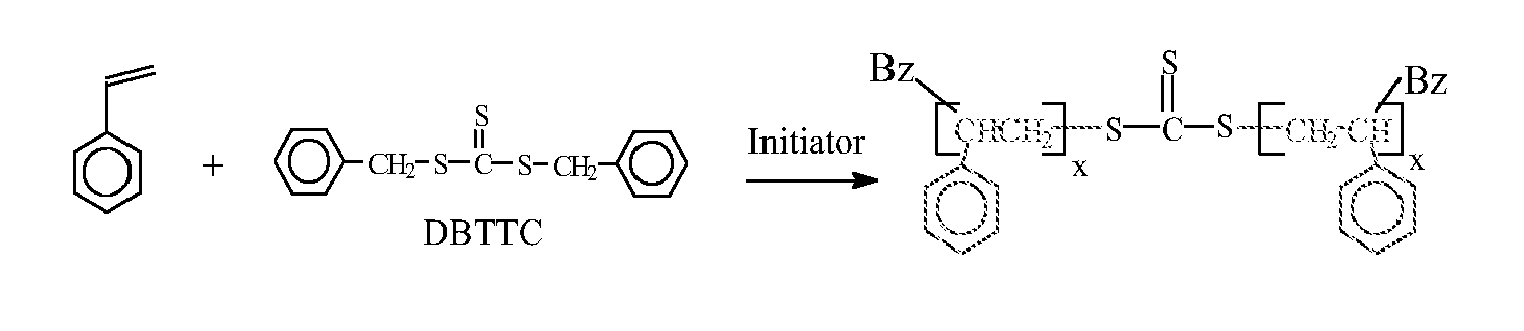
- If, on the other hand, as in Eq. 3 both "R" groups are not identical but one is capable of radical reinitiation (e.g., a benzyl group) then a situation arises where the polymer chain will grow in a controlled manner from only one end (see Eq. 5).

- In Eq. 5, the linear alkyl group is not active in the polymerization and only the benzyl group propagates the radical polymerization.
- Development of a successful and practical RAFT-based controlled free radical emulsion polymerization process depends upon finding the solution to several problems. First, finding a simple emulsification method that would mimic a miniemulsion system, that is, a system wherein the primary locus of polymerization is within microemulsified monomer droplets and not soap micelles. This type of system will eliminate the requirement that the RAFT agent be able to migrate through the water phase from monomer droplets to the micelles. All the microemulsified monomer droplets will then contain the same fixed ratio of monomer to RAFT agent. The second issue revolves around finding a readily prepared RAFT agent having high activity, good solubility in the monomers and preferably slight solubility in the aqueous phase.
- A solution to the first problem has now been found in the so-called "In-Situ" emulsification method. "In-Situ" emulsification may be defined in terms of a process modification of "classical" emulsion polymerization, where a latent surfactant precursor such as oleic acid is dissolved in monomer prior to adding an aqueous solution containing a base (e.g., potassium hydroxide). As the two-phase system is mixed, surfactant (potassium oleate) is generated and an emulsion forms. This is in contrast to the more prevalent industrial mode of emulsification, where a preformed surfactant solution is mixed with monomer at 600 to 800 rpm until a uniform emulsion is prepared. However, this seemingly minor process modification has profound implications for emulsion polymerization, in general, and for the practical implementation of controlled free radical emulsion polymerization, in particular. Linking the "in-situ" emulsification technique to the RAFT-CFRP mechanism has now been found to be a key component to a practical process.
- The solution to the second problem would appear to reside in selecting the proper RAFT agent to provide the desired solubility characteristics in an emulsified system. Trithiocarbonates may be readily prepared following the procedures described herein. At least one of the "R" groups on the trithiocarbonate should be benzylic or tertiary alkyl group to provide radicals that will reinitiate polymerization. As previously mentioned, unsymmetrical trithiocarbonates can contain two different "R" groups. Therefore, to add a small degree of hydrophilic character a polar group could be introduced onto one or both "R" groups.
- One technique to prepare such a mildly hydrophilic unsymmetrical trithiocarbonate would be to use a functional thiol to first prepare an alkali metal trithiocarbonate salt followed by alkylation with a benzylic halide. One method to prepare a functional thiol such as a b-hydroxythiol, is to react an epoxide with hydrogen sulfide. The overall process for the formation of the unsymmetrical trithiocarbonate is shown in the following Eqs.


- The key ingredient in this synthetic scheme, b-hydroxydecanethiol (HDT), can be readily prepared in high yield by the catalyzed reaction of epoxides with hydrogen sulfide according to the teachings found in
US 4, 985, 586 . - More generally, the free radical control agent is of the structural formula:

- In one embodiment, Y represents a functional group selected from the group consisting of -C(R')2CN, -C(CH3)2Ar, -C(CH3)2COOR", -C(CH3)2CONHR", -C(CH3)2CH2C(CH3), -CH(CH3)Ar, -CH2Ar, -C(CH3)3, -CR'2COOH, -C(R')(CN)-(CH2)n-COOH, and -C(R')(CN)-(CH2)n-OH; wherein R' represents a linear or branched hydrocarbon containing from 1 to 12 carbon atoms; wherein Ar represents an unsubstituted or substituted phenyl, napthyl, anthracenyl, pyrenyl or pyridyl group; and wherein n represents an integer from 1 to 8.
- In another embodiment, Y represents a function group selected from the group consisting of benzyl, picolyl, or t-butyl.
- In another embodiment, R1 is a divalent alkyl group of 1 to 4 carbon atoms, i.e., R1 is (CH2)m where m ranges from 1 to 4.
- In another embodiment, R1 is (CH2)9, R2 and R3 are hydrogen, R4 is -COOH, Y is benzyl, and the free radical control agent is S-benzyl-S'-(11-undecanoic acid) trithiocarbonate.
- In another embodiment, R1 is CH2, R2 is (CH2)8, R3 is hydrogen, R4 is
- -OH, Y is benzyl, and the free radical control agent is S-benzyl-S'-(2-hydroxydecyl) trithiocarbonate.
- In another embodiment, R1 is CH2, R2 is (CH2)8, R3 is hydrogen, R4 is -OH, Y is 4-picolyl, and the free radical control agent is S-(4 -picolyl)-S'-(2-hydroxydecyl) trithiocarbonate.
- The unsymmetrical trithiocarbonate free radical control agents of the present invention can be used in conducting controlled polymerizations. Such polymers are particularly useful in manufacturing polymeric compositions such as tire tread compounds. In any case, such controlled polymerizations are conducted in the presence of the free radical control agents made by the synthesis process of this invention.
- The controlled polymerization can be a batch, semi-batch, or continuous process which provides excellent control of the polymer composition and morphology. The controlled polymerization will normally be carried out as an emulsion polymerization process.
- Monomers that may be polymerized in a controlled polymerization using the free radical control agents of this invention include at least one monomer selected from the group consisting of styrene, substituted styrene, alkyl acrylate, substituted alkyl acrylate, alkyl methacrylate, substituted alkyl methacrylate, acrylonitrile, methacrylonitrile, acrylamide, methacrylamide, N,N-dialkylacrylamide, N,N-dialkylmethacrylamide, isoprene, 1,3-butadiene, ethylene, vinyl acetate, vinyl chloride, vinylidene chloride, and combinations thereof. Functionalized versions of these monomers may also be used. Specific monomers or co-monomers that may be used in this invention and from which M is derivable include methyl methacrylate, ethyl methacrylate, propyl methacrylate (all isomers), butyl methacrylate (all isomers), 2-ethylhexyl methacrylate, isobornyl methacrylate, methacrylic acid, benzyl methacrylate, phenyl methacrylate, methacrylonitrile, α-methylstyrene, methyl acrylate, ethyl acrylate, propyl acrylate (all isomers), butyl acrylate (all isomers), 2-ethylhexyl acrylate, isobornyl acrylate, acrylic acid, benzyl acrylate, phenyl acrylate, acrylonitrile, styrene, glycidyl methacrylate, 2-hydroxyethyl methacrylate, hydroxypropyl methacrylate (all isomers), hydroxybutyl methacrylate (all isomers), N,N-dimethylaminoethyl methacrylate, N,N-diethylaminoethyl methacrylate, triethyleneglycol methacrylate, itaconic anhydride, itaconic acid, glycidyl acrylate, 2-hydroxyethyl acrylate, hydroxypropyl acrylate (all isomers), hydroxybutyl acrylate (all isomers), N,N-dimethylaminoethyl acrylate, N,N-diethylaminoethyl acrylate, triethyleneglycol acrylate, methacrylamide, N-methylacrylamide, N,N-dimethylacrylamide, N-tert-butylmethacrylamide, N-n-butylmethacrylamide, N-methylolmethacrylamide, N-ethylolmethacrylamide, N-tert-butylacrylamide, N-n-butylacrylamide, N-methylolacrylamide, N-ethylolacrylamide, vinyl benzoic acid (all isomers), diethylaminostyrene (all isomers), a-methylvinyl benzoic acid (all isomers), diethylamino alphamethylstyrene (all isomers), p-vinylbenzene sulfonic acid, p-vinylbenzene sulfonic sodium salt, trimethoxysilylpropyl methacrylate, triethoxysilylpropyl methacrylate, tributoxysilylpropyl methacrylate, dimethoxymethylsilylpropyl methacrylate, diethoxymethylsilylpropyl methacrylate, dibutoxymethylsilylpropyl methacrylate, diisopropoxymethylsilylpropyl methacrylate, dimethoxysilylpropyl methacrylate, diethoxysilylpropyl methacrylate, dibutoxysilylpropyl methacrylate, diisopropoxysilylpropyl methacrylate, trimethoxysilylpropyl acrylate, triethoxysilylpropyl acrylate, tributoxysilylpropyl acrylate, dimethoxymethylsilylpropyl acrylate, diethoxymethylsilylpropyl acrylate, dibutoxymethylsilylpropyl acrylate, diisopropoxymethylsilylpropyl acrylate, dimethoxysilylpropyl acrylate, diethoxysilylpropyl acrylate, dibutoxysilylpropyl acrylate, diisopropoxysilylpropyl acrylate, maleic anhydride, N-phenylmaleimide, N-butylmaleimide, chloroprene, ethylene, vinyl acetate, vinyl chloride, vinylidene chloride, 2-(2-oxo-1-imidazolidinyl)ethyl 2-methyl-2-propenoate, 1-[2-[2-hydroxy-3-(2-propyl)propyl]amino]ethyl]-2-imidazolidinone, N-vinyl pyrrolidone, N-vinyl imidazole, crotonic acid, vinyl sulfonic acid, and combinations thereof. In one embodiment, the monomer is selected from 1,3-butadiene, styrene, and isoprene.
- Controlled polymerization requires the presence of a free radical control agent to control the course of polymerization while minimizing undesirable side reactions, such as chain termination. The control agent has characteristics that depend greatly on the details of the polymerization, including the mechanism for polymerization, the types of monomers being used, the type of initiation, the solvent system and the reaction conditions. In one embodiment, the control agent may be a control agent for polymerization by a free radical mechanism, such as reversible-addition fragmentation transfer (RAFT). The control agent may be introduced into the emulsion system by many different methods, and the preferred method depends greatly on the particular embodiment being practiced. In some embodiments, the active control agent may be added directly to the reaction vessel in the form of a pure compound or as a component of a solution or mixture. In other embodiments, the active control agent may be generated in situ from chemical reactions occurring prior to, during or after emulsification.
- Regardless of the method used to introduce or generate a control agent, the control agents suitable for the present invention offer one or more of the benefits associated with "living" polymerization kinetics. These benefits may include: (1) a linear dependence of the degree of polymerization as a function of time; (2) a linear dependence of the number-average molecular weight (Mn) on the extent of polymerization; (3) a constant number of polymer molecules and active centers that is sensibly independent of conversion; (4) a narrow molecular weight distribution, with Mw/Mn generally less than 2, preferably between 1.1 and 1.8, and often below 1.4; and (5) essentially complete conversion of monomer to polymer with the ability to continue polymerization upon addition of more monomer.
- All polymerization reactions must be initiated. For some monomers, such as styrene for example, thermal self-initiation can occur without the need for additional reagents. For many other monomers, initiation may be accomplished by adding an agent to trigger one or more chemical reactions that ultimately produces an intermediate capable of propagating polymerization. These agents often are referred to as "initiators."
- The type of initiators suitable for the present invention depend greatly on the details of the polymerization, including the mechanism for polymerization, the types of monomers being used, the type of control agent, the solvent system and the reaction conditions. Many different types of initiators have been investigated.
- The initiator may be an initiator for polymerization by a free radical mechanism, such as RAFT or a related mechanism involving stable free radicals. Typically, suitable initiators for free radical polymerization are reagents or combinations of reagents that are capable of producing free radicals. Other methods for producing free radicals, including exposure to ionizing radiation (60Co γ-rays), photochemical reactions, or sonication, will be evident to those of skill in the art as suitable methods for initiating free radical polymerization.
- Some representative examples of free radical initiators which are commonly used include the various peroxygen compounds such as potassium persulfate, ammonium persulfate, benzoyl peroxide, hydrogen peroxide, di-t-butyl peroxide, dicumyl peroxide, 2,4-dichlorobenzoyl peroxide, decanoyl peroxide, lauryl peroxide, cumene hydroperoxide, p-menthane hydroperoxide, t-butyl hydroperoxide, acetyl acetone peroxide, dicetyl peroxydicarbonate, t-butyl peroxyacetate, t-butyl peroxymaleic acid, t-butyl peroxybenzoate, acetyl cyclohexyl sulfonyl peroxide, and the like; the various azo compounds such as 2-t-butylazo-2-cyanopropane, dimethyl azodiisobutyrate, azodiisobutyronitrile, 2-t-butylazo-1-cyanocyclohexane, 1-t-amylazo-1-cyanocyclohexane, and the like; the various alkyl perketals, such as 2,2-bis-(t-butylperoxy)butane, ethyl 3,3-bis(t-butylperoxy)butyrate, 1,1-di-(t-butylperoxy)cyclohexane, and the like. Persulfate initiators, such as potassium persulfate and ammonium persulfate, are especially useful in such aqueous emulsion polymerizations.
- Polymerization can also be initiated with free radicals that are generated utilizing redox initiators, such as combinations of chelated iron salts, sodium formaldehyde sulfoxylate, and organic hydroperoxides. Some representative examples of such organic hydroperoxides include cumene hydroperoxide, paramenthane hydroperoxide, and tertiary butyl hydroperoxide. Tertiary butyl hydroperoxide (t-BHP), tertiary butyl peracetate (t-BPA) and "azo" initiators, such as azobisiobutyronitrile (AIBN), are preferred for use in generating free radicals.
- In batch operations, the polymerization time can be varied as desired; it may vary, for example, from a few minutes to several days. Polymerization in batch processes may be terminated when monomer is no longer absorbed, or earlier, if desired, e.g., if the reaction mixture becomes too viscous. In continuous operations, the polymerization mixture may be passed through a reactor system of any suitable design. The polymerization reactions in such cases are suitably adjusted by varying the residence time. Residence times vary with the type of reactor system and the size of the reactors, for example, from 10 to 15 minutes to 24 or more hours.
- Surfactants are essential in the case of controlled emulsion polymerizations, and suitable surfactants include any compound or mixture of compounds capable of stabilizing colloidal aqueous emulsions. Generally, surfactants are amphiphilic molecules that reduce the surface tension of liquids, or reduce interfacial tension between two liquids or a liquid and a solid. Surfactants may be small molecules or polymers, micelle-forming or non-micelle-forming, and may be anionic, cationic, zwitterionic or nonionic. In some embodiments of the present invention, mixtures of surfactants are used. The amount of surfactant used typically ranges from 0.01 to 200 percent by weight relative to the monomer, with a more preferred range being from 0.1 to 8 percent by weight and a more specifically preferred range being from 0.5 to 3 percent by weight. Those skilled in the art typically consider a number of factors when selecting surfactants for a particular application, including economic factors (see Detergents Handbook, McCutcheon Division, Manufacturing Confectioner Publishing Co, Glen Rock, NJ, 1999). Suitable anionic surfactants include substituted or unsubstituted hydrocarbyl sulfates, sulfonates, carboxylates, phosphonates and phosphates having between 6 and 30 carbon atoms per anionic functional group. Suitable cationic surfactants include substituted or unsubstituted hydrocarbyl ammonium salts having between 6 and 30 carbon atoms per cationic functional group. Suitable nonionic surfactants include amphiphilic amides having between 6 and 30 carbon atoms for each hydrocarboyl group and between 2 and 30 carbon atoms for each hydrocarbyl amine group. A broad range of suitable surfactants is described in McCutcheon's Emulsifiers. For each surfactant, one or more hydrogen or carbon atom from the hydrocarbyl groups may have replaced with another atom selected from the group consisting of N, S, O, Si, F, Cl, Br and I. The hydrocarbyl may also have one or more hydrogen or carbon atom replaced with a functionality such as a keto, ester, amide, ether, thioether, hydroxyl and the like, and the hydrocarbyl may be part of a ring structure.
- In some embodiments, useful surfactants include, for example, alkali metal and ammonium salts of:
- (i) alkylsulfates (alkyl radical: C8 to C18);
- (ii) alkylarylsulfonic acids (alkyl radical: C9 to C18);
- (iii) alkanesulfonic acids (alkyl radical: C8 to C18);
- (iv) succinate half-amides of alkylamines (alkyl radical: C8 to C18);
- (v) succinate half-esters of alkanols (alkyl radical: C8 to C18);
- (vi) alkanoic acids (alkyl radical: C8 to C18);
- (vii) alkylphosphates (alkyl radical: C1 to C18);
- (viii) alkylphosphonates (alkyl radical: C1 to C18);
- (ix) acylated sarcosine and taurine (acyl radical C8 to C18); and
- (x) sulfosuccinic acid diesters and diamides (alkyl radical: C4 to C18).
- In other embodiments, useful surfactant include, for example:
- (i) alkanol amides (alkyl radical: C2 to C18);
- (ii) quaternized amines (alkyl radical: C1 to C18), including amine oxide derivatives;
- (iii) quaternized nitrogen-containing heterocycles with pendant alkyls (alkyl radical: C4 to C18);
- (iv) betaine derivatives (alkyl radical: C8 to C18); and
- (v) amphiphilic block copolymers.
- An important aspect of the present invention is in-situ emulsification, which is achieved by reacting a "latent surfactant" with a "surfactant activator" to produce the surfactant for controlled emulsion polymerization. As used herein, the term "latent surfactant" refers to a compound or mixture of compounds that:
- (i) is soluble in a monomer-containing solution that is not miscible with water; and (ii) is not independently capable of producing a stabilized colloidal microemulsion at conventional surfactant levels from simple gentle mixing of the compound or mixture of compounds with monomer-containing solution and water. The term "surfactant activator" is used herein to describe a compound or mixture of compounds that: (i) is soluble in water; and (ii) is not independently capable of producing a stabilized colloidal microemulsion at conventional surfactant levels from simple gentle mixing of the compound or mixture of compounds with monomer-containing solution and water. For the present invention, water can be a reactant for in-situ emulsification reactions, but water alone cannot be the surfactant activator. The use of an in-situ emulsification technique in a controlled polymerization process that can be used in accordance with this invention is described in
US-A- 2004-0127634 which is incorporated herein by reference in its entirety. - The fundamental principles for in-situ microemulsification are described by Prokopov and Gritskova (Russ. Chem. Rev 2001, 70, 791), who review its use in conventional free-radical polymerization of styrene using alkali-metal soaps prepared in situ via neutralization of fatty acids. As explained by Prokopov and Gritskova, the preparation of a carboxylate soap at a styrene-water interface during emulsification can produce a fine microemulsion because interfacial tension is decreased significantly by an abundance of emulsifier produced at the interface. By varying the nature of the carboxylic acid and the metal counter-ion used in the surfactant synthesis at the interface, it was possible to control the degree of dispersion and stability of the emulsion, as well as the resulting polystyrene latex produced via conventional free radical polymerization. In the present invention, the principles of in-situ microemulsification are expanded broadly to produce emulsions suitable for controlled polymerization via a wide range of methods utilizing conventional soap levels without added hydrophobes or specialized emulsification equipment.
- In some embodiments, the surfactant for controlled polymerization may be produced by an acid/base neutralization reaction at the monomer/water interface. For some types of anionic surfactants, this may be accomplished, for example, via reaction of a monomer-soluble acid with an aqueous base, where the monomer-soluble acid is the latent surfactant and the base is the surfactant activator for in-situ emulsification. Suitable monomer-soluble acids include, for example, palmitic acid, oleic acid, dodecylbenzene sulfonic acid, lauryl sulfate, hexadecylsulfonic acid, dihexadecylphosphonic acid, hexadecylsuccinate half ester, and the monohexadecylamide of succinic acid. Suitable bases include, for example, hydroxides, carbonates and bicarbonates of alkali metal ions and quaternary ammonium ions, substituted and unsubstituted amines, and basic nitrogen-containing heterocycles. It will be evident to those skilled in the art that any aqueous base with a pKb less than about the pKa of the monomer-soluble acid also may be suitable. It also will be evident that hydroxides generated in situ via hydrolysis of moisture-sensitive compounds, such as sodium methoxide, sodium amide, potassium hydride and the like, also may be suitable as surfactant activators.
- For some types of cationic surfactants, in situ synthesis during emulsification may be accomplished, for example, via reaction of a monomer-soluble base with an aqueous acid, where the monomer-soluble base is the latent surfactant and the acid is the surfactant activator. Suitable monomer-soluble bases include, for example, hexadecyldimethylamine, hexadecyldimethylamine oxide, and amphiphilic nitrogen-containing heterocycles. Suitable acids include for example mineral acids, sulfonic acids and phosphonic acids. It will be evident to those skilled in the art that any aqueous acid with a pKa less than about the pKb of the monomer-soluble base also may be suitable. It also will be evident that acids generated in situ via: hydrolysis of moisture-sensitive compounds, such as Lewis acids, acyl halides, acyl anhydrides, mineral acid anhydrides, hydrolyzable transition-metal halides, main group halides and the like, also may be suitable as surfactant activators.
- In some embodiments, surfactant may be produced in situ by chemical reactions that attach hydrophilic functionality to a functionalized hydrophobe. For these embodiments, the functionalized hydrophobe is the latent surfactant and the reagent or reagents necessary for attaching the hydrophilic functionality serve as surfactant activator. For some types of surfactants this may be accomplished, for example, via reaction of a monomer-soluble electrophile with an aqueous nucleophile. Suitable electrophiles include for example:
- (i) hydrocarboyl halides;
- (ii) hydrocarboyl esters;
- (iii) hydrocarboyl anhydrides;
- (iv) hydrocarbyl isocyanates;
- (v) hydrocarbyl halides; and
- (vi) hydrocarbyl esters of sulfonic acids.
- Suitable surfactant activators include for example:
- (i) amine-functionalized hydrocarbylsulfates, hydrocarbylcarboxylates, hydrocarbylphosphates, hydrocarbylammonium salts;
- (ii) diethanol amine;
- (iii) diethylenetriamine and other aminoamines;
- (iv) amino-polyethyleneglycols and polyethyleneglycol ethers;
- (v) aminoglycosides;
- (vi) aminobetaines;
- (vii) hydroxides of alkali metal ions and quaternary ammonium ions; and
- (viii) hydrocarbylamines.
- For some types of surfactants, in-situ synthesis and emulsification may be accomplished by reaction of a monomer-soluble nucleophile with an aqueous electrophile. Suitable nucleophiles include for example, hexadecylamine and hexadecyldimethylamine. Suitable electrophiles include for example succinic anhydride, dimethylsulfate and 1,3-propanesultone.
- Many other reactions can be used to synthesize surfactants in situ, and the specific embodiments illustrated above are not intended to preclude any combination of latent surfactant/surfactant activator that produces a surfactant during emulsification. It will be evident to those skilled in the art that other latent surfactant/surfactant activator combinations may be suitable when the chemistries of surfactant synthesis and controlled polymerization are compatible.
- Polymers produced using the RAFT agents of the invention may be used in rubber compositions in tire components. Such components may include but are not limited to treads, sidewalls, sidewall inserts, plycoats, apexs, chafers, wire coats, and the like. It is readily understood by those having skill in the art that rubber compositions used in tire components would be compounded by methods generally known in the rubber compounding art, such as mixing the various sulfur-vulcanizable constituent rubbers with various commonly used additive materials such as, for example, curing aids, such as sulfur, activators, retarders and accelerators, processing additives, such as oils, resins including tackifying resins, silicas, and plasticizers, fillers, pigments, fatty acid, zinc oxide, waxes, antioxidants and antiozonants, peptizing agents and reinforcing materials such as, for example, carbon black and silica. As known to those skilled in the art, depending on the intended use of the sulfur vulcanizable and sulfur vulcanized material (rubbers), the additives mentioned above are selected and commonly used in conventional amounts. The components and tire can be built, shaped, molded and cured by various methods which will be readily apparent to those having skill in such art.
- The practice of this invention is further illustrated by the following examples which are intended to be representative rather than restrictive of the scope of the subject invention. Unless indicated otherwise, all parts and percentages are given by weight.
- A one liter three neck round bottomed flask equipped with a mechanical paddle stirrer, nitrogen inlet, pot thermometer and condenser, was charged under a slow nitrogen bleed with 95g (∼0.50 moles) of b-hydroxydecanethiol (HDT). To the stirred HDT, was then added an aqueous solution of 32.0g of 87.6 percent pure KOH (∼0.50 moles) dissolved in 248g of water. After stirring for 15 min. at ambient temperature, a solution of 78g (~1.0 mole) of carbon disulfide and 1.0g of Aliquat 336 were added to the mixture. The solution rapidly turns yellow and a small amount of solid precipitated from solution. The solution temperature increased 44°C and was controlled using slight cooling from a water bath. After 15 min., 60.1g (0.0475 moles) of benzyl chloride were added. Again the temperature was maintained at 44°C until the exotherm subsided. At this point, the mixture was heated for one hour at 50°C. Let stand at room temperature overnight then add 50ml of dichloromethane. Separate off the lower product phase and strip off solvent at reduced pressure to obtain 184.3g of crude product; ∼94 percent crude yield as a yellow oil that crystallizes rapidly. Verification of the main component in the crude reaction mixture as being BHDTTC was obtained using electro-spray ionization mass spectrometry (ESI-MS). The crude product was used for subsequent emulsion polymerization studies.
- Procedure is identical to that of Ex. 1 except that 1-dodecanethiol was substituted for HDT. Crude product crystallizes into a bright yellow solid within a few hours at room temperature.
- A 500ml three-necked round bottomed flask equipped with a mechanical paddle stirrer, nitrogen inlet, pot thermometer and condenser was charged under a slow nitrogen purge with 21.8g (∼ 0.10 moles) of 11-mercaptoundecanoic acid (I), 12.8g (∼0.20 moles) of 87.5 percent pure KOH and 100ml of water. The mixture was stirred and warmed to ~50°C until all of (I) had dissolved and a clear solution was achieved. The solution was then cooled to ~30°C before adding all at once a solution of 0.2g of Aliquat 336 dissolved in 7.6g (~0.10 moles) of carbon disulfide. An orange solution develops immediately and the solution temperature increases to ~45°C within 10-15 min. After an additional 15 minutes, 12.02g (∼0.095 moles) of benzyl chloride. A slight temperature increase as the reaction proceeds and the mixture became very thick. After 10 min., an additional 100ml of water was added to thin the mixture. After stirring an additional 10 min., the entire mixture was neutralized to an acidic pH with the addition of dilute hydrochloric acid. The bright yellow solid that forms was filtered off, washed with water followed by a hexane wash and then dried to give 39.26g of crude product. The crude product was purified by dissolving it in 400 ml of water containing 4.5g of sodium hydroxide followed by its reprecipitation using dilute HCl. NMR analysis indicates >95 percent purity of the desired structure.
- A one liter three-necked round bottomed flask equipped with a mechanical paddle stirrer, nitrogen inlet, pot thermometer and condenser was charged with 2.55g (∼0.0069 moles) of BDTTC, 140g (~1.34 moles) of styrene and 8.4g (∼0.0297 moles) of oleic acid. The mixture was stirred to form a homogeneous solution. In a separate flask, were dissolved 0.84g (0.0031 moles) of potassium persulfate (KPS), 5.6g (0.0264 moles) tripotassium phosphate, and 2.31 g (∼0.0355 moles) of 87.5 percent pure of potassium hydroxide in 238g of reverse osmosis (RO) treated water. The aqueous solution was then added to the stirred styrene solution all at once to rapidly generate a uniform emulsion. The system was then rapidly heated to 55°C. An exotherm carried the reaction temperature to ~78°C before being cooled in a water bath to 75°C. Theoretical solids at 100 percent conversion are 40 percent. After 1 hour at 75°C the solids were 39 percent. A small sample of the final latex was coagulated in dilute HCl, filtered, washed and dried for SEC analysis.
- The Mn was determined to be 162,000 with a PDI of 1.85.
- Theoretical Mn should be ∼20,000.
- These results indicate poor control over polymerization rate, MW and polydispersity by BDTTC in anionic emulsion polymerization.
- A 250ml three-necked round bottomed flask equipped with a mechanical paddle stirrer, nitrogen inlet, pot thermometer and condenser was charged with 19.0g (~0.10 moles) of 2-hydroxydecanethiol and 12.8g (∼0.20 moles) of potassium hydroxide dissolved in 50 ml of water under nitrogen with slow stirring. The thick clear mixture was stirred for 10 min. then cooled to room temperature before adding a solution of 0.25g of Aliquat 336 dissolved in 15.2 (∼0.20 moles) of carbon disulfide. The mixture rapidly turns bright yellow in color. Cool mixture to room temperature and stir for 10 min. Next, carefully add a solution of 4-picolyl hydrochloride dissolved in 20 ml water to the mixture. * Note: Heat of neutralization of hydrochloride salt with KOH may cause excessive foaming of excess carbon disulfide if temperature during addition is not carefully monitored. As the reaction proceeds, the lower product phase becomes brick red while the upper aqueous phase becomes a clear pale yellow. After 1.5 hours of stirring at room temperature, 50 ml of dichloromethane were added and the lower product phase separated. The solvent was then removed at reduced vacuum to give a dark red clear liquid, 34.2g. This represents a crude yield of 95.5 percent.
- A 500 ml three-necked round bottomed flask equipped with a mechanical paddle stirrer, nitrogen inlet, pot thermometer and condenser was charged with 5.67g (~0.0153 moles) of BDTTC, 100g (∼0.96 moles) of styrene and 6.0g (~0.0212 moles) of oleic acid. The mixture was stirred to form a homogeneous solution. In a separate flask, were dissolved 0.60g (0.0022 moles) of potassium persulfate (KPS), 1.43g (0.017 moles) sodium bicarbonate, 1.43g (0.0135 moles) of sodium carbonate and 1.36g (∼0.021 moles) of 87.5 percent pure of potassium hydroxide in 185.6g of reverse osmosis (RO) treated water. The aqueous solution was then added to the stirred styrene solution all at once to rapidly generate a uniform emulsion. The system was then rapidly heated to 55°C. An exotherm carried the reaction temperature to ~80°C before being cooled in a water bath to 75°C. After 2 hours at 75°C the solids were 35.7 percent. A small sample of the final latex was coagulated in dilute HCl, filtered, washed and dried for SEC analysis.
- The Mn was determined to be 150,000 with a PDI of 1.26.
- Theoretical Mn should be -7000.
- Once again, these results indicate poor control over polymerization rate, MW and polydispersity by BDTTC in anionic emulsion polymerization.
- A 500 ml three-necked round bottomed flask equipped with a mechanical paddle stirrer, nitrogen inlet, pot thermometer and condenser was charged with 5.67g (~0.0153 moles) of BDTTC, 100g (∼0.96 moles) of styrene and 5.23g (~0.0176 moles) of octadecyldimethylamine. The mixture was stirred to form a homogeneous solution. In a separate flask, were dissolved 0.61g (0.0022 moles) of potassium persulfate (KPS), 1.78g (0.018 moles) of concentrated HCl in 178g of reverse osmosis (RO) treated water. The aqueous solution was then added to the stirred styrene solution all at once to rapidly generate a uniform emulsion. The system was then heated to 65°C. Slight exotherm increased temperature to ~68°C. After 2.5 hrs., solids were 37.4 percent. A small sample of the final latex was coagulated in dilute HCl, filtered, washed and dried for SEC analysis.
- The Mn was determined to be 178,000 with a PDI of 1.29.
- Theoretical Mn should be ∼7000.
- Once again, these results indicate poor control over polymerization rate, MW and polydispersity by BDTTC in cationic emulsion polymerization.
- A 500 ml three-necked round bottomed flask equipped with a mechanical paddle stirrer, nitrogen inlet, pot thermometer and condenser was charged with 6.38g (~0.0153 moles) of BUTTC, 100g (∼0.96 moles) of styrene and 6.0g (~0.0212 moles) of oleic acid. The mixture was stirred to form a homogeneous solution. In a separate flask, were dissolved 0.60g (0.0022 moles) of potassium persulfate (KPS), 0.6g (0.0028 moles) tripotassium phosphate and 2.34g (∼0.0365 moles) of 87.5 percent pure of potassium hydroxide in 170.0g of reverse osmosis (RO) treated water. The aqueous solution was then added to the stirred styrene solution all at once to rapidly generate a uniform emulsion. The system was then heated to 70°C. After 6 hours at 70°C the solids were 39.6 percent. A small sample of the final latex was coagulated in dilute HCl, filtered, washed and dried for SEC analysis.
- The Mn was determined to be 35,400 with a PDI of 1.36.
- Theoretical Mn should be -7000.
- These results represent a dramatic improvement over the use of BDTTC in comparative examples 4, 5 and 6. Polymerization rate is slower but much more easily controlled. MW is also much lower than when using BDTTC at the same molar level as in Comparative Example 5. Polydispersity is somewhat higher.
- A 500 ml three-necked round bottomed flask equipped with a mechanical paddle stirrer, nitrogen inlet, pot thermometer and condenser was charged with 5.95g (~0.0153 moles) of BHDTTC, 100g (∼0.96 moles) of styrene and 5.23g (~0.0176 moles) of octadecyldimethylamine. The mixture was stirred to form a homogeneous solution. In a separate flask, were dissolved 0.60g (0.0022 moles) of potassium persulfate (KPS), 1.78g (0.018 moles) of concentrated HCl in 178g of reverse osmosis (RO) treated water. The aqueous solution was then added to the stirred styrene solution all at once to rapidly generate a uniform emulsion. The system was then heated to 70°C. After 11 hrs., solids were 36.5 percent (theory 38.3 percent). A small sample of the final latex was coagulated in dilute KOH, filtered, washed and dried for SEC analysis.
- The Mn was determined to be 10,100 with a PDI of 1.27.
- Theoretical Mn should be ∼7000.
- These results represent an improvement over the use of BDTTC and BUTTC. Polymerization rate is slower but easily controlled.
- This reaction was run in an identical manner to Example 8 except that the level of BHDTTC was halved to 2.97g (0.00765 moles). After 6 hrs., solids were 36.5percent (theory 37.7 percent). A small sample of the final latex was coagulated in dilute KOH, filtered, washed and dried for SEC analysis.
- The Mn was determined to be 19,700 with a PDI of 1.25.
- Theoretical Mn should be ~13,000.
- This reaction was run in an identical manner to Example 8 except that the level of BHDTTC was lowered to 1.48g (0.0038 moles). After 4.5 hrs., solids were 37 percent (theory 37.4 percent). A small sample of the final latex was coagulated in dilute KOH, filtered, washed and dried for SEC analysis.
- The Mn was determined to be 36,000 with a PDI of 1.30.
- Theoretical Mn should be ∼26,000.
- A 500 ml three-necked round bottomed flask equipped with a mechanical paddle stirrer, nitrogen inlet, pot thermometer and condenser was charged with 2.97g (∼0.0076 moles) of BHDTTC, 100g (∼0.96 moles) of styrene and 6.0g (~0.0212 moles) of oleic acid. The mixture was stirred to form a homogeneous solution. In a separate flask, were dissolved 0.60g (0.0022 moles) of potassium persulfate (KPS), 1.37g (0.0163 moles) sodium bicarbonate, 1.37g (0.0129 moles) of sodium carbonate and 1.4g (~0.0215 moles) of 87.5 percent pure of potassium hydroxide in 170g of reverse osmosis (RO) treated water. The aqueous solution was then added to the stirred styrene solution all at once to rapidly generate a uniform emulsion. After 2 hours at 70°C the solids were 37.9 percent. After 4 hours at 70°C, the polymerization was discontinued and filtered to remove ~10g of granular yellow solid. A small sample of the final filtered latex was coagulated in dilute HCl, filtered, washed and dried for SEC analysis along with a sample of the granular yellow solid.
- The Mn of the coagulated filtered latex sample was determined to be 31,700 with a PDI of 1.36 while the Mn of the granular solid was found to be 21,000 with a PDI of 1.21.
- Theoretical Mn should be ~13,000.
- A 2 gallon reactor was initially flushed with nitrogen before being charged with a solution prepared from 540g (5.19 moles) of styrene, 81.0g (∼0.27 moles) of N,N-dimethyloctadecylamine and 4.77g (~0.0123 moles) of BHDTTC and stirred at 200 rpm. To this mixture was then added an aqueous solution prepared from 3510g of RO water, 12.6g (0.0466 moles) of potassium persulfate and 33.66g of conc. Hydrochloric acid (∼0.34 moles). The reactor was again flushed with nitrogen before adding 1260g (∼23.33 moles) of distilled butadiene. The stirred reactor was then heated to 65°C with "solids" being taken every 2 hours to follow the progress of the polymerization. The reaction was shortstopped at ∼23 percent solids (∼65 percent conversion) with 45g of a 2 percent aq. solution of 4-hydroxy TEMPO after 10.5 hours. The latex was then cooled and vacuumed stripped of residual monomers to yield a final latex with 24.1 percent solids, pH 1.53, viscosity of 352 cps, mechanical stability of 221 mg and an alcohol Mooney (ML4) of 37. NMR analysis indicates 23.3 percent styrene, 62.3 percent 1,4-BD and 14.4 percent 1,2-BD.
- A 500 ml three-necked round bottomed flask equipped with a mechanical paddle stirrer, nitrogen inlet, pot thermometer and condenser was charged with 2.74g (∼0.00765 moles) of PHDTTC, 100g (∼0.96 moles) of styrene and 6.0g (~0.0212 moles) of oleic acid. The mixture was stirred to form a homogeneous solution. In a separate flask, were dissolved 0.60g (0.0022 moles) of potassium persulfate (KPS), 1.2g (0.0143 moles) sodium bicarbonate, 1.2g (0.0113 moles) of sodium carbonate and 1.4g (~0.0218 moles) of 87.5 percent pure of potassium hydroxide in 178g of reverse osmosis (RO) treated water. The aqueous solution was then added to the stirred styrene solution all at once to rapidly generate a uniform emulsion. The mixture was then rapidly heated to 75°C. After 2.5 hrs, the latex solids were at 37.2 percent.
- Theoretical Mn should be 13,000. Mn against polystyrene standards by SEC was determined to be 29,400 with PDI of 1.08.
- A 500 ml three-necked round bottomed flask equipped with a mechanical paddle stirrer, nitrogen inlet, pot thermometer and condenser was charged with 2.74g (∼0.00765 moles) of PHDTTC, 100g (∼0.96 moles) of styrene and 5.23g (~0.0176 moles) of octadecyldimethylamine. The mixture was stirred to form a homogeneous solution. In a separate flask, were dissolved 0.60g (0.0022 moles) of potassium persulfate (KPS), 2.52g (∼0.0255 moles) of concentrated HCl in 178g of reverse osmosis (RO) treated water. The aqueous solution was then added to the stirred styrene solution all at once to rapidly generate a uniform emulsion. The system was then heated to 75°C. After 3 hrs., solids were 36.2 percent (theory 37.6 percent). A small sample of the final latex was coagulated in dilute KOH, filtered, washed and dried for SEC analysis.
- Theoretical Mn is 13,000. SEC results show Mn of 147,000 with a PDI of 2.18 indicating that PHDTTC is a poor RAFT agent in an acidic cationic emulsion polymerization.
- The following conclusions may be drawn from the foregoing examples:
- (1) Surprisingly, the unsymmetrical trithiocarbonate CFR agents BHDTTC and BUTTC containing either a hydroxyl or carboxyl group respectively, perform exceptionally well in controlling molecular weight and polydispersity relative to their "unfunctionalized" counterpart (BDTTC) when using "in-situ" emulsion techniques.
- (2) PHDTTC works well in anionic recipes but not acidic cationic ones.
- (3) No instance could be found for the composition-of-matter for BHDTTC, BUTTC, or PHDTTC CFR agents or their use in combination with the "in-situ" emulsification technique.
- (4) The processes for the preparation of BHDTTC , BUTTC and PHDTTC are simple, fast, high yielding, and solventless phase transfer catalyzed methods.
- (5) Polymers prepared using either BHDTTC, BUTTC or PHDTTC prepared in bulk, solution or emulsion systems contain terminal functionality consisting of a trithiocarbonate group and either a hydroxyl, carboxyl or pyridyl group.
- (6) Polymers from (4) above can function as macroinitiators for the subsequent formation of block, graft or gradient copolymers.
Claims (10)
- A free radical control agent claims having the structural formula:

- The free radical control agent according to claim 1 wherein Y represents a functional group selected from the group consisting of -C(R')2CN, -C(CH3)2Ar, -C(CH3)2COOR", -C(CH3)2CONHR", -C(CH3)2CH2C(CH3), -CH(CH3)Ar, -CH2Ar, -C(CH3)3, -CR'2COOH, -C(R')(CN)-(CH2)n-COOH, and -C(R')(CN)-(CH2)n-OH; wherein R' represents a linear or branched hydrocarbon containing from 1 to 12 carbon atoms; wherein Ar represents an unsubstituted or substituted phenyl, napthyl, anthracenyl, pyrenyl or pyridyl group; and wherein n represents an integer from 1 to 8.
- The free radical control agent according to claim 1 or 2 wherein R1 is (CH2)m where m ranges from 1 to 4.
- The free radical control agent according to claim 1 wherein Y represents a function group selected from the group consisting of benzyl, picolyl, and t-butyl.
- The free radical control agent according to claim 1, wherein R1 is (CH2)9, R2 and R3 are hydrogen, R4 is -COOH, Y is benzyl, and the free radical control agent is S-benzyl-S'-(11-undecanoic acid) trithiocarbonate.
- The free radical control agent according to claim 1, wherein R1 is CH2, R2 is (CH2)8, R3 is hydrogen, R4 is -OH, Y is benzyl, and the free radical control agent is S-benzyl-S'-(2-hydroxydecyl) trithiocarbonate.
- The free radical control agent according to claim 1, wherein R1 is CH2, R2 is (CH2)8, R3 is hydrogen, R4 is -OH, Y is 4-picolyl, and the free radical control agent is S-(4 -Picolyl)-S'-(2-hydroxydecyl) trithiocarbonate.
- A polymer derived from the free radical control agent of claim 1 and at least one monomer selected from the group consisting of styrene, substituted styrene, alkyl acrylate, substituted alkyl acrylate, alkyl methacrylate, substituted alkyl methacrylate, acrylonitrile, methacrylonitrile, acrylamide, methacrylamide, N-alkylacrylamide, N-alkylmethacrylamide, N,N-dialkylacrylamide, N,N-dialkylmethacrylamide, isoprene, 1,3-butadiene, ethylene, vinyl acetate, vinyl chloride, and vinylidene chloride.
- The polymer of claim 8 wherein the monomer is styrene, 1,3-butadiene, or isoprene.
- A tire comprising the polymer of claim 8 or 9.
Applications Claiming Priority (1)
| Application Number | Priority Date | Filing Date | Title |
|---|---|---|---|
| US75314505P | 2005-12-22 | 2005-12-22 |
Publications (1)
| Publication Number | Publication Date |
|---|---|
| EP1801100A1 true EP1801100A1 (en) | 2007-06-27 |
Family
ID=37909438
Family Applications (1)
| Application Number | Title | Priority Date | Filing Date |
|---|---|---|---|
| EP06126188A Withdrawn EP1801100A1 (en) | 2005-12-22 | 2006-12-14 | Functional trithiocarbonate RAFT agents |
Country Status (4)
| Country | Link |
|---|---|
| US (1) | US7230063B1 (en) |
| EP (1) | EP1801100A1 (en) |
| JP (1) | JP5252802B2 (en) |
| BR (1) | BRPI0605254A (en) |
Cited By (4)
| Publication number | Priority date | Publication date | Assignee | Title |
|---|---|---|---|---|
| WO2010015779A1 (en) * | 2008-08-05 | 2010-02-11 | Arkema France | Novel core-shell impact modifiers for transparent polymer matrices |
| WO2013092587A1 (en) * | 2011-12-21 | 2013-06-27 | Solvay Sa | Process for the preparation of a vinylidene chloride polymer |
| EP2921477A3 (en) * | 2010-01-27 | 2015-11-25 | Mitsubishi Rayon Co., Ltd. | Novel chain transfer agent and emulsion polymerization using same |
| EP2960264A1 (en) * | 2014-06-23 | 2015-12-30 | Sumitomo Rubber Industries, Ltd. | Rubber composition and pneumatic tire having tread manufactured from said rubber composition |
Families Citing this family (21)
| Publication number | Priority date | Publication date | Assignee | Title |
|---|---|---|---|---|
| WO2009035793A1 (en) * | 2007-08-09 | 2009-03-19 | The Lubrizol Corporation | Process for making substituted trithiocarbonate derivatives |
| KR101010757B1 (en) * | 2008-06-09 | 2011-01-25 | 주식회사 동부하이텍 | Chain transfer agent, manufacturing method of antireflection film resin using same |
| EP2291413B1 (en) * | 2008-06-17 | 2012-11-14 | Basf Se | Method for preparing an aqueous polymer dispersion |
| US20100315588A1 (en) * | 2009-06-16 | 2010-12-16 | Bausch & Lomb Incorporated | Biomedical devices |
| US20100332768A1 (en) * | 2009-06-26 | 2010-12-30 | Microsoft Corporation | Flexible read- and write-monitored and buffered memory blocks |
| IN2012DN02284A (en) | 2009-09-17 | 2015-08-21 | Lanxess Deutschland Gmbh | |
| EP2298824A1 (en) | 2009-09-17 | 2011-03-23 | LANXESS Deutschland GmbH | Nitrile rubbers and production of same in organic solvents |
| EP2385074A1 (en) | 2010-05-07 | 2011-11-09 | LANXESS Deutschland GmbH | Nitrile rubbers and production of same in organic solvents |
| CN101880364A (en) * | 2010-06-25 | 2010-11-10 | 浙江大学 | Styrene/butadiene diblock copolymer nano latex and preparation method thereof |
| EP2423234A1 (en) | 2010-08-31 | 2012-02-29 | LANXESS Deutschland GmbH | Rubber blends from different nitrile rubbers |
| EP2554558A1 (en) | 2011-08-02 | 2013-02-06 | Lanxess Deutschland GmbH | Method for producing nitrile rubbers in organic solvents |
| CN104302680B (en) * | 2011-12-21 | 2016-12-14 | 索尔维公司 | Process for preparing vinylidene chloride polymer composites |
| BR112014014952B1 (en) * | 2011-12-21 | 2020-12-15 | Solvay Sa | PROCESS FOR THE PREPARATION OF A VINYLIDENE CHLORIDE POLYMER / CLAY COMPOUND |
| US8415432B1 (en) | 2011-12-21 | 2013-04-09 | The Goodyear Tire & Rubber Company | Rubber composition and pneumatic tire |
| EP2634198B1 (en) | 2012-03-02 | 2014-09-17 | Suntech Co., Ltd. | Copolymers containing phosphorylcholine groups and methods of preparing and using the same |
| CN103145933A (en) * | 2013-03-28 | 2013-06-12 | 南京工业大学 | Method for preparing polyhydroxy acid block polyvinyl monomer copolymer |
| EP2810956A1 (en) | 2013-06-03 | 2014-12-10 | LANXESS Deutschland GmbH | Nitrile rubbers coupled with bisdihydropyrazole groups, production and use of the same |
| CN108017775B (en) * | 2017-12-10 | 2022-06-21 | 上饶师范学院 | Preparation method of polyurethane RAFT reagent |
| KR101997538B1 (en) * | 2017-12-29 | 2019-07-09 | 금호석유화학 주식회사 | A raft agent and a method for manufacturing a copolymer using the same |
| KR102458927B1 (en) * | 2018-08-29 | 2022-10-25 | 주식회사 엘지화학 | Method for producing polyacrylonitrile polymer |
| CN118290318B (en) * | 2024-05-31 | 2024-07-30 | 广东工业大学 | A trithiocarbonate and its application in preparing narrow distribution poly(p-acetoxystyrene) |
Citations (3)
| Publication number | Priority date | Publication date | Assignee | Title |
|---|---|---|---|---|
| WO2001060792A1 (en) * | 2000-02-16 | 2001-08-23 | Noveon Ip Holdings Corp. | S,S'-BIS-(α,α'-DISUBSTITUTED-α'-ACETIC ACID)-TRITHIOCARBONATES AND DERIVATIVES AS INITIATOR - CHAIN TRANSFER AGENT - TERMINATOR FOR CONTROLLED RADICAL POLYMERIZATIONS AND THE PROCESS FOR MAKING THE SAME |
| WO2003055919A1 (en) * | 2001-12-21 | 2003-07-10 | University Of Sydney | Aqueous dispersions of polymer particles |
| WO2005061555A1 (en) * | 2003-12-23 | 2005-07-07 | The University Of Leeds | Polymerisation using chain transfer agents |
Family Cites Families (6)
| Publication number | Priority date | Publication date | Assignee | Title |
|---|---|---|---|---|
| IT1159071B (en) * | 1982-06-23 | 1987-02-25 | Consiglio Nazionale Ricerche | TRITIOCARBONIC ACID DIESTER PREPARATION PROCESS |
| US7557235B2 (en) * | 2000-02-16 | 2009-07-07 | Lubrizol Advanced Materials, Inc. | Hydroxyl-terminated thiocarbonate containing compounds, polymers, and copolymers, and polyurethanes and urethane acrylics made therefrom |
| BRPI0408020A (en) * | 2003-03-03 | 2006-02-14 | Polymers Australia Pty Ltd | nanocomposite dispersing agents |
| US6998452B1 (en) * | 2005-01-14 | 2006-02-14 | The Goodyear Tire & Rubber Company | Controlled free radical agent for nanocomposite synthesis |
| US7671152B2 (en) * | 2005-12-22 | 2010-03-02 | The Goodyear Tire & Rubber Company | Surfactantless synthesis of amphiphilic cationic block copolymers |
| US7625985B1 (en) * | 2005-12-22 | 2009-12-01 | The Goodyear Tire & Rubber Company | Water-based process for the preparation of polymer-clay nanocomposites |
-
2006
- 2006-10-19 US US11/583,624 patent/US7230063B1/en not_active Expired - Fee Related
- 2006-12-12 BR BRPI0605254-1A patent/BRPI0605254A/en not_active IP Right Cessation
- 2006-12-14 EP EP06126188A patent/EP1801100A1/en not_active Withdrawn
- 2006-12-22 JP JP2006346547A patent/JP5252802B2/en not_active Expired - Fee Related
Patent Citations (3)
| Publication number | Priority date | Publication date | Assignee | Title |
|---|---|---|---|---|
| WO2001060792A1 (en) * | 2000-02-16 | 2001-08-23 | Noveon Ip Holdings Corp. | S,S'-BIS-(α,α'-DISUBSTITUTED-α'-ACETIC ACID)-TRITHIOCARBONATES AND DERIVATIVES AS INITIATOR - CHAIN TRANSFER AGENT - TERMINATOR FOR CONTROLLED RADICAL POLYMERIZATIONS AND THE PROCESS FOR MAKING THE SAME |
| WO2003055919A1 (en) * | 2001-12-21 | 2003-07-10 | University Of Sydney | Aqueous dispersions of polymer particles |
| WO2005061555A1 (en) * | 2003-12-23 | 2005-07-07 | The University Of Leeds | Polymerisation using chain transfer agents |
Non-Patent Citations (5)
Cited By (10)
| Publication number | Priority date | Publication date | Assignee | Title |
|---|---|---|---|---|
| WO2010015779A1 (en) * | 2008-08-05 | 2010-02-11 | Arkema France | Novel core-shell impact modifiers for transparent polymer matrices |
| FR2934861A1 (en) * | 2008-08-05 | 2010-02-12 | Arkema France | NEW MODIFIERS CHOCKS OF THE HEART-ECORCE TYPE FOR TRANSPARENT POLYMERIC MATRICES. |
| US8466214B2 (en) | 2008-08-05 | 2013-06-18 | Arkema France | Core-shell impact modifiers for transparent polymer matrices |
| EP2921477A3 (en) * | 2010-01-27 | 2015-11-25 | Mitsubishi Rayon Co., Ltd. | Novel chain transfer agent and emulsion polymerization using same |
| US9452978B2 (en) | 2010-01-27 | 2016-09-27 | Mitsubishi Rayon Co., Ltd. | Chain transfer agent and emulsion polymerization using the same |
| US9676888B2 (en) | 2010-01-27 | 2017-06-13 | Mitsubishi Chemical Corporation | Chain transfer agent and emulsion polymerization using the same |
| WO2013092587A1 (en) * | 2011-12-21 | 2013-06-27 | Solvay Sa | Process for the preparation of a vinylidene chloride polymer |
| CN104271621A (en) * | 2011-12-21 | 2015-01-07 | 索尔维公司 | Process for the preparation of a vinylidene chloride polymer |
| CN104271621B (en) * | 2011-12-21 | 2017-09-05 | 索尔维公司 | Method for preparing vinylidene chloride polymer |
| EP2960264A1 (en) * | 2014-06-23 | 2015-12-30 | Sumitomo Rubber Industries, Ltd. | Rubber composition and pneumatic tire having tread manufactured from said rubber composition |
Also Published As
| Publication number | Publication date |
|---|---|
| US7230063B1 (en) | 2007-06-12 |
| JP5252802B2 (en) | 2013-07-31 |
| BRPI0605254A (en) | 2007-10-09 |
| JP2007169653A (en) | 2007-07-05 |
| US20070149741A1 (en) | 2007-06-28 |
Similar Documents
| Publication | Publication Date | Title |
|---|---|---|
| US7230063B1 (en) | Functional trithiocarbonate RAFT agents | |
| EP1322674B1 (en) | Control agents for living-type free radical polymerization, methods of polymerizing, emulsions and polymers with same | |
| US7671152B2 (en) | Surfactantless synthesis of amphiphilic cationic block copolymers | |
| US6518364B2 (en) | Emulsion living-type free radical polymerization, methods and products of same | |
| US7098280B2 (en) | Controlled polymerization | |
| US7812108B2 (en) | Hydrogenation and epoxidation of polymers made by controlled polymerization | |
| NZ505654A (en) | Living polymerisation process whereby photo-initiators of polymerisation utilises a thermal process resulting in polymers of controlled molecular weight and low polydispersity | |
| JP2003522816A (en) | S, S′-bis- (α, α′-disubstituted-α ″ -acetic acid) -trithiocarbonates and their derivatives as initiators, chain transfer agents or chain terminators for controlled radical polymerization and How to make them | |
| EP1801158A1 (en) | Water-based process for the preparation of polymer-clay nanocomposites | |
| US20030204034A1 (en) | Control agents for living-type free radical polymerization and methods of polymerizing | |
| EP1681293B1 (en) | Composite particles and production process thereof, aqueous dispersion composition for chemical polishing, and process for manufacture of semiconductor device | |
| US20040192838A1 (en) | Controlled mini-emulsion free radical polymerisation | |
| US7462674B2 (en) | Oxathiazaphospholidine free radical control agent | |
| US7442746B2 (en) | Epoxidation of unsaturated cationically stabilized polymer latex | |
| US7335714B1 (en) | Sulfine control agents for synthesizing polymers | |
| US20060106178A1 (en) | Synthesis of statistical microgels by means of controlled radical polymerisation | |
| CN100354313C (en) | Controlled polymerization |
Legal Events
| Date | Code | Title | Description |
|---|---|---|---|
| PUAI | Public reference made under article 153(3) epc to a published international application that has entered the european phase |
Free format text: ORIGINAL CODE: 0009012 |
|
| AK | Designated contracting states |
Kind code of ref document: A1 Designated state(s): AT BE BG CH CY CZ DE DK EE ES FI FR GB GR HU IE IS IT LI LT LU LV MC NL PL PT RO SE SI SK TR |
|
| AX | Request for extension of the european patent |
Extension state: AL BA HR MK YU |
|
| 17P | Request for examination filed |
Effective date: 20071227 |
|
| 17Q | First examination report despatched |
Effective date: 20080205 |
|
| AKX | Designation fees paid |
Designated state(s): DE FR GB IT |
|
| STAA | Information on the status of an ep patent application or granted ep patent |
Free format text: STATUS: THE APPLICATION IS DEEMED TO BE WITHDRAWN |
|
| 18D | Application deemed to be withdrawn |
Effective date: 20090710 |