EP1800965A1 - Passenger detecting device adapted for motor vehicle - Google Patents
Passenger detecting device adapted for motor vehicle Download PDFInfo
- Publication number
- EP1800965A1 EP1800965A1 EP06127028A EP06127028A EP1800965A1 EP 1800965 A1 EP1800965 A1 EP 1800965A1 EP 06127028 A EP06127028 A EP 06127028A EP 06127028 A EP06127028 A EP 06127028A EP 1800965 A1 EP1800965 A1 EP 1800965A1
- Authority
- EP
- European Patent Office
- Prior art keywords
- weight
- passenger
- seat
- motor vehicle
- detecting device
- Prior art date
- Legal status (The legal status is an assumption and is not a legal conclusion. Google has not performed a legal analysis and makes no representation as to the accuracy of the status listed.)
- Withdrawn
Links
Images




Classifications
-
- B—PERFORMING OPERATIONS; TRANSPORTING
- B60—VEHICLES IN GENERAL
- B60R—VEHICLES, VEHICLE FITTINGS, OR VEHICLE PARTS, NOT OTHERWISE PROVIDED FOR
- B60R21/00—Arrangements or fittings on vehicles for protecting or preventing injuries to occupants or pedestrians in case of accidents or other traffic risks
- B60R21/01—Electrical circuits for triggering passive safety arrangements, e.g. airbags, safety belt tighteners, in case of vehicle accidents or impending vehicle accidents
- B60R21/015—Electrical circuits for triggering passive safety arrangements, e.g. airbags, safety belt tighteners, in case of vehicle accidents or impending vehicle accidents including means for detecting the presence or position of passengers, passenger seats or child seats, and the related safety parameters therefor, e.g. speed or timing of airbag inflation in relation to occupant position or seat belt use
- B60R21/01512—Passenger detection systems
- B60R21/01516—Passenger detection systems using force or pressure sensing means
-
- B—PERFORMING OPERATIONS; TRANSPORTING
- B60—VEHICLES IN GENERAL
- B60N—SEATS SPECIALLY ADAPTED FOR VEHICLES; VEHICLE PASSENGER ACCOMMODATION NOT OTHERWISE PROVIDED FOR
- B60N2/00—Seats specially adapted for vehicles; Arrangement or mounting of seats in vehicles
- B60N2/002—Seats provided with an occupancy detection means mounted therein or thereon
- B60N2/0021—Seats provided with an occupancy detection means mounted therein or thereon characterised by the type of sensor or measurement
- B60N2/0024—Seats provided with an occupancy detection means mounted therein or thereon characterised by the type of sensor or measurement for identifying, categorising or investigation of the occupant or object on the seat
- B60N2/0026—Seats provided with an occupancy detection means mounted therein or thereon characterised by the type of sensor or measurement for identifying, categorising or investigation of the occupant or object on the seat for distinguishing between humans, animals or objects
-
- B—PERFORMING OPERATIONS; TRANSPORTING
- B60—VEHICLES IN GENERAL
- B60N—SEATS SPECIALLY ADAPTED FOR VEHICLES; VEHICLE PASSENGER ACCOMMODATION NOT OTHERWISE PROVIDED FOR
- B60N2/00—Seats specially adapted for vehicles; Arrangement or mounting of seats in vehicles
- B60N2/002—Seats provided with an occupancy detection means mounted therein or thereon
- B60N2/0021—Seats provided with an occupancy detection means mounted therein or thereon characterised by the type of sensor or measurement
- B60N2/003—Seats provided with an occupancy detection means mounted therein or thereon characterised by the type of sensor or measurement characterised by the sensor mounting location in or on the seat
- B60N2/0031—Seats provided with an occupancy detection means mounted therein or thereon characterised by the type of sensor or measurement characterised by the sensor mounting location in or on the seat mounted on the frame
-
- B—PERFORMING OPERATIONS; TRANSPORTING
- B60—VEHICLES IN GENERAL
- B60R—VEHICLES, VEHICLE FITTINGS, OR VEHICLE PARTS, NOT OTHERWISE PROVIDED FOR
- B60R21/00—Arrangements or fittings on vehicles for protecting or preventing injuries to occupants or pedestrians in case of accidents or other traffic risks
- B60R21/01—Electrical circuits for triggering passive safety arrangements, e.g. airbags, safety belt tighteners, in case of vehicle accidents or impending vehicle accidents
- B60R21/015—Electrical circuits for triggering passive safety arrangements, e.g. airbags, safety belt tighteners, in case of vehicle accidents or impending vehicle accidents including means for detecting the presence or position of passengers, passenger seats or child seats, and the related safety parameters therefor, e.g. speed or timing of airbag inflation in relation to occupant position or seat belt use
- B60R21/01512—Passenger detection systems
- B60R21/01516—Passenger detection systems using force or pressure sensing means
- B60R21/0152—Passenger detection systems using force or pressure sensing means using strain gauges
-
- G—PHYSICS
- G01—MEASURING; TESTING
- G01G—WEIGHING
- G01G19/00—Weighing apparatus or methods adapted for special purposes not provided for in the preceding groups
- G01G19/40—Weighing apparatus or methods adapted for special purposes not provided for in the preceding groups with provisions for indicating, recording, or computing price or other quantities dependent on the weight
- G01G19/413—Weighing apparatus or methods adapted for special purposes not provided for in the preceding groups with provisions for indicating, recording, or computing price or other quantities dependent on the weight using electromechanical or electronic computing means
- G01G19/414—Weighing apparatus or methods adapted for special purposes not provided for in the preceding groups with provisions for indicating, recording, or computing price or other quantities dependent on the weight using electromechanical or electronic computing means using electronic computing means only
- G01G19/4142—Weighing apparatus or methods adapted for special purposes not provided for in the preceding groups with provisions for indicating, recording, or computing price or other quantities dependent on the weight using electromechanical or electronic computing means using electronic computing means only for controlling activation of safety devices, e.g. airbag systems
-
- B—PERFORMING OPERATIONS; TRANSPORTING
- B60—VEHICLES IN GENERAL
- B60N—SEATS SPECIALLY ADAPTED FOR VEHICLES; VEHICLE PASSENGER ACCOMMODATION NOT OTHERWISE PROVIDED FOR
- B60N2210/00—Sensor types, e.g. for passenger detection systems or for controlling seats
- B60N2210/40—Force or pressure sensors
Definitions
- the present invention relates to a passenger detecting device that is adapted for a motor vehicle and is capable of surely detecting information on a passenger on a seat thereof.
- a conventional passenger detecting device adapted for motor vehicle, of this kind is disclosed in Japanese patent laid-open publication No. 2000 - 302003 .
- This conventional passenger detecting device has a seat belt sensor for detecting whether a seat belt on a seat is fastened or not, and a seat sensor for detecting existence and weight of a passenger on the seat.
- the seat belt sensor detects that the seat belt is fastened and the seat sensor detects existence of a passenger on a seat
- the weight of the passenger is measured based on an output of the seat sensor.
- This detected weight data is stored and maintained to judge the passenger to be an adult, a little adult, or a child so that actuation of an air bag can be controlled, based on its judgment result, according to a physical size of the passenger, while the weight data is erased when the seat belt sensor detects unfastening of the seat belts.
- the above known conventional passenger detecting device encounters a problem in that information on the passenger on the seat can not be stably and properly obtained in some cases.
- a child having heavy luggage may get in a motor vehicle and sit on the seat.
- his or her weight is measured by the seat sensor and the passenger on the seat is judged to be an adult depending on the weight of the luggage.
- the child is not judged to be a child any longer by the conventional passenger detecting device even when he or she moves the luggage to another seat or another place.
- it may not properly detect the weight of a passenger when the passenger fastens a seat belt while a motor vehicle runs, especially, suddenly accelerates and is suddenly braked .
- an object of the present invention to provide a passenger detecting device adapted for motor vehicle which overcomes the foregoing drawbacks and can more stably and properly detect information on a passenger on a seat than the conventional passenger detecting devices.
- a passenger detecting device that is adapted for motor vehicle and includes a plurality of weight sensors, a weight-fluctuation monitoring means and a passenger judging and data updating means.
- the weight sensors are arranged at different positions of a seat for respectively detecting weights acting on the seat of a motor vehicle.
- the weight-fluctuation monitoring means monitors weight-fluctuation amounts of the plurality of the weight sensors and sum-weight fluctuation amount.
- the passenger judging and data updating means judges a passenger on the seat to be a large physical-size person or a small physical-size person to update information on the passenger on the seat when the sum-weight fluctuation amount is not less than each of the weight fluctuation amounts, and prevents the information to be updated when at least one of the weight fluctuation amounts is larger than the sum-weight fluctuation amount.
- the passenger detecting device of the present invention can more stably and properly detect information on a passenger on a seat than the conventional passenger detecting devices.
- the plurality of the weight sensors are located at a front left position, a front right position, a rear left position and a rear right position of the seat, respectively.
- the weight sensors can properly detect the weight of the passenger on the seat, and the passenger can be judged easily and at low manufacturing costs, by using the four weight sensors for detecting the weights acting on the seat at its front left position, its front right position, its rear left position and its rear right position.
- the plurality of the weight sensors are located on the legs of the seat.
- the weight sensors can be easily fixed to the seat and properly detect the weight of the passenger.
- FIGS. 1 and 2 of the drawings there is shown a passenger detecting device 2, adapted for a motor vehicle, of a first preferred embodiment according to the present invention.
- the motor vehicle has a driver seat 4a, a front passenger seat 4b, and a rear passenger seat 4c.
- the motor vehicle is equipped with an air-bag control unit 1, the passenger detecting device 2, a passenger-detection-state indicator lamp 6, a warning lamp 8, and an air bag 7.
- the air-bag control unit 1 has a central processing unit (CPU) 11, and is electrically connected to the passenger detecting device 2, the passenger-detection-state indicator lamp 6, the warning lamp 8, and the air bag 7.
- the control unit 1 receives a passenger-detection-state signal from the passenger detecting device 2 to judge the passenger to be an adult, a little adult, or a child.
- the adult corresponds to a large physical-size person of the present invention
- the little adult and the child correspond to a small physical-size person of the present invention.
- the control unit 1 is also electrically connected to a not-shown crash sensor to receive a crash signal therefrom in the event of a serious accident.
- a crash signal When it receives the crash signal, it controls the air bag 7 so that the air bag, adapted for a seat judged to have no passenger, does not deploy, while the air bag can deploy according to its judgment result, deploying to have a larger volume when the judgment result is an adult and to have a smaller volume when the judgment result is a child or a little adult.
- the judgment result is this case can be only a small physical-size passenger, not being capable of judging whether he or she is the little adult or the child.
- the passenger detecting device 2 has a CPU 21, and is electrically connected with the air-bag control unit 1, a first weigh sensor 3a, a second weight sensor 3b, a third weight sensor 3c and a fourth weight sensor 3d, where the first to fourth weight sensors 3a to 3d are provided on a seat 4 to act as a seat sensor, for example the front passenger seat 4b in this embodiment.
- the passenger detecting device 2 receives a first weight signal, a second weight signal, a third weight signal and a fourth weight signal from the first to fourth weight sensors 3a to 3d, respectively, to judge a passenger on the seat 4 to be the adult or the child and outputs the passenger-detection-state signal to the air-bag control unit 1.
- the passenger-detection-state indicator lamp 6 is electrically connected to the air-bag control unit 1, and is constructed so that it can indicate no passenger, an adult, or a child based on the passenger-detection-state signal.
- the lamp 6 may be electrically connected to the passenger detecting device 2.
- the warning lamp 8 is electrically connected to the air-bag control unit 1 to receive a fault signal therefrom.
- the warning lamp 8 lights up to warn a driver a potential malfunction when it receives the fault signal.
- the air bag 7 is made of a nylon fabric with a coating on its inside and contains a not-shown pyrotechnic inflater and a not-shown igniter.
- the air bag 7 can deploy to absorb driver's momentum when the crash sensor detects a sufficient impact acting on the motor vehicle and the seat sensor corresponding to the air bag 7 detects the existence of the passenger.
- the air bag 7 can be controlled so as to deploy to have at least two different volumes according to the physical size of the passenger.
- the first to fourth weight sensors 3 to 3d are arranged on four legs of the seat 4, respectively, as shown in FIGS. 3A to 3C. Specifically, the first weight sensor 3a is arranged on a front left leg of the seat 4, the second weight sensor 3b is arranged on a front right leg thereof, the third weight sensor 3d is arranged on a rear left leg thereof, and the fourth weight sensor 3d is arranged on a rear right leg thereof.
- the air-bag control unit 1 controls the igniter to produce an ignition spark.
- Fuel tablets burn very rapidly to produce a given quantity of gas and deploy the air bag 7. This volume of the air bag 7 is smaller when the passenger is judged to be a child, while it is larger when the passenger is judged to be an adult.
- the air bag 7 does not deploy in case of judgment of no existence of a passenger, although the crash sensor detects the sufficient impact.
- the passenger detecting device 2 receives the first to fourth weight signals from the first to fourth weight sensors 3a to 3d, and judges the passenger on the seat 4 to be an adult or a child.
- FIG. 4 shows a flow chart of a weight-fluctuation monitoring process and a passenger judging and data updating process executed by the CPU 21 of the passenger detecting device 2, and its each step will be described. These processes are executed while an ignition key is kept ON.
- the passenger detecting device 2 and its not-shown program of the weight monitoring process correspond to a weight-fluctuation monitoring means of the present invention.
- the passenger detecting device 2 and its not-shown program of the passenger judging and data updating process correspond to a passenger judging and data updating means of the present invention.
- the passenger detecting device 2 receives the first to fourth signals from the first to fourth weight sensors 3a to 3d to calculate the sum-weight fluctuation amount ⁇ Sum and each weight fluctuation amounts ⁇ Fi, ⁇ Fo, ⁇ Ri, and ⁇ Fo of the first to fourth weight sensors 3a to 3d, where ⁇ Fi is the weight fluctuation amount detected by the first weight sensor 3a at front inner side of the seat 4, ⁇ Fo is the weight fluctuation amount detected by the second weight sensor 3b at a front outer side of the seat 4, ⁇ Ri is the weight fluctuation amount detected by the third weight sensor 3c at a rear left side of the seat 4, and ⁇ Fo is the weight fluctuation amount detected by the fourth weight sensor 3d at a rear right side of the seat 4.
- the seat 4 is the front passenger seat 4b in this embodiment, and located at a front right side of the motor vehicle.
- the passenger detecting device 2 compares the sum-weight fluctuation amount ⁇ Sum and each weight fluctuation amounts ⁇ Fi, ⁇ Fo, ⁇ Ri, and ⁇ Ro with each other so as to judge whether the motor vehicle is in a stable state or not. If at least one of the weigh fluctuation amounts ⁇ Fi, ⁇ Fo, ⁇ Ri, and ⁇ Ro is larger than the sum-weight fluctuation amount ⁇ Sum, the flow goes to step S2, while, if the sum-weight fluctuation amount ⁇ Sum is equal to one of the weigh fluctuation amounts ⁇ Fi, ⁇ Fo, ⁇ Ri, and ⁇ Ro or larger than all of them, the flow goes to step S4.
- the passenger detecting device 2 judges the motor vehicle to be in a fluctuant state, and then the flow goes to step S3.
- the passenger detecting device 2 is prevented from judging a passenger to be an adult or a child, and maintains stored information on the passenger, and then returns to the step S 1.
- step S4 the passenger detecting device 2 judges the motor vehicle to be in a stable state, and then the flow goes to step S5.
- the passenger detecting device 2 judges the passenger to be an adult or a child to update the information on the driver, and then the flow returns to the step S 1.
- the passenger process will be explained using examples of various motor vehicle states.
- the output values of the first to fourth weight sensors 3a to 3d are stable to provide well-rounded small fluctuation amounts, each of which becomes equal to or smaller than the sum-weight fluctuation amount ⁇ Sum.
- the motor vehicle is judged to be in the stable state, and the information on the passenger is updated, thus providing a proper judgment result on the passenger. Therefore, the air bag 7 can be deployed properly according to the detected physical size of the passenger.
- the outputs values of the first to fourth sensors 3a to 3d largely change to disrupt a balance of the left side weights and the right side weights.
- the sum weight is kept to have an amount close to that obtained when the motor vehicle runs on the flat road at the substantially constant speed, although it is decreased by an amount of the weight supported by the door.
- FIG. 5A shows an example of the weights obtained when the motor vehicle parks or runs on the flat road at the substantially constant speed
- FIG. 5B shows an example of the weights obtained when the motor vehicle is running round the curve.
- the sum-weight fluctuation amount ⁇ Sum becomes smaller than each of the weight fluctuation amounts ⁇ Fi, ⁇ Fo, ⁇ Ri, and ⁇ Ro. Therefore, the passenger detecting device 2 judges the motor vehicle to be in the fluctuant state, and prevents judging the passenger to maintain the previously stored information on the passenger. This can prevent the air bag 7 from being deployed by mistake, such as when an adult is judged to be a child.
- the outputs values of the first to fourth sensors 3a to 3d change greatly to disrupt a balance of the front side weights and the rear side weights.
- the sum weight is kept to have an amount close to that obtained when the motor vehicle runs on the flat road at the substantially constant speed, although it is decreased by an amount of the weight supported by the door.
- FIG. 7A shows an example of the weights obtained when the motor vehicle parks or runs on the flat road at the substantially constant speed
- FIG. 7B shows an example of the weights obtained when the motor vehicle is suddenly stopped or braked.
- the sum-weight fluctuation amount ⁇ Sum becomes smaller than each of the weight fluctuation amounts ⁇ Fi, ⁇ Fo, ⁇ Ri, and ⁇ Ro. Therefore, the passenger detecting device 2 judges the motor vehicle to be in the fluctuant state, and prevents judging the passenger to maintain the previously stored information on the passenger. This can prevent the air bag 7 from being deployed by mistake, such as when an adult is judged to be a child.
- the passenger detecting device 2 When the motor vehicle is suddenly started or accelerated, the shift of the weights becomes to have a direction opposite to that generated when the motor vehicle is suddenly stopped or braked. In this case, the passenger detecting device 2 similarly judges the motor vehicle to be in the fluctuant state, and prevents judging the passenger and maintains the previously stored information on the passenger. This can prevent the air bag 7 from being deployed by mistake, such as when an adult is judged to be a child.
- the one passenger leaves the seat 4, and then the other passenger sits on the seat 4. This causes change of the weights detected by the first to fourth weight sensors 3a to 3d.
- FIG. 9A shows an example of the weights obtained when the motor vehicle parks or runs on the flat road at the substantially constant speed
- FIG. 9B shows an example of the weights obtained after the passengers change on the seat 4.
- the sum-weight fluctuation amount ⁇ Sum becomes larger than each of the weight fluctuation amounts ⁇ Fi, ⁇ Fo, ⁇ Ri, and ⁇ Ro. Therefore, the passenger detecting device 2 judges the motor vehicle to be in the stable state, and judges the passenger to update the information on the passenger. Then, when the other passenger sits on the seat 4, the sum-fluctuation amount becomes larger than each of the weight fluctuation amounts detected by the first to fourth weight sensors 3a to 3d. Therefore, the passenger detecting device 2 judges the motor vehicle to be in the stable state, and judges the passenger to update the information on the passenger. This can deploy the air bag 7 according to the physical size of this new passenger in the event of a serious accident.
- This case is that the child gets in the motor vehicle and sits on the seat 4 with the heavy luggage, and then the first to fourth weight sensors 3a to 3d detect weight of the child and the luggage.
- a passenger on the seat 4 is judged to be an adult, so that the volume of air bag 7 when it deploys is for an adult size. This is acceptable because of increase in volume of the child and the luggage.
- the luggage may be moved off from the seat 4.
- the weight acting on the seat 4 decreases, and accordingly the passenger detecting device 2 judges the passenger to be a child to update the information on the passenger. Therefore, the air bag 7 is deployed to have a child volume in the event of an accident.
- FIG. 10A shows an example of the weights obtained when the child with the luggage is detected as the weight of the passenger on the seat 4
- FIG. 10B shows an example of the weights obtained after the child without the luggage, because of moving it off from the seat 4, is detected as the weight of the passenger on the seat 4.
- the sum-weight fluctuation amount ⁇ Sum becomes larger than each of the weight fluctuation amounts ⁇ Fi, ⁇ Fo, ⁇ Ri, and ⁇ Ro. Therefore, the passenger detecting device 2 judges the motor vehicle to be in the stable state, and judges the passenger to be a child to update the previously stored information on the passenger. This enables the air bag 7 to deploy to have a volume suitable for the child.
- the passenger detecting device 2 of the embodiment has the following advantages.
- the passenger detecting device 2 of the embodiment includes the first to fourth weight sensors 3a to 3d for detecting the weights acting on different portions of the seat 4, and monitors the weight fluctuation amounts ⁇ Fi, ⁇ Fo, ⁇ Ri, and ⁇ Ro and the sum-weight fluctuation amount ⁇ Sum to judge the passenger based thereon.
- the passenger judging process is prevented, thus maintaining the previous stored information on the passenger. Therefore, the passenger detecting device 2 of the embodiment can prevent a wrong judgment of the passenger during the curving, the sudden acceleration, the sudden braking and the like of the motor vehicle, thereby preventing the air bag 7 to be deployed to have an undesirable volume.
- the passenger detecting device 2 of the embodiment can properly judge the passenger to update the information on the driver when the passengers change and when the child move the luggage from the seat 4.
- the passenger detecting device 2 of the embodiment can more stably and properly detect the passenger to be an adult or a child and desirably control deployment of the air bag 7.
- the first to fourth weight sensors 3a to 3d may employ a strain gauge transducer, a hydraulic type weight sensor, or others which can directly or indirectly detectable the weight, as long as it can accurately detect the weight of a passenger on a seat.
- the four weight sensors 3a to 3d are used, while the number of the weight sensors may be changed.
- the weight sensors 3a to 3d are provided on the front passenger seat 4b, while they may be provided on another seat or on other seats.
- the passenger judging process when at least one of the weight fluctuation amounts ⁇ Fi, ⁇ Fo, ⁇ Ri, and ⁇ Ro is larger than the sum-weight fluctuation amount ⁇ Sum, the passenger judging process is prevented, while in this case the passenger judging process may be executed as long as the information on the passenger is not updated.
Landscapes
- Engineering & Computer Science (AREA)
- Mechanical Engineering (AREA)
- Physics & Mathematics (AREA)
- Mathematical Physics (AREA)
- Theoretical Computer Science (AREA)
- Aviation & Aerospace Engineering (AREA)
- Transportation (AREA)
- General Physics & Mathematics (AREA)
- Seats For Vehicles (AREA)
- Electric Propulsion And Braking For Vehicles (AREA)
- Air Bags (AREA)
Abstract
Description
- The present invention relates to a passenger detecting device that is adapted for a motor vehicle and is capable of surely detecting information on a passenger on a seat thereof.
- A conventional passenger detecting device, adapted for motor vehicle, of this kind is disclosed in
Japanese patent laid-open publication No. 2000 - 302003 - The above known conventional passenger detecting device, however, encounters a problem in that information on the passenger on the seat can not be stably and properly obtained in some cases. For example, a child having heavy luggage may get in a motor vehicle and sit on the seat. In this case, when the child fastens the seat belt with the luggage, his or her weight is measured by the seat sensor and the passenger on the seat is judged to be an adult depending on the weight of the luggage. After this judgment, the child is not judged to be a child any longer by the conventional passenger detecting device even when he or she moves the luggage to another seat or another place. In another case, it may not properly detect the weight of a passenger when the passenger fastens a seat belt while a motor vehicle runs, especially, suddenly accelerates and is suddenly braked .
- It is, therefore, an object of the present invention to provide a passenger detecting device adapted for motor vehicle which overcomes the foregoing drawbacks and can more stably and properly detect information on a passenger on a seat than the conventional passenger detecting devices.
- According to a first aspect of the present invention there is provided a passenger detecting device that is adapted for motor vehicle and includes a plurality of weight sensors, a weight-fluctuation monitoring means and a passenger judging and data updating means. The weight sensors are arranged at different positions of a seat for respectively detecting weights acting on the seat of a motor vehicle. The weight-fluctuation monitoring means monitors weight-fluctuation amounts of the plurality of the weight sensors and sum-weight fluctuation amount. The passenger judging and data updating means judges a passenger on the seat to be a large physical-size person or a small physical-size person to update information on the passenger on the seat when the sum-weight fluctuation amount is not less than each of the weight fluctuation amounts, and prevents the information to be updated when at least one of the weight fluctuation amounts is larger than the sum-weight fluctuation amount.
- Therefore, the passenger detecting device of the present invention can more stably and properly detect information on a passenger on a seat than the conventional passenger detecting devices.
- Preferably, the plurality of the weight sensors are located at a front left position, a front right position, a rear left position and a rear right position of the seat, respectively.
- Therefore, the weight sensors can properly detect the weight of the passenger on the seat, and the passenger can be judged easily and at low manufacturing costs, by using the four weight sensors for detecting the weights acting on the seat at its front left position, its front right position, its rear left position and its rear right position.
- Preferably, the plurality of the weight sensors are located on the legs of the seat.
- Therefore, the weight sensors can be easily fixed to the seat and properly detect the weight of the passenger.
- The objects, features and advantages of the present invention will become apparent as the description proceeds when taken in conjunction with the accompanying drawings, in which:
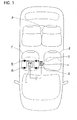
- FIG. 1 is a schematic plan view showing a motor vehicle which is equipped with front seats, rear seats and a passenger detecting device, of an embodiment according to the present invention, for detecting information on a passenger on the seat;
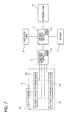
- FIG. 2 is a block diagram of the passenger detecting device of the embodiment and its related devices;
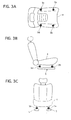
- FIG. 3A is a plan view showing the seat having four weight sensors of the passenger detecting device of the embodiment, FIG. 3B is a side view showing the seat having the sensors, and the FIG. 3C is a front view showing the seat having the sensors;
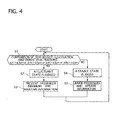
- FIG. 4 is a flow chart of a weight-fluctuation monitoring process and a passenger judging and data updating process executed by a control unit of the passenger detecting device;
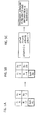
- FIG. 5A is a diagram showing weight values detected by the weight sensors of the seat and their total weight value when the motor vehicle stops or runs on a flat surface road, FIG. 5B is a diagram showing the weight values and the total weight value when the motor vehicle runs on a curved road, and FIG. 5C is a flow of the passenger judging process for judging whether judgment of information on a passenger is to be made or not;
- FIG. 6 is a plan view showing weight shift on the seat, a state of the passenger and a movement direction of the motor vehicle when the motor vehicle runs on the curved road;
- FIG. 7A is a diagram showing weight values detected by the weight sensors and their total weight value when the motor vehicle stops or runs on the flat surface road, FIG. 7B is a diagram showing the weight values and the total weight value when the motor vehicle makes a sudden stop, and FIG. 7C is the flow of the passenger judging process for judging whether the judgment of information on the passenger is to be made or not;
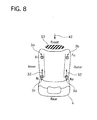
- FIG. 8 is a plan view showing the weight shift, the state of the passenger and a direction of brake force acting on the motor vehicle when it makes a sudden stop;
- FIG. 9A is a diagram showing weight values detected by the weight sensors and their total weight value when the motor vehicle stops or runs on the flat surface road, FIG. 9B is a diagram showing the weight values and the total weight value when the passengers change his or her seats, and FIG. 9C is the flow of the passenger judging process for judging whether the judgment of information on the passenger is to be made or not; and
- FIG. 10A is a diagram showing weight values detected by the weight sensors and their total weight value when a child sits on the seat with luggage, FIG. 10B is a diagram showing the weight values and the total weight value when the child moves the luggage from the seat, and FIG. 10C is the flow of the passenger judging process for judging whether the judgment of information on the passenger is to be made or not.
- Throughout the following detailed description, similar reference characters and numbers refer to similar elements in all figures of the drawings, and their descriptions are omitted for eliminating duplication.
- Referring to FIGS. 1 and 2 of the drawings, there is shown a
passenger detecting device 2, adapted for a motor vehicle, of a first preferred embodiment according to the present invention. - The motor vehicle has a
driver seat 4a, afront passenger seat 4b, and arear passenger seat 4c. The motor vehicle is equipped with an air-bag control unit 1, thepassenger detecting device 2, a passenger-detection-state indicator lamp 6, awarning lamp 8, and anair bag 7. - The air-
bag control unit 1 has a central processing unit (CPU) 11, and is electrically connected to thepassenger detecting device 2, the passenger-detection-state indicator lamp 6, thewarning lamp 8, and theair bag 7. Thecontrol unit 1 receives a passenger-detection-state signal from thepassenger detecting device 2 to judge the passenger to be an adult, a little adult, or a child. The adult corresponds to a large physical-size person of the present invention, and the little adult and the child correspond to a small physical-size person of the present invention. - The
control unit 1 is also electrically connected to a not-shown crash sensor to receive a crash signal therefrom in the event of a serious accident. When it receives the crash signal, it controls theair bag 7 so that the air bag, adapted for a seat judged to have no passenger, does not deploy, while the air bag can deploy according to its judgment result, deploying to have a larger volume when the judgment result is an adult and to have a smaller volume when the judgment result is a child or a little adult. Note that the judgment result is this case can be only a small physical-size passenger, not being capable of judging whether he or she is the little adult or the child. - The
passenger detecting device 2 has aCPU 21, and is electrically connected with the air-bag control unit 1, afirst weigh sensor 3a, asecond weight sensor 3b, athird weight sensor 3c and afourth weight sensor 3d, where the first tofourth weight sensors 3a to 3d are provided on aseat 4 to act as a seat sensor, for example thefront passenger seat 4b in this embodiment. Thepassenger detecting device 2 receives a first weight signal, a second weight signal, a third weight signal and a fourth weight signal from the first tofourth weight sensors 3a to 3d, respectively, to judge a passenger on theseat 4 to be the adult or the child and outputs the passenger-detection-state signal to the air-bag control unit 1. - The passenger-detection-
state indicator lamp 6 is electrically connected to the air-bag control unit 1, and is constructed so that it can indicate no passenger, an adult, or a child based on the passenger-detection-state signal. Thelamp 6 may be electrically connected to thepassenger detecting device 2. - The
warning lamp 8 is electrically connected to the air-bag control unit 1 to receive a fault signal therefrom. Thewarning lamp 8 lights up to warn a driver a potential malfunction when it receives the fault signal. - The
air bag 7 is made of a nylon fabric with a coating on its inside and contains a not-shown pyrotechnic inflater and a not-shown igniter. Theair bag 7 can deploy to absorb driver's momentum when the crash sensor detects a sufficient impact acting on the motor vehicle and the seat sensor corresponding to theair bag 7 detects the existence of the passenger. Theair bag 7 can be controlled so as to deploy to have at least two different volumes according to the physical size of the passenger. - The first to
fourth weight sensors 3 to 3d are arranged on four legs of theseat 4, respectively, as shown in FIGS. 3A to 3C. Specifically, thefirst weight sensor 3a is arranged on a front left leg of theseat 4, thesecond weight sensor 3b is arranged on a front right leg thereof, thethird weight sensor 3d is arranged on a rear left leg thereof, and thefourth weight sensor 3d is arranged on a rear right leg thereof. - The operation of thus-constructed air bag system used in the embodiment will be described.
- When the crash sensor detects a sufficient impact and the
passenger detecting device 2 detects the existence of the passenger, the air-bag control unit 1 controls the igniter to produce an ignition spark. Fuel tablets burn very rapidly to produce a given quantity of gas and deploy theair bag 7. This volume of theair bag 7 is smaller when the passenger is judged to be a child, while it is larger when the passenger is judged to be an adult. Theair bag 7 does not deploy in case of judgment of no existence of a passenger, although the crash sensor detects the sufficient impact. - Next, the operation of the
passenger detecting device 2 of the embodiment will be described. - The
passenger detecting device 2 receives the first to fourth weight signals from the first tofourth weight sensors 3a to 3d, and judges the passenger on theseat 4 to be an adult or a child. - FIG. 4 shows a flow chart of a weight-fluctuation monitoring process and a passenger judging and data updating process executed by the
CPU 21 of thepassenger detecting device 2, and its each step will be described. These processes are executed while an ignition key is kept ON. Incidentally, thepassenger detecting device 2 and its not-shown program of the weight monitoring process correspond to a weight-fluctuation monitoring means of the present invention. In addition, thepassenger detecting device 2 and its not-shown program of the passenger judging and data updating process correspond to a passenger judging and data updating means of the present invention. - At step S1, the
passenger detecting device 2 receives the first to fourth signals from the first tofourth weight sensors 3a to 3d to calculate the sum-weight fluctuation amount ΔSum and each weight fluctuation amounts ΔFi, ΔFo, ΔRi, and ΔFo of the first tofourth weight sensors 3a to 3d, where ΔFi is the weight fluctuation amount detected by thefirst weight sensor 3a at front inner side of theseat 4, ΔFo is the weight fluctuation amount detected by thesecond weight sensor 3b at a front outer side of theseat 4, ΔRi is the weight fluctuation amount detected by thethird weight sensor 3c at a rear left side of theseat 4, and ΔFo is the weight fluctuation amount detected by thefourth weight sensor 3d at a rear right side of theseat 4. Theseat 4 is thefront passenger seat 4b in this embodiment, and located at a front right side of the motor vehicle. - Then, the
passenger detecting device 2 compares the sum-weight fluctuation amount ΔSum and each weight fluctuation amounts ΔFi, ΔFo, ΔRi, and ΔRo with each other so as to judge whether the motor vehicle is in a stable state or not. If at least one of the weigh fluctuation amounts ΔFi, ΔFo, ΔRi, and ΔRo is larger than the sum-weight fluctuation amount ΔSum, the flow goes to step S2, while, if the sum-weight fluctuation amount ΔSum is equal to one of the weigh fluctuation amounts ΔFi, ΔFo, ΔRi, and ΔRo or larger than all of them, the flow goes to step S4. That is, if ΔFi > ΔSum, or ΔFo > ΔSum, or ΔRi > ΔSum, or ΔRo > ΔSum, then the motor vehicle is judged to be in the fluctuant state. Note that the above fluctuation amounts and the sum-fluctuation amount are used as absolute values in these comparisons. - At the step S2, the
passenger detecting device 2 judges the motor vehicle to be in a fluctuant state, and then the flow goes to step S3. - At the step S3, the
passenger detecting device 2 is prevented from judging a passenger to be an adult or a child, and maintains stored information on the passenger, and then returns to thestep S 1. - At the step S4, the
passenger detecting device 2 judges the motor vehicle to be in a stable state, and then the flow goes to step S5. - At the step S5, the
passenger detecting device 2 judges the passenger to be an adult or a child to update the information on the driver, and then the flow returns to thestep S 1. - The passenger process will be explained using examples of various motor vehicle states.
- First, the judging process, executed when the motor vehicle parks or runs on a flat road at a substantially constant speed, will be described.
- The output values of the first to
fourth weight sensors 3a to 3d are stable to provide well-rounded small fluctuation amounts, each of which becomes equal to or smaller than the sum-weight fluctuation amount ΔSum. In this state, the motor vehicle is judged to be in the stable state, and the information on the passenger is updated, thus providing a proper judgment result on the passenger. Therefore, theair bag 7 can be deployed properly according to the detected physical size of the passenger. - Next, the judging process, executed when the motor vehicle runs on a curved road, will be described with reference to FIGS. 5A to 5C and 6.
- As shown in FIG. 6, when the motor vehicle is running around the curve in a direction indicated by an
arrow 41, centrifugal force acts on the passenger in a right direction in FIG. 6, and consequently the weigh shift of the passenger is generated as indicated byarrows 31. This increases the weight detected by thefourth weight sensor 3d. At the same time, a part of the passenger's body may lean over on a front right door, not shown, as indicated by azone 51, and accordingly a part of the passenger's weight is supported by the front right door. - Therefore, while the motor vehicle are running round the curve, the outputs values of the first to
fourth sensors 3a to 3d largely change to disrupt a balance of the left side weights and the right side weights. However, the sum weight is kept to have an amount close to that obtained when the motor vehicle runs on the flat road at the substantially constant speed, although it is decreased by an amount of the weight supported by the door. - FIG. 5A shows an example of the weights obtained when the motor vehicle parks or runs on the flat road at the substantially constant speed, and FIG. 5B shows an example of the weights obtained when the motor vehicle is running round the curve.
- As shown in FIG. 5A, when the motor vehicle parks or runs on the flat road at the substantially constant speed, the first to
fourth weight sensors 3a to 3d detect the weights acting on theseat 4, for example, Fi = 8, Fo = 8, Ri = 12, Ro = 12, and the sum weight Sum = 40. On the other hand, as shown in FIG. 5B, when the motor vehicle is running round the curve, the first tofourth weight sensors 3a to 3d detect the weights acting on theseat 4, for example, Fi = 0, Fo = 13, Ri = -4, Ro = 29, and the sum weight Sum = 38. - Accordingly, at the step S1 of the judging process, the weight fluctuation amounts become as follows. ΔSum = 2, ΔFi = 8, ΔFo = 8, ΔRi = 16, and ΔRo = 17 as shown in FIG. 5C. The sum-weight fluctuation amount ΔSum becomes smaller than each of the weight fluctuation amounts ΔFi, ΔFo, ΔRi, and ΔRo. Therefore, the
passenger detecting device 2 judges the motor vehicle to be in the fluctuant state, and prevents judging the passenger to maintain the previously stored information on the passenger. This can prevent theair bag 7 from being deployed by mistake, such as when an adult is judged to be a child. - Next, the judging process, executed when the motor vehicle is suddenly stopped or braked, will be described with reference to FIGS. 7A to 7C and 8.
- As shown in FIG. 8, when the motor vehicle is suddenly stopped or braked, brake force acts on the motor vehicle in a direction indicated by an
arrow 42, and consequently the weigh shift of the passenger is generated as indicated byarrows 32. This increases weight detected by the first andsecond weight sensors zone 52, and accordingly a part of the passenger's weight is supported by a floor, not shown, of the motor vehicle. - Therefore, while the motor vehicle is suddenly stopped or braked, the outputs values of the first to
fourth sensors 3a to 3d change greatly to disrupt a balance of the front side weights and the rear side weights. However, the sum weight is kept to have an amount close to that obtained when the motor vehicle runs on the flat road at the substantially constant speed, although it is decreased by an amount of the weight supported by the door. - FIG. 7A shows an example of the weights obtained when the motor vehicle parks or runs on the flat road at the substantially constant speed, and FIG. 7B shows an example of the weights obtained when the motor vehicle is suddenly stopped or braked.
- As shown in FIG. 7A, when the motor vehicle parks or runs on the flat road at the substantially constant speed, the first to
fourth weight sensors 3a to 3d detect the weights acting on theseat 4, for example, Fi = 8, Fo = 8, Ri = 12, Ro = 12, and the sum weight Sum = 40. On the other hand, as shown in FIG. 7B, when the motor vehicle is suddenly stopped or braked, the first tofourth weight sensors 3a to 3d detect the weights acting on theseat 4, for example, Fi = 17, Fo = 16, Ri = 2, Ro = 3, and the sum weight Sum = 38. - Accordingly, at the
step S 1 of the judging process, the weight fluctuation amounts become as follows. ΔSum = 2, ΔFi = 10, ΔFo = 7, ΔRi = 9, and ΔRo = 6 as shown in FIG. 7C. The sum-weight fluctuation amount ΔSum becomes smaller than each of the weight fluctuation amounts ΔFi, ΔFo, ΔRi, and ΔRo. Therefore, thepassenger detecting device 2 judges the motor vehicle to be in the fluctuant state, and prevents judging the passenger to maintain the previously stored information on the passenger. This can prevent theair bag 7 from being deployed by mistake, such as when an adult is judged to be a child. - When the motor vehicle is suddenly started or accelerated, the shift of the weights becomes to have a direction opposite to that generated when the motor vehicle is suddenly stopped or braked. In this case, the
passenger detecting device 2 similarly judges the motor vehicle to be in the fluctuant state, and prevents judging the passenger and maintains the previously stored information on the passenger. This can prevent theair bag 7 from being deployed by mistake, such as when an adult is judged to be a child. - Next, the judging process, executed when passengers change from one to another on the
seat 4, will be described with reference to FIGS. 9A to 9C. - In this case, the one passenger leaves the
seat 4, and then the other passenger sits on theseat 4. This causes change of the weights detected by the first tofourth weight sensors 3a to 3d. - FIG. 9A shows an example of the weights obtained when the motor vehicle parks or runs on the flat road at the substantially constant speed, and FIG. 9B shows an example of the weights obtained after the passengers change on the
seat 4. - As shown in FIG. 9A, when the motor vehicle parks or runs on the flat road at the substantially constant speed, the first to
fourth weight sensors 3a to 3d detect the weights acting on theseat 4, for example, Fi = 8, Fo = 8, Ri = 12, Ro = 12, and the sum weight Sum = 40. On the other hand, as shown in FIG. 7B, when the passenger leaves theseat 4, the first tofourth weight sensors 3a to 3d detect the weights acting on theseat 4, for example, Fi = 0, Fo = 0, Ri = 0, Ro = 0, and the sum weight Sum = 0. - Accordingly, at the
step S 1 of the judging process, the weight fluctuation amounts become as follows. ΔSum = 40, ΔFi = 8, ΔFo = 8, ΔRi = 12, and ΔRo = 12 as shown in FIG. 9C. The sum-weight fluctuation amount ΔSum becomes larger than each of the weight fluctuation amounts ΔFi, ΔFo, ΔRi, and ΔRo. Therefore, thepassenger detecting device 2 judges the motor vehicle to be in the stable state, and judges the passenger to update the information on the passenger. Then, when the other passenger sits on theseat 4, the sum-fluctuation amount becomes larger than each of the weight fluctuation amounts detected by the first tofourth weight sensors 3a to 3d. Therefore, thepassenger detecting device 2 judges the motor vehicle to be in the stable state, and judges the passenger to update the information on the passenger. This can deploy theair bag 7 according to the physical size of this new passenger in the event of a serious accident. - Next, the judging process, executed when a child having his or her heavy luggage sits on the
seat 4, will be described with reference to FIGS. 10A to 10C. - This case is that the child gets in the motor vehicle and sits on the
seat 4 with the heavy luggage, and then the first tofourth weight sensors 3a to 3d detect weight of the child and the luggage. In this case, a passenger on theseat 4 is judged to be an adult, so that the volume ofair bag 7 when it deploys is for an adult size. This is acceptable because of increase in volume of the child and the luggage. - On the other hand, after the
passenger detecting device 2 judges the passenger to be an adult, the luggage may be moved off from theseat 4. In this case, the weight acting on theseat 4 decreases, and accordingly thepassenger detecting device 2 judges the passenger to be a child to update the information on the passenger. Therefore, theair bag 7 is deployed to have a child volume in the event of an accident. - FIG. 10A shows an example of the weights obtained when the child with the luggage is detected as the weight of the passenger on the
seat 4, and FIG. 10B shows an example of the weights obtained after the child without the luggage, because of moving it off from theseat 4, is detected as the weight of the passenger on theseat 4. - As shown in FIG. 10A, when the child with the luggage is detected as the weight of the passenger on the
seat 4, the first tofourth weight sensors 3a to 3d detect the weights acting on theseat 4, for example, Fi = 6, Fo = 6, Ri = 10, Ro = 10, and the sum weight Sum = 32. On the other hand, as shown in FIG 10B, when the child without the luggage is detected as the weight of the passenger on theseat 4, the first tofourth weight sensors 3a to 3d detect the weights acting on theseat 4, for example, Fi = 5, Fo = 5, Ri = 8, Ro = 8, and the sum weight Sum = 26. - Accordingly, at the step S of the judging process, the weight fluctuation amounts become as follows. ΔSum = 6, ΔFi = 1, ΔFo = 1, ΔRi = 2, and ΔRo = 2 as shown in FIG. 10C. The sum-weight fluctuation amount ΔSum becomes larger than each of the weight fluctuation amounts ΔFi, ΔFo, ΔRi, and ΔRo. Therefore, the
passenger detecting device 2 judges the motor vehicle to be in the stable state, and judges the passenger to be a child to update the previously stored information on the passenger. This enables theair bag 7 to deploy to have a volume suitable for the child. - The
passenger detecting device 2 of the embodiment has the following advantages. - The
passenger detecting device 2 of the embodiment includes the first tofourth weight sensors 3a to 3d for detecting the weights acting on different portions of theseat 4, and monitors the weight fluctuation amounts ΔFi, ΔFo, ΔRi, and ΔRo and the sum-weight fluctuation amount ΔSum to judge the passenger based thereon. When at least one of the weight fluctuation amounts ΔFi, ΔFo, ΔRi, and ΔRo is larger than the sum-weight fluctuation amount ΔSum, the passenger judging process is prevented, thus maintaining the previous stored information on the passenger. Therefore, thepassenger detecting device 2 of the embodiment can prevent a wrong judgment of the passenger during the curving, the sudden acceleration, the sudden braking and the like of the motor vehicle, thereby preventing theair bag 7 to be deployed to have an undesirable volume. - On the contrary, when all of the weight fluctuation amounts ΔFi, ΔFo, ΔRi, and ΔRo is equal to or smaller than the sum-weight fluctuation amount ΔSum, the passenger judging process is executed, thus the information being updated. Therefore, the
passenger detecting device 2 of the embodiment can properly judge the passenger to update the information on the driver when the passengers change and when the child move the luggage from theseat 4. - Thus, the
passenger detecting device 2 of the embodiment can more stably and properly detect the passenger to be an adult or a child and desirably control deployment of theair bag 7. - While there have been particularly shown and described with reference to preferred embodiments thereof, it will be understood that various modifications may be made therein.
- The first to
fourth weight sensors 3a to 3d may employ a strain gauge transducer, a hydraulic type weight sensor, or others which can directly or indirectly detectable the weight, as long as it can accurately detect the weight of a passenger on a seat. - In the embodiment, the four
weight sensors 3a to 3d are used, while the number of the weight sensors may be changed. - In the embodiment, the
weight sensors 3a to 3d are provided on thefront passenger seat 4b, while they may be provided on another seat or on other seats. - In the embodiment, when at least one of the weight fluctuation amounts ΔFi, ΔFo, ΔRi, and ΔRo is larger than the sum-weight fluctuation amount ΔSum, the passenger judging process is prevented, while in this case the passenger judging process may be executed as long as the information on the passenger is not updated.
Claims (3)
- A passenger detecting device (2) adapted for motor vehicle, the passenger detecting device (2) being characterized in that it comprises:a plurality of weight sensors (3a, 3b, 3c and 3d) that are arranged at different positions of a seat (4; 4b) for respectively detecting weights acting on the seat (4; 4b) of a motor vehicle;a weight-fluctuation monitoring means for monitoring weight-fluctuation amounts of the plurality of the weight sensors (3a, 3b, 3c and 3d) and sum-weight fluctuation amount; anda passenger judging and data updating means for judging a passenger on the seat (4; 4b) to be a large physical-size person or a small physical-size person to update information on the passenger on the seat (4; 4b) when the sum-weight fluctuation amount is not less than each of the weight fluctuation amounts, the passenger judging and data updating means preventing the information to be updated when at least one of the weight fluctuation amounts is larger than the sum-weight fluctuation amount.
- The passenger detecting device (2) according to claim 1,
characterized in thatthe plurality of the weight sensors (3a, 3b, 3c and 3d) are located at a front left position, a front right position, a rear left position and a rear right position of the seat (4; 4b), respectively. - The passenger detecting device according to claim 1 or claim 2,
characterized in thatthe plurality of the weight sensors (3 3b, 3c and 3d) are located on the legs of the seat (4; 4b).
Applications Claiming Priority (1)
| Application Number | Priority Date | Filing Date | Title |
|---|---|---|---|
| JP2005369743A JP4801988B2 (en) | 2005-12-22 | 2005-12-22 | Vehicle occupant detection device |
Publications (1)
| Publication Number | Publication Date |
|---|---|
| EP1800965A1 true EP1800965A1 (en) | 2007-06-27 |
Family
ID=37888056
Family Applications (1)
| Application Number | Title | Priority Date | Filing Date |
|---|---|---|---|
| EP06127028A Withdrawn EP1800965A1 (en) | 2005-12-22 | 2006-12-22 | Passenger detecting device adapted for motor vehicle |
Country Status (3)
| Country | Link |
|---|---|
| US (1) | US7562735B2 (en) |
| EP (1) | EP1800965A1 (en) |
| JP (1) | JP4801988B2 (en) |
Cited By (1)
| Publication number | Priority date | Publication date | Assignee | Title |
|---|---|---|---|---|
| CN101393433B (en) * | 2007-09-21 | 2011-08-03 | 浙江天成座椅有限公司 | System for monitoring and controlling amenity and safety of automobile chair and method thereof |
Families Citing this family (8)
| Publication number | Priority date | Publication date | Assignee | Title |
|---|---|---|---|---|
| KR100837919B1 (en) * | 2007-06-14 | 2008-06-13 | 기아자동차주식회사 | Passenger identification device and method of car seat |
| JP2009046114A (en) * | 2007-07-23 | 2009-03-05 | Calsonic Kansei Corp | Occupant detection system for vehicle |
| KR100941252B1 (en) | 2007-12-17 | 2010-02-10 | 현대모비스 주식회사 | Passenger Identification System Using Two Load Sensors |
| KR101372549B1 (en) | 2008-07-02 | 2014-03-07 | 현대모비스 주식회사 | Apparatus and Method for control of air-bag |
| CN101774365A (en) * | 2010-03-30 | 2010-07-14 | 奇瑞汽车股份有限公司 | Control system and method for automotive safety device |
| US20110290895A1 (en) * | 2010-05-28 | 2011-12-01 | Jingwei Yin | Secondary Heating System for Motor Vehicles |
| JP5631808B2 (en) * | 2011-05-13 | 2014-11-26 | カルソニックカンセイ株式会社 | Vehicle occupant detection device |
| JP5862348B2 (en) * | 2012-02-15 | 2016-02-16 | アイシン精機株式会社 | Seat occupant determination device |
Citations (5)
| Publication number | Priority date | Publication date | Assignee | Title |
|---|---|---|---|---|
| JP2000302003A (en) * | 1999-04-16 | 2000-10-31 | Nabco Ltd | Vehicle occupant physique detection device |
| EP1190916A2 (en) * | 2000-09-25 | 2002-03-27 | Toyota Jidosha Kabushiki Kaisha | Weight detector for vehicle seat |
| EP1411331A1 (en) * | 2002-10-16 | 2004-04-21 | Mazda Motor Corporation | Vehicle passenger detection device |
| EP1440838A1 (en) * | 2003-01-23 | 2004-07-28 | Nhk Spring Co., Ltd. | Occupant discriminating method for vehicular seat |
| EP1574401A1 (en) * | 2004-03-10 | 2005-09-14 | Delphi Technologies, Inc. | Occupant classification method based on seated weight measurement |
Family Cites Families (11)
| Publication number | Priority date | Publication date | Assignee | Title |
|---|---|---|---|---|
| US3657475A (en) * | 1969-03-19 | 1972-04-18 | Thomson Csf T Vt Sa | Position-indicating system |
| JPS5823576B2 (en) * | 1978-07-10 | 1983-05-16 | 株式会社島津製作所 | electronic balance |
| US4635739A (en) * | 1985-06-25 | 1987-01-13 | Caterpillar Inc. | Payload monitor |
| US4782904A (en) * | 1986-11-07 | 1988-11-08 | Ohaus Scale Corporation | Electronic balance |
| CH682518A5 (en) * | 1991-07-09 | 1993-09-30 | Mettler Toledo Ag | Electronic scale with a device for standstill control. |
| US5987370A (en) * | 1997-09-03 | 1999-11-16 | Delco Electronics Corp. | Vehicle occupant weight estimation apparatus having fluid-filled seat bladder |
| US6557424B1 (en) * | 1999-02-24 | 2003-05-06 | Siemens Vdo Automotive Corporation | Method and apparatus for sensing seat occupant weight |
| US6636792B2 (en) * | 2000-09-29 | 2003-10-21 | Siemens Vdo Automotive Corporation | Weight classification system |
| JP4009155B2 (en) * | 2002-07-22 | 2007-11-14 | アイシン精機株式会社 | Crew determination device |
| JP2005170300A (en) * | 2003-12-12 | 2005-06-30 | Mitsubishi Electric Corp | Crew determination device |
| JP4878145B2 (en) * | 2005-02-16 | 2012-02-15 | カルソニックカンセイ株式会社 | Vehicle occupant detection device |
-
2005
- 2005-12-22 JP JP2005369743A patent/JP4801988B2/en not_active Expired - Fee Related
-
2006
- 2006-12-21 US US11/642,831 patent/US7562735B2/en not_active Expired - Fee Related
- 2006-12-22 EP EP06127028A patent/EP1800965A1/en not_active Withdrawn
Patent Citations (5)
| Publication number | Priority date | Publication date | Assignee | Title |
|---|---|---|---|---|
| JP2000302003A (en) * | 1999-04-16 | 2000-10-31 | Nabco Ltd | Vehicle occupant physique detection device |
| EP1190916A2 (en) * | 2000-09-25 | 2002-03-27 | Toyota Jidosha Kabushiki Kaisha | Weight detector for vehicle seat |
| EP1411331A1 (en) * | 2002-10-16 | 2004-04-21 | Mazda Motor Corporation | Vehicle passenger detection device |
| EP1440838A1 (en) * | 2003-01-23 | 2004-07-28 | Nhk Spring Co., Ltd. | Occupant discriminating method for vehicular seat |
| EP1574401A1 (en) * | 2004-03-10 | 2005-09-14 | Delphi Technologies, Inc. | Occupant classification method based on seated weight measurement |
Cited By (1)
| Publication number | Priority date | Publication date | Assignee | Title |
|---|---|---|---|---|
| CN101393433B (en) * | 2007-09-21 | 2011-08-03 | 浙江天成座椅有限公司 | System for monitoring and controlling amenity and safety of automobile chair and method thereof |
Also Published As
| Publication number | Publication date |
|---|---|
| US20070144793A1 (en) | 2007-06-28 |
| JP4801988B2 (en) | 2011-10-26 |
| JP2007168634A (en) | 2007-07-05 |
| US7562735B2 (en) | 2009-07-21 |
Similar Documents
| Publication | Publication Date | Title |
|---|---|---|
| US7831359B2 (en) | Passenger detecting device adapted for motor vehicle | |
| US6341252B1 (en) | Method and apparatus for controlling an actuatable occupant protection device | |
| US9376076B2 (en) | Method and apparatus for deployment of an air bag | |
| EP0981469B1 (en) | Air bag suppression system and method | |
| JP5765069B2 (en) | Seat load judgment device | |
| CN1134355C (en) | Vehicle safety device with multi-chamber safety airbag | |
| US6431593B1 (en) | Vehicle crash determination arrangement and method, utilizing center of gravity, for an occupant protection system | |
| US6416080B1 (en) | Apparatus and method for protecting a vehicle occupant utilizing a correlation between an occupant-associated center and a distance to an occupant-associated surface | |
| CN100413734C (en) | method when classifying objects occupying a seat | |
| EP1278657B1 (en) | Airbag system with biomechanical gray zones | |
| US6804595B1 (en) | Controller for occupant restraint system | |
| KR100910005B1 (en) | Method and apparatus for controlling an actuatable restraining device using crush zone sensors for safing function | |
| JP2005239128A (en) | Twin air bag device | |
| CZ165695A3 (en) | Apparatus for inflation of inflatable hold-up for passengers in a car | |
| EP1208021B1 (en) | Controller for occupant restraint system | |
| JPH0858522A (en) | Device for preventing operation of vehicle occupant restraint device | |
| CA2048720A1 (en) | Passenger out-of-position sensor | |
| GB2418514A (en) | A motor vehicle rollover detection system | |
| US10131308B2 (en) | Safety on-board vehicle multi-force restraint system employing a weighing moderator | |
| US7562735B2 (en) | Passenger detecting device adapted for motor vehicle | |
| US6494284B1 (en) | Seat arrangement for a vehicle having an actuatable occupant protection device | |
| US7320478B2 (en) | Smart airbag for vehicular applications | |
| EP0892728B1 (en) | Automotive seat weight sensing system | |
| JP2008519720A (en) | Car with occupant restraint system | |
| JP3093302B2 (en) | Automotive airbag equipment |
Legal Events
| Date | Code | Title | Description |
|---|---|---|---|
| PUAI | Public reference made under article 153(3) epc to a published international application that has entered the european phase |
Free format text: ORIGINAL CODE: 0009012 |
|
| AK | Designated contracting states |
Kind code of ref document: A1 Designated state(s): AT BE BG CH CY CZ DE DK EE ES FI FR GB GR HU IE IS IT LI LT LU LV MC NL PL PT RO SE SI SK TR |
|
| AX | Request for extension of the european patent |
Extension state: AL BA HR MK YU |
|
| AKX | Designation fees paid | ||
| 17P | Request for examination filed |
Effective date: 20070730 |
|
| RBV | Designated contracting states (corrected) |
Designated state(s): DE FR GB |
|
| REG | Reference to a national code |
Ref country code: DE Ref legal event code: 8566 |
|
| STAA | Information on the status of an ep patent application or granted ep patent |
Free format text: STATUS: THE APPLICATION HAS BEEN WITHDRAWN |
|
| 18W | Application withdrawn |
Effective date: 20100120 |