EP1798083A2 - Door hardware module - Google Patents
Door hardware module Download PDFInfo
- Publication number
- EP1798083A2 EP1798083A2 EP06126092A EP06126092A EP1798083A2 EP 1798083 A2 EP1798083 A2 EP 1798083A2 EP 06126092 A EP06126092 A EP 06126092A EP 06126092 A EP06126092 A EP 06126092A EP 1798083 A2 EP1798083 A2 EP 1798083A2
- Authority
- EP
- European Patent Office
- Prior art keywords
- carrier plate
- inner panel
- door inner
- door
- fastener
- Prior art date
- Legal status (The legal status is an assumption and is not a legal conclusion. Google has not performed a legal analysis and makes no representation as to the accuracy of the status listed.)
- Withdrawn
Links
Images




Classifications
-
- B—PERFORMING OPERATIONS; TRANSPORTING
- B60—VEHICLES IN GENERAL
- B60J—WINDOWS, WINDSCREENS, NON-FIXED ROOFS, DOORS, OR SIMILAR DEVICES FOR VEHICLES; REMOVABLE EXTERNAL PROTECTIVE COVERINGS SPECIALLY ADAPTED FOR VEHICLES
- B60J5/00—Doors
- B60J5/04—Doors arranged at the vehicle sides
- B60J5/042—Reinforcement elements
- B60J5/0451—Block or short strip-type elements
-
- B—PERFORMING OPERATIONS; TRANSPORTING
- B60—VEHICLES IN GENERAL
- B60J—WINDOWS, WINDSCREENS, NON-FIXED ROOFS, DOORS, OR SIMILAR DEVICES FOR VEHICLES; REMOVABLE EXTERNAL PROTECTIVE COVERINGS SPECIALLY ADAPTED FOR VEHICLES
- B60J5/00—Doors
- B60J5/04—Doors arranged at the vehicle sides
-
- B—PERFORMING OPERATIONS; TRANSPORTING
- B60—VEHICLES IN GENERAL
- B60J—WINDOWS, WINDSCREENS, NON-FIXED ROOFS, DOORS, OR SIMILAR DEVICES FOR VEHICLES; REMOVABLE EXTERNAL PROTECTIVE COVERINGS SPECIALLY ADAPTED FOR VEHICLES
- B60J5/00—Doors
-
- B—PERFORMING OPERATIONS; TRANSPORTING
- B60—VEHICLES IN GENERAL
- B60J—WINDOWS, WINDSCREENS, NON-FIXED ROOFS, DOORS, OR SIMILAR DEVICES FOR VEHICLES; REMOVABLE EXTERNAL PROTECTIVE COVERINGS SPECIALLY ADAPTED FOR VEHICLES
- B60J5/00—Doors
- B60J5/04—Doors arranged at the vehicle sides
- B60J5/0412—Lower door structure
- B60J5/0416—Assembly panels to be installed in doors as a module with components, e.g. lock or window lifter, attached thereto
-
- B—PERFORMING OPERATIONS; TRANSPORTING
- B60—VEHICLES IN GENERAL
- B60J—WINDOWS, WINDSCREENS, NON-FIXED ROOFS, DOORS, OR SIMILAR DEVICES FOR VEHICLES; REMOVABLE EXTERNAL PROTECTIVE COVERINGS SPECIALLY ADAPTED FOR VEHICLES
- B60J5/00—Doors
- B60J5/04—Doors arranged at the vehicle sides
- B60J5/042—Reinforcement elements
- B60J5/0452—Reinforcement elements including foams or expanded materials
-
- E—FIXED CONSTRUCTIONS
- E05—LOCKS; KEYS; WINDOW OR DOOR FITTINGS; SAFES
- E05F—DEVICES FOR MOVING WINGS INTO OPEN OR CLOSED POSITION; CHECKS FOR WINGS; WING FITTINGS NOT OTHERWISE PROVIDED FOR, CONCERNED WITH THE FUNCTIONING OF THE WING
- E05F11/00—Man-operated mechanisms for operating wings, including those which also operate the fastening
- E05F11/38—Man-operated mechanisms for operating wings, including those which also operate the fastening for sliding windows, e.g. vehicle windows, to be opened or closed by vertical movement
- E05F11/42—Man-operated mechanisms for operating wings, including those which also operate the fastening for sliding windows, e.g. vehicle windows, to be opened or closed by vertical movement operated by rack bars and toothed wheels or other push-pull mechanisms
- E05F11/423—Man-operated mechanisms for operating wings, including those which also operate the fastening for sliding windows, e.g. vehicle windows, to be opened or closed by vertical movement operated by rack bars and toothed wheels or other push-pull mechanisms for vehicle windows
-
- E—FIXED CONSTRUCTIONS
- E05—LOCKS; KEYS; WINDOW OR DOOR FITTINGS; SAFES
- E05F—DEVICES FOR MOVING WINGS INTO OPEN OR CLOSED POSITION; CHECKS FOR WINGS; WING FITTINGS NOT OTHERWISE PROVIDED FOR, CONCERNED WITH THE FUNCTIONING OF THE WING
- E05F15/00—Power-operated mechanisms for wings
- E05F15/60—Power-operated mechanisms for wings using electrical actuators
- E05F15/603—Power-operated mechanisms for wings using electrical actuators using rotary electromotors
- E05F15/665—Power-operated mechanisms for wings using electrical actuators using rotary electromotors for vertically-sliding wings
- E05F15/689—Power-operated mechanisms for wings using electrical actuators using rotary electromotors for vertically-sliding wings specially adapted for vehicle windows
-
- E—FIXED CONSTRUCTIONS
- E05—LOCKS; KEYS; WINDOW OR DOOR FITTINGS; SAFES
- E05Y—INDEXING SCHEME ASSOCIATED WITH SUBCLASSES E05D AND E05F, RELATING TO CONSTRUCTION ELEMENTS, ELECTRIC CONTROL, POWER SUPPLY, POWER SIGNAL OR TRANSMISSION, USER INTERFACES, MOUNTING OR COUPLING, DETAILS, ACCESSORIES, AUXILIARY OPERATIONS NOT OTHERWISE PROVIDED FOR, APPLICATION THEREOF
- E05Y2201/00—Constructional elements; Accessories therefor
- E05Y2201/40—Motors; Magnets; Springs; Weights; Accessories therefor
- E05Y2201/43—Motors
- E05Y2201/434—Electromotors; Details thereof
-
- E—FIXED CONSTRUCTIONS
- E05—LOCKS; KEYS; WINDOW OR DOOR FITTINGS; SAFES
- E05Y—INDEXING SCHEME ASSOCIATED WITH SUBCLASSES E05D AND E05F, RELATING TO CONSTRUCTION ELEMENTS, ELECTRIC CONTROL, POWER SUPPLY, POWER SIGNAL OR TRANSMISSION, USER INTERFACES, MOUNTING OR COUPLING, DETAILS, ACCESSORIES, AUXILIARY OPERATIONS NOT OTHERWISE PROVIDED FOR, APPLICATION THEREOF
- E05Y2400/00—Electronic control; Electrical power; Power supply; Power or signal transmission; User interfaces
- E05Y2400/65—Power or signal transmission
- E05Y2400/654—Power or signal transmission by electrical cables
-
- E—FIXED CONSTRUCTIONS
- E05—LOCKS; KEYS; WINDOW OR DOOR FITTINGS; SAFES
- E05Y—INDEXING SCHEME ASSOCIATED WITH SUBCLASSES E05D AND E05F, RELATING TO CONSTRUCTION ELEMENTS, ELECTRIC CONTROL, POWER SUPPLY, POWER SIGNAL OR TRANSMISSION, USER INTERFACES, MOUNTING OR COUPLING, DETAILS, ACCESSORIES, AUXILIARY OPERATIONS NOT OTHERWISE PROVIDED FOR, APPLICATION THEREOF
- E05Y2600/00—Mounting or coupling arrangements for elements provided for in this subclass
- E05Y2600/40—Mounting location; Visibility of the elements
- E05Y2600/46—Mounting location; Visibility of the elements in or on the wing
-
- E—FIXED CONSTRUCTIONS
- E05—LOCKS; KEYS; WINDOW OR DOOR FITTINGS; SAFES
- E05Y—INDEXING SCHEME ASSOCIATED WITH SUBCLASSES E05D AND E05F, RELATING TO CONSTRUCTION ELEMENTS, ELECTRIC CONTROL, POWER SUPPLY, POWER SIGNAL OR TRANSMISSION, USER INTERFACES, MOUNTING OR COUPLING, DETAILS, ACCESSORIES, AUXILIARY OPERATIONS NOT OTHERWISE PROVIDED FOR, APPLICATION THEREOF
- E05Y2900/00—Application of doors, windows, wings or fittings thereof
- E05Y2900/50—Application of doors, windows, wings or fittings thereof for vehicles
- E05Y2900/53—Type of wing
- E05Y2900/55—Windows
Definitions
- the invention relates to automotive door modules.
- Doors for automotive vehicles typically include various components that are coupled to form the door. Doors may include an inner panel, various reinforcement members and an interior trim. Various components including latches, window regulators and other hardware may be attached to the doors. However, attaching all the components to the door requires a time consuming and complex operation, as well as occupies a large factory floor space.
- a door module that includes a door inner panel including at least one fastening feature.
- a carrier plate includes at least one fastener attached thereon prior to attachment to the door inner panel.
- the fastener couples with the at least one fastening feature of the door inner panel for operatively connecting the door inner panel and the carrier plate.
- a door module that includes a door inner panel including at least one location slot formed therein.
- a carrier plate is adapted to engage the door inner panel.
- the carrier plate includes a recess formed thereon.
- a trim component is adapted to engage the carrier plate and includes an extension formed thereon. The recess of the carrier plate is disposed within the location slot formed in the door inner panel and the extension engages the recess of the carrier plate for minimizing a tolerance stack up between the door inner panel, carrier plate and trim component.
- a door module that includes a carrier plate including at least one access hole formed therein.
- a side impact member is disposed within the access hole for protecting an occupant of the vehicle during a side impact collision.
- Figure 1 is a perspective view of a door module including a carrier plate
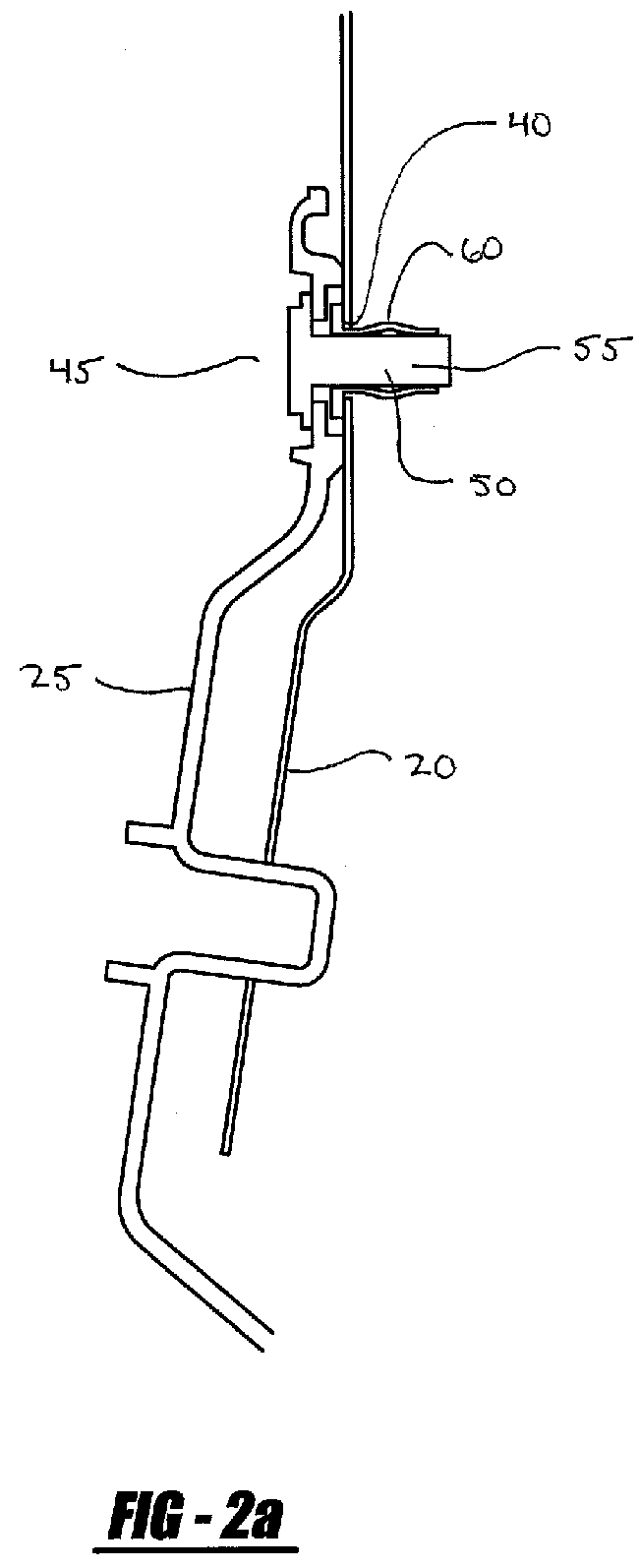
- Figure 2A and 2B are sectional views of a fastener associated with the door mode in an installed and uninstalled position
- Figure 3 is a sectional view of an alternative fastener associated with the door module
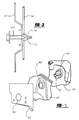
- Figure 4 is partial perspective view of a locator of a carrier plate of the door module positioned relative to a door inner panel and a trim component;
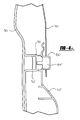
- Figure 4A is a section taken through the locator of Figure 4.
- Figure 5 is a partial perspective view of a door module
- Figure 5A is a partial perspective view of the door module of Figure 5 including an energy absorbing member
- Figure 6 is a partial perspective view of window regulator of the door module.
- the door assembly 10 may include a door inner panel 20, the door module 15 including a carrier plate 25, and an interior trim component 30.
- the door inner panel 20 may be formed of a sheet metal or other material and is shaped to form an outer skin or surface of a door for a vehicle.
- the carrier plate 25, as depicted has a shape corresponding to an inner shape of the door inner panel 20 and may be formed of a suitable molded material, such as a fiberglass reinforced plastic material although it may be formed of any material including other plastic resins or metal materials.
- the carrier plate 25 includes various contours, attachment points, and slots formed therein for performing various functions and attachments, as will be discussed in more detail below.
- the carrier plate 25 is adapted to hold numerous subassemblies that are commonly associated with a door of a vehicle.
- the carrier plate 25 includes an attachment point for receiving a window rack lift system 35. Additionally, the carrier plate 25 may accommodate other components such as a release handle, speaker, latch presenter, as well as other modules that may be associated with the door of a vehicle.
- the door inner panel 20 includes at least one fastening feature 40, best seen in Figures 2A and B.
- the fastening feature 40 may be a hole or slot formed around a periphery of the door inner panel 20 that is adapted to couple with a fastener 45, as will be discussed in more detail below.
- the carrier plate 25 includes at least one fastener 45 attached thereto for operatively connecting the door inner panel 20 with the carrier plate 25.
- the fastener 45 may be received within the at least one fastening feature 40 formed on the door inner panel 20.
- the fastener 45 is attached to the carrier plate 25 prior to attachment to the door inner panel 20 such that the fasteners 45 are integrated with the carrier plate 25 for quick assembly during a manufacturing operation with the door inner panel 20.
- the fastener 45 may be a jack nut 50 and bolt 55 partially rotatably retained within the jack nut 50.
- the jack nut 50 is fixedly attached to the door inner panel 20 in response to rotation of the bolt 55, bending the jack nut prongs 60 into contact with the door inner panel 20.
- This design is in contrast to current manufacturing techniques that utilize weld nuts, J-clips or plastic snap-in fasteners that are attached to a door inner panel and then a bolt or stud is used to couple the carrier plate to the door inner panel.
- the fastener 45 of the carrier plate 25 can allow the attachment of the carrier plate 25 to the door inner panel 20 without the use of additional members described above attached to the door inner panel simplifying an assembly process of a door. Additionally, the jack nut 50 remains attached to the door inner panel 20 after the bolt 55 has been removed or rotated in an opposing direction to the original fastening rotation allowing servicing of the door module 15 and reattachment of the carrier plate 25 in a straightforward and simple manner.
- the fastener 45 may be integrally formed with the carrier plate 25.
- the carrier plate 25 includes a slot 70 having legs 75 integrally formed thereon.
- a bolt 55 is partially rotatably retained in the slot 70 such that the legs 75 that are integrally formed with the carrier plate 25 engage the door inner panel 20 in response to the rotation of the bolt 55.
- the fastener 45 attached to the carrier plate 25 is positioned within the fastening feature 40 formed in the door inner panel 20, thereby holding the carrier plate 25 in relation to the door inner panel 20.
- the operator who is installing the door module 15 does not need to hold the carrier plate 25 in position while attempting to thread bolts into fasteners or nuts applied to the door inner panel 20, as in prior art applications.
- the bolt 55 may then be rotated in a conventional manner causing the prongs 60 of the jack nut 50 to crimp and engage the door inner panel 20.
- the jack nut 50 is fixedly attached to the door inner panel 20 such that the bolt 55 can be removed during a service operation while the jack nut 50 remains installed on the door inner panel 20.
- the integrally formed fastener 45 described above may be attached to the door inner panel 20 utilizing a bolt 55 which, upon rotation, causes the integrally formed legs 75 to flex outward and engage the door inner panel 20.
- the integrally formed embodiment when the bolt 55 is removed, the integrally formed legs 75 are allowed to flex back to their original starting position such that the carrier plate 25 may be removed for servicing as necessary.
- the door inner panel 20 includes at least one location slot 80 formed therein.
- the carrier plate 25 includes a recess 85 formed thereon.
- the trim component 30 preferably includes an extension 90 formed thereon.
- the recess 85 of the carrier plate 25 is disposed within the location slot 80 formed in the door inner panel 20 and the extension 90 engages the recess 80 of the carrier plate 25 for minimizing a tolerance stacked up between the door inner panel 20, carrier plate 25 and trim component 30 when they are coupled.
- the recess 80 formed on the carrier plate 25 may be sized and shaped such that it engages the extension 90.
- the extension 90 may include prongs or spring arms 95 that snap within the recess 80 formed on the carrier plate 25 to positively retain the trim component 30 relative to the carrier plate 25. In this manner, location between the trim component 30, the carrier plate 25 and the door inner panel 20 will be located to the door module 15 using a common locator. Such a design minimizes tolerance stack up between the trim component 30 and mating parts such as the release handle, as well as improves the visual appearance of the door in relation to the rest of the vehicle trim.
- the carrier plate 25 may include an access hole 100 for attaching various subassemblies to the carrier panel 25, after it has been attached to the door inner panel 20.
- a side impact member 105 is disposed at least partially within the access hole 100 on an inboard side of a window pane disposed within the rack lift 35.
- the side impact member 105 is preferably formed of a suitable foam material for protecting an occupant of a vehicle during a side impact collision. Additionally, the side impact member 105 may be used to seal the access hole 100 between the two sides of the carrier plate 25.
- the side impact member 105 may be formed of various materials and can have various shapes and sizes that may be adjusted for different force absorbing and sealing characteristics.
- the rack lift 35 for moving a window 110 associated with the door module 15.
- the rack lift 35 is attached to the carrier plate 25 and includes a motor 115 and a travel guide 120.
- the travel guide 120 in one aspect of the invention includes a recess 125 formed therein.
- a flexible ribbon wiring harness 130 is attached to the motor 115 and is disposed within the recess 125 formed in the travel guide 120.
- the flexible ribbon wiring harness 130 travels with the rack lift 35 when moving the window and remains disposed within the recess 125 formed in the travel guide 120 to avoid interference with the rack lift 35. In this manner, bulky circular wiring harnesses commonly utilized with motors that may fatigue or otherwise interfere with operation of the window rack can be eliminated.
- the flexible ribbon wiring harness 130 may support multiple conductors with various gauge sizes and have enough slack to allow it to travel through the full range of the window glass 110 associated with the rack lift 35.
Landscapes
- Engineering & Computer Science (AREA)
- Mechanical Engineering (AREA)
- Window Of Vehicle (AREA)
- Securing Of Glass Panes Or The Like (AREA)
- Lock And Its Accessories (AREA)
- Vehicle Interior And Exterior Ornaments, Soundproofing, And Insulation (AREA)
Abstract
Description
- This application claims priority of
United States Provisional Patent Application Serial No. 60/750,224 filed December 14, 2005 - The invention relates to automotive door modules.
- Doors for automotive vehicles typically include various components that are coupled to form the door. Doors may include an inner panel, various reinforcement members and an interior trim. Various components including latches, window regulators and other hardware may be attached to the doors. However, attaching all the components to the door requires a time consuming and complex operation, as well as occupies a large factory floor space.
- To decrease the time and complexity of assembling the door, recent proposals have been made to construct some of the hardware as a subassembly or module. This subassembly can then be joined with the remainder of the door at any given place and time. Various entities have attempted to create such door modules, but there is a need in the art for improved door modules that can be easily assembled with a door to decrease the time and complexity of the assembly operation. There is also a need in the art for a door module that can be reliably positioned in a correct orientation with respect to the remainder of the door and trim. There is also a need in the art for a door module that has improved hardware for a window regulator. Additionally there is a need for a door module that has improved sealing, side impact and energy absorbing characteristics.
- In a first aspect there is disclosed a door module that includes a door inner panel including at least one fastening feature. A carrier plate includes at least one fastener attached thereon prior to attachment to the door inner panel. The fastener couples with the at least one fastening feature of the door inner panel for operatively connecting the door inner panel and the carrier plate.
- In a second aspect there is a door module that includes a door inner panel including at least one location slot formed therein. A carrier plate is adapted to engage the door inner panel. The carrier plate includes a recess formed thereon. A trim component is adapted to engage the carrier plate and includes an extension formed thereon. The recess of the carrier plate is disposed within the location slot formed in the door inner panel and the extension engages the recess of the carrier plate for minimizing a tolerance stack up between the door inner panel, carrier plate and trim component.
- In a third aspect there is disclosed a door module that includes a carrier plate including at least one access hole formed therein. A side impact member is disposed within the access hole for protecting an occupant of the vehicle during a side impact collision.
- Figure 1 is a perspective view of a door module including a carrier plate;
- Figure 2A and 2B are sectional views of a fastener associated with the door mode in an installed and uninstalled position;
- Figure 3 is a sectional view of an alternative fastener associated with the door module;
- Figure 4 is partial perspective view of a locator of a carrier plate of the door module positioned relative to a door inner panel and a trim component;
- Figure 4A is a section taken through the locator of Figure 4;
- Figure 5 is a partial perspective view of a door module;
- Figure 5A is a partial perspective view of the door module of Figure 5 including an energy absorbing member;
- Figure 6 is a partial perspective view of window regulator of the door module.
- Referring to Figure 1, there is shown part of a door assembly 10 including a
door module 15. The door assembly 10 may include a doorinner panel 20, thedoor module 15 including acarrier plate 25, and aninterior trim component 30. - The door
inner panel 20 may be formed of a sheet metal or other material and is shaped to form an outer skin or surface of a door for a vehicle. Thecarrier plate 25, as depicted has a shape corresponding to an inner shape of the doorinner panel 20 and may be formed of a suitable molded material, such as a fiberglass reinforced plastic material although it may be formed of any material including other plastic resins or metal materials. As can be seen in the figure, thecarrier plate 25 includes various contours, attachment points, and slots formed therein for performing various functions and attachments, as will be discussed in more detail below. - The
carrier plate 25 is adapted to hold numerous subassemblies that are commonly associated with a door of a vehicle. Thecarrier plate 25 includes an attachment point for receiving a windowrack lift system 35. Additionally, thecarrier plate 25 may accommodate other components such as a release handle, speaker, latch presenter, as well as other modules that may be associated with the door of a vehicle. - The door
inner panel 20 includes at least one fastening feature 40, best seen in Figures 2A and B. Thefastening feature 40 may be a hole or slot formed around a periphery of the doorinner panel 20 that is adapted to couple with afastener 45, as will be discussed in more detail below. - In one aspect, the
carrier plate 25 includes at least onefastener 45 attached thereto for operatively connecting the doorinner panel 20 with thecarrier plate 25. Thefastener 45 may be received within the at least onefastening feature 40 formed on the doorinner panel 20. Thefastener 45 is attached to thecarrier plate 25 prior to attachment to the doorinner panel 20 such that thefasteners 45 are integrated with thecarrier plate 25 for quick assembly during a manufacturing operation with the doorinner panel 20. - In one aspect, as shown in Figures 2A and 2B, the
fastener 45 may be ajack nut 50 andbolt 55 partially rotatably retained within thejack nut 50. Thejack nut 50 is fixedly attached to the doorinner panel 20 in response to rotation of thebolt 55, bending the jack nut prongs 60 into contact with the doorinner panel 20. This design is in contrast to current manufacturing techniques that utilize weld nuts, J-clips or plastic snap-in fasteners that are attached to a door inner panel and then a bolt or stud is used to couple the carrier plate to the door inner panel. Thefastener 45 of thecarrier plate 25 can allow the attachment of thecarrier plate 25 to the doorinner panel 20 without the use of additional members described above attached to the door inner panel simplifying an assembly process of a door. Additionally, thejack nut 50 remains attached to the doorinner panel 20 after thebolt 55 has been removed or rotated in an opposing direction to the original fastening rotation allowing servicing of thedoor module 15 and reattachment of thecarrier plate 25 in a straightforward and simple manner. - In another aspect, as shown in Figure 3, the
fastener 45 may be integrally formed with thecarrier plate 25. In this embodiment, thecarrier plate 25 includes aslot 70 havinglegs 75 integrally formed thereon. Again, abolt 55 is partially rotatably retained in theslot 70 such that thelegs 75 that are integrally formed with thecarrier plate 25 engage the doorinner panel 20 in response to the rotation of thebolt 55. - As can be seen in Figures 2A and 2B, the
fastener 45 attached to thecarrier plate 25 is positioned within thefastening feature 40 formed in the doorinner panel 20, thereby holding thecarrier plate 25 in relation to the doorinner panel 20. In this manner, the operator who is installing thedoor module 15 does not need to hold thecarrier plate 25 in position while attempting to thread bolts into fasteners or nuts applied to the doorinner panel 20, as in prior art applications. Once thefastener 45 is positioned within thefastening feature 40 formed in the doorinner panel 20, thebolt 55 may then be rotated in a conventional manner causing theprongs 60 of thejack nut 50 to crimp and engage the doorinner panel 20. In this manner, thejack nut 50 is fixedly attached to the doorinner panel 20 such that thebolt 55 can be removed during a service operation while thejack nut 50 remains installed on the doorinner panel 20. In a similar manner, the integrally formedfastener 45 described above may be attached to the doorinner panel 20 utilizing abolt 55 which, upon rotation, causes the integrally formedlegs 75 to flex outward and engage the doorinner panel 20. However in the integrally formed embodiment, when thebolt 55 is removed, the integrally formedlegs 75 are allowed to flex back to their original starting position such that thecarrier plate 25 may be removed for servicing as necessary. - Referring to Figure 4, there is shown partial views of the door
inner panel 20,carrier plate 25 andtrim component 30 of the door assembly 10. In one aspect, the doorinner panel 20 includes at least onelocation slot 80 formed therein. Thecarrier plate 25 includes arecess 85 formed thereon. Thetrim component 30 preferably includes anextension 90 formed thereon. Therecess 85 of thecarrier plate 25 is disposed within thelocation slot 80 formed in the doorinner panel 20 and theextension 90 engages therecess 80 of thecarrier plate 25 for minimizing a tolerance stacked up between the doorinner panel 20,carrier plate 25 andtrim component 30 when they are coupled. As can be seen in Figure 4, therecess 80 formed on thecarrier plate 25 may be sized and shaped such that it engages theextension 90. Theextension 90 may include prongs orspring arms 95 that snap within therecess 80 formed on thecarrier plate 25 to positively retain thetrim component 30 relative to thecarrier plate 25. In this manner, location between thetrim component 30, thecarrier plate 25 and the doorinner panel 20 will be located to thedoor module 15 using a common locator. Such a design minimizes tolerance stack up between thetrim component 30 and mating parts such as the release handle, as well as improves the visual appearance of the door in relation to the rest of the vehicle trim. - Referring to Figures 5A and 5B, the
carrier plate 25 may include anaccess hole 100 for attaching various subassemblies to thecarrier panel 25, after it has been attached to the doorinner panel 20. In one aspect, aside impact member 105 is disposed at least partially within theaccess hole 100 on an inboard side of a window pane disposed within therack lift 35. Theside impact member 105 is preferably formed of a suitable foam material for protecting an occupant of a vehicle during a side impact collision. Additionally, theside impact member 105 may be used to seal theaccess hole 100 between the two sides of thecarrier plate 25. Theside impact member 105 may be formed of various materials and can have various shapes and sizes that may be adjusted for different force absorbing and sealing characteristics. - Referring to Figure 6, there is shown the
rack lift 35 for moving awindow 110 associated with thedoor module 15. Therack lift 35 is attached to thecarrier plate 25 and includes amotor 115 and atravel guide 120. Thetravel guide 120, in one aspect of the invention includes arecess 125 formed therein. A flexibleribbon wiring harness 130 is attached to themotor 115 and is disposed within therecess 125 formed in thetravel guide 120. The flexibleribbon wiring harness 130 travels with therack lift 35 when moving the window and remains disposed within therecess 125 formed in thetravel guide 120 to avoid interference with therack lift 35. In this manner, bulky circular wiring harnesses commonly utilized with motors that may fatigue or otherwise interfere with operation of the window rack can be eliminated. In one aspect of the invention, the flexibleribbon wiring harness 130 may support multiple conductors with various gauge sizes and have enough slack to allow it to travel through the full range of thewindow glass 110 associated with therack lift 35. - The invention has been described in an illustrative manner. It is to be understood that the terminology which has been used is intended to be in the nature of words of description rather than limitation. Many modifications and variations of the invention are possible in light of the above teachings. Therefore, within the scope of the appended claims, the invention may be practiced other than as specifically described.
Claims (13)
- A door module for a vehicle comprising:a carrier plate including at least one access hole formed therein;a side impact member disposed within the access hole for protecting an occupant of the vehicle during a side impact collision.
- The door module of claim 1 wherein the side impact member seals the at least one access hole formed in the carrier plate.
- The door module of claim 1 wherein the carrier plate including at least one access hole formed therein includes at least one fastener attached thereon prior to attachment to the door inner panel, the carrier plate including a recess formed thereon; and further comprising:a door inner panel including at least one location slot formed therein and at least one fastening feature;a trim component adapted to engage the carrier plate, the trim panel including an extension formed thereon, the recess of the carrier plate disposed within the location slot formed in the door inner panel and the extension engaging the recess of the carrier plate for minimizing a tolerance stack up between the door inner panel, carrier plate and trim component; andthe fastener coupling with the at least one fastening feature of the door inner panel for operatively connecting the door inner panel and the carrier plate.
- The door module of claim 3 wherein the fastener couples the carrier plate to the door inner panel without additional members attached to the door inner panel.
- The door module of Claim 3 wherein the fastener comprises a jack nut and bolt partially rotationally retained in the jack nut, the jack nut fixedly attached to the door inner panel in response to rotation of the bolt; preferably
the jack nut remains attached to the door inner panel after the bolt has been removed allowing servicing of the door module and reattachment of the carrier plate. - The door module of Claim 3 wherein the fastener is integrally formed with the carrier plate; preferably
the carrier plate includes a slot having legs integrally formed thereon, and a bolt partially rotationally retained in the slot, the legs attached to the door inner panel in response to rotation of the bolt; more preferably
the legs move out of attachment with the door inner panel after the bolt has been removed allowing servicing of the door module and reattachment of the carrier plate. - The door module of claim 3 including a rack lift for moving a window associated with the carrier plate, the rack lift including a motor and a travel guide having a recess formed therein, the motor including a flexible ribbon wiring harness attached to the motor and disposed within the recess formed in the travel guide for movement with the rack lift when moving the window.
- A door module for a vehicle comprising:a door inner panel including at least one fastening feature;a carrier plate including at least one fastener attached thereon prior to attachment to the door inner panel;the fastener coupling with the at least one fastening feature of the door inner panel for operatively connecting the door inner panel and the carrier plate.
- The door module of claim 8 wherein the fastener couples the carrier plate to the door inner panel without additional members attached to the door inner panel.
- The door module of Claim 8 wherein the fastener comprises a jack nut and bolt partially rotationally retained in the jack nut, the jack nut fixedly attached to the door inner panel in response to rotation of the bolt; preferably
the jack nut remains attached to the door inner panel after the bolt has been removed allowing servicing of the door module and reattachment of the carrier plate. - The door module of Claim 8 wherein the fastener is integrally formed with the carrier plate; preferably
the legs move out of attachment with the door inner panel after the bolt has been removed allowing servicing of the door module and reattachment of the carrier plate. - The door module of claim 8 including a rack lift for moving a window associated with the carrier plate, the rack lift including a motor and a travel guide having a recess formed therein, the motor including a flexible ribbon wiring harness attached to the motor and disposed within the recess formed in the travel guide for movement with the rack lift when moving the window.
- A door module for a vehicle comprising:a door inner panel including at least one location slot formed therein;a carrier plate adapted to engage the door inner panel, the carrier plate including a recess formed thereon and;a trim component adapted to engage the carrier plate, the trim component including an extension formed thereon;the recess of the carrier plate disposed within the location slot formed in the door inner panel and the extension engaging the recess of the carrier plate for minimizing a tolerance stack up between the door inner panel, carrier plate and trim component.
Applications Claiming Priority (1)
| Application Number | Priority Date | Filing Date | Title |
|---|---|---|---|
| US75022405P | 2005-12-14 | 2005-12-14 |
Publications (2)
| Publication Number | Publication Date |
|---|---|
| EP1798083A2 true EP1798083A2 (en) | 2007-06-20 |
| EP1798083A3 EP1798083A3 (en) | 2007-11-21 |
Family
ID=37836666
Family Applications (1)
| Application Number | Title | Priority Date | Filing Date |
|---|---|---|---|
| EP06126092A Withdrawn EP1798083A3 (en) | 2005-12-14 | 2006-12-14 | Door hardware module |
Country Status (4)
| Country | Link |
|---|---|
| EP (1) | EP1798083A3 (en) |
| JP (1) | JP2007161245A (en) |
| KR (1) | KR20070063456A (en) |
| CN (1) | CN1991122A (en) |
Cited By (2)
| Publication number | Priority date | Publication date | Assignee | Title |
|---|---|---|---|---|
| WO2008009482A1 (en) * | 2006-07-19 | 2008-01-24 | Faurecia Innenraum Systeme Gmbh | Automobile door |
| FR3056947A1 (en) * | 2016-10-03 | 2018-04-06 | Peugeot Citroen Automobiles Sa | FASTENING ELEMENT FOR A MOTOR VEHICLE DOOR PANEL |
Families Citing this family (3)
| Publication number | Priority date | Publication date | Assignee | Title |
|---|---|---|---|---|
| CN101418665B (en) * | 2008-11-18 | 2012-01-04 | 奇瑞汽车股份有限公司 | Device for adjusting vehicle window glass of non-frame door of automobile |
| DE202012104962U1 (en) * | 2012-12-19 | 2014-03-27 | Brose Fahrzeugteile Gmbh & Co. Kommanditgesellschaft, Hallstadt | Interface between a holding and balancing device and a door module for a motor vehicle door |
| US10676975B2 (en) * | 2016-04-29 | 2020-06-09 | Magna Closures Inc. | Door assembly with collapsible carrier |
Family Cites Families (7)
| Publication number | Priority date | Publication date | Assignee | Title |
|---|---|---|---|---|
| FR2550267B1 (en) * | 1983-08-04 | 1985-11-15 | Marchal Equip Auto | DEVICE FOR HANDLING AN ORGAN, SUCH AS A DOOR GLASS OR A SUNROOF, IN PARTICULAR FOR A MOTOR VEHICLE |
| DE9001069U1 (en) * | 1990-01-31 | 1990-04-05 | Böllhoff & Co GmbH & Co KG, 4800 Bielefeld | Blind rivet nut |
| DE4340013A1 (en) * | 1993-11-24 | 1995-06-01 | Brose Fahrzeugteile | Electrically-driven adjuster for car window or sun-roof |
| DE4435287C1 (en) * | 1994-10-01 | 1996-03-07 | Kostal Leopold Gmbh & Co Kg | Connection device for several devices in motor vehicle |
| DE19838560B4 (en) * | 1998-08-25 | 2006-04-13 | Lisa Dräxlmaier GmbH | Quick-action closure for connecting several components together |
| JP3882448B2 (en) * | 2000-02-29 | 2007-02-14 | マツダ株式会社 | Automobile door and method of assembling the autodoor |
| CA2551572C (en) * | 2004-02-06 | 2012-04-24 | Intier Automotive Closures Inc. | Trim door hardware carrier and methods of assembling vehicle door |
-
2006
- 2006-12-13 CN CNA2006100639858A patent/CN1991122A/en active Pending
- 2006-12-14 JP JP2006357228A patent/JP2007161245A/en active Pending
- 2006-12-14 EP EP06126092A patent/EP1798083A3/en not_active Withdrawn
- 2006-12-14 KR KR1020060127826A patent/KR20070063456A/en not_active Withdrawn
Cited By (3)
| Publication number | Priority date | Publication date | Assignee | Title |
|---|---|---|---|---|
| WO2008009482A1 (en) * | 2006-07-19 | 2008-01-24 | Faurecia Innenraum Systeme Gmbh | Automobile door |
| US8172305B2 (en) | 2006-07-19 | 2012-05-08 | Faurecia Innenraum Systeme Gmbh | Automotive vehicle door |
| FR3056947A1 (en) * | 2016-10-03 | 2018-04-06 | Peugeot Citroen Automobiles Sa | FASTENING ELEMENT FOR A MOTOR VEHICLE DOOR PANEL |
Also Published As
| Publication number | Publication date |
|---|---|
| KR20070063456A (en) | 2007-06-19 |
| CN1991122A (en) | 2007-07-04 |
| EP1798083A3 (en) | 2007-11-21 |
| JP2007161245A (en) | 2007-06-28 |
Similar Documents
| Publication | Publication Date | Title |
|---|---|---|
| CN108263486B (en) | Loose layered assembly component and vehicle front end assembling method | |
| US6546674B1 (en) | Vehicle door assembly with a trim panel forming a structural door module component carrier | |
| CN107762299A (en) | The handle chassis with more height installation bases for Vehicular door component | |
| CN108263487B (en) | Sub-assembly for front end of vehicle | |
| EP2006134B1 (en) | Vehicle door | |
| EP1932701B2 (en) | Automotive door | |
| US20120102713A1 (en) | Door Handle Assembly | |
| CN107524360B (en) | Shockproof fastener and vehicle actuator fastening device with shockproof fastener | |
| EP0901420A1 (en) | Motor vehicle door module | |
| US8011709B2 (en) | Trim panel attachment assembly with anti-rotation flange | |
| CA2472631C (en) | Trim hardware carrier | |
| US20090183436A1 (en) | Trim panel retention system | |
| US20070125003A1 (en) | Motor vehicle door | |
| US6896311B2 (en) | Modular mounting assembly | |
| CN107539077B (en) | Inner support plate with multi-faceted mounting interface for hardware module of vehicle door assembly | |
| EP1798083A2 (en) | Door hardware module | |
| US8586878B2 (en) | Switch engagement assembly for an automobile door panel | |
| US6746072B1 (en) | Vehicle liftgate with accessory component module | |
| JP5313631B2 (en) | Interior member mounting structure | |
| US12479392B2 (en) | Opening structure for a roof airbag | |
| JP2001030841A (en) | Ceiling integrated overhead console mounting structure | |
| EP0346155A2 (en) | Modular headliner assembly | |
| US20240317160A1 (en) | Mount for vehicle electric control module | |
| US20240317031A1 (en) | Main body for a motor vehicle door | |
| US12194819B2 (en) | Door module |
Legal Events
| Date | Code | Title | Description |
|---|---|---|---|
| PUAI | Public reference made under article 153(3) epc to a published international application that has entered the european phase |
Free format text: ORIGINAL CODE: 0009012 |
|
| AK | Designated contracting states |
Kind code of ref document: A2 Designated state(s): AT BE BG CH CY CZ DE DK EE ES FI FR GB GR HU IE IS IT LI LT LU LV MC NL PL PT RO SE SI SK TR |
|
| AX | Request for extension of the european patent |
Extension state: AL BA HR MK YU |
|
| PUAL | Search report despatched |
Free format text: ORIGINAL CODE: 0009013 |
|
| AK | Designated contracting states |
Kind code of ref document: A3 Designated state(s): AT BE BG CH CY CZ DE DK EE ES FI FR GB GR HU IE IS IT LI LT LU LV MC NL PL PT RO SE SI SK TR |
|
| AX | Request for extension of the european patent |
Extension state: AL BA HR MK YU |
|
| RIC1 | Information provided on ipc code assigned before grant |
Ipc: E05F 11/42 20060101ALI20071016BHEP Ipc: B60J 1/17 20060101ALI20071016BHEP Ipc: B60J 5/04 20060101AFI20070328BHEP |
|
| 17P | Request for examination filed |
Effective date: 20080519 |
|
| AKX | Designation fees paid |
Designated state(s): AT BE BG CH CY CZ DE DK EE ES FI FR GB GR HU IE IS IT LI LT LU LV MC NL PL PT RO SE SI SK TR |
|
| GRAP | Despatch of communication of intention to grant a patent |
Free format text: ORIGINAL CODE: EPIDOSNIGR1 |
|
| STAA | Information on the status of an ep patent application or granted ep patent |
Free format text: STATUS: THE APPLICATION IS DEEMED TO BE WITHDRAWN |
|
| 18D | Application deemed to be withdrawn |
Effective date: 20090303 |