EP1795841A1 - Apparatus for conditioning of organic materials - Google Patents
Apparatus for conditioning of organic materials Download PDFInfo
- Publication number
- EP1795841A1 EP1795841A1 EP06125431A EP06125431A EP1795841A1 EP 1795841 A1 EP1795841 A1 EP 1795841A1 EP 06125431 A EP06125431 A EP 06125431A EP 06125431 A EP06125431 A EP 06125431A EP 1795841 A1 EP1795841 A1 EP 1795841A1
- Authority
- EP
- European Patent Office
- Prior art keywords
- organic material
- conditioning
- thermodynamic medium
- immobilizing
- thermodynamic
- Prior art date
- Legal status (The legal status is an assumption and is not a legal conclusion. Google has not performed a legal analysis and makes no representation as to the accuracy of the status listed.)
- Granted
Links
Images
Classifications
-
- A—HUMAN NECESSITIES
- A24—TOBACCO; CIGARS; CIGARETTES; SIMULATED SMOKING DEVICES; SMOKERS' REQUISITES
- A24B—MANUFACTURE OR PREPARATION OF TOBACCO FOR SMOKING OR CHEWING; TOBACCO; SNUFF
- A24B3/00—Preparing tobacco in the factory
- A24B3/04—Humidifying or drying tobacco bunches or cut tobacco
-
- F—MECHANICAL ENGINEERING; LIGHTING; HEATING; WEAPONS; BLASTING
- F26—DRYING
- F26B—DRYING SOLID MATERIALS OR OBJECTS BY REMOVING LIQUID THEREFROM
- F26B17/00—Machines or apparatus for drying materials in loose, plastic, or fluidised form, e.g. granules, staple fibres, with progressive movement
- F26B17/02—Machines or apparatus for drying materials in loose, plastic, or fluidised form, e.g. granules, staple fibres, with progressive movement with movement performed by belts carrying the materials; with movement performed by belts propelling the materials over stationary surfaces
- F26B17/06—Machines or apparatus for drying materials in loose, plastic, or fluidised form, e.g. granules, staple fibres, with progressive movement with movement performed by belts carrying the materials; with movement performed by belts propelling the materials over stationary surfaces the belts being all vertical or steeply inclined
-
- F—MECHANICAL ENGINEERING; LIGHTING; HEATING; WEAPONS; BLASTING
- F26—DRYING
- F26B—DRYING SOLID MATERIALS OR OBJECTS BY REMOVING LIQUID THEREFROM
- F26B21/00—Arrangements for supplying or controlling air or other gases for drying solid materials or objects
- F26B21/40—Arrangements for supplying or controlling air or other gases for drying solid materials or objects using gases other than air
-
- F—MECHANICAL ENGINEERING; LIGHTING; HEATING; WEAPONS; BLASTING
- F26—DRYING
- F26B—DRYING SOLID MATERIALS OR OBJECTS BY REMOVING LIQUID THEREFROM
- F26B2200/00—Drying processes and machines for solid materials characterised by the specific requirements of the drying goods
- F26B2200/22—Tobacco leaves
Definitions
- Present invention relates to the apparatus for conditioning of organic materials.
- thermodynamic medium The other problem related with the conditioning using thermodynamic medium is the mechanical degradation of organic materials resulting in dusting related to the high friction and inter-particles interaction being a result of the relative motion of organic material particles. Swirling in a mass, fine organic material particles hit each other, this leads to particles ripping out, particles brakes down which results in dusting, and to the loss in the amount and quality of the organic material being conditioned.
- US patent no. 5 908 032 discloses a method and apparatus for expansion of tobacco, which is using a channel in a form of letter C, wherein tobacco is transported by hot gaseous medium.
- US patent no. 5 711 086 discloses an apparatus for continuous drying in a superheated steam.
- Apparatus disclosed comprises a drying chamber and an assembly of the conveyor belts transporting material being dried.
- Superheated steam is generated inside the drying chamber from the moisture coming from the material being dried, as a result of exposing the material to hot gas or the moisture is introduced into to the chamber from the external source of the superheated steam.
- US patent no. 4 044 780 discloses an apparatus for expanding in volume of the cut tobacco, the apparatus comprises first unit increasing tobacco temperature and humidity to the state where tobacco particles open. Such apparatus comprises additionally separate unit for creating a thin layer of opened organic material particles in the gas atmosphere and a unit for rapid cooling.
- US patent no. 6 185 843 discloses a dryer where the transport of the organic material is carried out using pneumatic means.
- the shape of the inlet channel is decreasing the contact of the tobacco particles with internal surfaces of the transport channel.
- EP patent no. 1 033 081 discloses a method of expanding the food products or tobacco using superheated steam as transport medium.
- apparatus for conditioning the organic material comprises inlet gate, conditioning chamber and outlet gate.
- Further conditioning chamber comprises:
- a set of nozzles is placed in relation to the immobilizing means in a such way that the flowing thermodynamic medium is placing the organic material in the immobilizing means.
- immobilizing means is a net.
- the net is a net of the conveyor belt with adjustable speed of move.
- the conditioning chamber has a vertical configuration.
- the conditioning chamber deviates from the vertical direction by an angle from 0° to 80°, preferably around 40°.
- thermodynamic medium is selected from the group comprising steam, air, gases, vapors as well as their solutions and/or aerosols.
- a set of nozzles is covered by the bottom sieve.
- each particle of the organic material is placed in the constant conditioning conditions for a precise determined period of time when the conditioning process takes place.
- apparatus according to the invention the process of conveying heat to/from organic material is better controlled, further the process of conveying moisture and/or volatile substances to/from organic material can be also better controlled.
- Immobilizing organic material particles for the time of conditioning process avoids mechanical degradation, for example dusting, tensional deflection or shrinking of the organic material particles.
- Apparatus according to the invention allows using jointly or independently different thermodynamic mediums, for example superheated steam, air, conditioning substances, their solutions, other gases and vapors and aerosols.
- thermodynamic mediums for example superheated steam, air, conditioning substances, their solutions, other gases and vapors and aerosols.
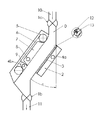
- an apparatus for conditioning of organic materials disclosed on figure comprises inlet gate 1a where the organic material is introduced through the supplying channel 10 , such organic material is for example tobacco to be conditioned inside the apparatus.
- the inlet gate 1a is connected with the conditioning chamber 0 , conditioning chamber 0 deviates from the vertical direction by an angle in a range from 0° to 80°, preferably around 40°.
- the set of nozzles 12 , 13 is supplied from the external source (not show) through inlet 4a , with thermodynamic medium of controlled physiochemical parameters chosen appropriately to the organic material being conditioned, conditioning parameters and other parameters that are proper to the conditioning process, estimated by the person skilled in the art of the conditioning organic materials.
- the set of nozzles 12 , 13 is directing the stream or streams of the thermodynamic medium through the sieve mesh of the bottom sieve 3 , towards immobilizing unit 5 , 6 .
- an immobilizing unit 5 , 6 for immobilizing particles of the organic material the unit comprising a net 6 of the conveyor belt 5 .
- the net 6 immobilizes in relation to each other organic material particles.
- a unit for immobilizing organic material particles is provided additionally with outlet chamber 7 collecting used thermodynamic medium, which is transported outside the apparatus through the outlet channel 8 for recycling in the recycling unit (not shown), for example for dedusting or for the change the physicochemical parameters for example by heating, moisturizing etc.
- Further immobilizing unit comprises inlet 4b of the thermodynamic medium placed in a such way that it directs the stream of the thermodynamic medium downwards towards the net 6 for removing the organic material particles from the net 6 in the discharging area 9 .
- the outlet gate 1b is placed in the bottom part of the conditioning chamber.
- the outlet gate is discharging an organic material outside the apparatus for conditioning.
- An organic material for example tobacco, is delivered from the outside to the inlet gate 1a through supplying channel 10 .
- Inlet gate 1a controls the process of supplying an organic material to the conditioning chamber 0 .
- An organic material is introduced into the conditioning chamber 0 , where it flows down towards the bottom sieve 3 .
- a set of nozzles 12 , 13 is placed below the bottom sieve 3 and directs stream or streams of thermodynamic medium of proper physicochemical parameters towards immobilizing unit 5 , 6 .
- the streams of the thermodynamic medium carry organic material particles towards the immobilizing unit 5 , 6 , where due to a high speed of the thermodynamic medium, the organic material particles are placed in the net 6 of the conveyor belt 5 constituting the immobilizing unit 5 , 6 . Placed in the net the organic material particles are immobilized in relation to each other, further they are exposed to the thermodynamic medium flowing with high speed over the immobilized organic material particles.
- the time period for which the organic material is within the area of exposing to the thermodynamic medium is precisely controlled due to the possibility of the adjusting the speed of the conveyor belt.
- the conveyor belt 5 transports organic material towards the discharging area 9 , where the stream of the thermodynamic medium directed from the bottom of the net 6 removes the organic material particles from the net 6 , and directs the particles towards the outlet gate 1b discharging the organic material through the channel 11 outside the apparatus for conditioning.
- thermodynamic medium is supplied from the external source (not show) through the inlet openings 4a , 4b , used thermodynamic medium is discharged from the apparatus for conditioning through the discharging opening 8 of the chamber 7 for discharging used thermodynamic medium to the recycling unit (not shown), where thermodynamic medium can be recycled, for example dedusted, heated or moistened etc.
- the thermodynamic medium is a gas, preferably steam in any form, including superheated steam in the temperature range of 120°C to 320°C, preferably in a range of 170°C to 270°C.
- Thermodynamic medium can be air, preferably hot air in the temperature range of 80°C do 280°C.
- Thermodynamic medium may be also any combination of aerosols and/or chemical vapors, as well as gases, for example argon, nitrogen, carbon dioxide etc, which may favorably influence the conditioning process and/or give specific organoleptic properties of the conditioned material.
- An apparatus for conditioning may be supplied with different thermodynamic mediums at the same time, for example if the thermodynamic medium is air alone, preferably low humidity air, then the apparatus for conditioning being a drier.
- Speed of drying increases with the increase of the temperature of the thermodynamic medium, relative humidity and relative speed between organic material and thermodynamic medium.
- the Nusselt number increases which intensifies exchange of the heat and mass (for example water) between thermodynamic medium and organic material. Described above process parameters can be controlled by adjusting speed of circulation for thermodynamic medium.
- the time period of exposing the organic material to the thermodynamic medium can be controlled by regulation of the conveyor belt speed.
- Thermodynamic medium could be chosen from the group comprising nitrogen, argon, carbon dioxide or other non reactive gas, then apart from intensive drying the thermodynamic medium can be heated to the temperature above ignition point of the organic material being dried, this allows not only drying but also allows expansion (swelling) of the organic material.
- thermodynamic medium is a steam with a small addition of air
- organic material after introducing into an apparatus is moistened to the point where no condensation appears. This leads to increase of the humidity of an organic material.
- the organic material can be expanded, and than dried to achieve final humidity.
- the additional steam can be supplied by additional set of nozzles (not shown) placed just behind the inlet gate 1a .
- the conditions in the process, in particular immobilizing organic material particles results in a less shrinking, which is favorable for some kind of the organic materials.
- An apparatus for conditioning of organic materials may be supplied with many different thermodynamic mediums in many different conditioning processes or can be supplied with many different thermodynamic mediums in a single conditioning process.
Landscapes
- Engineering & Computer Science (AREA)
- Mechanical Engineering (AREA)
- General Engineering & Computer Science (AREA)
- Drying Of Solid Materials (AREA)
- Organic Low-Molecular-Weight Compounds And Preparation Thereof (AREA)
- Working-Up Tar And Pitch (AREA)
- Agricultural Chemicals And Associated Chemicals (AREA)
- Apparatuses For Bulk Treatment Of Fruits And Vegetables And Apparatuses For Preparing Feeds (AREA)
- Soil Working Implements (AREA)
- Formation And Processing Of Food Products (AREA)
- Manufacture Of Tobacco Products (AREA)
Abstract
Description
- Present invention relates to the apparatus for conditioning of organic materials.
- In the process of conditioning of organic materials, for example tobacco, it is extremely important to precisely control parameters of the conditioning process, this is particularly difficult in a case of the fine particles of the organic material exposed to the thermodynamic medium of high absolute speed and high relative speed in relation to the particles being conditioned. The main problem in a such process is controlling the parameters of nonlaminar stream of mass consisting of particles of the conditioned organic material and thermodynamic medium, in respect to the particular particles of the organic material.
- The other problem related with the conditioning using thermodynamic medium is the mechanical degradation of organic materials resulting in dusting related to the high friction and inter-particles interaction being a result of the relative motion of organic material particles. Swirling in a mass, fine organic material particles hit each other, this leads to particles ripping out, particles brakes down which results in dusting, and to the loss in the amount and quality of the organic material being conditioned.
- There are several apparatus for conditioning of organic materials known in the state of the art.
US patent no. 5 908 032 discloses a method and apparatus for expansion of tobacco, which is using a channel in a form of letter C, wherein tobacco is transported by hot gaseous medium. -
US patent no. 5 711 086 discloses an apparatus for continuous drying in a superheated steam. Apparatus disclosed comprises a drying chamber and an assembly of the conveyor belts transporting material being dried. Superheated steam is generated inside the drying chamber from the moisture coming from the material being dried, as a result of exposing the material to hot gas or the moisture is introduced into to the chamber from the external source of the superheated steam. -
US patent no. 4 044 780 discloses an apparatus for expanding in volume of the cut tobacco, the apparatus comprises first unit increasing tobacco temperature and humidity to the state where tobacco particles open. Such apparatus comprises additionally separate unit for creating a thin layer of opened organic material particles in the gas atmosphere and a unit for rapid cooling. -
US patent no. 6 185 843 discloses a dryer where the transport of the organic material is carried out using pneumatic means. The shape of the inlet channel is decreasing the contact of the tobacco particles with internal surfaces of the transport channel. -
EP patent no. 1 033 081 discloses a method of expanding the food products or tobacco using superheated steam as transport medium. - According to the invention apparatus for conditioning the organic material comprises inlet gate, conditioning chamber and outlet gate. Further conditioning chamber comprises:
- a set of nozzles supplying thermodynamic medium,
- and immobilizing means for immobilizing organic material,
- According to the invention a set of nozzles is placed in relation to the immobilizing means in a such way that the flowing thermodynamic medium is placing the organic material in the immobilizing means.
- According to the invention immobilizing means is a net.
- Further according to the invention the net is a net of the conveyor belt with adjustable speed of move.
- According to the invention the conditioning chamber has a vertical configuration.
- And further according to the invention the conditioning chamber deviates from the vertical direction by an angle from 0° to 80°, preferably around 40°.
- According to the invention the thermodynamic medium is selected from the group comprising steam, air, gases, vapors as well as their solutions and/or aerosols.
- Further according to the invention a set of nozzles is covered by the bottom sieve.
- Thanks to the introducing an apparatus according to the invention is possible to obtain increased intensity of the process as well as a better control over the conditioning process, each particle of the organic material is placed in the constant conditioning conditions for a precise determined period of time when the conditioning process takes place. Thanks to apparatus according to the invention the process of conveying heat to/from organic material is better controlled, further the process of conveying moisture and/or volatile substances to/from organic material can be also better controlled.
- Immobilizing organic material particles for the time of conditioning process avoids mechanical degradation, for example dusting, tensional deflection or shrinking of the organic material particles.
- Apparatus according to the invention allows using jointly or independently different thermodynamic mediums, for example superheated steam, air, conditioning substances, their solutions, other gases and vapors and aerosols.
- Present invention has been described in detail below in relation to the preferred embodiment disclosed on figure attached to the description, which presents an apparatus according to the invention for conditioning of organic materials.
- In the preferred embodiment of the invention an apparatus for conditioning of organic materials disclosed on figure comprises inlet gate 1a where the organic material is introduced through the supplying
channel 10, such organic material is for example tobacco to be conditioned inside the apparatus. - The inlet gate 1a is connected with the
conditioning chamber 0,conditioning chamber 0 deviates from the vertical direction by an angle in a range from 0° to 80°, preferably around 40°. - Inside the
conditioning chamber 0, at its bottom there is placed a set ofnozzles bottom sieve 3. The set ofnozzles inlet 4a, with thermodynamic medium of controlled physiochemical parameters chosen appropriately to the organic material being conditioned, conditioning parameters and other parameters that are proper to the conditioning process, estimated by the person skilled in the art of the conditioning organic materials. The set ofnozzles bottom sieve 3, towards immobilizingunit 5, 6. - In the upper part of the conditioning chamber there is placed an immobilizing
unit 5, 6 for immobilizing particles of the organic material, the unit comprising a net 6 of theconveyor belt 5. The net 6 immobilizes in relation to each other organic material particles. A unit for immobilizing organic material particles is provided additionally with outlet chamber 7 collecting used thermodynamic medium, which is transported outside the apparatus through theoutlet channel 8 for recycling in the recycling unit (not shown), for example for dedusting or for the change the physicochemical parameters for example by heating, moisturizing etc. Further immobilizing unit comprisesinlet 4b of the thermodynamic medium placed in a such way that it directs the stream of the thermodynamic medium downwards towards the net 6 for removing the organic material particles from the net 6 in thedischarging area 9. - In the bottom part of the conditioning chamber the outlet gate 1b is placed. The outlet gate is discharging an organic material outside the apparatus for conditioning.
- The apparatus according to the invention disclosed on figure operates as described below.
- An organic material, for example tobacco, is delivered from the outside to the inlet gate 1a through supplying
channel 10. Inlet gate 1a controls the process of supplying an organic material to theconditioning chamber 0. - An organic material is introduced into the
conditioning chamber 0, where it flows down towards thebottom sieve 3. A set ofnozzles bottom sieve 3 and directs stream or streams of thermodynamic medium of proper physicochemical parameters towards immobilizingunit 5, 6. - The streams of the thermodynamic medium carry organic material particles towards the immobilizing
unit 5, 6, where due to a high speed of the thermodynamic medium, the organic material particles are placed in the net 6 of theconveyor belt 5 constituting the immobilizingunit 5, 6. Placed in the net the organic material particles are immobilized in relation to each other, further they are exposed to the thermodynamic medium flowing with high speed over the immobilized organic material particles. The time period for which the organic material is within the area of exposing to the thermodynamic medium is precisely controlled due to the possibility of the adjusting the speed of the conveyor belt. - The
conveyor belt 5 transports organic material towards thedischarging area 9, where the stream of the thermodynamic medium directed from the bottom of the net 6 removes the organic material particles from the net 6, and directs the particles towards the outlet gate 1b discharging the organic material through the channel 11 outside the apparatus for conditioning. - The thermodynamic medium is supplied from the external source (not show) through the
inlet openings discharging opening 8 of the chamber 7 for discharging used thermodynamic medium to the recycling unit (not shown), where thermodynamic medium can be recycled, for example dedusted, heated or moistened etc. - The thermodynamic medium is a gas, preferably steam in any form, including superheated steam in the temperature range of 120°C to 320°C, preferably in a range of 170°C to 270°C. Thermodynamic medium can be air, preferably hot air in the temperature range of 80°C do 280°C. Thermodynamic medium may be also any combination of aerosols and/or chemical vapors, as well as gases, for example argon, nitrogen, carbon dioxide etc, which may favorably influence the conditioning process and/or give specific organoleptic properties of the conditioned material.
- An apparatus for conditioning may be supplied with different thermodynamic mediums at the same time, for example if the thermodynamic medium is air alone, preferably low humidity air, then the apparatus for conditioning being a drier. Speed of drying increases with the increase of the temperature of the thermodynamic medium, relative humidity and relative speed between organic material and thermodynamic medium. Along with increase of the relative speed the Nusselt number increases which intensifies exchange of the heat and mass (for example water) between thermodynamic medium and organic material. Described above process parameters can be controlled by adjusting speed of circulation for thermodynamic medium. The time period of exposing the organic material to the thermodynamic medium can be controlled by regulation of the conveyor belt speed.
- Thermodynamic medium could be chosen from the group comprising nitrogen, argon, carbon dioxide or other non reactive gas, then apart from intensive drying the thermodynamic medium can be heated to the temperature above ignition point of the organic material being dried, this allows not only drying but also allows expansion (swelling) of the organic material.
- In a case when the thermodynamic medium is a steam with a small addition of air, organic material after introducing into an apparatus is moistened to the point where no condensation appears. This leads to increase of the humidity of an organic material. Keeping an organic material longer in the area of exposing to the thermodynamic medium by lowering the speed of the net of the conveyor belt or by increasing temperature (considerably higher than the saturation temperature), the organic material can be expanded, and than dried to achieve final humidity. To increase expansion of the material additional steam can be used, the additional steam can be supplied by additional set of nozzles (not shown) placed just behind the inlet gate 1a.
- Additionally, the conditions in the process, in particular immobilizing organic material particles results in a less shrinking, which is favorable for some kind of the organic materials.
- An apparatus for conditioning of organic materials may be supplied with many different thermodynamic mediums in many different conditioning processes or can be supplied with many different thermodynamic mediums in a single conditioning process.
Claims (8)
- Apparatus for conditioning of organic materials comprising inlet gate, conditioning chamber and outlet gate characterized in that conditioning chamber (0) comprises:a set of nozzles (12, 13) supplying thermodynamic medium,and immobilizing means (5, 6) for immobilizing organic material,placed in relation to each other in a such way that the flowing thermodynamic medium flows over conditioned organic material placed in the immobilizing means (5, 6).
- Apparatus according to claim 1 characterized in that a set of nozzles (12, 13) is placed in relation to the immobilizing means (5, 6) in a such way that the flowing thermodynamic medium is placing the organic material in the immobilizing means (5, 6).
- Apparatus according to claim 1 characterized in that the immobilizing means is a net.
- Apparatus according to claim 3, characterized in that the net is a net (6) of the conveyor belt (5) with adjustable speed of move.
- Apparatus according to claim 1 characterized in that the conditioning chamber (0) has a vertical configuration.
- Apparatus according to claim 5 characterized in that the conditioning chamber deviates from the vertical direction by an angle (_) in a range from 0° to 80°, preferably around 40°.
- Apparatus according to claim 1 characterized in that the thermodynamic medium is selected from the group comprising steam, air, gases, vapors as well as their solutions and/or aerosols.
- Apparatus according to claim 1 characterized in that the set of nozzles (12, 13) is covered by the bottom sieve (3).
Priority Applications (1)
| Application Number | Priority Date | Filing Date | Title |
|---|---|---|---|
| PL06125431T PL1795841T3 (en) | 2005-12-06 | 2006-12-05 | Apparatus for conditioning of organic materials |
Applications Claiming Priority (1)
| Application Number | Priority Date | Filing Date | Title |
|---|---|---|---|
| PL378285A PL209654B1 (en) | 2005-12-06 | 2005-12-06 | Vegetable origin material conditioning device |
Publications (2)
| Publication Number | Publication Date |
|---|---|
| EP1795841A1 true EP1795841A1 (en) | 2007-06-13 |
| EP1795841B1 EP1795841B1 (en) | 2010-04-07 |
Family
ID=37734851
Family Applications (1)
| Application Number | Title | Priority Date | Filing Date |
|---|---|---|---|
| EP06125431A Not-in-force EP1795841B1 (en) | 2005-12-06 | 2006-12-05 | Apparatus for conditioning of organic materials |
Country Status (5)
| Country | Link |
|---|---|
| US (1) | US8113214B2 (en) |
| EP (1) | EP1795841B1 (en) |
| AT (1) | ATE463707T1 (en) |
| DE (1) | DE602006013392D1 (en) |
| PL (2) | PL209654B1 (en) |
Cited By (2)
| Publication number | Priority date | Publication date | Assignee | Title |
|---|---|---|---|---|
| CN110226770A (en) * | 2018-03-05 | 2019-09-13 | 湖南中烟工业有限责任公司 | Piece cigarette spray equipment, spray system and spraying method after a kind of beating and double roasting |
| CN110887368A (en) * | 2019-11-29 | 2020-03-17 | 湖南杨家将茶油股份有限公司 | Camellia fruit dryer |
Families Citing this family (2)
| Publication number | Priority date | Publication date | Assignee | Title |
|---|---|---|---|---|
| DE102017120626A1 (en) * | 2017-09-07 | 2019-03-07 | Hauni Maschinenbau Gmbh | Conditioning of tobacco |
| CN111165855B (en) * | 2020-02-11 | 2021-09-28 | 贵州中烟工业有限责任公司 | Method for controlling shrinkage rate of tobacco flakes |
Citations (5)
| Publication number | Priority date | Publication date | Assignee | Title |
|---|---|---|---|---|
| GB613166A (en) * | 1946-06-13 | 1948-11-23 | John Lockhart Erisman | Apparatus for drying, heating, and/or cooling flowable solids |
| EP0058398A2 (en) * | 1981-02-16 | 1982-08-25 | AUTOMATIK Apparate-Maschinenbau GmbH | Apparatus for dewatering and drying solid material, especially for synthetic material granulated under water |
| DE4100162A1 (en) * | 1991-01-05 | 1992-07-09 | Michael Dr Ing Reinhard | Assembly to dry granulate with reduced cleaning and risk of blockages - leads granulate into pipe where it is accelerated by air, then impacts sieve to stop granulate, but water continues |
| DE19625338A1 (en) * | 1996-06-25 | 1998-01-02 | Hollstein Gmbh Lueftungs Klima | Conditioning system for tobacco |
| US5711086A (en) * | 1993-08-26 | 1998-01-27 | Heat-Win Limited | Method and apparatus for continuous drying in superheated steam |
Family Cites Families (3)
| Publication number | Priority date | Publication date | Assignee | Title |
|---|---|---|---|---|
| JPS608786B2 (en) * | 1982-10-25 | 1985-03-05 | 日本たばこ産業株式会社 | Ventilation band type leaf tobacco drying device |
| US5755238A (en) * | 1996-10-17 | 1998-05-26 | Brown & Williamson Tobacco Corporation | Method and apparatus for low residence time redrying of tobacco |
| ITBO20030378A1 (en) * | 2003-06-19 | 2004-12-20 | Gd Spa | CIGARETTE PACKAGING MACHINE |
-
2005
- 2005-12-06 PL PL378285A patent/PL209654B1/en not_active IP Right Cessation
-
2006
- 2006-12-05 AT AT06125431T patent/ATE463707T1/en not_active IP Right Cessation
- 2006-12-05 PL PL06125431T patent/PL1795841T3/en unknown
- 2006-12-05 EP EP06125431A patent/EP1795841B1/en not_active Not-in-force
- 2006-12-05 DE DE602006013392T patent/DE602006013392D1/en active Active
- 2006-12-06 US US11/634,204 patent/US8113214B2/en not_active Expired - Fee Related
Patent Citations (5)
| Publication number | Priority date | Publication date | Assignee | Title |
|---|---|---|---|---|
| GB613166A (en) * | 1946-06-13 | 1948-11-23 | John Lockhart Erisman | Apparatus for drying, heating, and/or cooling flowable solids |
| EP0058398A2 (en) * | 1981-02-16 | 1982-08-25 | AUTOMATIK Apparate-Maschinenbau GmbH | Apparatus for dewatering and drying solid material, especially for synthetic material granulated under water |
| DE4100162A1 (en) * | 1991-01-05 | 1992-07-09 | Michael Dr Ing Reinhard | Assembly to dry granulate with reduced cleaning and risk of blockages - leads granulate into pipe where it is accelerated by air, then impacts sieve to stop granulate, but water continues |
| US5711086A (en) * | 1993-08-26 | 1998-01-27 | Heat-Win Limited | Method and apparatus for continuous drying in superheated steam |
| DE19625338A1 (en) * | 1996-06-25 | 1998-01-02 | Hollstein Gmbh Lueftungs Klima | Conditioning system for tobacco |
Cited By (2)
| Publication number | Priority date | Publication date | Assignee | Title |
|---|---|---|---|---|
| CN110226770A (en) * | 2018-03-05 | 2019-09-13 | 湖南中烟工业有限责任公司 | Piece cigarette spray equipment, spray system and spraying method after a kind of beating and double roasting |
| CN110887368A (en) * | 2019-11-29 | 2020-03-17 | 湖南杨家将茶油股份有限公司 | Camellia fruit dryer |
Also Published As
| Publication number | Publication date |
|---|---|
| US8113214B2 (en) | 2012-02-14 |
| US20070125393A1 (en) | 2007-06-07 |
| DE602006013392D1 (en) | 2010-05-20 |
| ATE463707T1 (en) | 2010-04-15 |
| EP1795841B1 (en) | 2010-04-07 |
| PL378285A1 (en) | 2007-06-11 |
| PL209654B1 (en) | 2011-10-31 |
| PL1795841T3 (en) | 2010-09-30 |
Similar Documents
| Publication | Publication Date | Title |
|---|---|---|
| AU711922B2 (en) | Method and apparatus for preventing agglomeration | |
| CA1252012A (en) | Treatment of tobacco | |
| AU2007247801B2 (en) | Indirect-heat thermal processing of particulate material | |
| JPH04173079A (en) | Air stream drying method for tobacco stock and system therefor | |
| US6779527B2 (en) | Device for conditioning comminuted tobacco material | |
| EP3040666B1 (en) | Drying method, drying device, and drying system making use of temperature differential | |
| KR20080103914A (en) | Variable Flow Rate Dehumidification Plant and Process for Granule Materials | |
| DK171412B1 (en) | Device for expansion of finely divided tobacco material | |
| CA2308370A1 (en) | Roasting system | |
| US6993857B2 (en) | Milling and drying apparatus incorporating a cyclone | |
| CA1160935A (en) | Tobacco drying apparatus | |
| US4766912A (en) | Method and apparatus for puffing tobacco | |
| AU2001282727A1 (en) | Milling and drying apparatus incorporating a cyclone | |
| EP1795841B1 (en) | Apparatus for conditioning of organic materials | |
| US4583559A (en) | Reordering of tobacco | |
| GB2426566A (en) | Tobacco dryer comprising a closed processing chamber formed by starwheel airlocks | |
| US8051858B2 (en) | Method and apparatus for conditioning of cellular materials, in particular organic materials | |
| EP1795842B1 (en) | Apparatus for conditioning of organic materials | |
| EP2113176A1 (en) | Process for preparing a tobacco blend | |
| CN103052327B (en) | For the treatment of the device of tobacco | |
| EP0325630B1 (en) | Apparatus for expanding and/or drying particulate material | |
| US5139612A (en) | Spray drying apparatus | |
| WO2005047791A2 (en) | Drying of particulate materials | |
| NZ500705A (en) | Method and apparatus for treating a board-like material by passing gas through material, with gas heating or cooling material | |
| GB2142519A (en) | Improvements relating to the reordering of tobacco |
Legal Events
| Date | Code | Title | Description |
|---|---|---|---|
| PUAI | Public reference made under article 153(3) epc to a published international application that has entered the european phase |
Free format text: ORIGINAL CODE: 0009012 |
|
| AK | Designated contracting states |
Kind code of ref document: A1 Designated state(s): AT BE BG CH CY CZ DE DK EE ES FI FR GB GR HU IE IS IT LI LT LU LV MC NL PL PT RO SE SI SK TR |
|
| AX | Request for extension of the european patent |
Extension state: AL BA HR MK YU |
|
| 17P | Request for examination filed |
Effective date: 20071210 |
|
| 17Q | First examination report despatched |
Effective date: 20080114 |
|
| AKX | Designation fees paid |
Designated state(s): AT BE BG CH CY CZ DE DK EE ES FI FR GB GR HU IE IS IT LI LT LU LV MC NL PL PT RO SE SI SK TR |
|
| GRAP | Despatch of communication of intention to grant a patent |
Free format text: ORIGINAL CODE: EPIDOSNIGR1 |
|
| RAP1 | Party data changed (applicant data changed or rights of an application transferred) |
Owner name: INTERNATIONAL TOBACCO MACHINERY POLAND SP. Z O.O. |
|
| GRAS | Grant fee paid |
Free format text: ORIGINAL CODE: EPIDOSNIGR3 |
|
| GRAA | (expected) grant |
Free format text: ORIGINAL CODE: 0009210 |
|
| AK | Designated contracting states |
Kind code of ref document: B1 Designated state(s): AT BE BG CH CY CZ DE DK EE ES FI FR GB GR HU IE IS IT LI LT LU LV MC NL PL PT RO SE SI SK TR |
|
| REG | Reference to a national code |
Ref country code: GB Ref legal event code: FG4D |
|
| REG | Reference to a national code |
Ref country code: CH Ref legal event code: EP |
|
| REG | Reference to a national code |
Ref country code: IE Ref legal event code: FG4D |
|
| REF | Corresponds to: |
Ref document number: 602006013392 Country of ref document: DE Date of ref document: 20100520 Kind code of ref document: P |
|
| REG | Reference to a national code |
Ref country code: NL Ref legal event code: VDEP Effective date: 20100407 |
|
| PG25 | Lapsed in a contracting state [announced via postgrant information from national office to epo] |
Ref country code: SI Free format text: LAPSE BECAUSE OF FAILURE TO SUBMIT A TRANSLATION OF THE DESCRIPTION OR TO PAY THE FEE WITHIN THE PRESCRIBED TIME-LIMIT Effective date: 20100407 |
|
| LTIE | Lt: invalidation of european patent or patent extension |
Effective date: 20100407 |
|
| REG | Reference to a national code |
Ref country code: PL Ref legal event code: T3 |
|
| PG25 | Lapsed in a contracting state [announced via postgrant information from national office to epo] |
Ref country code: ES Free format text: LAPSE BECAUSE OF FAILURE TO SUBMIT A TRANSLATION OF THE DESCRIPTION OR TO PAY THE FEE WITHIN THE PRESCRIBED TIME-LIMIT Effective date: 20100718 Ref country code: SE Free format text: LAPSE BECAUSE OF FAILURE TO SUBMIT A TRANSLATION OF THE DESCRIPTION OR TO PAY THE FEE WITHIN THE PRESCRIBED TIME-LIMIT Effective date: 20100407 Ref country code: LT Free format text: LAPSE BECAUSE OF FAILURE TO SUBMIT A TRANSLATION OF THE DESCRIPTION OR TO PAY THE FEE WITHIN THE PRESCRIBED TIME-LIMIT Effective date: 20100407 Ref country code: NL Free format text: LAPSE BECAUSE OF FAILURE TO SUBMIT A TRANSLATION OF THE DESCRIPTION OR TO PAY THE FEE WITHIN THE PRESCRIBED TIME-LIMIT Effective date: 20100407 |
|
| PG25 | Lapsed in a contracting state [announced via postgrant information from national office to epo] |
Ref country code: AT Free format text: LAPSE BECAUSE OF FAILURE TO SUBMIT A TRANSLATION OF THE DESCRIPTION OR TO PAY THE FEE WITHIN THE PRESCRIBED TIME-LIMIT Effective date: 20100407 Ref country code: FI Free format text: LAPSE BECAUSE OF FAILURE TO SUBMIT A TRANSLATION OF THE DESCRIPTION OR TO PAY THE FEE WITHIN THE PRESCRIBED TIME-LIMIT Effective date: 20100407 Ref country code: IS Free format text: LAPSE BECAUSE OF FAILURE TO SUBMIT A TRANSLATION OF THE DESCRIPTION OR TO PAY THE FEE WITHIN THE PRESCRIBED TIME-LIMIT Effective date: 20100807 Ref country code: LV Free format text: LAPSE BECAUSE OF FAILURE TO SUBMIT A TRANSLATION OF THE DESCRIPTION OR TO PAY THE FEE WITHIN THE PRESCRIBED TIME-LIMIT Effective date: 20100407 |
|
| PG25 | Lapsed in a contracting state [announced via postgrant information from national office to epo] |
Ref country code: GR Free format text: LAPSE BECAUSE OF FAILURE TO SUBMIT A TRANSLATION OF THE DESCRIPTION OR TO PAY THE FEE WITHIN THE PRESCRIBED TIME-LIMIT Effective date: 20100708 Ref country code: CY Free format text: LAPSE BECAUSE OF FAILURE TO SUBMIT A TRANSLATION OF THE DESCRIPTION OR TO PAY THE FEE WITHIN THE PRESCRIBED TIME-LIMIT Effective date: 20100512 |
|
| PG25 | Lapsed in a contracting state [announced via postgrant information from national office to epo] |
Ref country code: DK Free format text: LAPSE BECAUSE OF FAILURE TO SUBMIT A TRANSLATION OF THE DESCRIPTION OR TO PAY THE FEE WITHIN THE PRESCRIBED TIME-LIMIT Effective date: 20100407 Ref country code: PT Free format text: LAPSE BECAUSE OF FAILURE TO SUBMIT A TRANSLATION OF THE DESCRIPTION OR TO PAY THE FEE WITHIN THE PRESCRIBED TIME-LIMIT Effective date: 20100809 Ref country code: EE Free format text: LAPSE BECAUSE OF FAILURE TO SUBMIT A TRANSLATION OF THE DESCRIPTION OR TO PAY THE FEE WITHIN THE PRESCRIBED TIME-LIMIT Effective date: 20100407 |
|
| PLBE | No opposition filed within time limit |
Free format text: ORIGINAL CODE: 0009261 |
|
| STAA | Information on the status of an ep patent application or granted ep patent |
Free format text: STATUS: NO OPPOSITION FILED WITHIN TIME LIMIT |
|
| PG25 | Lapsed in a contracting state [announced via postgrant information from national office to epo] |
Ref country code: BE Free format text: LAPSE BECAUSE OF FAILURE TO SUBMIT A TRANSLATION OF THE DESCRIPTION OR TO PAY THE FEE WITHIN THE PRESCRIBED TIME-LIMIT Effective date: 20100407 Ref country code: RO Free format text: LAPSE BECAUSE OF FAILURE TO SUBMIT A TRANSLATION OF THE DESCRIPTION OR TO PAY THE FEE WITHIN THE PRESCRIBED TIME-LIMIT Effective date: 20100407 Ref country code: SK Free format text: LAPSE BECAUSE OF FAILURE TO SUBMIT A TRANSLATION OF THE DESCRIPTION OR TO PAY THE FEE WITHIN THE PRESCRIBED TIME-LIMIT Effective date: 20100407 Ref country code: CZ Free format text: LAPSE BECAUSE OF FAILURE TO SUBMIT A TRANSLATION OF THE DESCRIPTION OR TO PAY THE FEE WITHIN THE PRESCRIBED TIME-LIMIT Effective date: 20100407 |
|
| PGFP | Annual fee paid to national office [announced via postgrant information from national office to epo] |
Ref country code: PL Payment date: 20101015 Year of fee payment: 5 |
|
| 26N | No opposition filed |
Effective date: 20110110 |
|
| PG25 | Lapsed in a contracting state [announced via postgrant information from national office to epo] |
Ref country code: MC Free format text: LAPSE BECAUSE OF NON-PAYMENT OF DUE FEES Effective date: 20101231 |
|
| REG | Reference to a national code |
Ref country code: CH Ref legal event code: PL |
|
| REG | Reference to a national code |
Ref country code: FR Ref legal event code: ST Effective date: 20110831 |
|
| PG25 | Lapsed in a contracting state [announced via postgrant information from national office to epo] |
Ref country code: FR Free format text: LAPSE BECAUSE OF NON-PAYMENT OF DUE FEES Effective date: 20110103 Ref country code: CH Free format text: LAPSE BECAUSE OF NON-PAYMENT OF DUE FEES Effective date: 20101231 Ref country code: LI Free format text: LAPSE BECAUSE OF NON-PAYMENT OF DUE FEES Effective date: 20101231 Ref country code: IE Free format text: LAPSE BECAUSE OF NON-PAYMENT OF DUE FEES Effective date: 20101205 |
|
| PG25 | Lapsed in a contracting state [announced via postgrant information from national office to epo] |
Ref country code: HU Free format text: LAPSE BECAUSE OF FAILURE TO SUBMIT A TRANSLATION OF THE DESCRIPTION OR TO PAY THE FEE WITHIN THE PRESCRIBED TIME-LIMIT Effective date: 20101008 Ref country code: LU Free format text: LAPSE BECAUSE OF NON-PAYMENT OF DUE FEES Effective date: 20101205 Ref country code: BG Free format text: LAPSE BECAUSE OF FAILURE TO SUBMIT A TRANSLATION OF THE DESCRIPTION OR TO PAY THE FEE WITHIN THE PRESCRIBED TIME-LIMIT Effective date: 20100407 |
|
| PG25 | Lapsed in a contracting state [announced via postgrant information from national office to epo] |
Ref country code: TR Free format text: LAPSE BECAUSE OF FAILURE TO SUBMIT A TRANSLATION OF THE DESCRIPTION OR TO PAY THE FEE WITHIN THE PRESCRIBED TIME-LIMIT Effective date: 20100407 |
|
| PGFP | Annual fee paid to national office [announced via postgrant information from national office to epo] |
Ref country code: DE Payment date: 20121128 Year of fee payment: 7 |
|
| PGFP | Annual fee paid to national office [announced via postgrant information from national office to epo] |
Ref country code: IT Payment date: 20121221 Year of fee payment: 7 Ref country code: GB Payment date: 20121205 Year of fee payment: 7 |
|
| REG | Reference to a national code |
Ref country code: PL Ref legal event code: LAPE |
|
| PG25 | Lapsed in a contracting state [announced via postgrant information from national office to epo] |
Ref country code: PL Free format text: LAPSE BECAUSE OF NON-PAYMENT OF DUE FEES Effective date: 20111205 |
|
| PG25 | Lapsed in a contracting state [announced via postgrant information from national office to epo] |
Ref country code: BG Free format text: LAPSE BECAUSE OF FAILURE TO SUBMIT A TRANSLATION OF THE DESCRIPTION OR TO PAY THE FEE WITHIN THE PRESCRIBED TIME-LIMIT Effective date: 20100707 |
|
| REG | Reference to a national code |
Ref country code: DE Ref legal event code: R119 Ref document number: 602006013392 Country of ref document: DE |
|
| GBPC | Gb: european patent ceased through non-payment of renewal fee |
Effective date: 20131205 |
|
| REG | Reference to a national code |
Ref country code: DE Ref legal event code: R119 Ref document number: 602006013392 Country of ref document: DE Effective date: 20140701 |
|
| PG25 | Lapsed in a contracting state [announced via postgrant information from national office to epo] |
Ref country code: DE Free format text: LAPSE BECAUSE OF NON-PAYMENT OF DUE FEES Effective date: 20140701 |
|
| PG25 | Lapsed in a contracting state [announced via postgrant information from national office to epo] |
Ref country code: GB Free format text: LAPSE BECAUSE OF NON-PAYMENT OF DUE FEES Effective date: 20131205 |
|
| PG25 | Lapsed in a contracting state [announced via postgrant information from national office to epo] |
Ref country code: IT Free format text: LAPSE BECAUSE OF NON-PAYMENT OF DUE FEES Effective date: 20131231 |
|
| PG25 | Lapsed in a contracting state [announced via postgrant information from national office to epo] |
Ref country code: IT Free format text: LAPSE BECAUSE OF NON-PAYMENT OF DUE FEES Effective date: 20131205 |