EP1795529B1 - Process for producing N-(Hetero)Aryl-substituted nitrogen-containing heteroaryl compound - Google Patents
Process for producing N-(Hetero)Aryl-substituted nitrogen-containing heteroaryl compound Download PDFInfo
- Publication number
- EP1795529B1 EP1795529B1 EP06025125A EP06025125A EP1795529B1 EP 1795529 B1 EP1795529 B1 EP 1795529B1 EP 06025125 A EP06025125 A EP 06025125A EP 06025125 A EP06025125 A EP 06025125A EP 1795529 B1 EP1795529 B1 EP 1795529B1
- Authority
- EP
- European Patent Office
- Prior art keywords
- aryl
- hetero
- heteroaryl compound
- producing
- substituted nitrogen
- Prior art date
- Legal status (The legal status is an assumption and is not a legal conclusion. Google has not performed a legal analysis and makes no representation as to the accuracy of the status listed.)
- Expired - Fee Related
Links
- -1 nitrogen-containing heteroaryl compound Chemical class 0.000 title claims description 62
- 238000000034 method Methods 0.000 title claims description 48
- 239000003054 catalyst Substances 0.000 claims description 27
- 239000003446 ligand Substances 0.000 claims description 26
- KDLHZDBZIXYQEI-UHFFFAOYSA-N Palladium Chemical group [Pd] KDLHZDBZIXYQEI-UHFFFAOYSA-N 0.000 claims description 21
- 125000001424 substituent group Chemical group 0.000 claims description 19
- UHOVQNZJYSORNB-UHFFFAOYSA-N Benzene Chemical compound C1=CC=CC=C1 UHOVQNZJYSORNB-UHFFFAOYSA-N 0.000 claims description 18
- SIKJAQJRHWYJAI-UHFFFAOYSA-N Indole Chemical compound C1=CC=C2NC=CC2=C1 SIKJAQJRHWYJAI-UHFFFAOYSA-N 0.000 claims description 18
- RAXXELZNTBOGNW-UHFFFAOYSA-N imidazole Natural products C1=CNC=N1 RAXXELZNTBOGNW-UHFFFAOYSA-N 0.000 claims description 18
- 229910052751 metal Inorganic materials 0.000 claims description 15
- 239000002184 metal Substances 0.000 claims description 15
- BASFCYQUMIYNBI-UHFFFAOYSA-N platinum Chemical group [Pt] BASFCYQUMIYNBI-UHFFFAOYSA-N 0.000 claims description 15
- JUJWROOIHBZHMG-UHFFFAOYSA-N Pyridine Chemical compound C1=CC=NC=C1 JUJWROOIHBZHMG-UHFFFAOYSA-N 0.000 claims description 14
- 125000005842 heteroatom Chemical group 0.000 claims description 14
- XYFCBTPGUUZFHI-UHFFFAOYSA-N Phosphine Chemical compound P XYFCBTPGUUZFHI-UHFFFAOYSA-N 0.000 claims description 13
- PZOUSPYUWWUPPK-UHFFFAOYSA-N indole Natural products CC1=CC=CC2=C1C=CN2 PZOUSPYUWWUPPK-UHFFFAOYSA-N 0.000 claims description 10
- RKJUIXBNRJVNHR-UHFFFAOYSA-N indolenine Natural products C1=CC=C2CC=NC2=C1 RKJUIXBNRJVNHR-UHFFFAOYSA-N 0.000 claims description 10
- 229910052763 palladium Inorganic materials 0.000 claims description 9
- KZPYGQFFRCFCPP-UHFFFAOYSA-N 1,1'-bis(diphenylphosphino)ferrocene Chemical compound [Fe+2].C1=CC=C[C-]1P(C=1C=CC=CC=1)C1=CC=CC=C1.C1=CC=C[C-]1P(C=1C=CC=CC=1)C1=CC=CC=C1 KZPYGQFFRCFCPP-UHFFFAOYSA-N 0.000 claims description 8
- KAESVJOAVNADME-UHFFFAOYSA-N 1H-pyrrole Natural products C=1C=CNC=1 KAESVJOAVNADME-UHFFFAOYSA-N 0.000 claims description 8
- RYXZOQOZERSHHQ-UHFFFAOYSA-N [2-(2-diphenylphosphanylphenoxy)phenyl]-diphenylphosphane Chemical compound C=1C=CC=C(P(C=2C=CC=CC=2)C=2C=CC=CC=2)C=1OC1=CC=CC=C1P(C=1C=CC=CC=1)C1=CC=CC=C1 RYXZOQOZERSHHQ-UHFFFAOYSA-N 0.000 claims description 8
- MUALRAIOVNYAIW-UHFFFAOYSA-N binap Chemical group C1=CC=CC=C1P(C=1C(=C2C=CC=CC2=CC=1)C=1C2=CC=CC=C2C=CC=1P(C=1C=CC=CC=1)C=1C=CC=CC=1)C1=CC=CC=C1 MUALRAIOVNYAIW-UHFFFAOYSA-N 0.000 claims description 8
- YLQBMQCUIZJEEH-UHFFFAOYSA-N Furan Chemical compound C=1C=COC=1 YLQBMQCUIZJEEH-UHFFFAOYSA-N 0.000 claims description 7
- UMJSCPRVCHMLSP-UHFFFAOYSA-N pyridine Natural products COC1=CC=CN=C1 UMJSCPRVCHMLSP-UHFFFAOYSA-N 0.000 claims description 7
- IANQTJSKSUMEQM-UHFFFAOYSA-N 1-benzofuran Chemical compound C1=CC=C2OC=CC2=C1 IANQTJSKSUMEQM-UHFFFAOYSA-N 0.000 claims description 6
- HYZJCKYKOHLVJF-UHFFFAOYSA-N 1H-benzimidazole Chemical compound C1=CC=C2NC=NC2=C1 HYZJCKYKOHLVJF-UHFFFAOYSA-N 0.000 claims description 6
- OKTJSMMVPCPJKN-UHFFFAOYSA-N Carbon Chemical compound [C] OKTJSMMVPCPJKN-UHFFFAOYSA-N 0.000 claims description 6
- UFWIBTONFRDIAS-UHFFFAOYSA-N Naphthalene Chemical compound C1=CC=CC2=CC=CC=C21 UFWIBTONFRDIAS-UHFFFAOYSA-N 0.000 claims description 6
- KYQCOXFCLRTKLS-UHFFFAOYSA-N Pyrazine Chemical compound C1=CN=CC=N1 KYQCOXFCLRTKLS-UHFFFAOYSA-N 0.000 claims description 6
- SMWDFEZZVXVKRB-UHFFFAOYSA-N Quinoline Chemical compound N1=CC=CC2=CC=CC=C21 SMWDFEZZVXVKRB-UHFFFAOYSA-N 0.000 claims description 6
- MWPLVEDNUUSJAV-UHFFFAOYSA-N anthracene Chemical compound C1=CC=CC2=CC3=CC=CC=C3C=C21 MWPLVEDNUUSJAV-UHFFFAOYSA-N 0.000 claims description 6
- IOJUPLGTWVMSFF-UHFFFAOYSA-N benzothiazole Chemical compound C1=CC=C2SC=NC2=C1 IOJUPLGTWVMSFF-UHFFFAOYSA-N 0.000 claims description 6
- 229910052799 carbon Inorganic materials 0.000 claims description 6
- AWJUIBRHMBBTKR-UHFFFAOYSA-N isoquinoline Chemical compound C1=NC=CC2=CC=CC=C21 AWJUIBRHMBBTKR-UHFFFAOYSA-N 0.000 claims description 6
- YNPNZTXNASCQKK-UHFFFAOYSA-N phenanthrene Chemical compound C1=CC=C2C3=CC=CC=C3C=CC2=C1 YNPNZTXNASCQKK-UHFFFAOYSA-N 0.000 claims description 6
- 229910000073 phosphorus hydride Inorganic materials 0.000 claims description 6
- 125000000168 pyrrolyl group Chemical group 0.000 claims description 4
- JYEUMXHLPRZUAT-UHFFFAOYSA-N 1,2,3-triazine Chemical compound C1=CN=NN=C1 JYEUMXHLPRZUAT-UHFFFAOYSA-N 0.000 claims description 3
- BCMCBBGGLRIHSE-UHFFFAOYSA-N 1,3-benzoxazole Chemical compound C1=CC=C2OC=NC2=C1 BCMCBBGGLRIHSE-UHFFFAOYSA-N 0.000 claims description 3
- BAXOFTOLAUCFNW-UHFFFAOYSA-N 1H-indazole Chemical compound C1=CC=C2C=NNC2=C1 BAXOFTOLAUCFNW-UHFFFAOYSA-N 0.000 claims description 3
- ZCQWOFVYLHDMMC-UHFFFAOYSA-N Oxazole Chemical compound C1=COC=N1 ZCQWOFVYLHDMMC-UHFFFAOYSA-N 0.000 claims description 3
- PCNDJXKNXGMECE-UHFFFAOYSA-N Phenazine Natural products C1=CC=CC2=NC3=CC=CC=C3N=C21 PCNDJXKNXGMECE-UHFFFAOYSA-N 0.000 claims description 3
- WTKZEGDFNFYCGP-UHFFFAOYSA-N Pyrazole Chemical compound C=1C=NNC=1 WTKZEGDFNFYCGP-UHFFFAOYSA-N 0.000 claims description 3
- CZPWVGJYEJSRLH-UHFFFAOYSA-N Pyrimidine Chemical compound C1=CN=CN=C1 CZPWVGJYEJSRLH-UHFFFAOYSA-N 0.000 claims description 3
- FZWLAAWBMGSTSO-UHFFFAOYSA-N Thiazole Chemical compound C1=CSC=N1 FZWLAAWBMGSTSO-UHFFFAOYSA-N 0.000 claims description 3
- GRTJBNJOHNTQBO-UHFFFAOYSA-N [2-(2-diphenylphosphanylphenyl)phenyl]-diphenylphosphane Chemical group C1=CC=CC=C1P(C=1C(=CC=CC=1)C=1C(=CC=CC=1)P(C=1C=CC=CC=1)C=1C=CC=CC=1)C1=CC=CC=C1 GRTJBNJOHNTQBO-UHFFFAOYSA-N 0.000 claims description 3
- QRUDEWIWKLJBPS-UHFFFAOYSA-N benzotriazole Chemical compound C1=CC=C2N[N][N]C2=C1 QRUDEWIWKLJBPS-UHFFFAOYSA-N 0.000 claims description 3
- 239000012964 benzotriazole Substances 0.000 claims description 3
- ZCILODAAHLISPY-UHFFFAOYSA-N biphenyl ether Natural products C1=C(CC=C)C(O)=CC(OC=2C(=CC(CC=C)=CC=2)O)=C1 ZCILODAAHLISPY-UHFFFAOYSA-N 0.000 claims description 3
- PBMFSQRYOILNGV-UHFFFAOYSA-N pyridazine Chemical compound C1=CC=NN=C1 PBMFSQRYOILNGV-UHFFFAOYSA-N 0.000 claims description 3
- 150000003852 triazoles Chemical class 0.000 claims description 3
- 125000001041 indolyl group Chemical group 0.000 claims description 2
- 238000006243 chemical reaction Methods 0.000 description 15
- XEKOWRVHYACXOJ-UHFFFAOYSA-N Ethyl acetate Chemical compound CCOC(C)=O XEKOWRVHYACXOJ-UHFFFAOYSA-N 0.000 description 9
- YXFVVABEGXRONW-UHFFFAOYSA-N Toluene Chemical compound CC1=CC=CC=C1 YXFVVABEGXRONW-UHFFFAOYSA-N 0.000 description 9
- 150000001875 compounds Chemical class 0.000 description 9
- 239000002904 solvent Substances 0.000 description 7
- HEMHJVSKTPXQMS-UHFFFAOYSA-M Sodium hydroxide Chemical compound [OH-].[Na+] HEMHJVSKTPXQMS-UHFFFAOYSA-M 0.000 description 6
- 230000000052 comparative effect Effects 0.000 description 6
- 229940079593 drug Drugs 0.000 description 6
- 239000003814 drug Substances 0.000 description 6
- MFRIHAYPQRLWNB-UHFFFAOYSA-N sodium tert-butoxide Chemical compound [Na+].CC(C)(C)[O-] MFRIHAYPQRLWNB-UHFFFAOYSA-N 0.000 description 6
- 125000003118 aryl group Chemical group 0.000 description 5
- 230000015572 biosynthetic process Effects 0.000 description 5
- UKVIEHSSVKSQBA-UHFFFAOYSA-N methane;palladium Chemical compound C.[Pd] UKVIEHSSVKSQBA-UHFFFAOYSA-N 0.000 description 5
- 238000003786 synthesis reaction Methods 0.000 description 5
- 239000003905 agrochemical Substances 0.000 description 4
- 125000005843 halogen group Chemical group 0.000 description 4
- 125000000623 heterocyclic group Chemical group 0.000 description 4
- 239000007788 liquid Substances 0.000 description 4
- 229910052757 nitrogen Inorganic materials 0.000 description 4
- RIOQSEWOXXDEQQ-UHFFFAOYSA-N triphenylphosphine Chemical compound C1=CC=CC=C1P(C=1C=CC=CC=1)C1=CC=CC=C1 RIOQSEWOXXDEQQ-UHFFFAOYSA-N 0.000 description 4
- XLYOFNOQVPJJNP-UHFFFAOYSA-N water Substances O XLYOFNOQVPJJNP-UHFFFAOYSA-N 0.000 description 4
- QTBSBXVTEAMEQO-UHFFFAOYSA-N Acetic acid Chemical compound CC(O)=O QTBSBXVTEAMEQO-UHFFFAOYSA-N 0.000 description 3
- WEVYAHXRMPXWCK-UHFFFAOYSA-N Acetonitrile Chemical compound CC#N WEVYAHXRMPXWCK-UHFFFAOYSA-N 0.000 description 3
- ZMXDDKWLCZADIW-UHFFFAOYSA-N N,N-Dimethylformamide Chemical compound CN(C)C=O ZMXDDKWLCZADIW-UHFFFAOYSA-N 0.000 description 3
- KWYUFKZDYYNOTN-UHFFFAOYSA-M Potassium hydroxide Chemical compound [OH-].[K+] KWYUFKZDYYNOTN-UHFFFAOYSA-M 0.000 description 3
- VYPSYNLAJGMNEJ-UHFFFAOYSA-N Silicium dioxide Chemical compound O=[Si]=O VYPSYNLAJGMNEJ-UHFFFAOYSA-N 0.000 description 3
- ZMANZCXQSJIPKH-UHFFFAOYSA-N Triethylamine Chemical compound CCN(CC)CC ZMANZCXQSJIPKH-UHFFFAOYSA-N 0.000 description 3
- 125000001072 heteroaryl group Chemical group 0.000 description 3
- 238000004128 high performance liquid chromatography Methods 0.000 description 3
- 239000000543 intermediate Substances 0.000 description 3
- 239000000203 mixture Substances 0.000 description 3
- VLKZOEOYAKHREP-UHFFFAOYSA-N n-Hexane Chemical compound CCCCCC VLKZOEOYAKHREP-UHFFFAOYSA-N 0.000 description 3
- IJGRMHOSHXDMSA-UHFFFAOYSA-N nitrogen Substances N#N IJGRMHOSHXDMSA-UHFFFAOYSA-N 0.000 description 3
- 239000012044 organic layer Substances 0.000 description 3
- 239000000047 product Substances 0.000 description 3
- 238000000746 purification Methods 0.000 description 3
- 239000011541 reaction mixture Substances 0.000 description 3
- 238000011084 recovery Methods 0.000 description 3
- 238000010992 reflux Methods 0.000 description 3
- 239000000741 silica gel Substances 0.000 description 3
- 229910002027 silica gel Inorganic materials 0.000 description 3
- 230000002194 synthesizing effect Effects 0.000 description 3
- LVEYOSJUKRVCCF-UHFFFAOYSA-N 1,3-bis(diphenylphosphino)propane Chemical compound C=1C=CC=CC=1P(C=1C=CC=CC=1)CCCP(C=1C=CC=CC=1)C1=CC=CC=C1 LVEYOSJUKRVCCF-UHFFFAOYSA-N 0.000 description 2
- AXNJDTFKZMDPTN-UHFFFAOYSA-N 1-pyridin-4-ylindole Chemical compound C1=CC2=CC=CC=C2N1C1=CC=NC=C1 AXNJDTFKZMDPTN-UHFFFAOYSA-N 0.000 description 2
- XKRFYHLGVUSROY-UHFFFAOYSA-N Argon Chemical compound [Ar] XKRFYHLGVUSROY-UHFFFAOYSA-N 0.000 description 2
- WKBOTKDWSSQWDR-UHFFFAOYSA-N Bromine atom Chemical compound [Br] WKBOTKDWSSQWDR-UHFFFAOYSA-N 0.000 description 2
- 0 C*c(nc1)c[n]1-c1ncc[s]1 Chemical compound C*c(nc1)c[n]1-c1ncc[s]1 0.000 description 2
- XTHFKEDIFFGKHM-UHFFFAOYSA-N Dimethoxyethane Chemical compound COCCOC XTHFKEDIFFGKHM-UHFFFAOYSA-N 0.000 description 2
- VEXZGXHMUGYJMC-UHFFFAOYSA-N Hydrochloric acid Chemical compound Cl VEXZGXHMUGYJMC-UHFFFAOYSA-N 0.000 description 2
- CSNNHWWHGAXBCP-UHFFFAOYSA-L Magnesium sulfate Chemical compound [Mg+2].[O-][S+2]([O-])([O-])[O-] CSNNHWWHGAXBCP-UHFFFAOYSA-L 0.000 description 2
- WQDUMFSSJAZKTM-UHFFFAOYSA-N Sodium methoxide Chemical compound [Na+].[O-]C WQDUMFSSJAZKTM-UHFFFAOYSA-N 0.000 description 2
- WYURNTSHIVDZCO-UHFFFAOYSA-N Tetrahydrofuran Chemical compound C1CCOC1 WYURNTSHIVDZCO-UHFFFAOYSA-N 0.000 description 2
- 125000003342 alkenyl group Chemical group 0.000 description 2
- 150000004703 alkoxides Chemical class 0.000 description 2
- 125000003545 alkoxy group Chemical group 0.000 description 2
- 125000000217 alkyl group Chemical group 0.000 description 2
- 125000000304 alkynyl group Chemical group 0.000 description 2
- PNEYBMLMFCGWSK-UHFFFAOYSA-N aluminium oxide Inorganic materials [O-2].[O-2].[O-2].[Al+3].[Al+3] PNEYBMLMFCGWSK-UHFFFAOYSA-N 0.000 description 2
- 125000003277 amino group Chemical group 0.000 description 2
- 125000004397 aminosulfonyl group Chemical group NS(=O)(=O)* 0.000 description 2
- RDOXTESZEPMUJZ-UHFFFAOYSA-N anisole Chemical compound COC1=CC=CC=C1 RDOXTESZEPMUJZ-UHFFFAOYSA-N 0.000 description 2
- 150000004982 aromatic amines Chemical class 0.000 description 2
- 125000004104 aryloxy group Chemical group 0.000 description 2
- 125000004429 atom Chemical group 0.000 description 2
- 125000003917 carbamoyl group Chemical group [H]N([H])C(*)=O 0.000 description 2
- 125000001951 carbamoylamino group Chemical group C(N)(=O)N* 0.000 description 2
- 125000002915 carbonyl group Chemical group [*:2]C([*:1])=O 0.000 description 2
- 125000005708 carbonyloxy group Chemical group [*:2]OC([*:1])=O 0.000 description 2
- 125000003178 carboxy group Chemical group [H]OC(*)=O 0.000 description 2
- 239000000460 chlorine Substances 0.000 description 2
- 229910052801 chlorine Inorganic materials 0.000 description 2
- 239000012043 crude product Substances 0.000 description 2
- 125000004093 cyano group Chemical group *C#N 0.000 description 2
- 125000002887 hydroxy group Chemical group [H]O* 0.000 description 2
- 239000012535 impurity Substances 0.000 description 2
- 239000010410 layer Substances 0.000 description 2
- 238000004519 manufacturing process Methods 0.000 description 2
- 125000004433 nitrogen atom Chemical group N* 0.000 description 2
- 229910052697 platinum Inorganic materials 0.000 description 2
- BWHMMNNQKKPAPP-UHFFFAOYSA-L potassium carbonate Chemical compound [K+].[K+].[O-]C([O-])=O BWHMMNNQKKPAPP-UHFFFAOYSA-L 0.000 description 2
- LPNYRYFBWFDTMA-UHFFFAOYSA-N potassium tert-butoxide Chemical compound [K+].CC(C)(C)[O-] LPNYRYFBWFDTMA-UHFFFAOYSA-N 0.000 description 2
- 230000035484 reaction time Effects 0.000 description 2
- 239000000126 substance Substances 0.000 description 2
- 239000000758 substrate Substances 0.000 description 2
- 125000000020 sulfo group Chemical group O=S(=O)([*])O[H] 0.000 description 2
- 125000000565 sulfonamide group Chemical group 0.000 description 2
- 125000000472 sulfonyl group Chemical group *S(*)(=O)=O 0.000 description 2
- BWHDROKFUHTORW-UHFFFAOYSA-N tritert-butylphosphane Chemical compound CC(C)(C)P(C(C)(C)C)C(C)(C)C BWHDROKFUHTORW-UHFFFAOYSA-N 0.000 description 2
- LZDKZFUFMNSQCJ-UHFFFAOYSA-N 1,2-diethoxyethane Chemical compound CCOCCOCC LZDKZFUFMNSQCJ-UHFFFAOYSA-N 0.000 description 1
- RYHBNJHYFVUHQT-UHFFFAOYSA-N 1,4-Dioxane Chemical compound C1COCCO1 RYHBNJHYFVUHQT-UHFFFAOYSA-N 0.000 description 1
- XGAFCCUNHIMIRV-UHFFFAOYSA-N 4-chloropyridine;hydron;chloride Chemical compound Cl.ClC1=CC=NC=C1 XGAFCCUNHIMIRV-UHFFFAOYSA-N 0.000 description 1
- BCJVBDBJSMFBRW-UHFFFAOYSA-N 4-diphenylphosphanylbutyl(diphenyl)phosphane Chemical compound C=1C=CC=CC=1P(C=1C=CC=CC=1)CCCCP(C=1C=CC=CC=1)C1=CC=CC=C1 BCJVBDBJSMFBRW-UHFFFAOYSA-N 0.000 description 1
- BVKZGUZCCUSVTD-UHFFFAOYSA-L Carbonate Chemical compound [O-]C([O-])=O BVKZGUZCCUSVTD-UHFFFAOYSA-L 0.000 description 1
- 208000024172 Cardiovascular disease Diseases 0.000 description 1
- XUIBZPOGJDREAE-UHFFFAOYSA-N Cc(nc1)c[n]1-c1ccc[s]1 Chemical compound Cc(nc1)c[n]1-c1ccc[s]1 XUIBZPOGJDREAE-UHFFFAOYSA-N 0.000 description 1
- KZBUYRJDOAKODT-UHFFFAOYSA-N Chlorine Chemical compound ClCl KZBUYRJDOAKODT-UHFFFAOYSA-N 0.000 description 1
- ZAMOUSCENKQFHK-UHFFFAOYSA-N Chlorine atom Chemical compound [Cl] ZAMOUSCENKQFHK-UHFFFAOYSA-N 0.000 description 1
- RYGMFSIKBFXOCR-UHFFFAOYSA-N Copper Chemical compound [Cu] RYGMFSIKBFXOCR-UHFFFAOYSA-N 0.000 description 1
- ZAFNJMIOTHYJRJ-UHFFFAOYSA-N Diisopropyl ether Chemical compound CC(C)OC(C)C ZAFNJMIOTHYJRJ-UHFFFAOYSA-N 0.000 description 1
- LFQSCWFLJHTTHZ-UHFFFAOYSA-N Ethanol Chemical compound CCO LFQSCWFLJHTTHZ-UHFFFAOYSA-N 0.000 description 1
- 108010022355 Fibroins Proteins 0.000 description 1
- FXHOOIRPVKKKFG-UHFFFAOYSA-N N,N-Dimethylacetamide Chemical compound CN(C)C(C)=O FXHOOIRPVKKKFG-UHFFFAOYSA-N 0.000 description 1
- SUAKHGWARZSWIH-UHFFFAOYSA-N N,N‐diethylformamide Chemical compound CCN(CC)C=O SUAKHGWARZSWIH-UHFFFAOYSA-N 0.000 description 1
- SECXISVLQFMRJM-UHFFFAOYSA-N N-Methylpyrrolidone Chemical compound CN1CCCC1=O SECXISVLQFMRJM-UHFFFAOYSA-N 0.000 description 1
- CTQNGGLPUBDAKN-UHFFFAOYSA-N O-Xylene Chemical compound CC1=CC=CC=C1C CTQNGGLPUBDAKN-UHFFFAOYSA-N 0.000 description 1
- OAICVXFJPJFONN-UHFFFAOYSA-N Phosphorus Chemical compound [P] OAICVXFJPJFONN-UHFFFAOYSA-N 0.000 description 1
- 239000004793 Polystyrene Substances 0.000 description 1
- KJTLSVCANCCWHF-UHFFFAOYSA-N Ruthenium Chemical compound [Ru] KJTLSVCANCCWHF-UHFFFAOYSA-N 0.000 description 1
- 238000006887 Ullmann reaction Methods 0.000 description 1
- 238000007259 addition reaction Methods 0.000 description 1
- 125000004390 alkyl sulfonyl group Chemical group 0.000 description 1
- 150000001408 amides Chemical class 0.000 description 1
- 150000001450 anions Chemical class 0.000 description 1
- 229910052786 argon Inorganic materials 0.000 description 1
- 150000001491 aromatic compounds Chemical class 0.000 description 1
- 239000003849 aromatic solvent Substances 0.000 description 1
- 125000004391 aryl sulfonyl group Chemical group 0.000 description 1
- 239000012298 atmosphere Substances 0.000 description 1
- QVGXLLKOCUKJST-UHFFFAOYSA-N atomic oxygen Chemical compound [O] QVGXLLKOCUKJST-UHFFFAOYSA-N 0.000 description 1
- 239000011324 bead Substances 0.000 description 1
- 238000006664 bond formation reaction Methods 0.000 description 1
- GDTBXPJZTBHREO-UHFFFAOYSA-N bromine Substances BrBr GDTBXPJZTBHREO-UHFFFAOYSA-N 0.000 description 1
- 229910052794 bromium Inorganic materials 0.000 description 1
- YAQUQHDVCUGNLM-UHFFFAOYSA-N c1c[n](-c(cc2)cc3c2[o]cc3)nc1 Chemical compound c1c[n](-c(cc2)cc3c2[o]cc3)nc1 YAQUQHDVCUGNLM-UHFFFAOYSA-N 0.000 description 1
- UYTSLIYAJHEPOQ-UHFFFAOYSA-N c1c[n](-c2cc(cccc3)c3c3ccccc23)nc1 Chemical compound c1c[n](-c2cc(cccc3)c3c3ccccc23)nc1 UYTSLIYAJHEPOQ-UHFFFAOYSA-N 0.000 description 1
- YJLYGWOUDNVDMM-UHFFFAOYSA-N c1c[n](-c2cccnc2)nc1 Chemical compound c1c[n](-c2cccnc2)nc1 YJLYGWOUDNVDMM-UHFFFAOYSA-N 0.000 description 1
- YACWDKFXWATANA-UHFFFAOYSA-N c1cnc[n]1-c(cc1)cc2c1cncc2 Chemical compound c1cnc[n]1-c(cc1)cc2c1cncc2 YACWDKFXWATANA-UHFFFAOYSA-N 0.000 description 1
- FJDQFPXHSGXQBY-UHFFFAOYSA-L caesium carbonate Chemical compound [Cs+].[Cs+].[O-]C([O-])=O FJDQFPXHSGXQBY-UHFFFAOYSA-L 0.000 description 1
- 229910000024 caesium carbonate Inorganic materials 0.000 description 1
- 239000003153 chemical reaction reagent Substances 0.000 description 1
- 239000003795 chemical substances by application Substances 0.000 description 1
- 150000001879 copper Chemical class 0.000 description 1
- ZXKWUYWWVSKKQZ-UHFFFAOYSA-N cyclohexyl(diphenyl)phosphane Chemical compound C1CCCCC1P(C=1C=CC=CC=1)C1=CC=CC=C1 ZXKWUYWWVSKKQZ-UHFFFAOYSA-N 0.000 description 1
- 238000001514 detection method Methods 0.000 description 1
- 230000006866 deterioration Effects 0.000 description 1
- BOUYBUIVMHNXQB-UHFFFAOYSA-N dicyclohexyl(2-dicyclohexylphosphanylethyl)phosphane Chemical compound C1CCCCC1P(C1CCCCC1)CCP(C1CCCCC1)C1CCCCC1 BOUYBUIVMHNXQB-UHFFFAOYSA-N 0.000 description 1
- 230000008034 disappearance Effects 0.000 description 1
- 201000010099 disease Diseases 0.000 description 1
- 208000037265 diseases, disorders, signs and symptoms Diseases 0.000 description 1
- MWVXFEZPEPOQRE-UHFFFAOYSA-N ditert-butyl(2-ditert-butylphosphanylethyl)phosphane Chemical compound CC(C)(C)P(C(C)(C)C)CCP(C(C)(C)C)C(C)(C)C MWVXFEZPEPOQRE-UHFFFAOYSA-N 0.000 description 1
- UIYGJYHQLCCIQS-UHFFFAOYSA-N ditert-butyl(4-ditert-butylphosphanylbutyl)phosphane Chemical compound CC(C)(C)P(C(C)(C)C)CCCCP(C(C)(C)C)C(C)(C)C UIYGJYHQLCCIQS-UHFFFAOYSA-N 0.000 description 1
- 238000005401 electroluminescence Methods 0.000 description 1
- 239000003480 eluent Substances 0.000 description 1
- 239000004210 ether based solvent Substances 0.000 description 1
- 125000006125 ethylsulfonyl group Chemical group 0.000 description 1
- 239000000835 fiber Substances 0.000 description 1
- 239000000706 filtrate Substances 0.000 description 1
- 239000001307 helium Substances 0.000 description 1
- 229910052734 helium Inorganic materials 0.000 description 1
- SWQJXJOGLNCZEY-UHFFFAOYSA-N helium atom Chemical compound [He] SWQJXJOGLNCZEY-UHFFFAOYSA-N 0.000 description 1
- 238000009776 industrial production Methods 0.000 description 1
- 239000011261 inert gas Substances 0.000 description 1
- 208000027866 inflammatory disease Diseases 0.000 description 1
- 150000007529 inorganic bases Chemical class 0.000 description 1
- 238000011835 investigation Methods 0.000 description 1
- PNDPGZBMCMUPRI-UHFFFAOYSA-N iodine Chemical compound II PNDPGZBMCMUPRI-UHFFFAOYSA-N 0.000 description 1
- 229910052741 iridium Inorganic materials 0.000 description 1
- GKOZUEZYRPOHIO-UHFFFAOYSA-N iridium atom Chemical compound [Ir] GKOZUEZYRPOHIO-UHFFFAOYSA-N 0.000 description 1
- 238000002955 isolation Methods 0.000 description 1
- 229910052943 magnesium sulfate Inorganic materials 0.000 description 1
- 235000019341 magnesium sulphate Nutrition 0.000 description 1
- UZKWTJUDCOPSNM-UHFFFAOYSA-N methoxybenzene Substances CCCCOC=C UZKWTJUDCOPSNM-UHFFFAOYSA-N 0.000 description 1
- 125000004170 methylsulfonyl group Chemical group [H]C([H])([H])S(*)(=O)=O 0.000 description 1
- 150000002894 organic compounds Chemical class 0.000 description 1
- 229910052762 osmium Inorganic materials 0.000 description 1
- SYQBFIAQOQZEGI-UHFFFAOYSA-N osmium atom Chemical compound [Os] SYQBFIAQOQZEGI-UHFFFAOYSA-N 0.000 description 1
- 239000001301 oxygen Substances 0.000 description 1
- 229910052760 oxygen Inorganic materials 0.000 description 1
- YJVFFLUZDVXJQI-UHFFFAOYSA-L palladium(ii) acetate Chemical compound [Pd+2].CC([O-])=O.CC([O-])=O YJVFFLUZDVXJQI-UHFFFAOYSA-L 0.000 description 1
- 125000003170 phenylsulfonyl group Chemical group C1(=CC=CC=C1)S(=O)(=O)* 0.000 description 1
- 125000004437 phosphorous atom Chemical group 0.000 description 1
- 229910052698 phosphorus Inorganic materials 0.000 description 1
- 239000011574 phosphorus Substances 0.000 description 1
- 108091008695 photoreceptors Proteins 0.000 description 1
- 229920002223 polystyrene Polymers 0.000 description 1
- 229910000027 potassium carbonate Inorganic materials 0.000 description 1
- BDAWXSQJJCIFIK-UHFFFAOYSA-N potassium methoxide Chemical compound [K+].[O-]C BDAWXSQJJCIFIK-UHFFFAOYSA-N 0.000 description 1
- 238000011403 purification operation Methods 0.000 description 1
- 238000001953 recrystallisation Methods 0.000 description 1
- 239000011369 resultant mixture Substances 0.000 description 1
- 229910052703 rhodium Inorganic materials 0.000 description 1
- 239000010948 rhodium Substances 0.000 description 1
- MHOVAHRLVXNVSD-UHFFFAOYSA-N rhodium atom Chemical compound [Rh] MHOVAHRLVXNVSD-UHFFFAOYSA-N 0.000 description 1
- 229910052707 ruthenium Inorganic materials 0.000 description 1
- 238000000926 separation method Methods 0.000 description 1
- 239000007858 starting material Substances 0.000 description 1
- 125000002088 tosyl group Chemical group [H]C1=C([H])C(=C([H])C([H])=C1C([H])([H])[H])S(*)(=O)=O 0.000 description 1
- 125000005259 triarylamine group Chemical group 0.000 description 1
- WLPUWLXVBWGYMZ-UHFFFAOYSA-N tricyclohexylphosphine Chemical compound C1CCCCC1P(C1CCCCC1)C1CCCCC1 WLPUWLXVBWGYMZ-UHFFFAOYSA-N 0.000 description 1
- WTVXIBRMWGUIMI-UHFFFAOYSA-N trifluoro($l^{1}-oxidanylsulfonyl)methane Chemical group [O]S(=O)(=O)C(F)(F)F WTVXIBRMWGUIMI-UHFFFAOYSA-N 0.000 description 1
- IGNTWNVBGLNYDV-UHFFFAOYSA-N triisopropylphosphine Chemical compound CC(C)P(C(C)C)C(C)C IGNTWNVBGLNYDV-UHFFFAOYSA-N 0.000 description 1
- COIOYMYWGDAQPM-UHFFFAOYSA-N tris(2-methylphenyl)phosphane Chemical compound CC1=CC=CC=C1P(C=1C(=CC=CC=1)C)C1=CC=CC=C1C COIOYMYWGDAQPM-UHFFFAOYSA-N 0.000 description 1
- 238000005292 vacuum distillation Methods 0.000 description 1
- 239000008096 xylene Substances 0.000 description 1
Classifications
-
- C—CHEMISTRY; METALLURGY
- C07—ORGANIC CHEMISTRY
- C07D—HETEROCYCLIC COMPOUNDS
- C07D207/00—Heterocyclic compounds containing five-membered rings not condensed with other rings, with one nitrogen atom as the only ring hetero atom
- C07D207/02—Heterocyclic compounds containing five-membered rings not condensed with other rings, with one nitrogen atom as the only ring hetero atom with only hydrogen or carbon atoms directly attached to the ring nitrogen atom
- C07D207/30—Heterocyclic compounds containing five-membered rings not condensed with other rings, with one nitrogen atom as the only ring hetero atom with only hydrogen or carbon atoms directly attached to the ring nitrogen atom having two double bonds between ring members or between ring members and non-ring members
- C07D207/32—Heterocyclic compounds containing five-membered rings not condensed with other rings, with one nitrogen atom as the only ring hetero atom with only hydrogen or carbon atoms directly attached to the ring nitrogen atom having two double bonds between ring members or between ring members and non-ring members with only hydrogen atoms, hydrocarbon or substituted hydrocarbon radicals, directly attached to ring carbon atoms
- C07D207/325—Heterocyclic compounds containing five-membered rings not condensed with other rings, with one nitrogen atom as the only ring hetero atom with only hydrogen or carbon atoms directly attached to the ring nitrogen atom having two double bonds between ring members or between ring members and non-ring members with only hydrogen atoms, hydrocarbon or substituted hydrocarbon radicals, directly attached to ring carbon atoms with substituted hydrocarbon radicals directly attached to the ring nitrogen atom
-
- C—CHEMISTRY; METALLURGY
- C07—ORGANIC CHEMISTRY
- C07D—HETEROCYCLIC COMPOUNDS
- C07D233/00—Heterocyclic compounds containing 1,3-diazole or hydrogenated 1,3-diazole rings, not condensed with other rings
- C07D233/54—Heterocyclic compounds containing 1,3-diazole or hydrogenated 1,3-diazole rings, not condensed with other rings having two double bonds between ring members or between ring members and non-ring members
-
- C—CHEMISTRY; METALLURGY
- C07—ORGANIC CHEMISTRY
- C07D—HETEROCYCLIC COMPOUNDS
- C07D401/00—Heterocyclic compounds containing two or more hetero rings, having nitrogen atoms as the only ring hetero atoms, at least one ring being a six-membered ring with only one nitrogen atom
- C07D401/02—Heterocyclic compounds containing two or more hetero rings, having nitrogen atoms as the only ring hetero atoms, at least one ring being a six-membered ring with only one nitrogen atom containing two hetero rings
- C07D401/04—Heterocyclic compounds containing two or more hetero rings, having nitrogen atoms as the only ring hetero atoms, at least one ring being a six-membered ring with only one nitrogen atom containing two hetero rings directly linked by a ring-member-to-ring-member bond
-
- C—CHEMISTRY; METALLURGY
- C07—ORGANIC CHEMISTRY
- C07D—HETEROCYCLIC COMPOUNDS
- C07D403/00—Heterocyclic compounds containing two or more hetero rings, having nitrogen atoms as the only ring hetero atoms, not provided for by group C07D401/00
- C07D403/02—Heterocyclic compounds containing two or more hetero rings, having nitrogen atoms as the only ring hetero atoms, not provided for by group C07D401/00 containing two hetero rings
- C07D403/04—Heterocyclic compounds containing two or more hetero rings, having nitrogen atoms as the only ring hetero atoms, not provided for by group C07D401/00 containing two hetero rings directly linked by a ring-member-to-ring-member bond
-
- C—CHEMISTRY; METALLURGY
- C07—ORGANIC CHEMISTRY
- C07D—HETEROCYCLIC COMPOUNDS
- C07D405/00—Heterocyclic compounds containing both one or more hetero rings having oxygen atoms as the only ring hetero atoms, and one or more rings having nitrogen as the only ring hetero atom
- C07D405/02—Heterocyclic compounds containing both one or more hetero rings having oxygen atoms as the only ring hetero atoms, and one or more rings having nitrogen as the only ring hetero atom containing two hetero rings
- C07D405/04—Heterocyclic compounds containing both one or more hetero rings having oxygen atoms as the only ring hetero atoms, and one or more rings having nitrogen as the only ring hetero atom containing two hetero rings directly linked by a ring-member-to-ring-member bond
Definitions
- the present invention relates to a process for producing an N-(hetero)aryl-substituted nitrogen-containing heteroaryl compound which is useful in the fields of medicines, agricultural chemicals, organic electroluminescent elements, catalyst ligands, solar cell elements, etc.
- N-(Hetero)aryl-substituted nitrogen-containing heteroaryl compounds are important intermediates for medicines and agricultural chemicals and are useful intermediates for organic electroluminescent elements, catalyst ligands, solar cell elements, and the like. Especially in the field of medicines, the compounds are exceedingly useful as intermediates for medicines for depression, cardiovascular diseases, inflammatory diseases, and other diseases (see International Publication No. 2003/104222 , pamphlet, International Publication No. 2003/4027 , pamphlet and European Patent No. 580502 ).
- a known method for synthesizing an N-(hetero)aryl-substituted nitrogen-containing heteroaryl compound is a method of N-C bond formation by the Ullmann reaction employing a combination of a copper powder or copper salt and various ligands (see International Publication No. 2003/104222 , pamphlet and Journal of the American Chemical Society, 2002, Vol.124, No.39, pp.11684-11688 ).
- this method has had drawbacks, for example, that impurities generate considerably due to the high-temperature reaction and a complicated purification operation is necessary for removing these impurities and that the reaction requires much time.
- An object of the invention is to provide a process by which an N-(hetero)aryl-substituted nitrogen-containing heteroaryl compound useful in the fields of medicines, agricultural chemicals, organic electroluminescent elements, catalyst ligands, solar cell elements, etc. can be produced on an industrial scale in high yield at low cost.
- the present inventors made intensive investigations in order to accomplish that object. As a result, they have found that the object can be accomplished with a novel method of synthesizing an N-(hetero)aryl-substituted nitrogen-containing heteroaryl compound.
- the invention has been thus completed. Namely, the invention is achieved with the following methods.
- the heteroaryl compound having an NH group as a ring-constituting component in the invention retains aromaticity because the lone pair of the nitrogen atom is conjugated with the heterocycle. Consequently, the proton of the NH group has a low pK a and is easily abstracted by a base to give an anion. This functions as a driving force in the reaction in the invention to yield a product in which the nitrogen atom on the heterocycle is directly bonded to a (hetero)aryl ring.
- the platinum group metal catalyst for use in the process of the invention which is characterized by being a heterogeneous-system catalyst supported on carbon, silica gel, alumina, or the like, is effective in avoiding troubles accompanying the use of a homogeneous-system catalyst, such as the deterioration of product quality caused by metal inclusion, etc. anda trouble some operation for catalyst removal, to thereby enable a cost reduction in industrial production based on recovery and reuse.
- (hetero)aryl means “aryl” or “heteroaryl”.
- the heteroaryl compound having an NH group as a ring-constituting component to be used in the invention specifically is a 5- or 7-membered nitrogen-containing heteroaryl compound, which may be fused to another ring to form a fused ring.
- Preferred examples thereof include pyrrole, indole, pyrazole, indazole, imidazole, benzimidazole, triazole, and benzotriazole. More preferred are pyrrole, indole, imidazole, and benzimidazole. Especially preferred is indole.
- heteroaryl compounds may have one or more substituents, and the substituents are not particularly limited.
- Preferred examples of the substituents include alkyl groups, alkenyl groups, alkynyl groups, aryl groups, a hydroxyl group, alkoxy groups, aryloxy groups, carbonyl groups, carbonyloxy groups, sulfonyl groups, amino groups, ureido groups, carbamoyl groups, carbonylamido groups, sulfamoyl groups, sulfonamide groups, a carboxy group, a sulfo group, a cyano group, halogen atoms, and heterocycle residues.
- Examples of the (hetero) aryl compound having a leaving group to be used in the invention include benzene, naphthalene, anthracene, phenanthrene, pyridine, pyridazine, pyrimidine, pyrazine, triazine, quinoline, isoquinoline, oxazole, benzoxazole, thiazole, benzothiazole, furan, and benzofuran.
- the leaving group possessed by the (hetero) aryl compound is not particularly limited.
- Preferred examples thereof include halogen atoms such as iodine, bromine, and chlorine; oxygen-atom-bonding type substituents such as sulfonyloxy groups (e.g., methylsulfonyloxy and trifluoromethylsulfonyloxy); and sulfur-atom-bonding type substituents such as alkylsulfonyl groups (e.g., methylsulfonyl and ethylsulfonyl) and arylsulfonyl groups (e.g., phenylsulfonyl and tosyl). More preferred are halogen atoms. Especially preferred is a chlorine or bromine atom.
- the (hetero)aryl compound having a leaving group may have one or more other substituents, and the substituents are not particularly limited.
- Preferred examples of the substituents include alkyl groups, alkenyl groups, alkynyl groups, aryl groups, a hydroxyl group, alkoxy groups, aryloxy groups, carbonyloxy groups, a carboxyl group, carbonyl groups, sulfonyl groups, amino groups, ureido groups, carbamoyl groups, carbonylamido groups, sulfamoyl groups, sulfonamide groups, a sulfo group, a cyano group, halogen atoms, and heterocycle residues.
- N-(hetero)aryl-substituted nitrogen-containing heteroaryl compound which can be produced by the invention are shown below.
- the compound to be produced by the invention should not be construed as being limited to the following examples.
- heteroaryl compounds having an NH group as a ring-constituting component which are usable in the invention are on the market and can be easily available.
- the amount of the (hetero) aryl compound having a leaving group to be used may be 0.5-2 equivalents to the heteroaryl compound having an NH group as a ring-constituting component.
- the amount thereof is preferably 0.8-1.5 equivalents, more preferably 0.9-1.2 equivalents, to the heteroaryl compound.
- the heterogeneous-system platinum group metal catalyst to be used in the invention is a catalyst comprising a platinum group metal supported on a support.
- the platinum group metal include palladium, ruthenium, rhodium, osmium, iridium, and platinum. Preferred are palladium and platinum. More preferred is palladium.
- the support include carbon, silica gel, alumina, fibers such as silk fibroin, and beads of polystyrene having a phosphine ligand in a terminal group.
- These catalysts maybe commercial ones, ormaybeprepared by known methods (e.g., Shin Jikken Kagaku Ko ⁇ za, published by Maruzen Co., Ltd., 1977, Vol.15, p. 390 ; and Ko ⁇ za Ju ⁇ go ⁇ Hanno ⁇ Ron, published by Kagaku Dozin Co., Ltd., 1972, Vol.10 (last volume), p.355).
- palladium supported on carbon is especially preferred because it is easily available.
- the amount of the heterogeneous-system platinum group metal catalyst to be used may be up to 20% by mole based on the heteroaryl compound having an NH group as a ring-constituting component.
- the amount thereof is preferably up to 5% by mole, more preferably up to 1% by mole, based on the heteroaryl compound.
- the ligand to be used in the invention is not particularly limited as long as it is capable of coordinating to the heterogeneous-system platinum group metal catalyst.
- Preferred is a phosphine ligand.
- Preferred examples thereof include monophosphine ligands such as triphenylphosphine, triisopropylphosphine, tri-tert-butylphosphine, tricyclohexylphosphine, tri-o-tolylphosphine, and diphenylcyclohexylphosphine; and bisphosphine ligands such as 1,2-bis(di-tert-butylphosphino)ethane, 1,3-bis(diphenylphosphino)propane, 1,4-bis(diphenylphosphino)butane, 1,4-bis(di-tert-butylphosphino)butane, 1,2-bis(dicyclohexylphosphino)ethan
- the amount of the ligand to be used in the invention is preferably from 1:0.001 to 1:20, especially preferably from 1:0.01 to 1:4, in terms of the proportion of the metal atoms of the heterogeneous-system platinum group metal catalyst to the atoms coordinating thereto.
- the proportion of the palladium atoms to the phosphorus atoms is preferably from 1:0.001 to 1: 20, especially preferably from 1:0.01 to 1:4.
- the base to be used in the invention is one by which the NH group of the heteroaryl compound having an NH group as a ring-constituting component can be dissociated to yield a nitrogen anion.
- examples thereof include inorganic bases such assodium carbonate,potassium carbonate,sodium hydroxide, potassium hydroxide, and cesium carbonate; and metal alkoxides such as sodium methoxide, potassium methoxide, sodium tert-butoxide, and potassium tert-butoxide. Preferred are metal alkoxides. More preferred are sodium tert-butoxide and potassium tert-butoxide.
- the amount of the base to be used varies depending on the kind of the base employed and the substituent to be dissociated. However, the amount thereof is generally 0.5-5 equivalents, preferably 0.8-4 equivalents, more preferably 1-3 equivalents, to the heteroaryl compound having an NH group as a ring-constituting component.
- the reaction in the invention can be conducted without using any solvent.
- a solvent can be used according to circumstances.
- usable solvents include aromatic solvents such as toluene, xylene, and anisole; ether solvents such as tetrahydrofuran, 1,4-dioxane, ethylene glycol dimethyl ether, ethylene glycol diethyl ether, and diisopropyl ether; and amide solvents such as N,N-dimethylformamide, N,N-diethylformamide, N,N-dimethylacetamide, and N-methylpyrrolidone. These solvents may be used alone or as a mixture of two or more thereof.
- the proportions thereof may be determined at will.
- the amount of the solvent to be used is not particularly limited. However, the amount thereof is preferably 0.1-100 times by mass, more preferably 1-50 times by mass, especially preferably 1.5-30 times by mass, the amount of the heteroaryl compound having an NH group as a ring-constituting component.
- the reaction temperature in the invention is preferably 0-200°C, more preferably 10-150°C, especially preferably 20-120°C.
- the reaction time varies depending on the substrates, the catalyst used, etc. However, the disappearance of the starting materials is ascertained generally in 24 hours, mostly in 2-10 hours. It is preferred that the reaction in the invention be conducted in an atmosphere of an inert gas, e.g., nitrogen, argon, or helium.
- the N-(hetero)aryl-substituted nitrogen-containing heteroaryl compound obtained can be purified by an isolation/purification method for ordinary organic compounds.
- the palladium-carbon in the liquid reaction mixture is filtered off, and water is added to the filtrate.
- the resultant liquid mixture is subjected to liquid separation and concentration, whereby a crude product is obtained.
- This crude product is further purified by recrystallization from ethyl acetate, toluene, an alcohol, hexane, etc., column purification with silica gel, vacuum distillation, etc.
- Such techniques may be used alone or in combination of two or more thereof to conduct purification, whereby the target compound having a high purity can be obtained.
- HPLC high-performance liquid chromatography
- the target compound was synthesized by conducting the same procedure as in Example 1, except that the catalyst to be used was replaced by palladium acetate (Pd(OCOCH 3 ) 2 ) serving as a homogeneous-system catalyst and that the reaction conditions were changed as shown below.
- the catalyst to be used was replaced by palladium acetate (Pd(OCOCH 3 ) 2 ) serving as a homogeneous-system catalyst and that the reaction conditions were changed as shown below.
- Example 1 The results obtained in Example 1 and Comparative Example 1 are shown in Table 1.
- Table 1 Reagent Reaction conditions Yield (%) Remarks Example 1 Pd-C DPEphos refluxing 10 hr 86 heterogeneous-system reaction; catalyst recovery is possible Comparative Example 1 Pd(OCOCH 3 ) 2 DPEphos refluxing 16 hr 80 homogeneous-system reaction; catalyst recovery is impossible
- the process of the invention can produce the target compound in a shorter reaction time than the other process and attains a satisfactory yield. Furthermore, the catalyst used can be recovered and repeatedly used. The target compound can hence be synthesized at a lower cost in the process of the invention than in the other process.
- Example 2 The same synthesis procedure as in Example 1 was conducted, except that the ligand to be used was replaced by those shown in Table 2.
- Example 2 The same synthesis procedure as in Example 1 was conducted, except that no ligand was added.
Landscapes
- Chemical & Material Sciences (AREA)
- Organic Chemistry (AREA)
- Organic Low-Molecular-Weight Compounds And Preparation Thereof (AREA)
- Catalysts (AREA)
- Pyridine Compounds (AREA)
- Plural Heterocyclic Compounds (AREA)
- Pyrrole Compounds (AREA)
- Low-Molecular Organic Synthesis Reactions Using Catalysts (AREA)
Description
- The present invention relates to a process for producing an N-(hetero)aryl-substituted nitrogen-containing heteroaryl compound which is useful in the fields of medicines, agricultural chemicals, organic electroluminescent elements, catalyst ligands, solar cell elements, etc.
- N-(Hetero)aryl-substituted nitrogen-containing heteroaryl compounds are important intermediates for medicines and agricultural chemicals and are useful intermediates for organic electroluminescent elements, catalyst ligands, solar cell elements, and the like. Especially in the field of medicines, the compounds are exceedingly useful as intermediates for medicines for depression, cardiovascular diseases, inflammatory diseases, and other diseases (see International Publication No.
2003/104222 , pamphlet, International Publication No.2003/4027 European Patent No. 580502 - A known method for synthesizing an N-(hetero)aryl-substituted nitrogen-containing heteroaryl compound is a method of N-C bond formation by the Ullmann reaction employing a combination of a copper powder or copper salt and various ligands (see International Publication
No. 2003/104222 , pamphlet and Journal of the American Chemical Society, 2002, Vol.124, No.39, pp.11684-11688). However, this method has had drawbacks, for example, that impurities generate considerably due to the high-temperature reaction and a complicated purification operation is necessary for removing these impurities and that the reaction requires much time. - Another method which has been disclosed is a process for production in a homogeneous system employing a palladium catalyst and a phosphine ligand (see
U.S. Patent Application Publication No. 2005054631 and Organic Letters, 2000, Vol.2, pp.1403-1406). However, this process has had drawbacks that since the catalyst is unstable in air, it is necessary to strictly remove oxygen from the reaction system and that the catalyst is difficult to recover/reuse, resulting in an exceedingly high production cost. - An object of the invention is to provide a process by which an N-(hetero)aryl-substituted nitrogen-containing heteroaryl compound useful in the fields of medicines, agricultural chemicals, organic electroluminescent elements, catalyst ligands, solar cell elements, etc. can be produced on an industrial scale in high yield at low cost.
- The present inventors made intensive investigations in order to accomplish that object. As a result, they have found that the object can be accomplished with a novel method of synthesizing an N-(hetero)aryl-substituted nitrogen-containing heteroaryl compound. The invention has been thus completed. Namely, the invention is achieved with the following methods.
- <1> A process for producing an N-(hetero)aryl-substituted nitrogen-containing heteroaryl compound, the process comprising:
- reacting a heteroaryl compound having an NH group as a ring-constituting component with a (hetero)aryl compound having a leaving group in the presence of a heterogeneous-system platinum group metal catalyst, a ligand and a base.
- <2> The process for producing an N-(hetero)aryl-substituted nitrogen-containing heteroaryl compound as described in <1> above,
wherein the heteroaryl compound having an NH group as a ring-constituting component is pyrrole, indole, pyrazole, indazole, imidazole, benzimidazole, triazole or benzotriazole which each may have one or more substituents. - <3> The process for producing an N-(hetero)aryl-substituted nitrogen-containing heteroaryl compound as described in <1> above,
wherein the heteroaryl compound having an NH group as a ring-constituting component is pyrrole, indole, imidazole or benzimidazole which each may have one or more substituents. - <4> The process for producing an N-(hetero)aryl-substituted nitrogen-containing heteroaryl compound as described in <1> above,
wherein the heteroaryl compound having an NH group as a ring-constituting component is indole which may have one or more substituents. - <5> The process for producing an N-(hetero)aryl-substituted nitrogen-containing heteroaryl compound as described in <1> above,
wherein the (hetero)aryl compound having a leaving group is benzene, naphthalene, anthracene, phenanthrene, pyridine, pyridazine, pyrimidine, pyrazine, triazine, quinoline, isoquinoline, oxazole, benzoxazole, thiazole, benzothiazole, furan or benzofuran which may have one or more other substituents. - <6> The process for producing an N-(hetero)aryl-substituted nitrogen-containing heteroaryl compound as described in <1> above,
wherein the (hetero)aryl compound having a leaving group is benzene or pyridine which each may have one or more other substituents. - <7> The process for producing an N-(hetero)aryl-substituted nitrogen-containing heteroaryl compound as described in <1> above,
wherein the heterogeneous-system platinum group metal catalyst is palladium supported on carbon. - <8> The process for producing an N-(hetero)aryl-substituted nitrogen-containing heteroaryl compound as described in <1> above,
wherein the ligand is a phosphine ligand. - <9> The process for producing an N-(hetero)aryl-substituted nitrogen-containing heteroaryl compound as described in <1> above,
- Various techniques of reacting an aromatic amine with a halogenated aromatic compound using a palladium catalyst and a phosphorus ligand have been reported as methods of synthesizing aromatic amines (triarylamines) for use as charge-transporting agents in the fields of electrophotographic photoreceptors and organic electroluminescence (see, for example,
JP-A-2004-307412 JP-A-2005-145910 - The invention will be explained below in detail.
- The term "(hetero)aryl" means "aryl" or "heteroaryl".
- One embodiment of the process of the invention will be described below in order to explain the process of the invention in more detail. However, the details of the invention should not be construed as being limited to those of the embodiment.

- The heteroaryl compound having an NH group as a ring-constituting component to be used in the invention specifically is a 5- or 7-membered nitrogen-containing heteroaryl compound, which may be fused to another ring to form a fused ring. Preferred examples thereof include pyrrole, indole, pyrazole, indazole, imidazole, benzimidazole, triazole, and benzotriazole. More preferred are pyrrole, indole, imidazole, and benzimidazole. Especially preferred is indole.
- Those heteroaryl compounds may have one or more substituents, and the substituents are not particularly limited. Preferred examples of the substituents include alkyl groups, alkenyl groups, alkynyl groups, aryl groups, a hydroxyl group, alkoxy groups, aryloxy groups, carbonyl groups, carbonyloxy groups, sulfonyl groups, amino groups, ureido groups, carbamoyl groups, carbonylamido groups, sulfamoyl groups, sulfonamide groups, a carboxy group, a sulfo group, a cyano group, halogen atoms, and heterocycle residues.
- Examples of the (hetero) aryl compound having a leaving group to be used in the invention include benzene, naphthalene, anthracene, phenanthrene, pyridine, pyridazine, pyrimidine, pyrazine, triazine, quinoline, isoquinoline, oxazole, benzoxazole, thiazole, benzothiazole, furan, and benzofuran. Preferred are benzene and pyridine. More preferred is pyridine.
- The leaving group possessed by the (hetero) aryl compound is not particularly limited. Preferred examples thereof include halogen atoms such as iodine, bromine, and chlorine; oxygen-atom-bonding type substituents such as sulfonyloxy groups (e.g., methylsulfonyloxy and trifluoromethylsulfonyloxy); and sulfur-atom-bonding type substituents such as alkylsulfonyl groups (e.g., methylsulfonyl and ethylsulfonyl) and arylsulfonyl groups (e.g., phenylsulfonyl and tosyl). More preferred are halogen atoms. Especially preferred is a chlorine or bromine atom.
- The (hetero)aryl compound having a leaving group may have one or more other substituents, and the substituents are not particularly limited. Preferred examples of the substituents include alkyl groups, alkenyl groups, alkynyl groups, aryl groups, a hydroxyl group, alkoxy groups, aryloxy groups, carbonyloxy groups, a carboxyl group, carbonyl groups, sulfonyl groups, amino groups, ureido groups, carbamoyl groups, carbonylamido groups, sulfamoyl groups, sulfonamide groups, a sulfo group, a cyano group, halogen atoms, and heterocycle residues.
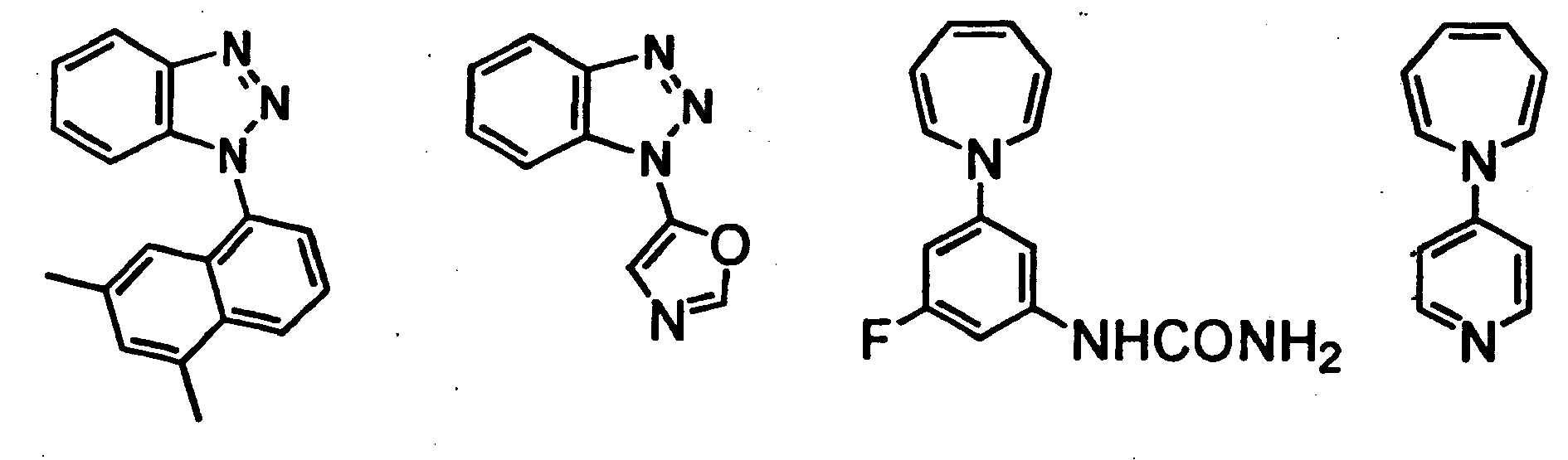
- Specific examples of the N-(hetero)aryl-substituted nitrogen-containing heteroaryl compound which can be produced by the invention are shown below. However, the compound to be produced by the invention should not be construed as being limited to the following examples.


- The process of the invention is explained next.
- Many heteroaryl compounds having an NH group as a ring-constituting component which are usable in the invention are on the market and can be easily available.
- Many (hetero)aryl compounds having a leaving group which are usable in the invention also are on the market and can be easily available. The amount of the (hetero) aryl compound having a leaving group to be used may be 0.5-2 equivalents to the heteroaryl compound having an NH group as a ring-constituting component. The amount thereof is preferably 0.8-1.5 equivalents, more preferably 0.9-1.2 equivalents, to the heteroaryl compound.
- The heterogeneous-system platinum group metal catalyst to be used in the invention is a catalyst comprising a platinum group metal supported on a support. Examples of the platinum group metal include palladium, ruthenium, rhodium, osmium, iridium, and platinum. Preferred are palladium and platinum. More preferred is palladium. Examples of the support include carbon, silica gel, alumina, fibers such as silk fibroin, and beads of polystyrene having a phosphine ligand in a terminal group. These catalystsmaybe commercial ones, ormaybeprepared by known methods (e.g., Shin Jikken Kagaku Ko̅za, published by Maruzen Co., Ltd., 1977, Vol.15, p. 390; and Ko̅za Ju̅go̅ Hanno̅ Ron, published by Kagaku Dozin Co., Ltd., 1972, Vol.10 (last volume), p.355). Of these, palladium supported on carbon is especially preferred because it is easily available.
- The amount of the heterogeneous-system platinum group metal catalyst to be used may be up to 20% by mole based on the heteroaryl compound having an NH group as a ring-constituting component. The amount thereof is preferably up to 5% by mole, more preferably up to 1% by mole, based on the heteroaryl compound.
- The ligand to be used in the invention is not particularly limited as long as it is capable of coordinating to the heterogeneous-system platinum group metal catalyst. Preferred is a phosphine ligand. Preferred examples thereof include monophosphine ligands such as triphenylphosphine, triisopropylphosphine, tri-tert-butylphosphine, tricyclohexylphosphine, tri-o-tolylphosphine, and diphenylcyclohexylphosphine; and bisphosphine ligands such as 1,2-bis(di-tert-butylphosphino)ethane, 1,3-bis(diphenylphosphino)propane, 1,4-bis(diphenylphosphino)butane, 1,4-bis(di-tert-butylphosphino)butane, 1,2-bis(dicyclohexylphosphino)ethane, 1,1'-bis(diphenylphosphino)ferrocene (hereinafter abbreviated as DPPF), 2,2'-bis(diphenylphosphino)-1,1'-binaphthyl (hereinafter abbreviated as BINAP), and 2,2'-bis(diphenylphosphino)biphenyl ether (hereinafter abbreviated as DPEphos). More preferred of these are bisphosphine ligands. Even more preferred are DPPF, BINAP, and DPEphos.
- The amount of the ligand to be used in the invention is preferably from 1:0.001 to 1:20, especially preferably from 1:0.01 to 1:4, in terms of the proportion of the metal atoms of the heterogeneous-system platinum group metal catalyst to the atoms coordinating thereto. For example, in the case where palladium supported on carbon and a bis-type phosphine ligand are used, the proportion of the palladium atoms to the phosphorus atoms is preferably from 1:0.001 to 1: 20, especially preferably from 1:0.01 to 1:4.
- The base to be used in the invention is one by which the NH group of the heteroaryl compound having an NH group as a ring-constituting component can be dissociated to yield a nitrogen anion. Examples thereof include inorganic bases such assodium carbonate,potassium carbonate,sodium hydroxide, potassium hydroxide, and cesium carbonate; and metal alkoxides such as sodium methoxide, potassium methoxide, sodium tert-butoxide, and potassium tert-butoxide. Preferred are metal alkoxides. More preferred are sodium tert-butoxide and potassium tert-butoxide.
- The amount of the base to be used varies depending on the kind of the base employed and the substituent to be dissociated. However, the amount thereof is generally 0.5-5 equivalents, preferably 0.8-4 equivalents, more preferably 1-3 equivalents, to the heteroaryl compound having an NH group as a ring-constituting component.
- The reaction in the invention can be conducted without using any solvent. However, a solvent can be used according to circumstances. Examples of usable solvents include aromatic solvents such as toluene, xylene, and anisole; ether solvents such as tetrahydrofuran, 1,4-dioxane, ethylene glycol dimethyl ether, ethylene glycol diethyl ether, and diisopropyl ether; and amide solvents such as N,N-dimethylformamide, N,N-diethylformamide, N,N-dimethylacetamide, and N-methylpyrrolidone. These solvents may be used alone or as a mixture of two or more thereof. In the case of using a mixture of two or more solvents, the proportions thereof may be determined at will. The amount of the solvent to be used is not particularly limited. However, the amount thereof is preferably 0.1-100 times by mass, more preferably 1-50 times by mass, especially preferably 1.5-30 times by mass, the amount of the heteroaryl compound having an NH group as a ring-constituting component.
- The reaction temperature in the invention is preferably 0-200°C, more preferably 10-150°C, especially preferably 20-120°C. The reaction time varies depending on the substrates, the catalyst used, etc. However, the disappearance of the starting materials is ascertained generally in 24 hours, mostly in 2-10 hours. It is preferred that the reaction in the invention be conducted in an atmosphere of an inert gas, e.g., nitrogen, argon, or helium.
- After completion of the reaction, the N-(hetero)aryl-substituted nitrogen-containing heteroaryl compound obtained can be purified by an isolation/purification method for ordinary organic compounds. For example, the palladium-carbon in the liquid reaction mixture is filtered off, and water is added to the filtrate. The resultant liquid mixture is subjected to liquid separation and concentration, whereby a crude product is obtained. This crude product is further purified by recrystallization from ethyl acetate, toluene, an alcohol, hexane, etc., column purification with silica gel, vacuum distillation, etc. Such techniques may be used alone or in combination of two or more thereof to conduct purification, whereby the target compound having a high purity can be obtained.
- The invention will be explained below in more detail by reference to Examples, but the invention should not be construed as being limited to the following Examples. Purity was evaluated by high-performance liquid chromatography (abbreviated as HPLC). Conditions for the HPLC are as follows: column, YMC-PACK ODS AM-312; detection UV, 254 nm; flow rate, 1.0 mL/min; eluent, acetonitrile/water (0.1% triethylamine + 0.1% acetic acid) = 1/1.
- In 600 mL of toluene were dissolved 30.0 g (0.20 mol) of 4-chloropyridine hydrochloride, 53.8 g (0.56 mol) of sodium t-butoxide, 19.6 g (0.01 mol) of 10 w/w% palladium-carbon (Pd-C) (containing 54 w/w% water), 23.4 g (0.20 mol) of indole, and 5.39 g (0.01 mol) of DPEphos. The resultant mixture was stirred for 10 hours with refluxing. After completion of the reaction, the reaction mixture was cooled to room temperature and the palladium-carbon was filtered off. This liquid reaction mixture was concentrated. 300 mL of ethyl acetate and 300 mL of 1-M hydrochloric acid were added to the residue to extract the target compound with the aqueous layer. Subsequently, 300 mL of ethyl acetate and 200 mL of 2-M aqueous sodium hydroxide solution were added to the aqueous layer to extract the target compound with the organic layer this time. This organic layer was washed with 200 mL of water and then dried with magnesium sulfate. The organic layer was filtered and concentrated to obtain 33.3 g (yield, 86%) of the target compound as an oily substance. The purity thereof was 99.8%.
- The target compound was synthesized by conducting the same procedure as in Example 1, except that the catalyst to be used was replaced by palladium acetate (Pd(OCOCH3)2) serving as a homogeneous-system catalyst and that the reaction conditions were changed as shown below.
- The results obtained in Example 1 and Comparative Example 1 are shown in Table 1.
Table 1 Reagent Reaction conditions Yield (%) Remarks Example 1 Pd-C DPEphos refluxing 10 hr 86 heterogeneous-system reaction; catalyst recovery is possible Comparative Example 1 Pd(OCOCH3)2 DPEphos refluxing 16 hr 80 homogeneous-system reaction; catalyst recovery is impossible - The following are apparent from the results shown in Table 1.
- The process of the invention can produce the target compound in a shorter reaction time than the other process and attains a satisfactory yield. Furthermore, the catalyst used can be recovered and repeatedly used. The target compound can hence be synthesized at a lower cost in the process of the invention than in the other process.
- The same synthesis procedure as in Example 1 was conducted, except that the ligand to be used was replaced by those shown in Table 2.
- The same synthesis procedure as in Example 1 was conducted, except that no ligand was added.
- The results obtained in the Examples and the Comparative Example are shown in Table 2.
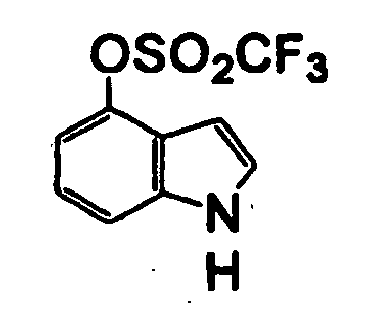
Table 2 Example Ligand Yield (%) Example 1 DPEphos 86 Example 2 PPh3 41 Example 3 BINAP 80 Example 4 DPPF 79 Comparative Example 2 no addition reaction did not proceed - The same synthesis procedure as in Example 1 was conducted, except that the substrates to be used were replaced by those shown in Table 3. The results obtained are shown in Table 3.
Table 3 Example Heteroaryl compound (Hetero)aryl compound product Yield (%) 5 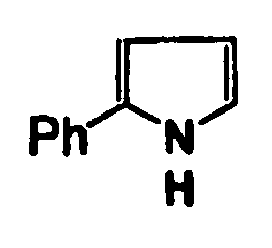


76 6 


63 7 

51 8 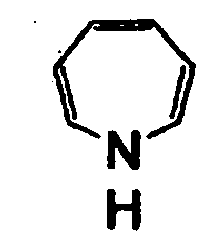


42 - According to the invention, it has become possible to produce an N-(hetero)aryl-substituted nitrogen-containing heteroaryl compound useful for medicines, agricultural chemicals, organic electroluminescent elements, catalyst ligands and solar sell elements on an industrial scale in high yield at low cost.
Claims (9)
- A process for producing an N-(hetero)aryl-substituted nitrogen-containing heteroaryl compound, the process comprising:reacting a heteroaryl compound having an NH group as a ring-constituting component with a (hetero)aryl compound having a leaving group in the presence of a heterogeneous-system platinum group metal catalyst, a ligand and a base.
- The process for producing an N-(hetero)aryl-substituted nitrogen-containing heteroaryl compound according to claim 1,
wherein the heteroaryl compound having an NH group as a ring-constituting component is pyrrole, indole, pyrazole, indazole, imidazole, benzimidazole, triazole or benzotriazole which each may have one or more substituents. - The process for producing an N-(hetero)aryl-substituted nitrogen-containing heteroaryl compound according to claim 1,
wherein the heteroaryl compound having an NH group as a ring-constituting component is pyrrole, indole, imidazole or benzimidazole which each may have one or more substituents. - The process for producing an N-(hetero)aryl-substituted nitrogen-containing heteroaryl compound according to claim 1,
wherein the heteroaryl compound having an NH group as a ring-constituting component is indole which may have one or more substituents. - The process for producing an N-(hetero)aryl-substituted nitrogen-containing heteroaryl compound according to claim 1,
wherein the (hetero)aryl compound having a leaving group is benzene, naphthalene, anthracene, phenanthrene, pyridine, pyridazine, pyrimidine, pyrazine, triazine, quinoline, isoquinoline, oxazole, benzoxazole, thiazole, benzothiazole, furan or benzofuran which may have one or more other substituents. - The process for producing an N-(hetero)aryl-substituted nitrogen-containing heteroaryl compound according to claim 1,
wherein the (hetero)aryl compound having a leaving group is benzene or pyridine which each may have one or more other substituents. - The process for producing an N-(hetero)aryl-substituted nitrogen-containing heteroaryl compound according to claim 1,
wherein the heterogeneous-system platinum group metal catalyst is palladium supported on carbon. - The process for producing an N-(hetero)aryl-substituted nitrogen-containing heteroaryl compound according to claim 1,
wherein the ligand is a phosphine ligand. - The process for producing an N-(hetero)aryl-substituted nitrogen-containing heteroaryl compound according to claim 1,
wherein the ligand is 1,1'-bis(diphenylphosphino)ferrocene (DPPF), 2,2'-bis(diphenylphosphino)-1,1'-binaphthyl (BINAP) or 2,2'-bis(diphenylphosphino)biphenyl ether (DPEphos).
Applications Claiming Priority (1)
| Application Number | Priority Date | Filing Date | Title |
|---|---|---|---|
| JP2005356876A JP2007161608A (en) | 2005-12-09 | 2005-12-09 | Method for producing n-(hetero)aryl-substituted nitrogen-containing heteroaryl compound |
Publications (3)
| Publication Number | Publication Date |
|---|---|
| EP1795529A2 EP1795529A2 (en) | 2007-06-13 |
| EP1795529A3 EP1795529A3 (en) | 2008-03-05 |
| EP1795529B1 true EP1795529B1 (en) | 2011-02-16 |
Family
ID=37913658
Family Applications (1)
| Application Number | Title | Priority Date | Filing Date |
|---|---|---|---|
| EP06025125A Expired - Fee Related EP1795529B1 (en) | 2005-12-09 | 2006-12-05 | Process for producing N-(Hetero)Aryl-substituted nitrogen-containing heteroaryl compound |
Country Status (5)
| Country | Link |
|---|---|
| US (1) | US7834183B2 (en) |
| EP (1) | EP1795529B1 (en) |
| JP (1) | JP2007161608A (en) |
| CN (1) | CN1978440A (en) |
| DE (1) | DE602006020102D1 (en) |
Families Citing this family (1)
| Publication number | Priority date | Publication date | Assignee | Title |
|---|---|---|---|---|
| US12304897B2 (en) | 2019-01-31 | 2025-05-20 | Kyorin Pharmaceutical Co., Ltd. | 15-PGDH inhibitors |
Family Cites Families (6)
| Publication number | Priority date | Publication date | Assignee | Title |
|---|---|---|---|---|
| JPH1135514A (en) * | 1997-07-18 | 1999-02-09 | Sankyo Co Ltd | Production of biaryl compound |
| WO2002004120A2 (en) * | 2000-07-12 | 2002-01-17 | Merck Patent Gmbh | Catalyst associated with functionalized plastic beads or silica for use in fluorous biphasic catalysis |
| MXPA04007196A (en) * | 2002-01-23 | 2005-06-08 | Bayer Pharmaceuticals Corp | Rho-kinase inhibitors. |
| JP2004182713A (en) * | 2002-12-03 | 2004-07-02 | Api Corporation | Method for producing haloaryl-substituted pyridine derivative |
| CA2516234A1 (en) * | 2003-02-21 | 2004-09-02 | Pfizer Inc. | N-heterocyclyl-substituted amino-thiazole derivatives as protein kinase inhibitors |
| JP2007504238A (en) * | 2003-09-04 | 2007-03-01 | アベンティス・ファーマスーティカルズ・インコーポレイテツド | Substituted indoles as inhibitors of poly (ADP-ribose) polymerase (PARP) |
-
2005
- 2005-12-09 JP JP2005356876A patent/JP2007161608A/en active Pending
-
2006
- 2006-12-05 EP EP06025125A patent/EP1795529B1/en not_active Expired - Fee Related
- 2006-12-05 DE DE602006020102T patent/DE602006020102D1/en active Active
- 2006-12-05 CN CNA2006101642190A patent/CN1978440A/en active Pending
- 2006-12-08 US US11/635,664 patent/US7834183B2/en not_active Expired - Fee Related
Also Published As
| Publication number | Publication date |
|---|---|
| US7834183B2 (en) | 2010-11-16 |
| DE602006020102D1 (en) | 2011-03-31 |
| EP1795529A2 (en) | 2007-06-13 |
| JP2007161608A (en) | 2007-06-28 |
| CN1978440A (en) | 2007-06-13 |
| EP1795529A3 (en) | 2008-03-05 |
| US20070135633A1 (en) | 2007-06-14 |
Similar Documents
| Publication | Publication Date | Title |
|---|---|---|
| CN102030701B (en) | Fluoradene derivative and preparation method thereof | |
| CN105283442A (en) | New process for the synthesis of 1-(2-((2,4-dimethylphenyl)thio)phenyl)piperazine | |
| CN109516998B (en) | Synthesis method of Barosavir intermediate | |
| CN111285847A (en) | Method for preparing alectinib | |
| CN101402537B (en) | Applications of 2-pyridine-β-ketones | |
| JP2001233855A (en) | Method for producing indole type compound | |
| WO2019020508A1 (en) | Method for the preparation of high-purity rucaparib | |
| CN105985316A (en) | A kind of preparation method of trexagliptin and salt thereof | |
| US7126009B2 (en) | Palladium catalyzed indolization of 2-bromo or chloroanilines | |
| US3947405A (en) | Process for making neohesperidine dihydrochalcone | |
| US7834183B2 (en) | Process for producing N-(hetero)aryl-substituted nitrogen-containing heteroaryl compound | |
| CN110963959B (en) | Preparation method for synthesizing N-protected and unprotected 3-hydroxy-4, 4-dimethylpiperidine | |
| CN103619815A (en) | Method for producing proline compound | |
| CN114805170B (en) | Preparation method of novel silodosin chiral intermediate | |
| CN110357790A (en) | Compound and its use in synthesizing brivaracetam bulk drug | |
| KR20070107802A (en) | Pharmaceutical Active Compounds (Irbesartan) and Synthetic Intermediates thereof | |
| TW202328077A (en) | Hydrogenation synthesis method for preparing pyrazinecarboxylic acid derivative as fluorescent tracer | |
| CN106316871A (en) | Chiral beta 2-amino acid derivative and preparing method thereof | |
| CN106588745A (en) | Intermediate of benzovindiflupyr and preparation method and application thereof | |
| CN108250196B (en) | Process for the preparation of (piperazin-1-yl) -1-hydro-imidazoheteroaromatic compounds | |
| CN112939983A (en) | Synthesis method of SYK kinase inhibitor Lanraplenib | |
| CN120463615B (en) | Asymmetric azobenzene compound, synthetic method and application | |
| CN115368244B (en) | Synthesis method of 2-aryl-2-(4-aminophenyl)propane | |
| CN119775279B (en) | A method for synthesizing fezonantane and its intermediates using chiral cofactors | |
| WO2025240124A1 (en) | Processes for preparing enantiomeric compounds and related molecules |
Legal Events
| Date | Code | Title | Description |
|---|---|---|---|
| PUAI | Public reference made under article 153(3) epc to a published international application that has entered the european phase |
Free format text: ORIGINAL CODE: 0009012 |
|
| AK | Designated contracting states |
Kind code of ref document: A2 Designated state(s): AT BE BG CH CY CZ DE DK EE ES FI FR GB GR HU IE IS IT LI LT LU LV MC NL PL PT RO SE SI SK TR |
|
| AX | Request for extension of the european patent |
Extension state: AL BA HR MK YU |
|
| PUAL | Search report despatched |
Free format text: ORIGINAL CODE: 0009013 |
|
| AK | Designated contracting states |
Kind code of ref document: A3 Designated state(s): AT BE BG CH CY CZ DE DK EE ES FI FR GB GR HU IE IS IT LI LT LU LV MC NL PL PT RO SE SI SK TR |
|
| AX | Request for extension of the european patent |
Extension state: AL BA HR MK YU |
|
| 17P | Request for examination filed |
Effective date: 20080519 |
|
| AKX | Designation fees paid |
Designated state(s): DE GB |
|
| GRAP | Despatch of communication of intention to grant a patent |
Free format text: ORIGINAL CODE: EPIDOSNIGR1 |
|
| GRAS | Grant fee paid |
Free format text: ORIGINAL CODE: EPIDOSNIGR3 |
|
| GRAA | (expected) grant |
Free format text: ORIGINAL CODE: 0009210 |
|
| AK | Designated contracting states |
Kind code of ref document: B1 Designated state(s): DE GB |
|
| REG | Reference to a national code |
Ref country code: GB Ref legal event code: FG4D |
|
| REF | Corresponds to: |
Ref document number: 602006020102 Country of ref document: DE Date of ref document: 20110331 Kind code of ref document: P |
|
| REG | Reference to a national code |
Ref country code: DE Ref legal event code: R096 Ref document number: 602006020102 Country of ref document: DE Effective date: 20110331 |
|
| PLBE | No opposition filed within time limit |
Free format text: ORIGINAL CODE: 0009261 |
|
| STAA | Information on the status of an ep patent application or granted ep patent |
Free format text: STATUS: NO OPPOSITION FILED WITHIN TIME LIMIT |
|
| 26N | No opposition filed |
Effective date: 20111117 |
|
| REG | Reference to a national code |
Ref country code: DE Ref legal event code: R097 Ref document number: 602006020102 Country of ref document: DE Effective date: 20111117 |
|
| GBPC | Gb: european patent ceased through non-payment of renewal fee |
Effective date: 20121205 |
|
| REG | Reference to a national code |
Ref country code: DE Ref legal event code: R119 Ref document number: 602006020102 Country of ref document: DE Effective date: 20130702 |
|
| PG25 | Lapsed in a contracting state [announced via postgrant information from national office to epo] |
Ref country code: DE Free format text: LAPSE BECAUSE OF NON-PAYMENT OF DUE FEES Effective date: 20130702 |
|
| PG25 | Lapsed in a contracting state [announced via postgrant information from national office to epo] |
Ref country code: GB Free format text: LAPSE BECAUSE OF NON-PAYMENT OF DUE FEES Effective date: 20121205 |