EP1795381A2 - Method, apparatus and program for alarming abnormality in tire air-pressure - Google Patents
Method, apparatus and program for alarming abnormality in tire air-pressure Download PDFInfo
- Publication number
- EP1795381A2 EP1795381A2 EP06023819A EP06023819A EP1795381A2 EP 1795381 A2 EP1795381 A2 EP 1795381A2 EP 06023819 A EP06023819 A EP 06023819A EP 06023819 A EP06023819 A EP 06023819A EP 1795381 A2 EP1795381 A2 EP 1795381A2
- Authority
- EP
- European Patent Office
- Prior art keywords
- tire
- new tire
- pressure
- air
- new
- Prior art date
- Legal status (The legal status is an assumption and is not a legal conclusion. Google has not performed a legal analysis and makes no representation as to the accuracy of the status listed.)
- Granted
Links
- 238000000034 method Methods 0.000 title claims abstract description 36
- 230000005856 abnormality Effects 0.000 title claims abstract description 26
- 230000007423 decrease Effects 0.000 claims abstract description 29
- 238000001514 detection method Methods 0.000 description 11
- 101100170173 Caenorhabditis elegans del-1 gene Proteins 0.000 description 6
- 230000003247 decreasing effect Effects 0.000 description 4
- 238000005259 measurement Methods 0.000 description 2
- 101100278884 Arabidopsis thaliana E2FD gene Proteins 0.000 description 1
- 101100278886 Arabidopsis thaliana E2FF gene Proteins 0.000 description 1
- 230000001133 acceleration Effects 0.000 description 1
- 238000012986 modification Methods 0.000 description 1
- 230000004048 modification Effects 0.000 description 1
Images


Classifications
-
- B—PERFORMING OPERATIONS; TRANSPORTING
- B60—VEHICLES IN GENERAL
- B60C—VEHICLE TYRES; TYRE INFLATION; TYRE CHANGING; CONNECTING VALVES TO INFLATABLE ELASTIC BODIES IN GENERAL; DEVICES OR ARRANGEMENTS RELATED TO TYRES
- B60C23/00—Devices for measuring, signalling, controlling, or distributing tyre pressure or temperature, specially adapted for mounting on vehicles; Arrangement of tyre inflating devices on vehicles, e.g. of pumps or of tanks; Tyre cooling arrangements
- B60C23/06—Signalling devices actuated by deformation of the tyre, e.g. tyre mounted deformation sensors or indirect determination of tyre deformation based on wheel speed, wheel-centre to ground distance or inclination of wheel axle
- B60C23/061—Signalling devices actuated by deformation of the tyre, e.g. tyre mounted deformation sensors or indirect determination of tyre deformation based on wheel speed, wheel-centre to ground distance or inclination of wheel axle by monitoring wheel speed
Definitions
- the present invention relates to a method, apparatus and program for alarming abnormality in tire air-pressure.
- a method for alarming abnormality in tire air-pressure in accordance with the prior art in which a decrease in tire air-pressure is detected and an alarm is issued makes use of a fact that a tire having a decreased tire air-pressure rotates faster than a tire having a normal tire air-pressure.
- the method for alarming abnormality in tire air-pressure detects whether or not an air-pressure in tire is decreased based on the variation of a determinate value (DEL1) calculated from a rotational velocity of each tire by the following equation, and issues an alarm when it is determined that the air-pressure in any tire is decreased.
- DEL1 determinate value
- FL, FR, RL and RR represent a rotational angular velocity of the front left tire, the front right tire, the rear left tire, and the rear right tire, respectively.
- DEL ⁇ 1 FL + RR / FR + RL - 1 ⁇ 100 , or FL + RR - FR + RL / FR + FR + RL + RR ⁇ 200 ,
- a tire discrimination apparatus and method for having a capability to discriminate a kind of tire mounted on a vehicle replacing a different kind of old tire by an initialization process, to improve accuracy of determination of a decrease in tire air-pressure, and to prevent giving an erroneous alarm or no alarm and an apparatus and method for alarming decrease in tire air-pressure with the use of the above apparatus are issued.
- that invention does not teach a method to prevent issuing an erroneous alarm or no alarm when a new tire is mounted in place of an old tire.
- An object of the present invention is to provide a method, an apparatus and a program for alarming abnormality in tire air-pressure which enables to prevent issuing an erroneous alarm or no alarm when only one tire is replaced with a new tire.
- An aspect of the present invention relates to a method for alarming abnormality in tire air-pressure including a step of detecting whether or not a new tire has been mounted by comparing the difference between determinate values to judge a decrease in air-pressure before and after enlargement of a diameter of the new tire with a set threshold value when only one tire is replaced with the new tire, with the use of a fact that a diameter of a new tire on a vehicle enlarges after running.
- the method for alarming abnormality in tire air-pressure includes a step of detecting whether or not a new tire is mounted, only by comparing the difference between determinate values to judge a decrease in air-pressure during a slow to medium velocity running before and after a high velocity running with a set threshold value, as the conditions for detecting a new tire in accordance with the above-mentioned step.
- Another aspect of the present invention relates to an apparatus for alarming abnormality in tire air-pressure including a means of detecting whether or not a new tire has been mounted by comparing the difference between determinate values to judge a decrease in air-pressure before and after enlargement of a diameter of the new tire with a set threshold value when only one tire is replaced with the new tire, with the use of a fact that a diameter of a new tire on a vehicle enlarges after running.
- the apparatus for alarming abnormality in tire air-pressure further includes a means of detecting whether or not a new tire is mounted, only by comparing the difference between determinate values to judge a decrease in air-pressure during a slow to medium velocity running before and after a high velocity running with a set threshold value, as the conditions for detecting a new tire in accordance with the above-mentioned means.
- Another aspect of the present invention relates to a program for alarming abnormality in tire air-pressure, making a computer execute the procedure of detecting whether or not a new tire has been mounted, only by comparing the difference between determinate values to judge a decrease in air-pressure before and after enlargement of a diameter of the new tire with a set threshold value when only one tire is replaced with the new tire, with the use of a fact that a diameter of a new tire on a vehicle enlarges after running.
- the program of alarming abnormality in tire air-pressure further makes a computer execute the procedure of detecting whether or not a new tire is mounted, only by comparing the difference between determinate values to judge a decrease in air-pressure during a slow to medium velocity running before and after a high velocity running with a set threshold value, as the conditions for detecting a new tire in accordance with the above-mentioned procedure.
- a method, an apparatus and a program for alarming abnormality in tire air-pressure makes a computer prevent issuing an erroneous alarm or no alarm when one tire is replaced with a new tire by comparing the difference between determinate values to judge a decrease in air-pressure before and after an enlargement in the diameter of the new tire with a set threshold value and detecting whether a new tire has been mounted or not.
- the method for alarming abnormality in tire air-pressure in accordance with the present invention includes a step to detect whether a new tire has been mounted or not based on determinate values to judge a decrease in air-pressure before and after the enlargement in the diameter of the new tire (hereinafter referred to as step 1).
- step 1 it is possible to detect whether a new tire has been mounted or not when only one tire is replaced with the new tire.
- step 1 when only one tire is replaced with a new tire, it is possible to detect whether the new tire has been mounted or not by calculating a determinate value to judge a decrease in air-pressure based on a rotational velocity of each tire and then comparing the difference between the determinate value before the enlargement of the diameter of the new tire (hereinafter referred to as determinate value 1) and the determinate value after the enlargement of the diameter of the new tire (hereinafter referred to as determinate value 2) with a set threshold value (hereinafter referred to as threshold value 1). In this case, if the difference between determinate value 1 and determinate value 2 exceeds threshold value 1, it is determined that a new tire has been mounted.
- Those determinate values 1 and 2 may, for example, be calculated by combining the ratios of rotational velocities of the right tires to those of the left tires, the ratios of rotational velocities of the front tires to those of the rear tires, and the ratios of rotational velocities of the tires to those of the tires on respective diagonal lines.
- Determinate value 1 may store a condition of the new tire before the enlargement of the diameter during the initial running as a standard level (namely 0), and a deviation therefrom may be assigned to determinate value 2.
- step 2 When it is detected in step 1 that a new tire has been mounted, a further step to detect whether a new tire has been mounted or not based on determinate values to judge a decrease in air-pressure during a slow to medium velocity running before and after a high velocity running is preferably implemented (hereinafter referred to as step 2).
- step 2 In case where only step 1 is performed, since determinate value 1 will become the same with determinate value 2 representing that the diameter of a new tire is enlarged when a biased load is applied under the slow to medium velocity running, an erroneous alarm or no alarm tends to be issued.
- step 2 it is possible to detect whether a new tire has been mounted or not by calculating a determinate value to judge a decrease in air-pressure based on a rotational velocity of each tire and then comparing the difference between the determinate value to judge a decrease in air-pressure during a slow to medium velocity running before a high velocity running (hereinafter referred to as determinate value 3) and the determinate value to judge a decrease in air-pressure after the high velocity (hereinafter referred to as determinate value 4) with a set threshold value (hereinafter referred to as threshold value 2). In this case, if the difference between determinate value 3 and determinate value 4 exceeds threshold value 2, it is determined that a new tire has been mounted.
- Those determinate values 3 and values 4 may, for example, be calculated by combining determinate values (DEL 1, DEL 2 and DEL 3) represented by the difference between the two pairs of the sums of rotational velocities of tires will be calculated in accordance with the following equations.
- Determinate value 3 may store a condition of a new tire before enlargement of the diameter during the initial running as a standard level (namely 0), and a deviation therefrom may be assigned to determinate value 4.
- FL, FR, RL, and RR represent a rotational velocity of the front left tire, the front right tire, the rear left tire, and the rear right tire, respectively.
- DEL ⁇ 1 FL + RR / FR + RL - 1 ⁇ 100 , or ( FL + RR - FR + RL ) / FL + FR + RL + RR ⁇ 200
- DEL ⁇ 2 FL + FR / RL + RR - 1 ⁇ 100 , or FL + RR - FR + RL / FR + FR + RL + RR ⁇ 200
- DEL ⁇ 3 FL + RL / FR + RR - 1 ⁇ 100 , or FL + RR - FR + RL / FR + FR + RL + RR ⁇ 200 ,
- determinate values 1 to 4 may be obtained by moving average to stabilize the values.
- step 2 the high velocity running is preferable to be performed at a velocity in the range from 130 to 250 km/h and the slow to medium running is preferable to be performed at a velocity in the range from 15 to 130 km/h.
- Step 2 to be implemented after the detection of mounting of a new tire in step 1 is preferable to be performed when tires are not under determination of a decrease in air-pressure since accurate determinate values can not be available when a decrease in air-pressure is detected. Also, step 2 is preferable to be implemented before the vehicle mounted on a new tire runs determinate distance after the start of an initialization. The determinate value is preferable to be in the range from 500 to 1000 km.
- the initialization After detecting a new tire in step 2. Thereafter, the initialization is preferable to be started automatically or manually by a driver, and more preferable to be started automatically. Also, when a new tire is mounted, the threshold value is preferable to be increased so as to avoid determinating erroneously a decrease in air-pressure of the new tire due to the difference between its rotational velocity and those of other tires.
- the method for alarming abnormality in tire air-pressure in accordance with the present invention is a method for alarming abnormality in tire air-pressure including step 1, and preferably is a method for alarming abnormality in tire air-pressure including a method to detect a new tire including step 1. Furthermore, the method for alarming abnormality in tire air-pressure is preferable to include, in addition to steps 1 and 2, a step not to issue the alarm when a new tire is detected.
- Fig. 1 shows an example of step to detect whether a new tire has been mounted or not based on technical items described hereinabove.
- the description as shown in Fig. 1 is one of the examples, and the embodiments of the present invention should not be limited to what has been specifically described herein.
- determination is made as to whether one tire is determined to be “slower” or not during a slow to medium velocity running after a high velocity running. If no tire is determined to be “slower” or the number of tires determined to be “slower” is more than one, a counter for detection of new tire is decremented at S7 and the routine of this time is terminated at the end and then a new process for determination is started from the start. And, if one tire is determined to be "slower” the counter for detection of new tire is incremented at S8, and the routine is performed at S9.
- DUNLOP SPSPORTS 9000 On an FR two-seated car for testing, tires of the size 245/40ZR18 (DUNLOP SPSPORTS 9000) were mounted on the front tires (as front left tire (FL) and front right tire (FR)) and tires of the size 265/35ZR (DUNLOP SPSPORTS 9000) were mounted on the rear tires (as rear left tire (RL) and rear right tire (RR)). In this case, a new tire was assigned to FL.
- the above-mentioned FR car was run at 200 km/h for 300 seconds, and the ratios (FL/FR) of rotational velocities of FL to those of FR were measured during the time frame.
- Fig. 2 shows that the values of FL/FR decreased gradually as the rotational velocities of FL were reduced as a result of the enlargement of the diameter of FL as time goes by.
- the above-mentioned FR car was run at a speed of 80 km/h for 12 seconds (from 0 to 12 seconds). Then, the speed was raised to 200 km/h after the acceleration at 3.70 m/s 2 for 6 seconds (12 to 18 seconds) and the car was run for 11 seconds (18 to 29 seconds). After that, the speed was returned to 80 km/h after the deceleration at 3.70 m/s 2 for 6 seconds (29 to 35 seconds) and the car was run at that speed for 12 seconds (35 to 47 seconds).
- the threshold value for determining a tire to be "slower” is set to be -0.09 for DEL 1, DEL 2 and DEL 3, respectively.
- the counter for detection of new tire started to be incremented at a point of 35 seconds and when the counts exceeded 60 at the point of 46 seconds, a new tire was detected.
Landscapes
- Engineering & Computer Science (AREA)
- Mechanical Engineering (AREA)
- Measuring Fluid Pressure (AREA)
Abstract
Description
- The present invention relates to a method, apparatus and program for alarming abnormality in tire air-pressure.
- A method for alarming abnormality in tire air-pressure in accordance with the prior art in which a decrease in tire air-pressure is detected and an alarm is issued, makes use of a fact that a tire having a decreased tire air-pressure rotates faster than a tire having a normal tire air-pressure. The method for alarming abnormality in tire air-pressure detects whether or not an air-pressure in tire is decreased based on the variation of a determinate value (DEL1) calculated from a rotational velocity of each tire by the following equation, and issues an alarm when it is determined that the air-pressure in any tire is decreased. In the following equation FL, FR, RL and RR represent a rotational angular velocity of the front left tire, the front right tire, the rear left tire, and the rear right tire, respectively.


- However, when a vehicle runs after replacing with a new tire, the rotational velocity of the new tire decreases due to an enlargement of the diameter of the new tire. As a result, in the method for alarming abnormality in tire air-pressure in accordance with the prior art there has been a case where an erroneous alarm is issued or alarm is not issued at all when the new tire is mounted on a vehicle.
- In
Japanese Unexamined Patent Publication No. 211220/2002 - An object of the present invention is to provide a method, an apparatus and a program for alarming abnormality in tire air-pressure which enables to prevent issuing an erroneous alarm or no alarm when only one tire is replaced with a new tire.
- An aspect of the present invention relates to a method for alarming abnormality in tire air-pressure including a step of detecting whether or not a new tire has been mounted by comparing the difference between determinate values to judge a decrease in air-pressure before and after enlargement of a diameter of the new tire with a set threshold value when only one tire is replaced with the new tire, with the use of a fact that a diameter of a new tire on a vehicle enlarges after running.
- Preferably, the method for alarming abnormality in tire air-pressure includes a step of detecting whether or not a new tire is mounted, only by comparing the difference between determinate values to judge a decrease in air-pressure during a slow to medium velocity running before and after a high velocity running with a set threshold value, as the conditions for detecting a new tire in accordance with the above-mentioned step.
- Another aspect of the present invention relates to an apparatus for alarming abnormality in tire air-pressure including a means of detecting whether or not a new tire has been mounted by comparing the difference between determinate values to judge a decrease in air-pressure before and after enlargement of a diameter of the new tire with a set threshold value when only one tire is replaced with the new tire, with the use of a fact that a diameter of a new tire on a vehicle enlarges after running.
- Preferably, the apparatus for alarming abnormality in tire air-pressure further includes a means of detecting whether or not a new tire is mounted, only by comparing the difference between determinate values to judge a decrease in air-pressure during a slow to medium velocity running before and after a high velocity running with a set threshold value, as the conditions for detecting a new tire in accordance with the above-mentioned means.
- Another aspect of the present invention relates to a program for alarming abnormality in tire air-pressure, making a computer execute the procedure of detecting whether or not a new tire has been mounted, only by comparing the difference between determinate values to judge a decrease in air-pressure before and after enlargement of a diameter of the new tire with a set threshold value when only one tire is replaced with the new tire, with the use of a fact that a diameter of a new tire on a vehicle enlarges after running.
- Preferably, the program of alarming abnormality in tire air-pressure further makes a computer execute the procedure of detecting whether or not a new tire is mounted, only by comparing the difference between determinate values to judge a decrease in air-pressure during a slow to medium velocity running before and after a high velocity running with a set threshold value, as the conditions for detecting a new tire in accordance with the above-mentioned procedure.
- According to the present invention, a method, an apparatus and a program for alarming abnormality in tire air-pressure makes a computer prevent issuing an erroneous alarm or no alarm when one tire is replaced with a new tire by comparing the difference between determinate values to judge a decrease in air-pressure before and after an enlargement in the diameter of the new tire with a set threshold value and detecting whether a new tire has been mounted or not.
- Fig. 1 is a flowchart showing an example of an embodiment of the present invention;
- Fig. 2 is a graph showing determinate values in detecting a new tire in a first embodiment; and
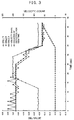
- Fig. 3 is a graph showing determinate values in detecting a new tire in a second embodiment.
- When a vehicle mounted on a new tire runs, the new tire subtly expands in a phase to adjust itself to a practical use, causing an enlargement in the diameter of the new tire. Thereby a rotational velocity of the new tire becomes slower than that of other tires. The method for alarming abnormality in tire air-pressure in accordance with the present invention includes a step to detect whether a new tire has been mounted or not based on determinate values to judge a decrease in air-pressure before and after the enlargement in the diameter of the new tire (hereinafter referred to as step 1).
- In step 1, it is possible to detect whether a new tire has been mounted or not when only one tire is replaced with the new tire.
- In step 1, when only one tire is replaced with a new tire, it is possible to detect whether the new tire has been mounted or not by calculating a determinate value to judge a decrease in air-pressure based on a rotational velocity of each tire and then comparing the difference between the determinate value before the enlargement of the diameter of the new tire (hereinafter referred to as determinate value 1) and the determinate value after the enlargement of the diameter of the new tire (hereinafter referred to as determinate value 2) with a set threshold value (hereinafter referred to as threshold value 1). In this case, if the difference between determinate value 1 and determinate value 2 exceeds threshold value 1, it is determined that a new tire has been mounted.
- Those determinate values 1 and 2 may, for example, be calculated by combining the ratios of rotational velocities of the right tires to those of the left tires, the ratios of rotational velocities of the front tires to those of the rear tires, and the ratios of rotational velocities of the tires to those of the tires on respective diagonal lines. Determinate value 1 may store a condition of the new tire before the enlargement of the diameter during the initial running as a standard level (namely 0), and a deviation therefrom may be assigned to determinate value 2.
- When it is detected in step 1 that a new tire has been mounted, a further step to detect whether a new tire has been mounted or not based on determinate values to judge a decrease in air-pressure during a slow to medium velocity running before and after a high velocity running is preferably implemented (hereinafter referred to as step 2). In case where only step 1 is performed, since determinate value 1 will become the same with determinate value 2 representing that the diameter of a new tire is enlarged when a biased load is applied under the slow to medium velocity running, an erroneous alarm or no alarm tends to be issued.
- In step 2, it is possible to detect whether a new tire has been mounted or not by calculating a determinate value to judge a decrease in air-pressure based on a rotational velocity of each tire and then comparing the difference between the determinate value to judge a decrease in air-pressure during a slow to medium velocity running before a high velocity running (hereinafter referred to as determinate value 3) and the determinate value to judge a decrease in air-pressure after the high velocity (hereinafter referred to as determinate value 4) with a set threshold value (hereinafter referred to as threshold value 2). In this case, if the difference between determinate value 3 and determinate value 4 exceeds threshold value 2, it is determined that a new tire has been mounted.
- Those determinate values 3 and values 4 may, for example, be calculated by combining determinate values (DEL 1, DEL 2 and DEL 3) represented by the difference between the two pairs of the sums of rotational velocities of tires will be calculated in accordance with the following equations. Determinate value 3 may store a condition of a new tire before enlargement of the diameter during the initial running as a standard level (namely 0), and a deviation therefrom may be assigned to determinate value 4. In the following equations FL, FR, RL, and RR represent a rotational velocity of the front left tire, the front right tire, the rear left tire, and the rear right tire, respectively.




- In calculating DEL 1, DEL 2 and DEL 3 as determinate values 3 and 4, from the relationship among a sign provided to each of DEL1, DEL2 and DEL3, a tire having a slow rotational velocity can be detected. As a result, a wheel where a new tire has been mounted can be detected. Table 1 shows tires with slower rotational velocity detected from the relationship among a sign prefixed to each DEL 1, DEL 2 and DEL 3.
TABLE 1 DEL 1 DEL 2 DEL 3 FR: Slower + - + FL: Slower - - - RR: Slower - + + RL: Slower + + - - Preferably, determinate values 1 to 4 may be obtained by moving average to stabilize the values.
- In step 2, the high velocity running is preferable to be performed at a velocity in the range from 130 to 250 km/h and the slow to medium running is preferable to be performed at a velocity in the range from 15 to 130 km/h.
- Step 2 to be implemented after the detection of mounting of a new tire in step 1 is preferable to be performed when tires are not under determination of a decrease in air-pressure since accurate determinate values can not be available when a decrease in air-pressure is detected. Also, step 2 is preferable to be implemented before the vehicle mounted on a new tire runs determinate distance after the start of an initialization. The determinate value is preferable to be in the range from 500 to 1000 km.
- It is preferable to start the initialization after detecting a new tire in step 2. Thereafter, the initialization is preferable to be started automatically or manually by a driver, and more preferable to be started automatically. Also, when a new tire is mounted, the threshold value is preferable to be increased so as to avoid determinating erroneously a decrease in air-pressure of the new tire due to the difference between its rotational velocity and those of other tires.
- The method for alarming abnormality in tire air-pressure in accordance with the present invention is a method for alarming abnormality in tire air-pressure including step 1, and preferably is a method for alarming abnormality in tire air-pressure including a method to detect a new tire including step 1. Furthermore, the method for alarming abnormality in tire air-pressure is preferable to include, in addition to steps 1 and 2, a step not to issue the alarm when a new tire is detected.
- The flowchart in Fig. 1 shows an example of step to detect whether a new tire has been mounted or not based on technical items described hereinabove. The description as shown in Fig. 1 is one of the examples, and the embodiments of the present invention should not be limited to what has been specifically described herein.
- At S1, determination is made as to whether a new tire is detected or not. If a new tire is detected, no detection of a new tire is made at S2 and the routine is terminated. If a new tire is not detected, the routine at S3 is implemented.
- At S3, determination is made as to whether the vehicle has run at least 500 km after the start of an initialization process. If affirmative, no detection of a new tire is made at S2 and the routine is terminated. If the vehicle runs at least 500 km, the routine at S4 is performed.
- At S4, determination is made as to whether determination of a pressure decrease has been made after the start of an initialization process. If affirmative, no detection of a new tire is made at S2 and the routine is terminated. If determination of the decrease in air-pressure is not made, the routine at S5 is implemented.
- At S5, determination is made as to whether the initialization process has been finished or not. If negative, the routine this time is terminated at the end and then a new process for determination is started from the start again. If affirmative, the routine at S6 is performed.
- At S6, determination is made as to whether one tire is determined to be "slower" or not during a slow to medium velocity running after a high velocity running. If no tire is determined to be "slower" or the number of tires determined to be "slower" is more than one, a counter for detection of new tire is decremented at S7 and the routine of this time is terminated at the end and then a new process for determination is started from the start. And, if one tire is determined to be "slower" the counter for detection of new tire is incremented at S8, and the routine is performed at S9.
- At S9, determination is made as to whether the counter for detection of new tire has counted more than 60 or not. If negative, the routine of this time is terminated at the end and then a new process for determination is started from the start. If affirmative, detection of a new tire is made at S10, and after that at S11 the initialization process is started automatically to store information on the new tire and increase the threshold value so as to prevent the erroneous alarm to be issued due to the mounting of the new tire.
- The present invention will now be explained based on Examples, but it should not be construed that the present invention is limited to Examined specified herein.
- On an FR two-seated car for testing, tires of the size 245/40ZR18 (DUNLOP SPSPORTS 9000) were mounted on the front tires (as front left tire (FL) and front right tire (FR)) and tires of the size 265/35ZR (DUNLOP SPSPORTS 9000) were mounted on the rear tires (as rear left tire (RL) and rear right tire (RR)). In this case, a new tire was assigned to FL.
- The above-mentioned FR car was run at 200 km/h for 300 seconds, and the ratios (FL/FR) of rotational velocities of FL to those of FR were measured during the time frame.
- Measurement result of Example 1 is shown in Fig. 2.
- Fig. 2 shows that the values of FL/FR decreased gradually as the rotational velocities of FL were reduced as a result of the enlargement of the diameter of FL as time goes by.
- The above-mentioned FR car was run at a speed of 80 km/h for 12 seconds (from 0 to 12 seconds). Then, the speed was raised to 200 km/h after the acceleration at 3.70 m/s2 for 6 seconds (12 to 18 seconds) and the car was run for 11 seconds (18 to 29 seconds). After that, the speed was returned to 80 km/h after the deceleration at 3.70 m/s2 for 6 seconds (29 to 35 seconds) and the car was run at that speed for 12 seconds (35 to 47 seconds).
- During the running determinate values (DEL 1, DEL 2 and DEL 3) were measured and the counter for detection of new tire was set. In this case, the threshold value for determining a tire to be "slower" is set to be -0.09 for DEL 1, DEL 2 and DEL 3, respectively. When a rotational velocity of one tire is slower than the others based on the determinate values during a slow to medium velocity running the counter for detection of new tire was incremented, and when the counts exceeded 60 it was determined that a new tire was mounted.
- Measurement result of Example 2 is shown in Fig. 3.
- The counter for detection of new tire started to be incremented at a point of 35 seconds and when the counts exceeded 60 at the point of 46 seconds, a new tire was detected.
- Though several Embodiments of the present invention are described above, it is to be understood that the present invention is not limited only to the above-mentioned, various changes and modifications may be made in the invention without departing from the spirit and scope thereof.
Claims (6)
- A method for alarming abnormality in tire air-pressure including a step of detecting whether or not a new tire has been mounted by comparing the difference between determinate values to judge a decrease in air-pressure before and after enlargement of a diameter of the new tire with a set threshold value when solely one tire is replaced with the new tire, with the use of a phenomenon that a diameter of a new tire on a vehicle enlarges after running.
- The method for alarming abnormality in tire air-pressure of Claim 1, including a step of detecting whether or not a new tire is mounted, only by comparing the difference between determinate values to judge a decrease in air-pressure during a slow to medium velocity running before and after a high velocity running with a set threshold value, as the conditions for detecting a new tire in accordance with the step in Claim 1.
- An apparatus for alarming abnormality in tire air-pressure including a means of detecting whether or not a new tire has been mounted by comparing the difference between determinate values to judge a decrease in air-pressure before and after enlargement of a diameter of the new tire with a set threshold value when solely one tire is replaced with the new tire with the use of a phenomenon that a diameter of a new tire on a vehicle enlarges after running.
- The apparatus for alarming abnormality in tire air-pressure of Claim 3, including a means of detecting whether or not a new tire is mounted, solely by comparing the difference between determinate values to judge a decrease in air-pressure during a slow to medium velocity running before and after a high velocity running with a set threshold value, as the conditions for detecting a new tire in accordance with the means in Claim 3.
- A program for alarming abnormality in tire air-pressure making a computer execute a procedure of detecting whether or not a new tire has been mounted by comparing the difference between determinate values to judge a decrease in air-pressure before and after enlargement of a diameter of the new tire with a set threshold value when solely one tire is replaced with the new tire with the use of a phenomenon that a diameter of a new tire on a vehicle enlarges after running.
- The program for alarming abnormality in tire air-pressure of Claim 5, making a computer execute a procedure of detecting whether or not a new tire is mounted, solely by comparing the difference between determinate values to judge a decrease in air-pressure during a slow to medium velocity running before and after a high velocity running with a set threshold value, as the conditions for detecting a new tire in accordance with the procedure in Claim 5.
Applications Claiming Priority (1)
| Application Number | Priority Date | Filing Date | Title |
|---|---|---|---|
| JP2005357494A JP4637011B2 (en) | 2005-12-12 | 2005-12-12 | Tire pressure abnormality alarm method, apparatus and program |
Publications (3)
| Publication Number | Publication Date |
|---|---|
| EP1795381A2 true EP1795381A2 (en) | 2007-06-13 |
| EP1795381A3 EP1795381A3 (en) | 2012-04-11 |
| EP1795381B1 EP1795381B1 (en) | 2013-07-10 |
Family
ID=37836963
Family Applications (1)
| Application Number | Title | Priority Date | Filing Date |
|---|---|---|---|
| EP06023819.3A Ceased EP1795381B1 (en) | 2005-12-12 | 2006-11-16 | Method, apparatus and program for alarming abnormality in tire air-pressure |
Country Status (4)
| Country | Link |
|---|---|
| US (1) | US7573376B2 (en) |
| EP (1) | EP1795381B1 (en) |
| JP (1) | JP4637011B2 (en) |
| CN (1) | CN1982100B (en) |
Families Citing this family (8)
| Publication number | Priority date | Publication date | Assignee | Title |
|---|---|---|---|---|
| JP4159541B2 (en) * | 2004-12-24 | 2008-10-01 | 住友ゴム工業株式会社 | Tire pressure drop detection method and apparatus |
| CN104709002B (en) * | 2013-12-13 | 2017-02-15 | 北汽福田汽车股份有限公司 | Tire pressure alarm method, tire pressure alarm device and vehicle |
| KR101704632B1 (en) * | 2015-07-14 | 2017-02-08 | 현대오트론 주식회사 | Apparatus and method for monitoring tire pressure considering low pressure situation |
| KR101816039B1 (en) * | 2016-09-08 | 2018-01-08 | 현대오트론 주식회사 | Apparatus and method for deciding low pressure of tire |
| JP6848601B2 (en) * | 2017-03-29 | 2021-03-24 | 横浜ゴム株式会社 | Information display device, information display system, information output method and control program |
| WO2019072822A1 (en) | 2017-10-09 | 2019-04-18 | Nira Dynamics Ab | Determining a tire change status in a vehicle |
| CN108873747B (en) * | 2018-06-20 | 2020-10-27 | 安徽安凯汽车股份有限公司 | Double inflation signal control method for new energy passenger car |
| JP2026030738A (en) * | 2024-08-09 | 2026-02-20 | 住友ゴム工業株式会社 | Decompression state detection device, determination method, and program |
Citations (1)
| Publication number | Priority date | Publication date | Assignee | Title |
|---|---|---|---|---|
| JP2002211220A (en) | 2001-01-12 | 2002-07-31 | Sumitomo Rubber Ind Ltd | Tire identification device and method, and tire pressure drop warning device and method using the device |
Family Cites Families (6)
| Publication number | Priority date | Publication date | Assignee | Title |
|---|---|---|---|---|
| GB8711310D0 (en) | 1987-05-13 | 1987-06-17 | Sp Tyres Uk Ltd | Tyres deflation warning device |
| US4996516A (en) * | 1989-11-13 | 1991-02-26 | Mason L Dale | Indicator of under inflated tire |
| JP2869969B2 (en) | 1995-04-28 | 1999-03-10 | ソニーケミカル株式会社 | Method for manufacturing flexible circuit board |
| US5900543A (en) * | 1996-04-15 | 1999-05-04 | Sumitomo Rubber Industries, Ltd | Method for detecting decrease of tire air pressure and apparatus used therefor |
| JP2003506255A (en) * | 1999-08-06 | 2003-02-18 | コンティネンタル・テーベス・アクチエンゲゼルシヤフト・ウント・コンパニー・オッフェネ・ハンデルスゲゼルシヤフト | Method and apparatus for detecting pressure drop in tires of vehicle wheels |
| US7263878B2 (en) * | 2002-04-17 | 2007-09-04 | Continental Teves Ag & Co. Ohg | Method for identifying tire characteristics |
-
2005
- 2005-12-12 JP JP2005357494A patent/JP4637011B2/en not_active Expired - Fee Related
-
2006
- 2006-11-16 EP EP06023819.3A patent/EP1795381B1/en not_active Ceased
- 2006-11-21 US US11/602,350 patent/US7573376B2/en not_active Expired - Fee Related
- 2006-12-11 CN CN2006101693417A patent/CN1982100B/en not_active Expired - Fee Related
Patent Citations (1)
| Publication number | Priority date | Publication date | Assignee | Title |
|---|---|---|---|---|
| JP2002211220A (en) | 2001-01-12 | 2002-07-31 | Sumitomo Rubber Ind Ltd | Tire identification device and method, and tire pressure drop warning device and method using the device |
Also Published As
| Publication number | Publication date |
|---|---|
| CN1982100A (en) | 2007-06-20 |
| CN1982100B (en) | 2010-04-14 |
| US20070132568A1 (en) | 2007-06-14 |
| EP1795381A3 (en) | 2012-04-11 |
| EP1795381B1 (en) | 2013-07-10 |
| US7573376B2 (en) | 2009-08-11 |
| JP2007161011A (en) | 2007-06-28 |
| JP4637011B2 (en) | 2011-02-23 |
Similar Documents
| Publication | Publication Date | Title |
|---|---|---|
| EP1880875A2 (en) | Method, apparatus and program for alarming decrease in tire air-pressure | |
| EP1752317A2 (en) | Method for detecting decrease in inner pressure of tire using GPS speed information | |
| EP1527909B1 (en) | Method and device for detecting decompression of tires | |
| EP2390117B1 (en) | Method and apparatus for detecting tire having decreased internal pressure, and program for detecting tire having decreased internal pressure | |
| EP1795381B1 (en) | Method, apparatus and program for alarming abnormality in tire air-pressure | |
| KR100312875B1 (en) | Method and apparatus for detecting decrease of tire air pressure | |
| EP2384911A2 (en) | Apparatus, method and program for detecting decrease in tire air pressure | |
| EP2455238A1 (en) | Apparatus and method for detecting decrease in tire air pressure and program for detecting decrease in tire air pressure | |
| US20030140688A1 (en) | Method and apparatus for detecting decrease in tire air-pressure, and program for judging decompression of tire | |
| EP2022652B1 (en) | Lowered tire air pressure alarming method | |
| JP3929962B2 (en) | Tire pressure drop detection method and apparatus, and tire decompression determination program | |
| JP2002178730A (en) | Tire air pressure drop warning method and device | |
| EP1795379B1 (en) | Apparatus, method and program for alarming abnormality in tire air-pressure | |
| EP1477337A2 (en) | Apparatus and method for calculating initial correction coefficient | |
| JP3083438B2 (en) | Tire pressure drop detector | |
| JP3980835B2 (en) | Tire identification device and method thereof, and tire pressure drop alarm device and method using the same | |
| EP1616725A2 (en) | Tire deflation warning system and method thereof | |
| JP3623023B2 (en) | Tire pressure drop detection method and apparatus | |
| JP3929961B2 (en) | Tire pressure drop detection method and apparatus, and tire decompression determination program | |
| JP3167278B2 (en) | Method and apparatus for detecting decrease in tire air pressure | |
| EP2191986B1 (en) | Apparatus and method for detecting decrease in tire air pressure and program for detecting decrease in tire air pressure | |
| EP1798078B1 (en) | Apparatus, method and program for alarming abnormality in tire air-pressure | |
| EP1795380A2 (en) | Apparatus, method and program for alarming abnormality in tire air-pressure | |
| JP3396522B2 (en) | Tire pressure drop determination method and tire pressure drop detection device | |
| JPH07125512A (en) | Tire air pressure drop determination method and tire air pressure drop detection apparatus using this method |
Legal Events
| Date | Code | Title | Description |
|---|---|---|---|
| PUAI | Public reference made under article 153(3) epc to a published international application that has entered the european phase |
Free format text: ORIGINAL CODE: 0009012 |
|
| AK | Designated contracting states |
Kind code of ref document: A2 Designated state(s): AT BE BG CH CY CZ DE DK EE ES FI FR GB GR HU IE IS IT LI LT LU LV MC NL PL PT RO SE SI SK TR |
|
| AX | Request for extension of the european patent |
Extension state: AL BA HR MK YU |
|
| PUAL | Search report despatched |
Free format text: ORIGINAL CODE: 0009013 |
|
| AK | Designated contracting states |
Kind code of ref document: A3 Designated state(s): AT BE BG CH CY CZ DE DK EE ES FI FR GB GR HU IE IS IT LI LT LU LV MC NL PL PT RO SE SI SK TR |
|
| AX | Request for extension of the european patent |
Extension state: AL BA HR MK RS |
|
| RIC1 | Information provided on ipc code assigned before grant |
Ipc: B60C 23/06 20060101AFI20120307BHEP |
|
| 17P | Request for examination filed |
Effective date: 20120529 |
|
| AKX | Designation fees paid |
Designated state(s): DE FR |
|
| GRAP | Despatch of communication of intention to grant a patent |
Free format text: ORIGINAL CODE: EPIDOSNIGR1 |
|
| RIN1 | Information on inventor provided before grant (corrected) |
Inventor name: OSHIRO, YUJI |
|
| GRAS | Grant fee paid |
Free format text: ORIGINAL CODE: EPIDOSNIGR3 |
|
| GRAA | (expected) grant |
Free format text: ORIGINAL CODE: 0009210 |
|
| AK | Designated contracting states |
Kind code of ref document: B1 Designated state(s): DE FR |
|
| REG | Reference to a national code |
Ref country code: DE Ref legal event code: R096 Ref document number: 602006037197 Country of ref document: DE Effective date: 20130912 |
|
| PLBE | No opposition filed within time limit |
Free format text: ORIGINAL CODE: 0009261 |
|
| STAA | Information on the status of an ep patent application or granted ep patent |
Free format text: STATUS: NO OPPOSITION FILED WITHIN TIME LIMIT |
|
| 26N | No opposition filed |
Effective date: 20140411 |
|
| REG | Reference to a national code |
Ref country code: DE Ref legal event code: R097 Ref document number: 602006037197 Country of ref document: DE Effective date: 20140411 |
|
| REG | Reference to a national code |
Ref country code: FR Ref legal event code: PLFP Year of fee payment: 10 |
|
| REG | Reference to a national code |
Ref country code: FR Ref legal event code: PLFP Year of fee payment: 11 |
|
| REG | Reference to a national code |
Ref country code: FR Ref legal event code: PLFP Year of fee payment: 12 |
|
| PGFP | Annual fee paid to national office [announced via postgrant information from national office to epo] |
Ref country code: DE Payment date: 20171108 Year of fee payment: 12 Ref country code: FR Payment date: 20171012 Year of fee payment: 12 |
|
| REG | Reference to a national code |
Ref country code: DE Ref legal event code: R119 Ref document number: 602006037197 Country of ref document: DE |
|
| PG25 | Lapsed in a contracting state [announced via postgrant information from national office to epo] |
Ref country code: FR Free format text: LAPSE BECAUSE OF NON-PAYMENT OF DUE FEES Effective date: 20181130 Ref country code: DE Free format text: LAPSE BECAUSE OF NON-PAYMENT OF DUE FEES Effective date: 20190601 |