EP1793558B1 - Distributed server network - Google Patents
Distributed server network Download PDFInfo
- Publication number
- EP1793558B1 EP1793558B1 EP05257443A EP05257443A EP1793558B1 EP 1793558 B1 EP1793558 B1 EP 1793558B1 EP 05257443 A EP05257443 A EP 05257443A EP 05257443 A EP05257443 A EP 05257443A EP 1793558 B1 EP1793558 B1 EP 1793558B1
- Authority
- EP
- European Patent Office
- Prior art keywords
- tftp server
- tftp
- server
- devices
- distributed
- Prior art date
- Legal status (The legal status is an assumption and is not a legal conclusion. Google has not performed a legal analysis and makes no representation as to the accuracy of the status listed.)
- Expired - Fee Related
Links
Images

Classifications
-
- H—ELECTRICITY
- H04—ELECTRIC COMMUNICATION TECHNIQUE
- H04L—TRANSMISSION OF DIGITAL INFORMATION, e.g. TELEGRAPHIC COMMUNICATION
- H04L67/00—Network arrangements or protocols for supporting network services or applications
- H04L67/01—Protocols
- H04L67/06—Protocols specially adapted for file transfer, e.g. file transfer protocol [FTP]
-
- H—ELECTRICITY
- H04—ELECTRIC COMMUNICATION TECHNIQUE
- H04L—TRANSMISSION OF DIGITAL INFORMATION, e.g. TELEGRAPHIC COMMUNICATION
- H04L67/00—Network arrangements or protocols for supporting network services or applications
- H04L67/34—Network arrangements or protocols for supporting network services or applications involving the movement of software or configuration parameters
-
- G—PHYSICS
- G06—COMPUTING OR CALCULATING; COUNTING
- G06F—ELECTRIC DIGITAL DATA PROCESSING
- G06F8/00—Arrangements for software engineering
- G06F8/60—Software deployment
-
- H—ELECTRICITY
- H04—ELECTRIC COMMUNICATION TECHNIQUE
- H04L—TRANSMISSION OF DIGITAL INFORMATION, e.g. TELEGRAPHIC COMMUNICATION
- H04L61/00—Network arrangements, protocols or services for addressing or naming
- H04L61/50—Address allocation
- H04L61/5007—Internet protocol [IP] addresses
- H04L61/5014—Internet protocol [IP] addresses using dynamic host configuration protocol [DHCP] or bootstrap protocol [BOOTP]
Definitions
- the present invention relates to communication systems, in particular, to a distributed TFTP server network for downloading software to a plurality of devices connected to the network.
- a network such as a LAN or a WAN, for example.
- devices such as IP phones, computers, or other network devices must be assigned an IP address. This is normally accomplished by the device requesting an IP address from a server using Dynamic Host Configuration Protocol (DHCP).
- DHCP Dynamic Host Configuration Protocol
- devices such as IP phones customarily incorporate a TFTP client in order to download software, including executable binary files, from a central TFTP server, such as a PBX.
- TFTP Trivial File Transfer Protocol
- TFTP is a simple file transfer protocol used for downloading bootcode to diskless devices, such as IP phones.
- TFTP is set forth in RFC 1350 published by the Network Working Group in July 1992.
- the PBX is only able to perform a limited number of concurrent TFTP sessions because each TFTP session between a phone client and the PBX burdens the processing capability of the PBX.
- the size of the downloaded executable binary files has grown from approximately 256 KB to approximately 4 MB and continues to grow. At the same time, the size of PBXs continues to grow, with increasing numbers of phones. The large size of the executable binary files and the increased number of phones connected to the PBX compromises the performance of the PBX. Bandwidth utilization and upgrade time for all connected phones is also impacted.
- PBX configurations include remote campuses routed over T1 links and other bandwidth limited media to a central TFTP server. IP fragmentation in routed networks and narrow communication connections results in TFTP download times becoming onerous. In addition, the processing capability of the PBX is impacted by phones performing DHCP, attempting to make TCP connections or attempting SSL or other secure protocols on top of TCP.
- US 2003/0028623A1 describes a distributed computing system that facilitates receiving content at a client from one or more servers that can potentially provide the content.
- the client starts by sending a request for the content to a directory server.
- the client receives a list of candidate servers that can potentially provide the content from the directory server.
- the client sends a request to one or more of the candidate servers for the content, and subsequently receives the content from one or more of the candidate servers.
- An embodiment of the present invention provides a method for providing a distributed TFTP server network among a plurality of IP devices, the method including:
- the distributed TFTP method of the embodiment reduces the number of TFTP clients that the central TFTP server (i.e. PBX) must service. Further, the distributed TFTP method reduces the number of router hops and possible MTU (Maximum Transmission Unit) fragmentation between the TFTP servers and TFTP clients. Additionally, TFTP traffic over the external communication links of remote campuses will also be reduced.
- PBX central TFTP server
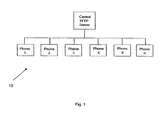
- Figure 1 is a schematic view of an exemplary PBX network
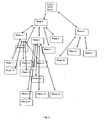
- Figure 2 is a schematic view showing communication among phones within the PBX network of Figure 1 for establishing a distributed TFTP network according to the present invention.
- Figure 3 is a timing diagram showing operation of the distributed TFTP network of Figure 2 .
- the network 10 includes a central TFTP server and a plurality of IP phones.
- the phones are linked to the central TFTP server via a local area network (LAN) in a manner that is well known in the art.
- the phones may alternatively be linked to the TFTP server via a wireless connection or any medium that supports a TCP/IP network.
- Each phone contains a TFTP client that has the ability to transform itself into a TFTP server.
- a phone may download software from the central TFTP server or, alternatively, may download software from another phone that has transformed itself into a TFTP server.
- An example of a distributed TFTP method is shown in Figure 2 in which phones 1, 2, 3 and 5 have transformed into TFTP servers in order to service other phones. Once a phone has downloaded the software from the central TFTP server or another phone, it can transform itself into a TFTP server. As such, the number of TFTP servers that are available to the network 10 grows over time.
- Each phone is provided with two IP addresses.
- the first IP address is the central TFTP server IP address.
- the second IP address is used to allow the phones to communicate with one another and may be either a multicast group address or a broadcast address.
- the TFTP sessions between the phones and the central TFTP server are unicast.
- the TFTP sessions between the phones and a phone that has transformed itself into a TFTP server are also unicast.
- the phones only use multicasts or broadcasts to communicate server status with one another.
- the phones determine that the distributed TFTP method is being used by the network 10 from the DHCP options or from manual entry, i.e. because there are two TFTP IP addresses.
- the phones know that they are to attempt the distributed TFTP method if one of the TFTP addresses provided to them is a multicast or broadcast IP address. Such addresses can be identified because they fall in the range of 224.0.0.0 to 239.255.255.255. If the phones detect a TFTP IP address in this range, they determine that the distributed TFTP method is being used.
- each phone institutes a random back off prior to attempting TFTP. All phones must observe and complete a random back off before attempting to initiate a TFTP session.
- a phone When a phone completes a TFTP download, it transmits a "TFTP Server Ready" message using the designated communication protocol dictated by DHCP or manual entry.
- the information that is transmitted with the "TFTP Server Ready” message includes: set type, filename available, file revision number, phone IP address and phone MAC address.
- Each time a phone in a random back off state reads a "TFTP Server Ready” message with a corresponding set type and filename, it adds the TFTP server to it's TFTP server list. Each new TFTP server is added to the top of the list.
- the central TFTP server which the phone discovers via DHCP or manual entry, remains at the bottom of the list.
- phones When searching for a TFTP server, phones start at the top of their TFTP server list and continue down the list until an available TFTP server is found. Phones that are in TFTP server mode service five TFTP sessions, either sequentially or concurrently. Additional TFTP session requests are answered with a TFTP error message. If a phone is rejected, the phone then attempts a TFTP session with the next TFTP server on it's TFTP server list. Phones that are in TFTP server mode resume normal operation if they have completed five TFTP session requests or if they have completed less than 5 TFTP session requests and more than 10 seconds has elapsed since their last TFTP session request. Once a phone has resumed normal operation, further TFTP requests from other phones are denied.
- Figure 3 shows a chart of a distributed TFTP phone scheme.
- the phone with the shortest random back off (phone 3 in Figure 3 ) is generally the first to initiate and complete a TFTP session with the central TFTP server.
- the sequence of events is as follows. Initially, phone 3's TFTP server list is populated by a single IP address, the central TFTP server. Phone 3 then initiates a TFTP session with the central TFTP server. Once the TFTP session is complete, phone 3 sends the "TFTP Server Ready" message to the local area network. Other phones that are just completing their random back off and require the same software filename, add the new TFTP server (phone 3) to the top of the their TFTP server list. The other phones then initiate TFTP sessions with the new TFTP server.
- phone 3 downloads software to a single phone (phone 2) rather than the maximum permitted 5 phones. This is because by the time the next phone (phone 7) requests a TFTP session, additional phones (phone 8 and phone 4) have completed their TFTP sessions and been added to the top of the available server list. Therefore, following the software download to phone 2, phone 3 resumes normal operation and denies further TFTP requests from other phones 10 seconds after the TFTP session request from phone 2.
- the phones 14 are used to download software for other IP phones or to download the software to devices other than IP phones, such as personal digital assistants (PDAs), faxes and printers, for example.
- PDAs personal digital assistants
- the phones are programmed to download binaries meant for other devices. The phones 14 would have to modify the information in their broadcasts accordingly.
- An aspect of the invention comprises a computer program executed on an IP device to provide a TFTP client which can convert to a TFTP server and implement the above described method.
- a further aspect of the invention comprises a storage medium storing the above computer program.
Landscapes
- Engineering & Computer Science (AREA)
- Computer Networks & Wireless Communication (AREA)
- Signal Processing (AREA)
- Computer And Data Communications (AREA)
- Information Transfer Between Computers (AREA)
Description
- The present invention relates to communication systems, in particular, to a distributed TFTP server network for downloading software to a plurality of devices connected to the network.
- In medium size and large businesses, communication between devices is typically established over a network, such as a LAN or a WAN, for example. In order to communicate over the network, devices such as IP phones, computers, or other network devices must be assigned an IP address. This is normally accomplished by the device requesting an IP address from a server using Dynamic Host Configuration Protocol (DHCP). In addition, when the device is first connected to the network or when software upgrades are required, devices such as IP phones customarily incorporate a TFTP client in order to download software, including executable binary files, from a central TFTP server, such as a PBX. TFTP (Trivial File Transfer Protocol) is a simple file transfer protocol used for downloading bootcode to diskless devices, such as IP phones. TFTP is set forth in RFC 1350 published by the Network Working Group in July 1992.
- However, the PBX is only able to perform a limited number of concurrent TFTP sessions because each TFTP session between a phone client and the PBX burdens the processing capability of the PBX.
- The size of the downloaded executable binary files has grown from approximately 256 KB to approximately 4 MB and continues to grow. At the same time, the size of PBXs continues to grow, with increasing numbers of phones. The large size of the executable binary files and the increased number of phones connected to the PBX compromises the performance of the PBX. Bandwidth utilization and upgrade time for all connected phones is also impacted.
- Many PBX configurations include remote campuses routed over T1 links and other bandwidth limited media to a central TFTP server. IP fragmentation in routed networks and narrow communication connections results in TFTP download times becoming onerous. In addition, the processing capability of the PBX is impacted by phones performing DHCP, attempting to make TCP connections or attempting SSL or other secure protocols on top of TCP.
- It is therefore desirable to improve TFTP download time from a PBX to multiple IP phones, and otherwise reduce the processing burden on the PBX.
US 2003/0028623A1 describes a distributed computing system that facilitates receiving content at a client from one or more servers that can potentially provide the content. The client starts by sending a request for the content to a directory server. In response to the request, the client receives a list of candidate servers that can potentially provide the content from the directory server. Once the client has received the list of candidate servers, the client sends a request to one or more of the candidate servers for the content, and subsequently receives the content from one or more of the candidate servers.
Aspects of the present invention are set out in the appended independent claims. - An embodiment of the present invention provides a method for providing a distributed TFTP server network among a plurality of IP devices, the method including:
- providing a plurality of IP devices, each of the IP devices being in communication with a central TFTP server;
- each IP device maintaining a list of available servers, the central TFTP server remaining at the bottom of the list of available servers;
- at least one IP device selecting a TFTP server from the top of the list of available servers and attempting to connect to the TFTP server;
- downloading software from the TFTP server to the at least one IP device;
- the at least one IP device sending a server ready signal over the distributed TFTP server network following successful download of the software whereupon the at least one IP device is added to the top of the list of available servers and operates as a further TFTP server for allowing other IP devices in the distributed TFTP server network to attempt to connect to the further TFTP server for downloading the software.
- The distributed TFTP method of the embodiment reduces the number of TFTP clients that the central TFTP server (i.e. PBX) must service. Further, the distributed TFTP method reduces the number of router hops and possible MTU (Maximum Transmission Unit) fragmentation between the TFTP servers and TFTP clients. Additionally, TFTP traffic over the external communication links of remote campuses will also be reduced.
- The invention will be better understood with reference to the following Figures in which like numerals denote like parts and in which:
-
Figure 1 is a schematic view of an exemplary PBX network; -
Figure 2 is a schematic view showing communication among phones within the PBX network ofFigure 1 for establishing a distributed TFTP network according to the present invention; and -
Figure 3 is a timing diagram showing operation of the distributed TFTP network ofFigure 2 . - Referring to
Figure 1 , a schematic overview of aPBX network 10 is generally shown. Thenetwork 10 includes a central TFTP server and a plurality of IP phones. The phones are linked to the central TFTP server via a local area network (LAN) in a manner that is well known in the art. The phones may alternatively be linked to the TFTP server via a wireless connection or any medium that supports a TCP/IP network. - Each phone contains a TFTP client that has the ability to transform itself into a TFTP server. As such, a phone may download software from the central TFTP server or, alternatively, may download software from another phone that has transformed itself into a TFTP server. An example of a distributed TFTP method is shown in
Figure 2 in whichphones network 10 grows over time. - Each phone is provided with two IP addresses. The first IP address is the central TFTP server IP address. The second IP address is used to allow the phones to communicate with one another and may be either a multicast group address or a broadcast address. The TFTP sessions between the phones and the central TFTP server are unicast. Similarly, the TFTP sessions between the phones and a phone that has transformed itself into a TFTP server are also unicast. The phones only use multicasts or broadcasts to communicate server status with one another.
- The phones determine that the distributed TFTP method is being used by the
network 10 from the DHCP options or from manual entry, i.e. because there are two TFTP IP addresses. The phones know that they are to attempt the distributed TFTP method if one of the TFTP addresses provided to them is a multicast or broadcast IP address. Such addresses can be identified because they fall in the range of 224.0.0.0 to 239.255.255.255. If the phones detect a TFTP IP address in this range, they determine that the distributed TFTP method is being used. - In the distributed TFTP method, each phone institutes a random back off prior to attempting TFTP. All phones must observe and complete a random back off before attempting to initiate a TFTP session.
- When a phone completes a TFTP download, it transmits a "TFTP Server Ready" message using the designated communication protocol dictated by DHCP or manual entry. The information that is transmitted with the "TFTP Server Ready" message includes: set type, filename available, file revision number, phone IP address and phone MAC address. Each time a phone in a random back off state reads a "TFTP Server Ready" message with a corresponding set type and filename, it adds the TFTP server to it's TFTP server list. Each new TFTP server is added to the top of the list. The central TFTP server, which the phone discovers via DHCP or manual entry, remains at the bottom of the list.
- When searching for a TFTP server, phones start at the top of their TFTP server list and continue down the list until an available TFTP server is found. Phones that are in TFTP server mode service five TFTP sessions, either sequentially or concurrently. Additional TFTP session requests are answered with a TFTP error message. If a phone is rejected, the phone then attempts a TFTP session with the next TFTP server on it's TFTP server list. Phones that are in TFTP server mode resume normal operation if they have completed five TFTP session requests or if they have completed less than 5 TFTP session requests and more than 10 seconds has elapsed since their last TFTP session request. Once a phone has resumed normal operation, further TFTP requests from other phones are denied.
-
Figure 3 shows a chart of a distributed TFTP phone scheme. As shown, the phone with the shortest random back off (phone 3 inFigure 3 ) is generally the first to initiate and complete a TFTP session with the central TFTP server. Forphone 3, the sequence of events is as follows. Initially,phone 3's TFTP server list is populated by a single IP address, the central TFTP server.Phone 3 then initiates a TFTP session with the central TFTP server. Once the TFTP session is complete,phone 3 sends the "TFTP Server Ready" message to the local area network. Other phones that are just completing their random back off and require the same software filename, add the new TFTP server (phone 3) to the top of the their TFTP server list. The other phones then initiate TFTP sessions with the new TFTP server. - In the scenario depicted in
Figure 3 ,phone 3 downloads software to a single phone (phone 2) rather than the maximum permitted 5 phones. This is because by the time the next phone (phone 7) requests a TFTP session, additional phones (phone 8 and phone 4) have completed their TFTP sessions and been added to the top of the available server list. Therefore, following the software download tophone 2,phone 3 resumes normal operation and denies further TFTP requests fromother phones 10 seconds after the TFTP session request fromphone 2. - In another embodiment, the
phones 14 are used to download software for other IP phones or to download the software to devices other than IP phones, such as personal digital assistants (PDAs), faxes and printers, for example. In order to download software to devices other than IP phones, the phones are programmed to download binaries meant for other devices. Thephones 14 would have to modify the information in their broadcasts accordingly. - A specific embodiment of the present invention has been shown and described herein. However, modifications and variations may occur to those skilled in the art. All such modifications and variations are believed to be within the scope of the present invention.
- An aspect of the invention comprises a computer program executed on an IP device to provide a TFTP client which can convert to a TFTP server and implement the above described method.
- A further aspect of the invention comprises a storage medium storing the above computer program.
Claims (10)
- A method for providing a distributed TFTP server network (10) among a plurality of IP devices, said method comprising:providing said plurality of IP devices (1 to n), each of said IP devices being in communication with a central TFTP server;each IP device maintaining a list of available servers;at least one IP device selecting a TFTP server from said list of available servers and attempting to connect to said TFTP server;downloading information from said TFTP server to said at least one IP device;said at least one IP device sending a server ready signal over said distributed TFTP server network following successful download of said information whereupon said at least one IP device is added to the top of said list of available servers and operates as a further TFTP server for enabling other IP devices in said distributed TFTP server network to attempt to connect to said further TFTP server for downloading said information.
- A method as claimed in claim 1, wherein each of said IP devices waits a random back off period following power up and prior to attempting to connect to either said TFTP server or said further TFTP server.
- A method as claimed in claim 2, wherein said IP device having the shortest random back off period connects to the central TFTP server.
- A method as claimed in claim 1, wherein said IP device is an IP phone.
- A method as claimed in claim 1, wherein said information comprises software.
- An IP device (1 to n) for use in a distributed TFTP server network (10) in which a plurality of IP devices are adapted to communicate with a central TFTP server, said IP device comprising:a TFTP client for communicating with a TFTP server;means for maintaining a list of available servers including said central TFTP servermeans for downloading information from said TFTP server; andmeans for sending a signal to said plurality of IP devices after said IP device has successfully downloaded information from said TFTP server, said IP device being added top-most on said list of available servers and said IP device, whereby said IP device operates as a further TFTP server for enabling other IP devices in said distributed TFTP server network to attempt to connect to said further TFTP server for downloading said information.
- An IP device as claimed in claim 6, wherein said IP device is an IP phone.
- An IP device as claimed in claim 6, wherein said information comprises software.
- A computer program comprising instructions for controlling an IP device when executed by a processor of the device to carry out all of the steps of a method carried out by the IP device according to any of claims 1 to 5.
- A storage medium storing a computer program as claimed in claim 9.
Priority Applications (4)
| Application Number | Priority Date | Filing Date | Title |
|---|---|---|---|
| EP05257443A EP1793558B1 (en) | 2005-12-02 | 2005-12-02 | Distributed server network |
| DE602005010723T DE602005010723D1 (en) | 2005-12-02 | 2005-12-02 | Distributed server network |
| CA002568697A CA2568697C (en) | 2005-12-02 | 2006-11-23 | Distributed server network |
| US11/563,231 US20070130354A1 (en) | 2005-12-02 | 2006-11-27 | Distributed Server Network |
Applications Claiming Priority (1)
| Application Number | Priority Date | Filing Date | Title |
|---|---|---|---|
| EP05257443A EP1793558B1 (en) | 2005-12-02 | 2005-12-02 | Distributed server network |
Publications (2)
| Publication Number | Publication Date |
|---|---|
| EP1793558A1 EP1793558A1 (en) | 2007-06-06 |
| EP1793558B1 true EP1793558B1 (en) | 2008-10-29 |
Family
ID=35840285
Family Applications (1)
| Application Number | Title | Priority Date | Filing Date |
|---|---|---|---|
| EP05257443A Expired - Fee Related EP1793558B1 (en) | 2005-12-02 | 2005-12-02 | Distributed server network |
Country Status (4)
| Country | Link |
|---|---|
| US (1) | US20070130354A1 (en) |
| EP (1) | EP1793558B1 (en) |
| CA (1) | CA2568697C (en) |
| DE (1) | DE602005010723D1 (en) |
Families Citing this family (4)
| Publication number | Priority date | Publication date | Assignee | Title |
|---|---|---|---|---|
| US20080222236A1 (en) * | 2006-11-27 | 2008-09-11 | Christopher James Nason | Method and system for processing data on a plurality of communication devices |
| CN101170442B (en) * | 2007-11-29 | 2010-08-11 | 中国联合网络通信集团有限公司 | Software online upgrade method and system |
| CN101854745B (en) * | 2009-04-02 | 2014-09-10 | 中兴通讯股份有限公司 | Transmission method of software version and device thereof |
| US11381634B1 (en) | 2021-08-03 | 2022-07-05 | International Business Machines Corporation | TFTP (trivial file transfer protocol) broadcast controller |
Family Cites Families (11)
| Publication number | Priority date | Publication date | Assignee | Title |
|---|---|---|---|---|
| EP0993163A1 (en) * | 1998-10-05 | 2000-04-12 | Backweb Technologies Ltd. | Distributed client-based data caching system and method |
| US7162538B1 (en) * | 2000-10-04 | 2007-01-09 | Intel Corporation | Peer to peer software distribution system |
| KR100467643B1 (en) * | 2000-12-28 | 2005-01-24 | 엘지전자 주식회사 | Method for multimedia data transmission in wireless LAN |
| AU2002324615A1 (en) * | 2001-08-04 | 2003-02-24 | Kontiki, Inc. | Method and apparatus for facilitating secure distributed content delivery across a computer network |
| US20030069946A1 (en) * | 2001-10-05 | 2003-04-10 | Adc Telecommunications, Inc. | Central directory server |
| US8780770B2 (en) * | 2002-05-13 | 2014-07-15 | Misonimo Chi Acquisition L.L.C. | Systems and methods for voice and video communication over a wireless network |
| JP2004328604A (en) * | 2003-04-28 | 2004-11-18 | Nec Corp | Ip telephony service system, and charging processing method |
| KR20050080504A (en) * | 2004-02-10 | 2005-08-17 | (주)씨앤에스 테크놀로지 | Upgrade firmware system of internet video phone and method for employing as the same |
| US20060242318A1 (en) * | 2005-04-21 | 2006-10-26 | Paul Nettle | Method and apparatus for cascading media |
| US20070047520A1 (en) * | 2005-08-31 | 2007-03-01 | Byers Charles C | Method for calling multimedia IP units about an impending emergency situation |
| US20070116227A1 (en) * | 2005-10-11 | 2007-05-24 | Mikhael Vitenson | System and method for advertising to telephony end-users |
-
2005
- 2005-12-02 EP EP05257443A patent/EP1793558B1/en not_active Expired - Fee Related
- 2005-12-02 DE DE602005010723T patent/DE602005010723D1/en not_active Expired - Lifetime
-
2006
- 2006-11-23 CA CA002568697A patent/CA2568697C/en not_active Expired - Fee Related
- 2006-11-27 US US11/563,231 patent/US20070130354A1/en not_active Abandoned
Also Published As
| Publication number | Publication date |
|---|---|
| CA2568697C (en) | 2009-09-08 |
| CA2568697A1 (en) | 2007-06-02 |
| EP1793558A1 (en) | 2007-06-06 |
| DE602005010723D1 (en) | 2008-12-11 |
| US20070130354A1 (en) | 2007-06-07 |
Similar Documents
| Publication | Publication Date | Title |
|---|---|---|
| JP4198053B2 (en) | Method and apparatus for facilitating distribution and delivery of content over a computer network | |
| US7350068B2 (en) | Server blade network boot method that minimizes required network bandwidth | |
| US7620816B1 (en) | System and method for automatic selection of service provider for efficient use of bandwidth and resources in a peer-to-peer network environment | |
| US20080109533A1 (en) | Method and apparatus for distributing computer files across a network | |
| TW201344576A (en) | Firmware upgrade method and system and terminal device using the method | |
| US20030061333A1 (en) | System and method for universal networked device management | |
| JP2001356973A (en) | Network system | |
| US20090130971A1 (en) | Method & apparatus for distributing files in a communications network | |
| US20070043874A1 (en) | File transfer method and system | |
| WO2004098143A1 (en) | System and method for mobile unit session management across a wireless communication network | |
| CN103379142A (en) | Terminal device firmware upgrading method and system | |
| US8571061B2 (en) | Inter-network translation | |
| US20050120135A1 (en) | Method and apparatus for configuring a router | |
| US20060056379A1 (en) | System and method for network-assisted connection in a wireless environment | |
| KR20050080707A (en) | System and method for trivial file transfer protocol including broadcasting function | |
| CA2568697C (en) | Distributed server network | |
| WO2005015416A1 (en) | Synchronization extent of mail client based on data link characteristics | |
| RU2317650C2 (en) | Communication system, computer-filter of messages of equivalent nodes and method for processing messages from equivalent nodes | |
| US20090248839A1 (en) | Using a proxy to redirect downloads | |
| US7564854B2 (en) | Network architecture with a light-weight TCP stack | |
| CN101316213B (en) | Distributed server network | |
| JP5413940B2 (en) | Thin client network, thin client, unauthorized connection prevention device, operation method thereof, and recording medium | |
| JP4642674B2 (en) | Terminal management system | |
| JP4785338B2 (en) | Data transfer method, communication system, and communication apparatus | |
| CN115150363B (en) | IP address updating method, gateway device, gateway down-hanging device and storage medium |
Legal Events
| Date | Code | Title | Description |
|---|---|---|---|
| PUAI | Public reference made under article 153(3) epc to a published international application that has entered the european phase |
Free format text: ORIGINAL CODE: 0009012 |
|
| AK | Designated contracting states |
Kind code of ref document: A1 Designated state(s): AT BE BG CH CY CZ DE DK EE ES FI FR GB GR HU IE IS IT LI LT LU LV MC NL PL PT RO SE SI SK TR |
|
| AX | Request for extension of the european patent |
Extension state: AL BA HR MK YU |
|
| 17P | Request for examination filed |
Effective date: 20070917 |
|
| 17Q | First examination report despatched |
Effective date: 20071019 |
|
| AKX | Designation fees paid |
Designated state(s): DE FR GB |
|
| GRAP | Despatch of communication of intention to grant a patent |
Free format text: ORIGINAL CODE: EPIDOSNIGR1 |
|
| GRAS | Grant fee paid |
Free format text: ORIGINAL CODE: EPIDOSNIGR3 |
|
| GRAA | (expected) grant |
Free format text: ORIGINAL CODE: 0009210 |
|
| AK | Designated contracting states |
Kind code of ref document: B1 Designated state(s): DE FR GB |
|
| REG | Reference to a national code |
Ref country code: GB Ref legal event code: FG4D |
|
| REF | Corresponds to: |
Ref document number: 602005010723 Country of ref document: DE Date of ref document: 20081211 Kind code of ref document: P |
|
| PLBE | No opposition filed within time limit |
Free format text: ORIGINAL CODE: 0009261 |
|
| STAA | Information on the status of an ep patent application or granted ep patent |
Free format text: STATUS: NO OPPOSITION FILED WITHIN TIME LIMIT |
|
| 26N | No opposition filed |
Effective date: 20090730 |
|
| PGFP | Annual fee paid to national office [announced via postgrant information from national office to epo] |
Ref country code: DE Payment date: 20121128 Year of fee payment: 8 |
|
| PGFP | Annual fee paid to national office [announced via postgrant information from national office to epo] |
Ref country code: GB Payment date: 20121128 Year of fee payment: 8 |
|
| PGFP | Annual fee paid to national office [announced via postgrant information from national office to epo] |
Ref country code: FR Payment date: 20130107 Year of fee payment: 8 |
|
| REG | Reference to a national code |
Ref country code: DE Ref legal event code: R119 Ref document number: 602005010723 Country of ref document: DE |
|
| GBPC | Gb: european patent ceased through non-payment of renewal fee |
Effective date: 20131202 |
|
| REG | Reference to a national code |
Ref country code: DE Ref legal event code: R119 Ref document number: 602005010723 Country of ref document: DE Effective date: 20140701 |
|
| REG | Reference to a national code |
Ref country code: FR Ref legal event code: ST Effective date: 20140829 |
|
| PG25 | Lapsed in a contracting state [announced via postgrant information from national office to epo] |
Ref country code: DE Free format text: LAPSE BECAUSE OF NON-PAYMENT OF DUE FEES Effective date: 20140701 |
|
| PG25 | Lapsed in a contracting state [announced via postgrant information from national office to epo] |
Ref country code: GB Free format text: LAPSE BECAUSE OF NON-PAYMENT OF DUE FEES Effective date: 20131202 Ref country code: FR Free format text: LAPSE BECAUSE OF NON-PAYMENT OF DUE FEES Effective date: 20131231 |