EP1793519A2 - Method and apparatus for dynamic switching of space-time coding/decoding mode - Google Patents
Method and apparatus for dynamic switching of space-time coding/decoding mode Download PDFInfo
- Publication number
- EP1793519A2 EP1793519A2 EP06023507A EP06023507A EP1793519A2 EP 1793519 A2 EP1793519 A2 EP 1793519A2 EP 06023507 A EP06023507 A EP 06023507A EP 06023507 A EP06023507 A EP 06023507A EP 1793519 A2 EP1793519 A2 EP 1793519A2
- Authority
- EP
- European Patent Office
- Prior art keywords
- space
- time
- coding mode
- channel
- coding
- Prior art date
- Legal status (The legal status is an assumption and is not a legal conclusion. Google has not performed a legal analysis and makes no representation as to the accuracy of the status listed.)
- Granted
Links
- 238000000034 method Methods 0.000 title claims abstract description 29
- 230000001427 coherent effect Effects 0.000 claims abstract description 70
- 238000013507 mapping Methods 0.000 claims abstract description 30
- 239000000969 carrier Substances 0.000 claims description 25
- 238000005259 measurement Methods 0.000 abstract description 5
- 238000010586 diagram Methods 0.000 description 13
- 230000001360 synchronised effect Effects 0.000 description 8
- 230000005540 biological transmission Effects 0.000 description 7
- 239000011159 matrix material Substances 0.000 description 6
- 238000005562 fading Methods 0.000 description 5
- 239000013256 coordination polymer Substances 0.000 description 3
- 238000004891 communication Methods 0.000 description 2
- 230000000694 effects Effects 0.000 description 2
- 238000010295 mobile communication Methods 0.000 description 2
- 238000013461 design Methods 0.000 description 1
- 238000012986 modification Methods 0.000 description 1
- 230000004048 modification Effects 0.000 description 1
- 238000005070 sampling Methods 0.000 description 1
Images



Classifications
-
- H—ELECTRICITY
- H04—ELECTRIC COMMUNICATION TECHNIQUE
- H04L—TRANSMISSION OF DIGITAL INFORMATION, e.g. TELEGRAPHIC COMMUNICATION
- H04L1/00—Arrangements for detecting or preventing errors in the information received
- H04L1/0001—Systems modifying transmission characteristics according to link quality, e.g. power backoff
- H04L1/0009—Systems modifying transmission characteristics according to link quality, e.g. power backoff by adapting the channel coding
-
- H—ELECTRICITY
- H04—ELECTRIC COMMUNICATION TECHNIQUE
- H04L—TRANSMISSION OF DIGITAL INFORMATION, e.g. TELEGRAPHIC COMMUNICATION
- H04L1/00—Arrangements for detecting or preventing errors in the information received
- H04L1/02—Arrangements for detecting or preventing errors in the information received by diversity reception
- H04L1/06—Arrangements for detecting or preventing errors in the information received by diversity reception using space diversity
- H04L1/0606—Space-frequency coding
-
- H—ELECTRICITY
- H04—ELECTRIC COMMUNICATION TECHNIQUE
- H04L—TRANSMISSION OF DIGITAL INFORMATION, e.g. TELEGRAPHIC COMMUNICATION
- H04L1/00—Arrangements for detecting or preventing errors in the information received
- H04L1/02—Arrangements for detecting or preventing errors in the information received by diversity reception
- H04L1/06—Arrangements for detecting or preventing errors in the information received by diversity reception using space diversity
- H04L1/0618—Space-time coding
- H04L1/0637—Properties of the code
- H04L1/0643—Properties of the code block codes
-
- H—ELECTRICITY
- H04—ELECTRIC COMMUNICATION TECHNIQUE
- H04L—TRANSMISSION OF DIGITAL INFORMATION, e.g. TELEGRAPHIC COMMUNICATION
- H04L1/00—Arrangements for detecting or preventing errors in the information received
- H04L1/0001—Systems modifying transmission characteristics according to link quality, e.g. power backoff
- H04L1/0023—Systems modifying transmission characteristics according to link quality, e.g. power backoff characterised by the signalling
- H04L1/0026—Transmission of channel quality indication
Definitions
- the present invention relates to the 4 th generation mobile communication technique, particularly to method and apparatus for dynamic switching of space-time coding/decoding mode based on channel status information for a MIMO-OFDM system.
- a Multiple-Input Multiple-Output (MIMO) system is capable of obtaining frequency efficiency proportional to the number of transmit antennas in an environment of rich scattering and of obtaining very high wireless transmission rate in a condition of not sacrificing frequency resource and transmit power, and thereby it is widely concerned.
- Orthogonal Frequency Division Multiplexing (OFDM) system modulates transmit symbols onto orthogonal narrowband sub-carriers so that the symbols transmitted on each sub-carrier is only subject to flat fading and thus design for receivers is largely simplified, which is an efficient solution to high rate wireless data transmission under multipath fading channels.
- OFDM Orthogonal Frequency Division Multiplexing
- MIMO has two basic space-time structures. One is space-time coding and the main object thereof is to obtain coding gain. The other is space multiplexing and the main object thereof is to obtain data rate gain.
- space-time coding schemes There are three basic structures in space-time coding schemes: it is referred to as space-time block coding if space diversity is obtained by jointly coding the transmitted information symbol stream in space and time domains; it is referred to as space-frequency block coding if space diversity is obtained by jointly coding the transmitted information symbol stream in space and frequency domains; it is referred to as space-time-frequency block coding if space diversity is obtained by jointly coding the transmitted information symbol stream in space, time and frequency domains.
- the space-time block coding and the space-frequency block coding (it is recorded as space-time/space-frequency block coding) is more efficient in an actual application since the space-time-frequency coding relatively has high complexity and low flexibility.
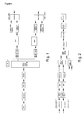
- Figure 1 and Figure 2 respectively illustrated structures of transmitter and receiver for space-time block coding or space-frequency block coding in an existing MIMO-OFDM system.
- the transmitted source bit sequence is mapped to a modulated constellation to generate a modulated symbol sequence after channel coding and interleaving.
- the modulated symbol sequence is space-time block coded (space-frequency block coded) to generate two sets of symbol streams respectively corresponding to transmit antenna 1 and transmit antenna 2.
- pilot symbols are inserted according to pilot pattern
- the respective symbol streams of the transmit antennas are inverse fast fourier transformed (IFFT) to generate OFDM symbols, each of which has circle prefix inserted at the head to generate a spread OFDM symbol.
- IFFT inverse fast fourier transformed
- a number of spread OFDM symbols form a time slot
- a pseudo random synchronization sequence is inserted prior to each time slot for timing synchronization.
- a number of time slots form a transmission frame of minimum transmission unit.
- the received symbols streams are first frame synchronized, time slot synchronized and symbol synchronized based on synchronization sequences.
- the synchronized spread OFDM symbols are fast fourier transformed (FFT) after the circle prefix is removed.
- FFT fast fourier transformed
- a frequency domain pilot is extracted from the OFDM sub-carrier for channel estimation.
- the estimated channel frequency response is assistant for decoding of remain data symbols by a space-time block coding decoder/a space-frequency block coding decoder.
- the generated symbol streams are demodulated, deinterleaved and channel decoded to generate an estimated source bit sequence.
- the pre-transmitted modulated symbols S1 and S2 are coded by a space-frequency block coder to generate a symbol stream S 1, S 1* S 2 and - S 2* Then, S 1 and S 1* are mapped to adjacent sub-carriers of the same OFDM symbol and transmitted by antenna 1; S 2 and - S 2* are mapped to adjacent sub-carriers of the same OFDM symbol and transmitted by antenna 2.
- the next set of pre-transmitted modulated symbols S3 and S4 are coded by the space-frequency block coder to generate a symbol stream S 3 , S 3*, S 4 and - S 4*. Then, S 3 and - S 4* are mapped to adjacent sub-carriers of the same OFDM symbol and transmitted by antenna 1; S 4 and S 3* are mapped to adjacent sub-carriers of the same OFDM symbol and transmitted by antenna 2.
- the pre-transmitted modulated symbols S1 and S2 are coded by a space-time block coder to generate a symbol stream S 1, S 1*, S 2 and - S 2*. Then, S 1 and - S 2* are mapped to adjacent sub-carriers of the same OFDM symbol and transmitted by antenna 1; S 2 and S 1* are mapped to adjacent sub-carriers of the same OFDM symbol and transmitted by antenna 2.
- the pre-transmitted modulated symbols S3 and S4 are coded by the space-time block coder to generate a symbol stream S3, S 3*, S 4 and - S 4*. Then, S 3 and - S 4* are mapped to adjacent sub-carriers of the same OFDM symbol and transmitted by antenna 1; S 4 and S 3* are mapped to adjacent sub-carriers of the same OFDM symbol and transmitted by antenna 2.
- the channel matrix is constant between adjacent coded OFDM symbols in the space-time block coding designed based on orthogonal signals.
- the symbol interval of the OFDM system largely increases compared with a single carrier system with the same bandwidth so that the condition that the channel matrix is constant between adjacent coded OFDM symbols is difficult to be achieved, and thus the performance of space-time block coding is degraded.
- the channel matrix is constant between adjacent coded OFDM symbols in the space-frequency block coding designed based on orthogonal signals.
- the actual channel is usually frequency-selective, so that the condition that the channel matrix is constant between adjacent coded OFDM symbols is difficult to be achieved, and thus the performance of space-frequency block coding is degraded.
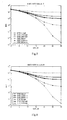
- Figure 5 and Figure 6 respectively illustrate comparison of performances of the space-time block coding and the space-frequency block coding at different delay spreading and different moving speed.
- delay spreading of channel is less, the same bit error rate (BER) performance is obtained in a range of moving speed of 5-120kmph for the space-frequency block coding (SFBC).
- SFBC space-frequency block coding
- delay spreading of channel is greater, performance will be badly degraded in a variety of ranges of moving speed for the space-frequency block coding, which attributes to channel frequency-selection caused by greater delay spreading resulting in non-constant between adjacent carriers of the space-time block coding.
- the space-time coding can operate at frequency-selective channels, but it is subject to effect on orthogonality by Doppler shift, which badly degrades performance; the space-frequency coding can operate at Doppler shift channels, but it is subject to effect on orthogonality by frequency-selection, which badly degrades performance.
- the present invention is directed to provide dynamic switching technique for space-time coding/decoding mode based on channel status information, by which advantages such as low complexity of space-time coding, stable performance under space associated channels, complete space diversity and etc. can remain while the application environment of space-time or space-frequency block coding in a OFDM system can be extended and thus a MIMO OFDM system can be applied in a number of complex propagation environments.
- the first of the present invention a method for dynamic switching of space-time coding mode.
- the method comprises: determining step for determining a space-time coding mode based on feedback information by a transmitter; mapping step for mapping the determined coding mode to a corresponding coder so that a number of sets symbol streams corresponding to respective transmit antennas are generated after coding a modulated symbol sequence for desired coding; and feedback step for periodically feeding used coding mode information back to a receiver via a forward control channel.
- the space-time coding mode comprises a space-time block coding mode and a space-frequency block coding mode.
- the feedback information of a reverse channel comprises coherent bandwidth and coherent time of the channel.
- the coherent bandwidth of the channel is set as bandwidth with a channel frequency response having a correlation coefficient greater than 0.5; said coherent time of the channel is set as a time interval with a channel impulse response having a correlation coefficient greater than 0.5.
- the rule for the determining space-time coding mode is that the space-frequency block coding is determined if the coherent bandwidth is greater than a given multiple of interval width between two sub-carriers.
- the rule for the determining space-time coding mode is that the space-time block coding is determined if the coherent time is greater than a given multiple of time interval between two spread OFDM symbols.
- the rule for the determining space-time coding mode is that the space-frequency block coding is determined if ⁇ ⁇ width between two sub - carriers correlation bandwidth is less than time interval between two OFDM symbols correlation time , wherein ⁇ is a experience coefficient associated with channel characteristics.
- the second of the present invention an apparatus for dynamic switching of space-time coding mode.
- the apparatus is arranged in a transmitter and comprises a determining unit, a first mapping unit and a first feedback unit connected in turn, wherein the determining unit is used for determining a space-time coding mode based on received feedback information of a reverse channel; the first mapping unit is used for mapping the determined coding mode to a corresponding coder so that a number of sets symbol streams corresponding to respective transmit antennas are generated after coding a modulated symbol sequence for desired coding; the first feedback unit is used for periodically feeding used coding mode information back to a receiver via a forward control channel.
- the space-time coding mode determined by the determining unit comprises a space-time block coding mode and a space-frequency block coding mode.
- the feedback information received by the determining unit comprises coherent bandwidth and coherent time of the channel.
- the coherent bandwidth of the channel is set as bandwidth with a channel frequency response having a correlation coefficient greater than 0.5; said coherent time of the channel is set as a time interval with a channel impulse response having a correlation coefficient greater than 0.5.
- the rule for the determining space-time coding mode by the determining unit is that the space-frequency block coding is determined if the coherent bandwidth is greater than a given multiple of interval width between two sub-carriers.
- the rule for the determining space-time coding mode by the determining unit is that the space-time block coding is determined if the coherent time is greater than a given multiple of time interval between two spread OFDM symbols.
- the rule for the determining space-time coding mode by the determining unit is that the space-frequency block coding is determined if ⁇ ⁇ width between two sub - carriers correlation bandwidth is less than time interval between two OFDM symbols correlation time , wherein ⁇ is a experience coefficient associated with channel characteristics.
- the third of the present invention a method for dynamic switching for space-time decoding mode.
- the method comprises: receiving step for receiving space-time coding mode information used at a transmitter and transmitted by a forward control channel; mapping step for mapping the received coding mode information to a decoder of a corresponding space-time decoding mode for decoding in a corresponding mode; and feedback step for feeding coherent bandwidth and coherent time of channel status information back to the transmitter via a reverse control channel.
- the space-time coding mode comprises a space-time block coding mode and a space-frequency block coding mode.
- the fourth of the present invention an apparatus for dynamic switching for space-time decoding mode.
- the apparatus is arranged in a receiver and comprises a receiving unit, a second mapping unit and a second feedback unit connected in turn, wherein the receiving unit is used for receiving space-time coding mode information used at a transmitter and transmitted by a forward control channel; the second mapping unit is used for mapping the received coding mode information to a decoder of a corresponding space-time decoding mode for decoding in a corresponding mode; and the second feedback unit is used for feeding coherent bandwidth and coherent time of channel status information back to the transmitter via a reverse control channel.
- the space-time coding mode comprises a space-time block coding mode and a space-frequency block coding mode.
- the fifth of the present invention a transmitter
- the features of the transmitter are that it comprises a coder with two modes of space-time block coding and space-frequency block coding and a switching means for space-time/space-frequency block coding mode, wherein the switching means for space-time/space-frequency block coding mode is used for determining coding mode based on information on coherent bandwidth and coherent time of a received reverse channel feedback and space-time block coding or space-frequency block coding a modulated symbol sequence for desired coding in a corresponding mode to generate a number of sets symbol streams corresponding to respective transmit antennas and further periodically feeding the used coding mode back to a receiver via a forward control channel.
- the sixth of the present invention a receiver
- the features of the receiver are that it comprises a decoder with two modes of space-time block coding and space-frequency block coding and a switching means for space-time/space-frequency block decoding mode, wherein the switching means for space-time/space-frequency block decoding mode is used for mapping the received space-time coding mode information to a decoder of a corresponding space-time decoding mode for decoding in a corresponding mode based on the space-time coding mode information used at a transmitter and transmitted by a forward control channel; and further feeding coherent bandwidth and coherent time of channel status information back to the transmitter via a reverse control channel.
- the present invention provides dynamic switching technique for space-time coding/decoding mode based on channel status information, coherent bandwidth and coherent time are defined as measurement of switching threshold and the corresponding switching policy is proposed to retain advantages such as low complexity of space-time coding, stable performance under space associated channels, complete space diversity and etc. and extend the application environment of space-time or space-frequency block coding in a OFDM system so that a MIMO OFDM system can be applied in a number of complex propagation environments.
- the transmitted source bit sequence is mapped to a modulated constellation to generate a modulated symbol sequence after channel coding and interleaving.
- the dynamic switching means for space-time coding mode is usually used as the dynamic switching means for space-time/space-frequency block coding mode, which determines space-time coding mode based on control information of the reverse channel feedback and space-time block codes or space-frequency block codes the modulated symbol sequence in a corresponding mode to generate three sets symbol streams respectively corresponding to transmit antenna 1, transmit antenna 2 and transmit antenna 3, while the used coding mode is periodically fed back to the receiver via a forward control channel.
- the respective symbol streams of the transmit antennas are inverse fast fourier transformed (IFFT) with length of N to generated OFDM symbols, each of which has circle prefix with length of CP samples inserted at the head to generated a spread OFDM symbol.
- IFFT inverse fast fourier transformed
- a number of spread OFDM symbols form a time slot, and a pseudo random synchronization sequence is inserted prior to each time slot for timing synchronization.
- a number of time slots form a transmission frame as a minimum transmission unit for transmission of symbols.
- the sampling frequency is f s Hz.
- the received symbols streams are first frame synchronized, time slot synchronized and symbol synchronized based on synchronization sequences.
- the synchronized spread OFDM symbols are fast fourier transformed (FFT) after the circle prefix is removed.
- FFT fast fourier transformed
- a MIMO-OFDM channel estimation unit performs channel estimation using a frequency domain pilot extracted from the OFDM symbols to generate a channel matrix and periodically estimates channel status information such as coherent bandwidth and coherent time.
- a dynamic switching means for space-time/space-frequency block decoding mode decodes the extracted data symbols in a corresponding mode using the channel matrix based on space-time/space-frequency coding mode used at the transmitter and demodulated by a forward control channel, while the coding mode is determined based on the periodically received coherent bandwidth and coherent time for channel and periodically fed back to the transmitter via a reverse control channel.
- the generated symbol streams are demodulated, deinterleaved and channel decoded to generate a estimated source bit sequence.
- Bandwidth with a channel frequency response having a correlation coefficient greater than 0.5 is set as the coherent bandwidth of channel B c , which depends on delay spreading of channel, which can be easily obtained from channel impulse response estimated by a channel estimator in the prior art or estimated by the circle prefix of the OFDM system and whose reciprocal can be approximated as the coherent bandwidth of channel.
- a time interval with a channel impulse response having a correlation coefficient greater than 0.5 is set as the coherent time of channel T c , which depends on Doppler shift of channel, which can be estimated by time domain correlation of channel impulse response estimated by the channel estimator in the prior art and whose reciprocal can be approximated as the coherent time of channel.
- a channel estimation unit can estimate the coherent bandwidth of channel and the coherent time of channel based on the estimated channel response.
- the estimation of the coherent time and coherent bandwidth of channel does not belong to the range of the present invention, so we always assume that the coherent bandwidth and the coherent time of channel is ideally estimated and the above estimation thereof will not be further described herein.
- the coherent bandwidth is largely greater than interval width between two sub-carriers, i.e. B c >> f s / N, then it can be considered that the channel within two sub-carriers is flat, that is, the channel frequency response within two sub-carriers is constant.
- space-frequency coding is performed between a number of antennas and two sub-carriers, and thus dynamic changes of channel will not degrade performance of space-frequency coding.
- the coherent time is largely greater than time interval between two spread OFDM symbols, i.e. T c > > 1 + CP N / f s , then it can be considered that the channel within two OFDM symbols is slowly fading, that is, the channel impulse response within two OFDM symbols is constant.
- space-time coding is performed between a number of antennas and two OFDM symbols, and thus dynamic changes of channel will not degrade performance of space-time coding.
- the coherent bandwidth and the coherent time of channel as measurement of dynamic adjustment for coding mode and the coding mode is set according to the following policy, in which when the space-time block coding mode is 0, it corresponds to space-frequency block coding; when the space-time block coding mode is 1, it corresponds to space-time block coding.
- Initializing step setting the space-time block coding mode as 0, coding the input modulated symbols based on the space-time block coding mode and determining whether feedback control information of a reverse channel is received;
- Space-time coding mode switching step setting a corresponding space-time coding mode based on feedback control information if the feedback control information is received; coding the input modulated symbols based on the space-time block coding mode, determining whether feedback control information of a reverse channel is received or not, if yes, setting a corresponding space-time coding mode based on feedback control information.
- Initializing step setting the space-time decoding mode based on control information, decoding the input modulated symbols based on the space-time decoding mode and determining whether channel status information is received from a channel estimation unit;
- Space-time decoding mode switching step making determination of the space-time decoding mode if channel status information is received from a channel estimation unit; decoding the input modulated symbols based on the space-time decoding mode, determining whether channel status information is received from a channel estimation unit, and making determination of the space-time decoding mode again.
- an apparatus for dynamic switching of space-time coding mode is arranged in a transmitter and comprises a determining unit 11, a first mapping unit 12 and a first feedback unit 13 connected in turn, wherein:
- an apparatus for dynamic switching for space-time decoding mode is arranged in a receiver and comprises a receiving unit 21, a second mapping unit 22 and a second feedback unit 23, wherein:
- the present invention provides dynamic switching method and apparatus for space-time coding/decoding mode based on channel status information, coherent bandwidth and coherent time are defined as measurement of switching threshold and the corresponding switching policy is proposed to retain advantages such as low complexity of space-time coding, stable performance under space associated channels, complete space diversity and etc. and extend the application environment of space-time or space-frequency block coding in a OFDM system so that a MIMO OFDM system can be applied in a number of complex propagation environments.
Landscapes
- Engineering & Computer Science (AREA)
- Computer Networks & Wireless Communication (AREA)
- Signal Processing (AREA)
- Quality & Reliability (AREA)
- Radio Transmission System (AREA)
- Compression, Expansion, Code Conversion, And Decoders (AREA)
- Executing Machine-Instructions (AREA)
Abstract
Description
- The present invention relates to the 4th generation mobile communication technique, particularly to method and apparatus for dynamic switching of space-time coding/decoding mode based on channel status information for a MIMO-OFDM system.
- A Multiple-Input Multiple-Output (MIMO) system is capable of obtaining frequency efficiency proportional to the number of transmit antennas in an environment of rich scattering and of obtaining very high wireless transmission rate in a condition of not sacrificing frequency resource and transmit power, and thereby it is widely concerned.
- An Orthogonal Frequency Division Multiplexing (OFDM) system modulates transmit symbols onto orthogonal narrowband sub-carriers so that the symbols transmitted on each sub-carrier is only subject to flat fading and thus design for receivers is largely simplified, which is an efficient solution to high rate wireless data transmission under multipath fading channels.
- It is assumed that the channel is flat in an existing MIMO structure, but the actual wireless communication channel is frequency-selective. Therefore, combination of MIMO and OFDM will meet requirement of MIMO on channel selection and is one of advanced wireless communication solutions in future.
- MIMO has two basic space-time structures. One is space-time coding and the main object thereof is to obtain coding gain. The other is space multiplexing and the main object thereof is to obtain data rate gain. There are three basic structures in space-time coding schemes: it is referred to as space-time block coding if space diversity is obtained by jointly coding the transmitted information symbol stream in space and time domains; it is referred to as space-frequency block coding if space diversity is obtained by jointly coding the transmitted information symbol stream in space and frequency domains; it is referred to as space-time-frequency block coding if space diversity is obtained by jointly coding the transmitted information symbol stream in space, time and frequency domains. Although diversity in space, time and frequency domains can be obtained by space-time-frequency coding, the space-time block coding and the space-frequency block coding (it is recorded as space-time/space-frequency block coding) is more efficient in an actual application since the space-time-frequency coding relatively has high complexity and low flexibility.
- The existing technical solution is described as follows taking example for a two-transmit-two-receive MIMO-OFDM system.
- Figure 1 and Figure 2 respectively illustrated structures of transmitter and receiver for space-time block coding or space-frequency block coding in an existing MIMO-OFDM system. In the transmitter, the transmitted source bit sequence is mapped to a modulated constellation to generate a modulated symbol sequence after channel coding and interleaving. The modulated symbol sequence is space-time block coded (space-frequency block coded) to generate two sets of symbol streams respectively corresponding to transmit
antenna 1 and transmitantenna 2. After pilot symbols are inserted according to pilot pattern, the respective symbol streams of the transmit antennas are inverse fast fourier transformed (IFFT) to generate OFDM symbols, each of which has circle prefix inserted at the head to generate a spread OFDM symbol. A number of spread OFDM symbols form a time slot, and a pseudo random synchronization sequence is inserted prior to each time slot for timing synchronization. A number of time slots form a transmission frame of minimum transmission unit. - In the receiver, the received symbols streams are first frame synchronized, time slot synchronized and symbol synchronized based on synchronization sequences. The synchronized spread OFDM symbols are fast fourier transformed (FFT) after the circle prefix is removed. A frequency domain pilot is extracted from the OFDM sub-carrier for channel estimation. The estimated channel frequency response is assistant for decoding of remain data symbols by a space-time block coding decoder/a space-frequency block coding decoder. The generated symbol streams are demodulated, deinterleaved and channel decoded to generate an estimated source bit sequence.
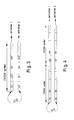
- The main differences between the space-time block coding and the space-frequency block coding are described as follows in Figure 3 and Figure 4.
- As shown in Figure 3, the pre-transmitted modulated symbols S1 and S2 are coded by a space-frequency block coder to generate a symbol stream S1, S1* S2 and -S2* Then, S1 and S1* are mapped to adjacent sub-carriers of the same OFDM symbol and transmitted by
antenna 1; S2 and -S2* are mapped to adjacent sub-carriers of the same OFDM symbol and transmitted byantenna 2. As such, the next set of pre-transmitted modulated symbols S3 and S4 are coded by the space-frequency block coder to generate a symbol stream S3, S3*, S4 and -S4*. Then, S3 and - S4* are mapped to adjacent sub-carriers of the same OFDM symbol and transmitted byantenna 1; S4 and S3* are mapped to adjacent sub-carriers of the same OFDM symbol and transmitted byantenna 2. - As shown in Figure 4, the pre-transmitted modulated symbols S1 and S2 are coded by a space-time block coder to generate a symbol stream S1, S1*, S2 and -S2*. Then, S1 and -S2* are mapped to adjacent sub-carriers of the same OFDM symbol and transmitted by
antenna 1; S2 and S1* are mapped to adjacent sub-carriers of the same OFDM symbol and transmitted byantenna 2. The pre-transmitted modulated symbols S3 and S4 are coded by the space-time block coder to generate a symbol stream S3, S3*, S4 and -S4*. Then, S3 and -S4* are mapped to adjacent sub-carriers of the same OFDM symbol and transmitted byantenna 1; S4 and S3* are mapped to adjacent sub-carriers of the same OFDM symbol and transmitted byantenna 2. - It is assumed that the channel matrix is constant between adjacent coded OFDM symbols in the space-time block coding designed based on orthogonal signals. However, the symbol interval of the OFDM system largely increases compared with a single carrier system with the same bandwidth so that the condition that the channel matrix is constant between adjacent coded OFDM symbols is difficult to be achieved, and thus the performance of space-time block coding is degraded. Particularly, since the future mobile communication system supports users with higher frequency band and higher moving speed, signals subject to fast fading will badly degrade performance of the space-time block coding. Similarly, the channel matrix is constant between adjacent coded OFDM symbols in the space-frequency block coding designed based on orthogonal signals. However, the actual channel is usually frequency-selective, so that the condition that the channel matrix is constant between adjacent coded OFDM symbols is difficult to be achieved, and thus the performance of space-frequency block coding is degraded.
- Figure 5 and Figure 6 respectively illustrate comparison of performances of the space-time block coding and the space-frequency block coding at different delay spreading and different moving speed. When delay spreading of channel is less, the same bit error rate (BER) performance is obtained in a range of moving speed of 5-120kmph for the space-frequency block coding (SFBC). Even when the moving speed is up to 500kmph, performance as good as at a low speed can be obtained for the space-frequency block coding if an ideal technique for removing interference between carriers is used. When delay spreading of channel is greater, performance will be badly degraded in a variety of ranges of moving speed for the space-frequency block coding, which attributes to channel frequency-selection caused by greater delay spreading resulting in non-constant between adjacent carriers of the space-time block coding. Similarly, good BER performance can be obtained for the space-time block coding at a low moving speed of 5kmph no matter how much the channel delay spreading is. However, in a range of moving speed of 120-150kmph, the performance of the space-time block coding is badly degraded, which attributes to fast channel fading caused by greater Doppler shift resulting in non-constant channel between coded symbols in the time domain.
- In one word, the space-time coding can operate at frequency-selective channels, but it is subject to effect on orthogonality by Doppler shift, which badly degrades performance; the space-frequency coding can operate at Doppler shift channels, but it is subject to effect on orthogonality by frequency-selection, which badly degrades performance.
- Therefore, there is a certain limit in the environment of any existing space-time coding scheme.
- The present invention is directed to provide dynamic switching technique for space-time coding/decoding mode based on channel status information, by which advantages such as low complexity of space-time coding, stable performance under space associated channels, complete space diversity and etc. can remain while the application environment of space-time or space-frequency block coding in a OFDM system can be extended and thus a MIMO OFDM system can be applied in a number of complex propagation environments.
- The first of the present invention: a method for dynamic switching of space-time coding mode.
- The method comprises: determining step for determining a space-time coding mode based on feedback information by a transmitter; mapping step for mapping the determined coding mode to a corresponding coder so that a number of sets symbol streams corresponding to respective transmit antennas are generated after coding a modulated symbol sequence for desired coding; and feedback step for periodically feeding used coding mode information back to a receiver via a forward control channel.
- In the above method for dynamic switching of space-time coding mode, the space-time coding mode comprises a space-time block coding mode and a space-frequency block coding mode.
- In the above method for dynamic switching of space-time coding mode, the feedback information of a reverse channel comprises coherent bandwidth and coherent time of the channel.
- In the above method for dynamic switching of space-time coding mode, the coherent bandwidth of the channel is set as bandwidth with a channel frequency response having a correlation coefficient greater than 0.5; said coherent time of the channel is set as a time interval with a channel impulse response having a correlation coefficient greater than 0.5.
- In the above method for dynamic switching of space-time coding mode, the rule for the determining space-time coding mode is that the space-frequency block coding is determined if the coherent bandwidth is greater than a given multiple of interval width between two sub-carriers.
- In the above method for dynamic switching of space-time coding mode, the rule for the determining space-time coding mode is that the space-time block coding is determined if the coherent time is greater than a given multiple of time interval between two spread OFDM symbols.
- In the above method for dynamic switching of space-time coding mode, the rule for the determining space-time coding mode is that the space-frequency block coding is determined if


- The second of the present invention: an apparatus for dynamic switching of space-time coding mode.
- The apparatus is arranged in a transmitter and comprises a determining unit, a first mapping unit and a first feedback unit connected in turn, wherein the determining unit is used for determining a space-time coding mode based on received feedback information of a reverse channel; the first mapping unit is used for mapping the determined coding mode to a corresponding coder so that a number of sets symbol streams corresponding to respective transmit antennas are generated after coding a modulated symbol sequence for desired coding; the first feedback unit is used for periodically feeding used coding mode information back to a receiver via a forward control channel.
- In the above apparatus for dynamic switching of space-time coding mode, the space-time coding mode determined by the determining unit comprises a space-time block coding mode and a space-frequency block coding mode.
- In the above apparatus for dynamic switching of space-time coding mode, the feedback information received by the determining unit comprises coherent bandwidth and coherent time of the channel.
- In the above apparatus for dynamic switching of space-time coding mode, the coherent bandwidth of the channel is set as bandwidth with a channel frequency response having a correlation coefficient greater than 0.5; said coherent time of the channel is set as a time interval with a channel impulse response having a correlation coefficient greater than 0.5.
- In the above apparatus for dynamic switching of space-time coding mode, the rule for the determining space-time coding mode by the determining unit is that the space-frequency block coding is determined if the coherent bandwidth is greater than a given multiple of interval width between two sub-carriers.
- In the above apparatus for dynamic switching of space-time coding mode, the rule for the determining space-time coding mode by the determining unit is that the space-time block coding is determined if the coherent time is greater than a given multiple of time interval between two spread OFDM symbols.
- In the above apparatus for dynamic switching of space-time coding mode, the rule for the determining space-time coding mode by the determining unit is that the space-frequency block coding is determined if


- The third of the present invention: a method for dynamic switching for space-time decoding mode.
- The method comprises: receiving step for receiving space-time coding mode information used at a transmitter and transmitted by a forward control channel; mapping step for mapping the received coding mode information to a decoder of a corresponding space-time decoding mode for decoding in a corresponding mode; and feedback step for feeding coherent bandwidth and coherent time of channel status information back to the transmitter via a reverse control channel.
- In the above method for dynamic switching of space-time decoding mode, the space-time coding mode comprises a space-time block coding mode and a space-frequency block coding mode.
- The fourth of the present invention: an apparatus for dynamic switching for space-time decoding mode.
- The apparatus is arranged in a receiver and comprises a receiving unit, a second mapping unit and a second feedback unit connected in turn, wherein the receiving unit is used for receiving space-time coding mode information used at a transmitter and transmitted by a forward control channel; the second mapping unit is used for mapping the received coding mode information to a decoder of a corresponding space-time decoding mode for decoding in a corresponding mode; and the second feedback unit is used for feeding coherent bandwidth and coherent time of channel status information back to the transmitter via a reverse control channel.
- In the above apparatus for dynamic switching of space-time decoding mode, the space-time coding mode comprises a space-time block coding mode and a space-frequency block coding mode.
- The fifth of the present invention: a transmitter
- The features of the transmitter are that it comprises a coder with two modes of space-time block coding and space-frequency block coding and a switching means for space-time/space-frequency block coding mode, wherein the switching means for space-time/space-frequency block coding mode is used for determining coding mode based on information on coherent bandwidth and coherent time of a received reverse channel feedback and space-time block coding or space-frequency block coding a modulated symbol sequence for desired coding in a corresponding mode to generate a number of sets symbol streams corresponding to respective transmit antennas and further periodically feeding the used coding mode back to a receiver via a forward control channel.
- The sixth of the present invention: a receiver
- The features of the receiver are that it comprises a decoder with two modes of space-time block coding and space-frequency block coding and a switching means for space-time/space-frequency block decoding mode, wherein the switching means for space-time/space-frequency block decoding mode is used for mapping the received space-time coding mode information to a decoder of a corresponding space-time decoding mode for decoding in a corresponding mode based on the space-time coding mode information used at a transmitter and transmitted by a forward control channel; and further feeding coherent bandwidth and coherent time of channel status information back to the transmitter via a reverse control channel.
- Using the above technical solution, i.e. the present invention provides dynamic switching technique for space-time coding/decoding mode based on channel status information, coherent bandwidth and coherent time are defined as measurement of switching threshold and the corresponding switching policy is proposed to retain advantages such as low complexity of space-time coding, stable performance under space associated channels, complete space diversity and etc. and extend the application environment of space-time or space-frequency block coding in a OFDM system so that a MIMO OFDM system can be applied in a number of complex propagation environments.
-
- Figure 1 is a schematic diagram showing structure of a STBC/SFBC transmitter of an existing MIMO-OFDM system;
- Figure 2 is a schematic diagram showing structure of a STBC/SFBC receiver of an existing MIMO-OFDM system;
- Figure 3 is a schematic diagram of space-frequency coding;
- Figure 4 is a schematic diagram of space-time coding;
- Figure 5 is a schematic diagram of comparison of performance of space-frequency block coding and space-time block coding at different moving speed on a channel with low delay spreading;
- Figure 6 is a schematic diagram of comparison of performance of space-frequency block coding and space-time block coding at different moving speed on a channel with high delay spreading;
- Figure 7 shows a transmitter of the present invention, i.e. a schematic diagram showing structure of a transmitter having switching means for space-time/space-frequency block coding mode in a MIMO-OFDM system;
- Figure 8 shows a receiver of the present invention, i.e. a schematic diagram showing structure of a transmitter having switching means for space-time/space-frequency block decoding mode in a MIMO-OFDM system;
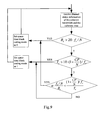
- Figure 9 is a schematic diagram of a flow for dynamic determination of space-time/space-frequency block coding mode;
- Figure 10 is a schematic diagram of an operational flow for dynamic switching of space-time coding mode;
- Figure 11 is a schematic diagram of an operational flow for dynamic switching of space-time decoding mode;
- Figure 12 is a schematic diagram shows structure of an apparatus for dynamic switching of space-time coding mode;
- Figure 13 is a schematic diagram shows structure of an apparatus for dynamic switching of space-time decoding mode.
- Referring to Figure 7, after initialization, the transmitted source bit sequence is mapped to a modulated constellation to generate a modulated symbol sequence after channel coding and interleaving. The dynamic switching means for space-time coding mode is usually used as the dynamic switching means for space-time/space-frequency block coding mode, which determines space-time coding mode based on control information of the reverse channel feedback and space-time block codes or space-frequency block codes the modulated symbol sequence in a corresponding mode to generate three sets symbol streams respectively corresponding to transmit
antenna 1, transmitantenna 2 and transmitantenna 3, while the used coding mode is periodically fed back to the receiver via a forward control channel. After pilot symbols are inserted according to pilot pattern, the respective symbol streams of the transmit antennas are inverse fast fourier transformed (IFFT) with length of N to generated OFDM symbols, each of which has circle prefix with length of CP samples inserted at the head to generated a spread OFDM symbol. A number of spread OFDM symbols form a time slot, and a pseudo random synchronization sequence is inserted prior to each time slot for timing synchronization. A number of time slots form a transmission frame as a minimum transmission unit for transmission of symbols. The sampling frequency is fs Hz. - Referring to Figure 8, after initialization, the received symbols streams are first frame synchronized, time slot synchronized and symbol synchronized based on synchronization sequences. The synchronized spread OFDM symbols are fast fourier transformed (FFT) after the circle prefix is removed. A MIMO-OFDM channel estimation unit performs channel estimation using a frequency domain pilot extracted from the OFDM symbols to generate a channel matrix and periodically estimates channel status information such as coherent bandwidth and coherent time. That is, a dynamic switching means for space-time/space-frequency block decoding mode decodes the extracted data symbols in a corresponding mode using the channel matrix based on space-time/space-frequency coding mode used at the transmitter and demodulated by a forward control channel, while the coding mode is determined based on the periodically received coherent bandwidth and coherent time for channel and periodically fed back to the transmitter via a reverse control channel. The generated symbol streams are demodulated, deinterleaved and channel decoded to generate a estimated source bit sequence.
- Bandwidth with a channel frequency response having a correlation coefficient greater than 0.5 is set as the coherent bandwidth of channel Bc, which depends on delay spreading of channel, which can be easily obtained from channel impulse response estimated by a channel estimator in the prior art or estimated by the circle prefix of the OFDM system and whose reciprocal can be approximated as the coherent bandwidth of channel. Similarly, a time interval with a channel impulse response having a correlation coefficient greater than 0.5 is set as the coherent time of channel Tc, which depends on Doppler shift of channel, which can be estimated by time domain correlation of channel impulse response estimated by the channel estimator in the prior art and whose reciprocal can be approximated as the coherent time of channel. Apparently, a channel estimation unit can estimate the coherent bandwidth of channel and the coherent time of channel based on the estimated channel response. The estimation of the coherent time and coherent bandwidth of channel does not belong to the range of the present invention, so we always assume that the coherent bandwidth and the coherent time of channel is ideally estimated and the above estimation thereof will not be further described herein.
- Apparently, if the coherent bandwidth is largely greater than interval width between two sub-carriers, i.e. Bc >> fs /N, then it can be considered that the channel within two sub-carriers is flat, that is, the channel frequency response within two sub-carriers is constant. At this time, space-frequency coding is performed between a number of antennas and two sub-carriers, and thus dynamic changes of channel will not degrade performance of space-frequency coding.
- As such, if the coherent time is largely greater than time interval between two spread OFDM symbols, i.e.

- Therefore, we define the coherent bandwidth and the coherent time of channel as measurement of dynamic adjustment for coding mode and the coding mode is set according to the following policy, in which when the space-time block coding mode is 0, it corresponds to space-frequency block coding; when the space-time block coding mode is 1, it corresponds to space-time block coding.
- As shown in Figure 9, after channel status information of the coherent bandwidth and the coherent time is received, the following determination is made:
- 1) The space-time block coding mode is set as 0 if the coherent bandwidth is largely greater than interval width between two sub-carriers, i.e. Bc > 20·fs /N.
- 2) Otherwise, the space-time block coding mode is set as 1 if the coherent time is largely greater than time interval between two spread OFDM symbols,

- 3) Otherwise, the space-time block coding mode is set as 0 if


- 4) Otherwise, the space-time block coding mode is set as 1.
- As shown in Figure 10, a dynamic switching flow for space-time coding mode is illustrated.
- Initializing step: setting the space-time block coding mode as 0, coding the input modulated symbols based on the space-time block coding mode and determining whether feedback control information of a reverse channel is received;
- Space-time coding mode switching step: setting a corresponding space-time coding mode based on feedback control information if the feedback control information is received; coding the input modulated symbols based on the space-time block coding mode, determining whether feedback control information of a reverse channel is received or not, if yes, setting a corresponding space-time coding mode based on feedback control information. The flow circles as above.
- As shown in Figure 11, a dynamic switching flow for space-time decoding mode is illustrated.
- Initializing step: setting the space-time decoding mode based on control information, decoding the input modulated symbols based on the space-time decoding mode and determining whether channel status information is received from a channel estimation unit;
- Space-time decoding mode switching step: making determination of the space-time decoding mode if channel status information is received from a channel estimation unit; decoding the input modulated symbols based on the space-time decoding mode, determining whether channel status information is received from a channel estimation unit, and making determination of the space-time decoding mode again. The flow circles as above.
- As shown in Figure 12, an apparatus for dynamic switching of space-time coding mode is arranged in a transmitter and comprises a determining
unit 11, afirst mapping unit 12 and afirst feedback unit 13 connected in turn, wherein: - the determining
unit 10 is used for determining a space-time coding mode based on received feedback information of a reverse channel; - the
first mapping unit 12 is used for mapping the determined coding mode to a corresponding coder so that a number of sets symbol streams corresponding to respective transmit antennas are generated after coding a modulated symbol sequence for desired coding; - the
first feedback unit 13 is used for periodically feeding the used coding mode information back to a receiver via a forward control channel. - As shown in Figure 13, an apparatus for dynamic switching for space-time decoding mode is arranged in a receiver and comprises a receiving
unit 21, asecond mapping unit 22 and asecond feedback unit 23, wherein: - the receiving
unit 21 is used for receiving the space-time coding mode information used at a transmitter and transmitted by a forward control channel; - the
second mapping unit 22 is used for mapping the received coding mode information to a decoder of a corresponding space-time decoding mode for decoding in a corresponding mode; and - the
second feedback unit 23 is used for feeding coherent bandwidth and coherent time of channel status information back to the transmitter via a reverse control channel. - Summing up the above, the present invention provides dynamic switching method and apparatus for space-time coding/decoding mode based on channel status information, coherent bandwidth and coherent time are defined as measurement of switching threshold and the corresponding switching policy is proposed to retain advantages such as low complexity of space-time coding, stable performance under space associated channels, complete space diversity and etc. and extend the application environment of space-time or space-frequency block coding in a OFDM system so that a MIMO OFDM system can be applied in a number of complex propagation environments.
- It should be understood from the foregoing that, while particular embodiments of the invention have been illustrated and described, various alternatives and modifications can be made thereto without departing from the spirit and scope of the invention. Therefore, it is not intended that the invention be limited by the specification; instead, the scope of the present invention is intended to be limited only by the appended claims.
Claims (20)
- A method for dynamic switching of space-time coding mode, comprising:determining step for determining a space-time coding mode based on feedback information by a transmitter;mapping step for mapping the determined coding mode to a corresponding coder so that a number of sets symbol streams corresponding to respective transmit antennas are generated after coding a modulated symbol sequence for desired coding; andfeedback step for periodically feeding used coding mode information back to a receiver via a forward control channel.
- The method for dynamic switching of space-time coding mode as claimed in Claim 1, wherein the space-time coding mode comprises a space-time block coding mode and a space-frequency block coding mode.
- The method for dynamic switching of space-time coding mode as claimed in Claim 1 or 2, wherein the feedback information of a reverse channel comprises coherent bandwidth and coherent time of the channel.
- The method for dynamic switching of space-time coding mode as claimed in Claim 3, wherein the coherent bandwidth of the channel is set as bandwidth with a channel frequency response having a correlation coefficient greater than 0.5; said coherent time of the channel is set as a time interval with a channel impulse response having a correlation coefficient greater than 0.5.
- The method for dynamic switching of space-time coding mode as claimed in Claim 4, wherein a rule for the determining space-time coding mode is that the space-frequency block coding is determined if the coherent bandwidth is greater than a given multiple of interval width between two sub-carriers.
- The method for dynamic switching of space-time coding mode as claimed in Claim 4, wherein a rule for the determining space-time coding mode is that the space-time block coding is determined if the coherent time is greater than a given multiple of time interval between two spread OFDM symbols.
- The method for dynamic switching of space-time coding mode as claimed in Claim 4, wherein a rule for the determining space-time coding mode is that the space-frequency block coding is determined if


- An apparatus for dynamic switching of space-time coding mode, which is arranged in a transmitter and characterized in that it comprises a determining unit, a first mapping unit and a first feedback unit connected in turn, wherein:the determining unit is used for determining a space-time coding mode based on received feedback information of a reverse channel;the first mapping unit is used for mapping the determined coding mode to a corresponding coder so that a number of sets symbol streams corresponding to respective transmit antennas are generated after coding a modulated symbol sequence for desired coding;the first feedback unit is used for periodically feeding used coding mode information back to a receiver via a forward control channel.
- The apparatus for dynamic switching of space-time coding mode as claimed in Claim 8, wherein the space-time coding mode determined by the determining unit comprises a space-time block coding mode and a space-frequency block coding mode.
- The apparatus for dynamic switching of space-time coding mode as claimed in Claim 8 or 9, wherein the feedback information received by the determining unit comprises coherent bandwidth and coherent time of the channel.
- The apparatus for dynamic switching of space-time coding mode as claimed in Claim 10, wherein the coherent bandwidth of the channel is set as bandwidth with a channel frequency response having a correlation coefficient greater than 0.5; said coherent time of the channel is set as a time interval with a channel impulse response having a correlation coefficient greater than 0.5.
- The apparatus for dynamic switching of space-time coding mode as claimed in Claim 11, wherein a rule for the determining space-time coding mode by the determining unit is that the space-frequency block coding is determined if the coherent bandwidth is greater than a given multiple of interval width between two sub-carriers.
- The apparatus for dynamic switching of space-time coding mode as claimed in Claim 11, wherein a rule for the determining space-time coding mode by the determining unit is that the space-time block coding is determined if the coherent time is greater than a given multiple of time interval between two spread OFDM symbols.
- The apparatus for dynamic switching of space-time coding mode as claimed in Claim 11, wherein a rule for the determining space-time coding mode by the determining unit is that the space-frequency block coding is determined if


- A method for dynamic switching for space-time decoding mode, comprising:receiving step for receiving space-time coding mode information used at a transmitter and transmitted by a forward control channel;mapping step for mapping the received coding mode information to a decoder of a corresponding space-time decoding mode for decoding in a corresponding mode; andfeedback step for feeding coherent bandwidth and coherent time of channel status information back to the transmitter via a reverse control channel.
- The method for dynamic switching of space-time decoding mode as claimed in Claim 15, wherein the space-time coding mode comprises a space-time block coding mode and a space-frequency block coding mode.
- An apparatus for dynamic switching for space-time decoding mode, which is arranged in a receiver and characterized in that it comprises a receiving unit, a second mapping unit and a second feedback unit connected in turn, wherein:the receiving unit is used for receiving space-time coding mode information used at a transmitter and transmitted by a forward control channel;the second mapping unit is used for mapping the received coding mode information to a decoder of a corresponding space-time decoding mode for decoding in a corresponding mode; andthe second feedback unit is used for feeding coherent bandwidth and coherent time of channel status information back to the transmitter via a reverse control channel.
- The apparatus for dynamic switching of space-time decoding mode as claimed in Claim 17, wherein the space-time coding mode comprises a space-time block coding mode and a space-frequency block coding mode.
- A transmitter, characterized in that it comprises a coder with two modes of space-time block coding and space-frequency block coding and a switching means for space-time/space-frequency block coding mode, wherein:the switching means for space-time/space-frequency block coding mode is used for determining coding mode based on information on coherent bandwidth and coherent time of a received reverse channel feedback and space-time block coding or space-frequency block coding a modulated symbol sequence for desired coding in a corresponding mode to generate a number of sets symbol streams corresponding to respective transmit antennas and further periodically feeding the used coding mode back to a receiver via a forward control channel.
- A receiver, characterized in that it comprises a decoder with two modes of space-time block coding and space-frequency block coding and a switching means for space-time/space-frequency block decoding mode, wherein:the switching means for space-time/space-frequency block decoding mode is used for mapping the received space-time coding mode information to a decoder of a corresponding space-time decoding mode for decoding in a corresponding mode based on the space-time coding mode information used at a transmitter and transmitted by a forward control channel; and further feeding coherent bandwidth and coherent time of channel status information back to the transmitter via a reverse control channel.
Priority Applications (1)
| Application Number | Priority Date | Filing Date | Title |
|---|---|---|---|
| PL06023507T PL1793519T3 (en) | 2005-11-30 | 2006-11-11 | A method and device for dynamic switching of space-time coding / decoding |
Applications Claiming Priority (1)
| Application Number | Priority Date | Filing Date | Title |
|---|---|---|---|
| CN200510110986A CN100592672C (en) | 2005-11-30 | 2005-11-30 | Method and device for dynamic switching of space-time encoding/decoding modes |
Publications (3)
| Publication Number | Publication Date |
|---|---|
| EP1793519A2 true EP1793519A2 (en) | 2007-06-06 |
| EP1793519A3 EP1793519A3 (en) | 2008-08-20 |
| EP1793519B1 EP1793519B1 (en) | 2011-09-14 |
Family
ID=37872420
Family Applications (1)
| Application Number | Title | Priority Date | Filing Date |
|---|---|---|---|
| EP06023507A Not-in-force EP1793519B1 (en) | 2005-11-30 | 2006-11-11 | Method and apparatus for dynamic switching of space-time coding/decoding mode |
Country Status (7)
| Country | Link |
|---|---|
| US (1) | US7733970B2 (en) |
| EP (1) | EP1793519B1 (en) |
| JP (1) | JP5031337B2 (en) |
| CN (1) | CN100592672C (en) |
| AT (1) | ATE524895T1 (en) |
| ES (1) | ES2374238T3 (en) |
| PL (1) | PL1793519T3 (en) |
Cited By (3)
| Publication number | Priority date | Publication date | Assignee | Title |
|---|---|---|---|---|
| CN103384186A (en) * | 2012-05-04 | 2013-11-06 | 美国博通公司 | Wireless communication device with configurable spatial time-frequency coding and methods for use therewith |
| WO2015184631A1 (en) * | 2014-06-06 | 2015-12-10 | Qualcomm Incorporated | Methods and apparatus for doppler spread estimation in a wireless communication system |
| CN114050891A (en) * | 2021-07-22 | 2022-02-15 | 东南大学 | A spatiotemporal two-dimensional channel coding method |
Families Citing this family (20)
| Publication number | Priority date | Publication date | Assignee | Title |
|---|---|---|---|---|
| JP2007116637A (en) * | 2005-10-24 | 2007-05-10 | Fujitsu Ltd | RADIO COMMUNICATION METHOD, RADIO COMMUNICATION SYSTEM, RECEPTION DEVICE, AND TRANSMISSION DEVICE |
| US20080192720A1 (en) * | 2007-02-12 | 2008-08-14 | Nokia Corporation | Shared control channel data-assisted channel estimation |
| KR101382894B1 (en) | 2007-03-12 | 2014-04-08 | 엘지전자 주식회사 | Method for transmitting control information in multiple antenna system |
| KR101199152B1 (en) | 2007-05-08 | 2012-11-13 | 인터디지탈 테크날러지 코포레이션 | Method and apparatus for reducing interference in space frequency block coding communication |
| CN101378299B (en) * | 2007-08-28 | 2012-05-09 | 中兴通讯股份有限公司 | A Transmit Diversity Method Based on Space-Frequency Coding |
| KR100997668B1 (en) | 2007-11-22 | 2010-12-02 | 한국과학기술원 | Channel coding decoding method and decoder |
| KR101049510B1 (en) * | 2007-11-30 | 2011-07-15 | 한국과학기술원 | Data transmission and switching by system switching and data transmission by the system and the system by the method of switching the system and the transmission by the system and the method of communication with the system. |
| EP2071758A1 (en) * | 2007-12-11 | 2009-06-17 | Sony Corporation | OFDM-Transmitting apparatus and method, and OFDM-receiving apparatus and method |
| CN101621358B (en) * | 2008-07-04 | 2013-01-02 | 上海华为技术有限公司 | Uplink transmission method, system and device |
| EP2377259B1 (en) * | 2008-12-23 | 2015-09-16 | Orange | Method for transmitting a space-frequency coded data signal via a plurality of transmitting entities |
| CN101771446B (en) * | 2008-12-29 | 2014-06-04 | 株式会社Ntt都科摩 | Method, device and system for processing multiple-input-multiple-output signal |
| KR20110013195A (en) * | 2009-07-30 | 2011-02-09 | 엘지전자 주식회사 | A method and apparatus for transmitting pilot signals in a wireless mobile communication system supporting multiple antennas |
| CN103312652B (en) * | 2013-05-15 | 2016-01-20 | 西南石油大学 | A kind of space-frequency coding SFBC MIMO-OFDM system based on F matrix carries out the method for selected mapping method SLM |
| CN105519029B (en) * | 2013-12-31 | 2019-09-06 | 展讯通信(上海)有限公司 | OFDM communication system, method and device for transmitting and receiving signals |
| US9686102B2 (en) * | 2014-04-09 | 2017-06-20 | Altiostar Networks, Inc. | Sparse ordered iterative group multi-antenna channel estimation |
| CN107924369B (en) * | 2015-09-11 | 2021-08-31 | 东芝存储器株式会社 | memory device |
| US10158403B2 (en) * | 2015-11-05 | 2018-12-18 | Telefonaktiebolaget Lm Ericsson (Publ) | Radio precoding |
| CN105871436B (en) * | 2016-04-25 | 2019-07-09 | 南京航空航天大学 | A kind of power distribution method of DISTRIBUTED MIS O system under spatial correlation channel |
| CN107346982B (en) * | 2016-05-06 | 2020-02-14 | 北京信威通信技术股份有限公司 | Downlink multi-antenna transmission method and device |
| US10523362B2 (en) * | 2017-12-18 | 2019-12-31 | Ciena Corporation | Systems and methods for error-free reconstruction of transmitted symbols in a coherent receiver |
Citations (1)
| Publication number | Priority date | Publication date | Assignee | Title |
|---|---|---|---|---|
| WO2005055507A1 (en) | 2003-12-03 | 2005-06-16 | Nokia Corporation | Exploiting selection diversity in communications systems with non-orthonormal matrix and vector modulation |
Family Cites Families (7)
| Publication number | Priority date | Publication date | Assignee | Title |
|---|---|---|---|---|
| US6351499B1 (en) * | 1999-12-15 | 2002-02-26 | Iospan Wireless, Inc. | Method and wireless systems using multiple antennas and adaptive control for maximizing a communication parameter |
| US6922445B1 (en) * | 1999-12-15 | 2005-07-26 | Intel Corporation | Method and system for mode adaptation in wireless communication |
| US6298092B1 (en) * | 1999-12-15 | 2001-10-02 | Iospan Wireless, Inc. | Methods of controlling communication parameters of wireless systems |
| US7110378B2 (en) * | 2000-10-03 | 2006-09-19 | Wisconsin Alumni Research Foundation | Channel aware optimal space-time signaling for wireless communication over wideband multipath channels |
| US7042858B1 (en) * | 2002-03-22 | 2006-05-09 | Jianglei Ma | Soft handoff for OFDM |
| JP2004040232A (en) * | 2002-06-28 | 2004-02-05 | Matsushita Electric Ind Co Ltd | Wireless communication system, wireless transmitting device, and wireless receiving device |
| KR100713403B1 (en) * | 2003-09-30 | 2007-05-04 | 삼성전자주식회사 | Apparatus and method for controlling transmission method according to channel state in communication system |
-
2005
- 2005-11-30 CN CN200510110986A patent/CN100592672C/en not_active Expired - Lifetime
-
2006
- 2006-11-11 AT AT06023507T patent/ATE524895T1/en not_active IP Right Cessation
- 2006-11-11 EP EP06023507A patent/EP1793519B1/en not_active Not-in-force
- 2006-11-11 ES ES06023507T patent/ES2374238T3/en active Active
- 2006-11-11 PL PL06023507T patent/PL1793519T3/en unknown
- 2006-11-24 JP JP2006316843A patent/JP5031337B2/en not_active Expired - Fee Related
- 2006-11-28 US US11/564,123 patent/US7733970B2/en not_active Expired - Fee Related
Patent Citations (1)
| Publication number | Priority date | Publication date | Assignee | Title |
|---|---|---|---|---|
| WO2005055507A1 (en) | 2003-12-03 | 2005-06-16 | Nokia Corporation | Exploiting selection diversity in communications systems with non-orthonormal matrix and vector modulation |
Cited By (6)
| Publication number | Priority date | Publication date | Assignee | Title |
|---|---|---|---|---|
| CN103384186A (en) * | 2012-05-04 | 2013-11-06 | 美国博通公司 | Wireless communication device with configurable spatial time-frequency coding and methods for use therewith |
| EP2661005A3 (en) * | 2012-05-04 | 2014-07-09 | Broadcom Corporation | Wireless communication device with configurable spatial time-frequency coding and methods for use therewith |
| US8989241B2 (en) | 2012-05-04 | 2015-03-24 | Broadcom Corporation | Wireless communication device with configurable spatial time-frequency coding and methods for use therewith |
| WO2015184631A1 (en) * | 2014-06-06 | 2015-12-10 | Qualcomm Incorporated | Methods and apparatus for doppler spread estimation in a wireless communication system |
| CN114050891A (en) * | 2021-07-22 | 2022-02-15 | 东南大学 | A spatiotemporal two-dimensional channel coding method |
| CN114050891B (en) * | 2021-07-22 | 2024-02-27 | 东南大学 | Space-time two-dimensional channel coding method |
Also Published As
| Publication number | Publication date |
|---|---|
| EP1793519A3 (en) | 2008-08-20 |
| US20070153925A1 (en) | 2007-07-05 |
| EP1793519B1 (en) | 2011-09-14 |
| ES2374238T3 (en) | 2012-02-15 |
| JP2007159119A (en) | 2007-06-21 |
| CN1980110A (en) | 2007-06-13 |
| US7733970B2 (en) | 2010-06-08 |
| CN100592672C (en) | 2010-02-24 |
| PL1793519T3 (en) | 2012-02-29 |
| JP5031337B2 (en) | 2012-09-19 |
| ATE524895T1 (en) | 2011-09-15 |
Similar Documents
| Publication | Publication Date | Title |
|---|---|---|
| US7733970B2 (en) | Method and apparatus for dynamic switching of space-time coding/decoding method | |
| US7974359B2 (en) | Methods and apparatus for mitigating multi-antenna correlation effect in communication systems | |
| US8111772B2 (en) | Method and apparatus for multi-antenna transmitting based on spatial-frequency encoding | |
| WO2006019253A1 (en) | Apparatus and method for space-time-frequency block coding for increasing performance | |
| Suto et al. | Performance evaluation of space-time-frequency block codes over frequency selective fading channels | |
| EP2822191B1 (en) | Transmitting apparatus, receiving apparatus, and control methods thereof | |
| RU2340100C1 (en) | Device and method of frequency-space-time coding for increasing efficiency | |
| Kim et al. | Transmit diversity and multiplexing methods for 3G-LTE downlink control channels | |
| US20120002753A1 (en) | Method for Encoding Data Symbols with Implicitly Embedded Pilot Symbols in Resource Blocks for Wireless Networks | |
| KR100539924B1 (en) | System and method for channel estimation generating a preamble sequence in mobile communication system using orthogonal frequency division multiple scheme | |
| Yang et al. | Transmit diversity for TDS-OFDM broadcasting system over doubly selective fading channels | |
| Pramono et al. | Performance analysis of transceiver 4× 4 space time block coded MIMO-OFDM system | |
| CA2469913A1 (en) | Method and apparatus for multi-carrier transmission | |
| Suto et al. | Space-time-frequency block codes over frequency selective fading channels | |
| Lu et al. | A orthogonal superimposed pilot for channel estimation in MIMO-OFDM systems | |
| Ong et al. | Adaptive time-frequency spreading of quasi-orthogonal block codes for MIMO-OFDM systems | |
| Revathy et al. | Carrier frequency offset estimation in OFDM system using ML criterion precoded by turbo codes | |
| Shrivastava et al. | Space-time-frequency turbo coded MIMO-OFDM systems over frequency selective fading channels | |
| Horii et al. | Improving detection performance of pre-coded STBC OFDM by re-generating pre-coded symbols | |
| Kulakowski et al. | Iterative Channel Estimation for Space-Time Block Codes | |
| Lakshmanan et al. | Channel estimation for MISO OFDM system using improved cyclic delay diversity | |
| Pasquero et al. | Efficient space code block code mimo channel estimation for future mobile video broadcasting | |
| KR20090056729A (en) | MIMO (Multiple Input MultipleOutput) OMM OMM OIMO IMO | |
| Deshmukh et al. | Performance Evaluation of STBC-OFDM System for Wireless Communication | |
| Wang et al. | Designs of Differential Space-Time and Space-Frequency Coded OFDM Schemes |
Legal Events
| Date | Code | Title | Description |
|---|---|---|---|
| PUAI | Public reference made under article 153(3) epc to a published international application that has entered the european phase |
Free format text: ORIGINAL CODE: 0009012 |
|
| AK | Designated contracting states |
Kind code of ref document: A2 Designated state(s): AT BE BG CH CY CZ DE DK EE ES FI FR GB GR HU IE IS IT LI LT LU LV MC NL PL PT RO SE SI SK TR |
|
| AX | Request for extension of the european patent |
Extension state: AL BA HR MK YU |
|
| PUAL | Search report despatched |
Free format text: ORIGINAL CODE: 0009013 |
|
| AK | Designated contracting states |
Kind code of ref document: A3 Designated state(s): AT BE BG CH CY CZ DE DK EE ES FI FR GB GR HU IE IS IT LI LT LU LV MC NL PL PT RO SE SI SK TR |
|
| AX | Request for extension of the european patent |
Extension state: AL BA HR MK RS |
|
| 17P | Request for examination filed |
Effective date: 20090203 |
|
| 17Q | First examination report despatched |
Effective date: 20090317 |
|
| AKX | Designation fees paid |
Designated state(s): AT BE BG CH CY CZ DE DK EE ES FI FR GB GR HU IE IS IT LI LT LU LV MC NL PL PT RO SE SI SK TR |
|
| GRAP | Despatch of communication of intention to grant a patent |
Free format text: ORIGINAL CODE: EPIDOSNIGR1 |
|
| GRAS | Grant fee paid |
Free format text: ORIGINAL CODE: EPIDOSNIGR3 |
|
| GRAA | (expected) grant |
Free format text: ORIGINAL CODE: 0009210 |
|
| AK | Designated contracting states |
Kind code of ref document: B1 Designated state(s): AT BE BG CH CY CZ DE DK EE ES FI FR GB GR HU IE IS IT LI LT LU LV MC NL PL PT RO SE SI SK TR |
|
| REG | Reference to a national code |
Ref country code: GB Ref legal event code: FG4D |
|
| REG | Reference to a national code |
Ref country code: CH Ref legal event code: EP |
|
| REG | Reference to a national code |
Ref country code: IE Ref legal event code: FG4D |
|
| REG | Reference to a national code |
Ref country code: DE Ref legal event code: R096 Ref document number: 602006024335 Country of ref document: DE Effective date: 20111110 |
|
| REG | Reference to a national code |
Ref country code: NL Ref legal event code: VDEP Effective date: 20110914 |
|
| PG25 | Lapsed in a contracting state [announced via postgrant information from national office to epo] |
Ref country code: SE Free format text: LAPSE BECAUSE OF FAILURE TO SUBMIT A TRANSLATION OF THE DESCRIPTION OR TO PAY THE FEE WITHIN THE PRESCRIBED TIME-LIMIT Effective date: 20110914 Ref country code: FI Free format text: LAPSE BECAUSE OF FAILURE TO SUBMIT A TRANSLATION OF THE DESCRIPTION OR TO PAY THE FEE WITHIN THE PRESCRIBED TIME-LIMIT Effective date: 20110914 Ref country code: LT Free format text: LAPSE BECAUSE OF FAILURE TO SUBMIT A TRANSLATION OF THE DESCRIPTION OR TO PAY THE FEE WITHIN THE PRESCRIBED TIME-LIMIT Effective date: 20110914 |
|
| REG | Reference to a national code |
Ref country code: ES Ref legal event code: FG2A Ref document number: 2374238 Country of ref document: ES Kind code of ref document: T3 Effective date: 20120215 |
|
| RAP2 | Party data changed (patent owner data changed or rights of a patent transferred) |
Owner name: ALCATEL LUCENT |
|
| LTIE | Lt: invalidation of european patent or patent extension |
Effective date: 20110914 |
|
| PG25 | Lapsed in a contracting state [announced via postgrant information from national office to epo] |
Ref country code: AT Free format text: LAPSE BECAUSE OF FAILURE TO SUBMIT A TRANSLATION OF THE DESCRIPTION OR TO PAY THE FEE WITHIN THE PRESCRIBED TIME-LIMIT Effective date: 20110914 Ref country code: GR Free format text: LAPSE BECAUSE OF FAILURE TO SUBMIT A TRANSLATION OF THE DESCRIPTION OR TO PAY THE FEE WITHIN THE PRESCRIBED TIME-LIMIT Effective date: 20111215 Ref country code: LV Free format text: LAPSE BECAUSE OF FAILURE TO SUBMIT A TRANSLATION OF THE DESCRIPTION OR TO PAY THE FEE WITHIN THE PRESCRIBED TIME-LIMIT Effective date: 20110914 Ref country code: CY Free format text: LAPSE BECAUSE OF FAILURE TO SUBMIT A TRANSLATION OF THE DESCRIPTION OR TO PAY THE FEE WITHIN THE PRESCRIBED TIME-LIMIT Effective date: 20110914 Ref country code: SI Free format text: LAPSE BECAUSE OF FAILURE TO SUBMIT A TRANSLATION OF THE DESCRIPTION OR TO PAY THE FEE WITHIN THE PRESCRIBED TIME-LIMIT Effective date: 20110914 |
|
| REG | Reference to a national code |
Ref country code: PL Ref legal event code: T3 Ref country code: CH Ref legal event code: PCOW Free format text: ALCATEL LUCENT;3, AVENUE OCTAVE GREARD;75007 PARIS (FR) |
|
| REG | Reference to a national code |
Ref country code: AT Ref legal event code: MK05 Ref document number: 524895 Country of ref document: AT Kind code of ref document: T Effective date: 20110914 |
|
| PG25 | Lapsed in a contracting state [announced via postgrant information from national office to epo] |
Ref country code: BE Free format text: LAPSE BECAUSE OF FAILURE TO SUBMIT A TRANSLATION OF THE DESCRIPTION OR TO PAY THE FEE WITHIN THE PRESCRIBED TIME-LIMIT Effective date: 20110914 |
|
| PG25 | Lapsed in a contracting state [announced via postgrant information from national office to epo] |
Ref country code: CZ Free format text: LAPSE BECAUSE OF FAILURE TO SUBMIT A TRANSLATION OF THE DESCRIPTION OR TO PAY THE FEE WITHIN THE PRESCRIBED TIME-LIMIT Effective date: 20110914 Ref country code: SK Free format text: LAPSE BECAUSE OF FAILURE TO SUBMIT A TRANSLATION OF THE DESCRIPTION OR TO PAY THE FEE WITHIN THE PRESCRIBED TIME-LIMIT Effective date: 20110914 Ref country code: IS Free format text: LAPSE BECAUSE OF FAILURE TO SUBMIT A TRANSLATION OF THE DESCRIPTION OR TO PAY THE FEE WITHIN THE PRESCRIBED TIME-LIMIT Effective date: 20120114 |
|
| PG25 | Lapsed in a contracting state [announced via postgrant information from national office to epo] |
Ref country code: PT Free format text: LAPSE BECAUSE OF FAILURE TO SUBMIT A TRANSLATION OF THE DESCRIPTION OR TO PAY THE FEE WITHIN THE PRESCRIBED TIME-LIMIT Effective date: 20120116 Ref country code: RO Free format text: LAPSE BECAUSE OF FAILURE TO SUBMIT A TRANSLATION OF THE DESCRIPTION OR TO PAY THE FEE WITHIN THE PRESCRIBED TIME-LIMIT Effective date: 20110914 Ref country code: NL Free format text: LAPSE BECAUSE OF FAILURE TO SUBMIT A TRANSLATION OF THE DESCRIPTION OR TO PAY THE FEE WITHIN THE PRESCRIBED TIME-LIMIT Effective date: 20110914 Ref country code: EE Free format text: LAPSE BECAUSE OF FAILURE TO SUBMIT A TRANSLATION OF THE DESCRIPTION OR TO PAY THE FEE WITHIN THE PRESCRIBED TIME-LIMIT Effective date: 20110914 |
|
| PG25 | Lapsed in a contracting state [announced via postgrant information from national office to epo] |
Ref country code: MC Free format text: LAPSE BECAUSE OF NON-PAYMENT OF DUE FEES Effective date: 20111130 |
|
| REG | Reference to a national code |
Ref country code: CH Ref legal event code: PL |
|
| PLBE | No opposition filed within time limit |
Free format text: ORIGINAL CODE: 0009261 |
|
| STAA | Information on the status of an ep patent application or granted ep patent |
Free format text: STATUS: NO OPPOSITION FILED WITHIN TIME LIMIT |
|
| PG25 | Lapsed in a contracting state [announced via postgrant information from national office to epo] |
Ref country code: DK Free format text: LAPSE BECAUSE OF FAILURE TO SUBMIT A TRANSLATION OF THE DESCRIPTION OR TO PAY THE FEE WITHIN THE PRESCRIBED TIME-LIMIT Effective date: 20110914 Ref country code: CH Free format text: LAPSE BECAUSE OF NON-PAYMENT OF DUE FEES Effective date: 20111130 Ref country code: LI Free format text: LAPSE BECAUSE OF NON-PAYMENT OF DUE FEES Effective date: 20111130 |
|
| 26N | No opposition filed |
Effective date: 20120615 |
|
| REG | Reference to a national code |
Ref country code: IE Ref legal event code: MM4A |
|
| REG | Reference to a national code |
Ref country code: DE Ref legal event code: R097 Ref document number: 602006024335 Country of ref document: DE Effective date: 20120615 |
|
| PG25 | Lapsed in a contracting state [announced via postgrant information from national office to epo] |
Ref country code: IE Free format text: LAPSE BECAUSE OF NON-PAYMENT OF DUE FEES Effective date: 20111111 |
|
| PG25 | Lapsed in a contracting state [announced via postgrant information from national office to epo] |
Ref country code: LU Free format text: LAPSE BECAUSE OF NON-PAYMENT OF DUE FEES Effective date: 20111111 |
|
| PG25 | Lapsed in a contracting state [announced via postgrant information from national office to epo] |
Ref country code: BG Free format text: LAPSE BECAUSE OF FAILURE TO SUBMIT A TRANSLATION OF THE DESCRIPTION OR TO PAY THE FEE WITHIN THE PRESCRIBED TIME-LIMIT Effective date: 20111214 |
|
| PG25 | Lapsed in a contracting state [announced via postgrant information from national office to epo] |
Ref country code: TR Free format text: LAPSE BECAUSE OF FAILURE TO SUBMIT A TRANSLATION OF THE DESCRIPTION OR TO PAY THE FEE WITHIN THE PRESCRIBED TIME-LIMIT Effective date: 20110914 |
|
| REG | Reference to a national code |
Ref country code: GB Ref legal event code: 732E Free format text: REGISTERED BETWEEN 20130926 AND 20131002 |
|
| PG25 | Lapsed in a contracting state [announced via postgrant information from national office to epo] |
Ref country code: HU Free format text: LAPSE BECAUSE OF FAILURE TO SUBMIT A TRANSLATION OF THE DESCRIPTION OR TO PAY THE FEE WITHIN THE PRESCRIBED TIME-LIMIT Effective date: 20110914 |
|
| REG | Reference to a national code |
Ref country code: FR Ref legal event code: GC Effective date: 20131018 |
|
| REG | Reference to a national code |
Ref country code: FR Ref legal event code: RG Effective date: 20141016 |
|
| REG | Reference to a national code |
Ref country code: FR Ref legal event code: PLFP Year of fee payment: 10 |
|
| REG | Reference to a national code |
Ref country code: FR Ref legal event code: PLFP Year of fee payment: 11 |
|
| PGFP | Annual fee paid to national office [announced via postgrant information from national office to epo] |
Ref country code: FR Payment date: 20161118 Year of fee payment: 11 Ref country code: GB Payment date: 20161122 Year of fee payment: 11 Ref country code: DE Payment date: 20161121 Year of fee payment: 11 |
|
| PGFP | Annual fee paid to national office [announced via postgrant information from national office to epo] |
Ref country code: IT Payment date: 20161123 Year of fee payment: 11 Ref country code: PL Payment date: 20161021 Year of fee payment: 11 Ref country code: ES Payment date: 20161114 Year of fee payment: 11 |
|
| REG | Reference to a national code |
Ref country code: DE Ref legal event code: R119 Ref document number: 602006024335 Country of ref document: DE |
|
| GBPC | Gb: european patent ceased through non-payment of renewal fee |
Effective date: 20171111 |
|
| REG | Reference to a national code |
Ref country code: FR Ref legal event code: ST Effective date: 20180731 |
|
| PG25 | Lapsed in a contracting state [announced via postgrant information from national office to epo] |
Ref country code: DE Free format text: LAPSE BECAUSE OF NON-PAYMENT OF DUE FEES Effective date: 20180602 Ref country code: FR Free format text: LAPSE BECAUSE OF NON-PAYMENT OF DUE FEES Effective date: 20171130 Ref country code: IT Free format text: LAPSE BECAUSE OF NON-PAYMENT OF DUE FEES Effective date: 20171111 |
|
| PG25 | Lapsed in a contracting state [announced via postgrant information from national office to epo] |
Ref country code: GB Free format text: LAPSE BECAUSE OF NON-PAYMENT OF DUE FEES Effective date: 20171111 |
|
| PG25 | Lapsed in a contracting state [announced via postgrant information from national office to epo] |
Ref country code: ES Free format text: LAPSE BECAUSE OF NON-PAYMENT OF DUE FEES Effective date: 20171112 |
|
| PG25 | Lapsed in a contracting state [announced via postgrant information from national office to epo] |
Ref country code: PL Free format text: LAPSE BECAUSE OF NON-PAYMENT OF DUE FEES Effective date: 20171111 |