EP1793347A2 - Method for limited angle tomography - Google Patents
Method for limited angle tomography Download PDFInfo
- Publication number
- EP1793347A2 EP1793347A2 EP06120874A EP06120874A EP1793347A2 EP 1793347 A2 EP1793347 A2 EP 1793347A2 EP 06120874 A EP06120874 A EP 06120874A EP 06120874 A EP06120874 A EP 06120874A EP 1793347 A2 EP1793347 A2 EP 1793347A2
- Authority
- EP
- European Patent Office
- Prior art keywords
- dimensional
- transform
- iteration
- domain
- reconstruction
- Prior art date
- Legal status (The legal status is an assumption and is not a legal conclusion. Google has not performed a legal analysis and makes no representation as to the accuracy of the status listed.)
- Granted
Links
Images




Classifications
-
- G—PHYSICS
- G06—COMPUTING OR CALCULATING; COUNTING
- G06T—IMAGE DATA PROCESSING OR GENERATION, IN GENERAL
- G06T12/00—Tomographic reconstruction from projections
- G06T12/20—Inverse problem, i.e. transformations from projection space into object space
-
- G—PHYSICS
- G06—COMPUTING OR CALCULATING; COUNTING
- G06T—IMAGE DATA PROCESSING OR GENERATION, IN GENERAL
- G06T2211/00—Image generation
- G06T2211/40—Computed tomography
- G06T2211/424—Iterative
-
- G—PHYSICS
- G06—COMPUTING OR CALCULATING; COUNTING
- G06T—IMAGE DATA PROCESSING OR GENERATION, IN GENERAL
- G06T2211/00—Image generation
- G06T2211/40—Computed tomography
- G06T2211/436—Limited angle
Definitions
- the invention relates to computer limited angle computer tomography. Especially advantageously the method according invention is used for X-ray or gamma ray tomography.
- 3D (three-dimensional) imaging enables measuring distances and defining exact structures of the objects.
- 3D imaging Unlike conventional X-ray imaging, 3D (three-dimensional) imaging enables measuring distances and defining exact structures of the objects.
- Other example of the benefit in 3D imaging is avoiding the superposition problem (i.e. problem caused by overlapping issues) in diagnostic imaging.
- CT computed tomography
- the basic philosophy of CT imaging is to measure the attenuation in each volume element (voxel) cross the object of interest. This approach requires specially designed system with exact mechanical accuracy and over-sampling of the issue of interest, which means in practice high dose and high device costs comparing to 2D (two-dimensional) imaging. Therefore, the use of CT imaging is now-a-days limited to serious diseases and it is typically utilized only in big hospital districts which eventually limits the smooth patient workflow.
- CBCT dedicated dental cone beam CT -based systems
- these CBCT systems has also the same drawbacks than non-dedicated CTs.
- the dedicated dental CBCTs are less expensive than conventional CTs, the total cost of the dental CBCT device is typically more than ten times the cost of standard digital panoramic device.
- the object of the invention is to improve an algorithm, which could calculate a 3D model from small number of images and could handle incomplete imaging geometry and intensity information in reasonable calculating time.
- the 3D images could be taken by using any existing digital X-ray system, including dental panoramic and intra oral systems or mammography system.
- 3D imaging could be expanded to any medical study and it would fit smoothly into clinical workflow.
- the invention aims to enable lower cost of the hardware for calculating the tomography.
- Present limited angle tomography is either very slow or it need expensive dedicated hardware, and still with for example large memory display controller hardware for calculations the calculating time is too slow for smooth clinical workflow.
- the aim is to use standard affordable computer systems and still get the results much faster than before.
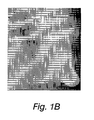
- Figure 1A shows a guideline for drilling a hole 2 for a dental implant. It is difficult to know from the X-ray picture 1B the location of the mandibular nerve 1.
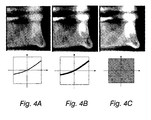
- the cross-section of the same jaw is presented as tomography image in figures 4A, 4B, and 4C.
- the advantage of the tomography is clear; the nerve is clearly visible in all the tomography images made with method according the invention, even with worse selection of parameters.
- the invention enables much more useful imaging and makes the drilling operation safer, and the image can be achieved faster and with cheaper equipment than before. This is only one example of usefulness of fast, cheap, and widely applicable limited angle tomography according the invention.
- Biopsy in mammography is another especially advantageous use in addition to all the present uses of computer tomography, as the method enables smaller doses with acceptable image quality and much faster calculation than in present methods.
- ART Arithmetic Reconstruction Technique
- the ART algorithm is always a heavy iterative algorithm and the known ART methods are too slow to calculate with present computers. Even the method itself would give satisfactory result; the calculating time is limiting clinical use and there have been no commercial devices available yet.
- a T back-projects the measurements into the volume and x is multiplied by operator A T A : R 3 ⁇ R 3 .
- the number N is the number of iterations.
- the invention solves the above mentioned problem with low computer cache hit rate and it even enables distributed calculation.
- the invention uses an iterative algorithm, which minimizes the likelihood in the frequency domain instead of spatial domain as in prior art.
- the frequency behavior of the system is defined by calculating Fourier transform of systems PSF (Point Spread Function).
- PSF Point Spread Function
- a T A can be considered as a convolution and consequently the PSF of the A T A can be defined.
- Figure 2A presents a typical non-affine imaging geometry and a schematic presentation of the A T A and the Fourier transform after FFT.
- This non-affine geometry is typical for a normal X-ray device, and therefore we need to solve the problem in more general case.
- Radiation source 3 is a point source, and detector 4 receives the radiation beams 5.
- M ⁇ 1 ⁇ A ⁇ L ⁇ x ⁇ ⁇ exp - i ⁇ 2 ⁇ ⁇ ⁇ ⁇ T ⁇ ⁇ where A is the area in detector m.
- ⁇ The purpose for the operator ⁇ is to cut-off all the frequencies outside region defined by ⁇ .
- ⁇ can be considered as a probability matrix; when the corresponding frequency in ⁇ (m k ) is known, the value is set to 1, otherwise it is 0. Furthermore, if the geometry is not well-known the values can be set also between 1 and zero. Notice that ⁇ i has the same dimension than X i and, unlike ⁇ , ⁇ itself is an irreversible operator.
- Benefits against the spatial ART are the voxel-wise multiplying and the information accumulation.
- the well-known frequencies are located on a surface of a ball.
- the radius of the ball corresponds the SID (source to image distance) and the center point corresponds with the X-ray source point respectively.
- this rule is valid in any one-shot imaging geometry.
- Figure 4 shows cross-section of jaw calculated with a method according the invention and corresponding ⁇ on frequency domain.
- Figure 4A is used with SID tolerance of 4mm, 4B used 8mm and 4C used A matrix of ones. Note that the A is here described in 2D for simplification.
- Figure 5 shows the block diagram of the imaging algorithm used in the test.
- the flow chart is presented only as an example of one embodiment.
- the iteration itself is quite alike as in the known ART algorithms, only done in the frequency domain to avoid the cache misses that are unavoidable in conventional ART algorithm.
- other transforms than FFT may be used to convert to the frequency domain, the only requirement for the transform algorithm is that there is an inverse transform back to spatial domain and the iteration can be made in the frequency domain in reasonable way.
- the method according the invention is not limited to the X-ray.
- Other forms of radiation may be for example gamma rays, any particle radiation, or even UV, IR or visible light. The possible type radiation depends on the object.
- the Figure 4 shows result of the clinical case.
- 11 images were taken from about 40 degree aperture.
- the size of the image was 512x512 @ 1.8mm pixel size.
- the reconstructed volume was 256x256x256 voxels and size of 60x60x60mm.
- the reconstruction time was about 8 minutes (7 minutes to calculate ⁇ (mk) and 1 minute for 55 iteration rounds).
- the conventional ART took with the same PC (2GHz Pentium 4) about 30 minutes.
- the frequency based ART according the invention works well and is remarkably faster than known ART based on spatial domain iterations and the quality of tomography image is not deteriorated compared to the known ART methods.
Landscapes
- Physics & Mathematics (AREA)
- General Physics & Mathematics (AREA)
- Engineering & Computer Science (AREA)
- Theoretical Computer Science (AREA)
- Image Processing (AREA)
- Apparatus For Radiation Diagnosis (AREA)
Abstract
Description
- The invention relates to computer limited angle computer tomography. Especially advantageously the method according invention is used for X-ray or gamma ray tomography.
- Unlike conventional X-ray imaging, 3D (three-dimensional) imaging enables measuring distances and defining exact structures of the objects. For example in dental implantology, it is critical for the firm attachment of the implant to use optimal screw size and therefore measure optimal depth and angle for the screw hole If the bone implant screw is too short, the implant will be loose. On another hand, if the hole is drilled too deep, the mandibular nerve could be damaged. Other example of the benefit in 3D imaging is avoiding the superposition problem (i.e. problem caused by overlapping issues) in diagnostic imaging.
- So far the medical 3D imaging has been associated to CT (computed tomography) algorithms and systems. The basic philosophy of CT imaging is to measure the attenuation in each volume element (voxel) cross the object of interest. This approach requires specially designed system with exact mechanical accuracy and over-sampling of the issue of interest, which means in practice high dose and high device costs comparing to 2D (two-dimensional) imaging. Therefore, the use of CT imaging is now-a-days limited to serious diseases and it is typically utilized only in big hospital districts which eventually limits the smooth patient workflow.
- Lately there has been increasing interest in dedicated dental cone beam CT -based systems (CBCT). Since the dental CBCT systems are based on same algorithms and philosophy as non-dedicated CTs, these CBCT systems has also the same drawbacks than non-dedicated CTs. Specially, as in dental CBCT system the patient is sitting (instead of laying) during the exposure, there is even more patient motion artifacts in the images than in non-dedicated CT. It is well known that these kinds of artifacts cannot be handled in current CT algorithms. Moreover, despite the fact that the dedicated dental CBCTs are less expensive than conventional CTs, the total cost of the dental CBCT device is typically more than ten times the cost of standard digital panoramic device.
- The object of the invention is to improve an algorithm, which could calculate a 3D model from small number of images and could handle incomplete imaging geometry and intensity information in reasonable calculating time. With that kind of construction, the 3D images could be taken by using any existing digital X-ray system, including dental panoramic and intra oral systems or mammography system. Furthermore, since there would be no need for high dose or mechanical accuracy, 3D imaging could be expanded to any medical study and it would fit smoothly into clinical workflow.
- Also the invention aims to enable lower cost of the hardware for calculating the tomography. Present limited angle tomography is either very slow or it need expensive dedicated hardware, and still with for example large memory display controller hardware for calculations the calculating time is too slow for smooth clinical workflow. The aim is to use standard affordable computer systems and still get the results much faster than before.
-
- Fig. 1A
- Guideline of drilling a hole for implant.
- Fig 1B
- Typical X-ray image of the same area
- Fig 2A to 2C
- The Point Spread Function (PSF) and its Fourier transform in non-affine imaging geometry.
- Fig 3
- The relation between FFT, Φ, and Λ, showing their relation in a method according the invention.
- Fig 4A to 4C
- Calculation results of clinical test according the invention with different parameters of the jaw in fig 1B.
- Fig 5
- The block diagram of a preferred embodiment of the method according the invention using Fourier transformed image iteration.
- Figure 1A shows a guideline for drilling a
hole 2 for a dental implant. It is difficult to know from the X-ray picture 1B the location of themandibular nerve 1. The cross-section of the same jaw is presented as tomography image in figures 4A, 4B, and 4C. The advantage of the tomography is clear; the nerve is clearly visible in all the tomography images made with method according the invention, even with worse selection of parameters. The invention enables much more useful imaging and makes the drilling operation safer, and the image can be achieved faster and with cheaper equipment than before. This is only one example of usefulness of fast, cheap, and widely applicable limited angle tomography according the invention. Biopsy in mammography is another especially advantageous use in addition to all the present uses of computer tomography, as the method enables smaller doses with acceptable image quality and much faster calculation than in present methods. - One of the most used back projection algorithm in limited angle cases is called Arithmetic Reconstruction Technique (ART). ART is a common name for set of iterative reconstructions where system is modeled with number of linear equations. The ultimate purpose of the ART calculation is to solve these equations.
- In limited angle problem a relatively small number (typically from 7 to 11) X-ray images are taken from different angles from the same object. Since there are fewer measurements than variables and contrast and spatial limited accuracy, it is impossible to define the object non-ambiguously. Therefore, instead of giving exact solution, the function of the ART is to minimize the error between the measurement (projection images) and projected volume. This kind of under-determined system is commonly known as an ill-posed system.
- The ART algorithm is always a heavy iterative algorithm and the known ART methods are too slow to calculate with present computers. Even the method itself would give satisfactory result; the calculating time is limiting clinical use and there have been no commercial devices available yet.
- In known ART algorithm we combine the volume x∈ R 3 and the measurement m∈ R 2 by using geometry matrix A : R 3 → R 2 and volume. If we ignore the noise, we can say

where m is the measured values in matrix, A presents the imaging geometry matrix and x is the 3D presentation of the object. Typically the matrix A is not formed as a matrix, because it is enormously large and sparse. The A is usually presented as a set of rules that are applied for each element when needed. The purpose of reconstruction is to define the x when the m is known. Hence the A -1 does not exist; we need a process to minimize the error between the measurement m and projected volume Ax. However, in X-ray imaging we only know the sum cross the attenuation and therefore, it is not appropriate to use directly the equation ε = Ax - m for likelihood error. Instead of that, we multiply the equation 2.1 by AT : R2 → R3 from left-hand side.
- The operator AT back-projects the measurements into the volume and x is multiplied by operator ATA : R3 → R3. Here ATA defines the freedom for x cross the beam (i.e. only the sum cross the beam has to match the measurement -not single values). Now we can refine the likelihood error more sensible way

- If we update the guess x by subtracting the attenuated error from the guess on each iteration round, we get an iterative process which minimizes the error ε. i.e.

where i is the iteration round and λ is the relaxation parameter (0 < λ << 1). Since it is more effective to do the iteration by using one projection image per iteration round, we rather define
- This is one of the most known form of ART. Here k is the projection number (i = Nk, N ∈ N +). The number N is the number of iterations.
- The problem of ART algorithms is long computing time. The main reason for that is the non-optimized PC architecture for the sparse operations like Akxi. Technically speaking, the bottleneck in PC architecture is the bus between the main memory (RAM) and the microprocessor. Several architectural fixes has been done to solve that problem. One standard solution for this problem is method called cache, which is a buffer between the memory and the microprocessor. The purpose of the cache is to make sophisticated guess for the next access location on the memory. This is extremely powerful when same or next memory location is accessed several times. However, since matrix A is a sparse matrix and not affine, the cache fails in most of the cases. The effect of the cache is defined by hit rate factor. In typical ART calculation, the cache hit rate is low, which leads to longer memory access times and finally, to time consuming iteration rounds. This phenomenon does not depend whether the volume is updated voxel-by-voxel or using back projection cross the beam. Also there is no cheap computer architecture for fast and random memory access to large memory, the access time to very large memory is always considerably longer than the processors handling time for the data. So there is not expectable in near future hardware solution for the problem.
- The invention solves the above mentioned problem with low computer cache hit rate and it even enables distributed calculation. The invention uses an iterative algorithm, which minimizes the likelihood in the frequency domain instead of spatial domain as in prior art. Typically the frequency behavior of the system is defined by calculating Fourier transform of systems PSF (Point Spread Function). In affine case (i.e. all x-ray beams are parallel) ATA can be considered as a convolution and consequently the PSF of the ATA can be defined. Now we can transform equation 2.5 to frequency domain

where Fk = FFT(Ak TAk), Mk = FFT(Ak T mk) and Xi = FFT(xi). Despite the fact that we need to calculate the FFT, as well as AT m, before the iteration is this method significantly faster than using equation 2.5, because the voxel-wise multiplying is applied (marked with ⊗) and therefore corresponding voxels are on same location and the cache would speed-up the process dramatically. However, in non-affine case the PSF varies in function of space and therefore it is impossible to define the exact convolution kernel for ATA. Therefore, this type of approach is limited only to affine cases. - Figure 2A presents a typical non-affine imaging geometry and a schematic presentation of the ATA and the Fourier transform after FFT. This non-affine geometry is typical for a normal X-ray device, and therefore we need to solve the problem in more general case.
Radiation source 3 is a point source, and detector 4 receives the radiation beams 5. - As we show earlier the straight forward Fourier conversion is limited only in affine cases. Therefore we have to develop another approach for arbitrary geometry. Projection m ∈ R 2 from the object x ∈ R 3 can be defined as follows:

where x(v) is (logarithm of) attenuation in point v ∈ R3 and v' ∈ R2 is the corresponding projection point. Fourier transform of the measurement m is
where A is the area in detector m. On the another hand, the Fourier transform of the object is
where V is the volume. Notice that ω1 ∈ R 2 and ω2 ∈ R 3.
To compare M and X in equations 5.2 and 5.3 we define two new operators Φ : R 2 → R3 and Λ : R3 → R3 so that equivalency Φ(M(ω1)) = Λ(X(ω2)) exists like shown in figure 3. - Φ is an operator which re-maps the projection image to volume space in frequency domain. Therefore, by using equation 2.2, we elaborate the operator Φ
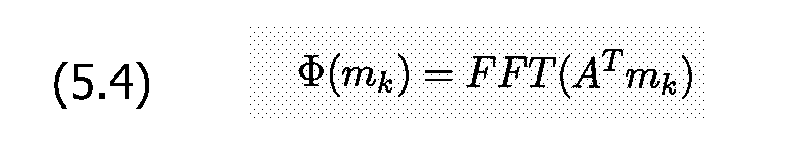
- This means that the operator Φ defines the correlation between the volume and the measurement in frequency domain based on simple back-projection. Despite AT m fulfills the mathematical equations, it typically (almost always) gives the wrong solution, which can be seen as a blurring effect in reconstruction. However, this blurring can be minimized (or at least, controlled) by the operator Λ.
- The purpose for the operator Λ is to cut-off all the frequencies outside region defined by Φ. In addition, Λ can be considered as a probability matrix; when the corresponding frequency in Φ(mk) is known, the value is set to 1, otherwise it is 0. Furthermore, if the geometry is not well-known the values can be set also between 1 and zero. Notice that Λi has the same dimension than Xi and, unlike Φ, Λ itself is an irreversible operator.
- Now we can define the ART equation respective to equation 2.5 in Fourier domain.

- Benefits against the spatial ART (ref equation 2.5) are the voxel-wise multiplying and the information accumulation. For example, in cone beam geometry the well-known frequencies are located on a surface of a ball. The radius of the ball corresponds the SID (source to image distance) and the center point corresponds with the X-ray source point respectively. In fact, this rule is valid in any one-shot imaging geometry.
- Figure 4 shows cross-section of jaw calculated with a method according the invention and corresponding Λ on frequency domain. Figure 4A is used with SID tolerance of 4mm, 4B used 8mm and 4C used A matrix of ones. Note that the A is here described in 2D for simplification.
- Figure 5 shows the block diagram of the imaging algorithm used in the test. The flow chart is presented only as an example of one embodiment. The iteration itself is quite alike as in the known ART algorithms, only done in the frequency domain to avoid the cache misses that are unavoidable in conventional ART algorithm. Also other transforms than FFT may be used to convert to the frequency domain, the only requirement for the transform algorithm is that there is an inverse transform back to spatial domain and the iteration can be made in the frequency domain in reasonable way. The method according the invention is not limited to the X-ray. Other forms of radiation may be for example gamma rays, any particle radiation, or even UV, IR or visible light. The possible type radiation depends on the object.
- The Figure 4 shows result of the clinical case. In this case 11 images were taken from about 40 degree aperture. The size of the image was 512x512 @ 1.8mm pixel size. The reconstructed volume was 256x256x256 voxels and size of 60x60x60mm. The reconstruction time was about 8 minutes (7 minutes to calculate Φ(mk) and 1 minute for 55 iteration rounds). As a reference, the conventional ART took with the same PC (2GHz Pentium 4) about 30 minutes.
- The volumes were reconstructed by using different A values while other parameters were fixed (including initial guess). Results can be seen on figures 4A to 4C. Notice that when A is tightly defined (image 4A), the off-focal shadows produces highfrequency artifacts instead of blurring (image 4C). As described earlier, the clinical task is to define the distance from the jaw ridge to nerve channel, Mental foramen, for right implant planning. Despite the fact that the mental foramen is clearly visible in every case, most clearly it can be seen on image 4A. Furthermore, this test shows that the best subjective image quality is gained with Λ ≈ ±4mm tolerance, which also matches with our experience of systems tolerances.
- Therefore the frequency based ART according the invention works well and is remarkably faster than known ART based on spatial domain iterations and the quality of tomography image is not deteriorated compared to the known ART methods.
- The present invention has been described in terms of the preferred embodiment, and it is recognized that equivalents, alternative, and modifications, aside from those expressly stated, are possible and within the scope of the appending claims. For example the instead of the Fast Fourier Transform may be used other transforms, like z-transform, wavelet-transform, or any imaginary or real transform, that enables the iteration to be calculated using inner product or sequential computation.
Claims (10)
- A tomographic reconstruction method for calculation of a 3-dimensional image data or 2-dimensional slice from a limited amount of 2-dimensional or 1-dimensional projection images using iterations to calculate 3D image elements, said method comprising transformation of measured or reconstructed data to transform domain.
- A reconstruction method according the claim 1, where method uses integral, sum, or functional transform for creating a new domain for data to be iterated prior the iterative reconstruction in transform domain and the inverse transform of said integral, sum, or functional transform to form the 3-dimensional image in the spatial domain.
- A reconstruction method according to the claim 1, said method using Fourier transform to the image data prior the iterative reconstruction in frequency domain.
- Tomographic reconstruction method for calculation of a 3-dimensional image data or 2-dimensional slice from a limited amount of 2-dimensional or 1-dimensional projection images radiated at least from two locations of radiation source, said method using iteration to obtain the 3D image elements, said method comprising transformation of measured or reconstructed data to transform domain prior the iteration step to enable the iteration to be made with matrix element wise multiplication in sequential order to lower the computer cache miss rate during the iterative computation.
- Method according the claim 1, the method being an X-ray imaging method.
- Method according the claim 1, the transform being a frequency related transform.
- Method according the claim 1, the method using general purpose computing device for iteration.
- Method according the claim 1, the method using networked general purpose computing devices for iteration.
- A device for a tomographic reconstruction of a 3-dimensional image data or 2-dimensional slice from limited amount of 1- or 2-dimensional images, the device comprising means to perform iterative computation in transform domain.
- A software for a tomographic reconstruction of a 3-dimensional image data or 2-dimensional slice from limited amount of 1- or 2-dimensional images, said software comprising means to perform iterative computation in transform domain.
Applications Claiming Priority (1)
| Application Number | Priority Date | Filing Date | Title |
|---|---|---|---|
| US11/292,318 US7853056B2 (en) | 2005-12-01 | 2005-12-01 | Method for limited angle tomography |
Publications (3)
| Publication Number | Publication Date |
|---|---|
| EP1793347A2 true EP1793347A2 (en) | 2007-06-06 |
| EP1793347A3 EP1793347A3 (en) | 2010-09-01 |
| EP1793347B1 EP1793347B1 (en) | 2012-12-05 |
Family
ID=37762566
Family Applications (1)
| Application Number | Title | Priority Date | Filing Date |
|---|---|---|---|
| EP06120874A Not-in-force EP1793347B1 (en) | 2005-12-01 | 2006-09-19 | Method for limited angle tomography |
Country Status (2)
| Country | Link |
|---|---|
| US (1) | US7853056B2 (en) |
| EP (1) | EP1793347B1 (en) |
Cited By (1)
| Publication number | Priority date | Publication date | Assignee | Title |
|---|---|---|---|---|
| DE102011115577A1 (en) | 2011-10-11 | 2013-04-11 | Universität Zu Lübeck | Method for avoiding artifact in iterative reconstruction of object such as apple, involves determining start model of object function under back projection of detected gray values of projections for all prospects in object space |
Families Citing this family (10)
| Publication number | Priority date | Publication date | Assignee | Title |
|---|---|---|---|---|
| DE102009015032A1 (en) * | 2009-03-26 | 2010-10-07 | Siemens Aktiengesellschaft | Iterative extra focal radiation correction in the reconstruction of CT images |
| US8670521B2 (en) | 2011-06-02 | 2014-03-11 | Carestream Health, Inc. | Method for generating an intraoral volume image |
| US8849016B2 (en) * | 2011-07-21 | 2014-09-30 | Carestream Health, Inc. | Panoramic image generation from CBCT dental images |
| US8929635B2 (en) | 2011-07-21 | 2015-01-06 | Carestream Health, Inc. | Method and system for tooth segmentation in dental images |
| US8842904B2 (en) | 2011-07-21 | 2014-09-23 | Carestream Health, Inc. | Method for tooth dissection in CBCT volume |
| US9129363B2 (en) | 2011-07-21 | 2015-09-08 | Carestream Health, Inc. | Method for teeth segmentation and alignment detection in CBCT volume |
| US10758315B2 (en) * | 2012-06-21 | 2020-09-01 | Globus Medical Inc. | Method and system for improving 2D-3D registration convergence |
| CN106408664B (en) * | 2016-08-30 | 2021-03-02 | 任少康 | Three-dimensional model curved surface reconstruction method based on three-dimensional scanning device |
| WO2019040056A1 (en) | 2017-08-23 | 2019-02-28 | Carestream Dental Technology Topco Limited | Dental chair-side tomosynthesis system |
| EP4017370B1 (en) | 2019-08-19 | 2024-09-25 | Carestream Dental LLC | Geometric calibration marker detection in spectral tomosynthesis system |
Family Cites Families (8)
| Publication number | Priority date | Publication date | Assignee | Title |
|---|---|---|---|---|
| IT1035676B (en) * | 1974-05-10 | 1979-10-20 | Barbieri Marcello | PROCEDOMENT AND EQUIPMENT FOR REBUILDING STRUCTURES BY MEANS OF X-RAY RADIOGRAPHIES |
| US4506327A (en) * | 1981-11-23 | 1985-03-19 | General Electric Company | Limited-angle imaging using multiple energy scanning |
| US6002738A (en) * | 1995-07-07 | 1999-12-14 | Silicon Graphics, Inc. | System and method of performing tomographic reconstruction and volume rendering using texture mapping |
| US6768782B1 (en) * | 2002-12-16 | 2004-07-27 | University Of Notre Dame Du Lac | Iterative method for region-of-interest reconstruction |
| US6907102B1 (en) * | 2002-12-16 | 2005-06-14 | Ken Sauer | Iterative reconstruction methods for multi-slice computed tomography |
| US8045770B2 (en) * | 2003-03-24 | 2011-10-25 | Cornell Research Foundation, Inc. | System and method for three-dimensional image rendering and analysis |
| US6904121B2 (en) * | 2003-06-25 | 2005-06-07 | General Electric Company | Fourier based method, apparatus, and medium for optimal reconstruction in digital tomosynthesis |
| US7251306B2 (en) * | 2004-11-17 | 2007-07-31 | General Electric Company | Methods, apparatus, and software to facilitate iterative reconstruction of images |
-
2005
- 2005-12-01 US US11/292,318 patent/US7853056B2/en active Active
-
2006
- 2006-09-19 EP EP06120874A patent/EP1793347B1/en not_active Not-in-force
Non-Patent Citations (10)
| Title |
|---|
| ALEXANDER H DELANEY ET AL: "A Fast and Accurate Fourier Algorithm for Iterative Parallel-Beam Tomography" IEEE TRANSACTIONS ON IMAGE PROCESSING, IEEE SERVICE CENTER, PISCATAWAY, NJ, US, vol. 5, no. 5, 1 May 1996 (1996-05-01), XP011025991 ISSN: 1057-7149 * |
| BIDAUT ET AL: "Second-generation three-dimensional reconstruction for rotational three-dimensional angiography" ACADEMIC RADIOLOGY, RESTON, VA, US LNKD- DOI:10.1016/S1076-6332(98)80244-4, vol. 5, no. 12, 1 December 1998 (1998-12-01), pages 836-849, XP005307401 ISSN: 1076-6332 * |
| GRUNBAUM F A: "A STUDY OF FOURIER SPACE METHODS FOR LIMITED ANGLE IMAGE RECONSTRUCTION" NUMERICAL FUNCTIONAL ANALYSIS AND OPTIMIZATION, DEKKER, NEW YORK, NY, US, vol. 2, no. 1, 1 January 1980 (1980-01-01) , pages 31-42, XP001083951 ISSN: 0163-0563 * |
| JONIC S ET AL: "Spline-based image-to-volume registration for three-dimensional electron microscopy" ULTRAMICROSCOPY, ELSEVIER, AMSTERDAM, NL LNKD- DOI:10.1016/J.ULTRAMIC.2005.02.002, vol. 103, no. 4, 1 July 2005 (2005-07-01), pages 303-317, XP004882916 ISSN: 0304-3991 * |
| KLAUS MUELLER ET AL: "Fast Implementations of Algebraic Methods for Three-Dimensional Reconstruction from Cone-Beam Data" IEEE TRANSACTIONS ON MEDICAL IMAGING, IEEE SERVICE CENTER, PISCATAWAY, NJ, US, vol. 18, no. 6, 1 June 1999 (1999-06-01), XP011035868 ISSN: 0278-0062 * |
| NA H ET AL: "A space-frequency algorithm for limited angle tomography" PROCEEDINGS OF THE INTERNATIONAL CONFERENCE ON IMAGE PROCESSING (ICIP) AUSTIN, NOV. 13 - 16, 1994; [PROCEEDINGS OF THE INTERNATIONAL CONFERENCE ON IMAGE PROCESSING (ICIP)], LOS ALAMITOS, IEEE COMP. SOC. PRESS, US LNKD- DOI:10.1109/ICIP.1994.413684, vol. 2, 13 November 1994 (1994-11-13), pages 815-819, XP010146284 ISBN: 978-0-8186-6952-1 * |
| PIERRE BLEUET ET AL: "An Adapted Fan Volume Sampling Scheme for 3-D Algebraic Reconstruction in Linear Tomosynthesis" IEEE TRANSACTIONS ON NUCLEAR SCIENCE, IEEE SERVICE CENTER, NEW YORK, NY, US, vol. 49, no. 5, 1 October 2002 (2002-10-01), XP011077781 ISSN: 0018-9499 * |
| SORZANO C O S ET AL: "XMIPP: a new generation of an open-source image processing package for electron microscopy" JOURNAL OF STRUCTURAL BIOLOGY, ORLANDO, US LNKD- DOI:10.1016/J.JSB.2004.06.006, vol. 148, no. 2, 1 November 2004 (2004-11-01), pages 194-204, XP004599032 ISSN: 1047-8477 * |
| STSEPANKOU D ET AL: "FPGA-acceleration of cone-beam reconstruction for the X-ray CT" FIELD-PROGRAMMABLE TECHNOLOGY, 2004. PROCEEDINGS. 2004 IEEE INTERNATIO NAL CONFERENCE ON BRISTANE, AUSTRALIA DEC. 6-8, 2004, PISCATAWAY, NJ, USA,IEEE LNKD- DOI:10.1109/FPT.2004.1393291, 6 December 2004 (2004-12-06), pages 327-330, XP010767571 ISBN: 978-0-7803-8651-8 * |
| TAM, K-C.; PEREZ-MENDEZ, V.: "Limited-angle 3-D reconstruction using Fourier transform iterations and Radon transform iterations" 1980 INTERNATIONAL OPTICAL COMPUTING CONFERENCE, 8 April 1980 (1980-04-08), - 11 April 1980 (1980-04-11) pages 142-148, XP002590681 * |
Cited By (1)
| Publication number | Priority date | Publication date | Assignee | Title |
|---|---|---|---|---|
| DE102011115577A1 (en) | 2011-10-11 | 2013-04-11 | Universität Zu Lübeck | Method for avoiding artifact in iterative reconstruction of object such as apple, involves determining start model of object function under back projection of detected gray values of projections for all prospects in object space |
Also Published As
| Publication number | Publication date |
|---|---|
| US7853056B2 (en) | 2010-12-14 |
| EP1793347A3 (en) | 2010-09-01 |
| US20070127801A1 (en) | 2007-06-07 |
| EP1793347B1 (en) | 2012-12-05 |
Similar Documents
| Publication | Publication Date | Title |
|---|---|---|
| US7680240B2 (en) | Iterative reconstruction of tomographic image data method and system | |
| US9911208B2 (en) | Apparatus and method of iterative image reconstruction using regularization-parameter control | |
| US8150131B2 (en) | Computer tomography method for determining an object region with the aid of projection images | |
| US8532350B2 (en) | Dose reduction and image enhancement in tomography through the utilization of the object's surroundings as dynamic constraints | |
| US20130129178A1 (en) | Method and system for iterative image reconstruction | |
| CN107635469B (en) | Estimation of Attenuation Maps Based on Scattering Coincidence in PET Systems | |
| WO2006082557A2 (en) | Apparatus and method for correction or extension of x-ray projections | |
| CN102160085B (en) | Imaging apparatus including correction unit for scattered radiation | |
| JP2008006288A (en) | Iterative image reconstruction system and method | |
| US8045774B2 (en) | Method for creating material-selective volume images | |
| CN101138501A (en) | Method and system for generating multispectral images of objects | |
| EP1793347B1 (en) | Method for limited angle tomography | |
| Li et al. | A projection-domain low-count quantitative SPECT method for ɑ-particle-emitting radiopharmaceutical therapy | |
| Wiegert et al. | Model based scatter correction for cone-beam computed tomography | |
| Wieczorek | The image quality of FBP and MLEM reconstruction | |
| US8335358B2 (en) | Method and system for reconstructing a medical image of an object | |
| CN101175439B (en) | Continuous computer tomography performing ultra-short scans and stronger weighting of up-to-date data | |
| Zeng et al. | A projector/backprojector with slice-to-slice blurring for efficient three-dimensional scatter modeling | |
| US12076173B2 (en) | System and method for controlling errors in computed tomography number | |
| Anastasio et al. | A preliminary investigation of local tomography for megavoltage CT imaging | |
| US7737972B2 (en) | Systems and methods for digital volumetric laminar tomography | |
| Mou et al. | A beam hardening correction method based on HL consistency | |
| Snyder et al. | Image reconstruction for transmission tomography when projection data are incomplete | |
| EP1899890B1 (en) | System for image reconstruction | |
| CN101331516A (en) | Advanced convergence for multiple iteration algorithms |
Legal Events
| Date | Code | Title | Description |
|---|---|---|---|
| PUAI | Public reference made under article 153(3) epc to a published international application that has entered the european phase |
Free format text: ORIGINAL CODE: 0009012 |
|
| AK | Designated contracting states |
Kind code of ref document: A2 Designated state(s): AT BE BG CH CY CZ DE DK EE ES FI FR GB GR HU IE IS IT LI LT LU LV MC NL PL PT RO SE SI SK TR |
|
| AX | Request for extension of the european patent |
Extension state: AL BA HR MK YU |
|
| PUAL | Search report despatched |
Free format text: ORIGINAL CODE: 0009013 |
|
| AK | Designated contracting states |
Kind code of ref document: A3 Designated state(s): AT BE BG CH CY CZ DE DK EE ES FI FR GB GR HU IE IS IT LI LT LU LV MC NL PL PT RO SE SI SK TR |
|
| AX | Request for extension of the european patent |
Extension state: AL BA HR MK RS |
|
| 17P | Request for examination filed |
Effective date: 20110301 |
|
| RAP1 | Party data changed (applicant data changed or rights of an application transferred) |
Owner name: GENERAL ELECTRIC COMPANY |
|
| AKX | Designation fees paid |
Designated state(s): AT BE BG CH CY CZ DE DK EE ES FI FR GB GR HU IE IS IT LI LT LU LV MC NL PL PT RO SE SI SK TR |
|
| RAP1 | Party data changed (applicant data changed or rights of an application transferred) |
Owner name: PALODEX GROUP OY |
|
| GRAP | Despatch of communication of intention to grant a patent |
Free format text: ORIGINAL CODE: EPIDOSNIGR1 |
|
| GRAS | Grant fee paid |
Free format text: ORIGINAL CODE: EPIDOSNIGR3 |
|
| GRAA | (expected) grant |
Free format text: ORIGINAL CODE: 0009210 |
|
| AK | Designated contracting states |
Kind code of ref document: B1 Designated state(s): AT BE BG CH CY CZ DE DK EE ES FI FR GB GR HU IE IS IT LI LT LU LV MC NL PL PT RO SE SI SK TR |
|
| REG | Reference to a national code |
Ref country code: GB Ref legal event code: FG4D |
|
| REG | Reference to a national code |
Ref country code: CH Ref legal event code: EP |
|
| REG | Reference to a national code |
Ref country code: AT Ref legal event code: REF Ref document number: 587627 Country of ref document: AT Kind code of ref document: T Effective date: 20121215 |
|
| REG | Reference to a national code |
Ref country code: IE Ref legal event code: FG4D |
|
| REG | Reference to a national code |
Ref country code: DE Ref legal event code: R096 Ref document number: 602006033430 Country of ref document: DE Effective date: 20130131 |
|
| REG | Reference to a national code |
Ref country code: AT Ref legal event code: MK05 Ref document number: 587627 Country of ref document: AT Kind code of ref document: T Effective date: 20121205 |
|
| PG25 | Lapsed in a contracting state [announced via postgrant information from national office to epo] |
Ref country code: LT Free format text: LAPSE BECAUSE OF FAILURE TO SUBMIT A TRANSLATION OF THE DESCRIPTION OR TO PAY THE FEE WITHIN THE PRESCRIBED TIME-LIMIT Effective date: 20121205 Ref country code: ES Free format text: LAPSE BECAUSE OF FAILURE TO SUBMIT A TRANSLATION OF THE DESCRIPTION OR TO PAY THE FEE WITHIN THE PRESCRIBED TIME-LIMIT Effective date: 20130316 Ref country code: SE Free format text: LAPSE BECAUSE OF FAILURE TO SUBMIT A TRANSLATION OF THE DESCRIPTION OR TO PAY THE FEE WITHIN THE PRESCRIBED TIME-LIMIT Effective date: 20121205 |
|
| REG | Reference to a national code |
Ref country code: NL Ref legal event code: VDEP Effective date: 20121205 |
|
| REG | Reference to a national code |
Ref country code: LT Ref legal event code: MG4D |
|
| PG25 | Lapsed in a contracting state [announced via postgrant information from national office to epo] |
Ref country code: SI Free format text: LAPSE BECAUSE OF FAILURE TO SUBMIT A TRANSLATION OF THE DESCRIPTION OR TO PAY THE FEE WITHIN THE PRESCRIBED TIME-LIMIT Effective date: 20121205 Ref country code: GR Free format text: LAPSE BECAUSE OF FAILURE TO SUBMIT A TRANSLATION OF THE DESCRIPTION OR TO PAY THE FEE WITHIN THE PRESCRIBED TIME-LIMIT Effective date: 20130306 Ref country code: CY Free format text: LAPSE BECAUSE OF FAILURE TO SUBMIT A TRANSLATION OF THE DESCRIPTION OR TO PAY THE FEE WITHIN THE PRESCRIBED TIME-LIMIT Effective date: 20121205 Ref country code: LV Free format text: LAPSE BECAUSE OF FAILURE TO SUBMIT A TRANSLATION OF THE DESCRIPTION OR TO PAY THE FEE WITHIN THE PRESCRIBED TIME-LIMIT Effective date: 20121205 Ref country code: PL Free format text: LAPSE BECAUSE OF FAILURE TO SUBMIT A TRANSLATION OF THE DESCRIPTION OR TO PAY THE FEE WITHIN THE PRESCRIBED TIME-LIMIT Effective date: 20121205 |
|
| PG25 | Lapsed in a contracting state [announced via postgrant information from national office to epo] |
Ref country code: AT Free format text: LAPSE BECAUSE OF FAILURE TO SUBMIT A TRANSLATION OF THE DESCRIPTION OR TO PAY THE FEE WITHIN THE PRESCRIBED TIME-LIMIT Effective date: 20121205 |
|
| PG25 | Lapsed in a contracting state [announced via postgrant information from national office to epo] |
Ref country code: SK Free format text: LAPSE BECAUSE OF FAILURE TO SUBMIT A TRANSLATION OF THE DESCRIPTION OR TO PAY THE FEE WITHIN THE PRESCRIBED TIME-LIMIT Effective date: 20121205 Ref country code: EE Free format text: LAPSE BECAUSE OF FAILURE TO SUBMIT A TRANSLATION OF THE DESCRIPTION OR TO PAY THE FEE WITHIN THE PRESCRIBED TIME-LIMIT Effective date: 20121205 Ref country code: BE Free format text: LAPSE BECAUSE OF FAILURE TO SUBMIT A TRANSLATION OF THE DESCRIPTION OR TO PAY THE FEE WITHIN THE PRESCRIBED TIME-LIMIT Effective date: 20121205 Ref country code: IS Free format text: LAPSE BECAUSE OF FAILURE TO SUBMIT A TRANSLATION OF THE DESCRIPTION OR TO PAY THE FEE WITHIN THE PRESCRIBED TIME-LIMIT Effective date: 20130405 Ref country code: BG Free format text: LAPSE BECAUSE OF FAILURE TO SUBMIT A TRANSLATION OF THE DESCRIPTION OR TO PAY THE FEE WITHIN THE PRESCRIBED TIME-LIMIT Effective date: 20130305 Ref country code: CZ Free format text: LAPSE BECAUSE OF FAILURE TO SUBMIT A TRANSLATION OF THE DESCRIPTION OR TO PAY THE FEE WITHIN THE PRESCRIBED TIME-LIMIT Effective date: 20121205 |
|
| PG25 | Lapsed in a contracting state [announced via postgrant information from national office to epo] |
Ref country code: PT Free format text: LAPSE BECAUSE OF FAILURE TO SUBMIT A TRANSLATION OF THE DESCRIPTION OR TO PAY THE FEE WITHIN THE PRESCRIBED TIME-LIMIT Effective date: 20130405 Ref country code: NL Free format text: LAPSE BECAUSE OF FAILURE TO SUBMIT A TRANSLATION OF THE DESCRIPTION OR TO PAY THE FEE WITHIN THE PRESCRIBED TIME-LIMIT Effective date: 20121205 Ref country code: RO Free format text: LAPSE BECAUSE OF FAILURE TO SUBMIT A TRANSLATION OF THE DESCRIPTION OR TO PAY THE FEE WITHIN THE PRESCRIBED TIME-LIMIT Effective date: 20121205 |
|
| PLBE | No opposition filed within time limit |
Free format text: ORIGINAL CODE: 0009261 |
|
| STAA | Information on the status of an ep patent application or granted ep patent |
Free format text: STATUS: NO OPPOSITION FILED WITHIN TIME LIMIT |
|
| PG25 | Lapsed in a contracting state [announced via postgrant information from national office to epo] |
Ref country code: DK Free format text: LAPSE BECAUSE OF FAILURE TO SUBMIT A TRANSLATION OF THE DESCRIPTION OR TO PAY THE FEE WITHIN THE PRESCRIBED TIME-LIMIT Effective date: 20121205 |
|
| 26N | No opposition filed |
Effective date: 20130906 |
|
| REG | Reference to a national code |
Ref country code: DE Ref legal event code: R097 Ref document number: 602006033430 Country of ref document: DE Effective date: 20130906 |
|
| PG25 | Lapsed in a contracting state [announced via postgrant information from national office to epo] |
Ref country code: MC Free format text: LAPSE BECAUSE OF FAILURE TO SUBMIT A TRANSLATION OF THE DESCRIPTION OR TO PAY THE FEE WITHIN THE PRESCRIBED TIME-LIMIT Effective date: 20121205 |
|
| REG | Reference to a national code |
Ref country code: CH Ref legal event code: PL |
|
| GBPC | Gb: european patent ceased through non-payment of renewal fee |
Effective date: 20130919 |
|
| REG | Reference to a national code |
Ref country code: IE Ref legal event code: MM4A |
|
| PG25 | Lapsed in a contracting state [announced via postgrant information from national office to epo] |
Ref country code: GB Free format text: LAPSE BECAUSE OF NON-PAYMENT OF DUE FEES Effective date: 20130919 Ref country code: LI Free format text: LAPSE BECAUSE OF NON-PAYMENT OF DUE FEES Effective date: 20130930 Ref country code: IE Free format text: LAPSE BECAUSE OF NON-PAYMENT OF DUE FEES Effective date: 20130919 Ref country code: CH Free format text: LAPSE BECAUSE OF NON-PAYMENT OF DUE FEES Effective date: 20130930 |
|
| PG25 | Lapsed in a contracting state [announced via postgrant information from national office to epo] |
Ref country code: TR Free format text: LAPSE BECAUSE OF FAILURE TO SUBMIT A TRANSLATION OF THE DESCRIPTION OR TO PAY THE FEE WITHIN THE PRESCRIBED TIME-LIMIT Effective date: 20121205 |
|
| PG25 | Lapsed in a contracting state [announced via postgrant information from national office to epo] |
Ref country code: HU Free format text: LAPSE BECAUSE OF FAILURE TO SUBMIT A TRANSLATION OF THE DESCRIPTION OR TO PAY THE FEE WITHIN THE PRESCRIBED TIME-LIMIT; INVALID AB INITIO Effective date: 20060919 Ref country code: LU Free format text: LAPSE BECAUSE OF NON-PAYMENT OF DUE FEES Effective date: 20130919 |
|
| REG | Reference to a national code |
Ref country code: FR Ref legal event code: PLFP Year of fee payment: 10 |
|
| PGFP | Annual fee paid to national office [announced via postgrant information from national office to epo] |
Ref country code: FI Payment date: 20150929 Year of fee payment: 10 |
|
| PGFP | Annual fee paid to national office [announced via postgrant information from national office to epo] |
Ref country code: FR Payment date: 20150917 Year of fee payment: 10 |
|
| PGFP | Annual fee paid to national office [announced via postgrant information from national office to epo] |
Ref country code: IT Payment date: 20150923 Year of fee payment: 10 |
|
| PGFP | Annual fee paid to national office [announced via postgrant information from national office to epo] |
Ref country code: DE Payment date: 20150929 Year of fee payment: 10 |
|
| REG | Reference to a national code |
Ref country code: DE Ref legal event code: R119 Ref document number: 602006033430 Country of ref document: DE |
|
| PG25 | Lapsed in a contracting state [announced via postgrant information from national office to epo] |
Ref country code: FI Free format text: LAPSE BECAUSE OF NON-PAYMENT OF DUE FEES Effective date: 20160919 |
|
| REG | Reference to a national code |
Ref country code: FR Ref legal event code: ST Effective date: 20170531 |
|
| PG25 | Lapsed in a contracting state [announced via postgrant information from national office to epo] |
Ref country code: DE Free format text: LAPSE BECAUSE OF NON-PAYMENT OF DUE FEES Effective date: 20170401 Ref country code: FR Free format text: LAPSE BECAUSE OF NON-PAYMENT OF DUE FEES Effective date: 20160930 |
|
| PG25 | Lapsed in a contracting state [announced via postgrant information from national office to epo] |
Ref country code: IT Free format text: LAPSE BECAUSE OF NON-PAYMENT OF DUE FEES Effective date: 20160919 |