EP1792909A1 - Synthesis of polynucleotides - Google Patents
Synthesis of polynucleotides Download PDFInfo
- Publication number
- EP1792909A1 EP1792909A1 EP06255600A EP06255600A EP1792909A1 EP 1792909 A1 EP1792909 A1 EP 1792909A1 EP 06255600 A EP06255600 A EP 06255600A EP 06255600 A EP06255600 A EP 06255600A EP 1792909 A1 EP1792909 A1 EP 1792909A1
- Authority
- EP
- European Patent Office
- Prior art keywords
- group
- solution
- rna
- substituted
- protected
- Prior art date
- Legal status (The legal status is an assumption and is not a legal conclusion. Google has not performed a legal analysis and makes no representation as to the accuracy of the status listed.)
- Withdrawn
Links
- 108091033319 polynucleotide Proteins 0.000 title claims abstract description 121
- 102000040430 polynucleotide Human genes 0.000 title claims abstract description 121
- 239000002157 polynucleotide Substances 0.000 title claims abstract description 121
- 238000003786 synthesis reaction Methods 0.000 title description 164
- 230000015572 biosynthetic process Effects 0.000 title description 161
- 238000000034 method Methods 0.000 claims abstract description 144
- 239000000178 monomer Substances 0.000 claims abstract description 109
- 125000003729 nucleotide group Chemical group 0.000 claims abstract description 84
- 239000002773 nucleotide Substances 0.000 claims abstract description 83
- 229920002477 rna polymer Polymers 0.000 claims description 336
- -1 t-butyl-dimethylsilyl group Chemical group 0.000 claims description 328
- 125000006239 protecting group Chemical group 0.000 claims description 279
- MHAJPDPJQMAIIY-UHFFFAOYSA-N Hydrogen peroxide Chemical compound OO MHAJPDPJQMAIIY-UHFFFAOYSA-N 0.000 claims description 167
- 239000007787 solid Substances 0.000 claims description 149
- 239000012038 nucleophile Substances 0.000 claims description 102
- 125000005647 linker group Chemical group 0.000 claims description 81
- 150000003839 salts Chemical class 0.000 claims description 47
- 125000000217 alkyl group Chemical group 0.000 claims description 45
- 125000003118 aryl group Chemical group 0.000 claims description 39
- 125000000623 heterocyclic group Chemical group 0.000 claims description 37
- 125000002887 hydroxy group Chemical group [H]O* 0.000 claims description 35
- 125000000547 substituted alkyl group Chemical group 0.000 claims description 28
- 125000003107 substituted aryl group Chemical group 0.000 claims description 26
- 125000002924 primary amino group Chemical group [H]N([H])* 0.000 claims description 24
- 239000002253 acid Substances 0.000 claims description 19
- 125000003277 amino group Chemical group 0.000 claims description 18
- LJGHYPLBDBRCRZ-UHFFFAOYSA-N 3-(3-aminophenyl)sulfonylaniline Chemical compound NC1=CC=CC(S(=O)(=O)C=2C=C(N)C=CC=2)=C1 LJGHYPLBDBRCRZ-UHFFFAOYSA-N 0.000 claims description 16
- 229910052736 halogen Inorganic materials 0.000 claims description 16
- 150000002367 halogens Chemical class 0.000 claims description 16
- 230000002194 synthesizing effect Effects 0.000 claims description 15
- KFSLWBXXFJQRDL-UHFFFAOYSA-N Peracetic acid Chemical compound CC(=O)OO KFSLWBXXFJQRDL-UHFFFAOYSA-N 0.000 claims description 14
- 125000003545 alkoxy group Chemical group 0.000 claims description 14
- 125000004104 aryloxy group Chemical group 0.000 claims description 14
- OKTJSMMVPCPJKN-UHFFFAOYSA-N Carbon Chemical group [C] OKTJSMMVPCPJKN-UHFFFAOYSA-N 0.000 claims description 12
- 150000004965 peroxy acids Chemical class 0.000 claims description 11
- 125000004093 cyano group Chemical group *C#N 0.000 claims description 10
- 125000000449 nitro group Chemical group [O-][N+](*)=O 0.000 claims description 9
- 150000002432 hydroperoxides Chemical class 0.000 claims description 6
- QVGXLLKOCUKJST-UHFFFAOYSA-N atomic oxygen Chemical compound [O] QVGXLLKOCUKJST-UHFFFAOYSA-N 0.000 claims description 5
- 125000001841 imino group Chemical group [H]N=* 0.000 claims description 5
- 239000001301 oxygen Substances 0.000 claims description 5
- 229910052760 oxygen Inorganic materials 0.000 claims description 5
- 125000005415 substituted alkoxy group Chemical group 0.000 claims description 5
- AKUNSTOMHUXJOZ-UHFFFAOYSA-N 1-hydroperoxybutane Chemical compound CCCCOO AKUNSTOMHUXJOZ-UHFFFAOYSA-N 0.000 claims description 4
- ULQQGOGMQRGFFR-UHFFFAOYSA-N 2-chlorobenzenecarboperoxoic acid Chemical compound OOC(=O)C1=CC=CC=C1Cl ULQQGOGMQRGFFR-UHFFFAOYSA-N 0.000 claims description 4
- YNJSNEKCXVFDKW-UHFFFAOYSA-N 3-(5-amino-1h-indol-3-yl)-2-azaniumylpropanoate Chemical compound C1=C(N)C=C2C(CC(N)C(O)=O)=CNC2=C1 YNJSNEKCXVFDKW-UHFFFAOYSA-N 0.000 claims description 4
- NINIDFKCEFEMDL-UHFFFAOYSA-N Sulfur Chemical group [S] NINIDFKCEFEMDL-UHFFFAOYSA-N 0.000 claims description 4
- 150000007513 acids Chemical class 0.000 claims description 4
- JYINMLPNDRBKKZ-UHFFFAOYSA-N hydroperoxybenzene Chemical compound OOC1=CC=CC=C1 JYINMLPNDRBKKZ-UHFFFAOYSA-N 0.000 claims description 4
- YVJRCWCFDJYONJ-UHFFFAOYSA-N hydroperoxymethylbenzene Chemical compound OOCC1=CC=CC=C1 YVJRCWCFDJYONJ-UHFFFAOYSA-N 0.000 claims description 4
- 125000002560 nitrile group Chemical group 0.000 claims description 4
- 125000000852 azido group Chemical group *N=[N+]=[N-] 0.000 claims description 3
- 125000002092 orthoester group Chemical group 0.000 claims description 3
- 125000000542 sulfonic acid group Chemical group 0.000 claims description 2
- 239000005864 Sulphur Substances 0.000 claims 2
- ZZOUNUKCRDIVOO-UHFFFAOYSA-N azidosulfonyl cyanate Chemical compound [N-]=[N+]=NS(=O)(=O)OC#N ZZOUNUKCRDIVOO-UHFFFAOYSA-N 0.000 claims 1
- 239000000243 solution Substances 0.000 description 391
- XLYOFNOQVPJJNP-UHFFFAOYSA-N water Substances O XLYOFNOQVPJJNP-UHFFFAOYSA-N 0.000 description 203
- WEVYAHXRMPXWCK-UHFFFAOYSA-N Acetonitrile Chemical compound CC#N WEVYAHXRMPXWCK-UHFFFAOYSA-N 0.000 description 200
- LFQSCWFLJHTTHZ-UHFFFAOYSA-N Ethanol Chemical compound CCO LFQSCWFLJHTTHZ-UHFFFAOYSA-N 0.000 description 168
- NYHBQMYGNKIUIF-UUOKFMHZSA-N Guanosine Chemical compound C1=NC=2C(=O)NC(N)=NC=2N1[C@@H]1O[C@H](CO)[C@@H](O)[C@H]1O NYHBQMYGNKIUIF-UUOKFMHZSA-N 0.000 description 162
- 108091034117 Oligonucleotide Proteins 0.000 description 153
- OKKJLVBELUTLKV-UHFFFAOYSA-N Methanol Chemical compound OC OKKJLVBELUTLKV-UHFFFAOYSA-N 0.000 description 147
- JUJWROOIHBZHMG-UHFFFAOYSA-N Pyridine Chemical compound C1=CC=NC=C1 JUJWROOIHBZHMG-UHFFFAOYSA-N 0.000 description 136
- OIRDTQYFTABQOQ-KQYNXXCUSA-N adenosine Chemical compound C1=NC=2C(N)=NC=NC=2N1[C@@H]1O[C@H](CO)[C@@H](O)[C@H]1O OIRDTQYFTABQOQ-KQYNXXCUSA-N 0.000 description 132
- 238000010511 deprotection reaction Methods 0.000 description 118
- 150000001412 amines Chemical class 0.000 description 94
- 238000006243 chemical reaction Methods 0.000 description 82
- 125000002496 methyl group Chemical group [H]C([H])([H])* 0.000 description 73
- 150000004713 phosphodiesters Chemical class 0.000 description 73
- 229940029575 guanosine Drugs 0.000 description 72
- MIKUYHXYGGJMLM-GIMIYPNGSA-N Crotonoside Natural products C1=NC2=C(N)NC(=O)N=C2N1[C@H]1O[C@@H](CO)[C@H](O)[C@@H]1O MIKUYHXYGGJMLM-GIMIYPNGSA-N 0.000 description 71
- NYHBQMYGNKIUIF-UHFFFAOYSA-N D-guanosine Natural products C1=2NC(N)=NC(=O)C=2N=CN1C1OC(CO)C(O)C1O NYHBQMYGNKIUIF-UHFFFAOYSA-N 0.000 description 71
- 239000000872 buffer Substances 0.000 description 70
- JLCPHMBAVCMARE-UHFFFAOYSA-N [3-[[3-[[3-[[3-[[3-[[3-[[3-[[3-[[3-[[3-[[3-[[5-(2-amino-6-oxo-1H-purin-9-yl)-3-[[3-[[3-[[3-[[3-[[3-[[5-(2-amino-6-oxo-1H-purin-9-yl)-3-[[5-(2-amino-6-oxo-1H-purin-9-yl)-3-hydroxyoxolan-2-yl]methoxy-hydroxyphosphoryl]oxyoxolan-2-yl]methoxy-hydroxyphosphoryl]oxy-5-(5-methyl-2,4-dioxopyrimidin-1-yl)oxolan-2-yl]methoxy-hydroxyphosphoryl]oxy-5-(6-aminopurin-9-yl)oxolan-2-yl]methoxy-hydroxyphosphoryl]oxy-5-(6-aminopurin-9-yl)oxolan-2-yl]methoxy-hydroxyphosphoryl]oxy-5-(6-aminopurin-9-yl)oxolan-2-yl]methoxy-hydroxyphosphoryl]oxy-5-(6-aminopurin-9-yl)oxolan-2-yl]methoxy-hydroxyphosphoryl]oxyoxolan-2-yl]methoxy-hydroxyphosphoryl]oxy-5-(5-methyl-2,4-dioxopyrimidin-1-yl)oxolan-2-yl]methoxy-hydroxyphosphoryl]oxy-5-(4-amino-2-oxopyrimidin-1-yl)oxolan-2-yl]methoxy-hydroxyphosphoryl]oxy-5-(5-methyl-2,4-dioxopyrimidin-1-yl)oxolan-2-yl]methoxy-hydroxyphosphoryl]oxy-5-(5-methyl-2,4-dioxopyrimidin-1-yl)oxolan-2-yl]methoxy-hydroxyphosphoryl]oxy-5-(6-aminopurin-9-yl)oxolan-2-yl]methoxy-hydroxyphosphoryl]oxy-5-(6-aminopurin-9-yl)oxolan-2-yl]methoxy-hydroxyphosphoryl]oxy-5-(4-amino-2-oxopyrimidin-1-yl)oxolan-2-yl]methoxy-hydroxyphosphoryl]oxy-5-(4-amino-2-oxopyrimidin-1-yl)oxolan-2-yl]methoxy-hydroxyphosphoryl]oxy-5-(4-amino-2-oxopyrimidin-1-yl)oxolan-2-yl]methoxy-hydroxyphosphoryl]oxy-5-(6-aminopurin-9-yl)oxolan-2-yl]methoxy-hydroxyphosphoryl]oxy-5-(4-amino-2-oxopyrimidin-1-yl)oxolan-2-yl]methyl [5-(6-aminopurin-9-yl)-2-(hydroxymethyl)oxolan-3-yl] hydrogen phosphate Polymers Cc1cn(C2CC(OP(O)(=O)OCC3OC(CC3OP(O)(=O)OCC3OC(CC3O)n3cnc4c3nc(N)[nH]c4=O)n3cnc4c3nc(N)[nH]c4=O)C(COP(O)(=O)OC3CC(OC3COP(O)(=O)OC3CC(OC3COP(O)(=O)OC3CC(OC3COP(O)(=O)OC3CC(OC3COP(O)(=O)OC3CC(OC3COP(O)(=O)OC3CC(OC3COP(O)(=O)OC3CC(OC3COP(O)(=O)OC3CC(OC3COP(O)(=O)OC3CC(OC3COP(O)(=O)OC3CC(OC3COP(O)(=O)OC3CC(OC3COP(O)(=O)OC3CC(OC3COP(O)(=O)OC3CC(OC3COP(O)(=O)OC3CC(OC3COP(O)(=O)OC3CC(OC3COP(O)(=O)OC3CC(OC3COP(O)(=O)OC3CC(OC3CO)n3cnc4c(N)ncnc34)n3ccc(N)nc3=O)n3cnc4c(N)ncnc34)n3ccc(N)nc3=O)n3ccc(N)nc3=O)n3ccc(N)nc3=O)n3cnc4c(N)ncnc34)n3cnc4c(N)ncnc34)n3cc(C)c(=O)[nH]c3=O)n3cc(C)c(=O)[nH]c3=O)n3ccc(N)nc3=O)n3cc(C)c(=O)[nH]c3=O)n3cnc4c3nc(N)[nH]c4=O)n3cnc4c(N)ncnc34)n3cnc4c(N)ncnc34)n3cnc4c(N)ncnc34)n3cnc4c(N)ncnc34)O2)c(=O)[nH]c1=O JLCPHMBAVCMARE-UHFFFAOYSA-N 0.000 description 69
- 239000002126 C01EB10 - Adenosine Substances 0.000 description 68
- 229960005305 adenosine Drugs 0.000 description 68
- UMJSCPRVCHMLSP-UHFFFAOYSA-N pyridine Natural products COC1=CC=CN=C1 UMJSCPRVCHMLSP-UHFFFAOYSA-N 0.000 description 68
- UHDGCWIWMRVCDJ-UHFFFAOYSA-N 1-beta-D-Xylofuranosyl-NH-Cytosine Natural products O=C1N=C(N)C=CN1C1C(O)C(O)C(CO)O1 UHDGCWIWMRVCDJ-UHFFFAOYSA-N 0.000 description 67
- UHDGCWIWMRVCDJ-PSQAKQOGSA-N Cytidine Natural products O=C1N=C(N)C=CN1[C@@H]1[C@@H](O)[C@@H](O)[C@H](CO)O1 UHDGCWIWMRVCDJ-PSQAKQOGSA-N 0.000 description 67
- CBTVGIZVANVGBH-UHFFFAOYSA-N aminomethyl propanol Chemical compound CC(C)(N)CO CBTVGIZVANVGBH-UHFFFAOYSA-N 0.000 description 67
- UHDGCWIWMRVCDJ-ZAKLUEHWSA-N cytidine Chemical compound O=C1N=C(N)C=CN1[C@H]1[C@H](O)[C@@H](O)[C@H](CO)O1 UHDGCWIWMRVCDJ-ZAKLUEHWSA-N 0.000 description 67
- 150000002978 peroxides Chemical class 0.000 description 67
- 239000002585 base Substances 0.000 description 64
- 239000000203 mixture Substances 0.000 description 63
- 125000002777 acetyl group Chemical group [H]C([H])([H])C(*)=O 0.000 description 55
- YMWUJEATGCHHMB-UHFFFAOYSA-N Dichloromethane Chemical compound ClCCl YMWUJEATGCHHMB-UHFFFAOYSA-N 0.000 description 54
- WFDIJRYMOXRFFG-UHFFFAOYSA-N Acetic anhydride Chemical compound CC(=O)OC(C)=O WFDIJRYMOXRFFG-UHFFFAOYSA-N 0.000 description 51
- 239000002342 ribonucleoside Substances 0.000 description 50
- CURLTUGMZLYLDI-UHFFFAOYSA-N Carbon dioxide Chemical compound O=C=O CURLTUGMZLYLDI-UHFFFAOYSA-N 0.000 description 46
- XEKOWRVHYACXOJ-UHFFFAOYSA-N Ethyl acetate Chemical compound CCOC(C)=O XEKOWRVHYACXOJ-UHFFFAOYSA-N 0.000 description 45
- KWYHDKDOAIKMQN-UHFFFAOYSA-N N,N,N',N'-tetramethylethylenediamine Chemical compound CN(C)CCN(C)C KWYHDKDOAIKMQN-UHFFFAOYSA-N 0.000 description 45
- 150000004985 diamines Chemical class 0.000 description 44
- VLKZOEOYAKHREP-UHFFFAOYSA-N n-Hexane Chemical class CCCCCC VLKZOEOYAKHREP-UHFFFAOYSA-N 0.000 description 43
- 239000000047 product Substances 0.000 description 42
- 235000011089 carbon dioxide Nutrition 0.000 description 41
- YXFVVABEGXRONW-UHFFFAOYSA-N Toluene Chemical compound CC1=CC=CC=C1 YXFVVABEGXRONW-UHFFFAOYSA-N 0.000 description 39
- YGYAWVDWMABLBF-UHFFFAOYSA-N Phosgene Chemical compound ClC(Cl)=O YGYAWVDWMABLBF-UHFFFAOYSA-N 0.000 description 38
- 239000004793 Polystyrene Substances 0.000 description 37
- 229920002223 polystyrene Polymers 0.000 description 37
- 239000011541 reaction mixture Substances 0.000 description 37
- KRHYYFGTRYWZRS-UHFFFAOYSA-M Fluoride anion Chemical compound [F-] KRHYYFGTRYWZRS-UHFFFAOYSA-M 0.000 description 36
- 238000001816 cooling Methods 0.000 description 35
- 238000005119 centrifugation Methods 0.000 description 33
- 239000005289 controlled pore glass Substances 0.000 description 33
- 238000003756 stirring Methods 0.000 description 32
- RTZKZFJDLAIYFH-UHFFFAOYSA-N Diethyl ether Chemical group CCOCC RTZKZFJDLAIYFH-UHFFFAOYSA-N 0.000 description 30
- 230000008569 process Effects 0.000 description 29
- BDAGIHXWWSANSR-UHFFFAOYSA-N methanoic acid Natural products OC=O BDAGIHXWWSANSR-UHFFFAOYSA-N 0.000 description 28
- UIIMBOGNXHQVGW-UHFFFAOYSA-M Sodium bicarbonate Chemical compound [Na+].OC([O-])=O UIIMBOGNXHQVGW-UHFFFAOYSA-M 0.000 description 26
- 239000002777 nucleoside Substances 0.000 description 26
- 239000007864 aqueous solution Substances 0.000 description 25
- 238000003776 cleavage reaction Methods 0.000 description 25
- 239000003153 chemical reaction reagent Substances 0.000 description 24
- 230000007017 scission Effects 0.000 description 23
- DRTQHJPVMGBUCF-XVFCMESISA-N Uridine Chemical compound O[C@@H]1[C@H](O)[C@@H](CO)O[C@H]1N1C(=O)NC(=O)C=C1 DRTQHJPVMGBUCF-XVFCMESISA-N 0.000 description 22
- 238000004255 ion exchange chromatography Methods 0.000 description 22
- 150000003833 nucleoside derivatives Chemical class 0.000 description 22
- 125000001424 substituent group Chemical group 0.000 description 21
- 102000039446 nucleic acids Human genes 0.000 description 19
- 108020004707 nucleic acids Proteins 0.000 description 19
- 150000007523 nucleic acids Chemical class 0.000 description 19
- 150000008300 phosphoramidites Chemical class 0.000 description 18
- 125000000026 trimethylsilyl group Chemical group [H]C([H])([H])[Si]([*])(C([H])([H])[H])C([H])([H])[H] 0.000 description 17
- XKRFYHLGVUSROY-UHFFFAOYSA-N Argon Chemical compound [Ar] XKRFYHLGVUSROY-UHFFFAOYSA-N 0.000 description 16
- 230000008901 benefit Effects 0.000 description 16
- FZFAMSAMCHXGEF-UHFFFAOYSA-N chloro formate Chemical compound ClOC=O FZFAMSAMCHXGEF-UHFFFAOYSA-N 0.000 description 16
- IJOOHPMOJXWVHK-UHFFFAOYSA-N chlorotrimethylsilane Chemical compound C[Si](C)(C)Cl IJOOHPMOJXWVHK-UHFFFAOYSA-N 0.000 description 15
- 239000000543 intermediate Substances 0.000 description 15
- 125000004430 oxygen atom Chemical group O* 0.000 description 15
- 229920000642 polymer Polymers 0.000 description 15
- 239000000126 substance Substances 0.000 description 15
- 239000000758 substrate Substances 0.000 description 15
- OSWFIVFLDKOXQC-UHFFFAOYSA-N 4-(3-methoxyphenyl)aniline Chemical compound COC1=CC=CC(C=2C=CC(N)=CC=2)=C1 OSWFIVFLDKOXQC-UHFFFAOYSA-N 0.000 description 14
- OAICVXFJPJFONN-UHFFFAOYSA-N Phosphorus Chemical group [P] OAICVXFJPJFONN-UHFFFAOYSA-N 0.000 description 14
- 235000019253 formic acid Nutrition 0.000 description 14
- 238000010791 quenching Methods 0.000 description 14
- KDCGOANMDULRCW-UHFFFAOYSA-N Purine Natural products N1=CNC2=NC=NC2=C1 KDCGOANMDULRCW-UHFFFAOYSA-N 0.000 description 13
- 229910052799 carbon Inorganic materials 0.000 description 13
- 238000003818 flash chromatography Methods 0.000 description 13
- 229910000030 sodium bicarbonate Inorganic materials 0.000 description 13
- KWOLFJPFCHCOCG-UHFFFAOYSA-N Acetophenone Chemical compound CC(=O)C1=CC=CC=C1 KWOLFJPFCHCOCG-UHFFFAOYSA-N 0.000 description 12
- ISWSIDIOOBJBQZ-UHFFFAOYSA-N Phenol Chemical compound OC1=CC=CC=C1 ISWSIDIOOBJBQZ-UHFFFAOYSA-N 0.000 description 12
- ABLZXFCXXLZCGV-UHFFFAOYSA-N Phosphorous acid Chemical compound OP(O)=O ABLZXFCXXLZCGV-UHFFFAOYSA-N 0.000 description 12
- CZPWVGJYEJSRLH-UHFFFAOYSA-N Pyrimidine Chemical compound C1=CN=CN=C1 CZPWVGJYEJSRLH-UHFFFAOYSA-N 0.000 description 12
- 230000006819 RNA synthesis Effects 0.000 description 12
- VYPSYNLAJGMNEJ-UHFFFAOYSA-N Silicium dioxide Chemical compound O=[Si]=O VYPSYNLAJGMNEJ-UHFFFAOYSA-N 0.000 description 12
- 230000002378 acidificating effect Effects 0.000 description 12
- ZFTFAPZRGNKQPU-UHFFFAOYSA-L carboxylato carbonate Chemical compound [O-]C(=O)OC([O-])=O ZFTFAPZRGNKQPU-UHFFFAOYSA-L 0.000 description 12
- 239000012043 crude product Substances 0.000 description 12
- 238000001704 evaporation Methods 0.000 description 12
- 230000008020 evaporation Effects 0.000 description 12
- 239000003921 oil Substances 0.000 description 12
- 230000001376 precipitating effect Effects 0.000 description 12
- 238000002360 preparation method Methods 0.000 description 12
- QGZKDVFQNNGYKY-UHFFFAOYSA-N Ammonia Chemical compound N QGZKDVFQNNGYKY-UHFFFAOYSA-N 0.000 description 11
- 108020004414 DNA Proteins 0.000 description 11
- 229920006362 Teflon® Polymers 0.000 description 11
- DRTQHJPVMGBUCF-PSQAKQOGSA-N beta-L-uridine Natural products O[C@H]1[C@@H](O)[C@H](CO)O[C@@H]1N1C(=O)NC(=O)C=C1 DRTQHJPVMGBUCF-PSQAKQOGSA-N 0.000 description 11
- AOGYCOYQMAVAFD-UHFFFAOYSA-N chlorocarbonic acid Chemical class OC(Cl)=O AOGYCOYQMAVAFD-UHFFFAOYSA-N 0.000 description 11
- 239000007789 gas Substances 0.000 description 11
- 230000004048 modification Effects 0.000 description 11
- 238000012986 modification Methods 0.000 description 11
- RMVRSNDYEFQCLF-UHFFFAOYSA-N thiophenol Chemical compound SC1=CC=CC=C1 RMVRSNDYEFQCLF-UHFFFAOYSA-N 0.000 description 11
- DRTQHJPVMGBUCF-UHFFFAOYSA-N uracil arabinoside Natural products OC1C(O)C(CO)OC1N1C(=O)NC(=O)C=C1 DRTQHJPVMGBUCF-UHFFFAOYSA-N 0.000 description 11
- 229940045145 uridine Drugs 0.000 description 11
- 108091027075 5S-rRNA precursor Proteins 0.000 description 10
- HEDRZPFGACZZDS-UHFFFAOYSA-N Chloroform Chemical compound ClC(Cl)Cl HEDRZPFGACZZDS-UHFFFAOYSA-N 0.000 description 10
- BAVYZALUXZFZLV-UHFFFAOYSA-N Methylamine Chemical compound NC BAVYZALUXZFZLV-UHFFFAOYSA-N 0.000 description 10
- 239000004809 Teflon Substances 0.000 description 10
- 238000013459 approach Methods 0.000 description 10
- 239000001282 iso-butane Substances 0.000 description 10
- UHOVQNZJYSORNB-UHFFFAOYSA-N Benzene Chemical compound C1=CC=CC=C1 UHOVQNZJYSORNB-UHFFFAOYSA-N 0.000 description 9
- ZMANZCXQSJIPKH-UHFFFAOYSA-N Triethylamine Chemical compound CCN(CC)CC ZMANZCXQSJIPKH-UHFFFAOYSA-N 0.000 description 9
- 238000004440 column chromatography Methods 0.000 description 9
- 150000001875 compounds Chemical class 0.000 description 9
- 230000008878 coupling Effects 0.000 description 9
- 238000010168 coupling process Methods 0.000 description 9
- 238000005859 coupling reaction Methods 0.000 description 9
- RAXXELZNTBOGNW-UHFFFAOYSA-N imidazole Natural products C1=CNC=N1 RAXXELZNTBOGNW-UHFFFAOYSA-N 0.000 description 9
- 238000011065 in-situ storage Methods 0.000 description 9
- 239000000463 material Substances 0.000 description 9
- 150000003212 purines Chemical class 0.000 description 9
- VEXZGXHMUGYJMC-UHFFFAOYSA-M Chloride anion Chemical compound [Cl-] VEXZGXHMUGYJMC-UHFFFAOYSA-M 0.000 description 8
- 108091030084 RNA-OUT Proteins 0.000 description 8
- XSQUKJJJFZCRTK-UHFFFAOYSA-N Urea Chemical compound NC(N)=O XSQUKJJJFZCRTK-UHFFFAOYSA-N 0.000 description 8
- 229910052786 argon Inorganic materials 0.000 description 8
- 125000004429 atom Chemical group 0.000 description 8
- 239000012467 final product Substances 0.000 description 8
- 125000006366 methylene oxy carbonyl group Chemical group [H]C([H])([*:1])OC([*:2])=O 0.000 description 8
- 239000002904 solvent Substances 0.000 description 8
- ILMRJRBKQSSXGY-UHFFFAOYSA-N tert-butyl(dimethyl)silicon Chemical compound C[Si](C)C(C)(C)C ILMRJRBKQSSXGY-UHFFFAOYSA-N 0.000 description 8
- 229910019142 PO4 Inorganic materials 0.000 description 7
- 125000002252 acyl group Chemical group 0.000 description 7
- 125000003236 benzoyl group Chemical group [H]C1=C([H])C([H])=C(C([H])=C1[H])C(*)=O 0.000 description 7
- 125000000753 cycloalkyl group Chemical group 0.000 description 7
- 238000010494 dissociation reaction Methods 0.000 description 7
- 230000005593 dissociations Effects 0.000 description 7
- QJGQUHMNIGDVPM-UHFFFAOYSA-N nitrogen group Chemical group [N] QJGQUHMNIGDVPM-UHFFFAOYSA-N 0.000 description 7
- 230000001590 oxidative effect Effects 0.000 description 7
- NBIIXXVUZAFLBC-UHFFFAOYSA-K phosphate Chemical compound [O-]P([O-])([O-])=O NBIIXXVUZAFLBC-UHFFFAOYSA-K 0.000 description 7
- 239000010452 phosphate Substances 0.000 description 7
- 150000003230 pyrimidines Chemical class 0.000 description 7
- 238000011160 research Methods 0.000 description 7
- QTBSBXVTEAMEQO-UHFFFAOYSA-N Acetic acid Chemical compound CC(O)=O QTBSBXVTEAMEQO-UHFFFAOYSA-N 0.000 description 6
- CSCPPACGZOOCGX-UHFFFAOYSA-N Acetone Chemical compound CC(C)=O CSCPPACGZOOCGX-UHFFFAOYSA-N 0.000 description 6
- NLXLAEXVIDQMFP-UHFFFAOYSA-N Ammonia chloride Chemical compound [NH4+].[Cl-] NLXLAEXVIDQMFP-UHFFFAOYSA-N 0.000 description 6
- 230000015556 catabolic process Effects 0.000 description 6
- 125000004122 cyclic group Chemical group 0.000 description 6
- 238000006731 degradation reaction Methods 0.000 description 6
- 125000005842 heteroatom Chemical group 0.000 description 6
- 125000000472 sulfonyl group Chemical group *S(*)(=O)=O 0.000 description 6
- JDTDWAGPXAYXCI-UHFFFAOYSA-N (2-methylpropan-2-yl)oxymethanethioic s-acid Chemical compound CC(C)(C)OC(S)=O JDTDWAGPXAYXCI-UHFFFAOYSA-N 0.000 description 5
- NLHHRLWOUZZQLW-UHFFFAOYSA-N Acrylonitrile Chemical compound C=CC#N NLHHRLWOUZZQLW-UHFFFAOYSA-N 0.000 description 5
- 238000006845 Michael addition reaction Methods 0.000 description 5
- 125000004414 alkyl thio group Chemical group 0.000 description 5
- 125000003368 amide group Chemical group 0.000 description 5
- 229910021529 ammonia Inorganic materials 0.000 description 5
- 238000007068 beta-elimination reaction Methods 0.000 description 5
- 125000004432 carbon atom Chemical group C* 0.000 description 5
- 230000007423 decrease Effects 0.000 description 5
- 150000002148 esters Chemical class 0.000 description 5
- 125000000524 functional group Chemical group 0.000 description 5
- 238000004128 high performance liquid chromatography Methods 0.000 description 5
- 150000002466 imines Chemical class 0.000 description 5
- 230000000670 limiting effect Effects 0.000 description 5
- NXPHGHWWQRMDIA-UHFFFAOYSA-M magnesium;carbanide;bromide Chemical compound [CH3-].[Mg+2].[Br-] NXPHGHWWQRMDIA-UHFFFAOYSA-M 0.000 description 5
- 229910052751 metal Inorganic materials 0.000 description 5
- 239000002184 metal Substances 0.000 description 5
- 229910052757 nitrogen Inorganic materials 0.000 description 5
- 230000000269 nucleophilic effect Effects 0.000 description 5
- 229940124276 oligodeoxyribonucleotide Drugs 0.000 description 5
- 229910052698 phosphorus Inorganic materials 0.000 description 5
- 239000011574 phosphorus Substances 0.000 description 5
- 229910052717 sulfur Inorganic materials 0.000 description 5
- 125000004434 sulfur atom Chemical group 0.000 description 5
- 230000009466 transformation Effects 0.000 description 5
- NXLNNXIXOYSCMB-UHFFFAOYSA-N (4-nitrophenyl) carbonochloridate Chemical compound [O-][N+](=O)C1=CC=C(OC(Cl)=O)C=C1 NXLNNXIXOYSCMB-UHFFFAOYSA-N 0.000 description 4
- WQADWIOXOXRPLN-UHFFFAOYSA-N 1,3-dithiane Chemical compound C1CSCSC1 WQADWIOXOXRPLN-UHFFFAOYSA-N 0.000 description 4
- HPZMWTNATZPBIH-UHFFFAOYSA-N 1-methyladenine Chemical compound CN1C=NC2=NC=NC2=C1N HPZMWTNATZPBIH-UHFFFAOYSA-N 0.000 description 4
- RFLVMTUMFYRZCB-UHFFFAOYSA-N 1-methylguanine Chemical compound O=C1N(C)C(N)=NC2=C1N=CN2 RFLVMTUMFYRZCB-UHFFFAOYSA-N 0.000 description 4
- OTTXCOAOKOEENK-UHFFFAOYSA-N 2,2-difluoroethenone Chemical group FC(F)=C=O OTTXCOAOKOEENK-UHFFFAOYSA-N 0.000 description 4
- GQHTUMJGOHRCHB-UHFFFAOYSA-N 2,3,4,6,7,8,9,10-octahydropyrimido[1,2-a]azepine Chemical compound C1CCCCN2CCCN=C21 GQHTUMJGOHRCHB-UHFFFAOYSA-N 0.000 description 4
- FZWGECJQACGGTI-UHFFFAOYSA-N 2-amino-7-methyl-1,7-dihydro-6H-purin-6-one Chemical compound NC1=NC(O)=C2N(C)C=NC2=N1 FZWGECJQACGGTI-UHFFFAOYSA-N 0.000 description 4
- JVVRCYWZTJLJSG-UHFFFAOYSA-N 4-dimethylaminophenol Chemical compound CN(C)C1=CC=C(O)C=C1 JVVRCYWZTJLJSG-UHFFFAOYSA-N 0.000 description 4
- 229960000549 4-dimethylaminophenol Drugs 0.000 description 4
- VHYFNPMBLIVWCW-UHFFFAOYSA-N 4-dimethylaminopyridine Substances CN(C)C1=CC=NC=C1 VHYFNPMBLIVWCW-UHFFFAOYSA-N 0.000 description 4
- LRFVTYWOQMYALW-UHFFFAOYSA-N 9H-xanthine Chemical compound O=C1NC(=O)NC2=C1NC=N2 LRFVTYWOQMYALW-UHFFFAOYSA-N 0.000 description 4
- PAYRUJLWNCNPSJ-UHFFFAOYSA-N Aniline Chemical compound NC1=CC=CC=C1 PAYRUJLWNCNPSJ-UHFFFAOYSA-N 0.000 description 4
- IJGRMHOSHXDMSA-UHFFFAOYSA-N Atomic nitrogen Chemical compound N#N IJGRMHOSHXDMSA-UHFFFAOYSA-N 0.000 description 4
- 102000053602 DNA Human genes 0.000 description 4
- UGQMRVRMYYASKQ-KQYNXXCUSA-N Inosine Chemical compound O[C@@H]1[C@H](O)[C@@H](CO)O[C@H]1N1C2=NC=NC(O)=C2N=C1 UGQMRVRMYYASKQ-KQYNXXCUSA-N 0.000 description 4
- 229930010555 Inosine Natural products 0.000 description 4
- BVIAOQMSVZHOJM-UHFFFAOYSA-N N(6),N(6)-dimethyladenine Chemical compound CN(C)C1=NC=NC2=C1N=CN2 BVIAOQMSVZHOJM-UHFFFAOYSA-N 0.000 description 4
- XUIMIQQOPSSXEZ-UHFFFAOYSA-N Silicon Chemical compound [Si] XUIMIQQOPSSXEZ-UHFFFAOYSA-N 0.000 description 4
- QAOWNCQODCNURD-UHFFFAOYSA-N Sulfuric acid Chemical compound OS(O)(=O)=O QAOWNCQODCNURD-UHFFFAOYSA-N 0.000 description 4
- ISAKRJDGNUQOIC-UHFFFAOYSA-N Uracil Chemical compound O=C1C=CNC(=O)N1 ISAKRJDGNUQOIC-UHFFFAOYSA-N 0.000 description 4
- 235000011054 acetic acid Nutrition 0.000 description 4
- 150000001299 aldehydes Chemical class 0.000 description 4
- PYMYPHUHKUWMLA-LMVFSUKVSA-N aldehydo-D-ribose Chemical compound OC[C@@H](O)[C@@H](O)[C@@H](O)C=O PYMYPHUHKUWMLA-LMVFSUKVSA-N 0.000 description 4
- 125000006242 amine protecting group Chemical group 0.000 description 4
- 239000004202 carbamide Substances 0.000 description 4
- 150000001721 carbon Chemical group 0.000 description 4
- 125000002915 carbonyl group Chemical group [*:2]C([*:1])=O 0.000 description 4
- KQIADDMXRMTWHZ-UHFFFAOYSA-N chloro-tri(propan-2-yl)silane Chemical compound CC(C)[Si](Cl)(C(C)C)C(C)C KQIADDMXRMTWHZ-UHFFFAOYSA-N 0.000 description 4
- OPTASPLRGRRNAP-UHFFFAOYSA-N cytosine Chemical compound NC=1C=CNC(=O)N=1 OPTASPLRGRRNAP-UHFFFAOYSA-N 0.000 description 4
- 125000002541 furyl group Chemical group 0.000 description 4
- UYTPUPDQBNUYGX-UHFFFAOYSA-N guanine Chemical compound O=C1NC(N)=NC2=C1N=CN2 UYTPUPDQBNUYGX-UHFFFAOYSA-N 0.000 description 4
- FDGQSTZJBFJUBT-UHFFFAOYSA-N hypoxanthine Chemical compound O=C1NC=NC2=C1NC=N2 FDGQSTZJBFJUBT-UHFFFAOYSA-N 0.000 description 4
- 229960003786 inosine Drugs 0.000 description 4
- 239000010410 layer Substances 0.000 description 4
- 125000003835 nucleoside group Chemical group 0.000 description 4
- CTSLXHKWHWQRSH-UHFFFAOYSA-N oxalyl chloride Chemical compound ClC(=O)C(Cl)=O CTSLXHKWHWQRSH-UHFFFAOYSA-N 0.000 description 4
- IGFXRKMLLMBKSA-UHFFFAOYSA-N purine Chemical compound N1=C[N]C2=NC=NC2=C1 IGFXRKMLLMBKSA-UHFFFAOYSA-N 0.000 description 4
- 239000000741 silica gel Substances 0.000 description 4
- 229910002027 silica gel Inorganic materials 0.000 description 4
- 238000010898 silica gel chromatography Methods 0.000 description 4
- 239000000377 silicon dioxide Substances 0.000 description 4
- TUZFIWBNGKNFPW-UHFFFAOYSA-M sodium;2-methylpropane-2-thiolate Chemical compound [Na+].CC(C)(C)[S-] TUZFIWBNGKNFPW-UHFFFAOYSA-M 0.000 description 4
- 238000010532 solid phase synthesis reaction Methods 0.000 description 4
- 241000894007 species Species 0.000 description 4
- 238000006467 substitution reaction Methods 0.000 description 4
- RWQNBRDOKXIBIV-UHFFFAOYSA-N thymine Chemical compound CC1=CNC(=O)NC1=O RWQNBRDOKXIBIV-UHFFFAOYSA-N 0.000 description 4
- 230000001052 transient effect Effects 0.000 description 4
- YNJBWRMUSHSURL-UHFFFAOYSA-N trichloroacetic acid Chemical compound OC(=O)C(Cl)(Cl)Cl YNJBWRMUSHSURL-UHFFFAOYSA-N 0.000 description 4
- 229960004319 trichloroacetic acid Drugs 0.000 description 4
- 125000004044 trifluoroacetyl group Chemical group FC(C(=O)*)(F)F 0.000 description 4
- UJUVTBKGZSFWEG-UHFFFAOYSA-N 1-(2-methoxyphenyl)-2-methylpropan-2-ol Chemical compound COC1=CC=CC=C1CC(C)(C)O UJUVTBKGZSFWEG-UHFFFAOYSA-N 0.000 description 3
- IHPYMWDTONKSCO-UHFFFAOYSA-N 2,2'-piperazine-1,4-diylbisethanesulfonic acid Chemical compound OS(=O)(=O)CCN1CCN(CCS(O)(=O)=O)CC1 IHPYMWDTONKSCO-UHFFFAOYSA-N 0.000 description 3
- YLMXBNACRIGGFX-UHFFFAOYSA-N C=1[C-]=NNN=1 Chemical compound C=1[C-]=NNN=1 YLMXBNACRIGGFX-UHFFFAOYSA-N 0.000 description 3
- LSDPWZHWYPCBBB-UHFFFAOYSA-N Methanethiol Chemical group SC LSDPWZHWYPCBBB-UHFFFAOYSA-N 0.000 description 3
- ZLMJMSJWJFRBEC-UHFFFAOYSA-N Potassium Chemical compound [K] ZLMJMSJWJFRBEC-UHFFFAOYSA-N 0.000 description 3
- PMZURENOXWZQFD-UHFFFAOYSA-L Sodium Sulfate Chemical compound [Na+].[Na+].[O-]S([O-])(=O)=O PMZURENOXWZQFD-UHFFFAOYSA-L 0.000 description 3
- 239000004280 Sodium formate Substances 0.000 description 3
- QAOWNCQODCNURD-UHFFFAOYSA-L Sulfate Chemical group [O-]S([O-])(=O)=O QAOWNCQODCNURD-UHFFFAOYSA-L 0.000 description 3
- DHXVGJBLRPWPCS-UHFFFAOYSA-N Tetrahydropyran Chemical compound C1CCOCC1 DHXVGJBLRPWPCS-UHFFFAOYSA-N 0.000 description 3
- 125000004036 acetal group Chemical group 0.000 description 3
- 125000003342 alkenyl group Chemical group 0.000 description 3
- 235000019270 ammonium chloride Nutrition 0.000 description 3
- 238000004458 analytical method Methods 0.000 description 3
- 239000003637 basic solution Substances 0.000 description 3
- 229960004424 carbon dioxide Drugs 0.000 description 3
- KRKNYBCHXYNGOX-UHFFFAOYSA-N citric acid Chemical compound OC(=O)CC(O)(C(O)=O)CC(O)=O KRKNYBCHXYNGOX-UHFFFAOYSA-N 0.000 description 3
- 238000004821 distillation Methods 0.000 description 3
- 125000006575 electron-withdrawing group Chemical group 0.000 description 3
- 230000008030 elimination Effects 0.000 description 3
- 238000003379 elimination reaction Methods 0.000 description 3
- 125000005843 halogen group Chemical group 0.000 description 3
- 125000001072 heteroaryl group Chemical group 0.000 description 3
- 125000001183 hydrocarbyl group Chemical group 0.000 description 3
- 239000001257 hydrogen Substances 0.000 description 3
- 229910052739 hydrogen Inorganic materials 0.000 description 3
- 239000012948 isocyanate Substances 0.000 description 3
- 150000002513 isocyanates Chemical class 0.000 description 3
- 238000006317 isomerization reaction Methods 0.000 description 3
- 238000004519 manufacturing process Methods 0.000 description 3
- 230000007935 neutral effect Effects 0.000 description 3
- 125000004433 nitrogen atom Chemical group N* 0.000 description 3
- 125000001181 organosilyl group Chemical group [SiH3]* 0.000 description 3
- 238000007254 oxidation reaction Methods 0.000 description 3
- ACVYVLVWPXVTIT-UHFFFAOYSA-M phosphinate Chemical compound [O-][PH2]=O ACVYVLVWPXVTIT-UHFFFAOYSA-M 0.000 description 3
- UEZVMMHDMIWARA-UHFFFAOYSA-M phosphonate Chemical group [O-]P(=O)=O UEZVMMHDMIWARA-UHFFFAOYSA-M 0.000 description 3
- 239000011591 potassium Substances 0.000 description 3
- 229910052700 potassium Inorganic materials 0.000 description 3
- 230000002829 reductive effect Effects 0.000 description 3
- 229910052710 silicon Inorganic materials 0.000 description 3
- 239000010703 silicon Substances 0.000 description 3
- HLBBKKJFGFRGMU-UHFFFAOYSA-M sodium formate Chemical compound [Na+].[O-]C=O HLBBKKJFGFRGMU-UHFFFAOYSA-M 0.000 description 3
- 235000019254 sodium formate Nutrition 0.000 description 3
- 229910052938 sodium sulfate Inorganic materials 0.000 description 3
- 235000011152 sodium sulphate Nutrition 0.000 description 3
- 238000001308 synthesis method Methods 0.000 description 3
- 125000000999 tert-butyl group Chemical group [H]C([H])([H])C(*)(C([H])([H])[H])C([H])([H])[H] 0.000 description 3
- 238000000844 transformation Methods 0.000 description 3
- 229940086542 triethylamine Drugs 0.000 description 3
- SATCOUWSAZBIJO-UHFFFAOYSA-N 1-methyladenine Natural products N=C1N(C)C=NC2=C1NC=N2 SATCOUWSAZBIJO-UHFFFAOYSA-N 0.000 description 2
- WJNGQIYEQLPJMN-IOSLPCCCSA-N 1-methylinosine Chemical compound C1=NC=2C(=O)N(C)C=NC=2N1[C@@H]1O[C@H](CO)[C@@H](O)[C@H]1O WJNGQIYEQLPJMN-IOSLPCCCSA-N 0.000 description 2
- UTQNKKSJPHTPBS-UHFFFAOYSA-N 2,2,2-trichloroethanone Chemical group ClC(Cl)(Cl)[C]=O UTQNKKSJPHTPBS-UHFFFAOYSA-N 0.000 description 2
- BWZVCCNYKMEVEX-UHFFFAOYSA-N 2,4,6-Trimethylpyridine Chemical compound CC1=CC(C)=NC(C)=C1 BWZVCCNYKMEVEX-UHFFFAOYSA-N 0.000 description 2
- WYDKPTZGVLTYPG-UHFFFAOYSA-N 2,8-diamino-3,7-dihydropurin-6-one Chemical compound N1C(N)=NC(=O)C2=C1N=C(N)N2 WYDKPTZGVLTYPG-UHFFFAOYSA-N 0.000 description 2
- MOFOHAKURRTYGE-UHFFFAOYSA-N 2-(1,3-dithian-2-yl)propan-2-ol Chemical compound CC(C)(O)C1SCCCS1 MOFOHAKURRTYGE-UHFFFAOYSA-N 0.000 description 2
- HLYBTPMYFWWNJN-UHFFFAOYSA-N 2-(2,4-dioxo-1h-pyrimidin-5-yl)-2-hydroxyacetic acid Chemical compound OC(=O)C(O)C1=CNC(=O)NC1=O HLYBTPMYFWWNJN-UHFFFAOYSA-N 0.000 description 2
- SGAKLDIYNFXTCK-UHFFFAOYSA-N 2-[(2,4-dioxo-1h-pyrimidin-5-yl)methylamino]acetic acid Chemical compound OC(=O)CNCC1=CNC(=O)NC1=O SGAKLDIYNFXTCK-UHFFFAOYSA-N 0.000 description 2
- YSAJFXWTVFGPAX-UHFFFAOYSA-N 2-[(2,4-dioxo-1h-pyrimidin-5-yl)oxy]acetic acid Chemical compound OC(=O)COC1=CNC(=O)NC1=O YSAJFXWTVFGPAX-UHFFFAOYSA-N 0.000 description 2
- CRYCZDRIXVHNQB-UHFFFAOYSA-N 2-amino-8-bromo-3,7-dihydropurin-6-one Chemical compound N1C(N)=NC(=O)C2=C1N=C(Br)N2 CRYCZDRIXVHNQB-UHFFFAOYSA-N 0.000 description 2
- YCFWZXAEOXKNHL-UHFFFAOYSA-N 2-amino-8-chloro-3,7-dihydropurin-6-one Chemical compound N1C(N)=NC(=O)C2=C1N=C(Cl)N2 YCFWZXAEOXKNHL-UHFFFAOYSA-N 0.000 description 2
- DJGMEMUXTWZGIC-UHFFFAOYSA-N 2-amino-8-methyl-3,7-dihydropurin-6-one Chemical compound N1C(N)=NC(=O)C2=C1N=C(C)N2 DJGMEMUXTWZGIC-UHFFFAOYSA-N 0.000 description 2
- MWBWWFOAEOYUST-UHFFFAOYSA-N 2-aminopurine Chemical compound NC1=NC=C2N=CNC2=N1 MWBWWFOAEOYUST-UHFFFAOYSA-N 0.000 description 2
- 125000001731 2-cyanoethyl group Chemical group [H]C([H])(*)C([H])([H])C#N 0.000 description 2
- ASJSAQIRZKANQN-CRCLSJGQSA-N 2-deoxy-D-ribose Chemical compound OC[C@@H](O)[C@@H](O)CC=O ASJSAQIRZKANQN-CRCLSJGQSA-N 0.000 description 2
- XMSMHKMPBNTBOD-UHFFFAOYSA-N 2-dimethylamino-6-hydroxypurine Chemical compound N1C(N(C)C)=NC(=O)C2=C1N=CN2 XMSMHKMPBNTBOD-UHFFFAOYSA-N 0.000 description 2
- ZWVHTXAYIKBMEE-UHFFFAOYSA-N 2-hydroxyacetophenone Chemical compound OCC(=O)C1=CC=CC=C1 ZWVHTXAYIKBMEE-UHFFFAOYSA-N 0.000 description 2
- SMADWRYCYBUIKH-UHFFFAOYSA-N 2-methyl-7h-purin-6-amine Chemical compound CC1=NC(N)=C2NC=NC2=N1 SMADWRYCYBUIKH-UHFFFAOYSA-N 0.000 description 2
- KFZMGEQAYNKOFK-UHFFFAOYSA-N 2-propanol Substances CC(C)O KFZMGEQAYNKOFK-UHFFFAOYSA-N 0.000 description 2
- KOLPWZCZXAMXKS-UHFFFAOYSA-N 3-methylcytosine Chemical compound CN1C(N)=CC=NC1=O KOLPWZCZXAMXKS-UHFFFAOYSA-N 0.000 description 2
- QASBCTGZKABPKX-UHFFFAOYSA-N 4-(methylsulfanyl)phenol Chemical compound CSC1=CC=C(O)C=C1 QASBCTGZKABPKX-UHFFFAOYSA-N 0.000 description 2
- GJAKJCICANKRFD-UHFFFAOYSA-N 4-acetyl-4-amino-1,3-dihydropyrimidin-2-one Chemical compound CC(=O)C1(N)NC(=O)NC=C1 GJAKJCICANKRFD-UHFFFAOYSA-N 0.000 description 2
- BHNCZRFXNHVDDT-UHFFFAOYSA-N 4-methoxyoxane Chemical compound COC1CCOCC1 BHNCZRFXNHVDDT-UHFFFAOYSA-N 0.000 description 2
- BLXGZIDBSXVMLU-UHFFFAOYSA-N 5-(2-bromoethenyl)-1h-pyrimidine-2,4-dione Chemical compound BrC=CC1=CNC(=O)NC1=O BLXGZIDBSXVMLU-UHFFFAOYSA-N 0.000 description 2
- MQJSSLBGAQJNER-UHFFFAOYSA-N 5-(methylaminomethyl)-1h-pyrimidine-2,4-dione Chemical compound CNCC1=CNC(=O)NC1=O MQJSSLBGAQJNER-UHFFFAOYSA-N 0.000 description 2
- LQLQRFGHAALLLE-UHFFFAOYSA-N 5-bromouracil Chemical compound BrC1=CNC(=O)NC1=O LQLQRFGHAALLLE-UHFFFAOYSA-N 0.000 description 2
- ZFTBZKVVGZNMJR-UHFFFAOYSA-N 5-chlorouracil Chemical compound ClC1=CNC(=O)NC1=O ZFTBZKVVGZNMJR-UHFFFAOYSA-N 0.000 description 2
- RHIULBJJKFDJPR-UHFFFAOYSA-N 5-ethyl-1h-pyrimidine-2,4-dione Chemical compound CCC1=CNC(=O)NC1=O RHIULBJJKFDJPR-UHFFFAOYSA-N 0.000 description 2
- JDBGXEHEIRGOBU-UHFFFAOYSA-N 5-hydroxymethyluracil Chemical compound OCC1=CNC(=O)NC1=O JDBGXEHEIRGOBU-UHFFFAOYSA-N 0.000 description 2
- KSNXJLQDQOIRIP-UHFFFAOYSA-N 5-iodouracil Chemical compound IC1=CNC(=O)NC1=O KSNXJLQDQOIRIP-UHFFFAOYSA-N 0.000 description 2
- KELXHQACBIUYSE-UHFFFAOYSA-N 5-methoxy-1h-pyrimidine-2,4-dione Chemical compound COC1=CNC(=O)NC1=O KELXHQACBIUYSE-UHFFFAOYSA-N 0.000 description 2
- ZLAQATDNGLKIEV-UHFFFAOYSA-N 5-methyl-2-sulfanylidene-1h-pyrimidin-4-one Chemical compound CC1=CNC(=S)NC1=O ZLAQATDNGLKIEV-UHFFFAOYSA-N 0.000 description 2
- LRSASMSXMSNRBT-UHFFFAOYSA-N 5-methylcytosine Chemical compound CC1=CNC(=O)N=C1N LRSASMSXMSNRBT-UHFFFAOYSA-N 0.000 description 2
- JHEKLAXXCHLMNM-UHFFFAOYSA-N 5-propyl-1h-pyrimidine-2,4-dione Chemical compound CCCC1=CNC(=O)NC1=O JHEKLAXXCHLMNM-UHFFFAOYSA-N 0.000 description 2
- DCPSTSVLRXOYGS-UHFFFAOYSA-N 6-amino-1h-pyrimidine-2-thione Chemical compound NC1=CC=NC(S)=N1 DCPSTSVLRXOYGS-UHFFFAOYSA-N 0.000 description 2
- CZJGCEGNCSGRBI-UHFFFAOYSA-N 6-amino-5-ethyl-1h-pyrimidin-2-one Chemical compound CCC1=CNC(=O)N=C1N CZJGCEGNCSGRBI-UHFFFAOYSA-N 0.000 description 2
- CKOMXBHMKXXTNW-UHFFFAOYSA-N 6-methyladenine Chemical compound CNC1=NC=NC2=C1N=CN2 CKOMXBHMKXXTNW-UHFFFAOYSA-N 0.000 description 2
- VKKXEIQIGGPMHT-UHFFFAOYSA-N 7h-purine-2,8-diamine Chemical compound NC1=NC=C2NC(N)=NC2=N1 VKKXEIQIGGPMHT-UHFFFAOYSA-N 0.000 description 2
- FVXHPCVBOXMRJP-UHFFFAOYSA-N 8-bromo-7h-purin-6-amine Chemical compound NC1=NC=NC2=C1NC(Br)=N2 FVXHPCVBOXMRJP-UHFFFAOYSA-N 0.000 description 2
- MSSXOMSJDRHRMC-UHFFFAOYSA-N 9H-purine-2,6-diamine Chemical compound NC1=NC(N)=C2NC=NC2=N1 MSSXOMSJDRHRMC-UHFFFAOYSA-N 0.000 description 2
- 229930024421 Adenine Natural products 0.000 description 2
- GFFGJBXGBJISGV-UHFFFAOYSA-N Adenine Chemical compound NC1=NC=NC2=C1N=CN2 GFFGJBXGBJISGV-UHFFFAOYSA-N 0.000 description 2
- KXDHJXZQYSOELW-UHFFFAOYSA-N Carbamic acid Chemical group NC(O)=O KXDHJXZQYSOELW-UHFFFAOYSA-N 0.000 description 2
- RWSOTUBLDIXVET-UHFFFAOYSA-N Dihydrogen sulfide Chemical class S RWSOTUBLDIXVET-UHFFFAOYSA-N 0.000 description 2
- GHASVSINZRGABV-UHFFFAOYSA-N Fluorouracil Chemical compound FC1=CNC(=O)NC1=O GHASVSINZRGABV-UHFFFAOYSA-N 0.000 description 2
- YLQBMQCUIZJEEH-UHFFFAOYSA-N Furan Chemical compound C=1C=COC=1 YLQBMQCUIZJEEH-UHFFFAOYSA-N 0.000 description 2
- OAKJQQAXSVQMHS-UHFFFAOYSA-N Hydrazine Chemical compound NN OAKJQQAXSVQMHS-UHFFFAOYSA-N 0.000 description 2
- VEXZGXHMUGYJMC-UHFFFAOYSA-N Hydrochloric acid Chemical compound Cl VEXZGXHMUGYJMC-UHFFFAOYSA-N 0.000 description 2
- UFHFLCQGNIYNRP-UHFFFAOYSA-N Hydrogen Chemical compound [H][H] UFHFLCQGNIYNRP-UHFFFAOYSA-N 0.000 description 2
- UGQMRVRMYYASKQ-UHFFFAOYSA-N Hypoxanthine nucleoside Natural products OC1C(O)C(CO)OC1N1C(NC=NC2=O)=C2N=C1 UGQMRVRMYYASKQ-UHFFFAOYSA-N 0.000 description 2
- AMIMRNSIRUDHCM-UHFFFAOYSA-N Isopropylaldehyde Chemical compound CC(C)C=O AMIMRNSIRUDHCM-UHFFFAOYSA-N 0.000 description 2
- 239000012359 Methanesulfonyl chloride Substances 0.000 description 2
- SGSSKEDGVONRGC-UHFFFAOYSA-N N(2)-methylguanine Chemical compound O=C1NC(NC)=NC2=C1N=CN2 SGSSKEDGVONRGC-UHFFFAOYSA-N 0.000 description 2
- CBCQWVQNMGNYEO-UHFFFAOYSA-N N(6)-hydroxyadenine Chemical compound ONC1=NC=NC2=C1NC=N2 CBCQWVQNMGNYEO-UHFFFAOYSA-N 0.000 description 2
- MZRVEZGGRBJDDB-UHFFFAOYSA-N N-Butyllithium Chemical compound [Li]CCCC MZRVEZGGRBJDDB-UHFFFAOYSA-N 0.000 description 2
- 229930182474 N-glycoside Natural products 0.000 description 2
- KYQCOXFCLRTKLS-UHFFFAOYSA-N Pyrazine Chemical compound C1=CN=CC=N1 KYQCOXFCLRTKLS-UHFFFAOYSA-N 0.000 description 2
- KAESVJOAVNADME-UHFFFAOYSA-N Pyrrole Chemical compound C=1C=CNC=1 KAESVJOAVNADME-UHFFFAOYSA-N 0.000 description 2
- 229920005654 Sephadex Polymers 0.000 description 2
- 239000012507 Sephadex™ Substances 0.000 description 2
- KEAYESYHFKHZAL-UHFFFAOYSA-N Sodium Chemical compound [Na] KEAYESYHFKHZAL-UHFFFAOYSA-N 0.000 description 2
- YTPLMLYBLZKORZ-UHFFFAOYSA-N Thiophene Chemical compound C=1C=CSC=1 YTPLMLYBLZKORZ-UHFFFAOYSA-N 0.000 description 2
- IQFYYKKMVGJFEH-XLPZGREQSA-N Thymidine Chemical compound O=C1NC(=O)C(C)=CN1[C@@H]1O[C@H](CO)[C@@H](O)C1 IQFYYKKMVGJFEH-XLPZGREQSA-N 0.000 description 2
- ATJFFYVFTNAWJD-UHFFFAOYSA-N Tin Chemical compound [Sn] ATJFFYVFTNAWJD-UHFFFAOYSA-N 0.000 description 2
- CZLMUMZXIXSCFI-UHFFFAOYSA-N [Zn].[I] Chemical compound [Zn].[I] CZLMUMZXIXSCFI-UHFFFAOYSA-N 0.000 description 2
- DHKHKXVYLBGOIT-UHFFFAOYSA-N acetaldehyde Diethyl Acetal Natural products CCOC(C)OCC DHKHKXVYLBGOIT-UHFFFAOYSA-N 0.000 description 2
- 150000001243 acetic acids Chemical class 0.000 description 2
- 239000003929 acidic solution Substances 0.000 description 2
- 230000003213 activating effect Effects 0.000 description 2
- 229960000643 adenine Drugs 0.000 description 2
- 230000002411 adverse Effects 0.000 description 2
- 150000001298 alcohols Chemical class 0.000 description 2
- 125000004397 aminosulfonyl group Chemical group NS(=O)(=O)* 0.000 description 2
- 125000000129 anionic group Chemical group 0.000 description 2
- 239000011260 aqueous acid Substances 0.000 description 2
- PYMYPHUHKUWMLA-UHFFFAOYSA-N arabinose Natural products OCC(O)C(O)C(O)C=O PYMYPHUHKUWMLA-UHFFFAOYSA-N 0.000 description 2
- 125000003710 aryl alkyl group Chemical group 0.000 description 2
- 239000012298 atmosphere Substances 0.000 description 2
- 125000001584 benzyloxycarbonyl group Chemical group C(=O)(OCC1=CC=CC=C1)* 0.000 description 2
- SRBFZHDQGSBBOR-UHFFFAOYSA-N beta-D-Pyranose-Lyxose Natural products OC1COC(O)C(O)C1O SRBFZHDQGSBBOR-UHFFFAOYSA-N 0.000 description 2
- 239000004305 biphenyl Substances 0.000 description 2
- 238000009835 boiling Methods 0.000 description 2
- 239000006227 byproduct Substances 0.000 description 2
- 239000001569 carbon dioxide Substances 0.000 description 2
- 229910002092 carbon dioxide Inorganic materials 0.000 description 2
- 125000005587 carbonate group Chemical group 0.000 description 2
- 150000004649 carbonic acid derivatives Chemical class 0.000 description 2
- 125000003178 carboxy group Chemical group [H]OC(*)=O 0.000 description 2
- GZUUGHVICIWANG-UHFFFAOYSA-N carboxy hydrogen carbonate;methylsulfanylmethylcyclohexane Chemical compound OC(=O)OC(O)=O.CSCC1CCCCC1.CSCC1CCCCC1 GZUUGHVICIWANG-UHFFFAOYSA-N 0.000 description 2
- 238000007796 conventional method Methods 0.000 description 2
- JHIVVAPYMSGYDF-UHFFFAOYSA-N cyclohexanone Chemical compound O=C1CCCCC1 JHIVVAPYMSGYDF-UHFFFAOYSA-N 0.000 description 2
- 229940104302 cytosine Drugs 0.000 description 2
- 230000006378 damage Effects 0.000 description 2
- 230000001419 dependent effect Effects 0.000 description 2
- JXTHNDFMNIQAHM-UHFFFAOYSA-N dichloroacetic acid Chemical compound OC(=O)C(Cl)Cl JXTHNDFMNIQAHM-UHFFFAOYSA-N 0.000 description 2
- KPUWHANPEXNPJT-UHFFFAOYSA-N disiloxane Chemical group [SiH3]O[SiH3] KPUWHANPEXNPJT-UHFFFAOYSA-N 0.000 description 2
- 230000000694 effects Effects 0.000 description 2
- 229960002949 fluorouracil Drugs 0.000 description 2
- 125000002485 formyl group Chemical group [H]C(*)=O 0.000 description 2
- 230000009368 gene silencing by RNA Effects 0.000 description 2
- 150000002373 hemiacetals Chemical class 0.000 description 2
- 125000004435 hydrogen atom Chemical group [H]* 0.000 description 2
- 238000002955 isolation Methods 0.000 description 2
- 150000002576 ketones Chemical class 0.000 description 2
- GLVAUDGFNGKCSF-UHFFFAOYSA-N mercaptopurine Chemical compound S=C1NC=NC2=C1NC=N2 GLVAUDGFNGKCSF-UHFFFAOYSA-N 0.000 description 2
- QARBMVPHQWIHKH-UHFFFAOYSA-N methanesulfonyl chloride Chemical compound CS(Cl)(=O)=O QARBMVPHQWIHKH-UHFFFAOYSA-N 0.000 description 2
- IZAGSTRIDUNNOY-UHFFFAOYSA-N methyl 2-[(2,4-dioxo-1h-pyrimidin-5-yl)oxy]acetate Chemical compound COC(=O)COC1=CNC(=O)NC1=O IZAGSTRIDUNNOY-UHFFFAOYSA-N 0.000 description 2
- GRVDJDISBSALJP-UHFFFAOYSA-N methyloxidanyl Chemical group [O]C GRVDJDISBSALJP-UHFFFAOYSA-N 0.000 description 2
- 125000002816 methylsulfanyl group Chemical group [H]C([H])([H])S[*] 0.000 description 2
- SFGRNWDUGJRMJS-UHFFFAOYSA-N methylsulfanylmethyl carbonochloridate Chemical compound CSCOC(Cl)=O SFGRNWDUGJRMJS-UHFFFAOYSA-N 0.000 description 2
- 230000005012 migration Effects 0.000 description 2
- 238000013508 migration Methods 0.000 description 2
- DSWNRHCOGVRDOE-UHFFFAOYSA-N n,n-dimethylmethanimidamide Chemical compound CN(C)C=N DSWNRHCOGVRDOE-UHFFFAOYSA-N 0.000 description 2
- MYYQSUKBWORIIV-UHFFFAOYSA-N n-(3-methylbutyl)-2-methylsulfanyl-7h-purin-6-amine Chemical compound CSC1=NC(NCCC(C)C)=C2NC=NC2=N1 MYYQSUKBWORIIV-UHFFFAOYSA-N 0.000 description 2
- FZQMZXGTZAPBAK-UHFFFAOYSA-N n-(3-methylbutyl)-7h-purin-6-amine Chemical compound CC(C)CCNC1=NC=NC2=C1NC=N2 FZQMZXGTZAPBAK-UHFFFAOYSA-N 0.000 description 2
- 238000002515 oligonucleotide synthesis Methods 0.000 description 2
- 230000003647 oxidation Effects 0.000 description 2
- 230000037361 pathway Effects 0.000 description 2
- BSCCSDNZEIHXOK-UHFFFAOYSA-N phenyl carbamate Chemical compound NC(=O)OC1=CC=CC=C1 BSCCSDNZEIHXOK-UHFFFAOYSA-N 0.000 description 2
- UYWQUFXKFGHYNT-UHFFFAOYSA-N phenylmethyl ester of formic acid Natural products O=COCC1=CC=CC=C1 UYWQUFXKFGHYNT-UHFFFAOYSA-N 0.000 description 2
- 125000003356 phenylsulfanyl group Chemical group [*]SC1=C([H])C([H])=C([H])C([H])=C1[H] 0.000 description 2
- 125000002467 phosphate group Chemical group [H]OP(=O)(O[H])O[*] 0.000 description 2
- 125000004437 phosphorous atom Chemical group 0.000 description 2
- LFGREXWGYUGZLY-UHFFFAOYSA-N phosphoryl Chemical group [P]=O LFGREXWGYUGZLY-UHFFFAOYSA-N 0.000 description 2
- BASFCYQUMIYNBI-UHFFFAOYSA-N platinum Chemical compound [Pt] BASFCYQUMIYNBI-UHFFFAOYSA-N 0.000 description 2
- BWHMMNNQKKPAPP-UHFFFAOYSA-L potassium carbonate Chemical compound [K+].[K+].[O-]C([O-])=O BWHMMNNQKKPAPP-UHFFFAOYSA-L 0.000 description 2
- 238000001556 precipitation Methods 0.000 description 2
- GRJJQCWNZGRKAU-UHFFFAOYSA-N pyridin-1-ium;fluoride Chemical compound F.C1=CC=NC=C1 GRJJQCWNZGRKAU-UHFFFAOYSA-N 0.000 description 2
- 230000009257 reactivity Effects 0.000 description 2
- 238000010992 reflux Methods 0.000 description 2
- 238000007363 ring formation reaction Methods 0.000 description 2
- YPSUCTSXOROPBS-UHFFFAOYSA-N s-methyl chloromethanethioate Chemical compound CSC(Cl)=O YPSUCTSXOROPBS-UHFFFAOYSA-N 0.000 description 2
- 238000007086 side reaction Methods 0.000 description 2
- 150000004756 silanes Chemical class 0.000 description 2
- 125000004469 siloxy group Chemical group [SiH3]O* 0.000 description 2
- 125000003808 silyl group Chemical group [H][Si]([H])([H])[*] 0.000 description 2
- 235000017557 sodium bicarbonate Nutrition 0.000 description 2
- 159000000000 sodium salts Chemical class 0.000 description 2
- PSFMPKLJLPGPPY-UHFFFAOYSA-M sodium;2-phenylpropane-2-thiolate Chemical compound [Na+].CC(C)([S-])C1=CC=CC=C1 PSFMPKLJLPGPPY-UHFFFAOYSA-M 0.000 description 2
- 125000000446 sulfanediyl group Chemical group *S* 0.000 description 2
- 125000005420 sulfonamido group Chemical group S(=O)(=O)(N*)* 0.000 description 2
- BDHFUVZGWQCTTF-UHFFFAOYSA-M sulfonate Chemical compound [O-]S(=O)=O BDHFUVZGWQCTTF-UHFFFAOYSA-M 0.000 description 2
- HHVIBTZHLRERCL-UHFFFAOYSA-N sulfonyldimethane Chemical compound CS(C)(=O)=O HHVIBTZHLRERCL-UHFFFAOYSA-N 0.000 description 2
- 239000006228 supernatant Substances 0.000 description 2
- 150000003509 tertiary alcohols Chemical class 0.000 description 2
- 150000003555 thioacetals Chemical class 0.000 description 2
- 125000002813 thiocarbonyl group Chemical group *C(*)=S 0.000 description 2
- ZEMGGZBWXRYJHK-UHFFFAOYSA-N thiouracil Chemical compound O=C1C=CNC(=S)N1 ZEMGGZBWXRYJHK-UHFFFAOYSA-N 0.000 description 2
- 229940113082 thymine Drugs 0.000 description 2
- 229960003087 tioguanine Drugs 0.000 description 2
- 150000003852 triazoles Chemical class 0.000 description 2
- 125000002023 trifluoromethyl group Chemical group FC(F)(F)* 0.000 description 2
- AKKLQBVXDORTJZ-UHFFFAOYSA-N trimethyl-[1-(methylsulfanylmethyl)cyclohexyl]oxysilane Chemical compound CSCC1(O[Si](C)(C)C)CCCCC1 AKKLQBVXDORTJZ-UHFFFAOYSA-N 0.000 description 2
- 229940035893 uracil Drugs 0.000 description 2
- 229940075420 xanthine Drugs 0.000 description 2
- 125000004169 (C1-C6) alkyl group Chemical group 0.000 description 1
- 229920002818 (Hydroxyethyl)methacrylate Polymers 0.000 description 1
- 125000003088 (fluoren-9-ylmethoxy)carbonyl group Chemical group 0.000 description 1
- 108091032973 (ribonucleotides)n+m Proteins 0.000 description 1
- 102000040650 (ribonucleotides)n+m Human genes 0.000 description 1
- AUHZEENZYGFFBQ-UHFFFAOYSA-N 1,3,5-Me3C6H3 Natural products CC1=CC(C)=CC(C)=C1 AUHZEENZYGFFBQ-UHFFFAOYSA-N 0.000 description 1
- SUGXZLKUDLDTKX-UHFFFAOYSA-N 1-(2-nitrophenyl)ethanone Chemical compound CC(=O)C1=CC=CC=C1[N+]([O-])=O SUGXZLKUDLDTKX-UHFFFAOYSA-N 0.000 description 1
- WNKKRLJRXMEVSB-UHFFFAOYSA-N 1-(cyclohexylamino)ethanesulfonic acid Chemical compound OS(=O)(=O)C(C)NC1CCCCC1 WNKKRLJRXMEVSB-UHFFFAOYSA-N 0.000 description 1
- LOSXTWDYAWERDB-UHFFFAOYSA-N 1-[chloro(diphenyl)methyl]-2,3-dimethoxybenzene Chemical compound COC1=CC=CC(C(Cl)(C=2C=CC=CC=2)C=2C=CC=CC=2)=C1OC LOSXTWDYAWERDB-UHFFFAOYSA-N 0.000 description 1
- MCTWTZJPVLRJOU-UHFFFAOYSA-N 1-methyl-1H-imidazole Chemical compound CN1C=CN=C1 MCTWTZJPVLRJOU-UHFFFAOYSA-N 0.000 description 1
- XEZNGIUYQVAUSS-UHFFFAOYSA-N 18-crown-6 Chemical compound C1COCCOCCOCCOCCOCCO1 XEZNGIUYQVAUSS-UHFFFAOYSA-N 0.000 description 1
- 125000006334 2,4-difluoro benzoyl group Chemical group [H]C1=C([H])C(C(*)=O)=C(F)C([H])=C1F 0.000 description 1
- ABDHLPJVULDYTN-UHFFFAOYSA-N 2-(2-nitrophenyl)propan-2-ol Chemical compound CC(C)(O)C1=CC=CC=C1[N+]([O-])=O ABDHLPJVULDYTN-UHFFFAOYSA-N 0.000 description 1
- SOOARYARZPXNAL-UHFFFAOYSA-N 2-(Methylthio)phenol Chemical compound CSC1=CC=CC=C1O SOOARYARZPXNAL-UHFFFAOYSA-N 0.000 description 1
- SXGZJKUKBWWHRA-UHFFFAOYSA-N 2-(N-morpholiniumyl)ethanesulfonate Chemical compound [O-]S(=O)(=O)CC[NH+]1CCOCC1 SXGZJKUKBWWHRA-UHFFFAOYSA-N 0.000 description 1
- NGNBDVOYPDDBFK-UHFFFAOYSA-N 2-[2,4-di(pentan-2-yl)phenoxy]acetyl chloride Chemical compound CCCC(C)C1=CC=C(OCC(Cl)=O)C(C(C)CCC)=C1 NGNBDVOYPDDBFK-UHFFFAOYSA-N 0.000 description 1
- ZEMIYEHYWDJANL-UHFFFAOYSA-N 2-[2-tri(propan-2-yl)silyloxyphenyl]propan-2-ol Chemical compound CC(C)[Si](C(C)C)(C(C)C)OC1=CC=CC=C1C(C)(C)O ZEMIYEHYWDJANL-UHFFFAOYSA-N 0.000 description 1
- AXZRUTPBQMAWLP-UHFFFAOYSA-N 2-bromo-4-fluorobenzoyl chloride Chemical compound FC1=CC=C(C(Cl)=O)C(Br)=C1 AXZRUTPBQMAWLP-UHFFFAOYSA-N 0.000 description 1
- 125000003541 2-chlorobenzoyl group Chemical group ClC1=C(C(=O)*)C=CC=C1 0.000 description 1
- KMEMIMRPZGDOMG-UHFFFAOYSA-N 2-cyanoethoxyphosphonamidous acid Chemical compound NP(O)OCCC#N KMEMIMRPZGDOMG-UHFFFAOYSA-N 0.000 description 1
- NEAQRZUHTPSBBM-UHFFFAOYSA-N 2-hydroxy-3,3-dimethyl-7-nitro-4h-isoquinolin-1-one Chemical compound C1=C([N+]([O-])=O)C=C2C(=O)N(O)C(C)(C)CC2=C1 NEAQRZUHTPSBBM-UHFFFAOYSA-N 0.000 description 1
- XCJGLBWDZKLQCY-UHFFFAOYSA-N 2-methylpropane-2-sulfonic acid Chemical compound CC(C)(C)S(O)(=O)=O XCJGLBWDZKLQCY-UHFFFAOYSA-N 0.000 description 1
- LWJQGKJCZOGGPJ-UHFFFAOYSA-N 2-methylsulfanylbenzoic acid Chemical compound CSC1=CC=CC=C1C(O)=O LWJQGKJCZOGGPJ-UHFFFAOYSA-N 0.000 description 1
- RUKISNQKOIKZGT-UHFFFAOYSA-N 2-nitrodiphenylamine Chemical compound [O-][N+](=O)C1=CC=CC=C1NC1=CC=CC=C1 RUKISNQKOIKZGT-UHFFFAOYSA-N 0.000 description 1
- TVVMCHGYOZAXES-UHFFFAOYSA-N 2-nitropropan-2-ylbenzene Chemical compound [O-][N+](=O)C(C)(C)C1=CC=CC=C1 TVVMCHGYOZAXES-UHFFFAOYSA-N 0.000 description 1
- FRIBMENBGGCKPD-UHFFFAOYSA-N 3-(2,3-dimethoxyphenyl)prop-2-enal Chemical compound COC1=CC=CC(C=CC=O)=C1OC FRIBMENBGGCKPD-UHFFFAOYSA-N 0.000 description 1
- DVLFYONBTKHTER-UHFFFAOYSA-N 3-(N-morpholino)propanesulfonic acid Chemical compound OS(=O)(=O)CCCN1CCOCC1 DVLFYONBTKHTER-UHFFFAOYSA-N 0.000 description 1
- 125000004080 3-carboxypropanoyl group Chemical group O=C([*])C([H])([H])C([H])([H])C(O[H])=O 0.000 description 1
- 125000001999 4-Methoxybenzoyl group Chemical group [H]C1=C([H])C(=C([H])C([H])=C1OC([H])([H])[H])C(*)=O 0.000 description 1
- 125000000242 4-chlorobenzoyl group Chemical group ClC1=CC=C(C(=O)*)C=C1 0.000 description 1
- KWHCPERWLHBLOT-UHFFFAOYSA-N 4-methylsulfanylbenzoic acid Chemical compound CSC1=CC=C(C(O)=O)C=C1 KWHCPERWLHBLOT-UHFFFAOYSA-N 0.000 description 1
- ZCYVEMRRCGMTRW-UHFFFAOYSA-N 7553-56-2 Chemical compound [I] ZCYVEMRRCGMTRW-UHFFFAOYSA-N 0.000 description 1
- 229920000936 Agarose Polymers 0.000 description 1
- TWCMVXMQHSVIOJ-UHFFFAOYSA-N Aglycone of yadanzioside D Natural products COC(=O)C12OCC34C(CC5C(=CC(O)C(O)C5(C)C3C(O)C1O)C)OC(=O)C(OC(=O)C)C24 TWCMVXMQHSVIOJ-UHFFFAOYSA-N 0.000 description 1
- VHUUQVKOLVNVRT-UHFFFAOYSA-N Ammonium hydroxide Chemical compound [NH4+].[OH-] VHUUQVKOLVNVRT-UHFFFAOYSA-N 0.000 description 1
- PLMKQQMDOMTZGG-UHFFFAOYSA-N Astrantiagenin E-methylester Natural products CC12CCC(O)C(C)(CO)C1CCC1(C)C2CC=C2C3CC(C)(C)CCC3(C(=O)OC)CCC21C PLMKQQMDOMTZGG-UHFFFAOYSA-N 0.000 description 1
- 108091032955 Bacterial small RNA Proteins 0.000 description 1
- DWRXFEITVBNRMK-UHFFFAOYSA-N Beta-D-1-Arabinofuranosylthymine Natural products O=C1NC(=O)C(C)=CN1C1C(O)C(O)C(CO)O1 DWRXFEITVBNRMK-UHFFFAOYSA-N 0.000 description 1
- LSNNMFCWUKXFEE-UHFFFAOYSA-M Bisulfite Chemical group OS([O-])=O LSNNMFCWUKXFEE-UHFFFAOYSA-M 0.000 description 1
- WKBOTKDWSSQWDR-UHFFFAOYSA-N Bromine atom Chemical compound [Br] WKBOTKDWSSQWDR-UHFFFAOYSA-N 0.000 description 1
- XVZXOLOFWKSDSR-UHFFFAOYSA-N Cc1cc(C)c([C]=O)c(C)c1 Chemical group Cc1cc(C)c([C]=O)c(C)c1 XVZXOLOFWKSDSR-UHFFFAOYSA-N 0.000 description 1
- ZAMOUSCENKQFHK-UHFFFAOYSA-N Chlorine atom Chemical compound [Cl] ZAMOUSCENKQFHK-UHFFFAOYSA-N 0.000 description 1
- 244000068485 Convallaria majalis Species 0.000 description 1
- 235000009046 Convallaria majalis Nutrition 0.000 description 1
- 230000006820 DNA synthesis Effects 0.000 description 1
- 229920002307 Dextran Polymers 0.000 description 1
- 235000000836 Epigaea repens Nutrition 0.000 description 1
- JOYRKODLDBILNP-UHFFFAOYSA-N Ethyl urethane Chemical compound CCOC(N)=O JOYRKODLDBILNP-UHFFFAOYSA-N 0.000 description 1
- PXGOKWXKJXAPGV-UHFFFAOYSA-N Fluorine Chemical compound FF PXGOKWXKJXAPGV-UHFFFAOYSA-N 0.000 description 1
- WOBHKFSMXKNTIM-UHFFFAOYSA-N Hydroxyethyl methacrylate Chemical compound CC(=C)C(=O)OCCO WOBHKFSMXKNTIM-UHFFFAOYSA-N 0.000 description 1
- VVQNEPGJFQJSBK-UHFFFAOYSA-N Methyl methacrylate Chemical compound COC(=O)C(C)=C VVQNEPGJFQJSBK-UHFFFAOYSA-N 0.000 description 1
- 101100206458 Mus musculus Them4 gene Proteins 0.000 description 1
- YNLCVAQJIKOXER-UHFFFAOYSA-N N-[tris(hydroxymethyl)methyl]-3-aminopropanesulfonic acid Chemical compound OCC(CO)(CO)NCCCS(O)(=O)=O YNLCVAQJIKOXER-UHFFFAOYSA-N 0.000 description 1
- JOCBASBOOFNAJA-UHFFFAOYSA-N N-tris(hydroxymethyl)methyl-2-aminoethanesulfonic acid Chemical compound OCC(CO)(CO)NCCS(O)(=O)=O JOCBASBOOFNAJA-UHFFFAOYSA-N 0.000 description 1
- SEQKRHFRPICQDD-UHFFFAOYSA-N N-tris(hydroxymethyl)methylglycine Chemical compound OCC(CO)(CO)[NH2+]CC([O-])=O SEQKRHFRPICQDD-UHFFFAOYSA-N 0.000 description 1
- KBHCPIJKJQNHPN-UHFFFAOYSA-N N=NP(O)=O Chemical group N=NP(O)=O KBHCPIJKJQNHPN-UHFFFAOYSA-N 0.000 description 1
- 239000000020 Nitrocellulose Substances 0.000 description 1
- 101710163270 Nuclease Proteins 0.000 description 1
- 108091028043 Nucleic acid sequence Proteins 0.000 description 1
- ZCQWOFVYLHDMMC-UHFFFAOYSA-N Oxazole Chemical compound C1=COC=N1 ZCQWOFVYLHDMMC-UHFFFAOYSA-N 0.000 description 1
- PCNDJXKNXGMECE-UHFFFAOYSA-N Phenazine Natural products C1=CC=CC2=NC3=CC=CC=C3N=C21 PCNDJXKNXGMECE-UHFFFAOYSA-N 0.000 description 1
- 239000004743 Polypropylene Substances 0.000 description 1
- WTKZEGDFNFYCGP-UHFFFAOYSA-N Pyrazole Chemical compound C=1C=NNC=1 WTKZEGDFNFYCGP-UHFFFAOYSA-N 0.000 description 1
- 238000012228 RNA interference-mediated gene silencing Methods 0.000 description 1
- 108091030071 RNAI Proteins 0.000 description 1
- 239000007868 Raney catalyst Substances 0.000 description 1
- 229910000564 Raney nickel Inorganic materials 0.000 description 1
- NPXOKRUENSOPAO-UHFFFAOYSA-N Raney nickel Chemical compound [Al].[Ni] NPXOKRUENSOPAO-UHFFFAOYSA-N 0.000 description 1
- 102000006382 Ribonucleases Human genes 0.000 description 1
- 108010083644 Ribonucleases Proteins 0.000 description 1
- WBTCZXYOKNRFQX-UHFFFAOYSA-N S1(=O)(=O)NC1=O Chemical group S1(=O)(=O)NC1=O WBTCZXYOKNRFQX-UHFFFAOYSA-N 0.000 description 1
- 229920002684 Sepharose Polymers 0.000 description 1
- 108020004459 Small interfering RNA Proteins 0.000 description 1
- FZWLAAWBMGSTSO-UHFFFAOYSA-N Thiazole Chemical compound C1=CSC=N1 FZWLAAWBMGSTSO-UHFFFAOYSA-N 0.000 description 1
- 239000007983 Tris buffer Substances 0.000 description 1
- 150000008065 acid anhydrides Chemical class 0.000 description 1
- 125000003158 alcohol group Chemical group 0.000 description 1
- 125000002723 alicyclic group Chemical group 0.000 description 1
- 125000001931 aliphatic group Chemical group 0.000 description 1
- 150000004703 alkoxides Chemical class 0.000 description 1
- 125000004453 alkoxycarbonyl group Chemical group 0.000 description 1
- 150000003973 alkyl amines Chemical class 0.000 description 1
- 125000003282 alkyl amino group Chemical group 0.000 description 1
- 125000006177 alkyl benzyl group Chemical group 0.000 description 1
- 125000005907 alkyl ester group Chemical group 0.000 description 1
- 150000001343 alkyl silanes Chemical class 0.000 description 1
- 125000005103 alkyl silyl group Chemical group 0.000 description 1
- 125000004691 alkyl thio carbonyl group Chemical group 0.000 description 1
- 125000000304 alkynyl group Chemical group 0.000 description 1
- 229910045601 alloy Inorganic materials 0.000 description 1
- 239000000956 alloy Substances 0.000 description 1
- 150000001409 amidines Chemical class 0.000 description 1
- 125000004103 aminoalkyl group Chemical group 0.000 description 1
- 239000000908 ammonium hydroxide Substances 0.000 description 1
- 150000001448 anilines Chemical class 0.000 description 1
- 239000012062 aqueous buffer Substances 0.000 description 1
- 125000003435 aroyl group Chemical group 0.000 description 1
- 125000001769 aryl amino group Chemical group 0.000 description 1
- 150000007860 aryl ester derivatives Chemical class 0.000 description 1
- 125000005161 aryl oxy carbonyl group Chemical group 0.000 description 1
- 125000005110 aryl thio group Chemical group 0.000 description 1
- 150000001540 azides Chemical group 0.000 description 1
- VQOLBXATZQIRCX-UHFFFAOYSA-N azido azidooxycarbonylsulfanylformate Chemical compound N(=[N+]=[N-])OC(=O)SC(=O)ON=[N+]=[N-] VQOLBXATZQIRCX-UHFFFAOYSA-N 0.000 description 1
- 239000011324 bead Substances 0.000 description 1
- 235000010233 benzoic acid Nutrition 0.000 description 1
- 150000001559 benzoic acids Chemical class 0.000 description 1
- 125000001797 benzyl group Chemical group [H]C1=C([H])C([H])=C(C([H])=C1[H])C([H])([H])* 0.000 description 1
- IQFYYKKMVGJFEH-UHFFFAOYSA-N beta-L-thymidine Natural products O=C1NC(=O)C(C)=CN1C1OC(CO)C(O)C1 IQFYYKKMVGJFEH-UHFFFAOYSA-N 0.000 description 1
- 125000002619 bicyclic group Chemical group 0.000 description 1
- OWMVSZAMULFTJU-UHFFFAOYSA-N bis-tris Chemical compound OCCN(CCO)C(CO)(CO)CO OWMVSZAMULFTJU-UHFFFAOYSA-N 0.000 description 1
- 230000000903 blocking effect Effects 0.000 description 1
- 125000005382 boronyl group Chemical group 0.000 description 1
- GDTBXPJZTBHREO-UHFFFAOYSA-N bromine Substances BrBr GDTBXPJZTBHREO-UHFFFAOYSA-N 0.000 description 1
- 229910052794 bromium Inorganic materials 0.000 description 1
- 125000004744 butyloxycarbonyl group Chemical group 0.000 description 1
- 238000004850 capillary HPLC Methods 0.000 description 1
- 125000001589 carboacyl group Chemical group 0.000 description 1
- XEVRDFDBXJMZFG-UHFFFAOYSA-N carbonyl dihydrazine Chemical compound NNC(=O)NN XEVRDFDBXJMZFG-UHFFFAOYSA-N 0.000 description 1
- 150000007942 carboxylates Chemical class 0.000 description 1
- 150000001732 carboxylic acid derivatives Chemical class 0.000 description 1
- 150000001734 carboxylic acid salts Chemical class 0.000 description 1
- 230000008859 change Effects 0.000 description 1
- 150000001793 charged compounds Chemical class 0.000 description 1
- 239000000460 chlorine Substances 0.000 description 1
- 229910052801 chlorine Inorganic materials 0.000 description 1
- 150000001805 chlorine compounds Chemical class 0.000 description 1
- 125000002668 chloroacetyl group Chemical group ClCC(=O)* 0.000 description 1
- 238000004587 chromatography analysis Methods 0.000 description 1
- 238000011097 chromatography purification Methods 0.000 description 1
- 238000009833 condensation Methods 0.000 description 1
- 230000005494 condensation Effects 0.000 description 1
- 230000021615 conjugation Effects 0.000 description 1
- 229920001577 copolymer Polymers 0.000 description 1
- QPJDMGCKMHUXFD-UHFFFAOYSA-N cyanogen chloride Chemical compound ClC#N QPJDMGCKMHUXFD-UHFFFAOYSA-N 0.000 description 1
- 125000000392 cycloalkenyl group Chemical group 0.000 description 1
- UNWDCFHEVIWFCW-UHFFFAOYSA-N decanediperoxoic acid Chemical compound OOC(=O)CCCCCCCCC(=O)OO UNWDCFHEVIWFCW-UHFFFAOYSA-N 0.000 description 1
- 230000003247 decreasing effect Effects 0.000 description 1
- 230000007812 deficiency Effects 0.000 description 1
- 230000000593 degrading effect Effects 0.000 description 1
- 238000011161 development Methods 0.000 description 1
- 238000010790 dilution Methods 0.000 description 1
- 239000012895 dilution Substances 0.000 description 1
- 239000006185 dispersion Substances 0.000 description 1
- 238000006073 displacement reaction Methods 0.000 description 1
- 238000004090 dissolution Methods 0.000 description 1
- 238000001035 drying Methods 0.000 description 1
- 150000002170 ethers Chemical class 0.000 description 1
- 125000001495 ethyl group Chemical group [H]C([H])([H])C([H])([H])* 0.000 description 1
- 230000007717 exclusion Effects 0.000 description 1
- 238000002474 experimental method Methods 0.000 description 1
- 238000000605 extraction Methods 0.000 description 1
- 239000011737 fluorine Substances 0.000 description 1
- 229910052731 fluorine Inorganic materials 0.000 description 1
- 229940104869 fluorosilicate Drugs 0.000 description 1
- 238000013467 fragmentation Methods 0.000 description 1
- 238000006062 fragmentation reaction Methods 0.000 description 1
- 238000004817 gas chromatography Methods 0.000 description 1
- 238000002290 gas chromatography-mass spectrometry Methods 0.000 description 1
- 239000011521 glass Substances 0.000 description 1
- 150000004676 glycans Chemical class 0.000 description 1
- PCHJSUWPFVWCPO-UHFFFAOYSA-N gold Chemical compound [Au] PCHJSUWPFVWCPO-UHFFFAOYSA-N 0.000 description 1
- 239000010931 gold Substances 0.000 description 1
- 229910052737 gold Inorganic materials 0.000 description 1
- 125000001188 haloalkyl group Chemical group 0.000 description 1
- 125000006277 halobenzyl group Chemical group 0.000 description 1
- 125000003187 heptyl group Chemical group [H]C([*])([H])C([H])([H])C([H])([H])C([H])([H])C([H])([H])C([H])([H])C([H])([H])[H] 0.000 description 1
- 150000002390 heteroarenes Chemical class 0.000 description 1
- 125000004051 hexyl group Chemical group [H]C([H])([H])C([H])([H])C([H])([H])C([H])([H])C([H])([H])C([H])([H])* 0.000 description 1
- PFOARMALXZGCHY-UHFFFAOYSA-N homoegonol Natural products C1=C(OC)C(OC)=CC=C1C1=CC2=CC(CCCO)=CC(OC)=C2O1 PFOARMALXZGCHY-UHFFFAOYSA-N 0.000 description 1
- 238000006698 hydrazinolysis reaction Methods 0.000 description 1
- GPRLSGONYQIRFK-UHFFFAOYSA-N hydron Chemical compound [H+] GPRLSGONYQIRFK-UHFFFAOYSA-N 0.000 description 1
- 150000002443 hydroxylamines Chemical class 0.000 description 1
- 239000012535 impurity Substances 0.000 description 1
- 238000010348 incorporation Methods 0.000 description 1
- 230000003993 interaction Effects 0.000 description 1
- 239000011630 iodine Substances 0.000 description 1
- 229910052740 iodine Inorganic materials 0.000 description 1
- 125000000959 isobutyl group Chemical group [H]C([H])([H])C([H])(C([H])([H])[H])C([H])([H])* 0.000 description 1
- 125000005929 isobutyloxycarbonyl group Chemical group [H]C([H])([H])C([H])(C([H])([H])[H])C([H])([H])OC(*)=O 0.000 description 1
- 125000001449 isopropyl group Chemical group [H]C([H])([H])C([H])(*)C([H])([H])[H] 0.000 description 1
- 125000005928 isopropyloxycarbonyl group Chemical group [H]C([H])([H])C([H])(OC(*)=O)C([H])([H])[H] 0.000 description 1
- 150000003951 lactams Chemical class 0.000 description 1
- 239000007788 liquid Substances 0.000 description 1
- 238000004895 liquid chromatography mass spectrometry Methods 0.000 description 1
- 229910003002 lithium salt Inorganic materials 0.000 description 1
- 159000000002 lithium salts Chemical class 0.000 description 1
- 238000004949 mass spectrometry Methods 0.000 description 1
- 230000007246 mechanism Effects 0.000 description 1
- 150000002739 metals Chemical class 0.000 description 1
- AWIJRPNMLHPLNC-UHFFFAOYSA-N methanethioic s-acid Chemical compound SC=O AWIJRPNMLHPLNC-UHFFFAOYSA-N 0.000 description 1
- 125000000956 methoxy group Chemical group [H]C([H])([H])O* 0.000 description 1
- 125000001570 methylene group Chemical group [H]C([H])([*:1])[*:2] 0.000 description 1
- SNVLJLYUUXKWOJ-UHFFFAOYSA-N methylidenecarbene Chemical compound C=[C] SNVLJLYUUXKWOJ-UHFFFAOYSA-N 0.000 description 1
- KMRKZWOJLUYLAM-UHFFFAOYSA-N methylsulfanylsilane Chemical compound CS[SiH3] KMRKZWOJLUYLAM-UHFFFAOYSA-N 0.000 description 1
- 108091070501 miRNA Proteins 0.000 description 1
- 239000002679 microRNA Substances 0.000 description 1
- 125000002950 monocyclic group Chemical group 0.000 description 1
- 238000007040 multi-step synthesis reaction Methods 0.000 description 1
- LSMZHPCHKDMYMQ-UHFFFAOYSA-N n-[chloro(methyl)phosphoryl]-n-propan-2-ylpropan-2-amine Chemical compound CC(C)N(C(C)C)P(C)(Cl)=O LSMZHPCHKDMYMQ-UHFFFAOYSA-N 0.000 description 1
- 125000004108 n-butyl group Chemical group [H]C([H])([H])C([H])([H])C([H])([H])C([H])([H])* 0.000 description 1
- 125000004123 n-propyl group Chemical group [H]C([H])([H])C([H])([H])C([H])([H])* 0.000 description 1
- 229920001220 nitrocellulos Polymers 0.000 description 1
- 125000006501 nitrophenyl group Chemical group 0.000 description 1
- 125000000018 nitroso group Chemical group N(=O)* 0.000 description 1
- 239000012454 non-polar solvent Substances 0.000 description 1
- UADYIAKXZXQESY-UHFFFAOYSA-N o-tert-butyl carbamothioate Chemical compound CC(C)(C)OC(N)=S UADYIAKXZXQESY-UHFFFAOYSA-N 0.000 description 1
- 125000002347 octyl group Chemical group [H]C([*])([H])C([H])([H])C([H])([H])C([H])([H])C([H])([H])C([H])([H])C([H])([H])C([H])([H])[H] 0.000 description 1
- 238000005580 one pot reaction Methods 0.000 description 1
- 238000010915 one-step procedure Methods 0.000 description 1
- 239000012044 organic layer Substances 0.000 description 1
- 239000003960 organic solvent Substances 0.000 description 1
- 239000007800 oxidant agent Substances 0.000 description 1
- 125000004043 oxo group Chemical group O=* 0.000 description 1
- 125000005740 oxycarbonyl group Chemical group [*:1]OC([*:2])=O 0.000 description 1
- 125000003232 p-nitrobenzoyl group Chemical group [N+](=O)([O-])C1=CC=C(C(=O)*)C=C1 0.000 description 1
- 230000036961 partial effect Effects 0.000 description 1
- 239000008188 pellet Substances 0.000 description 1
- 125000001147 pentyl group Chemical group C(CCCC)* 0.000 description 1
- XCRBXWCUXJNEFX-UHFFFAOYSA-N peroxybenzoic acid Chemical class OOC(=O)C1=CC=CC=C1 XCRBXWCUXJNEFX-UHFFFAOYSA-N 0.000 description 1
- FKQUXRVTCCKEGP-UHFFFAOYSA-N phenylsulfanylsilane Chemical compound [SiH3]SC1=CC=CC=C1 FKQUXRVTCCKEGP-UHFFFAOYSA-N 0.000 description 1
- 125000000612 phthaloyl group Chemical group C(C=1C(C(=O)*)=CC=CC1)(=O)* 0.000 description 1
- 239000004033 plastic Substances 0.000 description 1
- 229920003023 plastic Polymers 0.000 description 1
- 229910052697 platinum Inorganic materials 0.000 description 1
- 229920002401 polyacrylamide Polymers 0.000 description 1
- 239000004417 polycarbonate Substances 0.000 description 1
- 229920000515 polycarbonate Polymers 0.000 description 1
- 229920001155 polypropylene Polymers 0.000 description 1
- 229920001282 polysaccharide Polymers 0.000 description 1
- 239000005017 polysaccharide Substances 0.000 description 1
- 229920001343 polytetrafluoroethylene Polymers 0.000 description 1
- 239000004810 polytetrafluoroethylene Substances 0.000 description 1
- 229920002451 polyvinyl alcohol Polymers 0.000 description 1
- 235000019422 polyvinyl alcohol Nutrition 0.000 description 1
- 229910000027 potassium carbonate Inorganic materials 0.000 description 1
- NNFCIKHAZHQZJG-UHFFFAOYSA-N potassium cyanide Chemical compound [K+].N#[C-] NNFCIKHAZHQZJG-UHFFFAOYSA-N 0.000 description 1
- 239000002243 precursor Substances 0.000 description 1
- 102000004196 processed proteins & peptides Human genes 0.000 description 1
- 108090000765 processed proteins & peptides Proteins 0.000 description 1
- 230000002035 prolonged effect Effects 0.000 description 1
- 239000001294 propane Substances 0.000 description 1
- FVSKHRXBFJPNKK-UHFFFAOYSA-N propionitrile Chemical compound CCC#N FVSKHRXBFJPNKK-UHFFFAOYSA-N 0.000 description 1
- 125000001501 propionyl group Chemical group O=C([*])C([H])([H])C([H])([H])[H] 0.000 description 1
- 125000004742 propyloxycarbonyl group Chemical group 0.000 description 1
- 108090000623 proteins and genes Proteins 0.000 description 1
- 102000004169 proteins and genes Human genes 0.000 description 1
- 125000000561 purinyl group Chemical group N1=C(N=C2N=CNC2=C1)* 0.000 description 1
- PBMFSQRYOILNGV-UHFFFAOYSA-N pyridazine Chemical compound C1=CC=NN=C1 PBMFSQRYOILNGV-UHFFFAOYSA-N 0.000 description 1
- 238000011002 quantification Methods 0.000 description 1
- 230000035484 reaction time Effects 0.000 description 1
- 238000009877 rendering Methods 0.000 description 1
- 238000004007 reversed phase HPLC Methods 0.000 description 1
- JZWFDVDETGFGFC-UHFFFAOYSA-N salacetamide Chemical group CC(=O)NC(=O)C1=CC=CC=C1O JZWFDVDETGFGFC-UHFFFAOYSA-N 0.000 description 1
- 229920006395 saturated elastomer Polymers 0.000 description 1
- 238000012216 screening Methods 0.000 description 1
- 150000003349 semicarbazides Chemical class 0.000 description 1
- 239000002002 slurry Substances 0.000 description 1
- 239000011734 sodium Substances 0.000 description 1
- 229910052708 sodium Inorganic materials 0.000 description 1
- ZZWGNTRRHQENMT-UHFFFAOYSA-N sodium;1,1,1,3,3,3-hexafluoro-2-methylpropan-2-olate Chemical compound [Na+].FC(F)(F)C([O-])(C)C(F)(F)F ZZWGNTRRHQENMT-UHFFFAOYSA-N 0.000 description 1
- 239000007790 solid phase Substances 0.000 description 1
- 238000003797 solvolysis reaction Methods 0.000 description 1
- 125000003003 spiro group Chemical group 0.000 description 1
- 239000003381 stabilizer Substances 0.000 description 1
- 125000005346 substituted cycloalkyl group Chemical group 0.000 description 1
- 150000003457 sulfones Chemical class 0.000 description 1
- 239000011593 sulfur Substances 0.000 description 1
- GFYHSKONPJXCDE-UHFFFAOYSA-N sym-collidine Natural products CC1=CN=C(C)C(C)=C1 GFYHSKONPJXCDE-UHFFFAOYSA-N 0.000 description 1
- 229920002994 synthetic fiber Polymers 0.000 description 1
- XBXCNNQPRYLIDE-UHFFFAOYSA-N tert-butylcarbamic acid Chemical compound CC(C)(C)NC(O)=O XBXCNNQPRYLIDE-UHFFFAOYSA-N 0.000 description 1
- OGPGHEYPFKKJPK-UHFFFAOYSA-N tert-butylcarbamothioic s-acid Chemical group CC(C)(C)NC(S)=O OGPGHEYPFKKJPK-UHFFFAOYSA-N 0.000 description 1
- 125000001981 tert-butyldimethylsilyl group Chemical group [H]C([H])([H])[Si]([H])(C([H])([H])[H])[*]C(C([H])([H])[H])(C([H])([H])[H])C([H])([H])[H] 0.000 description 1
- 150000007970 thio esters Chemical class 0.000 description 1
- DUYAAUVXQSMXQP-UHFFFAOYSA-M thioacetate Chemical compound CC([S-])=O DUYAAUVXQSMXQP-UHFFFAOYSA-M 0.000 description 1
- 125000004001 thioalkyl group Chemical group 0.000 description 1
- 125000003396 thiol group Chemical group [H]S* 0.000 description 1
- 150000003573 thiols Chemical class 0.000 description 1
- 229930192474 thiophene Natural products 0.000 description 1
- 229940104230 thymidine Drugs 0.000 description 1
- LENZDBCJOHFCAS-UHFFFAOYSA-N tris Chemical compound OCC(N)(CO)CO LENZDBCJOHFCAS-UHFFFAOYSA-N 0.000 description 1
Images


Classifications
-
- C—CHEMISTRY; METALLURGY
- C07—ORGANIC CHEMISTRY
- C07H—SUGARS; DERIVATIVES THEREOF; NUCLEOSIDES; NUCLEOTIDES; NUCLEIC ACIDS
- C07H19/00—Compounds containing a hetero ring sharing one ring hetero atom with a saccharide radical; Nucleosides; Mononucleotides; Anhydro-derivatives thereof
- C07H19/02—Compounds containing a hetero ring sharing one ring hetero atom with a saccharide radical; Nucleosides; Mononucleotides; Anhydro-derivatives thereof sharing nitrogen
- C07H19/04—Heterocyclic radicals containing only nitrogen atoms as ring hetero atom
- C07H19/06—Pyrimidine radicals
-
- C—CHEMISTRY; METALLURGY
- C07—ORGANIC CHEMISTRY
- C07H—SUGARS; DERIVATIVES THEREOF; NUCLEOSIDES; NUCLEOTIDES; NUCLEIC ACIDS
- C07H19/00—Compounds containing a hetero ring sharing one ring hetero atom with a saccharide radical; Nucleosides; Mononucleotides; Anhydro-derivatives thereof
- C07H19/02—Compounds containing a hetero ring sharing one ring hetero atom with a saccharide radical; Nucleosides; Mononucleotides; Anhydro-derivatives thereof sharing nitrogen
- C07H19/04—Heterocyclic radicals containing only nitrogen atoms as ring hetero atom
- C07H19/12—Triazine radicals
-
- C—CHEMISTRY; METALLURGY
- C07—ORGANIC CHEMISTRY
- C07H—SUGARS; DERIVATIVES THEREOF; NUCLEOSIDES; NUCLEOTIDES; NUCLEIC ACIDS
- C07H19/00—Compounds containing a hetero ring sharing one ring hetero atom with a saccharide radical; Nucleosides; Mononucleotides; Anhydro-derivatives thereof
- C07H19/02—Compounds containing a hetero ring sharing one ring hetero atom with a saccharide radical; Nucleosides; Mononucleotides; Anhydro-derivatives thereof sharing nitrogen
- C07H19/04—Heterocyclic radicals containing only nitrogen atoms as ring hetero atom
- C07H19/16—Purine radicals
-
- C—CHEMISTRY; METALLURGY
- C07—ORGANIC CHEMISTRY
- C07H—SUGARS; DERIVATIVES THEREOF; NUCLEOSIDES; NUCLEOTIDES; NUCLEIC ACIDS
- C07H21/00—Compounds containing two or more mononucleotide units having separate phosphate or polyphosphate groups linked by saccharide radicals of nucleoside groups, e.g. nucleic acids
- C07H21/02—Compounds containing two or more mononucleotide units having separate phosphate or polyphosphate groups linked by saccharide radicals of nucleoside groups, e.g. nucleic acids with ribosyl as saccharide radical
-
- C—CHEMISTRY; METALLURGY
- C07—ORGANIC CHEMISTRY
- C07H—SUGARS; DERIVATIVES THEREOF; NUCLEOSIDES; NUCLEOTIDES; NUCLEIC ACIDS
- C07H21/00—Compounds containing two or more mononucleotide units having separate phosphate or polyphosphate groups linked by saccharide radicals of nucleoside groups, e.g. nucleic acids
- C07H21/04—Compounds containing two or more mononucleotide units having separate phosphate or polyphosphate groups linked by saccharide radicals of nucleoside groups, e.g. nucleic acids with deoxyribosyl as saccharide radical
-
- Y—GENERAL TAGGING OF NEW TECHNOLOGICAL DEVELOPMENTS; GENERAL TAGGING OF CROSS-SECTIONAL TECHNOLOGIES SPANNING OVER SEVERAL SECTIONS OF THE IPC; TECHNICAL SUBJECTS COVERED BY FORMER USPC CROSS-REFERENCE ART COLLECTIONS [XRACs] AND DIGESTS
- Y02—TECHNOLOGIES OR APPLICATIONS FOR MITIGATION OR ADAPTATION AGAINST CLIMATE CHANGE
- Y02P—CLIMATE CHANGE MITIGATION TECHNOLOGIES IN THE PRODUCTION OR PROCESSING OF GOODS
- Y02P20/00—Technologies relating to chemical industry
- Y02P20/50—Improvements relating to the production of bulk chemicals
- Y02P20/55—Design of synthesis routes, e.g. reducing the use of auxiliary or protecting groups
Definitions
- This application relates to synthesis of polynucleotides.
- it relates to monomer compositions for the synthesis of polynucleotides, methods of synthesis, and methods of deprotection.
- RNA was actually a much more difficult task than the synthesis of DNA.
- the internucleotide bond in native RNA was far less stable than in the DNA series.
- the close proximity of a protected 2'-hydroxyl to the internucleotide phosphate presents problems, both in terms of the formation of the internucleotide linkage and in the removal of the 2'-protecting group once the oligoribonucleotide has been synthesized (See FIG. 1).
- RNAi pathway and small RNAs such as siRNA, miRNAs and ntcRNAs associated with the RNA interference pathway was primarily responsible for this increased demand.
- Most recent attempts at the chemical synthesis of oligoribonucleotides have followed the synthetic strategy for the chemical synthesis of oligodeoxyribonucleotides: the standard phosphoramidite approach [ Matteucci, M. D., Caruthers, M. H. J. Am. Chem. Soc. 1981, 103, 3186-3191 ].
- Such methods proceed by the step-wise addition of protected ribonucleoside phosphoramidite monomers to a growing RNA chain connected to a solid phase support.
- efficient solid phase synthesis of oligoribonucleotides still poorly compared to the efficiency of oligodeoxyribonucleotides synthesis.
- RNA synthesis utilized monomers whereby the 5'-hydroxyl of the ribonucleoside was protected by the acid-labile dimethoxytrityl (DMT) protecting group.
- DMT dimethoxytrityl
- Various protecting groups have been placed on the 2'-hydroxyl to prevent isomerization and cleavage of the internucleotide bond during the acid deprotection step.
- researchers have focused on finding an ideal 2'-protecting group compatible with acid deprotection. Research directed toward the discovery of this ideal 2'-protecting group has taken two primary courses: the use of acid-stable 2'-protecting groups and the use of acid-labile 2'-protecting groups.
- Acid-stable protecting groups are typically base-labile or nucleophile-labile (e.g., removed by a strong base or a strong nucleophile).
- General base-labile protecting groups are removed by elimination or fragmentation subsequent to proton abstraction by a strong base.
- An example of this type of protecting group was a propionitrile-containing protecting group, which was removed by beta-elimination to form acrylonitrile after a proton was abstracted from the methylene carbon adjacent to the nitrile group.
- Protecting groups that are removed by the weakly basic conditions below pH 11 are typically unstable to the conditions used for capping and oxidation.
- the approach of using general base-labile protecting groups for 2'-hydroxyl protection has rarely been pursued, and never enabled.
- nucleophile-labile protecting groups for the protection of the 2'-hydroxyl.
- the difficulty associated with the use of nucleophile-labile protecting groups was that most typical nucleophiles are governed by the Br ⁇ nsted-type plot of nucleophilicity as a function of basicity: the stronger the nucleophilicity, the stronger the basicity.
- strong nucleophiles are usually also strong bases and therefore the use of strong nucleophiles for deprotection of the 2'-hydroxyl typically results in the destruction of the desired RNA product by a subsequent proton abstraction from the 2'-hydroxyl.
- nucleophile-labile 2'-hydroxyl protecting groups for RNA synthesis has only been enabled by the use of fluoride ion, a silicon-specific nucleophile that was reactive with silanes and siloxanes at a wide variety of pH conditions.
- TBDMS t-butyl-dimethylsilyl group
- this 2'-protecting group was less bulky than the TBDMS, allowing higher coupling efficiency. Since the protecting group was an acetal moiety, there was no significant problem of isomerization.
- the commercial protecting group typically used in this approach was the tri-isopropyloxymethyl derivative known by the abbreviation TOM. Although this protecting group scheme solves many of the problems encountered by the TBDMS chemistry, it suffers from other significant difficulties. The synthesis of the TOM-protected monomers was extremely difficult and low yielding. The protecting group itself requires a low yield multi-step synthesis prior to its placement on the nucleoside.
- the attachment to the nucleoside was performed through a nucleophillic displacement reaction by a 2'-3' alkoxide generated from a dialkyl tin reagent that produces a mixture of non-regioselective products that have to be separated and isolated by chromatography.
- the tin reagents can preferentially react with the heterobase rather than the 2'-, 3'-hydroxyl moieties.
- the overall yield of desired products from these reactions can be significantly less than 10%, rendering the monomer synthons and subsequent RNA products very expensive to produce.
- acetal protecting groups compared with silyl ethers protecting groups was that they can be introduced regioselectively into the 2' position through the use of the Markiewicz protecting group: tetraisopropyldisiloxane-1,3-diyl.
- This protecting group also known as TIPS, simultaneously blocks the 5'- and 3'- hydroxyls to allow complete regioselective upon introduction of the acetal group on to the 2'- hydroxyl [Markiewicz W.T., J. Chem Research (S) 1979 24-25)].
- Another advantage was that the phosphoramidite coupling with 2'-acetal protected monomers was typically more efficient than with trialkyl silanes.
- Dellinger et al developed 2'-orthoester protecting groups whose labiality on the oligonucleotide was less affected by close proximity to the internucleotide phosphate allowing effective removal under aqueous acid conditions that do not degrade the desired RNA product.
- the use of 2'-cyclic orthoesters was evaluated using a regioselective coupling procedure as well as a set of 5'-nucleophile labile carbonates [ Marvin H. Caruthers, Tadeusz K. Wyrzkiewicz, and Douglas J. Dellinger.
- This method uses a 5'-silyloxy protecting group [patents US 5,889,136 , US 6,111,086 , and US 6,590,093 ] which require silicon-specific fluoride ion nucleophiles to be removed, in conjugation with the use of optimized 2'-orthoesters protecting groups (ACE).
- ACE 2'-orthoesters protecting groups
- RNA sequences that contain other commercially available phosphoramidite monomers, such as modified nucleotides, fluorescent labels, or anchors.
- RNA synthesis method has the ability to produce very high quality RNA, but the reactions conditions are tricky and the synthesis not robust enough to routinely produce long sequences of RNAs.
- the commercial success of the ACE chemistry clearly illustrates the need to develop a RNA synthesis method that was founded upon mild and simple final deprotection conditions that will not affect the integrity of the final RNA product.
- the RNA molecule While protected, the RNA molecule has similar stability to the DNA molecule. Consequently, the final deprotection conditions to treat a synthetic RNA molecule are typically the same as the conditions to treat a synthetic DNA molecule prior to the removal of the 2'-hydroxyl protecting group. As a result, the current methods of RNA synthesis perform the final deprotection of the synthetic RNA in a 4-, 3-, or a 2-step fashion.
- the removal of the 2'-hydroxyl protecting group was problematic for both the 3-and 2-step processes.
- the phosphorus protecting group was typically removed first, while the oligoribonucleotide was still attached to a solid support.
- the heterobase protecting groups are removed using a nucleophillic base like ammonia or methyl amine, also which usually result in the cleavage of the oligoribonucleotide from the support.
- Modification and cleavage decreases the yield and quality of the desired RNA products and can often prevent synthesis and isolation of oligonucleotide sequences significantly longer than 15 or 20 nucleotides in length.
- removal of residual fluoride ions requires additional steps and can be quite difficult and time consuming.
- protecting groups that are susceptible to cleavage by proton abstraction followed by beta-elimination generally decreases the reactivity of the active phosphorus intermediate due to their electron withdrawing nature, and this effect lowers the per-cycle coupling efficiency.
- elimination products such as acrylonitrile are reactive toward the heterobases and often form base adducts that result in undesired modifications.
- nucleotide monomer as specified in claim 1.
- Nucleotide monomers, polynucleotides, methods of making each, and methods of deprotecting each are disclosed.
- An embodiment of the nucleotide monomer, among others includes a nucleotide monomer having a heterobase protecting group selected from structures I through III as described herein.
- An embodiment of the polynucleotide, among others, includes a plurality of nucleotide moieties having a heterobase protecting group selected from one of structures I through III as described herein.
- An embodiment of the method of deprotecting polynucleotides includes: synthesizing a ribonucleic acid (RNA), containing a plurality of nucleotide moieties having a structure selected from one of: structures I through III as described herein; introducing the RNA to a solution including an ⁇ -effect nucleophile, wherein the solution was at a pH of about 6 to 11 and wherein the ⁇ -effect nucleophile has a pKa of about 4 to 13; and deprotecting one or more of the exocyclic amino protecting groups.
- RNA ribonucleic acid
- An embodiment of the method of deprotecting polynucleotides includes: synthesizing a ribonucleic acid (RNA) containing a plurality of nucleotide moieties having a structure selected from one of: structures I through III as described herein; introducing the RNA to a solution including an ⁇ -effect nucleophile, wherein the solution was at a pH of about 6 to 11 and wherein the ⁇ -effect nucleophile has a pKa of about 4 to 13; deprotecting one or more of the exocyclic amino protecting groups; and introducing the RNA to another solution to remove one or more 2'-hydroxyl protecting groups.
- RNA ribonucleic acid
- An embodiment of the method of deprotecting polynucleotides includes: synthesizing a ribonucleic acid (RNA) containing a plurality of nucleotide moieties having a structure selected from one of: structures I through III as described herein; introducing the RNA to a solution to remove one or more 2'-hydroxyl protecting groups; introducing the RNA to a solution including an ⁇ -effect nucleophile, wherein the solution was at a pH of about 6 to 11, and wherein the ⁇ -effect nucleophile has a pKa of about 4 to 13; and deprotecting one or more of the exocyclic amino protecting groups.
- RNA ribonucleic acid
- An embodiment of the method of deprotecting polynucleotides includes: providing a synthetically made ribonucleic acid (RNA) containing a plurality of nucleotide moieties having a structure selected from one of: structures I through III as described herein; and deprotecting one or more of the exocyclic amino protecting groups of the RNA in a solution including an ⁇ -effect nucleophile, wherein the solution was at a pH of about 4 to 10, and wherein the ⁇ -effect nucleophile has a pKa of about 4 to 13.
- RNA ribonucleic acid
- An embodiment of the method for the chemical synthesis of a polynucleotide with a predetermined nucleotide-sequence includes: coupling a nucleotide monomer as described herein, wherein R2 was a phosphoramidite, with a terminally deprotected polynucleotide precursor.
- Embodiments of the present disclosure employ, unless otherwise indicated, conventional techniques of synthetic organic chemistry, biochemistry, molecular biology, and the like, which are within the skill of one in the art. Such techniques are explained fully in the literature.
- polynucleotides include single or multiple stranded configurations, where one or more of the strands may or may not be completely aligned with another.
- polynucleotide and oligonucleotide shall be generic to polydeoxynucleotides (containing 2-deoxy-D-ribose), to polyribonucleotides (containing D-ribose), to any other type of polynucleotide which was an N-glycoside of a purine or pyrimidine base, and to other polymers in which the conventional backbone has been replaced with a non-naturally occurring or synthetic backbone or in which one or more of the conventional bases has been replaced with a non-naturally occurring or synthetic base.
- nucleotide and a “nucleotide moiety” refer to a sub-unit of a nucleic acid (whether DNA or RNA or an analogue thereof) which may include, but was not limited to, a phosphate group, a sugar group and a nitrogen containing base, as well as analogs of such sub-units.
- Other groups e.g., protecting groups
- nucleoside references a nucleic acid subunit including a sugar group and a nitrogen containing base. It should be noted that the term “nucleotide” was used herein to describe embodiments of the disclosure, but that one skilled in the art would understand that the term “nucleoside” and “nucleotide” are interchangable in most instances. One skilled in the art would have the understanding that additional modification to the nucleoside may be necessary, and one skilled in the art has such knowledge.
- nucleotide monomer refers to a molecule which was not incorporated in a larger oligo- or poly-nucleotide chain and which corresponds to a single nucleotide sub-unit; nucleotide monomers may also have activating or protecting groups, if such groups are necessary for the intended use of the nucleotide monomer.
- a "polynucleotide intermediate” references a molecule occurring between steps in chemical synthesis of a polynucleotide, where the polynucleotide intermediate was subjected to further reactions to get the intended final product (e.g., a phosphite intermediate, which was oxidized to a phosphate in a later step in the synthesis), or a protected polynucleotide, which was then deprotected.
- oligonucleotide generally refers to a nucleotide multimer of about 2 to 100 nucleotides in length, while a “polynucleotide” includes a nucleotide multimer having any number of nucleotides greater than 1.
- oligonucleotide and polynucleotide are often used interchangeably, consistent with the context of the sentence and paragraph in which they are used in.
- nucleoside and nucleotide will include those moieties which contain not only the naturally occurring purine and pyrimidine bases, e.g., adenine (A), thymine (T), cytosine (C), guanine (G), or uracil (U), but also modified purine and pyrimidine bases and other heterocyclic bases which have been modified (these moieties are sometimes referred to herein, collectively, as "purine and pyrimidine bases and analogs thereof').
- purine and pyrimidine bases e.g., adenine (A), thymine (T), cytosine (C), guanine (G), or uracil (U)
- purine and pyrimidine bases and other heterocyclic bases which have been modified
- Such modifications include, e.g., diaminopurine and its deravitives, inosine and its deravitives, alkylated purines or pyrimidines, acylated purines or pyrimidines thiolated purines or pyrimidines, and the like, or the addition of a protecting group such as acetyl, difluoroacetyl, trifluoroacetyl, isobutyryl, benzoyl, 9-fluorenylmethoxycarbonyl, phenoxyacetyl, dimethylformamidine, N,N-diphenyl carbamate, or the like.
- a protecting group such as acetyl, difluoroacetyl, trifluoroacetyl, isobutyryl, benzoyl, 9-fluorenylmethoxycarbonyl, phenoxyacetyl, dimethylformamidine, N,N-diphenyl carbamate, or the like.
- the purine or pyrimidine base may also be an analog of the foregoing; suitable analogs will be known to those skilled in the art and are described in the pertinent texts and literature. Common analogs include, but are not limited to, 1-methyladenine, 2-methyladenine, N6-methyladenine, N6-isopentyladenine, 2-methylthio-N6-isopentyladenine, N,N-dimethyladenine, 8-bromoadenine, 2-thiocytosine, 3-methylcytosine, 5-methylcytosine, 5-ethylcytosine, 4-acetylcytosine, 1-methylguanine, 2-methylguanine, 7-methylguanine, 2,2-dimethylguanine, 8-bromoguanine, 8-chloroguanine, 8-aminoguanine, 8-methylguanine, 8-thioguanine, 5-fluorouracil, 5-bromouracil, 5-chlorouracil, 5-iodouracil, 5-
- internucleotide bond refers to a chemical linkage between two nucleoside moieties, such as a phosphodiester linkage in nucleic acids found in nature, or such as linkages well known from the art of synthesis of nucleic acids and nucleic acid analogues.
- An internucleotide bond may include a phospho or phosphite group, and may include linkages where one or more oxygen atoms of the phospho or phosphite group are either modified with a substituent or replaced with another atom, e.g., a sulfur atom, or the nitrogen atom of a mono- or di-alkyl amino group.
- a "group” includes both substituted and unsubstituted forms.
- Typical substituents include one or more lower alkyl, amino, imino, amido, alkylamino, arylamino, alkoxy, aryloxy , thio, alkylthio, arylthio,or aryl, or alkyl; aryl, alkoxy, thioalkyl, hydroxyl, amino, amido, sulfonyl, thio, mercapto, imino, halo, cyano, nitro, nitroso, azido, carboxy, sulfide, sulfone, sulfoxy, phosphoryl, silyl, silyloxy, and boronyl, or optionally substituted on one or more available carbon atoms with a nonhydrocarbyl substituent such as cyano, nitro, halogen, hydroxyl, sulfonic acid, sulfate, phosphonic
- acetic acid includes substituted acetic acids such as di-chloroacetic acid (DCA) or tri-chloroacetic acid (TCA).
- a "phospho” group includes a phosphodiester, phosphotriester, and H-phosphonate groups.
- a chemical moiety other than a substituted 5-membered furyl ring may be attached to O of the phospho or phosphite group which links between the furyl ring and the P atom.
- a “protecting group” was used in the conventional chemical sense to reference a group, which reversibly renders unreactive a functional group under specified conditions of a desired reaction, as taught, for example, in Greene, et al., "Protective Groups in Organic Synthesis,” John Wiley and Sons, Second Edition, 1991, which was incorporated herein by reference. After the desired reaction, protecting groups may be removed to deprotect the protected functional group. All protecting groups should be removable (and hence, labile) under conditions which do not degrade a substantial proportion of the molecules being synthesized. In contrast to a protecting group, a “capping group” permanently binds to a segment of a molecule to prevent any further chemical transformation of that segment. It should be noted that the functionality protected by the protecting group may or may not be a part of what was referred to as the protecting group.
- a “hydroxyl protecting group” or “O-protecting group” refers to a protecting group where the protected group was a hydroxyl.
- a “reactive-site hydroxyl” was the terminal 5'-hydroxyl during 3'-5' polynucleotide synthesis and was the 3'-hydroxyl during 5'-3' polynucleotide synthesis.
- An "acid-labile protected hydroxyl” was a hydroxyl group protected by a protecting group that can be removed by acidic conditions.
- an “acid-labile protecting group” was a protecting group that can be removed by acidic conditions.
- linking moiety was a group known in the art to connect nucleotide moieties in a polynucleotide or oligonucleotide compound.
- alkyl was art-recognized, and includes saturated aliphatic groups, including straight-chain alkyl groups, branched-chain alkyl groups, cycloalkyl (alicyclic) groups, alkyl substituted cycloalkyl groups, and cycloalkyl substituted alkyl groups.
- a straight chain or branched chain alkyl has about 30 or fewer carbon atoms in its backbone ( e . g ., C 1 -C 30 for straight chain, C 3 -C 30 for branched chain), and alternatively, about 20 or fewer.
- alkyl can refer to straight or branched chain hydrocarbon groups, such as methyl, ethyl, n-propyl, i-propyl, n-butyl, i-butyl, t-butyl, pentyl, hexyl, heptyl, octyl, and the like.
- cycloalkyls have from about 3 to about 10 carbon atoms in their ring structure, and alternatively about 5, 6 or 7 carbons in the ring structure.
- alkyl was also defined to include halosubstituted alkyls and heteroatom substituted alkyls.
- alkyl includes “substituted alkyls", which refers to alkyl moieties having substituents replacing a hydrogen on one or more carbons of the hydrocarbon backbone.
- substituents may include, for example, a hydroxyl, a carbonyl (such as a carboxyl, an alkoxycarbonyl, a formyl, or an acyl), a thiocarbonyl (such as a thioester, a thioacetate, or a thioformate), an alkoxyl, a phosphoryl, a phosphonate, a phosphinate, an amino, an amido, an amidine, an imine, a cyano, a nitro, an azido, a sulfhydryl, an alkylthio, a sulfate, a sulfonate, a sulfamoyl, a s
- the moieties substituted on the hydrocarbon chain may themselves be substituted, if appropriate.
- the substituents of a substituted alkyl may include substituted and unsubstituted forms of amino, azido, imino, amido, phosphoryl (including phosphonate and phosphinate), sulfonyl (including sulfate, sulfonamido, sulfamoyl and sulfonate), and silyl groups, as well as ethers, alkylthios, carbonyls (including ketones, aldehydes, carboxylates, and esters), -CN, and the like. Cycloalkyls may be further substituted with alkyls, alkenyls, alkoxys, alkylthios, aminoalkyls, carbonyl-substituted alkyls, -CN, and the like.
- alkoxy means an alkyl group linked to oxygen thus: R-O-.
- R represents the alkyl group.
- An example would be the methoxy group CH 3 O-.
- aryl refers to 5-, 6-, and 7-membered single-ring aromatic groups that may include from zero to four heteroatoms, for example, benzene, pyrrole, furan, thiophene, imidazole, oxazole, thiazole, triazole, pyrazole, pyridine, pyrazine, pyridazine and pyrimidine, and the like.
- aryl heterocycles or "heteroaromatics.”
- the aromatic ring may be substituted at one or more ring positions with such substituents as described above, for example, halogen, azide, alkyl, aralkyl, alkenyl, alkynyl, cycloalkyl, hydroxyl, alkoxyl, amino, nitro, sulfhydryl, imino, amido, phosphonate, phosphinate, carbonyl, carboxyl, silyl, ether, alkylthio, sulfonyl, sulfonamido, ketone, aldehyde, ester, heterocyclic, aromatic or heteroaromatic moieties, -CF 3 , -CN, or the like.
- substituents as described above, for example, halogen, azide, alkyl, aralkyl, alkenyl, alkynyl, cycloalkyl, hydroxyl, alkoxyl, amino, nitro, sulfhydryl, imino,
- aryl also includes polycyclic ring systems having two or more cyclic rings in which two or more carbons are common to two adjoining rings (the rings are "fused rings") wherein at least one of the rings was aromatic ( e . g ., the other cyclic rings may be cycloalkyls, cycloalkenyls, cycloalkynyls, aryls, and/or heterocyclyls).
- halogen and halo refer to fluorine, chlorine, bromine, and iodine.
- heterocycle refers to fully saturated or partially or completely unsaturated, including aromatic (“heteroaryl”) or nonaromatic cyclic groups (for example, 3 to 13 member monocyclic, 7 to 17 member bicyclic, or 10 to 20 member tricyclic ring systems) which have at least one heteroatom in at least one carbon atom-containing ring.
- Each ring of the heterocyclic group containing a heteroatom may have 1, 2, 3, or 4 heteroatoms selected from nitrogen atoms, oxygen atoms and/or sulfur atoms, where the nitrogen and sulfur heteroatoms may optionally be oxidized and the nitrogen heteroatoms may optionally be quaternized.
- the heterocyclic group may be attached at any heteroatom or carbon atom of the ring or ring system.
- the rings of multi-ring heterocycles may be either fused, bridged and/or joined through one or more spiro unions.
- substituted heterocycle refers to heterocycle, heterocyclic, and heterocyclo groups substituted with one or more groups preferably selected from alkyl, substituted alkyl, alkenyl, oxo, aryl, substituted aryl, heterocyclo, substituted heterocyclo, carbocyclo (optionally substituted), halo, hydroxy, alkoxy (optionally substituted), aryloxy (optionally substituted), alkanoyl (optionally substituted), aroyl (optionally substituted), alkylester (optionally substituted), arylester (optionally substituted), cyano, nitro, amido, amino, substituted amino, lactam, urea, urethane, sulfonyl, and the like, where optionally one or more pair of substituents together with the atoms to which they are bonded form a 3 to 7
- hemiacetal When used herein, the terms “hemiacetal”, “thiohemiacetal”, “acetal”, and “thioacetal”, are recognized in the art, and refer to a chemical moiety in which a single carbon atom was geminally disubstituted with either two oxygen atoms or a combination of an oxygen atom and a sulfur atom.
- the carbon atom when using the terms, it was understood that the carbon atom may actually be geminally disubstituted by two carbon atoms, forming ketal, rather than acetal, compounds.
- electron-withdrawing group was art-recognized, and refers to the tendency of a substituent to attract valence electrons from neighboring atoms ( i . e ., the substituent was electronegative with respect to neighboring atoms).
- a quantification of the level of electron-withdrawing capability was given by the Hammett sigma constant. This well known constant was described in many references, for instance, March, Advanced Organic Chemistry 251-59, McGraw Hill Book Company, New York, (1977 ).
- Exemplary electron-withdrawing groups include nitro, acyl, formyl, sulfonyl, trifluoromethyl, cyano, chloride, and the like.
- electron-donating group was art-recognized, and refers to the tendency of a substituent to repel valence electrons from neighboring atoms ( i.e ., the substituent was less electronegative with respect to neighboring atoms).
- exemplary electron-donating groups include amino, methoxy, alkyl (including C 1-6 alkyl that can have a linear or branched structure), C 4-9 cycloalkyl, and the like.
- deprotecting simultaneously refers to a process which aims at removing different protecting groups in the same process and performed substantially concurrently or concurrently. However, as used herein, this term does not imply that the deprotection of the different protecting groups occur at the same time or with the same rate or same kinetics.
- dissociation constant e.g., an acid dissociation constant
- dissociation constant has its conventional definition as used in the chemical arts and references a characteristic property of a molecule having a tendency to lose a hydrogen ion.
- the value of a dissociation constant mentioned herein was typically expressed as a negative log value ( i . e ., a pKd).
- the present disclosure includes nucleotide structures such as nucleotide monomers and oligonucleotide or polynucleotide compounds (e.g., synthetic ribonucleic acid (RNA)) having nucleotide moieties.
- the nucleotide monomers and the nucleotide moieties include various types of protecting groups that can be used in conjunction with the methods, processes, and/or compositions of the present disclosure for the deprotection of polynucleotides.
- Embodiments of the present disclosure enable quasi-quantitative or quantitative and rapid synthesis of the desired deprotected full-length polynucleotide product.
- Embodiments of the present disclosure also include methods, processes, compositions, and nucleotide structures that enable the synthesis of RNA with greater efficiency and lower cost compared to previous methods.
- Embodiments of the present disclosure provide for methods, processes, compositions, and nucleotide structures that overcome at least some of the degradation problems of the polynucleotides (e . g ., RNA) that occurs during the deprotection procedure due to the use of strongly basic conditions, by the use of peroxyanions in mildly basic solutions and the protecting groups described herein (e.g., 2'-hydroxyl protecting groups, base protecting groups, and phosphorus protecting groups).
- Embodiments of the present disclosure can be used in conjunction with other methods, processes, compositions, and nucleotide structures.
- Exemplary methods of deprotecting polynucleotides include: providing a synthetically made ribonucleic acid (RNA) (e.g., synthesized on a solid support (e.g., bead, CPG, polymeric support, an array)), wherein the RNA, optionally, has at least one protected exocyclic amine on a heterocyclic base protected by a base protecting group (e.g ., an acyl protecting group, an oxycarbonyl protecting group, a thiocarbonyl protecting group, an alkyloxymethylcarbonyl protecting group (optionally substituted), an alkylthiomethylcarbonyl protecting group (optionally substituted), an aryloxymethylcarbonyl protecting group (optionally substituted), an arylthiomethylcarbonyl protecting group (optionally substituted), an dialkylformamidine protecting group (optionally substituted), a dialkylamidine protecting group (optionally substituted), and combinations thereof), wherein the RNA, optionally, has at least
- ⁇ -effect nucleophile has a pKa of about 4 to 13; (prior to or after deprotecting) optionally, cleaving ( e . g ., simultaneously or independently) the RNA from the support; and optionally, precipitating the RNA out of the solution.
- exemplary methods of deprotecting polynucleotides include: synthesizing on a solid support a ribonucleic acid (RNA), wherein the RNA has at least one 2'-hydroxyl protecting group and at least one protected exocyclic amine on a heterocyclic base; wherein said 2'-hydroxyl group was protected with an orthoester protecting group; introducing the RNA to a solution including an ⁇ -effect nucleophile, wherein the solution was at a pH of about 6 to 11, andwherein the ⁇ -effect nucleophile has a pKa of about 4 to 13; deprotecting said 2'-orthoester protecting group under acidic conditions; (prior to or after) optionally, simultaneously, or independently cleaving the RNA from the support; and optionally, precipitating the RNA out of the solution.
- RNA ribonucleic acid
- exemplary methods of deprotecting polynucleotides include: synthesizing on a solid support a ribonucleic acid (RNA), wherein the RNA has at least one 2'-hydroxyl protecting group and at least one protected exocyclic amine on a heterocyclic base; wherein said 2'-hydroxyl protecting group includes an acetal protecting group; introducing the RNA to a solution including an ⁇ -effect nucleophile, wherein the solution was at a pH of about 6 to 11 and wherein the ⁇ -effect nucleophile has a pKa of about 4 to 13; deprotecting said 2'-acetal protecting group under acidic conditions; (prior to or after) optionally, simultaneously or independently cleaving the RNA from the support; and optionally, precipitating the RNA out of the solution.
- RNA ribonucleic acid
- exemplary methods of deprotecting polynucleotides include: synthesizing on a solid support a ribonucleic acid (RNA), wherein the RNA has at least one 2'-hydroxyl protecting group and at least one protected exocyclic amine on a heterocyclic base; wherein said 2'-hydroxyl protecting group was a triisopropyloxymethyl (TOM) group; introducing the RNA to a solution including an ⁇ -effect nucleophile, wherein the solution was at a pH of about 6 to 11 and wherein the ⁇ -effect nucleophile has a pKa of about 4 to 13; deprotecting said 2'-trisiopropyloxymethyl protecting group under fluoride anions conditions; optionally, cleaving the RNA from the support; and optionally, precipitating the RNA out of the solution.
- RNA ribonucleic acid
- TOM triisopropyloxymethyl
- exemplary methods of deprotecting polynucleotides include: synthesizing on a solid support a ribonucleic acid (RNA), wherein the RNA has at least one 2'-hydroxyl protecting group and at least one protected exocyclic amine on a heterocyclic base; wherein said 2'-hydroxyl protecting group includes a tert-butyldimethylsilyl (TBDMS) protecting group; introducing the RNA to a solution including an ⁇ -effect nucleophile, wherein the solution was at a pH of about 6 to 11 and wherein the ⁇ -effect nucleophile has a pKa of about 4 to 13; deprotecting said 2'-TBDMS protecting group with fluoride anions; (prior to or after) optionally, simultaneously or independently cleaving the RNA from the support; and optionally, precipitating the RNA out of the solution.
- RNA ribonucleic acid
- TDMS tert-butyldimethylsilyl
- exemplary methods of deprotecting polynucleotides include: synthesizing on a polystyrene solid support a ribonucleic acid (RNA), wherein the RNA has at least one phosphorus protecting group, at least one 2'-hydroxyl protecting group, and at least one protected exocyclic amine on a heterocyclic base; wherein said phosphorus protecting group was a methyl and said 2'-hydroxyl protecting group was trisiopropyloxymethyl (TOM) group; deprotecting said methyl group with thiophenol or a derivative of thiophenol; deprotecting said 2'-trisiopropyloxymethyl protecting group under fluoride anions conditions; subsequently, introducing the RNA to a solution including an ⁇ -effect nucleophile, wherein the solution was at a pH of about 6 to 11 and wherein the ⁇ -effect nucleophile has a pKa of about 4 to 13; deprotecting the excocycl
- RNA ribonucleic acid
- exemplary methods of deprotecting polynucleotides include: synthesizing on a polystyrene solid support a ribonucleic acid (RNA), wherein the RNA has at least one phosphorus protecting group, at least one 2'-hydroxyl protecting group, and at least one protected exocyclic amine on a heterocyclic base; wherein said phosphorus protecting group was a methyl and said 2'-hydroxyl protecting group was a tert-butyldimethylsilyl (TBDMS) protecting group; deprotecting said methyl group with thiophenol or a derivative of thiophenol; deprotecting said 2'- TBDMS protecting group under fluoride anions conditions; subsequently, introducing the RNA to a solution including an ⁇ -effect nucleophile, wherein the solution was at a pH of about 6 to 11, and wherein the ⁇ -effect nucleophile has a pKa of about 4 to 13; deprotecting said ex
- exemplary methods of deprotecting polynucleotides includes: synthesizing optionally on a solid support a polynucleotide wherein the polynucleotide has at least one protected exocyclic amine on a heterocyclic base; deprotecting the exocyclic amino groups by introducing the polynucleotide to a solution including an ⁇ -effect nucleophile, and wherein the solution was at a pH of about 6 to 11, wherein the ⁇ -effect nucleophile has a pKa of about 4 to 13; optionally, simultaneously, or independently cleaving the polynucleotide from the support; and optionally, precipitating the polynucleotide out of the solution.
- exemplary methods of deprotecting polynucleotides include: synthesizing optionally on a solid support a polynucleotide wherein the polynucleotide has at least one protected exocyclic amine on a heterocyclic base and at least one protected imine on a heterocyclic base; deprotecting the exocyclic amino groups by introducing the polynucleotide to a solution including an ⁇ -effect nucleophile, wherein the solution was at a pH of about 6 to 11 and wherein the ⁇ -effect nucleophile has a pKa of about 4 to 13; optionally, simultaneously, or independently cleaving the polynucleotide from the support; and optionally, precipitating the polynucleotide out of the solution.
- exemplary methods of deprotecting polynucleotides include: synthesizing optionally on a solid support a polynucleotide wherein the polynucleotide has at least one protected exocyclic amine on a heterocyclic base, at least one protected imine on a heterocyclic base and at least one 2'-hydroxyl protecting group; deprotecting the exocyclic amino groups by introducing the polynucleotide to a solution including an ⁇ -effect nucleophile, wherein the solution was at a pH of about 6 to 11 and wherein the ⁇ -effect nucleophile has a pKa of about 4 to 13; optionally, simultaneously, or independently cleaving the polynucleotide from the support; and optionally, precipitating the polynucleotide out of the solution.
- exemplary methods of deprotecting polynucleotides includes: synthesizing optionally on a solid support a polynucleotide wherein the polynucleotide has at least one protected exocyclic amine on a heterocyclic base, at least one protected imine on a heterocyclic base and at least one 2'-hydroxyl protecting group; deprotecting the exocyclic amino groups and the 2'-hydroxyl protecting groups by introducing the polynucleotide to a solution including an ⁇ -effect nucleophile, wherein the solution was at a pH of about 6 to 11 and wherein the ⁇ -effect nucleophile has a pKa of about 4 to 13; optionally, simultaneously, or independently cleaving the polynucleotide from the support; and optionally, precipitating the polynucleotide out of the solution.
- Embodiments of the disclosure include nucleotide monomers and polynucleotide compounds including at least one nucleotide moiety unit, where the nucleotide monomer and the nucleotide moiety each include a heterocyclic base protecting group.
- the nucleotide monomer and the nucleotide moiety are different, in at least one way, in that the nucleotide moiety was part of a polynucleotide compound, while the nucleotide monomer was not part of a polynucleotide compound.
- the nucleotide moiety includes a linking moiety that links a plurality of nucleotide moieties (and/or to a substrate), while the nucleotide monomer does not include such a linking moiety.
- the structures may be referred to as "nucleotide monomer", but it was to be understood that the structures can be nucleotide moieties if a linking group was included in the structure to interconnect nucleotide moieties in a polynucleotide compound.
- Exocyclic amines of the aglycone need to be protected during polynucleotide synthesis.
- the following exocyclic amines N-4 of cytidine, N-6 of adenosine, and N-2 of guanosine require protection during RNA synthesis.
- the imino group can require additional protection.
- the N-3 or O-4 of uridine, and the N-1 or O-6 of guanosine can require a protecting group.
- the protecting groups utilized for exocyclic amines can also be applied to the protection of the imino group through a screening process.
- the nucleotide monomer can include, but was not limited to, a nucleotide monomer that includes a structure such as those shown in structures I through III below. Embodiments of the position of the base protecting groups (APGs) on bases are shown on structures I through III:
- R 1 and R2 are each individually selected from one of the following: H, a protecting group, and but R1 and R2 are not both:
- R1 and R2 can also be a linking moiety that interconnects a plurality of nucleotide moieties in a polynucleotide or connects to a substrate.
- R 3 can include, but was not limited to, an alkyl group, a substituted alkyl group, an aryl group, a substituted aryl group, and, optionally, a linking moiety that links to another nucleotide moiety of a polynucleotide or connects to a substrate.
- R 4 and R 5 can each independently include, but are not limited to, an alkyl group, a substituted alkyl group, an aryl group, a substituted aryl group, a cyclic alkyl, a substituted cyclic alkyl, a heterocycle, a substituted heterocycle, an aryl group, and a substituted aryl group.
- R 3 may include a linking moiety that links to another nucleotide moiety of the polynucleotide or connects to a substrate.
- X can include, but was not limited to, H, OH, halogen, a alkoxy group, a substituted alkoxy group, an aryloxy group, a substituted aryloxy group, an amino group, a substituted amino group, a cyano group, an azido group, a sulfonic acid group, a protecting group, and an O-protecting group.
- the APGs can include, but are not limited to, exocyclic amino protecting groups.
- the APGs can include, but are not limited to, base protecting groups that are removed under a same set of conditions as the 2'-hydroxyl protecting groups (e.g., in peroxyanions solutions).
- the APG and the 2'-hydroxyl protecting groups can be removed in a single step when exposed to a peroxyanion solution.
- the APG was a moiety that can undergo oxidative transformations in peroxyanion solutions (as discussed in more detail below) to enhance the lability of the protecting group towards nucleophilic removal. These oxidative transformations can occur prior to the cleavage, typically generating an electron withdrawing species on the protecting group that did not exist prior to the oxidation reaction, or after the cleavage reaction in order to generate a species that cannot participate in an equilibrium reaction to reform the protecting group.
- the 2-methylthiobenzoyl group was an example of a species that undergoes an oxidative transformation to produce and electron withdrawing species that makes the protecting group more labile.
- the 2-methylthiobenzoyl group has similar stability to benzoyl or 2-methylbenzoyl. However, upon exposure to a buffered 6% hydrogen peroxide solution at about pH 9.5, the 2-methylthio moiety was oxidized to a methylsulfone, and the methylsulfone derivative was significantly more labile to nucleophiles than benzoyl or 2-methylbenzoyl. The resulting 2-methylsulfonbenzoyl was cleaved rapidly by the hydroperoxide anion.
- the t-butylthiocarbamate group was an example of an oxidative transformation that occurs after the cleavage of the protecting group.
- the sulfur atom on the t-butylthiocarbamate was not oxidized when exposed to 6% hydrogen peroxide at pH 5.0, and the lability to nucleophile was similar to t-butylcarbamate.
- using 6% hydrogen peroxide at about pH 9.5 rapidly renders the t-butylsulfonic acid and removal of the protecting group was quite facile.
- a particularly useful set of the 2'-hydroxyl protecting group includes a moiety that can undergo oxidative transformations in peroxyanion solutions (to enhance the lability of the protecting group towards nucleophilic removal), or a moiety that can be cleaved in peroxyanion solutions, which can be deprotected simultaneously with the heterobase protecting groups in a single step (one pot reaction).
- These 2'-hydroxyl protecting groups include, but are not limited to, an ester protecting group, a carbonate protecting group, a thiocarbonate protecting group, and/or a carbamate protecting group.
- the APGs can include, but are not limited to, base protecting groups such as those having the following structures:
- Q was an atom such as, but not limited to, sulfur (S) and oxygen (O), and that R was a group such as, but not limited to, an alkyl group, a substituted alkyl group, an aryl group, and a substituted aryl group.
- R' and R" are each independently selected from a group such as, but not limited to, a halogen, an alkyl group, a substituted alkyl group, an aryl group, and a substituted aryl group.
- R 15 was a group such as, but not limited to, an alkyl group, an aryl group, a substituted alkyl, and a substituted aryl group.
- bonds e.g., indicated by lines
- bonds that are directed into the center of a ring structure (e.g., benzene ring) mean that the bond can be to any one of the carbons of the ring that are only bonded to a hydrogen and another carbon of the ring.
- R 16 can include one or more groups, where each group was attached to one of the carbons in the carbon ring.
- Each R 16 was independently a group such as, but not limited to, H, a halogen, a hydroxyl group, an alkoxy group, a substituted alkoxy group, an aryloxy group, a substituted aryloxy group, an amino group, a substituted amino group, a nitro group, a nitrile group, an alkyl group, an aryl group, a substituted alkyl, and a substituted aryl group.
- R 16 when there are more than one R 16 (e.g., multiple R 16 's bonded to different carbons on the carbon ring), then two or more of R 16 are optionally cyclically connected to each other.
- R 17 , R 18 , and R 19 are each independently a group such as, but not limited to, H, an alkyl group, an aryl group, a substituted alkyl, and a substituted aryl group. In an embodiment, two or three of R 17 , R 18 , and R 19 can be cyclically connected to each other.
- the nucleotide polymer can include, but was not limited to, a nucleotide polymer that includes at least one structure such as those shown in structures I through III above.
- Embodiments of the position of the base protecting groups (APG) on the bases are shown on structures I through III above.
- R1 and R2 may each individually be selected from one of the following: H, a protecting group, and: but where both R 1 and R2 are not
- R 3 can include, but was not limited to, an alkyl group, a substituted alkyl group, an aryl group, a substituted aryl group, and, optionally, a linking moiety that links to another nucleotide moiety of a polynucleotide.
- Nuc was a nucleotide or polynucleotide.
- the APGs can include, but are not limited to, base protecting groups that are removed under a different set of conditions than the 2'-hydroxyl protecting groups, for example wherein the 2'-hydroxyl protecting groups include, but are not limited to, TBDMS, TOM, ACE, acetals such as THP, and derivatives of acetals (Ctmp and the like).
- the APGs can include, but are not limited to, base protecting groups such as acetyl, chloroacetyl, dicholoracetyl, trichloroacetyl, fluoroacetyl, difluoroacetyl, trifluoroacetyl, nitroacetyl, propionyl, n-butyryl, i-butyryl, n-pentanoyl, i-pentanoyl, t-pentanoyl, phenoxyacetyl, 2-chlorophenoxyacetyl, t-butyl-phenoxyacetyl, methylthioacetyl, phenylthioacetyl, 2-chlorophenylthioacetyl, 3-chlorophenylthioacetyl, 4-chlorophenylthioacetyl, t-butyl-phenylthioacetyl, benzyloxycarbonyl, (9-
- R1 and R2 can have the following structure:
- R' and R" are each individually a group such as, but not limited to, H, an alkyl group, an aryl group, a substituted alkyl, a substituted aryl group, and, optionally, a linking moiety that interconnects the nucleotide moieties in a polynucleotide.
- R 3 was a group such as, but not limited to, an alkyl group, an aryl group, a substituted alkyl, a substituted aryl group, and, optionally, a linking moiety that interconnects the nucleotide moieties in a polynucleotide.
- R 4 and R 5 are each independently a group such as, but not limited to, an alkyl group, an aryl group, a substituted alkyl, a substituted aryl group, and, optionally, a linking moiety that interconnects the nucleotide moieties in a polynucleotide.
- R 4 and R 5 can be, optionally, cyclically connected to each other.
- embodiments of the present disclosure include methods for deprotecting one or more protecting groups of a polynucleotide (e.g., a RNA) molecule such as those described herein.
- the methods include deprotecting a RNA molecule in a solution of an ⁇ -effect nucleophile (e . g ., a peroxyanion solution), where the ⁇ -effect nucleophile has a pKa of about 4 to 13.
- the solution was at a pH of about 6 to 11.
- RNA deprotecting is a mildly basic solution including an ⁇ -effect nucleophile.
- the solution including an ⁇ -effect nucleophile was compatible with standard phosphoramidite methods for polynucleotide synthesis. Further, the deprotected RNA molecules are stable and show little or no degradation for an extended period of time when stored in the solution including the ⁇ -effect nucleophile.
- An additional advantage of using the solution including an ⁇ -effect nucleophile was that the disadvantages associated with the 3- and 2-step processes typically used for RNA deprotecting are not present.
- embodiments of the present disclosure include methods that are multi-step methods and use the ⁇ -effect nucleophile (e . g ., for deprotection of the one or more 2'-hydroxyl protecting groups, one or more base protecting groups, and/or one or more phosphorus protecting groups) may be one of a number of steps used in the synthesis and/or deprotection of the polynucleotide.
- one step of the method may use the ⁇ -effect nucleophile to deprotect one or more protecting groups, while one or more other steps may include other solutions (e.g., TBDMS, TOM, ACE, and like chemistries) used to deprotect one or more other protecting groups.
- the methods involve forming and/or providing a synthetic RNA molecule, where the RNA molecule has at least one of the following: a base having a protecting group, a 2'-hydroxyl protecting group, a phosphorus protecting group, and combinations thereof. Then, the RNA molecule was mixed with a solution including a least one type of an ⁇ -effect nucleophile, where the solution was at a pH of about 4 to 11. In addition, the ⁇ -effect nucleophile has a pKa of about 4 to 12. One or more of the protecting groups can be deprotected through interaction with the ⁇ -effect nucleophile.
- these solutions including the ⁇ -effect nucleophiles can be predominately buffered aqueous solutions or buffered aqueous/organic solutions. Under these conditions it was convenient and cost effective to remove the deprotecting solutions by simple precipitation of the desired RNA oligonucleotides directly from the deprotecting mixture by addition of ethanol to the solution. Under these conditions, the RNA was pelleted to the bottom of a centrifuge tube and the deprotecting mixture containing the ⁇ -effect nucleophile was removed by simply pouring off the supernatant and rinsing the pellet with fresh ethanol. The desired RNA was then isolated by resuspending in a typical buffer for chromatographic purification or direct usage in the biological experiment of interest.
- ⁇ -effect nucleophile solution can be exploited to remove a variety of commonly used protecting groups, the protecting groups described herein, or linkers under pH conditions that do not catalyze rapid degradation of RNA.
- partial loss of the 2'-protecting group, prior to or during exposure to the ⁇ -effect nucleophiles does not result in cleavage of the internucleotide bond.
- the solution of an ⁇ -effect nucleophile typically may have a pH in the range of about 4 to 11, about 5 to 11, about 6 to 11, about 7 to 11, about 8 to 11, about 4 to 10, about 5 to 10, about 6 to 10, about 7 to 10, or about 8 to 10.
- the solution has a pH of about 7 to 10. It should also be noted that the pH was dependent, at least in part, upon the ⁇ -effect nucleophile in the solution and the protecting groups of the RNA. Appropriate adjustments to the pH can be made to the solution to accommodate the ⁇ -effect nucleophile.
- the ⁇ -effect nucleophiles can include, but are not limited to, peroxyanions, hydroxylamine derivatives, hydroximic acid and derivatives thererof, hydroxamic acid and derivatives thereof, hydrazine and derivatives thereof, carbazide and derivatives thereof, semicarbazides and derivatives thereof, and combinations thereof.
- the peroxyanion ⁇ -effect nucleophiles can include compounds such as, but not limited to, hydrogen peroxide and salts thereof, peracids and salts thereof, perboric acids and salts thereof, alkylperoxides and salts thereof, hydroperoxides and salts thereof, butylhydroperoxide and salts thereof, benzylhydroperoxide and salts thereof, phenylhydroperoxide and salts thereof, performic acid and salts thereof, peracetic acid and salts thereof, perbenzoic acid and salts thereof, chloroperbenzoic acid and salts thereof, benzoic acids and salts thereof, substituted perbenzoic acids and salts thereof, cumene hydroperoxide and salts thereof, perbutric acid and salts thereof, tertriarylbutylperoxybenzoic acid and salts thereof, decanediperoxoic acid and salts thereof, and combinations thereof.
- Hydrogen peroxide, salts of hydrogen peroxide, and mixtures of hydrogen peroxide and performic acid are especially useful.
- Hydrogen peroxide which has a pKa around 11, was particularly useful for deprotecting solutions above pH 9.0. Below pH 9.0 there was generally no suffcient concentration of peroxyanion to work as an effective nucleophile. Below pH 9.0 it was especially useful to use mixtures of hydrogen peroxide and peracids. These peracids can be preformed and added to the solution or they can be formed in situ by the reaction of hydrogen peroxide and the carboxylic acid or carboxylic acid salt.
- the ⁇ -effect nucleophiles typically used in these reactions are typically strong oxidants, therefore the concentration of the reagent in the deprotecting solution shoud be limited in order to avoid oxidative side products where undesired.
- the ⁇ -effect nucleophiles are typically less than about 30% weight/vol of the solution, more typically between about 0.1% and 10% weight/vol of the solution and most typically about 3% to 7% weight/vol of the solution.
- the typical 3% solution of hydrogen peroxide was about 1 molar hydrogen peroxide. A solution of between 1 molar and 2 molar hydrogen peroxide was especially useful.
- a typical solution of hydrogen peroxide and performic acid was an equal molar mixture of hydrogen peroxide and performic acid, both in the range of about 1 to 2 molar.
- An example of an in situ prepared solution of performic acid was about 2 molar hydrogen peroxide and about 2 molar sodium formate buffered at about pH 8.5.
- the ⁇ -effect nucleophile was characterized as having a pKa in the range from about 4 to 13, about 4 to 12, about 4 to 11, about 5 to 13, about 5 to 12, about 5 to 11, about 6 to 13, about 6 to 12, about 6 to 11, about 7 to 13, about 7 to 12, or about 7 to 11.
- the pKa was a physical constant that was characteristic of the specific ⁇ -effect nucleophile.
- Chemical substitution and solvolysis conditions can be used to raise or lower the pKa and therefore specifically optimize the conditions of deprotecting. Appropriate selection of the ⁇ -effect nucleophile should be made considering the other conditions of the method and the protecting groups of the RNA.
- mixtures of peroxides and hydroperoxides can be used with molecules to form peroxyanions in situ.
- a solution of hydrogen peroxide can be used with a solution of formic acid at pH conditions below 9.0.
- pH conditions less than 9.0 hydrogen peroxide was not significantly ionized due to its ionization constant of around 11.
- pH 7.0 only about 0.01 % of the hydrogen peroxide was in the ionized form of the ⁇ -effect nucleophile.
- the hydrogen peroxide can react in situ with the formic acid to form performic acid in a stable equilibrium.
- the performic acid was significantly in the ionized form and was an active ⁇ -effect nucleophile.
- the lower the pKa the more ionized; the higher the pKa, the better the nucleophile.
- the pKa for the hydroperoxides was about 8 to 13.
- the pKa for hydrogen peroxide was quoted to be about 10 to 12, depending upon the method of analysis and solvent conditions.
- the pKa for the alkylperoxides was about 8 to 14.
- the pKa for the peracids was about 3 to 9.
- the solution was at pH of about 9 to 11.
- the peroxyanion was hydrogen peroxide
- the solution was at pH of about 9 to 10.
- the solution was at pH of about 8 to 11. In embodiments where the peroxyanion was a peracid, the solution was at pH of about 6 to 9. In addition, the peracid has a pKa of about 4 to 10.
- the aqueous buffer solution includes a buffer such as, but not limited to, tris(hydroxymethyl)aminomethane, aminomethylpropanol, citric acid, N,N'-bis(2-hydroxyethyl)glycine, 2-[bis(2-hydroxyethyl)amino]-2-(hydroxy-methyl)-1,3-propanediol, 2-(cyclohexylamino)ethane-2-sulfonic acid, N-2-hydroxyethyl)piperazine-N'-2-ethane sulfonic acid, N-(2-hydroxyethyl)piperazine-N'-3-propane sulfonic acid, morpholinoethane sulfonic acid, morpholinopropane sulfonic acid, piperazine-N,N'-bis(2-ethane sulfonic acid), N-tris(hydroxymethyl)methyl-3-aminopropane sulfonic acid, N-tris(hydroxymethyl)methyl
- the polynucleotides can be attached to suitable substrates that may have a variety of forms and compositions.
- the substrates may derive from naturally occurring materials, naturally occurring materials that have been synthetically modified, or synthetic materials.
- suitable support materials include, but are not limited to, nitrocellulose, glasses, silicas, teflons, and metals (e.g., gold, platinum, and the like).
- Suitable materials also include polymeric materials, including plastics (for example, polytetrafluoroethylene, polypropylene, polystyrene, polycarbonate, and blends thereof, and the like), polysaccharides such as agarose ( e .
- Sepharose® that available commercially as Sepharose®, from Pharmacia
- dextran e.g., those available commercially under the tradenames Sephadex® and Sephacyl®, also from Pharmacia
- polyacrylamides polystyrenes
- polyvinyl alcohols polyvinyl alcohols
- copolymers of hydroxyethyl methacrylate and methyl methacrylate and the like.
- ⁇ -effect nucleophiles are compatible with either polymeric or silica substrates.
- silica substrates can be used since they are less expensive than polymeric substrates.
- fluoride ion final deprotection conditions attack the silica substrate in a similar manner as attacks the silicon protecting groups it was attempting to remove.
- the silica substrate can be dissolved or partially dissolved, giving a significant amount of fluorosilicate impurities that are difficult to remove.
- the attack on the substrate decreases the effective concentration of the fluoride reagent used for deprotection, requiring longer deprotection times and higher concentrations of fluoride reagent.
- the use of fluoride ion final deprotection was often limited to the use of polymeric supports or multiple step final deprotections.
- a synthetic RNA SEQ. ID NO. 1, 5'- GUCACCAGCCCACUUGAG-3'
- the synthetic RNA showed little or no degradation in a solution of 5% hydrogen peroxide in a solution having a pH of about 8 for up to 24 hours.
- This procedure can be adapted and optimized by anyone skilled in the art to a variety of substrates. For example, a larger excess of trimethylsilyl chloride was useful for obtaining higher yields on guanosine nucleosides ( Fan et. al.,Org. Lett. Vol 6. No. 15, 2004 ). If the nucleoside substrate already contains protective groups on one or more of the hydroxyl residues, the excess of trimethylsilyl chloride was scaled back. This procedure can also be used for protection of the imino groups on guanosine, thymidine and uridine.
- the exocyclic amine groups can be reacted with any number of amino reactive protecting groups.
- these for illustration not exclusion, are acid chlorides, active esters such as p-nitrophenyl ester, chloroformates, thiochloroformates, acid anhydrides, pyrocarbonates, dithiopyrocarbonates, and the like.
- TIPS tetraisopropyldisiloxane dichloride
- the preparation chloroformates includes using solutions of phosgene. Alcohols and mercaptans are typically reacted with excess phosgene at dry-ice temperatures. It was often important to add one equivalent of a non-nucleophillic base, like pyridine or triethyl amine, to both catalyze the reaction and neutralize the HCl formed. The order of addition should be considered since, during the reaction, it was significant that the phosgene was generally in high concentration relative to the alcohol or mercaptan; this prevents the formation of carbonates or thiocarbonates.
- the phosgene solution (6 molar equivalents) was typically cooled on a dry ice/ethanol bath, and an alcohol or mercaptan solution in toluene/pyridine was added dropwise. The solution was allowed to warm to room temperature and was filtered under a blanket of dry argon gas. The resulting clear solution was evaporated to an oil using a rotary evaporator attached to a Teflon head diaphragm pump. The excess phosgene can be removed by evaporation, since phosgene was a gas at room temperature. The evaporation process removes the solvent and excess phosgene. The exhaust from the pump was bubbled through an aqueous solution of KOH to neutralize the excess phosgene.
- chloroformates can have low boiling points.
- Tertiary chloroformates are typically made using metal salts of alcohols and mercaptans.
- the metal salt such as sodium salt, was formed on the alcohol or mercaptan prior to reacting with phosgene, and typically a non-nucleophilic base was not required.
- FIG. 5 illustrates the selective protection of exocyclic amine with chloroformate reagents.
- FIG. 6 illustrates the selective protection of 2'-hydroxyl with chloroformate reagents.
- Nucleosides can be protected using the Markiewicz procedure to give 5',3'-O-(Tetraisopropyldisiloxane-1,3-diyl) ribonucleosides. Those monomers can then be reacted with either chloroformates or pyrocarbonates to produce ribonucleosides simultaneously protected with the same protecting group.
- This procedure has the specific advantage of streamlining the synthesis of nucleoside monomers for RNA synthesis and thus reducing the cost and complexity of synthesis.
- the ability to utilize the same protecting group on both the heterobase and 2'-hydroxyl was specifically enabled through the use of peroxyanions for the final deprotection.
- Peroxyanion nucleophillic cleavage at mildly basic pH allows for the deprotection of both groups under pH conditions that does not give rise to cyclization and cleavage of the internucleotide bond. If typical nucleophiles were used to simultaneously remove the protective groups from the exocyclic amine and 2'-hydroxyl it would require that the reactions occur under strongly basic conditions. Under the strongly basic conditions of typical nucleophiles, removal of the 2'-hydroxyl protective group would immediately result in cyclization and cleavage of the internucleotide bond.
- FIG. 7 illustrates the preparation of 5',3'-O-(tTetraisopropyldisiloxane-1,3-diyl) ribonucleosides.
- FIG. 8 illustrates the simultaneous protection of 5',3'-O-(tetraisopropyldisiloxane-1,3-diyl) ribonucleosides using chloroformates or pyrocarbonates.
- tertiary chloroformates are only stable at low temperatures. However, most tertiary thiochloroformates are stable at room temperature. The instability of tertiary chloroformates at room temperature makes it difficult to isolate and use these reagents. As a result, pyrocarbonates were selected for use in the preparation of nucleoside N-carbonyloxy compounds that have a tertiary carbon attached to the oxygen. These pyrocarbonates are significantly more stable at room temperature than the corresponding chloroformates. Pyrocarbonates are typically made using the metal salt or trimethylsilyl derivatives of tertiary alcohols.
- the metal salt of the alcohol was reacted in a non-polar solvent, such as hexanes with carbon dioxide, to form the corresponding carbonic acid.
- a non-polar solvent such as hexanes with carbon dioxide
- methane sulfonyl chloride was added to the reaction to form the pyrocarbonate.
- the reaction was then quenched with a 5% aqueous solution of sulfuric acid and the pyrocarbonate isolated by evaporation of the hexanes layer.
- FIG. 9 illustrates the selective protection of exocyclic amine with pyrocarbonate reagents.
- FIG. 10 illustrates the selective protection of 2'-hydroxyl with pyrocarbonate reagents.
- the potassium cyanide-18-crown-6 complex was prepared by the dissolution of 1 equivalent of potassium cyanide in anhydrous methanol of 1 equivalent of 18-crown-6 (Aldrich). The solvent was removed at 65°C using a Teflon head diaphragm pump, followed by drying under high vacuum at room temperature for 15 to 20 min.
- FIG. 11 illustrates the selective protection of exocyclic amine with hemimethylthioacetal chloroformate reagents.
- FIG. 12 illustrates the synthesis of O- trimethylsilylhemimethylthioacetals as intermediates in the preparation of the corresponding chloroformate.
- FIG. 13 illustrates O -trimethylsilylhemimethylthioketals as intermediate in the preparation of the corresponding pyrocarbonate.
- FIG. 14 illustrates the selective protection of exocyclic amine with hemimethylthioketal pyrocarbonate reagents.
- FIG. 15 illustrates the selective protection of 2'-hydroxyl with hemimethylthioketal pyrocarbonate reagents.
- Acetic acid methylthiomethyl ester (50 mmol) was purchased from TCI America (Portland, OR) and dissolved in 200 mL of ether, and 100 mL of a 1.0 M solution of KOH in water was added. The reaction was allowed to stir overnight and the ether solution separated and evaporated to an oil. The resulting methylthiomethyl hemiacetal was dissolved in anhydrous toluene with an equal molar amount of anhydrous pyridine. A phosgene solution (6 molar equivalents) was cooled on a dry ice/ethanol bath, and the hemiacetal solution added dropwise. The solution was allowed to warm to room temperature and filtered under a blanket of dry argon gas.
- the resulting clear solution was evaporated to an oil using a rotary evaporator attached to a Teflon head diaphragm pump to produce methylthiomethylchloroformate.
- the evaporation process removed the solvent and excess phosgene.
- the exhaust from the pump was bubbled through an aqueous solution of KOH to neutralize the excess phosgene.
- a ribonucleoside (10 mmole) was coevaporated 3 times with pyridine and then dried on vacuum pump for 2 hours.
- Anhydrous pyridine (50 mL) and trimethylsilyl chloride (8.8 ml, 70 mmole) were added, and the mixture was stirred at room temperature for 2 hours.
- Methylthiomethylchloroformate (20 mmole) was then added, and stirring continued for another 12 hours. Water (10 mL) was added to quench the reaction and hydrolyze trimethylsilyl groups. The reaction mixture was left overnight. Crude product was evaporated to remove the excess pyridine, and 200 mL of DCM was added with 5% aqueous solution of NaHCO 3 . The precipitated product was dried and utilized in the next reactions.
- Methylthiochloroformate was purchased from Aldrich. A ribonucleoside (10 mmole) was coevaporated 3 times with pyridine, and then dried on a vacuum pump for 2 hours. Anhydrous pyridine (50 mL) and trimethylsilyl chloride (8.8 ml, 70 mmole) were added, and the mixture was stirred at room temperature for 2 hours. Methylthiochloroformate (20 mmole) was then added, and stirring continued for another 12 hours. Water (10 mL) was added to quench the reaction and hydrolyze trimethylsilyl groups. The reaction mixture was left overnight. Crude product was evaporated to remove the excess pyridine, and 200 mL of DCM was added with 5% aqueous solution of NaHCO 3 . The precipitated product was dried and utilized in the next reactions.
- the resulting clear solution was evaporated to an oil using a rotary evaporator attached to a Teflon head diaphragm pump to produce phethylthiomethyl-1-H-isobutryloxy chloroformate.
- a ribonucleoside (10 mmole) was coevaporated 3 times with pyridine and then dried on vacuum pump for 2 hours.
- Anhydrous pyridine (50 mL) and trimethylsilyl chloride (8.8 ml, 70 mmole) were added, and the mixture stirred at room temperature for 2 hours.
- Phethylthiomethyl-1-H-isobutryloxy chloroformate (20 mmole) was then added, and stirring continued for another 12 hours.
- a 250 mL four-necked flask equipped with a stirrer, a thermometer, a gas-inlet tube, and a dropping funnel was filled with nitrogen, 1-trimethylsilyloxy-1-methylthiomethylcyclo-hexane (10.2 g, 50 mmol), and hexane (100 mL).
- carbon dioxide gas 1. liters, 60 mmol was bubbled at 0° C using a gas dispersion tube over one hour while stirring.
- a ribonucleoside (10 mmole) was coevaporated 3 times with pyridine, and then dried on a vacuum pump for 2 hours.
- Anhydrous pyridine (50 mL) and trimethylsilyl chloride (8.8 ml, 70 mmole) were added, and the mixture was stirred at room temperature for 2 hours.
- bis -(1-Methylthiomethylcyclohexane) pyrocarbonate 7.24 grams (20 mmole) was then added, and stirring continued for another 12 hours.
- Water (10 mL) was added to quench the reaction and hydrolyze trimethylsilyl groups. The reaction mixture was left overnight. Crude product was evaporated to remove the excess pyridine, and 200 mL of DCM was added with 5% aqueous solution of NaHCO 3 . The precipitated product was dried and utilized in the next reactions.
- 2-(Methylthio)benzoic acid 50 mmol was purchased from Aldrich and dissolved in anhydrous hexanes. A large excess of oxalyl chloride (Aldrich) was added to the hexanes solution, and the mixture fitted with a reflux condenser. The reaction was refluxed overnight, and the 2-thiomethylbenzoyl chloride isolated by evaporation.
- 2-Thiomethylphenyl chloroformate was made in situ by the reaction of 2-(methyl-mercapto)phenol (Aldrich) with a 20% phosgene solution in toluene (Fluka).
- the phenol was dissolved in anhydrous toluene with an equal molar amount of anhydrous pyridine.
- the phosgene solution (6 molar equivalents) was cooled on a dry ice/ethanol bath, and the phenol solution added dropwise. The solution was allowed to warm to room temperature and filtered under a blanket of dry argon gas.
- the resulting clear solution was evaporated to an oil using a rotary evaporator attached to a Teflon head diaphragm pump.
- the evaporation process removed the solvent and excess phosgene.
- the exhaust from the pump was bubbled through an aqueous solution of KOH to neutralize the excess phosgene.
- a ribonucleoside (10 mmole) was coevaporated 3 times with pyridine and then dried on vacuum pump for 2 hours.
- Anhydrous pyridine (50 mL) and trimethylsilyl chloride (8.8 ml, 70 mmole) were added, and the mixture was stirred at room temperature for 2 hours.
- 2-Thiomethylphenyl chloroformate (20 mmole) was then added, and stirring continued for another 12 hours.
- Water (10 mL) was added to quench the reaction and hydrolyze trimethylsilyl groups. The reaction mixture was left overnight. Crude product was evaporated to remove the excess pyridine, and 200 mL of DCM was added with 5% aqueous solution of NaHCO 3 . The precipitated product was dried and utilized in the next reactions.
- 4-Thiomethylphenyl chloroformate was made in situ by the reaction of 4-(methyl-mercapto)phenol (Aldrich) with a 20% phosgene solution in toluene (Fluka).
- the phenol was dissolved in anhydrous toluene with an equal molar amount of anhydrous pyridine.
- the phosgene solution (6 molar equivalents) was cooled on a dry ice/ethanol bath, and the phenol solution added dropwise. The solution was allowed to warm to room temperature and filtered under a blanket of dry argon gas.
- the resulting clear solution was evaporated to an oil using a rotary evaporator attached to a Teflon head diaphragm pump.
- 4-Thiomethylphenyl chloroformate was made in situ by the reaction of 4-(methyl-mercapto)phenol (Aldrich) with a 20% phosgene solution in toluene (Fluka).
- the phenol was dissolved in anhydrous toluene with an equal molar amount of anhydrous pyridine.
- the phosgene solution (6 molar equivalents) was cooled on a dry ice/ethanol bath, and the phenol solution added dropwise. The solution was allowed to warm to room temperature and filtered under a blanket of dry argon gas.
- the resulting clear solution was evaporated to an oil using a rotary evaporator attached to a Teflon head diaphragm pump.
- t -Butylthiochloroformate was made in situ by the reaction of sodium 2-methyl-2-propanethiolate (Aldrich) with a 20% phosgene solution in toluene (Fluka).
- the sodium 2-methyl-2-propanethiolate was suspended in anhydrous toluene.
- the phosgene solution (6 molar equivalents) was cooled on a dry ice/ethanol bath, and the sodium 2-methyl-2-propanethiolate solution added dropwise.
- the solution was allowed to warm to room temperature and filtered under a blanket of dry argon gas.
- the resulting clear solution was evaporated to an oil using a rotary evaporator attached to a Teflon head diaphragm pump.
- FIG. 16 illustrates examplary 2'-hydroxyl protective groups.
- 1,3-Dithiane (4.08 g, 34.00 mmol) in THF (80 mL) was added to n-butyl lithium (37.40 mmol) at -78° C.
- the mixture was allowed to warm to 0° C on an ice/water bath and then stirred for 30 min.
- the mixture was once again cooled to -78° C, and a solution of freshly distilled acetone (3.74 mL, 50.94 mmol) in anhydrous THF (50 mL) was added drop-wise with stirring.
- the mixture was allowed to warm to room temperature and stirred to keep the lithium salt of 2-(1-hydroxy-1-methylethyl)1, 3-dithiane suspended.
- 2-Nitrophenylaniline (6.9 gm 50 mmol) was dissolved in 100 mL of anhydrous pyridine. Thiomethyacetyl chloride (55 mmole) was then added, and the reaction stirred for 12 hours. The excess thiomethyacetyl chloride was neutralized by the addition of 10 mL of methanol, and the reaction evaporated to dryness.
- the product, 2-nitro-1-thiomethyl-phenylacetamide was purified by silica gel flash chromatography in methylene chloride with a gradient of methanol (0-5%). The product was converted to the aniline deravitive using a Raney nickel alloy with ammonium chloride in water as described by Bhumik and Akamanchi, (Can.
- the resulting clear solution was evaporated to an oil using a rotary evaporator attached to a Teflon head diaphragm pump.
- the excess phosgene and HCl was removed by evaporation.
- the exhaust from the pump was bubbled through an aqueous solution of KOH to neutralize the excess phosgene.
- 2-Hydroxylacetophenone (15 g, 110 mmol) was dissolved in anhydrous dichloromethane (150 mL) with triethyl amine (250 mmol). Triisopropylsilyl chloride (130 mmol) was dissolved in anhydrous dicholormethane (50 mL) and added to the stirring solution of the acetophenone. The reaction was allowed to stir at room temperature overnight and was quenched by the addition of water (200 mL). The dichloromethane layer was separated and dried over sodium sulfate. The silylated acetophenone was purified by flash chromatography in hexanes with an ethyl acetate gradient (0 to 30%).
- the reaction was neutralized by the addition of 10 mL of water and evaporated to an oil.
- the crude reaction was purified directly on silica gel chromatography using methylene chloride with a methanol gradient (1-4%). Two main products were isolated, including of the 2' and 3' protected isomers. The yields were about 19% for uridine-5'-DMT-2'-O-(2-triisopropylsilyloxy)dimethylphenylmethylcarbonate.
- the 2-(o-anisyl)-2-propanol was purified by silica gel chromatography using dichloromethane and a methanol gradient.
- the 2-(o-anisyl)-2-propanol (15 mmol) was dissolved in 50 mL of anhydrous pyridine.
- Thiomethyacetyl chloride (15 mmole) was then added, and the reaction stirred for 12 hours.
- the excess thiomethyacetyl chloride was neutralized by the addition of 5 mL of methanol and the reaction evaporated to dryness.
- the product, 2-(o-thiomethyl-phenylacetamide)-2-propanol was purified by silica gel flash chromatography in methylene chloride with a gradient of methanol (0-5%).
- the 2-( o- thiomethylphenylacetamide)-2-propanol (10 mmol) was dissolved in THF 30 mL and converted to the sodium salt using sodium metal. This solution was added directly to a solution of phosgene (10mmol) at -20° C.
- the phosgene reaction was allowed to stir at -20° C for 30 min and then added to a pyridine solution of 5',3'-O-(Tetraisopropyl-disiloxane-1,3-diyl) uridine (Monomer Sciences, New Market, Alabama). The reaction was allowed to stir overnight and warm to room temperature. The reaction was neutralized by the addition of 10 mL of water and evaporated to an oil. The crude reaction was purified directly on silica gel chromatography using methylene chloride with a methanol gradient (1-4%).
- 2-Hydroxylacetophenone (15 g, 110 mmol) was dissolved in anhydrous dichloromethane (150 mL) with triethyl amine (250 mmol). Triisopropylsilyl chloride (130 mmol) was dissolved in anhydrous dicholormethane (50 mL) and added to the stirring solution of the acetophenone. The reaction was allowed to stir at room temperature overnight and was quenched by the addition of water (200 mL). The dichloromethane layer was separated and dried over sodium sulfate. The silylated acetophenone was purified by flash chromatography in hexanes with an ethyl acetate gradient (0 to 30%).
- the final product was purified by flash chromatography using hexanes with a gradient of ethyl acetate (0-30%). The yield was about-55% for 5', 3'-O-(tetraisopropyldisiloxane-1,3-diyl)-2'-O-dimethylphenyl-methylthiocarbonate uridine.
- the solid phase synthesis of oligodeoxyribonucleotides and oligoribonucleotides was accomplished using an ABI model 394 automated DNA synthesizer from Applied Biosystems (Foster City, CA). The synthesis cycle was adapted from a standard one-micromolar 2-cyanoethyl-phosphoramidite RNA or DNA synthesis cycle.
- a separate synthesizer was specially adapted with Teflon tubing and fittings to handle the fluoride ion deblock conditions.
- the ACE chemistry was performed as described by Scaringe et. al. J. Am. Chem. Soc., 1998, 120(45) 11820-11821 , which was incorporated herein by reference.
- RNA synthesized with 2'-ACE monomers Cytidine was protected with acetyl, adenosine was protected with isobutyryl, and guanosine was protected with t-butylphenoxyacetyl ( Sinha, et. al., Biochimie, 1993, 75, 13-23 ).
- the solid support was polystyrene containing a peroxide oxidizable safety catch linker. Following synthesis, the methyl protecting groups on the phosphodiesters were cleaved using 1 M disodium-2-carbamoyl-2-cyanoethylene-1,1-dithiolate trihydrate in DMF for 30 minutes.
- the deprotection solution was washed from the solid support bound oligonucleotide using water.
- the support was then treated with a 6% hydrogen peroxide solution buffered at pH 9.4 using aminomethylpropanol buffer in 50/50 methanol/water. This released the RNA oligonucleotides into solution, deprotected the exocyclic amines, and modified the 2'-ACE groups.
- the 2'-ACE groups were then cleaved using a buffered aqueous formic acid solution at pH 3.8 overnight.
- RNA was synthesized using 2'-TOM monomers. Cytidine was protected with acetyl, adenosine was protected with isobutyryl, and guanosine was protected with t-butylphenoxyacetyl.
- the solid support was controlled pore glass containing a peroxide oxidizable safety catch linker. Following synthesis, the methyl protecting groups on the phosphodiesters were cleaved using 1 M disodium-2-carbamoyl-2-cyanoethylene-1,1-dithiolate trihydrate in DMF for 30 minutes. The deprotection solution was washed from the solid support bound oligonucleotide using water.
- the support was then treated with a 6% hydrogen peroxide solution buffered at pH 9.4 using aminomethylpropanol buffer in 50/50 methanol/water. This released the RNA oligonucleotides into solution and deprotected the exocyclic amines.
- the RNA containing the 2'-TOM protecting groups was then precipitated from the hydrogen peroxide solution and exposed to a solution of HF/tetraethylene diamine (20% TEMED, 10% HF(aq) in acetonitrile at pH 8.6) for 6 hours at room temperature.
- the reaction mixture was diluted with water and purified by ion-exchange chromatography.
- RNA was synthesized using 2'-TOM monomers. Cytidine was protected with acetyl, adenosine was protected with isobutyryl, and guanosine was protected with t-butylphenoxyacetyl.
- the solid support was the polystyrene based Rapp Polymere containing a peroxide oxidizable safety catch linker. Following synthesis, the methyl protecting groups on the phosphodiesters were cleaved using 1 M disodium-2-carbamoyl-2-cyanoethylene-1,1-dithiolate trihydrate in DMF for 30 minutes. The deprotection solution was washed from the solid support bound oligonucleotide using water.
- the support was then treated with a solution of HF/tetraethylene diamine (20% TEMED, 10% HF(aq) in acetonitrile at pH 8.6) for 2 hours at room temperature.
- the fluoride ion solution was washed from the support using acetonitrile followed by water.
- the support was then treated with a 6% hydrogen peroxide solution buffered at pH 9.4 using aminomethylpropanol buffer in 10/90 ethanol/water for 4 hours. This released the RNA oligonucleotides into solution and deprotected the exocyclic amines.
- the RNA was then directly precipitated by adding 5 volumes of anhydrous ethanol, cooling on dry ice, and then isolating by centrifugation.
- RNA was synthesized using 2'-TBDMS monomers. Cytidine was protected with acetyl, adenosine was protected with isobutyryl, and guanosine was protected with t-butylphenoxyacetyl.
- the solid support was controlled pore glass containing a peroxide oxidizable safety catch linker. Following synthesis, the methyl protecting groups on the phosphodiesters were cleaved using 1 M disodium-2-carbamoyl-2-cyanoethylene-1,1-dithiolate trihydrate in DMF for 30 minutes. The deprotection solution was washed from the solid support bound oligonucleotide using water.
- the support was then treated with a 6% hydrogen peroxide solution buffered at pH 9.4 using aminomethylpropanol buffer in 50/50 methanol/water. This released the RNA oligonucleotides into solution, and deprotected the exocyclic amines.
- the RNA containing the 2'-TBDMS protecting groups were then precipitated from the hydrogen peroxide solution and exposed to a solution of HF/tetraethylene diamine (20% TEMED, 10% HF(aq) in acetonitrile at pH 8.6) for 6 hours at room temperature.
- the reaction mixture was diluted with water and purified by ion-exchange chromatography.
- RNA was synthesized using 2'-TBDMS monomers. Cytidine was protected with acetyl, adenosine was protected with isobutyryl, and guanosine was protected with t-butylphenoxyacetyl.
- the solid support was the polystyrene-based Rapp Polymere containing a peroxide oxidizable safety catch linker. Following synthesis, the methyl protecting groups on the phosphodiesters were cleaved using 1 M disodium-2-carbamoyl-2-cyanoethylene-1,1-dithiolate trihydrate in DMF for 30 minutes. The deprotection solution was washed from the solid support bound oligonucleotide using water.
- the support was then treated with a solution of HF/tetraethylene diamine (20% TEMED, 10% HF(aq) in acetonitrile at pH 8.6) for 2 hours at room temperature.
- the fluoride ion solution was washed from the support using acetonitrile followed by water.
- the support was then treated with a 6% hydrogen peroxide solution buffered at pH 9.4 using aminomethylpropanol buffer in 10/90 ethanol/water for 4 hours. This released the RNA oligonucleotides into solution and deprotected the exocyclic amines.
- the RNA was then directly precipitated by adding 5 volumes of anhydrous ethanol, cooling on dry ice, and then isolating by centrifugation.
- RNA was synthesized with 2'-ACE monomers. Cytidine was protected with acetyl, adenosine was protected with isobutyryl, and guanosine was protected with N-(methylthiomethyloxy-carbonyl).
- the solid support was the polystyrene based Rapp Polymer containing a peroxide oxidizable safety catch linker. Following synthesis, the methyl protecting groups on the phosphodiesters were cleaved using 1 M disodium-2-carbamoyl-2-cyanoethylene-1,1-dithiolate trihydrate in DMF for 30 minutes. The deprotection solution was washed from the solid support bound oligonucleotide using water.
- the support was then treated with a 6% hydrogen peroxide solution buffered at pH 9.4 using aminomethylpropanol buffer in 50/50 methanol/water. This released the RNA oligonucleotides into solution, deprotected the exocyclic amines, and modified the 2'-ACE groups. The 2'-ACE groups were then cleaved using a buffered aqueous formic acid solution at pH 3.8 overnight.
- RNA was synthesized with 2'-ACE monomers. Cytidine was protected with acetyl, adenosine was protected with isobutyryl, and guanosine was protected with N-(methylthiocarbamate).
- the solid support was the polystyrene based Rapp Polymer containing a peroxide oxidizable safety catch linker. The capping step using acetic anhydride was removed from the synthesis cycle. Following synthesis, the methyl protecting groups on the phosphodiesters were cleaved using 1 M disodium-2-carbamoyl-2-cyanoethylene-1,1-dithiolate trihydrate in DMF for 30 minutes.
- the deprotection solution was washed from the solid support bound oligonucleotide using water.
- the support was then treated with a 6% hydrogen peroxide solution buffered at pH 9.4 using aminomethylpropanol buffer in 50/50 methanol/water. This released the RNA oligonucleotides into solution, deprotected the exocyclic amines, and modified the 2'-ACE groups.
- the 2'-ACE groups were then cleaved using a buffered aqueous formic acid solution at pH 3.8 overnight.
- RNA was synthesized with 2'-ACE monomers. Cytidine was protected with acetyl, adenosine was protected with isobutyryl, and guanosine was protected with N-thiomethylacetyl.
- the solid support was the polystyrene based Rapp Polymer containing a peroxide oxidizable safety catch linker. The capping step using acetic anhydride was removed from the synthesis cycle. Following synthesis, the methyl protecting groups on the phosphodiesters were cleaved using 1 M disodium-2-carbamoyl-2-cyanoethylene-1,1-dithiolate trihydrate in DMF for 30 minutes.
- the deprotection solution was washed from the solid support bound oligonucleotide using water.
- the support was then treated with a 6% hydrogen peroxide solution buffered at pH 9.4 using aminomethylpropanol buffer in 50/50 methanol/water. This released the RNA oligonucleotides into solution, deprotected the exocyclic amines, and modified the 2'-ACE groups.
- the 2'-ACE groups were then cleaved using a buffered aqueous formic acid solution at pH 3.8 overnight.
- RNA was synthesized with 2'-ACE monomers. Cytidine was protected with N-(carbonyloxy-1-phethylthiomethyl-1-H-isobutane), adenosine was protected with isobutyryl, and guanosine was protected with t-butylphenoxyacetyl.
- the solid support was the polystyrene based Rapp Polymer containing a peroxide oxidizable safety catch linker. Following synthesis, the methyl protecting groups on the phosphodiesters were cleaved using 1 M disodium-2-carbamoyl-2-cyanoethylene-1,1-dithiolate trihydrate in DMF for 30 minutes.
- the deprotection solution was washed from the solid support bound oligonucleotide using water.
- the support was then treated with a 6% hydrogen peroxide solution buffered at pH 9.4 using aminomethylpropanol buffer in 50/50 methanol/water. This released the RNA oligonucleotides into solution, deprotected the exocyclic amines, and modified the 2'-ACE groups.
- the 2'-ACE groups were then cleaved using a buffered aqueous formic acid solution at pH 3.8 overnight.
- RNA was synthesized with 2'-ACE monomers. Cytidine was protected with N-(carbonyloxy-1-methylthiomethylcyclohexane), adenosine was protected with isobutyryl, and guanosine was protected with t -butylphenoxyacetyl.
- the solid support was the polystyrene based Rapp Polymer containing a peroxide oxidizable safety catch linker. Following synthesis, the methyl protecting groups on the phosphodiesters were cleaved using 1 M disodium-2-carbamoyl-2-cyanoethylene-1,1-dithiolate trihydrate in DMF for 30 minutes.
- the deprotection solution was washed from the solid support bound oligonucleotide using water.
- the support was then treated with a 6% hydrogen peroxide solution buffered at pH 9.4 using aminomethylpropanol buffer in 50/50 methanol/water. This released the RNA oligonucleotides into solution, deprotected the exocyclic amines, and modified the 2'-ACE groups.
- the 2'-ACE groups were then cleaved using a buffered aqueous formic acid solution at pH 3.8 overnight.
- RNA was synthesized with 2'-ACE monomers. Cytidine was protected with acetyl, adenosine was protected with N-(4-thiomethylbenzoyl), and guanosine was protected with t-butylphenoxyacetyl.
- the solid support was the polystyrene based Rapp Polymer containing a peroxide oxidizable safety catch linker. Following synthesis, the methyl protecting groups on the phosphodiesters were cleaved using 1 M disodium-2-carbamoyl-2-cyanoethylene-1,1-dithiolate trihydrate in DMF for 30 minutes. The deprotection solution was washed from the solid support bound oligonucleotide using water.
- the support was then treated with a 6% hydrogen peroxide solution buffered at pH 9.4 using aminomethylpropanol buffer in 50/50 methanol/water. This released the RNA oligonucleotides into solution, deprotected the exocyclic amines, and modified the 2'-ACE groups. The 2'-ACE groups were then cleaved using a buffered aqueous formic acid solution at pH 3.8 overnight.
- RNA was synthesized with 2'-ACE monomers. Cytidine was protected with acetyl, adenosine was protected with N-(2-thiomethylbenzoyl), and guanosine was protected with t-butylphenoxyacetyl.
- the solid support was the polystyrene based Rapp Polymer containing a peroxide oxidizable safety catch linker. Following synthesis, the methyl protecting groups on the phosphodiesters were cleaved using 1 M disodium-2-carbamoyl-2-cyanoethylene-1,1-dithiolate trihydrate in DMF for 30 minutes. The deprotection solution was washed from the solid support bound oligonucleotide using water.
- the support was then treated with a 6% hydrogen peroxide solution buffered at pH 9.4 using aminomethylpropanol buffer in 50/50 methanol/water. This released the RNA oligonucleotides into solution, deprotected the exocyclic amines, and modified the 2'-ACE groups. The 2'-ACE groups were then cleaved using a buffered aqueous formic acid solution at pH 3.8 overnight.
- RNA was synthesized with 2'-ACE monomers. Cytidine was protected with N-(2-thiomethylphenoxycarbonyl), adenosine was protected with isobutyryl, and guanosine was protected with t -butylphenoxyacetyl.
- the solid support was the polystyrene based Rapp Polymer containing a peroxide oxidizable safety catch linker. Following synthesis, the methyl protecting groups on the phosphodiesters were cleaved using 1 M disodium-2-carbamoyl-2-cyanoethylene-1,1-dithiolate trihydrate in DMF for 30 minutes. The deprotection solution was washed from the solid support bound oligonucleotide using water.
- the support was then treated with a 6% hydrogen peroxide solution buffered at pH 9.4 using aminomethylpropanol buffer in 50/50 methanol/water. This released the RNA oligonucleotides into solution, deprotected the exocyclic amines, and modified the 2'-ACE groups. The 2'-ACE groups were then cleaved using a buffered aqueous formic acid solution at pH 3.8 overnight.
- RNA was synthesized with 2'-ACE monomers. Cytidine was protected with N-(4-thiomethylphenoxycarbonyl), adenosine was protected with isobutyryl, and guanosine was protected with t -butylphenoxyacetyl.
- the solid support was the polystyrene based Rapp Polymer containing a peroxide oxidizable safety catch linker. Following synthesis, the methyl protecting groups on the phosphodiesters were cleaved using 1 M disodium-2-carbamoyl-2-cyanoethylene-1,1-dithiolate trihydrate in DMF for 30 minutes. The deprotection solution was washed from the solid support bound oligonucleotide using water.
- the support was then treated with a 6% hydrogen peroxide solution buffered at pH 9.4 using aminomethylpropanol buffer in 50/50 methanol/water. This released the RNA oligonucleotides into solution, deprotected the exocyclic amines, and modified the 2'-ACE groups. The 2'-ACE groups were then cleaved using a buffered aqueous formic acid solution at pH 3.8 overnight.
- RNA synthesized with 2'-ACE monomers Cytidine was protected with acetyl, adenosine was protected with isobutyryl, and guanosine was protected with N-(t-butylthiocarbamate).
- the solid support was the polystyrene based Rapp Polymer containing a peroxide oxidizable safety catch linker. Following synthesis, the methyl protecting groups on the phosphodiesters were cleaved using 1 M disodium-2-carbamoyl-2-cyanoethylene-1,1-dithiolate trihydrate in DMF for 30 minutes. The deprotection solution was washed from the solid support bound oligonucleotide using water.
- the support was then treated with a 6% hydrogen peroxide solution buffered at pH 9.4 using aminomethylpropanol buffer in 50/50 methanol/water. This released the RNA oligonucleotides into solution, deprotected the exocyclic amines, and modified the 2'-ACE groups. The 2'-ACE groups were then cleaved using a buffered aqueous formic acid solution at pH 3.8 overnight.
- RNA was synthesized using 2'-TOM monomers. Cytidine was protected with N-(methylthiomethyloxycarbonyl), adenosine was protected with isobutyryl, and guanosine was protected with t -butylphenoxyacetyl.
- the solid support was controlled pore glass containing a peroxide oxidizable safety catch linker.
- the acetic anhydride capping step was removed from the synthesis cycle. Following synthesis, the methyl protecting groups on the phosphodiesters were cleaved using 1 M disodium-2-carbamoyl-2-cyanoethylene-1,1-dithiolate trihydrate in DMF for 30 minutes.
- the deprotection solution was washed from the solid support bound oligonucleotide using water.
- the support was then treated with a 6% hydrogen peroxide solution buffered at pH 9.4 using aminomethylpropanol buffer in 50/50 methanol/water. This released the RNA oligonucleotides into solution and deprotects the exocyclic amines.
- the RNA containing the 2'-TOM protecting groups was then precipitated from the hydrogen peroxide solution and exposed to a solution of HF/tetraethylene diamine (20% TEMED, 10% HF(aq) in acetonitrile at pH 8.6) for 6 hours at room temperature.
- the reaction mixture was diluted with water and purified by ion-exchange chromatography.
- RNA was synthesized using 2'-TOM monomers. Cytidine was protected with N-(methylthiomethyloxycarbonyl), adenosine was protected with isobutyryl, and guanosine was protected with t-butylphenoxyacetyl.
- the solid support was the polystyrene based Rapp Polymere containing a peroxide oxidizable safety catch linker. The acetic anhydride capping step was removed from the synthesis cycle. Following synthesis, the methyl protecting groups on the phosphodiesters were cleaved using 1 M disodium-2-carbamoyl-2-cyanoethylene-1,1-dithiolate trihydrate in DMF for 30 minutes.
- the deprotection solution was washed from the solid support bound oligonucleotide using water.
- the support was then treated with a solution of HF/tetraethylene diamine (20% TEMED, 10% HF(aq) in acetonitrile at pH 8.6) for 2 hours at room temperature.
- the fluoride ion solution was washed from the support using acetonitrile followed by water.
- the support was then treated with a 6% hydrogen peroxide solution buffered at pH 9.4 using aminomethylpropanol buffer in 10/90 ethanol/water for 4 hours. This releases the RNA oligonucleotides into solution and deprotects the exocyclic amines.
- the RNA was directly precipitated by adding 5 volumes of anhydrous ethanol, cooling on dry ice, and then isolating by centrifugation.
- RNA was synthesized using 2'-TOM monomers. Cytidine was protected with acetyl, adenosine was protected with isobutyryl, and guanosine was protected with N-(methylthiocarbamate).
- the solid support was controlled pore glass containing a peroxide oxidizable safety catch linker. The acetic anhydride capping step was removed from the synthesis cycle. Following synthesis, the methyl protecting groups on the phosphodiesters were cleaved using 1 M disodium-2-carbamoyl-2-cyanoethylene-1,1-dithiolate trihydrate in DMF for 30 minutes. The deprotection solution was washed from the solid support bound oligonucleotide using water.
- the support was then treated with a 6% hydrogen peroxide solution buffered at pH 9.4 using aminomethylpropanol buffer in 50/50 methanol/water. This releases the RNA oligonucleotides into solution and deprotects the exocyclic amines.
- the RNA containing the 2'-TOM protecting groups was then precipitated from the hydrogen peroxide solution and exposed to a solution of HF/tetraethylene diamine (20% TEMED, 10% HF(aq) in acetonitrile at pH 8.6) for 6 hours at room temperature.
- the reaction mixture was diluted with water and purified by ion-exchange chromatography.
- RNA was synthesized using 2'-TOM monomers. Cytidine was protected with acetyl, adenosine was protected with isobutyryl, and guanosine was protected with N-(methylthiocarbamate).
- the solid support was the polystyrene based Rapp Polymere containing a peroxide oxidizable safety catch linker.
- the acetic anhydride capping step was removed from the synthesis cycle. Following synthesis, the methyl protecting groups on the phosphodiesters were cleaved using 1 M disodium-2-carbamoyl-2-cyanoethylene-1,1-dithiolate trihydrate in DMF for 30 minutes.
- the deprotection solution was washed from the solid support bound oligonucleotide using water.
- the support was then treated with a solution of HF/tetraethylene diamine (20% TEMED, 10% HF(aq) in acetonitrile at pH 8.6) for 2 hours at room temperature.
- the fluoride ion solution was washed from the support using acetonitrile followed by water.
- the support was then treated with a 6% hydrogen peroxide solution buffered at pH 9.4 using aminomethylpropanol buffer in 10/90 ethanol/water for 4 hours. This releases the RNA oligonucleotides into solution and deprotects the exocyclic amines.
- the RNA was directly precipitated by adding 5 volumes of anhydrous ethanol, cooling on dry ice, and then isolating by centrifugation.
- RNA was synthesized using 2'-TOM monomers. Cytidine was protected with acetyl, adenosine was protected with isobutyryl, and guanosine was protected with N-thiomethylacetyl.
- the solid support was controlled pore glass containing a peroxide oxidizable safety catch linker. The acetic anhydride capping step was removed from the synthesis cycle. Following synthesis, the methyl protecting groups on the phosphodiesters were cleaved using 1 M disodium-2-carbamoyl-2-cyanoethylene-1,1-dithiolate trihydrate in DMF for 30 minutes. The deprotection solution was washed from the solid support bound oligonucleotide using water.
- the support was then treated with a 6% hydrogen peroxide solution buffered at pH 9.4 using aminomethylpropanol buffer in 50/50 methanol/water. This releases the RNA oligonucleotides into solution and deprotects the exocyclic amines.
- the RNA containing the 2'-TOM protecting groups was then precipitated from the hydrogen peroxide solution and exposed to a solution of HF/tetraethylene diamine (20% TEMED, 10% HF(aq) in acetonitrile at pH 8.6) for 6 hours at room temperature.
- the reaction mixture was diluted with water and purified by ion-exchange chromatography.
- RNA was synthesized using 2'-TOM monomers. Cytidine was protected with acetyl, adenosine was protected with isobutyryl, and guanosine was protected with N-thiomethylacetyl .
- the solid support was the polystyrene based Rapp Polymere containing a peroxide oxidizable safety catch linker. The acetic anhydride capping step was removed from the synthesis cycle. Following synthesis, the methyl protecting groups on the phosphodiesters were cleaved using 1 M disodium-2-carbamoyl-2-cyanoethylene-1,1-dithiolate trihydrate in DMF for 30 minutes.
- the deprotection solution was washed from the solid support bound oligonucleotide using water.
- the support was then treated with a solution of HF/tetraethylene diamine (20% TEMED, 10% HF(aq) in acetonitrile at pH 8.6) for 2 hours at room temperature.
- the fluoride ion solution was washed from the support using acetonitrile followed by water.
- the support was then treated with a 6% hydrogen peroxide solution buffered at pH 9.4 using aminomethylpropanol buffer in 10/90 ethanol/water for 4 hours. This releases the RNA oligonucleotides into solution and deprotects the exocyclic amines.
- the RNA was directly precipitated by adding 5 volumes of anhydrous ethanol, cooling on dry ice, and then isolating by centrifugation.
- RNA was synthesized using 2'-TOM monomers. Cytidine was protected with N-(carbonyloxy-1-phethylthiomethyl-1-H-isobutane), adenosine was protected with isobutyryl, and guanosine was protected with t -butylphenoxyacetyl.
- the solid support was controlled pore glass containing a peroxide oxidizable safety catch linker. Following synthesis, the methyl protecting groups on the phosphodiesters were cleaved using 1 M disodium-2-carbamoyl-2-cyanoethylene-1,1-dithiolate trihydrate in DMF for 30 minutes.
- the deprotection solution was washed from the solid support bound oligonucleotide using water.
- the support was then treated with a 6% hydrogen peroxide solution buffered at pH 9.4 using aminomethylpropanol buffer in 50/50 methanol/water. This releases the RNA oligonucleotides into solution and deprotects the exocyclic amines.
- the RNA containing the 2'-TOM protecting groups was then precipitated from the hydrogen peroxide solution and exposed to a solution of HF/tetraethylene diamine (20% TEMED, 10% HF(aq) in acetonitrile at pH 8.6) for 6 hours at room temperature.
- the reaction mixture was diluted with water and purified by ion-exchange chromatography.
- RNA was synthesized using 2'-TOM monomers. Cytidine was protected with N-(carbonyloxy-1-phethylthiomethyl-1-H-isobutane), adenosine was protected with isobutyryl, and guanosine was protected with t-butylphenoxyacetyl.
- the solid support was the polystyrene based Rapp Polymere containing a peroxide oxidizable safety catch linker. Following synthesis, the methyl protecting groups on the phosphodiesters were cleaved using 1 M disodium-2-carbamoyl-2-cyanoethylene-1,1-dithiolate trihydrate in DMF for 30 minutes.
- the deprotection solution was washed from the solid support bound oligonucleotide using water.
- the support was then treated with a solution of HF/tetraethylene diamine (20% TEMED, 10% HF(aq) in acetonitrile at pH 8.6) for 2 hours at room temperature.
- the fluoride ion solution was washed from the support using acetonitrile followed by water.
- the support was then treated with a 6% hydrogen peroxide solution buffered at pH 9.4 using aminomethylpropanol buffer in 10/90 ethanol/water for 4 hours. This releases the RNA oligonucleotides into solution and deprotects the exocyclic amines.
- the RNA was directly precipitated by adding 5 volumes of anhydrous ethanol, cooling on dry ice, and then isolating by centrifugation.
- RNA was synthesized using 2'-TOM monomers. Cytidine was protected with N-(carbonyloxy-1-methylthiomethylcyclohexane), adenosine was protected with isobutyryl, and guanosine was protected with t -butylphenoxyacetyl.
- the solid support was controlled pore glass containing a peroxide oxidizable safety catch linker. Following synthesis, the methyl protecting groups on the phosphodiesters were cleaved using 1 M disodium-2-carbamoyl-2-cyanoethylene-1,1-dithiolate trihydrate in DMF for 30 minutes. The deprotection solution was washed from the solid support bound oligonucleotide using water.
- the support was then treated with a 6% hydrogen peroxide solution buffered at pH 9.4 using aminomethylpropanol buffer in 50/50 methanol/water. This releases the RNA oligonucleotides into solution and deprotects the exocyclic amines.
- the RNA containing the 2'-TOM protecting groups was then precipitated from the hydrogen peroxide solution and exposed to a solution of HF/tetraethylene diamine (20% TEMED, 10% HF(aq) in acetonitrile at pH 8.6) for 6 hours at room temperature.
- the reaction mixture was diluted with water and purified by ion-exchange chromatography.
- RNA was synthesized using 2'-TOM monomers. Cytidine was protected with N-(carbonyloxy-1-methylthiomethylcyclohexane), adenosine was protected with isobutyryl, and guanosine was protected with t -butylphenoxyacetyl.
- the solid support was the polystyrene based Rapp Polymere containing a peroxide oxidizable safety catch linker. Following synthesis, the methyl protecting groups on the phosphodiesters were cleaved using 1 M disodium-2-carbamoyl-2-cyanoethylene-1,1-dithiolate trihydrate in DMF for 30 minutes.
- the deprotection solution was washed from the solid support bound oligonucleotide using water.
- the support was then treated with a solution of HF/tetraethylene diamine (20% TEMED, 10% HF(aq) in acetonitrile at pH 8.6) for 2 hours at room temperature.
- the fluoride ion solution was washed from the support using acetonitrile followed by water.
- the support was then treated with a 6% hydrogen peroxide solution buffered at pH 9.4 using aminomethylpropanol buffer in 10/90 ethanol/water for 4 hours. This releases the RNA oligonucleotides into solution and deprotects the exocyclic amines.
- the RNA was directly precipitated by adding 5 volumes of anhydrous ethanol, cooling on dry ice, and then isolating by centrifugation.
- RNA was synthesized using 2'-TOM monomers. Cytidine was protected with acetyl, adenosine was protected with N-(4-thiomethylbenzoyl), guanosine was protected with t -butylphenoxyacetyl.
- the solid support was controlled pore glass containing a peroxide oxidizable safety catch linker. Following synthesis, the methyl protecting groups on the phosphodiesters were cleaved using 1 M disodium-2-carbamoyl-2-cyanoethylene-1,1-dithiolate trihydrate in DMF for 30 minutes. The deprotection solution was washed from the solid support bound oligonucleotide using water.
- the support was then treated with a 6% hydrogen peroxide solution buffered at pH 9.4 using aminomethylpropanol buffer in 50/50 methanol/water. This releases the RNA oligonucleotides into solution and deprotects the exocyclic amines.
- the RNA containing the 2'-TOM protecting groups was then precipitated from the hydrogen peroxide solution and exposed to a solution of HF/tetraethylene diamine (20% TEMED, 10% HF(aq) in acetonitrile at pH 8.6) for 6 hours at room temperature.
- the reaction mixture was diluted with water and purified by ion-exchange chromatography.
- RNA was synthesized using 2'-TOM monomers. Cytidine was protected with acetyl, adenosine was protected with N-(4-thiomethylbenzoyl), guanosine was protected with t-butylphenoxyacetyl.
- the solid support was the polystyrene based Rapp Polymere containing a peroxide oxidizable safety catch linker. Following synthesis, the methyl protecting groups on the phosphodiesters were cleaved using 1 M disodium-2-carbamoyl-2-cyanoethylene-1,1-dithiolate trihydrate in DMF for 30 minutes. The deprotection solution was washed from the solid support bound oligonucleotide using water.
- the support was then treated with a solution of HF/tetraethylene diamine (20% TEMED, 10% HF(aq) in acetonitrile at pH 8.6) for 2 hours at room temperature.
- the fluoride ion solution was washed from the support using acetonitrile followed by water.
- the support was then treated with a 6% hydrogen peroxide solution buffered at pH 9.4 using aminomethylpropanol buffer in 10/90 ethanol/water for 4 hours. This releases the RNA oligonucleotides into solution and deprotects the exocyclic amines.
- the RNA was directly precipitated by adding 5 volumes of anhydrous ethanol, cooling on dry ice, and then isolating by centrifugation.
- RNA was synthesized using 2'-TOM monomers. Cytidine was protected with acetyl, adenosine was protected with N-(2-thiomethylbenzoyl), guanosine was protected with t-butylphenoxyacetyl.
- the solid support was controlled pore glass containing a peroxide oxidizable safety catch linker. Following synthesis, the methyl protecting groups on the phosphodiesters were cleaved using 1 M disodium-2-carbamoyl-2-cyanoethylene-1,1-dithiolate trihydrate in DMF for 30 minutes. The deprotection solution was washed from the solid support bound oligonucleotide using water.
- the support was then treated with a 6% hydrogen peroxide solution buffered at pH 9.4 using aminomethylpropanol buffer in 50/50 methanol/water. This releases the RNA oligonucleotides into solution and deprotects the exocyclic amines.
- the RNA containing the 2'-TOM protecting groups was then precipitated from the hydrogen peroxide solution and exposed to a solution of HF/tetraethylene diamine (20% TEMED, 10% HF(aq) in acetonitrile at pH 8.6) for 6 hours at room temperature.
- the reaction mixture was diluted with water and purified by ion-exchange chromatography.
- RNA was synthesized using 2'-TOM monomers. Cytidine was protected with acetyl, adenosine was protected with N-(2-thiomethylbenzoyl), guanosine was protected with t -butylphenoxyacetyl.
- the solid support was the polystyrene based Rapp Polymere containing a peroxide oxidizable safety catch linker. Following synthesis, the methyl protecting groups on the phosphodiesters were cleaved using 1 M disodium-2-carbamoyl-2-cyanoethylene-1,1-dithiolate trihydrate in DMF for 30 minutes. The deprotection solution was washed from the solid support bound oligonucleotide using water.
- the support was then treated with a solution of HF/tetraethylene diamine (20% TEMED, 10% HF(aq) in acetonitrile at pH 8.6) for 2 hours at room temperature.
- the fluoride ion solution was washed from the support using acetonitrile followed by water.
- the support was then treated with a 6% hydrogen peroxide solution buffered at pH 9.4 using aminomethylpropanol buffer in 10/90 ethanol/water for 4 hours. This releases the RNA oligonucleotides into solution and deprotects the exocyclic amines.
- the RNA was directly precipitated by adding 5 volumes of anhydrous ethanol, cooling on dry ice, and then isolating by centrifugation.
- RNA was synthesized using 2'-TOM monomers. Cytidine was protected with N-(2-thiomethylphenoxycarbonyl), adenosine was protected with isobutyryl, and guanosine was protected with t -butylphenoxyacetyl.
- the solid support was controlled pore glass containing a peroxide oxidizable safety catch linker. Following synthesis, the methyl protecting groups on the phosphodiesters were cleaved using 1 M disodium-2-carbamoyl-2-cyanoethylene-1,1-dithiolate trihydrate in DMF for 30 minutes. The deprotection solution was washed from the solid support bound oligonucleotide using water.
- the support was then treated with a 6% hydrogen peroxide solution buffered at pH 9.4 using aminomethylpropanol buffer in 50/50 methanol/water. This releases the RNA oligonucleotides into solution and deprotects the exocyclic amines.
- the RNA containing the 2'-TOM protecting groups was then precipitated from the hydrogen peroxide solution and exposed to a solution of HF/tetraethylene diamine (20% TEMED, 10% HF(aq) in acetonitrile at pH 8.6) for 6 hours at room temperature.
- the reaction mixture was diluted with water and purified by ion-exchange chromatography.
- RNA was synthesized using 2'-TOM monomers. Cytidine was protected with N-(2-thiomethylphenoxycarbonyl), adenosine was protected with isobutyryl, and guanosine was protected with t -butylphenoxyacetyl.
- the solid support was the polystyrene based Rapp Polymere containing a peroxide oxidizable safety catch linker. Following synthesis, the methyl protecting groups on the phosphodiesters were cleaved using 1 M disodium-2-carbamoyl-2-cyanoethylene-1,1-dithiolate trihydrate in DMF for 30 minutes. The deprotection solution was washed from the solid support bound oligonucleotide using water.
- the support was then treated with a solution of HF/tetraethylene diamine (20% TEMED, 10% HF(aq) in acetonitrile at pH 8.6) for 2 hours at room temperature.
- the fluoride ion solution was washed from the support using acetonitrile followed by water.
- the support was then treated with a 6% hydrogen peroxide solution buffered at pH 9.4 using aminomethylpropanol buffer in 10/90 ethanol/water for 4 hours. This releases the RNA oligonucleotides into solution and deprotects the exocyclic amines.
- the RNA was directly precipitated by adding 5 volumes of anhydrous ethanol, cooling on dry ice, and then isolating by centrifugation.
- RNA was synthesized using 2'-TOM monomers. Cytidine was protected with N-(4-thiomethylphenoxycarbonyl), adenosine was protected with isobutyryl, and guanosine was protected with t-butylphenoxyacetyl.
- the solid support was controlled pore glass containing a peroxide oxidizable safety catch linker. Following synthesis, the methyl protecting groups on the phosphodiesters were cleaved using 1 M disodium-2-carbamoyl-2-cyanoethylene-1,1-dithiolate trihydrate in DMF for 30 minutes. The deprotection solution was washed from the solid support bound oligonucleotide using water.
- the support was then treated with a 6% hydrogen peroxide solution buffered at pH 9.4 using aminomethylpropanol buffer in 50/50 methanol/water. This releases the RNA oligonucleotides into solution and deprotects the exocyclic amines.
- the RNA containing the 2'-TOM protecting groups was then precipitated from the hydrogen peroxide solution and exposed to a solution of HF/tetraethylene diamine (20% TEMED, 10% HF(aq) in acetonitrile at pH 8.6) for 6 hours at room temperature.
- the reaction mixture was diluted with water and purified by ion-exchange chromatography.
- RNA was synthesized using 2'-TOM monomers. Cytidine was protected with N-(4-thiomethylphenoxycarbonyl), adenosine was protected with isobutyryl, and guanosine was protected with t -butylphenoxyacetyl.
- the solid support was the polystyrene based Rapp Polymere containing a peroxide oxidizable safety catch linker. Following synthesis, the methyl protecting groups on the phosphodiesters were cleaved using 1 M disodium-2-carbamoyl-2-cyanoethylene-1,1-dithiolate trihydrate in DMF for 30 minutes. The deprotection solution was washed from the solid support bound oligonucleotide using water.
- the support was then treated with a solution of HF/tetraethylene diamine (20% TEMED, 10% HF(aq) in acetonitrile at pH 8.6) for 2 hours at room temperature.
- the fluoride ion solution was washed from the support using acetonitrile followed by water.
- the support was then treated with a 6% hydrogen peroxide solution buffered at pH 9.4 using aminomethylpropanol buffer in 10/90 ethanol/water for 4 hours. This releases the RNA oligonucleotides into solution and deprotects the exocyclic amines.
- the RNA was directly precipitated by adding 5 volumes of anhydrous ethanol, cooling on dry ice, and then isolating by centrifugation.
- RNA was synthesized using 2'-TOM monomers. Cytidine was protected with acetyl, adenosine was protected with isobutyryl, and guanosine was protected with N-( t- butylthiocarbamate).
- the solid support was controlled pore glass containing a peroxide oxidizable safety catch linker. Following synthesis, the methyl protecting groups on the phosphodiesters were cleaved using 1 M disodium-2-carbamoyl-2-cyanoethylene-1,1-dithiolate trihydrate in DMF for 30 minutes. The deprotection solution was washed from the solid support bound oligonucleotide using water.
- the support was then treated with a 6% hydrogen peroxide solution buffered at pH 9.4 using aminomethylpropanol buffer in 50/50 methanol/water. This releases the RNA oligonucleotides into solution and deprotects the exocyclic amines.
- the RNA containing the 2'-TOM protecting groups was then precipitated from the hydrogen peroxide solution and exposed to a solution of HF/tetraethylene diamine (20% TEMED, 10% HF(aq) in acetonitrile at pH 8.6) for 6 hours at room temperature.
- the reaction mixture was diluted with water and purified by ion-exchange chromatography.
- RNA was synthesized using 2'-TOM monomers. Cytidine was protected with acetyl, adenosine was protected with isobutyryl, and guanosine was protected with N-(t-butylthiocarbamate).
- the solid support was the polystyrene based Rapp Polymere containing a peroxide oxidizable safety catch linker. Following synthesis, the methyl protecting groups on the phosphodiesters were cleaved using 1 M disodium-2-carbamoyl-2-cyanoethylene-1,1-dithiolate trihydrate in DMF for 30 minutes. The deprotection solution was washed from the solid support bound oligonucleotide using water.
- the support was then treated with a solution of HF/tetraethylene diamine (20% TEMED, 10% HF(aq) in acetonitrile at pH 8.6) for 2 hours at room temperature.
- the fluoride ion solution was washed from the support using acetonitrile followed by water.
- the support was then treated with a 6% hydrogen peroxide solution buffered at pH 9.4 using aminomethylpropanol buffer in 10/90 ethanol/water for 4 hours. This releases the RNA oligonucleotides into solution and deprotects the exocyclic amines.
- the RNA was directly precipitated by adding 5 volumes of anhydrous ethanol, cooling on dry ice, and then isolating by centrifugation.
- RNA was synthesized using 2'-TBDMS monomers. Cytidine was protected with N-(methylthiomethyloxycarbonyl), adenosine was protected with isobutyryl, and guanosine was protected with t -butylphenoxyacetyl.
- the solid support was controlled pore glass containing a peroxide oxidizable safety catch linker.
- the Acetic Anhydride capping step was removed from the synthesis cycle. Following synthesis, the methyl protecting groups on the phosphodiesters were cleaved using 1 M disodium-2-carbamoyl-2-cyanoethylene-1,1-dithiolate trihydrate in DMF for 30 minutes.
- the deprotection solution was washed from the solid support bound oligonucleotide using water.
- the support was then treated with a 6% hydrogen peroxide solution buffered at pH 9.4 using aminomethylpropanol buffer in 50/50 methanol/water. This releases the RNA oligonucleotides into solution and deprotects the exocyclic amines.
- the RNA containing the 2'-TBDMS protecting groups was then precipitated from the hydrogen peroxide solution and exposed to a solution of HF/tetraethylene diamine (20% TEMED, 10% HF(aq) in acetonitrile at pH 8.6) for 6 hours at room temperature.
- the reaction mixture was diluted with water and purified by ion-exchange chromatography.
- RNA was synthesized using 2'-TBDMS monomers. Cytidine was protected with N-(methylthiomethyloxycarbonyl), adenosine was protected with isobutyryl, and guanosine was protected with t-butylphenoxyacetyl.
- the solid support was the polystyrene based Rapp Polymere containing a peroxide oxidizable safety catch linker. The acetic anhydride capping step was removed from the synthesis cycle. Following synthesis, the methyl protecting groups on the phosphodiesters were cleaved using 1 M disodium-2-carbamoyl-2-cyanoethylene-1,1-dithiolate trihydrate in DMF for 30 minutes.
- the deprotection solution was washed from the solid support bound oligonucleotide using water.
- the support was then treated with a solution of HF/tetraethylene diamine (20% TEMED, 10% HF(aq) in acetonitrile at pH 8.6) for 2 hours at room temperature.
- the fluoride ion solution was washed from the support using acetonitrile followed by water.
- the support was then treated with a 6% hydrogen peroxide solution buffered at pH 9.4 using aminomethylpropanol buffer in 10/90 ethanol/water for 4 hours. This releases the RNA oligonucleotides into solution and deprotects the exocyclic amines.
- the RNA was directly precipitated by adding 5 volumes of anhydrous ethanol, cooling on dry ice, and then isolating by centrifugation.
- RNA was synthesized using 2'-TBDMS monomers. Cytidine was protected with acetyl, adenosine was protected with isobutyryl, and guanosine was protected with N-(methylthiocarbamate).
- the solid support was controlled pore glass containing a peroxide oxidizable safety catch linker. The acetic anhydride capping step was removed from the synthesis cycle. Following synthesis, the methyl protecting groups on the phosphodiesters were cleaved using 1 M disodium-2-carbamoyl-2-cyanoethylene-1,1-dithiolate trihydrate in DMF for 30 minutes. The deprotection solution was washed from the solid support bound oligonucleotide using water.
- the support was then treated with a 6% hydrogen peroxide solution buffered at pH 9.4 using aminomethylpropanol buffer in 50/50 methanol/water. This releases the RNA oligonucleotides into solution and deprotects the exocyclic amines.
- the RNA containing the 2'-TBDMS protecting groups was then precipitated from the hydrogen peroxide solution and exposed to a solution of HF/tetraethylene diamine (20% TEMED, 10% HF(aq) in acetonitrile at pH 8.6) for 6 hours at room temperature.
- the reaction mixture was diluted with water and purified by ion-exchange chromatography.
- RNA was synthesized using 2'-TBDMS monomers. Cytidine was protected with acetyl, adenosine was protected with isobutyryl, and guanosine was protected with N-(methylthiocarbamate).
- the solid support was the polystyrene based Rapp Polymere containing a peroxide oxidizable safety catch linker.
- the acetic anhydride capping step was removed from the synthesis cycle. Following synthesis, the methyl protecting groups on the phosphodiesters were cleaved using 1 M disodium-2-carbamoyl-2-cyanoethylene-1,1-dithiolate trihydrate in DMF for 30 minutes.
- the deprotection solution was washed from the solid support bound oligonucleotide using water.
- the support was then treated with a solution of HF/tetraethylene diamine (20% TEMED, 10% HF(aq) in acetonitrile at pH 8.6) for 2 hours at room temperature.
- the fluoride ion solution was washed from the support using acetonitrile followed by water.
- the support was then treated with a 6% hydrogen peroxide solution buffered at pH 9.4 using aminomethylpropanol buffer in 10/90 ethanol/water for 4 hours. This releases the RNA oligonucleotides into solution and deprotects the exocyclic amines.
- the RNA was directly precipitated by adding 5 volumes of anhydrous ethanol, cooling on dry ice, and then isolating by centrifugation.
- RNA was synthesized using 2'-TBDMS monomers. Cytidine was protected with acetyl, adenosine was protected with isobutyryl, and guanosine was protected with N-thiomethylacetyl.
- the solid support was controlled pore glass containing a peroxide oxidizable safety catch linker. The acetic anhydride capping step was removed from the synthesis cycle. Following synthesis, the methyl protecting groups on the phosphodiesters were cleaved using 1 M disodium-2-carbamoyl-2-cyanoethylene-1,1-dithiolate trihydrate in DMF for 30 minutes. The deprotection solution was washed from the solid support bound oligonucleotide using water.
- the support was then treated with a 6% hydrogen peroxide solution buffered at pH 9.4 using aminomethylpropanol buffer in 50/50 methanol/water. This releases the RNA oligonucleotides into solution and deprotects the exocyclic amines.
- the RNA containing the 2'-TBDMS protecting groups was then precipitated from the hydrogen peroxide solution and exposed to a solution of HF/tetraethylene diamine (20% TEMED, 10% HF(aq) in acetonitrile at pH 8.6) for 6 hours at room temperature.
- the reaction mixture was diluted with water and purified by ion-exchange chromatography.
- RNA was synthesized using 2'-TBDMS monomers. Cytidine was protected with acetyl, adenosine was protected with isobutyryl, and guanosine was protected with N-thiomethylacetyl.
- the solid support was the polystyrene based Rapp Polymere containing a peroxide oxidizable safety catch linker.
- the acetic anhydride capping step was removed from the synthesis cycle. Following synthesis, the methyl protecting groups on the phosphodiesters were cleaved using 1 M disodium-2-carbamoyl-2-cyanoethylene-1,1-dithiolate trihydrate in DMF for 30 minutes.
- the deprotection solution was washed from the solid support bound oligonucleotide using water.
- the support was then treated with a solution of HF/tetraethylene diamine (20% TEMED, 10% HF(aq) in acetonitrile at pH 8.6) for 2 hours at room temperature.
- the fluoride ion solution was washed from the support using acetonitrile followed by water.
- the support was then treated with a 6% hydrogen peroxide solution buffered at pH 9.4 using aminomethylpropanol buffer in 10/90 ethanol/water for 4 hours. This releases the RNA oligonucleotides into solution and deprotects the exocyclic amines.
- the RNA was then directly precipitated by adding 5 volumes of anhydrous ethanol, cooling on dry ice then isolating by centrifugation.
- RNA was synthesized using 2'-TBDMS monomers. Cytidine was protected with N-(carbonyloxy-1-phethylthiomethyl-1-H-isobutane), adenosine was protected with isobutyryl, and guanosine was protected with t -butylphenoxyacetyl.
- the solid support was controlled pore glass containing a peroxide oxidizable safety catch linker. Following synthesis, the methyl protecting groups on the phosphodiesters were cleaved using 1 M disodium-2-carbamoyl-2-cyanoethylene-1,1-dithiolate trihydrate in DMF for 30 minutes.
- the deprotection solution was washed from the solid support bound oligonucleotide using water.
- the support was then treated with a 6% hydrogen peroxide solution buffered at pH 9.4 using aminomethylpropanol buffer in 50/50 methanol/water. This releases the RNA oligonucleotides into solution and deprotects the exocyclic amines.
- the RNA containing the 2'-TBDMS protecting groups was then precipitated from the hydrogen peroxide solution and exposed to a solution of HF/tetraethylene diamine (20% TEMED, 10% HF(aq) in acetonitrile at pH 8.6) for 6 hours at room temperature.
- the reaction mixture was diluted with water and purified by ion-exchange chromatography.
- RNA was synthesized using 2'-TBDMS monomers. Cytidine was protected with N-(carbonyloxy-1-phethylthiomethyl-1-H-isobutane), adenosine was protected with isobutyryl, and guanosine was protected with t-butylphenoxyacetyl.
- the solid support was the polystyrene based Rapp Polymere containing a peroxide oxidizable safety catch linker. Following synthesis, the methyl protecting groups on the phosphodiesters were cleaved using 1 M disodium-2-carbamoyl-2-cyanoethylene-1,1-dithiolate trihydrate in DMF for 30 minutes.
- the deprotection solution was washed from the solid support bound oligonucleotide using water.
- the support was then treated with a solution of HF/tetraethylene diamine (20% TEMED, 10% HF(aq) in acetonitrile at pH 8.6) for 2 hours at room temperature.
- the fluoride ion solution was washed from the support using acetonitrile followed by water.
- the support was then treated with a 6% hydrogen peroxide solution buffered at pH 9.4 using aminomethylpropanol buffer in 10/90 ethanol/water for 4 hours. This releases the RNA oligonucleotides into solution and deprotects the exocyclic amines.
- the RNA was directly precipitated by adding 5 volumes of anhydrous ethanol, cooling on dry ice, and then isolating by centrifugation.
- RNA was synthesized using 2'-TBDMS monomers. Cytidine was protected with N-(carbonyloxy-1-methylthiomethylcyclohexane), adenosine was protected with isobutyryl, and guanosine was protected with t -butylphenoxyacetyl.
- the solid support was controlled pore glass containing a peroxide oxidizable safety catch linker. Following synthesis, the methyl protecting groups on the phosphodiesters were cleaved using 1 M disodium-2-carbamoyl-2-cyanoethylene-1,1-dithiolate trihydrate in DMF for 30 minutes. The deprotection solution was washed from the solid support bound oligonucleotide using water.
- the support was then treated with a 6% hydrogen peroxide solution buffered at pH 9.4 using aminomethylpropanol buffer in 50/50 methanol/water. This releases the RNA oligonucleotides into solution and deprotects the exocyclic amines.
- the RNA containing the 2'-TBDMS protecting groups was then precipitated from the hydrogen peroxide solution and exposed to a solution of HF/tetraethylene diamine (20% TEMED, 10% HF(aq) in acetonitrile at pH 8.6) for 6 hours at room temperature.
- the reaction mixture was diluted with water and purified by ion-exchange chromatography.
- RNA was synthesized using 2'-TBDMS monomers. Cytidine was protected with N-(carbonyloxy-1-methylthiomethylcyclohexane), adenosine was protected with isobutyryl, and guanosine was protected with t-butylphenoxyacetyl.
- the solid support was the polystyrene based Rapp Polymere containing a peroxide oxidizable safety catch linker. Following synthesis, the methyl protecting groups on the phosphodiesters were cleaved using 1 M disodium-2-carbamoyl-2-cyanoethylene-1,1-dithiolate trihydrate in DMF for 30 minutes.
- the deprotection solution was washed from the solid support bound oligonucleotide using water.
- the support was then treated with a solution of HF/tetraethylene diamine (20% TEMED, 10% HF(aq) in acetonitrile at pH 8.6) for 2 hours at room temperature.
- the fluoride ion solution was washed from the support using acetonitrile followed by water.
- the support was then treated with a 6% hydrogen peroxide solution buffered at pH 9.4 using aminomethylpropanol buffer in 10/90 ethanol/water for 4 hours. This releases the RNA oligonucleotides into solution and deprotects the exocyclic amines.
- the RNA was directly precipitated by adding 5 volumes of anhydrous ethanol, cooling on dry ice, and then isolating by centrifugation.
- RNA was synthesized using 2'-TBDMS monomers. Cytidine was protected with acetyl, adenosine was protected with N-(4-thiomethylbenzoyl), guanosine was protected with t -butylphenoxyacetyl.
- the solid support was controlled pore glass containing a peroxide oxidizable safety catch linker. Following synthesis, the methyl protecting groups on the phosphodiesters were cleaved using 1 M disodium-2-carbamoyl-2-cyanoethylene-1,1-dithiolate trihydrate in DMF for 30 minutes. The deprotection solution was washed from the solid support bound oligonucleotide using water.
- the support was then treated with a 6% hydrogen peroxide solution buffered at pH 9.4 using aminomethylpropanol buffer in 50/50 methanol/water. This releases the RNA oligonucleotides into solution and deprotects the exocyclic amines.
- the RNA containing the 2'-TBDMS protecting groups was then precipitated from the hydrogen peroxide solution and exposed to a solution of HF/tetraethylene diamine (20% TEMED, 10% HF (aq) in acetonitrile at pH 8.6) for 6 hours at room temperature.
- the reaction mixture was diluted with water and purified by ion-exchange chromatography.
- RNA was synthesized using 2'-TBDMS monomers. Cytidine was protected with acetyl, adenosine was protected with N-(4-thiomethylbenzoyl), guanosine was protected with t -butylphenoxyacetyl.
- the solid support was the polystyrene based Rapp Polymere containing a peroxide oxidizable safety catch linker. Following synthesis, the methyl protecting groups on the phosphodiesters were cleaved using 1 M disodium-2-carbamoyl-2-cyanoethylene-1,1-dithiolate trihydrate in DMF for 30 minutes. The deprotection solution was washed from the solid support bound oligonucleotide using water.
- the support was then treated with a solution of HF/tetraethylene diamine (20% TEMED, 10% HF(aq) in acetonitrile at pH 8.6) for 2 hours at room temperature.
- the fluoride ion solution was washed from the support using acetonitrile followed by water.
- the support was then treated with a 6% hydrogen peroxide solution buffered at pH 9.4 using aminomethylpropanol buffer in 10/90 ethanol/water for 4 hours. This releases the RNA oligonucleotides into solution and deprotects the exocyclic amines.
- the RNA was directly precipitated by adding 5 volumes of anhydrous ethanol, cooling on dry ice, and then isolating by centrifugation.
- RNA was synthesized using 2'-TBDMS monomers. Cytidine was protected with acetyl, adenosine was protected with N-(2-thiomethylbenzoyl), guanosine was protected with t -butylphenoxyacetyl.
- the solid support was controlled pore glass containing a peroxide oxidizable safety catch linker. Following synthesis, the methyl protecting groups on the phosphodiesters were cleaved using 1 M disodium-2-carbamoyl-2-cyanoethylene-1,1-dithiolate trihydrate in DMF for 30 minutes. The deprotection solution was washed from the solid support bound oligonucleotide using water.
- the support was then treated with a 6% hydrogen peroxide solution buffered at pH 9.4 using aminomethylpropanol buffer in 50/50 methanol/water. This releases the RNA oligonucleotides into solution and deprotects the exocyclic amines.
- the RNA containing the 2'-TBDMS protecting groups was then precipitated from the hydrogen peroxide solution and exposed to a solution of HF/tetraethylene diamine (20% TEMED, 10% HF(aq) in acetonitrile at pH 8.6) for 6 hours at room temperature.
- the reaction mixture was diluted with water and purified by ion-exchange chromatography.
- RNA was synthesized using 2'-TBDMS monomers. Cytidine was protected with acetyl, adenosine was protected with N-(2-thiomethylbenzoyl), guanosine was protected with t -butylphenoxyacetyl.
- the solid support was the polystyrene based Rapp Polymere containing a peroxide oxidizable safety catch linker. Following synthesis, the methyl protecting groups on the phosphodiesters were cleaved using 1 M disodium-2-carbamoyl-2-cyanoethylene-1,1-dithiolate trihydrate in DMF for 30 minutes. The deprotection solution was washed from the solid support bound oligonucleotide using water.
- the support was then treated with a solution of HF/tetraethylene diamine (20% TEMED, 10% HF(aq) in acetonitrile at pH 8.6) for 2 hours at room temperature.
- the fluoride ion solution was washed from the support using acetonitrile followed by water.
- the support was then treated with a 6% hydrogen peroxide solution buffered at pH 9.4 using aminomethylpropanol buffer in 10/90 ethanol/water for 4 hours. This releases the RNA oligonucleotides into solution and deprotects the exocyclic amines.
- the RNA was directly precipitated by adding 5 volumes of anhydrous ethanol, cooling on dry ice, and then isolating by centrifugation.
- RNA was synthesized using 2'-TBDMS monomers. Cytidine was protected with N-(2-thiomethylphenoxycarbonyl), adenosine was protected with isobutyryl, and guanosine was protected with t -butylphenoxyacetyl.
- the solid support was controlled pore glass containing a peroxide oxidizable safety catch linker. Following synthesis, the methyl protecting groups on the phosphodiesters were cleaved using 1 M disodium-2-carbamoyl-2-cyanoethylene-1,1-dithiolate trihydrate in DMF for 30 minutes. The deprotection solution was washed from the solid support bound oligonucleotide using water.
- the support was then treated with a 6% hydrogen peroxide solution buffered at pH 9.4 using aminomethylpropanol buffer in 50/50 methanol/water. This releases the RNA oligonucleotides into solution and deprotects the exocyclic amines.
- the RNA containing the 2'-TBDMS protecting groups was then precipitated from the hydrogen peroxide solution and exposed to a solution of HF/tetraethylene diamine (20% TEMED, 10% HF(aq) in acetonitrile at pH 8.6) for 6 hours at room temperature.
- the reaction mixture was diluted with water and purified by ion-exchange chromatography.
- RNA was synthesized using 2'-TBDMS monomers. Cytidine was protected with N-(2-thiomethylphenoxycarbonyl), adenosine was protected with isobutyryl, and guanosine was protected with t -butylphenoxyacetyl.
- the solid support was the polystyrene based Rapp Polymere containing a peroxide oxidizable safety catch linker. Following synthesis, the methyl protecting groups on the phosphodiesters were cleaved using 1 M disodium-2-carbamoyl-2-cyanoethylene-1,1-dithiolate trihydrate in DMF for 30 minutes. The deprotection solution was washed from the solid support bound oligonucleotide using water.
- the support was then treated with a solution of HF/tetraethylene diamine (20% TEMED, 10% HF(aq) in acetonitrile at pH 8.6) for 2 hours at room temperature.
- the fluoride ion solution was washed from the support using acetonitrile followed by water.
- the support was then treated with a 6% hydrogen peroxide solution buffered at pH 9.4 using aminomethylpropanol buffer in 10/90 ethanol/water for 4 hours. This releases the RNA oligonucleotides into solution and deprotects the exocyclic amines.
- the RNA was directly precipitated by adding 5 volumes of anhydrous ethanol, cooling on dry ice, and then isolating by centrifugation.
- RNA was synthesized using 2'-TBDMS monomers. Cytidine was protected with N-(4-thiomethylphenoxycarbonyl),-adenosine was protected with isobutyryl, and guanosine was protected with t -butylphenoxyacetyl.
- the solid support was controlled pore glass containing a peroxide oxidizable safety catch linker. Following synthesis, the methyl protecting groups on the phosphodiesters were cleaved using 1 M disodium-2-carbamoyl-2-cyanoethylene-1,1-dithiolate trihydrate in DMF for 30 minutes. The deprotection solution was washed from the solid support bound oligonucleotide using water.
- the support was then treated with a 6% hydrogen peroxide solution buffered at pH 9.4 using aminomethylpropanol buffer in 50/50 methanol/water. This releases the RNA oligonucleotides into solution and deprotects the exocyclic amines.
- the RNA containing the 2'-TBDMS protecting groups was then precipitated from the hydrogen peroxide solution and exposed to a solution of HF/tetraethylene diamine (20% TEMED, 10% HF(aq) in acetonitrile at pH 8.6) for 6 hours at room temperature.
- the reaction mixture was diluted with water and purified by ion-exchange chromatography.
- RNA was synthesized using 2'-TBDMS monomers. Cytidine was protected with N-(4-thiomethylphenoxycarbonyl), adenosine was protected with isobutyryl, and guanosine was protected with t-butylphenoxyacetyl.
- the solid support was the polystyrene based Rapp Polymere containing a peroxide oxidizable safety catch linker. Following synthesis, the methyl protecting groups on the phosphodiesters were cleaved using 1 M disodium-2-carbamoyl-2-cyanoethylene-1,1-dithiolate trihydrate in DMF for 30 minutes. The deprotection solution was washed from the solid support bound oligonucleotide using water.
- the support was then treated with a solution of HF/tetraethylene diamine (20% TEMED, 10% HF(aq) in acetonitrile at pH 8.6) for 2 hours at room temperature.
- the fluoride ion solution was washed from the support using acetonitrile followed by water.
- the support was then treated with a 6% hydrogen peroxide solution buffered at pH 9.4 using aminomethylpropanol buffer in 10/90 ethanol/water for 4 hours. This releases the RNA oligonucleotides into solution and deprotects the exocyclic amines.
- the RNA was directly precipitated by adding 5 volumes of anhydrous ethanol, cooling on dry ice, and then isolating by centrifugation.
- RNA was synthesized using 2'-TBDMS monomers. Cytidine was protected with acetyl, adenosine was protected with isobutyryl, and guanosine was protected with N-(t-butylthiocarbamate).
- the solid support was controlled pore glass containing a peroxide oxidizable safety catch linker. Following synthesis, the methyl protecting groups on the phosphodiesters were cleaved using 1 M disodium-2-carbamoyl-2-cyanoethylene-1,1-dithiolate trihydrate in DMF for 30 minutes. The deprotection solution was washed from the solid support bound oligonucleotide using water.
- the support was then treated with a 6% hydrogen peroxide solution buffered at pH 9.4 using aminomethylpropanol buffer in 50/50 methanol/water. This releases the RNA oligonucleotides into solution and deprotects the exocyclic amines.
- the RNA containing the 2'-TBDMS protecting groups was then precipitated from the hydrogen peroxide solution and exposed to a solution of HF/tetraethylene diamine (20% TEMED, 10% HF(aq) in acetonitrile at pH 8.6) for 6 hours at room temperature.
- the reaction mixture was diluted with water and purified by ion-exchange chromatography.
- RNA was synthesized using 2'-TBDMS monomers. Cytidine was protected with acetyl, adenosine was protected with isobutyryl, and guanosine was protected with N-( t- butylthiocarbamate).
- the solid support was the polystyrene based Rapp Polymere containing a peroxide oxidizable safety catch linker. Following synthesis, the methyl protecting groups on the phosphodiesters were cleaved using 1 M disodium-2-carbamoyl-2-cyanoethylene-1,1-dithiolate trihydrate in DMF for 30 minutes. The deprotection solution was washed from the solid support bound oligonucleotide using water.
- the support was then treated with a solution of HF/tetraethylene diamine (20% TEMED, 10% HF(aq) in acetonitrile at pH 8.6) for 2 hours at room temperature.
- the fluoride ion solution was washed from the support using acetonitrile followed by water.
- the support was then treated with a 6% hydrogen peroxide solution buffered at pH 9.4 using aminomethylpropanol buffer in 10/90 ethanol/water for 4 hours. This releases the RNA oligonucleotides into solution and deprotects the exocyclic amines.
- the RNA was directly precipitated by adding 5 volumes of anhydrous ethanol, cooling on dry ice, and then isolating by centrifugation.
- RNA was synthesized using 2'- tert -butylthiocarbonate (BSC) protected monomers cytidine was protected with acetyl, adenosine was protected with isobutyryl, and guanosine was protected with tert -butylphenoxyacetyl.
- BSC 2'- tert -butylthiocarbonate
- cytidine was protected with acetyl
- adenosine was protected with isobutyryl
- guanosine was protected with tert -butylphenoxyacetyl.
- the solid support was controlled pore glass containing a peroxide oxidizable safety catch linker.
- the methyl protecting groups on the phosphodiesters were cleaved using 1 M disodium-2-carbamoyl-2-cyanoethylene-1,1-dithiolate trihydrate in DMF for 30 minutes.
- the deprotection solution was washed from the
- the support was then treated with a 6% hydrogen peroxide solution buffered at pH 9.4 using aminomethylpropanol buffer in 10/90 ethanol/water. This released the RNA oligonucleotides into solution, and deprotected the exocyclic amines and the 2'-BSC groups.
- the RNA was then directly precipitated by adding 5 volumes of anhydrous ethanol, cooling on dry ice, and then isolating by centrifugation.
- RNA was synthesized using 2'- tert -butylthiocarbonate (BSC) protected monomers cytidine was protected with acetyl, adenosine was protected with isobutyryl, and guanosine was protected with N-(methylthiomethyloxycarbonyl).
- BSC 2'- tert -butylthiocarbonate
- cytidine was protected with acetyl
- adenosine was protected with isobutyryl
- guanosine was protected with N-(methylthiomethyloxycarbonyl).
- the solid support was controlled pore glass containing a peroxide oxidizable safety catch linker.
- Acetic anhydride capping was removed from the synthesis cycle.
- the methyl protecting groups on the phosphodiesters were cleaved using 1 M disodium-2-carbamoyl-2-cyanoethylene-1,1-dithiolate trihydrate in DMF for 30 minutes.
- the deprotection solution was washed from the solid support bound oligonucleotide using water.
- the support was then treated with a 6% hydrogen peroxide solution buffered at pH 9.4 using aminomethylpropanol buffer in 10/90 ethanol/water. This released the RNA oligonucleotides into solution and deprotected the exocyclic amines and the 2'-BSC groups.
- the RNA was then directly precipitated by adding 5 volumes of anhydrous ethanol, cooling on dry ice, and then isolating by centrifugation.
- RNA was synthesized using 2'- tert -butylthiocarbonate (BSC) protected monomers cytidine was protected with acetyl, adenosine was protected with isobutyryl, and guanosine was protected with N-(methylthiocarbamate).
- BSC 2'- tert -butylthiocarbonate
- cytidine was protected with acetyl
- adenosine was protected with isobutyryl
- guanosine was protected with N-(methylthiocarbamate).
- the solid support was controlled pore glass containing a peroxide oxidizable safety catch linker.
- Acetic anhydride capping was removed from the synthesis cycle.
- the methyl protecting groups on the phosphodiesters were cleaved using 1 M disodium-2-carbamoyl-2-cyanoethylene-1,1-dithiolate trihydrate in DMF for 30 minutes.
- the deprotection solution was washed from the solid support bound oligonucleotide using water.
- the support was then treated with a 6% hydrogen peroxide solution buffered at pH 9.4 using aminomethylpropanol buffer in 10/90 ethanol/water. This released the RNA oligonucleotides into solution and deprotected the exocyclic amines and the 2'-BSC groups.
- the RNA was then directly precipitated by adding 5 volumes of anhydrous ethanol, cooling on dry ice, and then isolating by centrifugation.
- RNA was synthesized using 2'- tert -butylthiocarbonate (BSC) protected monomers cytidine was protected with acetyl, adenosine was protected with isobutyryl, and guanosine was protected with N-thiomethylacetyl.
- BSC 2'- tert -butylthiocarbonate
- cytidine was protected with acetyl
- adenosine was protected with isobutyryl
- guanosine was protected with N-thiomethylacetyl.
- the solid support was controlled pore glass containing a peroxide oxidizable safety catch linker.
- Acetic anhydride capping was removed from the synthesis cycle.
- the methyl protecting groups on the phosphodiesters were cleaved using 1 M disodium-2-carbamoyl-2-cyanoethylene-1,1-dithiolate trihydrate in DMF for 30 minutes.
- the deprotection solution was washed from the solid support bound oligonucleotide using water.
- the support was then treated with a 6% hydrogen peroxide solution buffered at pH 9.4 using aminomethylpropanol buffer in 10/90 ethanol/water. This released the RNA oligonucleotides into solution and deprotected the exocyclic amines and the 2'-BSC groups.
- the RNA was then directly precipitated by adding 5 volumes of anhydrous ethanol, cooling on dry ice, and then isolating by centrifugation.
- RNA was synthesized using 2'- tert -butylthiocarbonate (BSC) protected monomers cytidine was protected with acetyl, adenosine was protected with isobutyryl, and guanosine was protected with N-(carbonyloxy-1-phethylthiomethyl-1-H-isobutane).
- BSC 2'- tert -butylthiocarbonate
- cytidine was protected with acetyl
- adenosine was protected with isobutyryl
- guanosine was protected with N-(carbonyloxy-1-phethylthiomethyl-1-H-isobutane).
- the solid support was controlled pore glass containing a peroxide oxidizable safety catch linker.
- the methyl protecting groups on the phosphodiesters were cleaved using 1 M disodium-2-carbamoyl-2-cyanoethylene-1,1-dithio
- the deprotection solution was washed from the solid support bound oligonucleotide using water.
- the support was then treated with a 6% hydrogen peroxide solution buffered at pH 9.4 using aminomethylpropanol buffer in 10/90 ethanol/water. This releases the RNA oligonucleotides into solution and deprotects the exocyclic amines and the 2'-BSC groups.
- the RNA was then directly precipitated by adding 5 volumes of anhydrous ethanol, cooling on dry ice, and then isolating by centrifugation.
- RNA was synthesized using 2'- tert -butylthiocarbonate (BSC) protected monomers cytidine was protected with acetyl, adenosine was protected with isobutyryl, and guanosine was protected with N-(carbonyloxy-1-methylthiomethylcyclohexane).
- BSC 2'- tert -butylthiocarbonate
- cytidine was protected with acetyl
- adenosine was protected with isobutyryl
- guanosine was protected with N-(carbonyloxy-1-methylthiomethylcyclohexane).
- the solid support was controlled pore glass containing a peroxide oxidizable safety catch linker.
- the methyl protecting groups on the phosphodiesters were cleaved using 1 M disodium-2-carbamoyl-2-cyanoethylene-1,1-dithiolate trihydrate in DMF for 30 minutes.
- the deprotection solution was washed from the solid support bound oligonucleotide using water.
- the support was then treated with a 6% hydrogen peroxide solution buffered at pH 9.4 using aminomethylpropanol buffer in 10/90 ethanol/water. This releases the RNA oligonucleotides into solution and deprotects the exocyclic amines and the 2'-BSC groups.
- the RNA was then directly precipitated by adding 5 volumes of anhydrous ethanol, cooling on dry ice, and then isolating by centrifugation.
- RNA was synthesized using 2'- tert -butylthiocarbonate (BSC) protected monomers cytidine was protected with acetyl, adenosine was protected with N-(4-thiomethyl-benzoyl), guanosine was protected with tert -butylphenoxyacetyl.
- BSC 2'- tert -butylthiocarbonate
- cytidine was protected with acetyl
- adenosine was protected with N-(4-thiomethyl-benzoyl)
- guanosine was protected with tert -butylphenoxyacetyl.
- the solid support was controlled pore glass containing a peroxide oxidizable safety catch linker.
- the methyl protecting groups on the phosphodiesters were cleaved using 1 M disodium-2-carbamoyl-2-cyanoethylene-1,1-dithiolate trihydrate in DMF for 30
- the deprotection solution was washed from the solid support bound oligonucleotide using water.
- the support was then treated with a 6% hydrogen peroxide solution buffered at pH 9.4 using aminomethylpropanol buffer in 10/90 ethanol/water. This released the RNA oligonucleotides into solution and deprotected the exocyclic amines and the 2'-BSC groups.
- the RNA was then directly precipitated by adding 5 volumes of anhydrous ethanol, cooling on dry ice, and then isolating by centrifugation.
- RNA was synthesized using 2'- tert -butylthiocarbonate (BSC) protected monomers cytidine was protected with acetyl, adenosine was protected with N-(2-thiomethyl-benzoyl), guanosine was protected with tert -butylphenoxyacetyl.
- BSC 2'- tert -butylthiocarbonate
- cytidine was protected with acetyl
- adenosine was protected with N-(2-thiomethyl-benzoyl)
- guanosine was protected with tert -butylphenoxyacetyl.
- the solid support was controlled pore glass containing a peroxide oxidizable safety catch linker.
- the methyl protecting groups on the phosphodiesters were cleaved using 1 M disodium-2-carbamoyl-2-cyanoethylene-1,1-dithiolate trihydrate in DMF for 30 minutes.
- the deprotection solution was washed from the solid support bound oligonucleotide using water.
- the support was then treated with a 6% hydrogen peroxide solution buffered at pH 9.4 using aminomethylpropanol buffer in 10/90 ethanol/water. This released the RNA oligonucleotides into solution and deprotected the exocyclic amines and the 2'-BSC groups.
- the RNA was then directly precipitated by adding 5 volumes of anhydrous ethanol, cooling on dry ice, and then isolating by centrifugation.
- RNA was synthesized using 2'- tert -butylthiocarbonate (BSC) protected monomers cytidine was protected with N-(2-thiomethylphenoxycarbonyl), adenosine was protected with isobutyryl, and guanosine was protected with tert -butylphenoxyacetyl.
- BSC 2'- tert -butylthiocarbonate
- cytidine was protected with N-(2-thiomethylphenoxycarbonyl)
- adenosine was protected with isobutyryl
- guanosine was protected with tert -butylphenoxyacetyl.
- the solid support was controlled pore glass containing a peroxide oxidizable safety catch linker.
- the methyl protecting groups on the phosphodiesters were cleaved using 1 M disodium-2-carbamoyl-2-cyanoethylene-1,1-dithiolate trihydrate in DMF for 30 minutes
- the deprotection solution was washed from the solid support bound oligonucleotide using water.
- the support was then treated with a 6% hydrogen peroxide solution buffered at pH 9.4 using aminomethylpropanol buffer in 10/90 ethanol/water. This released the RNA oligonucleotides into solution and deprotected the exocyclic amines and the 2'-BSC groups.
- the RNA was then directly precipitated by adding 5 volumes of anhydrous ethanol, cooling on dry ice, and then isolating by centrifugation.
- RNA was synthesized using 2'- tert -butylthiocarbonate (BSC) protected monomers cytidine was protected with N-(4-thiomethylphenoxycarbonyl), adenosine was protected with isobutyryl, and guanosine was protected with tert -butylphenoxyacetyl.
- BSC 2'- tert -butylthiocarbonate
- cytidine was protected with N-(4-thiomethylphenoxycarbonyl)
- adenosine was protected with isobutyryl
- guanosine was protected with tert -butylphenoxyacetyl.
- the solid support was controlled pore glass containing a peroxide oxidizable safety catch linker.
- the methyl protecting groups on the phosphodiesters were cleaved using 1 M disodium-2-carbamoyl-2-cyanoethylene-1,1-dithiolate trihydrate in DMF
- the deprotection solution was washed from the solid support bound oligonucleotide using water.
- the support was then treated with a 6% hydrogen peroxide solution buffered at pH 9.4 using aminomethylpropanol buffer in 10/90 ethanol/water. This released the RNA oligonucleotides into solution and deprotected the exocyclic amines and the 2'-BSC groups.
- the RNA was then directly precipitated by adding 5 volumes of anhydrous ethanol, cooling on dry ice, and then isolating by centrifugation.
- RNA was synthesized using 2'- tert -butylthiocarbonate (BSC) protected monomers cytidine was protected with acetyl, adenosine was protected with isobutyryl, and guanosine was protected with N-( tert -butylthiocarbamate).
- BSC 2'- tert -butylthiocarbonate
- cytidine was protected with acetyl
- adenosine was protected with isobutyryl
- guanosine was protected with N-( tert -butylthiocarbamate).
- the solid support was controlled pore glass containing a peroxide oxidizable safety catch linker.
- the methyl protecting groups on the phosphodiesters were cleaved using 1 M disodium-2-carbamoyl-2-cyanoethylene-1,1-dithiolate trihydrate in DMF for 30 minutes.
- the deprotection solution was washed from the solid support bound oligonucleotide using water.
- the support was then treated with a 6% hydrogen peroxide solution buffered at pH 9.4 using aminomethylpropanol buffer in 10/90 ethanol/water. This released the RNA oligonucleotides into solution and deprotected the exocyclic amines and the 2'-BSC groups.
- the RNA was then directly precipitated by adding 5 volumes of anhydrous ethanol, cooling on dry ice, and then isolating by centrifugation.
- RNA products When a carbonyl protective group was present on the 2'-hydroxyl that contains a strong electron withdrawing group, a molecular ion minus 52 Dalton (M-52) side product has been observed in the mass spectroscopy analysis of such RNA products and only associated with the incorporation of uridine.
- M-52 molecular ion minus 52 Dalton
- the product may be the result of Michael addition at the C-6 carbon of the heterobase followed by nucleophillic acyl substitution at the C-4 carbon, resulting in formation of a urea.
- FIG. 17 illustrates a Michael addition at the C-6 carbon of the heterobase followed by nucleophillic acyl substitution at the C-4 carbon, resulting in formation of a urea.
- this mechanism can be avoided by employing O-4 protection as described below.
- FIG. 18 illustrates that an O-4 protection prevents initial Michael addition at C-6.
- O-4 protecting on uridine can be quite convenient and high yielding by employing the formation of a triazole deravitive as described by (Reference)
- FIG. 19 illustrates the formation of C-4 triazolide. Because the triazolide intermediate was quite stable to isolate, it can easily fit into a regioselective scheme for monomer synthesis.
- FIG. 20 illustrates the regiospecific synthesis of 2'-Protected Nucleoside with O-4 protection.
- CPG-Q-T-(U 2'Bsc ) 20 was synthesized by regular 4-step DMT chemistry on CPG-Q-T using DMTrU 2'Bsc OMe phosphoramidite, and then the product was treated with MeCN/TEMED/HF (4/1/0.5) (40 min), neutralized (TRIS pH 7.4), and filtered on Sephadex column.
- FIG. 21 illustrates fraction 3 on RP HPLC.
- CPG-Q-T-rC-rA was synthesized by regular 4-step DMT chemistry with DMTrC Ac 2'Bsc OMe phosphoramidite and DMTrA ibu 2'Bsc OMe phosphoramidite.
- the product was cleaved (off the CPG, the Bsc and Ac from C, and ibu from A) by 5% H 2 O 2 (pH 9.4, 50 mM alkaline buffer, 10% MeOH), and the crude cleavage mixture was analysed by HPLC (regular) (FIG. 22, upper panel) and LC-MS (capillary HPLC) (FIG. 22, on middle panel).
- FIG. 22 illustrates the TIC (on the lower panel).
- CPG-Q-T-rCrArCrA was synthesized by regular 4-step DMT chemistry with DMTrC Ac 2'Bsc OMe phosphoramidite and DMTrA ibu 2'Bsc OMe phosphoramidite. Analysis was similar to dTrCrA (FIG. 23).
- This application also relates to methods for deprotecting polynucleotide.
- nucleoside reagent of the formula: in which:
- R' is an oxygen atom carrying a protecting group and R" is a halogen
- the method is known as the phosphite method
- R" is a leaving group of the disubstituted amine type
- the method is known as the phosphoramidite method.
- FIG. 1 illustrates an exemplary process for forming synthetic RNA. While protected, the RNA molecule has similar stability to the DNA molecule. Consequently, the final deprotection conditions to treat a synthetic RNA molecule are the same as the conditions to treat a synthetic DNA molecule prior to the removal of the 2'-hydroxyl protecting group. As a result, the current methods of RNA synthesis perform the final deprotection of the synthetic RNA in a 3- or a 2-step fashion. The removal of the 2'-hydroxyl protecting group is problematic for both the 3- and 2-step processes. In the 3-step process, the phosphorus protecting group is typically removed first, while the oligoribonucleotide is still attached to a solid support. In the second step, the heterobase protecting groups are removed using a nucleophillic base like ammonia or methyl amine.
- Modification and/or cleavage decreases the yield and quality of the desired RNA products and can often prevent synthesis and isolation of oligonucleotide sequences significantly longer than 15 or 20 nucleotides in length.
- removal of residual fluoride ions requires additional steps and can be quite difficult and time consuming.
- removal of the phosphorus protecting groups is accomplished simultaneously with the removal of the heterobase protecting groups. This is usually accomplished using a nucleophilic base like ammonia or methyl amine. Most often the phosphorus-protecting group is removed using a beta-elimination reaction such as the formation of acrylonitrile from a 3-hydroxyproprionitrile ester.
- beta-elimination reaction such as the formation of acrylonitrile from a 3-hydroxyproprionitrile ester.
- protecting groups that are susceptible to cleavage by proton abstraction followed by beta-elimination generally decreases the reactivity of the active phosphorus intermediate due to their electron withdrawing nature, and this effect lowers the per-cycle coupling efficiency.
- elimination products such as acrylonitrile are reactive toward the heterobases and often form base adducts that result in undesired modifications.
- embodiments of this disclosure include methods of forming polynucleotides.
- Embodiments of methods of forming polynucleotides include methods of deprotecting polynucleotides.
- One exemplary method of deprotecting polynucleotides includes providing a synthetically made ribonucleic acid (RNA), wherein the RNA has at least one 2'-hydroxyl protecting group, and deprotecting the 2'-hydroxyl protecting group of the RNA in a solution including an ⁇ -effect nucleophile, wherein the solution is at a pH of about 4 to 10 and wherein the ⁇ -effect nucleophile has a dissociation constant of about 4 to 13.
- RNA ribonucleic acid
- Another exemplary method of deprotecting polynucleotides includes: synthesizing a ribonucleic acid (RNA), wherein the RNA has at least one 2'-hydroxyl protecting group; introducing the RNA to a solution including an ⁇ -effect nucleophile, wherein the solution is at a pH of about 6 to 10, wherein the ⁇ -effect nucleophile has a dissociation constant of about 4 to 13; deprotecting the2'-hydroxyl protecting group; and precipitating the RNA out of the solution.
- RNA ribonucleic acid
- Embodiments of the present disclosure employ, unless otherwise indicated, conventional techniques of synthetic organic chemistry, biochemistry, molecular biology, and the like, which are within the skill of one in the art. Such techniques are explained fully in the literature.
- polynucleotides include single or multiple stranded configurations, where one or more of the strands may or may not be completely aligned with another.
- polynucleotide and oligonucleotide shall be generic to polydeoxynucleotides (containing 2-deoxy-D-ribose), to polyribonucleotides (containing D-ribose), to any other type of polynucleotide which is an N-glycoside of a purine or pyrimidine base, and to other polymers in which the conventional backbone has been replaced with a non-naturally occurring or synthetic backbone or in which one or more of the conventional bases has been replaced with a non-naturally occurring or synthetic base.
- nucleotide refers to a sub-unit of a nucleic acid (whether DNA or RNA or analogue thereof) that includes a phosphate group, a sugar group and a nitrogen containing base, as well as analogs of such sub-units.
- nucleoside references a nucleic acid subunit including a sugar group and a nitrogen containing base.
- nucleotide is used herein to describe embodiments of the disclosure, but that one skilled in the art would understand that the term “nucleoside” and “nucleotide” are interchangable in most instances. One skilled in the art would have the understanding that additional modification to the nucleoside may be necessary, and one skilled in the art has such knowledge.
- nucleoside moiety refers to a molecule having a sugar group and a nitrogen containing base (as in a nucleoside) as a portion of a larger molecule, such as in a polynucleotide, oligonucleotide, or nucleoside phosphoramidite.
- nucleotide monomer refers to a molecule that is not incorporated in a larger oligo- or poly-nucleotide chain and that corresponds to a single nucleotide sub-unit; nucleotide monomers may also have activating or protecting groups, if such groups are necessary for the intended use of the nucleotide monomer.
- a "polynucleotide intermediate” references a molecule occurring between steps in chemical synthesis of a polynucleotide, where the polynucleotide intermediate is subjected to further reactions to get the intended final product (e.g., a phosphite intermediate, which is oxidized to a phosphate in a later step in the synthesis), or a protected polynucleotide, which is then deprotected.
- oligonucleotide generally refers to a nucleotide multimer of about 2 to 100 nucleotides in length, while a “polynucleotide” includes a nucleotide multimer having any number of nucleotides greater than 1.
- nucleoside and nucleotide will include those moieties which contain not only the naturally occurring purine and pyrimidine bases, e.g., adenine (A), thymine (T), cytosine (C), guanine (G), or uracil (U), but also modified purine and pyrimidine bases and other heterocyclic bases which have been modified (these moieties are sometimes referred to herein, collectively, as “purine and pyrimidine bases and analogs thereof”). Such modifications include, e .
- diaminopurine and its deravitives diaminopurine and its deravitives, inosine and its deravitives, alkylated purines or pyrimidines, acylated purines or pyrimidines, thiolated purines or pyrimidines, and the like, or purines or pyrimidines have the addition of a protecting group such as acetyl, difluoroacetyl, trifluoroacetyl, isobutyryl, benzoyl, 9-fluorenylmethoxycarbonyl, phenoxyacetyl, dimethylformamidine, N,N-diphenyl carbamate, or the like.
- a protecting group such as acetyl, difluoroacetyl, trifluoroacetyl, isobutyryl, benzoyl, 9-fluorenylmethoxycarbonyl, phenoxyacetyl, dimethylformamidine, N,N-diphen
- the purine or pyrimidine base may also be an analog of the foregoing; suitable analogs will be known to those skilled in the art and are described in the pertinent texts and literature. Common analogs include, but are not limited to, 1-methyladenine, 2-methyladenine, N6-methyladenine, N6-isopentyladenine, 2-methylthio-N6-isopentyladenine, N,N-dimethyladenine, 8-bromoadenine, 2-thiocytosine, 3-methylcytosine, 5-methylcytosine, 5-ethylcytosine, 4-acetylcytosine, 1-methylguanine, 2-methylguanine, 7-methylguanine, 2,2-dimethylguanine, 8-bromoguanine, 8-chloroguanine, 8-aminoguanine, 8-methylguanine, 8-thioguanine, 5-fluorouracil, 5-bromouracil, 5-chlorouracil, 5-iodouracil, 5-
- internucleotide bond refers to a chemical linkage between two nucleoside moieties, such as a phosphodiester linkage in nucleic acids found in nature, or such as linkages well known from the art of synthesis of nucleic acids and nucleic acid analogues.
- An internucleotide bond may include a phospho or phosphite group and may include linkages where one or more oxygen atoms of the phospho or phosphite group are either modified with a substituent or replaced with another atom, e.g., a sulfur atom, or the nitrogen atom of a mono- or di-alkyl amino group.
- a "group” includes both substituted and unsubstituted forms.
- Typical substituents include, but are not limited to, one or more lower alkyl, any halogen, hydroxy, or aryl, or optionally substituted on one or more available carbon atoms with a nonhydrocarbyl substituent such as cyano, nitro, halogen, hydroxyl, or the like. Any substituents are typically chosen so as not to substantially adversely affect reaction yield (for example, not lower it by more than 20% (or 10%, or 5% or 1 %) of the yield otherwise obtained without a particular substituent or substituent combination).
- An "acetic acid” includes substituted acetic acids such as di-chloroacetic acid (DCA) or tri-chloroacetic acid (TCA).
- a "phospho” group includes, but is not limited to, a phosphodiester, phosphotriester, and H-phosphonate group.
- a chemical moiety other than a substituted 5-membered furyl ring may be attached to the O of the phospho or phosphite group that links between the furyl ring and the P atom.
- a “protecting group” is used in the conventional chemical sense to reference a group that under specified conditions of a desired reaction reversibly renders unreactive a functional group. After the desired reaction, protecting groups may be removed to deprotect the protected functional group. All protecting groups are typically removable (and hence, labile) under conditions which do not degrade a substantial proportion of the molecules being synthesized. In contrast to a protecting group, a “capping group” permanently binds to a segment of a molecule to prevent any further chemical transformation of that segment.
- a “hydroxyl protecting group” refers to a protecting group where the protected group is a hydroxyl.
- a “reactive-site hydroxyl” is the terminal 5'-hydroxyl during 3'-5' polynucleotide synthesis and is the 3'-hydroxyl during 5'-3' polynucleotide synthesis.
- An “acid labile protected hydroxyl” is a hydroxyl group protected by a protecting group that can be removed by acidic conditions.
- an “acid labile protecting group” is a protecting group that can be removed by acidic conditions.
- Embodiments of the present disclosure include methods for deprotecting the 2'-hydroxyl protection group on an RNA molecule.
- the method includes deprotecting the 2'-hydroxyl protection group(s) on an RNA molecule in a solution of an ⁇ -effect nucleophile, where the ⁇ -effect nucleophile has a dissociation constant of about 4 to 13.
- the solution is at a pH of about 4 to 10.
- One advantage of using a mildly basic solution including an ⁇ -effect nucleophile is that the method substantially avoids isomerization and cleavage of the internucleotide bonds of the RNA.
- the solution including an ⁇ -effect nucleophile is compatible with standard phosphoramidite methods for polynucleotide synthesis.
- the deprotected RNA molecules are stable and show little or no degradation for an extended period of time when stored in a solution including the ⁇ -effect nucleophile.
- An additional advantage of using a solution including an ⁇ -effect nucleophile is that the disadvantages associated with the 3- and 2-step processes typically used for RNA deprotection are not present.
- the methods involve forming and/or providing a synthetic RNA molecule, where the RNA molecule has at least one 2'-hydroxyl protecting group. Then, the RNA molecule is introduced and mixed with a solution including a least one type of an ⁇ -effect nucleophile, where the solution is at a pH of about 4 to 10. In addition, the ⁇ -effect nucleophile has a dissociation constant of about 4 to 13.1.
- these solutions including the ⁇ -effect nucleophiles can be predominately buffered aqueous solutions or buffered aqueous/organic solutions. Under these conditions it is convenient and cost effective to remove the deprotection solutions by simple precipitation of the desired RNA oligonucleotides directly from the deprotection mixture by addition of ethanol to the solution. Under these conditions, the RNA is pelleted to the bottom of a centrifuge tube and the deprotection mixture containing the ⁇ -effect nucleophile is removed by simply pouring off the supernatant and rinsing the pellet with fresh ethanol. The desired RNA is then isolated by resuspending in a typical buffer for chromatographic purification or direct usage in the biological experiment of interest.
- the solution containing the ⁇ -effect nucleophile has a pH of about 4 to 10, about 5 to 10, about 6 to 10, about 7 to 10, about 8 to 10, about 4 to 9, about 5 to 9, about 6 to 9, about 7 to 9, and about 8 to 9.
- the solution has a pH of about 7 to 10.
- the pH is dependent, at least in part, upon the ⁇ -effect nucleophile in the solution and the protecting groups of the RNA. Appropriate adjustments to the pH can be made to the solution to accommodate the ⁇ -effect nucleophile and/or the protecting groups.
- the ⁇ -effect nucleophiles can include, but are not limited to, peroxyanions.
- the ⁇ -effect nucleophiles can include compounds such as, but not limited to, hydrogen peroxide, peracids, perborates, alkylperoxides, hydrogen peroxide salts, hydroperoxides, butylhydroperoxide, benzylhydroperoxide, phenylhydroperoxide, cumene hydroperoxide, performic acid, peracetic acid, perbenzoic acid benzoic and substituted perbonzoic acids such as chloroperbenzoic acid perbutric acid, tertriarybutylperoxybenzoic acid, decanediperoxoic acid, other similar compounds, and combinations thereof.
- the ⁇ -effect nucleophiles typically used in these reactions are typically strong oxidants, therefore it is desirable to limit the concentration of the reagent in the deprotection solution in order to avoid oxidative side products where undesired.
- the ⁇ -effect nucleophiles are typically less than about 30% weight/vol of the solution, more typically between 0.1% and 10% weight/vol of the solution and most typically between 1% to 5% weight/vol of the solution.
- the dissociation constant of the ⁇ -effect nucleophile can be from about 4 to 13, about 4 to 11, about 4 to 10, about 5 to 12, about 5 to 11, about 5 to 10, about 6 to 13, about 6 to 11, about 6 to 10, about 7 to 12, about 7 to 11, and about 7 to 10.
- the dissociation constant is a physical constant that is characteristic of the specific ⁇ -effect nucleophile.
- Chemical substitution and solvolysis conditions can be used to raise or lower the dissociation constant and therefore specifically optimize the conditions of deprotection.
- Appropriate selection of the ⁇ -effect nucleophile generally includes taking into consideration the other conditions of the method and the protecting groups of the RNA.
- mixtures of peroxides and hydroperoxides can be used with molecules to form peroxyanions in situ .
- a solution of hydrogen peroxide can be used with a solution of acetic acid at pH conditions below about 8.0.
- pH conditions less than about 8.0 hydrogen peroxide is not significantly ionized due to it's ionization constant of around 12.
- pH 7.0 only about 0.001 % of the hydrogen peroxide is in the ionized form of the ⁇ -effect nucleophile.
- the hydrogen peroxide can react in situ with the acetic acid to form peracetic acid in a stable equilibrium.
- the peracetic acid is significantly in the ionized form and is an active ⁇ -effect nucleophile.
- the advantage of such an approach is that solutions of peracetic acid tend to degrade rapidly and stabilizers need to be added.
- the equilibrium that is formed between the hydrogen peroxide solutions and the acetic acid helps stabilize the peracetic acid such that it can be used to completely deprotect the RNA prior to degrading.
- the dissociation constant for the hydroperoxides is about 8 to 13.
- the dissociation constant for hydrogen peroxide is quoted to be about 10 to 12 depending upon the method of analysis and solvent conditions.
- the dissociation constant for the alkylperoxides is about 8 to 14.
- the dissociation constant for the peracids is about 3 to 9.
- the solution is at pH of about 8 to 10.
- the peroxyanion is hydrogen peroxide
- the solution is at pH of about 8 to 10
- the solution is at pH of about 8 to 11. In embodiments where the peroxyanion is a peracid, the solution is at pH of about 5 to 9. In addition, the peracid has a dissociation constant of about 3 to 10.
- Exemplary 2'-hydroxyl protecting groups include, but are not limited to, acid-labile protecting groups, base-labile protecting groups, fluoride labile protecting groups and oxidative labile protecting groups. These groups can include, but are not limited to, esters, carbonates, carbamates, acetals, hemiacetals, orthoesters, silanes, siloxanes, and a variety of substituted derivatives of any of the previously described functionalities.
- RNA molecule can be attached to a substrate.
- Suitable substrates may have a variety of forms and compositions and may derive from naturally occurring materials, naturally occurring materials that have been synthetically modified, or synthetic materials.
- suitable support materials include, but are not limited to, nitrocellulose, glasses, silicas, teflons, and metals (for example, gold, platinum, and the like).
- Suitable materials also include polymeric materials, including plastics (for example, polytetrafluoroethylene, polypropylene, polystyrene, polycarbonate, and blends thereof, and the like), polysaccharides such as agarose (e.g., that available commercially as Sepharose®, from Pharmacia) and dextran (e.g., those available commercially under the tradenames Sephadex® and Sephacyl®, also from Pharmacia), polyacrylamides, polystyrenes, polyvinyl alcohols, copolymers of hydroxyethyl methacrylate and methyl methacrylate, and the like.
- plastics for example, polytetrafluoroethylene, polypropylene, polystyrene, polycarbonate, and blends thereof, and the like
- polysaccharides such as agarose (e.g., that available commercially as Sepharose®, from Pharmacia) and dextran (e.g., those available commercially under the tradenames Sephad
- ⁇ -effect nucleophiles are compatible with either polymeric or silica substrates.
- silica substrates can be used since they are less expensive than polymeric substrates.
- fluoride ion final deprotection conditions attack the silica substrate in a similar manner as they attack the silicon protecting groups they are attempting to remove.
- the silica substrate can be dissolved or partially dissolved giving a significant number in fluorosilicate impurities that are difficult to remove.
- this attack on the substrate decreases the effective concentration of the reagent used for deprotection thus requiring longer deprotection times and higher concentrations of fluoride reagent.
- the use of fluoride ion final is often limited to use with polymeric supports or in multiple step final deprotections.
- the synthetic RNA showed little or no degradation in a solution of 5% hydrogen peroxide in a solution having a pH of about 8 for up to 24 hours.
- a first aspect of the invention provides a method of deprotecting polynucleotides, comprising:
- the ⁇ -effect nucleophile is a peroxyanion.
- the ⁇ -effect nucleophile is selected from hydrogen peroxide, peracids, perborates, alkylperoxides, hydrogen peroxide salts, hydroperoxides, butylhydroperoxide, benzylhydroperoxide, phenylhydroperoxide, performic acid, peracetic acid, perbenzoic acid, chloroperbenzoic acid, and combinations thereof.
- the ⁇ -effect nucleophile may comprise a hydroperoxide, wherein the solution is at a pH of about 7 to 10, and wherein the hydroperoxide has a dissociation constant of about 8 to 13.
- the ⁇ -effect nucleophile may comprise hydrogen peroxide, wherein the solution is at a pH of about 8 to 10, and wherein the hydrogen peroxide has a dissociation constant of about 11 to 13.
- the ⁇ -effect nucleophile comprises a peracid wherein the solution is at a pH of about 7 to 10, and wherein the peracid has a dissociation constant of about 6 to 11.
- the ⁇ -effect nucleophile may comprise a perborate wherein the solution is at a pH of about 8 to 10, and wherein the perborate has a dissociation constant of about 9 to 12.
- the ⁇ -effect nucleophile comprises a alkylperoxide wherein the solution is at a pH of about 8 to 10, and wherein the alkylperoxide has a dissociation constant of about 9 to 13.
- the ⁇ -effect nucleophile may comprise a hydrogen peroxide salt, wherein the solution is at a pH of about 8 to 10, and wherein the hydrogen peroxide salt has a dissociation constant of about 11 to 12.
- the solution is preferably at a pH of about 7 to 10, more preferably at a pH of about 8 to 10.
- the ⁇ -effect nucleophile is selected from at least two of the following: hydrogen peroxide, peracids, perborates, alkylperoxides, hydrogen peroxide salts, hydroperoxides, butylhydroperoxide, benzylhydroperoxide, phenylhydroperoxide, performic acid, peracetic acid, perbenzoic acid, chloroperbenzoic acid, perbutric acid, tertriarybutylperoxybenzoic acid, decanediperoxoic acid, and cumene hydroperoxide tert-butyl hydroperoxide.
- a second aspect of the present invention provides a method of making polynucleotides, comprising:
- the precipitating includes ethanol precipitating the RNA out of the solution.
Landscapes
- Chemical & Material Sciences (AREA)
- Organic Chemistry (AREA)
- Health & Medical Sciences (AREA)
- Life Sciences & Earth Sciences (AREA)
- Biochemistry (AREA)
- Molecular Biology (AREA)
- Engineering & Computer Science (AREA)
- Biotechnology (AREA)
- General Health & Medical Sciences (AREA)
- Genetics & Genomics (AREA)
- Saccharide Compounds (AREA)
Abstract
Description
- This application relates to synthesis of polynucleotides. In particular it relates to monomer compositions for the synthesis of polynucleotides, methods of synthesis, and methods of deprotection.
- This application is related to, and claims priority from,
US 60/731,723 - This application is also related to
US 11/388,112 - This application is also related to
US 11/387,269 - This application is also related to
US 11/389,388 - This application is also related to
US 11/389,326 - This application is also related to
US 11/388,339 - Advances in the chemical synthesis of oligoribonucleotides have not kept pace with the many advances in techniques developed for the chemical synthesis of oligodeoxyribonucleotides. The synthesis of RNA was actually a much more difficult task than the synthesis of DNA. The internucleotide bond in native RNA was far less stable than in the DNA series. The close proximity of a protected 2'-hydroxyl to the internucleotide phosphate presents problems, both in terms of the formation of the internucleotide linkage and in the removal of the 2'-protecting group once the oligoribonucleotide has been synthesized (See FIG. 1).
- Only recently has there been a great demand for small synthetic RNA. The discoveries of the RNAi pathway and small RNAs, such as siRNA, miRNAs and ntcRNAs associated with the RNA interference pathway was primarily responsible for this increased demand. Most recent attempts at the chemical synthesis of oligoribonucleotides have followed the synthetic strategy for the chemical synthesis of oligodeoxyribonucleotides: the standard phosphoramidite approach [Matteucci, M. D., Caruthers, M. H. J. Am. Chem. Soc. 1981, 103, 3186-3191]. Such methods proceed by the step-wise addition of protected ribonucleoside phosphoramidite monomers to a growing RNA chain connected to a solid phase support. However, efficient solid phase synthesis of oligoribonucleotides still poorly compared to the efficiency of oligodeoxyribonucleotides synthesis.
- Until recently, the typical approach to RNA synthesis utilized monomers whereby the 5'-hydroxyl of the ribonucleoside was protected by the acid-labile dimethoxytrityl (DMT) protecting group. Various protecting groups have been placed on the 2'-hydroxyl to prevent isomerization and cleavage of the internucleotide bond during the acid deprotection step. By using this as a starting point for RNA synthesis, researchers have focused on finding an ideal 2'-protecting group compatible with acid deprotection. Research directed toward the discovery of this ideal 2'-protecting group has taken two primary courses: the use of acid-stable 2'-protecting groups and the use of acid-labile 2'-protecting groups. The use of acid-stable 2'-protecting groups has been quite limiting from a chemical perspective, since there are not many options available when the base lability of RNA was considered. Acid-stable protecting groups are typically base-labile or nucleophile-labile (e.g., removed by a strong base or a strong nucleophile). General base-labile protecting groups are removed by elimination or fragmentation subsequent to proton abstraction by a strong base. An example of this type of protecting group was a propionitrile-containing protecting group, which was removed by beta-elimination to form acrylonitrile after a proton was abstracted from the methylene carbon adjacent to the nitrile group. It was difficult to use these types of protecting groups on the 2'-hydroxyl of RNA since subsequent proton abstraction from the ensuing 2'-hydroxyl results in cleavage of the internucleotide bond via formation of a 2'-3' cyclic phosphate and destruction of the RNA.

- This approach was therefore only viable if the pH conditions used for proton abstraction from the protecting group are below pH 11, the pH at which proton abstraction from the 2'-hydroxyl begins to give rapid cleavage of the internucleotide bond. The approach of using a general base-labile protecting group for the 2'-hydroxyl has been further stymied by the necessary use of weak bases during the oxidation and capping reactions that occur in the standard phosphoramidite oligonucleotide synthesis process.
- Protecting groups that are removed by the weakly basic conditions below pH 11 (such that the 2'-hydroxyl was not appreciably deprotonated) are typically unstable to the conditions used for capping and oxidation. As a result, the approach of using general base-labile protecting groups for 2'-hydroxyl protection has rarely been pursued, and never enabled.
- Alternatively, there have been many attempts at the use of nucleophile-labile protecting groups for the protection of the 2'-hydroxyl. The difficulty associated with the use of nucleophile-labile protecting groups was that most typical nucleophiles are governed by the Brønsted-type plot of nucleophilicity as a function of basicity: the stronger the nucleophilicity, the stronger the basicity. As a result, strong nucleophiles are usually also strong bases and therefore the use of strong nucleophiles for deprotection of the 2'-hydroxyl typically results in the destruction of the desired RNA product by a subsequent proton abstraction from the 2'-hydroxyl. The use of nucleophile-labile 2'-hydroxyl protecting groups for RNA synthesis has only been enabled by the use of fluoride ion, a silicon-specific nucleophile that was reactive with silanes and siloxanes at a wide variety of pH conditions.
- The most popular of these acid-stable protecting groups seem to be the t-butyl-dimethylsilyl group known as TBDMS [Ogilvie et al., Can. J. Chem., Vol 57, pp. 2230-2238 (1979)]. Widely practiced in the research community, the use of TBDMS as 2'-protecting group, dominated the previously small market for chemical synthesis of RNA for a very long time [Usman et al. J. Am. Chem. Soc. 109 (1987) 7845], [Ogilvie et al. Proc. Natl. Acad. Sci. USA 85 (1988) 5764]. The oligoribonucleotide syntheses carried out therewith are, however, by no means satisfactory and typically produces poor quality RNA products.
- Several publications have reported the migration of the alkylsilyl group under a variety of conditions [Scaringe et al, Nucleic Acids Res 18, (18) 1990 5433-5441; Hogrefe et al. Nucleic Acids Research, 1993, 21 (20), 4739-4741]. Also, the loss of the 2'-silyl group that occurs during the removal of exocyclic amine protecting groups has been widely described in the literature [Stawinski et. al. Nucleic Acids Res. 1988, 16 (19), 9285-9298]. Methods that use less stable exocyclic amine protecting groups such as phenoxyacetyl or methoxyacetyl were subsequently developed to circumvent this problem [Schulhof et al. Nucleic Acids Res. 1987 15(2) 397-416]. However, the synthesis of the 5'-O-dimethoxytrityl-2'-O-tert-butyldimethylsilyl-ribo-3'-O-(β-cyanoethyl, N-diisopropyl)phosphoramidite monomers was still challenging and costly due to the non-regioselective introduction of the 2'-silyl group and the added chemical requirements to prevent migration of the silyl group during the phosphoramidite production. It was also well known in the art that the coupling efficiency of these monomers was greatly decreased due to the steric hindrance of the 2'-TBDMS protecting group, thereby affecting the yield and purity of the full-length product, and also limiting the length of the oligoribonucleotide that can be achieved by this chemical synthesis.
- The most recent acid-stable 2'-hydroxyl protection approach for RNA synthesis was developed by Pitsch et al. [
US 5,986,084 ] to try to circumvent the problems encountered with the previous 2'-silyl protecting groups. This approach also relies on the use of 2'-O-acetals groups further protected by an alkylsilane, which was removed by the silicon-specific nucleophile fluoride ion. Although somewhat less acid stable than TBDMS, it was used in combination with acid-labile 5'-protecting groups such as DMT or the 5'-9-phenylxanthen-9-yl (Pix) group shown below.
- Because of the presence of the methylene group, this 2'-protecting group was less bulky than the TBDMS, allowing higher coupling efficiency. Since the protecting group was an acetal moiety, there was no significant problem of isomerization. The commercial protecting group typically used in this approach was the tri-isopropyloxymethyl derivative known by the abbreviation TOM. Although this protecting group scheme solves many of the problems encountered by the TBDMS chemistry, it suffers from other significant difficulties. The synthesis of the TOM-protected monomers was extremely difficult and low yielding. The protecting group itself requires a low yield multi-step synthesis prior to its placement on the nucleoside. The attachment to the nucleoside was performed through a nucleophillic displacement reaction by a 2'-3' alkoxide generated from a dialkyl tin reagent that produces a mixture of non-regioselective products that have to be separated and isolated by chromatography. In the case of the guanosine nucleoside, the tin reagents can preferentially react with the heterobase rather than the 2'-, 3'-hydroxyl moieties. In many cases, the overall yield of desired products from these reactions can be significantly less than 10%, rendering the monomer synthons and subsequent RNA products very expensive to produce.
- Alternatively, many researchers have pursued the use of acid-labile groups for the protection of the 2'-hydroxyl moiety. The classic acid-labile protecting group was the 2'-acetal moiety, which was initially developed by Reese [ Reese, C. B., Org. Biomol. Chem. 2005, 3(21), 3851-68], such as tetrahydropyran (THP) or 4-methoxy-tetrahydropyran (MTHP), 1-(2-chloroethoxy)ethyl (Cee) [O. Sakatsume et al. Tetrahedron 47 (1991) 8717-8728], 1-(2-fluorophenyl)-4-methoxypiperidin-4-yl (Fpmp) [M. Vaman Rao et al., J. Chem. Soc. Perkin Trans., Paper 2:43-55 (1993), Daniel C. Capaldi et al., Nucleic Acids Research, 22(12):2209-2216 (1994)].
- One of the advantages of acetal protecting groups compared with silyl ethers protecting groups was that they can be introduced regioselectively into the 2' position through the use of the Markiewicz protecting group: tetraisopropyldisiloxane-1,3-diyl. This protecting group, also known as TIPS, simultaneously blocks the 5'- and 3'- hydroxyls to allow complete regioselective upon introduction of the acetal group on to the 2'- hydroxyl [Markiewicz W.T., J. Chem Research (S) 1979 24-25)]. Another advantage was that the phosphoramidite coupling with 2'-acetal protected monomers was typically more efficient than with trialkyl silanes. The problems encountered when using the combination of 5'-O-DMT and 2'-O-acetals groups reside in the difficulty to find suitable 2'-O acetal groups that are both completely stable to the anhydrous acidic conditions used to remove the 5'O-DMT group and completely labile to the mild aqueous acid conditions used to remove this 2'-acetal protecting group, while not cleaving the internucleotide bond of the RNA. The removal of acetals that are stable under DMT deprotection conditions typically requires prolonged exposure to acidic conditions that degrade the RNA. To inhibit the loss of the 2'protecting group, the 5'-9-phenylxanthen-9-yl (Pix) group was applied, which was more labile than the DMT protecting group.
- Even considering all of these innovations, the inability to find a viable combination of 2'-acetal and 5'-acid labile protecting groups that fits into the standard phosphoramidite synthesis cycle has resulted in these chemical schemes that were never effectively commercialized. Conversely, acetals used in combination with 5' protecting groups such as leuvinyl and 9-fluorenylmethyloxycarbonyl (FMOC) that are deprotected under non-acidic conditions like hydrazinolysis have not met significant success. One of the overriding reasons that 2'-acetals have not achieved wide acceptance was that they tend to be too stable under the required acid deprotection conditions once the monomers are incorporated onto an oligonucleotide, due to the close proximity of the protected 2'-hydroxyl to the internucleotide phosphate. There was a significant change in the stability of the protecting group once the oligonucleotide was produced. Conditions that can effectively remove an acetal group from a protected nucleoside monomer tend to be ineffective to remove the same group from the oligonucleotide.
- To address this issue, Dellinger et al. developed 2'-orthoester protecting groups whose labiality on the oligonucleotide was less affected by close proximity to the internucleotide phosphate allowing effective removal under aqueous acid conditions that do not degrade the desired RNA product. The use of 2'-cyclic orthoesters was evaluated using a regioselective coupling procedure as well as a set of 5'-nucleophile labile carbonates [Marvin H. Caruthers, Tadeusz K. Wyrzkiewicz, and Douglas J. Dellinger. "Synthesis of Oligonucleotides and Oligonucleotide Analogs on Polymer Supports" In Innovation and Perspectives in Solid Phase Synthesis: Peptides, Proteins and Nucleic Acids (R. Epton, ed.) Mayflower Worldwide Limited, Birmingham, 39-44 (1994)]. Subsequently, Scaringe et. al. developed a set of 5'- and 2'- protecting groups that overcome the problems associated with use of 5'-DMT. This method uses a 5'-silyloxy protecting group [patents
US 5,889,136 ,US 6,111,086 , andUS 6,590,093 ] which require silicon-specific fluoride ion nucleophiles to be removed, in conjugation with the use of optimized 2'-orthoesters protecting groups (ACE). Although the coupling efficiency was greatly increased with the use of the ACE 2'-orthoester protecting group, and the final deprotection facile under pH conditions at which RNA was stable, the use of fluoride anions to deprotect the 5'-protecting groups prior each condensation cycle carries some disadvantages for routine synthesis of RNA and was even more problematic for large-scale synthesis of RNA. Because this chemistry requires atypical nucleoside protecting groups and custom synthesized monomers, namely on the 5' OH, it was difficult and time consuming to build RNA sequences that contain other commercially available phosphoramidite monomers, such as modified nucleotides, fluorescent labels, or anchors. - In order to incorporate a wide variety of alternative monomers and modifications using this chemistry, it was necessary to have each of them custom-synthesized with the appropriate 5'-silyloxy protecting group, thus significantly limiting the commercial applications for this chemistry. The ACE chemistry has the ability to produce very high quality RNA, but the reactions conditions are tricky and the synthesis not robust enough to routinely produce long sequences of RNAs. As a result, there was still clearly a need for the development of a chemical synthesis method for RNA that was simple and robust and produces high quality RNA products, while fitting into the standard phosphoramidite oligonucleotide synthesis approach. The commercial success of the ACE chemistry clearly illustrates the need to develop a RNA synthesis method that was founded upon mild and simple final deprotection conditions that will not affect the integrity of the final RNA product.
- While protected, the RNA molecule has similar stability to the DNA molecule. Consequently, the final deprotection conditions to treat a synthetic RNA molecule are typically the same as the conditions to treat a synthetic DNA molecule prior to the removal of the 2'-hydroxyl protecting group. As a result, the current methods of RNA synthesis perform the final deprotection of the synthetic RNA in a 4-, 3-, or a 2-step fashion.
- 1. Deprotection of the protected phosphotriester, most commonly the cyanoethyl group (CNE), which was performed by brief exposure to ammonia (½ hr at room temperature) or in the case of the methyl group, by treatment with thiophenol for ½ hr at room temperature.
- 2. Cleavage of the oligoribonucleotides from the support performed under basic conditions, usually by exposure to ammonium hydroxide, anhydrous ammonia in an alcohol, methylamine, other alkyl amines, basic non-amine solutions such as potassium carbonate solutions, or non-nucleophillic bases such as 1,8-diazabicyclo[5.4.0]undec-7-ene (DBU) in organic solvents.
- 3. Deprotection of the nucleobases, which one most commonly protected on the exocyclic amine with protecting groups such as phenoxyacetyl (PAC), acetyl (Ac), isobutyryl (iBu) or benzoyl (Bz) and which are typically also removed under basic conditions. Most of the time, steps 2 and 3 are performed simultaneously.
- 4. Usually, the 2'-deprotection was performed post-cleavage of the oligonucleotide from the support. In the case of TBDMS and TOM chemistry, the oligoribonucleotide was exposed to fluoride anions to deblock the 2' hydroxyl groups after cleavage of the oligoribonucleotide from the support. In the case of the ACE chemistry, the 2'-O-orthoester group can be removed with acidic conditions after cleavage of the oligoribonucleotide from the support, but also can be kept and deprotected during shipment to the customers or after shipment by the customers (this procedure allows keeping the oligoribonucleotide intact longer, since RNA was very sensitive to nuclease RNase degradation).
- The removal of the 2'-hydroxyl protecting group was problematic for both the 3-and 2-step processes. In the 3-step process, the phosphorus protecting group was typically removed first, while the oligoribonucleotide was still attached to a solid support. In the second step, the heterobase protecting groups are removed using a nucleophillic base like ammonia or methyl amine, also which usually result in the cleavage of the oligoribonucleotide from the support.
- Finally, a fluoride ion-based solution under neutral, mildly acidic, or mildly basic conditions (TBDMS, TOM) [Pitsch, et. al. Helv. Chim. Acta, 2001, 84, 3773-3795] or a weak acidic solution was used to remove the ACE 2'-hydroxyl protecting group [Scaringe et al, ; Scaringe et al, J. Am. Chem. Soc., 120, 11820-11821 (1998)]. This process requires that the 2'-hydroxyl protecting gropup was orthogonally stable to the deblock conditions utilized to remove the protecting group for the 3'- or 5'-hydroxyl functional during the chemical synthesis process, and stable to the conditions utilized for deprotection of the phosphorus protecting groups and the heterobase protecting groups. Most often it was seen that a loss of the 2'-protecting group occurs to some extent during one of these previous deblock or deprotection processes. The result was modification of the desired RNA strand or cleavage of the desired RNA product:
- Modification and cleavage decreases the yield and quality of the desired RNA products and can often prevent synthesis and isolation of oligonucleotide sequences significantly longer than 15 or 20 nucleotides in length. In the case of the use of a fluoride ion solution for deprotection of the 2'-hydroxy group, removal of residual fluoride ions requires additional steps and can be quite difficult and time consuming.
- In the 3-step process, removal of the phosphorus protecting groups was accomplished simultaneously with the removal of the heterobase protecting groups. This was usually accomplished using a nucleophillic base like ammonia or methylamine. Most often the phosphorus-protecting group was removed using a beta-elimination reaction such as the formation of acrylonitrile from a 3-hydroxypropionitrile ester. However, the use of this system for the protection of the internucleotide phosphodiester linkage, followed by simultaneous deprotection during cleavage of the heterobase protecting groups, results in a number of notable side reactions that affect the yield and purity of the final product. The use of protecting groups that are susceptible to cleavage by proton abstraction followed by beta-elimination generally decreases the reactivity of the active phosphorus intermediate due to their electron withdrawing nature, and this effect lowers the per-cycle coupling efficiency. In addition, the elimination products such as acrylonitrile are reactive toward the heterobases and often form base adducts that result in undesired modifications.
- According to a first aspect of the present invention, there is provided a nucleotide monomer as specified in
claim 1. - According to a second aspect of the present invention, there is provided a polynucleotide as specified in
claim 2. - According to a third aspect of the present invention, there is provided a method of deprotecting a polynucleotide as specified in
claim 5. - According to a fourth aspect of the present invention, there is provided a method of deprotecting a polynucleotide as specified in claim 11.
- According to a fifth aspect of the present invention, there is provided a method of deprotecting a polynucleotide as specified in
claim 16. - Nucleotide monomers, polynucleotides, methods of making each, and methods of deprotecting each, are disclosed. An embodiment of the nucleotide monomer, among others, includes a nucleotide monomer having a heterobase protecting group selected from structures I through III as described herein. An embodiment of the polynucleotide, among others, includes a plurality of nucleotide moieties having a heterobase protecting group selected from one of structures I through III as described herein.
- An embodiment of the method of deprotecting polynucleotides, among others, includes: synthesizing a ribonucleic acid (RNA), containing a plurality of nucleotide moieties having a structure selected from one of: structures I through III as described herein; introducing the RNA to a solution including an α-effect nucleophile, wherein the solution was at a pH of about 6 to 11 and wherein the α-effect nucleophile has a pKa of about 4 to 13; and deprotecting one or more of the exocyclic amino protecting groups.
- An embodiment of the method of deprotecting polynucleotides, among others, includes: synthesizing a ribonucleic acid (RNA) containing a plurality of nucleotide moieties having a structure selected from one of: structures I through III as described herein; introducing the RNA to a solution including an α-effect nucleophile, wherein the solution was at a pH of about 6 to 11 and wherein the α-effect nucleophile has a pKa of about 4 to 13; deprotecting one or more of the exocyclic amino protecting groups; and introducing the RNA to another solution to remove one or more 2'-hydroxyl protecting groups.
- An embodiment of the method of deprotecting polynucleotides, among others, includes: synthesizing a ribonucleic acid (RNA) containing a plurality of nucleotide moieties having a structure selected from one of: structures I through III as described herein; introducing the RNA to a solution to remove one or more 2'-hydroxyl protecting groups; introducing the RNA to a solution including an α-effect nucleophile, wherein the solution was at a pH of about 6 to 11, and wherein the α-effect nucleophile has a pKa of about 4 to 13; and deprotecting one or more of the exocyclic amino protecting groups.
- An embodiment of the method of deprotecting polynucleotides, among others, includes: providing a synthetically made ribonucleic acid (RNA) containing a plurality of nucleotide moieties having a structure selected from one of: structures I through III as described herein; and deprotecting one or more of the exocyclic amino protecting groups of the RNA in a solution including an α-effect nucleophile, wherein the solution was at a pH of about 4 to 10, and wherein the α-effect nucleophile has a pKa of about 4 to 13.
- An embodiment of the method for the chemical synthesis of a polynucleotide with a predetermined nucleotide-sequence, among others, includes: coupling a nucleotide monomer as described herein, wherein R2 was a phosphoramidite, with a terminally deprotected polynucleotide precursor.
- Additional objects, advantages, and novel features of this disclosure shall be set forth in part in the descriptions and examples that follow and in part will become apparent to those skilled in the art upon examination of the following specifications or may be learned by the practice of the disclosure. The objects and advantages of the disclosure may be realized and attained by means of the instruments, combinations, compositions, and methods particularly pointed out in the appended claims.
- Preferred embodiments of the present invention are now described, by way of example only, with reference to the accompanying drawings. Note that the components in the drawings are not necessarily to scale.
- FIG. 1 schematically illustrates a prior art multi-step RNA synthesis method.
- FIGS. 2A through 2E illustrate chromatograph of a synthetic RNA and a solution of 5% hydrogen peroxide in a solution having a pH of about 9 at various times (FIG. 2A (timeRNA = 0), FIG. 2B (timeHP = 0), FIG. 2C (time = 3 hours), FIG. 2D (time = 12 hours), and FIG. 2E (time = 24 hours)).
- FIG. 3 illustrates the transient protection of hydroxyl moieties ("Jones Procedure").
- FIG. 4 illustrates the transient protection of hydroxyl moieties ("Markiewicz Procedure").
- FIG. 5 illustrates the selective protection of exocyclic amine with chloroformate reagents.
- FIG. 6 illustrates the selective protection of 2'-hydroxyl with chloroformate reagents.
- FIG. 7 illustrates the preparation of 5',3'-O-(tetraisopropyldisiloxane-1,3-diyl) ribonucleosides.
- FIG. 8 illustrates the simultaneous protection of 5',3'-O-(tetraisopropyldisiloxane-1,3-diyl) ribonucleosides using chloroformates or pyrocarbonates.
- FIG. 9 illustrates the selective protection of exocyclic amine with pyrocarbonate reagents.
- FIG. 10 illustrates the selective protection of 2'-hydroxyl with pyrocarbonate reagents.
- FIG. 11 illustrates the selective protection of exocyclic amine with hemimethylthioacetal chloroformate reagents.
- FIG. 12 illustrates the synthesis of O-trimethylsilylhemimethylthioacetal as an intermediate in the preparation of the corresponding chloroformate.
- FIG. 13 illustrates the O-trimethylsilylhemimethylthioketals as intermediate in the preparation of the corresponding pyrocarbonate.
- FIG. 14 illustrates the selective protection of exocyclic amine with hemimethylthioketal pyrocarbonate reagents.
- FIG. 15 illustrates the selective protection of 2'-hydroxyl with hemimethylthioketal pyrocarbonate reagents.
- FIG. 16 illustrates the 2'-hydroxyl protective groups.
- FIG. 17 illustrates the Michael addition at the C-6 carbon of the heterobase followed by nucleophillic acyl substitution at the C-4 carbon resulting in formation of a urea.
- FIG. 18 illustrates that O-4 protection prevents initial Michael addition at C-6.
- FIG. 19 illustrates the formation of C-4 triazolide.
- FIG. 20 illustrates the regiospecific synthesis of a 2'-protected nucleoside with O-4 protection.
- FIG. 21 illustrates HPLC Chromatograms of RNA synthesized by the present disclosure.
- FIG. 22 illustrates HPLC Chromatograms of RNA synthesized by the present disclosure.
- FIG. 23 illustrates HPLC Chromatograms of RNA synthesized by the present disclosure.
- Embodiments of the present disclosure employ, unless otherwise indicated, conventional techniques of synthetic organic chemistry, biochemistry, molecular biology, and the like, which are within the skill of one in the art. Such techniques are explained fully in the literature.
- The following examples are put forth so as to provide those of ordinary skill in the art with a complete disclosure and description of how to perform the methods and use the compositions disclosed and claimed herein. Efforts have been made to ensure accuracy with respect to numbers (e.g., amounts, temperature, etc.), but some errors and deviations should be accounted for in the specification. Unless indicated otherwise, parts are parts by weight, temperature was in °C, and pressure was at or near atmospheric. Standard temperature and pressure are defined as 20 °C and 1 atmosphere.
- Before the embodiments of the present disclosure are described in detail, it was to be understood that unless otherwise indicated, the present disclosure was not limited to particular materials, reagents, reaction materials, manufacturing processes, or the like, as such may vary. It was also to be understood that the terminology used herein was for purposes of describing particular embodiments only, and was not intended to be limiting. It was also possible in the present disclosure that steps may be executed in different sequence where this was logically possible.
- It must be noted that, as used in the specification and the appended claims, the singular forms "a," "an" and "the" include plural referents unless the context clearly dictates otherwise. Thus, for example, reference to "a support" includes a plurality of supports. In this specification and in the claims that follow, reference will be made to a number of terms that shall be defined to have the following meanings, unless a contrary intention was apparent.
- As used herein, polynucleotides include single or multiple stranded configurations, where one or more of the strands may or may not be completely aligned with another. The terms "polynucleotide" and "oligonucleotide" shall be generic to polydeoxynucleotides (containing 2-deoxy-D-ribose), to polyribonucleotides (containing D-ribose), to any other type of polynucleotide which was an N-glycoside of a purine or pyrimidine base, and to other polymers in which the conventional backbone has been replaced with a non-naturally occurring or synthetic backbone or in which one or more of the conventional bases has been replaced with a non-naturally occurring or synthetic base.
- A "nucleotide" and a "nucleotide moiety" refer to a sub-unit of a nucleic acid (whether DNA or RNA or an analogue thereof) which may include, but was not limited to, a phosphate group, a sugar group and a nitrogen containing base, as well as analogs of such sub-units. Other groups (e.g., protecting groups) can be attached to the sugar group and nitrogen containing base group.
- A "nucleoside" references a nucleic acid subunit including a sugar group and a nitrogen containing base. It should be noted that the term "nucleotide" was used herein to describe embodiments of the disclosure, but that one skilled in the art would understand that the term "nucleoside" and "nucleotide" are interchangable in most instances. One skilled in the art would have the understanding that additional modification to the nucleoside may be necessary, and one skilled in the art has such knowledge.
- A "nucleotide monomer" refers to a molecule which was not incorporated in a larger oligo- or poly-nucleotide chain and which corresponds to a single nucleotide sub-unit; nucleotide monomers may also have activating or protecting groups, if such groups are necessary for the intended use of the nucleotide monomer.
- A "polynucleotide intermediate" references a molecule occurring between steps in chemical synthesis of a polynucleotide, where the polynucleotide intermediate was subjected to further reactions to get the intended final product (e.g., a phosphite intermediate, which was oxidized to a phosphate in a later step in the synthesis), or a protected polynucleotide, which was then deprotected.
- An "oligonucleotide" generally refers to a nucleotide multimer of about 2 to 100 nucleotides in length, while a "polynucleotide" includes a nucleotide multimer having any number of nucleotides greater than 1. The terms "oligonucleotide" and "polynucleotide" are often used interchangeably, consistent with the context of the sentence and paragraph in which they are used in.
- It will be appreciated that, as used herein, the terms "nucleoside" and "nucleotide" will include those moieties which contain not only the naturally occurring purine and pyrimidine bases, e.g., adenine (A), thymine (T), cytosine (C), guanine (G), or uracil (U), but also modified purine and pyrimidine bases and other heterocyclic bases which have been modified (these moieties are sometimes referred to herein, collectively, as "purine and pyrimidine bases and analogs thereof'). Such modifications include, e.g., diaminopurine and its deravitives, inosine and its deravitives, alkylated purines or pyrimidines, acylated purines or pyrimidines thiolated purines or pyrimidines, and the like, or the addition of a protecting group such as acetyl, difluoroacetyl, trifluoroacetyl, isobutyryl, benzoyl, 9-fluorenylmethoxycarbonyl, phenoxyacetyl, dimethylformamidine, N,N-diphenyl carbamate, or the like. The purine or pyrimidine base may also be an analog of the foregoing; suitable analogs will be known to those skilled in the art and are described in the pertinent texts and literature. Common analogs include, but are not limited to, 1-methyladenine, 2-methyladenine, N6-methyladenine, N6-isopentyladenine, 2-methylthio-N6-isopentyladenine, N,N-dimethyladenine, 8-bromoadenine, 2-thiocytosine, 3-methylcytosine, 5-methylcytosine, 5-ethylcytosine, 4-acetylcytosine, 1-methylguanine, 2-methylguanine, 7-methylguanine, 2,2-dimethylguanine, 8-bromoguanine, 8-chloroguanine, 8-aminoguanine, 8-methylguanine, 8-thioguanine, 5-fluorouracil, 5-bromouracil, 5-chlorouracil, 5-iodouracil, 5-ethyluracil, 5-propyluracil, 5-methoxyuracil, 5-hydroxymethyluracil, 5-(carboxyhydroxymethyl)uracil, 5-(methylaminomethyl)uracil, 5-(carboxymethylaminomethyl)-uracil, 2-thiouracil, 5-methyl-2-thiouracil, 5-(2-bromovinyl)uracil, uracil-5-oxyacetic acid, uracil-5-oxyacetic acid methyl ester, pseudouracil, 1-methylpseudouracil, queosine, inosine, 1-methylinosine, hypoxanthine, xanthine, 2-aminopurine, 6-hydroxyaminopurine, 6-thiopurine, and 2,6-diaminopurine.
- An "internucleotide bond" refers to a chemical linkage between two nucleoside moieties, such as a phosphodiester linkage in nucleic acids found in nature, or such as linkages well known from the art of synthesis of nucleic acids and nucleic acid analogues. An internucleotide bond may include a phospho or phosphite group, and may include linkages where one or more oxygen atoms of the phospho or phosphite group are either modified with a substituent or replaced with another atom, e.g., a sulfur atom, or the nitrogen atom of a mono- or di-alkyl amino group.
- A "group" includes both substituted and unsubstituted forms. Typical substituents include one or more lower alkyl, amino, imino, amido, alkylamino, arylamino, alkoxy, aryloxy , thio, alkylthio, arylthio,or aryl, or alkyl; aryl, alkoxy, thioalkyl, hydroxyl, amino, amido, sulfonyl, thio, mercapto, imino, halo, cyano, nitro, nitroso, azido, carboxy, sulfide, sulfone, sulfoxy, phosphoryl, silyl, silyloxy, and boronyl, or optionally substituted on one or more available carbon atoms with a nonhydrocarbyl substituent such as cyano, nitro, halogen, hydroxyl, sulfonic acid, sulfate, phosphonic acid, phosphate, phosphonate, or the like. Any substituents are typically chosen so as not to substantially adversely affect reaction yield (for example, not lower it by more than 20% (or 10%, or 5%, or 1%) of the yield otherwise obtained without a particular substituent or substituent combination). An "acetic acid" includes substituted acetic acids such as di-chloroacetic acid (DCA) or tri-chloroacetic acid (TCA).
- A "phospho" group includes a phosphodiester, phosphotriester, and H-phosphonate groups. In the case of either a phospho or phosphite group, a chemical moiety other than a substituted 5-membered furyl ring may be attached to O of the phospho or phosphite group which links between the furyl ring and the P atom.
- A "protecting group" was used in the conventional chemical sense to reference a group, which reversibly renders unreactive a functional group under specified conditions of a desired reaction, as taught, for example, in Greene, et al., "Protective Groups in Organic Synthesis," John Wiley and Sons, Second Edition, 1991, which was incorporated herein by reference. After the desired reaction, protecting groups may be removed to deprotect the protected functional group. All protecting groups should be removable (and hence, labile) under conditions which do not degrade a substantial proportion of the molecules being synthesized. In contrast to a protecting group, a "capping group" permanently binds to a segment of a molecule to prevent any further chemical transformation of that segment. It should be noted that the functionality protected by the protecting group may or may not be a part of what was referred to as the protecting group.
- A "hydroxyl protecting group" or "O-protecting group" refers to a protecting group where the protected group was a hydroxyl. A "reactive-site hydroxyl" was the terminal 5'-hydroxyl during 3'-5' polynucleotide synthesis and was the 3'-hydroxyl during 5'-3' polynucleotide synthesis. An "acid-labile protected hydroxyl" was a hydroxyl group protected by a protecting group that can be removed by acidic conditions. Similarly, an "acid-labile protecting group" was a protecting group that can be removed by acidic conditions.
- A "linking moiety" was a group known in the art to connect nucleotide moieties in a polynucleotide or oligonucleotide compound.
- The term "alkyl" was art-recognized, and includes saturated aliphatic groups, including straight-chain alkyl groups, branched-chain alkyl groups, cycloalkyl (alicyclic) groups, alkyl substituted cycloalkyl groups, and cycloalkyl substituted alkyl groups. In certain embodiments, a straight chain or branched chain alkyl has about 30 or fewer carbon atoms in its backbone (e.g., C1-C30 for straight chain, C3-C30 for branched chain), and alternatively, about 20 or fewer. For example the term "alkyl" can refer to straight or branched chain hydrocarbon groups, such as methyl, ethyl, n-propyl, i-propyl, n-butyl, i-butyl, t-butyl, pentyl, hexyl, heptyl, octyl, and the like. Likewise, cycloalkyls have from about 3 to about 10 carbon atoms in their ring structure, and alternatively about 5, 6 or 7 carbons in the ring structure. The term "alkyl" was also defined to include halosubstituted alkyls and heteroatom substituted alkyls.
- Moreover, the term "alkyl" (or "lower alkyl") includes "substituted alkyls", which refers to alkyl moieties having substituents replacing a hydrogen on one or more carbons of the hydrocarbon backbone. Such substituents may include, for example, a hydroxyl, a carbonyl (such as a carboxyl, an alkoxycarbonyl, a formyl, or an acyl), a thiocarbonyl (such as a thioester, a thioacetate, or a thioformate), an alkoxyl, a phosphoryl, a phosphonate, a phosphinate, an amino, an amido, an amidine, an imine, a cyano, a nitro, an azido, a sulfhydryl, an alkylthio, a sulfate, a sulfonate, a sulfamoyl, a sulfonamido, a sulfonyl, a heterocyclic, an aralkyl, or an aromatic or heteroaromatic moiety. It will be understood by those skilled in the art that the moieties substituted on the hydrocarbon chain may themselves be substituted, if appropriate. For instance, the substituents of a substituted alkyl may include substituted and unsubstituted forms of amino, azido, imino, amido, phosphoryl (including phosphonate and phosphinate), sulfonyl (including sulfate, sulfonamido, sulfamoyl and sulfonate), and silyl groups, as well as ethers, alkylthios, carbonyls (including ketones, aldehydes, carboxylates, and esters), -CN, and the like. Cycloalkyls may be further substituted with alkyls, alkenyls, alkoxys, alkylthios, aminoalkyls, carbonyl-substituted alkyls, -CN, and the like.
- The term "alkoxy" means an alkyl group linked to oxygen thus: R-O-. In this function, R represents the alkyl group. An example would be the methoxy group CH3O-.
- The term "aryl" refers to 5-, 6-, and 7-membered single-ring aromatic groups that may include from zero to four heteroatoms, for example, benzene, pyrrole, furan, thiophene, imidazole, oxazole, thiazole, triazole, pyrazole, pyridine, pyrazine, pyridazine and pyrimidine, and the like. Those aryl groups having heteroatoms in the ring structure may also be referred to as "aryl heterocycles" or "heteroaromatics."
- The aromatic ring may be substituted at one or more ring positions with such substituents as described above, for example, halogen, azide, alkyl, aralkyl, alkenyl, alkynyl, cycloalkyl, hydroxyl, alkoxyl, amino, nitro, sulfhydryl, imino, amido, phosphonate, phosphinate, carbonyl, carboxyl, silyl, ether, alkylthio, sulfonyl, sulfonamido, ketone, aldehyde, ester, heterocyclic, aromatic or heteroaromatic moieties, -CF3, -CN, or the like.
- The term "aryl" also includes polycyclic ring systems having two or more cyclic rings in which two or more carbons are common to two adjoining rings (the rings are "fused rings") wherein at least one of the rings was aromatic (e.g., the other cyclic rings may be cycloalkyls, cycloalkenyls, cycloalkynyls, aryls, and/or heterocyclyls).
- The terms "halogen" and "halo" refer to fluorine, chlorine, bromine, and iodine.
- The terms "heterocycle", "heterocyclic", "heterocyclic group" or "heterocyclo" refer to fully saturated or partially or completely unsaturated, including aromatic ("heteroaryl") or nonaromatic cyclic groups (for example, 3 to 13 member monocyclic, 7 to 17 member bicyclic, or 10 to 20 member tricyclic ring systems) which have at least one heteroatom in at least one carbon atom-containing ring. Each ring of the heterocyclic group containing a heteroatom may have 1, 2, 3, or 4 heteroatoms selected from nitrogen atoms, oxygen atoms and/or sulfur atoms, where the nitrogen and sulfur heteroatoms may optionally be oxidized and the nitrogen heteroatoms may optionally be quaternized. The heterocyclic group may be attached at any heteroatom or carbon atom of the ring or ring system. The rings of multi-ring heterocycles may be either fused, bridged and/or joined through one or more spiro unions.
- The terms "substituted heterocycle", "substituted heterocyclic", "substituted heterocyclic group" and "substituted heterocyclo" refer to heterocycle, heterocyclic, and heterocyclo groups substituted with one or more groups preferably selected from alkyl, substituted alkyl, alkenyl, oxo, aryl, substituted aryl, heterocyclo, substituted heterocyclo, carbocyclo (optionally substituted), halo, hydroxy, alkoxy (optionally substituted), aryloxy (optionally substituted), alkanoyl (optionally substituted), aroyl (optionally substituted), alkylester (optionally substituted), arylester (optionally substituted), cyano, nitro, amido, amino, substituted amino, lactam, urea, urethane, sulfonyl, and the like, where optionally one or more pair of substituents together with the atoms to which they are bonded form a 3 to 7 member ring.
- When used herein, the terms "hemiacetal", "thiohemiacetal", "acetal", and "thioacetal", are recognized in the art, and refer to a chemical moiety in which a single carbon atom was geminally disubstituted with either two oxygen atoms or a combination of an oxygen atom and a sulfur atom. In addition, when using the terms, it was understood that the carbon atom may actually be geminally disubstituted by two carbon atoms, forming ketal, rather than acetal, compounds.
- The term "electron-withdrawing group" was art-recognized, and refers to the tendency of a substituent to attract valence electrons from neighboring atoms (i.e., the substituent was electronegative with respect to neighboring atoms). A quantification of the level of electron-withdrawing capability was given by the Hammett sigma constant. This well known constant was described in many references, for instance, March, Advanced Organic Chemistry 251-59, McGraw Hill Book Company, New York, (1977). Exemplary electron-withdrawing groups include nitro, acyl, formyl, sulfonyl, trifluoromethyl, cyano, chloride, and the like.
- The term "electron-donating group" was art-recognized, and refers to the tendency of a substituent to repel valence electrons from neighboring atoms (i.e., the substituent was less electronegative with respect to neighboring atoms). Exemplary electron-donating groups include amino, methoxy, alkyl (including C1-6 alkyl that can have a linear or branched structure), C4-9 cycloalkyl, and the like.
- The term "deprotecting simultaneously" refers to a process which aims at removing different protecting groups in the same process and performed substantially concurrently or concurrently. However, as used herein, this term does not imply that the deprotection of the different protecting groups occur at the same time or with the same rate or same kinetics.
- As used herein, "dissociation constant" (e.g., an acid dissociation constant) has its conventional definition as used in the chemical arts and references a characteristic property of a molecule having a tendency to lose a hydrogen ion. The value of a dissociation constant mentioned herein was typically expressed as a negative log value (i.e., a pKd).
- The present disclosure includes nucleotide structures such as nucleotide monomers and oligonucleotide or polynucleotide compounds (e.g., synthetic ribonucleic acid (RNA)) having nucleotide moieties. The nucleotide monomers and the nucleotide moieties include various types of protecting groups that can be used in conjunction with the methods, processes, and/or compositions of the present disclosure for the deprotection of polynucleotides. Embodiments of the present disclosure enable quasi-quantitative or quantitative and rapid synthesis of the desired deprotected full-length polynucleotide product. Embodiments of the present disclosure also include methods, processes, compositions, and nucleotide structures that enable the synthesis of RNA with greater efficiency and lower cost compared to previous methods.
- Embodiments of the present disclosure provide for methods, processes, compositions, and nucleotide structures that overcome at least some of the degradation problems of the polynucleotides (e.g., RNA) that occurs during the deprotection procedure due to the use of strongly basic conditions, by the use of peroxyanions in mildly basic solutions and the protecting groups described herein (e.g., 2'-hydroxyl protecting groups, base protecting groups, and phosphorus protecting groups). Embodiments of the present disclosure can be used in conjunction with other methods, processes, compositions, and nucleotide structures.
- Exemplary methods of deprotecting polynucleotides, among others, include: providing a synthetically made ribonucleic acid (RNA) (e.g., synthesized on a solid support (e.g., bead, CPG, polymeric support, an array)), wherein the RNA, optionally, has at least one protected exocyclic amine on a heterocyclic base protected by a base protecting group (e.g., an acyl protecting group, an oxycarbonyl protecting group, a thiocarbonyl protecting group, an alkyloxymethylcarbonyl protecting group (optionally substituted), an alkylthiomethylcarbonyl protecting group (optionally substituted), an aryloxymethylcarbonyl protecting group (optionally substituted), an arylthiomethylcarbonyl protecting group (optionally substituted), an dialkylformamidine protecting group (optionally substituted), a dialkylamidine protecting group (optionally substituted), and combinations thereof), wherein the RNA, optionally, has at least one protected imine on a heterocyclic base by a base protecting group (e.g., an acyl protecting group (optionally substituted), an alkyloxylcarbonyl protecting group (optionally substituted), an aryloxycarbonyl protecting group (optionally substituted), an alkylthiocarbonyl protecting group (optionally substituted), an arylthiocarbonyl protecting group (optionally substituted), and combinations thereof), wherein the RNA, optionally, has at least one 2'-hydroxyl protecting group (e.g., a silyl protecting group, a silyloxy protecting group, an ester protecting group, a carbonate protecting group, a thiocarbonate protecting group, a carbamate protecting group, an acetal protecting group, an acetaloxycarbonyl protecting group, an orthoester protecting group, an orthothioester protecting group, an orthoesteroxycarbonyl protecting group, orthothioesteroxycarbonyl protecting group, orthoesterthiocarbonyl protecting group, orthothioesterthiocarbonyl protecting group, a thioacetal protecting group, a thioacetaloxycarbonyl protecting group, and combinations thereof), and wherein, optionally, the RNA has at least one phosphorus protecting group (e.g., substituted and unsubstituted: alkyl, benzyl, alkylbenzyl, dialkylbenzyl, trialkylbenzyl, thioalkylbenzyl, phenylthiobenzyl, dithioalkylbenzyl, trithioalkylbenzyl, thioalkylhalobenzyl, alkyloxybenzyl, dialkyloxybenzyl, halobenzyl, dihalobenzyl, trihalobenzyl, esterified salicyl, alkylnitrile protecting groups, as well as other protecting groups described herein); deprotecting (e.g., deprotecting, simultaneously or independently, one or more of the 2'-hydroxyl protecting group, the base protecting group, and/or the phosphorus protecting group) the RNA in a solution including an α-effect nucleophile (e.g., hydrogen peroxide, peracids, perboric acids, alkylperoxides, hydrogen peroxide salts, hydroperoxides, butylhydroperoxide, benzylhydroperoxide, phenylhydroperoxide, performic acid, peracetic acid, perbenzoic acid, chloroperbenzoic acid, mixtures with other compounds (e.g., sodium formate) and combinations thereof), wherein the solution was at a pH of about 4 to 11 (e.g., a pH of about 6 to 11 and a pH of about 8 to 11) and wherein the α-effect nucleophile has a pKa of about 4 to 13; (prior to or after deprotecting) optionally, cleaving (e.g., simultaneously or independently) the RNA from the support; and optionally, precipitating the RNA out of the solution.
- In another embodiment of the present disclosure, exemplary methods of deprotecting polynucleotides, among others, include: synthesizing on a solid support a ribonucleic acid (RNA), wherein the RNA has at least one 2'-hydroxyl protecting group and at least one protected exocyclic amine on a heterocyclic base; wherein said 2'-hydroxyl group was protected with an orthoester protecting group; introducing the RNA to a solution including an α-effect nucleophile, wherein the solution was at a pH of about 6 to 11, andwherein the α-effect nucleophile has a pKa of about 4 to 13; deprotecting said 2'-orthoester protecting group under acidic conditions; (prior to or after) optionally, simultaneously, or independently cleaving the RNA from the support; and optionally, precipitating the RNA out of the solution.
- In another embodiment of the present disclosure, exemplary methods of deprotecting polynucleotides, among others, include: synthesizing on a solid support a ribonucleic acid (RNA), wherein the RNA has at least one 2'-hydroxyl protecting group and at least one protected exocyclic amine on a heterocyclic base; wherein said 2'-hydroxyl protecting group includes an acetal protecting group; introducing the RNA to a solution including an α-effect nucleophile, wherein the solution was at a pH of about 6 to 11 and wherein the α-effect nucleophile has a pKa of about 4 to 13; deprotecting said 2'-acetal protecting group under acidic conditions; (prior to or after) optionally, simultaneously or independently cleaving the RNA from the support; and optionally, precipitating the RNA out of the solution.
- In another embodiment of the present disclosure, exemplary methods of deprotecting polynucleotides, among others, include: synthesizing on a solid support a ribonucleic acid (RNA), wherein the RNA has at least one 2'-hydroxyl protecting group and at least one protected exocyclic amine on a heterocyclic base; wherein said 2'-hydroxyl protecting group was a triisopropyloxymethyl (TOM) group; introducing the RNA to a solution including an α-effect nucleophile, wherein the solution was at a pH of about 6 to 11 and wherein the α-effect nucleophile has a pKa of about 4 to 13; deprotecting said 2'-trisiopropyloxymethyl protecting group under fluoride anions conditions; optionally, cleaving the RNA from the support; and optionally, precipitating the RNA out of the solution.
- In another embodiment of the present disclosure, exemplary methods of deprotecting polynucleotides, among others, include: synthesizing on a solid support a ribonucleic acid (RNA), wherein the RNA has at least one 2'-hydroxyl protecting group and at least one protected exocyclic amine on a heterocyclic base; wherein said 2'-hydroxyl protecting group includes a tert-butyldimethylsilyl (TBDMS) protecting group; introducing the RNA to a solution including an α-effect nucleophile, wherein the solution was at a pH of about 6 to 11 and wherein the α-effect nucleophile has a pKa of about 4 to 13; deprotecting said 2'-TBDMS protecting group with fluoride anions; (prior to or after) optionally, simultaneously or independently cleaving the RNA from the support; and optionally, precipitating the RNA out of the solution.
- In another embodiment of the present disclosure, exemplary methods of deprotecting polynucleotides, among others, include: synthesizing on a polystyrene solid support a ribonucleic acid (RNA), wherein the RNA has at least one phosphorus protecting group, at least one 2'-hydroxyl protecting group, and at least one protected exocyclic amine on a heterocyclic base; wherein said phosphorus protecting group was a methyl and said 2'-hydroxyl protecting group was trisiopropyloxymethyl (TOM) group; deprotecting said methyl group with thiophenol or a derivative of thiophenol; deprotecting said 2'-trisiopropyloxymethyl protecting group under fluoride anions conditions; subsequently, introducing the RNA to a solution including an α-effect nucleophile, wherein the solution was at a pH of about 6 to 11 and wherein the α-effect nucleophile has a pKa of about 4 to 13; deprotecting the excocyclic amine protecting group; optionally, simultaneously or independently cleaving the RNA from the support; and optionally precipitating the RNA out of the solution.
- In another embodiment of the present disclosure, exemplary methods of deprotecting polynucleotides, among others, include: synthesizing on a polystyrene solid support a ribonucleic acid (RNA), wherein the RNA has at least one phosphorus protecting group, at least one 2'-hydroxyl protecting group, and at least one protected exocyclic amine on a heterocyclic base; wherein said phosphorus protecting group was a methyl and said 2'-hydroxyl protecting group was a tert-butyldimethylsilyl (TBDMS) protecting group; deprotecting said methyl group with thiophenol or a derivative of thiophenol; deprotecting said 2'- TBDMS protecting group under fluoride anions conditions; subsequently, introducing the RNA to a solution including an α-effect nucleophile, wherein the solution was at a pH of about 6 to 11, and wherein the α-effect nucleophile has a pKa of about 4 to 13; deprotecting said exocyclic amine protecting group; optionally, simultalneously or independently cleaving the RNA from the support; and optionally precipitating the RNA out of the solution.
- In another embodiment of the present disclosure, exemplary methods of deprotecting polynucleotides, among others, includes: synthesizing optionally on a solid support a polynucleotide wherein the polynucleotide has at least one protected exocyclic amine on a heterocyclic base; deprotecting the exocyclic amino groups by introducing the polynucleotide to a solution including an α-effect nucleophile, and wherein the solution was at a pH of about 6 to 11, wherein the α-effect nucleophile has a pKa of about 4 to 13; optionally, simultaneously, or independently cleaving the polynucleotide from the support; and optionally, precipitating the polynucleotide out of the solution.
- In another embodiment of the present disclosure, exemplary methods of deprotecting polynucleotides, among others, include: synthesizing optionally on a solid support a polynucleotide wherein the polynucleotide has at least one protected exocyclic amine on a heterocyclic base and at least one protected imine on a heterocyclic base; deprotecting the exocyclic amino groups by introducing the polynucleotide to a solution including an α-effect nucleophile, wherein the solution was at a pH of about 6 to 11 and wherein the α-effect nucleophile has a pKa of about 4 to 13; optionally, simultaneously, or independently cleaving the polynucleotide from the support; and optionally, precipitating the polynucleotide out of the solution.
- In another embodiment of the present disclosure, exemplary methods of deprotecting polynucleotides, among others, include: synthesizing optionally on a solid support a polynucleotide wherein the polynucleotide has at least one protected exocyclic amine on a heterocyclic base, at least one protected imine on a heterocyclic base and at least one 2'-hydroxyl protecting group; deprotecting the exocyclic amino groups by introducing the polynucleotide to a solution including an α-effect nucleophile, wherein the solution was at a pH of about 6 to 11 and wherein the α-effect nucleophile has a pKa of about 4 to 13; optionally, simultaneously, or independently cleaving the polynucleotide from the support; and optionally, precipitating the polynucleotide out of the solution.
- In another embodiment of the present disclosure, exemplary methods of deprotecting polynucleotides, among others, includes: synthesizing optionally on a solid support a polynucleotide wherein the polynucleotide has at least one protected exocyclic amine on a heterocyclic base, at least one protected imine on a heterocyclic base and at least one 2'-hydroxyl protecting group; deprotecting the exocyclic amino groups and the 2'-hydroxyl protecting groups by introducing the polynucleotide to a solution including an α-effect nucleophile, wherein the solution was at a pH of about 6 to 11 and wherein the α-effect nucleophile has a pKa of about 4 to 13; optionally, simultaneously, or independently cleaving the polynucleotide from the support; and optionally, precipitating the polynucleotide out of the solution.
- Embodiments of the disclosure include nucleotide monomers and polynucleotide compounds including at least one nucleotide moiety unit, where the nucleotide monomer and the nucleotide moiety each include a heterocyclic base protecting group. The nucleotide monomer and the nucleotide moiety are different, in at least one way, in that the nucleotide moiety was part of a polynucleotide compound, while the nucleotide monomer was not part of a polynucleotide compound. The nucleotide moiety includes a linking moiety that links a plurality of nucleotide moieties (and/or to a substrate), while the nucleotide monomer does not include such a linking moiety. For the following discussion the structures may be referred to as "nucleotide monomer", but it was to be understood that the structures can be nucleotide moieties if a linking group was included in the structure to interconnect nucleotide moieties in a polynucleotide compound.
- Exocyclic amines of the aglycone need to be protected during polynucleotide synthesis. Typically, the following exocyclic amines N-4 of cytidine, N-6 of adenosine, and N-2 of guanosine, require protection during RNA synthesis. Sometimes, the imino group can require additional protection. In the case of imino protection, the N-3 or O-4 of uridine, and the N-1 or O-6 of guanosine can require a protecting group. In most cases, the protecting groups utilized for exocyclic amines can also be applied to the protection of the imino group through a screening process.
- The nucleotide monomer can include, but was not limited to, a nucleotide monomer that includes a structure such as those shown in structures I through III below. Embodiments of the position of the base protecting groups (APGs) on bases are shown on structures I through III:


- R1 and R2 are each individually selected from one of the following: H, a protecting group, and


- R1 and R2 can also be a linking moiety that interconnects a plurality of nucleotide moieties in a polynucleotide or connects to a substrate.
- R3 can include, but was not limited to, an alkyl group, a substituted alkyl group, an aryl group, a substituted aryl group, and, optionally, a linking moiety that links to another nucleotide moiety of a polynucleotide or connects to a substrate. R4 and R5 can each independently include, but are not limited to, an alkyl group, a substituted alkyl group, an aryl group, a substituted aryl group, a cyclic alkyl, a substituted cyclic alkyl, a heterocycle, a substituted heterocycle, an aryl group, and a substituted aryl group. In an embodiment, R3 may include a linking moiety that links to another nucleotide moiety of the polynucleotide or connects to a substrate.
- X can include, but was not limited to, H, OH, halogen, a alkoxy group, a substituted alkoxy group, an aryloxy group, a substituted aryloxy group, an amino group, a substituted amino group, a cyano group, an azido group, a sulfonic acid group, a protecting group, and an O-protecting group.
- The APGs can include, but are not limited to, exocyclic amino protecting groups. In addition, the APGs can include, but are not limited to, base protecting groups that are removed under a same set of conditions as the 2'-hydroxyl protecting groups (e.g., in peroxyanions solutions). For example, the APG and the 2'-hydroxyl protecting groups can be removed in a single step when exposed to a peroxyanion solution.
- In an embodiment, the APG was a moiety that can undergo oxidative transformations in peroxyanion solutions (as discussed in more detail below) to enhance the lability of the protecting group towards nucleophilic removal. These oxidative transformations can occur prior to the cleavage, typically generating an electron withdrawing species on the protecting group that did not exist prior to the oxidation reaction, or after the cleavage reaction in order to generate a species that cannot participate in an equilibrium reaction to reform the protecting group.
- The 2-methylthiobenzoyl group was an example of a species that undergoes an oxidative transformation to produce and electron withdrawing species that makes the protecting group more labile. The 2-methylthiobenzoyl group has similar stability to benzoyl or 2-methylbenzoyl. However, upon exposure to a buffered 6% hydrogen peroxide solution at about pH 9.5, the 2-methylthio moiety was oxidized to a methylsulfone, and the methylsulfone derivative was significantly more labile to nucleophiles than benzoyl or 2-methylbenzoyl. The resulting 2-methylsulfonbenzoyl was cleaved rapidly by the hydroperoxide anion.
- The t-butylthiocarbamate group was an example of an oxidative transformation that occurs after the cleavage of the protecting group. The sulfur atom on the t-butylthiocarbamate was not oxidized when exposed to 6% hydrogen peroxide at pH 5.0, and the lability to nucleophile was similar to t-butylcarbamate. However, using 6% hydrogen peroxide at about pH 9.5 rapidly renders the t-butylsulfonic acid and removal of the protecting group was quite facile.
- It should also be noted that as for the protection of heterobase protecting groups, a particularly useful set of the 2'-hydroxyl protecting group includes a moiety that can undergo oxidative transformations in peroxyanion solutions (to enhance the lability of the protecting group towards nucleophilic removal), or a moiety that can be cleaved in peroxyanion solutions, which can be deprotected simultaneously with the heterobase protecting groups in a single step (one pot reaction). These 2'-hydroxyl protecting groups include, but are not limited to, an ester protecting group, a carbonate protecting group, a thiocarbonate protecting group, and/or a carbamate protecting group.
- The APGs can include, but are not limited to, base protecting groups such as those having the following structures:

- It should be noted that Q was an atom such as, but not limited to, sulfur (S) and oxygen (O), and that R was a group such as, but not limited to, an alkyl group, a substituted alkyl group, an aryl group, and a substituted aryl group. R' and R" are each independently selected from a group such as, but not limited to, a halogen, an alkyl group, a substituted alkyl group, an aryl group, and a substituted aryl group. R15 was a group such as, but not limited to, an alkyl group, an aryl group, a substituted alkyl, and a substituted aryl group.
- It should be noted that bonds (e.g., indicated by lines) that are directed into the center of a ring structure (e.g., benzene ring) mean that the bond can be to any one of the carbons of the ring that are only bonded to a hydrogen and another carbon of the ring. R16 can include one or more groups, where each group was attached to one of the carbons in the carbon ring. Each R16 was independently a group such as, but not limited to, H, a halogen, a hydroxyl group, an alkoxy group, a substituted alkoxy group, an aryloxy group, a substituted aryloxy group, an amino group, a substituted amino group, a nitro group, a nitrile group, an alkyl group, an aryl group, a substituted alkyl, and a substituted aryl group. In an embodiment, when there are more than one R16 (e.g., multiple R16's bonded to different carbons on the carbon ring), then two or more of R16 are optionally cyclically connected to each other. R17, R18, and R19, are each independently a group such as, but not limited to, H, an alkyl group, an aryl group, a substituted alkyl, and a substituted aryl group. In an embodiment, two or three of R17, R18, and R19 can be cyclically connected to each other.
- In another embodiment, the nucleotide polymer can include, but was not limited to, a nucleotide polymer that includes at least one structure such as those shown in structures I through III above. Embodiments of the position of the base protecting groups (APG) on the bases are shown on structures I through III above.
- In an embodiment, R1 and R2 may each individually be selected from one of the following: H, a protecting group, and:

R 1 and R2 are not
- R3 can include, but was not limited to, an alkyl group, a substituted alkyl group, an aryl group, a substituted aryl group, and, optionally, a linking moiety that links to another nucleotide moiety of a polynucleotide. Nuc was a nucleotide or polynucleotide.
- The APGs can include, but are not limited to, base protecting groups that are removed under a different set of conditions than the 2'-hydroxyl protecting groups, for example wherein the 2'-hydroxyl protecting groups include, but are not limited to, TBDMS, TOM, ACE, acetals such as THP, and derivatives of acetals (Ctmp and the like).
- The APGs can include, but are not limited to, base protecting groups such as acetyl, chloroacetyl, dicholoracetyl, trichloroacetyl, fluoroacetyl, difluoroacetyl, trifluoroacetyl, nitroacetyl, propionyl, n-butyryl, i-butyryl, n-pentanoyl, i-pentanoyl, t-pentanoyl, phenoxyacetyl, 2-chlorophenoxyacetyl, t-butyl-phenoxyacetyl, methylthioacetyl, phenylthioacetyl, 2-chlorophenylthioacetyl, 3-chlorophenylthioacetyl, 4-chlorophenylthioacetyl, t-butyl-phenylthioacetyl, benzyloxycarbonyl, (9-fluoroenyl)-methoxycarbonyl (Fmoc), 2-nitrophenylsulfenyl, 4-nitrophenylethylcarbonyl, 4-nitrophenylethoxycarbonyl, diphenylcarbamoyl, morpholinocarbamoyl, dialkylformamidines, succinyl, phthaloyl, benzoyl, 4-trifluoromethylbenzoyl, 2-methylbenzoyl, 3-methylbenzoyl, 4-methylbenzoyl, 2, 4-dimethylbenzoyl, 2, 6-dimethylbenzoyl, 2, 4, 6-trimethylbenzoyl, 2-methoxybenzoyl, 3-methoxybenzoyl, 4-methoxybenzoyl, 2, 4-dimethoxybenzoyl, 2, 6-dimethoxybenzoyl, 2, 4, 6-trimethoxybenzoyl, 2-methylthiobenzoyl, 3- methylthiobenzoyl, 4- methylthiobenzoyl, 2, 4-dimethylthiobenzoyl, 2, 6-dimethylthiobenzoyl, 2, 4, 6-trimethylthiobenzoyl, 2-chlorobenzoyl, 3-chlorobenzoyl, 4-chlorobenzoyl, 2, 4-dichlorobenzoyl, 2, 6-dicholorbenzoyl, 2-fluorobenzoyl, 3-fluorobenzoyl, 4-fluorobenzoyl, 2, 4-difluorobenzoyl, 2, 6-difluorobenzoyl, 2, 5-difluorobenzoyl, 3, 5-difluorobenzoyl, 2-trifluoromethylbenzoyl, 3-trifluoromethylbenzoyl, 2, 4-trifluoromethylbenzoyl, 2, 6- trifluoromethylbenzoyl, 2, 5-trifluoromethylbenzoyl, 3, 5-trifluoromethylbenzoyl, 2-nitrobenzoyl, 3-nitrobenzoyl, 4-nitrobenzoyl, (3-methoxy 4-phenoxy)benzoyl, (triphenyl)silylethyleneoxycarbonyl, (diphenylmethyl)silylethyleneoxycarbonyl, (phenyldimethyl)silylethyleneoxycarbonyl, (trimethyl)silylethyleneoxycarbonyl, (triphenyl)silyl(2,2-dimethyl)ethyleneoxycarbonyl, (diphenylmethyl)silyl[(2,2-dimethyl)ethylene]oxycarbonyl, phenyldimethylsilyl[(2,2-dimethyl)ethylene]oxycarbonyl, trimethylsilyl[(2,2-dimethyl)ethylene]oxycarbonyl, methyloxycarbonyl, ethyloxycarbonyl, propyloxycarbonyl, isopropyloxycarbonyl, butyloxycarbonyl, isobutyloxycarbonyl, t-butyloxycarbonyl, phenyloxycarbonyl, benzyloxycarbonyl, methylthiocarbonyl, ethylthiocarbonyl, propylthiocarbonyl, isopropylthiocarbonyl, butylthiocarbonyl, isobutylthiocarbonyl, t-butylthiocarbonyl, phenylthiocarbonyl, benzylthiocarbonyl, methyloxymethyleneoxycarbonyl, methylthiomethylene-oxycarbonyl, phenyloxymethylene-oxycarbonyl, phenylthiomethyleneoxycarbonyl, methyloxy(methyl)methyleneoxycarbonyl, methylthio(methyl)methyleneoxycarbonyl, methyloxy(dimethyl)methyleneoxycarbonyl, methylthio(dimethyl)methyleneoxycarbonyl, phenyloxy(methyl)methyleneoxycarbonyl, phenylthio(methyl)methyleneoxycarbonyl, phenyloxy(dimethyl)methyleneoxycarbonyl, phenylthio(dimethyl)methyleneoxycarbonyl, and substituted derivatives of any of these previously described groups.
- In another embodiment, R1 and R2 can have the following structure:

- R' and R" are each individually a group such as, but not limited to, H, an alkyl group, an aryl group, a substituted alkyl, a substituted aryl group, and, optionally, a linking moiety that interconnects the nucleotide moieties in a polynucleotide.
- R3 was a group such as, but not limited to, an alkyl group, an aryl group, a substituted alkyl, a substituted aryl group, and, optionally, a linking moiety that interconnects the nucleotide moieties in a polynucleotide.
- R4 and R5 are each independently a group such as, but not limited to, an alkyl group, an aryl group, a substituted alkyl, a substituted aryl group, and, optionally, a linking moiety that interconnects the nucleotide moieties in a polynucleotide. In addition, R4 and R5 can be, optionally, cyclically connected to each other.
- As mentioned above, embodiments of the present disclosure include methods for deprotecting one or more protecting groups of a polynucleotide (e.g., a RNA) molecule such as those described herein. In particular, the methods include deprotecting a RNA molecule in a solution of an α-effect nucleophile (e.g., a peroxyanion solution), where the α-effect nucleophile has a pKa of about 4 to 13. In addition, the solution was at a pH of about 6 to 11.
- One advantage of using a mildly basic solution including an α-effect nucleophile was that the solution including an α-effect nucleophile was compatible with standard phosphoramidite methods for polynucleotide synthesis. Further, the deprotected RNA molecules are stable and show little or no degradation for an extended period of time when stored in the solution including the α-effect nucleophile. An additional advantage of using the solution including an α-effect nucleophile was that the disadvantages associated with the 3- and 2-step processes typically used for RNA deprotecting are not present.
- It should be noted that embodiments of the present disclosure include methods that are multi-step methods and use the α-effect nucleophile (e.g., for deprotection of the one or more 2'-hydroxyl protecting groups, one or more base protecting groups, and/or one or more phosphorus protecting groups) may be one of a number of steps used in the synthesis and/or deprotection of the polynucleotide. For example, one step of the method may use the α-effect nucleophile to deprotect one or more protecting groups, while one or more other steps may include other solutions (e.g., TBDMS, TOM, ACE, and like chemistries) used to deprotect one or more other protecting groups.
- In general, the methods involve forming and/or providing a synthetic RNA molecule, where the RNA molecule has at least one of the following: a base having a protecting group, a 2'-hydroxyl protecting group, a phosphorus protecting group, and combinations thereof. Then, the RNA molecule was mixed with a solution including a least one type of an α-effect nucleophile, where the solution was at a pH of about 4 to 11. In addition, the α-effect nucleophile has a pKa of about 4 to 12. One or more of the protecting groups can be deprotected through interaction with the α-effect nucleophile.
- In general, these solutions including the α-effect nucleophiles can be predominately buffered aqueous solutions or buffered aqueous/organic solutions. Under these conditions it was convenient and cost effective to remove the deprotecting solutions by simple precipitation of the desired RNA oligonucleotides directly from the deprotecting mixture by addition of ethanol to the solution. Under these conditions, the RNA was pelleted to the bottom of a centrifuge tube and the deprotecting mixture containing the α-effect nucleophile was removed by simply pouring off the supernatant and rinsing the pellet with fresh ethanol. The desired RNA was then isolated by resuspending in a typical buffer for chromatographic purification or direct usage in the biological experiment of interest. Because of the nature of most α-effect nucleophiles, removal of the deprotection reagents from the desired RNA products was significantly less tedious and time consuming; this was especially true in comparison to the use of a fluoride-ion solution for final deprotection of the RNA molecule.
- One significant advantage for post synthetic deprotection applied to any method of RNA synthesis was that the α-effect nucleophile solution can be exploited to remove a variety of commonly used protecting groups, the protecting groups described herein, or linkers under pH conditions that do not catalyze rapid degradation of RNA. Unlike the commonly applied use of strong bases and/or typical nucleophiles for post synthetic deprotection of RNA, partial loss of the 2'-protecting group, prior to or during exposure to the α-effect nucleophiles, does not result in cleavage of the internucleotide bond. Therefore, the use of the α-effect nucleophile solutions simply for the deprotection of heterobase blocking groups has significant advantages over current methods even if coupled with the use of routine protecting groups. These advantages become even more significant if they are used with protecting groups described herein that are specifically optimized for the rapid removal under oxidative, nucleophilic conditions at neutral to mildly basic pH.
- The solution of an α-effect nucleophile typically may have a pH in the range of about 4 to 11, about 5 to 11, about 6 to 11, about 7 to 11, about 8 to 11, about 4 to 10, about 5 to 10, about 6 to 10, about 7 to 10, or about 8 to 10. In particular embodiments, the solution has a pH of about 7 to 10. It should also be noted that the pH was dependent, at least in part, upon the α-effect nucleophile in the solution and the protecting groups of the RNA. Appropriate adjustments to the pH can be made to the solution to accommodate the α-effect nucleophile.
- The α-effect nucleophiles can include, but are not limited to, peroxyanions, hydroxylamine derivatives, hydroximic acid and derivatives thererof, hydroxamic acid and derivatives thereof, hydrazine and derivatives thereof, carbazide and derivatives thereof, semicarbazides and derivatives thereof, and combinations thereof. The peroxyanion α-effect nucleophiles can include compounds such as, but not limited to, hydrogen peroxide and salts thereof, peracids and salts thereof, perboric acids and salts thereof, alkylperoxides and salts thereof, hydroperoxides and salts thereof, butylhydroperoxide and salts thereof, benzylhydroperoxide and salts thereof, phenylhydroperoxide and salts thereof, performic acid and salts thereof, peracetic acid and salts thereof, perbenzoic acid and salts thereof, chloroperbenzoic acid and salts thereof, benzoic acids and salts thereof, substituted perbenzoic acids and salts thereof, cumene hydroperoxide and salts thereof, perbutric acid and salts thereof, tertriarylbutylperoxybenzoic acid and salts thereof, decanediperoxoic acid and salts thereof, and combinations thereof.
- Hydrogen peroxide, salts of hydrogen peroxide, and mixtures of hydrogen peroxide and performic acid are especially useful. Hydrogen peroxide, which has a pKa around 11, was particularly useful for deprotecting solutions above pH 9.0. Below pH 9.0 there was generally no suffcient concentration of peroxyanion to work as an effective nucleophile. Below pH 9.0 it was especially useful to use mixtures of hydrogen peroxide and peracids. These peracids can be preformed and added to the solution or they can be formed in situ by the reaction of hydrogen peroxide and the carboxylic acid or carboxylic acid salt.
- An example was that an equal molar mixture of hydrogen peroxide and sodium formate can be used at pH conditions below 9.0 as an effective peroxyanion deprotecting solution where hydrogen peroxide alone was not an effective deprotecting mixture. The utility of peracids tends to be dependent upon the pKa of the acid and size of molecule: the higher the pKa of the acid, the more useful as a peroxyanion solution, and the larger the size of the molecule, the less useful. Typically the pKa of the peracid was lower than the pH of the desired peroxyanion solution.
- The α-effect nucleophiles typically used in these reactions are typically strong oxidants, therefore the concentration of the reagent in the deprotecting solution shoud be limited in order to avoid oxidative side products where undesired. The α-effect nucleophiles are typically less than about 30% weight/vol of the solution, more typically between about 0.1% and 10% weight/vol of the solution and most typically about 3% to 7% weight/vol of the solution. The typical 3% solution of hydrogen peroxide was about 1 molar hydrogen peroxide. A solution of between 1 molar and 2 molar hydrogen peroxide was especially useful. A typical solution of hydrogen peroxide and performic acid was an equal molar mixture of hydrogen peroxide and performic acid, both in the range of about 1 to 2 molar. An example of an in situ prepared solution of performic acid was about 2 molar hydrogen peroxide and about 2 molar sodium formate buffered at about pH 8.5.
- In typical embodiments, the α-effect nucleophile was characterized as having a pKa in the range from about 4 to 13, about 4 to 12, about 4 to 11, about 5 to 13, about 5 to 12, about 5 to 11, about 6 to 13, about 6 to 12, about 6 to 11, about 7 to 13, about 7 to 12, or about 7 to 11.
- It should also be noted that the pKa was a physical constant that was characteristic of the specific α-effect nucleophile. Chemical substitution and solvolysis conditions can be used to raise or lower the pKa and therefore specifically optimize the conditions of deprotecting. Appropriate selection of the α-effect nucleophile should be made considering the other conditions of the method and the protecting groups of the RNA. In addition, mixtures of peroxides and hydroperoxides can be used with molecules to form peroxyanions in situ.
- As an example a solution of hydrogen peroxide can be used with a solution of formic acid at pH conditions below 9.0. At pH conditions less than 9.0, hydrogen peroxide was not significantly ionized due to its ionization constant of around 11. At pH 7.0, only about 0.01 % of the hydrogen peroxide was in the ionized form of the α-effect nucleophile. However, the hydrogen peroxide can react in situ with the formic acid to form performic acid in a stable equilibrium. At pH 7.0, the performic acid was significantly in the ionized form and was an active α-effect nucleophile. In general, the lower the pKa, the more ionized; the higher the pKa, the better the nucleophile. The advantage of such an approach was that solutions of performic acid tend to degrade rapidly and stabilizers need to be added. The equilibrium that was formed between the hydrogen peroxide solutions and the formic acid helps stabilize the performic acid such that it can be used to completely deprotect the RNA prior to degrading. Performic acid was especially useful in a buffered mixture of hydrogen peroxide at pH 8.5 because the pKa of performic acid was approximately 7.1. Peracetic acid was useful at pH 8.5 but less useful than performic acid because the pKa of peracetic acid was approximately 8.2. At pH 8.5, peracetic acid was only about 50% anionic, whereas at pH 8.5 performic acid was more than 90% anionic.
- In general, the pKa for the hydroperoxides was about 8 to 13. The pKa for hydrogen peroxide was quoted to be about 10 to 12, depending upon the method of analysis and solvent conditions. The pKa for the alkylperoxides was about 8 to 14. The pKa for the peracids was about 3 to 9. In embodiments where the peroxyanion was hydroperoxide, the solution was at pH of about 9 to 11. In embodiments where the peroxyanion was hydrogen peroxide, the solution was at pH of about 9 to 10.
- In embodiments where the peroxyanion was an alkylperoxide, the solution was at pH of about 8 to 11. In embodiments where the peroxyanion was a peracid, the solution was at pH of about 6 to 9. In addition, the peracid has a pKa of about 4 to 10.
- In addition, the aqueous buffer solution includes a buffer such as, but not limited to, tris(hydroxymethyl)aminomethane, aminomethylpropanol, citric acid, N,N'-bis(2-hydroxyethyl)glycine, 2-[bis(2-hydroxyethyl)amino]-2-(hydroxy-methyl)-1,3-propanediol, 2-(cyclohexylamino)ethane-2-sulfonic acid, N-2-hydroxyethyl)piperazine-N'-2-ethane sulfonic acid, N-(2-hydroxyethyl)piperazine-N'-3-propane sulfonic acid, morpholinoethane sulfonic acid, morpholinopropane sulfonic acid, piperazine-N,N'-bis(2-ethane sulfonic acid), N-tris(hydroxymethyl)methyl-3-aminopropane sulfonic acid, N-tris(hydroxymethyl)methyl-2-aminoethane sulfonic acid, N-tris (hydroxymethyl) methylglycine, and combinations thereof.
- The polynucleotides (one or more units) can be attached to suitable substrates that may have a variety of forms and compositions. The substrates may derive from naturally occurring materials, naturally occurring materials that have been synthetically modified, or synthetic materials. Examples of suitable support materials include, but are not limited to, nitrocellulose, glasses, silicas, teflons, and metals (e.g., gold, platinum, and the like). Suitable materials also include polymeric materials, including plastics (for example, polytetrafluoroethylene, polypropylene, polystyrene, polycarbonate, and blends thereof, and the like), polysaccharides such as agarose (e.g., that available commercially as Sepharose®, from Pharmacia) and dextran (e.g., those available commercially under the tradenames Sephadex® and Sephacyl®, also from Pharmacia), polyacrylamides, polystyrenes, polyvinyl alcohols, copolymers of hydroxyethyl methacrylate and methyl methacrylate, and the like.
- One advantage of using α-effect nucleophiles was that unlike methods using fluoride-based solutions for the final deprotection ofRNA, the α-effect nucleophiles are compatible with either polymeric or silica substrates. In this regard, silica substrates can be used since they are less expensive than polymeric substrates.
- In contrast, fluoride ion final deprotection conditions attack the silica substrate in a similar manner as attacks the silicon protecting groups it was attempting to remove. As a result, the silica substrate can be dissolved or partially dissolved, giving a significant amount of fluorosilicate impurities that are difficult to remove. Also, the attack on the substrate decreases the effective concentration of the fluoride reagent used for deprotection, requiring longer deprotection times and higher concentrations of fluoride reagent. As a result, the use of fluoride ion final deprotection was often limited to the use of polymeric supports or multiple step final deprotections.
- While the foregoing embodiments have been set forth in considerable detail for the purpose of making a complete disclosure, it will be apparent to those of skill in the art that numerous changes may be made to such details without departing from the spirit and the principles of the disclosure. Accordingly, the disclosure should be limited only by the following claims.
- All patents, patent applications, and publications mentioned herein are hereby incorporated by reference in their entireties.
- FIGS. 2A through 2E illustrate chromatographs of a synthetic RNA (SEQ. ID NO. 1, 5'- GUCACCAGCCCACUUGAG-3') and a solution of 5% hydrogen peroxide in a solution having a pH of about 8 at various times (FIG. 2A (timeRNA = 0), FIG. 2B (timeHP = 0), FIG. 2C (time = 3 hours), FIG. 2D (time = 12 hours), and FIG. 2E (time = 24 hours)).
- The synthetic RNA showed little or no degradation in a solution of 5% hydrogen peroxide in a solution having a pH of about 8 for up to 24 hours.
- The chemical protection of the exocyclic amino groups on the heterobases of DNA and RNA are typically accomplished using the "Jones procedures" (FIG. 3) that were initially described by Ti et. al. J. Am. Chem Soc 1982, 104, 1316-1319, which was incorporated herein by reference. In this procedure a nucleoside was transiently protected using excess trimethylsilyl chloride in pyridine. The trimethylsilyl groups react with all available hydroxyls and amines on the molecule. The trimethylsilyl group blocks the reaction of the hydroxyls with any further protecting groups, but the exocyclic amine remains reactive even though they can contain trimethylsilyl groups. This procedure can be adapted and optimized by anyone skilled in the art to a variety of substrates. For example, a larger excess of trimethylsilyl chloride was useful for obtaining higher yields on guanosine nucleosides (Fan et. al.,Org. Lett. ). If the nucleoside substrate already contains protective groups on one or more of the hydroxyl residues, the excess of trimethylsilyl chloride was scaled back. This procedure can also be used for protection of the imino groups on guanosine, thymidine and uridine.
- Once the nucleoside has been transiently protected with trimethylsilyl groups, the exocyclic amine groups can be reacted with any number of amino reactive protecting groups. Examples of these, for illustration not exclusion, are acid chlorides, active esters such as p-nitrophenyl ester, chloroformates, thiochloroformates, acid anhydrides, pyrocarbonates, dithiopyrocarbonates, and the like.
- The chemical protection of the 5' and 3' hydroxyl moiety of a nucleoside was typically accomplished using a disiloxane deravitive known as tetraisopropyldisiloxane dichloride (TIPS). This protecting group simultaneously blocks the 5' and 3' hydroxyls to allow for complete regioselective introduction of a protective group on to the 2'- hydroxyl (FIG. 4) [Markiewicz, W.T., J. Chem Research (S) 1979 24-25) which was incorporated herein by reference].
- The preparation chloroformates includes using solutions of phosgene. Alcohols and mercaptans are typically reacted with excess phosgene at dry-ice temperatures. It was often important to add one equivalent of a non-nucleophillic base, like pyridine or triethyl amine, to both catalyze the reaction and neutralize the HCl formed. The order of addition should be considered since, during the reaction, it was significant that the phosgene was generally in high concentration relative to the alcohol or mercaptan; this prevents the formation of carbonates or thiocarbonates. The phosgene solution (6 molar equivalents) was typically cooled on a dry ice/ethanol bath, and an alcohol or mercaptan solution in toluene/pyridine was added dropwise. The solution was allowed to warm to room temperature and was filtered under a blanket of dry argon gas. The resulting clear solution was evaporated to an oil using a rotary evaporator attached to a Teflon head diaphragm pump. The excess phosgene can be removed by evaporation, since phosgene was a gas at room temperature. The evaporation process removes the solvent and excess phosgene. The exhaust from the pump was bubbled through an aqueous solution of KOH to neutralize the excess phosgene. The temperature was controlled during the evaporation since some chloroformates can have low boiling points. Tertiary chloroformates are typically made using metal salts of alcohols and mercaptans. In this case, the metal salt, such as sodium salt, was formed on the alcohol or mercaptan prior to reacting with phosgene, and typically a non-nucleophilic base was not required.
- FIG. 5 illustrates the selective protection of exocyclic amine with chloroformate reagents. FIG. 6 illustrates the selective protection of 2'-hydroxyl with chloroformate reagents.
- Nucleosides can be protected using the Markiewicz procedure to give 5',3'-O-(Tetraisopropyldisiloxane-1,3-diyl) ribonucleosides. Those monomers can then be reacted with either chloroformates or pyrocarbonates to produce ribonucleosides simultaneously protected with the same protecting group. This procedure has the specific advantage of streamlining the synthesis of nucleoside monomers for RNA synthesis and thus reducing the cost and complexity of synthesis. The ability to utilize the same protecting group on both the heterobase and 2'-hydroxyl was specifically enabled through the use of peroxyanions for the final deprotection. Peroxyanion nucleophillic cleavage at mildly basic pH allows for the deprotection of both groups under pH conditions that does not give rise to cyclization and cleavage of the internucleotide bond. If typical nucleophiles were used to simultaneously remove the protective groups from the exocyclic amine and 2'-hydroxyl it would require that the reactions occur under strongly basic conditions. Under the strongly basic conditions of typical nucleophiles, removal of the 2'-hydroxyl protective group would immediately result in cyclization and cleavage of the internucleotide bond.
- FIG. 7 illustrates the preparation of 5',3'-O-(tTetraisopropyldisiloxane-1,3-diyl) ribonucleosides. FIG. 8 illustrates the simultaneous protection of 5',3'-O-(tetraisopropyldisiloxane-1,3-diyl) ribonucleosides using chloroformates or pyrocarbonates.
- Many tertiary chloroformates are only stable at low temperatures. However, most tertiary thiochloroformates are stable at room temperature. The instability of tertiary chloroformates at room temperature makes it difficult to isolate and use these reagents. As a result, pyrocarbonates were selected for use in the preparation of nucleoside N-carbonyloxy compounds that have a tertiary carbon attached to the oxygen. These pyrocarbonates are significantly more stable at room temperature than the corresponding chloroformates. Pyrocarbonates are typically made using the metal salt or trimethylsilyl derivatives of tertiary alcohols. The metal salt of the alcohol was reacted in a non-polar solvent, such as hexanes with carbon dioxide, to form the corresponding carbonic acid. One half of one equivalent of methane sulfonyl chloride was added to the reaction to form the pyrocarbonate. The reaction was then quenched with a 5% aqueous solution of sulfuric acid and the pyrocarbonate isolated by evaporation of the hexanes layer.
- FIG. 9 illustrates the selective protection of exocyclic amine with pyrocarbonate reagents. FIG. 10 illustrates the selective protection of 2'-hydroxyl with pyrocarbonate reagents.
-

- The potassium cyanide-18-crown-6 complex was prepared by the dissolution of 1 equivalent of potassium cyanide in anhydrous methanol of 1 equivalent of 18-crown-6 (Aldrich). The solvent was removed at 65°C using a Teflon head diaphragm pump, followed by drying under high vacuum at room temperature for 15 to 20 min.
- A dry, round bottom flask was charged with 1 equivalent of the aldehyde and 1.1 equivalent of an alkyl or arylthiotrimethylsilane. Upon addition of 5 X 10⁻⁴ equivalents of the solid potassium cyanide-18-crown-6 complex, the reaction was initiated. Often the reaction becomes exothermic and requires cooling with an ice bath. Upon completion of the reaction, the O-trimethylsilylhemimethylthioacetal products were typically isolated by direct distillation from the crude mixture.
- FIG. 11 illustrates the selective protection of exocyclic amine with hemimethylthioacetal chloroformate reagents. FIG. 12 illustrates the synthesis of O-trimethylsilylhemimethylthioacetals as intermediates in the preparation of the corresponding chloroformate.
- To a dry 25-mL flask was added 10 mg (0.03 mmol)) of anhydrous zinc iodine, 10 mg (0.15 mmol) of imidazole, and 10 mmol of the aldehyde or ketone in 5 mL of anhydrous ether. To this stirred solution was added 22 mmol of the appropriate thiosilane. General reaction time of 1 hr at 25° C was observed. Typically, the products were isolated by distillation after dilution with ether, followed by extraction with water. The ether layer was typically evaporated, and the residual distilled at reduced pressure.
- FIG. 13 illustrates O-trimethylsilylhemimethylthioketals as intermediate in the preparation of the corresponding pyrocarbonate. FIG. 14 illustrates the selective protection of exocyclic amine with hemimethylthioketal pyrocarbonate reagents. FIG. 15 illustrates the selective protection of 2'-hydroxyl with hemimethylthioketal pyrocarbonate reagents.
- Acetic acid methylthiomethyl ester (50 mmol) was purchased from TCI America (Portland, OR) and dissolved in 200 mL of ether, and 100 mL of a 1.0 M solution of KOH in water was added. The reaction was allowed to stir overnight and the ether solution separated and evaporated to an oil. The resulting methylthiomethyl hemiacetal was dissolved in anhydrous toluene with an equal molar amount of anhydrous pyridine. A phosgene solution (6 molar equivalents) was cooled on a dry ice/ethanol bath, and the hemiacetal solution added dropwise. The solution was allowed to warm to room temperature and filtered under a blanket of dry argon gas. The resulting clear solution was evaporated to an oil using a rotary evaporator attached to a Teflon head diaphragm pump to produce methylthiomethylchloroformate. The evaporation process removed the solvent and excess phosgene. The exhaust from the pump was bubbled through an aqueous solution of KOH to neutralize the excess phosgene. A ribonucleoside (10 mmole) was coevaporated 3 times with pyridine and then dried on vacuum pump for 2 hours. Anhydrous pyridine (50 mL) and trimethylsilyl chloride (8.8 ml, 70 mmole) were added, and the mixture was stirred at room temperature for 2 hours. Methylthiomethylchloroformate (20 mmole) was then added, and stirring continued for another 12 hours. Water (10 mL) was added to quench the reaction and hydrolyze trimethylsilyl groups. The reaction mixture was left overnight. Crude product was evaporated to remove the excess pyridine, and 200 mL of DCM was added with 5% aqueous solution of NaHCO3. The precipitated product was dried and utilized in the next reactions.
- Methylthiochloroformate was purchased from Aldrich. A ribonucleoside (10 mmole) was coevaporated 3 times with pyridine, and then dried on a vacuum pump for 2 hours. Anhydrous pyridine (50 mL) and trimethylsilyl chloride (8.8 ml, 70 mmole) were added, and the mixture was stirred at room temperature for 2 hours. Methylthiochloroformate (20 mmole) was then added, and stirring continued for another 12 hours. Water (10 mL) was added to quench the reaction and hydrolyze trimethylsilyl groups. The reaction mixture was left overnight. Crude product was evaporated to remove the excess pyridine, and 200 mL of DCM was added with 5% aqueous solution of NaHCO3. The precipitated product was dried and utilized in the next reactions.
- 5',3'-O-(Tetraisopropyldisiloxane-1,3-diyl) riboguanosine (20 mmole) was coevaporated 3 times with pyridine and then dried on vacuum pump for 2 hours. Anhydrous pyridine (100 mL) and trimethylsilyl chloride (12.8 ml, 100 mmole) were added, and the mixture was stirred at room temperature for 2 hours. Thiomethyacetyl chloride (24 mmole) was then added, and stirring continued for another 12 hours. Water (100 mL) was added to quench the reaction and hydrolyze trimethylsilyl groups. The reaction mixture was left for 1 hour. Crude product was extracted with DCM, washed with 5% aqueous solution of NaHCO3, and purified by column chromatography using CHCl3 with a gradient of methanol (0-3%). The yield was about 69%.
- A dry, round bottom flask was charged with 5 mL (55.1 mmol) of isobutyraldehyde and 10.4 g (57 mmol) of phenylthiosilane. Upon addition of 10 mg of the solid potassium cyanide-18-crown-6 complex, the reaction was initiated. The reaction became exothermic and required cooling with an ice bath. Upon completion of the reaction, the O-trimethylsilyl-1-phethylthiomethyl-1-H-isobutane, 11.3 grams (81% yield), was isolated by direct distillation from the crude mixture at 71° C at 0.05 mm Hg.
- The resulting O-trimethylsilyl-1-phethylthiomethyl-1-H-isobutane was dissolved in anhydrous toluene with an equal molar amount of anhydrous pyridine. A phosgene solution (6 molar equivalents) was cooled on a dry ice/ethanol bath, and the O-trimethylsilyl-1-phethylthiomethyl-1-H-isobutane solution added dropwise. The solution was allowed to warm to room temperature and filtered under a blanket of dry argon gas. The resulting clear solution was evaporated to an oil using a rotary evaporator attached to a Teflon head diaphragm pump to produce phethylthiomethyl-1-H-isobutryloxy chloroformate. A ribonucleoside (10 mmole) was coevaporated 3 times with pyridine and then dried on vacuum pump for 2 hours. Anhydrous pyridine (50 mL) and trimethylsilyl chloride (8.8 ml, 70 mmole) were added, and the mixture stirred at room temperature for 2 hours. Phethylthiomethyl-1-H-isobutryloxy chloroformate (20 mmole) was then added, and stirring continued for another 12 hours. Water (10 mL) was added to quench the reaction and hydrolyze trimethylsilyl groups. The reaction mixture was left overnight. Crude product was evaporated to remove the excess pyridine, and 200 mL of DCM was added with 5% aqueous solution of NaHCO3. The precipitated product can be dried and utilized in the next reactions.
- To a dry 100-mL flask was added 30 mg (0.09 mmol) of anhydrous zinc iodine, 30 mg (0.45 mmol) of imidazole, and 5.89 grams of cyclohexanone (60 mmol) of in 15 mL of anhydrous ether. To this stirred solution was added 8.1 grams (66 mmol) of methylthiosilane. The reaction was allowed to stir at room temperature for 1 hour and then diluted with 50 mL of ether. The ether was extracted with water and dried over sodium sulfate. The ether was evaporated, and the product distilled at 45° C at 0.01 mm Hg, giving 10.2 grams of 1-trimethylsilyloxy-1-methylthiomethylcyclohexane at about 84% yield.
- A 250 mL four-necked flask equipped with a stirrer, a thermometer, a gas-inlet tube, and a dropping funnel was filled with nitrogen, 1-trimethylsilyloxy-1-methylthiomethylcyclo-hexane (10.2 g, 50 mmol), and hexane (100 mL). Through the mixture in the flask, carbon dioxide gas (1.4 liters, 60 mmol) was bubbled at 0° C using a gas dispersion tube over one hour while stirring. Then, to the resulting slurry type mixture, pyridine (80 mg, 1 mmol) was added at 0° C, and then methanesulfonyl chloride (2.87 g, 25 mmol) was dropwise added at the same temperature, followed by stirring at the same temperature for 2.5 hours. After the reaction, 5 % sulfuric acid (25 ml) was added to the reaction mixture, and the mixture was stirred for 30 minutes and then kept standing to separate. The resulting organic layer was washed with a 5 % aqueous solution of sodium bicarbonate and water successively and concentrated under reduced pressure at 35 to 40° C to obtain colorless liquid bis-(1-methylthiomethylcyclohexane) pyrocarbonate (16.1 g). The yield was 89 %. This product was analyzed by gas chromatography. The purity was about 98.6 % by GC/MS.
- A ribonucleoside (10 mmole) was coevaporated 3 times with pyridine, and then dried on a vacuum pump for 2 hours. Anhydrous pyridine (50 mL) and trimethylsilyl chloride (8.8 ml, 70 mmole) were added, and the mixture was stirred at room temperature for 2 hours. bis-(1-Methylthiomethylcyclohexane) pyrocarbonate 7.24 grams (20 mmole) was then added, and stirring continued for another 12 hours. Water (10 mL) was added to quench the reaction and hydrolyze trimethylsilyl groups. The reaction mixture was left overnight. Crude product was evaporated to remove the excess pyridine, and 200 mL of DCM was added with 5% aqueous solution of NaHCO3. The precipitated product was dried and utilized in the next reactions.
- 4-(Methylthio)benzoic acid (50 mmol) was purchased from Aldrich and dissolved in anhydrous hexanes. A large excess of oxalyl chloride (Aldrich) was added to the hexanes solution, and the mixture fitted with a reflux condenser. The reaction was refluxed overnight, and the acid chloride isolated by evaporation.
- Ribonucleoside (10 mmole) was coevaporated 3 times with pyridine and then dried on vacuum pump for 2 hours. Anhydrous pyridine (50 mL) and trimethylsilyl chloride (6.3 ml, 50 mmole) were added, and the mixture was stirred at room temperature for 2 hours. 4-thiomethylbenzoyl chloride (11 mmole) was then added, and stirring continued for another 48 hours. Water (10 mL) was added to quench the reaction and hydrolyze trimethylsilyl groups. The reaction mixture was left overnight. Crude product was extracted with DCM, washed with 5% aqueous solution of NaHCO3, and purified by column chromatography, using CHCl3 with a gradient of methanol (0-5%). The yields were: A 46%; C 56%; and
G 8%. - 2-(Methylthio)benzoic acid (50 mmol) was purchased from Aldrich and dissolved in anhydrous hexanes. A large excess of oxalyl chloride (Aldrich) was added to the hexanes solution, and the mixture fitted with a reflux condenser. The reaction was refluxed overnight, and the 2-thiomethylbenzoyl chloride isolated by evaporation.
- Ribonucleoside (10 mmole) was coevaporated 3 times with pyridine and then dried on vacuum pump for 2 hours. Anhydrous pyridine (50 mL) and trimethylsilyl chloride (6.3 ml, 50 mmole) were added, and the mixture was stirred at room temperature for 2 hours. 2-Thiomethylbenzoyl chloride (11 mmole) was then added, and stirring continued for another 48 hours. Water (10 mL) was added to quench the reaction and hydrolyze trimethylsilyl groups. The reaction mixture was left overnight. Crude product was extracted with DCM, washed with 5% aqueous solution of NaHCO3, and purified. The yields were: A 44%; C 62%; and G 31%.
- 2-Thiomethylphenyl chloroformate was made in situ by the reaction of 2-(methyl-mercapto)phenol (Aldrich) with a 20% phosgene solution in toluene (Fluka). The phenol was dissolved in anhydrous toluene with an equal molar amount of anhydrous pyridine. The phosgene solution (6 molar equivalents) was cooled on a dry ice/ethanol bath, and the phenol solution added dropwise. The solution was allowed to warm to room temperature and filtered under a blanket of dry argon gas. The resulting clear solution was evaporated to an oil using a rotary evaporator attached to a Teflon head diaphragm pump. The evaporation process removed the solvent and excess phosgene. The exhaust from the pump was bubbled through an aqueous solution of KOH to neutralize the excess phosgene. A ribonucleoside (10 mmole) was coevaporated 3 times with pyridine and then dried on vacuum pump for 2 hours. Anhydrous pyridine (50 mL) and trimethylsilyl chloride (8.8 ml, 70 mmole) were added, and the mixture was stirred at room temperature for 2 hours. 2-Thiomethylphenyl chloroformate (20 mmole) was then added, and stirring continued for another 12 hours. Water (10 mL) was added to quench the reaction and hydrolyze trimethylsilyl groups. The reaction mixture was left overnight. Crude product was evaporated to remove the excess pyridine, and 200 mL of DCM was added with 5% aqueous solution of NaHCO3. The precipitated product was dried and utilized in the next reactions.
- 5',3'-O-(Tetraisopropyldisiloxane-1,3-diyl) ribonucleoside (10 mmole) was coevaporated 3 times with pyridine, and then dried on vacuum pump for 2 hours. Anhydrous pyridine (50 mL) and trimethylsilyl chloride (6.3 ml, 50 mmole) were added, and the mixture was stirred at room temperature for 2 hours. 2-thiomethylphenyl chloroformate (20 mmole) was then added, and stirring continued for another 12 hours. Water (10 mL) was added to quench the reaction and hydrolyze trimethylsilyl groups. The reaction mixture was left overnight. Crude product was extracted with DCM, washed with 5% aqueous solution of NaHCO3, and purified by column chromatography using CHCl3 with a gradient of methanol (0-4%).
- 4-Thiomethylphenyl chloroformate was made in situ by the reaction of 4-(methyl-mercapto)phenol (Aldrich) with a 20% phosgene solution in toluene (Fluka). The phenol was dissolved in anhydrous toluene with an equal molar amount of anhydrous pyridine. The phosgene solution (6 molar equivalents) was cooled on a dry ice/ethanol bath, and the phenol solution added dropwise. The solution was allowed to warm to room temperature and filtered under a blanket of dry argon gas. The resulting clear solution was evaporated to an oil using a rotary evaporator attached to a Teflon head diaphragm pump. The evaporation process removed the solvent and excess phosgene. The exhaust from the pump was bubbled through an aqueous solution of KOH to neutralize the excess phosgene. A ribonucleoside (10 mmole) was coevaporated 3 times with pyridine and then dried on vacuum pump for 2 hours. Anhydrous pyridine (50 mL) and trimethylsilyl chloride (8.8 ml, 70 mmole) were added, and the mixture was stirred at room temperature for 2 hours. 4-Thiomethylphenyl chloroformate (20 mmole) was then added, and stirring continued for another 12 hours. Water (10 mL) was added to quench the reaction and hydrolyze trimethylsilyl groups. The reaction mixture was left overnight. Crude product was evaporated to remove the excess pyridine, and 200 mL of DCM was added with 5% aqueous solution of NaHCO3. The precipitated product was dried and utilized in the next reactions.
- 4-Thiomethylphenyl chloroformate was made in situ by the reaction of 4-(methyl-mercapto)phenol (Aldrich) with a 20% phosgene solution in toluene (Fluka). The phenol was dissolved in anhydrous toluene with an equal molar amount of anhydrous pyridine. The phosgene solution (6 molar equivalents) was cooled on a dry ice/ethanol bath, and the phenol solution added dropwise. The solution was allowed to warm to room temperature and filtered under a blanket of dry argon gas. The resulting clear solution was evaporated to an oil using a rotary evaporator attached to a Teflon head diaphragm pump. The evaporation process removed the solvent and excess phosgene. The exhaust from the pump was bubbled through an aqueous solution of KOH to neutralize the excess phosgene. 5',3'-O-(Tetraisopropyldisiloxane-1,3-diyl) ribonucleoside (10 mmole) was coevaporated 3 times with pyridine and then dried on vacuum pump for 2 hours. Anhydrous pyridine (50 mL) and trimethylsilyl chloride (6.3 ml, 50 mmole) were added, and the mixture was stirred at room temperature for 2 hours. 4-Thiomethylphenyl chloroformate (20 mmole) was then added, and stirring continued for another 12 hours. Water (10 mL) was added to quench the reaction and hydrolyze trimethylsilyl groups. The reaction mixture was left overnight. Crude product was extracted with DCM, washed with 5% aqueous solution of NaHCO3, and purified by column chromatography using CHCl3 with a gradient of methanol (0-3%).
- t-Butylthiochloroformate was made in situ by the reaction of sodium 2-methyl-2-propanethiolate (Aldrich) with a 20% phosgene solution in toluene (Fluka). The sodium 2-methyl-2-propanethiolate was suspended in anhydrous toluene. The phosgene solution (6 molar equivalents) was cooled on a dry ice/ethanol bath, and the sodium 2-methyl-2-propanethiolate solution added dropwise. The solution was allowed to warm to room temperature and filtered under a blanket of dry argon gas. The resulting clear solution was evaporated to an oil using a rotary evaporator attached to a Teflon head diaphragm pump. Due to the low boiling point of the resulting chloroformate, the water bath on the rotary evaporator was kept to 20° C. The evaporation process removed the solvent and excess phosgene. The exhaust from the pump was bubbled through an aqueous solution of KOH to neutralize the excess phosgene. A ribonucleoside (10 mmole) was coevaporated 3 times with pyridine and then dried on vacuum pump for 2 hours. Anhydrous pyridine (50 mL) and trimethylsilyl chloride (8.8 ml, 70 mmole) were added, and the mixture was stirred at room temperature for 2 hours. t-Butylthiochloroformate (20 mmole) was then added, and stirring continued for another 12 hours. Water (10 mL) was added to quench the reaction and hydrolyze trimethylsilyl groups. The reaction mixture was left overnight. Crude product was evaporated to remove the excess pyridine, and 200 mL of DCM was added with 5% aqueous solution of NaHCO3. The precipitated product was dried and utilized in the next reactions.
Table 1. Deprotection Time of various APG exocyclic amino Protecting groups in a solution of 5% Hydrogen Peroxide in AMP buffer pH~9/methanol (50/50, v/v). APG- N4-APG-Cytidine N6-APG-Adenosine N2-APG-Guanosine Phenoxyacetyl < 1min < 30 min < 8 hrs 4-t-butylphenoxyacetyl < 1min < 30 min < 8 hrs Acetyl < 1min < 30 min < 8 hrs Chloroacetyl- < 1min < 30 min < 8 hrs dichloroacetyl < 1min < 30 min < 8 hrs trichloroacetyl < 1min < 30 min < 8 hrs Fluoroacetyl < 1min < 30 min < 8 hrs Difluoroacetyl < 1min < 30 min < 8 hrs Trifluoroacetyl < 1min < 30 min < 8 hrs Nitroacetyl < 1min < 30 min < 8 hrs n-propionyl < 30 min < 2hrs stable n-butyryl < 30 min < 2hrs stable i-butyryl < 30 min < 2hrs stable n-pentanoyl < 30 min < 2hrs stable i-pentanoyl < 30 min < 2hrs stable t-pentanoyl < 30 min < 2hrs stable MeSCH2CO <60 min <6 hrs > 24hrs PhSCH2CO <60 min <6 hrs > 24hrs 2-Cl-PhSCH2CO <60 min <6 hrs > 24hrs 3-Cl-PhSCH2CO <60 min <6 hrs > 24hrs 4-Cl-PhSCH2CO <60 min <6 hrs > 24hrs 2-NO2-Benzoyl <60 min <6 hrs > 24hrs 3-NO2-Benzoyl <60 min <6 hrs > 24hrs 4-NO2-Benzoyl <60 min <6 hrs > 24hrs 2-Cl-Benzoyl <60 min <6 hrs > 24hrs 3-Cl-Benzoyl <60 min <6 hrs > 24hrs 4-Cl-Benzoyl <60 min <6 hrs > 24hrs 2,4-di-Cl-Benzoyl <60 min <6 hrs > 24hrs 2-F-Benzoyl <60 min <6 hrs stable 3-F-Benzoyl <60 min <6 hrs stable 4-F-Benzoyl <60 min <6 hrs stable 2-CF3-Benzoyl <60 min <6 hrs > 24hrs 3-CF3-Benzoyl <60 min <6 hrs > 24hrs 4-CF3-Benzoyl <60 min <6 hrs > 24hrs Benzoyl <60 min <6 hrs stable 2-MeO-Benzoyl < 2hrs < 24 hrs stable 3-MeO-Benzoyl < 2hrs < 24 hrs stable 4-MeO-Benzoyl < 2hrs < 24 hrs stable 2-Me-Benzoyl < 2hrs < 24 hrs stable 3-Me-Benzoyl < 2hrs < 24 hrs stable 4-Me-Benzoyl < 2hrs >24 hrs stable 2,4-di-Me-Benzoyl < 6hrs >24 hrs stable 2,4,6-tri-Me-Benzoyl < 6hrs >24 hrs stable t-Butyl-SCO <24 hrs <24 hrs <24 hrs Methyl-SCO <24 hrs <24 hrs <24 hrs Ethyl-SCO < 24hrs <24 hrs <24 hrs Propyl-SCO <24 hrs <24 hrs <24 hrs i-propyl-SCO <24 hrs <24 hrs <24 hrs Phenyl-SCO < 24hrs <24 hrs <24 hrs 2-Cl-PhSCO <24 hrs <24 hrs <24 hrs 3-Cl-PhSCO <24 hrs <24 hrs <24 hrs 4-Cl-PhSCO < 24hrs <24 hrs <24 hrs 2-F-PhSCO <24 hrs <24 hrs <24 hrs 3-F-PhSCO <24 hrs <24 hrs <24 hrs 4-F-PhSCO < 24hrs <24 hrs <24 hrs 2-CF3-PhSCO <24 hrs <24 hrs <24 hrs 3-CF3-PhSCO <24 hrs <24 hrs <24 hrs 4-CF3-PhSCO < 24hrs <24 hrs <24 hrs 2-NO2-PhSCO <24 hrs <24 hrs <24 hrs 3-NO2-PhSCO <24 hrs <24 hrs <24 hrs 4-NO2-PhSCO < 24hrs <24 hrs <24 hrs 2-OMe-PhSCO <24 hrs <24 hrs <24 hrs 3-OMe-PhSCO <24 hrs <24 hrs <24 hrs 4-OMe-PhSCO < 24hrs <24 hrs <24 hrs - FIG. 16 illustrates examplary 2'-hydroxyl protective groups.
- 5',3'-O-(Tetraisopropyldisiloxane-1,3-diyl) ribonucleoside (20 mmole) was coevaporated 3 times with pyridine and then dried on vacuum pump for 12 hours. Anhydrous pyridine (200 mL) and appropriate chloroformate (120 mmole) were added, and the mixture was stirred at room temperature for 12 hours. The product was purified by column chromatography using hexanes with a gradient of ethyl acetate (0-60%).
- 5', 3'-O-(tetraisopropyldisiloxane-1,3-diyl) ribonucleoside (10 mmole) was coevaporated 3 times with pyridine and then dried on vacuum pump for 12 hours. Anhydrous pyridine (100 mL), p-nitrophenyl chloroformate (3.02 g, 15 mmole), and DMAP (488 mg, 4 mmole) were added, and the mixture was stirred at room temperature for 12 hours. The 2'-O-(4-nitrophenyl carbonate) derivate was isolated by flash chromatography, using hexanes with a gradient of ethyl acetate (0-100%) and then dried on vacuum pump for 12 hours.
- 1,3-Dithiane (4.08 g, 34.00 mmol) in THF (80 mL) was added to n-butyl lithium (37.40 mmol) at -78° C. The mixture was allowed to warm to 0° C on an ice/water bath and then stirred for 30 min. The mixture was once again cooled to -78° C, and a solution of freshly distilled acetone (3.74 mL, 50.94 mmol) in anhydrous THF (50 mL) was added drop-wise with stirring. The mixture was allowed to warm to room temperature and stirred to keep the lithium salt of 2-(1-hydroxy-1-methylethyl)1, 3-dithiane suspended.
- The 5', 3'-O-(Tetraisopropyldisiloxane-1, 3-diyl) 2'-O-(4-nitrophenyl carbonate) ribonucleoside was redissolved in anhydrous pyridine (75 mL), and the THF solution of 2-(1-hydroxy-1-methylethyl)1, 3-dithiane was added. The mixture was stirred at room temperature for 12 hours. The final product was purified by flash chromatography using hexanes with a gradient of ethyl acetate (0-30%). The yield was about 74%.
- 5', 3'-O-(Tetraisopropyldisiloxane-1,3-diyl) ribonucleoside (10 mmole) was coevaporated 3 times with pyridine and then dried on vacuum pump for 12 hours. Anhydrous pyridine (100 mL),p-nitrophenyl chloroformate (3.02 g, 15 mmole), and DMAP (488 mg, 4 mmole) were added, and the mixture was stirred at room temperature for 12 hours. The 2'-O-(4-nitrophenyl carbonate) derivate was isolated by flash chromatography using hexanes with a gradient of ethyl acetate (0-100%) and then dried on vacuum pump for 12 hours. Anhydrous pyridine (75 mL) and
sodium - 5',3'-O-(Tetraisopropyldisiloxane-1,3-diyl) ribonucleoside (10 mmole) was coevaporated 3 times with pyridine and then dried on vacuum pump for 12 hours. Anhydrous pyridine (100 mL), p-nitrophenyl chloroformate (3.02 g, 15 mmole), and DMAP (488 mg, 4 mmole) were added, and the mixture was stirred at room temperature for 12 hours. The 2'-O-(4-nitrophenyl carbonate) derivate was isolated by flash chromatography using hexanes with a gradient of ethyl acetate (0-100%) and then dried on vacuum pump for 12 hours. Anhydrous pyridine (75 mL) and sodium 2-methyl-2-propanethiolate (1.68 g, 15 mmole) were added, and the mixture was stirred at room temperature for 12 hours. The final product was purified by flash chromatography using hexanes with a gradient of ethyl acetate (0-30%). The yields were about 76% for tert-Butyl thiocarbonate U analog, about 63% for tert-Butyl thiocarbonate rA-iBu analog, and 18% for tert-Butyl thiocarbonate rG-AcSMe analog.
- 5',3'-O-(Tetraisopropyldisiloxane-1,3-diyl) ribonucleoside (20 mmole) was coevaporated 3 times with pyridine and then dried on vacuum pump for 12 hours. Anhydrous pyridine (200 mL) and an appropriate chloroformate (120 mmole) were added, and the mixture was stirred at room temperature for 12 hours. The product was purified by column chromatography using hexanes with a gradient of ethyl acetate (0-60%). The yields were about 76% for tert-Butyl thiocarbonate U analog and 61% for tert-Butyl thiocarbonate rC-Ac analog.
- 2-Nitrophenylaniline (6.9
gm 50 mmol) was dissolved in 100 mL of anhydrous pyridine. Thiomethyacetyl chloride (55 mmole) was then added, and the reaction stirred for 12 hours. The excess thiomethyacetyl chloride was neutralized by the addition of 10 mL of methanol, and the reaction evaporated to dryness. The product, 2-nitro-1-thiomethyl-phenylacetamide, was purified by silica gel flash chromatography in methylene chloride with a gradient of methanol (0-5%). The product was converted to the aniline deravitive using a Raney nickel alloy with ammonium chloride in water as described by Bhumik and Akamanchi, (Can. J. Chem. Vol 81, 2003 197-198), which was incorporated herein by reference. The aniline derivative (10 mmol) was converted to the isocyanate in situ by dissolving in toluene (50 mL) with 10% pyridine. A 20% solution of phosgene (10 mL) in toluene (Fluka) was placed in a 100 mL round bottom flask and cooled to -78°C. The aniline solution was added dropwise, and the reaction allowed to warm to 0°C and stirred overnight. The solution was allowed to warm to room temperature and filtered under a blanket of dry argon gas. The resulting clear solution was evaporated to an oil using a rotary evaporator attached to a Teflon head diaphragm pump. The excess phosgene and HCl was removed by evaporation. The exhaust from the pump was bubbled through an aqueous solution of KOH to neutralize the excess phosgene. The resulting crude isocyanate, 5',3'-O-(Tetraisopropyldisiloxane-1,3-diyl) uridine (3 mmole), was coevaporated 3 times with pyridine and then dried on vacuum pump for 2 hours. Anhydrous pyridine (2 mL) and isocyanate (6 mmole) were added, and the mixture was stirred at room temperature for 3 hours. The product was purified by column chromatography using CHCl3 with a gradient of methanol (0-3%). The yields were about 64% for uridine 5', 3'-O-(Tetraisopropyldisiloxane-1,3-diyl)-2'-O-(2-thiomethylacetamide)phenylcarbamate. - 2-Hydroxylacetophenone (15 g, 110 mmol) was dissolved in anhydrous dichloromethane (150 mL) with triethyl amine (250 mmol). Triisopropylsilyl chloride (130 mmol) was dissolved in anhydrous dicholormethane (50 mL) and added to the stirring solution of the acetophenone. The reaction was allowed to stir at room temperature overnight and was quenched by the addition of water (200 mL). The dichloromethane layer was separated and dried over sodium sulfate. The silylated acetophenone was purified by flash chromatography in hexanes with an ethyl acetate gradient (0 to 30%). The purified silylated acetophenone (30 mmol) was redissolved in ether and cooled to 0° C on an ice/water bath. Methyl magnesium bromide (33 mmol) in ether (1.0 M, Aldrich) was added dropwise to the stirring solution, and the reaction allowed to react for 30 minutes at 0° C. This solution was added directly to a solution of phosgene (30mmol) at -20° C. The phosgene reaction was allowed to stir at -20° C for 30 min and then added to a pyridine solution of 5'-dimethoxytrityl uridine (ChemGenes, Waltham, Mass). The reaction was allowed to stir overnight and warm to room temperature. The reaction was neutralized by the addition of 10 mL of water and evaporated to an oil. The crude reaction was purified directly on silica gel chromatography using methylene chloride with a methanol gradient (1-4%). Two main products were isolated, including of the 2' and 3' protected isomers. The yields were about 19% for uridine-5'-DMT-2'-O-(2-triisopropylsilyloxy)dimethylphenylmethylcarbonate.
- 2'-Nitroacetophenone was (30 mmol) dissolved in ether and cooled to 0° C on an ice/water bath. Methyl magnesium bromide (33 mmol) in ether (1.0 M, Aldrich) was added dropwise to the stirring solution, and the reaction allowed to react for 30 minutes at 0° C. A cold aqueous solution of ammonium chloride was added to the mixture to quench the unreacted methyl magnesium bromide and to protonate the alcohol producing the 2-(o-nitrophenyl)-2-propanol. The nitrophenyl group was reduced to the 2-(o-anisyl)-2-propanol by the method described by Bhumik and Akamanchi, (Can. J. Chem. Vol 81, 2003 197-198). The 2-(o-anisyl)-2-propanol was purified by silica gel chromatography using dichloromethane and a methanol gradient. The 2-(o-anisyl)-2-propanol (15 mmol) was dissolved in 50 mL of anhydrous pyridine. Thiomethyacetyl chloride (15 mmole) was then added, and the reaction stirred for 12 hours. The excess thiomethyacetyl chloride was neutralized by the addition of 5 mL of methanol and the reaction evaporated to dryness. The product, 2-(o-thiomethyl-phenylacetamide)-2-propanol was purified by silica gel flash chromatography in methylene chloride with a gradient of methanol (0-5%). The 2-(o-thiomethylphenylacetamide)-2-propanol (10 mmol) was dissolved in
THF 30 mL and converted to the sodium salt using sodium metal. This solution was added directly to a solution of phosgene (10mmol) at -20° C. The phosgene reaction was allowed to stir at -20° C for 30 min and then added to a pyridine solution of 5',3'-O-(Tetraisopropyl-disiloxane-1,3-diyl) uridine (Monomer Sciences, New Market, Alabama). The reaction was allowed to stir overnight and warm to room temperature. The reaction was neutralized by the addition of 10 mL of water and evaporated to an oil. The crude reaction was purified directly on silica gel chromatography using methylene chloride with a methanol gradient (1-4%). - 2-Hydroxylacetophenone (15 g, 110 mmol) was dissolved in anhydrous dichloromethane (150 mL) with triethyl amine (250 mmol). Triisopropylsilyl chloride (130 mmol) was dissolved in anhydrous dicholormethane (50 mL) and added to the stirring solution of the acetophenone. The reaction was allowed to stir at room temperature overnight and was quenched by the addition of water (200 mL). The dichloromethane layer was separated and dried over sodium sulfate. The silylated acetophenone was purified by flash chromatography in hexanes with an ethyl acetate gradient (0 to 30%). The purified silylated acetophenone (30 mmol) was redissolved in ether and cooled to 0° C on an ice/water bath. Methyl magnesium bromide (33 mmol) in ether (1.0 M, Aldrich) was added dropwise to the stirring solution, and the reaction allowed to react for 30 minutes at 0° C. A cold aqueous solution of ammonium chloride was added to the mixture to quench the unreacted methyl magnesium bromide and to protonate the alcohol producing the 2-(o-triisopropylsilyl-oxyphenyl)-2-propanol. The tertiary alcohol was then converted to a thiol by the method described by Nishio (J. Chem. Soc., Chem. Commun., 1989, 4, 205-206), which was incorporated herein by reference. The sodium thiolate was formed using sodium metal in THF and the resulting solution was added directly to a solution of phosgene (30mmol) at -20° C. The phosgene reaction was allowed to stir at -20° C for 30 min and then added to a pyridine solution of 5'-dimethoxytrityl uridine (ChemGenes, Waltham, Mass). The reaction was allowed to stir overnight and warm to room temperature. The reaction was neutralized by the addition of 10 mL of water and evaporated to an oil. The crude reaction was purified directly on silica gel chromatography using methylene chloride with a methanol gradient (1-4%). Two main products were isolated consisting of the 2' and 3' protected isomers.
- Sodium 2-phenyl-2-propanethiolate was synthesized from 2-phenyl-2-nitropropane by the method described by Kornblum and Widmer (J. Am. Chem. Soc., 1987, 100:22, 7086-7088), which was incorporated herein by reference. 5',3'-O-(tetraisopropyldisiloxane-1,3-diyl) uridine (10 mmole) was coevaporated 3 times with pyridine and then dried on vacuum pump for 12 hours. Anhydrous pyridine (100 mL), p-nitrophenyl chloroformate (3.02 g, 15 mmole) and DMAP (488 mg, 4 mmole) were added, and the mixture was stirred at room temperature for 12 hours. 2'-O-(4-nitrophenyl carbonate) derivate was isolated by flash chromatography using hexanes with a gradient of ethyl acetate (0-100%) and then dried on vacuum pump for 12 hours. Anhydrous pyridine (75 mL) and Sodium 2-phenyl-2-propanethiolate (15 mmole) were added, and the mixture was stirred at room temperature for 12 hours. The final product was purified by flash chromatography using hexanes with a gradient of ethyl acetate (0-30%). The yield was about-55% for 5', 3'-O-(tetraisopropyldisiloxane-1,3-diyl)-2'-O-dimethylphenyl-methylthiocarbonate uridine.
- Anhydrous hydrogen fluoride-pyridine (3.5 mL) was carefully added to an ice-cold solution of pyridine (4 mL) in MeCN (24 mL). The mixture was stirred for about 5 minutes and then transferred via cannula to 5',3'-O-(tetraisopropyldisiloxane-1,3-diyl) 2'-O-thiocarbonate protected ribonucleoside (10 mmole). The reaction was left with stirring at room temperature for 2-3 hours. Crude reaction mixture (without concentration) was applied to the silica gel, and the product was purified by column chromatography using hexanes followed by ethyl acetate with a gradient of acetone (0-5%).
- The 2'-O-(tert-butyl thiocarbonate)-N-(tert-butyl thiocarbonate) protected ribonucleoside (10 mmole) was coevaporated 3 times with pyridine and then dried on vacuum pump for 12 hours. Anhydrous pyridine (100 mL) and dimethoxytrityl chloride (4.1 g, 12 mmole) were added, and the mixture was stirred at room temperature for 12 hours. The 5'-O-(4, 4'-dimethoxy-trityl)-2'-O-(tert-butyl thiocarbonate)-N-(tert-butyl thiocarbonate) derivate was isolated by flash chromatography using hexanes with a gradient of ethyl acetate (0-100%) and then dried on vacuum pump for 12 hours.
- 5'-O-Dimethoxytrityl-2'-O-thiocarbonate ribonucleoside (1 mmole) was dried on a vacuum pump for 12 hours. Anhydrous THF (3 mL), 2,4,6-collidine (0.993 mL, 7.5 mmole) and N-methylimidazole (0.04 mL, 0.5 mmole) were added. N,N-diisopropylmethyl phosphonamidic chloride (0.486 mL, 2.5 mmole) was then added dropwise over 10 minutes at RT, and the reaction mixture was left with stirring for ~3 hours. Crude mixture (without concentration) was applied on the silica gel, and the product was purified by column chromatography using benzene with a gradient of ethyl acetate (0-40%).
- The solid phase synthesis of oligodeoxyribonucleotides and oligoribonucleotides was accomplished using an ABI model 394 automated DNA synthesizer from Applied Biosystems (Foster City, CA). The synthesis cycle was adapted from a standard one-micromolar 2-cyanoethyl-phosphoramidite RNA or DNA synthesis cycle. For the ACE chemistry, a separate synthesizer was specially adapted with Teflon tubing and fittings to handle the fluoride ion deblock conditions. The ACE chemistry was performed as described by Scaringe et. al. J. Am. Chem. Soc., 1998, 120(45) 11820-11821, which was incorporated herein by reference. The TOM chemistry was performed as described by
Pitsch, et. al. in US Patent No. 5,986,084 , which was incorporated herein by reference. RNA was synthesized using the 2'-TBDMS method as described by Wincott et. al., Nucleic Acids Research, 1995, 23, 2677-2684, which was incorporated herein by reference. - RNA synthesized with 2'-ACE monomers. Cytidine was protected with acetyl, adenosine was protected with isobutyryl, and guanosine was protected with t-butylphenoxyacetyl (Sinha, et. al., Biochimie, 1993, 75, 13-23). The solid support was polystyrene containing a peroxide oxidizable safety catch linker. Following synthesis, the methyl protecting groups on the phosphodiesters were cleaved using 1 M disodium-2-carbamoyl-2-cyanoethylene-1,1-dithiolate trihydrate in DMF for 30 minutes. The deprotection solution was washed from the solid support bound oligonucleotide using water. The support was then treated with a 6% hydrogen peroxide solution buffered at pH 9.4 using aminomethylpropanol buffer in 50/50 methanol/water. This released the RNA oligonucleotides into solution, deprotected the exocyclic amines, and modified the 2'-ACE groups. The 2'-ACE groups were then cleaved using a buffered aqueous formic acid solution at pH 3.8 overnight.
- RNA was synthesized using 2'-TOM monomers. Cytidine was protected with acetyl, adenosine was protected with isobutyryl, and guanosine was protected with t-butylphenoxyacetyl. The solid support was controlled pore glass containing a peroxide oxidizable safety catch linker. Following synthesis, the methyl protecting groups on the phosphodiesters were cleaved using 1 M disodium-2-carbamoyl-2-cyanoethylene-1,1-dithiolate trihydrate in DMF for 30 minutes. The deprotection solution was washed from the solid support bound oligonucleotide using water. The support was then treated with a 6% hydrogen peroxide solution buffered at pH 9.4 using aminomethylpropanol buffer in 50/50 methanol/water. This released the RNA oligonucleotides into solution and deprotected the exocyclic amines. The RNA containing the 2'-TOM protecting groups was then precipitated from the hydrogen peroxide solution and exposed to a solution of HF/tetraethylene diamine (20% TEMED, 10% HF(aq) in acetonitrile at pH 8.6) for 6 hours at room temperature. The reaction mixture was diluted with water and purified by ion-exchange chromatography.
- RNA was synthesized using 2'-TOM monomers. Cytidine was protected with acetyl, adenosine was protected with isobutyryl, and guanosine was protected with t-butylphenoxyacetyl. The solid support was the polystyrene based Rapp Polymere containing a peroxide oxidizable safety catch linker. Following synthesis, the methyl protecting groups on the phosphodiesters were cleaved using 1 M disodium-2-carbamoyl-2-cyanoethylene-1,1-dithiolate trihydrate in DMF for 30 minutes. The deprotection solution was washed from the solid support bound oligonucleotide using water. The support was then treated with a solution of HF/tetraethylene diamine (20% TEMED, 10% HF(aq) in acetonitrile at pH 8.6) for 2 hours at room temperature. The fluoride ion solution was washed from the support using acetonitrile followed by water. The support was then treated with a 6% hydrogen peroxide solution buffered at pH 9.4 using aminomethylpropanol buffer in 10/90 ethanol/water for 4 hours. This released the RNA oligonucleotides into solution and deprotected the exocyclic amines. The RNA was then directly precipitated by adding 5 volumes of anhydrous ethanol, cooling on dry ice, and then isolating by centrifugation.
- RNA was synthesized using 2'-TBDMS monomers. Cytidine was protected with acetyl, adenosine was protected with isobutyryl, and guanosine was protected with t-butylphenoxyacetyl. The solid support was controlled pore glass containing a peroxide oxidizable safety catch linker. Following synthesis, the methyl protecting groups on the phosphodiesters were cleaved using 1 M disodium-2-carbamoyl-2-cyanoethylene-1,1-dithiolate trihydrate in DMF for 30 minutes. The deprotection solution was washed from the solid support bound oligonucleotide using water. The support was then treated with a 6% hydrogen peroxide solution buffered at pH 9.4 using aminomethylpropanol buffer in 50/50 methanol/water. This released the RNA oligonucleotides into solution, and deprotected the exocyclic amines. The RNA containing the 2'-TBDMS protecting groups were then precipitated from the hydrogen peroxide solution and exposed to a solution of HF/tetraethylene diamine (20% TEMED, 10% HF(aq) in acetonitrile at pH 8.6) for 6 hours at room temperature. The reaction mixture was diluted with water and purified by ion-exchange chromatography.
- RNA was synthesized using 2'-TBDMS monomers. Cytidine was protected with acetyl, adenosine was protected with isobutyryl, and guanosine was protected with t-butylphenoxyacetyl. The solid support was the polystyrene-based Rapp Polymere containing a peroxide oxidizable safety catch linker. Following synthesis, the methyl protecting groups on the phosphodiesters were cleaved using 1 M disodium-2-carbamoyl-2-cyanoethylene-1,1-dithiolate trihydrate in DMF for 30 minutes. The deprotection solution was washed from the solid support bound oligonucleotide using water. The support was then treated with a solution of HF/tetraethylene diamine (20% TEMED, 10% HF(aq) in acetonitrile at pH 8.6) for 2 hours at room temperature. The fluoride ion solution was washed from the support using acetonitrile followed by water. The support was then treated with a 6% hydrogen peroxide solution buffered at pH 9.4 using aminomethylpropanol buffer in 10/90 ethanol/water for 4 hours. This released the RNA oligonucleotides into solution and deprotected the exocyclic amines. The RNA was then directly precipitated by adding 5 volumes of anhydrous ethanol, cooling on dry ice, and then isolating by centrifugation.
- RNA was synthesized with 2'-ACE monomers. Cytidine was protected with acetyl, adenosine was protected with isobutyryl, and guanosine was protected with N-(methylthiomethyloxy-carbonyl). The solid support was the polystyrene based Rapp Polymer containing a peroxide oxidizable safety catch linker. Following synthesis, the methyl protecting groups on the phosphodiesters were cleaved using 1 M disodium-2-carbamoyl-2-cyanoethylene-1,1-dithiolate trihydrate in DMF for 30 minutes. The deprotection solution was washed from the solid support bound oligonucleotide using water. The support was then treated with a 6% hydrogen peroxide solution buffered at pH 9.4 using aminomethylpropanol buffer in 50/50 methanol/water. This released the RNA oligonucleotides into solution, deprotected the exocyclic amines, and modified the 2'-ACE groups. The 2'-ACE groups were then cleaved using a buffered aqueous formic acid solution at pH 3.8 overnight.
- RNA was synthesized with 2'-ACE monomers. Cytidine was protected with acetyl, adenosine was protected with isobutyryl, and guanosine was protected with N-(methylthiocarbamate). The solid support was the polystyrene based Rapp Polymer containing a peroxide oxidizable safety catch linker. The capping step using acetic anhydride was removed from the synthesis cycle. Following synthesis, the methyl protecting groups on the phosphodiesters were cleaved using 1 M disodium-2-carbamoyl-2-cyanoethylene-1,1-dithiolate trihydrate in DMF for 30 minutes. The deprotection solution was washed from the solid support bound oligonucleotide using water. The support was then treated with a 6% hydrogen peroxide solution buffered at pH 9.4 using aminomethylpropanol buffer in 50/50 methanol/water. This released the RNA oligonucleotides into solution, deprotected the exocyclic amines, and modified the 2'-ACE groups. The 2'-ACE groups were then cleaved using a buffered aqueous formic acid solution at pH 3.8 overnight.
- RNA was synthesized with 2'-ACE monomers. Cytidine was protected with acetyl, adenosine was protected with isobutyryl, and guanosine was protected with N-thiomethylacetyl. The solid support was the polystyrene based Rapp Polymer containing a peroxide oxidizable safety catch linker. The capping step using acetic anhydride was removed from the synthesis cycle. Following synthesis, the methyl protecting groups on the phosphodiesters were cleaved using 1 M disodium-2-carbamoyl-2-cyanoethylene-1,1-dithiolate trihydrate in DMF for 30 minutes. The deprotection solution was washed from the solid support bound oligonucleotide using water. The support was then treated with a 6% hydrogen peroxide solution buffered at pH 9.4 using aminomethylpropanol buffer in 50/50 methanol/water. This released the RNA oligonucleotides into solution, deprotected the exocyclic amines, and modified the 2'-ACE groups. The 2'-ACE groups were then cleaved using a buffered aqueous formic acid solution at pH 3.8 overnight.
- RNA was synthesized with 2'-ACE monomers. Cytidine was protected with N-(carbonyloxy-1-phethylthiomethyl-1-H-isobutane), adenosine was protected with isobutyryl, and guanosine was protected with t-butylphenoxyacetyl. The solid support was the polystyrene based Rapp Polymer containing a peroxide oxidizable safety catch linker. Following synthesis, the methyl protecting groups on the phosphodiesters were cleaved using 1 M disodium-2-carbamoyl-2-cyanoethylene-1,1-dithiolate trihydrate in DMF for 30 minutes. The deprotection solution was washed from the solid support bound oligonucleotide using water. The support was then treated with a 6% hydrogen peroxide solution buffered at pH 9.4 using aminomethylpropanol buffer in 50/50 methanol/water. This released the RNA oligonucleotides into solution, deprotected the exocyclic amines, and modified the 2'-ACE groups. The 2'-ACE groups were then cleaved using a buffered aqueous formic acid solution at pH 3.8 overnight.
- RNA was synthesized with 2'-ACE monomers. Cytidine was protected with N-(carbonyloxy-1-methylthiomethylcyclohexane), adenosine was protected with isobutyryl, and guanosine was protected with t-butylphenoxyacetyl. The solid support was the polystyrene based Rapp Polymer containing a peroxide oxidizable safety catch linker. Following synthesis, the methyl protecting groups on the phosphodiesters were cleaved using 1 M disodium-2-carbamoyl-2-cyanoethylene-1,1-dithiolate trihydrate in DMF for 30 minutes. The deprotection solution was washed from the solid support bound oligonucleotide using water. The support was then treated with a 6% hydrogen peroxide solution buffered at pH 9.4 using aminomethylpropanol buffer in 50/50 methanol/water. This released the RNA oligonucleotides into solution, deprotected the exocyclic amines, and modified the 2'-ACE groups. The 2'-ACE groups were then cleaved using a buffered aqueous formic acid solution at pH 3.8 overnight.
- RNA was synthesized with 2'-ACE monomers. Cytidine was protected with acetyl, adenosine was protected with N-(4-thiomethylbenzoyl), and guanosine was protected with t-butylphenoxyacetyl. The solid support was the polystyrene based Rapp Polymer containing a peroxide oxidizable safety catch linker. Following synthesis, the methyl protecting groups on the phosphodiesters were cleaved using 1 M disodium-2-carbamoyl-2-cyanoethylene-1,1-dithiolate trihydrate in DMF for 30 minutes. The deprotection solution was washed from the solid support bound oligonucleotide using water. The support was then treated with a 6% hydrogen peroxide solution buffered at pH 9.4 using aminomethylpropanol buffer in 50/50 methanol/water. This released the RNA oligonucleotides into solution, deprotected the exocyclic amines, and modified the 2'-ACE groups. The 2'-ACE groups were then cleaved using a buffered aqueous formic acid solution at pH 3.8 overnight.
- RNA was synthesized with 2'-ACE monomers. Cytidine was protected with acetyl, adenosine was protected with N-(2-thiomethylbenzoyl), and guanosine was protected with t-butylphenoxyacetyl. The solid support was the polystyrene based Rapp Polymer containing a peroxide oxidizable safety catch linker. Following synthesis, the methyl protecting groups on the phosphodiesters were cleaved using 1 M disodium-2-carbamoyl-2-cyanoethylene-1,1-dithiolate trihydrate in DMF for 30 minutes. The deprotection solution was washed from the solid support bound oligonucleotide using water. The support was then treated with a 6% hydrogen peroxide solution buffered at pH 9.4 using aminomethylpropanol buffer in 50/50 methanol/water. This released the RNA oligonucleotides into solution, deprotected the exocyclic amines, and modified the 2'-ACE groups. The 2'-ACE groups were then cleaved using a buffered aqueous formic acid solution at pH 3.8 overnight.
- RNA was synthesized with 2'-ACE monomers. Cytidine was protected with N-(2-thiomethylphenoxycarbonyl), adenosine was protected with isobutyryl, and guanosine was protected with t-butylphenoxyacetyl. The solid support was the polystyrene based Rapp Polymer containing a peroxide oxidizable safety catch linker. Following synthesis, the methyl protecting groups on the phosphodiesters were cleaved using 1 M disodium-2-carbamoyl-2-cyanoethylene-1,1-dithiolate trihydrate in DMF for 30 minutes. The deprotection solution was washed from the solid support bound oligonucleotide using water. The support was then treated with a 6% hydrogen peroxide solution buffered at pH 9.4 using aminomethylpropanol buffer in 50/50 methanol/water. This released the RNA oligonucleotides into solution, deprotected the exocyclic amines, and modified the 2'-ACE groups. The 2'-ACE groups were then cleaved using a buffered aqueous formic acid solution at pH 3.8 overnight.
- RNA was synthesized with 2'-ACE monomers. Cytidine was protected with N-(4-thiomethylphenoxycarbonyl), adenosine was protected with isobutyryl, and guanosine was protected with t-butylphenoxyacetyl. The solid support was the polystyrene based Rapp Polymer containing a peroxide oxidizable safety catch linker. Following synthesis, the methyl protecting groups on the phosphodiesters were cleaved using 1 M disodium-2-carbamoyl-2-cyanoethylene-1,1-dithiolate trihydrate in DMF for 30 minutes. The deprotection solution was washed from the solid support bound oligonucleotide using water. The support was then treated with a 6% hydrogen peroxide solution buffered at pH 9.4 using aminomethylpropanol buffer in 50/50 methanol/water. This released the RNA oligonucleotides into solution, deprotected the exocyclic amines, and modified the 2'-ACE groups. The 2'-ACE groups were then cleaved using a buffered aqueous formic acid solution at pH 3.8 overnight.
- RNA synthesized with 2'-ACE monomers. Cytidine was protected with acetyl, adenosine was protected with isobutyryl, and guanosine was protected with N-(t-butylthiocarbamate). The solid support was the polystyrene based Rapp Polymer containing a peroxide oxidizable safety catch linker. Following synthesis, the methyl protecting groups on the phosphodiesters were cleaved using 1 M disodium-2-carbamoyl-2-cyanoethylene-1,1-dithiolate trihydrate in DMF for 30 minutes. The deprotection solution was washed from the solid support bound oligonucleotide using water. The support was then treated with a 6% hydrogen peroxide solution buffered at pH 9.4 using aminomethylpropanol buffer in 50/50 methanol/water. This released the RNA oligonucleotides into solution, deprotected the exocyclic amines, and modified the 2'-ACE groups. The 2'-ACE groups were then cleaved using a buffered aqueous formic acid solution at pH 3.8 overnight.
- RNA was synthesized using 2'-TOM monomers. Cytidine was protected with N-(methylthiomethyloxycarbonyl), adenosine was protected with isobutyryl, and guanosine was protected with t-butylphenoxyacetyl. The solid support was controlled pore glass containing a peroxide oxidizable safety catch linker. The acetic anhydride capping step was removed from the synthesis cycle. Following synthesis, the methyl protecting groups on the phosphodiesters were cleaved using 1 M disodium-2-carbamoyl-2-cyanoethylene-1,1-dithiolate trihydrate in DMF for 30 minutes. The deprotection solution was washed from the solid support bound oligonucleotide using water. The support was then treated with a 6% hydrogen peroxide solution buffered at pH 9.4 using aminomethylpropanol buffer in 50/50 methanol/water. This released the RNA oligonucleotides into solution and deprotects the exocyclic amines. The RNA containing the 2'-TOM protecting groups was then precipitated from the hydrogen peroxide solution and exposed to a solution of HF/tetraethylene diamine (20% TEMED, 10% HF(aq) in acetonitrile at pH 8.6) for 6 hours at room temperature. The reaction mixture was diluted with water and purified by ion-exchange chromatography.
- RNA was synthesized using 2'-TOM monomers. Cytidine was protected with N-(methylthiomethyloxycarbonyl), adenosine was protected with isobutyryl, and guanosine was protected with t-butylphenoxyacetyl. The solid support was the polystyrene based Rapp Polymere containing a peroxide oxidizable safety catch linker. The acetic anhydride capping step was removed from the synthesis cycle. Following synthesis, the methyl protecting groups on the phosphodiesters were cleaved using 1 M disodium-2-carbamoyl-2-cyanoethylene-1,1-dithiolate trihydrate in DMF for 30 minutes. The deprotection solution was washed from the solid support bound oligonucleotide using water. The support was then treated with a solution of HF/tetraethylene diamine (20% TEMED, 10% HF(aq) in acetonitrile at pH 8.6) for 2 hours at room temperature. The fluoride ion solution was washed from the support using acetonitrile followed by water. The support was then treated with a 6% hydrogen peroxide solution buffered at pH 9.4 using aminomethylpropanol buffer in 10/90 ethanol/water for 4 hours. This releases the RNA oligonucleotides into solution and deprotects the exocyclic amines. The RNA was directly precipitated by adding 5 volumes of anhydrous ethanol, cooling on dry ice, and then isolating by centrifugation.
- RNA was synthesized using 2'-TOM monomers. Cytidine was protected with acetyl, adenosine was protected with isobutyryl, and guanosine was protected with N-(methylthiocarbamate). The solid support was controlled pore glass containing a peroxide oxidizable safety catch linker. The acetic anhydride capping step was removed from the synthesis cycle. Following synthesis, the methyl protecting groups on the phosphodiesters were cleaved using 1 M disodium-2-carbamoyl-2-cyanoethylene-1,1-dithiolate trihydrate in DMF for 30 minutes. The deprotection solution was washed from the solid support bound oligonucleotide using water. The support was then treated with a 6% hydrogen peroxide solution buffered at pH 9.4 using aminomethylpropanol buffer in 50/50 methanol/water. This releases the RNA oligonucleotides into solution and deprotects the exocyclic amines. The RNA containing the 2'-TOM protecting groups was then precipitated from the hydrogen peroxide solution and exposed to a solution of HF/tetraethylene diamine (20% TEMED, 10% HF(aq) in acetonitrile at pH 8.6) for 6 hours at room temperature. The reaction mixture was diluted with water and purified by ion-exchange chromatography.
- RNA was synthesized using 2'-TOM monomers. Cytidine was protected with acetyl, adenosine was protected with isobutyryl, and guanosine was protected with N-(methylthiocarbamate). The solid support was the polystyrene based Rapp Polymere containing a peroxide oxidizable safety catch linker. The acetic anhydride capping step was removed from the synthesis cycle. Following synthesis, the methyl protecting groups on the phosphodiesters were cleaved using 1 M disodium-2-carbamoyl-2-cyanoethylene-1,1-dithiolate trihydrate in DMF for 30 minutes. The deprotection solution was washed from the solid support bound oligonucleotide using water. The support was then treated with a solution of HF/tetraethylene diamine (20% TEMED, 10% HF(aq) in acetonitrile at pH 8.6) for 2 hours at room temperature. The fluoride ion solution was washed from the support using acetonitrile followed by water. The support was then treated with a 6% hydrogen peroxide solution buffered at pH 9.4 using aminomethylpropanol buffer in 10/90 ethanol/water for 4 hours. This releases the RNA oligonucleotides into solution and deprotects the exocyclic amines. The RNA was directly precipitated by adding 5 volumes of anhydrous ethanol, cooling on dry ice, and then isolating by centrifugation.
- RNA was synthesized using 2'-TOM monomers. Cytidine was protected with acetyl, adenosine was protected with isobutyryl, and guanosine was protected with N-thiomethylacetyl. The solid support was controlled pore glass containing a peroxide oxidizable safety catch linker. The acetic anhydride capping step was removed from the synthesis cycle. Following synthesis, the methyl protecting groups on the phosphodiesters were cleaved using 1 M disodium-2-carbamoyl-2-cyanoethylene-1,1-dithiolate trihydrate in DMF for 30 minutes. The deprotection solution was washed from the solid support bound oligonucleotide using water. The support was then treated with a 6% hydrogen peroxide solution buffered at pH 9.4 using aminomethylpropanol buffer in 50/50 methanol/water. This releases the RNA oligonucleotides into solution and deprotects the exocyclic amines. The RNA containing the 2'-TOM protecting groups was then precipitated from the hydrogen peroxide solution and exposed to a solution of HF/tetraethylene diamine (20% TEMED, 10% HF(aq) in acetonitrile at pH 8.6) for 6 hours at room temperature. The reaction mixture was diluted with water and purified by ion-exchange chromatography.
- RNA was synthesized using 2'-TOM monomers. Cytidine was protected with acetyl, adenosine was protected with isobutyryl, and guanosine was protected with N-thiomethylacetyl . The solid support was the polystyrene based Rapp Polymere containing a peroxide oxidizable safety catch linker. The acetic anhydride capping step was removed from the synthesis cycle. Following synthesis, the methyl protecting groups on the phosphodiesters were cleaved using 1 M disodium-2-carbamoyl-2-cyanoethylene-1,1-dithiolate trihydrate in DMF for 30 minutes. The deprotection solution was washed from the solid support bound oligonucleotide using water. The support was then treated with a solution of HF/tetraethylene diamine (20% TEMED, 10% HF(aq) in acetonitrile at pH 8.6) for 2 hours at room temperature. The fluoride ion solution was washed from the support using acetonitrile followed by water. The support was then treated with a 6% hydrogen peroxide solution buffered at pH 9.4 using aminomethylpropanol buffer in 10/90 ethanol/water for 4 hours. This releases the RNA oligonucleotides into solution and deprotects the exocyclic amines. The RNA was directly precipitated by adding 5 volumes of anhydrous ethanol, cooling on dry ice, and then isolating by centrifugation.
- RNA was synthesized using 2'-TOM monomers. Cytidine was protected with N-(carbonyloxy-1-phethylthiomethyl-1-H-isobutane), adenosine was protected with isobutyryl, and guanosine was protected with t-butylphenoxyacetyl. The solid support was controlled pore glass containing a peroxide oxidizable safety catch linker. Following synthesis, the methyl protecting groups on the phosphodiesters were cleaved using 1 M disodium-2-carbamoyl-2-cyanoethylene-1,1-dithiolate trihydrate in DMF for 30 minutes. The deprotection solution was washed from the solid support bound oligonucleotide using water. The support was then treated with a 6% hydrogen peroxide solution buffered at pH 9.4 using aminomethylpropanol buffer in 50/50 methanol/water. This releases the RNA oligonucleotides into solution and deprotects the exocyclic amines. The RNA containing the 2'-TOM protecting groups was then precipitated from the hydrogen peroxide solution and exposed to a solution of HF/tetraethylene diamine (20% TEMED, 10% HF(aq) in acetonitrile at pH 8.6) for 6 hours at room temperature. The reaction mixture was diluted with water and purified by ion-exchange chromatography.
- RNA was synthesized using 2'-TOM monomers. Cytidine was protected with N-(carbonyloxy-1-phethylthiomethyl-1-H-isobutane), adenosine was protected with isobutyryl, and guanosine was protected with t-butylphenoxyacetyl. The solid support was the polystyrene based Rapp Polymere containing a peroxide oxidizable safety catch linker. Following synthesis, the methyl protecting groups on the phosphodiesters were cleaved using 1 M disodium-2-carbamoyl-2-cyanoethylene-1,1-dithiolate trihydrate in DMF for 30 minutes. The deprotection solution was washed from the solid support bound oligonucleotide using water. The support was then treated with a solution of HF/tetraethylene diamine (20% TEMED, 10% HF(aq) in acetonitrile at pH 8.6) for 2 hours at room temperature. The fluoride ion solution was washed from the support using acetonitrile followed by water. The support was then treated with a 6% hydrogen peroxide solution buffered at pH 9.4 using aminomethylpropanol buffer in 10/90 ethanol/water for 4 hours. This releases the RNA oligonucleotides into solution and deprotects the exocyclic amines. The RNA was directly precipitated by adding 5 volumes of anhydrous ethanol, cooling on dry ice, and then isolating by centrifugation.
- RNA was synthesized using 2'-TOM monomers. Cytidine was protected with N-(carbonyloxy-1-methylthiomethylcyclohexane), adenosine was protected with isobutyryl, and guanosine was protected with t-butylphenoxyacetyl. The solid support was controlled pore glass containing a peroxide oxidizable safety catch linker. Following synthesis, the methyl protecting groups on the phosphodiesters were cleaved using 1 M disodium-2-carbamoyl-2-cyanoethylene-1,1-dithiolate trihydrate in DMF for 30 minutes. The deprotection solution was washed from the solid support bound oligonucleotide using water. The support was then treated with a 6% hydrogen peroxide solution buffered at pH 9.4 using aminomethylpropanol buffer in 50/50 methanol/water. This releases the RNA oligonucleotides into solution and deprotects the exocyclic amines. The RNA containing the 2'-TOM protecting groups was then precipitated from the hydrogen peroxide solution and exposed to a solution of HF/tetraethylene diamine (20% TEMED, 10% HF(aq) in acetonitrile at pH 8.6) for 6 hours at room temperature. The reaction mixture was diluted with water and purified by ion-exchange chromatography.
- RNA was synthesized using 2'-TOM monomers. Cytidine was protected with N-(carbonyloxy-1-methylthiomethylcyclohexane), adenosine was protected with isobutyryl, and guanosine was protected with t-butylphenoxyacetyl. The solid support was the polystyrene based Rapp Polymere containing a peroxide oxidizable safety catch linker. Following synthesis, the methyl protecting groups on the phosphodiesters were cleaved using 1 M disodium-2-carbamoyl-2-cyanoethylene-1,1-dithiolate trihydrate in DMF for 30 minutes. The deprotection solution was washed from the solid support bound oligonucleotide using water. The support was then treated with a solution of HF/tetraethylene diamine (20% TEMED, 10% HF(aq) in acetonitrile at pH 8.6) for 2 hours at room temperature. The fluoride ion solution was washed from the support using acetonitrile followed by water. The support was then treated with a 6% hydrogen peroxide solution buffered at pH 9.4 using aminomethylpropanol buffer in 10/90 ethanol/water for 4 hours. This releases the RNA oligonucleotides into solution and deprotects the exocyclic amines. The RNA was directly precipitated by adding 5 volumes of anhydrous ethanol, cooling on dry ice, and then isolating by centrifugation.
- RNA was synthesized using 2'-TOM monomers. Cytidine was protected with acetyl, adenosine was protected with N-(4-thiomethylbenzoyl), guanosine was protected with t-butylphenoxyacetyl. The solid support was controlled pore glass containing a peroxide oxidizable safety catch linker. Following synthesis, the methyl protecting groups on the phosphodiesters were cleaved using 1 M disodium-2-carbamoyl-2-cyanoethylene-1,1-dithiolate trihydrate in DMF for 30 minutes. The deprotection solution was washed from the solid support bound oligonucleotide using water. The support was then treated with a 6% hydrogen peroxide solution buffered at pH 9.4 using aminomethylpropanol buffer in 50/50 methanol/water. This releases the RNA oligonucleotides into solution and deprotects the exocyclic amines. The RNA containing the 2'-TOM protecting groups was then precipitated from the hydrogen peroxide solution and exposed to a solution of HF/tetraethylene diamine (20% TEMED, 10% HF(aq) in acetonitrile at pH 8.6) for 6 hours at room temperature. The reaction mixture was diluted with water and purified by ion-exchange chromatography.
- RNA was synthesized using 2'-TOM monomers. Cytidine was protected with acetyl, adenosine was protected with N-(4-thiomethylbenzoyl), guanosine was protected with t-butylphenoxyacetyl. The solid support was the polystyrene based Rapp Polymere containing a peroxide oxidizable safety catch linker. Following synthesis, the methyl protecting groups on the phosphodiesters were cleaved using 1 M disodium-2-carbamoyl-2-cyanoethylene-1,1-dithiolate trihydrate in DMF for 30 minutes. The deprotection solution was washed from the solid support bound oligonucleotide using water. The support was then treated with a solution of HF/tetraethylene diamine (20% TEMED, 10% HF(aq) in acetonitrile at pH 8.6) for 2 hours at room temperature. The fluoride ion solution was washed from the support using acetonitrile followed by water. The support was then treated with a 6% hydrogen peroxide solution buffered at pH 9.4 using aminomethylpropanol buffer in 10/90 ethanol/water for 4 hours. This releases the RNA oligonucleotides into solution and deprotects the exocyclic amines. The RNA was directly precipitated by adding 5 volumes of anhydrous ethanol, cooling on dry ice, and then isolating by centrifugation.
- RNA was synthesized using 2'-TOM monomers. Cytidine was protected with acetyl, adenosine was protected with N-(2-thiomethylbenzoyl), guanosine was protected with t-butylphenoxyacetyl. The solid support was controlled pore glass containing a peroxide oxidizable safety catch linker. Following synthesis, the methyl protecting groups on the phosphodiesters were cleaved using 1 M disodium-2-carbamoyl-2-cyanoethylene-1,1-dithiolate trihydrate in DMF for 30 minutes. The deprotection solution was washed from the solid support bound oligonucleotide using water. The support was then treated with a 6% hydrogen peroxide solution buffered at pH 9.4 using aminomethylpropanol buffer in 50/50 methanol/water. This releases the RNA oligonucleotides into solution and deprotects the exocyclic amines. The RNA containing the 2'-TOM protecting groups was then precipitated from the hydrogen peroxide solution and exposed to a solution of HF/tetraethylene diamine (20% TEMED, 10% HF(aq) in acetonitrile at pH 8.6) for 6 hours at room temperature. The reaction mixture was diluted with water and purified by ion-exchange chromatography.
- RNA was synthesized using 2'-TOM monomers. Cytidine was protected with acetyl, adenosine was protected with N-(2-thiomethylbenzoyl), guanosine was protected with t-butylphenoxyacetyl. The solid support was the polystyrene based Rapp Polymere containing a peroxide oxidizable safety catch linker. Following synthesis, the methyl protecting groups on the phosphodiesters were cleaved using 1 M disodium-2-carbamoyl-2-cyanoethylene-1,1-dithiolate trihydrate in DMF for 30 minutes. The deprotection solution was washed from the solid support bound oligonucleotide using water. The support was then treated with a solution of HF/tetraethylene diamine (20% TEMED, 10% HF(aq) in acetonitrile at pH 8.6) for 2 hours at room temperature. The fluoride ion solution was washed from the support using acetonitrile followed by water. The support was then treated with a 6% hydrogen peroxide solution buffered at pH 9.4 using aminomethylpropanol buffer in 10/90 ethanol/water for 4 hours. This releases the RNA oligonucleotides into solution and deprotects the exocyclic amines. The RNA was directly precipitated by adding 5 volumes of anhydrous ethanol, cooling on dry ice, and then isolating by centrifugation.
- RNA was synthesized using 2'-TOM monomers. Cytidine was protected with N-(2-thiomethylphenoxycarbonyl), adenosine was protected with isobutyryl, and guanosine was protected with t-butylphenoxyacetyl. The solid support was controlled pore glass containing a peroxide oxidizable safety catch linker. Following synthesis, the methyl protecting groups on the phosphodiesters were cleaved using 1 M disodium-2-carbamoyl-2-cyanoethylene-1,1-dithiolate trihydrate in DMF for 30 minutes. The deprotection solution was washed from the solid support bound oligonucleotide using water. The support was then treated with a 6% hydrogen peroxide solution buffered at pH 9.4 using aminomethylpropanol buffer in 50/50 methanol/water. This releases the RNA oligonucleotides into solution and deprotects the exocyclic amines. The RNA containing the 2'-TOM protecting groups was then precipitated from the hydrogen peroxide solution and exposed to a solution of HF/tetraethylene diamine (20% TEMED, 10% HF(aq) in acetonitrile at pH 8.6) for 6 hours at room temperature. The reaction mixture was diluted with water and purified by ion-exchange chromatography.
- RNA was synthesized using 2'-TOM monomers. Cytidine was protected with N-(2-thiomethylphenoxycarbonyl), adenosine was protected with isobutyryl, and guanosine was protected with t-butylphenoxyacetyl. The solid support was the polystyrene based Rapp Polymere containing a peroxide oxidizable safety catch linker. Following synthesis, the methyl protecting groups on the phosphodiesters were cleaved using 1 M disodium-2-carbamoyl-2-cyanoethylene-1,1-dithiolate trihydrate in DMF for 30 minutes. The deprotection solution was washed from the solid support bound oligonucleotide using water. The support was then treated with a solution of HF/tetraethylene diamine (20% TEMED, 10% HF(aq) in acetonitrile at pH 8.6) for 2 hours at room temperature. The fluoride ion solution was washed from the support using acetonitrile followed by water. The support was then treated with a 6% hydrogen peroxide solution buffered at pH 9.4 using aminomethylpropanol buffer in 10/90 ethanol/water for 4 hours. This releases the RNA oligonucleotides into solution and deprotects the exocyclic amines. The RNA was directly precipitated by adding 5 volumes of anhydrous ethanol, cooling on dry ice, and then isolating by centrifugation.
- RNA was synthesized using 2'-TOM monomers. Cytidine was protected with N-(4-thiomethylphenoxycarbonyl), adenosine was protected with isobutyryl, and guanosine was protected with t-butylphenoxyacetyl. The solid support was controlled pore glass containing a peroxide oxidizable safety catch linker. Following synthesis, the methyl protecting groups on the phosphodiesters were cleaved using 1 M disodium-2-carbamoyl-2-cyanoethylene-1,1-dithiolate trihydrate in DMF for 30 minutes. The deprotection solution was washed from the solid support bound oligonucleotide using water. The support was then treated with a 6% hydrogen peroxide solution buffered at pH 9.4 using aminomethylpropanol buffer in 50/50 methanol/water. This releases the RNA oligonucleotides into solution and deprotects the exocyclic amines. The RNA containing the 2'-TOM protecting groups was then precipitated from the hydrogen peroxide solution and exposed to a solution of HF/tetraethylene diamine (20% TEMED, 10% HF(aq) in acetonitrile at pH 8.6) for 6 hours at room temperature. The reaction mixture was diluted with water and purified by ion-exchange chromatography.
- RNA was synthesized using 2'-TOM monomers. Cytidine was protected with N-(4-thiomethylphenoxycarbonyl), adenosine was protected with isobutyryl, and guanosine was protected with t-butylphenoxyacetyl. The solid support was the polystyrene based Rapp Polymere containing a peroxide oxidizable safety catch linker. Following synthesis, the methyl protecting groups on the phosphodiesters were cleaved using 1 M disodium-2-carbamoyl-2-cyanoethylene-1,1-dithiolate trihydrate in DMF for 30 minutes. The deprotection solution was washed from the solid support bound oligonucleotide using water. The support was then treated with a solution of HF/tetraethylene diamine (20% TEMED, 10% HF(aq) in acetonitrile at pH 8.6) for 2 hours at room temperature. The fluoride ion solution was washed from the support using acetonitrile followed by water. The support was then treated with a 6% hydrogen peroxide solution buffered at pH 9.4 using aminomethylpropanol buffer in 10/90 ethanol/water for 4 hours. This releases the RNA oligonucleotides into solution and deprotects the exocyclic amines. The RNA was directly precipitated by adding 5 volumes of anhydrous ethanol, cooling on dry ice, and then isolating by centrifugation.
- RNA was synthesized using 2'-TOM monomers. Cytidine was protected with acetyl, adenosine was protected with isobutyryl, and guanosine was protected with N-(t-butylthiocarbamate). The solid support was controlled pore glass containing a peroxide oxidizable safety catch linker. Following synthesis, the methyl protecting groups on the phosphodiesters were cleaved using 1 M disodium-2-carbamoyl-2-cyanoethylene-1,1-dithiolate trihydrate in DMF for 30 minutes. The deprotection solution was washed from the solid support bound oligonucleotide using water. The support was then treated with a 6% hydrogen peroxide solution buffered at pH 9.4 using aminomethylpropanol buffer in 50/50 methanol/water. This releases the RNA oligonucleotides into solution and deprotects the exocyclic amines. The RNA containing the 2'-TOM protecting groups was then precipitated from the hydrogen peroxide solution and exposed to a solution of HF/tetraethylene diamine (20% TEMED, 10% HF(aq) in acetonitrile at pH 8.6) for 6 hours at room temperature. The reaction mixture was diluted with water and purified by ion-exchange chromatography.
- RNA was synthesized using 2'-TOM monomers. Cytidine was protected with acetyl, adenosine was protected with isobutyryl, and guanosine was protected with N-(t-butylthiocarbamate). The solid support was the polystyrene based Rapp Polymere containing a peroxide oxidizable safety catch linker. Following synthesis, the methyl protecting groups on the phosphodiesters were cleaved using 1 M disodium-2-carbamoyl-2-cyanoethylene-1,1-dithiolate trihydrate in DMF for 30 minutes. The deprotection solution was washed from the solid support bound oligonucleotide using water. The support was then treated with a solution of HF/tetraethylene diamine (20% TEMED, 10% HF(aq) in acetonitrile at pH 8.6) for 2 hours at room temperature. The fluoride ion solution was washed from the support using acetonitrile followed by water. The support was then treated with a 6% hydrogen peroxide solution buffered at pH 9.4 using aminomethylpropanol buffer in 10/90 ethanol/water for 4 hours. This releases the RNA oligonucleotides into solution and deprotects the exocyclic amines. The RNA was directly precipitated by adding 5 volumes of anhydrous ethanol, cooling on dry ice, and then isolating by centrifugation.
- RNA was synthesized using 2'-TBDMS monomers. Cytidine was protected with N-(methylthiomethyloxycarbonyl), adenosine was protected with isobutyryl, and guanosine was protected with t-butylphenoxyacetyl. The solid support was controlled pore glass containing a peroxide oxidizable safety catch linker. The Acetic Anhydride capping step was removed from the synthesis cycle. Following synthesis, the methyl protecting groups on the phosphodiesters were cleaved using 1 M disodium-2-carbamoyl-2-cyanoethylene-1,1-dithiolate trihydrate in DMF for 30 minutes. The deprotection solution was washed from the solid support bound oligonucleotide using water. The support was then treated with a 6% hydrogen peroxide solution buffered at pH 9.4 using aminomethylpropanol buffer in 50/50 methanol/water. This releases the RNA oligonucleotides into solution and deprotects the exocyclic amines. The RNA containing the 2'-TBDMS protecting groups was then precipitated from the hydrogen peroxide solution and exposed to a solution of HF/tetraethylene diamine (20% TEMED, 10% HF(aq) in acetonitrile at pH 8.6) for 6 hours at room temperature. The reaction mixture was diluted with water and purified by ion-exchange chromatography.
- RNA was synthesized using 2'-TBDMS monomers. Cytidine was protected with N-(methylthiomethyloxycarbonyl), adenosine was protected with isobutyryl, and guanosine was protected with t-butylphenoxyacetyl. The solid support was the polystyrene based Rapp Polymere containing a peroxide oxidizable safety catch linker. The acetic anhydride capping step was removed from the synthesis cycle. Following synthesis, the methyl protecting groups on the phosphodiesters were cleaved using 1 M disodium-2-carbamoyl-2-cyanoethylene-1,1-dithiolate trihydrate in DMF for 30 minutes. The deprotection solution was washed from the solid support bound oligonucleotide using water. The support was then treated with a solution of HF/tetraethylene diamine (20% TEMED, 10% HF(aq) in acetonitrile at pH 8.6) for 2 hours at room temperature. The fluoride ion solution was washed from the support using acetonitrile followed by water. The support was then treated with a 6% hydrogen peroxide solution buffered at pH 9.4 using aminomethylpropanol buffer in 10/90 ethanol/water for 4 hours. This releases the RNA oligonucleotides into solution and deprotects the exocyclic amines. The RNA was directly precipitated by adding 5 volumes of anhydrous ethanol, cooling on dry ice, and then isolating by centrifugation.
- RNA was synthesized using 2'-TBDMS monomers. Cytidine was protected with acetyl, adenosine was protected with isobutyryl, and guanosine was protected with N-(methylthiocarbamate). The solid support was controlled pore glass containing a peroxide oxidizable safety catch linker. The acetic anhydride capping step was removed from the synthesis cycle. Following synthesis, the methyl protecting groups on the phosphodiesters were cleaved using 1 M disodium-2-carbamoyl-2-cyanoethylene-1,1-dithiolate trihydrate in DMF for 30 minutes. The deprotection solution was washed from the solid support bound oligonucleotide using water. The support was then treated with a 6% hydrogen peroxide solution buffered at pH 9.4 using aminomethylpropanol buffer in 50/50 methanol/water. This releases the RNA oligonucleotides into solution and deprotects the exocyclic amines. The RNA containing the 2'-TBDMS protecting groups was then precipitated from the hydrogen peroxide solution and exposed to a solution of HF/tetraethylene diamine (20% TEMED, 10% HF(aq) in acetonitrile at pH 8.6) for 6 hours at room temperature. The reaction mixture was diluted with water and purified by ion-exchange chromatography.
- RNA was synthesized using 2'-TBDMS monomers. Cytidine was protected with acetyl, adenosine was protected with isobutyryl, and guanosine was protected with N-(methylthiocarbamate). The solid support was the polystyrene based Rapp Polymere containing a peroxide oxidizable safety catch linker. The acetic anhydride capping step was removed from the synthesis cycle. Following synthesis, the methyl protecting groups on the phosphodiesters were cleaved using 1 M disodium-2-carbamoyl-2-cyanoethylene-1,1-dithiolate trihydrate in DMF for 30 minutes. The deprotection solution was washed from the solid support bound oligonucleotide using water. The support was then treated with a solution of HF/tetraethylene diamine (20% TEMED, 10% HF(aq) in acetonitrile at pH 8.6) for 2 hours at room temperature. The fluoride ion solution was washed from the support using acetonitrile followed by water. The support was then treated with a 6% hydrogen peroxide solution buffered at pH 9.4 using aminomethylpropanol buffer in 10/90 ethanol/water for 4 hours. This releases the RNA oligonucleotides into solution and deprotects the exocyclic amines. The RNA was directly precipitated by adding 5 volumes of anhydrous ethanol, cooling on dry ice, and then isolating by centrifugation.
- RNA was synthesized using 2'-TBDMS monomers. Cytidine was protected with acetyl, adenosine was protected with isobutyryl, and guanosine was protected with N-thiomethylacetyl. The solid support was controlled pore glass containing a peroxide oxidizable safety catch linker. The acetic anhydride capping step was removed from the synthesis cycle. Following synthesis, the methyl protecting groups on the phosphodiesters were cleaved using 1 M disodium-2-carbamoyl-2-cyanoethylene-1,1-dithiolate trihydrate in DMF for 30 minutes. The deprotection solution was washed from the solid support bound oligonucleotide using water. The support was then treated with a 6% hydrogen peroxide solution buffered at pH 9.4 using aminomethylpropanol buffer in 50/50 methanol/water. This releases the RNA oligonucleotides into solution and deprotects the exocyclic amines. The RNA containing the 2'-TBDMS protecting groups was then precipitated from the hydrogen peroxide solution and exposed to a solution of HF/tetraethylene diamine (20% TEMED, 10% HF(aq) in acetonitrile at pH 8.6) for 6 hours at room temperature. The reaction mixture was diluted with water and purified by ion-exchange chromatography.
- RNA was synthesized using 2'-TBDMS monomers. Cytidine was protected with acetyl, adenosine was protected with isobutyryl, and guanosine was protected with N-thiomethylacetyl. The solid support was the polystyrene based Rapp Polymere containing a peroxide oxidizable safety catch linker. The acetic anhydride capping step was removed from the synthesis cycle. Following synthesis, the methyl protecting groups on the phosphodiesters were cleaved using 1 M disodium-2-carbamoyl-2-cyanoethylene-1,1-dithiolate trihydrate in DMF for 30 minutes. The deprotection solution was washed from the solid support bound oligonucleotide using water. The support was then treated with a solution of HF/tetraethylene diamine (20% TEMED, 10% HF(aq) in acetonitrile at pH 8.6) for 2 hours at room temperature. The fluoride ion solution was washed from the support using acetonitrile followed by water. The support was then treated with a 6% hydrogen peroxide solution buffered at pH 9.4 using aminomethylpropanol buffer in 10/90 ethanol/water for 4 hours. This releases the RNA oligonucleotides into solution and deprotects the exocyclic amines. The RNA was then directly precipitated by adding 5 volumes of anhydrous ethanol, cooling on dry ice then isolating by centrifugation.
- RNA was synthesized using 2'-TBDMS monomers. Cytidine was protected with N-(carbonyloxy-1-phethylthiomethyl-1-H-isobutane), adenosine was protected with isobutyryl, and guanosine was protected with t-butylphenoxyacetyl. The solid support was controlled pore glass containing a peroxide oxidizable safety catch linker. Following synthesis, the methyl protecting groups on the phosphodiesters were cleaved using 1 M disodium-2-carbamoyl-2-cyanoethylene-1,1-dithiolate trihydrate in DMF for 30 minutes. The deprotection solution was washed from the solid support bound oligonucleotide using water. The support was then treated with a 6% hydrogen peroxide solution buffered at pH 9.4 using aminomethylpropanol buffer in 50/50 methanol/water. This releases the RNA oligonucleotides into solution and deprotects the exocyclic amines. The RNA containing the 2'-TBDMS protecting groups was then precipitated from the hydrogen peroxide solution and exposed to a solution of HF/tetraethylene diamine (20% TEMED, 10% HF(aq) in acetonitrile at pH 8.6) for 6 hours at room temperature. The reaction mixture was diluted with water and purified by ion-exchange chromatography.
- RNA was synthesized using 2'-TBDMS monomers. Cytidine was protected with N-(carbonyloxy-1-phethylthiomethyl-1-H-isobutane), adenosine was protected with isobutyryl, and guanosine was protected with t-butylphenoxyacetyl. The solid support was the polystyrene based Rapp Polymere containing a peroxide oxidizable safety catch linker. Following synthesis, the methyl protecting groups on the phosphodiesters were cleaved using 1 M disodium-2-carbamoyl-2-cyanoethylene-1,1-dithiolate trihydrate in DMF for 30 minutes. The deprotection solution was washed from the solid support bound oligonucleotide using water. The support was then treated with a solution of HF/tetraethylene diamine (20% TEMED, 10% HF(aq) in acetonitrile at pH 8.6) for 2 hours at room temperature. The fluoride ion solution was washed from the support using acetonitrile followed by water. The support was then treated with a 6% hydrogen peroxide solution buffered at pH 9.4 using aminomethylpropanol buffer in 10/90 ethanol/water for 4 hours. This releases the RNA oligonucleotides into solution and deprotects the exocyclic amines. The RNA was directly precipitated by adding 5 volumes of anhydrous ethanol, cooling on dry ice, and then isolating by centrifugation.
- RNA was synthesized using 2'-TBDMS monomers. Cytidine was protected with N-(carbonyloxy-1-methylthiomethylcyclohexane), adenosine was protected with isobutyryl, and guanosine was protected with t-butylphenoxyacetyl. The solid support was controlled pore glass containing a peroxide oxidizable safety catch linker. Following synthesis, the methyl protecting groups on the phosphodiesters were cleaved using 1 M disodium-2-carbamoyl-2-cyanoethylene-1,1-dithiolate trihydrate in DMF for 30 minutes. The deprotection solution was washed from the solid support bound oligonucleotide using water. The support was then treated with a 6% hydrogen peroxide solution buffered at pH 9.4 using aminomethylpropanol buffer in 50/50 methanol/water. This releases the RNA oligonucleotides into solution and deprotects the exocyclic amines. The RNA containing the 2'-TBDMS protecting groups was then precipitated from the hydrogen peroxide solution and exposed to a solution of HF/tetraethylene diamine (20% TEMED, 10% HF(aq) in acetonitrile at pH 8.6) for 6 hours at room temperature. The reaction mixture was diluted with water and purified by ion-exchange chromatography.
- RNA was synthesized using 2'-TBDMS monomers. Cytidine was protected with N-(carbonyloxy-1-methylthiomethylcyclohexane), adenosine was protected with isobutyryl, and guanosine was protected with t-butylphenoxyacetyl. The solid support was the polystyrene based Rapp Polymere containing a peroxide oxidizable safety catch linker. Following synthesis, the methyl protecting groups on the phosphodiesters were cleaved using 1 M disodium-2-carbamoyl-2-cyanoethylene-1,1-dithiolate trihydrate in DMF for 30 minutes. The deprotection solution was washed from the solid support bound oligonucleotide using water. The support was then treated with a solution of HF/tetraethylene diamine (20% TEMED, 10% HF(aq) in acetonitrile at pH 8.6) for 2 hours at room temperature. The fluoride ion solution was washed from the support using acetonitrile followed by water. The support was then treated with a 6% hydrogen peroxide solution buffered at pH 9.4 using aminomethylpropanol buffer in 10/90 ethanol/water for 4 hours. This releases the RNA oligonucleotides into solution and deprotects the exocyclic amines. The RNA was directly precipitated by adding 5 volumes of anhydrous ethanol, cooling on dry ice, and then isolating by centrifugation.
- RNA was synthesized using 2'-TBDMS monomers. Cytidine was protected with acetyl, adenosine was protected with N-(4-thiomethylbenzoyl), guanosine was protected with t-butylphenoxyacetyl. The solid support was controlled pore glass containing a peroxide oxidizable safety catch linker. Following synthesis, the methyl protecting groups on the phosphodiesters were cleaved using 1 M disodium-2-carbamoyl-2-cyanoethylene-1,1-dithiolate trihydrate in DMF for 30 minutes. The deprotection solution was washed from the solid support bound oligonucleotide using water. The support was then treated with a 6% hydrogen peroxide solution buffered at pH 9.4 using aminomethylpropanol buffer in 50/50 methanol/water. This releases the RNA oligonucleotides into solution and deprotects the exocyclic amines. The RNA containing the 2'-TBDMS protecting groups was then precipitated from the hydrogen peroxide solution and exposed to a solution of HF/tetraethylene diamine (20% TEMED, 10% HF (aq) in acetonitrile at pH 8.6) for 6 hours at room temperature. The reaction mixture was diluted with water and purified by ion-exchange chromatography.
- RNA was synthesized using 2'-TBDMS monomers. Cytidine was protected with acetyl, adenosine was protected with N-(4-thiomethylbenzoyl), guanosine was protected with t-butylphenoxyacetyl. The solid support was the polystyrene based Rapp Polymere containing a peroxide oxidizable safety catch linker. Following synthesis, the methyl protecting groups on the phosphodiesters were cleaved using 1 M disodium-2-carbamoyl-2-cyanoethylene-1,1-dithiolate trihydrate in DMF for 30 minutes. The deprotection solution was washed from the solid support bound oligonucleotide using water. The support was then treated with a solution of HF/tetraethylene diamine (20% TEMED, 10% HF(aq) in acetonitrile at pH 8.6) for 2 hours at room temperature. The fluoride ion solution was washed from the support using acetonitrile followed by water. The support was then treated with a 6% hydrogen peroxide solution buffered at pH 9.4 using aminomethylpropanol buffer in 10/90 ethanol/water for 4 hours. This releases the RNA oligonucleotides into solution and deprotects the exocyclic amines. The RNA was directly precipitated by adding 5 volumes of anhydrous ethanol, cooling on dry ice, and then isolating by centrifugation.
- RNA was synthesized using 2'-TBDMS monomers. Cytidine was protected with acetyl, adenosine was protected with N-(2-thiomethylbenzoyl), guanosine was protected with t-butylphenoxyacetyl. The solid support was controlled pore glass containing a peroxide oxidizable safety catch linker. Following synthesis, the methyl protecting groups on the phosphodiesters were cleaved using 1 M disodium-2-carbamoyl-2-cyanoethylene-1,1-dithiolate trihydrate in DMF for 30 minutes. The deprotection solution was washed from the solid support bound oligonucleotide using water. The support was then treated with a 6% hydrogen peroxide solution buffered at pH 9.4 using aminomethylpropanol buffer in 50/50 methanol/water. This releases the RNA oligonucleotides into solution and deprotects the exocyclic amines. The RNA containing the 2'-TBDMS protecting groups was then precipitated from the hydrogen peroxide solution and exposed to a solution of HF/tetraethylene diamine (20% TEMED, 10% HF(aq) in acetonitrile at pH 8.6) for 6 hours at room temperature. The reaction mixture was diluted with water and purified by ion-exchange chromatography.
- RNA was synthesized using 2'-TBDMS monomers. Cytidine was protected with acetyl, adenosine was protected with N-(2-thiomethylbenzoyl), guanosine was protected with t-butylphenoxyacetyl. The solid support was the polystyrene based Rapp Polymere containing a peroxide oxidizable safety catch linker. Following synthesis, the methyl protecting groups on the phosphodiesters were cleaved using 1 M disodium-2-carbamoyl-2-cyanoethylene-1,1-dithiolate trihydrate in DMF for 30 minutes. The deprotection solution was washed from the solid support bound oligonucleotide using water. The support was then treated with a solution of HF/tetraethylene diamine (20% TEMED, 10% HF(aq) in acetonitrile at pH 8.6) for 2 hours at room temperature. The fluoride ion solution was washed from the support using acetonitrile followed by water. The support was then treated with a 6% hydrogen peroxide solution buffered at pH 9.4 using aminomethylpropanol buffer in 10/90 ethanol/water for 4 hours. This releases the RNA oligonucleotides into solution and deprotects the exocyclic amines. The RNA was directly precipitated by adding 5 volumes of anhydrous ethanol, cooling on dry ice, and then isolating by centrifugation.
- RNA was synthesized using 2'-TBDMS monomers. Cytidine was protected with N-(2-thiomethylphenoxycarbonyl), adenosine was protected with isobutyryl, and guanosine was protected with t-butylphenoxyacetyl. The solid support was controlled pore glass containing a peroxide oxidizable safety catch linker. Following synthesis, the methyl protecting groups on the phosphodiesters were cleaved using 1 M disodium-2-carbamoyl-2-cyanoethylene-1,1-dithiolate trihydrate in DMF for 30 minutes. The deprotection solution was washed from the solid support bound oligonucleotide using water. The support was then treated with a 6% hydrogen peroxide solution buffered at pH 9.4 using aminomethylpropanol buffer in 50/50 methanol/water. This releases the RNA oligonucleotides into solution and deprotects the exocyclic amines. The RNA containing the 2'-TBDMS protecting groups was then precipitated from the hydrogen peroxide solution and exposed to a solution of HF/tetraethylene diamine (20% TEMED, 10% HF(aq) in acetonitrile at pH 8.6) for 6 hours at room temperature. The reaction mixture was diluted with water and purified by ion-exchange chromatography.
- RNA was synthesized using 2'-TBDMS monomers. Cytidine was protected with N-(2-thiomethylphenoxycarbonyl), adenosine was protected with isobutyryl, and guanosine was protected with t-butylphenoxyacetyl. The solid support was the polystyrene based Rapp Polymere containing a peroxide oxidizable safety catch linker. Following synthesis, the methyl protecting groups on the phosphodiesters were cleaved using 1 M disodium-2-carbamoyl-2-cyanoethylene-1,1-dithiolate trihydrate in DMF for 30 minutes. The deprotection solution was washed from the solid support bound oligonucleotide using water. The support was then treated with a solution of HF/tetraethylene diamine (20% TEMED, 10% HF(aq) in acetonitrile at pH 8.6) for 2 hours at room temperature. The fluoride ion solution was washed from the support using acetonitrile followed by water. The support was then treated with a 6% hydrogen peroxide solution buffered at pH 9.4 using aminomethylpropanol buffer in 10/90 ethanol/water for 4 hours. This releases the RNA oligonucleotides into solution and deprotects the exocyclic amines. The RNA was directly precipitated by adding 5 volumes of anhydrous ethanol, cooling on dry ice, and then isolating by centrifugation.
- RNA was synthesized using 2'-TBDMS monomers. Cytidine was protected with N-(4-thiomethylphenoxycarbonyl),-adenosine was protected with isobutyryl, and guanosine was protected with t-butylphenoxyacetyl. The solid support was controlled pore glass containing a peroxide oxidizable safety catch linker. Following synthesis, the methyl protecting groups on the phosphodiesters were cleaved using 1 M disodium-2-carbamoyl-2-cyanoethylene-1,1-dithiolate trihydrate in DMF for 30 minutes. The deprotection solution was washed from the solid support bound oligonucleotide using water. The support was then treated with a 6% hydrogen peroxide solution buffered at pH 9.4 using aminomethylpropanol buffer in 50/50 methanol/water. This releases the RNA oligonucleotides into solution and deprotects the exocyclic amines. The RNA containing the 2'-TBDMS protecting groups was then precipitated from the hydrogen peroxide solution and exposed to a solution of HF/tetraethylene diamine (20% TEMED, 10% HF(aq) in acetonitrile at pH 8.6) for 6 hours at room temperature. The reaction mixture was diluted with water and purified by ion-exchange chromatography.
- RNA was synthesized using 2'-TBDMS monomers. Cytidine was protected with N-(4-thiomethylphenoxycarbonyl), adenosine was protected with isobutyryl, and guanosine was protected with t-butylphenoxyacetyl. The solid support was the polystyrene based Rapp Polymere containing a peroxide oxidizable safety catch linker. Following synthesis, the methyl protecting groups on the phosphodiesters were cleaved using 1 M disodium-2-carbamoyl-2-cyanoethylene-1,1-dithiolate trihydrate in DMF for 30 minutes. The deprotection solution was washed from the solid support bound oligonucleotide using water. The support was then treated with a solution of HF/tetraethylene diamine (20% TEMED, 10% HF(aq) in acetonitrile at pH 8.6) for 2 hours at room temperature. The fluoride ion solution was washed from the support using acetonitrile followed by water. The support was then treated with a 6% hydrogen peroxide solution buffered at pH 9.4 using aminomethylpropanol buffer in 10/90 ethanol/water for 4 hours. This releases the RNA oligonucleotides into solution and deprotects the exocyclic amines. The RNA was directly precipitated by adding 5 volumes of anhydrous ethanol, cooling on dry ice, and then isolating by centrifugation.
- RNA was synthesized using 2'-TBDMS monomers. Cytidine was protected with acetyl, adenosine was protected with isobutyryl, and guanosine was protected with N-(t-butylthiocarbamate). The solid support was controlled pore glass containing a peroxide oxidizable safety catch linker. Following synthesis, the methyl protecting groups on the phosphodiesters were cleaved using 1 M disodium-2-carbamoyl-2-cyanoethylene-1,1-dithiolate trihydrate in DMF for 30 minutes. The deprotection solution was washed from the solid support bound oligonucleotide using water. The support was then treated with a 6% hydrogen peroxide solution buffered at pH 9.4 using aminomethylpropanol buffer in 50/50 methanol/water. This releases the RNA oligonucleotides into solution and deprotects the exocyclic amines. The RNA containing the 2'-TBDMS protecting groups was then precipitated from the hydrogen peroxide solution and exposed to a solution of HF/tetraethylene diamine (20% TEMED, 10% HF(aq) in acetonitrile at pH 8.6) for 6 hours at room temperature. The reaction mixture was diluted with water and purified by ion-exchange chromatography.
- RNA was synthesized using 2'-TBDMS monomers. Cytidine was protected with acetyl, adenosine was protected with isobutyryl, and guanosine was protected with N-(t-butylthiocarbamate). The solid support was the polystyrene based Rapp Polymere containing a peroxide oxidizable safety catch linker. Following synthesis, the methyl protecting groups on the phosphodiesters were cleaved using 1 M disodium-2-carbamoyl-2-cyanoethylene-1,1-dithiolate trihydrate in DMF for 30 minutes. The deprotection solution was washed from the solid support bound oligonucleotide using water. The support was then treated with a solution of HF/tetraethylene diamine (20% TEMED, 10% HF(aq) in acetonitrile at pH 8.6) for 2 hours at room temperature. The fluoride ion solution was washed from the support using acetonitrile followed by water. The support was then treated with a 6% hydrogen peroxide solution buffered at pH 9.4 using aminomethylpropanol buffer in 10/90 ethanol/water for 4 hours. This releases the RNA oligonucleotides into solution and deprotects the exocyclic amines. The RNA was directly precipitated by adding 5 volumes of anhydrous ethanol, cooling on dry ice, and then isolating by centrifugation.
- RNA was synthesized using 2'-tert-butylthiocarbonate (BSC) protected monomers cytidine was protected with acetyl, adenosine was protected with isobutyryl, and guanosine was protected with tert-butylphenoxyacetyl. The solid support was controlled pore glass containing a peroxide oxidizable safety catch linker. Following synthesis, the methyl protecting groups on the phosphodiesters were cleaved using 1 M disodium-2-carbamoyl-2-cyanoethylene-1,1-dithiolate trihydrate in DMF for 30 minutes. The deprotection solution was washed from the solid support bound oligonucleotide using water. The support was then treated with a 6% hydrogen peroxide solution buffered at pH 9.4 using aminomethylpropanol buffer in 10/90 ethanol/water. This released the RNA oligonucleotides into solution, and deprotected the exocyclic amines and the 2'-BSC groups. The RNA was then directly precipitated by adding 5 volumes of anhydrous ethanol, cooling on dry ice, and then isolating by centrifugation.
- RNA was synthesized using 2'-tert-butylthiocarbonate (BSC) protected monomers cytidine was protected with acetyl, adenosine was protected with isobutyryl, and guanosine was protected with N-(methylthiomethyloxycarbonyl). The solid support was controlled pore glass containing a peroxide oxidizable safety catch linker. Acetic anhydride capping was removed from the synthesis cycle. Following synthesis, the methyl protecting groups on the phosphodiesters were cleaved using 1 M disodium-2-carbamoyl-2-cyanoethylene-1,1-dithiolate trihydrate in DMF for 30 minutes. The deprotection solution was washed from the solid support bound oligonucleotide using water. The support was then treated with a 6% hydrogen peroxide solution buffered at pH 9.4 using aminomethylpropanol buffer in 10/90 ethanol/water. This released the RNA oligonucleotides into solution and deprotected the exocyclic amines and the 2'-BSC groups. The RNA was then directly precipitated by adding 5 volumes of anhydrous ethanol, cooling on dry ice, and then isolating by centrifugation.
- RNA was synthesized using 2'-tert-butylthiocarbonate (BSC) protected monomers cytidine was protected with acetyl, adenosine was protected with isobutyryl, and guanosine was protected with N-(methylthiocarbamate). The solid support was controlled pore glass containing a peroxide oxidizable safety catch linker. Acetic anhydride capping was removed from the synthesis cycle. Following synthesis, the methyl protecting groups on the phosphodiesters were cleaved using 1 M disodium-2-carbamoyl-2-cyanoethylene-1,1-dithiolate trihydrate in DMF for 30 minutes. The deprotection solution was washed from the solid support bound oligonucleotide using water. The support was then treated with a 6% hydrogen peroxide solution buffered at pH 9.4 using aminomethylpropanol buffer in 10/90 ethanol/water. This released the RNA oligonucleotides into solution and deprotected the exocyclic amines and the 2'-BSC groups. The RNA was then directly precipitated by adding 5 volumes of anhydrous ethanol, cooling on dry ice, and then isolating by centrifugation.
- RNA was synthesized using 2'-tert-butylthiocarbonate (BSC) protected monomers cytidine was protected with acetyl, adenosine was protected with isobutyryl, and guanosine was protected with N-thiomethylacetyl. The solid support was controlled pore glass containing a peroxide oxidizable safety catch linker. Acetic anhydride capping was removed from the synthesis cycle. Following synthesis, the methyl protecting groups on the phosphodiesters were cleaved using 1 M disodium-2-carbamoyl-2-cyanoethylene-1,1-dithiolate trihydrate in DMF for 30 minutes. The deprotection solution was washed from the solid support bound oligonucleotide using water. The support was then treated with a 6% hydrogen peroxide solution buffered at pH 9.4 using aminomethylpropanol buffer in 10/90 ethanol/water. This released the RNA oligonucleotides into solution and deprotected the exocyclic amines and the 2'-BSC groups. The RNA was then directly precipitated by adding 5 volumes of anhydrous ethanol, cooling on dry ice, and then isolating by centrifugation.
- RNA was synthesized using 2'-tert-butylthiocarbonate (BSC) protected monomers cytidine was protected with acetyl, adenosine was protected with isobutyryl, and guanosine was protected with N-(carbonyloxy-1-phethylthiomethyl-1-H-isobutane). The solid support was controlled pore glass containing a peroxide oxidizable safety catch linker. Following synthesis, the methyl protecting groups on the phosphodiesters were cleaved using 1 M disodium-2-carbamoyl-2-cyanoethylene-1,1-dithiolate trihydrate in DMF for 30 minutes. The deprotection solution was washed from the solid support bound oligonucleotide using water. The support was then treated with a 6% hydrogen peroxide solution buffered at pH 9.4 using aminomethylpropanol buffer in 10/90 ethanol/water. This releases the RNA oligonucleotides into solution and deprotects the exocyclic amines and the 2'-BSC groups. The RNA was then directly precipitated by adding 5 volumes of anhydrous ethanol, cooling on dry ice, and then isolating by centrifugation.
- RNA was synthesized using 2'-tert-butylthiocarbonate (BSC) protected monomers cytidine was protected with acetyl, adenosine was protected with isobutyryl, and guanosine was protected with N-(carbonyloxy-1-methylthiomethylcyclohexane). The solid support was controlled pore glass containing a peroxide oxidizable safety catch linker. Following synthesis, the methyl protecting groups on the phosphodiesters were cleaved using 1 M disodium-2-carbamoyl-2-cyanoethylene-1,1-dithiolate trihydrate in DMF for 30 minutes. The deprotection solution was washed from the solid support bound oligonucleotide using water. The support was then treated with a 6% hydrogen peroxide solution buffered at pH 9.4 using aminomethylpropanol buffer in 10/90 ethanol/water. This releases the RNA oligonucleotides into solution and deprotects the exocyclic amines and the 2'-BSC groups. The RNA was then directly precipitated by adding 5 volumes of anhydrous ethanol, cooling on dry ice, and then isolating by centrifugation.
- RNA was synthesized using 2'-tert-butylthiocarbonate (BSC) protected monomers cytidine was protected with acetyl, adenosine was protected with N-(4-thiomethyl-benzoyl), guanosine was protected with tert-butylphenoxyacetyl. The solid support was controlled pore glass containing a peroxide oxidizable safety catch linker. Following synthesis, the methyl protecting groups on the phosphodiesters were cleaved using 1 M disodium-2-carbamoyl-2-cyanoethylene-1,1-dithiolate trihydrate in DMF for 30 minutes. The deprotection solution was washed from the solid support bound oligonucleotide using water. The support was then treated with a 6% hydrogen peroxide solution buffered at pH 9.4 using aminomethylpropanol buffer in 10/90 ethanol/water. This released the RNA oligonucleotides into solution and deprotected the exocyclic amines and the 2'-BSC groups. The RNA was then directly precipitated by adding 5 volumes of anhydrous ethanol, cooling on dry ice, and then isolating by centrifugation.
- RNA was synthesized using 2'-tert-butylthiocarbonate (BSC) protected monomers cytidine was protected with acetyl, adenosine was protected with N-(2-thiomethyl-benzoyl), guanosine was protected with tert-butylphenoxyacetyl. The solid support was controlled pore glass containing a peroxide oxidizable safety catch linker. Following synthesis, the methyl protecting groups on the phosphodiesters were cleaved using 1 M disodium-2-carbamoyl-2-cyanoethylene-1,1-dithiolate trihydrate in DMF for 30 minutes. The deprotection solution was washed from the solid support bound oligonucleotide using water. The support was then treated with a 6% hydrogen peroxide solution buffered at pH 9.4 using aminomethylpropanol buffer in 10/90 ethanol/water. This released the RNA oligonucleotides into solution and deprotected the exocyclic amines and the 2'-BSC groups. The RNA was then directly precipitated by adding 5 volumes of anhydrous ethanol, cooling on dry ice, and then isolating by centrifugation.
- RNA was synthesized using 2'-tert-butylthiocarbonate (BSC) protected monomers cytidine was protected with N-(2-thiomethylphenoxycarbonyl), adenosine was protected with isobutyryl, and guanosine was protected with tert-butylphenoxyacetyl. The solid support was controlled pore glass containing a peroxide oxidizable safety catch linker. Following synthesis, the methyl protecting groups on the phosphodiesters were cleaved using 1 M disodium-2-carbamoyl-2-cyanoethylene-1,1-dithiolate trihydrate in DMF for 30 minutes. The deprotection solution was washed from the solid support bound oligonucleotide using water. The support was then treated with a 6% hydrogen peroxide solution buffered at pH 9.4 using aminomethylpropanol buffer in 10/90 ethanol/water. This released the RNA oligonucleotides into solution and deprotected the exocyclic amines and the 2'-BSC groups. The RNA was then directly precipitated by adding 5 volumes of anhydrous ethanol, cooling on dry ice, and then isolating by centrifugation.
- RNA was synthesized using 2'-tert-butylthiocarbonate (BSC) protected monomers cytidine was protected with N-(4-thiomethylphenoxycarbonyl), adenosine was protected with isobutyryl, and guanosine was protected with tert-butylphenoxyacetyl. The solid support was controlled pore glass containing a peroxide oxidizable safety catch linker. Following synthesis, the methyl protecting groups on the phosphodiesters were cleaved using 1 M disodium-2-carbamoyl-2-cyanoethylene-1,1-dithiolate trihydrate in DMF for 30 minutes. The deprotection solution was washed from the solid support bound oligonucleotide using water. The support was then treated with a 6% hydrogen peroxide solution buffered at pH 9.4 using aminomethylpropanol buffer in 10/90 ethanol/water. This released the RNA oligonucleotides into solution and deprotected the exocyclic amines and the 2'-BSC groups. The RNA was then directly precipitated by adding 5 volumes of anhydrous ethanol, cooling on dry ice, and then isolating by centrifugation.
- RNA was synthesized using 2'-tert-butylthiocarbonate (BSC) protected monomers cytidine was protected with acetyl, adenosine was protected with isobutyryl, and guanosine was protected with N-(tert-butylthiocarbamate). The solid support was controlled pore glass containing a peroxide oxidizable safety catch linker. Following synthesis, the methyl protecting groups on the phosphodiesters were cleaved using 1 M disodium-2-carbamoyl-2-cyanoethylene-1,1-dithiolate trihydrate in DMF for 30 minutes. The deprotection solution was washed from the solid support bound oligonucleotide using water. The support was then treated with a 6% hydrogen peroxide solution buffered at pH 9.4 using aminomethylpropanol buffer in 10/90 ethanol/water. This released the RNA oligonucleotides into solution and deprotected the exocyclic amines and the 2'-BSC groups. The RNA was then directly precipitated by adding 5 volumes of anhydrous ethanol, cooling on dry ice, and then isolating by centrifugation.
- When a carbonyl protective group was present on the 2'-hydroxyl that contains a strong electron withdrawing group, a molecular ion minus 52 Dalton (M-52) side product has been observed in the mass spectroscopy analysis of such RNA products and only associated with the incorporation of uridine. Although not intending to be bound by theory, the product may be the result of Michael addition at the C-6 carbon of the heterobase followed by nucleophillic acyl substitution at the C-4 carbon, resulting in formation of a urea.
- FIG. 17 illustrates a Michael addition at the C-6 carbon of the heterobase followed by nucleophillic acyl substitution at the C-4 carbon, resulting in formation of a urea. However, this mechanism can be avoided by employing O-4 protection as described below.
- FIG. 18 illustrates that an O-4 protection prevents initial Michael addition at C-6.
- FIG. 19 illustrates the formation of C-4 triazolide. Because the triazolide intermediate was quite stable to isolate, it can easily fit into a regioselective scheme for monomer synthesis.
- FIG. 20 illustrates the regiospecific synthesis of 2'-Protected Nucleoside with O-4 protection.
- CPG-Q-T-(U2'Bsc)20 was synthesized by regular 4-step DMT chemistry on CPG-Q-T using DMTrU2'BscOMe phosphoramidite, and then the product was treated with MeCN/TEMED/HF (4/1/0.5) (40 min), neutralized (TRIS pH 7.4), and filtered on Sephadex column. FIG. 21 illustrates
fraction 3 on RP HPLC. - CPG-Q-T-rC-rA was synthesized by regular 4-step DMT chemistry with DMTrCAc 2'BscOMe phosphoramidite and DMTrAibu 2'BscOMe phosphoramidite. The product was cleaved (off the CPG, the Bsc and Ac from C, and ibu from A) by 5% H2O2 (pH 9.4, 50 mM alkaline buffer, 10% MeOH), and the crude cleavage mixture was analysed by HPLC (regular) (FIG. 22, upper panel) and LC-MS (capillary HPLC) (FIG. 22, on middle panel). FIG. 22 illustrates the TIC (on the lower panel).
- CPG-Q-T-rCrArCrA was synthesized by regular 4-step DMT chemistry with DMTrCAc 2'BscOMe phosphoramidite and DMTrAibu 2'BscOMe phosphoramidite. Analysis was similar to dTrCrA (FIG. 23).
- The disclosures in
United States patent application nos. 60/731,723 11/387,388 - This application also relates to methods for deprotecting polynucleotide.
- Much interest has been focused on reactions for coupling nucleotides to form polynucleotide chains, and various chemical schemes have been described for the synthesis of polynucleotides. Typically these methods use a nucleoside reagent of the formula:

- A represents H (e.g., DNA), OH (e.g., RNA), halogen, or a protected hydroxyl group (ORp) (e.g., RNA);
- B is a purine or pyrimidine base whose exocyclic amine functional group is optionally protected;
one of M or Q is a conventional protective group for the 3' or 5'--OH functional group while the other is:
- a) when x=1:
R' represents H and R" represents a negatively charged oxygen atom; or
R' is an oxygen atom and R" represents either an oxygen atom or an oxygen atom carrying a protecting group; and - b) when x=0, R' is an oxygen atom carrying a protecting group and R" is either a hydrogen or a di-substituted amine group.
- When x is equal to 1, R' is an oxygen atom and R" is an oxygen atom, the method in this case is the so-called phosphodiester method; when R" is an oxygen atom carrying a protecting group, the method in this case is the so-called phosphotriester method.
- When x is equal to 1, R' is a hydrogen atom and R" is a negatively charged oxygen atom, the method is known as the H-phosphonate method.
- When x is equal to 0, R' is an oxygen atom carrying a protecting group and R" is a halogen, the method is known as the phosphite method, and when R" is a leaving group of the disubstituted amine type, the method is known as the phosphoramidite method.
- FIG. 1 illustrates an exemplary process for forming synthetic RNA. While protected, the RNA molecule has similar stability to the DNA molecule. Consequently, the final deprotection conditions to treat a synthetic RNA molecule are the same as the conditions to treat a synthetic DNA molecule prior to the removal of the 2'-hydroxyl protecting group. As a result, the current methods of RNA synthesis perform the final deprotection of the synthetic RNA in a 3- or a 2-step fashion. The removal of the 2'-hydroxyl protecting group is problematic for both the 3- and 2-step processes. In the 3-step process, the phosphorus protecting group is typically removed first, while the oligoribonucleotide is still attached to a solid support. In the second step, the heterobase protecting groups are removed using a nucleophillic base like ammonia or methyl amine.
- Finally, a fluoride ion-based solution under neutral or mildly acidic conditions or a weak acidic solution is used to remove the 2'-hydroxyl protecting group [Scaringe et al, ;
U.S. Patent 5,986,084 ; Scaringe et al, J. Am. Chem. Soc., 120, 11820-11821 (1998)]. This process requires that the 2'-hydroxyl protecting group is orthogonally stable to the deblock conditions utilized to remove the conventional protective group for the 3' or 5'--OH functional during the chemical synthesis process and stable to the conditions utilized for deprotection of the phosphorus protecting groups and the heterobase protecting groups. Most often it is seen that a loss of the 2'-protecting group occurs at some point during one of these previous deblock or deprotection processes. The result is modification of the desired RNA strand or cleavage of the desired RNA product. - Modification and/or cleavage decreases the yield and quality of the desired RNA products and can often prevent synthesis and isolation of oligonucleotide sequences significantly longer than 15 or 20 nucleotides in length. In the case of the use of a fluoride ion solution for deprotection of the 2'-hydroxy group, removal of residual fluoride ions requires additional steps and can be quite difficult and time consuming.
- In the 2-step process, removal of the phosphorus protecting groups is accomplished simultaneously with the removal of the heterobase protecting groups. This is usually accomplished using a nucleophilic base like ammonia or methyl amine. Most often the phosphorus-protecting group is removed using a beta-elimination reaction such as the formation of acrylonitrile from a 3-hydroxyproprionitrile ester. However, the use of this system for the protection of the internucleotide phosphodiester linkage, followed by simultaneous deprotection during cleavage of the heterobase protecting groups, results in a number of notable side reactions that affect the yield and purity of the final product. The use of protecting groups that are susceptible to cleavage by proton abstraction followed by beta-elimination generally decreases the reactivity of the active phosphorus intermediate due to their electron withdrawing nature, and this effect lowers the per-cycle coupling efficiency. In addition, the elimination products such as acrylonitrile are reactive toward the heterobases and often form base adducts that result in undesired modifications.
- Therefore, there is a need in the industry to provide final deprotection conditions that overcome at least some of the deficiencies of the current methods.
- Briefly described, embodiments of this disclosure include methods of forming polynucleotides. Embodiments of methods of forming polynucleotides include methods of deprotecting polynucleotides. One exemplary method of deprotecting polynucleotides, among others, includes providing a synthetically made ribonucleic acid (RNA), wherein the RNA has at least one 2'-hydroxyl protecting group, and deprotecting the 2'-hydroxyl protecting group of the RNA in a solution including an α-effect nucleophile, wherein the solution is at a pH of about 4 to 10 and wherein the α-effect nucleophile has a dissociation constant of about 4 to 13.
- Another exemplary method of deprotecting polynucleotides, among others, includes: synthesizing a ribonucleic acid (RNA), wherein the RNA has at least one 2'-hydroxyl protecting group; introducing the RNA to a solution including an α-effect nucleophile, wherein the solution is at a pH of about 6 to 10, wherein the α-effect nucleophile has a dissociation constant of about 4 to 13; deprotecting the2'-hydroxyl protecting group; and precipitating the RNA out of the solution.
- Additional objects, advantages, and novel features of this disclosure shall be set forth in part in the descriptions and examples that follow and in part will become apparent to those skilled in the art upon examination of the following specifications or may be learned by the practice of the disclosure. The objects and advantages of the disclosure may be realized and attained by means of the instruments, combinations, compositions, and methods particularly pointed out in the appended claims.
- Preferred embodiments of the present invention are described, by way of example only, with reference to the accompanying drawings. Note that the components in the drawings are not necessarily to scale.
- FIG. 1 schematically illustrates a prior art multi-step RNA synthesis method.
- FIGS. 2A through 2E illustrate a synthetic RNA and a solution of 5% hydrogen peroxide in a solution having a pH of about 8 taken at various times (FIG. 2A (timeRNA = 0), FIG. 2B (timeHP = 0), FIG. 2C (time = 3 hours), FIG. 2D (time = 12 hours), and FIG. 2E (time = 24 hours)).
- Embodiments of the present disclosure employ, unless otherwise indicated, conventional techniques of synthetic organic chemistry, biochemistry, molecular biology, and the like, which are within the skill of one in the art. Such techniques are explained fully in the literature.
- The following examples are put forth so as to provide those of ordinary skill in the art with a complete disclosure and description of how to perform the methods and use the compositions disclosed and claimed herein. Efforts have been made to ensure accuracy with respect to numbers (e.g., amounts, temperature, etc.) but some errors and deviations should be accounted for. Unless indicated otherwise, parts are parts by weight, temperature is in °C, and pressure is at or near atmospheric. Standard temperature and pressure are defined as 20 °C and 1 atmosphere.
- Before the embodiments of the present disclosure are described in detail, it is to be understood that unless otherwise indicated the present disclosure is not limited to particular materials, reagents, reaction materials, manufacturing processes, or the like, as such may vary. It is also to be understood that the terminology used herein is for purposes of describing particular embodiments only, and is not intended to be limiting. It is also possible in the present disclosure that steps may be executed in different sequence where this is logically possible.
- It must be noted that, as used in the specification and the appended claims, the singular forms "a," "an" and "the" include plural referents unless the context clearly dictates otherwise. Thus, for example, reference to "a support" includes a plurality of supports. In this specification and in the claims that follow, reference will be made to a number of terms that shall be defined to have the following meanings, unless a contrary intention is apparent.
- As used herein, polynucleotides include single or multiple stranded configurations, where one or more of the strands may or may not be completely aligned with another. The terms "polynucleotide" and "oligonucleotide" shall be generic to polydeoxynucleotides (containing 2-deoxy-D-ribose), to polyribonucleotides (containing D-ribose), to any other type of polynucleotide which is an N-glycoside of a purine or pyrimidine base, and to other polymers in which the conventional backbone has been replaced with a non-naturally occurring or synthetic backbone or in which one or more of the conventional bases has been replaced with a non-naturally occurring or synthetic base.
- A "nucleotide" refers to a sub-unit of a nucleic acid (whether DNA or RNA or analogue thereof) that includes a phosphate group, a sugar group and a nitrogen containing base, as well as analogs of such sub-units.
- A "nucleoside" references a nucleic acid subunit including a sugar group and a nitrogen containing base. It should be noted that the term "nucleotide" is used herein to describe embodiments of the disclosure, but that one skilled in the art would understand that the term "nucleoside" and "nucleotide" are interchangable in most instances. One skilled in the art would have the understanding that additional modification to the nucleoside may be necessary, and one skilled in the art has such knowledge.
- A "nucleoside moiety" refers to a molecule having a sugar group and a nitrogen containing base (as in a nucleoside) as a portion of a larger molecule, such as in a polynucleotide, oligonucleotide, or nucleoside phosphoramidite.
- A "nucleotide monomer" refers to a molecule that is not incorporated in a larger oligo- or poly-nucleotide chain and that corresponds to a single nucleotide sub-unit; nucleotide monomers may also have activating or protecting groups, if such groups are necessary for the intended use of the nucleotide monomer.
- A "polynucleotide intermediate" references a molecule occurring between steps in chemical synthesis of a polynucleotide, where the polynucleotide intermediate is subjected to further reactions to get the intended final product (e.g., a phosphite intermediate, which is oxidized to a phosphate in a later step in the synthesis), or a protected polynucleotide, which is then deprotected.
- An "oligonucleotide" generally refers to a nucleotide multimer of about 2 to 100 nucleotides in length, while a "polynucleotide" includes a nucleotide multimer having any number of nucleotides greater than 1.
- It will be appreciated that, as used herein, the terms "nucleoside" and "nucleotide" will include those moieties which contain not only the naturally occurring purine and pyrimidine bases, e.g., adenine (A), thymine (T), cytosine (C), guanine (G), or uracil (U), but also modified purine and pyrimidine bases and other heterocyclic bases which have been modified (these moieties are sometimes referred to herein, collectively, as "purine and pyrimidine bases and analogs thereof"). Such modifications include, e.g., diaminopurine and its deravitives, inosine and its deravitives, alkylated purines or pyrimidines, acylated purines or pyrimidines, thiolated purines or pyrimidines, and the like, or purines or pyrimidines have the addition of a protecting group such as acetyl, difluoroacetyl, trifluoroacetyl, isobutyryl, benzoyl, 9-fluorenylmethoxycarbonyl, phenoxyacetyl, dimethylformamidine, N,N-diphenyl carbamate, or the like. The purine or pyrimidine base may also be an analog of the foregoing; suitable analogs will be known to those skilled in the art and are described in the pertinent texts and literature. Common analogs include, but are not limited to, 1-methyladenine, 2-methyladenine, N6-methyladenine, N6-isopentyladenine, 2-methylthio-N6-isopentyladenine, N,N-dimethyladenine, 8-bromoadenine, 2-thiocytosine, 3-methylcytosine, 5-methylcytosine, 5-ethylcytosine, 4-acetylcytosine, 1-methylguanine, 2-methylguanine, 7-methylguanine, 2,2-dimethylguanine, 8-bromoguanine, 8-chloroguanine, 8-aminoguanine, 8-methylguanine, 8-thioguanine, 5-fluorouracil, 5-bromouracil, 5-chlorouracil, 5-iodouracil, 5-ethyluracil, 5-propyluracil, 5-methoxyuracil, 5-hydroxymethyluracil, 5-(carboxyhydroxymethyl)uracil, 5-(methylaminomethyl)uracil, 5-(carboxymethylaminomethyl)-uracil, 2-thiouracil, 5-methyl-2-thiouracil, 5-(2-bromovinyl)uracil, uracil-5-oxyacetic acid, uracil-5-oxyacetic acid methyl ester, pseudouracil, 1-methylpseudouracil, queosine, inosine, 1-methylinosine, hypoxanthine, xanthine, 2-aminopurine, 6-hydroxyaminopurine, 6-thiopurine, and 2,6-diaminopurine.
- An "internucleotide bond" refers to a chemical linkage between two nucleoside moieties, such as a phosphodiester linkage in nucleic acids found in nature, or such as linkages well known from the art of synthesis of nucleic acids and nucleic acid analogues. An internucleotide bond may include a phospho or phosphite group and may include linkages where one or more oxygen atoms of the phospho or phosphite group are either modified with a substituent or replaced with another atom, e.g., a sulfur atom, or the nitrogen atom of a mono- or di-alkyl amino group.
- A "group" includes both substituted and unsubstituted forms. Typical substituents include, but are not limited to, one or more lower alkyl, any halogen, hydroxy, or aryl, or optionally substituted on one or more available carbon atoms with a nonhydrocarbyl substituent such as cyano, nitro, halogen, hydroxyl, or the like. Any substituents are typically chosen so as not to substantially adversely affect reaction yield (for example, not lower it by more than 20% (or 10%, or 5% or 1 %) of the yield otherwise obtained without a particular substituent or substituent combination). An "acetic acid" includes substituted acetic acids such as di-chloroacetic acid (DCA) or tri-chloroacetic acid (TCA).
- A "phospho" group includes, but is not limited to, a phosphodiester, phosphotriester, and H-phosphonate group. In the case of either a phospho or phosphite group, a chemical moiety other than a substituted 5-membered furyl ring may be attached to the O of the phospho or phosphite group that links between the furyl ring and the P atom.
- A "protecting group" is used in the conventional chemical sense to reference a group that under specified conditions of a desired reaction reversibly renders unreactive a functional group. After the desired reaction, protecting groups may be removed to deprotect the protected functional group. All protecting groups are typically removable (and hence, labile) under conditions which do not degrade a substantial proportion of the molecules being synthesized. In contrast to a protecting group, a "capping group" permanently binds to a segment of a molecule to prevent any further chemical transformation of that segment.
- A "hydroxyl protecting group" refers to a protecting group where the protected group is a hydroxyl. A "reactive-site hydroxyl" is the terminal 5'-hydroxyl during 3'-5' polynucleotide synthesis and is the 3'-hydroxyl during 5'-3' polynucleotide synthesis. An "acid labile protected hydroxyl" is a hydroxyl group protected by a protecting group that can be removed by acidic conditions. Similarly, an "acid labile protecting group" is a protecting group that can be removed by acidic conditions.
- Embodiments of the present disclosure include methods for deprotecting the 2'-hydroxyl protection group on an RNA molecule. In particular, the method includes deprotecting the 2'-hydroxyl protection group(s) on an RNA molecule in a solution of an α-effect nucleophile, where the α-effect nucleophile has a dissociation constant of about 4 to 13. In addition, the solution is at a pH of about 4 to 10.
- One advantage of using a mildly basic solution including an α-effect nucleophile is that the method substantially avoids isomerization and cleavage of the internucleotide bonds of the RNA. In addition, the solution including an α-effect nucleophile is compatible with standard phosphoramidite methods for polynucleotide synthesis. Further, the deprotected RNA molecules are stable and show little or no degradation for an extended period of time when stored in a solution including the α-effect nucleophile. An additional advantage of using a solution including an α-effect nucleophile is that the disadvantages associated with the 3- and 2-step processes typically used for RNA deprotection are not present.
- In general, the methods involve forming and/or providing a synthetic RNA molecule, where the RNA molecule has at least one 2'-hydroxyl protecting group. Then, the RNA molecule is introduced and mixed with a solution including a least one type of an α-effect nucleophile, where the solution is at a pH of about 4 to 10. In addition, the α-effect nucleophile has a dissociation constant of about 4 to 13.1.
- In general, these solutions including the α-effect nucleophiles can be predominately buffered aqueous solutions or buffered aqueous/organic solutions. Under these conditions it is convenient and cost effective to remove the deprotection solutions by simple precipitation of the desired RNA oligonucleotides directly from the deprotection mixture by addition of ethanol to the solution. Under these conditions, the RNA is pelleted to the bottom of a centrifuge tube and the deprotection mixture containing the α-effect nucleophile is removed by simply pouring off the supernatant and rinsing the pellet with fresh ethanol. The desired RNA is then isolated by resuspending in a typical buffer for chromatographic purification or direct usage in the biological experiment of interest. Because of the nature of most α-effect nucleophiles, removal from the desired RNA products is significantly less tedious and time consuming than removal of other deprotecting agents; this is especially true in comparison the use of a fluoride-ion solution for-final deprotection of the RNA molecule.
- The solution containing the α-effect nucleophile has a pH of about 4 to 10, about 5 to 10, about 6 to 10, about 7 to 10, about 8 to 10, about 4 to 9, about 5 to 9, about 6 to 9, about 7 to 9, and about 8 to 9. In particular, the solution has a pH of about 7 to 10. It should also be noted that the pH is dependent, at least in part, upon the α-effect nucleophile in the solution and the protecting groups of the RNA. Appropriate adjustments to the pH can be made to the solution to accommodate the α-effect nucleophile and/or the protecting groups.
- The α-effect nucleophiles can include, but are not limited to, peroxyanions. The α-effect nucleophiles can include compounds such as, but not limited to, hydrogen peroxide, peracids, perborates, alkylperoxides, hydrogen peroxide salts, hydroperoxides, butylhydroperoxide, benzylhydroperoxide, phenylhydroperoxide, cumene hydroperoxide, performic acid, peracetic acid, perbenzoic acid benzoic and substituted perbonzoic acids such as chloroperbenzoic acid perbutric acid, tertriarybutylperoxybenzoic acid, decanediperoxoic acid, other similar compounds, and combinations thereof.
- The α-effect nucleophiles typically used in these reactions are typically strong oxidants, therefore it is desirable to limit the concentration of the reagent in the deprotection solution in order to avoid oxidative side products where undesired. The α-effect nucleophiles are typically less than about 30% weight/vol of the solution, more typically between 0.1% and 10% weight/vol of the solution and most typically between 1% to 5% weight/vol of the solution.
- The dissociation constant of the α-effect nucleophile can be from about 4 to 13, about 4 to 11, about 4 to 10, about 5 to 12, about 5 to 11, about 5 to 10, about 6 to 13, about 6 to 11, about 6 to 10, about 7 to 12, about 7 to 11, and about 7 to 10.
- It should also be noted that the dissociation constant is a physical constant that is characteristic of the specific α-effect nucleophile. Chemical substitution and solvolysis conditions can be used to raise or lower the dissociation constant and therefore specifically optimize the conditions of deprotection. Appropriate selection of the α-effect nucleophile generally includes taking into consideration the other conditions of the method and the protecting groups of the RNA. In addition, mixtures of peroxides and hydroperoxides can be used with molecules to form peroxyanions in situ.
- As an example, a solution of hydrogen peroxide can be used with a solution of acetic acid at pH conditions below about 8.0. At pH conditions less than about 8.0 hydrogen peroxide is not significantly ionized due to it's ionization constant of around 12. At pH 7.0 only about 0.001 % of the hydrogen peroxide is in the ionized form of the α-effect nucleophile. However, the hydrogen peroxide can react in situ with the acetic acid to form peracetic acid in a stable equilibrium. At pH 7.0 the peracetic acid is significantly in the ionized form and is an active α-effect nucleophile. The advantage of such an approach is that solutions of peracetic acid tend to degrade rapidly and stabilizers need to be added. The equilibrium that is formed between the hydrogen peroxide solutions and the acetic acid helps stabilize the peracetic acid such that it can be used to completely deprotect the RNA prior to degrading.
- In general, the dissociation constant for the hydroperoxides is about 8 to 13. The dissociation constant for hydrogen peroxide is quoted to be about 10 to 12 depending upon the method of analysis and solvent conditions. The dissociation constant for the alkylperoxides is about 8 to 14. The dissociation constant for the peracids is about 3 to 9. In embodiments where the peroxyanion is hydroperoxide, the solution is at pH of about 8 to 10. In embodiments where the peroxyanion is hydrogen peroxide, the solution is at pH of about 8 to 10
- In embodiments where the peroxyanion is an alkylperoxide, the solution is at pH of about 8 to 11. In embodiments where the peroxyanion is a peracid, the solution is at pH of about 5 to 9. In addition, the peracid has a dissociation constant of about 3 to 10.
- Exemplary 2'-hydroxyl protecting groups include, but are not limited to, acid-labile protecting groups, base-labile protecting groups, fluoride labile protecting groups and oxidative labile protecting groups. These groups can include, but are not limited to, esters, carbonates, carbamates, acetals, hemiacetals, orthoesters, silanes, siloxanes, and a variety of substituted derivatives of any of the previously described functionalities.
- The RNA molecule can be attached to a substrate. Suitable substrates may have a variety of forms and compositions and may derive from naturally occurring materials, naturally occurring materials that have been synthetically modified, or synthetic materials. Examples of suitable support materials include, but are not limited to, nitrocellulose, glasses, silicas, teflons, and metals (for example, gold, platinum, and the like). Suitable materials also include polymeric materials, including plastics (for example, polytetrafluoroethylene, polypropylene, polystyrene, polycarbonate, and blends thereof, and the like), polysaccharides such as agarose (e.g., that available commercially as Sepharose®, from Pharmacia) and dextran (e.g., those available commercially under the tradenames Sephadex® and Sephacyl®, also from Pharmacia), polyacrylamides, polystyrenes, polyvinyl alcohols, copolymers of hydroxyethyl methacrylate and methyl methacrylate, and the like.
- One advantage of using α-effect nucleophiles is that unlike methods using fluoride-based solutions for the final deprotection of RNA, the α-effect nucleophiles are compatible with either polymeric or silica substrates. In this regard, silica substrates can be used since they are less expensive than polymeric substrates.
- In contrast, fluoride ion final deprotection conditions attack the silica substrate in a similar manner as they attack the silicon protecting groups they are attempting to remove. As a result, the silica substrate can be dissolved or partially dissolved giving a significant number in fluorosilicate impurities that are difficult to remove. Additionally, this attack on the substrate decreases the effective concentration of the reagent used for deprotection thus requiring longer deprotection times and higher concentrations of fluoride reagent. As a result, the use of fluoride ion final is often limited to use with polymeric supports or in multiple step final deprotections.
- While the foregoing embodiments have been set forth in considerable detail for the purpose of making a complete disclosure, it will be apparent to those of skill in the art that numerous changes may be made in such details without departing from the spirit and the principles of the disclosure. Accordingly, the disclosure should be limited only by the following claims.
- All patents, patent applications, and publications mentioned herein are hereby incorporated by reference in their entireties.
- FIGS. 2A through 2E illustrate a synthetic RNA (SEQ ID No. 1, 5' - GUCACCAGCCCACUUGAG-3') and a solution of 5% hydrogen peroxide, in a solution having a pH of about 8, at various times (FIG. 2A (timeRNA = 0), FIG. 2B (timeHP = 0), FIG. 2C (time = 3 hours), FIG. 2D (time = 12 hours), and FIG. 2E (time = 24 hours)).
- The synthetic RNA showed little or no degradation in a solution of 5% hydrogen peroxide in a solution having a pH of about 8 for up to 24 hours.
- A first aspect of the invention provides a method of deprotecting polynucleotides, comprising:
- providing a synthetically made ribonucleic acid (RNA), wherein the RNA has at least one 2'-hydroxyl protecting group; and
- deprotecting the 2'-hydroxyl protecting group of the RNA in a solution including an α-effect nucleophile, wherein the solution is at a pH of about 4 to 10, wherein the α-effect nucleophile has a dissociation constant of about 4 to 13.
- Preferably the α-effect nucleophile is a peroxyanion.
- Preferably the α-effect nucleophile is selected from hydrogen peroxide, peracids, perborates, alkylperoxides, hydrogen peroxide salts, hydroperoxides, butylhydroperoxide, benzylhydroperoxide, phenylhydroperoxide, performic acid, peracetic acid, perbenzoic acid, chloroperbenzoic acid, and combinations thereof.
- The α-effect nucleophile may comprise a hydroperoxide, wherein the solution is at a pH of about 7 to 10, and wherein the hydroperoxide has a dissociation constant of about 8 to 13.
- The α-effect nucleophile may comprise hydrogen peroxide, wherein the solution is at a pH of about 8 to 10, and wherein the hydrogen peroxide has a dissociation constant of about 11 to 13.
- Preferably the α-effect nucleophile comprises a peracid wherein the solution is at a pH of about 7 to 10, and wherein the peracid has a dissociation constant of about 6 to 11.
- The α-effect nucleophile may comprise a perborate wherein the solution is at a pH of about 8 to 10, and wherein the perborate has a dissociation constant of about 9 to 12.
- Preferably the α-effect nucleophile comprises a alkylperoxide wherein the solution is at a pH of about 8 to 10, and wherein the alkylperoxide has a dissociation constant of about 9 to 13.
- The α-effect nucleophile may comprise a hydrogen peroxide salt, wherein the solution is at a pH of about 8 to 10, and wherein the hydrogen peroxide salt has a dissociation constant of about 11 to 12.
- The solution is preferably at a pH of about 7 to 10, more preferably at a pH of about 8 to 10.
- In some embodiments the α-effect nucleophile is selected from at least two of the following: hydrogen peroxide, peracids, perborates, alkylperoxides, hydrogen peroxide salts, hydroperoxides, butylhydroperoxide, benzylhydroperoxide, phenylhydroperoxide, performic acid, peracetic acid, perbenzoic acid, chloroperbenzoic acid, perbutric acid, tertriarybutylperoxybenzoic acid, decanediperoxoic acid, and cumene hydroperoxide tert-butyl hydroperoxide.
- A second aspect of the present invention provides a method of making polynucleotides, comprising:
- synthesizing a ribonucleic acid (RNA), wherein the RNA has at least one 2'-hydroxyl protecting group;
- introducing the RNA to a solution including an α-effect nucleophile, wherein the solution is at a pH of about 6 to 10, wherein the α-effect nucleophile has a dissociation constant of about 4 to 13;
- deprotecting the 2'-hydroxyl protecting group; and
- precipitating the RNA out of the solution.
- Preferably the precipitating includes ethanol precipitating the RNA out of the solution.
Claims (20)
- A nucleotide monomer comprising: a nucleotide monomer with a heterobase protecting group selected from structures I through III:


wherein R4 and R5 are each independently an alkyl group, a substituted alkyl group, a cyclic alkyl, a substituted cyclic alkyl, a heterocycle, a substituted heterocycle, an aryl group, or a substituted aryl group;
wherein X is H, halogen, alkoxy, a substiuted alkoxy, an aryloxy, a substituted aryloxy, an amino, a substituted amino, cyano, azido, sulfonic acid, OH, a protecting group, or O-protecting group; and
wherein APG is an exocyclic amino protecting group selected from groups I through X:
wherein R is an alkyl group, a substituted alkyl group, an aryl group, or a substituted aryl group;
wherein R' and R" are independently a halogen, an alkyl group, a substituted alkyl group, an aryl group, or a substituted aryl group;
wherein R15 is an alkyl group, an aryl group, a substituted alkyl, or a substituted aryl group;
wherein R16 is one or more groups, where each R16 is attached to one of the carbons in the carbon ring, wherein one or more of R16 are each independently H, a halogen, a hydroxyl group, an alkoxy group, a substituted alkoxy group, an aryloxy group, a substituted aryloxy group, an amino group, a substituted amino group, a nitro group, a nitrile group, an alkyl group, an aryl group, a substituted alkyl, or a substituted aryl group,
wherein when R16 is more than one, two or more of R16 are optionally cyclically connected to each other; and
wherein R17, R18, and R19, are each independently H, an alkyl group, an aryl group, a substituted alkyl, or a substituted aryl group. - A polynucleotide comprising a plurality of nucleotide moieties having a structure selected from one of structures I through III:
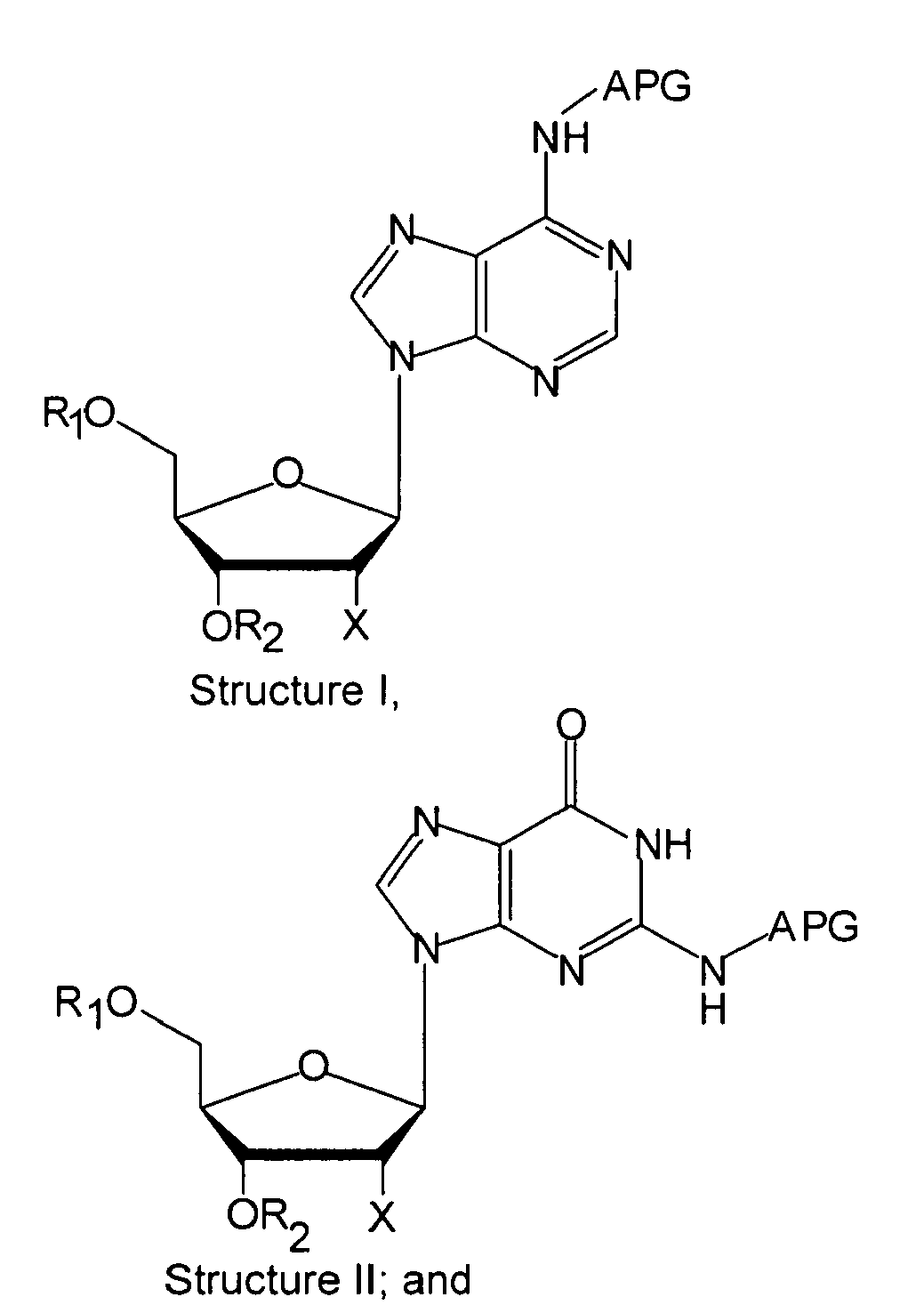


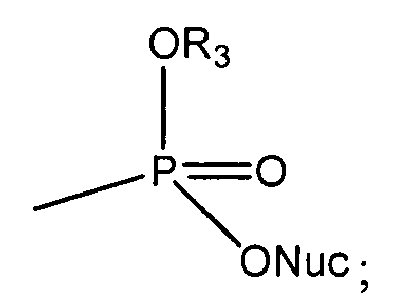

wherein X is H, OH, halogen, an alkoxy group, a substituted alkoxy group, an aryloxy group, a substituted aryloxy group, an amino group, a substituted amino group, a cyano group, an azido group, a sulfonic acid group, a protecting group, or O-protecting group; and
wherein APG is an exocyclic amino protecting group selected from groups I through X:
wherein R is an alkyl group, a substituted alkyl group, an aryl group, or a substituted aryl group;
wherein R' and R" are independently a halogen, an alkyl group, a substituted alkyl group, an aryl group, or a substituted aryl group;
wherein R15 is an alkyl group, an aryl group, a substituted alkyl, or a substituted aryl group;
wherein R16 is one or more groups, where each R16 is attached to one of the carbons in the carbon ring, wherein each R16 is independently H, a halogen, a hydroxyl group, an alkoxy group, a substituted alkoxy group, an aryloxy group, a substituted aryloxy group, an amino group, a substituted amino group, a nitro group, a nitrile group, an alkyl group, an aryl group, a substituted alkyl, or a substituted aryl group, and wherein when R16 is more than one, two or more of R16 are optionally cyclically connected to each other; and
R17, R18, and R19, are each independently H, an alkyl group, an aryl group, a substituted alkyl, or a substituted aryl group. - A polynucleotide as claimed in claim 2, wherein the polynucleotide is attached to a support.
- A polynucleotide as claimed in claim 3, wherein the support is an array.
- A method of deprotecting a polynucleotide comprising:synthesizing a ribonucleic acid (RNA) containing a plurality of nucleotide moieties having a structure selected from one of: structures I through III as defined in claim 1 and/or claim 2;introducing the RNA to a solution including an α-effect nucleophile, wherein the solution is at a pH of about 6 to 11, and wherein the α-effect nucleophile has a pKa of about 4 to 13; anddeprotecting one or more of the exocyclic amino protecting groups.
- A method as claimed in claim 5, wherein X is an O-protecting group.
- A method as claimed in claim 6, wherein X is t-butyl-dimethylsilyl group (TBDMS).
- A method as claimed in claim 6, wherein X is tri-isopropyloxymethyl derivative (TOM).
- A method as claimed in claim 6, wherein X is an orthoester.
- A method as claimed in any of claims 6 to 9, wherein APG and the protecting group of the O-protecting group are deprotected simultaneously.
- A method of deprotecting a polynucleotide, comprising:providing a polynucleotide, wherein the polynucleotide includes at least one nucleotide monomer that has at least one protecting group selected from the following: a base having a protecting group, a 2'-hydroxyl protecting group, and a combination thereof; anddeprotecting at least one of the protecting groups of the polynucleotide by introducing the polynucleotide to a solution including an α-effect nucleophile, wherein the solution is at apH of about 4 to 11, and wherein the α-effect nucleophile has a pKa of about 4 to 13.
- A method as claimed in claim 11, wherein the α-effect nucleophile is a peroxyanion.
- A method as claimed in claim 11, wherein the α-effect nucleophile is at least one of the following: hydrogen peroxide and salts thereof, peracids and salts thereof, perboric acids and salts thereof, alkylperoxides and salts thereof, hydroperoxides and salts thereof, butylhydroperoxide and salts thereof, benzylhydroperoxide and salts thereof, phenylhydroperoxide and salts thereof, performic acid and salts thereof, peracetic acid and salts thereof, perbenzoic acid and salts thereof, chloroperbenzoic acid and salts thereof, or combinations thereof.
- A method as claimed in claim 11, wherein the α-effect nucleophile comprises a hydroperoxide, wherein the solution is at a pH of about 7 to 10, and wherein the hydroperoxide has a pKa of about 8 to 13.
- A method as claimed in claim 11, wherein the α-effect nucleophile comprises hydrogen peroxide, wherein the solution is at a pH of about 8 to 10, and wherein the hydrogen peroxide has a pKa of about 11 to 13.
- A method of deprotecting a polynucleotide, comprising:providing a polynucleotide, wherein the polynucleotide includes at least one nucleotide monomer that has at least one protecting group selected from the following: an exocyclic amino protecting group, an imino protecting group, a 2'-hydroxyl protecting group, andcombinations thereof; anddeprotecting at least one of the protecting groups of the polynucleotide by introducing thepolynucleotide to a solution including an α-effect nucleophile, wherein the solution is at apH of about 4 to 10, and wherein the α-effect nucleophile has a pKa of about 4 to 13.
- A method as claimed in claim 16, wherein the polynucleotide is attached to a solid support.
- A method as claimed in claim 17, wherein the solid support is an array.
- A method as claimed in claim 16, 17 or 18, wherein the α-effect nucleophile is a peroxyanion.
- A method as claimed in claim 16, 17 or 18, wherein the α-effect nucleophile is at least one of the following: hydrogen peroxide and salts thereof, peracids and salts thereof, perboric acids and salts thereof, alkylperoxides and salts thereof, hydroperoxides and salts thereof, butylhydroperoxide and salts thereof, benzylhydroperoxide and salts thereof, phenylhydroperoxide and salts thereof, performic acid and salts thereof, peracetic acid and salts thereof, perbenzoic acid and salts thereof, chloroperbenzoic acid and salts thereof, or combinations thereof.
Applications Claiming Priority (2)
| Application Number | Priority Date | Filing Date | Title |
|---|---|---|---|
| US73172305P | 2005-10-31 | 2005-10-31 | |
| US11/387,388 US8202985B2 (en) | 2005-10-31 | 2006-03-23 | Monomer compositions for the synthesis of polynucleotides, methods of synthesis, and methods of deprotection |
Publications (1)
| Publication Number | Publication Date |
|---|---|
| EP1792909A1 true EP1792909A1 (en) | 2007-06-06 |
Family
ID=37605834
Family Applications (1)
| Application Number | Title | Priority Date | Filing Date |
|---|---|---|---|
| EP06255600A Withdrawn EP1792909A1 (en) | 2005-10-31 | 2006-10-31 | Synthesis of polynucleotides |
Country Status (2)
| Country | Link |
|---|---|
| US (1) | US8202985B2 (en) |
| EP (1) | EP1792909A1 (en) |
Families Citing this family (33)
| Publication number | Priority date | Publication date | Assignee | Title |
|---|---|---|---|---|
| US8552174B2 (en) * | 2005-10-31 | 2013-10-08 | Agilent Technologies, Inc. | Solutions, methods, and processes for deprotection of polynucleotides |
| US8097711B2 (en) * | 2006-09-02 | 2012-01-17 | Agilent Technologies, Inc. | Thioether substituted aryl carbonate protecting groups |
| US7999087B2 (en) * | 2006-11-15 | 2011-08-16 | Agilent Technologies, Inc. | 2′-silyl containing thiocarbonate protecting groups for RNA synthesis |
| US8242258B2 (en) * | 2006-12-03 | 2012-08-14 | Agilent Technologies, Inc. | Protecting groups for RNA synthesis |
| KR101625363B1 (en) | 2007-05-10 | 2016-05-30 | 애질런트 테크놀로지스, 인크. | Thiocarbon-protecting groups for rna synthesis |
| US7790387B2 (en) * | 2007-09-24 | 2010-09-07 | Agilent Technologies, Inc. | Thiocarbonate linkers for polynucleotides |
| US20100076183A1 (en) | 2008-09-22 | 2010-03-25 | Dellinger Douglas J | Protected monomer and method of final deprotection for rna synthesis |
| TWI707038B (en) | 2013-08-05 | 2020-10-11 | 美商扭轉生物科技有限公司 | De novo synthesized gene libraries |
| WO2016126882A1 (en) | 2015-02-04 | 2016-08-11 | Twist Bioscience Corporation | Methods and devices for de novo oligonucleic acid assembly |
| WO2016126987A1 (en) | 2015-02-04 | 2016-08-11 | Twist Bioscience Corporation | Compositions and methods for synthetic gene assembly |
| US9981239B2 (en) | 2015-04-21 | 2018-05-29 | Twist Bioscience Corporation | Devices and methods for oligonucleic acid library synthesis |
| KR20180050411A (en) | 2015-09-18 | 2018-05-14 | 트위스트 바이오사이언스 코포레이션 | Oligonucleotide mutant library and its synthesis |
| CN108698012A (en) | 2015-09-22 | 2018-10-23 | 特韦斯特生物科学公司 | Flexible substrates for nucleic acid synthesis |
| WO2017095958A1 (en) | 2015-12-01 | 2017-06-08 | Twist Bioscience Corporation | Functionalized surfaces and preparation thereof |
| KR102212257B1 (en) | 2016-08-22 | 2021-02-04 | 트위스트 바이오사이언스 코포레이션 | De novo synthesized nucleic acid library |
| WO2018057526A2 (en) | 2016-09-21 | 2018-03-29 | Twist Bioscience Corporation | Nucleic acid based data storage |
| EP3554514A4 (en) | 2016-12-16 | 2020-08-05 | Twist Bioscience Corporation | VARIANT LIBRARIES OF THE IMMUNOLOGICAL SYNAPSE AND SYNTHESIS THEREOF |
| CN110892485B (en) | 2017-02-22 | 2024-03-22 | 特韦斯特生物科学公司 | Nucleic acid-based data storage |
| AU2018234629A1 (en) | 2017-03-15 | 2019-10-17 | Twist Bioscience Corporation | Variant libraries of the immunological synapse and synthesis thereof |
| WO2018231864A1 (en) | 2017-06-12 | 2018-12-20 | Twist Bioscience Corporation | Methods for seamless nucleic acid assembly |
| JP7169999B2 (en) | 2017-06-12 | 2022-11-11 | ツイスト バイオサイエンス コーポレーション | Methods for Seamless Nucleic Acid Assembly |
| AU2018328847A1 (en) | 2017-09-11 | 2020-04-23 | Twist Bioscience Corporation | GPCR binding proteins and synthesis thereof |
| WO2019079769A1 (en) | 2017-10-20 | 2019-04-25 | Twist Bioscience Corporation | Heated nanowells for polynucleotide synthesis |
| EP4715681A2 (en) | 2018-01-04 | 2026-03-25 | Atlas Data Storage, Inc. | Dna-based digital information storage |
| IL278771B2 (en) | 2018-05-18 | 2025-09-01 | Twist Bioscience Corp | Polynucleotides, reagents, and methods for nucleic acid hybridization |
| CN111187797B (en) * | 2018-11-15 | 2024-01-05 | 深圳华大生命科学研究院 | Method for synthesizing nucleic acid having predetermined sequence |
| WO2020139871A1 (en) | 2018-12-26 | 2020-07-02 | Twist Bioscience Corporation | Highly accurate de novo polynucleotide synthesis |
| AU2020227802A1 (en) | 2019-02-26 | 2021-10-14 | Twist Bioscience Corporation | Variant nucleic acid libraries for antibody optimization |
| WO2020176678A1 (en) | 2019-02-26 | 2020-09-03 | Twist Bioscience Corporation | Variant nucleic acid libraries for glp1 receptor |
| CA3144644A1 (en) | 2019-06-21 | 2020-12-24 | Twist Bioscience Corporation | Barcode-based nucleic acid sequence assembly |
| EP4034564A4 (en) | 2019-09-23 | 2023-12-13 | Twist Bioscience Corporation | VARIANT NUCLEIC ACID LIBRARIES FOR SINGLE DOMAIN ANTIBODIES |
| US12091777B2 (en) | 2019-09-23 | 2024-09-17 | Twist Bioscience Corporation | Variant nucleic acid libraries for CRTH2 |
| BR112022011235A2 (en) | 2019-12-09 | 2022-12-13 | Twist Bioscience Corp | LIBRARIES OF NUCLEIC ACID VARIANTS TO ADENOSINE RECEPTORS |
Citations (1)
| Publication number | Priority date | Publication date | Assignee | Title |
|---|---|---|---|---|
| US20040230052A1 (en) * | 1998-08-03 | 2004-11-18 | Dellinger Douglas J. | Methods of synthesizing oligonucleotides using carbonate protecting groups and alpha-effect nucleophile deprotection |
Family Cites Families (17)
| Publication number | Priority date | Publication date | Assignee | Title |
|---|---|---|---|---|
| EP1176151B1 (en) * | 2000-07-28 | 2014-08-20 | Agilent Technologies, Inc. | Synthesis of polynucleotides using combined oxidation/deprotection chemistry |
| US6693187B1 (en) * | 2000-10-17 | 2004-02-17 | Lievre Cornu Llc | Phosphinoamidite carboxlates and analogs thereof in the synthesis of oligonucleotides having reduced internucleotide charge |
| US6852850B2 (en) * | 2001-10-31 | 2005-02-08 | Agilent Technologies, Inc. | Use of ionic liquids for fabrication of polynucleotide arrays |
| US6858720B2 (en) * | 2001-10-31 | 2005-02-22 | Agilent Technologies, Inc. | Method of synthesizing polynucleotides using ionic liquids |
| US7193077B2 (en) * | 2003-08-30 | 2007-03-20 | Agilent Technologies, Inc. | Exocyclic amine triaryl methyl protecting groups in two-step polynucleotide synthesis |
| US7417139B2 (en) * | 2003-08-30 | 2008-08-26 | Agilent Technologies, Inc. | Method for polynucleotide synthesis |
| US7385050B2 (en) * | 2003-08-30 | 2008-06-10 | Agilent Technologies, Inc. | Cleavable linker for polynucleotide synthesis |
| US7427679B2 (en) * | 2003-08-30 | 2008-09-23 | Agilent Technologies, Inc. | Precursors for two-step polynucleotide synthesis |
| US7572907B2 (en) * | 2005-04-29 | 2009-08-11 | Agilent Technologies, Inc. | Methods and compounds for polynucleotide synthesis |
| US7368550B2 (en) * | 2005-10-31 | 2008-05-06 | Agilent Technologies, Inc. | Phosphorus protecting groups |
| US7759471B2 (en) * | 2005-10-31 | 2010-07-20 | Agilent Technologies, Inc. | Monomer compositions for the synthesis of RNA, methods of synthesis, and methods of deprotection |
| US8097711B2 (en) * | 2006-09-02 | 2012-01-17 | Agilent Technologies, Inc. | Thioether substituted aryl carbonate protecting groups |
| US7999087B2 (en) * | 2006-11-15 | 2011-08-16 | Agilent Technologies, Inc. | 2′-silyl containing thiocarbonate protecting groups for RNA synthesis |
| US8242258B2 (en) * | 2006-12-03 | 2012-08-14 | Agilent Technologies, Inc. | Protecting groups for RNA synthesis |
| US20080206850A1 (en) * | 2007-02-28 | 2008-08-28 | Dellinger Douglas J | Methods and compositions for DNA synthesis |
| US20080206851A1 (en) * | 2007-02-28 | 2008-08-28 | Dellinger Douglas J | Methods and compositions for RNA synthesis |
| US7790387B2 (en) * | 2007-09-24 | 2010-09-07 | Agilent Technologies, Inc. | Thiocarbonate linkers for polynucleotides |
-
2006
- 2006-03-23 US US11/387,388 patent/US8202985B2/en active Active
- 2006-10-31 EP EP06255600A patent/EP1792909A1/en not_active Withdrawn
Patent Citations (1)
| Publication number | Priority date | Publication date | Assignee | Title |
|---|---|---|---|---|
| US20040230052A1 (en) * | 1998-08-03 | 2004-11-18 | Dellinger Douglas J. | Methods of synthesizing oligonucleotides using carbonate protecting groups and alpha-effect nucleophile deprotection |
Non-Patent Citations (4)
| Title |
|---|
| CHAIX, CAROLE ET AL: "The use of labile base protecting groups in oligoribonucleotide synthesis", TETRAHEDRON LETTERS , 30(1), 71 -4 CODEN: TELEAY; ISSN: 0040-4039, 1989, XP002416700 * |
| KOESTER, HUBERT ET AL: "N-acyl protecting groups for deoxynucleosides. A quantitative and comparative study", TETRAHEDRON , 37(2), 363 -9 CODEN: TETRAB ; ISSN: 0040-4020, 1981, XP002416702 * |
| SCHULHOF, J. C. ET AL: "Facile removal of new base protecting groups useful in oligonucleotide synthesis", TETRAHEDRON LETTERS , 28(1), 51 -4 CODEN: TELEAY; ISSN: 0040-4039, 1987, XP002416701 * |
| WATKINS B E ET AL: "Synthesis of Benzyl and benzyloxycarbonyl base-blocked 2'-deoxyribonucleosides", JOURNAL OF ORGANIC CHEMISTRY, AMERICAN CHEMICAL SOCIETY. EASTON, US, vol. 47, 1982, pages 4471 - 4477, XP002245960, ISSN: 0022-3263 * |
Also Published As
| Publication number | Publication date |
|---|---|
| US8202985B2 (en) | 2012-06-19 |
| US20070100138A1 (en) | 2007-05-03 |
Similar Documents
| Publication | Publication Date | Title |
|---|---|---|
| EP2567964B1 (en) | Monomer compositions for the synthesis of RNA, methods of synthesis, and methods of deprotection | |
| US8202985B2 (en) | Monomer compositions for the synthesis of polynucleotides, methods of synthesis, and methods of deprotection | |
| US8552174B2 (en) | Solutions, methods, and processes for deprotection of polynucleotides | |
| EP2694524B1 (en) | 2'-o-aminooxymethyl nucleoside derivatives for use in the synthesis and modification of nucleosides, nucleotides and oligonucleotides | |
| EP2160396B1 (en) | Thiocarbon-protecting groups for rna synthesis | |
| EP2334692B1 (en) | Rna monomers containing o-acetal levulinyl ester groups and their use in rna microarrays | |
| US8309706B2 (en) | Methods of synthesizing oligonucleotides using carbonate protecting groups and alpha-effect nucleophile deprotection | |
| EP2277886B1 (en) | The use of n-alkyl imidazole for sulfurization of oligonucleotides with an acetyl disulfide | |
| EP1512691A1 (en) | Protecting groups for two-step polynucleotide synthesis | |
| EP1510523A1 (en) | Precurors for two-step polynucleotide synthesis | |
| EP1510522A1 (en) | Method of polynucleotide synthesis using modified support | |
| EP3137478B1 (en) | Phosphorous protecting groups and methods of preparation and use thereof | |
| EP2609107B1 (en) | Block synthesis of oligoribonucleotides | |
| JPH11510790A (en) | Improved method for oligonucleotide synthesis | |
| CN100484949C (en) | Nucleoside phosphoramidites used in the synthesis of RNA oligonucleotides and their synthesis methods | |
| EP3154996B1 (en) | Protecting groups for "z nucleotide" and methods thereof | |
| WO1995031470A2 (en) | Antisense inhibitors of gene expression | |
| WO1996018638A2 (en) | 2'-o-derivatized pyrimidine ribonucleosides and methods of production | |
| CN116981676A (en) | Hydrocinnamoyl-protected riboguanosine phosphoramidites used to reduce depyrimidination caused by alkylamine exposure during final deprotection |
Legal Events
| Date | Code | Title | Description |
|---|---|---|---|
| PUAI | Public reference made under article 153(3) epc to a published international application that has entered the european phase |
Free format text: ORIGINAL CODE: 0009012 |
|
| AK | Designated contracting states |
Kind code of ref document: A1 Designated state(s): AT BE BG CH CY CZ DE DK EE ES FI FR GB GR HU IE IS IT LI LT LU LV MC NL PL PT RO SE SI SK TR |
|
| AX | Request for extension of the european patent |
Extension state: AL BA HR MK YU |
|
| RIN1 | Information on inventor provided before grant (corrected) |
Inventor name: CARUTHERS, MARVIN Inventor name: DELLINGER, GERALDINE Inventor name: SIERZCHALA, AGNIESZKA Inventor name: TIMAR, ZOLTAN Inventor name: DELLINGER, DOUGLAS |
|
| AKX | Designation fees paid | ||
| RBV | Designated contracting states (corrected) |
Designated state(s): DE FR GB |
|
| 17P | Request for examination filed |
Effective date: 20071021 |
|
| REG | Reference to a national code |
Ref country code: DE Ref legal event code: 8566 |
|
| 17Q | First examination report despatched |
Effective date: 20080325 |
|
| STAA | Information on the status of an ep patent application or granted ep patent |
Free format text: STATUS: THE APPLICATION IS DEEMED TO BE WITHDRAWN |
|
| 18D | Application deemed to be withdrawn |
Effective date: 20080806 |