EP1792899A1 - Process for production of optically active amine derivatives - Google Patents
Process for production of optically active amine derivatives Download PDFInfo
- Publication number
- EP1792899A1 EP1792899A1 EP05782085A EP05782085A EP1792899A1 EP 1792899 A1 EP1792899 A1 EP 1792899A1 EP 05782085 A EP05782085 A EP 05782085A EP 05782085 A EP05782085 A EP 05782085A EP 1792899 A1 EP1792899 A1 EP 1792899A1
- Authority
- EP
- European Patent Office
- Prior art keywords
- indeno
- furan
- tetrahydro
- weight
- ethyl
- Prior art date
- Legal status (The legal status is an assumption and is not a legal conclusion. Google has not performed a legal analysis and makes no representation as to the accuracy of the status listed.)
- Granted
Links
- SJGFAGDJJKISNM-GQCTYLIASA-N CCOC(/C=C/c1ccc2OCCc2c1)=O Chemical compound CCOC(/C=C/c1ccc2OCCc2c1)=O SJGFAGDJJKISNM-GQCTYLIASA-N 0.000 description 1
- TUFWVKLKUFXARX-BJMVGYQFSA-N N#C/C=C(\CC1)/c2c1ccc1c2CCO1 Chemical compound N#C/C=C(\CC1)/c2c1ccc1c2CCO1 TUFWVKLKUFXARX-BJMVGYQFSA-N 0.000 description 1
- ZZUIZMWFNOKNLN-UHFFFAOYSA-N O=C(CC1)c2c1ccc1c2CCO1 Chemical compound O=C(CC1)c2c1ccc1c2CCO1 ZZUIZMWFNOKNLN-UHFFFAOYSA-N 0.000 description 1
- WEBVDBDZSOJGPB-UHFFFAOYSA-N O=Cc(cc1)cc2c1OCC2 Chemical compound O=Cc(cc1)cc2c1OCC2 WEBVDBDZSOJGPB-UHFFFAOYSA-N 0.000 description 1
Images

Classifications
-
- C—CHEMISTRY; METALLURGY
- C07—ORGANIC CHEMISTRY
- C07D—HETEROCYCLIC COMPOUNDS
- C07D307/00—Heterocyclic compounds containing five-membered rings having one oxygen atom as the only ring hetero atom
- C07D307/77—Heterocyclic compounds containing five-membered rings having one oxygen atom as the only ring hetero atom ortho- or peri-condensed with carbocyclic rings or ring systems
-
- A—HUMAN NECESSITIES
- A61—MEDICAL OR VETERINARY SCIENCE; HYGIENE
- A61P—SPECIFIC THERAPEUTIC ACTIVITY OF CHEMICAL COMPOUNDS OR MEDICINAL PREPARATIONS
- A61P3/00—Drugs for disorders of the metabolism
- A61P3/08—Drugs for disorders of the metabolism for glucose homeostasis
- A61P3/10—Drugs for disorders of the metabolism for glucose homeostasis for hyperglycaemia, e.g. antidiabetics
-
- A—HUMAN NECESSITIES
- A61—MEDICAL OR VETERINARY SCIENCE; HYGIENE
- A61K—PREPARATIONS FOR MEDICAL, DENTAL OR TOILETRY PURPOSES
- A61K31/00—Medicinal preparations containing organic active ingredients
- A61K31/33—Heterocyclic compounds
- A61K31/335—Heterocyclic compounds having oxygen as the only ring hetero atom, e.g. fungichromin
- A61K31/34—Heterocyclic compounds having oxygen as the only ring hetero atom, e.g. fungichromin having five-membered rings with one oxygen as the only ring hetero atom, e.g. isosorbide
- A61K31/343—Heterocyclic compounds having oxygen as the only ring hetero atom, e.g. fungichromin having five-membered rings with one oxygen as the only ring hetero atom, e.g. isosorbide condensed with a carbocyclic ring, e.g. coumaran, bufuralol, befunolol, clobenfurol, amiodarone
-
- A—HUMAN NECESSITIES
- A61—MEDICAL OR VETERINARY SCIENCE; HYGIENE
- A61P—SPECIFIC THERAPEUTIC ACTIVITY OF CHEMICAL COMPOUNDS OR MEDICINAL PREPARATIONS
- A61P15/00—Drugs for genital or sexual disorders; Contraceptives
- A61P15/18—Feminine contraceptives
-
- A—HUMAN NECESSITIES
- A61—MEDICAL OR VETERINARY SCIENCE; HYGIENE
- A61P—SPECIFIC THERAPEUTIC ACTIVITY OF CHEMICAL COMPOUNDS OR MEDICINAL PREPARATIONS
- A61P21/00—Drugs for disorders of the muscular or neuromuscular system
- A61P21/02—Muscle relaxants, e.g. for tetanus or cramps
-
- A—HUMAN NECESSITIES
- A61—MEDICAL OR VETERINARY SCIENCE; HYGIENE
- A61P—SPECIFIC THERAPEUTIC ACTIVITY OF CHEMICAL COMPOUNDS OR MEDICINAL PREPARATIONS
- A61P25/00—Drugs for disorders of the nervous system
-
- A—HUMAN NECESSITIES
- A61—MEDICAL OR VETERINARY SCIENCE; HYGIENE
- A61P—SPECIFIC THERAPEUTIC ACTIVITY OF CHEMICAL COMPOUNDS OR MEDICINAL PREPARATIONS
- A61P25/00—Drugs for disorders of the nervous system
- A61P25/06—Antimigraine agents
-
- A—HUMAN NECESSITIES
- A61—MEDICAL OR VETERINARY SCIENCE; HYGIENE
- A61P—SPECIFIC THERAPEUTIC ACTIVITY OF CHEMICAL COMPOUNDS OR MEDICINAL PREPARATIONS
- A61P25/00—Drugs for disorders of the nervous system
- A61P25/08—Antiepileptics; Anticonvulsants
-
- A—HUMAN NECESSITIES
- A61—MEDICAL OR VETERINARY SCIENCE; HYGIENE
- A61P—SPECIFIC THERAPEUTIC ACTIVITY OF CHEMICAL COMPOUNDS OR MEDICINAL PREPARATIONS
- A61P25/00—Drugs for disorders of the nervous system
- A61P25/14—Drugs for disorders of the nervous system for treating abnormal movements, e.g. chorea, dyskinesia
- A61P25/16—Anti-Parkinson drugs
-
- A—HUMAN NECESSITIES
- A61—MEDICAL OR VETERINARY SCIENCE; HYGIENE
- A61P—SPECIFIC THERAPEUTIC ACTIVITY OF CHEMICAL COMPOUNDS OR MEDICINAL PREPARATIONS
- A61P25/00—Drugs for disorders of the nervous system
- A61P25/18—Antipsychotics, i.e. neuroleptics; Drugs for mania or schizophrenia
-
- A—HUMAN NECESSITIES
- A61—MEDICAL OR VETERINARY SCIENCE; HYGIENE
- A61P—SPECIFIC THERAPEUTIC ACTIVITY OF CHEMICAL COMPOUNDS OR MEDICINAL PREPARATIONS
- A61P25/00—Drugs for disorders of the nervous system
- A61P25/20—Hypnotics; Sedatives
-
- A—HUMAN NECESSITIES
- A61—MEDICAL OR VETERINARY SCIENCE; HYGIENE
- A61P—SPECIFIC THERAPEUTIC ACTIVITY OF CHEMICAL COMPOUNDS OR MEDICINAL PREPARATIONS
- A61P25/00—Drugs for disorders of the nervous system
- A61P25/22—Anxiolytics
-
- A—HUMAN NECESSITIES
- A61—MEDICAL OR VETERINARY SCIENCE; HYGIENE
- A61P—SPECIFIC THERAPEUTIC ACTIVITY OF CHEMICAL COMPOUNDS OR MEDICINAL PREPARATIONS
- A61P25/00—Drugs for disorders of the nervous system
- A61P25/24—Antidepressants
-
- A—HUMAN NECESSITIES
- A61—MEDICAL OR VETERINARY SCIENCE; HYGIENE
- A61P—SPECIFIC THERAPEUTIC ACTIVITY OF CHEMICAL COMPOUNDS OR MEDICINAL PREPARATIONS
- A61P25/00—Drugs for disorders of the nervous system
- A61P25/28—Drugs for disorders of the nervous system for treating neurodegenerative disorders of the central nervous system, e.g. nootropic agents, cognition enhancers, drugs for treating Alzheimer's disease or other forms of dementia
-
- A—HUMAN NECESSITIES
- A61—MEDICAL OR VETERINARY SCIENCE; HYGIENE
- A61P—SPECIFIC THERAPEUTIC ACTIVITY OF CHEMICAL COMPOUNDS OR MEDICINAL PREPARATIONS
- A61P27/00—Drugs for disorders of the senses
- A61P27/02—Ophthalmic agents
- A61P27/06—Antiglaucoma agents or miotics
-
- A—HUMAN NECESSITIES
- A61—MEDICAL OR VETERINARY SCIENCE; HYGIENE
- A61P—SPECIFIC THERAPEUTIC ACTIVITY OF CHEMICAL COMPOUNDS OR MEDICINAL PREPARATIONS
- A61P35/00—Antineoplastic agents
-
- A—HUMAN NECESSITIES
- A61—MEDICAL OR VETERINARY SCIENCE; HYGIENE
- A61P—SPECIFIC THERAPEUTIC ACTIVITY OF CHEMICAL COMPOUNDS OR MEDICINAL PREPARATIONS
- A61P37/00—Drugs for immunological or allergic disorders
- A61P37/02—Immunomodulators
-
- A—HUMAN NECESSITIES
- A61—MEDICAL OR VETERINARY SCIENCE; HYGIENE
- A61P—SPECIFIC THERAPEUTIC ACTIVITY OF CHEMICAL COMPOUNDS OR MEDICINAL PREPARATIONS
- A61P5/00—Drugs for disorders of the endocrine system
-
- A—HUMAN NECESSITIES
- A61—MEDICAL OR VETERINARY SCIENCE; HYGIENE
- A61P—SPECIFIC THERAPEUTIC ACTIVITY OF CHEMICAL COMPOUNDS OR MEDICINAL PREPARATIONS
- A61P5/00—Drugs for disorders of the endocrine system
- A61P5/24—Drugs for disorders of the endocrine system of the sex hormones
-
- A—HUMAN NECESSITIES
- A61—MEDICAL OR VETERINARY SCIENCE; HYGIENE
- A61P—SPECIFIC THERAPEUTIC ACTIVITY OF CHEMICAL COMPOUNDS OR MEDICINAL PREPARATIONS
- A61P9/00—Drugs for disorders of the cardiovascular system
-
- A—HUMAN NECESSITIES
- A61—MEDICAL OR VETERINARY SCIENCE; HYGIENE
- A61P—SPECIFIC THERAPEUTIC ACTIVITY OF CHEMICAL COMPOUNDS OR MEDICINAL PREPARATIONS
- A61P9/00—Drugs for disorders of the cardiovascular system
- A61P9/12—Antihypertensives
-
- C—CHEMISTRY; METALLURGY
- C07—ORGANIC CHEMISTRY
- C07D—HETEROCYCLIC COMPOUNDS
- C07D307/00—Heterocyclic compounds containing five-membered rings having one oxygen atom as the only ring hetero atom
- C07D307/77—Heterocyclic compounds containing five-membered rings having one oxygen atom as the only ring hetero atom ortho- or peri-condensed with carbocyclic rings or ring systems
- C07D307/78—Benzo [b] furans; Hydrogenated benzo [b] furans
- C07D307/79—Benzo [b] furans; Hydrogenated benzo [b] furans with only hydrogen atoms, hydrocarbon or substituted hydrocarbon radicals, directly attached to carbon atoms of the hetero ring
- C07D307/80—Radicals substituted by oxygen atoms
-
- C—CHEMISTRY; METALLURGY
- C07—ORGANIC CHEMISTRY
- C07D—HETEROCYCLIC COMPOUNDS
- C07D307/00—Heterocyclic compounds containing five-membered rings having one oxygen atom as the only ring hetero atom
- C07D307/77—Heterocyclic compounds containing five-membered rings having one oxygen atom as the only ring hetero atom ortho- or peri-condensed with carbocyclic rings or ring systems
- C07D307/78—Benzo [b] furans; Hydrogenated benzo [b] furans
- C07D307/79—Benzo [b] furans; Hydrogenated benzo [b] furans with only hydrogen atoms, hydrocarbon or substituted hydrocarbon radicals, directly attached to carbon atoms of the hetero ring
- C07D307/81—Radicals substituted by nitrogen atoms not forming part of a nitro radical
Definitions
- the present invention relates to a process for production of an optically active amine derivative having high purity, wherein the formation of side products is suppressed.
- JP-A 11-140073 and JP-A 2002-212063 disclose a method for producing (S)-2-(1,6,7,8-tetrahydro-2H-indeno[5,4-b]furan-8-yl)ethylamine hydrochloride by means of asymmetric reduction from (E)-2-(1,6,7,8-tetrahydro-2H-indeno[5,4-b]furan-8-ylidene)ethylamine hydrochloride as starting material
- both methods are not enough as an industrial production method in which the formation of side products is suppressed and high-purity crystals of (S)-2-(1,6,7,8-tetrahydro-2H-indeno[5,4-b]furan-8-yl)ethylamine hydrochloride are produced with high yield.
- problems are to control the side products represented by the following formulae (III') and (IV').
- the object of the present invention is to provide an industrial process for production of an optically active amine derivative with high yield and high purity, wherein the formation of side products is controlled.
- the present inventors found that in the steps of production of the optically active amine derivative, the formation of side products represented by the above formulae (III') and (IV') can be controlled by controlling pH and temperature of the reaction solution at the time of catalytic reduction with Pd-C and the solution at the time of post-treatment thereof, and completed the present invention.
- the present invention provides:
- Examples of the salt of (S)-2-(1,6,7,8-tetrahydro-2H-indeno[5,4-b]furan-8-yl)ethylamine in the present invention include salts with an inorganic acid such as hydrochloric acid, sulfuric acid, and nitric acid, salts with an organic acid such as formic acid, acetic acid, and trifluoroacetic acid, and the like.
- an inorganic acid such as hydrochloric acid, sulfuric acid, and nitric acid
- salts with an organic acid such as formic acid, acetic acid, and trifluoroacetic acid, and the like.
- (E)-2-(1,6,7,8-tetrahydro-2H-indeno[5,4-b]furan-8-ylidene)ethylamine which is a raw compound to be used for the production of (S)-2-(1,6,7,8-tetrahydro-2H-indeno[5,4-b]furan-8-yl)ethylamine or a salt thereof of the present invention can be produced by a method described in JP-A 2002-212063 , that is, method of catalytically reducing 4,5-dibromo-1,2,6,7-tetrahydro-8H-indeno[5,4-b]furan-8-one with catalytic reduction catalyst such as Pd-C, then reacting the obtained 1,2,6,7-tetrahydro-8H-indeno[5,4-b]furan-8-one with diethyl cyanomethylphosphonate, followed by hydrogenating with cobalt catalyst, or analogous methods thereto.
- catalytic reduction catalyst
- catalytic reduction of 4,5-dibromo-1,2,6,7-tetrahydro-8H-indeno[5,4-b]furan-8-one can be carried out by mixing 4,5-dibromo-1,2,6,7-tetrahydro-8H-indeno[5,4-b]furan-8-one, organic solvent, and if desired, a base, then preferably after displacing the system with nitrogen, adding catalytic reduction catalyst thereto, followed by pressurizing with hydrogen and stirring.
- the reaction should be carried out under the condition of hydrogen pressure and gas-liquid overall mass transfer volume coefficient, which meets the inequality: hydrogen pressure (MPa) > -0.02 x gas-liquid overall mass transfer volume coefficient (1/hr) + 0.43.
- hydrogen pressure (MPa) > -0.02 x gas-liquid overall mass transfer volume coefficient (1/hr) + 0.43 the gas-liquid overall mass transfer volume coefficient can be determined with Na 2 SO 3 method as described in detail in the after-mentioned Example 1.
- the hydrogen pressure in the present reaction is usually 0.1 to 1 MPa, preferably 0.3 to 0.5 MPa.
- rate N A in which gas dissolves in solution per unit contact area can be expressed like in the case of dissolution rate in solid-liquid system, extraction rate in liquid-liquid system and transfer phenomenon in heat transfer by convection, and given in the form of (mass transfer coefficient) x (concentration difference).
- K L is a mass transfer coefficient for liquid
- C 1 is a concentration which is in equilibrium with gas partial pressure in gas bubble and C is a saturated concentration at a given time
- (C 1 -C) is a driving force for gas absorption.
- equation: dC / dt K L ⁇ A ⁇ C 1 - C / V L is derived from formulae (1) and (2).
- mass transfer volume coefficient for liquid K L a which is a product of a and mass transfer coefficient for liquid K L is used as an index to express gas absorbability.
- organic solvent used in the present reaction examples include formic acid, acetic acid, methanol, ethanol, N-methylpyrrolidone and the like, and particularly preferred is methanol. These solvents may be used alone, or with a mixture of 2 or more of them.
- the amount of solvent to be used is 5 to 100 mL, preferably 15 to 25 mL, per 1 g of raw compound.
- Examples of the base used in the present reaction include anhydrous sodium acetate, Et 3 N, pyridine, NaHCO 3 , Na 2 CO 3 , and the like. In particular, anhydrous sodium acetate and Et 3 N are preferred.
- the amount of base to be used is usually 2 to 3 equivalent moles.
- Examples of the catalytic reduction catalyst used in the present reaction include Pd-C, PtO 2 , Rh-Al 2 O 3 , (RhCl[P(C 6 H 5 ) 3 ] 3 ) and the like.
- the amount of catalytic reduction catalyst to be used is 1/10 equivalent mole to 5/1000 equivalent mole, preferably 1/100 equivalent mole to 3/100 equivalent mole relative to 1 mole of raw compound to be used in step (i).
- the reaction temperature of the present reaction is usually 10°C to 100°C, preferably 30°C to 50°C, and the reaction time is usually 1 to 50 hrs, preferably 2 to 10 hrs.
- (E)-2-(1,6,7,8-tetrahydro-2H-indeno[5,4-b]furan-8-ylidene)ethylamine used in the present invention can be used in a form of free compound or a salt thereof.
- examples of such salt include a salt with an inorganic acid such as hydrochloric acid, sulfuric acid, and nitric acid, a salt with an organic acid such as formic acid, acetic acid, and trifluoroacetic acid, and the like.
- the process for producing (S)-2-(1,6,7,8-tetrahydro-2H-indeno[5,4-b]furan-8-yl)ethylamine or a salt thereof of the present invention is comprised of step (i) for asymmetrically reducing the raw compound: (E)-2-(1,6,7,8-tetrahydro-2H-indeno[5,4-b]furan-8-ylidene)ethylamine or a salt thereof, and step (ii) for converting the side product in the reaction products obtained in step (i) to target compound by catalytic reduction.
- the asymmetric reduction in step (i) is carried out by using catalyst, and examples of such catalyst for asymmetric reduction include Ruthenium-optically active phosphine complex (Ru-BINAP), Rhodium-optically active phosphine complex (Rh-BINAP), Iridium-optically active phosphine complex (Ir-BINAP), and the like.
- Ru-BINAP Ruthenium-optically active phosphine complex
- Rh-BINAP Rhodium-optically active phosphine complex
- Ir-BINAP Iridium-optically active phosphine complex
- Ru-BINAP catalyst specifically, Ru 2 Cl 4 [(R)-BINAP] 2 N(C 2 H 5 ) 3 , ⁇ RuCl(Benzene)[(R)-BINAP] ⁇ Cl, ⁇ RuCl(p-Cymene) [(R)-BINAP] ⁇ Cl, ⁇ RuBr(p-Cymene) [(R)-BINAP] ⁇ Br, ⁇ RuI(p-Cymene)[(R)-BINAP] ⁇ I 3 , ⁇ RuI(p-Cymene) [(R)-BINAP] ⁇ I and the like are exemplified.
- These catalysts can be prepared according to a known method, for example, methods described in JP-B 07-57758 , JP-A 11-140073 , etc.
- ⁇ RuCl(Benzene)[(R)-BINAP] ⁇ Cl is preferably used.
- step (i) When a salt of (E)-2-(1,6,7,8-tetrahydro-2H-indeno[5,4-b]furan-8-ylidene)ethylamine is used as raw compound in the asymmetric reduction reaction of step (i), it is converted to a free compound by alkali treatment, dissolved in organic solvent, and asymmetric reduction catalyst is added to the solution, and then the asymmetric reduction reaction is carried out under pressure and hydrogen atmosphere.
- organic solvent examples include aromatic hydrocarbons (e.g., toluene, benzene, etc.), alcohols (e.g., methanol, ethanol, etc.), aliphatic esters (ethyl acetate, n-propyl acetate, n-butyl acetate, etc.), ethers (e.g., isopropyl ether, diethyl ether, tetrahydrofuran (THF), etc.), halogenated hydrocarbons (e.g., dichloromethane, dichloroethane, etc.), amides (e.g., N,N-dimethylformamide, etc.), and the like.
- aromatic hydrocarbons e.g., toluene, benzene, etc.
- alcohols e.g., methanol, ethanol, etc.
- aliphatic esters ethyl acetate, n-propyl acetate, n-buty
- solvents may be used alone, or with a mixture of 2 or more of them, and among them, a mixed solvent of toluene and methanol, a mixed solvent of tetrahydrofuran and methanol, and the like are preferred.
- the amount of solvent to be used is 1 to 1000 mL, preferably 2 to 20 mL, per 1 g of raw compound.
- the amount to be added of the asymmetric reduction catalyst used in the present reaction is 1/2 equivalent mole to 1/2000 equivalent mole, preferably 1/10 equivalent mole to 1/1000 equivalent mole relative to 1 mole of raw compound, and the hydrogen pressure is 0.5 to 15 MPa, preferably 3 to 11 MPa.
- reaction temperature is 0 to 150°C, preferably 10 to 80°C
- reaction time is 0.5 to 200 hrs, preferably 5 to 50 hrs.
- the catalytic reduction reaction of the above-mentioned step (ii) is carried out using the reaction solution obtained in step (i).
- the compound represented by the following formula (III') is included as side product, and in the step (ii), this side product is converted by the catalytic reduction to the target compound, that is, (S)-2-(1,6,7,8-tetrahydro-2H-indeno[5,4-b]furan-8-yl)ethylamine.
- step (ii) The reaction of the above-mentioned step (ii) is carried out as follows. That is, to the reaction solution obtained in step (i) is added enough amount of dilute hydrochloric acid to dissolve the reaction product at a temperature below 10°C, and the reaction product is transferred to aqueous layer by stirring or shaking, then the aqueous layer is separated. The obtained aqueous layer is adjusted to pH 3 to 9, preferably 5 to 7, with aklali such as dilute aqueous sodium hydroxide solution, and catalytic reduction catalyst is added thereto to reduce under pressure and hydrogen atmosphere.
- aklali such as dilute aqueous sodium hydroxide solution
- Examples of the catalytic reduction catalyst used in the present reaction include Pd-C, PtO 2 , Rh-Al 2 O 3 , (RhCl[P(C 6 H 5 ) 3 ] 3 ), and the like.
- the amount of catalytic reduction catalyst to be used is 1/2 equivalent mole to 1/2000 equivalent mole, preferably 1/10 equivalent mole to 1/500 equivalent mole relative to 1 mole of raw compound to be used in step (i), and the hydrogen pressure is 0.5 to 15 MPa, preferably 3 to 11 MPa.
- reaction temperature is 40°C to 100°C, preferably 50°C to 70°C
- reaction time is 0.5 to 200 hrs, preferably 3 to 20 hrs.
- reaction solution obtained in the catalytic reduction reaction is filtered to remove the catalyst, and treated using a method known per se (e.g., concentration, crystallization, recrystallization, chromatography, etc.) to give (S)-2-(1,6,7,8-tetrahydro-2H-indeno[5,4-b]furan-8-yl)ethylamine.
- a method known per se e.g., concentration, crystallization, recrystallization, chromatography, etc.
- step (a) for propionylating the amino group of (S)-2-(1,6,7,8-tetrahydro-2H-indeno[5,4-b]furan-8-yl)ethylamine and step (b) for crystallizing out of the reaction solution obtained in step (a).
- step (a) the amino group of (S)-2-(1,6,7,8-tetrahydro-2H-indeno[5,4-b]furan-8-yl)ethylamine obtained in the above-mentioned process is reacted with a propionylating agent to propionylate.
- a propionylating agent to propionylate.
- (S)-2-(1,6,7,8-tetrahydro-2H-indeno[5,4-b]furan-8-yl)ethylamine is used in the form of salt, it is converted to free compound by a conventional method, followed by subjecting to propionylation reaction.
- propionylating agent examples include propionyl halides such as propionyl chloride and propionyl bromide.
- the amount of propionylating agent to be used is a ratio of 1 - 2 mol to 1 mol of (S)-2-(1,6,7,8-tetrahydro-2H-indeno[5,4-b]furan-8-yl)ethylamine.
- the reaction is carried out in a solvent, and examples of the solvent include ethers such as tetrahydrofuran, diethyl ether, dioxane and 1,2-dimethoxyethane, alcohols such as methanol, ethanol and propanol, hydrocarbons such as benzene, toluene, cyclohexane and hexane, amides such as N,N-dimethylformamide and N,N-dimethylacetamide, halogenated hydrocarbons such as dichloromethane, chloroform, carbon tetrachloride and 1,2-dichloroethane, nitriles such as acetonitrile and propionitrile, sulfoxides such as dimethylsulfoxide, and the like and a mixed solvent thereof, inter alia, tetrahydrofuran is preferred.
- the reaction time is usually 5 minutes to 48 hrs, preferably 30 minutes to 6 hrs.
- the reaction temperature is usually -20 to
- step (b) crystals of (S)-N-[2-(1,6,7,8-tetrahydro-2H-indeno[5,4-b]furan-8-yl)ethyl]propionamide is crystallized by adding aqueous solvent to the reaction solution obtained in step (a).
- aqueous solvent include city water, pure water, purified water, etc.
- the amount of aqueous solvent to be added is a ratio by volume of 0.5 - 5 to the reaction solution obtained in step (a).
- the crystallization temperature is usually -20 to 60°C, preferably -10 to 40°C.
- the crystals of (S)-N-[2-(1,6,7,8-tetrahydro-2H-indeno[5,4-b]furan-8-yl)ethyl]propionamide is obtained with high yield of 97% by collecting the precipitated crystals by filtration.
- Highly pure crystals of (S)-N-[2-(1,6,7,8-tetrahydro-2H-indeno[5,4-b]furan-8-yl)ethyl]propionamide can be obtained by further recrystallizing the obtained crystals from ethanol-water (1:2).
- crystals of (S)-N-[2-(1,6,7,8-tetrahydro-2H-indeno[5,4-b]furan-8-yl)ethyl]propionamide obtained in the process of the present invention may have a possibility of containing the compounds represented by the following formulae (I) to (IV) as impurities (in the present specification, hereinafter, sometimes referred to as compound (I) to (IV), respectively), each content of the compounds (I) to (IV) is 0.15% by weight or less and further total content of the compounds (I) to (IV) is about 0.20% by weight or less.
- the contents of compound (III) and (IV) are each below the detection limit of less than 0.02% by weight (HPLC), the content of compound (I) is about 0.1% by weight or less (preferably, 0.03% by weight o 0.03% by weight or less), and the content of compound (II) is about 0.02 to about 0.15% by weight, and further total content of the compounds (I) to (IV) is about 0.20% by weight or less. r less), and the content of compound (II) is about 0.02 to about 0.15% by weight, and further total content of the compounds (I) to (IV) is about 0.20% by weight or less.
- (S)-N-[2-(1,6,7,8-tetrahydro-2H-indeno[5,4-b]furan-8-yl)ethyl]propionamide of the present invention has a physiological activity such as affinity for melatonin receptor, in addition, has low toxicity and fewer side effects.
- antidepressant e.g., imipramine, clomipramine, noxiptiline, phenelzine, amitriptyline hydrochloride, nortriptyline hydrochloride, amoxapine, mianserin hydrochloride, maprotiline hydrochloride, sulpiride, fluvoxamine maleate, trazodone hydrochloride, paroxetine hydrochloride, milnacipran hydrochloride, fluoxetine, venlafaxine, Mitrazapine, Sertraline, citalopram, duloxetine, reboxetine, Moclobemide), antianxiety drug (e.g., diazepam, oxazolam, bromazepam, alprazolam, clonazepam, buspirone, tandospirone citrate), mood stabilizer (e.g., lithium, valproic acid, carbamazin, amaze, noxip
- Examples of administration form include (1) administration of a single preparation obtained by formulating the compound of the present invention and the joint use drug simultaneously, (2) simultaneous administration of two kinds of preparations obtained by formulating the compound of the present invention and the joint use drug separately, via an identical administration route, (3) sequential and intermittent administration of two kinds of preparations obtained by formulating the compound of the present invention and the joint use drug separately, via an identical administration route, (4) simultaneous administration of two kinds of preparations obtained by formulating the compound of the present invention and the joint use drug separately, via different administration routes and (5) sequential and intermittent administration of two kinds of preparations obtained by formulating the compound of the present invention and the joint use drug separately, via different administration routes (e.g. administration in an order of the compound of the present invention ⁇ the joint use drug, or administration in a reverse order).
- administration routes e.g. administration in an order of the compound of the present invention ⁇ the joint use drug, or administration in a reverse order.
- a dose of the joint use drug can be selected appropriately based on the clinically used dosage.
- a ratio of blending the compound of the present invention and the joint use drug can be appropriately selected depending on an administration subject, an administration route, subject disease, symptom, a combination, and the like. For example, when the administration subject is human, 0.01 to 100 parts by weight of the joint use drug can be used relative to 1 part by weight of the compound of the present invention.
- (S)-N-[2-(1,6,7,8-tetrahydro-2H-indeno[5,4-b]furan-8-yl)ethyl]propionamide of the present invention can be used as a pharmaceutical raw material with grinding by Jet mil etc., and a content uniformity in preparation and the like can be assured by adjusting the particle size (median size) to about 1 to 10 ⁇ m.
- the particle size can be measured as follows by using commercially available measuring apparatus.
- a 100 mL Erlenmeyer flask equipped with stopper is charged with 0.05 g of sample, and 50 mL of dispersion medium is added thereto.
- the mixture is irradiated with ultrasonic wave for about 5 minutes with shaking and mixing to give a suspension.
- To 40 mL of dispersion medium is added about 100 ⁇ L of this suspension, and a test is carried out under the following condition.
- the compound of the present invention can be safely administered orally or parenterally (e.g. local, rectal, intravenous administration etc.) as it is or by formulating into pharmaceutical preparations such as tables (including sugar-coated tablets, film coating tablets), powders, granules, capsules, solutions, emulsions, suspensions, injectables, suppositories, sustained-release agents and adhesive preparations by mixing with a pharmacologically acceptable carrier according to a conventional method (e.g., method described in Japanese Pharmacopoeia, etc.).
- a content of the compound in the pharmaceutical composition is usually about 0.01 to 100% by weight based on the whole composition.
- 2,3-Dihydrobenzofuran (100 g, 832 mmol) and N,N-dimethylformamide (134 g, 1830 mmol) were mixed and heated, and phosphorus oxychloride (255 g, 1643 mmol) were added thereto at an inner temperature of 70 to 80°C over 2 hrs.
- the reaction mixture was heated at an inner temperature of 80 to 90°C and stirred for 7.5 hrs.
- the resulting mixture was added dropwise to water (1000 g) under cooling, and stirred at room temperature for 5 hrs.
- Ethyl (E)-3-(2,3-dihydrobenzofuran-5-yl)propenoate (50.0 g, 227 mmol) was dissolved in acetic acid (312 g), and the reaction system was replaced with nitrogen. Then, 5% Pd/C (4.96 g, as dry weight) was added to the solution and pressurized with hydrogen to 196 to 294 kPa. The mixture was reacted at 50°C for 1 hr under a pressure of 196 to 294 kPa. The catalyst was filtered, and washed with acetic acid (208 g) to give a solution of the title compound in acetic acid (amount 569 g, apparent yield 100%).
- the reaction rate is sufficiently fast compared to absorption rate of oxygen (oxygen absorption is rate-determining step). Therefore, oxygen absorption rate (N A ) can be obtained by measuring the concentration change of sodium sulfite.
- K L a K L ⁇ a ⁇ C * - C
- K L ⁇ a N A / C *
- solubility of oxygen in aqueous solution can be expressed by the following, using Henry's law.
- C * p / H From these, K L a can be calculated.
- reaction solution was cooled, and water (330 L) and concentrated hydrochloric acid (52.3 kg) were added at below 30°C, followed by stirring for 30 minutes, then the layers were separated.
- the aqueous layer was washed with toluene (195 L), and pH was adjusted to about 6.0 by adding 5% aqueous solution of NaOH to the aqueous layer (containing 5.0% of compound III').
- 5% Pd-C (50% wet, 9.7 kg) was added thereto, and stirred at 60°C for 6 hrs under hydrogen atmosphere (4.9 MPa).
- the reaction mixture was filtered, and the filtrate was adjusted to around pH 6.0 with 5% aqueous solution of NaOH or dilute hydrochloric acid, followed by concentration under reduced pressure.
- the residue was recrystallized from mixed solution of n-butanol and water to give title compound (88.6 kg, yield 73.0%, compound (III') is not detected, compound (IV') is not detected).
Landscapes
- Health & Medical Sciences (AREA)
- Chemical & Material Sciences (AREA)
- Organic Chemistry (AREA)
- Animal Behavior & Ethology (AREA)
- Veterinary Medicine (AREA)
- Pharmacology & Pharmacy (AREA)
- General Health & Medical Sciences (AREA)
- Public Health (AREA)
- Medicinal Chemistry (AREA)
- Life Sciences & Earth Sciences (AREA)
- Bioinformatics & Cheminformatics (AREA)
- Engineering & Computer Science (AREA)
- Nuclear Medicine, Radiotherapy & Molecular Imaging (AREA)
- General Chemical & Material Sciences (AREA)
- Chemical Kinetics & Catalysis (AREA)
- Neurology (AREA)
- Biomedical Technology (AREA)
- Neurosurgery (AREA)
- Diabetes (AREA)
- Endocrinology (AREA)
- Pain & Pain Management (AREA)
- Psychiatry (AREA)
- Epidemiology (AREA)
- Ophthalmology & Optometry (AREA)
- Cardiology (AREA)
- Immunology (AREA)
- Heart & Thoracic Surgery (AREA)
- Reproductive Health (AREA)
- Emergency Medicine (AREA)
- Orthopedic Medicine & Surgery (AREA)
- Physical Education & Sports Medicine (AREA)
- Gynecology & Obstetrics (AREA)
- Hospice & Palliative Care (AREA)
- Anesthesiology (AREA)
- Psychology (AREA)
- Hematology (AREA)
- Obesity (AREA)
- Organic Low-Molecular-Weight Compounds And Preparation Thereof (AREA)
- Pharmaceuticals Containing Other Organic And Inorganic Compounds (AREA)
- Furan Compounds (AREA)
Abstract
Description
- The present invention relates to a process for production of an optically active amine derivative having high purity, wherein the formation of side products is suppressed.
- Although
JP-A 11-140073 JP-A 2002-212063 
- On the other hand, dimerization of benzofuran compound under the presence of Pd-catalyst is described in Liebigs. Ann. Chem., 10,945 (1989) and J. Chem. Soc. (A), 1324 (1968). However, these cases are the dimerization by binding of two aromatic rings, and the structures of their dimers are different from those of dimers formed by the reaction between aromatic ring and benzyl position, like compound represented by the above formula (IV'). In addition, J. Chem. Soc. D, 736 (1970) discloses that oxidation of benzyl position of benzofuran compound takes place under the presence of Pd-catalyst, but formation of dimer is not described therein.
- The object of the present invention is to provide an industrial process for production of an optically active amine derivative with high yield and high purity, wherein the formation of side products is controlled.
- As a result of intensive studies to solve the above problem, the present inventors found that in the steps of production of the optically active amine derivative, the formation of side products represented by the above formulae (III') and (IV') can be controlled by controlling pH and temperature of the reaction solution at the time of catalytic reduction with Pd-C and the solution at the time of post-treatment thereof, and completed the present invention.
- That is, the present invention provides:
- (1) A process for producing (S)-2-(1,6,7,8-tetrahydro-2H-indeno[5,4-b]furan-8-yl)ethylamine or a salt thereof, which comprises step (i): a step for asymmetrically reducing (E)-2-(1,6,7,8-tetrahydro-2H-indeno[5,4-b]furan-8-ylidene)ethylamine or a salt thereof with a catalyst, and step (ii): a step for catalytically reducing the reaction product obtained in step (i) at a reaction temperature of 40°C to 100°C and
pH 3 to 9 with a catalyst, - (2) The process according to the above-mentioned (1), wherein the reaction temperature in step (ii) is 50°C to 70°C,
- (3) The process according to the above-mentioned (1), wherein the pH in step (ii) is 5 to 7,
- (4) The process according to the above-mentioned (1), wherein the catalyst in step (i) is Ru-BINAP catalyst,
- (5) The process according to the above-mentioned (1), wherein the catalyst in step (ii) is Pd-C catalyst,
- (6) A process for producing crystals of (S)-N-[2-(1,6,7,8-tetrahydro-2H-indeno[5,4-b]furan-8-yl)ethyl]propionamide, comprising step (a): a step for propionylating the amino group of (S)-2-(1,6,7,8-tetrahydro-2H-indeno[5,4-b]furan-8-yl)ethylamine or a salt thereof obtained in the process according to the above-mentioned (1), and step (b): a step for crystallizing by adding aqueous solvent to the reaction solution obtained in step (a),
- (7) Crystals of (S)-N-[2-(1,6,7,8-tetrahydro-2H-indeno[5,4-b]furan-8-yl)ethyl]propionamide, wherein each content of the compounds represented by the following formulae (I), (II), (III) and (IV) is 0.15% by weight or less, and the total content of the compounds represented by the following formulae (I) to (IV) is 0.2% by weight or less,

- (8) Crystals of (S)-N-[2-(1,6,7,8-tetrahydro-2H-indeno[5,4-b]furan-8-yl)ethyl]propionamide, wherein each content of the compounds represented by the following formulae (I), (III) and (IV) is 0.15% by weight or less, and the content of the compound represented by the following formula (II) is 0.02 to 0.15% by weight, and further the total content of the compounds represented by the following formulae (I) to (IV) is 0.2% by weight or less,

- (9) The crystals according to the above-mentioned (7) or (8), wherein the content of the compound represented by formula (I) is 0.10% by weight or less,
- (10) A composition comprising (S)-N-[2-(1,6,7,8-tetrahydro-2H-indeno[5,4-b]furan-8-yl)ethyl]propionamide and the compounds represented by the following formulae (I), (II), (III) and (IV), wherein relative to 100 parts by weight of (S)-N-[2-(1,6,7,8-tetrahydro-2H-indeno[5,4-b]furan-8-yl)ethyl]propionamide, each content of the compounds represented by the following formulae (I), (II), (III) and (IV) is 0 to 0.15 part by weight and the total content of the compounds represented by the following formulae (I) to (IV) is 0 to 0.2 part by weight,

- (11) A composition comprising (S)-N-[2-(1,6,7,8-tetrahydro-2H-indeno[5,4-b]furan-8-yl)ethyl]propionamide and the compounds represented by the following formulae (I), (II), (III) and (IV), wherein relative to 100 parts by weight of (S)-N-[2-(1,6,7,8-tetrahydro-2H-indeno[5,4-b]furan-8-yl)ethyl]propionamide, each content of the compounds represented by the following formulae (I), (III) and (IV) is 0 to 0.15 part by weight, and the content of the compound represented by the following formula (II) is 0.02 to 0.15 part by weight, and further the total content of the compounds represented by the following formulae (I) to (IV) is 0 to 0.2 part by weight,

- (12) The composition according to the above-mentioned (10) or (11), wherein the content of the compound represented by formula (I) is 0 to 0.10 part by weight relative to 100 parts by weight of (S)-N-[2-(1,6,7,8-tetrahydro-2H-indeno[5,4-b]furan-8-yl)ethyl]propionamide,

- (13) The crystals according to the above-mentioned (7) or the composition according to the above-mentioned (10), which is prepared on a commercial scale,
- (14) A process for producing 1,2,6,7-tetrahydro-8H-indeno[5,4-b]furan-8-one, comprising a step for reducing 4,5-dibromo-1,2,6,7-tetrahydro-8H-indeno[5,4-b]furan-8-one with Pd-C catalyst under the condition: hydrogen pressure (MPa) > -0.02 x gas-liquid overall mass transfer volume coefficient (1/hr) + 0.43,
- (15) Use of the crystals according to the above-mentioned (7) for the manufacture of a preventive or therapeutic agent for sleep disorder,
- (16) The composition according to the above-mentioned (10) which is a preventive or therapeutic agent for sleep disorder, and
- (17) A method for the prevention or treatment of sleep disorder, comprising administering the crystals according to the above-mentioned (8) or the composition according to the above-mentioned (10).
-
- Figure 1 is a HPLC chart which shows result of analysis of compound (I) to (IV) in the crystals of (S)-N-[2-(1,6,7,8-tetrahydro-2H-indeno[5,4-b]furan-8-yl)ethyl]propionamide.
- Examples of the salt of (S)-2-(1,6,7,8-tetrahydro-2H-indeno[5,4-b]furan-8-yl)ethylamine in the present invention include salts with an inorganic acid such as hydrochloric acid, sulfuric acid, and nitric acid, salts with an organic acid such as formic acid, acetic acid, and trifluoroacetic acid, and the like.
- In addition, (E)-2-(1,6,7,8-tetrahydro-2H-indeno[5,4-b]furan-8-ylidene)ethylamine which is a raw compound to be used for the production of (S)-2-(1,6,7,8-tetrahydro-2H-indeno[5,4-b]furan-8-yl)ethylamine or a salt thereof of the present invention can be produced by a method described in
JP-A 2002-212063 - In the catalytic reduction step, catalytic reduction of 4,5-dibromo-1,2,6,7-tetrahydro-8H-indeno[5,4-b]furan-8-one can be carried out by mixing 4,5-dibromo-1,2,6,7-tetrahydro-8H-indeno[5,4-b]furan-8-one, organic solvent, and if desired, a base, then preferably after displacing the system with nitrogen, adding catalytic reduction catalyst thereto, followed by pressurizing with hydrogen and stirring.
- Here, from the viewpoint of formation control of side product (specifically, dimer), it is preferred that the reaction should be carried out under the condition of hydrogen pressure and gas-liquid overall mass transfer volume coefficient, which meets the inequality: hydrogen pressure (MPa) > -0.02 x gas-liquid overall mass transfer volume coefficient (1/hr) + 0.43. Herein, the gas-liquid overall mass transfer volume coefficient can be determined with Na2SO3 method as described in detail in the after-mentioned Example 1.
- Further, the hydrogen pressure in the present reaction is usually 0.1 to 1 MPa, preferably 0.3 to 0.5 MPa.
- In gas-liquid system, rate NA in which gas dissolves in solution per unit contact area can be expressed like in the case of dissolution rate in solid-liquid system, extraction rate in liquid-liquid system and transfer phenomenon in heat transfer by convection, and given in the form of (mass transfer coefficient) x (concentration difference).

Here, KL is a mass transfer coefficient for liquid, C1 is a concentration which is in equilibrium with gas partial pressure in gas bubble and C is a saturated concentration at a given time, and (C1-C) is a driving force for gas absorption. - In addition, given that A is a gas-liquid contact area and VL is a volume of liquid, since increasing rate VLdC/dt of gas concentration in solution is equal to dissolution rate of gas, the following equation can be given.

- Thus, equation:

- Furthermore, given that A/VL is represented by a: gas-liquid interface area per unit area, equation:

- Since it is difficult to obtain the gas-liquid interface area: a independently in gas-liquid stirring operation, mass transfer volume coefficient for liquid KLa which is a product of a and mass transfer coefficient for liquid KL is used as an index to express gas absorbability.
- In addition, from the fact that when stirring rate is increased, gas-liquid interface area: a becomes larger, it can generally be said that KLa becomes larger with stirring rate.
- Examples of the organic solvent used in the present reaction include formic acid, acetic acid, methanol, ethanol, N-methylpyrrolidone and the like, and particularly preferred is methanol. These solvents may be used alone, or with a mixture of 2 or more of them. The amount of solvent to be used is 5 to 100 mL, preferably 15 to 25 mL, per 1 g of raw compound.
- Examples of the base used in the present reaction include anhydrous sodium acetate, Et3N, pyridine, NaHCO3, Na2CO3, and the like. In particular, anhydrous sodium acetate and Et3N are preferred. The amount of base to be used is usually 2 to 3 equivalent moles.
- Examples of the catalytic reduction catalyst used in the present reaction include Pd-C, PtO2, Rh-Al2O3, (RhCl[P(C6H5)3]3) and the like. The amount of catalytic reduction catalyst to be used is 1/10 equivalent mole to 5/1000 equivalent mole, preferably 1/100 equivalent mole to 3/100 equivalent mole relative to 1 mole of raw compound to be used in step (i).
- The reaction temperature of the present reaction is usually 10°C to 100°C, preferably 30°C to 50°C, and the reaction time is usually 1 to 50 hrs, preferably 2 to 10 hrs.
- (E)-2-(1,6,7,8-tetrahydro-2H-indeno[5,4-b]furan-8-ylidene)ethylamine used in the present invention can be used in a form of free compound or a salt thereof. Examples of such salt include a salt with an inorganic acid such as hydrochloric acid, sulfuric acid, and nitric acid, a salt with an organic acid such as formic acid, acetic acid, and trifluoroacetic acid, and the like.
- The process for producing (S)-2-(1,6,7,8-tetrahydro-2H-indeno[5,4-b]furan-8-yl)ethylamine or a salt thereof of the present invention is comprised of step (i) for asymmetrically reducing the raw compound: (E)-2-(1,6,7,8-tetrahydro-2H-indeno[5,4-b]furan-8-ylidene)ethylamine or a salt thereof, and step (ii) for converting the side product in the reaction products obtained in step (i) to target compound by catalytic reduction.
- The asymmetric reduction in step (i) is carried out by using catalyst, and examples of such catalyst for asymmetric reduction include Ruthenium-optically active phosphine complex (Ru-BINAP), Rhodium-optically active phosphine complex (Rh-BINAP), Iridium-optically active phosphine complex (Ir-BINAP), and the like.
- As a Ru-BINAP catalyst, specifically, Ru2Cl4[(R)-BINAP]2N(C2H5)3, {RuCl(Benzene)[(R)-BINAP]}Cl, {RuCl(p-Cymene) [(R)-BINAP]}Cl, {RuBr(p-Cymene) [(R)-BINAP]}Br, {RuI(p-Cymene)[(R)-BINAP]}I3, {RuI(p-Cymene) [(R)-BINAP]}I and the like are exemplified. These catalysts can be prepared according to a known method, for example, methods described in
JP-B 07-57758 JP-A 11-140073 - As an asymmetric reduction catalyst, {RuCl(Benzene)[(R)-BINAP]}Cl is preferably used.
- When a salt of (E)-2-(1,6,7,8-tetrahydro-2H-indeno[5,4-b]furan-8-ylidene)ethylamine is used as raw compound in the asymmetric reduction reaction of step (i), it is converted to a free compound by alkali treatment, dissolved in organic solvent, and asymmetric reduction catalyst is added to the solution, and then the asymmetric reduction reaction is carried out under pressure and hydrogen atmosphere.
- Examples of the organic solvent include aromatic hydrocarbons (e.g., toluene, benzene, etc.), alcohols (e.g., methanol, ethanol, etc.), aliphatic esters (ethyl acetate, n-propyl acetate, n-butyl acetate, etc.), ethers (e.g., isopropyl ether, diethyl ether, tetrahydrofuran (THF), etc.), halogenated hydrocarbons (e.g., dichloromethane, dichloroethane, etc.), amides (e.g., N,N-dimethylformamide, etc.), and the like. These solvents may be used alone, or with a mixture of 2 or more of them, and among them, a mixed solvent of toluene and methanol, a mixed solvent of tetrahydrofuran and methanol, and the like are preferred. The amount of solvent to be used is 1 to 1000 mL, preferably 2 to 20 mL, per 1 g of raw compound.
- The amount to be added of the asymmetric reduction catalyst used in the present reaction is 1/2 equivalent mole to 1/2000 equivalent mole, preferably 1/10 equivalent mole to 1/1000 equivalent mole relative to 1 mole of raw compound, and the hydrogen pressure is 0.5 to 15 MPa, preferably 3 to 11 MPa.
- In addition, the reaction temperature is 0 to 150°C, preferably 10 to 80°C, and the reaction time is 0.5 to 200 hrs, preferably 5 to 50 hrs.
- The catalytic reduction reaction of the above-mentioned step (ii) is carried out using the reaction solution obtained in step (i). In the reaction solution obtained in step (i), the compound represented by the following formula (III') is included as side product, and in the step (ii), this side product is converted by the catalytic reduction to the target compound, that is, (S)-2-(1,6,7,8-tetrahydro-2H-indeno[5,4-b]furan-8-yl)ethylamine.

- The reaction of the above-mentioned step (ii) is carried out as follows. That is, to the reaction solution obtained in step (i) is added enough amount of dilute hydrochloric acid to dissolve the reaction product at a temperature below 10°C, and the reaction product is transferred to aqueous layer by stirring or shaking, then the aqueous layer is separated. The obtained aqueous layer is adjusted to
pH 3 to 9, preferably 5 to 7, with aklali such as dilute aqueous sodium hydroxide solution, and catalytic reduction catalyst is added thereto to reduce under pressure and hydrogen atmosphere. - Examples of the catalytic reduction catalyst used in the present reaction include Pd-C, PtO2, Rh-Al2O3, (RhCl[P(C6H5)3]3), and the like. The amount of catalytic reduction catalyst to be used is 1/2 equivalent mole to 1/2000 equivalent mole, preferably 1/10 equivalent mole to 1/500 equivalent mole relative to 1 mole of raw compound to be used in step (i), and the hydrogen pressure is 0.5 to 15 MPa, preferably 3 to 11 MPa.
- In addition, the reaction temperature is 40°C to 100°C, preferably 50°C to 70°C, and the reaction time is 0.5 to 200 hrs, preferably 3 to 20 hrs.
- The reaction solution obtained in the catalytic reduction reaction is filtered to remove the catalyst, and treated using a method known per se (e.g., concentration, crystallization, recrystallization, chromatography, etc.) to give (S)-2-(1,6,7,8-tetrahydro-2H-indeno[5,4-b]furan-8-yl)ethylamine.
- Furthermore, the resulting (S)-2-(1,6,7,8-tetrahydro-2H-indeno[5,4-b]furan-8-yl)ethylamine can be converted to a desired salt according to a conventional method.
- When the reaction and the post-treatment of the above-mentioned step (ii) are carried out without pH control, that is, under a strongly acidic condition below about
pH 1, the above-mentioned benzofuran derivative (III') is formed with about 5 to 10% and dihydrobenzofuran dimer (IV') is formed with about 0.2%, which are side products. In contrast, the production amount of these side products can be suppressed to below 0.07%, and to below 0.02%, respectively, by carrying out under the condition ofpH 3 to 9, preferablypH 5 to 7 of the present invention. - The process for producing a crystal of (S)-N-[2-(1,6,7,8-tetrahydro-2H-indeno[5,4-b]furan-8-yl)ethyl]propionamide of the present invention will be described below. The process is comprised of step (a) for propionylating the amino group of (S)-2-(1,6,7,8-tetrahydro-2H-indeno[5,4-b]furan-8-yl)ethylamine, and step (b) for crystallizing out of the reaction solution obtained in step (a). Namely, in step (a), the amino group of (S)-2-(1,6,7,8-tetrahydro-2H-indeno[5,4-b]furan-8-yl)ethylamine obtained in the above-mentioned process is reacted with a propionylating agent to propionylate. When the raw material, (S)-2-(1,6,7,8-tetrahydro-2H-indeno[5,4-b]furan-8-yl)ethylamine is used in the form of salt, it is converted to free compound by a conventional method, followed by subjecting to propionylation reaction. Examples of the propionylating agent include propionyl halides such as propionyl chloride and propionyl bromide. The amount of propionylating agent to be used is a ratio of 1 - 2 mol to 1 mol of (S)-2-(1,6,7,8-tetrahydro-2H-indeno[5,4-b]furan-8-yl)ethylamine.
- The reaction is carried out in a solvent, and examples of the solvent include ethers such as tetrahydrofuran, diethyl ether, dioxane and 1,2-dimethoxyethane, alcohols such as methanol, ethanol and propanol, hydrocarbons such as benzene, toluene, cyclohexane and hexane, amides such as N,N-dimethylformamide and N,N-dimethylacetamide, halogenated hydrocarbons such as dichloromethane, chloroform, carbon tetrachloride and 1,2-dichloroethane, nitriles such as acetonitrile and propionitrile, sulfoxides such as dimethylsulfoxide, and the like and a mixed solvent thereof, inter alia, tetrahydrofuran is preferred. The reaction time is usually 5 minutes to 48 hrs, preferably 30 minutes to 6 hrs. The reaction temperature is usually -20 to 200°C, preferably -10 to 50°C.
- In step (b), crystals of (S)-N-[2-(1,6,7,8-tetrahydro-2H-indeno[5,4-b]furan-8-yl)ethyl]propionamide is crystallized by adding aqueous solvent to the reaction solution obtained in step (a). Examples of the aqueous solvent include city water, pure water, purified water, etc. The amount of aqueous solvent to be added is a ratio by volume of 0.5 - 5 to the reaction solution obtained in step (a). The crystallization temperature is usually -20 to 60°C, preferably -10 to 40°C.
- The crystals of (S)-N-[2-(1,6,7,8-tetrahydro-2H-indeno[5,4-b]furan-8-yl)ethyl]propionamide is obtained with high yield of 97% by collecting the precipitated crystals by filtration. Highly pure crystals of (S)-N-[2-(1,6,7,8-tetrahydro-2H-indeno[5,4-b]furan-8-yl)ethyl]propionamide can be obtained by further recrystallizing the obtained crystals from ethanol-water (1:2).
- Although the crystals of (S)-N-[2-(1,6,7,8-tetrahydro-2H-indeno[5,4-b]furan-8-yl)ethyl]propionamide obtained in the process of the present invention may have a possibility of containing the compounds represented by the following formulae (I) to (IV) as impurities (in the present specification, hereinafter, sometimes referred to as compound (I) to (IV), respectively), each content of the compounds (I) to (IV) is 0.15% by weight or less and further total content of the compounds (I) to (IV) is about 0.20% by weight or less.

- For example, in the crystals of (S)-N-[2-(1,6,7,8-tetrahydro-2H-indeno[5,4-b]furan-8-yl)ethyl]propionamide obtained in the process of the present invention, the contents of compound (III) and (IV) are each below the detection limit of less than 0.02% by weight (HPLC), the content of compound (I) is about 0.1% by weight or less (preferably, 0.03% by weight o 0.03% by weight or less), and the content of compound (II) is about 0.02 to about 0.15% by weight, and further total content of the compounds (I) to (IV) is about 0.20% by weight or less. r less), and the content of compound (II) is about 0.02 to about 0.15% by weight, and further total content of the compounds (I) to (IV) is about 0.20% by weight or less.
- As described above, higher-quality crystals of (S)-N-[2-(1,6,7,8-tetrahydro-2H-indeno[5,4-b]furan-8-yl)ethyl]propionamide can be produced by controlling the content of impurities, and as a result, improvement of crystallinity accompanied with improvement of purity, improvement of stability and the like are expected. Furthermore, when (S)-N-[2-(1,6,7,8-tetrahydro-2H-indeno[5,4-b]furan-8-yl)ethyl]propionamide is used as medicine, reduction of impurities has extremely significant meaning from the viewpoint of quality assurance to patients. According to the present invention, such crystals can be produced on a commercial scale. In addition, by using such crystals, the composition of the present invention can be manufactured according to a known method.
- (S)-N-[2-(1,6,7,8-tetrahydro-2H-indeno[5,4-b]furan-8-yl)ethyl]propionamide of the present invention has a physiological activity such as affinity for melatonin receptor, in addition, has low toxicity and fewer side effects. Therefore, it can be used for preventing and treating sleep-wakefulness dysrhythmia, jet lag, biorhythm upset due to work in three shifts etc., seasonal melancholia, disease of reproduction and neuroendocrine, senile dementia, Alzheimer's disease, various diseases accompanied with aging (e.g., prevention of aging etc.), cerebral circulation disorder (cerebral apoplexy etc.), head injury, bone marrow injury, stress, epilepsy, convulsion, anxiety, depression, Parkinson's disease, hypertension, glaucoma, cancer, insomnia, diabetes, cluster headache, and the like, and furthermore, it is also effective for immunomodulation, nootropism, mental stabilization and ovulation adjustment (e.g., contracepyion).
- The compounds of the present invention can be used in combination with antidepressant (e.g., imipramine, clomipramine, noxiptiline, phenelzine, amitriptyline hydrochloride, nortriptyline hydrochloride, amoxapine, mianserin hydrochloride, maprotiline hydrochloride, sulpiride, fluvoxamine maleate, trazodone hydrochloride, paroxetine hydrochloride, milnacipran hydrochloride, fluoxetine, venlafaxine, Mitrazapine, Sertraline, citalopram, duloxetine, reboxetine, Moclobemide), antianxiety drug (e.g., diazepam, oxazolam, bromazepam, alprazolam, clonazepam, buspirone, tandospirone citrate), mood stabilizer (e.g., lithium, valproic acid, carbamazepine), antidementia drug (e.g., tacrine, donepezil, rivastigmine, galantamine, memantine), antipsychotic drug (e.g., haloperidol, olanzapine, risperidone, quetiapine, ziprasidone, chlorpromazine, sulpiride, Aripiprazole), antiepileptic drug (e.g., phenobarbital, gabapentin, tiagabin, pregabalin), cerebral circulation improving drug, brain metabolic stimulant, and the like.
- Examples of administration form include (1) administration of a single preparation obtained by formulating the compound of the present invention and the joint use drug simultaneously, (2) simultaneous administration of two kinds of preparations obtained by formulating the compound of the present invention and the joint use drug separately, via an identical administration route, (3) sequential and intermittent administration of two kinds of preparations obtained by formulating the compound of the present invention and the joint use drug separately, via an identical administration route, (4) simultaneous administration of two kinds of preparations obtained by formulating the compound of the present invention and the joint use drug separately, via different administration routes and (5) sequential and intermittent administration of two kinds of preparations obtained by formulating the compound of the present invention and the joint use drug separately, via different administration routes (e.g. administration in an order of the compound of the present invention → the joint use drug, or administration in a reverse order). A dose of the joint use drug can be selected appropriately based on the clinically used dosage. In addition, a ratio of blending the compound of the present invention and the joint use drug can be appropriately selected depending on an administration subject, an administration route, subject disease, symptom, a combination, and the like. For example, when the administration subject is human, 0.01 to 100 parts by weight of the joint use drug can be used relative to 1 part by weight of the compound of the present invention.
- (S)-N-[2-(1,6,7,8-tetrahydro-2H-indeno[5,4-b]furan-8-yl)ethyl]propionamide of the present invention can be used as a pharmaceutical raw material with grinding by Jet mil etc., and a content uniformity in preparation and the like can be assured by adjusting the particle size (median size) to about 1 to 10 µm.
- The particle size can be measured as follows by using commercially available measuring apparatus.
- A 100 mL Erlenmeyer flask equipped with stopper is charged with 0.05 g of sample, and 50 mL of dispersion medium is added thereto. The mixture is irradiated with ultrasonic wave for about 5 minutes with shaking and mixing to give a suspension. To 40 mL of dispersion medium is added about 100 µL of this suspension, and a test is carried out under the following condition.
- 0.1% sodium lauryl sulfate solution saturated with (S)-N-[2-(1,6,7,8-tetrahydro-2H-indeno[5,4-b]furan-8-yl)ethyl]propionamide
-
- HELOS system KF (Sympatec GmbH)
- HELOS sensor
- CUVETTE dispersion unit (wet disperser)
- HELOS standard software: WINDOX 3.2 (for Windows) or equivalent
-
- Focal length: 100 mm
- Stirring speed: 50%
- Sampling time: 1 second
- Measurement time: 10 seconds
- The compound of the present invention can be safely administered orally or parenterally (e.g. local, rectal, intravenous administration etc.) as it is or by formulating into pharmaceutical preparations such as tables (including sugar-coated tablets, film coating tablets), powders, granules, capsules, solutions, emulsions, suspensions, injectables, suppositories, sustained-release agents and adhesive preparations by mixing with a pharmacologically acceptable carrier according to a conventional method (e.g., method described in Japanese Pharmacopoeia, etc.). A content of the compound in the pharmaceutical composition is usually about 0.01 to 100% by weight based on the whole composition.
- The present invention will be further explained in detail by way of the following Reference Examples and Examples, but the present invention is not limited to these Examples. In addition, each abbreviation in the Reference Examples and Examples has the following meanings.
- DBF: 2,3-dihydrobenzofuran
- FBA: 2,3-dihydrobenzofuran-5-carbaldehyde
- PPN: ethyl (E)-3-(2,3-dihydrobenzofuran-5-yl)propenoate
- PPE: ethyl 3-(2,3-dihydrobenzofuran-5-yl)propionate
- DBA: 3-(6,7-dibromo-2,3-dihydrobenzofuran-5-yl)propionic acid
- BIF: 4,5-dibromo-1,2,6,7-tetrahydro-8H-indeno[5,4-b]furan-8-one
- THI: 1,2,6,7-tetrahydro-8H-indeno[5,4-b]furan-8-one
- ICN: (E)-(1,6,7,8-tetrahydro-2H-indeno[5,4-b]furan-8-ylidene)acetonitrile
- EAI·HCl: (E)-2-(1,6,7,8-tetrahydro-2H-indeno[5,4-b]furan-8-ylidene)ethylamine hydrochloride
- (S)-AMI·HCl: (S)-2-(1,6,7,8-tetrahydro-2H-indeno[5,4-b]furan-8-yl)ethylamine hydrochloride
- 2,3-Dihydrobenzofuran-5-carbaldehyde

- 2,3-Dihydrobenzofuran (100 g, 832 mmol) and N,N-dimethylformamide (134 g, 1830 mmol) were mixed and heated, and phosphorus oxychloride (255 g, 1643 mmol) were added thereto at an inner temperature of 70 to 80°C over 2 hrs. The reaction mixture was heated at an inner temperature of 80 to 90°C and stirred for 7.5 hrs. Then, the resulting mixture was added dropwise to water (1000 g) under cooling, and stirred at room temperature for 5 hrs. The resulting mixture was extracted with toluene, and the extract was washed sequentially with water, saturated sodium bicarbonate aqueous solution and water, and the organic layer was concentrated under vacuum to give a toluene solution of the title compound (amount 340 g, apparent yield 100%).
- Ethyl (E)-3-(2,3-dihydrobenzofuran-5-yl)propenoate

- To the solution (340 g) of 2,3-Dihydrobenzofuran-5-carbaldehyde (832 mmol) in toluene obtained in the above step was added dropwise triethyl phosphonoacetate (205 g, 916 mmol) under cooling. Then, a suspension of sodium t-butylate (88.0 g, 1187 mmol) in toluene (530 g) was added dropwise, and stirred for 1 hr, and further acetic acid (20 g) and water (500 g) were added dropwise thereto. The reaction mixture was warmed to room temperature, and separated the layers. The organic layer was washed sequentially with saturated sodium bicarbonate aqueous solution and water, and the organic layer was concentrated to below 300 mL under vacuum. Then to the residue was added methanol (396 g) to heat and dissolve. To the solution was added dropwise water (500 g) at room temperature, and stirred to deposit crystals, which was collected by filtration and dried under reduced pressure to give title compound (amount 161 g, yield 88.1%).
- Ethyl 3-(2,3-dihydrobenzofuran-5-yl)propionate

- Ethyl (E)-3-(2,3-dihydrobenzofuran-5-yl)propenoate (50.0 g, 227 mmol) was dissolved in acetic acid (312 g), and the reaction system was replaced with nitrogen. Then, 5% Pd/C (4.96 g, as dry weight) was added to the solution and pressurized with hydrogen to 196 to 294 kPa. The mixture was reacted at 50°C for 1 hr under a pressure of 196 to 294 kPa. The catalyst was filtered, and washed with acetic acid (208 g) to give a solution of the title compound in acetic acid (amount 569 g, apparent yield 100%).
- 3-(6,7-Dibromo-2,3-dihydrobenzofuran-5-yl)propionic acid

- To the solution of PPE in acetic acid (569 g, 227 mmol) obtained in the above step was added anhydrous sodium acetate (18.6 g), and bromine (222 g) was added dropwise thereto under stirring and cooling over 2 hrs. After reacting for 4 hrs at room temperature, the reaction mixture was added dropwise to a cooled 15% aqueous solution of sodium sulfite (670 mL), and stirred for 30 minutes. To the reaction solution was added acetonitrile (118 g), and reacted for 2 hrs with heating under reflux, then cooled gradually and stirred for 1 hr to crystallize. The crystals were collected by filtration, washed with water, and dried under vacuum to give title compound (amount 63.3 g, yield 73.2%).
- 4,5-Dibromo-1,2,6,7-tetrahydro-8H-indeno[5,4-b]furan-8-one

- 3-(6,7-Dibromo-2,3-dihydrobenzofuran-5-yl)propionic acid (40.0 g, 114 mmol), o-dichlorobenzene (182 g) and N,N-dimethylformamide (0.1 g) were mixed, and thionyl chloride (17.7 g, 149 mmol) was added dropwise thereto at inner temperature of 42°C, followed by stirring for 30 to 40 minutes to give a solution of acid chloride. Then, to the solution was added anhydrous aluminium chloride (17.5 g, 132 mmol) in several portions under ice-cooling, and stirred for 30 minutes. Methanol (475 g) was prepared separately, and the reaction solution was added dropwise to the methanol to crystallize. To the crystallization solution was added dropwise water (76 g) under cooling, and stirred for 30 minutes. The crystals were collected by filtration, and the wet crystals were washed sequentially with methanol, water, saturated aqueous solution of sodium bicarbonate, water, and methanol, followed by drying under vacuum to give 31.6 g of title compound (yield 92.2%).
- 1,2,6,7-Tetrahydro-8H-indeno[5,4-b]furan-8-one

- (1) 4,5-Dibromo-1,2,6,7-tetrahydro-8H-indeno[5,4-b]furan-8-one (280 kg, 843mol), anhydrous sodium acetate (173 kg, 2109 mol), methanol (6384 L) were mixed, and the reaction system was replaced with nitrogen. Then, to the reaction mixture was added 10% Pd/C (30.8 kg, as dry weight), and pressurized with hydrogen to 0.29 to 0.49 MPa, and catalytically reduced at about 40°C for 8 hrs with stirring at such a stirring rate that the gas-liquid overall mass transfer coefficient KLa(1/hr) is about 15. The catalyst was filtered, and the filtrate was concentrated under reduced pressure, and further water was added to the residue, followed by concentrating under reduced pressure to substitute the solvent, cooling and stirring for 1 hr to mature. The crystallization solution was filtered to give wet crystals of title compound (amount 127 kg as dry weight, yield 86.6%). The content of dimer in the wet crystals was less than 0.1% by weight.
- (2) Purification step
Wet crystals (127 kg as dry weight), activated charcoal (6 kg, Shirasagi A: trade name) and methanol (1723 L) were mixed, and stirred for 1 hr under reflux, and filtered. The filtrate and washings were concentrated under reduced pressure, then, the residue was refluxed for 1 hr and cooled. Water (306 L) was added thereto under cooling, matured for 1 hr, and the precipitate was collected by filtration, followed by drying under reduced pressure to give title compound (amount 117 kg, yield 92.1%). - (3) Gas-liquid overall mass transfer coefficient
Here, the gas-liquid overall mass transfer coefficient was determined by Na2SO3 method. - Sodium sulfite (Na2SO3), in an aqueous solution thereof, converts to sodium sulfate (Na2SO4) by reacting with oxygen which was incorporated from air. The reaction rate is sufficiently fast compared to absorption rate of oxygen (oxygen absorption is rate-determining step). Therefore, oxygen absorption rate (NA) can be obtained by measuring the concentration change of sodium sulfite.
- Now, the gas-liquid overall mass transfer volume coefficient KLa is defined by the following equation.

- Since actually in this measurement system, concentration of dissolved oxygen in the aqueous solution of sodium sulfite can be deemed as 0, the following equation is given.
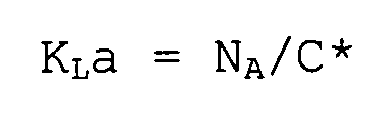

- In addition, symbols in the above equation have the following meanings.
- KLa: gas-liquid overall mass transfer volume coefficient [1/Hr]
- NA: oxygen absorption rate [mol/L·Hr]
- C: oxygen concentration in liquid [mol/L]
- C*: solubility of oxygen in saturation [mol/L]
- p: partial pressure of oxygen in gas phase [Pa]
- H: Henry constant [Pa·L/Hr]
-
- (i) Pure water (475 ml, same liquid volume as feed scale of BIF 23.34 g) is charged into 1 L autoclave (Glass Reactor, TEM-V-1000 type).
- (ii) Na2SO3 (9.5 g) is added thereto, and mixed for about 2 minutes to dissolve.
- (iii) A prepared 0.1 mol/L CuSO4 solution (4.75 ml) is added to the aqueous solution of Na2SO3 (CuSO4 concentration after the addition = 1x10⁻³ M), and the reaction solution is stirred slowly for 1 minute (reaction initiation).
- (iv) Immediately, 10 ml of the dissolution solution is precisely sampled, and titrated according to the procedure of the following (c). (titration volume = T1 [ml])
- (v) The reaction solution is stirred with a given rotation rate for a given time Δθ (= 1.0 [Hr]). At this time, a certain amount of air is streamed into the upper of the vessel to prevent decrease in partial pressure of oxygen in gas phase in autoclave (about 200 ml/L).
- (vi) 10 ml is precisely sampled from the solution of (v), and titrated according to the procedure of the following (c). (titration volume = T2 [ml])
- (vii) From the result of titration, oxygen absorption rate NA is calculated according to the following equation. Here, F represents a factor of N/10 iodine solution reagent.
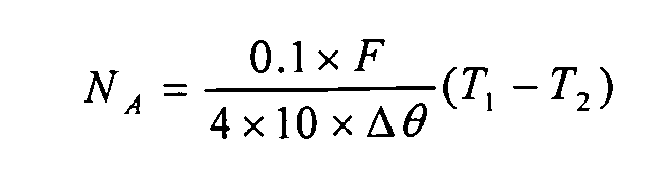
-
- (i) A 200 ml Erlenmeyer flask containing pure water (100 m), acetic acid-sodium acetate buffer*2 (10 ml), and N/10 iodine solution reagent (40 ml) is prepared beforehand.
- (ii) Sample solution (10 ml) is added thereto gently.
- (iii) After about 5 minutes, the sample solution is titrated with N/10 sodium thiosulfate solution using a starch solution*3 (0.5 - 1 ml) as an indicator.
- * 1: Titration principle is based on that after oxidizing sulfite radical existing in the sample solution with iodine, the remaining iodine is titrated with sodium thiosulfate, and each step can be represented by the following reaction formula.
- oxidation of sulfite radical: Na2SO3 + I2 + H2O → 2NaI + H2SO4
- titration of iodine: I2 + 2Na2S2O3 → 2NaI + Na2S4O6
- * 2: 75 g of sodium acetate (CH3COONa·3H2O) is dissolved in 500 ml of aqueous acetic acid (CH3COOH : H2O = 1 : 2).
- * 3: 1.0 g of starch is scrubbed and mixed with 10 ml of water, and the resulting mixture is fed into 200 ml of hot water. After boiling until this turns into semitransparent, it is left to cool.
- * 1: Titration principle is based on that after oxidizing sulfite radical existing in the sample solution with iodine, the remaining iodine is titrated with sodium thiosulfate, and each step can be represented by the following reaction formula.
- (E)-(1,6,7,8-Tetrahydro-2H-indeno[5,4-b]furan-8-ylidene)acetonitrile

- To a solution of toluene (184 g), 1,2,6,7-tetrahydro-8H-indeno[5,4-b]furan-8-one (8.5 g, 48.9 mmol) and diethyl cyanomethylphosphonate (10.4 g, 58.7 mmol) was added dropwise 28% sodium methoxide solution in methanol (11.3 g) over 1 hr under ice-cooling, and reacted for 4 hrs. To the reaction solution was added dropwise water (85 g), and warmed, then the layers were separated. The organic layer was washed with water, and filtered to remove dusts under pressurization. The organic layer was concentrated under reduced pressure, and to the residue was added methanol and concentrated under reduced pressure to substitute the solvent. After stirring for 1 hr under heating with reflux, the solution was cooled and matured for 1hr. The crystallization solution was filtered, and the crystals were dried under reduced pressure to give title compound (amount 8.1 g, yield 84.4%).
- (E)-2-(1,6,7,8-Tetrahydro-2H-indeno[5,4-b]furan-8-ylidene)ethylamine hydrochloride

- To a mixed suspension of (E)-(1,6,7,8-tetrahydro-2H-indeno[5,4-b]furan-8-ylidene)acetonitrile (10.0 g, 50.7 mmol) in toluene (37.5 mL) and methanol (12.5 mL) were added activated cobalt (7.22 g) and 14.4% aqueous solution of potassium hydroxide (1.4 g), and stirred for 6.5 hrs at 34 to 50°C under hydrogen atmosphere (0.2 MPa). The reaction solution was filtered, and to the filtrate were added toluene (170 mL) and methanol (35 mL) to separate the layers. 0.5N Hydrochloric acid (101 mL) was added to the organic layer, and stirred for 30 minutes at 25 to 30°C. Then, the layers were separated, and active charcoal (1 g) was added to the aqueous layer, followed by stirring. The active charcoal was removed by filtration to give an aqueous solution of title compound (246 g, Net 12.0 g, yield 99.6%).
- (S)-2-(1,6,7,8-Tetrahydro-2H-indeno[5,4-b]furan-8-yl)ethylamine hydrochloride

- To an aqueous solution of (E)-2-(1,6,7,8-tetrahydro-2H-indeno[5,4-b]furan-8-ylidene)ethylamine hydrochloride (1979 kg, Net 122kg, 513 mol) were added toluene (532 L) and 5% aqueous solution of sodium hydroxide (456 L), and stirred. The layers were separated, and to the organic layer were added methanol (155 kg) and [RuCl(bebzene)(R)-BINAP]Cl (894 g) under nitrogen atmosphere, followed by stirring at 80°C for 15 hrs under hydrogen atmosphere (4.9 MPa). The reaction solution was cooled, and water (330 L) and concentrated hydrochloric acid (52.3 kg) were added at below 30°C, followed by stirring for 30 minutes, then the layers were separated. The aqueous layer was washed with toluene (195 L), and pH was adjusted to about 6.0 by adding 5% aqueous solution of NaOH to the aqueous layer (containing 5.0% of compound III'). 5% Pd-C (50% wet, 9.7 kg) was added thereto, and stirred at 60°C for 6 hrs under hydrogen atmosphere (4.9 MPa). The reaction mixture was filtered, and the filtrate was adjusted to around pH 6.0 with 5% aqueous solution of NaOH or dilute hydrochloric acid, followed by concentration under reduced pressure. The residue was recrystallized from mixed solution of n-butanol and water to give title compound (88.6 kg, yield 73.0%, compound (III') is not detected, compound (IV') is not detected).
- In addition, the content of compound (III') and compound (IV') (dimer) in the obtained crystals of the title compound was determined by HPLC under the following condition.
- detector: ultraviolet absorptiometer (wavelength for measurement: 220 nm)
- column: Develosil UG-3, 4.6 mmi.d.x75 mm
- column temperature: given temperature around 25°C
- mobile phase: mixed solution of 0.1 mol/L potassium dihydrogenphosphate (pH 3.0)/methanol (75 : 25)
-

- To a mixed solution of (S)-2-(1,6,7,8-tetrahydro-2H-indeno[5,4-b]furan-8-yl)ethylamine hydrochloride (74 kg, 309 mol) in tetrahydrofuran (185 L) and city water (259 L) were added 30% aqueous solution of sodium hydroxide (70 L) and propionyl chloride (32.8 kg), and stirred at room temperature for 1 hr. To the reaction solution was added city water (592 L), and cooled. The precipitated crystals were collected by filtration, and dried under reduced pressure to give title compound (78.0 kg, yield 97.4%).
- The crystals (77.3 kg, 298 mol) obtained in (i) were dissolved in mixed solution (178 kg) of ethanol and purified water (10 : 1), and active charcoal (0.78 kg) was added thereto, then stirred for 10 minutes, followed by filtration (washed with mixed solution (74 kg) of ethanol and purified water (10 : 1)). To the filtrate was added water (588 L) under warming, cooled, and the precipitated crystals were collected by filtration, which were dried under reduced pressure. The resulting crystals were pulverized with jet mil to give title compound (74.0 kg, yield 95.7%, compound (I) 0.02%, compound (II) 0.06%, compound (III) and (IV) less than 0.02%, total analogous material 0.08%).
- The content of compound (I) to (IV) in the crystals of the title compound obtained in (ii) was determined by HPLC under the following condition.
- detector: ultraviolet absorptiometer (wavelength for measurement: 288 nm)
- column: YMC-Pack ODS-AM AM-302.5µm, 4.6 mm i.d.x150 mm (manufactured by YMC)
- column temperature: given temperature around 25°C
- mobile phase:
- A; mixed solution of 0.01 mol/L phosphate buffer (pH 7.0)/acetonitrile (4 : 1)
- B; mixed solution of 0.01 mol/L phosphate buffer (pH 7.0)/acetonitrile (3 : 7)
- Resulting HPLC chart was shown in Figure 1. As obvious from Figure 1, compound (I) and (II) were detected at each side of main peak of (S)-N-[2-(1,6,7,8-tetrahydro-2H-indeno[5,4-b]furan-8-yl)ethyl]propionamide, however, compound (III) and (IV) were each below the detection limit of less than 0.02%.
- According to the process of the present invention, by controlling the pH of reaction solution in catalytic reduction step and post-treatment solution thereof, highly pure optically active amine derivatives which are useful as medicine can be produced with high yield, and high-quality pharmaceutical raw materials can be provided industrially.
| time (min.) | mobile phase A | |
| 0 | 90% | 10% |
| 60 | 40% | 60% |
| 70 | 40% | 60% |
| 70.1 | 90% | 10% |
| 85 | 90% | 10% |
Claims (17)
- A process for producing (S)-2-(1,6,7,8-tetrahydro-2H-indeno[5,4-b]furan-8-yl)ethylamine or a salt thereof, which comprises step (i): a step for asymmetrically reducing (E)-2-(1,6,7,8-tetrahydro-2H-indeno[5,4-b]furan-8-ylidene)ethylamine or a salt thereof with a catalyst, and step (ii): a step for catalytically reducing the reaction product obtained in step (i) at a reaction temperature of 40°C to 100°C and pH 3 to 9 with a catalyst.
- The process according to claim 1, wherein the reaction temperature in step (ii) is 50°C to 70°C.
- The process according to claim 1, wherein the pH in step (ii) is 5 to 7.
- The process according to claim 1, wherein the catalyst in step (i) is Ru-BINAP catalyst.
- The process according to claim 1, wherein the catalyst in step (ii) is Pd-C catalyst.
- A process for producing crystals of (S)-N-[2-(1,6,7,8-tetrahydro-2H-indeno[5,4-b]furan-8-yl)ethyl]propionamide, comprising step (a): a step for propionylating the amino group of (S)-2-(1,6,7,8-tetrahydro-2H-indeno[5,4-b]furan-8-yl)ethylamine or a salt thereof obtained in the process according to claim 1, and step (b): a step for crystallizing by adding aqueous solvent to the reaction solution obtained in step (a).
- Crystals of (S)-N-[2-(1,6,7,8-tetrahydro-2H-indeno [5,4-b] furan-8-yl) ethyl]propionamide, wherein each content of the compounds represented by the following formulae (I), (II), (III) and (IV) is 0.15% by weight or less, and the total content of the compounds represented by the following formulae (I) to (IV) is 0.2% by weight or less.

- Crystals of (S)-N-[2-(1,6,7,8-tetrahydro-2H-indeno[5,4-b]furan-8-yl)ethyl]propionamide, wherein each content of the compounds represented by the following formulae (I), (III) and (IV) is 0.15% by weight or less, and the content of the compound represented by the following formula (II) is 0.02 to 0.15% by weight, and further the total content of the compounds represented by the following formulae (I) to (IV) is 0.2% by weight or less.

- The crystals according to claim 7 or 8, wherein the content of the compound represented by formula (I) is 0.10% by weight or less.
- A composition comprising (S)-N-[2-(1,6,7,8-tetrahydro-2H-indeno[5,4-b]furan-8-yl)ethyl]propionamide and the compounds represented by the following formulae (I), (II), (III) and (IV), wherein relative to 100 parts by weight of (S)-N-[2-(1,6,7,8-tetrahydro-2H-indeno[5,4-b]furan-8-yl)ethyl]propionamide, each content of the compounds represented by the following formulae (I), (II), (III) and (IV) is 0 to 0.15 part by weight and the total content of the compounds represented by the following formulae (I) to (IV) is 0 to 0.2 part by weight.

- A composition comprising (S)-N-[2-(1,6,7,8-tetrahydro-2H-indeno[5,4-b]furan-8-yl)ethyl]propionamide and the compounds represented by the following formulae (I), (II), (III) and (IV), wherein relative to 100 parts by weight of (S)-N-[2-(1,6,7,8-tetrahydro-2H-indeno[5,4-b]furan-8-yl)ethyl]propionamide, each content of the compounds represented by the following formulae (I), (III) and (IV) is 0 to 0.15 part by weight, and the content of the compound represented by the following formula (II) is 0.02 to 0.15 part by weight, and further the total content of the compounds represented by the following formulae (I) to (IV) is 0 to 0.2 part by weight.

- The composition according to claim 10 or 11, wherein the content of the compound represented by formula (I) is 0 to 0.10 part by weight relative to 100 parts by weight of (S)-N-[2-(1,6,7,8-tetrahydro-2H-indeno[5,4-b]furan-8-yl)ethyl]propionamide.

- The crystals according to claim 7 or the composition according to claim 10, which is prepared on a commercial scale.
- A process for producing 1,2,6,7-tetrahydro-8H-indeno[5,4-b]furan-8-one, comprising a step for reducing 4,5-dibromo-1,2,6,7-tetrahydro-8H-indeno[5,4-b]furan-8-one with Pd-C catalyst under the condition: hydrogen pressure (MPa) > -0.02 x gas-liquid overall mass transfer volume coefficient (1/hr) + 0.43.
- Use of the crystals according to claim 7 for the manufacture of a preventive or therapeutic agent for sleep disorder.
- The composition according to claim 10 which is a preventive or therapeutic agent for sleep disorder.
- A method for the prevention or treatment of sleep disorder, comprising administering the crystals according to claim 8 or the composition according to claim 10.
Priority Applications (1)
| Application Number | Priority Date | Filing Date | Title |
|---|---|---|---|
| EP12182935A EP2537842A1 (en) | 2004-09-13 | 2005-09-12 | Crystals of (S)-N-[2-(2,6,7,8-Tetrahydro-1H-indeno[5,4-b]furan-8-yl)ethyl]propionamide |
Applications Claiming Priority (2)
| Application Number | Priority Date | Filing Date | Title |
|---|---|---|---|
| JP2004265307 | 2004-09-13 | ||
| PCT/JP2005/016761 WO2006030739A1 (en) | 2004-09-13 | 2005-09-12 | Process for production of optically active amine derivatives |
Related Child Applications (1)
| Application Number | Title | Priority Date | Filing Date |
|---|---|---|---|
| EP12182935A Division-Into EP2537842A1 (en) | 2004-09-13 | 2005-09-12 | Crystals of (S)-N-[2-(2,6,7,8-Tetrahydro-1H-indeno[5,4-b]furan-8-yl)ethyl]propionamide |
Publications (3)
| Publication Number | Publication Date |
|---|---|
| EP1792899A1 true EP1792899A1 (en) | 2007-06-06 |
| EP1792899A4 EP1792899A4 (en) | 2009-12-16 |
| EP1792899B1 EP1792899B1 (en) | 2014-07-09 |
Family
ID=36059992
Family Applications (2)
| Application Number | Title | Priority Date | Filing Date |
|---|---|---|---|
| EP12182935A Withdrawn EP2537842A1 (en) | 2004-09-13 | 2005-09-12 | Crystals of (S)-N-[2-(2,6,7,8-Tetrahydro-1H-indeno[5,4-b]furan-8-yl)ethyl]propionamide |
| EP05782085.4A Expired - Lifetime EP1792899B1 (en) | 2004-09-13 | 2005-09-12 | Process for production of optically active amine derivatives |
Family Applications Before (1)
| Application Number | Title | Priority Date | Filing Date |
|---|---|---|---|
| EP12182935A Withdrawn EP2537842A1 (en) | 2004-09-13 | 2005-09-12 | Crystals of (S)-N-[2-(2,6,7,8-Tetrahydro-1H-indeno[5,4-b]furan-8-yl)ethyl]propionamide |
Country Status (32)
| Country | Link |
|---|---|
| US (4) | US8097737B2 (en) |
| EP (2) | EP2537842A1 (en) |
| JP (2) | JP5127228B2 (en) |
| KR (1) | KR101298335B1 (en) |
| CN (2) | CN102516211A (en) |
| AR (1) | AR050737A1 (en) |
| AU (1) | AU2005283521B2 (en) |
| BR (1) | BRPI0515170A (en) |
| CA (2) | CA2764314C (en) |
| CR (2) | CR8975A (en) |
| EC (1) | ECSP077317A (en) |
| ES (1) | ES2485890T3 (en) |
| GE (1) | GEP20094725B (en) |
| GT (2) | GT200500257AA (en) |
| HN (1) | HN2005000548A (en) |
| IL (2) | IL181462A (en) |
| MA (1) | MA28855B1 (en) |
| MX (1) | MX2007002822A (en) |
| MY (2) | MY158073A (en) |
| NO (1) | NO20071866L (en) |
| NZ (1) | NZ553562A (en) |
| PA (1) | PA8645701A1 (en) |
| PE (3) | PE20060662A1 (en) |
| PH (1) | PH12012501172A1 (en) |
| RU (1) | RU2385318C2 (en) |
| SA (1) | SA05260347A (en) |
| SG (1) | SG151330A1 (en) |
| TW (1) | TWI400220B (en) |
| UA (1) | UA95598C2 (en) |
| UY (1) | UY29118A1 (en) |
| WO (1) | WO2006030739A1 (en) |
| ZA (1) | ZA200701724B (en) |
Cited By (11)
| Publication number | Priority date | Publication date | Assignee | Title |
|---|---|---|---|---|
| WO2008150953A1 (en) * | 2007-05-30 | 2008-12-11 | Dr. Reddy's Laboratories Ltd. | Process of making ramelteon and related substances |
| WO2008151170A3 (en) * | 2007-05-31 | 2009-04-23 | Teva Pharma | Process for the synthesis of ramelteon and its intermediates |
| WO2009060318A3 (en) * | 2007-07-12 | 2009-12-10 | Teva Pharmaceutical Industries Ltd. | Polymorphic forms of ramelteon and processes for preparation thereof |
| WO2010007022A1 (en) * | 2008-07-14 | 2010-01-21 | Lek Pharmaceuticals D.D. | Synthesis of 6,7-dihydro-1h-indeno[5,4-b]furan-8(2h)-one as intermediate in the preparation of ramelteon |
| WO2010045565A1 (en) * | 2008-10-16 | 2010-04-22 | Teva Pharmaceutical Industries Ltd. | Process for the synthesis of ramelteon and its intermediates |
| WO2010092107A1 (en) | 2009-02-12 | 2010-08-19 | Lek Pharmaceuticals D.D. | Synthesis of (s)-n-[2-(1,6,7,8-tetrahydro-2h-indeno-[5,4-b]furan-8-yl)ethyl]propionamide |
| WO2010103553A1 (en) | 2009-03-10 | 2010-09-16 | Industriale Chimica S.R.L. | Process for the preparation of ramelteon |
| WO2010115897A2 (en) | 2009-04-07 | 2010-10-14 | Lek Pharmaceuticals D.D. | Synthesis of 1-(2,3-dihydrobenzofuran-4-yl)ethanone as intermediate in the preparation of ramelteon |
| WO2011027323A1 (en) | 2009-09-03 | 2011-03-10 | Ranbaxy Laboratories Limited | Process for the preparation of ramelteon |
| WO2011027319A1 (en) | 2009-09-03 | 2011-03-10 | Ranbaxy Laboratories Limited | Process for the preparation of an intermediate for ramelteon |
| WO2011044990A1 (en) | 2009-09-29 | 2011-04-21 | Lonza Ltd | Process for preparing 1,2,6,7-tetrahydro-8h-indeno[5,4-b]furan-8-one |
Families Citing this family (14)
| Publication number | Priority date | Publication date | Assignee | Title |
|---|---|---|---|---|
| JP5450056B2 (en) * | 2007-03-19 | 2014-03-26 | 武田薬品工業株式会社 | Allylamine asymmetric hydrogenation method |
| CN101531647B (en) * | 2008-03-13 | 2012-10-31 | 常州亚邦制药有限公司 | Resolution method of (±)-2-(1,6,7,8-tetrahydro-2H-indeno[5,4-b]furan-8-yl)ethylamine |
| CN101824012B (en) * | 2009-03-02 | 2011-12-07 | 四川大学 | 2-(1,6,7,8-tetrahydrogen-2H-indeno-[5,4-b] furan-8-group) acetonitrile, preparation method and applciation |
| CN101665477B (en) * | 2009-09-21 | 2012-05-09 | 四川大学 | (E) -3- (benzofuran-5-yl) acrylate compound, and preparation method and application thereof |
| CN101648931B (en) * | 2009-09-21 | 2012-05-09 | 四川大学 | A kind of preparation method of 3-(2,3-dihydrobenzofuran-5-yl)-propionic acid |
| WO2012035303A2 (en) | 2010-09-17 | 2012-03-22 | Cipla Limited Et Al | A novel process for synthesis of ramelteon, and key intermediates for the synthesis of ramelteon |
| CN103664849B (en) * | 2012-08-31 | 2017-03-29 | 上海阳帆医药科技有限公司 | Prepare the 2 (methods of 1,6,7,8 tetrahydrochysene 2H indenos [5,4 b] furan, 8 subunit ethamine |
| CN102924410A (en) * | 2012-10-29 | 2013-02-13 | 华润赛科药业有限责任公司 | Preparation method and intermediate of ramelteon |
| CN103396387A (en) * | 2013-08-07 | 2013-11-20 | 安徽联创药物化学有限公司 | Preparation method of ramelteon intermediates |
| CN105277628B (en) * | 2014-07-07 | 2017-05-31 | 南京长澳医药科技有限公司 | By high efficiency liquid chromatography for separating and determining ramelteon and its method for impurity |
| CN104402848B (en) * | 2014-09-22 | 2017-02-08 | 珠海联邦制药股份有限公司 | Preparation method of impurity compound in ramelteon and prepared standard substance |
| CN105622557B (en) * | 2014-11-05 | 2018-12-04 | 上海医药工业研究院 | Ramelteon intermediate and preparation method thereof |
| KR102359229B1 (en) | 2020-04-16 | 2022-02-07 | 제이투에이치바이오텍 (주) | A method for manufacturing ramelteon and intermediate compounds used therein |
| CN115477628A (en) * | 2022-10-17 | 2022-12-16 | 江苏海悦康医药科技有限公司 | A kind of synthetic method of ramelteon dimer |
Family Cites Families (13)
| Publication number | Priority date | Publication date | Assignee | Title |
|---|---|---|---|---|
| JPH0757758B2 (en) | 1988-10-24 | 1995-06-21 | 高砂香料工業株式会社 | Ruthenium-phosphine complex |
| US6060503A (en) | 1991-12-02 | 2000-05-09 | Endorecherche, Inc. | Benzopyran-containing compounds and method for their use |
| CZ290989B6 (en) | 1995-03-02 | 2002-11-13 | Sankyo Company, Limited | Optically active thiazolidinone derivative, pharmaceutical preparation containing thereof and use of such derivative as well as process of its preparation |
| JP2884153B2 (en) | 1996-03-08 | 1999-04-19 | 武田薬品工業株式会社 | Tricyclic compound, its production method and agent |
| US6034239A (en) * | 1996-03-08 | 2000-03-07 | Takeda Chemical Industries, Ltd. | Tricyclic compounds, their production and use |
| EP1199304A1 (en) * | 1997-03-05 | 2002-04-24 | Takeda Chemical Industries, Ltd. | Bicyclic compounds and pharmaceutical composition containing tricyclic compound for treating or preventing sleep disorders |
| CA2241666C (en) * | 1996-03-08 | 2007-11-06 | Takeda Chemical Industries, Ltd. | Tricyclic compounds, their production and use |
| JP4242940B2 (en) | 1997-02-13 | 2009-03-25 | 高砂香料工業株式会社 | Method for producing optically active amine derivative |
| JP4081161B2 (en) | 1997-09-05 | 2008-04-23 | 武田薬品工業株式会社 | Method for producing optically active compound |
| DE69910795T2 (en) | 1998-06-09 | 2004-06-17 | Takeda Chemical Industries, Ltd. | PHARMACEUTICAL COMBINATION WITH A TRIZYCLIC COMPOUND AND AT LEAST ONE OF ZOLPIDEM, ZOPICLONE AND BROTIZOLAM, FOR TREATING OR PREVENTING SLEEP DISORDERS |
| JP3509637B2 (en) * | 1998-06-09 | 2004-03-22 | 武田薬品工業株式会社 | Sleep disorder prevention / treatment agent |
| JP3633895B2 (en) * | 2000-11-17 | 2005-03-30 | 武田薬品工業株式会社 | Copolyvidone-containing preparation |
| US20040018239A1 (en) * | 2000-11-17 | 2004-01-29 | Hajime Ishida | Pharmaceutical preparation containing copolyvidone |
-
2005
- 2005-09-06 TW TW094130493A patent/TWI400220B/en not_active IP Right Cessation
- 2005-09-09 PE PE2005001052A patent/PE20060662A1/en not_active Application Discontinuation
- 2005-09-09 PE PE2008001369A patent/PE20081390A1/en not_active Application Discontinuation
- 2005-09-09 PE PE2012001990A patent/PE20130154A1/en not_active Application Discontinuation
- 2005-09-12 RU RU2007113811/04A patent/RU2385318C2/en not_active IP Right Cessation
- 2005-09-12 UA UAA200702582A patent/UA95598C2/en unknown
- 2005-09-12 EP EP12182935A patent/EP2537842A1/en not_active Withdrawn
- 2005-09-12 SG SG200902222-9A patent/SG151330A1/en unknown
- 2005-09-12 AU AU2005283521A patent/AU2005283521B2/en not_active Ceased
- 2005-09-12 CN CN201110304598XA patent/CN102516211A/en active Pending
- 2005-09-12 JP JP2006535875A patent/JP5127228B2/en not_active Expired - Lifetime
- 2005-09-12 GE GEAP20059926A patent/GEP20094725B/en unknown
- 2005-09-12 ES ES05782085.4T patent/ES2485890T3/en not_active Expired - Lifetime
- 2005-09-12 EP EP05782085.4A patent/EP1792899B1/en not_active Expired - Lifetime
- 2005-09-12 AR ARP050103792A patent/AR050737A1/en not_active Application Discontinuation
- 2005-09-12 MY MYPI20091231A patent/MY158073A/en unknown
- 2005-09-12 PH PH1/2012/501172A patent/PH12012501172A1/en unknown
- 2005-09-12 NZ NZ553562A patent/NZ553562A/en not_active IP Right Cessation
- 2005-09-12 CA CA2764314A patent/CA2764314C/en not_active Expired - Lifetime
- 2005-09-12 MX MX2007002822A patent/MX2007002822A/en active IP Right Grant
- 2005-09-12 US US11/662,684 patent/US8097737B2/en active Active
- 2005-09-12 BR BRPI0515170-8A patent/BRPI0515170A/en not_active IP Right Cessation
- 2005-09-12 WO PCT/JP2005/016761 patent/WO2006030739A1/en not_active Ceased
- 2005-09-12 CN CN2005800388478A patent/CN101056867B/en not_active Expired - Lifetime
- 2005-09-12 KR KR1020077005754A patent/KR101298335B1/en not_active Expired - Fee Related
- 2005-09-12 MY MYPI20054286A patent/MY147822A/en unknown
- 2005-09-12 CA CA2579121A patent/CA2579121C/en not_active Expired - Lifetime
- 2005-09-12 ZA ZA200701724A patent/ZA200701724B/en unknown
- 2005-09-13 GT GT200500257AK patent/GT200500257AA/en unknown
- 2005-09-13 UY UY29118A patent/UY29118A1/en not_active Application Discontinuation
- 2005-09-13 GT GT200500257A patent/GT200500257A/en unknown
- 2005-09-13 HN HN2005000548A patent/HN2005000548A/en unknown
- 2005-09-13 PA PA20058645701A patent/PA8645701A1/en unknown
- 2005-11-08 SA SA05260347A patent/SA05260347A/en unknown
-
2007
- 2007-02-20 IL IL181462A patent/IL181462A/en not_active IP Right Cessation
- 2007-03-06 CR CR8975A patent/CR8975A/en unknown
- 2007-03-09 MA MA29745A patent/MA28855B1/en unknown
- 2007-03-13 EC EC2007007317A patent/ECSP077317A/en unknown
- 2007-04-12 NO NO20071866A patent/NO20071866L/en not_active Application Discontinuation
-
2010
- 2010-08-09 IL IL207510A patent/IL207510A/en not_active IP Right Cessation
-
2011
- 2011-12-14 US US13/325,946 patent/US20120088826A1/en not_active Abandoned
- 2011-12-21 CR CR20110698A patent/CR20110698A/en unknown
-
2012
- 2012-01-26 JP JP2012014435A patent/JP5615304B2/en not_active Expired - Lifetime
- 2012-08-29 US US13/597,361 patent/US8609871B2/en not_active Expired - Lifetime
-
2013
- 2013-11-13 US US14/079,607 patent/US20140066499A1/en not_active Abandoned
Cited By (13)
| Publication number | Priority date | Publication date | Assignee | Title |
|---|---|---|---|---|
| WO2008150953A1 (en) * | 2007-05-30 | 2008-12-11 | Dr. Reddy's Laboratories Ltd. | Process of making ramelteon and related substances |
| US8084630B2 (en) | 2007-05-31 | 2011-12-27 | Teva Pharmaceutical Industries Ltd. | Process for the synthesis of ramelteon and its intermediates |
| WO2008151170A3 (en) * | 2007-05-31 | 2009-04-23 | Teva Pharma | Process for the synthesis of ramelteon and its intermediates |
| WO2009060318A3 (en) * | 2007-07-12 | 2009-12-10 | Teva Pharmaceutical Industries Ltd. | Polymorphic forms of ramelteon and processes for preparation thereof |
| WO2010007022A1 (en) * | 2008-07-14 | 2010-01-21 | Lek Pharmaceuticals D.D. | Synthesis of 6,7-dihydro-1h-indeno[5,4-b]furan-8(2h)-one as intermediate in the preparation of ramelteon |
| WO2010045565A1 (en) * | 2008-10-16 | 2010-04-22 | Teva Pharmaceutical Industries Ltd. | Process for the synthesis of ramelteon and its intermediates |
| WO2010092107A1 (en) | 2009-02-12 | 2010-08-19 | Lek Pharmaceuticals D.D. | Synthesis of (s)-n-[2-(1,6,7,8-tetrahydro-2h-indeno-[5,4-b]furan-8-yl)ethyl]propionamide |
| WO2010103553A1 (en) | 2009-03-10 | 2010-09-16 | Industriale Chimica S.R.L. | Process for the preparation of ramelteon |
| EP2243775A1 (en) | 2009-04-07 | 2010-10-27 | LEK Pharmaceuticals d.d. | Synthesis of 1-(2,3-Dihydrobenzofuran-4-YL)ethanone as intermediate in the preparation of ramelteon |
| WO2010115897A2 (en) | 2009-04-07 | 2010-10-14 | Lek Pharmaceuticals D.D. | Synthesis of 1-(2,3-dihydrobenzofuran-4-yl)ethanone as intermediate in the preparation of ramelteon |
| WO2011027323A1 (en) | 2009-09-03 | 2011-03-10 | Ranbaxy Laboratories Limited | Process for the preparation of ramelteon |
| WO2011027319A1 (en) | 2009-09-03 | 2011-03-10 | Ranbaxy Laboratories Limited | Process for the preparation of an intermediate for ramelteon |
| WO2011044990A1 (en) | 2009-09-29 | 2011-04-21 | Lonza Ltd | Process for preparing 1,2,6,7-tetrahydro-8h-indeno[5,4-b]furan-8-one |
Also Published As
Similar Documents
| Publication | Publication Date | Title |
|---|---|---|
| US8609871B2 (en) | Process for production of optically active amine derivatives | |
| JP3162523B2 (en) | Piperidylmethyl-substituted chroman derivatives | |
| HK1106525A (en) | Process for production of optically active amine derivatives | |
| HRP20000247A2 (en) | Dofetilide polymorphs | |
| EP1828125B1 (en) | Arylpiperazine derivatives and their use as ligangs selective of the dopamine d3 receptor | |
| US4923863A (en) | Morpholine derivatives, pharmaceutical compositions and use | |
| JPS63135378A (en) | Butyrolactone derivative, production and use thereof | |
| CN110218209B (en) | Crystal form A of ipiprazole laurate, and preparation method and application thereof | |
| JP3484115B2 (en) | Condensed pyridazine derivatives, their production and use | |
| WO1996001816A1 (en) | Novel 2,3-dihydrobenzofuran derivative, process for producing the same, and use thereof | |
| JP3054207B2 (en) | Cyclopropachromene derivative | |
| EP0298758A2 (en) | Hydroquinonylphenyl butyric acid amide derivative | |
| EP2393778B1 (en) | Optically active 3-[(phenylpiperazin-1-yl)alkyl]-3- alkyl-oxindole derivatives having CNS activity | |
| JPH09124608A (en) | Cyclopropane derivative and antiviral agent containing the same | |
| IE51008B1 (en) | Novel oxazolines | |
| JPH0625184B2 (en) | Novel substituted benzothiazolinones, process for their production and pharmaceutical compositions containing them | |
| JPS62142173A (en) | 1,5-benzoxathiepin derivative |
Legal Events
| Date | Code | Title | Description |
|---|---|---|---|
| PUAI | Public reference made under article 153(3) epc to a published international application that has entered the european phase |
Free format text: ORIGINAL CODE: 0009012 |
|
| 17P | Request for examination filed |
Effective date: 20070308 |
|
| AK | Designated contracting states |
Kind code of ref document: A1 Designated state(s): AT BE BG CH CY CZ DE DK EE ES FI FR GB GR HU IE IS IT LI LT LU LV MC NL PL PT RO SE SI SK TR |
|
| AX | Request for extension of the european patent |
Extension state: AL BA HR MK YU |
|
| REG | Reference to a national code |
Ref country code: HK Ref legal event code: DE Ref document number: 1106525 Country of ref document: HK |
|
| DA4 | Supplementary search report drawn up and despatched (deleted) | ||
| RA4 | Supplementary search report drawn up and despatched (corrected) |
Effective date: 20091112 |
|
| 17Q | First examination report despatched |
Effective date: 20100910 |
|
| GRAP | Despatch of communication of intention to grant a patent |
Free format text: ORIGINAL CODE: EPIDOSNIGR1 |
|
| INTG | Intention to grant announced |
Effective date: 20140124 |
|
| GRAS | Grant fee paid |
Free format text: ORIGINAL CODE: EPIDOSNIGR3 |
|
| GRAA | (expected) grant |
Free format text: ORIGINAL CODE: 0009210 |
|
| AK | Designated contracting states |
Kind code of ref document: B1 Designated state(s): AT BE BG CH CY CZ DE DK EE ES FI FR GB GR HU IE IS IT LI LT LU LV MC NL PL PT RO SE SI SK TR |
|
| AX | Request for extension of the european patent |
Extension state: AL BA HR MK YU |
|
| REG | Reference to a national code |
Ref country code: GB Ref legal event code: FG4D |
|
| REG | Reference to a national code |
Ref country code: AT Ref legal event code: REF Ref document number: 676538 Country of ref document: AT Kind code of ref document: T Effective date: 20140715 Ref country code: CH Ref legal event code: EP |
|
| REG | Reference to a national code |
Ref country code: IE Ref legal event code: FG4D |
|
| REG | Reference to a national code |
Ref country code: CH Ref legal event code: PCAR Free format text: NEW ADDRESS: HOLBEINSTRASSE 36-38, 4051 BASEL (CH) Ref country code: CH Ref legal event code: NV Representative=s name: BOHEST AG, CH |
|
| REG | Reference to a national code |
Ref country code: ES Ref legal event code: FG2A Ref document number: 2485890 Country of ref document: ES Kind code of ref document: T3 Effective date: 20140814 Ref country code: DE Ref legal event code: R096 Ref document number: 602005044148 Country of ref document: DE Effective date: 20140814 |
|
| REG | Reference to a national code |
Ref country code: AT Ref legal event code: MK05 Ref document number: 676538 Country of ref document: AT Kind code of ref document: T Effective date: 20140709 |
|
| REG | Reference to a national code |
Ref country code: NL Ref legal event code: VDEP Effective date: 20140709 |
|
| REG | Reference to a national code |
Ref country code: LT Ref legal event code: MG4D |
|
| PG25 | Lapsed in a contracting state [announced via postgrant information from national office to epo] |
Ref country code: PT Free format text: LAPSE BECAUSE OF FAILURE TO SUBMIT A TRANSLATION OF THE DESCRIPTION OR TO PAY THE FEE WITHIN THE PRESCRIBED TIME-LIMIT Effective date: 20141110 Ref country code: FI Free format text: LAPSE BECAUSE OF FAILURE TO SUBMIT A TRANSLATION OF THE DESCRIPTION OR TO PAY THE FEE WITHIN THE PRESCRIBED TIME-LIMIT Effective date: 20140709 Ref country code: SE Free format text: LAPSE BECAUSE OF FAILURE TO SUBMIT A TRANSLATION OF THE DESCRIPTION OR TO PAY THE FEE WITHIN THE PRESCRIBED TIME-LIMIT Effective date: 20140709 Ref country code: BG Free format text: LAPSE BECAUSE OF FAILURE TO SUBMIT A TRANSLATION OF THE DESCRIPTION OR TO PAY THE FEE WITHIN THE PRESCRIBED TIME-LIMIT Effective date: 20141009 Ref country code: LT Free format text: LAPSE BECAUSE OF FAILURE TO SUBMIT A TRANSLATION OF THE DESCRIPTION OR TO PAY THE FEE WITHIN THE PRESCRIBED TIME-LIMIT Effective date: 20140709 Ref country code: GR Free format text: LAPSE BECAUSE OF FAILURE TO SUBMIT A TRANSLATION OF THE DESCRIPTION OR TO PAY THE FEE WITHIN THE PRESCRIBED TIME-LIMIT Effective date: 20141010 |
|
| PG25 | Lapsed in a contracting state [announced via postgrant information from national office to epo] |
Ref country code: IS Free format text: LAPSE BECAUSE OF FAILURE TO SUBMIT A TRANSLATION OF THE DESCRIPTION OR TO PAY THE FEE WITHIN THE PRESCRIBED TIME-LIMIT Effective date: 20141109 Ref country code: CY Free format text: LAPSE BECAUSE OF FAILURE TO SUBMIT A TRANSLATION OF THE DESCRIPTION OR TO PAY THE FEE WITHIN THE PRESCRIBED TIME-LIMIT Effective date: 20140709 Ref country code: LV Free format text: LAPSE BECAUSE OF FAILURE TO SUBMIT A TRANSLATION OF THE DESCRIPTION OR TO PAY THE FEE WITHIN THE PRESCRIBED TIME-LIMIT Effective date: 20140709 Ref country code: PL Free format text: LAPSE BECAUSE OF FAILURE TO SUBMIT A TRANSLATION OF THE DESCRIPTION OR TO PAY THE FEE WITHIN THE PRESCRIBED TIME-LIMIT Effective date: 20140709 Ref country code: NL Free format text: LAPSE BECAUSE OF FAILURE TO SUBMIT A TRANSLATION OF THE DESCRIPTION OR TO PAY THE FEE WITHIN THE PRESCRIBED TIME-LIMIT Effective date: 20140709 Ref country code: AT Free format text: LAPSE BECAUSE OF FAILURE TO SUBMIT A TRANSLATION OF THE DESCRIPTION OR TO PAY THE FEE WITHIN THE PRESCRIBED TIME-LIMIT Effective date: 20140709 |
|
| REG | Reference to a national code |
Ref country code: DE Ref legal event code: R097 Ref document number: 602005044148 Country of ref document: DE |
|
| PG25 | Lapsed in a contracting state [announced via postgrant information from national office to epo] |
Ref country code: LU Free format text: LAPSE BECAUSE OF FAILURE TO SUBMIT A TRANSLATION OF THE DESCRIPTION OR TO PAY THE FEE WITHIN THE PRESCRIBED TIME-LIMIT Effective date: 20140912 Ref country code: SK Free format text: LAPSE BECAUSE OF FAILURE TO SUBMIT A TRANSLATION OF THE DESCRIPTION OR TO PAY THE FEE WITHIN THE PRESCRIBED TIME-LIMIT Effective date: 20140709 Ref country code: RO Free format text: LAPSE BECAUSE OF FAILURE TO SUBMIT A TRANSLATION OF THE DESCRIPTION OR TO PAY THE FEE WITHIN THE PRESCRIBED TIME-LIMIT Effective date: 20140709 Ref country code: DK Free format text: LAPSE BECAUSE OF FAILURE TO SUBMIT A TRANSLATION OF THE DESCRIPTION OR TO PAY THE FEE WITHIN THE PRESCRIBED TIME-LIMIT Effective date: 20140709 Ref country code: CZ Free format text: LAPSE BECAUSE OF FAILURE TO SUBMIT A TRANSLATION OF THE DESCRIPTION OR TO PAY THE FEE WITHIN THE PRESCRIBED TIME-LIMIT Effective date: 20140709 Ref country code: MC Free format text: LAPSE BECAUSE OF FAILURE TO SUBMIT A TRANSLATION OF THE DESCRIPTION OR TO PAY THE FEE WITHIN THE PRESCRIBED TIME-LIMIT Effective date: 20140709 Ref country code: EE Free format text: LAPSE BECAUSE OF FAILURE TO SUBMIT A TRANSLATION OF THE DESCRIPTION OR TO PAY THE FEE WITHIN THE PRESCRIBED TIME-LIMIT Effective date: 20140709 |
|
| PLBE | No opposition filed within time limit |
Free format text: ORIGINAL CODE: 0009261 |
|
| STAA | Information on the status of an ep patent application or granted ep patent |
Free format text: STATUS: NO OPPOSITION FILED WITHIN TIME LIMIT |
|
| 26N | No opposition filed |
Effective date: 20150410 |
|
| REG | Reference to a national code |
Ref country code: IE Ref legal event code: MM4A |
|
| PG25 | Lapsed in a contracting state [announced via postgrant information from national office to epo] |
Ref country code: BE Free format text: LAPSE BECAUSE OF NON-PAYMENT OF DUE FEES Effective date: 20140930 |
|
| PG25 | Lapsed in a contracting state [announced via postgrant information from national office to epo] |
Ref country code: IE Free format text: LAPSE BECAUSE OF NON-PAYMENT OF DUE FEES Effective date: 20140912 |
|
| PG25 | Lapsed in a contracting state [announced via postgrant information from national office to epo] |
Ref country code: SI Free format text: LAPSE BECAUSE OF FAILURE TO SUBMIT A TRANSLATION OF THE DESCRIPTION OR TO PAY THE FEE WITHIN THE PRESCRIBED TIME-LIMIT Effective date: 20140709 |
|
| PG25 | Lapsed in a contracting state [announced via postgrant information from national office to epo] |
Ref country code: TR Free format text: LAPSE BECAUSE OF FAILURE TO SUBMIT A TRANSLATION OF THE DESCRIPTION OR TO PAY THE FEE WITHIN THE PRESCRIBED TIME-LIMIT Effective date: 20140709 Ref country code: BE Free format text: LAPSE BECAUSE OF FAILURE TO SUBMIT A TRANSLATION OF THE DESCRIPTION OR TO PAY THE FEE WITHIN THE PRESCRIBED TIME-LIMIT Effective date: 20140709 Ref country code: HU Free format text: LAPSE BECAUSE OF FAILURE TO SUBMIT A TRANSLATION OF THE DESCRIPTION OR TO PAY THE FEE WITHIN THE PRESCRIBED TIME-LIMIT; INVALID AB INITIO Effective date: 20050912 |
|
| REG | Reference to a national code |
Ref country code: FR Ref legal event code: PLFP Year of fee payment: 12 |
|
| REG | Reference to a national code |
Ref country code: FR Ref legal event code: PLFP Year of fee payment: 13 |
|
| REG | Reference to a national code |
Ref country code: FR Ref legal event code: PLFP Year of fee payment: 14 |
|
| PGFP | Annual fee paid to national office [announced via postgrant information from national office to epo] |
Ref country code: DE Payment date: 20240820 Year of fee payment: 20 |
|
| PGFP | Annual fee paid to national office [announced via postgrant information from national office to epo] |
Ref country code: GB Payment date: 20240820 Year of fee payment: 20 |
|
| PGFP | Annual fee paid to national office [announced via postgrant information from national office to epo] |
Ref country code: FR Payment date: 20240820 Year of fee payment: 20 |
|
| PGFP | Annual fee paid to national office [announced via postgrant information from national office to epo] |
Ref country code: IT Payment date: 20240820 Year of fee payment: 20 |
|
| PGFP | Annual fee paid to national office [announced via postgrant information from national office to epo] |
Ref country code: ES Payment date: 20241001 Year of fee payment: 20 |
|
| PGFP | Annual fee paid to national office [announced via postgrant information from national office to epo] |
Ref country code: CH Payment date: 20241001 Year of fee payment: 20 |
|
| REG | Reference to a national code |
Ref country code: DE Ref legal event code: R071 Ref document number: 602005044148 Country of ref document: DE |
|
| REG | Reference to a national code |
Ref country code: CH Ref legal event code: PL |
|
| REG | Reference to a national code |
Ref country code: ES Ref legal event code: FD2A Effective date: 20250926 |
|
| REG | Reference to a national code |
Ref country code: GB Ref legal event code: PE20 Expiry date: 20250911 |
|
| PG25 | Lapsed in a contracting state [announced via postgrant information from national office to epo] |
Ref country code: ES Free format text: LAPSE BECAUSE OF EXPIRATION OF PROTECTION Effective date: 20250913 |