EP1791571B1 - Radiofluorinated peptides - Google Patents
Radiofluorinated peptides Download PDFInfo
- Publication number
- EP1791571B1 EP1791571B1 EP05790076A EP05790076A EP1791571B1 EP 1791571 B1 EP1791571 B1 EP 1791571B1 EP 05790076 A EP05790076 A EP 05790076A EP 05790076 A EP05790076 A EP 05790076A EP 1791571 B1 EP1791571 B1 EP 1791571B1
- Authority
- EP
- European Patent Office
- Prior art keywords
- compound
- formula
- iiia
- integer
- salt
- Prior art date
- Legal status (The legal status is an assumption and is not a legal conclusion. Google has not performed a legal analysis and makes no representation as to the accuracy of the status listed.)
- Expired - Lifetime
Links
- 0 C*C([C@@](NC([C@](Cc1ccccc1)NC(C(NC([C@](CC(O)=O)NC(CNC([C@](CCCNC(N)=N)NC1=O)=O)=O)=O)SSC1NC([C@](CCCCNC(COCC(NC(C)CCOCCNC(CON)=O)=O)=O)N1)=O)=O)=O)SCC1=O)=O Chemical compound C*C([C@@](NC([C@](Cc1ccccc1)NC(C(NC([C@](CC(O)=O)NC(CNC([C@](CCCNC(N)=N)NC1=O)=O)=O)=O)SSC1NC([C@](CCCCNC(COCC(NC(C)CCOCCNC(CON)=O)=O)=O)N1)=O)=O)=O)SCC1=O)=O 0.000 description 4
- YXFVVABEGXRONW-UHFFFAOYSA-N Cc1ccccc1 Chemical compound Cc1ccccc1 YXFVVABEGXRONW-UHFFFAOYSA-N 0.000 description 1
- HLPLWHOQAKWZIS-UHFFFAOYSA-N OCCOCCOCCNC(CO)=O Chemical compound OCCOCCOCCNC(CO)=O HLPLWHOQAKWZIS-UHFFFAOYSA-N 0.000 description 1
Classifications
-
- A—HUMAN NECESSITIES
- A61—MEDICAL OR VETERINARY SCIENCE; HYGIENE
- A61K—PREPARATIONS FOR MEDICAL, DENTAL OR TOILETRY PURPOSES
- A61K51/00—Preparations containing radioactive substances for use in therapy or testing in vivo
- A61K51/02—Preparations containing radioactive substances for use in therapy or testing in vivo characterised by the carrier, i.e. characterised by the agent or material covalently linked or complexing the radioactive nucleus
- A61K51/04—Organic compounds
- A61K51/08—Peptides, e.g. proteins, carriers being peptides, polyamino acids, proteins
-
- A—HUMAN NECESSITIES
- A61—MEDICAL OR VETERINARY SCIENCE; HYGIENE
- A61K—PREPARATIONS FOR MEDICAL, DENTAL OR TOILETRY PURPOSES
- A61K51/00—Preparations containing radioactive substances for use in therapy or testing in vivo
- A61K51/02—Preparations containing radioactive substances for use in therapy or testing in vivo characterised by the carrier, i.e. characterised by the agent or material covalently linked or complexing the radioactive nucleus
- A61K51/04—Organic compounds
- A61K51/08—Peptides, e.g. proteins, carriers being peptides, polyamino acids, proteins
- A61K51/088—Peptides, e.g. proteins, carriers being peptides, polyamino acids, proteins conjugates with carriers being peptides, polyamino acids or proteins
-
- A—HUMAN NECESSITIES
- A61—MEDICAL OR VETERINARY SCIENCE; HYGIENE
- A61P—SPECIFIC THERAPEUTIC ACTIVITY OF CHEMICAL COMPOUNDS OR MEDICINAL PREPARATIONS
- A61P35/00—Antineoplastic agents
-
- A—HUMAN NECESSITIES
- A61—MEDICAL OR VETERINARY SCIENCE; HYGIENE
- A61P—SPECIFIC THERAPEUTIC ACTIVITY OF CHEMICAL COMPOUNDS OR MEDICINAL PREPARATIONS
- A61P9/00—Drugs for disorders of the cardiovascular system
Definitions
- the present invention relates to new peptide-based compounds and their use for diagnostic imaging using positron emission tomography (PET). More specifically the invention relates to the use of such peptide-based compounds as targeting vectors that bind to receptors associated with angiogenesis, in particular integrin receptors, for example, the ⁇ v ⁇ 3 integrin receptor. Such compounds may thus be used for diagnosis or therapy of, for example, malignant diseases, heart diseases, endometriosis, inflammation-related diseases, rheumatoid arthritis and Kaposi's sarcoma. It further relates to methods and reagents for production of such peptide-based compounds.
- radiolabelled bioactive peptides for diagnostic imaging is gaining importance in nuclear medicine.
- Biologically active molecules which selectively interact with specific cell types are useful for the delivery of radioactivity to target tissues.
- radiolabelled peptides have significant potential for the delivery of radionuclides to tumours, infarcts, and infected tissues for diagnostic imaging and radiotherapy.
- 18 F with its half-life of approximately 110 minutes, is the positron-emitting nuclide of choice for many receptor imaging studies. Therefore, 18 F-labelled bioactive peptides have great clinical potential because of their utility in PET to quantitatively detect and characterise a wide variety of diseases.
- New blood vessels can be formed by two different mechanisms: vasculogenesis or angiogenesis.
- Angiogenesis is the formation of new blood vessels by branching from existing vessels.
- the primary stimulus for this process may be inadequate supply of nutrients and oxygen (hypoxia) to cells in a tissue.
- the cells may respond by secreting angiogenic factors, of which there are many; one example, which is frequently referred to, is vascular endothelial growth factor (VEGF). These factors initiate the secretion of proteolytic enzymes that break down the proteins of the basement membrane, as well as inhibitors that limit the action of these potentially harmful enzymes.
- VEGF vascular endothelial growth factor
- the other prominent effect of angiogenic factors is to cause endothelial cells to migrate and divide. Endothelial cells that are attached to the basement membrane, which forms a continuous sheet around blood vessels on the contralumenal side, do not undergo mitosis.
- the combined effect of loss of attachment and signals from the receptors for angiogenic factors is to cause the endothelial cells to move, multiply, and rearrange themselves, and finally to synthesise a basement membrane around the new vessels.
- Angiogenesis is prominent in the growth and remodelling of tissues, including wound healing and inflammatory processes. Tumours must initiate angiogenesis when they reach millimetre size in order to keep up their rate of growth. Angiogenesis is accompanied by characteristic changes in endothelial cells and their environment. The surface of these cells is remodelled in preparation for migration, and cryptic structures are exposed where the basement membrane is degraded, in addition to the variety of proteins which are involved in effecting and controlling proteolysis. In the case of tumours, the resulting network of blood vessels is usually disorganised, with the formation of sharp kinks and also arteriovenous shunts. Inhibition of angiogenesis is also considered to be a promising strategy for antitumour therapy.
- angiogenesis is also very promising for diagnosis, one example being malignant disease, but the concept also shows great promise in inflammation and a variety of inflammation-related diseases, including atherosclerosis, the macrophages of early atherosclerotic lesions being potential sources of angiogenic factors.
- RGD arginine-glycine-aspartic acid
- WO 03/006491 describes peptide-based compounds which target integrin receptors associated with angiogenesis.
- further such peptide-based compounds having utility for diagnostic imaging techniques such as PET.
- Co-pending International application WO2004/080492 describes methods suitable for labelling biologically active vectors with 18 F. But there is still a need for peptide-based compounds which may be prepared rapidly and efficiently and yet still have the desirable biological activity.
- WO 03/080544 describes methods and reagents for [ 18 F]fluorination using thiols. Poethke et al, J. Nucl. Med. 45 (5), 892-902 describes radiofluorination methods for certain peptides using [ 18 F]fluorobenzaldehyde. WO2005/012335 describes certain labelled RGD peptides.
- the present invention provides a method for radiofluorination comprising reaction of a compound of formula (la): wherein X 7 is either-NH 2 or wherein a is an integer of from 1 to 10, preferably a is 1 and b is an integer of from 2 to 20, and is preferably 3 to 10, most preferably 5; with a compound of formula (II): wherein:
- This reaction may be effected in a suitable solvent, for example, in an aqueous buffer in the pH range 1 to 11, suitably 2 to 11, more suitably 2 to 6, and at a non-extreme temperature of from 5 to 100 °C, suitably 20 to 70°C, preferably at ambient temperature.
- a suitable solvent for example, in an aqueous buffer in the pH range 1 to 11, suitably 2 to 11, more suitably 2 to 6, and at a non-extreme temperature of from 5 to 100 °C, suitably 20 to 70°C, preferably at ambient temperature.
- the linker forming part of the vector in the compound of formula (Ia) is chosen to provide good in vivo pharmacokinetics, such as favourable excretion characteristics in the resultant conjugate of formula (IIIa).
- the use of linker groups with different lipophilicities and or charge can significantly change the in vivo pharmacokinetics of the peptide to suit the diagnostic need.
- a hydrophilic linker is used, and where it is desirable for clearance to be by hepatobiliary excretion a hydrophobic linker is used.
- Linkers including a polyethylene glycol moiety have been found to slow blood clearance which is desirable in some circumstances.
- the linker forming part of the vector in the compound of formula (Ia) comprises a polyethylene glycol subunit of formula B: wherein b is an integer of from 2 to 20, and is preferably 3 to 10, most preferably 5.
- X 7 is either -NH 2 or wherein a is an integer of from 1 to 10, preferably a is 1 and b is an integer of from 2 to 20 and is preferably 3 to 10, most preferably 5.
- Preferred compounds of formula (II) are those where m is 0, n is 0, and Y is hydrogen.
- Compounds of formula (Ia) and (IIIa) may be prepared by standard methods of peptide synthesis, for example, solid-phase peptide synthesis, for example, as described in Atherton, E. and Sheppard, R.C.; "Solid Phase Synthesis”; IRL Press: Oxford, 1989 .
- Incorporation of the aminoxy group in a compound of formula (Ia) may be achieved by formation of a stable amide bond formed by reaction of a peptide amine function with an activated acid and introduced either during or following the peptide synthesis.
- the present invention provides compounds of formula (Ia) as defined above having use as reagents useful for the production of radiolabelled peptide-based compounds.
- the present invention provides radiolabelled conjugates of formula (IIIa) or a salt thereof, as defined above.
- Preferred compounds of formula (IIIa) are those of formula: or a salt thereof, wherein X 7 is either -NH 2 or wherein a is an integer of from 1 to 10, preferably a is 1 and b is an integer of from 2 to 20 and is preferably 3 to 10, most preferably 5.
- Suitable salts of the compounds of formula (IIIa) include pharmaceutically acceptable acid additions salts such as those formed from hydrochloric, hydrobromic, sulphuric, citric, tartaric, phosphoric, lactic, pyruvic, acetic, trifluoroacetic, succinic, oxaxlic, fumaric, maleic, oxalacetic, methanesulphonic, ethanesulphonic, p-toluenesulphonic, benzenesulphonic, and isoethionic acids.
- Compounds of formula (II) may be prepared from the corresponding precursors of formula (IV): or a protected derivative thereof, wherein L is a leaving group preferably when m ⁇ 1, L is p-toluenesulphonate, trifluoromethanesulphonate, or methanesulphonate or a halide and when m is 0 L is p-trialkyl ammonium salt or p-nitro, and Y, m, and n are as described for the compound of formula (II); by reaction with cyclotron produced aqueous [ 18 F]-fluoride, suitably preactivated by evaporation from a base (for example, from tetrabutylammonium or K 2 CO 3 /Kryptofix-222), in a suitable solvent such as acetonitrile, N,N-dimethylformamide, or dimethyl sulphoxide, typically at ambient or at elevated temperature, for example up to 140°C.
- L is a
- the compounds of formula (Ia) bind to receptors associated with angiogenesis. These compounds may thus be useful for treatment, in vivo diagnosis and imaging of diseases and conditions associated with angiogenesis.
- diseases and conditions associated with angiogenesis includes those diseases and conditions referred to below. Reference is also made in this regard to WO 98/47541 .
- Diseases and conditions associated with angiogenesis include different forms of cancer and metastasis, for example, breast, skin, colorectal, pancreatic, prostate, lung or ovarian cancer.
- inflammation for example, chronic inflammation
- atherosclerosis for example, atherosclerosis
- rheumatoid arthritis for example, gingivitis
- angiogenesis diseases and conditions associated with angiogenesis are arteriovenous alformations, astrocytomas, choriocarcinomas, glioblastomas, gliomas, hemangiomas (childhood, capillary), hepatomas, hyperplastic endometrium, ischemic myocardium, endometriosis, Kaposi sarcoma, macular degeneration, melanoma, neuroblastomas, occluding peripheral artery disease, osteoarthritis, psoriasis, retinopathy (diabetic, proliferative), scleroderma, seminomas and ulcerative colitis.
- the present invention also provides a radiopharmaceutical composition
- a radiopharmaceutical composition comprising an effective amount (e.g. an amount effective for use in in vivo PET imaging) of a compound of general formula (IIIa) or a salt thereof, as defined above; together with one or more pharmaceutically acceptable adjuvants, excipients or diluents.
- a preferred embodiment of the invention relates to a compound of general formula (IIIa) or a salt thereof, as defined above, for use in medicine, particularly in the in vivo diagnosis or imaging, for example by PET, of a disease or condition associated with angiogenesis.
- the radiolabelled conjugates of of formula (IIIa) may be administered to patients for PET imaging in amounts sufficient to yield the desired signal, typical radionuclide dosages of 0.01 to 100 mCi, preferably 0.1 to 50 mCi, most preferably 1 to 20 mCi, will normally be sufficient per 70kg bodyweight.
- the radiolabelled conjugates of formula (IIIa) may therefore be formulated for administration using physiologically acceptable carriers or excipients in a manner fully within the skill of the art.
- the compounds optionally with the addition of pharmaceutically acceptable excipients, may be suspended or dissolved in an aqueous medium, with the resulting solution or suspension then being sterilized.
- the invention provides the use of a radiolabelled conjugate of formula (IIIa) or a salt thereof as defined above for the manufacture of a radiopharmaceutical for use in a method of in vivo imaging, suitably PET, and preferably for imaging of a disease or condition associated with angiogenesis; involving administration of said radiopharmaceutical to a human or animal body and generation of an image of at least part of said body.
- the invention provides a compound for use in a method for in vivo diagnosis or imaging of a disease or condition associated with angiogenesis involving administering a radiopharmaceutical to said body, e.g. into the vascular system and generating an image of at least a part of said body to which said radiopharmaceutical has distributed using PET, wherein said radiopharmaceutical comprises a radiolabelled conjugate of formula (IIIa) or a salt thereof.
- the invention provides a compound for use in a method of monitoring the effect of treatment of a human or animal body with a drug to combat a condition associated with cancer, preferably angiogenesis, e.g. a cytotoxic agent, said method comprising administering to said body a radiolabelled conjugate of formula (IIIa) or a salt thereof and detecting the uptake of said conjugate by cell receptors, preferably endothelial cell receptors and in particular ⁇ v ⁇ 3 receptors, said administration and detection optionally but preferably being effected repeatedly, e.g. before, during and after treatment with said drug.
- the methods and compounds of the instant invention may be used in the form of a kit for the preparation of a radiofluorinated tracer comprising a prosthetic group of formula (II) and a compound of formula (Ia).
- the compound of formula (II) would be added to the compound of formula (Ia) respectively which may suitably be dissolved in aqueous buffer (pH 1-11). After reaction at a non-extreme temperature for 1 to 70 minutes, the labelled peptide may be purified, for example, by solid-phase extraction (SPE) or high performance liquid chromatography (HPLC) and collected.
- SPE solid-phase extraction
- HPLC high performance liquid chromatography
- the peptide, Compound 2 was synthesised using standard peptide synthesis.
- the aqueous phase was concentrated and the product was taken up in dichloromethane (150 mL).
- the organic phase was dried (Na 2 SO 4 ) and concentrated giving of 22 g (95 %) of a yellow oil.
- the product was identified by elctrospray mass spectrometry (ESI-MS) (MH + calculated: 307.19; found 307.4).
- ESI-MS elctrospray mass spectrometry
- Deprotection of peptide 3 was carried out by addition of TFA containing 5% water to 10mg of peptide.
- the Boc-deprotected peptide (5.9 mg, 0.0044 mmol) in 1 ml water was added to 4-fluoro benzaldehyde (Compound 1) (1.1 mg, 0.94 ⁇ l,11, 0.0089 mmol) in 1 ml acetonitrile. pH of the mixture was 3.5.
- the solvents were then removed in vacuo.
- the deprotected peptide was redissolved in 0.1 M NH 4 OAc buffer, pH4 (0.4ml) and combined with 4- 18 F-fluorobenzaldehyde in the reaction vessel.
- the reaction vessel was sealed and heated to 70°C for 15mins to effect conjugation.
- the product fraction was diluted with water (10ml) and loaded onto a SepPak C18-plus cartridge (conditioned with 10ml EtOH and 20ml H 2 O).
- Compound 4 was eluted in ethanol (1ml). The ethanol was removed in vacuo and compound 4 was formulated in PBS.
- the mixture will be passed sequentially through ion exchange cartridges (preconditioned with ethanol (or acetonitrile) and water) and eluted in an acetonitrile/water mixture.
- the eluate will be concentrated using a C18 Seppak, and the fluorobenzaldehyde will be eluted in acetonitrile.
- Compound 3 is treated with 5% water in TFA for 5mins at room temperature. The solvents are then removed by evaporation under vacuum. The peptide is redissolved in 0.1 M NH 4 OAc buffer, pH4 (0.5ml) and combined with 4- 18 F-fluorobenzaldehyde in the reaction vessel. The reaction vessel is sealed and heated to 70°C for 15mins to effect conjugation. After cooling to room temperature, the product is obtained by preparative radio HPLC (as described for method 1) or by SPE.
- Compound 4 had a K i value of 10 nM.
- mice Male C57BU6, ca. 25 g were injected sub-cutaneously into the inner right thigh with Lewis lung carcinoma (LLC) cells (0.1 mL, 1x10 7 cells/mL in medium). Animals were monitored for tumour growth for up to 15 days, with this time selected during model development as it showed the highest level of angiogenesis. To determine the biodistribution of 18 F-compounds, tumour-bearing animals were injected with test article (0.1 mL, 5-10 MBq/mL) as an intravenous bolus via the tail vein. At various times post injection animals were euthanased.
- LLC Lewis lung carcinoma
- Muscle, kidneys, urine, lung, liver, stomach, small intestine, large intestine, thyroid, tumour were dissected and a blood sample taken. Dissected tissues and blood samples were weighed and counted (Wallac automatic gamma counter system). At least three animals per time point were studied. Results are expressed as %id and %id per gram of tissue.
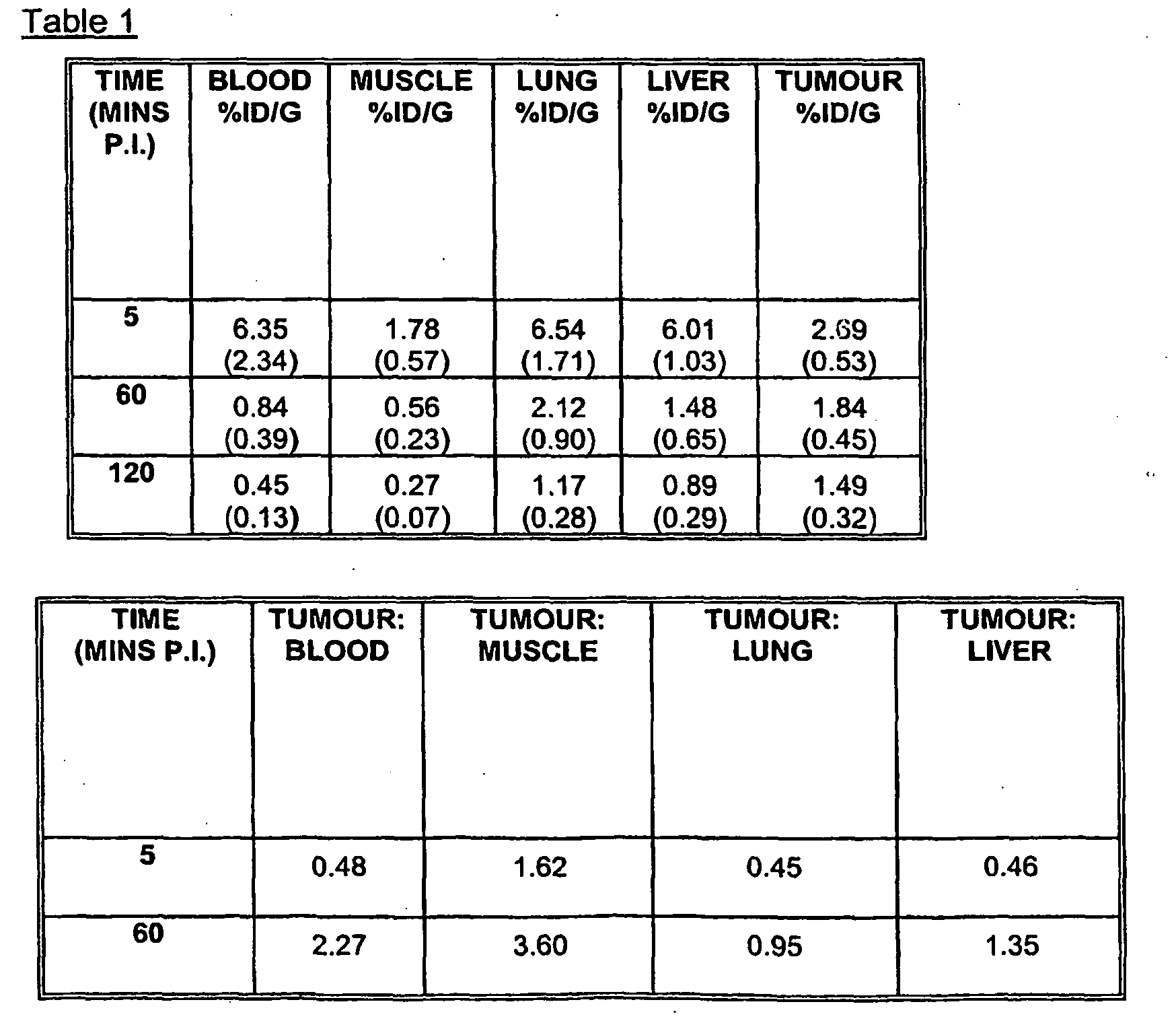
- Table 1 shows biodistribution of Compound 4 in the mouse Lewis Lung tumour model. Summarised data over time. Average data (n>3) of 5 independent experiments, presented as Mean (SD).
- the additional PEG moiety in compound 4 imparts significantly more favourable in vivo characteristics. Specifically the remaining activity present in background tissues such as blood, muscle, lung and liver for compound 4 after 120 minutes is substantially less than for compound 5. Subsequently tumour:background ratios are significantly better thus enabling imaging.
Landscapes
- Health & Medical Sciences (AREA)
- Life Sciences & Earth Sciences (AREA)
- Proteomics, Peptides & Aminoacids (AREA)
- Pharmacology & Pharmacy (AREA)
- Veterinary Medicine (AREA)
- Public Health (AREA)
- Chemical & Material Sciences (AREA)
- General Health & Medical Sciences (AREA)
- Animal Behavior & Ethology (AREA)
- Medicinal Chemistry (AREA)
- Physics & Mathematics (AREA)
- Optics & Photonics (AREA)
- Epidemiology (AREA)
- Chemical Kinetics & Catalysis (AREA)
- Organic Chemistry (AREA)
- General Chemical & Material Sciences (AREA)
- Nuclear Medicine, Radiotherapy & Molecular Imaging (AREA)
- Heart & Thoracic Surgery (AREA)
- Cardiology (AREA)
- Bioinformatics & Cheminformatics (AREA)
- Engineering & Computer Science (AREA)
- Medicines Containing Antibodies Or Antigens For Use As Internal Diagnostic Agents (AREA)
- Peptides Or Proteins (AREA)
- Medicines That Contain Protein Lipid Enzymes And Other Medicines (AREA)
- Hydrogenated Pyridines (AREA)
- Organic Low-Molecular-Weight Compounds And Preparation Thereof (AREA)
Abstract
Description
- The present invention relates to new peptide-based compounds and their use for diagnostic imaging using positron emission tomography (PET). More specifically the invention relates to the use of such peptide-based compounds as targeting vectors that bind to receptors associated with angiogenesis, in particular integrin receptors, for example, the αvβ3 integrin receptor. Such compounds may thus be used for diagnosis or therapy of, for example, malignant diseases, heart diseases, endometriosis, inflammation-related diseases, rheumatoid arthritis and Kaposi's sarcoma. It further relates to methods and reagents for production of such peptide-based compounds.
- The application of radiolabelled bioactive peptides for diagnostic imaging is gaining importance in nuclear medicine. Biologically active molecules which selectively interact with specific cell types are useful for the delivery of radioactivity to target tissues, For example, radiolabelled peptides have significant potential for the delivery of radionuclides to tumours, infarcts, and infected tissues for diagnostic imaging and radiotherapy. 18F, with its half-life of approximately 110 minutes, is the positron-emitting nuclide of choice for many receptor imaging studies. Therefore, 18F-labelled bioactive peptides have great clinical potential because of their utility in PET to quantitatively detect and characterise a wide variety of diseases.
- New blood vessels can be formed by two different mechanisms: vasculogenesis or angiogenesis. Angiogenesis is the formation of new blood vessels by branching from existing vessels. The primary stimulus for this process may be inadequate supply of nutrients and oxygen (hypoxia) to cells in a tissue. The cells may respond by secreting angiogenic factors, of which there are many; one example, which is frequently referred to, is vascular endothelial growth factor (VEGF). These factors initiate the secretion of proteolytic enzymes that break down the proteins of the basement membrane, as well as inhibitors that limit the action of these potentially harmful enzymes.
- The other prominent effect of angiogenic factors is to cause endothelial cells to migrate and divide. Endothelial cells that are attached to the basement membrane, which forms a continuous sheet around blood vessels on the contralumenal side, do not undergo mitosis. The combined effect of loss of attachment and signals from the receptors for angiogenic factors is to cause the endothelial cells to move, multiply, and rearrange themselves, and finally to synthesise a basement membrane around the new vessels.
- Angiogenesis is prominent in the growth and remodelling of tissues, including wound healing and inflammatory processes. Tumours must initiate angiogenesis when they reach millimetre size in order to keep up their rate of growth. Angiogenesis is accompanied by characteristic changes in endothelial cells and their environment. The surface of these cells is remodelled in preparation for migration, and cryptic structures are exposed where the basement membrane is degraded, in addition to the variety of proteins which are involved in effecting and controlling proteolysis. In the case of tumours, the resulting network of blood vessels is usually disorganised, with the formation of sharp kinks and also arteriovenous shunts. Inhibition of angiogenesis is also considered to be a promising strategy for antitumour therapy. The transformations accompanying angiogenesis are also very promising for diagnosis, one example being malignant disease, but the concept also shows great promise in inflammation and a variety of inflammation-related diseases, including atherosclerosis, the macrophages of early atherosclerotic lesions being potential sources of angiogenic factors.
- Many ligands involved in cell adhesion contain the tripeptide sequence arginine-glycine-aspartic acid (RGD). The RGD sequence appears to act as a primary recognition site between the ligands presenting this sequence and receptors on the surface of cells. It is generally believed that secondary interactions between the ligand and receptor enhance the specificity of the interaction. These secondary interactions might take place between moieties of the ligand and receptor that are immediately adjacent to the RGD sequence or at sites that are distant from the RGD sequence.
- The efficient targeting and imaging of integrin receptors associated with angiogenesis in vivo demands therefore a selective, high affinity RGD based vector that is chemically robust and stable. Furthermore, the route of excretion is an important factor when designing imaging agents in order to reduce problems with background.
-
WO 03/006491 WO2004/080492 describes methods suitable for labelling biologically active vectors with 18F. But there is still a need for peptide-based compounds which may be prepared rapidly and efficiently and yet still have the desirable biological activity. -
WO 03/080544 WO2005/012335 describes certain labelled RGD peptides. - In a first aspect, the present invention provides a method for radiofluorination comprising reaction of a compound of formula (la):


- n is an integer of 0 to 20;
- m is an integer of 0 to 10;
- Y is hydrogen, C1-6alkyl (such as methyl), or phenyl
- to give a compound of formula (IIIa):

- This reaction may be effected in a suitable solvent, for example, in an aqueous buffer in the pH range 1 to 11, suitably 2 to 11, more suitably 2 to 6, and at a non-extreme temperature of from 5 to 100 °C, suitably 20 to 70°C, preferably at ambient temperature.
- The linker forming part of the vector in the compound of formula (Ia) is chosen to provide good in vivo pharmacokinetics, such as favourable excretion characteristics in the resultant conjugate of formula (IIIa). The use of linker groups with different lipophilicities and or charge can significantly change the in vivo pharmacokinetics of the peptide to suit the diagnostic need. For example, where it is desirable for a conjugate of formula (IIIa) to be cleared from the body by renal excretion, a hydrophilic linker is used, and where it is desirable for clearance to be by hepatobiliary excretion a hydrophobic linker is used. Linkers including a polyethylene glycol moiety have been found to slow blood clearance which is desirable in some circumstances.
- The linker forming part of the vector in the compound of formula (Ia) comprises a polyethylene glycol subunit of formula B:

- Accordingly, there is provided a compound of formula (Ia):


- Preferred compounds of formula (II) are those where m is 0, n is 0, and Y is hydrogen.
- Compounds of formula (Ia) and (IIIa) may be prepared by standard methods of peptide synthesis, for example, solid-phase peptide synthesis, for example, as described in Atherton, E. and Sheppard, R.C.; "Solid Phase Synthesis"; IRL Press: Oxford, 1989. Incorporation of the aminoxy group in a compound of formula (Ia) may be achieved by formation of a stable amide bond formed by reaction of a peptide amine function with an activated acid and introduced either during or following the peptide synthesis.
- In another aspect, the present invention provides compounds of formula (Ia) as defined above having use as reagents useful for the production of radiolabelled peptide-based compounds.
- In a further aspect the present invention provides radiolabelled conjugates of formula (IIIa) or a salt thereof, as defined above. Preferred compounds of formula (IIIa) are those of formula:


- Once particularly preferred compound of formula (IIIa) is:

- Suitable salts of the compounds of formula (IIIa) include pharmaceutically acceptable acid additions salts such as those formed from hydrochloric, hydrobromic, sulphuric, citric, tartaric, phosphoric, lactic, pyruvic, acetic, trifluoroacetic, succinic, oxaxlic, fumaric, maleic, oxalacetic, methanesulphonic, ethanesulphonic, p-toluenesulphonic, benzenesulphonic, and isoethionic acids.
- Compounds of formula (II) may be prepared from the corresponding precursors of formula (IV):

- As shown in the in vitro competition binding assay below, the compounds of formula (Ia) bind to receptors associated with angiogenesis. These compounds may thus be useful for treatment, in vivo diagnosis and imaging of diseases and conditions associated with angiogenesis.
- The term "diseases and conditions associated with angiogenesis" includes those diseases and conditions referred to below. Reference is also made in this regard to
WO 98/47541 - Diseases and conditions associated with angiogenesis include different forms of cancer and metastasis, for example, breast, skin, colorectal, pancreatic, prostate, lung or ovarian cancer.
- Other diseases and conditions associated with angiogenesis are inflammation (for example, chronic inflammation), atherosclerosis, rheumatoid arthritis and gingivitis.
- Further diseases and conditions associated with angiogenesis are arteriovenous alformations, astrocytomas, choriocarcinomas, glioblastomas, gliomas, hemangiomas (childhood, capillary), hepatomas, hyperplastic endometrium, ischemic myocardium, endometriosis, Kaposi sarcoma, macular degeneration, melanoma, neuroblastomas, occluding peripheral artery disease, osteoarthritis, psoriasis, retinopathy (diabetic, proliferative), scleroderma, seminomas and ulcerative colitis.
- The present invention also provides a radiopharmaceutical composition comprising an effective amount (e.g. an amount effective for use in in vivo PET imaging) of a compound of general formula (IIIa) or a salt thereof, as defined above; together with one or more pharmaceutically acceptable adjuvants, excipients or diluents.
- A preferred embodiment of the invention relates to a compound of general formula (IIIa) or a salt thereof, as defined above, for use in medicine, particularly in the in vivo diagnosis or imaging, for example by PET, of a disease or condition associated with angiogenesis.
- The radiolabelled conjugates of of formula (IIIa) may be administered to patients for PET imaging in amounts sufficient to yield the desired signal, typical radionuclide dosages of 0.01 to 100 mCi, preferably 0.1 to 50 mCi, most preferably 1 to 20 mCi, will normally be sufficient per 70kg bodyweight.
- The radiolabelled conjugates of formula (IIIa) may therefore be formulated for administration using physiologically acceptable carriers or excipients in a manner fully within the skill of the art. For example, the compounds, optionally with the addition of pharmaceutically acceptable excipients, may be suspended or dissolved in an aqueous medium, with the resulting solution or suspension then being sterilized.
- Viewed from a further aspect the invention provides the use of a radiolabelled conjugate of formula (IIIa) or a salt thereof as defined above for the manufacture of a radiopharmaceutical for use in a method of in vivo imaging, suitably PET, and preferably for imaging of a disease or condition associated with angiogenesis; involving administration of said radiopharmaceutical to a human or animal body and generation of an image of at least part of said body.
- Viewed from a still further aspect the invention provides a compound for use in a method for in vivo diagnosis or imaging of a disease or condition associated with angiogenesis involving administering a radiopharmaceutical to said body, e.g. into the vascular system and generating an image of at least a part of said body to which said radiopharmaceutical has distributed using PET, wherein said radiopharmaceutical comprises a radiolabelled conjugate of formula (IIIa) or a salt thereof.
- Viewed from a further aspect the invention provides a compound for use in a method of monitoring the effect of treatment of a human or animal body with a drug to combat a condition associated with cancer, preferably angiogenesis, e.g. a cytotoxic agent, said method comprising administering to said body a radiolabelled conjugate of formula (IIIa) or a salt thereof and detecting the uptake of said conjugate by cell receptors, preferably endothelial cell receptors and in particular αvβ3 receptors, said administration and detection optionally but preferably being effected repeatedly, e.g. before, during and after treatment with said drug.
- The methods and compounds of the instant invention may be used in the form of a kit for the preparation of a radiofluorinated tracer comprising a prosthetic group of formula (II) and a compound of formula (Ia).
- In use of such kits, the compound of formula (II) would be added to the compound of formula (Ia) respectively which may suitably be dissolved in aqueous buffer (pH 1-11). After reaction at a non-extreme temperature for 1 to 70 minutes, the labelled peptide may be purified, for example, by solid-phase extraction (SPE) or high performance liquid chromatography (HPLC) and collected.
- The invention is illustrated by way of examples in which the following abbreviations are used:
- hr(s) : hour(s)
- min(s) : minute(s)
- DMAP : 4-(dimethylamino)pyridine
- THF : tetrahydrofuran
- DCM : dichloromethane
- DMF : N,N-dimethylformamide
- TBAF: tetrabutylammonium fluoride
- MeOH: methanol
- TLC: thin layer chromatography
- TIS: triisopropylsilane
- DMSO: dimethylsulphoxide
- PBS: phosphate buffered saline
- PyAOP :[7-azabenzotriazol-1-yloxytris(pyrrolidino)phosphonium-hexafluorophosphate]
- Boc: t-butoxycarbonyl
- RT: room temperature
-

- This compound was synthesised according to the procedure described by Haka et al (J. Labelled Cpds.& Radiopharms 1989 27(7) 823).
- The peptide, Compound 2 was synthesised using standard peptide synthesis.

- A solution of dry hexaethylene glycol (25 g, 88 mmol) and methanesulphonyl chloride (22.3 g, 195 mmol) in dry THF (125 mL) was kept under argon and cooled to 0 °C in an ice/water bath. A solution of triethylamine (19.7 g, 195 mmol) in dry THF (25 mL) was added dropwise over 45 min. After 1 hr the cooling bath was removed and the reaction was stirred for another for 4 hrs. Water (55 mL) was then added to the mixture, followed by sodium hydrogencarbonate (5.3 g, to pH 8) and sodium azide (12.7 g, 195 mmol). THF was removed by distillation and the aqueous solution was refluxed for 24 h (two layers were formed). The mixture was cooled, ether (100 mL) was added and the aqueous phase was saturated with sodium chloride. The phases were separated and the aqueous phase was extracted with ether (4 x 50 mL). The combined organic phases were washed with brine (2 x 50 mL) and dried (MgSO4). Filtration and evaporation of the solvent gave 26 g (89 %) of a yellow oil. The product was used in the next step without further purification.
- To a vigorously stirred suspension of 1,17-diazido-3,6,9,12,15-pentaoxaheptadecane (25 g,75 mmol) in 5 % HCl (200 mL) was added a solution of triphenylphosphine (19.2 g, 73 mmol) in ether (150 mL) over 3 hrs at room temperature. The reaction mixture was stirred for additional 24 hrs. The phases were separated and the aqueous phase was extracted with dichloromethane (3 x 40 mL). The aqueous phase was cooled in an ice/water bath and the pH was adjusted to 12 by addition of solid potassium hydroxide. The aqueous phase was concentrated and the product was taken up in dichloromethane (150 mL). The organic phase was dried (Na2SO4) and concentrated giving of 22 g (95 %) of a yellow oil. The product was identified by elctrospray mass spectrometry (ESI-MS) (MH+ calculated: 307.19; found 307.4). The crude oil was used in the nest step without further purification.
- To a solution of 17-azido-3,6,9,12,15-pentaoxaheptadecanamine (15 g, 50 mmol) in dichloromethane (100 mL) was added diglycolic anhydride (Acros, 6.4 g, 55 mmol). The reaction mixture was stirred overnight. The reaction was monitored by ESI-MS analysis, and more reagents were added to drive the reaction to completion. The solution was concentrated to give a yellow residue which was dissolved in water (250 mL). The product was isolated from the aqueous phase by continuous extraction with dichloromethane over night. Drying and evaporation of the solvent gave a yield of 18 g (85 %). The product was characterized by ESI-MS analysis (MH+ calculated: 423.20; found 423.4). The product was used in the next step without further purification.
- 23-Azido-5-oxo-6-aza-3,9,12,15,18,21-hexaoxatricosanoic acid (9.0 g, 21 mmol) was dissolved in water (50 mL) and reduced using H2(g)-Pd/C (10 %). The reaction was run until ESI-MS analysis showed complete conversion to the desired product (MH+ calculated: 397.2; found 397.6). The crude product was used in the next step without further purification.
- A solution of dicyclohexycarbodiimide (515 mg, 2.50 mmol) in dioxan (2.5 mL) was added dropwise to a solution of (Boc-aminooxy)acetic acid (477 mg, 2.50 mmol) and N-hydroxysuccinimide (287 mg, 2.50 mmol) in dioxan (2.5 mL). The reaction was stirred at RT for 1 h and filtered. The filtrate was transferred to a reaction vessel containing a solution of 23-amino-5-oxo-6-aza-3,9,12,15,18,21-hexaoxatricosanoic acid (1.0 g, 2.5 mmol) and N-methymorpholine (278 µl, 2.50 mmol) in water (5 mL). The mixture was stirred at RT for 30 min. ESI-MS analysis showed complete conversion to the desired product (MH+ calculated: 570.28; found 570.6).
The crude product was purified by preparative HPLC (column: Phenomenex Luna 5µ C18 (2) 250 x 21.20 mm, detection: 214 nm, gradient: 0-50 % B over 60 min where A = H2O/0.1 % TFA and B = acetonitrile/0.1 % TFA, flow rate: 10 mUmin) affording 500 mg (38 %) of pure product.
The product was analyzed by HPLC (column: Phenomenex Luna 3µ C18 (2), 50 x 2.00 mm, detection: 214 nm, gradient: 0-50 % B over 10 min where A = H2O/0.1 % TFA and B = acetonitrile/0.1 % TFA, flow rate: 0.75 mL/min, Rt = 5.52 min). Further confirmation was carried out by NMR analysis. - (Boc-aminooxy)acetyl-PEG(6)-diglycolic acid (0.15 mmol, 85 mg) and PyAOP (0.13 mmol, 68 mg) were dissolved in DMF (2 mL). N-methylmorpholine (0.20 mmol, 20 µL) was added and the mixture was stirred for 10 min. A solution of Compound 2 (0.100 mmol, 126 mg) and N-methylmorpholine (0.20 mmol, 20 µL) in DMF (4 mL) was added and the reaction mixture was stirred for 25 min. Additional N-methylmorpholine (0.20 mmol, 20 µL) was added and the mixture was stirred for another 15 min. DMF was evaporated in vacuo and the product was taken up in 10 % acetonitrile-water and purified by preparative HPLC (column: Phenomenex Luna 5µ C18 (2) 250 x 21.20 mm, detection: UV 214 nm, gradient: 5-50 % B over 40 min where A = H2O/0.1 % TFA and B = acetonitrile/0.1 % TFA, flow rate: 10 mL/min,) affording 100 mg semi-pure product. A second purification step where TFA was replaced by HCOOH (gradient: 0-30 % B, otherwise same conditions as above) afforded 89 mg (50 %). The product was analysed by HPLC (column: Phenomenex Luna 3µ C18 (2) 50 x 2 mm, detection: UV 214 nm, gradient: 0-30 % B over 10 min where A = H2O/0.1 % HCOOH and B = acetonitrile/0.1 % HCOOH, flow rate: 0.3 mL/min, Rt: 10.21 min). Further product characterisation was carried out using ESI-MS (MH2 2+ calculated: 905.4, found: 906.0).
-

- Deprotection of peptide 3 was carried out by addition of TFA containing 5% water to 10mg of peptide. The Boc-deprotected peptide (5.9 mg, 0.0044 mmol) in 1 ml water was added to 4-fluoro benzaldehyde (Compound 1) (1.1 mg, 0.94 µl,11, 0.0089 mmol) in 1 ml acetonitrile. pH of the mixture was 3.5. After 45 minutes at 70 degrees the mixture was purified by reverse phase preparative chromatography twice (Phenomenex Luna C18 column, 00G-4253-N0; solvents: A= water + 0.1 % TFA / B= CH3CN + 0.1 % TFA, gradient: 10-40 % B over 30 min ; flow 5.0 ml /minute; detected at 214 nm), affording 2.0 mg (32 %) of pure compound (analytical HPLC: Phenomenex Luna C18 column, 00G-4252-E0; solvents: A= water + 0.1 % TFA / B= CH3CN + 0.1% TFA, gradient: 10-50 % B over 20 min ; flow 1.0 ml /minute; retention time 16.3 minutes, detected at 214 and 254 nm). Further characterisation was carried out using mass spectrometry, giving m/z value 1437.2. [M-H+].
- 18F-fluoride (up to 370MBq) was azeotropically dried in the presence of Kryptofix 222 (5mg in 0.5ml acetonitrile) and potassium carbonate (50µl 0.1 M solution in water) by heating under N2 to 110°C for 20mins. During this time 3×0.5ml acetonitrile were added and evaporated. After cooling to <40°C, a solution of trimethylammonium benzaldehyde triflate (1mg in 0.4ml DMSO) was added. The reaction vessel was sealed and heated to 90°C for 15 mins to effect labelling. Meanwhile, Compound 3 (6mg) was treated with 5% water in TFA (200µl) for 5 mins at RT. The solvents were then removed in vacuo. The deprotected peptide was redissolved in 0.1 M NH4OAc buffer, pH4 (0.4ml) and combined with 4-18F-fluorobenzaldehyde in the reaction vessel. The reaction vessel was sealed and heated to 70°C for 15mins to effect conjugation. After cooling to room temperature, the product was obtained by preparative radio HPLC (column Phenomenex Luna C18(2) 5 µm 10 x 100 mm, solvents: A = water/0.1% TFA and B = acetonitrile/0.1 % TFA; gradient 15-25% B over 5 min; 25%B for 12 mins; 25-50%B over 10 mins; flow 4.0 ml/min, UV detection at 210 and 254 nm). The product fraction was diluted with water (10ml) and loaded onto a SepPak C18-plus cartridge (conditioned with 10ml EtOH and 20ml H2O). Compound 4 was eluted in ethanol (1ml). The ethanol was removed in vacuo and compound 4 was formulated in PBS.
- 18F-Fluoride (up to 370MBq) is azeotropically dried in the presence of Kryptofix 222 (5mg in 0.5ml acetonitrile) and potassium carbonate (50µl 0.1 M solution in water) by heating under N2 to 110°C for 20mins. During this time 3 x 0.5ml acetonitrile are added and evaporated. After cooling to <40°C, a solution of trimethylammonium benzaldehyde triflate (1mg in O.4ml DMSO) is added. The reaction vessel is sealed and heated to 90°C for 15mins to effect labelling. The crude reaction mixture is cooled to room temperature and diluted by addition of water. The mixture will be passed sequentially through ion exchange cartridges (preconditioned with ethanol (or acetonitrile) and water) and eluted in an acetonitrile/water mixture. The eluate will be concentrated using a C18 Seppak, and the fluorobenzaldehyde will be eluted in acetonitrile.
- Compound 3 is treated with 5% water in TFA for 5mins at room temperature. The solvents are then removed by evaporation under vacuum. The peptide is redissolved in 0.1 M NH4OAc buffer, pH4 (0.5ml) and combined with 4-18F-fluorobenzaldehyde in the reaction vessel. The reaction vessel is sealed and heated to 70°C for 15mins to effect conjugation. After cooling to room temperature, the product is obtained by preparative radio HPLC (as described for method 1) or by SPE.
- Using cell membrane preparations known to express the αvβ3 integrin receptor, competitive binding studies were carried out using 125I-echistatin and the F-19 labelled peptides as competing ligand. Binding curves were obtained and Ki's calculated using Prism™ software.
- Compound 4, had a Ki value of 10 nM.
- Mice (male C57BU6, ca. 25 g) were injected sub-cutaneously into the inner right thigh with Lewis lung carcinoma (LLC) cells (0.1 mL, 1x10⁷ cells/mL in medium). Animals were monitored for tumour growth for up to 15 days, with this time selected during model development as it showed the highest level of angiogenesis.
To determine the biodistribution of 18F-compounds, tumour-bearing animals were injected with test article (0.1 mL, 5-10 MBq/mL) as an intravenous bolus via the tail vein. At various times post injection animals were euthanased. Muscle, kidneys, urine, lung, liver, stomach, small intestine, large intestine, thyroid, tumour were dissected and a blood sample taken. Dissected tissues and blood samples were weighed and counted (Wallac automatic gamma counter system). At least three animals per time point were studied. Results are expressed as %id and %id per gram of tissue. - Table 1 shows biodistribution of Compound 4 in the mouse Lewis Lung tumour model. Summarised data over time. Average data (n>3) of 5 independent experiments, presented as Mean (SD).
- As comparison, biodistribution of Compound 5 in the mouse Lewis Lung tumour model is shown in Table 2. Summarised data over time. Average data (n>3) of 5 independent experiments, presented as Mean (SD).


- The additional PEG moiety in compound 4 imparts significantly more favourable in vivo characteristics. Specifically the remaining activity present in background tissues such as blood, muscle, lung and liver for compound 4 after 120 minutes is substantially less than for compound 5. Subsequently tumour:background ratios are significantly better thus enabling imaging.
Claims (13)
- A method for radiofluorination comprising reaction of a compound of formula (Ia):


with a compound of formula (II): n is an integer of 0 to 20;m is an integer of 0 to 10;Y is hydrogen, C1-6alkyl (such as methyl), or phenylto give a compound of formula (IIIa):wherein m, n, and Y are defined as for the compound of formula (II) and X7 and b are as defined for the compound of formula (Ia).
- A method according to claim 1 wherein a is 1.
- A method according to claim 1 or 2 wherein b is 3 to 10, and is preferably 5.
- A compound of formula (Ia) as defined in any one of claims 1 to 3.
- A compound of formula (IIIa):

X7 is either -NH2 or
- A compound of formula (IIIa) according to claim 5 of formula :


- A compound of formula (IIIa) which is:

- A radiopharmaceutical composition comprising an effective amount of a compound of formula (IIIa) or a salt thereof, as defined in any of claims 5 to 7; together with one or more pharmaceutically acceptable adjuvants, excipients or diluents.
- A compound of formula (IIIa) or a salt thereof, as defined in any of claims 5 to 7, for use in medicine.
- A compound or salt according to claim 9 for use in the in vivo diagnosis or imaging, for example by PET, of a disease or condition associated with angiogenesis.
- A compound or salt according to claim 10 wherein the in vivo diagnosis or imaging comprises administering a radiopharmaceutical to a body, for example into the vascular system and generating an image of at least a part of said body to which said radiopharmaceutical has distributed using PET, wherein said radiopharmaceutical comprises a compound of formula (IIIa) or a salt thereof as defined in any of claims 5 to 7.
- A compound or salt according to claim 9 for use in a method of monitoring the effect of treatment of a human or animal body with a drug to combat a condition associated with cancer, preferably angiogenesis, said method comprising administering to said body a compound of formula (IIIa) or a salt thereof as defined in any of claims 5 to 7 and detecting the uptake of said compound by cell receptors, said administration and detection optionally but preferably being effected repeatedly.
- Use of a radiolabelled conjugate of formula (IIIa) or a salt thereof as defined in any of claims 5 to 7 for the manufacture of a radiopharmaceutical for use in a method of in vivo imaging, suitably PET, and preferably for imaging of a disease or condition associated with angiogenesis; involving administration of said radiopharmaceutical to a human or animal body and generation of an image of at least part of said body
Priority Applications (2)
| Application Number | Priority Date | Filing Date | Title |
|---|---|---|---|
| SI200530442T SI1791571T1 (en) | 2004-09-14 | 2005-09-14 | Radiofluorinated peptides |
| PL05790076T PL1791571T3 (en) | 2004-09-14 | 2005-09-14 | Radiofluorinated peptides |
Applications Claiming Priority (2)
| Application Number | Priority Date | Filing Date | Title |
|---|---|---|---|
| GBGB0420344.4A GB0420344D0 (en) | 2004-09-14 | 2004-09-14 | Diagnostic compounds |
| PCT/IB2005/002727 WO2006030291A2 (en) | 2004-09-14 | 2005-09-14 | Radiofluorinated peptides |
Publications (2)
| Publication Number | Publication Date |
|---|---|
| EP1791571A2 EP1791571A2 (en) | 2007-06-06 |
| EP1791571B1 true EP1791571B1 (en) | 2008-08-13 |
Family
ID=33186989
Family Applications (1)
| Application Number | Title | Priority Date | Filing Date |
|---|---|---|---|
| EP05790076A Expired - Lifetime EP1791571B1 (en) | 2004-09-14 | 2005-09-14 | Radiofluorinated peptides |
Country Status (23)
| Country | Link |
|---|---|
| US (2) | US7875701B2 (en) |
| EP (1) | EP1791571B1 (en) |
| JP (1) | JP4949251B2 (en) |
| KR (1) | KR101243016B1 (en) |
| CN (1) | CN101151054B (en) |
| AT (1) | ATE404225T1 (en) |
| AU (1) | AU2005283904B8 (en) |
| BR (1) | BRPI0515175A (en) |
| CA (1) | CA2578470C (en) |
| DE (1) | DE602005008996D1 (en) |
| DK (1) | DK1791571T3 (en) |
| ES (1) | ES2312018T3 (en) |
| GB (1) | GB0420344D0 (en) |
| IL (1) | IL181529A (en) |
| MX (1) | MX2007003019A (en) |
| NO (1) | NO20071880L (en) |
| NZ (1) | NZ553384A (en) |
| PL (1) | PL1791571T3 (en) |
| PT (1) | PT1791571E (en) |
| RU (1) | RU2396272C9 (en) |
| SI (1) | SI1791571T1 (en) |
| WO (1) | WO2006030291A2 (en) |
| ZA (1) | ZA200702700B (en) |
Families Citing this family (27)
| Publication number | Priority date | Publication date | Assignee | Title |
|---|---|---|---|---|
| HU230901B1 (en) * | 2001-07-10 | 2019-01-28 | Ge Healthcare Limited | Peptide-based compounds and pharmaceutical compositions containing them |
| EP1985624A3 (en) * | 2007-04-23 | 2008-12-24 | Bayer Schering Pharma Aktiengesellschaft | Single step method of radiofluorination of biologically active compounds or biomolecules |
| CA2663454C (en) * | 2006-09-15 | 2015-04-21 | Siemens Medical Solutions Usa, Inc. | Click chemistry-derived cyclopeptide derivatives as imaging agents for integrins |
| WO2008072976A2 (en) * | 2006-12-13 | 2008-06-19 | Ge Healthcare As | Synthesis of a radiofluorinated peptide using microwave activation technology |
| WO2008075966A2 (en) * | 2006-12-18 | 2008-06-26 | Ge Healthcare As | Synthesis of a radiofluorinated peptide using photolabile protecting groups |
| EP2114464A2 (en) * | 2006-12-28 | 2009-11-11 | GE Healthcare AS | Radiofluorination methods |
| KR20090119966A (en) * | 2007-03-01 | 2009-11-23 | 바이엘 쉐링 파마 악티엔게젤샤프트 | 18f fluoro-benzoyl labelled biological active compounds as diagnostic imaging agents as well as benzotriazol-1-yloxy-benzoyl, 2,5-dioxo-pyrrolidin-1-yloxy)benzoyl and trimethylammonio-benzoyl precursers |
| EP2195037A2 (en) * | 2007-09-10 | 2010-06-16 | GE Healthcare UK Limited | Radiofluorination methods |
| JP5399422B2 (en) * | 2008-02-28 | 2014-01-29 | ジーイー・ヘルスケア・リミテッド | Synthesis of PEG-6 components from commercially available inexpensive chemicals |
| GB0905438D0 (en) * | 2009-03-30 | 2009-05-13 | Ge Healthcare Ltd | Radiolabelling reagents and methods |
| US8834839B2 (en) * | 2009-04-27 | 2014-09-16 | General Electric Company | Labeled molecular imaging agents, methods of making and methods of use |
| GB0910013D0 (en) * | 2009-06-10 | 2009-07-22 | Ge Healthcare Ltd | PET imaging of fibogenesis |
| WO2011084763A1 (en) | 2009-12-21 | 2011-07-14 | Ge Healthcare Limited | Borosilicate glassware and silica based qma's in 18f nucleophilic substitution: influence of aluminum, boron and silicon on the reactivity of the 18f ion |
| GB201013808D0 (en) * | 2010-08-18 | 2010-09-29 | Ge Healthcare Ltd | Peptide radiotracer compositions |
| CA2819347A1 (en) | 2010-12-01 | 2012-06-07 | Ge Healthcare Limited | Radioconjugation method |
| US9180213B2 (en) | 2010-12-09 | 2015-11-10 | Ge Healthcare Limited | Radiotracer compositions |
| BR112013015580A2 (en) * | 2010-12-21 | 2016-10-04 | Ge Healthcare Ltd | radiostabilization method |
| US20130074758A1 (en) | 2011-09-26 | 2013-03-28 | Ocean Power Technologies, Inc. | Anchoring apparatus for wave energy converters |
| WO2013048996A1 (en) | 2011-09-30 | 2013-04-04 | Ge Healthcare Limited | Method for the purification of a peptide-based imaging agent precursor |
| WO2013048956A2 (en) * | 2011-09-30 | 2013-04-04 | Ge Healthcare Limited | Solid phase extraction separation method |
| GB201202420D0 (en) * | 2012-02-13 | 2012-03-28 | Ge Healthcare Ltd | Radiotracer compositions |
| GB201221266D0 (en) | 2012-11-27 | 2013-01-09 | Ge Healthcare Ltd | Aldehyde compositions |
| GB201314936D0 (en) | 2013-08-21 | 2013-10-02 | Ge Healthcare Ltd | Radiolabelling method |
| KR102205845B1 (en) | 2013-10-28 | 2021-01-22 | 삼성전자주식회사 | Method and apparatus for modeling based on particles |
| GB201322456D0 (en) | 2013-12-18 | 2014-02-05 | Ge Healthcare Ltd | Radiotracer compositions and methods |
| WO2016087653A1 (en) | 2014-12-04 | 2016-06-09 | Ge Healthcare Limited | Method of removing acetaldehyde from radioactive pharmaceuticals |
| GB201518918D0 (en) * | 2015-10-26 | 2015-12-09 | Norsk Medisinsk Syklotronsenter As And Uni I Oslo | Method |
Family Cites Families (5)
| Publication number | Priority date | Publication date | Assignee | Title |
|---|---|---|---|---|
| RU2165266C1 (en) * | 2000-06-28 | 2001-04-20 | Центральный научно-исследовательский рентгенорадиологический институт | Method of synthesis of [2-18f]-2-deoxyglucose |
| HU230901B1 (en) * | 2001-07-10 | 2019-01-28 | Ge Healthcare Limited | Peptide-based compounds and pharmaceutical compositions containing them |
| GB0206750D0 (en) * | 2002-03-22 | 2002-05-01 | Amersham Plc | Radiofluorination methods |
| GB0305704D0 (en) | 2003-03-13 | 2003-04-16 | Amersham Plc | Radiofluorination methods |
| GB0317815D0 (en) | 2003-07-30 | 2003-09-03 | Amersham Health As | Imaging agents |
-
2004
- 2004-09-14 GB GBGB0420344.4A patent/GB0420344D0/en not_active Ceased
-
2005
- 2005-09-14 CA CA2578470A patent/CA2578470C/en not_active Expired - Fee Related
- 2005-09-14 RU RU2007108762/04A patent/RU2396272C9/en not_active IP Right Cessation
- 2005-09-14 WO PCT/IB2005/002727 patent/WO2006030291A2/en not_active Ceased
- 2005-09-14 PT PT05790076T patent/PT1791571E/en unknown
- 2005-09-14 AU AU2005283904A patent/AU2005283904B8/en not_active Ceased
- 2005-09-14 MX MX2007003019A patent/MX2007003019A/en active IP Right Grant
- 2005-09-14 ES ES05790076T patent/ES2312018T3/en not_active Expired - Lifetime
- 2005-09-14 DK DK05790076T patent/DK1791571T3/en active
- 2005-09-14 AT AT05790076T patent/ATE404225T1/en active
- 2005-09-14 US US11/575,163 patent/US7875701B2/en active Active
- 2005-09-14 BR BRPI0515175-9A patent/BRPI0515175A/en not_active IP Right Cessation
- 2005-09-14 KR KR1020077005792A patent/KR101243016B1/en not_active Expired - Fee Related
- 2005-09-14 JP JP2007530793A patent/JP4949251B2/en not_active Expired - Lifetime
- 2005-09-14 NZ NZ553384A patent/NZ553384A/en not_active IP Right Cessation
- 2005-09-14 EP EP05790076A patent/EP1791571B1/en not_active Expired - Lifetime
- 2005-09-14 PL PL05790076T patent/PL1791571T3/en unknown
- 2005-09-14 SI SI200530442T patent/SI1791571T1/en unknown
- 2005-09-14 DE DE602005008996T patent/DE602005008996D1/en not_active Expired - Lifetime
- 2005-09-14 CN CN200580030720.1A patent/CN101151054B/en not_active Expired - Lifetime
-
2007
- 2007-02-22 IL IL181529A patent/IL181529A/en not_active IP Right Cessation
- 2007-03-30 ZA ZA200702700A patent/ZA200702700B/en unknown
- 2007-04-13 NO NO20071880A patent/NO20071880L/en unknown
-
2011
- 2011-01-21 US US13/010,814 patent/US8563600B2/en not_active Expired - Lifetime
Also Published As
Similar Documents
| Publication | Publication Date | Title |
|---|---|---|
| US8563600B2 (en) | Diagnostic compounds | |
| Chen et al. | MicroPET imaging of breast cancer αv-integrin expression with 64Cu-labeled dimeric RGD peptides | |
| US20220202966A1 (en) | Positron emitting radionuclide labeled peptides for human upar pet imaging | |
| US8299030B2 (en) | Peptide-based compounds | |
| EP1648925B1 (en) | Bicyclic peptide imaging agents | |
| WO2012118909A1 (en) | Radiolabelled octreotate analogues as pet tracers | |
| EP4338757A1 (en) | New pet tracer for imaging of the functional liver reserve | |
| US8241606B2 (en) | Synthesis of a radiofluorinated peptide using photolabile protecting groups | |
| EP2101826B1 (en) | Radiolabelled peptide based compounds and uses thereof | |
| HK1118713B (en) | Diagnostic compounds |
Legal Events
| Date | Code | Title | Description |
|---|---|---|---|
| PUAI | Public reference made under article 153(3) epc to a published international application that has entered the european phase |
Free format text: ORIGINAL CODE: 0009012 |
|
| 17P | Request for examination filed |
Effective date: 20070402 |
|
| AK | Designated contracting states |
Kind code of ref document: A2 Designated state(s): AT BE BG CH CY CZ DE DK EE ES FI FR GB GR HU IE IS IT LI LT LU LV MC NL PL PT RO SE SI SK TR |
|
| AX | Request for extension of the european patent |
Extension state: AL BA HR MK YU |
|
| R17D | Deferred search report published (corrected) |
Effective date: 20070614 |
|
| RIC1 | Information provided on ipc code assigned before grant |
Ipc: A61K 47/48 20060101ALI20070619BHEP Ipc: A61K 51/08 20060101AFI20070619BHEP Ipc: A61K 101/02 20060101ALI20070619BHEP Ipc: C07K 7/56 20060101ALI20070619BHEP |
|
| DAX | Request for extension of the european patent (deleted) | ||
| 17Q | First examination report despatched |
Effective date: 20071008 |
|
| GRAP | Despatch of communication of intention to grant a patent |
Free format text: ORIGINAL CODE: EPIDOSNIGR1 |
|
| GRAS | Grant fee paid |
Free format text: ORIGINAL CODE: EPIDOSNIGR3 |
|
| GRAA | (expected) grant |
Free format text: ORIGINAL CODE: 0009210 |
|
| AK | Designated contracting states |
Kind code of ref document: B1 Designated state(s): AT BE BG CH CY CZ DE DK EE ES FI FR GB GR HU IE IS IT LI LT LU LV MC NL PL PT RO SE SI SK TR |
|
| REG | Reference to a national code |
Ref country code: GB Ref legal event code: FG4D |
|
| REG | Reference to a national code |
Ref country code: CH Ref legal event code: EP |
|
| REG | Reference to a national code |
Ref country code: IE Ref legal event code: FG4D |
|
| REF | Corresponds to: |
Ref document number: 602005008996 Country of ref document: DE Date of ref document: 20080925 Kind code of ref document: P |
|
| REG | Reference to a national code |
Ref country code: CH Ref legal event code: NV Representative=s name: ISLER & PEDRAZZINI AG |
|
| REG | Reference to a national code |
Ref country code: PT Ref legal event code: SC4A Free format text: AVAILABILITY OF NATIONAL TRANSLATION Effective date: 20081106 |
|
| REG | Reference to a national code |
Ref country code: SE Ref legal event code: TRGR |
|
| REG | Reference to a national code |
Ref country code: DK Ref legal event code: T3 |
|
| REG | Reference to a national code |
Ref country code: GR Ref legal event code: EP Ref document number: 20080403098 Country of ref document: GR |
|
| PG25 | Lapsed in a contracting state [announced via postgrant information from national office to epo] |
Ref country code: LT Free format text: LAPSE BECAUSE OF FAILURE TO SUBMIT A TRANSLATION OF THE DESCRIPTION OR TO PAY THE FEE WITHIN THE PRESCRIBED TIME-LIMIT Effective date: 20080813 Ref country code: IS Free format text: LAPSE BECAUSE OF FAILURE TO SUBMIT A TRANSLATION OF THE DESCRIPTION OR TO PAY THE FEE WITHIN THE PRESCRIBED TIME-LIMIT Effective date: 20081213 |
|
| REG | Reference to a national code |
Ref country code: PL Ref legal event code: T3 |
|
| REG | Reference to a national code |
Ref country code: ES Ref legal event code: FG2A Ref document number: 2312018 Country of ref document: ES Kind code of ref document: T3 |
|
| PG25 | Lapsed in a contracting state [announced via postgrant information from national office to epo] |
Ref country code: LV Free format text: LAPSE BECAUSE OF FAILURE TO SUBMIT A TRANSLATION OF THE DESCRIPTION OR TO PAY THE FEE WITHIN THE PRESCRIBED TIME-LIMIT Effective date: 20080813 |
|
| PG25 | Lapsed in a contracting state [announced via postgrant information from national office to epo] |
Ref country code: MC Free format text: LAPSE BECAUSE OF NON-PAYMENT OF DUE FEES Effective date: 20080930 Ref country code: BG Free format text: LAPSE BECAUSE OF FAILURE TO SUBMIT A TRANSLATION OF THE DESCRIPTION OR TO PAY THE FEE WITHIN THE PRESCRIBED TIME-LIMIT Effective date: 20081113 |
|
| PG25 | Lapsed in a contracting state [announced via postgrant information from national office to epo] |
Ref country code: RO Free format text: LAPSE BECAUSE OF FAILURE TO SUBMIT A TRANSLATION OF THE DESCRIPTION OR TO PAY THE FEE WITHIN THE PRESCRIBED TIME-LIMIT Effective date: 20080813 |
|
| PLBE | No opposition filed within time limit |
Free format text: ORIGINAL CODE: 0009261 |
|
| STAA | Information on the status of an ep patent application or granted ep patent |
Free format text: STATUS: NO OPPOSITION FILED WITHIN TIME LIMIT |
|
| 26N | No opposition filed |
Effective date: 20090514 |
|
| PG25 | Lapsed in a contracting state [announced via postgrant information from national office to epo] |
Ref country code: EE Free format text: LAPSE BECAUSE OF FAILURE TO SUBMIT A TRANSLATION OF THE DESCRIPTION OR TO PAY THE FEE WITHIN THE PRESCRIBED TIME-LIMIT Effective date: 20080813 |
|
| PG25 | Lapsed in a contracting state [announced via postgrant information from national office to epo] |
Ref country code: CY Free format text: LAPSE BECAUSE OF FAILURE TO SUBMIT A TRANSLATION OF THE DESCRIPTION OR TO PAY THE FEE WITHIN THE PRESCRIBED TIME-LIMIT Effective date: 20080813 Ref country code: LU Free format text: LAPSE BECAUSE OF NON-PAYMENT OF DUE FEES Effective date: 20080914 |
|
| REG | Reference to a national code |
Ref country code: DE Ref legal event code: R082 Ref document number: 602005008996 Representative=s name: J D REYNOLDS & CO., GB Country of ref document: DE |
|
| PGFP | Annual fee paid to national office [announced via postgrant information from national office to epo] |
Ref country code: CZ Payment date: 20150826 Year of fee payment: 11 Ref country code: SK Payment date: 20150819 Year of fee payment: 11 Ref country code: IE Payment date: 20150929 Year of fee payment: 11 Ref country code: CH Payment date: 20150928 Year of fee payment: 11 Ref country code: PT Payment date: 20150821 Year of fee payment: 11 Ref country code: FI Payment date: 20150929 Year of fee payment: 11 |
|
| PGFP | Annual fee paid to national office [announced via postgrant information from national office to epo] |
Ref country code: TR Payment date: 20150828 Year of fee payment: 11 Ref country code: AT Payment date: 20150819 Year of fee payment: 11 Ref country code: HU Payment date: 20150901 Year of fee payment: 11 Ref country code: SE Payment date: 20150929 Year of fee payment: 11 Ref country code: PL Payment date: 20150818 Year of fee payment: 11 Ref country code: BE Payment date: 20150928 Year of fee payment: 11 Ref country code: SI Payment date: 20150819 Year of fee payment: 11 Ref country code: GR Payment date: 20150929 Year of fee payment: 11 |
|
| PGFP | Annual fee paid to national office [announced via postgrant information from national office to epo] |
Ref country code: DK Payment date: 20150928 Year of fee payment: 11 |
|
| PGFP | Annual fee paid to national office [announced via postgrant information from national office to epo] |
Ref country code: NL Payment date: 20150926 Year of fee payment: 11 |
|
| REG | Reference to a national code |
Ref country code: FR Ref legal event code: PLFP Year of fee payment: 12 |
|
| PG25 | Lapsed in a contracting state [announced via postgrant information from national office to epo] |
Ref country code: BE Free format text: LAPSE BECAUSE OF NON-PAYMENT OF DUE FEES Effective date: 20160930 |
|
| REG | Reference to a national code |
Ref country code: DK Ref legal event code: EBP Effective date: 20160930 |
|
| PG25 | Lapsed in a contracting state [announced via postgrant information from national office to epo] |
Ref country code: FI Free format text: LAPSE BECAUSE OF NON-PAYMENT OF DUE FEES Effective date: 20160914 Ref country code: SE Free format text: LAPSE BECAUSE OF NON-PAYMENT OF DUE FEES Effective date: 20160915 |
|
| REG | Reference to a national code |
Ref country code: CH Ref legal event code: PL |
|
| REG | Reference to a national code |
Ref country code: SE Ref legal event code: EUG Ref country code: DE Ref legal event code: R082 Ref document number: 602005008996 Country of ref document: DE |
|
| REG | Reference to a national code |
Ref country code: NL Ref legal event code: MM Effective date: 20161001 |
|
| REG | Reference to a national code |
Ref country code: AT Ref legal event code: MM01 Ref document number: 404225 Country of ref document: AT Kind code of ref document: T Effective date: 20160914 |
|
| PG25 | Lapsed in a contracting state [announced via postgrant information from national office to epo] |
Ref country code: PT Free format text: LAPSE BECAUSE OF NON-PAYMENT OF DUE FEES Effective date: 20170314 Ref country code: CZ Free format text: LAPSE BECAUSE OF NON-PAYMENT OF DUE FEES Effective date: 20160914 |
|
| REG | Reference to a national code |
Ref country code: SK Ref legal event code: MM4A Ref document number: E 4575 Country of ref document: SK Effective date: 20160914 |
|
| REG | Reference to a national code |
Ref country code: IE Ref legal event code: MM4A |
|
| PG25 | Lapsed in a contracting state [announced via postgrant information from national office to epo] |
Ref country code: NL Free format text: LAPSE BECAUSE OF NON-PAYMENT OF DUE FEES Effective date: 20161001 |
|
| REG | Reference to a national code |
Ref country code: GR Ref legal event code: ML Ref document number: 20080403098 Country of ref document: GR Effective date: 20170411 |
|
| PG25 | Lapsed in a contracting state [announced via postgrant information from national office to epo] |
Ref country code: SK Free format text: LAPSE BECAUSE OF NON-PAYMENT OF DUE FEES Effective date: 20160914 Ref country code: CH Free format text: LAPSE BECAUSE OF NON-PAYMENT OF DUE FEES Effective date: 20160930 Ref country code: IE Free format text: LAPSE BECAUSE OF NON-PAYMENT OF DUE FEES Effective date: 20160914 Ref country code: GR Free format text: LAPSE BECAUSE OF NON-PAYMENT OF DUE FEES Effective date: 20170411 Ref country code: LI Free format text: LAPSE BECAUSE OF NON-PAYMENT OF DUE FEES Effective date: 20160930 |
|
| REG | Reference to a national code |
Ref country code: SI Ref legal event code: KO00 Effective date: 20170609 |
|
| PG25 | Lapsed in a contracting state [announced via postgrant information from national office to epo] |
Ref country code: SI Free format text: LAPSE BECAUSE OF NON-PAYMENT OF DUE FEES Effective date: 20160915 Ref country code: HU Free format text: LAPSE BECAUSE OF NON-PAYMENT OF DUE FEES Effective date: 20160915 Ref country code: AT Free format text: LAPSE BECAUSE OF NON-PAYMENT OF DUE FEES Effective date: 20160914 |
|
| REG | Reference to a national code |
Ref country code: FR Ref legal event code: PLFP Year of fee payment: 13 |
|
| REG | Reference to a national code |
Ref country code: BE Ref legal event code: MM Effective date: 20160930 |
|
| PG25 | Lapsed in a contracting state [announced via postgrant information from national office to epo] |
Ref country code: DK Free format text: LAPSE BECAUSE OF NON-PAYMENT OF DUE FEES Effective date: 20160930 |
|
| PG25 | Lapsed in a contracting state [announced via postgrant information from national office to epo] |
Ref country code: PL Free format text: LAPSE BECAUSE OF NON-PAYMENT OF DUE FEES Effective date: 20160914 |
|
| REG | Reference to a national code |
Ref country code: FR Ref legal event code: PLFP Year of fee payment: 14 |
|
| PG25 | Lapsed in a contracting state [announced via postgrant information from national office to epo] |
Ref country code: TR Free format text: LAPSE BECAUSE OF NON-PAYMENT OF DUE FEES Effective date: 20160914 |
|
| P01 | Opt-out of the competence of the unified patent court (upc) registered |
Effective date: 20230529 |
|
| PGFP | Annual fee paid to national office [announced via postgrant information from national office to epo] |
Ref country code: DE Payment date: 20240820 Year of fee payment: 20 |
|
| PGFP | Annual fee paid to national office [announced via postgrant information from national office to epo] |
Ref country code: GB Payment date: 20240822 Year of fee payment: 20 |
|
| PGFP | Annual fee paid to national office [announced via postgrant information from national office to epo] |
Ref country code: FR Payment date: 20240820 Year of fee payment: 20 |
|
| PGFP | Annual fee paid to national office [announced via postgrant information from national office to epo] |
Ref country code: IT Payment date: 20240820 Year of fee payment: 20 |
|
| PGFP | Annual fee paid to national office [announced via postgrant information from national office to epo] |
Ref country code: ES Payment date: 20241001 Year of fee payment: 20 |
|
| REG | Reference to a national code |
Ref country code: DE Ref legal event code: R071 Ref document number: 602005008996 Country of ref document: DE |
|
| REG | Reference to a national code |
Ref country code: ES Ref legal event code: FD2A Effective date: 20250926 |
|
| REG | Reference to a national code |
Ref country code: GB Ref legal event code: PE20 Expiry date: 20250913 |
|
| PG25 | Lapsed in a contracting state [announced via postgrant information from national office to epo] |
Ref country code: ES Free format text: LAPSE BECAUSE OF EXPIRATION OF PROTECTION Effective date: 20250915 |