EP1790831A2 - Turbofan gas turbine engine with variable fan outlet guide vanes - Google Patents
Turbofan gas turbine engine with variable fan outlet guide vanes Download PDFInfo
- Publication number
- EP1790831A2 EP1790831A2 EP06254934A EP06254934A EP1790831A2 EP 1790831 A2 EP1790831 A2 EP 1790831A2 EP 06254934 A EP06254934 A EP 06254934A EP 06254934 A EP06254934 A EP 06254934A EP 1790831 A2 EP1790831 A2 EP 1790831A2
- Authority
- EP
- European Patent Office
- Prior art keywords
- fan
- engine
- core
- section
- guide vanes
- Prior art date
- Legal status (The legal status is an assumption and is not a legal conclusion. Google has not performed a legal analysis and makes no representation as to the accuracy of the status listed.)
- Withdrawn
Links
- 230000007704 transition Effects 0.000 claims description 9
- 239000012530 fluid Substances 0.000 claims description 3
- 239000007789 gas Substances 0.000 description 13
- 239000000446 fuel Substances 0.000 description 3
- 238000011144 upstream manufacturing Methods 0.000 description 3
- 239000013598 vector Substances 0.000 description 3
- 244000261422 Lysimachia clethroides Species 0.000 description 2
- 239000000567 combustion gas Substances 0.000 description 2
- 238000002485 combustion reaction Methods 0.000 description 2
- 238000012986 modification Methods 0.000 description 2
- 230000004048 modification Effects 0.000 description 2
- 230000003416 augmentation Effects 0.000 description 1
- 230000008859 change Effects 0.000 description 1
- 230000003247 decreasing effect Effects 0.000 description 1
- 230000000694 effects Effects 0.000 description 1
- 239000007787 solid Substances 0.000 description 1
Images



Classifications
-
- F—MECHANICAL ENGINEERING; LIGHTING; HEATING; WEAPONS; BLASTING
- F02—COMBUSTION ENGINES; HOT-GAS OR COMBUSTION-PRODUCT ENGINE PLANTS
- F02K—JET-PROPULSION PLANTS
- F02K7/00—Plants in which the working fluid is used in a jet only, i.e. the plants not having a turbine or other engine driving a compressor or a ducted fan; Control thereof
- F02K7/10—Plants in which the working fluid is used in a jet only, i.e. the plants not having a turbine or other engine driving a compressor or a ducted fan; Control thereof characterised by having ram-action compression, i.e. aero-thermo-dynamic-ducts or ram-jet engines
- F02K7/16—Composite ram-jet/turbo-jet engines
-
- F—MECHANICAL ENGINEERING; LIGHTING; HEATING; WEAPONS; BLASTING
- F01—MACHINES OR ENGINES IN GENERAL; ENGINE PLANTS IN GENERAL; STEAM ENGINES
- F01D—NON-POSITIVE DISPLACEMENT MACHINES OR ENGINES, e.g. STEAM TURBINES
- F01D17/00—Regulating or controlling by varying flow
- F01D17/10—Final actuators
- F01D17/12—Final actuators arranged in stator parts
- F01D17/14—Final actuators arranged in stator parts varying effective cross-sectional area of nozzles or guide conduits
- F01D17/16—Final actuators arranged in stator parts varying effective cross-sectional area of nozzles or guide conduits by means of nozzle vanes
- F01D17/162—Final actuators arranged in stator parts varying effective cross-sectional area of nozzles or guide conduits by means of nozzle vanes for axial flow, i.e. the vanes turning around axes which are essentially perpendicular to the rotor centre line
-
- F—MECHANICAL ENGINEERING; LIGHTING; HEATING; WEAPONS; BLASTING
- F02—COMBUSTION ENGINES; HOT-GAS OR COMBUSTION-PRODUCT ENGINE PLANTS
- F02C—GAS-TURBINE PLANTS; AIR INTAKES FOR JET-PROPULSION PLANTS; CONTROLLING FUEL SUPPLY IN AIR-BREATHING JET-PROPULSION PLANTS
- F02C7/00—Features, components parts, details or accessories, not provided for in, or of interest apart form groups F02C1/00 - F02C6/00; Air intakes for jet-propulsion plants
- F02C7/04—Air intakes for gas-turbine plants or jet-propulsion plants
- F02C7/042—Air intakes for gas-turbine plants or jet-propulsion plants having variable geometry
-
- F—MECHANICAL ENGINEERING; LIGHTING; HEATING; WEAPONS; BLASTING
- F02—COMBUSTION ENGINES; HOT-GAS OR COMBUSTION-PRODUCT ENGINE PLANTS
- F02C—GAS-TURBINE PLANTS; AIR INTAKES FOR JET-PROPULSION PLANTS; CONTROLLING FUEL SUPPLY IN AIR-BREATHING JET-PROPULSION PLANTS
- F02C7/00—Features, components parts, details or accessories, not provided for in, or of interest apart form groups F02C1/00 - F02C6/00; Air intakes for jet-propulsion plants
- F02C7/04—Air intakes for gas-turbine plants or jet-propulsion plants
- F02C7/057—Control or regulation
-
- F—MECHANICAL ENGINEERING; LIGHTING; HEATING; WEAPONS; BLASTING
- F02—COMBUSTION ENGINES; HOT-GAS OR COMBUSTION-PRODUCT ENGINE PLANTS
- F02K—JET-PROPULSION PLANTS
- F02K3/00—Plants including a gas turbine driving a compressor or a ducted fan
- F02K3/02—Plants including a gas turbine driving a compressor or a ducted fan in which part of the working fluid by-passes the turbine and combustion chamber
- F02K3/04—Plants including a gas turbine driving a compressor or a ducted fan in which part of the working fluid by-passes the turbine and combustion chamber the plant including ducted fans, i.e. fans with high volume, low pressure outputs, for augmenting the jet thrust, e.g. of double-flow type
- F02K3/06—Plants including a gas turbine driving a compressor or a ducted fan in which part of the working fluid by-passes the turbine and combustion chamber the plant including ducted fans, i.e. fans with high volume, low pressure outputs, for augmenting the jet thrust, e.g. of double-flow type with front fan
-
- F—MECHANICAL ENGINEERING; LIGHTING; HEATING; WEAPONS; BLASTING
- F05—INDEXING SCHEMES RELATING TO ENGINES OR PUMPS IN VARIOUS SUBCLASSES OF CLASSES F01-F04
- F05D—INDEXING SCHEME FOR ASPECTS RELATING TO NON-POSITIVE-DISPLACEMENT MACHINES OR ENGINES, GAS-TURBINES OR JET-PROPULSION PLANTS
- F05D2220/00—Application
- F05D2220/30—Application in turbines
- F05D2220/36—Application in turbines specially adapted for the fan of turbofan engines
-
- F—MECHANICAL ENGINEERING; LIGHTING; HEATING; WEAPONS; BLASTING
- F05—INDEXING SCHEMES RELATING TO ENGINES OR PUMPS IN VARIOUS SUBCLASSES OF CLASSES F01-F04
- F05D—INDEXING SCHEME FOR ASPECTS RELATING TO NON-POSITIVE-DISPLACEMENT MACHINES OR ENGINES, GAS-TURBINES OR JET-PROPULSION PLANTS
- F05D2220/00—Application
- F05D2220/80—Application in supersonic vehicles excluding hypersonic vehicles or ram, scram or rocket propulsion
-
- Y—GENERAL TAGGING OF NEW TECHNOLOGICAL DEVELOPMENTS; GENERAL TAGGING OF CROSS-SECTIONAL TECHNOLOGIES SPANNING OVER SEVERAL SECTIONS OF THE IPC; TECHNICAL SUBJECTS COVERED BY FORMER USPC CROSS-REFERENCE ART COLLECTIONS [XRACs] AND DIGESTS
- Y02—TECHNOLOGIES OR APPLICATIONS FOR MITIGATION OR ADAPTATION AGAINST CLIMATE CHANGE
- Y02T—CLIMATE CHANGE MITIGATION TECHNOLOGIES RELATED TO TRANSPORTATION
- Y02T50/00—Aeronautics or air transport
- Y02T50/60—Efficient propulsion technologies, e.g. for aircraft
Definitions
- This invention relates to turbofan gas turbine engines and, more particularly, to such engines having guide vanes in the front fan section of the engine.
- Turbofan gas turbine engines with multiple bypasses and having variable cycle capability are being developed for improved speed and power.
- One particular application is for aircraft-like vehicles for space-launch operations.
- Such gas turbine engines are designed to accelerate the vehicle to high flight mach numbers (Mach 4+) at which point scramjet propulsion systems take over. It is highly desirable have a gas turbine engine that meets the broad range of operating conditions for such an application.
- the fan has to operate at a high fan pressure ratio at take-off and be windmilled at high flight mach numbers.
- the fan has to operate at a high fan pressure ratio at take-off. It is under these conditions where fan rotor and outlet guide vanes (OGVs) are most heavily loaded aerodynamically. An engine and fan section are needed to operate and operate efficiently at these conditions so as to be able to pass a required airflow through the fan stage into a ramburner to create the required thrust.
- OGV fan rotor and outlet guide vanes
- An engine and fan section are needed to operate and operate efficiently at these conditions so as to be able to pass a required airflow through the fan stage into a ramburner to create the required thrust.
- the fan OGV has to be designed with high solidity and high loading, while at high flight mach numbers, the fan has to be windmilled. These two requirements have conflicting fan OGV designs. This approach results in an OGV design that at the high flight Mach numbers causes the OGV to operate choked which limits the amount of flow to the ramburner and hence lowers the amount of thrust that can be produced.
- gas turbine engine that can operate from take-off to high mach number conditions including in ramburner mode without choking the OGV and being able to windmill the fan in ramburner mode and yet minimize weight, fan inlet frontal area, and fan inlet airflow interruption.
- a turbofan gas turbine engine includes a forward fan section with at least one row of circumferentially spaced apart longitudinally forward fan rotor blades and a core engine located aft and downstream of the forward fan section.
- the core engine includes in downstream serial flow relationship a core compressor, a core combustor, and a high pressure turbine drivingly connected to the core compressor by a core engine shaft.
- a fan bypass duct located downstream of the forward fan section is disposed radially outwardly of the core engine.
- the forward fan section has only a single stage of variable fan guide vanes and the fan guide vanes are variable fan outlet guide vanes located downstream or aft of and adjacent to the forward fan rotor blades.
- An exemplary embodiment of the turbofan gas turbine engine includes an exhaust duct downstream of and in fluid communication with the fan bypass duct and a low pressure turbine located aft and downstream of the core engine and drivingly connected to the forward fan rotor blades by a low pressure shaft.
- An exhaust nozzle is disposed at a downstream end of the exhaust duct and an afterburner is disposed in the exhaust duct between the low pressure turbine and the exhaust nozzle.
- Struts may extend radially across a radially inwardly curved portion of a transition section of a flowpath of the engine extending axially between the forward fan section and the core engine.
- a forward variable area bypass injector may be located at an inlet to the fan bypass duct and a rear variable area bypass injector may be located at a fan bypass duct outlet from the fan bypass duct.
- the variable fan outlet guide vanes may be operable to pivot from a nominal OGV position at take-off to an open OGV position at a high flight Mach Number and the high flight Mach Number may be in a range of between about 2.5 - 4+. Applications are contemplated where the range may extend up to about a flight Mach Number equal to 4.9.
- turbofan gas turbine engine has two inlets to the fan bypass duct, radially outer and inner inlets.
- An inner inlet duct extends from the inner inlet to the fan bypass duct and a supercharger is disposed in the inlet duct.
- the supercharger may include radially outwardly extending blade tips of rotor blades of the core driven fan.
- FIG. 1 Illustrated in FIG. 1 is an exemplary turbofan gas turbine engine 10 capable of operating in a fanjet, turbojet, and ramjet modes, or cycles from take-off up through about Mach 4 or higher (4+). Applications are contemplated where the range may extend up to about a flight Mach Number equal to 4.9. Disposed about a longitudinally extending axis or centerline 12 of the engine 10 is a forward fan section 33 and further downstream a core engine 18 (also called a gas generator).
- the core engine 18 includes, in a serial downstream axial flow relationship, an aft or core driven fan (CDF) 19, a high pressure compressor 20, a core combustor 22, and a high pressure turbine (HPT) 23 having a row of high pressure turbine blades 24.
- CDF aft or core driven fan
- HPT high pressure turbine
- High pressure compressor blades 64 of the high pressure compressor 20 and the CDF 19 are fixedly interconnected in driving engagement to the high pressure turbine blades 24 by a larger diameter annular core engine shaft 26 which is disposed coaxially about the centerline 12 of the engine 10 forming a high pressure spool.
- Pressurized air from the high pressure compressor 20 is mixed with fuel in the combustor 22 and ignited, thereby, generating combustion gases. Some work is extracted from these gases by the high pressure turbine blades 24 which drives the high pressure compressor 20.
- the combustion gases are discharged from the core engine 18 into a low pressure turbine (LPT) 27 having a row of low pressure turbine rotor blades 28.
- the low pressure turbine rotor blades 28 are fixedly attached to a smaller diameter annular low pressure shaft 30 disposed coaxially about the centerline 12 of the engine 10 within the core engine shaft 26 and drivingly attached to a row of circumferentially spaced apart longitudinally forward fan rotor blades 32 of the forward fan section 33, thus, forming a low pressure spool.
- the forward fan section 33 has only a single stage 200 of variable fan outlet guide vanes 35 extending radially across a flowpath 29 of the engine 10.
- the single stage of variable fan outlet guide vanes 35 is located downstream or aft of and adjacent to the forward fan rotor blades 32 and they are the only guide vanes in forward fan section 33.
- adjacent is used herein, for the purposes of this patent, to mean that there are no other rotor blade rows and/or stator vane rows between the named adjacent elements (i.e., between the forward row of fan rotor blades 32 and the variable fan outlet guide vanes 35). There are no inlet guide vanes at all, neither fixed or variable, which is large weight savings for the engine.
- the engine 10 is operable to accelerate a vehicle to high flight mach numbers (Mach 4+) at which point scramjet propulsion systems take over.
- the forward fan section 33 has to operate at a high fan pressure ratio at take-off and be windmilled at high flight mach numbers.
- the single guide vane stage forward fan section 33 with only a single row or stage of variable fan outlet guide vanes 35 provides this capability.
- the core engine shaft 26 also rotates a longitudinally aft row of circumferentially spaced apart core driven or aft fan rotor blades 36 having generally radially outwardly extending blade tips 38.
- the aft fan rotor blades 36 are disposed longitudinally aft of the more longitudinally forward row of forward fan rotor blades 32.
- a row of circumferentially spaced-apart aft fan stator vanes 34 is disposed longitudinally between the rows of the forward and aft fan rotor blades 32 and 36, respectively, and longitudinally adjacent and in direct serial flow relationship with the row of the aft fan rotor blades 36.
- a fan bypass duct 40 radially located between an engine inner casing 74 and an engine outer casing 82 has a radially outer inlet 42 disposed longitudinally between the forward fan section 33 and the aft or core driven fan 19.
- the outer inlet 42 includes a forward variable area bypass injector (VABI) exemplified by selector valve doors 44.
- VABI forward variable area bypass injector
- a radially inner inlet 46 to the fan bypass duct 40 is disposed longitudinally between the forward fan section 33 and the aft or core driven fan 19 and radially inwardly of the outer inlet 42.
- An annular radially outer flow splitter 53 disposed between the radially outer and inner inlets 42 and 46.
- the radially outer and inner inlets 42 and 46 provide two parallel bypass flowpaths, separated by the outer flow splitter 53, into the fan bypass duct 40 from the forward fan.
- An inner inlet duct 43 extends from the inner inlet 46 to an inner inlet duct outlet 47 to the fan bypass duct 40 placing the inner inlet 46 in fluid communication with the fan bypass duct 40.
- the inner inlet 46 includes an annular duct wall 45 with a radially inner flow splitter 48.
- the annular duct wall 45 includes a rotatable portion 108 or a shroud that is disposed radially between radially outer blade tip portions 107 and radially inner blade hub portions 109, respectively, of blade airfoils 37 of the aft fan rotor blades 36.
- the blade airfoil 37 extends from a blade base 41 to the blade tip 38 and the rotatable portion 108 is located at a location along a span S of the airfoil near the blade tip.
- the annular duct wall 45 also includes a non-rotatable portion 106 that is disposed between radially outer variable angle vanes 84 and radially inner variable angle vanes 86 which at least in part form the aft fan stator vanes 34.
- a fan bypass duct outlet 51 is disposed longitudinally aft and downstream of the outer and inner inlets 42 and 46 and includes a rear variable area bypass injector (VABI) exemplified by rear doors 49.
- VABI rear variable area bypass
- the engine or fan airflow 50 passes through the forward row of fan blades 32 and is then split into a core airflow portion 60 and bypass flow 54 by the radially inner flow splitter 48 at a forward end of the non-rotatable portion 106 supported by struts 31 extending radially across the flowpath 29.
- the bypass flow 54 includes a radially outer bypass airflow portion 52 which passes through the outer inlet 42 of the fan bypass duct 40 and a radially inner bypass airflow portion 56 which passes through the inner inlet 46 of the fan bypass duct 40, depending on the engine's operation.
- the blade tip 38 functions as a supercharger 57 that supercharges or further compresses the inner bypass airflow portion 56 of the bypass flow 54 which passes through the radially inner inlet 46 to the fan bypass duct 40.
- the outer bypass airflow portion 52 is substantially zero and the inner bypass airflow portion 56 is at or near maximum.
- the fan airflow 50 is split between the core airflow portion 60 passing through the row of aft fan stator vanes 34 and the more aft row of fan blades 36 and the inner bypass airflow portion 56.
- the supercharger 57 disclosed herein is driven by the high pressure turbine 23 of the core engine 18 and that other superchargers in the radially inner inlet 46 to the fan bypass duct 40 driven by a low pressure turbine have been disclosed.
- the inner bypass airflow portion 56 passes through the inner inlet 46 and past the outer variable angle vanes 84 and the blade tip portions 107 together which provide a supercharger means for compressing the inner bypass airflow portion 56 in the inner inlet duct 43.
- the blade tip portions 107 compress or supercharge the inner bypass airflow portion 56, and the outer variable angle vanes 84 provide control together, thus, providing variable and controllable supercharging of the inner bypass airflow portion 56, which under certain operating conditions, may be essentially all of the bypass flow passing around the core engine 18 through the fan bypass duct 40 when the selector valve door 44 is in a fully closed position.
- a row of bypass stator vanes 58 are disposed in the inner inlet duct 43 to deswirl the inner bypass airflow portion 56 in the inner inlet duct 43 before the inner bypass airflow portion 56 is discharged into the fan bypass duct 40 to mix with the outer bypass airflow portion 52.
- the core airflow portion 60 in serial flow, passes through the high pressure compressor stator vanes 62 and the high pressure compressor blades 64 of the high pressure compressor 20; the combustor 22; the row of high pressure turbine blades 24; a row of low pressure turbine stator vanes 66; and the row of low pressure turbine blades 28.
- the core airflow portion 60 is discharged from the low pressure turbine 27 past the low pressure turbine rotor blades 28 between the engine inner casing 74 and a centerbody 72 at which point it is referred to as a core discharge airflow 70.
- a total bypass airflow 78 including the outer and inner bypass airflow portions 52 and 56 combined flows through the fan bypass duct 40 to the VABI rear doors 49.
- most of the total bypass airflow 78 is injected through the rear VABI into an upstream end 71 of an exhaust duct 69 as bypass discharge flow 80 and is mixed with the core discharge airflow 70.
- An afterburner 130 is located aft and downstream of the core engine 18 in the vicinity of the upstream end 71 of the exhaust duct 69 and is operable to provide fuel for combustion with the mixed core discharge airflow 70 and the bypass discharge flow 80 in the exhaust duct 69 during thrust augmentation and ram mode operation of the engine 10.
- the afterburner 130 provides virtually all of the fuel and ignition for combustion in the ram operating mode of the engine 10.
- a variable throat area A8 exhaust nozzle 68 is located downstream of the afterburner 130 at a downstream end 73 of the exhaust duct 69.
- the flowpath 29 is annular and has a transition section 129 extending axially between the forward fan section 33 and the core engine 18.
- a portion 131 of the transition section 129 is radially inwardly curved in the axially aftwardly or downstream direction.
- the transition section 129 is sometimes referred to as a gooseneck.
- the struts 31 extend radially across the radially inwardly curved portion 131 of the transition section 129 of the flowpath 29.
- the variable fan outlet guide vanes 35 are operable to pivot as illustrated by nominal and open OGV positions as illustrated in FIG. 3.
- the nominal OGV position is denoted by a solid line and the open OGV position is denoted by a broken line in FIG. 3.
- the nominal OGV position is chosen to provide about 5 degrees of swirl coming out of the variable fan outlet guide vanes 35 which reduces loading of the variable fan outlet guide vanes 35.
- the variable fan outlet guide vanes 35 have high solidity for better operability at take-off.
- the open OGV position is chosen to avoid choking of the variable fan outlet guide vanes 35 at high flight Mach Numbers which would limit the amount of airflow to a ram burner, illustrated herein as a afterburner 130 in FIG.1 and, hence, lower the amount of thrust that can be produced.
- the variable fan outlet guide vanes 35 are designed to pivot 10 degrees between the nominal and open OGV positions to accommodate first and second swirl angles A1 and A2, respectively, as illustrated in FIG. 4.
- the first and second swirl angles A1 and A2 are angles between the centerline 12 and flow vectors V1 and V2 at leading edges LE of the variable fan outlet guide vanes 35.
- the first and second swirl angles A1 and A2 are 51 degrees and 24 degrees respectively at 40% span of the variable fan outlet guide vanes 35 at take-off and flight Mach Number equal to 3.3.
- variable fan outlet guide vanes 35 are set at the nominal setting which is designated at 0 degrees and then reset at vehicle flight mach number equal to about 2.9 to the open setting which is a change of -10 degrees as illustrated in FIG. 4.
- the nominal and open OGV positions are designed to produce about + and - 5 degrees of swirl respectively coming out of the variable fan outlet guide vanes 35 to ensure axial struts 31 downstream in the gooseneck or transition section 129 do not stall due to incidence effects.
- Each of the variable fan outlet guide vanes 35 illustrated in FIGS. 1 and 2 pivot in its entirety between the nominal and open OGV positions.
- Two alternative embodiments of the variable fan outlet guide vanes 35 are illustrated in FIGS. 5 and 6 in cross-section at the 40% span of the variable fan outlet guide vanes 35.
- Each of these variable fan outlet guide vanes 35 has a pivotal forward section 110 and a fixed aft section 112.
- the nominal and the open OGV positions of the variable fan outlet guide vanes 35 are denoted by solid and broken lines respectively in FIGS. 5 and 6.
- a trailing edge TE of the pivotal forward section 110 is designed to seal flush against a leading edge LE of the fixed aft section 112 so that no leakage can get through in the embodiment of the variable fan outlet guide vanes 35 illustrated in FIG. 5.
- a gap 114 is between the trailing edge TE of the pivotal forward section 110 and the leading edge LE of the fixed aft section 112 in the embodiment of the variable fan outlet guide vanes 35 illustrated in FIG. 6.
- the pivotal forward section 110 When the pivotal forward section 110 is closed, the nominal OGV position of the variable fan outlet guide vanes 35 denoted by a solid line, the forward and aft sections 110 and 112, respectively, do not come together and a wake off the pivotal forward section 110 is directed slightly below on a pressure side 116 of the aft section 112.
Landscapes
- Engineering & Computer Science (AREA)
- Chemical & Material Sciences (AREA)
- Combustion & Propulsion (AREA)
- Mechanical Engineering (AREA)
- General Engineering & Computer Science (AREA)
- Physics & Mathematics (AREA)
- Geometry (AREA)
- Structures Of Non-Positive Displacement Pumps (AREA)
Abstract
Description
- This invention relates to turbofan gas turbine engines and, more particularly, to such engines having guide vanes in the front fan section of the engine.
- Turbofan gas turbine engines with multiple bypasses and having variable cycle capability are being developed for improved speed and power. One particular application is for aircraft-like vehicles for space-launch operations. Such gas turbine engines are designed to accelerate the vehicle to high flight mach numbers (Mach 4+) at which point scramjet propulsion systems take over. It is highly desirable have a gas turbine engine that meets the broad range of operating conditions for such an application. The fan has to operate at a high fan pressure ratio at take-off and be windmilled at high flight mach numbers.
- It is desirable to reduce frontal area of the engine, reduce weight of the engine, and minimize or eliminate airflow interruption going into the fan. The fan has to operate at a high fan pressure ratio at take-off. It is under these conditions where fan rotor and outlet guide vanes (OGVs) are most heavily loaded aerodynamically. An engine and fan section are needed to operate and operate efficiently at these conditions so as to be able to pass a required airflow through the fan stage into a ramburner to create the required thrust. For take-off operating conditions, the fan OGV has to be designed with high solidity and high loading, while at high flight mach numbers, the fan has to be windmilled. These two requirements have conflicting fan OGV designs. This approach results in an OGV design that at the high flight Mach numbers causes the OGV to operate choked which limits the amount of flow to the ramburner and hence lowers the amount of thrust that can be produced.
- Thus, it is highly desirable to have a gas turbine engine that can operate from take-off to high mach number conditions including in ramburner mode without choking the OGV and being able to windmill the fan in ramburner mode and yet minimize weight, fan inlet frontal area, and fan inlet airflow interruption.
- According to a first aspect of the present invention, a turbofan gas turbine engine includes a forward fan section with at least one row of circumferentially spaced apart longitudinally forward fan rotor blades and a core engine located aft and downstream of the forward fan section. The core engine includes in downstream serial flow relationship a core compressor, a core combustor, and a high pressure turbine drivingly connected to the core compressor by a core engine shaft. A fan bypass duct located downstream of the forward fan section is disposed radially outwardly of the core engine. The forward fan section has only a single stage of variable fan guide vanes and the fan guide vanes are variable fan outlet guide vanes located downstream or aft of and adjacent to the forward fan rotor blades.
- An exemplary embodiment of the turbofan gas turbine engine includes an exhaust duct downstream of and in fluid communication with the fan bypass duct and a low pressure turbine located aft and downstream of the core engine and drivingly connected to the forward fan rotor blades by a low pressure shaft. An exhaust nozzle is disposed at a downstream end of the exhaust duct and an afterburner is disposed in the exhaust duct between the low pressure turbine and the exhaust nozzle. Struts may extend radially across a radially inwardly curved portion of a transition section of a flowpath of the engine extending axially between the forward fan section and the core engine. A forward variable area bypass injector may be located at an inlet to the fan bypass duct and a rear variable area bypass injector may be located at a fan bypass duct outlet from the fan bypass duct. The variable fan outlet guide vanes may be operable to pivot from a nominal OGV position at take-off to an open OGV position at a high flight Mach Number and the high flight Mach Number may be in a range of between about 2.5 - 4+. Applications are contemplated where the range may extend up to about a flight Mach Number equal to 4.9.
- Another exemplary embodiment of the turbofan gas turbine engine has two inlets to the fan bypass duct, radially outer and inner inlets. An inner inlet duct extends from the inner inlet to the fan bypass duct and a supercharger is disposed in the inlet duct. The supercharger may include radially outwardly extending blade tips of rotor blades of the core driven fan.
- Various advantages, aspects and other features of the invention are explained in the following description, taken in connection with the accompanying drawings where:
- FIG. 1 is a schematical cross-sectional view illustration of a aircraft variable cycle gas turbine engine with no fan inlet guide vane and a variable fan outlet guide vane.
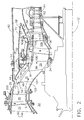
- FIG. 2 is a more detailed cross-sectional view illustration of a fan section in the engine illustrated in FIG. 1.
- FIG. 3 is a schematical cross-sectional view illustration taken through the variable fan outlet guide vane illustrated in FIG. 2 illustrating nominal and open positions of the variable outlet guide vanes.
- FIG. 4 is a graphical illustration of an exemplary operation of the variable fan outlet guide vane illustrated in FIG. 3.
- FIG. 5 is an illustration of a first alternative embodiment of the variable fan outlet guide vane having a pivotal forward section with a trailing edge designed to seal flush against a leading edge of a fixed aft section of the variable fan outlet guide vane.
- FIG. 6 is an illustration of a second alternative embodiment of the variable fan outlet guide vane having a gap between a trailing edge of a pivotal forward section and a leading edge of a fixed aft section of the variable fan outlet guide vane.
- Illustrated in FIG. 1 is an exemplary turbofan
gas turbine engine 10 capable of operating in a fanjet, turbojet, and ramjet modes, or cycles from take-off up through about Mach 4 or higher (4+). Applications are contemplated where the range may extend up to about a flight Mach Number equal to 4.9. Disposed about a longitudinally extending axis orcenterline 12 of theengine 10 is aforward fan section 33 and further downstream a core engine 18 (also called a gas generator). Thecore engine 18 includes, in a serial downstream axial flow relationship, an aft or core driven fan (CDF) 19, ahigh pressure compressor 20, acore combustor 22, and a high pressure turbine (HPT) 23 having a row of highpressure turbine blades 24. Highpressure compressor blades 64 of thehigh pressure compressor 20 and theCDF 19 are fixedly interconnected in driving engagement to the highpressure turbine blades 24 by a larger diameter annularcore engine shaft 26 which is disposed coaxially about thecenterline 12 of theengine 10 forming a high pressure spool. - Pressurized air from the
high pressure compressor 20 is mixed with fuel in thecombustor 22 and ignited, thereby, generating combustion gases. Some work is extracted from these gases by the highpressure turbine blades 24 which drives thehigh pressure compressor 20. The combustion gases are discharged from thecore engine 18 into a low pressure turbine (LPT) 27 having a row of low pressureturbine rotor blades 28. The low pressureturbine rotor blades 28 are fixedly attached to a smaller diameter annularlow pressure shaft 30 disposed coaxially about thecenterline 12 of theengine 10 within thecore engine shaft 26 and drivingly attached to a row of circumferentially spaced apart longitudinally forwardfan rotor blades 32 of theforward fan section 33, thus, forming a low pressure spool. - The
forward fan section 33 has only asingle stage 200 of variable fanoutlet guide vanes 35 extending radially across aflowpath 29 of theengine 10. The single stage of variable fanoutlet guide vanes 35 is located downstream or aft of and adjacent to the forwardfan rotor blades 32 and they are the only guide vanes inforward fan section 33. The term "adjacent" is used herein, for the purposes of this patent, to mean that there are no other rotor blade rows and/or stator vane rows between the named adjacent elements (i.e., between the forward row offan rotor blades 32 and the variable fan outlet guide vanes 35). There are no inlet guide vanes at all, neither fixed or variable, which is large weight savings for the engine. - The
engine 10 is operable to accelerate a vehicle to high flight mach numbers (Mach 4+) at which point scramjet propulsion systems take over. In order for the engine to effectively meet the broad range of operating conditions for such an application, theforward fan section 33 has to operate at a high fan pressure ratio at take-off and be windmilled at high flight mach numbers. The single guide vane stageforward fan section 33 with only a single row or stage of variable fanoutlet guide vanes 35 provides this capability. - The
core engine shaft 26 also rotates a longitudinally aft row of circumferentially spaced apart core driven or aftfan rotor blades 36 having generally radially outwardly extendingblade tips 38. The aftfan rotor blades 36 are disposed longitudinally aft of the more longitudinally forward row of forwardfan rotor blades 32. A row of circumferentially spaced-apart aftfan stator vanes 34 is disposed longitudinally between the rows of the forward and aftfan rotor blades fan rotor blades 36. - A
fan bypass duct 40 radially located between an engineinner casing 74 and an engineouter casing 82 has a radiallyouter inlet 42 disposed longitudinally between theforward fan section 33 and the aft or core drivenfan 19. Theouter inlet 42 includes a forward variable area bypass injector (VABI) exemplified byselector valve doors 44. A radiallyinner inlet 46 to thefan bypass duct 40 is disposed longitudinally between theforward fan section 33 and the aft or core drivenfan 19 and radially inwardly of theouter inlet 42. An annular radiallyouter flow splitter 53 disposed between the radially outer andinner inlets inner inlets outer flow splitter 53, into thefan bypass duct 40 from the forward fan. Aninner inlet duct 43 extends from theinner inlet 46 to an innerinlet duct outlet 47 to thefan bypass duct 40 placing theinner inlet 46 in fluid communication with thefan bypass duct 40. Theinner inlet 46 includes anannular duct wall 45 with a radiallyinner flow splitter 48. - The
annular duct wall 45 includes arotatable portion 108 or a shroud that is disposed radially between radially outerblade tip portions 107 and radially innerblade hub portions 109, respectively, ofblade airfoils 37 of the aftfan rotor blades 36. Theblade airfoil 37 extends from ablade base 41 to theblade tip 38 and therotatable portion 108 is located at a location along a span S of the airfoil near the blade tip. Theannular duct wall 45 also includes anon-rotatable portion 106 that is disposed between radially outervariable angle vanes 84 and radially innervariable angle vanes 86 which at least in part form the aftfan stator vanes 34. A fanbypass duct outlet 51 is disposed longitudinally aft and downstream of the outer andinner inlets rear doors 49. - The engine or
fan airflow 50 passes through the forward row offan blades 32 and is then split into acore airflow portion 60 andbypass flow 54 by the radiallyinner flow splitter 48 at a forward end of the non-rotatableportion 106 supported bystruts 31 extending radially across theflowpath 29. Thebypass flow 54 includes a radially outerbypass airflow portion 52 which passes through theouter inlet 42 of thefan bypass duct 40 and a radially innerbypass airflow portion 56 which passes through theinner inlet 46 of thefan bypass duct 40, depending on the engine's operation. Theblade tip 38 functions as asupercharger 57 that supercharges or further compresses the innerbypass airflow portion 56 of thebypass flow 54 which passes through the radiallyinner inlet 46 to thefan bypass duct 40. At high power, the outerbypass airflow portion 52 is substantially zero and the innerbypass airflow portion 56 is at or near maximum. At part power as the innerbypass airflow portion 56 is decreased and the outerbypass airflow portion 52 increases in more or less direct proportion. When the frontselector valve door 44 is closed, thefan airflow 50 is split between thecore airflow portion 60 passing through the row of aftfan stator vanes 34 and the more aft row offan blades 36 and the innerbypass airflow portion 56. Note that thesupercharger 57 disclosed herein is driven by thehigh pressure turbine 23 of thecore engine 18 and that other superchargers in the radiallyinner inlet 46 to thefan bypass duct 40 driven by a low pressure turbine have been disclosed. - The inner
bypass airflow portion 56 passes through theinner inlet 46 and past the outervariable angle vanes 84 and theblade tip portions 107 together which provide a supercharger means for compressing the innerbypass airflow portion 56 in theinner inlet duct 43. Theblade tip portions 107 compress or supercharge the innerbypass airflow portion 56, and the outervariable angle vanes 84 provide control together, thus, providing variable and controllable supercharging of the innerbypass airflow portion 56, which under certain operating conditions, may be essentially all of the bypass flow passing around thecore engine 18 through thefan bypass duct 40 when theselector valve door 44 is in a fully closed position. A row ofbypass stator vanes 58 are disposed in theinner inlet duct 43 to deswirl the innerbypass airflow portion 56 in theinner inlet duct 43 before the innerbypass airflow portion 56 is discharged into thefan bypass duct 40 to mix with the outerbypass airflow portion 52. - The
core airflow portion 60, in serial flow, passes through the high pressurecompressor stator vanes 62 and the highpressure compressor blades 64 of thehigh pressure compressor 20; thecombustor 22; the row of highpressure turbine blades 24; a row of low pressureturbine stator vanes 66; and the row of lowpressure turbine blades 28. Thecore airflow portion 60 is discharged from thelow pressure turbine 27 past the low pressureturbine rotor blades 28 between the engineinner casing 74 and acenterbody 72 at which point it is referred to as acore discharge airflow 70. Atotal bypass airflow 78 including the outer and innerbypass airflow portions fan bypass duct 40 to the VABIrear doors 49. During turbofan and ram operation of theengine 10, most of thetotal bypass airflow 78 is injected through the rear VABI into anupstream end 71 of anexhaust duct 69 asbypass discharge flow 80 and is mixed with thecore discharge airflow 70. - An
afterburner 130 is located aft and downstream of thecore engine 18 in the vicinity of theupstream end 71 of theexhaust duct 69 and is operable to provide fuel for combustion with the mixedcore discharge airflow 70 and thebypass discharge flow 80 in theexhaust duct 69 during thrust augmentation and ram mode operation of theengine 10. Theafterburner 130 provides virtually all of the fuel and ignition for combustion in the ram operating mode of theengine 10. A variable throat areaA8 exhaust nozzle 68 is located downstream of theafterburner 130 at adownstream end 73 of theexhaust duct 69. - Referring to FIG. 2, the
flowpath 29 is annular and has atransition section 129 extending axially between theforward fan section 33 and thecore engine 18. Aportion 131 of thetransition section 129 is radially inwardly curved in the axially aftwardly or downstream direction. Thetransition section 129 is sometimes referred to as a gooseneck. Thestruts 31 extend radially across the radially inwardlycurved portion 131 of thetransition section 129 of theflowpath 29. The variable fanoutlet guide vanes 35 are operable to pivot as illustrated by nominal and open OGV positions as illustrated in FIG. 3. - The nominal OGV position is denoted by a solid line and the open OGV position is denoted by a broken line in FIG. 3. The nominal OGV position is chosen to provide about 5 degrees of swirl coming out of the variable fan
outlet guide vanes 35 which reduces loading of the variable fan outlet guide vanes 35. The variable fanoutlet guide vanes 35 have high solidity for better operability at take-off. The open OGV position is chosen to avoid choking of the variable fanoutlet guide vanes 35 at high flight Mach Numbers which would limit the amount of airflow to a ram burner, illustrated herein as aafterburner 130 in FIG.1 and, hence, lower the amount of thrust that can be produced. - The variable fan
outlet guide vanes 35 are designed to pivot 10 degrees between the nominal and open OGV positions to accommodate first and second swirl angles A1 and A2, respectively, as illustrated in FIG. 4. The first and second swirl angles A1 and A2 are angles between the centerline 12 and flow vectors V1 and V2 at leading edges LE of the variable fan outlet guide vanes 35. In the exemplary embodiment illustrated herein, the first and second swirl angles A1 and A2 are 51 degrees and 24 degrees respectively at 40% span of the variable fanoutlet guide vanes 35 at take-off and flight Mach Number equal to 3.3. For a particular design, the variable fanoutlet guide vanes 35 are set at the nominal setting which is designated at 0 degrees and then reset at vehicle flight mach number equal to about 2.9 to the open setting which is a change of -10 degrees as illustrated in FIG. 4. The nominal and open OGV positions are designed to produce about + and - 5 degrees of swirl respectively coming out of the variable fanoutlet guide vanes 35 to ensureaxial struts 31 downstream in the gooseneck ortransition section 129 do not stall due to incidence effects. - Each of the variable fan
outlet guide vanes 35 illustrated in FIGS. 1 and 2 pivot in its entirety between the nominal and open OGV positions. Two alternative embodiments of the variable fanoutlet guide vanes 35 are illustrated in FIGS. 5 and 6 in cross-section at the 40% span of the variable fan outlet guide vanes 35. Each of these variable fanoutlet guide vanes 35 has a pivotalforward section 110 and a fixedaft section 112. The nominal and the open OGV positions of the variable fanoutlet guide vanes 35 are denoted by solid and broken lines respectively in FIGS. 5 and 6. A trailing edge TE of the pivotalforward section 110 is designed to seal flush against a leading edge LE of the fixedaft section 112 so that no leakage can get through in the embodiment of the variable fanoutlet guide vanes 35 illustrated in FIG. 5. - A
gap 114 is between the trailing edge TE of the pivotalforward section 110 and the leading edge LE of the fixedaft section 112 in the embodiment of the variable fanoutlet guide vanes 35 illustrated in FIG. 6. When the pivotalforward section 110 is closed, the nominal OGV position of the variable fanoutlet guide vanes 35 denoted by a solid line, the forward andaft sections forward section 110 is directed slightly below on apressure side 116 of theaft section 112. When the pivotalforward section 110 is opened, the open OGV position of the variable fanoutlet guide vanes 35 denoted by a broken line, the forward andaft sections gap 114 is larger and the wake off the pivotalforward section 110 is directed further away below and downstream on thepressure side 116 of theaft section 112. - While there have been described herein what are considered to be preferred and exemplary embodiments of the present invention, other modifications of the invention shall be apparent to those skilled in the art from the teachings herein and, it is therefore, desired to be secured in the appended claims all such modifications as fall within the true spirit and scope of the invention.
-
- 10.
- turbofan gas turbine engine
- 12.
- centerline
- 18.
- core engine
- 19.
- core driven fan (CDF)
- 20.
- compressor
- 22.
- combustor
- 23.
- high pressure turbine (HPT)
- 24.
- high pressure turbine blades
- 26.
- core engine shaft
- 27.
- low pressure turbine (LPT)
- 28.
- low pressure turbine rotor blades
- 29.
- flowpath
- 30.
- low pressure shaft
- 31.
- struts
- 32.
- forward fan rotor blades
- 33.
- forward fan section
- 34.
- aft fan stator vanes
- 35.
- variable fan outlet guide vanes
- 36.
- aft fan rotor blades
- 37.
- blade airfoils
- 38.
- blade tips
- 40.
- fan bypass duct
- 41.
- blade base
- 42.
- outer inlet
- 43.
- inner inlet duct
- 44.
- selector valve doors
- 45.
- annular duct wall
- 46.
- inner inlet
- 47.
- inner inlet duct outlet
- 48.
- inner flow splitter
- 49.
- rear doors
- 50.
- engine or fan airflow
- 51.
- duct outlet
- 52.
- outer bypass airflow portion
- 53.
- outer flow splitter
- 54.
- bypass flow
- 56.
- inner bypass airflow portion
- 57.
- supercharger
- 58.
- bypass stator vanes
- 60.
- core airflow portion
- 62.
- high pressure compressor stator vanes
- 64.
- high pressure compressor blades
- 66.
- low pressure turbine stator vanes
- 68.
- exhaust nozzle
- 69.
- exhaust duct
- 70.
- core discharge airflow
- 71.
- upstream end
- 72.
- centerbody
- 73.
- downstream end
- 74.
- engine inner casing
- 78.
- total bypass airflow
- 80.
- bypass discharge flow
- 82.
- engine outer casing
- 84.
- outer angle vanes
- 86.
- inner angle vanes
- 106.
- non-rotatable portion
- 107.
- outer blade tip portions
- 108.
- rotatable portion
- 109.
- inner blade hub portions
- 110.
- pivotal forward section
- 112.
- fixed aft section
- 114.
- gap
- 116.
- pressure side
- 129.
- transition section
- 130.
- afterburner
- 131.
- curved portion
- 200.
- single stage
- S -
- span
- A8 -
- variable throat area
- A1 -
- first swirl angles
- A2 -
- second swirl angles
- V1 -
- flow vectors
- V2 -
- flow vectors
- LE -
- leading edge
- TE -
- trailing edge
Claims (10)
- A turbofan gas turbine engine (10) comprising:a forward fan section (33) including at least one row of circumferentially spaced apart longitudinally forward fan rotor blades (32);a core engine (18) located aft and downstream of the forward fan section (33) and including in downstream serial flow relationship a core compressor (20), a core combustor (22), and a high pressure turbine (23) drivingly connected to the core compressor (20) by a core engine shaft (26);a fan bypass duct (40) located downstream of the forward fan section (33) and disposed radially outwardly of the core engine (18); andthe forward fan section (33) having only a single stage of variable fan guide vanes and the fan guide vanes being variable fan outlet guide vanes (35) located downstream of and adjacent to the forward fan rotor blades (32).
- A turbofan gas turbine engine (10) as claimed in claim 1 further comprising:an exhaust duct (69) downstream of and in fluid communication with the fan bypass duct (40) and a low pressure turbine (27) located aft and downstream of the core engine (18) and drivingly connected to the forward fan rotor blades (32) by a low pressure shaft (30),an exhaust nozzle (68) disposed at a downstream end (73) of the exhaust duct (69), andan afterburner (130) disposed in the exhaust duct (69) between the low pressure turbine (27) and the exhaust nozzle (68).
- A turbofan gas turbine engine (10) as claimed in claim 1 or claim 2 further comprising:a flowpath (29) of the engine (10),a transition section (129) of the flowpath (29) extending axially between the forward fan section (33) and the core engine (18), andstruts (31) extending radially across a radially inwardly curved portion (131) of the transition section (129).
- A turbofan gas turbine engine (10) as claimed in any preceding claim further comprising a forward variable area bypass injector (44) at an inlet (42) to the fan bypass duct (40) and a rear variable area bypass injector (49) at a fan bypass duct outlet (51) from the fan bypass duct (40).
- A turbofan gas turbine engine (10) as claimed in any preceding claim further comprising the variable fan outlet guide vanes (35) being operable to pivot from a nominal OGV position at take-off to an open OGV position at a high flight Mach Number.
- A turbofan gas turbine engine (10) as claimed in claim 5 wherein the high flight Mach Number is in a range of between about 2.5 - 4+.
- A turbofan gas turbine engine (10) as claimed in any preceding claim further comprising a forward variable area bypass injector (44) at an inlet (42) to the fan bypass duct (40) and a rear variable area bypass injector (49) at a fan bypass duct outlet (51) from the fan bypass duct (40).
- A turbofan gas turbine engine (10) as claimed in any preceding claim further comprising the variable fan outlet guide vanes (35) being operable to pivot from a nominal OGV position at take-off to an open OGV position at a high flight Mach Number.
- A turbofan gas turbine engine (10) as claimed in any preceding claim further comprising each of the variable fan outlet guide vanes (35) having a pivotal forward section (110) and a fixed aft section (112).
- A turbofan gas turbine engine (10) comprising:a forward fan section (33) including at least one row of circumferentially spaced apart longitudinally forward fan rotor blades (32);a core engine (18) located aft and downstream of the forward fan section (33) and comprising in downstream serial flow relationship an aft core driven fan (19), a compressor (20), a core combustor (22), and a high pressure turbine (23) drivingly connected to the core driven fan (19) and the core compressor (20) by a core engine shaft (26);a low pressure turbine (27) located aft and downstream of the core engine (18) and drivingly connected to the forward fan rotor blades (32) by a low pressure shaft (30);a fan bypass duct (40) downstream of the forward fan section (33) and disposed radially outwardly of the core engine (18);the fan bypass duct (40) including radially outer and inner inlets (42 and 46) from the forward fan section (33) to the fan bypass duct (40);an inner inlet duct (43) extending from the inner inlet (46) to the fan bypass duct (40) and having a supercharger (57) disposed in the inlet duct (43); andthe forward fan section (33) having only a single stage of fan guide vanes and the fan guide vanes being variable fan outlet guide vanes (35) located downstream or aft of and adjacent to the forward fan rotor blades (32).
Applications Claiming Priority (1)
| Application Number | Priority Date | Filing Date | Title |
|---|---|---|---|
| US11/290,247 US7730714B2 (en) | 2005-11-29 | 2005-11-29 | Turbofan gas turbine engine with variable fan outlet guide vanes |
Publications (2)
| Publication Number | Publication Date |
|---|---|
| EP1790831A2 true EP1790831A2 (en) | 2007-05-30 |
| EP1790831A3 EP1790831A3 (en) | 2012-08-01 |
Family
ID=37193980
Family Applications (1)
| Application Number | Title | Priority Date | Filing Date |
|---|---|---|---|
| EP06254934A Withdrawn EP1790831A3 (en) | 2005-11-29 | 2006-09-25 | Turbofan gas turbine engine with variable fan outlet guide vanes |
Country Status (6)
| Country | Link |
|---|---|
| US (1) | US7730714B2 (en) |
| EP (1) | EP1790831A3 (en) |
| JP (1) | JP5009581B2 (en) |
| CN (1) | CN1975130B (en) |
| CA (1) | CA2560448C (en) |
| RU (1) | RU2435057C2 (en) |
Cited By (4)
| Publication number | Priority date | Publication date | Assignee | Title |
|---|---|---|---|---|
| WO2014113043A1 (en) * | 2013-01-18 | 2014-07-24 | United Technologies Corporation | Compound fillet for guide vane |
| WO2015084452A2 (en) | 2013-09-16 | 2015-06-11 | United Technologies Corporation | Variable area turbine vane row assembly |
| EP3093443A1 (en) * | 2015-05-11 | 2016-11-16 | General Electric Company | Turbine engine having variable pitch outlet guide vanes |
| US10260426B2 (en) | 2012-10-01 | 2019-04-16 | United Technologies Corporaation | Sensor adapter |
Families Citing this family (106)
| Publication number | Priority date | Publication date | Assignee | Title |
|---|---|---|---|---|
| FR2904663B1 (en) * | 2006-08-01 | 2012-02-03 | Snecma | DOUBLE FLOW TURBOMACHINE WITH ARTIFICIAL VARIATION OF ITS COLLEGE SECTION |
| US8887485B2 (en) * | 2008-10-20 | 2014-11-18 | Rolls-Royce North American Technologies, Inc. | Three spool gas turbine engine having a clutch and compressor bypass |
| US20110167792A1 (en) * | 2009-09-25 | 2011-07-14 | James Edward Johnson | Adaptive engine |
| US20110171007A1 (en) * | 2009-09-25 | 2011-07-14 | James Edward Johnson | Convertible fan system |
| US20110167831A1 (en) * | 2009-09-25 | 2011-07-14 | James Edward Johnson | Adaptive core engine |
| US9353684B2 (en) * | 2009-12-11 | 2016-05-31 | Northrop Grumman Systems Corporation | Aircraft engine airflow modulation apparatus and method for engine bay cooling and cycle flow matching |
| CN101737194B (en) * | 2009-12-18 | 2013-06-05 | 北京航空航天大学 | Adjustable front duct ejector in variable cycle engine mode switching mechanism |
| FR2955617B1 (en) * | 2010-01-26 | 2012-10-26 | Airbus Operations Sas | TURBOMACHINE THRUSTER FOR AN AIRCRAFT |
| JP5644302B2 (en) * | 2010-09-15 | 2014-12-24 | 株式会社Ihi | Axial compressor and gas turbine engine |
| CN102619642B (en) * | 2010-10-19 | 2014-03-19 | 靳北彪 | Efficient turbojet engine |
| US8961114B2 (en) | 2010-11-22 | 2015-02-24 | General Electric Company | Integrated variable geometry flow restrictor and heat exchanger |
| WO2012075566A1 (en) * | 2010-12-10 | 2012-06-14 | Marc Campagna | Turbine assembly, and kit with components for assembling the same |
| US20120163960A1 (en) * | 2010-12-27 | 2012-06-28 | Ress Jr Robert A | Gas turbine engine and variable camber vane system |
| US9062559B2 (en) | 2011-08-02 | 2015-06-23 | Siemens Energy, Inc. | Movable strut cover for exhaust diffuser |
| US9057328B2 (en) * | 2011-11-01 | 2015-06-16 | United Technologies Corporation | Gas turbine engine with intercooling turbine section |
| US10125724B2 (en) * | 2012-01-17 | 2018-11-13 | United Technologies Corporation | Start system for gas turbine engines |
| US9810077B2 (en) | 2012-01-31 | 2017-11-07 | United Technologies Corporation | Fan blade attachment of gas turbine engine |
| US8438832B1 (en) * | 2012-01-31 | 2013-05-14 | United Technologies Corporation | High turning fan exit stator |
| US9157366B2 (en) | 2012-05-30 | 2015-10-13 | United Technologies Corporation | Adaptive fan with cold turbine |
| JP6035946B2 (en) * | 2012-07-26 | 2016-11-30 | 株式会社Ihi | Engine duct and aircraft engine |
| US9540938B2 (en) * | 2012-09-28 | 2017-01-10 | United Technologies Corporation | Pylon matched fan exit guide vane for noise reduction in a geared turbofan engine |
| WO2014133645A2 (en) * | 2013-02-20 | 2014-09-04 | Rolls-Royce North American Technologies Inc. | Gas turbine engine having configurable bypass passage |
| US9488101B2 (en) | 2013-03-14 | 2016-11-08 | United Technologies Corporation | Adaptive fan reverse core geared turbofan engine with separate cold turbine |
| US9850822B2 (en) | 2013-03-15 | 2017-12-26 | United Technologies Corporation | Shroudless adaptive fan with free turbine |
| CN103195612B (en) * | 2013-04-08 | 2015-02-11 | 魏汉章 | Multifunctional turbofan jet engine |
| WO2015069334A2 (en) * | 2013-08-07 | 2015-05-14 | United Technologies Corporation | Variable area turbine arrangement for a gas turbine engine |
| US10156206B2 (en) | 2013-10-24 | 2018-12-18 | United Technologies Corporation | Pivoting blocker door |
| US9656760B2 (en) * | 2013-11-07 | 2017-05-23 | Sikorsky Aircraft Corporation | Variable geometry helicopter engine inlet |
| CN103726890B (en) * | 2014-01-05 | 2015-04-22 | 中国科学院工程热物理研究所 | High-low pressure turbine transition section layout structure and design method thereof |
| US10371090B2 (en) | 2014-01-13 | 2019-08-06 | United Technologies Corporation | Variable area exhaust mixer for a gas turbine engine |
| US10030606B2 (en) | 2014-01-27 | 2018-07-24 | United Technologies Corporation | Variable exhaust mixer and cooler for a three-stream gas turbine engine |
| FR3034461B1 (en) * | 2015-04-01 | 2018-03-16 | Safran Aircraft Engines | TURBOMACHINE DISCHARGE VEIN CONDUIT COMPRISING A VARIABLE-SET VBV GRID |
| US10161316B2 (en) | 2015-04-13 | 2018-12-25 | United Technologies Corporation | Engine bypass valve |
| CN104895839A (en) * | 2015-04-22 | 2015-09-09 | 南京航空航天大学 | Axial-flow compressor stator blade system with adjustable first and second half of segments and working method thereof |
| US10077694B2 (en) | 2015-06-29 | 2018-09-18 | General Electric Company | Power generation system exhaust cooling |
| US10060316B2 (en) | 2015-06-29 | 2018-08-28 | General Electric Company | Power generation system exhaust cooling |
| US10215070B2 (en) | 2015-06-29 | 2019-02-26 | General Electric Company | Power generation system exhaust cooling |
| US10087801B2 (en) | 2015-06-29 | 2018-10-02 | General Electric Company | Power generation system exhaust cooling |
| US10030558B2 (en) * | 2015-06-29 | 2018-07-24 | General Electric Company | Power generation system exhaust cooling |
| US11391298B2 (en) | 2015-10-07 | 2022-07-19 | General Electric Company | Engine having variable pitch outlet guide vanes |
| US10371096B2 (en) * | 2015-11-17 | 2019-08-06 | General Electric Company | Gas turbine engine fan |
| US10563593B2 (en) * | 2016-01-04 | 2020-02-18 | Rolls-Royce North American Technologies, Inc. | System and method of transferring power in a gas turbine engine |
| US10794281B2 (en) * | 2016-02-02 | 2020-10-06 | General Electric Company | Gas turbine engine having instrumented airflow path components |
| US20170218842A1 (en) * | 2016-02-02 | 2017-08-03 | General Electric Company | Adjusting Airflow Distortion in Gas Turbine Engine |
| US10753278B2 (en) | 2016-03-30 | 2020-08-25 | General Electric Company | Translating inlet for adjusting airflow distortion in gas turbine engine |
| US11073090B2 (en) | 2016-03-30 | 2021-07-27 | General Electric Company | Valved airflow passage assembly for adjusting airflow distortion in gas turbine engine |
| US20170314509A1 (en) * | 2016-04-27 | 2017-11-02 | General Electric Company | Turbofan assembly and method of assembling |
| US10316759B2 (en) | 2016-05-31 | 2019-06-11 | General Electric Company | Power generation system exhaust cooling |
| US10436447B2 (en) | 2016-08-01 | 2019-10-08 | United Technologies Corporation | Augmentor vane assembly of a gas turbine engine with an additively manufactured augmentor vane |
| US10337341B2 (en) | 2016-08-01 | 2019-07-02 | United Technologies Corporation | Additively manufactured augmentor vane of a gas turbine engine with additively manufactured fuel line extending therethrough |
| US20180208297A1 (en) * | 2017-01-20 | 2018-07-26 | General Electric Company | Nacelle for an aircraft aft fan |
| US10737801B2 (en) * | 2016-10-31 | 2020-08-11 | Rolls-Royce Corporation | Fan module with rotatable vane ring power system |
| US10618667B2 (en) | 2016-10-31 | 2020-04-14 | Rolls-Royce Corporation | Fan module with adjustable pitch blades and power system |
| CN108087150B (en) * | 2016-11-22 | 2020-02-18 | 江西洪都航空工业集团有限责任公司 | Boost type small turbofan engine for supersonic missile |
| CN108612597B (en) * | 2016-12-09 | 2020-06-05 | 中国航发商用航空发动机有限责任公司 | Fan layout structure for aircraft engine |
| GB201712993D0 (en) * | 2017-08-14 | 2017-09-27 | Rolls Royce Plc | Gas turbine engine |
| RU2675031C1 (en) * | 2017-10-05 | 2018-12-14 | Российская Федерация в лице Министерства промышленности и торговли Российской Федерации (Минпромторг России) | Fan of turbofan aircraft engine |
| GB201719538D0 (en) * | 2017-11-24 | 2018-01-10 | Rolls Royce Plc | Gas turbine engine |
| US11725584B2 (en) * | 2018-01-17 | 2023-08-15 | General Electric Company | Heat engine with heat exchanger |
| CN109162829B (en) * | 2018-09-04 | 2019-08-23 | 中国航发沈阳发动机研究所 | The compressibility of variable cycle engine |
| GB201818014D0 (en) * | 2018-11-05 | 2018-12-19 | Rolls Royce Plc | Control system for a gas turbine engine |
| CN109441663A (en) * | 2018-12-12 | 2019-03-08 | 清华大学 | Combined cycle engine |
| GB201820925D0 (en) * | 2018-12-21 | 2019-02-06 | Rolls Royce Plc | Turbine engine |
| GB201820930D0 (en) * | 2018-12-21 | 2019-02-06 | Rolls Royce Plc | Turbine engine |
| US20200386189A1 (en) * | 2019-04-30 | 2020-12-10 | General Electric Company | High Speed Aircraft Flight Technologies |
| GB201906168D0 (en) * | 2019-05-02 | 2019-06-19 | Rolls Royce Plc | Gas turbine engine with fan outlet guide vanes |
| GB201906167D0 (en) * | 2019-05-02 | 2019-06-19 | Rolls Royce Plc | Gas turbine engine with core mount |
| CN109973244B (en) * | 2019-05-12 | 2024-07-05 | 西北工业大学 | Self-driven outer duct counter-rotating annular fan blade compression device |
| JP7305472B2 (en) * | 2019-07-12 | 2023-07-10 | 三菱重工業株式会社 | GAS TURBINE SYSTEM AND MOVING OBJECT WITH THE SAME |
| CN110685817A (en) * | 2019-10-11 | 2020-01-14 | 上海朝临动力科技有限公司 | Turbofan engine and aircraft |
| CN111140341A (en) * | 2019-12-20 | 2020-05-12 | 中国北方发动机研究所(天津) | Segmented adjustable blade vaned diffuser structure |
| US20210262416A1 (en) * | 2020-02-20 | 2021-08-26 | General Electric Company | Turbofan engine with core exhaust and bypass flow mixing |
| CN111636976B (en) * | 2020-06-08 | 2021-10-19 | 清华大学 | A three-channel large thrust-to-weight ratio high-efficiency power propulsion |
| WO2022013459A1 (en) * | 2020-07-13 | 2022-01-20 | Martinez Vilanova Pinon Rafael | Jet engine for aircraft |
| FR3115564B1 (en) * | 2020-10-22 | 2023-06-16 | Safran Aircraft Engines | Turbofan engine |
| CN112727635B (en) * | 2020-12-31 | 2022-04-26 | 中国航空发动机研究院 | Double-culvert engine |
| CN112963366B (en) * | 2021-01-12 | 2024-12-27 | 江西农业大学 | Angle-adjustable blades and fans |
| CN112879162B (en) * | 2021-01-19 | 2021-12-14 | 南京航空航天大学 | An aero-engine intake port with adjustable S-curve offset |
| US11982191B2 (en) | 2021-06-04 | 2024-05-14 | The Boeing Company | Subsonic turbofan engines with variable outer guide vanes and associated methods |
| US11927136B1 (en) * | 2021-06-04 | 2024-03-12 | Rtx Corporation | Turbofan engine with precooler |
| US11879343B2 (en) * | 2021-08-25 | 2024-01-23 | Rolls-Royce Corporation | Systems for controlling variable outlet guide vanes |
| US11802490B2 (en) | 2021-08-25 | 2023-10-31 | Rolls-Royce Corporation | Controllable variable fan outlet guide vanes |
| US11686211B2 (en) | 2021-08-25 | 2023-06-27 | Rolls-Royce Corporation | Variable outlet guide vanes |
| US11788429B2 (en) | 2021-08-25 | 2023-10-17 | Rolls-Royce Corporation | Variable tandem fan outlet guide vanes |
| CN114060313A (en) * | 2021-11-05 | 2022-02-18 | 中国航发沈阳发动机研究所 | An aero-engine multi-ducted front and rear fan |
| CN114576006B (en) * | 2022-03-10 | 2023-09-22 | 中国航空发动机研究院 | Engine and aircraft |
| FR3133367B1 (en) * | 2022-03-11 | 2024-08-23 | Safran Aircraft Engines | AERONAUTICAL PROPELLER |
| CN114856818A (en) * | 2022-05-12 | 2022-08-05 | 中国航发四川燃气涡轮研究院 | Variable cycle engine core machine with variable working mode |
| US12221893B2 (en) | 2022-08-10 | 2025-02-11 | Generale Electric Company | Controlling excitation loads associated with open rotor aeronautical engines |
| US12421864B2 (en) | 2022-08-10 | 2025-09-23 | General Electric Company | Controlling excitation loads associated with open rotor aeronautical engines |
| US12491988B2 (en) | 2022-08-12 | 2025-12-09 | General Electric Company | Controlling excitation loads associated with open rotor aeronautical engines |
| US12163472B2 (en) * | 2022-09-02 | 2024-12-10 | Rohr, Inc. | Engine exhaust nozzle with acoustic attenuation |
| CN115535266A (en) * | 2022-11-04 | 2022-12-30 | 中国电子科技集团公司第二十九研究所 | Two-stage adjustable guide vane and its control method for aircraft S-curved bleed airway |
| CN116066256B (en) * | 2023-01-08 | 2026-02-27 | 四川大学 | A novel hybrid adaptive variable bypass ratio turbofan engine and its adjustment method |
| US12398648B2 (en) | 2023-03-17 | 2025-08-26 | Rolls-Royce North American Technologies Inc. | Segmented variable fan outlet guide vane with cam assembly and pass through actuation mechanisms |
| US12480422B2 (en) | 2023-03-17 | 2025-11-25 | Rolls-Royce North American Technologies Inc. | Segmented variable fan outlet guide vane with pass through actuation mechanisms |
| US12292056B2 (en) | 2023-03-17 | 2025-05-06 | Rolls-Royce North American Technologies Inc. | Segmented variable fan outlet guide vane with gear assembly |
| US12428974B2 (en) | 2023-03-17 | 2025-09-30 | Rolls-Royce North American Technologies Inc. | Segmented variable fan outlet guide vane with unique actuation mechanisms |
| US12398655B2 (en) | 2023-03-17 | 2025-08-26 | Rolls-Royce North American Technologies Inc. | Segmented variable fan outlet guide vane with segment interface components |
| US12320260B2 (en) | 2023-03-17 | 2025-06-03 | Rolls-Royce North American Technologies Inc. | Segmented variable fan outlet guide vane with cam assembly and unique actuation mechanisms |
| US11927140B1 (en) * | 2023-04-21 | 2024-03-12 | Rtx Corporation | Gas turbine engine with guided bleed air dump |
| CN117365744B (en) * | 2023-10-31 | 2024-09-27 | 南京航空航天大学 | An external parallel combined inlet with mode switching and synchronous adjustment of throat area |
| CN117738814B (en) * | 2024-02-21 | 2024-05-17 | 中国航发四川燃气涡轮研究院 | Variable flow path wide speed range engine with blade tip fan and series compressor |
| FR3162062A1 (en) * | 2024-05-07 | 2025-11-14 | Safran Aircraft Engines | Tandem system of stator blades comprising an upstream blade with variable pitch and a downstream blade with fixed pitch |
| US12312966B1 (en) | 2024-06-05 | 2025-05-27 | Rtx Corporation | Gas turbine engine with hybrid fan exit guide vanes |
| US12517529B1 (en) * | 2024-09-05 | 2026-01-06 | Rolls-Royce North American Technologies Inc. | Systems and methods of fluid flow control with two valves |
Family Cites Families (34)
| Publication number | Priority date | Publication date | Assignee | Title |
|---|---|---|---|---|
| US2805818A (en) * | 1951-12-13 | 1957-09-10 | Ferri Antonio | Stator for axial flow compressor with supersonic velocity at entrance |
| GB1313841A (en) * | 1967-01-18 | 1973-04-18 | Secr Defence | Gas turbine jet propulsion engine |
| US3632224A (en) | 1970-03-02 | 1972-01-04 | Gen Electric | Adjustable-blade turbine |
| DE2149619A1 (en) * | 1971-10-05 | 1973-04-19 | Motoren Turbinen Union | TURBINE JET FOR VERTICAL OR SHORT-STARTING OR LANDING AIRPLANES |
| US4137708A (en) | 1973-07-02 | 1979-02-06 | General Motors Corporation | Jet propulsion |
| US4069661A (en) | 1975-06-02 | 1978-01-24 | The United States Of America As Represented By The United States National Aeronautics And Space Administration | Variable mixer propulsion cycle |
| US4275560A (en) * | 1978-12-27 | 1981-06-30 | General Electric Company | Blocker door actuation system |
| US4791783A (en) * | 1981-11-27 | 1988-12-20 | General Electric Company | Convertible aircraft engine |
| RU2030644C1 (en) * | 1988-09-26 | 1995-03-10 | Борис Шамшадович Мамедов | Axial fan |
| DE3911715A1 (en) * | 1989-04-10 | 1990-10-11 | Mtu Muenchen Gmbh | SHUT-OFF DEVICE FOR BLOWED, IN PARTICULAR BLOWED, RADIANT JET ENGINES |
| DE3935313C1 (en) | 1989-10-24 | 1991-06-06 | Mtu Muenchen Gmbh | |
| US5694768A (en) | 1990-02-23 | 1997-12-09 | General Electric Company | Variable cycle turbofan-ramjet engine |
| US5182905A (en) * | 1990-05-11 | 1993-02-02 | General Electric Company | Method for automatic bypass operation |
| FR2685385B1 (en) * | 1991-12-24 | 1995-03-31 | Snecma | VARIABLE CYCLE PROPULSION ENGINE FOR SUPERSONIC AIRCRAFT. |
| US5311735A (en) | 1993-05-10 | 1994-05-17 | General Electric Company | Ramjet bypass duct and preburner configuration |
| US6662546B1 (en) | 1993-06-23 | 2003-12-16 | General Electric Company | Gas turbine engine fan |
| US5404713A (en) * | 1993-10-04 | 1995-04-11 | General Electric Company | Spillage drag and infrared reducing flade engine |
| US5402638A (en) * | 1993-10-04 | 1995-04-04 | General Electric Company | Spillage drag reducing flade engine |
| US5623823A (en) * | 1995-12-06 | 1997-04-29 | United Technologies Corporation | Variable cycle engine with enhanced stability |
| US5806303A (en) | 1996-03-29 | 1998-09-15 | General Electric Company | Turbofan engine with a core driven supercharged bypass duct and fixed geometry nozzle |
| US5809772A (en) | 1996-03-29 | 1998-09-22 | General Electric Company | Turbofan engine with a core driven supercharged bypass duct |
| US5794432A (en) | 1996-08-27 | 1998-08-18 | Diversitech, Inc. | Variable pressure and variable air flow turbofan engines |
| RU2140001C1 (en) * | 1996-10-04 | 1999-10-20 | Геня Те | Method of operation of supersonic hybrid air-jet engine plant |
| US5867980A (en) | 1996-12-17 | 1999-02-09 | General Electric Company | Turbofan engine with a low pressure turbine driven supercharger in a bypass duct operated by a fuel rich combustor and an afterburner |
| US6045325A (en) | 1997-12-18 | 2000-04-04 | United Technologies Corporation | Apparatus for minimizing inlet airflow turbulence in a gas turbine engine |
| US6371725B1 (en) * | 2000-06-30 | 2002-04-16 | General Electric Company | Conforming platform guide vane |
| FR2823532B1 (en) | 2001-04-12 | 2003-07-18 | Snecma Moteurs | DISCHARGE SYSTEM FOR A TURBO-JET OR TURBO-PROPELLER WITH SIMPLIFIED CONTROL |
| US6438941B1 (en) | 2001-04-26 | 2002-08-27 | General Electric Company | Bifurcated splitter for variable bleed flow |
| US6619916B1 (en) | 2002-02-28 | 2003-09-16 | General Electric Company | Methods and apparatus for varying gas turbine engine inlet air flow |
| US6931858B2 (en) | 2003-04-24 | 2005-08-23 | General Electric Company | Rotating pulse detonation system for a gas turbine engine |
| US7246484B2 (en) * | 2003-08-25 | 2007-07-24 | General Electric Company | FLADE gas turbine engine with counter-rotatable fans |
| US6901739B2 (en) | 2003-10-07 | 2005-06-07 | General Electric Company | Gas turbine engine with variable pressure ratio fan system |
| US7395657B2 (en) * | 2003-10-20 | 2008-07-08 | General Electric Company | Flade gas turbine engine with fixed geometry inlet |
| US7475545B2 (en) * | 2005-04-29 | 2009-01-13 | General Electric Company | Fladed supersonic missile turbojet |
-
2005
- 2005-11-29 US US11/290,247 patent/US7730714B2/en active Active
-
2006
- 2006-09-21 CA CA2560448A patent/CA2560448C/en not_active Expired - Fee Related
- 2006-09-25 EP EP06254934A patent/EP1790831A3/en not_active Withdrawn
- 2006-09-28 RU RU2006134493/06A patent/RU2435057C2/en not_active IP Right Cessation
- 2006-09-29 CN CN2006101413261A patent/CN1975130B/en active Active
- 2006-09-29 JP JP2006266457A patent/JP5009581B2/en not_active Expired - Fee Related
Non-Patent Citations (1)
| Title |
|---|
| None * |
Cited By (6)
| Publication number | Priority date | Publication date | Assignee | Title |
|---|---|---|---|---|
| US10260426B2 (en) | 2012-10-01 | 2019-04-16 | United Technologies Corporaation | Sensor adapter |
| WO2014113043A1 (en) * | 2013-01-18 | 2014-07-24 | United Technologies Corporation | Compound fillet for guide vane |
| WO2015084452A2 (en) | 2013-09-16 | 2015-06-11 | United Technologies Corporation | Variable area turbine vane row assembly |
| EP3047116B1 (en) * | 2013-09-16 | 2021-04-14 | Raytheon Technologies Corporation | Variable area turbine vane row assembly |
| EP3904641A1 (en) * | 2013-09-16 | 2021-11-03 | Raytheon Technologies Corporation | Variable area turbine vane row assembly |
| EP3093443A1 (en) * | 2015-05-11 | 2016-11-16 | General Electric Company | Turbine engine having variable pitch outlet guide vanes |
Also Published As
| Publication number | Publication date |
|---|---|
| RU2435057C2 (en) | 2011-11-27 |
| CN1975130A (en) | 2007-06-06 |
| US7730714B2 (en) | 2010-06-08 |
| JP2007146832A (en) | 2007-06-14 |
| US20070119150A1 (en) | 2007-05-31 |
| JP5009581B2 (en) | 2012-08-22 |
| CA2560448C (en) | 2014-11-18 |
| RU2006134493A (en) | 2008-04-10 |
| EP1790831A3 (en) | 2012-08-01 |
| CA2560448A1 (en) | 2007-05-29 |
| CN1975130B (en) | 2011-07-13 |
Similar Documents
| Publication | Publication Date | Title |
|---|---|---|
| CA2560448C (en) | Turbofan gas turbine engine with variable fan outlet guide vanes | |
| US5806303A (en) | Turbofan engine with a core driven supercharged bypass duct and fixed geometry nozzle | |
| EP1522710B1 (en) | Gas turbine engine with variable pressure | |
| US5809772A (en) | Turbofan engine with a core driven supercharged bypass duct | |
| US10544741B2 (en) | Flutter sensing and control system for a gas turbine engine | |
| US5867980A (en) | Turbofan engine with a low pressure turbine driven supercharger in a bypass duct operated by a fuel rich combustor and an afterburner | |
| US7140174B2 (en) | Methods and apparatus for assembling a gas turbine engine | |
| JP2607051B2 (en) | Aircraft fled gas turbine engine and method of operating an aircraft fled gas turbine engine | |
| US7877980B2 (en) | Convertible gas turbine engine | |
| JP4953924B2 (en) | FLADE fan with different inner and outer airfoil stagger angles in the position of the shroud between the inner and outer airfoils | |
| US7134271B2 (en) | Thrust vectoring aft FLADE engine | |
| US7475545B2 (en) | Fladed supersonic missile turbojet | |
| EP2472089B1 (en) | Flade discharge in 2-d exhaust nozzle | |
| US10385871B2 (en) | Method and system for compressor vane leading edge auxiliary vanes | |
| Wood et al. | Turbofan gas turbine engine with variable fan outlet guide vanes |
Legal Events
| Date | Code | Title | Description |
|---|---|---|---|
| PUAI | Public reference made under article 153(3) epc to a published international application that has entered the european phase |
Free format text: ORIGINAL CODE: 0009012 |
|
| AK | Designated contracting states |
Kind code of ref document: A2 Designated state(s): AT BE BG CH CY CZ DE DK EE ES FI FR GB GR HU IE IS IT LI LT LU LV MC NL PL PT RO SE SI SK TR |
|
| AX | Request for extension of the european patent |
Extension state: AL BA HR MK YU |
|
| PUAL | Search report despatched |
Free format text: ORIGINAL CODE: 0009013 |
|
| AK | Designated contracting states |
Kind code of ref document: A3 Designated state(s): AT BE BG CH CY CZ DE DK EE ES FI FR GB GR HU IE IS IT LI LT LU LV MC NL PL PT RO SE SI SK TR |
|
| AX | Request for extension of the european patent |
Extension state: AL BA HR MK RS |
|
| RIC1 | Information provided on ipc code assigned before grant |
Ipc: F02C 7/057 20060101ALI20120627BHEP Ipc: F02C 7/042 20060101ALI20120627BHEP Ipc: F02K 7/16 20060101ALI20120627BHEP Ipc: F01D 17/16 20060101AFI20120627BHEP Ipc: F02K 3/06 20060101ALI20120627BHEP |
|
| 17P | Request for examination filed |
Effective date: 20130201 |
|
| AKX | Designation fees paid |
Designated state(s): FR GB |
|
| REG | Reference to a national code |
Ref country code: DE Ref legal event code: R108 |
|
| REG | Reference to a national code |
Ref country code: DE Ref legal event code: R108 Effective date: 20130410 |
|
| 17Q | First examination report despatched |
Effective date: 20130503 |
|
| GRAP | Despatch of communication of intention to grant a patent |
Free format text: ORIGINAL CODE: EPIDOSNIGR1 |
|
| INTG | Intention to grant announced |
Effective date: 20170710 |
|
| STAA | Information on the status of an ep patent application or granted ep patent |
Free format text: STATUS: THE APPLICATION IS DEEMED TO BE WITHDRAWN |
|
| 18D | Application deemed to be withdrawn |
Effective date: 20171121 |